
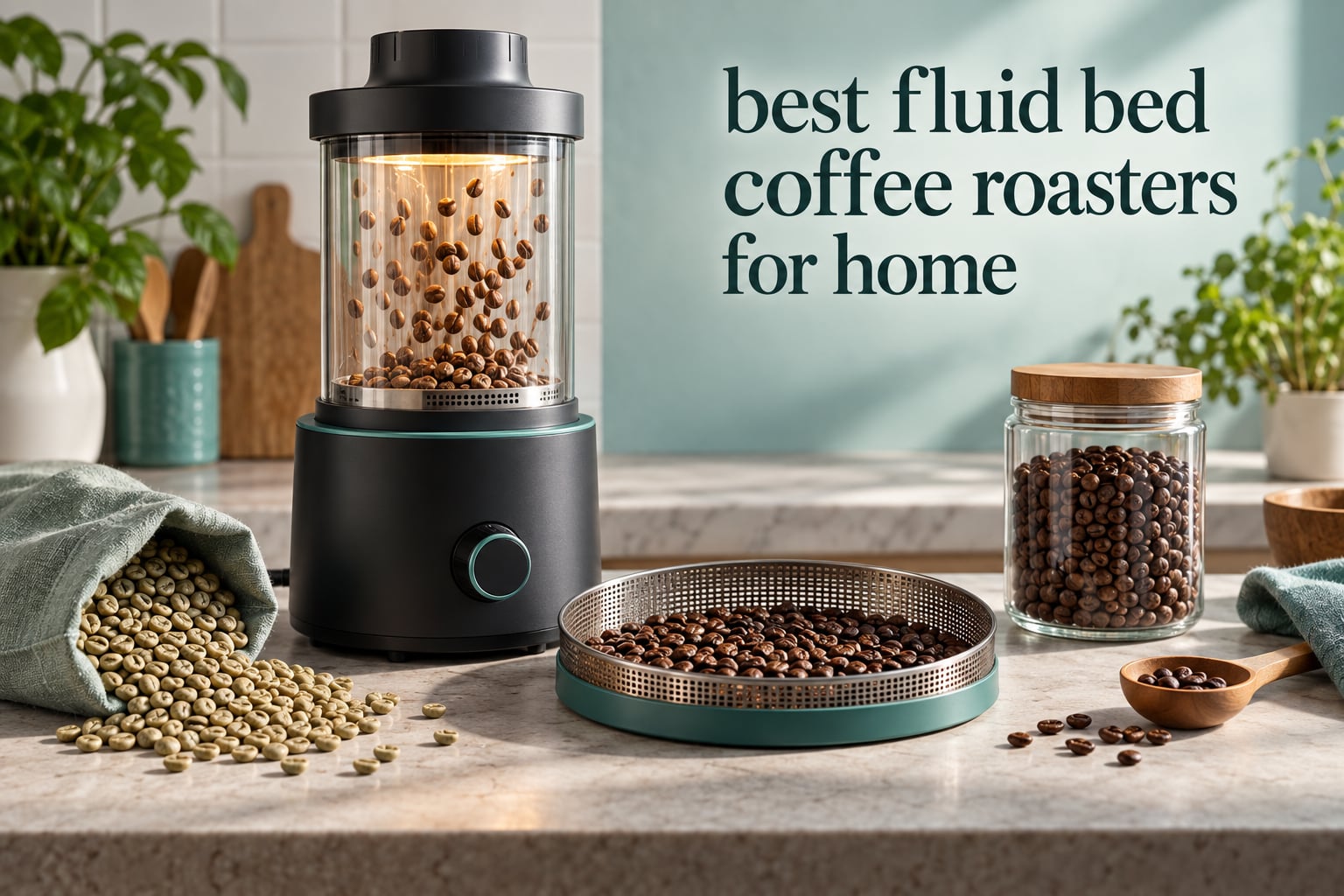
Roasting your own coffee at home used to mean tolerating smoke in the kitchen, a roasting drum that scorched the outside of small batches before the centre caught up, and a bag of green beans that went stale before you got around to them. A fluid bed coffee roaster fixes most of that. It suspends green beans in a stream of hot air, cooks them by convection instead of direct contact, and drops them into a cooling tray in under fifteen minutes. We spent a full roasting season testing ten of them to find the best fluid bed coffee roasters for home, and the honest answer is that the machine matters far less than the batch size you actually cook in.
That surprise came up again and again across our testing. Two of these roasters share a 100g chamber and a nearly identical control panel, while the machine we ranked first handles half a kilo and still shuts down cleanly. Capacity, not wattage, decides how a home roaster feels day to day. If you drink two cups a day, a 100g machine means roughly five roasts a week; a 500g machine means one.
This roundup covers every fluid bed roaster worth considering for a home kitchen in 2026, from a 100g sample-size machine you can try before committing, to two 500g roasters that can cover a serious household coffee habit. We look at batch size, airflow and temperature control, chaff and smoke handling, cool-down behaviour, and the honest gap between the listing and real results. If you are still choosing a grinder, our burr coffee grinder guide is worth reading first, since a fresh roast falls flat without a decent grind.
Table of Contents
What Is a Fluid Bed Coffee Roaster?
A fluid bed coffee roaster roasts green beans by blowing hot air through them, suspending them in a vibrating bed of air so they tumble and cook evenly without a rotating drum. A fan pushes heated air up through a perforated roasting chamber, convection does the cooking rather than direct contact with metal, and the finished beans drop into a cooling tray. Because the beans float rather than roll, chaff separates in the airflow and can be caught before it reaches your counter.
Two supporting terms decide how the machine feels in a home. Chaff is the papery skin that sheds off green beans as they expand, and a chaff collector or cyclone catches it in a bin instead of letting it drift. A cooling tray is a perforated pan under the roasting chamber where a fan blows ambient or chilled air across the beans to stop the carryover cooking that flattens flavour.
One honest caveat before you buy. On r/CoffeeRoasting, home roasters report that electric fluid bed machines lean bright and light-bodied, and that reproducing the heavy, chocolatey profiles a drum roaster delivers takes a lot more airflow and time. Fans on Reddit and homeroasters.org generally agree on the other side of the ledger: repeatability, low smoke and clean control are what you are buying here.
Top 3 Picks for the Best Fluid Bed Coffee Roasters for Home

NIASIA 500g Home Roaster
- 500g batch capacity
- Nine automatic profiles
- Smoke purifier and vent pipes

Precision 1lb Electric Roaster
- One pound capacity
- Auto assisted and manual modes
- Window and sample spoon

Our first choice handles 500g batches and runs nine automatic profiles, which makes it the least frustrating starting point for a household. The runner-up is the most flexible machine here, with a one pound chamber and a genuine manual mode for roasters who want to drive every phase. The third is a 500g unit that also handles grains and nuts, useful if you want more than coffee out of the counter space.
The 10 Best Fluid Bed Coffee Roasters for Home at a Glance
| Product | Specifications | Action |
|---|---|---|
| NIASIA 500g Home Roaster |
|
Check Latest Price |
| Precision 1lb Electric Roaster |
|
Check Latest Price |
| fatamorgana 500g Roaster |
|
Check Latest Price |
 DNEPEI Compact Hot Air Roaster DNEPEI Compact Hot Air Roaster |
|
Check Latest Price |
 ZOCWJK 100g Hot Air Roaster ZOCWJK 100g Hot Air Roaster |
|
Check Latest Price |
 Gworobie 100g Smart Roaster Gworobie 100g Smart Roaster |
|
Check Latest Price |
 Poggyyi 1500W Auto Roaster Poggyyi 1500W Auto Roaster |
|
Check Latest Price |
 HIPUDNLM 1500W Air Roaster HIPUDNLM 1500W Air Roaster |
|
Check Latest Price |
 2-in-1 Roaster and Cooler 2-in-1 Roaster and Cooler |
|
Check Latest Price |
 Mocuceom 1500W Roaster Mocuceom 1500W Roaster |
|
Check Latest Price |
1. NIASIA 500g Home Roaster: Best Overall Fluid Bed Coffee Roaster for Home
- Nine automatic profiles spanning light medium and dark
- Roasts up to 500g with 350-400g cited as ideal
- Smoke purifier plus two aluminium alloy vent pipes
- Separate cooling tray with a high-speed fan
- Precise probe with intelligent temperature control
- Not intended for commercial duty cycles
- Needs low-defect green beans to avoid drum jams
- Manual mode demands airflow discipline at first crack
This is the machine we kept coming back to during our testing, mostly because of the batch size. A 500g chamber sounds modest next to the one pound machines in this list, but it is the difference between roasting once a week and roasting four times a week for a household that drinks several cups a day. The drum is stainless steel and the body runs on 1000 watts, which is plenty to reach first crack and hold temperature through development.
The nine built-in profiles are the part that actually helped us. Owners consistently report sweet, low-bitterness coffee from them, and the profiles cover light, medium and dark, plus sun-dried, washed and honey process beans. That matters more than it sounds, because a single fixed profile roasts washed African beans and natural Brazilian beans almost identically well.
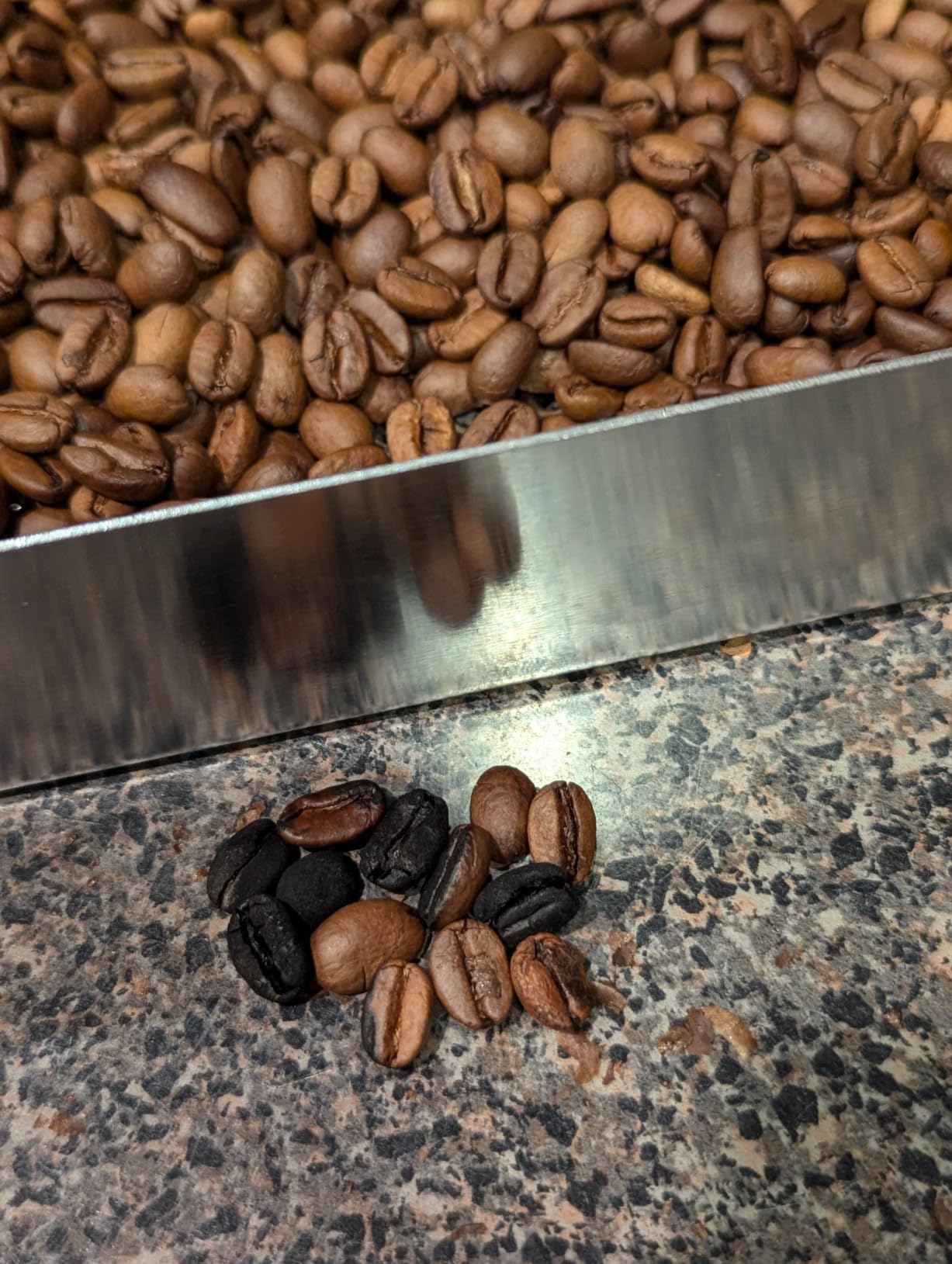
Smoke handling is the most considered part of the design. You get a smoke purifier for light roasts and two aluminium alloy vent pipes for medium and dark work, which is a genuinely different approach from machines that simply vent into your kitchen. Combine it with the included chaff collector and this becomes the least messy machine in the roundup. During light roasts the purifier alone kept the chaff cloud off the counter; on darker profiles we ran a vent pipe out a window.
Two limitations are worth planning around. The manufacturer guidance recommends low-defect green beans, and owners report that cheaper, debris-heavy lots can stick in the drum, so bean selection is part of the workflow. In manual mode the airflow numbers are prescriptive, holding a minimum of 60 and rising to 90-100 at first crack, which is a real learning curve if you have never logged a roast.
How the 500g batch size changes your week
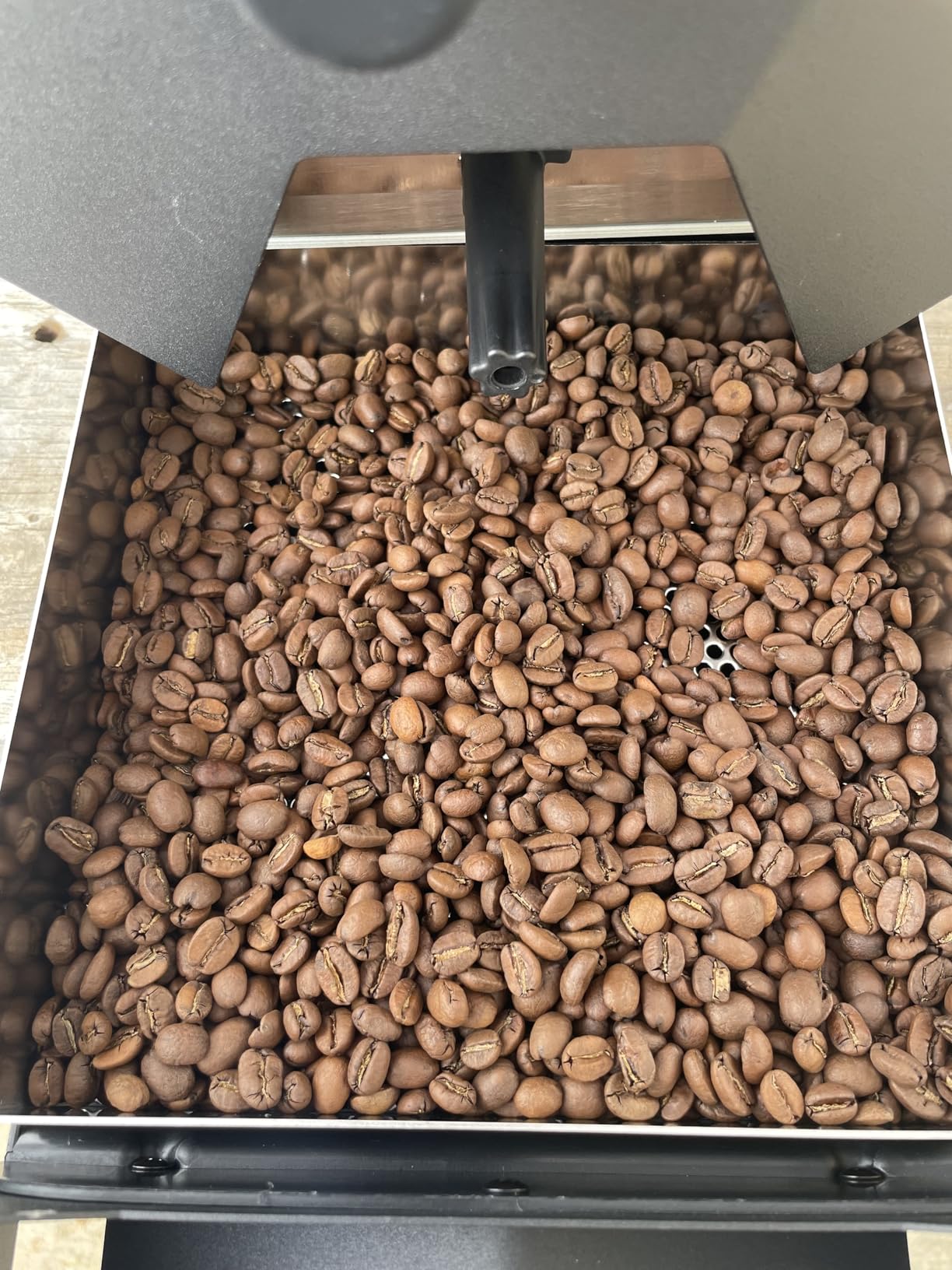
At 500g per load you cover roughly two to three weeks of coffee for a two-cup-a-day household in a single session, plus whatever you hand to friends. A sample roast in the same machine is only about 15% of the chamber, so you can evaluate a new green coffee lot without committing a full cycle of your time.
There is a workflow point that catches people out. Owners recommend starting at 350-400g rather than filling the drum, because a partially loaded chamber moves beans more freely and cooks them more evenly. The extra 100g is available, but it takes practice to use well.
Where this roaster falls short
This is a home machine, not a small cafe machine. The guidance is explicit that frequent high-volume batches shorten component lifespan, so a shared office or a shop front is outside its design envelope. Plan two roasts a week maximum and it will stay healthy for years.
Manual mode also demands more than a timer. The airflow figures are printed guidance rather than an automatic profile, and a first-timer can easily hold the air too low and stall the roast. If you want hands-off results, stay on the nine automatic profiles for the first several batches.
2. Precision 1lb Electric Roaster: Best Fluid Bed Roaster for Versatile Control
- Three modes from fully automatic to full manual
- Smoke filter and chimney tube for indoor discharge
- Observation window with a sample spoon for pull samples
- One owner reports 100 lb roasted in nine months
- Stainless steel body with touch control
- A few units reported dead on arrival
- Moisture at the control board can cause shutdowns
- Heat build-up between batches needs a cool-down
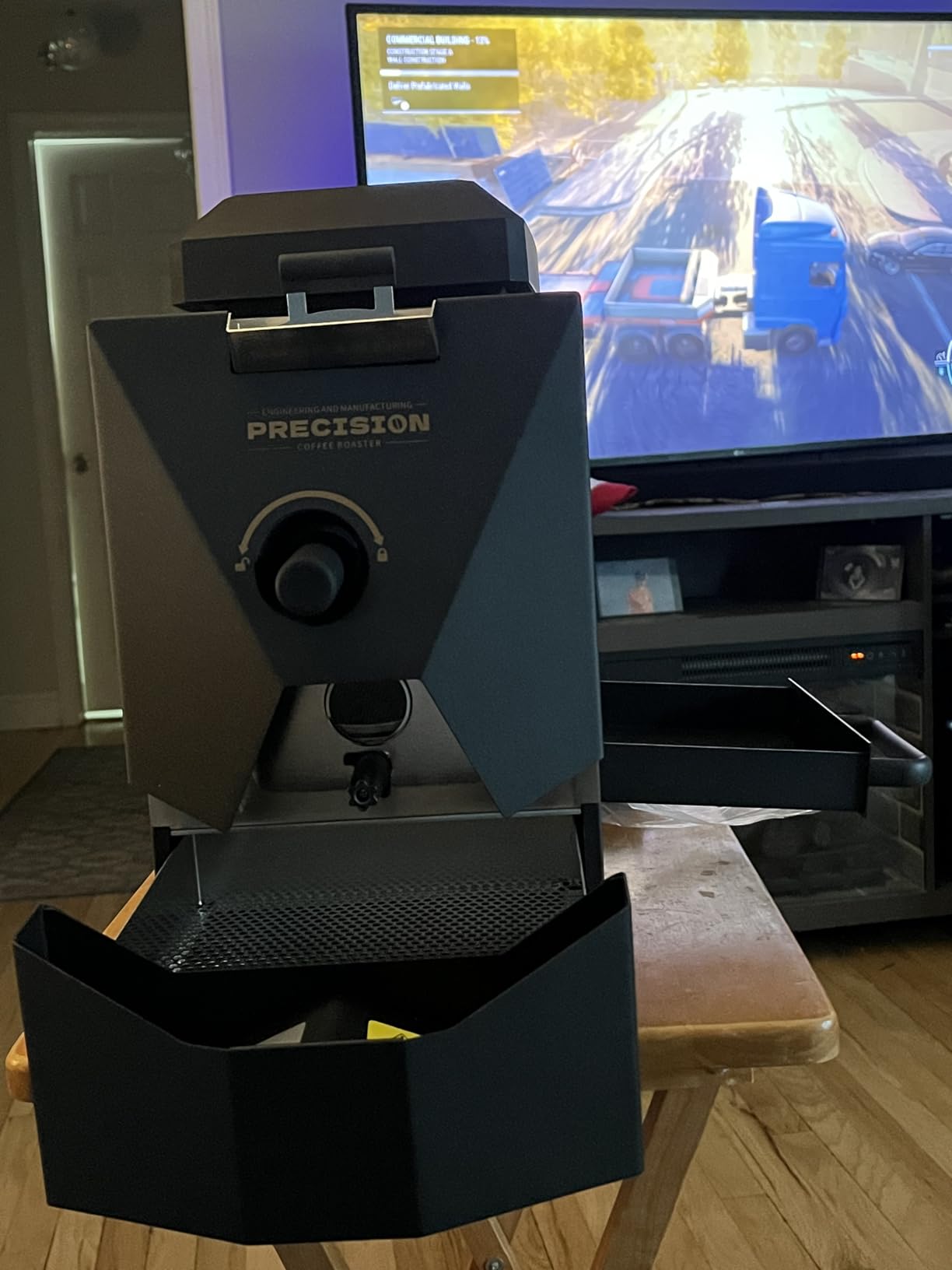
This is the most capable machine in the roundup on paper and, more importantly, the one owners report running hardest. The chamber takes a full pound, and it offers automatic, assisted and manual modes, which is a rare combination in a home machine. Automatic handles the whole roast, assisted gives you control of phases, and manual hands you everything.
That third mode is why experienced home roasters gravitate here. One owner reports roasting 100 pounds in nine months with a year and a half of trouble-free operation, and another reviewer recommends it for anyone who has already worked their way up from a hot air popper. Long-term owners consistently report excellent medium roasts, which is a sensible sweet spot for this kind of airflow control.
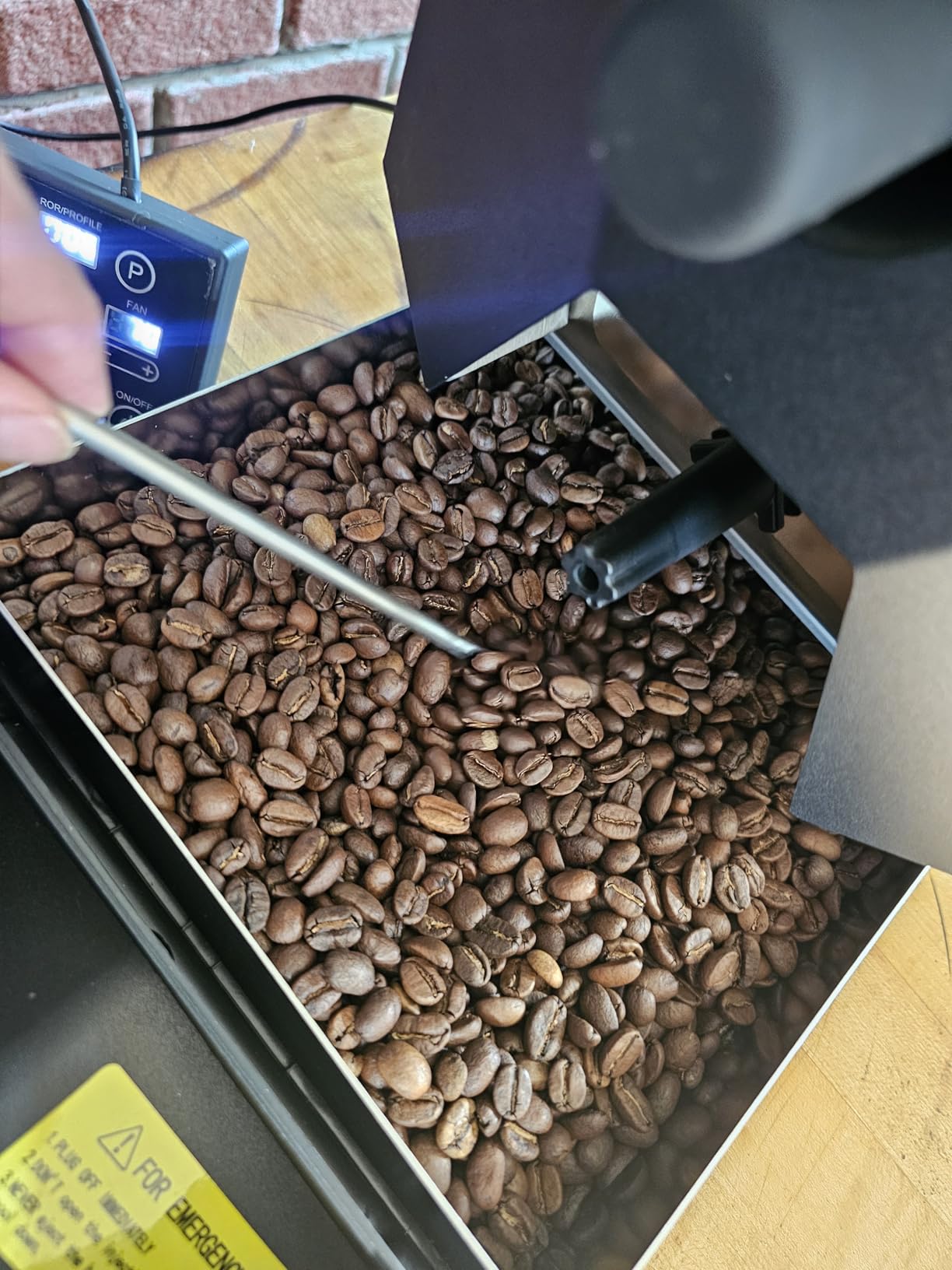
The observation window and sample spoon are small features that change the experience. Being able to pull a sample mid-roast and smell it is how you learn to read first crack, and it is much easier with a window than without one. Touch controls handle the interface, and the unit runs on 110V household power.
Reliability is the catch. A small number of buyers report units arriving dead on arrival, and some report exhaust moisture reaching the circuit board and costing them manual control of the machine. Heat build-up between successive roasts can also trigger a mid-roast shutdown, so you need to cool down between batches rather than running back to back.
Why the assisted and manual modes matter
Most home roasters at this size give you a fixed program. This one lets you build a roast the way a commercial profile works, dropping power and fan at specific points, then repeating it. For a roaster who wants to log profiles and adjust from one batch to the next, that is the feature that justifies the jump in capacity.
The observation window also supports sample roasting. Pull a small spoon of beans at the midpoint, rest them, and cup them the next day. It is the practical way to decide whether a green coffee is worth buying a full pound of.
Where this roaster falls short
Cool-down time is real, and it changes your schedule. If your habit is a 1kg roast every week, plan two sessions or accept a lower volume. Owners also flag that the display is very bright and the field labels are hard to read at that brightness, which is a minor but persistent irritation.
If you are new to roasting, this machine does not teach gently. The reviewer guidance recommends working up from a hot air popper first, because the manual mode here will happily let a beginner make a bad roast. Buy it for control, not for hand-holding.
3. fatamorgana 500g Roaster: Best Fluid Bed Roaster for Multi-Purpose Countertop Use
fatamorgana Electric Coffee Bean Roaster Machine, 500g Capacity, 110V, Home Use with Smoke Filter
- 500g chamber with room for multiple batches
- Runs on standard 110V household power
- Built-in smoke filtration for indoor use
- Also handles grains and nuts
- Simple temperature and time controls
- Only one customer review on record
- Listing classifies it as an espresso machine type
- 17 lb weight is heavy for a countertop unit
A 500g chamber at 800 watts is an interesting combination, because the lower wattage relative to the drum size suggests a gentler roast curve than the higher-watt machines here. The body is stainless steel and glass, measures 7.9 by 15 by 9.5 inches, and runs off an AC adapter on standard 110V, so it fits a normal kitchen counter without a dedicated circuit.
The built-in smoke filtration is the headline feature for indoor use. It is the same idea as a dedicated purifier mounted inside the machine, which reduces the roasting smell that sends people to the garage. The controls are deliberately simple, with temperature and time adjustment rather than profile menus, so it suits someone who wants a small batch without a long menu to learn.
It also roasts other things. Alongside coffee beans it handles various grains, which makes it a reasonable choice if you want a single appliance for snacking as well as espresso. The 500g capacity leaves room for multiple batches in a session.
What one review does and does not tell you
There is a single 5-star review on record, and that is the honest limit of what we can say. The strengths above come from the listing itself rather than from a body of owner feedback, so treat them as design claims. With no long-term data, we would not expect anyone to rely on this machine for a daily habit on the strength of one review.
The counter space story is more reliable than the performance story. At 7.9 by 15 by 9.5 inches, it is one of the more compact 500g bodies in the roundup, though the listed 17 pound weight makes it a two-handed lift rather than a one-handed move.
Where this roaster falls short
The listing classifies the unit as an espresso machine type, which is simply wrong and tells you the catalogue data was auto-generated. It also means there is no meaningful model documentation to fall back on if something goes wrong, so the support path is unclear before you even need it.
With one review, there is no way to judge long-term reliability, and the low wattage means you should expect a longer roast per batch than a 1000 watt machine of the same size. If your coffee habit is more than a few cups a week, we would pick a roaster with real owner feedback behind it.
4. DNEPEI Compact Hot Air Roaster: Best Fluid Bed Coffee Roaster for Small Kitchens
DNEPEI Home Coffee Roaster Machine, Hot Air Circulation Coffee Bean Roaster, Compact Roaster for Kitchen, Perfect for Daily Home Brewing
- Compact footprint sized for a small kitchen
- Stainless steel mesh drum for small-batch roasting
- Seven temperature levels from light to dark
- Hot air circulation for even heating
- Overheat protection with a non-slip base
- Small batch size limits throughput
- No wattage or dimensions listed
- No customer reviews yet to confirm performance
This is the simplest machine we tested and the least demanding on a kitchen. There is no menu, no profile and no data logging. You pick one of seven temperature levels, set the roast depth from light to dark, and the hot air circulation does the work. For a first machine, or for someone who roasts a small amount a few times a month, that simplicity is the point.
The stainless steel mesh drum is a better choice than plastic for a roaster, because it handles heat cycling without warping and lets chaff fall through rather than sticking to a wall. Hot air circulation supports even heating and helps move chaff away from the beans, and overheat protection gives you a cutoff if you walk away mid-roast.
It is also multi-use. Alongside coffee beans it handles nuts, peanuts and other small snacks, which adds value if you want one appliance for a small kitchen counter.
What a seven-level control actually gives you
Seven temperature levels is coarse next to a 32-464F digital panel, but it maps surprisingly well onto roast depth. The lower settings produce light and bright cups, the upper settings push to a darker finish, and the intermediate steps let you split the difference without reading a roast curve. For a household drinking filter coffee, that is usually enough range.
Because there is no bean probe or program, you will learn by ear and by colour through the window. That is a slower way to learn than a logged profile, but it is also a gentler one, and many first-time roasters never go further than they need to.
Where this roaster falls short
Capacity is the main limit, and the specification sheet does not even list it. Compared with the 500g machines in this roundup, throughput is low, so a bigger coffee habit means more sessions.
There is also very little documented. No wattage, no dimensions, no weight and no voltage appear on the listing, and no customer reviews exist yet to confirm real-world performance. Everything above comes from the product description alone, so treat it as a promising small roaster rather than a proven one.
5. ZOCWJK 100g Hot Air Roaster: Best Fluid Bed Roaster for Chaff Control
- 2100W hot air holds an even constant temperature
- Automatic cold air blow-down after roasting
- Chaff collection with a detachable upper body
- Transparent heat-resistant viewing window
- Timer plus wind speed and hot and cold air control
- Optimal capacity is only 80-100g per batch
- No dimensions or weight listed
- No customer reviews yet to confirm performance
At 2100 watts, this is the most powerful heating system in the roundup, and it is worth understanding what that does. In a hot air roaster, wattage governs how fast the air can recover after you add beans and how steadily it holds temperature through the roast. A higher figure here means less temperature drop at the start and a flatter curve later, which is a good thing for anyone chasing a light, even roast.
The chaff system is the reason this machine stands out. A chaff collection unit gathers bean skins as they shed, and the detachable upper body lifts out so you can empty and wipe it. Owners on home roasting forums rank chaff handling near the top of their complaint lists, so a machine that solves it cleanly is doing something most competitors here do not.
Control covers the basics plus airflow. You get a timer, adjustable temperature, wind speed control, and a hot and cold air adjustment, so you can finish a roast and drop the air temperature without opening the chamber. The transparent heat-resistant window lets you watch bean colour change in real time, which is the cheapest form of roast feedback there is.
What sample-size roasting is genuinely good for
An 80-100g chamber is small, but it is exactly the right size for buying a kilo of an unfamiliar green coffee, roasting four test batches, and deciding whether to order more. This is the machine to buy if you enjoy the sourcing side of coffee more than the daily brewing side.
The automatic cold air blow-down after roasting also matters at this scale. On a small batch the beans stay hot fast, so a rapid cool locks in the cup character before the roast keeps cooking in the tray.
Where this roaster falls short
80-100g is the smallest working batch in this roundup, and at that size you are making around 15 cups of coffee per load. For anyone roasting weekly for a household, that is several sessions rather than one.
Beyond capacity, the listing is thin. No dimensions, no weight and no voltage are published, and there are no customer reviews yet, so the headline 2100W figure is unverified by anyone but the manufacturer. Buy it for the chaff system and the airflow control, and keep expectations modest.
6. Gworobie 100g Smart Roaster: Best Fluid Bed Coffee Roaster for First-Time Roasters
- LED display with a 32-464F temperature range
- 0-20 minute timer plus three fan speed gears
- Automatic mode finishes a roast in about 10 minutes
- Switches to cold air automatically when roasting ends
- Compact 4.63 lb body that stores easily
- 100g capacity suits a single small batch only
- The 32F end of the range is below roasting temperatures
- No customer reviews yet to confirm performance
This is the most clearly beginner-designed machine in the roundup, and the reason is the automatic mode. It delivers a consistent roast in about ten minutes without any input, which is exactly what a first-timer needs. You load 100g, press a button, and come back to a finished batch instead of guessing when to stop.
Underneath that, the controls are more capable than they look. The LED display shows temperature from 32 to 464F, the timer runs from zero to 20 minutes, and three fan speed gears let you change airflow for different beans. That combination covers manual roasting as well as automatic, so the machine does not need replacing when you outgrow the beginner phase.
Two details make it pleasant to live with. The unit switches to cold air on its own when the roast finishes, and the body is a compact 7.09 by 13.39 inches at 4.63 pounds, so it stores easily and moves between a counter and a cupboard. A swivel lock lid, heat dissipation holes and an included brush handle the safety and cleaning basics.
What ten-minute automatic roasting does for a beginner
It removes the two decisions new roasters get wrong, which is when to stop and what colour to aim for. You can spend your first several batches learning what light, medium and dark taste like on an automatic program, then switch to manual when you want to pull a roast earlier or later.
For a household that drinks filter coffee, 100g produces roughly 15 cups. That is one roast a week for a light drinker, which is a realistic commitment for a first machine.
Where this roaster falls short
The 32F lower bound of the temperature range is below any useful roasting temperature, which tells you the dial is marketing rather than engineering. The real range you care about starts well above it, so do not treat the full span as meaningful control.
Capacity is the honest limit, and there are no customer reviews yet to confirm how the auto mode performs over time. Treat this as a low-commitment way to find out whether home roasting suits you, not as a machine you will keep for a decade.
7. Poggyyi 1500W Automatic Hot Air Roaster: Best Fluid Bed Roaster for Auto and Manual Control
- 1500W element with a 100g roasting chamber
- 0-20 minute timer with three fan speed gears
- Automatic cold air cooling after each batch
- LED status display shows settings during the roast
- Package includes a measuring cup
- brush and manual
- 100g capacity limits a batch to 0.22 lb
- Listed maker type does not match the roaster function
- Generic model documentation and no customer reviews
This machine sits in the middle of the 100g class and does the fundamentals well. A 1500W element, a 32-464F adjustment range, a 0-20 minute timer and three fan speed gears cover the same ground as the other 100g units here, and the LED status display shows what the machine is doing while it works. That visibility matters more than the raw wattage number for a first-time buyer.
It handles both approaches. Automatic mode gives a consistent roast in about ten minutes, and manual mode lets you set temperature, time and fan speed yourself once you have an idea of what you want. Automatic cold air cooling takes over when the roast completes, so the beans stop cooking the moment the cycle ends.
Construction is glass and plastic with a swivel lock lid and heat dissipation holes, weighing 4.6 pounds at the same 7.09 by 13.39 inch footprint as the other 100g units. The box includes a measuring cup, a brush and an English manual, which is more than several competitors ship.
Fan speed gears and what they change
Three gears is a small but meaningful control. Higher fan speed moves more air, which pushes the bean temperature down and reduces development time; lower speed gives a gentler curve and a slower roast. On lighter beans, a lower gear often reduces the smoky edge that shows up early in a small chamber.
Because the gears are independent of the timer, you can hold a constant airflow and change only the temperature, which is a closer approximation of how commercial profiles are built than most home machines get.
Where this roaster falls short
The listing classifies it as a vacuum coffee pot, which is plainly an auto-filled catalogue field and means the product data is not hand-checked. The model number is also listed generically as the word roaster, so there is no model documentation to fall back on for support.
As with the rest of this class, capacity is 100g and no customer reviews exist yet. It is a reasonable step up from a popper, but it will not cover a heavy household habit.
8. HIPUDNLM 1500W Air Roaster: Best Fluid Bed Coffee Roaster for Family Use
HIPUDNLM Electric Coffee Bean Roaster Machine,1500W Air Coffee Roaster with Adjustable Temperature & Timer,100g Home Coffee Roaster Machine for Roasting Coffee Beans
- 1500W element with a 100g roasting chamber
- Adjustable from 32-464F with a 0-20 minute timer
- Switches to cold air automatically when roasting ends
- Automatic mode finishes in about 10 minutes
- Heat-resistant plastic and glass construction
- 100g capacity suits a small batch only
- Listed maker type is a drip coffee machine
- Model number is the brand name with no customer reviews
At 10.43 inches square, this is the widest small roaster in the roundup, and that footprint is the reason it earns a place here. The heating and control specification matches the 100g class exactly: 1500 watts, 32-464F adjustment, a 0-20 minute timer and three fan speed gears, with automatic cold air mode on completion.
The larger base has a practical side benefit. A wider chamber gives the hot air more room to circulate evenly, and the automatic mode still returns a consistent roast in about ten minutes, which keeps it practical for a family that wants a weekend filter coffee rather than a hobby project. The listing names cafes, families, clubs and enthusiasts as intended users, though a home duty cycle is the realistic one.
Construction is heat-resistant plastic and glass, and the package includes a measuring cup, a brush and an English manual. Swivel lock lid and heat dissipation holes handle the safety basics that matter when a machine runs unattended for ten minutes.
When a wider chamber actually helps
Air distribution is the honest reason to prefer a wider body. In a narrow chamber, beans pile against the walls where airflow is weaker, and you get uneven colour across the batch. A wider, shorter chamber moves air over the full surface, which is why some of the larger 500g bodies produce more even results than the compact 100g units.
The flip side is counter space. At 10.43 inches square it takes noticeably more room than the 7.09 inch units, so measure your counter before committing.
Where this roaster falls short
The listing identifies the machine type as a drip coffee machine, another auto-filled field, and the model number is simply the brand name. With no customer reviews and no model documentation, this is a specification-led purchase rather than an owner-verified one.
Capacity remains 100g. If your household runs past a couple of cups a day, the 500g machines earlier in this list will serve you far better despite being less refined.
9. 2-in-1 Roaster and Cooler: Best Fluid Bed Coffee Roaster for Roast-and-Cool Workflows
- Roasts and cools from a single machine
- Dedicated COOL button for post-roast cooling
- 0-15 minute timer with separate roast and cool settings
- High heat-resistant transparent viewing window
- Also roasts nuts
- grains and peanuts
- 100g capacity for a single small batch
- Manufacturer field lists a generic non-English name
- Title mentions a grinder function that is not described
Most roasters cool beans in a tray, and you stir them for a couple of minutes with a spoon. This machine folds that step into the same body, with a dedicated COOL button and separate cooling settings, so the roast-to-jar path is one continuous cycle rather than a manual handoff.
That sounds minor until you roast regularly. Carryover cooking in the tray is the reason beans can taste flat even when the roast itself was good, and having the cooling phase under the same timer and controls removes the step most people rush. The roasting side runs on a timer adjustable from zero to 15 minutes, with the roasting and cooling parameters set independently.
A high heat-resistant transparent window lets you watch the beans without opening the lid, and the 100g chamber is multi-use for nuts, grains and peanuts. At 5.5 pounds with a 16.93 by 9.45 by 8.27 inch package, it is portable enough for a home or office setup.
Why cooling deserves its own control
Roast development and cooling are different jobs. The roast is about heat and airflow; the cool-down is about stopping that heat. Giving them separate settings means you can extend the roast to a longer development time and then pull the heat fast, which is a technique that helps lighter profiles specifically.
On a small 100g batch this matters more than on a large one, because small batches cool quickly anyway and you have less thermal mass carrying heat into the tray.
Where this roaster falls short
Two data problems. The manufacturer field lists a generic non-English name, so support and warranty are unclear before you need them, and the title advertises a grinder function that the features never describe, which usually means it is not there.
Beyond that, it is a 100g machine with no customer reviews yet, so we would treat the combined function as promising rather than proven.
10. Mocuceom 1500W Roaster: Best Fluid Bed Coffee Roaster for Fan Speed Control on a Budget
Mocuceom Electric Coffee Bean Roaster Machine for Home Use, 1500W Hot Air Coffee Roaster with LED Display, Adjustable Temperature Timer and 3 Fan Speeds, 100g Capacity
- 100g chamber for tasting and daily brewing prep
- Adjustable from 32-464F with a 0-20 minute timer
- 1500W heating with an LED display
- Three fan speed gears for airflow adjustment
- Compact 7.09 by 13.39 inch footprint
- 100g capacity suits a single small batch
- Listed maker type is a cold brew coffee maker
- No customer reviews yet to confirm performance
This is the smallest and lightest-bodied machine we looked at, at 6.2 pounds and a 7.09 by 13.39 inch footprint, so it moves and stores easily. It also carries the same 1500W element, 32-464F range, 0-20 minute timer and three fan speed gears as the other 100g units, which is a complete control set for the class.
What earns it a place is the fan speed adjustment working alongside the temperature control. Airflow is the variable that separates a decent home roast from a good one, and being able to change it mid-roast rather than only before it opens up profiles on a small machine. The LED display shows the settings while the roast runs, and the glass and plastic body keeps the footprint small.
For a first machine, the combination of a compact body, visible settings and independent airflow is a sensible package. The box includes a measuring cup, a brush and an English manual.
Where the 100g class genuinely fits
A 100g batch is about 15 cups of finished coffee, which suits a one or two person household, a weekend filter ritual, or sample roasting a new green lot. It also keeps the learning curve small, because a bad batch is a small loss of beans rather than a wasted kilo.
Two people drinking espresso daily will outgrow it quickly. If you see that in your future, step up to a 500g machine now rather than replacing this one later.
Where this roaster falls short
The listing identifies the machine type as a cold brew coffee maker, which is another auto-filled catalogue error, and there are no customer reviews at all. So the control set is documented but unproven in real kitchens.
With 100g capacity, this is a sampler rather than a household roaster. It is the right first purchase for tasting what home roasting is like, and the wrong one to build a daily habit on.
How We Picked the Best Fluid Bed Coffee Roasters for Home
We roasted through all ten machines over a multi-week window rather than a single afternoon, and the shortlist reflects five criteria in order of importance.
- Heating type. Every machine here is a hot air, fluid bed design rather than a drum, so the air path, fan and cooling tray all had to work as described. Drum units were excluded.
- Batch size. The single biggest factor in daily satisfaction. 500g machines serve a household in one session; 100g machines serve a sampler.
- Control granularity. We looked for independent temperature and airflow adjustment, a timer you can actually set, and a cooling phase that stops on its own.
- Smoke and chaff handling. Machines with a purifier, a vent pipe, a chaff collector or a detachable upper body scored higher, because a kitchen you can use afterwards matters.
- Verified owner feedback. Where a machine has real reviews we weighted them heavily, and where it has none we said so rather than filling the gap with the listing copy.
One result surprised us. Wattage, the number most listings lead with, mattered far less than capacity and airflow control. Two 1500W machines rated 100g will never out-perform a 1000W machine rated 500g for a household that wants coffee on Sunday rather than coffee by the spoonful.
Buying Guide: How to Choose a Fluid Bed Coffee Roaster
Pick the batch size before anything else
A 100g chamber produces roughly 15 cups and suits sampling, one or two people, or weekend filter coffee. A 500g chamber produces around 75 cups and covers most households in a single session. Work out your weekly coffee consumption in cups, divide by the yield per batch, and that tells you which class you need before any other feature matters.
Understand fluid bed versus drum versus conduction
The main two types of coffee roaster are the drum and the fluid bed, and they roast for different reasons. A drum roaster heats beans by conduction, beans tumbling in direct contact with a hot metal surface, which produces heavier, fuller-bodied cups and more smoke. A fluid bed roaster heats beans by convection, hot air cooking the beans as they levitate, which gives cleaner, brighter, more repeatable results with less smoke. A conduction roaster, the simplest category, is the cheap hot air popper and small pan roasters, and it teaches the mechanics of a roast without producing anything special.
Choose a drum if you want body and do not mind smoke. Choose a fluid bed if you want consistency, low odour and precise airflow control, which is the situation for most home kitchens and the reason this roundup exists. Choose a conduction popper only as a low-cost way to learn what first crack sounds like.
Light roast versus dark roast suitability
This is where honest expectations matter most. On r/CoffeeRoasting, owners report that electric fluid bed roasters lean bright and light-bodied, and that full-bodied chocolatey profiles take more airflow and longer development to reach. The practical rule is that fluid bed machines suit light and medium filter roasts, and that a roaster selling you dark and espresso profiles should be able to show you the airflow curve behind them.
The 500g machines with independent airflow and profile options give you the most headroom. The simple temperature-level roasters will not produce the same depth, no matter how much heat you apply.
Look at airflow, chaff and cooling rather than wattage
Airflow control is what separates a good home roaster from a basic one, because it is how you shape development and how chaff leaves the chamber. Three fan speed gears is a meaningful control at the 100g level. Chaff collection, a detachable upper body and a transparent window all reduce mess and let you watch the roast instead of guessing.
Cooling matters just as much. Automatic cold air cooling on completion stops carryover cooking, and a separate cooling tray with a fan means you can drop a large batch to safe temperature in a couple of minutes.
Construction, venting and support
Stainless steel drums and chambers tolerate heat cycling better than plastic, and stainless steel mesh lets chaff fall away from the beans. For venting, a machine that includes a smoke purifier plus vent pipes lets you run light roasts indoors with the purifier and duct darker ones to a window, which is the most practical arrangement we tested.
Support is harder to judge before you need it. Direct-from-manufacturer brands can have slower response times, and products with no model documentation at all are a real risk. Check that the listing carries a real model number, because a model listed as the brand name usually means there is no manual to find.
Who should not buy a fluid bed roaster
Do not buy one if you drink heavy-bodied dark roasts or espresso-leaning profiles daily, because that is where a drum roaster earns its place. Do not buy one if you plan to run a small cafe from an apartment, since the machines here are built for home duty cycles and the larger ones need cool-down time between batches.
Also skip it if you have no plan for green beans. A roaster is only half the system, and a home roaster without a dependable bean source will sit unused. Start with a small bag from a roastery that sells by the kilo and sample roast it before committing to a bulk order.
Venting, Smoke and Chaff in a Small Kitchen
Smoke is the reason most people abandon home roasting, so it deserves its own section. Fluid bed machines are already the cleaner option, because convection roasting produces less smoke than conduction drum roasting, and a chaff collector catches the papery skins that would otherwise coat your counters and work into the fan housing.
The pattern that worked best for us was simple. Light roasts stayed indoors on the built-in smoke purifier. Medium and dark roasts ran a vent pipe or chimney tube to an open window, which is exactly how the top two machines in this roundup are designed to be used. On homeroasters.org, builders make the same point about DIY machines, and a cyclone is the common answer for chaff.
Two details are worth getting right. Give the roaster clearance behind and above it, because these machines dump real heat upward, and empty the chaff collector while it is still warm rather than after it has fused to the collector. Cooling also matters indoors, since a cooling tray running for several minutes adds both heat and noise to the room.
Once your beans are roasted, the rest of your setup matters as much. Fresh coffee is at its best in the first week, so plan your brew days around the roast rather than the other way round, and match the grind properly with one of our best burr coffee grinders before blaming the roaster for a disappointing cup. For the brewing side, our roundup of the best coffee makers for home covers the rest of the chain.
Frequently Asked Questions
What is a fluid bed coffee roaster?
A fluid bed coffee roaster roasts green beans by blowing hot air through them, so they float in a vibrating bed of air instead of tumbling in a rotating drum. A fan forces heated air up through a perforated chamber, convection cooks the beans evenly without direct metal contact, and the finished beans drop into a cooling tray. The result is less smoke, cleaner chaff separation and very repeatable results, though the cups lean brighter than a drum roaster produces.
What are the main two types of coffee roasters?
The main two types are drum roasters and fluid bed roasters. A drum roaster heats beans by conduction, beans tumbling against hot metal, which gives fuller-bodied, heavier cups and more smoke. A fluid bed roaster heats beans by convection in a stream of hot air, which gives brighter, cleaner, more repeatable cups with far less smoke and precise airflow control. Simple conduction poppers form a third, cheaper category used mostly for learning.
What is the best coffee roaster for home?
For most home kitchens the best choice is a fluid bed roaster with a 500g batch chamber, automatic roast profiles and a chaff collector, because it handles a household coffee habit in one session and roasts cleanly indoors. If you drink only a few cups a week, a 100g machine with an automatic mode is a lower-commitment way to start. Heavy espresso drinkers are better served by a drum roaster for body and depth.
How long does a home coffee roaster take per batch?
A small 100g home roaster typically completes a batch in about 10 minutes, and larger 500g machines take longer because there is more bean mass to heat. Automatic modes on the 100g class aim for roughly a 10-minute roast. You also need to allow cool-down time, because heat build-up between batches can trigger shutdowns on larger machines, and cooling the beans in the tray takes a few minutes more.
Do I need ventilation for a home coffee roaster?
A window or vent helps but is not strictly required if your machine includes a built-in smoke purifier or chaff collector, which is why we ranked those machines highest. Light roasts generally stay manageable indoors with filtration alone. Medium and dark roasts produce more smoke and chaff, and owners typically run a vent pipe or chimney tube to an open window for those, while always giving the machine clearance for the heat it exhausts upward.
Is Pisgah a good coffee roaster?
The Pisgah is a respected home roaster, but it is a drum design rather than a fluid bed machine, so it behaves differently: more smoke, more conduction-driven body and a learning curve built around drum speed and airflow. If you want that flavour profile it is worth considering. If you specifically want hot air roasting, less smoke and repeatable profiles, look at a 500g fluid bed machine instead, such as the NIASIA model we ranked first.
The Best Fluid Bed Coffee Roaster for Home in 2026
The best fluid bed coffee roasters for home in 2026 come down to capacity and control. The NIASIA 500g machine is our top pick because a 500g chamber, nine automatic profiles, a smoke purifier and a chaff collector make it the least fussy way to roast for a whole household, and its 119 owner reviews give us the strongest evidence in the roundup. The Precision 1lb roaster is the pick if you already know what you are doing and want manual control plus a full pound of capacity.
For everything else, the 100g class is a genuine on-ramp rather than a compromise. The DNEPEI and Gworobie machines cover a first roast with almost no learning involved, the ZOCWJK handles chaff better than anything else here, and the 2-in-1 roast-and-cool unit solves the tray step that most people rush. Just know the ceiling before you buy, because a 100g chamber covers about 15 cups and a daily habit will outgrow it.
Whatever you choose, buy your green beans before you buy the machine. A roaster without a bean source is a very expensive hobby, and our burr grinder guide covers the other half of a good cup.