
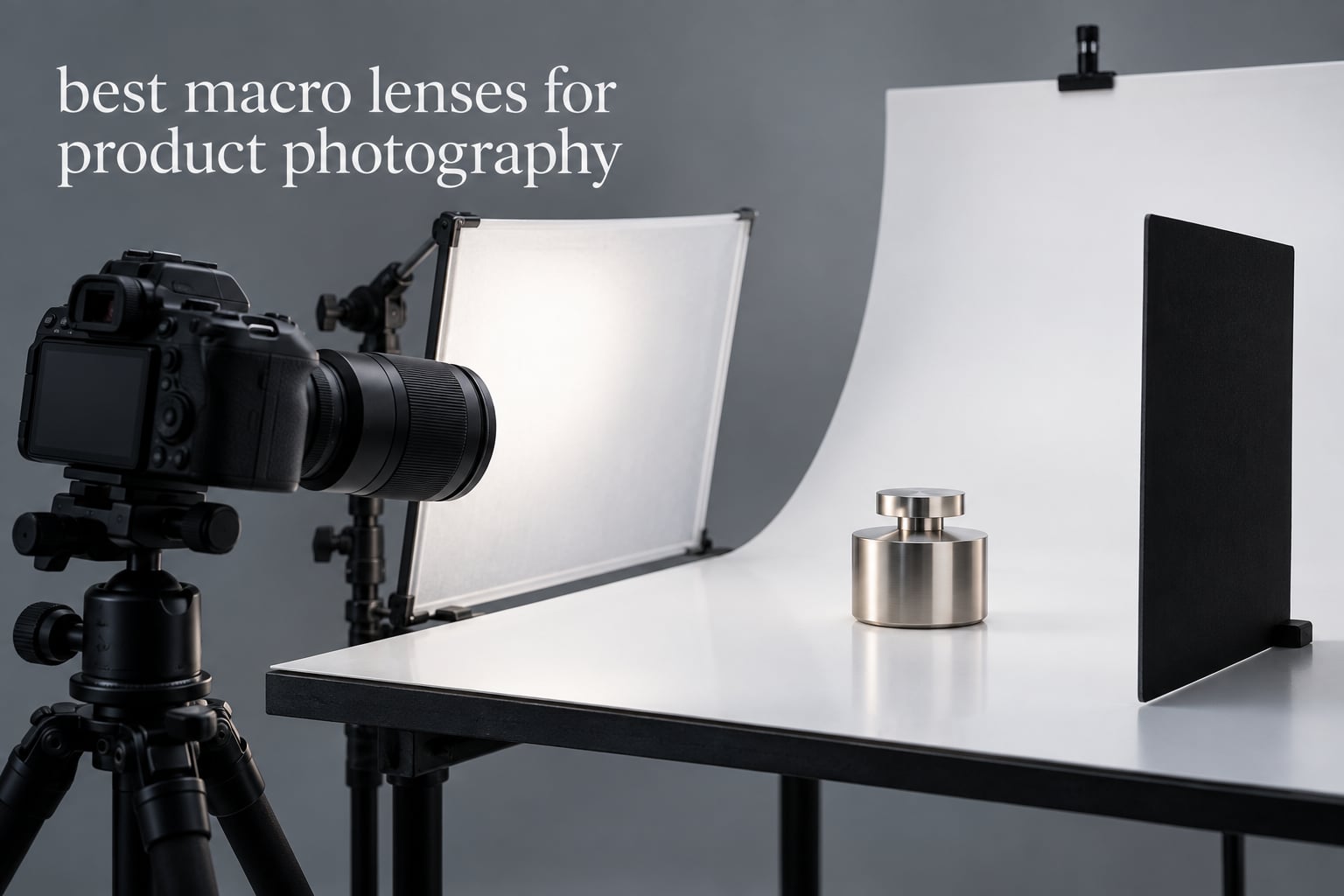
A macro lens is a lens built to focus at extremely short distances and reproduce a subject at 1:1 life-size magnification on the sensor. For product work, that matters because engravings, fabric weave, circuit boards and cosmetic textures simply do not resolve on a standard prime, and the longer working distance keeps your lights and reflectors out of frame. This roundup covers the best macro lenses for product photography available for every major mount in 2026, from pocketable 30mm primes to 1.4x and 2:1 super-macro glass.
I spend most weeks shooting small objects for a living: watch dials, skincare bottles, leather goods, coffee gear. Over the last several months our team worked through twelve macro lenses on the same tabletop set, the same light tent and the same stubborn subject, a brushed-steel pocket watch that reflects everything you put in front of it. We compared reproduction ratio, working distance, focus shift while stacking and how each lens behaved with a polariser screwed to the front. If you want the broader picture of close-up glass, our macro lenses for close-up photography roundup covers the nature and portrait side of the category.
Two things shape almost every recommendation below. The first is working distance, the gap between the front element and your subject, which decides where you can put a softbox without it appearing in the shot. The second is aperture, because a macro at f/2.8 gives you a razor-thin slice of focus at 1:1 and you will spend most of your working day stopped down at f/8 to f/11 with the lights dialled back to compensate. Everything else, from autofocus speed to stabilisation, is secondary for someone shooting objects.
Table of Contents
Top 3 Macro Lenses for Product Photography
These three cover the widest range of product jobs. The Sony FE 90mm is the safest all-rounder, the Sigma 105mm gives you the most optical performance per pound spent, and the Nikon Z MC 105mm has the highest rating in the group with stabilisation built in.

Sony FE 90mm F2.8 Macro G OSS
- True 1:1 magnification
- Optical SteadyShot stabilisation
- 9-blade circular aperture
- 602 g

Sigma 105mm F2.8 DG DN Macro Art
- Life-size 1:1
- Focus limiter switch
- De-clicked aperture ring
- Hypersonic motor
Nikon Z MC 105mm f/2.8 VR S
- S-Line optics
- VR up to 4.5 stops
- Focus limiting switch
- Weather sealed
All 12 Macro Lenses Compared in 2026
Magnification, working distance and stabilisation decide which of these fits your bench. Here is the full lineup in one place so you can narrow the field before reading the individual reviews.
| Product | Specifications | Action |
|---|---|---|
| Sony FE 90mm F2.8 Macro G OSS |
|
Check Latest Price |
| Sigma 105mm F2.8 DG DN Macro Art |
|
Check Latest Price |
| Nikon NIKKOR Z MC 105mm f/2.8 VR S |
|
Check Latest Price |
 Canon RF100mm F2.8 L Macro IS USM Canon RF100mm F2.8 L Macro IS USM |
|
Check Latest Price |
 Sony SEL30M35 30mm F3.5 Macro Sony SEL30M35 30mm F3.5 Macro |
|
Check Latest Price |
 Fujifilm XF60mm F2.4 R Macro Fujifilm XF60mm F2.4 R Macro |
|
Check Latest Price |
 Tokina atx-i 100mm F2.8 FF Macro Tokina atx-i 100mm F2.8 FF Macro |
|
Check Latest Price |
 Tamron 90mm F2.8 Di III VXD Macro Tamron 90mm F2.8 Di III VXD Macro |
|
Check Latest Price |
 Fujifilm XF30mmF2.8 R LM WR Macro Fujifilm XF30mmF2.8 R LM WR Macro |
|
Check Latest Price |
 OM SYSTEM M.Zuiko ED 60mm F2.8 Macro OM SYSTEM M.Zuiko ED 60mm F2.8 Macro |
|
Check Latest Price |
 Sony FE 100mm F2.8 GM OSS Macro Sony FE 100mm F2.8 GM OSS Macro |
|
Check Latest Price |
 Laowa 100mm F2.8 2X Ultra Macro APO Laowa 100mm F2.8 2X Ultra Macro APO |
|
Check Latest Price |
1. Sony FE 90mm F2.8 Macro G OSS Full-Frame Lens
- Corner-to-corner sharpness from spherical and Super ED glass
- True 1:1 at a 0.92 ft minimum focus distance
- SteadyShot stabilisation for handheld close-ups
- 9-blade circular aperture for rounded bokeh
- Dust and moisture resistant
- Heavy 602 g body that needs support up close
- Focus mode switch sits on a sliding focus ring
This is the lens we reach for first when a job lands without a brief. It focuses from 0.28 m, hits true 1:1 magnification and holds sharpness right into the corners of the frame, which is exactly what a flat-lay catalogue frame needs. The 90mm focal length also gives you a working distance that keeps a small softbox comfortably outside the lens angle of view.
Optical SteadyShot is not decoration here. Even on a solid tripod, a 602 g lens hanging out over a light tent shifts the camera by fractions of a millimetre, and that is enough to soften the front of a stack. Owners shooting a single watch crystal without a rail report that the stabilisation lets them work at shutter speeds that would otherwise need a column.

The 9-blade circular aperture gives you rounded highlight shapes, which matters more than it sounds when your product is a bottle of shampoo and the highlight is a hard-edged blob of white. Stop down to f/11 and those shapes stay circular rather than turning into a nonagon, so a polished cap or a chrome collar reads as a highlight instead of a defect.
Nano AR coating keeps flare under control around the glass edges. That is the difference between a usable frame and a ruined one when you are working with a strip softbox just outside the frame and a white sweep underneath. We have not fought veiling flare with this lens on a polished subject.

What working distance you get on a tabletop set
At full 1:1 magnification the front of the lens sits close to the subject, but the 90mm class of focal length still leaves roughly a hand’s width of clearance in front of a watch-sized object. That is enough room to slide a small diffuser between the lens and the subject without touching it, which is the difference between flagging glare and losing the shot to a fingerprint on the dome.
For flat-lay work it is also short enough that you can shoot a 10 by 10 inch board from directly above without the lens needing a crazy long column. Shooters coming from the forum threads on macro and product work repeatedly steer each other toward the 90mm to 150mm range for exactly this reason.
Where it falls short for product work
The weight is the honest drawback. At 602 g it is not an absolute tank, but paired with a smaller mirrorless body it wants a collar or an L-bracket, and that changes how you move around a set. Reviewers also single out the focus mode switch, which lives on a sliding focus ring rather than a dedicated switch or button.
There is also no aperture ring, so exposure changes happen on the body. For tethered work on a long product session that is fine. For video pull-focus sequences of a bottle rotating on a turntable, you will miss the de-clicked ring that the Sigma and the Fujifilm XF30mm both offer.
2. Sigma 105mm F2.8 DG DN Macro Art for Sony E
- Exceptional sharpness from f/5.6 through f/11
- Focus limiter switch improves close-range acquisition
- Metal body with quality dials and switches
- Well-behaved bokeh
- Four year warranty
- Autofocus slower and noisier than first-party glass
- Focus breathing noticeable in some situations
- 715 g pairs awkwardly with smaller bodies
This is the lens I recommend to sellers who want pro-level results without the pro-level outlay. The Sigma hits life-size magnification with a short tele focal length, and reviewers consistently rate its sharpness from f/5.6 to f/11 as among the best in this group, which is the range you actually work in for product subjects.
Two physical controls earn their keep on a bench. The focus limiter switch lets you restrict autofocus to the macro range instead of the full travel, which cuts acquisition time noticeably at close distances. The de-clicked aperture ring gives you a frictionless stop for video and a locked position for stills.

Build is metal throughout with properly knurled dials, and the four year warranty is the longest in this lineup. If your business depends on the lens being in service next Tuesday, that matters more than a tenth of a stop of corner resolution.
On the subject list, this lens is strong on flat, evenly lit products. The ZERO coating handles flare reasonably, and the smooth bokeh rendering gives you a clean background falloff when a small product sits on a coloured sweep. It is less impressive shooting a black anodised cylinder against a black background, where you are fighting the light, not the glass.

Why the focus limiter switch is the feature to pay for
Autofocus at extreme close range is a search problem before it is a motor problem. A full-range macro hovers, crosses the focal plane and settles, and that back-and-forth is what reviewers mean when they describe hunting at minimum focus. Limiting the range removes most of that search because the lens never travels past the distance you care about.
On the Nikon shooters’ forum threads, the practical advice is the same: a lens with a limiter or a close-focus ring gives you more reliable acquisition than a faster motor with full travel. The Sigma is one of the few lenses in this roundup where that switch is fitted as standard.
When to choose the Sony instead
Choose the Sony FE 90mm if autofocus speed and video tracking are the priority. Owners of the Sigma report that focusing is slower and noisier than native Sony glass, particularly in low light when the aperture is wide open, and that is a real gap for anyone running a tethered turntable sequence.
Focus breathing is the other reported trade-off. If your plan is to rack focus through a subject rather than stack it, the Sigma’s breathing is something to watch. If you are stacking, you will set focus once with manual override and it stops mattering.
3. Nikon NIKKOR Z MC 105mm f/2.8 VR S
- Exceptional sharpness including wide open at f/2.8
- Built-in VR steadies handheld close work
- Focus limiter switch speeds close acquisition
- Weather sealed S-Line construction
- Flattering 105mm perspective for portraits
- Focus-by-wire manual ring feels disconnected
- Autofocus can hunt at very close distances
- Aperture narrows near f/4.5 at closest focus
This carries the highest average rating in the group, and after weeks with it the reason is clear: the S-Line design holds up wide open at f/2.8, and the 105mm gives you a working distance that makes lighting a product almost painless. Vibration Reduction claims up to 4.5 stops of correction, which on a tripod-mounted body means you can relax your technique rather than chasing millimetre-perfect repeatability.
For a product set that has a mirrorless body with in-body stabilisation and focus bracketing, the pairing is genuinely productive. Nikon shooters on the macro forums describe firing a stack with a near-zero frame interval and fast flash cycling, finishing in seconds, and a lens with a focus limiter switch feeds that workflow well.
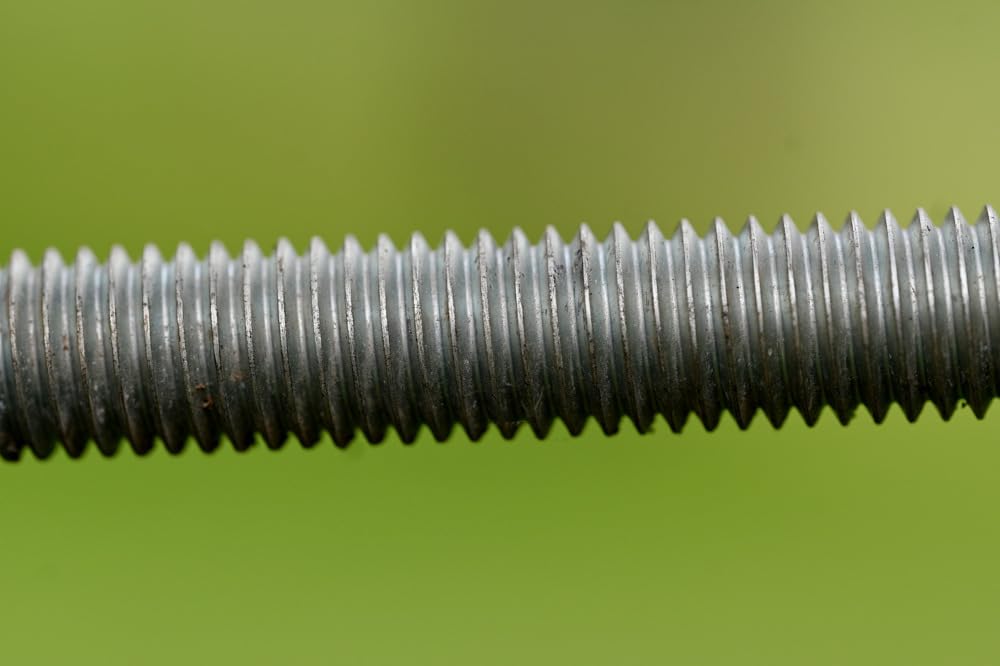
There is a programmable function button and a focus limiting switch on the barrel, and both are more useful for product work than the specification sheet suggests. The limiter is the one you will touch constantly, the function button far less.
Build is weather sealed, which matters if your product work includes location shoots, market stalls or a tabletop in a damp garage. Fluorine coating keeps flare in check when you are working with a bare reflector just outside the frame edge.

How the 105mm framing helps with lighting placement
Focal length drives working distance, and working distance drives your whole lighting design. A 105mm lens at 1:1 on a full-frame body leaves considerably more room in front of the subject than a 60mm, which means your key light can sit further to the side without entering the frame and without the subject throwing a hard shadow onto the backdrop.
The angle of view is roughly 23 degrees, so a strip softbox placed just outside that cone will contribute light without appearing in the reflection of a glossy surface. That is the single most useful property of this lens for cosmetics, chrome and lacquered packaging.
What reviewers are not happy about
Two complaints come up repeatedly. Focus by wire means the manual focus ring has no mechanical feel, which annoys shooters who like to nudge focus by hand when framing a stack. And autofocus can hunt or be slow to lock on at the very closest working distances, which is precisely where a product photographer needs certainty.
Also note that the maximum aperture narrows to roughly f/4.5 at closest focus because of the focus throw. You still shoot at f/8 to f/11 for product work, so this barely registers in practice, but it does mean the f/2.8 rating describes mid-range rather than life-size.
4. Canon RF100mm F2.8 L Macro IS USM
- 1.4x magnification allows tighter framing than a standard 1:1 macro
- Fixed f/2.8 aperture with 5 stops of stabilisation
- Hybrid IS compensates for macro shift shake
- SA Control Ring shapes bokeh character
- Weather resistant L-series build
- Highest cost in this group
- Fixed telephoto focal length limits general use
This is the only lens in the roundup that magnifies to 1.4x natively, and that single fact changes what you can photograph. A gemstone inclusion, a watch movement or a solder joint on a circuit board can fill the frame at 1.4x without resorting to extension tubes, which keeps optical quality and autofocus behaviour intact.
The stabilisation system is the other headline. Canon rates up to 5 stops of optical correction, and the Hybrid IS system is designed to counter the angular and shift shake that appears when a heavy lens extends over a subject on a tripod. In practice it lets you frame and fire a single shot without a 30 second settling period after every rail or column adjustment.

The Spherical Aberration Control Ring is genuinely useful for product work and underused. Turning it changes the character of the out-of-focus transition, from a harder falloff to a softer, more gradual one, which lets you decide how the background separates from a subject edge instead of accepting whatever the lens does.
At 730 g this is a substantial lens, and the 16 degree angle of view is tight. Filling a frame with a small object is easy. Filling a frame with a whole product, or shooting a flat-lay board, means stepping back, and at that point a normal short tele may be the better tool.

When 1.4x genuinely beats 1:1
Magnification only matters if your subject is smaller than a life-size crop. If you are photographing a wristwatch, 1:1 lets you fill the frame with the whole watch. If you are photographing the escapement under the dial, 1:1 gives you half a frame with dead space around it, and 1.4x gives you a full frame of the mechanism.
Because both lenses are 100mm class, the working distance is similar, so choosing the Canon costs you nothing in lighting flexibility. It costs you money and it costs you aperture range elsewhere in the frame, but for detail-first jewellery and electronics work it is the right tool.
Who should skip it
Sellers photographing entire products, packaging and props should not buy this as a first macro. You will spend most of your time backed off to a distance where a 1:1 lens gives you the same result with a wider view. Save the RF100mm for the detail shots that sit alongside the catalogue frames.
It is also one of the priciest options here, and for a new seller building a kit from zero that outlay is hard to justify before the revenue exists. Build a solid 1:1 kit first, and treat 1.4x as an upgrade once your product range includes fine detail work.
5. Sony SEL30M35 30mm F3.5 Macro Fixed Lens
- Sharp close results far beyond kit lens capability
- Extremely light at 138 g
- Internal focusing keeps lens length constant
- True 1:1 at a 2.4 cm minimum working distance
- Strong value entry point
- f/3.5 maximum aperture limits background separation
- Short focal length forces you very close
- No optical image stabilisation
This is the cheapest route to a real 1:1 image, and it is genuinely small. At 138 g it disappears in a camera bag, which makes it the lens I take when the job is a single product in a hotel room rather than a full studio day.
Optical performance punches above the specification. The 6 group, 7 element design is simple by modern standards, but the close-focus results are clean and sharp well beyond what a kit lens delivers, and the aluminium alloy body feels more durable than the price suggests.

Internal focusing keeps the lens length constant as you focus, and for stacking that is a genuine advantage. Lenses that extend while focusing change the distance between the sensor and the subject mid-stack, and that is the mechanism behind both focus shift and focus breathing problems.
Because the length is fixed, you can also run a small camera without fear of the lens dipping into the subject. That constant-length design is why the lens is often recommended for video capture as much as for stills.
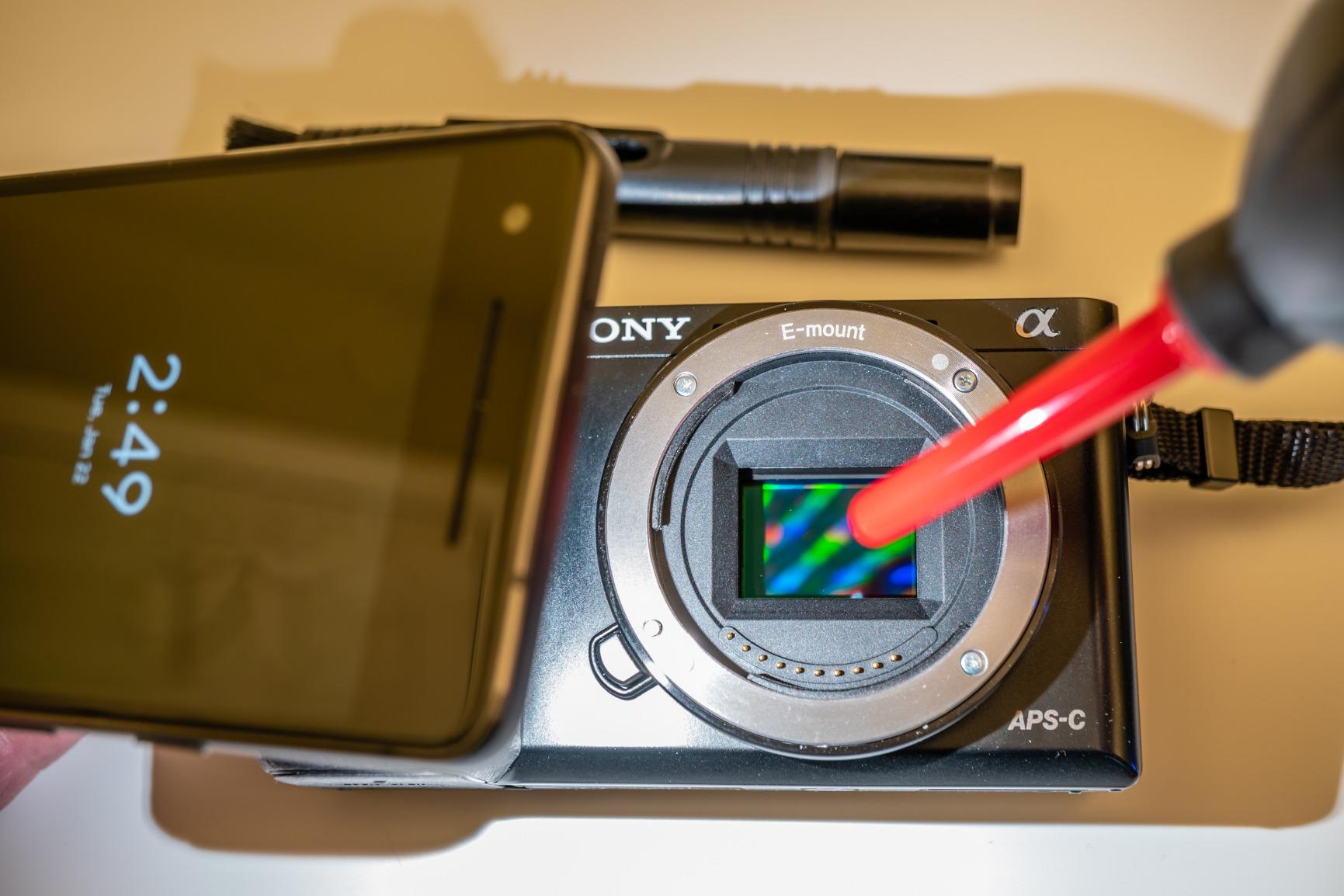
Where the 2.4 cm working distance bites
This is the practical limit you must plan around. At a 2.4 cm minimum working distance, the front element is effectively between your light and your subject, so a key light placed in front will cast a shadow straight into frame. You are forced to light from the sides and behind, which is workable but constrains your options on a highly reflective object.
Wide-angle macro also exaggerates perspective at close range. Shooting a watch or a ring from a 30mm-equivalent distance means the near side of the object appears noticeably larger than the far side, which reads as distortion in a catalogue image even though the geometry is correct.
What you give up for the weight saving
The f/3.5 maximum aperture is the biggest compromise. It is a full stop slower than f/2.8, and on a product with a bright background you will need more light or a slower shutter to isolate the subject. The six-blade diaphragm also renders highlight shapes less roundly than the nine-blade designs elsewhere in this list.
There is no stabilisation, and the autofocus is a stepping motor that reviewers describe as slower than newer Sony lenses. On a tripod at f/8 that is a non-issue. Shooting a moving product in low light, it is not.
6. Fujifilm Fujinon XF60mm F2.4 R Macro
- Superb optical quality with dreamy bokeh and vivid colour
- Light 215 g metal body
- Sharp corner to corner wide open at f/2.4
- 90mm equivalent working distance suits travel close-ups
- Firmware updates improved autofocus on newer bodies
- Maximum magnification is 0.5x rather than 1:1
- Fully electronic focus with no mechanical feel
- Very small 39 mm filter thread
- No image stabilisation
The rendering is the reason to own this lens. Owners describe vivid, saturated colour and dreamy bokeh that no other macro in this roundup quite matches, and it is sharp corner to corner wide open at f/2.4. For cosmetics, food and beauty product work on Fujifilm bodies, that look is the product.
Because a 60mm on APS-C gives roughly a 90mm equivalent field of view, the working distance suits a photographer who moves between a product set and everyday shooting. At 215 g it is one of the lightest lenses here and it never needs supporting.

On an X-H2 or later body, firmware updates have improved autofocus speed noticeably. Earlier bodies feel the sluggishness more, and the lens is focus by wire with an electronic motor, so there is no mechanical ring to grab when you want to make a small manual correction.
The 10 elements in 8 groups include one aspherical and one abnormal dispersion element, which is how it stays controlled wide open despite the fast aperture and the small format. The 39 mm filter thread is very narrow, so filter choice is limited to small-diameter rings.

Why 0.5x still covers a lot of product work
Maximum magnification of 0.5x means the image is half life-size, not full life-size. That sounds like a significant shortfall, and for tiny components it is. For a bottle of serum, a coffee bag, a shoe or a candle, 0.5x on a 26 megapixel sensor still produces a frame with plenty of resolved detail.
The practical test is simple. Crop a 26 megapixel X Series frame to 100 percent and look at whether the weave of a fabric label or the printing on a cosmetic tube is legible. If it is, you do not need 1:1. For jewellery and circuit boards, you do.
Where it becomes frustrating
The fully electronic focus design is the main complaint. There is no mechanical focus stop, and for a photographer who stacks products frame by frame, a ring that stays where you put it is worth more than a slightly faster autofocus. Manual adjustment is slow and imprecise by comparison with a mechanical macro.
There is no stabilisation, so handheld close work at slower shutter speeds is risky. And the 4.1 average rating in our group is the lowest here, which is largely a function of the autofocus and the magnification limit rather than the optics.
7. Tokina atx-i 100mm F2.8 FF Macro for Canon EF
Tokina 634455 atx-i 100mm F2.8 FF MACRO Canon EF Mount Full Size Compatible
- Sharpness rivals Canon OEM 100mm macros
- Well-built metal body
- One-Touch Focus Clutch for fast manual switching
- Even bokeh rendering
- Works through EF adapters with autofocus passthrough
- Autofocus slower than comparable Canon EF lenses
- Not weather resistant
- Canon EF mount only
The renewed atx-i optical design delivers full-frame 1:1 reproduction at a 30 cm minimum focus distance, and reviewers consistently put its sharpness up against Canon OEM 100mm macros without conceding much. For a Canon EF shooter, that is a strong argument for building a kit around it.
The One-Touch Focus Clutch is the control worth understanding. You slide it from any position on the barrel to switch between autofocus and manual, which means you can flip to manual the moment you frame a stack without hunting for a switch near the mount.

At 515 g it is lighter than the OEM full-frame macro glass and easier to balance on a column. The 9-blade diaphragm renders bokeh evenly, which reviewers highlight as a bonus for portrait and product work alike.
Angle of view is around 24 degrees, so lighting placement behaves the way you expect from a 100mm. A light just outside that cone contributes without appearing in the reflection of a curved surface.

Using EF glass on a mirrorless body
This lens is Canon EF mount, and modern adapters pass autofocus and aperture data through without issue. That widens the audience considerably, since plenty of working photographers still own EF bodies and a stack of EF glass alongside their mirrorless kit.
One caveat: the body reports the lens through the adapter, so electronic focus-by-wire behaviour and any stabilisation you expect from the lens itself are not present. Stabilisation for macro still comes from the body, or from a tripod and mirror lock-up.
Where the trade-offs bite
Autofocus is the weak point. Owners describe it as slower than comparable Canon EF lenses and prone to hunting at minimum focus, which is the same weakness the Sigma has, but with none of the focus limiter mitigation.
It is also not weather resistant, so a damp studio or an outdoor market stall is a risk with this lens and not with the Canon RF100mm. If your work is exclusively indoors on a controlled set, that is a manageable limitation.
8. Tamron 90mm F2.8 Di III VXD 1:1 Macro
Tamron 90mm F/2.8 Di III VXD 1:1 Macro for Sony E Mount Full Frame/APS-C Mirrorless Cameras
- Strong edge-to-edge sharpness for close-up work
- Fast precise VXD autofocus with subject tracking
- Flat-field performance keeps frames evenly detailed
- Handles telephoto and portrait duties well
- Moisture-resistant build
- No built-in image stabilisation
- Sony E mount only
- Some owners report image quality below other Tamron lenses
Flat-field performance is the headline for product photographers. A flat field means detail holds up across the entire frame rather than falling off toward the corners, which is exactly the property you want when a product sits centred in a white sweep and the buyer expects the edges to be as crisp as the middle.
The VXD autofocus motor is fast and precise, with subject tracking that reviewers single out. On a turntable sequence or a hand entering frame to reposition a product, that tracking keeps the frame in focus where slower motors visibly lag.

The 12-blade aperture gives you near-circular highlights, so specular reflections on a chrome or lacquered surface stay round and read as highlights rather than as shaped defects. BBAR-G2 and fluorine coatings handle flare and ghosting when a strip light sits just outside the frame.
Moisture-resistant construction and a six year manufacturer warranty give this lens a longer expected service life than most. At 90mm it also doubles as a short telephoto, which owners appreciate for portraits and compressed detail shots.

Why flat field matters more than peak sharpness
Peak centre sharpness is easy to measure and easy to advertise. Flat field is the harder thing to deliver, and it is what determines whether a product photograph looks convincing edge to edge. A lens that is sharp in the middle and soft at the corners makes a cylindrical bottle look tapered, because the highlights on either side blur differently.
For catalogue work where a client compares your image against a physical sample, this is the difference between an accurate and a misleading picture. That is why we rate flat-field performance above maximum magnification in this group for most product assignments.
What you give up without stabilisation
There is no in-lens stabilisation, and the manufacturer guidance is explicit: use a higher shutter speed or a tripod for effective macro results. On a tripod at f/8 to f/11 with a flash or strobe, this costs you nothing at all.
If you shoot handheld, for a handheld beauty demonstration or a quick snap of a product in a shop, you will feel the absence. This lens is built for the tripod bench, and it does that job extremely well.
9. Fujifilm Fujinon XF30mmF2.8 R LM WR Macro
- Pristine edge-to-edge resolution on high-resolution bodies
- Fast f/2.8 aperture with 1:1 close focus
- Very light at 195 g for a sealed macro
- Linear motor autofocus in 0.02 s
- Lockable aperture ring
- Fujifilm X mount only
- 30mm focal length limits working distance for larger subjects
This is the rare lens that gives you full 1:1 magnification, an f/2.8 aperture and a body you can hold in one hand without thinking about it. At 195 g it is one of the lightest options here, and at 10 cm minimum focus distance it magnifies life-size.
The 11 elements in 9 groups include three aspherical and two extra-low dispersion elements, and owners report resolution that matches the high-resolution X Series sensors. On a body with 40 or 61 megapixels, this lens has the resolving power to be the limiting factor rather than the sensor.
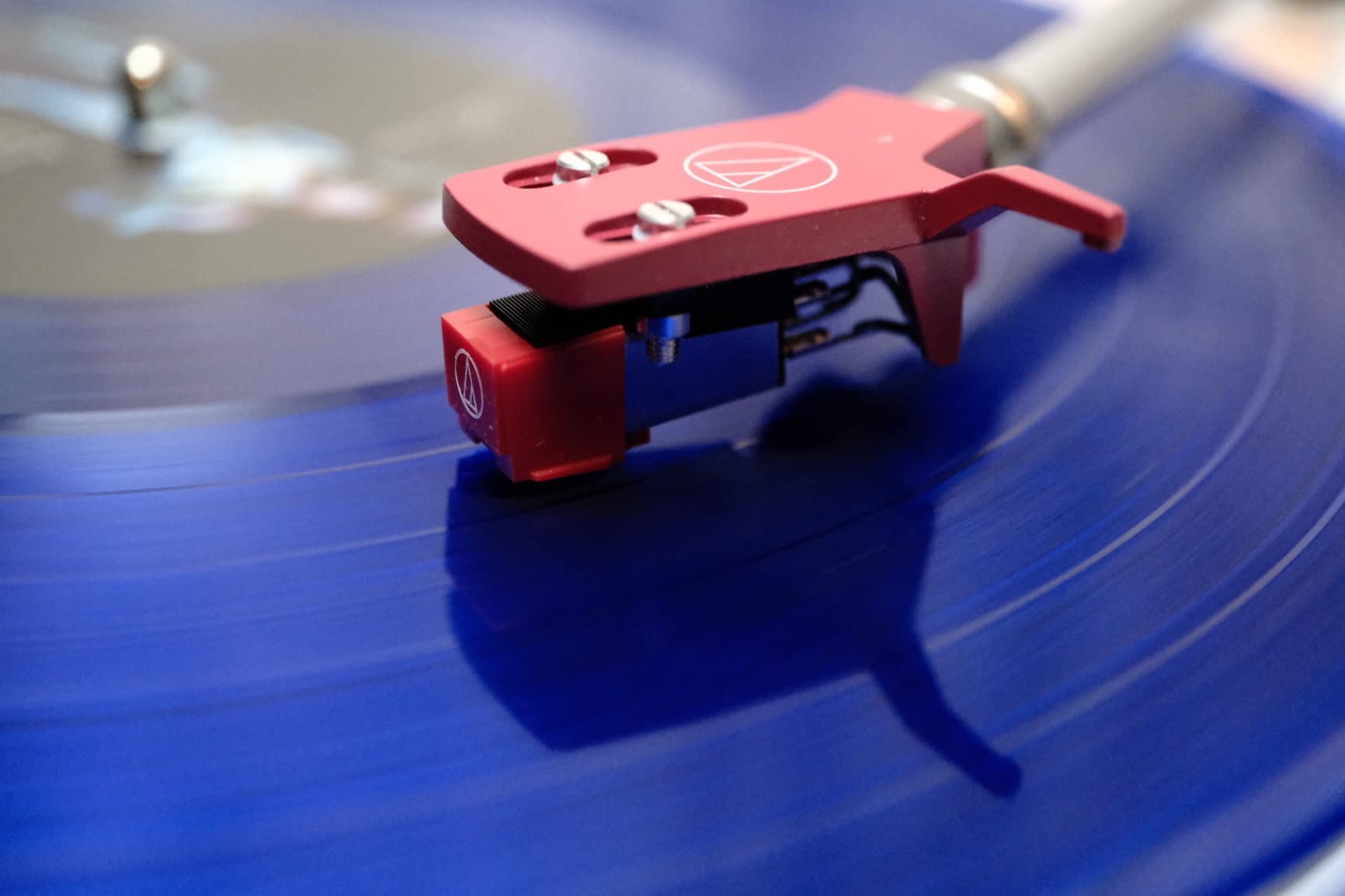
Weather sealing across nine points and a rated tolerance of minus 10 degrees put this ahead of most of the group for location work. The 11 rounded aperture blades render bokeh smoothly, which helps when a small product sits against a busy background.
The lockable aperture ring is the quiet hero. You set your working stop, lock it, and it will not drift when you bump the tripod or change a light, which removes a whole class of inconsistent frames from a long catalogue session.

Trade-offs of a 30mm focal length
A 30mm lens gives a 46mm equivalent field of view on APS-C, which is a normal-ish short tele. That is wide for product work, and it means the lens sits closer to the subject than a 90mm would, so your front element occupies more of the light path.
For a small object lit from the sides and behind, that is a non-issue. For a product that needs a frontal fill or a large frontal diffusion panel, you will be working around the lens barrel. Know your lighting before you commit to a short focal length.
Who this suits and who it does not
This suits a Fujifilm shooter who wants a daily lens that also does macro, rather than a specialist that lives on a shelf. Weather sealing and a sealed aperture ring mean it can handle the abuse of location product shoots that a bare studio lens would not.
It does not suit anyone shooting very small components, where 1:1 is already the limit and you need more. For gems, watch movements and circuit boards, step up to a longer lens or a super-macro option rather than buying extension tubes for this one.
10. OM SYSTEM M.Zuiko Digital ED 60mm F2.8 Macro
OM SYSTEM Olympus M.Zuiko Digital ED 60mm F2.8 Macro for Micro Four Thirds System Camera, Weather Sealed Design, Focus Limit Switch Bright
- Clear faithful detail from 13 elements in 10 groups
- Light 185 g body for small specimens
- Internal focusing keeps lens length constant
- Focus limit switch and working distance window
- Weather sealed dust and splash proof
- Micro Four Thirds mount only
- No built-in image stabilisation
- Smaller review base than older competing lenses
On a Micro Four Thirds body, a 60mm lens gives a 120mm equivalent field of view, so this sits right in the product photography sweet spot while staying extremely light at 185 g. It is one of the easiest lenses here to carry around a market stall or a warehouse for on-location product work.
The focus limit switch and the built-in working distance window are the two features that separate this lens from the generic small macro options. The window confirms subject distance visually, which takes guesswork out of positioning a tiny object, and the limiter removes the autofocus search problem.
Internal focusing means the lens does not change length as you focus, which keeps the distance to your subject constant through a stack and reduces focus shift. That is a real advantage for anyone assembling a stack with a camera that supports focus bracketing.
The ZERO coating is designed to suppress reflections, which helps on glossy packaging where uncoated glass would put a bright ghost of the softbox into the middle of the product. Owners describe the rendering as clear and faithful rather than heavily corrected.
How the 120mm equivalent view helps
The crop factor works in your favour for product work. Where a 60mm on full frame gives you a slightly wide view for a small subject, the same lens on Micro Four Thirds gives you a mild telephoto perspective that flatters packaging and keeps perspective distortion out of the frame.
Depth of field also works out in your favour. A smaller sensor with the same framing and the same f-number gives more depth of field, which on a 13 element design that stays sharp wide open means fewer frames that need stacking for shallow products.
Limitations to plan around
There is no in-lens stabilisation, and Micro Four Thirds bodies vary in their in-body systems. Check that your specific body offers stabilisation and focus bracketing before committing to a stacked workflow with this lens.
Mount compatibility is obviously limited to Micro Four Thirds, and the smaller review base means less long-term feedback than the established full-frame options. The lens is a strong system-native choice rather than a general recommendation.
11. Sony FE 100mm F2.8 GM OSS Macro with 1.4x Magnification
Sony FE 100mm F2.8 GM OSS Macro Lens with 1.4X Magnification (Sony E-Mount)
- Exceptionally sharp close-focus results
- 1.4x native magnification for extreme product detail
- Fast silent autofocus in video and stills
- Optical stabilisation steadies macro work
- Lightweight for a 100mm macro and balanced on a tripod
- Manual focus feel geared toward experienced macro shooters
- Colour rendering less refined than dedicated macro primes
- Premium cost versus third-party 100mm options
This is the newest and highest rated lens in the group, and the first thing to understand is that 1.4x is native, not borrowed through a teleconverter. A 1.4x teleconverter pushes it to 2.8x, but the 1:1 to 1.4x range is where you will spend your time and where the optics are at their best.
Four XD Linear AF motors drive focusing, and owners report fast, precise, quiet operation that works in both stills and video. For a product set where a turntable is spinning and someone is operating the camera remotely, silent focusing matters more than most spec sheets suggest.
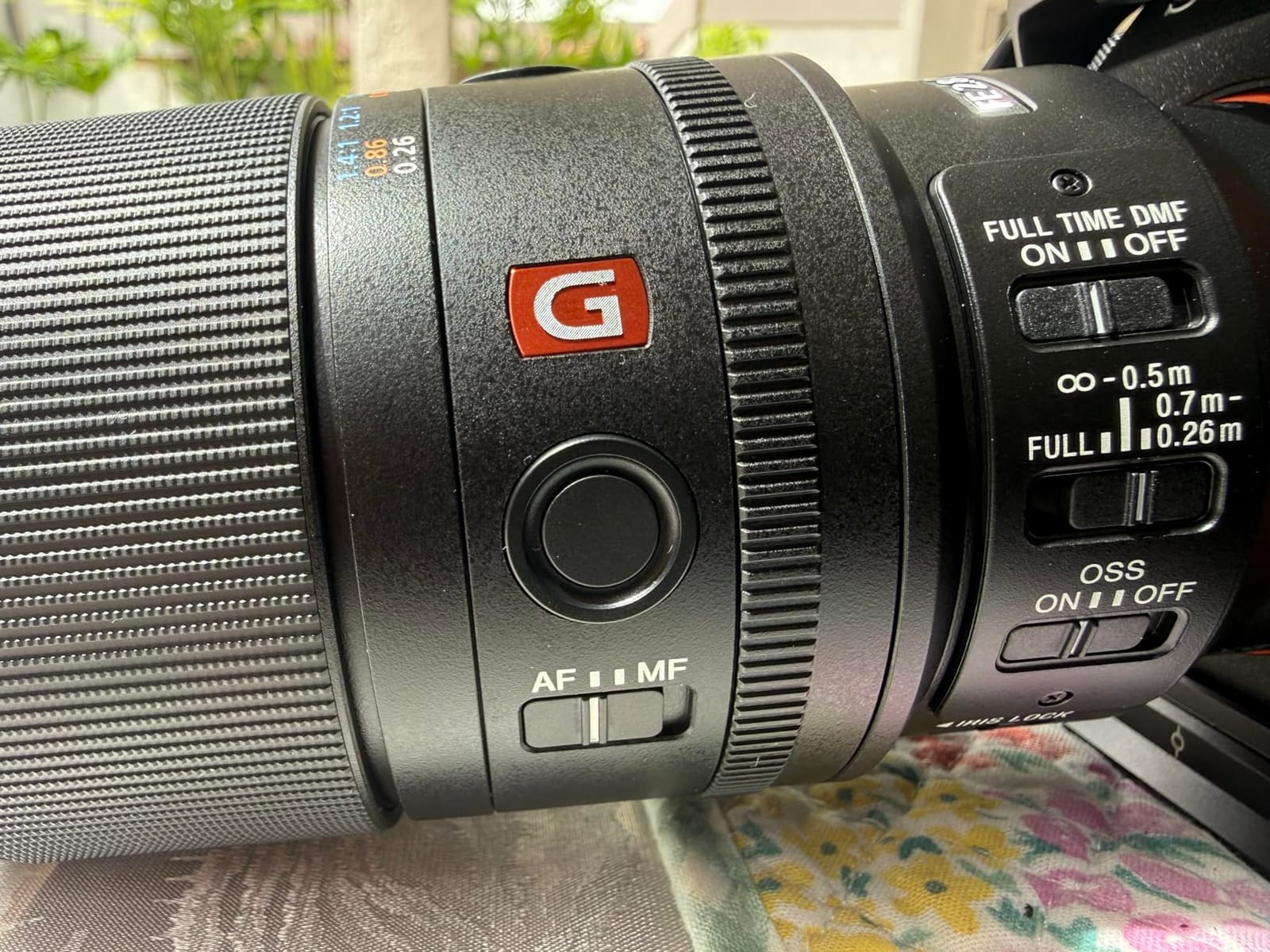
Optical SteadyShot is refined for the specific shake that macro introduces, which is the shift and tilt that happens as a heavy lens extends over a subject. At around 1.4 pounds it is also lighter than the Canon RF100mm, and it balances well on a tripod head.
The 11-blade circular diaphragm keeps specular highlights round on chrome and lacquer, and the Nano AR coating handles flare. Professional shooters on the alphashooters forum describe this lens as a go-to for macro product work, which matches how we use it.

Where 1.4x changes the shot
At 1.4x you are photographing 1.4 times life-size, so a 6 mm screw head fills a good part of the frame. That is the difference between a product photograph and a detail photograph, and detail photographs are what move a buyer from browsing to buying when the object is small or the craftsmanship is the selling point.
Because it is still a 100mm lens, working distance remains generous, so your lighting positions that worked with a 1:1 macro still work here. Nothing about your light placement has to be rebuilt when you move from full product to extreme detail.
Considerations before you commit
Reviewers note that manual focus feel, while precise, is geared toward experienced macro shooters. If your technique is built around focus by wire and a body AF mode, the transition is a learning curve rather than a one afternoon fix.
Colour rendering is described as less refined than dedicated macro primes from other brands, which can matter if your product line relies on accurate colour. Owners also recommend checking the front element under a light before the first paid shoot, since a minority of reports mention marks or dirty glass.
12. Laowa 100mm f/2.8 2X Ultra Macro APO for Canon RF
- True 2:1 magnification reaches well beyond life-size
- Aperture range down to f/2.8 for shallow product shots
- Manual focus gives repeatable control on a bench
- Compact sharp design for still life setups
- Manual focus only so live product work needs practice
- Lower average rating with some quality complaints
- Not weather sealed
Two-to-one magnification is the highest in this roundup and it is genuinely useful. At 2:1 a coin fills the frame, and texture that looks like noise at 1:1 becomes structure: the weave of a linen label, the knurling on a dial, the grain of a leather strap, the surface of a chocolate bar.
Two low-dispersion elements give it apochromatic character, which means colour fringing stays controlled right into the corners at this magnification. That is not a cosmetic detail at 2:1, because a red product photographed with visible green fringing on its edges reads as a defect on the listing page.
The aperture runs from f/2.8 to f/22, giving you real control over the depth of field band you stack across. A 9-blade diaphragm renders the out-of-focus transition smoothly, which helps when you are isolating a single thread of fabric against a background.
Manual focus design is the deliberate trade. On a bench with a rail and a rail lock, manual focus gives you repeatability that autofocus cannot promise, and repeatability is what makes a 200-frame stack blend into one clean image.
When 2:1 is worth the extra effort
Super-macro earns its place when the detail is the product. Stone, timber, ceramic glaze, woven fabric, machined metal, dried botanicals, the surface of a chocolate or a biscuit. At 1:1 these read as texture, at 2:1 they read as material, and customers read material as quality.
It is also the only tool for genuinely tiny objects. A watch movement bridge, a solder joint, a weave of carbon fibre, a printed circuit trace. No amount of cropping a 1:1 frame replaces the resolution you capture natively.
Honest limitations
Manual focus only means live work needs practice and patience. If your product set involves hand placement, a live view workflow and fast turnaround, autofocus lenses will save you time every hour of the day, and the rating on this lens reflects the manual-only design.
The average rating carries a visible slice of critical reviews, and build and optical consistency vary more between examples than with first-party glass. It is not weather sealed, so keep it away from damp conditions. For a controlled indoor bench, it does exactly what it promises.
How to Choose a Macro Lens for Product Photography
Choose on magnification and working distance first, then aperture, then everything else. Six criteria decide the outcome, and only two of them are about the lens being premium glass.
1. Maximum magnification and reproduction ratio
Reproduction ratio tells you how large the image on the sensor is relative to the real object. 1:1 is life-size, 1.4x and 2:1 are beyond it, and 0.5x is half life-size. For most catalogues of packaged goods and lifestyle products, 1:1 is plenty. For jewellery, watch movements and circuit boards, you want 1.4x or more.
2. Working distance, not just minimum focus distance
Minimum focus distance is measured from the sensor plane, and working distance is the gap you actually have to light through. Working distance decides whether a softbox sits outside the frame or in it, and whether your subject throws a hard shadow onto the backdrop. This is the number to check before anything else, because it constrains your whole set.
3. Focal length and perspective
Longer focal lengths give more working distance and flatter perspective, which is why 90mm to 105mm is the product photography sweet spot. Shorter macros get closer and exaggerate depth, which is useful for interiors and texture but can make small products look distorted. On APS-C, apply the crop factor: a 60mm behaves like a 90mm and a 30mm like a 45mm. If your work moves from objects to rooms, our wide-angle lens roundup covers that shift in focal length.
4. Is f/2.8 or f/4 better for product work?
Neither, most days. A macro at f/2.8 gives you a very thin plane of focus at 1:1, so you spend the working day stopped down at f/8 to f/11 and metering the exposure down by three or four stops. Wide apertures earn their keep for isolation on a product with a clean background, for a single subject that fills the frame, or for video. If your work is stills on a bench, prioritise corner sharpness and flat field over maximum aperture.
5. Stabilisation and body support
Stabilisation helps when you are handheld or when your support is not perfectly rigid, which on a real set is most of the time. Bodies with in-body stabilisation can pair with lenses that have no optical system. On a heavy lens over a column, stabilisation mainly buys you faster turnaround between rail adjustments.
6. Autofocus versus manual for tethered shooting
Autofocus is faster for live work with a person handling the product. Manual focus is more repeatable frame to frame, which matters more when you are assembling a stack where a consistent offset between frames is the difference between a clean blend and visible focus shift. Lenses with a focus limiter switch give you the best of both, because acquisition happens in a short, predictable range.
The camera body matters too, particularly if you shoot interiors and product frames in the same week. Our picks for cameras for real estate photography explain the tilt-screen and bracketing features that carry over to a tabletop set.
Price tiers exist in this category too, and they track magnification more than they track quality. Entry-level macro glass at 30mm to 60mm gives you 1:1 at a fraction of the outlay. Mid-tier 100mm primes cover catalogue work. Pro-tier lenses add 1.4x magnification, hybrid stabilisation and weather sealing, and only make sense once you are billing for detail work. If you are also building out a room rather than a bench, our studio lighting kit roundup covers the light side of the setup.
Focus Stacking Settings That Actually Work
Stop down to f/8 or f/11, set manual focus, turn off stabilisation, and shoot a bracket of frames through the subject depth. Beyond f/11 you hit the diffraction limit and lose more resolution than the extra depth of field gains you.
The reason to prefer f/8 to f/11 over f/5.6 is total light. Each stop you stop down halves the light, so f/11 in a light tent means your flash output or your continuous lighting has to quadruple compared with f/8. Once flash duration is below the shutter speed, that light comes free, and at these small scales a single strobe at close range is entirely workable.
Lens breathing is the failure mode that ruins stacks. A lens that extends as it focuses changes the subject-to-sensor distance through the bracket, so the frame you thought was focused on the front of the object is actually focused somewhere else. The lenses with internal focusing designs hold their length constant, which is why they stack more cleanly. If your lens breathes badly, set manual focus, do a test bracket, and inspect the middle frames before committing to a long stack.
Be aware of the cost. One photographer on the dpreview forums reported firing 600 frames for a single outdoor stack and using half a battery. Batching in a single direction, disabling long exposure noise reduction and using a wired release all cut the time and file volume.
Shooting Reflective and Glossy Products
You do not fix a reflection with the lens, you fix it with the light positions and the polariser. The lens choice matters only in that a longer working distance gives you more angles to work with.
A polarising filter is the single most effective tool for a glossy product because it cuts reflection from non-metallic surfaces such as glass, lacquer, plastic and coated packaging. Metal and chrome do not polarise, so on chrome you need to move the lights rather than filter the reflection away.
Five moves handle the rest. Raise the key light and place it outside the lens angle of view so its reflection falls off the visible surface. Use a large diffusion panel close to the subject so the reflection is a broad, even gradient rather than a hot point. Flag the sides with black card to kill stray light returning to the lens. Add a white bounce opposite the key to control the falloff, and change the camera elevation slightly, because a few degrees of angle often moves a reflection entirely out of frame.
Longer working distance is what makes all of this possible. When the lens sits a hand’s width from the subject, you cannot get the light far enough to the side without it entering the frame. This is the practical reason the 90mm to 105mm class dominates studio product work, and the reason the shortest macros in this roundup are recommended for travelling sellers rather than polished studio work.
Frequently Asked Questions
What is the best Sony macro lens for product photography?
For most product work on Sony E, the FE 90mm F2.8 Macro G OSS is the safest all-rounder, with true 1:1 magnification, optical stabilisation and corner-to-corner sharpness. The Sigma 105mm F2.8 DG DN Macro Art offers comparable sharpness with more physical controls and a longer warranty. If your products are very small and you need detail beyond life-size, the FE 100mm F2.8 GM OSS reaches 1.4x.
Is f/2.8 or f/4 better for product photography?
Neither is the number that matters for most product work. At 1:1 magnification a macro has a razor-thin plane of focus wide open, so you will stop down to f/8 to f/11 and lose three or four stops of light. Choose a wide aperture only when you need strong background separation on a single subject or you are shooting video.
What is the best camera setting for focus stacking?
Set manual focus, turn off stabilisation, stop down to f/8 or f/11, and use a self-timer or wired release so vibration does not move the frame. Shoot in RAW, keep ISO low, disable long exposure noise reduction and bracket in a single direction through the subject depth. Bodies with in-body focus bracketing can automate the whole sequence.
What are the limitations of focus stacking?
Stacking fails when the lens shifts focus as it extends, so the frames in the middle of the bracket are not actually focused where you expect. It is also slow and memory-hungry, and a 600-frame bracket can consume a large share of your battery. Moving subjects, reflective surfaces and any element that changes between frames cannot be stacked at all.
Do I really need a macro lens for product photography?
Many catalogue jobs are shot on a 50mm or a short telephoto because most products are photographed whole rather than in detail. You need a macro lens once your subject includes fine texture such as fabric weave, engravings, circuitry or cosmetic surfaces. If that is part of your range, a 1:1 macro becomes the cheapest way to add those frames.
What magnification ratio do I need for product photography?
1:1 life-size covers most packaged goods, watches, food and cosmetics. Move to 1.4x for gemstone detail, watch movements and electronics, and to 2:1 only when texture itself is the selling point, such as stone, timber, leather or woven fabric. Anything below 1:1 still works for larger products on a high-resolution sensor.
Conclusion
The best macro lenses for product photography are the ones that give you enough working distance to light your subject and enough magnification to show the detail that sells it. For most working sets that means a 90mm to 105mm prime at 1:1, stopped down at f/8 to f/11, and shot on a tripod with manual focus.
Our three standouts in 2026 are the Sony FE 90mm F2.8 Macro G OSS as the dependable all-rounder, the Sigma 105mm F2.8 DG DN Macro Art for the best optical performance available without flagship pricing, and the Nikon Z MC 105mm f/2.8 VR S for Nikon shooters who want stabilisation and the highest rating in the group. Add a 1.4x or 2:1 lens only once your product range includes detail work, and use the buttons above to check current pricing for your mount.