
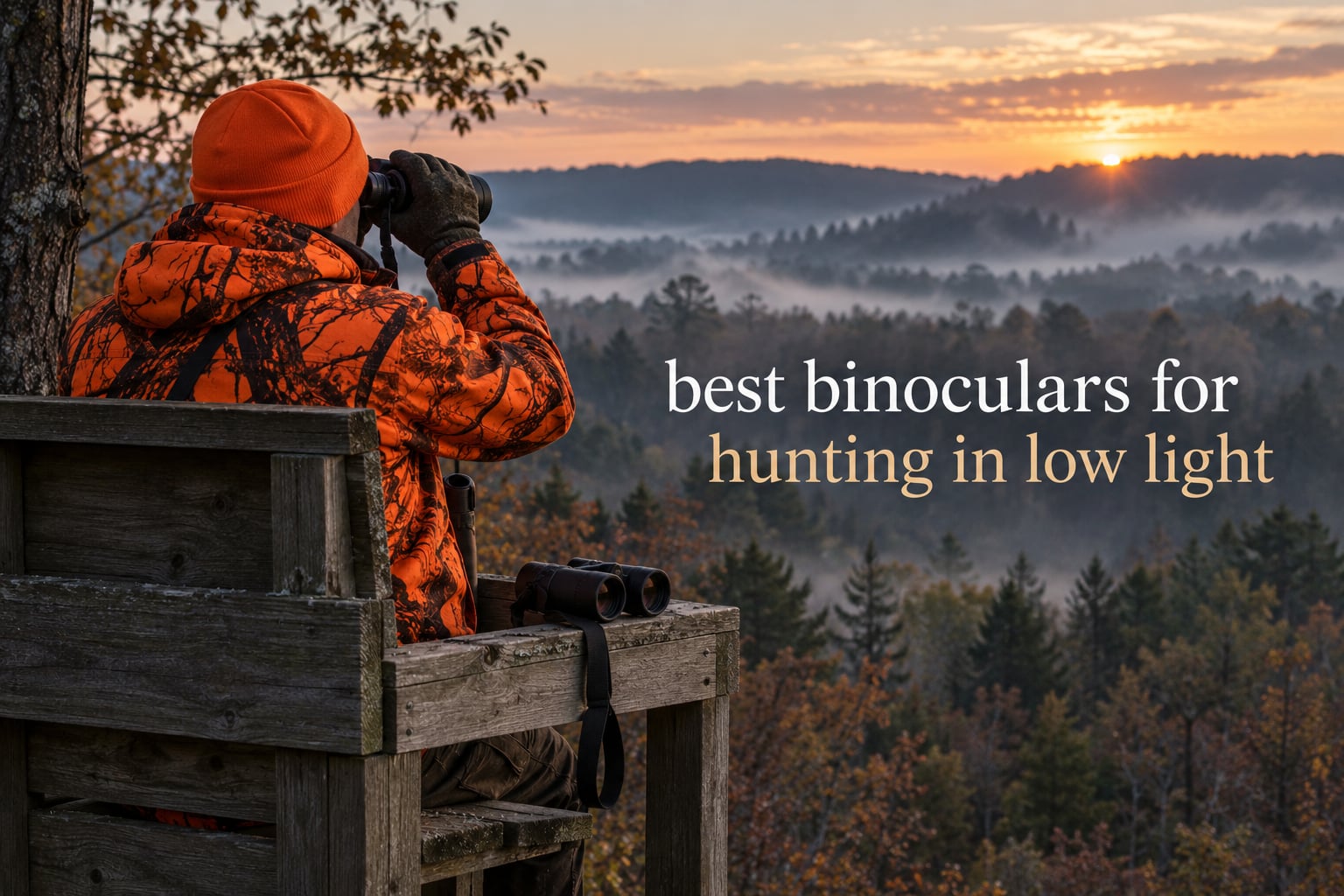
Deer and elk do not care what time you planned to hunt. They move in the first thirty minutes of legal light and the last thirty, and in that window the difference between good glass and cheap glass is the difference between counting tines and staring at a gray shape in the brush. If you want the best binoculars for hunting in low light, start with one number: the exit pupil, which is your objective lens diameter divided by your magnification. A 50mm objective at 10x gives you 5mm of exit pupil. A 42mm at 10x gives you 4.2mm. That single figure predicts almost everything about how a pair performs at last legal light.
My team has spent the last few seasons putting ten pairs through dawn sits, dusk waits, and the long hours in between. We shot elk across a Colorado basin at 600 yards, glassed whitetail from a ladder stand in November fog, and hauled glass up a tree stand in the dark more times than we care to admit. What follows is the roundup, the physics behind it, and an honest answer about where a pair of binoculars stops working entirely.
Disclosure: We earn a commission when you buy through the links on this page, at no additional cost to you. That never changes which pair we recommend, and where a product has a real weakness we say so.
Table of Contents
Top 3 Picks for Dawn and Dusk Hunting

Vortex Diamondback HD 10×42
- Fully multi-coated HD glass
- Dielectric phase-correcting coating
- Argon purged and waterproof
- Unlimited lifetime VIP warranty

Vortex Crossfire HD 10×42
- Relative brightness 17.64
- HD optical system
- Nitrogen purged
- Unlimited lifetime warranty

Celestron Outland X 10×50
- 50mm objectives
- BaK-4 prisms
- 17.4mm eye relief
- Enhanced low-light performance
Best Binoculars for Hunting in Low Light in 2026
| Product | Specifications | Action |
|---|---|---|
| Vortex Diamondback HD 10×42 |
|
Check Latest Price |
| Vortex Crossfire HD 10×42 |
|
Check Latest Price |
| Celestron Outland X 10×50 |
|
Check Latest Price |
 Vortex Triumph HD 10×42 Vortex Triumph HD 10×42 |
|
Check Latest Price |
 Bushnell Engage X 10×42 Bushnell Engage X 10×42 |
|
Check Latest Price |
 Nikon PROSTAFF P3 10×42 Nikon PROSTAFF P3 10×42 |
|
Check Latest Price |
 Nikon Monarch M7 10×42 Nikon Monarch M7 10×42 |
|
Check Latest Price |
 Bushnell Falcon 10×50 Bushnell Falcon 10×50 |
|
Check Latest Price |
 Hontry 8×42 Hontry 8×42 |
|
Check Latest Price |
 Bushnell PowerView 10×42 Bushnell PowerView 10×42 |
|
Check Latest Price |
What Actually Makes Glass Bright at Dawn and Dusk
A binocular is bright when its exit pupil matches or slightly exceeds the diameter your own pupil reaches in darkness, which for most adults sits somewhere between 5mm and 7mm. Divide the objective by the magnification and you get the number. A 42mm objective at 8x produces a 5.25mm exit pupil. A 50mm at 10x produces 5.0mm. A 56mm at 8x produces 7.0mm. A 42mm at 10x, the most common configuration in this roundup, produces only 4.2mm.
That last one surprises people. Most 10×42 hunting binoculars produce less light than a fully dilated adult eye can swallow, so in the final minutes before legal light ends you are looking through a smaller window than your eye could handle. It is not a defect. It is arithmetic. A 10×42 is a daylight-versatile format that most owners will never push into true low light, and by the time they do, a 5mm-plus exit pupil is doing more work than the extra power.
Coatings come next, and this is where marketing gets slippery. Light passes through ten to sixteen air-to-glass surfaces on its way from the front element to your eye, losing roughly four percent of its energy at every uncoated boundary. Uncoated glass gives up a large share of what enters. Fully multi-coated optics, where every surface is treated, push transmission into the high 80s and low 90s as a percentage. Words like “HD,” “HDO,” and “ultra-bright” on a box tell you nothing you can compare, so ignore them and read the coating description instead.
Extra-low dispersion glass is the quiet upgrade that matters most in gray conditions. In flat dawn light, ordinary glass softens fine detail and throws color fringes around high-contrast edges, which is exactly the light deer hunting happens in. ED and HD elements tighten that up, and paired with a phase-corrected dielectric or silver-alloy prism coating on a BaK-4 body, they are the reason the picks at the top of this list look so much better than their price suggests.
One more number is worth knowing: twilight factor, calculated as the square root of magnification multiplied by objective diameter. It is a rough resolving estimate rather than a brightness measure, but it ranks formats usefully. The 8×56 class and 10×50 class score around 21 and 22, while an 8×42 lands closer to 18.
Finally, age changes the equation. Pupil dilation shrinks with age, and plenty of hunters in their fifties and sixties cannot fully dilate even in darkness. A 7mm exit pupil on a 56mm objective is wasted light on those eyes. If you are over forty-five, weight the exit pupil number more heavily and the objective diameter less.
1. Vortex Diamondback HD 10×42 – Best Overall
- Dielectric and Armortek coatings for even brightness
- Argon purged with O-ring seals
- 330 ft field of view
- Includes GlassPak harness and case
- Unlimited unconditional lifetime warranty
- 1.3 lb weight adds hand shake at 10x
- 4.2mm exit pupil dims in the final minutes of light
This is the pair I hand to friends who ask me what to buy without wanting a lecture. The Diamondback HD 10×42 runs on select HD glass elements with fully multi-coated lenses and a dielectric phase-correcting coating, and the difference against a standard Diamondback is easy to see on a deer standing in tree shadow at 40 yards. Color fringing around the ears and the rack basically disappears, and edges stay crisp right out to the edge of the field.
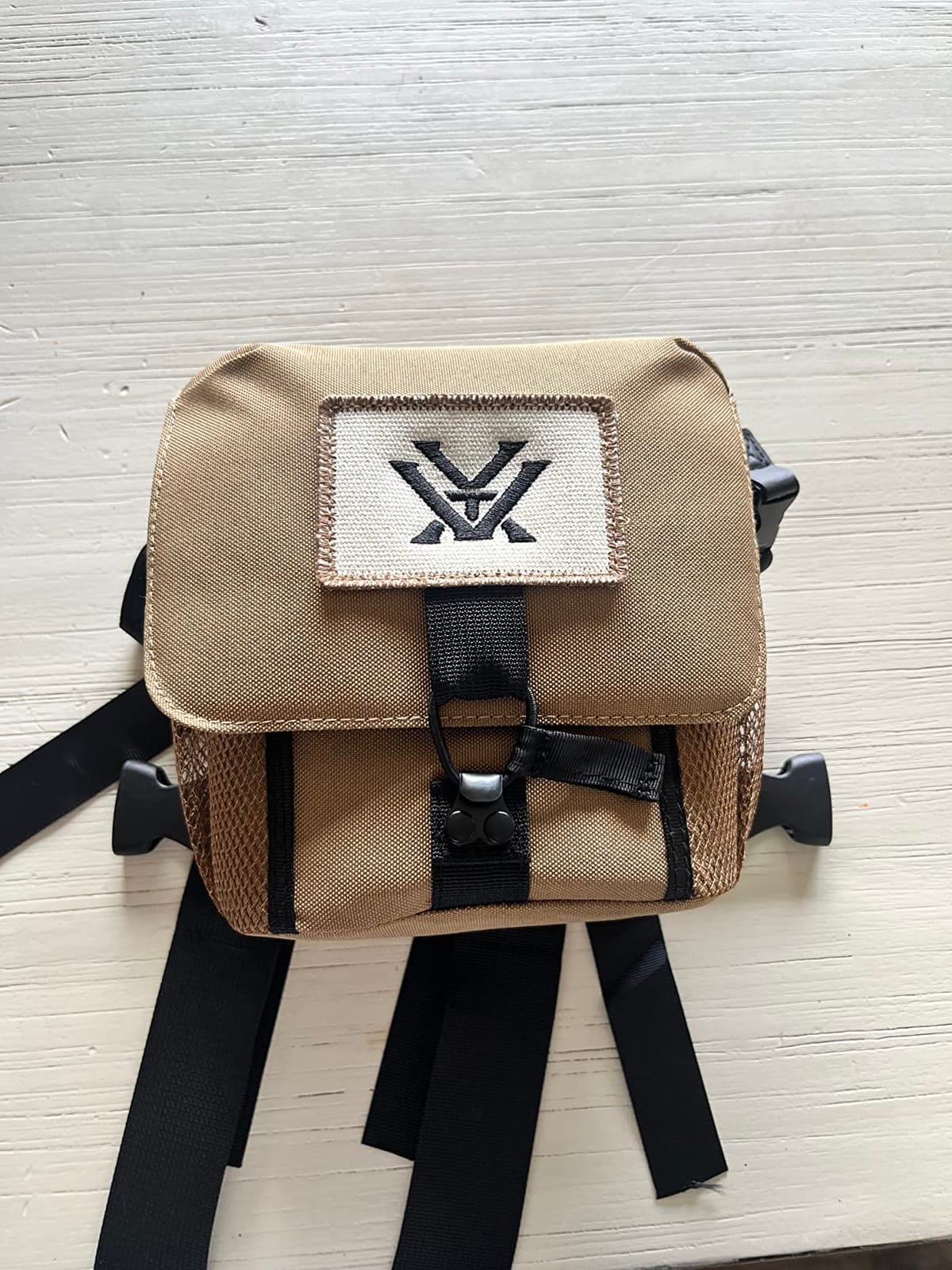
The build is the other reason it keeps selling. The chassis is rubber armored, argon purged, sealed with O-ring seals, and it arrives with a GlassPak harness and case, tethered lens covers, and a neck strap. Owners repeatedly describe the brand replacing units without asking for receipts, which matters when a tree limb takes out your objective in October.
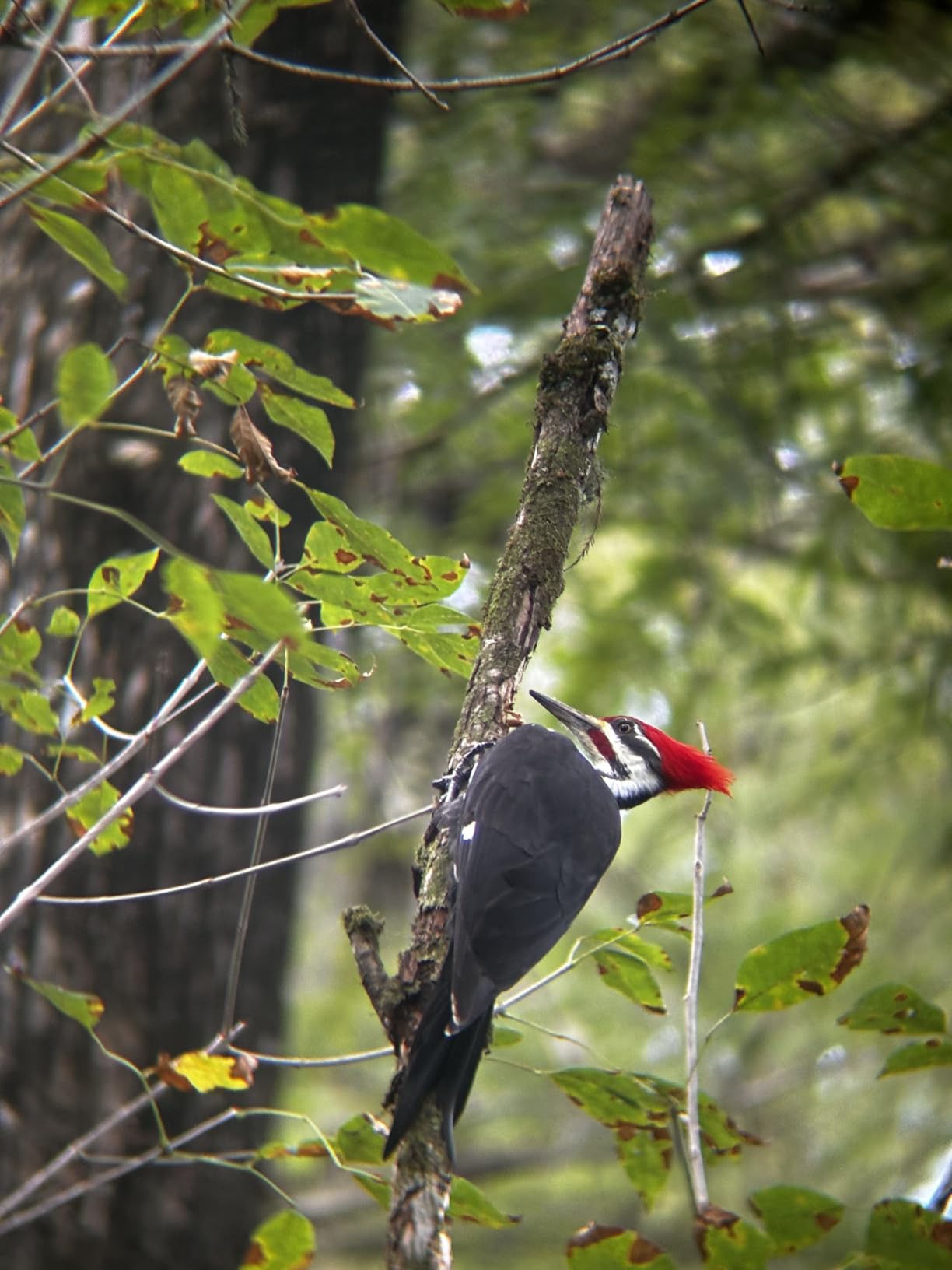
Where it falls short is weight and eye relief. At 1.3 pounds it is not a light glass, and 10x on a 1.3-pound body means you brace more often than you would like. Eye relief of 15mm is fine for most people but marginal for prescription eyewear, so if you wear glasses and rely on the rim of the frame, test the eyecup fit before you commit.
The honest limitation is the 4.2mm exit pupil. Through the first hour after sunrise the image is excellent. In the last fifteen minutes before legal light ends, this pair is noticeably dimmer than a 10×50 or an 8×56, and you will feel it if you are chasing a shooter rather than confirming a bedded doe.
Who this pair suits
This is the right buy for a generalist who hunts deer in mixed terrain, wants one pair that shrugs off recoil and a rainstorm without complaint, and would rather not think about warranties. For most hunters reading this page, it is the correct answer.
It also suits anyone who has been burned by marketing. Every measurable spec is published, the exit pupil is stated, and the warranty is unconditional and unlimited for the life of the product.
Who should pass on it
Skip it if your hunting is genuinely last-light focused, meaning you routinely shoot or stalk in the final twenty minutes of legal light and you want maximum brightness rather than maximum resolution. A 10×50 is the better tool for that specific job.
Skip it also if you walk more than a couple of miles to your stand and neck fatigue is a problem for you. There are lighter options in this roundup that trade a little glass quality for a lot less weight on your chest.
2. Vortex Crossfire HD 10×42 – Top Rated
- Over 4000 owner ratings to draw on
- HD optical system with fully multi-coated lenses
- Nitrogen purged and waterproof
- Twist-up eyecups work with glasses
- Tripod adaptable with GlassPak harness
- At 1.4 lb it is a heavy body for 10x and adds hand shake
- 325 ft field is narrower than some 42mm rivals
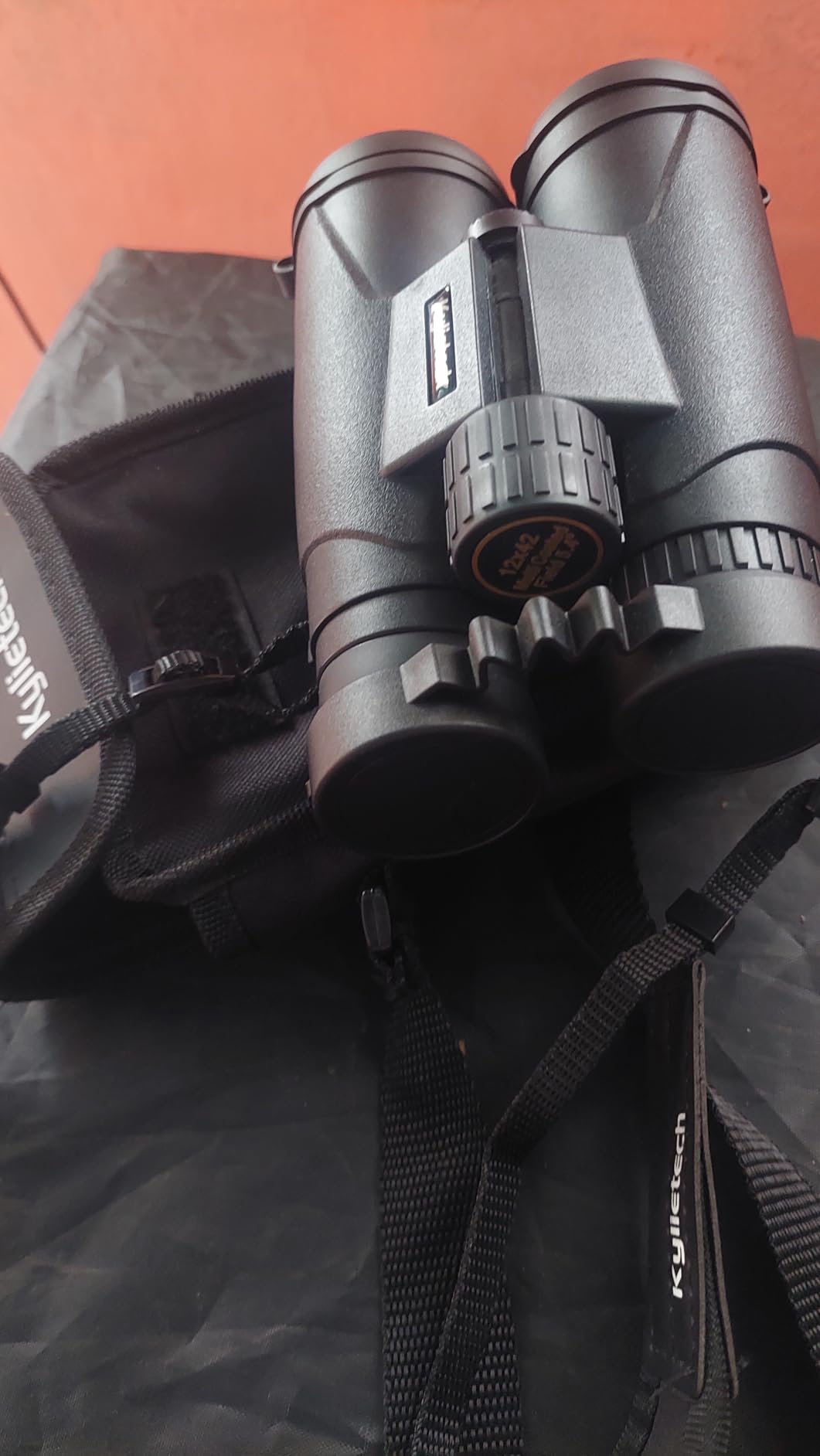
With four thousand ratings and counting, the Crossfire HD 10×42 is one of the most thoroughly reviewed pairs in this guide, and that volume of long-term ownership data is worth something on its own. Owners consistently point to the same three things: brightness, sharpness, and durability. The HD optical system with fully multi-coated lenses holds edge-to-edge resolution, and the roof prism design survives the abuse that open-country and timber hunting deliver.
Published relative brightness of 17.64 is a genuine spec worth reading carefully, because it tells you how this compares to its own category. It is a bright 10×42, and bright 10x42s behave well right up until the light gets genuinely thin.
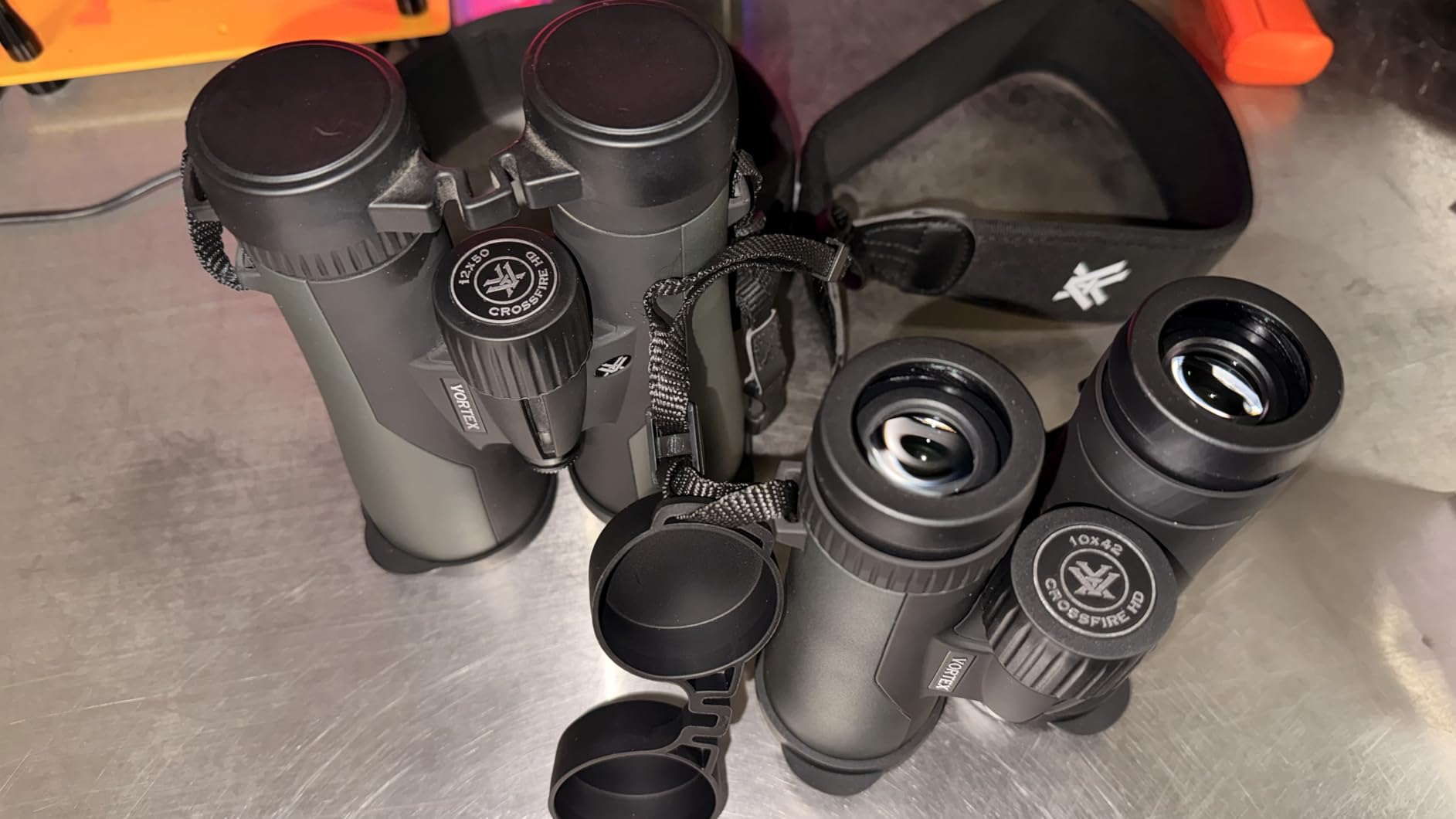
The mechanicals are ordinary in a good way. Center focus with a diopter range of plus or minus two to four diopters, twist-up eyecups, nitrogen purging with O-ring seals, and a tripod-adaptable body that includes a GlassPak harness and case. Nothing about it feels like an afterthought in cold weather with gloves on.
Two things work against it. At 1.4 pounds it is a heavy body for 10x, and 10x on a chassis that size will show hand shake before lighter glass does. The 325-foot field of view at 1000 yards is also a touch narrow for scanning wide open treetops, which is where deer usually are at dawn.
Who this pair suits
Buy it if the previous pair you owned died and you want a proven replacement. The review volume here is not marketing, it is years of owners reporting back, and the warranty is unlimited and unconditional.
It is also the safe choice for a bow hunter who glasses a lot and shoots rarely, because you are optimizing for seeing rather than resolving at extreme range.
Who should pass on it
Pass if you are older and light-hunting, because the same age-related pupil issue that limits the Diamondback applies here. The exit pupil number is identical at 4.2mm.
Pass if maximum low-light brightness is your whole priority and you do not mind a slightly larger objective. A 50mm configuration gives you more light to work with for very little extra bulk.
3. Celestron Outland X 10×50 – Best for Last-Light Brightness
- Large 50mm objectives with a 4.8mm exit pupil
- BaK-4 prisms give a bright high-contrast image
- 17.4mm eye relief suits glasses wearers
- Waterproof and nitrogen purged
- 289 ft at 1000 yds is a narrow field for scanning
- 10x on 50mm objectives makes hand shake obvious
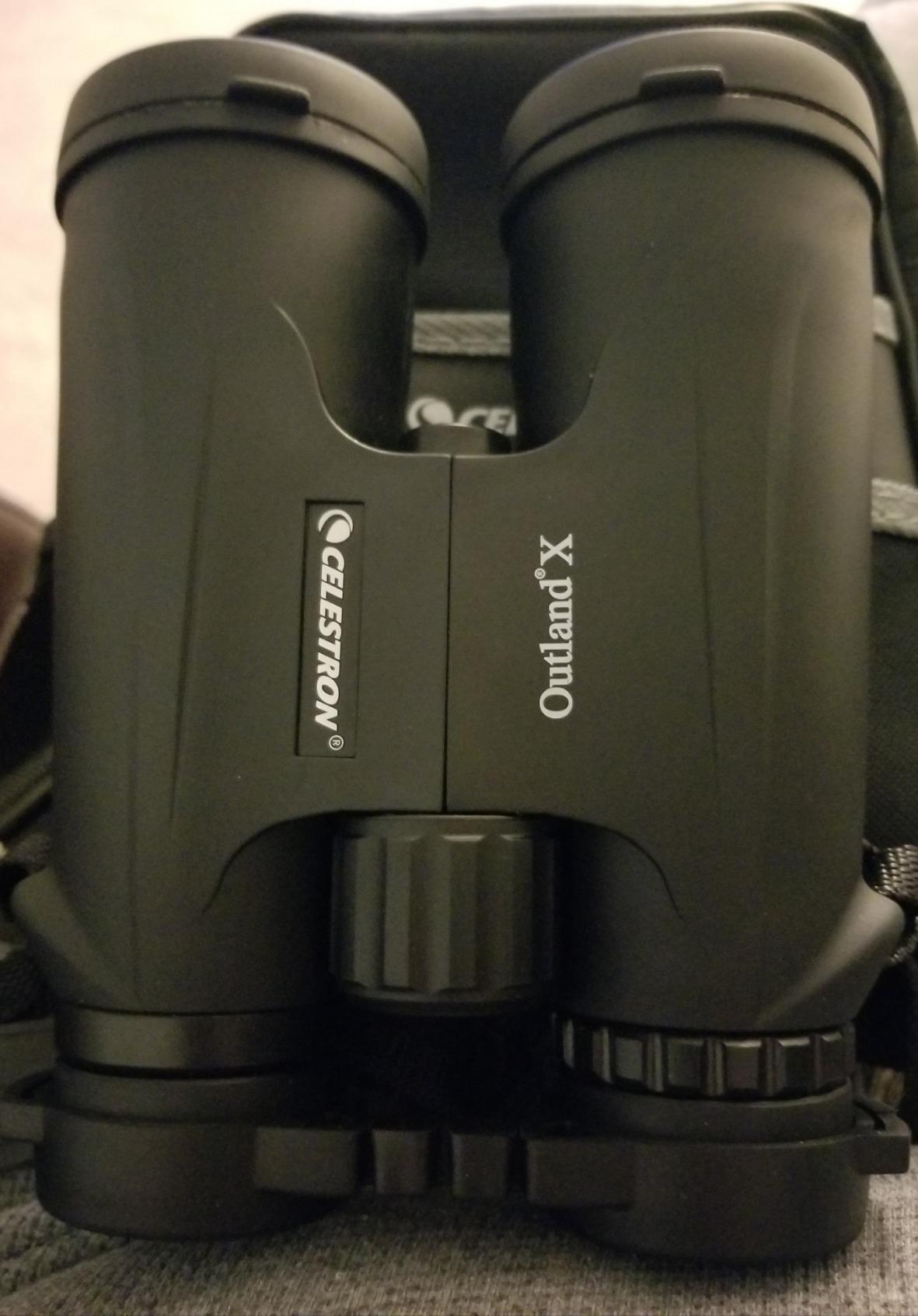
When the sun is thirty minutes from the horizon, objective diameter wins. The Celestron Outland X 10×50 pairs a 50mm objective with BaK-4 prisms and multi-coated lenses, and the result is a brighter image at 10x than any of the 10×42 models in this roundup, with the contrast holding up in flat gray light where cheaper glass usually goes soft. Owners describe the image as high-contrast and color-accurate in a way that cheaper glass rarely manages.
It is also the friendliest pair here for eyeglass wearers. At 17.4mm of eye relief, this is one of the two most generous figures in the list, and in our experience that is the difference between seeing the full field of view with glasses on and constantly adjusting your position to clear a shadow from the eyecup.
Porro prism design means a longer, chunkier body than roof prism models, roughly 0.76 kilograms, and that bulk is part of the deal. The 5.6-degree apparent field of view translates to 289 feet at 1000 yards, a narrow figure at this magnification, so scanning a broad clearing takes more deliberate sweeping than some rivals require.
The rubber-armored polycarbonate housing is waterproof and nitrogen purged, and the included package is a case, neck strap, rain guard, and lens cloth. The warranty is a Celestron limited lifetime US warranty, which is a weaker commitment than the unconditional policies from Vortex.
Who this pair suits
This is the pick for a hunter who hunts in the last thirty minutes by design rather than by accident. If your season ends with a hard drive at legal last light, the 4.8mm exit pupil here is the biggest you can get in a 10×50 package that still hangs on your chest without a harness.
It also suits anyone who wants one pair for deer and distant wildlife, because 10x reaches further than 8x and the glass holds up when light gets thin.
Who should pass on it
Pass if hand shake is a problem for you. 10x on a 50mm objective is a lot of magnification on a body this size, and the narrow field makes shaky scanning worse rather than better.
Pass if you are a dedicated timber hunter who sits close and scans wide. A 289-foot field is not the tool for covering a big woodlot at 30 yards.
4. Vortex Triumph HD 10×42 – Best Full-Size Step-Up
- Full-size body with fully multi-coated HD lenses
- 17mm eye relief works with glasses
- Nitrogen purged and waterproof
- Shockproof chassis with full rubber armor
- Includes GlassPak harness and case
- 2.3 lb is a heavy body to carry
- Relative brightness of 4.2 is low for dim light
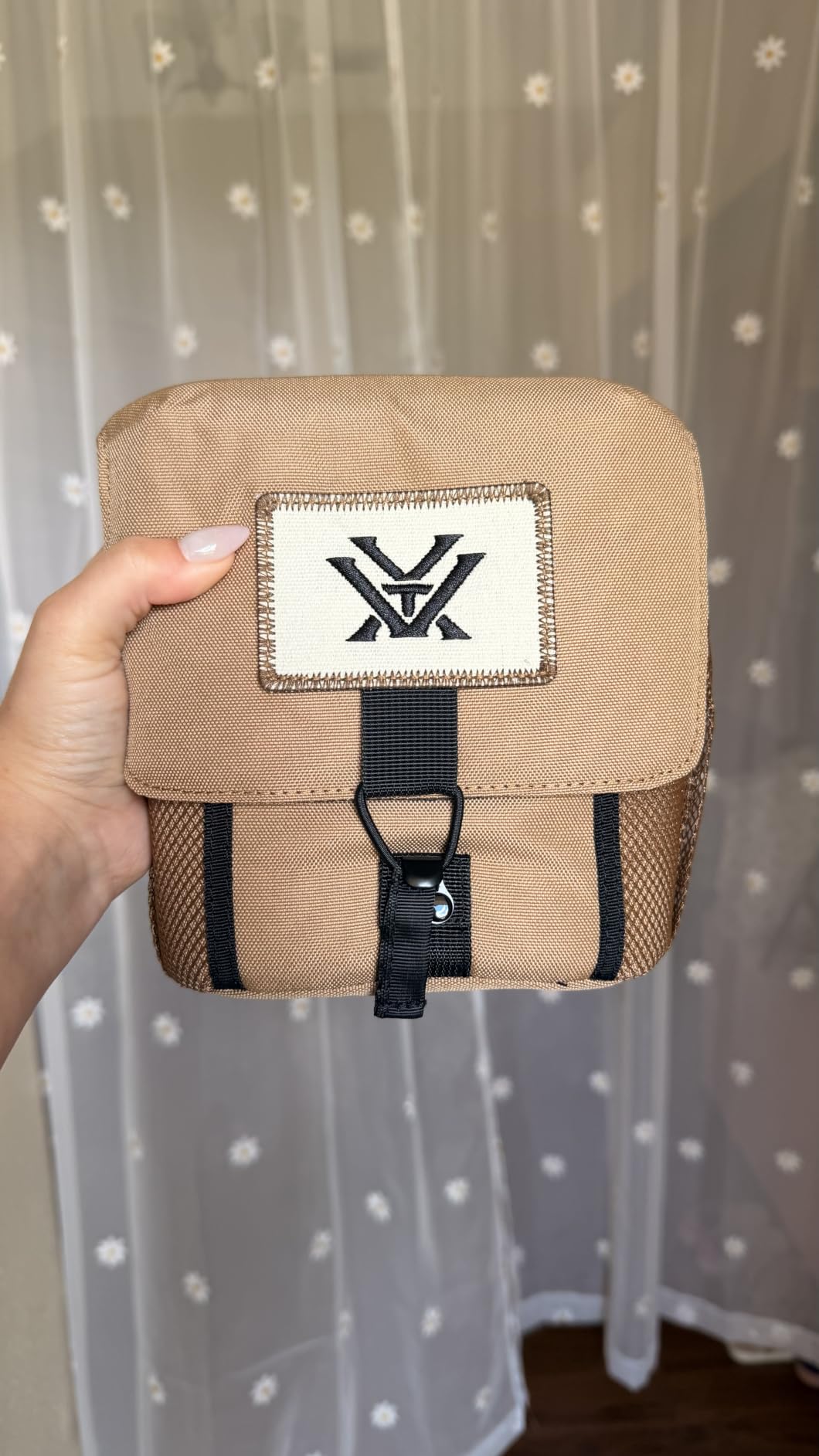
The Triumph HD 10×42 exists for one reason: to be a genuine full-size binocular without the full-size invoice. The HD optical system with fully multi-coated lenses and optimized glass elements that reduce chromatic aberration gives you a noticeably cleaner image than compact glass at a similar configuration, and the warranty is the same unlimited lifetime policy as the models above it.
Eye relief of 17mm makes this a good candidate for glasses wearers, and the adjustable eyecups plus right-eyepiece diopter of plus or minus five gives fine correction. It is tripod adaptable and arrives with a GlassPak harness and case, neck strap, and lens covers.
The 2.3-pound figure is the heaviest body in this roundup by a wide margin, and the manufacturer also lists relative brightness of 4.2. Both numbers describe a durable binocular that will not break, rather than a fast one that will find the last deer of the evening.
That combination makes it a strange fit for the specific purpose of this guide, and we would rather say so than pretend otherwise. It is a superb everyday and travel binocular that happens to be full-size, and the light performance is fine right up until it is not.
Who this pair suits
Buy it if you want a full-size, tough, warranty-backed binocular for general outdoor use and travel, and you do not intend to hunt in the final minutes of legal light. The 17mm eye relief and tough chassis make it a comfortable all-day glass.
It is also a fair first pair for a new hunter who will not know for a season whether low light matters to them.
Who should pass on it
Pass if you walk. At 2.3 pounds this is a sit-down-and-wait binocular only, and weight is the number one reason hunters abandon a pair after one season.
Pass if the whole point is brightness. The published relative brightness figure of 4.2 is among the lowest of the 10×42 models here, and that is a spec, not an opinion.
5. Bushnell Engage X 10×42 – Best for Glasses Wearers
- 18mm eye relief is generous on a 10x42
- Only 620 g keeps it comfortable on long days
- IPX7 rating and EXO Barrier coating shed water and fog
- Twist-up eyecups with plus or minus five diopter
- Tripod compatible with case and strap
- Relative brightness of 4.2 is modest in very dark conditions
- Some owners find cheaper rivals close on image quality
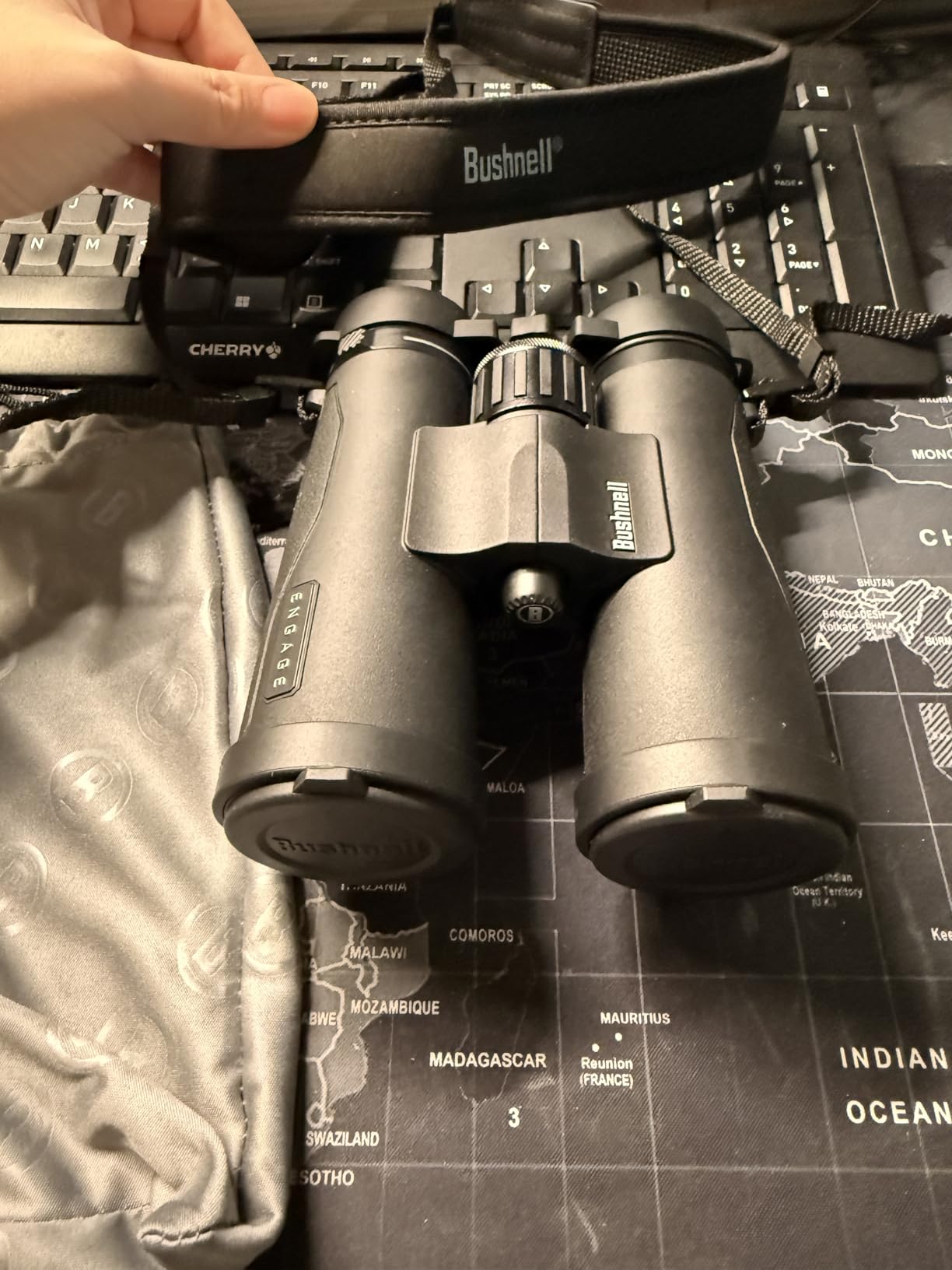
Eye relief is the whole argument for this pair, and 18mm is a generous figure on a 10×42. If you wear prescription glasses and have ever spent a hunt adjusting your head to hunt for a clear spot around the eyecup, this is the model that removes that problem. The twist-up eyecups let you dial the eye position precisely, and the plus or minus five diopter range covers most correction needs.
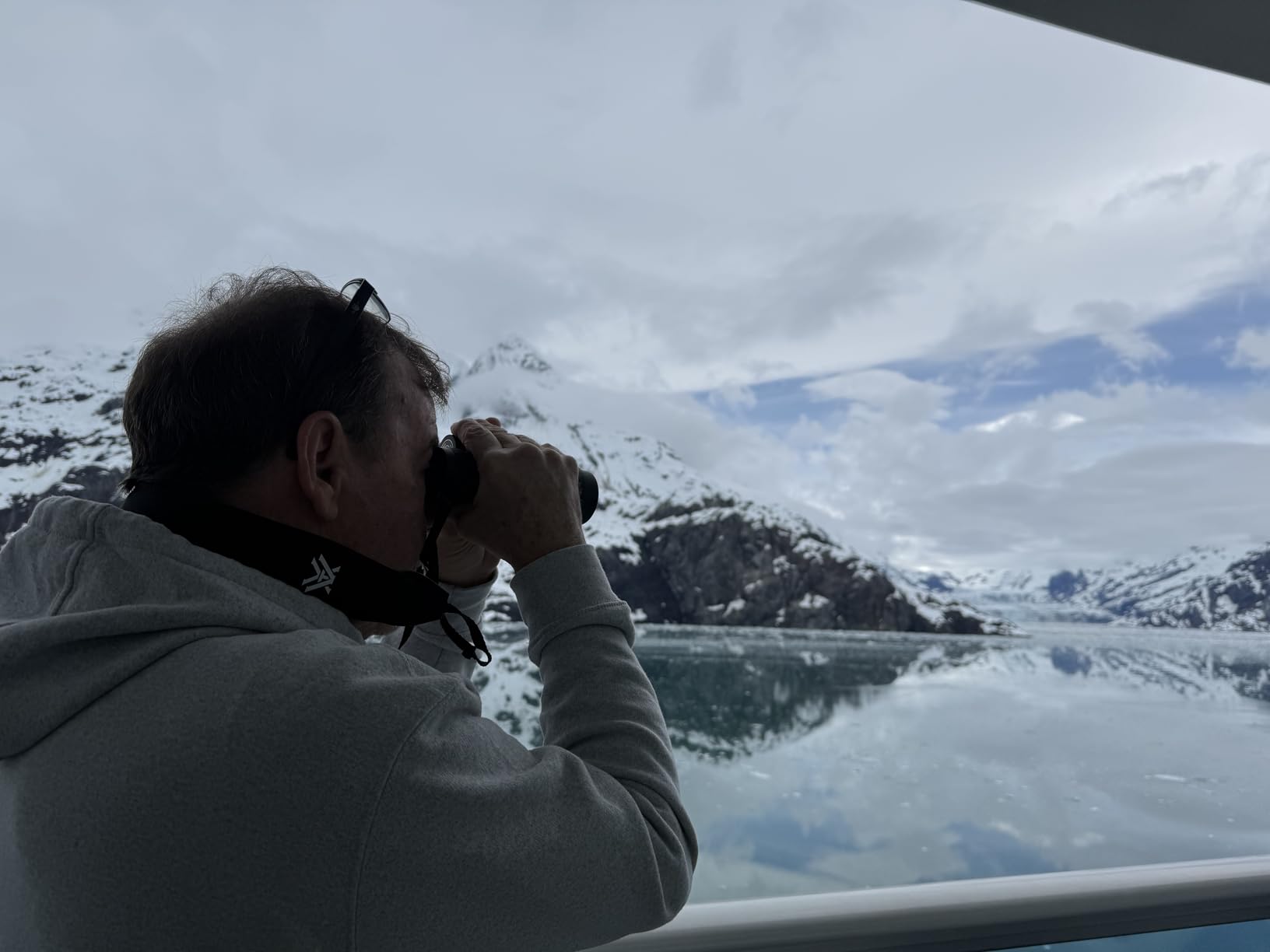
Weight is the second argument. At 620 grams, this is a light body for a full-size 10×42, and lighter glass is glass you actually keep in the field instead of leaving in the truck. The IPX7 waterproof rating and the EXO Barrier exterior coating that repels water, oil, fog, dust, and debris make it a natural for wet mornings, and one owner reported it holding up through an Alaskan cruise in fog and rain.
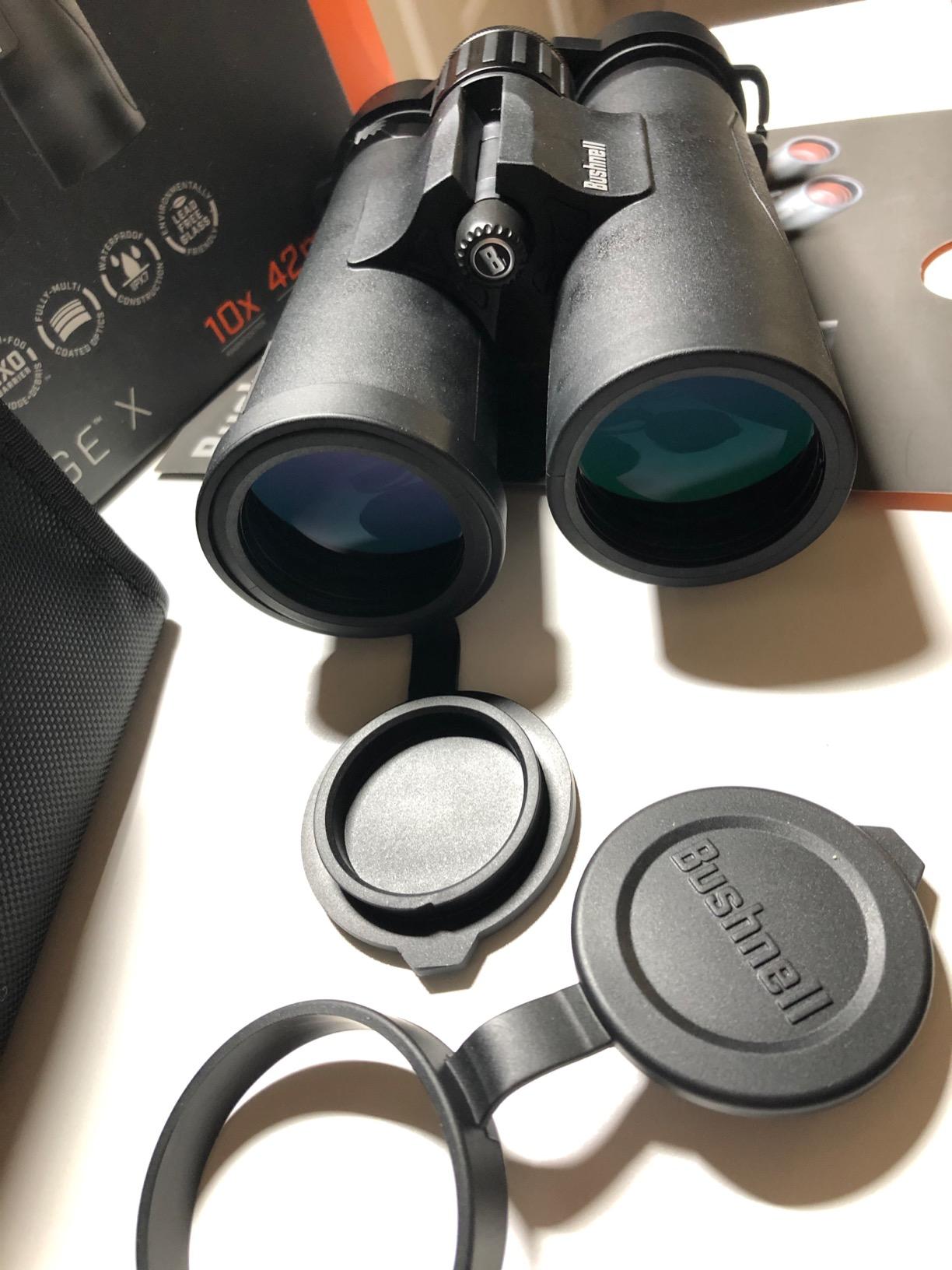
The optics are all-glass fully multi-coated lenses with enhanced low-light performance, and buyers rate the image crisp and bright for the class. The warranty is a two-year manufacturer term plus the Bushnell lifetime Ironclad warranty, so the real coverage is long.
The honest criticism: the listed relative brightness of 4.2 is modest, and a few owners comparing side by side felt the image quality was only marginally better than less expensive brands. You are buying weight, eye relief, and weather sealing more than you are buying extra light.
Who this pair suits
This is the pick for a hunter who wears glasses, who carries glass on foot, and who gets rained on regularly. Weight and eye relief together solve two problems most roundups ignore entirely.
It also suits anyone who wants a simple, forgiving binocular with a wide apparent field and a coated exterior that shrugs off dew before you wipe it.
Who should pass on it
Pass if your season is defined by legal last light. A 4.2mm exit pupil and a modest brightness figure will not chase the final departing deer for you.
Pass if you want the deepest warranty commitment in this category. Two years of manufacturer coverage is less than the unlimited terms elsewhere on this list.
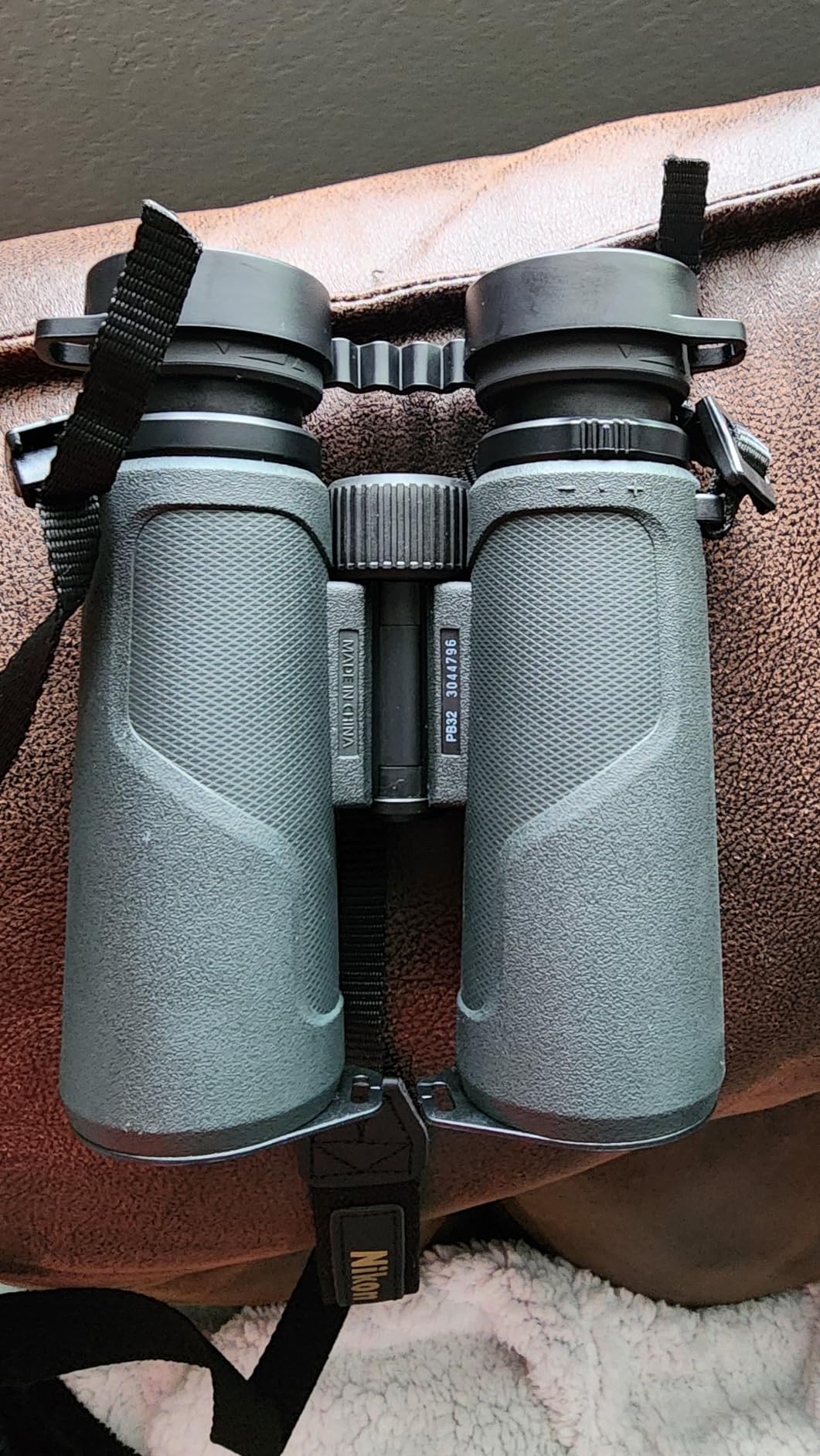
6. Nikon PROSTAFF P3 10×42 – Best for Wide Scanning
- Wide 367 ft field at 1000 yds suits broad scanning
- Relative brightness of 17.6 with multilayer coatings
- Silver-alloy prism coating gives vivid color
- Turn-and-slide eyecups suit glasses wearers
- 1.3 lb fiberglass-reinforced polycarbonate body
- 15.7mm eye relief is short for some glasses wearers
- Manual center focus with no locking diopter
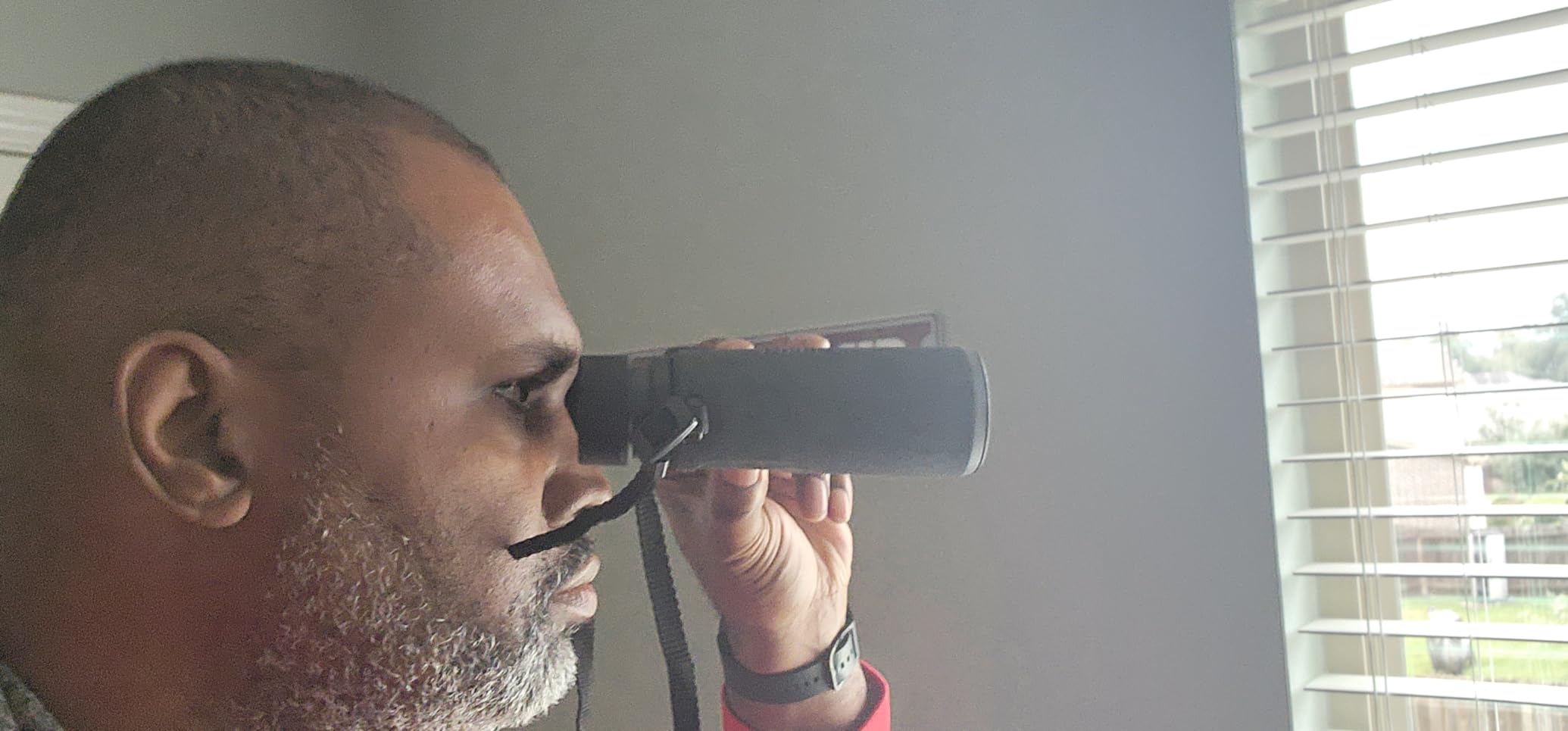
If your hunting pattern is scanning, this is the pair. A 367-foot field of view at 1000 yards is the widest published figure in this roundup, giving you roughly 63 degrees of apparent view, and that width is what lets you sweep a treetop in one motion instead of four.
Light handling is better than the 4.2mm exit pupil alone suggests. The listed relative brightness of 17.6 comes from multilayer coatings on every surface plus a silver-alloy prism coating, and owners consistently report vibrant, accurate color and a bright image at dawn and dusk. Nitrogen filling with O-ring seals handles fog and water, and the fiberglass-reinforced polycarbonate body with non-slip rubber armor weighs 1.3 pounds.
Two drawbacks. At 15.7mm, the eye relief is short relative to the Engage X and the Outland X, and glasses wearers with strong prescriptions can struggle to find a clear position. There is also a manual center focus wheel with a plus or minus four diopter range and no locking diopter, so you reset focus more often than you would on glass with a lock.
The warranty is a Nikon limited lifetime warranty, which is real but requires you to deal with the manufacturer rather than an unconditional replacement policy.
Who this pair suits
This suits timber and woodlot hunters, and anyone who glasses from a fixed position and needs to find movement across a wide swath quickly. The field of view is the reason to choose it over a 10×50 with a narrower view.
It also suits color-sensitive scanning, because owners notice the difference in coat detail between this and cheaper multi-coated glass.
Who should pass on it
Pass if you wear thick prescription glasses and need generous eye relief. A wider figure is available elsewhere in this roundup for that specific fit problem.
Pass if edge-to-edge sharpness is your top priority at long range. Owners place this a step below Nikon’s own Monarch line in that respect, and the Monarch is also on this list.
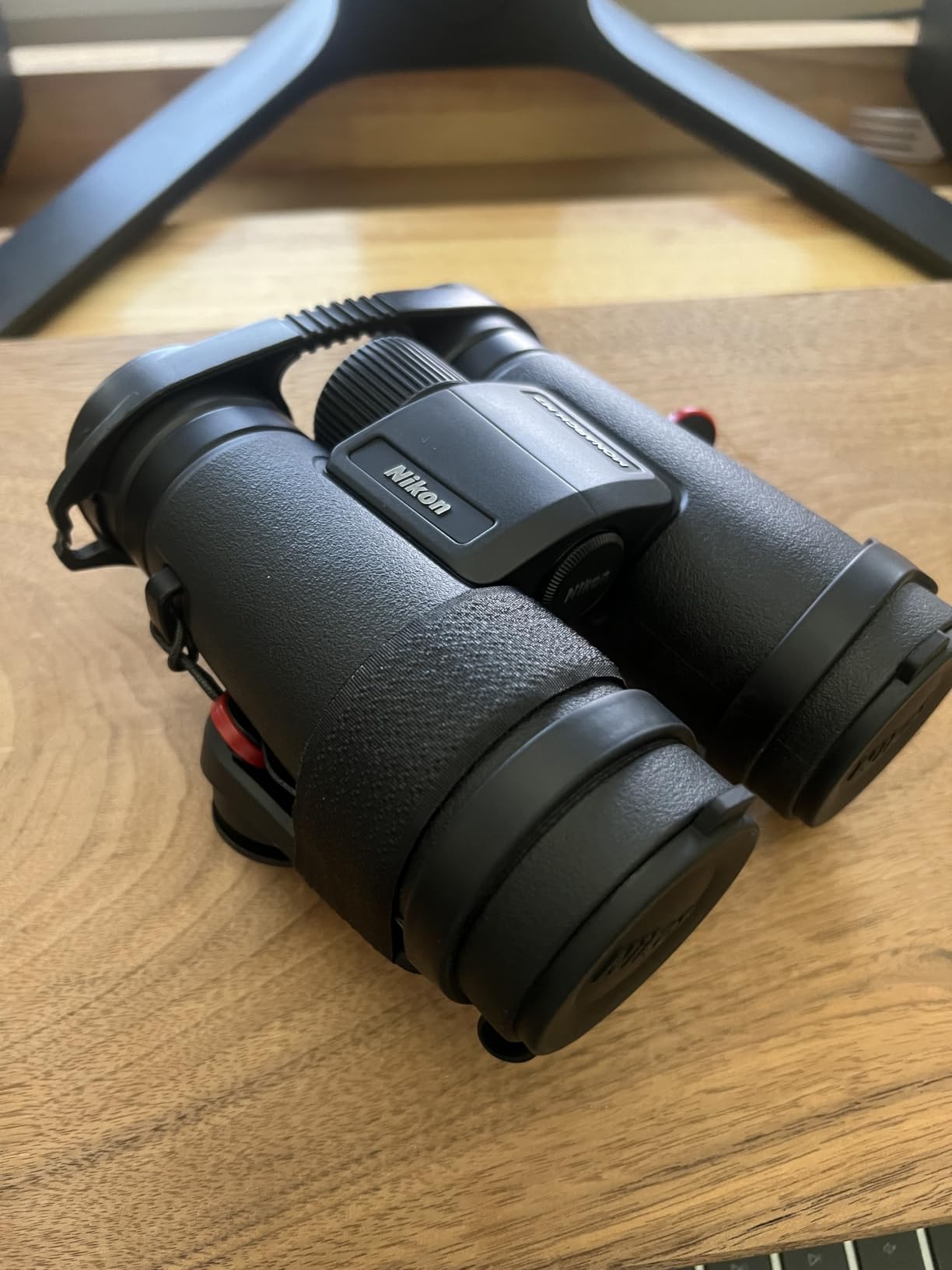
7. Nikon Monarch M7 10×42 – Best for Big Game Glassing
Nikon Monarch M7 10×42 Binoculars | Official Nikon USA Model
- Extra-low dispersion glass with phase-corrected dielectric prisms
- Big-game hunters report clear elk glassing at dawn and dusk
- High-eyepoint turn-and-slide eyecups work with sunglasses
- Locking diopter holds focus between sessions
- Oil and water-repellent coatings resist smudges
- 1.5 lb is a heavy body to carry all day
- Some owners report slight purple fringing on high-contrast sunlit subjects
- Premium over mid-price glass is hard to justify for some
Six hundred yards across a Colorado basin at last light is exactly the job this pair does, and extra-low dispersion glass with multilayer lens coatings and phase-corrected dielectric prisms is the combination that holds contrast in flat, gray, low-contrast light. The 10x magnification gives you the reach to judge a bull rather than just detect movement.
Owners who use this glass for big game report identifying elk clearly at dawn and dusk on actual hunts, and the rubber armor held up through rain and fog in their accounts. The oil- and water-repellent coatings matter more than they sound like, because a smudged objective at dawn is a genuinely dark objective.
The locking diopter is a small feature that changes daily use. Once your focus is set it stays set, so you are not refocusing every time you raise the glass in a tree stand. The high-eyepoint turn-and-slide eyecups give 16.5mm of eye relief and work comfortably even with sunglasses on.
It weighs 1.5 pounds, making it a heavy body for a 10×42, and some owners report a slight purple fringe on high-contrast sunlit subjects. A few also question whether the step up from mid-price glass is worth the money for their own hunting, which is an honest reaction to a premium tier.
Who this pair suits
This suits the serious open-country and big-game hunter who has a specific identification job for their glass and wants ED glass plus a locking diopter. It is the most capable optic here for a job that requires judging an animal rather than finding it.
It also suits anyone who wants one pair that works at dawn, at midday, and at dusk without changing behavior between sessions.
Who should pass on it
Pass if you are on a budget or replacing a perfectly good mid-range pair. Owners comparing it side by side with cheaper glass report differences that are real but modest, and that is a difficult thing to justify for every hunter.
Pass if you hunt on foot. At 1.5 pounds this is a glass for a set position, and the 4.2mm exit pupil limits its low-light ceiling anyway.
8. Bushnell Falcon 10×50 – Best for Spot and Stalk
- 5mm exit pupil from a 50mm objective
- Porro prism with fully coated optics
- InstaFocus lever focuses fast on moving targets
- Over 6500 owner ratings
- Non-slip rubber grip pads hold steady
- 9mm eye relief is very short and hard with glasses
- Loose eyepiece lens caps fall off easily
- InstaFocus lever feels flimsy at full far focus
A 50mm objective at 10x gives a 5mm exit pupil, which sits right at the lower end of what a healthy adult eye can dilate to in darkness, and that means you are feeding your eye nearly everything the objective can collect. The Porro prism with fully coated optics delivers a clear, bright image, and the 4.5 rating across more than six and a half thousand reviews is a large body of real-world data.
The InstaFocus lever is the feature hunters like most. Instead of a fine focus wheel, a single lever snaps the diopter and focus to infinity for fast acquisition of moving targets, and with a 10×50 that is a genuinely useful thing to have when a buck breaks cover.
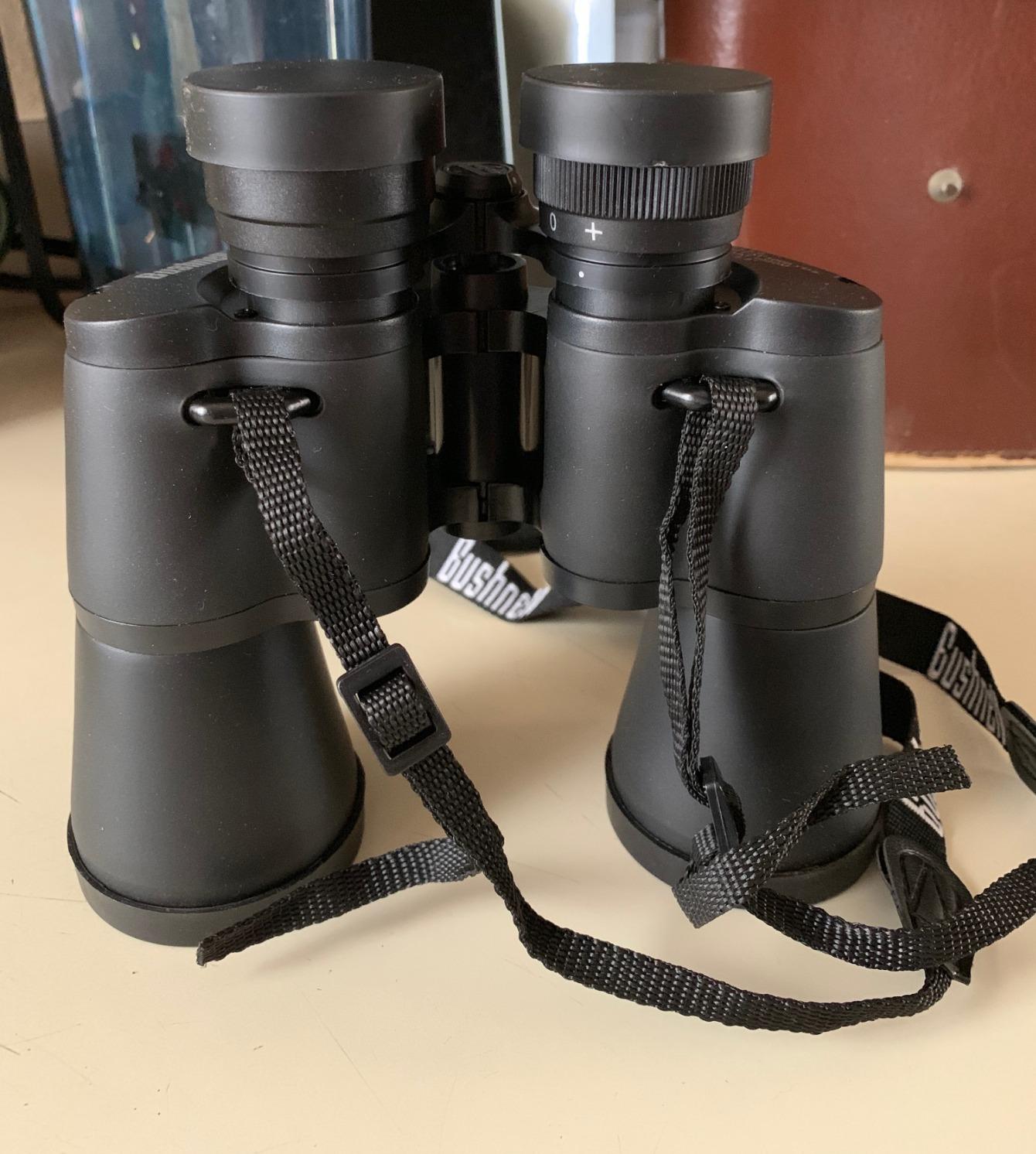
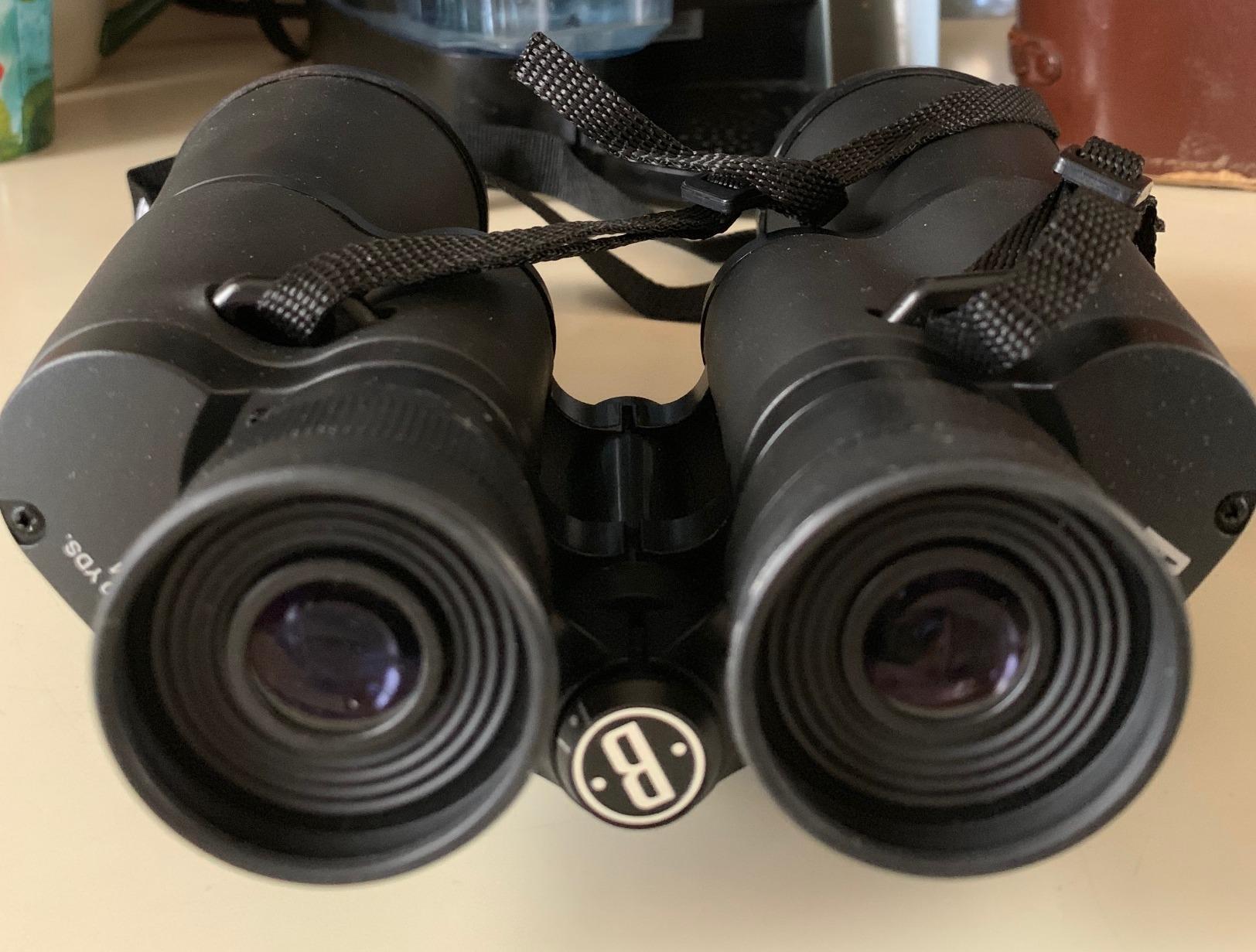
Now the honest list. Eye relief of 9mm is very short, and it is the most common reason people return this pair, because glasses wearers find the eyecup rim cutting into their view. The body is also bulkier than the roof prism models, and at 830 grams it is not a pack-light binocular.
Recurring mechanical gripes are the loose eyepiece lens caps, which fall off easily, and the InstaFocus lever feeling flimsy and crunching when pushed all the way to far focus. Neither is a dealbreaker; both are the kind of detail that ages a pair.
Who this pair suits
This suits a spot-and-stalk or vehicle hunter who wants strong brightness per dollar and already owns or can manage without prescription glasses. At a 5mm exit pupil it is well matched to true last-light work.
It also suits anyone who wants a large, repairable, no-frills binocular with a manufacturer lifetime defect-free warranty behind it.
Who should pass on it
Pass if you wear glasses. Nine millimeters of eye relief is hard to work around, and the fix is usually a different pair, not a different adjustment.
Pass if you want cutting-edge resolution at range. Fully coated rather than fully multi-coated glass gives up a few percent of transmission, and you can see it against the Vortex pairs at long range.
9. Hontry 8×42 – Most Versatile
- 5.2mm exit pupil from a 42mm objective at 8x
- IPX6 housing that floats if dropped in water
- Close focus of roughly 11.5 ft with 318 ft field
- Twist-up eyecups work with eyeglasses
- Low Light Vision coating on UV protected lens
- Edge chromatic aberration and weaker low-light color than premium glass
- 1.6 lb body feels heavy on long walks
- Only a 365-day warranty against lifetime terms from Vortex
- Nikon and Bushnell
Look at the exit pupil before anything else here. A 42mm objective at 8x produces a 5.2mm exit pupil, and the published relative brightness of 28 is a strong figure for a pair at this level, which makes this a capable low-light performer per dollar even though it sits at the cheap end of the list.
The 8x magnification also does something for you that 10x does not: it holds steady. On a sit-and-wait dawn watch, or a slow glassing scan across a hillside, 8x with a 5.2mm exit pupil gives you a bright, stable image where a 10×42 gives you a shakier, dimmer one.
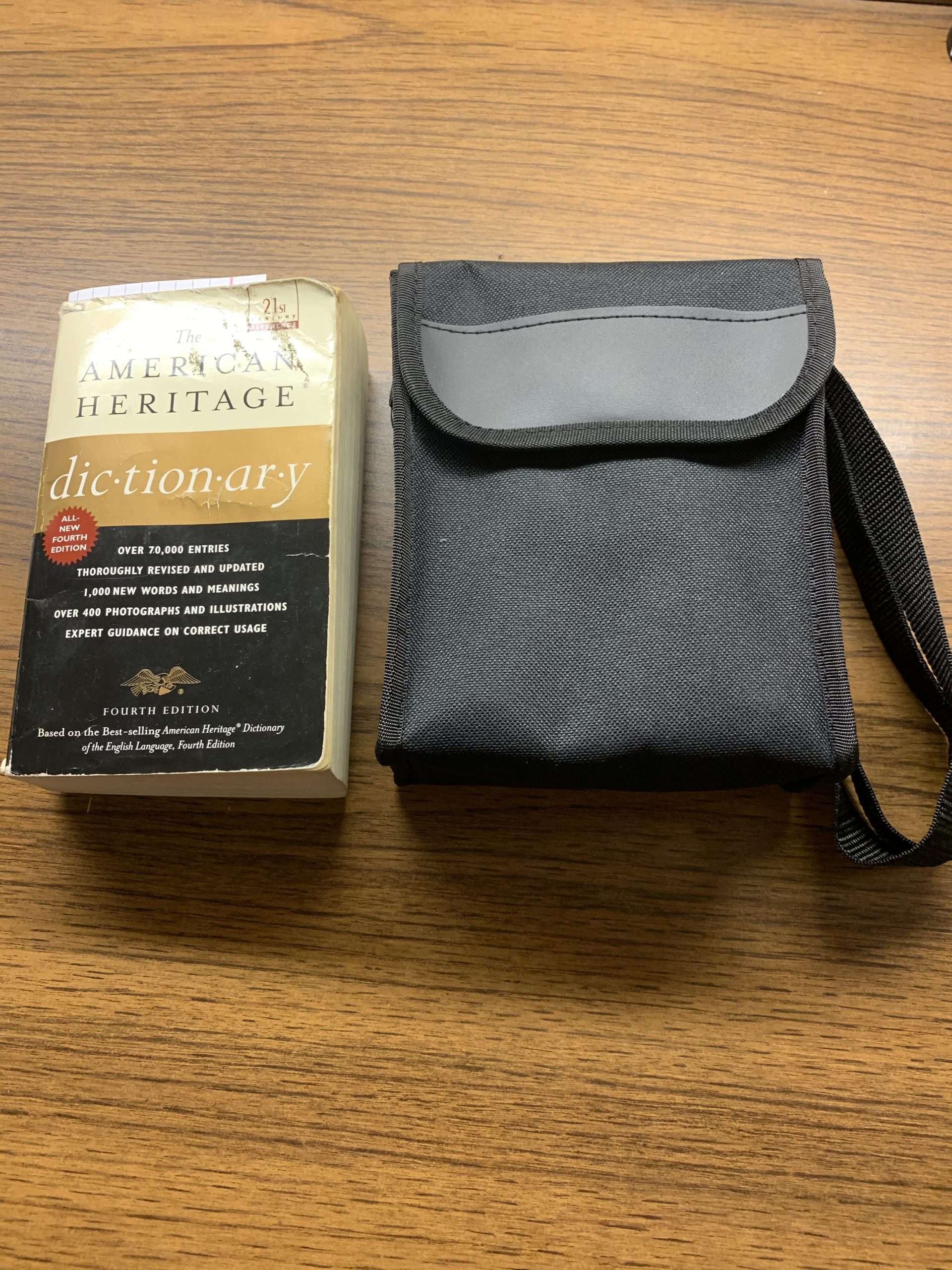
The housing is IPX6 waterproof and floats if you drop it, which matters more than it sounds for waterfowl country and for anyone who has ever fished a tree stand into a creek. The rubber body and twist-up eyecups round out the package, and the included items are a fabric shoulder bag, lens cloth, and cap.
The compromises are real. Reviewers mention edge chromatic aberration and weaker low-light color than premium glass, and at 1.6 pounds this is not the lightweight option it might appear to be. The warranty runs 365 days, which is shorter than the terms most competitors offer.
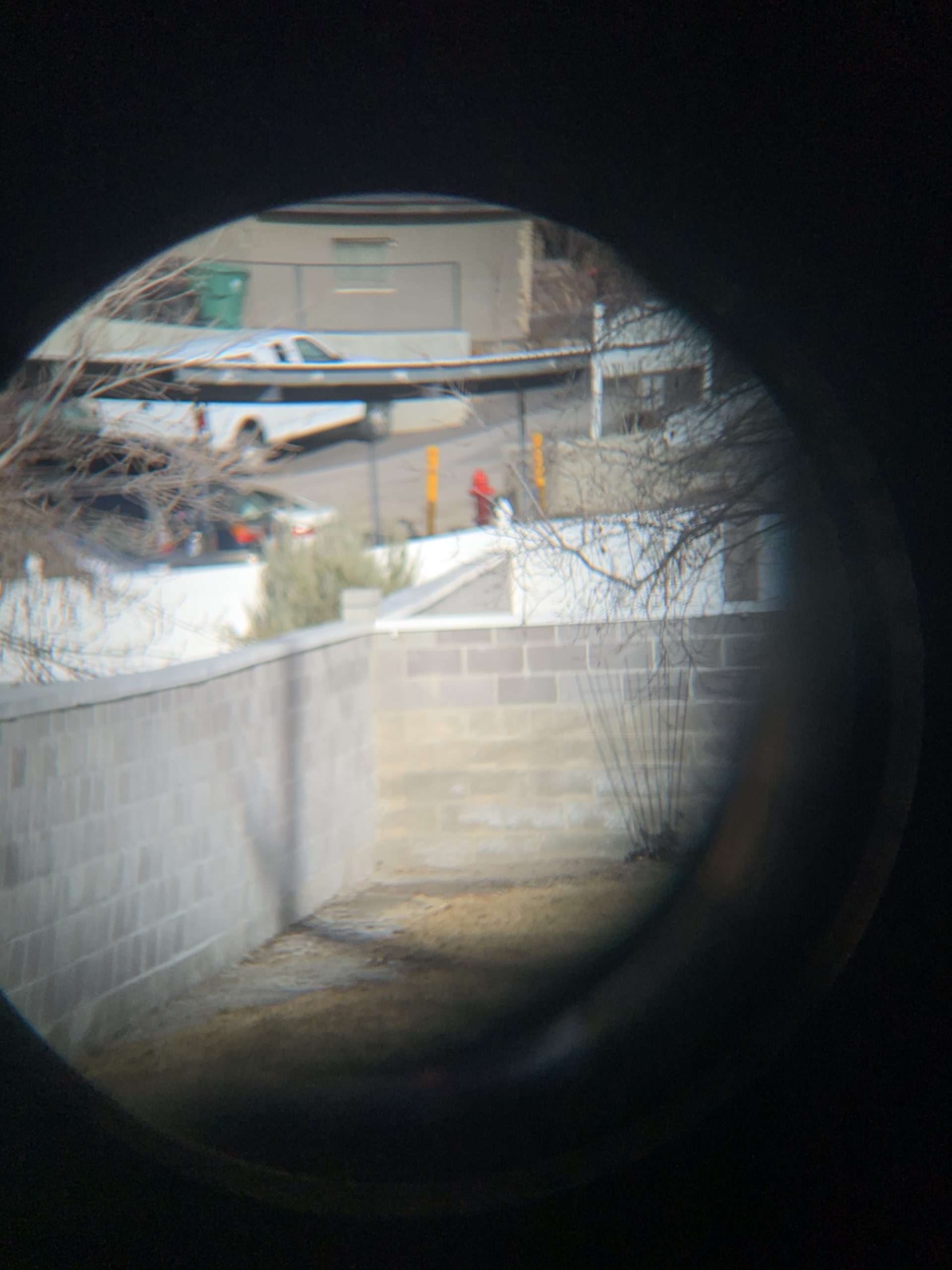
Who this pair suits
This suits a new hunter or a budget-conscious regular who wants a bright exit pupil and steady 8x magnification more than they want brand prestige. The math is genuinely favorable here, and it is hard to find a pair that combines a 5mm-plus exit pupil with 8x steadiness at any price.
It also suits waterfowl and boat hunters thanks to the floating housing and the 11-foot close focus distance.
Who should pass on it
Pass if color fringe bothers you. Reviewers who compare this against ED glass notice it at high-contrast edges, and if you spend your time in bright sun as well as low light, that difference is visible.
Pass if warranty longevity matters to you. A one-year term is the shortest here, in a category where most competitors offer lifetime coverage.
10. Bushnell PowerView 10×42 – Best for Compact Packing
Bushnell PowerView 10×42 Compact Roof Prism Binoculars, Black
- Compact and light enough to live in a day pack
- Telescoping eyecups allow individual focus
- Attached front caps and split eyepiece caps reduce lens loss
- Build has held up over years of owner use
- Soft shell case included
- A few owners report occasional internal blackness
- Progressive lens wearers must find the focus sweet spot
- 10x is underpowered for long-distance glassing
The PowerView 10×42 is the odd one out in this roundup because it is compact, and that is exactly why it is here. It disappears into a pack, rides in a chest pocket, and gives you a full 10×42 configuration when a full-size pair would be dead weight on a walk-in hunt.
The telescoping eyecups let each user dial in individual focus, which is more useful than it sounds when a hunting partner with different vision shares the glass. Owners also praise the attached front lens caps and the split eyepiece caps with strap slits, both of which address the single most common way binoculars get ruined in the field.
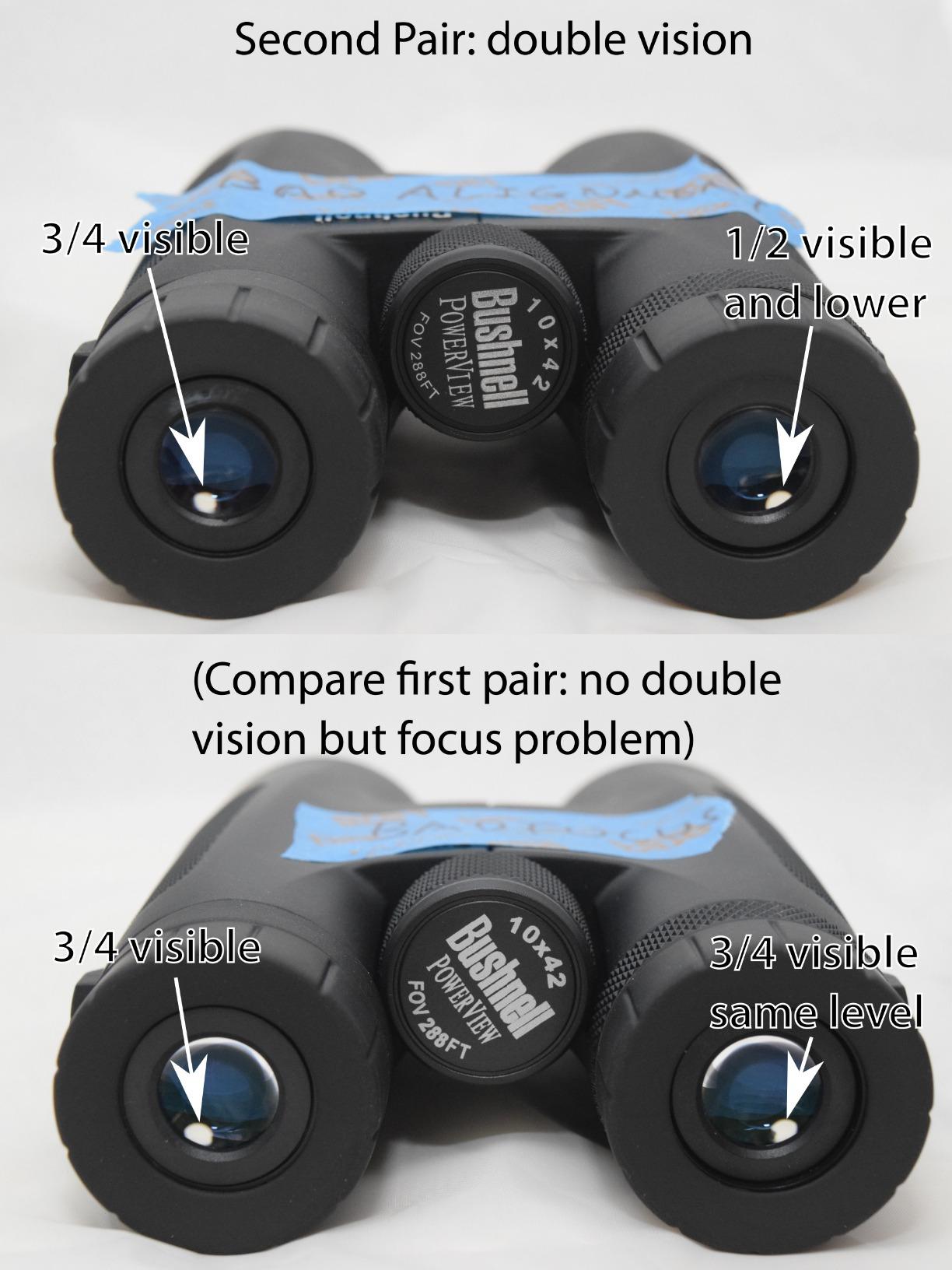
Owner reports describe clear, sharp images for the class, a compact body that is easy to carry, and a build that has survived years of regular use. That last point matters, because a pair that still works after five seasons is worth more than a better pair that lives in a truck.
There are limits. A few owners report occasional internal blackness, progressive lens wearers have to hunt for the right focus position, and 10x is underpowered for the long-distance wildlife viewing some buyers expect. We would not choose it for low light when a full-size pair is an option.
Who this pair suits
This suits walk-in hunters, travelers, and anyone who carries glass as a backup rather than a primary tool. The compact roof prism body disappears into a pack, and the soft shell case keeps it protected in the bottom of one.
It also suits families sharing one pair, since the telescoping eyecups adjust for different eyes.
Who should pass on it
Pass if low light is genuinely the point. This configuration is a general-purpose compact, and the pairs higher on this list exist precisely for the light you are trying to gather.
Pass if you want a warranty to lean on or a highly specific spec sheet, since this listing gives you less published optical detail than the models above it.
8×42 vs 10×42 vs 10×50 vs 8×56: Which Format for Which Terrain
For deer hunting, 8×42 wins. The 5.25mm exit pupil beats the 4.2mm of a 10×42, and 8x produces a steadier image, and that difference matters far more than spec sheets admit when you are scanning treetops for forty minutes.
For open country and mountains, 10x is the right reach, and if you want that power in low light, take it as a 10×50 rather than a 10×42. The 5.0mm exit pupil of a 10×50 beats the 4.2mm of a 10×42 by a wide margin, and a multi-coated 10×50 with BaK-4 prisms like the Celestron in this roundup adds more still.
The 8×56 class remains the brightest configuration in the category, at a 7.0mm exit pupil, and hunters who buy one describe the advantage as obvious in the last fifteen minutes of light and effectively invisible an hour earlier. That is why the format is worth a chest harness for a hunter who sits still.
Skip 12x and above without a tripod. The field of view collapses, hand shake becomes the limiting factor, and the exit pupil drops below the threshold where your eye is being fully fed.
One more format note before you compare numbers. If your dawn glassing is as much about songbirds as deer, the bird watching binocular picks we tested weight close focus and edge-to-edge sharpness differently than the hunting glass here, and the comparison is worth five minutes of your time.
How to Choose: The Low-Light Buyer’s Checklist
1. Start with the exit pupil. Objective divided by magnification. Below 5mm and you lose light before you reach true last light; 5mm and above is the target for a dedicated low-light hunter.
2. Match magnification to terrain. 8x for timber and stands, 10x for open plains and long basins, 12x only with a tripod or a solid rest.
3. Set your weight ceiling first. Above roughly 30 ounces, most hunters who hike more than a couple of miles to their stand take the glass off within a season. Pick the heaviest pair you will actually carry all day.
4. Check eye relief if you wear glasses. 16mm or more. Below 15mm, expect to reposition constantly or to lose the edge of the field.
5. Read the coating description, not the marketing. “Fully multi-coated” means every air-to-glass surface is treated. “Coated” or “multi-coated” alone does not, and the difference shows at last light.
6. Look for ED or HD glass in flat light. Extra-low dispersion elements reduce the softness and color fringing that ordinary glass shows in gray dawn conditions.
7. Confirm weather sealing. Nitrogen purging with O-ring seals, plus an exterior coating that sheds water and oil. Dew and internal fog are a bigger real-world brightness killer than a coatings difference.
8. Read the warranty like a contract. Unlimited and unconditional means the brand replaces the unit. A limited term means paperwork, and a short term means you may well buy twice.
9. Buy the field of view you will actually scan. Around 320 to 370 feet at 1000 yards is the useful range. Below 300 and you will sweep a clearing in pieces.
On budget: spend under 250 and you are buying a proven 10×42 with real coatings and a lifetime warranty, which serves most hunters well. Spend between 250 and 600 and you add ED glass, wider fields of view, and better prism coatings. Above 600 you are buying a few extra minutes of genuine twilight and better edge sharpness, which is real but only matters if you hunt in the final thirty minutes.
On terrain: dense timber and heavy cover favor 8×42 and 8×56 with a wide field. Open plains, ridges, and basins favor 10×50. Waterfowl and boat access favor whatever stays dry.
On weight versus maximum twilight performance: they trade directly against each other. A chest harness lets you carry the brightest glass without wrecking your neck, and a harness is treated as mandatory rather than optional for heavy 8×56-class glass. If you refuse to wear one, buy lighter and accept less light.
Our broader hunting binocular guide covers configurations that are not specifically low-light oriented, and our bird watching binocular picks are useful if your dawn glassing is as much about birds as deer.
Field Tactics: Getting More Out of Any Pair
Brace before you raise the glass. A hunter’s elbow to knee, or the temple of the tree to your shoulder, cuts hand shake dramatically and recovers usable stability that no glass upgrade can buy you.
Use a tripod adapter or a stable rest when glassing from a fixed position. Stabilizing at 10x is the cheapest brightness improvement available.
Scan in a grid rather than randomly. Sweep the full width once, then step up one field-of-view width, then sweep back. You will find deer you walked past the first time.
Clean the objective lenses before every hunt. A film of dust, oil, or fingerprint haze on the front element is a measurable light loss, and a microfiber cloth fixes it in seconds.
Protect dark adaptation. Use a red headlamp rather than white, give your eyes the full twenty minutes to adjust after switching off a bright light, and keep eyecups rolled down so peripheral daylight does not leak in.
What Low-Light Binoculars Cannot Do
Binoculars amplify the light that reaches them. They do not create light, and no amount of glass will let you identify a deer after full dark. If your season requires seeing in genuine darkness, you need thermal or digital night vision, and that is a different tool with a different budget and a different learning curve.
Cold weather and dew are the quiet failure modes. Internal fog from a seal that has aged, or a wet front element at dawn, can cost you more light than any coating difference in this guide. Every pair recommended here is nitrogen purged and O-ring sealed for exactly that reason.
Hand shake is the other limit, and it is not an optical problem. Above 10x, or on a heavy body, no glass compensates for a cold, stiff, gloved hand. Bracing solves it for free.
Frequently Asked Questions
Which is better for deer hunting, 8×42 or 10×42?
The 8×42 is better for deer hunting in most terrain. Its 5.25mm exit pupil delivers noticeably more light than the 4.2mm of a 10×42, and 8x produces a steadier image, which matters during long scans. A 10×42 earns its place in open country where reach matters more than the final minutes of light.
Should I get 8x or 10x binoculars for hunting?
Choose 8x if you hunt timber, hike to your stand, or are over forty-five and want a brighter image. Choose 10x if you glass open plains, ridges, and long basins from a fixed position. Most hunters who can only carry one pair want 8×42, because brightness and stability beat reach for the majority of seasons.
What makes a binocular good in low light for hunting?
Three things matter most: an exit pupil of 5mm or larger, fully multi-coated extra-low dispersion glass, and phase-corrected or dielectric-coated prisms on a BaK-4 body. Below 5mm of exit pupil the image dims before you reach true last light, and uncoated surfaces lose a large share of the light that enters the objective.
Are 8×56 binoculars worth it for hunting?
Yes for a sit-and-wait hunter chasing the last legal minutes, because a 7mm exit pupil is the brightest in the category. No for hikers, who usually abandon the weight, or for hunters over forty-five whose pupils no longer dilate fully. Any glass above roughly 30 ounces also needs a chest harness to stay comfortable.
What is the main difference between Diamondback and Diamondback HD binoculars?
The HD version uses higher-durability fully multi-coated HD glass elements with better edge correction and higher light transmission, which shows as less color fringing and a cleaner image in low light. The standard model uses conventional glass with fewer special elements. Warranty terms are effectively the same, both carrying the unlimited unconditional lifetime policy.
Do lens coatings really make a difference in low light?
Yes, measurably. Light crosses ten to sixteen air-to-glass surfaces on its way to your eye and loses roughly four percent at every uncoated boundary. Fully multi-coated premium optics push transmission into the high 80s and low 90s as a percentage, and that gap is visible in the last thirty minutes of legal light.
Will low light binoculars let me see deer at night?
No. Binoculars only gather ambient light, so they run out at true darkness. For seeing in full darkness you need thermal or digital night vision, which is a different tool with a different budget. Well-chosen low-light glass is built for the dawn and dusk windows, and it is extremely good inside them.
Final Pick: One Recommendation for Most Hunters
After a full season of dawn sits and dusk waits, the Vortex Diamondback HD 10×42 is the pair we recommend to most people shopping for the best binoculars for hunting in low light in 2026. It has real HD glass, fully multi-coated lenses with dielectric phase-correcting coatings, argon purging, and an unlimited lifetime warranty that does not ask for receipts.
If your season is defined by legal last light, buy more objective instead. The Celestron Outland X 10×50 gives you a 4.8mm exit pupil and 17.4mm of eye relief. If you wear glasses and walk a long way, the Bushnell Engage X at 620 grams solves both problems. And if you are on a strict budget, the Hontry 8×42 gives you a 5.2mm exit pupil on 8x magnification, which no other pair in this roundup matches.
Read the exit pupil number first, set your weight ceiling second, and buy from a brand that will replace what it sold you. Everything else in the spec sheet is detail.