
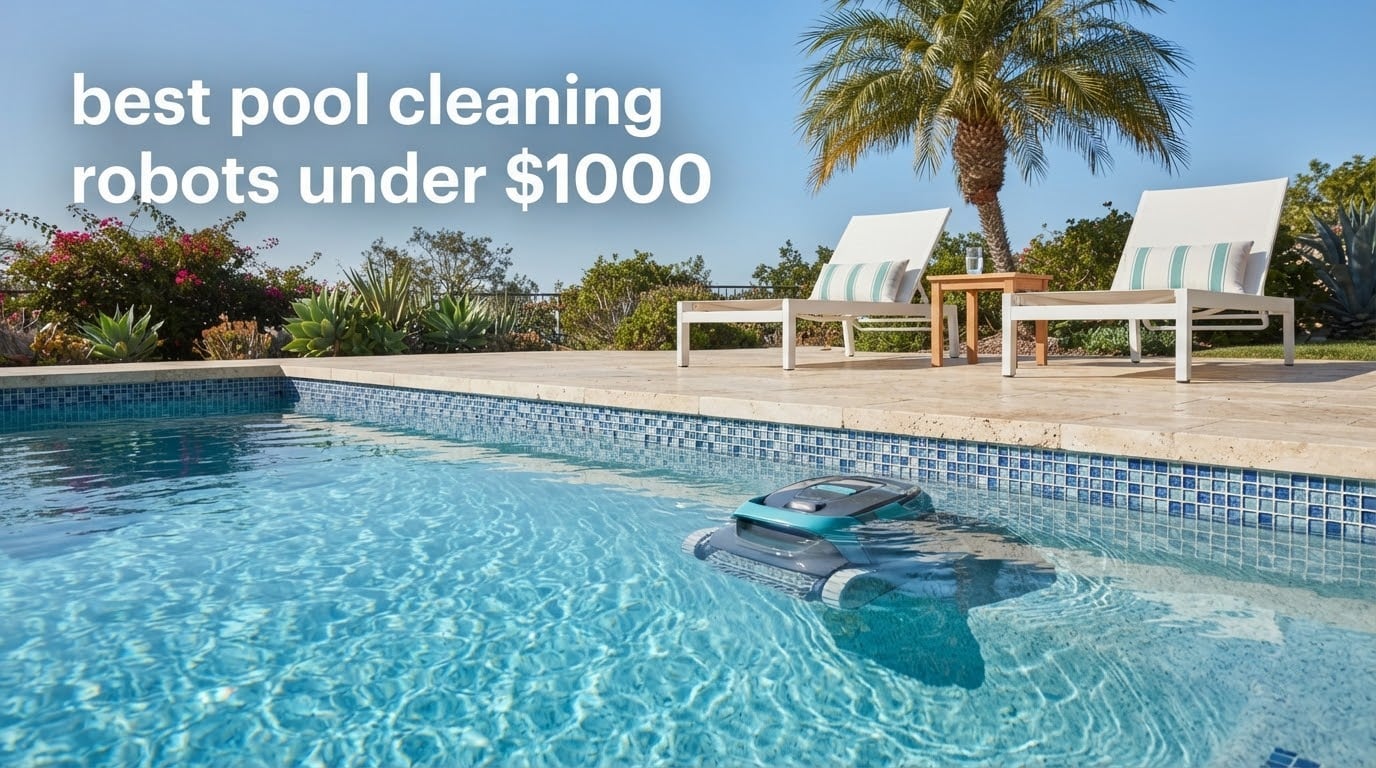
The best pool cleaning robots under a thousand dollars are the Dolphin Nautilus CC Plus for overall coverage, the Betta SE Plus for fine surface debris, and the AIPER EcoSurfer S2 for app-controlled skimming. Below that ceiling you can finally get continuous suction power, real navigation and fine filtration instead of a floor-only novelty.
That matters because the jump between a cheap battery toy and a genuine labor saver happens somewhere around this price band. Under it you are usually buying a robot that wanders, misses corners and dies mid-cycle. In it, you start finding dual 24V motors, gyroscope path planning and multi-layer filter baskets rated in microns rather than vague “fine mesh”.
We spent weeks reading owner feedback and comparing spec sheets across all ten machines listed here, because the differences that matter at this budget are not obvious from a product photo. Runtime claims, real filtration ratings and how a unit behaves in a deep end decide whether the robot becomes a weekly habit or a garage ornament. If you also need the manual gear for waterline brushing and skimmer baskets, our pool cleaning kit roundup covers the hand tools that still earn their keep alongside a robot.
Table of Contents
Top 3 Picks for the Best Pool Cleaning Robots Under a Thousand Dollars


The Nautilus CC Plus takes the top spot because it carries the largest verified ownership base in this group on a full floor-and-wall corded design. The Betta SE Plus is the value pick because solar power removes both the cord and the daily recharge from the equation for surface debris. The EcoSurfer S2 takes the budget slot for buyers who want phone-based scheduling and a built-in chlorine tablet dispenser in a surface skimmer.
At a Glance: Best Robotic Pool Cleaners Under a Thousand Dollars in 2026
| Product | Specifications | Action |
|---|---|---|
| Dolphin Nautilus CC Plus |
|
Check Latest Price |
| Betta SE Plus Solar Skimmer |
|
Check Latest Price |
| AIPER EcoSurfer S2 |
|
Check Latest Price |
 Dolphin Escape Dolphin Escape |
|
Check Latest Price |
 WYBOT C1 Cordless WYBOT C1 Cordless |
|
Check Latest Price |
 AIPER Scuba V3 AI Vision AIPER Scuba V3 AI Vision |
|
Check Latest Price |
 WYBOT C2 Cordless WYBOT C2 Cordless |
|
Check Latest Price |
 Beatbot Sora 30 Beatbot Sora 30 |
|
Check Latest Price |
 WYBOT B1 Cordless WYBOT B1 Cordless |
|
Check Latest Price |
 BOTLIFE PC10 Cordless BOTLIFE PC10 Cordless |
|
Check Latest Price |
Two of these ten are surface skimmers rather than floor robots, and the table lists them as surface only so you do not buy one expecting it to scrub a floor. The remaining eight all clean the bottom of the pool, with wall and waterline coverage varying by model.
1. Dolphin Nautilus CC Plus – The Best Overall Corded Pool Robot Under a Thousand Dollars
- Wall scrubbing on any pool surface
- Active scrubbing brush clears stubborn debris
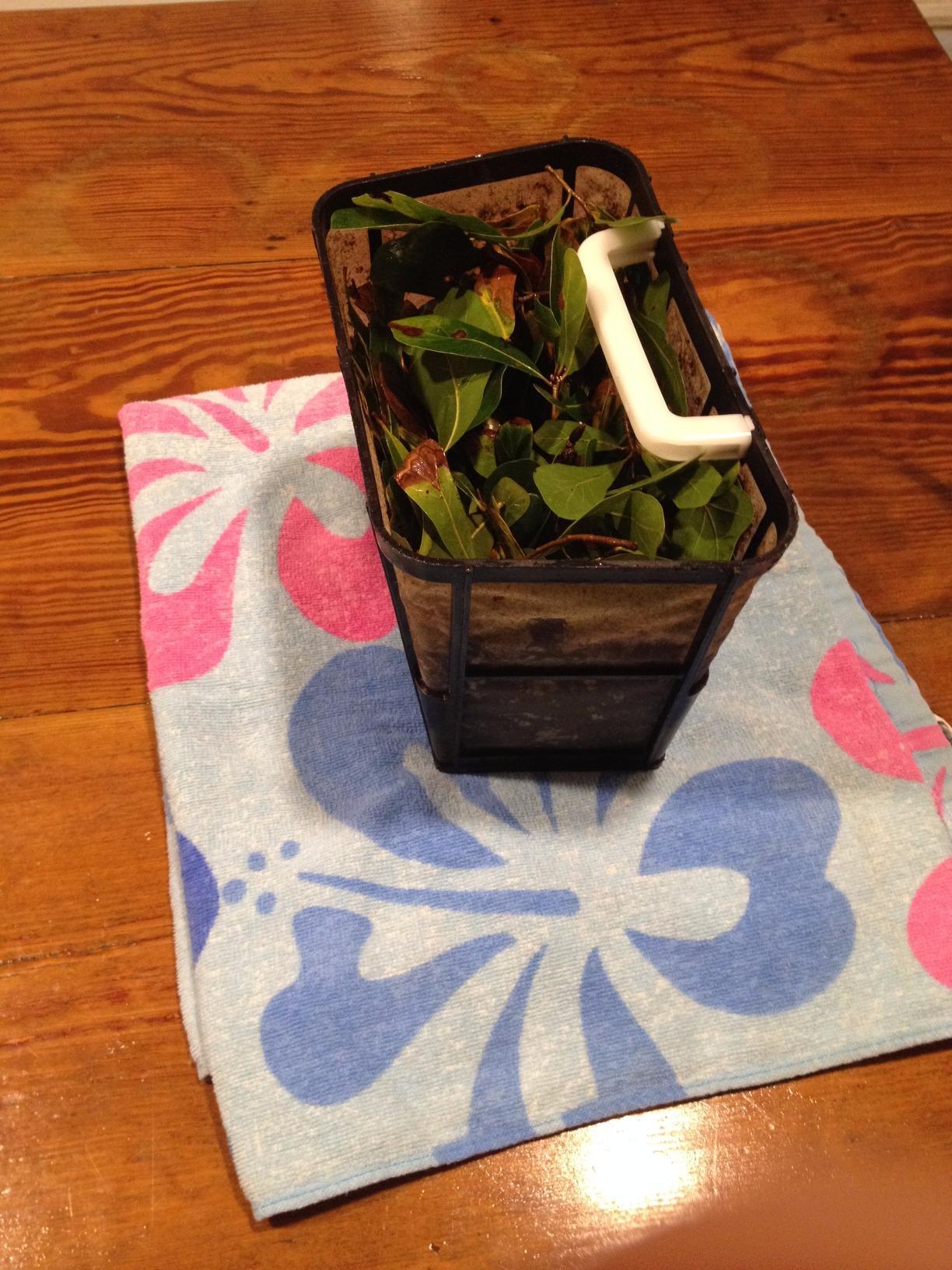
- Top-load filter lifts out for a fast rinse
- Plug-and-play and finishes a pool in about two hours
- Cord has to reach an outlet
- Filter needs rinsing after every cycle
Our pick for the best robotic pool cleaner under a thousand dollars is the Nautilus CC Plus, and the number behind it is 13969 reviews averaging 4.3 stars. That is by far the largest verified ownership base in this group, which matters more than any spec line. A robot design that has been through six seasons of leaf loads and sand cycles tells you something a new model with better marketing copy does not.
Weighing 9.45 kg and measuring 22.2 inches long by 17.6 wide, it is a compact corded unit with dual drive motors that climb the pool wall and work along the waterline with an active scrubbing brush. Owners across the reviews single out the same three things: wall climbing that works on their surface, a filter basket you can lift straight out of the top, and navigation that covers an in-ground pool in roughly two hours.
The one design decision owners consistently push back on is the cord. If your outlet sits on the far side of the deck, the cable has to cross the walkway, and reviewers describe routing it around lounge furniture or along a fence line to keep it out of foot traffic. A swivel at the cord exit helps with tangling, but you still have to plan the run before every cycle.
Filter maintenance is the other recurring theme, and it is not a fault. The basket lifts out from the top for a quick hose rinse, but sand and pollen still need attention every few cycles or suction drops noticeably. Buyers who set a routine of rinsing after each run report the machine keeps working at full strength for seasons; buyers who ignore it report a gradual loss of power that looks like a failing motor.

What the Nautilus CC Plus does well in the deep end
The wall-climbing behaviour is what separates this from floor-only budget machines, and reviewers with deep ends describe it as reliable rather than occasional. The active brush stays in contact with the wall as the unit tracks upward, which pulls waterline debris into the basket instead of pushing it around. In a pool with a genuine deep end, that means fewer manual passes with a pole.
Navigation is deliberately simple. It drives patterns from the power supply and covers an in-ground pool up to 40 feet in length, which comfortably covers most residential rectangles and many L-shapes. On freeform pools, a few deep corners can survive a single cycle, which is normal for a robot without mapping at this level.
Where the Nautilus CC Plus falls short
There is no app, no schedule and no way to start it remotely. If your goal is to have the pool cleaned while you are at work three days a week, you still have to press a button on the unit itself. Buyers chasing hands-off automation should look at the cordless models with app scheduling further down this list, with the understanding that those trade suction consistency for convenience.
The product listing also notes the warranty as limited, and Maytronics support is easier to reach than most of the brands here. Cord length is the practical limit for larger freeform pools where the transformer sits at one end only.
2. Betta SE Plus – The Best Value for Pollen and Fine Surface Debris
- Solar panel keeps it running 30+ hours
- 200 um basket catches pollen that nets miss
- Twin salt chlorine tolerant motors suit saltwater pools
- Remote control retrieves it without entering the water
- Shallow water safeguard handles steps and ledges
- Surface skimmer only
- no floor or wall cleaning
- Can snag on a bottom cleaner's cord
- Will not clean tight against the pool edge
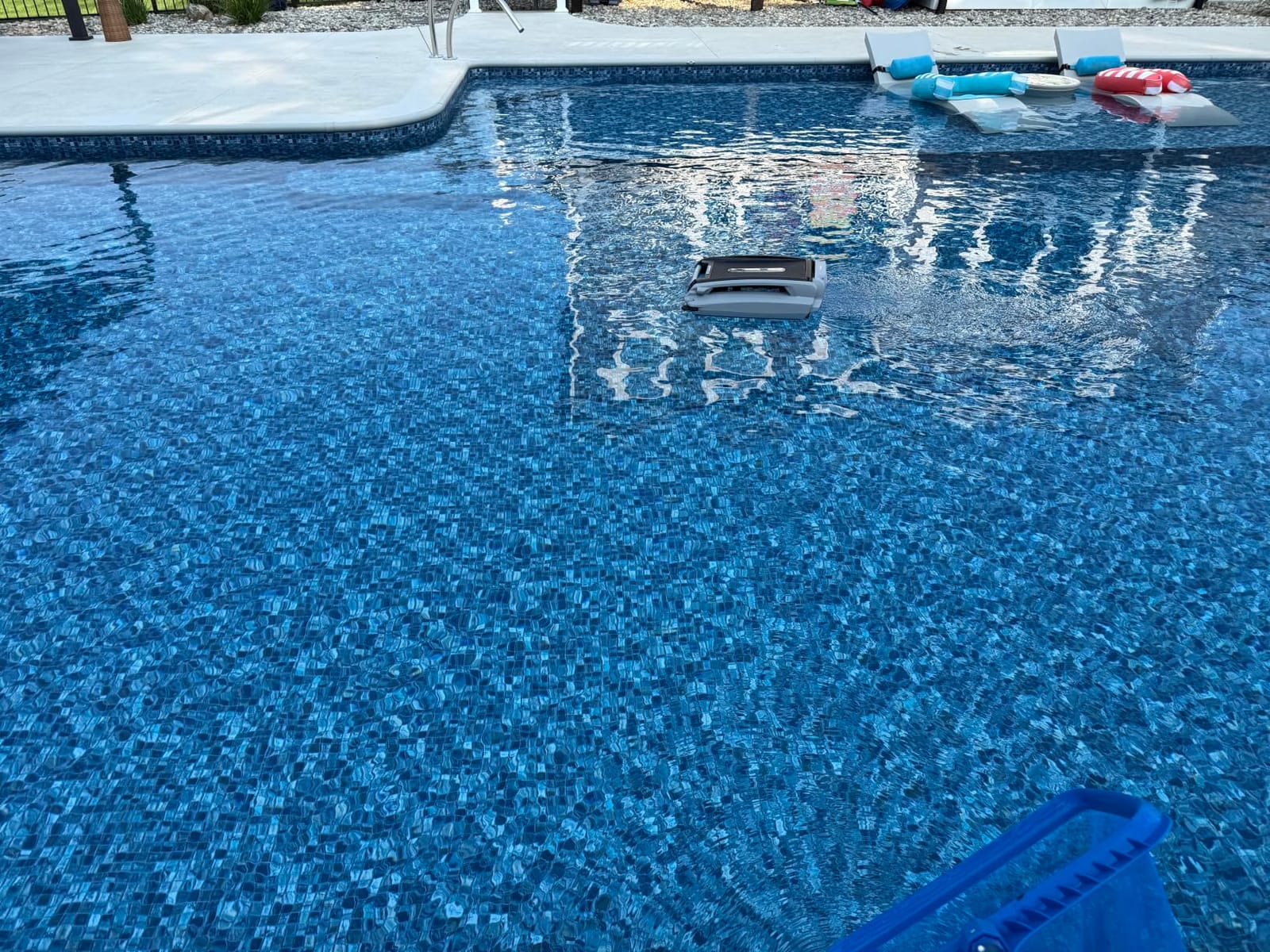
The Betta SE Plus is not a floor robot and never claims to be, which is exactly why it earns the second slot. It is a solar-powered surface skimmer, and for pools that collect pollen, dust and floating leaves it does a job no floor robot handles well.
At 4.5 stars across 3030 reviews with 80% five-star ratings, owner satisfaction on that narrow job is high.
The solar panel is the headline. A 32.56 watt-hour lithium-ion pack with four cells charges in about 5 hours under direct sun and 3.5 hours through the adapter, and owners report 30+ hours of continuous running. Many reviewers describe a full season without touching the backup adapter, and one owner in year three reports the panels and batteries still performing.
The 200 micron fine-mesh debris basket is the second reason to like it. That rating is fine enough to hold pollen and small floating particles that a standard skimmer net pushes back into the water, and reviewers on tree-heavy yards say the basket is the difference between clear water and a permanently hazy surface. Ultrasonic radar obstacle detection helps it steer around steps and ledges in the shallow end.
Two twin salt chlorine tolerant motors handle saltwater pools without the corrosion problems that end cheaper electronics early. The whole unit weighs 6.8 kg and measures 22 by 18.5 by 8 inches, so it is easy to lift out with the included handle.
Why pool owners pair a skimmer with a floor robot
Reviews on this product make the case clearly: a surface skimmer handles what a floor robot structurally cannot reach. Floating debris that never settles stays suspended and gets pumped back into circulation, so pairing a surface unit with a floor model is the arrangement most owners settle on. If you run both at the same time, sequence them rather than overlapping them.
The remote control is a practical feature at this level. You can call the unit to the side for basket emptying without climbing a ladder, and change modes from the deck, which matters for elderly owners and anyone with a back issue.
Where the Betta SE Plus causes friction
Owners report it snagging on the pool skimmer opening and, more often, on the cord of a bottom cleaner running at the same time. If you plan to run a floor robot alongside it, stagger the cycles rather than running both unattended at once.
It also will not clean tight against the pool edge or into corners, so you will still touch up the perimeter occasionally. A full basket of heavy debris such as pine needles can overload the unit until you empty it, and reviewers note the sharp edges around the lid are worth handling carefully when you reach in.
3. AIPER EcoSurfer S2 – The Most Versatile for App-Controlled Skimming
AIPER EcoSurfer S2 Solar Pool Skimmer Robot 24/7 Continuous Cleaning, Gray
- Solar charging with DC adapter backup gives up to 35 hours runtime
- App control with remote steering and custom schedules
- 150 micron filtration with anti-leak design
- Four retractable anti-stranding columns on steps
- Built-in adjustable chlorine dispenser
- Surface skimmer only
- App connection needed for full features
- Heavier than comparable solar skimmers
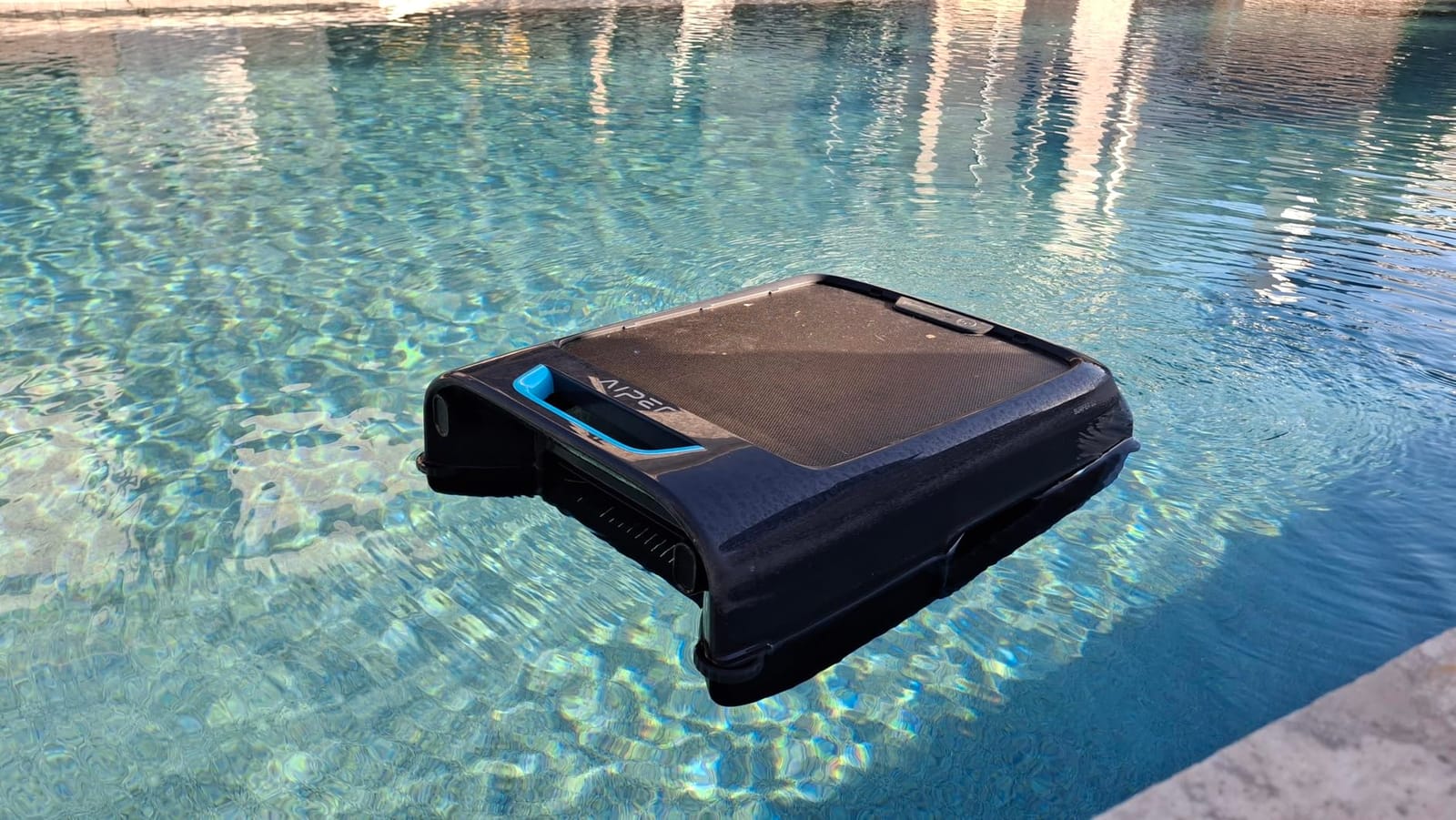
Where the Betta uses a handheld remote, the EcoSurfer S2 puts the controls in your phone. App support covers remote steering, scheduling and cleaning history, with OTA firmware updates on top. At 4.4 stars from 2342 reviews and 74% five-star ratings, it is the most capable surface skimmer in this group, and the app is the single feature buyers single out.
Power comes from a 56.16 watt-hour lithium-ion pack across six cells at 10.8 volts, running up to 35 hours on solar with a DC adapter as backup. Filtration is 150 micron with a DebrisGuard anti-leak design, so fine particles stay in the 4-litre basket rather than tracking back into the water.
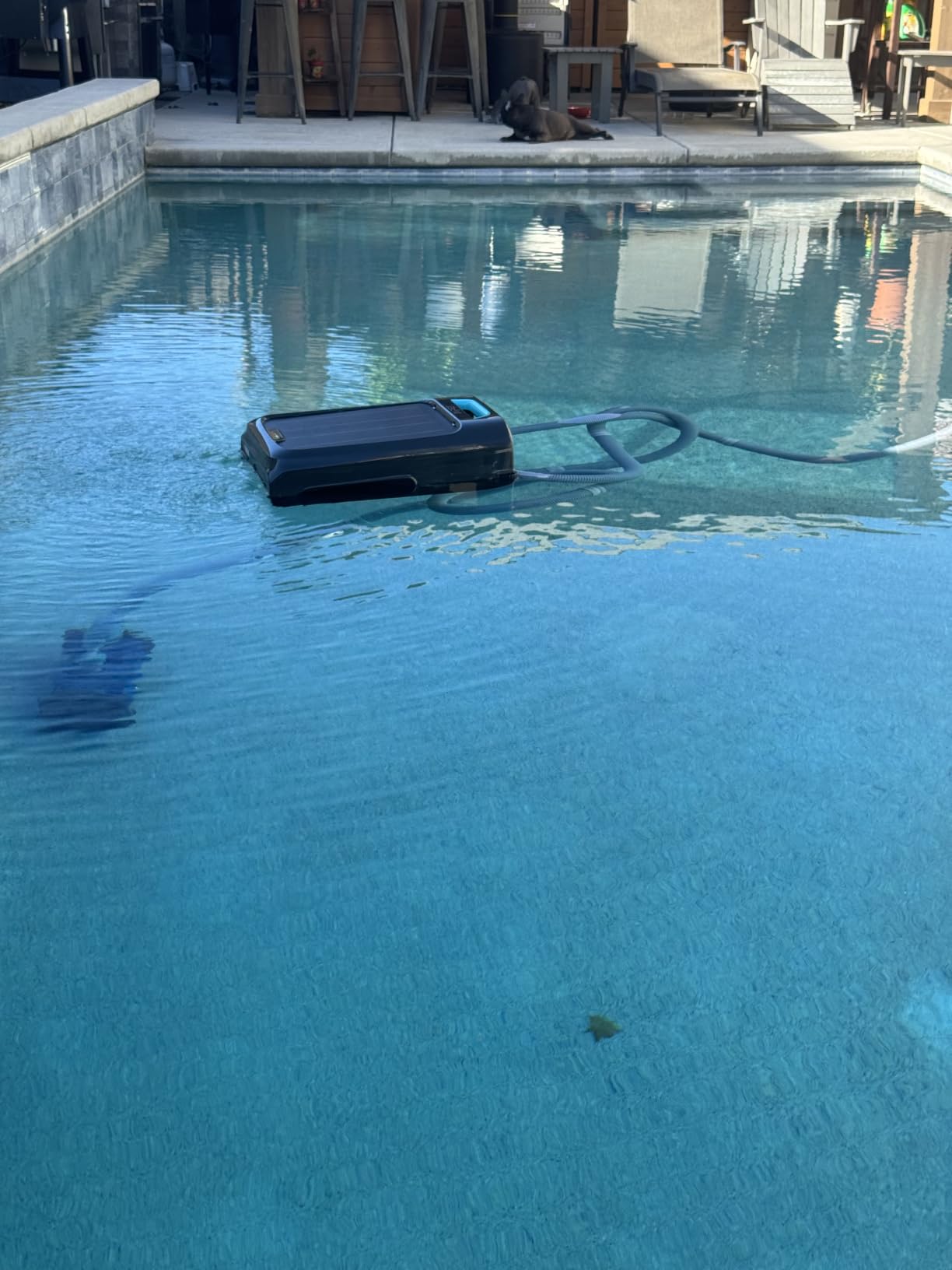
Two details separate it from simpler skimmers. An adjustable chlorine dispenser accepts a 3-inch diameter, 1-inch thickness chlorine tablet, so the unit does double duty as a surface cleaner and a light chemical dispenser while it works. Four retractable anti-stranding columns extend to help it escape pool steps, a specific frustration among owners of cheaper solar skimmers.
Dual sensors drive smart obstacle avoidance, and a dedicated edge and corner cleaning mode targets the perimeter where floating debris collects. Installation type is listed as robotic, meaning you drop it in the water rather than plumbing anything to a wall.
What scheduling actually does for a skimmer
Because this is a solar surface unit, scheduling it means something different from a floor robot’s program. The app lets you set it to run while nobody is home, so floating debris gets pulled to the basket before guests arrive rather than after. Reviews also value the cleaning history view for spotting which days produced the heaviest loads.
The chlorine dispenser is the sleeper feature for pools that sit without a full-time service. Owners on lighter maintenance routines say it keeps surface water steadier between manual additions, though it is a supplement rather than a replacement for proper chemical management.
Where the EcoSurfer S2 falls short
Same limitation as the Betta: surface only. It does not touch the floor or the walls, so it cannot replace a floor robot in any pool where settled debris is the main problem.
Full feature access depends on the app connection, and app reliability is a common complaint across budget pool electronics. At 12.6 pounds it is also noticeably heavier than comparable solar skimmers, which makes lifting it onto the deck less pleasant for older owners.
4. Dolphin Escape – The Best Corded Choice for Vinyl and Fiberglass Pools
Dolphin Escape Robotic Pool Cleaner (2026 Model) — Massive Top-Loading Filter, Dual Motors, HyperBrush, HyperGrip Tracks, Smart Navigation — for Above Ground & In-Ground Pools up to 33ft
- Oversized cartridge holds up to 60% more debris
- HyperBrush lifts algae and stubborn grime
- HyperGrip tracks hold traction on uneven floors
- SmartNav 2.0 plans efficient routes
- Light 14 lb body releases water quickly for cleaning
- Corded design needs routing power to the pool
- Filter cartridge needs regular rinsing
The Dolphin Escape is the other Maytronics machine here, and it is the one most often recommended for vinyl liner and fiberglass pools. It shares the corded architecture of the Nautilus CC Plus but swaps the bag-style handling for an oversized top-loading debris cartridge, dual 24V DC motors at 4000+ GPH, and a full two year quality assurance warranty.
At 14 lbs it is one of the lighter corded robots, which makes lifting it out of a shallow end simple, and the listing notes a quick water release for cleaning. HyperGrip continuous tracks replace conventional wheels, and reviewers say the tracks leave other cleaners in their wake on uneven surfaces and main drain covers.
The cartridge is the piece owners write about most. It holds up to 60% more debris than a standard filter bag, which in practice means fewer mid-cycle breaks in a pool with sand or fine dust. HyperBrush scrubbing pulls algae and stubborn contaminants off surfaces rather than only vacuuming loose debris.
SmartNav 2.0 robotic scanning software picks efficient routes around obstacles, and with dual 24V motors it suits above ground and in-ground pools up to 33 feet. Dimensions are 22.2 by 17.6 by 12.8 inches, the same footprint as the Nautilus CC Plus.
Why track drive matters on liner and fiberglass
Vinyl liner and fiberglass floors are the two surfaces where a wheeled robot most often loses grip. A seam, a main drain ring or a shallow slope can leave conventional wheels spinning, and the HyperGrip continuous tracks keep contact across those transitions. Reviewers with vinyl pools mention the track drive as the reason the unit keeps making progress across the whole floor.
For pools with a deep end, 4000+ GPH filtration and dual motors provide the suction to move heavier sand and silt rather than just floating dust, and the top-loading cartridge means you are not reaching into a sealed bag to see what it collected.
Where the Dolphin Escape disappoints
The 4.2 average with 11% one-star ratings reflects a durable workhorse rather than a flawless one. Owners report the unit missing some deep corners and struggling on steep transitions between shallow and deep sections, particularly on freeform shapes.
Like any corded model, you need a reachable outlet, and the cartridge needs regular rinsing to keep suction at full strength. If your pool is larger than 33 feet or has a complex floor plan, the coverage shortfall becomes the deciding factor.
5. WYBOT C1 – The Best Cordless Robot for Steep Pool Walls
WYBOT C1 Cordless Robotic Pool Vacuum for Inground Pools, Professional
- 4-in-1 cleaning of floor walls waterline and steps
- Triple-motor system climbs 45 degree slopes
- Gyroscope navigation with N-path and S-path patterns
- App control with scheduling and OTA updates
- Real runtime closer to two hours than the claim
- App pairing requires lifting the unit from the water
- Can get stuck or flip on ledges
The WYBOT C1 is the cordless option with the strongest climbing claim in this group, and that is what earns it a place despite a joint-lowest average rating here at 4.0 stars from 1024 reviews. A triple-motor system handles slopes up to 45 degrees, the steepest figure claimed by any unit in this roundup and the difference between working a waterline and stalling at the bottom of it.
Navigation is gyroscope-based, with N-path and S-path cleaning patterns selected for different areas of the pool. A high-precision gyroscope plus path planning is a sensible pairing: the gyro knows which way is up, and the pattern tells it where to go. The listing states coverage for in-ground pools up to 1618 square feet at depths to 9.86 feet.
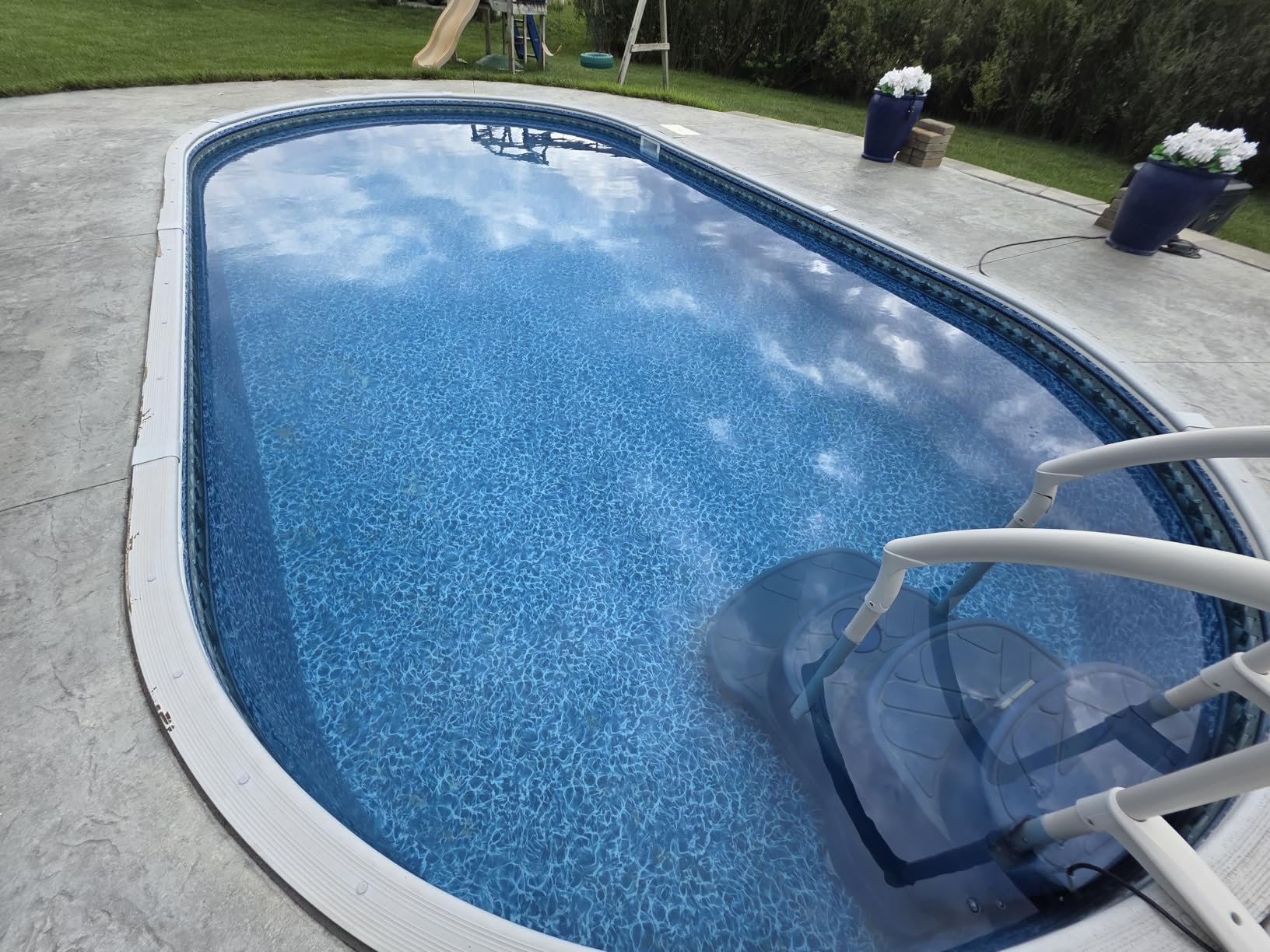
Battery figures are quoted at 99.34 watt-hours with up to 160 minutes of runtime on a 4-hour charge. Owners are candid that real runtime tends toward two to two and a half hours depending on how much wall work the cycle includes, which is normal for a cordless unit but worth planning around. App control adds scheduling plus over-the-air firmware updates.
The unit measures 17 by 13 by 18 inches and comes with a two year limited manufacturer warranty, which is more support commitment than several cordless machines here offer.
Where the 45 degree climbing claim earns its keep
Wall climbing is a recurring reason buyers upgrade or return a cordless robot, and the C1 addresses it with three motors rather than one. Reviewers note it holds to the wall on transition slopes and works the waterline without repeated stalls, which is where most budget cordless machines lose a third of their runtime going round in circles.
The 4-in-1 coverage claim matters too. Floor, walls, waterline and steps are all in scope, so a pool with a raised platform or a Caribbean-style shelf gets treated as one cleaning job rather than two.
Where the WYBOT C1 falls short
Connection and retrieval are the weak points. The unit has to be lifted out of the water to pair with the phone over Wi-Fi or Bluetooth, and a proprietary power connector replaces a standard plug, which is an inconvenience if the charger goes missing. Some owners report battery charging failures within a year and slow warranty response afterwards.
Caribbean-style shelves and ledges are also named as a sticking point, with reports of the robot getting stuck or flipping over on them. The debris basket also draws complaints for feeling flimsy and for an awkward latch while the cord is connected.
6. AIPER Scuba V3 AI Vision – The Best Cordless Robot for Fine Sand and Dust
- MicroMesh 180 um plus 3 um layer traps fine sand and dust
- 8.2 kg body is easy to lift from the water
- Wireless dock needs no drying or exposed connectors
- Two year product care with 20 global service centers
- TUV certified on-device data privacy
- AI mode can skip obvious debris
- Cannot be stopped or mode-changed while submerged
- MicroMesh filter and treads are consumable parts
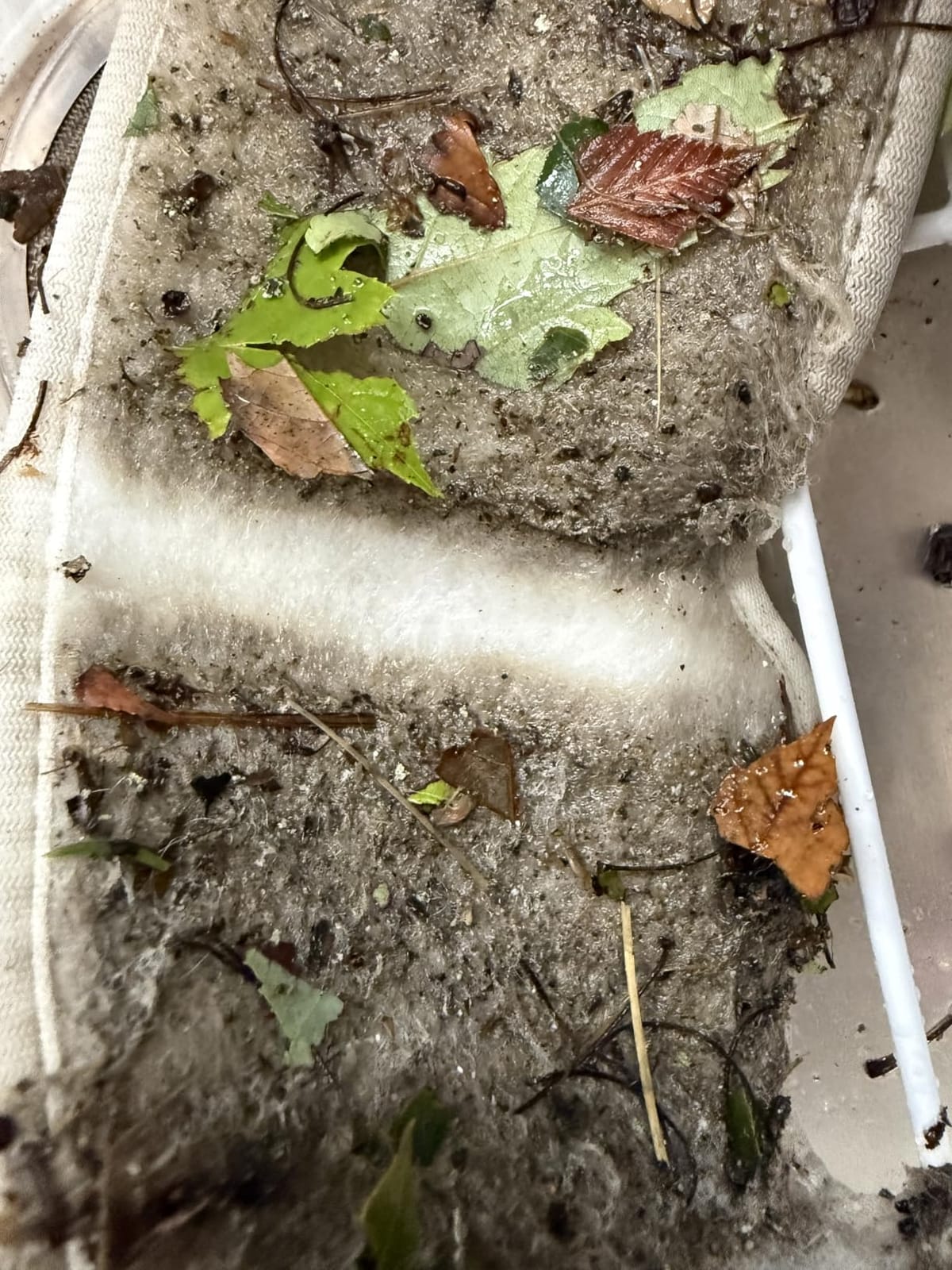
Filtration is the reason this robot is different, and it is the reason to look past the AI branding. The MicroMesh system layers a 180 micron filter with a 3 micron ultra-fine layer, which is the finest figure in this roundup. For pools that pick up fine sand, dust or pollen, that extra layer is what separates a clear bottom from permanently cloudy water.
At 8.2 kg it is lighter than the other cordless floor robots here, and reviewers who struggle with heavier models call that out as a real quality of life improvement when lifting from a shallow end. A 149.76 watt-hour lithium-ion pack of 16 cells, roughly 10400mAh, runs up to 180 minutes after a 4 to 5 hour charge.
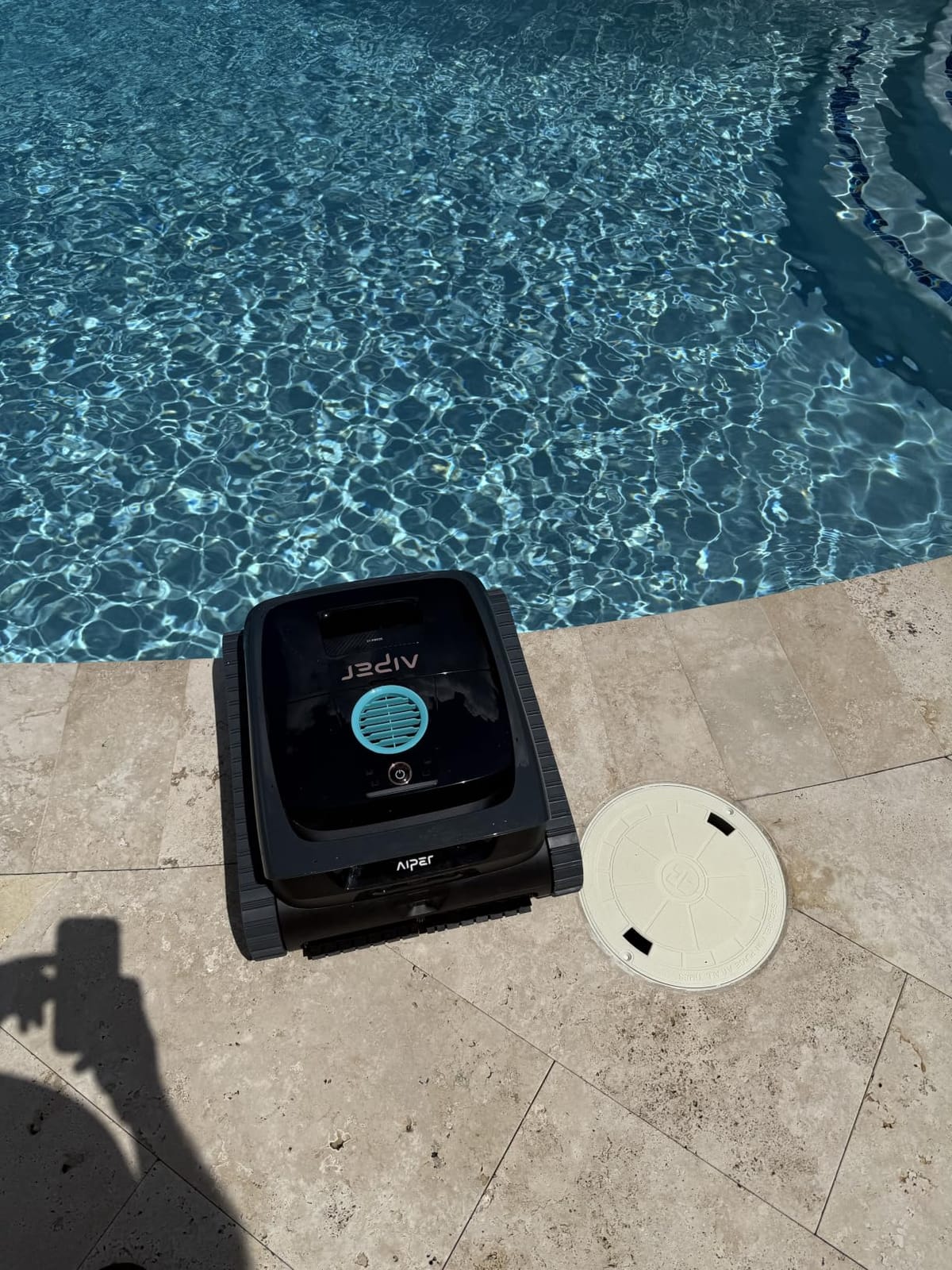
The single front-facing AI camera detects more than 20 debris types and the Navium mode builds autonomous weekly cleaning plans. Wireless charging on the dock means no exposed connectors to dry after a swim. The listing also notes TUV certified on-device data privacy, so nothing is stored or uploaded, and two year product care backed by 20 global service centers.
Reviewers also mention that AIPER support resolved AI behaviour issues through firmware changes, and in several cases that resolution changed their rating. That is worth knowing: the software is still maturing.
Why a 3 micron layer changes sandy pools
Coarse mesh filters let fine sand pass straight through and settle back onto the floor, so the robot finishes its cycle and the water stays cloudy. Reviewers on sand-heavy pools say the ultra-fine layer traps particles that other machines in this roundup leave behind, which reduces the frequency of manual vacuuming considerably.
Coverage is floor, wall and waterline, and the smart waterline parking feature is meant to park the unit high on the wall for retrieval, with an app notification when it does. On a deck with no outlet nearby, the cordless design removes the routing problem entirely.
Where the AI features disappoint
This is one of the widest rating spreads in the selection: 63% five-star against a 15% one-star rate. The AI camera sometimes ignores obvious debris and revisits the same patch, which is a strange failure mode for a machine whose selling point is recognising debris. Reviewers with consistently bad AI behaviour note the trade-off and stay on manual modes.
App control only works on land, so you set the mode before dropping it in, and you cannot stop or change it mid-cycle. Waterline parking does not always trigger, retrieval is often manual, and at 18 lbs the unit still has to be lifted onto the dock by hand. The MicroMesh filter and treads are consumable parts, which is a running cost other budgets ignore.
7. WYBOT C2 – The Best Rated Cordless Robot with Dual Filtration
Wybot C2 Cordless Pool Vacuum for Inground Pools, Robotic Pool Cleaner
- Dual filtration: 10 um ultra-fine plus 180 um primary
- Three brushless motors deliver strong suction
- Up to 180 minutes runtime covering 2152 sq ft
- Seven cleaning modes with auto parking at the edge
- Only 414 reviews in this roundup
- 3 litre canister fills quickly on leaf-heavy pools
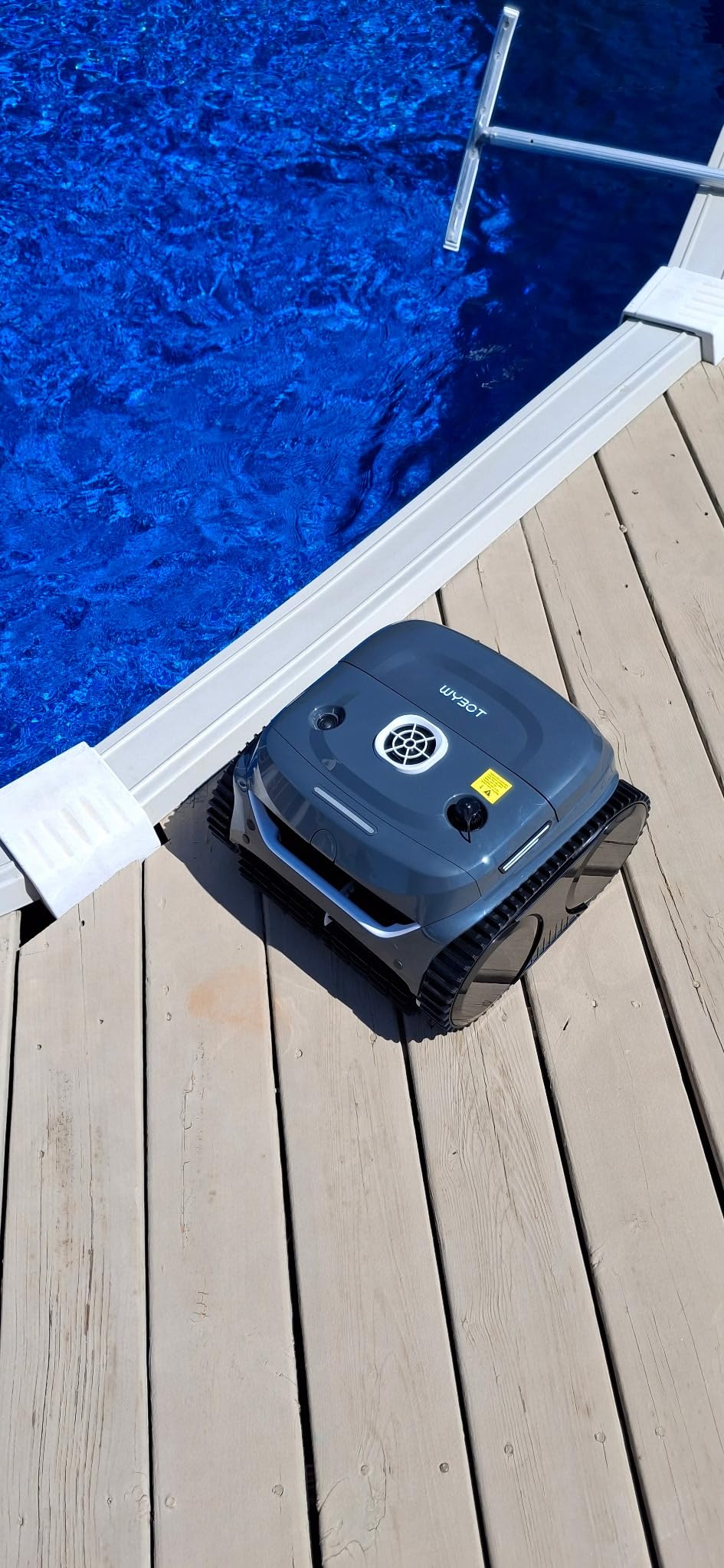
The WYBOT C2 posts the highest average rating in this selection at 4.6 stars, with 76% five-star and only 4% one-star, from a review base of 414. That is a much smaller sample than the Dolphin models here, but the sentiment is unusually consistent: reviewers point to the same three features, the dual filtration, the wall and waterline scrubbing, and the auto parking.
Dual filtration runs a 10 micron ultra-fine filter alongside a 180 micron primary, so it captures both fine dust and larger debris in one pass. Three brushless motors supply the suction, which matters because brushless motors have no brushes to wear out and fewer moving parts to fail in chlorinated, warm water.
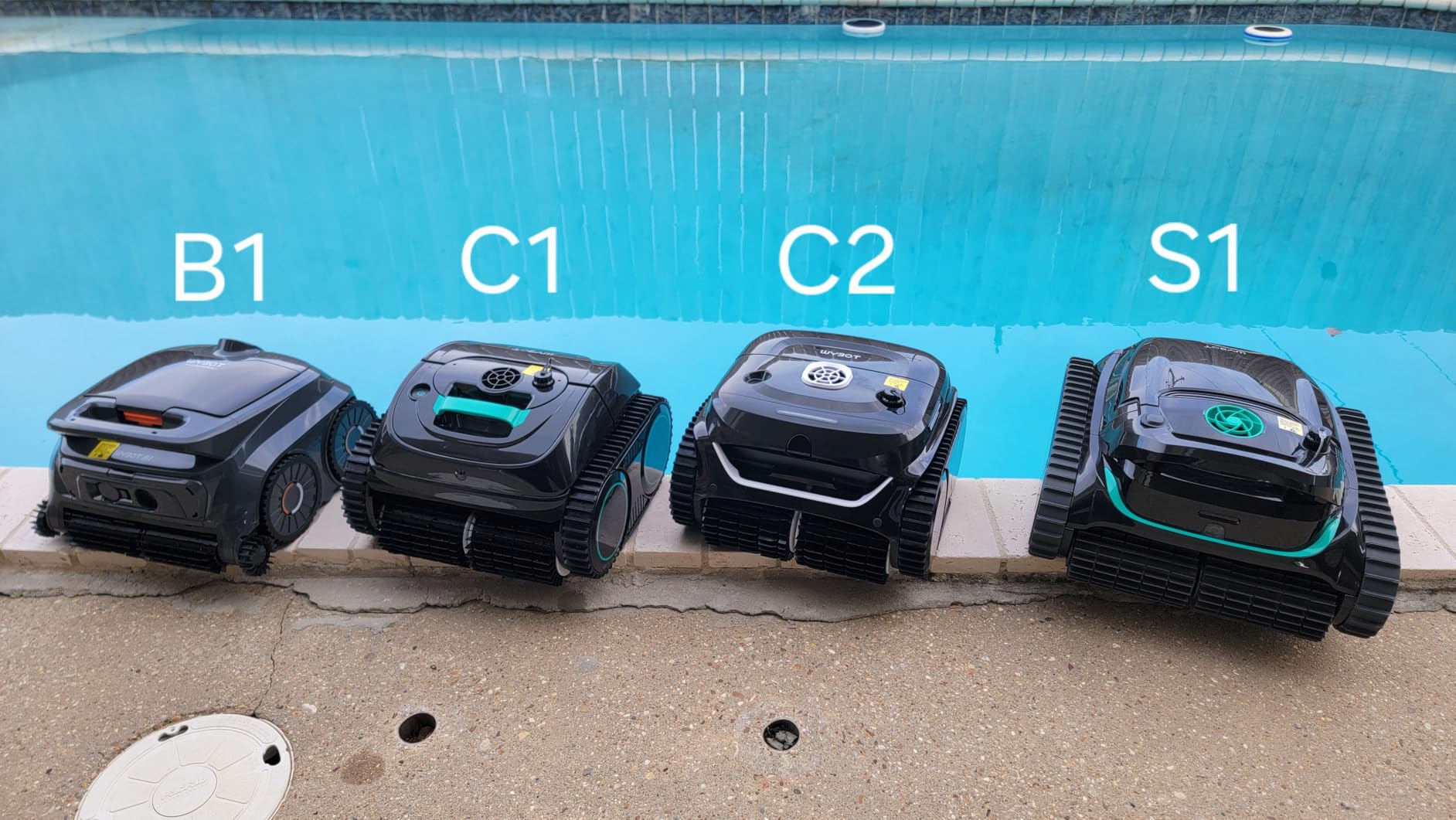
Runtime is quoted at up to 180 minutes with coverage of up to 2152 square feet per cycle, driven by a 95 watt-hour lithium-ion pack across seven cells at 25.2 volts. Seven cleaning modes plus automatic parking at the pool edge cover the range from a quick top-up before guests arrive to a full cycle.
Navigation is gyroscope-based and control runs over Bluetooth through the WYBOT app. Dimensions are 18.4 by 16.9 by 12.4 inches, with a 3-litre debris canister.
What dual filtration does in a real pool
Two-stage filtration lets the primary layer take leaves and larger debris while the fine layer holds the dust and sand that would otherwise recirculate. In a pool near dusty ground or under trees, reviewers say it is the difference between running the robot once and running it twice before the water clears.
Auto parking matters more than it sounds. A robot that ends its cycle at the wall edge can be lifted out with a pool pole from the deck, which removes the one task owners most dislike. Climb-to-wall behaviour is also what makes the waterline claim meaningful.
Where the WYBOT C2 falls short
The honest caveat is the review base. At 414 reviews it has far less long-term history than the Dolphin models here, so we cannot tell you how the battery and brushless motors hold up across four or five seasons. Treat the 4.6 as promising rather than proven.
The 3-litre canister also fills quickly on leaf-heavy pools, meaning more mid-cycle emptying than the larger baskets on the Dolphin and Beatbot units. Coverage claims are strong, but the smaller canister is the limit on heavy autumn debris loads.
8. Beatbot Sora 30 – The Best Cordless Robot for Leaf-Heavy Pools
- Heavy quoted suction at 6800 GPH
- Parks at the waterline and floats for one-handed lifting
- One-tap app retrieval avoids pole fishing
- Four-zone cleaning covers floor walls waterline and platforms
- Ultrasonic sensors read shallow areas down to 8 inches
- Only 247 reviews across this roundup
- Needs manual placement back in the pool
The Beatbot Sora 30 is built around two numbers: 6800 GPH suction from its HydroBalance structure, and up to 300 minutes of runtime from a 10,000mAh battery at 21.6 volts. The suction figure is the heaviest quoted in this roundup, and it is why the robot earns its place for pools under trees.
At 4.4 stars from 247 reviews, the sample is one of the smallest here, so treat the enthusiasm as early but consistent. Seventy-three percent of ratings are five-star, and the recurring theme is retrieval: owners like that the unit rises, releases its water and floats rather than needing a hook.
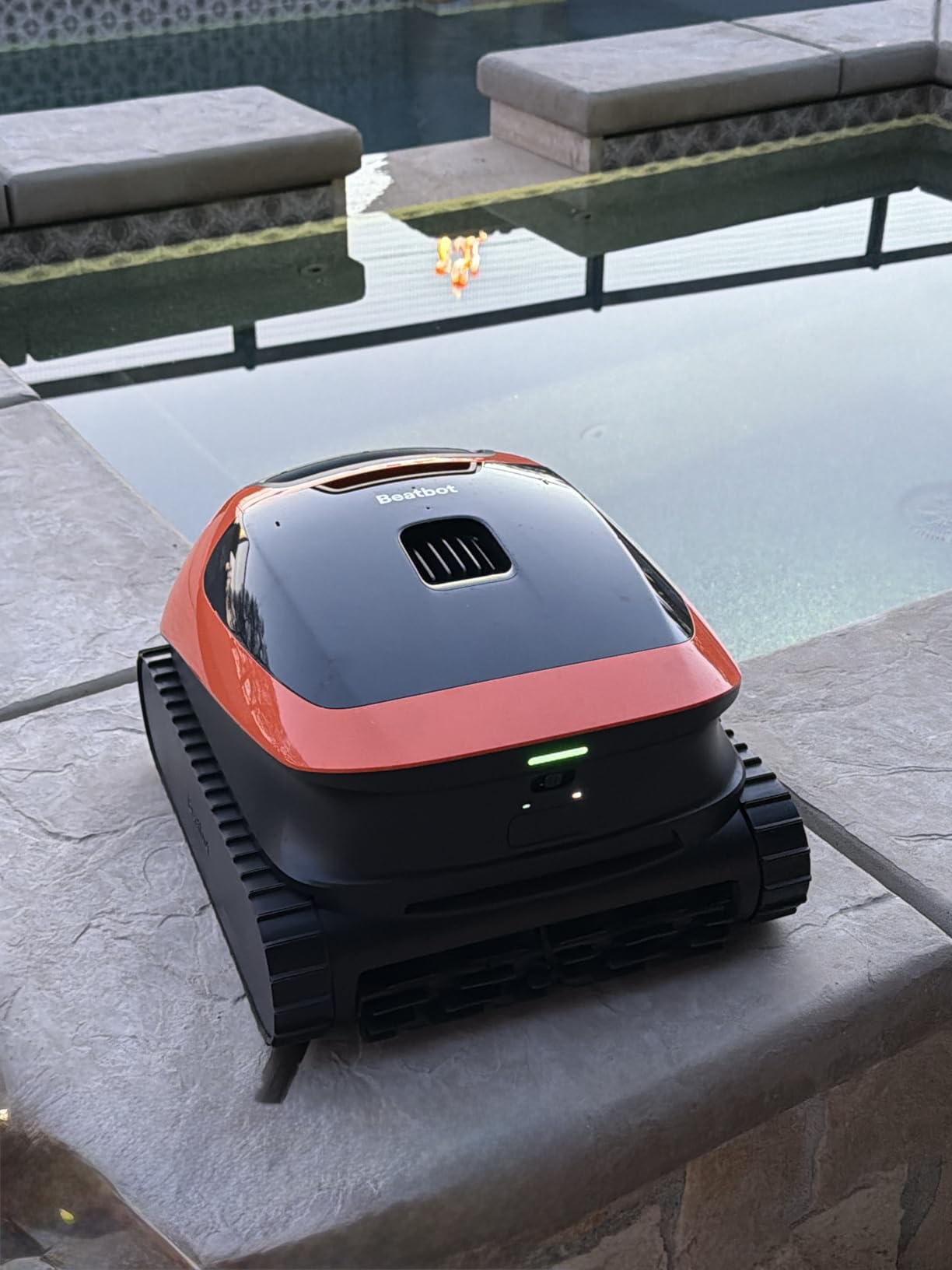
For anyone who has hauled a heavy corded unit out of a deep end, that retrieval step changes daily life more than any suction figure.
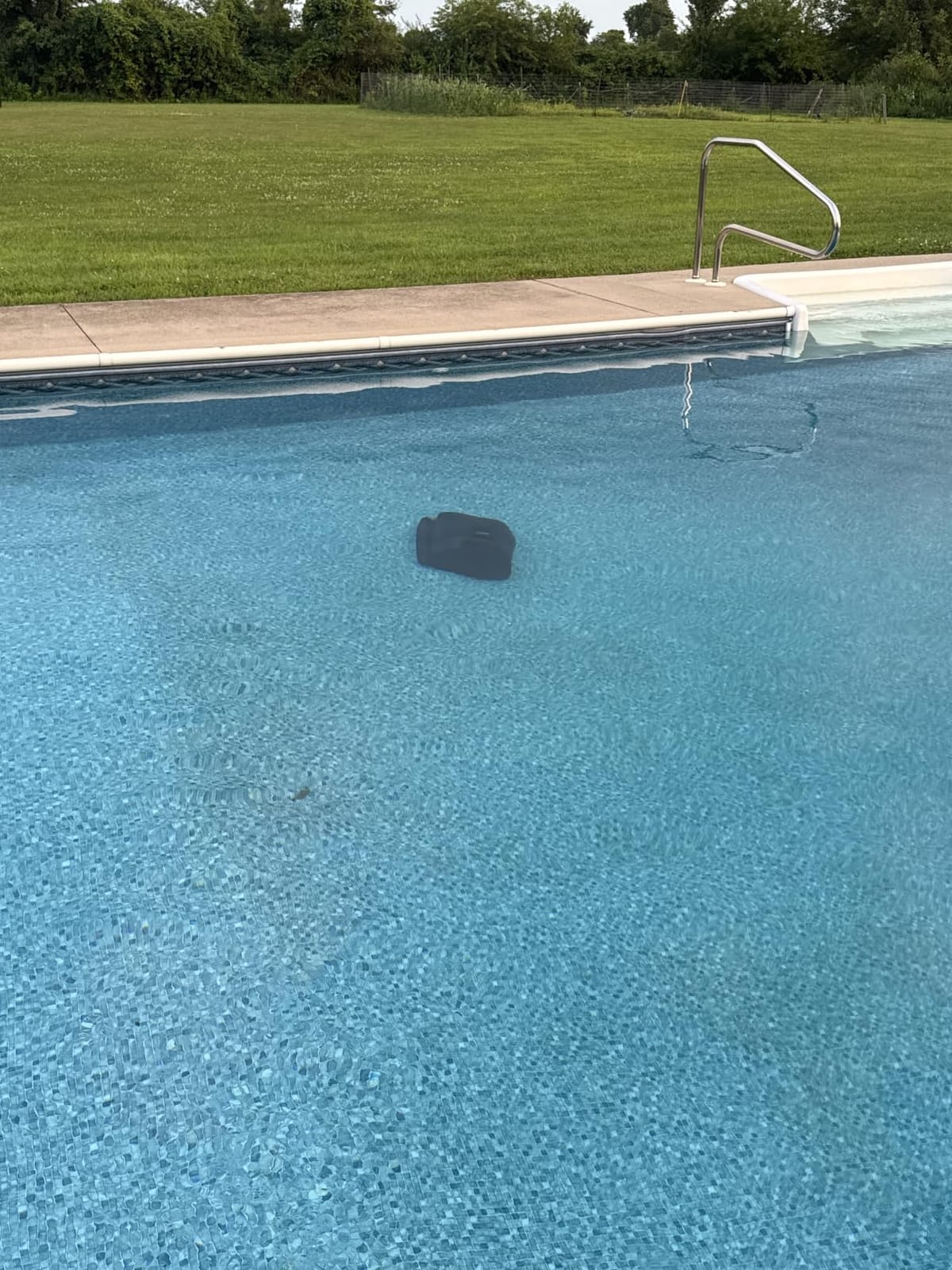
Smart water-surface parking is the mechanism: the robot climbs to the top of the pool, dumps the water weight and floats, and a one-tap app retrieval call brings it to you.
Four-zone cleaning covers floor, walls, waterline and platforms, and ultrasonic sensors detect ledges, platforms and shallow areas down to 8 inches. Coverage is listed at 3229 square feet per charge across above ground and in-ground pools, with a 4.5-litre canister and a two year warranty.
Why suction figure matters under trees
Leaf debris is heavy and low on the floor, so it takes suction rather than brush agitation to move it. A robot rated at 6800 GPH pulls a load into the basket in a single pass where weaker machines push leaves into a corner pile. Reviewers with leaf-heavy yards describe fewer repeat passes compared with lower-rated cordless units.
The 300 minute runtime is the other half of the equation. A full deep-end floor, both walls, the waterline and a platform deck in one continuous cycle means a single charge covers a large pool, rather than splitting the job into two runs.
Where the Beatbot Sora 30 falls short
It cannot self-dock or climb out. Despite the smart parking, someone still has to lift it out and put it back, and at 10.5 kg it is not the easiest unit on this list to handle. The convenience is in the retrieval side of the cycle, not the deployment side.
With 247 reviews, long-term durability data is thin. Assembly time is listed at 10 minutes, which is a one-time setup cost rather than a per-cycle one. Assembly and app connection are also what most first-week complaints trace back to.
9. WYBOT B1 – The Best Cordless Robot for Lightweight Handling
WYBOT B1 Cordless Robotic Pool Vacuum Pool Cleaner Robot for Inground Pools
- Light 14.3 lb body lifts out one-handed
- Quad-roller and dual side brushes shift acorns and grit
- Smooth obstacle crossing over drains and seams
- Five cleaning modes with app scheduling and OTA updates
- Self-parks at the pool edge on low battery
- Stiff top debris-tray latch
- Wall climbing can fail on some pools
- 120 minutes is tight for larger pools
At 14.3 lbs, the WYBOT B1 is among the lightest floor robots here, and for pools where the person doing the lifting is older or recovering from an injury, that is not a minor specification. Reviewers repeatedly note it is easy to lift out one-handed, and several describe it outperforming more expensive robots they previously owned.
The cleaning hardware is more serious than the weight suggests. Quad-roller brushes work alongside two dual front side brushes, and reviewers on leaf and acorn pools say that combination shifts debris that single-pass machines leave behind. Obstacle crossing over main drains, seams and uneven floors is smooth, which is what keeps a light frame from catching on pool fittings.
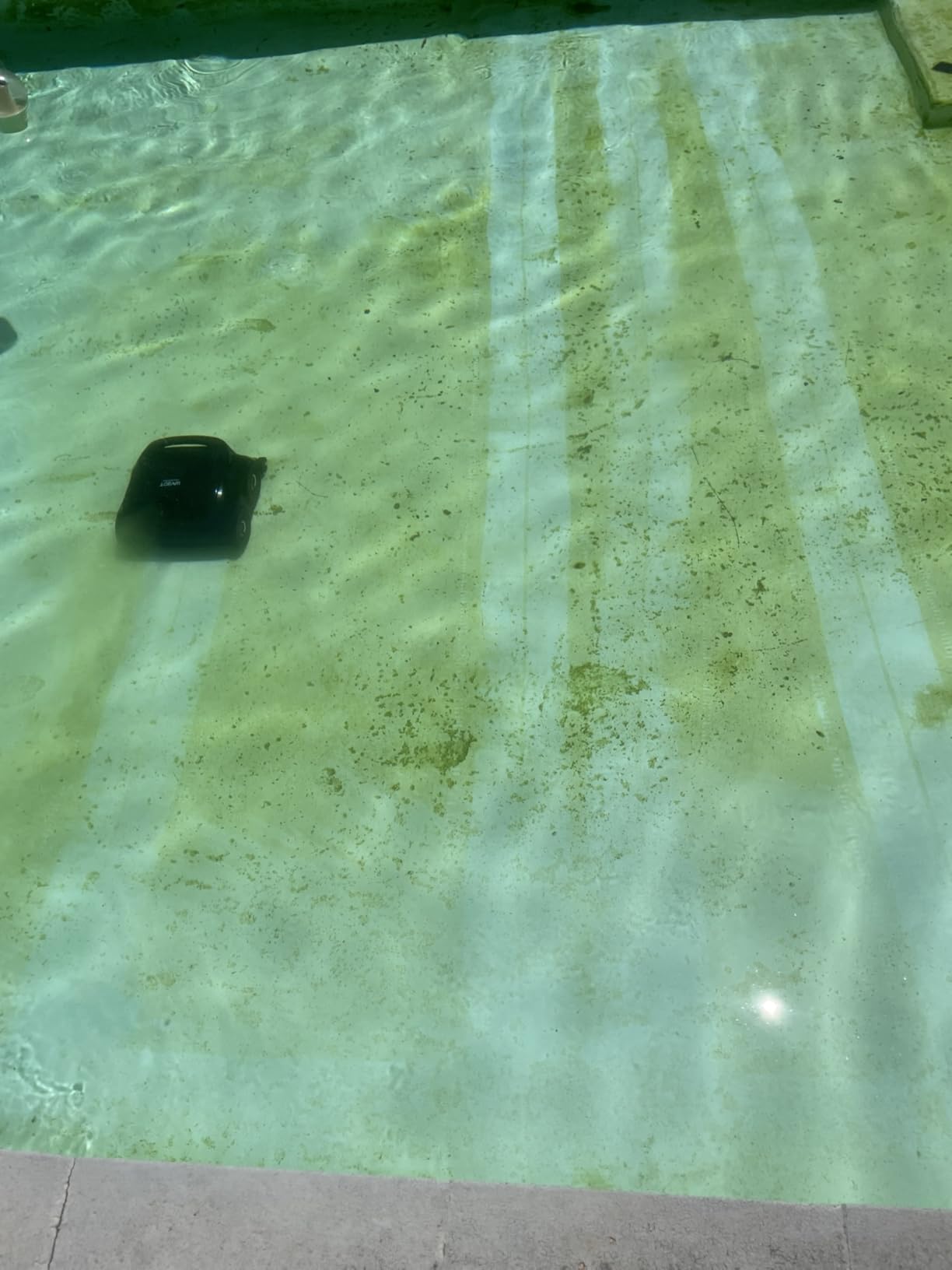
Runtime is up to 120 minutes on a 58 watt-hour lithium-ion pack of five cells at 29.4 volts, covering pools up to 1150 square feet with a 3-hour charge. A 1-hour Quick Clean mode handles a top-up cycle before guests arrive. Five selectable cleaning modes pair with app scheduling and over-the-air firmware updates, and the package includes floating blocks plus a pole retrieval hook.
The 6-litre basket is the largest canister in this roundup, which helps on leaf-heavy pools, and the unit self-parks at the pool edge on a low battery so retrieval does not require a long pole reach.
When weight beats suction
Weight is the specification that matters most for owners who retrieve the robot by hand every cycle. The floor robots in this roundup span from 14 lbs to a little over 23 lbs, and that gap is something you feel every time you lift a wet machine out of a deep end.
The self-parking behaviour reinforces the same idea. Ending a cycle parked at the edge turns retrieval into a two-second task, and a robot that is easy to put back in the water gets run more often.
Where the WYBOT B1 falls short
The top debris-tray latch is stiff and hard to open, which is an annoying detail every reviewer who mentions it mentions twice. More importantly, wall climbing can fail, with the rear wheels losing floor contact on some pool shapes, so do not buy it expecting reliable waterline scrubbing.
At 120 minutes, runtime is tight for larger pools cleaning both floor and walls, and navigation occasionally re-covers areas or misses corners. Reviewers also note it is less effective on heavy debris without pre-cleaning the pool first.
10. BOTLIFE PC10 – The Best Cordless Robot for Mixed Above Ground and Inground Pools
BOTLIFE PC10 Cordless Robotic Pool Vacuum for Inground & Above Ground Pools
- 5000 GPH suction from dual drive motors lifts leaves and sand
- Floor-only and wall-only modes alongside full pool mode
- S-path and N-path routing reduces random movement
- 120 minute runtime for pools up to 1830 sq ft
- Self-parks near the edge with an included retrieval hook
- Only 125 reviews in this roundup
- Track traction handles slopes only to 30 degrees
The BOTLIFE PC10 is the entry point for buyers moving from a manual vacuum to their first robot, and the specification sheet explains why it ranks well despite only 125 reviews. 5000 GPH suction from dual drive motors, a dedicated pump and two active brushes is real floor-cleaning power rather than token spec, and that is the number reviewers cite first.
Coverage is listed at pools up to 1830 square feet with 120 minutes of cordless runtime from a 5200mAh battery and an approximate 2.5 hour recharge. Three modes let you choose full pool, floor only or wall only, which is useful when the floor is already clean and you just want the walls worked.
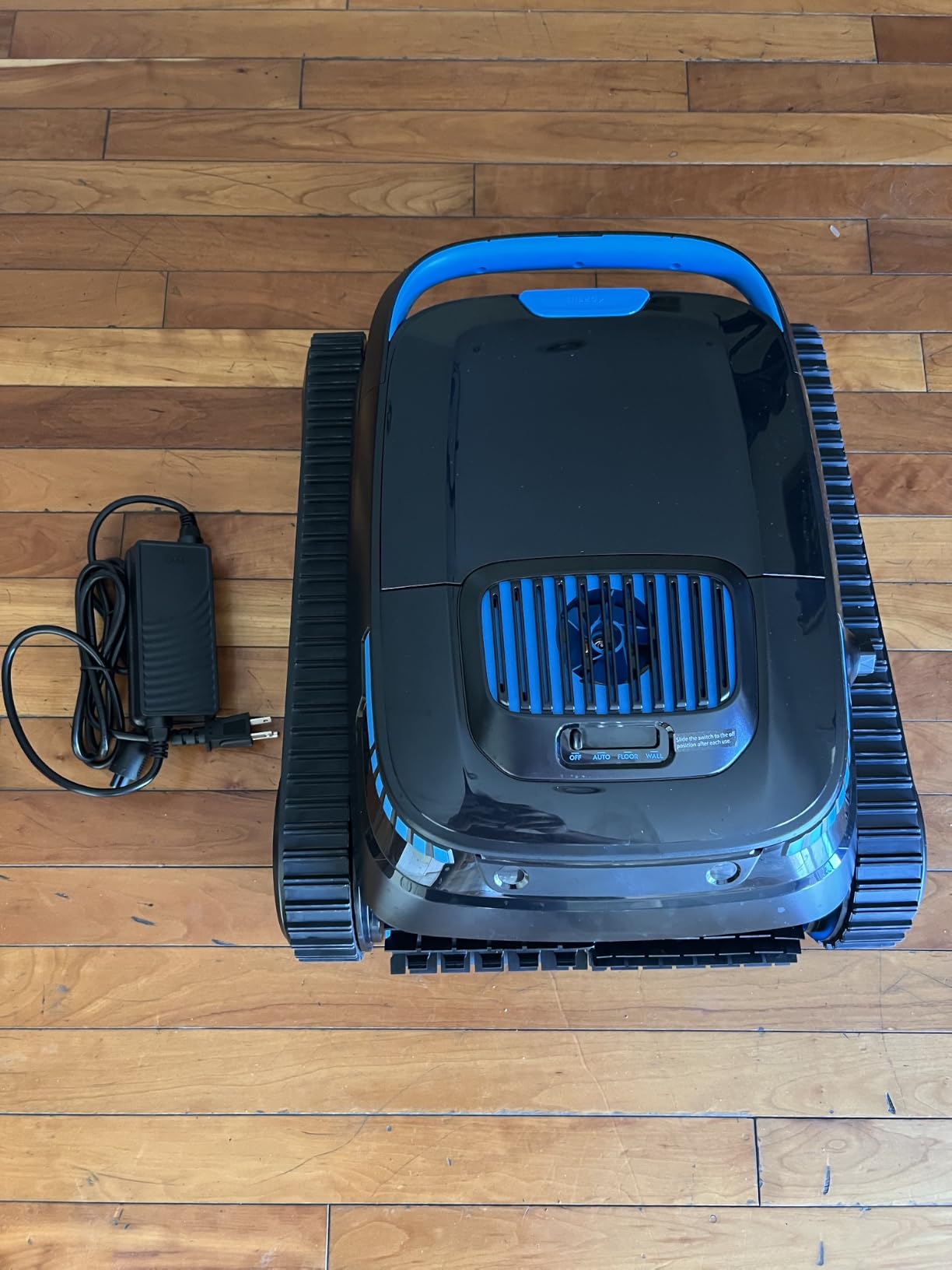
Navigation uses S-path on the floor and N-path on walls, a deliberate choice that reduces random wandering and repeated passes over the same tiles. That is the complaint most often levelled at cheaper cordless robots, so it is worth noting that this one is designed around deterministic paths rather than random turns.
The top-load 4-litre basket carries 150 micron mesh and rinses with a garden hose. It self-parks near the pool edge, and a retrieval hook is included in the box.
Why floor-only and wall-only modes matter
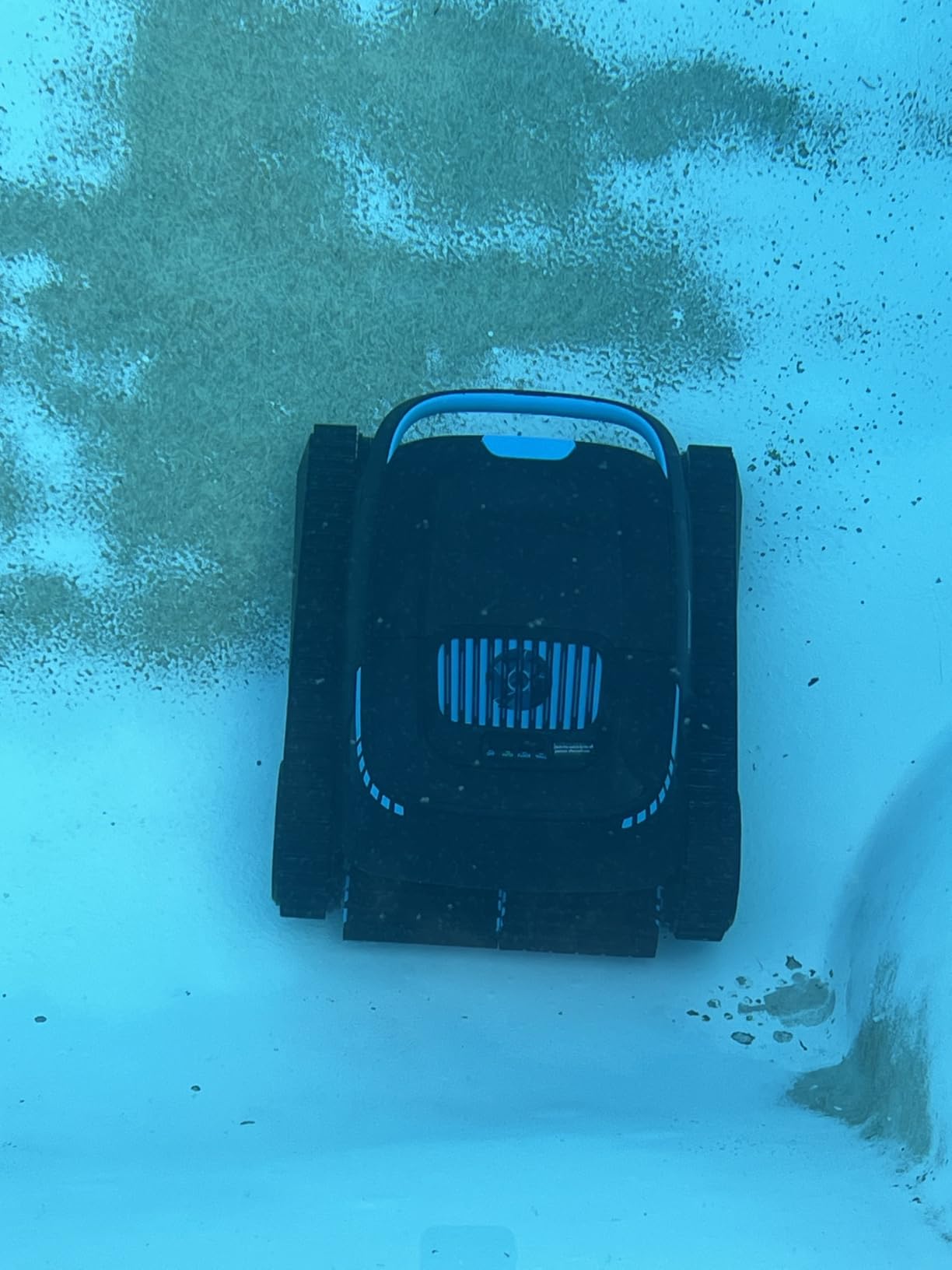
Most budget robots offer one button and one behaviour. Splitting the job into floor, wall and full-pool modes saves battery, which on a cordless unit is the scarcest resource. Reviewers with small above ground pools say a floor-only cycle finishes in roughly half the runtime and still leaves the walls for a second run before guests arrive.
Because the machine is listed for both inground and above ground pools, it also suits households with two pools, or owners who moved and brought a smaller framed pool forward. Above ground pools with flat bottoms are the easiest case, since there is no deep end to drain and climb.
Where the BOTLIFE PC10 falls short
Its 125 reviews are one of the smallest bases in this selection, so there is very little long-term data on battery degradation or seal wear. That is the main reason it sits tenth despite a respectable 4.5 average and only 4% one-star ratings.
Track traction is rated for slopes up to 30 degrees, shallower than the 45 degree claim on the WYBOT C1, so it is not the choice for a pool with a steep transition. App control is not listed as a feature, and self-parking still means hooking it out rather than it climbing out on its own.
How to Choose a Robotic Pool Cleaner Under a Thousand Dollars
Corded or cordless: our recommendation
Choose corded unless you have a specific reason not to. A corded unit draws continuous low-voltage power, so suction stays at full strength for the entire cycle with no battery degradation to plan around, and it can run as long as the pool takes. Cordless machines buy you two things: no cord to route across the deck, and no outlet needed nearby.
That convenience has a running cost. The cordless models here quote between 120 and 300 minutes of runtime and 2.5 to 5 hours of recharge, and the cycle has to start and end when you are willing to retrieve the unit. If your pool has no deck access point, or you rent and cannot run a cable across the yard, that outweighs the suction difference. Our test verdict: corded for daily or near-daily use, cordless when the deck layout makes a cord impossible.
Match the robot to your pool size and shape
Coverage figures are the first filter, and they are the easiest number to get wrong. The Dolphin Nautilus CC Plus is listed for in-ground pools up to 40 feet, the Dolphin Escape up to 33 feet, and the cordless models quote square footage from 1150 up to 3229. Match that figure to your actual pool area rather than to the maximum printed on the box.
Shape matters as much as size. Random-navigation machines leave dirty patches in L-shaped and freeform pools, which owners raise repeatedly on pool forums. Gyroscope and path-planned units such as the WYBOT C2 and the BOTLIFE PC10 are better on irregular shapes because their routes are deterministic.
Deep ends and multi-level transitions raise the bar further, since a robot that stalls at the transition never reaches the waterline. A pool that is too large for its stated coverage leaves sections untouched on every single run.
Filtration is what keeps the water clear
Mesh ratings are the clearest way to compare these machines, and they run from 200 micron on the Betta SE Plus and 150 micron on two of the skimmers down to 10 micron on the WYBOT C2 and a 3 micron ultra-fine layer on the AIPER Scuba V3. Fine sand, dust and pollen pass straight through coarse mesh and settle back, which is why sandy pools need a finer filter rather than more suction.
Basket or canister capacity matters just as much on leaf-heavy pools. The Beatbot Sora 30 at 4.5 litres and the WYBOT B1 at 6 litres hold more between cleanouts than the 3-litre canister on the WYBOT C2. Whatever you choose, budget ten minutes a cycle for rinsing the filter. A clogged filter reduces suction and gets blamed on a failing motor.
Coverage: floor, walls and waterline are not the same feature
Floor cleaning is table stakes. Wall climbing separates the serious units from the budget tier, and waterline scrubbing is the version of that claim worth paying for, because it is the band where grime, oils and sunscreen collect. Track-driven machines such as the Dolphin Escape hold traction on liner transitions better than wheeled designs.
Coverage claims also have a floor. Nearly every robot in this group can be lifted out or hooked out only by a person, so shallow waterlines on ledges and platforms remain manual work for most owners. The Beatbot Sora 30 reads shallow areas down to 8 inches, which helps on steps and tanning ledges.
Automation and what a weekly timer actually means
A delay switch and a weekly timer are different things. A delay switch starts the cycle once, after a set delay. A programmable weekly timer starts on chosen days at chosen times without you touching it, which is the difference between an automatic cleaner and a manual one that happens to run unattended.
Under this ceiling, programmable timers are rare on corded units and common on app-driven cordless models such as the EcoSurfer S2, the WYBOT B1 and the WYBOT C1. Schedule the cycles for when the pool is empty, and expect occasional connectivity friction with budget apps.
Warranty, support and running costs
Warranty length is the clearest quality signal in this category. The Dolphin Escape carries a full two year quality assurance, the WYBOT C1 a two year manufacturer warranty, and the Beatbot Sora 30 a two year warranty. The Betta SE Plus lists a one year warranty, which is a downgrade signal if you expect the unit to last several seasons.
Also count consumables in the first-year budget. The AIPER Scuba V3 lists its MicroMesh filter and treads as replacement parts, and any robot with fine-layer filtration will need those replaced as they clog. Buying through an authorized dealer rather than a third-party marketplace seller is what keeps a manufacturer warranty valid.
What you give up below this ceiling
Under this budget you rarely get a certified-refurbished flagship from an authorized dealer, multi-zone cleaning that handles platforms and shallow shelves reliably, or mapping that guarantees full coverage of a freeform pool. Those features start showing up above the thousand-dollar mark, along with longer warranties and stronger US support networks.
Storage and deck space planning go hand in hand with the rest of the setup, and if the same room doubles as a games area, our guides to the best pool tables under $1000 and the best pool cues under $1000 cover the furniture and accessory side of the room.
Our buyer’s guide companions cover the hand tools that still matter alongside a robot. Our best pool cleaning kits roundup walks through the leaf nets, skimmer baskets and wall brushes that handle the corners robots miss.
Frequently Asked Questions
Which robotic pool cleaner is the best value for money?
The Dolphin Nautilus CC Plus is the best value overall under a thousand dollars. It combines corded continuous power, wall climbing, a top-loading filter and coverage for in-ground pools up to 40 feet, and it has the largest verified review base in this category. For pools where floating pollen is the main problem, the Betta SE Plus solar skimmer does that job without a cord or a daily recharge.
What is the most recommended robotic pool cleaner?
Among the machines reviewed here, the Dolphin Nautilus CC Plus is the most recommended, holding a 4.3 average across 13969 reviews. The WYBOT C2 scores highest on rating alone at 4.6 stars, but from a much smaller base of 414 reviews, so the Maytronics design carries more proven long-term history.
Are robot pool cleaners worth the money?
Yes, if your pool is large enough to take manual vacuuming regularly. A robotic pool cleaner handles floor, wall and waterline cleaning on a schedule you set, and the corded units draw so little power that energy cost is negligible. The return is paid in time saved rather than in electricity, which is why robot ownership suits owners who value their weekend afternoons.
Should I get a corded or cordless pool robot?
Choose corded if you can run power to the pool. Suction stays constant for the whole cycle, runtime is not limited by a battery, and there is no degradation to plan for over five years. Choose cordless if there is no reachable outlet, if HOA or rental rules prevent running a cable, or if you want to avoid routing a cord across a walkway. Cordless convenience costs you runtime, recharge time and weaker constant suction.
What are the best corded pool vacuum robots?
The two corded models in this roundup are both from Maytronics. The Nautilus CC Plus covers in-ground pools up to 40 feet with wall climbing and an active scrubbing brush, while the Dolphin Escape adds HyperBrush scrubbing, HyperGrip continuous tracks, an oversized debris cartridge and a two year warranty for pools up to 33 feet. Choose the Nautilus for maximum coverage, the Escape for track traction and debris capacity.
Do robotic pool cleaners work on vinyl and fiberglass pools?
Yes. All the floor and wall robots listed here are intended for in-ground pools across vinyl liner, fiberglass, gunite and tile surfaces, and the track-driven Dolphin Escape is specifically noted by owners as holding traction on liner seams and uneven floors. Robotic cleaners are generally safe on these surfaces because they are low-pressure suction units rather than pressure-side cleaners.
What size pool can a pool robot under a thousand dollars clean?
Coverage figures across this group range from 1150 square feet on the WYBOT B1 up to 3229 square feet on the Beatbot Sora 30, with the Dolphin Escape listed for pools up to 33 feet and the Nautilus CC Plus for in-ground pools up to 40 feet in length. Match the coverage figure to your actual pool area rather than to the maximum on the box.
What is a weekly timer on a pool robot?
A weekly timer is a programmable clock that starts the cleaning cycle automatically on selected days and times without you pressing anything. It differs from a delay switch, which starts one cycle after a set delay and then stops. A weekly timer is what turns a robotic pool cleaner into an automatic appliance rather than a device you remember to run.
Final Verdict: The Best Pool Cleaning Robot Under a Thousand Dollars
The best pool cleaning robots under a thousand dollars come down to two questions: can you run power to the pool, and is your problem settled debris or floating debris? If you can run power and settled debris is the issue, the Dolphin Nautilus CC Plus is the pick, with corded constant suction, wall climbing, a rinse-friendly top-loading filter and the deepest ownership history in the category.
If floating pollen and leaves are the problem, add the Betta SE Plus solar skimmer to the mix rather than replacing a floor robot with one. For cordless-only sites, the WYBOT C2 leads on rating and dual filtration, the Beatbot Sora 30 leads on suction and runtime, and the WYBOT B1 combines a light 14.3 lb body with the largest basket in the roundup for anyone who lifts the unit out by hand every cycle.
Check the coverage figure against your actual pool area before you commit, and plan ten minutes per cycle for filter rinsing. That habit, more than any feature on the spec sheet, decides whether the robot keeps working for you in year three.