
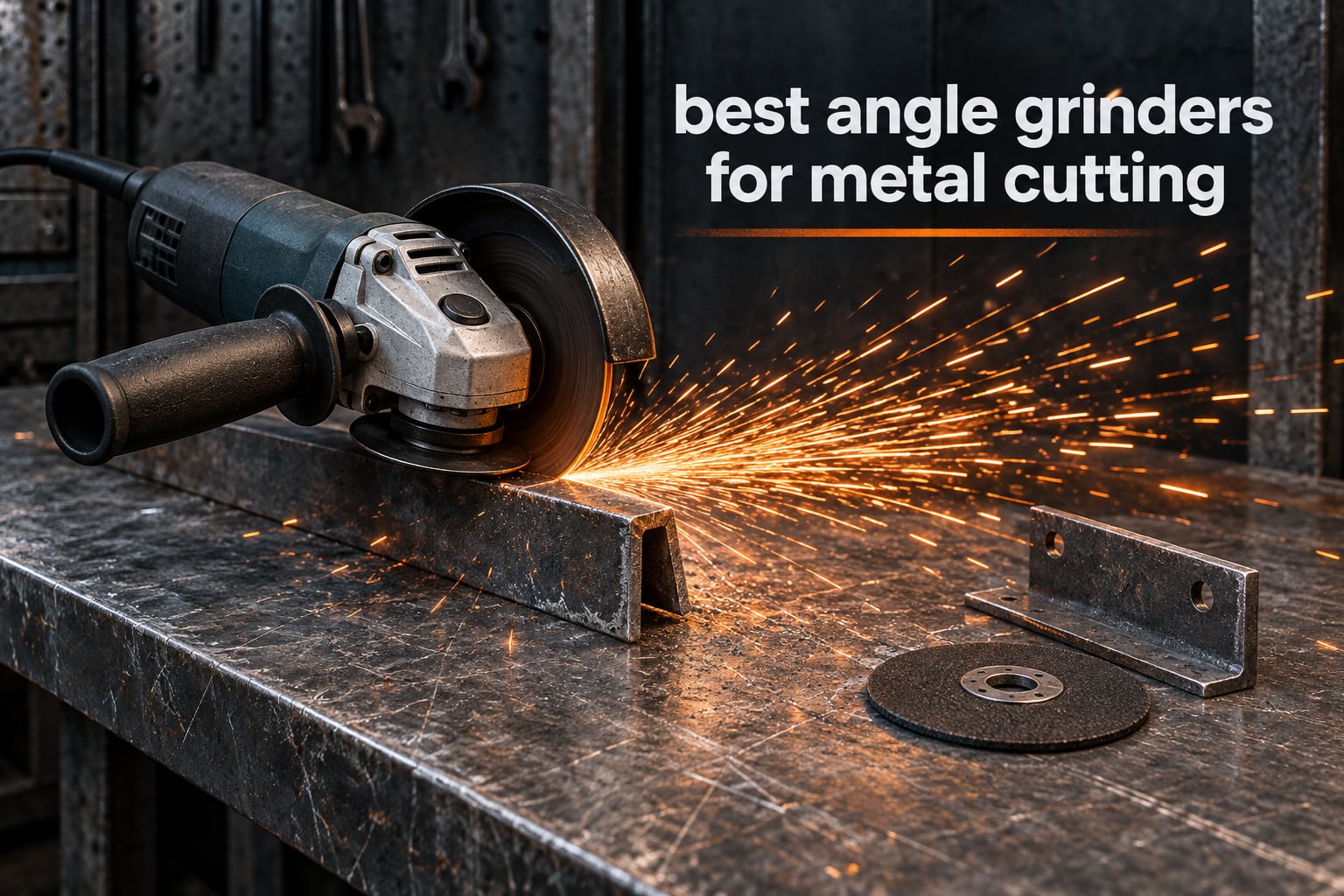
Short answer: the DEWALT DCG413B is the best angle grinder for metal cutting overall, a 20V MAX brushless 4-1/2 inch cordless machine with an electronic kickback brake and a paddle switch that shuts it off the moment you let go. Runners-up are the BLACK+DECKER BDEG400 for first-time buyers who want a cheap corded tool, and the Makita 9557PBX1 if you want both wheel guards, a diamond blade and a carrying case in the box. Last updated for 2026.
An angle grinder is the fastest handheld way to cut, grind and deburr metal. A 4-1/2 inch corded model spins a cut-off disc at 10000 to 12000 RPM and will take a 1/4 inch steel plate, rebar, angle iron or stainless pipe if you let the wheel do the work and keep the guard on. The tool holds the disc at speed under load while you guide the trailing edge of the wheel along the cut line.
That last part matters more than any spec sheet. The same grinder will bind and kick if you push the disc against its rotation, and a brushless motor will not save you from a wheel pinched in the cut. So below I have written up eight grinders with the specs that matter, what each one is bad at, and a technique section that explains the trailing-edge rule that forum users argue about constantly.
If you are also setting up a home workshop, our guide to the best bench grinders covers sharpening and tool dressing, which is a different job from cutting stock with a wheel.
Table of Contents
Top 3 Picks for Metal Cutting Right Now

DEWALT DCG413B 4-1/2 Inch Cordless
- 20V MAX brushless motor
- Electronic kickback brake
- Two-stage paddle switch
- 3.8 lb tool only

BLACK+DECKER BDEG400 4-1/2 Inch
- 6.5 amp / 800 watts corded
- 10000 RPM
- Spindle lock
- 3-position side handle

AVID POWER AAG589 4-1/2 Inch
- 7.5 amp / 900 watts corded
- 12000 RPM
- Spindle lock
- Full wheel bundle included
The DEWALT wins on the combination that actually shows up on a job: 4.8 stars across 9588 reviews, a brake that stops the wheel in 2 seconds or less, and a body light enough at 3.8 pounds to work overhead. The BLACK+DECKER is the pick if the deciding factor is getting a capable corded grinder without buying into a battery system. The AVID POWER ships with two cutting wheels, two grinding wheels, a flap disc, a guard, a side handle, a spanner wrench and spare carbon brushes, so it can make a cut the day it arrives.
The Best Angle Grinders for Metal Cutting at a Glance
| Product | Specifications | Action |
|---|---|---|
| DEWALT DCG413B 4-1/2 Inch Cordless |
|
Check Latest Price |
| BLACK+DECKER BDEG400 Corded |
|
Check Latest Price |
| AVID POWER AAG589 Corded |
|
Check Latest Price |
 Metabo HPT G12SR4 Corded Metabo HPT G12SR4 Corded |
|
Check Latest Price |
 Makita 9557PBX1 Corded Kit Makita 9557PBX1 Corded Kit |
|
Check Latest Price |
 CRAFTSMAN CMCG400B Cordless CRAFTSMAN CMCG400B Cordless |
|
Check Latest Price |
 Milwaukee 2880-20 Cordless Milwaukee 2880-20 Cordless |
|
Check Latest Price |
 Bosch GWS8-45 Corded Bosch GWS8-45 Corded |
|
Check Latest Price |
Two numbers on this table drive almost everything else. No-load speed sets how hot the cut gets, and amp rating sets how long the motor holds that speed once the wheel touches metal. A 6.2 amp grinder at 12000 RPM is a completely different tool from a 7.5 amp grinder at 11000 RPM, even though the labels look similar on a shelf.
How We Picked
We compared the eight grinders below on five things, and we weighted them the way a fabricator or a weekend metalworker would rather than the way a spec sheet does.
Sustained power under load. A grinder that stalls halfway through a 1/4 inch plate is not usable, so we looked at amp rating and at reported behaviour under sustained contact.
Safety hardware that does something. Electronic brakes, kickback brakes, anti-reload clutches and restart protection get credit only when reviewers report the wheel actually stopping.
Wheel change speed. A spindle lock, a tool-free guard or a quick-release flange saves real time on a job where you swap between grinding and cutting.
Weight and balance over a long session. Grinders are held one-handed, often overhead, for far longer than the job seems like it will take.
Warranty and parts. A limited lifetime warranty or serviceable carbon brushes changes the ownership calculation on a tool you may buy once and keep for a decade.
We also flagged every pick that comes as a bare tool, because the battery and charger are the most common surprise in this category and the loudest complaint across owner forums.
1. DEWALT DCG413B – Best Overall Cordless Grinder for Metal Cutting
- Brushless motor needs no brush changes
- Brake stops the wheel in 2 seconds or less
- Light 3.8 lb body suits overhead work
- Two-stage paddle trigger prevents stray starts
- Standard 20V platform shared across DEWALT tools
- Bare tool - battery and charger sold separately
- About 20 to 30 minutes of grinding on a 4Ah pack
- Not the sustained power of a corded grinder on thick plate
This is the grinder I put in a fabricator’s hand first. The DCG413B is a 4-1/2 inch cordless tool with a brushless motor, an electronic kickback brake and a paddle trigger that takes two deliberate actions to start, so a bump on a workbench will not wake it up. At 3.8 pounds it is the lightest machine in this roundup, and that is the number that decides whether you can finish a weld prep without wrecking your wrist.
Owners consistently single out the brake as the reason to trust it. When the wheel pinches, stalls or binds, the electronics sense it and the brake engages with maximum force to stop the wheel quickly and shut the tool down. For cutting rebar or stainless pipe, where a bind-up is a matter of when rather than if, that is worth more than extra amps.
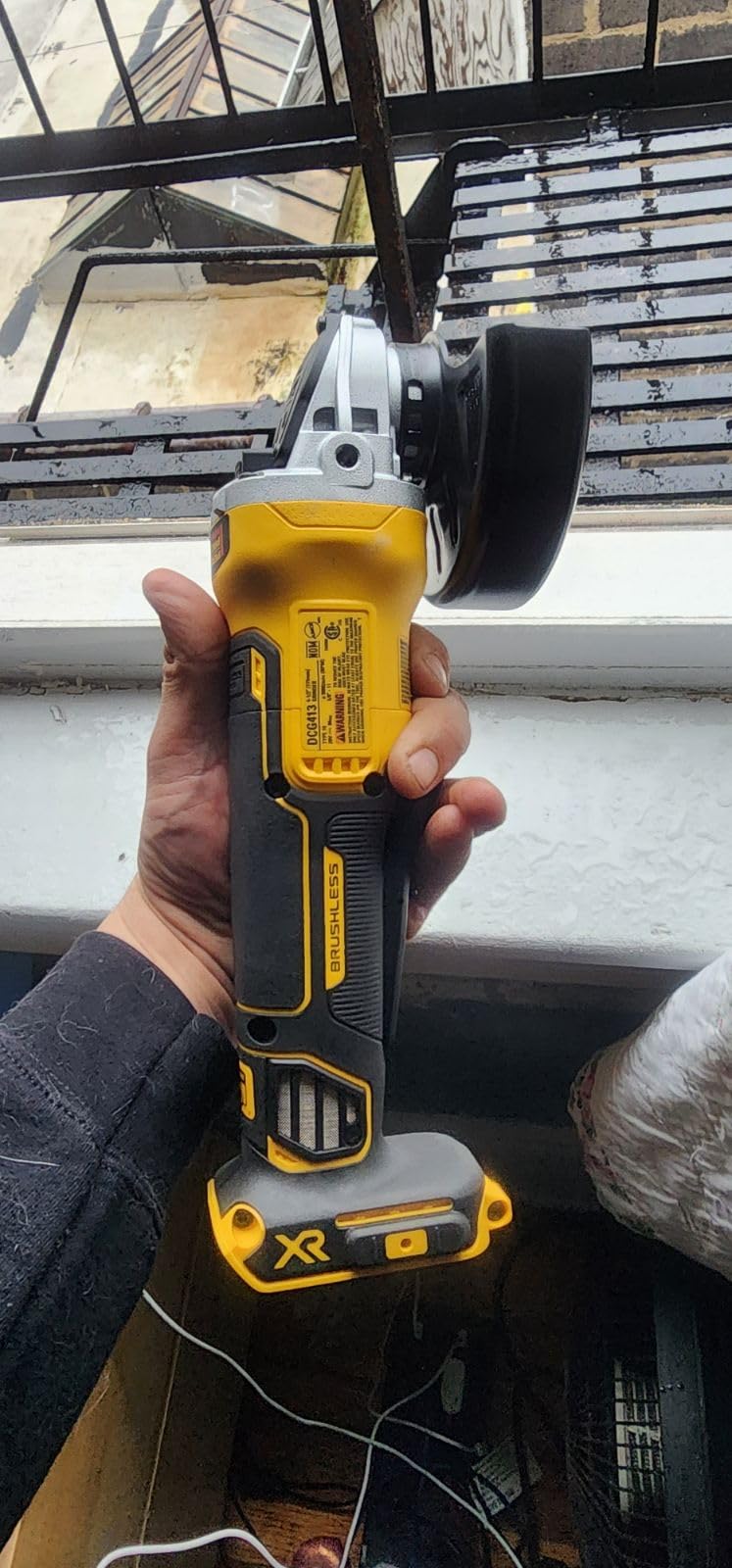
The honest limit is energy storage. A 4Ah pack gives roughly 20 to 30 minutes of continuous grinding, which is fine for a cut here and a cleanup there, and short of a full production weld-prep afternoon. The E-switch no-volt release function means the tool will not restart after you release the paddle, which is a small thing that prevents an enormous number of accidents.
One detail that gets missed: wheel changes use a standard Allen wrench, not a proprietary check key. If you already own discs from another brand, nothing stops you running them as long as the RPM rating on the disc is at or above what the grinder produces.
Why this grinder suits a fabricator or welder
The two-stage paddle trigger and the kickback brake are the features trade users actually praise, and the 3.8 pound weight means you can hold a light grind flat on a fillet weld without wrist fatigue. The 20V MAX platform is enormous, so if you already own DEWALT packs and a charger, the cost of getting into the tool is the tool.
It also handles the full range of 4-1/2 inch work: deburring a cut edge, cleaning up a weld, cleaning rust off a bracket, and slicing through angle iron or thin plate with a cut-off disc.
Why you should skip it
Skip the DCG413B if you are going to grind for hours on thick material in one session, because the pack will not last and the corded machines in this list will not slow down. Also skip it if you do not own a 20V MAX battery and charger already and do not want to buy one.
The 3450 RPM no-load speed is the lowest figure on this list, and that is deliberate on DEWALT’s part. Lower speed means less heat and fewer bind-ups on a light cut, but it does mean the wheel is not removing metal as fast as an 11000 RPM corded unit on the same cut.
2. BLACK+DECKER BDEG400 – Best Corded Grinder for First-Time Buyers
- Handles light to medium cutting of pipe and angle iron
- Lock-on switch holds power without a trigger
- Metal gear housing for long life
- 3-position side handle and adjustable guard
- Wheel
- spanner wrench and guard included
- Locking slide switch can jump its groove once worn
- Noticeable vibration during use
- Included wheel is a grinding wheel not a cut-off wheel
- Not built for continuous production work
The BDEG400 is the tool I recommend to someone who has never held a grinder. It is a 6.5 amp, 800 watt corded 4-1/2 inch machine running at 10000 RPM, and owners report it cutting pipe, angle iron and steel adequately for weekend metalwork. The metal gear case is the part that matters: plastic gear heads crack, and this one is rated to take the shock of a wheel binding.
A three-position side handle and an adjustable guard mean you can set up for a top cut, a side cut or overhead work without buying a second tool. The lock-on switch frees your index finger, which matters on a longer deburring or grinding pass.
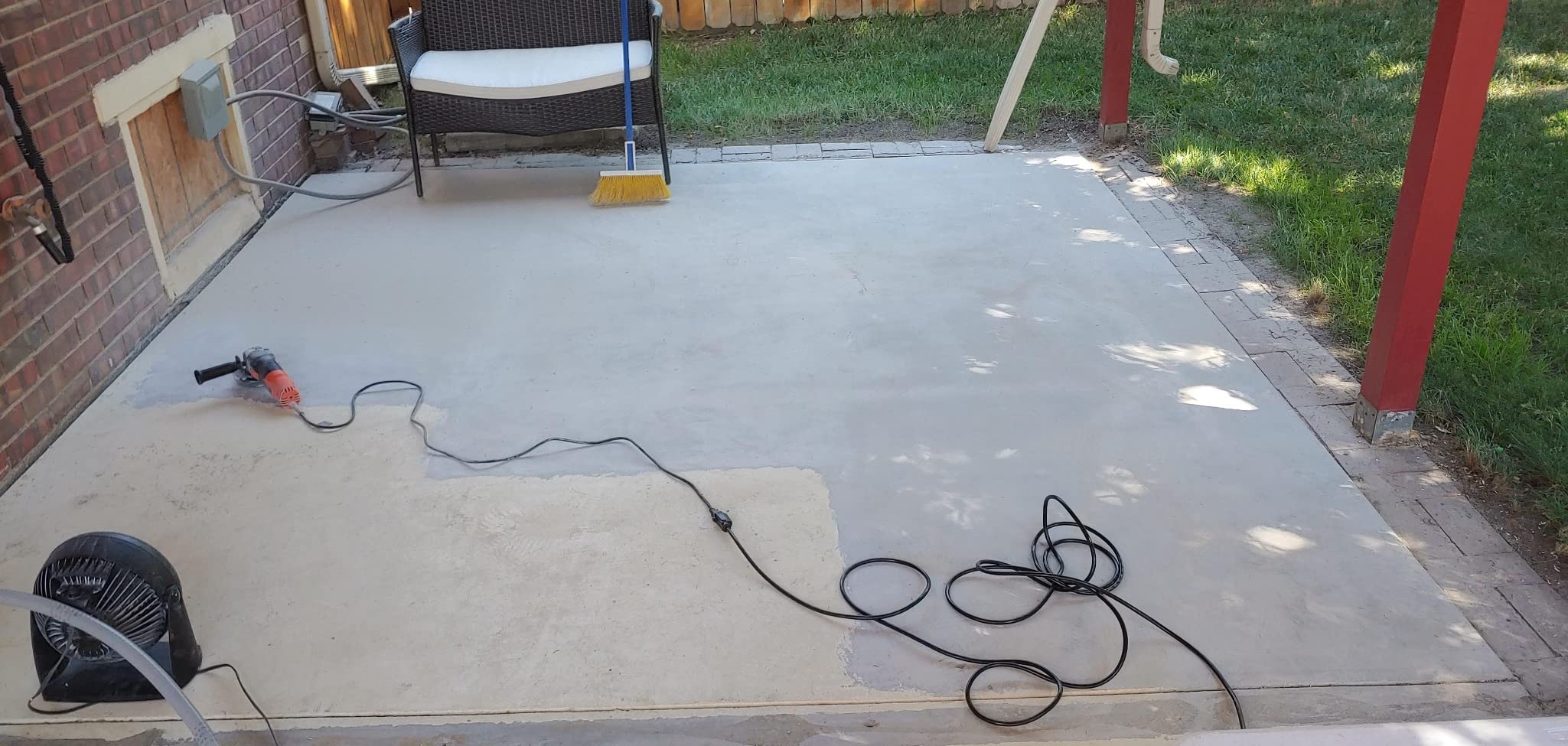
Two limitations come up repeatedly in reviews. The slide lock switch can jump out of its groove as the plastic wears, which is annoying rather than dangerous, and the tool produces noticeable vibration compared with the premium grinders. Neither stops it from finishing the cut.
One practical note before you buy: the wheel that ships in the box is a grinding wheel, not a cut-off disc. A grinding wheel is for shaping and weld prep, not for slicing. Buy a proper cut-off wheel for metal separately.
Why it suits a first-time buyer
There is no ecosystem to enter. You plug it in and go, and the 2-year limited manufacturer warranty covers the gear case and motor. For someone cutting rebar in a garage or trimming a steel frame for a shelf, that simplicity is worth a lot.
The 10000 RPM wheel speed is a good middle ground too. It is slower than a 12000 RPM machine, so it throws fewer sparks and runs cooler on light work, which is easier on a new user still learning wheel stand-off and spark direction.
Why you should skip it
Skip it for production grinding, for a shop that runs a grinder for hours a day, and for anyone who notices vibration. A 6.5 amp motor has less headroom than a 7.5 amp class machine when the wheel bites into thick plate.
The vibration is also a hint about balance. If the wheel is wobbling, check it before blaming the tool, because a bent or mismatched disc produces exactly this symptom on any grinder.
3. AVID POWER AAG589 – Best Budget Grinder With a Full Wheel Bundle
- More power than the price suggests
- Spindle lock for fast disc changes
- Standard 7/8 inch arbor fits most wheels
- Tool-free adjustable guard
- Two cutting wheels and two grinding wheels included
- Replaceable carbon brushes
- On/off switch feels fragile and hard to depress
- Guard has few adjustment positions
- Some units report stripped flange holes or smoking motors
- Included cut-off discs are thicker than ideal
The AVID POWER AAG589 answers a question most roundups ignore: the shortest route to a grinder that can cut metal on day one. The box contains two metal cutting wheels, two metal grinding wheels, a flap disc, a side handle, a spanner wrench, the wheel guard and two spare carbon brushes. Very few competitors ship that much consumable material.
Under the plastic, it is a 7.5 amp, 900 watt corded motor spinning at up to 12000 RPM, with a standard 7/8 inch arbor and a 5/8-11 threaded spindle. That arbor arrangement is the practical gem: locking nuts and discs from major brands fit it, so you are never waiting on a proprietary part.
Owners use it for sharpening, rebar, rusty bolts and general weekend metalwork, and they report more cutting performance than the price suggests. The replaceable carbon brushes are also a genuine plus on a tool this size, since you can extend its life rather than scrapping it when the brushes wear.
The criticism is concentrated in the controls and the guard. The on/off switch is described as fragile and hard to depress, and the guard has few adjustment positions with a simple locking mechanism. A small body that fits tight spaces is a common positive, offsetting the complaints about overall clumsiness.
Why it suits a weekend metalworker
You get a 7.5 amp motor and 12000 RPM, which is tied for the highest no-load speed in this roundup, plus a spindle lock for tool-free-style disc changes. That combination handles sharpening, rebar cutting, rust removal and light grinding without a second purchase.
It is also the pick if you want to keep spending on the consumables you already trust rather than learning a new brand’s wheel line.
Why you should skip it
Skip it if the tool lives on a job site and the switch gets knocked a hundred times a week, or if you depend on a company tool that needs to be indestructible. A minority of owners report premature failures with stripped flange holes or smoking motors, which is a small share of reviews but a real one.
The included cut-off discs are thicker than ideal, and a thicker disc wastes more of your material as kerf. Swap in a thinner wheel before you start work on anything you want to keep.
4. Metabo HPT G12SR4 – Best Grinder for Tight, Confined Cuts
Metabo HPT 4-1/2-Inch Angle Grinder, Includes 5 Grinding Wheels & Hard Case, 6.2-Amp Motor, Compact & Lightweight, G12SR4
- Compact 4.0 lb body with a small grip
- Low-profile gear case reaches confined areas
- Spindle lock for quick disc changes
- Quick-off slide switch adds a safety layer
- Five grinding wheels and a hard case included
- Labyrinth seal design for dust durability
- 6.2 amp motor trails the 7 to 7.5 amp class
- Slide switch placement takes adjustment for some hands
- No lock-on for continuous work
The G12SR4 solves a specific problem: getting a 4-1/2 inch wheel into a gap that a full-size grinder will not fit. The gear case is low profile, the body is 4.0 pounds, and the grip is deliberately small. For trimming a steel bracket against a wall, cutting the end off a pipe stub inside a frame, or working inside a chassis, that geometry is the whole point.
Inside it is a 6.2 amp motor with 980 watts of maximum output at up to 12000 RPM, which is plenty for detail work, fabrication touch-ups and hobby metalwork. The spindle lock handles disc changes, the removable forward-canted side handle works for either hand, and the labyrinth seal design keeps dust out of the bearings.
Owners point to the compact body, the low-profile head and the bundle as the reasons to pick it, and describe it as suited to detail and hobby fabrication rather than sustained heavy grinding. That is an accurate description of what a 6.2 amp motor can deliver without overheating.
You also get five grinding wheels and a hard carrying case, which makes it easy to keep in a truck and move between sites without the tool bouncing around loose.
Why it suits tight-access and detail work
The small grip and low-profile gear case are the reasons owners recommend it, and they matter most when you are cutting a length of angle iron trapped between studs or finishing a cut in a corner you cannot back a tool into.
At 4.0 pounds it is comfortable for one-handed control, and the quick-off slide switch is a genuine safety benefit over a trigger that requires a sustained squeeze.
Why you should skip it
Skip it if you are grinding thick plate all day. A 6.2 amp motor simply does not have the headroom, and the review data is consistent that this is a detail and fabrication grinder rather than a production machine.
There is also no lock-on feature, so a long pass means holding the switch. The slide switch sits on one side of the body, which some users find needs adjustment before it feels natural.
5. Makita 9557PBX1 – Best All-in-One Corded Grinder Kit
- Paddle switch runs the length of the tool
- Compact body fits corners and confined spaces
- Includes both Type 27 and Type 1 guards
- Smooth 11000 RPM with good balance
- All ball bearings and metal gear housing
- Labyrinth seals protect the armature
- Tool does not fit the case with the handle attached
- Case slots are full with no spare room
- Phillips screwdriver for guard swaps is not included
- Less raw power than 10 to 11 amp class grinders
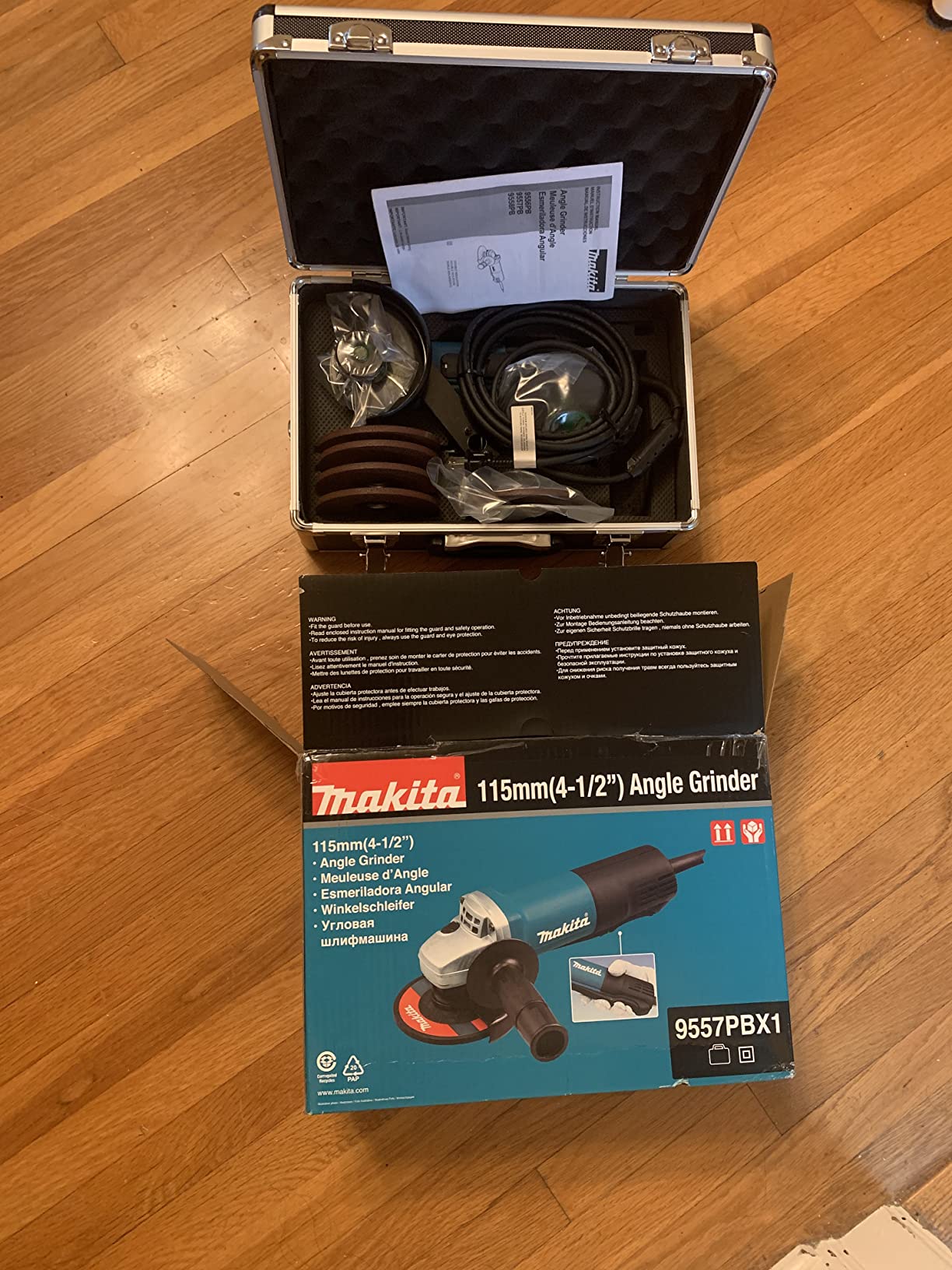
The Makita 9557PBX1 is the most complete package in this roundup, and for a first grinder it removes almost every reason to make a second purchase. The box holds a 4-1/2 inch diamond blade, five 4-1/2 inch grinding wheels, both a 4-1/2 inch wheel guard and a 4-1/2 inch cut-off wheel guard, a lock nut, a lock nut wrench, a side handle, an inner flange and an aluminum case.
Having both guards is the part that gets underestimated. Many grinders ship with one guard, and the guard is what controls sparks and protects you when the wheel breaks. Getting the cut-off guard from the start means you can switch between grinding and cutting without sourcing a part.
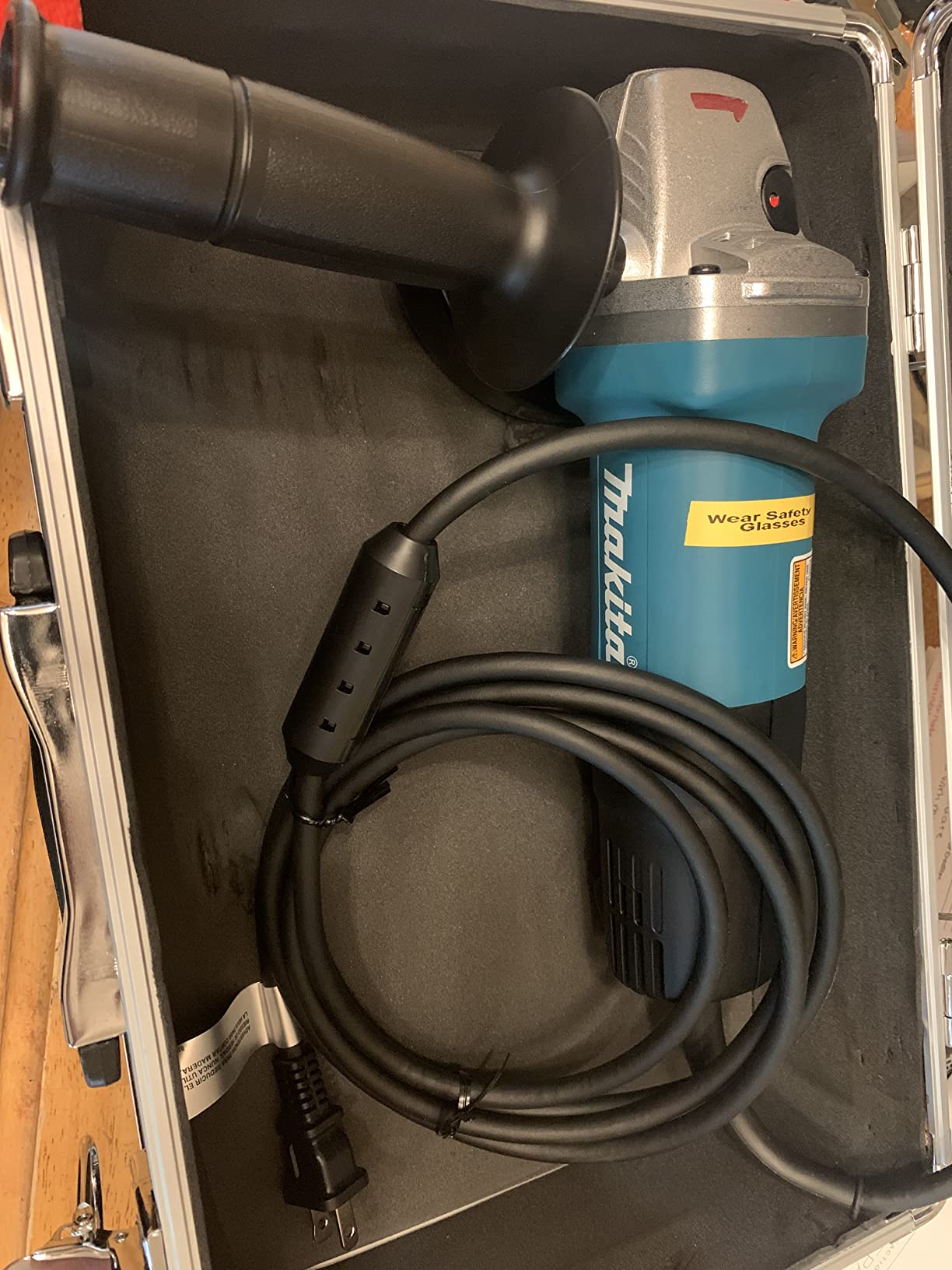
The tool itself is a 7.5 amp, 900 watt corded machine at 11000 RPM in about 4.5 pounds, with a small 2-1/2 inch diameter barrel grip. The paddle switch runs the length of the body, so it works no matter how you hold the tool, and releasing it stops the tool immediately.
Build details are professional grade: labyrinth construction seals the motor and bearings from dust and debris, protective varnish seals the armature, and it uses all ball bearings with a metal gear housing. It also accepts 5/8 inch arbor accessories, and the inserts can be reversed for 7/8 inch wheels.
Why it suits a new owner building a kit
You get guards, wheels, a diamond blade, a wrench, a side handle and a case in one box, which is why owners call it strong value for the complete package. For someone who does not yet know which disc thickness or guard type they need, this removes the guesswork.
The paddle switch safety and the compact barrel grip are the most-praised features, and the 11000 RPM output is smooth with good balance according to owners.
Why you should skip it
Skip it if your cuts are heavy and continuous. A 7.5 amp motor has less raw power than 10 to 11 amp class grinders, and no amount of kit contents changes that.
The case is the most common complaint. The tool does not fit inside it with the side handle attached, the slots are full with no room for extra wheels, and the Phillips screwdriver you need to swap the guards is not included. If you are the type who wants everything in its place, this kit will annoy you.
6. CRAFTSMAN CMCG400B – Best Cordless Small Grinder With a Lifetime Warranty
CRAFTSMAN V20* Angle Grinder, Small, 4-1/2-Inch, Tool Only (CMCG400B)
- Compact small body comfortable for detail work
- Tool-free guard positioning is quick
- Cast metal gear housing runs cool
- 3-position handle for different orientations
- Backed by a limited lifetime warranty
- Battery and charger sold separately
- 8500 RPM is low so cuts run slower
- Fewer reviews than the category leaders
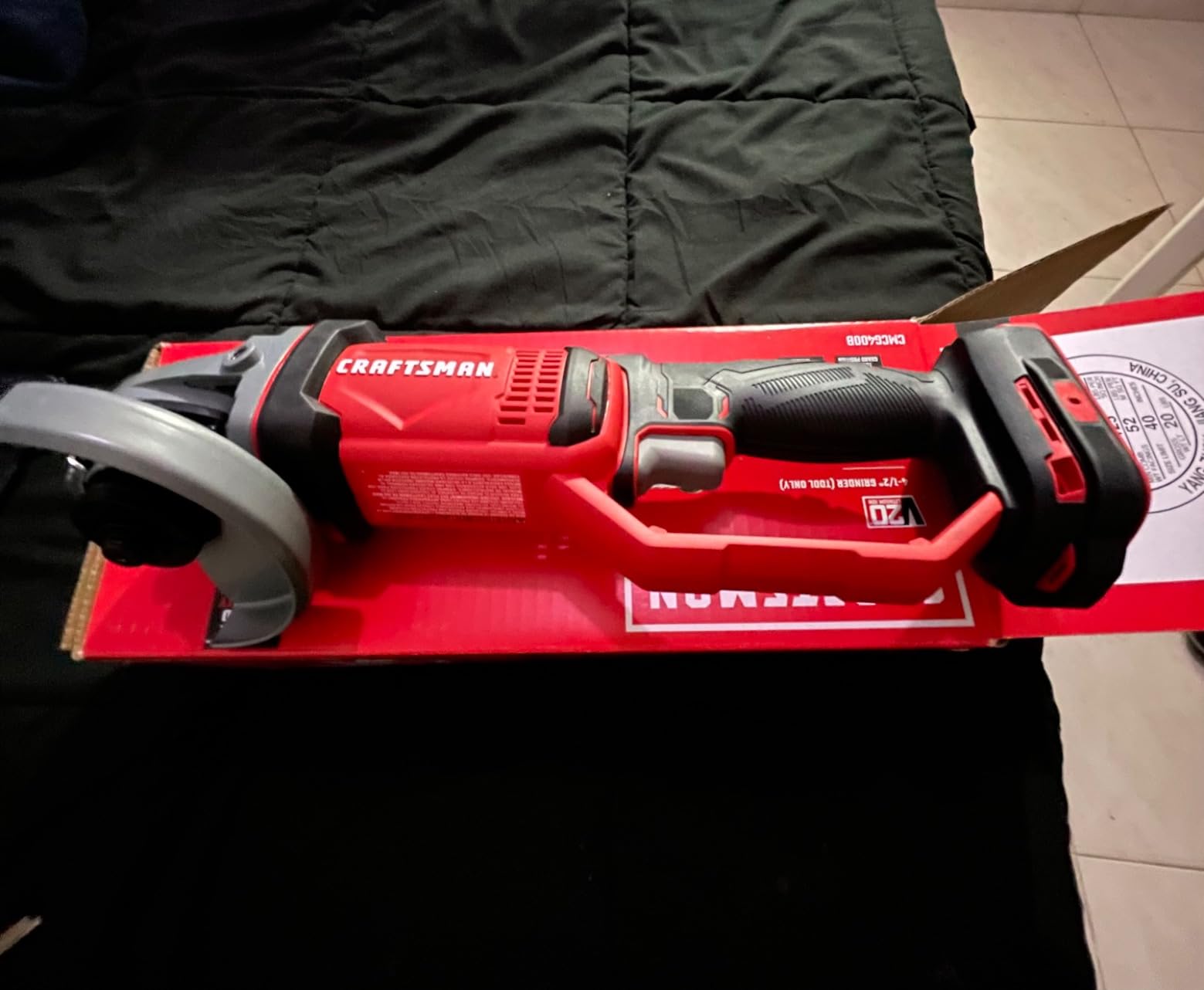
The CMCG400B is the cordless option for people who want a small grinder for controlled work rather than production removal. It is a 4-1/2 inch cordless tool on a 20V battery platform, and the compact small-handled design is comfortable in the hand for detail work and weld cleanup.
Two features do the most work here. The tool-free guard positioning lets you reposition the guard in seconds without a wrench, which is exactly the feature owners who change tasks often say saves them the most time. The cast metal gear housing dissipates heat during extended use, which is a meaningful difference on a small cordless body.
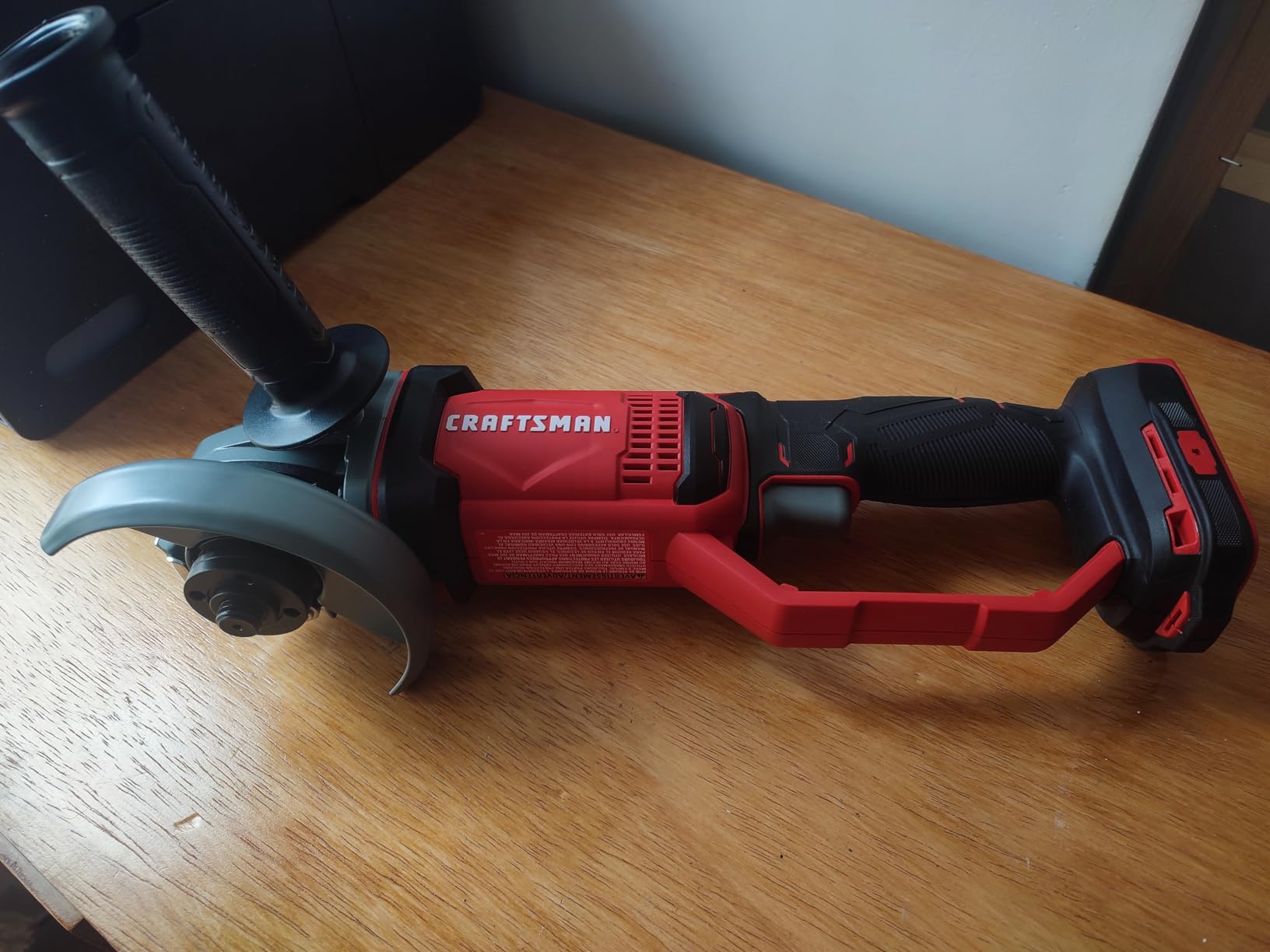
The 3-position handle and contoured over-molded grip give good control when the tool is rotated for a corner or a flat surface. It ships with a grinding guard, a grinding wheel and a spanner wrench, but no battery and no charger.
That last point is the one to price carefully. A limited lifetime warranty is real value and a genuine differentiator at this end of the market, but it covers the tool, not the ecosystem cost of getting into the platform.
Why it suits a homeowner with a 20V platform
If you already own 20V packs and a charger, this becomes a low-friction second grinder for cuts away from an outlet, and the tool-free guard plus 3-position handle make it easy to use on a bracket, a pipe end or a cleanup pass without hunting for a wrench.
Owners also point to the cool-running cast metal gear case, which matters on a small tool that spends its life in a hand.
Why you should skip it
Skip it if you are starting from nothing on a battery platform and your real work is heavy stock removal. The 8500 RPM figure is lower than most 4-1/2 inch grinders, so cuts are slower, and the warranty does not change that.
Be aware of the evidence base too. At just under 3000 reviews there is less long-term durability history here than on the category leaders, which is a fair reason to prefer one of them if you expect to keep the tool for a decade.
7. Milwaukee 2880-20 – Best Cordless Grinder for Bind-Ups and Kickback
Milwaukee 2880-20 M18 Fuel Brushless Lithium-Ion 4-1/2 in. / 5 in. Cordless Small Angle Grinder with No-Lock Paddle Switch (Tool Only)
- Electronic clutch kickback protection on bind-ups
- No-lock paddle switch stops the tool on release
- Anti-vibration side handle cuts hand fatigue
- Overload protection extends motor life
- Takes 4-1/2 and 5 inch wheels
- Works with all M18 batteries
- Tool only - battery and charger sold separately
- 8500 RPM is modest next to corded grinders
- Heavier than smaller cordless grinders for overhead work
The Milwaukee 2880-20 is the one I would hand someone who cuts stainless pipe, where heat builds fast and the wheel is most likely to bind. Instead of a mechanical clutch, it uses an electronic clutch for kickback protection, plus overload protection to maximize motor life. Owners consistently credit those two features as the reason to pick it over other cordless options.
It is also the most flexible disc platform here. It accepts both 4-1/2 inch and 5 inch wheels on a standard 5/8-11 spindle, so you can step up to a 5 inch cut-off disc for heavier material without changing tools. The anti-vibration side handle is a genuine comfort feature on long sessions.
The no-lock paddle switch is worth calling out because it is the opposite design choice from many corded grinders. There is no lock-on, so the tool stops the moment you relax your grip, which removes a whole category of runaway-tool incidents at the cost of a longer continuous pass.
It works with all M18 batteries, so if you have any M18 tool already, the barrier to entry is just the bare tool. Owners describe the combination of clutch, paddle switch and anti-vibration handle as what sets it apart on metal cutting and grinding.

Why it suits someone cutting pipe and stainless
The electronic clutch is the feature trade users praise, and stainless pipe in particular is where a bind is most likely and where sparks and heat are least welcome. Overload protection matters for the same reason, because it keeps the motor out of the damage zone on a heavy pass.
The ability to run a 5 inch wheel from the same tool means one battery platform covers both general shop work and heavier stock removal.
Why you should skip it
Skip it if you are buying your first M18 tool. The bare tool plus separate battery and charger is the recurring caveat in the reviews, and it is a real cost even with an existing platform.
Skip it for long overhead work on the basis of weight. At 5 pounds it is the heaviest cordless grinder here, and the 8500 RPM figure is modest next to an 11000 or 12000 RPM corded machine, so the material removal rate is lower for the same disc.
8. Bosch GWS8-45 – Best Corded Grinder for Long Grinding Sessions
- Holds 11000 RPM through 15 minute sessions without bogging
- Delivers real grinding power for its 4.2 lb weight
- Slim-grip body fits tight spaces and runs one-handed
- Large spindle lock makes wheel changes fast
- Service-minder brushes and directed air flow extend motor life
- Guard needs an Allen key to reposition
- Handle sits forward which is awkward overhead
- Manual states the tool is not approved for cut-off use
- Lock-on slide switch takes practice
The Bosch GWS8-45 is the grind-and-grind machine of this group. Reviewers report it running cool and steady through 15-minute continuous sessions without bogging down, and describe it as punching well above its 4.2 pound weight, handling jobs like stripping paint and sharpening tractor blades. The professional 7.5 amp motor holds 11000 no-load RPM under sustained contact.
The slim-grip body is small enough to run one-handed and still fits the hand properly, and the large red spindle lock makes disc changes fast. The burst-protection guard and directed air flow that diverts dust from vital components are both durability features rather than safety theatre.
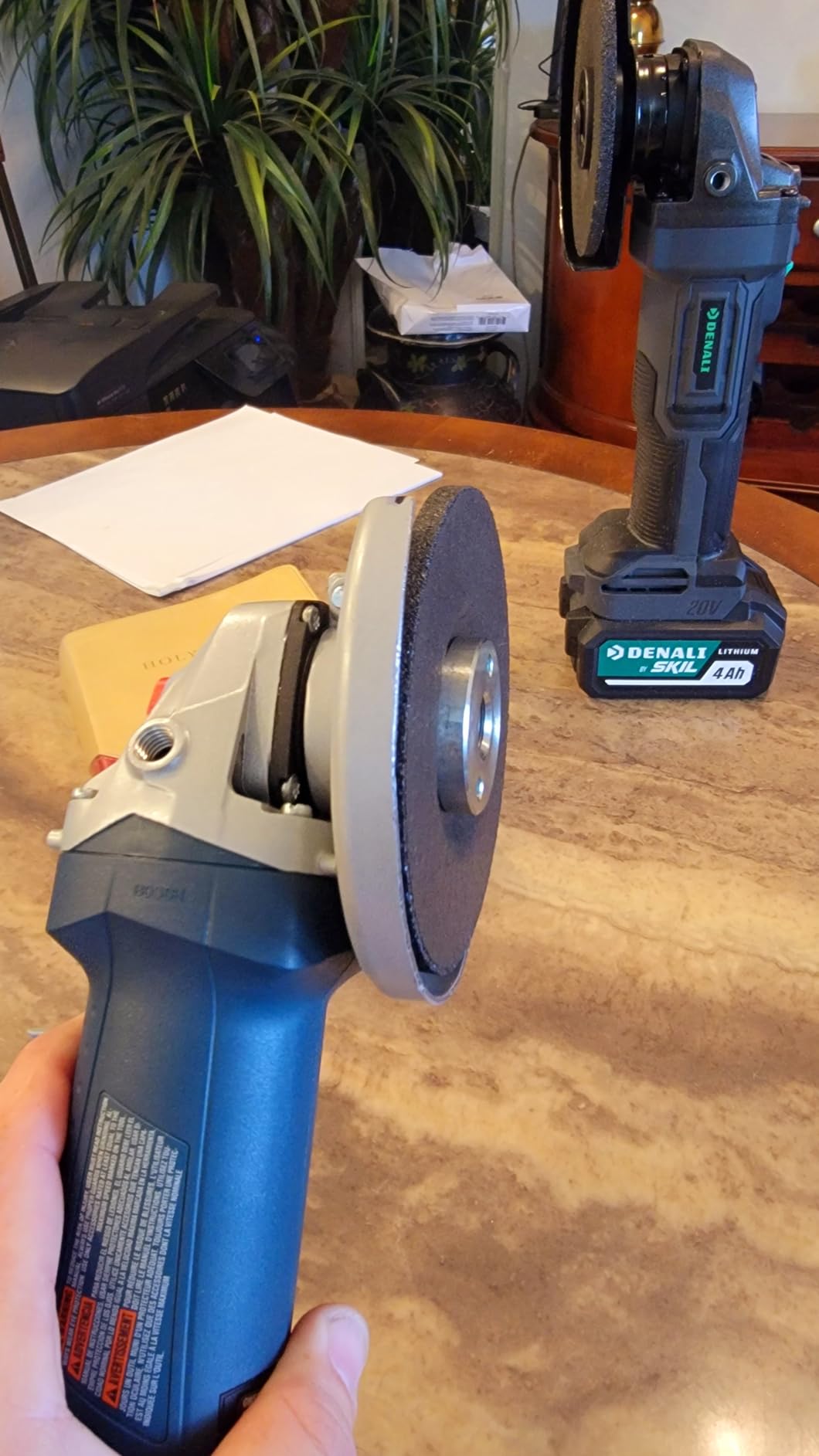
The service-minder carbon brushes are unusual and genuinely useful. The grinder stops when brush maintenance is due, so you are not running the motor to destruction on worn brushes, and you can replace them rather than replace the tool.
One caveat deserves a clear mention. Reviewers report that the manual states the tool is not approved for cut-off use, even though it cuts. If your work is primarily cutting metal, buy a grinder that is rated and documented for cut-off work instead of relying on an interpretation of the manual.
Why it suits long grinding passes
The combination of a 7.5 amp motor holding 11000 RPM, directed air flow and a cool-running profile is what makes it a session tool rather than a sprint tool. If your day involves weld prep, paint stripping or sharpening rather than slicing, that is the right trade.
Owners also appreciate the power-to-weight ratio, and the two-position side handle plus slim grip give good control in tight spots.
Why you should skip it
Skip it as your primary cutting tool, for the manual reason above. Skip it for overhead work, because owners report the handle position sits forward, which is awkward when you are working above shoulder height.
Also expect friction on two small things. The guard requires an Allen key to reposition rather than a clamping collar, and the lock-on slide switch takes practice, particularly when you are working one-handed.
How to Make a Clean, Safe Cut with an Angle Grinder
No grinder in this roundup will save you from bad technique, and the same technique errors cause the bind-ups and kickbacks that owners post about constantly. The following sequence is the one that comes up again and again in metalworking forums, and it is worth learning before you buy a wheel.
1. Keep the guard on. This is the most repeated safety line in every forum thread on the subject, and it is also the one most often ignored. The guard is what contains sparks and fragments if the wheel breaks, and it should only be repositioned for the specific cut, never removed to get at a tight spot.
2. Inspect the wheel before fitting it. Look for cracks, a chipped rim, or a wheel that has clearly been used before. Check the printed markings for maximum RPM, wheel type, arbor size and thickness. If the RPM on the wheel is below what the grinder produces, do not fit it.
3. Set up the work before you start. Clean the metal, mark the cut line, clamp the work so it cannot move, and support the offcut so it cannot pinch the wheel when it separates. Most kicked wheels are caused by a moving workpiece, not a bad tool.
4. Cut with the trailing edge. The trailing edge is the part of the disc that is moving into the material rather than away from it. Pushing against the rotation is unstable and is the mechanism behind most kickbacks. Angle the tool so the wheel enters the cut from the direction of travel, and the disc wants to pull itself into the cut instead of grabbing it.
5. Watch the stand-off angle. Standing too far off the work lets the wheel wander, dive in and bind. Too close and you are grinding the face of the disc instead of cutting with its edge. Keep a steady, shallow angle and keep the pressure light.
6. Point the sparks away from people, fuel and combustibles. Sparks travel in the direction of the wheel’s rotation at the point of contact. Aim them at a wall, a fire extinguisher or open ground, never at a bystander, a vehicle interior or a pile of offcuts.
7. Let the wheel do the work. Long grinder threads converge on one point: heat and vibration problems usually come from forcing the tool. If a cut slows down, check whether the wheel is blunt, whether the disc is too thick for the job, or whether the motor is at its limit, before leaning harder on it.
If you also need blades sharpened rather than metal cut, a bench grinder such as the ones in our bench grinder roundup is the right tool, because an angle grinder makes grinding much harder than sharpening.
Which Cut-Off Disc to Use for Metal Cutting
The disc, not the grinder, decides the quality of a metal cut. Buying a better grinder with the wrong wheel produces a slow, hot, frustrating cut, and this is the single most under-covered part of angle grinder buying.
Type 1 cut-off wheels are flat discs with a depressed centre, made for slicing. Type 27 grinding wheels are raised-centre discs for shaping, weld prep and deburring. Putting a grinding wheel on for a cut wastes the wheel and throws a shocking amount of spark.
Abrasive cut-off wheels are the standard for mild steel, rebar, angle iron and general shop work. Diamond wheels are for masonry, tile, stone and concrete, and they are not for metal. Flap discs are for blending, deburring and surface finishing, not for cutting through.
Thickness is where most buyers waste material. A 1.6 mm wheel is stronger and safer for heavy stock and thick plate. A 1.2 mm wheel is the sensible all-round choice. A 0.9 mm wheel removes the least material as kerf and makes the fastest, cleanest cut, which is why enthusiast threads on hobby forums keep pushing thinner wheels for sheet metal and thin gauge work. The trade is rigidity, so go thicker when you are cutting heavy structural material.
On metal type, the short version is this. Mild steel, rebar and angle iron take a standard abrasive cut-off wheel. Stainless steel wants a dedicated stainless-rated wheel, because carbon steel contamination can leave rust marks on the finished surface. Cast iron and steel pipe cut cleanly with the same abrasive wheel. Aluminium, copper and brass are better cut with a wheel specified for non-ferrous metals, which is usually a slightly different grit. Masonry and concrete need a diamond wheel, not an abrasive one.
Finally, read the markings on the wheel itself. Maximum RPM, wheel type, arbor size and manufacturer date are all printed on the disc, and a wheel that has been sitting in a damp shop for years can lose its rated speed. Quality matters here too: forum users are split on generic discs, and the safety-conscious majority insists on a wheel rated at or above the grinder’s speed.
Kitchen work is the one place where a different mindset applies. If the metal work is small enough to be happening near a cutting board, our guide to the best cutting boards tested and reviewed is the more relevant read.
Corded vs Cordless: The Platform Cost Question
The forum consensus is not really about power. It is about whether you already own a battery system. On r/Tools and homemadetools threads the view is plain: corded is the default for most cutting, and cordless is the answer if you need cordless.
Start with the honest cases for each. A corded 7.5 amp grinder holds speed indefinitely, and 10000 to 12000 RPM keeps the cut cooler and faster than a cordless machine spinning at 8500 RPM. That is why working metalworkers default to corded for real stock removal.
Cordless wins where a cable is a liability: on a roof, at the far end of a site, inside a vehicle, or anywhere a 20 foot cord becomes something to trip over. The three cordless picks in this roundup all pair 4.8 or 4.7 star ratings with kickback protection or a lifetime warranty, which is a real quality level.
Now the platform math, which competitors almost never show. Owners on r/MilwaukeeTool and r/Dewalt report that the trigger purchase is usually a two-battery kit plus a charger, not a single tool. If you already own that ecosystem, the correct decision is usually obvious. If you do not, the batteries and charger are the real cost of the tool, and they will be bought again for the next one you need.
So the practical rule is this. If your metal cutting happens within reach of an outlet, buy corded and spend the difference on good wheels. If you routinely work where there is no power, and you are already inside one platform, buy cordless. If you are not already inside a platform, the corded grinders here will still be running in ten years with a new set of carbon brushes.
What to Look For When Buying an Angle Grinder
Start with disc size, which is the decision that shapes everything else. A 4-1/2 inch grinder is the standard for a reason: it fits a 5/8-11 or 7/8 inch arbor that is shared across brands, it is light enough to control, and the discs are cheap and easy to find. Larger discs remove more metal per pass but are heavier, harder to control, and consume more of your material as kerf.
Next is amp rating, which is a proxy for how much torque the tool has when the wheel bites. Under about 6 amps you are fine for sharpening, light deburring and thin material. In the 6.5 to 7.5 amp range is where general metal cutting lives. Above that you are into production work, and the cost of the tool and its discs goes up sharply.
No-load RPM is the speed with nothing touching the wheel, and it drives heat and burn risk. Higher speed means faster cutting and more heat. A variable speed trigger gives you more control, particularly on thin sheet metal and stainless where a sudden bind is common.
Motor type is the next question. Brushed motors use carbon brushes that wear and need replacement, and the manufacturer usually exposes them for servicing. Brushless motors have no brushes, run cooler, and are the default on every cordless grinder worth buying. A service-minder that stops the tool when brush maintenance is due is a nice middle ground on a brushed machine.
Safety hardware deserves honest treatment, because forums are genuinely split. An electronic brake stops the wheel in under two seconds. A kickback brake or anti-reload clutch detects a bind and kills the wheel. Restart protection stops the tool starting after a power interruption. Trade users treat these as the reason to pay a premium. Casual buyers are more likely to see them as a sales line. If you cut rebar, pipe or stainless regularly, they are the difference between a near-miss and nothing happening.
Wheel change speed saves more time than most people expect. A spindle lock means one button instead of two tools. A tool-free or one-touch guard means the guard follows the wheel without a wrench. On a job where you alternate between grinding and cutting, that is a real time saving.
Weight, balance and handle positions matter for fatigue rather than speed. A 4-1/2 inch grinder under 4.5 pounds with a three-position side handle is noticeably more comfortable overhead. A forward-canted handle is better for reaching into a corner.
Finally, check the warranty and what is in the box. Serviceable brushes, a metal gear housing and a lifetime warranty extend ownership meaningfully. And count the consumables, because a grinder that arrives with no cut-off wheel is not ready to cut. The AVID POWER and Makita kits here are the two that arrive complete.
One naming caution before you shop: a mechanical meat grinder shares the “grinder” name but does the opposite job to an angle grinder. If you are processing food rather than stock, our roundup of the best meat grinders is the one to read instead.
Frequently Asked Questions
What is the best angle grinder for cutting metal?
The DEWALT DCG413B is the best overall for metal cutting: a 20V MAX brushless 4-1/2 inch cordless grinder rated 4.8 stars across 9588 reviews, with an electronic kickback brake that stops the wheel in 2 seconds or less and a 3.8 pound body light enough for overhead work. For a corded tool, the Makita 9557PBX1 pairs 7.5 amp power with both wheel guards, a diamond blade and a case included.
Are angle grinders good for cutting metal?
Yes. A 4-1/2 inch corded grinder at 10000 to 12000 RPM is the fastest handheld way to cut mild steel, rebar, angle iron, stainless pipe and sheet metal. The tool is at its best on cuts where a chop saw cannot reach, and it is far less useful on long straight cuts across thick plate, where a chop saw is faster, safer and gives a square edge.
What type of angle grinder blade should I use for cutting metal?
Use a Type 1 depressed-centre abrasive cut-off wheel, not a raised-centre Type 27 grinding wheel. For ordinary mild steel, rebar and angle iron a 1.2 mm wheel is the sensible all-round choice. Step up to 1.6 mm for heavy structural stock, and step down to 0.9 mm for thin gauge and sheet metal where kerf loss matters. Check the printed maximum RPM on the wheel against the grinder before fitting it.
Should I buy a corded or cordless angle grinder?
Buy corded if your metal cutting happens near a power outlet: it holds speed indefinitely and spins faster, so cuts run cooler. Buy cordless if you work away from power, and especially if you already own batteries and a charger for that platform. The cost of a bare cordless tool plus separate batteries and charger is the largest hidden cost in this category.
What are the best angle grinder cut-off discs for metal?
For mild steel, rebar and angle iron, a standard abrasive cut-off wheel from a known brand is the right answer, fitted so the printed RPM rating is at or above what the grinder produces. Use a stainless-rated wheel for stainless steel so carbon contamination does not leave rust marks, and a diamond wheel only for masonry, tile and concrete. Thinner wheels cut faster and waste less material as kerf, but are less rigid on thick stock.
The Best Angle Grinder for Metal Cutting, Verdict
The DEWALT DCG413B is the best angle grinder for metal cutting overall, and its 4.8 star rating across 9588 reviews reflects a tool that owners keep because the kickback brake and the two-stage paddle switch make a bind-up an event rather than a hazard. For first-time buyers who want a corded machine and no ecosystem, the BLACK+DECKER BDEG400 does the job without ceremony.
Choose the AVID POWER AAG589 if you want cut-off wheels in the box on day one, the Metabo HPT G12SR4 if your cuts happen in gaps, and the Makita 9557PBX1 if you want both guards and every accessory included. Reach for the Milwaukee 2880-20 on stainless and pipe where bind-ups are likely, and the Bosch GWS8-45 for long grinding sessions rather than cutting.
Whichever one you choose, spend your remaining money on good cut-off wheels and learn the trailing-edge rule. That combination does more for the quality of your cuts than any spec on this page, and it is updated for 2026.