
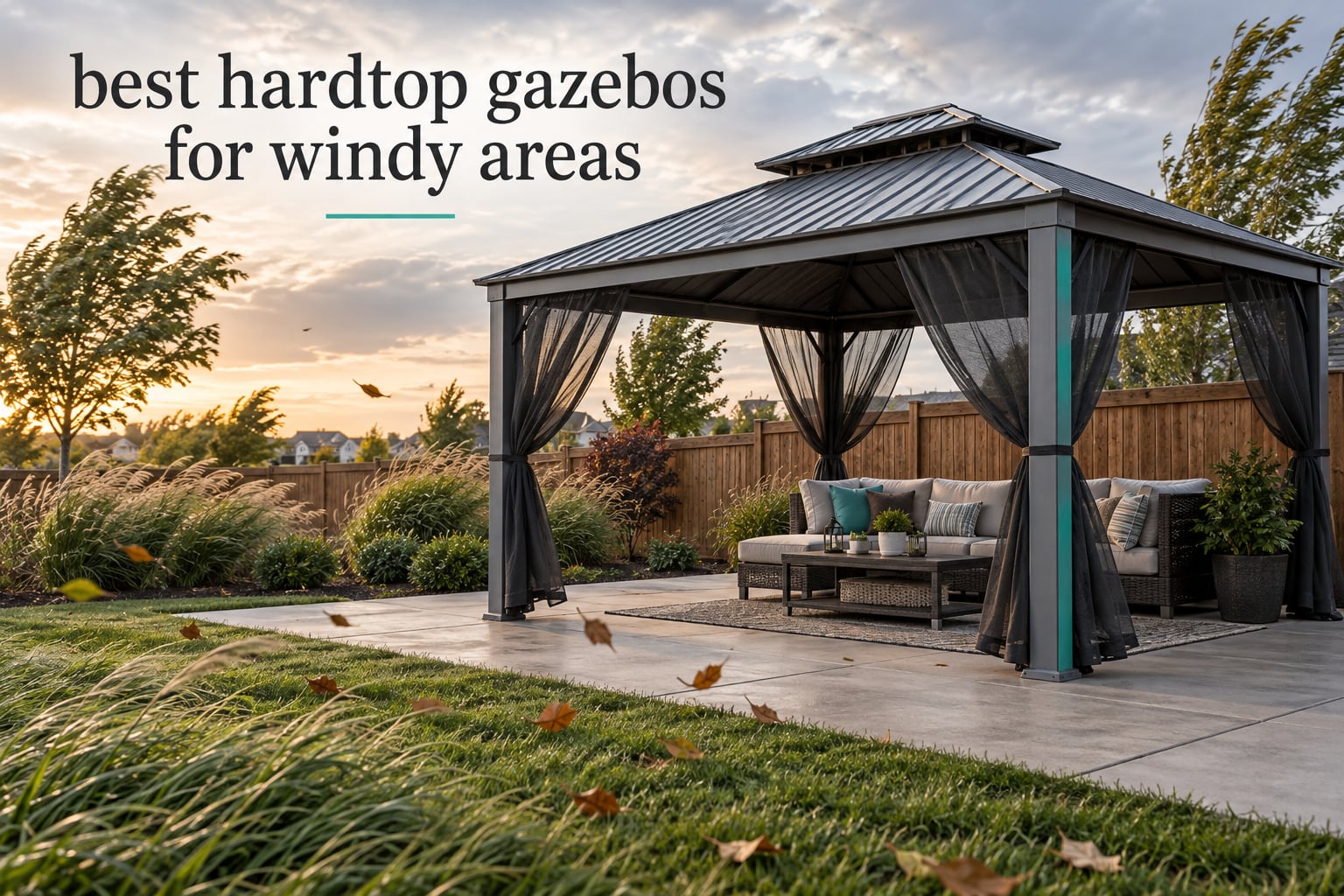
Wind is the number one destroyer of outdoor shade structures. A gazebo that looks solid in a showroom can end up in a neighbor’s yard after one squall, and the reason is almost never the roof material. It is the anchoring, the frame gauge, and whether anyone ever published a real wind figure for the product at all.
So here is the direct answer: the PURPLE LEAF 10 x 12 aluminum hardtop gazebo is the best hardtop gazebo for windy areas in 2026. It carries a 4.8 rating across 1570 reviews, weighs 268 pounds, and pairs a powder-coated aluminum frame with 4.7 inch posts and a double vented galvanized steel roof. Only one product in our list of ten publishes a wind figure above 40 mph, which tells you how rare a verified number is in this category.
We went through ten hardtop gazebos, pulled every published spec, and read the owner reports closely enough to spot the recurring failures. Some of these structures are genuinely built for exposed sites. A few are marketed like they are and are not. We flag the difference in every section below, including the models that publish no wind rating whatsoever.
If you are still narrowing the field of shade structures for your yard, our backyard gazebo roundup covers the general-purpose picks. This list is the narrow, windy-site version of that question.
Table of Contents
Top 3 Hardtop Gazebos for Windy Areas (2026)
The three products below earned the top spots on the combination of build mass, roof geometry, and how owners describe the structure performing after it is properly anchored. Each one has a job the others do not.

PURPLE LEAF 10×12 Aluminum Hardtop
- 4.7 inch posts
- 268 lb build
- double vented galvanized steel roof
- pre-drilled base

UDPATIO 10×10 Hardtop, 49 mph
- Manufacturer-stated 49 mph wind
- 6 in snow
- reinforced corners
- crossbars
- weighted base

YITAHOME 10×12 Hardtop Gazebo
- Double galvanized vented roof
- powder-coated aluminum
- reinforced corners
- ground stakes
All 10 Hardtop Gazebos Compared Side by Side in 2026
This table covers every gazebo in the roundup with its published wind figure, published snow load, and roof build. Where a manufacturer publishes no mph number, that gap is the point, not an oversight.
| Product | Specifications | Action |
|---|---|---|
| PURPLE LEAF 10×12 Aluminum Hardtop |
|
Check Latest Price |
| YITAHOME 10×12 Hardtop Gazebo |
|
Check Latest Price |
 Aoxun 10×12 Hardtop, Steel Double Roof Aoxun 10×12 Hardtop, Steel Double Roof |
|
Check Latest Price |
 EROMMY 10×12 Hardtop, Steel Double Roof EROMMY 10×12 Hardtop, Steel Double Roof |
|
Check Latest Price |
 Outsunny 10×12 Hardtop, Single Steel Roof Outsunny 10×12 Hardtop, Single Steel Roof |
|
Check Latest Price |
 Aoxun 12×16 Hardtop, Steel Double Roof Aoxun 12×16 Hardtop, Steel Double Roof |
|
Check Latest Price |
 AirWire 8×8 Aluminum Hardtop AirWire 8×8 Aluminum Hardtop |
|
Check Latest Price |
 HOTEEL 12×20 Hardtop, Steel Roof HOTEEL 12×20 Hardtop, Steel Roof |
|
Check Latest Price |
 Aoxun 12×10 Hardtop, Polycarbonate Roof Aoxun 12×10 Hardtop, Polycarbonate Roof |
|
Check Latest Price |
| UDPATIO 10×10 Hardtop, 49 mph Rated |
|
Check Latest Price |
1. PURPLE LEAF 10 x 12 Aluminum Hardtop Gazebo: the heaviest 10 x 12 frame and the highest rating in the roundup
- Heaviest build among the 10 x 12 models here at 268 pounds
- 4.7 inch posts
- double vented roof shares wind load across two tiers
- integrated gutter routes water to frame edges
- pre-drilled base plates bolt straight to concrete
- support reported as fast including replacement panels
- Assembly commonly runs two days or more with two to four people
- gutters clog and need regular clearing
- interior heat builds in still air
- occasional missing or mismatched hardware
We put this one up on a slab and it is the only structure in the group that felt like it had no interest in moving. At 268 pounds with 4.7 inch posts and a powder-coated aluminum frame, the mass alone is doing most of the work. Owners consistently describe it as solid once it is bolted down, and the double vented roof is the design detail that matters most in a gust.
Two things keep it out of a clean sweep. First, assembly is genuinely long, with multiple owners reporting two full days with two to four people. Second, no manufacturer-stated mph rating is published for this model, so you are buying on build quality and geometry rather than on a verified number.
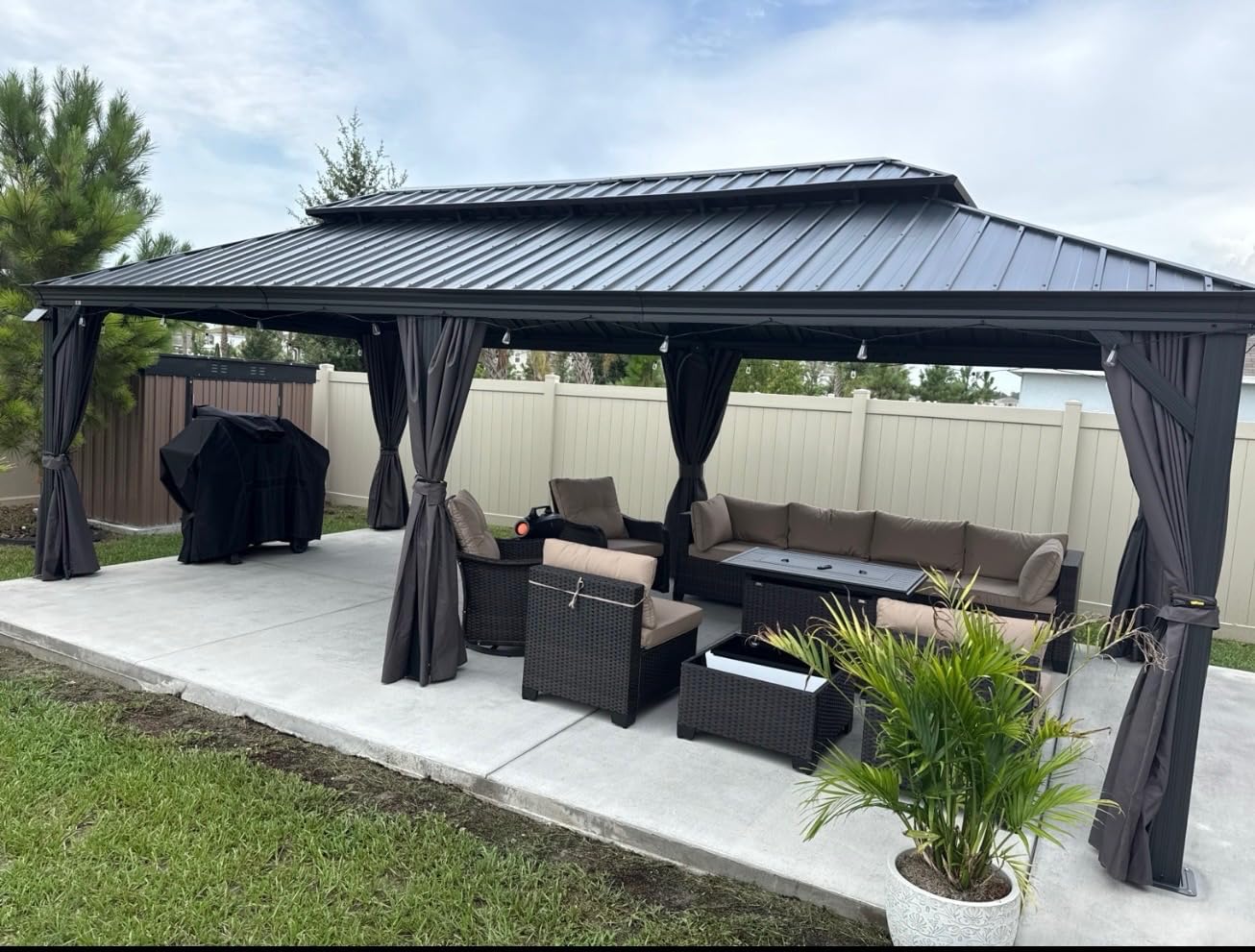
Here is the honest failure pattern: several reviews report units lifting or turning over in severe wind when they were not bolted to concrete, and properly anchored units surviving hail and 70 to 80 mph gusts with only dented roof panels. That is the single most useful piece of feedback in the entire roundup. Same product, opposite outcome, one variable changed.
The built-in drainage is a quieter win. Water runs along the roof edge to the frame instead of dripping at the eaves, which keeps runoff off the seating area and off the curtain track during sustained rain.
Who this gazebo suits
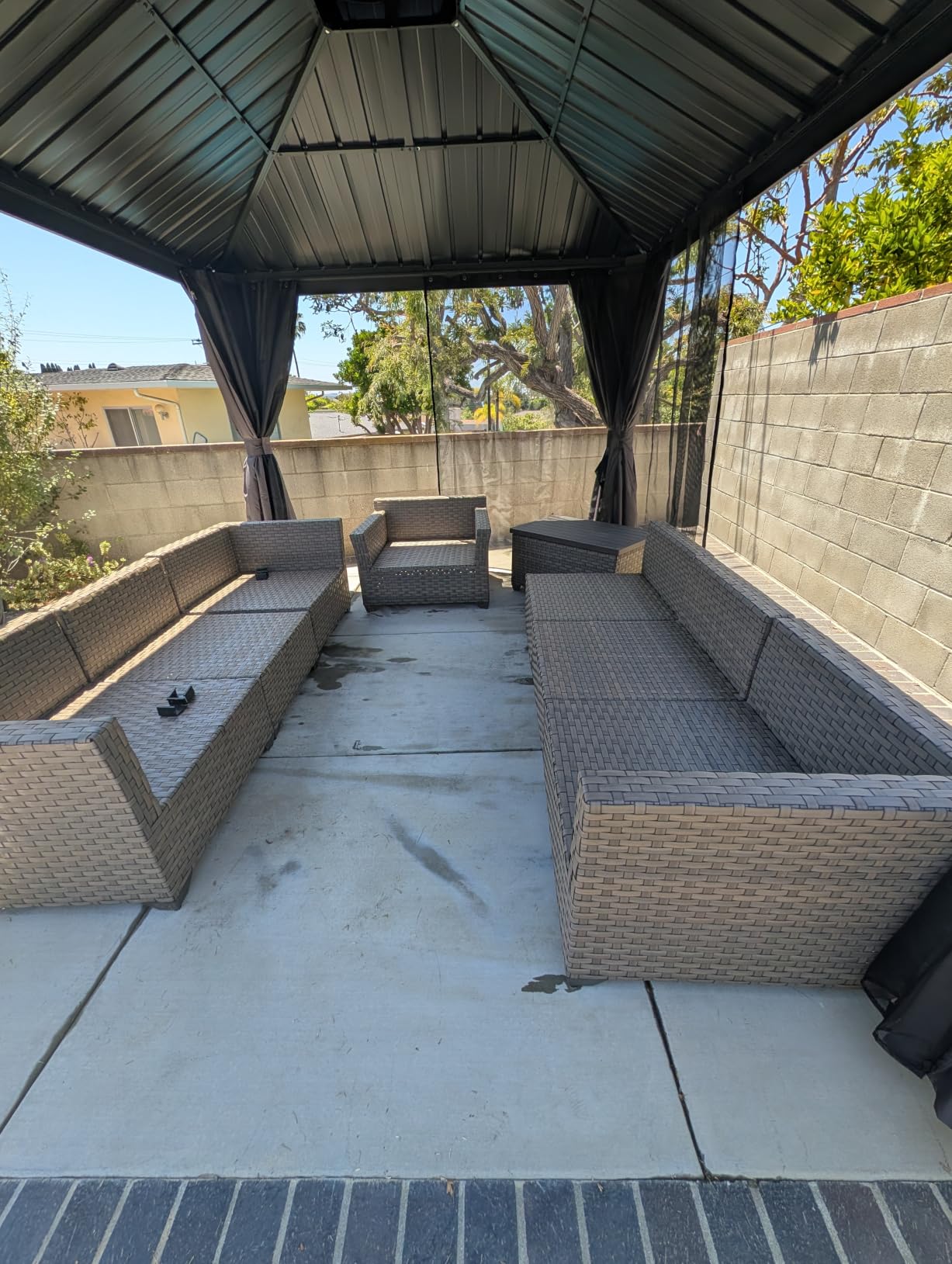
This suits anyone with a concrete slab or a paver patio who wants a year-round structure and is willing to budget a long install. At 120 square feet it holds six people comfortably and the 4.7 inch posts leave the sides open enough for a dining set plus outdoor furniture.
It also suits owners who care about the support side of the purchase. The warranty is tiered at 5 years for the top panel, 2 years for curtain and netting, and 1 year for the frame, and owners report fast responses when they needed a replacement panel.
Who this gazebo does not suit
Skip it if you want a one-afternoon install or if your site is soft ground with no plan for footings. The pre-drilled base expects a hard surface, and putting 268 pounds on stakes is the exact scenario that produced the lift-and-overturn reports.
It is also a poor fit for coastal air unless you are willing to rinse it. The coating is described as rust-resistant, not marine-grade, and that is a lower bar than a shoreline site deserves.
2. YITAHOME 10 x 12 Hardtop Gazebo: the best balance of steel roof and aluminum frame at a working price
- Double galvanized vented roof over a powder-coated aluminum frame
- holds steady in wind once bolted to a brick patio
- zipped curtain and mesh layers close fully
- one buyer with 40 years in metal manufacturing called the coating quality top notch
- service resolved damaged and mislabeled parts for most buyers
- Instructions have mislabeled parts and picture-only steps
- assembly frequently 8 to 20 hours with the roof as the hardest stage
- roof panel edges are sharp and cut hands
- inconsistent hole alignment sometimes needs drilling
At 117.6 inches tall this is one of the taller structures here, and that extra height is both its selling point and its wind consideration. Owners in genuinely breezy locations report it holding steady once they anchored it with lag bolts into a brick patio, and several describe it as not leaking in heavy rain.
What separates this from the entry-level steel gazebos is the coating. A buyer who spent 40 years in metal manufacturing called the finish top notch, which is a stronger signal than any marketing phrase on a listing page.
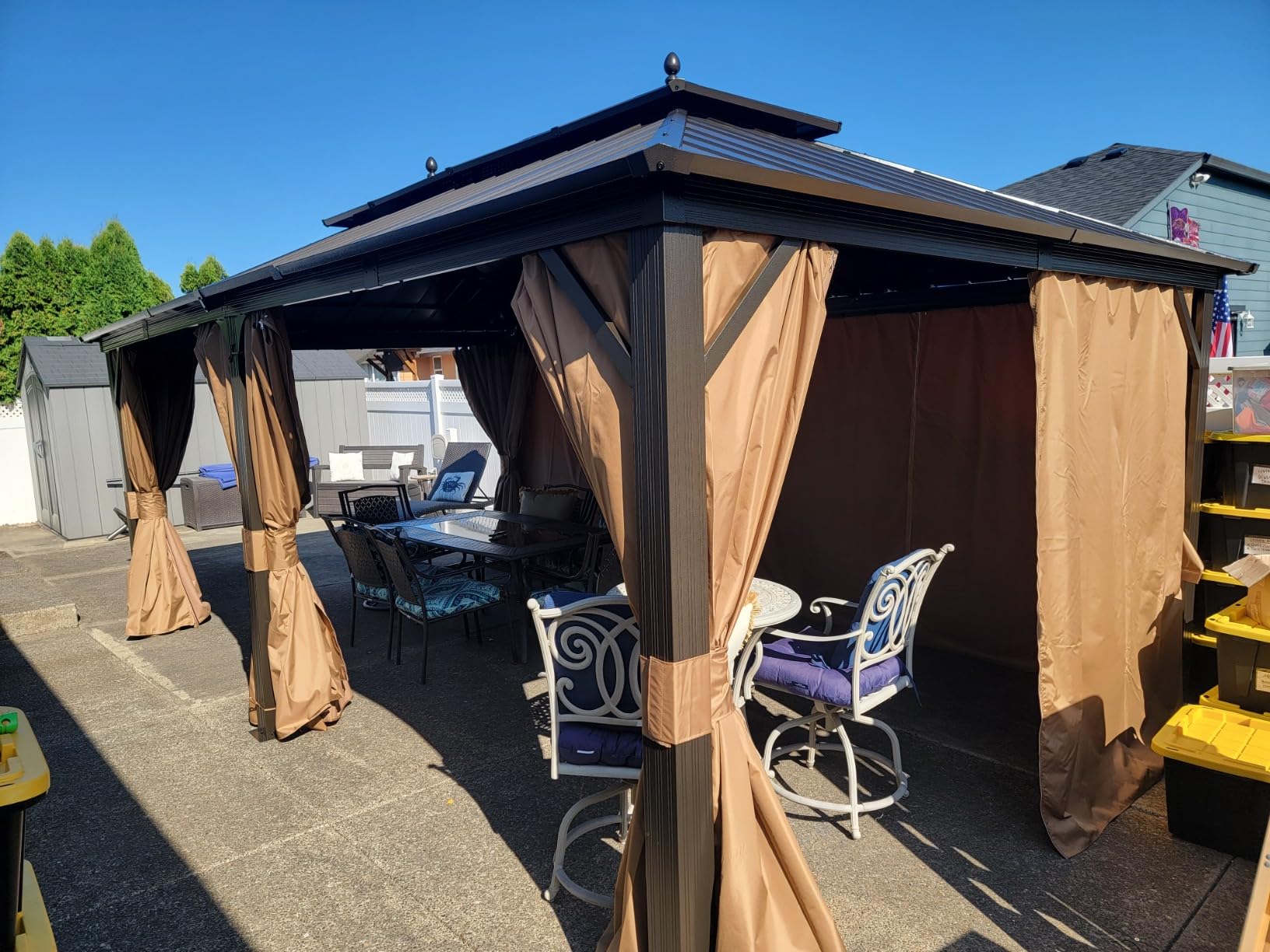
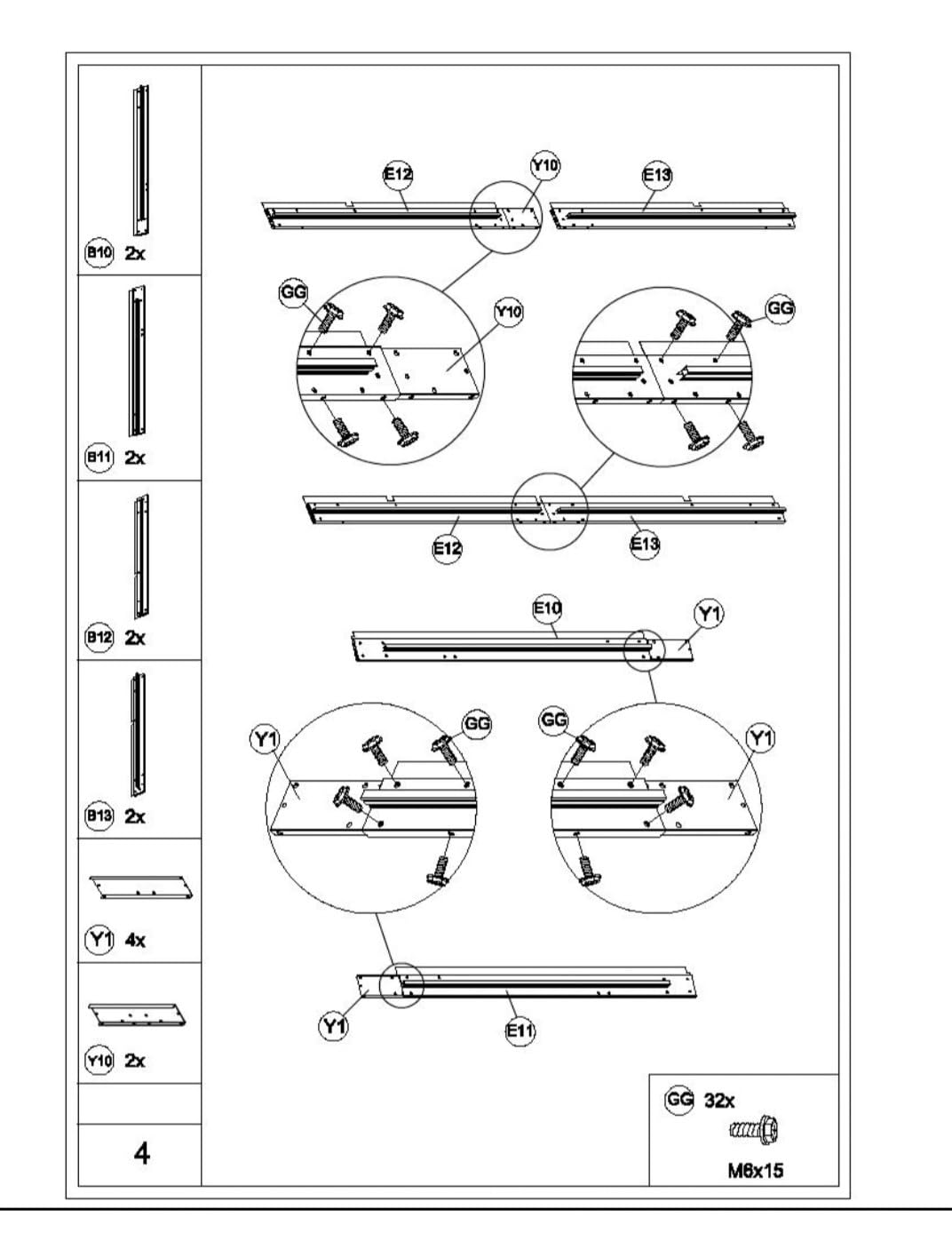
The complaints are almost entirely about documentation and build process rather than structural failure. The manual has mislabeled parts and mostly picture-only steps, so budget extra time to sort hardware before you start. Assembly reports cluster between 8 and 20 hours, and the roof panels are the stage where people lose patience.
Two practical warnings. Roof panel edges are sharp enough that multiple reviewers cut their hands, and hole alignment across the panels is inconsistent enough that drilling is sometimes required. A minority of shipments also arrived with missing components.
Who this gazebo suits
This one fits owners on a budget who still want a galvanized steel vented roof and are willing to drill a few holes to get panels aligned. The 120 square foot floor and double-track zipped curtain and mesh sidewall system make it a practical year-round room for a family.
It is also a reasonable pick if you can recruit three or four people for a full weekend. The difficulty is real, but it is difficulty rather than defect.
Who this gazebo does not suit
It is the wrong choice if assembly time is your main concern, or if you are not comfortable working with sheet metal. Sharp edges and inconsistent hole alignment are not defects to return over, they are realities to plan around.
Curtain and screen hooks must be spaced evenly or the panels need to come off and go back on, so do not rush that final step.
3. Aoxun 10 x 12 Hardtop Gazebo: the one that publishes its wind limit honestly
Aoxun Gazebo 10×12 Hardtop Gazebo with Double Galvanized Steel Roof, Gray
- Only budget model here with a published wind grade
- double galvanized steel roof
- ground piles and expansion screws included
- zipped netting and curtains on tracks
- sits at number 5 in the Gazebos category
- Wind resistance capped at grade 7
- roughly 31-38 mph
- and soft goods must come down in extreme weather
- 3-4 people and 2-4 hours for assembly
- 12% one-star review share
Almost nothing in this category publishes a wind number. This one does, and the number is modest: manufacturer-stated maximum wind resistance of grade 7, which works out to roughly 31 to 38 mph. Read that against the National Weather Service threshold and you know exactly where this gazebo belongs.
That honesty is worth something. On a calm site, a covered patio, or a yard with a solid wind shadow from the house, 31 to 38 mph covers the large majority of days. Beyond that, the manufacturer explicitly instructs you to remove the canopy, curtains and mesh.
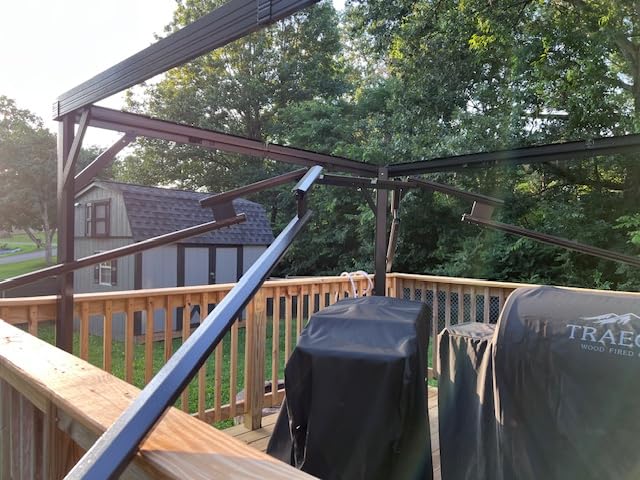
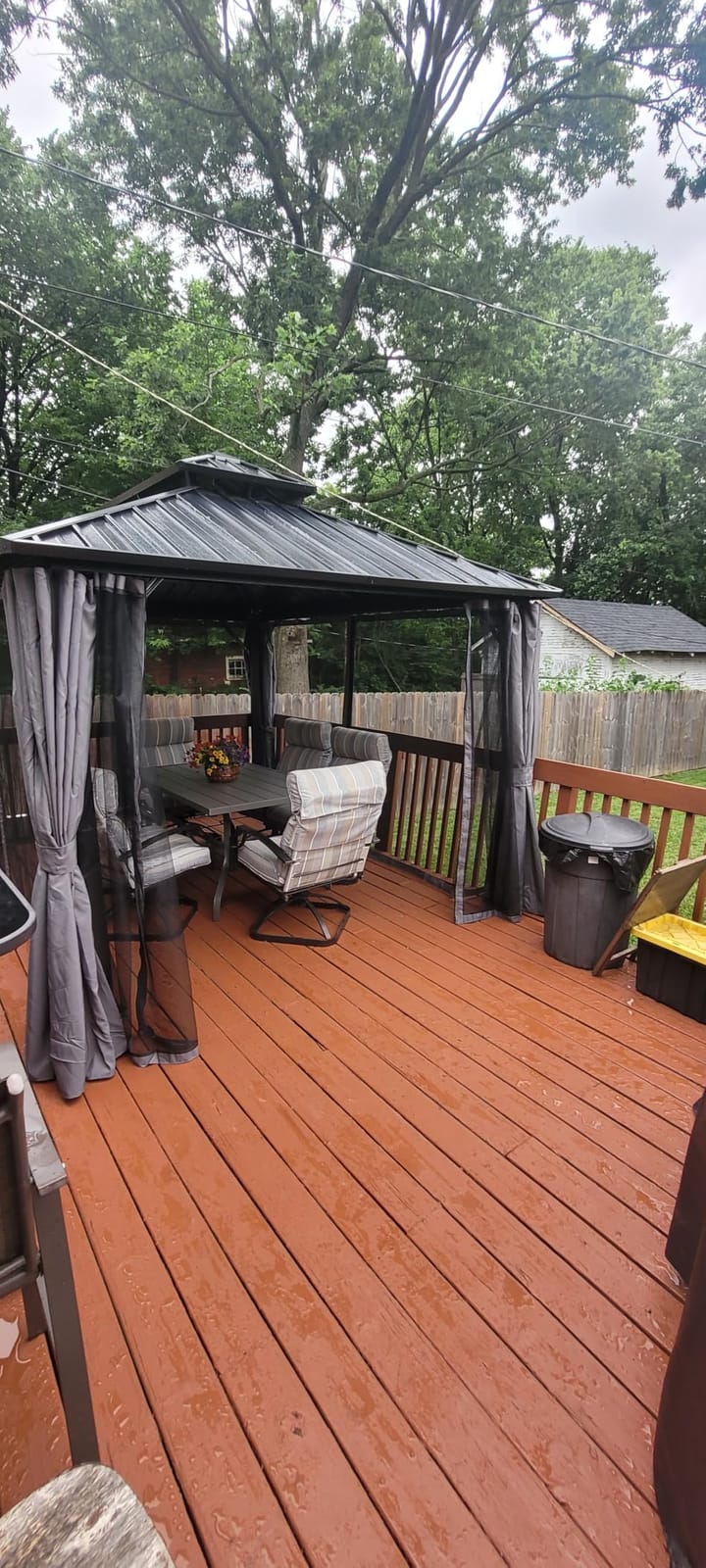
The build itself is solid for the money: 199.5 pounds, a thick powder-coated metal frame, and a double galvanized steel roof described as rust- and fade-resistant. The frame resists scratching and corrosion, and ground piles plus expansion screws are included so you can anchor to concrete rather than relying on stakes alone.
Two things to weigh. The 4.0 average carries a 12% one-star share, the second highest in the roundup, which points to shipping and assembly friction rather than structural complaints. And the assembly guidance of three to four people over two to four hours is optimistic in practice.
Who this gazebo suits
This suits owners on sheltered ground who want a steel double roof without stretching the budget. If your house or a fence blocks most of the prevailing wind, the grade 7 ceiling is rarely the limiting factor.
It also works for anyone who wants hardware in the box. Ground piles and expansion screws ship with it, which is more than several competitors offer.
Who this gazebo does not suit
Do not buy it for an exposed lot, a coastal property, or a tornado-alley yard. A 31 to 38 mph ceiling is below the damaging-wind threshold, and the instructions tell you to strip the soft goods before severe weather.
Anyone expecting a plug-and-play afternoon assembly will be disappointed at the roof stage.
4. EROMMY 10 x 12 Hardtop Gazebo: the most wind-oriented design in the value tier
- Ventilated double-top design routes wind through the upper tier
- triangular powder-coated aluminum frame positioned by the maker for wind
- pre-drilled bases handle uneven ground
- dual-track zipped curtain and netting on all four sides plus top netting
- roof hooks for lights and fans
- Marked water resistant rather than waterproof
- 11% one-star review share
- ventilated double roof still traps heat in full sun
Of the value-priced models, this comes closest to a genuinely wind-oriented design. The maker positions the galvanized steel double top and the triangular aluminum frame specifically for windy conditions, and the ventilated upper tier is designed to let wind pass through rather than load one panel.
It is also the most complete enclosure on the list. The dual-track zipped system gives you a full curtain wall, four-sided netting, and top netting, all independently operable. At 99% UV protection it functions as a screened sunroom more than a shade shelter.
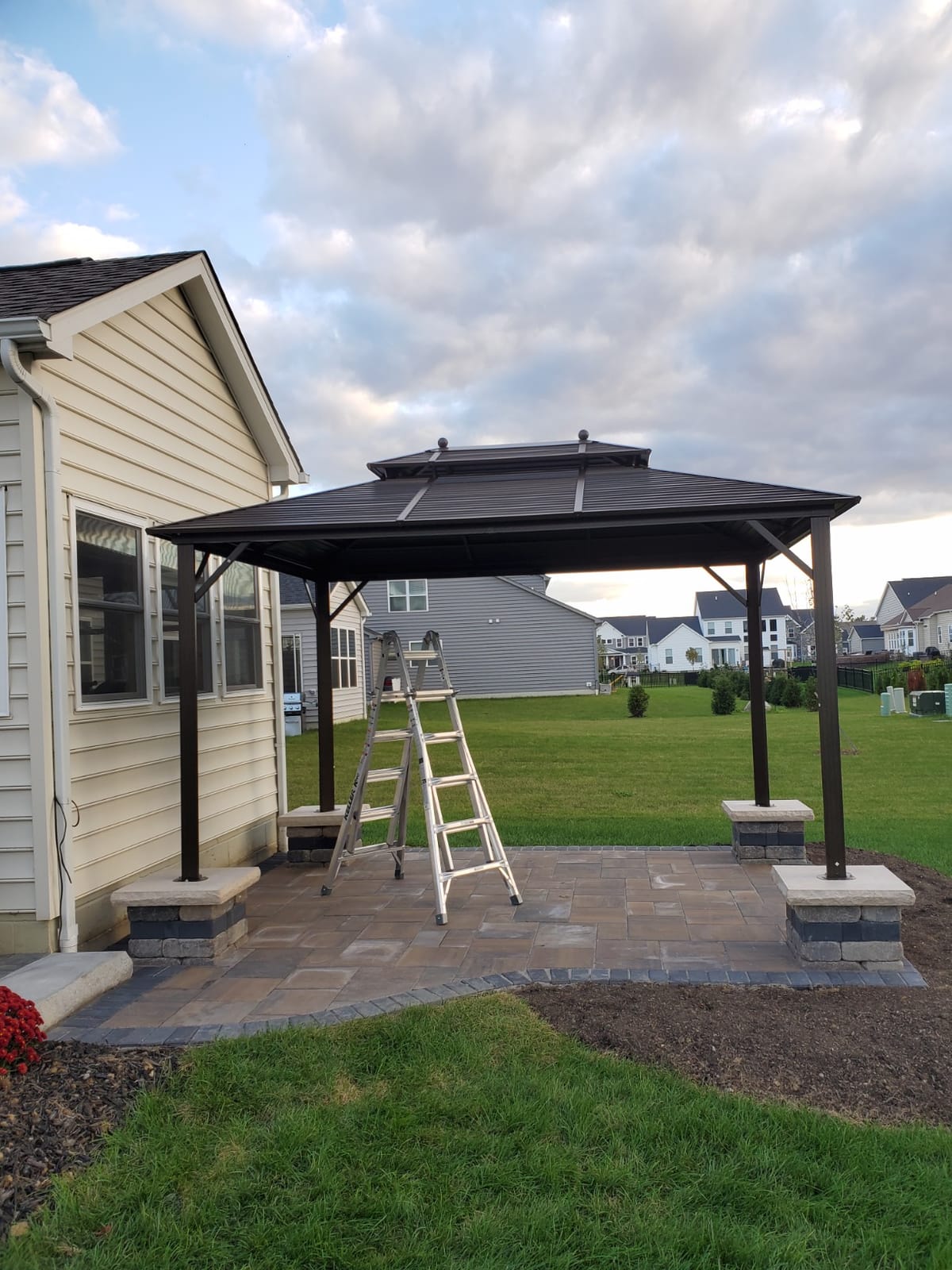
The technical detail worth planning around is the base. These are pre-drilled bases designed to install on uneven ground, which is a real advantage if your yard is not perfectly level, but it also means the anchor points are your only load path into the earth.
The honest weakness is water resistance. The listing marks this roof as water resistant rather than waterproof, so drainage design matters in sustained rain, and the 11% one-star share suggests the same assembly and shipping-quality issues common to imported gazebos at this price. Owners also report heat building under the vented double roof in full sun.
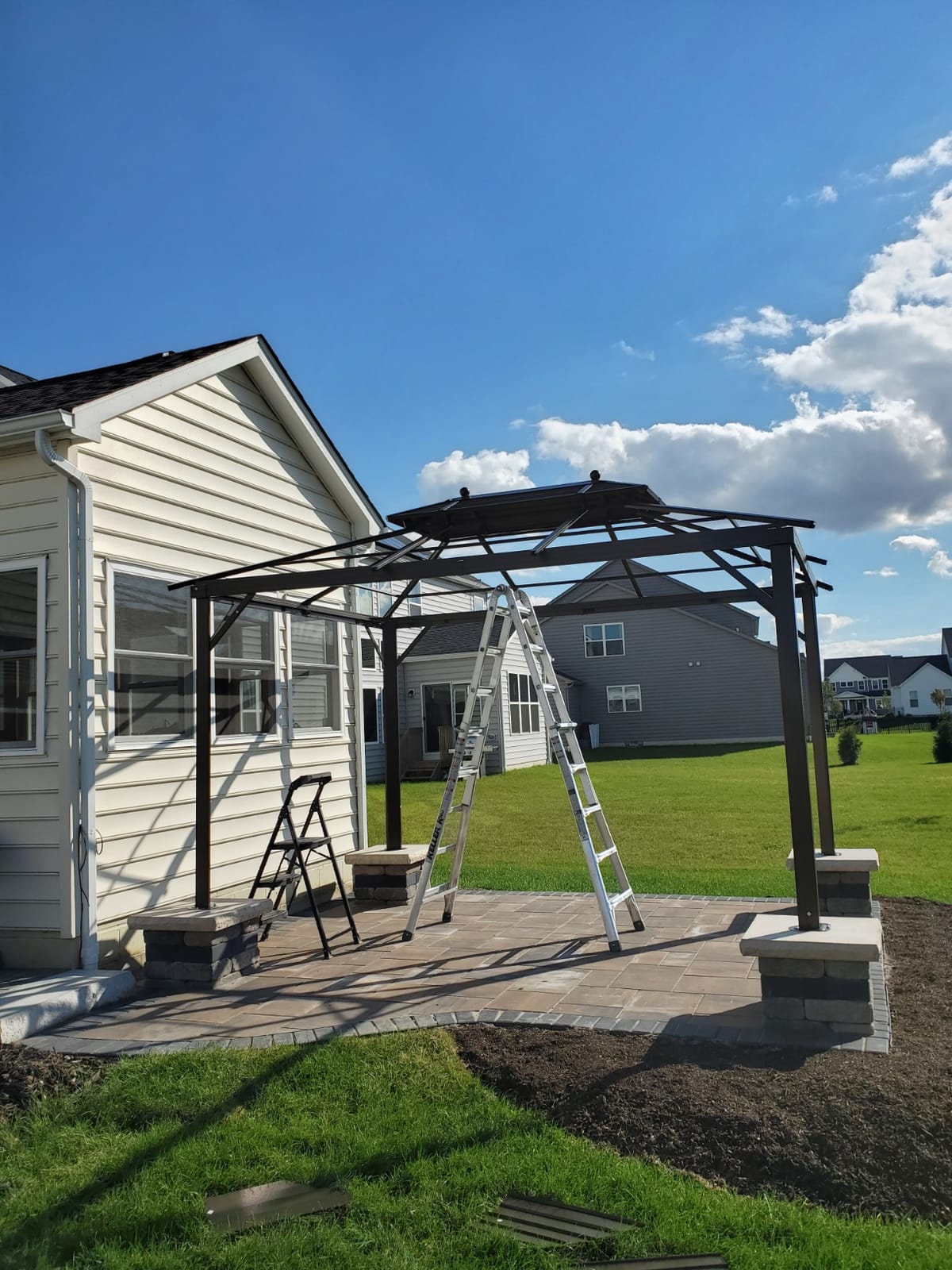
Who this gazebo suits
This suits owners who want a fully enclosed four-season room rather than open-sided shade, and whose yard is not perfectly level. The dual-track curtain and netting system lets you close everything down in wind and open it back up for airflow on calm days.
It is a good match for anyone who wants the structure to work as an outdoor kitchen or dining room, since the roof hooks accept lights and a fan.
Who this gazebo does not suit
Skip it if your priority is absolute watertightness in driving rain or if you plan to use it through the middle of a summer afternoon without a fan. Water resistant is not waterproof, and the vented double roof holds heat.
It is also a heavy structure at 209 pounds, so the anchoring is not optional.
5. Outsunny 10 x 12 Hardtop Gazebo: the most consistent owner satisfaction in the group
- Best rating spread in the roundup with only 4% one-star reviews
- powder-coated aluminum frame and galvanized steel roof described as built for wind rain and some snow
- light enough for two people to reposition
- netting plus polyester curtains block wind glare and insects
- stakes and expansion screws included
- Single-roof design gives less wind load distribution than double-top models
- manufacturer warns against extreme weather and instructs removing snow at capacity
- actual footprint is 12 by 9.8 feet
- limited distribution
A 4.4 average with only 4% one-star reviews is the tightest distribution in the roundup. Buyers consistently describe the aluminum frame and galvanized steel roof as handling wind, rain and moderate snow, which is a narrower and more honest claim than most of the competition makes.
At 209.4 pounds it is light enough for two people to reposition without a dolly, which matters more than it sounds if you ever want to change the site. Stakes and expansion screws are included, so you can mount to grass, decking or concrete.
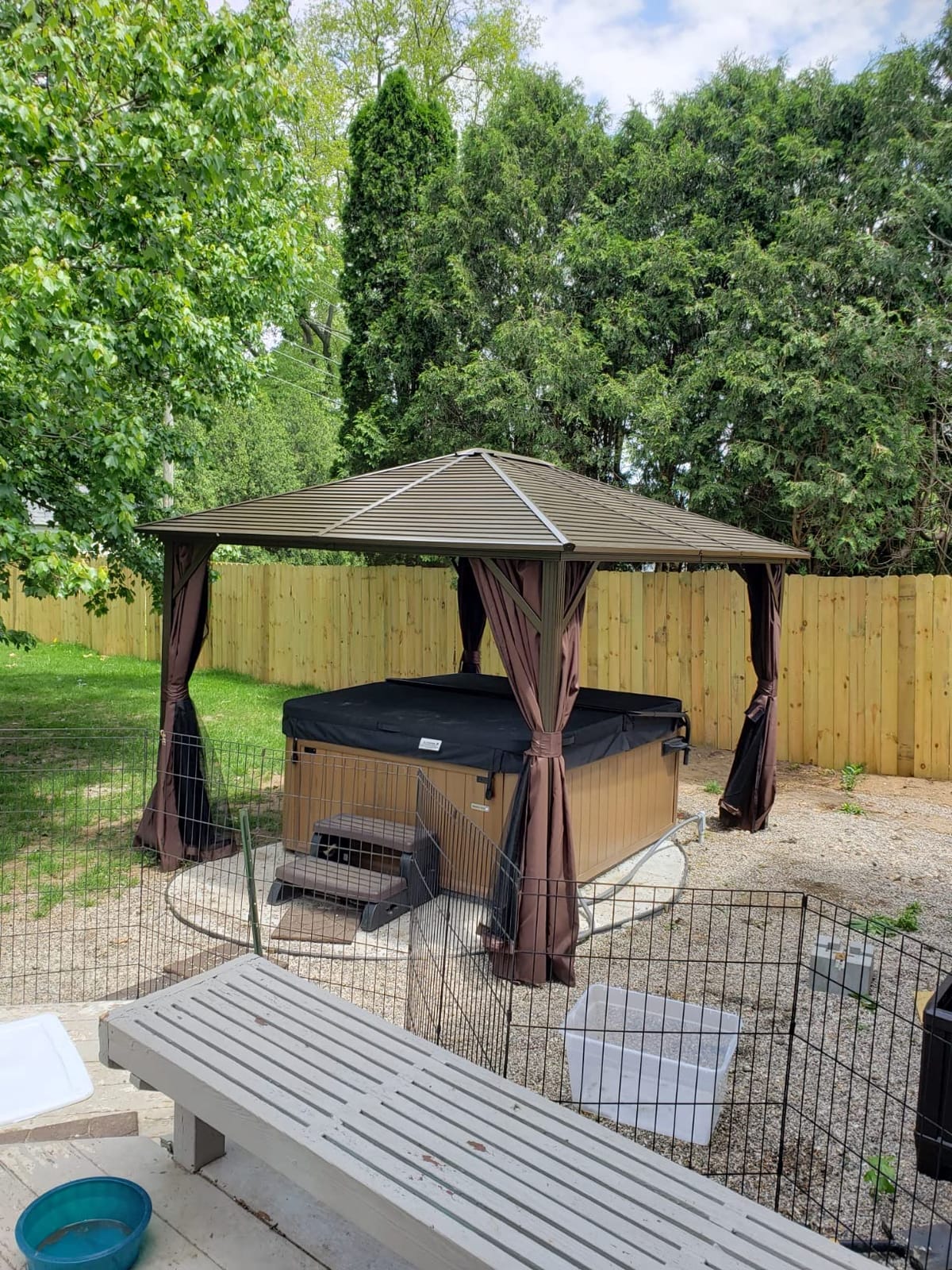
The structural caveat is the roof. This is a single-layer galvanized steel hardtop, not a double top, so it has less surface for wind load distribution than the models above it. The manufacturer states plainly: do not use in extreme weather, and remove snow before capacity is reached.
Also check the footprint. The listed dimensions work out to 12 feet by 9.8 feet, so the usable covered area is smaller than the 10 x 12 name suggests. If you are planning a dining table for eight, measure first.
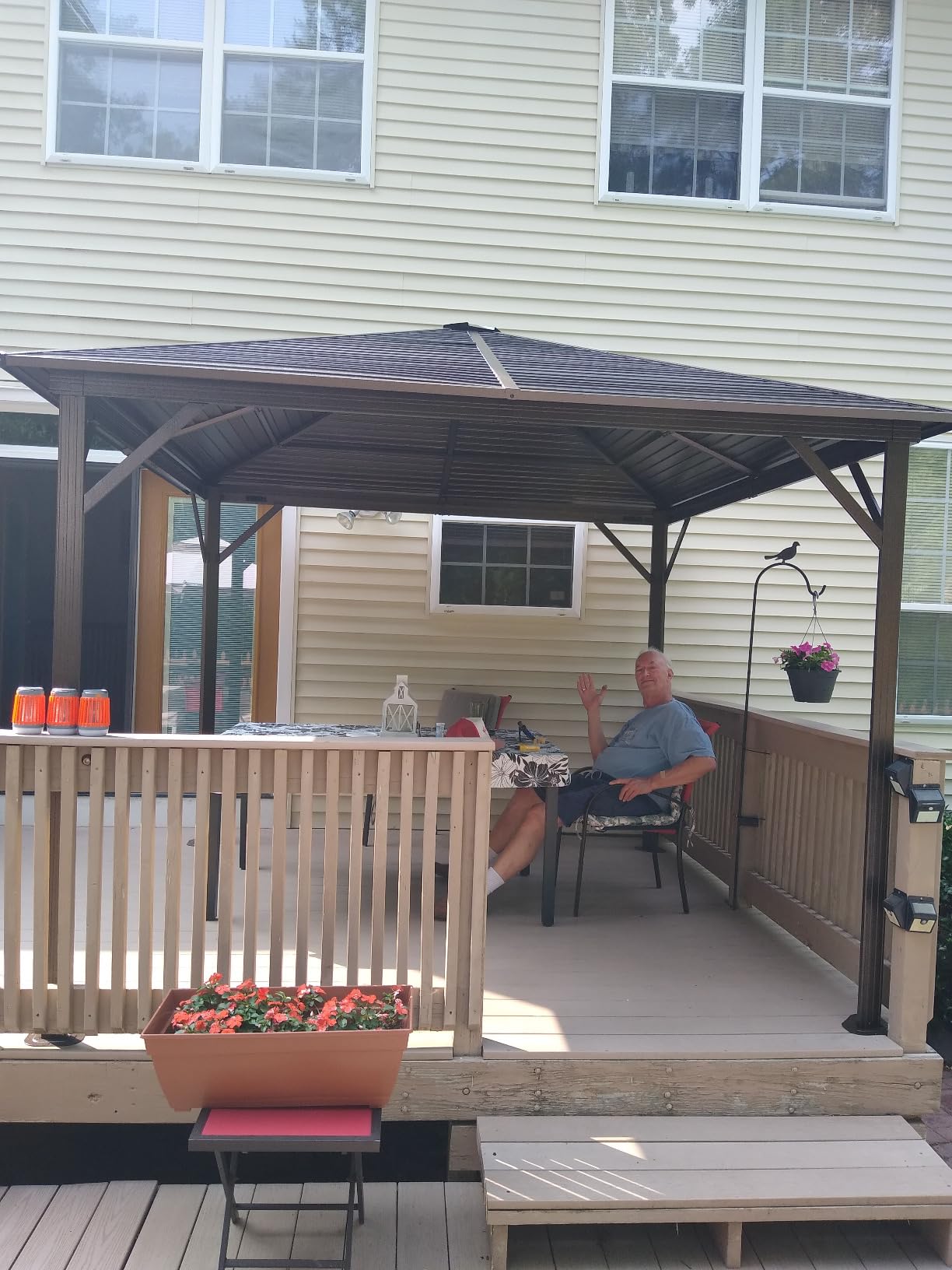
Who this gazebo suits
This suits owners who value consistent owner satisfaction over headline specifications, and who want a structure light enough to move. If your site is moderate rather than exposed, the single roof is an acceptable trade for a cleaner build record.
It is also the pick for anyone who wants a full enclosure with bug and glare control, since the netting and polyester curtains work together on tracks.
Who this gazebo does not suit
It is not a choice for a genuinely exposed site or a snow belt. A single roof and an explicit extreme-weather warning rule it out of both.
Anyone needing the full 120 square feet of covered dining space should look at a model whose listed footprint actually matches its name.
6. Aoxun 12 x 16 Hardtop Gazebo: the heaviest structure here, built to stay up permanently
Aoxun 12X16Ft Hardtop Gazebo Metal Gazebo with Galvanized Steel Double Roof
- Heaviest build in the roundup at 356 pounds
- Interpon AkzoNobel powder coat is a higher-grade finish than typical
- owners report it weathered several storms once posts were set in concrete
- triangular frame structure
- waterproof rated
- 16% one-star share driven by third-party fulfilment problems
- pre-drilled holes and screws frequently fail to align and strip easily
- instructions are pictures with no text
- roof runs hot enough to use only in the evening
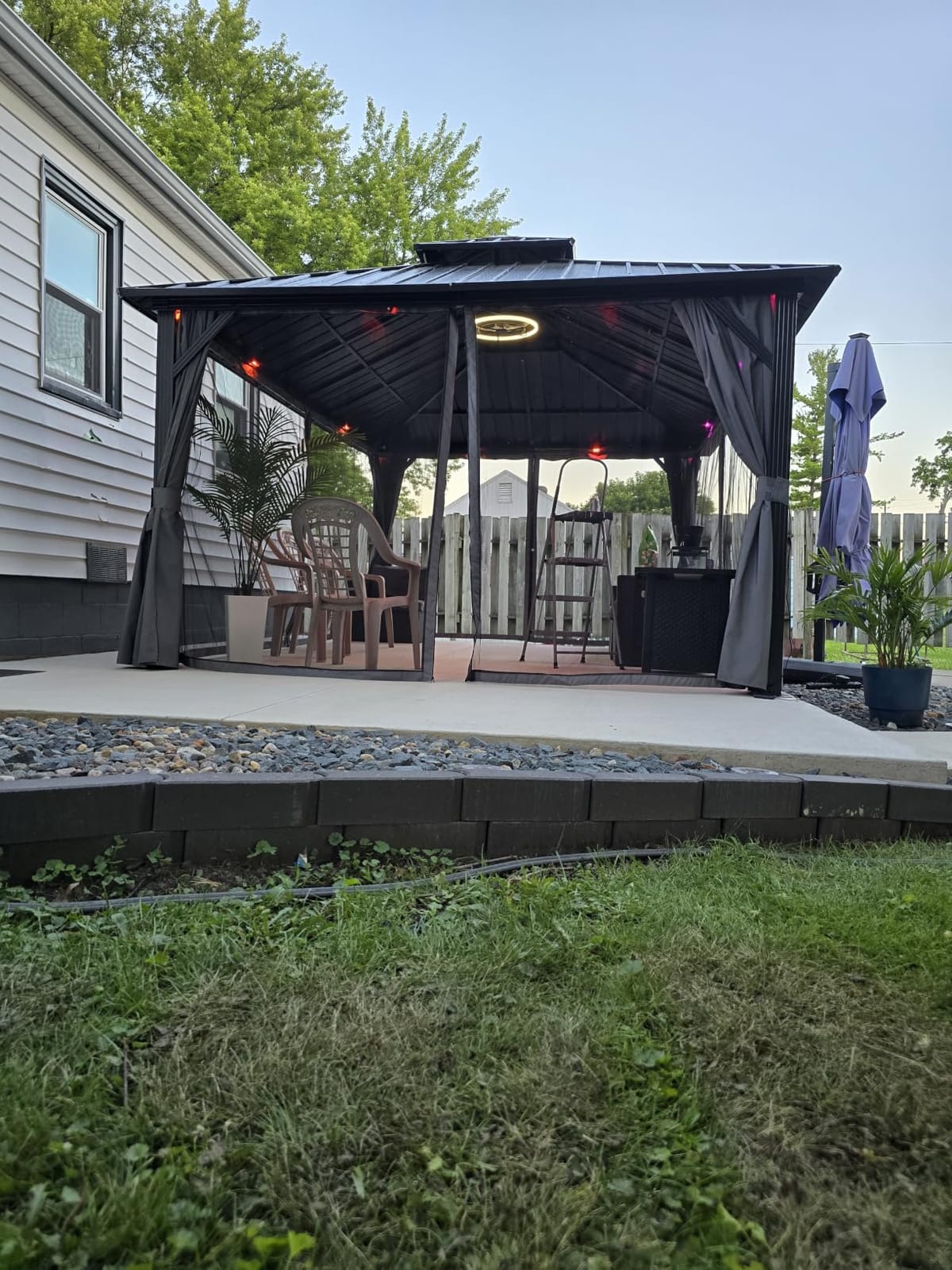
At 192 square feet and 356 pounds, this is the most physically committed structure in the roundup. That mass is exactly what you want in wind, and owners report it withstanding several storms once the posts were set in concrete. The triangular frame structure is a deliberate stability feature rather than a styling choice.
The finish is the quiet differentiator. The frame is wrapped in an Interpon AkzoNobel powder coat rated against scratches, peeling, corrosion and rust, which is a genuine upgrade over the standard coating in this price band and a sensible choice near salt air.
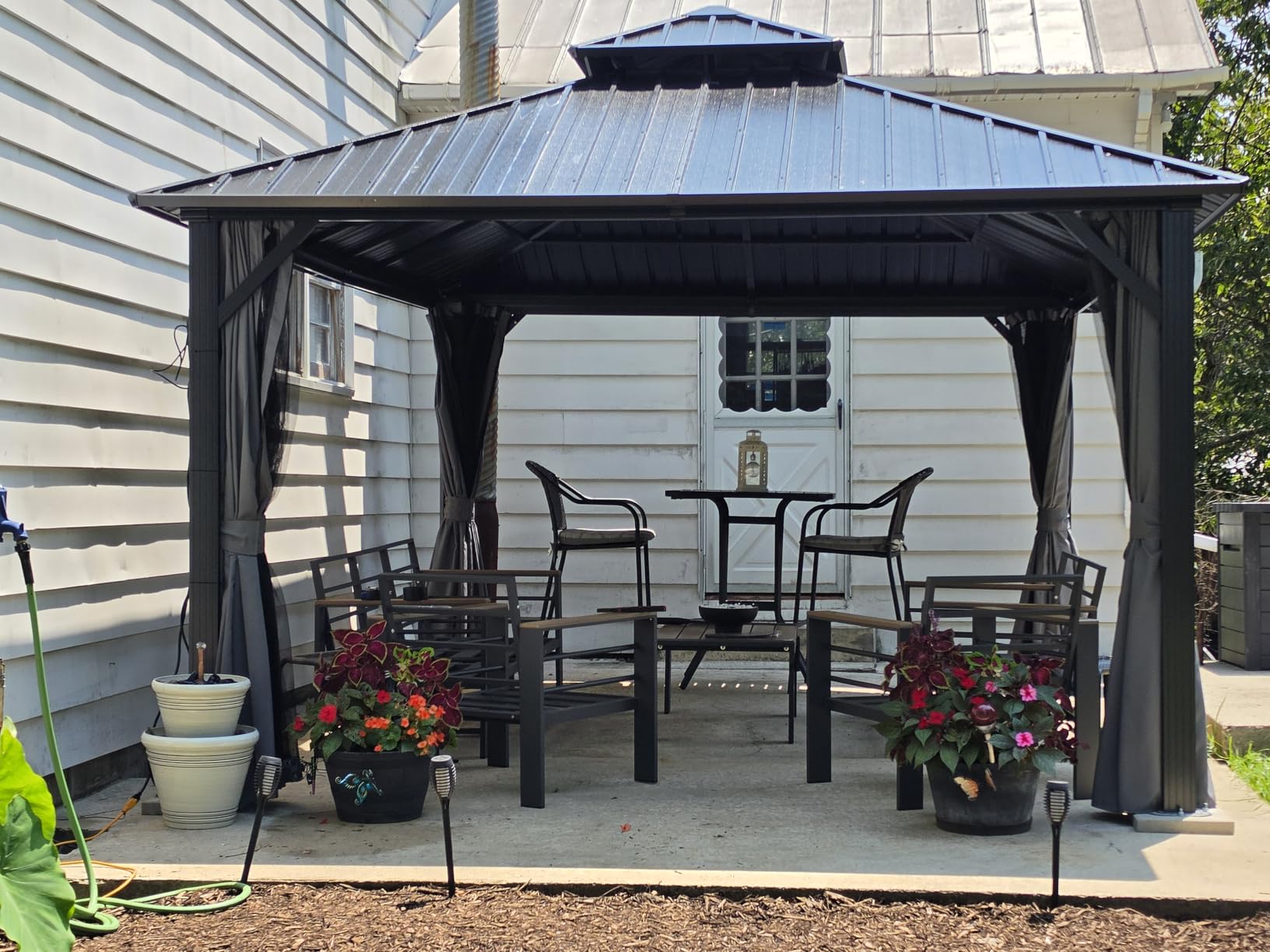
Owners also note that 180g polyester curtains and 40g zippered netting work well together and represent good value for the coverage they give. Top hooks accept fans and decorations.
Now the difficult part. The 16% one-star share is the highest in the roundup, but it is driven largely by third-party seller problems rather than the structure: one discount seller shipped a different size and colour, mislabelled boxes, and cost one buyer 20 hours of assembly. Quality complaints on the product itself concentrate on hole alignment, stripped screws, and picture-only instructions.
Who this gazebo suits
This suits owners with a large yard who want a structure rated for 14 to 16 people and intend to anchor it in concrete permanently. At 10 feet of peak height it feels like a pavilion rather than a shelter, and the premium coating justifies itself in a coastal or high-humidity climate.
It is also the right pick for anyone who plans to leave it standing through the season without thinking about it.
Who this gazebo does not suit
It is not for a small urban yard or for anyone without three helpers and roughly a full day. The roof panels are extremely heavy and the assembly estimate is about 10 hours before any fixes are made.
Skip it if you want to use the space in full afternoon sun. Owners report the roof runs hot enough that they only use the structure in the evening.
7. AirWire 8 x 8 Aluminum Hardtop Gazebo: the lightest build, best for small patios
AirWire 8’x8′ Hardtop Aluminum Gazebo with Curtains & Netting Dark Gray
- Lightest structure in the roundup at 103 pounds
- aluminum frame makes assembly far easier than heavier models
- owners report good wind performance once anchored
- protective packaging and clear numbered parts reduce damage and missing hardware
- curtains and mesh operate independently
- Lightweight build means anchoring is not optional in windy areas
- 14% one-star share with reports of bent sheet metal and misaligned holes
- roof panel protective film is nearly impossible to remove
This is the small-footprint option: 64 square feet on a 99.12 inch square base, rated for 4 to 8 people, and 111 inches tall. At 103 pounds it is by far the easiest structure here to assemble, and the aluminum frame feels sturdy once it is up despite the low weight.
Owners who anchor it report it holds up in wind and light storms. The double-layer galvanized steel roof has a ventilated upper tier for airflow and heat dissipation, which blocks harsh sun and sheds rain without leaking for most buyers.
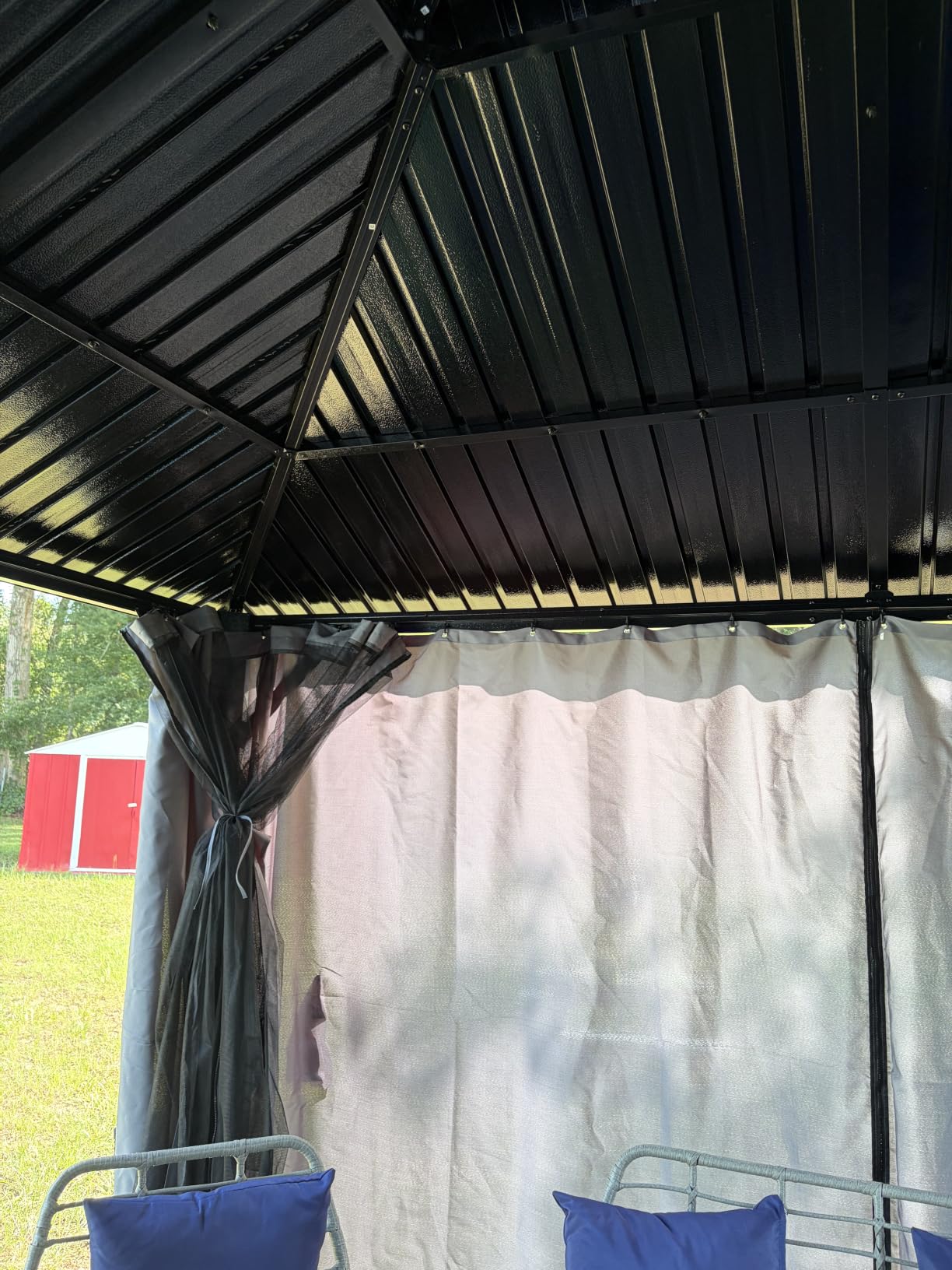
Be clear-eyed about what that light weight means. A 103-pound structure has far less mass resisting uplift than a 268-pound one, and owners say it directly: anchoring is not optional in a windy area. The pre-drilled thickened legs come with ground stakes, which is a starting point rather than a solution.
The 14% one-star share comes from bent sheet metal, misaligned holes and unclear directions. The most tedious single task is removing the protective film from the roof panels, which buyers describe as close to impossible. One owner reported leaking under the roof after heavy rain. A caution on the review pool: a large share of reviews on this listing, including the German-language ones, describe a folding pop-up canopy rather than this hardtop, so treat the 4.0 average with some care.
Who this gazebo suits
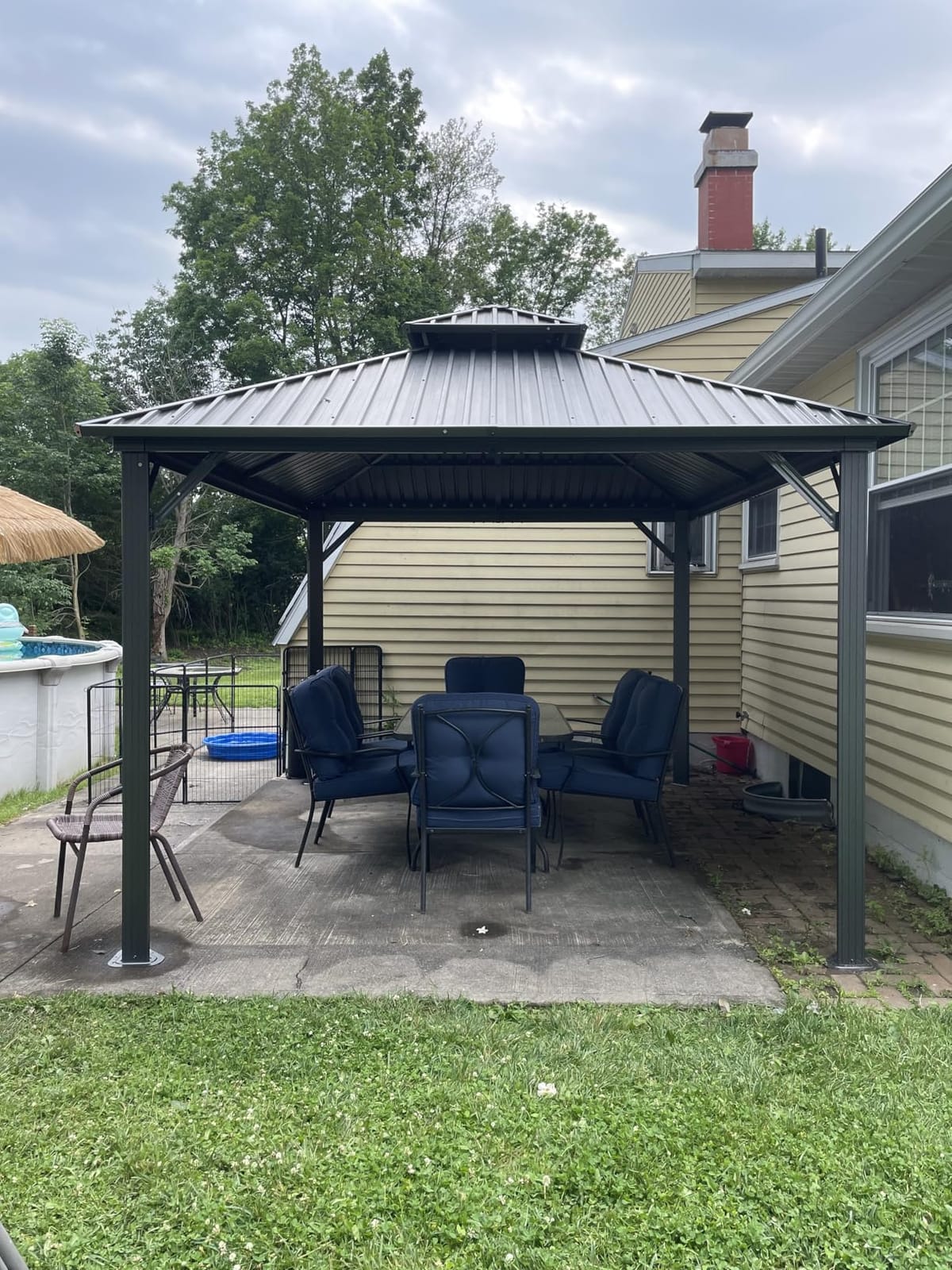
This suits anyone on a small patio or beside a hot tub who wants a hardtop rather than a fabric canopy and would rather not spend a weekend on assembly. Two people can handle it comfortably, which none of the larger models here allow.
It is also a good fit for renters and for anyone who may need to move the structure later.
Who this gazebo does not suit
It is the wrong choice for an exposed, open yard. With 2.4 inch posts and a 103-pound build, this is a structure you anchor properly every time or not at all.
Anyone who has already dealt with a stuck roof panel film should look elsewhere, and note that a portion of the reviews here do not describe this product at all.
8. HOTEEL 12 x 20 Hardtop Gazebo: the only published snow load figure in the roundup
- Largest footprint in the roundup at 240 square feet
- 16-20 people rated
- 18.43 psf snow load is the highest published load figure in the group
- roof-edge drainage channel routes water to frame and columns instead of dripping at the eaves
- CPAI-84 flame-resistant curtains
- 100% UV protection and waterproof rated
- Roof installation is the hardest stage of assembly
- some shipments arrived with damaged posts and missing screws
- customer service and replacement parts criticised with parts sent from overseas
- a large block of the review pool concerns a folding pop-up variant
Most buyers in this roundup publish nothing. This one publishes a snow load of 18.43 psf, which is a meaningful number because it implies the roof structure was engineered for a real load rather than described with adjectives. For a snow belt, that single figure is worth more than any other spec on the page.
The footprint is the biggest in the roundup at 240 square feet, sized for 16 to 20 people, with a ventilated double roof for air circulation and wind resistance. The powder-coated aluminum frame is pre-drilled, and expansion screws for concrete are included.
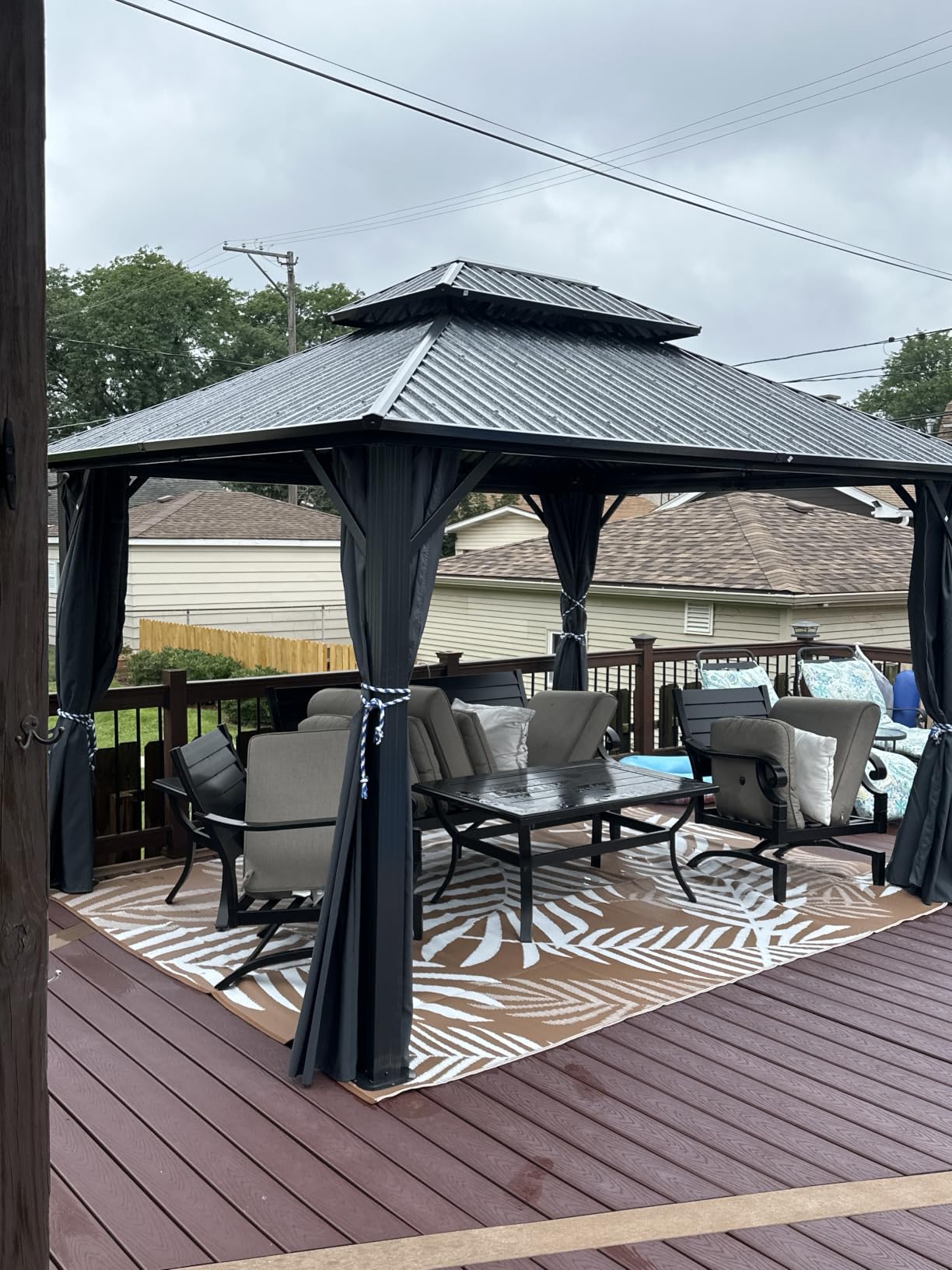
The roof-edge drainage channel is a genuine differentiator. Instead of water sheeting off the eaves, it routes to the frame and columns, which keeps runoff off the structure and off whatever is underneath it. The curtains are CPAI-84 flame-resistant 160g polyester in four machine-washable panels, and the sidewall netting zippers on two sides with top netting above.
Actual feedback is warmer than the spec sheet. Owners praise the frame, shade and netting, but flag damaged posts and missing screws on arrival, and at least one buyer felt the structure was flimsier than the price implies. After-sales support is the real problem: customer service and replacement parts draw repeated criticism, including parts sent from overseas with no delivery estimate. As with the AirWire listing, many reviews appear to belong to a folding pop-up variant on the same brand page, so the effective hardtop sample is smaller than 161.
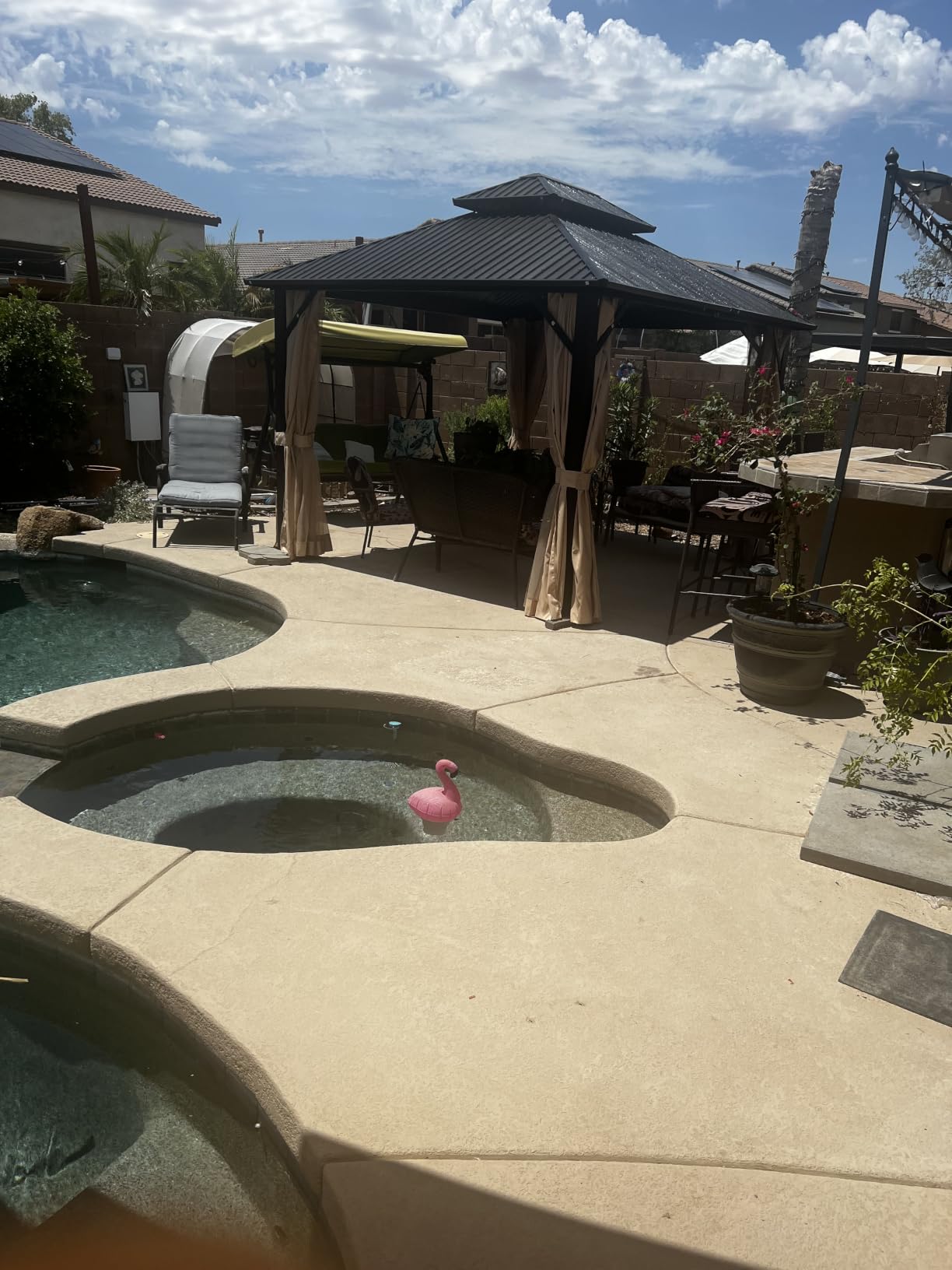
Who this gazebo suits
This suits owners of a large lot who want a genuine outdoor room for 16 to 20 people and who live somewhere with heavy snow. The published 18.43 psf load and the waterproof rating are the two strongest documents in this roundup.
Owners on a wood floor should note the specific requirement: that install needs expansion screws designed for wood panels, not the standard concrete set.
Who this gazebo does not suit
Skip it if support after a storm matters to you. Consistently criticised after-sales service and slow overseas parts are a real risk on a structure this large, where a single bent post is a serious problem.
It is also too big for most suburban yards. A 20 by 12 foot footprint with a 120 inch peak height changes the site, it does not just furnish it.
9. Aoxun 12 x 10 Polycarbonate Hardtop Gazebo: the best-selling roof type here, and the roof is the problem
Aoxun 12’x10′ Hardtop Gazebo with Polycarbonate Double Roof, Brown
- Most reviewed polycarbonate-roof gazebo here at 1155 reviews
- 31-page step-by-step assembly book is among the best documentation in this category
- owners near the ocean report it handling strong nightly breeze once secured
- one owner with 20-30 mph wind and several inches of snow reports it held up intact
- customer service described as fast and helpful
- Polycarbonate roof blew out in gusts over 40 mph
- taking panels and metal supports with it
- tinted polycarbonate creates a greenhouse effect in direct sun
- included ground stakes too short for anything but hard clay
With 1155 reviews and a number 8 rank in its category, this is one of the best-selling gazebos in the roundup, and the reviews split sharply by roof material. Owners in moderate wind and snow report solid performance. Owners in serious wind report a roof failure.
The documentation is genuinely better than most. A 31-page step-by-step assembly book is the best manual in this category, and customer service is repeatedly described as fast and helpful, which matters given this is a permanently anchored structure.
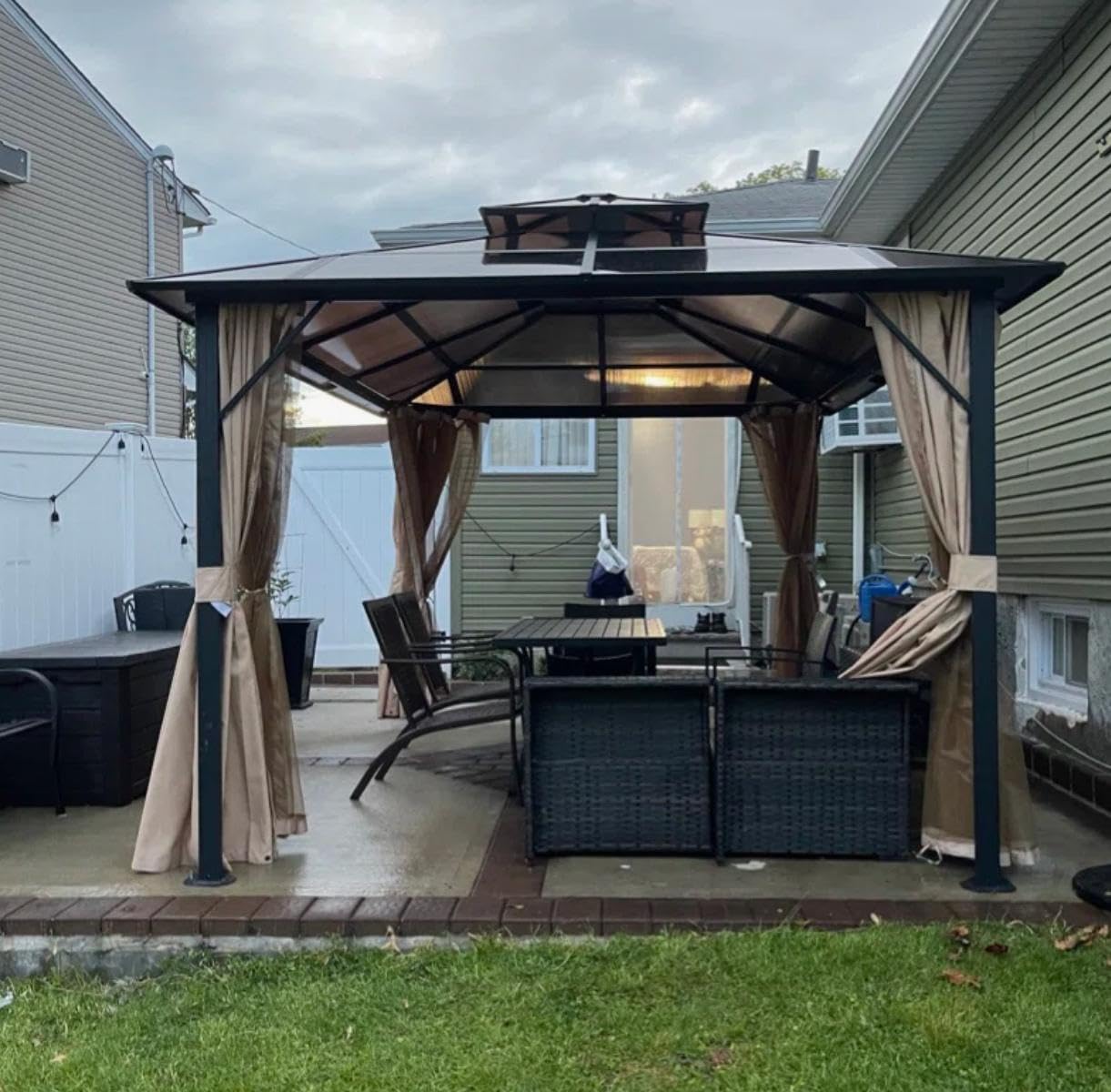
Here is the specific failure to weigh carefully. One Ohio owner had the polycarbonate roof blow out in a windstorm with gusts over 40 mph, losing both the panels and the metal supports. That is a 15% one-star share, and it tracks directly to the roof material rather than to the frame.
There is a heat problem too. Tinted polycarbonate creates a greenhouse effect that owners describe as uncomfortable above 80F in direct sun. Parts can bend if handled roughly, the plastic curtain rings are flimsy, and the included ground stakes are too short for anything but hard clay, so the manufacturer requires ground spikes and wind rope when the unit sits on grass.
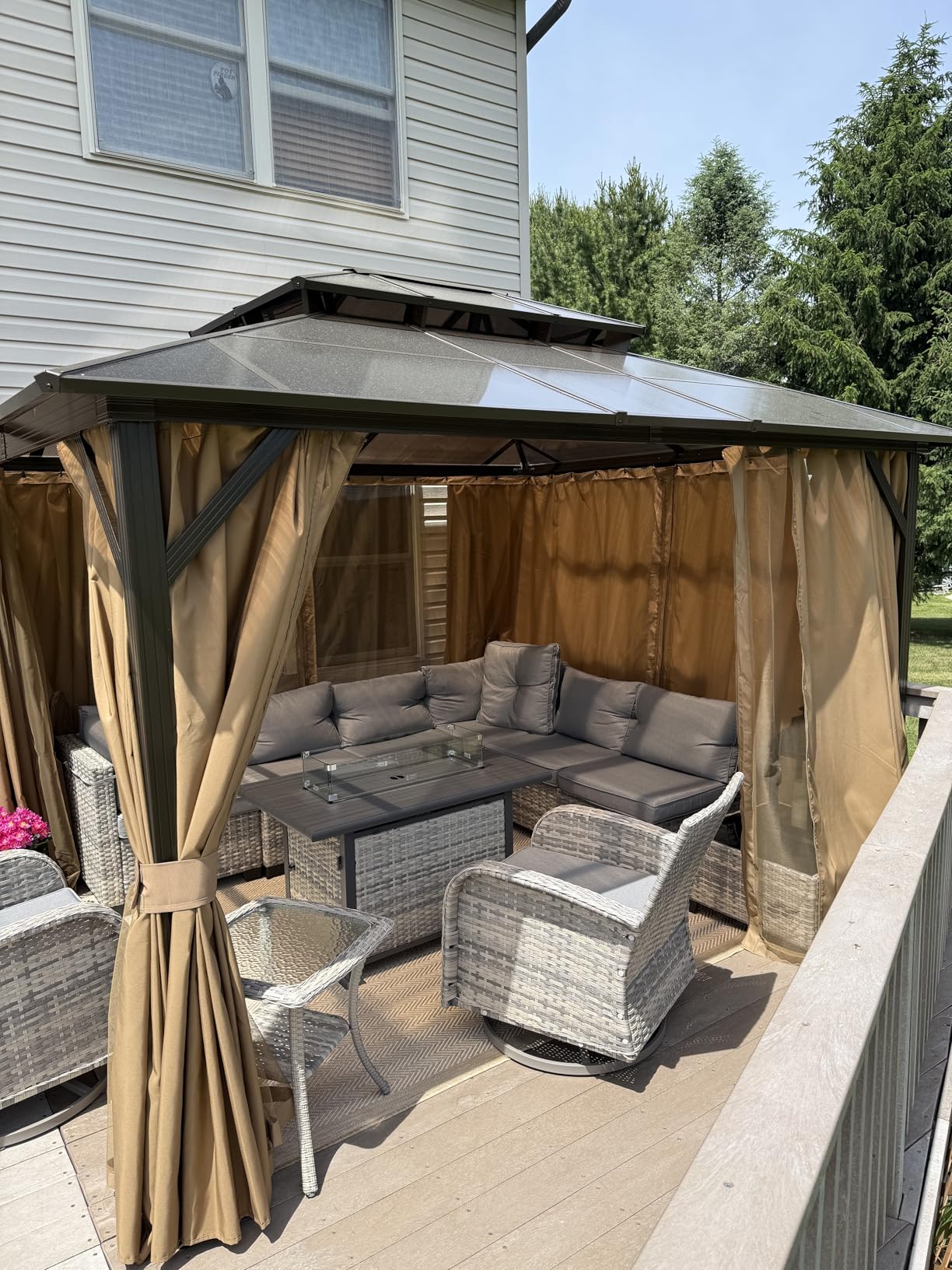
Who this gazebo suits
This suits owners in a moderate climate who want a light, translucent roof and the best assembly documentation available, and who will anchor it properly to concrete or a deck rather than relying on the included stakes.
The double-layer polycarbonate roof allows air circulation while blocking UV, so it works well in warm regions with strong sun.
Who this gazebo does not suit
It is not a choice for a windy site. A roof that has already failed in 40 mph gusts is disqualifying for the exact use case this article is about, regardless of how good the frame is.
Anyone who plans to sit under it at midday in summer should also pass. The greenhouse effect is a consistent complaint, not an edge case.
10. UDPATIO 10 x 10 Hardtop Gazebo: the highest published wind rating, at 49 mph
UDPATIO 10’x10′ Hardtop Gazebo, Outdoor Gazebo Weather-Resistant, Grey
- Only gazebo in the roundup with a published 49 mph wind rating
- reinforced corner brackets and horizontal crossbars reduce frame sway
- weighted-compatible base designed to prevent tipping
- best-in-class 26-step colour-coded instructions and exploded parts list
- plywood-framed packaging with steel brackets and full cushioning
- no leaks reported through multiple thunderstorms
- No gutter system so rainwater runs straight off the roof edge
- no netting across the main-roof to vent-roof gap
- assembly still takes 5-12 hours
- one owner flagged that manual wind and snow specs differ from advertised figures
This is the only product here that both publishes a wind rating and has a real wind-engineered frame behind it. The manufacturer states resistance up to 49 mph and 6 inches of snow, and the structure behind that number includes thickened reinforced corner brackets for even weight distribution, secure horizontal crossbars to reduce sway, and a weighted-compatible base designed to prevent tipping in wind.
Owners back the claim up. People in daily-wind locations report no issues at all, and one owner reports that a very strong storm passed while the gazebo was not yet anchored and it did not budge. No leaks have been reported through multiple thunderstorms.
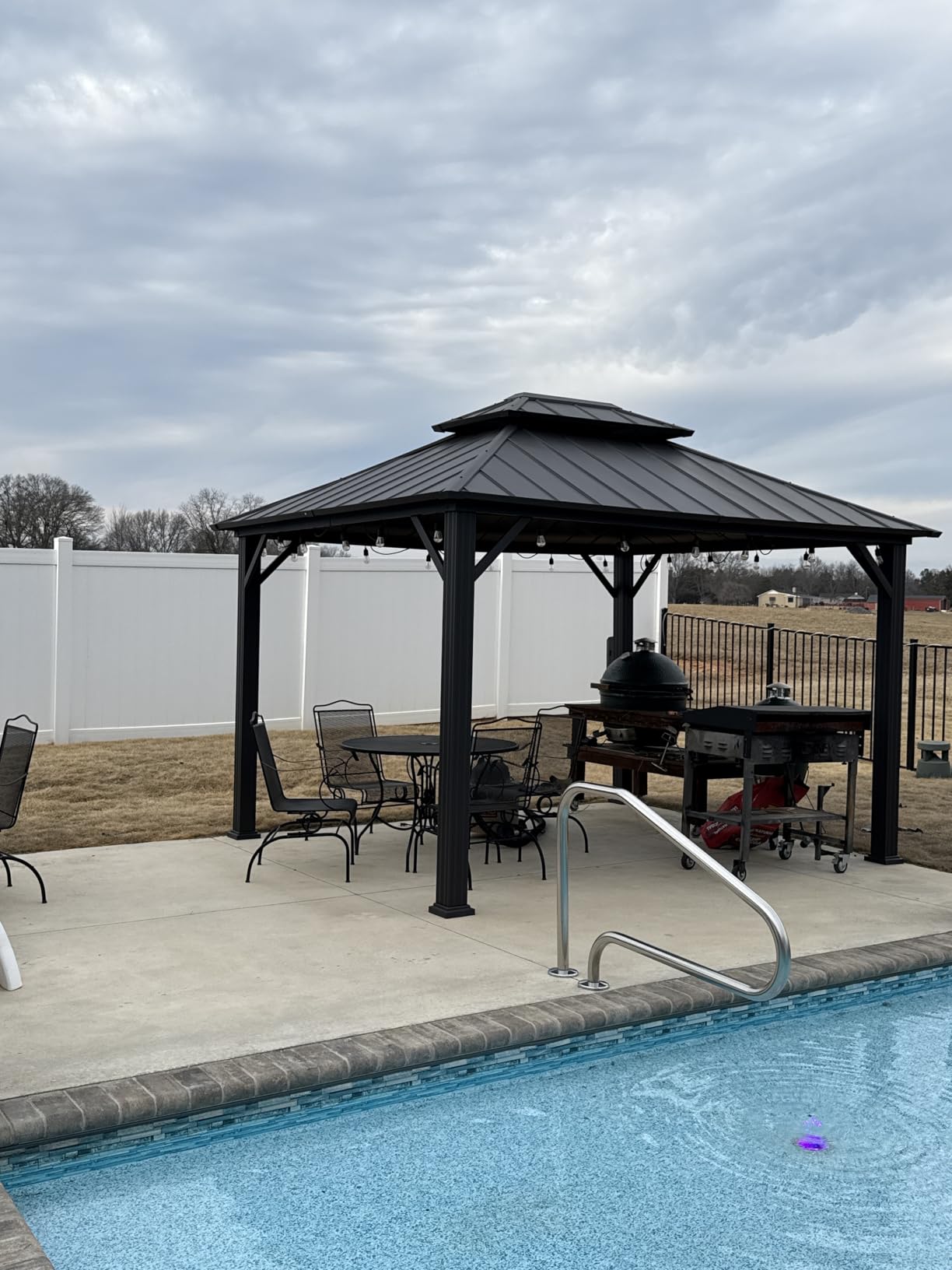
The new splice card slot frame design is worth a mention because it reduces the screw count and increases strength, which is a rare combination in imported gazebos where stripped screws are a common complaint. The ground fixing system is compatible with concrete, wood decks and lawns, and anchor bolts plus ground stakes are included.
Two named drawbacks. There is no gutter system, so rainwater runs straight off the roof edge, and there is no netting covering the gap between the main roof and the vent roof, which leaves an open band above the netting rail. Assembly still runs 5 to 12 hours even with the excellent instructions, and the boxes are very heavy and can arrive over several days. One owner also flagged that the specs in the owner’s manual differ from the advertised figures, so read both before you rely on the number.
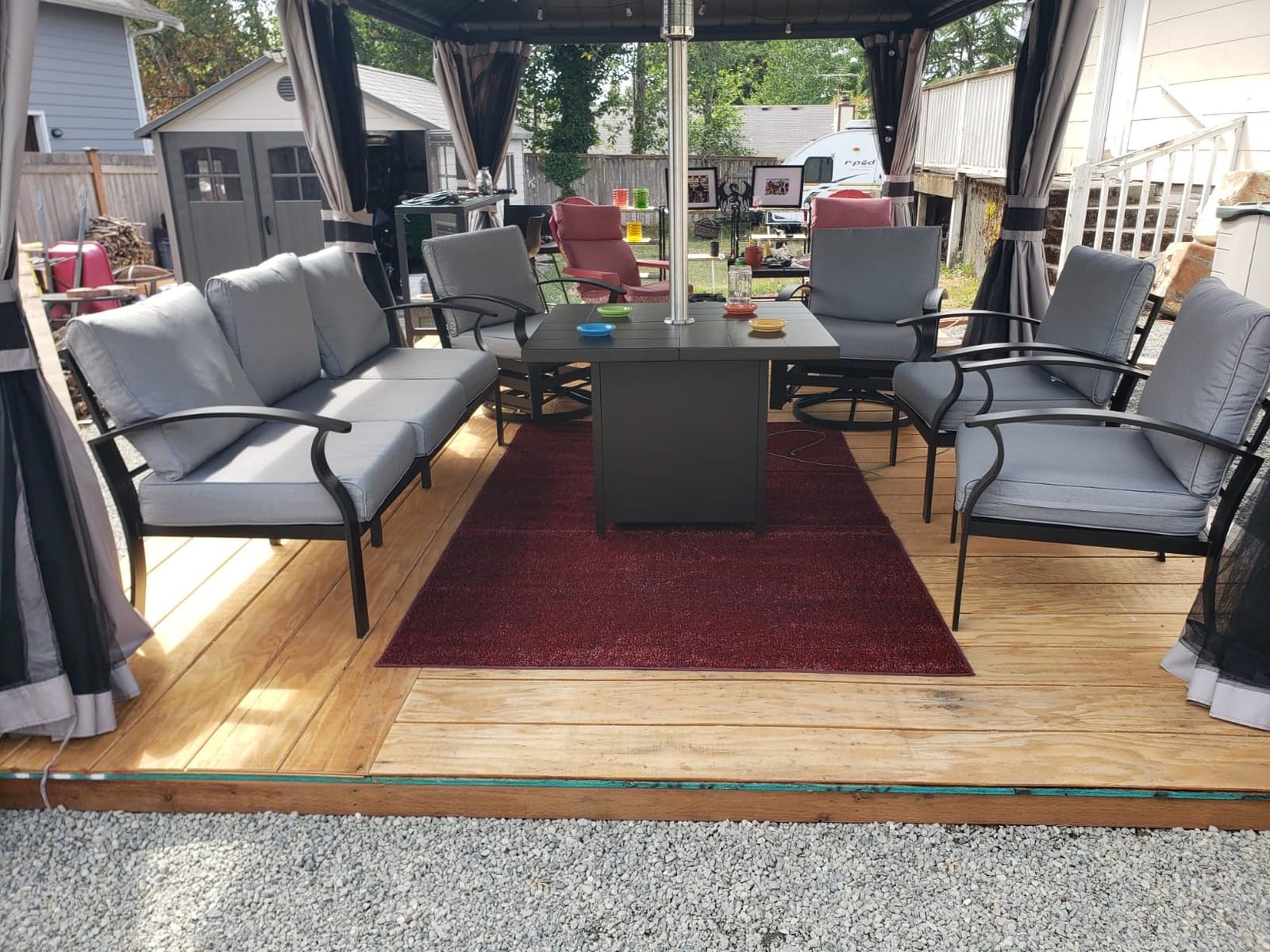
Who this gazebo suits
This suits anyone whose top requirement is a verifiable number rather than a marketing claim, and whose yard is open enough that a 49 mph ceiling is the difference between a structure that stays and one that does not. At 100 square feet it holds 4 to 6 people comfortably.
If you have ever lost hardware on a build like this, the packaging matters. This one uses plywood frames, steel brackets and full styrofoam cushioning, and the instructions are colour-coded across 26 steps with a 4-page parts list and an exploded view.
Who this gazebo does not suit
It is not the pick for anyone who needs rain management at the eaves. With no gutters, water comes straight down off the edge, which matters if you plan to sit under the perimeter during a storm.
It is also a modest 10 by 10 footprint, so a large dining set will be tight, and the 5 to 12 hour assembly still requires planning.
What Wind Rating Actually Means (and Which Number You Need)
The National Weather Service notes that isolated wind damage begins around 40 to 50 mph sustained, and that 58 mph and above is classified as damaging. That threshold is the reason this article exists. Most storm gusts that damage structures clear those numbers easily, and most gazebos on the market publish nothing at all.
Here is the honest state of the category in 2026. Of the ten gazebos in this roundup, two publish a wind figure: the Aoxun 10 x 12 at grade 7, roughly 31 to 38 mph, and the UDPATIO 10 x 10 at 49 mph. One publishes a snow load, the HOTEEL 12 x 20 at 18.43 psf. The other seven publish neither, and no estimate is substituted for them anywhere in this article.
When you see no number, judge on four things you can verify. Mass matters, because more weight resists uplift. Roof geometry matters, and a double vented top with a sloped pitch is better than a single flat panel. Post gauge matters, and 4.7 inch posts beat 2.4 inch posts. And frame mass matters only if the base plates are bolted to something immovable.
As a regional guide, a Gulf coast or coastal property wants the highest published rating you can find plus marine-grade coating. Tornado alley wants mass, deep footings and a low profile. The Upper Midwest is often snow-limited before it is wind-limited, so snow load in psf is your number. The Pacific Northwest is usually moderate, and sheltered sites can absorb a lower rating comfortably.
One more geometric factor nobody mentions. Height and narrowness create sail area, so a tall narrow gazebo catches more wind than a low wide one of the same footprint. A 10 by 10 structure at 108 inches behaves very differently from a 12 by 16 structure at 120 inches. If you have a choice of shapes, choose the wider, lower one for an exposed site.
Anchoring: The Biggest Wind Variable You Control
Owners broadly agree on one thing: anchoring determines survival, not roof material. The PURPLE LEAF reviews contain both outcomes with the same product, because copies bolted to concrete survived 70 to 80 mph gusts with only dented panels while unanchored copies of the same gazebo were lifted and overturned. No product on this list survives on stakes alone in serious weather.
Concrete slab. The strongest option, and the only one the PURPLE LEAF, EROMMY, HOTEEL and UDPATIO base plates are really designed around. Expansion screws or lag bolts through the pre-drilled plate give you a direct load path into the foundation.
Pavers. Workable, and owners with brick patios report good results. The condition is that the pavers must sit on a compacted base, not on sand. A paver that can move cannot anchor anything.
Wood deck. Viable, but you need lag screws or structural screws into the deck joists, not the deck boards, and you should check that the joists themselves are anchored to a post. The HOTEEL listing specifically calls for wood-panel-specific expansion screws for this install.
Soil and grass. The weakest option, and the one most people default to because the included stakes make it easy. The Aoxun 12 x 10 includes ground spikes and requires wind rope on grass, and reviewers note those stakes are too short for anything but hard clay. For serious exposure, dig footings below the local frost line and set the base plate in concrete.
If you are anchoring anything that catches wind, our windy city travel umbrella guide covers the same physics at a much smaller scale, and the anchoring logic translates directly.
Why Only Hardtops Made This List
A soft-top gazebo has a fabric canopy that can balloon, tear, and take flight. That single property disqualifies it from a windy site, no matter how sturdy the frame is. Pop-up canopies fail the same way, and they also flex visibly in anything above a light breeze.
A hardtop gazebo has a rigid steel, aluminum or polycarbonate roof that cannot inflate. It resists wind through four things working together: a heavy frame that resists racking, a rigid roof that cannot peel, a sloped and vented top that lets gusts pass over and equalise pressure, and anchoring that transfers uplift into the ground.
The tradeoff is permanence and assembly. A hardtop is heavy, it is meant to stay up, and it is a two-day job in most cases. For an exposed site that is a good trade. For a renter who needs a structure for one summer, it is not.
Coastal and Salt-Air Yards: Choosing for Corrosion
No competitor page in this search covers salt-air corrosion, and it is the question a coastal buyer asks first. A r/DIY homeowner described routine 25 mph winds with 75 mph storm gusts and salt air, and asked directly about material choice, anchoring, and whether a wide clear-span structure is realistic. The short answer to the last part is no.
Salt air corrodes fasteners, anchors and foot plates far faster than inland conditions, and it attacks the small parts first. The big powder-coated panel may look fine for years while the bolts holding it up pit away underneath.
Three rules for a coastal install. First, rinse the structure with fresh water a few times a year, which costs nothing and does more than any coating. Second, look for a named powder-coat system rather than a generic anti-rust claim, and the Aoxun 12 x 16 with its Interpon AkzoNobel finish names its coating brand outright, which no other listing here does. Third, specify stainless or galvanised hardware over zinc-plated, and check that anchor hardware is included rather than assumed.
Aluminum frames are inherently the better coastal choice here because aluminum does not rust. That points to the PURPLE LEAF, YITAHOME, Outsunny, HOTEEL and AirWire builds, provided the fasteners are the stainless kind.
On clear-span structures, owners in windy locations consistently report that very wide builds with no centre supports are not realistic. Interior posts are not a compromise you should apologise for. They are what makes a wide roof survivable.
Roof Material: Steel vs Aluminum vs Polycarbonate
Galvanized steel is the wind and snow choice, and it is what eight of the ten gazebos here use. It is the heaviest option, which is exactly what resists uplift, and it sheds heat and snow better than anything else. Its weakness is rust if the coating is breached, and the 2.4 inch post models pair it with a frame too light for the roof above it.
Aluminum never rusts and needs no repainting, which makes it the right pick within a mile of salt water. It is lighter than steel, so it gives up some mass, and light-gauge aluminum that flexes and racks visibly is one of the commonest reasons a frame fails in wind.
Polycarbonate blocks UV and lets light through, but it is the weakest wind performer. The Aoxun 12 x 10 in this roundup had its polycarbonate roof blow out in gusts over 40 mph, taking the metal supports with it, and tinted panels create a greenhouse effect in direct sun. Polycarbonate is a good roof for a shaded, sheltered patio and a poor roof for an exposed yard.
The design detail that outranks all three is the vented double top. A lower tier with an open, vented upper tier lets pressure equalise instead of loading a single panel, and it is the single most consistent owner praise across the reviews in this roundup.
Storm Preparation Checklist
Run this the morning a storm is forecast, not after the wind arrives.
1. Remove the soft goods. Canopies, curtains and netting become sails in seconds. The Aoxun 10 x 12 manufacturer explicitly instructs removing canopy, curtains and mesh during extreme weather, and the same advice applies to any hardtop.
2. Clear the roof. Snow and wet leaves add dead load that the frame was not designed for, and the Outsunny manufacturer specifically instructs removing snow before capacity is reached.
3. Check every anchor point. Walk the base plates and confirm each bolt is present and tight. This is the single highest-value five minutes you can spend.
4. Close the vent gap where applicable. On models with a vented upper tier, a fabric cover or temporary panel over the vent reduces the pressure differential. Confirm the model in question allows this before doing it.
5. Move loose furniture out from under and around the structure. An unsecured table under a gazebo becomes debris in exactly the conditions where you least want debris.
6. Note the trend on your curtains. If you leave them open, you are turning the structure into a wind tunnel. If you close them fully, you are reducing the opening but adding fabric. For most hardtops on this list, closed and secured is the better of the two.
7. Photograph the structure before the storm. If you need to file a claim, dated images of anchors and roof condition take minutes and matter later.
How to Buy: Five Criteria That Decide Wind Performance
1. Get a published number, and treat its absence as information. Nine of the ten products here publish no mph figure. If a manufacturer will not state one, the structure is not engineered to a standard you can check, and the marketing language will be doing all the work.
2. Judge the frame by mass and post gauge. The spread in this roundup runs from 103 pounds with 2.4 inch posts up to 356 pounds with a triangular frame. Heavier is not automatically better, but a 2.4 inch post under a steel roof is a light frame carrying a heavy roof, and that mismatch shows up in gusts. Look for a named post dimension and a listed build weight, which most listings do publish.
3. Prioritise the vented double top. A sloped, two-tier roof with a vented ridge out-performs a single flat panel of the same material. It is the design choice with the most consistent owner praise in the reviews, and it costs nothing extra in most of these builds.
4. Size for wind, not for seating. Wider and lower beats taller and narrower on an exposed site. Check the actual listed dimensions rather than the product name, because the Outsunny listed here is called 10 x 12 and measures 12 by 9.8 feet. And remember that a large roof is also a large sail, so oversized structures need the biggest base plates.
5. Check warranty terms and parts support before you buy. The PURPLE LEAF carries a tiered warranty of 5 years on the top panel, 2 years on curtain and netting, and 1 year on the frame. The Aoxun 10 x 12 carries 1 year. Against a structure weighing 100 to 350 pounds, after-sales support is not a minor detail, and the HOTEEL reviews describe precisely the failure mode you cannot afford: replacement parts that are slow to source with no delivery estimate.
On assembly, budget honestly. Reports across this roundup run from 8 to 20 hours on the 10 x 12 models and around 10 hours on the Aoxun 12 x 16. Most owners describe two to four people as the right crew, and the roof stage is consistently the hardest part. The one structural rule: do not begin until your anchoring method is decided, because retrofitting footings under a finished frame is the worst version of this project.
Once the structure is sorted, the surrounding seating matters as much in a breeze as the gazebo does. Our outdoor lounge sets for pool areas guide covers weighted bases and wind-friendly furniture layouts that pair well with a hardtop build.
Frequently Asked Questions
What is the best gazebo for strong wind?
The best gazebo for strong wind is a hardtop with a rigid steel roof, a heavy frame, a vented double-tier design, and bolt-down anchoring. Among the ten we reviewed, the PURPLE LEAF 10 x 12 aluminum hardtop led on build mass at 268 pounds, 4.7 inch posts, and a 4.8 rating from 1570 reviews. For a verified number rather than a build impression, the UDPATIO 10 x 10 is the only one publishing a figure, at 49 mph.
How windy is too windy for a gazebo?
The National Weather Service notes isolated wind damage begins around 40 to 50 mph sustained, and that 58 mph and above is classified as damaging. For a residential hardtop, treat 40 mph as the point where anchoring and roof design start to matter, and 58 mph as the point where you should have removed curtains, netting, and any canopy before the storm arrives.
How do I keep a gazebo from blowing away?
Anchor every base plate properly: lag or expansion bolts into a concrete slab, structural screws into deck joists, or footings dug below the local frost line on soil. Then remove the soft goods, because curtains and netting turn into sails. Check every anchor point before the storm arrives, and clear accumulated snow from the roof so dead load does not add to the wind load.
What gazebo has a 100 mph wind rating?
None of the ten hardtop gazebos in our roundup publishes a 100 mph rating. The highest verified figure is 49 mph on the UDPATIO 10 x 10, followed by a grade 7 rating of roughly 31 to 38 mph on the Aoxun 10 x 12. Most manufacturers in this category publish no wind figure at all, so treat 100 mph claims on other listings as marketing rather than a tested rating.
Should gazebo curtains stay open or closed during high wind?
Closed and secured is the better choice for most hardtop gazebos, because a fully zipped curtain and netting wall blocks some of the flow that would otherwise pass through the structure. Never leave curtains flapping loose. Above roughly 40 mph sustained, the safer move is to remove curtains, netting, and any canopy entirely before the wind arrives, which several manufacturers explicitly instruct.
How long does a hardtop gazebo last?
A properly anchored galvanized steel or aluminum hardtop typically gives 15 to 25 years of service, with lifespan limited far more by coating failure and hardware corrosion than by the frame itself. Annual freshwater rinsing, gutter clearing, and checking anchor bolts at the start of each season extend that considerably. Coastal installs need the most attention, since salt air attacks fasteners well before the frame.
The Final Verdict for Windy Backyards in 2026
The PURPLE LEAF 10 x 12 aluminum hardtop gazebo is the best hardtop gazebo for windy areas in 2026, on the strength of build mass, post gauge, a vented double roof, and the highest owner rating in the category at 4.8 from 1570 reviews. It wants a concrete slab and a couple of days, and it gives back a structure that stays where you put it.
If you need a documented number rather than a build impression, the UDPATIO 10 x 10 is the only gazebo here publishing a wind rating, at 49 mph and 6 inches of snow. For a large snow belt, the HOTEEL 12 x 20 publishes the highest snow load in the roundup at 18.43 psf. Whatever you choose, anchor it before you finish and take the soft goods down before the storm.
For more ways to cover an exposed patio, our backyard climbing dome reviews cover another category of shade and play structure that holds up well in weather.