
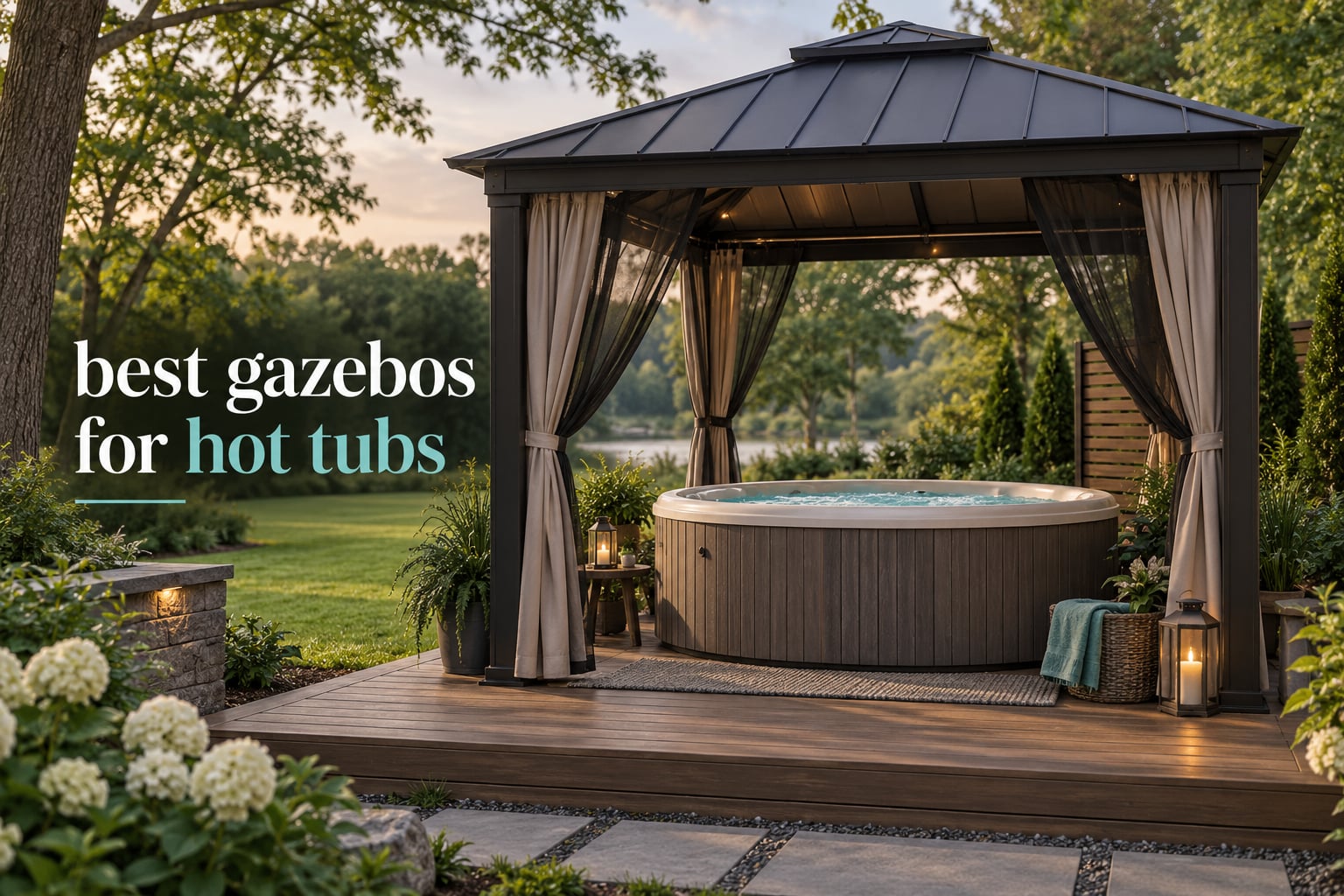
A hot tub is at its best when you can get into it on a cold night without standing in the rain first. The problem is that most backyards leave a spa completely exposed, so owners end up soaking only in mild weather and then draining the tub sooner than they would like. A gazebo over the spa solves that, and it also keeps rain, sun, leaves and UV off the water and the cover.
We spent weeks going through specs, warranty terms and owner reviews for the best gazebos for hot tubs currently on the market, then sorted them by how well each one handles the specific problems a hot tub creates: constant moisture, heavy water weight, year-round exposure and access to service panels. Ten models made the cut, and every one of them has real published ratings and owner feedback behind it.
Two things surprised us more than anything else. First, the biggest mistake is sizing, not brand: most gazebos that look generous in a listing become tight once you add steps, the cover and walk-around clearance. Second, condensation under a closed roof is a genuine concern that almost no competitor article explains, and we cover it in the buying guide below.
Table of Contents
Can You Put a Hot Tub Under a Gazebo?
Yes, you can put a hot tub under a gazebo, and it is one of the most effective upgrades you can make to a backyard spa. A hardtop or enclosed gazebo gives you shade in summer, rain protection in spring and autumn, and snow shielding in winter, while cutting evaporation from the water and keeping the cover and chemicals dry. The critical requirements are that the roof sits high enough above the tub for steam to clear, that the frame is anchored rather than freestanding, and that you leave enough clearance on every side to reach the spa filters and service panels. Owners on r/hottub report that the real payoff is longer soaking season and less maintenance, not just looks.
Top 3 Gazebos for Hot Tubs in 2026
These three sit at the top of the list for different reasons. The Kozyard Alexander is the most proven all-rounder, with the largest review base of any hardtop we looked at and published wind and snow ratings. The Backyard Discovery Arcadia is the strongest build quality option if you want cedar instead of metal. The LAUSAINT HOME is the value pick, giving you a double roof and full bug screening without breaking the bank.

Kozyard Alexander 10×12
- Aluminum frame
- 2500 lb snow load
- 60 MPH wind rated
- Dual-track curtains and netting

Backyard Discovery Arcadia
- 100% cedar with 6 in posts
- 100 MPH wind tested
- PowerPort with USB ports
- 5-year warranty

LAUSAINT HOME 10×13
- Double-tier roof
- UPF 50+ polyester
- Netting and privacy curtains
- Level 6 wind resistance
Best Gazebos for Hot Tubs in 2026 — Quick Comparison
Every model below fits a typical round or square spa with room to spare. Roof type, frame material and rated load are the three numbers that matter most over a hot tub, so we pulled those out first.
| Product | Specifications | Action |
|---|---|---|
| Kozyard Alexander 10 x 12 Hardtop Gazebo |
|
Check Latest Price |
| Backyard Discovery Arcadia 12 x 9.5 Cedar Pavilion |
|
Check Latest Price |
| LAUSAINT HOME 10×13 Double Roof Canopy Gazebo |
|
Check Latest Price |
 MASTERCANOPY 11×11 Heavy Duty Patio Gazebo MASTERCANOPY 11×11 Heavy Duty Patio Gazebo |
|
Check Latest Price |
 Aoxun 10×12 Hardtop Gazebo Aoxun 10×12 Hardtop Gazebo |
|
Check Latest Price |
 EROMMY 10 x 12 Hardtop Gazebo EROMMY 10 x 12 Hardtop Gazebo |
|
Check Latest Price |
 Aoxun 12×10 Canopy Gazebo with Mosquito Netting Aoxun 12×10 Canopy Gazebo with Mosquito Netting |
|
Check Latest Price |
 Modern Shade 12×12 Hardtop Gazebo with LED Lights Modern Shade 12×12 Hardtop Gazebo with LED Lights |
|
Check Latest Price |
 HOTEEL 10×15 Hardtop Gazebo HOTEEL 10×15 Hardtop Gazebo |
|
Check Latest Price |
 VEVOR Pop Up Gazebo Screen Tent 10×10 VEVOR Pop Up Gazebo Screen Tent 10×10 |
|
Check Latest Price |
1. Kozyard Alexander 10′ x 12′ Hardtop Gazebo — Best All-Round Hot Tub Gazebo
- Sturdy aluminum frame with reinforced beams
- Double galvanized steel roof sheds water and shade
- Curtains and netting on a dual sliding track
- Components packed in labeled boxes
- Hundreds of small fasteners make assembly long
- Roof panel clips pop off easily
- Picture-only manual is hard to follow
This is the gazebo we keep coming back to because it does the few things that matter over a hot tub, and it does them with published numbers rather than vague marketing. The frame uses 4.7-inch triangular aluminum poles with 5 by 4-inch reinforced beams, and the roof is 29-gauge galvanized steel in a double-top design. Buyers rate it 4.6 out of 5 across more than 1500 reviews, which is the largest verified owner base in this group.
The rated figures are what set it apart. Anchored properly, the manufacturer rates it for 2500 pounds of snow load and wind up to 60 MPH. Those are real numbers you can compare against your local weather records, and they are considerably stronger than most soft-top gazebos in the same footprint class.
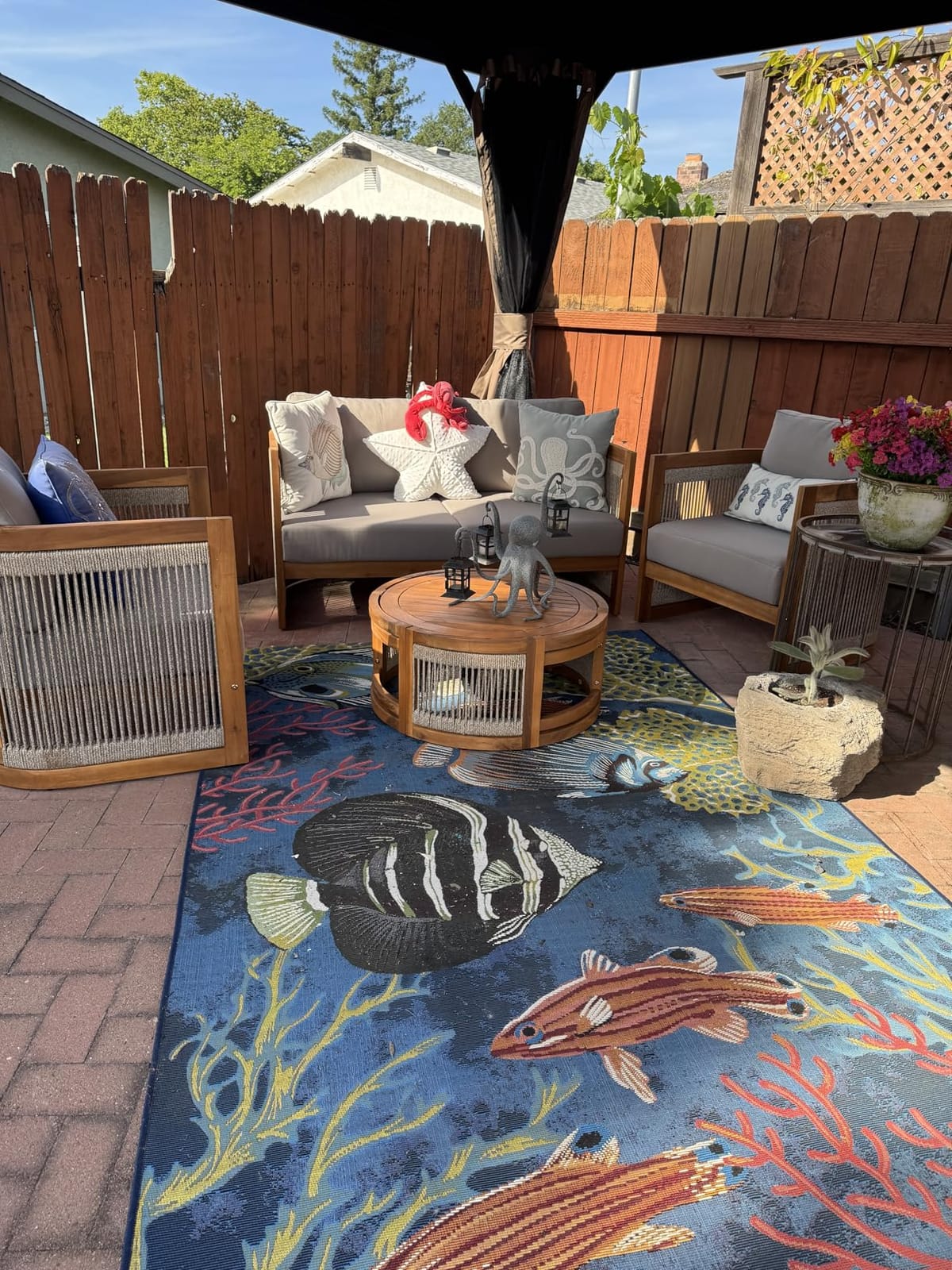
The drainage detail matters more than it sounds. Integrated gutters channel water down the poles instead of letting it drip from the roof edge onto the spa cover or your deck, and the double roof gives airflow underneath so the underside stays cooler in summer. Curtains and double-layer mesh netting slide on a dual-track system, so you can screen the tub against mosquitoes at night and open everything up on a mild afternoon.
Set against those strengths, assembly is the honest drawback. Owners describe a very large number of small screws, nuts and bolts, plus a manual that is mostly pictures with hard-to-orient parts. Roof panel edge clips pop off easily during installation, and pre-drilled holes can occasionally be misaligned. Two people are realistic even if you have built flat-pack furniture before.
How it handles a filled spa in bad weather
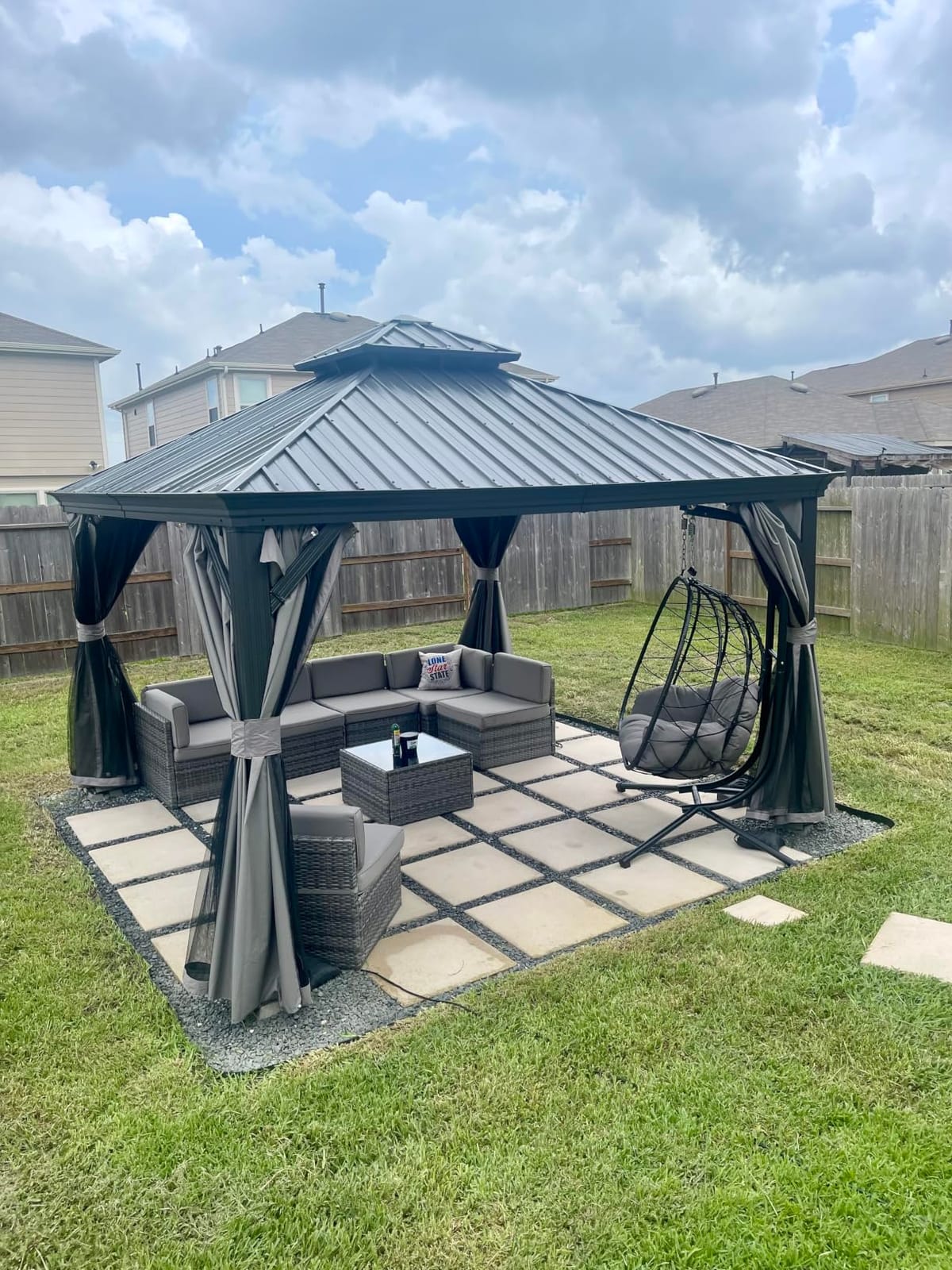
The 60 MPH wind rating and 2500-pound snow figure are meaningful over a hot tub because a filled spa is a heavy, awkward object sitting directly under the roof, and wet snow loads add up on any roof surface. Anchored correctly, this frame is built for the conditions that destroy fabric canopies, and the aluminum poles will not rust the way untreated steel eventually does.
At 320 pounds shipped, this is a serious structure rather than a tent. Budget a full weekend, a second pair of hands, and a proper anchoring plan for your surface before it arrives, because the ratings only apply once it is fixed down.
Who should skip it
If you want a gazebo up in an afternoon with no tools, this is the wrong choice entirely, and the picture-only manual is a genuine frustration for first-time builders. It is also more than you need if your goal is summer shade and bug protection in a mild climate rather than four-season use.
Owners also report that the 10 by 12 footprint is snug once you account for steps and walk-around space on a larger spa. Measure first, and if you own an 8-foot tub, step up to a 12 by 12 or wider before you commit.
2. Backyard Discovery Arcadia Cedar Pavilion — Best Hardtop Gazebo for Build Quality
- Genuine cedar construction that ages well
- Pre-cut and pre-drilled parts align cleanly
- PowerPort adds three outlets and three USB ports
- Pro-Tect tested for snow and wind
- Multi-day build needing several helpers
- Main posts are laminated rather than solid
- Wood dents during assembly
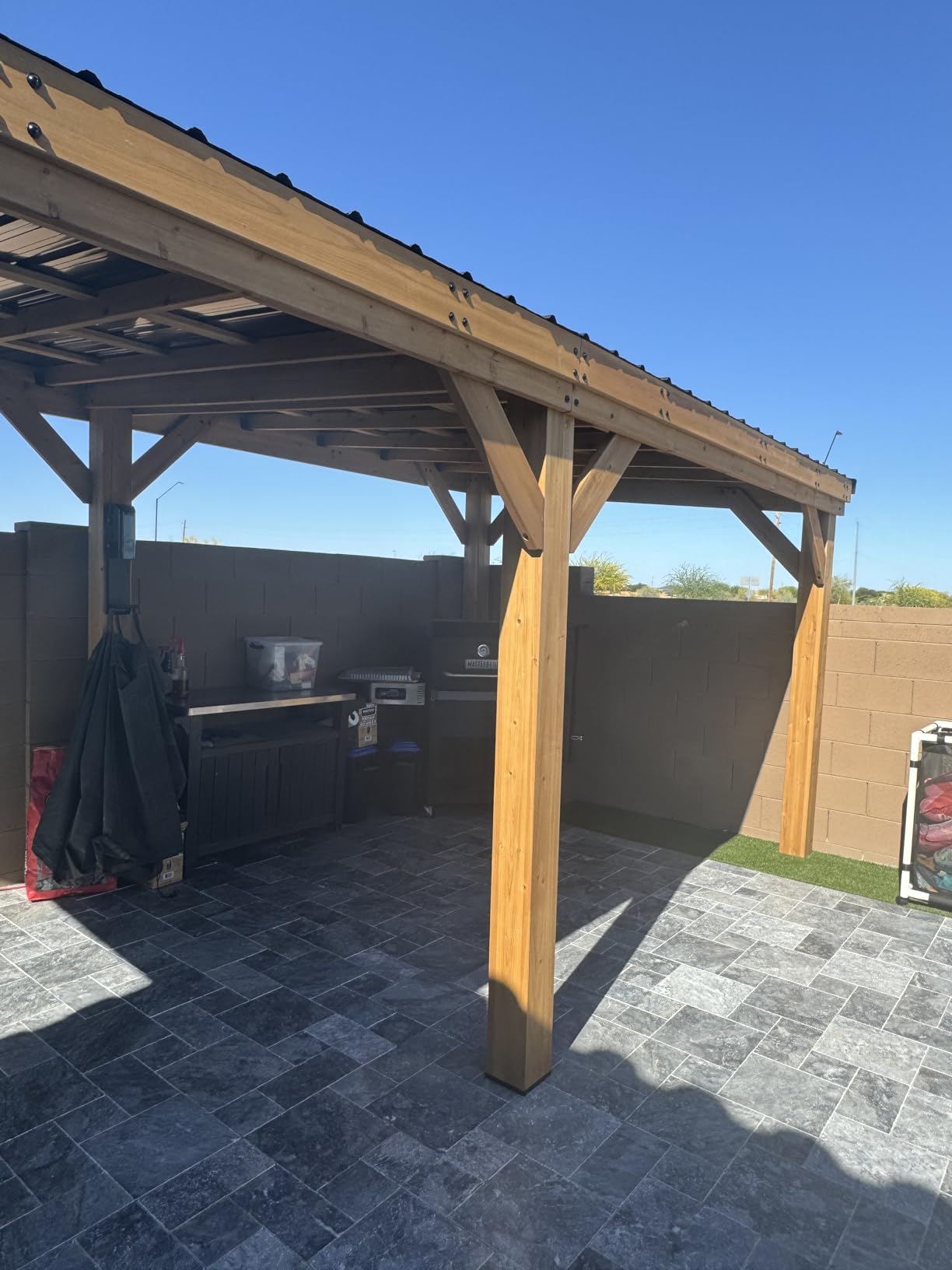
The Arcadia is the only all-cedar structure in this roundup, and it earns its place for anyone who wants a gazebo that looks like part of the house rather than a temporary canopy. It carries a 4.7 rating with 613 reviews, and roughly 84 percent of those reviews are five stars, which makes it the best-liked model we covered.
Where most gazebos give you a vague wind claim, this one was Pro-Tect tested to 5800 pounds over a 30-inch snow load and winds up to 100 MPH when anchored. Those are the strongest published figures here, and combined with 6 by 6-inch cedar support posts and a 29-gauge black steel slope roof at a 5-degree pitch, the structure is genuinely suited to snow country.
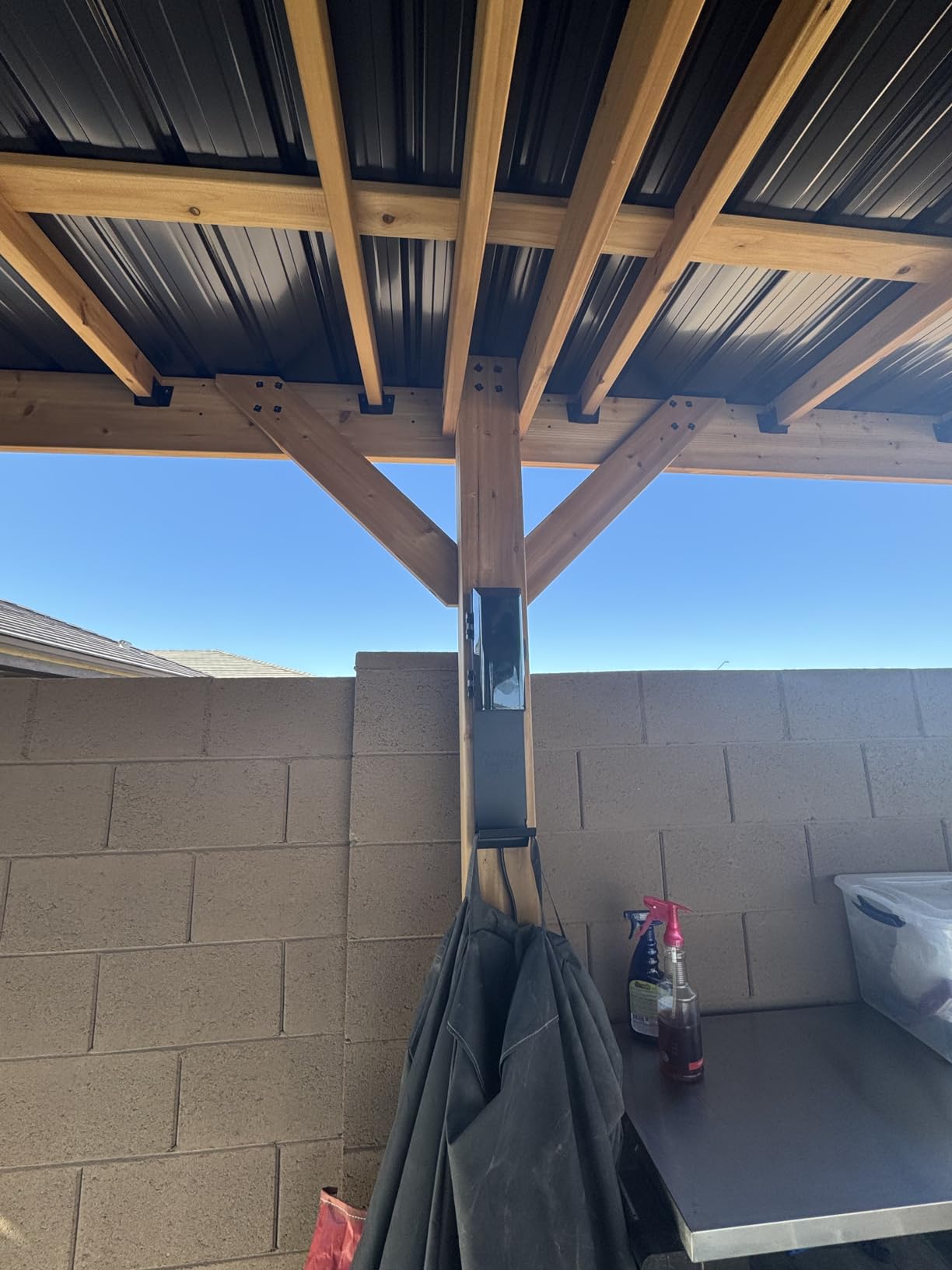
The patented PowerPort is a small feature that owners consistently mention. Three outlets and three USB ports are built into the frame, so a fan, a phone charger or string lights plug straight in rather than requiring an outdoor-rated extension run across the deck. Curtains and netting handle the weather sealing, and the whole unit is pre-cut, pre-drilled and pre-stained before it leaves the factory.
Assembly is the trade-off, and it is a real one. Buyers describe a two-day-plus project with multiple helpers, especially for the roof, and the manual app plus written guide make it more manageable than a typical flat-pack build. Cedar dents and mars easily during assembly, and a few owners report shipping damage to the steel roof panels or anchoring lag screws that are not included.
Why cedar works in a hot tub setting
Cedar is naturally rot-resistant, which matters in an environment where hot water vapor rises into the frame every time the tub runs. The steel slope roof sheds snow and rain quickly at that pitch, and the tight five-year limited warranty is the longest written commitment among the aluminum and steel models here, aside from no longer claims at all.
Note that the main posts are laminated hollow-core rather than solid 6 by 6 timber, which some owners found disappointing given the listing language. It still holds a filled spa, but the label oversells the solidity slightly.
Who should skip it
This is not a weekend project and it is not a portable shelter. If you want something you can move, or you only plan to use the tub in summer, the cedar construction and the assembly time are more than you need.
At 573.99 kg shipped, it also needs a crew and a clear path from the delivery point to the build site. Plan the footprint before ordering, because the 12 by 9.5-foot shape is closer to a patio dining shelter than a roomy walk-around spa enclosure.
3. LAUSAINT HOME 10×13 Gazebo — Best Value Double-Roof Canopy
- Thicker metal tubing than most at this tier
- Zippered netting and curtains with solid zippers
- Double-tier roof improves airflow and cooling
- Clear labeled parts and instructions
- Stretching the canopy over the frame is difficult
- Narrow roof vent traps heat and admits bugs
- Some frames arrive with misaligned holes
If you want bug protection, shade and rain cover over a spa without committing to a permanent structure, this is the value pick. It rates 4.4 out of 5 across 1104 reviews, and the frame uses 40 by 40-millimeter powder-coated galvanized steel, which owners note is thicker than they expected at this level.
The double-tier roof is the piece that actually earns its name. It creates a gap between the canopy and the top vent that lets warm air escape, so the interior stays noticeably cooler than a single-layer canopy in full sun. The 135G polyester carries UPF 50+ protection and a 1500MM water resistance rating, and the fabric is rated at wind resistance Level 6 when properly secured.
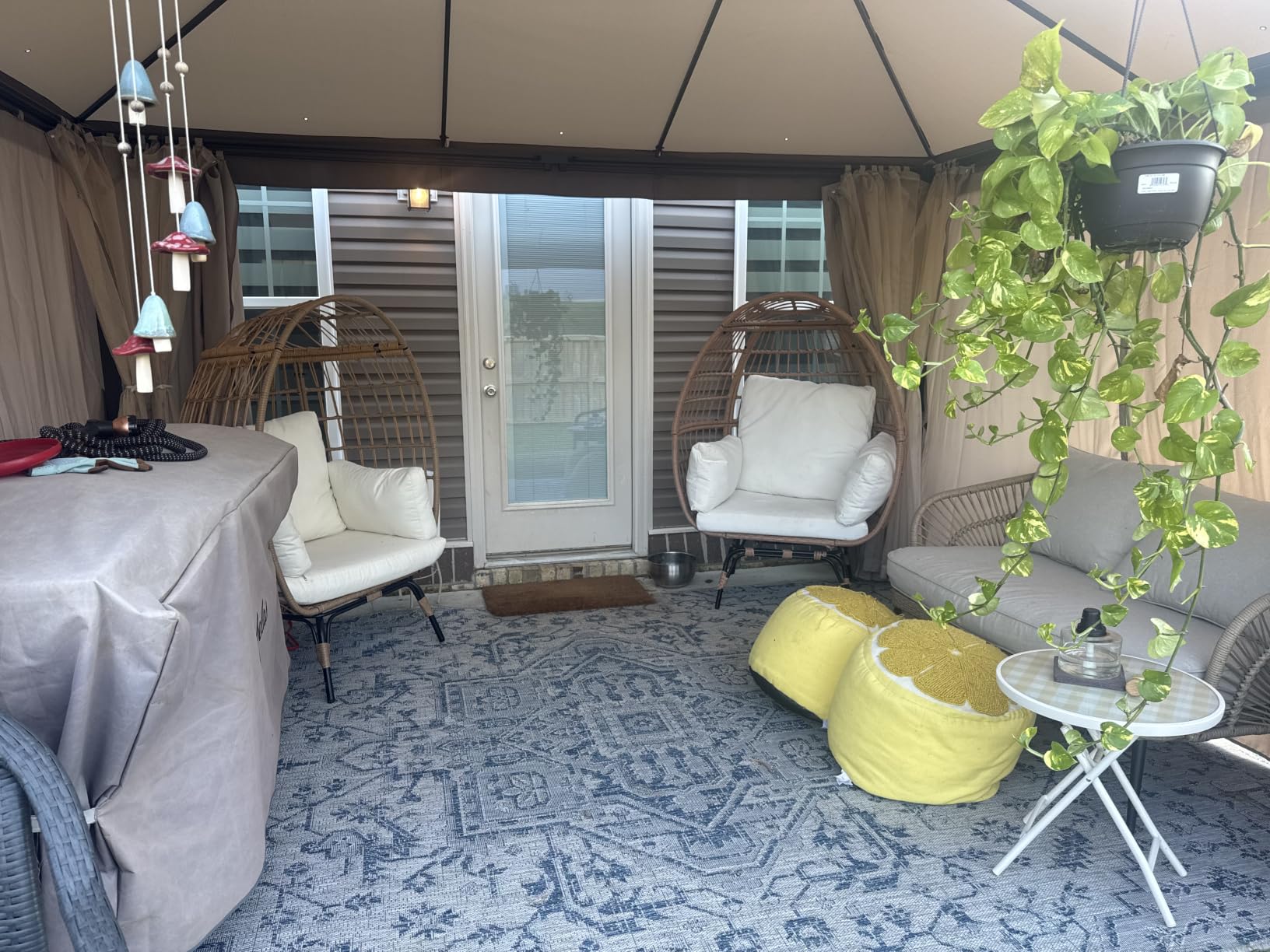
For evening use around a hot tub, the zippered mosquito netting and privacy curtains matter more than on any other canopy type, and owners single out the zipper quality as better than the cheap versions they replaced. There are drain holes in the top, plus a center hook and D-rings for hanging lights or a fan.
Two construction details catch people out. Stretching the canopy over the frame, particularly the small top vent section, is genuinely difficult and is the most common complaint. The vent is also narrow enough that heat still builds under it and leaves a gap bugs can exploit, which undercuts the netting advantage in hot weather.
How it performs through a season over a spa
Owners report the fabric holding up through wind, hail and multiple seasons as long as the soft parts come down in winter. For a hot tub specifically, the practical pattern is to leave the steel frame standing and remove the canopy and curtains when the tub is shut down for cold months. That keeps the structure in place without asking fabric to carry winter loads.
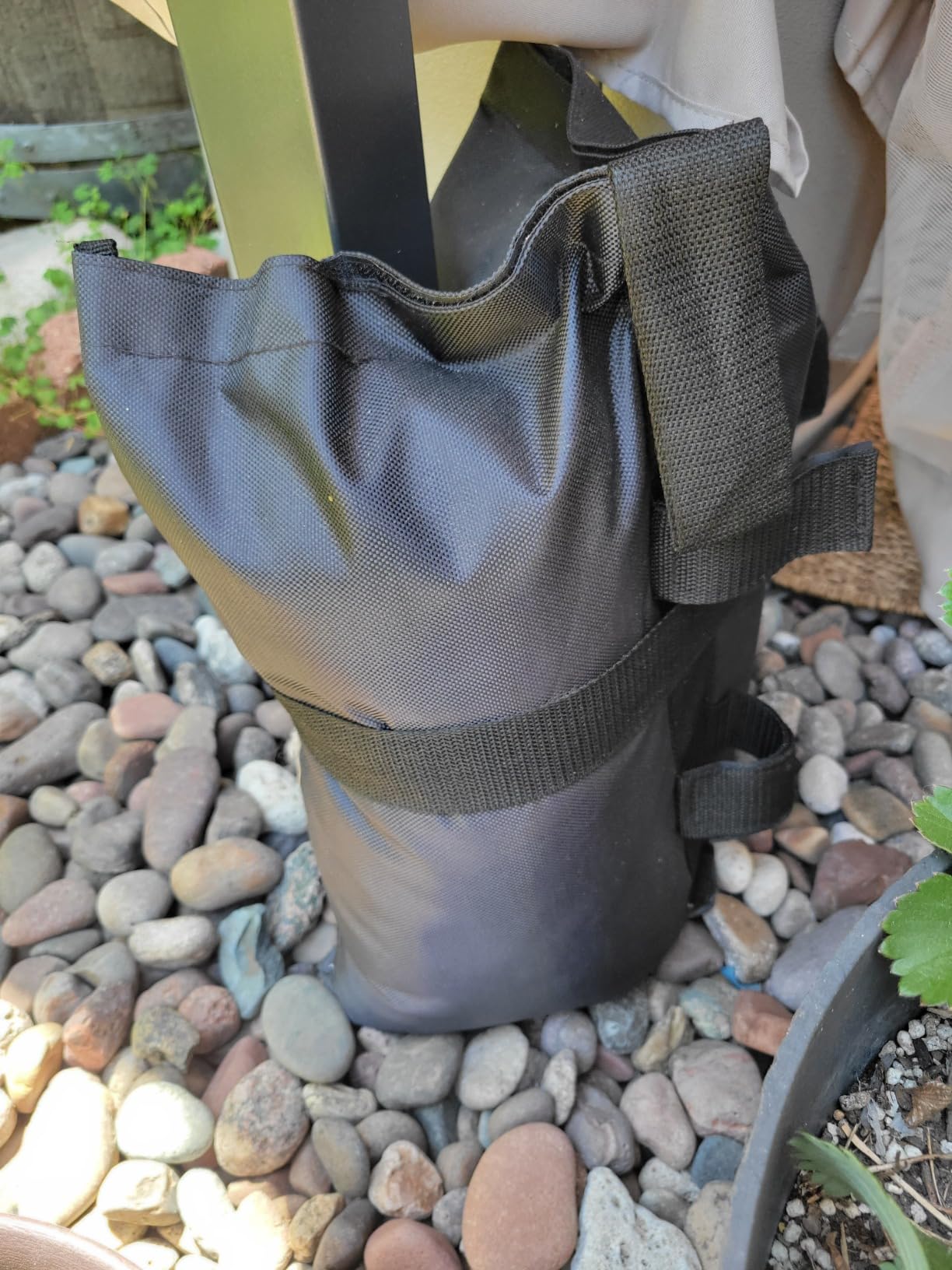
Eight expansion bolts are included for anchoring, and the frame weighs just over 100 pounds, so two people can reposition it if your patio layout changes. The 10 by 13 size is measured from the eaves, so account for that when you check clearance around the tub.
Who should skip it
This is not a waterproof shelter in heavy rain, despite the listing language, and owners say so directly. It is also not appropriate for snow loads or for permanent year-round installations, since the roof is fabric rather than paneled.
Some frames arrive with drilled holes or sockets that are misaligned or on the wrong face, and the ties only hold two side panels at once, so opening one side while closing another is awkward. If you need true weather sealing, move up to a hardtop.
4. MASTERCANOPY 11×11 Heavy Duty Patio Gazebo — Best for Fast Setup and Simple Screening
MASTERCANOPY 11×11 ft Heavy Duty Patio Gazebo with Netting Walls, Black
- Assembles in about an hour for two people
- Four zippered netting walls keep bugs out while airflow stays
- Frame has survived a New England winter
- Looks more expensive than it costs
- Canopy fabric can stretch at the seams
- Shallow plastic leg connectors are a weak point
- Water pooling can damage the frame if not cleared
This is the pick for anyone who wants shade and insect control over a hot tub without a hardware project. Two people typically have it standing in about an hour, and at 56.2 pounds it is light enough to move when you want the tub in the sun instead of the shade.
The square 11 by 11 footprint gives 121 square feet, which is one of the better fits for a round spa of the common 7-foot class. The powder-coated steel frame uses 50-millimeter, or 2-inch, legs, and the roof blocks 99 percent of UV at UPF 50+ with drain holes along the edge to prevent water accumulation.
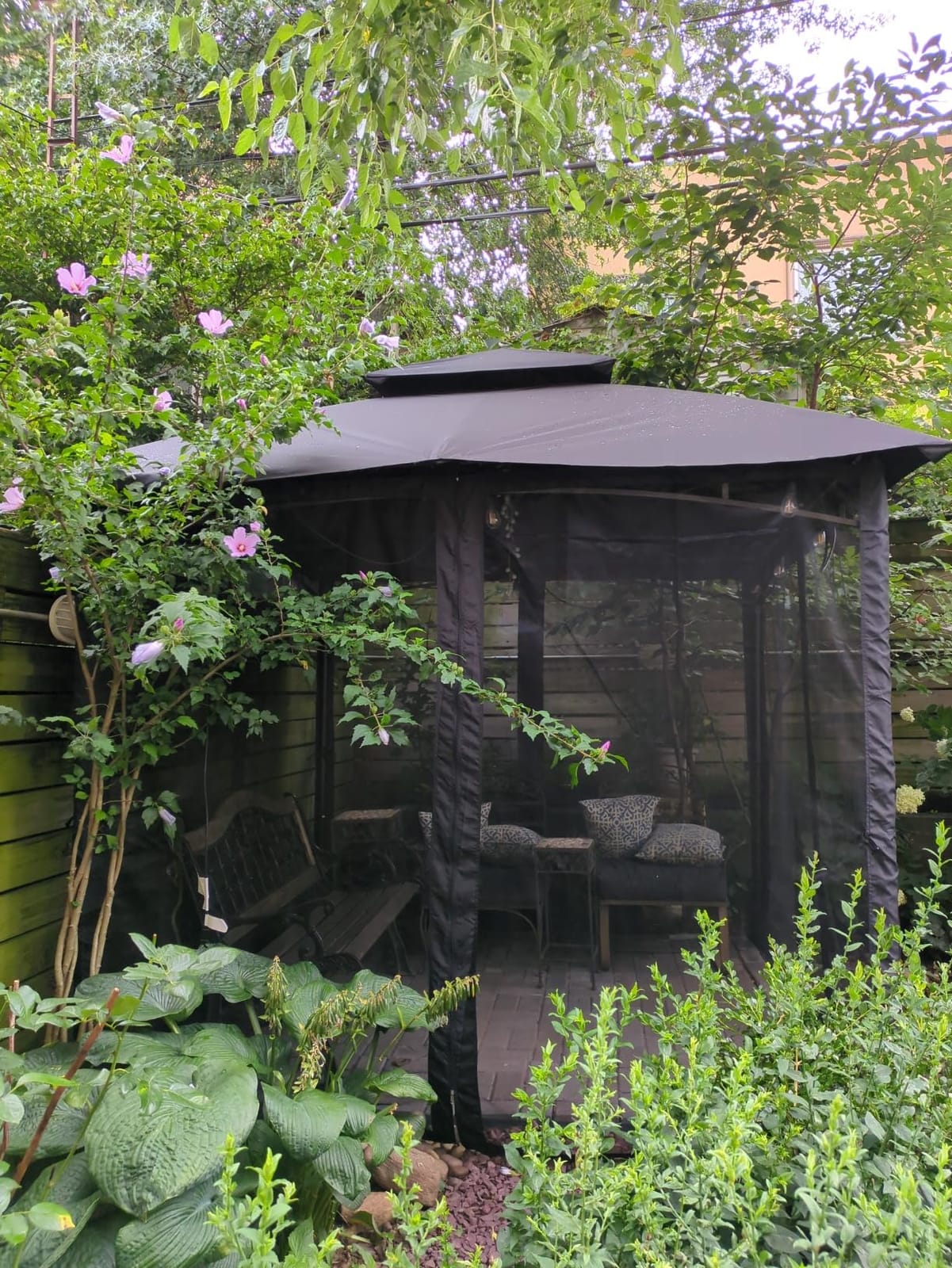
Four removable zippered screen walls attach with adjustable Velcro straps, so you can screen all sides for an evening soak or strip two walls for airflow during the day. That flexibility is what makes it work around a hot tub, where you often want shade and bugs blocked while the water is still producing steam.
Owners consistently report the frame holding up well when braced and weighted, including a Massachusetts winter with the canopy removed. The frame also comes with a one-year replacement guarantee and six months on other parts, which is short but at least stated clearly.
What it means for a spa with water vapor
Because all four walls are mesh rather than solid fabric, this is one of the better choices for reducing condensation. Vapor escapes through the netting instead of pooling against a fabric wall, which matters when a hot tub pushes warm moisture upward for hours at a time.
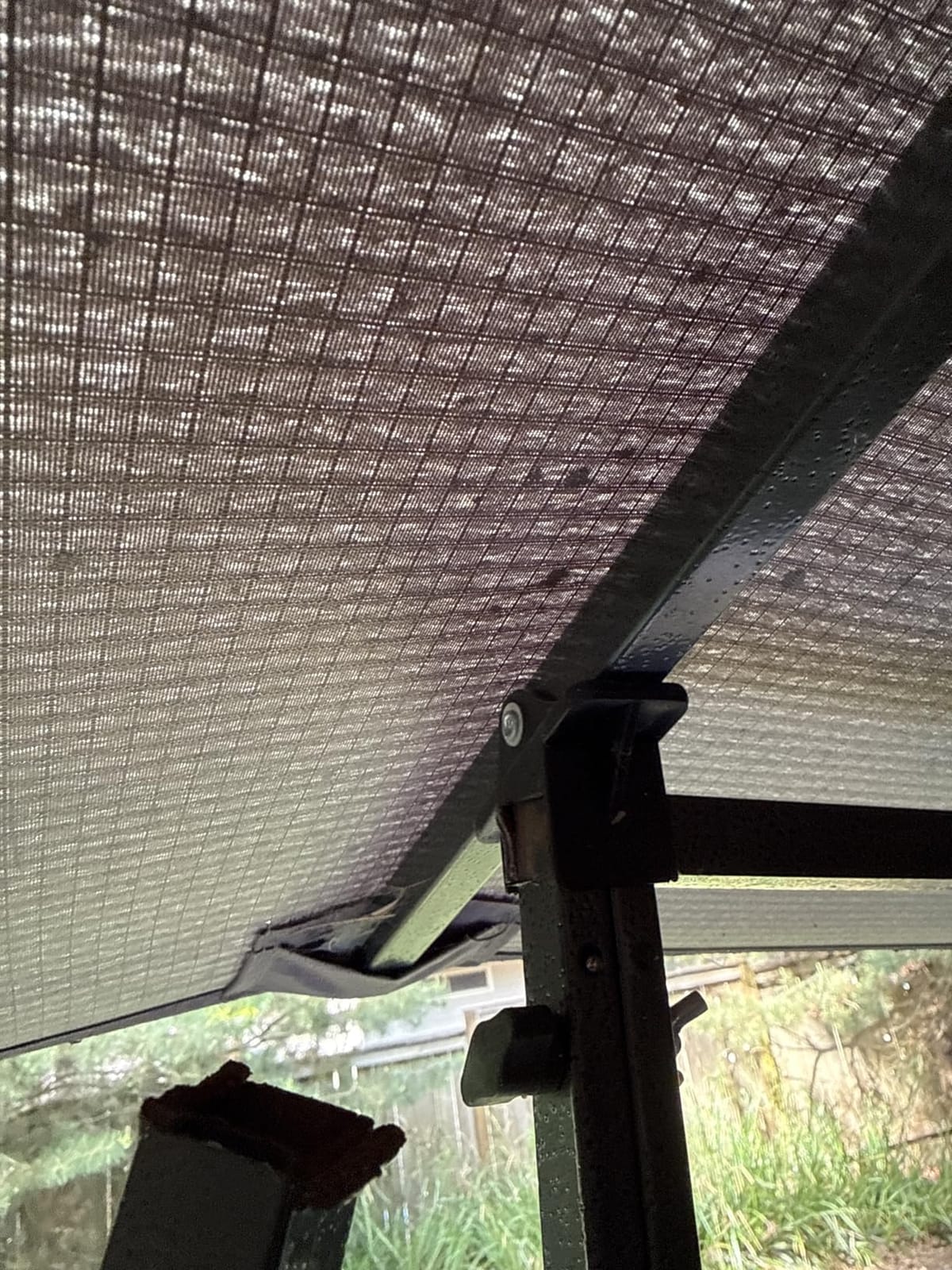
The canopy fabric is tight against the frame and can stretch or tear at the seams if forced during installation, so take your time with that step. Drain holes only work if the roof is tensioned properly and you clear standing water after heavy rain.
Who should skip it
The plastic connectors at the leg extension joints are the recurring weak point, and a meaningful share of one-star reviews center on shipping damage, weld quality and finish arriving chipped or lightly rusted. Instructions that call for repainting the metal every three months to avoid rust are not encouraging either.
If you want weatherproofing in rain or snow rather than shade and bug protection, this is the wrong category. The canopy is polyester, so it should come down before winter conditions and go back up in spring.
5. Aoxun 10×12 Hardtop Gazebo — Best Budget Hardtop Over a Small Spa
Aoxun Gazebo 10×12 Hardtop Gazebo with Double Galvanized Steel Roof, Gray
- Hard galvanized steel double roof resists rust and fade
- Netting tracks and curtains slide smoothly
- Top hooks for lights or a fan
- All hardware included with clear instructions
- Manufacturer recommends 3-4 people and 2-4 hours
- Soft parts must come down in extreme weather
- Wind rating limited to 31-38 MPH
A hard metal roof at a modest price is useful if you want shade and rain cover without paying for a full aluminum frame package. The double galvanized steel roof is rust and fade resistant, and the powder-coated metal frame is thick enough that owners rarely complain about flex.
This is the lowest-rated hardtop in the group at 4.0, with 12 percent one-star reviews across 719 ratings. The recurring issues are assembly effort, the need to anchor it properly, and occasional missing or damaged components in the box, so it is worth checking the parts inventory before you start.
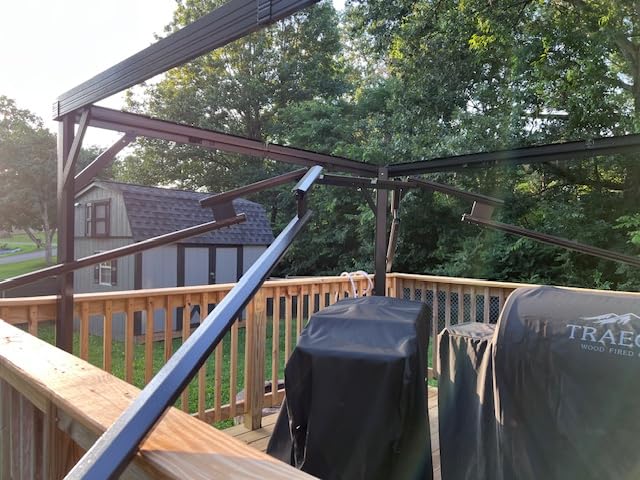
The wind rating is the number to watch, and it is modest: wind class 7, which corresponds to 31 to 38 MPH. If your area gets storms above that, this is a summer and shoulder-season shelter rather than a year-round one, and the manual recommends removing the soft parts in extreme weather.
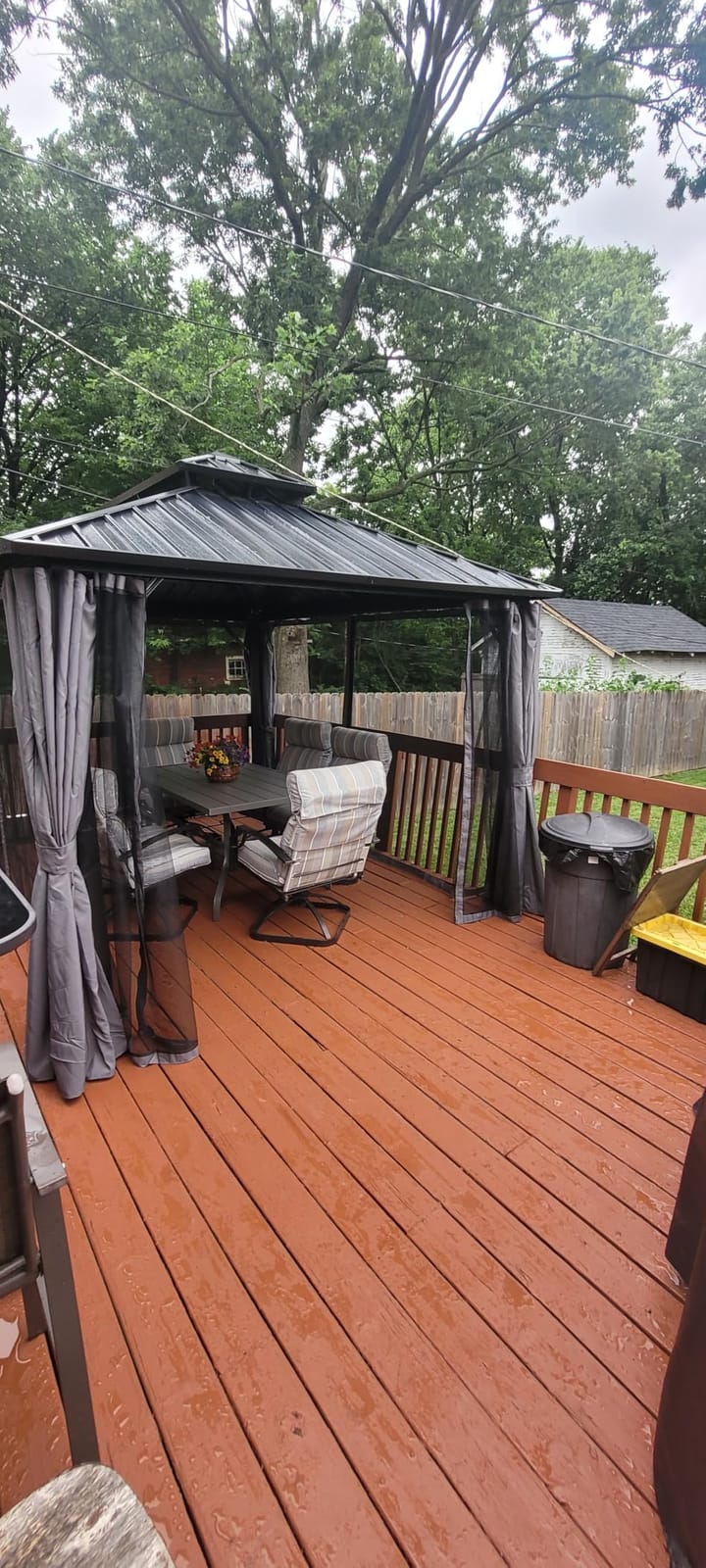
For everyday spa use it does the important things well. Netting runs on zip tracks with curtains and three binding belts for adjustable privacy, and top hooks let you hang lights or a fan over the tub, which is what turns a bare canopy into a usable evening room.
Where it fits well over a hot tub
At 120 square feet, this suits a smaller round spa where you want the tub covered but do not need to walk all the way around it inside the structure. The metal roof also does not absorb the way fabric does, so shade temperatures under the gazebo stay more stable through a hot afternoon.
Four ground stakes and expansion screws ship with the gazebo, which matters because the rated performance assumes the frame is anchored rather than simply set on the ground. Unanchored, a metal roof lifts easily, and a lift over a filled spa is the failure nobody wants to test.
Who should skip it
Anyone in a high-wind or snowy climate should pass. The 31 to 38 MPH ceiling is well below what a filled spa in an exposed yard needs, and a sagging or collapsed roof over water you have paid to fill is a bad trade.
Assembly is genuinely heavy lifting, with the manufacturer calling for three to four people and two to four hours. The one-year warranty is also the shortest on this list, so treat it as a seasonal shelter rather than a long-term backyard room.
6. EROMMY 10′ x 12′ Hardtop Gazebo — Best for a Durable Four-Season Enclosure
EROMMY 10′ x 12′ Hardtop Gazebo, Aluminum Frame Gazebos with Galvanized Steel Double Roof, Permanent Outdoor Metal Pavilion with Curtain and Netting for Patio, Lawn, Deck
- Steel hardtop far stronger than fabric roofs
- Pre-drilled bases handle uneven ground
- Double roof vents wind and blocks UV
- Dual-track double-layer curtains and netting
- Must be anchored to perform as described
- One-star share runs about 11 percent
- Many size options make footprints easy to misjudge
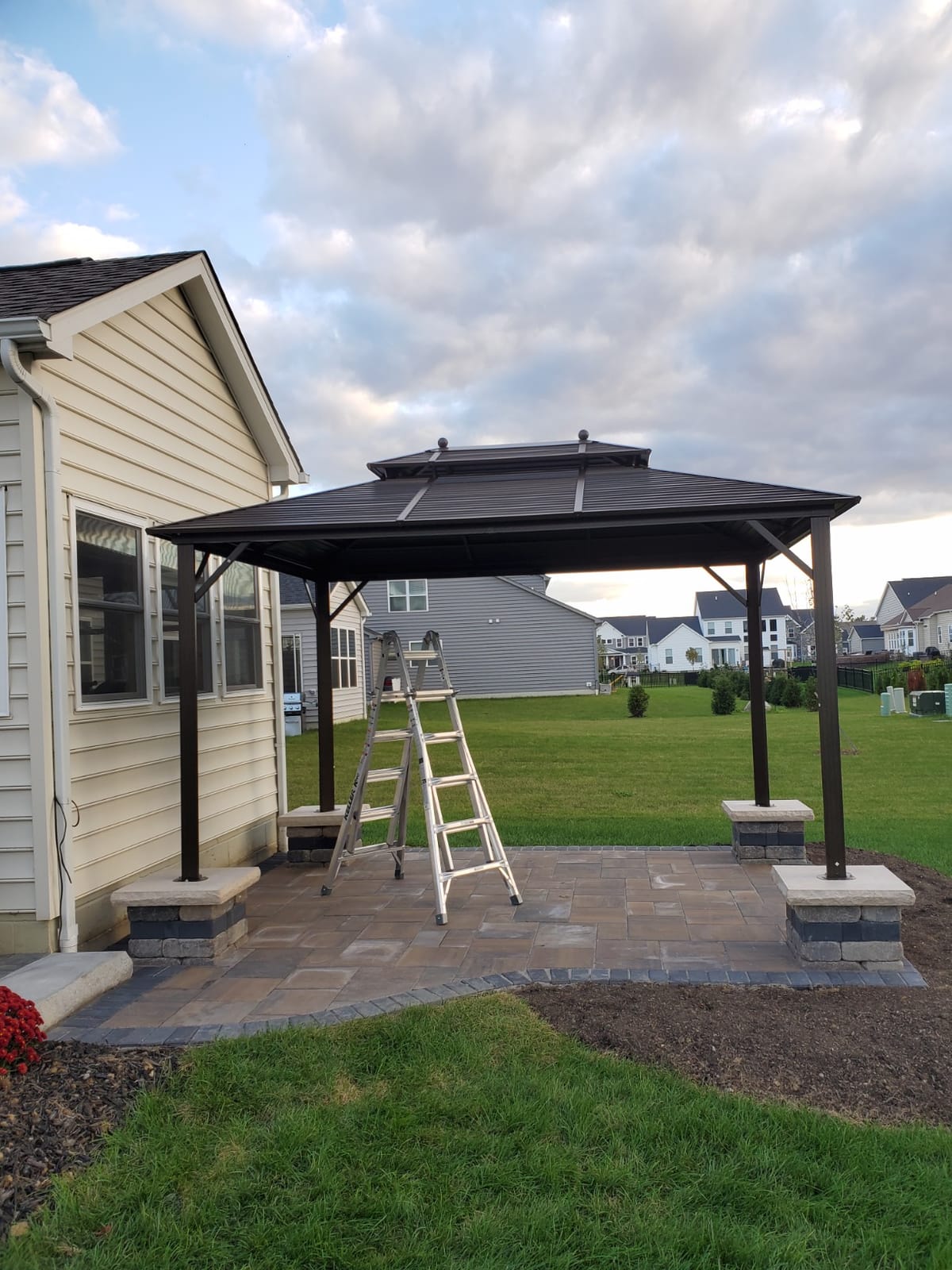
The EROMMY focuses on the reason owners buy a gazebo for a spa in the first place: keeping water, leaves and weather off an expensive piece of equipment. The galvanized steel hardtop replaces fabric or polycarbonate, and buyers consistently say it feels much more stable than any soft-top they have owned.
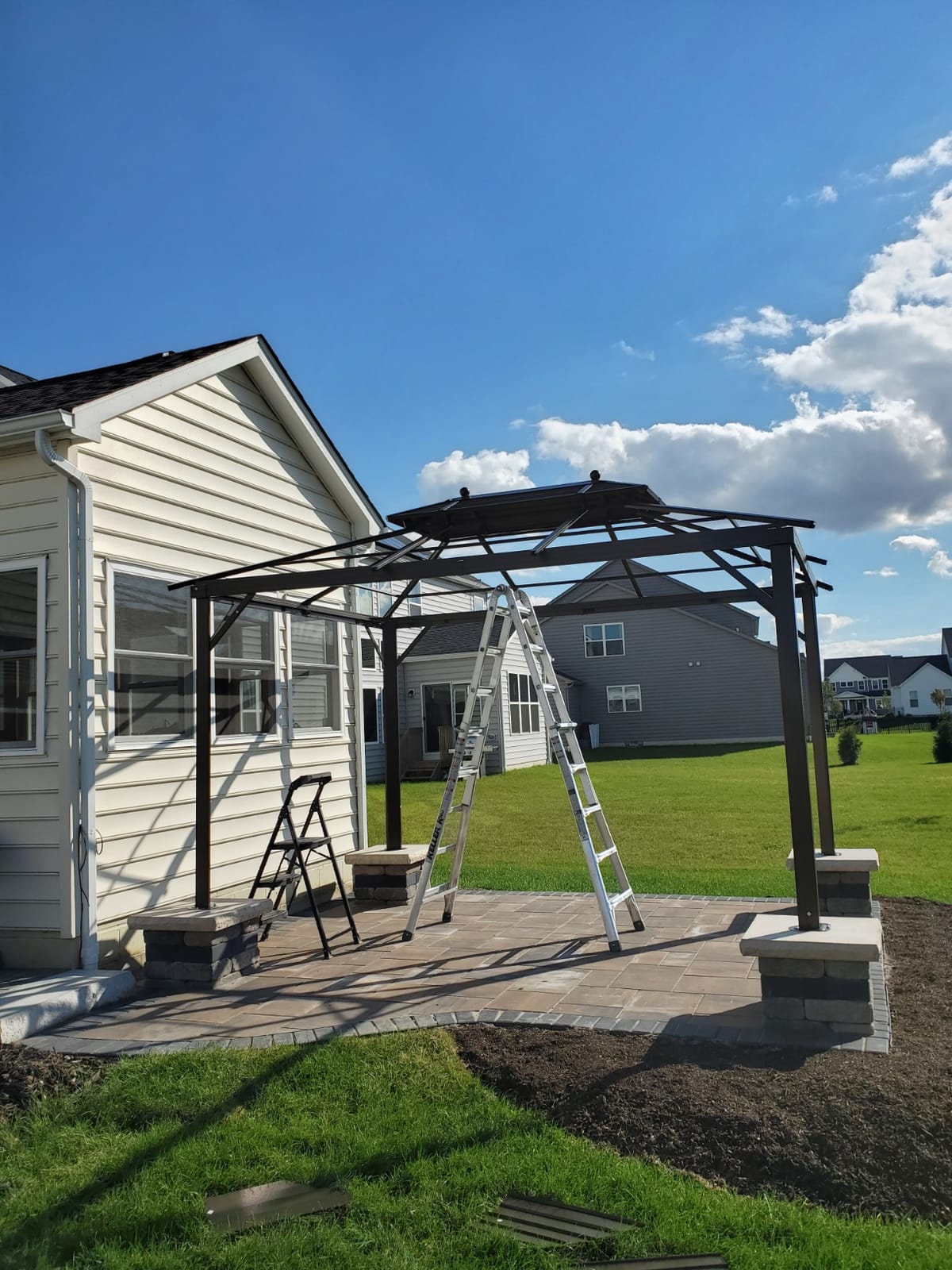
The frame is powder-coated triangular aluminum with pre-drilled bases, which owners credit for handling uneven ground better than adjustable-leg designs. UV protection is listed at 99 percent, and the double-top roof lets wind pass through while shading the water below.
Enclosure is where this one separates from cheaper hardtops. It carries fully enclosed zippered double-layer sidewalls on a dual-track system, so curtains and mesh can be combined or swapped depending on weather. That matters over a hot tub because you can close everything down in a storm and open the mesh on a warm evening.
At 120 square feet it fits a sofa set or a seven-piece dining set comfortably, and the range extends from 10 by 10 up to 14 by 24 if you later need a larger enclosure. Rated for three to eight people, it is a shelter first and a gathering space second.
Why the double roof helps above hot water
A double-top roof creates a ventilated cavity that lets rising steam and warm air escape rather than pressing against an underside panel. Over a hot tub running at 100 degrees or more, that is the difference between a roof that dries out overnight and one that stays permanently damp.
The pre-drilled bases are worth noting for site prep, because they anchor without the guesswork that comes with drilling your own holes. Just confirm the finished footprint against your tub before ordering, since a long list of sizes makes it easy to misjudge what you are actually buying.
Who should skip it
About 11 percent of ratings are one star, mostly around assembly difficulty, delivery problems and the anchoring requirement. A metal hardtop that is not anchored does not behave as described, and that is not a minor caveat.
Permanent installation also removes flexibility. If you plan to move the spa or want a shelter you can take down at the end of the season, a canopy-style gazebo is a better fit for the same money.
7. Aoxun 12×10 Canopy Gazebo — Best for Mosquito Protection Around a Spa
Aoxun 12×10 Outdoor Gazebo with Mosquito Netting & Double Roof, Gray
- Full-perimeter sealed mesh keeps insects out
- Double roof gives good shade and airflow
- Easy setup for most buyers
- Anchoring kit ships with the gazebo
- Netting only
- no curtains included
- A loose roof seam can trap water
- Needs anchoring or it shifts in strong wind
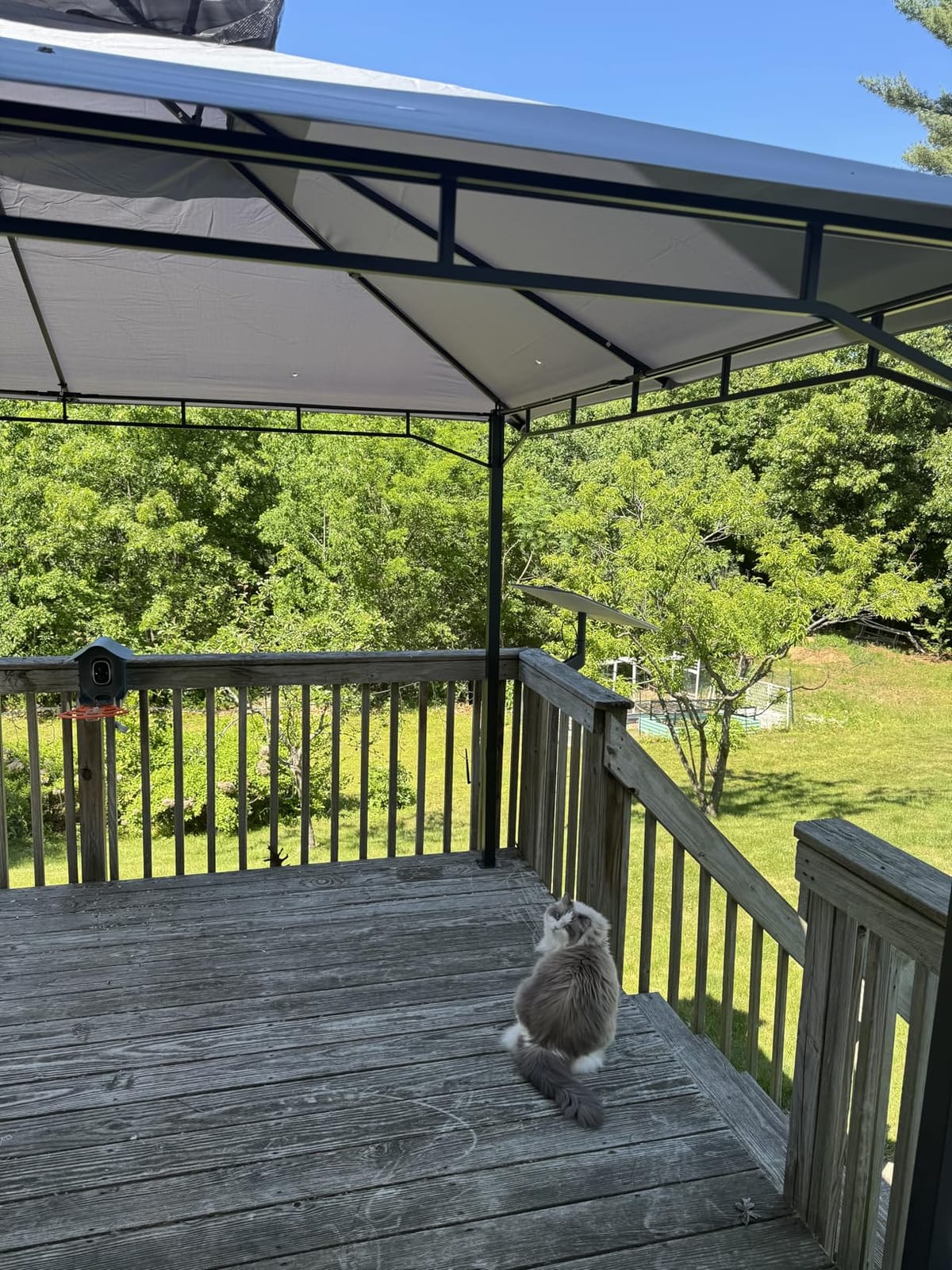
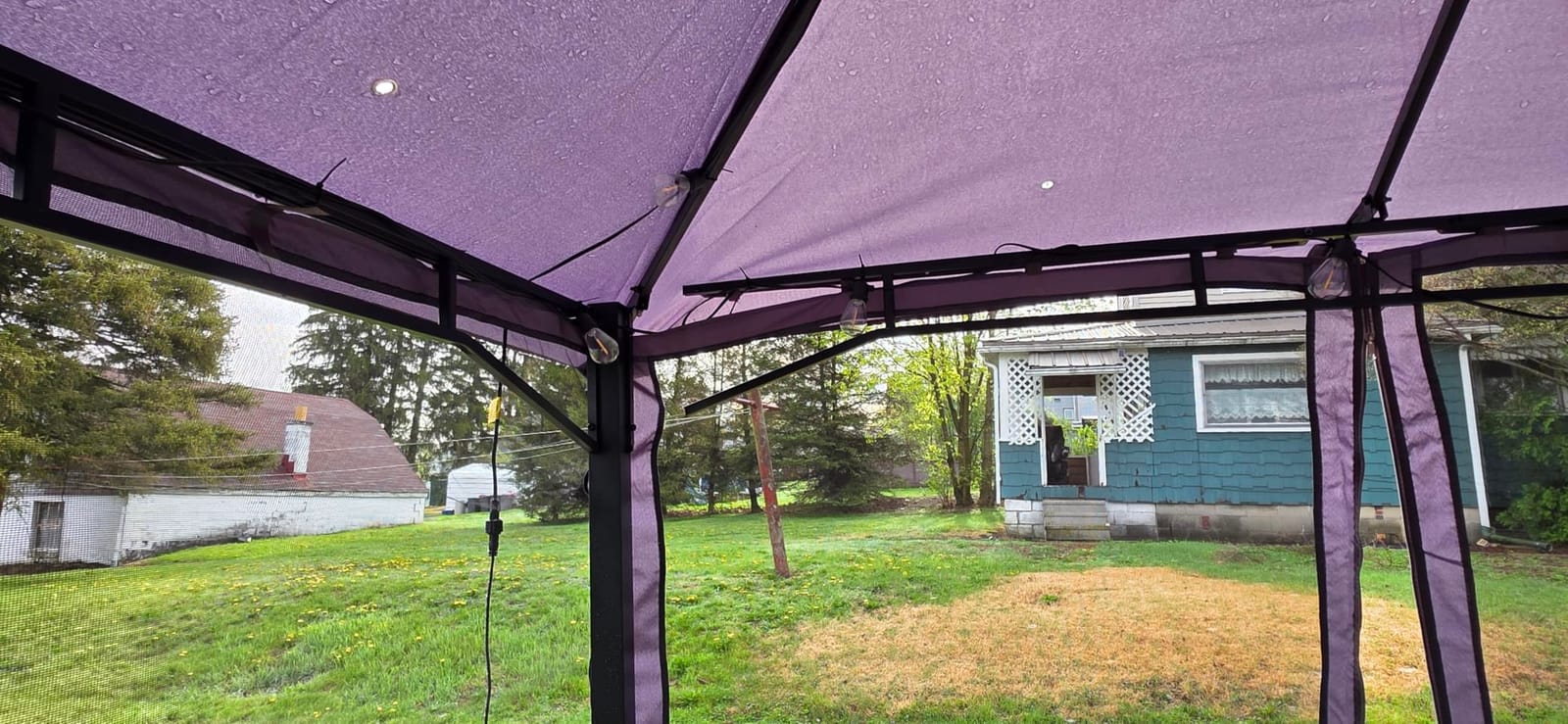
Evening soaking around a hot tub is where mosquitoes become the deciding factor, and this gazebo is built for it. The full-perimeter netting attaches with Velcro-sealed edges all the way around, and the top ventilation duct has its own mosquito-proof net so airflow does not become an entry point for insects.
Underneath, the fabric is 160g PU-coated polyester with UPF 50+ protection, which is a step up from the 135G used in most budget canopies. Eight drainage holes in the top roof speed up runoff, and the 50 by 50-millimeter powder-coated steel legs are rated for Level 7 wind and 250 pounds.
Owners like the look and the shade, and most find assembly straightforward, particularly compared with hardtops in the same price band. At 89.3 pounds it is also manageable for two people to reposition if the tub moves.
Be clear-eyed about one thing: this is a netting configuration only, and curtains are not included. If you want privacy and weather sealing, you are adding curtains separately or choosing a different model.
How it handles water from a hot tub
Double roofs on canopy gazebos earn their keep when the source of moisture is a spa rather than rain. The gap between layers gives rising vapor somewhere to go, and the coated fabric underneath does not wick the way lighter polyester does.
One loose roof side can allow water to pool in a pocket that has to be pushed out to drain, so check the tension after a windy night. Owners also report some shipments arriving with missing roof poles, so inventory the box before assembly day.
Who should skip it
If your priority is rain and wind protection rather than shade and bugs, this is not the shelter. Fabric roofs are not built for snow, and the structure should be anchored or taken down before a serious storm.
Around 10 percent of reviews are one star, and a meaningful share of those describe difficulty getting a prepaid return from the seller. Check the return process before you buy rather than after, and avoid it entirely if you cannot store it indoors off-season.
8. Modern Shade 12×12 Hardtop Gazebo with LED Lights — Best for Evening Use Out of the Box
Modern Shade Hardtop Gazebo 12×12 with 4 LED Lights for Backyard, Black
- Four solar LED lights need no wiring
- Rust-proof frame with base expansion screws
- Detachable dual-track netting balances shelter and airflow
- 20 lb per sq ft snow load rating
- Arrives in multiple boxes at different times
- At 348 pounds it needs two to three people
- Wood-grain variants cost more
The thing that sets this apart is the lighting package. Four solar-powered LED lights are included, so you can light the tub at dusk without running a single cable or adding a fixture yourself. For a hot tub, that is the difference between a shelter you use at night and one you only use in daylight.
It also posts the highest wind figure in this group at up to 83 MPH with a snow load capacity of 20 pounds per square foot, on a galvanized steel double roof rated fade and rust resistant. Owners rate it 4.7 with 250 reviews, and about 85 percent are five stars.
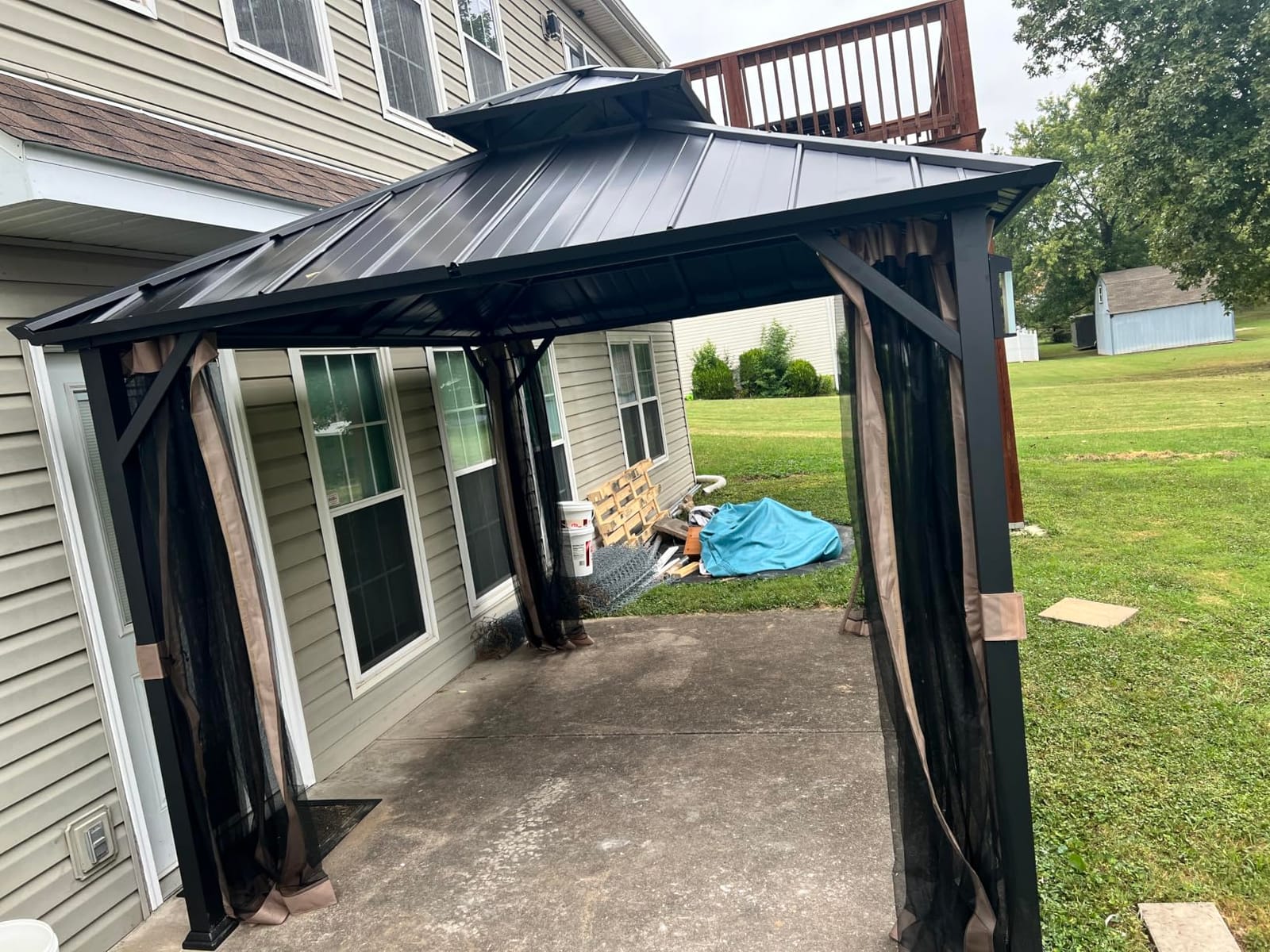
The 12 by 12 footprint gives 142 inches on each side at 142 by 142 inches overall, and at 120 inches high there is real clearance above the water for steam to rise. Detachable dual-track mosquito netting lets you keep bugs out while still allowing airflow, which is the balance you want in warm weather.
Anchoring screws for concrete or deck are included, and the frame is described as corrosion and rust-proof with extra base expansion screws. Listed occupancy is 10 to 12 people, so there is room to move around the tub rather than squeeze past it.
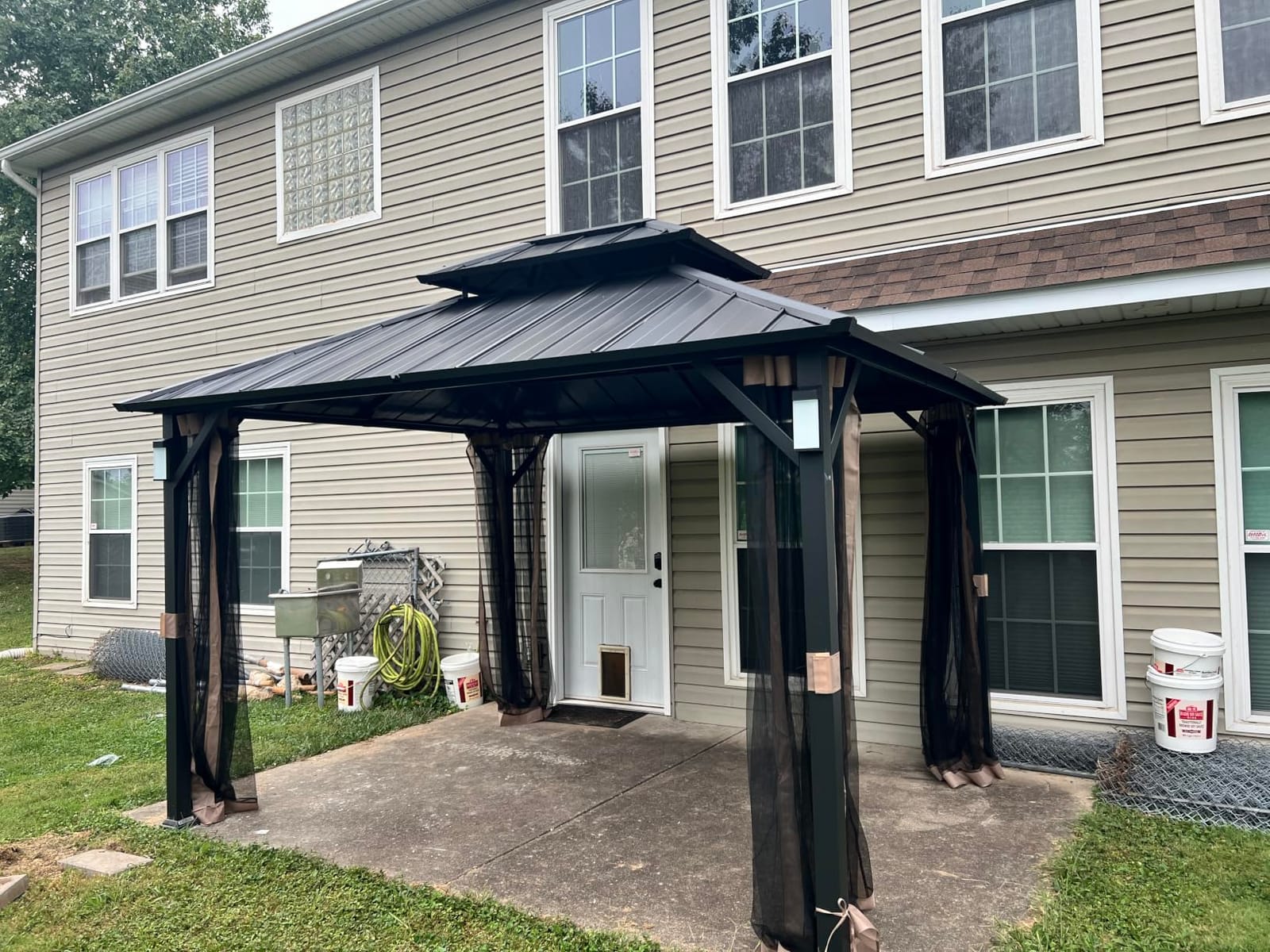
Why lighting matters more over a spa
A hot tub is used at night, and ambient light changes how the space feels far more than any other single upgrade. Solar LEDs mounted under the roof frame mean no extension cords across a wet deck, which is both a convenience and a safety point in a space where water and electricity share the floor.
The 20-pound-per-square-foot snow rating is modest compared with the 2500-pound figure on the Kozyard, so treat it as a four-season structure in temperate zones rather than a heavy-snow shelter. In a mild climate with the double steel roof, it performs well year-round once anchored.
Who should skip it
Delivery is the catch. It arrives in multiple boxes that may not arrive at the same time, so you need all of them before you can install, and at 348 pounds the build needs two to three people. Plan for a delayed, incomplete start if you are eager to get it up this weekend.
Anyone on a tight budget should also check the larger sizes and wood-grain finishes, which sit at higher price points than the base model. And if you have already committed to string lighting of your own, the included lights are a bonus rather than a reason to buy.
9. HOTEEL 10×15 Hardtop Gazebo — Best Gazebo for Larger Spas and Swimmer Pools
- Roomy 10x15 footprint for 10-14 people
- Galvanized steel roof shades well and does not leak
- CPAI-84 flame-resistant curtains are washable
- Double-track curtains plus two-sided zipper netting
- Roof assembly needs a power screw gun
- Manual is cluttered and hard to follow
- Replacement parts can take over a month
This is the largest footprint in the roundup at 150 square feet, and that is precisely why it works for larger spas. A 10 by 15 layout gives you genuine walk-around space on all sides of the tub, which is what you need to reach filters and service panels, and it accommodates 10 to 14 people.
The powder-coated aluminum frame comes with a pre-drilled base and expansion screws, and the heavy-duty galvanized steel roof carries an 18.43 psf snow load rating with a ventilated double roof. Long-term owners report it holding up without leaking, which is the outcome that matters most over a filled spa.
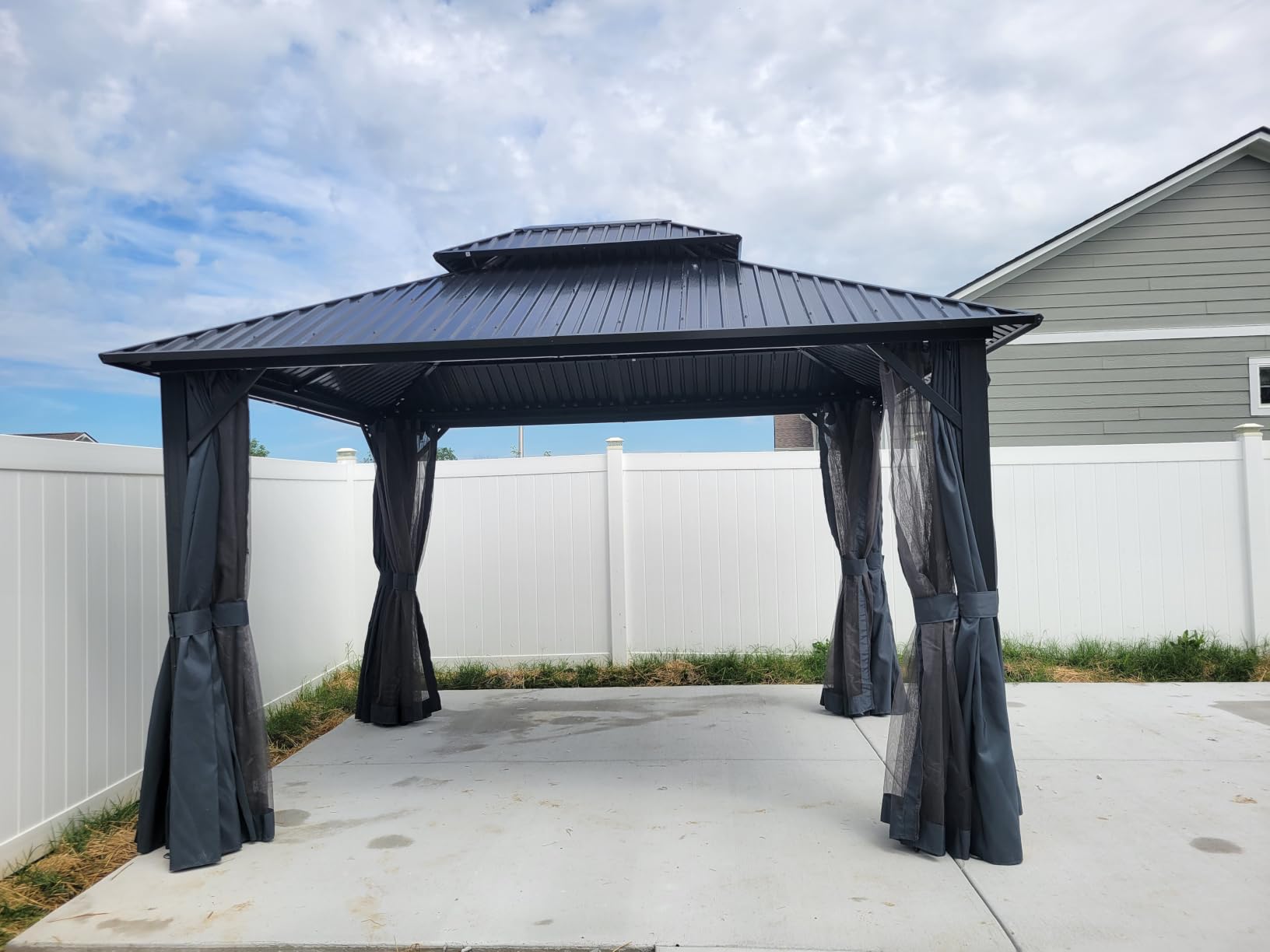
The curtains are a cut above the category. They are CPAI-84 flame-resistant 160g polyester in four machine-washable pieces, which matters because fabric hung near a steamy hot tub picks up odors and needs to be laundered rather than discarded.
The double-track curtain system works with two-sided zipper sidewall netting and top netting, giving you a genuine screen room when you want it and full open sides when you do not. Two top hooks accept lights or a fan.
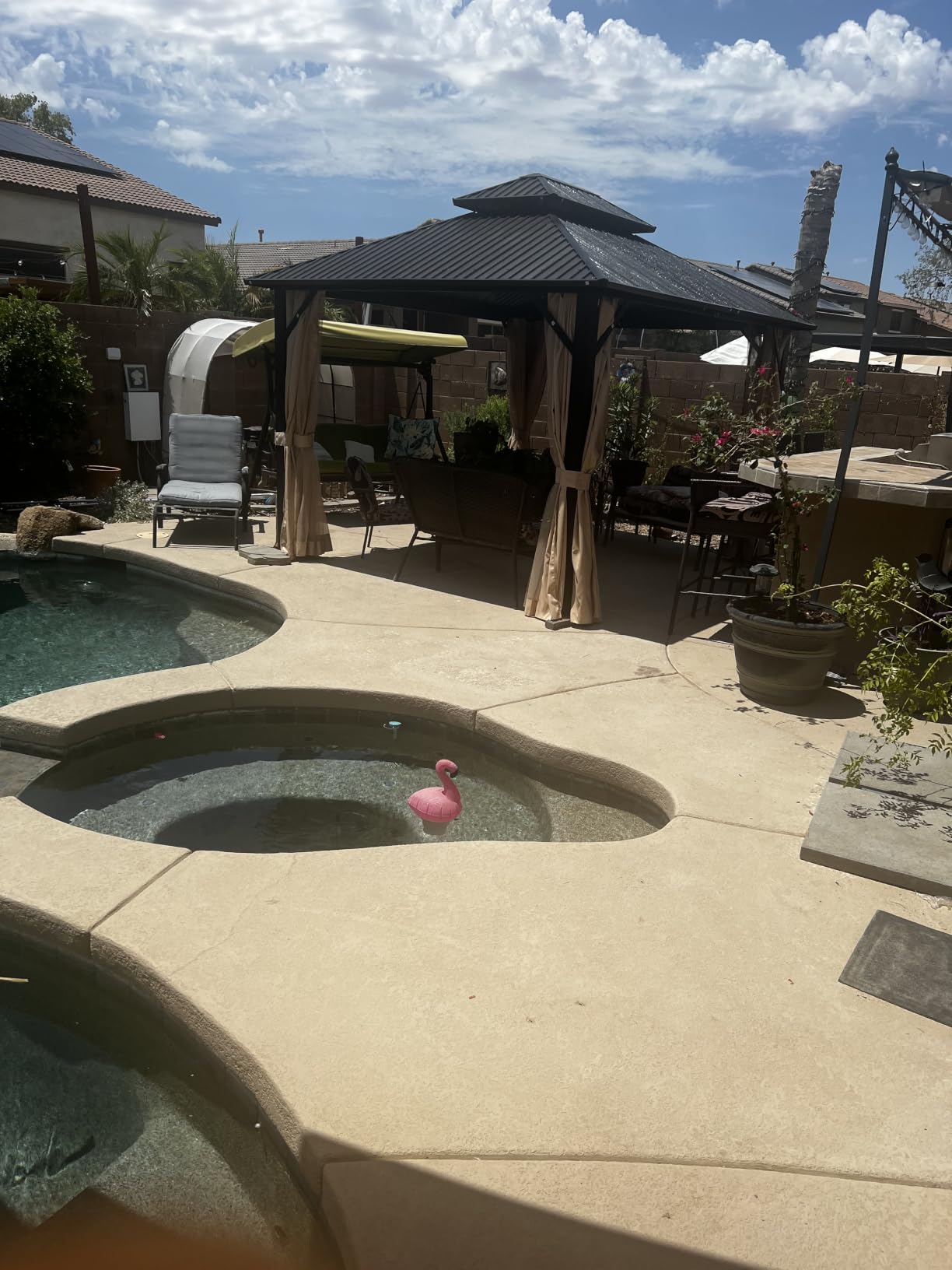
Where the extra size pays off
Community consensus among hot tub owners is that people almost always underestimate gazebo size, because they measure only the tub. This model gives you 180 by 120 inches, so a 7 or 8-foot round spa plus steps, a cover and working room still fits inside with clearance on each side.
That clearance is not just comfort. Spa filters and service panels need regular access, and a gazebo that is exactly tub-sized turns a ten-minute filter change into a disassembly job.
Who should skip it
At 345 pounds the roof is the hardest part of the build and typically needs a power screw gun, with installation guides calling for three to four people and about four hours. The instruction manual is also cluttered with irrelevant material, which owners mention often.
Some orders arrive with damaged leg posts or missing screws, and replacement parts can take more than a month and show up scratched. If your yard is tight, measure the 15-foot dimension carefully, and note that wood decks require separate wood-specific expansion screws.
10. VEVOR Pop Up Gazebo Screen Tent 10×10 — Best Pop-Up Gazebo for a Seasonal Hot Tub
- Sets up in about 10 minutes with no tools
- High-density mesh blocks mosquitoes and no-see-ums
- Removable top fly toggles between breeze and rain
- Folds into a carry bag for storage
- Fiberglass poles can splinter at the sockets
- Roof can sag under collected rainwater
- Carry bag is undersized for the weight
The VEVOR is the most popular gazebo in this group by review volume, with 3181 ratings and a category bestseller ranking of number two. If you want a hot tub shelter you can set up in ten minutes and take down again in the same time, nothing else here does that.
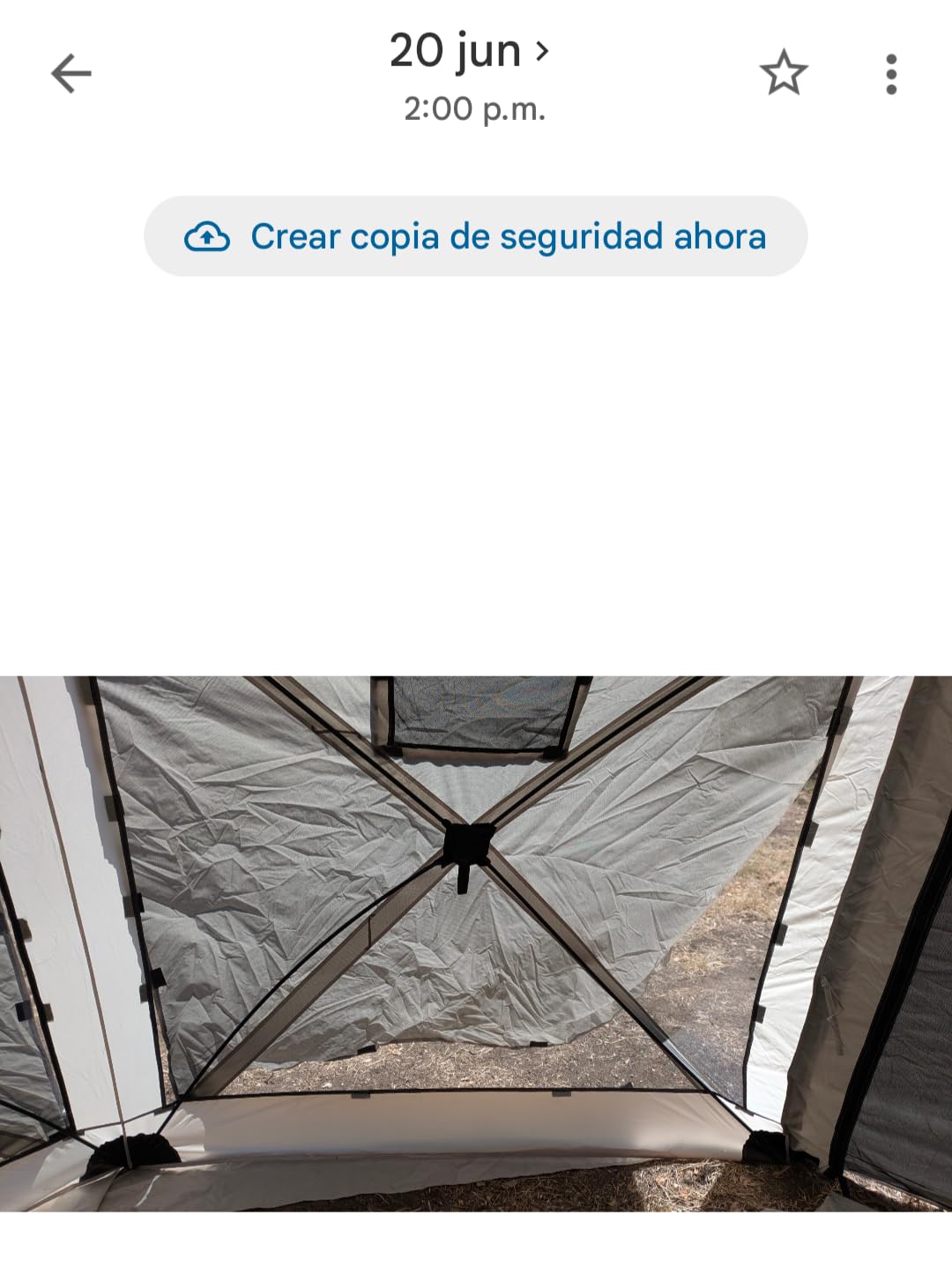
The pop-up frame needs no tools at all. Fabric is 300D Oxford with taped, reinforced seams, and the walls use high-density B3 gauze netting. Six removable wind cloths, two of them with mesh windows, let you configure the sides, and the front panel doubles as an awning.
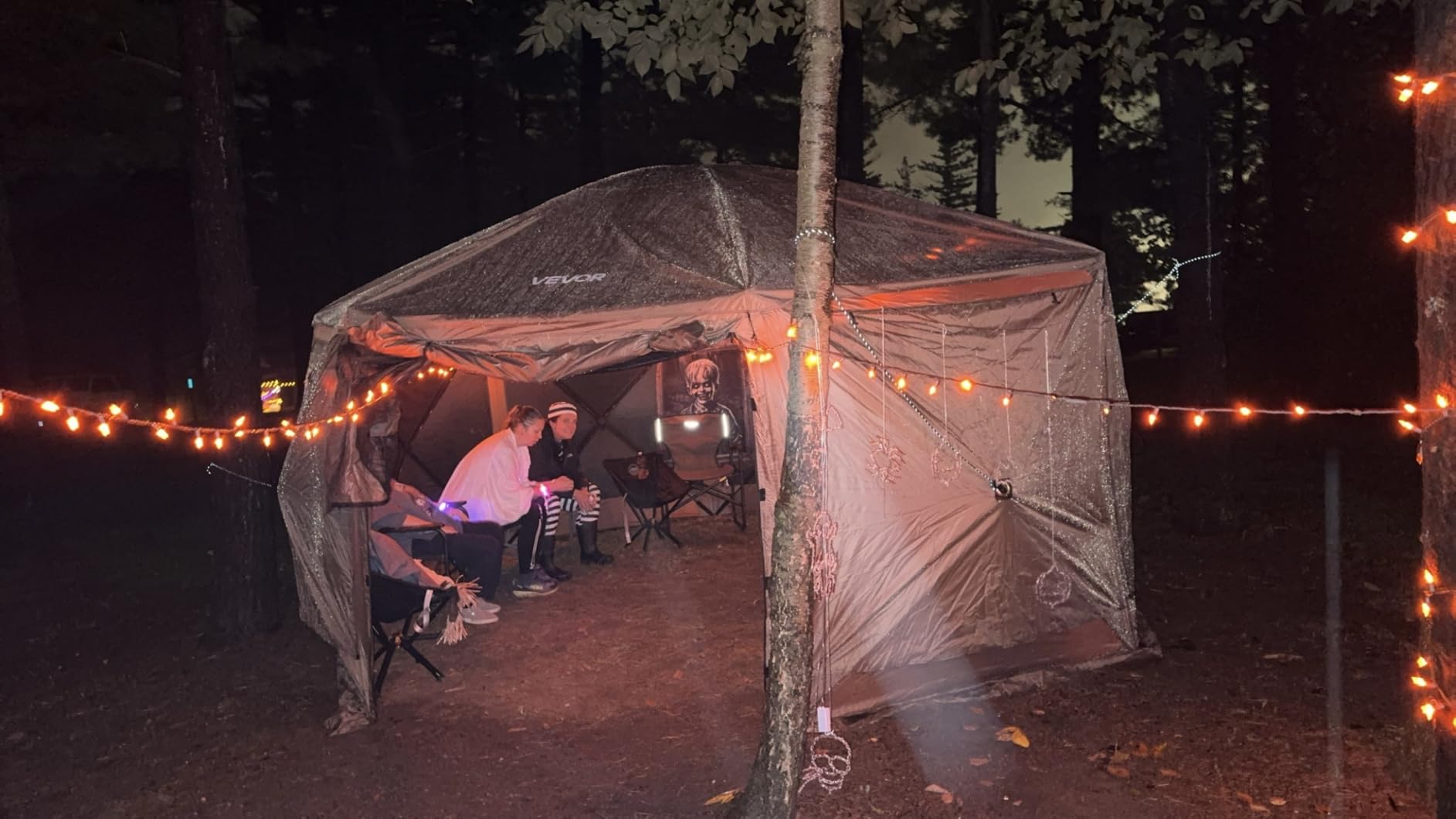
Owners confirm it holds up in strong wind when anchored, including one large festival storm, and the fine mesh is effective against mosquitoes, no-see-ums and sand fleas. The removable top fly is the smart feature for spa use, because you can drop it for a breeze on a warm night or cover it when rain arrives.
At 31 pounds it folds down small enough to move between the patio and the side yard, and it fits six to eight people. Ceiling height runs from 180 to 229 centimeters, so there is headroom to stand under it while the tub runs.
When a pop-up makes sense over a hot tub
A screen tent works well when your climate is warm and your main goal is bug control and evening shade. It also suits renters and anyone with a small yard, since it leaves no concrete pad and no permanent anchor holes behind.
The material spec is honest about the limit, though. The manufacturer recommends stopping use during heavy rain or storms, and that guidance is worth following because water on the roof is the failure mode that matters here.
Who should skip it
Fiberglass poles can split into sharp splinters when slid into the metal sockets, the roof can collapse under collected rainwater if the fly is left on, and the carry bag is undersized with handles that will not take the weight. Repacking is also difficult with almost no instructions provided.
Anyone in a climate with snow, hard wind or heavy seasonal rain should skip this category entirely and look at a hardtop. The mesh is so fine that it also blocks a good amount of breeze, and side panels extend about a foot beyond the nominal footprint, so measure the site rather than the listing.
How to Choose a Gazebo for a Hot Tub
What size gazebo do I need for a hot tub?
Size the gazebo by the tub plus clearance, not by the tub alone. A 7-foot round spa usually needs a 10 by 10 gazebo, an 8-foot spa needs 12 by 12, and a rectangular swim spa running 12 by 8 needs something like a 12 by 20. Add 12 to 18 inches of clearance on every side so you can reach the filters, and remember that steps and a stored cover take more room than most people expect.
Here is the mapping we use when matching tubs to shelters:
A 6 to 7-foot round spa, roughly 7 feet across, pairs with a 10 by 10 gazebo. An 8-foot round spa, around 8 feet across, fits a 12 by 12. A rectangular 7 by 13 spa needs a 12 by 16 at minimum. An 8 by 12 or similar rectangular spa needs 12 by 18 or 12 by 20.
Every one of those should leave walk-around space rather than sitting flush against the tub. If you are still narrowing down which tub to buy, our picks for the best inflatable hot tubs and backyard inflatable hot tubs will help you size the rest of the setup. Owners consistently report that going one size larger than they planned was the right call.
Roof type: soft-top, hardtop or enclosed
A soft-top canopy is polyester fabric over a steel frame. It is the cheapest option, shades well, and blocks mosquitoes when paired with netting, but it should come down before winter and will not hold snow.
A hardtop uses galvanized steel or polycarbonate panels on an aluminum or steel frame. It sheds rain and snow, lasts longer, and is the right choice if you want the tub sheltered year-round. Polycarbonate panels admit light while blocking UV, which reduces heat buildup under the roof.
An enclosed gazebo adds walls, sliding doors, windows and skylights so the space works as a four-season room. That is where condensation management matters most, and where costs climb sharply. For general backyard gazebos outside a spa, our best gazebos for backyards guide covers the same roof categories in more detail.
Frame material and why it matters over water
Aluminum frames will not rust and need no painting, which is a real advantage in a constantly damp environment. Galvanized steel is stronger and cheaper, but the coating eventually fails and the frame needs attention. Cedar looks best and ages well, but it needs sealing and will not match a metal setup.
Who makes the best quality gazebos? Look at three things: whether the roof rating is published as a number, whether the frame is aluminum or coated steel, and whether parts arrive pre-cut and pre-drilled. A manufacturer willing to publish a wind figure and a snow load figure is telling you something real about engineering. Vague weatherproof language is not a rating.
Condensation and ventilation over hot water
This is the issue nobody covers, and it is the one that damages shelters fastest. A hot tub releases a surprising volume of water vapor, and under a closed roof that moisture condenses on the underside of the panels and drips back down onto your spa cover and deck.
Four habits reduce it. Choose a double-top roof, which creates a ventilated cavity above the panels. Keep curtains and netting on a dual track so you can open the walls while the tub runs. Leave the roof height as high as your budget allows so steam has somewhere to travel. And clear any standing water off the roof after heavy rain, since pooled water loads the frame and marks the panels.
Wind and snow ratings, translated
Wind resistance is published in miles per hour or as a Beaufort-style level, and the difference matters enormously over a spa. Products here range from wind class 7, or 31 to 38 MPH, up to 83 and 100 MPH for the strongest metal and cedar builds. If your area sees storms above 40 MPH, anything under that ceiling is a seasonal shelter.
Snow load is published either as a total figure, like 2500 pounds on the Kozyard Alexander, or per square foot, like 20 pounds per square foot on the Modern Shade, or in testing terms such as Pro-Tect certified at 5800 pounds over a 30-inch snow load. All three formats are legitimate, so compare the per-square-foot or per-test numbers rather than eyeballing the totals.
Pop-up versus hardtop: the honest trade-off
A pop-up gazebo gives you speed and portability in exchange for weather protection. It is up in ten minutes with no tools, it weighs 31 pounds, and it costs less than any hard option here. What you give up is rain shedding, snow capability and year-round durability, and the manufacturer itself advises stopping use in heavy rain or storms.
A hardtop gives you permanent anchoring, published load ratings and the ability to leave the tub sheltered through winter. What you give up is time and money: two to four hours with three or four people, a permanent foundation or anchor set, and a structure that stays where you put it.
Maintenance access and site preparation
Leave room on at least one side for a service technician to reach the spa electronics and filter housing. A gazebo sized exactly to the tub turns a routine filter change into a major disassembly, and that is the most common regret owners describe on hot tub forums.
Surface preparation depends on the gazebo. Pop-up and canopy models use spiral ground stakes, short stakes and expansion bolts on the anchoring kits we covered. Hardtops and cedar structures need a proper plan: concrete or deck anchors included with the product, or lag screws purchased separately because several manufacturers do not include wood-deck fasteners.
One extra note for cold climates. Leaving a gazebo up all year is fine for a hardtop with an adequate snow rating and permanent anchoring. For fabric models, the pattern owners use is to leave the steel frame standing and remove the canopy and curtains for the off-season, then reinstall them in spring.
Planning permission and the final checklist
Do you need planning permission for a gazebo? In most places a free-standing gazebo sits within permitted development, but enclosed or attached structures often cross a threshold. Check your local authority rules before you build, especially for a fully enclosed gazebo with sliding glass doors.
Before you order, run this checklist: measure the tub and add 12 to 18 inches of clearance on every side, confirm the wind rating beats your local storm record, check that the snow rating suits your winters if you plan to leave it up, confirm service panels stay reachable, verify the anchoring hardware suits your surface, and read the warranty terms rather than assuming. If you are shopping for the tub itself, our cold plunge tub guide covers the other end of the temperature range.
Frequently Asked Questions
Can you put a hot tub under a gazebo?
Yes, and it is one of the best upgrades you can make to a backyard spa. A gazebo keeps rain, sun, leaves and UV off the water and the cover, cuts evaporation, and extends the season you can soak. Make sure the roof is high enough for steam to clear, anchor the frame rather than leaving it freestanding, and keep enough clearance on each side to reach filters and service panels.
What size gazebo do I need for a hot tub?
Size by the tub plus clearance, not the tub alone. A 6 to 7-foot round spa usually needs a 10×10 gazebo, an 8-foot round spa needs 12×12, and a rectangular swim spa around 12×8 needs roughly 12×20. Add 12 to 18 inches on every side so you can walk around the tub and reach the filter and service panels, and allow extra room for steps and a stored cover.
What is the best pop-up gazebo for a hot tub?
The VEVOR Pop Up Gazebo Screen Tent is the strongest all-round pop-up in this group. It sets up and breaks down in about ten minutes with no tools, weighs 31 pounds, and uses high-density B3 gauze netting that blocks mosquitoes and no-see-ums. Its removable top fly lets you drop it for a breeze or cover it for rain. It is a seasonal shelter, not a rain or snow solution.
What are the best waterproof gazebos for a hot tub?
Hardtop models with galvanized steel or polycarbonate roofs are the waterproof option. The Backyard Discovery Arcadia cedar pavilion was Pro-Tect tested to 5800 pounds of snow load and winds up to 100 MPH when anchored, and the Kozyard Alexander carries a 2500-pound snow rating with wind up to 60 MPH. Fabric canopy models are water resistant at best, and the manufacturer of the budget pop-up advises stopping use in heavy rain.
Who makes the best quality gazebos?
Judge quality by three published details rather than brand reputation alone. Look for a numeric wind rating, a numeric snow load rating, and confirmation of whether the frame is aluminum or powder-coated galvanized steel. Parts that arrive pre-cut and pre-drilled, a warranty stated in years rather than months, and honest assembly guidance are all reliable indicators. These traits are more useful than any logo.
Can a gazebo be left up all year?
Yes, if it is a hardtop with an adequate snow and wind rating and it is permanently anchored. The Kozyard Alexander is rated for 2500 pounds of snow and 60 MPH wind, the Backyard Discovery Arcadia was tested to 5800 pounds and 100 MPH, and the Modern Shade 12×12 posts 83 MPH. Fabric canopies and pop-ups should have their soft parts removed for the off-season while the frame stays standing.
Do you need planning permission for a gazebo?
Most free-standing gazebos fall within permitted development, so no permission is normally required. Fully enclosed structures with walls and sliding glass doors, or any gazebo attached to the house, are more likely to cross a threshold in some areas. Check your local authority rules before you build, and confirm whether footings or a concrete pad trigger any additional requirement.
Conclusion: Our Final Gazebo Picks for Hot Tubs
After comparing all ten models, the best gazebos for hot tubs in 2026 come down to a few clear winners. The Kozyard Alexander 10 by 12 is our top pick, with the largest verified owner base, published wind and snow ratings, and a double galvanized roof that handles both weather and steam. The Backyard Discovery Arcadia is the build-quality choice for anyone who wants cedar and the highest tested wind figure, while the LAUSAINT HOME 10×13 delivers the best balance of double roof, bug screening and cost.
For temporary or budget setups, the VEVOR pop-up takes ten minutes to raise and stores between uses, and the MASTERCANOPY 11×11 covers a smaller spa with full mesh screening at a low weight. Whichever route you take, measure the tub first, add clearance on every side, and anchor the frame properly before the first fill.