
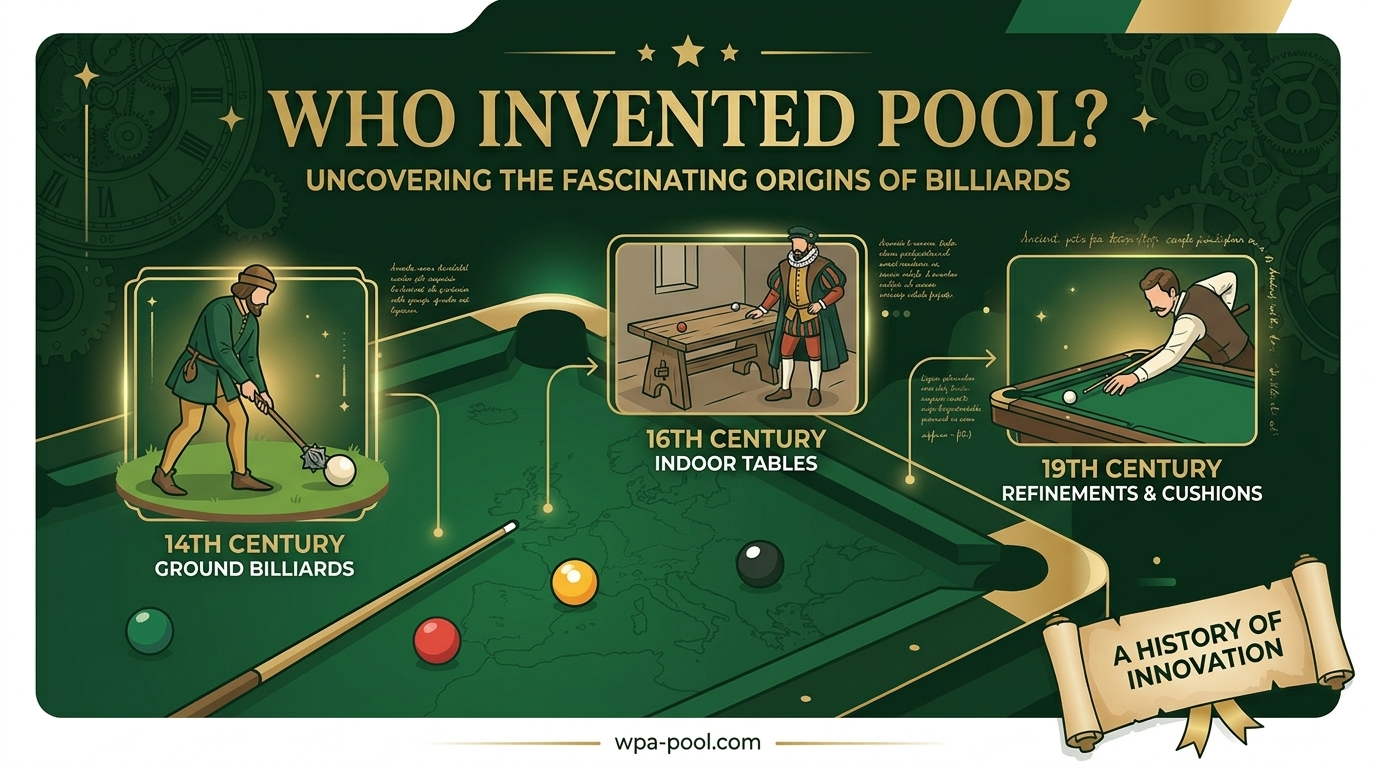
Pool, one of the most enduring and beloved table games in history, traces its origins to 14th-century France. While no single person can claim to have invented pool in the traditional sense, King Louis XI of France commissioned the first documented indoor billiard table around 1469. This pivotal moment marked the transition from outdoor lawn games to the indoor cue sports we recognize today.
In this comprehensive guide, we explore the fascinating evolution of pool from its humble beginnings as a croquet-like game played on grass to the sophisticated sport enjoyed in pool halls worldwide. You will discover how equipment innovations transformed gameplay, why the game carries two different names, and how Hollywood brought billiards back from the brink of obscurity.
Whether you are a casual player curious about the history behind the felt table or a billiards enthusiast seeking authoritative historical context, this article covers everything you need to know about who invented pool and how it became the game millions play today.
Table of Contents
Who Invented Pool? The Direct Answer
The question of who invented pool does not have a simple answer because the game evolved gradually over several centuries rather than appearing fully formed. Historical records point to 14th-century France as the birthplace of billiards, where it began as an outdoor lawn game called ground billiards. French nobility played this early version, which closely resembled croquet and involved hitting balls through wickets using a mace-like implement.
The first major milestone in indoor billiards came in the 1460s when King Louis XI of France had the first documented indoor billiard table installed in his royal court. This innovation protected the game from weather and allowed for year-round play, fundamentally changing how the sport developed. While King Louis XI did not invent the game itself, his patronage and the creation of the first indoor table marked the true beginning of billiards as an indoor sport.
Over the next 500 years, countless inventors, craftsmen, and players contributed innovations that shaped modern pool. From the transition from maces to cue sticks to the development of slate bed tables and vulcanized rubber cushions, billiards represents a collaborative evolution rather than a single moment of invention.
Origins and Early History: Where Did Pool Billiards Originate?
The history of billiards begins in Northern Europe during the 14th century, specifically in France where the game emerged as a popular pastime among the aristocracy. Originally played outdoors on grass lawns, this early form called ground billiards involved striking balls through a series of hoops or wickets using a heavy wooden mace. The game shared obvious similarities with croquet and likely evolved alongside other lawn sports of the medieval period.
Shakespeare referenced billiards in his play Antony and Cleopatra, written around 1606, indicating the game had spread to England by the early 17th century. In Act 2, Scene 5, Cleopatra says, “Let us to billiards,” suggesting the game had achieved enough prominence in Elizabethan England to appear in popular literature. This literary reference provides valuable historical documentation of billiards’ cultural spread across Europe.
French nobility embraced ground billiards as both recreation and status symbol. The game required expensive equipment and ample space, making it accessible primarily to wealthy landowners and royalty. As the sport grew in popularity among the upper classes, players sought ways to enjoy it regardless of weather conditions, setting the stage for the move indoors.
The Move from Outdoors to Indoors
The transition from outdoor lawn billiards to indoor table play occurred gradually throughout the 15th century. Players began moving tables inside to escape rain and cold, initially using simple wooden boards with raised edges to contain the balls. These early indoor tables lacked pockets and featured simple obstacles rather than the sophisticated cushion systems used today.
Green felt became the standard table covering because it visually connected indoor play to the grass lawns where the game originated. This tradition continues today, with nearly all billiard tables featuring some shade of green felt. The color serves as a subtle reminder of the game’s outdoor heritage despite centuries of indoor play.
By the mid-15th century, indoor billiards had become firmly established in French aristocratic culture. The game provided entertainment during long winters and offered a refined alternative to more vigorous outdoor sports. This period of development set the foundation for the technical innovations that would transform billiards over the following centuries.
King Louis XI and the First Indoor Billiard Table
King Louis XI of France, who ruled from 1461 to 1483, holds the distinction of commissioning the first documented indoor billiard table around 1469. Historical accounts describe a table featuring a stone bed covered with cloth, with raised edges to keep balls in play. This innovation represents the earliest known example of a dedicated indoor billiards installation, making Louis XI a pivotal figure in the game’s development.
The French monarch’s interest in billiards helped elevate the game’s status throughout Europe. As nobility in other countries observed French court culture, they adopted billiards as well, spreading the game to England, Spain, and eventually the American colonies. Royal patronage provided both resources for equipment improvements and social validation that encouraged wider participation.
Louis XI’s table differed significantly from modern equipment but contained the essential elements that define billiards: a flat playing surface, balls, and implements for striking them. The specific details of this first table remain somewhat unclear due to the passage of time, but its existence is well-documented in historical records from the period.
The Significance of Royal Patronage
Royal interest in billiards accelerated the game’s technical development. Wealthy patrons could afford expensive materials like slate, fine woods, and quality cloth, enabling craftsmen to experiment with superior construction techniques. This financial support created an environment where innovation flourished, leading to gradual improvements in table design and playing equipment.
Famous historical figures who played billiards include Wolfgang Amadeus Mozart, Marie Antoinette, Napoleon Bonaparte, and Abraham Lincoln. Each of these individuals contributed to the game’s cultural significance simply by their participation. When Mozart played billiards during composition breaks or Napoleon relaxed with the game after military campaigns, they reinforced its status as a pastime worthy of great minds.
The association with intelligence and strategy helped billiards maintain respectability even as gambling connections sometimes damaged its reputation. Players could point to distinguished historical figures as evidence that billiards required skill, calculation, and mental discipline rather than mere chance.
From Mace to Cue: The Evolution of Equipment
Early billiards players used a wooden implement called a mace to strike balls. Resembling a golf club with a flat striking surface, the mace allowed players to push balls across the table with reasonable control. However, the mace proved cumbersome for shots near cushions or in tight spaces, as its bulky head made striking balls close to raised edges difficult.
The cue stick emerged as a practical solution to this problem, though its invention occurred gradually and involved multiple contributors. By the late 1600s, players had begun using slender tapered sticks to strike balls when maces proved impractical. These early cues were simply called “queues,” the French word for tail, describing the tapering shape.
Women players actually pioneered cue use because societal conventions prevented them from raising maces over their shoulders in mixed company. Female players used cues exclusively while men continued using maces, until the cue’s obvious advantages eventually convinced everyone to adopt the slimmer implement. This represents one of the rare instances where women’s participation drove a major technical innovation in sports equipment.
Captain Mingaud and the Leather Tip
Captain Francois Mingaud, a French officer imprisoned during the Napoleonic Wars, made one of the most significant equipment innovations in billiards history. While imprisoned in Paris from 1807 to 1815, Mingaud studied the game obsessively and experimented with cue design. He discovered that attaching a small piece of leather to the cue tip dramatically improved ball control.
The leather tip allowed players to apply spin to the cue ball, opening entirely new dimensions of strategic play. Before Mingaud’s innovation, shots were essentially flat strikes without the spin effects modern players take for granted. English, draw, follow, and masse shots all became possible thanks to this simple but revolutionary improvement.
Mingaud published his findings in 1827 after his release, documenting how the leather tip enabled players to strike the cue ball off-center without miscuing. His work transformed billiards from a game of simple positioning into one where spin control and precise cue ball manipulation became essential skills. Modern billiards would be unrecognizable without this fundamental innovation.
Table Innovations: Slate, Rubber, and Pockets
The modern pool table represents centuries of gradual improvements to basic design concepts. Early tables used wooden beds that warped with humidity and temperature changes, making consistent play impossible. The introduction of slate bed tables in the 19th century solved this problem, providing a perfectly flat, stable surface that remained true regardless of environmental conditions.
Slate offered ideal playing characteristics but required substantial support structures due to its weight. Craftsmen developed sophisticated framing techniques to support heavy slate slabs while maintaining table level. This engineering challenge drove innovations in table construction that produced the sturdy, professional-grade equipment used today.
The Vulcanized Rubber Revolution
John Wesley Hyatt, an American inventor best known for developing celluloid, also contributed crucial improvements to billiards equipment. In the 1870s, Hyatt experimented with vulcanized rubber as a cushion material, discovering that it provided superior ball rebound compared to the stuffed felt or wooden rails used previously.
Vulcanized rubber cushions transformed how balls behaved upon contact with table edges. The consistent, predictable bounce enabled bank shots and kick shots to become standard parts of the game rather than lucky accidents. Players could now calculate angles with mathematical precision, elevating billiards toward true sport status rather than mere recreation.
Hyatt’s rubber cushions, combined with slate beds and quality cloth, created the standardized playing surface that enabled competitive billiards to flourish. Tournaments became meaningful contests of skill when equipment provided consistent behavior across different venues. This standardization proved essential for the professional development of the sport.
The Evolution of Pockets
Early billiards tables were pocketless, with gameplay focused on caroms (bouncing the cue ball off object balls) rather than sinking balls into holes. The addition of pockets transformed billiards into pocket billiards, creating entirely new game variants. Six-pocket tables became standard for the games most Americans recognize as pool today.
Pocket placement and size evolved through extensive play testing. Corner pockets and side pockets developed standardized dimensions that balanced difficulty with playability. The pockets needed to be large enough to accept balls cleanly while small enough to demand precision from players. Modern pocket specifications reflect generations of refinement based on player feedback.
Game variants emerged based on pocket configurations and rules. Eight-ball, nine-ball, straight pool, and one-pocket all use the same six-pocket table but impose different objectives and constraints. This versatility helped pool maintain popularity, as players could switch between game types without needing different equipment.
Why Is It Called Pool? The Etymology Explained
The term pool carries an interesting etymological history that confuses many modern players. The word derives from the French “poule,” meaning chicken or hen. In 17th-century France, a “poule” referred to a collective bet or stakes placed in a common pot, similar to how modern office pools work for sports betting.
As billiards became associated with gambling, the betting terminology transferred to the game itself. Rooms where people gathered to bet on horse races often featured billiard tables for entertainment between races. These establishments became known as pool rooms, and the game played there gradually adopted the same name.
The connection to horse racing pools remains evident in historical records. Gambling parlors that accepted wagers on races commonly provided billiard tables, creating an association between the betting activity and the cue sport. Over time, the name “pool” specifically identified pocket billiards while “billiards” became associated with carom games played on pocketless tables.
Billiards vs. Pool: Understanding the Distinction
Technically, billiards refers to any cue sport played on a table with balls and cues. Pool specifically describes pocket billiards games played on tables with six pockets. However, common usage varies significantly by region. In the United Kingdom, “billiards” typically means English billiards, a specific three-ball game played on a pocketless table.
Americans generally use “pool” to describe eight-ball, nine-ball, and similar pocket games while reserving “billiards” for carom games. This regional variation creates confusion when players from different countries discuss the sport. British players might refer to playing “billiards” when Americans would say “pool,” even when describing similar activities.
Professional organizations use precise terminology to distinguish game types. The World Pool-Billiard Association governs pocket billiards while other bodies oversee snooker and carom billiards. These formal distinctions help maintain clarity in competitive contexts, though casual conversation often blurs the lines between terms.
How Pool Evolved in America
Pool arrived in America with early European colonists who brought their gaming traditions across the Atlantic. The sport gained steady popularity throughout the 18th and 19th centuries, with billiard tables appearing in taverns, hotels, and private clubs. American equipment initially followed European designs but gradually developed distinctive characteristics.
John M. Brunswick founded the Brunswick Company in 1845, establishing the first major American manufacturer of billiard tables. His company applied industrial manufacturing techniques to what had been a craft industry, producing consistent, high-quality equipment at scale. Brunswick tables became the standard for American pool halls and remain prestigious today.
American pool developed its own game variants distinct from European traditions. Eight-ball, perhaps the most widely played pool game globally, originated in America during the early 1900s. Nine-ball also emerged as an American innovation, designed for faster play and television broadcasting. These American contributions significantly shaped how the world plays pool today.
The Rise and Fall of Pool Room Culture
Pool halls became iconic American institutions during the late 19th and early 20th centuries. These establishments provided social spaces where men gathered to play, gamble, and socialize. The pool room culture flourished in urban areas, with ornate parlors featuring multiple tables, bars, and spectator seating.
However, associations with gambling and organized crime damaged pool’s reputation during the mid-20th century. Respectable society increasingly viewed pool halls as disreputable establishments, and participation declined among middle-class players. By the 1950s, pool faced an existential crisis as younger generations rejected the sport’s tarnished image.
This decline set the stage for one of the most remarkable revivals in sports history. Hollywood rediscovered pool in the early 1960s, transforming public perception and sparking renewed interest that continues today.
The Paul Newman Revival: Pool in Pop Culture
The 1961 film “The Hustler,” starring Paul Newman as pool shark Fast Eddie Felson, fundamentally changed American attitudes toward billiards. Newman portrayed pool as a sophisticated contest of skill, intelligence, and psychological warfare rather than mere gambling. The film’s critical and commercial success introduced millions of viewers to the strategic depth of high-level pool.
Pool hall attendance surged following the film’s release, with industry reports indicating significant increases in table sales and room revenues. Young people who had previously dismissed pool as old-fashioned suddenly viewed it as cool and challenging. The movie’s stylish black-and-white cinematography and compelling performances elevated billiards to art form status.
Twenty-five years later, “The Color of Money” (1986) brought Paul Newman back to the pool table, this time as an aging mentor to Tom Cruise’s character. This sequel introduced pool to a new generation of viewers who had missed the original film. The movie’s release coincided with the early growth of cable television, ensuring extensive airtime that sustained interest throughout the following decades.
Women in Billiards History
Women have played billiards since the game’s earliest days, though their participation often faced social restrictions. As noted earlier, women pioneered the use of cue sticks precisely because etiquette prevented them from using the more vigorous mace stroke. Despite this early technical contribution, women’s competitive billiards developed separately from men’s play for centuries.
Jeanette Lee, known as “The Black Widow,” became the most famous female pool player of the modern era during the 1990s and 2000s. Her aggressive playing style, distinctive fashion sense, and competitive success brought women’s professional pool into mainstream awareness. Lee demonstrated that female players could compete at the highest levels while building entertaining personal brands.
Allison Fisher, a British player who dominated women’s pool in the 1990s, won over 50 major championships during her career. Fisher’s technical precision and consistent performance set standards for professional women’s play. Her rivalry with Jeanette Lee created compelling narratives that attracted media attention and sponsor investment to women’s billiards.
Timeline of Billiards History: Key Dates and Events
Understanding the complete history of pool requires examining the chronological development of the sport. This timeline highlights the most significant milestones in billiards evolution from medieval France to modern professional competitions.
14th Century
Ground billiards emerges in France as an outdoor lawn game played by nobility. The game involves striking balls through wickets using wooden maces, closely resembling croquet.
1469
King Louis XI of France commissions the first documented indoor billiard table, marking the transition from outdoor to indoor play. This royal patronage establishes billiards as a prestigious pastime.
1606
Shakespeare references billiards in “Antony and Cleopatra,” indicating the game’s spread to England and its establishment in popular culture.
Late 1600s
Cue sticks begin replacing maces as the primary playing implement. Women players pioneer cue use due to social restrictions on mace strokes.
1807-1815
Captain Francois Mingaud experiments with cue design while imprisoned in Paris, eventually developing the leather cue tip that revolutionizes ball control.
1827
Mingaud publishes his findings on the leather tip, documenting spin techniques that transform billiards from a simple positioning game into one requiring advanced skill.
1845
John M. Brunswick founds the Brunswick Company in America, beginning industrial production of billiard tables and establishing standards for American equipment.
1870s
John Wesley Hyatt develops vulcanized rubber cushions, providing consistent ball rebound that enables precise bank shots and elevates competitive play.
1961
“The Hustler” starring Paul Newman premieres, sparking a massive resurgence in American pool popularity and transforming public perception of the sport.
1986
“The Color of Money” releases, bringing Paul Newman back to pool and introducing the sport to a new generation of players.
2026
Pool remains a popular recreational and competitive sport worldwide, with professional tournaments broadcast internationally and millions of tables in homes, bars, and dedicated halls across the globe.
Frequently Asked Questions
Where did pool billiards originate?
Pool billiards originated in 14th-century France as an outdoor lawn game called ground billiards. French nobility played this early version, which resembled croquet and involved striking balls through wickets using wooden maces. The game moved indoors during the 15th century, with King Louis XI commissioning the first documented indoor billiard table around 1469.
What did Einstein say about billiards?
Albert Einstein reportedly said that understanding how to play billiards well required understanding physics principles, particularly angles, momentum, and spin. While the exact quote varies in different sources, Einstein’s appreciation for the mathematical and physical aspects of billiards is well-documented. He enjoyed playing billiards as a recreational activity that engaged his scientific mind.
Why is it called pool and not billiards?
The name pool comes from the French word poule meaning chicken, which referred to collective betting pools. In 17th-century France, billiards rooms often hosted horse race betting, and the betting term transferred to the game itself. Technically, billiards encompasses all cue sports while pool specifically refers to pocket billiards played on tables with six pockets.
What is the 30 rule in pool?
The 30 degree rule states that when the cue ball hits an object ball with a full hit at medium speed, the cue ball will travel approximately 30 degrees from its original path. This rule helps players predict cue ball position after contact. However, the rule only applies to specific hit conditions and varies based on speed, spin, and cut angle.
Who was the first person to play billiards?
While no specific individual is documented as the first billiards player, the game emerged among French nobility in the 14th century. King Louis XI of France became the first documented owner of an indoor billiard table around 1469, making him one of the earliest known dedicated players. The game evolved collectively over centuries rather than being invented by any single person.
Conclusion: Who Invented Pool and Why It Matters
Who invented pool? The answer spans over 600 years of continuous evolution rather than a single moment of creation. From 14th-century French nobility playing ground billiards on manicured lawns to King Louis XI’s indoor table in 1469, from Captain Mingaud’s leather cue tip to John Wesley Hyatt’s rubber cushions, countless individuals shaped the game we play today.
Understanding this history enriches every shot you take. When you strike a cue ball with spin, you are using techniques developed by imprisoned French officers in the Napoleonic era. When you play on a slate bed table with consistent cushions, you benefit from 19th-century industrial innovations. When you enjoy pool as a respected pastime rather than a disreputable activity, you experience the legacy of Hollywood’s intervention through Paul Newman’s iconic performances.
Pool represents one of humanity’s most enduring games because it combines physical skill, mathematical precision, and strategic thinking in perfect balance. Whether you play casually with friends or compete seriously in tournaments, you participate in a tradition that has entertained kings, presidents, and common people alike since medieval times. The question of who invented pool ultimately leads to an appreciation of how games evolve through collective cultural contribution, making each player part of an ongoing historical story.