
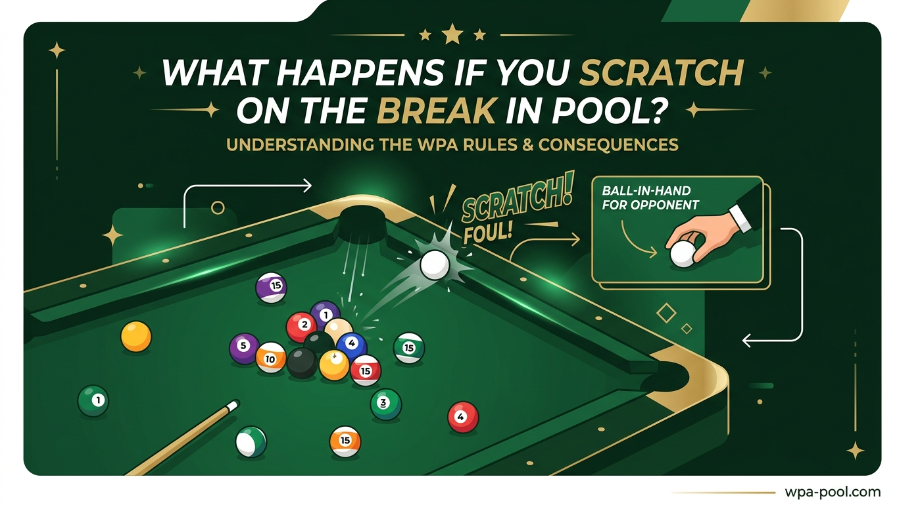
Scratching on the break in pool feels like a disaster, but it is not the game-ending catastrophe many players fear. When you send the cue ball into a pocket during your opening break shot, specific rules kick in that keep the game moving. Understanding exactly what happens if you scratch on the break in pool will save you from confusion and help you play with confidence in any setting.
In this guide, I will walk you through the official rules from BCA, WPA, and APA, explain what penalties apply, and show you how to prevent break scratches from happening in the first place. Whether you play casually at the local bar or compete in league matches, these rules will keep you prepared for every scenario.
Table of Contents
What Happens If You Scratch on the Break in Pool
When you scratch on the break, three things happen immediately. First, any object balls you pocketed during the break shot remain pocketed and stay down. Second, your opponent receives ball-in-hand, meaning they can place the cue ball anywhere on the table (or behind the head string depending on which rules you follow). Third, and most importantly, the table remains open.
The open table rule means neither stripes nor solids have been assigned to either player yet. Even if you pocketed three striped balls on the break before scratching, those balls count toward the eventual group assignment, but neither player is committed to stripes or solids until someone legally pockets a ball after the break.
This rule surprises many beginners who assume pocketing balls on the break automatically assigns them a group. The scratch nullifies any group assignment that might have otherwise occurred, keeping your options flexible when you get your next turn.
Is Scratching on the Break an Automatic Loss
No, scratching on the break is not an automatic loss of game. This is the single most common misconception I hear from players, and it causes unnecessary panic during games. Under all major rule sets including BCA, WPA, and APA, a break scratch results in a foul penalty, not immediate defeat.
The confusion likely stems from the fact that scratching when shooting at the 8-ball does result in an immediate loss. Many players lump all scratches together and assume the break shot carries the same severe penalty. It does not. The break scratch is treated as a standard foul, giving your opponent an advantage but not ending the match.
I have seen countless arguments in bars and recreation centers where one player declares victory after their opponent scratches on the break. If you encounter this situation, calmly explain that under official rules, the game continues with ball-in-hand for the opponent.
Break Scratch Rules by Governing Body
Different organizations handle break scratches slightly differently, and knowing these variations matters when you play in leagues or tournaments. Here is how the major governing bodies rule on break scratches.
BCA Rules (Billiard Congress of America)
Under BCA rules, scratching on a legal break shot means all pocketed balls remain pocketed except the 8-ball. It is a foul, and the table remains open. The incoming player gets ball-in-hand anywhere on the table. The BCA is the North American governing body for cue sports and their rules are widely followed in competitive play throughout the United States and Canada.
WPA Rules (World Pool-Billiard Association)
The WPA rules mirror the BCA closely for break scratches. When you scratch on the break, pocketed balls stay down, it is a foul, and the table stays open. Your opponent receives ball-in-hand anywhere on the table. The WPA governs international competition including world championships, so these rules apply when you watch professional matches or compete internationally.
APA Rules (American Poolplayers Association)
The APA handles break scratches differently in one key aspect. If a scratch occurs on the break, the opponent receives ball-in-hand, but it must be executed from behind the head string. This is often called the kitchen rule. The table remains open, and pocketed balls stay down. The head string restriction limits where your opponent can place the cue ball, giving you a slight advantage compared to full ball-in-hand under BCA/WPA rules.
House Rules and Bar Rules
House rules vary wildly depending on where you play. Some bars play that scratching on the break is an automatic loss. Others give ball-in-hand behind the line. Some allow the breaking player to re-rack and break again. Always ask which rules the house follows before starting a game for money or in a tournament setting.
When in doubt, I recommend playing under BCA or WPA rules since they are the most widely recognized standards. If your opponent insists on house rules, make sure everyone agrees before the first break shot.
What Does Ball-in-Hand Mean After a Break Scratch
Ball-in-hand is the standard penalty for most fouls in pool, including break scratches. This privilege allows the incoming player to pick up the cue ball and place it anywhere on the playing surface before taking their shot. The exact placement rules depend on which rule set governs your game.
Under BCA and WPA rules, ball-in-hand means exactly what it sounds like. Your opponent can place the cue ball anywhere on the table, including right up against an object ball if they choose. This gives them maximum flexibility to set up a runout or play a safety.
Under APA rules, the ball-in-hand after a break scratch comes with a restriction. The cue ball must be placed behind the head string, which is the imaginary line stretching across the table between the second diamonds on the long rails. This area behind the head string is called the kitchen. Your opponent cannot place the cue ball in front of this line, limiting their immediate offensive options.
The Head String and Kitchen Explained
The head string runs width-wise across the table at the head end, opposite from where you rack the balls. The area behind this line, between the head string and the head rail, is commonly called the kitchen. When playing under APA rules after a break scratch, your opponent must keep the cue ball in the kitchen until they strike their first object ball.
However, any object ball on the table is fair game, even if it sits in front of the head string. Your opponent can shoot at any ball, but the cue ball must be behind the line when they strike it. This creates interesting strategic scenarios where the incoming player might have to attempt a difficult kick shot or bank if all the object balls sit far from the kitchen area.
The Table Remains Open After a Break Scratch
An open table is one where neither player has been assigned stripes or solids. This status continues even after a break scratch, which confuses many players who think pocketing balls during the break determines group assignment.
Here is how the open table rule works in practice. If you break, pocket two solid balls, but scratch the cue ball into a corner pocket, the table stays open. Those two solid balls remain pocketed and count toward your eventual group, but neither you nor your opponent is assigned solids yet. The first player to legally pocket an object ball after the break chooses their group based on what they pocket.
What Happens If You Make a Stripe and Solid on the Break
If you pocket both a striped ball and a solid ball on the break (before scratching or not), the table remains open. The fact that you pocketed balls from both groups does not assign you to either one. The table stays open until someone legally pockets a ball on a post-break shot.
This rule prevents the random luck of the break from forcing a player into a difficult group assignment. Even if you sunk four solids and one stripe on the break, you are not stuck with solids unless you choose to pocket a solid on your next turn.
Special Case: Pocketing the 8-Ball on the Break
The 8-ball creates special scenarios during the break that differ from standard break scratches. What happens depends on whether you pocket the 8-ball cleanly or scratch while pocketing it.
8-Ball Pocketed Cleanly on the Break
Under BCA and WPA rules, if you pocket the 8-ball on a legal break shot, you win the game immediately. This is a rare but exciting outcome that ends the match in your favor. The 8-ball is spotted, and you break again in the next game if playing a series.
Under APA rules, pocketing the 8-ball on the break does not result in a win. Instead, you have two options. You can spot the 8-ball and continue shooting with the table open, or you can re-rack the balls and break again. Most experienced players choose to spot the 8-ball and continue rather than risk a worse break on the second attempt.
8-Ball Scratched on the Break
If you pocket the 8-ball on the break but also scratch the cue ball, the result differs from a clean 8-ball break. Under BCA and WPA rules, this is not a loss of game. The 8-ball is spotted, your opponent gets ball-in-hand, and the table remains open. The scratch penalty applies, but you do not lose because the 8-ball scratch rule only applies when shooting at the 8-ball as your called shot, not on the break.
Under APA rules, the same general principle applies. The 8-ball is spotted, your opponent gets ball-in-hand behind the head string, and play continues with an open table.
Why Do I Scratch When I Break in Pool
If you find yourself consistently scratching on the break, you are making one of several common technical errors. I have coached dozens of players who struggled with this issue, and the causes usually fall into predictable categories.
Hitting the cue ball too low is the most frequent cause of break scratches. When you strike below center, you impart draw spin (also called backspin) that pulls the cue ball backward after it hits the rack. If this backward momentum carries the cue ball into a corner pocket behind you, that is your scratch.
Aiming directly at the head ball from the center of the table also causes scratches. This direct line sends the cue ball straight into the rack and often straight back toward where it came from. The head ball sits at the apex of the triangle, and hitting it dead-on creates a predictable rebound path back toward the breaking player.
Using too much power amplifies any technical flaw. Even a slightly off-center hit becomes a scratch when you blast the cue ball at maximum speed. The cue ball flies around the table uncontrollably, finding pockets by accident rather than intention.
How Physics Causes Break Scratches
Understanding the physics helps you diagnose your own break issues. When the cue ball hits the rack, it transfers most of its forward momentum to the object balls. What remains is often sideways momentum or spin. If you hit with draw, that backspin takes over once forward momentum dissipates, pulling the cue ball back toward you.
The angle of approach matters too. A cue ball approaching the rack at a shallow angle tends to glance off and travel across the table, while a steep angle creates a direct rebound path. Positioning the cue ball properly before the break controls this angle and prevents scratches.
How to Avoid Scratching on the Break
Preventing break scratches requires attention to three elements: cue ball position, contact point on the rack, and cue ball speed. Master these fundamentals and your break scratches will disappear.
Position the Cue Ball Properly
Place the cue ball near the head string, ideally within a few inches of it. Do not place it against the head rail or too far forward into the table. The exact lateral position matters too. Instead of placing the cue ball dead center, move it slightly to either side, about one diamond width from center.
This offset positioning creates an angled approach to the rack rather than a straight-on collision. The angle sends the cue ball moving across the table rather than straight back at you. Understanding pool table dimensions helps you visualize the proper cue ball placement relative to the head string and rack position.
Use the Second-Ball Break Technique
Rather than hitting the head ball directly, aim for the second ball in the rack. From an offset position near the head string, you can strike the second ball in either the first or second row of the triangle. This angled hit spreads the rack effectively while sending the cue ball on a safe trajectory toward the side rail rather than back toward you.
The second-ball break requires practice to master the exact angle, but it dramatically reduces scratch frequency once you get the feel for it. Professional players use this technique regularly to maintain cue ball control while still breaking with power.
Control Your Cue Ball Speed
Power is not the goal of a good break. Controlled power is. You want enough speed to spread the rack and pocket balls, but not so much that the cue ball rockets unpredictably around the table. A smooth, accelerating stroke beats a jerky, maximum-effort blast every time.
Practice breaking at 70 percent power until you can consistently avoid scratches. Gradually increase speed as your technique and confidence improve. Most players break harder than necessary, sacrificing control for minimal gains in ball spread.
The 30-Degree Rule for Cue Ball Control
The 30-degree rule states that when the cue ball hits an object ball with a rolling cue ball (no draw or follow), it deflects approximately 30 degrees from its original path. While this rule applies more to regular shots than breaks, the principle of predictable cue ball paths helps you understand how to avoid scratches.
By hitting the rack at an angle rather than straight-on, you ensure the cue ball deflects sideways rather than rebounding straight back. Combine this angled approach with a slightly elevated cue (to avoid draw) and you have a scratch-free break technique.
Bar Rules vs Official Rules: What You Need to Know
Playing in bars and casual settings introduces rule variations that confuse many players. House rules differ from official BCA, WPA, and APA standards, and these differences create conflicts if players assume everyone follows the same guidelines.
Common bar rule variations include calling the 8-ball pocket on every shot (not just the 8-ball shot), allowing certain safeties that official rules prohibit, and yes, occasionally declaring that scratching on the break is an automatic loss. Some bars play that pocketing the 8-ball on the break is a win, while others spot it and continue. The variations are endless.
I learned this lesson the hard way years ago when I lost a twenty-dollar game because the house played that scratching on the break meant you lost. I had assumed standard rules applied. Now I always ask before playing for money or pride.
Why Bars Use Different Rules
Bar rules evolved to speed up games and accommodate casual players. Automatic loss on break scratches moves players off the table faster during busy nights. Simplified rules reduce arguments among players who do not know the official regulations. These house variations serve a practical purpose in their environment, even if they frustrate competitive players.
When you encounter house rules, adapt to them for that session. Arguing that official rules should override house rules just creates tension and rarely changes the outcome. Save your competitive energy for league play or tournaments where official standards apply consistently.
Frequently Asked Questions
Is it an automatic loss if you scratch on the break?
No, scratching on the break is not an automatic loss. Under BCA, WPA, and APA rules, a break scratch results in a foul penalty only. Your opponent receives ball-in-hand and the game continues. The table remains open. The confusion likely comes from the fact that scratching while shooting at the 8-ball does result in a loss, but break scratches are treated as standard fouls.
Why do I scratch when I break in the pool?
You scratch on the break because of one of three common errors: hitting the cue ball too low (imparting draw spin that pulls it back), aiming directly at the head ball from center table (creating a direct rebound path), or using excessive power that amplifies any technical flaw. To fix this, position the cue ball slightly off-center, use the second-ball break technique, and control your speed rather than blasting at maximum power.
What are the rules on a break in pool?
For a legal break, you must pocket at least one ball or drive four object balls to the rails. The cue ball must be struck from behind the head string. After a legal break, the table remains open regardless of what balls were pocketed. If you scratch on the break, pocketed balls stay down, it is a foul, your opponent gets ball-in-hand (behind the head string under APA rules, anywhere on the table under BCA/WPA), and the table stays open.
What happens if you make a stripe and solid on the break?
If you pocket both a striped ball and a solid ball on the break, the table remains open. Pocketing balls from both groups does not assign you to either one. The first player to legally pocket an object ball after the break chooses their group based on what they pocket. This rule prevents the random luck of the break from forcing a difficult group assignment.
Do you get ball-in-hand behind the line after a break scratch?
It depends on which rules you are playing. Under APA rules, yes, ball-in-hand after a break scratch must be taken from behind the head string (in the kitchen). Under BCA and WPA rules, ball-in-hand means anywhere on the table with no restrictions. Always confirm which rule set applies before starting your game.
What happens if you pocket the 8-ball on the break?
Under BCA and WPA rules, pocketing the 8-ball on a legal break shot wins the game immediately. Under APA rules, pocketing the 8-ball on the break does not result in a win. You may either spot the 8-ball and continue with the table open, or re-rack and break again. If you pocket the 8-ball on the break but also scratch the cue ball, the 8-ball is spotted, your opponent gets ball-in-hand, and the table remains open under all rule sets.
Conclusion
Scratching on the break in pool is a manageable foul, not a game-ending disaster. When you scratch on the break, your opponent receives ball-in-hand, the table remains open, and any balls you pocketed stay down. The exact placement rules for ball-in-hand depend on whether you are playing under BCA, WPA, or APA rules, so always confirm which standards apply before starting.
The key takeaways are simple. Scratching on the break is not an automatic loss. The table stays open after a break scratch. Understanding these rules prevents arguments and lets you focus on playing your best game. Combine this knowledge with proper break technique and you will scratch less often while playing with the confidence that comes from knowing the rules.