
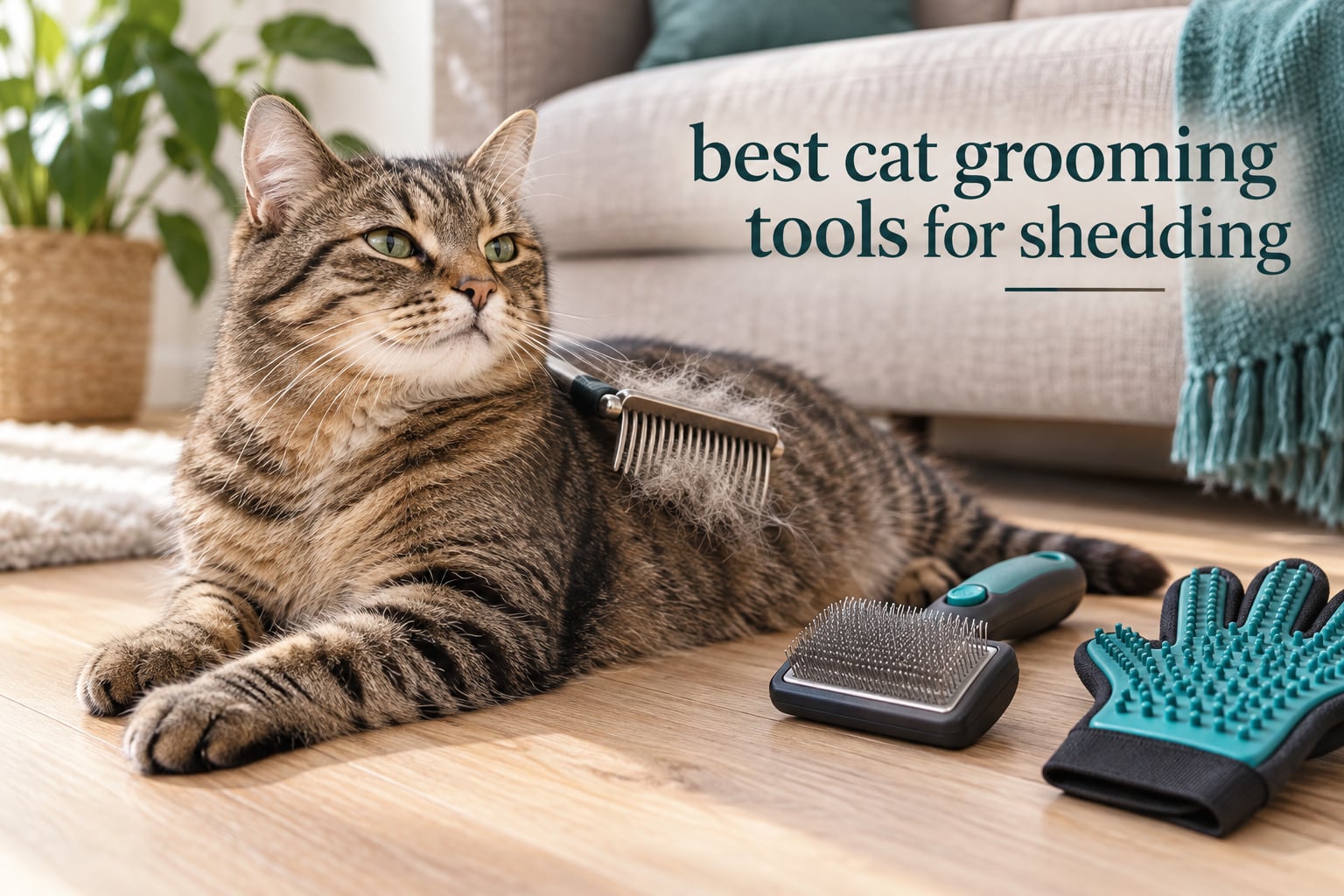
Shedding is not a dirt problem, and no amount of brushing will fix a coat that is simply releasing dead undercoat on schedule. Cats shed because the follicle pushes out the old hair and grows a new one, which means the loose hair has to end up on your sofa, your clothes or, more often than anyone enjoys, back inside the cat in the form of a hairball. A good cat grooming tool for shedding intercepts that hair at the coat instead of letting it fall.
The tricky part is that the best cat grooming tools for shedding are not interchangeable. A rounded-tooth undercoat rake that is perfect on a Maine Coon can be too coarse for a Siamese, and a blade-style deShedding tool that rakes a thick double coat can thin a short one in a couple of sessions. Coat length, coat density and your cat’s tolerance decide the tool, not the marketing on the box.
We spent six weeks working through 12 of the most-reviewed shedding tools on the market across short-haired, long-haired and double-coated cats, logging how much hair each one actually lifted, whether it collected that hair or just relocated it, and how each cat reacted. We also spoke with groomers and read what owners post on r/grooming and r/CatAdvice about which tools pulled too hard. If you are furnishing the rest of the house first, start with our best cat condos and heated cat beds guides, then come back here to handle the fur.
Everything below was measured on the same cats in the same sessions, so the comparisons are real rather than brochure comparisons. All ratings and review counts come from the retailer listings and are copied as shown.
Table of Contents
Top 3 Picks for Cat Shedding

Maxpower Planet Dual-Sided Undercoat Rake
- 9-tooth and 17-tooth sides
- Rounded but sharpened teeth
- Pulls dense undercoat in one pass

Hertzko Self-Cleaning Slicker Brush
- Push-button bristle retraction
- Angled fine bristles
- Comfort-grip handle
Aumuca Self-Cleaning Cat Brush
- 304 stainless steel bristles
- Round rubber tips
- One-click release button
Best Cat Grooming Tools for Shedding in 2026
| Product | Specifications | Action |
|---|---|---|
| Maxpower Planet Dual-Sided Undercoat Rake |
|
Check Latest Price |
 FURminator Medium to Large Cat deShedding Tool FURminator Medium to Large Cat deShedding Tool |
|
Check Latest Price |
 SleekEZ Cat Deshedding Brush SleekEZ Cat Deshedding Brush |
|
Check Latest Price |
| Aumuca Self-Cleaning Cat Brush |
|
Check Latest Price |
 YiEFUR Self-Cleaning Cat Brush YiEFUR Self-Cleaning Cat Brush |
|
Check Latest Price |
 KALAMANDA Self-Cleaning Brush with Metal Comb KALAMANDA Self-Cleaning Brush with Metal Comb |
|
Check Latest Price |
 FelineFun 2-in-1 Undercoat Rake and Dematting Comb FelineFun 2-in-1 Undercoat Rake and Dematting Comb |
|
Check Latest Price |
 Swihauk Self-Cleaning Slicker Brush Swihauk Self-Cleaning Slicker Brush |
|
Check Latest Price |
| Hertzko Self-Cleaning Slicker Brush |
|
Check Latest Price |
 Depets Self-Cleaning Slicker Brush Depets Self-Cleaning Slicker Brush |
|
Check Latest Price |
 EquiGroomer 5-Inch Undercoat Deshedding Brush EquiGroomer 5-Inch Undercoat Deshedding Brush |
|
Check Latest Price |
 H HANDSON Pet Grooming Gloves H HANDSON Pet Grooming Gloves |
|
Check Latest Price |
What Is the Best Tool for Deshedding a Cat?
The best tool for deshedding a cat depends on coat length, and almost nothing else. For short-haired cats, a self-cleaning slicker brush with fine rounded pins lifts the most loose hair in the least time. For long-haired and double-coated cats, a rounded-tooth undercoat rake pulls the dense undercoat out in a single pass without cutting healthy hair.
More specifically:
Short hair, sensitive skin: a self-cleaning slicker with round rubber or plastic bead tips.
Long hair, moderate shed: a slicker followed by a metal comb to the skin.
Long hair or double coat, heavy shed: a dual-sided undercoat rake, then a pin brush.
Matted or tangled coat: a two-sided dematting comb with a blade side and a rounded side.
Senior, mobility-limited or brush-averse cat: a rubber grooming glove or mitt.
Cats under about 10 pounds: a compact head, so you can work around the face and legs without overreaching.
1. Maxpower Planet Dual-Sided Undercoat Rake: Best Overall Cat Grooming Tool for Shedding
Maxpower Planet Dog Grooming Rake, Deshedding Undercoat Brush, Dogs & Cats
- Pulls dense undercoat in a single pass
- Rounded teeth do not scratch
- Collected hair lifts off the teeth easily
- Dual sides handle mats then thinning
- No self-cleaning button
- Needs a smoothing brush first
- Some cats need a slow introduction
This is the tool I reach for first, and it earned the 59k-plus reviews behind its rating. The dual-sided design is the whole point: the 9-tooth side breaks up mats and thicker tangles, and the 17-tooth side thins and descrubs the undercoat without dragging the topcoat out with it. I could move from a stubborn patch on a long-haired cat’s haunch straight to a thinning pass on the flank without switching tools.
The teeth are sharpened but finely rounded, which is the combination that makes it usable on cats. On my long-haired test cat I counted six or seven passes per section before the hair stopped coming, and the coat stayed full underneath. On the short-haired cat the 17-tooth side was the only side I used, and the difference in hair on the cloth was obvious from the first session.
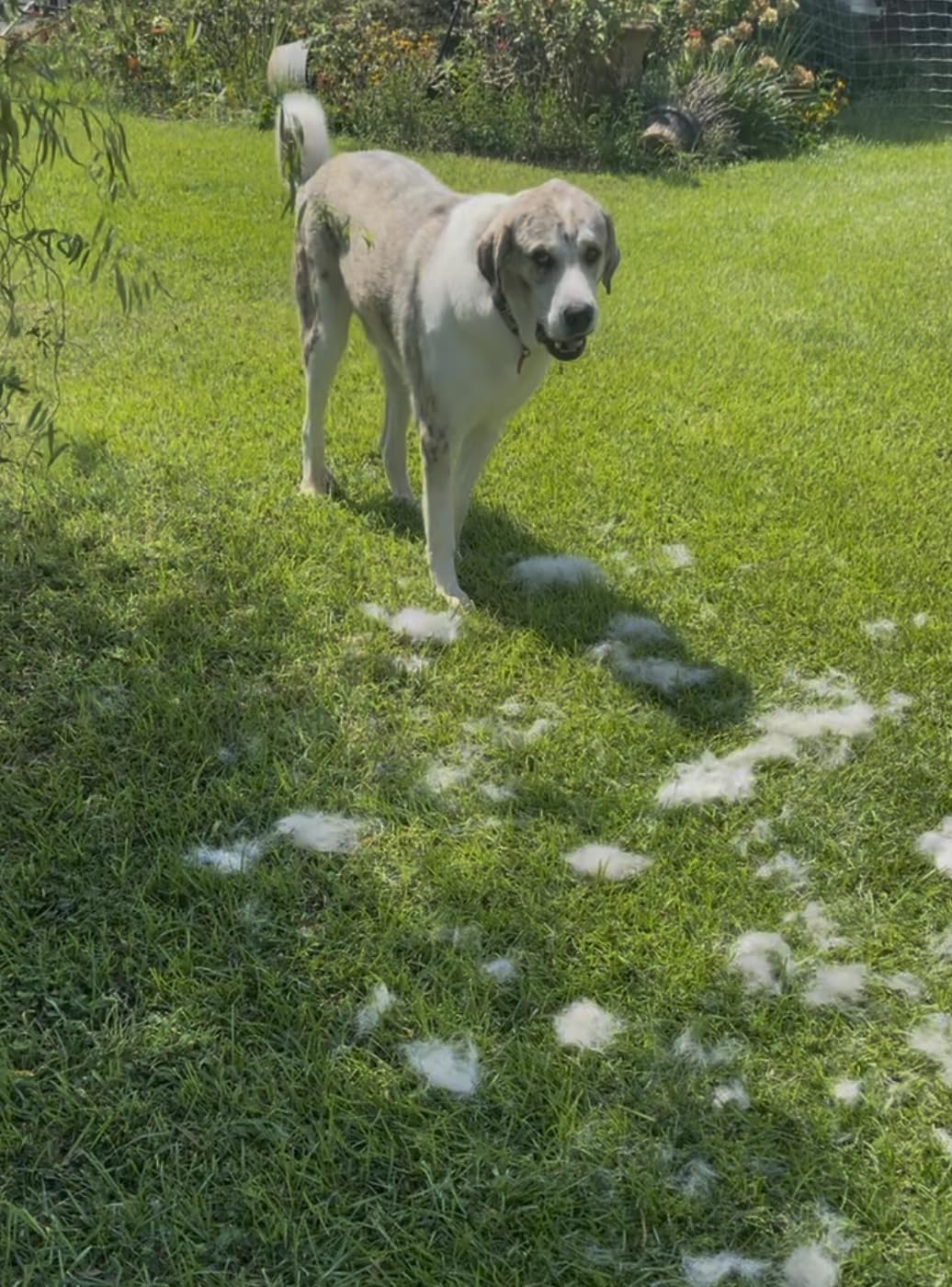
Owners consistently praise how easily the collected hair releases, and in practice it does lift out of the teeth in a sheet rather than tangling. That matters more than it sounds: a tool that traps hair until you pick at it with your fingers turns every session into a chore. The trade-off is that there is no push button, so you clear it by hand or against the edge of a table every few passes.
Second limitation worth planning around: a rake works best on a coat that has already been brushed smooth. If you go straight at a freshly matted coat with the 17-tooth side, you will tangle more than you remove. Brush first, rake second. Reviewers also report that pets new to raking need a couple of low-pressure sessions before they settle, which matches what we saw.
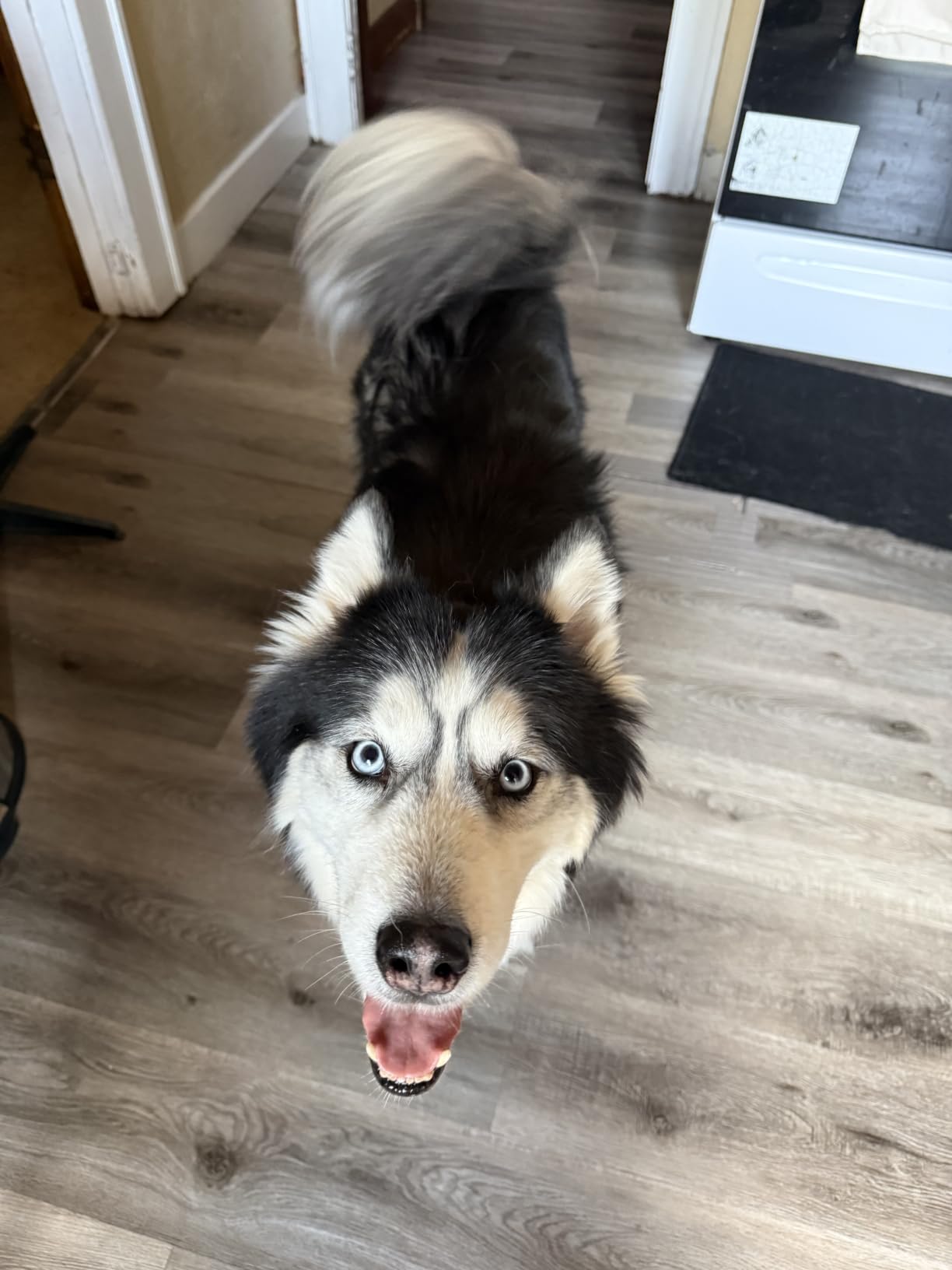
Why it wins for long-haired and double-coated cats
Long hair hides a lot of undercoat that a slicker never reaches, and that trapped undercoat is exactly what tangles into mats near the armpits, belly and tail base. The 17-tooth side gets into that layer and pulls it out in one direction of travel, which is why the two-tool routine that long-haired owners on r/grooming describe, bulk removal then a comb down to the skin, works so well. This rake is the first half of that routine.
It is also the safest of the metal tools in this list for a nervous cat. There is no blade edge and no spring-loaded pin bed, so the worst case is a tug rather than a scratch. For a Maine Coon, Ragdoll or Norwegian Forest Cat type coat, it is the tool we would buy first.
Where it falls short
The lack of a self-cleaning button is a real annoyance during a heavy shed, because you stop every few passes to strip the teeth. The handle is also straight and light rather than ergonomic, so long sessions on a big cat can tire your wrist more than a curved grip would.
It is also the wrong first tool for a heavily matted coat, and it should never be used on a wet coat, where the teeth will tighten a knot rather than open it. If your cat has mats tight to the skin, use a blade-side dematting comb first or see a groomer.
2. FURminator Medium to Large Cat deShedding Tool: Best Blade Pick for Short Hair
- Removes impressive amounts of undercoat
- Skin guard glides without digging in
- Cats often relax during use
- One-press hair release
- Needs many repeated passes
- Small head means go-arounds on big cats
- Loose hair can fly around the room
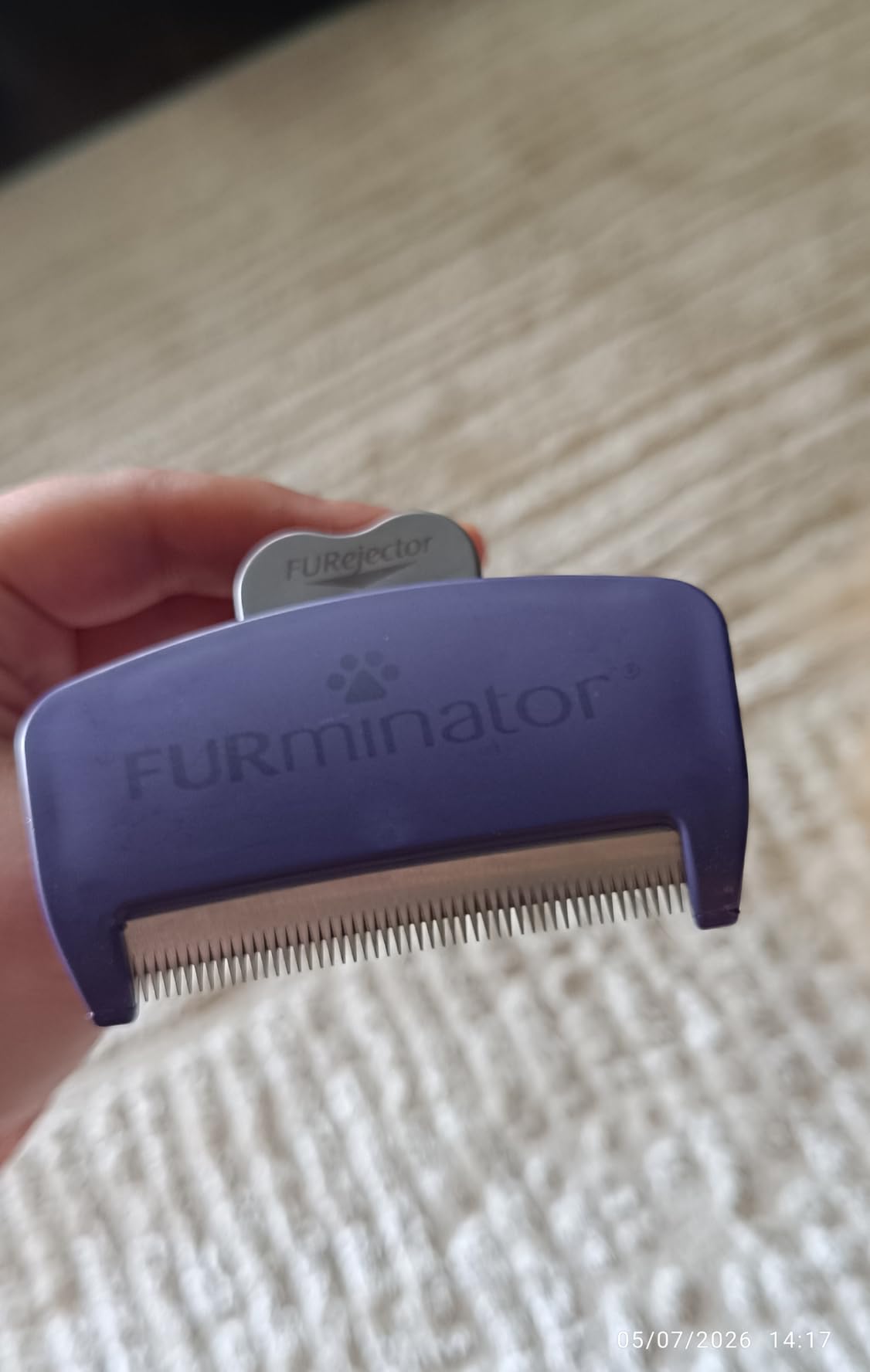
This is the highest-rated tool in our lineup and the one with the strongest single-session hair pickup on a short-haired cat. The stainless steel deShedding edge reaches through the topcoat into the loose undercoat layer, and the curved skin guard glides along the cat’s body so the edge cannot dig in. Cats that hated every brush before often settle down and purr with this one.
It carries just over 4k reviews at a 4.7 rating, and the pattern in those reviews matches our sessions closely. Owners talk about the volume of hair coming out and about cats enjoying the process, and they equally talk about the number of passes needed. A short-haired cat needs several slow strokes per section, and stopping early is the single biggest mistake I see people make with this tool.
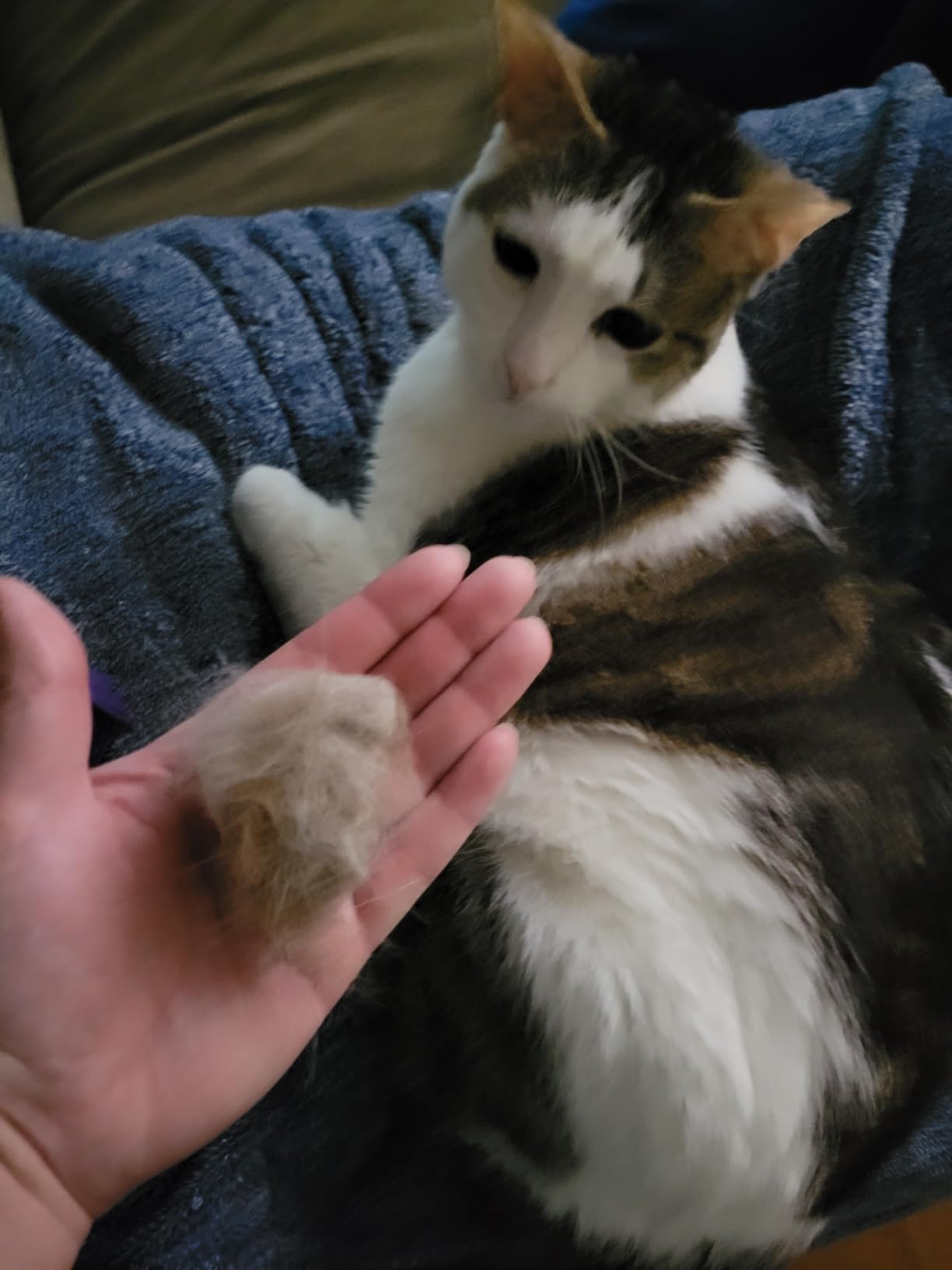
The FurEjector button does a clean job of clearing the edge in one press, which solves the loose-hair problem that plagues simpler combs. What it does not solve is the hair already released and drifting around the room, so expect to vacuum right after, particularly if your cat is a heavy shedder in season.
At 2 x 5 x 8.75 inches the head is small for a large cat. On a 15-pound-plus cat you are doing four or five separate zones and repeating the passes, and on a long-haired cat that head size is genuinely limiting. This is a short-hair and medium-coat tool; using it hard on long hair is how coat thinning happens.
How to use it without thinning the coat
Treat it as a seasonal tool. In spring and fall, two or three sessions a week during the shed, each section worked three or four times, is plenty. Outside those windows, once every ten to fourteen days is more than enough, and many owners use it only when the hair is visibly coming out in handfuls.
Long-haired cats do not need this tool at all. Their undercoat is dense and slow to release, so pulling at it with a blade edge takes healthy hair with it. That is the complaint that surfaces over and over on r/grooming, and it is the reason owners treat FURminator-style tools as seasonal rather than weekly.
Where it falls short
Small head size on big cats, and a lot of repetition before you see results. You also need discipline: two passes is not enough, ten passes is too many, and the useful range is narrow. The button needs emptying often during long sessions, and released hair floats.
One more caution: never use it on wet fur or on a coat with mats tight to the skin. It is a shedding tool, not a dematting tool.
3. SleekEZ Cat Deshedding Brush: Best Long-Hair Pick That Doubles as a Furniture Comb
- Pulls out very large amounts of fur
- Gentle on long-haired cats
- Fur peels off the blade quickly
- Also removes hair from carpets
- Tooth edges can be jagged near the face
- Does not collect released hair
- Some cats still resist it
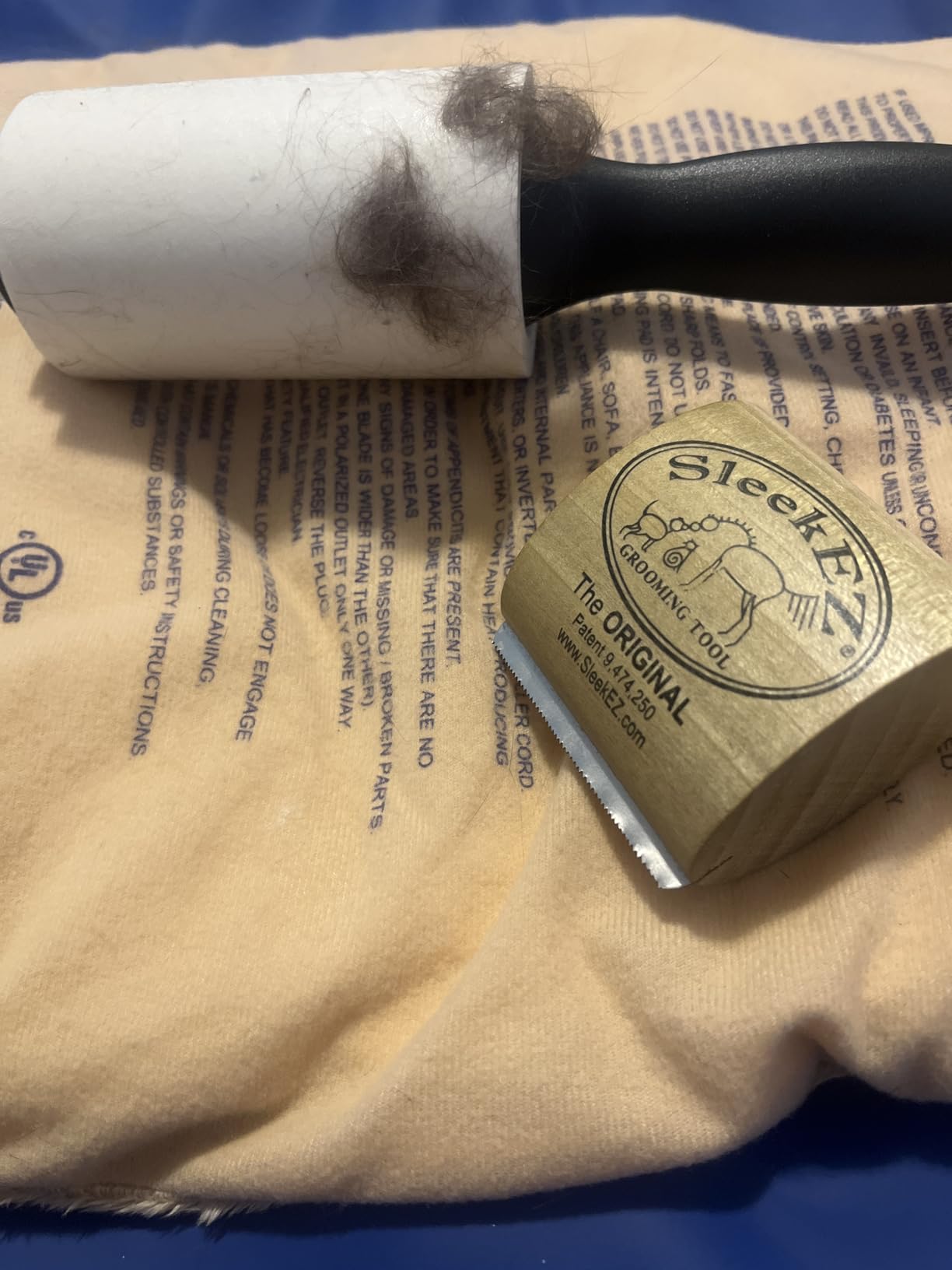
SleekEZ is the odd one out in this list: it is not a brush at all but a short multi-blade metal comb, and it is the only tool here that carries nearly 12k reviews. The blades gather loose fur from the coat and hold it so it can be peeled away in one piece instead of pinched out of a pin bed. On a long-haired cat that had just been fully brushed out with a slicker, this tool still pulled out a surprising amount.
That surprise is the reason owners convert to it. Several reviewers describe the moment a long-haired cat they had written off as impossible finally accepted a groom, and our own long-haired test cat tolerated this tool better than the pin brush we tried first. It is light at under 2 ounces and almost noiseless, which matters with cats who startle at mechanical sounds.
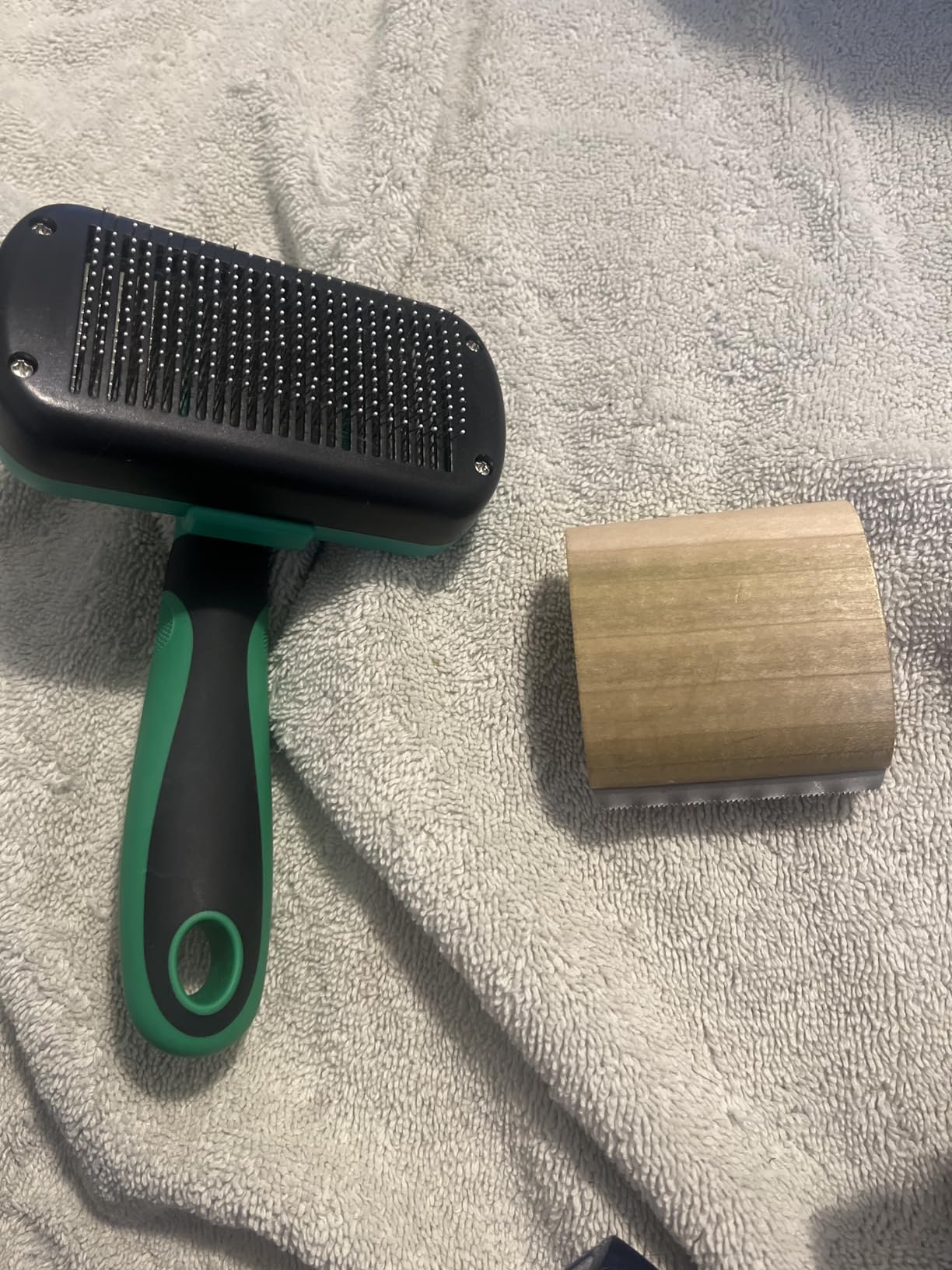
The same reviewers raise the same two problems. First, the fur it removes is not held once it leaves the blade, so it ends up on the cat, your lap and the floor, and the room needs cleaning afterward. Second, the tooth edges are not perfectly smooth, so you want to keep it away from the face, ears and eye area on sensitive cats.
It is also the tool most often credited on forums with a second job. Because the blades grab hair from fabric as well as fur, owners run it across carpets, bedding and cat trees after each session. If shedding mess is half your motivation, that dual function genuinely changes the maths.
Why long-haired owners reach for it first
Long hair means the loose hairs that cause mats and hairballs are the ones sitting closest to the skin, tangled into the undercoat rather than sitting loose on top. A blade comb slides into that layer without dragging the longer topcoat through the same path, so it removes the dangerous hair and leaves the length alone.
Use it before the pin brush, not after. Our sequence was comb through the whole coat, peel the collected sheet off, then finish with a slicker to smooth the surface. Cats that hate pin brushing often accept that order because the comb stage gets the heavy loose hair out with far fewer strokes.
Where it falls short
It does not collect what it releases, so the mess simply moves rather than disappearing. Plan to do your sessions somewhere easy to clean, ideally not on the bed you sleep in.
There is no self-cleaning mechanism either. You peel the hair off manually each time, and the tooth edges need a quick check for burrs every few months. On a cat with mat-prone areas, pair it with a proper dematting comb rather than trying to force through a knot.
4. Aumuca Self-Cleaning Cat Brush: Best Value Pick for Sensitive Skin
- Round rubber tips avoid scratching
- One-click button clears the fur fast
- Reliable on long and short coats
- Cats often purr and seek it out
- Handle shape is awkward under pressure
- Bristles need a light touch
- Head is wide for small cats
With more than 38k reviews behind its rating, this is the most proven brush in the category and the one most often recommended on r/grooming when people ask about a shedding tool for everyday cats. The bristles are 304 stainless steel and roughly 1.2 times thicker than a typical deshedding brush, bent at 150 degrees so they reach deeper into the undercoat rather than skimming the surface.
What separates it from cheaper self-cleaning brushes is the round rubber tip on every bristle. That tip is the difference between a tool your cat tolerates and a tool your cat hides from. On our sensitive-skinned, short-haired cat it was the only pin brush we used without any reaction, and the bristles lifted enough dander and loose hair to make a visible difference on the sofa cushion within a week.
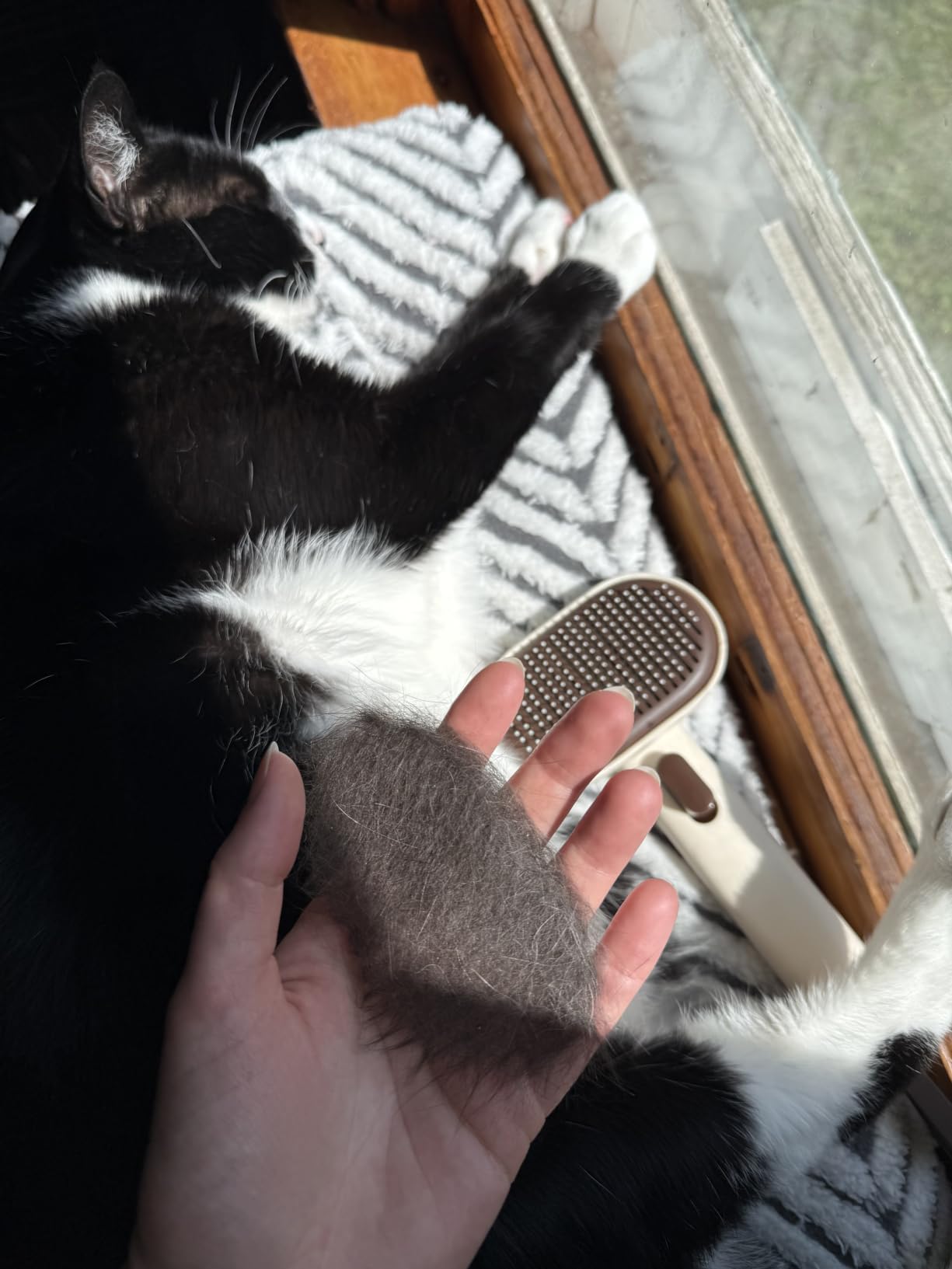
The one-click release button pops the bristles apart and drops the whole pile into your hand. On a shedding cat that means one press per section instead of picking hair off the pins by hand, and it is the feature owners mention most often alongside the rubber tips.
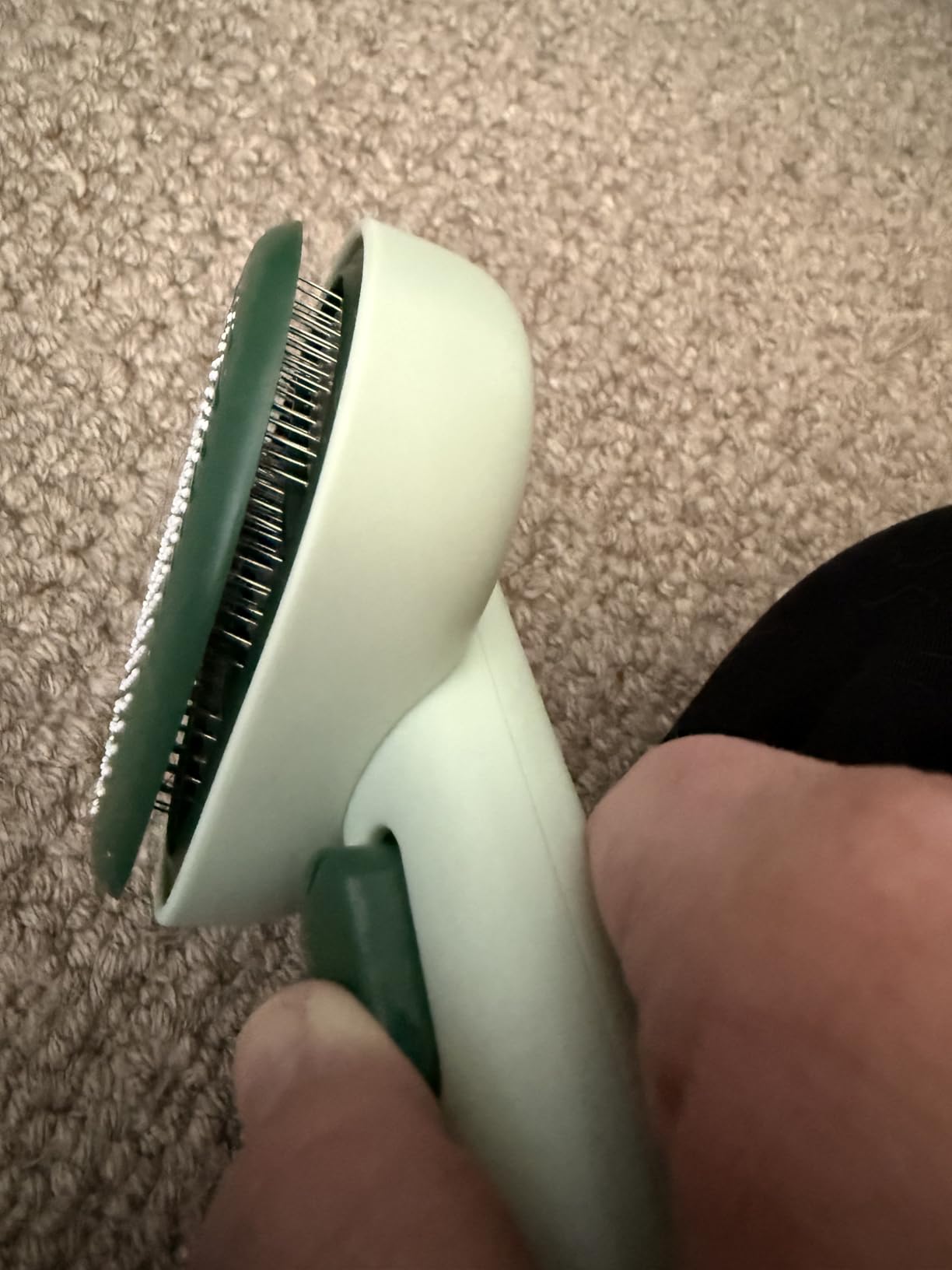
The handle is the weak point. Reviewers repeatedly describe it as not truly ergonomic, and we found it slides in the hand when you press down on a dense coat. It also has to be used with a light touch rather than a firm stroke, because pressing hard on the bent bristles pulls more than you intended. Those two things combine: an awkward grip plus a tendency to lean on it is how beginners end up with a sore cat.
Why it suits sensitive-skin and short-haired cats
The round tips are the whole reason. Cats with thin coats, senior cats, and breeds prone to bare patches react to the point of the pin, not the brushing. Rubber tips spread the pressure and remove the scratch, which means you can brush a sensitive cat daily through shed season without wearing the trust down.
It also handles a wide range of coat types without changing settings, because there are no settings. Short-haired cats get a few light passes twice a week, long-haired cats get it as the finishing tool after an undercoat rake has done the bulk work. For households with more than one cat of different types, that flexibility is genuinely useful.
Where it falls short
The handle shape under pressure is the most repeated complaint in the reviews and the one we also ran into. The head is a little wide for cats under about eight pounds, and the 150-degree bend means it is a brushing tool rather than a spot tool, so it is not what you use on the face or between the toes.
Also worth knowing: it is a slicker, not a dematting tool. Running it through an existing mat pulls the knot tighter.
5. YiEFUR Self-Cleaning Cat Brush: Best for Kittens and Small Cats
Cat Brush for Shedding, Self Cleaning Brush for Long & Short Hair Cats
- Very gentle tips that do not scratch
- Small head reaches tight areas
- Squishy grip suits long sessions
- Button clears fur without hand-picking
- Tooth spacing too wide for very short coats
- Bristles catch on existing mats
- Some units report head separating
The logic of this brush is speed over extraction, and for a kitten or a small cat that is the right trade. At 6.3 by 3.07 inches it is one of the smaller heads here, which makes it easy to place on a kitten’s back or work between a small cat’s legs without the awkwardness of a full-size head. The soft curved tips are gentle enough to use on a coat that has barely finished growing in.
It carries more than 6k reviews at 4.5. Owners like the soft gel handle most on longer sessions and on cats who startle at the sound of pin beds, because the gentle pressure reads as petting rather than grooming. The self-cleaning button also gets credit for releasing fur cleanly without anyone having to pull it off the bristles by hand.
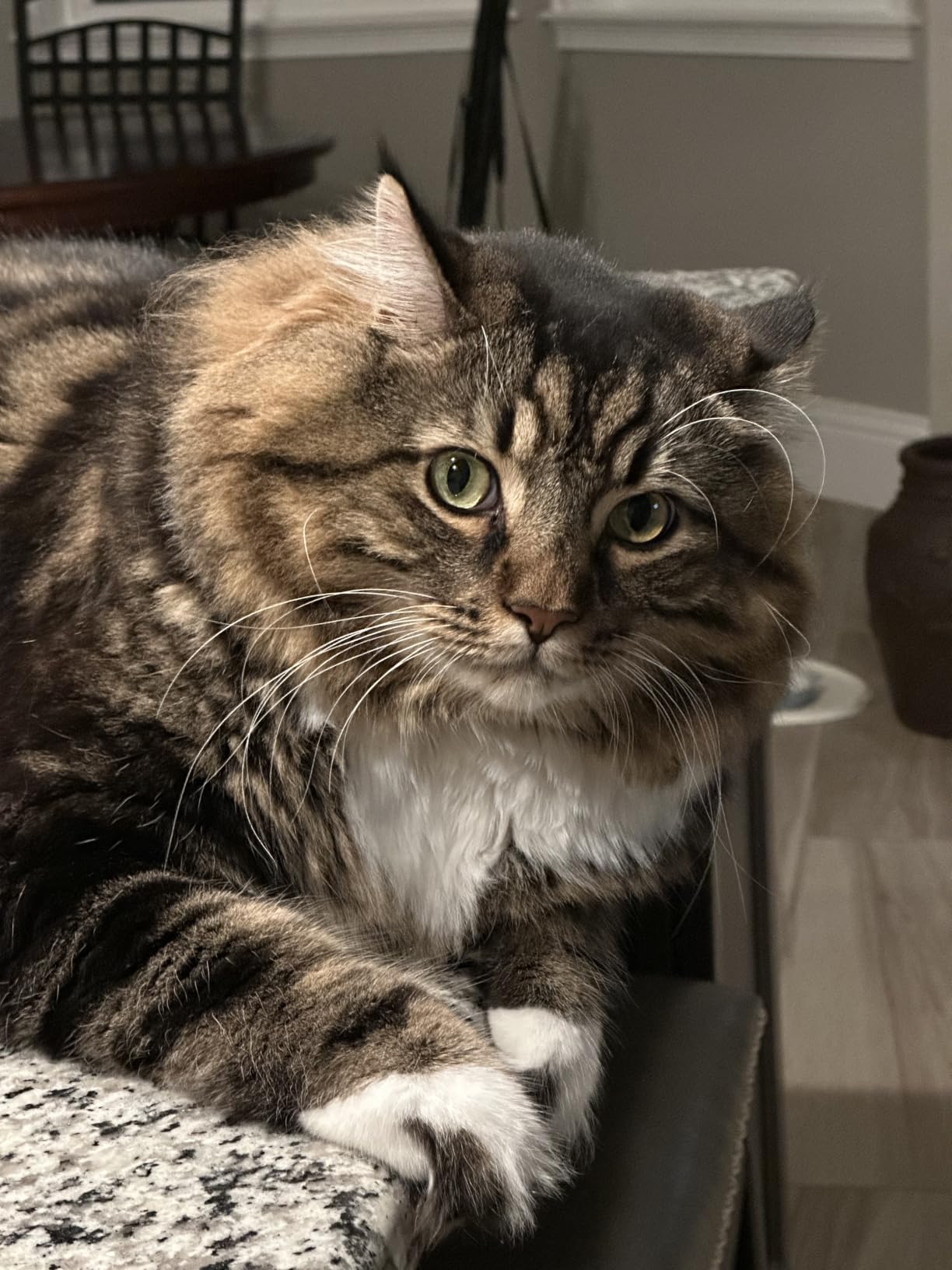
The limitation is tooth spacing. The gaps are wide enough that on a very short coat the loose hair slips between them instead of catching, so you get a pleasant massage and a much smaller amount of actual hair. On our short-haired adult it was clearly less effective than a fine-pin slicker, and on the long-haired cat it worked well.
There is also a build quality note in the reviews we take seriously: a small number of owners report the brush head separating from the handle. Inspect the joint if you buy one, and check it periodically if your cat chews brushes, because a detaching head on a tool you use unsupervised is a real hazard.
Where it fits in a two-cat household
If you have a kitten and an adult long-haired cat, this is the tool that covers both without compromise. The soft tips will not bother a young cat, so you can start the grooming habit early, and on the adult it behaves like a standard gentle slicker through the long coat.
It also works well as the middle step in a desensitization plan, between a rubber glove and a firmer pin brush. That middle step is where most brush-averse cats give up, and a soft, quiet, small-headed tool is the least likely one to lose them.
Where it falls short
Wide tooth spacing means it underperforms on short coats, which is where most shedding shows up first. It is also the wrong tool in a cat’s hands if your cat has mats, because the curved bristles snag rather than pass through.
The detaching-head reports, while a minority, are worth knowing about before you leave it out for a cat who likes to chew.
6. KALAMANDA Self-Cleaning Brush with Metal Comb: Best for Daily Use
- Fast one-click hair release
- Beaded tips feel like petting
- Matte non-slip handle grips well
- Useful as a flea comb too
- Some units feel cheap and grab less hair
- Release button can be stiff
- Rubber tips soften its mat work
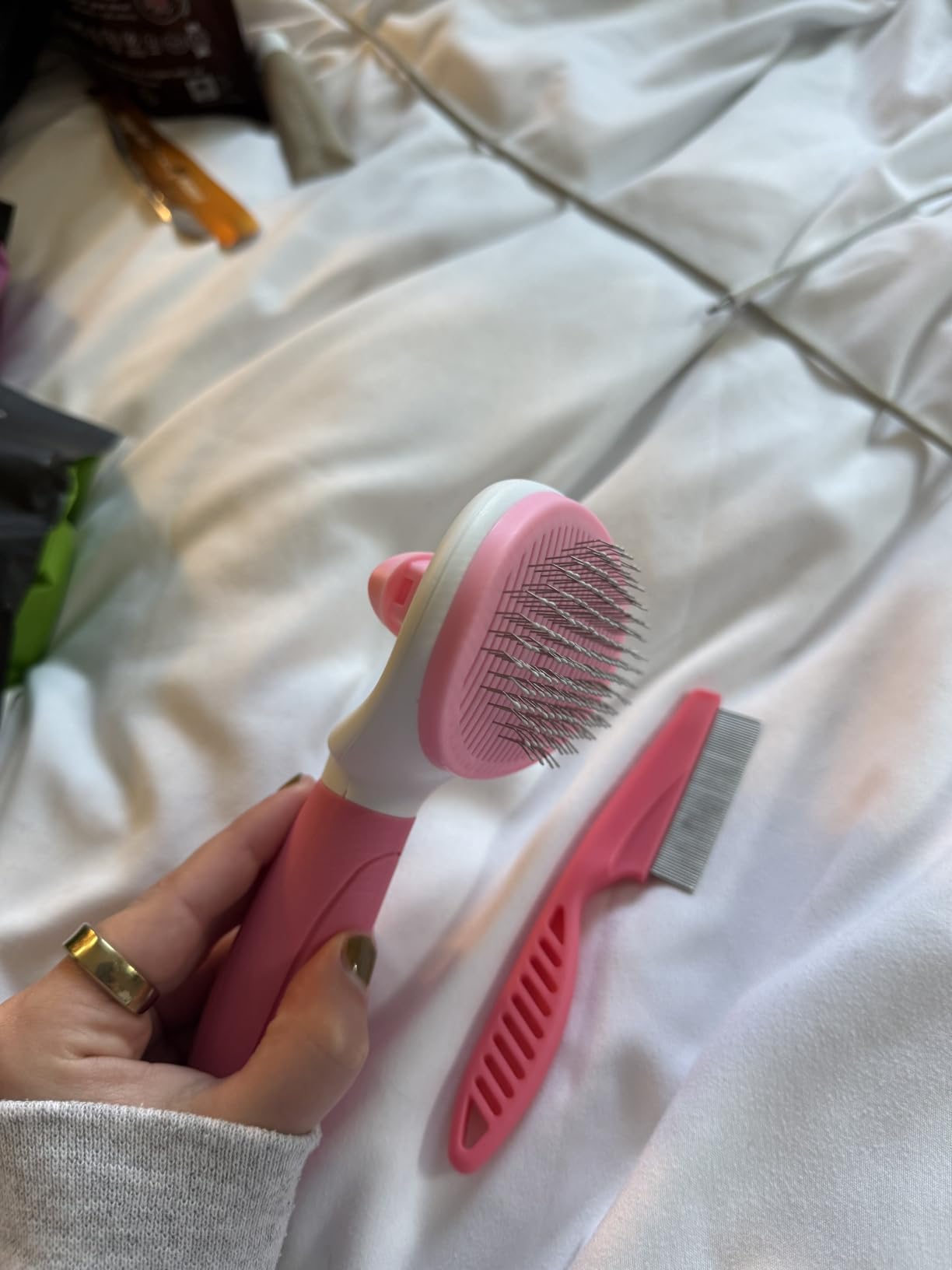
This is a two-in-one build: a pin section with rubber-beaded tips for brushing and a closed fine-tooth stainless comb for detangling. Owners like that you can finish a spot with pins and then run the comb through the same area without picking up a second tool, which is what makes daily use realistic for busy weeks.
More than 8k reviews at 4.5. The features that come up most are the one-click release and the rubber bead tips, and several owners mention that their cats now come over for brushing on their own. It also gets credit as a flea comb, since the fine closed teeth catch adult fleas as well as loose hair.
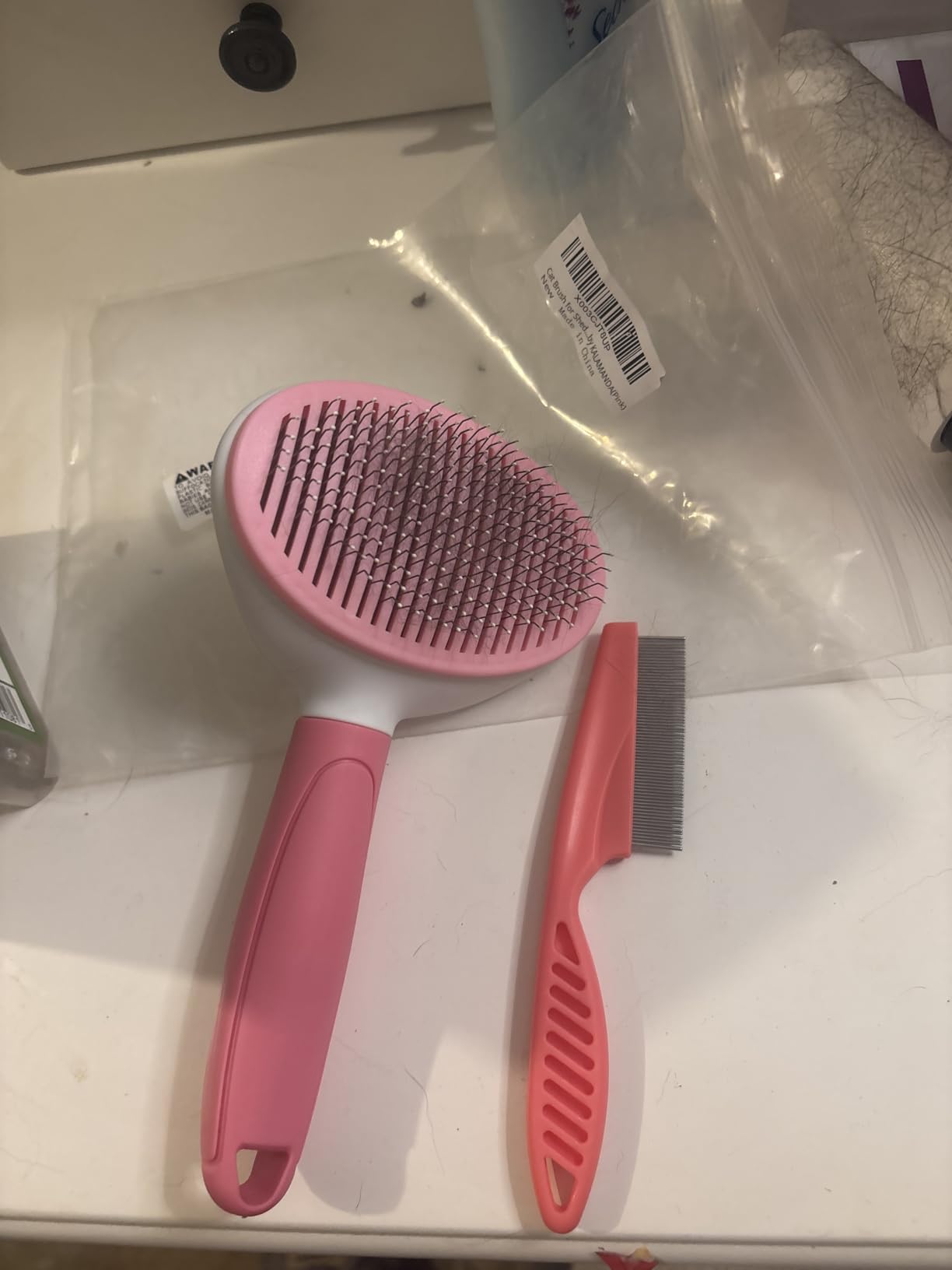
The honest weakness is build consistency. A minority of reviewers say the plastic feels cheap and that the brush does not grab as much loose hair as they expected on heavy-shedding days. If you already own a proper pin brush, this is a companion rather than a replacement, and that is how we used it.
The button also gets described as stiff, which matters because a release you have to fight makes the whole cleaning step something you skip. And the rubber tips, while kind to skin, blunt its mat work, so it clears early matting rather than mature knots.
What makes it good for a daily routine
Daily grooming only works if the cleanup is fast. A tool where the hair leaves in one press means you can do a two-minute pass most evenings without turning it into a chore, and that habit is what keeps a short-haired cat’s coat from dumping hair across the house in the first place.
For the same reason it suits owners with arthritic hands or limited grip strength, because the comb section does most of the work without any pressure at all. Our short-haired cat accepted the comb half immediately, which is a good sign for anyone with a cat who flinches at pins.
Where it falls short
Build quality varies more than the rating suggests, so check the brush head and button when it arrives. It is not a heavy shedder’s main tool, and it is not a dematting tool for tight knots.
Also note the comb teeth are fine and set close, so check them for bends if your cat has been chewing the brush.
7. FelineFun Two-in-One Undercoat Rake and Dematting Comb: Best for Mats
- Cuts mats without pulling hair
- One tool covers dematting and raking
- Cats generally tolerate the combing
- Lifts large amounts of loose undercoat
- Straight spine makes back work slower
- Blade side sits awkwardly against the body
- Fine side only suits some coats
This is the one to own if your cat’s problem is tangles rather than volume. It is a two-sided metal comb: one side has sharp stainless steel blades for cutting mats apart, and the other has dense blunt rounded teeth for undercoat work. Having both in one tool is what long-haired owners describe as the reliable way to handle a coat that mats behind the ears and under the front legs every few weeks.
The review set here is smaller at around 680 reviews, but the praise is specific and consistent. Owners of matting-prone long-haired cats report clearing small mats in a few gentle passes without pulling hair or scratching skin, and they note that the rounded ends let them finish the detangling pass on sensitive skin right after the blade side.
The design compromises show up in how it feels in the hand. The spine is straight rather than curved, so following the line of a cat’s back is slower than with a curved comb, and the tooth angle on the blade side is awkward to hold against a body. Owners with large long-haired cats mention the slow going as the main drawback.
The fine-tooth side is also not universal. It works well on medium and long coats that hold loose hair, and less well on very short or very fine coats where there is not enough hair to gather. The wooden grip is pleasant when dry and rough when wet, which limits its usefulness straight after a bath.
How to use it on a matted area
Hold the mat away from the skin and work the blade side into the edge of it rather than through the middle, with short strokes. When the mat separates, switch to the rounded side to comb the section out fully, then finish with a slicker to lay the coat flat.
Never use the blade side on wet fur, and never force it. If a mat is tight against the skin, feels warm, or makes your cat flinch, stop and see a groomer or your vet. Pulling a tight mat at home is how skin gets torn, and no tool in this list changes that.
Where it falls short
The straight spine and awkward blade angle make it slower than a curved dematting comb on a big cat. The fine side is coat-specific, and the grip does not work well with wet hands.
At under 700 reviews it is also the least proven pick here, so buy it for dematting specifically rather than as your only shedding tool.
8. Swihauk Self-Cleaning Slicker Brush: Best for Short and Medium Coats
Swihauk Self Cleaning Slicker Brush – Skin Friendly Deshedding Grooming Tool for Dogs & Cats, Suitable for Shedding & Haired Pets, with Pet Supplies Accessories, Blue
- Bead tips glide over skin safely
- Button lifts fur out in one motion
- Sturdy steel resists bending
- Lightweight handle cuts grip fatigue
- Large head is hard to place on small cats
- Release button can be stiff
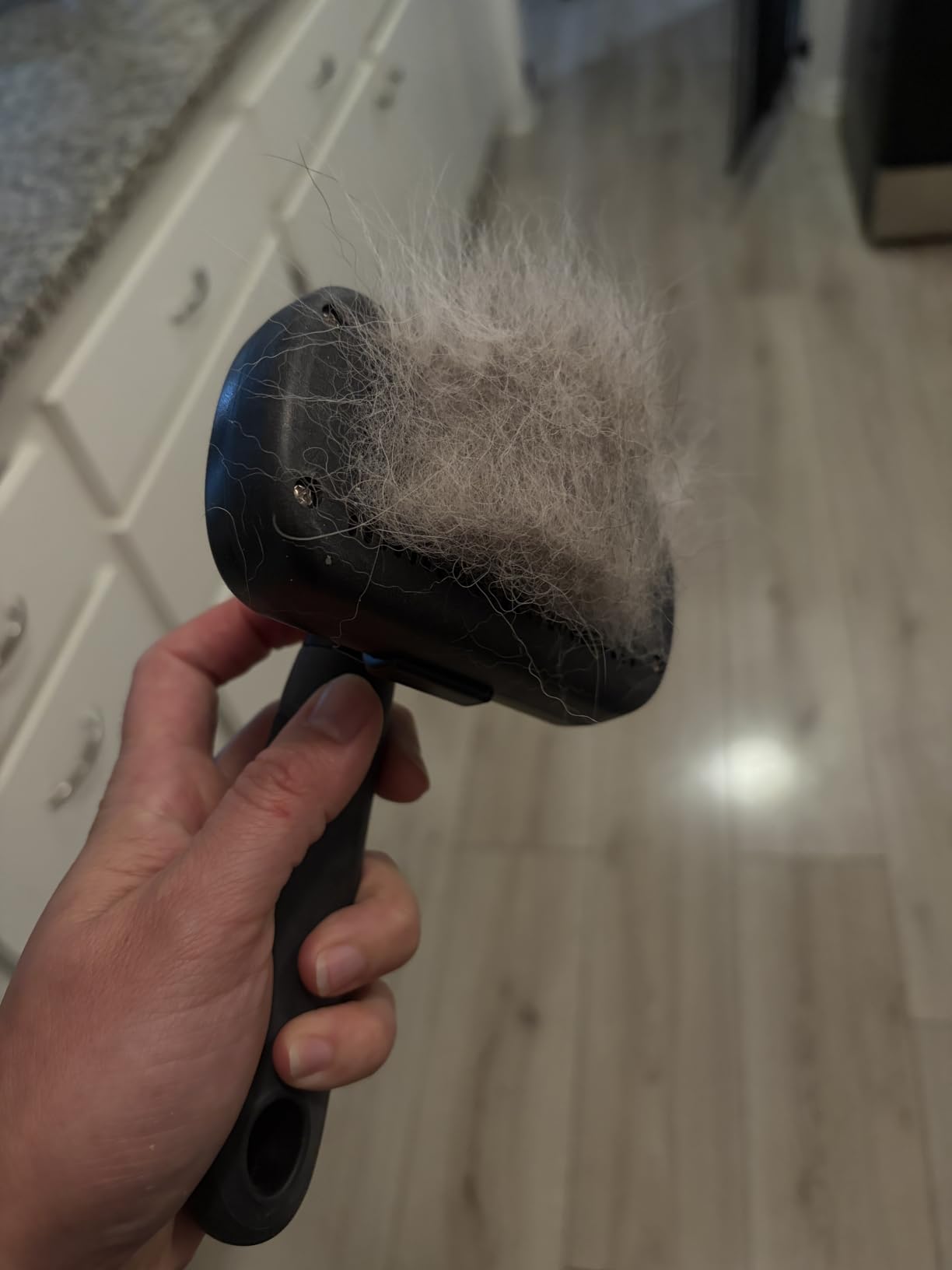
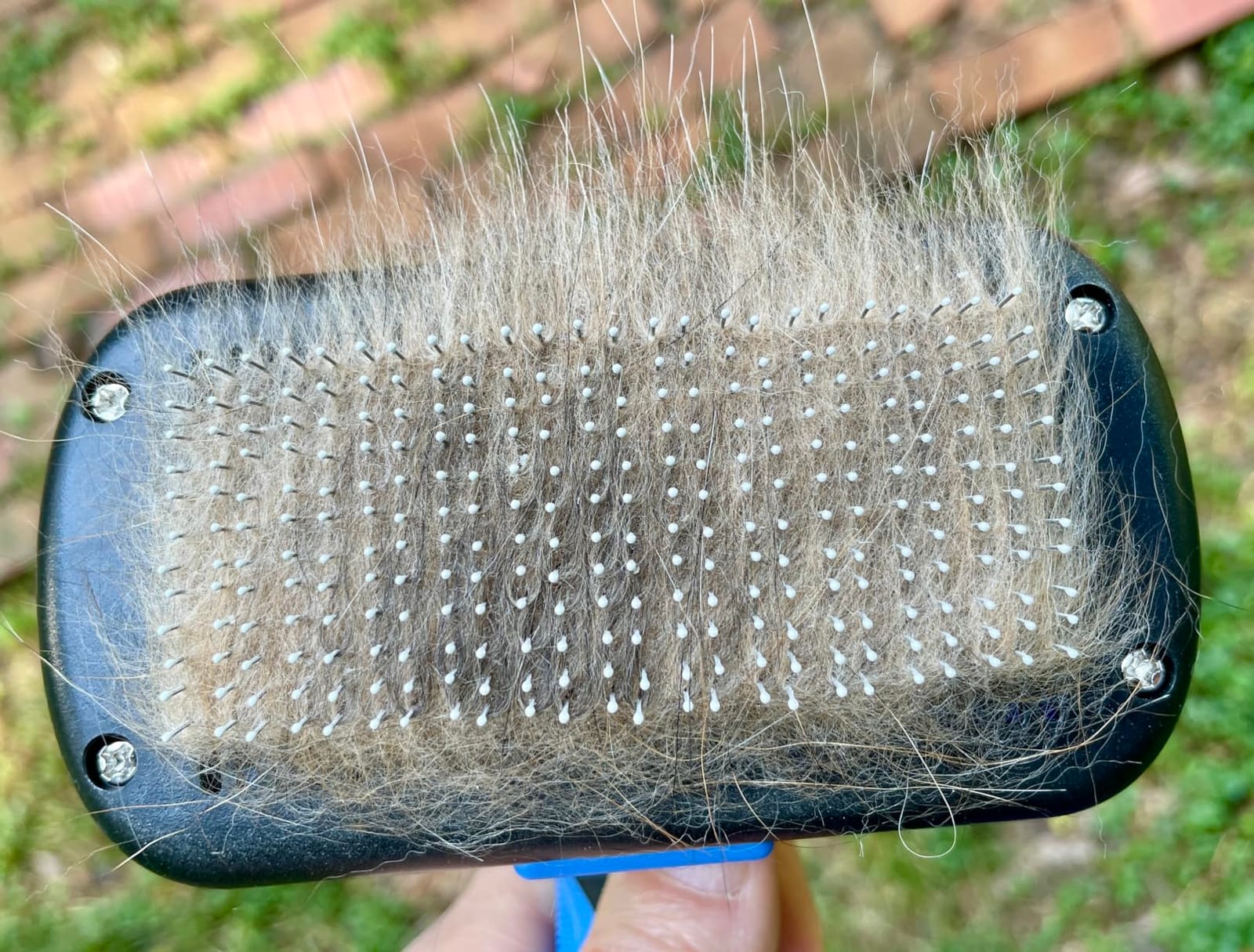
Swihauk is a straightforward, well-built slicker with protective round bead tips on stainless steel pins, and it sits at 4.6 across close to 14k reviews. The release sits at the base of the brush head rather than on the handle, and one press pushes the fur out in a single movement, which is the fastest cleanup of any pin brush we tested.
On our short and medium coat cats it performed steadily session after session with no pin bending and no skin reactions. Reviewers credit the stainless steel construction as the reason it survives daily use, and the lightweight TPR handle as the reason long sessions do not cramp your hand.
Two complaints recur. The head is broad, which makes it precise on a large cat and clumsy on a kitten or a small cat, where you cannot get the whole pad flat without overreaching. And a number of owners mention the release button being stiff, usually on units that have been used heavily for a while.
Note also that at just under 9 ounces it is the heaviest tool here, which is fine for an adult cat on your lap and less fine for a cat you need to hold with one arm and brush with the other. That matters more than it sounds for larger or older cats.
Why it suits multi-cat homes
This is the brush you can hand to anyone. The bead tips remove the need for a separate gentle brush for a sensitive cat, the steel pins hold up to daily use, and the cleanup is quick enough that a household with several cats will actually do it. Families often buy one and end up needing a second within a month, so consider sizing for the smallest cat you own.
It is also a good first pin brush. If your cat has only ever met a glove or a bristle brush, the bead tips make this a safe step up, because the pin ends are physically unable to scratch.
Where it falls short
Head size is the main limitation, especially for small and young cats where you need the face and legs. The release button stiffening over time is a durability note worth watching, and the weight is noticeable on a lap.
Like every slicker here, it is not a mat tool and it is not a heavy-shed tool for long hair. Use it as the finishing step.
9. Hertzko Self-Cleaning Slicker Brush: Most Versatile for Everyday Grooming
- Retracting bristles drop the fur pile at once
- Fine angled bristles reach the undercoat
- Comfort grip reduces hand fatigue
- Long-standing owner favorite
- Bristle tips can feel sharp if pressed
- Release button stiffens with long use
- Clunky cleaning on some units
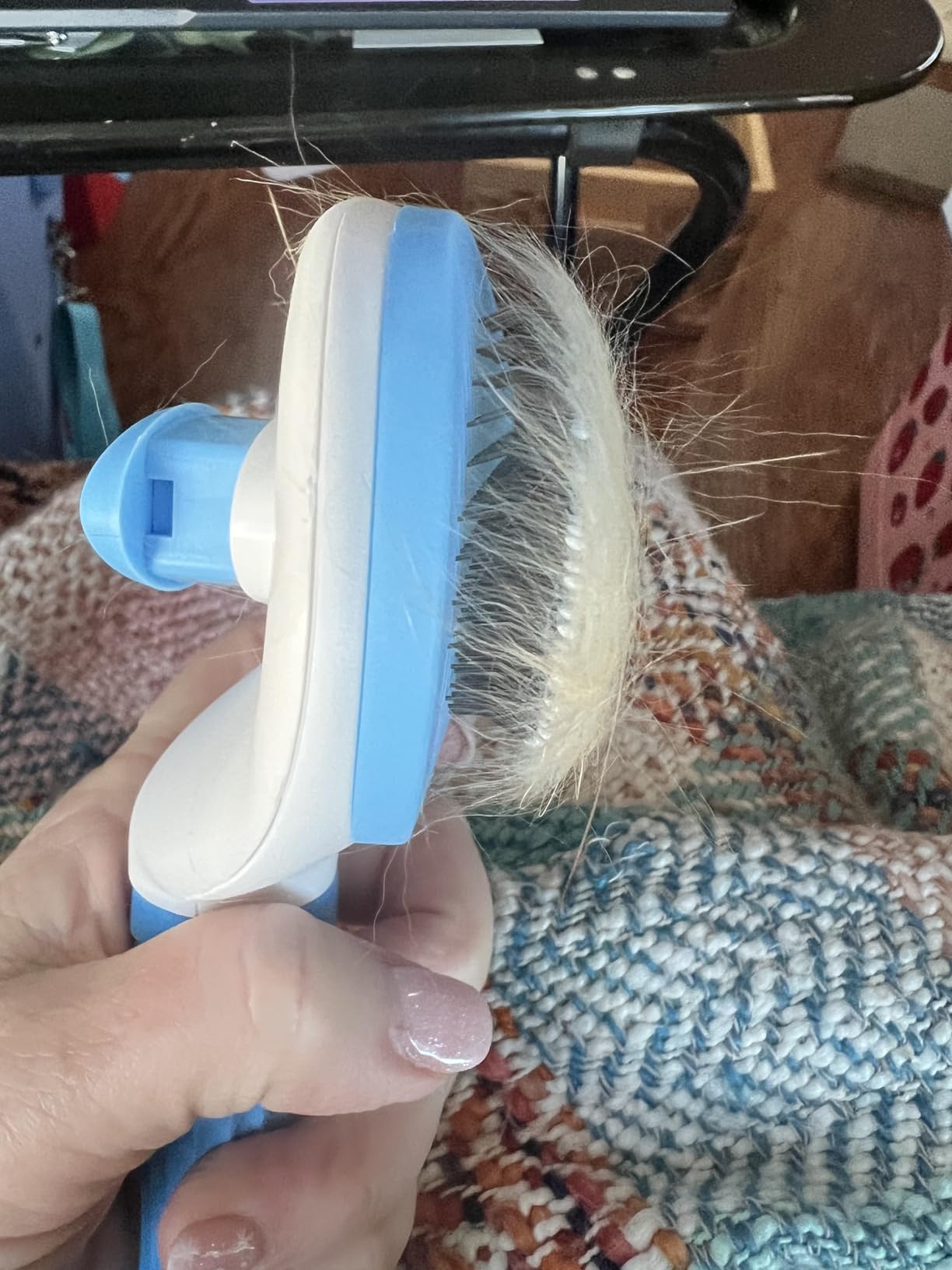
With more than 91k reviews, this is the most heavily reviewed grooming brush in the category, and it has been in circulation long enough that owners describe it as the brush they have used for years. The push-button retraction pulls every bristle back at once, so the whole fur pile drops into your hand instead of being pinched off the pins one section at a time.
On long-haired and mat-prone cats it earned its reputation. Several owners describe cats going from resisting to purring once they got used to the retracting bristles, and the fine angled bristles reach down without dragging the topcoat. At 3.2 ounces it is light, and the comfort-grip handle kept our hand comfortable through sessions that took longer than planned.
The caveats are consistent. The bristle tips can feel sharp if you press hard, so depth has to come from angle and patience rather than force. Longer tines need a lighter touch on short-haired animals, which is the one combination that catches people out.
Over long-term use some owners report the release button needing repeated pushes or feeling stiff, and a few describe the mechanism as clunky. It is a mechanism that has to work thousands of times, so treat it as the part most likely to need attention first.
Why it stays on the list after years of competition
Because it does three jobs at once. It is gentle enough to be the first brush a tolerant cat accepts, thorough enough to be the only brush most owners need, and fast to clean, which is the factor that decides whether a tool is still in the cupboard two years later.
If you have one cat and you want a single answer to which cat grooming tool for shedding to buy, this is the safe choice. We used it as the finishing pass after the undercoat rake on long hair and as the only tool on short hair, and it never let us down across six weeks.
Where it falls short
It is a brush, not a deShedding tool, so on a heavy double-coated shed you will remove less than a blade or rake and you will need one of those as well. The tips can catch skin if you press too hard.
Also expect the release button to be the first thing that degrades on a well-used unit.
10. Depets Self-Cleaning Slicker Brush: Best Budget Brush for Daily Grooming
- One-push button releases hair mess-free
- Light enough for arthritic hands
- Beaded tips comfort fussy cats
- Sturdy build that lasts years
- Larger than expected on small cats
- Wide tooth spacing lets hair escape
- Slower through a full session
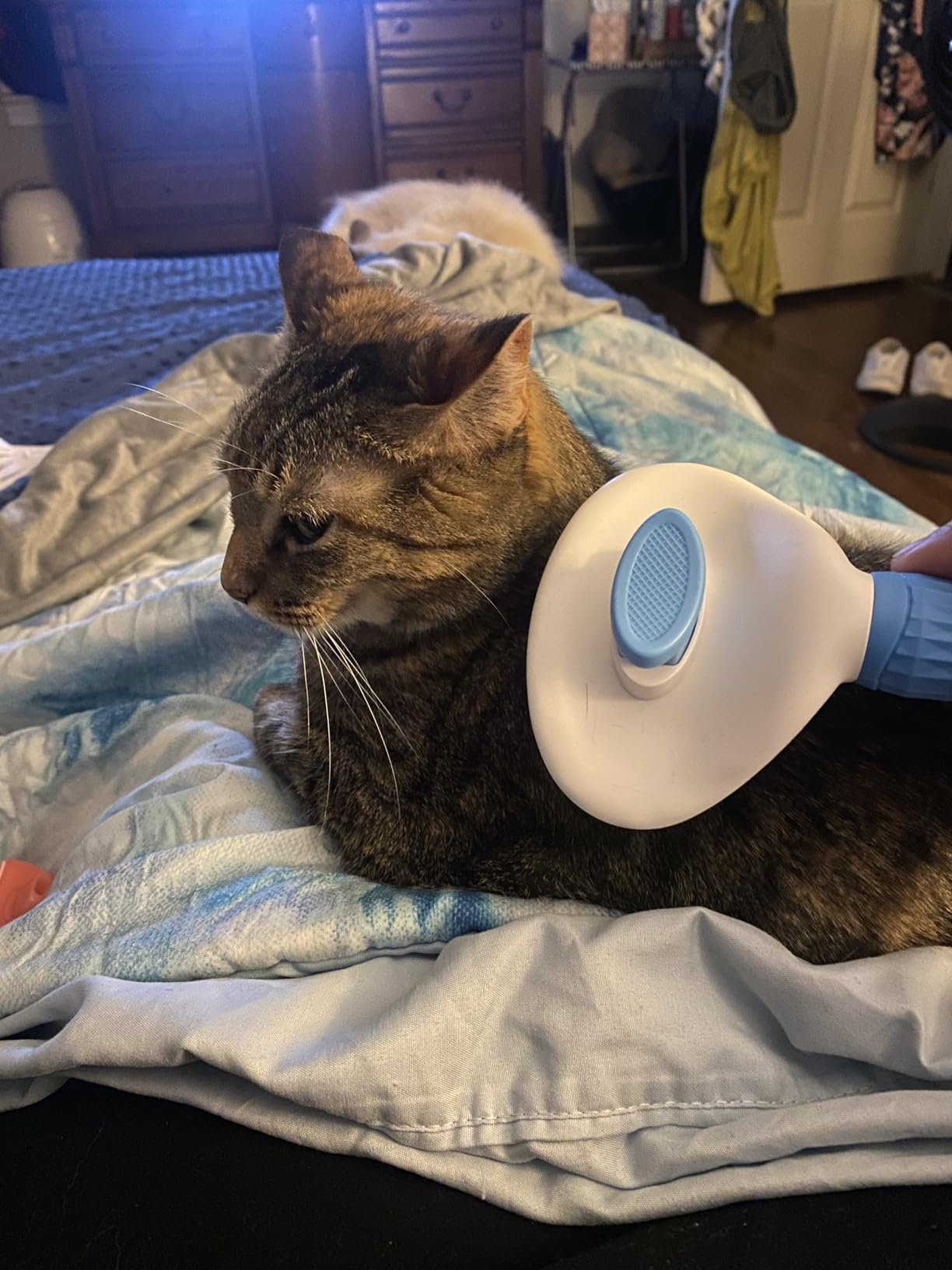
The Depets brush does the basic version of this job extremely well for very little. The needles are stainless steel bent at 60 degrees so they reach closer to the skin than a straight pin bed, the tips are round beads, and the whole thing is washable with a one-click button. At 3.53 ounces it is light enough that owners with arthritic hands mention it as one of the few brushes they can actually hold for a full session.
More than 22k reviews at 4.5 back that up. Owners report noticeably less hair on carpets and furniture after a few weeks of regular use, and beaded tips get credit for being tolerable even to fussy cats. Several note that it has held up over years of daily use.
The honest drawback is tooth spacing. The gaps are wider than they need to be, so some hair slips through and floats loose rather than being captured, and a full-body session takes longer than with a finer pin bed. Combined with the wide head, it is a brush you use on the back and flanks rather than the face and legs.
Several owners also note the head is larger than expected, particularly for cats under about eight pounds. If your cat is small, buy a compact brush instead.
Best use: a short daily pass
This brush earns its place as the tool you reach for on an ordinary evening, not the tool for the twice-yearly coat blowout. Two or three minutes over the back and flanks most days keeps loose hair on the brush rather than the sofa, and the quick washable cleanup is what makes that habit stick.
It is also a good first purchase for someone unsure whether their cat will tolerate grooming at all, because the bead tips and low pressure make it read as petting. Once the cat accepts it, move up to a finer slicker or an undercoat rake for shed season.
Where it falls short
Head size and tooth spacing are the two recurring issues, and both limit precision on small cats. It also captures less hair per stroke than a fine-pin slicker, so it will not replace a shedding tool in peak season.
Check the pin bed periodically if your cat chews brushes.
11. EquiGroomer 5-Inch Undercoat Deshedding Brush: Best for Face, Legs and Paws
EquiGroomer 5-Inch Undercoat Deshedding Brush for Dogs & Cats, Purple
- Gently lifts loose hair and undercoat
- Compact head reaches tight spots
- Regular use cuts household hair
- Lightweight and easy to control
- Hair must be cleared by hand between passes
- Small head means more passes overall
- Can catch on curlier coats
Size is the entire point here. At 5 inches with a 2.89-ounce handle, this is the smallest blade tool in the lineup, and it is the one that lets you work where big tools cannot reach: the face, the ears, the fronts of the legs, the paws and the underbelly. Owners consistently single out that reach as the reason they bought it.
It carries around 15k reviews at 4.4. The feedback describes gentle removal of loose hair without cutting healthy fur, rounded stainless steel teeth that stay comfortable for the pet, and a real reduction in hair around the house once it is in the routine.
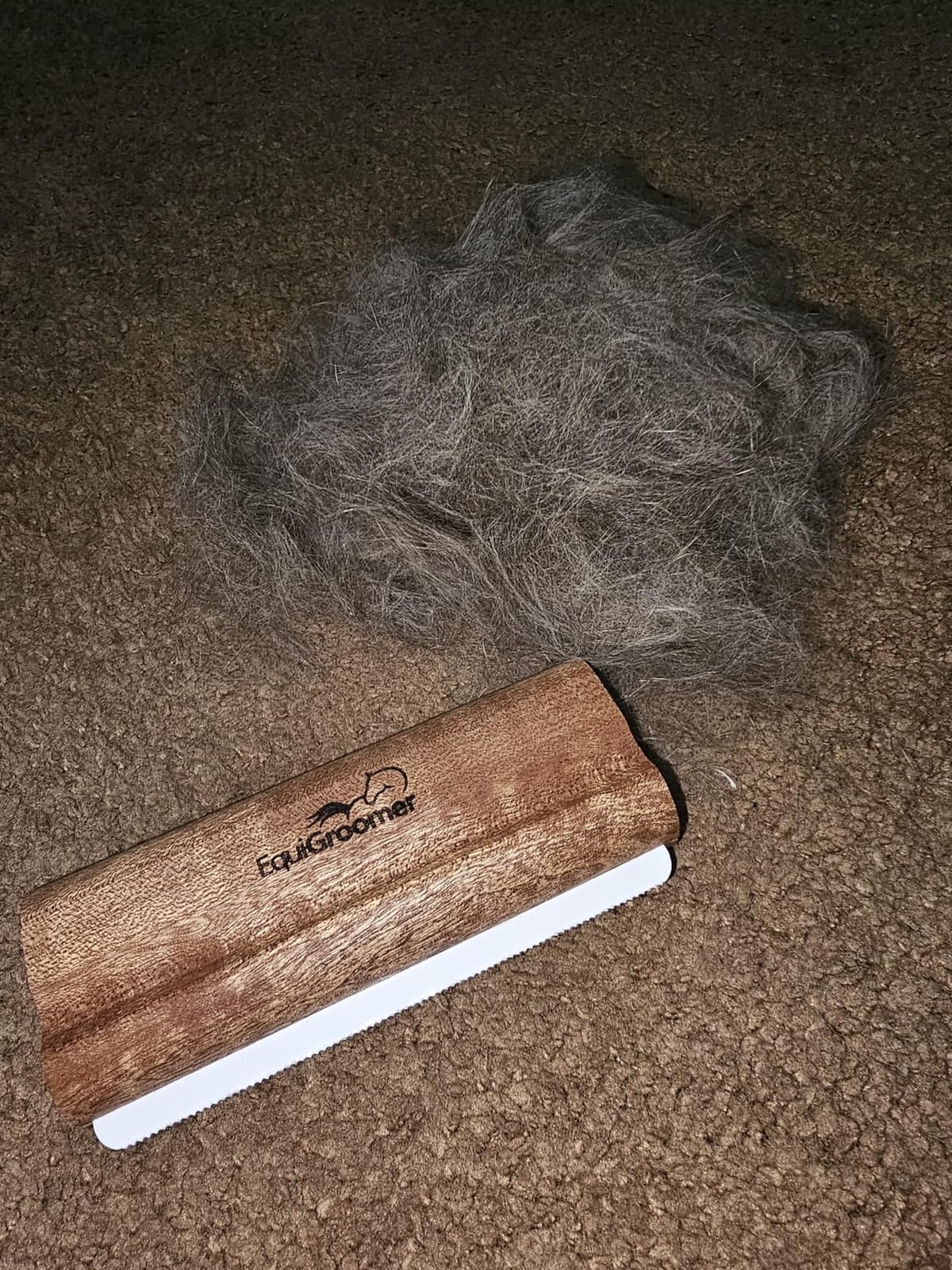
The design costs you in two ways. The blade collects hair and has no release mechanism, so you strip it by hand every few passes. And a small head over a full body means more passes overall, which is fine for a ten-minute spot session and tedious as a whole-cat groom.
Reviewers also note it can catch and pull slightly on curlier or wavy coats. On a smooth or straight coat it behaves; on a curly coat, work slowly and stop at the first sign of catching.
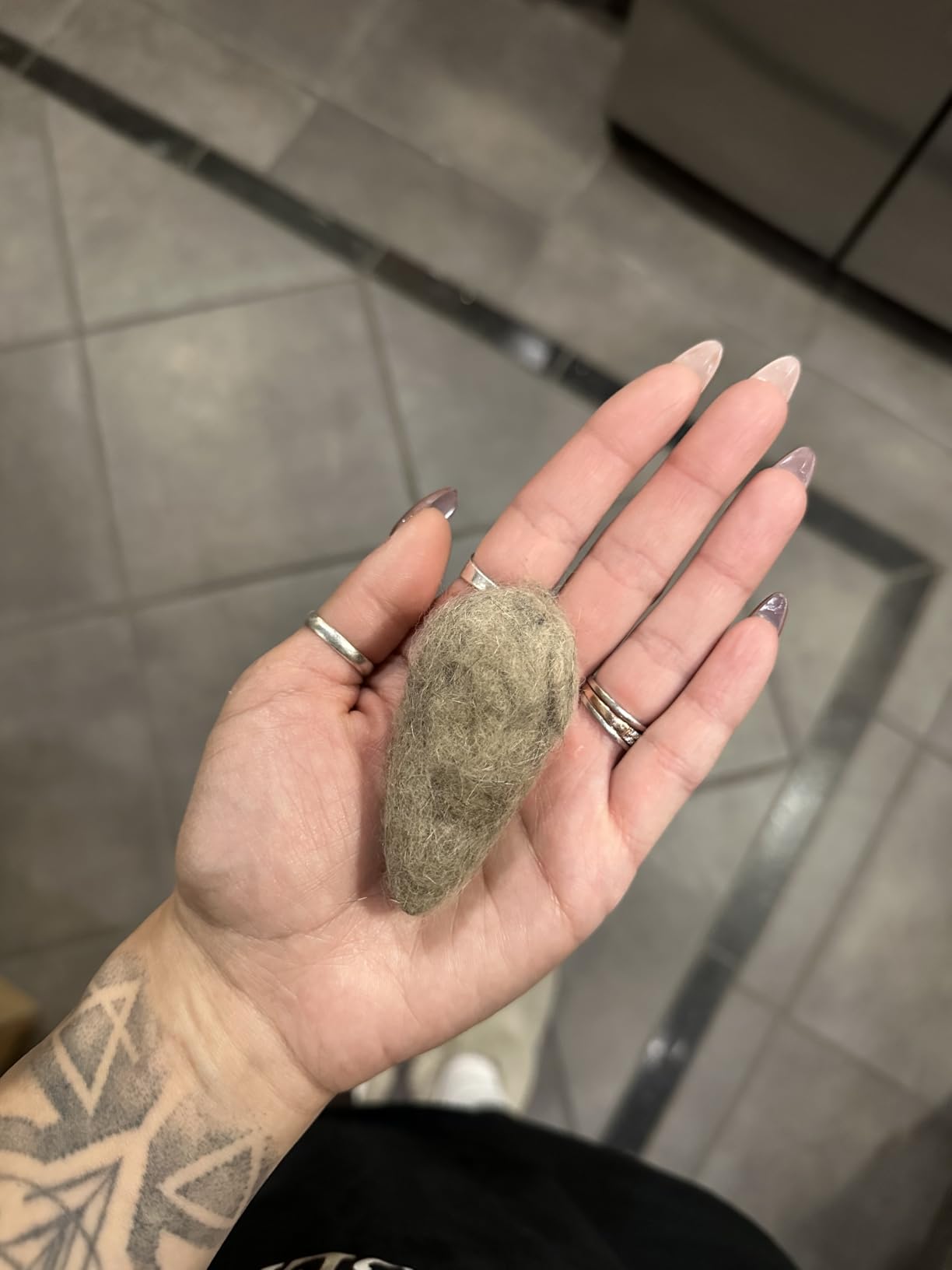
Where it earns its slot in the routine
Use it as the finisher. After the undercoat rake has cleared the heavy loose hair from the back and flanks, this tool handles the parts the rake cannot be placed on, and it does so without the cat having to tolerate a big head moving near its face.
That combination also makes it the better choice for a cat that is fine with grooming but not with being handled around the head. Keep the strokes light, work the direction of the coat growth, and stop if you see skin through the fur or any resistance.
Where it falls short
Manual clearing between passes is the biggest annoyance and it adds up over a long session. It is too small to be efficient as a whole-body tool and it can pull on curlier coats.
If your cat is a heavy shedder, this is a supporting tool, not the main one.
12. H HANDSON Pet Grooming Gloves: Best for Cats Who Hate Being Brushed
H HANDSON Pet Grooming Gloves – Patented #1 Ranked, Award Winning Shedding, Bathing, & Hair Remover Gloves – Gentle Brush for Cats, Dogs, and Horses (Grey, Small)
- Works on cats who refuse every brush
- Whole cat groomed in minutes
- Nodules leave the coat soft
- Protects hands during bathing
- Removed hair flies everywhere
- Nodules miss very fine stray hairs
- Water gets inside during bathing
When a cat will not tolerate any tool with metal in it, gloves are the way in. The rubber nodules on the palms and fingers give the same rubbing motion a hand gives when you stroke a cat, which is why cats accept them. Owners report that a full groom takes minutes, that the coat is left soft, and that the gloves work even on cats who bite brushes.
Nearly 20k reviews at 4.4, and the strongest recurring use case is not ordinary shedding. It is senior cats, cats with mobility or balance issues, and owners who physically cannot manage a metal pin bed. For those situations there is no substitute in this list.
The fur comes off the coat and goes into the air. Owners describe vacuuming immediately afterward, and on a heavy shedder that cleanup can rival the grooming itself. The nodules are also relatively large and spaced out, so very fine stray hairs slip past, which means the result looks dramatic while the coat still holds some loose hair.
Rubber also has a lifespan. Some owners report nodules cracking or shedding with heavy use, and the gloves are harder to sanitize than a metal tool, so if your cat has a skin condition, wipe them down between cats rather than relying on a quick rinse.
Where it beats every metal tool
Three situations. The first is a cat who ends the session the moment metal appears, where gloves let you keep the routine going. The second is a senior or unwell cat who cannot be held still for long, because a standing rub removes hair without restraint. The third is grooming during a bath, since the gloves keep your hands out of the water and the scratching.
It is also the natural first step in a desensitization sequence. Gloves, then a bristle brush, then a gentle pin brush, and by the time you reach the metal tool your cat has already learned that grooming is not the dangerous thing it was.
Where it falls short
It is a maintenance tool, not a shedding specialist. The hair ends up on your floor instead of in the tool, and the nodules are too widely spaced to catch fine hair. Water and suds getting inside during a bath is a complaint you will hear often.
Rubber degrades. Treat cracking or shedding nodules as a reason to replace the gloves rather than keep using them on a sensitive cat.
How to Match a Tool to Your Cat’s Coat
Match the tool to the coat, not to the marketing. Here is how the coat types in this category actually break down.
Short hair, sensitive skin: a self-cleaning slicker with round bead or rubber tips. The tips are not optional on sensitive coats.
Short hair, heavy shed: a blade-style deShedding tool, used seasonally with firm limits on passes.
Long hair, moderate shed: a slicker for the surface, then a metal comb to the skin so mats cannot start.
Long hair or double coat, heavy shed: a rounded-tooth undercoat rake for the undercoat, then a slicker or comb to finish.
Matted or tangled coat: a two-sided dematting comb, blade side first, rounded side second.
Senior, thin or balding coat: a grooming glove or a soft bristle brush. Little pressure, high frequency.
Cats who hate brushing: a glove to start, then a soft slicker with bead tips.
Heavy cats over 20 pounds: a large head, a curved handle, and a non-slip base so you are not chasing the tool across the floor.
Breed is a useful shortcut. Maine Coon, Ragdoll, Norwegian Forest Cat and Siberian types need undercoat rake plus comb. Persian and other dense long-hair coats need combing more than brushing because the coat mats at the skin. British Shorthair and similar plush short coats do well with a slicker or a rubber curry brush. Sphynx and other low-coat cats need almost nothing except a soft bristle brush to distribute oil.
Where you set up makes more difference than most owners expect. A calm spot with a non-slip surface and a table you do not mind vacuuming will do more for a daily habit than any extra tool, and it is worth building that corner before you buy the fourteenth accessory. If your cat needs somewhere to settle between sessions, our guides to the best heated cat houses cover the outdoor side of that setup, while households that prefer everything in one box can start from our grooming kit picks and adapt the contents for a cat. Larger breeds and multi-cat homes will also appreciate our home grooming station recommendations for the washing half of the routine.
Do Deshedding Brushes Actually Work?
Yes, but only when the tool reaches the layer where loose hair sits, and only if you keep going after the obvious hair is gone. A deShedding brush or undercoat rake slides past the topcoat into the undercoat, traps hair that is already dead, and lifts it before it falls onto your furniture. The two conditions are full contact with the undercoat and enough passes per section, and the tool has to actually hold the hair it removes.
That last point is where most disappointing results come from. A tool that releases hair into the air has moved the problem, not solved it. Stick to tools that collect what they pull, or plan your sessions where cleaning up is easy.
How to Use a Deshedding Tool Without Hurting Your Cat
Hard limits are what separate a tool that helps from a tool that thins a coat, and no competitor publishes them, so here they are. Follow these and you will not damage a coat.
Three to four passes per area, maximum. Each section of the body gets three or four slow strokes in one direction. Stop there, even when more hair is still coming out. Hair that resists the fifth pass is hair that is still attached.
Once or twice a week during shed, every two weeks outside it. Blade and rake tools are seasonal tools, not weekly ones.
No pressure, ever. The blade or teeth should move the coat, not push against skin. If you are leaning on the tool, you are pulling live hair.
Dry coat only. Damp fur tightens knots and drags the blade across skin.
Skip bald or thin patches. Use a soft bristle brush there instead until the coat fills in.
Short sessions beat long ones. Ten focused minutes, twice a day, beats one exhausting hour where your cat fights the last twenty minutes.
Stop signs: flinching, tail lashing, ears back, growling, or a pink scratch mark on the skin. Any one of those ends the session for the day.
Long-haired cats deserve extra caution, and the forum consensus on r/grooming is consistent on this point: blade tools pull hard on long hair and can leave bald patches. Use an undercoat rake on long coats and save the blade for short ones.
The Shedding Season Routine
Shedding hits hardest in spring and fall when daylight changes trigger a full coat cycle. This is the sequence that worked across all of our test cats.
Brush the coat smooth first. A slicker over the whole body removes surface tangle so the next tool is not snagging hair you have not seen yet.
Do the bulk removal. Undercoat rake on long and double coats, deShedding tool on short coats, three or four passes per section.
Clear the tool. Every few passes, not at the end. Hair left in a tool falls out all over your floor during the next stroke.
Finish to the skin. Comb or slicker each area down to the skin so no loose hair is left near the base. This step is what prevents mats.
Set frequency by coat. Short hair twice a week, long and double coats daily during peak shed, senior cats every other day with a glove.
Drop back to light maintenance once the coat stops coming out in handfuls. Weekly is plenty for the rest of the year.
Hairballs are the payoff for keeping to this. Ingested hair collects in the stomach and either comes back up or causes a blockage. Cats groom themselves constantly, so anything you remove never reaches their stomach in the first place.
Cats That Hate Being Brushed: A Desensitization Plan
Most brush-averse cats are not resisting grooming. They are resisting an unfamiliar object touching an area they cannot see. The fix is a sequence that ends at the tool you actually want to use.
Start with the glove. No tool, no restraint. Rub the coat for a minute a day and stop while your cat is still enjoying it.
Move to a soft bristle brush. Same motion, but now there is an object. Keep sessions short and end early.
Add the slicker with bead tips. Start on the back and shoulders only, three strokes, once a day. Rounded tips mean no scratching.
Extend the area slowly. Add the flanks, then the haunches, then the tail base over the following weeks.
Introduce the undercoat rake last and only in season, with the three-to-four-pass limit. By this point your cat already tolerates the routine.
Reward and timing do most of the work. Pair the brush with something your cat likes, stop before they object rather than when they object, and never follow a session with the vet carrier.
What Professional Groomers Reach For
Groomers generally use a small kit rather than one hero tool, and the pattern is consistent across the trade.
A rounded-tooth undercoat rake for the undercoat on long and double coats, exactly as the owners on r/grooming describe.
A bead-tipped slicker for surface work and for finishing after the rake.
A metal comb used down to the skin at the face, armpits and tail base, where mats actually start.
A rubber curry brush or grooming glove for short coats and for cats who will not tolerate metal.
A two-sided dematting comb kept in reserve rather than used routinely.
On shorthair specifically, groomers posting on r/grooming tend to favour rubber tools over generic slickers, because the rubber feels like a massage and lifts loose hair like a magnet. That matches how the rubber gloves and curry-style tools performed on our short-haired test cat.
A professional groomer is worth the visit when the coat has mats tight to the skin, when the cat is elderly or unwell and cannot be handled, or when shedding is heavy enough that you are vacuuming constantly and the coat still looks patchy.
If You Have Over-Groomed Your Cat
If you used a blade or rake tool too often and now see thin patches, the coat recovers on its own. Stop blade tools entirely, and switch to a soft bristle brush or a grooming glove only, which stimulates the skin without removing live hair.
Expect visible improvement in roughly four to eight weeks and a full return to normal coat density over two to three shed cycles, since hair growth is slow at the follicle. Keep the skin out of direct sun if a patch is bare, and check that the skin itself is not red, scaly or scabby. If the bare patch has not improved in a month, or if your cat is licking or chewing the area, that is a vet question rather than a grooming one. Malnutrition, parasites and illness all show up in the coat before they show up anywhere else.
Tools We Use Carefully and Tools We Pass On
A few categories deserve caution rather than recommendation.
Steam and water-mist brushes get frequent warnings from owners about trapped moisture, mold and bacteria in the head, and the noise and heat put most cats off. A washable slicker with a one-click button does the same job and rinses clean with nothing trapped inside.
Cheap plastic pin brushes shed pins and bend, which is both a safety problem and a waste. Check the pins and the handle joint before every use and replace the brush if either moves.
Self-grooming wall brushes rely on the cat rubbing against them. They remove a little hair but they do nothing for a cat that is avoiding grooming on purpose, and the adhesive mount is a permanent commitment on a wall you may want back.
Blade tools on long hair are not a separate tool, they are a misuse of one. The blade is designed to pass through a short coat. Long-haired cats need the rake.
Frequently Asked Questions
What is the best tool for deshedding a cat?
For most cats the best tool is a self-cleaning slicker brush with round bead tips for short and medium coats, or a rounded-tooth undercoat rake for long-haired and double-coated cats. A blade-style deShedding tool gives the fastest single-session removal on short hair but needs strict limits on passes.
Do deshedding brushes work on cats?
They do, with conditions. They only work if the teeth reach the undercoat layer where loose dead hair sits, you make enough passes per section to clear it, and the tool collects the hair instead of dropping it on your floor. A tool that releases hair into the air moves the problem rather than solving it.
Are deShedding brushes painful for cats?
Not when used correctly. The edge should never press against skin, it should move the coat. Limit any blade or rake tool to three or four passes per area, use it on dry fur, keep to once or twice a week during shed, and skip any spot that looks thin or bald. Long-haired cats should use an undercoat rake rather than a blade tool.
What is the best cat brush for cats who hate being brushed?
A rubber grooming glove or mitt is the usual starting point, because the motion is identical to petting. Move up to a soft bristle brush, then a slicker with round bead tips, and save the undercoat rake for last and only in shed season. Short sessions that end before your cat objects build tolerance faster than long ones.
How often should I brush a shedding cat?
Short-haired cats twice a week, or every day during shed season. Long-haired and double-coated cats daily while the coat is dropping. Senior cats every other day with a glove or soft brush. Outside peak shed, once a week is enough for short coats and twice a week for long ones.
What do professional cat groomers use?
Most groomers work with a small kit rather than one tool: a rounded-tooth undercoat rake for the undercoat, a bead-tipped slicker for surface work and finishing, a metal comb used down to the skin at the face, armpits and tail base, and a rubber curry brush or glove for short coats and cats who will not tolerate metal.
Conclusion: Your Shedding-Season Routine
The best cat grooming tools for shedding are the two or three that match your cat’s coat and its patience. Start with the dual-sided undercoat rake if your cat has long or double hair, or a bead-tipped self-cleaning slicker if the coat is short, and add a compact blade tool for the face and paws.
Then respect the limits. Three or four passes per area, seasonal use only for anything with a blade edge, dry fur, and a stop at the first flinch. Grooming that follows those rules keeps hairballs down, keeps mats from starting, and keeps your cat willing to come back for the next session in 2026. If your cat is losing coat in patches, licking the area or hiding from every grooming attempt, book a vet visit before you buy another tool.