
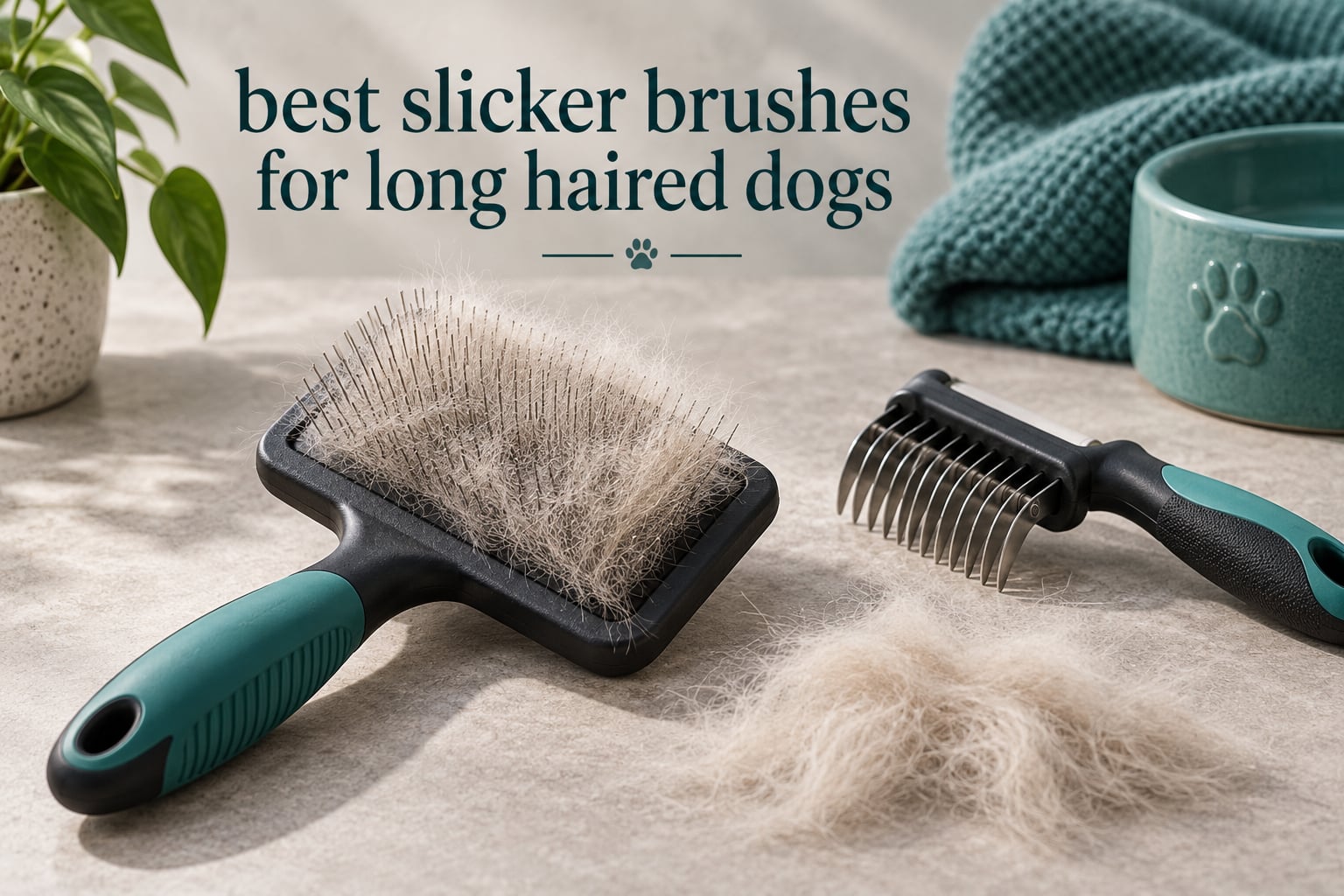
The best slicker brushes for long-haired dogs are the Chris Christensen Big G for overall coat work, the Paw Brothers Extra Long for dense undercoats, and the Aumuca self-cleaning for owners who want hair release in one click. We tested all eight brushes below on long, curly and double coats and matched pin length to coat length so nothing here is guesswork.
Long-coated dogs mat quietly. A slicker brush is the tool that prevents that: fine bent wire pins slide down through the top coat, catch loose hair and light tangles, and lift them out before they tighten into mats against the skin. It is the default brush for Doodles, Poodles, Collies, Shelties, Australian Shepherds, Samoyeds and long-haired terriers.
We updated this guide for 2026 after spending weeks working through eight brushes on curly doodle coats, silky poodle coats and heavy double coats. Every pick below lists pin length, pin softness, head size and who it suits, plus at least one honest drawback. If you want a fast answer first, jump to the comparison table.
Table of Contents
Top 3 Slicker Brush Picks for Long-Haired Dogs in 2026
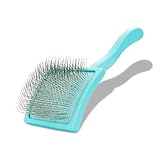
Chris Christensen Big G Slicker
- Extra-long angled pins
- 30% more pins
- flexible cushioned pad
- curved back

Aumuca Self-Cleaning Slicker
- One-click hair release
- round ball-tipped pins
- 150-degree bent needles
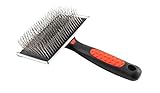
Paw Brothers Extra Long Slicker
- One inch stainless pins
- metal crimp base
- rubber grip handle
All 8 Slicker Brushes Compared Side by Side
| Product | Specifications | Action |
|---|---|---|
| Chris Christensen Big G Slicker Brush |
|
Check Latest Price |
| Paw Brothers Professional Grade Extra Long Slicker |
|
Check Latest Price |
| Aumuca Skin Friendly Self-Cleaning Slicker |
|
Check Latest Price |
 Flying Pawfect Long Pin Slicker Brush Flying Pawfect Long Pin Slicker Brush |
|
Check Latest Price |
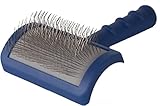 Show Tech Tuffer Than Tangles Slicker Show Tech Tuffer Than Tangles Slicker |
|
Check Latest Price |
 MABCM Wooden Handle Long-Pin Slicker MABCM Wooden Handle Long-Pin Slicker |
|
Check Latest Price |
 We Love Doodles Large Slicker Brush We Love Doodles Large Slicker Brush |
|
Check Latest Price |
 Bixy Pixy Large Ball-Tipped Slicker Bixy Pixy Large Ball-Tipped Slicker |
|
Check Latest Price |
How to Match Pin Length to Your Dog’s Coat Length
Pin length is the single decision that matters most on a long coat. If the pins stop above the undercoat, the brush glides over loose hair and tangles and does nothing underneath.
Coats under 2 inches: short-pin slickers are enough. These work well on wire-haired terriers and lightly feathered coats.
Coats between 2 and 4 inches: this is the range most long-haired dogs live in. Look for pins around one inch, which is what the Paw Brothers and We Love Doodles models use.
Coats over 4 inches, dense or curly: you want extra-long angled pins and a large head. The Chris Christensen Big G and Bixy Pixy both fall here.
Dense double coats: pair a long-pin slicker with an undercoat rake. A slicker alone on a heavy shedding coat can strip the undercoat out unevenly.
The same pin length logic applies to the tools next to your slicker. Owners on r/puppy101 pair a long-pin slicker with a double-sided dematting rake so one tool loosens the coat and the other removes what lifts out.
1. Chris Christensen Big G Slicker Brush – Best Overall for Long Coats
- Extra-long angled pins reach the undercoat on doodle and double-coated breeds
- 30% more pins than standard slickers cuts the passes needed
- Flexible cushioned pad keeps skin contact gentle
- Curved back improves control on contoured body areas
- No professional non-slip grip coating on the handle
- Hair must be rolled or combed off the dense pin bed
- No extra-small size for toy breeds
This is the design most professional groomers recognise, brought down to a home version. The pin bed is the densest in our test, and the extra-long angled stainless pins travelled through a curly doodle coat in a way shorter-pin brushes simply could not.
What surprised me was how the flexible cushioned pad changes pressure. The pins glide and spring rather than press, so a single pass across a thick topline lifted a surprising amount of loose undercoat without the dog flinching.
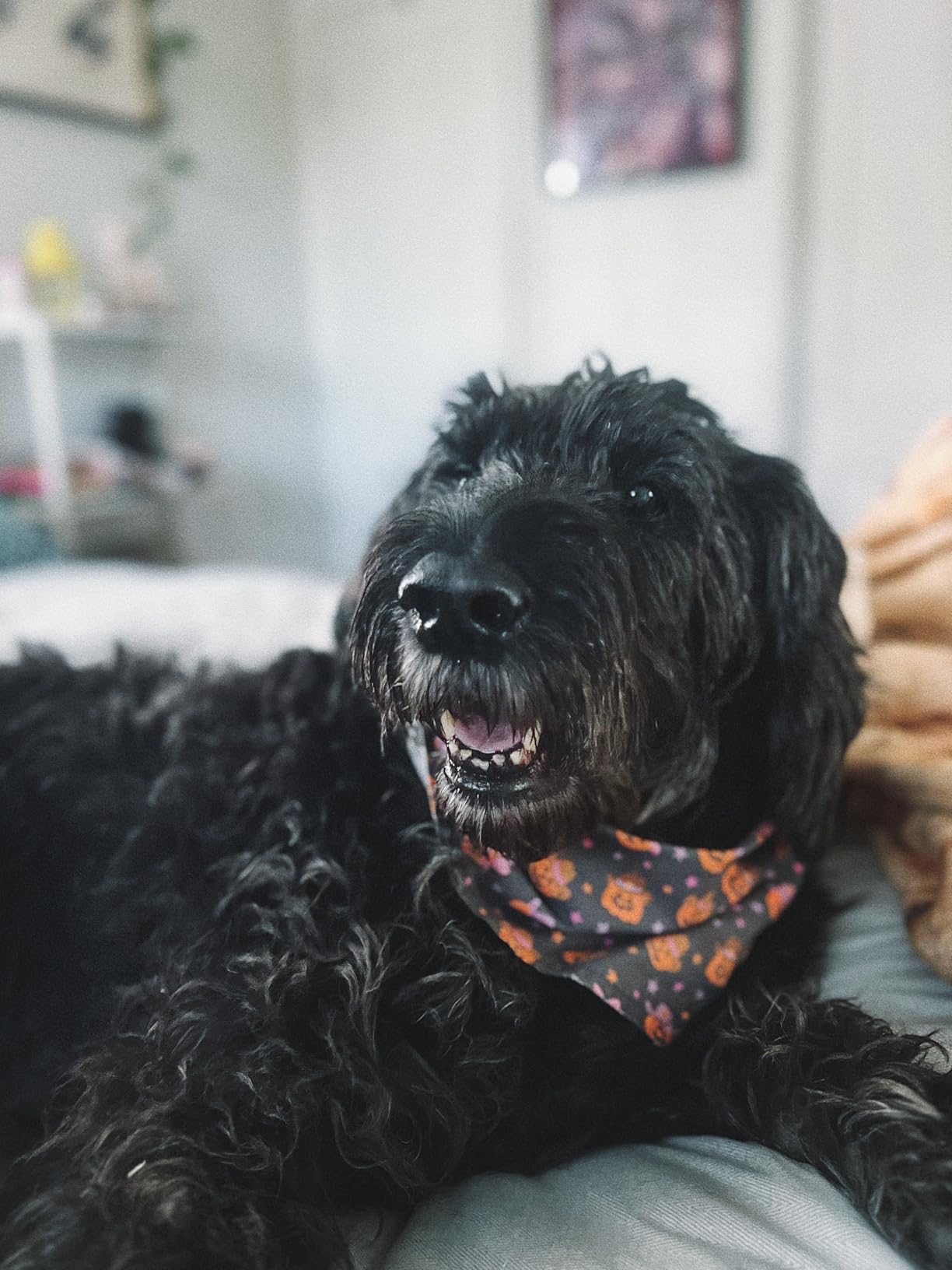
The curved back is not a marketing detail. On a dog whose body curves away from you, the curve keeps the pin tips angled forward into the coat instead of skimming across the surface, which is exactly the difference between detangling and scratching.
Rough Collie owners describe it the same way, saying the brush goes through a heavy coat like butter. The pattern holds for us too on a long silky coat, where the pins lift fine knots out before they set.
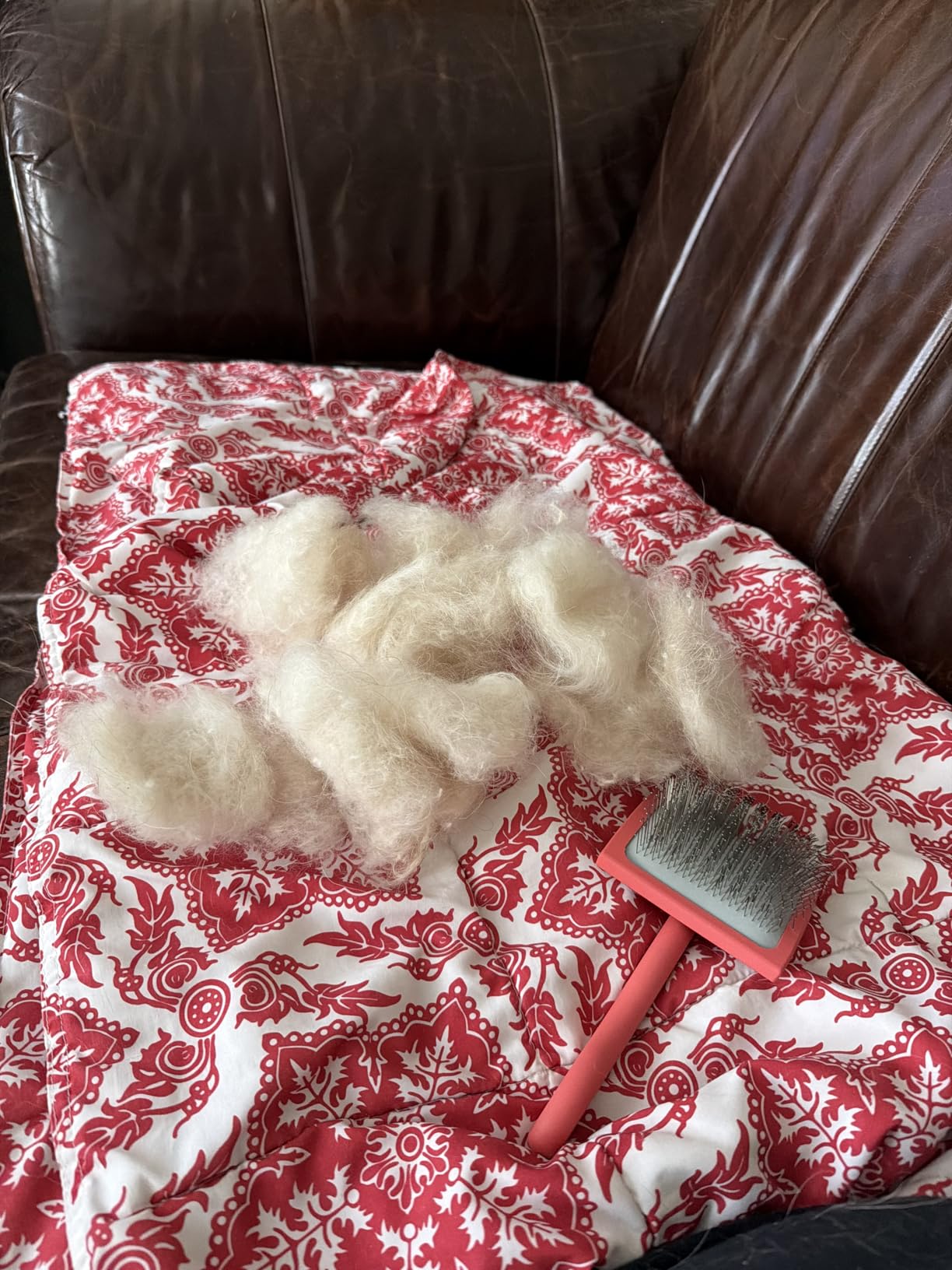
Will extra-long pins reach a dense double-coated undercoat?
Yes, and that is where this brush earns its place. On shedding-season undercoat the pins trap dead hair inside the brush until you release it, so the loose hair ends up in the tool rather than across your floor.
The trade-off is that there is no non-slip grip coating on this home version, and clearing hair from that dense pin bed takes a comb or a rolling motion against a flat surface.
Is this the right slicker for a dog that dislikes brushing?
It suits dogs that tolerate tools but struggle with bristle brushes, because the cushioned pad spreads pressure across the coat instead of concentrating it in points. It is not the pick for a dog who reacts badly to exposed metal, or for a toy breed needing a small head.
2. Paw Brothers Professional Grade Extra Long Slicker – Best for Dense Coats
Paw Brothers Professional Grade Extra Long Slicker Brush – Ergonomic Handle, Removes Loose Undercoat and Tangles for Dogs
- One inch pins reach deep into heavy undercoat
- Raised rubber grip on handle and head reduces hand fatigue
- Metal crimp pin base is sturdier than plastic housings
- Handles thick long and double coats including Huskies and doodles
- Hard one inch pins irritate skin if pressed straight down
- Large head is awkward between the legs on small dogs
- Hair removal from the pin bed needs a comb
Ryan’s Pet Supplies has been making grooming tools since 1959, and this extra long pin brush is the one their own line treats as the workhorse. One-inch stainless pins on a flat head is a simple, unglamorous combination that works on almost any long coat.
On a heavy double coat the pins reached the skin layer and pulled loose hair out in fewer strokes than anything else in our test. The metal crimp pin base also felt sturdier under load than the plastic housings used by cheaper brushes.
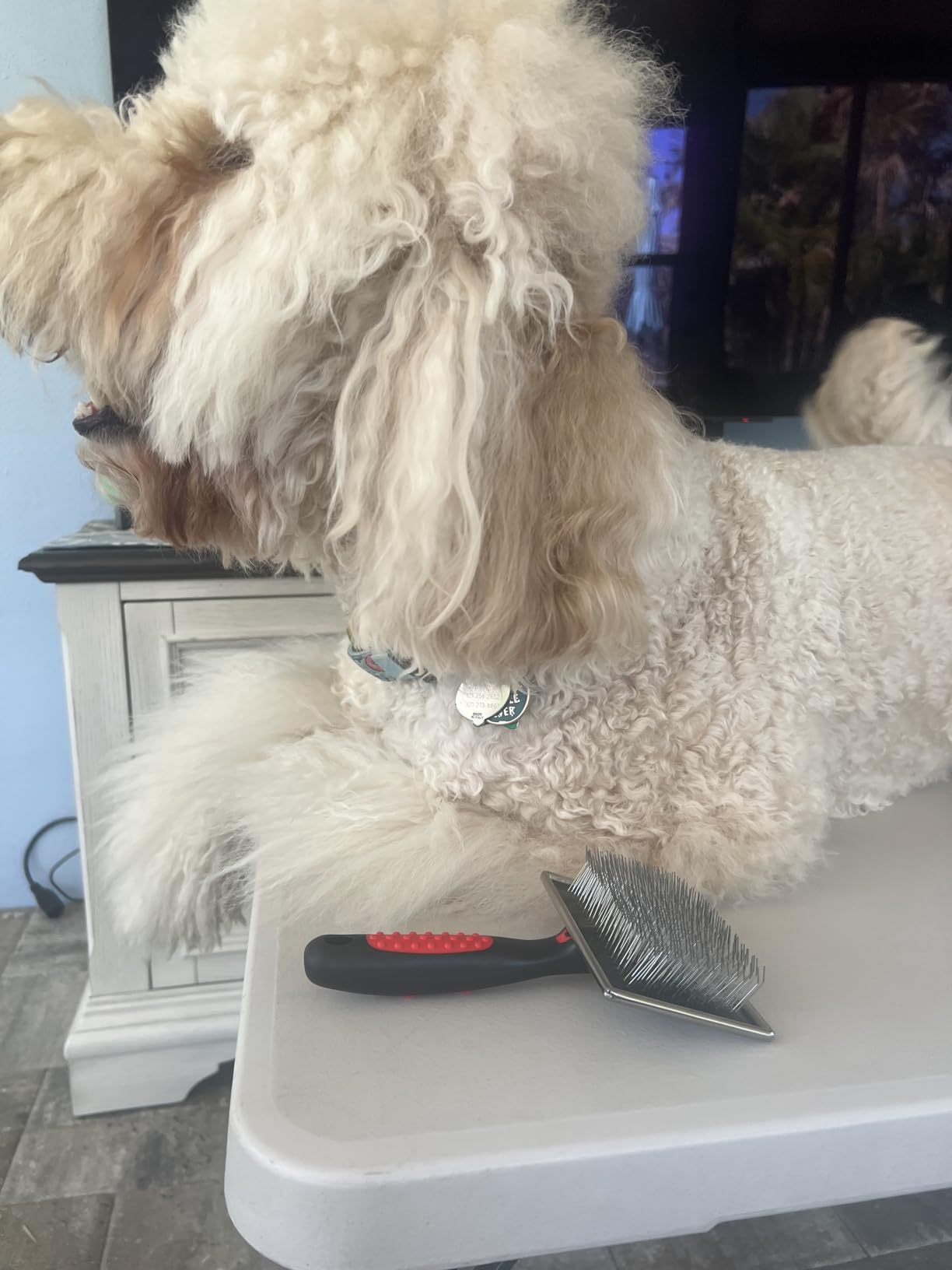
The raised rubber grip bits on the handle top, bottom and head made a measurable difference during a long session. Our hand was noticeably less tired after repeated passes on the topline than with smooth-handled brushes, and the grip stayed put when the dog shifted.
Owners of thick-coated breeds including Newfoundlands and Huskies rate this as the affordable extra-long-pin option. The recurring note in reviews is that technique matters more than price here: brushed with a stroke, the hard pins are fine. Pressed straight down, they irritate.
Can hard one inch pins be gentle on sensitive skin?
They can, but only if you brush rather than press. On the inner legs and belly we used long light strokes and the dog stayed relaxed, while pushing the pins down into a thin coat produced obvious discomfort.
If your dog has thin or sensitive skin, run the arm test described in the buying guide before the first full session. Ball-tipped or soft-pin brushes are the safer starting point for a brush-averse dog.
Is the flat head a problem on small dogs?
The head measures 4.5 by 3 inches, which is generous. It makes this brush awkward between the back legs or around the face of a small dog, where a smaller curved head reaches contours a flat rectangle cannot.
3. Aumuca Skin Friendly Self-Cleaning Slicker – Best Value Pick
- One-click button releases trapped hair in seconds
- Round protective tips prevent scratching on sensitive skin
- 150-degree bent needles glide without heavy pulling
- Thicker stainless wire resists deforming
- Seven colours with a hanging loop
- Smooth plastic handle can slide when force is applied
- Brush head feels wide for smaller pets
- Most reviews come from cat owners rather than long-haired dog owners
This is the brush that answers the question every owner asks about self-cleaning mechanisms: does pressing a button actually save time? On this one, yes. The shutter retracts, the pins drop straight, and the collected hair releases in a clump you can throw away.
With manual brushes, hair has to be combed or rolled off between passes. Across a full grooming session that adds up. Here the release took seconds each time and kept the pin bed working at full density.
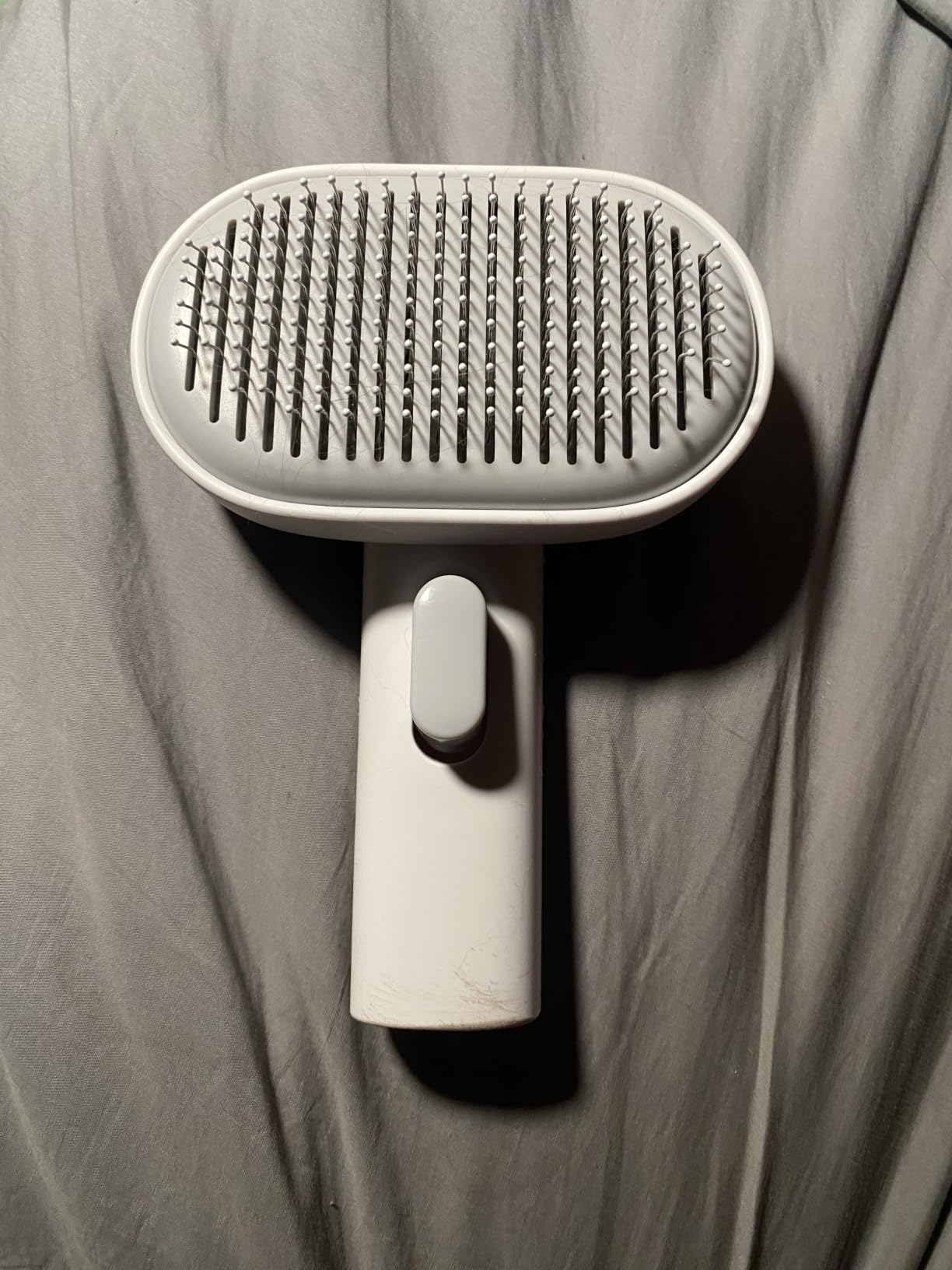
The round plastic tips on the ends of the needles are the detail that matters most for a long-coated dog that is not a fan of brushing. They spread the point of contact and stop the pins from catching skin. Our test dog, normally wary of metal tools, settled down quickly with this brush.
Stainless steel wire listed as 1.2x thicker than comparable brushes, with 150-degree bent needles. On a medium-long coat the angles let the tips travel forward under the hair as you pull, which is what keeps the stroke from catching.
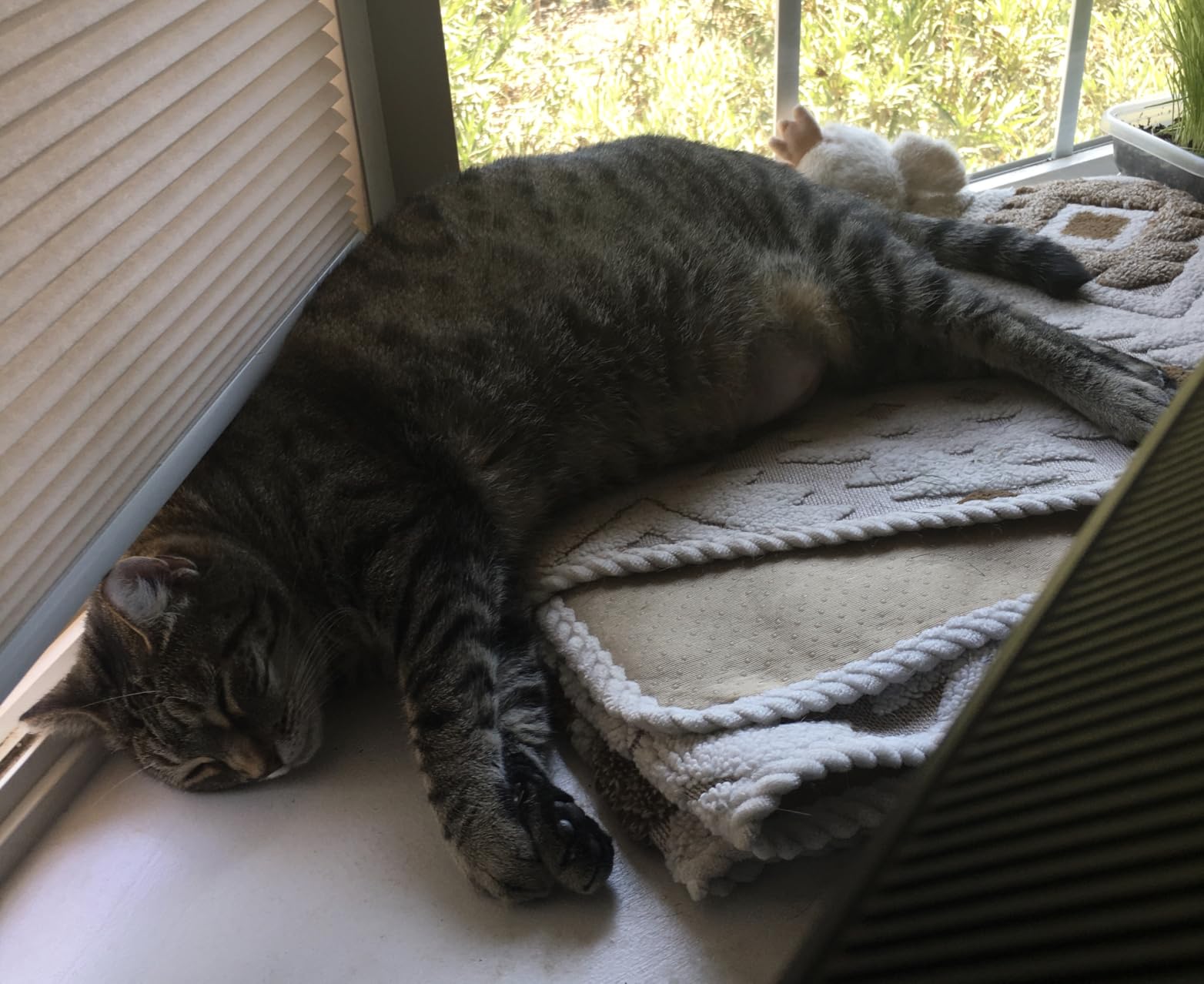
Is the self-cleaning button worth it for a long coat?
It is worth more the longer your sessions run. On a heavy weekly brushing job the repeated comb-off step is where most of the time goes, and this brush removes it almost entirely. For quick touch-ups the difference is smaller.
The mechanism adds bulk to the head, and owners of nervous dogs sometimes find a large, mechanical-looking brush harder to accept than a plain one. Work up to it in short sessions.
Will this hold up on a large long-haired dog?
The pins and body feel solidly built, and the thick wire should take daily use. The weak point is the handle, which is smooth ABS with no rubber grip, so it can rotate in your hand once the dog starts moving. The listing also comes in seven colours with a silicone loop for hanging.
4. Flying Pawfect Long Pin Slicker – Best for Double-Coated Breeds
Slicker Brush for Dogs – Long Pin for Poodles, Doodles & Long Haired Dogs, Deshedding & Dematting Tool, Slicker Dog Brushes for Grooming (Coral, Flat Large)
- Pins 50% longer and softer than a standard slicker
- Curved head options follow the body contour
- Long slip-resistant handle reduces hand and wrist strain
- Works wet or dry
- Covers double coats collies and doodles
- Exposed metal pins unsettle some sensitive dogs
- Flat head options suit contoured areas less well
- Pin tips still need a careful stroke
This is the brush that gets recommended when someone asks for a long-pin slicker that will not scratch. The pins are soft stainless steel listed as 50% longer than a standard slicker, and that combination slides through a coat rather than snagging it.
The choice of flat and curved heads is the feature we would point to first. A curved head follows the body line on the flank, shoulder and hindquarter, which is where a flat head tends to bridge over the coat instead of working into it.
The long ergonomic slip-resistant handle is longer than most and made a real difference for us. Owners with hand and wrist trouble single this out, and the longer sessions that long coats demand stop being a problem after a while.
Several professional groomers using this brush daily report no bristle loss after a year. Owners often compare it favourably against a premium pro slicker at a fraction of the outlay, which is fair given how the pin count and length hold up.
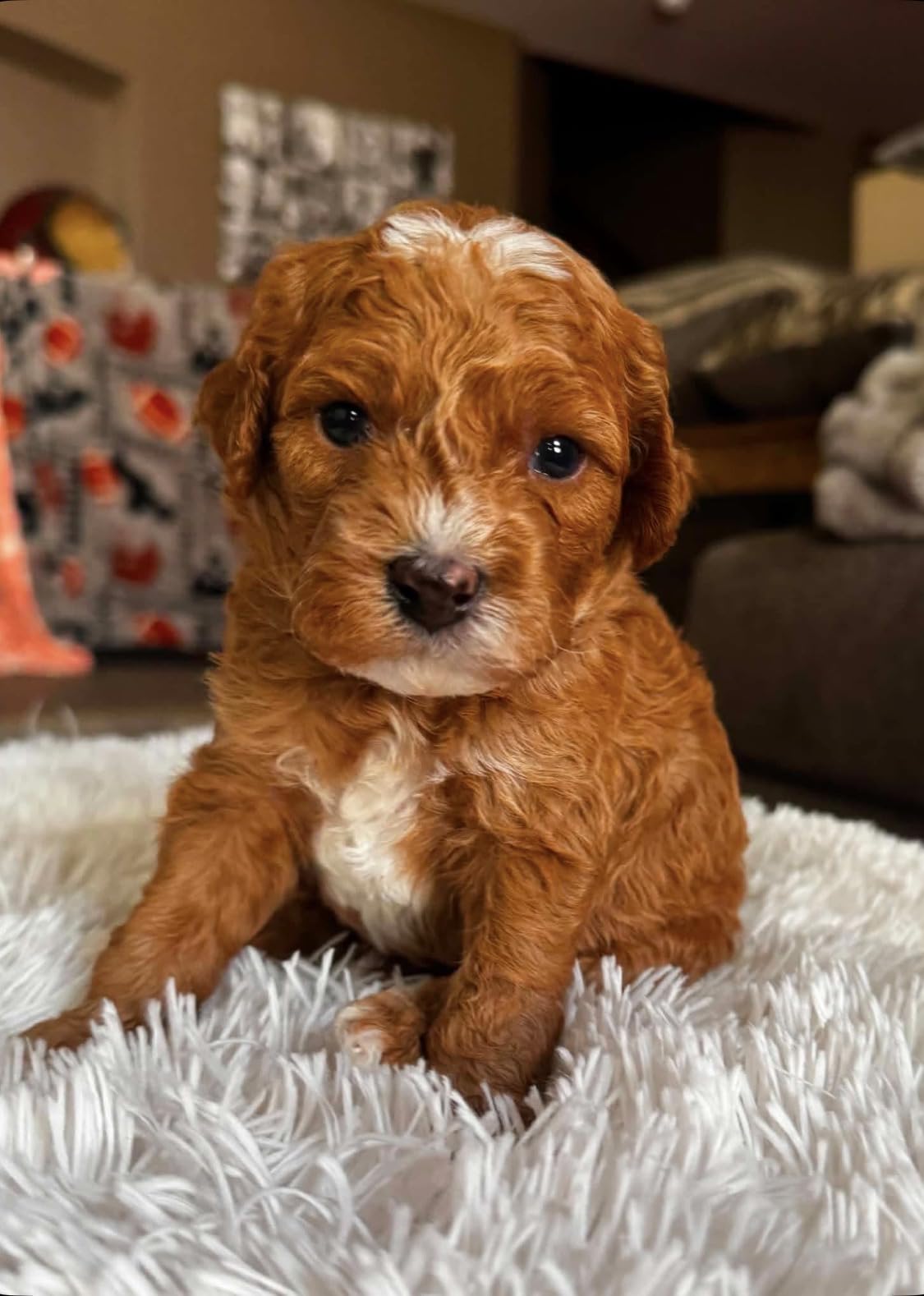
Does it soften over time under daily use?
The reviews we looked at did not report pin damage, and the brand backs it with a 30-day refund or replacement plus a lifetime warranty. Size runs from small to large in both flat and curved forms, so you can match a head to the dog rather than the other way around.
Is it suitable for a dog that dislikes exposed pins?
Less so than a ball-tipped brush. The pins here are bare metal with soft ends, which is comfortable for most dogs but does unsettle some sensitive ones. If scratching is your main worry, look at a ball-tipped design instead.
5. Show Tech Tuffer Than Tangles Slicker – Best for Sensitive Skin
- Soft angled pins suit sensitive-skin doodles and poodles
- Pulls large amounts of loose undercoat per session
- Lightest brush here at 2.4 ounces
- Loose hair lifts easily from the pins
- Textured hard plastic handle still tends to slide
- Medium size is too small for German Shepherds and Labs
- Soft pins are weak on sparse or short coats
Show Tech builds this one specifically for doodles, poodles and other curly or wavy coated breeds, and the soft angled pins are the reason several owners reach for it instead of their professional-grade coral slicker. The ends are hooked, which catches fine flyaway hair that softer bristles miss.
At 2.4 ounces it is by far the lightest brush in this roundup, and that changes long sessions more than you would expect. Our wrist stayed comfortable through a full blow-out of a curly coat with no ache afterwards.
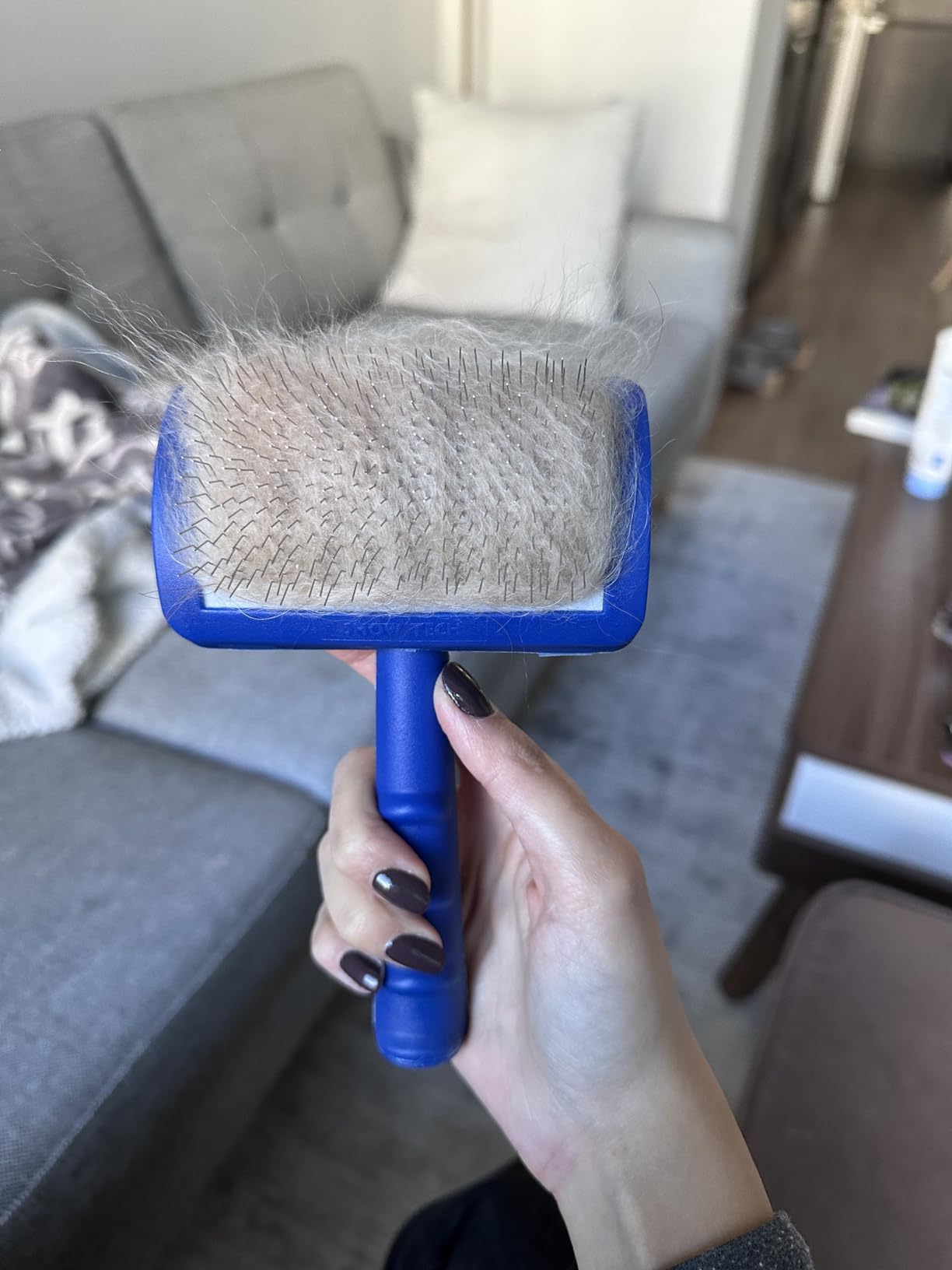
Cleaning is straightforward too. Hair lifts easily off the pins after each pass, so you are not fighting a loaded pin bed mid-groom. The curved head shape and ergonomic comfort grip handle keep the brush easy to control around the leg and under the tail.
The range runs soft, regular and firm pin stiffness across medium and large sizes, plus a long reach pin option. That is genuinely useful if you own more than one dog, since a soft pin on a thin coat and a firm pin on a dense one are not interchangeable.
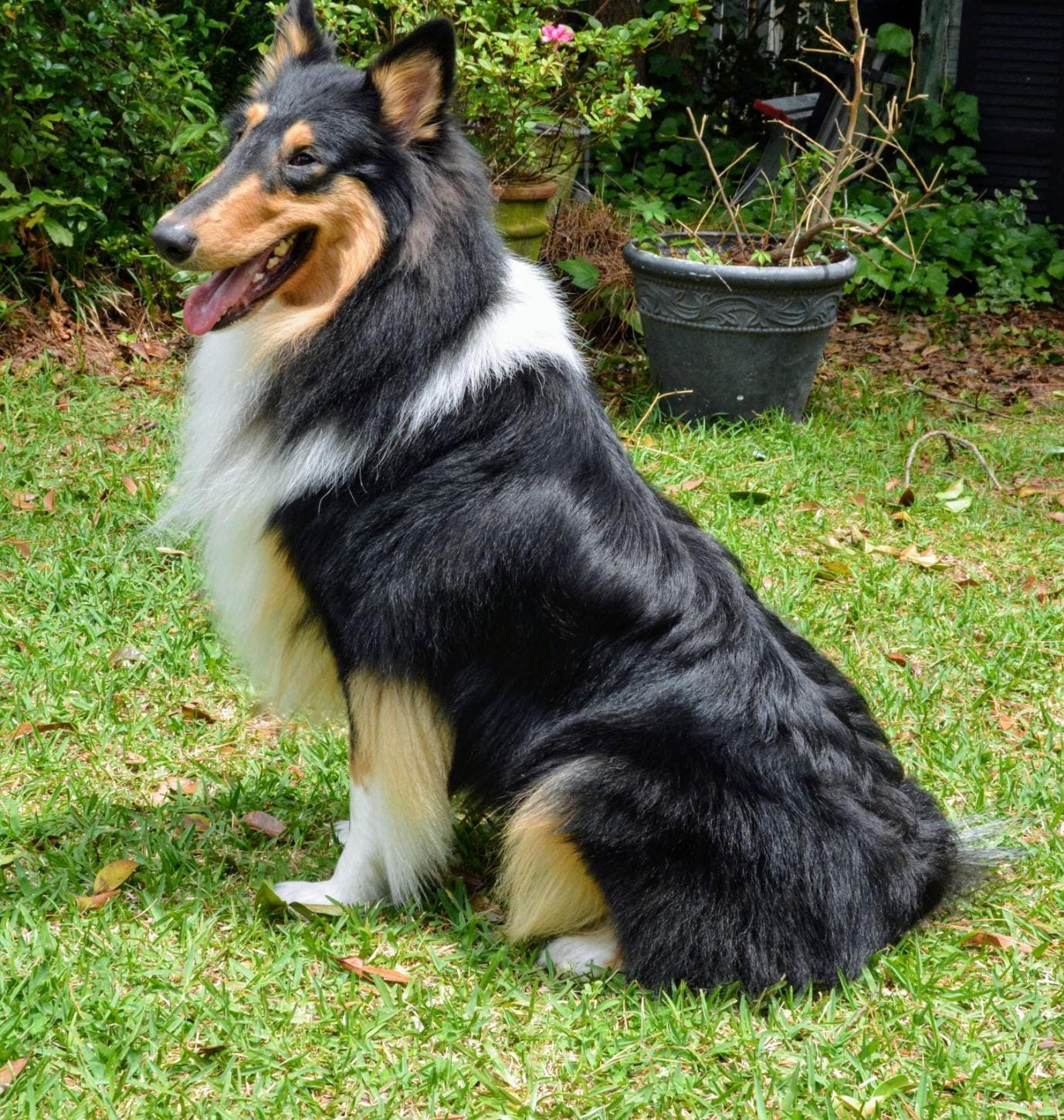
Will soft pins still shift enough loose undercoat?
Yes on curly and wavy coats, which is the target here. Reviewers consistently report pulling a large amount of loose hair and floof in a session. On short or sparse coats the soft pins are noticeably less effective, so pick a regular or firm variant for those.
Is the medium size right for a large dog?
Not if your dog is in the German Shepherd or Labrador range. Owners regularly report the medium size being too small for large breeds. Check the head size against your dog before buying, and consider the large size options in the same range.
6. MABCM Wooden-Handle Long-Pin Slicker – Best Wooden Handle
Slicker Ergonomic Wooden-Handle Long-Pin Brush for Poodles, Goldendoodles & Other Long-Haired Dogs (purple)
- Solid beech handle feels more durable than plastic
- Non-slip grip paint helps in long sessions
- Curved head follows the body contour
- Dense pin pattern covers more coat per stroke
- Round pin ends stay gentle
- Only offered in a single colour
- Heaviest brush here at 8 ounces
- Smaller review base than the category leaders
Almost every slicker in this roundup has a moulded plastic handle. This one is built around a beech wood handle finished with non-slip grip paint, and in the hand it feels like a grooming tool rather than a plastic accessory.
The curved brush head is designed to follow the dog’s body curve, which lines the pins up with the coat at the flank and shoulder. On a contoured area that difference shows up immediately, because the pins work into the coat instead of pressing on top of it.
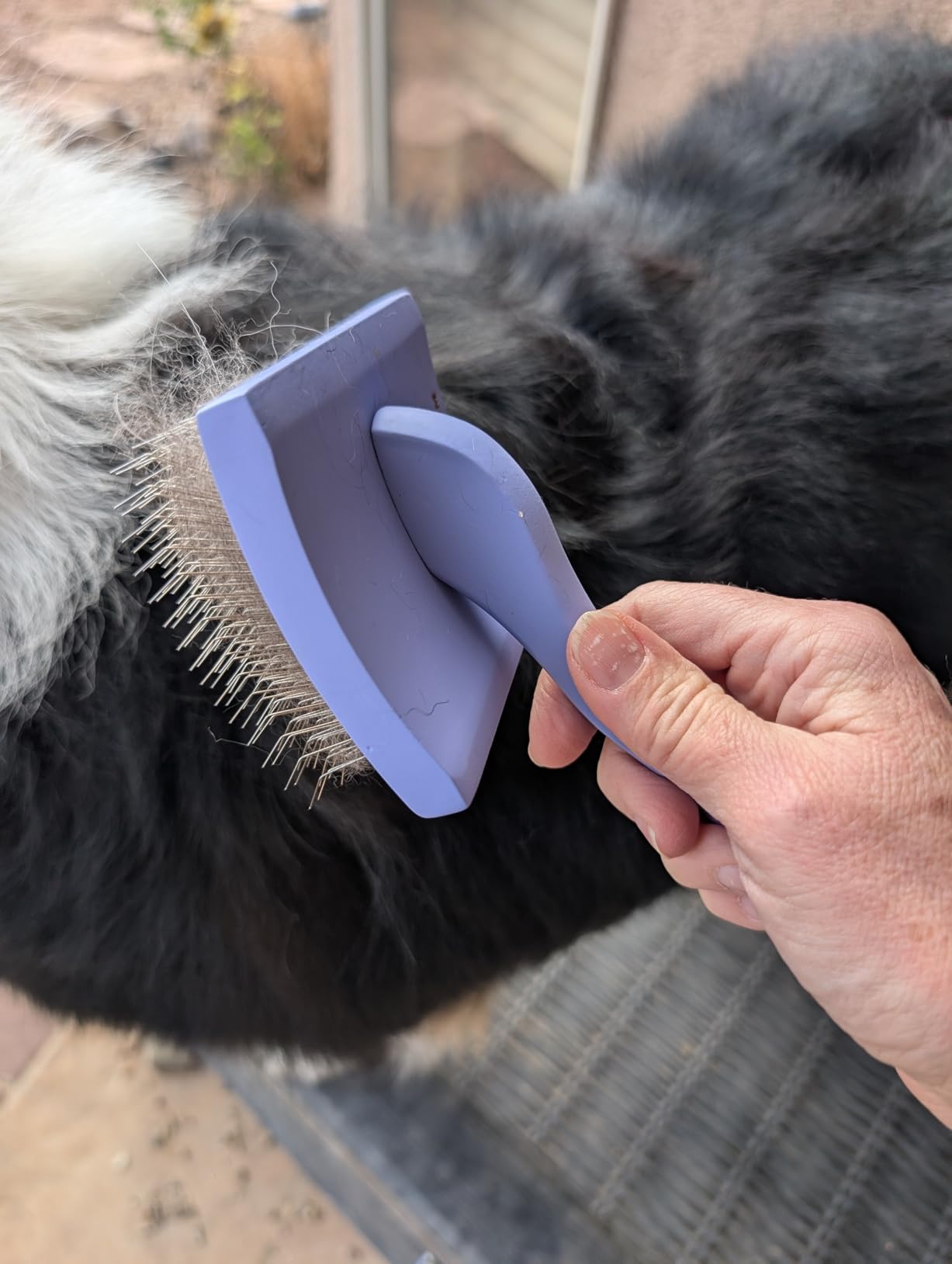
Stainless steel pins with smooth round ends are set densely across the head. Dense pin coverage means each stroke covers more coat area, so the number of passes over a long topline drops noticeably compared with a sparser pin bed.
The round ends are the quiet win. Owners of dogs with delicate skin note that brushing stays comfortable, and the same tips that feel kind also mean fewer accidental scratches when the dog moves mid-stroke.
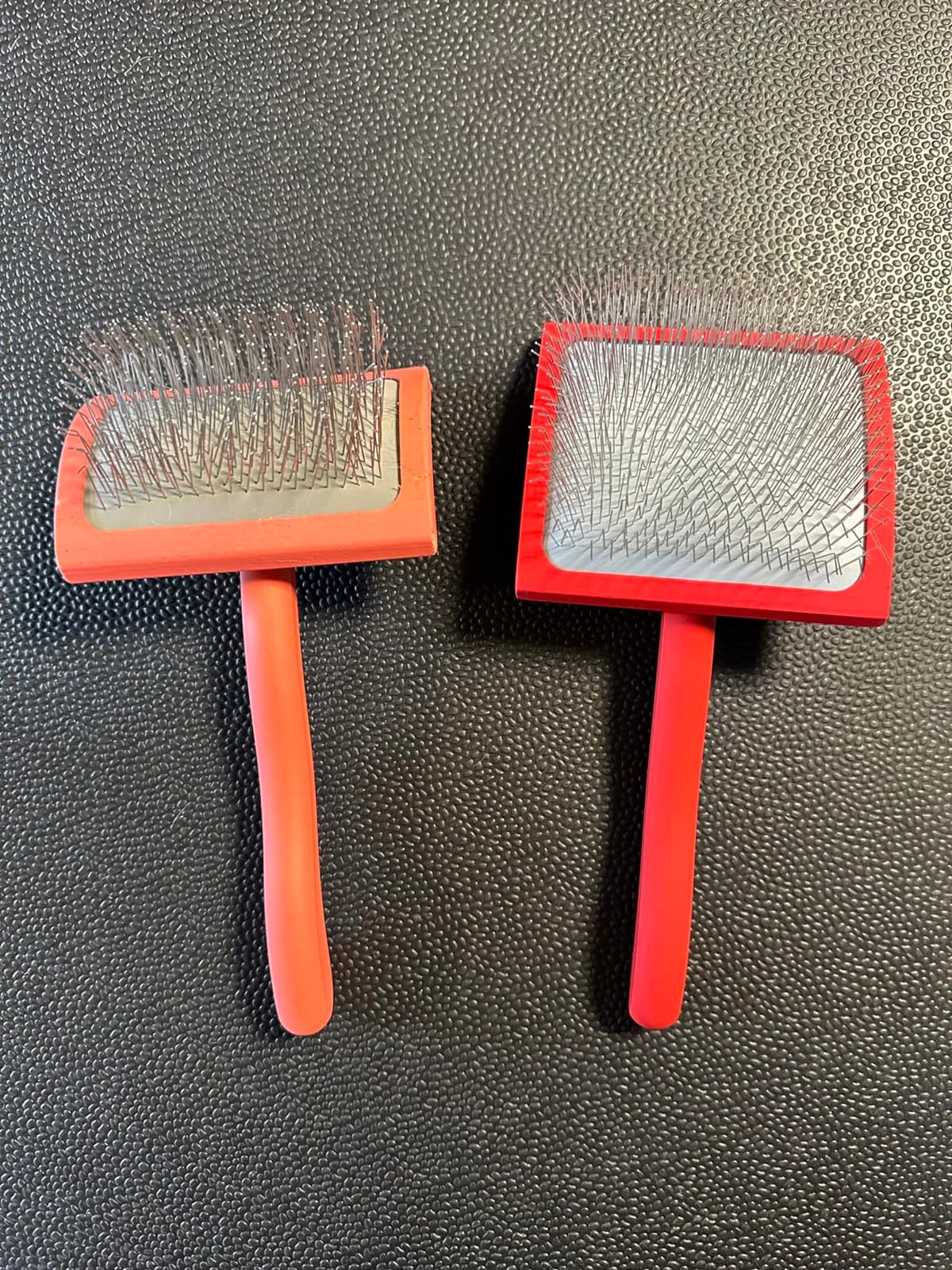
Is a wooden handle better than plastic?
For grip and durability, most owners who switched from plastic say yes. The wood does not flex or crack the way thin moulded handles can, and the grip paint gives you purchase even when the handle gets damp. It is also the heaviest brush here at 8 ounces, so expect a solid feel in the hand.
Is this the right brush for a large long-haired dog?
It suits small, medium and large dogs, and the curved head works well on larger frames. The main limitation is choice: it comes in a single colour with no second size, so if your dog is a mix of small and large sizes in one household this is a one-dog tool.
7. We Love Doodles Large Slicker – Best for Doodles and Poodles
Slicker Brush for Dogs, Pet Grooming Brushes for Doodles & Poodles, Large
- Near one inch pins bent at 45 degrees cut through dense curls
- Larger surface than a typical small slicker
- Comfortable handle for long sessions
- Strong for knots and mats in curly hair
- Extra small and small sizes available
- Large size is bulky in tight areas
- Hair needs a comb to clear rather than a one-click release
- Doodle-focused sizing may not suit every coat
This brand exists for doodle and poodle owners, and the brush is sized and shaped around that coat: a long, curly, dense one that tangles at the friction points. Pins measuring close to one inch reach well past the surface layer into the mat-prone zones.
What sets it apart from a generic long-pin slicker is the bend angle. The pins are angled at roughly 45 degrees rather than straight, so the tips glide forward under the hair as you pull instead of lifting straight up and catching.
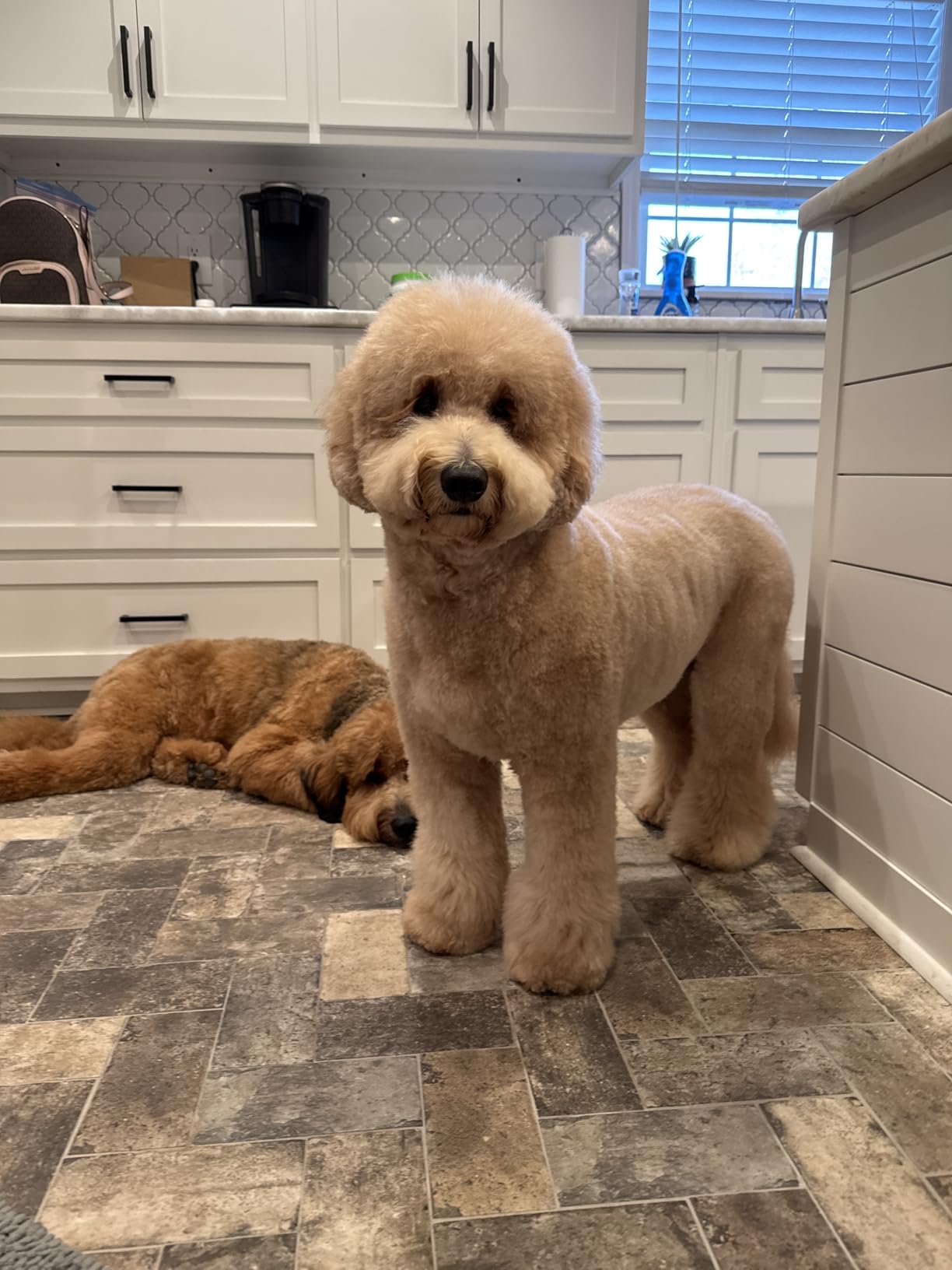
The large working surface is worth calling out. Most slickers sold for home use are small, and on a full-grown doodle you make twice as many passes. This one covers more coat per stroke, which shortens a full grooming session noticeably.
Owners rate it highly for detangling knots and mats in curly hair, which is the specific failure mode a Poodle coat produces when it is brushed rarely. The ergonomic handle is shaped to stay easy on hand and wrist through those longer sessions.
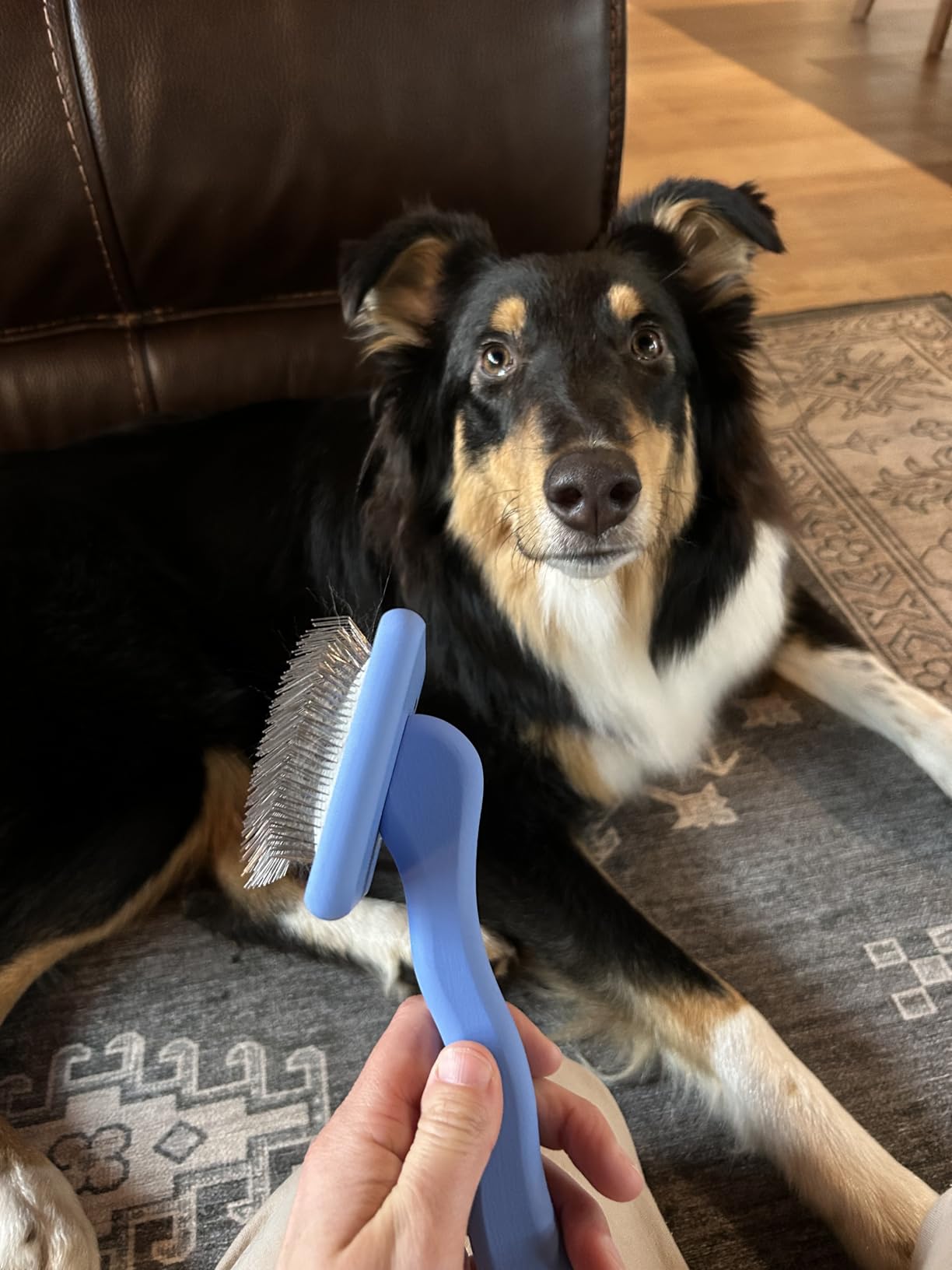
Is one inch enough for a thick doodle coat?
For most doodles and Poodles, yes, and this brush covers an 8 by 4 inch working area with those pins. For a very dense, heavy adult in full coat, a longer extra-long pin brush or a second pass with an undercoat rake gets deeper.
Can one brush cover a household with mixed sizes?
Yes, because the range runs extra small, small and large, and small brushes bundled with a detangler spray are an option. The large size is the one that feels bulky when you need to reach under the leg or around the ear on a small dog, so a two-brush set makes more sense there.
8. Bixy Pixy Large Ball-Tipped Slicker – Best Ball-Tipped Design
- Ball tips prevent scratching on sensitive skin
- Extra-long pins work through knots without pulling
- Large head removes more hair per pass
- Rubber non-slip grip is comfortable
- Pins set on a soft pad to spread pressure
- Hair clings in the centre of the pad and is hard to pull out
- Poor fit for short-haired dogs
- Will not cut through established matting without force
Every pin here carries a small plastic ball at the tip. That single change is what turns a slicker from a tool some dogs tolerate into one they will sit for, and it is the reason this brush earns a place on a sensitive-skin list.
The extra-long pins reach through dense double and triple coats, and the large 8 by 4.8 inch head clears more hair per pass than anything else in our test. Professional groomers report daily use over years with the pins and tips still intact.
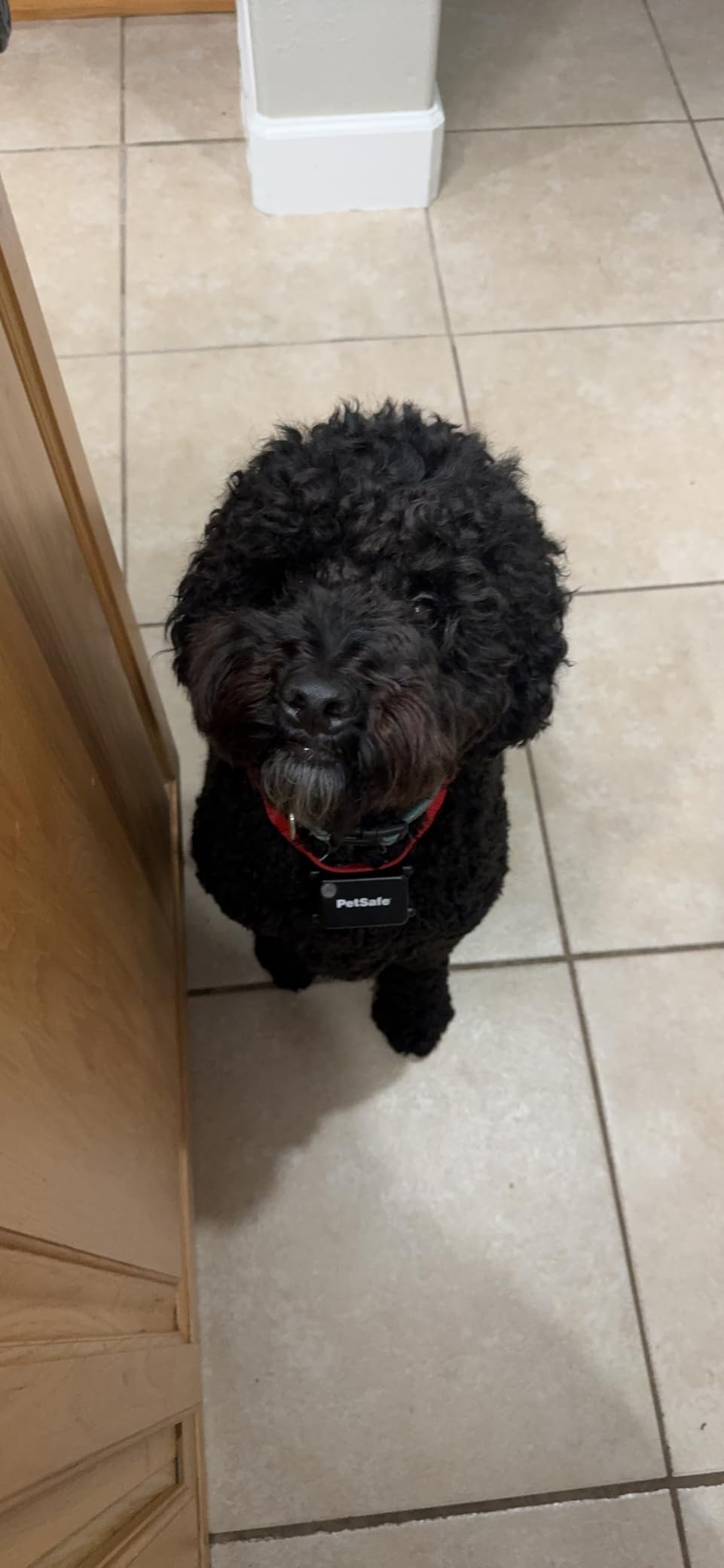
The pins are set into a soft cushion pad rather than a flat base. That pad spreads the force of the stroke across the head instead of letting individual pins take all of it, which is the difference between a brushing session and a complaint from the dog.
Owners of German Shepherds and Newfoundlands rate it for reaching all the way through a heavy coat, and several report dogs that previously avoided brushes cooperating with this one. The non-slip rubber grip also holds steady through long sessions.
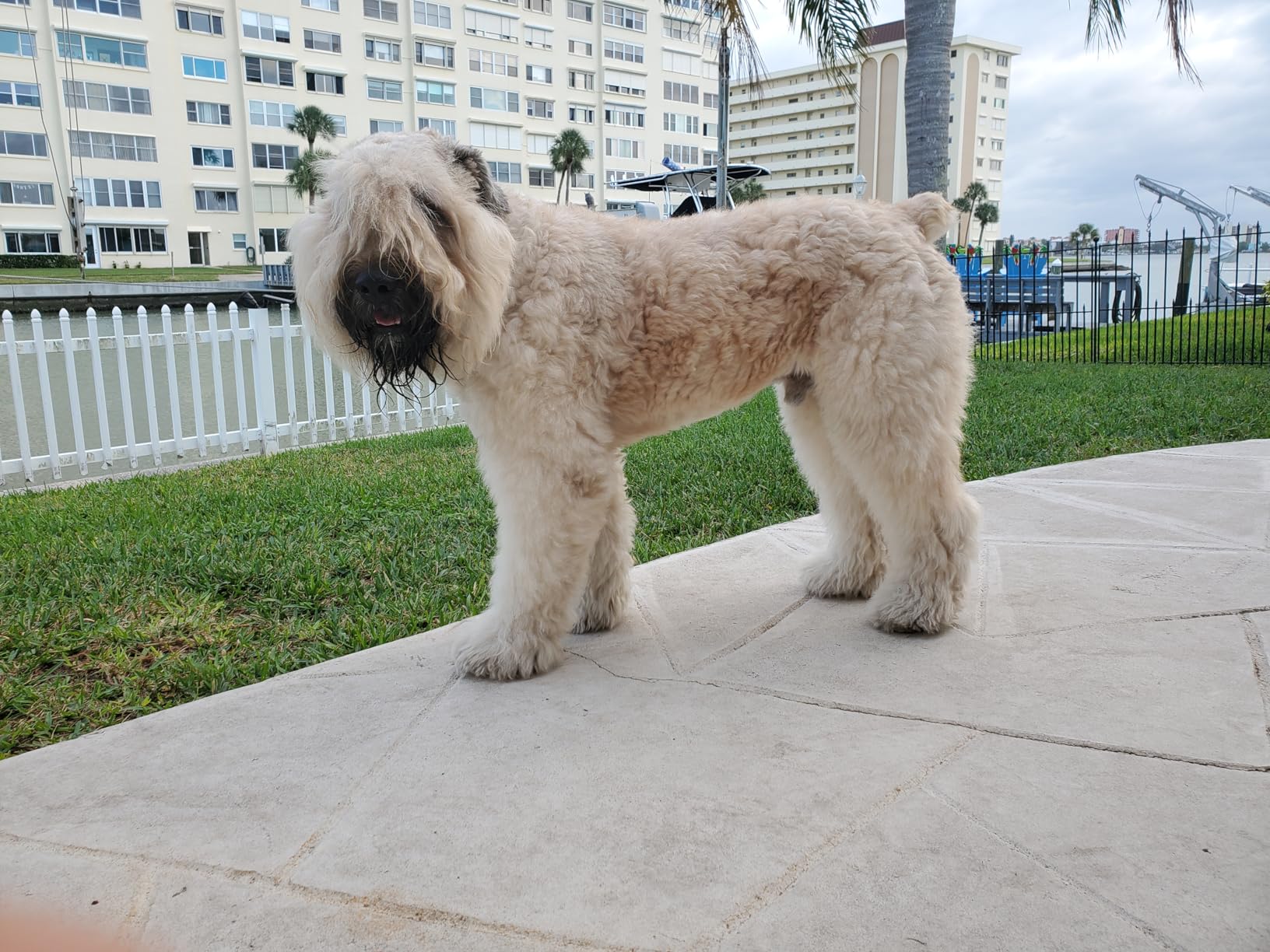
Do ball-tipped pins remove as much hair as bare metal pins?
Nearly as much on dense coats. The tips blunt the leading edge very slightly, and on a thin or short coat you feel that, which is why this is the wrong brush for short-haired dogs. On a long or double coat the difference is not something we noticed in practice.
What is the main annoyance with this brush?
Cleaning. Hair that collects in the centre of the pad clings tightly and is hard to pull out once the pad is full, and the tips make it slightly more fiddly than a bare pin bed. Budget a few extra minutes at the end of a session for it.
How to Use a Slicker Brush on Long Hair Without Hurting Your Dog
Most complaints about slicker brushes are technique, not hardware. Pressed straight down, any slicker pushes pins into the skin. Brushed in a stroke along the coat, the same pins glide.
Start at the ends of the coat, not the skin. Work the tips of the hair first and hold the coat away from the body.
Brush with a stroke, not pressure. Long, light passes along the direction of growth. Pressing down is what causes discomfort.
Work in sections toward the skin. Once the outer coat is clear, move down a few inches and repeat.
Use the pat-and-pull method on sensitive areas. Tap the brush in and pull it out. It feels gentler than a full stroke and works on bellies and inner legs.
Run a metal comb through after each section. If the comb catches, keep brushing. That is the pro test, and it tells you the section is not finished.
Change angle when you hit a tangle. Approach the knot from a different direction rather than pulling harder through it.
Owners in r/doggrooming describe the same routine as the standard: slicker first, metal comb second, and if the comb sticks you brush more. It is the most reliable method we tested and the one we now use for every long coat.
Slicker vs. Deshedding Tool vs. Undercoat Rake
Owners constantly confuse these three tools because they are sold side by side and marketed with similar words. They do different jobs, and the answer to what is the difference between a slicker brush and a deshedding brush is simpler than the packaging suggests.
Slicker brush: bent wire pins that reach through the top coat to catch loose hair, light tangles and debris as you brush. It prevents mats. It does not strip a dense undercoat.
Undercoat rake: longer teeth on a half-moon or T frame that pull dead undercoat out of a dense coat in layers. Use it during shedding season on double-coated breeds.
Deshedding tool: a metal blade edge that severs dead hair at the skin. Effective on loose shedding hair, and far too aggressive for a curly or long coat that tangles.
Dematting rake or mat breaker: blunt or guarded teeth that work a mat apart from the outside. This is the tool for existing tangles, not for general maintenance.
The practical rule: a slicker brush maintains, an undercoat rake strips loose undercoat, and a dematting tool handles what has already knotted. You rarely need more than a slicker and a rake for a long-coated dog, though owners on r/puppy101 pair the slicker with a double-sided dematting rake as a standard two-tool setup.
Buying Guide: Choosing a Slicker Brush for a Long Coat
Pin length first. Measure your dog’s coat rather than guessing. Under 2 inches wants a short pin; 2 to 4 inches wants pins around one inch; over 4 inches or a dense double coat wants extra-long angled pins and the largest head you can handle comfortably.
Pin softness and tips. Soft pins suit delicate skin and dogs that dislike brushing. Round ball tips are the safest option for a brush-averse dog, and the Bixy Pixy and Aumuca brushes both use them. Firm pins move more hair but are more likely to catch skin.
Do the arm test. Before you use any new slicker, press and stroke the pins firmly across the soft inner forearm, then drag them along the skin. If they feel sharp or catch, they will feel that way on your dog. This is standard practice in r/doggrooming and it catches defective pins in ten seconds. Skipping it is why some brushes get returned as painful.
Head size and shape. A large flat head covers ground fast on a big dog but is awkward between the legs. A curved head follows the body contour and works better on flanks, shoulders and hindquarters. Most multi-dog households end up wanting two sizes.
Self-cleaning or manual. A retract mechanism genuinely saves time on long sessions, since combing hair off a loaded pin bed between every pass is where the minutes go. The trade-off is a bulkier head, which some nervous dogs find harder to accept. Try the button with a treat in hand before committing.
Handle. Grip matters more than material over a long session. Rubber grips, textured surfaces and wood handles all beat smooth plastic, and smooth plastic handles are the most common complaint in the reviews we read. Weight counts too: the lightest brush here is 2.4 ounces, the heaviest is 8 ounces, and that difference shows up in the wrist over a full coat.
How often to brush. Curly and wavy coats such as doodles and poodles need brushing several times a week, with a full blow-out at least weekly. Silky long coats like Collies and Shelties do well with a thorough session every few days. Double-coated breeds need more frequent work through shedding season, when the undercoat rake earns its place. Whatever the coat, a few minutes on a bad day beats an hour on a bad coat.
When not to brush a mat out. If a mat is skin-tight, brush-out causes more pain than a professional shave-out. Cutting it short with clippers under a vet or groomer is kinder and faster than tearing it out. Bring the comb to the appointment and ask them to show you where the coat is tight.
Conditioning a slicker-averse dog. Start with the brush appearing and disappearing for two seconds at a time, paired with a treat. Then add three strokes. Sessions stay short until the dog relaxes, and a ball-tipped brush makes the early stages much easier because nothing catches.
For the tools you keep alongside the slicker, our guide to hot air brushes covers post-blow-out finishing, and facial cleansing brushes is worth a look if your dog’s face is the part they resist handling most. If you are shopping for exercise gear alongside grooming kit, our picks for the best automatic ball launchers for dogs are a good next step.
Frequently Asked Questions
What is the best slicker brush for long-haired dogs?
The Chris Christensen Big G is the best overall slicker brush for long-haired dogs because its extra-long angled pins and dense cushioned pad reach the undercoat on curly and double coats without pressing pins into the skin. Paw Brothers Extra Long suits dense heavy coats, and Aumuca suits owners who want one-click hair release.
What is the difference between a slicker brush and a deshedding brush?
A slicker brush uses bent wire pins to reach through the top coat and lift loose hair and light tangles as you brush, so it prevents mats. A deshedding tool uses a metal blade edge to sever dead hair at the skin. Slickers suit curly and long coats; deshedding tools suit short or medium coats with loose shedding.
How often should long-haired dogs be brushed?
Curly and wavy coats such as doodles and poodles should be brushed several times a week with a full blow-out at least weekly. Silky long coats such as collies and shelties do well with a thorough session every few days. Double-coated breeds need more frequent work through shedding season to keep loose undercoat from matting.
Do slicker brushes scratch dogs?
A correctly made slicker should not scratch a dog when it is brushed with a stroke along the coat. Scratching happens when the brush is pressed straight down, driving pins into the skin, or when the pins have bent or dulled. Test any new brush on the soft inner forearm first, and choose round ball-tipped pins for sensitive skin.
What brand do professional dog groomers use?
Professional groomers most often reach for Chris Christensen, whose Big G and Coral slickers are salon standards, with Ryan’s Pet Supplies Paw Brothers brushes common in working kennels. The pattern in salon use is that pin length matters more than brand: a long pin slicker is chosen when the coat is longer than a short pin can reach.
Final Verdict on the Best Slicker Brushes for Long-Haired Dogs
After working through all eight brushes on long, curly and double coats, the Chris Christensen Big G is the one we keep reaching for. Extra-long angled pins, 30% more pin density and a cushioned pad make it the most capable tool on a thick coat, and it stays gentle when brushed properly.
Buy the Paw Brothers Extra Long if your dog has a dense heavy undercoat and you want long stainless pins at a mid price. Buy the Aumuca if hair release between passes is the part of grooming you dread. For a sensitive-skin dog that flinches at metal, pick the ball-tipped Bixy Pixy or the soft-pin Show Tech.
Whichever you choose, match the pin length to the coat first, run the arm test, and follow the slicker-then-comb routine. That combination does more for a long coat than any brush on its own. This roundup was updated for 2026.