
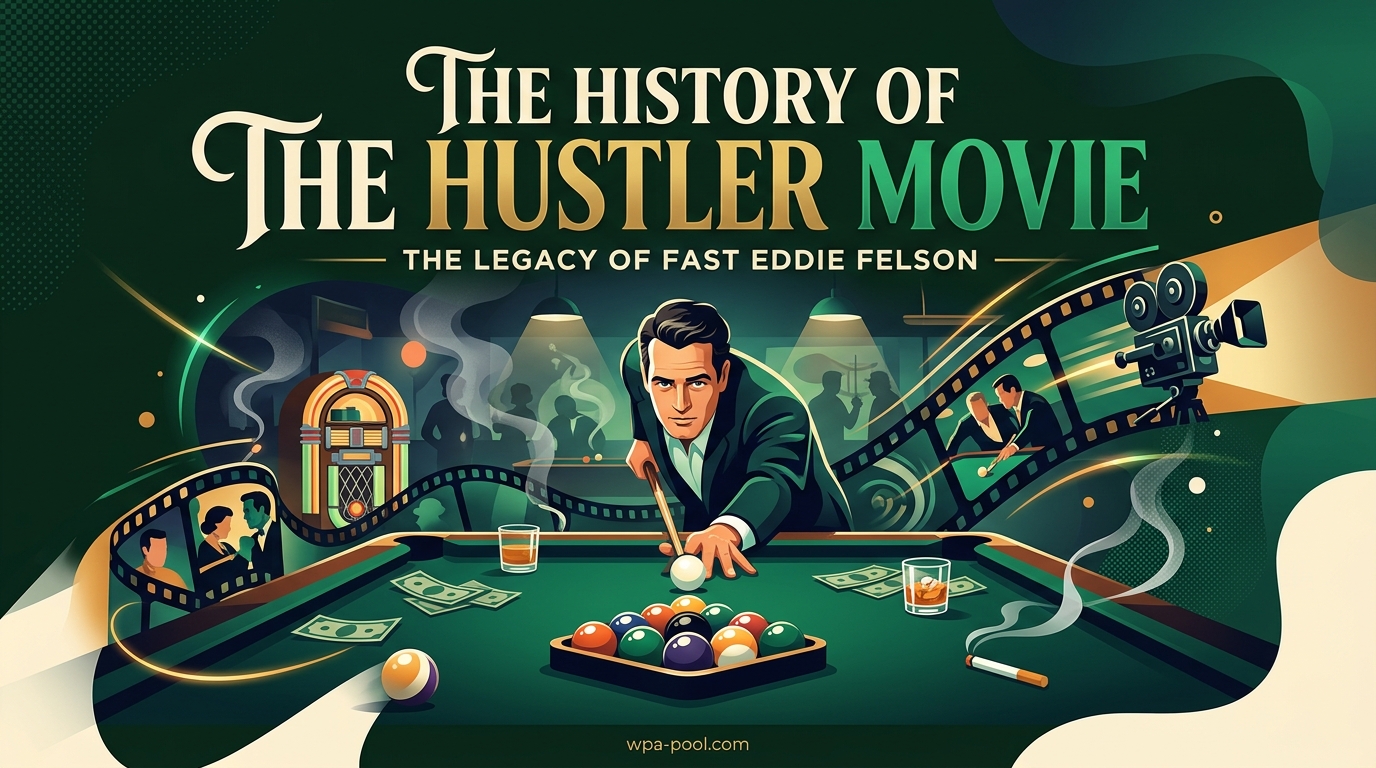
The Hustler (1961) did more than entertain audiences. It single-handedly revived a dying sport and transformed pool from a backroom gambling activity into a mainstream American pastime. When Paul Newman stepped into the role of Fast Eddie Felson, he didn’t just play a pool hustler. He sparked a cultural revolution that would bring thousands of new pool halls to cities across America.
In this guide, I will explore the complete history of The Hustler movie and its lasting impact on pool. You will learn how pool declined before the film, how the movie was made with authentic pool action, and the specific statistics that prove its incredible influence on the sport.
Table of Contents
The History of The Hustler Movie and Its Impact on Pool
The Hustler is a 1961 American sports drama film directed by Robert Rossen, based on the 1959 novel of the same name by Walter Tevis. The film stars Paul Newman as Eddie Felson, a small-time pool hustler with big ambitions, and Jackie Gleason as Minnesota Fats, the legendary player who becomes his rival. The story follows Eddie’s obsessive quest to prove himself as the best pool player in the country, exploring themes of talent versus character, winning versus losing, and the cost of ambition.
What makes The Hustler significant extends far beyond its critical acclaim. The film captured the public imagination at a crucial moment for pool. Before 1961, the sport was in serious decline. Within months of the film’s release, pool experienced a dramatic resurgence that would reshape American recreational culture for decades.
The Decline of Pool Before The Hustler
Pool was not always struggling for relevance. In the early 20th century, pocket billiards enjoyed widespread popularity across America. By the 1920s, the country boasted approximately 42,000 pool centers. These establishments ranged from upscale billiard parlors to working-class pool halls, serving as social hubs for millions of Americans.
The decline began gradually and accelerated after World War II. Several factors contributed to pool’s fading popularity. The rise of television drew people away from pool halls. Changing social attitudes made the smoky, male-dominated pool hall environment seem increasingly outdated. Most damaging of all, pool developed an association with gambling and questionable characters that pushed respectable families away.
By the late 1950s, the statistics told a grim story. The number of pool centers had plummeted from 42,000 to just 8,000 nationwide. Pool table sales had dropped by 75 percent. Major manufacturers like Brunswick, which had dominated the industry for decades, faced serious financial difficulties. The sport that had once thrived in every American city seemed headed for extinction.
This was the landscape that greeted The Hustler when production began in 1960. The filmmakers were not trying to save a sport. They were simply adapting a compelling novel about a pool hustler. Yet the authenticity they brought to the project would prove transformative.
The Hustler (1961): A Film Overview
The Hustler tells the story of Eddie Felson, nicknamed Fast Eddie, a talented but arrogant young pool hustler who travels from small town to small town, conning local players out of their money. Eddie believes he has the skill to beat the best, and he sets his sights on Minnesota Fats, the acknowledged king of pool.
Their first marathon match becomes the film’s centerpiece. Eddie takes an early lead against Fats, winning thousands of dollars, but his cockiness and lack of discipline lead to his collapse. He loses everything, including his self-respect. The rest of the film follows Eddie’s attempt to rebuild himself, both as a player and as a person, leading to a final confrontation with Fats.
Paul Newman delivers what many consider his breakthrough performance as Fast Eddie Felson. He captures the character’s combination of raw talent and immaturity, making Eddie both compelling and frustrating. Newman’s commitment to the role extended beyond acting. He spent weeks learning pool from the best player in the world.
Jackie Gleason brings unexpected depth to Minnesota Fats. Best known as a comedian, Gleason portrays Fats with quiet confidence and subtle menace. He never overplays the role, instead suggesting a lifetime of experience in every glance and gesture. Gleason’s performance earned him an Academy Award nomination and remains iconic in sports film history.
The supporting cast includes Piper Laurie as Sarah Packard, Eddie’s troubled love interest, and George C. Scott as Bert Gordon, a gambler who takes Eddie under his wing. Both actors received Oscar nominations for their performances. Robert Rossen’s direction emphasizes the psychological intensity of high-stakes pool, using close-ups and shadowy lighting to create a film noir atmosphere.
Upon release, The Hustler earned nine Academy Award nominations, including Best Picture. It won two Oscars for Best Art Direction and Best Cinematography. Critics praised the film’s adult storytelling and its refusal to provide easy answers. Audiences responded to the drama, making it a commercial success despite its dark themes.
Behind the Scenes: Authentic Pool on Film
The filmmakers understood that authentic pool action would be essential to The Hustler’s success. They hired Willie Mosconi, the 15-time world champion and widely considered the greatest pool player who ever lived, as the film’s technical advisor. This decision proved crucial to both the film’s quality and its eventual impact on the sport.
Mosconi spent hours working with Paul Newman, teaching him the fundamentals of pool and the specific techniques a hustler like Fast Eddie would use. Newman was a dedicated student. He practiced daily for weeks before filming began, determined to perform his own shots whenever possible. By the time cameras rolled, Newman could handle most of his pool action convincingly.
The most impressive pool performance in the film came from Jackie Gleason. Unlike Newman, Gleason did not need extensive coaching. He was already an accomplished pool player in real life. Gleason performed all his own shots in The Hustler, including complex maneuvers that would challenge professional players. His natural ability added immeasurably to the film’s authenticity.
For shots that were beyond even Gleason’s considerable skills, Mosconi himself stepped in. He performed the famous massé shot that appears in the film, a difficult curve shot that requires exceptional technique. Mosconi’s hands appear on screen during several close-up shots, though the actors handled the wide shots themselves.
This commitment to authenticity set The Hustler apart from typical Hollywood sports films. When audiences watched Fast Eddie and Minnesota Fats battle across the pool table, they were seeing real pool played at a high level. The actors respected the sport, and that respect translated to the screen.
How The Hustler Sparked a Pool Resurgence
The impact of The Hustler on pool was immediate and dramatic. Within six months of the film’s release in September 1961, approximately 2,000 new pool centers opened across the United States. This represented a 25 percent increase in the total number of pool halls in just half a year, reversing decades of decline.
The statistics tell an even more remarkable story. Pool table sales increased by over 300 percent in the year following the film’s release. Brunswick, the struggling table manufacturer, suddenly could not keep up with demand. The company reported its best sales year in decades, with orders backing up for months.
Suddenly, pool was cool again. The film had transformed public perception of the sport. Where pool halls had been viewed as seedy hangouts for gamblers and hustlers, they were now seen as sophisticated venues for skilled competition. Young people who had never picked up a cue flocked to pool halls to try their hand at the game they had seen on screen.
The demographic shift was significant. Before The Hustler, pool was predominantly a working-class male activity. After the film, middle-class men and women began playing in significant numbers. College students embraced pool as a social activity. The sport’s image had changed from disreputable to respectable practically overnight.
This was not merely a temporary spike in interest. The pool boom lasted through the 1960s and beyond, creating the foundation for the modern pool industry. Many of the pool halls that opened in the wake of The Hustler remained in business for decades, serving new generations of players.
Cultural Shift: Pool Halls Go Mainstream
The Hustler did more than increase participation in pool. It changed how American culture viewed the sport and the places where it was played. Pool halls began appearing in television shows and movies as settings for sophisticated drama rather than criminal activity. The terminology of pool entered mainstream conversation, with phrases like “hustler” and “fast Eddie” becoming widely understood references.
ABC’s Wide World of Sports began broadcasting pool tournaments, bringing competitive play into millions of American homes. For the first time, casual fans could watch professional players execute the same shots they had seen Paul Newman attempt. This television exposure further normalized pool as a legitimate sport.
Hustler Jamborees, tournaments inspired by the film, sprang up across the country. These events attracted both serious competitors and curious newcomers, creating a tournament culture that had not existed before. The film had provided a template for how pool could be presented as entertainment, and promoters seized the opportunity.
Pool hall design changed as well. New establishments emphasized cleanliness and accessibility, moving away from the dark, smoky atmosphere of traditional halls. Family-friendly pool centers opened in suburban shopping areas, welcoming players of all ages and backgrounds. The pool hall was no longer a male-only refuge. It had become a place where anyone could enjoy the game.
Professional pool players found themselves in unprecedented demand. Willie Mosconi, already famous among enthusiasts, became a household name. He toured extensively, giving exhibitions that drew crowds far larger than anything pool had seen before. Other players benefited from the increased interest, finding sponsorship opportunities and media coverage that had never existed.
The Lasting Legacy: From The Hustler to The Color of Money
The Hustler’s influence extended far beyond the 1960s. In 1986, director Martin Scorsese released The Color of Money, a sequel that reunited Paul Newman with the character of Fast Eddie Felson. Now older and wiser, Eddie takes a young player played by Tom Cruise under his wing, passing on the lessons he learned decades earlier.
The Color of Money brought pool back into the spotlight, triggering a smaller but significant resurgence similar to the original film’s impact. Newman won his only Academy Award for the performance, and the film introduced pool to a new generation of viewers. While it did not match The Hustler’s cultural impact, it confirmed the original film’s status as a classic.
More importantly, The Color of Money demonstrated that The Hustler’s influence was enduring. Twenty-five years after the original film, audiences still responded to the drama of high-stakes pool. The sport had become firmly established in American culture, no longer dependent on a single film for its relevance.
In 1997, The Hustler was selected for preservation in the United States National Film Registry. The Library of Congress recognized it as culturally, historically, and aesthetically significant. This honor placed The Hustler alongside the most important films in American cinema history.
The American Film Institute ranked The Hustler as the sixth greatest sports film ever made. It remains the highest-ranked film about pool on virtually every list of sports movies. For film historians, it represents a high point in the collaboration between Hollywood and authentic athletic competition.
Today, pool continues to thrive as both a recreational activity and a professional sport. While video games and other entertainment options have emerged, pool halls remain fixtures in cities and towns across America. The foundation laid by The Hustler in 1961 still supports the modern pool industry.
Frequently Asked Questions
Did Paul Newman get along with Jackie Gleason?
Yes, Paul Newman and Jackie Gleason got along well during the filming of The Hustler. Despite their different backgrounds, Newman the serious method actor and Gleason the comedian, they developed a mutual respect. Gleason later spoke warmly of Newman, praising his dedication to learning pool for the role. Their professional relationship contributed to the authentic rivalry that appears on screen.
What is the real story behind the movie Hustler?
The Hustler is based on the 1959 novel by Walter Tevis, which was itself inspired by real pool hustlers Tevis encountered while working as an English professor. While Fast Eddie Felson is fictional, the character draws from the culture of road players who traveled from town to town hustling local players. Minnesota Fats was partially inspired by several real players, most notably Rudolf Wanderone, who later adopted the Minnesota Fats name after the film’s success.
Was Jackie Gleason actually a good pool player?
Yes, Jackie Gleason was an excellent pool player in real life. He performed all his own shots in The Hustler, a remarkable achievement given the high level of play required. Gleason had played pool since his youth and maintained his skills throughout his life. His natural ability made Minnesota Fats one of the most authentic portrayals of a pool player in film history.
Did Jackie Gleason play pool in real life?
Yes, Jackie Gleason played pool regularly throughout his life. He learned the game growing up in Brooklyn and continued playing as an adult. His passion for pool made him the perfect choice to play Minnesota Fats. Unlike many actors who rely on stand-ins for athletic scenes, Gleason insisted on performing his own pool shots in The Hustler, demonstrating genuine skill that impressed even professional players like Willie Mosconi.
Did Paul Newman learn pool for The Hustler?
Yes, Paul Newman learned pool specifically for The Hustler under the tutelage of Willie Mosconi, the 15-time world champion. Newman practiced for hours daily before filming began and continued training throughout production. By the end of filming, Newman could execute most shots convincingly and did his own pool action for the majority of the film. His dedication to authenticity contributed significantly to the film’s impact.
How many pool centers opened after The Hustler?
Approximately 2,000 new pool centers opened in the United States within six months of The Hustler’s release in September 1961. This represented a 25 percent increase in the total number of pool halls nationwide. Additionally, pool table sales increased by over 300 percent in the year following the film’s release, reversing decades of decline in the industry.
Conclusion
The history of The Hustler movie and its impact on pool represents one of the most remarkable examples of film influencing American culture. What began as a faithful adaptation of a novel became a catalyst for transforming a declining sport into a mainstream phenomenon.
The Hustler accomplished this through authenticity, compelling storytelling, and respect for the game of pool. Paul Newman’s dedication to learning the sport, Jackie Gleason’s genuine skills, and Willie Mosconi’s technical guidance created a film that players and audiences could believe in.
More than six decades later, The Hustler remains essential viewing for anyone interested in pool or sports cinema. Its influence persists in every pool hall where players gather, in every tournament broadcast, and in the continued popularity of a game that was nearly extinct before Fast Eddie Felson picked up a cue.