
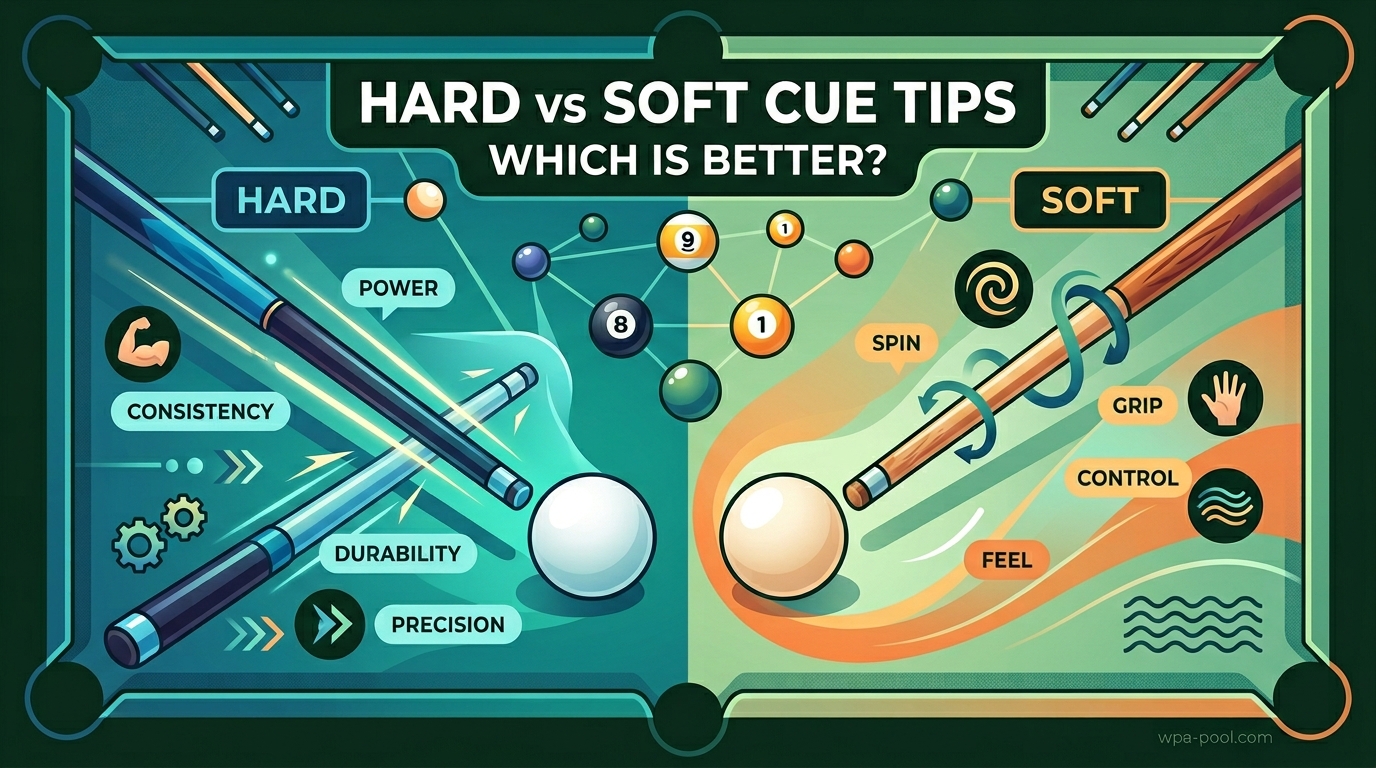
The biggest myth in pool is that soft cue tips automatically give you more spin. I spent my first three years of playing convinced I needed the softest tip possible to master English and draw shots. After testing every hardness level across hundreds of hours at the table, I learned that tip hardness affects your game differently than most players assume.
Hard vs soft cue tips comes down to three factors: how the tip grips the cue ball, how long the tip lasts, and how much maintenance you want to do. The right choice depends on your playing style, skill level, and whether you prioritize control or consistency. Understanding these differences will help you make an informed decision instead of following outdated advice.
Pool equipment choices matter just as much as understanding regulation pool table dimensions when setting up your game. Your cue tip is the only part of your stick that contacts the cue ball. That small piece of leather or synthetic material determines your ability to execute spin shots, control speed, and avoid miscues.
Table of Contents
What Is Cue Tip Hardness?
Cue tip hardness refers to how much a tip compresses when it strikes the cue ball. Manufacturers measure this on a durometer scale, with readings typically ranging from 60 (very soft) to 90+ (very hard) for leather tips. The hardness comes from the density of the leather and how tightly it is compressed during manufacturing.
Leather cue tips are made from pigskin or cowhide that is compressed and bonded together. Softer tips use less compression and maintain more natural porosity. Hard tips undergo more aggressive compression and often include additional binding agents.
The hardness scale for pool cue tips generally breaks down into four categories. Super soft tips register below 65 on the durometer. Soft tips fall between 65 and 74. Medium tips range from 75 to 84. Hard tips measure 85 and above. Some manufacturers use alternative scales, so ratings can vary slightly between brands.
Tip hardness affects the contact patch size when you strike the cue ball. A softer tip compresses more, creating a larger contact area. A harder tip maintains its shape, resulting in a smaller, more focused contact point. This difference influences how the cue ball responds to your stroke.
Soft Cue Tips: Characteristics and Performance
Soft pool cue tips absorb more impact energy and grip the cue ball longer during contact. Players describe the feel as “grabby” or “sticky.” This characteristic makes soft tips popular among players who prioritize cue ball control over raw power.
The primary advantage of soft tips is chalk retention. The porous nature of soft leather holds chalk particles effectively. Better chalk coverage reduces miscues, especially on shots where you strike the cue ball away from center. You can apply English with more confidence knowing the tip is less likely to slip off the ball surface.
Soft tips excel at finesse shots. Players who rely on delicate touch, subtle spin, and precise speed control often prefer soft tips. The increased contact time with the cue ball gives you more feedback through your shaft. You can feel exactly how the ball responds to different stroke speeds.
The downside is maintenance. Soft tips mushroom more quickly than hard tips. The edges flatten and spread outward, requiring frequent shaping with a tip tool. You will need to scuff the surface regularly to maintain chalk adherence. Most soft tips require replacement every 6 to 12 months with regular play.
Soft tips also transfer less power on break shots. The absorption that creates great feel on finesse shots becomes a liability when you need maximum energy transfer. If you break with your playing cue, a soft tip reduces the effectiveness of your opening shot.
Hard Cue Tips: Characteristics and Performance
Hard pool cue tips maintain their shape and deliver crisp, efficient energy transfer. When you strike the cue ball, a hard tip compresses minimally. The result is a sharp, responsive hit that many power players prefer.
Durability is the standout benefit of hard tips. They resist mushrooming and maintain their radius much longer than soft alternatives. Many hard tips last 12 to 24 months before needing replacement. The shape retention means less frequent maintenance with a tip shaper.
Hard tips produce less spin at the same tip offset compared to soft tips. Wait, that sounds like the myth I mentioned earlier. Here is what actually happens: hard tips require you to strike farther from center to achieve the same spin rate. The tip does not grip as aggressively, so you must be more precise with your aim.
This characteristic makes hard tips less forgiving for beginners. Miscues happen more easily when you strike too far from the cue ball center. The margin for error is smaller. However, experienced players appreciate the feedback because it teaches precise tip placement.
Hard tips excel at break shots and power strokes. The reduced compression means more of your stroke energy transfers to the cue ball. Players who prefer a firm, direct hit often gravitate toward harder tips after developing their fundamentals.
The tradeoff is feel. Hard tips provide less tactile feedback during the shot. Some players describe the sensation as “clicky” or “glassy.” You may need to adjust your stroke timing to accommodate the reduced contact time with the cue ball.
Medium Cue Tips: The Balanced Choice
Medium pool cue tips represent the middle ground that most players eventually choose. They balance the grip of soft tips with the durability of hard tips. The durometer range of 75 to 84 hits a sweet spot for versatility.
Medium tips work well for players who want some spin capability without constant maintenance. You get reasonable chalk retention and decent shape retention. Most medium tips last 9 to 18 months with regular care.
The compromise nature of medium tips makes them ideal for players who do not want to specialize their equipment. If you play a mix of power shots, spin shots, and straightforward strokes, a medium tip handles everything adequately. League players often prefer medium tips for this versatility.
Professional cue makers frequently install medium tips on production cues. The reason is simple: medium tips offend the fewest players. Whether you are a beginner learning fundamentals or an intermediate player refining your game, a medium tip rarely holds you back.
Do Soft Tips Really Give You More Spin?
No, soft tips do not inherently produce more spin than hard tips. This is the most persistent misconception in pool equipment. Physics research by Dr. Dave Alciatore and others has demonstrated that tip hardness within normal playing ranges does not directly limit spin potential.
What affects spin is your ability to strike the cue ball at the correct offset without miscuing. A soft tip allows you to strike slightly farther from center before miscuing because the increased contact patch and grip provide more margin for error. The soft tip is not creating more spin. It is allowing you to apply more offset without slipping off the ball.
Contact time between tip and cue ball is extremely brief regardless of hardness. Measurements show contact lasts less than one millisecond. The difference between soft and hard tip contact time is microseconds, not enough to significantly affect spin transfer.
The real factor in spin generation is tip offset and stroke speed. Strike the cue ball farther from center with a firm, accelerating stroke, and you get more spin. Whether you use a soft or hard tip, the physics of friction and angular momentum work the same way.
Some players mistakenly believe soft tips create more spin because they can strike farther from center without miscuing. They feel the cue ball “grab” and assume the tip is generating extra spin. In reality, they are simply applying more offset than they could with a hard tip before miscuing.
Your technique matters more than your tip hardness. Focus on clean stroke delivery and accurate tip placement. Choose tip hardness based on feel preference and maintenance tolerance, not magical spin properties.
Durability and Maintenance Comparison
Tip maintenance requirements vary significantly between hardness levels. Understanding these differences helps you choose a tip that fits your maintenance habits and budget.
Soft tips require the most attention. You should scuff the surface before each playing session to maintain chalk adherence. The tip face flattens quickly and needs regular shaping to restore the proper radius. Mushrooming happens within weeks of installation, requiring you to trim the edges.
Medium tips need moderate maintenance. Scuffing every few sessions keeps the surface receptive to chalk. Shaping is necessary every month or two depending on play frequency. Mushrooming occurs but at a slower rate than soft tips.
Hard tips are the low-maintenance option. You can go several sessions without scuffing. The tip maintains its shape for months. Some hard tips show minimal mushrooming even after a year of play.
Replacement frequency follows the maintenance pattern. Soft tips typically last 6 to 12 months. Medium tips last 9 to 18 months. Hard tips can last 12 to 24 months or longer. The exact lifespan depends on how often you play, how hard you strike the cue ball, and your maintenance routine.
Cost considerations matter too. If you pay for professional tip installation, soft tips become expensive over time. Hard tips reduce your long-term maintenance costs even if the initial price is similar.
Phenolic Tips: The Special Case for Breaking
Phenolic tips deserve a separate category because they behave completely differently from leather. These synthetic tips are extremely hard, measuring above 90 on the durometer scale. They do not compress or grip the cue ball like leather tips.
Phenolic tips are designed exclusively for breaking. The extreme hardness transfers maximum energy to the cue ball with minimal loss. The cue ball explodes off the tip with explosive force, sending the rack scattering.
You should never use a phenolic tip for regular play. The lack of grip makes spin shots nearly impossible. The tip skids off the cue ball surface, producing unpredictable results on anything except center-ball hits.
Most serious players own a separate break cue with a phenolic tip. This allows maximum power on the break without compromising their playing cue setup. Some phenolic tips are actually ferrule extensions with a thin phenolic layer, creating an extremely stiff hitting surface.
Installation of phenolic tips requires different techniques than leather. They are typically glued rather than pressed on. Professional installation is recommended because improper attachment can damage your cue ferrule.
Which Cue Tip Should You Choose?
Selecting the right cue tip hardness depends on your skill level, playing style, and maintenance preferences. Here are specific recommendations based on different player profiles.
Beginners should start with medium tips. The balance of grip and durability helps you learn without constant equipment issues. You get enough feel to develop touch while avoiding the rapid degradation of soft tips. As you develop your stroke, you will learn what characteristics matter most to your game.
Intermediate players can experiment based on their strengths. If you rely on spin shots and English, try a soft tip to see if the increased margin for error helps your game. If you prioritize power and consistency, test a hard tip for its feedback and durability.
Advanced players know their preferences. Many professionals use hard or medium-hard tips because they can generate spin through precise technique rather than relying on tip grip. The consistency and low maintenance let them focus entirely on execution.
League players often prefer medium tips. The versatility works across different table conditions and shot requirements. You might play on fast cloth one week and slow cloth the next. A medium tip adapts reasonably well to both.
Consider your break setup. If you break with your playing cue, a hard tip preserves your tip life and delivers better power. If you have a dedicated break cue, you can choose your playing tip based purely on shot-making preferences.
Frequently Asked Questions
Is a hard or soft pool cue tip better?
Neither is universally better. Soft tips offer more grip and chalk retention but require frequent maintenance. Hard tips last longer and provide crisp feedback but demand precise technique. Most players find medium tips offer the best balance.
Do pro pool players use a soft tip?
Most professional players use medium to hard tips. They can generate spin through precise technique without relying on the extra grip of soft tips. Hard tips offer consistency and require less maintenance during long tournament sessions.
What kind of tip does Efren Reyes use?
Efren Reyes has historically used medium to medium-hard tips. His incredible cue ball control comes from technique rather than equipment. The specific brand and hardness have varied throughout his career, but he generally avoids extremely soft tips.
What density cue tips do most pro players use?
Most professional players use medium-hard to hard tips in the 80 to 90 durometer range. This hardness level provides consistency across thousands of shots while still allowing adequate spin generation through proper technique.
Why do I miscue with a hard tip?
Hard tips miscue more easily because they grip less aggressively than soft tips. You must strike closer to the cue ball center to maintain contact. Improve your accuracy and ensure you are chalking properly before each shot.
How often should I replace my cue tip?
Soft tips typically need replacement every 6 to 12 months. Medium tips last 9 to 18 months. Hard tips can last 12 to 24 months. Replace your tip when it becomes too thin, loses its shape permanently, or no longer holds chalk effectively.
Conclusion
Understanding hard vs soft cue tips removes the confusion from equipment selection. The myth that soft tips automatically produce more spin has persisted too long. Your technique determines spin, not your tip hardness.
Choose soft tips if you value maximum grip, play finesse shots frequently, and do not mind regular maintenance. Choose hard tips if you prioritize durability, power transfer, and crisp feedback. Start with medium tips if you are unsure or want the most versatile option.
The best way to find your preference is testing. Try different hardness levels on similar cues. Pay attention to how each tip feels on draw shots, follow shots, and power strokes. Your perfect tip hardness matches your stroke style and maintenance tolerance.