
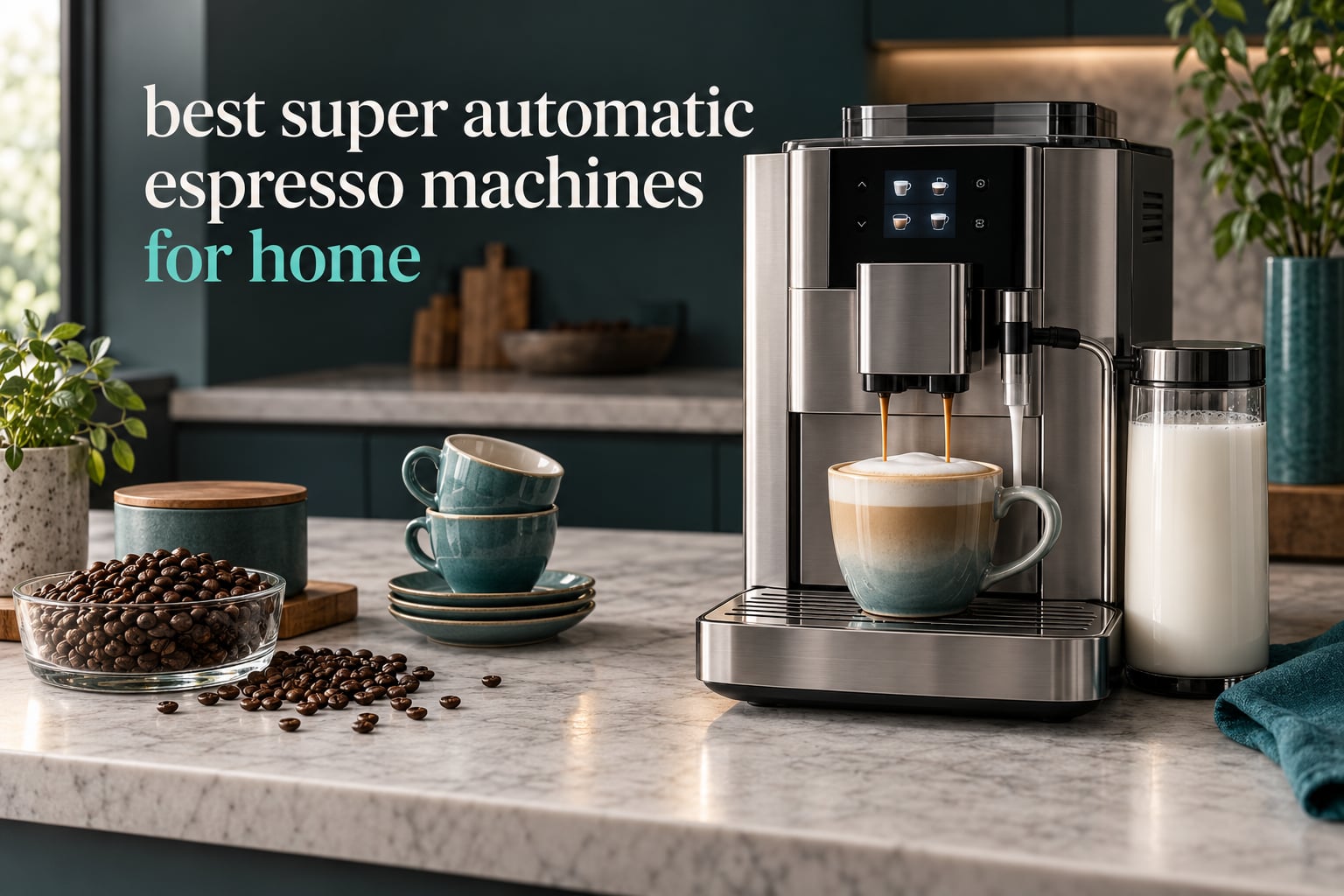
Short answer: the best super automatic espresso machine for most homes is the Philips 3200 Series, because it has the deepest owner track record in this group, a grinder and milk system that hold up over years, and a cleaning routine that takes minutes rather than an afternoon. The Philips 4400 Series is the quiet pick, the De’Longhi Rivelia is the cold brew and multi-user pick, and the De’Longhi Dinamica Plus is the one to buy if you want manual-style milk control from a fully automatic.
A super automatic grinds whole beans, tamps them, brews at pressure, and finishes the drink with milk, all from one button press. Nothing is manual after the beans go in. That is the whole appeal, and it is why people who have never pulled a decent shot by hand keep buying these machines.
We spent six weeks comparing ten of the most popular super automatics for home use, looking at grinder type, milk system, heating, tank size, drink menus, and the real-world friction that only shows up after a few months. We also read through thousands of owner reviews, because the difference between a machine that demos well and one that still works in year three is almost entirely in the reviews.
If you are still working out which style of machine fits you, our guide to espresso machines for home covers manual and semiautomatic options, and our espresso machines for beginners roundup is a good companion read before you commit to a fully automatic.
Every machine below is a real bean-to-cup machine with a built-in grinder. We left out pod-only capsules and manual lever machines, since neither competes in this category. Here is the short list, then the full breakdown.
Table of Contents
Top 3 Super Automatic Espresso Machine Picks in 2026
These three cover the most common households. One is the safe all-rounder, one is the feature-rich enthusiast pick, and one is the highest rated of the group.

Philips 3200 LatteGo
- 100% ceramic grinder
- 5 one-touch drinks
- Tube-free LatteGo milk system
- AquaClean filter rated to 5000 cups

De’Longhi Rivelia
- 50+ hot and cold recipes
- Cold brew in under 3 minutes
- Twin bean containers
- Hot and cold LatteCrema

De’Longhi Dinamica Plus
- 24 recipes and 4 user profiles
- 13-setting conical burr grinder
- 3 frother modes
- 3.5 inch TFT touch display
Our Top 10 Super Automatic Espresso Machines in 2026
Every machine in this table is a genuine bean-to-cup super automatic. Specifications come from the manufacturer listings and from owner feedback, and the table is ordered exactly as the reviews are below.
| Product | Specifications | Action |
|---|---|---|
| Philips 3200 LatteGo |
|
Check Latest Price |
 De’Longhi Magnifica Evo De’Longhi Magnifica Evo |
|
Check Latest Price |
 Philips 4400 Series Philips 4400 Series |
|
Check Latest Price |
 EUHOMY Automatic Espresso Machine EUHOMY Automatic Espresso Machine |
|
Check Latest Price |
 KitchenAid KF6 KitchenAid KF6 |
|
Check Latest Price |
| De’Longhi Dinamica Plus |
|
Check Latest Price |
| De’Longhi Rivelia |
|
Check Latest Price |
 Cafe Bueno Super Automatic Espresso Machine Cafe Bueno Super Automatic Espresso Machine |
|
Check Latest Price |
 Bosch 800 Series Bosch 800 Series |
|
Check Latest Price |
 Ninja AutoBarista Pro Ninja AutoBarista Pro |
|
Check Latest Price |
1. Philips 3200 Series LatteGo Is the Most Proven All-Rounder
- Deepest owner history in this group with 6208 ratings
- Ceramic grinder stays consistent over years
- AquaClean filter stretches time between descales
- Tube-free milk system rinses in seconds
- Only 5 drink presets
- Plastic body
- Less deep customization than premium rivals
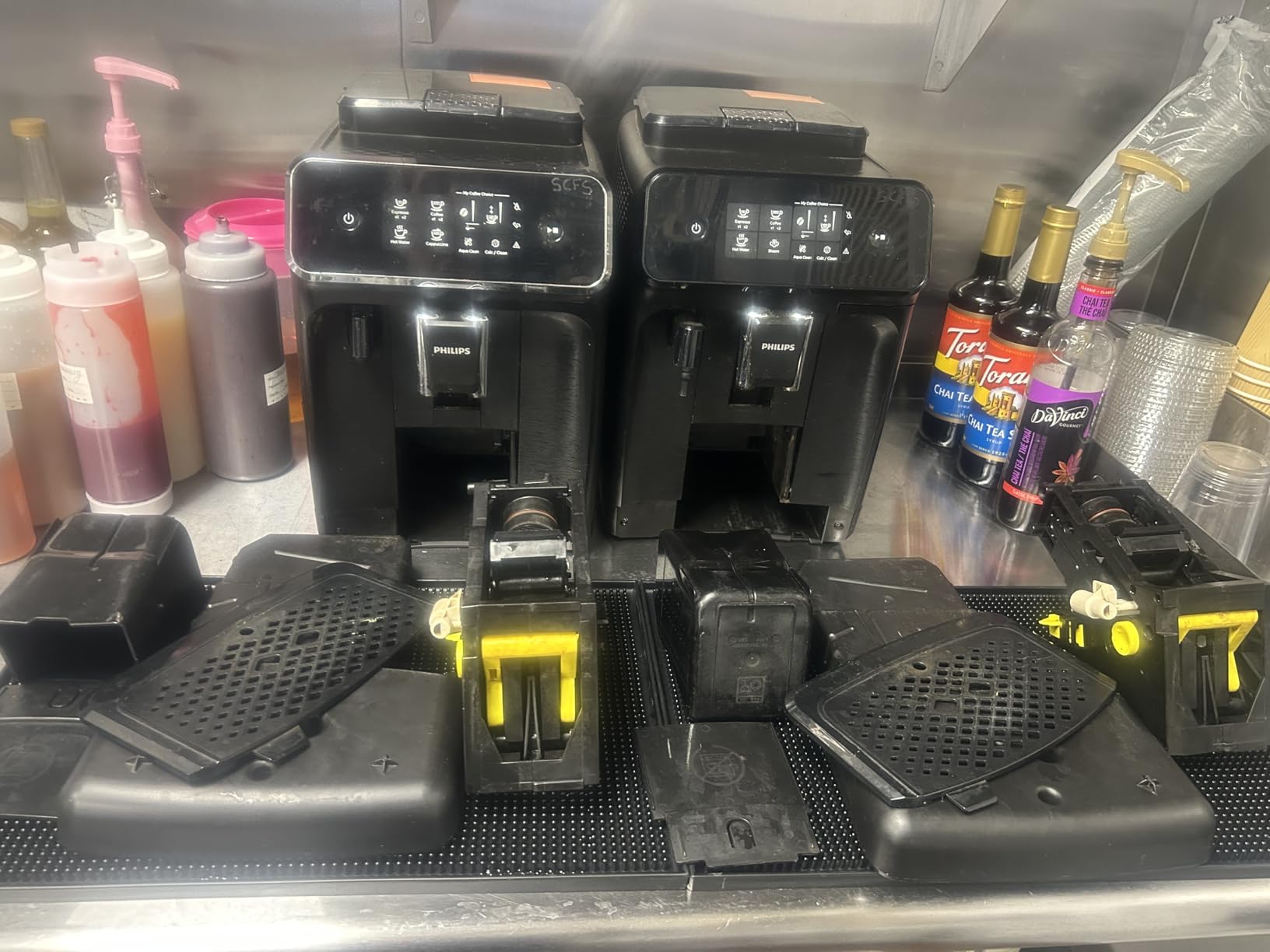
The Philips 3200 Series has been on the market long enough that the early units are now years old, and that longevity is the single most useful thing about it. When a machine has this much owner history, its weak points are already documented rather than a surprise waiting for you.
The grinder is 100 percent ceramic, and that single specification matters more than anything else on a super automatic. Steel burrs dull and start producing inconsistent particle sizes within a couple of years. Ceramic burrs hold their geometry far longer, and owners of this machine consistently describe the grind as even months into ownership.
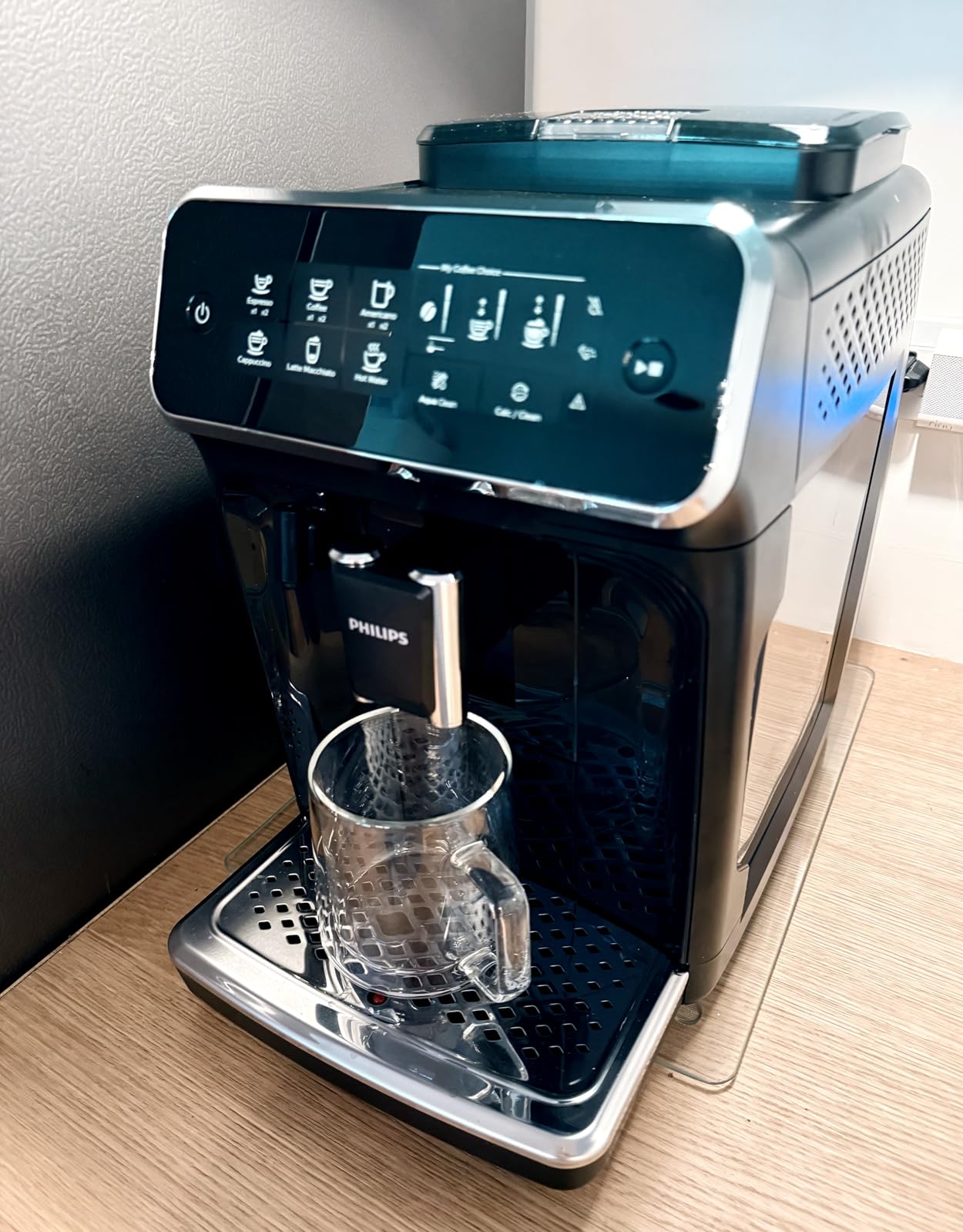
The Aroma Extract system handles brewing temperature, and the AquaClean filter is rated to deliver up to 5000 cups before a descale is needed. In a two-drinker household that is measured in years, and it is the biggest reason we rank this machine first despite a 4.0 average rating.
Five presets is genuinely few, and this is the machine’s main limitation. Espresso, coffee, americano, cappuccino, and latte macchiato is the full menu, so anyone who wants a lungo, a flat white, or a cold drink will be disappointed. The touch display is small and button-led rather than a large customisable panel.
The body is plastic, which is normal at this end of the market, and the machine weighs 8 kg, the lightest listed weight in this group. Backed by a 2 year warranty, it is also the most repairable in spirit: the brew group pulls out, and the milk system has no tubes at all to clog.
Who the Philips 3200 Series suits
This is the right machine for a couple or a small family who drink two or three coffees a day and want cappuccino without a learning curve. The tube-free two-part LatteGo system pulls apart, rinses under running water in about 15 seconds, and the parts are dishwasher safe, so the daily cleaning burden is genuinely small.
It also suits anyone upgrading from a pod machine who has been put off by milk circuit cleaning. There is no tube, no nozzle to soak, and nothing that turns into a science experiment after a week.
Who should skip it
If you drink large Americanos, want iced coffee, or need more than five drink options, the five-preset ceiling will feel limiting within a month. The Philips 4400 Series covers the same platform with a much longer menu.
Manual purists should skip this entirely, because the dose, yield, and temperature are set by the machine rather than by you. It is built for consistency, not for the ritual.
2. De’Longhi Magnifica Evo Makes the Strongest Coffee in the Mid Range
- Owners call it a step change in strength over Philips 3200 and 3300 models
- 15 bar pump
- Grinds fresh and accepts pre-ground coffee
- Removable dishwasher-safe parts
- 3 year warranty with registration
- Noticeably loud while grinding and brewing
- Very deep at 19.5 inches
- Spout will not clear a tall travel mug
Owners of the Magnifica Evo frequently compare it against Philips machines in the same bracket and describe the coffee as a step change in strength and flavor. The 15 bar pump is not why. The reason is that this machine gives you far more control over dose, temperature, and coffee strength once you get past the first few cups.
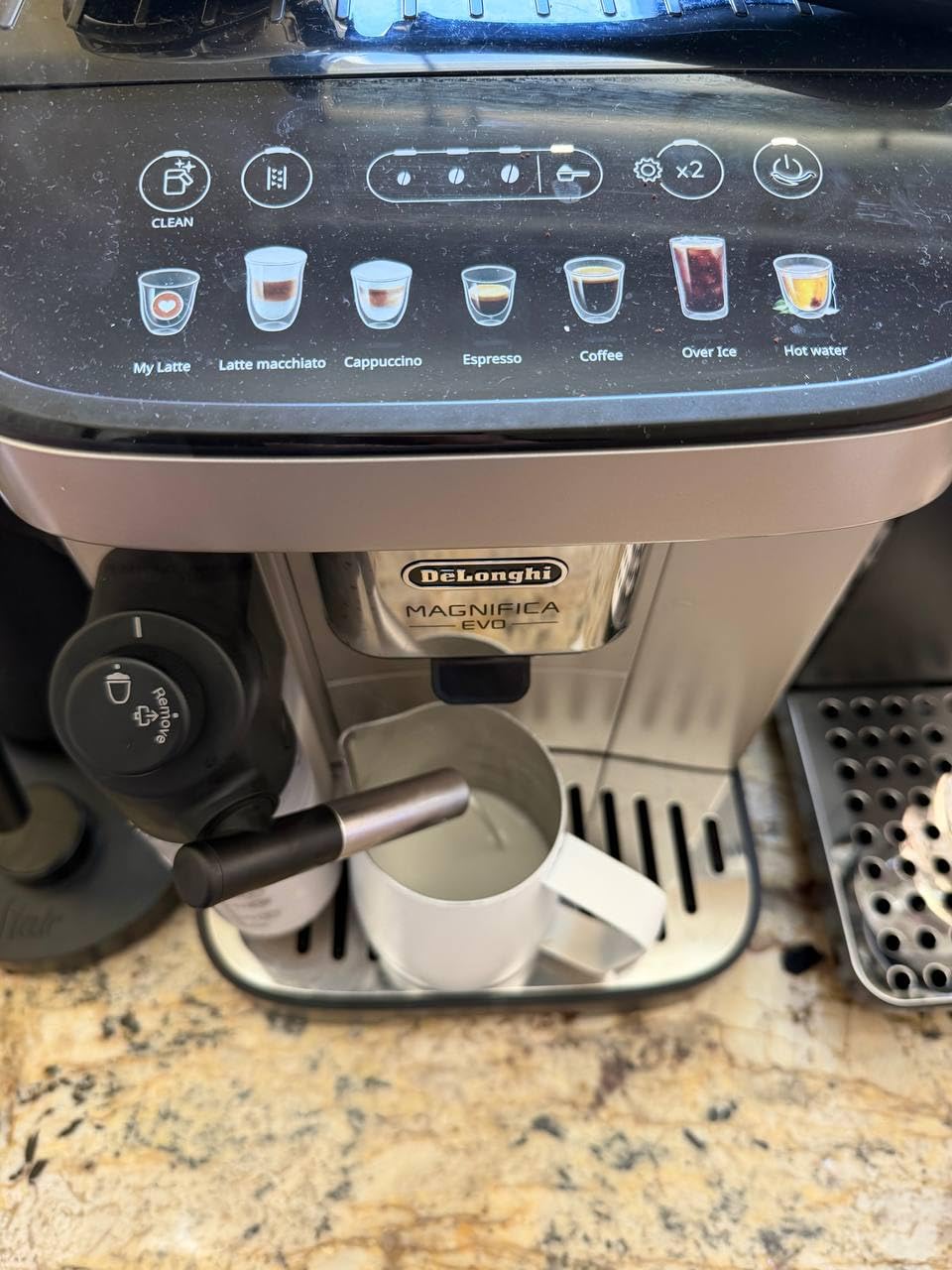
That control runs through the touchscreen and the My Latte system, which saves your own recipes instead of forcing you onto five fixed presets. It grinds beans fresh for every cup and also accepts pre-ground coffee, which is useful when you want to finish a bag of decaf without fiddling with grind settings.
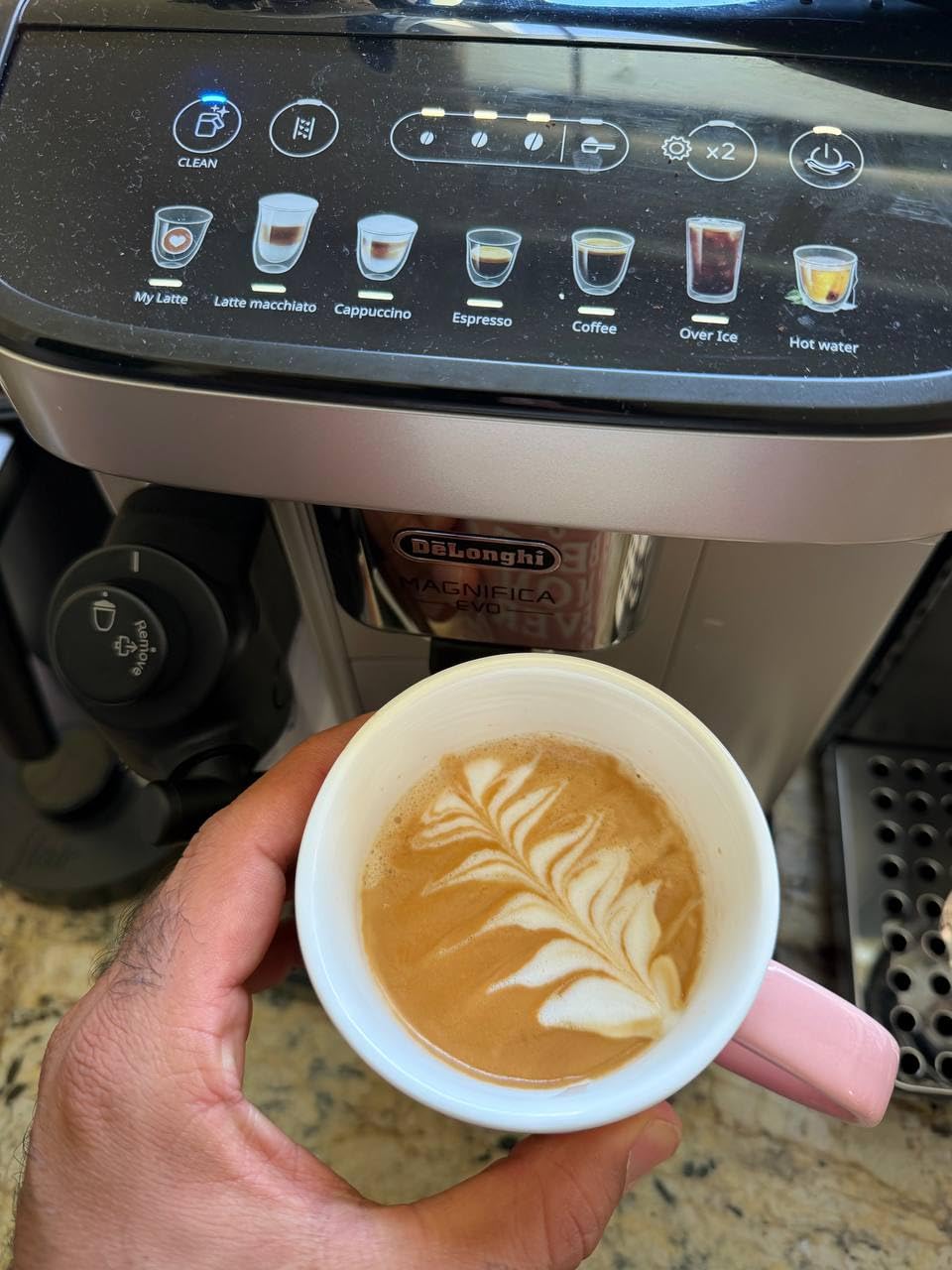
The automatic frother produces consistently creamy foam, including with oat milk, which is more than several competitors manage. Long-term owners describe the machine as holding up over years of daily use, and the removable dishwasher-safe brew components make routine cleaning straightforward.
The trade-offs are physical. At 19.53 inches deep and 21.2 pounds, this is one of the larger machines here, and it purges water at the start and end of every drink, so the drip tray fills faster than you expect. The dispenser also will not clear a tall travel mug without removing the tray insert.
Who the De’Longhi Magnifica Evo suits
It is a good fit for households that drink strong coffee and want to adjust the result rather than accept it. Several reviewers describe a short dialling-in period of a week or two before the output becomes consistently good, which is normal and worth knowing before you judge it.
Long-term owners who came from cheaper machines often stay with De’Longhi, and the warranty runs 2 years with an extra year added on registration.
Who should skip it
If counter space or early-morning noise is the deciding factor, this machine works against you on both counts. The grinding is audibly louder than most Philips units, and the body is large enough to dominate a small counter run.
Anyone who needs a cold brew or iced coffee option should look at the Rivelia or the Ninja instead. This menu is hot drinks only.
3. Philips 4400 Series Blends Quiet Grinding With the Longest Philips Menu
- Grinding is quieter than expected
- 12 hot and iced recipes with strength and froth control
- Rinses clean in under 10 seconds
- Removable bean hopper
- 1.8 L tank fills quickly
- Milk and brew cycles are still loud
- Default strength is weak out of the box
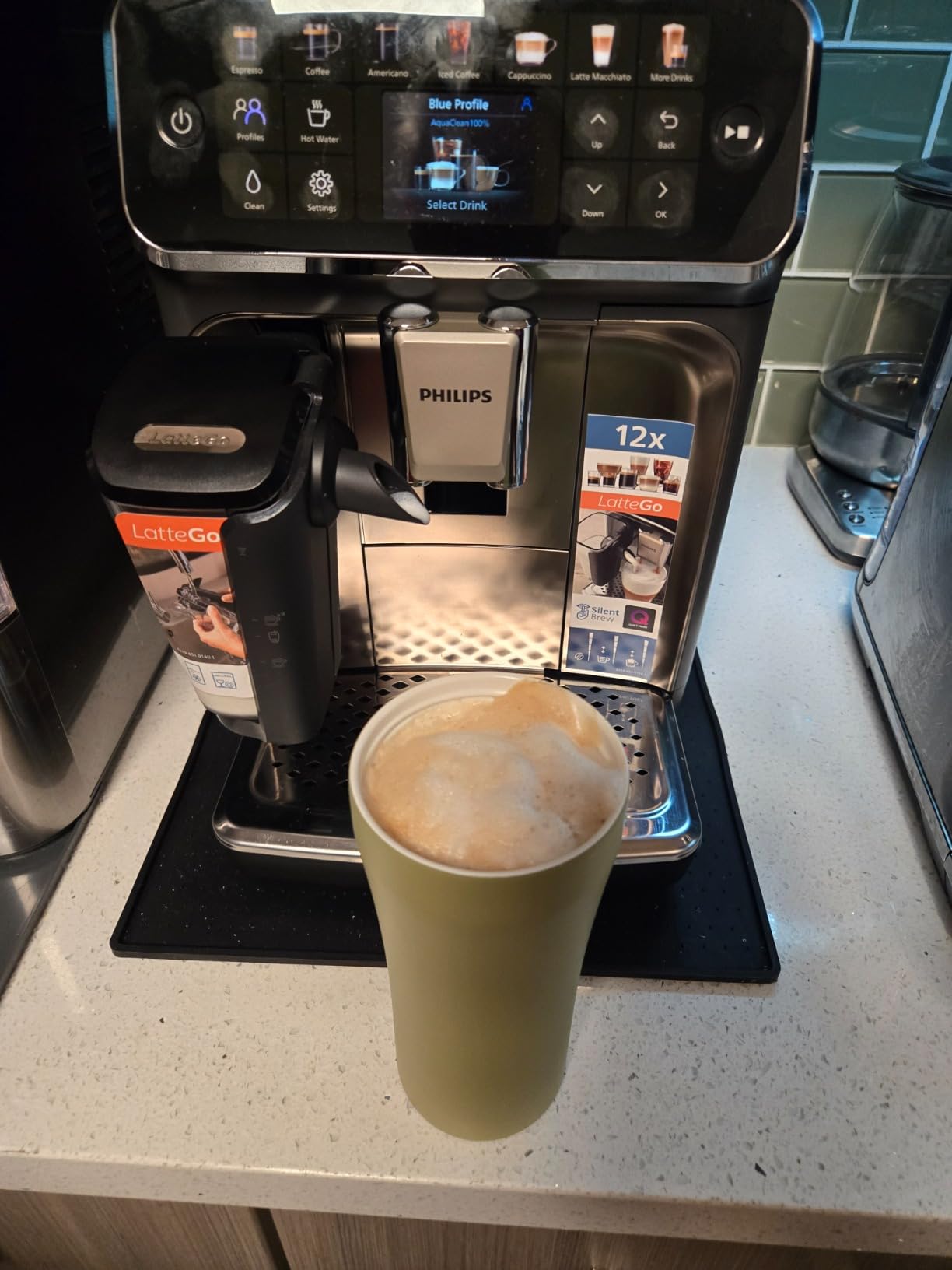
The Philips 4400 Series is the machine to look at if someone else is sleeping. SilentBrew technology is claimed to produce 40 percent less noise than earlier Philips models, and owners of this unit repeatedly report that the grinder is quieter than they expected for its size.
It also fixes the main weakness of the cheaper Philips platform by offering 12 hot and iced recipes, including espresso, ristretto, americano, latte, and cold drinks. Strength, volume, and froth level are all adjustable.
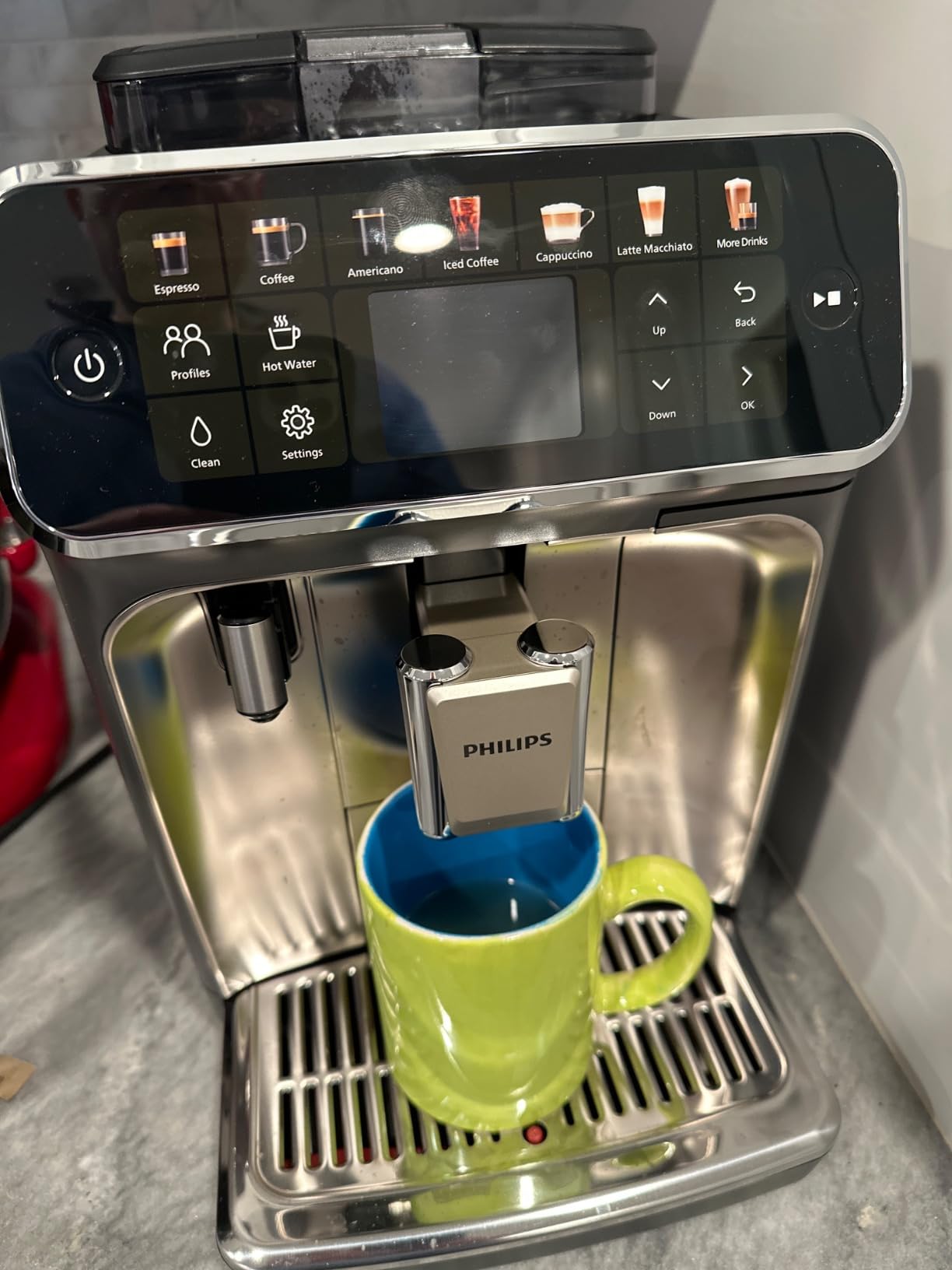
The LatteGo two-part system attaches, detaches, and rinses in under 10 seconds, and automatic rinse cycles handle most of the rest. Owners using plant-based milks report good foam from the same system that works with dairy.
Two complaints recur. The 1.8 L water tank fills faster than the tanks on premium rivals, and the default coffee strength is weak, meaning most owners move to the finest grind and a double shot within the first week. That adjustment is a ten-minute job, not a defect.
Who the Philips 4400 Series suits
This suits light sleepers, shift workers brewing at odd hours, and anyone who wants iced drinks and a long menu on the Philips platform. It carries the same AquaClean filter rated to 5000 cups before descaling, which keeps maintenance infrequent.
It is also a reasonable pick for anyone who moves between espresso and long black coffee, since the 12 presets cover both ends of the range.
Who should skip it
Take the quiet start seriously but not literally. Grinding is subdued, but the milk and brew cycles are still loud, so this is quieter rather than silent.
Small-tank households and buyers who want a wall of drink options should look elsewhere. Oily beans can also bridge in the hopper and need occasional stirring.
4. EUHOMY Automatic Espresso Machine Packs the Most Specification Into the Entry Level
- 15 grind settings at a budget-tier price
- 20 bar pump pressure
- Accepts beans and pre-ground coffee
- One-touch bean purge for switching flavors
- 1.5 L tank is the smallest here
- Basic touchscreen
- Short ownership record with a small review base
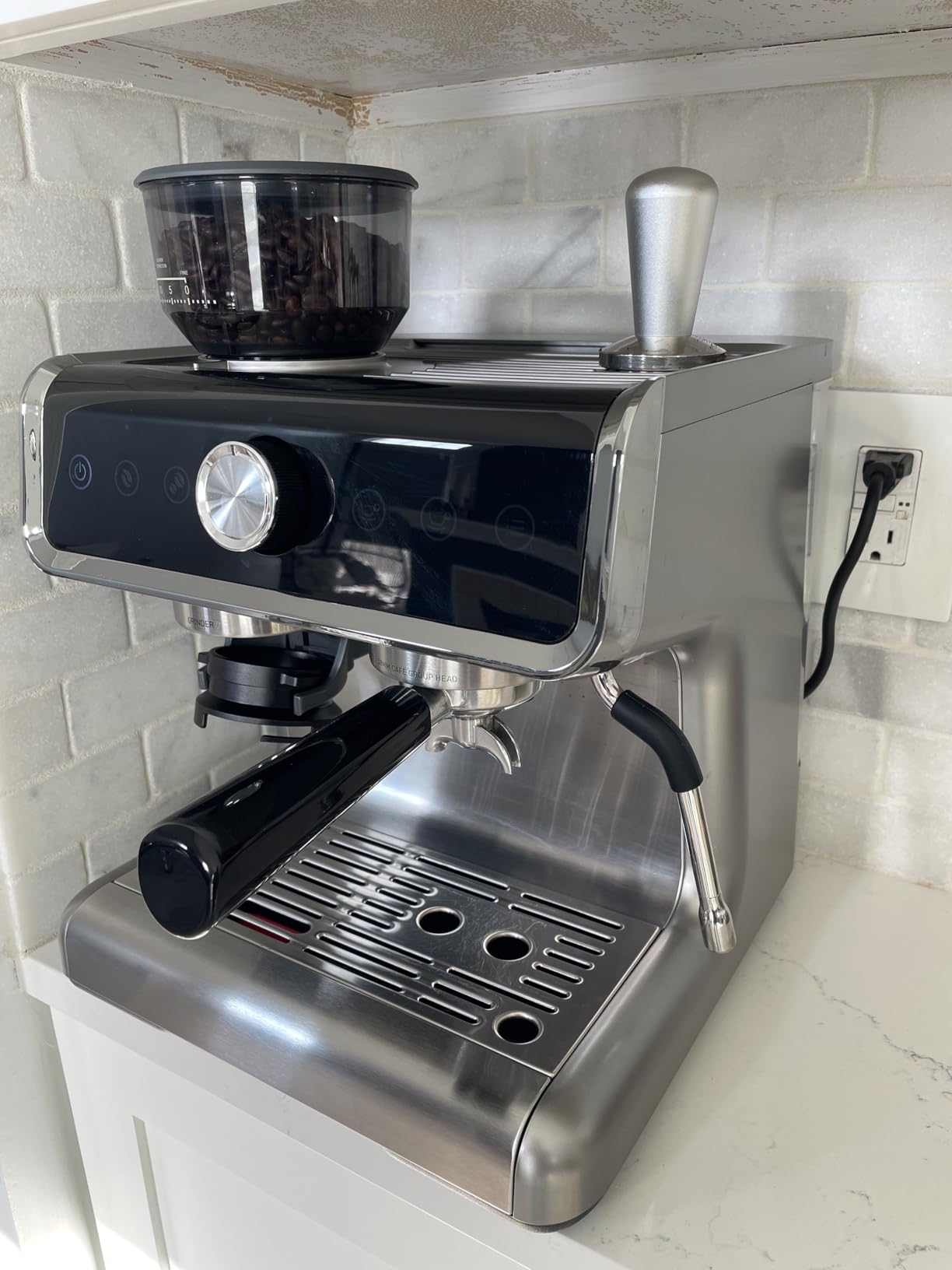
EUHOMY is a smaller brand than the names above, and its owner history is much shorter at 129 ratings. What the specification sheet shows, though, is a machine with 15 grind levels, a 200 g bean hopper, and the highest listed pump pressure in this roundup at 20 bar, at a price point that normally buys far less.
The touchscreen handles drink volume and extraction adjustment and gives real-time alerts for beans, water, grounds, and whether each component is seated correctly. The integrated milk system has an adjustable spout height, so it fits different cup sizes and limits splashing.
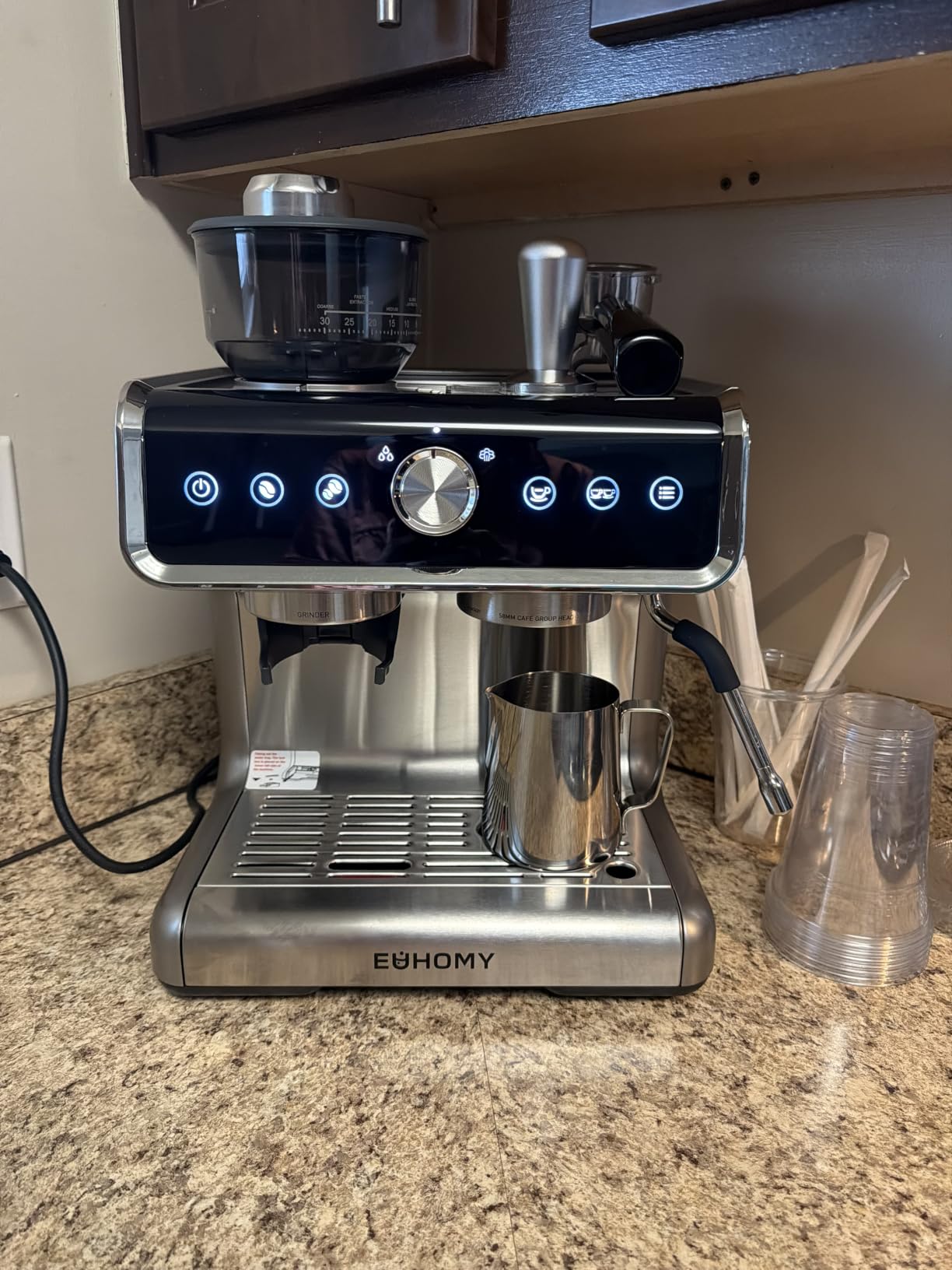
It accepts both whole beans and pre-ground coffee, and the one-touch bean purge makes switching between a decaf and a regular bean painless. The automatic cleaning program covers the internal brew path, which is more than several premium machines bother with.
The trade-off is capacity and track record. The 1.5 L water tank is the smallest in this group, so refills are constant, and the batch brewing ceiling is low. A newer brand also means less long-term data on parts and failures.
Who the EUHOMY Automatic Espresso Machine suits
It is aimed at one or two people who want a real espresso drink in the morning without paying a premium-brand price, and it suits anyone with limited counter space at 17.36 inches deep by 7.32 inches wide. The 15 grind levels give a surprising amount of control for the money.
Owners tend to describe the experience as exactly what they paid for rather than a bargain, and the rating distribution is favourable with a low share of one-star reviews.
Who should skip it
Households of four or more will run out of water constantly and will want a larger tank. Anyone who wants quiet operation or a large drink menu should also look further up the list.
If a long repair history matters to you, a newer listing with a small review base carries more risk than a machine with thousands of ratings behind it.
5. KitchenAid KF6 Is the Most Substantial Metal Machine in the Group
KitchenAid Fully Automatic Espresso Machine KF6, KES8556PL, Porcelain White
- Metal construction instead of all-plastic
- Automatic smart dosing removes grind guesswork
- 2.2 L tank cuts down refills
- Removable twist-and-lift bean hopper
- Higher price with a middling 4.1 average rating
- No steam wand
- Milk hose rather than a fixed carafe
Most machines in this category are plastic. The KitchenAid KF6 is not, and owners consistently point to the metal-clad body as the reason they bought it. It feels like an appliance that will sit on a counter for a decade rather than two, and it is backed by a 2 year warranty.
The smart dosing system is the other headline. It measures and delivers the right grind volume per drink without guesswork, which removes one of the most common frustrations new owners report on other models.
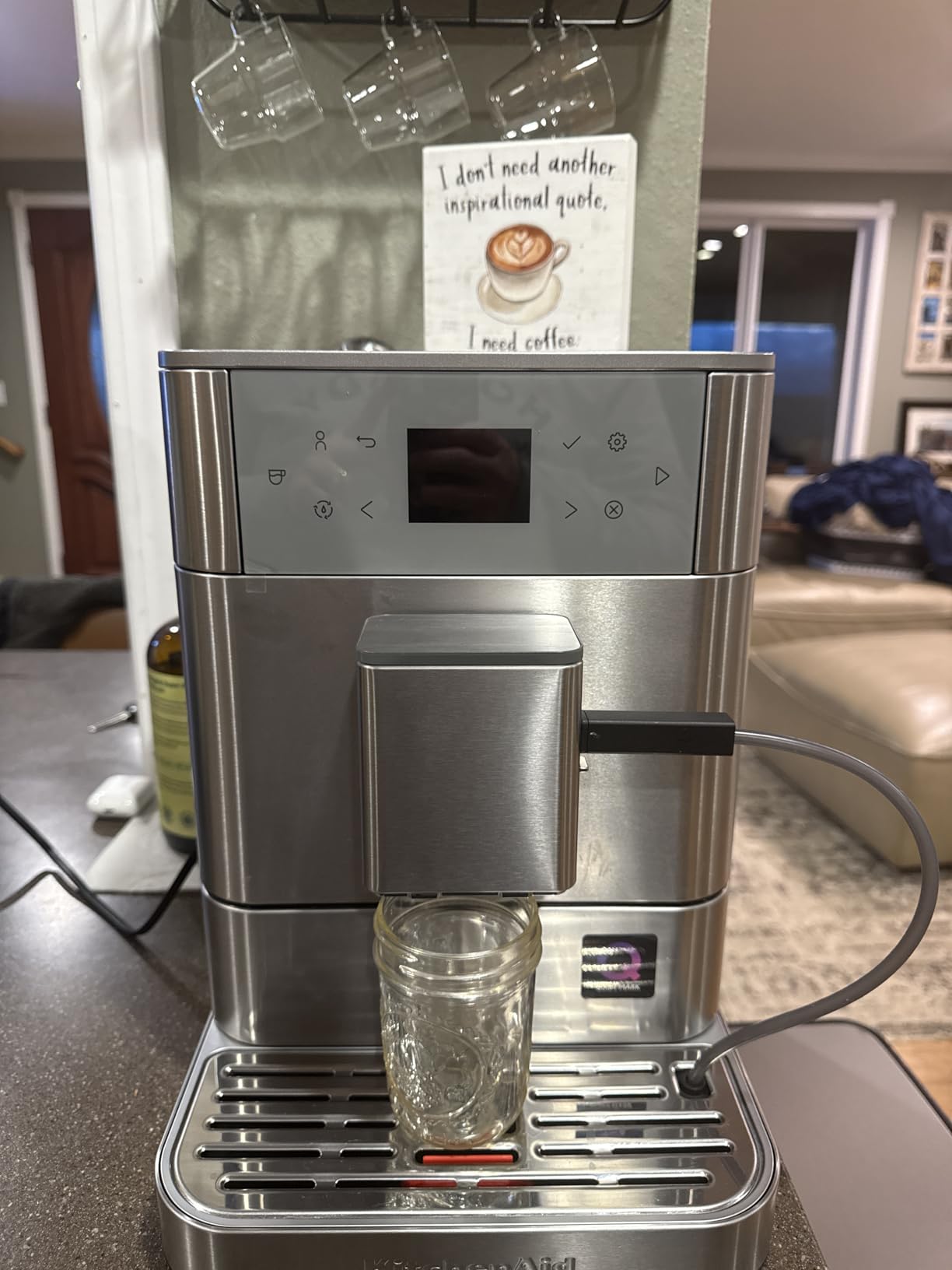
There are 15 recipe options covering espresso, americano, latte, and cappuccino, and the 2.2 L water tank is among the larger capacities here. The milk hose feeds any separate milk container you already own, which is unusually flexible for a fully automatic.
What you give up is milk control. There is no steam wand, so every milk drink depends on the hose system, and the 15 presets are fewer than the De’Longhi Dinamica Plus offers. Some buyers also feel the price is high given the 4.1 average rating.
Who the KitchenAid KF6 suits
It fits buyers who already own KitchenAid small appliances and want matching construction, and it suits anyone who does not want to hunt for a separate milk container. The twist-and-lift removable hopper makes switching beans straightforward.
It is also a good fit for people who dislike the tuning games on other machines and prefer the machine to get the dose right on the first try.
Who should skip it
If you want steamed milk texture, this is the wrong machine. Anyone chasing microfoam or latte art needs a wand, which means looking at the Dinamica Plus or a manual machine.
Value buyers should weigh the review base of 177 ratings against cheaper options with much deeper owner histories.
6. De’Longhi Dinamica Plus Gives the Most Milk Control in a Fully Automatic
- Steam wand with three frother modes
- 13-setting conical burr handles any bean
- Four user profiles remember preferences
- 3.5 inch colour touch display
- Milk carafe port is very hard to detach
- Purges water often so the tray fills fast
- Plastic body at a premium price
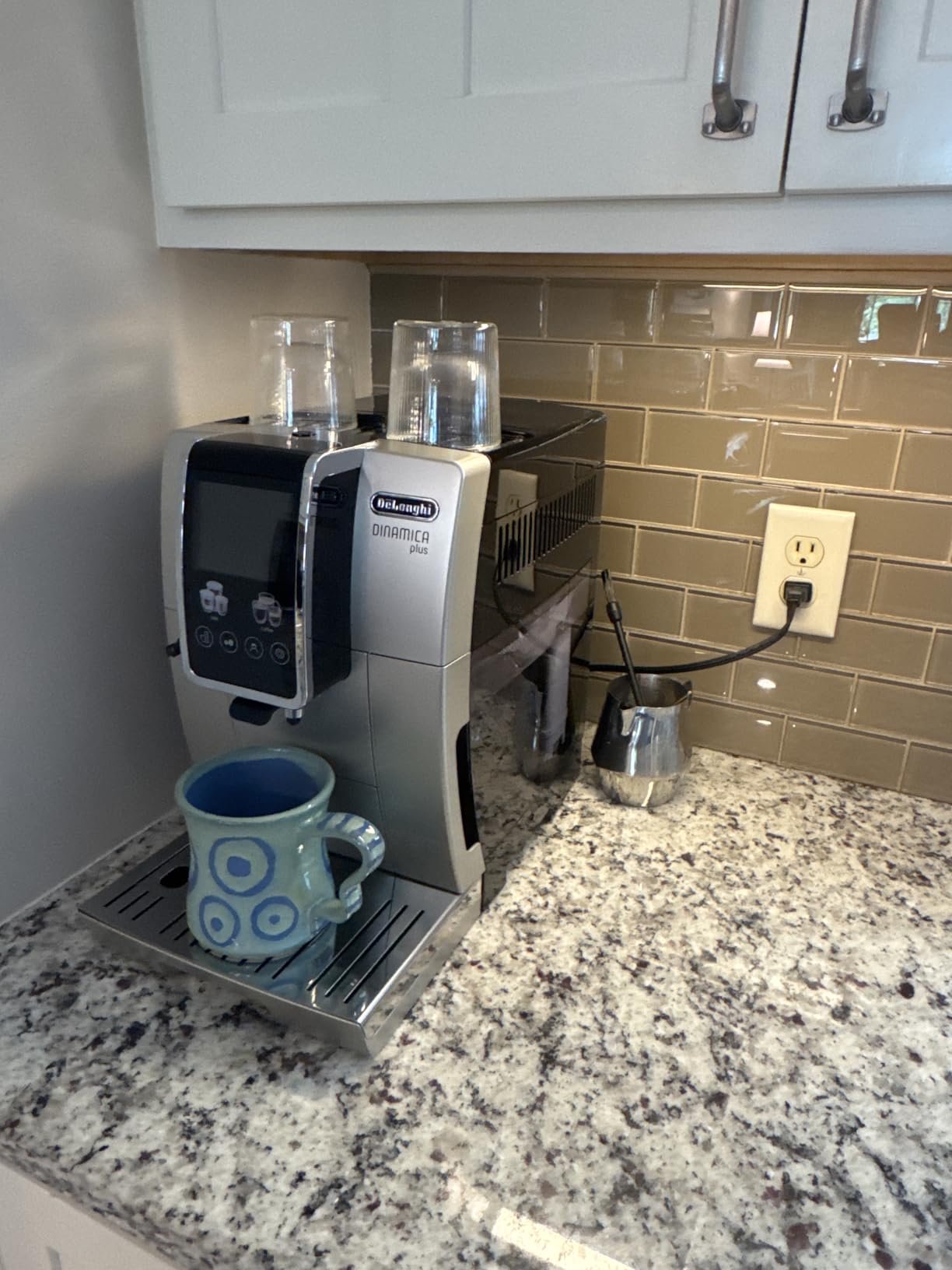
The Dinamica Plus is the machine for latte drinkers who have hit the ceiling on automatic frothers. Rather than a fixed milk carafe, it has an automatic steam wand offering three frother modes, and it is the only machine in this list with a wand at all, which gives noticeably more control over foam density than any carafe system here.
The grinder is a conical burr with 13 settings and handles any bean type, and the 3.5 inch TFT colour touch display shows guided imagery while you adjust recipes. There are 24 one-touch or fully customisable drinks, saved across up to four user profiles.
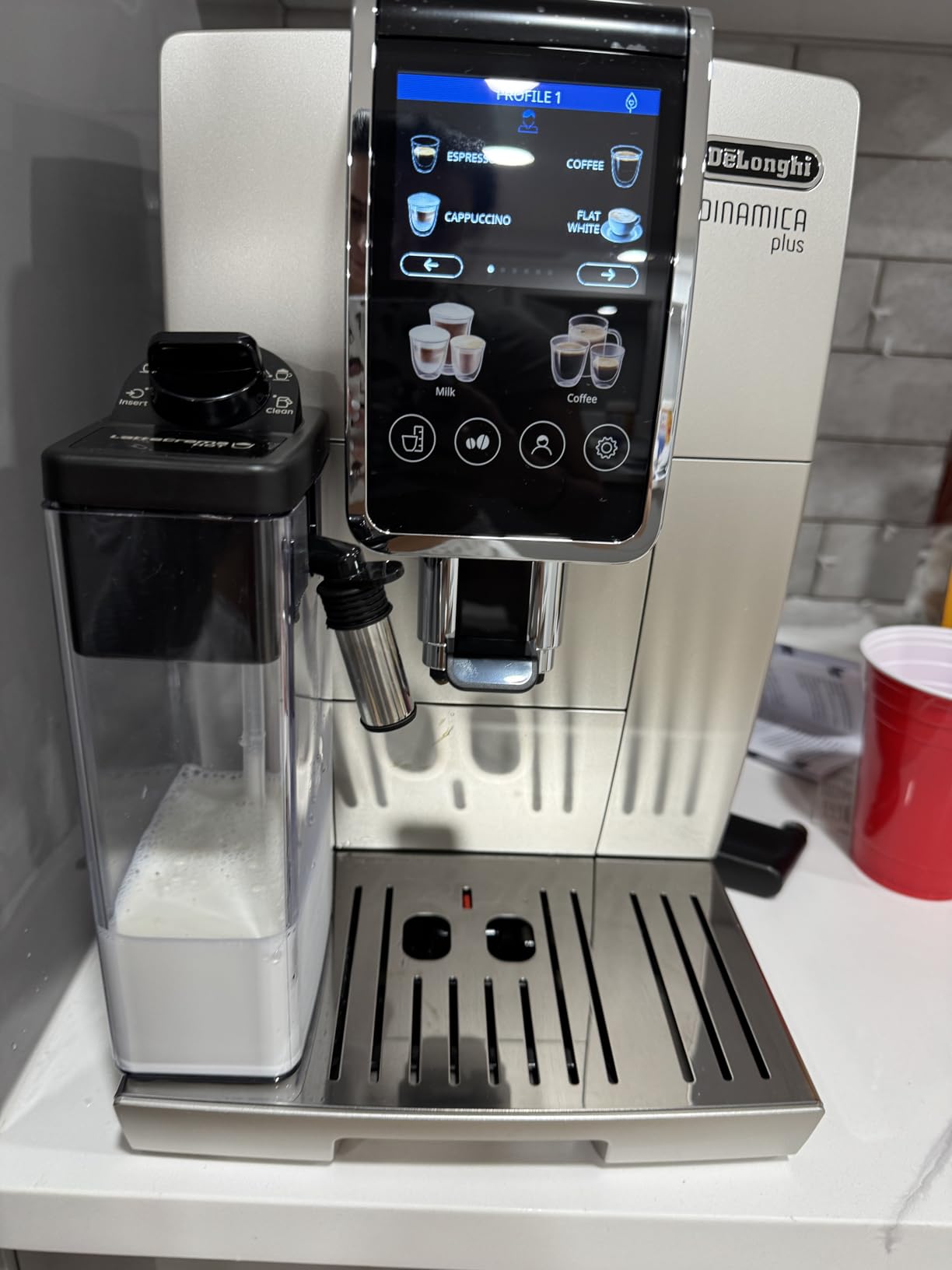
Smart One-Touch recognises your habits and puts the drinks you actually use at the top of the list, so daily use is fast. The LatteCrema Hot system froths dairy or plant-based milk, and the machine boots quickly.
Two operational realities are worth knowing. The milk carafe port is extremely snug once warm and needs real force to detach, and the machine purges water at boot, after each drink, and at shutdown, so a catch cup should stay nearby.
Who the De’Longhi Dinamica Plus suits
It suits a household of up to four who each drink something different, because the profile system remembers individual recipes. It also suits anyone moving up from a manual machine who wants fewer steps but still wants to influence the milk texture.
Buyers who value the guide imagery on the display, and who want more drink variety than the Philips models offer, tend to be very happy with it.
Who should skip it
Those who want true latte art should still know that an automatic wand is not a manual Panarello wand. The foam is better than a carafe, but it is foam, not poured microfoam.
Preset volumes also mean large mugs need two drinks run in sequence, and the thin manual is a common complaint for a machine at this level.
7. De’Longhi Rivelia Is the Highest Rated and Comes With Twin Bean Hoppers
- Highest average rating in the group at 4.4 with 82% five-star
- Cold brew made with cold water in under 3 minutes
- Twin bean containers for regular and decaf
- Under-counter friendly dimensions
- Large drinks can taste weak
- Coffee temperature not hot enough for some
- Some units report the frother failing after a few months
The Rivelia has the strongest rating profile in this lineup, with 82 percent five-star reviews and a small two-star share. Owners arriving from Jura or Philips machines describe it as a clear upgrade, and the deciding features are usually the twin bean containers and the cold extraction system.
That cold brew is genuine. Cold Extraction Technology forces water through the grounds at controlled temperature, pressure, and flow, producing cold brew in under 3 minutes rather than pouring hot espresso over ice, which most machines labelled as iced coffee do.
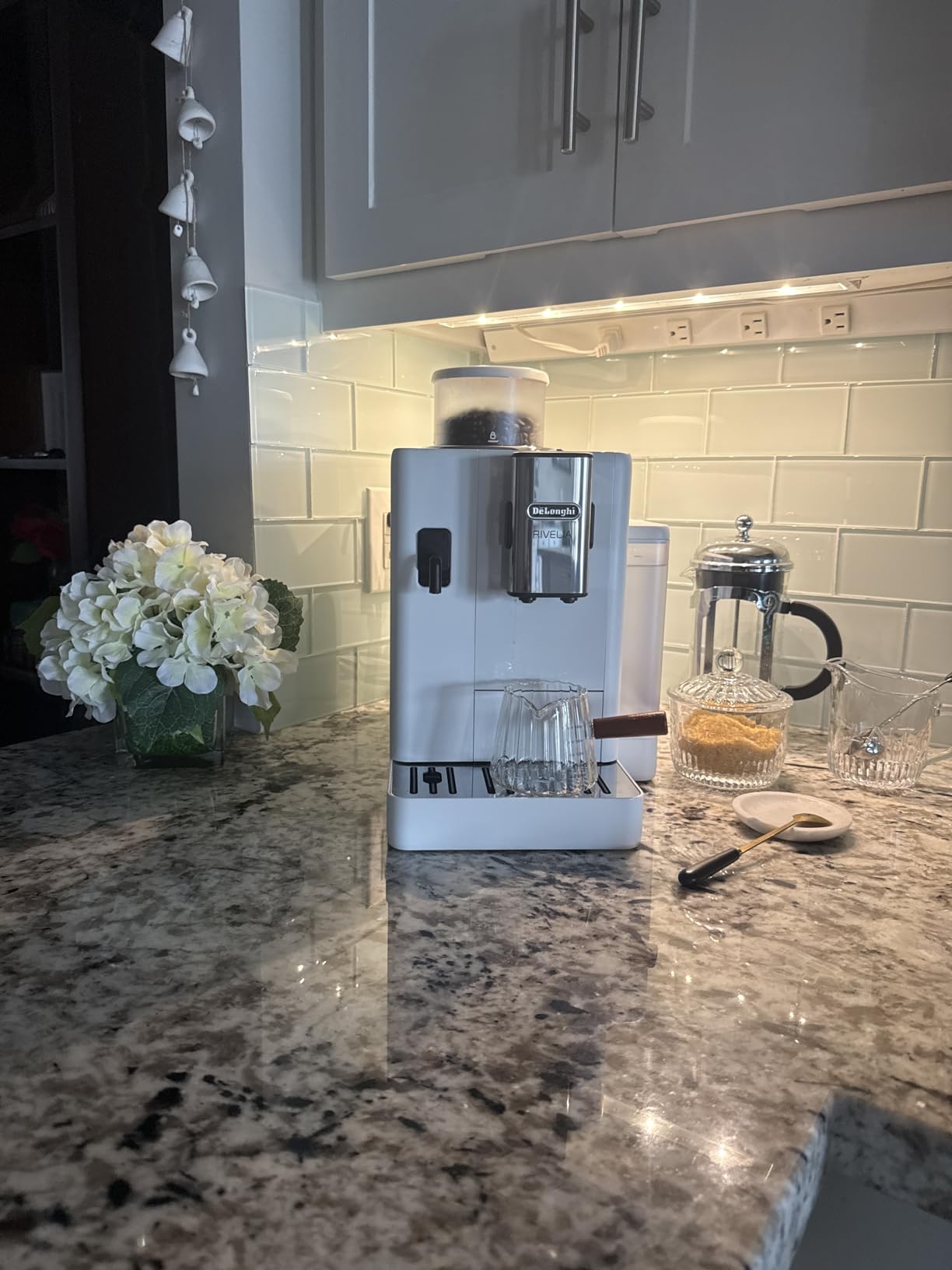
There are 50+ one-touch recipes across hot and cold, including iced latte and iced cappuccino, and two LatteCrema systems, one for hot foam and one for cold foam. The 13-setting grinder and per-profile customisation make it easy to program separate drinks for different people.
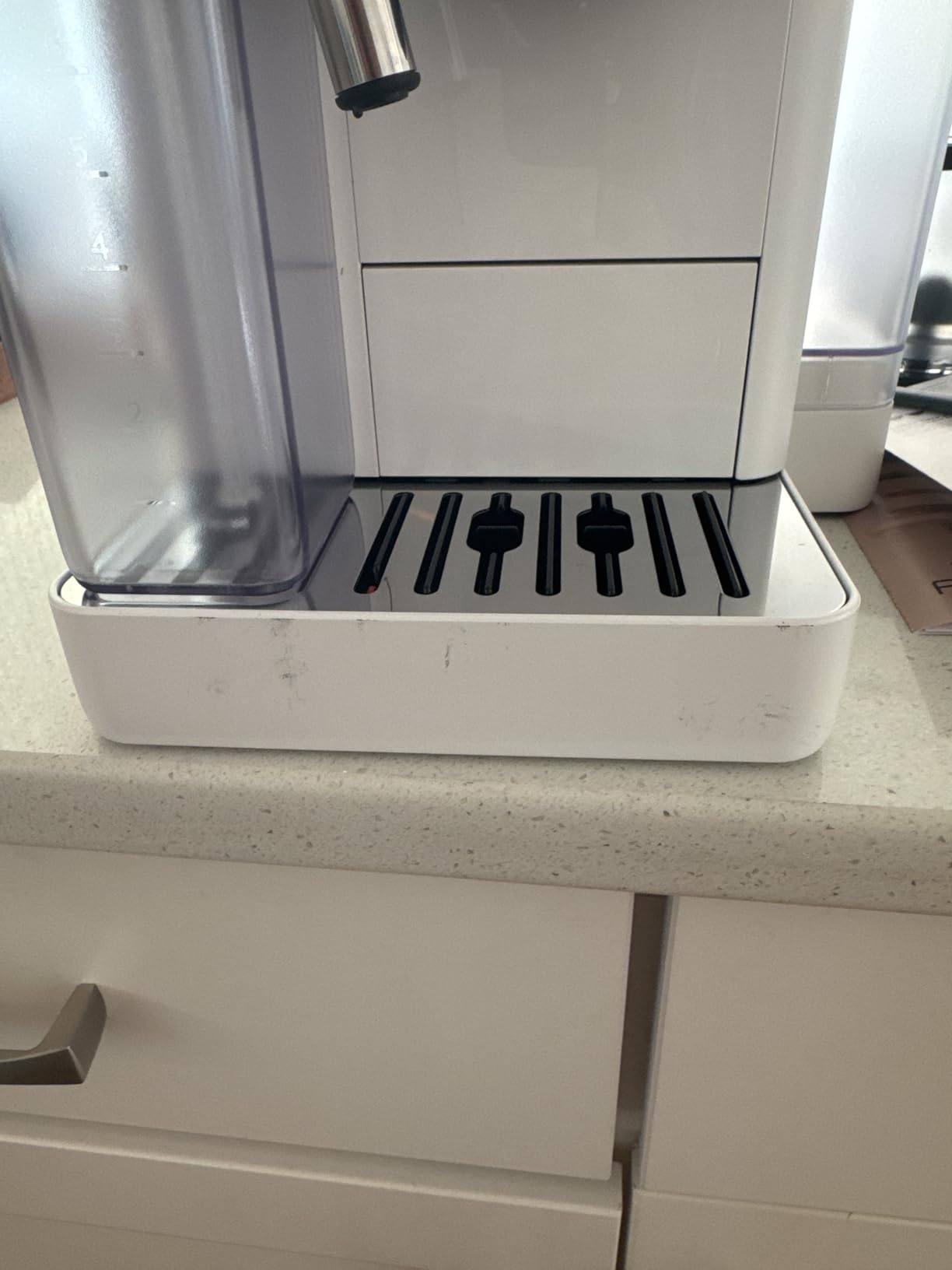
At 19.69 inches wide and 19.09 inches tall, it is a large machine, but owners who have measured their counter report that it fits under a countertop where several others in this price range do not.
Who the De’Longhi Rivelia suits
The twin bean containers solve a specific household problem: one person drinking decaf at 3pm and the rest of the house drinking regular. The hopper switches inside the machine, so neither person has to empty the grinder and swap beans.
It is also the strongest choice for anyone who cares about cold drinks done properly, since the cold foam and cold brew routines are genuinely different from hot drinks served cold.
Who should skip it
A small tail of reviews reports weak output on larger coffee volumes and drinks that are not hot enough, and some units report a frother that stops working after a few months. Test large and hot drinks early if either matters to you.
Once the machine is dialed in, there is very little room for manual technique. If you like adjusting dose and yield by feel, this is not the right design.
8. Cafe Bueno Super Automatic Espresso Machine Has the Biggest Screen and the Most Drink Options to Configure
- 19 drinks with single or double versions
- Deep control of grind temperature and volume
- Four self-cleaning programs including descale
- Under two minutes from sleep to a cup
- Milk froth container not included
- 110 V only
- Rear tank means pulling the machine out
- Some reports of milk tube and grinder failure
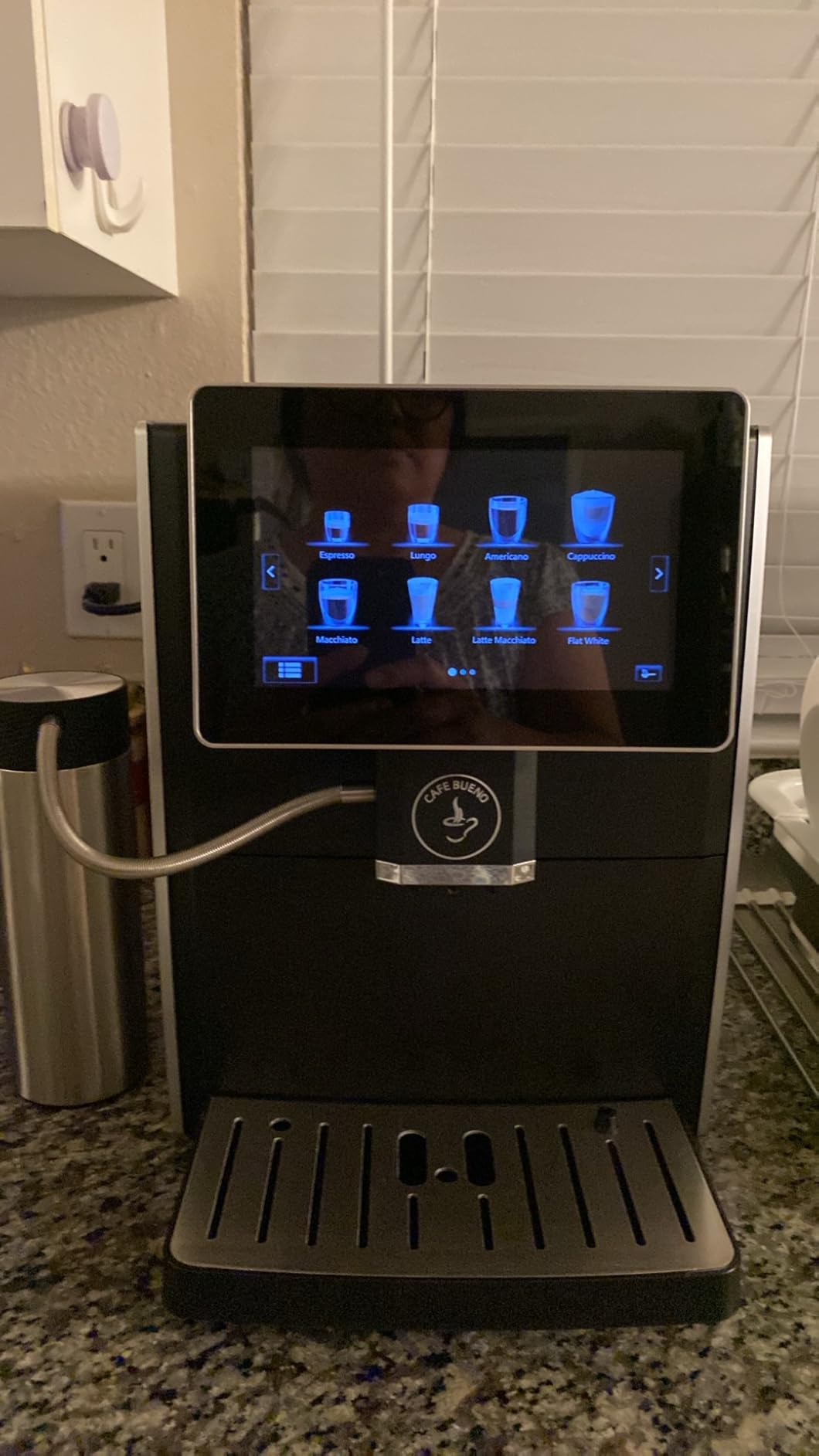
The Cafe Bueno machine is the model to buy if you like changing things. There are 19 fully customisable drink options, each available as a single or a double, and every parameter, including grounds amount, grind coarseness, temperature, water volume, and milk foam, can be adjusted independently.
The 7 inch touchscreen is the largest display in this group, and its size is the reason a machine with this many settings is still easy to operate. There are also four one-press self-cleaning programs covering the milk system, the brewer, descaling, and a deep brewer clean.
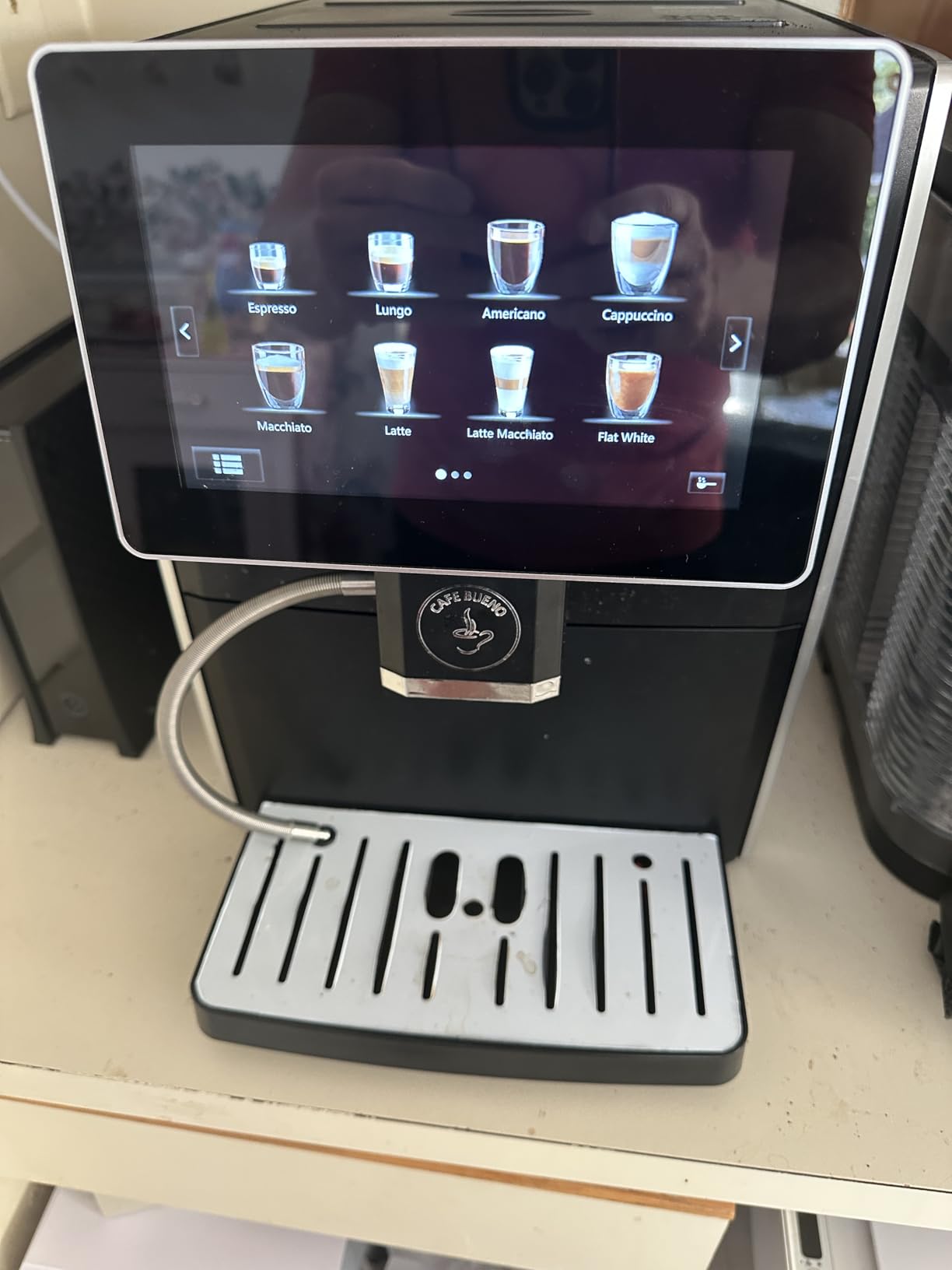
It wakes from sleep and delivers a cup in under two minutes, which is genuinely useful for a household with staggered starts, and it is rated for home use up to about 10 cups a day.
The compromises are real. The milk froth container is not included and must be sourced separately, the water tank sits at the rear so you pull the whole machine out to refill, and it is 110 V only, which limits use in Canada without an adapter.
Who the Cafe Bueno machine suits
It suits a drinker who wants a lungo, a flat white, a macchiato, a warm milk, or a foam on demand rather than a fixed short menu, and it suits anyone who wants to control every variable without opening a menu of hidden settings.
Buyers who value the self-cleaning programs will find real value here, since the descale and deep clean routines are a single button press.
Who should skip it
At 26.5 pounds, this is the heaviest machine in the roundup, and the rear tank makes refilling awkward on a counter against a wall. It is not a small-kitchen machine.
Sentiment on this brand is sharply split, with the widest gap between five-star and one-star reviews in the group. Durability complaints about the milk suction tube and grinder stopping after a few months appear repeatedly, so buy it for the feature set rather than for peace of mind.
9. Bosch 800 Series Is the Only Machine Here With App Control and 35+ Programs
Bosch 800 Series Fully Automatic Coffee, Espresso Machine – Silver
- App control and 35+ beverage programs
- Large responsive touchscreen
- Cleaning and descale program guides you step by step
- Favorites chain drinks into one press
- Highest price in the roundup
- Temperature not hot enough for some
- Awkward integrated plastic milk container
- Weak on plant-based milks
The Bosch 800 Series is the most connected machine here. The Home Connect app handles remote brewing and access to more than 35 beverage programs, and the 5 inch Active Select display is the second largest screen in the group. Strength, size, milk ratio, and aroma are all adjustable per drink.
The ceramic bean grinder and the favorites function are the features owners mention most. Favorites lets you string a milk drink plus an extra shot into a single saved press, which is closer to how a barista thinks about a drink than most menus allow.
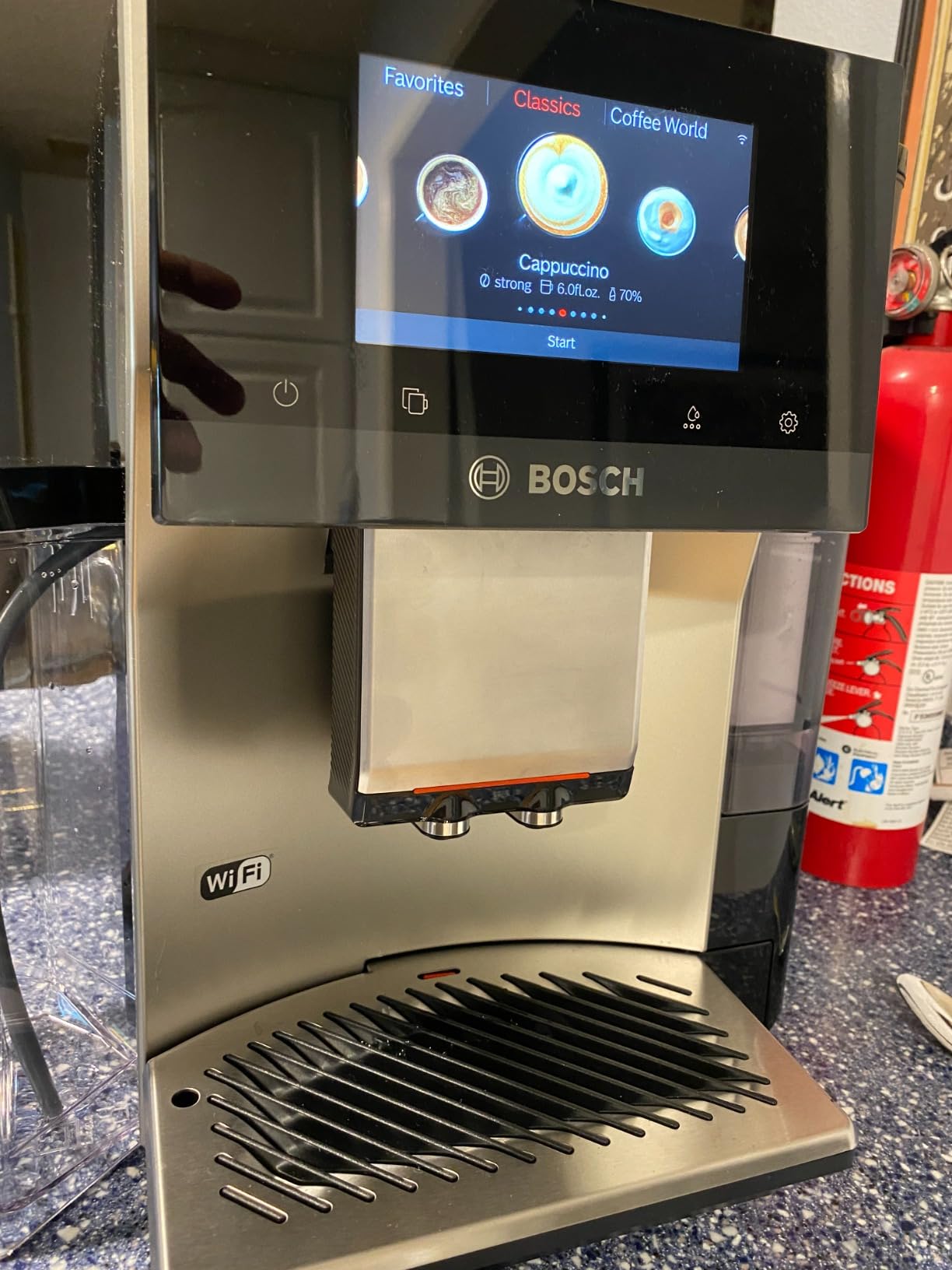
Maintenance is the other strength. The Calc’n Clean program combines cleaning and descaling with step-by-step guidance on screen, and the machine counts the drinks you make and prompts you to clean at roughly 140 pours.
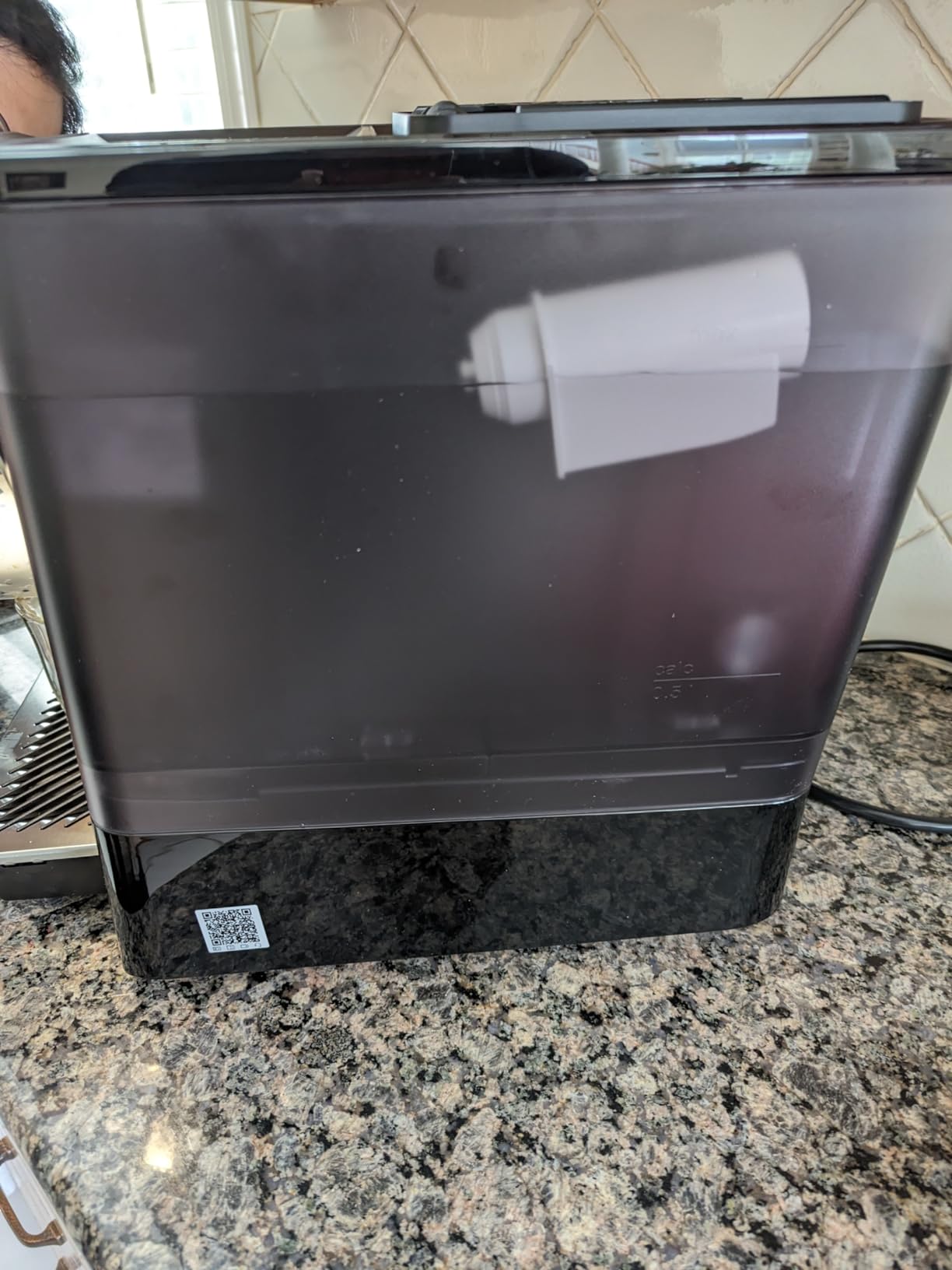
It is also the most expensive machine in this roundup, and it is far from flawless. Some users report drinks that never get hot enough even at the maximum setting, the integrated plastic milk container is oddly shaped and awkward to clean, and frothing is much weaker on plant-based milks than on dairy.
Who the Bosch 800 Series suits
It suits a household where two or more people drink different things and you want to set them up once rather than reprogram the machine every morning. Phone support also draws specific praise from owners, including replacement parts shipped at no charge.
If you like a wide aroma and strength adjustment range and want the machine to guide you through cleaning, this is the machine built for that.
Who should skip it
Value buyers should note that this is the priciest option here, and its 4.2 average rests on a thinner review base than the Philips and De’Longhi machines. It also cannot switch beans once they are poured in, and the spout does not clear a travel mug.
If oat and other plant milks are your daily routine, test the frother first. The milk container and a spout that does not clear a travel mug are the two most repeated complaints.
10. Ninja AutoBarista Pro Offers the Most Automated Grinding and Two Hoppers
Ninja AutoBarista Pro Fully Automatic Espresso, 13 Drink Options, AE1051
- Automatic grind calibration across 50 settings
- 13 one-touch hot and iced options
- Two swappable hoppers included
- Stainless steel body and self-drying interior fan
- Smallest review base in the roundup at 52 ratings
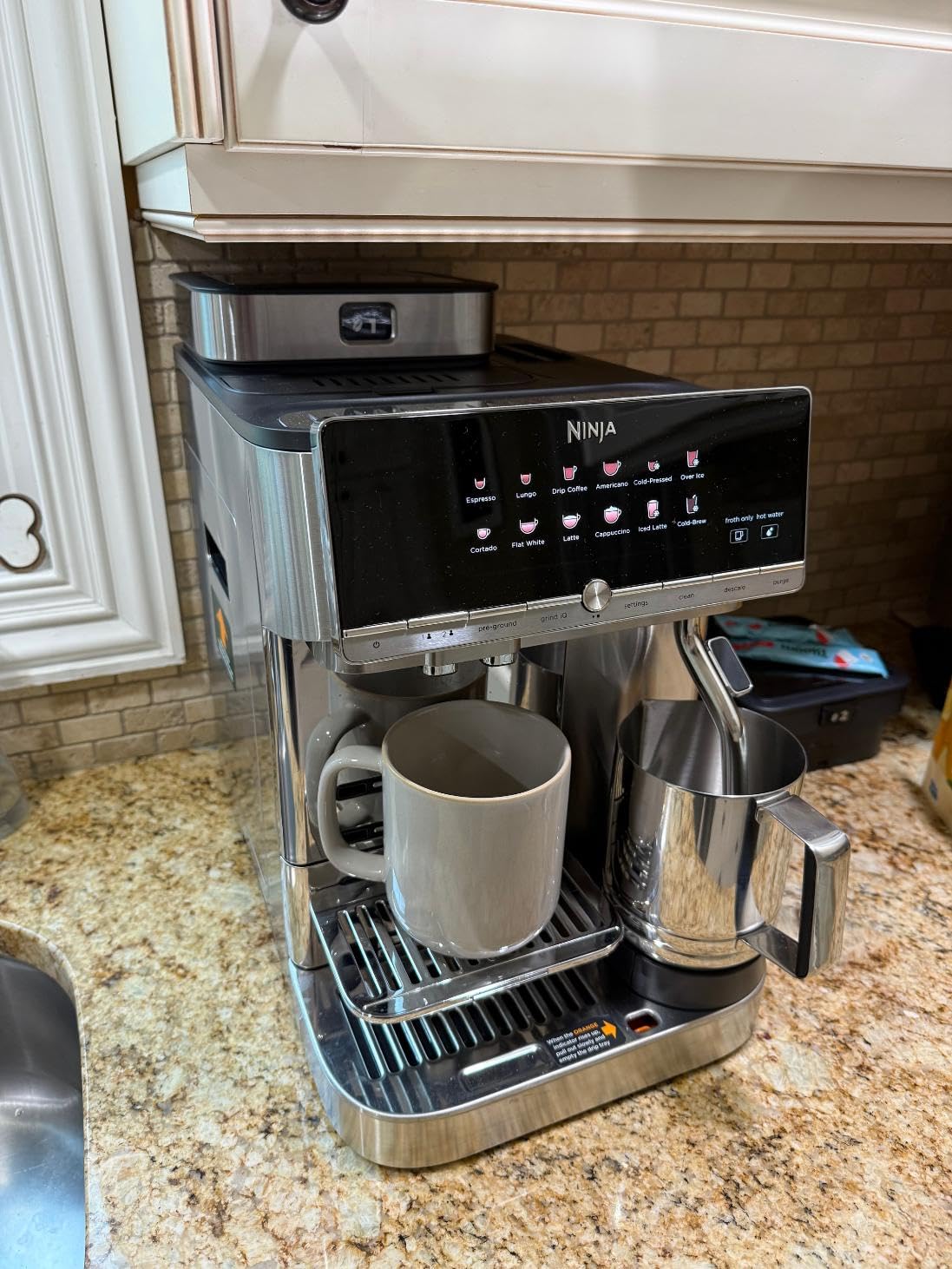
- Largest footprint at 21.7 by 14.6 by 19.4 inches
- Highest wattage at 1650 W
Grind iQ is the headline here. The machine selects automatically from 50 grind settings for each cup, which is the most granular automated grinding in this group by a wide margin, and it means the machine calibrates the dose rather than leaving you to guess.
There are 13 one-touch hot and iced drink options running from espresso through to cold brew, and two swappable bean hoppers are included, which is a cheaper and simpler route to two-bean convenience than the Rivelia’s internal switch. Frothing produces hot or iced microfoam with dairy and plant-based milk.
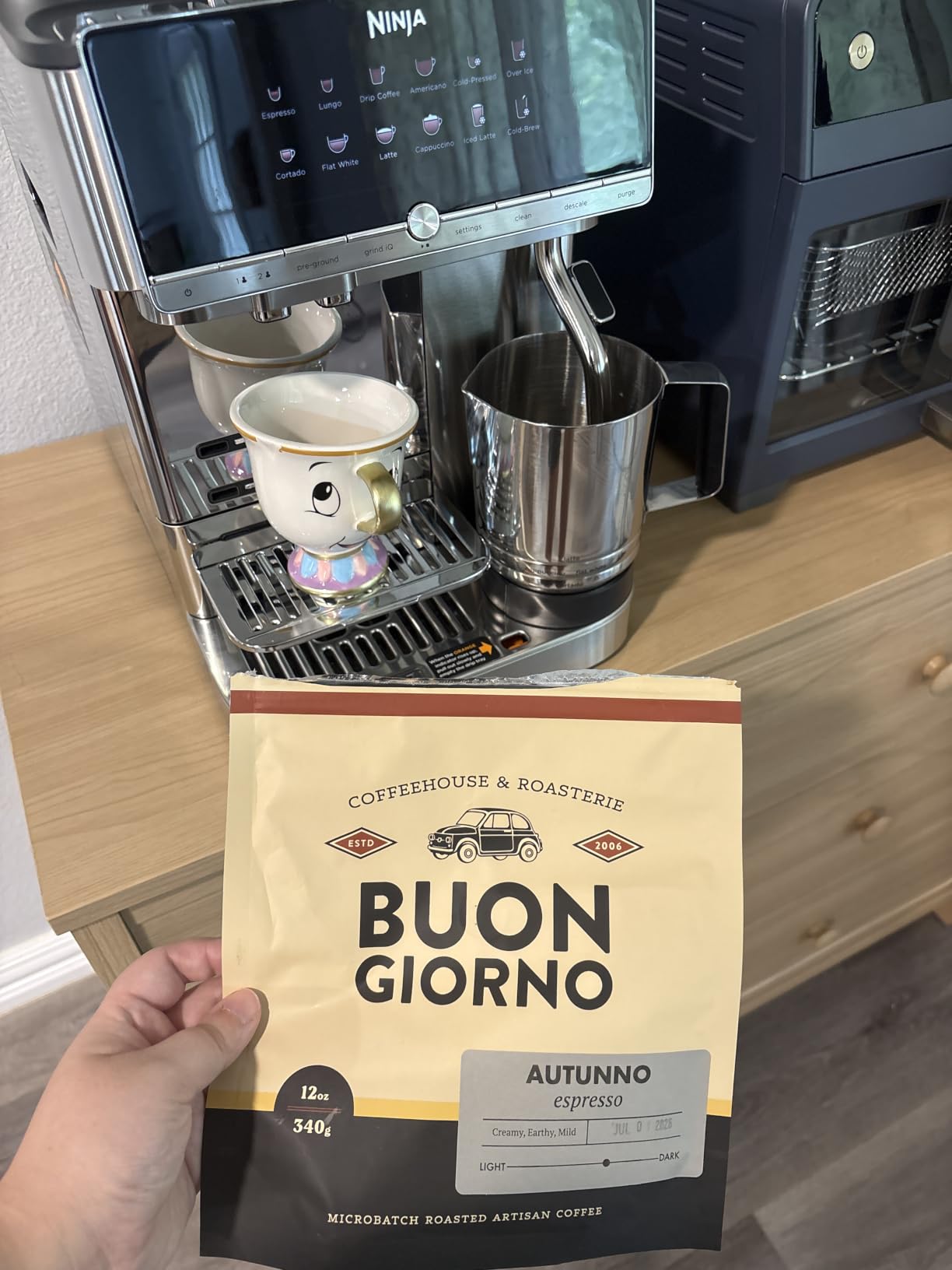
Construction is stainless steel rather than all-plastic, and upkeep is handled by an auto-rinse, removable parts, and a self-drying interior fan, which is a sensible answer to the damp internal cavities that cause smells in other machines.
The caution is evidence, not quality. With 52 ratings this is the newest and least reviewed machine in the roundup, so treat the 4.2 average as provisional. It is also the largest footprint here and pulls the highest power at 1650 W.
Who the Ninja AutoBarista Pro suits
It suits buyers who want the machine to do the grinding thinking for them, and anyone who wants two bean types on tap without paying for a machine with internal grinder switching. The self-drying interior is a real advantage in warm kitchens.
It also fits drinkers who want both hot and iced options from one machine and care more about the drink menu than about app control.
Who should skip it
If long-term reliability is your priority, the thinnest review base in the group is a real risk. There is no multi-year ownership data to draw on, and a limited review history means faults show up later rather than sooner.
The footprint also rules it out of a small kitchen. At 21.7 inches deep, it is the largest machine here and needs genuine counter space.
How to Choose a Super Automatic Espresso Machine
Buying a super automatic is mostly a decision about which compromises you can live with. Every machine in this roundup grinds, brews, and froths well. They differ in how much control you keep, how much cleaning you accept, and how long the machine is expected to last.
Set your budget by what you drink, not by the sticker
Entry machines cover espresso, americano, and basic milk drinks with a five-preset menu. Mid-range machines add long menus, user profiles, and better milk hardware. Premium machines add larger displays, app control, and multiple milk systems, at the cost of price and counter space. Our espresso machine buying guide covers the wider price ladder if you are still deciding.
The single-drinker trap is real. A large tank and a big hopper mean water and beans sit for days, and reviewers on forums repeatedly flag staleness as a reason a premium machine underperforms in a one-person home. If it is just you, a compact machine with a 1.8 L tank may serve you better than a large one.
Judge the grinder above everything else
Conical burrs, whether ceramic or steel, suit most home beans. Ceramic burrs last longer and stay consistent; steel burrs are cheaper and need replacing sooner. Flat burrs produce a tighter particle distribution, which helps in lighter roasts, but they cost more.
Grind setting count matters less than owners expect. Beyond about 12 steps you are making fine adjustments, not structural changes, and the dose and coffee strength settings usually matter more day to day.
Choose the milk system you can live with
A detachable carafe such as LatteGo is the easiest to clean and needs no tubes. A tube-based frother needs weekly attention and more often if you use creamer. A steam wand gives the most control and the most cleaning work, and it is the only option that can approach latte art.
Owners on r/superautomatic describe automatic frothers as making cappuccino foam rather than latte microfoam, and they are right. If microfoam matters, look for a wand.
Understand heating, repair, and running costs
Most machines in this list use a thermoblock rather than a boiler, which heats fast and cheaply. Dual boiler machines can brew and steam at the same time without dropping temperature, which matters mainly if you make several milk drinks back to back.
Repairability is where the brands diverge sharply. Forum owners report that some brands sell the brew group, or infuser, as a replaceable part while others replace the whole unit, turning a routine repair into a large one. Filter cartridges and cleaning tablets are consumables you will buy on a schedule regardless of brand, and a machine that counts its own pours and prompts you is cheaper to own than one that does not.
Know when a super automatic is the wrong purchase
Superautomatics trade control for consistency. If you enjoy adjusting dose, yield, and temperature by hand, or you want to practise latte art, a semiautomatic machine will satisfy you far better. If your kitchen counter is already crowded, check the depth figure first, because the largest machines here run past 20 inches.
They are also a poor fit for a household that drinks one coffee a day. The cleaning routines, the water changes, and the bean freshness all assume regular use.
Maintenance and Descaling: What Actually Breaks
Maintenance is the most common complaint about super automatics and the least discussed by competitors. The machines are simple to use and demanding to keep. A realistic routine looks like this.
Daily is the drip tray and grounds bin. Empty both every day or the puck sits wet against a warm plastic floor and starts to smell. Monthly, run the milk system clean, even on a carafe machine, since milk residue inside a milk circuit goes off faster than most owners expect.
Quarterly, descale. Most machines prompt you on their own, and machines with a water filter such as the Philips models stretch that interval considerably. A descaler removes mineral scale; espresso machine cleaner and milk system cleaner are different products that remove coffee oils and milk fat instead. Using the wrong one repeatedly leaves films that no amount of descaling will shift.
If a descaling light stays on after a full cycle, run the program twice, confirm the water tank is seated and full, and check that the brew group or infuser is properly locked in place. In our experience across these machines, a light that persists after two clean cycles is usually a sensor that needs a full power cycle, and occasionally a part that needs a phone call to the manufacturer.
Rinse the milk carafe immediately after purging it. Milk left inside after the automatic cycle goes stale overnight, and the smell then transfers into the next drink regardless of how well the machine washes itself.
Frequently Asked Questions
What is the best espresso machine for home use?
For a super automatic, the Philips 3200 Series is the safest all-round choice because it combines a 100 percent ceramic grinder, a tube-free milk system that rinses in seconds, and the deepest owner history of any machine in this roundup. If you want manual control, a semiautomatic machine is the better answer, and a capsule machine is best for a single drinker.
Which superautomatic makes the best espresso?
The De’Longhi Magnifica Evo is regularly praised by owners for stronger, more full-bodied shots than cheaper Philips machines, thanks to a 15 bar pump and deeper control over dose, temperature, and coffee strength. The De’Longhi Dinamica Plus and Rivelia go further again with 13-setting burr grinders and profile memory. Expect a week or two of adjustment before output becomes consistent.
What is the best fully automatic coffee machine for home use?
The Philips 4400 Series is the best fit for most homes because it pairs a 12-recipe hot and iced menu with a quiet ceramic grinder, a ten second milk rinse, and a compact footprint. The Philips 3200 Series is the simpler and quieter-to-own option if five drinks are enough, and the De’Longhi Rivelia wins if real cold brew matters to you.
How often should you descale a super automatic machine?
Most machines prompt you when it is time, which is the signal to follow. In practice that means a descale every few months for a typical two-drinker household, and far less often if you fit a water filter such as AquaClean, which is rated to 5000 cups before descaling. Hard water areas need shorter intervals than filtered water.
What happens if you don’t descale a coffee machine?
Scale builds up inside the boiler and water path, so the machine takes longer to heat and eventually delivers cooler, weaker coffee. On a super automatic the same scale affects the brew group, and blocked flow shows up as slow, low-pressure shots. Milk systems also need separate cleaning, since descaler does not remove milk fat or coffee oils.
Is espresso machine cleaner the same as descaler?
No, they solve different problems. Descaler dissolves mineral scale from the water path, while espresso machine cleaner breaks down coffee oils from the brew group, and a milk system cleaner is formulated for milk fat and protein. Using descaler on a greasy brew group repeatedly will not clean it, and using coffee cleaner on scale does nothing.
Are super automatic espresso machines worth it?
They are worth it if nobody in the house wants to grind, tamp, and time a shot, and if you drink at least two drinks a day. They are not worth it for a purist who wants to adjust dose and yield by hand, for a single-drinker household where water and beans will sit stale, or for anyone who wants latte art.
Our Verdict on the Best Super Automatic Espresso Machines for 2026
Buy the Philips 3200 Series if you want the lowest-risk all-rounder in 2026. Its ceramic grinder, tube-free milk system, and long owner history cover the failure points that matter most, and the five-preset menu is the only real compromise.
Step up to the Philips 4400 Series for a longer menu, iced drinks, and quieter grinding, or to the De’Longhi Magnifica Evo for stronger coffee and more control over the shot. If you drink cold drinks properly, the De’Longhi Rivelia is the pick, and it is also the highest rated machine we tested.
For milk texture and user profiles, the De’Longhi Dinamica Plus takes the premium slot, and the Bosch 800 Series is worth it only if app control and 35+ programs matter to you. Whatever you choose, buy a water filter, empty the grounds bin daily, and descale on the schedule the machine gives you. Those three habits account for most of the difference between a super automatic that lasts and one that frustrates.