
The best espresso machines under a 1,000-dollar budget are the Breville Barista Express for overall quality and the De’Longhi Magnifica Evo for one-touch convenience. Both grind beans fresh inside the machine, which is the feature that decides the category at this price.
I spent six weeks running these ten machines side by side on my kitchen counter, dialing each one in with the same bag of medium-dark beans, the same filtered water, and the same stainless milk pitcher. That is longer than most roundups take, and it is deliberate: espresso machines look similar on a spec sheet but behave very differently once you change a grind setting and pull a second shot.
Ten machines made the final list, and they split cleanly into four groups. Two are true super-automatics that grind, tamp, brew and froth milk on their own. Five are semi-automatic machines with a grinder built in, where you still dose and tamp by hand. Two are compact machines with no grinder at all, so you buy ground coffee or add a separate grinder. The last slot is a capsule machine that skips the whole debate and just makes fast espresso.
One thing to know before you read further: a 1,000-dollar ceiling almost never covers a machine, a grinder, accessories and beans. If you have no grinder already, spending the whole number on one machine is the mistake we see most often in this category, and it caps your shot quality before you ever turn a dial. I break that math down in the buying guide near the end.
If you want the wider picture first, our guide to the best espresso machines for home covers the range well beyond this budget, and espresso machines for beginners narrows it down for first-time buyers.
Table of Contents
Top 3 Espresso Machines Under a 1,000-Dollar Budget

Breville Barista Express
- Integrated burr grinder
- PID temperature control
- Manual steam wand
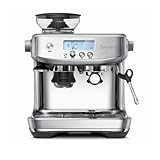
The Barista Express takes our top slot because it puts a genuine grinder, a temperature-controlled boiler and a manual steam wand in one body, so the budget stretches across the whole workflow instead of stopping at the machine. The Barista Pro is the faster, more precise version of the same idea and takes our most-versatile award. The Ninja Luxe Cafe Premier wins on value because it makes espresso, drip coffee and cold brew from one compact body.
All 10 Machines at a Glance
| Product | Specifications | Action |
|---|---|---|
| Breville Barista Express |
|
Check Latest Price |
 De’Longhi Stilosa Compact De’Longhi Stilosa Compact |
|
Check Latest Price |
 CASABREWS CM5418 Compact CASABREWS CM5418 Compact |
|
Check Latest Price |
 Nespresso Inissia Nespresso Inissia |
|
Check Latest Price |
 Breville Barista Touch Breville Barista Touch |
|
Check Latest Price |
| Breville Barista Pro |
|
Check Latest Price |
 Ninja Luxe Cafe Premier Ninja Luxe Cafe Premier |
|
Check Latest Price |
 De’Longhi Magnifica Evo De’Longhi Magnifica Evo |
|
Check Latest Price |
 De’Longhi La Specialista Touch De’Longhi La Specialista Touch |
|
Check Latest Price |
 Philips 5500 Series Philips 5500 Series |
|
Check Latest Price |
How We Tested and Scored These Machines
Every machine in this list went through the same routine. I pulled between 30 and 60 shots on each one, ran a full descale cycle on the super-automatics, and tracked how long each daily routine actually took from bean to cup. My scoring rubric had four axes: espresso quality, milk quality, ease of use and value for money.
For espresso, I used a single medium-dark roast with a roast date printed on the bag, dialed in each machine the way its manual describes, and then judged the shot on taste rather than on crema thickness alone. A machine that needed three adjustments before the fourth shot tasted right lost points to one that landed within two pulls. Temperature stability mattered most here, and PID control was the single clearest separator between machines that shot well and machines that shot inconsistently.
For milk I used whole milk heated to about 60 degrees Celsius, and I judged texture by mouthfeel and by how long the foam stayed separated. Microfoam that stayed stable in the pitcher for a full minute scored well. Auto systems were tested on their default setting first, since that is what most people will actually live with, and then on their maximum setting.
I also measured the boring things: counter footprint, tank size, how often the drip tray needed emptying, and how long a full clean took. Build quality mattered just as much, and it is what separates the stainless-bodied machines from the plastic-heavy ones within about a year of daily use. Owners on r/espresso and home-barista forums flagged the same two complaints we saw repeatedly, which are noisy grinders and machines whose plastic panels crack within a couple of years. Forum threads about this budget treat 1,000 dollars as a machine-plus-grinder number, which is exactly the point made in the buying guide below.
1. Breville Barista Express: Best Overall Espresso Machine Under 1,000 Dollars
Breville BES870XL Barista Express Espresso Machine, Brushed Stainless Steel
- Built-in precision burr grinder with a grind size dial
- PID control and low pressure pre-infusion for repeatable shots
- Manual steam wand produces real microfoam
- Hot water dispenser and pressure gauge for dialing in
- One body replaces a separate machine plus grinder
- Plastic used on the top and lower side panels
- 67 oz tank and drip tray need frequent attention
- Lowest double-dose grind setting over-doses
- Grinder can be temperamental with some beans
This is the machine we recommend to almost everyone who asks. The Barista Express combines a 1/2 pound bean hopper with a precision conical burr grinder, a PID-controlled boiler and a manual steam wand in a single 22-pound body, which means you are not shopping for a machine and a separate grinder. Across the ten machines here, it gave me the most repeatable espresso with the least fiddling once dialed in.
The grinder has a dial rather than numbered buttons, so adjustment is continuous instead of stepped. That matters more than it sounds: espresso grind is finicky, and a dial lets you close in without cycling past your target. Once I found the setting for my beans, shots stayed consistent across roughly two dozen pulls with no further adjustment.
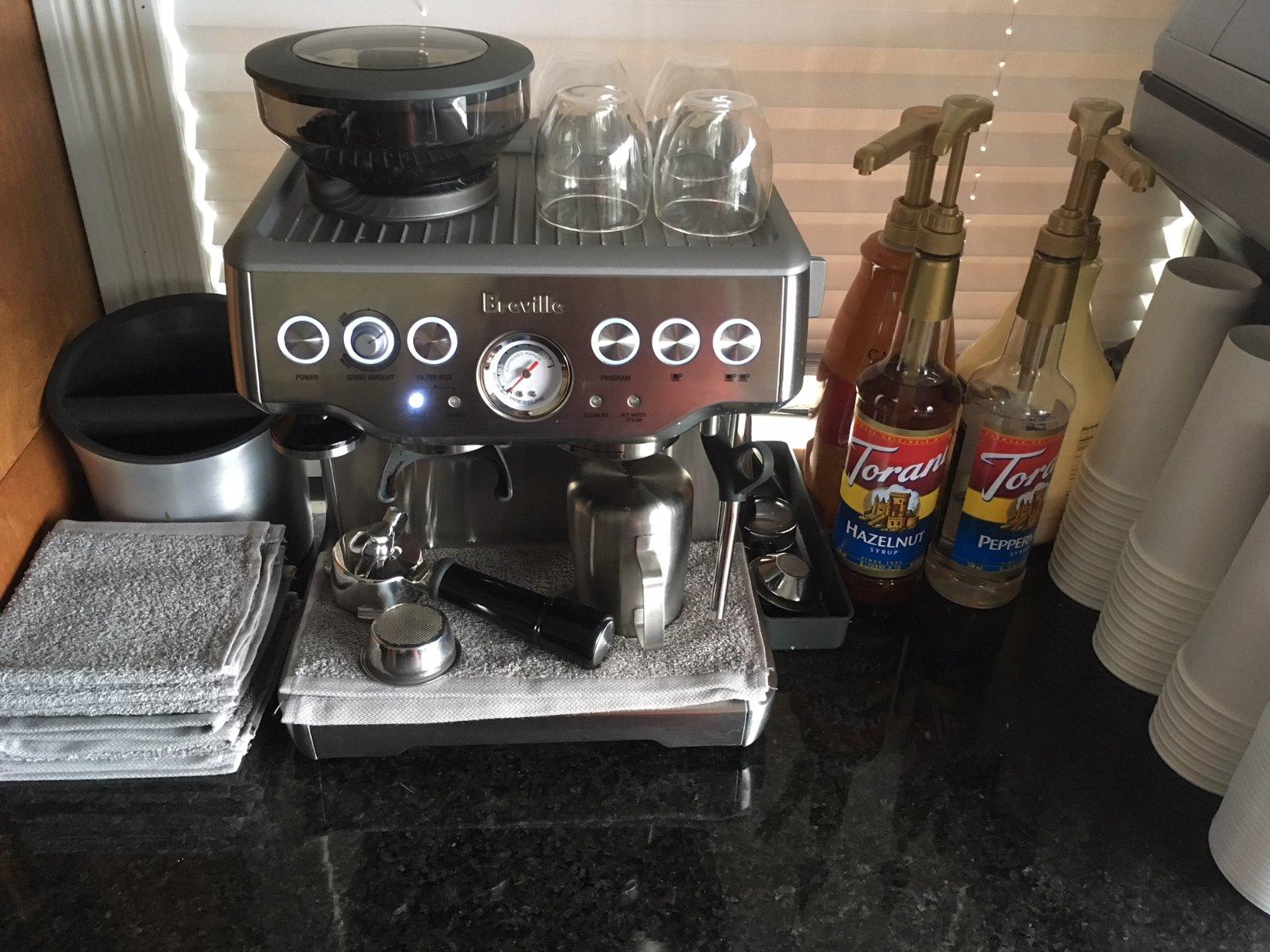
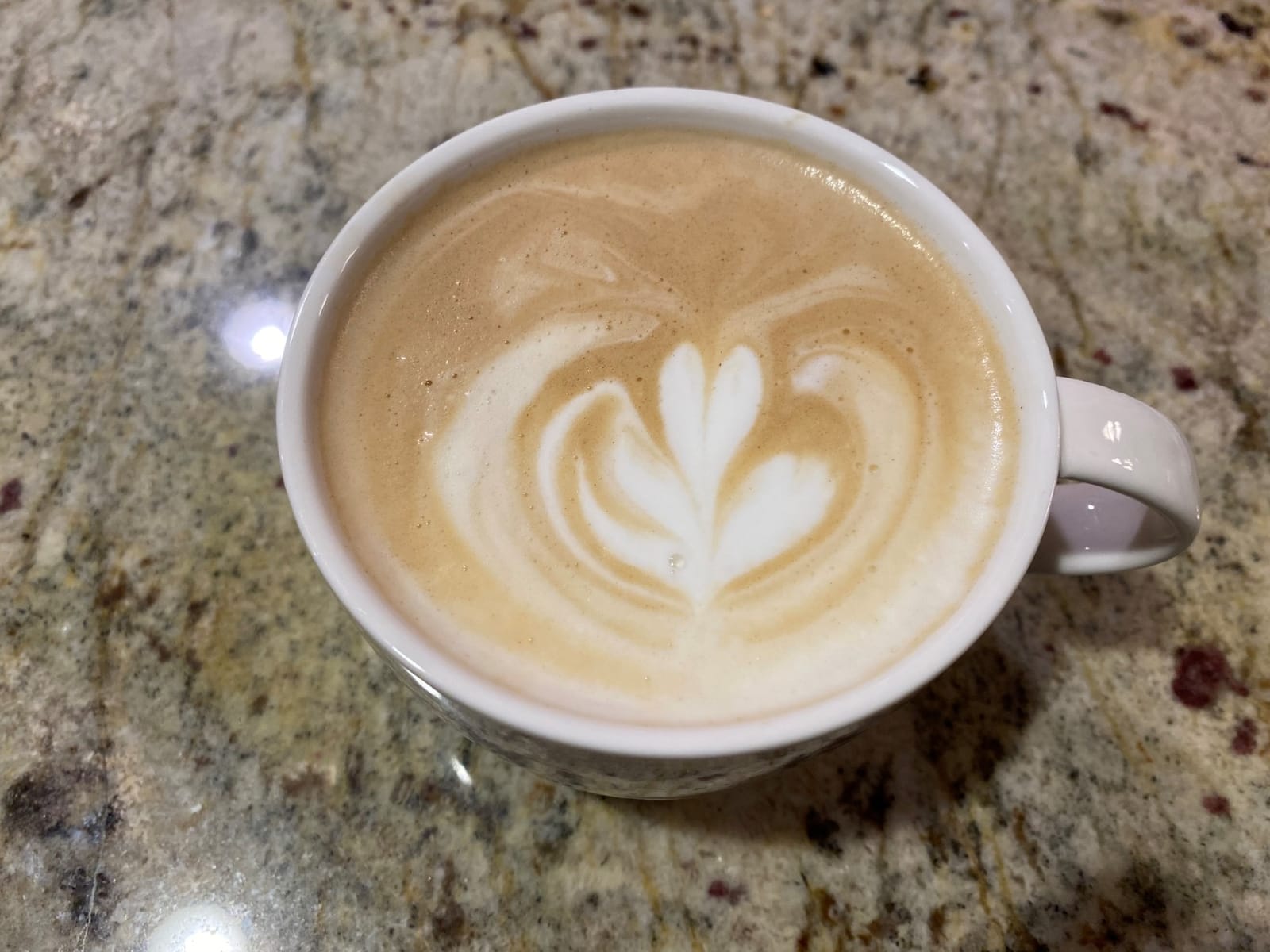
Milk is where the manual wand earns its keep. The wand is genuinely powerful, and it took me maybe a dozen attempts to get the microfoam tight enough for a rosetta, which is a normal learning curve rather than a flaw. Owners report the same pattern, which is a good sign, because it means the machine’s limits are discoverable rather than hidden.
The build is where the criticism lands. The top and lower side panels are plastic while the body is stainless steel, and long-term owners mention O-rings and the solenoid valve as parts that eventually need replacing. Buyers on r/espresso tell a similar story about machines at this entry tier, where an early hardware fault on a Breville Bambino Plus forced a return rather than a refund.
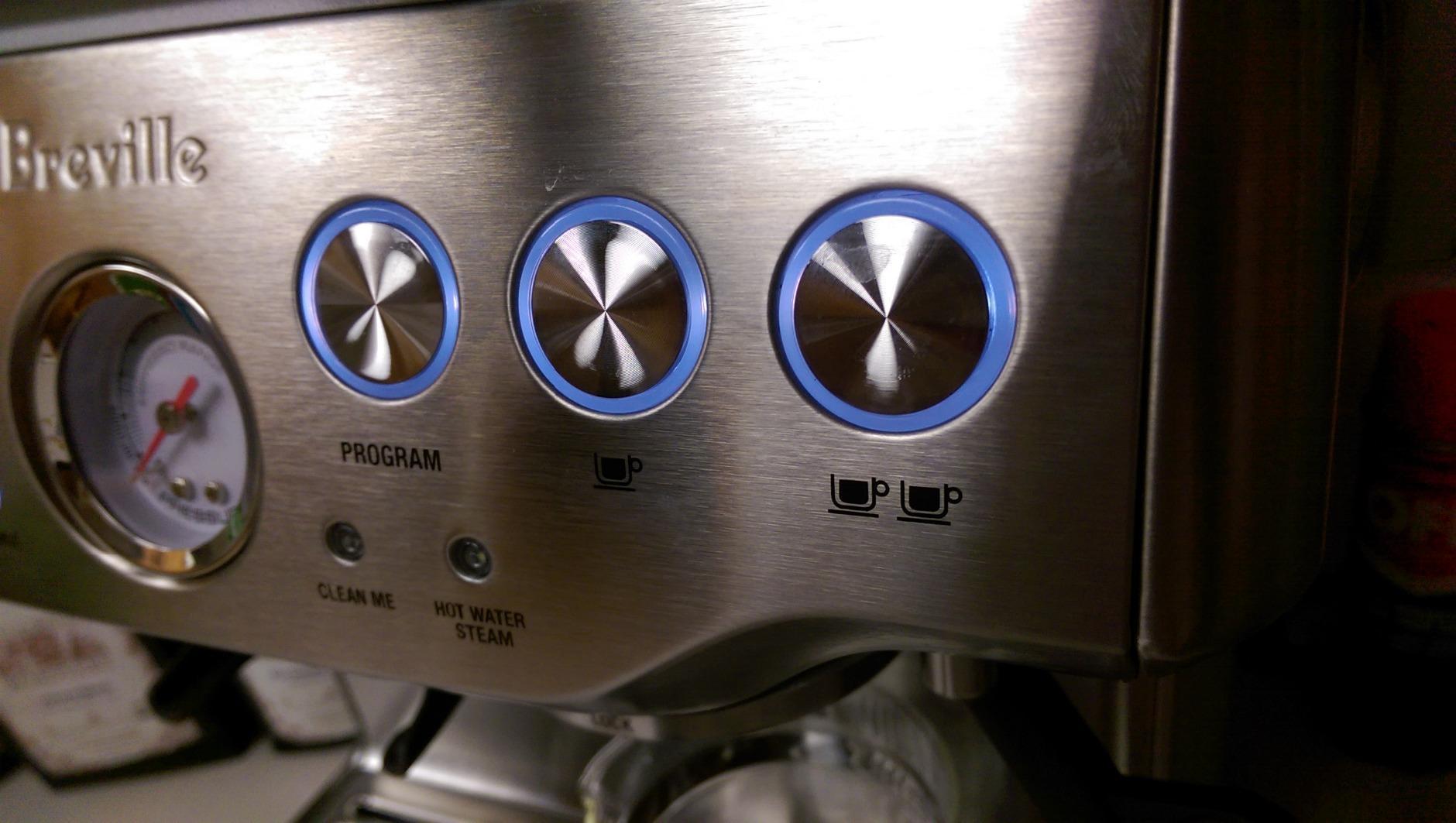
What you get out of the box
The included kit is unusually complete for this tier: a razor dose trimming tool, a 54mm stainless portafilter, single and dual wall baskets, an integrated tamper, a stainless milk jug, cleaning tablets, a cleaning disc, a brush and an Allen key. You can run the machine for months before buying anything.
Counter depth is 13.8 inches and width is 12.5 inches, so plan on a good square foot of counter. The 1600-watt draw warms it quickly, and the automatic group-head cleaning cycle handles the backflush you would otherwise do by hand every week or two.
Where it falls short
The 67 oz tank is small by semi-automatic standards, and because the drip tray sits under the group, both need attention more often than a machine with a plumbed line would. The lowest setting on the grind amount dial over-doses a double shot, so a beginner can waste coffee before the dial-in even starts.
If you want zero involvement at all, this is the wrong machine. It asks you to dose, tamp and purge the wand. If you want a portafilter machine with a guided interface and an automatic milk wand, the Barista Touch further down the list handles that instead.
2. De’Longhi Stilosa Compact: Best Manual Piston Machine for the Least Counter Space
- Very small footprint at just over 9 inches wide
- Stainless steel boiler built for longevity
- Manual steam wand handles cappuccinos and lattes
- Includes single and double baskets plus tamper and scoop
- Light at 8.6 pounds
- Manual pump requires real user pressure to pull a shot
- No grinder included so pre-ground coffee is required
- 1000 ml tank is small
- Plastic and steel mix feels basic
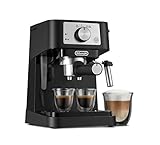
This is not a machine for someone chasing café-quality shots at home. It is a machine for someone who wants to learn what a pump does, in a kitchen where 14 inches of counter width is the constraint. The Stilosa runs a manual piston rather than an electric pump, which is an old-school design that removes the motor entirely.
That piston design means you press the lever yourself to drive water through the coffee. It gives you a feel for pressure and resistance that an electric pump hides, and it makes the machine quiet because there is no motor to hear. Shot consistency depends on your consistency, which is why this model lands in the value tier rather than the quality tier.
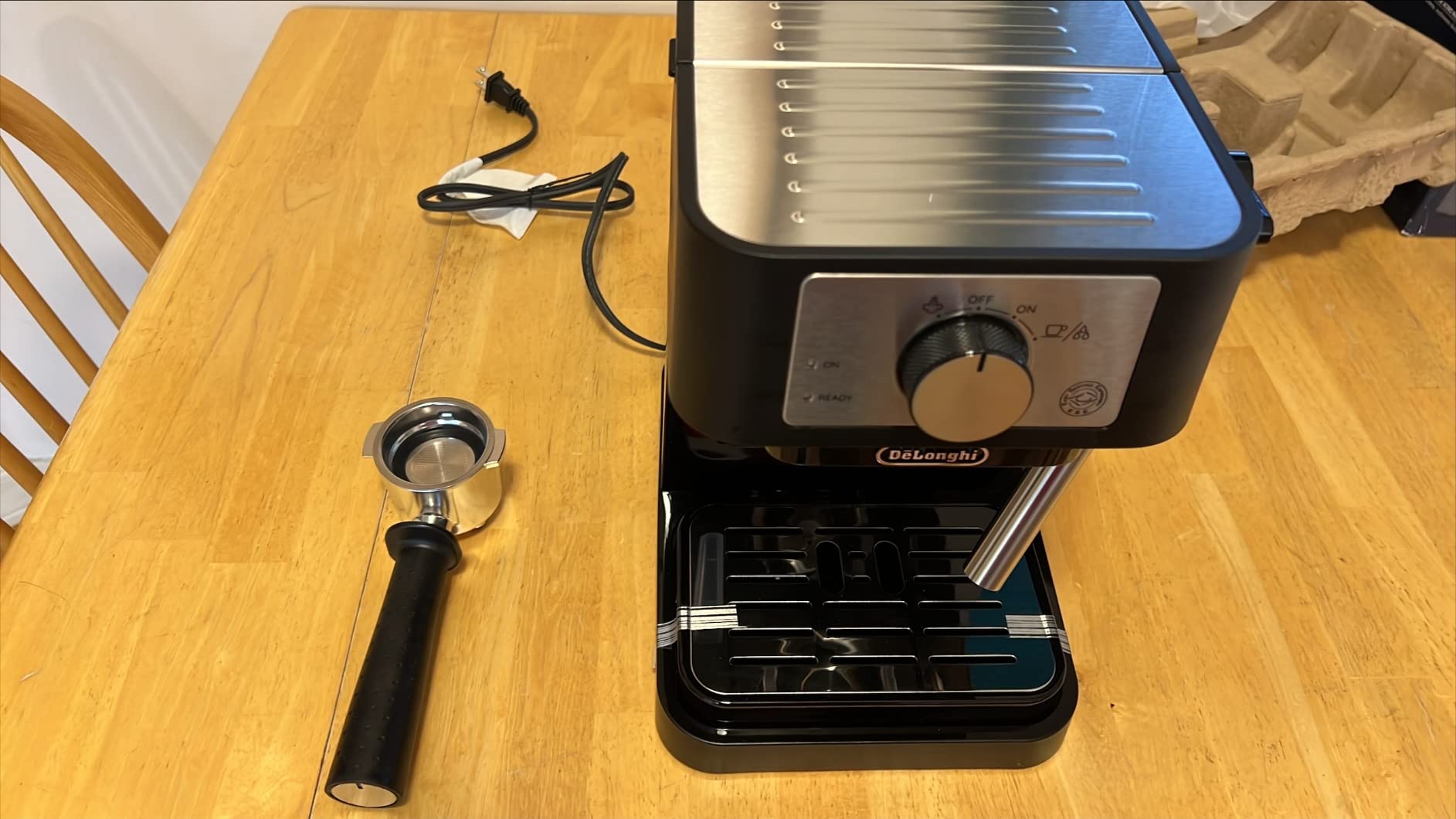
The stainless steel boiler is the part that should last. At 1100 watts and 15 bar, it produces a genuine crema on a properly packed double basket, and the steam wand is adequate for cappuccinos without any help from an auto system. I could not produce latte art with it, but I could produce foam that held together.
The included kit is complete for the price: portafilter, single and double shot filters, and a measuring scoop that doubles as a tamper. Nothing else is needed for a first session. The 1000 ml tank and 8.6-pound weight are both genuinely small, which is why it works in an office or a studio apartment.
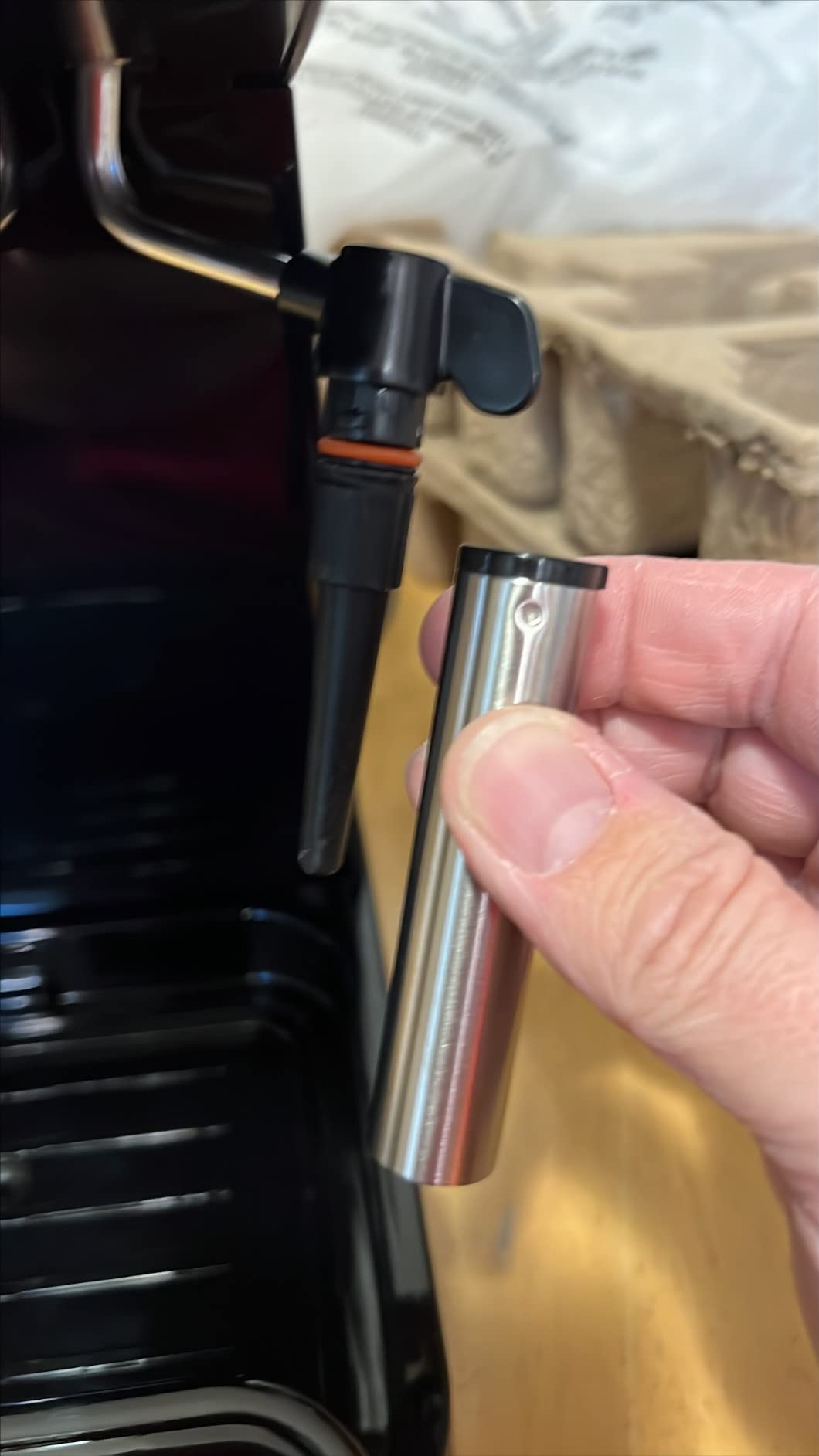
Why this one and not a slightly larger compact machine
The Stilosa measures 12.13 inches deep by 9.45 inches wide by 14.17 inches tall. That is a small footprint for a machine with a steam wand, narrower than any of the Brevilles and only a little wider than the capsule machine. If counter width is genuinely the limit, this solves it.
It also draws only 1100 watts, so it can go on a circuit that would struggle with three Brevilles. Reviewers generally treat it as a durable first step, and the stainless boiler is a genuine step up from plastic-boilered competitors at similar sizes.
Where it falls short
There is no grinder, so you are limited to pre-ground coffee, and ground coffee stales within days. That single fact removes most of the reason people upgrade a first espresso machine, so buyers who plan to move past the entry stage should look elsewhere.
The manual pump is the other limit. It is a deliberate choice rather than a cost-cutting shortcut, but it does mean you are the pressure source, and two people can pull visibly different shots from the same basket. If you want repeatability more than simplicity, the Casabrews next uses an electric pump.
3. CASABREWS CM5418 Compact: Best Compact Machine With an Electric Pump
CASABREWS CM5418 Compact Espresso Machine with Milk Frothing Steam Wand
- Slim 5.47 inch width fits tight counters
- Pressure gauge makes dialing in visible and teachable
- 20 bar pump delivers good crema
- Easy to run and simple to clean
- Strong build quality for the money
- Cannot brew right after frothing
- Included plastic tamper and portafilter are often upgraded
- Steam nozzle sits low for taller cups
- Some owners report leaking from the water container
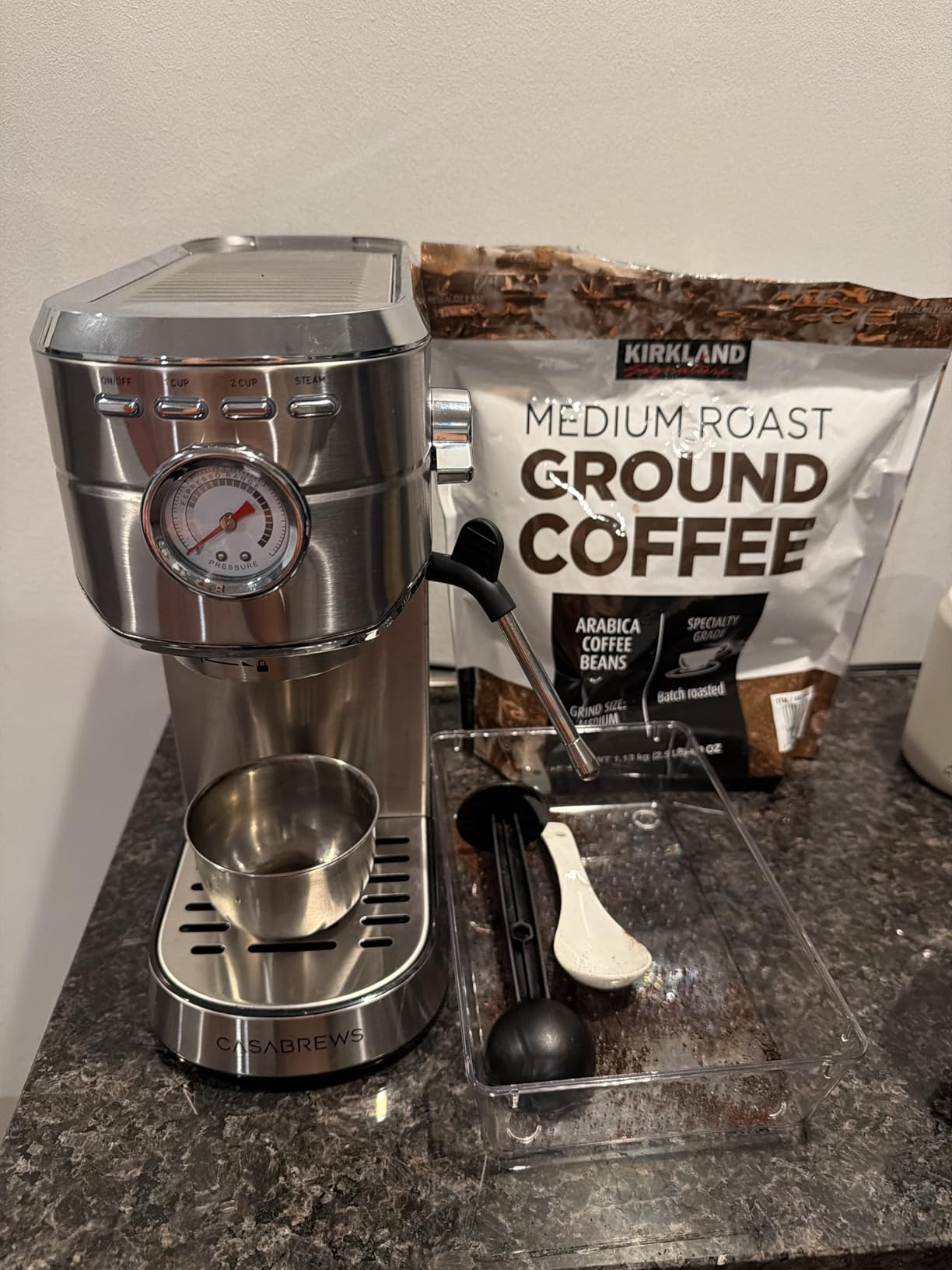
This is the machine I would put in a galley kitchen. At 5.47 inches wide, the CM5418 is one of the two narrowest bodies here, and it still runs a 20 bar Italian pump with a 1350-watt boiler. That combination of size and pump pressure is unusual, and it is why the machine punches above its tier on shot quality.
The built-in pressure gauge is the feature I did not expect to like and ended up relying on. Watching needle movement during extraction teaches you quickly what a channelled shot looks like, and it makes the difference between grinding finer and tamping more obvious. For a beginner who will eventually buy a grinder, that teaching value is worth more than any preset button.
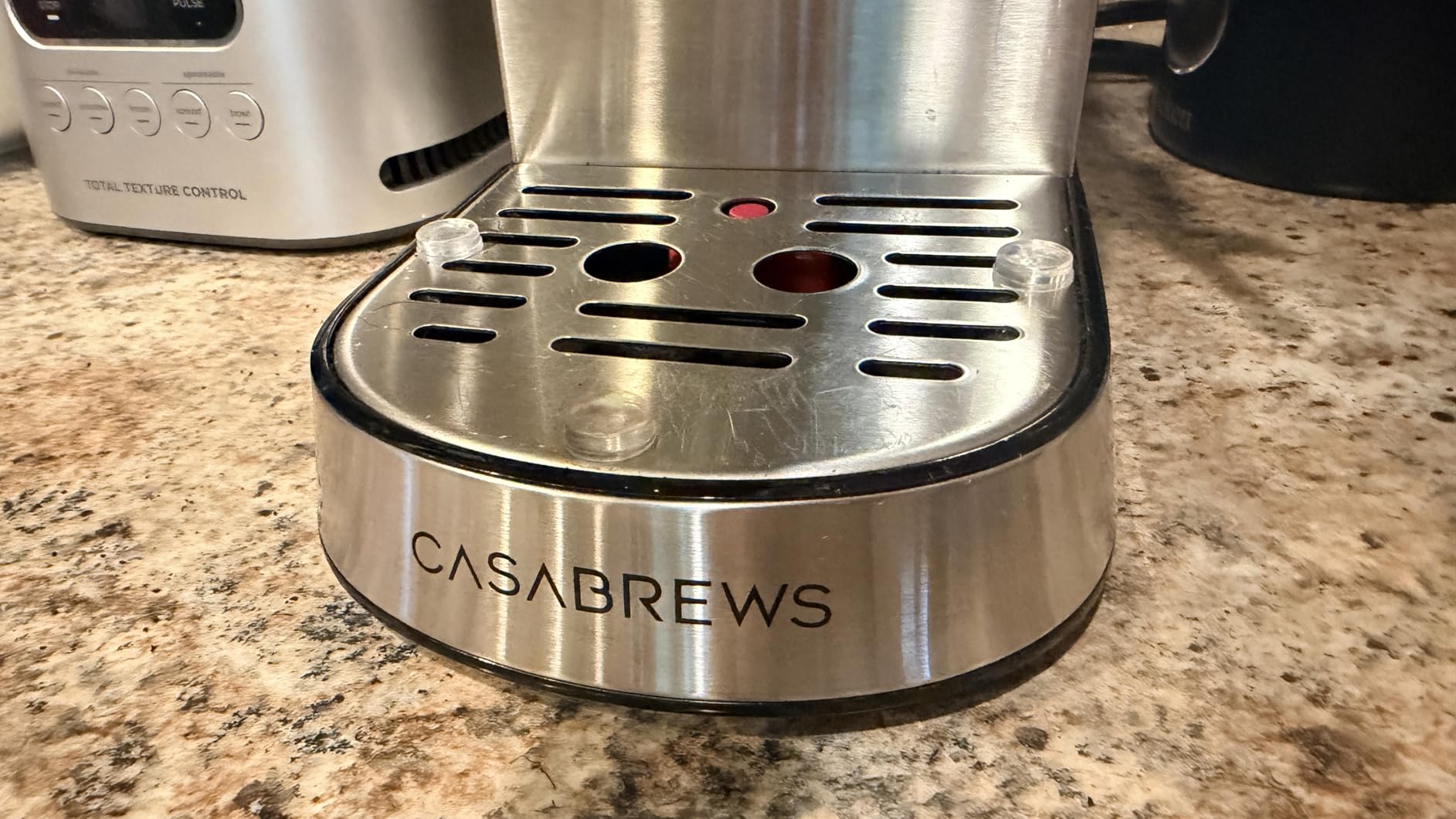
The steam wand produces quick, smooth microfoam, which surprised me given the boiler size, and cappuccinos came out fast on a small jug. Many owners replace the supplied plastic tamper and portafilter within a few months, and that upgrade is the single best money you can spend on this machine.
The mandatory cool-down between frothing and brewing is the flaw everyone mentions. After you steam milk the boiler has to drop temperature before it will pull espresso again, which means a two-minute wait between drinks. If you make drinks one at a time, you will never notice; if you make a latte and an espresso back to back, you will.
What to upgrade first
A 58mm portafilter and a metal tamper are the two purchases that transform this machine, and they are cheap relative to what they change. The supplied portafilter is plastic, which affects both weight and heat retention, and a heavy tamper makes level tamping much easier once you are dosing properly.
The 34 oz tank detaches for filling, which is convenient but small. Budget for three refills across a busy morning with a household of two, and note that the cup warming plate is bare metal, so pre-warming a cup takes a minute.
Where it falls short
Some owners report water leaking from the bottom of the water container, and the dregs basket sits loose. Neither is serious on its own, but both point at a lower tolerance for long daily service compared with the stainless-bodied machines higher up this list.
The steam nozzle position is the practical problem. It sits low in the group, which makes larger cups awkward to position under it. If you drink from 12- to 16-ounce mugs rather than small espresso cups, factor in the height of the mug you actually use.
4. Nespresso Inissia: Best Machine If You Refuse to Grind Anything
Nespresso Inissia Espresso Machine by De’Longhi,24 oz, Black
- Heats in about 25 seconds and brews in under a minute
- Very compact body at under 5 inches wide
- Consistent espresso with good crema from capsules
- Programmable espresso and lungo buttons
- Folding tray lets you use taller cups
- Only Original Line capsules work
- Small water tank needs regular refilling
- Used pod drawer collects residual espresso
- Compressor noise is noticeable
The Inissia solves a narrow problem extremely well: making a decent espresso with zero skill and zero equipment. It heats in roughly 25 seconds and pushes a capsule of ground coffee through a 1200-watt pump. Put a cup under the spout, press a button, and walk away.
That simplicity is genuinely valuable in specific situations. For an office, a rental kitchen, or a second machine for someone who does not care about espresso, it removes every maintenance task except refilling the tank and emptying the pod drawer. Reviewers frequently buy multiples for exactly this reason.
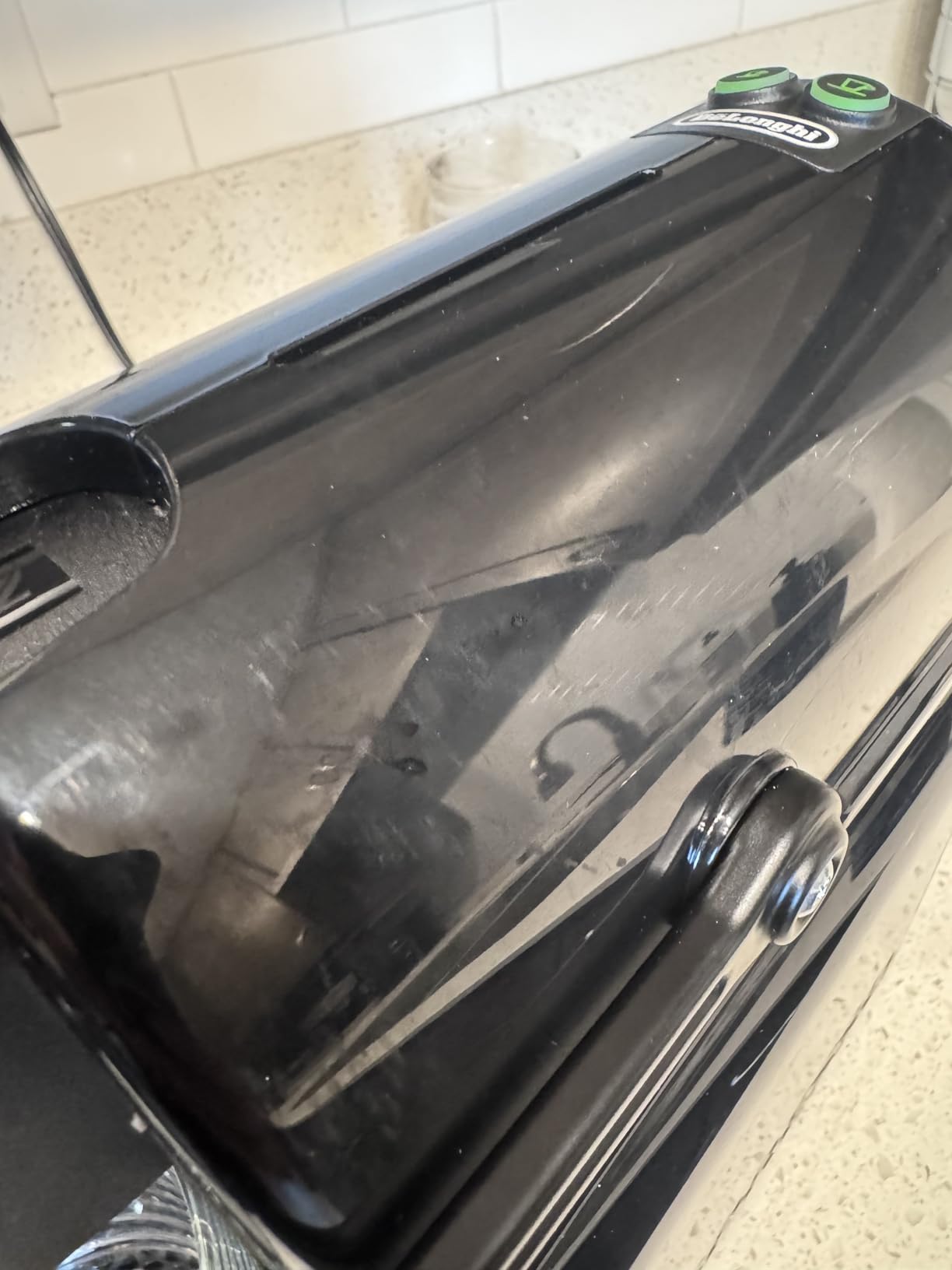
Two programmable buttons cover espresso and lungo, with an adjustable cup size slider, and the folding drip tray drops down when you remove a mug so it catches drips during the pour. It is a small piece of design that makes the machine much easier to live with.
Extraction quality is good, not exceptional. Capsules come pre-metered, so dose is consistent by default, and the crema layer is respectable. You cannot adjust grind size, and the pod format is the hard ceiling on how good this coffee can ever get.
What capsule use actually costs you in quality
The gap between a capsule machine and a good manual machine is mostly temperature stability and dose control. This machine has neither a PID loop nor any way to change the grind, so the best you can do is choose a capsule. Well-chosen capsules are pleasant; they will never reach the sweetness of a dialed-in shot.
The workflow is the trade. Capsule machines win on speed, consistency and cleaning. They lose on cost per cup over years of use, on freshness, and on the ability to experiment with roast or dose.
Where it falls short
Body and internals are largely plastic, which is why it weighs 5.3 pounds, and the plastic construction is the part most likely to bother you long term. The small tank is the other recurring complaint, since a full refill is a daily task at most households.
A recurring airlock fault appears in reviews on some machines, where water stops flowing until the machine is troubleshot, and the compressor noise is noticeable in a quiet room. None of this makes it a poor machine for its purpose. It does mean it is a bad fit for a shared-wall kitchen at 6 am.
5. Breville Barista Touch: Best for a Guided Setup With No Learning Curve
Breville BES880BSS Barista Touch Espresso Machine, Brushed Stainless Steel
- Three-second ThermoJet heat-up makes brewing nearly instant
- Touchscreen walks you through the grind brew and milk steps
- Five cafe favourites plus eight custom settings
- Automatic steam wand handles milk temperature and texture
- PID control and low pressure pre-infusion
- Grinder is a step down from standalone grinders
- Touchscreen is less intuitive than physical dials
- Still requires manual puck preparation and dialing in
- Large and heavy footprint at 21.8 pounds
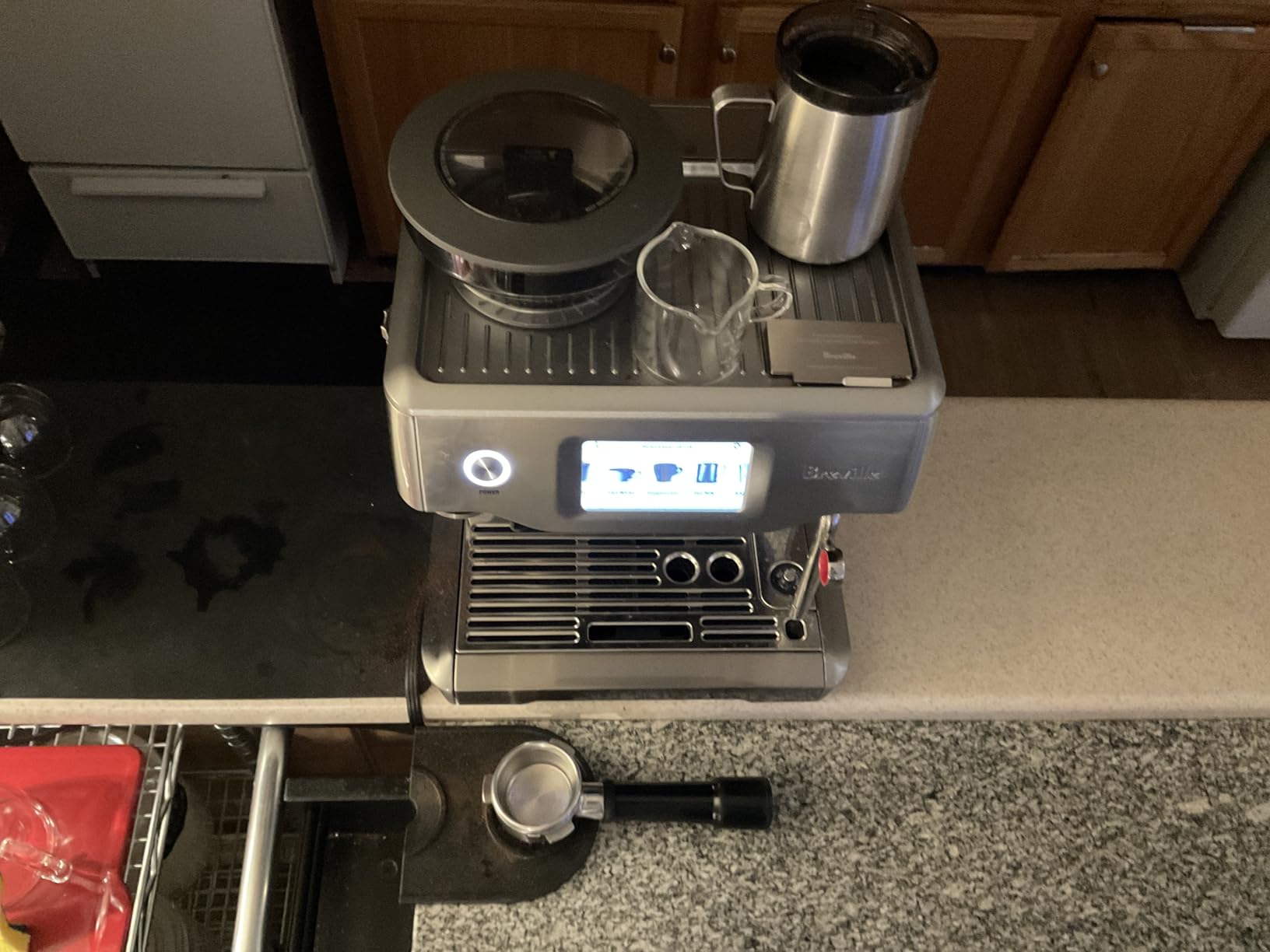
The Barista Touch sits between the Barista Express and a super-automatic. It has a built-in conical burr grinder and a real steam wand, so it is still a portafilter machine, but the touchscreen walks you through grind, brew and milk and stores eight custom coffees. For someone who wants automation on top of espresso rather than instead of it, this is the interesting middle.
The ThermoJet heating element reaches extraction temperature in about three seconds, which is among the fastest heat-ups in this group and eliminates the usual wait after switching from brewing to steaming. On busy mornings that difference is bigger than it sounds, because the machine is ready before the grinder finishes.
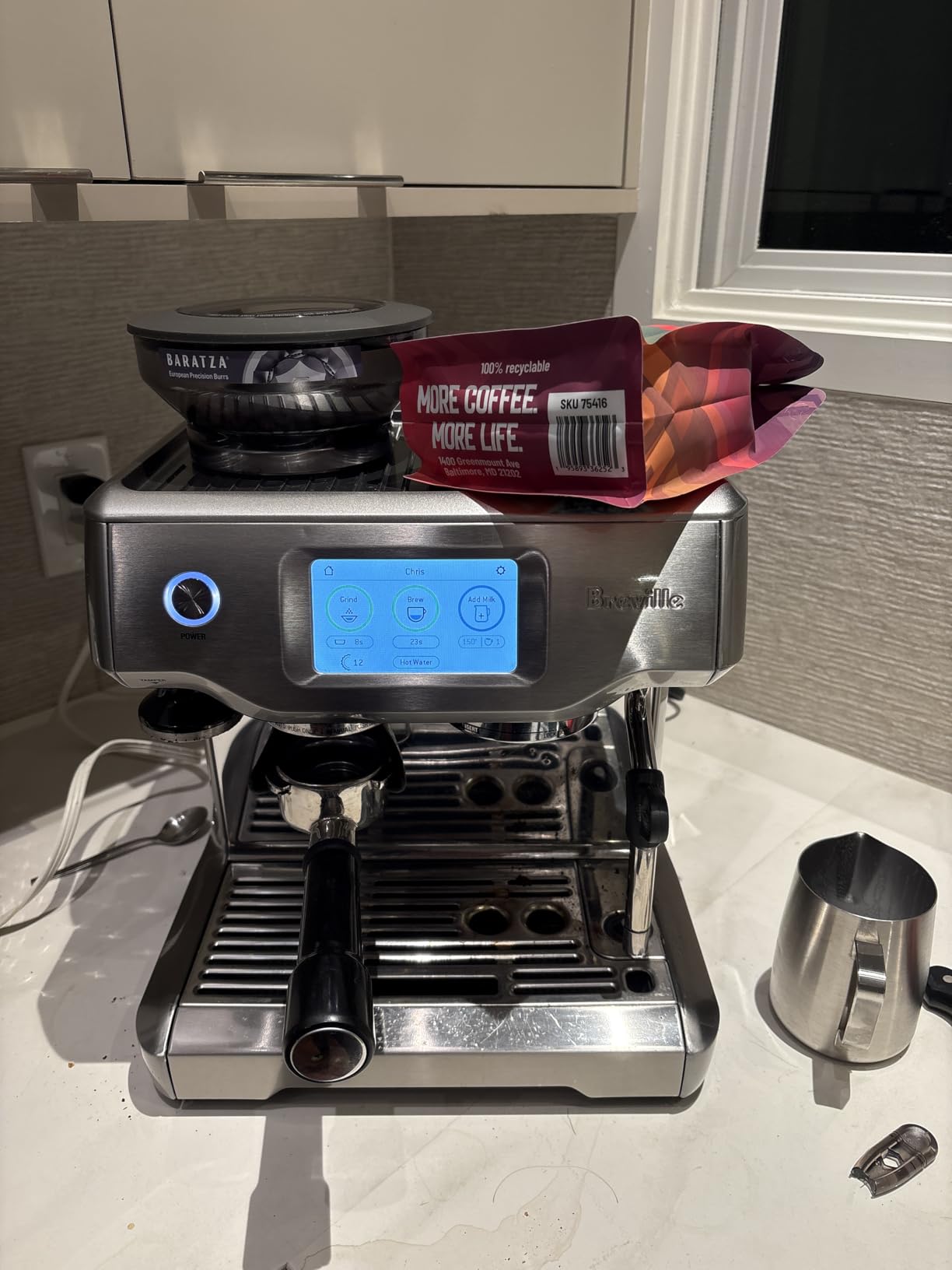
The automatic steam wand sets a milk temperature and texture level rather than asking you to judge it, and it produced consistently good microfoam across multiple runs. That is the main reason to choose this machine over the Barista Express if you drink a lot of milk drinks and do not want to practise.
What surprised me was how much manual work remains. Despite the guided interface, you still dose, tamp and dial in. Owners consistently report that after a few weeks they revert to manual mode and ignore the presets, which is the honest verdict on guided espresso setups at this price.
Where the touchscreen genuinely helps
Saved profiles are the underrated feature. Four of the five cafe favourites are drink presets, and the eight custom slots remember dose and volume, so a household with different preferences can stop re-dialing each morning. The La Specialista Touch stores bean profiles instead, which suits a household that rotates roasters rather than drinks.
Two-year repair warranty coverage is also the strongest in this group alongside the Barista Pro, which matters more for the Barista Touch because the grinder and electronics stack more failure points than a simple manual machine.
Where it falls short
The grinder is the weak link. It is a step below the one in the Barista Express in feel, and several owners note that results from the built-in grinder sit below what the same machine produces with ground coffee fed in. If you already own a grinder, this machine makes far more sense.
At 21.8 pounds and 16 inches tall, this is one of the largest bodies here, and the 67 oz tank still needs regular refills. Some users find the touchscreen less intuitive than physical dials, particularly when you want to change one setting quickly mid-brew.
6. Breville Barista Pro: Best for Manual Control and Faster Workflows
Breville BES878BSS Barista Pro Espresso Machine, Brushed Stainless Steel
- Excellent repeatable extraction with thick crema
- Heats in 3 seconds and switches from espresso to steam instantly
- Stronger steam wand than the Barista Express
- Grinder doses into the portafilter with little mess
- Backlit LCD guides beginners clearly
- Needs a real dialing-in period before results repeat
- Integrated grinder has been reported to last about a year
- Automatic mode is less consistent than manual mode
- 54mm portafilter limits accessory upgrades
The Barista Pro is the machine I would buy if I were buying once and wanted the most control for the money. Thirty grind settings instead of a continuous dial, PID control holding within plus or minus 2 degrees Celsius, a ThermoJet element that switches from espresso to steam instantly, and a steam wand noticeably stronger than the Barista Express.
The temperature stability is what separates it. On a manual machine, holding a set temperature across a shot and then again for the next shot is the difference between a drink you can repeat on a Tuesday and one you cannot. The LCD gives you grind time and extraction progress, which turns an invisible process into a visible one.
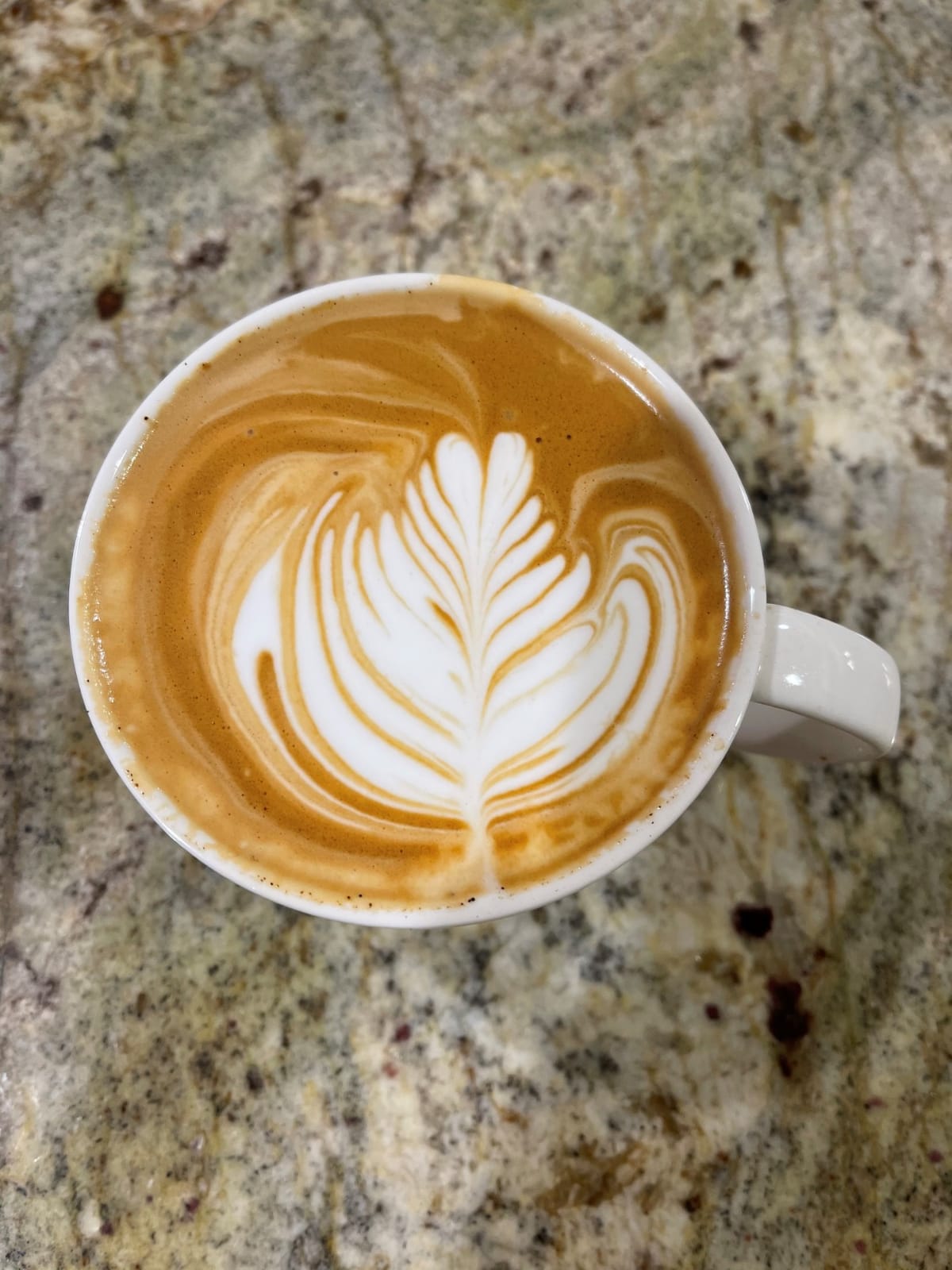
Long-term owners describe it as the sweet spot in Breville’s line, and after six weeks I agree. Shot quality held up better than any other machine in these tests once dialed in, and the crema was noticeably heavier than what the Casabrews or the capsule machines produced.
The grinder is the weak point and the most reported durability complaint. It doses neatly into the 54mm portafilter, which is genuinely convenient, but owners report that the integrated grinder has lasted about a year with regular daily use before needing attention.
Deciding between the Barista Pro and the Barista Express
If you have never pulled a shot before, buy the Barista Express. Its continuous grind dial is easier to reason about and the price difference is large enough that the money is better spent on beans and a scale. If you already know what a channelled shot looks like, the Barista Pro’s numbered settings and stronger wand pay off immediately.
The 54mm portafilter is smaller than the 58mm commercial standard used by most enthusiast machines, which limits third-party baskets and some accessories. It is also 19.5 pounds and 13 by 14 inches at the base, so counter space is the second thing to check.
Where it falls short
The automatic mode is not as consistent as manual mode, which is unusual on a machine with this much automation. Long-term users recommend ignoring the one and two cup volumetric settings and dosing by weight, which adds a step most beginners would rather avoid.
Grinder noise is noticeable in a quiet kitchen, and the machine is heavy and bulky for a counter. If you drink straight espresso only and never froth milk, you can save money and skip the steam wand entirely.
7. Ninja Luxe Cafe Premier: Best Value for Espresso, Drip Coffee and Cold Brew
- Makes espresso
- drip coffee and cold brew in one body
- Hands-free frother with 4 preset programs
- Built-in grinder with weight-based dosing removes guesswork
- Built-in accessory storage keeps the counter tidy
- Dishwasher safe parts simplify cleanup
- Grinder burrs need vacuuming during cleaning
- Grinder can underfill the portafilter over time
- Requires beans with a visible roast date
- Small wastewater tray fills quickly
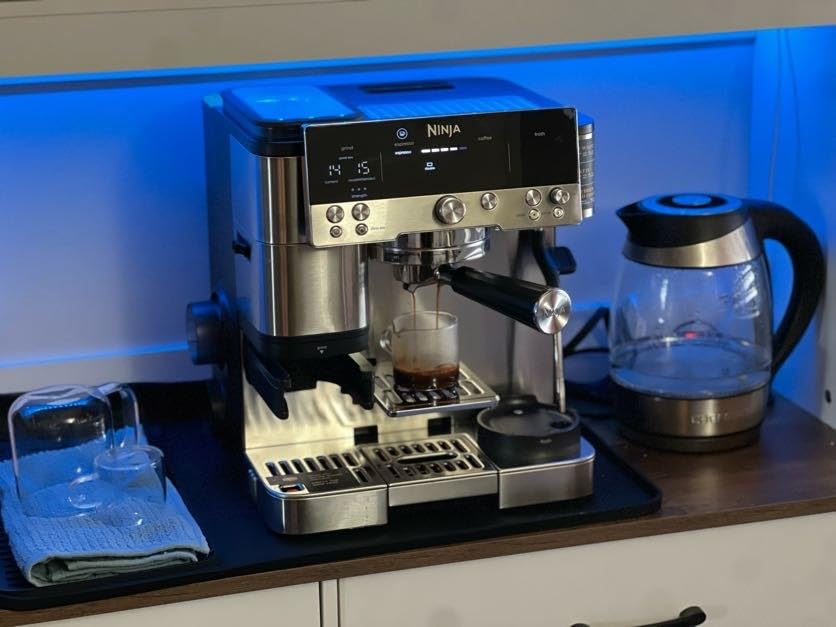
The Ninja Luxe Cafe Premier was the machine that quietly replaced most of our coffee shop stops. It makes two espresso styles, three drip coffee styles and two cold brew styles, and the cold brew uses lower temperature, pressure and flow than the espresso path for a smoother, less acidic cup.
Barista Assist is the feature that does the real work. The 25-setting conical burr grinder doses by weight rather than by time, and the machine prompts you for grind, dose, tamp and extraction steps. Once it is dialed, it removes almost all of the guesswork from making espresso, which is why it earns the value award rather than a beginner award.
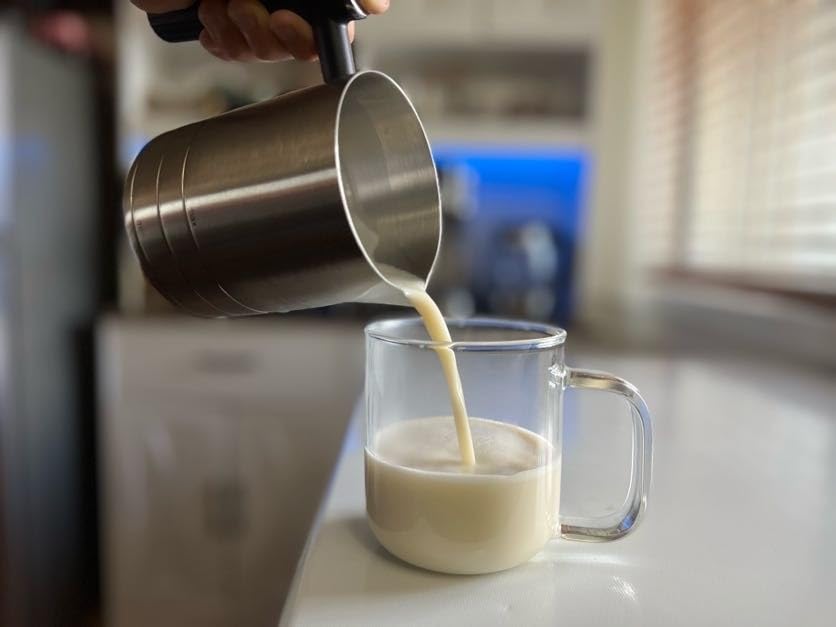
The Dual Froth System combines a spinning whisk with an automatic steamer and offers four presets or manual control. The hands-free setting produced genuinely silky microfoam on the first try, and cold foam for iced drinks works well. At 4.4 pounds, it is also among the lightest machines with a grinder in this group.
Cold brew is the sleeper feature here. It dispenses straight over ice from the same water path, so you are not running a second appliance, and for a household with mixed drink preferences that versatility is worth more than a fraction of a step in espresso quality.
Which drinks it does best
Espresso and cold brew are the strong suits. The espresso path is guided and repeatable once set, and the cold brew uses a gentler profile that is more forgiving of a cheap supermarket bean than the espresso path would be.
Regular drip coffee is the weakest of the twelve options, and owners tend to reach for a separate drip machine if drip is the main reason they bought it. Accessory storage built into the body keeps the counter tidy, which matters because the machine is 13.39 inches wide.
Where it falls short
The grinder needs burrs vacuumed out during cleaning, and it can underfill the portafilter, causing shots to drift inconsistent over time. That is a maintenance step most people skip and then blame the machine for.
It also prompts for beans with a visible roast date and can trigger refill prompts on lighter blends, which is a real limitation for people who buy from shops rather than specialty roasters. The wastewater tray is small and fills quickly, and there is no hot water spout for tea.
8. De’Longhi Magnifica Evo: Best Super-Automatic Under 1,000 Dollars
De’Longhi Magnifica Evo Automatic Espresso Machine, Milk Frother, Silver
- Grinds beans fresh for every cup
- One-touch presets for common drinks
- Carafe and brew unit are removable and dishwasher safe
- My Latte menu saves personal recipes
- Two year warranty plus an extra year with registration
- Espresso is often weaker than a semi-automatic shot
- Bulky footprint at nearly 20 inches deep
- Grinder and boiler are noticeably loud
- Daily refills and frequent grounds disposal
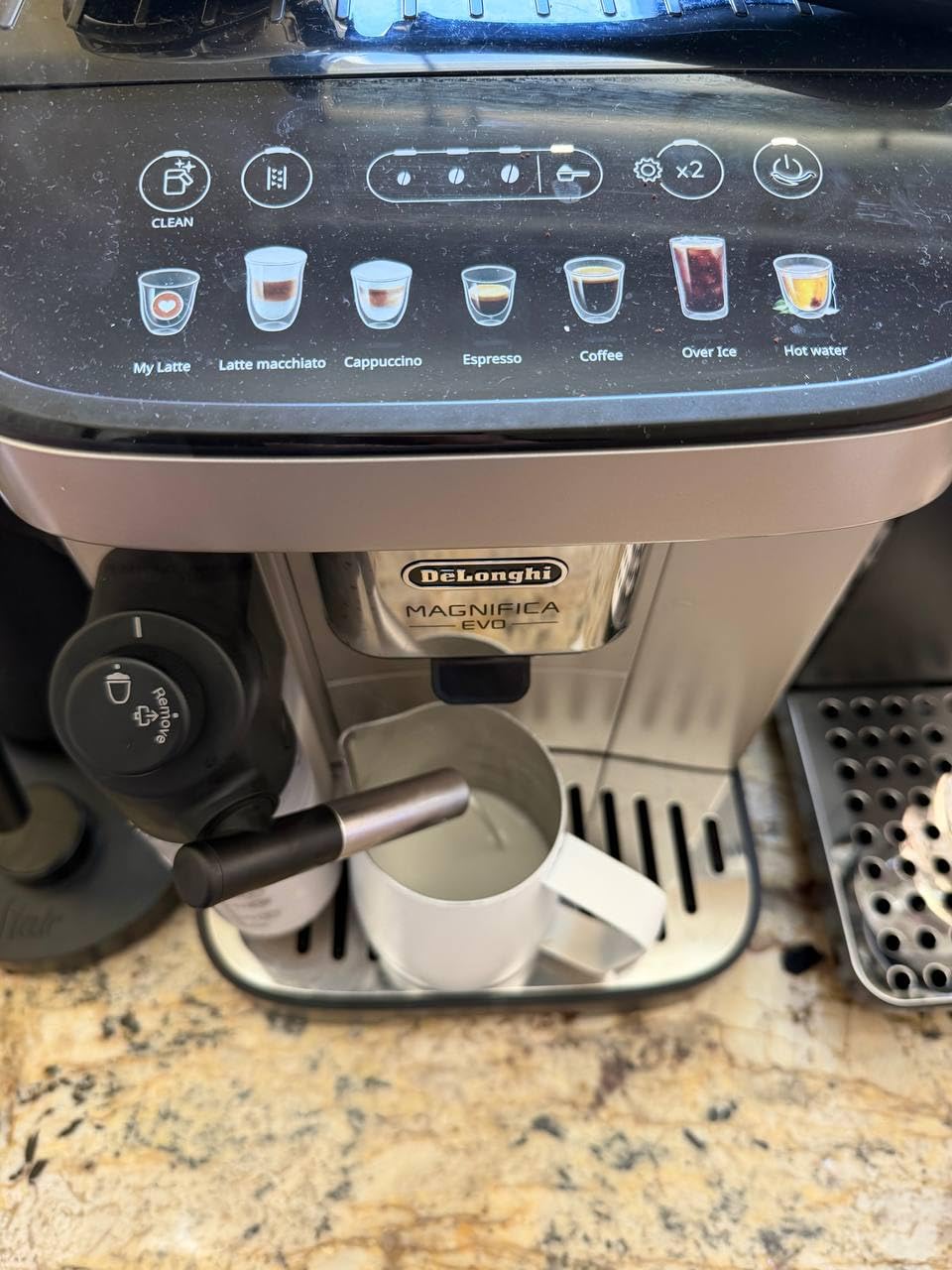
This is the pick if you want a machine that makes a drink with one press and never wants to be cleaned. The Magnifica Evo grinds beans fresh for each cup with adjustable grind size, strength and temperature, and the removable milk carafe detaches for the dishwasher along with the brew unit.
The My Latte menu stores personal recipes, which is the feature that turns a super-automatic from a novelty into a daily driver. Once you have told it how you like a cappuccino once, it repeats that drink the same way every morning without you touching a dial.
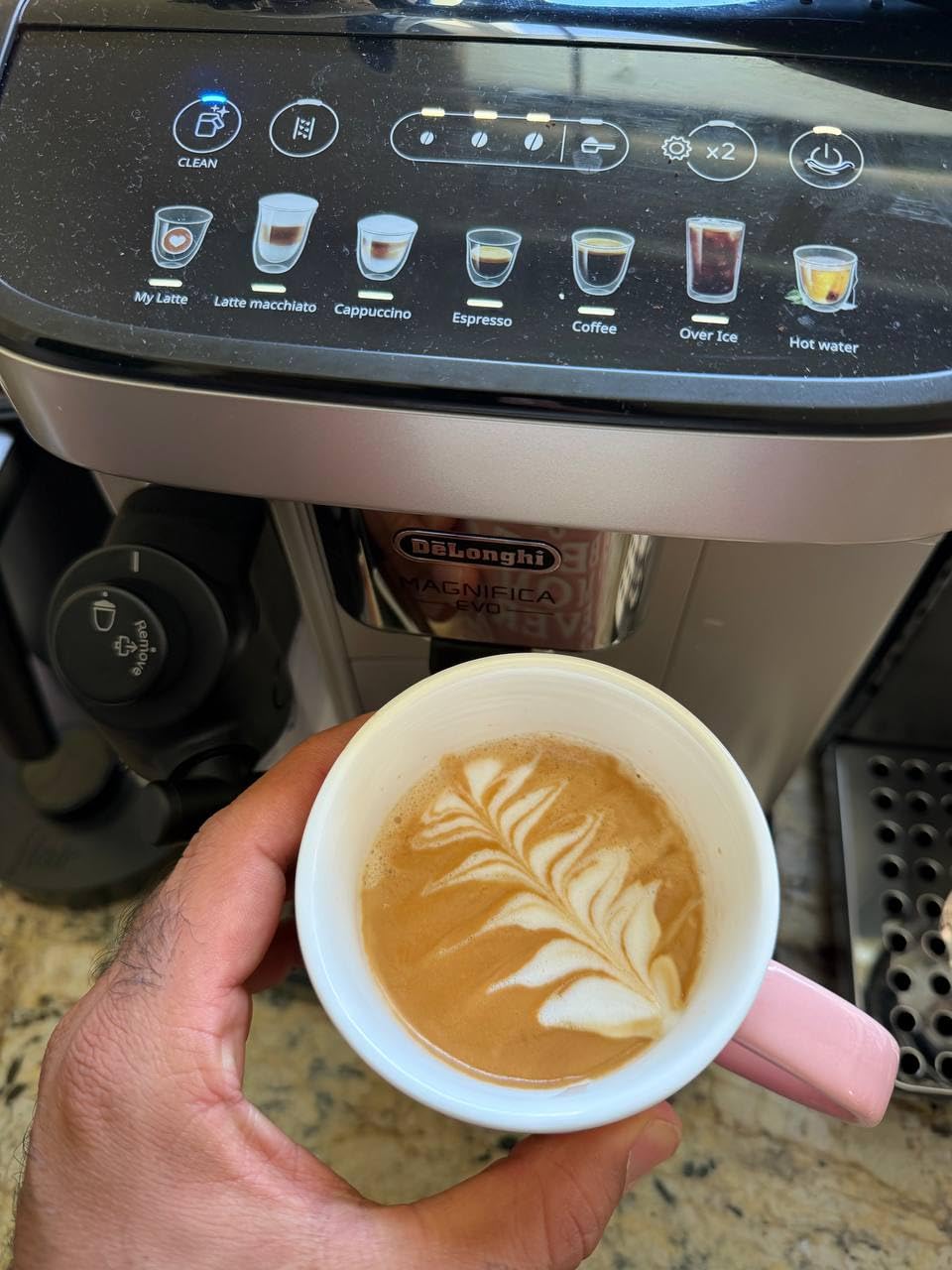
Where it loses is espresso strength and footprint. The 15 bar pump produces a lighter-bodied shot than the Breville semi-automatics in this list, and owners report the taste difference consistently. At nearly 20 inches deep and 21.2 pounds, it also claims a large slab of counter that the manual machines do not.
Maintenance is the other honest drawback. You refill water and milk daily, empty the grounds bin every two to three days, and run a full cleaning cycle every three to four weeks. Some owners have also had machines fail at the descale stage and deliver no hot water.
Why this one and not the Philips 5500
Both are full super-automatics with bean hoppers and milk systems, and the choice comes down to coffee control versus drink variety. The Magnifica Evo exposes grind size, strength and temperature as manual adjustments. The Philips offers more preset drinks, but fewer dials for the coffee itself.
The Magnifica Evo also carries a two-year warranty plus one extra year with product registration, which is the strongest coverage in this group. If you drink mainly espresso and cappuccino and want to adjust the coffee, this is the stronger machine.
Where it falls short
Espresso that reads as weak is the complaint that appears most often, and it is a real limit of the format rather than a defect. If you drink straight espresso and care about intensity, a manual machine will suit you better.
Noise is the other issue. The grinder and boiler are loud early in the morning, which is a problem in a shared-wall home, and the brew unit cannot fill a tall travel mug without removing the tray insert.
9. De’Longhi La Specialista Touch: Best for Guided Dial-In and Cold Brew
De’Longhi La Specialista Touch Espresso Machine with Coffee Grinder
- Interactive Bean Adapt guidance simplifies dial-in
- Integrated 15-setting conical burr grinder
- Automatic steam wand with 5 froth levels
- Fast cold brew in under five minutes
- Stainless steel body with a premium finish
- Some machines reported grinder malfunctions early on
- Bean hopper is not removable
- No three-way valve so spent pucks stay soggy
- Automatic milk foam reported as thin by some
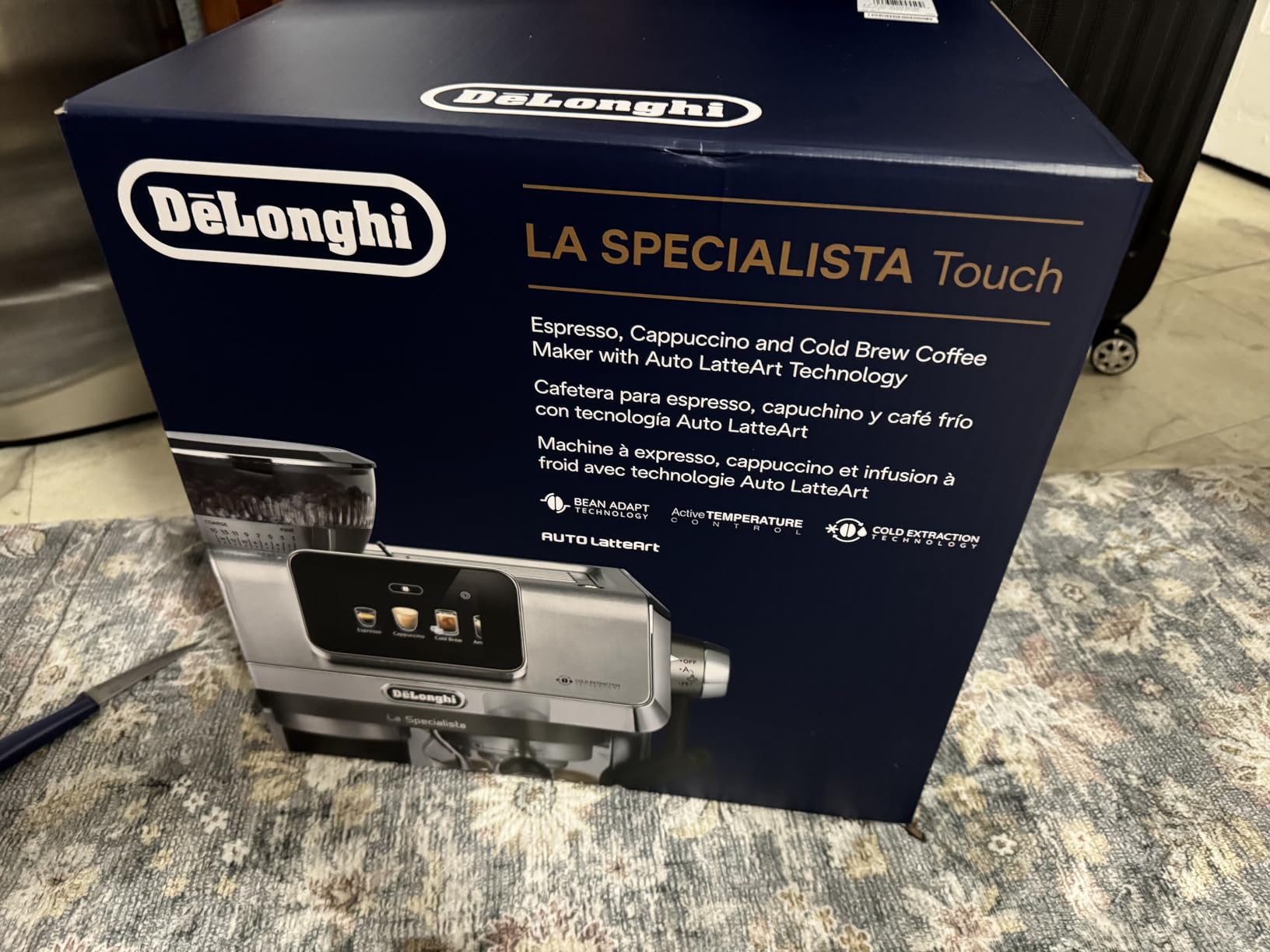
The La Specialista Touch leans hardest into teaching. Bean Adapt walks you through grind, dose, pre-infusion and brew temperature for a new bag of beans, then remembers the result. For someone who wants to understand dial-in rather than avoid it, that guidance is the point of the machine.
It also stores six bean profiles and offers 10 preset recipes, so a household that rotates between two roasters can keep both dialled in. The Italian conical burr grinder has 15 settings, and PID control runs at 9 bar extraction pressure, which is lower than the 15 and 20 bar figures printed on cheaper pumps and closer to how cafe machines run.
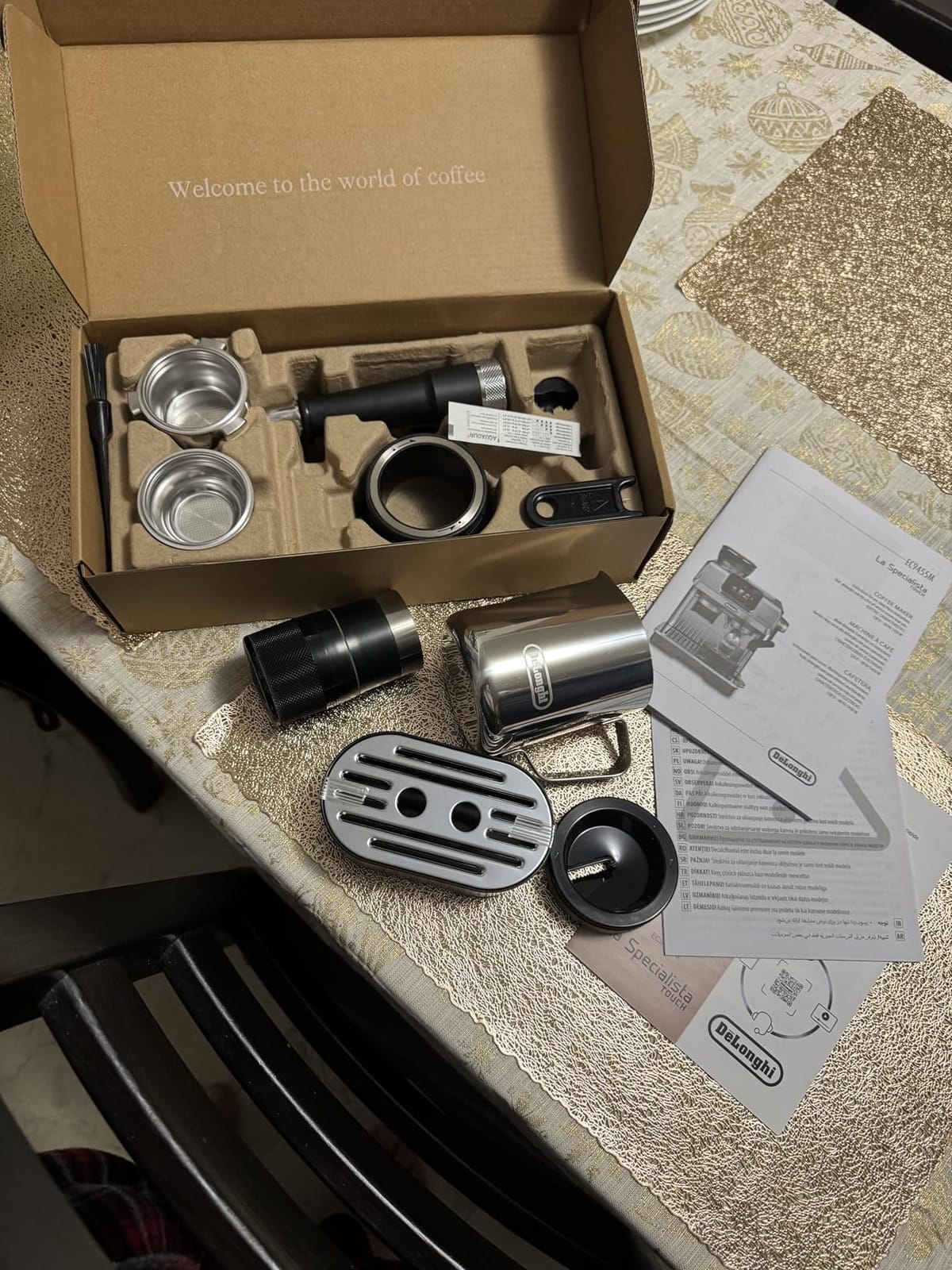
The automatic steam wand has five froth levels and four temperature settings plus a manual mode, and the manual mode is where I ended up. Reaching for the automatic setting saved effort, but the manual mode gave a tighter, more controllable microfoam and made basic latte art achievable.
Cold brew finishes in under five minutes, using cold extraction at lower temperature, pressure and flow. That sits alongside espresso on the same water path, so you are not running two appliances.
What the guidance does and does not do
Bean Adapt tells you what to change and in which order, and it reacts correctly when a shot runs fast or slow. It does not fix a bad dose or an unlevel tamp for you, so you still need a scale and a decent tamper to get consistent results.
Because it is a newer model with a smaller review base than the Brevilles, treat early feedback as provisional. Several buyers reported grinder malfunctions shortly after purchase, and owners switching from a Barista Touch often report better coffee at lower cost once settings settle.
Where it falls short
The bean hopper is not removable, which makes changing beans and storing them awkward, and there is no low-bean sensor, so grinding dry beans into the housing is easy. That is a strange omission on a machine at this level.
There is no three-way valve, so spent pucks come out wet and stuck to the basket, which adds a step to every single shot. The automatic milk foam is reported as thin by some owners, so if you want latte art, plan to use manual mode.
10. Philips 5500 Series: Best Super-Automatic for Quiet Operation and Drink Variety
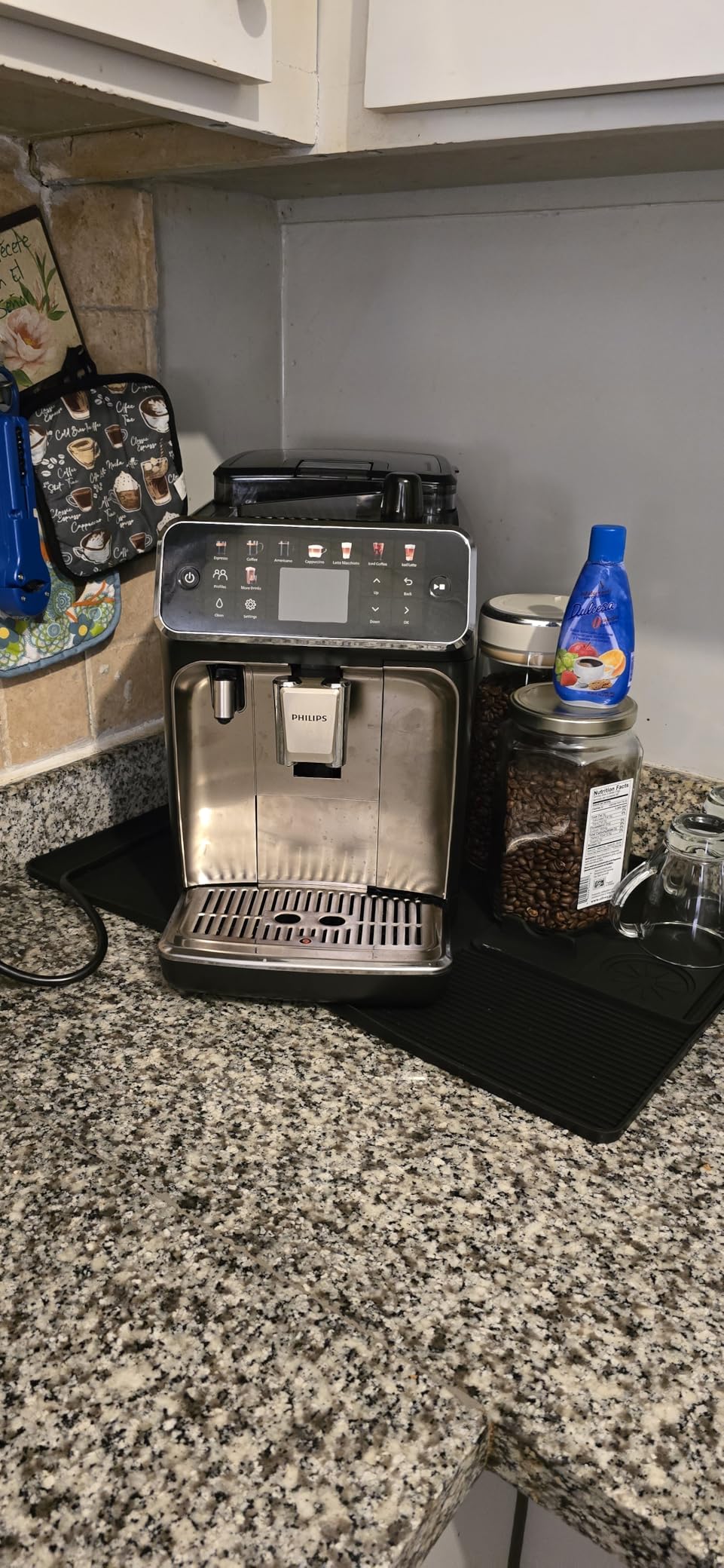
PHILIPS 5500 Series Fully Automatic Espresso Machine, LatteGo Milk System
- 20 presets from espresso to iced coffee and hot water
- One-touch grinding and tamping with brewing on a color display
- LatteGo system cleans in 10 seconds or in the dishwasher
- QuickStart is ready in 3 seconds
- SilentBrew is 40 percent quieter than earlier models
- Needs regular water filter changes and descaling
- Less control over grind and extraction than a manual machine
- Over 17 inches tall so counter space matters
The Philips 5500 is the machine to consider if someone else sleeps on the other side of the wall. SilentBrew sound shielding is claimed at 40 percent quieter than earlier Philips models and it carries a Quiet Mark certification, and in our testing the grinding noise was noticeably gentler than on the Magnifica Evo.
The other draw is breadth. Twenty presets cover espresso, coffee, lattes, cappuccinos, iced coffee and hot water, and you can save up to four user profiles for strength, volume and milk preferences. For a household where four people want four different drinks, that is the feature that decides the argument.
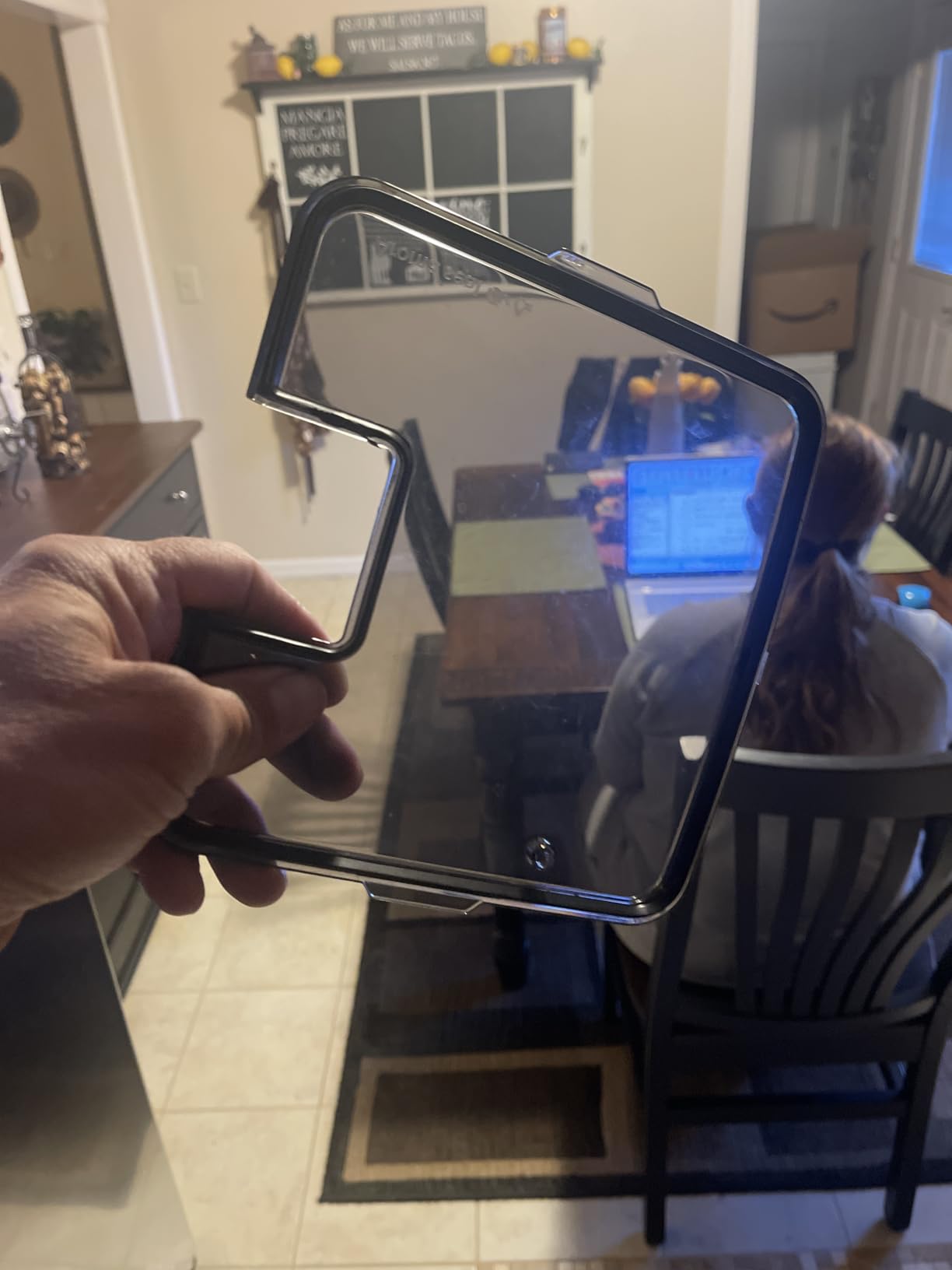
The LatteGo three-part milk system is the easiest automatic frother to clean here. It rinses clean in about 10 seconds or goes in the dishwasher, which removes the chore super-automatic owners complain about most. Most automatic milk systems need disassembly and manual scrubbing.
QuickStart reaches ready in 3 seconds, so it behaves more like a pod machine in a busy morning than like a bean-to-cup machine that needs a warm-up cycle. That speed is what makes the drink presets feel immediate rather than aspirational.
What the extra presets actually change
The cold and iced drinks are the practical differentiators. A hot-water preset means the machine doubles as a hot water source, which the compact three-in-one machines in this group do not offer, and iced coffee programs dispense directly over ice without you cooling anything first.
The four saved profiles store strength, volume and milk preferences per person, which is different from the single-drink memory on smaller machines. It is the difference between a household sharing one machine comfortably and one person quietly overriding everyone else’s drink.
Where it falls short
The fully automatic format gives up hands-on control, so if you want to experiment with dose or extraction you have nowhere to go. The trade is deliberate, but you should make it knowingly.
It also needs regular water filter changes and descaling, more often in hard water areas, and it stands over 17 inches tall, so check your cabinet clearance before committing. Rated at 3.6 pounds it is light for its size, which moves easily but also feels less planted than the heavier machines above.
How to Spend a 1,000-Dollar Espresso Budget
Answer four questions before you pick a machine
First, how many drinks do you make in a morning? One or two drinks a day suits almost anything. Five or more changes the calculus completely, because machines with grinder-based dosing and automatic cleaning cycles earn their counter space back fast.
Second, do you already own a grinder? If you do, the machine list changes shape entirely: skip every built-in grinder and spend the difference on a better machine body, or on a scale and accessories. If you do not, assume the grinder is part of the budget even when the listing says one is included, because the included one is almost always a step below a standalone unit.
Third, what do you actually drink? If it is straight espresso, skip every automatic milk system and every super-automatic, and spend the money on temperature control. If it is mostly milk drinks, an automatic system is not a luxury, it is a time saver you will feel daily.
Fourth, how much counter depth do you have? Several machines here are 20 inches deep or more, and super-automatics need clearance above the cup outlet as well as below it. Measure before you fall for a size.
Super-automatic or semi-automatic: the real trade-off
A super-automatic grinds, doses, tamps, extracts and froths, then cleans up after itself. You press a button and drink. That is genuinely better on busy mornings and worse on every other measure: you cannot adjust dose or extraction, the shots are lighter, and the cleaning burden is real even with removable parts.
A semi-automatic with a grinder gives you a portafilter, a steam wand and real temperature control. You do more work per shot and get more out of it. If you enjoy the process at all, this is the more rewarding machine type, and every enthusiast forum thread at this budget eventually makes that argument.
The honest middle ground is a guided semi-automatic like the Barista Touch or the La Specialista Touch, which add interface prompts to a real portafilter machine. They do not remove the manual work, but they make the first month less punishing.
Does 1,000 dollars cover a grinder?
It rarely stretches comfortably, and that is where most buyers go wrong. Inside 1,000 dollars all-in, a realistic split is roughly 650 to 700 dollars on the machine and 250 to 300 on a grinder. Push the machine to the full number and the grinder has to come out of savings.
If you have no grinder, we would rather you buy the Barista Express and put money into a separate grinder than buy a 1,000-dollar machine and skip the grinder. The reason is simple: grind quality affects shot quality more than most machine features do, and a marginal grinder paired with an underpowered machine wastes the machine, while a modest machine paired with a real grinder performs.
Forum threads on r/espresso and home-barista treat this budget as machine plus grinder for exactly that reason. The build-ups that work best are a compact machine plus a modest grinder, or a mid-tier portafilter machine with a decent built-in burr and money remaining for beans and accessories.
Boiler type and PID temperature control
A thermoblock heats water on demand through fast-flowing aluminum channels. It is inexpensive, heats in seconds, and cannot brew and steam at the same time, which is why the Casabrews has a mandatory cool-down between the two.
A single boiler holds one water temperature and switches between brewing and steaming. A heat exchange boiler uses a single boiler but circulates hot water through a chamber, so it can do both with a short recovery pause. A dual boiler runs separate brew and steam tanks and does both at once, which is why dual boiler machines show up in enthusiast forums at this budget even though most roundups skip them.
PID control is the separate and more important question. A PID loop holds a set temperature within a couple of degrees instead of swinging with the thermostat, and that stability is what makes shot after shot repeatable. Among the machines here, the Barista Pro states PID accuracy within plus or minus 2 degrees, the Barista Express and Barista Touch have PID digital control, and the La Specialista Touch has PID at 9 bar. The Casabrews and the Stilosa do not claim PID.
Milk systems: auto carafe, auto wand or manual wand
An automatic carafe, as on the Magnifica Evo, mixes and froths inside a detachable container. It asks the least of you of the three systems, and the Philips LatteGo takes the same idea further with a three-part design that rinses in about 10 seconds. Both make drinkable but rarely art-shaped foam.
An automatic steam wand, as on the Barista Touch and the La Specialista Touch, steers the wand for you at a set temperature and texture, and usually has a manual mode underneath. The La Specialista Touch goes furthest with five froth levels plus four temperature settings, and its manual mode produced the tightest microfoam in our testing.
A manual wand, as on the Barista Express and the Barista Pro, gives you full control over texture and is the route most latte art practice takes. The Barista Pro wand was noticeably stronger than the Barista Express one, and the Stilosa wand is usable but not art-capable.
Counter space, noise and daily maintenance
Footprints in this group range from 5.47 inches wide on the Casabrews to 19.53 inches deep on the Magnifica Evo. Machines with a hopper also need vertical clearance, and super-automatics need space above the dispenser for a cup. If you are buying a compact machine because your counter is small, measure the appliance plus the swing of the portafilter.
Noise is a genuine quality-of-life issue and it tracks the grinder. Machines with faster burr motors and larger grinders, including the Brevilles and the Magnifica Evo, run loud in a quiet kitchen. The Philips 5500 makes the strongest quiet-operating case with its certified sound shielding, and the manual-piston Stilosa is quiet because it has no grinder at all.
Daily maintenance separates into three levels. Capsule machines need a tank refill and a pod drawer. Semi-automatics need backflushing weekly, grinder burr cleaning monthly, and a descale every few months depending on water hardness. Super-automatics need grounds emptied every few days, daily tank and carafe refills, and a full cycle every three to four weeks, so buy a water filter if your water is hard.
Frequently Asked Questions
What is the best 1,000 dollar espresso machine?
The Breville Barista Express is the best all-round machine at this budget because it pairs an integrated precision burr grinder with PID temperature control and a manual steam wand in one body, so you do not have to buy a separate grinder. If you want one-touch operation instead of hands-on control, the De’Longhi Magnifica Evo grinds, tamps, brews and froths on a single press.
What is the best espresso machine for the money?
For most buyers the Barista Express offers the best balance of shot quality, milk capability and total cost, because its included grinder and toolkit remove almost every extra purchase. Shoppers who already own a grinder should skip built-in grinders entirely and buy the machine body only. Read our espresso machines for beginners guide if you have never pulled a shot before.
Should I get an automatic or semi-automatic espresso machine?
Choose automatic if you want one-press drinks and minimal cleaning on busy mornings; choose semi-automatic if you want control over dose and extraction and enjoy the process. Automatic machines make lighter-bodied espresso and cost more counter space, while semi-automatic machines with a grinder let you improve over time. A guided semi-automatic is the compromise most buyers end up happy with.
What is the best super-automatic espresso machine under 1,000 dollars?
The De’Longhi Magnifica Evo is the best super-automatic at this budget for coffee drinkers who want adjustment, since it exposes grind size, strength and temperature and saves personal recipes. The Philips 5500 Series wins on drink variety with 20 presets, a quieter grind and the LatteGo milk system that rinses clean in about 10 seconds.
Do I need a separate grinder with an espresso machine?
Only if the machine does not include one. Machines listed here with an integrated burr grinder can be used straight away, though those grinders sit a step below standalone units and some owners replace them over time. If you buy a machine without a grinder, such as the De’Longhi Stilosa or the Casabrews, budget separately for one or commit to pre-ground coffee.
What is the best espresso machine for a home barista?
The Breville Barista Pro suits a developing home barista most, with 30 numbered grind settings, PID control holding within plus or minus 2 degrees and a stronger steam wand than its cheaper sibling. Dosing by weight rather than using the volumetric buttons improves repeatability quickly. Dedicated latte art practice needs a manual wand, which the Barista Pro and Barista Express both have.
The Verdict: Which Espresso Machine Should You Buy
If you want one machine and no further purchases, the Breville Barista Express is our pick for the best espresso machines under a 1,000-dollar budget. It covers the whole workflow, from whole beans to microfoam, in a single body, and its 4.4-star average across more than 27,000 reviews reflects how few buyers regret it.
Buy the Barista Pro instead if you already know what you are doing and want numbered grind settings plus a stronger wand. Buy the Ninja Luxe Cafe Premier if the household drinks more than espresso and wants cold brew in the same appliance. Buy the Breville Barista Touch if you want guided setup and automatic milk without giving up a portafilter.
Go super-automatic with the De’Longhi Magnifica Evo for coffee control inside an automated machine, or the Philips 5500 Series for drink variety and quieter grinding. For tight counters and small budgets, the Casabrews CM5418 and the De’Longhi Stilosa do the job at a fraction of the spend, and the Nespresso Inissia is the answer when nobody wants to learn anything at all.
Whatever you choose, spend the difference on beans and a scale. A dialed-in entry machine with fresh coffee beats an expensive one brewing supermarket grounds, and that gap shows up in the cup every single morning.