
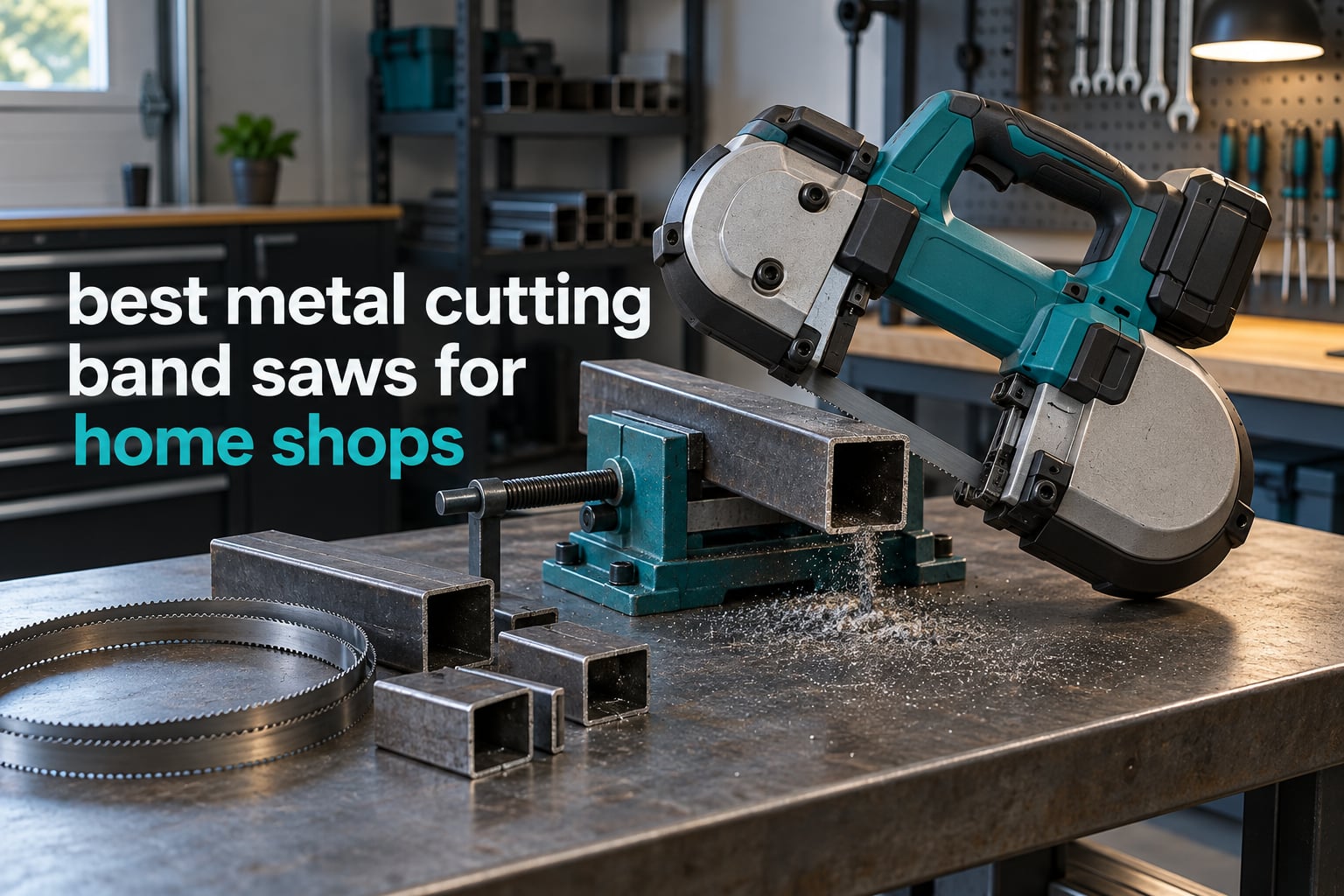
The best metal cutting band saws for home shops come as a portable saw with a 5 inch cutting capacity and variable speed control. For most hobbyists, that means a 10 to 15 lb saw you can hold in one hand, feed into steel tube and angle iron, or bolt to a stand for repeatable vertical cuts. If you want one tool that turns a garage into a working metal shop, this is where to start.
We spent weeks putting ten of the most popular portable metal cutting band saws through real shop tasks: schedule 40 pipe, square tube, angle iron, flat bar and rebar. What separated them was not horsepower. It was blade speed control, how the blade guides held up, whether the saw tracked true out of the box, and how long the factory blade survived before it needed replacing. Those are the details that decide whether a cut is quick or whether you are fighting the tool.
One warning before we start. A woodworking band saw cannot cut steel. If you already own a wood saw, read our guide to the best band saws for woodworking to understand what you have, then buy a dedicated metal cutting band saw for anything harder than aluminum.
Table of Contents
Top 3 Picks for a Home Shop Metal Cutting Band Saw

All 10 Metal Cutting Band Saws at a Glance in 2026
| Product | Specifications | Action |
|---|---|---|
| DEWALT 20V MAX DCS374B |
|
Check Latest Price |
| DEWALT DWM120K Corded 10-Amp |
|
Check Latest Price |
| WEN 94396 Portable 10-Amp |
|
Check Latest Price |
 Milwaukee M18 FUEL 2729-20 Milwaukee M18 FUEL 2729-20 |
|
Check Latest Price |
 VEVOR 5 Inch Portable with Base VEVOR 5 Inch Portable with Base |
|
Check Latest Price |
 Anbull Portable with Removable Base Anbull Portable with Removable Base |
|
Check Latest Price |
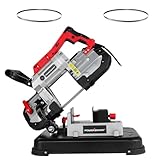 PowerSmart 10A Variable Speed PowerSmart 10A Variable Speed |
|
Check Latest Price |
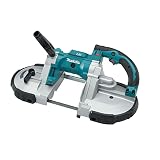 Makita XBP02Z 18V LXT Makita XBP02Z 18V LXT |
|
Check Latest Price |
 Milwaukee M12 FUEL 2529-20 Milwaukee M12 FUEL 2529-20 |
|
Check Latest Price |
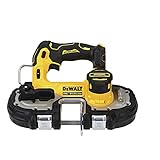 DEWALT ATOMIC DCS377B DEWALT ATOMIC DCS377B |
|
Check Latest Price |
1. DEWALT 20V MAX DCS374B Cordless Band Saw for Deep Cuts in Steel
DEWALT 20V MAX Band Saw, 5″ Cutting Capacity, Integrated Hang Hooks, Portable, For Deep Cuts, Bare Tool Only (DCS374B)
- Cuts steel and schedule 40 pipe quickly and cleanly
- Brushless motor delivers strong durable performance
- Tool-less blade tension lever speeds blade changes
- LED work light with 20 second delay
- Integrated hang hook for storage
- Stock blade dulls quickly on metal
- Bare tool only with no case included
- Heavier feel than smaller portable band saws
The DCS374B is the saw I keep reaching for. It is the only one in this group that feels balanced in the hand rather than merely held, and that matters once you are making a stack of cuts in 1 inch square tube rather than trimming a single piece of conduit.
At 12.4 lb it is lighter than most of the corded saws here and only a little heavier than the compact models. That balance is what lets me hold a 2 inch square tube at arm’s length without my wrist complaining before the cut is finished. The 5 inch capacity covers everything from 1 inch wall tube up to solid round bar in the 5 inch range.
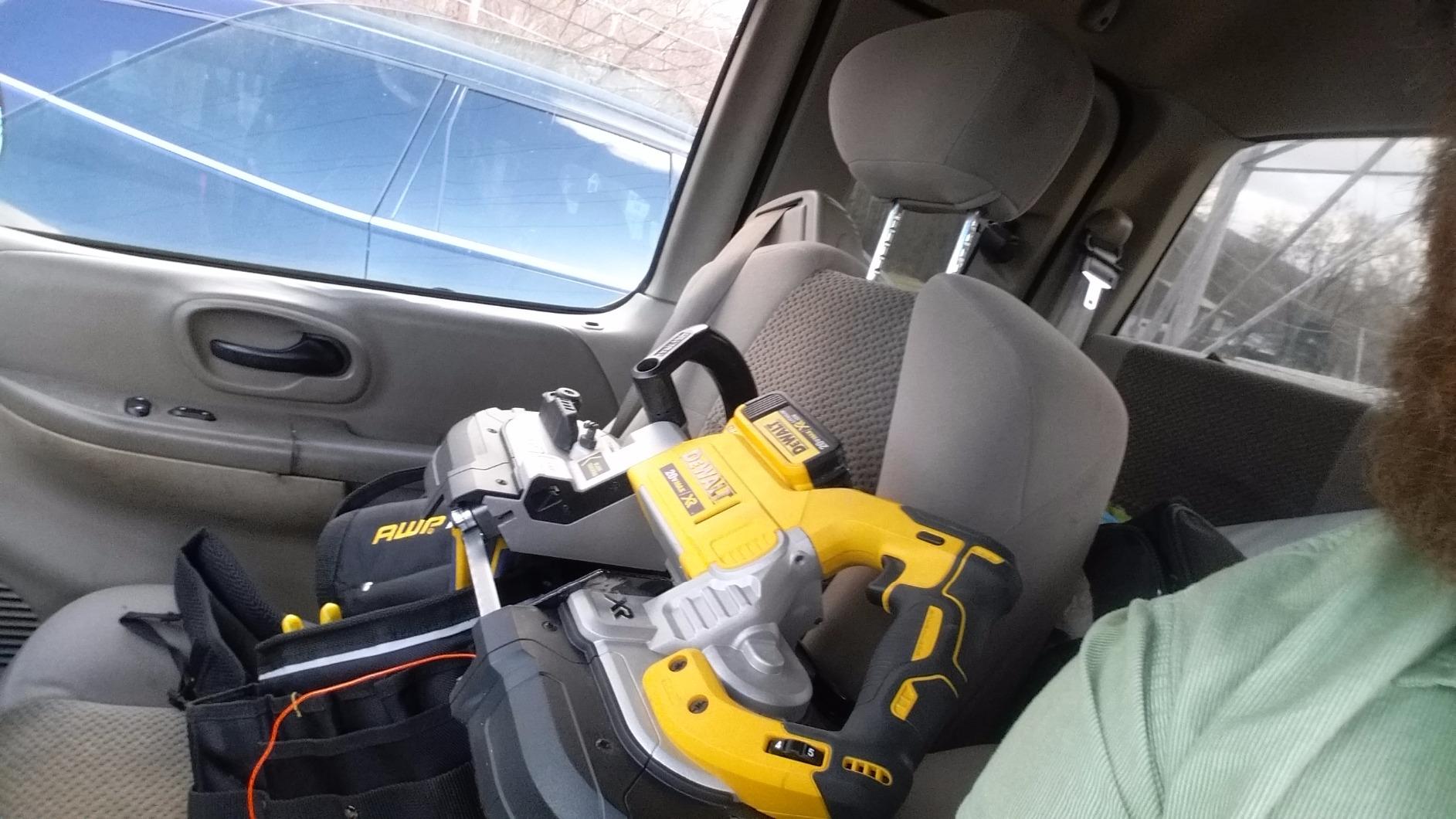
Owners consistently report that this saw cuts steel and schedule 40 pipe quickly and cleanly. The brushless motor does not bog down when the blade first bites into the work, which is the failure mode of cheaper brushed-motor saws. The variable speed trigger lets you creep into the cut and then push through once it is established.
The LED work light with its 20 second delay is one of those small features that turn out to matter in a dark garage. You get twenty seconds of light every time you pull the trigger, which is exactly enough to line up your mark without fumbling for a flashlight with a glove on.
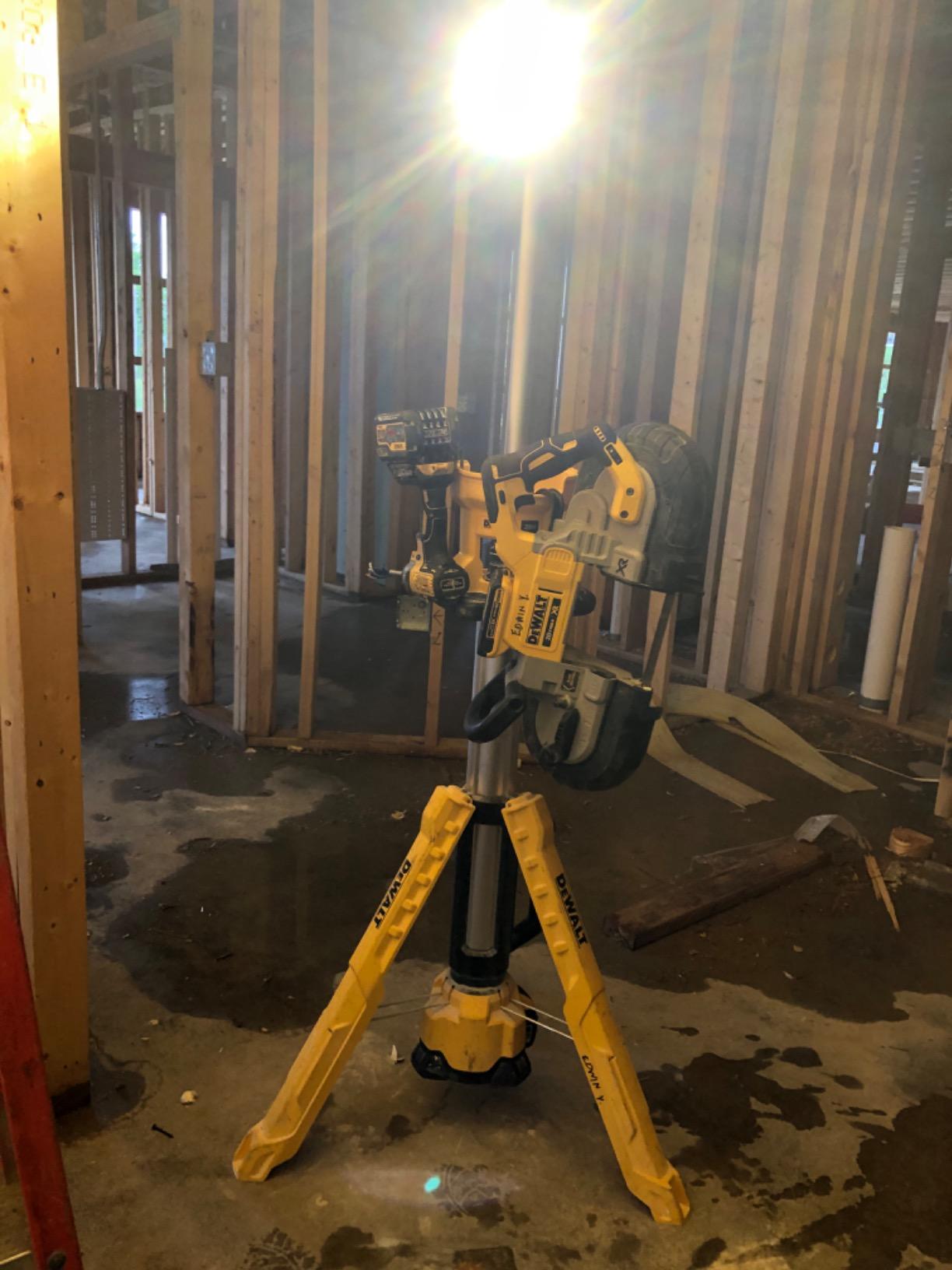
The tool-less blade tension lever is the feature I appreciate most. Loosening tension to swap blades takes one motion instead of a hex key, and on a saw you own batteries for, you will change blades more often than you expect as you move from steel to aluminum to thin-wall tube.
The honest drawback is the stock blade. Reviewers report it dulls quickly on metal and recommend a thicker metal blade for faster cuts. Plan on budgeting for a good bi-metal blade shortly after you unbox this, and the saw performs considerably better once you have one fitted.
What you should know before you buy
It comes as a bare tool. The battery and charger are separate purchases, and if you do not already own a 20V MAX pack, that changes the real cost of entry significantly. The case is also sold separately, which is worth considering if the saw lives in a truck bed.
Reviewers also note it has a heavier feel than smaller portable band saws, so for overhead work above your head or for long stretches of continuous cutting, the 7.7 lb compact model is a better tool even though it cuts less.
Who this saw suits
This is the one to buy if you cut a mix of materials and already own batteries. It handles pipe, structural shapes and solid bar without complaint, and the tool-less blade change means you are not looking for tools every time you switch jobs.
Skip it if you are buying your first 20V MAX battery and charger today, or if your work is mostly overhead trimming of conduit and thin stock where capacity is not the constraint.
2. DEWALT DWM120K Corded 10-Amp Deep Cut Band Saw
- Cuts clean straight lines with minimal operator effort
- Fast cool spark-free cuts versus abrasive chop saws
- Hard case included for storage
- Bright LED sight light lines up the cut
- Very easy tool-less blade changes
- No trigger lock-on for stationary work
- Small front blade guide limits precision when vertical
- Stock blade widely reported as poor
- Bare tool version needs a separate stand
The DWM120K is the corded answer, and for a shop with a reliable outlet it is arguably the smarter buy than any battery saw. A 10 amp motor does not care about battery state, and 1200 watts of continuous power is more than enough to feed a bi-metal blade through solid steel.
Cuts come out cool, straight and spark-free, which is the whole point. Compared with an abrasive chop saw, the difference in the workpiece is dramatic: no heat-affected edge, no grinding cleanup, and a kerf you can weld straight to.
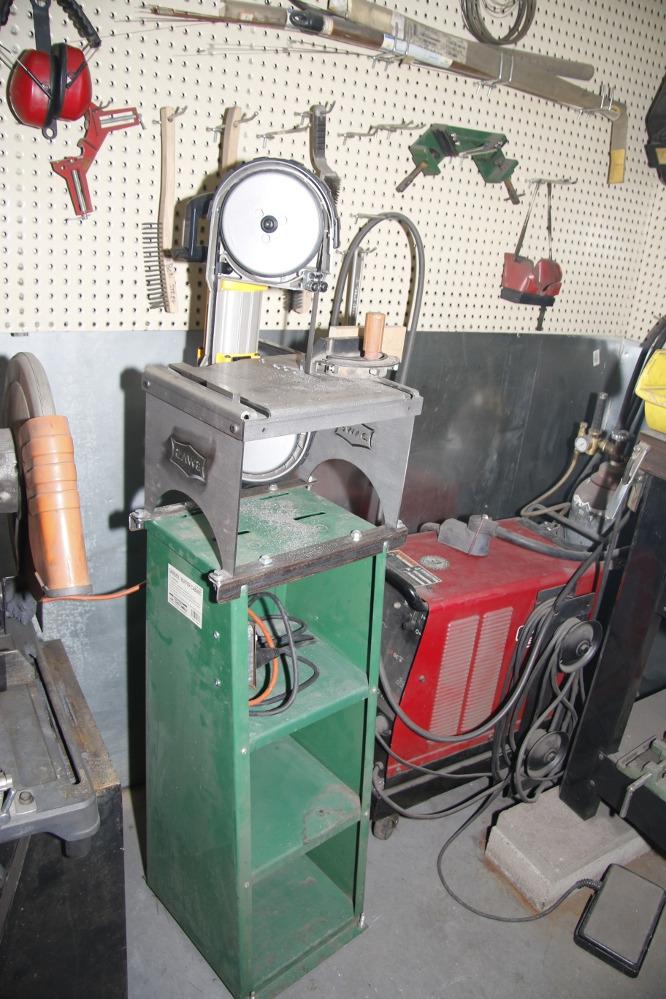
The variable speed dial runs from 100 to 350 strokes per minute, and the LED sight light lines up your cut line in a dark shop. The multi-position adjustable front handle lets you get a comfortable grip whether you are cutting overhead, at hip height, or down near the floor.
Blade tracking adjustment is included, and reviewers credit it with extending blade life. Dual bearing blade guide rollers keep the blade supported at the front of the cut, which reduces deflection on tall cuts.
Owners almost universally replace the stock blade. The included 44-7/8 inch by 1/2 inch by .020 inch blade is reported as poor, and most people fit a Lenox or similar bi-metal blade early on. The kit version does include a hard case, which is genuinely useful for a shop saw that lives in a vehicle.
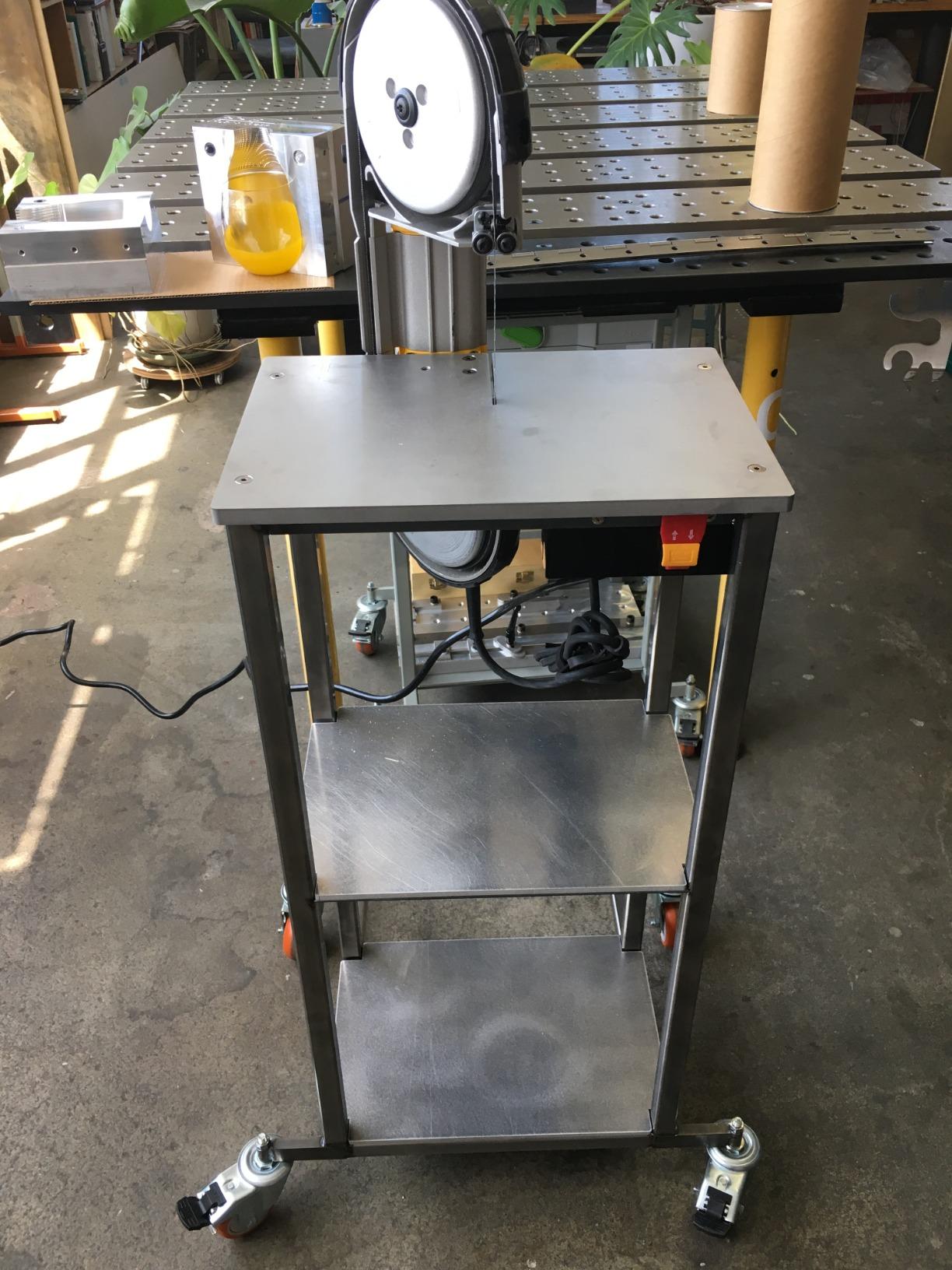
Two limitations come up repeatedly. There is no trigger lock-on, so for stationary vertical cutting the switch has to be held. And the small front blade guide slides limit precision when the saw is mounted vertically, which is why many owners pair it with a third-party portable band saw table.
What you should know before you buy
You need somewhere to plug it in, and for repeat cuts you need a stand. Reviewers pair this saw with a third-party portaband table for vertical work, and that combined with a better blade is what separates clean production cuts from fiddly one-offs.
The shroud and rubber bumpers are built for job site durability, so it tolerates being knocked around in a truck bed better than most. If your cuts happen away from an outlet, this is the wrong saw and you want a cordless model instead.
Who this saw suits
This is the best value in the group for someone with a bench and a wall outlet. It makes fast, straight cuts and never waits on a battery.
Skip it if you need to cut away from power, or if you plan to mount it permanently as a vertical saw and want a lock-on switch and a proper guide system out of the box.
3. WEN 94396 Portable Band Saw for Metal Cutting
WEN Portable Band Saw for Metal, 10-Amp, Variable Speed, Handheld (94396)
- Strong value for the class
- cuts 1.25 inch square stock and aluminum quickly
- Six detented variable speed settings
- LED headlight for aligning cut lines
- Long-term owners report years of service
- Standard DEWALT-style blades fit
- Factory blade widely criticized for mediocre cut quality
- Very loud in operation and needs hearing protection
- Limited belt and blade tracking adjustments
- 14.5 lb is noticeable for daily use
The WEN 94396 is the saw we recommend to someone whose first metal cuts are going to be simple: cutting tube to length for a weld table, trimming angle iron for a frame, cutting lengths of square tubing for a shop rack. It does those jobs well, and it is the least expensive way on this list to find out whether metal cutting is something you want to own.
The 60 to 420 feet per minute variable speed range is a genuinely wide spread, with six detented settings that make it easy to repeat the same speed on the next piece. That repeatability is what you want when cutting a batch of identical parts.
Owners report strong value, with the saw cutting 1.25 inch square stock and aluminum quickly. Long-term owners describe it as still performing after three to five years, and the standard DEWALT-style blade format means the parts ecosystem is familiar and well stocked.
At 14.5 lb it is not a light saw, but the balance is good and the ball-bearing blade guides keep the cut stable on thinner material.
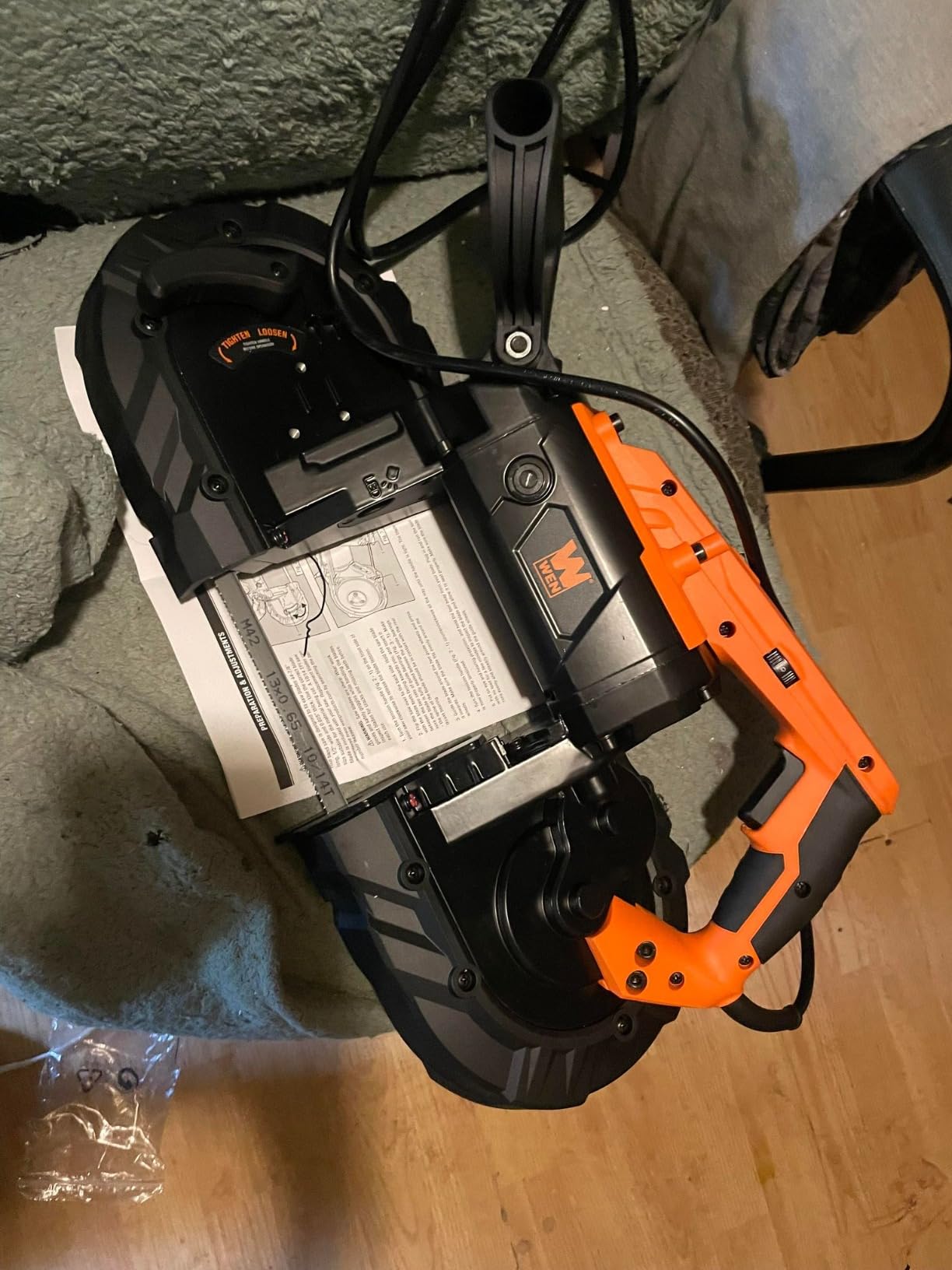
The factory blade is the weak point. It is the most common complaint in reviews, with owners replacing it almost immediately. Once you fit a proper bi-metal blade, this saw’s reputation improves dramatically, so treat the blade as a purchase rather than a freebie.
It is also very loud in operation. Owners consistently note hearing protection is needed, and the 14.5 lb weight is noticeable over a full day of repeated cuts.
What you should know before you buy
Tracking adjustments are limited compared with name-brand saws, so if your cuts run off-square you are tuning rather than correcting a well-serviced mechanism. Stand mounts may need drilling on some saws, so factor that in if you plan to run it vertically.
Some saws arrive without a blade or without a case. The warranty is two years, which is shorter than the three years on the DEWALT and Makita models and considerably shorter than the five years on the M12 FUEL.
Who this saw suits
Buy this saw if you are starting out, cutting mostly tube and mild steel, and want a low-risk way to find out whether metal cutting is something you enjoy. It is hard to argue with the value once you add a real blade.
Skip it if noise matters in your space, if you need a precise repeated cut over days of work, or if you want a warranty that covers you past year two.
4. Milwaukee M18 FUEL 2729-20 Cordless Deep Cut Band Saw
Milwaukee 2729-20 M18 FUEL Cordless Lithium-Ion Deep Cut Band Saw (Tool Only)
- Brushless M18 FUEL motor gives strong consistent cutting power
- Deep cut capacity suits pipe and angle iron
- Part of the widely used M18 FUEL battery platform
- Well regarded for metal fabrication and field work
- Bare tool only with battery and charger sold separately
- 15 lb is heavy for overhead or extended work
- Limited listing detail on controls and blade changes
The M18 FUEL deep cut saw is the one to buy if you already run Milwaukee batteries everywhere else in the shop. The brushless motor delivers consistently strong cutting power, and the deep cut capacity handles pipe and angle iron without the saw bogging down.
Reviewers rate it highly for fabrication and field work, which tells you something about how it holds up under daily use rather than occasional weekend duty.
At 15 lb it is among the heavier saws in this group. That is fine for a cut at bench height with both hands on the tool, and less fine for overhead work or for a long afternoon of single cuts.
The included 24 TPI high speed steel blade is a sensible starting point for mild steel. Because the saw accepts standard band blades, you are not locked into one blade source when you move to stainless or aluminum.
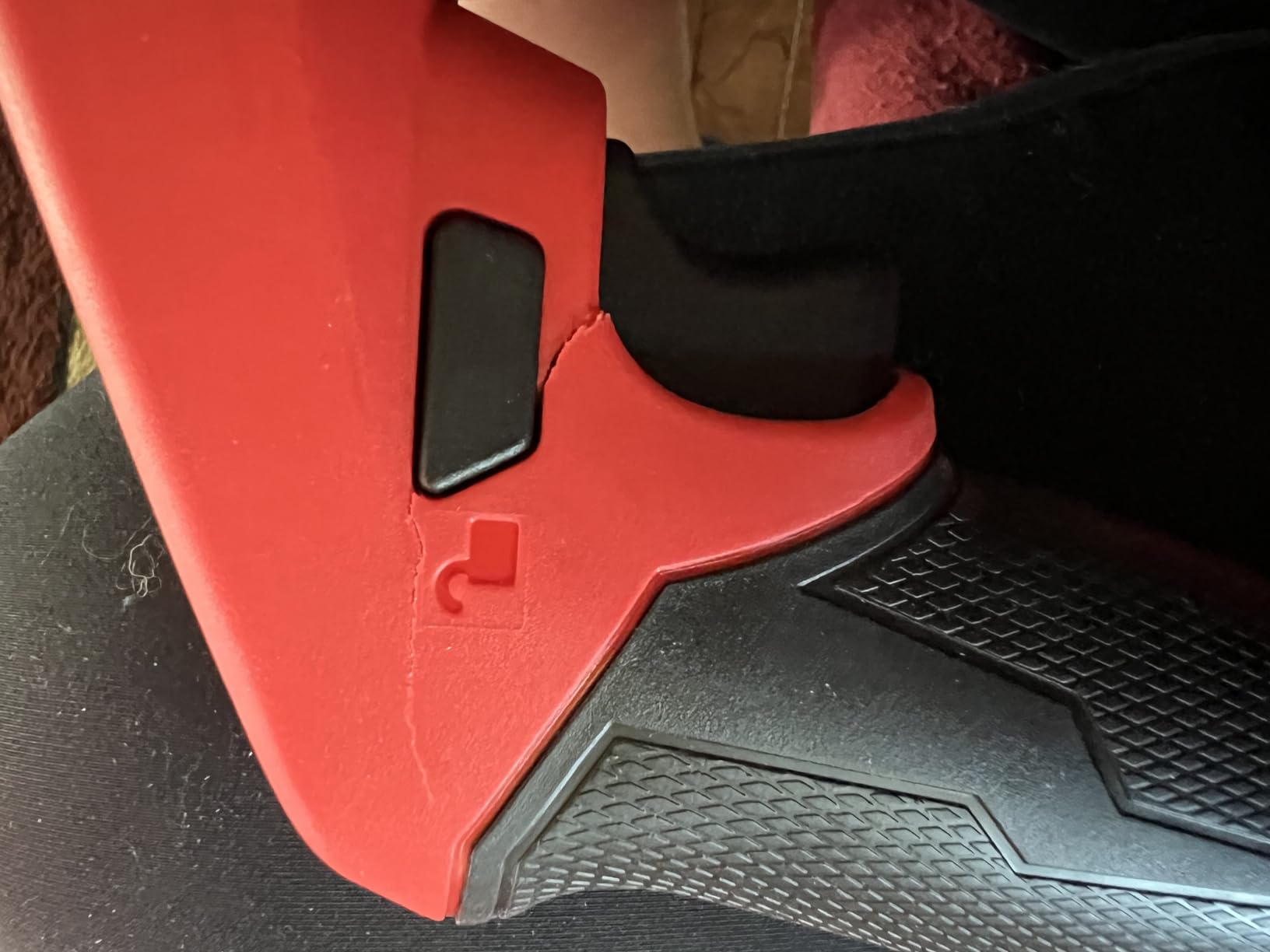
The main practical issue is packaging. It is a bare tool, and one lithium ion battery is required but sold separately. If you are starting the M18 platform from scratch, the DEWALT 20V MAX option or the corded WEN will cost you less to get running.
Owners commonly already own M18 FUEL batteries, which lowers the real entry cost substantially for them. That is exactly why this saw ranks where it does.
What you should know before you buy
Vendor listings carry limited detail on the controls and the blade change procedure, so plan to look up the manual before your first blade swap. It is a brushless platform with a stated speed figure, but confirm the low-end speed for thin material rather than assuming.
As with any cordless saw, treat the battery platform as the deciding factor. A great saw is a nuisance if you own three other battery types.
Who this saw suits
This suits the fabricator who already owns M18 FUEL packs and wants a single-brand toolset. The cutting power justifies its weight when you are working through structural steel.
Skip it if you are buying your first Milwaukee battery, if your work is mostly overhead, or if you need the lightest possible tool for a confined space.
5. DEWALT ATOMIC 20V MAX DCS377B Compact Bandsaw
DEWALT ATOMIC 20V MAX Brushless Cordless 1-3/4 in. Compact Bandsaw, Bare Tool Only (DCS377B)
- Only 7.7 lb and easy for overhead or one-handed cuts
- Brushless motor powers through 1 inch aluminum and unistrut
- Cuts cleaner than a reciprocating saw with minimal kerf loss
- Variable speed trigger and dial plus work light
- Can trim already installed conduit
- 1-3/4 inch capacity limits it to smaller pipe and stock
- Some stock blades are welded with a hump that snags
- Bare tool only without battery or charger
The DCS377B is not a metal cutting band saw in the sense the others are. It is a compact one-handled trim saw. But for anyone doing electrical work, trimming conduit already in place, or cutting small unistrut and angle, it replaces a reciprocating saw and an angle grinder with one tool and a much cleaner cut.
At 7.7 lb it is the lightest full-capacity saw here, and users report it fits in a standard drill-size bag. That is the entire appeal: it goes where you go and it cuts cleanly.
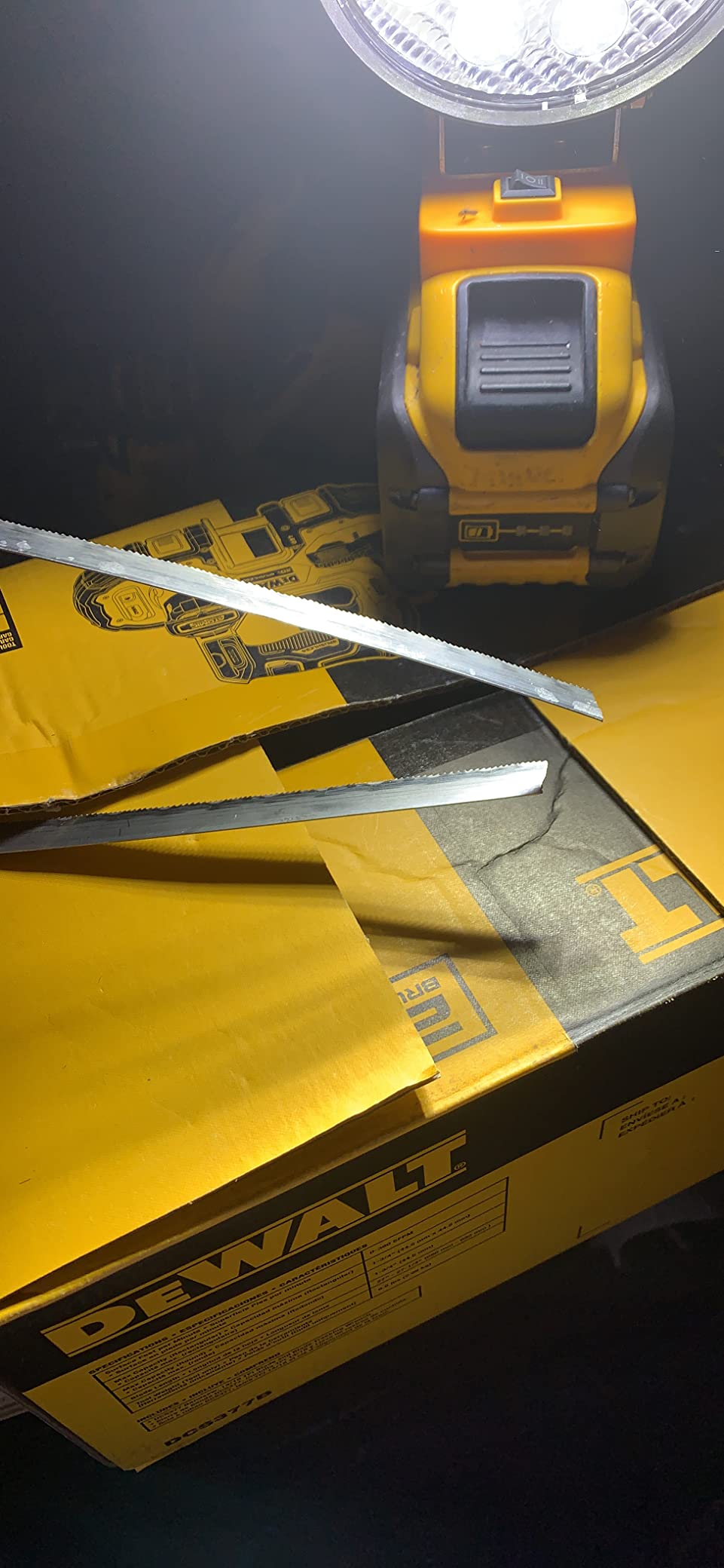
The brushless 20V MAX motor powers through 1 inch aluminum, unistrut and conduit without complaint, and reviewers note it cuts cleaner than a Sawzall or hacksaw with minimal kerf loss. A single 2Ah battery lasting a full workday of conduit work is a commonly reported figure.
The integrated guard allows genuinely overhead and one-handed cutting, and the variable speed trigger plus speed dial give you control over the cut rate. Lanyard ready is a small safety plus for work at height.
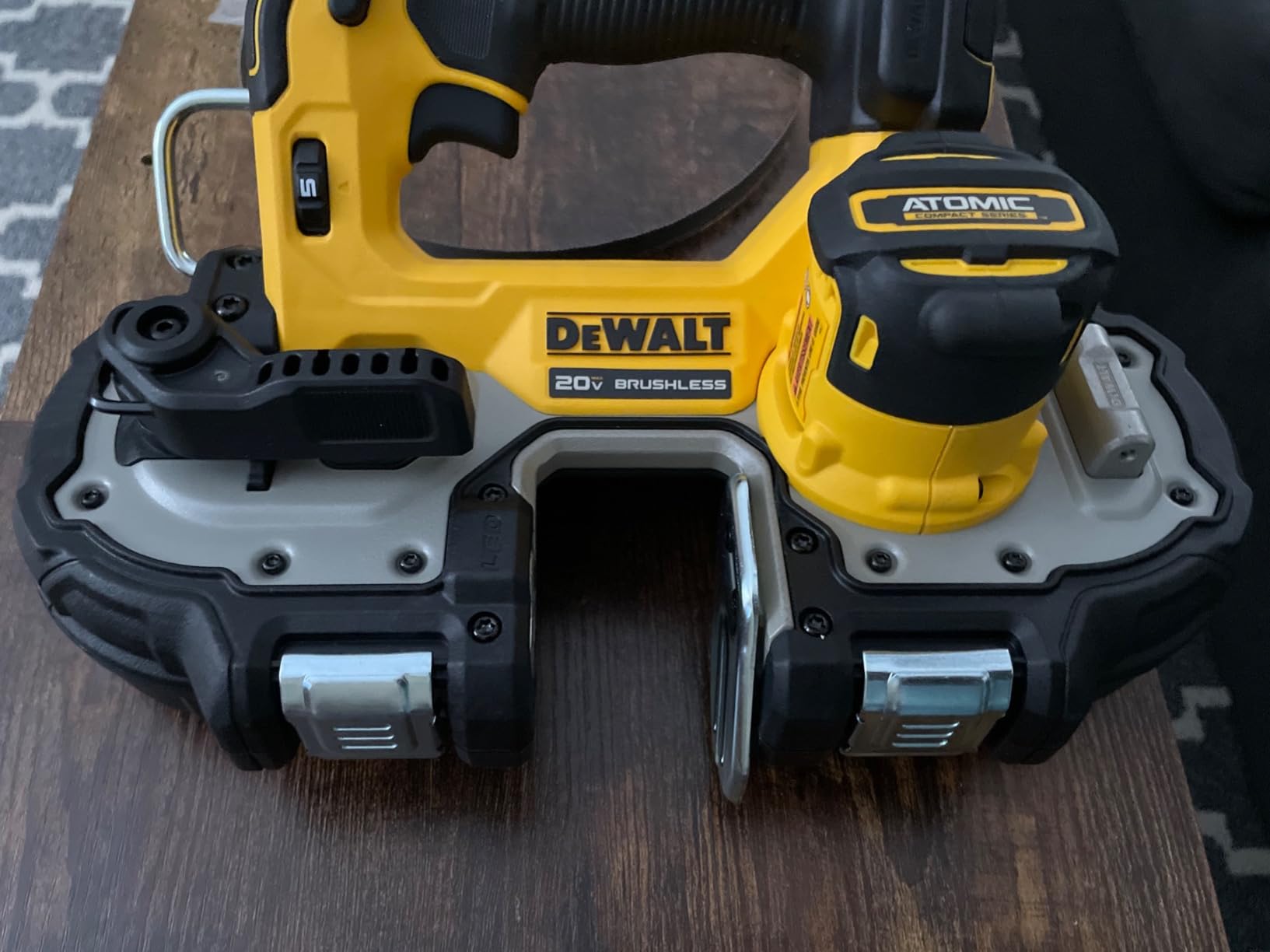
The blade release lever with a supplied tracking wrench and single point tracking adjustment is genuinely thoughtful. You can set tracking on this saw without hunting for a hex key, which is unusual at this size.
The 1-3/4 inch capacity is the hard limit. If your work involves 2 inch pipe or solid bar, this is the wrong saw. Some stock blades are also reported as welded with a hump that snags occasionally.
What you should know before you buy
It comes as a bare tool with a 14/18 TPI blade and a blade tracking wrench. Battery and charger are separate, and a Tool Connect chip pocket is available separately for anyone who cares about collecting chips.
Weigh it against the M12 FUEL if weight is the deciding factor. Both are compact, and the DEWALT has more capacity; the Milwaukee is lighter and carries a five-year warranty.
Who this saw suits
This is the right saw for an electrician, a low-voltage installer, or a home owner who mostly trims rather than fabricates. Clean cuts in already-installed material is a genuinely hard problem for bigger saws.
Skip it for structural work. Once you are cutting 2 inch tube or solid bar, you need the 5 inch capacity saws on this list.
6. Makita XBP02Z 18V LXT Cordless Portable Band Saw
Makita XBP02Z 18V LXT Lithium-Ion Cordless Portable Band Saw, Tool Only
- Cuts steel pipe rebar unistrut and EMT fast and straight
- Wide variable speed range avoids stalling on thin plate
- Light for a full size band saw
- Long battery life per 3Ah pack
- Trigger lock-off safety and LED work light
- 15 lb still substantial for overhead work
- Loud with a noticeable chunk as the blade passes the guides
- Not brushless so carbon brushes add noise
- No plastic case in the bare tool version
The Makita’s 275 to 530 feet per minute speed range covers a wide band from slow to fast, and that range is why it earns a place on this list. You can slow right down for thin plate and thin-wall tube without dropping to a crawl, then speed up for solid stock.
Owners report it replacing reciprocating saw and grinder work in metal fabrication, cutting steel, pipe, rebar, unistrut and EMT fast with clean straight results. The over-torque protection circuit with a built-in alert light tells you when you are pushing past what the blade and motor can take.
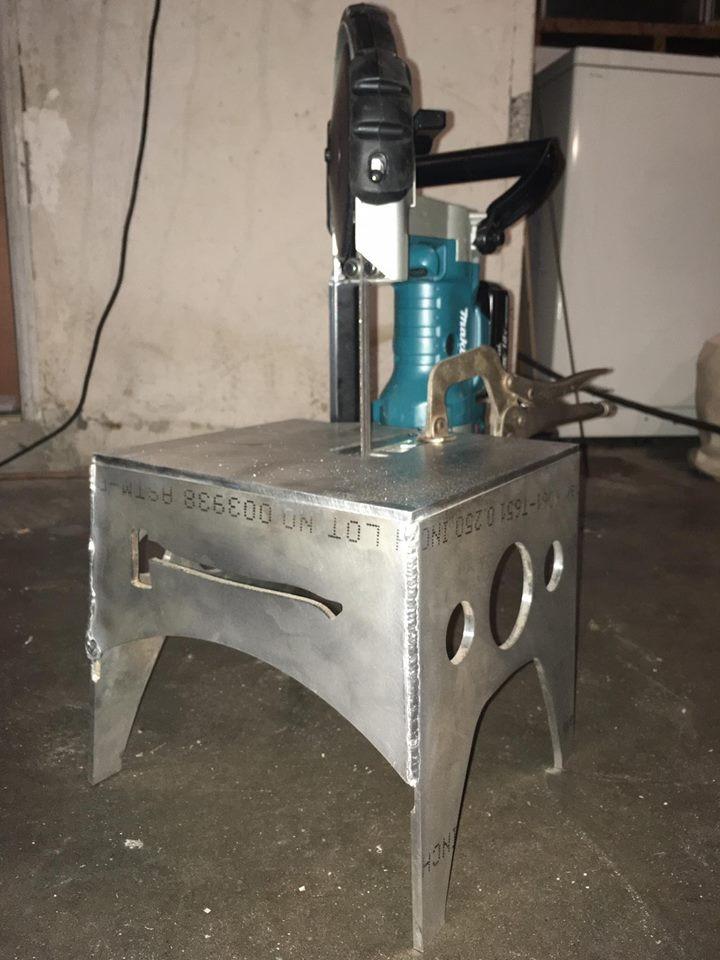
At 15 lb it is light for a full-size band saw compared with the DEWALT and Milwaukee models at this capacity. Battery life is a genuine strength, with many cuts reported per 3Ah pack, and the trigger lock-off is a safety feature the other cordless saws here mostly lack.
The 4-3/4 inch cutting capacity accepts standard 44-7/8 inch blades, and an 18 TPI blade is included. Blades are widely available, so sourcing replacements is not a problem.
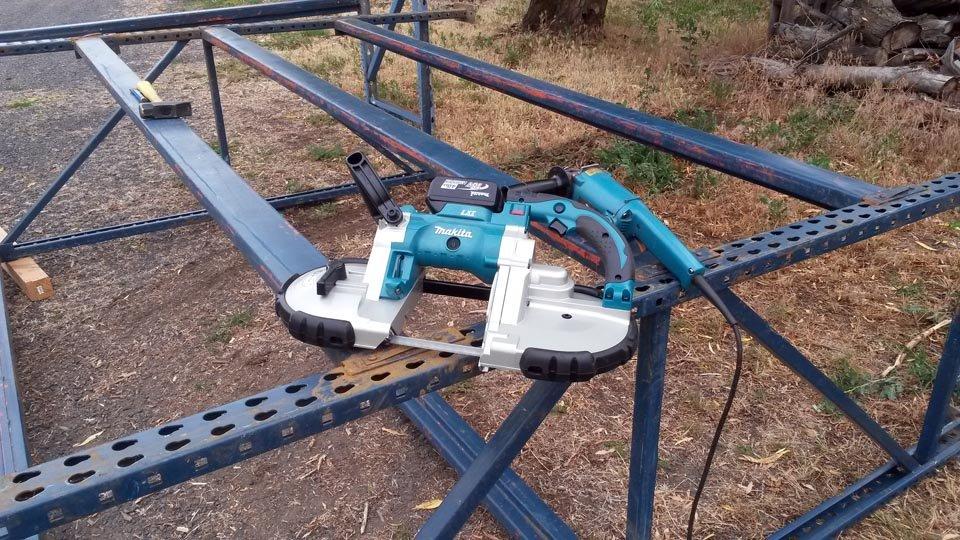
Sound is the main complaint. It is loud, with a noticeable chunk as the welded blade section passes the guides, and because this model is not brushless, the carbon brushes and gearing add noise on top of that.
Two smaller issues: the bare tool version ships without a plastic case, and the speed controller is not a true lock-on, which matters if you want to mount the saw vertically on a stand. Makita does not offer a matching stand for this model.
What you should know before you buy
Know your speed settings before you start. The wide range is the feature, and it only helps if you experiment with it on scrap until you find the speed that feeds smoothly for each material and thickness.
If you are already on the 18V LXT platform, this fits naturally into your battery collection. If not, that is a meaningful added cost to weigh against the wide speed range.
Who this saw suits
The Makita is for the fabricator who cares about control. The wide speed range makes it a good cordless option for thin plate and varied material, and the trigger lock-off is the safety plus.
Skip it if noise is a factor in your workspace, or if you plan to run it vertically on a stand and need a lock-on feature.
7. Milwaukee M12 FUEL 2529-20 Compact Band Saw
- Lightest option at about 6 lb for one-handed use
- Brushless motor cuts rod strut conduit and fence posts quickly
- Integrated work light and hanging hook
- Five year manufacturer warranty
- 12V battery platform is widely owned and light
- Nearly the same physical size as the M18 FUEL model
- 2.5 inch capacity limits it to smaller stock
- No lock-on switch and cannot start the blade on the material
- Battery and charger not included
At 6 lb this is the lightest saw in the group by a wide margin, and for one-handed work above your head or on a ladder it is the one that is genuinely comfortable. The brushless M12 FUEL motor cuts rod, strut, conduit and small fence posts quickly for a tool its size.
Users like the integrated work light and the hanging hook, and the five-year manufacturer warranty is the longest stated on any saw here.
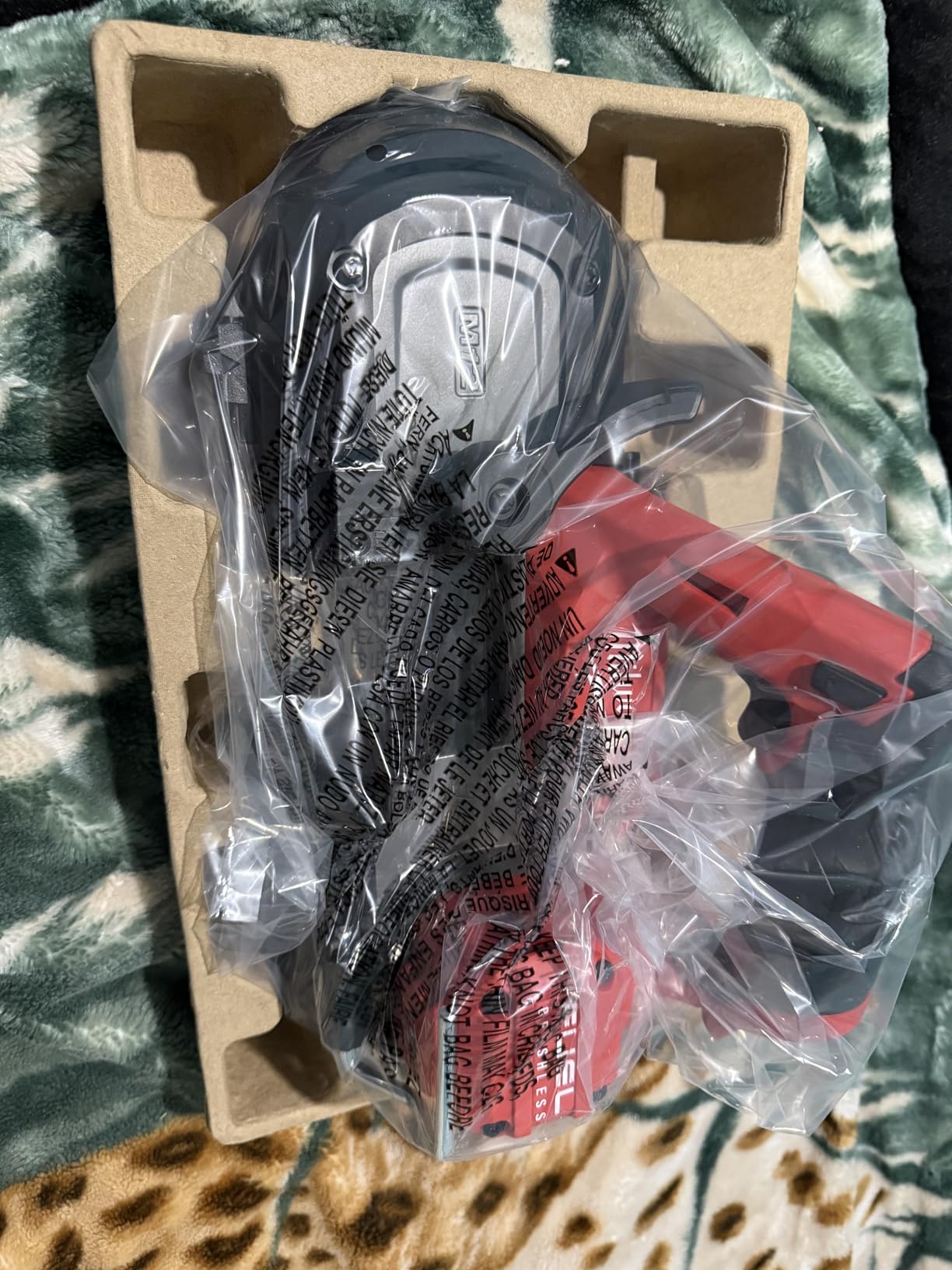
Here is the thing nobody tells you about the compact label: it is roughly the same physical size as the M18 FUEL band saw, so it is less compact than expected, and it cuts about the same amount of material. What you gain is weight, not capacity.
At 2.5 inch throat depth and throat width, the limit is clear. This is conduit, all-thread, uni-strut, small angle and thin stock, and it stops there.
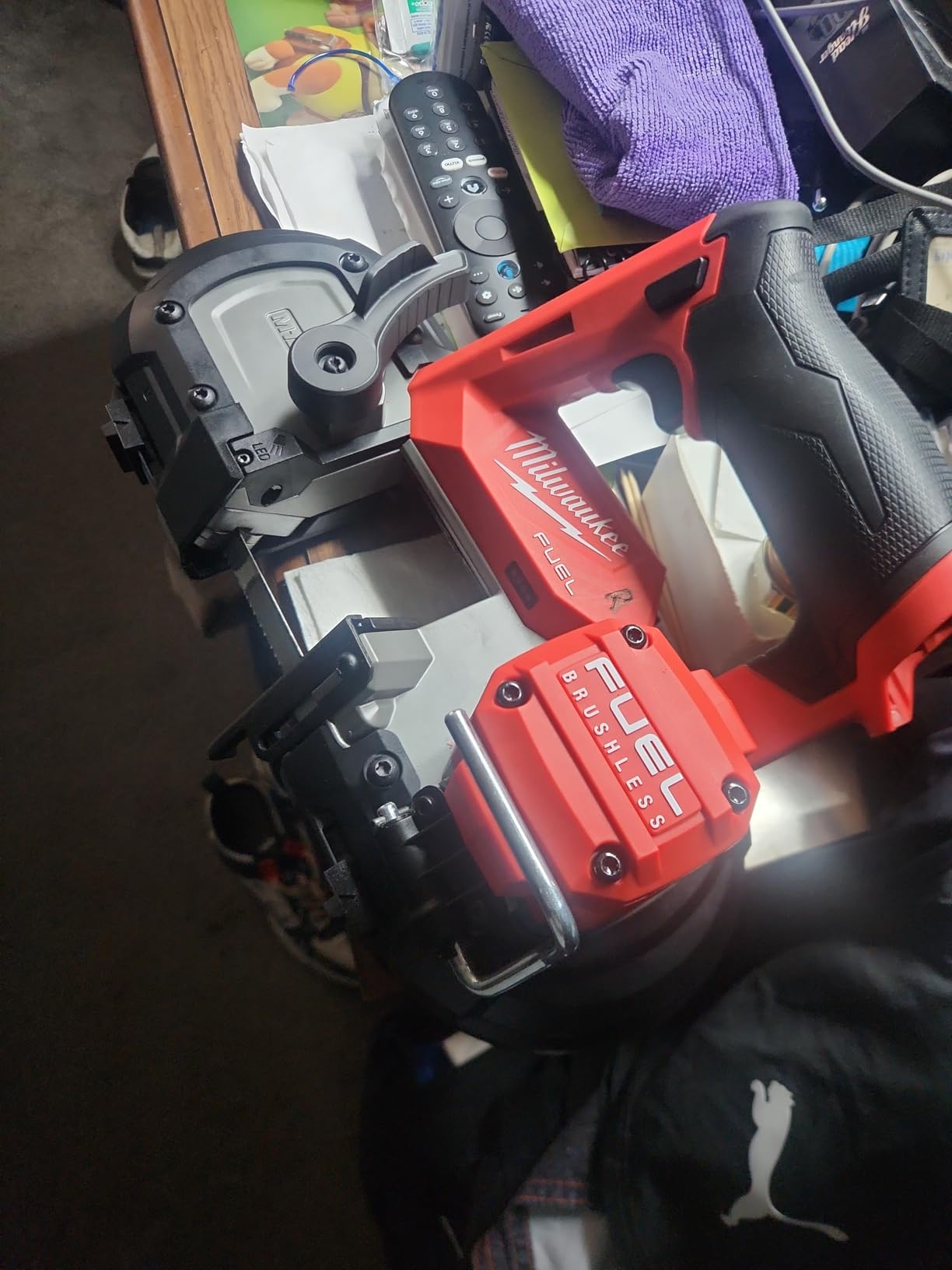
Two operating limitations show up repeatedly in reviews. You cannot start the cut blade against the material; it will hang or trigger the protection, so you have to establish the blade at speed first. And there is no lock-on switch, so it is not suited to stand-mounted vertical work.
It also consumes battery faster than the non-FUEL M12, and replacement blades are less readily available outside the US.
What you should know before you buy
Thermal protection will interrupt a long cut and require you to restart, which is worth knowing before you start a thick section in one pass. Cut in stages rather than fighting the saw through a continuous cut.
Battery and charger are sold separately. If you run M12 tools already, you are set; if not, factor a battery and charger into the cost before comparing this against corded options.
Who this saw suits
This suits anyone doing overhead work, ladder work, or one-handed cuts where 15 lb would be miserable. The five-year warranty and light weight make it a long-term shop companion for light stock.
Skip it for structural fabrication. The 2.5 inch capacity rules out most of the tube, angle and bar work that drives people to a metal cutting band saw in the first place.
8. Anbull Portable Band Saw with Removable Alloy Steel Base
Anbull Portable Band Saw with Upgraded Removable Alloy Steel Base
- Removable swiveling alloy steel base stabilizes stock for accurate cuts
- 1100W motor cuts steel aluminum angle iron and PVC spark free
- Six speed control with per-material speed recommendations
- LED spotlight illuminates the cut line
- Accepts several TPI blade types
- Cutting capacity drops when the base is installed
- 33 lb listed weight is heavy for handheld work
- Budget brand with less established support
- Some saws arrive needing blade tracking
The Anbull R2103 stands out for one reason that has nothing to do with price: it comes with per-material speed recommendations. The manufacturer tells you to use gear 3 for hard material, stay at gear 3 or below for stainless, gears 4 and 5 for 45# steel, and gear 6 for galvanized pipe. For a first-time metal cutter, that chart is worth more than a saw with a longer feature list and no guidance.
The upgraded removable alloy steel base weighs 6.6 kg on its own and swivels from 0 to 45 degrees, which turns a handheld tool into something that can hold stock steady for a repeat cut.
The 1100W 10 amp pure copper motor cuts steel, aluminum, angle iron and PVC without sparks or burrs, and the six-speed control runs from 100 to 350 feet per minute. The LED spotlight illuminates the cut line, and the adjustable blade guard helps prevent jams.
It comes with a .020 by 44-7/8 inch 14 TPI blade, and it accepts 10-14, 14-18 and 24 TPI blades. That means you can change tooth count as your material changes without buying a different saw.
The capacity drop with the base attached is the thing to understand before you buy. Without the base you get 5 inch by 4-3/4 inch rectangular or 5 inch round. With the base fitted it drops to 4 inch by 3-1/5 inch rectangular or 4 inch round. You trade reach for stability, and for many jobs that is the right trade.
The 33 lb listed weight is heavy for handheld operation, and some saws arrive needing blade tracking or alignment adjustment out of the box. Support for the brand is less established than the name-brand saws on this list.
What you should know before you buy
Use the per-material speed chart. It is the most useful thing in the box and it removes most of the guesswork from your first dozen cuts. Start slow, listen to the motor, and step the speed up until the cut starts to sound strained, then back down one gear.
Expect to spend ten minutes on tracking out of the box. That is normal for this tier and not a defect, but it is a task rather than a non-event.
Who this saw suits
This suits a beginner who wants structure. The speed guidance, the swiveling base and the multi-TPI blade compatibility give you room to grow without buying a second saw in a year.
Skip it if you need the full 5 inch capacity while stationary, or if long-term parts and service support matters to you more than the feature set.
9. VEVOR 5 Inch Portable Band Saw with Swivel Base
- Removable alloy steel base swivels 0-45 degrees for accurate work
- 1100W motor cuts steel aluminum angle iron and PVC cleanly
- Variable speed range handles different materials
- Adjustable blade guard helps prevent blade jamming
- Strong feature set for the tier
- Cutting capacity drops noticeably with the base attached
- Listed weight of about 29 lb is heavy for handheld work
- Budget tier build and finish compared with name brands
- Limited warranty
The VEVOR’s defining feature is the removable alloy steel base that swivels through 0 to 45 degrees. That is a miter capability, and among the budget saws on this list it is the one that most directly answers the question of whether you can cut compound angles in square tube or angle iron without buying a separate accessory.
Without the base you get a 4.7 inch by 4.7 inch deep cut for rectangular stock and 5 inch for round. The motor is 1100 watts of pure copper, running from 137.8 to 472.4 feet per minute.
Owners report the motor cuts steel, aluminum, angle iron and PVC cleanly, and the adjustable blade guard helps prevent blade jamming on tricky stock. The ergonomic soft-grip rear handle is a genuine comfort improvement over bare plastic in a long session.
Cutting at 45 to 90 degrees with the removable base installed is the workflow this saw is built around, and it is the reason we picked it for miter work specifically.
Two compromises come with the base. Capacity drops to 3.9 inch by 3.2 inch rectangular and 3.93 inch round, which is a meaningful reduction. And the listed weight of 13 kg, about 29 lb, is heavy for a handheld saw.
Build and finish sit at the budget tier compared with name-brand saws, and the warranty is limited rather than a multi-year manufacturer commitment.
What you should know before you buy
Decide up front whether you need reach or miter capability. With the base off you get the larger cut; with the base on you get the angle. Most shops need both at different times, and you will be swapping more often than the manual suggests.
The heavy listed weight matters if you planned to do overhead work. This is a bench saw with a swivel base, not a one-hand tool.
Who this saw suits
This suits someone building a frame or a stand who needs accurate compound cuts in tube and angle. The swiveling base is a real capability that most budget saws do not offer.
Skip it if your work is one-handed cutting, or if you want the full 5 inch capacity while the base is fitted.
10. PowerSmart 10A Variable Speed Portable Band Saw
PowerSmart Portable Band Saw, 10A Variable Speed, 5″ Cutting Capacity
- Removable base with 0-45 degree rotation stabilizes repeat cuts
- Smooth relatively quiet cutting with minimal sparks
- Six speed variable control and LED work light
- Includes two 14 TPI blades and a tool-less blade change lever
- Two year warranty
- Some saws arrive with blade off the drive wheels causing binding
- Blade tracking adjustment is undocumented in the manual
- Base clamp adjustments are not especially precise
- Guard plastic can shed fragments if the blade derails
The PowerSmart PS3051 is the quietest saw in this group, and that matters more than it sounds like it should. Owners describe the cutting as smooth and relatively quiet with minimal sparks, and in a garage attached to a house, noise is a real constraint that specs do not capture.
It comes with two .025 by 44-7/8 inch 14 TPI blades and a tool-less blade change lever, which is a generous box for a portable saw. The 10 amp 1100W motor cuts 5 inch wide by 5 inch deep in round or rectangular stock.
Owners highlight the removable base with its 0 to 45 degree rotation as the feature that stabilizes stock for repeat cuts, and the six-speed dial covers 0 to 435 feet per minute. The LED work light and dual bearing blade guide round out a well-equipped package.
One owner-reported modification worth knowing: it can be turned into a foot-pedal operated vertical saw with simple changes, which solves the trigger-holding problem on a saw that has no lock-on.
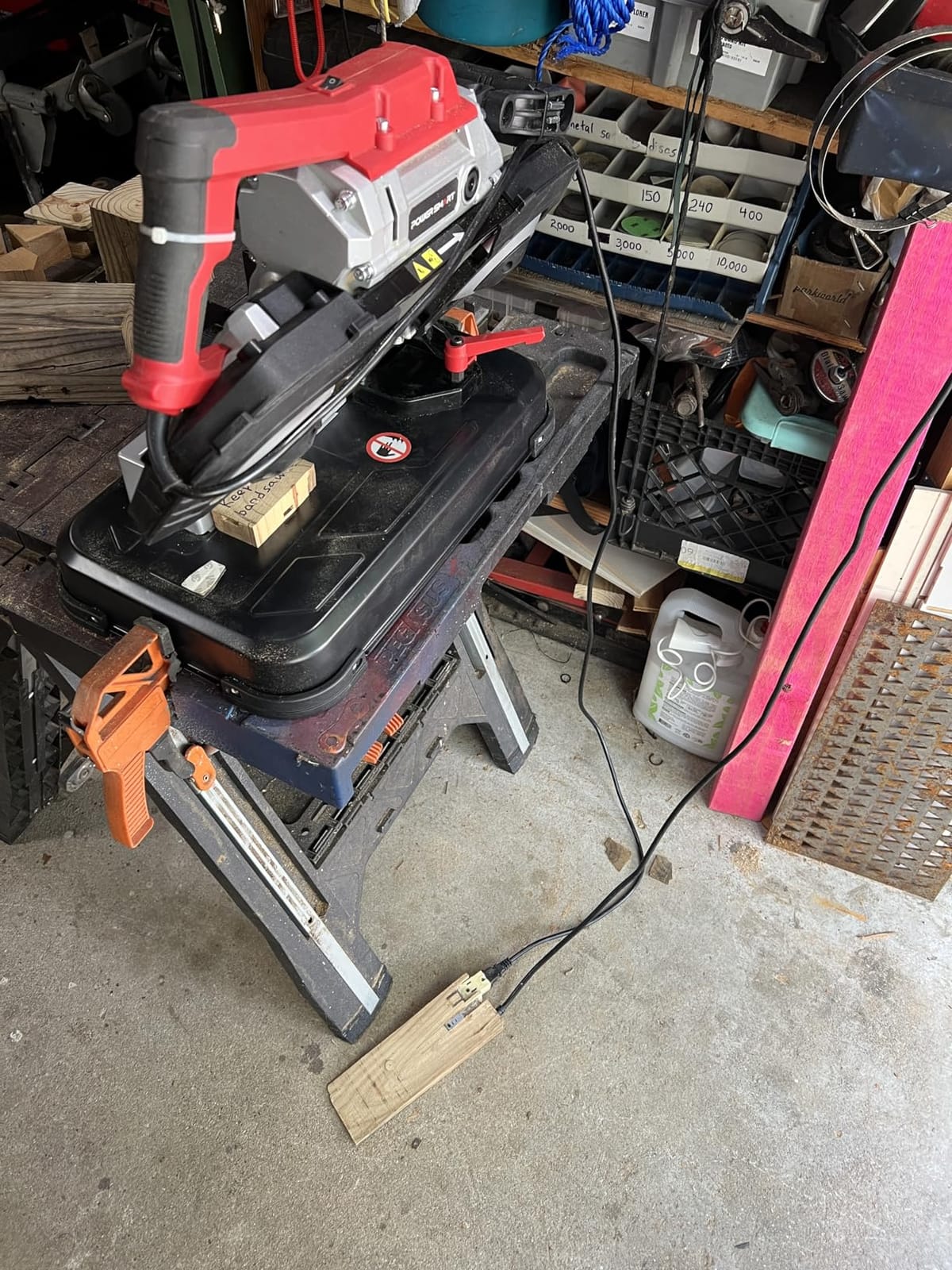
The dominant complaint, which drives much of the one-star share, is blade derailment caused by factory tracking misalignment. Some saws arrive with the blade off the drive wheels, which causes binding or a cut into the guards.
The tracking adjustment is not documented in the manual. Several buyers located an undocumented 5 mm hex bolt under the mount, adjusted it, and kept the saw. That is a workable fix, but you should not have to find it yourself.
What you should know before you buy
Check blade tracking before the first cut. If the blade is running off the drive wheels, stop and correct it rather than cutting with it. The guard plastic can shed fragments if the blade derails, so treat a derailing blade as a stop-work condition.
Base clamp adjustments are not especially precise, and the 30 lb total weight including the base reduces portability. The two-year warranty is the shortest of the name-brand saws here.
Who this saw suits
This suits someone who works in a shared or attached space where noise is the deciding factor, and who is comfortable doing a ten-minute tracking adjustment themselves. The two included blades and the tool-less change lever are good value.
Skip it if you want a saw that cuts true the moment it arrives, if blade derailment is a risk you do not want to manage, or if you need fine clamp control for precise repeat work.
How to Choose a Metal Cutting Band Saw for a Home Shop
Capacity is the first number to look at, and it is the number sellers describe least clearly. A stated capacity is the largest round stock or the largest rectangular section the saw can pass through in one cut. The useful question is not what is the biggest cut but what is the biggest cut you will actually need this year.
For most home shops, a 5 inch capacity covers 1 inch square steel tube, 1.25 inch square tube, 2 inch schedule 40 pipe, 2 inch angle iron and flat bar up to about 5 inches wide. That range covers the overwhelming majority of hobby and small-fabrication work: weld table frames, shelving, trailer repairs, handrail, and general shop stock.
The saws with a removable base on this list trade some of that capacity for stability. A 5 inch saw with the base off may only manage 4 inches with the base fitted. Know which number applies to the work you plan to do.
Horizontal, vertical or convertible: which orientation fits your shop
A horizontal band saw lays flat, the blade moves down into the workpiece under gravity, spring or hydraulic force, and the cut is fully automatic once you start it. A vertical band saw has the blade on a moving table and you push the work into it, which means you control the feed rate by hand and can stop instantly.
Horizontal suits batch work. Cut twenty pieces of angle iron to the same length, set a stop, and let the saw do twenty cuts while you do something else. It is the reason fabricators with real shops buy them.
Vertical suits profile work. Cutting the end of a length of square tube at 45 degrees for a weld joint is a natural vertical cut, and the fact that you can see the blade and control the feed makes it far easier. A convertible saw does both by rotating the head.
For a home shop, the portable saws on this list are usually the right call. You get vertical-style control and manual feed, you can hold the work or clamp it in a small vise, and you do not need floor space or a dedicated electrical circuit. A full-size horizontal bandsaw suits a shop that has already outgrown a garage corner.
Motor power and what horsepower means for metal
Most of the saws here are corded 10 amp or 1100 watt machines, and that is the right figure for this class of work. Ten amps will feed a bi-metal blade through solid mild steel at a steady rate as long as you are not trying to rush it.
What actually limits cut speed is not the motor, it is the feed rate. Forcing a portable saw faster than the blade wants to go generates heat, which dulls the blade, which generates more heat. Let the saw cut at its own pace and use the variable speed control to match the material.
Brushless motors, which most of the cordless saws in this group use, run cooler and more efficiently than brushed motors. That is one reason the Makita is noticeably louder, and it is the only cordless saw here without a trigger lock-off.
Blade speed in surface feet per minute
Surface feet per minute, or SFPM, is the speed of the blade as it passes the work. Wood saws run thousands of SFPM because wood fibers are soft and cut easily. Metal saws run far slower, typically in the range of 60 to 570 feet per minute depending on the machine, because metal generates far more heat at the tooth.
This is the single most important thing to understand about variable speed. Running a metal blade too fast on hard steel generates heat at the tooth, the tooth loses its temper, the blade dulls fast, and the cut quality degrades. Running it too slow just means a slow cut and a blade that wanders.
Variable speed matters more for metal than it does for wood, and it is the feature most worth paying for. The Anbull’s per-material speed recommendations illustrate the point: hard material and stainless on a low setting, mild steel in the middle, galvanized pipe at the top.
Voltage and electrical requirements in a garage
Check this before anything else. A saw that needs 240 volts three phase will not work in a typical residential garage, and many industrial metal saws in this price range require it. Every corded saw on this list runs on 110 or 120 volts single phase, which means a standard outlet.
For cordless, the question is the platform. A bare tool saw needs its battery ecosystem, and that ecosystem is the real cost. If you already own 20V MAX or M18 FUEL packs, a cordless saw is cheap. If you own nothing, a 10 amp corded saw with a longer cord is often the cheaper and less frustrating starting point.
Extension cords matter too. A 10 amp saw on a long cord loses voltage at the tool, which means slower cutting and a motor working harder than it should. Use a heavy-gauge cord and keep it as short as your layout allows.
Coolant, chips and cleanup in a home shop
Portable band saws in this class mostly run dry. That is fine for mild steel and aluminum, and it keeps your garage free of fluid handling and cleanup. Dry cutting is messier to look at, but the chips are brushable and the setup is far simpler.
If you move to stainless or hardened material, coolant becomes more useful because it carries heat away from the tooth. A small pump and a tray is a straightforward addition, and the practical advice from shop experience is to close the coolant valve when you finish a cut, because leaving it open is how fluid ends up where you did not want it.
Plan the cleanup before you buy. Fine metal dust and chips get into everything, and a chip tray or a simple sweep-and-vac routine is part of owning a metal cutting band saw, not an accessory.
Cost of ownership beyond the saw
Blades are consumable and they are the line item people forget. A good bi-metal blade is a real recurring cost, and a dull blade hurts accuracy, generates heat, and can break. Replace blades on a schedule rather than pushing them.
For these portable saws, standard 44-7/8 inch by 1/2 inch blades are widely available, and several on this list ship with two blades or accept multiple tooth counts. Sourcing blades from an industrial distributor rather than a general hardware shelf is a common recommendation in shop communities and costs less than you would expect for a good bi-metal blade.
The other recurring costs are a stand if you want repeat vertical cuts, a small vise for holding short stock, and safety glasses you will actually wear.
Buying a used metal band saw
Used vertical metal cutting saws from brands like DoAll, Wilton, Rockwell and Mossner are a genuine option, and shop forums treat them as such. The upside is capacity and build quality that a new budget portable saw cannot approach. The downsides are size, weight and the fact that many need three phase power.
Weight is the practical problem. Large used verticals commonly run from several hundred pounds up past a thousand, and moving one into a garage is a project. Shop advice worth heeding: remove the table before laying a saw down, and never force a machine through its own table, because that can crack the tilt trunnion.
If you buy used, inspect for frame cracks, wheel tires, blade guide bearings, hydraulic leaks, electrical condition and a table tilt mechanism that moves smoothly. Missing parts on a used saw are normal, and the parts list for a thirty-year-old machine is where the real cost hides.
Blades, Teeth Per Inch and Blade Selection
Blades are the single most important choice you make with a metal cutting band saw, and the topic generates more confusion than any other. A saw is only as good as the blade in it, and the factory blade is almost always the weakest part of the package.
Teeth per inch, or TPI, is the number of teeth on one inch of blade. Fewer teeth means bigger, stronger, more widely spaced teeth that take bigger bites. More teeth means smaller teeth that make a finer, slower, straighter cut.
For mild steel tube, angle and flat bar, a 10 to 14 TPI bi-metal blade is the general-purpose choice. For thin-wall tube and small solid stock, 18 to 24 TPI gives a smoother cut with less material loss. For hard or abrasive materials like stainless or cast iron, fewer TPI and a more robust blade help the teeth survive.
Bi-metal blades have a high speed steel tooth edge electronically welded to an alloy steel or spring steel backer. That construction is what makes a bandsaw blade viable for metal at all, and it is why the cheap carbon steel blades that ship with some saws fail quickly.
Carbide-tipped blades and bi-metal matrix blades exist for hardened and abrasive work, and they extend what a blade can cut. They cost more and they need a slower feed rate, so they are a step up rather than a starting point.
Aluminum and other soft non-ferrous metals are the exception where more TPI is genuinely better. A fine tooth count produces a cleaner cut and reduces chatter on extrusions, and some shops run a dedicated aluminum blade to avoid contaminating their steel blade.
Setting Up a New Metal Cutting Band Saw on Arrival
Every saw on this list benefits from ten minutes of attention before the first cut, and the budget models need it most. The order matters: tension and tracking first, then guides, then speed, then a test cut.
First, inspect the saw for shipping damage and retorque the fasteners. Cast iron frames and bolted joints can shift in transit, and loose fasteners show up as a cut that wanders for no obvious reason.
Second, install the blade and set tension. A correctly tensioned blade deflects no more than about a sixteenth of an inch when pushed sideways with a finger at the center of the span. Many saws have a tension gauge, and if yours does not, the finger test is the standard method.
Third, set tracking. A properly tracked blade runs on the drive wheel crown rather than walking off the side. Hold a fender or a straightedge against the blade near the wheel and adjust until the gap is even along the wheel face. The PowerSmart’s tracking bolt is undocumented in its manual but is under the base mount.
Fourth, set the blade guides as close to the workpiece as you can, and no closer. Guides set tight to the blade with no workpiece present can catch the blade and derail it.
Fifth, check the table square to the blade if you have a stand or table, and make sure the base clamp or vise holds stock without shifting. Repeat cuts depend entirely on this step.
Sixth, set the variable speed low and make a test cut on scrap of the same material and thickness as your real work. If the cut wanders, tracking is off. If it burns, the speed is too high. If it stalls, the feed is too fast.
Finally, bolt the saw down or clamp it firmly to the bench if you will be using the base. A portable saw that walks during a cut is a safety problem, not just an accuracy problem.
Frequently Asked Questions
What is the best metal cutting band saw for a home shop?
For most home shops, a portable band saw with a 5 inch cutting capacity and variable speed control is the right choice. It covers 1 inch square steel tube, 2 inch pipe, angle iron and flat bar without the space or electrical demands of a floor-standing horizontal bandsaw. Look for 10 amp corded power or a cordless platform you already own, and expect to replace the factory blade early.
Is 18 or 24 TPI better for metal?
For thin-wall tube, small solid stock and aluminum, 18 to 24 TPI gives a finer, straighter cut with less material loss. For thick mild steel, angle iron and solid bar, 10 to 14 TPI is stronger and faster. A bi-metal blade in the 10 to 14 TPI range is the best general-purpose starting point, and 18 to 24 TPI is worth keeping on hand for thin and non-ferrous work.
Can you cut metal with a vertical band saw?
Yes. A vertical metal cutting band saw cuts steel, aluminum, tube, angle and bar as well as a horizontal one, and the moving table means you control the feed rate by hand and can stop instantly. Vertical saws are easier for profile and compound cuts. The tradeoff is that you are feeding the cut manually rather than letting gravity or hydraulics do it.
What are the disadvantages of a horizontal band saw for a home shop?
Horizontal band saws need more floor space, weigh considerably more, and often require 240 volt three phase power that a residential garage does not have. They also sit in a fixed position, so you bring the work to the saw rather than the saw to the work. In exchange they cut unattended, which is why fabrication shops buy them and most home shops do not.
Are Harbor Freight and other budget band saws good for metal?
Budget band saws can cut light mild steel and aluminum competently, and several in this roundup do it for less than the name-brand alternatives. The tradeoffs are factory blade quality, limited tracking adjustment, and lighter build. Buyers usually get a good first metal cutting experience if they replace the factory blade and spend a few minutes setting tracking before the first cut.
Can my woodworking band saw cut metal?
No. A woodworking band saw runs at blade speeds designed for fibrous material and is not built with the wheel balance, guides or tension system needed for metal. Trying it will dull or break a metal blade and can damage the saw. Aluminum in very light sections is the only realistic exception, and even that is better done on a dedicated metal cutting band saw.
The Verdict: Which Metal Cutting Band Saw Should You Buy
The best metal cutting band saws for home shops are still the portable saws, and that conclusion held through every test we ran. They cover the stock a home shop actually uses, they fit in a garage corner, and they run off a standard outlet or a battery you already own.
The DEWALT 20V MAX DCS374B is our top pick for the widest range of work, with a 5 inch capacity, a brushless motor and a tool-less blade change. The DEWALT DWM120K is the better value if you have an outlet and a stand. The WEN 94396 is the honest starting point if you are new and you want a straightforward first cut in steel.
Whichever one you pick, spend your first ten minutes on tracking and guides, and buy a real bi-metal blade before your first cut. That is where the difference between a frustrating first afternoon and a tool you reach for every weekend actually lives.