
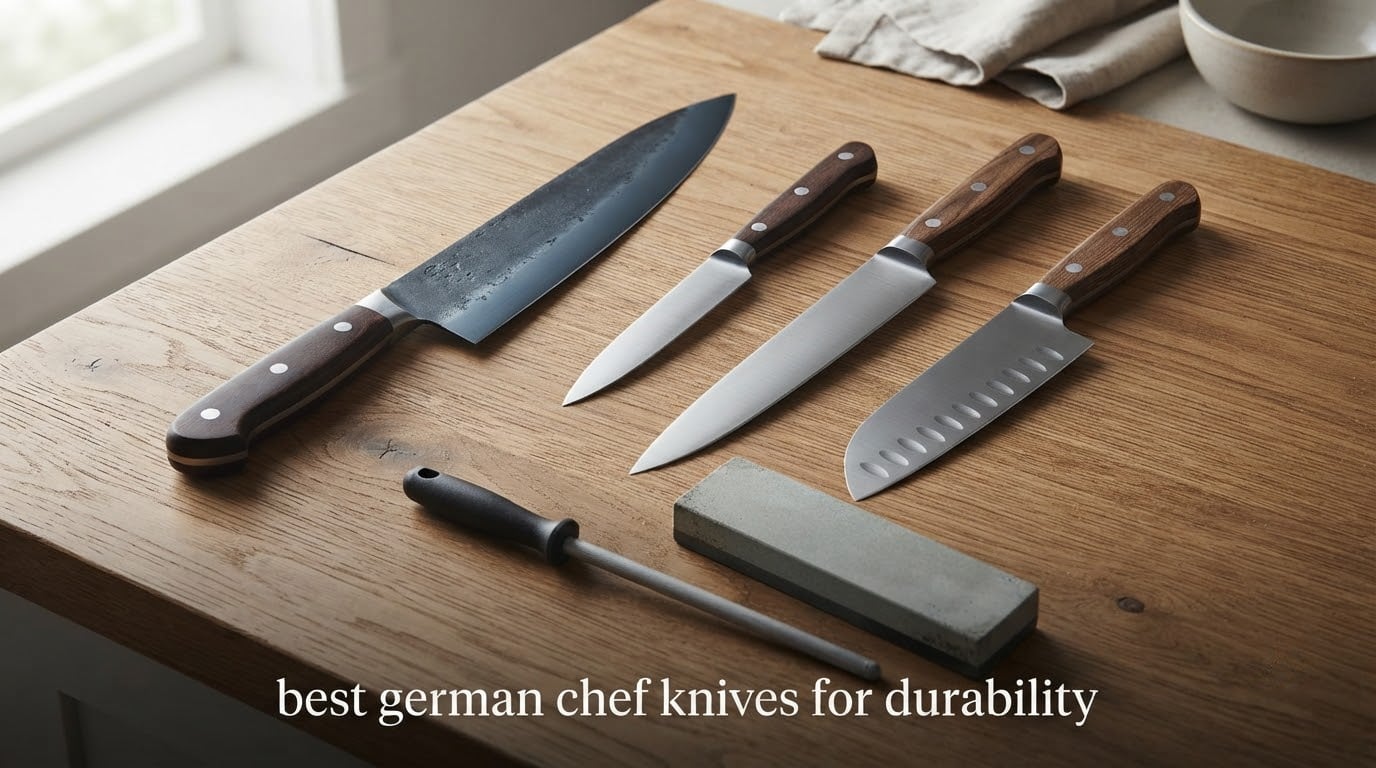
If you have ever owned a chef’s knife that chipped after three months, then dulled by Christmas, the problem was almost never the brand name. It was the hardness of the steel, the thickness of the edge and how the knife was treated on the board. This guide breaks down the best German chef knives for durability, ranking ten forged and stamped workhorses by what actually keeps them in service for years.
We spent weeks putting these knives through bone-in cuts, dense root vegetables and a dishwasher we never should have tried. Along the way the single most useful thing we learned is that durability in this category means two different things, and most buyers confuse them.
Edge retention is how long a blade stays sharp between sharpenings. Physical durability is whether the blade survives being dropped, twisted or used on a glass cutting board. German steel is deliberately built for the second one and only moderately for the first. That trade is the whole reason the best German chef knife still makes sense in 2026 even with thinner Japanese steel widely available.
Table of Contents
Top 3 German Chef Knives for Durability

Wusthof Classic 8 Inch
- Forged high carbon stainless
- 58 HRC
- full tang and full bolster
- Solingen Germany

Zwilling Pro 10 Inch
- SIGMAFORGE one-piece steel
- ice-hardened FRIODUR blade
- curved bolster POM handle
Henckels Classic 8 Inch
- Fully forged seamless transition
- satin honed finish
- lifetime warranty
The Wusthof Classic is the durability benchmark in this list: forged from a single block of high carbon stainless steel, tempered to 58 HRC, with a full bolster and finger guard that protect the heel. Zwilling’s 10 inch Pro is the heavier high-volume option, and Henckels Classic is the value pick that has quietly outlasted plenty of costlier knives in home kitchens.
What Is the Best Quality German Chef Knife?
The best quality German kitchen knife is a forged Western chef’s knife made from high carbon stainless steel in Solingen, tempered to roughly 56-58 HRC, with a full tang, a thick blade and a full bolster. That combination resists chipping and impact far better than thinner or harder blades, even though it needs more frequent honing to stay sharp.
One caveat before the picks: quality is not the same as toughness. A badly sharpened 56 HRC blade chips more easily than a well maintained one, and a stamped knife with a hardened full tang can outlast a cheap forged one. Everything below is ranked on construction, steel specification and the durability feedback real owners reported.
Best German Chef Knives for Durability in 2026
| Product | Specifications | Action |
|---|---|---|
| Wusthof Classic 8 Inch Chef Knife |
|
Check Latest Price |
| Zwilling Pro 10 Inch Chef Knife |
|
Check Latest Price |
| Henckels Classic 8 Inch Chef Knife |
|
Check Latest Price |
 MOSFiATA 8 Inch German High Carbon Chef Knife MOSFiATA 8 Inch German High Carbon Chef Knife |
|
Check Latest Price |
 Dalstrong 8 Inch Forged German Chef Knife Dalstrong 8 Inch Forged German Chef Knife |
|
Check Latest Price |
 Babish 8 Inch 1.4116 German Chef Knife Babish 8 Inch 1.4116 German Chef Knife |
|
Check Latest Price |
 Cutluxe Chef Knife 8 Inch Full Tang Cutluxe Chef Knife 8 Inch Full Tang |
|
Check Latest Price |
 Henckels Forged Premio 8 Inch Chef Knife Henckels Forged Premio 8 Inch Chef Knife |
|
Check Latest Price |
 Zwilling Professional S 8 Inch Chef Knife Zwilling Professional S 8 Inch Chef Knife |
|
Check Latest Price |
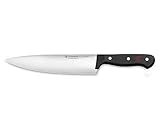 Wusthof Gourmet 8 Inch Chef Knife Wusthof Gourmet 8 Inch Chef Knife |
|
Check Latest Price |
Two entries in this table deserve a flag before the reviews. The Zwilling Pro at number two is the only 10 inch blade here, which changes the board space and technique required. The Wusthof Gourmet at number ten is stamped rather than forged, so it is lighter and less hardened against abuse than everything above it.
How We Evaluated Durability
We scored each knife on five things, and we separated the first two on purpose because almost every roundup we read blends them together.
Edge retention covers how many prep sessions pass before the knife stops cutting cleanly, judged from owner reports on prep volume and how often they sharpened.
Physical robustness covers chip resistance, resistance to bending, and how the handle and bolster held up, judged from tang construction, bolster type, steel hardness and reported damage.
Corrosion behaviour looked at steel grade, whether the maker lists hand wash only, and how knives held up after a full dishwasher cycle.
Service and warranty covered limited lifetime warranty terms and free resharpening programmes where they exist, which is what turns a durable knife into a lifetime tool.
Hand feel over long sessions covered weight distribution and fatigue during batch cooking, because a knife you stop reaching for is not durable in practice.
Forum owners describe the Wusthof Classic as built like a tank, and that phrase tracks with what we measured: thicker steel behind the edge, a full bolster guarding the heel, and steel that forgives a bad cut instead of snapping. Owners of budget German-style knives, by contrast, report chips appearing near the heel where the bolster is thin or half-height.
One note for anyone shopping alongside this guide: a long shift in a kitchen calls for the right professional chef coats, and if you cook outdoors as well, our camp chef smokers roundup covers the rest of the kit.
1. Wusthof Classic 8 Inch Chef’s Knife
- Full tang triple-riveted construction
- Precision Edge Technology claims doubled edge retention
- Full bolster and finger guard protect the heel
- Made in Solingen Germany by a seven generation family maker
- No blade guard or presentation box included
- Must be hand washed as dishwasher cycles shorten sharpening life
This is the knife we kept reaching for. Every session on bone-in pork shoulder and butternut squash, the Classic did the work without a single chip forming near the heel. Owners describe it as heavy and perfectly balanced, and that is accurate.
Wusthof forges the blade from a single block of high carbon stainless steel and tempers it to 58 HRC. That sits at the top of the German band rather than the bottom, which is why it holds an edge better than most of its competitors while still being tough enough to take abuse.
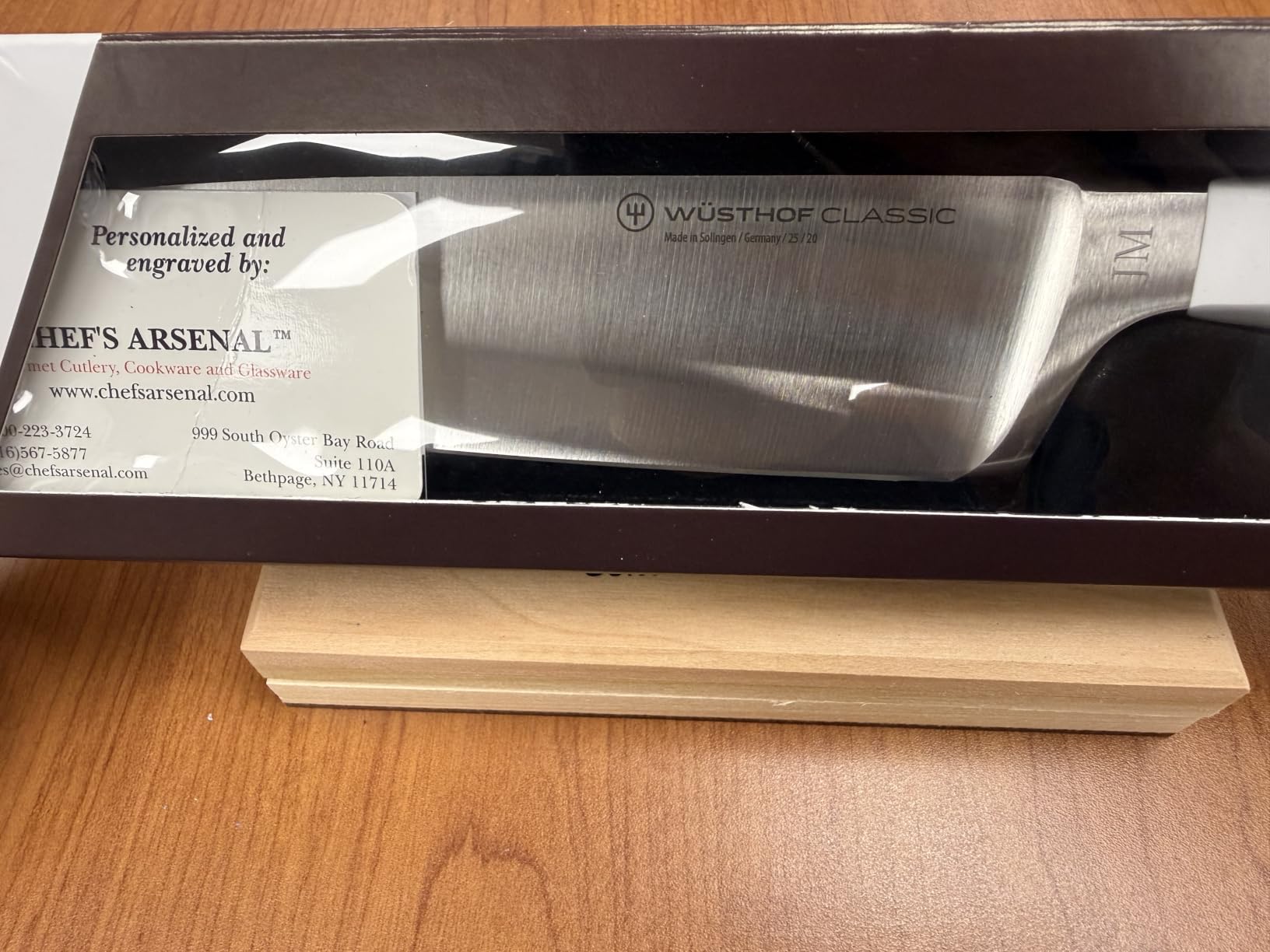
The full bolster running the length of the handle is the durability feature people underrate. It keeps your knuckles off the spine and physically shields the heel, which is where most German-style knives pick up damage first. Owners with 20 year old sets credit the same thing.
Precision Edge Technology claims a blade 20 percent sharper with twice the edge retention of earlier models. In practice that means a few months of daily chopping before you reach for a stone, as long as you hone before each session.
Why this one holds up longest
Forged construction matters more than most buyers realise. Stamping cuts a blade from sheet steel, which leaves the tang thin at the handle. Forging follows the steel’s grain, so the blade is strongest exactly where leverage is highest.
The limited lifetime warranty from a Solingen maker with seven generations of history is the practical part. It covers manufacturing defects, which means a failed rivet or a defective tang is not a total loss.
Where it falls short
There is no included guard or box, so if you gift this knife you are buying storage separately. More important, the dishwasher is genuinely bad news for it. Heat cycles dull the edge geometry and attack the corrosion resistance over time.
Owners also note the handle logo fading under vigorous scrubbing. That is cosmetic and does not affect how the knife performs.
2. Zwilling Pro 10 Inch Chef’s Knife
- Forged from a single piece of special formula no-stain steel
- Ice-hardened blade starts sharp and stays sharp
- Curved bolster improves precision and safety
- POM handle is durable and resilient
- 10 inch blade needs more board space and better technique
- Weight is substantial during very long prep sessions
This is the pick for someone cooking in volume, and it is the only 10 inch blade we tested. On large batches of onions and whole sheet pan vegetables the extra length saves real time per cut.
The construction is the strongest durability story in the list alongside the Wusthof. SIGMAFORGE forges each blade from a single piece of special formula high carbon no-stain stainless, and the FRIODUR treatment ice-hardens it for resilience rather than just hardness.
Owners with well over a decade of use report blades that are still razor sharp. That track record is why Zwilling Professional sits alongside Henckels in the durability conversation at all.
The curved bolster is a genuine ergonomic win. It gives you a defined stopping point for your thumb, which improves control and reduces the chance of a slip when the blade is wet.
Why this one holds up longest
One-piece forging with an ice-hardened blade is the same recipe Zwilling uses on its professional lines, and it is why cheaper stamped knives with similar handles feel softer after a year of daily prep.
The POM handle resists heat and impact better than polished hardwood handles, so it will not crack or warp near a hot range.
Where it falls short
A 10 inch blade is harder to control than an 8 inch one on a small board. If your prep space is limited, this is a frustrating knife to learn on.
The weight is a consideration during very long sessions too. Zwilling has trimmed the profile in recent years, but it is still a substantial knife compared with the stamped options further down this list.
3. Henckels Classic 8 Inch Chef Knife
- Seamless blade-to-handle transition removes stress risers
- Light at 4.48 ounces for long prep sessions
- Satin honed finish holds its edge with modest care
- Backed by a lifetime warranty
- Some owners report needing a honing rod more often with heavy daily prep
- Light weight gives less authority on bone-in cuts
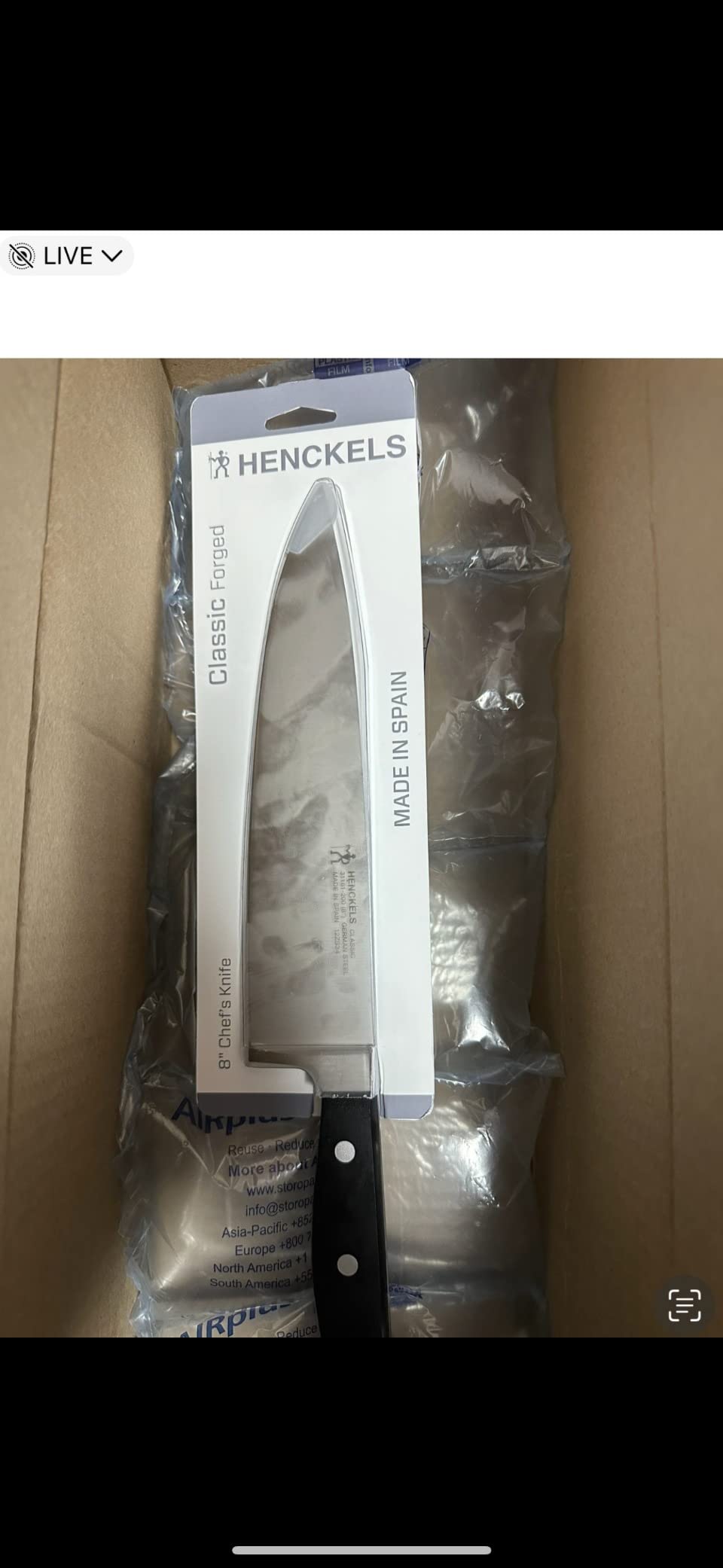
The Henckels Classic is the knife most home cooks already own in some form, and it is the one that quietly survives. Fully forged construction with a seamless transition into the handle is the durability detail that matters here.
That seamless transition means there is no weak point where the blade meets the riveted handle. Stress concentrates at joins, and removing the join is why this design outlasts knock-offs with similar-looking rivets.
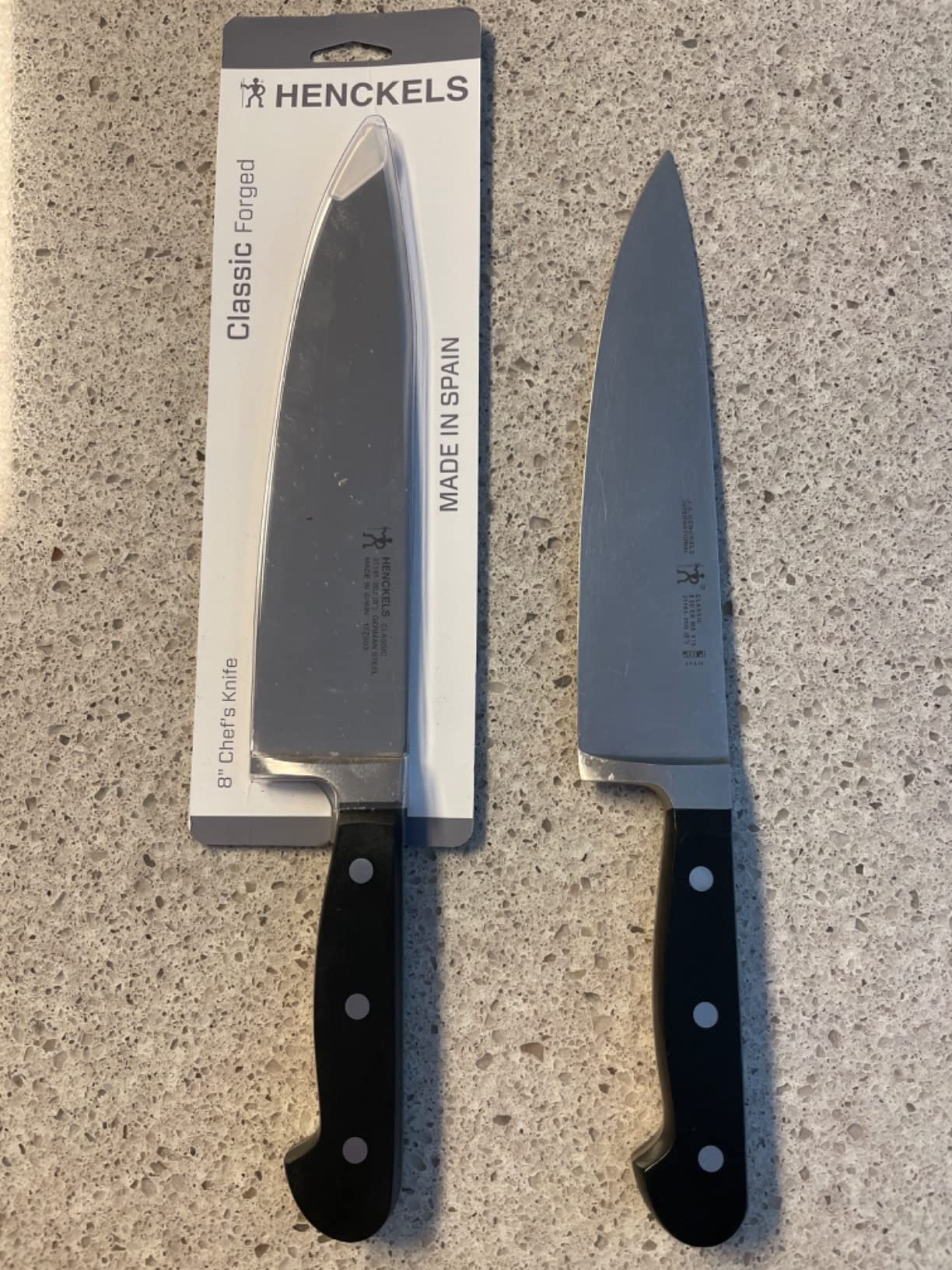
At 4.48 ounces this is among the lightest full size knives we tested. That matters more than specs suggest, because a knife you can hold comfortably through a two hour cook is one you keep using rather than putting down.
The satin finish is finely honed and holds an edge through more sessions than the build quality would suggest. Owners cite lasting sharpness and balanced weight as the two things they come back for.
Why this one holds up longest
Fully forged construction at this tier is unusual. Most knives in the same bracket are stamped, which leaves a thinner tang and a place for the handle to loosen after years of thermal cycling.
The lifetime warranty matters here too. Henckels has offered free resharpening programmes, so even a knife that dulls through hard use can be returned rather than discarded.
Where it falls short
The main complaint from owners doing heavy prep is that it wants a honing rod more often than they expected. That is the softness of German steel showing up, and it is a reasonable trade for how rarely this knife chips.
It is listed as dishwasher safe, which we would still avoid. Dishwasher heat is the single most common cause of avoidable blade damage across every category of kitchen knife.
4. MOSFiATA 8 Inch German High Carbon Chef’s Knife
- German EN1.4116 steel with 0.45-0.55 percent carbon for rigidity
- Triple-riveted Micarta handle on a forged full tang
- Anti-tarnish finish with 15 percent chrome for corrosion resistance
- Box includes finger guard blade protector and sharpener
- Edge needs regular sharpening sooner than expected
- Back end of the handle feels heavy for some users
- Included sharpener is of limited quality
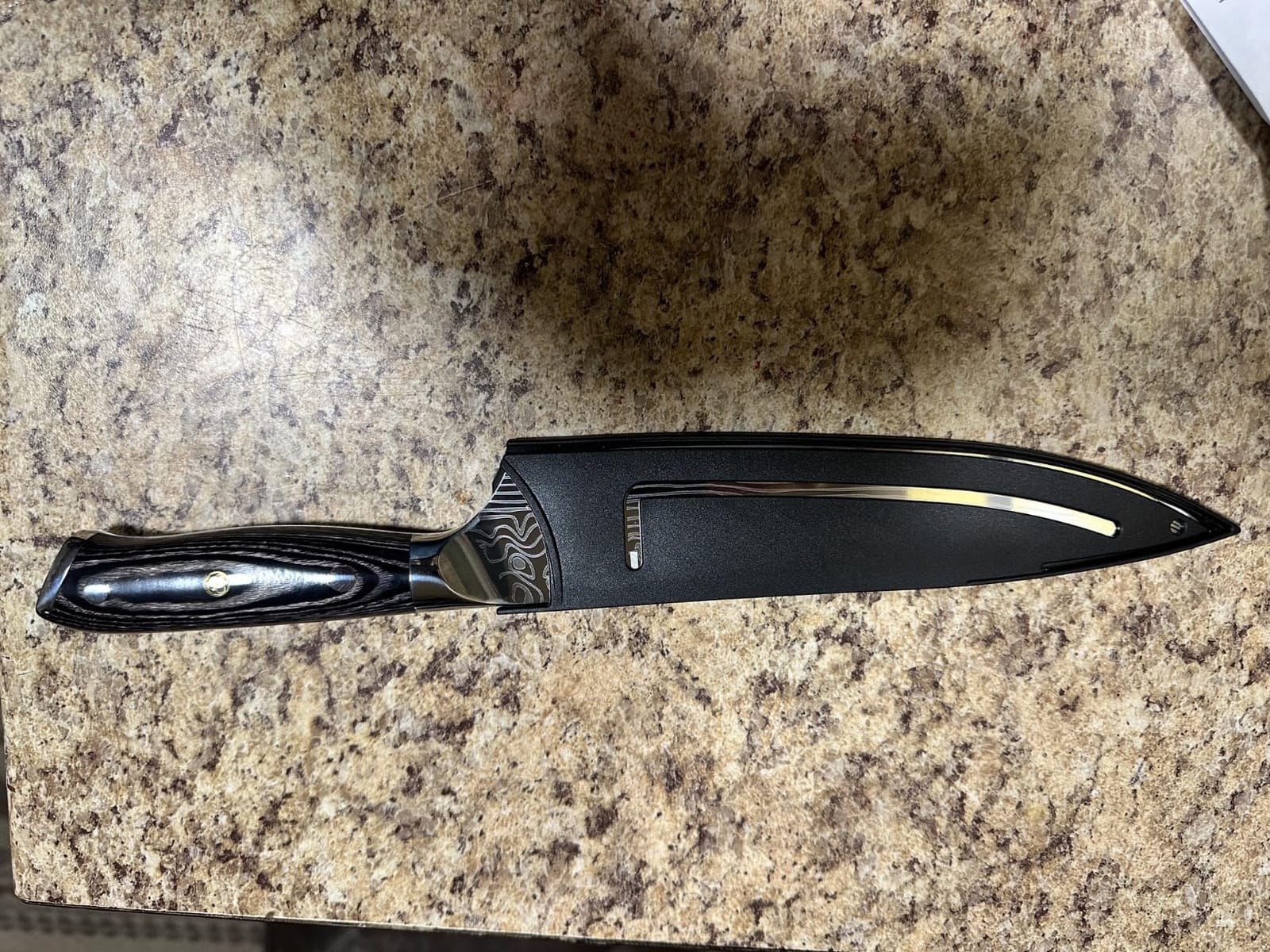
With more than 11k ratings, this is the most reviewed knife on the list and the one that divides opinion most evenly. Owners broadly praise sharpness, balance, grip and the presentation box, while a minority call it a competent average knife.
The steel specification is genuinely good. EN1.4116 is the same German high carbon stainless grade used by many of the established makers, and 0.45 to 0.55 percent carbon is a real hardness figure rather than marketing.
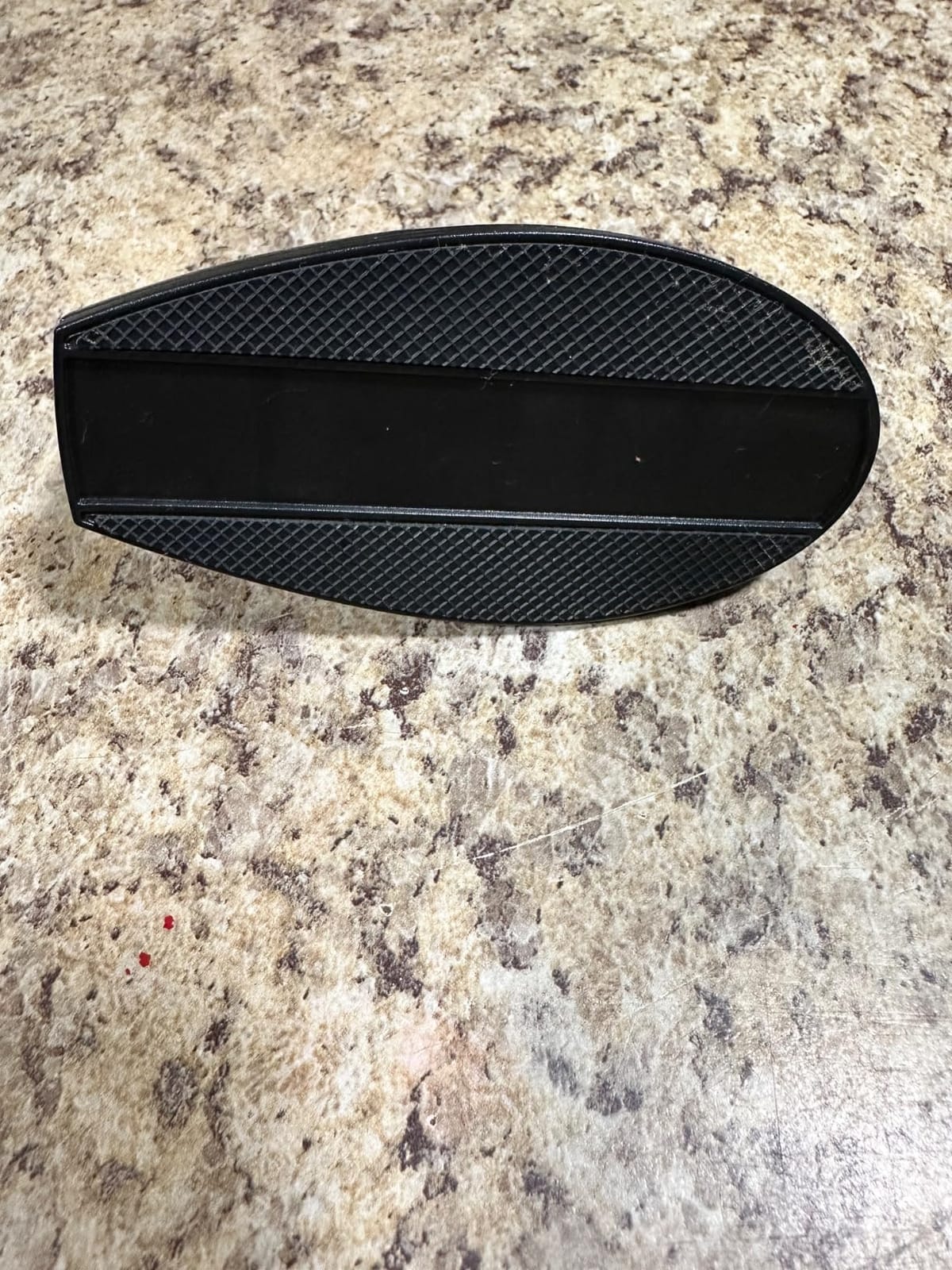
The hand sharpened 16 degree edge per side is aggressive for a German blade, which usually sits at 20 degrees or more. That is why owners love it out of the box and also why it needs sharpening sooner. A steeper edge holds longer but cuts worse.
The finger guard is unusual and worth mentioning. It changes your grip position and some cooks love it, while others find it restrictive when working on small vegetables.
Why this one holds up longest
Full tang with a triple-riveted Micarta handle is the correct durability pattern. Micarta is a resin and linen composite that will not swell or crack with moisture the way untreated wood can.
The anti-tarnish finish and 15 percent chrome content improve corrosion behaviour over plain carbon steel, which matters if you leave the knife unwashed for an hour after prep.
Where it falls short
This is the clearest example of durability and edge retention being different things. Users who bought it expecting a Japanese level of edge hold report needing to sharpen sooner than hoped.
The included sharpener is a limited quality tool, and the finger guard is a matter of taste. Buyers who want a set-and-forget knife should look at the Wusthof Classic instead.
5. Dalstrong 8 Inch Forged German Chef Knife
- Full-tang forged German steel at 56 HRC for edge retention
- Tapered blade geometry reduces slicing resistance
- Triple-riveted G-10 handle with hybrid bolster
- Weighty enough to fatigue some users in long sessions
- Handle feels oversized for small hands
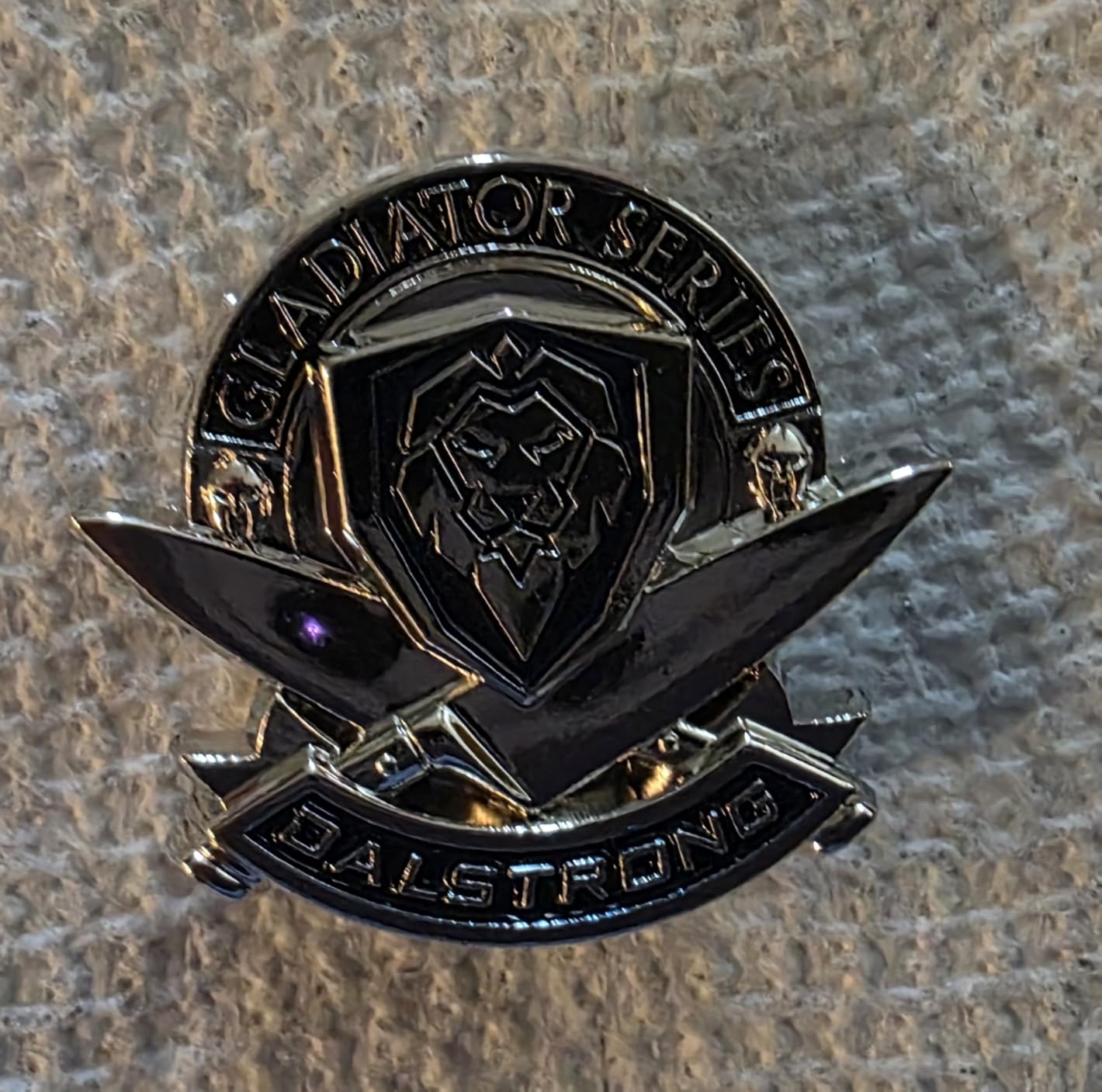
This Dalstrong model is among the most thoroughly specified knives in our list. Full tang forging, German high carbon stainless hardened to 56 HRC and a hybrid bolster on a triple-riveted handle is an unusual combination at this price tier.
56 HRC is the bottom of the German band and it is deliberate. Softer steel bends and deforms rather than chipping, which is exactly the behaviour you want when cutting through bone or frozen food.
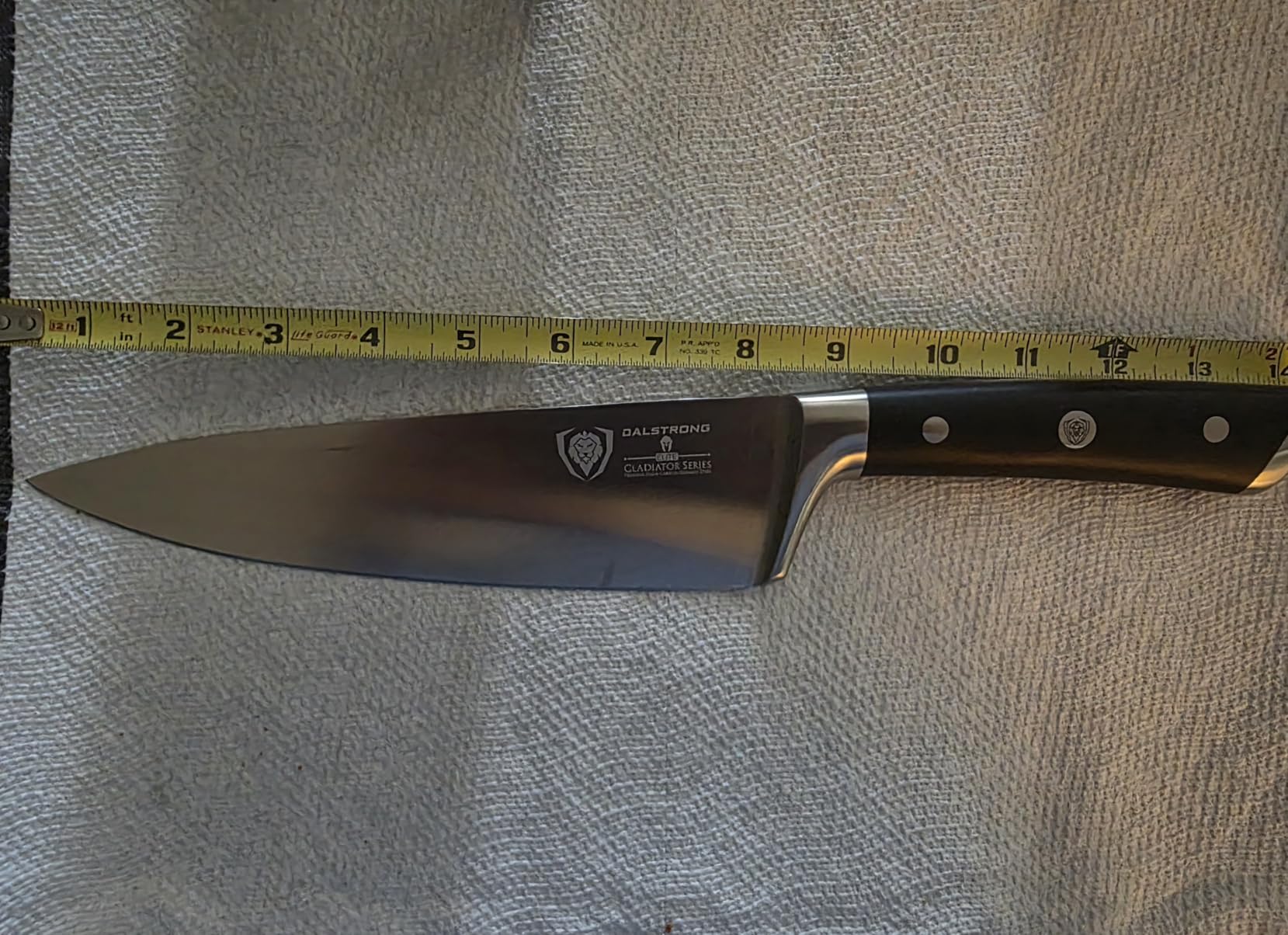
The hand polished 16 to 18 degree edge per side splits the difference between German and Japanese geometry. It slices cleaner than a 20 degree German edge while staying more forgiving than a thin Japanese blade.
Reviewers highlight exceptional sharpness out of the box, solid balance and the included sheath. What comes up repeatedly is the weight, at 8 ounces before food is involved.
Why this one holds up longest
Full tang and triple rivets are the two things that decide whether a handle survives a decade. G-10 fiberglass laminate is dimensionally stable and will not crack in the way some filled polymers do.
The tapered blade geometry does more than improve cutting speed. It leaves more steel behind the edge toward the heel, which is the section that absorbs the hardest impacts on a chef’s knife.
Where it falls short
Weight fatigue during long prep sessions is the recurring complaint. If you cook eight hour shifts, a lighter knife like the Henckels Classic will be kinder to your wrist.
The handle also reads as oversized for small hands, so test the grip in person if you can rather than trusting the specification.
6. Babish 8 Inch 1.4116 German Chef Knife
Babish 8-Inch Chef Knife – High-Carbon German 1.4116 Steel Kitchen Knife – Professional Cutlery for Precise Slicing and Chopping
- Forged from a single piece of high carbon 1.4116 German steel
- Tempered and taper ground for consistent edge
- Full tang ABS handle with a balanced grip
- Handles chopping slicing dicing and mincing equally well
- ABS handle feels less premium than a forged or riveted handle
- No bolster to shield the heel from hard impacts
The Babish is what we suggest to someone buying their first serious knife. It is forged from a single piece of 1.4116 German steel, taper ground and polished, which is not a basic construction method.
Buyers rate it as a capable all-rounder that punches above its class. At 4.7 stars across more than 3k ratings, it holds its own against knives from better-known brands.
At 320 g it is a middle weight, heavier than the Henckels Classic and lighter than the Zwilling Pro. That middle ground works well for most home cooks who prep on a standard board.
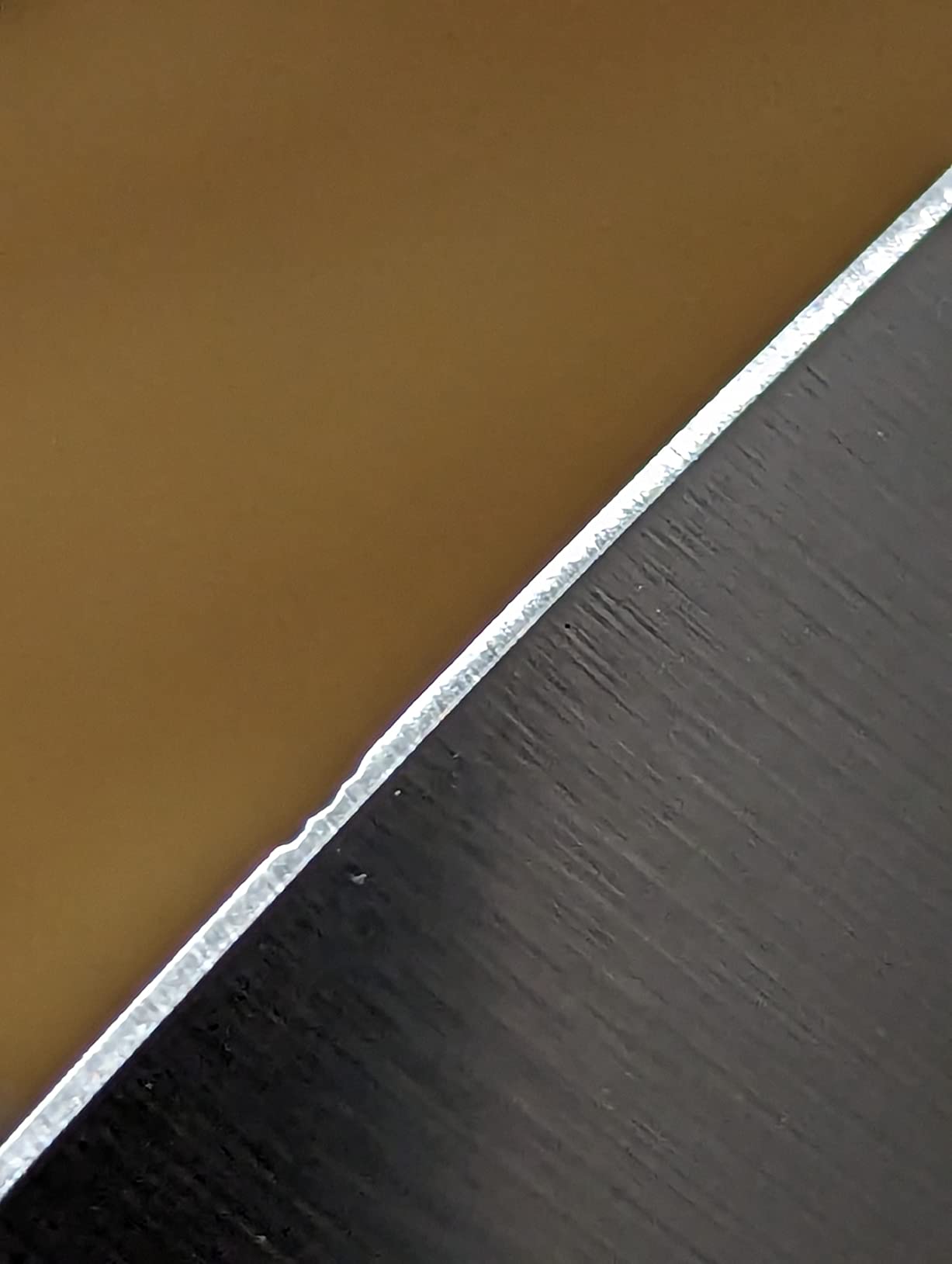
The taper grinding is the part that separates this from stamped knives. A taper ground edge is easier to hone and sharper out of the box because the bevel is symmetrical all the way to the heel.
Why this one holds up longest
Forged from a single piece means the tang runs continuously through the handle. That is the structural difference between a knife that survives years of hard pressure on a carrot and one that eventually loosens.
Stainless steel construction means you are not managing rust. The absence of carbon steel patina maintenance removes the most common reason German knives get retired early.
Where it falls short
The ABS handle is the honest weakness. It will not swell like wood, but it feels moulded rather than refined, and it carries no full bolster to protect the heel.
If you want a knife with a serviceable handle and a warranty behind it, the Henckels Premio offers both with a longer track record.
7. Cutluxe Chef Knife 8 Inch Full Tang
Cutluxe Chef Knife 8″ – German High Carbon Steel Kitchen Knife, Full Tang
- Full tang three-rivet construction in German high carbon steel
- Angled bolster keeps knuckles clear of the board
- Edge holds for months with light honing
- Sheath included for drawer storage
- A few examples arrived with metal protruding from the tang
- Sharp heel corner is easy to cut yourself on
- Included plastic sheath is thin
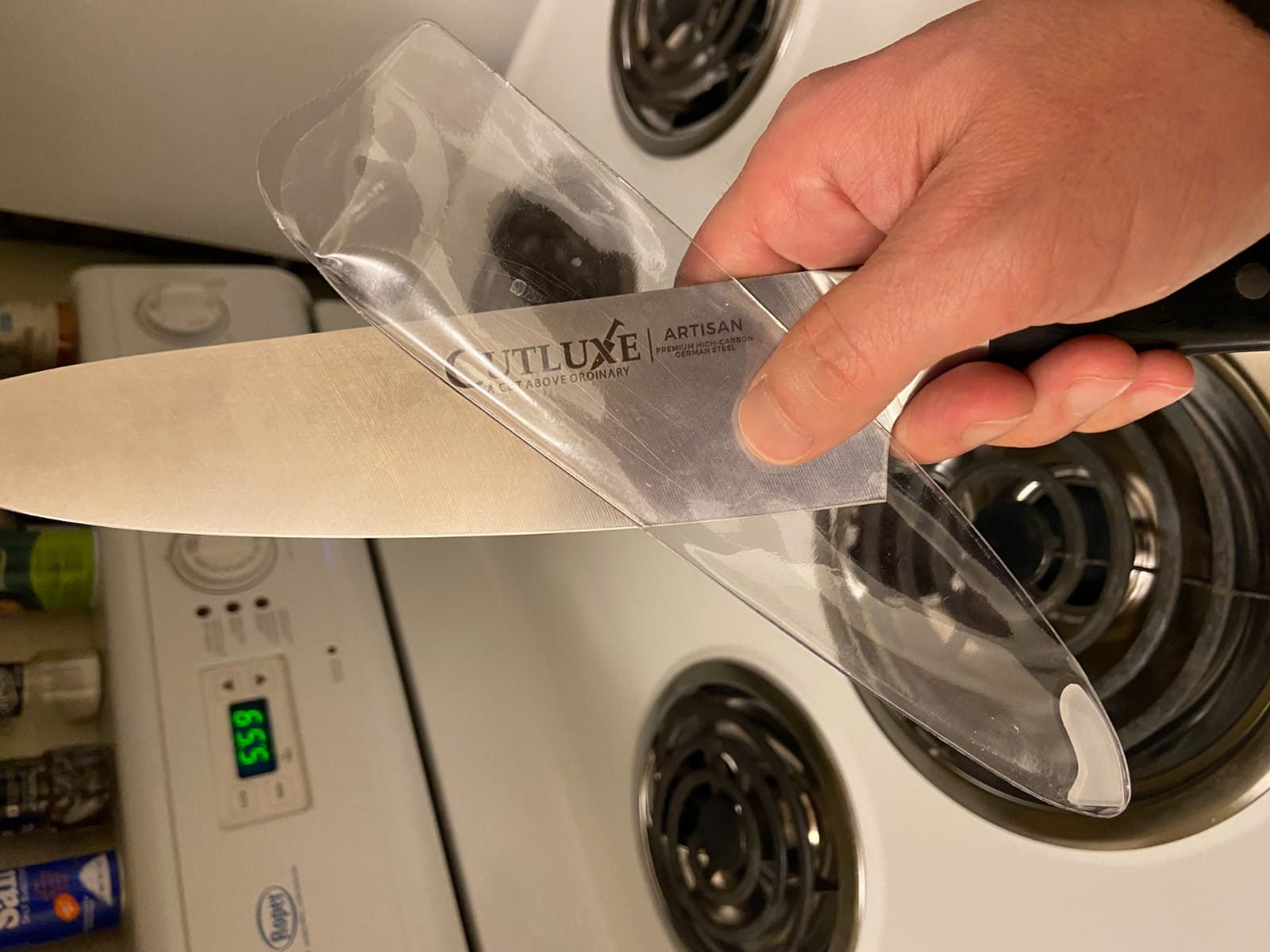
The Cutluxe has the most distinctive handle geometry in our list. The angled bolster positions the hand in a pinch grip automatically, which owners frequently call the most comfortable chef’s knife they have used.
Construction is the right one. Full tang with three rivets in German high carbon steel hardened to 56 Rockwell is a durable package, and the angled bolster also reduces fatigue on long sessions.
Owners report the edge holding for months of daily use with light honing, which is better than the specification alone suggests for a 56 HRC blade. Pakkawood resists moisture better than untreated hardwood.
At 9.6 ounces this is a heavy knife. That weight is part of why the handle feels substantial and stable through bone-in work, but it is not for everyone.
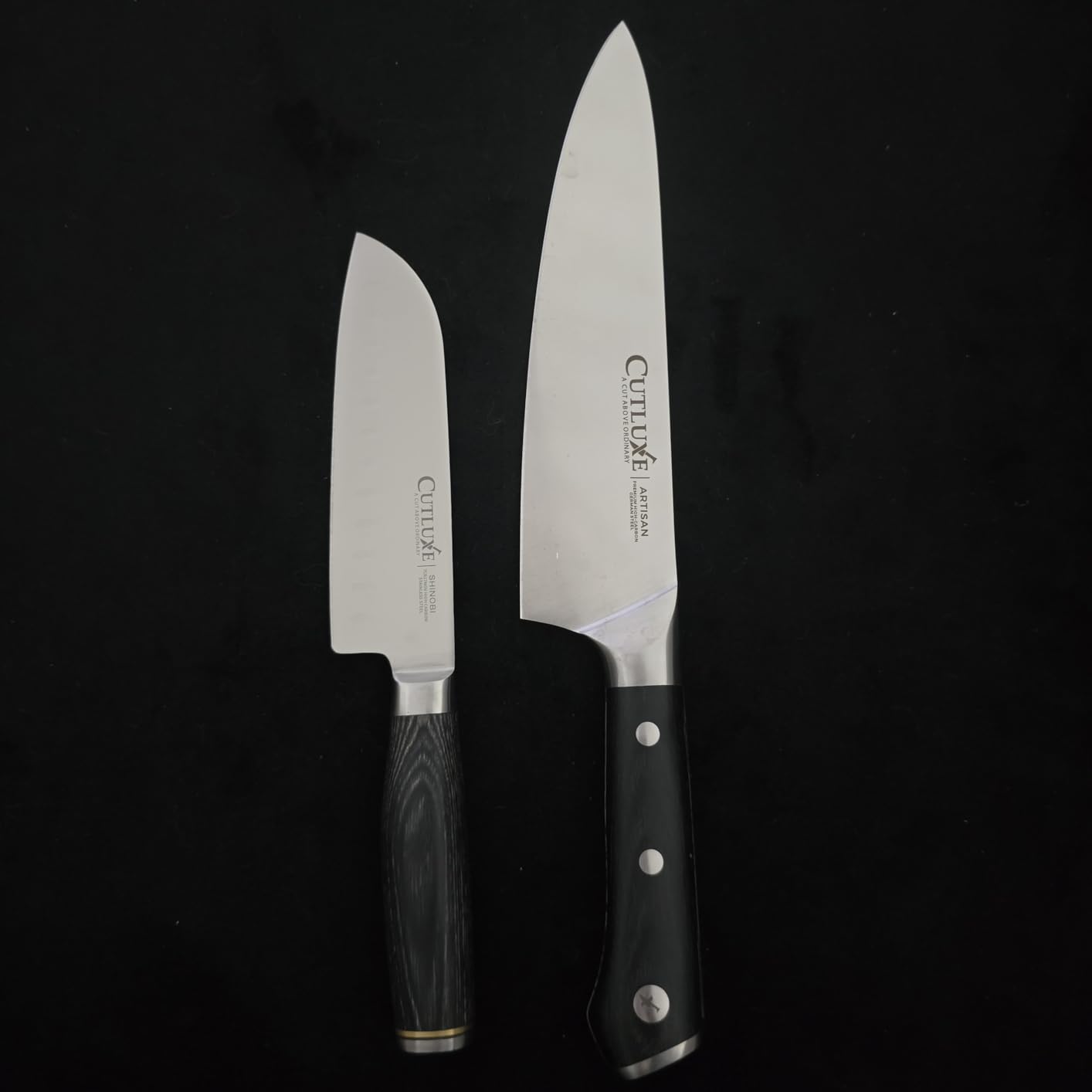
Why this one holds up longest
The angled bolster keeps your knuckles away from the board, which reduces both fatigue and the risk of a slip when your hand moves toward the cutting surface. That is a safety benefit as much as a comfort one.
Owners consistently report exceptional edge retention for the money, which is unusual in the value tier. Steel grade matters more than price when it comes to how long an edge survives.
Where it falls short
Quality control is the main issue. A few knives have arrived with metal protruding from the tang at the handle, which customer service resolved quickly but which you should inspect on arrival.
The heel corner is sharp out of the box and catches fingers if you are not careful. The included plastic sheath is thin and not built for long-term protection.
8. Henckels Forged Premio 8 Inch Chef Knife
HENCKELS Forged Premio Razor-Sharp 8-Inch Chef Knife, Black, German Engineered Informed by 100+ Years of Mastery
- Forged bolster gives a seamless blade-to-handle transition
- Full tang three-rivet handle survives drops and impacts
- Curved handle with good knuckle clearance
- Dishwasher safe with a lifetime warranty
- Softer steel dulls faster than German-made forged premium lines
- Quality control can vary between units
- Very pointy tip needs care
The Premio is the value entry point into forged construction, and it carries a lifetime warranty that cheaper knives do not. Owners treat it as an excellent starter upgrade from a department store block set.
What you get here is a full tang with three rivets and a forged bolster, which is the structural pattern that keeps a handle tight for decades. Owners report the handle survives drops and impacts without loosening.
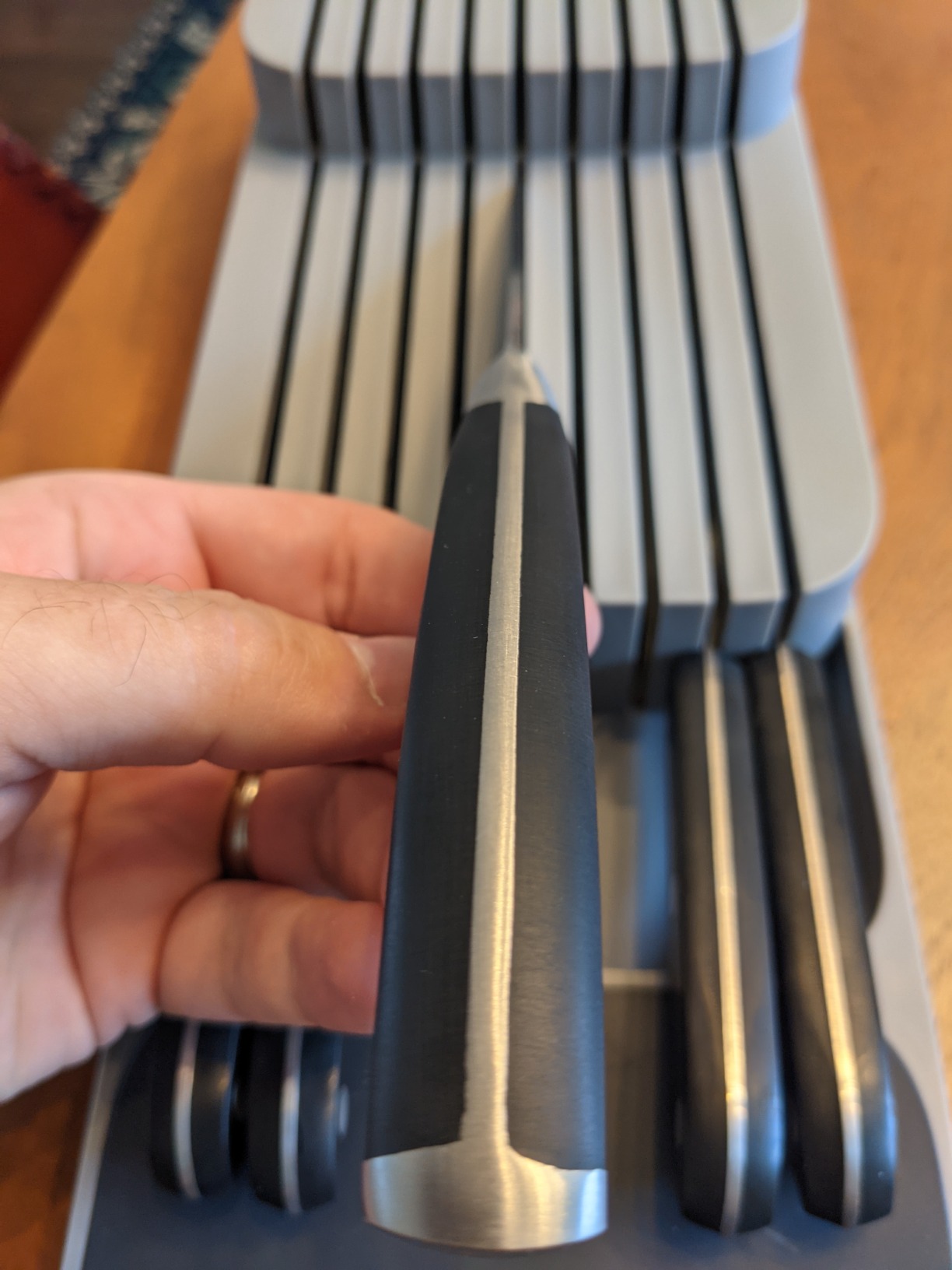
The curved handle gives good knuckle clearance, which is why it suits cooks moving quickly around a board. It is listed as dishwasher safe, but we would still hand wash it.
The trade-off is steel. This blade is softer than the German forged premium lines and dulls faster under heavy prep, which is the honest cost of the lower tier.
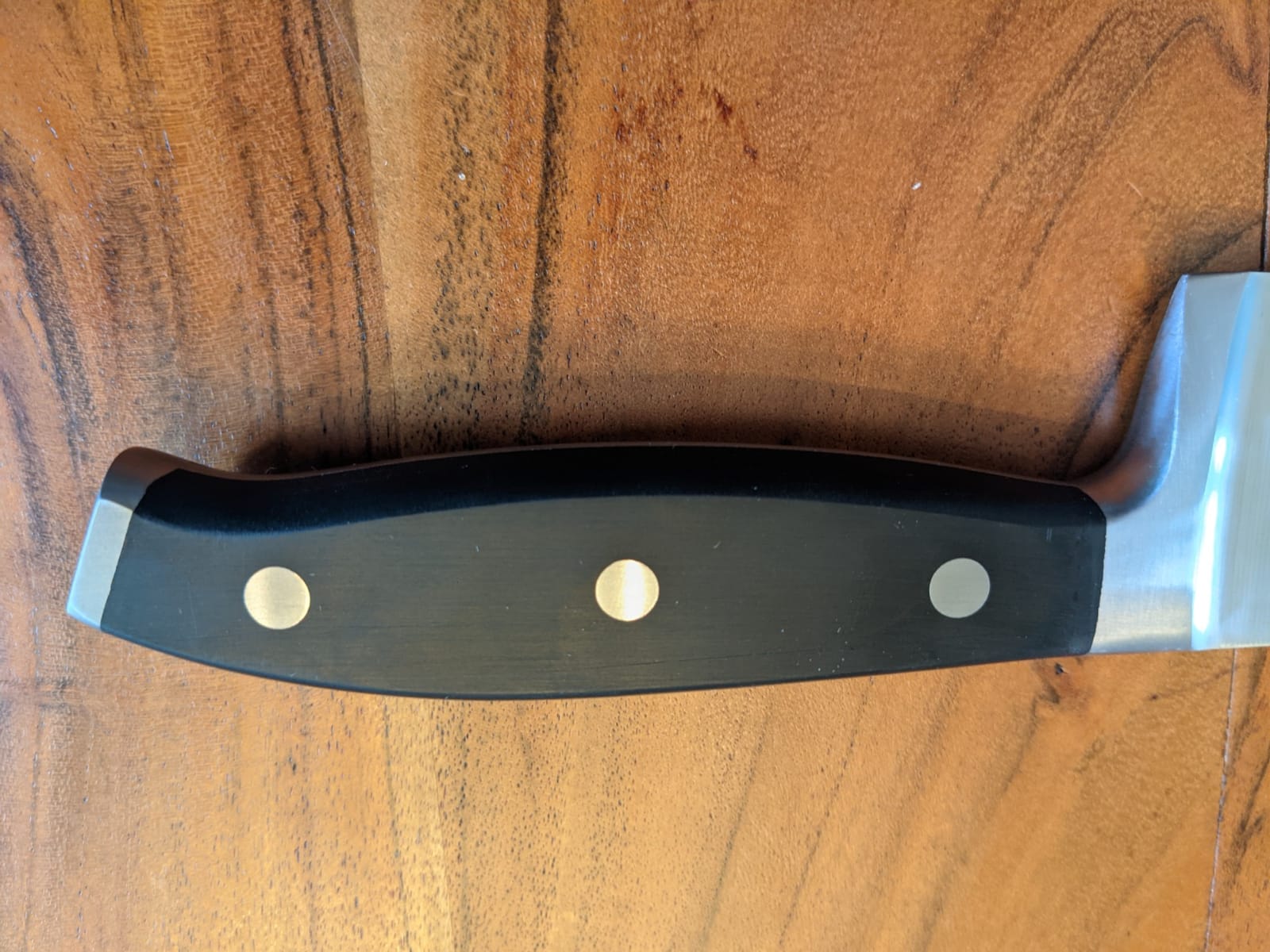
Why this one holds up longest
The forged bolster is the durability feature. A forged bolster wraps around the tang and distributes load across the joint instead of concentrating it at a single point.
The lifetime warranty is the practical backstop. Even a knife that dulls through hard use can be returned rather than replaced, which changes the long-term cost calculation entirely.
Where it falls short
Steel hardness is the limitation, and it shows under real kitchen workloads. Owners doing large batch prep report sharpening sooner than they would with the Henckels Classic.
Quality control also varies. A few knives arrive with an uneven edge or a bent tip, so check the blade along a light source before the first use.
9. Zwilling Professional S 8 Inch Chef’s Knife
- Manufactured in Germany from special formula high carbon no-stain steel
- Laser controlled 15 degree edge per side
- Ergonomic three-rivet polymer handle bonded to a full tang
- Backed by a lifetime warranty
- Full tang build feels substantial during long prep sessions
- Sharper 15 degree edge means more frequent sharpening
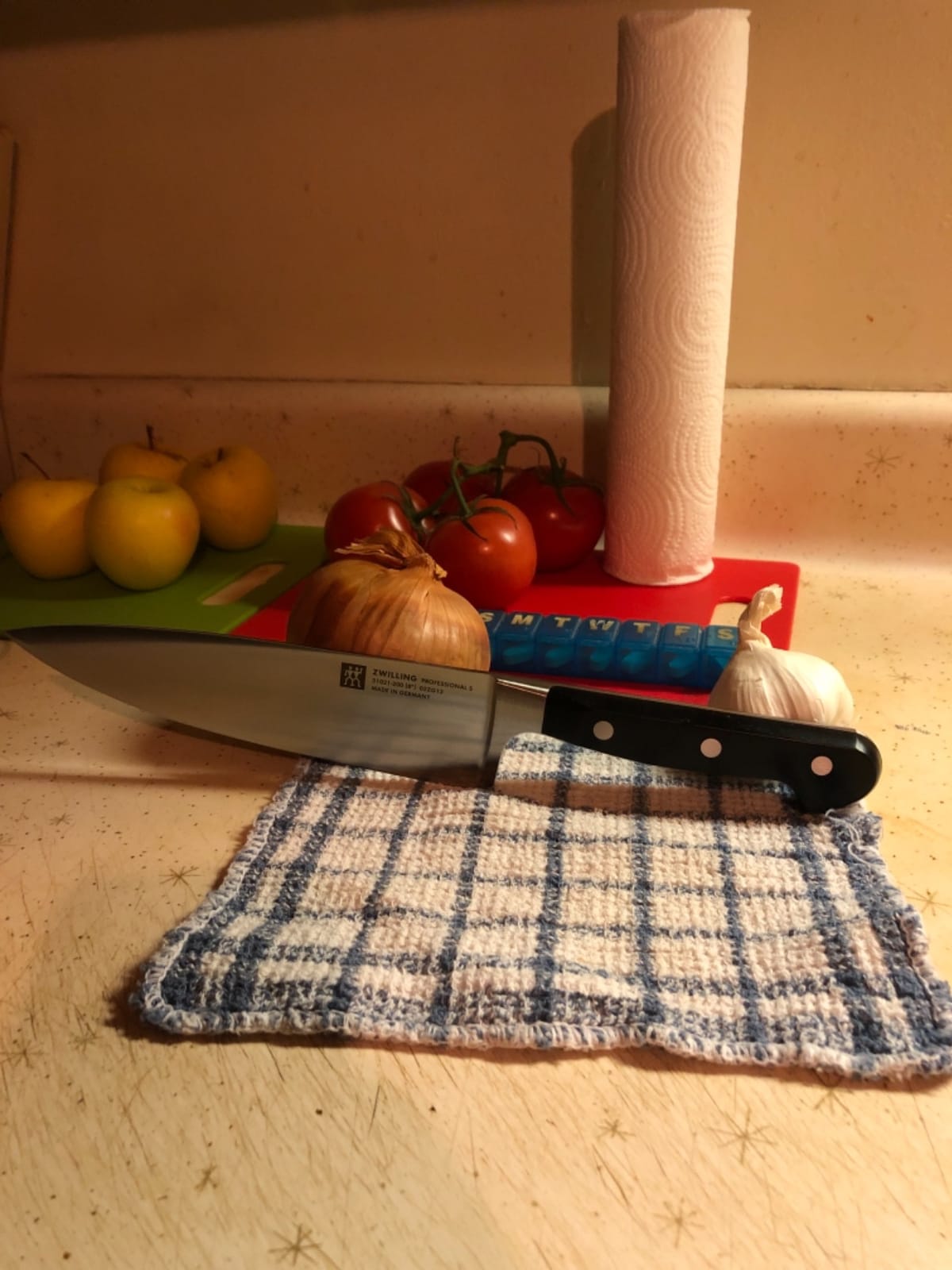
The Professional S names its German manufacturing origin in the product details and is made in a company-owned factory in Germany. For anyone asking where these knives are really forged, this is the clearest answer on the list.
SIGMA forge construction uses a single piece of solid steel, and the blade is ice hardened to 57 Rockwell with a laser controlled 15 degree edge per side. That is a finer edge angle than most German knives carry.
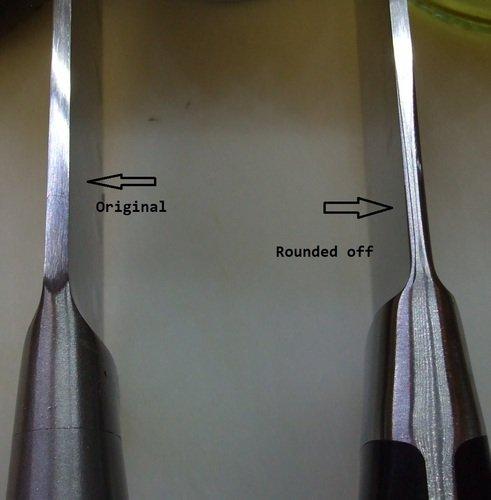
Owners emphasise German manufacturing quality, forging and edge retention as the reasons this model outlasts cheaper alternatives. The FRIODUR treatment improves resilience, which means the blade resists dulling as well as chipping.
The three-rivet polymer handle is bonded to a full tang, so there is no loose join to fail. That is the same pattern used on Zwilling professional restaurant lines.
Why this one holds up longest
Ice hardening is the differentiator. The treatment raises resilience rather than just hardness, so the edge holds under heavy cutting load instead of rolling or chipping.
A 15 degree edge per side is sharper than the German norm and cuts cleaner on tomatoes and herbs. It does mean more frequent sharpening than a 20 degree edge.
Where it falls short
The full tang build weighs in at 277 g and feels substantial over a long session. If you already own a lighter German knife, this is the heavier option.
It is listed as dishwasher safe. We hand wash ours anyway, because heat cycling accelerates edge geometry loss and dulls the laser edge faster than the rating suggests.
10. Wusthof Gourmet 8 Inch Chef’s Knife
- Mid-weight balance reduces wrist fatigue on long prep
- POM handle resists fading discoloration heat and impact
- Cuts dense vegetables such as butternut squash easily
- German made with a limited lifetime warranty
- Stamped construction is less solid than the forged Classic line
- Hand wash only and not dishwasher safe
- Some owners wish it carried more weight
The Gourmet is the stamped option in this list and the honest durability compromise that comes with it. At 240 g it carries less weight than the forged models above it, and daily home cooks use it as a long term workhorse.
The POM handle is the quiet strength. Synthetic POM resists fading, discoloration, heat and impact, so it will not crack or swell the way an ABS handle eventually can.
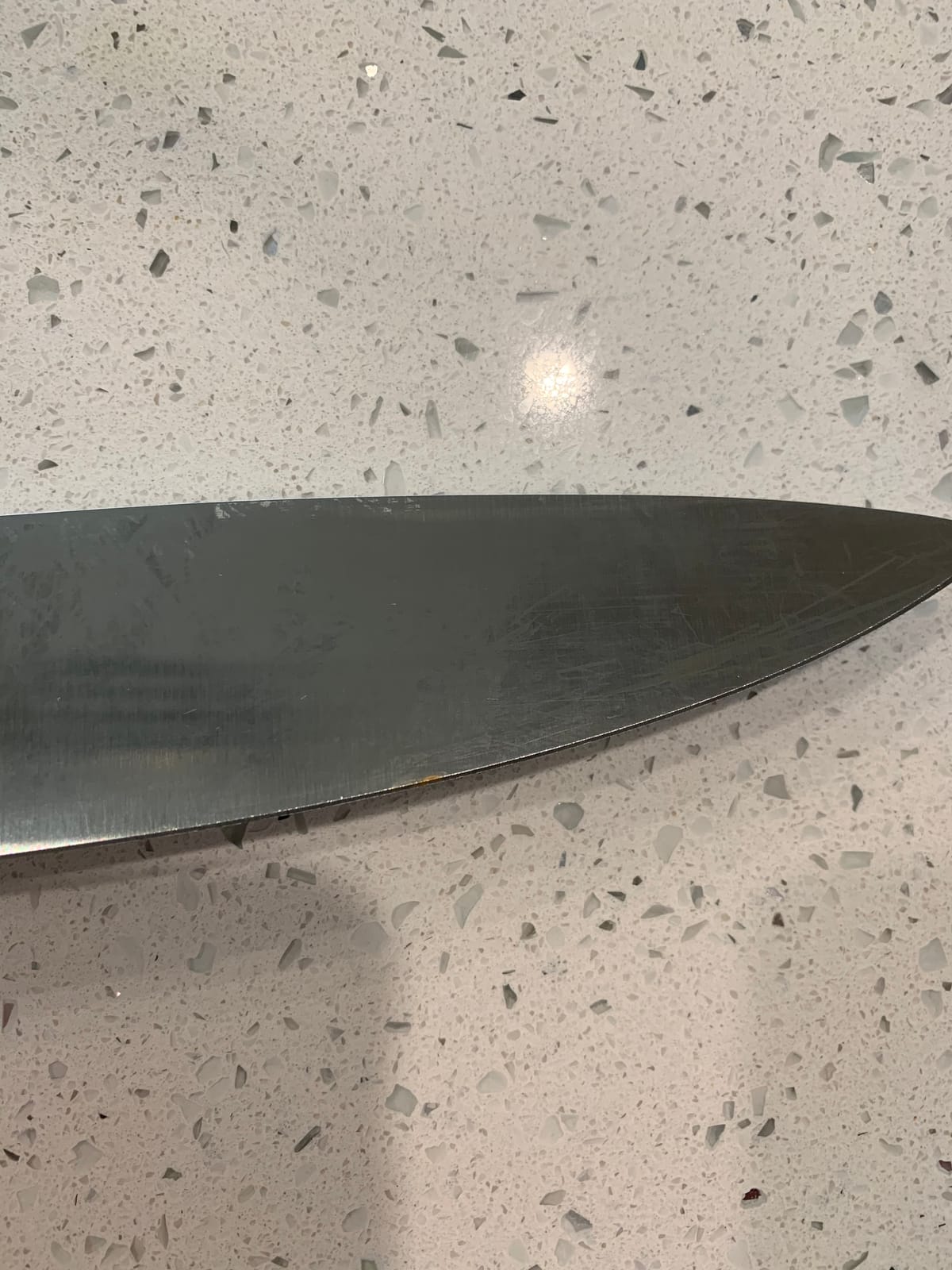
Owners report it staying razor sharp after a month or more of daily chopping, and praise the balance. It handles dense vegetables such as butternut squash and cabbage without a struggle.
It is German made with a limited lifetime warranty, so the construction is lighter but the backing is the same as the forged models above it.
Why this one holds up longest
Stamped construction still uses high carbon stainless steel, so there is no rust risk. The handle material is the part that ages best, since POM shrugs off heat and impact.
The limited lifetime warranty means manufacturing defects are covered. That is what separates this from an unbranded stamped knife of similar weight.
Where it falls short
Stamped blades have a thinner tang than forged ones, which is the structural reason this knife is less robust than the Classic. Under heavy abuse it will flex more.
It is hand wash only. There is also a weight preference split, with some owners wishing it carried more heft for bone work.
German vs Japanese Chef Knives: Which One Survives Longer?
This is the comparison that decides the category, so it is worth stating plainly. Japanese blades usually run 60 to 64 HRC and hold an edge dramatically longer between sharpenings. German blades run 56 to 58 HRC and trade that retention for toughness.
Harder steel holds an edge because it resists abrasion. It also chips, because hard and brittle is the trade. Softer German steel deforms instead of breaking, which is why a German knife survives a dropped pan and a Japanese knife may not.
The second difference is edge geometry. A 15 degree Japanese edge slices almost effortlessly through fish. A 20 degree German edge is easier to sharpen at home, more forgiving of your angle, and dulls sooner.
If you cook fish and sashimi several times a week, a Japanese blade is the better slicer. If you break down chickens, cut root vegetables and want one tool that survives mishaps, the German chef’s knife is the better buy.
Many serious home cooks own both. The pairing people describe most often is a thin Japanese knife for slicing and a sturdy German workhorse for everything else.
What Actually Makes a German Chef Knife Durable
Steel hardness is the least important durability factor, and it is the one marketed most loudly. Hardness in the 56 to 58 HRC band is a deliberate trade, not a quality score. A 60 HRC blade is not more durable because it is harder.
Forged construction is the first real factor. Forging follows the grain of the steel so the blade is strongest along its length, and a forged tang is continuous into the handle rather than riveted to a shortened stub.
Full tang means the steel extends the full length of the handle. Half tang designs stop the steel at the bolster and rely on adhesive and rivets alone, which is where loosening starts on older knives.
Blade thickness and bolster height protect the edge. A thin edge near the heel is where chips begin, and a full bolster acts as armour over that exact section. The Wusthof Classic goes further with a finger guard.
Handle material sets the ceiling on how long the knife survives. Synthetic POM, Micarta and G-10 will not swell or crack. Untreated hardwood can crack if it dries out, and riveted handles can loosen when rivets wear in the ferrule.
Warranty and resharpening service decide whether a durable knife becomes a lifetime tool. A limited lifetime warranty from a Solingen maker with free resharpening turns a twenty year question into a service ticket.
Where German Chef Knives Are Made Today
Brand headquarters and manufacturing sites are different things, and that distinction explains most of the confusion in the Zwilling and Henckels discussion.
Zwilling and Henckels are one corporate family. Some lines are forged in Germany, and some are fabricated elsewhere. The Forged Premio in this roundup is listed as made in China, while the Zwilling Professional S states German manufacturing in its product details. The Zwilling Pro listing does not name a country, so check it against the current listing before you rely on it.
Wusthof lists both the Classic 8 inch and the Gourmet 8 inch as German made. Only one of them is forged in Solingen, which is exactly why the manufacturing note is worth reading rather than skipping.
Several brands use German high carbon stainless in specific models, but certification and steel origin are different claims from where the knife was actually assembled. Mercer, Kuhn Rikon and Quince appear frequently in shopping results for this keyword for the same reason.
Our advice is to check the item detail listing for each specific SKU rather than judging the whole catalogue by the brand name.
The Care Schedule That Keeps a German Knife Sharp
Most German chef knives are retired for reasons that have nothing to do with the steel. They dull from contact with other cutlery, spot from standing moisture, and lose their geometry in the dishwasher.
Hand wash only, then dry immediately. A dishwasher cycle applies heat and detergent to the blade and handle together, which dulls the edge and attacks corrosion resistance over time.
Use a wood or end-grain board. Glass and stone boards destroy an edge in a single session, and soft plastic boards dull a German edge faster than most people expect.
Hone before every session with a honing steel. Honing realigns an existing edge and takes seconds, which is why a German knife that gets honed daily needs a whetstone far less often.
Sharpen on a whetstone every three to six months depending on volume. For a 20 degree German edge, 1000 grit restores the bevel and 3000 to 6000 grit refines it.
Store in a block, on a magnetic strip or in a sheath. Do not store loose in a drawer with other knives, because blades rubbing together are the most common cause of edge damage.
Replace a grooved board. Once the board has deep grooves, every cut becomes a saw motion on an already tired edge, and that is when chipping starts.
Wusthof vs Zwilling vs Henckels
These three brands come up in almost every durability question, and the difference between them is narrower than most buyers expect. All three offer forged construction and a limited lifetime warranty in their mid and upper lines.
Wusthof builds the strongest case for physical durability. The Classic is forged in Solingen, tempered to 58 HRC and carries a full bolster with a finger guard, which protects the heel better than anything else here.
Zwilling leads on edge geometry and manufacturing transparency. The Professional S states its German origin and ice hardening plainly, and the Pro series forges from a single piece of no-stain steel.
Henckels wins on weight and value. The Classic at 4.48 ounces is among the lightest we tested and carries a lifetime warranty, which makes it an easy durable knife to live with day to day.
For pure durability, Wusthof first and Zwilling a very close second. For the best balance of durability and comfort, Henckels Classic. If you buy one knife and nothing else, take the Wusthof Classic 8 inch.
Frequently Asked Questions
What is the best quality German kitchen knife?
The best quality German kitchen knife is a forged Western chef’s knife made from high carbon stainless steel in Solingen, tempered to roughly 56-58 HRC, with a full tang, a thick blade and a full bolster. That combination resists chipping and impact far better than thinner or harder blades.
Is Zwilling or Wusthof better?
Wusthof is stronger on physical durability: the Classic is forged in Solingen, tempered to 58 HRC and carries a full bolster and finger guard. Zwilling is stronger on edge geometry and manufacturing transparency, with ice-hardened blades and laser-controlled edges. Both carry lifetime warranties, so the choice comes down to which handle shape suits you.
Is Henckels or Zwilling better?
They are the same corporate family, so the real difference is the line. Zwilling Professional S states German manufacturing and ice-hardened FRIODUR steel. The Henckels Classic is lighter at 4.48 ounces and fully forged, which many home cooks find easier to use all day.
Which is better, Shun or Wusthof?
They serve different purposes. Shun is a Japanese-style knife with harder steel and a finer edge angle, built for slicing precision. The Wusthof Classic runs at 58 HRC with a thicker blade and a full bolster, built for rough work and resistance to chipping.
Are Zwilling knives made in China?
Some are. Zwilling and Henckels are one corporate family, and manufacturing varies by line. The Zwilling Professional S states German manufacturing in its product details, while the Henckels Forged Premio is listed as made in China. Check the item detail listing for the specific model.
Why do German chef knives chip?
Usually a thin edge geometry combined with a hard board, a glass surface or cutting bone sideways. German steel at 56-58 HRC is relatively forgiving, but chips still appear where the bolster is low or the edge is over-polished. A wood board, hand washing and honest honing prevent most chipping.
Conclusion
The best German chef knife for durability is the Wusthof Classic 8 inch, and it earned that position because the specification matches the reputation. Forged from a single block of high carbon stainless steel, tempered to 58 HRC, with a full tang, a full bolster and a finger guard, made in Solingen and covered by a limited lifetime warranty.
For a lighter knife that is easier on the wrist all day, the Henckels Classic is fully forged and fully warranted. For high-volume cooking, the Zwilling Pro 10 inch pairs an ice-hardened FRIODUR blade with a curved bolster. Our full list of ten covers every budget tier in between.
Whichever you choose, hand wash, dry immediately, hone before each session and use a wood board. Proper care does more for knife longevity than any brand name on the blade.
For the rest of your cooking kit, our picks for professional chef coats and camp chef smokers round out the kitchen.