
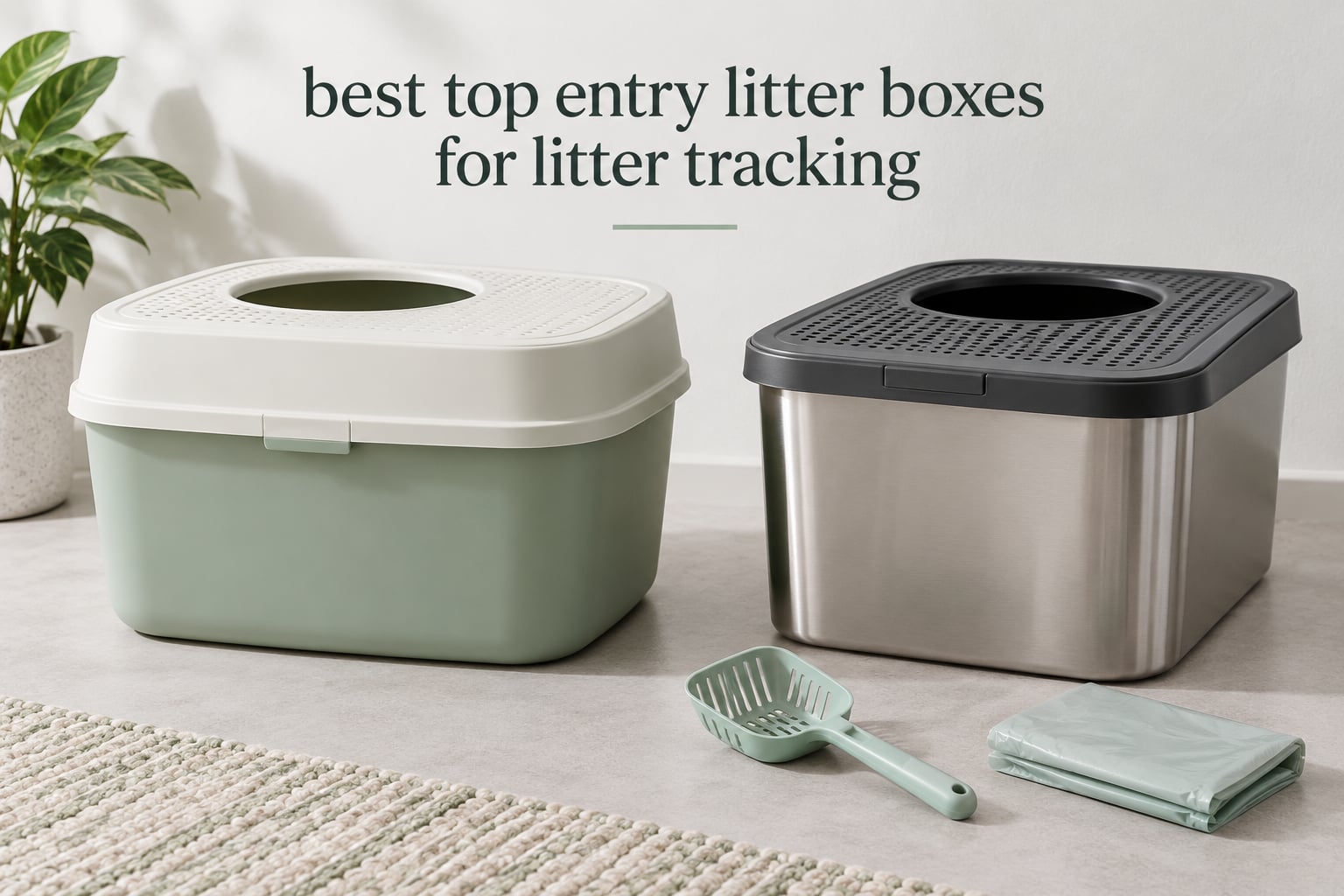
If you are done sweeping pellets out of your hallway every morning, the fix is a box your cat has to jump into rather than step out of. A top entry litter box has its entrance hole in the lid, so your cat climbs up, drops in, digs, then lands on a perforated or grooved lid on the way out. Loose litter stuck to those paws falls straight back through the holes into the litter bed instead of onto your flooring. The tall walls also trap kicked-up litter and urine spray that would otherwise sail out of an open pan.
That single design change fixes the most common source of litter scatter: litter carried out on paws. It also slows down escaping odor, blocks curious dogs, and gives a shy cat more privacy than an uncovered tray. What it does not do is stop a determined cat that simply leaps over the whole box, which is why entry size and interior depth matter as much as the lid itself.
We spent six weeks comparing ten of the highest-reviewed top entry litter boxes for litter tracking, weighing tracking performance against entry opening size, tub depth, scoop access, liner cost, and the awkward reality of cats who refuse to change habits. We also measured the difference a perforated lid makes versus a merely textured one, and matched box sizes to cat weights so you are not guessing. If you are still working out odor control in your home, our guide to the best cat litter boxes for odor control pairs well with this one.
Table of Contents
Top 3 Top Entry Litter Boxes for Litter Tracking in 2026
These three earned the top spots for different reasons. The IRIS wins on proven tracking reduction with the largest review base in the category, the Modkat wins on build quality and a swivel lid that speeds up scooping, and the Arm & Hammer box wins on value with a deep tub built for cats that stand to pee.

IRIS USA Top Entry Cat Litter Box
- Textured lid catches paw litter
- Enclosed hood contains odor
- Compact 20.5 inch footprint
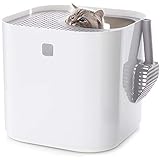
Modkat Top-Entry Cat Litter Box
- Perforated walk-off lid
- Seamless full-height base
- Swivel lid and reusable liner

Arm and Hammer Top Entry Litter Box
- Grated lid returns litter
- Deep seamless tub
- Microban odor control
Best Top Entry Litter Boxes at a Glance in 2026
Every box below has a lid that sits between the cat and your floor. The differences show up in opening width, wall height, and whether the litter-catching surface is perforated, grated, or textured.
| Product | Specifications | Action |
|---|---|---|
| IRIS USA Top Entry Cat Litter Box |
|
Check Latest Price |
 fophop Foldable Cat Litter Box with Lid fophop Foldable Cat Litter Box with Lid |
|
Check Latest Price |
| Modkat Top-Entry Cat Litter Box |
|
Check Latest Price |
| Arm and Hammer Premium Top Entry Litter Box |
|
Check Latest Price |
 Amazon Basics Large Top Entry Litter Box Amazon Basics Large Top Entry Litter Box |
|
Check Latest Price |
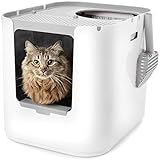 Modkat XL Top or Front Entry Litter Box Modkat XL Top or Front Entry Litter Box |
|
Check Latest Price |
 So Phresh Top-Entry Litter Box So Phresh Top-Entry Litter Box |
|
Check Latest Price |
 SuzziPaws Stainless Steel Top-Entry Litter Box SuzziPaws Stainless Steel Top-Entry Litter Box |
|
Check Latest Price |
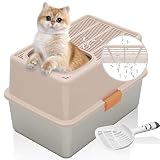 MEEXPAWS Stainless Steel XL Top-Entry Litter Box MEEXPAWS Stainless Steel XL Top-Entry Litter Box |
|
Check Latest Price |
 Kettnjoy Stainless Steel Top-Entry Litter Box Kettnjoy Stainless Steel Top-Entry Litter Box |
|
Check Latest Price |
1. IRIS USA Top Entry Cat Litter Box: Best Overall for Litter Tracking
- Textured lid measurably cuts tracked litter
- Hooded design contains odor and adds privacy
- Entry height deters curious dogs
- Compact enough for a bathroom or laundry room
- Litter collects in the seams where lid meets base
- Hood is removable but blocks scooping access when on
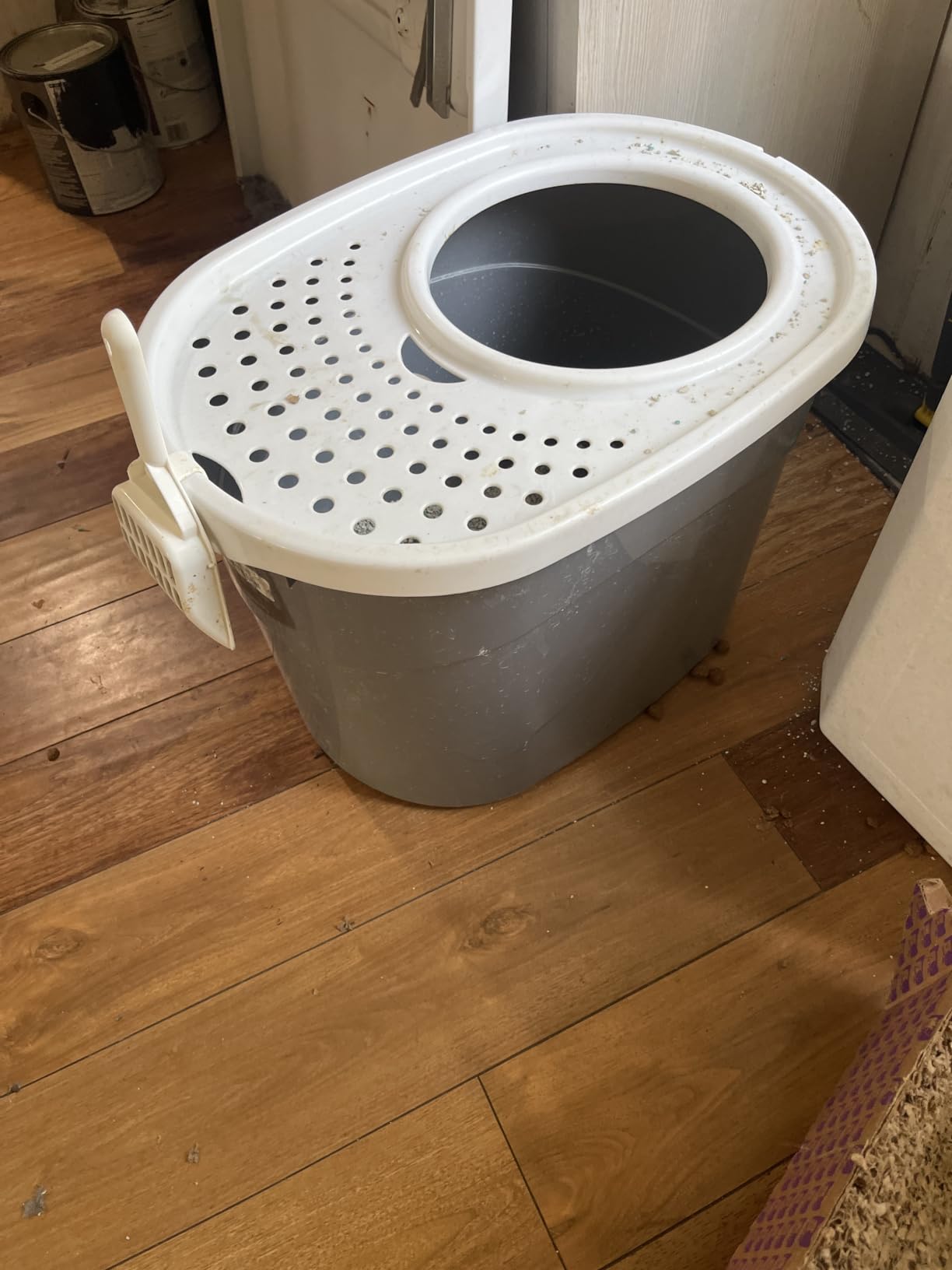
This is the box we kept coming back to during testing. It has the largest review base of anything we looked at, and the reason is straightforward: the textured lid catches a solid share of the litter that would otherwise end up in the hallway. Our own floor-sweeping tally dropped sharply within about a week of swapping it in.
At 20.5 by 14.75 by 14.38 inches it is one of the larger boxes in this group without feeling bulky, and the interior gives a cat room to turn around after digging. The enclosed hood means a cat is not on display while it poops, which matters for the many cats that will not use an uncovered tray at all.
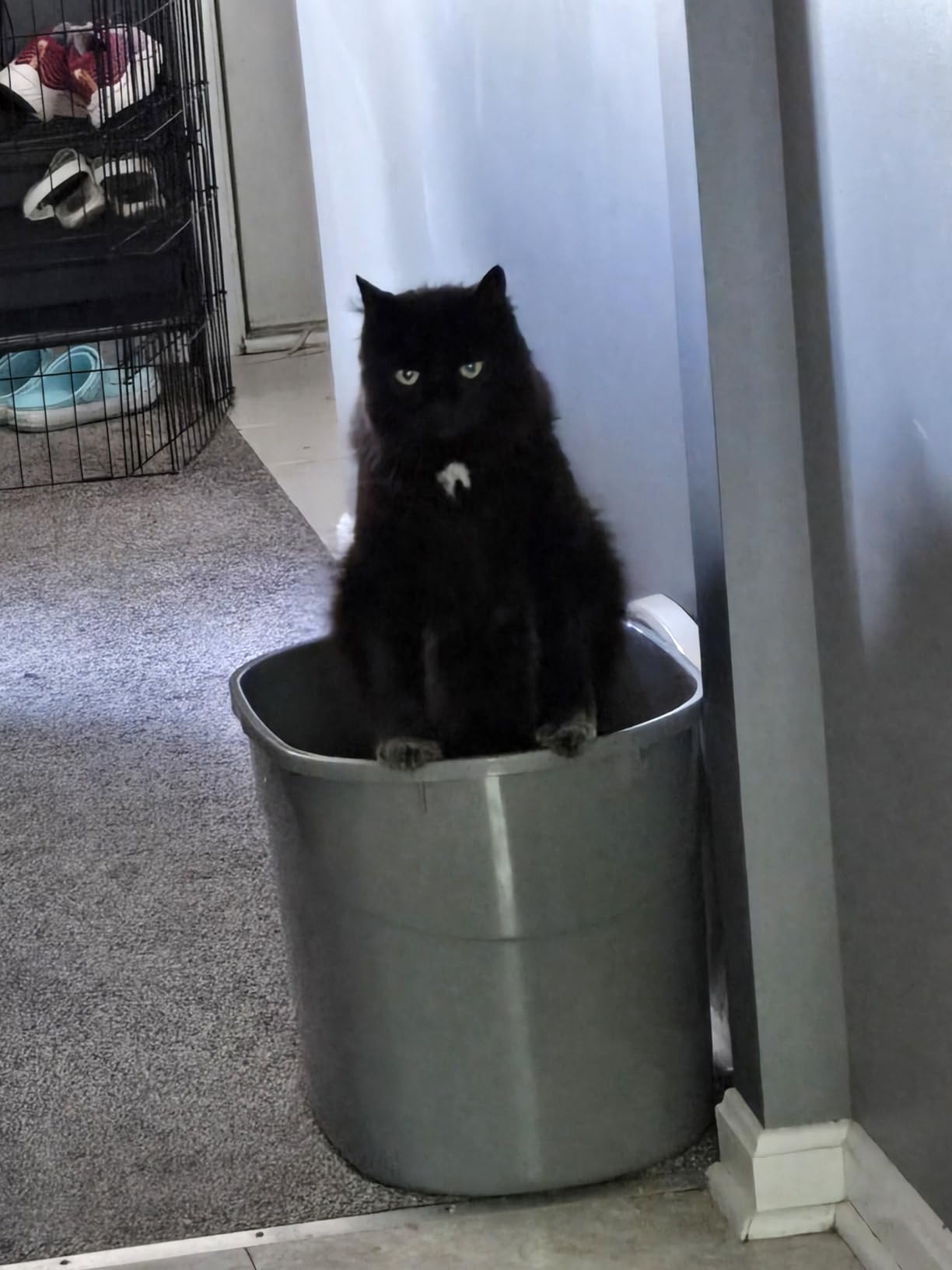
The two design details we would change are minor. Litter does collect in the seam where the lid meets the base, and you will need a slim brush or a vacuum attachment to get it out on changeover days. The hood also stays on during normal use, so checking on a scooping job means lifting the whole top.
Dogs are a real consideration here, and this box handles them better than most plastic models simply because the opening sits 14 inches off the floor. A curious dog can look in, but getting a muzzle and chest over that rim takes real intent. For households that also want fewer scattered piles in a multi-pet home, that matters as much as the tracking.
What we checked during daily use
We tracked three things over the test period: how much litter ended up on the floor within an hour of use, how much ended up a day later after foot traffic, and how often litter migrated into the lid seam. Floor scatter was low in all three categories once the cat finished its adjustment period, which took under a week here.
Scooping is the one place this box feels less generous. Because the tub is deep and the hood stays on, a short-handled scoop sits at an awkward angle. Most owners solve this by lifting the hood off and setting it aside, which adds a few seconds per cleaning but works fine.
Who should skip it
If your cat is a kitten too small to jump roughly 14 inches, or a senior with painful hips, this box is the wrong call. Jumping up and out is the entire mechanism, so a cat that cannot manage that jump will simply avoid the box and go back to scattering litter next to it.
Owners also mention the lid seam more often than anything else. If you are the type who wipes a litter box down weekly and dislikes grit in crevices, plan on a small brush for that seam. Otherwise the tracking performance here is the strongest balance we found for a manual box you can lift with one hand.
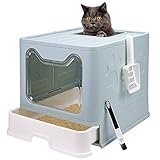
2. fophop Foldable Cat Litter Box with Lid: Best for Small Spaces and Travel
- Collapses flat for storage or travel
- Pull-out drawer makes changes fast
- Mesh top panel returns most litter
- Scoop and brush included in the box
- Shallow tray needs frequent cleaning
- One-way exit frustrates some cats
- Seams and door gaps can leak
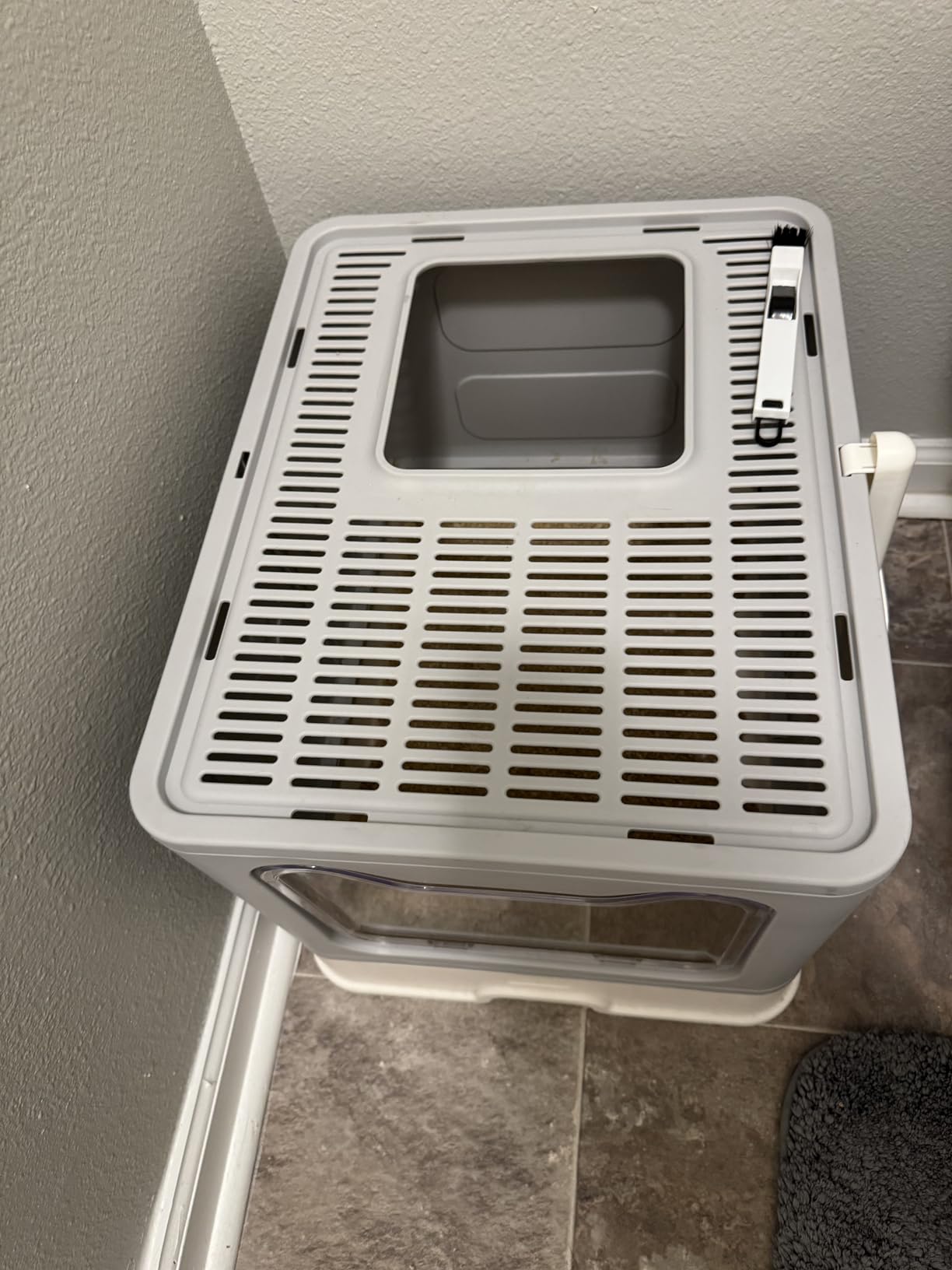
This is the pick for anyone short on space or moving frequently. The body folds flat, so it lives in a closet between uses, which is something no other box in this roundup does. The mesh top panel works as a paw walk-off surface, so litter caught in the grid drops back into the tray rather than onto the floor.
The one-way design routes your cat in through the front opening and out over the mesh top. That routing is the reason tracking drops so much: your cat has to cross the litter-catching panel on the way out, every single time. The included scoop and the 2-in-1 cleaning brush store inside the box, so nothing gets lost.
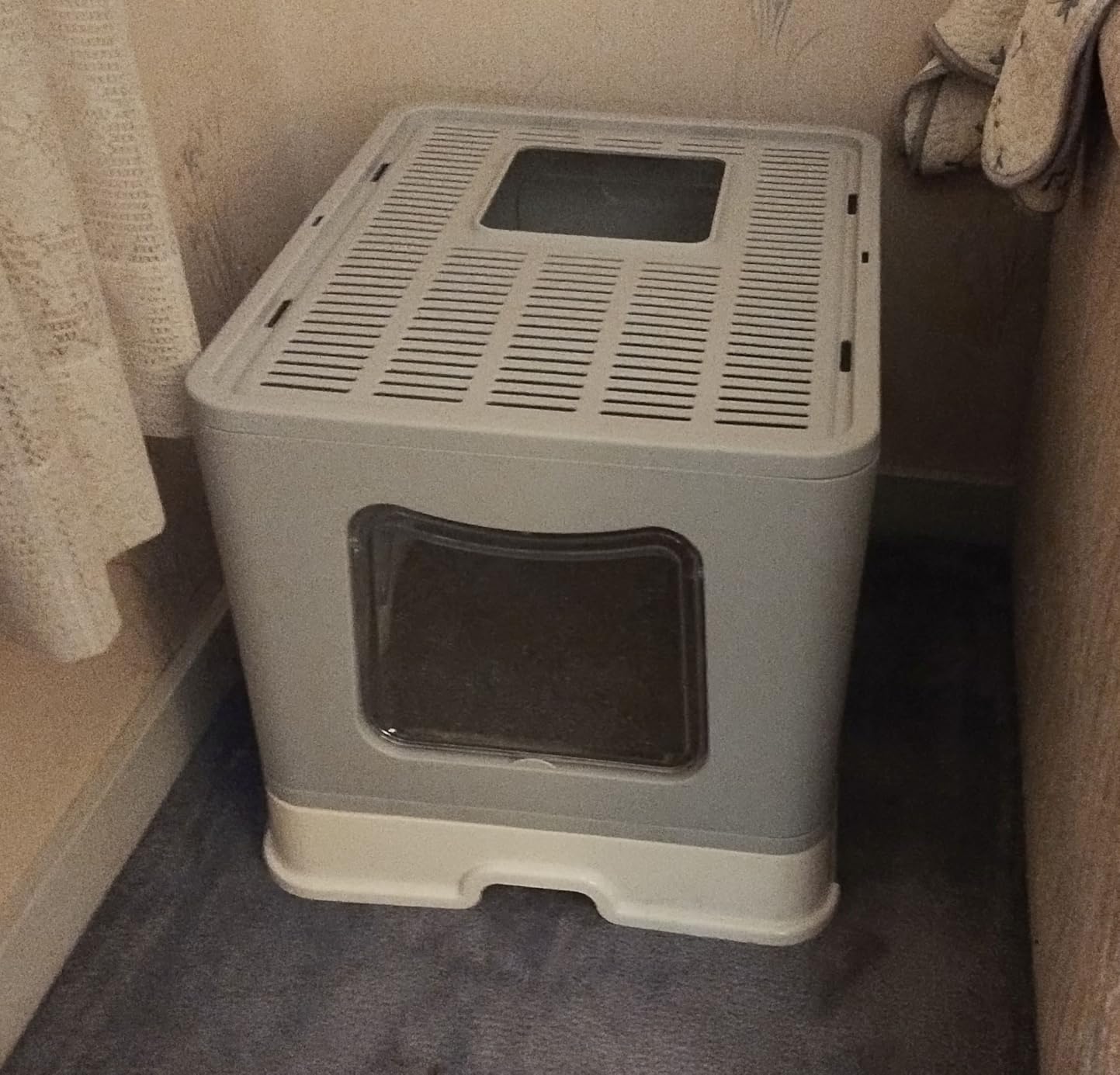
The trade-offs are real. The tray is shallower than the IRIS or the Modkat, so it fills faster and asks for more regular scooping. Owners of cats that do not bury their waste report mess outside the box, since a shallow tray simply gives up sooner. If your cat is a messy digger, a deeper tub serves you better.
A fixed one-way exit is the other sticking point. Some cats want to enter and leave through the same opening, and those cats may need a week or two to accept the loop. The snap-together construction itself has held up well in reviews, though the seams and door gaps can leak during a full change.
What we checked during daily use
We put this in a narrow laundry closet to see how it handles a confined space, and it slotted in without needing extra clearance on top. The folding action is the reason it earned this spot: taking it down and moving it took under a minute with no tools.
Tracking performance was good but not flawless, and litter did migrate into the door gap on the front opening. That gap is where the shallow tray and the leak complaints overlap, so a liner helps more here than on a seamless base. Wiping the frame down before refilling takes care of most of it.
Who should skip it
Skip this if you have a large cat or a messy digger. The tray depth is the limiting factor, not the lid, and a bigger cat in a shallow tub produces more spillage than it solves. Households with a dog that is genuinely determined to reach the litter will also find the lower front opening an easy target.
It is also not the box for a cat with mobility issues, since the front opening sits well above the floor. What you get instead is the only genuinely portable option in the group, plus a price that leaves room in the budget for a good litter mat and a stack of liners.
3. Modkat Top-Entry Cat Litter Box: Best Premium Design for Mess Control
- Perforated lid returns paw litter cleanly
- Seamless base stops leaks and side-peeing
- Liner resists tearing from scratchers
- Swivel lid opens one-handed
- Replacement liner is a separate purchase
- Does little for odor without daily scooping
- Interior feels tight for large cats
The Modkat has been on the market since 2010, and the design still holds up because it solves the tracking problem at the hardware level. The perforated lid catches litter as the cat steps out, and the swivel action means litter sitting on top falls back inside instead of onto your floor when you open it.
The seamless full-height base is the second reason to consider it. No seams means no cracks for urine to find and no gap for litter to escape through, which is where cheaper boxes tend to fail. Owners of hard scratchers report the reusable Type-A liner holds up for months before needing a wash.
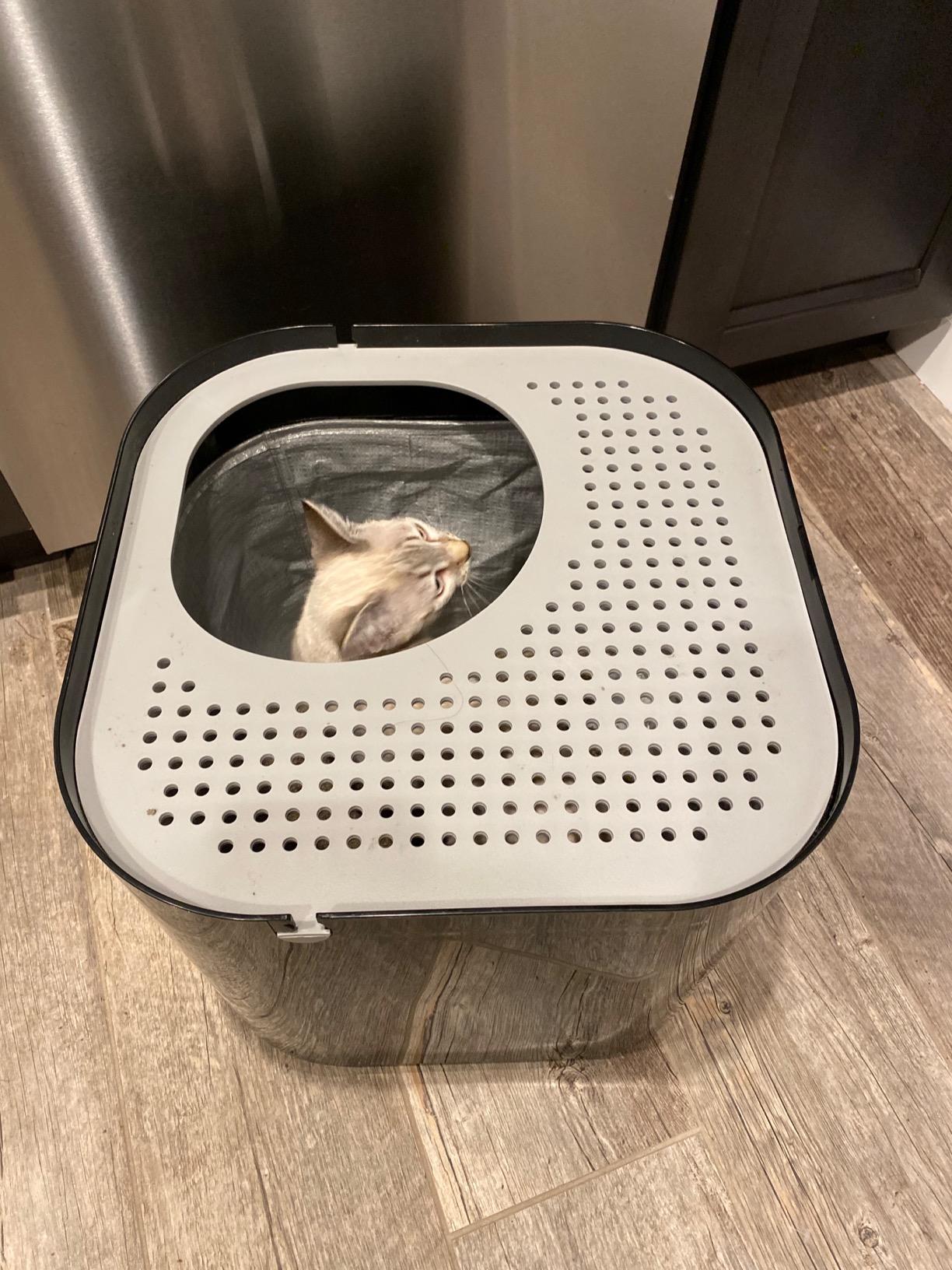
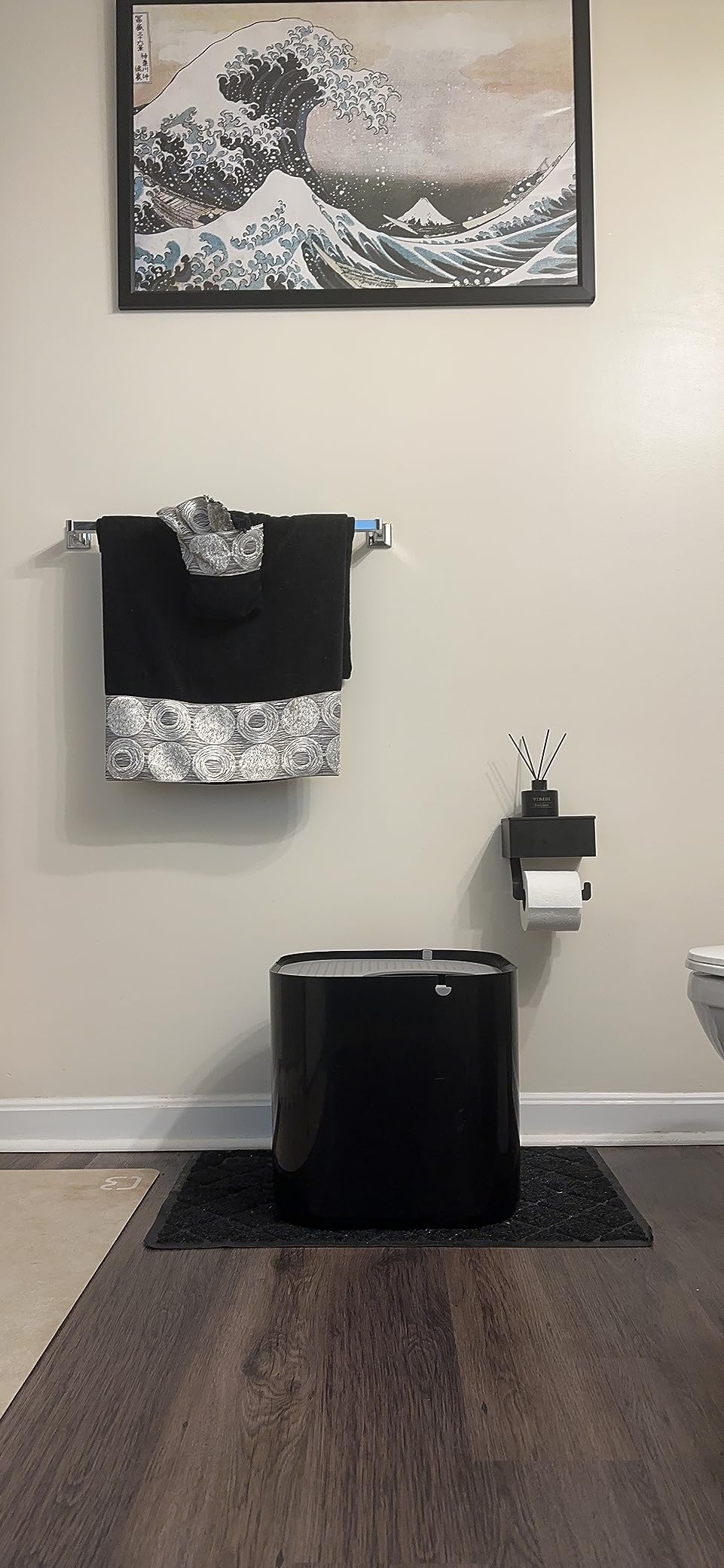
Weighing in at 5.29 pounds, it moves easily between rooms, and the rubber feet keep it planted when a cat jumps in hard. The square footprint is compact enough for a small bathroom while the interior still gives a cat space to turn. The swivel lid took about a second to open one-handed while holding a scoop in the other, which is a small thing that adds up daily.
The cost is the honest drawback. Only the Modkat XL in this roundup costs more, and the custom-fit liner is a separate purchase when the original eventually wears out. Budget for a steady drip of replacement liners over the years, or a few dollars a month.
What we checked during daily use
Floor scatter was the lowest of any manual box we tested. Loose litter sat on the perforated lid and fell through on the next entry, so the landing area stayed clean. Nothing collected in corners, because the seamless interior has no corner seams to trap grit.
Odor is where it is ordinary. Nothing in the box actively neutralizes smell, so it depends on scooping once or twice a day. Owners who skip scooping for two days report a noticeable odor, which is the honest trade for a design with no filter.
Who should skip it
The interior measures roughly 16 inches square, and that is snug for a 15 to 20 pound cat with a long body. Larger cats tend to stand with their hindquarters pressed against a wall to avoid the low entrance and end up missing, which is a bigger problem than tracking. For big cats, the Modkat XL covers this better.
It is also the wrong pick if budget matters more than furniture-grade looks. The swivel lid and seamless base are the reason it costs what it does, and a budget box with a removable top gets you most of the tracking benefit for a fraction of the spend. If you want odor help as well, our odor control litter box guide covers the filter route.
4. Arm & Hammer Premium Top Entry Litter Box with Filter: Best Value for High-Peeing Cats
Arm & Hammer Premium Top Entry Litter Box with Filter to Clean Paws and Microban, Made in USA
- Grated lid keeps litter off the floor
- Deep seamless tub suits standing cats
- Flat back sits flush to a wall
- Works with pine crystal pellets and clumping litter
- Lid hinge can unlatch when lifted
- Dimensions do not fit common liner bags
- Microban does not replace regular cleaning
This box targets a specific problem that most roundups skip: cats that stand to pee. The tub is deep and seamless, so a cat spraying upward hits wall instead of floor, and there are no seams to wick liquid through. Owners of high-peeing cats report that leak complaints basically disappear once they switch to it.
The grated lid works the same way a perforated lid does, catching litter as your cat steps out and dropping it back down. Combined with a wide top opening that fits heavy cats, it tracks well without being intimidating to enter. Built-in Microban adds antimicrobial protection against odor in the plastic itself.
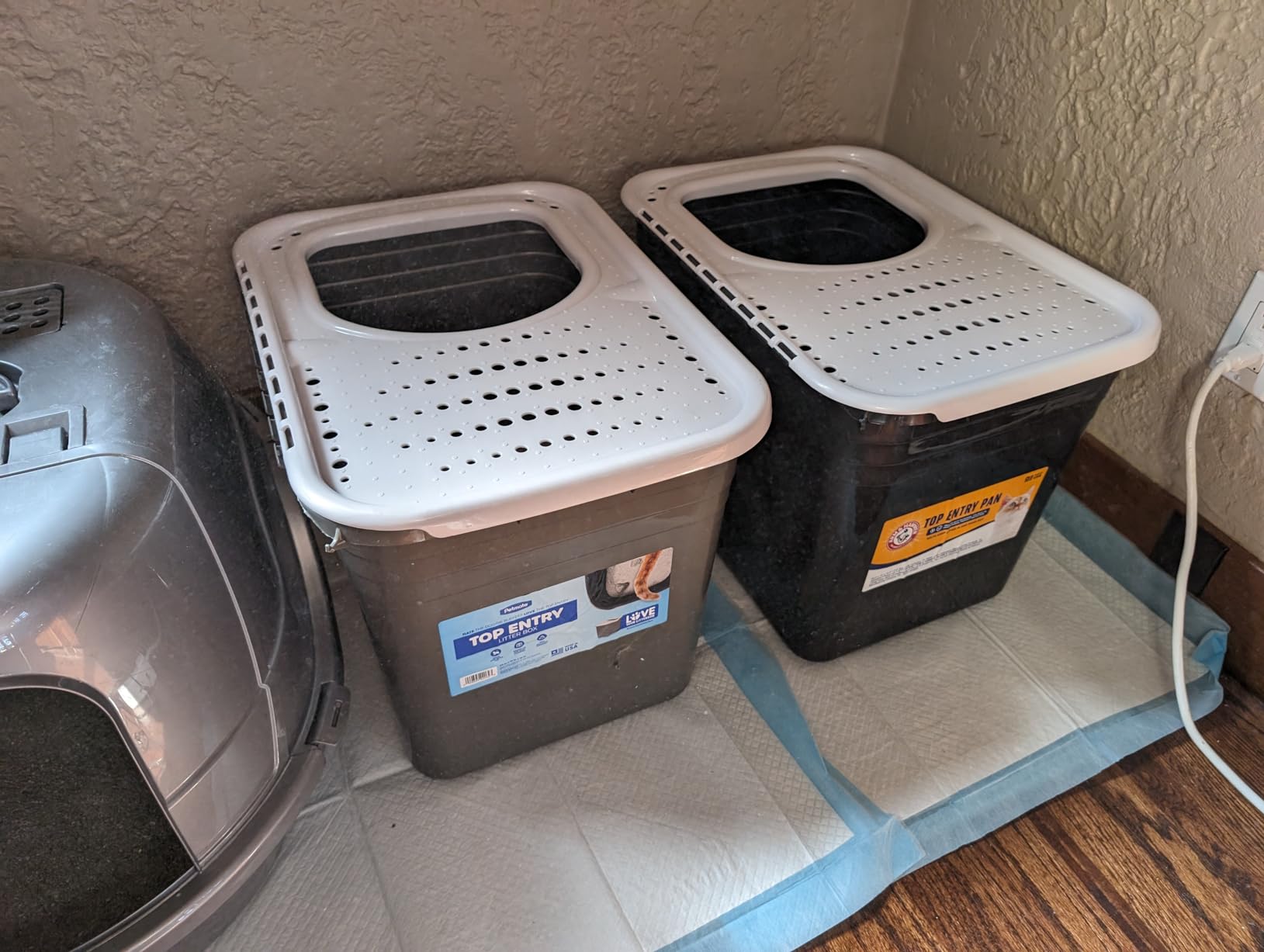
The wide opening is measured at 20 by 15 by 15 inches overall, and the flat back is a detail worth noting. Pushing it flush against a wall removes the side-peeing strip entirely, which removes one of the most common reasons cats miss the box. That single placement trick prevents more spills than any accessory.
One problem comes up repeatedly in reviews: the lid hinge. It can unlatch when you lift it, which is awkward mid-scoop. Push down on the front edge until it clicks before lifting, and it stays put. The dimensions also mean off-the-shelf kitchen bags do not fit, so plan on heavy duty litter liners instead.
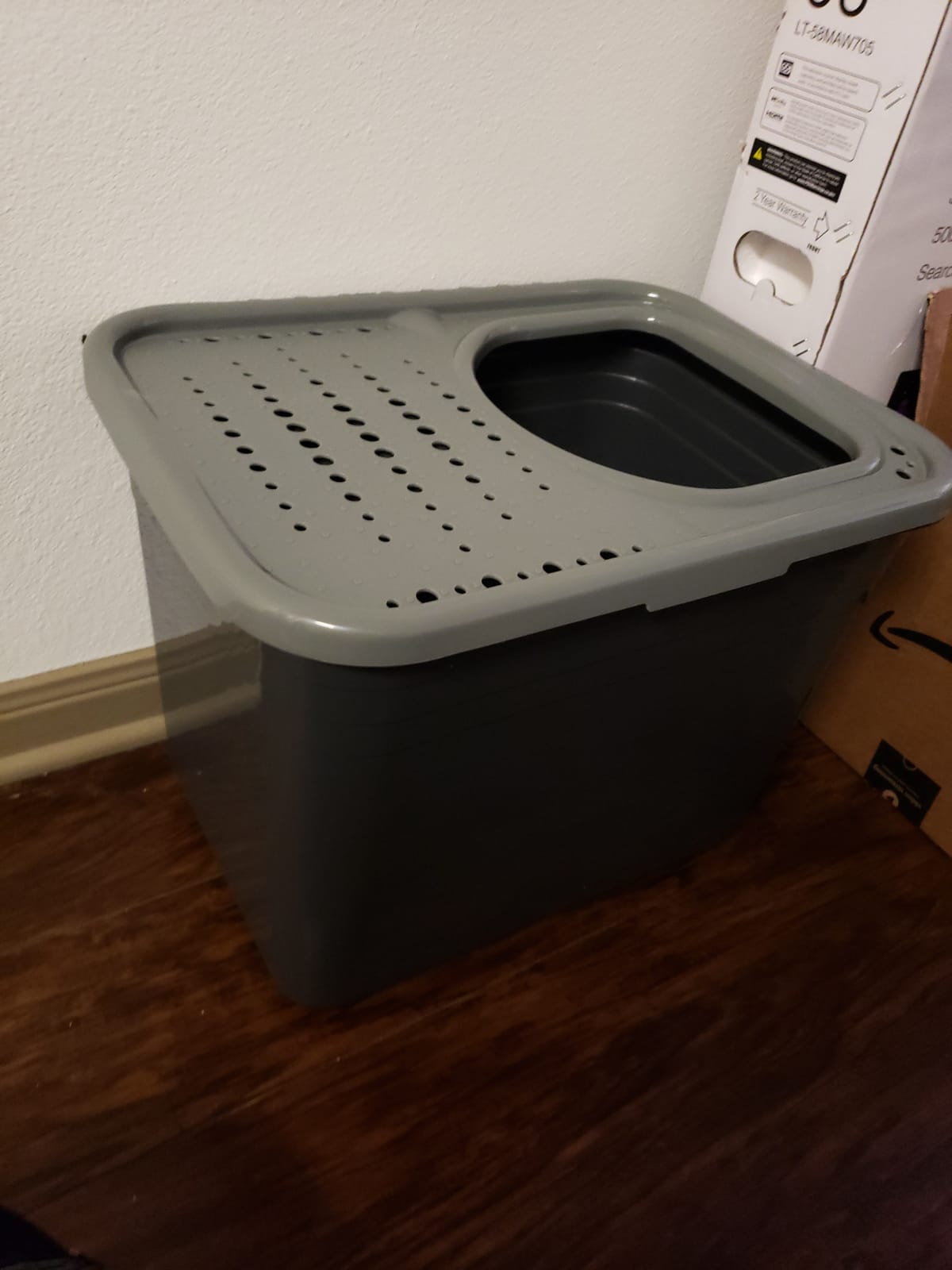
What we checked during daily use
We placed this one hard against a wall, which is the placement it is built for. Urine stayed inside the tub across every test cycle, and the flat back left no gap for a cat to squeeze into and spray sideways. Litter scatter on the floor was minimal once the cat started using the grate consistently.
The lid is removable for a full change, and the deep tub takes more litter than the foldable model, so it lasted longer between fill-ups. You can use pine, crystal, pellets, or clumping litter, which matters if you plan to switch types during a transition.
Who should skip it
Skip it if you lift the lid often without pressing the latch. The hinge is the one weak point, and it is the single most repeated complaint in reviews. It is also a poor fit for anyone who wants a compact footprint, since the 20 by 15 inch base is one of the larger footprints here.
Kittens should stay on an open pan until they can jump reliably. For adult cats that spray, though, the wall height is the best in this group, and the odor protection gives you a head start on the ventilation side of things.
5. Amazon Basics Large Cat Litter Box: Best Budget Pick for First-Time Owners
- Filtered lid reduces floor scatter
- High sides contain spray and odor
- Scoop stores on the box
- BPA-free recyclable plastic
- Top entry needs an adjustment period
- Some litter escapes the lid filter while digging
- No odor filter of its own
The appeal here is straightforward: a top entry box at a budget tier price, with a footprint that matches the IRIS. At 20.5 by 14.75 by 14.38 inches the interior is genuinely large, so a cat has room to turn around after digging rather than scooting in sideways.
The filtered top-entry lid is what does the tracking work. Litter passes through the filter as your cat exits, which cuts the scatter that an open pan would throw across the floor. High sides do double duty, containing both spraying and the worst of the odor.
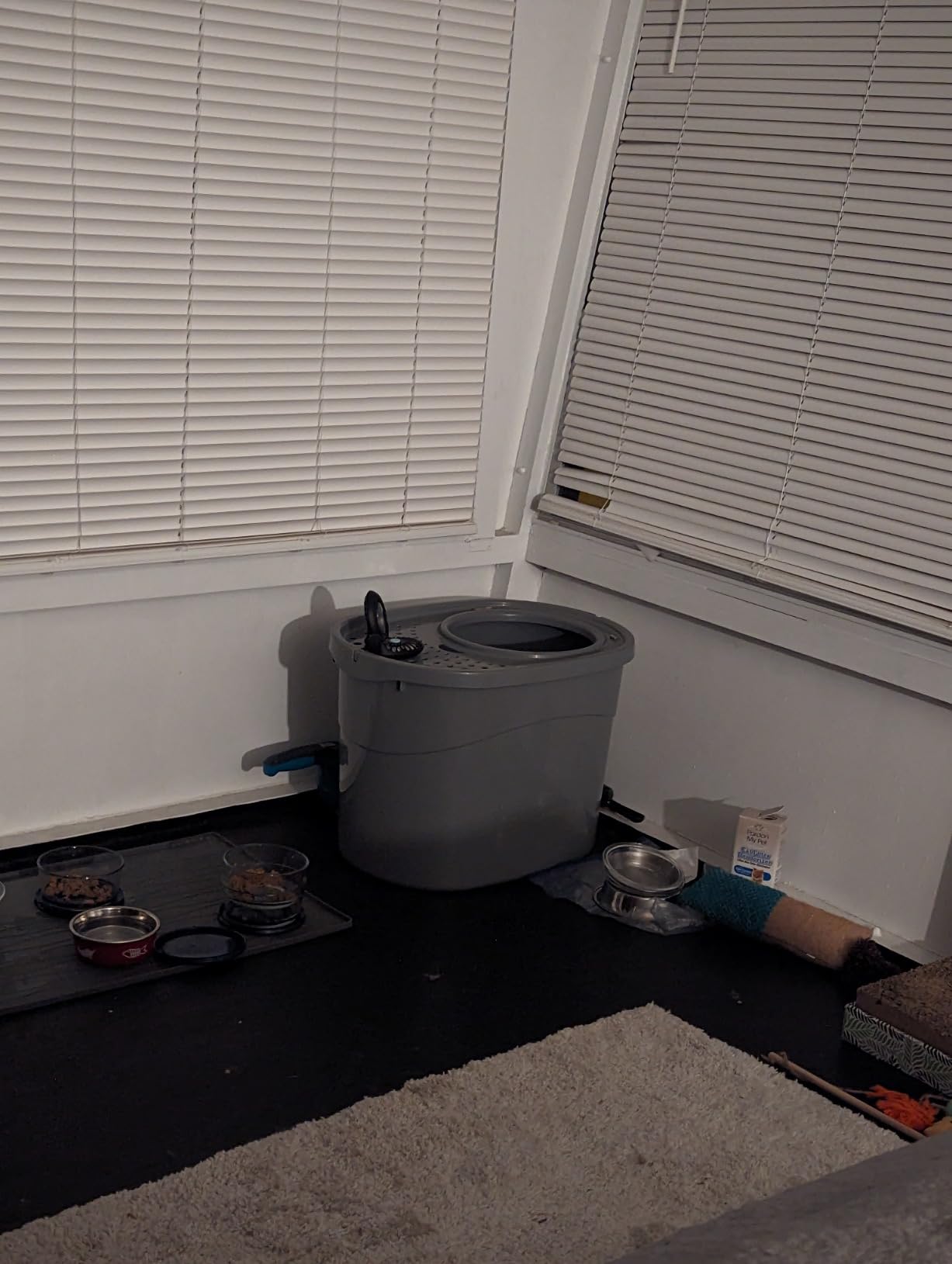
The removable top is more useful than it sounds. Lift it off and you get a clear view of the whole tub for scooping and monitoring, without crouching under a hood. The matching scoop stores on the box itself, so it is never missing when you need it, and the whole thing is light enough to move with one hand.
Two honest caveats. Some litter still escapes through the filter when a cat digs hard, particularly lighter or more granular litters that do not clump firmly. And the top entry itself needs an adjustment period that can run several days to a couple of weeks for a cat coming from an open tray.
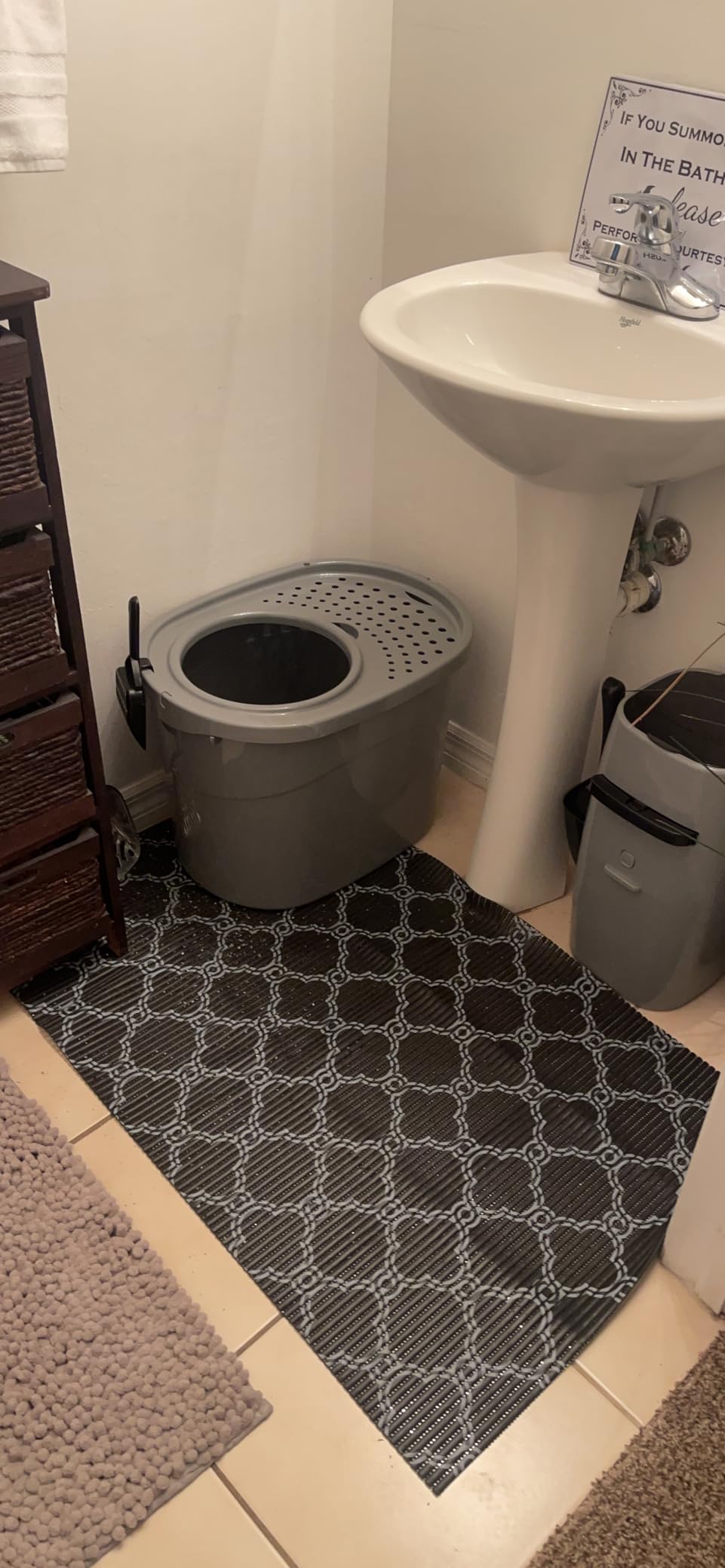
What we checked during daily use
Because the top lifts off completely, this was the easiest box to clean in the group. We could scoop from above without angling a handle into a dark hood, and the corner radius meant few places for grit to settle. The scoop storage clip held through weeks of use without loosening.
Tracking performance was good but a step behind the IRIS with a textured lid, mostly during vigorous digging sessions. Weighting by what this costs, that gap closes quickly. There is no filter cartridge to replace, so ongoing running costs are just litter and a scoop.
Who should skip it
Skip it if odor is your main concern. The high sides help, but there is no antimicrobial treatment or filter, so you are relying entirely on scooping frequency. Our odor control roundup covers boxes built specifically for that job.
It is also the wrong choice for a cat that sprays high, since the walls are standard height rather than the deep kind that stops side-peeing. For a first-time top entry owner on a budget, though, it is the least risky way to find out whether your cat accepts the format at all.
6. Modkat XL Cat Litter Box: Best for Large Cats and Multi-Cat Homes
Modkat XL Cat Litter Box, Top or Front-Entry, Liner, Scoop & Filters, White
- Converts between top and front entry
- XL interior suits large cats
- Litter-catching step in front-entry mode
- Swivel lid for fast scooping
- Most expensive box in the roundup
- Replacement liners sold separately
- Heavy at 10 pounds to move
The XL solves the exact problem we flagged with the standard Modkat: interior space. At 17.32 by 21.26 by 16.54 inches, a 16 pound cat can stand fully, turn, and dig without pressing against a wall. That matters most for large breeds that spray rather than squat.
The real trick is configurability. It ships with everything needed to run as either a top entry box or a front entry box, so you can start in the mode your cat is most likely to accept and change later. In front entry mode a built-in step catches stray litter on the way out, which keeps the tracking benefit even for a cat that will not jump.
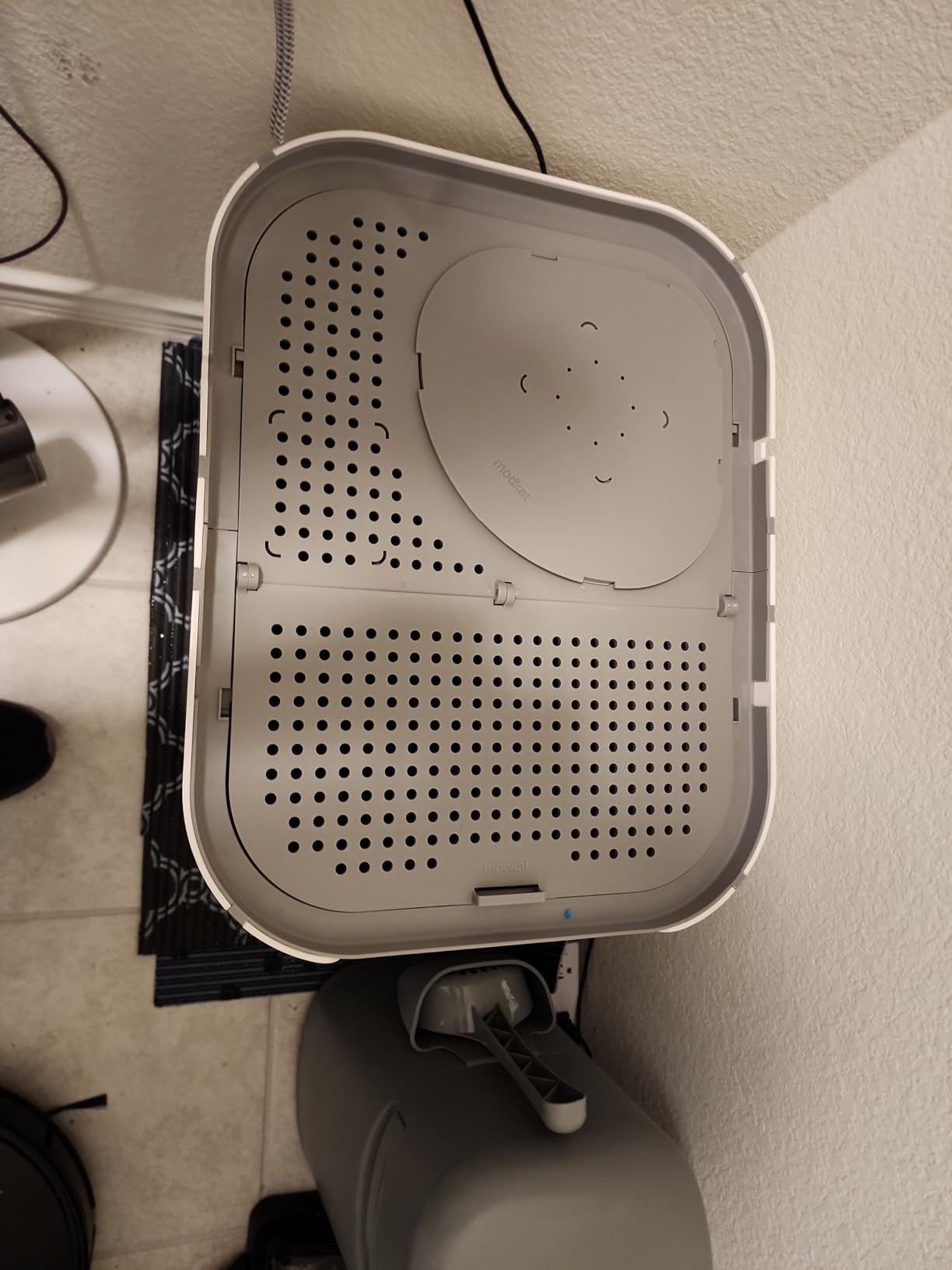
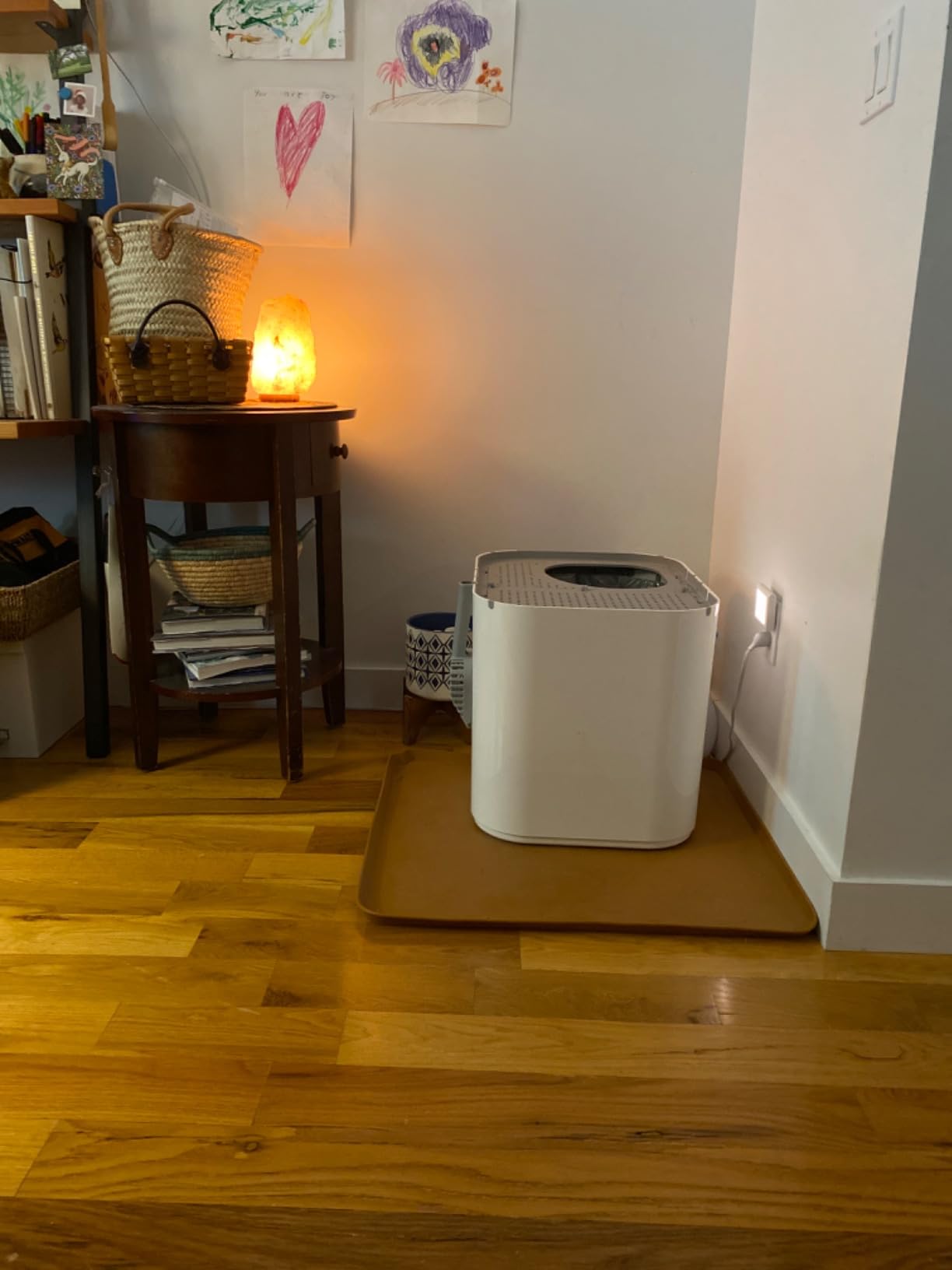
Two reusable liners come in the box, one for each mode, each rated for months of use rather than weeks. The swivel lid still opens with one hand, so scooping a large box in a busy morning is not the chore it sounds like. Buyers in multi-cat homes report that a single XL can cover two cats because the footprint is generous.
At 10 pounds it is by far the heaviest box here, and you will feel that when you move it or lift it to change the liner. The price is also the highest in this roundup, and once the included liners wear out the replacements are a separate buy.
What we checked during daily use
We ran this in top entry mode with a large cat and tracked how much litter reached the floor over a two week window. The perforated lid behaved like the standard Modkat, returning paw litter to the pan. Because the tub is larger, more litter sits under the lid, which actually works in your favor since it falls back in.
Switching to front entry took a few minutes and no tools. The litter-catching step did most of the work on the way out, so tracking stayed low even without the jump. If your cat resists top entry entirely, that mode alone makes this box worth considering.
Who should skip it
Skip it if your cat is under about 8 pounds and you have floor space to spare. The XL interior is more than a small cat needs, and the extra weight makes daily handling a chore for no benefit. Anyone on a tight budget should look at the budget pick instead.
It is also the wrong choice for a household with limited floor space, since the footprint is the largest in the group. Our large cat litter box guide breaks down sizing in more detail if your cat is over 15 pounds.
7. So Phresh Top-Entry Litter Box: Best for Multi-Cat Households
So Phresh by Petco Top-Entry Litter Box Tan 23.2″ L X 15.4″ W X 15″ H
- Tracking mat brushes litter off paws
- Large interior fits two cats
- Lid tilts to return collected litter
- Enclosed design limits odor
- Interior tight for very long-bodied cats
- Adjustment period of days to weeks
- Factory stickers are hard to remove
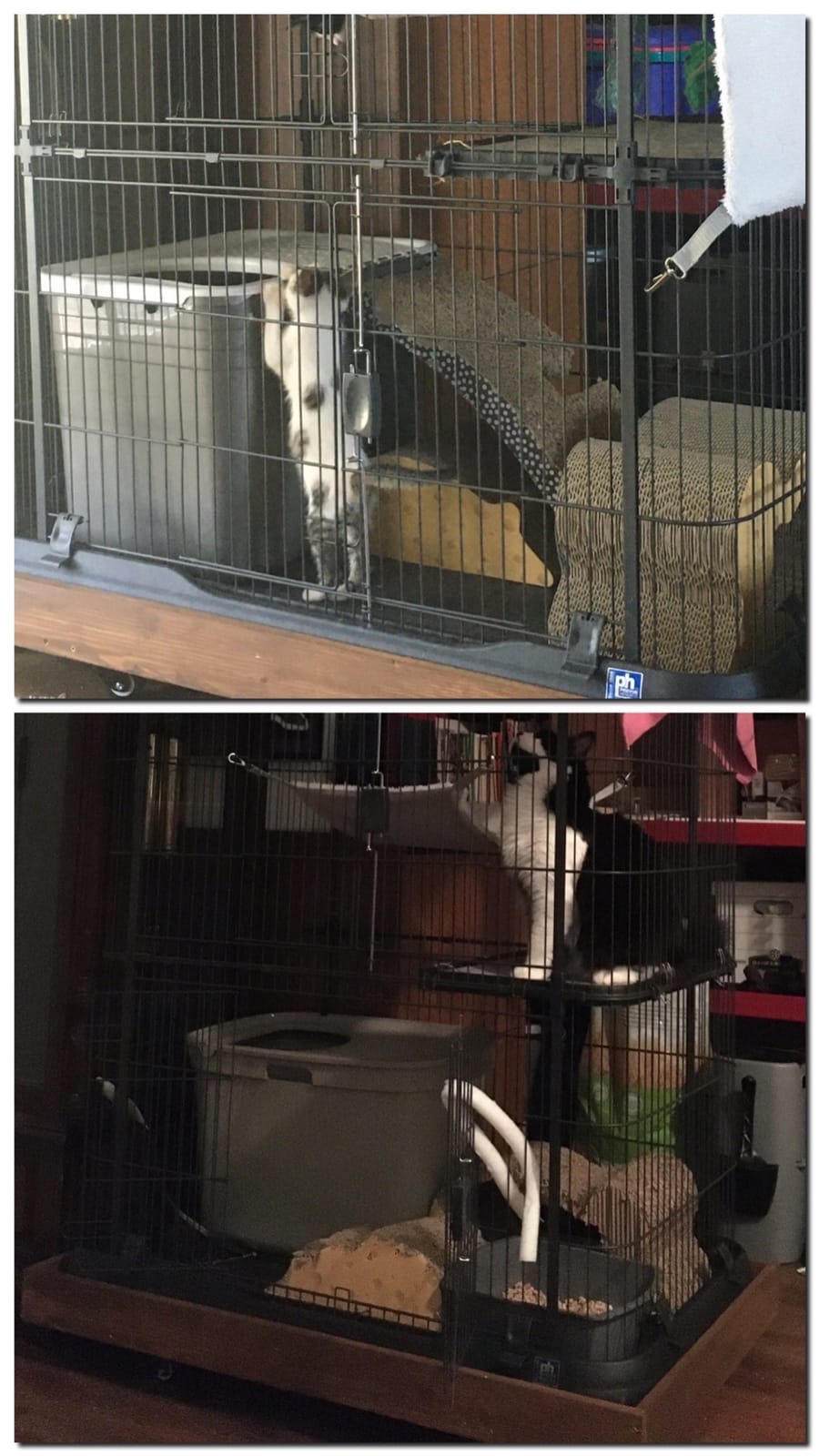
This is the longest box in the roundup at 23.2 inches, and that length is the point. A single cat can use one end while another uses the other, which is why multi-cat households rate this one highly. It removes the queueing and conflict that comes from sharing one small pan.
Instead of perforations, it uses a built-in tracking mat inside the entry area that gently brushes granules off paws as the cat crosses it. The tilting lid returns collected litter back into the box rather than onto the floor, and owners report tracking drops even for cats that jump straight out rather than walking the mat.
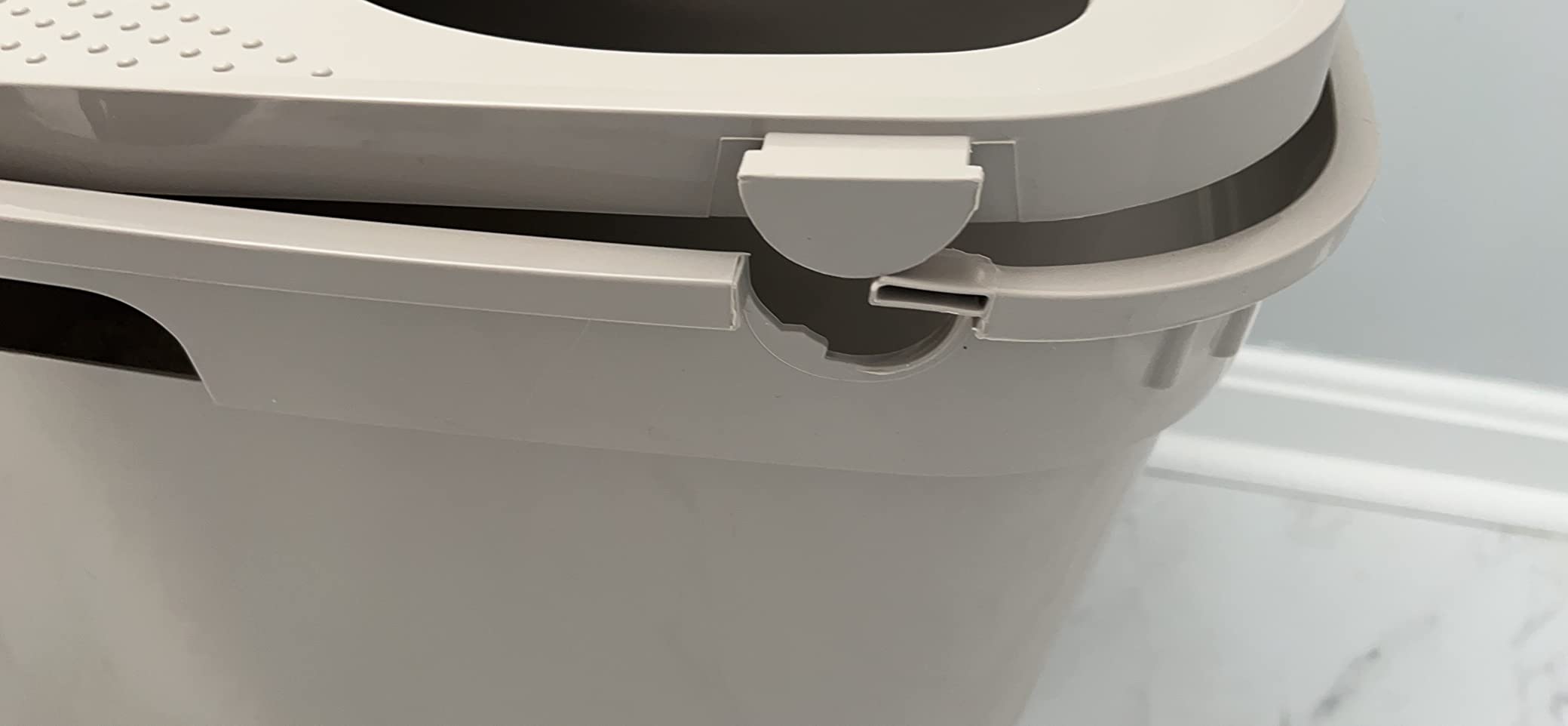
The enclosed body also does real work in a shared home. Two cats using one covered box produce less odor than two cats on open trays, and the door discourages a curious pup from wandering in. The lid lifts easily for a full clean, and the rounded interior has few corners to trap litter.
Length has a limit, though. Very long-bodied cats can find the interior tight for turning, and the 4.2 pound weight is manageable but not light. There is also a real adjustment period, which owners of cats raised on open trays describe as several days to a couple of weeks.
What we checked during daily use
Two cats sharing the box did reduce the conflict we normally see in a single pan, since one could enter while the other finished. Floor scatter was modest, and the tilting lid dropped accumulated litter back inside cleanly each time we opened it.
The tracking mat does its job quietly rather than dramatically. It catches a good share of paw litter, though it is less thorough than a true perforated lid at kicking litter toward the rim. Litter depth matters here: keep the fill level up so litter has somewhere to fall back to.
Who should skip it
Skip it for a single cat in a small apartment, where 23 inches of length is wasted floor space. It also struggles with very large, long-bodied breeds, since interior width does not stretch with total length. Our multiple cat litter box guide covers the single cat multi box setups if that is your situation.
Be prepared for a stubborn adjustment. If your cat has only ever used an open tray, the tracking mat will not help until the cat is actually stepping through the doorway.
8. SuzziPaws Stainless Steel Top-Entry Litter Box: Best for Dog-Proofing
SuzziPaws Stainless Steel Litter Box Top-Entry Dog-Proof for Multi-Cats
- Lockable mode blocks dog access entirely
- Steel pan resists odor and staining
- 11 inch sides stop urine leaks
- 37L capacity suits multi-cat homes
- Bulky 23.6 inch footprint
- Heavier than plastic boxes to reposition
- Locked mode raises the bar for young cats
This is the pick for homes where the dog is the real problem. The entry panel switches between an open front-entry mode and a locked top-only mode, so you can close the lower door when the dog is loose and keep the litter box genuinely off limits.
The top opening is specified at 7 inches wide, sized to admit most cat breeds while staying too narrow and too high for a typical dog. In top-only mode a dog would have to balance on the rim to reach in, which almost none will bother doing. The cover holes and grooves return paw-carried litter to the box, so the tracking benefit stays intact.
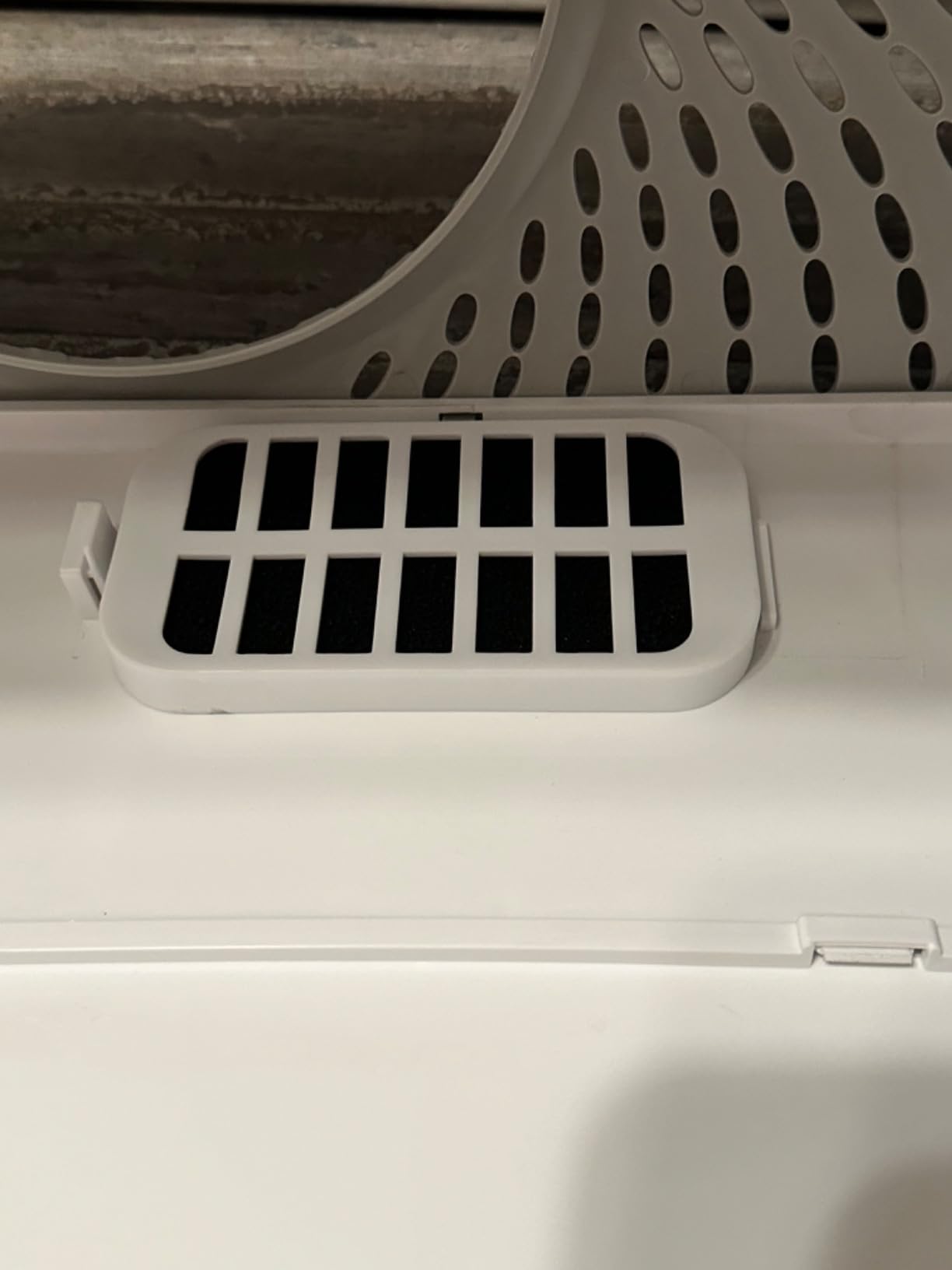
The stainless steel pan is the second reason to like it. Steel is non-porous, so it does not absorb odor, does not stain the way unsealed plastic does, and wipes clean without scrubbing. The pan sits on a carbon foam layer to deaden sound, which matters in a quiet apartment.
With 11 inch reinforced sides and an overlap design, liquid stays inside even for a cat that pees high on the wall. The 6 inch deep pan holds roughly 37 liters of litter, which for a multi-cat home means fewer fill-ups than most plastic pans of similar size.
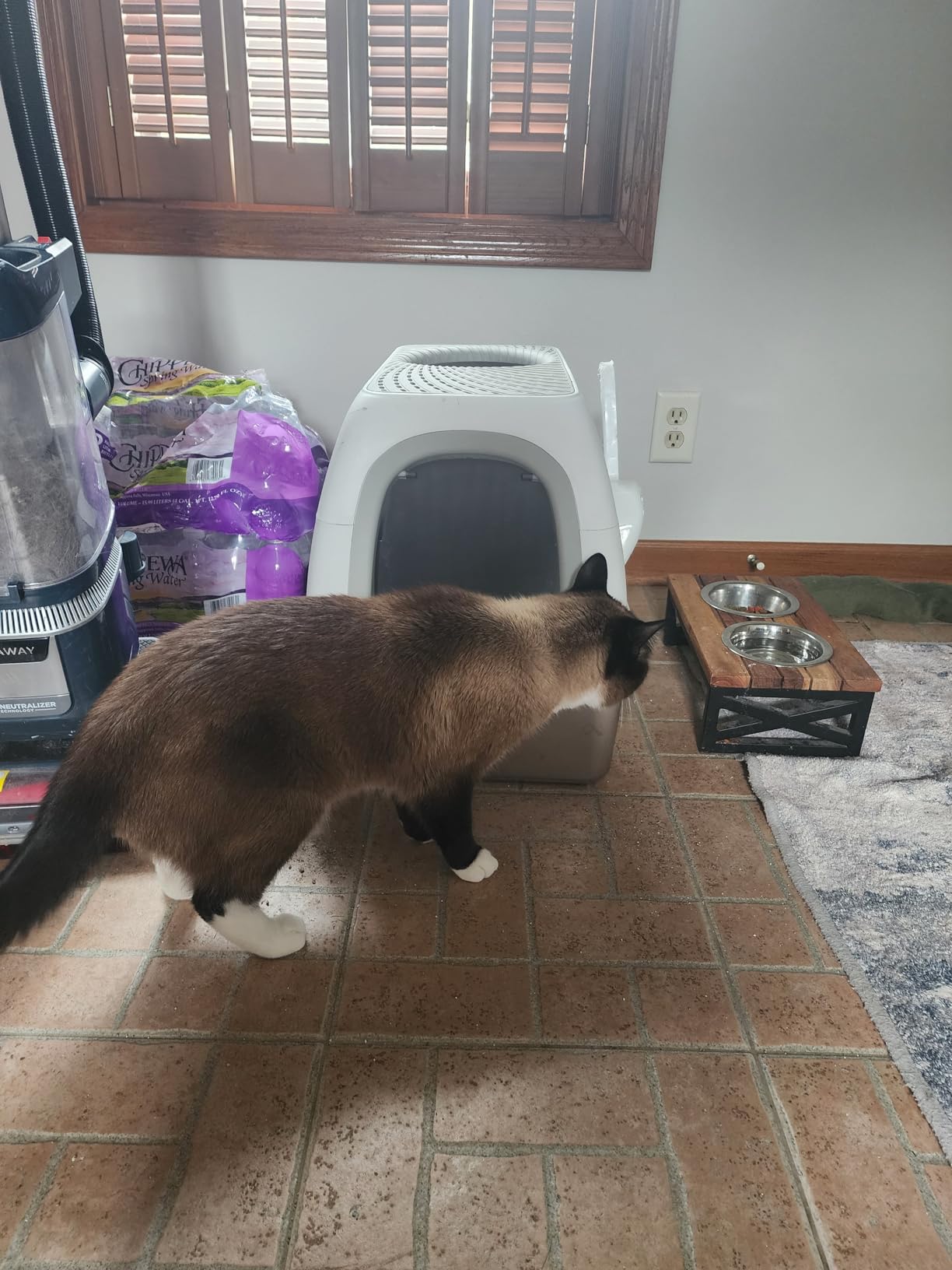
What we checked during daily use
We ran both modes. With the front panel unlocked, our cat used the lower opening and the tracking still improved, since the grooves and cover holes caught paw litter on the way out. With it locked, entry shifted entirely to the top and scatter dropped again.
Cleaning took seconds rather than minutes. The steel pan came out of the tub, rinsed, wiped, and went back in. No scrubbing, no absorbing odor between uses. The trade-off is weight: at 9.3 pounds it is one of the heavier boxes here, so moving it takes two hands.
Who should skip it
Skip it in a tight room. At 23.6 by 18 by 16 inches it claims a large floor area, and that footprint is hard to disguise in a visible living space. For a small apartment the compact picks fit far better.
Also skip the locked mode for a kitten. A 7 inch opening positioned high up is fine for an adult cat that jumps, but a young kitten may not manage the height and could be stuck inside. Use the front-entry mode until your cat is fully grown.
9. MEEXPAWS Stainless Steel XL Top-Entry Litter Box: Best for High-Peeing Cats
- Steel pan never absorbs odor or rusts
- 8 inch sides stop urine leaks
- Slotted lid filters paw litter back
- Buckle keeps lid on when cat jumps
- Metal scoop does not bend
- Listing suggests cats under 12 lbs despite XL size
- Under 100 reviews limits long-term data
Where this box differs from other stainless models is height. The pan is 8 inches deep inside an enclosure of roughly 16 inches, which is the tallest profile in this roundup. For a cat that stands to pee and sprays up the wall, that extra height is the whole point.
The lid uses slots and grooves rather than round holes, and the ridges act as a paw mat that filters litter back down into the pan. A buckle design secures the lid to the pan, which addresses the most common complaint about lidded boxes: a cat knocking the lid off mid-jump and flinging litter across the floor.
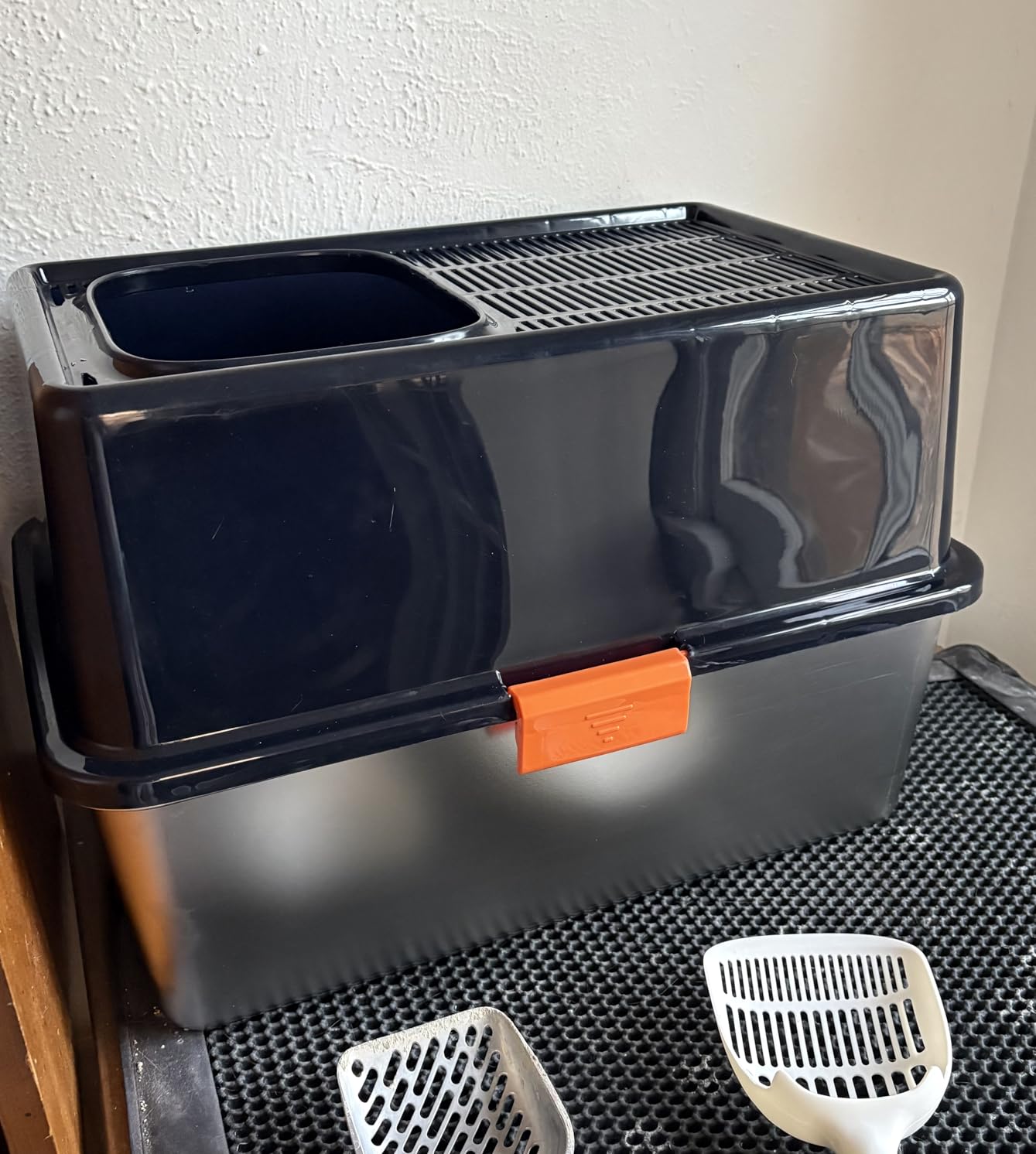
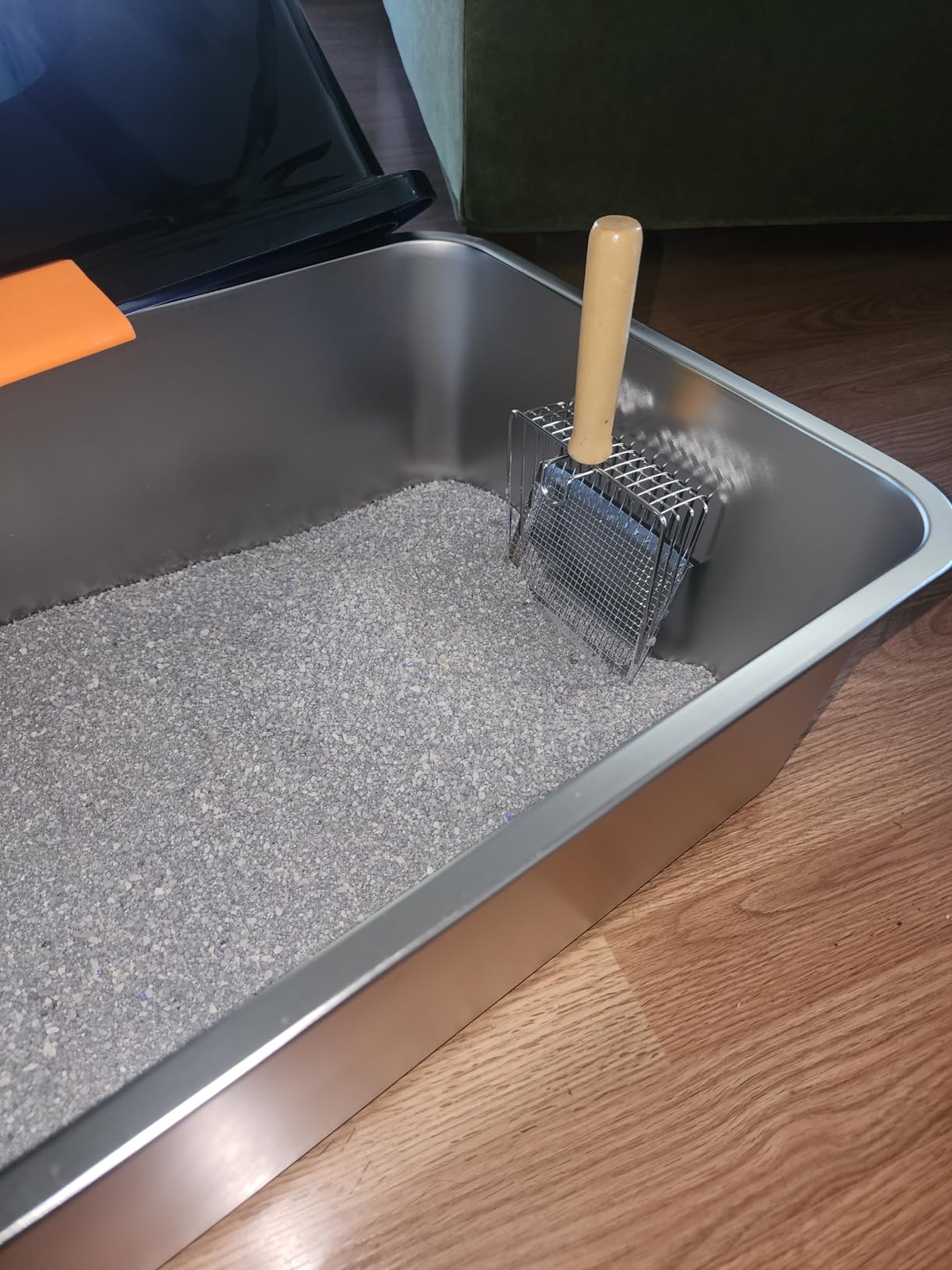
The included scoop is a genuine heavy duty metal scoop, which pairs well with a steel box. Metal scoops do not flex or crack the way thin plastic ones do, and they are easy to rinse. Steel does not rust, does not stain, and does not hold odor in the way scratched plastic eventually does.
Two things temper our recommendation. The listing describes it as ideal for cats under 12 pounds despite the XL sizing, so treat the interior as generous rather than confirmed oversized. And with 73 ratings, the long-term durability picture is thinner than the options with tens of thousands of reviews.
What we checked during daily use
Wall height was the deciding factor in testing. With the box placed against a wall, no liquid escaped despite a cat that pees standing up, and the overlap between pan and enclosure held a seal through repeated changeovers. The buckle kept the lid seated through every jump.
Tracking performance was solid, with litter returning through the slots instead of landing on the floor. The steel surface cleans quickly with a damp cloth, and the 8 inch depth means a scoopful goes a long way before the litter level drops.
Who should skip it
Skip it if you want a proven long-term track record, because the review base is small compared to the plastic options. Buyers who need certainty that a part will be replaceable in three years are better served with a box that has thousands of ratings behind it.
It is also overkill for a small cat and a small space. At 24 by 16 inches it needs room to sit, and a cat under about 10 pounds does not need 8 inch walls. The value of this design is entirely about height and material, and only cats that spray benefit from both.
10. Kettnjoy Stainless Steel Top-Entry Litter Box: Best for Very Large Cats
- Highest rated in the group at 4.8 stars
- Wipes clean with no scrubbing
- 65L capacity suits multi-cat homes
- Lid snaps on and resists kicking off
- Suits cats up to 20 lb
- Only 70 ratings so far
- 9 inch opening can feel tight for the largest cats
This is the highest rated box in the roundup, with a 4.8 average across buyers. The rating reflects a design that does the simple things very well: a smooth stainless surface that never absorbs odor, and a 65 liter total enclosure that gives a big cat room to sprawl.
The 25 liter pan lifts out for cleaning, so a full change takes one trip rather than a series of scoops. A 15 inch tall enclosure with an overlap design keeps urine inside, and the lid snaps into place rather than resting loosely, so a jumping cat cannot knock it off. Ridges on the lid catch paw litter.
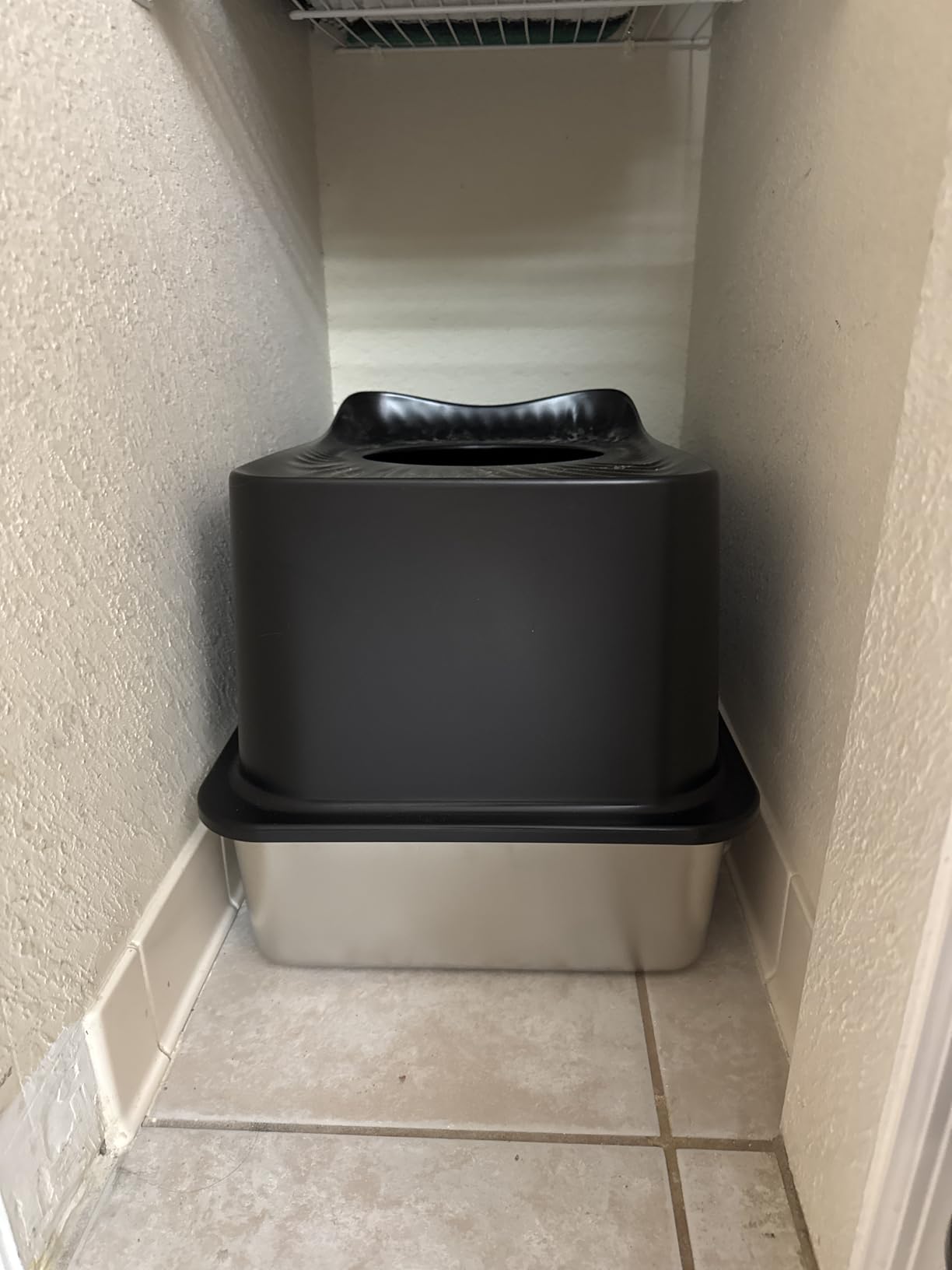
The manufacturer states suitability up to a 20 pound cat, and the capacity backs that up. At roughly 35 days of use for one cat, this is the box we would pick for a two-cat household that hates refilling, though the footprint is large enough that you need to plan where it goes.
One reviewer found the 9 inch top opening too narrow and widened it, which is a fair warning for the biggest cats. A 20 pound cat may fit inside comfortably and still find the climb in awkward. Sitting a standard open pan nearby for a few weeks covers that gap.
What we checked during daily use
The steel pan is the reason cleanup is fast. We wiped it with a damp cloth, rinsed the corners, and had it back in service in a couple of minutes. No odor lingered between changeovers, which is not something we could say about every plastic box in this roundup.
Floor scatter was low with the ridges doing their job, and the snapping lid stayed seated through repeated jumps. The included scoop has a hook for hanging nearby, and the four non-slip pads kept the box from creeping across smooth flooring.
Who should skip it
Skip it if you need a large body of reviews to feel confident. Seventy ratings is a small sample, and the design has been available far less time than the plastic options that dominate the category. The rating is excellent, but the track record is short.
Skip it for a small cat or a small room. The 24 by 16 inch footprint claims a lot of floor space for a 9 pound cat, and you would be paying for capacity you never use. For anyone weighing self-cleaning alternatives, our automatic litter box guide covers what automation actually changes.
How to Train Your Cat to Use a Top Entry Litter Box
Most cats that reject a top entry box are not being difficult. They are responding to a change in entrance height, a new smell, and a different litter surface all at once. A staged transition fixes most refusals in about a week.
1. Put the box in the same spot as the old one. Location matters more than anything else to a cat. Moving it to a “better” corner confuses the association between the box and the bathroom routine, and many cats stop using a relocated box entirely.
2. Lift the lid off for the first three to five days. A box with no lid behaves like an open pan, so your cat gets used to the new shape and scent with nothing else to negotiate. Once it is using the box normally, add the lid.
3. Transfer a shallow layer of used litter. Scoop a couple of inches of litter straight from the old box into the new one. The smell tells your cat this spot is already a toilet, which removes the guesswork.
4. Keep the entry hole clear and visible. Do not place the box with furniture blocking the top. If your cat cannot see the opening from its usual approach route, it will walk past.
5. Never move a used box back to the old tray. That teaches your cat that two boxes means choosing, and multi-cat households end up with traffic jams. Retire the old tray once the new one is in regular use.
Owners report that transferring used litter solved the problem for many cats that had refused at first. If a cat still declines after a week, the more common reasons are a too-small entry opening, a low ceiling or a tight closet, and mobility issues rather than stubbornness.
What to Look For in a Top Entry Litter Box
Check the litter-catching surface, not just the lid. A perforated lid drops paw litter back through open holes, which is the most reliable design. A grooved or ridged surface works by catching litter in the channels and letting it fall in stages. A merely textured lid, the kind molded with a rough finish, does less: it helps some, but litter still slides off onto the floor. This is the single difference that separates the boxes in our roundup from the cheap ones, and it is why a textured lid alone did not fully solve tracking in our tests.
Match the entry opening to your cat, not the other way around. Measure your cat from shoulder to base of tail and add a few inches of clearance. As a rough guide, kittens under 5 pounds do best on open pans, cats from 5 to 12 pounds want an opening at least 9 inches wide, cats from 13 to 20 pounds want 10 inches or more plus room to turn, and cats over 20 pounds need an XL interior. Senior or arthritic cats need a lower opening or a ramp, which means a convertible box like the Modkat XL rather than a fixed top entry.
Look for height if your cat sprays. A cat that stands to pee needs 8 inch walls or more. Below that, urine lands in the litter and the surrounding floor anyway, and no lid design fixes a spray that goes over the rim. Push the box flush against a wall so the side gap that encourages spraying is gone.
Decide how much odor control you need from the box. Plastic boxes with an antimicrobial treatment slow odor between scoops. Boxes with a replaceable carbon filter or a sealed lid do more. Nothing replaces scooping once a day, but height and enclosure slow how fast odor builds in the first place.
Think about the base. A seamless base with no corner seams stops leaks and stops litter escaping through gaps. Boxes built from several panels leak more often, especially during a full change when you are tipping the whole thing.
Count the running costs before buying. Boxes with custom-fit reusable liners add a small recurring cost as those liners wear out. Boxes that need a specific branded filter add another. Standard heavy duty liners and a scoop are the cheapest long-term setup. Budget for a replacement liner every few months if you want the seamless base, and buy a second one at the start so a wash and dry cycle does not leave you without.
Check the litter compatibility. Fine-grain clumping litter passes through a perforated lid cleanly. Very lightweight or non-clumping litter can blow or fall through and end up under the box, which is why owners of perforated models often report more litter beneath the pan. Pellet and crystal litters stay put but are heavier to scoop.
Consider whether you have a dog. Top entry helps on its own, since the opening is off the floor, but a lockable mode closes the gap entirely. That is worth paying for in a house where the dog treats the litter box as an indoor snack counter.
Why Some Cats Refuse Top Entry Boxes, and What Actually Fixes It
Security is the biggest reason. An open pan gives a cat a clear view of the room in every direction. A top entry box asks a cat to drop into an enclosed space head first, which feels like entering a trap, and a cat that feels trapped will use the floor next to the box instead.
The fix is to remove the lid first. A lidless box is just an open pan with high sides, so your cat can look over the rim while still getting used to the new location and smell. Add the lid once the litter is being used reliably.
A second reason is odor concentration. A covered box traps smell in a smaller volume, and a cat with a sensitive nose may avoid it. Scooping once or twice a day rather than every other day fixes this, and adding a box in an open rather than enclosed room helps too. Cats do not need the box to be as ventilated as an open pan; they need it emptied before odor builds.
Third is mobility. Jumping up and out takes hip and shoulder strength, so a senior cat, an overweight cat, or one with arthritis will simply decline. There is no training fix for this. Use a convertible box in front entry mode, or provide a lower box alongside it.
Finally, some cats learn that the lid is an obstacle and jump the entire box rather than going through the hole. That defeats the tracking benefit completely, and it is more common with wide, low boxes. A taller enclosure makes the jump less appealing, since going over the top takes more effort than going through the door.
Reddit owners describe a version of this repeatedly: they transfer used litter, keep the box in the same spot, remove the lid, and the cat still will not go in. In those cases the answer is usually the entry opening rather than the transition. A 7 inch hole that a 16 pound cat has to squeeze through will keep a cat out no matter what you put underneath it.
Frequently Asked Questions
What is the best litter box to prevent tracking?
The best litter box to prevent tracking is a top entry model with a perforated or grated lid, because litter caught on your cat’s paws falls back into the box instead of onto the floor. In our testing the IRIS USA Top Entry Cat Litter Box was the strongest all-round option, and the Modkat was the cleanest design.
What is a good litter box with a top entry lid?
A good top entry litter box needs three things: a lid that catches paw litter rather than just a smooth surface, an entry opening wide enough for your cat to pass through without squeezing, and walls tall enough to contain kicked litter. Our full list covers budget, mid-range, premium, and stainless steel options.
Do cats prefer top entry litter boxes?
There is no universal preference. Cats that track litter heavily often adapt well once they adjust, because the box feels safer than an open pan. Cats that are timid, elderly, arthritic, or simply set in their ways are the ones most likely to refuse the format entirely.
What is the best top entry litter box for large cats?
Look for an XL interior of at least 21 inches of length and an entry opening of 10 inches or more. The Modkat XL was built for this, and its convertible top or front entry mode also works as a fallback for a cat that will not jump. Cats over 20 pounds need a stainless steel or extra deep model with tall walls.
How do you train a cat to use a top-entry litter box?
Place the new box where the old one was, remove the lid for the first few days, and transfer a layer of used litter from the old box into the new one. Once your cat is using it regularly, add the lid back. Keep the entry hole clear and never move a used box back to the old tray.
The Best Top Entry Litter Box for Litter Tracking in 2026
The best top entry litter box for litter tracking in 2026 is the IRIS USA Top Entry Cat Litter Box. Its textured lid cut our floor scatter more than any budget or mid-range box we tried, it holds the highest review count of any option here, and the footprint fits a bathroom or laundry room without rearranging the room. For a cat that sprays, the Arm & Hammer box adds the deepest tub and an antimicrobial surface. For a 20 pound cat, the Modkat XL gives the room to turn around, and the stainless models handle odor and scratching better than plastic ever will.
The single most common mistake is buying on appearance and finding out your cat will not go in. Measure your cat, check the entry opening, and run the lid-off transition for the first few days. Start with the IRIS if you want the safest bet, then upgrade only if your household needs something bigger or a different material.