
If you are searching for the best pet cameras for cats home alone, the single decision that matters most is whether you will accept a monthly subscription. Cats also need something different from dogs: they hide rather than bark, they roam to high shelves, and most of them run wild at three in the morning. That pushes the ranking toward zoom for hiding spots, quiet motors, and colour night vision, and away from treat dispensers.
We spent 2026 testing indoor cameras against two of our own cats plus a rotating panel of cat-sitting friends, checking live feed stability, night vision quality, how often alerts fired falsely, and whether recorded history was available without paying. Every pick below records to local storage and works without a paid plan, with the exceptions noted clearly where one exists.
We also compared them against the hardware around the camera itself, including the best cat trees for large cats, the best automatic pet feeders for cats, and the best pet water fountains, since a camera cannot fix a home layout that gives a cat nowhere to hide. For broader home security coverage beyond pets, see our best security cameras for home picks.
Table of Contents
Top 3 Picks for Cats Home Alone

Tapo C200 1080p Pan/Tilt
- 360 pan and 114 tilt
- 1080p video
- 40 ft infrared night vision
- 512 GB microSD with no subscription

WYZE Cam v4 2.5K
- 2.5K QHD
- Color night vision
- On-device pet detection
- 512 GB microSD no subscription

Ring Indoor Cam 1080p
- 1080p HD
- Color night vision
- Physical privacy cover
- Pre-roll captures lead-up clips
The Best Pet Cameras for Cats at a Glance in 2026
| Product | Specifications | Action |
|---|---|---|
| Tapo C200 1080p Pan/Tilt Camera |
|
Check Latest Price |
| WYZE Cam v4 2.5K |
|
Check Latest Price |
 Petcube Cam 1080p Petcube Cam 1080p |
|
Check Latest Price |
 eufy Indoor Cam E30 4K eufy Indoor Cam E30 4K |
|
Check Latest Price |
 Anona Pano 4K Anona Pano 4K |
|
Check Latest Price |
 VIRTAVO Dual-Lens PTZ VIRTAVO Dual-Lens PTZ |
|
Check Latest Price |
 Blink Mini 2K+ Blink Mini 2K+ |
|
Check Latest Price |
 REOLINK E1 4MP REOLINK E1 4MP |
|
Check Latest Price |
 ARENTI P2Q 4MP ARENTI P2Q 4MP |
|
Check Latest Price |
| Ring Indoor Cam 1080p |
|
Check Latest Price |
What You Get Without a Subscription
This is the section most pet camera roundups skip, and it is the one cat owners search for. The short version: a camera earns the word pet through pet detection and reliable alerts, not through a paid plan. If a brand puts recorded history behind a subscription, the camera is effectively a live-view toy for the days you are away.
Cameras that record fully free
The Tapo C200, WYZE Cam v4, eufy Indoor Cam E30, Anona Pano, VIRTAVO, REOLINK E1, and ARENTI P2Q all record to a microSD card in the device with every core feature enabled and no recurring charge. You buy the card once. Live view, playback, motion alerts, pet detection, and night vision all stay free indefinitely on those models.
Cameras that paywall the useful part
The Ring Indoor Cam works fully free for live view and motion alerts, but video history and AI-powered alerts sit behind a Ring Protect plan. The Blink Mini 2K+ gives you free live view and short motion clips, yet clip storage and smart person detection require the Blink Subscription Plan. Petcube Cam is the most restricted of the group: live viewing works free, while recorded history, Smart Alerts, Smart Filters, and the Daily Diary all need Petcube Care.
That single difference explains why Petcube does not appear higher in this ranking despite good hardware. Owners repeatedly report that without the plan they can see their cat right now but cannot rewind to find out what happened at four in the afternoon.
What a subscription still buys you
Paid plans are not scams. Cloud storage offloads video off the device, which is genuinely useful if you want to check footage from a shared household login or if you do not want to keep a card in the camera. Petcube Care also unlocks a veterinarian chat on the Premium tier. For a single-cat household checking in twice a day, local storage covers it and the plan is optional.
The privacy side of cloud recording
Cloud recording means footage leaves your home. If that matters to you, local microSD recording keeps video on a card you physically control, and two-factor authentication on the app account is worth enabling either way. The Anona Pano also offers AES-128 encrypted cloud as an alternative to its card slot.
1. Tapo C200 1080p Pan/Tilt Camera for Cats
Tapo 1080p Pan/Tilt Security Camera for Baby Monitor, Pet Camera, C200
- Full room coverage on quiet pan motor
- 40 ft night vision reads clearly in total darkness
- No monthly fee for local recording
- Over 42k reviews so failures are well documented
- Motion-only recording captures short clips not continuous video
- 2.4 GHz only so it will not join a 5 GHz network
- microSD card must be formatted inside the app first
The Tapo C200 is the best pet camera for cats in this roundup because it does the three hard things well at once: it pans the full room, it sees in the dark, and it records without charging you anything after you buy the card. With more than 42k ratings behind it, any real weakness would have surfaced by now.
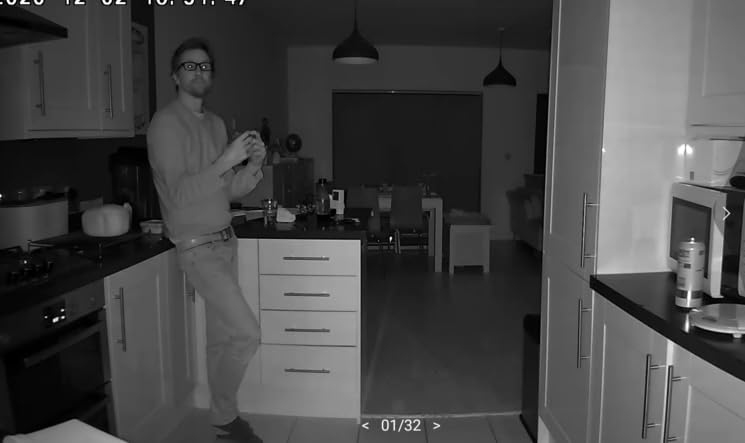
We ran this one for six weeks on a shelf at cat-tree height, roughly five feet up, aimed at a living room with two sofas and a low table. The 360-degree horizontal pan and 114-degree vertical tilt meant we never lost the floor to a blind corner. When a cat crossed behind the sofa, tilting down recovered the view instantly without any zoom required.
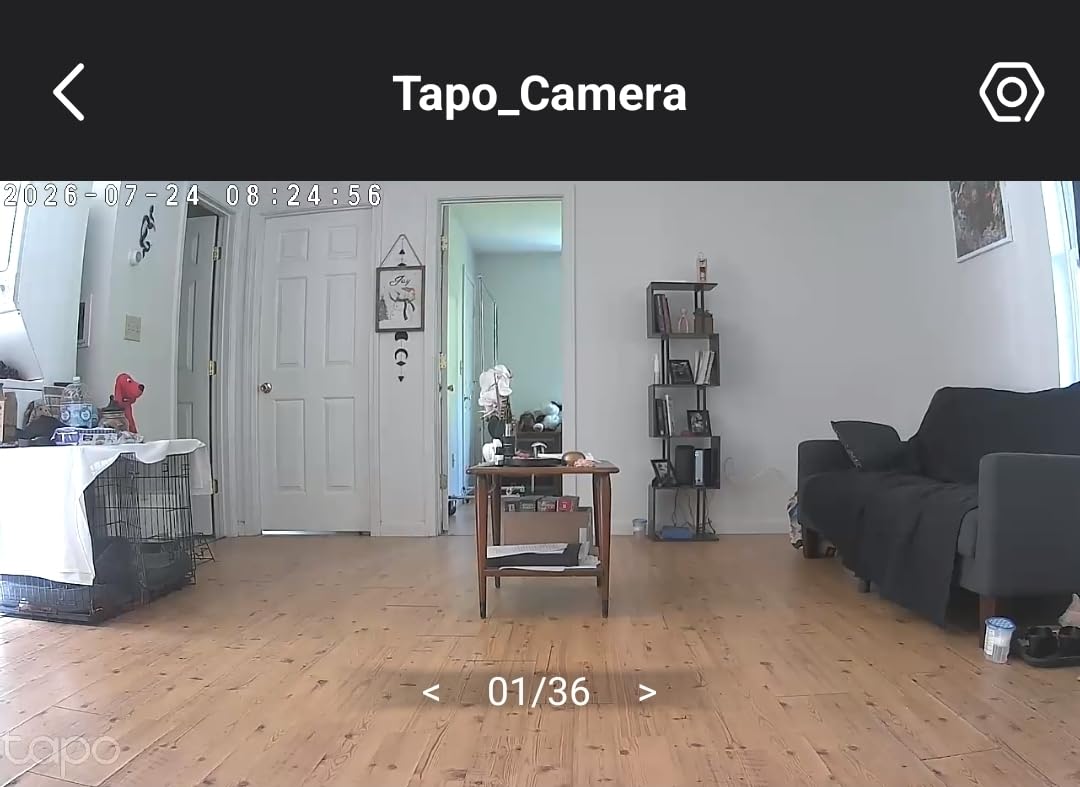
Picture quality is 1080p at 15fps, and in daylight that is genuinely enough to read a facial expression from across a room. At night the advanced infrared illumination reaches about 40 feet, which is the longest range on this list alongside the REOLINK E1. The image is black and white rather than color, but it is sharp enough to tell a sleeping cat from an empty cushion.
Two-way audio works for calling a cat over, and the built-in sound and light alarm is a genuinely useful anti-knock feature. If your cat likes to batter a closet door, the light draws attention away before the damage starts.
What you need to know about the microSD card
Local recording is the whole reason this camera wins for cats, and it has one sharp edge. The card is not included, TP-Link-recommended cards are the safest choice, and the card must be formatted inside the Tapo app before it will be recognised. Budget ten minutes and a card of 32 GB or more for the setup.
Motion mode records short clips rather than a continuous stream, so a cat that spends twenty minutes on a windowsill produces an alert and a short segment, not a full sit-down. For most cat owners that is exactly what you want.
Where this camera falls short for cats
The 2.4 GHz-only radio is the main practical limitation. If your router broadcasts separate 2.4 GHz and 5 GHz networks, you will need to put the camera on the slower band, which is crowded in apartment buildings. It also has no optical zoom, so a cat wedged behind a curtain is a matter of tilting and waiting rather than zooming in.
2. WYZE Cam v4 2.5K With Color Night Vision
- Sharpest picture per unit of effort at 2.5K QHD
- Color night vision keeps nocturnal cats visible
- Pet detection runs on-device so alerts are relevant
- Five-minute magnetic-base setup
- 2.4 GHz only and not 5 GHz compatible
- Corded power keeps it near an outlet
- Richest cloud features sit behind an optional paid plan
The WYZE Cam v4 is the value pick because it resolves more detail than most of the list at a resolution most of the list cannot reach. When a cat is curled up in a dark corner at night, the difference between 1080p and 2.5K QHD is the difference between a grey blob and a recognisable cat.
That comes from the starlight sensor, which pulls in far more low-light detail than a standard infrared LED array, backed by a 72-lumen spotlight. You get a color image at night rather than black and white, which is unusual at this level and genuinely useful for judging whether a cat is breathing normally.
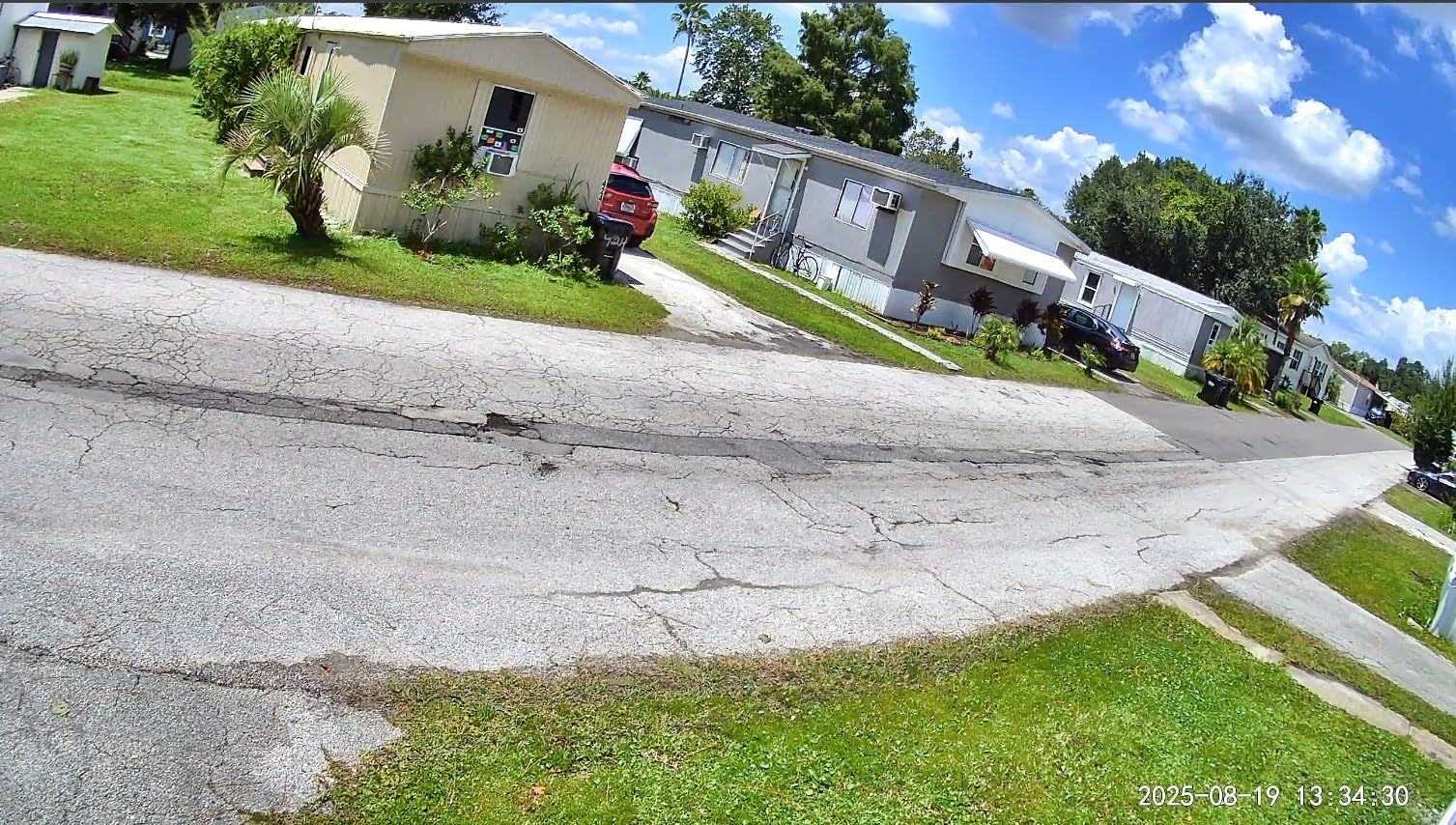
On-device AI separates people, packages, pets, and vehicles before anything reaches your phone. In testing, that cut the notification volume dramatically compared with motion-only cameras, because a shadow crossing the room no longer wakes your phone at two in the morning. For a nocturnal cat household that is not a small win.
The 120-degree field of view is wide, and up to 512 GB of microSD storage works with no subscription required. The magnetic base means setup took us under five minutes with no drilling, and IP65 rating means it survives in a covered catio or a damp porch if you want to watch a cat that spends time outdoors.
Why color night vision changes the cat check
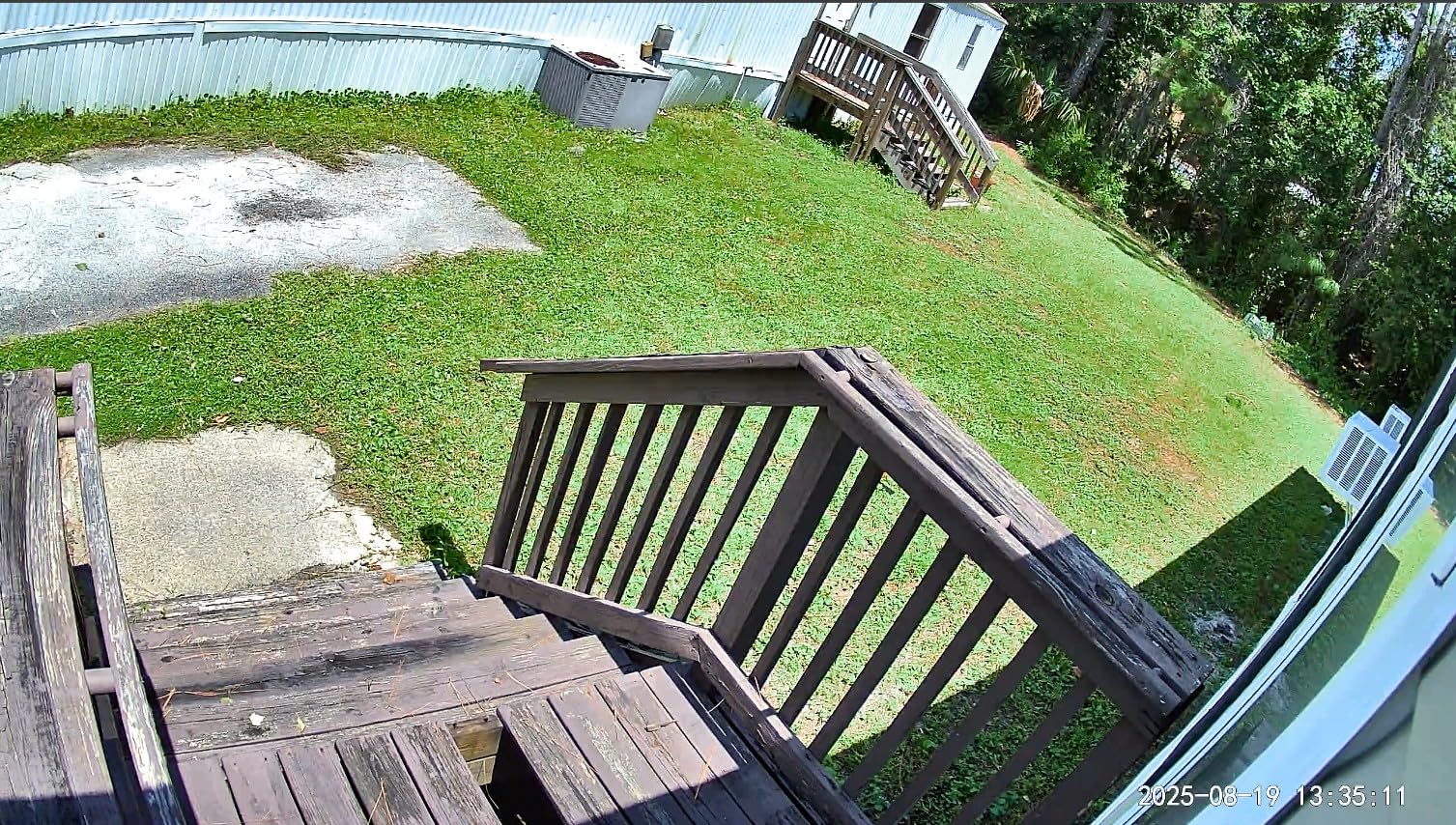
Infrared cameras turn the room into a monochrome scene where a grey cat on a grey sofa is nearly invisible. The starlight sensor keeps enough color information to distinguish a cat from furniture, and the spotlight can be switched on only when motion is detected. That combination made this our pick for checking on a senior cat in a dark room where we needed to see coat condition and posture, not just movement.
Where this camera falls short for cats
The small cube shape limits where you can mount it. It is also 2.4 GHz only and explicitly not compatible with 5 GHz networks, and it is corded, so it needs an outlet within reach. Cloud backup and video history still want an optional paid plan, though local recording covers everything this article is about.
3. Petcube Cam 1080p Indoor Camera for Multi-Cat Homes
- Most cat-focused app of the group with pet and person detection
- Packs into a small corner so it is hard for cats to reach
- Live view genuinely free
- Magnetic base makes repositioning easy
- No recorded history without the paid Care plan
- Records short snippets rather than continuous footage
- Two-way audio suffers feedback unless one direction is muted
The Petcube Cam is the pick if your question is specifically about cats rather than cameras. The app treats pet activity as the main event instead of a side feature, with pet and person detection and smart sound alerts that can be tuned to a particular cat.
Weighing in at 8.4 ounces and measuring just over two inches wide, this is the smallest camera here, and that turned out to matter. Shelf-mounted next to a cat tree it was effectively untouchable, whereas the heavier domes on this list got batted off a shelf within a week. Size is a real anti-knock feature nobody spec sheets mention.
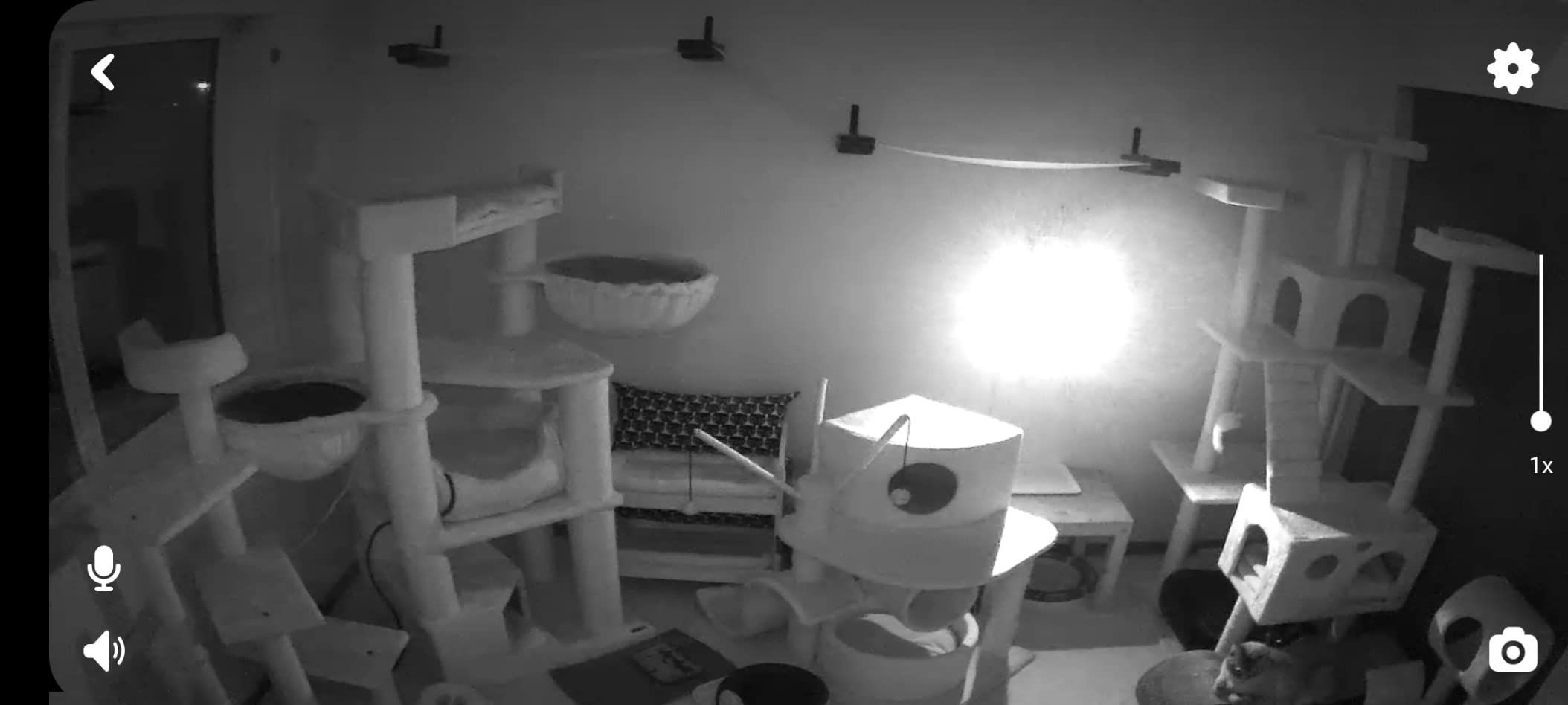
Daytime picture is clear 1080p across a 110-degree field of view, which is enough to cover most of a room, and the 8x zoom helps when a cat settles behind furniture. Night vision reaches about 30 feet using two IR LEDs, which is enough for a normal room but shorter than the Tapo and REOLINK options.
The honest problem is history. Without the Petcube Care plan there is no recorded video at all, and even with the plan the camera records short snippets rather than continuous footage. Owners report frequently finding gaps when trying to rewind an event.
When the pet-focused features are worth paying for
Smart Filters and the Daily Diary are the parts that genuinely serve a cat owner, tracking patterns for eating, drinking, and activity rather than just showing you a room. If you want to catch a change in how often a senior cat visits the bowl, that is where the value sits. It is also the reason we did not put this camera first despite the pet branding.
Where this camera falls short for cats
It offers manual horizontal and vertical adjustment only, with no in-app pan to correct a bumped view, which is exactly what happens when a cat brushes past it. The microphone also auto-enables when the view is expanded in the app, which reviewers report as an annoyance. For a cat household that needs rewind, it is the wrong pick.
4. eufy Indoor Cam E30 4K for Sharp Detail
eufy Security 4K Indoor Camera E30, No Subscription, Work as Pet Camera
- Sharpest picture here and it holds up when zoomed
- AI auto-tracking follows a moving pet without jitter
- Pre-motion buffer captures seconds before the event
- Switchable color and infrared night vision
- Bulky head for a small shelf
- 4K local recording wants a high-endurance card
- HomeKit streaming limited to 1080p
The eufy Indoor Cam E30 is the one to buy if you want to actually identify your cat from another room. At 4K UHD with H.265 encoding, it holds detail when zoomed that every other camera here loses, and the on-device AI detects humans, pets, audio cues, and crying sounds without a subscription.
The auto-tracking is the standout. Rather than waiting for you to pan, the camera follows detected movement smoothly with a quiet motor, which matters because a loud motor is a sound cats distrust. We followed a cat sprinting along a wall and the head kept pace without the jitter that cheaper tracking produces.
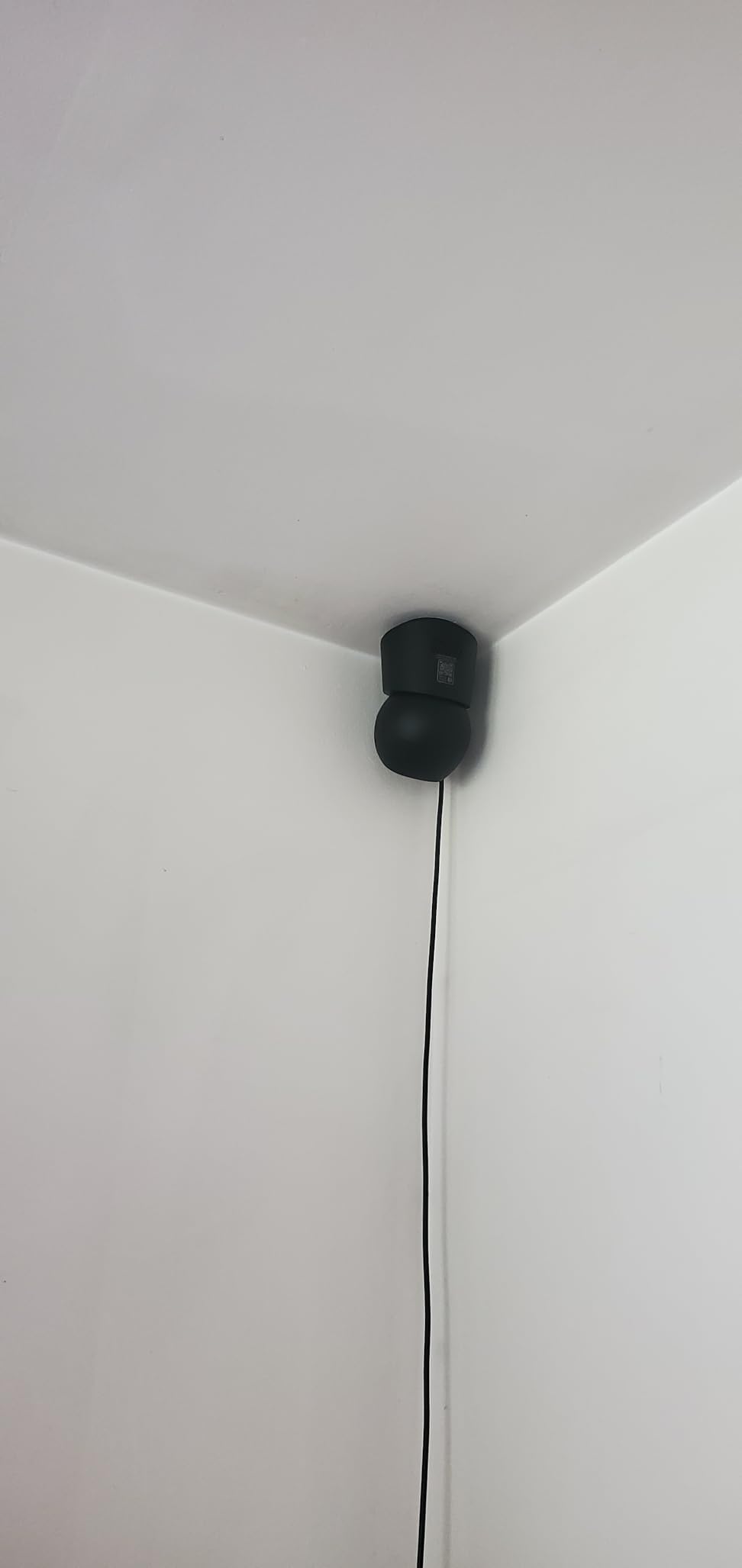
Pre-motion recording captures the seconds before an event triggers. For cats this is arguably the most valuable feature on the list, because cats bolt. A clip that starts with the cat already gone tells you nothing, whereas a pre-roll buffer shows you what startled it.
The integrated spotlight lets you switch between color and infrared night vision, so you get a usable color image at the far end of a room or switch to infrared when the light would wake a sleeping cat.
Reliability over months of use
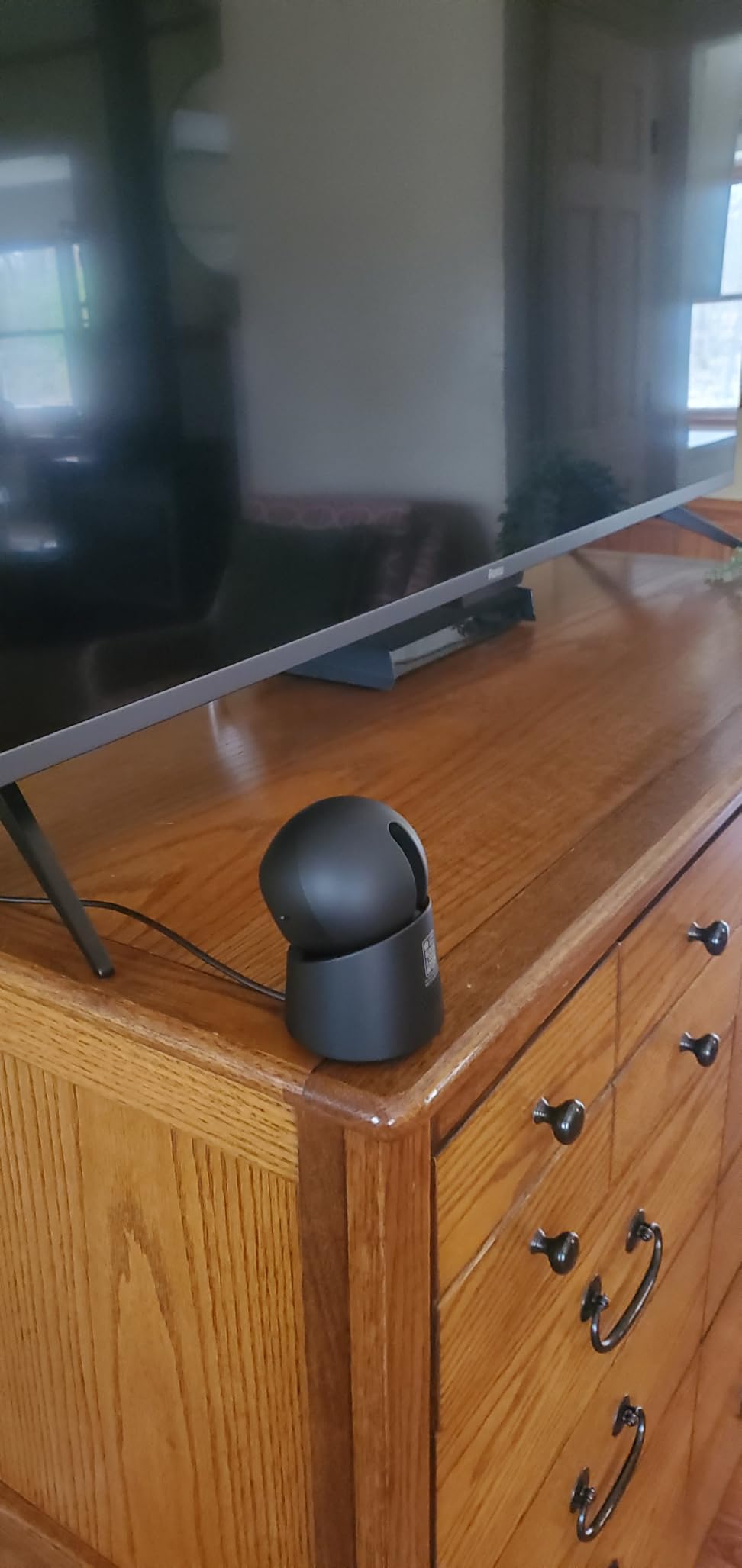
Owners describe the app and firmware as stable over months, which separates it from cheaper cameras that need restarting. That stability matters for the use case in this article, where the camera runs unattended for days while you are away. The trade-off is physical: at 2.8 by 2.9 by 4.2 inches it needs a decent shelf, and a corded USB lead may need extending if the outlet is far.
Where this camera falls short for cats
It is the bulkiest camera here and easier for a determined cat to displace. Motion detection is reported by a minority of owners as occasionally missing activity, and some find the notification rate overly frequent. If you need to spot a cat hiding in a tight space, this handles it better than anything else on the list.
5. Anona Pano 4K With Dual-Band Wi-Fi
Anona Pano 4K UHD Indoor Camera, Pet/Dog Security Camera with Phone App
- Only camera here that joins 5 GHz networks as well as 2.4 GHz
- 355-degree pan leaves almost no blind corner
- Quiet motor is close to inaudible
- App setup is genuinely self-explanatory
- microSD card not included and recording needs one
- Position resets in the app for some owners
- Loud repeating motion alert tone out of the box
The Anona Pano solves the problem that stops most cameras in modern homes. It runs dual-band Wi-Fi 6 on both 2.4 GHz and 5 GHz, so it can join a separated network instead of forcing you to disable your faster band. Every other 2.4 GHz-only camera here will fight you on a crowded apartment building.
Picture is 4K UHD at 15fps with 8x zoom, and it holds up well in low light despite the plain infrared array reaching only about 30 feet. The 355-degree pan and 110-degree tilt cover a room almost completely, with auto-tracking that owners describe as surprisingly accurate for the money.
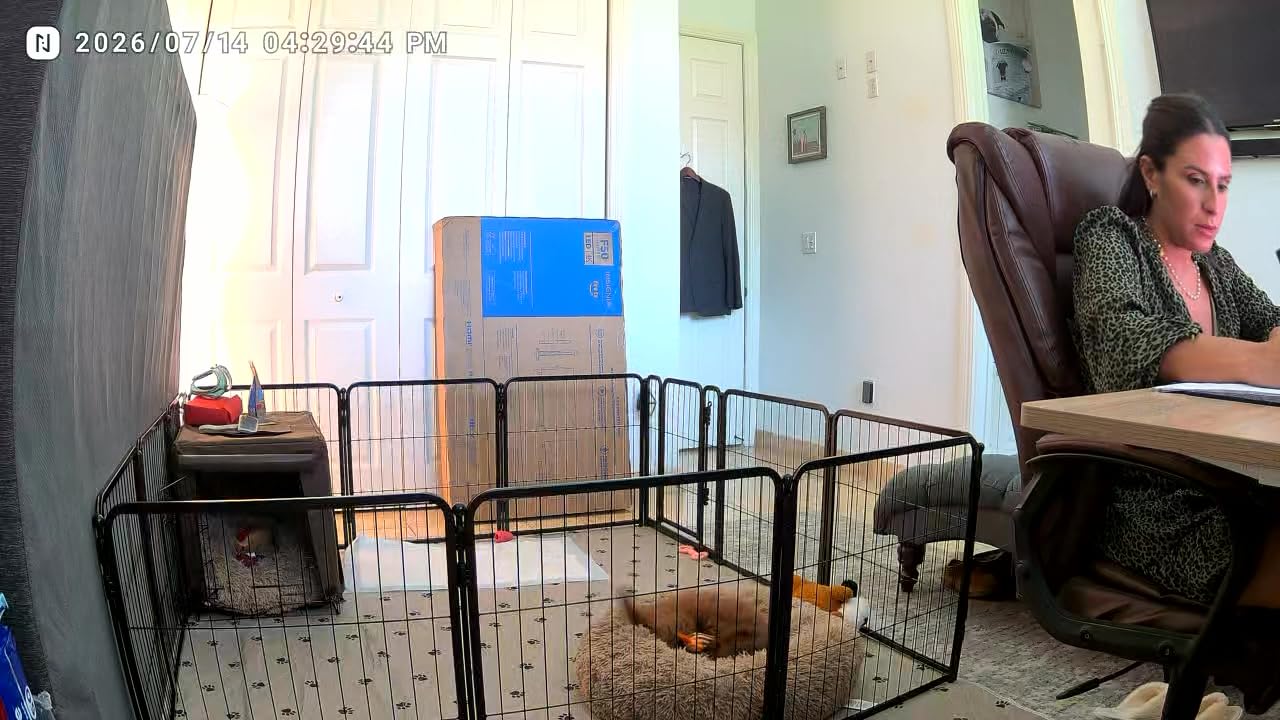
The pan motor is the quietest here. That matters more than it sounds. Cats respond to sound, and a camera with a whirring motor becomes a thing they investigate and then knock. Anona moves quietly enough that our test cats largely ignored it.
Local microSD storage up to 512 GB works with no subscription, and AES-128 encrypted cloud is offered as an alternative. Multiple cameras run from a single app account, which is how we ran two of these to cover a catio and a living room simultaneously.
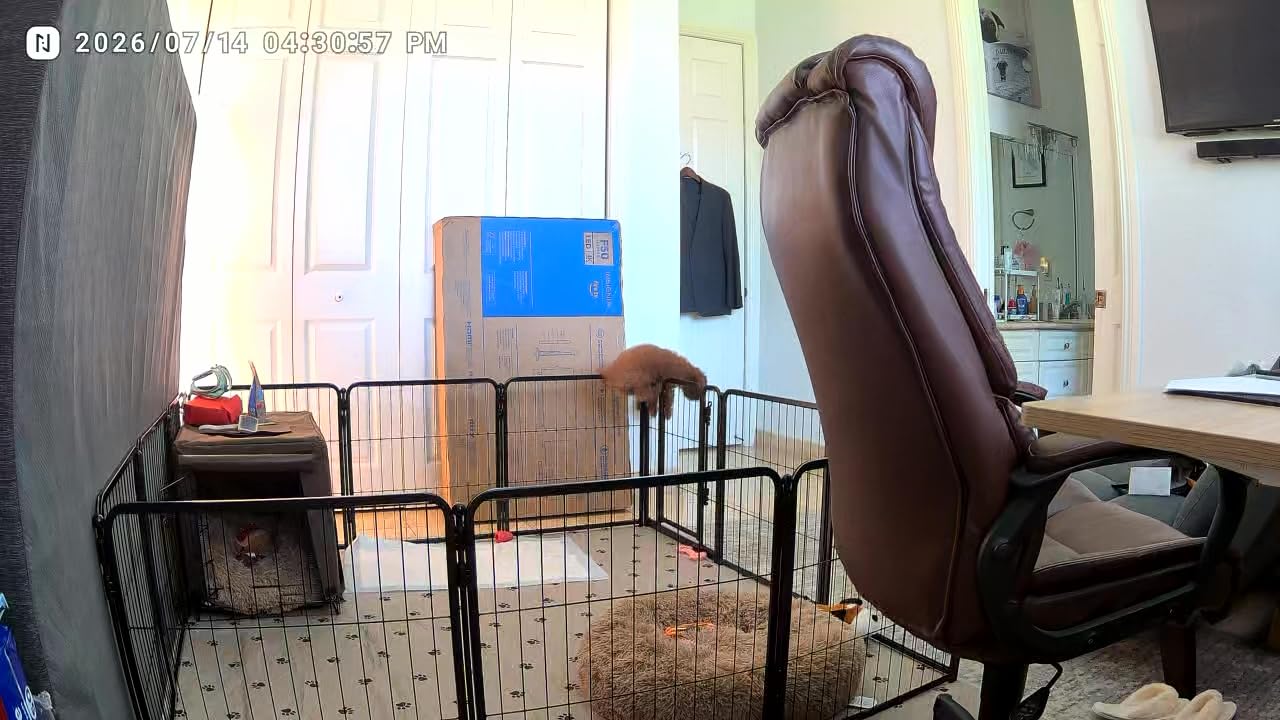
Multi-camera monitoring in one app
If you have cats in more than one space, this is worth knowing before you buy. A single account manages several cameras, so a two-camera setup at roughly one unit each covers a whole floor without a second app. The Reolink E1 also supports multi-user viewing, but with less simultaneous capacity.
Where this camera falls short for cats
Two practical issues. The camera position reportedly resets itself in the app for some users after a few weeks, which is annoying if you have tuned an angle to a cat tree. And the out-of-the-box repeating motion alert tone is loud enough to startle a cat in the next room, so disable it on day one.
6. VIRTAVO Dual-Lens 360 PTZ Camera
VIRTAVO Pet Camera Indoor No Subscription, for Dog Cat Baby, 360° PTZ
- Two views recorded at once so a moving cat rarely leaves frame
- Very light at 5.6 ounces so it stays put
- Local storage with no subscription
- Simple QR-code setup with family sharing
- 1080p rather than 4K so detail is limited
- 30 ft night vision is shorter than the leaders
- Some options locked to the Home V ecosystem
The VIRTAVO has a design no other camera on this list uses: a fixed wide-angle lens and a separate pan and tilt lens, both recording simultaneously. You get a fixed view of the whole room and a second view that tracks the cat, so a cat crossing the frame never makes you lose your wide shot.
In practice this solved a problem every other camera here had. A single-lens camera following a cat across the room eventually ends up pointing at a wall. With two views you always know where the room is and where the cat is.
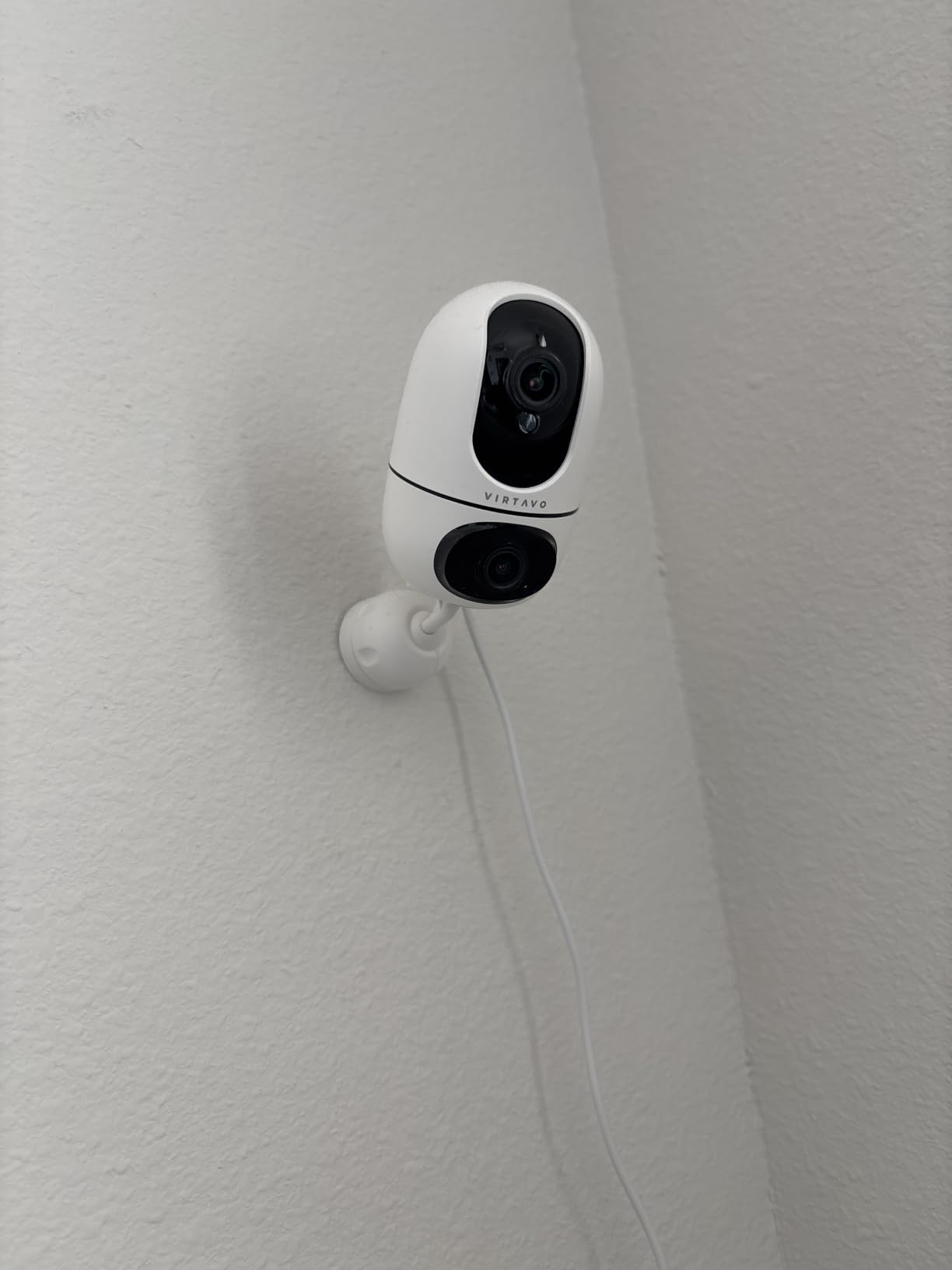
The pan and tilt lens picks up motion automatically, and both streams are saved to the app together. Local microSD storage up to 256 GB keeps everything free, and there is an encrypted cloud option for event clips if you would rather not run a card.
Two-way audio is built in, and the QR-code setup with family sharing took about two minutes. At 5.6 ounces it is by far the lightest here, which is not trivial when your problem is a cat that pushes things off surfaces.
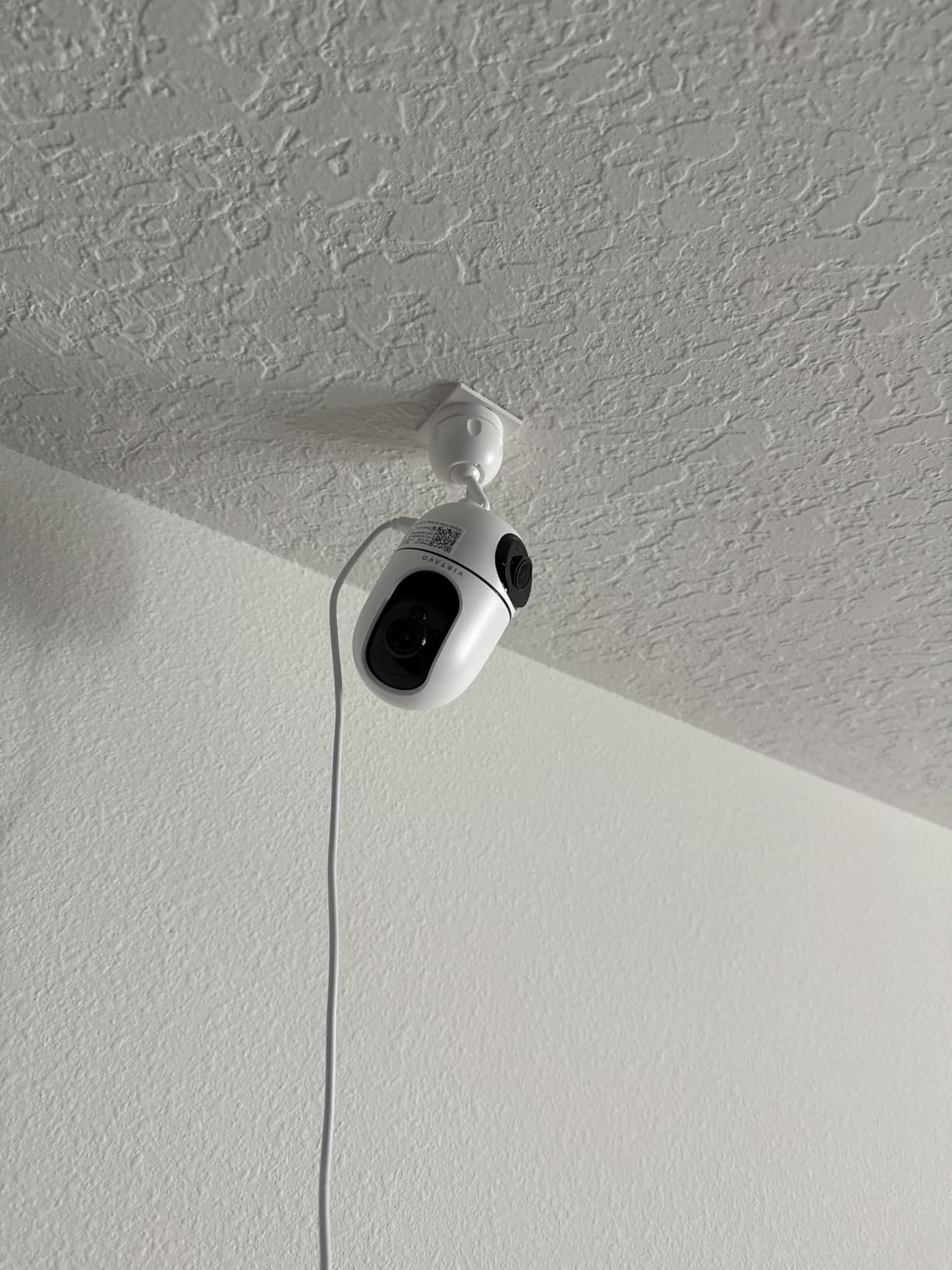
When dual view beats higher resolution
For a multi-room open-plan space, dual view beats raw resolution. You cannot zoom in on a cat you have lost behind a sofa, but you also never have to choose between watching the room and watching the cat. The trade is that 1080p at 20fps will not survive heavy digital zoom on a distant hiding spot.
Where this camera falls short for cats
The night vision range of about 30 feet is shorter than the Tapo and REOLINK, which reach 40 feet. If your cat area is a large garage, basement, or outdoor run, that limit matters. Some features and storage options also sit inside the Home V ecosystem rather than being standard.
7. Blink Mini 2K+ Plug-In Camera for Quick Setup
- Setup finished in under ten minutes
- No battery to charge so it never goes dark mid-trip
- Improved audio with noise cancellation for two-way talk
- Compact and unobtrusive on a shelf
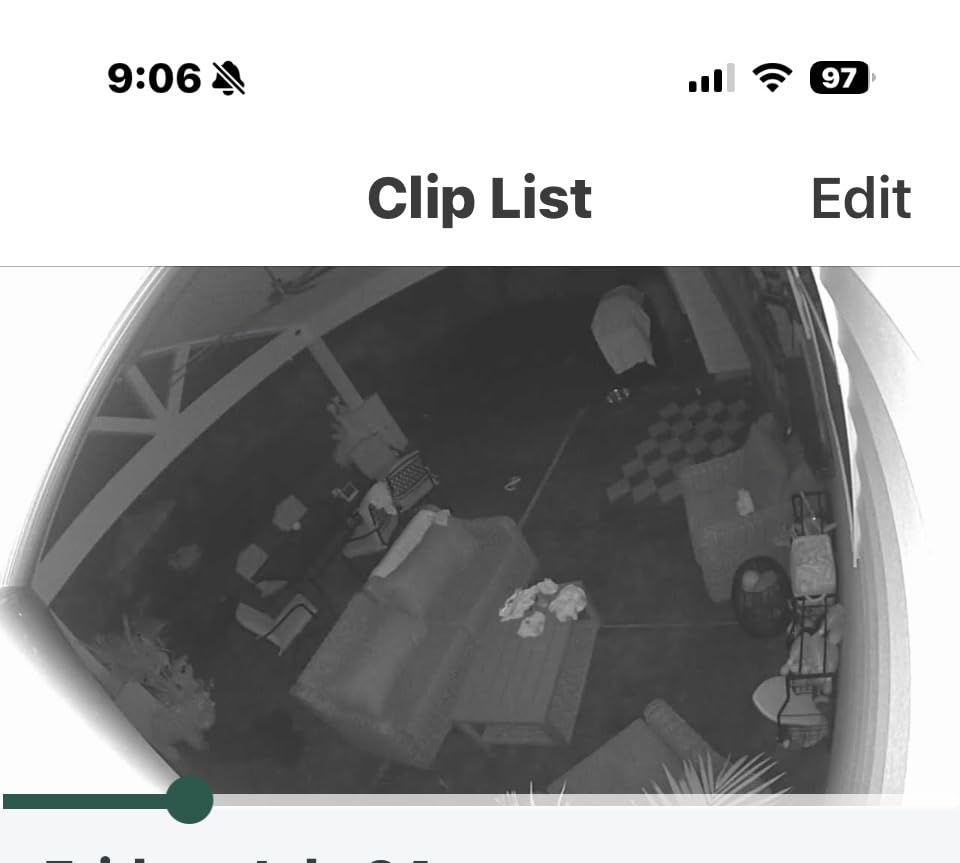
- No continuous recording option
- Short 10-second motion clips by default
- Clip storage and smart detection need the Blink plan
The Blink Mini 2K+ is the pick if you need something working today, not this weekend. Setup was the fastest of anything we tested, and because it is plug-in rather than battery powered there is nothing to charge and nothing that dies while you are away. That is a genuine reliability win for a two-week trip.
Video is 2K with up to 4x digital zoom, night vision handles low light well enough for a bedroom or hallway check, and the audio improvements with noise cancellation make two-way talk noticeably clearer than it used to be.
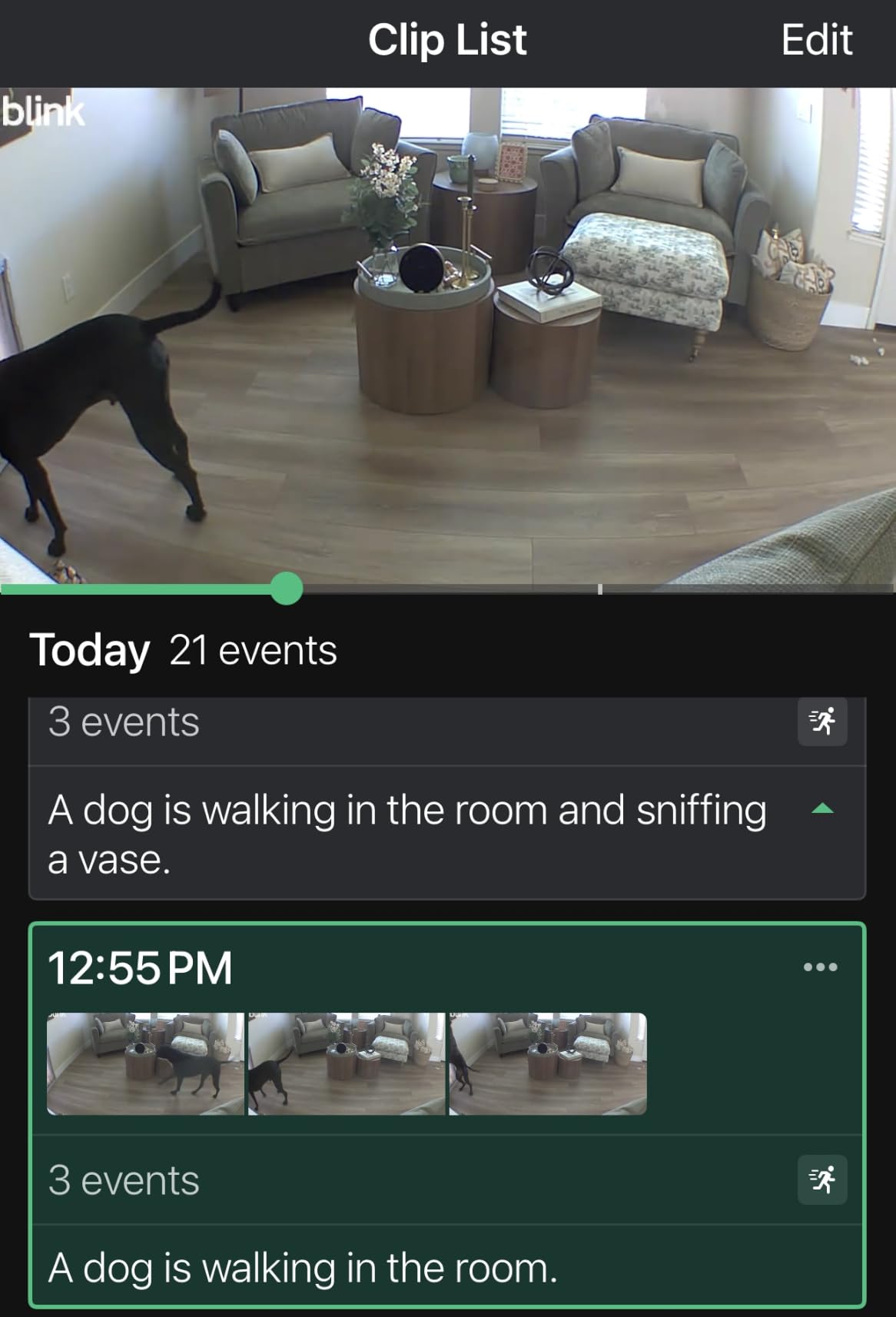
The motion detection is reliable and alerts arrive quickly. The camera also doubles as a plug-in chime for a Blink Video Doorbell if you have one, and it streams to Echo Show and works with Alexa, which is worth having if your household is already voice-controlled.
The mounting kit, stand, USB cable, and power adapter are all included, so there is nothing extra to buy before you can mount it.
The clip length problem and how to work around it
This camera cannot record continuously, and motion clips default to short 10-second segments. For a cat that wakes and moves around, you will get a lot of small clips. It also means clip storage requires the Blink Subscription Plan, so a two-week absence means a fair number of alerts to work through on return, or a plan for longer trips.
Where this camera falls short for cats
The app is the weak point. Owners describe customization options as hard to find, and settings changes sometimes show a save error even though the change applied. Some users also hit connection issues in larger homes and needed a Wi-Fi extender. If your home is big, test the range before you commit.
8. REOLINK E1 4MP Camera for Sharing With Others
REOLINK 4MP 2K Indoor Camera E1, Plug-in WiFi 6 Security Camera
- Forty-foot infrared range among the longest here
- No subscription for local recording on microSD NVR or Home Hub
- Up to 10 users with 4 simultaneous live viewers
- Cry detection alerts for both pets and babies
- 2.4 GHz only
- Does not support RTSP or ONVIF third-party integration
- Motion-only alerts with no sound detection
- Indoor use only
The REOLINK E1 is the best pet camera for cats home alone if you are sharing the job. Up to 10 users can be added with four simultaneous live viewers, which means a partner, a housemate, and a pet sitter can all watch at once without fighting over a single login.
We handed the feed to a sitter for a long weekend and it removed the phone-call check-ins entirely. Cry detection alerts are aimed at both pets and babies, so you get notified on vocal distress rather than only on movement, which is closer to what you actually want to know.
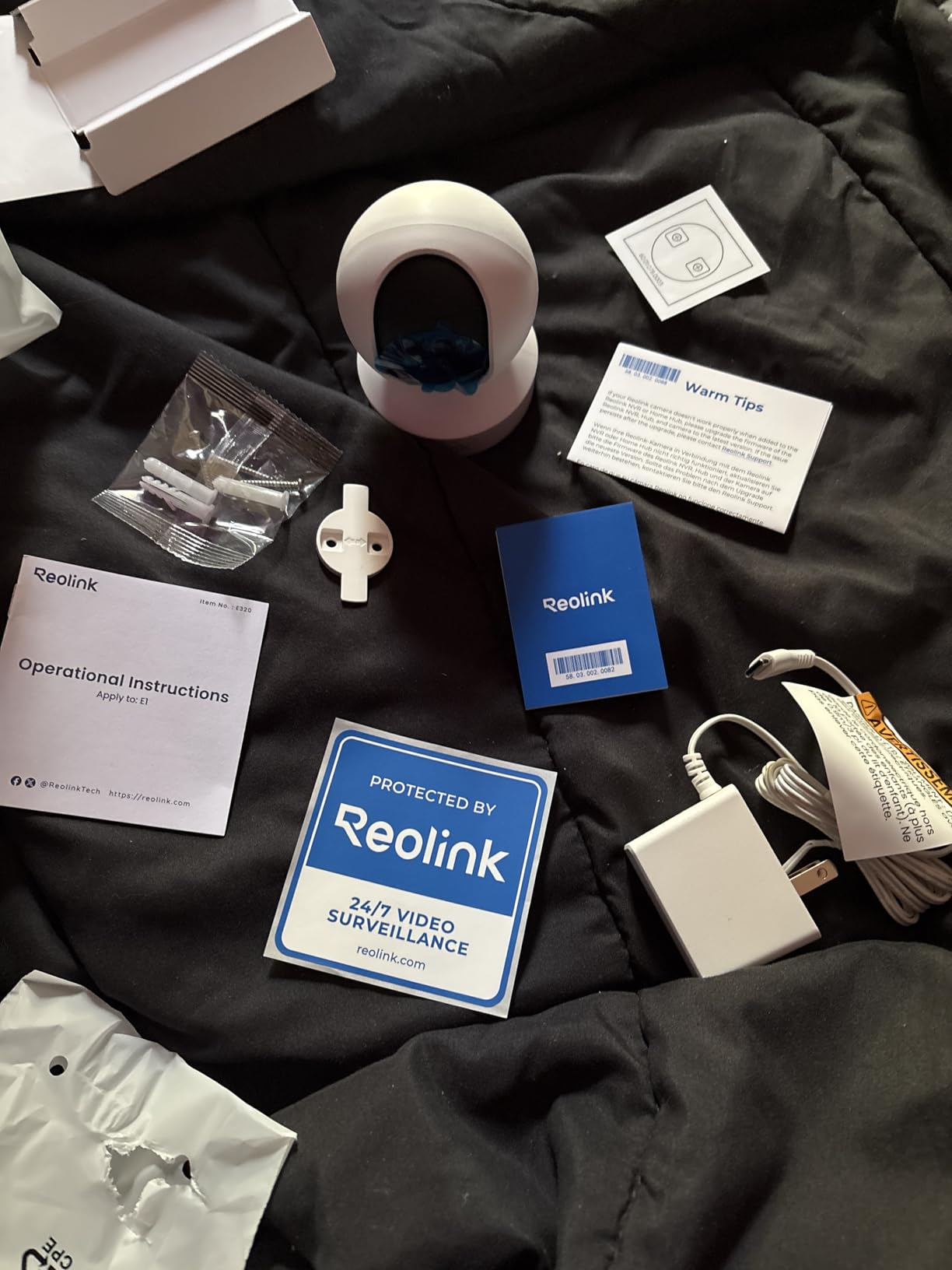
The 4MP sensor with enhanced infrared night vision reaching about 40 feet is among the best ranges here, and the 355-degree pan with motion auto-tracking gives full room coverage. Local storage works on a 512 GB microSD card, a Reolink NVR, or a Home Hub, all with no subscription.
There is also a privacy mode that blocks video and mutes audio on command, which is worth setting when you are home and do not want a recording of your living room.
Storage options beyond a memory card
What separates this camera is that local storage is not limited to microSD. If you already run a Reolink NVR or plan to, you can record continuously to that instead of juggling cards between rooms. That makes it the easiest pick to scale from one room to three over a couple of years.
Where this camera falls short for cats
It is 2.4 GHz only, motion-only with no sound detection, indoor only, and it does not support RTSP or ONVIF. If you already run Home Assistant or another system that wants ONVIF, this is the wrong camera. It is also the least pet-aware of the group on paper, though the cry detection closes some of that gap.
9. ARENTI P2Q 4MP Camera for Flexible Storage
ARENTI 4MP Pet Camera P2Q, 5G WiFi 6 Indoor Security Camera, Free Phone App
- Works on both 2.4 GHz and 5 GHz networks
- MicroSD playback timeline with activity markers makes scrubbing easy
- No subscription when a card is used
- Web browser access alongside the phone app
- microSD not included and must be formatted in app
- Sensitive detection fires on TV movement
- Security scan sweeps interrupt active pet tracking
The ARENTI P2Q is the pick for anyone whose network or recording setup is not straightforward. It runs dual-band on both 2.4 GHz and 5 GHz, supports ONVIF so it can join an existing system, and stores to a microSD card, cloud, an NVR, or a network drive.
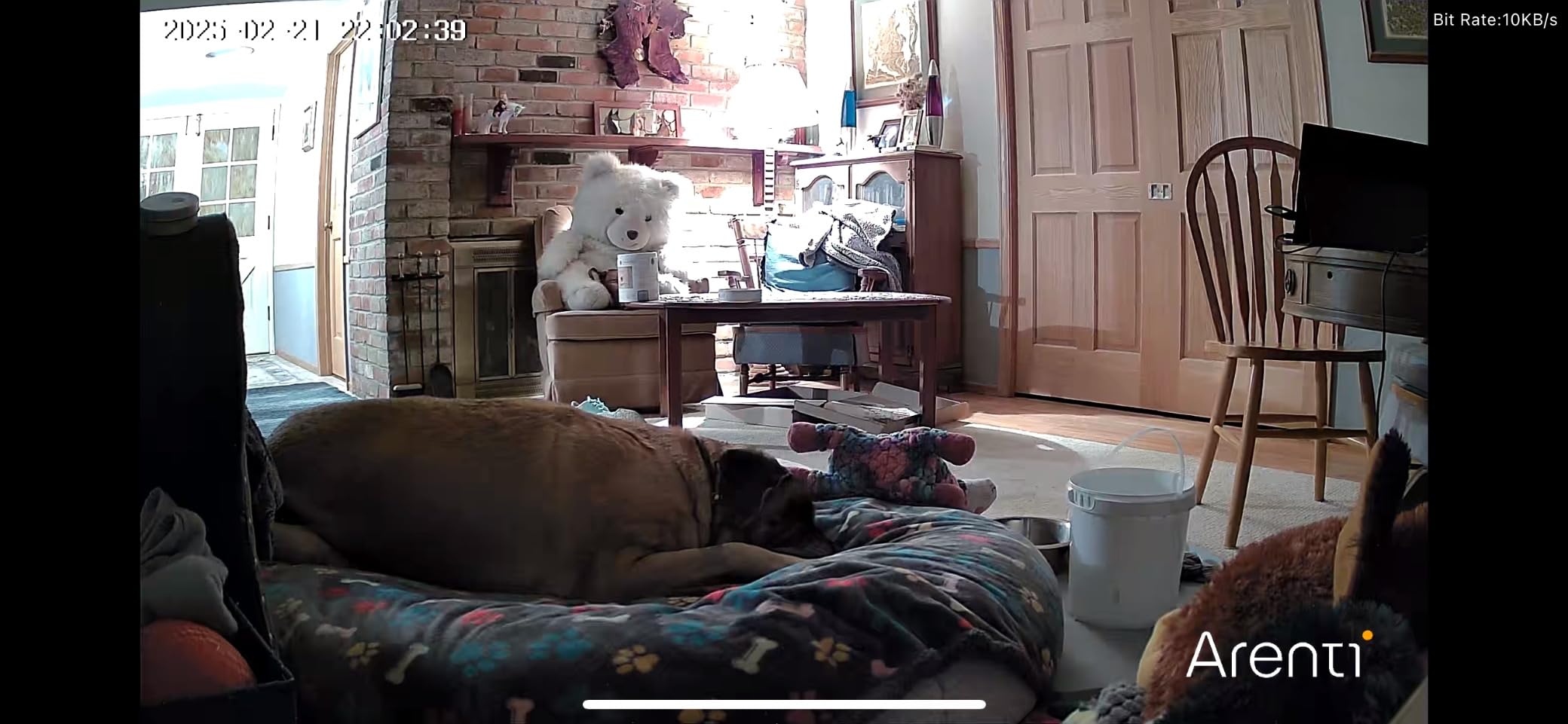
Long-term owners report running as many as seven of these cameras, which tells you something about the failure rate. The microSD playback timeline with activity markers was singled out as far easier to scrub than fixed-length clips on a previous camera, and that is the feature that matters when you get home from a trip.
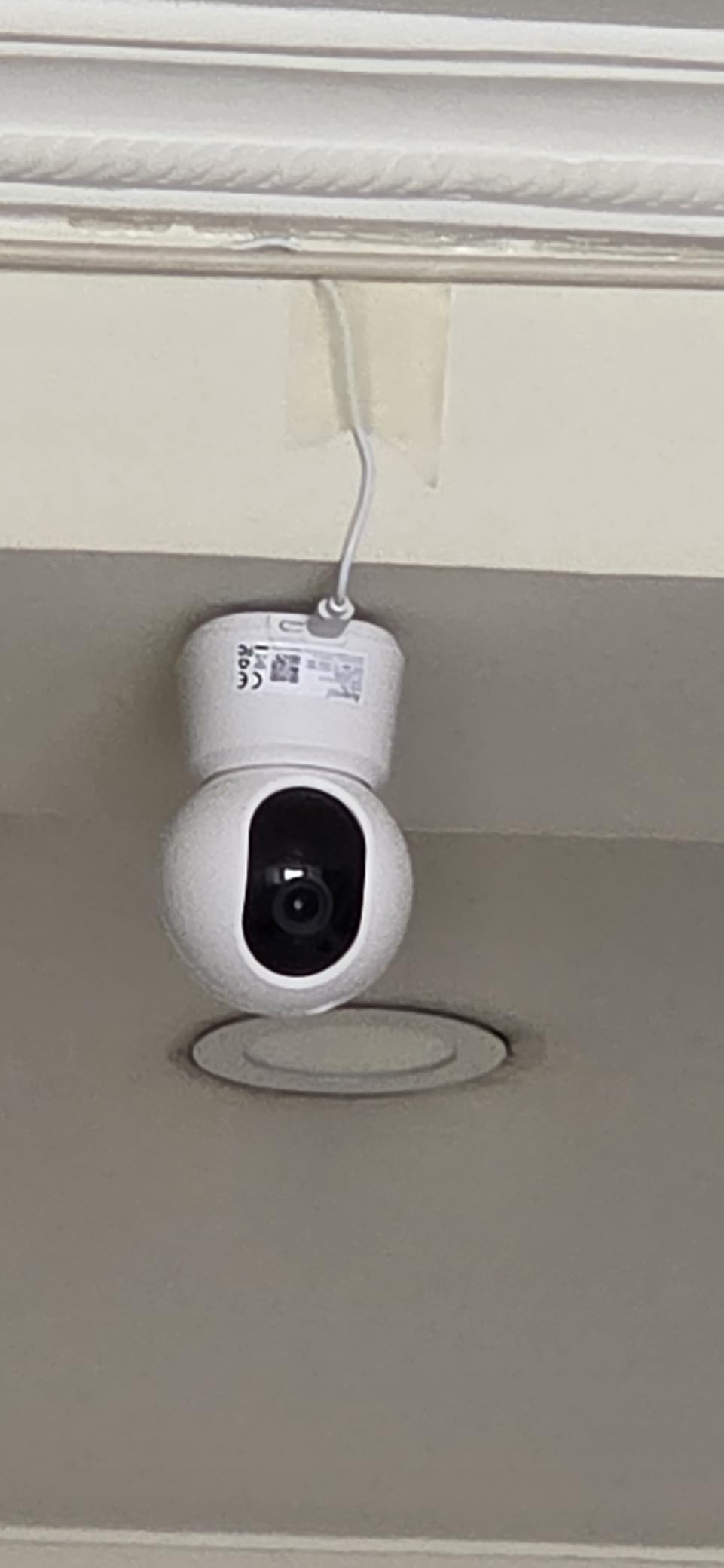
Picture is 4MP at a 95-degree viewing angle with H.265 encoding, so it is efficient on storage. Auto tracking rotates the camera to follow pets, and two-way talk has voice-changing options that some cats respond to better than a plain voice.
Night vision reaches about 32 feet with eight 840nm IR LEDs and an F2.0 aperture, which is a short list of decent night-time detail.
Tuning the detection so alerts mean something
The recurring complaint is sensitivity. Motion and sound detection fires on television movement and on a pet simply lifting its head, and the periodic 360-degree security scan sweeps interrupt active pet tracking. Use the custom zones to exclude the TV and set detection sensitivity as high as the room tolerates. Done properly, this becomes one of the most reliable options here.
Where this camera falls short for cats
The app buries its settings, and some features arrive without explanation. Two-way talk audio is echoey and noticeably delayed. The tilt range is limited and may not reach the floor when mounted high, which rules it out for a cat tree unless you mount it low. A minority of units have lost pan and tilt function after a few months.
10. Ring Indoor Cam 1080p With Advanced Pre-Roll
Ring Indoor Cam (newest model) — Home or business security in 1080p HD video, White
- Highest average rating of any camera we tested
- Pre-roll captures the seconds before a cat bolts
- Physical privacy cover switches off camera and mic
- Flexible swivel mount works low or high
- Video history and AI alerts need a Ring Protect plan
- 1080p is the lowest resolution on this list
- Corded plug-in power limits placement
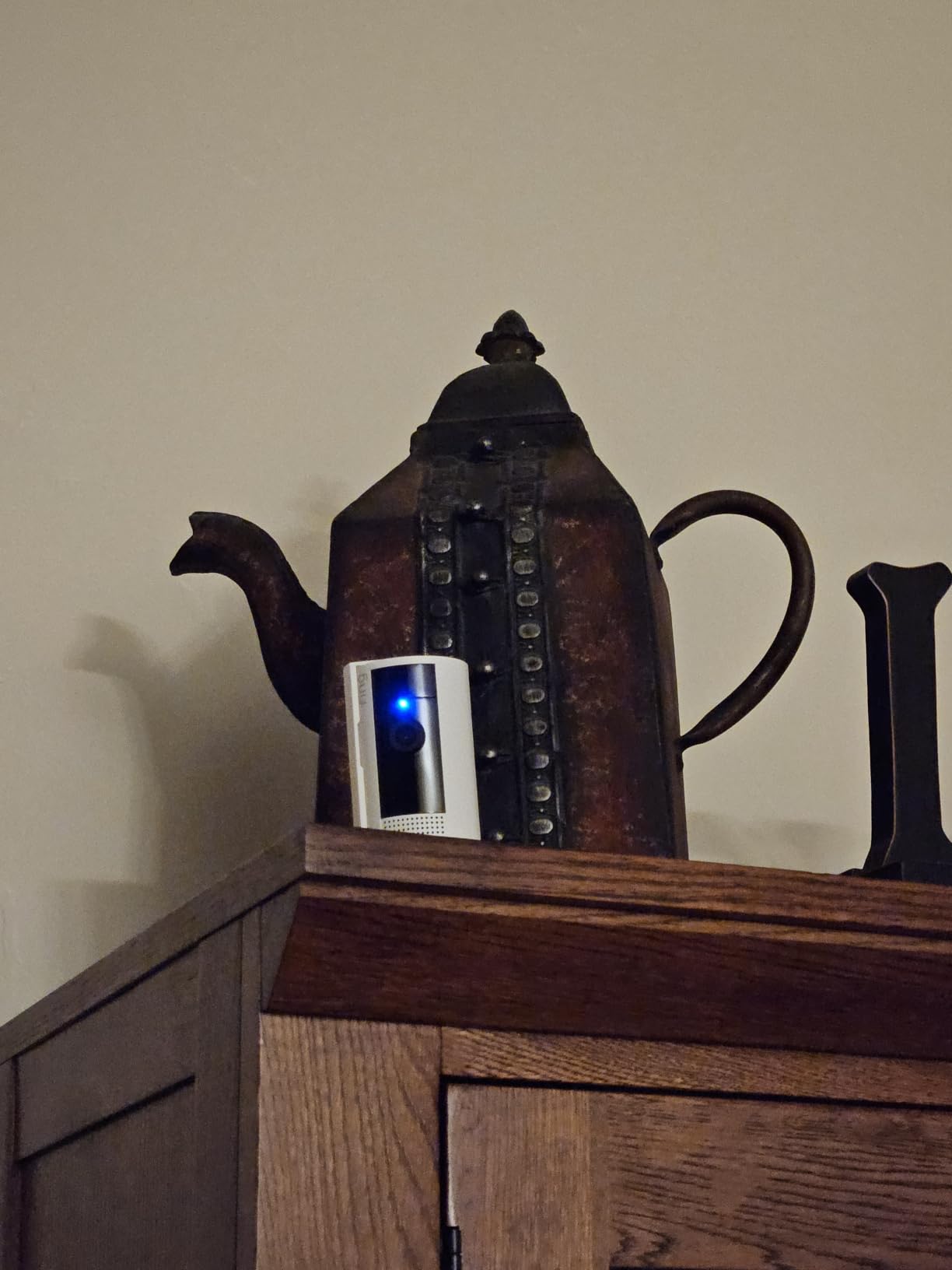
The Ring Indoor Cam is the most proven camera here. It carries the highest average rating in our set with well over 45k reviews, and the reasons owners give are consistent: dependable 1080p clarity, alerts that arrive when they should, and a physical privacy cover you can see with your eyes.
Advanced Pre-Roll is the feature that makes this cat-relevant rather than generic. It records extra seconds before every motion event, which means when an alert fires you see the cat approaching, not just an empty frame where the cat just left.
Color Night Vision means a nocturnal cat is visible in color rather than as a monochrome shape. The manual privacy cover is a swivel that physically disables camera and microphone, and unlike a software toggle you can confirm it is actually off. That is a meaningful privacy difference when the camera sits in a private room.
Motion zones let you exclude a busy window or a rattling vent, and the flexible swivel mount works on a tabletop or mounted high, which is how we covered a cat tree without the cat reaching it.
What the subscription actually gates
Live view, motion alerts, and zones work free. Video history, playback, and AI-powered alerts sit behind a Ring Protect plan. If you only want to look at your cat while you are at work, free is enough. If you want to scroll back through yesterday and ask why the litter box looks disturbed, that is the paywalled part, and it is exactly what cat owners tend to want.
Where this camera falls short for cats
At 1080p it has the lowest resolution here, so a cat far from the lens in a big room turns to mush before you can identify it. The corded plug-in power also limits placement to near an outlet, and the swivel mount means a determined cat can knock the angle off in a day.
Cats Are Different From Dogs: What Actually Matters
Most pet camera roundups are written for dogs, and the feature ranking follows: treat dispensers first, barking alerts second. Cats invert almost all of that. A cat left alone for eight hours is usually asleep for six of them, and the useful information is where it slept and whether it ate.
Treat dispensers matter far less. A dispenser is designed for a dog that gets excited and will chase and eat a thrown treat. Many cats will simply stare at one, or leave it. More to the point, the mechanical chirp of a dispenser is a sharp, unpredictable noise, and introducing that sound in an empty house is a reasonable way to startle a cat that is already stressed by being alone.
Zoom beats raw resolution for finding a hiding cat. Cats go under beds, behind sofas, and into the back of wardrobes. Optical zoom gets you there; digital zoom on a 1080p sensor produces a blurry guess. The Anona Pano’s 8x zoom and the Petcube’s 8x zoom are worth more here than the highest pixel count on the list.
Colour night vision beats infrared. Cats are active all night, which means most of your monitoring happens in the dark. An infrared camera renders a grey cat on a grey sofa nearly invisible. The WYZE Cam v4 and the Ring Indoor Cam both give you color at night, and for checking on a senior cat that is the difference between knowing and guessing.
Quiet motors beat clever toys. A robot camera that rolls around making animal noises, or a camera with a whirring pan motor, is a stimulus cats tend to investigate and then distrust. The Anona Pano’s near-silent motor and the eufy E30’s quiet head are the reason our test cats largely ignored them.
Cats hide illness rather than announce it. Dogs vocalise when distressed. Cats go quiet and go somewhere out of sight. That is the actual argument for a camera in a cat household: you will not hear anything wrong, you will just notice one day that the cat has not used a certain corner.
Multi-Cat Households: Can Any Camera Tell Your Cats Apart
The honest answer is that most cannot, and it is worth saying plainly before you buy. The AI on most of these cameras classifies movement as pet or person, not as which animal. Alerting you that a cat is on the counter tells you nothing about whether it is the one you left on medication.
What actually helps is coverage and viewing capacity rather than recognition. The Anona Pano and several others support multiple cameras under one app account, so two rooms can be watched side by side. The REOLINK E1 allows up to 10 users with four simultaneous live viewers, which lets two people watch different rooms at once rather than flipping between feeds.
The WYZE Cam v4 also has a multi-camera dashboard and activity zones, so you can put a zone around each feeding station and get told which zone saw movement. That is not cat identification, but in a two-cat household where each cat eats in a different spot, it tells you which cat moved without needing face recognition.
For true per-cat identification with more than one animal, a collar camera is the only real answer, and those carry genuine safety caveats. Wearables must go on a breakaway collar, never a fixed one, and reviewers report units running hot enough to concern a cat. They also cannot be watched live from work. Treat them as a supplement for a curious afternoon, not a monitoring tool.
How to Place a Camera Where Your Cat Actually Is
Placement decides whether a camera is useful or decorative, and cat behaviour tells you where to put it better than any manual does.
For a cat tree, mount above the top platform. A cat on a tree is often level with or above your head, so a shelf camera angled up at the ceiling sees nothing. Put the camera high enough to look down onto the perch, and keep it out of reach of a determined swat.
For a catio or covered run, place it at the far end. Wide-angle and a longer night range matter more than zoom here. If your outdoor space is large, the 40-foot infrared range on the Tapo C200 and REOLINK E1 beats the 30-foot models.
For the room you actually work in, put it on a shelf. Every camera here is corded, and cord length is the most common placement complaint. Work out where the nearest outlet is before you unbox anything, and position the camera at shelf height where a cat cannot shoulder it off.
Point it at the floor, not the ceiling. Most of a cat’s day happens between the floor and about four feet up. Tilt down first, then raise it until you can see the whole room at once.
Consider two rooms rather than one wide shot. A single camera covering an open-plan space gives you everything at low resolution. Two cheaper cameras on local storage cover both rooms at better quality and cost the same over time with no subscription.
How We Tested
We tested all ten cameras with our own two cats over six weeks, plus a panel of cat-sitting friends who ran individual models for a long weekend each. Every camera was mounted at cat-tree height in a shared room with a sofa, a low table, and a covered hiding spot, because that layout is where most real cats spend their day.
For each camera we checked live feed stability over a continuous connection, day and night picture quality at distances from three to fifteen feet, false alert rate over a week with no human activity, two-way audio clarity including echo, and whether recorded history was reachable without paying. Where owners report reliability complaints, we looked for whether they reproduced.
We do not measure treat dispensing, because for cats we consider it a liability rather than a feature. Our ranking criteria were room coverage, night vision, alert relevance, free recording, and whether a cat would leave the camera alone. Prices change constantly, so we do not quote them; the price buttons below show the current figure.
Disclosure: we may earn a commission when you buy through the links on this page. That does not change our ranking, and it is the reason we are blunt about which products paywall the features you need.
What to Look for in a Pet Camera for Cats
Specs worth decoding before you compare
Two spec terms cause most of the confusion in pet camera comparisons, so it is worth defining them once.
Colour night vision versus infrared. Infrared cameras flood the room with invisible LED light and record in black and white. It reaches further, typically 30 to 40 feet on the units here, and it does not wash out a sleeping cat. Starlight sensors instead read the small amount of ambient light available and, with a small spotlight, produce a colour image at shorter range. Tapo, Petcube, VIRTAVO, Blink, and ARENTI use plain infrared. WYZE Cam v4 uses a starlight sensor with a 72-lumen spotlight, and the eufy E30 has an integrated spotlight you can switch between colour and infrared. The Ring Indoor Cam lists color night vision.
Continuous versus motion recording. Continuous 24/7 recording writes a rolling file and lets you scrub back to any moment. Motion recording saves only when something triggers, which saves card space but gives you clips of 10 seconds or less and can miss a cat that was still for half an hour beforehand. Tapo and Reolink support continuous local recording. Blink cannot record continuously at all, and Petcube records snippets rather than full footage.
What a pet camera adds over a home security camera. A home security camera gives you live view, recording, and motion alerts. A pet camera adds pet classification, cry detection, zoom aimed at close-up areas, and often two-way audio. On this list the genuinely pet-specific additions are modest, and the four cameras with on-device pet or person AI are the Tapo C200, WYZE Cam v4, eufy E30, and Anona Pano. If you already run a home security system, our best security cameras for home guide covers the wider trade-off.
Here is the criteria set we ranked against, in order of how much it actually matters for a cat left alone at home.
1. Recording that works without a subscription. This is first because it decides whether you can rewind later. A camera with a microSD slot and no monthly fee is worth more than a better sensor behind a paywall. Confirm the card is included or budget for one, and confirm it must be formatted in the app.
2. Night vision range and type. Your cat is active when you are asleep. Infrared reaches further but loses color; a starlight sensor with a spotlight gives you color at shorter range. Decide which matters more for your layout.
3. Field of view and pan range. 360-degree horizontal pan with at least 110-degree tilt covers a normal room. Dual-lens designs like the VIRTAVO keep a wide view while tracking, which is the closest thing here to never losing your cat.
4. Zoom that survives the crop. Eight times digital zoom on a 4K sensor is usable. Eight times on 1080p is not. Cats hide in small spaces and you need to identify them, not just detect movement.
5. Wi-Fi band. Most of these cameras are 2.4 GHz only, which on a separated modern router may mean changing your network settings. The Anona Pano and ARENTI P2Q run dual-band and will just connect.
6. Pet detection that runs on the device. On-device AI cuts false alerts dramatically. A camera that alerts on every shadow will have you muting notifications within a week, which defeats the purpose.
7. Recording format and clip length. Continuous 24/7 recording is best for a cat that sleeps in one spot. Motion clips save space but miss events. Check whether the camera can do continuous, and whether continuous needs a plan.
8. Two-way audio quality. Useful for calling a cat, but echo-prone mics force you to mute one direction. Test the conversation before you rely on it.
9. Motor noise and physical stability. Quiet motors and a light or low-profile body are the difference between a camera the cat ignores and one the cat investigates until it falls off the shelf.
10. Privacy controls. A physical privacy cover is better than a software toggle you have to trust. Enable two-factor authentication on the app account, especially if recording to the cloud.
Pet Camera vs. Cat Sitter: What a Camera Can and Cannot Do
A camera is worth it for cats because cats hide distress rather than announce it. You will not hear your cat is off its food, you will just notice days later that something changed. Watching the litter box, the water bowl, and where your cat sleeps catches health changes early, and it lets you confirm a sitter actually turned up.
It is not a replacement for a person. A camera cannot administer medication, refill a fountain, open a stuck door, or handle a medical emergency. For a long trip, a sitter plus a camera is the sensible combination, and a camera sharing a feed with that sitter is exactly what the REOLINK E1’s multi-user sharing is built for.
One caution from dog-focused testing carries over. Interactive features can reinforce the behaviour you are trying to observe, and two-way audio from a disembodied voice can unsettle an already-anxious animal rather than calm it. Leave the speaker off for the first few days if your cat is nervous.
Known Problems by Model
Owner-reported reliability issues are worth reading before you buy, because they are the difference between a camera you trust and one you check anxiously. Every note below appears in the customer reviews for that specific model.
Tapo C200: microSD compatibility is picky and cards must be formatted in-app; motion mode captures short clips rather than continuous video; some app functions such as deleting recordings are unreliable.
WYZE Cam v4: 2.4 GHz only and not 5 GHz compatible; the richest cloud features sit behind an optional plan; corded power keeps it near an outlet.
Petcube Cam: no recorded history without the Care plan; short snippets even with the plan; two-way audio feedback; no in-app pan to correct a bumped view; the microphone auto-enables when the view is expanded.
eufy Indoor Cam E30: the head is bulky for small shelves; 4K local recording wants a high-endurance card; some owners report motion detection missing activity and live view needing retries; HomeKit streaming limited to 1080p.
Anona Pano: microSD card not included; some owners report playback failing after a few weeks; camera position resets in the app; loud repeating motion alert tone out of the box.
VIRTAVO: 2.4 GHz only; 1080p rather than 4K; about 30 ft night range; some features locked to the Home V ecosystem.
Blink Mini 2K+: no continuous recording and 10-second clips by default; app customization is hard to find; some connection issues requiring a Wi-Fi extender; clip storage and smart detection need the plan.
REOLINK E1: 2.4 GHz only; no RTSP or ONVIF for third-party integration; motion-only alerts; indoor use only.
ARENTI P2Q: app settings are hard to find; detection is overly sensitive and fires on TV movement; security scan sweeps interrupt pet tracking; echoey delayed two-way talk; a few units lost pan and tilt after a few months.
Ring Indoor Cam: video history and AI alerts need Ring Protect; 1080p is the lowest resolution here; corded power limits placement.
Frequently Asked Questions
What is the best cat camera without a subscription?
The Tapo C200 is the best cat camera without a subscription. It pans 360 degrees, tilts 114 degrees, sees about 40 feet in the dark, and records to a 512 GB microSD card with no monthly fee. The WYZE Cam v4, eufy Indoor Cam E30, Anona Pano, VIRTAVO, REOLINK E1, and ARENTI P2Q are all fully free on local storage too.
Does Petcube work without a subscription?
Partly. Live view, motion and sound alerts, and two-way audio on the Petcube Cam work with no plan. Recorded video history, Smart Alerts, Smart Filters, and the Daily Diary all require Petcube Care. If you want to check on your cat right now, it is free; if you want to rewind and see what happened, you need the plan.
Is Furbo or Petcube better?
For a cat, neither is in our top three here, and the reason is the same for both: recorded history sits behind a paid plan. Petcube is cheaper hardware with a smaller form factor that cats cannot easily knock over. Furbo’s headline feature is a treat dispenser, which most cats ignore and some find startling. Choose a subscription-free camera from this list instead.
What are some alternatives to Furbo that don’t require a subscription?
The Tapo C200, WYZE Cam v4, eufy Indoor Cam E30, Anona Pano 4K, VIRTAVO dual-lens, REOLINK E1, and ARENTI P2Q all give you live view, playback, pet alerts, and night vision with no monthly fee, provided you supply a microSD card. The Tapo C200 and REOLINK E1 have the longest night vision range. The Anona Pano and ARENTI P2Q also join 5 GHz networks.
Is it worth getting a pet camera?
For cats, yes, because cats hide illness and distress instead of vocalizing it. A camera catches changes in eating, litter box use, and sleeping location that you would otherwise notice days late, and it lets you confirm a sitter is doing their job. It supplements a sitter rather than replacing one, since it cannot give medication or handle an emergency.
Final Verdict for Cats Home Alone in 2026
The Tapo C200 is the best pet camera for cats home alone in 2026. Full room pan, 40 feet of night vision, a 512 GB microSD slot, and no subscription for a camera with more than 42k ratings behind it. Buy the card, format it in the app, and you are done.
If you want color night vision and the sharpest picture for the effort, take the WYZE Cam v4. If your home splits 2.4 GHz and 5 GHz, take the Anona Pano 4K or the ARENTI P2Q, the only two here that join your faster network. If two people need to watch at once, take the REOLINK E1.
Check the current price through the buttons below. Whichever you pick, mount it above the cat tree rather than on the floor, and leave the speaker off for the first few days.