
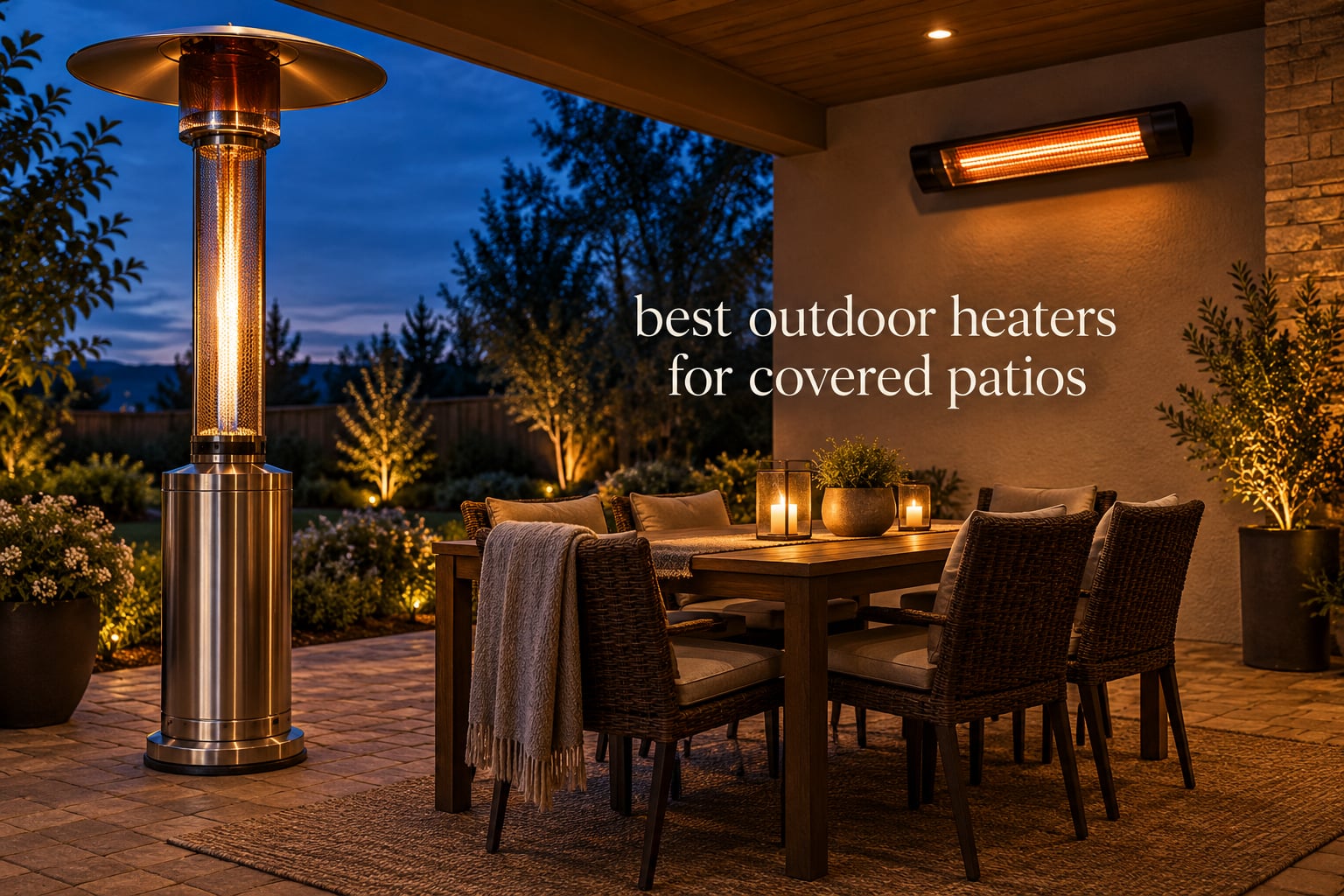
A covered patio is the easiest outdoor space to heat and the easiest to heat badly. Block the wind and the job becomes straightforward, but add a roof and you also inherit ceiling clearance, combustion venting and mounting questions that most product pages never answer.
We spent weeks reading spec sheets, certifications and thousands of owner reviews on outdoor heaters for covered patios, then sorted them the way the decision actually works once a roof is overhead. Fuel type is the question most shoppers ask first, and it is the second most important one. Mounting style is the first.
That is why this roundup of the best outdoor heaters for covered patios is grouped by mounting style rather than by fuel. Wall-mounted and ceiling-hanging units send heat out and down over a seating area. Freestanding pole heaters throw heat from the top of a tall tower. Tabletop units warm the people within arm’s reach and little else. Each of those behaves very differently under a roof.
We also set expectations honestly, because this is the thing most roundups skip. A patio heater takes the chill off. It radiates infrared at your skin and warms the chair you are sitting in. It does not turn a 200 square foot covered patio into a room, and anyone who tells you otherwise is selling you a different product.
As you read, you will notice that several of the highest-reviewed units here are rated for indoor use. We flag that clearly, because running an indoor-rated heater on a covered patio is the single most common mistake in this category. If you want a genuine outdoor heater, start with the sections on patio seating that tell you how people actually sit and move under a cover, then come back to the clearance rules.
Table of Contents
Top 3 Picks for Covered Patios in 2026

Amazon Basics 46000 BTU Propane
- 46000 BTU radiant heat
- 18-foot coverage diameter
- One-touch ignition with tilt shutoff
- Wheels and water-weighted base

Heat Storm 1500W Wi-Fi Wall Mount
- 1500W / 5200 BTU infrared
- Wall mount frees floor space
- Wi-Fi plus remote thermostat
- Tip-over shutoff

DR. INFRARED HEATER DR-239 3000W
- 3000W / 10260 BTU carbon infrared
- IP55 weatherproof
- Wall or ceiling mount
- Remote with on/off timer
Three picks cover most covered patios. The Amazon Basics tower is the strongest all-rounder and the one we would put on an ordinary covered deck. The Heat Storm wall unit has the largest review base in this roundup and the cleanest footprint, with one important caveat we get to below. The DR. INFRARED HEATER is the one to buy if you are willing to have a 240V circuit installed and want genuinely commercial-grade mounting.
Best Outdoor Heaters for Covered Patios at a Glance
| Product | Specifications | Action |
|---|---|---|
| Amazon Basics 46000 BTU Propane Patio Heater |
|
Check Latest Price |
| Heat Storm HS-1500-PHX-WIFI Wall Mount |
|
Check Latest Price |
| DR. INFRARED HEATER DR-239 3000W |
|
Check Latest Price |
 Pamapic 89 Inch Pyramid Patio Heater Pamapic 89 Inch Pyramid Patio Heater |
|
Check Latest Price |
 FOOWIN 48000 BTU Propane Pyramid Heater FOOWIN 48000 BTU Propane Pyramid Heater |
|
Check Latest Price |
 Mr. Heater 30000 BTU Vent Free Radiant Mr. Heater 30000 BTU Vent Free Radiant |
|
Check Latest Price |
 Paraheeter 1500W Carbon Infrared Heater Paraheeter 1500W Carbon Infrared Heater |
|
Check Latest Price |
 SereneLife 1500W Infrared Tower SereneLife 1500W Infrared Tower |
|
Check Latest Price |
 Encyclpo 1500W IPX5 Infrared Tower Encyclpo 1500W IPX5 Infrared Tower |
|
Check Latest Price |
 Cuisinart Perfect Position 38200 BTU Cuisinart Perfect Position 38200 BTU |
|
Check Latest Price |
 Cuisinart Tabletop 11000 BTU Heater Cuisinart Tabletop 11000 BTU Heater |
|
Check Latest Price |
 Nfccra 34 Inch Wall Mount 1500W Nfccra 34 Inch Wall Mount 1500W |
|
Check Latest Price |
Two things stand out in that table. First, five of the twelve units are outdoor-rated electric heaters that run on standard 120V power, which is a much bigger category than most roundups admit. Second, several of the highest-output propane units are freestanding towers, and a tall tower under a low ceiling is exactly the setup that produces the complaints you will read about later.
1. Amazon Basics 46,000 BTU Propane Patio Heater – Best Overall
- Very strong radiant heat across an 18-foot diameter
- One-touch ignition lights on the first try for most owners
- Wheels make repositioning and seasonal breakdown simple
- Base accepts water or sand for wind stability
- Powder-coated finish with well-illustrated instructions
- Assembly is genuinely time-consuming for a first-time builder
- Base fill hole is small
- making sand filling awkward
- Consumes propane quickly on the high setting
- Fixed pole length with no height adjustment
This is the heater we recommend to most people with a covered patio, and after comparing a dozen options it is the hardest one to argue against. The 46,000 BTU radiant output is real, consistent heat rather than a spec-sheet promise, and the listed coverage of 324 square feet matches what owners describe sitting on a normal-sized covered deck.
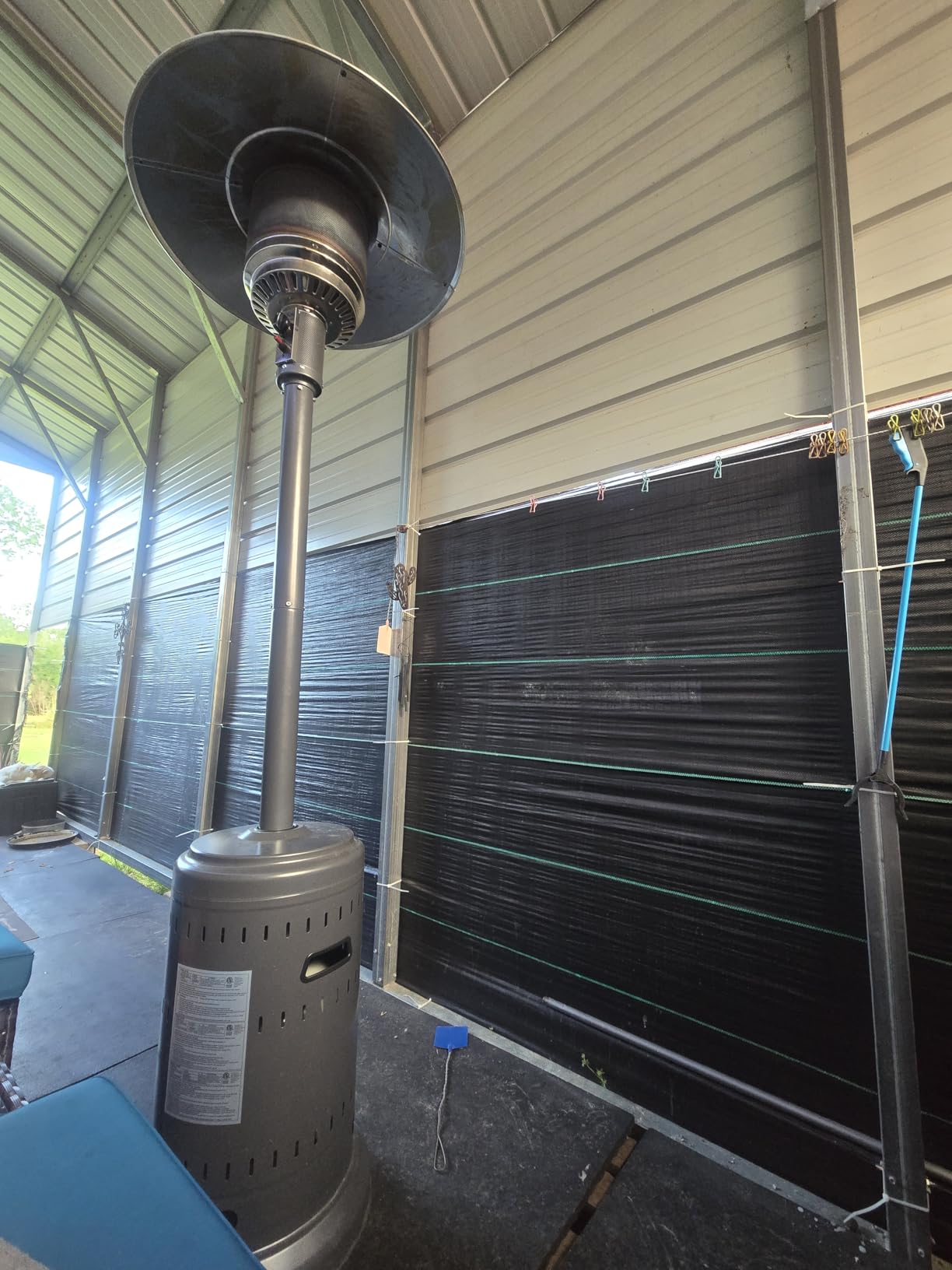
It stands 91.3 inches tall, which is the detail that matters most on a covered patio. That height exists for a reason: it puts the burner and its reflector above head height and above most patio table surfaces, so the heat comes down onto you rather than across your lap. It also means you need roof clearance above the top of the unit, and we cover that in the safety section.
The friction is assembly. Owners consistently report that the shrink wrap, hardware bags and the printed instructions turn a twenty-minute job into an hour. Several reviewers note errors or omissions in the paperwork. Budget an hour, keep the hardware sorted, and it is a fair trade for the output.
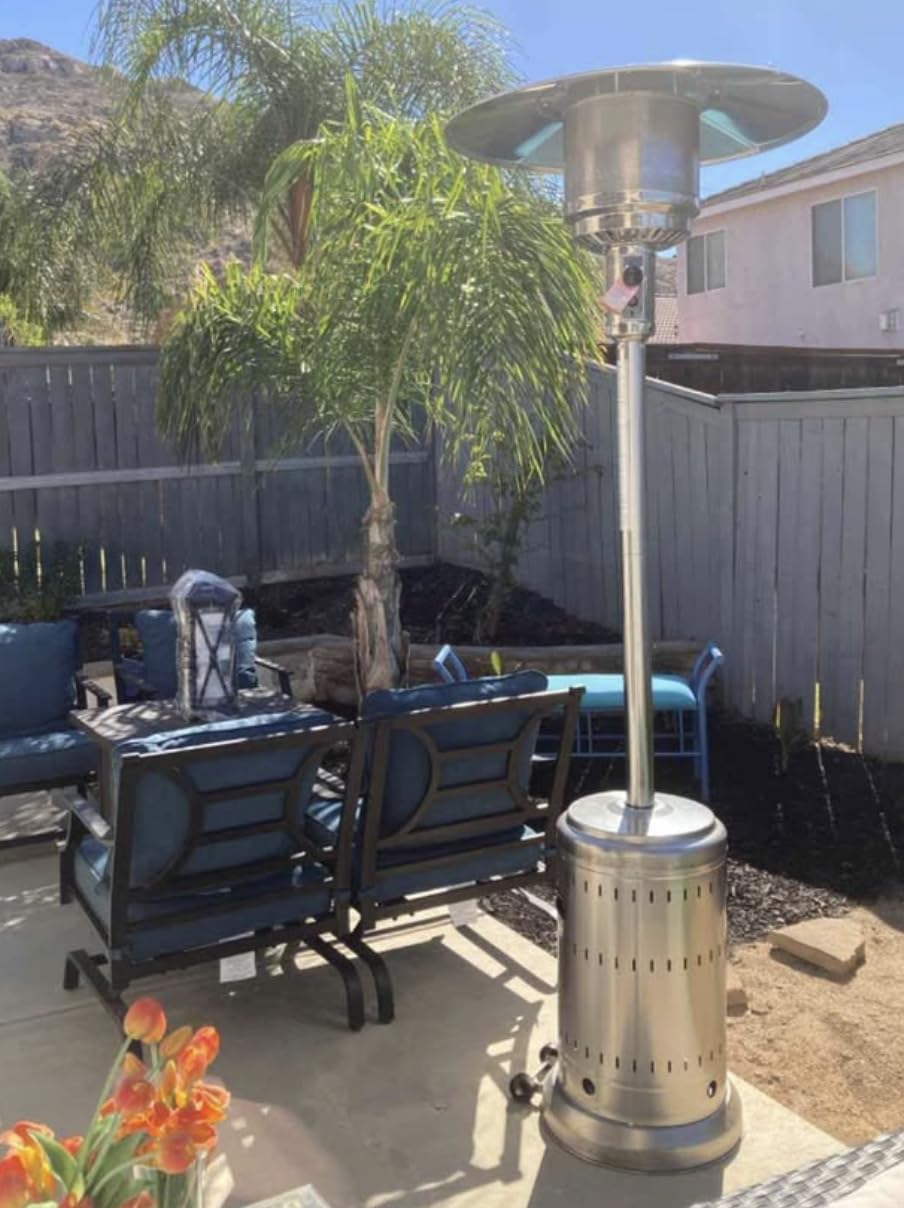
What works well under a roof
Because the reflector dome sits well above head height, the downward heat pattern is exactly what a covered patio needs. A built-in tilt safety valve shuts the burner off if the unit is knocked or tipped, and the base has a fill hole that accepts water for stability. Wheels let you roll it aside in summer and back out in autumn.
Where it falls short
On a small covered patio it is overkill, and on a wide open one you will see the coverage diameter fall off fast. Propane consumption is the other real constraint; a full evening on high will burn through a standard cylinder faster than most first-time owners expect, so plan refills around a party rather than during it.
2. Heat Storm 1500W Wi-Fi Wall Mount – Most Reviewed
- Largest review base in this roundup at nearly 14000 ratings
- Strong 1500W radiant element in a compact 4-inch-deep body
- Wi-Fi plus remote and touch-screen digital thermostat
- Wall mounting frees the floor entirely
- Tip-over shutoff and a safe-to-touch grill
- Listed for indoor use
- not outdoor covered patio installation
- Feet are not included on the wall-mounted version
- Maximum temperature setting is fixed at 99 degrees F
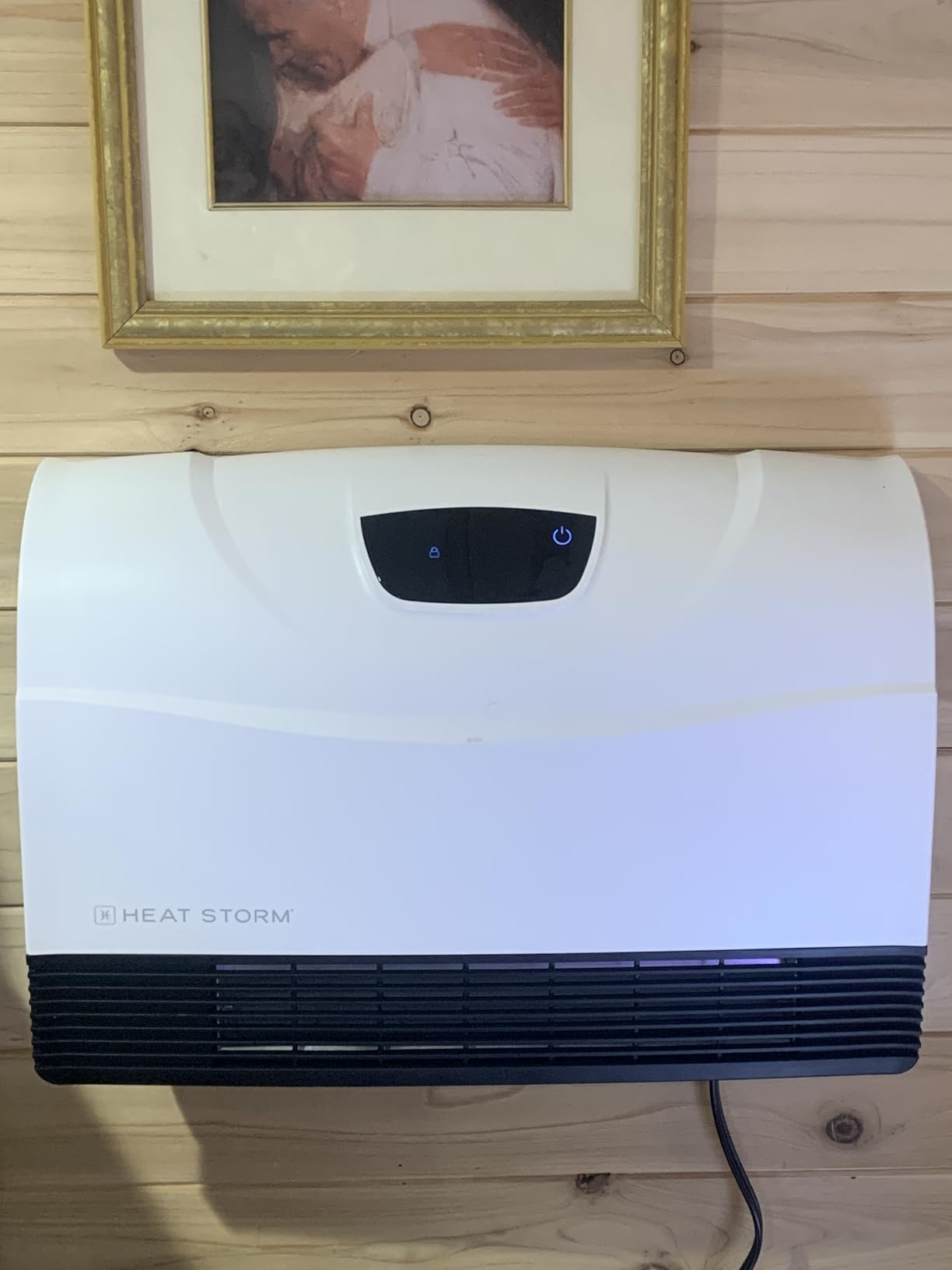
By volume of owner feedback this is the most proven appliance in the roundup, with close to 14000 ratings. The hardware is well liked: a 1500 watt infrared element delivering 5200 BTU of radiant heat in a cabinet that is only four inches deep, which matters on a covered patio with a low wall or a tight soffit.
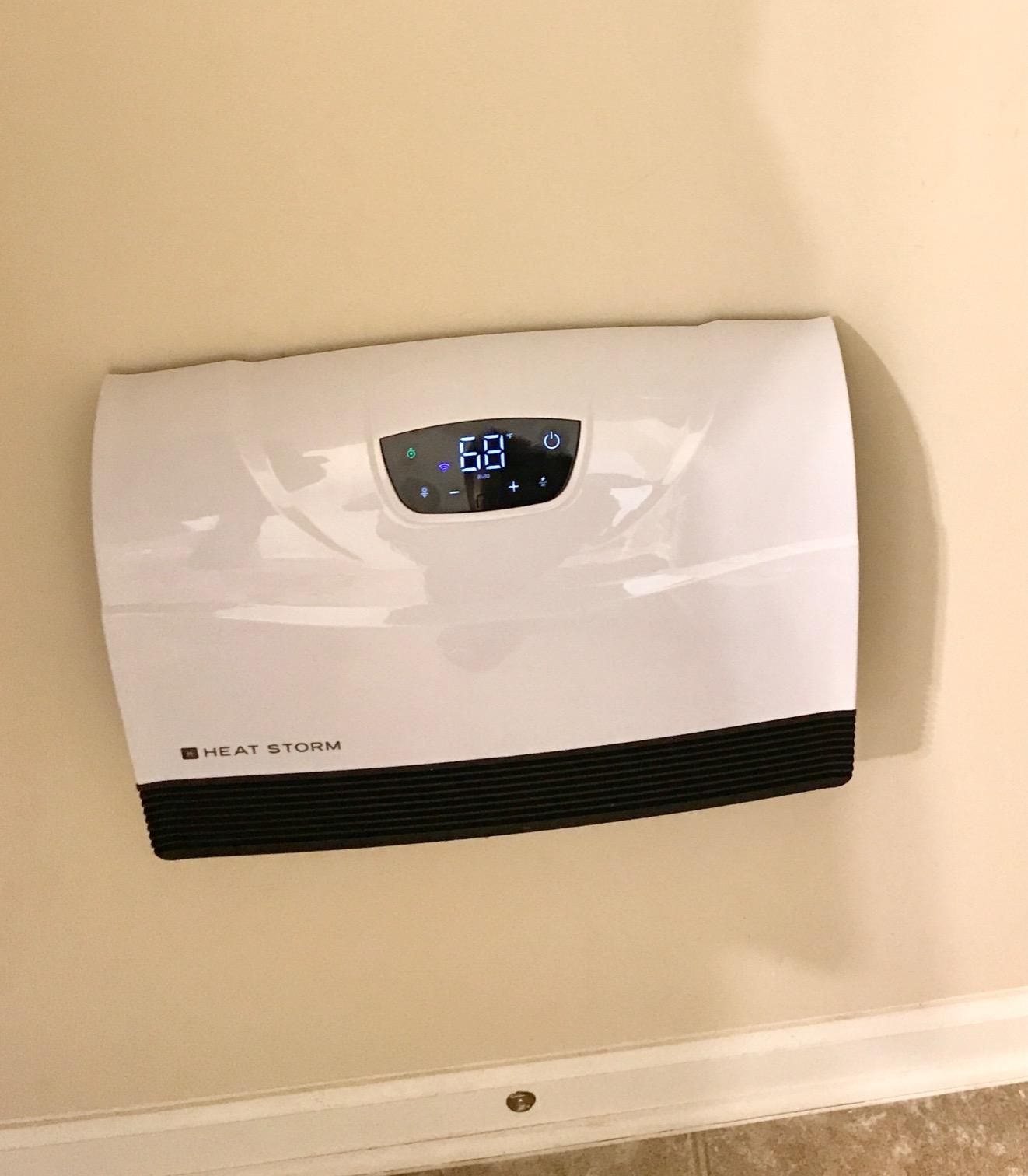
Control is where it beats most competitors at this output. You get a touch-screen digital thermostat, a handheld remote and Wi-Fi control from your phone. The cord can be concealed behind the unit when it is installed above the outlet, which is the detail that separates a clean wall-mount install from a taped-down cable.
Here is the honest problem. The product data lists this heater for indoor use. That means it is not certified for an outdoor covered patio, and running it there is outside the manufacturer’s instructions regardless of how convincing the radiant output feels on a cool evening. This is why it does not carry our top pick.
Who it genuinely suits
Enclosed sunrooms, screened porches with solid walls, garage bays and mud rooms, anywhere the heater will be surrounded by finished walls and dry air. Owners love the floor space it gives back, which matters in a room that already holds furniture. Pair it with a weatherproof cushion set and the wall stays the only thing left to plan around.
Why we would not put it on your patio
Rain and humidity are the enemies of a unit without an outdoor rating, and covered patios get both. The 99 degree F ceiling on the thermostat also means it cannot pre-warm a space the way a thermostat with a proper range can. If you want this form factor outdoors, the DR. INFRARED HEATER below is the same idea with a real outdoor certification.
3. DR. INFRARED HEATER DR-239 3000W – Best Mounted Electric
- IP55 weatherproofing rated for genuine outdoor covered-patio use
- 3000W carbon infrared with no warm-up and no open flame
- Wall and ceiling brackets plus remote and on/off timer included
- Overheat protection and automatic shutoff
- Silent and odorless with a one-year component warranty
- Highly directional
- heat is felt only within a few feet in front
- Needs a 220V-240V circuit rather than a standard outlet
- A small number of units stopped heating after a season or two
If you are building a covered patio properly rather than adding a heater to it, this is the unit to plan around. It is ETL Listed, carries an IP55 weatherproof rating, and runs on 220V to 240V. The 3000 watt carbon element throws 10,260 BTU of directional radiant heat with no warm-up time and no combustion.
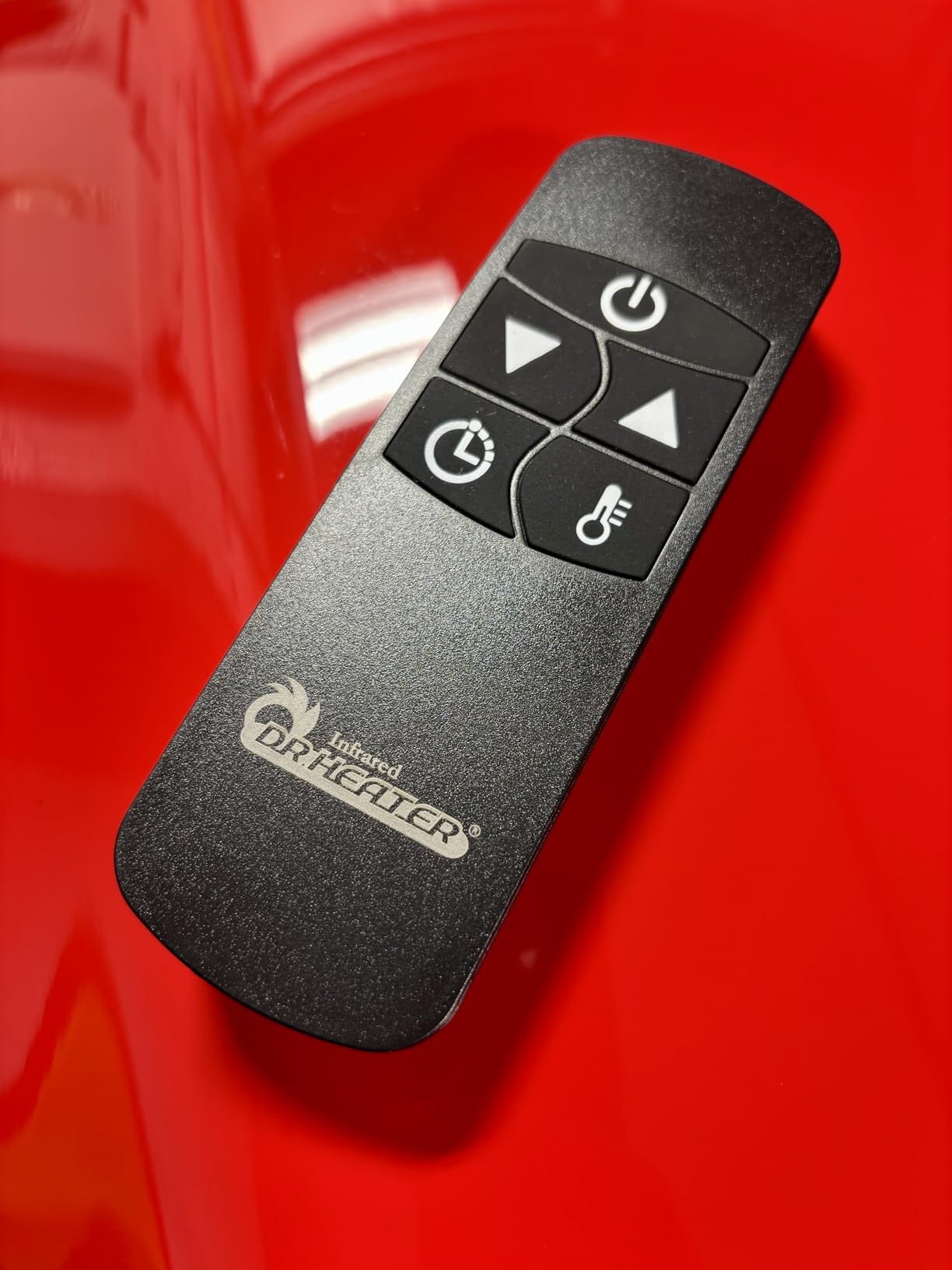
Both wall and ceiling mounting brackets are in the box, along with a remote that handles power levels, standby and a programmable on/off timer. That timer matters more than it sounds: you can schedule the patio to warm before guests arrive and shut down when the evening ends.
The 240V requirement is the deciding factor. Electricians advising on outdoor-rated heaters under a roof stress that you still want GFCI protection and a weatherproof junction box even when the appliance itself is rated for the elements. If a 240V circuit is not already in your plan, this is the moment to involve a licensed electrician rather than the moment to look for a different heater.
Why it beats a gas unit under a roof
No combustion means no carbon monoxide, no soot on an overhead surface and no fuel line running across your patio. Electricians point out the same thing from the code side: electric heat under a roof removes a whole category of ventilation questions. It is silent and odorless, and remote start means nobody has to leave a warm table to relight anything.
Where it disappoints
Heat falls off quickly in front of the unit and much more slowly to the sides, so a single mounted heater warms a defined zone rather than a whole patio. Owners also report that it will not remember its last setting after a power cut, and the infrared remote is needed to bring it back on.
4. Pamapic 89-Inch Pyramid Patio Heater – Best for Large Covered Decks
Pamapic 89″ Pyramid Patio Heater Outdoor, Propane Flame Tower with Quartz Glass Tube, Outdoor Heaters with Wheels & Cover for Deck, Porch, Backyard, Garden, Hammered Bronze
- Tall 89-inch tower throws heat over seated guests
- 48000 BTU suited to larger covered areas
- Visible quartz glass flame column adds real ambiance
- Built-in wheels and a weather cover are included
- Attractive hammered bronze finish
- Heat concentrates high on the tower so seated users sit close
- Heavy at 61.7 pounds and awkward to reposition
- Listed details give limited information on safety cut-offs
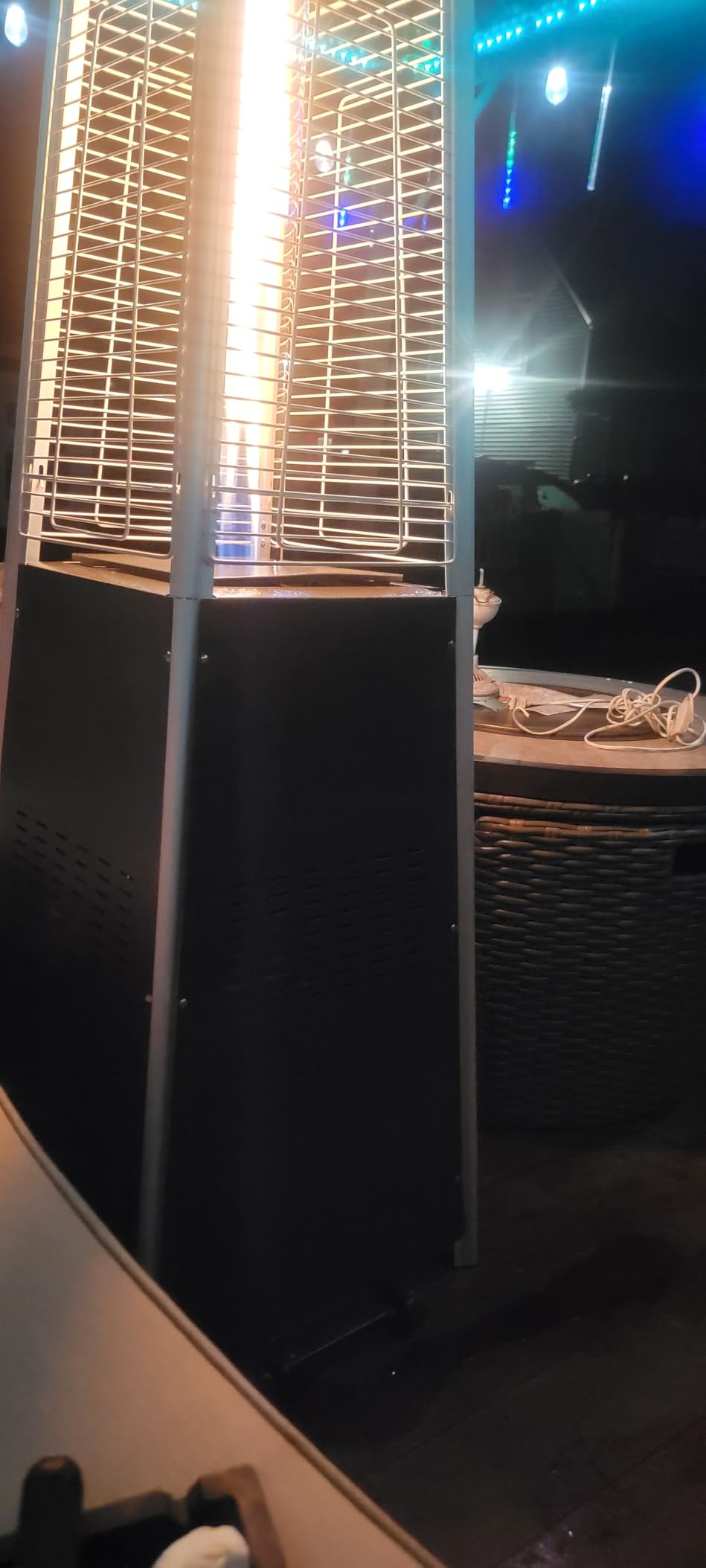
The visual appeal is the first thing owners mention and it is not a small thing on a covered patio that people use in the evening. The quartz glass flame tube gives you a visible column of fire inside a hammered bronze pyramid, and at 48000 BTU there is real output behind it.
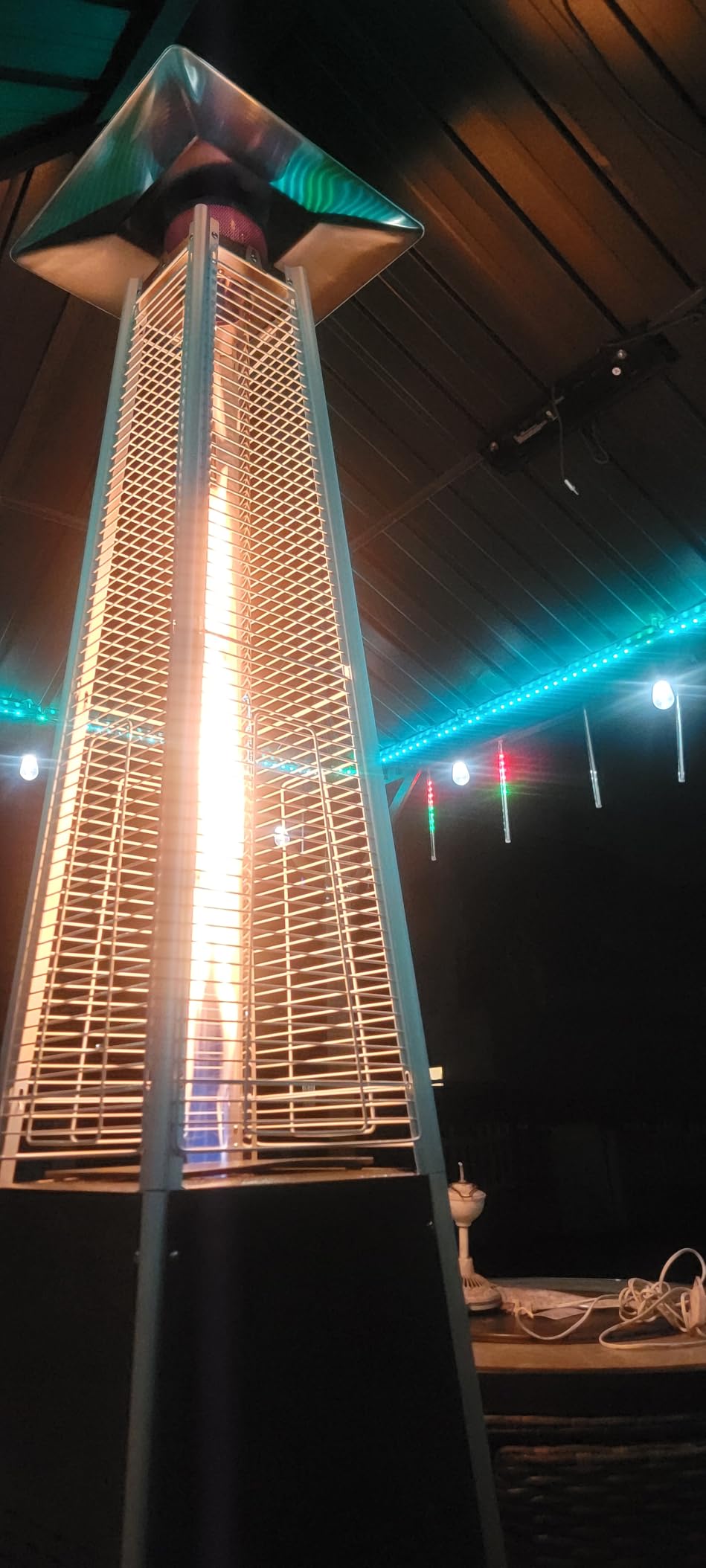
Heat coverage is listed at up to 15 feet in diameter, and reviewers confirm that it works well under a cover, where the absence of wind means more of that output reaches your table. Wheels are built in and a weather cover is included, so moving it aside for summer is not a two-person job the way a heavier unit would be.
The 89-inch height cuts both ways. It clears patio furniture well, but it also puts the burner as high as a low ceiling will allow, and the warmth arrives mostly from above. On a covered patio with a ceiling at normal headroom, guests commonly report sitting close.
Why it works under a roof
The tower format puts the flame and reflector above head height, which protects guests and keeps the flame well away from overhead structure. If your roof is high enough to clear the unit with manufacturer-specified clearance to the ceiling, this is a lot of heat in an attractive package. Multiple color variants are available to match existing furniture.
Where it falls short
At 61.7 pounds it is one of the heavier units here and repositioning it across a deck is a real task. The concentration of heat at the top of the tower means the seating layout matters more than with a mounted unit; plan the table within the coverage circle rather than beside it.
5. FOOWIN 48,000 BTU Propane Pyramid Heater – Best Value Gas
- Even 48000 BTU heat spread across roughly 130 sq ft
- Heats up in about 5 minutes
- Quartz glass tube styling owners rate above basic mushroom heaters
- Includes a waterproof cover and operating gloves
- 45-degree tilt auto-shutoff with protective nets
- Assembly can take hours and structural parts sometimes arrive bent
- Included machine screws strip easily
- Heat is thrown from the top of the tall tower
- Small print in the manual is hard to read
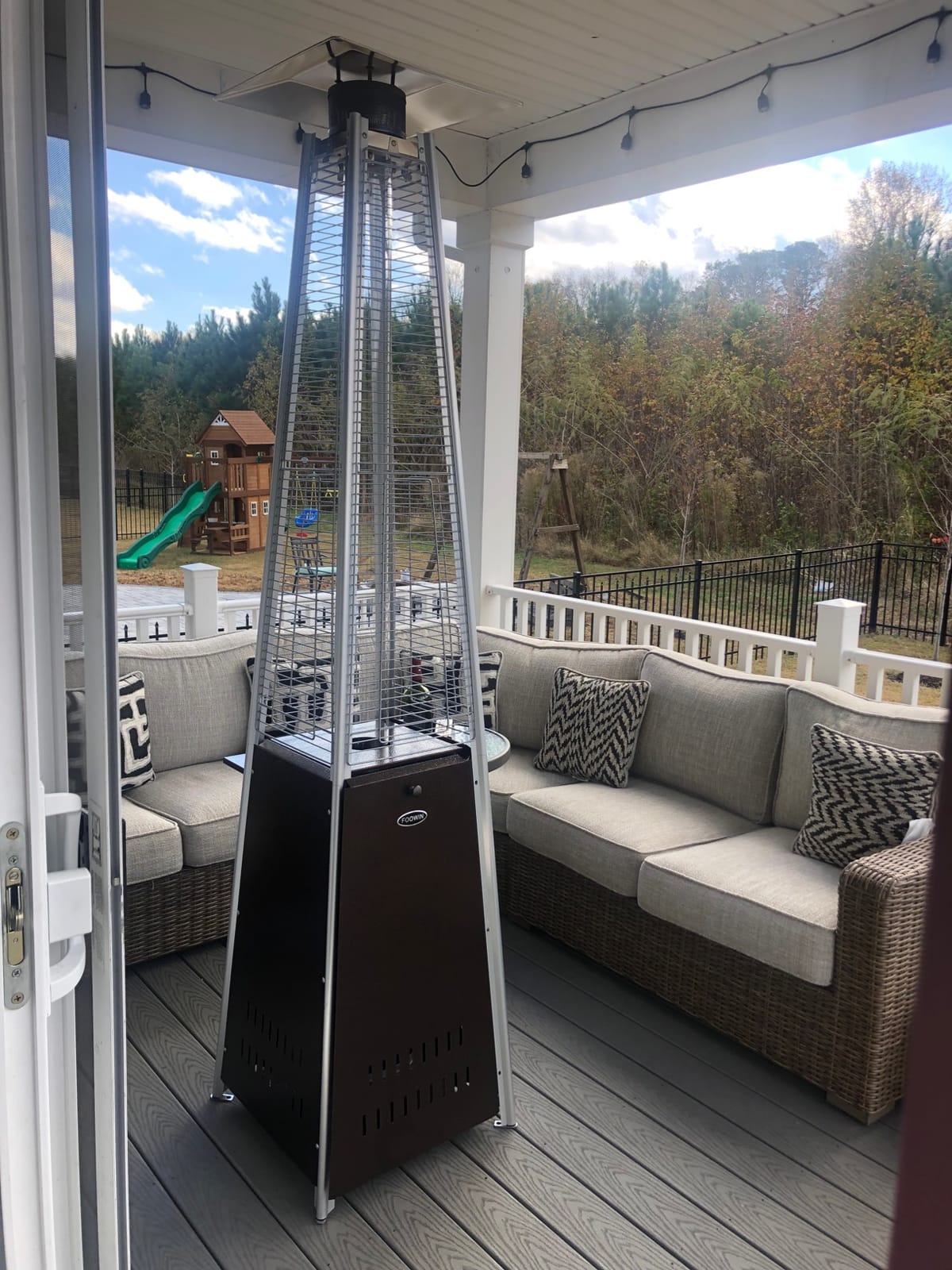
This is the gas tower to beat on value, and the engineering notes are unusually specific for the category. Each unit went through 10,000 flame-out cycles before leaving the factory, the gas pipe is described as explosion-proof, and the 48000 BTU output is listed as spreading evenly within about 130 square feet.
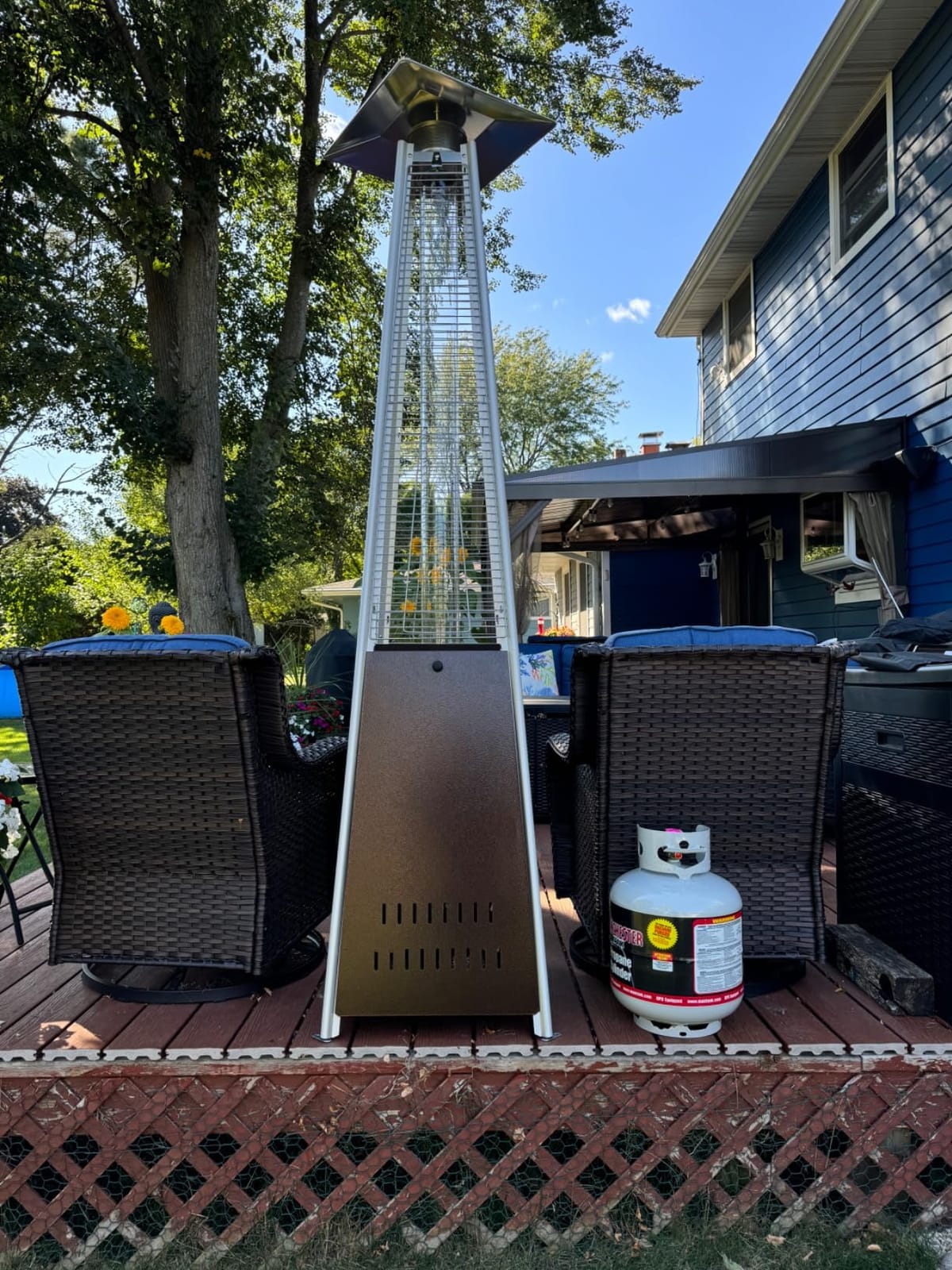
Owners consistently report that one-touch ignition works on the first attempt, which is not something you can say about every gas heater. The quartz glass tube in the bronze pyramid housing looks like a step up from the plain mushroom reflectors, and the package includes a waterproof cover and gloves.
Assembly is the weak point and it is not minor. Reports of bent structural parts in the box and included machine screws that strip have owners replacing hardware with parts from a hardware store. The bright spot is customer service, which has sent replacement burners quickly when units have needed them.
What works under a roof
The tilt auto-shutoff at 45 degrees and the protective nets are the features that matter most on a covered deck where kids and pets move around a tall tower. At 81.4 inches the unit sits close to the height of the Amazon Basics model, so it needs comparable roof clearance above it.
Where it falls short
Buyers note that the heat is thrown from the top of the tower, so you need to be close to feel it properly, and the coverage figure of 130 square feet is more modest than the diameter numbers some competing listings use. Allow time for assembly on a calm day rather than the morning of a gathering.
6. Mr. Heater 30,000 BTU Vent Free Radiant Heater – Best Vent Free Output
- Highest rating among the propane units reviewed
- Produces less soot and odor than open-flame radiant heaters
- Battery-operated electronic ignition needs no mains power
- Built-in adjustable thermostat for repeatable comfort
- Wall mounting hardware included
- Vent-free unit is rated for indoor use
- Propane hose and regulator are sold separately
- Requires full ventilation in enclosed spaces
- Heat is intense very close to the unit
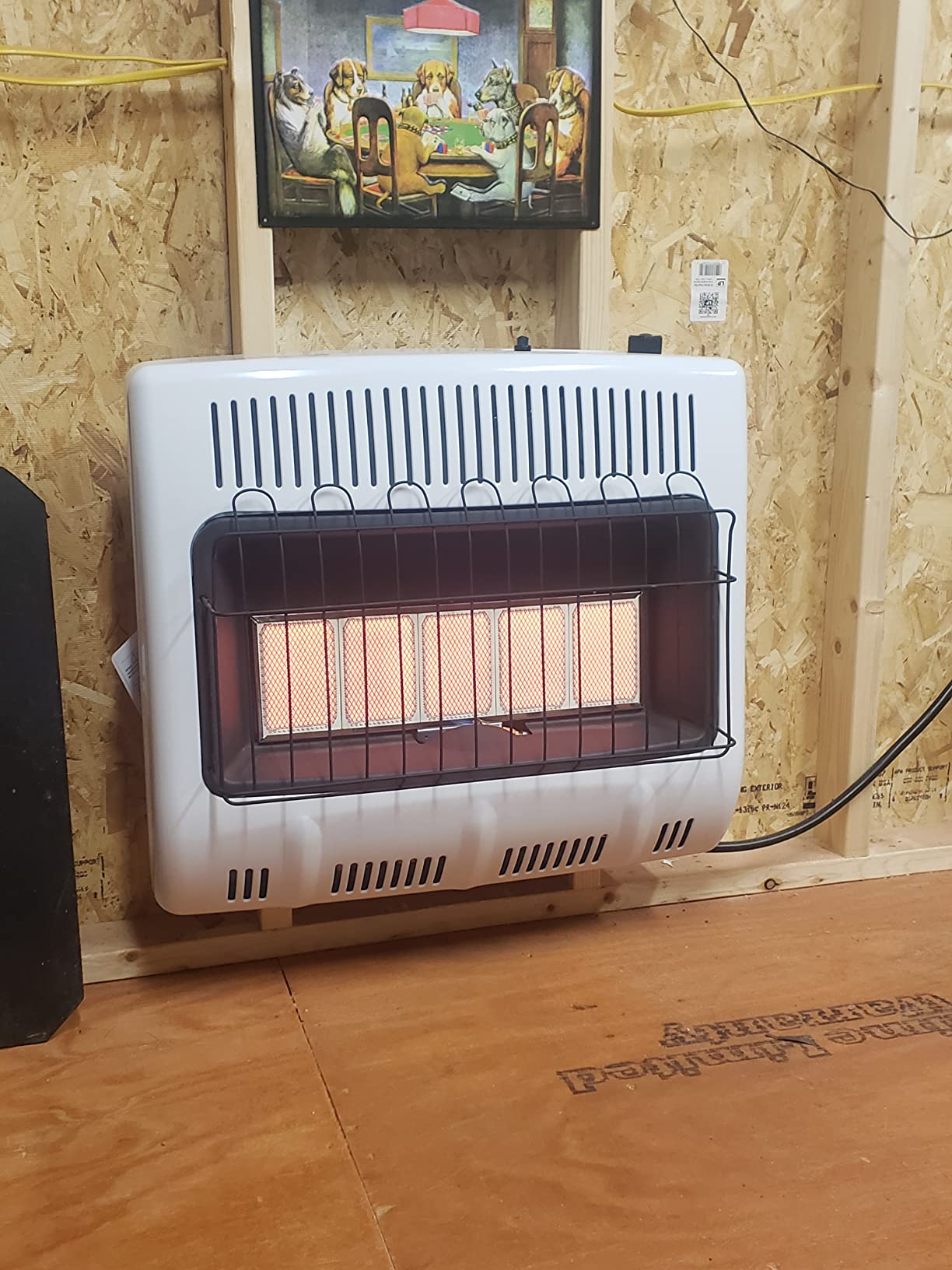
The highest-rated propane heater in this roundup is also the least talked about, which is a shame because the heat is substantial. 30,000 BTU per hour of vent-free radiant propane heat, rated to cover 750 square feet on the spec sheet with the product listing also citing up to 1,000 square feet.
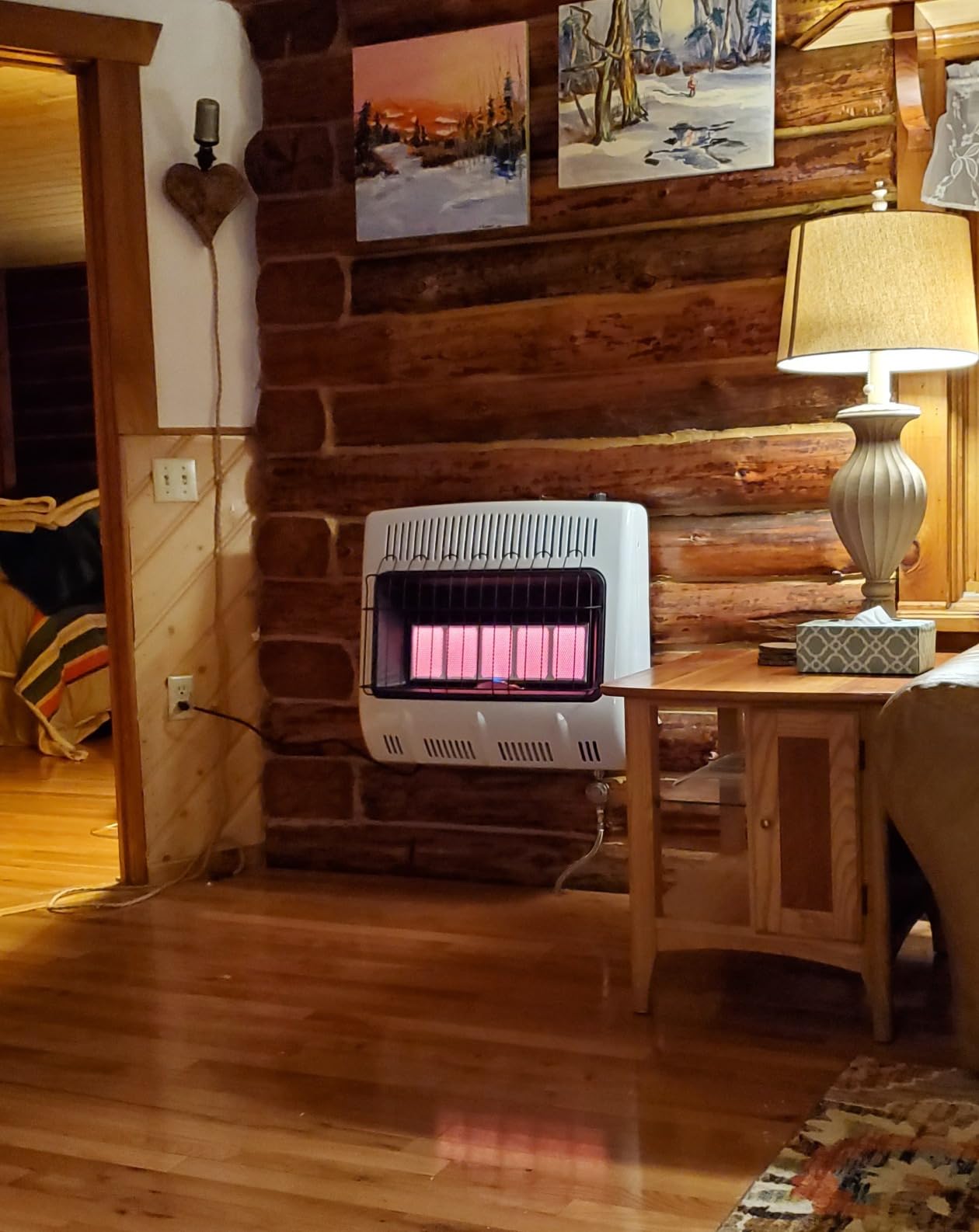
Two details make it pleasant to live with. The ignition is battery-operated electronic ignition with the battery included, so it needs no mains power at all, and there is a built-in adjustable thermostat, which is rare at this price point and much more useful than a two-position dial.
Owners also consistently note less soot and odour than open-flame radiant heaters, which matters if you are thinking about mounting something near an overhead surface. The wall mounting hardware is included. The propane hose and regulator are not, and there is a 4,500 foot altitude restriction to be aware of.
Where it earns its rating
Enclosed or semi-enclosed spaces where the thermostat genuinely helps. A covered patio with solid walls on two sides and good airflow is the scenario this unit is designed for, and the low-oxygen safety shut-off gives owners some reassurance in an enclosed volume.
Why it is not our patio pick
This is a vent-free indoor-rated unit. Under a roof with open sides you are adding a combustion appliance to a space that is neither fully indoors nor fully outdoors, and the manual’s ventilation requirements become your responsibility. It also runs at a 4,500 foot altitude limit. For an open-sided covered patio, an outdoor-rated tower is the safer specification.
7. Paraheeter 1500W Carbon Infrared – Best for Flexible Mounting
- IP65 weatherproofing is among the strongest ratings here
- Three mounting options: wall
- ceiling or tripod stand
- Carbon infrared heats objects directly so it works well outdoors
- Operating cost listed at roughly one tenth of propane
- CSA certified with a metal safety grille and remote
- Single power setting with a 100 degree F maximum
- Shipping foam must be pulled from the heating tube before first use
- Radiant heat falls off beyond the 10-15 foot radius
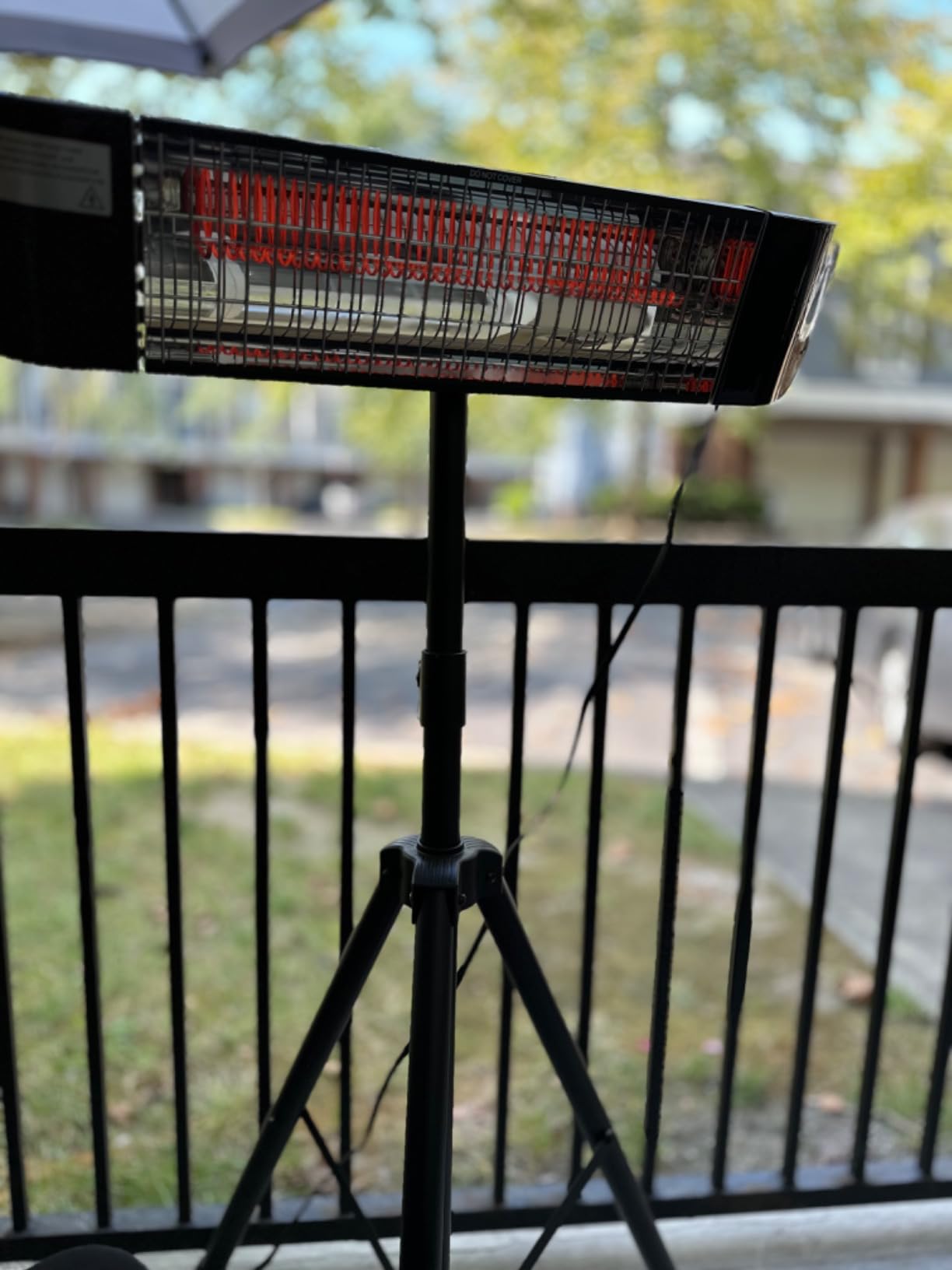
The most useful thing about this heater is that it answers the question every covered-patio owner eventually hits. Can it go on the wall? Yes. Under the pergola beams? Yes. On the deck if the wall is wrong? Yes, on the adjustable tripod stand. One appliance, three positions.
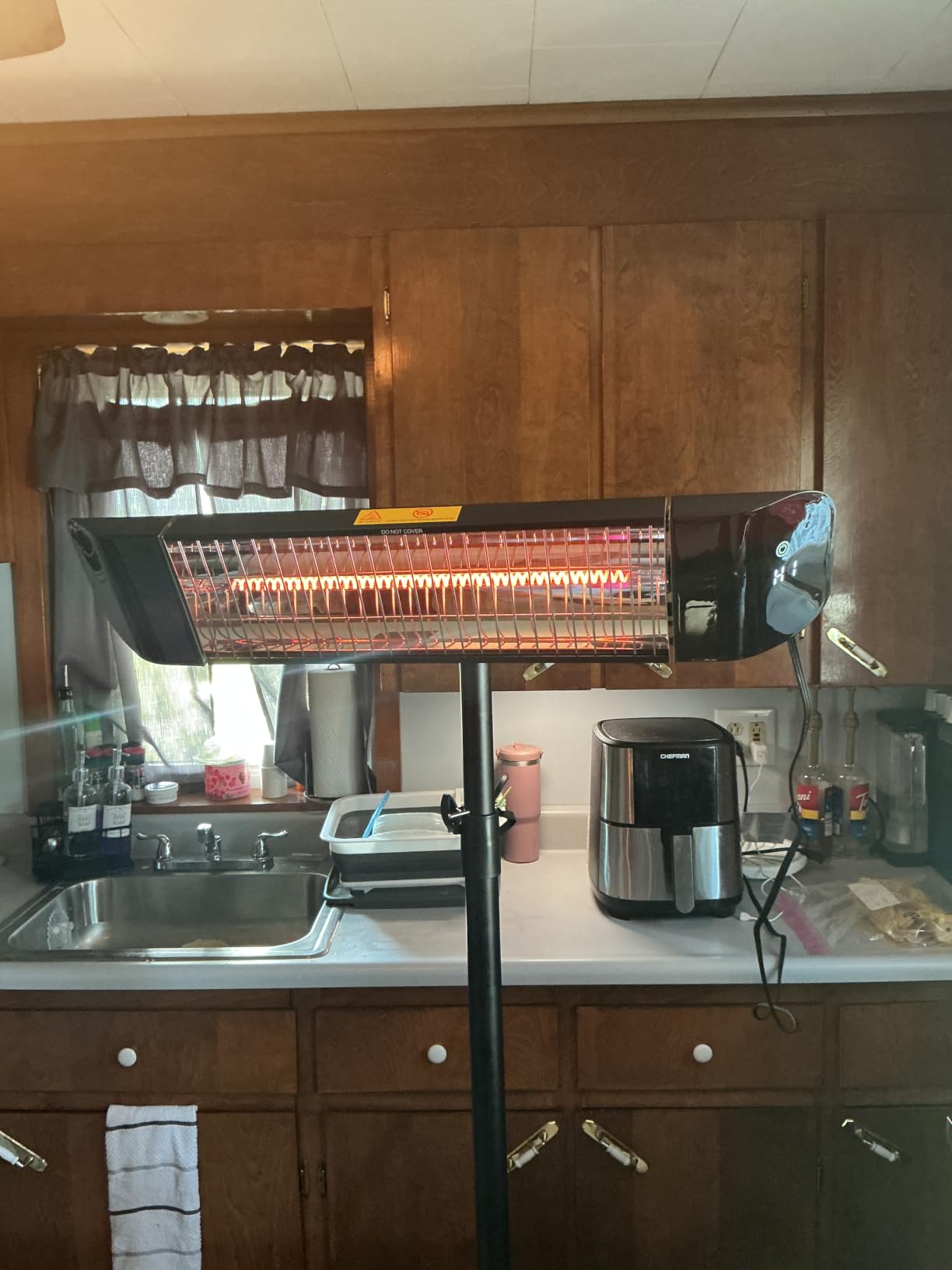
The IP65 rating is the strongest weather sealing in this roundup, and the carbon fiber heating tube is rated to 10,000 hours. Buyers like the operating economics too, with the manufacturer putting running cost at roughly one tenth that of propane heaters, which changes the maths if you plan to run it often.
There is one step people miss. A foam protective pad ships over the heating tube and has to be pulled off before you switch it on, and the product copy warns about overheating if you forget. It is a ten-second task that protects the element.
Best used as
A single-zone heater you reposition with the season. Wall-mount it in spring on the covered side of the patio, then move it to the tripod stand on the open deck for autumn. It is CSA certified, comes with a grounded three-prong plug and a metal grille, and the remote lets you adjust without getting up.
Trade-offs to plan around
There is one power setting and a 100 degree F maximum, so you get on and off rather than graded output. Heat is felt strongly inside the stated 10 to 15 foot radius and falls off quickly beyond it, which means placement matters more than it does with a broad-pattern tower.
8. SereneLife 1500W Infrared Tower – Best Portable 120V Option
- Instant odorless warmth with no propane or gas lines
- Three heat levels plus remote control
- ETL-certified element rated 88 percent efficient
- Quiet operation with no moving fan noise
- Available in 37
- 47 and 57 inch heights
- Small 25 sq ft effective zone means sitting close to the unit
- IP24 weather rating is modest for exposed outdoor use
- Lowest rating in this roundup
- Corded 120V power limits placement away from outlets
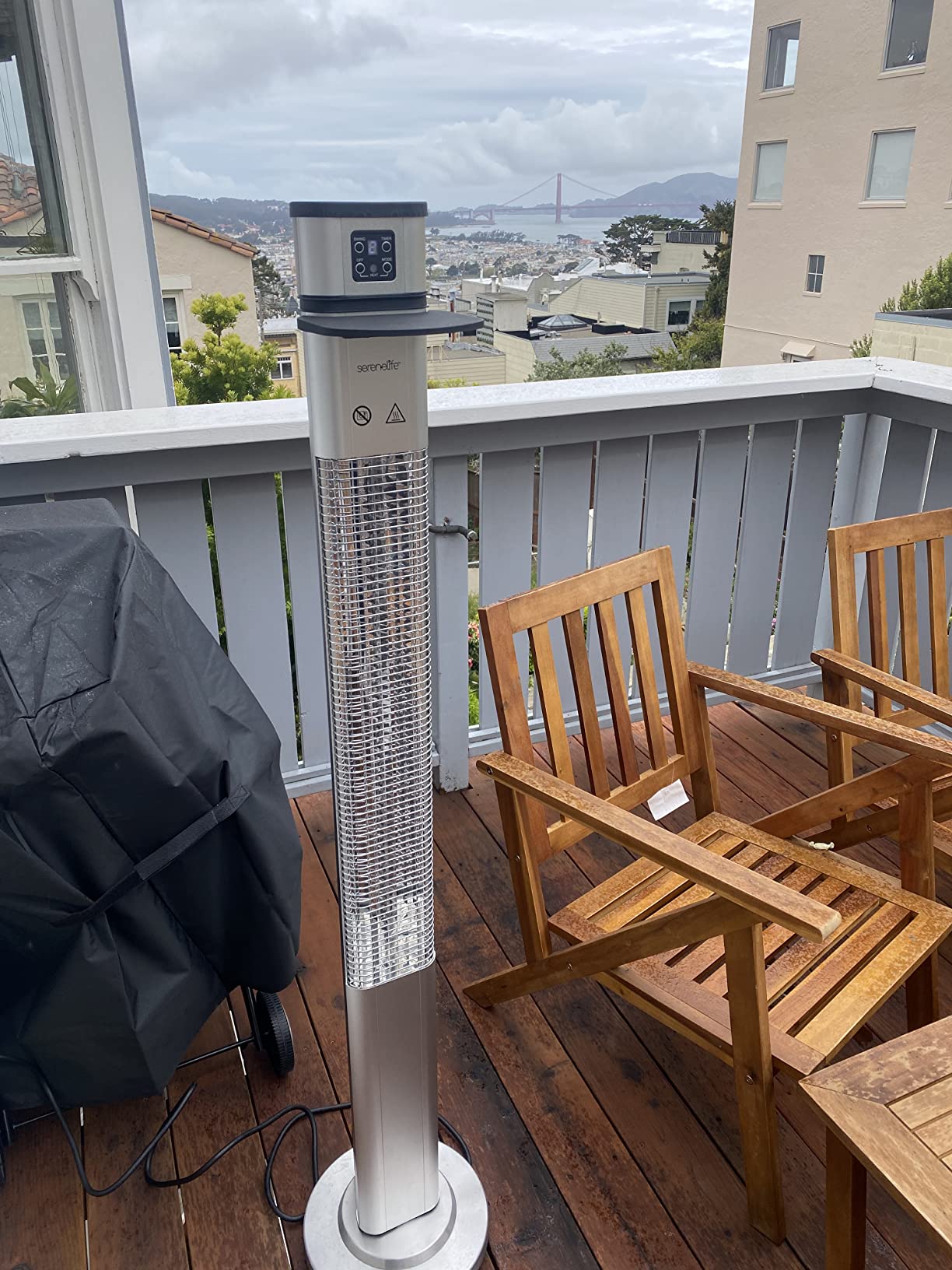
This is the tower shape that works on a covered patio with no mounting work at all. It plugs into a standard 120V outlet, runs on 1500 watts of ETL-certified carbon fiber at 88 percent efficiency, and the three heat levels come with a remote control.
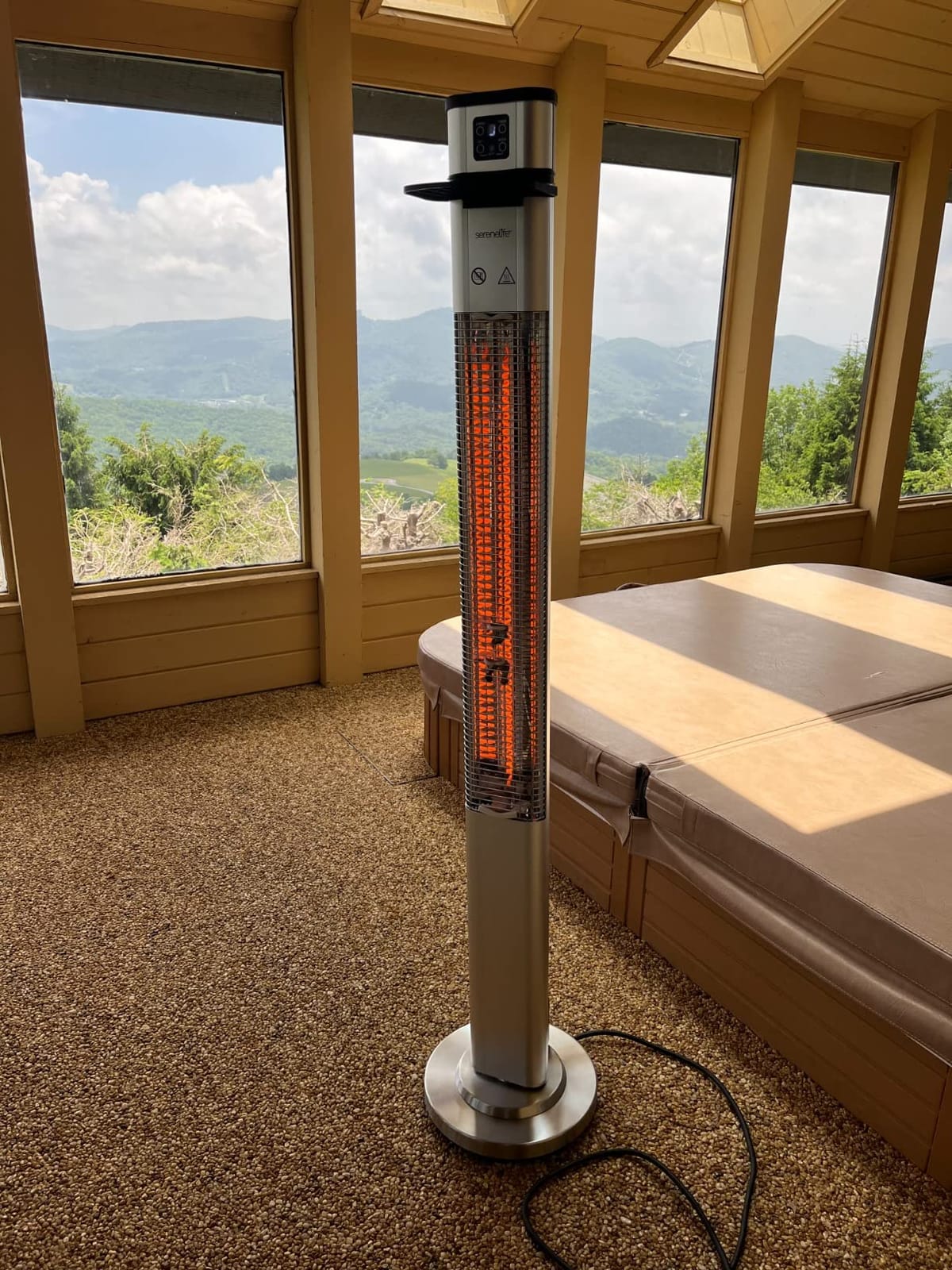
Safety hardware is more complete than the price suggests. A 360-degree tip-over switch, overheat protection and a mesh guard sit alongside a quiet, fanless design. It is also offered in three heights, and the 57 inch version is the one to pick for a patio table so the heat comes down at seated height rather than up your arm.
Be clear about what it does. The listed heating range is 25 square feet, which means this warms you and the people beside you, not the patio. Sitting a little apart from it and expecting it to heat the room is where disappointment comes from.
Best used as
A personal heater at one end of a long table, a garage bay, a pool house or a covered balcony where a standard outlet is already within reach of the seating. Reviewers like the odds and ends it solves, such as warming one spot during a cold spell or giving a covered room a usable corner.
Where the rating slips
At 4.1 with a comparatively high share of one-star ratings, this is the least warmly received unit here. The IP24 rating is modest for anything genuinely exposed, and the 12.5 amp draw on 120V means a long extension run is a bad idea even though it would technically work.
9. Encyclpo 1500W IPX5 Infrared Tower – Best Waterproof Portable
- Heats within seconds
- the fastest response in this roundup
- IPX5 waterproofing is stronger than most electric patio heaters
- Quiet and odorless
- 7.5-pound body with a carry handle
- Three settings at 600W
- 900W and 1500W
- Limited outdoor warm radius
- you need to sit close
- Tip-over switch is very sensitive and cuts out from minor bumps
- No remote control
- controls are on the unit
- Short cord length and extension cords are discouraged
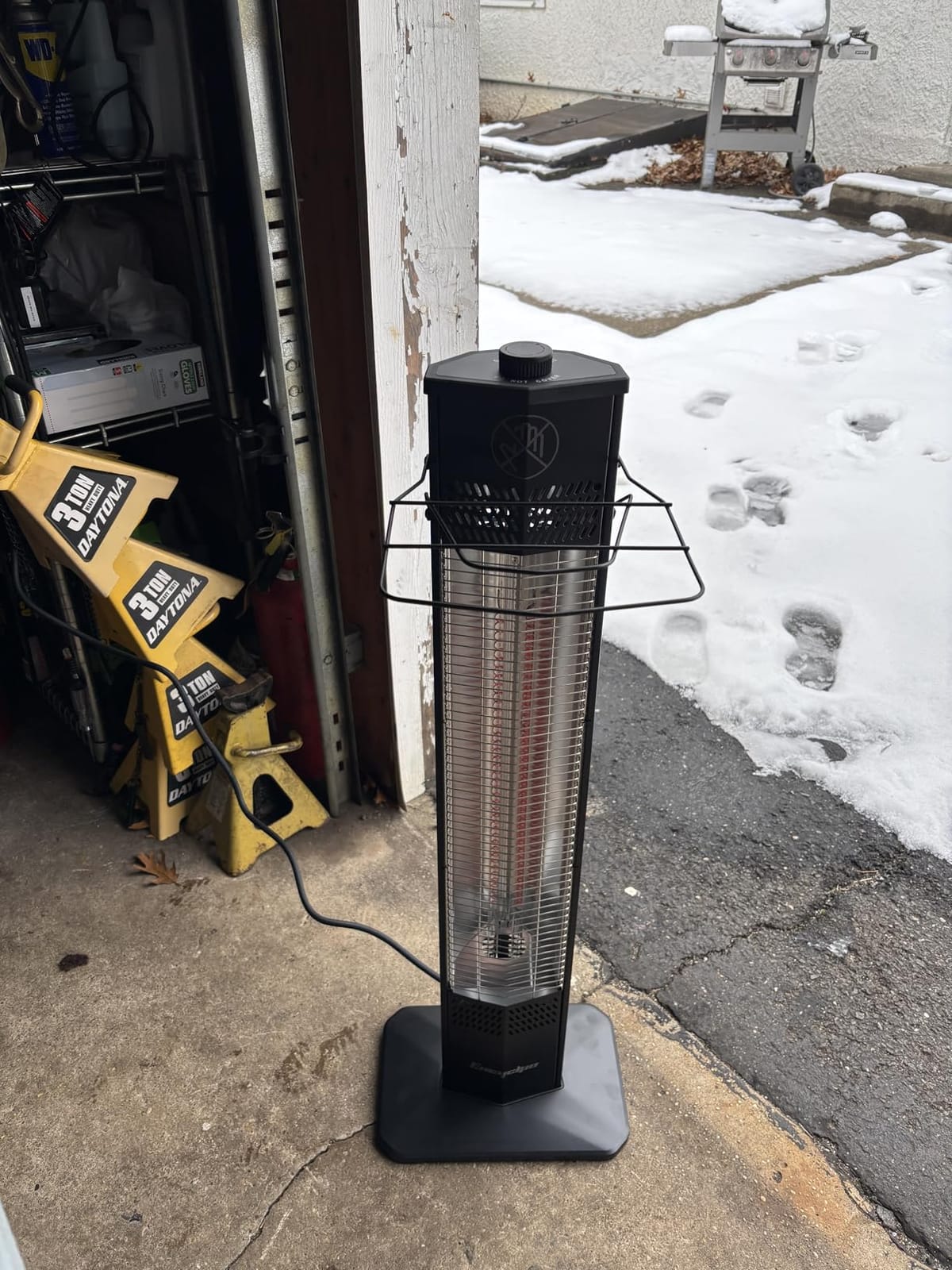
The most talked-about feature in owner reviews is speed. Owners describe this as the fastest heater they have used, warming almost immediately on the carbon fiber elements, and the IPX5 waterproof rating gives it more protection against spray and humidity than most electric patio heaters carry.
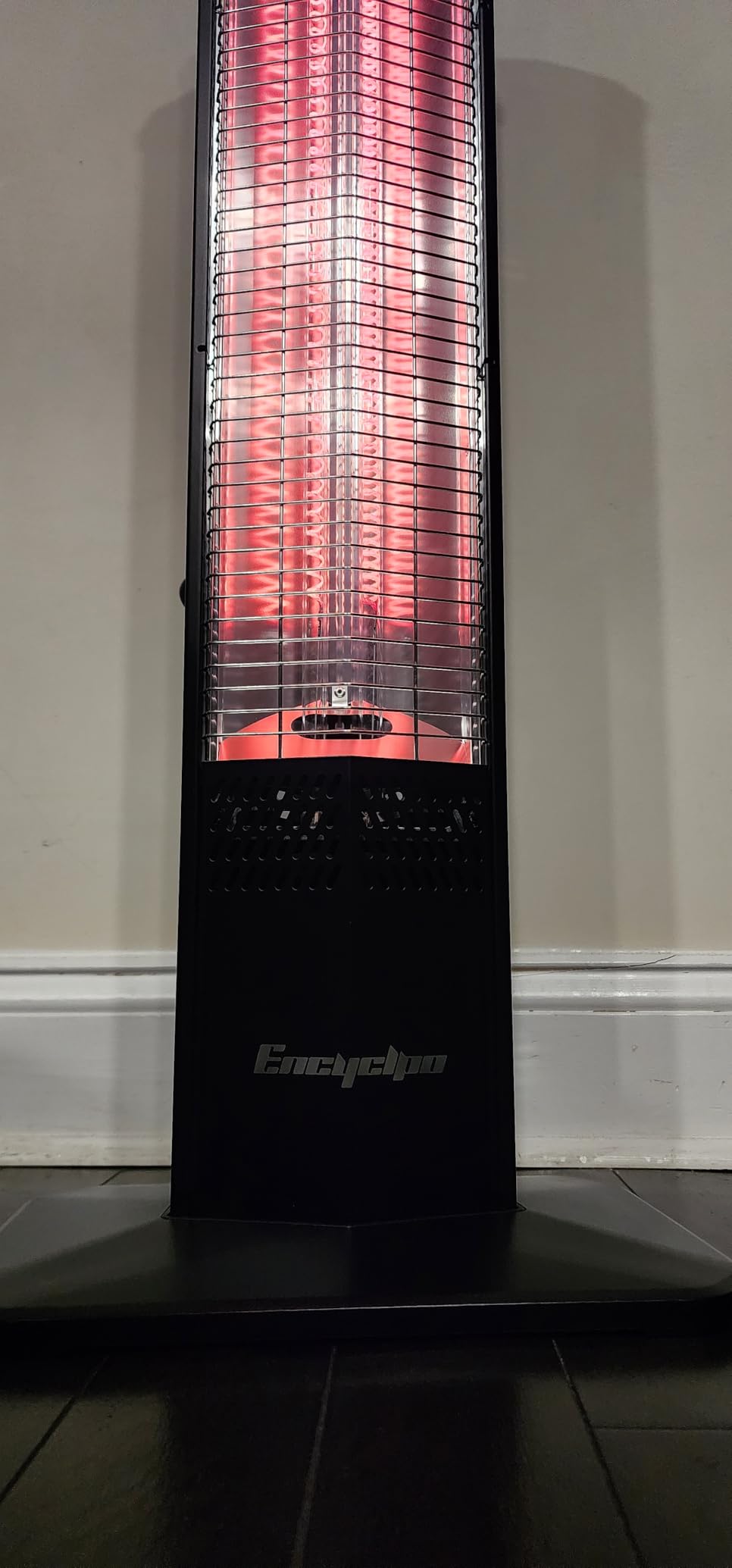
At 7.5 pounds with a carry handle it is by far the easiest unit here to move, which is exactly what you want on a covered patio where the warm spot moves with the sun and the seating. Three settings at 600, 900 and 1500 watts let you dial down rather than run full output.
The 36-inch tower is the sensible version of this design. Owners use them in garages, pool houses and screened patios, where a spot heater beats an attempt to heat the whole space. Set it on a stable surface away from walkways.
Where it earns its place
Covered spaces where dampness is a constant, and any location where you need warmth on one side of the room rather than everywhere. The silent, odourless operation and one-second response make it good for a spot you use briefly, and the temperature range runs from 40 to 140 degrees F.
What to watch
The tip-over switch is extremely sensitive and several owners report it cutting out after a minor tap. There is no remote, so you adjust at the unit. A small number of durability complaints about the control knob and one report of a unit failing after about five months are worth weighing against the low review count.
10. Cuisinart Perfect Position 38,200 BTU – Best With a Drink Table
- Swivel arm directs heat left or right across the seating
- 38200 BTU output covering 175 sq ft
- Built-in stainless steel drink table
- Enclosed base hides the propane tank
- Sand-filled wheeled base for stability
- 100 pounds is heavy to position initially
- 20 lb propane tank is sold separately
- Floor mount only with no wall mounting option
- Ongoing propane fuel cost
This is the only unit in the roundup built around a bar-height surface, and on a covered patio that is a genuinely useful idea. The 33 inch heat shield sits above a stainless steel drink table, so guests have somewhere to put a drink that is not their lap and are standing in the warm zone.
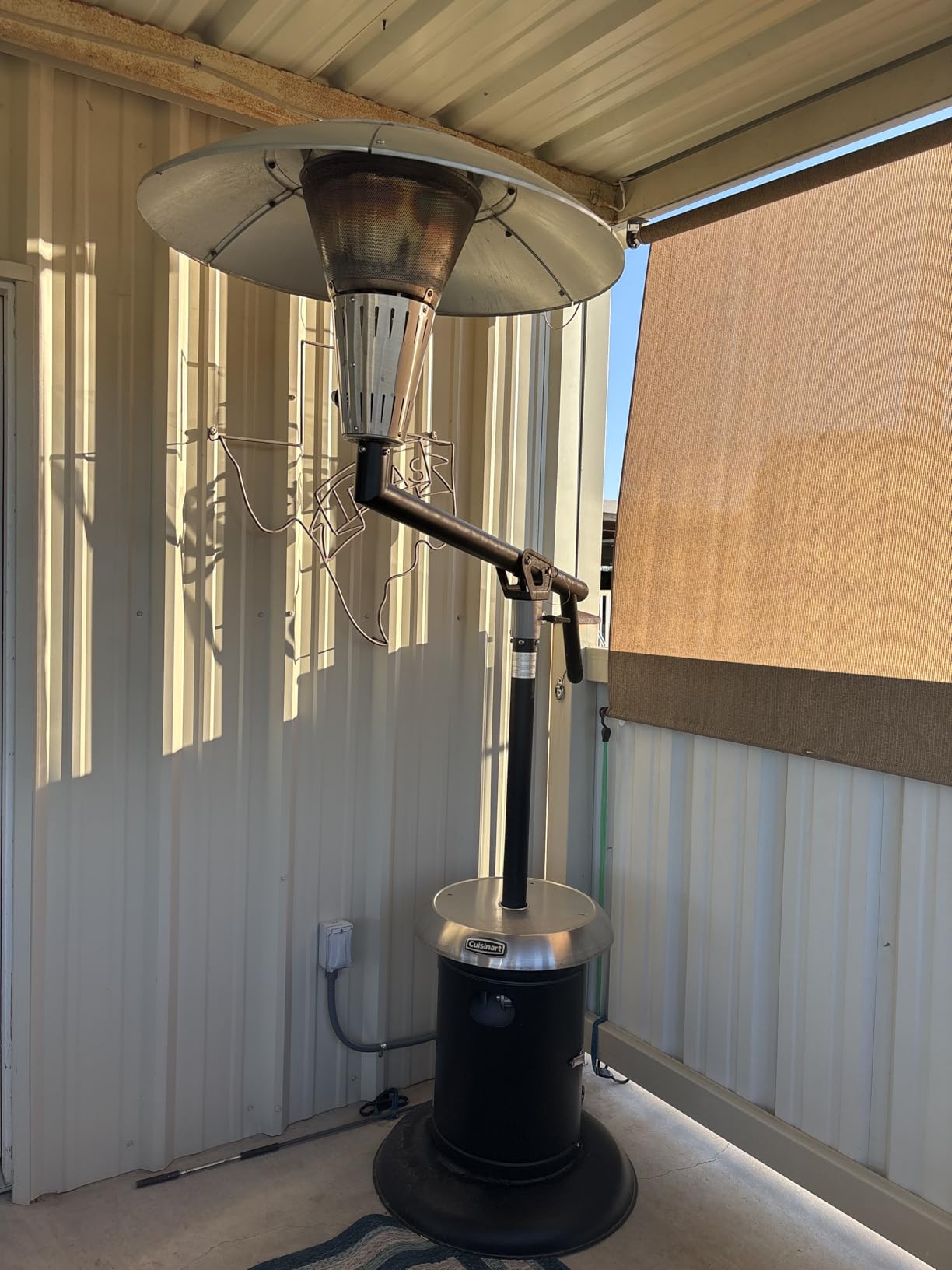
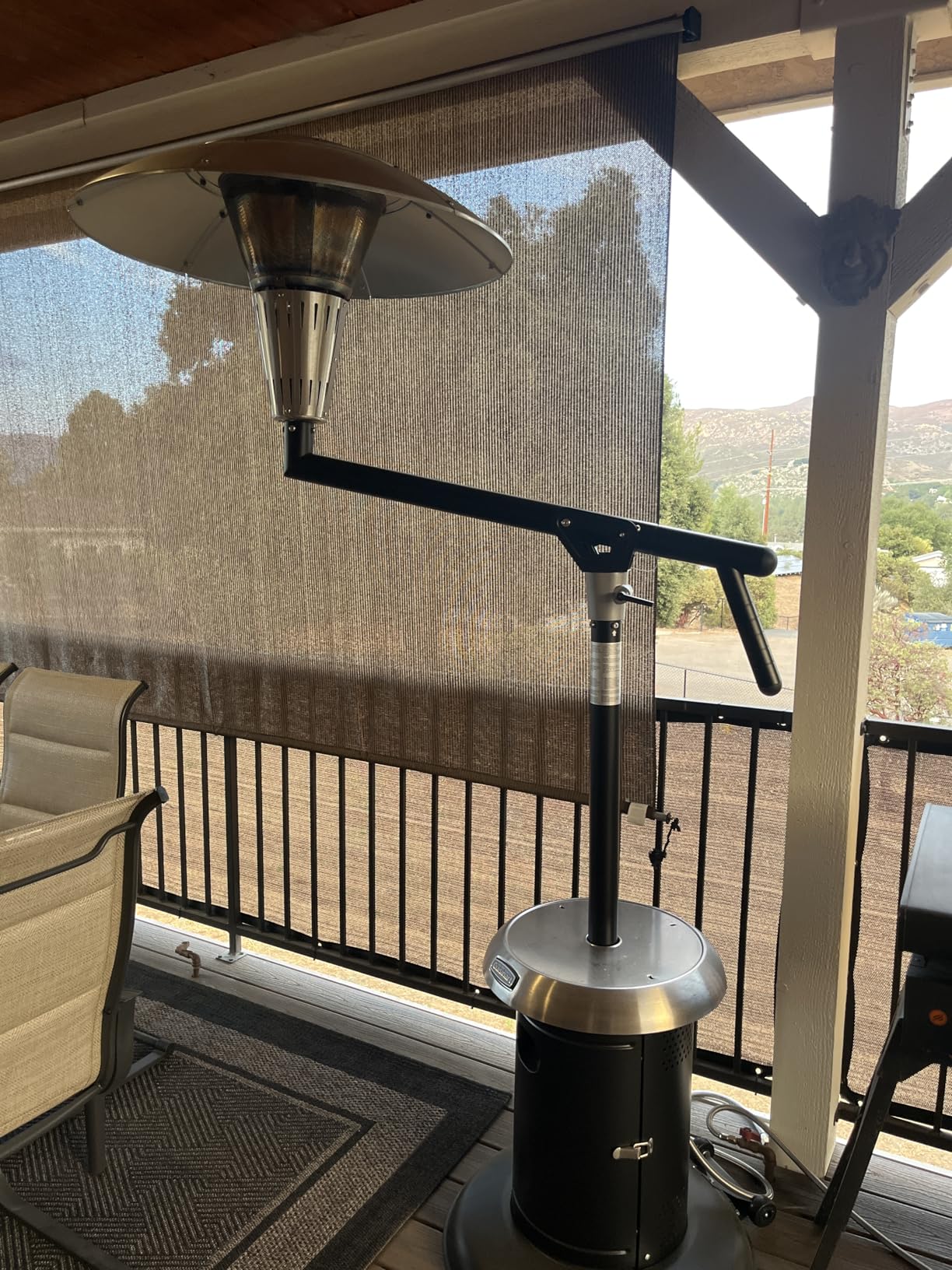
The swivel arm is the feature owners mention most. Rather than sitting in one fixed spot, the arm swings so you can direct the 38,200 BTU output toward one end of a long covered patio or the other, and it folds down for storage when the season ends. The base is sand-filled for stability and sits on wheels.
Owners also like that the propane tank lives inside an enclosed base rather than on display. The heater itself covers 175 square feet, which is a real number for a covered space and puts it in the same territory as much larger towers.
Why the swivel matters under a roof
A covered patio often has one section that stays warmer than the rest, near a wall or away from the open side. A fixed tower heats the same circle regardless. A swivel arm lets you follow the seating, which for a single appliance is a genuine efficiency gain on a 175 square foot covered area.
Where it falls down
One hundred pounds is a lot to get through a door and into position, and you will do it once rather than often. The tank is not included, and there is no wall-mount version, so the footprint on the patio is fixed for good.
11. Cuisinart Tabletop 11,000 BTU Heater – Best for a Patio Table
Cuisinart Patio Heater, Tabletop, Anti-Tilt Safety Switch, 11,000 BTU, Gray
- Compact 8.5-pound tabletop format that uses no floor space
- Anti-tilt auto shutoff and burner screen guard
- Reflector top plate spreads heat evenly
- Dial knob with low
- high and in-between settings
- Runs on a 1 lb tank or a 20 lb tank with a regulator
- 11000 BTU over about 30 sq ft is the smallest zone in the roundup
- Propane tank and optional regulator are not included
- Needs a stable heat-resistant surface
- No remote control
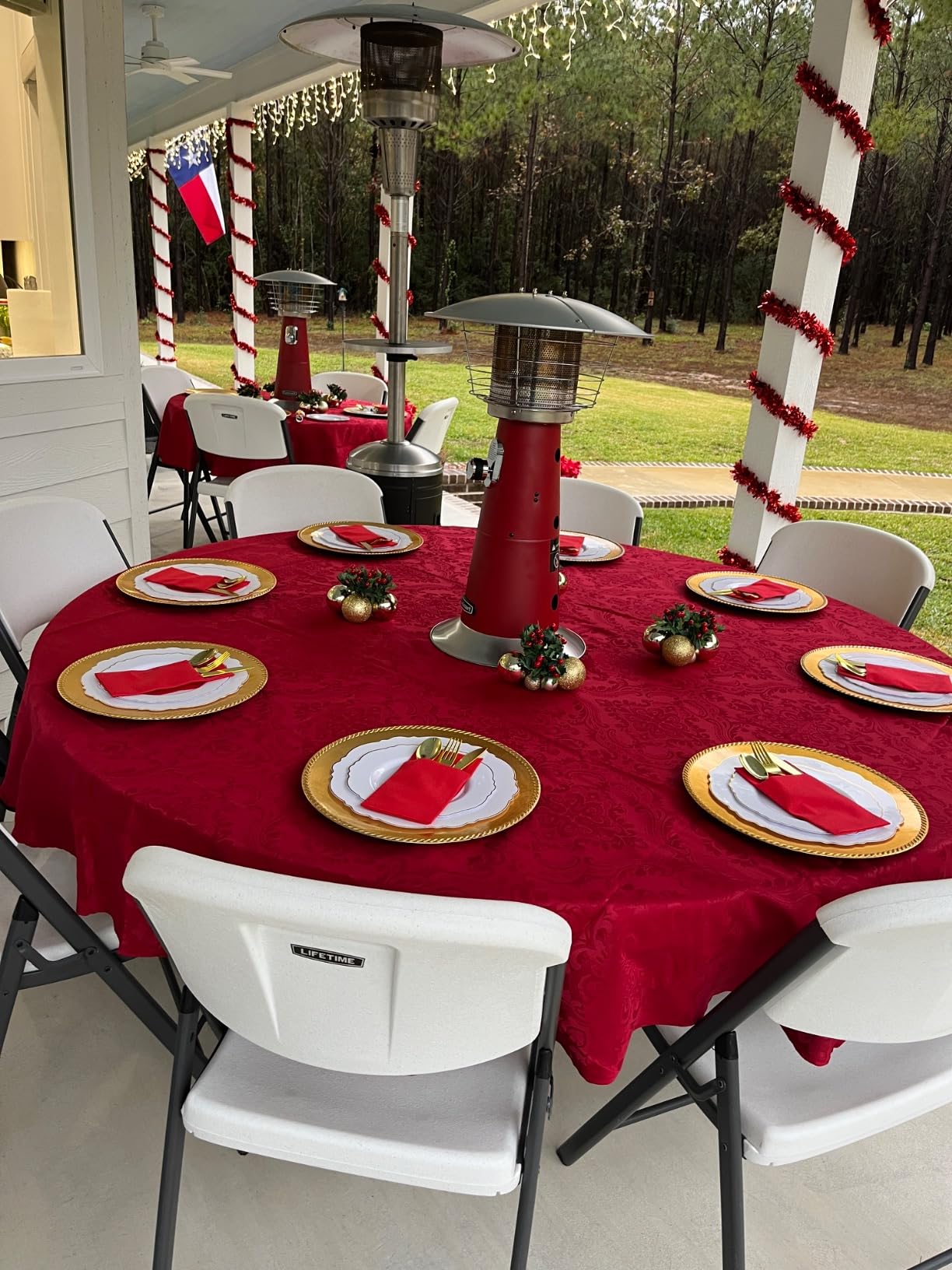
Tabletop heaters get criticised for pushing heat upward, and that criticism is fair in general. This one is best understood as a heater for one table rather than one patio, and the 11,000 BTU output with a reflector top plate does exactly what it is meant to do within about 30 square feet.
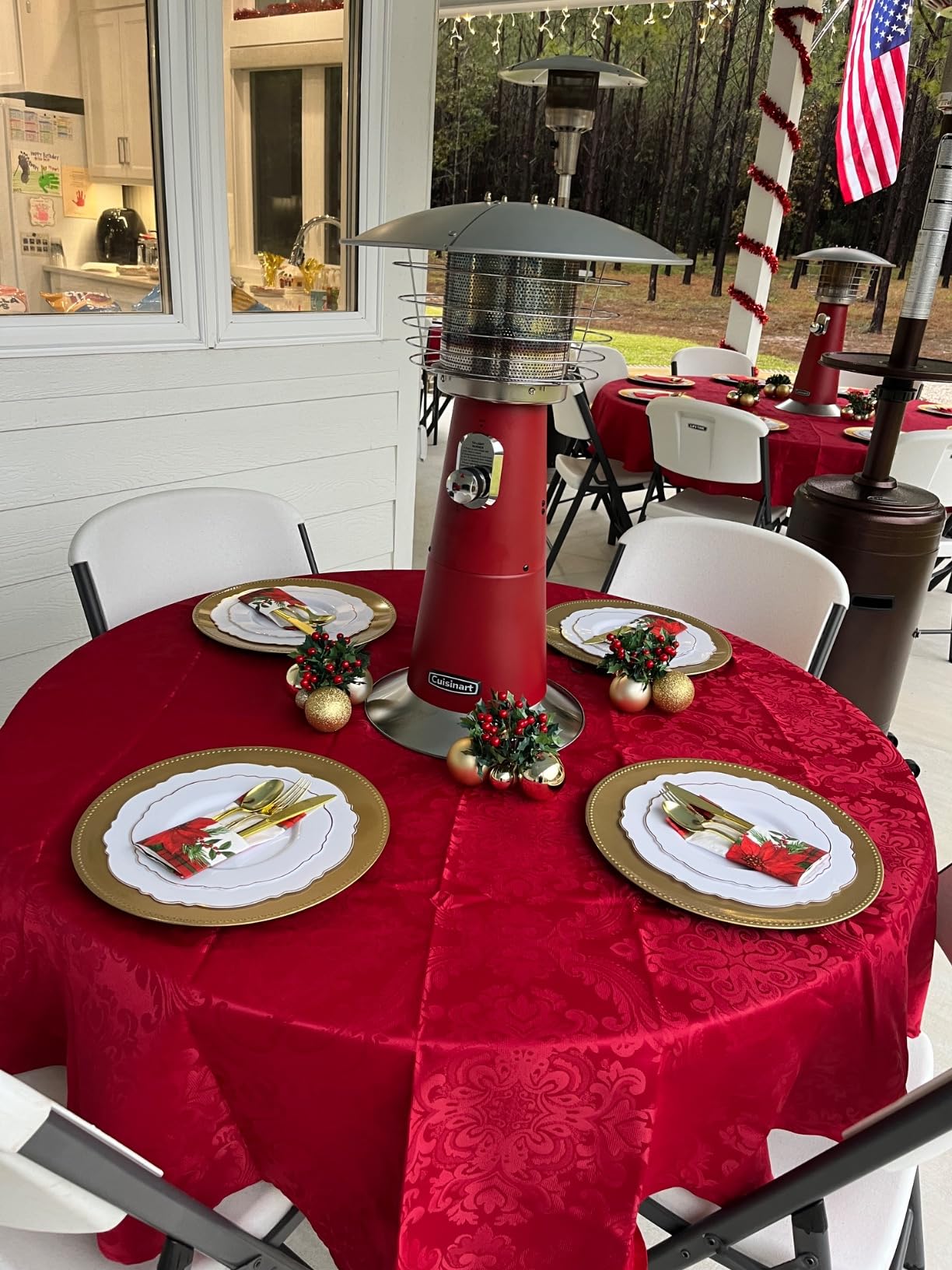
The safety hardware is the reason it works around a dining table. A built-in anti-tilt automatic shut-off and a burner screen guard mean a knocked table or an enthusiastic pet does not leave a burner running, and at 8.5 pounds it moves between the patio and the camping trip without ceremony.
It runs on a one pound propane tank out of the box or connects to a 20 pound tank with an optional regulator, so a long evening does not depend on a small cylinder. The dial gives low, high and in-between settings rather than a simple on-off.
Its one good job
Keeping one end of a dining table comfortable during a long outdoor dinner when a tower heater cannot reach, or when you only want heat for an hour rather than an evening. Owners like the compact size and the even reflector, and the outdoor rug beneath the table is a good place to keep it stable.
What it will not do
It will not heat a covered patio. Thirty square feet is roughly the footprint of a small dining set, and outside that radius you are relying on ambient warmth. If your goal is extending the season on a covered deck, treat this as a table accessory rather than a heating solution.
12. Nfccra 34-Inch Wall Mount 1500W – Best With a Motion Sensor
- Motion sensor switches the heater on when people are detected
- IPX5 waterproof rating for outdoor durability
- Nine heat levels and a 9-hour timer
- UL certified with overheat protection
- Wall mount frees floor space and mounting template included
- Requires mounting hardware and outlet access nearby
- A few reports of bolts rusting over time
- 1500W may be limited for a very large covered area
- A small number of early failures reported
This is the only unit here with a motion sensor, and on a covered patio that is more useful than it first sounds. The infrared sensor detects people and brings the heater on automatically, then shuts it off after five minutes of no activity.
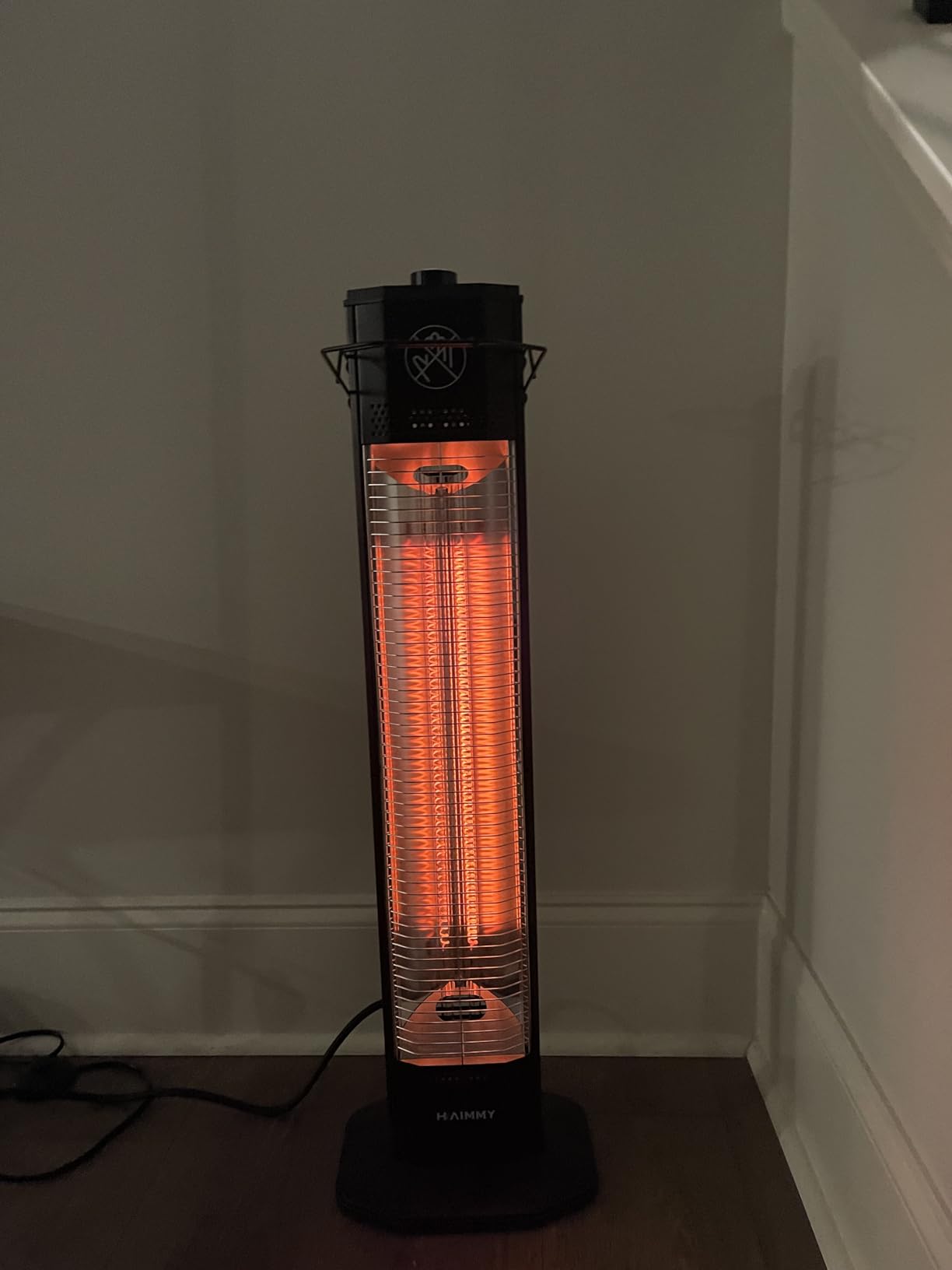
Control granularity is the other strength. Nine heat levels and a nine-hour timer, a remote, and a 120V plug rather than a hardwired 240V feed, which makes it one of the easiest outdoor-rated electric options to add to a patio that already has an outdoor outlet.
At 34 inches long and 6.8 pounds it is a slim wall-mounted strip that suits a low wall or a narrow section of covered space without taking the visual weight of a cabinet-style unit. Overheat protection is built in and the unit is UL certified.
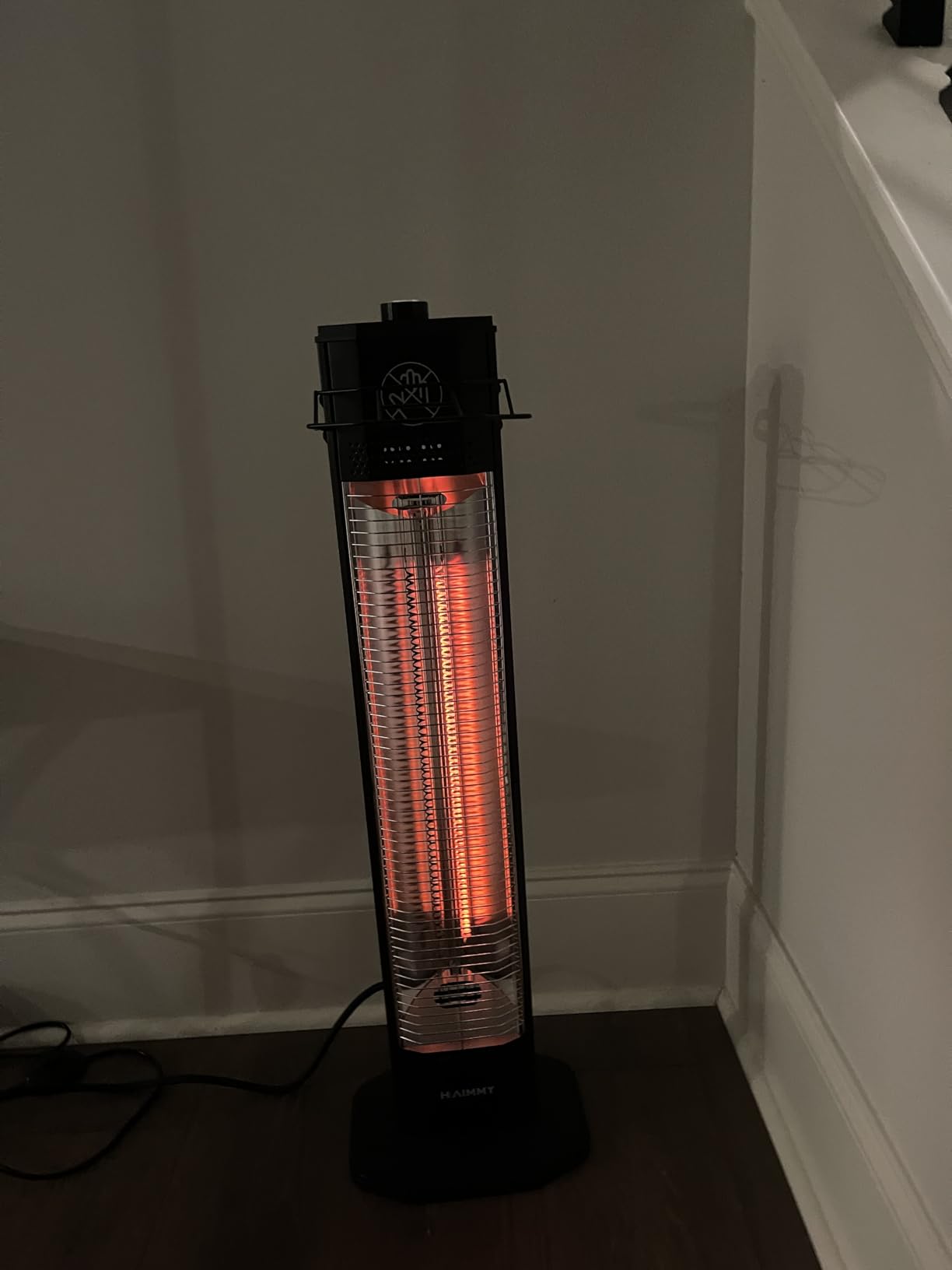
Best used as
A zone heater for a covered seating area, particularly one that gets used intermittently through the shoulder season. Several owners report reliable performance over months of outdoor exposure, and the three-year replacement warranty adds a layer of confidence that most products in this category do not offer.
Trade-offs
It needs a mounting job and an outlet within reach, and the included bolts have drawn reports of rusting over time, which is worth checking on an exposed wall. A small number of early failures are reported, and 1500 watts is a modest amount of heat for a genuinely large covered space.
Can You Actually Run a Heater Under a Roof? Clearance and Safety Rules
Yes, but only with a heater that is certified for outdoor use and mounted at the clearances its manufacturer specifies. Every outdoor-rated heater has those numbers printed on its rating plate or in its manual, and they take priority over anything you read on a retail page, including this one. Gas heaters in particular need stated clearance above, below and to the sides of the unit.
The physical reason is straightforward. A patio heater radiates heat in every direction, including up. Under a roof, some of that heat and, on a combustion unit, the combustion gases collect near the ceiling before they can disperse. Adequate clearance is what keeps a ceiling from staining and keeps the unit outside the conditions its warranty assumes.
Three rules cover most cases. Mount the unit so the required clearance to the ceiling and to any overhead structure is met with the reflector in place, not folded. Keep a combustion heater away from open edges where wind could draw flame and gases back toward the seating area. And never extend a gas heater’s reach with a hose or extra pipe that the manufacturer did not specify.
One forum complaint deserves a direct answer because it worries people unnecessarily. A new gas heater producing visible smoke on first light is normal behaviour while the burner burns off manufacturing oils, and it is not by itself a defect. Persistent smoke after several firings is a different matter and means you should stop using the unit.
Electric vs Propane vs Natural Gas for a Covered Patio
Electric wins on a covered patio for a simple reason: no combustion means no carbon monoxide, no soot and no ventilation question. The outdoor-rated electric units in this roundup carry IP ratings from IP24 to IP65, run quietly, start instantly and start remotely. The trade-off is installation: a 3000 watt unit like the DR. INFRARED HEATER needs a 220V to 240V circuit, while 120V plug-in models are limited to 1500 watts.
Propane wins on flexibility. You can put a tower anywhere a cylinder will go, move it between a covered patio and an open deck, and get more radiant output per dollar than any 120V electric unit delivers. The costs are a tank to refill, a burner to maintain and a combustion appliance to place carefully under a roof.
Natural gas is the permanent-installation answer that most roundups skip. A unit plumbed to a gas line never runs out mid-evening and produces a cleaner, more even heat than propane, which is why restaurant patios use it. The trade-off is a licensed gas fitter and a run of pipe, which only makes sense if you are already rebuilding the patio.
On running cost, the manufacturer figures for the carbon infrared units in this roundup put electric at roughly one tenth the operating cost of propane. Treat that as a directional comparison rather than a promise, since it depends on your local electricity and fuel rates, but the gap between a 1500 watt radiant element and a 40,000 BTU gas burner is large enough that the direction will not change.
How Many BTU Do You Need? Sizing by Patio Square Footage
Start from the coverage figures on this list rather than from a formula. A 46,000 BTU propane tower is rated to cover 324 square feet, and an 11,000 BTU tabletop is rated for 30 square feet. Those are the honest ranges, and a covered patio loses the wind that would otherwise carry heat away, so the mid-to-lower end of a rated figure is usually enough.
As a rough guide, plan on roughly 40,000 BTU of gas output or a 3000 watt mounted electric heater for a covered area of 150 to 200 square feet. A 120V 1500 watt portable unit is a spot heater for one table, not a patio heater, and the products that list 25 to 30 square feet are telling you exactly that.
Past about 200 square feet, two units beat one big one. A covered patio that size usually has open ends where the heat escapes, and two heaters placed at opposite ends warm the middle better than a single higher-output unit placed at the centre. Running one heater at a time on the coldest evenings also cuts fuel use.
For mounted electric, the same logic applies in reverse. Because infrared falloff is fast, two 1500 watt units covering separate seating areas will outperform one unit trying to cover the whole space. Electricians advising on covered-patio installs also recommend a dedicated circuit where the load demands it, plus GFCI protection and a weatherproof junction box, even when the appliance itself is outdoor rated.
What Not to Use Under a Cover: Wood-Burning and Pellet Heaters
Wood-burning and pellet heaters are the wrong answer for a covered patio, and the reason is code and air rather than performance. These appliances are designed to operate in a space with a defined combustion air supply and a venting path. Under a roof with open sides, the venting path is not reliably there, which is a ventilation problem that no amount of care on the patio fixes.
There is real demand for pellet heaters in covered spaces, and patio versions with 100,000 BTU-plus ratings do exist. The problem is that those ratings describe output, not suitability for a semi-outdoor enclosure. If you are considering one, the first call should be to your local building department about what your specific structure is classified as, not to a retailer page.
Gas and electric radiant heaters avoid the issue entirely. A propane heater is a small, sealed, exterior-rated appliance with its own venting requirements stated by the manufacturer. An electric heater produces no combustion at all. Both are designed for the environments they are sold into.
How to Choose an Outdoor Heater for a Covered Patio
Measure the space before you shop, in two directions. Measure the floor area and the distance from your intended mounting point to the ceiling. Those two numbers eliminate most options immediately, and they are the numbers the clearance rules are checked against.
Decide mounting style from the ceiling height. A low ceiling rules out tall freestanding towers and points you toward a wall-mounted or ceiling-hanging unit. A high ceiling with an open structure can take a tower. A patio with a solid wall on one side is a wall-mount problem, not a floor-stand problem.
Pick the fuel after that, not before. If you already have a propane cylinder and a patio outlet, both routes are open to you. If you have neither, the appliance with the easiest power or fuel path is the one you will actually install rather than leave in the box.
Check three specific things before checkout: the outdoor rating or IP certification, the stated clearance requirements, and the warranty. A one-year warranty is common; the Nfccra unit in this roundup carries a three-year replacement warranty, which tells you something about expected outdoor service life.
Finally, plan where it will live in summer. Every tower in this roundup either has wheels or is very heavy. Outdoor storage and a covered spot for the unit during the warm months will decide whether you keep using it in year three.
Screened-In Porches and Sunrooms Are a Different Problem
A screened-in porch with no ceiling line is closer to being outdoors than it looks, and heaters get labeled for it inconsistently. The screen does not create a roof, so a unit rated for open-air use is the specification you want, and you should check whether the screening manufacturer or local code treats the enclosure differently.
A sunroom is the opposite case. With glazed walls and a proper roof, a wall-mounted or ceiling-mounted electric unit is the natural fit, because there is no ventilation question and the space holds heat once warmed. In both situations the same rule applies: match the certification to the enclosure, not to the furniture.
Frequently Asked Questions
Can a patio heater be used under a covered patio?
Yes, provided the heater is certified for outdoor use and mounted at the clearance distances its manufacturer specifies, usually printed on the rating plate. Combustion heaters need stated clearance to the ceiling and to overhead structure so heat and combustion gases disperse. Under a roof, mounted wall and ceiling units are generally more effective than tall freestanding towers.
How much clearance does a patio heater need from a ceiling?
The required clearance is set by the manufacturer and printed on the rating plate or stated in the manual. That figure takes priority over any number you read online. Check the required clearance above, below and to the sides with the reflector in its installed position, and never hang a unit from structure that cannot carry the load.
Which patio heater gives off the most heat?
Gas heaters produce the highest raw output, and the units in this roundup range from 11,000 BTU tabletop models up to 48,000 BTU freestanding towers. The Cuisinart Perfect Position at 38,200 BTU covers 175 square feet, and the Amazon Basics tower at 46,000 BTU covers 324 square feet. Higher output is not automatically better on a small patio.
What is the best way to heat an outdoor covered patio?
Match the mounting style to your ceiling height first, then match the fuel to your power and fuel access. A wall-mounted or ceiling-hanging infrared heater works well under a low roof, while a tall tower suits an open-sided space with high clearance. Outdoor-rated electric avoids combustion entirely; propane gives higher output and more placement flexibility.
What type of heater is best for a screened-in porch?
For a screened-in porch with no ceiling line, choose a heater rated for outdoor use rather than assuming the screen makes the space interior. A wall-mounted outdoor-rated infrared unit works well where there is a solid surface to mount to. For a glazed sunroom, an electric wall or ceiling unit is usually the simplest and quietest option.
What are the drawbacks of using outdoor propane heaters?
The main drawbacks are carrying and refilling cylinders, the noise and smell at ignition, and the fact that a combustion appliance under a roof raises clearance and ventilation questions. Propane consumption on a high setting is faster than many first-time owners expect, and the heat is thrown from the top of tall towers rather than evenly across a table.
Do electric patio heaters work on a covered patio?
They do, provided the unit carries an outdoor or weatherproof rating such as the IP55 on the DR. INFRARED HEATER or the IP65 on the Paraheeter in this roundup. Units rated for indoor use only should not be installed outdoors, even under a cover. For 240V models you will need a dedicated circuit and GFCI protection.
The Best Outdoor Heater for Your Covered Patio
The best outdoor heaters for covered patios are not the ones with the biggest number on the box. They are the ones whose certification, clearance requirements and mounting geometry match your roof. Start with the ceiling height, confirm the outdoor rating, and only then compare output.
For most people, the Amazon Basics 46,000 BTU propane tower is the right buy. It has the strongest combination of output, review volume and real-world reports, and its 91 inch height keeps the burner above your table. If your ceiling is low or your patio is compact, go mounted instead, and choose the DR. INFRARED HEATER DR-239 if you can have a 240V circuit run, or the Paraheeter if you want one unit that works on the wall, the ceiling or a tripod.
Skip the Heat Storm and Mr. Heater units on an open-sided covered patio despite their review counts. Both are rated for indoor use, and matching a heater to the wrong space is the one mistake in this category that can matter. Read the clearance section again before the first cold evening, make sure your patio cushions are still where you put them last fall, and enjoy the extra months of the year.