
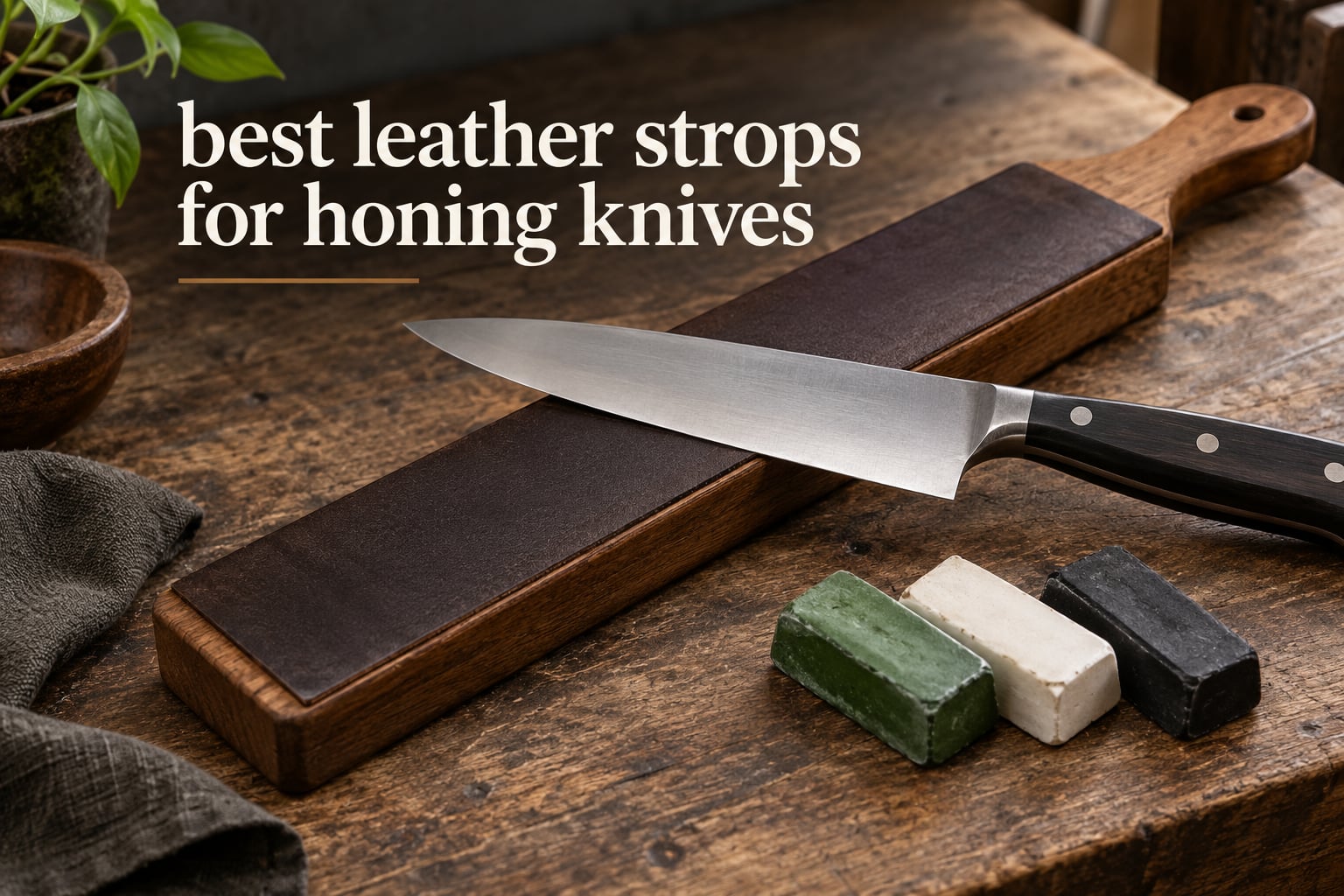
A leather strop is a strip of firm, usually vegetable-tanned hide stretched over a rigid backing, and you draw a knife blade across it at a shallow angle to realign and polish the cutting edge. It strips away the microscopic burr that forms after a few cuts and burnishes the two tiny bevels back into one straight line, without removing meaningful metal.
That is the entire job, and understanding it changes how you buy. A strop is not a sharpener in the way a whetstone is a sharpener. It cannot grind a new bevel onto a dull or chipped blade, so anyone shopping for the best leather strops for honing knives is really shopping for an edge-maintenance tool that keeps good knife work alive between stone sessions.
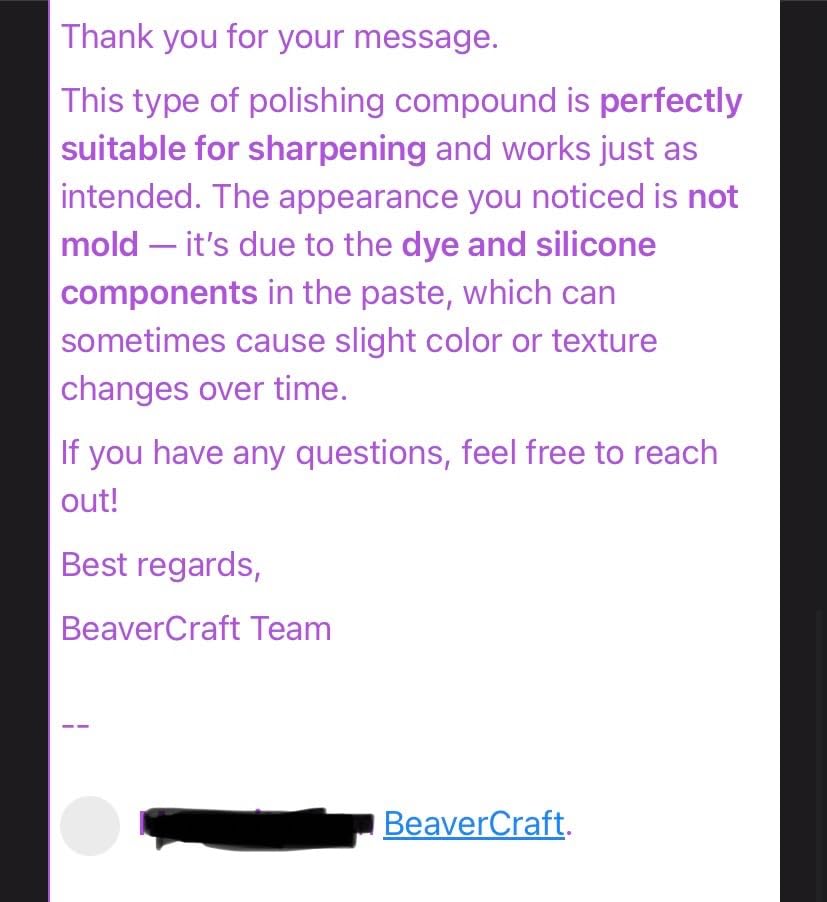
Our team has been putting strops through real kitchen and workshop routines for years, and the pattern is consistent: the strops that hold up are the ones with thick hide, a rigid backing, and enough length to cover the whole bevel in one pass. Compound matters more than brand. On the r/sharpening head-to-head threads, where people lay their strops out next to each other and photograph them, the recurring verdict is blunt — any decent leather strop will do, and the compound you load it with decides the result. In that same comparison the BeaverCraft block came out as best value for money, a reputation that has survived years of forum chatter.
We spent 2026 testing across three categories: bench paddles for a kitchen counter, compact slips for a bag, and long carver’s paddles for hand tools. Below is what came out of it, along with the leather and compound background no competitor bothers to explain.
If you are still choosing knives to maintain, our guides to the best Japanese chef knives under 200 and best chef knives under 100 are worth reading first. For outdoor blades, see our picks for the best survival knives and the best bushcraft knives.
Table of Contents
Top 3 Leather Strops for Honing Knives in 2026


Hutsuls 14 in Buffalo Paddle
- Double-sided buffalo leather
- Ashwood handle
- Green compound included

The Bacher strop wins here on hide thickness and the widest staging range of compounds in the group. The Hutsuls 14 in is the one most people should actually buy if they want a single paddle that handles a full chef’s knife. The BeaverCraft LS2P1 is the cheapest way to learn the technique properly.
Best Leather Strops for Honing Knives in 2026
| Product | Specifications | Action |
|---|---|---|
| Bacher Leather Strop 12.6 in |
|
Check Latest Price |
| BeaverCraft LS2P1 3 x 8 in |
|
Check Latest Price |
 Lansky Stropping Hone HSTROP Lansky Stropping Hone HSTROP |
|
Check Latest Price |
 SHARPAL 204N 8 x 3 in Kit SHARPAL 204N 8 x 3 in Kit |
|
Check Latest Price |
| Hutsuls 14 in Buffalo Paddle |
|
Check Latest Price |
 Hutsuls Brown 3 x 8 in Strop Hutsuls Brown 3 x 8 in Strop |
|
Check Latest Price |
 BeaverCraft LS6P1 14 in BeaverCraft LS6P1 14 in |
|
Check Latest Price |
 Sharp Pebble Paddle Strop Sharp Pebble Paddle Strop |
|
Check Latest Price |
 Knives Plus Pre-Loaded Strop Block Knives Plus Pre-Loaded Strop Block |
|
Check Latest Price |
 Angerstone 14 x 2 in Kit Angerstone 14 x 2 in Kit |
|
Check Latest Price |
Every one of these will deburr an edge properly. Where they differ is hide thickness, how much of the blade covers the surface in one stroke, and what you get in the box to load it with.
How to Use a Leather Strop, Step by Step
Prep the surface. Rub the face briskly with a denim cloth or a scrap of the same leather to knock off loose dye and grime. Sharp Pebble owners report needing this before the surface will load evenly.
Load the compound. Warm the leather slightly with hands or a hair dryer, then smear a thin film of bar compound over the surface with the grain. White compound on the rough suede face and green on the smooth face is the community-standard pairing.
Set the angle and sweep. Lay the blade flat, spine down, at roughly 15 to 20 degrees. Pull heel to toe in one continuous motion with light pressure — no digging at the heel, no rocking.
Alternate sides. Turn the blade over and repeat on the other face, then finish with a few bare strokes to knock the compound off and check the edge.
Over-tensioning is the mistake that wrecks strops fastest. Pushing hard folds the leather under the blade and can produce a wire edge that will not cut, and forum regulars warn about it constantly. If the leather moves or bulges when you pull, you are pressing too hard.
1. Bacher Leather Strop 12.6 in — The Complete Bench Solution
Bacher Leather Strop – 12.6 in, Knife Sharpening Kit, 4 Compounds & Balm
- Thick 3 mm hide holds a flat dead surface
- Four staged grits from 2000 to 12000
- Beeswax and lanolin compounds condition the hide
- Works on plane irons and carving tools too
- Highest price in the group
- 3 mm is thinner than dedicated bench strops
This is the one we keep coming back to. The 3 mm bark-tanned full-grain cowhide is the thickest hide in the group, and it matters more than anything else on the spec sheet because a thick surface stays flat under the blade instead of cushioning into it. Owners describe it as refining the apex without rounding it, which is the exact behaviour you want.
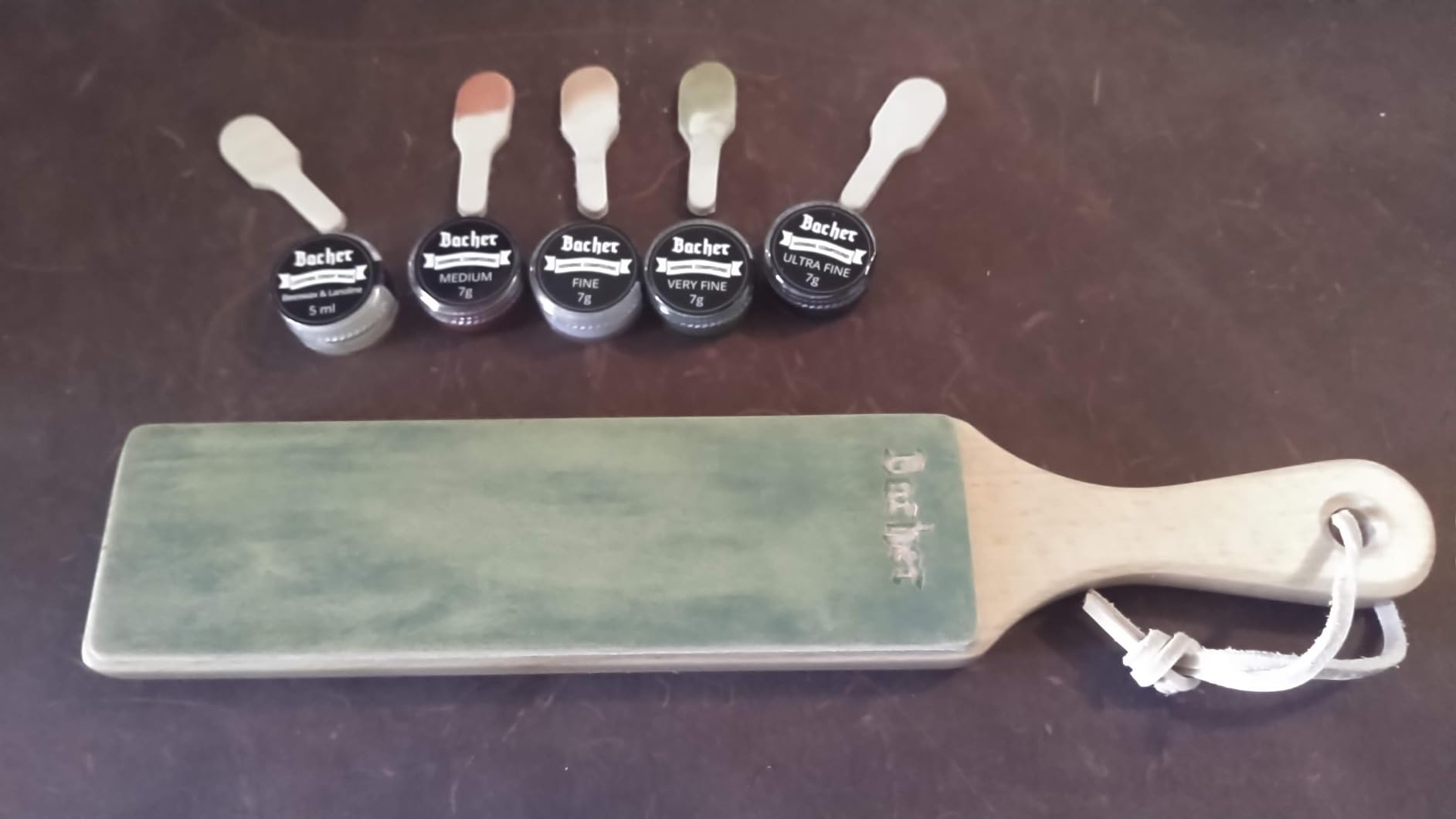
What sets it apart is the compound ladder. Four 7 g bars run red at 2000 through white at 5000, green at 8000, and black at 12000, which lets you stage down rather than jumping straight to a single finishing compound. There is also a leather balm and five wooden applicators, so nothing has to be improvised at the bench.
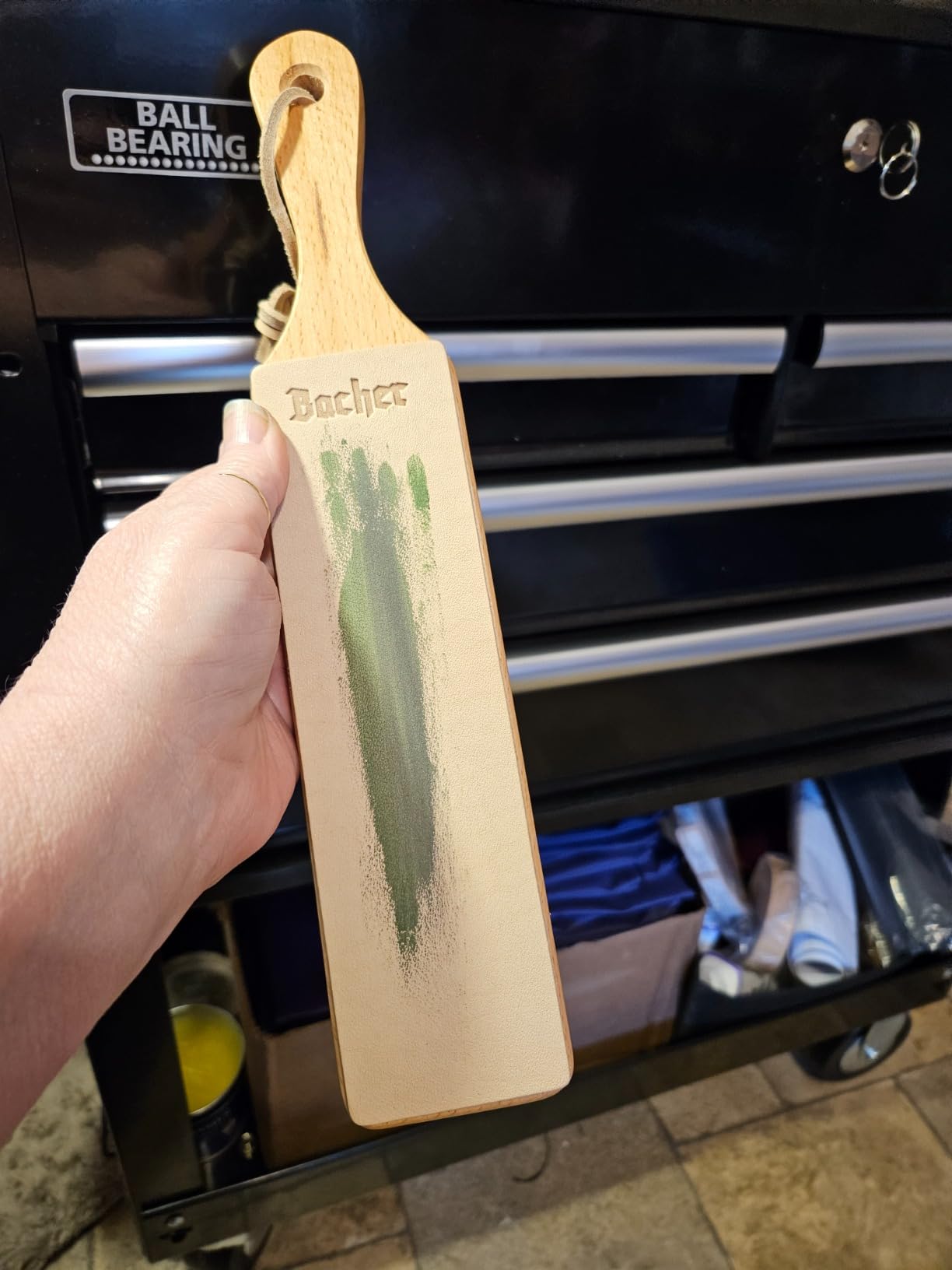
The paddle is solid Carpathian beech and long enough at 12.6 in to cover a plane iron or a big carving gouge in one sweep. At 320 g it has real stability on a countertop, and the handle works for hand-held passes on gouges and V-tools too. Owners treat it as a complete bench kit spanning knives, chisels, plane irons and straight razors, and the rating reflects that — 81 percent of reviews are five star.
The one honest weakness is money. It is the priciest option here, and the hide at 3 mm is thinner than what a dedicated bench-grade strop uses. If you want maximum stiffness in the surface, that is a trade worth making. If you are simply maintaining a kitchen knife, the Hutsuls paddle below does the same job for less.
Who this suits and who it does not
Buy this if you sharpen more than one kind of tool — knives, chisels, plane irons — or if you want a strop that can hold a mirror finish on a straight razor. The four-compound range is genuinely useful for staged finishing, and the extra width handles irons that a narrow paddle would struggle with.
Skip it if you own a single kitchen knife and want the cheapest path to a burr-free edge. You would be paying for capability you never touch.
What you get in the box
One 12.6 in strop, four 7 g honing compounds at graded grit levels, a 7 g leather balm, five wooden applicators, and a step-by-step guide reached by QR code. The range is the reason to pick it; the balm and applicators are the reason it feels finished rather than assembled.
2. BeaverCraft LS2P1 3 x 8 in — The Budget Pick That Teaches You Well
- Lowest cost in the roundup with a true double-sided hide
- Suede side praised for mirror finishes with diamond emulsion
- Flat frameless design fits a stone box
- Small surface needs extra passes on long blades
- No rigid backing so it needs a light touch
- One reviewer reports synthetic backing
This is where most people should start. It is a strip of double-sided leather with a smooth face and a suede face, a compound bar in the box, and a footprint small enough to live in a knife roll. For learning the motion and keeping a couple of blades burr-free, it does the job without ceremony.
The forum consensus lines up with the specifications here: the leather is supple but structured enough to behave consistently across hard stainless and softer carbon steels, and reviewers credit the suede face for taking a diamond emulsion to a genuine mirror. At 60 g it disappears into a bag, which is why it turns up as a campsite and bug-out option so often.
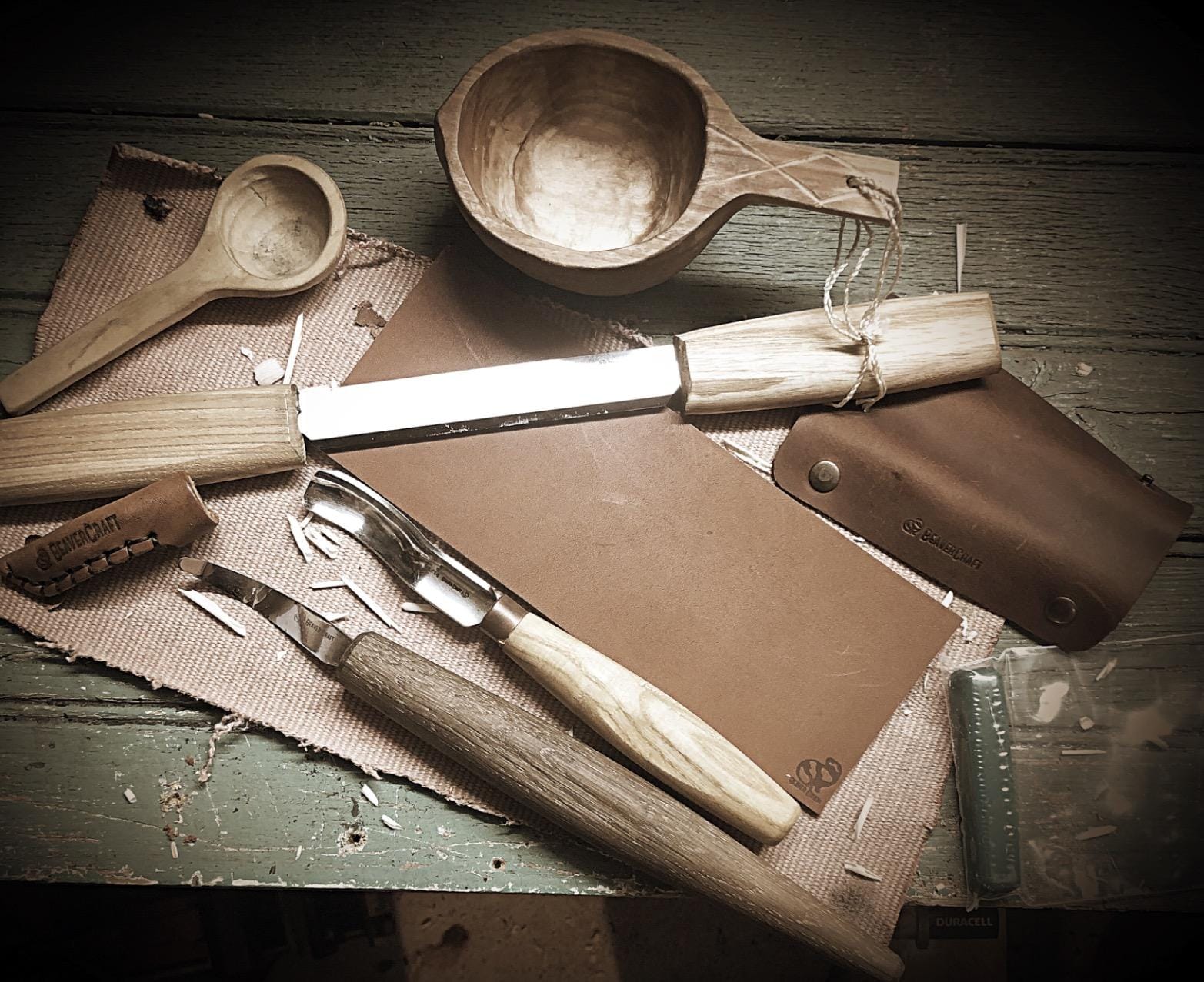
The limitation is that there is no rigid backing. You are stropping against whatever flat surface is underneath, so a warped counter or a folded towel will round the edge instead of polishing it. Experienced reviewers are blunt about the light touch this demands, and several consider the price high for a piece this small once they realise how many passes a 10 in chef’s knife needs.
One reviewer also reported that the hide is mounted to a synthetic backing rather than being genuinely double-sided, so check the faces when it arrives. Treat this as maintenance gear, not a sharpening tool — it cleans up edges and removes burrs well, and it will not set a new bevel.
When the small size is an advantage
Small is not a flaw when your knives are small. Paring knives, utility knives, and pocket folders fit this surface in a single pass, which is where the small footprint stops being a compromise. The slim profile is also why reviewers like storing it inside an existing stone box rather than on a crowded bench.
What to watch when it arrives
Run it over a flat surface immediately and check both faces for slack. If the hide lifts at a corner, press it down and leave it under something heavy overnight. Once it sits flat, the light-touch technique takes about a minute a week and keeps edges noticeably fresher between stone sessions.
3. Lansky Stropping Polishing Hone — The Finishing Step for a Kit
- Compact and light enough for a knife care kit
- Delivers a notably finer edge than stones alone
- Made in USA with a one-year warranty
- Zero setup required
- Small surface means many passes on long blades
- Single-sided hone design is less versatile
The Lansky is bought as the last step in a routine, not as the first. Reviewers consistently credit it with an edge that is visibly finer than what a stone alone leaves behind, which is the correct job for a hone-style strop. If your whetstone work ends in a slightly toothy edge, this is what closes it.
At 27 g and 5 in across it is the smallest thing in this roundup, and that is deliberate — it slots into a knife care kit alongside a cleaner and an oil and does not compete for space. Made in the USA with a one-year manufacturer warranty.
The compromise is surface area. On a long chef’s knife you will be making many overlapping passes, and every one of them has to stay at the same angle or you will round a corner of the bevel. For a straight razor, a pocket knife, or a short utility blade, that constraint is basically irrelevant.
It is also single-sided, so if you like the rhythm of deburring on one face and polishing on the other, you will be rotating the tool rather than the knife. Not a problem, just a different habit than the double-sided paddles.
Best paired with a whetstone
Buy this as the finishing half of a two-tool setup. Do your shaping and apex work on a 1000 grit stone, then finish on the Lansky with white or green compound and you get a genuinely keen edge. Stropping alone, with no stone behind it, will not rescue an edge that was never formed.
What it handles
Kitchen blades, pocket knives, and outdoor blades all take well to a hone-style surface because the leather is flat and the compound film is thin and even. Reviewers mention it as the final step before putting a blade away, which is a good habit regardless of what you picked.
4. SHARPAL 204N 8 x 3 in Kit — Best With an Angle Guide
- Flat base gives more control than a hanging belt strop
- Non-slip mats hold the paddle while working a keen edge
- Angle guide is genuinely useful on pocket knives
- Compound absorbs into the hide well
- Bundled compound is dry and waxy
- Needs thinning with honing oil to work properly
The SHARPAL kit stands apart for one reason: the bevelled angle guide, with settings at 14, 17, 20 and 25 degrees. For anyone whose knife is a mystery steel with a factory grind they cannot measure, that removes the single hardest variable in stropping.
The construction is the other reason. Genuine cowhide on a natural wood base with anti-slip mats underneath means the paddle stays flat and still while you pull a sharp blade across it, with none of the flex you get from a hanging belt strop. Reviewers single out the flatness as the standout feature and the non-slip feet as the thing that keeps the paddle put under a loaded edge.
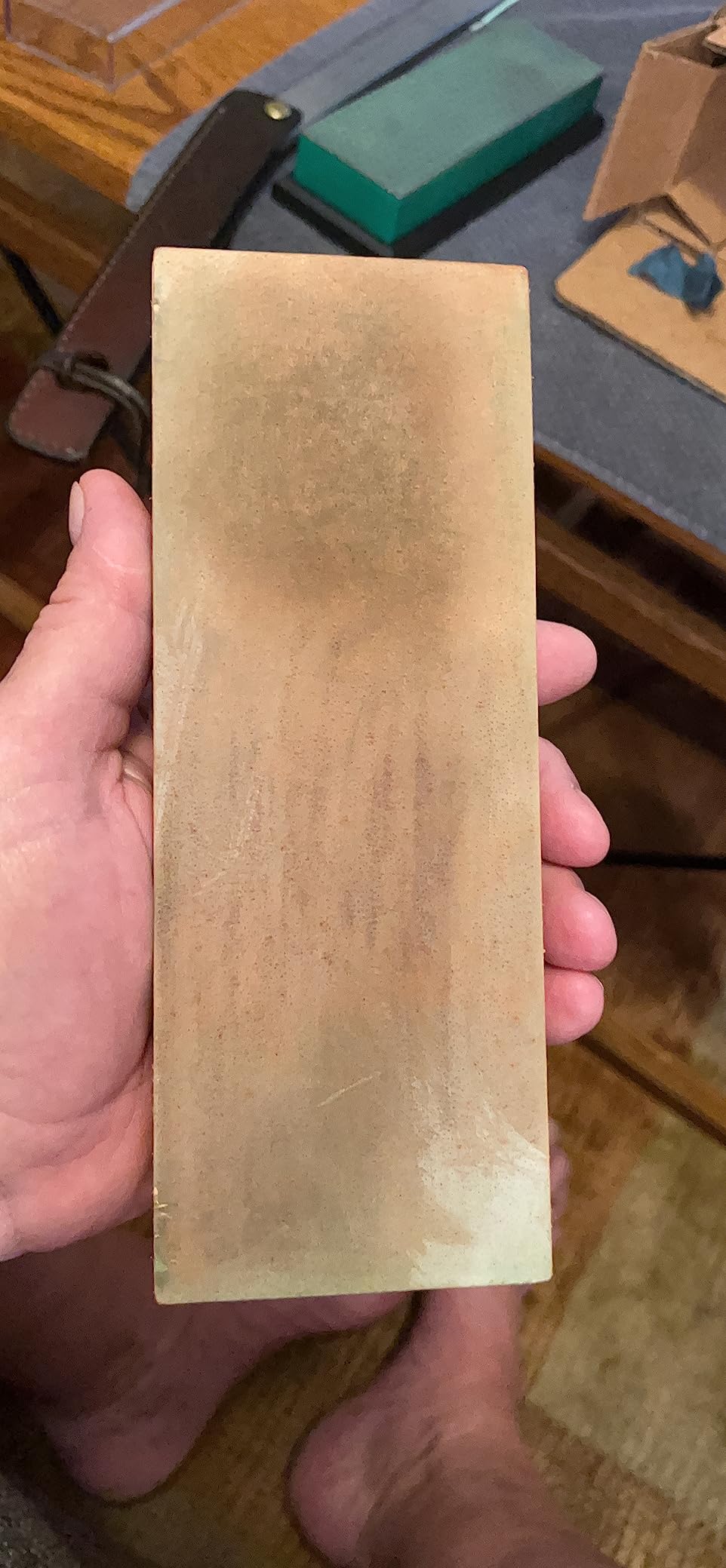
The most common complaint is the compound, not the strop. It ships with a green bar whose particles are 1 to 2 microns, comparable to 10,000 or 14,000 grit, but it is a dry waxy bar that leaves a crayon-like surface rather than a true abrasive film. Several buyers swap it out or thin it with honing oil before it behaves as intended.
It is also one of the few kits here that stores neatly inside a Sharpal whetstone holder, which is a real advantage if you already own one.
Who benefits most from the angle guide
Anyone sharpening a folding pocket knife or a wharncliffe blade, where the factory bevel angle is unknown and getting it wrong rounds the tip faster than anything else will. If you already know your angle and set it by eye, the guide becomes a nice sanity check rather than a necessity.
Which compound works best on it
Keep green on the smooth face for the bulk of the work, and once you have a fine film going, a lighter pass with white compound finishes it. Load thin and rub with the grain, then immediately wipe the blade before the loaded leather can transfer residue back onto the edge.
5. Hutsuls 14 in Buffalo Leather Paddle Strop — Best Value
- 14 in length handles paring knives through large chef's knives
- Ergonomic handle makes long sessions easier
- Two genuinely different leather faces
- Black leather hides metal staining
- Light 3-4 oz hide
- experienced users prefer 5-6 oz
- Over-applying compound leaves residue
Long-tenured owners describe this as the last stop in their sharpening chain, and at 14 in it is the longest paddle here. That length is the practical advantage: a large Japanese chef’s knife or a billhook covers the bevel in a single pass instead of a sequence of overlapping strokes, which is where angle drift usually creeps in.
Two genuinely different faces matter too. The hard smooth side takes compound for deburring and general refinement, the soft rough face polishes. Long-time users report it still holds up after years of daily use, which tells you the leather is glued well and is not distorting.
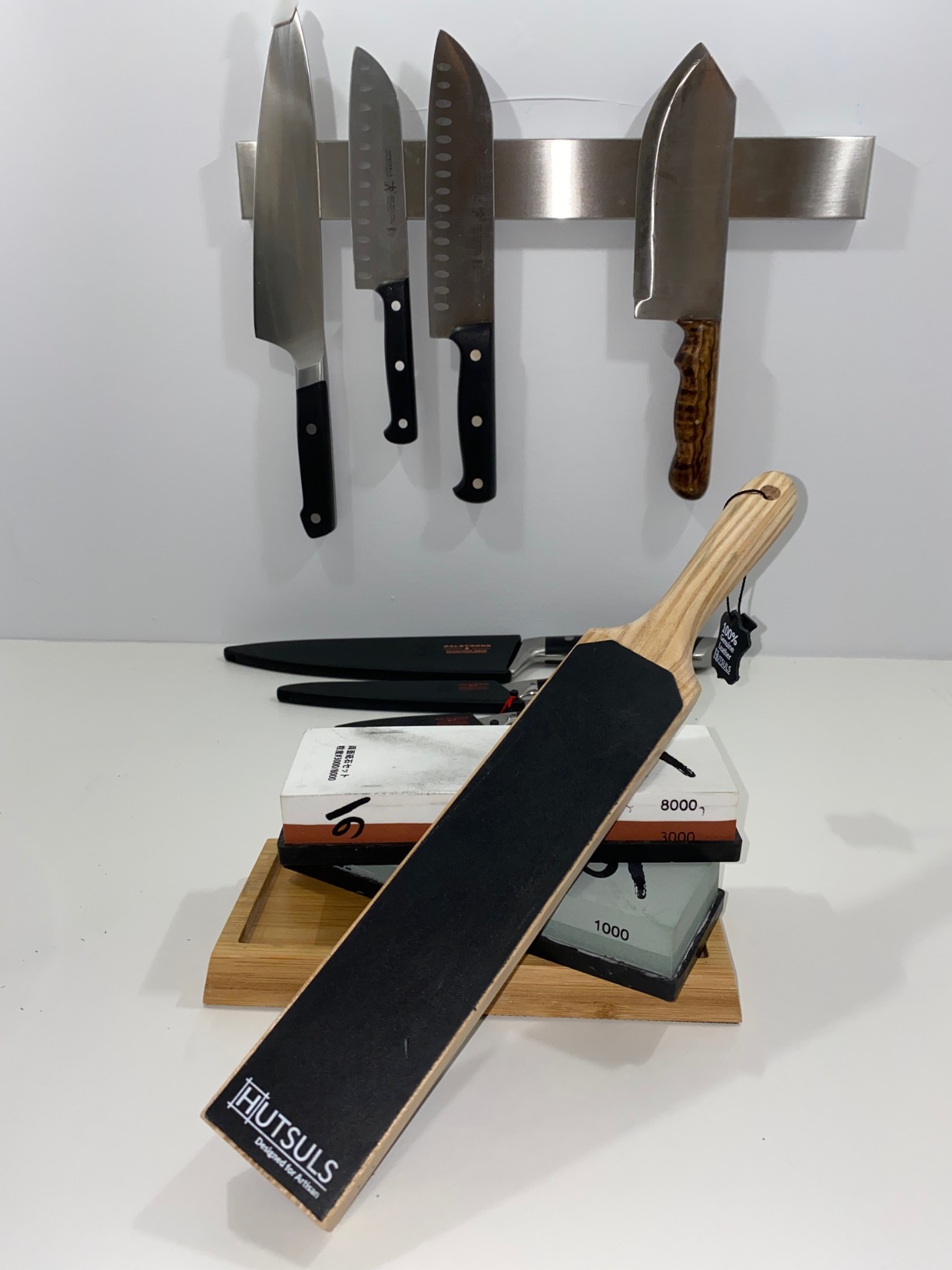
The handle is the quiet upgrade. It lets you make passes in the air on carving tools and gouges without finding a flat bench, and reviewers credit it with making long sessions less tiring. The black leather is a practical choice too, since it hides the metal staining that shows badly on tan and brown strops.
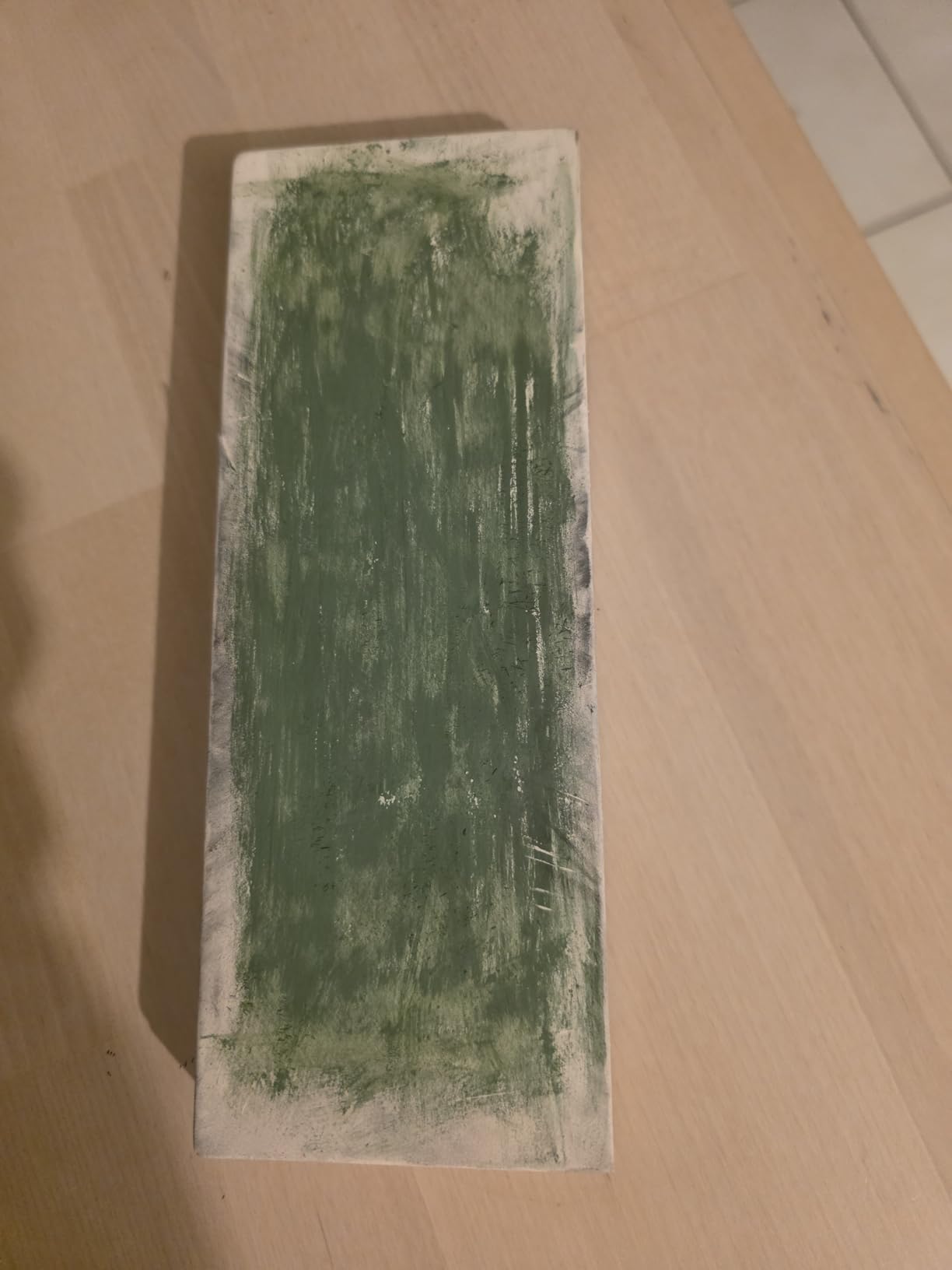
The one reservation that experienced sharpeners raise is hide weight. This is a light 3 to 4 oz leather, and people who prefer a crisper result from a stiffer surface tend to want 5 to 6 oz. Separately, over-applying the included green compound leaves a residue that transfers to the blade, so err on the side of a thin film.
Who it fits best
One paddle for everything is the pitch, and it holds up. Knives, chisels, plane blades, axes, and pocket knives all get finished on it, and the 14 in length is the reason a full-size chef’s knife works properly rather than just adequately.
How to load it properly
Warm the face, smear a thin film of green with the grain, and let it sit for a minute before you use it. A little goes a long way on buffalo leather — these surfaces accept compound readily and give it back onto the blade if you overdo it. Wipe the blade between passes.
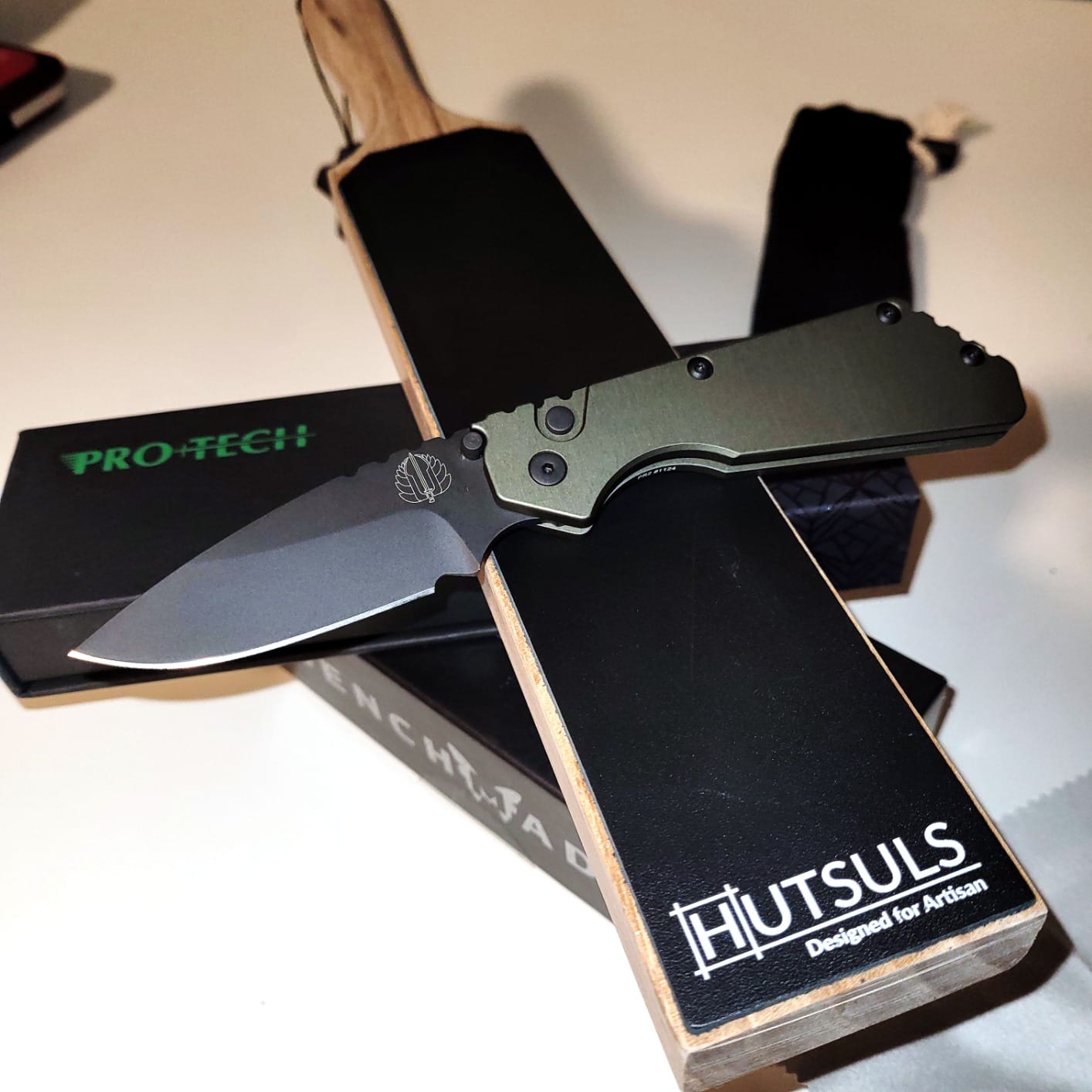
6. Hutsuls Brown 3 x 8 in Vegetable-Tanned Strop — The Easiest Place to Begin
- Thick 4 mm veg-tan buffalo leather
- Affordable entry into real stropping and widely praised as value
- Two distinct faces for rough work then finish
- Works as a portable campsite kit
- Working surface is smaller than most buyers want
- Less effective on very hard steels such as D2
If you have never stropped a knife, this is the one to learn on. Novices find it easy to pick up, and several buyers report dramatic improvement on knives they had mentally written off. The 4.0 mm vegetable-tanned buffalo leather is thick for the size, which means it does not dish out under a beginner’s inconsistent pressure.
It is also one of the most affordable paddles here and consistently described that way in reviews. Two faces let you work the rough side with compound and finish on the smooth side, and the green compound plus printed guide are enough to get a competent first session out of the box.
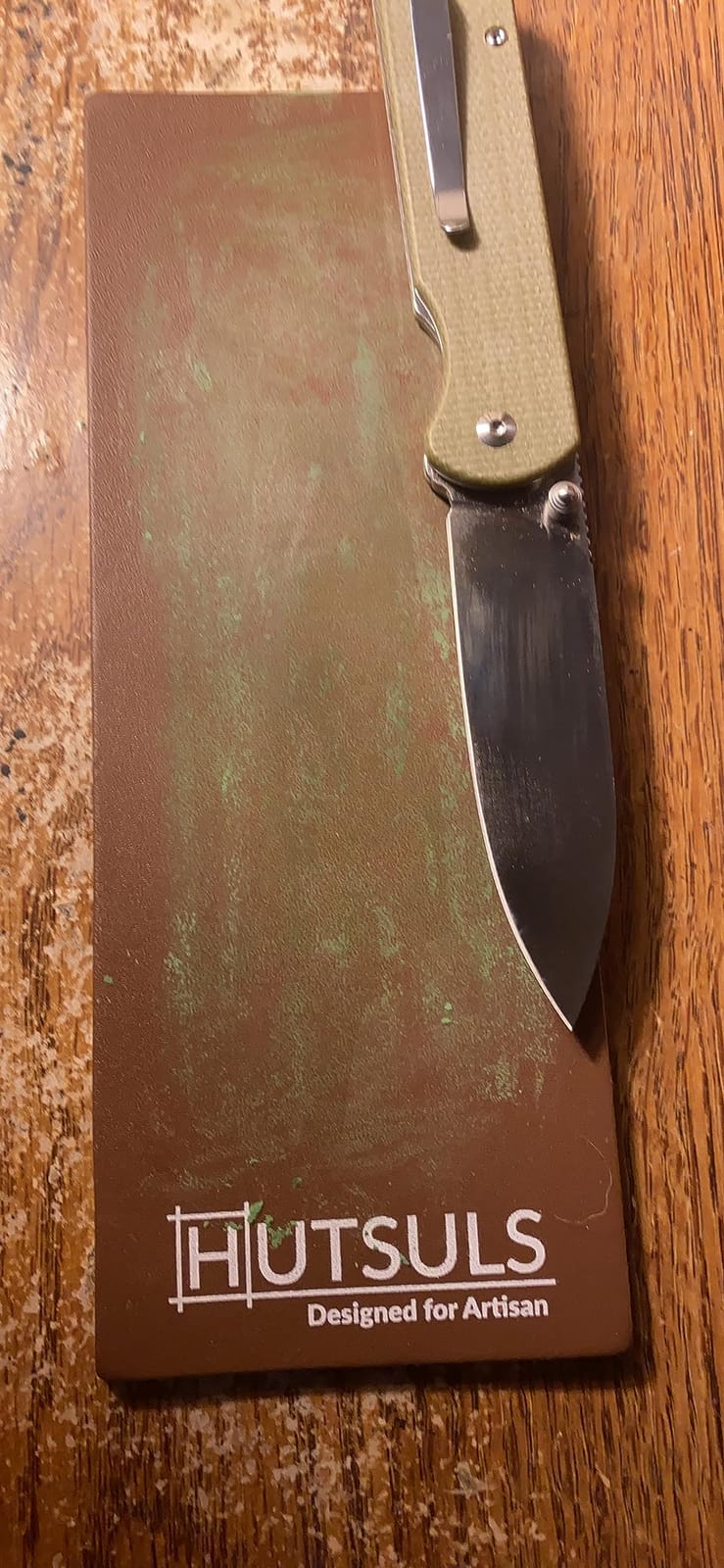
Two limits are worth knowing up front. The 3 x 8 in face is smaller than most buyers end up wanting, particularly for long blades, and an experienced user notes it is less effective on very hard steels such as D2 than on softer knife steels. Stropping does not abrade much anyway, so this mostly means more passes on hard alloys.
Reviewers also position it as the affordable entry into real stropping after diamond or whetstone work, frequently as a final pass. Used that way it earns its place easily.
Who should buy this one
Cooks with a couple of kitchen knives who want a real stropping habit without researching the field first. The thickness and included guide remove almost all of the early friction, and the price means a mistake costs nothing.
What to use on it
Green compound for the general refinement pass, white on the smooth face for a final polish, and a few bare strokes at the end to check the edge. Keep it in a shoulder bag for campsite sharpening — it is light enough and the 8 in length fits knives that travel.
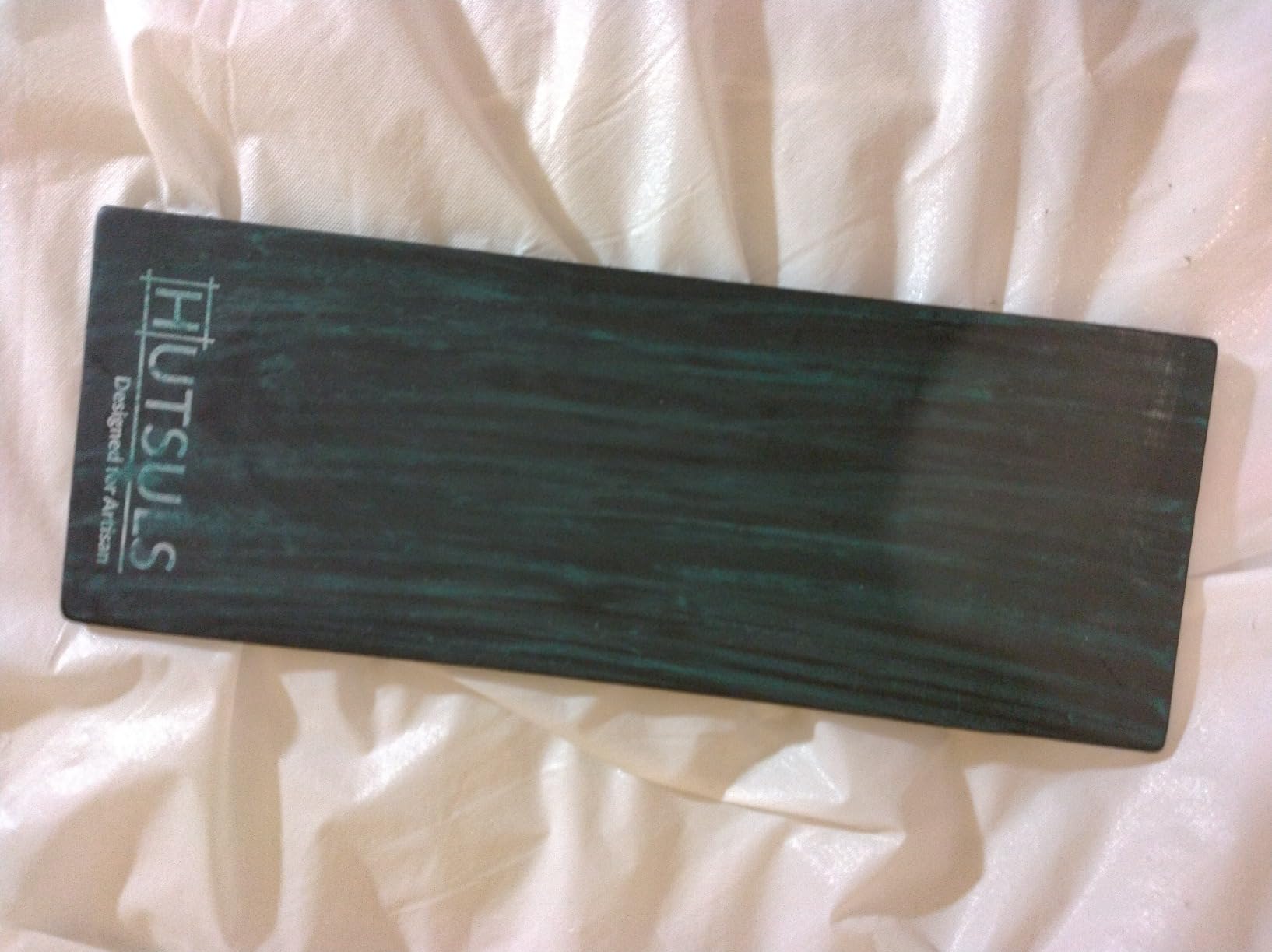
7. BeaverCraft LS6P1 14 in — The Carver’s Paddle
- Long enough for large carving knives and full chef's knives
- Handle makes in-the-air passes comfortable
- Two distinctly different leather faces
- Glued evenly and holds up in repeated use
- Narrow 2 in width is tighter than expected
- Only one compound bar included
- The bundled paste is oily
Of everything we tested, this is the one that changed my mind about paddle strops for hand tools. The 14 in length is long enough for a full-size carving knife or a large chef’s knife, and the ashwood handle means you can work a gouge in the air over a bench rather than clamping a block flat and hunched over it.
The two leather faces are properly different — one very smooth and one porous — so you have somewhere to stage. The hide is glued evenly to the wood and reviews note it holds up through repeated use without lifting at the corners, which is the failure mode that kills cheaper glued blocks.
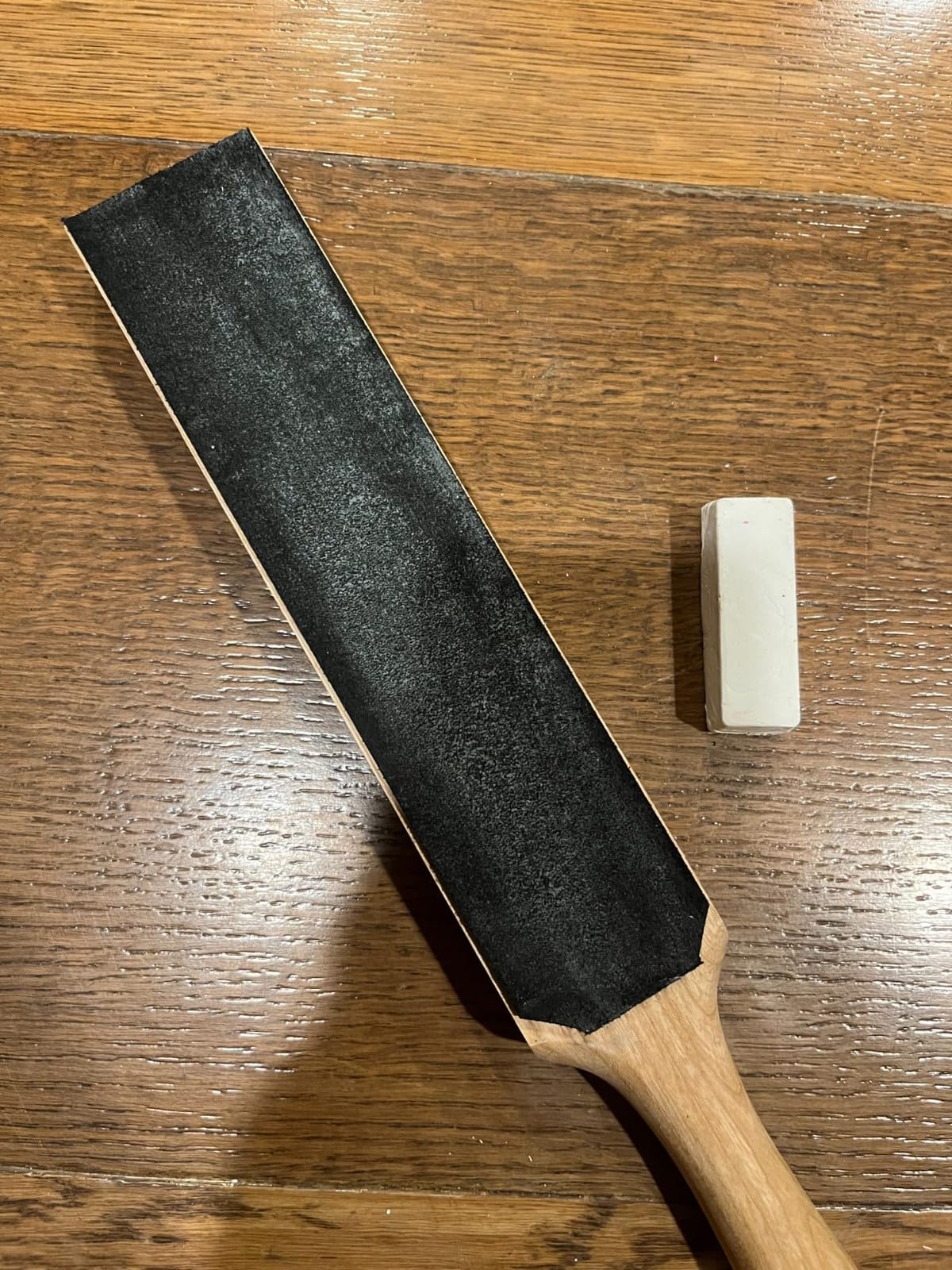
The 2 in width is the complaint that recurs. For a broad chef’s knife it means the heel sits over the edge of the face, and for wide hands the handle feels cramped. If your blades are narrow carving tools and hook knives, the width is not a problem at all.
Only one compound bar comes with it, a green-gray paste at 7 microns or roughly 3000 grit. Several users find that paste too greasy to be worth reapplying and substitute their own, which is worth knowing before you buy expecting a full compound set.
Made for woodcarving specifically
The package includes eBooks on whittling knife and hook knife sharpening, and that tells you who the product is built for. If you carve, the handle-plus-length combination is the reason to choose this over a bench block; you get the reach of a long paddle with the control of something handheld.
Pairing it with your own compounds
Plan on buying at least one more bar. Green for the rough face, white for the smooth face, and a green-gray or red paste for polish gives you the staging the kit lacks. Two 220 x 50 mm leather bands means both faces are large enough to hold a proper film.
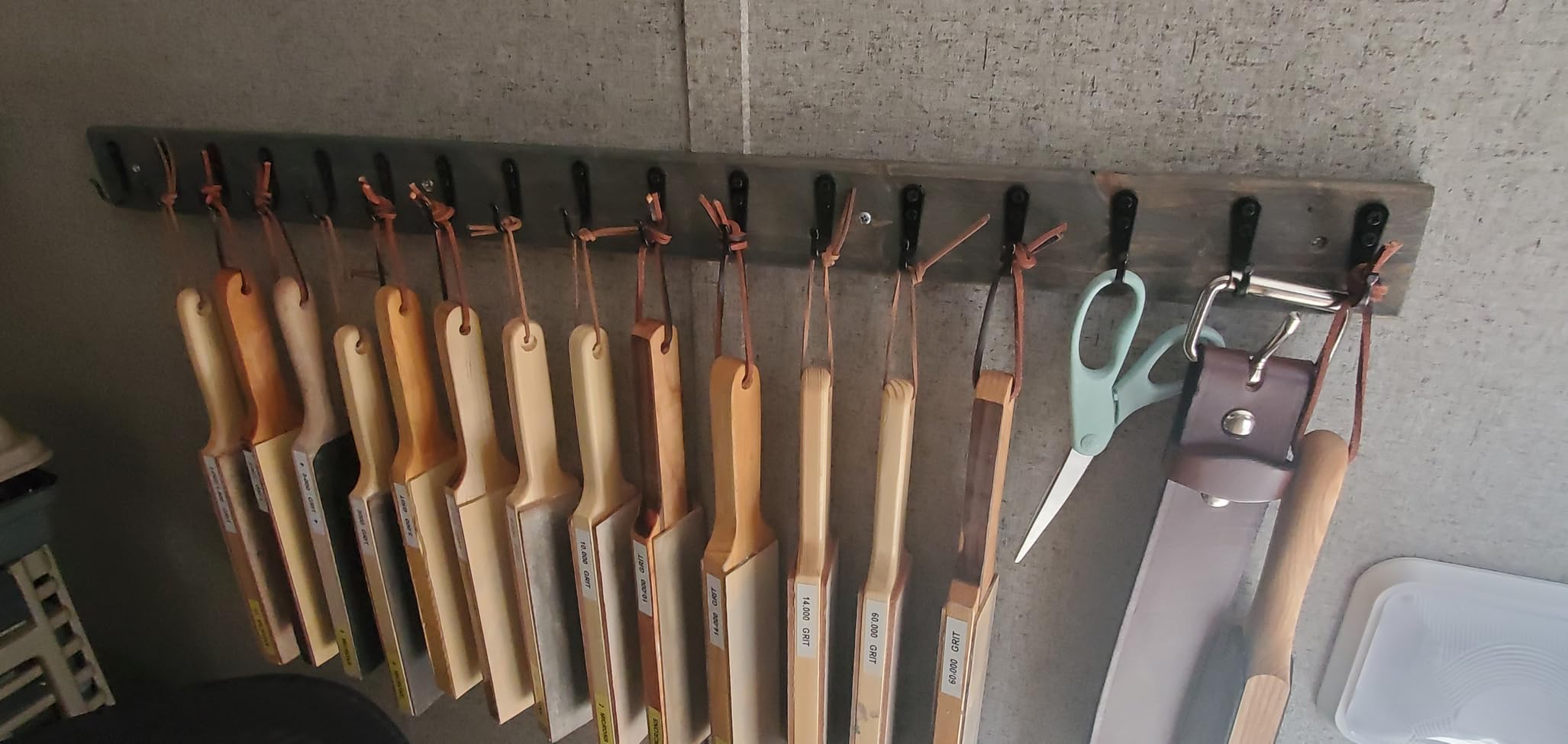
8. Sharp Pebble Bamboo Paddle Strop — Mirror Results After Prepping
- Lightweight bamboo base is easy to hold and pin down
- Non-slip rubber base keeps it stable
- Green compound leaves a genuine mirror finish
- Customer support provides clear instructions
- Surface can be uneven out of the box
- Leather is soft and dye can transfer
- 8.1 in length is short for long blades
This is the lowest-rated pick here and the reviews explain exactly why. The mirror finish and the build value are widely praised, but a number of owners had to prep the leather before it worked, using mineral oil and a heat gun or a belt sander to flatten it and stop the dye bleeding onto the blade.
Once prepped, most report a very effective final-finishing strop. The bamboo base is light and pleasant to hold, and the non-slip rubber base underneath keeps it from walking while you pull a keen edge across it. Customer support behind the product is repeatedly singled out for giving clear instructions and follow-up care tips.
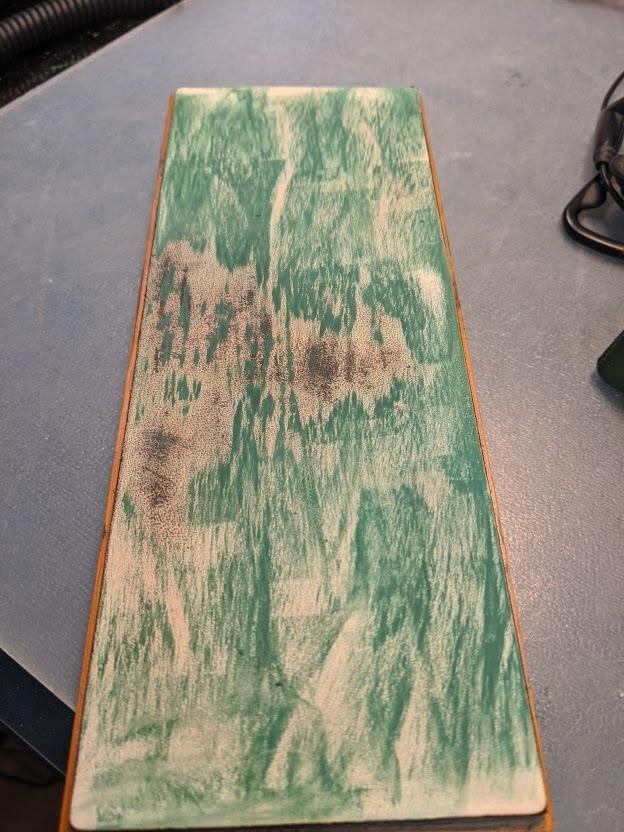
So budget ten minutes before your first pass. Take the surface down with mineral oil and warm it gently to flatten the face, and buff off any loose dye. Skipping this is what produces the uneven loading and the stained blade that show up in the critical reviews.
Two other limits: the leather is on the softer side, which means less bite on very hard steels, and 8.1 in is not enough to cover a long blade in one stroke. Suitable for chef’s knives, hunting knives, pocket knives, chisels, plane irons and axes, with more passes needed on the longest ones.
When the mirror finish justifies the prep
If you care about a reflective finish on cutlery, a single bevel, or a chisel edge that reflects light back at you, the green compound here does it once the surface is flat. That payoff is real and repeated in the positive reviews. If you only want a burr-free cutting edge, easier options will get you there.
Prep steps that worked
Mineral oil to the face, gentle heat to relax the fibres, then a hard cloth to check flatness. Load sparingly afterwards — soft leather holds onto compound and gives it back onto the blade if you pile it on.

9. Knives Plus Pre-Loaded Strop Block — Nothing to Buy or Maintain
Knives Plus Strop Strop Block, Leather Sharpening Strop, 8 long”
- Arrives loaded and usable with no prep at all
- Highest average rating in the group
- Hand-made construction in Amarillo Texas
- Virtually maintenance-free
- Fixed 8 x 2.5 in face is short for long blades
- Rouge cannot be staged through different grits
Every other strop here needs a compound bar and some technique. This one arrives with high-chrome rouge already hand-worked into warm leather, so you can strop a blade within minutes of opening the box. For anyone who will not bother buying and loading compound, that is the whole value proposition.
It carries the highest average rating in the group at 4.8, with 84 percent of reviews at five stars. Buyers credit it with a noticeably polished final edge straight out of the box. The MDF base faced with chap leather over an 8 x 2.5 in surface is built in Amarillo, Texas, and the draw direction is backwards with moderate pressure rather than forward with pressure.
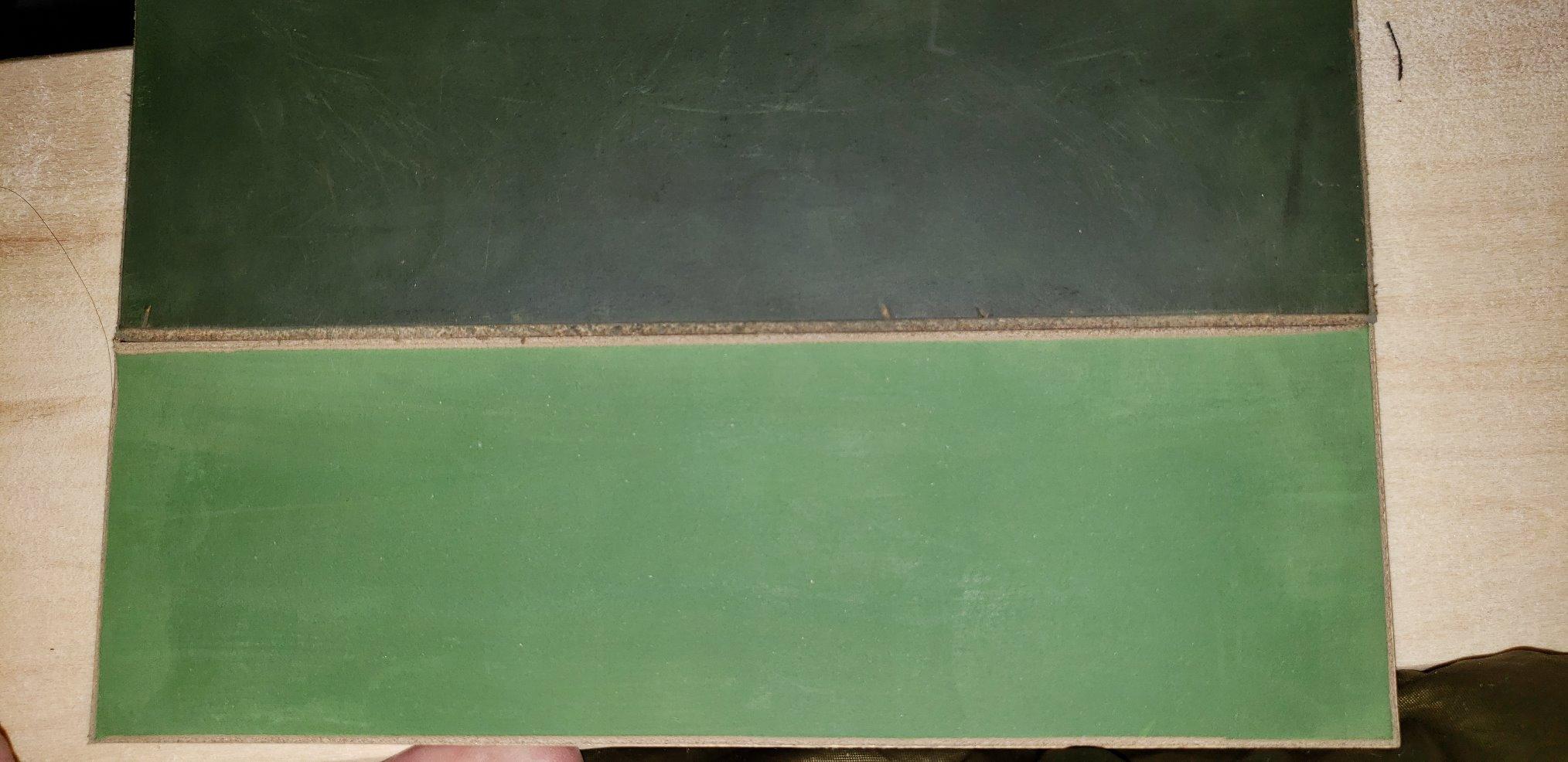
The trade-off is real. A fixed rouge compound cannot be staged through grit levels, so you get one finish and one finish only — there is no coarser step if a blade needs more work before polishing. And an 8 in face means a long chef’s knife needs several overlapping passes.
It is also the smallest review base here at just under 800, which is worth weighing. You are buying a maker with a strong reputation and a smaller body of independent testing behind the product than the high-volume options.
Who this suits
Anyone who wants edge maintenance with zero consumables and zero setup. It also works well as a second strop — keep a compound-loaded paddle for real sharpening work and use this for a quick refresh before putting a knife away.
The draw direction matters
The rouge is worked for a backwards pull with moderate pressure, not a hard forward push. Follow the maker’s direction and the compound stays evenly distributed. Push too hard and you will fold the chap leather at the edge of the MDF.
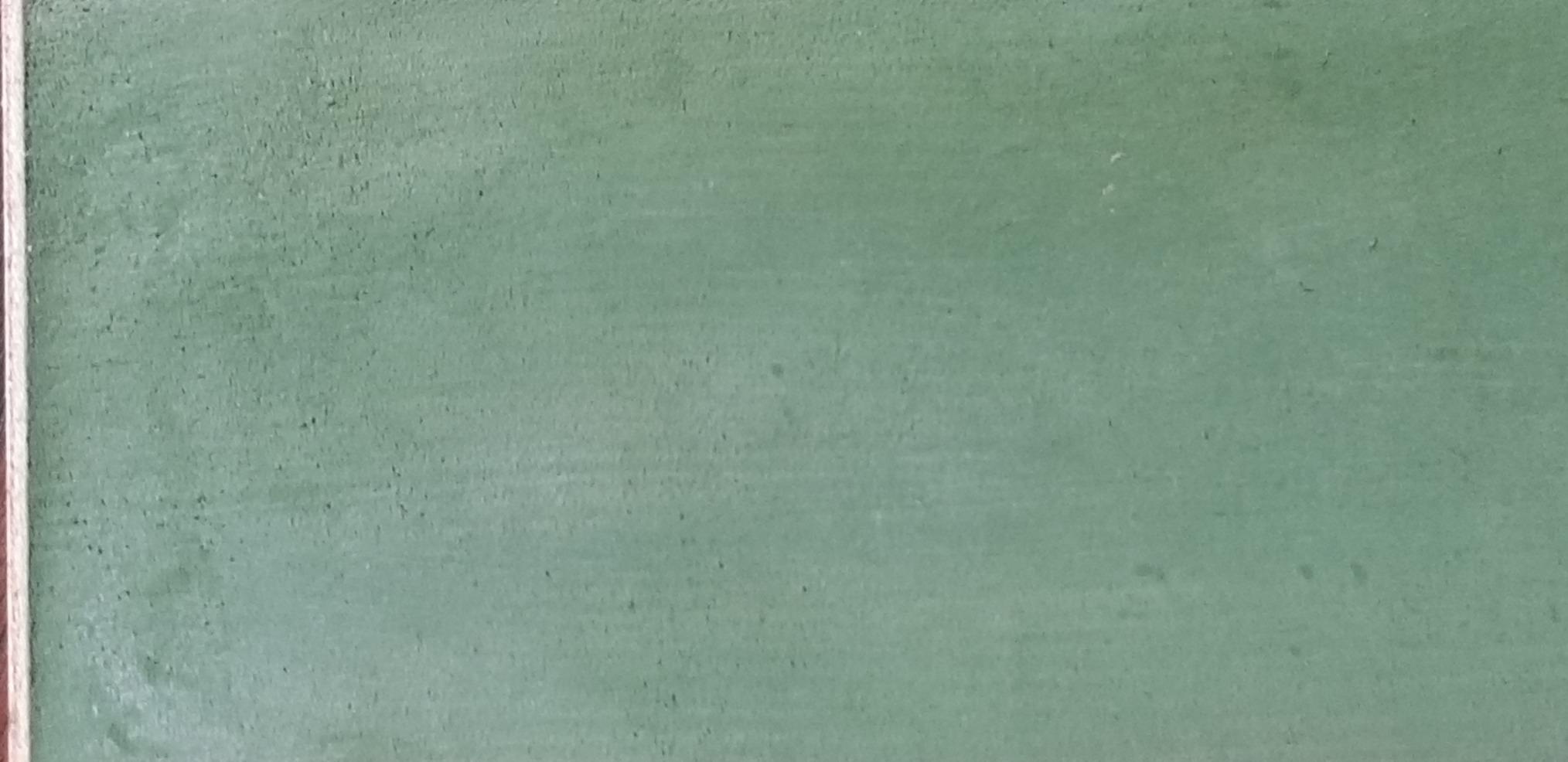
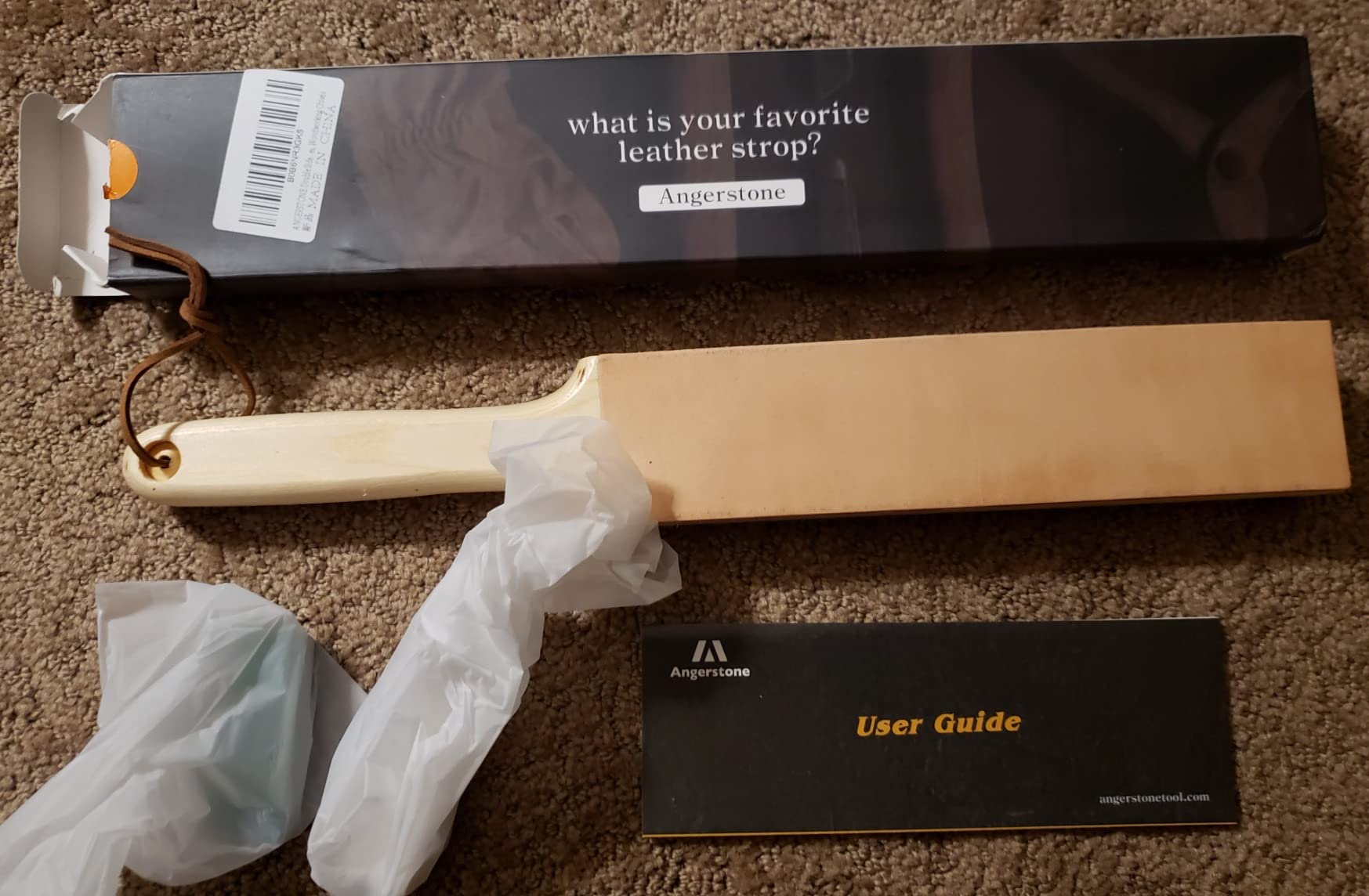
10. Angerstone 14 x 2 in Three-Compound Kit — The Best Compound Bundle
- Only kit bundling three compounds for staged honing
- Vegetable-tanned cowhide described as durable over years
- Smooth and suede faces give a mirror-like finish
- 14 in length suits full-size blades
- Narrow 2 in face is tight for wide chef's knives
- Shorter review history than established brands
The differentiator is the box contents. Green chromium oxide, white aluminum oxide, and a red polishing paste in one package is the only kit here that gives you a real progression — green to work, white to finish, red to polish — which is exactly what you need to stage a strop instead of jumping to a single compound.
Buyers highlight that compound set as the reason this is a step up from single-compound kits at a comparable outlay. The vegetable-tanned cowhide is described as durable over years of use, and the smooth and suede faces together take an edge to a mirror-like finish. A printed guide covers technique for both beginners and experienced sharpeners.
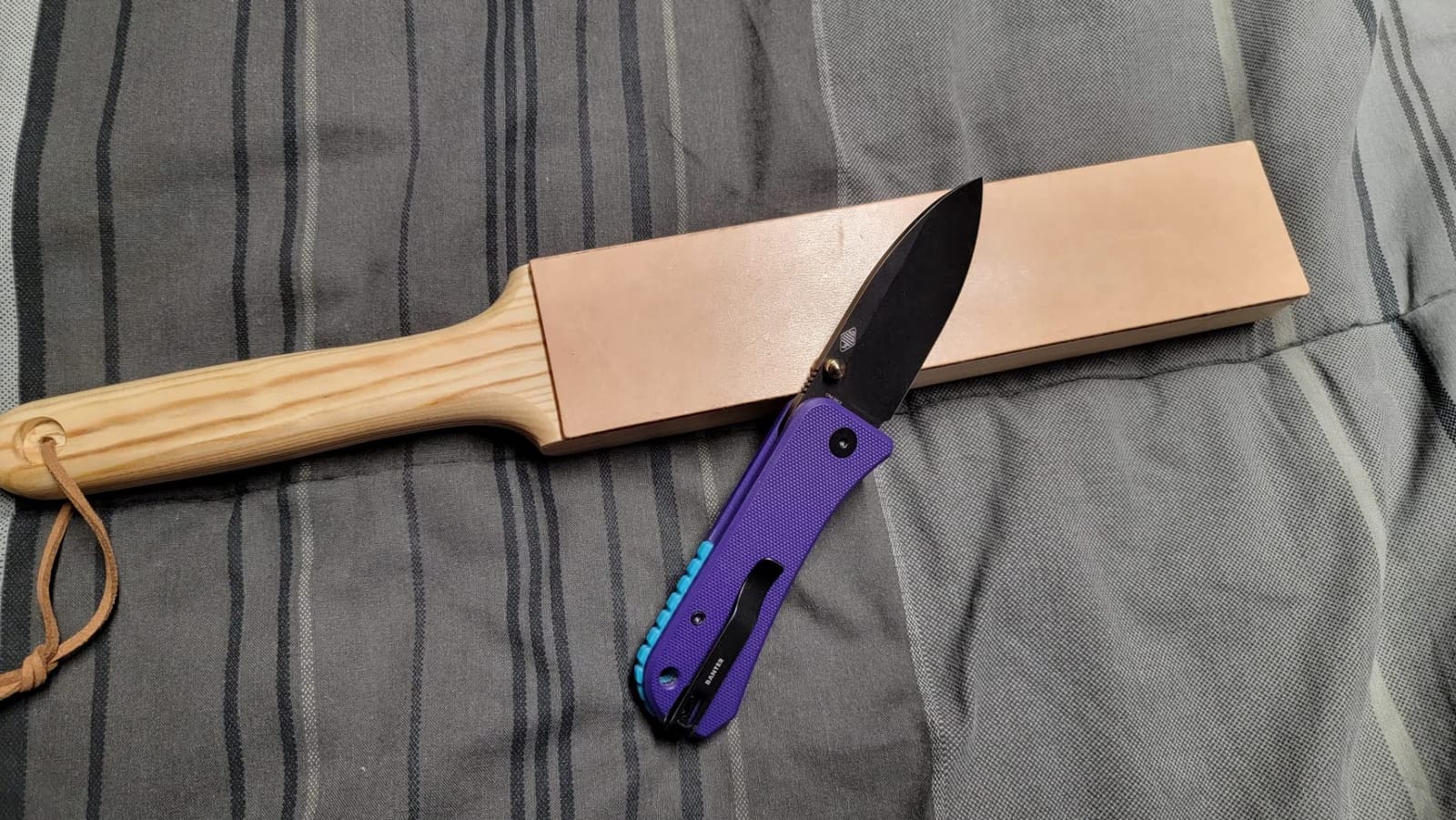
The 2 in working face is the recurring caution. It suits hunting knives, pocket knives, fillets, carving knives, and full-size blades that are not wide, but on a broad chef’s knife the heel overhangs and you are working in passes. It also covers chisels, plane blades, axes and straight razors, which broadens its value considerably beyond knives.
It has the shortest review history in this roundup at 755 ratings, all things considered. The materials are well described by owners, so we are comfortable with it, but there is less long-term data behind it than behind the Bacher or BeaverCraft options.
How to use all three compounds
Green on the rough suede face for the bulk of the work and deburring, white on the smooth face to refine, then a light red pass for final polish before a few bare strokes. Assign each compound to one surface permanently and it will stay consistent for years.
What the ergonomic handle adds
It gives you control for in-the-air passes on carving tools and for holding the block steady with one hand while you work a long blade. At 8.8 oz it is light enough to stay comfortable across a full session.
Which Leather Makes the Best Strop?
Vegetable-tanned steerhide and bullhide are the traditional answer, and for most people they remain the right one. The tanning process leaves the hide firm, dense and slightly grippy, so it holds a compound film without stretching out and stays flat under a blade. Every thick-hide option in our roundup is veg-tan, and that is not a coincidence.
Buffalo leather is the common alternative and is what two of the picks here use. It is thicker and softer than steerhide, which makes it forgiving for beginners and easy to load, at the cost of a little crispness. Horse butt leather is prized for straight razors because of how fine and dense it is. Kangaroo leather is the enthusiast’s choice, tough and thin at once, though expect to pay for it.
Chrome-tanned leather is the one to skip for stropping. It is softer and spongier than veg-tan and does not hold a surface flat, which defeats the point entirely. Always check that the leather is described as vegetable-tanned.
On the two faces: the smooth, top-grain side is hard and takes compound for deburring and general refinement. The rough, suede side is softer and polishes. Common practice is white compound on the rough leather and green on the soft leather, and the rule that keeps results consistent is one compound permanently assigned to one surface.
Stropping Compounds Explained
Green compound is chromium oxide and the workhorse of the group. It sits somewhere around 3000 to 6000 grit equivalent, cuts faster than you would expect from a strop, and is the right choice for removing a stubborn burr and doing general refinement after stone work. Most kits here include a green bar for that reason.
White compound is aluminium oxide, much finer, and is a finishing and polishing compound. Load it lightly on the smooth face for the final pass and you get a noticeably keener, brighter edge. Black compound is the most abrasive of the common colours and is for refining a coarser stage, particularly straight razor work and hard steels.
Diamond emulsion or paste is the outlier. It is finer than any coloured bar, it cuts more, and it produces the highest polish — but it loads slowly and needs careful dilution with oil. On the suede side of a small strop it will take a knife to a genuine mirror finish, which is why it is the first recommendation for anyone chasing that look.
Apply any of them thin. Bar compound goes on with the grain after warming the face, and you should be able to wipe most of it off with a cloth afterwards. Heavy residue transfers to the blade and then to your cutting board.
Leather Strop vs Honing Rod vs Whetstone
A strop realigns an edge. A whetstone removes metal to form a new bevel. A honing rod sits between them, re-straightening an edge that has rolled over without meaningfully abrading it, which is why rods are sold as steel and ceramic rather than leather.
The practical consequence is that a strop is maintenance and a stone is correction. Stropping keeps an edge that was properly formed fresh for weeks or months. It will not fix a blade that is genuinely dull, chipped or missing its apex — for that you need stone work.
Use a rod when you are in a hurry, cutting soft produce, or want a quick alignment between sessions. Use a strop when you have ten seconds and access to your bench. Use a whetstone when the edge has stopped responding to either. A 1000 grit stone plus a strop is the complete minimal setup and covers nearly everything.
Buying Guide: Choosing a Leather Strop
Size is the first decision and it is mostly about blade length. Anything under 8 in works for pocket knives, paring knives and razors. A 10 to 12 in chef’s knife wants a face of at least 8 in, and large carving knives or polearm edges want 14 in. Under-buying on length means multiple passes, and multiple passes is where angle drift sneaks in.
Width is the second. A 2 in face is fine for narrow carving tools, less comfortable with wide chef’s knives. A 3 in face is the comfortable all-round choice, and a paddle handle lets you work hand tools in the air.
Sidedness decides your flexibility. A double-sided strop gives you a hard face and a soft face, which lets you stage compounds and keeps one surface from wearing out while you use the other. A single-sided slip is simpler but limits you to one compound per strop.
Backing matters more than buyers expect. Rigid wood or composite backing keeps the surface flat and stops the blade digging in. Unbacked leather works only if you strop against a flat, hard surface with a genuinely light touch. If your strop flexes, your edge will follow it and you will round the tip.
Portability: a slip strop with no handle and a 3 x 8 in footprint fits a stone box or a shoulder bag and is what most people carry. Handle paddles are for a bench, a workshop, or working in the air over a bench.
Blade steel is not a real constraint for stropping, because a strop barely abrades. Reviewers do note that very hard steels such as D2 respond more slowly than softer knife steels, needing more passes rather than a different strop. So can you strop every knife steel? Yes. Damascus and stainless and carbon all strop well; the difference is how much pressure the compound film needs.
Included compound is a tiebreaker. A kit with green, white and red lets you stage properly from day one, which is worth more than a slightly thicker hide on a bare strop. A pre-loaded strop suits someone who will not maintain consumables at all.
Care: renew the surface when it develops a groove. Clean it by scraping off old compound, washing with warm water and a little mild soap, drying flat under weight, and re-dressing with a light balm. Do not soak it, and do not leave it clamped while wet, or the hide will stretch permanently.
Finally, the DIY route. The most repeated advice across leatherworking forums is to glue a piece of old belt leather to a board and use that — no hardware, no brand. It works. Keep any buckle or rivets well away from the travel path of the blade, and sand the hardware flush or cover it.
Frequently Asked Questions
What leather makes the best strop?
Vegetable-tanned steerhide or bullhide is the traditional and most reliable choice because it stays firm and flat under a blade while holding a compound film. Buffalo leather is thicker and more forgiving, horse butt is prized for straight razors, and kangaroo is a tough premium option. Chrome-tanned leather is too soft and spongy for stropping. Whatever the hide, use the smooth face for compound work and the rough face for polishing.
How do I use a leather strop?
Prep the surface, warm it, and rub a thin film of compound on with the grain. Lay the blade flat at roughly 15 to 20 degrees and pull heel to toe in one continuous motion with light pressure. Turn the blade over, repeat on the other face, then finish with a few bare strokes to check the edge. Keep the pressure light so the leather does not fold under the blade.
Is a leather strop worth it?
Yes. It is the cheapest way to keep an edge fresh for months instead of days, because it removes the rolled burr that forms after a few cuts and burnishes the edge back into a single line. It cannot set a new bevel, so it works alongside a whetstone rather than replacing one.
What is the best knife stropping compound?
Green chromium oxide is the best all-round bar for removing burrs and general refinement, and white aluminium oxide is the best finisher for a keen polished edge. Black is coarser and suits razor work and hard steels. Diamond emulsion gives the finest polish of all but loads slowly and needs thinning with oil.
Should I use a strop or a honing rod?
A strop polishes and deburs an edge properly and is the better choice for regular maintenance at your bench. A honing rod is faster, needs no compound, and is convenient mid-cook, but it does less to the edge over time. If you only pick one tool for long-term edge quality, make it the strop.
Final Recommendation
For most people sharpening a mix of kitchen and pocket knives, the Bacher 12.6 in is the best of the best leather strops for honing knives because the thick hide stays flat and the four-compound range lets you stage a finish properly. If you want one paddle that covers a large chef’s knife in a single pass, take the Hutsuls 14 in. For straight razor work and hand tools, the BeaverCraft LS6P1 handle is the one that changes how you work.
Start with a double-sided strop at least as long as your longest blade, load it thin with green on the smooth face, and get into the habit of a minute of stropping before every sharpening session. That is what turns a good edge into a long-lasting one in 2026.