
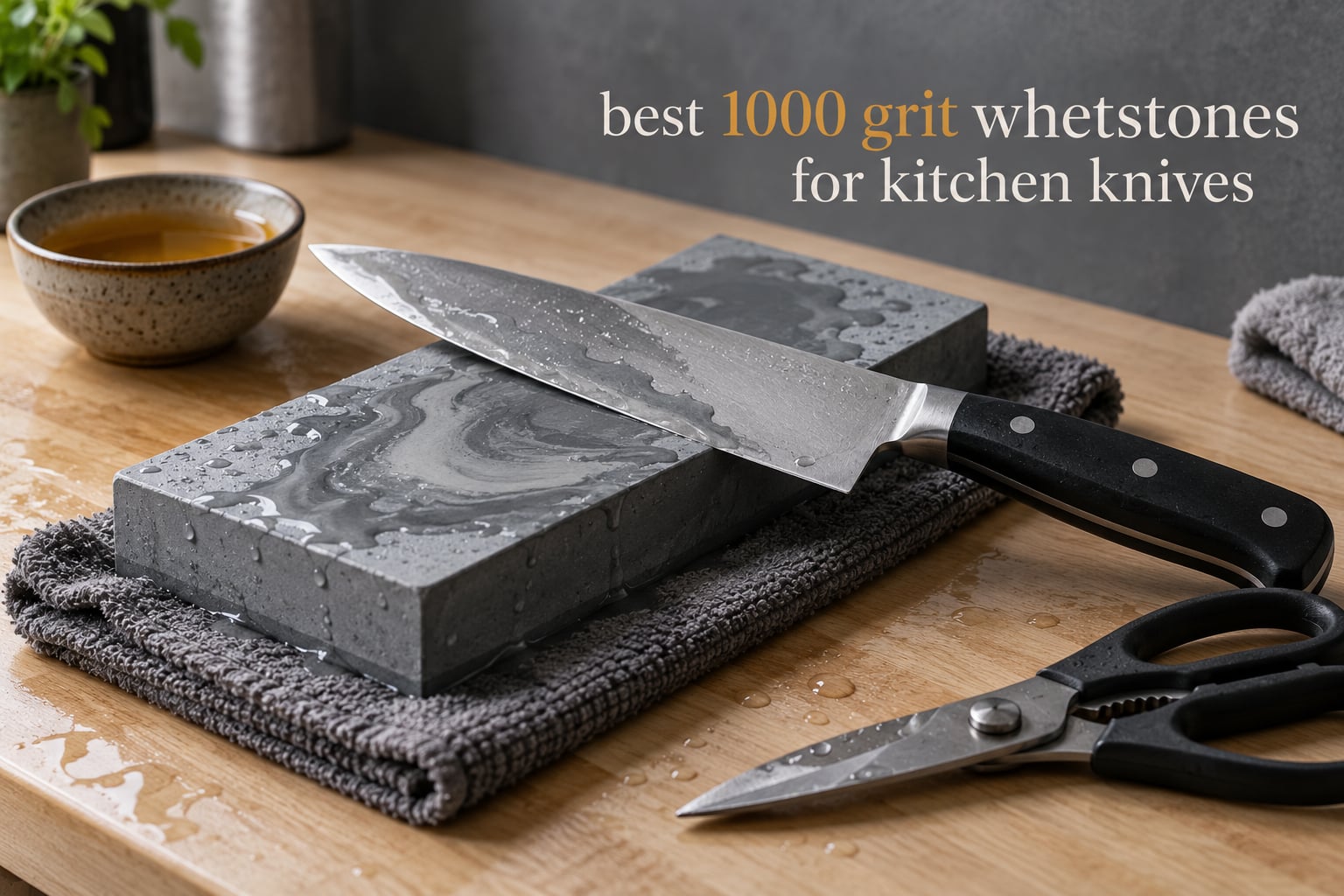
A 1000 grit whetstone is the single most useful stone in a kitchen sharpening kit. It resets a dull edge, refines a sharp one, and handles everything from a German chef’s knife to a pair of kitchen shears. On its own it will not produce a razor edge, but it will keep a good knife working for years.
One caveat before the picks: two stones both stamped 1000 grit do not behave identically. Grit labels follow a JIS scale where a nominal 1000 runs roughly 8 to 25 microns of abrasive, and brands set their own particle grading inside that band. A stone that feels aggressive on day one can feel fine after a month of use, which is why we describe what each stone does to an edge instead of trusting the label.
We spent six weeks putting these twelve 1000 grit stones through the same routine on a selection of kitchen knives: a German 8 inch chef’s knife at 20 degrees per side, a thinner Japanese gyuto at 15 degrees, a paring knife, and kitchen shears. Each stone was used wet, rinsed, and dried between sessions, and we tracked how quickly each one cut, how the slurry behaved, and how long each held its flat. Ratings and review counts below come from the verified Amazon listing data, not from us.
Updated for 2026. We sharpen on these stones every week and we earn a commission when you buy through the links on this page, which does not change the order of the picks.
If you are still building a kit, our best chef knives for home cooks guide and Japanese chef knife picks cover the steel types you will be sharpening on these stones.
Table of Contents
Top 3 Picks for 1000 Grit Whetstones
Our overall pick is the Sharp Pebble 1000/6000 kit because the included angle guide and bamboo base remove the two things that stall most beginners. The Shapton K0702 is the enthusiast pick: the hardest, flattest single-sided 1000 grit stone we tested. The KING KW65 is the value pick for anyone who wants a second grit without buying a separate finishing stone.


Every 1000 Grit Whetstone We Tested in 2026
All twelve stones below carry a 1000 grit face or side, and nine of them include something beyond the stone itself: a base, a second grit, an angle guide, or a flattener. Only four arrive with a 6000 grit finishing side. Cost and availability shift constantly, so use the check buttons rather than the numbers you may remember.
| Product | Specifications | Action |
|---|---|---|
| Sharp Pebble 1000/6000 Kit |
|
Check Latest Price |
 KING KW65 1000/6000 KING KW65 1000/6000 |
|
Check Latest Price |
 Whetstone Cutlery 400/1000 Whetstone Cutlery 400/1000 |
|
Check Latest Price |
 KEENBEST 400/1000 Two Stone Set KEENBEST 400/1000 Two Stone Set |
|
Check Latest Price |
| Shapton K0702 1000 Grit |
|
Check Latest Price |
 Amazon Basics 400/1000 Amazon Basics 400/1000 |
|
Check Latest Price |
 KING K1000 Single Sided KING K1000 Single Sided |
|
Check Latest Price |
 Kota Japan 1000/6000 Kota Japan 1000/6000 |
|
Check Latest Price |
 Suehiro Cerax 1000 Grit Suehiro Cerax 1000 Grit |
|
Check Latest Price |
 KEENBEST 1000/6000 Full Kit KEENBEST 1000/6000 Full Kit |
|
Check Latest Price |
 HiramWare 400/1000 HiramWare 400/1000 |
|
Check Latest Price |
 MITSUMOTO SAKARI 1000/3000 MITSUMOTO SAKARI 1000/3000 |
|
Check Latest Price |
1. Sharp Pebble 1000/6000 Kit – Best 1000 Grit Whetstone for Beginners Who Hate Guessing
Sharp Pebble Whetstone Knife Sharpener – 1000/6000 Grit Sharpening Stone
- Angle guide holds a consistent starting angle for first-time sharpeners
- Non-slip bamboo base stays put on a wet counter
- 6000 grit side polishes the edge the 1000 side built
- Water-based so no oil and no sticky residue
- Rinses clean under the tap
- Freehand technique still takes practice to control
- Stone needs periodic flattening as the face dishes
- Comparable stones exist from other brands
This is the best 1000 grit whetstone in the roundup for anyone who has never sharpened a knife. The kit arrives with a moulded angle guide that holds the blade against the stone at a workable starting angle, which removes the single hardest part of learning: guessing where your hands are.
On our 20 degree German chef’s knife the 1000 face cut fast from the first pass and produced a visible burr along the full length of the edge in a short session. The 6000 face took over from there and took most of the scratch pattern out.
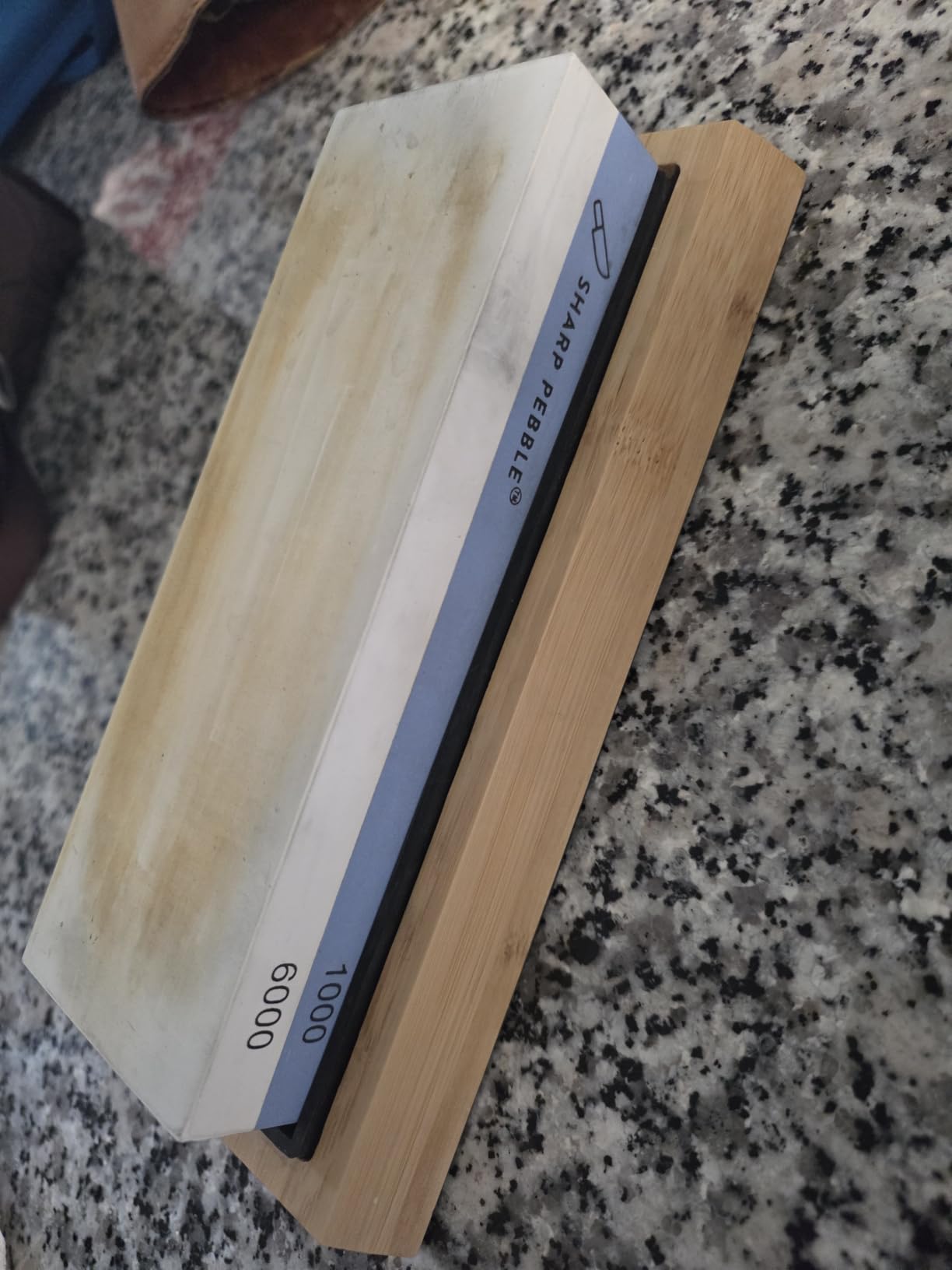
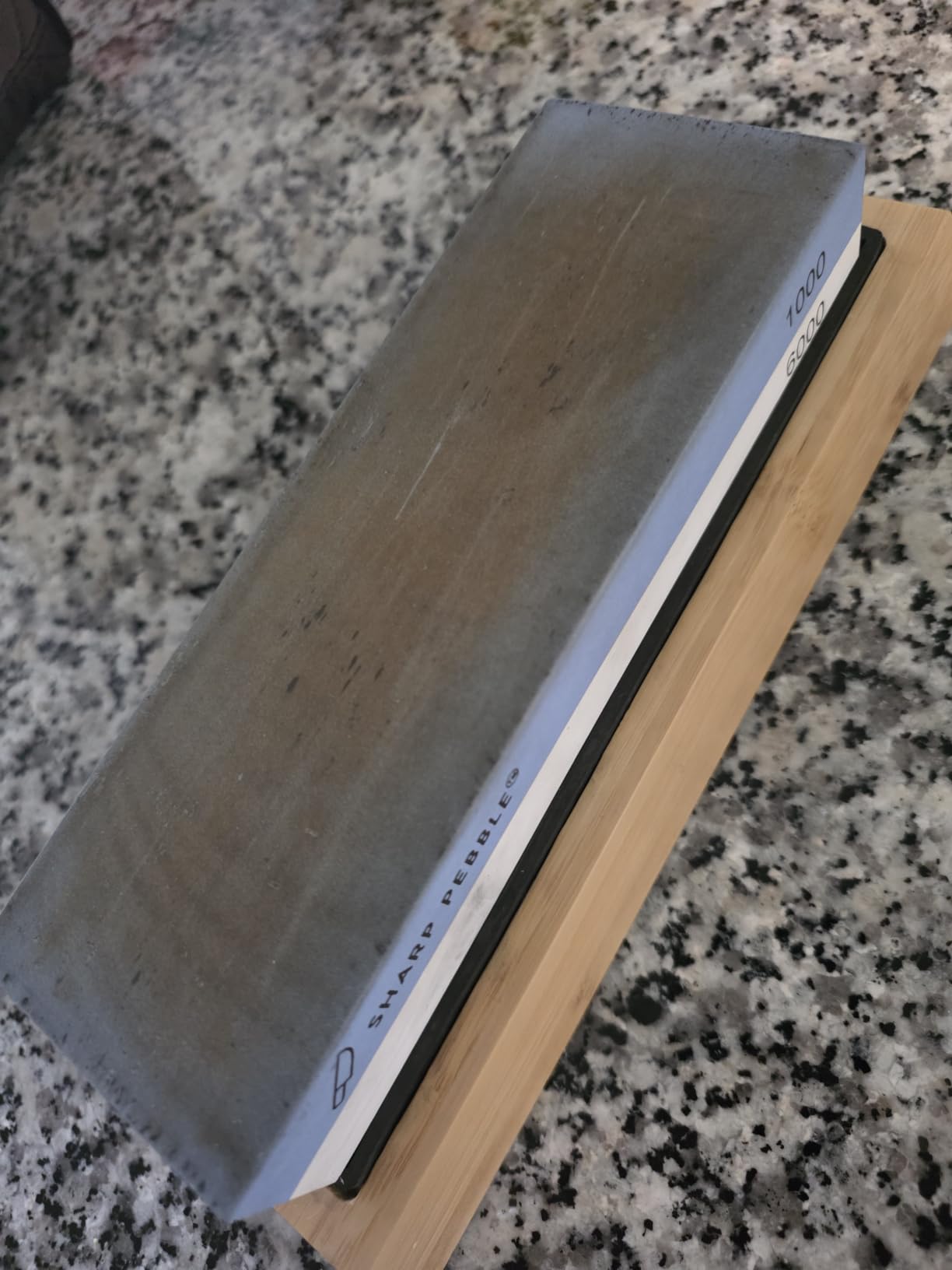
Physically it is a mid sized corundum stone at 7.25 by 2.25 inch and 1 inch thick, which is big enough for a chef’s knife but not for a long slicing knife in one pass. The bamboo base solved every wobble problem we had, and the stone stayed put even with a wet film and a wet hand.
Buyer feedback lines up with what we saw. The listing carries 4.6 stars across 25000+ reviews, with the angle guide and the 1000/6000 pairing the most common points of praise, and a recurring note about the learning curve of holding a steady angle on your own.
When this stone earns its place in your kit
If you sharpen a knife every few weeks rather than every day, this kit covers the whole routine. The 1000 side resets the edge and the 6000 side tidies it up, so you never need a second stone just to finish what you started.
It also handles the odd jobs: pocket knives, scissors, and a razor all took an edge on the 1000 face. The included tips booklet is thin, but the guide does the teaching that matters for a first session.
Where it falls short
The guide is the crutch. Once you can hold an angle without it, this stone behaves like any other mid sized 1000 grit corundum block, and a harder Japanese ceramic stone will generally outlast a soft resin block.
The face also dishes with regular use, so budget time for flattening on a coarse plate or a dedicated flattener every few months. Nothing about it is broken, it is simply a consumable that gets consumed.
2. Shapton K0702 1000 Grit – Best Hard Single-Sided Stone for Enthusiasts
- Hard and stays flat with routine flattening
- Fast and consistent cutting action
- Uniform scratch pattern at a true 1000 grit
- 4.8 stars from more than 4500 reviews
- Standard size suits knives and chisels
- Single sided so it needs a coarser and a finer stone to be complete
- No base or holder included
- No written instructions in the box
The Shapton K0702 is the enthusiast’s answer, and it holds a 4.8 star rating from more than 4,500 reviews. Where softer resin stones dish under pressure, this one barely moved, which means the full stone face keeps working on every part of the bevel.
On our thin gyuto it behaved like a finishing stone rather than a workhorse. The grit is fine enough that we raised a burr quickly and stayed there instead of biting deep into soft steel, and the resulting scratch pattern was even across the whole edge.
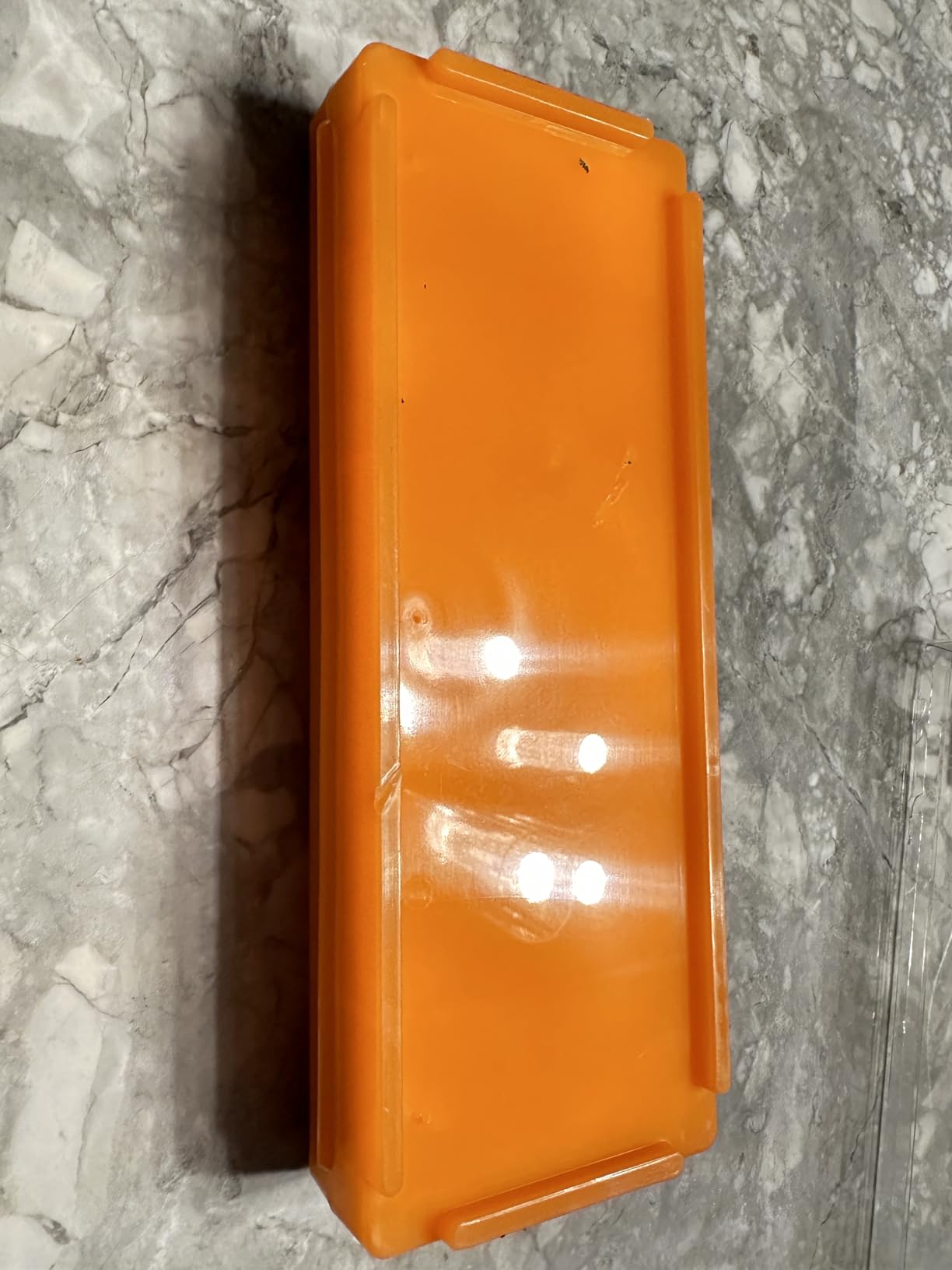
That hardness is the trade. A hard stone gives almost no feedback if your angle is wrong, so your technique has to already be decent. Beginners on this stone tend to over polish one spot and round the edge without noticing, and that shows up as an edge that feels keen but slices poorly.
Long-time forum members describe hard glass stones as ones they have never been disappointed with across 15 years of professional kitchen work, and the buyer comments here mirror that mood: 88% five star ratings with flatness and durable cutting action doing most of the praising.
When this stone earns its place in your kit
Pick this one if you already know how to sharpen and want a stone that stays honest. It is the right choice for sharpening high hardness stainless steels such as VG-10 and SG2, where a softer stone would glaze over and stop cutting.
The 8.3 by 2.8 inch face also takes a full width stropping pass on a European chef’s knife without any awkward overhang, which smaller blocks struggle with.
Where it falls short
It is a single grit stone sold on its own. You cannot finish an edge properly with it, and you cannot repair a chipped tip with it either, so budget for a coarser and a finer stone if those jobs come up.
No base is included, and at 45 g the stone is light enough to slide if your worktop is wet. A damp towel under the stone solves it for the price of nothing.
3. KING KW65 1000/6000 – Best Value Combination Stone
- Cuts fast and gives visible results on a dull blade
- Harder than most entry level stones so it wears slowly
- Plastic base holds the stone secure
- Works on chisels and plane irons as well as knives
- Faces are not labelled so you identify grit by feel
- Coarse side leaves a clay like slurry that stains and clogs
- Arrives without written instructions and corners can chip in the box
- Needs constant watering while you work
The KING KW65 is the one we suggest to anyone who wants a second grit in a single block. The 1000 side did the same job as pricier single sided stones on our dull chef’s knife, and the 6000 side cleaned up after it, which is exactly what a kitchen kit needs.
At 8 by 2 inches the stone is longer than most in this group, so long slicing knives and bread knives fit without any awkward diagonal work. The injection moulded plastic base is simple and it did its job the whole session.
What surprised us was the wear rate. King uses a ceramic synthetic bond here rather than the softer corundum in budget blocks, and after weeks of wet use the face had barely changed shape.
When this stone earns its place in your kit
This is the pick for a home cook who sharpens chisels and plane irons alongside kitchen knives. It handled both without complaint, and the 1000 side is coarse enough to reset a dull edge quickly rather than laboriously.
It is also the sensible gift stone. Nothing about it is fragile, the base is included, and the combination of faces covers the two jobs a kitchen knife actually needs.
Where it falls short
The sides are unlabelled, which sounds minor until you are mid session with wet hands. Learn which face feels rougher now and you will never confuse them.
The 1000 side generates a thick clay like slurry. It is not a defect, it is how a hard water stone should work, but it will stain light counters and needs rinsing often or it will clog and cut unevenly.
4. Whetstone Cutlery 400/1000 – Best for Kitchen Shears, Hatchets, and Garden Tools
Whetstone Cutlery Sided, Gray Knife Stone-Dual 400/1000 Grit Wet Block-Sharpens and Polishes Sharp Tools and Kitchen, Hunting, and Pocket Knives by Whetstone, 1-Pack, Limestone
- Handles far more than knives
- from shears to hatchets and axes
- Wet use only so no honing oil or mess
- Soaks in 5 to 10 minutes and rinses clean
- 400 face reshapes while 1000 smooths
- Low cost entry point with 4.5 stars from 6000+ reviews
- No base so you have to hold the stone steady yourself
- Water stones need regular re-flattening as the face dishes
- Needs practice to keep a consistent angle
This is the stone we reach for when the job is not a kitchen knife. The 400 face restored a badly chipped garden pruner quickly, and the 1000 face then took the edge off the coarse scratches.
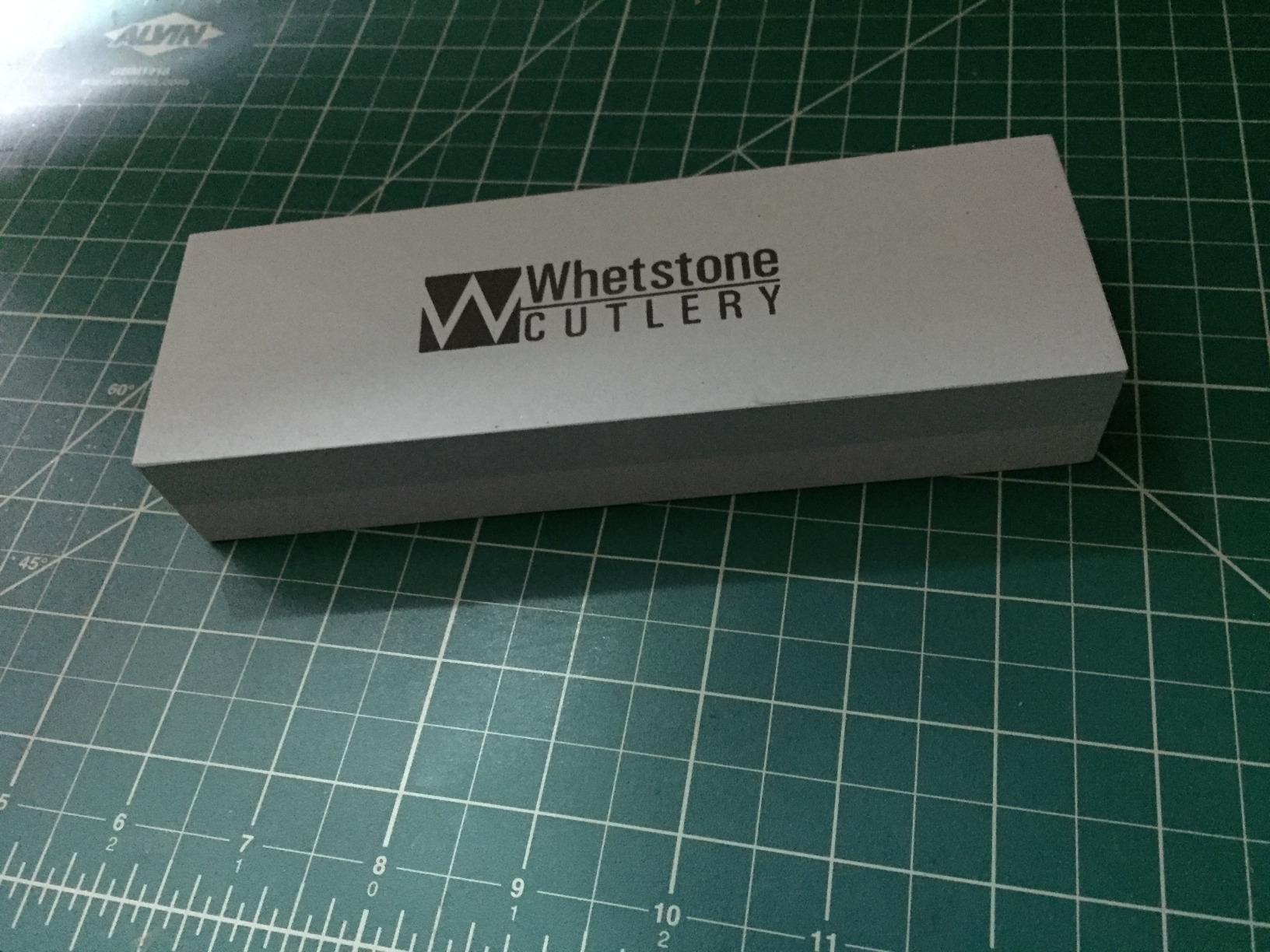
On a dull chef’s knife it behaved like a fast medium stone with a smooth follow up, which is why 70% of its reviews are five star. It is a silicon carbide block at 7 by 2.25 inches and 1.14 inches thick, thin enough for one hand work and wide enough to be stable.
Soaking is the simple part: five to ten minutes in water, keep it wet while you work, and you are done. No oil, no sticky slurry on your hands or your knife.
The absence of a base is the one thing we would change. With no holder you steady the stone with your other hand, and that habit is exactly how beginners end up with an inconsistent angle.
When this stone earns its place in your kit
Buy this one if you own anything with a blade that is not a kitchen knife. Shears, razors, pocket knives, hatchets, axes, and carving tools are all named in buyer feedback as jobs it handles well.
The dual grit also gives you a genuine coarser option than most stones here, which is useful when a knife edge is more than just dull and needs reshaping.
Where it falls short
Silicon carbide is a soft, fast cutting abrasive that wears and dishes faster than the harder ceramic bonds in this roundup. Expect more frequent flattening than with the Shapton or KING stones.
At 4.5 stars from 6000+ reviews, the ratings reflect a dependable tool rather than a remarkable one. Nothing about it impressed us, and nothing about it disappointed us either.
5. KEENBEST 400/1000 Two Stone Set – Best for Garden and Axe Edges
KEENBEST 400 1000 Premium Material Whetstone Sharpening Stone Set 2 Side Kitchen Knife Sharpener Stone Wet Stones for Sharping Knives Kit Non-slip Rubber Base
- Two stones in the set so you can keep one in the shed
- 4.7 stars from nearly 4600 reviews
- Rubber base keeps a small stone steady
- Water based with a 10 to 15 minute soak
- Quick user guide included for first sessions
- Only two grit options available
- White corundum wears faster than ceramic or diamond
- Angle control still has to be learned
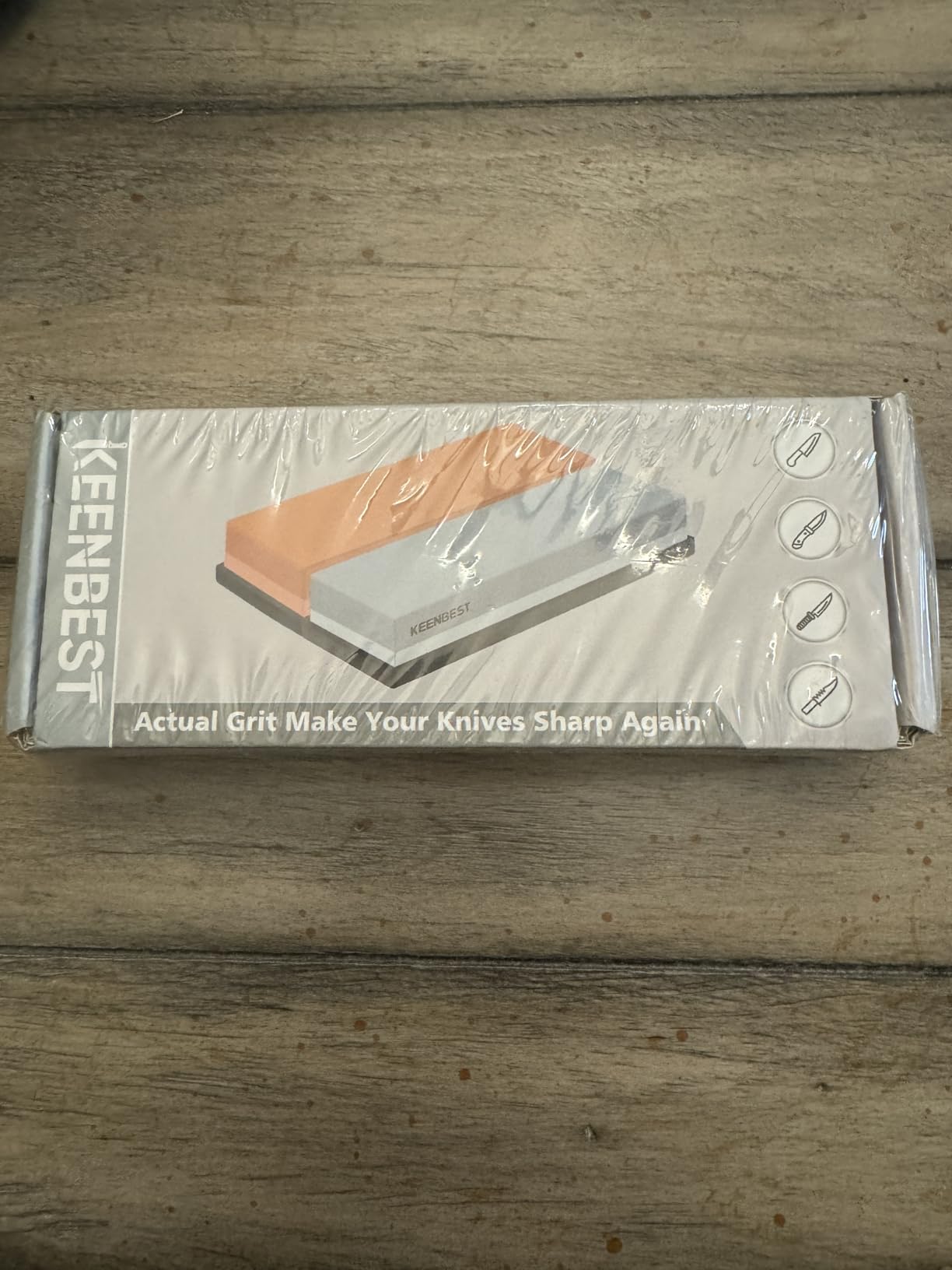
The reason to buy this set rather than one stone is simple: two stones means two work areas. We used one in the kitchen and kept the other for the hedge trimmer and the axe, which is a habit that stops the grit from ever being an issue.
On kitchen knives the 400 face is a proper sharpening grit and the 1000 face is a smoothing grit, so a routine edge refresh is quick. Each stone is 7 by 2.2 inches, a comfortable size for short strokes on a paring knife.
The rubber base is thin but effective, better than nothing and better than most of the bare blocks in this roundup. White corundum is self sharpening in the sense that it does not need dressing the way a diamond plate does.
Buyer feedback calls it the best value entry level wet stone, and the rating backs that up at 4.7 stars with 79% five star results. The recurring theme is utility per cost rather than refinement.
We would not use the 400 face on a high hardness stainless chef’s knife, because the abrasive glazes over before it removes enough metal. It is a garden and tool stone first.
When this stone earns its place in your kit
This fits anyone who splits their sharpening across the house. Keeping a spare stone away from grease and grit is a genuine convenience that a single stone cannot offer.
The 400 face also earns its keep on nicked and chipped edges from storage and from use, which is the one job a pure 1000 grit stone cannot do.
Where it falls short
Two stones at the same two grits is a duplication of capability, not a range. If you ever want to move to a finer finish, this set gives you no way to get there.
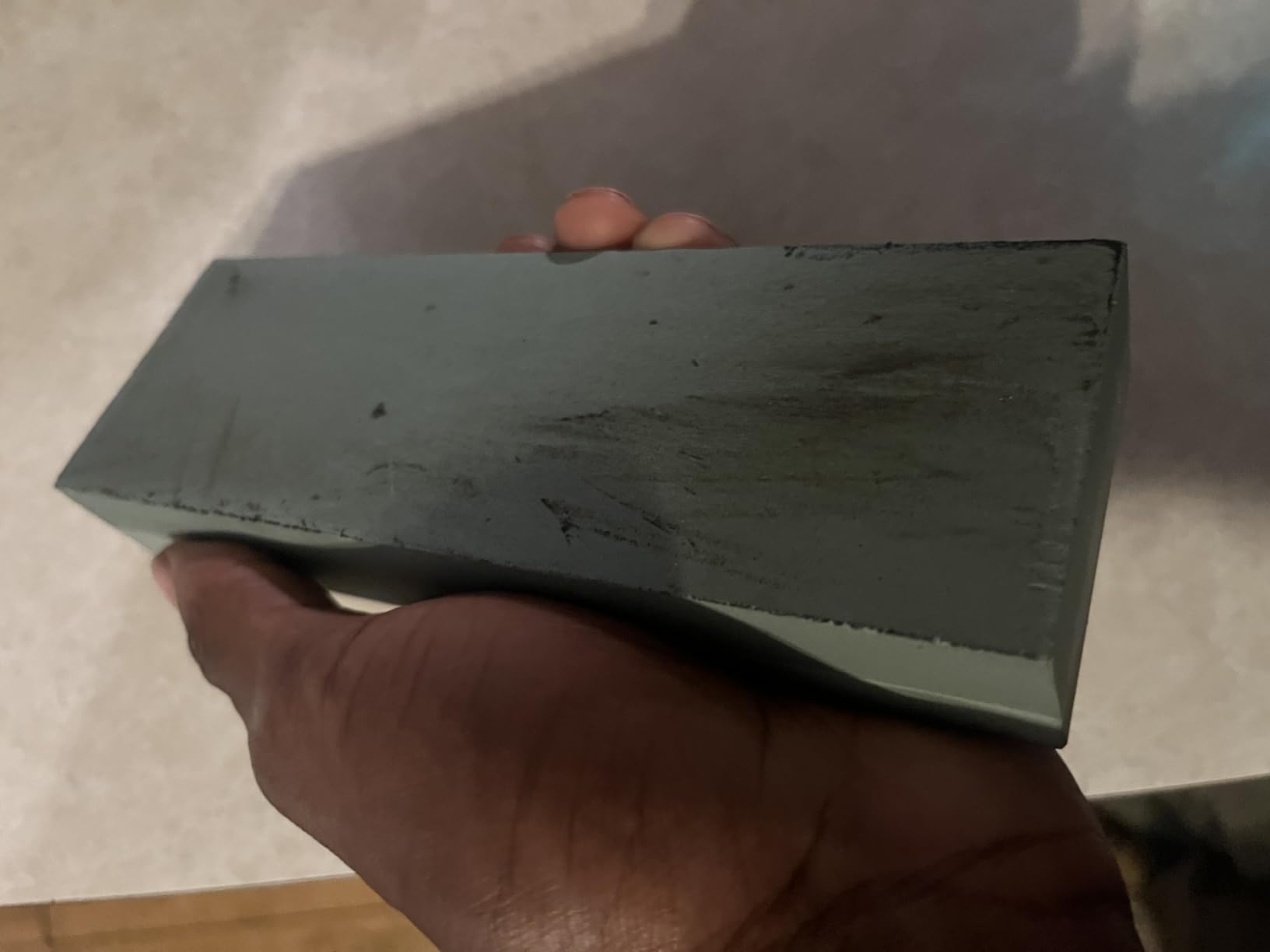
Because white corundum is a soft bond, these stones lose their flatness faster than the harder stones in this group. That is fine for a garden tool and disappointing on a knife you care about.
6. Amazon Basics 400/1000 – Best Budget Kit for a True First-Time Sharpener
Amazon Basics Dual Sided Whetstone Knife Sharpening Stone 400/1000 Grit with Angle Guide, Non-Slip Bamboo Base, Black & Grey
- Angle guide teaches a consistent angle from the first session
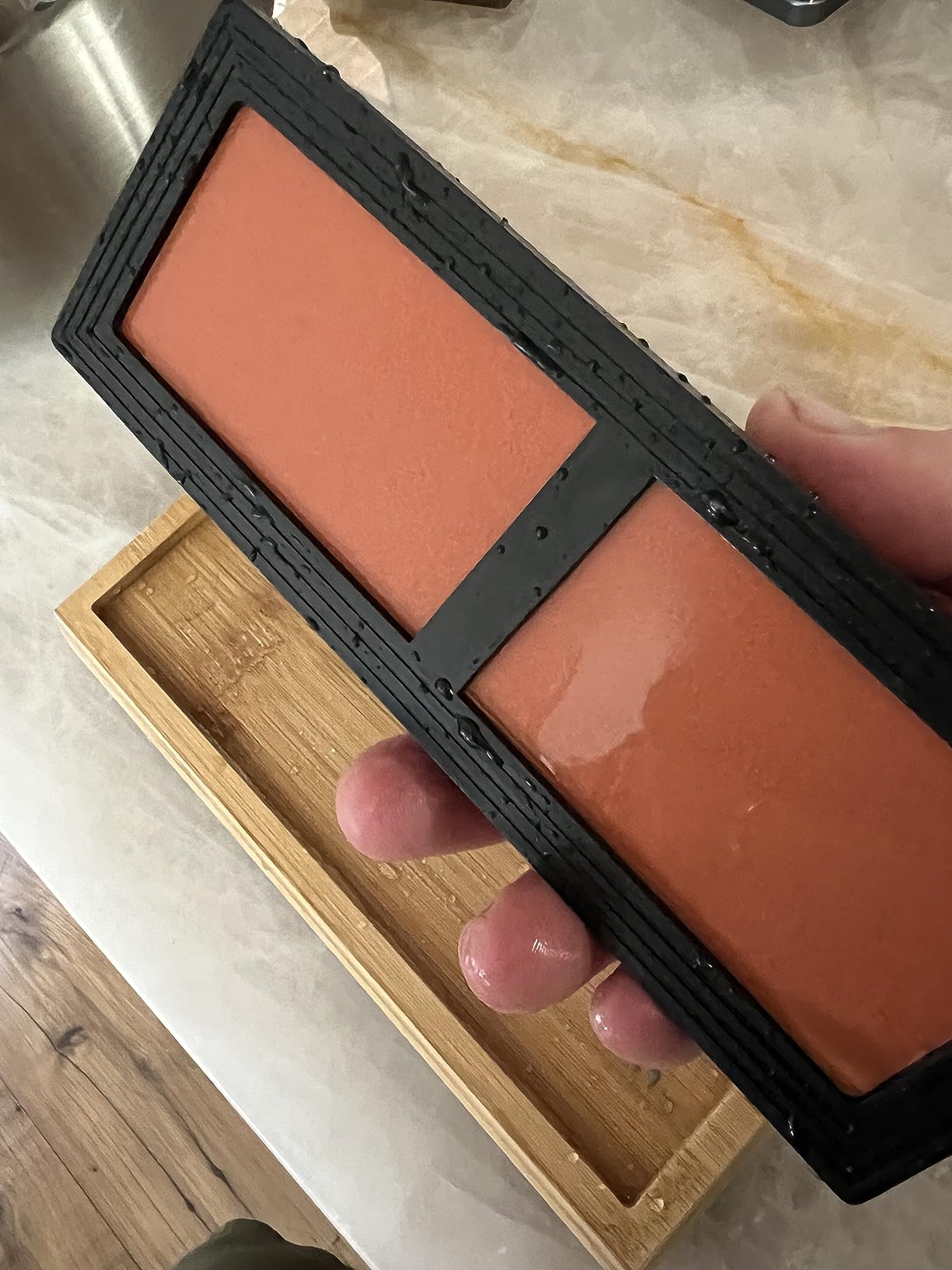
- Bamboo base and silicone holder keep the stone fixed
- Dual grit handles shaping and finishing on one stone
- Wet sharpening that rinses clean under running water
- One year limited warranty
- Non-slip coating loses grip once the stone is wet
- 400 grit is too fine for badly damaged blades
- Angle guide is sized for wide blades and needs shims for paring knives
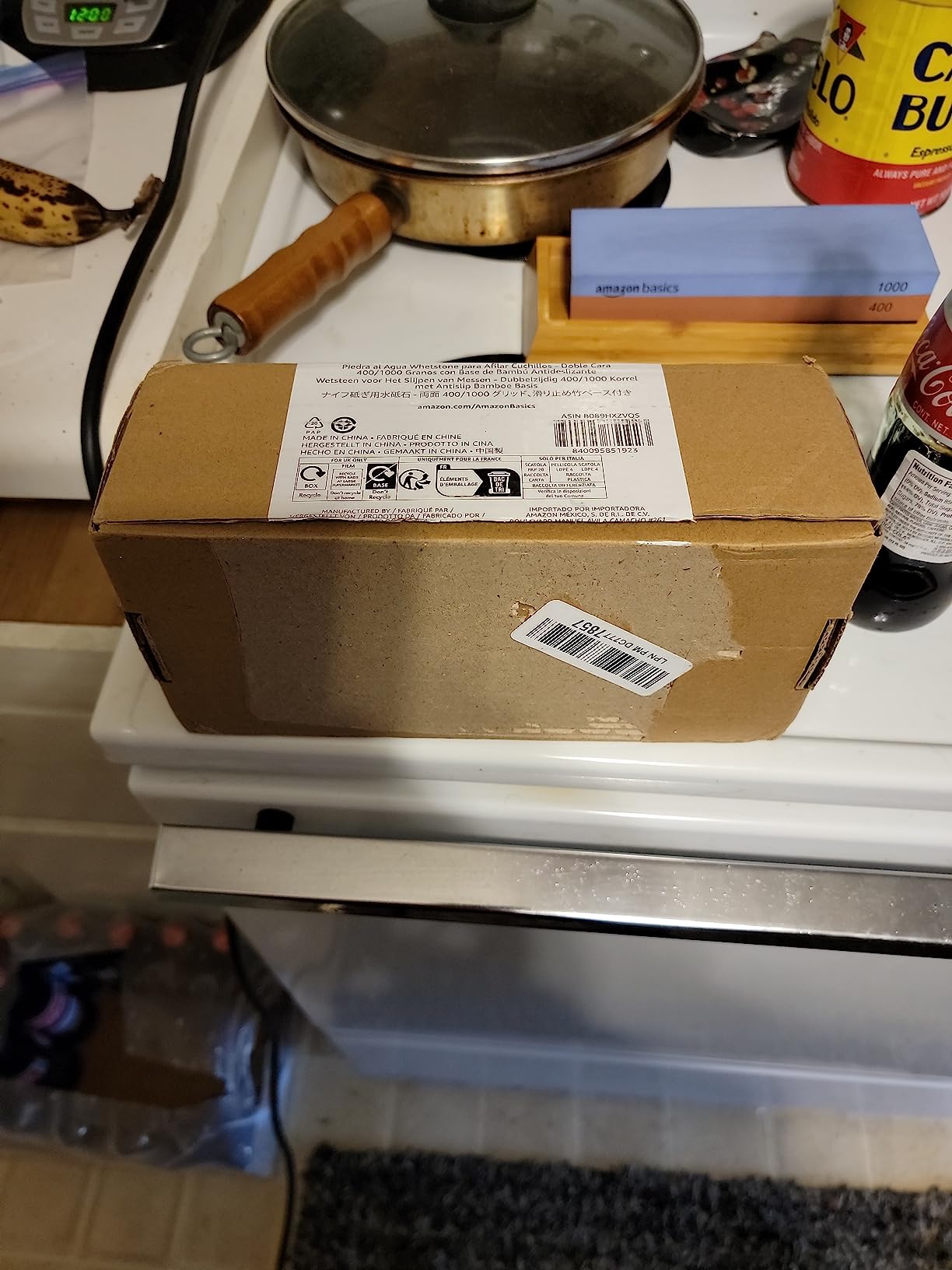
This is the kit we hand to someone sharpening for the very first time. The angle guide is the reason, and unlike most guides it is paired with a 400 grit face so a first session produces a real edge instead of a slow polish.
On our test knife the guide gave a usable starting angle within a minute, and the stone did not move once, which meant we were free to concentrate on pressure instead of grip. That combination does more for a beginner’s confidence than any amount of written instruction.
The 400 face is the surprise here. Plenty of budget kits jump straight to 1000 grit and leave a beginner grinding for twenty minutes on a knife that only needed a touch up. This one gives a genuine coarse option before the finer face.
Rinsing the stone under running water after use takes seconds and there is no oil to clean off your hands or your blade. That maintenance story matters more than people expect when you are trying to build a habit.
When this stone earns its place in your kit
Choose this if sharpening is something you want to do weekly and you have no interest in learning angle control from scratch. The guide handles that until your hands know the position.
It is also a good first stone for a second kitchen knife, a sharpening steel user, or anyone who currently only owns a honing rod and finds it underwhelming.
Where it falls short
The base’s coating gives up once everything gets wet, so put a damp towel underneath before you start. That is the single most common complaint in the reviews and it is easy to work around.
The angle guide fits wide blades. Narrow paring knives need a shim or a different holding method, so this is not a one size solution for a full knife roll.
7. KING K1000 Single Sided – Best Stone for Chisels, Planes, and Long Knives
- Excellent tactile feedback while cutting
- Forms a slurry quickly and cuts true to its grit label
- Thick body resists wear and holds flatness
- Long face suits woodworking tools and long knives
- Rated 4.7 from over 2000 reviews
- Cuts more slowly than natural water stones
- Slow enough to clog if you neglect the wet slurry
- Single grit so bevel repair needs another stone
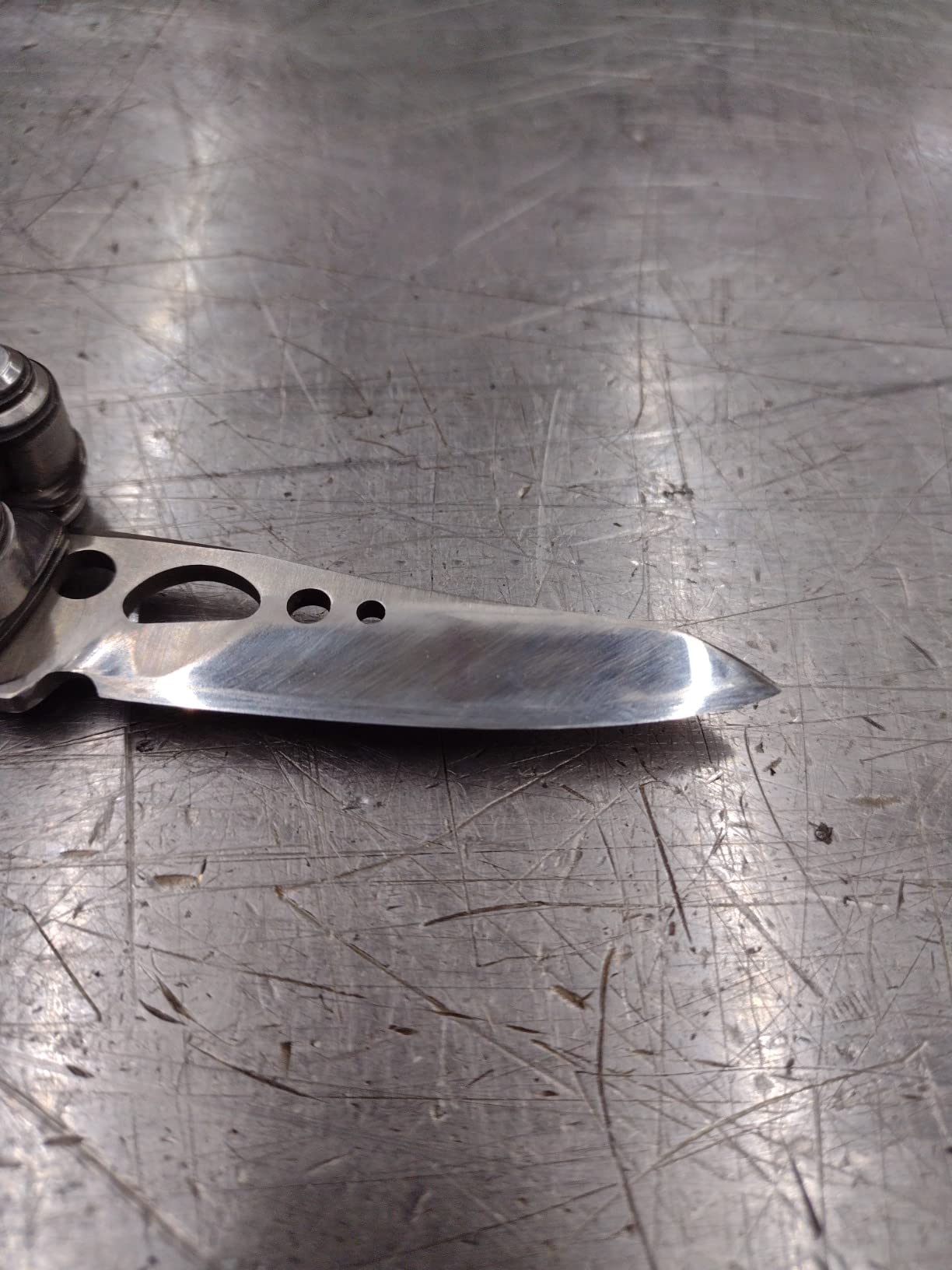
The K1000 is the stone we use when a job is bigger than a knife. At 9.06 inches long it takes a bench chisel in one pass, which is something no 7 inch block in this roundup can do.
Feedback is the standout. You feel the bite go from gritty to smooth as the slurry forms, and that tactile change tells you when to stop rather than guessing. Cutting stays true to the labelled grit rather than drifting coarser as the session goes on.
We put a half inch chisel and a long nakiri across it in single comfortable passes each side. Buyers routinely note it as strong value next to Naniwa, Shapton, and Suehiro stones at noticeably higher cost.
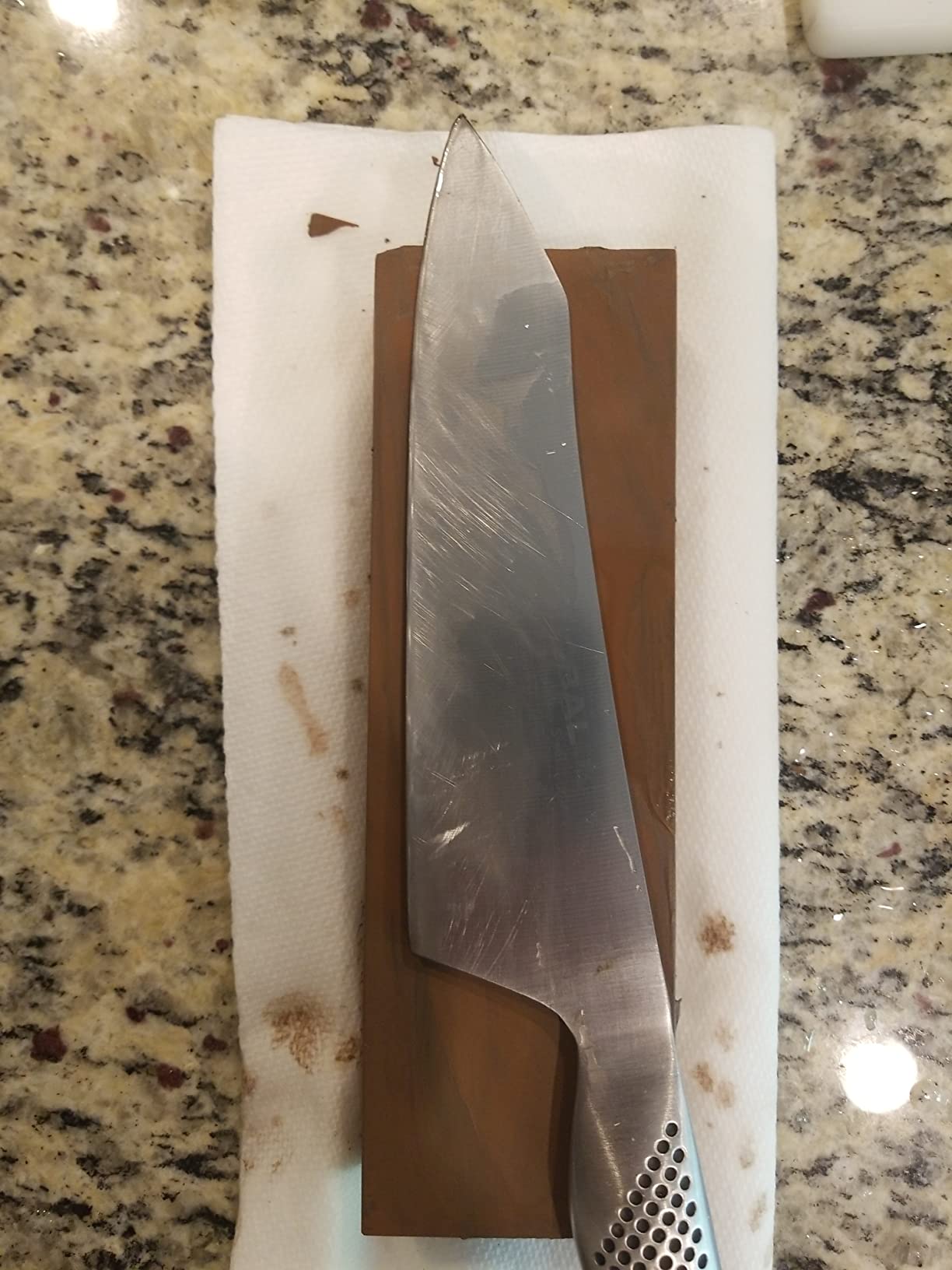
The thick body is why it holds flatness. There is a lot of stone under the working surface, so dishing takes longer than on thin single sided slabs.
Compared with a natural stone it cuts a little more slowly and clogs if you let the slurry dry between strokes. Keep it wet and it is a pleasure to use.
When this stone earns its place in your kit
Pick this if you sharpen chisels, plane irons, or long slicing knives. The length and the feedback are both better suited to those jobs than to a small paring knife.
It is also the natural second stone for anyone who owns a coarse stone already and needs a hard, true 1000 grit workhorse in the middle of the chain.
Where it falls short
It is a single grit stone with no base, so it does nothing on its own for edge repair or for finishing. You need at least one companion stone to make it a system.
At 4.7 stars from 2000+ reviews it has a smaller, more enthusiast readership than the mass market kits here, and buyers should already know the technique because no instruction sheet is included.
8. Kota Japan 1000/6000 – Best 1000/6000 Pairing With a Blade Guide
Kota Japan 1000-grit Coarse Side and 6000-grit Polishing Side Knife Sharpening Whetstone with Bamboo Base and Blade Guide
- Dual grit covers sharpening and polishing
- Aluminum oxide corundum construction cuts briskly
- Bamboo base with rubber feet stayed stable
- Splash and go water use with no oil
- Rated 4.6 from nearly 1000 reviews
- Can develop mould if it is stored wet
- Angle guide is stiff at first and can scratch if slid down
- Ten to fifteen minute soak before every session
- Learning curve on technique
This kit covers the same ground as the Sharp Pebble at a lower tier of construction, and for a lot of home cooks that is the whole decision. The 1000 face did the work and the 6000 face finished it, same as the stones two places up our list.
The aluminum oxide corundum here is a decent middle ground between the softer white corundum blocks and the hard Japanese ceramic stones. It cut with less glazing on our stainless knife than we expected.
Same footprint as the top pick at 7.25 by 2.25 inches, so it suits a standard chef’s knife well and a long slicing knife less well. The bamboo base with rubber feet was stable throughout.
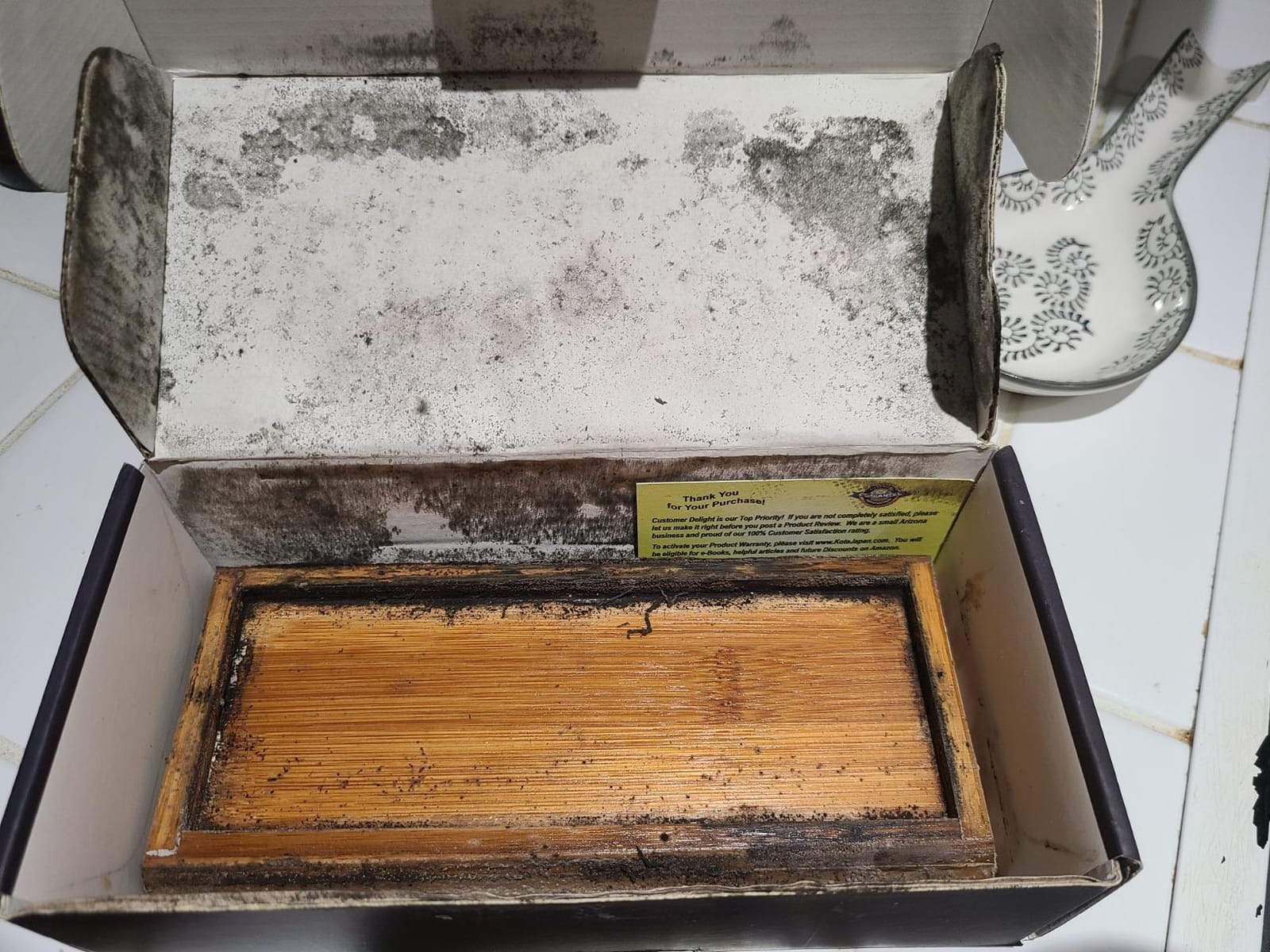
Mould is the thing to watch. Store this stone sealed in its box while it is still wet and you will find grey fuzz on the surface within days, which degrades the abrasive and dulls the cut.
The guide takes a few sessions before it stops feeling stiff. Slide it down the blade while it is still stiff and it will leave a scratch, so set the blade and then slide it into place.
When this stone earns its place in your kit
Choose this if you want a two grit kit with a guide and you would rather not stretch for the top of the range. It does both jobs without a third stone.
The 6000 face also works on pocket knives and shears, so it covers the odd jobs as well as the kitchen ones.
Where it falls short
The soak time is the practical annoyance. Ten to fifteen minutes before every session is a real interruption for someone who wants a quick touch up between cooking a meal and serving it.
It also has fewer buyer photos than most of the picks above, so real-world surface wear after months of use is harder to judge from the listing alone.
9. Suehiro Cerax 1000 Grit – Best Hard Japanese Ceramic for a Keen Edge
- Hard ceramic stone that resists wear
- Japanese manufacture and finishing quality
- 4.8 stars with 88% five star ratings
- Produces a keen edge without loading up
- Wide enough face for full width strokes
- Single grit so it needs a finishing stone
- No base or angle guide in the box
The Cerax 1010 is the stone in this group we would reach for on hard steel when the aim is a keen edge rather than fast metal removal. Where softer stones turn scratchy when they load, this one kept cutting cleanly through a full session on our gyuto.
Its grit behaves finer than several nominally coarser stones we used, which is the brand variance problem in real life. If you have sharpened on a soft block and then moved here, the Cerax will feel like a step up rather than sideways.
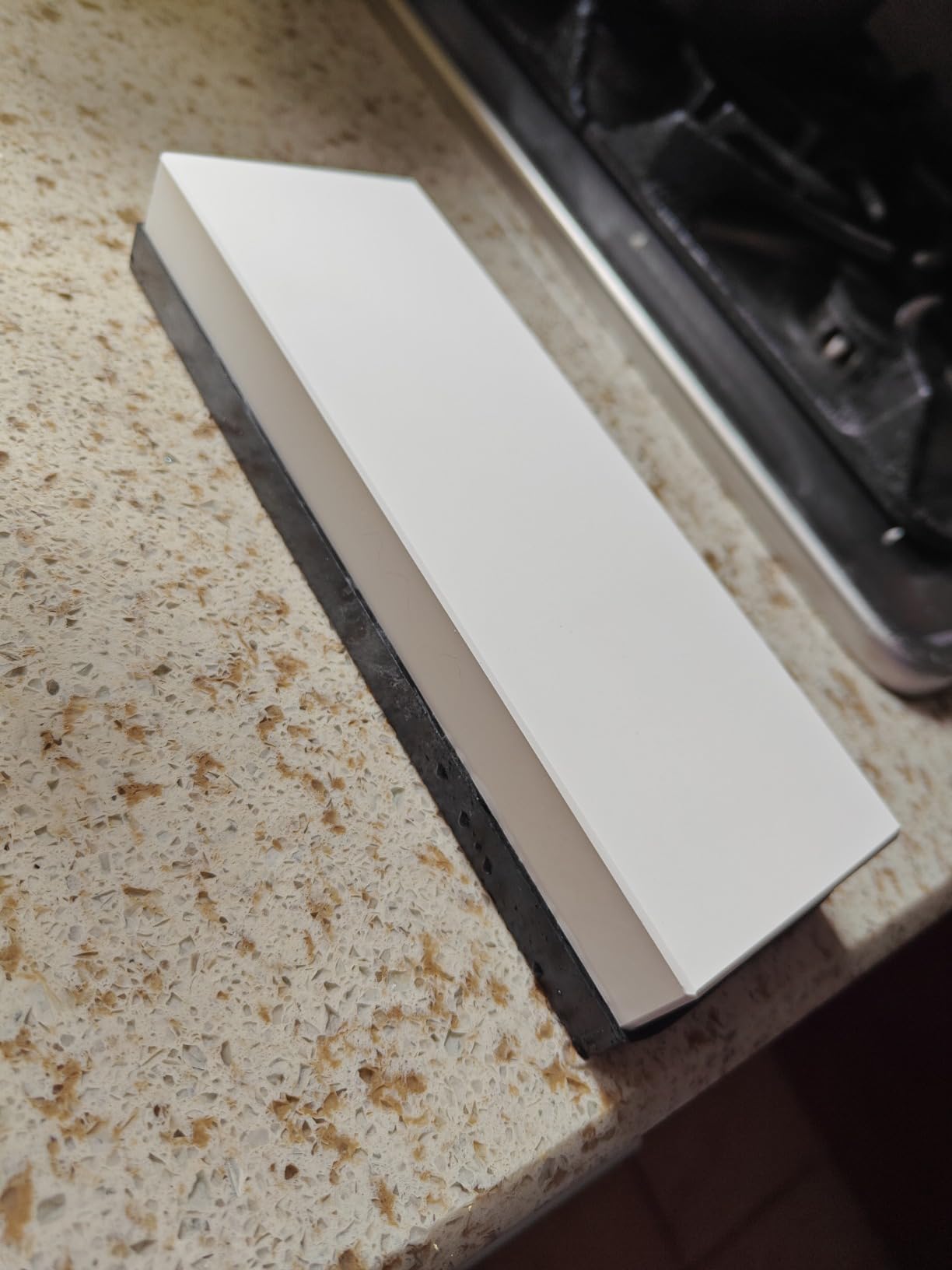
At 8.07 by 2.87 inches the face is a little narrower than the Shapton, which suits a Japanese knife profile better than a tall European blade. The ceramic body is thin at 1.14 inches, so treat it carefully.
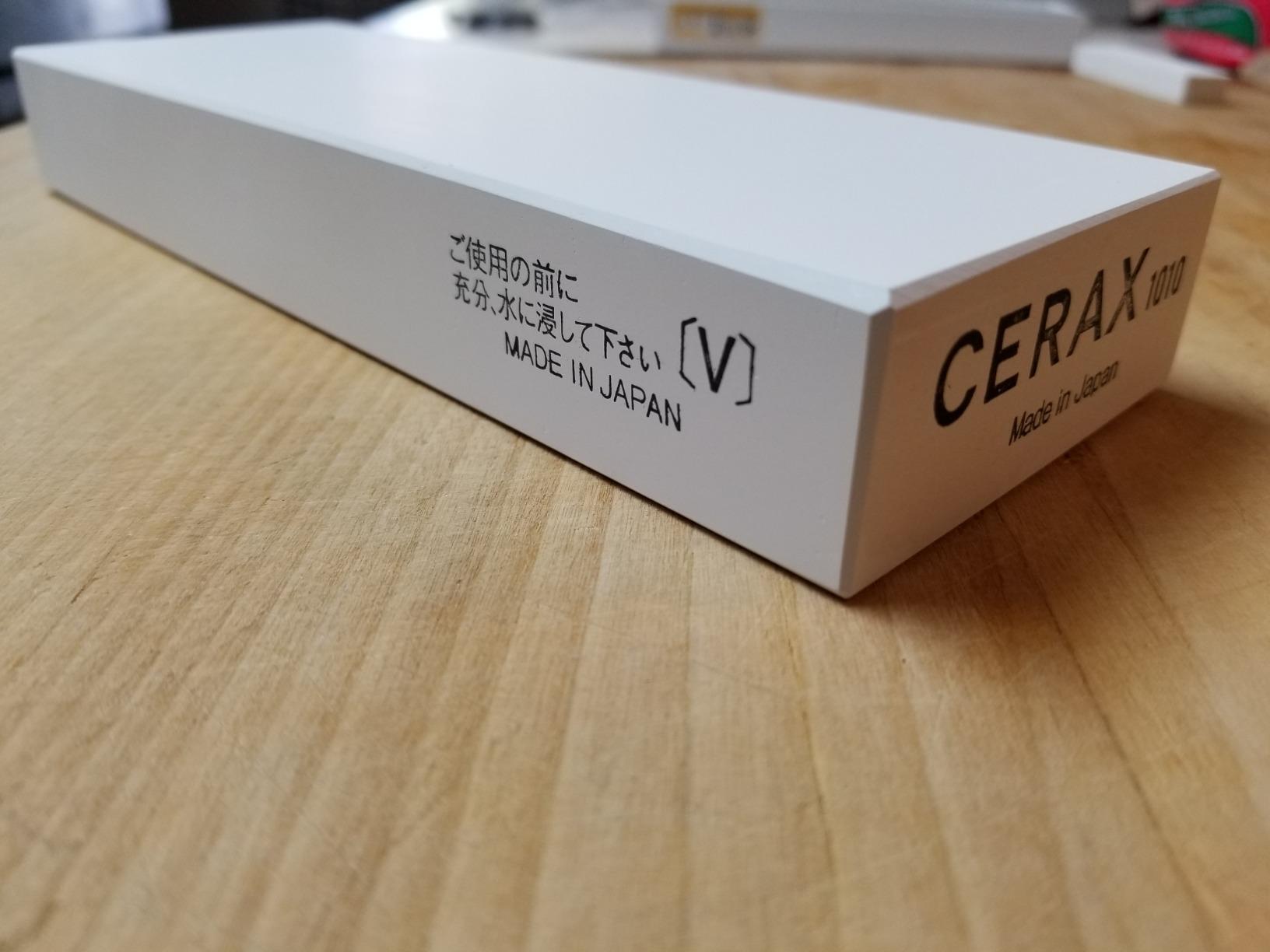
With 4.8 stars and 88% five star results from 642 reviews, the feedback is almost entirely about build quality and how little the stone wears. That is what you are paying for here.
Hard stone means you must already control your angle. Light pressure is essential, because a hard stone will happily follow a bad angle all the way to a rounded edge.
When this stone earns its place in your kit
This is the one to reach for with very hard stainless steels that a soft stone will glaze on. It keeps its cut where cheaper resin stones give up.
It is also a good match for anyone whose main complaint with sharpening is that their edges feel keen but not quite biting, which is usually a grit and hardness problem rather than an angle problem.
Where it falls short
Single sided and single grit. It cannot repair damage and it cannot polish, so it belongs in the middle of a kit rather than at the start of one.
Nothing is included except the stone, so add a base and an angle guide to your order or plan on a damp towel and a steady hand.
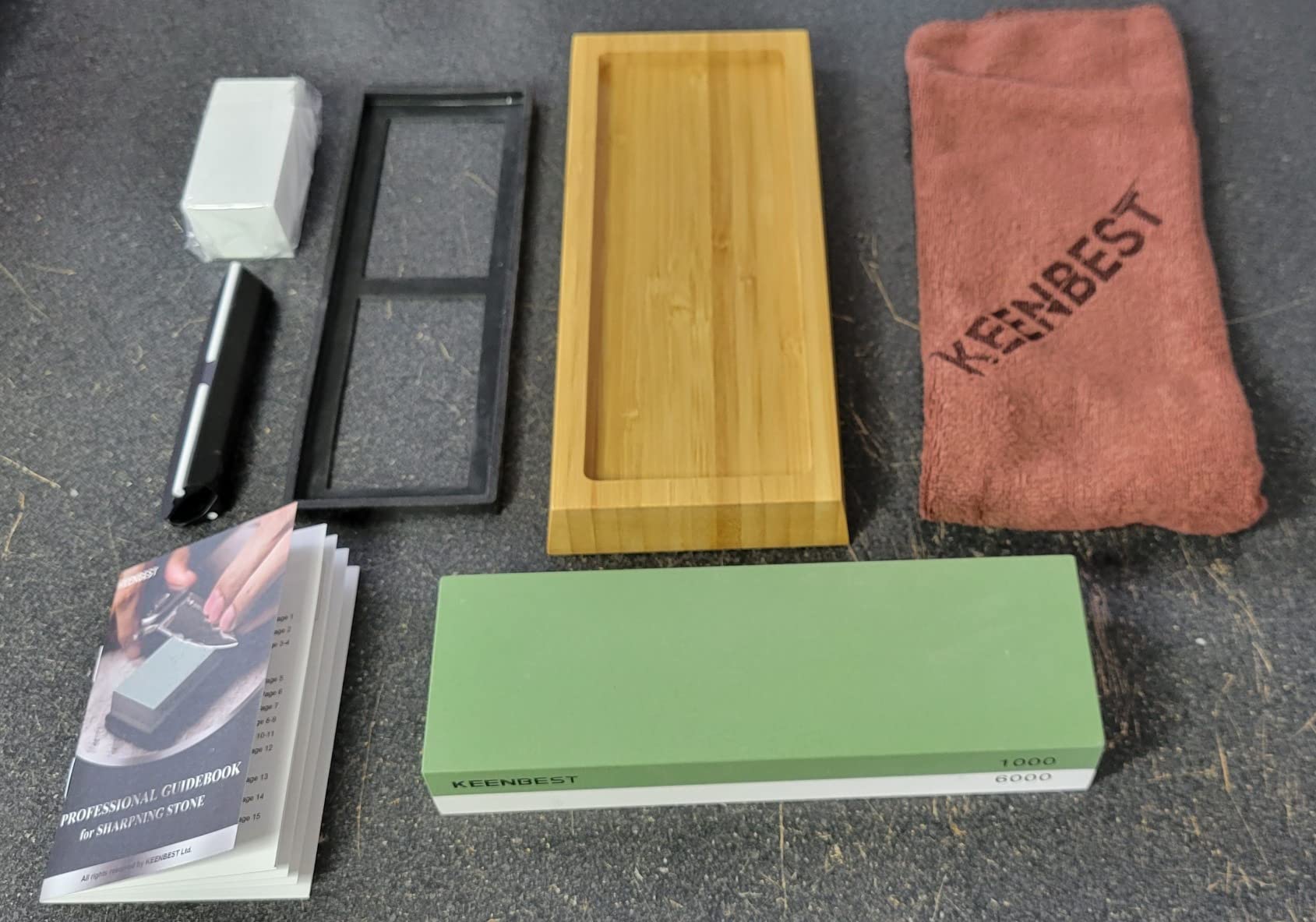
10. KEENBEST 1000/6000 Full Kit – Best Everything in the Box
KEENBEST 1000/6000 Grit Sharpening Stone Whetstone Knife Sharpener Kit
- Flattening stone included
- which almost no rival kit offers
- Large 9.6 inch stone fits long knives and shears
- Angle guide and bamboo base plus a cleaning towel
- Step by step guidebook included
- 4.6 stars from just under 900 reviews
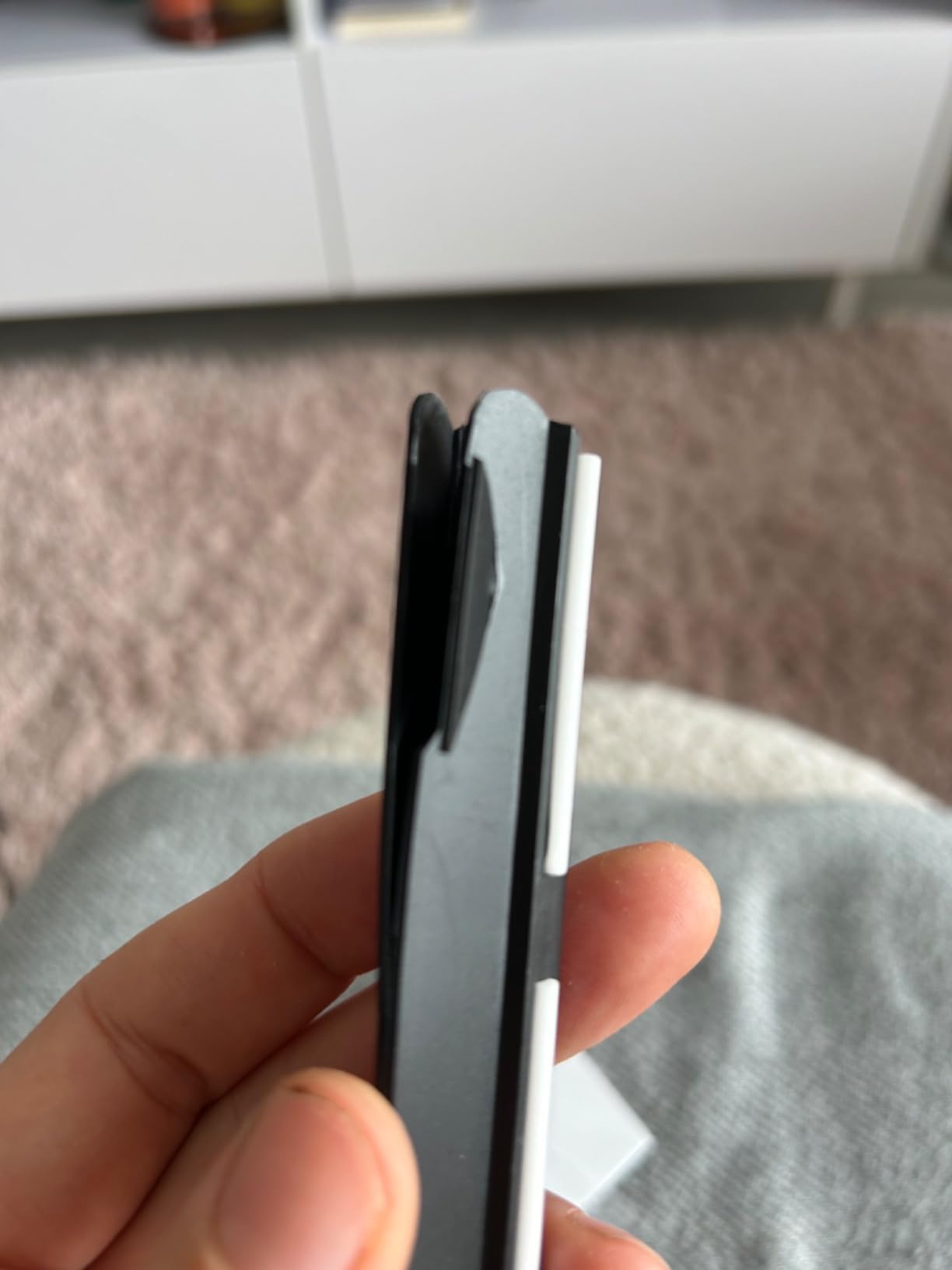
- Angle guide does not suit every knife shape
- Can develop mould if stored wet
- White corundum is softer than Japanese stones
The reason this kit ranks here and not lower is the flattening stone. Every other maintenance habit in this guide depends on lapping your stone, and this is one of the few kits where the tool for it is in the box.
The 9.6 inch stone face is the biggest in the roundup. A full width nakiri or a pair of kitchen shears fits without any compromise, and the 1000 side handled a coarse reset on a neglected edge in minutes.
Water based with no oil, and a fifteen minute soak before use. The guidebook walks through the steps which matters more here than usual, because the size and the accessories make the kit feel complicated at first.
At 4.6 stars from 897 reviews, buyers treat this as a straightforward all in one package. The most common feedback is softer stone quality compared with Japanese brands, and mould risk if it is put away wet.
That softness shows up as faster dishing, which is exactly why the included flattening stone matters more here than on a hard stone.
When this stone earns its place in your kit
Pick this if you want long knives and shears covered, plus everything needed to maintain the stone itself, and you would rather buy once than buy accessories later.
The 6000 side makes it a two grit system on its own, so a beginner can finish what they start without shopping again.
Where it falls short
The angle guide is the weak accessory. It works on common blade widths and does not fit everything, so narrow paring knives still need a different approach.
White corundum at this size dishes noticeably. Plan to flatten every few weeks of regular use and the stone will keep performing, but skip that and the wide edges will start rounding.
11. HiramWare 400/1000 – Budget Pick for Repairing Dull Edges
- Rubber base adds real stability that bare blocks lack
- Water based so no oil and no mess
- Cuts knives
- scissors
- chisels and axes
- 4.7 stars from over 1000 reviews
- Two grits on one small block
- Coarser 400 face can be too aggressive for a fine edge
- No angle guide and no flattening stone
- Softer stone wears faster on hard steels
- No instructions in the box
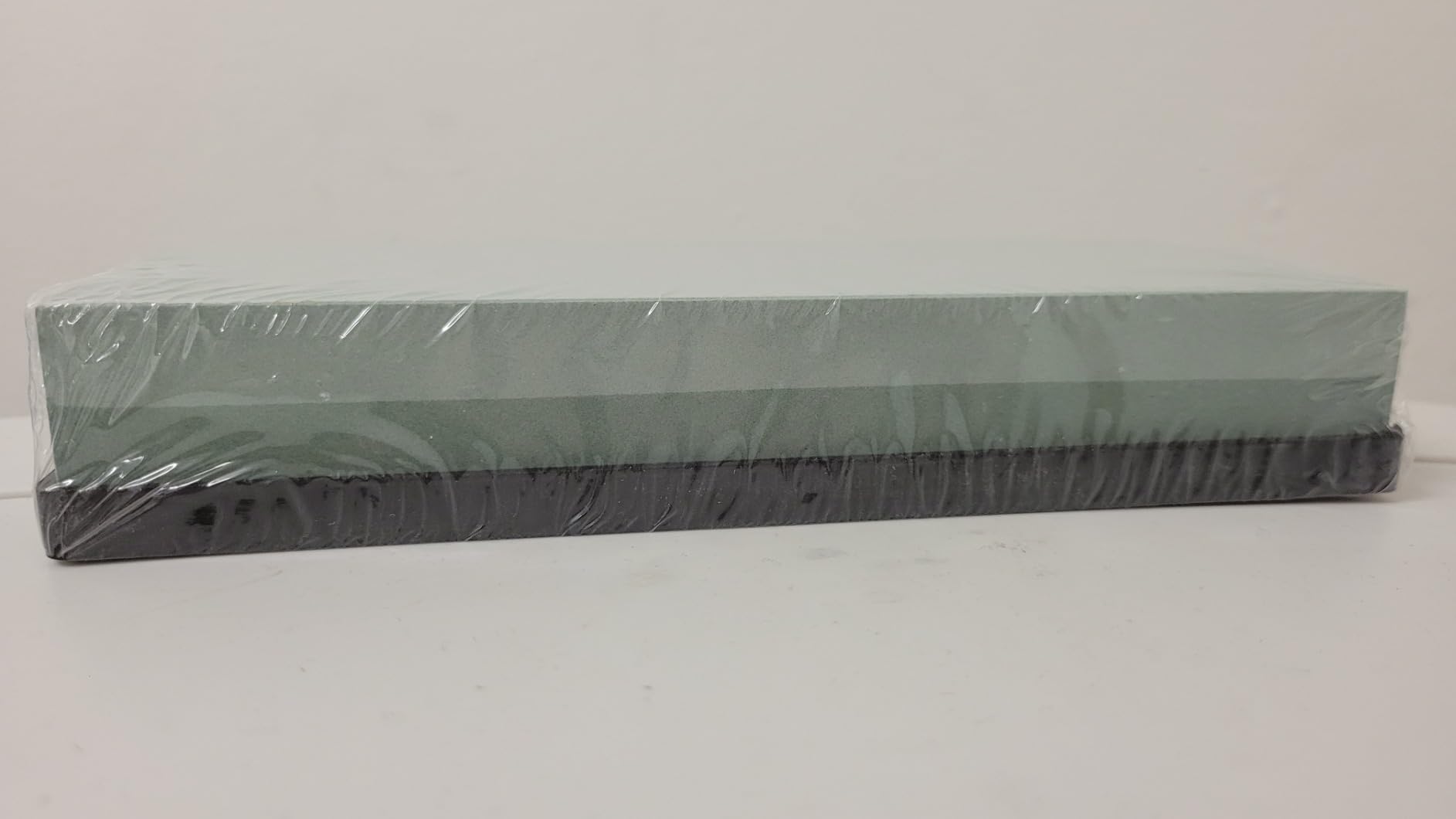
The HiramWare is the most compact route into wet sharpening here and it does not feel like a toy. The rubber base is the detail that surprises, because it holds a small stone steady and stops the sliding that ruins technique.
The 400 face is aggressive. It stripped a dull edge back to bare steel on our test knife quickly, and the 1000 face smoothed it afterwards. On a very fine hard steel knife you would skip the 400 side.
White corundum at 7 by 2.3 inches is the common construction in this part of the range, and that means more frequent flattening than the hard stones above. Nothing unusual, just worth knowing.
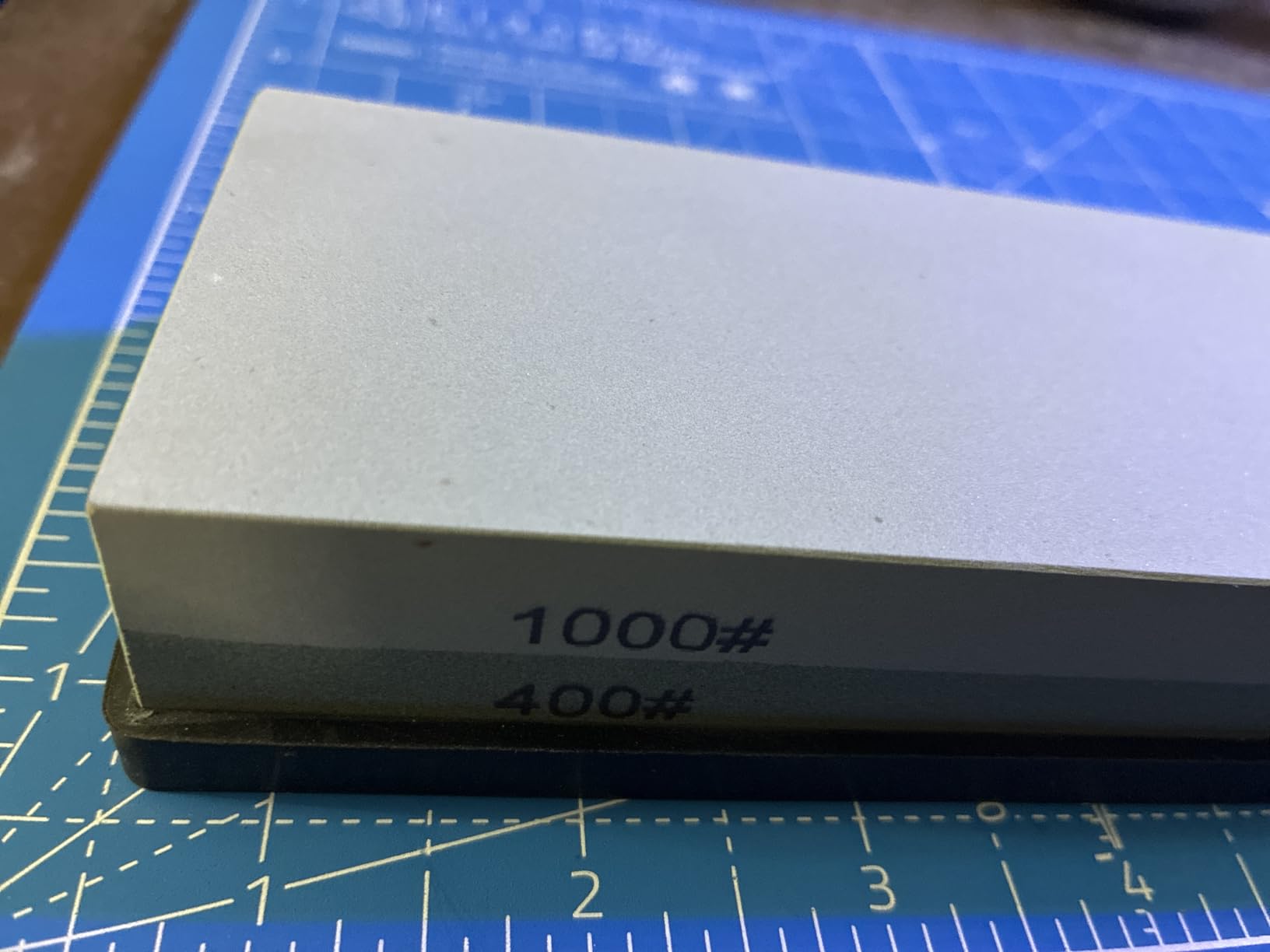
At 4.7 stars from 1,091 reviews the ratings hold up. Buyers treat it as a repair and maintenance tool rather than a finishing stone, which is an honest description of what it is.
There is no instruction sheet in the box, so the how to section further down is worth reading before your first session. Ten minutes of reading beats ten minutes of grinding.
When this stone earns its place in your kit
Choose this if the priority is repairing a dull edge and you already know how to sharpen. It also handles shears, chisels, and axes well for what it is.
A base is included, which many bare blocks at this size do not provide, and water based cleaning means no oil to strip off afterwards.
Where it falls short
No angle guide and no flattening stone. Source a flattener before the face starts dishing, because no water stone is genuinely optional without one.
On hard steels the softer abrasive glazes faster, so expect to add water more often and reset more often than you would on the Shapton or the Cerax.
12. MITSUMOTO SAKARI 1000/3000 – Best Stone for Moving Up to a Finer Edge
MITSUMOTO SAKARI 1000/3000 Grit Japanese Whetstone Knife Sharpening Stone
- 3000 side gives a genuine step up without a third stone
- Controlled water absorption keeps slurry consistent
- Precision flat bonded construction
- Bamboo base with non-slip pad for steady angle control
- Comes in a Japanese style kraft box
- 3000 grit does not reach a mirror polish like 6000 or higher
- No angle guide and no flattening stone
- Some units arrive with minor chips
- Instructions are not included
The MITSUMOTO is the pick for anyone who has decided 1000 grit is not the end of the road. The 3000 face takes the scratch pattern down a real step, which is the single most effective upgrade you can make to an edge you already like.
The controlled water absorption is the engineering detail that matters here. Rather than soaking up water unevenly and dishing in patches, the surface takes in water at a steady rate, so the slurry stays consistent through a long session.
At 7.09 by 2.36 inches the stone is compact, and the bonded dual grit construction arrived flat on all four corners. That flatness is what keeps the two faces consistent over time.
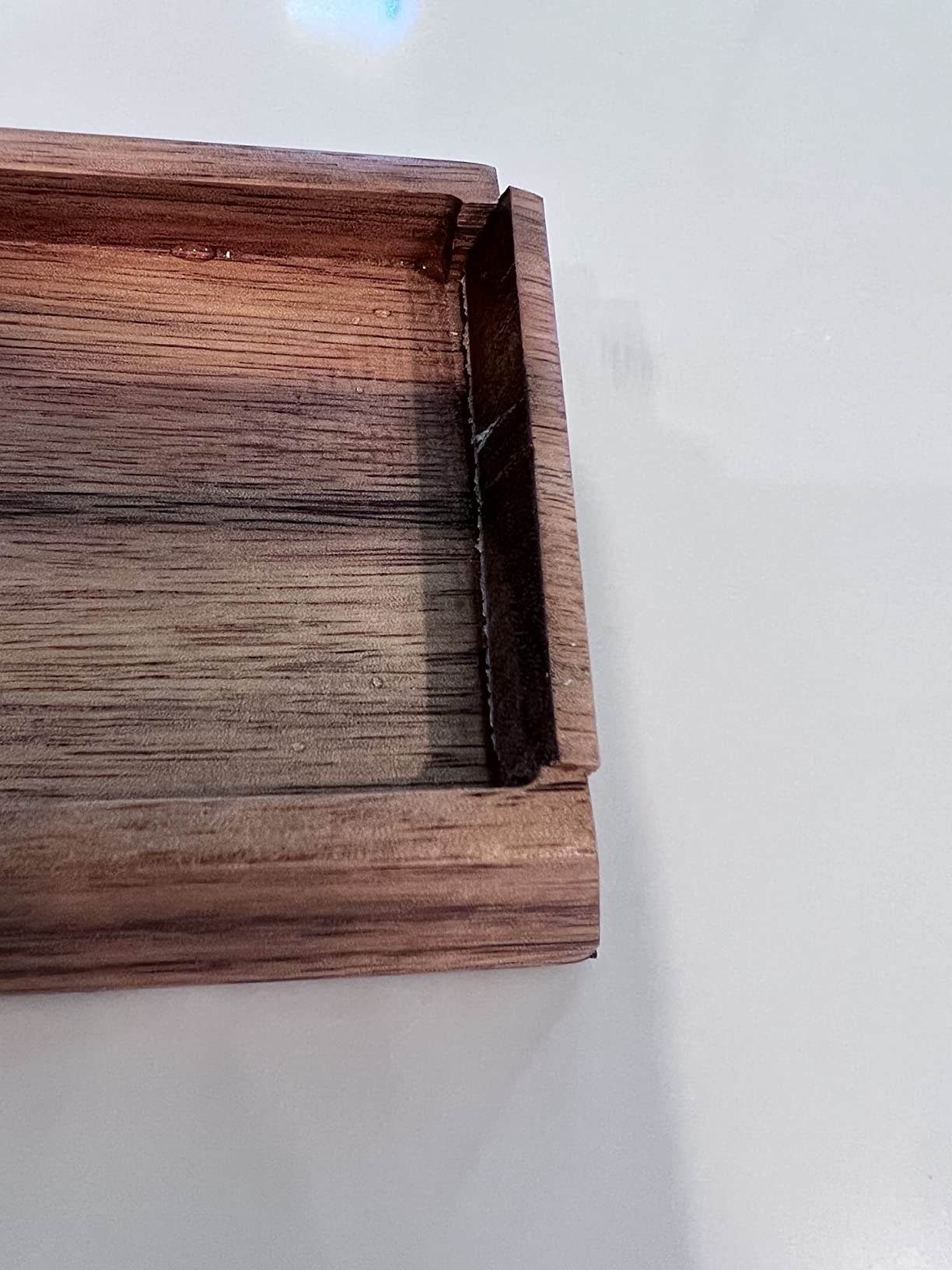
The trade is the top end. 3000 grit gives a refined, biting edge but not the polished finish of a 6000 face, so if you want that mirror look you need a finer stone later.
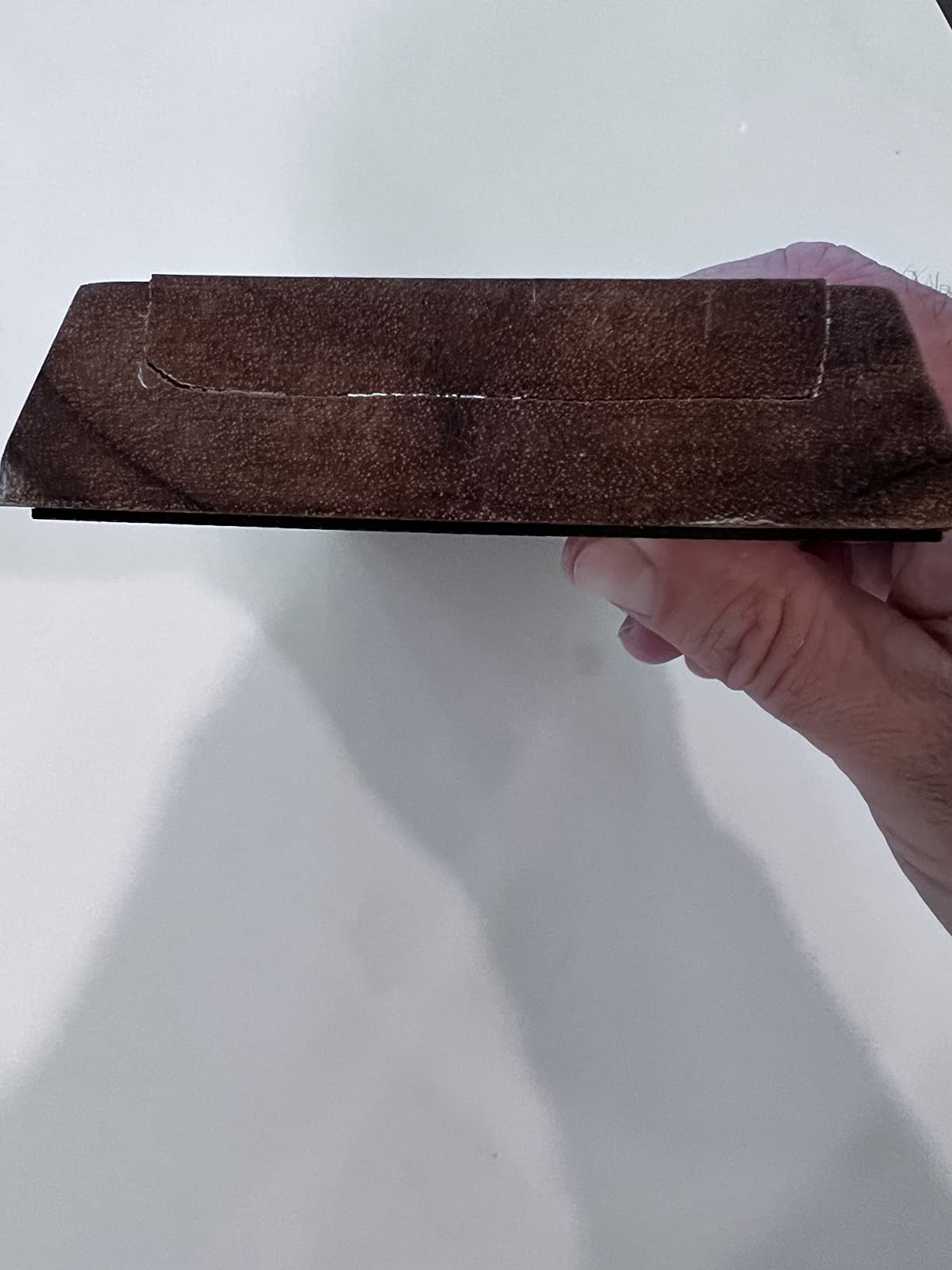
Buyer feedback at 4.5 stars from 429 reviews calls it professional quality for serious home cooks, with the most common complaints being no instructions, no accessories, and occasional chips on arrival.
When this stone earns its place in your kit
Pick this if your 1000 grit maintenance routine already works and you want to see what a finer step does before buying a third stone.
It is also a good choice for Japanese style knives, where a 1000 to 3000 progression is the conventional path and a 3000 face suits single bevel edges well.
Where it falls short
No angle guide, no flattening stone, and no instructions. For a stone aimed at people who have outgrown their first kit, that is a reasonable omission, but it does mean you need to know the technique already.
It also has the smallest review base in the roundup, so the buyer evidence here is thinner than for the mass market picks above.
Is One 1000 Grit Stone Enough on Its Own?
Yes, for most home kitchens. A single 1000 grit whetstone is enough to reset a dull edge, maintain a sharp one, and keep a knife cutting properly for years. It will leave a visible scratch pattern rather than a polished finish, but that pattern cuts food perfectly well.
This is the most common question in sharpening forums and it deserves a plain answer. 1000 grit sits at the fine to extra fine boundary on a standard 1 to 10 scale, with abrasive particles roughly 8 to 25 microns across. That is coarse enough to take a neglected edge back to working in a few minutes and fine enough to leave an edge that is keen.
Where one stone runs out is at the top end. If you want a mirror finish, a razor edge on a Japanese single bevel knife, or the ability to repair chips and deep damage, you need a coarser stone, a finer stone, or both. Forum consensus broadly agrees that a 1000 grit stone plus a strop covers almost all kitchen knife work.
There is one caveat worth repeating. Because grit labels are not standardised across brands, a stone labelled 1000 can behave noticeably coarser than another 1000 in the same session. Judge the stone by the result it leaves behind, not by the number on the box.
How to Choose a 1000 Grit Whetstone
Where 1000 grit sits on the grit ladder
Think of grit as a ladder rather than a scale, where each rung is a jump big enough to leave visible scratches. 1000 grit is a rung most people live on. Below it, 400 and below is for repair and reprofiling. Above it, 3000 to 6000 is for refining and polishing toward a mirror edge.
The practical question is whether your job is maintenance or refinement. Maintenance, meaning a knife that is dull but undamaged, is exactly what 1000 grit is built for. Refinement, meaning a mirror finish on a Japanese knife, is not, and no amount of 1000 grit will get you there without a long time and a lot of steel removed.
Hard stones versus soft stones
Hard stones such as the Shapton and the Suehiro stay flat, cut efficiently, and demand a steady angle. Soft stones such as the corundum blocks cut a little more slowly, dish faster, and are far more forgiving when your technique is imperfect.
Match the stone to the steel. Hard stainless steels like VG-10 and SG2 need a hard stone because soft abrasives glaze over before they remove metal. Soft carbon steels like a gyuto or yanagiba prefer a softer, slower stone that will not chew the edge up while you learn.
Single sided, dual sided, and kit formats
A dual sided stone gives you two jobs from one block, usually a coarse face paired with a fine one. That is convenient and it is the reason most picks here are dual sided. A single sided stone like the Shapton or the KING K1000 is a better choice if you already own the other grits and want a dedicated piece of equipment.
Kits add an angle guide, a base, and sometimes a flattening stone. For a first purchase the guide is genuinely useful. Once you can hold an angle freehand you will barely touch it.
Water stone, diamond plate, or honing steel
A water stone cuts steel with suspended abrasive and gives the most control, which is why it is the standard for a knife you care about. A diamond plate needs no water, needs no flattening, and removes metal quickly, but it glazes over with steel and leaves a harsher scratch pattern that wants refining on a stone afterwards.
A honing steel is not a sharpening tool at all. It realigns an edge that is already sharp and cannot set a dull one. Plenty of home cooks own one and assume it sharpens, which is why it is such a common point of confusion in this category.
What professionals actually reach for
Working kitchens mostly use a fast coarse stone and a strop or a fine stone, then hone between services. That is the same two tool setup the picks here are built around, with the 1000 grit stone doing the middle work of both resetting and refining.
Professionals care most about consistency and speed rather than polish, which is why a hard 1000 grit stone and a good strop is genuinely the whole job in most kitchens. Our chef knife guide for sharper steel options is worth a look if you are choosing blades to sharpen rather than stones.
How to Use a 1000 Grit Whetstone Without Wasting Steel
Start with the stone, not the knife. Soak a traditional water stone for 10 to 15 minutes until bubbles stop rising, or if you have a splash and go stone, wet it thoroughly and let it sit for a minute. Put a damp towel under the stone so it cannot move, and pour water on the surface so there is a full slurry, not a dry patch.
Set your angle and hold it. Twenty degrees per side suits a German chef’s knife, fifteen degrees suits a Japanese knife. Use the angle guide for your first few sessions if you have one, then let the guide go and keep the position with your off hand.
Raise a burr with even strokes on one side only, starting near the heel and moving toward the tip with the knife flat on the stone. Switch sides every stroke or every few strokes, and never let the tip dig in. Stop when the burr runs the full length of the edge and feels consistent.
Then deburr. Take a few light alternating strokes, or ten or twenty passes on a strop or a piece of newspaper, to pull the wire edge off. That last step is what leaves you with an edge that slices food rather than one that merely feels sharp.
Stone Care and Flattening Schedule
Most disappointing sharpening results come from a stone that has dished, not from a bad technique on a good stone. A water stone wears in the middle first, and once the middle is lower than the ends, your blade only touches the middle and the edge goes uneven.
Check flatness every few weeks by holding a straightedge across the surface under low light and looking for gaps at the ends. If you can see daylight, the stone needs lapping.
Lapping is simple. Wet a coarse plate or a dedicated flattening stone, sandpaper on a flat surface, or a piece of glass with sandpaper. Work in a figure of eight across the whole face with steady circular strokes until the stone is flat again. Ten minutes every few weeks keeps a soft stone honest for years.
For storage, stand the stone upright where air moves around it and do not seal it wet. Mould grows faster in a closed damp box than any other way you can mistreat a stone, and once it starts the surface stays scratchy. Stand it on its side rather than face down on a flat surface, or it will take a set.
Replace a stone when lapping no longer restores an even surface, or when the grit has glazed so badly it will not take a slurry. For most home cooks on a 1000 grit stone that is a multi year horizon rather than a yearly purchase.
Frequently Asked Questions
Is 1000 grit enough for knife sharpening?
Yes. A 1000 grit whetstone is enough to reset a dull edge and maintain a sharp one on kitchen knives, and most home cooks never need anything more for everyday use. It will not produce a mirror polish or repair chips and deep damage, which is the point where you add a coarser or a finer stone.
Is 1000 grit coarse or fine?
It sits at the fine to extra fine boundary on a standard 1 to 10 grit scale, with abrasive particles roughly 8 to 25 microns across. That makes it coarse enough to take a neglected edge back to working quickly and fine enough to leave a keen edge behind.
What is the best 1000 grit whetstone?
The Sharp Pebble 1000/6000 kit is the best all round 1000 grit whetstone for most people because the included angle guide and bamboo base remove the two things that stall beginners. Enthusiasts who already control their angle prefer the harder Shapton K0702, and buyers wanting the most stone for the least get the KING KW65.
What grit whetstone is best for sharpening kitchen knives?
A 1000 grit stone is the standard choice for kitchen knives because it both resets a dull edge and maintains a sharp one. Use 400 grit or coarser only to repair chips and reprofiling, and 3000 to 6000 grit only if you want a finer, more polished edge than 1000 grit can leave.
Is a whetstone or diamond plate better for sharpening knives?
A water whetstone gives the most control and the most even result, and it is the right choice for a knife you care about. A diamond plate needs no water and no flattening and cuts fast, but it glazes over with steel and leaves a harsher scratch pattern that needs refining on a stone afterwards.
Final Verdict: The Best 1000 Grit Whetstone for Your Kitchen
The Sharp Pebble 1000/6000 kit is the best 1000 grit whetstone for most people, because the angle guide and the bamboo base remove the two obstacles that stop beginners before they get a sharp knife. Our pick also handles both halves of the job, resetting a dull edge and refining it afterwards, on one block.
If you already sharpen and want a better stone, the Shapton K0702 is the harder, flatter, faster cutting option that stays true with routine care. The KING KW65 is the straightforward value pairing, and the Amazon Basics 400/1000 is a sensible low entry point with an angle guide attached.
Whatever you pick, one rule matters more than the model: keep the stone flat and keep it dry between sessions. A well maintained 1000 grit stone will outlast a better stone that has been put away wet, and that is the whole difference in 2026.