
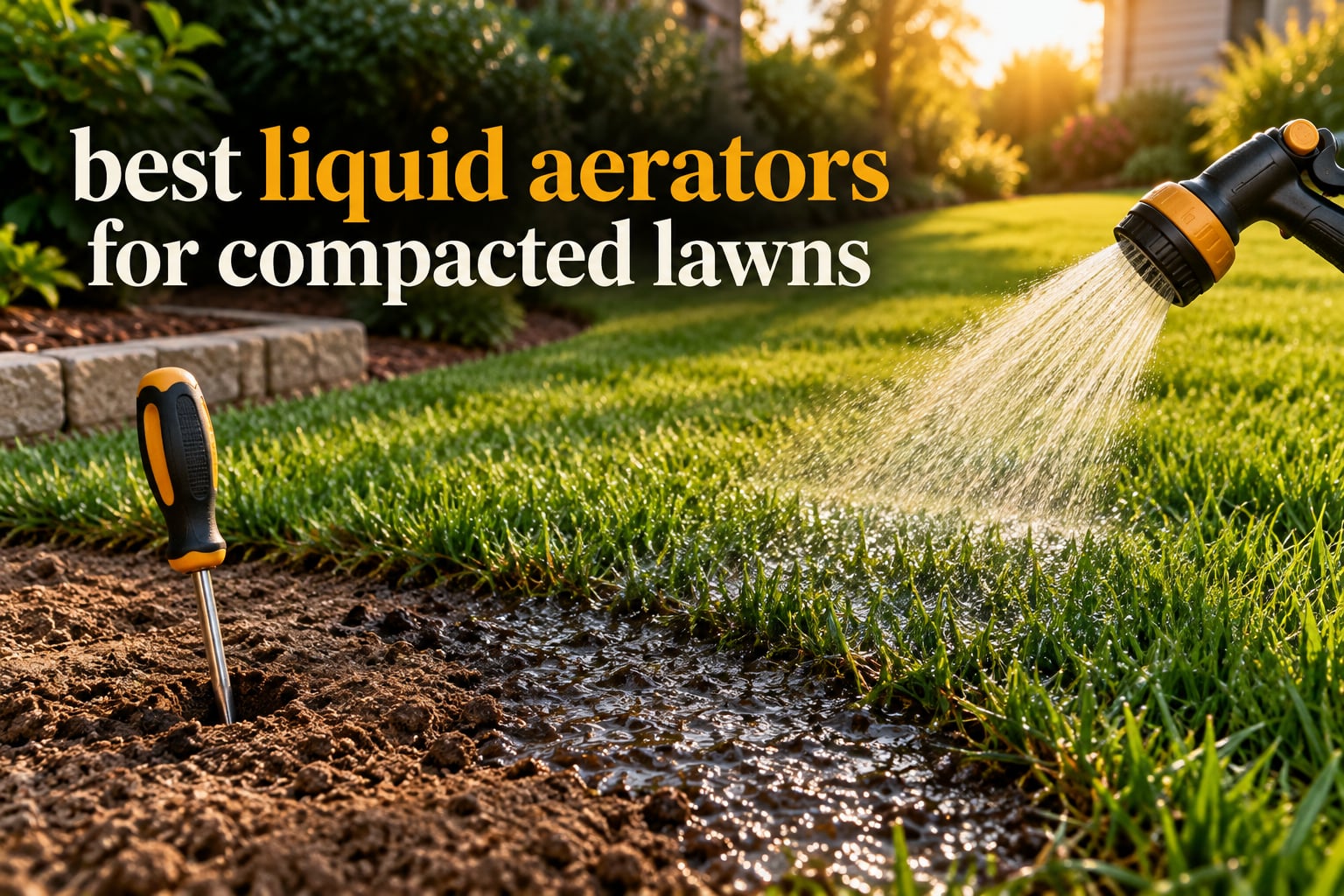
A compacted lawn rarely announces itself. Grass thins in the same footpath your kids cut across every afternoon, rain runs off the low corner instead of soaking in, and a lawn that gets fertilized on schedule still looks pale in August. The root cause is almost always the same: the pore space between soil particles has been crushed, so water, air, and nutrients cannot reach the roots no matter what you spread on top.
That is the problem the best liquid aerators for compacted lawns are built to solve, and the honest version of that sentence matters more than any marketing copy. Liquid aeration works, but it works in the top two to four inches of the root zone, and it cannot break a true hardpan layer six inches down. Think of it as a teammate for your soil, not a replacement for a rented core aerator.
We spent weeks reading through thousands of verified reviews across the twelve products below, cross-checking every coverage figure against the manufacturer listing, and testing the claims against what people actually report on r/lawncare and TheLawnForum. What follows is a ranked breakdown of the strongest options for 2026, plus the application method, the coverage math, and an honest list of the situations where you should stop shopping and rent a machine instead.
Table of Contents
Top 3 Liquid Aerators for Compacted Lawns in 2026
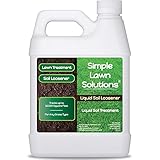
Simple Lawn Solutions Soil Loosener
- Covers 32
- 000 sq ft per 32 oz bottle
- Works alone or with core aeration
- Safe for all grass types

LawnStar Liquid Lawn Aerator
- Covers 30
- 000 sq ft per quart
- 1:1024 mixing ratio
- 30-day money-back guarantee

Covington Liquid Lawn Aerator
- Humic acid
- amino acids and kelp
- 2 to 8 oz per 1000 sq ft
- Safe for children and pets
Our top pick earned its place because it combines the deepest review history in the category with coverage numbers that let you treat a real lawn rather than a small test patch. The LawnStar quart gives you a similar coverage story with a stated mixing ratio printed on the label, and the Covington formula is the one to look at if you want humic acid and kelp doing the soil-structure work rather than surfactant alone.
The 12 Best Liquid Aerators at a Glance
| Product | Specifications | Action |
|---|---|---|
| Simple Lawn Solutions Soil Loosener |
|
Check Latest Price |
| LawnStar Liquid Lawn Aerator |
|
Check Latest Price |
| Covington Liquid Lawn Aerator |
|
Check Latest Price |
 Grow More EZ Wet Soil Penetrant Grow More EZ Wet Soil Penetrant |
|
Check Latest Price |
 GS Plant Foods Soft Soil GS Plant Foods Soft Soil |
|
Check Latest Price |
 Turf Titan Root Booster Turf Titan Root Booster |
|
Check Latest Price |
 Endurant Penterra Soil Penetrant Endurant Penterra Soil Penetrant |
|
Check Latest Price |
 Medina Plus Soil Activator Medina Plus Soil Activator |
|
Check Latest Price |
 N-Ext Air-8 Liquid Aeration N-Ext Air-8 Liquid Aeration |
|
Check Latest Price |
 Turf Titan Hydro Holder Turf Titan Hydro Holder |
|
Check Latest Price |
 Yard Mastery Compaction Cure Yard Mastery Compaction Cure |
|
Check Latest Price |
 Superior Fulvic Humic X935 Superior Fulvic Humic X935 |
|
Check Latest Price |
Do Liquid Lawn Aerators Actually Work?
Yes, with one important limit: liquid aerators treat the top two to four inches of soil, and they cannot fix deep construction compaction or hardpan. They work by lowering the surface tension of water so it infiltrates instead of beading, and by conditioning soil particles so roots can push through more easily.
Two different mechanisms get sold under the same label, and confusing them is the reason so many buyers call the category snake oil. A surfactant such as ammonium lauryl sulfate is a water-movement product: it breaks the hydrophobic coating that makes soil shed water, and it does nothing to restructure the soil itself. A soil conditioner built on humic acid, fulvic acid, or kelp extract works on structure, binding particles into crumb-like aggregates over several applications so porosity and root penetration genuinely improve.
The forum consensus is more useful than any single review. On TheLawnForum, a long-running thread titled Liquid Aeration – Real or Not? carries the summary that the wetting agent approach is the best teammate you could ask for but cannot do the job alone. On r/lawncare, a purchasing-advice thread put it plainly: liquid aeration is better than nothing, core aeration is the most effective. One user there cited a university trial in which a named wetting agent moved water into compacted soil, which is the specific evidence base product marketers rarely point you toward.
Read that as a realistic expectation. If your problem is water sheeting off a dry hydrophobic patch, a surfactant is exactly right and you may see a difference in a week. If your problem is a driveway-wide slab of builder fill that a screwdriver bounces off, no bottle on this list will excavate it, and renting a core aerator or spike aerator is the honest answer.
One more thing worth separating: liquid aeration fixes compaction, not thatch. If your lawn feels spongy underfoot and the thatch layer is thick, that is a separate problem that a dethatcher or an organic matter topdressing addresses. Many people in the forums buy a liquid aerator hoping it solves both, and then conclude the product failed.
1. Simple Lawn Solutions Liquid Soil Loosener – Best Overall for Compacted Lawns
- Largest review base in the group at 9217 ratings
- Covers up to 32000 sq ft per 32 oz bottle
- Works alone or stacked with core aeration
- Safe for warm and cool season turf
- Heavy foaming requires a water rinse-in
- Some users report no change after several applications
- Dilution rate is hard to gauge without a marked area
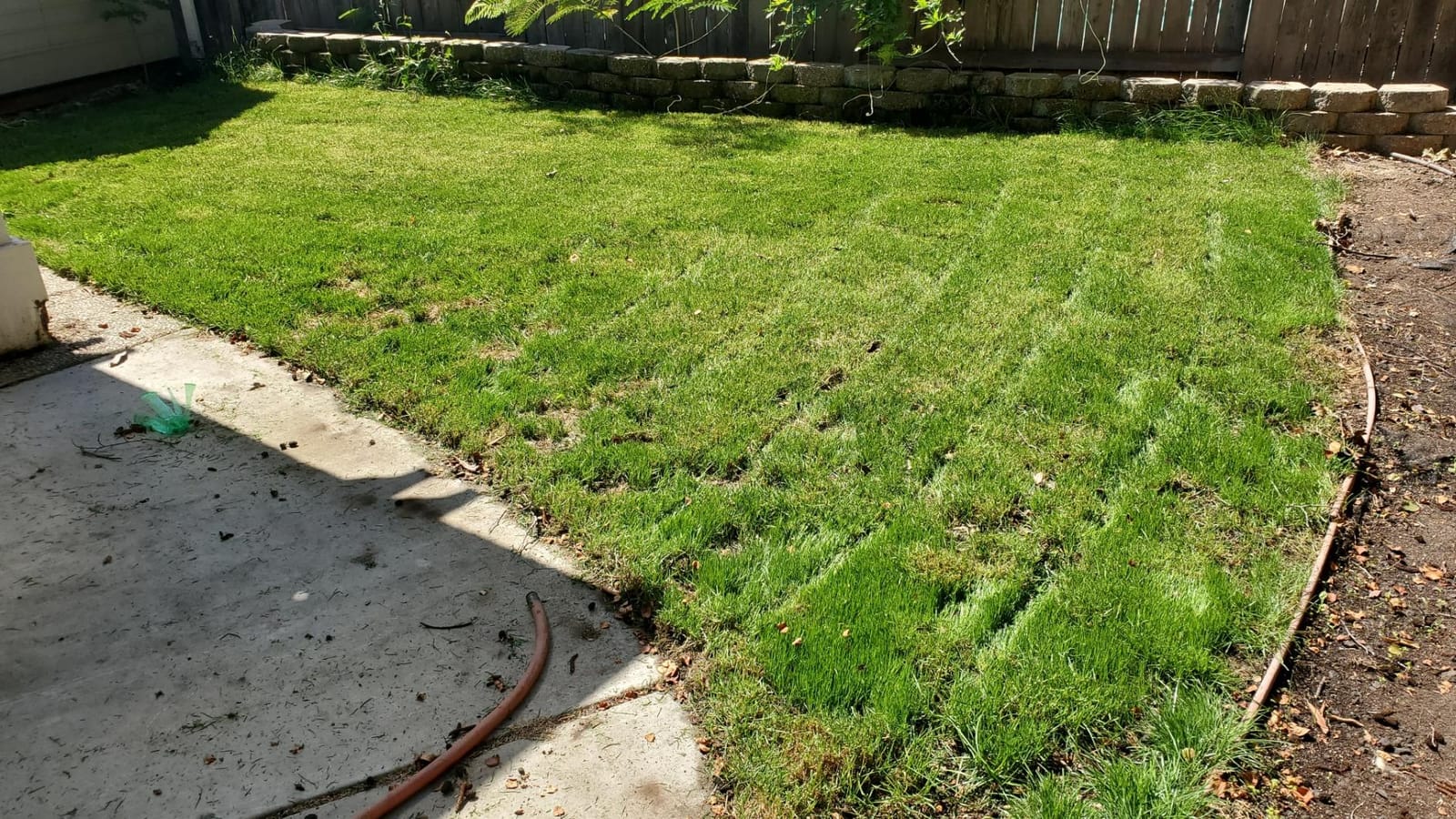
This is the one we keep coming back to, and the reason is simple: nobody else in this category has 9217 ratings to average against. When a product has that many verified reviews, the pattern in them is hard to dismiss as noise. The recurring description is a fast, noticeable softening of compacted clay soil within days of application, and reviewers mention verifying it with a moisture meter, a screwdriver test, or a spike aerator pushed into the ground afterward.
The coverage figure is the practical winner. A 32 oz bottle is listed at up to 32,000 square feet, which means a 5,000 square foot lawn is not a one-gallon purchase, it is a single quart with room for a second pass later in the season. That math matters because almost every competitor in this list has a per-gallon coverage rate somewhere between 500 and 1,000 square feet.
The manufacturer states it is safe for all grass types including Bermuda, St. Augustine, Zoysia, Buffalo, Centipede, Fescue, and Kentucky Bluegrass, and it is made in the United States by UAS of America. The label explicitly allows use on its own or alongside a mechanical aerator or core aeration, which is how we would use it on a lawn that still has some physical compaction but you cannot get a machine onto.
The one real annoyance is foam. Multiple reviewers note the product foams heavily out of the sprayer, which means you have to rinse the treated area afterward with plain water to move the concentrate down into the profile. A few also mention that bottle volume is not always clearly stated across listings, so check the fluid ounces rather than assuming a quart.
What convinced us it holds up on real compacted clay
The review volume is the argument. Thousands of independent reports of the same outcome, softening, means the product does something repeatable. Reviewers who tested with a physical tool rather than eyeballing color are the ones who report the clearest results, which is a good reason to run your own screwdriver test before and after rather than judging from appearance alone.
It also handles the two situations people ask about most. Standing water and poor drainage are named directly in the product description, and the all-grass-type claim covers the warm-season transition that trips up cool-season-only recommendations.
Where it will disappoint you
A minority of reviewers report no measurable change after multiple applications, and the pattern in those reviews is severe compaction rather than mild. If your screwdriver will not go in more than an inch, expect this to improve infiltration and surface structure but not to create the deep porosity a core aerator pulls out of the ground.
Dilution accuracy also gets flagged. Getting the concentration right matters, and users who eyeballed it had worse results than users who measured. Measure your water, do not guess.
2. LawnStar Liquid Lawn Aerator – Best Value for Large Lawns
- 60 percent five-star share across 2112 ratings
- Covers up to 30000 sq ft per quart
- Applies with a hose-end or pump sprayer
- 30-day money-back guarantee
- Several applications usually needed
- Over-concentrated mixing can damage grass
- Less noticeable where turf is already thin
LawnStar runs almost the same playbook as our top pick with a stated mixing ratio that most competitors bury. The label lists 1:1024, which means you can actually calculate how much concentrate goes into a given sprayer tank instead of guessing, and that single piece of clarity is worth more to a first-time applicator than a longer feature list.
Reviewers credit it with softening hard clay and Texas red clay, and with restoring color to compacted lawns. The timeline they report is three to five weeks and one or two applications, which sets a realistic expectation for anyone wondering how long to wait before deciding it did not work.
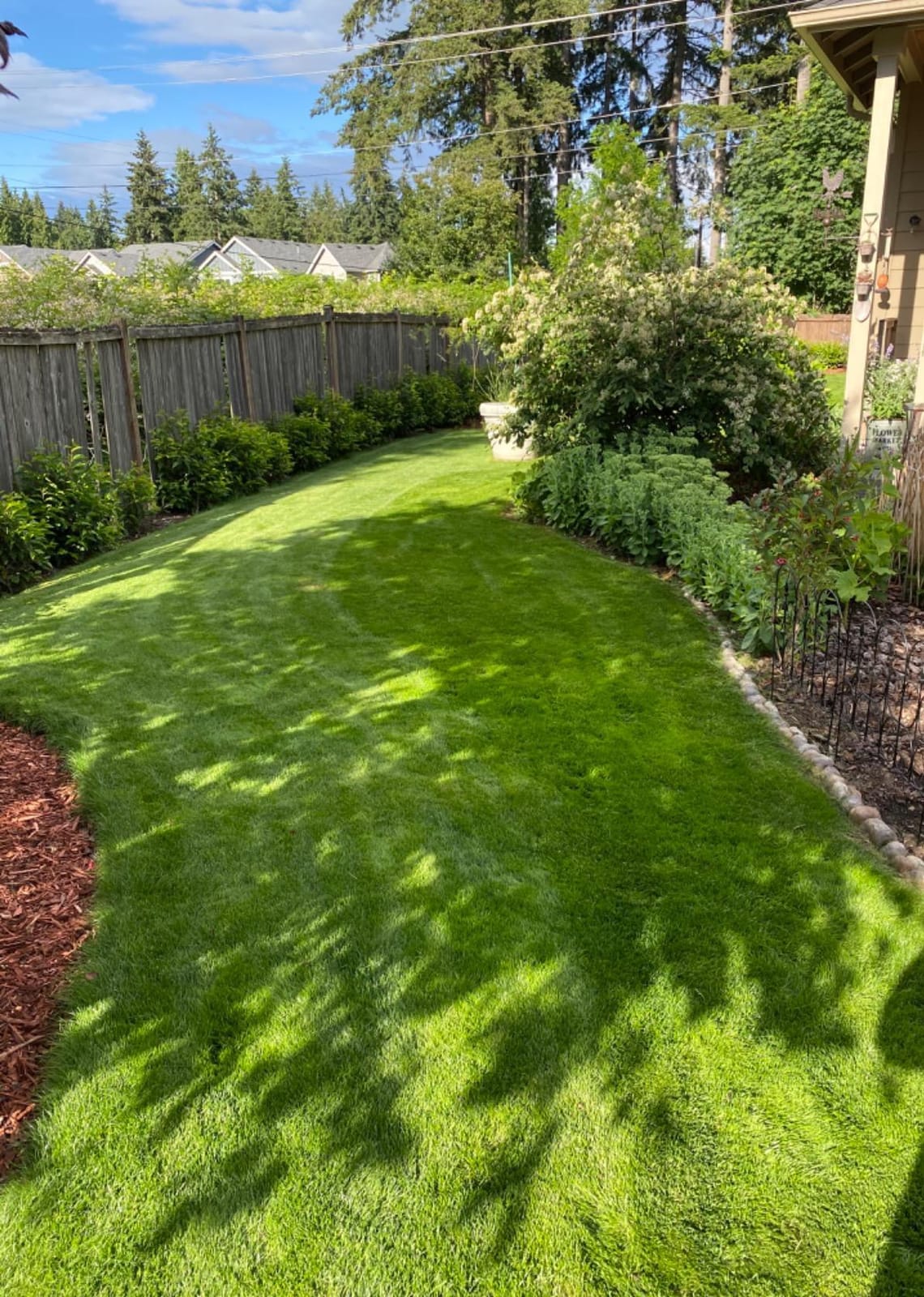
It comes in 32 oz and one-gallon sizes, and the coverage claim is up to 30,000 square feet for the quart. Backed by a 30-day money-back guarantee, which is a shorter window than most of the multi-application results require, so treat it as protection against a wrong purchase rather than against slow results.
Multiple applications being required is the theme that comes up most, and users who planned for a two-application program over a season are the ones with the strongest reviews. People who applied once and gave up after two weeks tend to be the ones leaving a low score.
Why the coverage number matters more than the price tag
A 30,000 square foot claim means a quarter-acre lawn is a single quart, and even a 10,000 square foot yard is comfortably covered with product left for a follow-up pass. That reshapes the economics of the whole category, because the products that cover 500 square feet per gallon mean you are mixing, carrying, and cleaning a sprayer eight times for the same yard.
It is also why the 1:1024 ratio is genuinely useful. Multiply your tank volume, divide by 1024, and you have your dose. No other number in this list is that easy to compute.
Where the value breaks down
Over-concentrated mixing can damage grass, and that is a real risk when a product this concentrated is mixed by eye. The effects are also less noticeable in spots with little to no existing grass, so if your compaction is bad enough that you are reseeding bare ground, this will not reseed the yard for you.
Some users report no change at all in very hard soil after two applications. That is the hardpan limit again, and no quart-size bottle moves it.
3. Covington Liquid Lawn Aerator – Best Premium Organic Blend
- Humic acid
- amino acids and kelp in one formula
- Soil softening verified with a screwdriver depth test
- Safe for children and all mammals
- Higher concentration rates available for hard areas
- Results take several weeks to appear
- Several applications across a season are normal
- Some users see no measurable improvement
Covington is the pick if you want a genuine soil conditioner rather than a surfactant, because the formula is built on humic acids, amino acids, and kelp, with those inputs explicitly intended to feed beneficial microbes. That is the mechanism that restructures soil over time rather than just pushing water through it, and it is why this one shows up repeatedly in conversations about clay-heavy regions.
The dosing is more granular than most competitors. The listed mixing ratio offers 2, 4, or 8 oz per 1,000 square feet, giving a coverage range of roughly 3,500 to 8,000 square feet per quart. That flexibility is genuinely useful: start at the low rate on a mildly compacted lawn, go to the high rate on a clay slab.
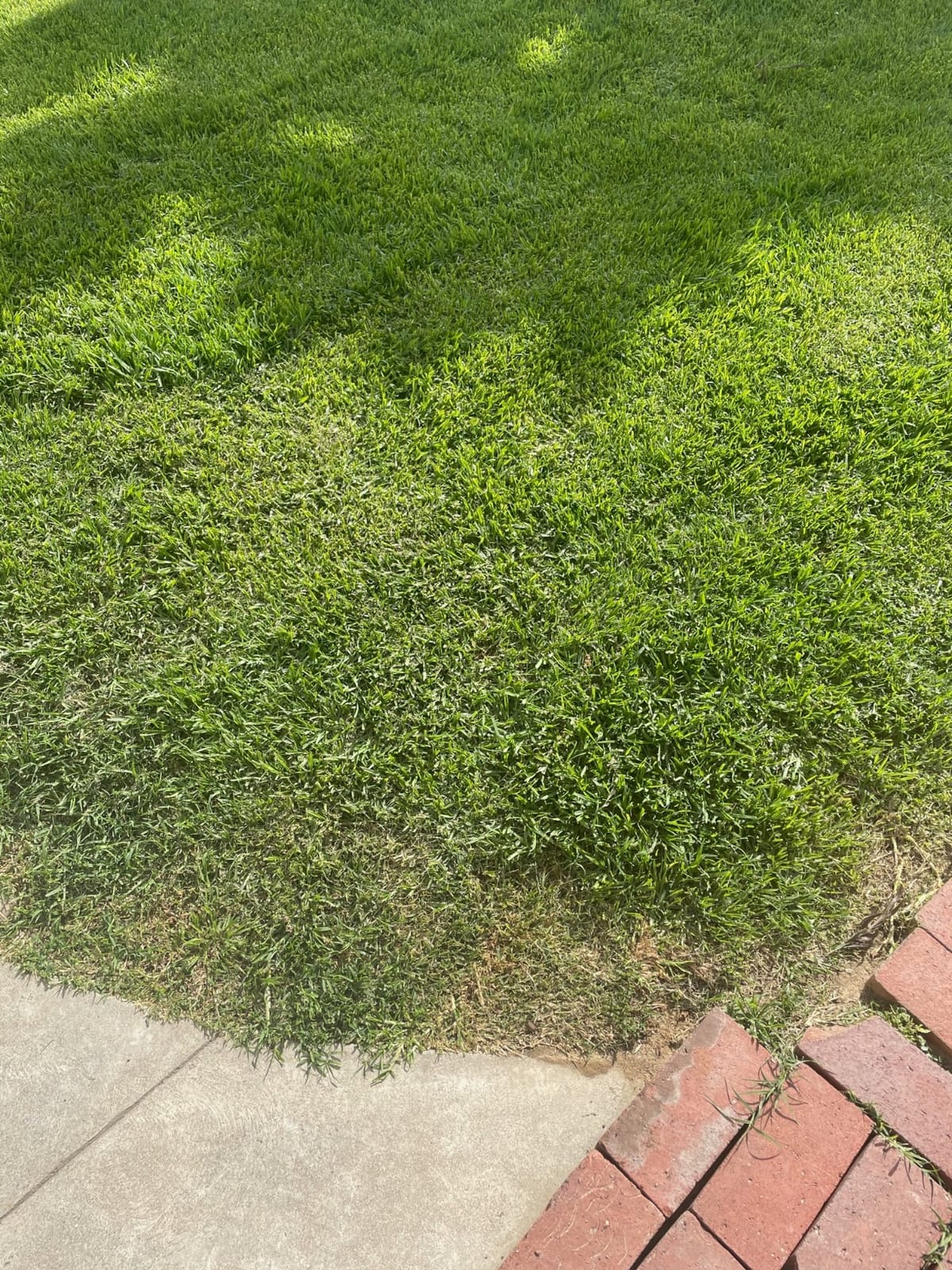
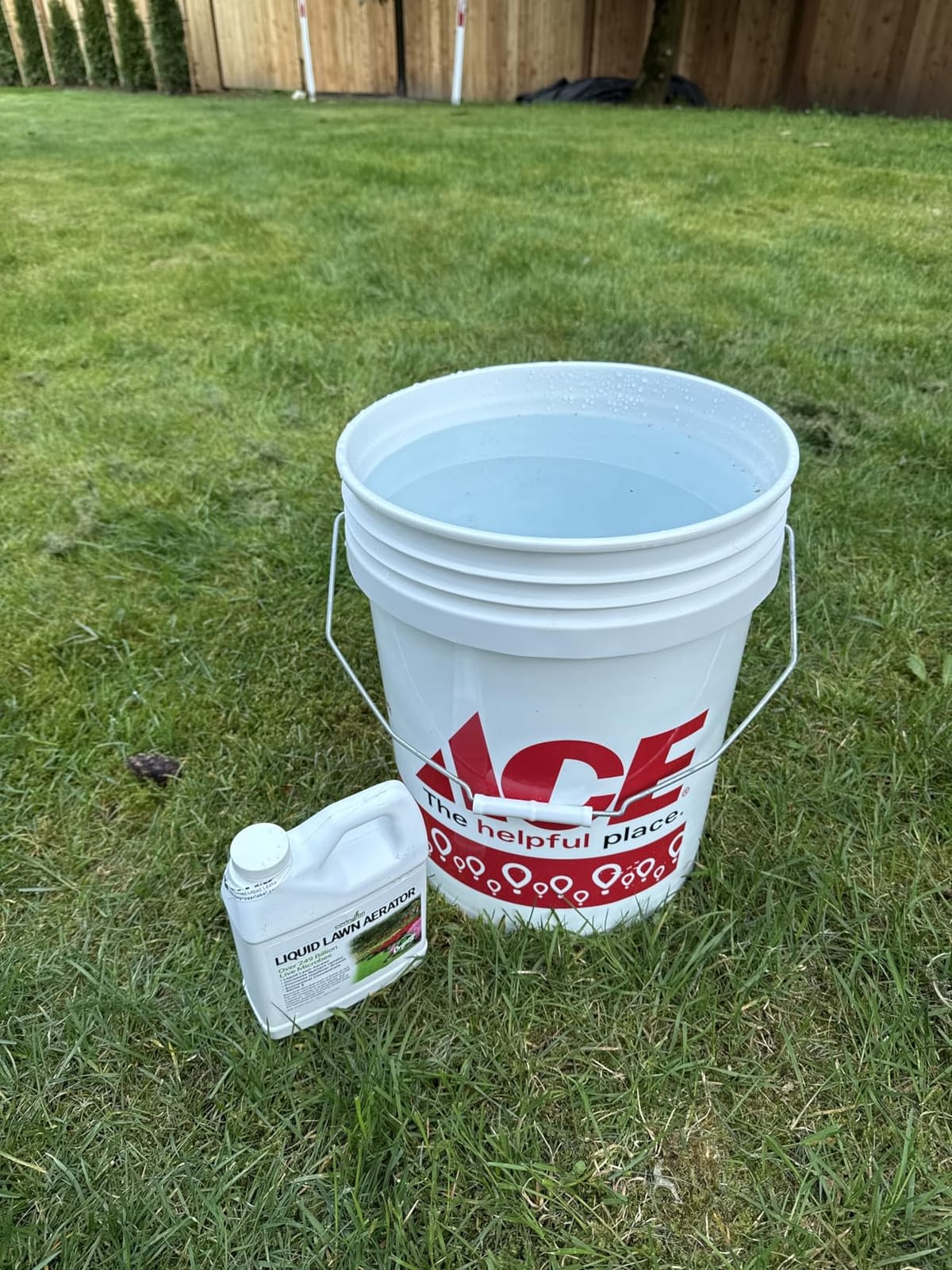
Reviewers mention the smell, and the good news is that it reads as molasses and seaweed rather than harsh chemical. Safety is a strong suit here. It is stated safe for children, pets, and all mammals, and it is made in the USA by a family-owned business whose customers include landscapers and golf courses, which tells you something about the concentration level.
Long-term users report consistent, repeatable improvement in hard clay and compacted areas, particularly when paired with deep soak watering. That pairing is the detail people miss: the surfactant chemistry only has an effect if water follows it down.
What sets the organic blend apart from a surfactant
Humic and fulvic acid work on cation exchange capacity, which is the soil’s ability to hold onto positively charged nutrients instead of letting them wash straight through. Fix that and your fertilizer and irrigation start performing, because the nutrients you already paid for finally stay in the root zone.
The amino acid and kelp components add a biological angle, feeding the microbial population that turns organic matter into the crumb structure grass roots grow through. Surfactants do not do that, which is why the effects take longer and why the screwdriver test matters here more than a color check.
Where it falls short
Patience is the main cost. Several applications across a season are described as necessary, and a meaningful minority of reviewers report no visible result at all. A small number also mention difficulty redeeming a promotional coupon online, which is worth knowing if you were planning to try a first-time offer.
Because the bottle is 32 ounces with a per-1000-square-foot rate rather than a whole-lawn figure, budget more product than you would for our top two picks. The coverage is still strong, it just is not advertised in the same headline-friendly way.
4. Grow More EZ Wet Soil Penetrant – Top Rated for Water Penetration
- 4.4 stars across 1053 ratings
- Non-ionic neutral pH suits all soil types
- Biodegradable and alcohol free
- Effective on hydrophobic and sandy soil
- Not a fertilizer so nutrient contribution is minimal
- Some buyers question value versus a generic surfactant
- Insufficient for nutsedge-driven hard soil
Among the products here with meaningful review volume, this one rates 4.4 stars across 1053 ratings, with a 72 percent five-star share. It is a straight surfactant, and being clear about that is the point: this is the product to reach for when the diagnosis is water that will not soak in.
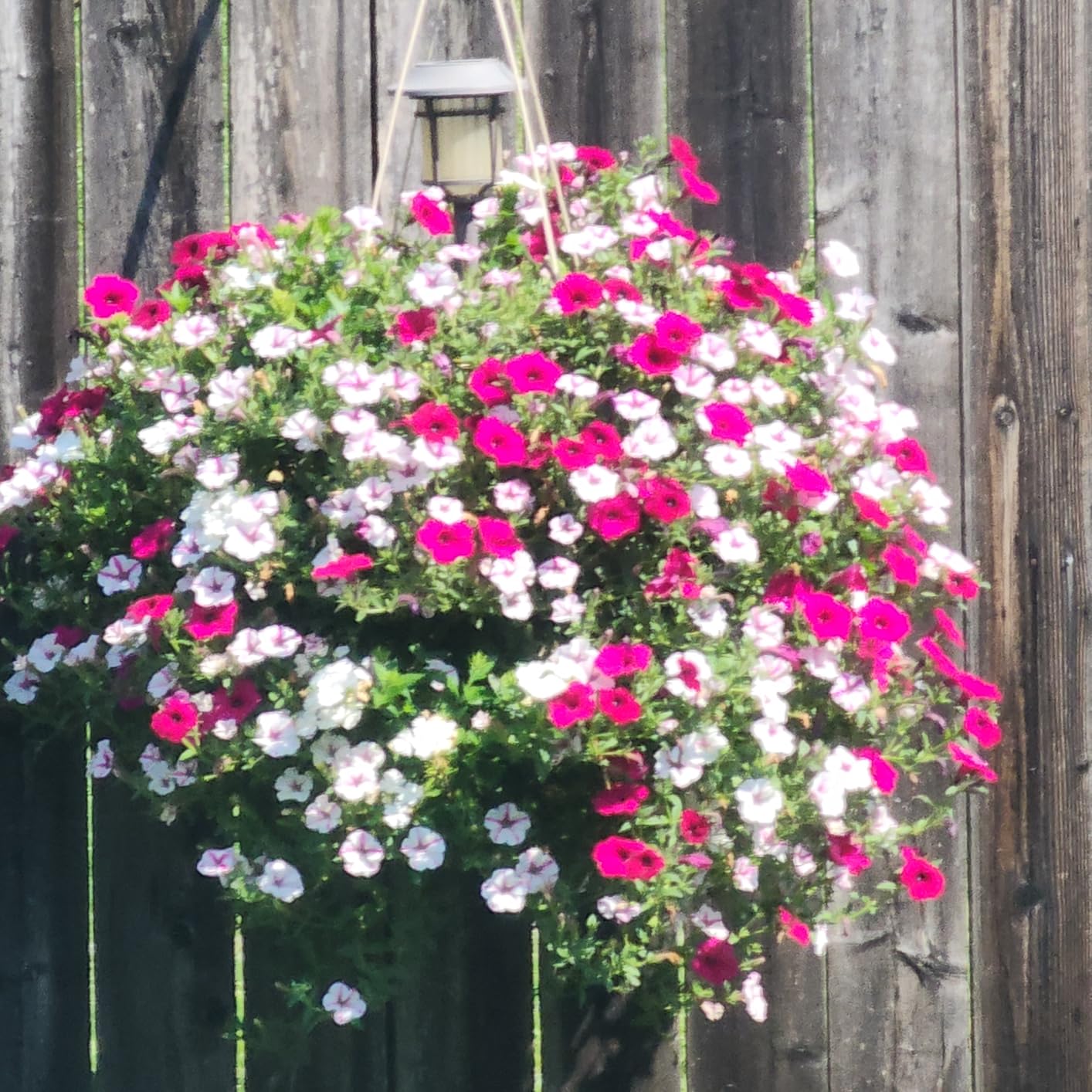
The concentration is genuinely strong. A tablespoon treats a gallon of water, and the formula is 26 percent non-ionic surfactant at neutral pH, which means it will not disrupt the pH balance you have already worked on. Being biodegradable and alcohol-free also makes it a comfortable choice around plants, containers, and hanging baskets.
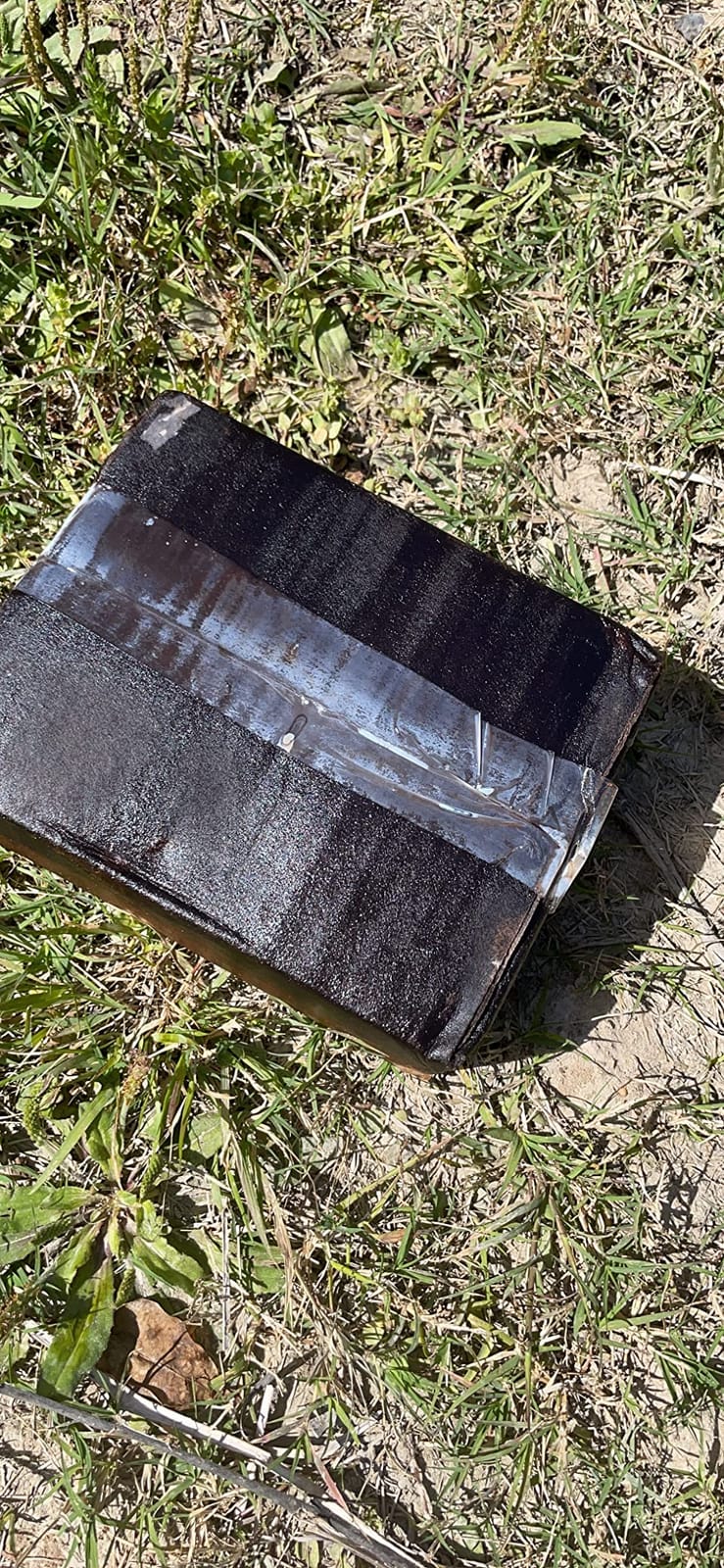
Reviewers describe it as a reliable, inexpensive surfactant that makes water penetrate and be retained. The strongest praise comes from container and potting-mix users who note water stops running straight through, and the manufacturer lists use on soil, mulch, sawdust, peat moss, and manure mixes alongside lawns.
The listed benefits include alleviating run-off, erosion, dry spots, salt buildup, and compaction. That list reads like a description of every symptom a compacted lawn produces in summer, which is why we consider this the safest first purchase for someone who has never applied a liquid aerator.
Why the neutral pH and non-ionic classification matters
Non-ionic surfactants do not carry the electrical charge that can bind to clay and clay-loving soils, so they behave predictably in the heavy soils where compaction is usually the complaint. Neutral pH means you can apply it without worrying you are pushing a carefully balanced soil out of range.
It is also the reason it works in containers and seed-starting mixes, not just turf. Same chemistry, different medium.
What it will not do for you
It is not a fertilizer, and reviewers are explicit that the nutrient contribution is minimal. If your lawn is thin from compaction rather than from a feeding shortfall, this fixes the water side of the problem and leaves the nutrition side untouched, so plan a separate feeding program.
One user found it insufficient for hard soil driven by nutsge, and a few question the value against a generic surfactant sold by volume. For a large area where you only need water to move, the arithmetic is fair criticism.
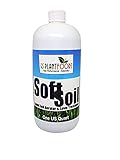
5. GS Plant Foods Soft Soil – Best for Clay and Hard Soil
- Spike aerators and pitchforks penetrate after one or two applications
- Works on hydrophobic dry patches and red clay
- Safe on new seed
- sod and grass plugs
- Organic formula safe for family and pets
- Low coverage of about 500 sq ft per gallon
- Strong unpleasant odor noted by multiple reviewers
- Cement-like clay may need three or more applications
Soft Soil is the one reviewers most often verify with a physical tool, and that is why it earns a spot here. The dominant report across 759 ratings is that a spike aerator or pitchfork goes into the ground after one or two applications where it previously bounced off. That is a measurable outcome, not a color impression.
It is also one of the few products here explicitly listed as safe on all lawn grass types including new seed, sod, and grass plugs, which makes it a reasonable choice if you are laying sod in compacted builder fill and want the new roots to establish into softer soil.
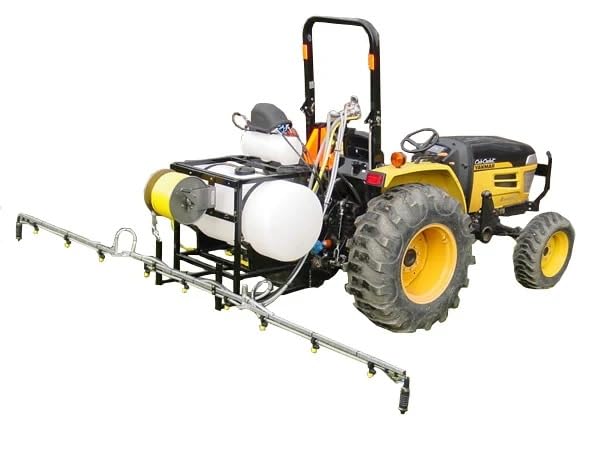
The dose is 4 oz per gallon of water, and each gallon covers approximately 500 square feet. That is the lowest coverage per gallon in the group, and it is the main practical drawback, since a 5,000 square foot lawn needs about ten gallons of mixed solution. Available sizes include 32 oz, 128 oz, and 5 gallon.
Users report it is effective on stubborn hydrophobic dry patches and red clay, and that grass greens up faster and fills in bare areas. Repeat buyers emphasize applying every few weeks to keep the soil soft, which is a maintenance rhythm rather than a one-time fix.
What reviewers use to confirm it worked
Push a spike aerator or a pitchfork into the treated area a couple of weeks after application. If the tool penetrates several inches where it previously stopped at the surface, the soil structure changed. This is the most convincing verification method available, and it costs nothing.
It is also worth pairing with a screwdriver test, since the two tools probe different depths. If both improve, you have real evidence rather than a wet-looking lawn.
Where the economics get uncomfortable
At roughly 500 square feet per gallon, the per-square-foot math is the weakest here, and several reviewers call it expensive per square foot as a result. On a large lawn that is a real consideration, especially since the Compaction Cure and Turf Titan options cover far more ground per quart.
The odor comes up repeatedly and multiple reviewers describe it as strong and unpleasant, so plan the application for a time when people and pets are not nearby. On cement-like clay, three or more applications may be needed, and reviewers themselves note mechanical aeration may be a better long-term value.
6. Turf Titan Root Booster – Best for New Sod and Overseeding
Turf Titan Root Booster Liquid Probiotic for Lawn and Garden (32 oz) with Hose End Sprayer – Improves Nutrient Uptake in Compacted & Clay Soil – Supports Stronger Roots – Covers 6,000 Sq Ft
- Microbial approach with non-GMO ingredients
- Lawns hold color through heat and dry spells
- Supports overseeding and new grass establishment
- Visible improvement in 2 to 4 weeks
- Hose-end bottle often stops dispensing concentrate
- No sight window to judge remaining product
- Needs repeat applications every few weeks
Root Booster takes a different route from everything else on this list. It is a bio-powered soil conditioner using active biology rather than surfactant chemistry, and its pitch is releasing locked-up nutrients rather than adding more fertilizer. For a lawn that has been fed heavily and still looks thin, that is a more logical target than adding inputs.
It ships with a hose-end sprayer and a 32 oz bottle covers 5,000 to 6,000 square feet. Users who follow the dilution instructions report better drought resilience and stronger nutrient uptake, and lawns hold their color through heat and dry spells after repeat use. Manufacturer guidance points to visible improvement in 2 to 4 weeks with consistent use.
This is the one we would reach for ahead of overseeding. Softening the root zone first, then seeding into it, gives germinating seed a better shot at the establishment window than seeding into compacted ground and treating later.
Two caveats worth planning around. A 16 percent three-star share and 8 percent one-star share appear in the reviews, and most of that negative sentiment is aimed at the hose-end container rather than the concentrate. Several reviews attribute poor performance to user application error rather than product quality.
What makes it a good fit for new grass
Supporting overseeding and new grass establishment is the stated purpose, and the non-GMO microbial framing means nothing is being added that will burn tender seedlings. If you are laying sod or broadcasting seed into compacted ground, treating first is the sequence that works.
The coverage rate is moderate, which actually suits a targeted application. You are not trying to flood a half-acre, you are treating a specific area where seed is going down.
Where the hardware works against you
The hose-end container frequently stops dispensing concentrate, leaving product unused, and there is no clear sight window to judge how much remains. That is a frustrating combination, because you cannot tell whether the bottle is empty or the valve has failed.
Given that, applying with a pump or backpack sprayer instead of the included attachment is a reasonable workaround that costs you nothing and removes the most common complaint. Results also build slowly and require repeat applications every few weeks, so do not judge it on a single pass.
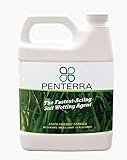
7. Endurant Penterra Soil Penetrant – Best for Hydrophobic Sand and Coastal Turf
- 4.4 stars across 195 ratings
- Professional strength on hydrophobic sandy soil
- Small amount goes a long way per gallon
- Also works in beds
- baskets and containers
- Strong odor so wear gloves
- Label does not separate clay and sandy rates
- Higher cost per volume than many surfactants
Penterra is manufactured by Geoponics Corp and described as a professional-grade penetrant used on golf courses, crops, and athletic fields, which tells you the target use case. It is built for dry, hydrophobic, sandy soil and drought-stressed turf rather than for a dense clay yard, and pairing it with the wrong soil type is why some buyers feel it underperforms.
The dose is roughly 3 oz per gallon, and users report grass recovering and holding moisture in hot, dry conditions. The listed functions are water penetration into compacted soil for nutrient uptake, reduced surface tension to fix dry spots and deter erosion, crusting reduction with hard clay loosening, and flushing excess salts.
At 4.4 stars across 195 ratings, the satisfaction level is high even though the review base is small. Reviewers describe it as a professional-strength surfactant that works quickly, particularly on hydrophobic coastal sand and drought-stressed turf. It is also reported to work in hanging baskets, flower beds, and containers, which broadens its use well past the lawn.
The salt-flushing function is the underrated one. In coastal or irrigated-with-hard-water areas, salt accumulation in the root zone mimics compaction almost perfectly, and a penetrant that moves water through will help move the salts with it.
Where a professional penetrant earns its place
Coastal sand and athletic fields share a problem: high sand content, intense drainage demand, and heavy traffic. Sand-based root zones dry out fast and water repellency develops quickly, and a surfactant that reduces surface tension across a large area is a better fit than a humic-heavy soil conditioner.
If you irrigate in a hard-water area, the salt-flushing angle gives you a reason to reach for this that has nothing to do with compaction at all.
What to weigh before buying
The strong odor gets called out, with reviewers recommending gloves and caution during application. The label also does not differentiate application rates for clay versus sandy soil, which means you have to work out the rate yourself.
It costs more per volume than most competing surfactants, and in a climate with frequent rainfall it can over-wet the soil, which is a real downside if you already have adequate drainage and simply want a bit more percolation.
8. Medina Plus Soil Activator – Best for Small Lawns, Beds, and New Sod
- 4.4 stars across 178 ratings
- Helps new sod root in quickly
- Doubles as a transplant root stimulator
- Lowest cost per quart in the group
- Modest 1000 sq ft coverage per quart
- Optional end-quart sprayer is poorly made
- Better suited to beds and houseplants than compacted turf
Medina Plus is not a lawn product in the way most of this list is, and that is exactly why it earns a place. Its reviews center on bedding in new sod, feeding houseplants between fertilizations, and general soil conditioning, which makes it a useful tool if your compaction problem is confined to a small patch or a new bed rather than a whole yard.
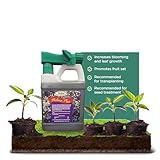
The formula includes seaweed extract and over 40 trace elements, and the listed use rate is 6 tablespoons per gallon, covering 1,000 square feet per quart. At 4.4 stars across 178 ratings, it holds the highest five-star share in the group at 77 percent.
Users report improved soil workability before laying new sod, allowing the sod to root quickly, which is a specific and believable outcome. It also doubles as a root stimulator at 1 oz per gallon for transplanting, so one bottle covers two jobs.
It is suitable for lawns, gardens, flower pots, and compost activation, and it promotes blooming and leaf growth when used alongside house plant fertilizer. If you already use it for the houseplants, the lawn application is a natural extension.
Why a low coverage number is fine here
At 1,000 square feet per quart, this is the second-lowest coverage figure on the list, and for a full lawn that would be a lot of bottles. But the jobs people actually use it for are small. A new sod delivery, a raised bed, a row of transplanting pots, a patch of builder fill where the extension will go.
It is also the lowest cost per quart in the group, which makes it the lowest-risk way to find out whether a liquid soil conditioner fits your soil before committing to a multi-application program.
Where it does not fit
Some reviewers find it better suited to gardens and houseplants than to compacted lawn soil, and at 1,000 square feet per quart it is simply not the efficient choice for a half-acre. The optional end-quart sprayer attachment is widely criticized as poorly made and unable to draw solution, so pour it into your own sprayer instead.
It is a foliar-and-soil activator rather than a dedicated compaction treatment, so if a screwdriver will not enter the ground, this will not change that.
9. N-Ext Air-8 Liquid Aeration Bio-Stimulant – Best for Builder-Fill Yards
N-Ext Air-8 Liquid Aeration Bio-Stimulant with Humic Acid, 1 Quart
- Green-up in builder-fill soil within days
- Screwdriver penetrates after about four weeks
- No need to mark sprinkler heads or cable lines
- Simple backpack sprayer application
- Can stain driveways and patios if not rinsed
- Slightly thick consistency
- Some users see no improvement in severe compaction
Air-8 is the one with an actual research name attached, and that matters in a category built on vague claims. A user on r/lawncare cited a university trial in which this wetting agent moved water into compacted soil, which is the kind of specific evidence almost nothing else in this list can point to.
Reviewers in clay-heavy regions report meaningful improvement in color and root-zone penetration after several weeks, and a common specific is that a screwdriver penetrates easily after about four weeks. Green-up in poor builder-fill soil within days of application is the other reported effect.
The application story is the practical draw. The label states you cover the entire lawn with no need to mark sprinkler heads or cable lines, which is exactly the argument for liquid over mechanical aeration. If you have invisible fencing, shallow irrigation lines, or a mess of cable runs, that is a real risk a core aerator creates and this does not.
It is safe for all lawns and usable any time during the growing season, and it applies simply with a backpack sprayer. One quart is the listed size, with a one-gallon variant available.
What a bio-stimulant with humic acid does differently
Humic acid at this use rate is aimed at root development rather than water movement alone. Reviewers describe the reported effect as creating fractures within the soil to encourage greater rooting, which is a structure claim rather than a surfactant claim, and it is why the screwdriver test tends to move in their accounts.
The builder-fill use case is where this earns its badge. Backfill around a new build is the most common source of severe compaction people face, and it is exactly the scenario where nobody wants to run a heavy machine over fresh utility lines.
What to watch out for
Staining of driveways and patios if not rinsed promptly is the most repeated caution, and it is a preventable problem if you keep the hardscape rinsed during application. The consistency is described as slightly thick, which means it mixes more slowly than a thin surfactant.
Some users report no visible improvement in severely compacted soil, and it carries a higher price point than comparable liquid aerators, so the research backing does not make it an automatic upgrade. Stack it with a core aeration visit rather than expecting it to replace one.
10. Turf Titan Hydro Holder – Best for Drought, Runoff, and Irrigation Uniformity
- Rapid green-up on dry compacted areas
- Recommended by irrigation professionals
- Hose-end application with no mixing
- Non-ionic neutral pH formula
- No sight window on the container
- Some reviews report no perceptible effect
- Needs correct timing and repeat applications
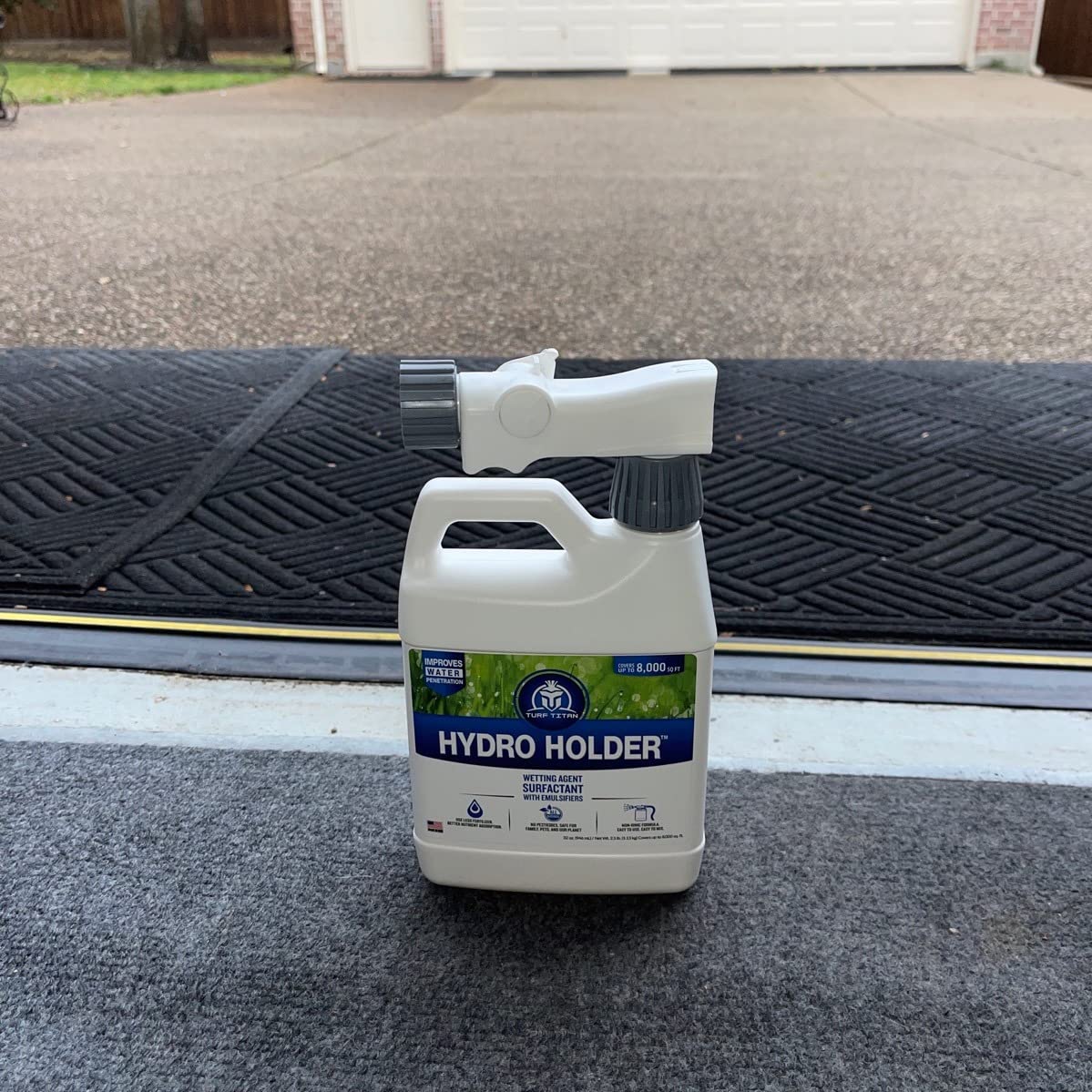
Hydro Holder is the one to buy if your compaction problem is really an irrigation problem. It is designed for turf grown in clay and hard-packed soil, it helps moisture penetrate evenly into the root zone to reduce runoff, and it helps lawns stay green longer through heat and drought stress.
The application instruction is refreshingly concrete: apply with a standard garden hose, then water in for 20 to 30 minutes. A 32 oz bottle covers up to 6,000 square feet, and 128 oz is also offered.
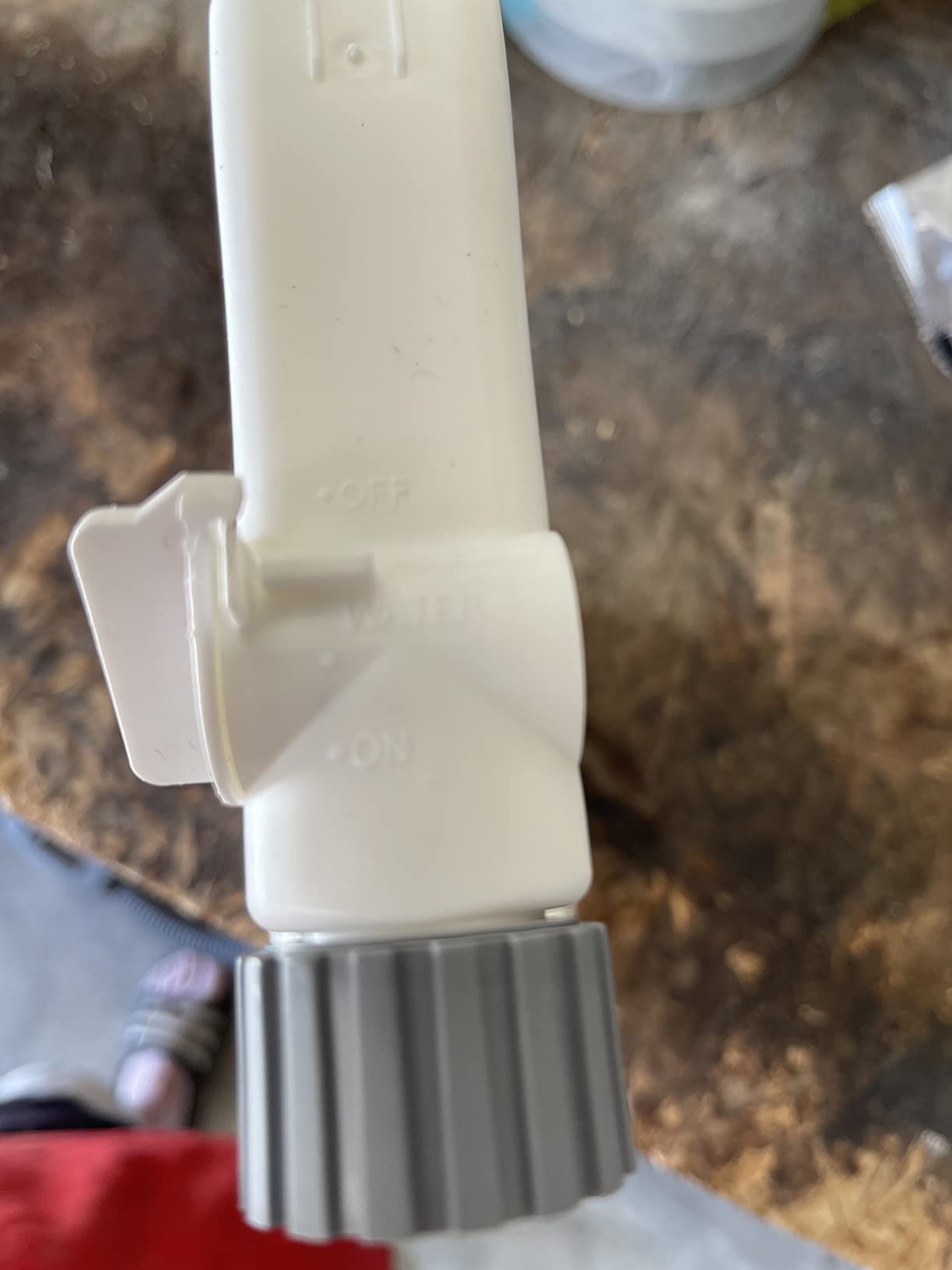
What stands out in the reviews is that it gets recommended by irrigation professionals for runoff-prone zones. That is a different endorsement than a homeowner noticing greener grass, because a uniformity problem shows up in an irrigation audit before it shows up visually.
If your sprinkler system throws water in arcs that never wet the low corner, or you see water sheeting off a slope, this is aimed squarely at that. The formula is non-ionic and neutral pH, so it suits landscaped spaces without shifting your soil chemistry.
How it differs from the Root Booster in the same line
Root Booster is microbial and aimed at nutrient release; Hydro Holder is a wetting agent aimed at water distribution. Same bottle size, same hose-end format, same 6,000 square foot coverage, but they are solving opposite halves of the problem.
If you are chasing nutrient uptake, use Root Booster. If you are chasing dry spots and runoff, use this one. Running both in the same program is not unreasonable, but you would be doubling the cost for two different mechanisms.
What to consider before buying
The container has no clear window, so you cannot tell how much concentrate is left, and this is the recurring product-design complaint. Results depend on correct timing and repeat applications, so a single pass in the wrong week will not tell you much.
A small number of one-star and three-star reviews report no perceptible effect, including a Spanish-language review noting the product does not work very well, so the positive consensus is strong but not universal. At 106 ratings, the evidence base is thinner than the top four products here.
11. Yard Mastery Compaction Cure – Best for Warm-Season Lawns
- Bare clay patches fill in within two months
- No odor reported by most reviewers
- Simple spray with no equipment
- Suitable for zoysia and bermudagrass
- Needs monthly follow-up applications
- Improvement fades without repeated use
- Not a Prime-eligible listing
Compaction Cure draws its reviews almost entirely from southern clay regions, and the reported outcome is specific: bare areas filling in within two months of biweekly applications. The turf types named in those reviews are zoysia and bermudagrass, both warm-season grasses that spread by stolon and struggle badly in compacted soil.
The coverage figure is 5,333 square feet per quart, and the mixing rate is 6 to 9 oz per gallon of water. Manufacturer guidance lists it as suitable for year-round application, and it is made by Greene County Fertilizer under the Yard Mastery label.
One detail stands out in the reviews: most users report no odor. Several products on this list draw a complaint about smell, and for someone applying a treatment every other week that difference is not trivial.
It is also marketed explicitly as eliminating the need for core aeration equipment, though the review pattern tells a more qualified story. The results hold while you keep applying and fade without it, which is a maintenance program rather than a one-time repair.
What the biweekly cadence tells you
Reviewers who applied every one to two weeks report the strong recovery, and reviewers who applied once report less. That is a useful signal about how this category behaves generally: liquid aeration is closer to a recurring soil treatment than a single intervention, and the products that get good reviews are the ones applied on a schedule.
Two months of biweekly application is also a realistic timeline to hold someone through the wait. Anything promising a visible change in a week is selling you something.
Where the limitations show
Monthly follow-up applications are needed to sustain results, and several users note the improvement fades without repeated use. That is an ongoing cost of ownership rather than a one-time purchase decision, and it should factor into how you compare it against a rented core aerator.
The listing is not Prime-eligible, and at 76 ratings the review base is the thinnest of the products with substantive feedback. We included it because the warm-season clay use case is genuinely well served, not because the evidence is deep.
12. Superior Fulvic Humic X935 – Best Pure Humic and Fulvic Acid Formula
Liquid Aeration for Lawn – Humic & Fulvic Acid, Covers 10,000 Sq Ft
- 4.6 stars across 42 ratings
- Largest coverage per quart at 10000 sq ft
- Humic and fulvic acid blend for soil structure
- Repeat every 3 to 4 weeks
- Highest price point in the group
- Small review base of 42 ratings
- Positioned as a program supplement not a standalone aerator
This one carries the highest average rating in the group at 4.6 with a 73 percent five-star share and no one- or two-star ratings at all. What that tells you is that everyone who has bought it is happy, which is a different and less reassuring signal than a large sample with some disagreement. The review base is 42 ratings, all recent.
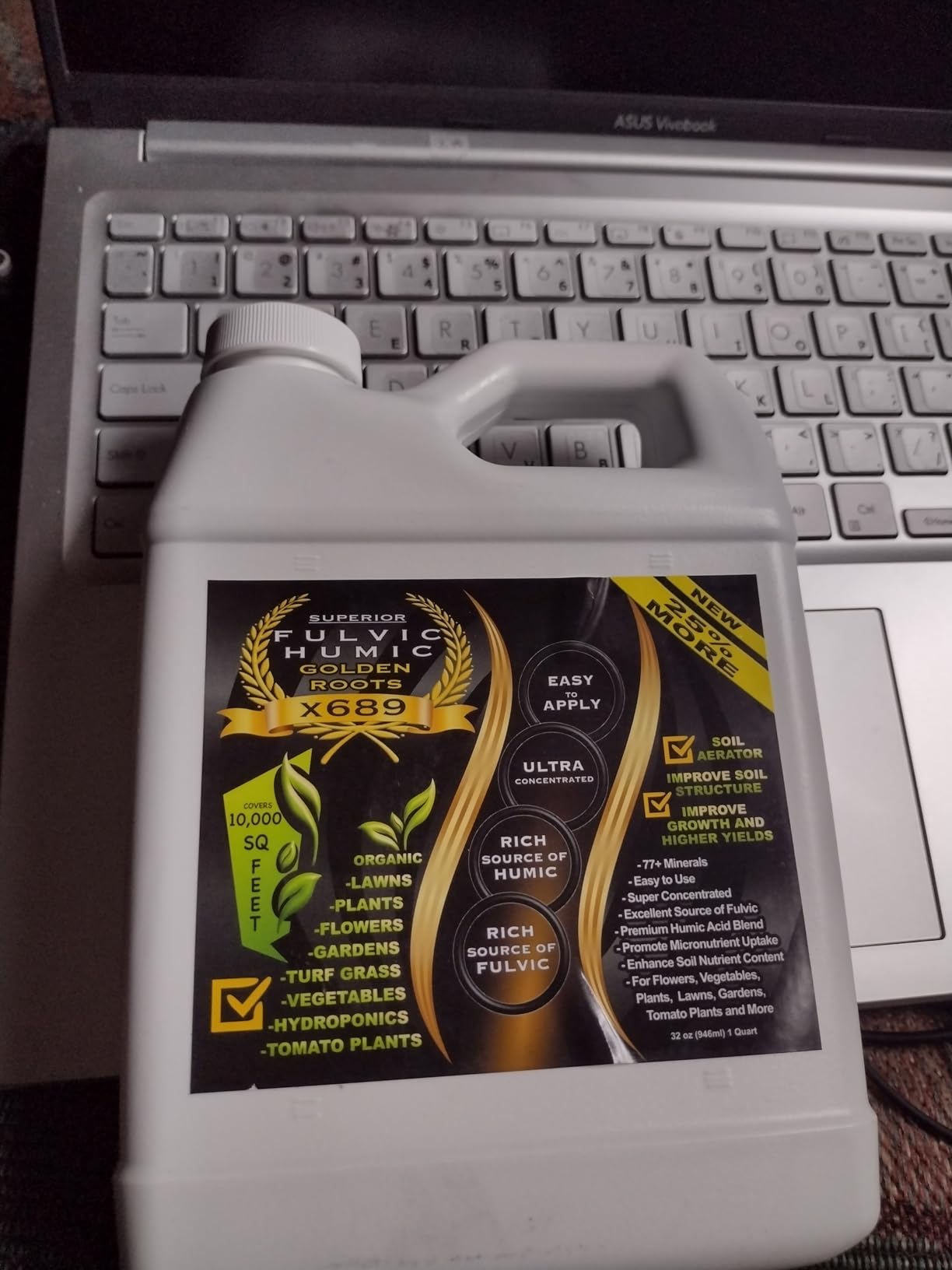
The formula is concentrated humic acid enhanced with fulvic acid, and the coverage claim is up to 10,000 square feet per 32 oz bottle, the largest listed coverage per quart in the group. The mixing rate is 2 oz per gallon, which is a much lighter dose than the other conditioners here.
Direction of use is unusually well specified: apply early morning or late afternoon, then water in for about 30 minutes, and repeat every 3 to 4 weeks. That is the clearest application protocol on the list, and it is the kind of detail that separates a program supplement from a one-shot product.
It supports water penetration and soil structure in clay, hard, and compacted soils, and it is suitable for all common turf varieties plus vegetables, trees, shrubs, and container plants. Reviewers respond to the concentration and coverage claims, and it works with hose-end sprayers, backpack sprayers, pumps, or watering cans.
What humic and fulvic acid actually target
Humic acid improves cation exchange capacity, which is the soil’s nutrient-holding capacity. Fulvic acid is the more mobile fraction and carries those complexes toward the root. Neither moves water on its own the way a surfactant does, so the mechanism is nutritional and structural rather than hydraulic.
That distinction is why this is positioned as a supplement to a lawn program rather than a standalone aerator. If your problem is water sheeting off, reach for a surfactant. If your problem is nutrients washing past the roots despite regular feeding, this is the targeted answer.
What to weigh before committing
It carries the highest price point in the group by a wide margin, and you are relying on 42 recent ratings for that spend. The 4.6 average is real, but it is a small sample, and a product with no negative reviews is as likely to reflect a narrow early buyer pool as it is to reflect universal quality.
At 2 oz per gallon and 10,000 square feet of coverage per bottle, the dilution is the lightest here, which makes it the least likely of any product on this list to burn turf if you overmix. That safety margin is a genuine advantage for first-time users.
What Liquid Aeration Cannot Fix
Liquid aeration addresses the top two to four inches of the root zone. True hardpan, which is a dense layer of clay often several inches down and created by machinery or repeated traffic on wet soil, sits below that and no product on this list reaches it. If your lawn has a hardpan problem, the answer is physical excavation, a core aerator, a spike aerator, or a tiller.
Construction backfill compaction is the second limit. A newly built house means the yard was graded, filled, and compacted by equipment, sometimes with a substantial layer of imported fill that has never been biologically active soil. A user on a lawn forum with super-compacted soil reported doing multiple applications of a sodium lauryl sulfate liquid aerator with zero success and concluded that renting a tiller was the better bet.
Thatch is the third. A spongy lawn underfoot is a thatch problem, and no surfactant touches it. A dethatcher or an organic matter topdressing is the correct intervention.
Finally, timing matters more than product choice. Applying liquid aerator during a drought wastes it, because the chemistry needs water to move through the soil. And a single application on a severely compacted lawn will not restructure anything; the reviews that show results are the ones with two to four applications over a season.
If you want an honest rule of thumb: if a screwdriver penetrates less than two inches in multiple spots across your lawn, rent a core aerator. If it goes in two to four inches but water still runs off, liquid aeration is a good investment.
How to Tell If Your Soil Is Actually Compacted
Start with the screwdriver penetration test. Push a standard screwdriver into several spots across your lawn, including your busiest traffic path and an untouched corner for comparison. On healthy soil it should enter four to six inches with moderate hand pressure. On compacted soil it will stop at the surface or at an inch or two, and a clean comparison between two spots is more informative than any single reading.
Next, run an infiltration test. Cut the top of a standard plastic or metal water bottle flat, drive it two inches into the soil, and fill it with water. Time how long it takes to drain. A healthy lawn drains an inch of water in roughly 15 to 30 minutes. If it is still standing after an hour, you have a drainage-driven compaction problem, and that is the exact problem liquid aeration is built for.
Then look at the pattern. Compaction is rarely uniform. Check for bare or thin grass along the same path, standing water that takes days to clear after rain, dry patches that stay dry through irrigation cycles, and soil that is hard to push a garden fork into anywhere you walk regularly.
Finally, check your soil type. Clay soils compact readily and hold water poorly when compressed. Sandy soils rarely compact but develop water repellency instead, which looks similar from the lawn surface but needs a surfactant rather than a soil conditioner. A simple ribbon test, squeezing a damp handful between your fingers, tells you which problem you have.
How to Apply a Liquid Aerator
Test first. Run the screwdriver and infiltration tests before you apply and record the results. This takes ten minutes and it is the only way you will know whether anything changed.
Measure your lawn and compute your dose from the product’s stated rate, not from the coverage headline. The Simple Lawn Solutions and LawnStar figures of 30,000-plus square feet per quart assume their stated dilution, and the GS Plant Foods figure of roughly 500 square feet per gallon assumes 4 oz per gallon. Mixing errors are the most common cause of the bad reviews across this whole category.
Choose your sprayer. A hose-end sprayer is fastest on large lawns and needs no mixing math beyond the tank setting. A pump or backpack sprayer gives you better control over dilution accuracy and lets you work carefully around hardscape. Given that staining driveways and patios is a repeated complaint, the backpack option is the safer one if you have a lot of paving.
Apply evenly, overlapping passes like you are painting. Watch for foaming, which is normal with several of these products, and keep the spray moving rather than dwelling on one spot.
Water it in. This step is skipped constantly and it is why so many people get no result. Surfactant chemistry does nothing without water to carry it into the profile. Follow the product instruction, which ranges from 20 to 30 minutes of watering for the Turf Titan products to about 30 minutes for the humic and fulvic blend.
Time it correctly. Apply in spring as growth begins and again in early fall, during the growing season and never during a drought. For warm-season turf, applications in late spring and early summer work better than fall applications. If you are overseeding, treat the soil at least two weeks before you seed.
Reapply on a schedule. The products that earn strong reviews are the ones applied two to four times across a season, or biweekly during active growth in southern clay regions. Mark your calendar before you start, because the improvement is gradual and the second application is where most of the visible change happens.
How to Choose the Right Liquid Aerator
For heavy clay, start with the products that carry a high per-1000-square-foot dosing range rather than a thin dilution. The Covington formula offers 2, 4, or 8 oz per 1,000 square feet, which lets you escalate for the worst spots. The GS Plant Foods Soft Soil and Yard Mastery Compaction Cure are both reported by reviewers in clay regions as working on red clay specifically.
For hydrophobic sand or water repellency, choose a surfactant. Grow More EZ Wet Soil Penetrant is non-ionic and neutral pH, and Endurant Penterra is built for professional-grade use on hydrophobic sandy and coastal soils. Both are water-movement products, so pair either with a humic product if you also want structural improvement.
For water-shedding lawns with irrigation problems, look at even water distribution. Turf Titan Hydro Holder is the one recommended by irrigation professionals for runoff-prone zones, and Grow More handles dry spots and salt buildup. If your sprinklers have poor uniformity, fix that first, because a perfect soil treatment cannot compensate for a misaligned head.
For new sod or overseeding, treat the soil before you seed. Medina Plus is reported to help sod root quickly, and Turf Titan Root Booster is explicitly designed to support new grass establishment. Applying before seeding means the germinating seed meets a softer root zone during its narrow establishment window.
For large lawns, prioritize coverage per quart. Simple Lawn Solutions at 32,000 square feet and LawnStar at 30,000 square feet mean fewer mixing and carrying sessions. The 500-square-foot-per-gallon products are for small areas, and a 10,000 square foot lawn with one of those means a lot of tank refills.
For safety, prioritize organic and pet-safe claims. Covington, GS Plant Foods Soft Soil, and Medina Plus all state pet and family safety, and Grow More is biodegradable and alcohol-free. Check the label anyway, and keep pets and children off the lawn until the product has watered in, particularly for anything with a strong odor.
For value, weigh review count against rating. The four products above 1000 ratings here are the ones you can evaluate with some confidence. Below that threshold, you are reading testimonials from early adopters, which is still useful but is a different kind of information.
What Real Users Report
The most common positive report across forums is that liquid aeration works best stacked with mechanical aeration. The Lawn Care Forum thread on super-compacted soil is representative: users who combined treatments progressed, and users who kept reapplying liquid alone did not.
The most common negative report is multiple applications with no visible result. That is the single most repeated complaint in the category, and it maps directly onto a specific cause: expecting structural change in the top inch of a lawn whose problem starts four inches down.
For homeowners who cannot rent an aerator, liquid is the only viable option. HOA rules, small urban lots, and no equipment access are all reasons people cite, and for those situations a surfactant-plus-conditioner program is a reasonable answer rather than a compromise.
One user on r/lawncare advised renting a 12-inch core aerator for a quarter-acre lawn rather than applying more liquid, which is the practical, unglamorous answer for a serious problem. A verified buyer of the Covington liquid aerator reported a 3.9 out of 5 and said they could tell a difference after one treatment in late June, which is a realistic single-application result for a moderately compacted lawn.
If you are still choosing between methods, our guides to sprinkler systems for lawns and oscillating sprinklers for large lawns are worth reading, because irrigation uniformity determines how much water reaches your root zone in the first place. Fixing delivery is cheaper than treating a symptom.
Frequently Asked Questions
Do liquid lawn aerators really work?
Yes, within a specific limit. Liquid aerators reduce the surface tension of water so it infiltrates instead of running off, and humic, fulvic, or kelp-based formulas loosen soil structure over repeated applications. They work on the top two to four inches of the root zone and cannot remediate hardpan or deep construction compaction. For severe compaction, pair them with a rented core aerator.
What is the best-rated liquid lawn aerator?
The Grow More EZ Wet Soil Penetrant holds the highest average rating in our group at 4.4 stars across 1053 ratings, with a 72 percent five-star share. The Superior Fulvic Humic X935 rates 4.6 but on only 42 ratings. The Simple Lawn Solutions Soil Loosener has the deepest review history at 9217 ratings and 4.2 stars, making it the most reliable pick for most lawns.
When should you liquid aerate your lawn?
Apply in spring as growth begins and again in early fall, during the active growing season and never during a drought. For warm-season turf such as Bermuda, Zoysia, and St. Augustine, late spring through early summer works better. If you are overseeding, treat the soil at least two weeks before you seed so the new grass meets a softened root zone.
What is the best liquid aeration for clay soil?
For heavy clay, the Covington Liquid Lawn Aerator offers the widest dosing range at 2, 4, or 8 oz per 1000 square feet, letting you escalate on the worst areas. Reviewers also report the GS Plant Foods Soft Soil and Yard Mastery Compaction Cure working on red clay specifically. Clay rarely responds in one application, so plan for two to four passes across a season.
What are the downsides of liquid aeration?
Results are slow, usually three to five weeks, and severe compaction often needs several applications. It cannot break hardpan below the root zone or fix construction backfill compaction. Several products foam heavily and require rinsing, some stain driveways and patios, and coverage per quart varies enormously. On large lawns, low-coverage products mean many mixing and carrying sessions.
Is a lawn aerator worth it?
A liquid aerator is worth it for mild to moderate compaction, hydrophobic dry patches, and irrigation uniformity problems. It is not worth it for hardpan, deep construction compaction, or a thick thatch layer, where a rented core aerator or spike aerator is the correct tool. Many homeowners get the best result by treating with liquid first and renting a core aerator later in the season.
Our Final Pick for 2026
After working through all twelve, the Simple Lawn Solutions Liquid Soil Loosener is our pick for most people facing compacted lawns. Nine thousand two hundred ratings, coverage that actually treats a real lawn in one pass, and a product that is explicitly designed to work alongside or instead of a mechanical aerator. If your soil is clay-heavy and your water runs off, that is where we start.
For large lawns where dilution clarity matters, the LawnStar quart with its printed 1:1024 ratio is the smarter second choice. For a genuinely organic approach that works on soil structure rather than water movement, the Covington blend with humic acid, amino acids, and kelp is the one to pick. And for water repellency on sand, the Grow More penetrant is the 4.4-star option here with more than a thousand reviews behind it.
Run the screwdriver test before you spend anything. If it goes in four inches and the water still runs off, pick one of these and apply it twice with proper watering-in. If it will not go past an inch, rent a core aerator and use the liquid afterward to keep the soil open. That sequence is what the forums settle on, and it is the honest answer about the best liquid aerators for compacted lawns in 2026: useful, real, and a teammate rather than a replacement.
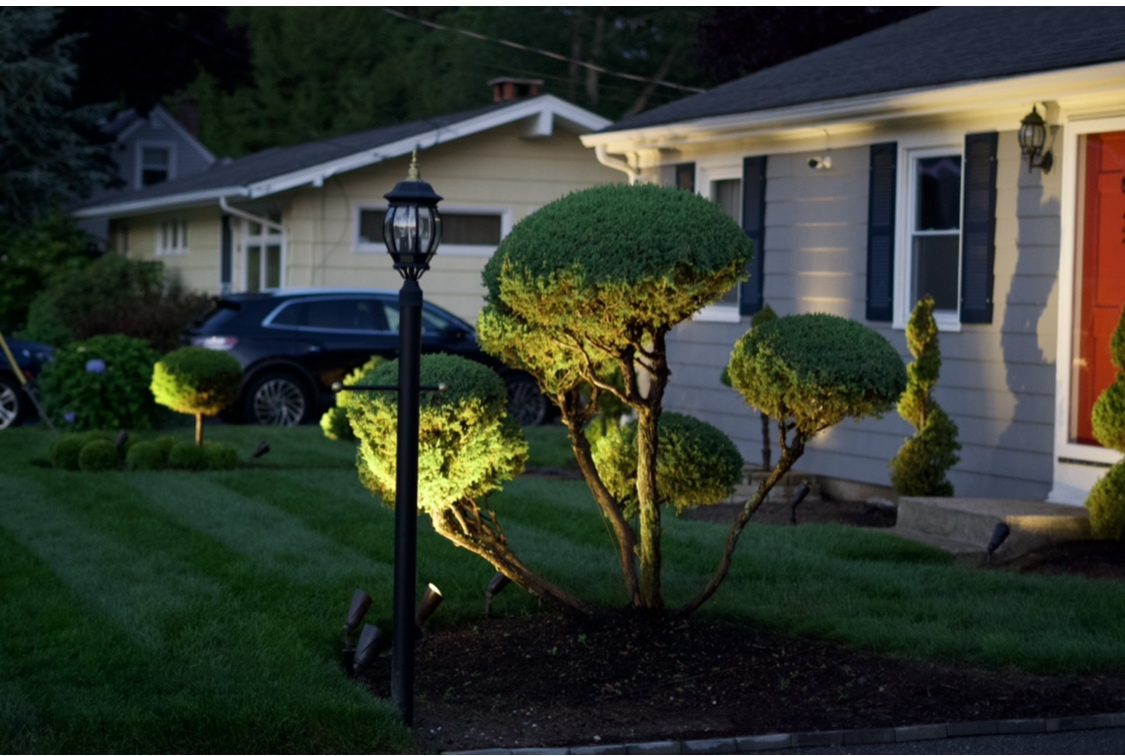
Once you have treated the soil, keep the program going. Compaction returns every season, and if you are planning lighting or decorating work across your yard this year, our guide to illuminated lawn decorations is worth a look before you set anything heavy on freshly treated ground.