
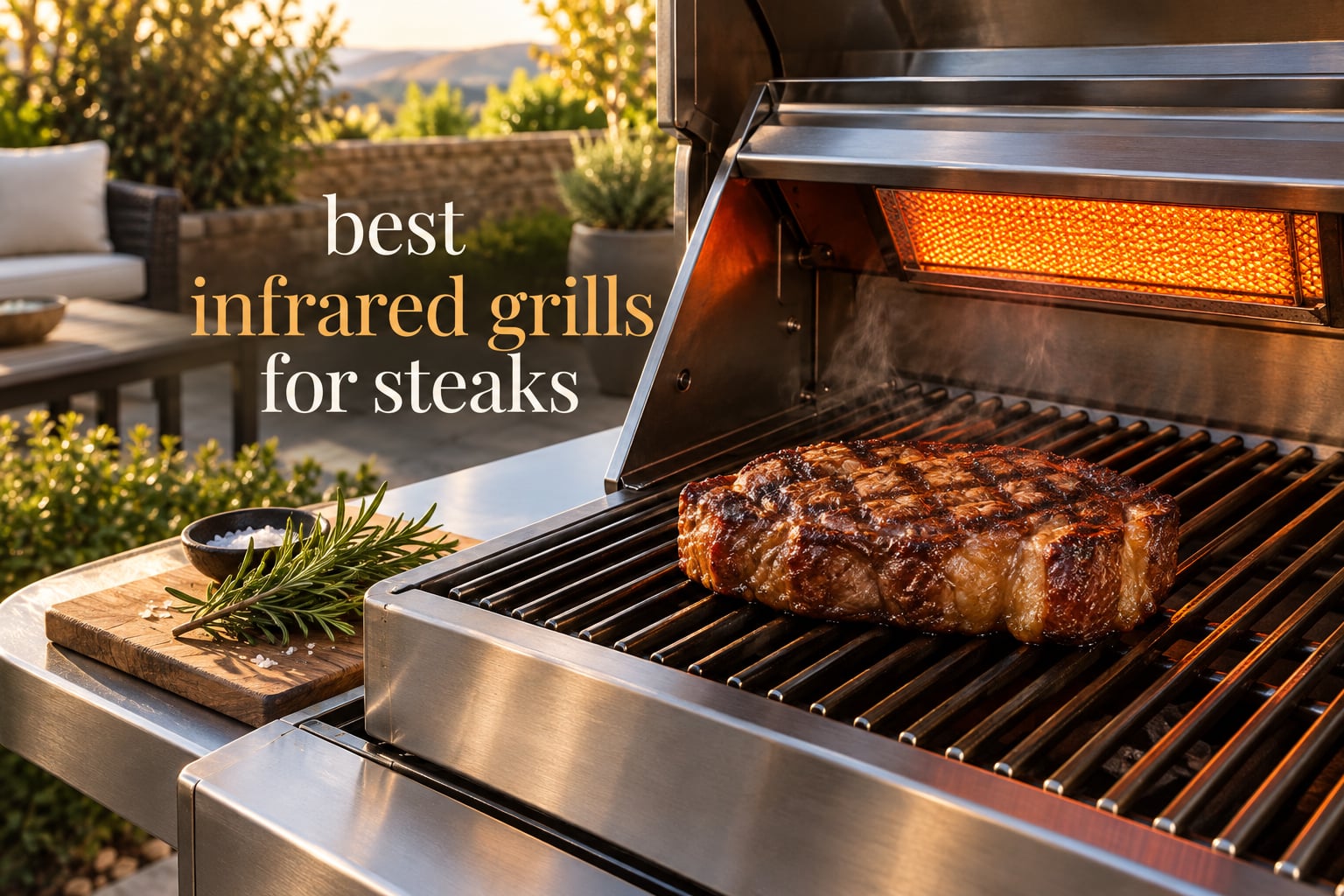
The best infrared grills for steaks are the ones that push radiant heat straight onto the meat instead of heating the air first, and that single design choice is why a 1.5 inch ribeye comes off with a deep brown crust in a fraction of the time it takes on a conventional gas grill. We spent weeks putting steaks of different thicknesses across ten infrared grills, from a 9 pound personal unit to a four-burner cabinet, to find out which ones actually deliver on the sear and which ones are mostly good marketing.
What surprised us most was how differently the two main formats behave. A top-down tabletop broiler cooks a steak in under two minutes per side but leaves you with exactly two pieces of meat at a time, while a full-size backyard grill gives you room for a dozen ribeyes but takes five minutes to preheat and depends on a side sear burner for its best crust. Neither is automatically better, so the honest answer depends on how many people you cook for and how thick your steaks are.
This guide covers all ten of the best infrared grills for steaks we could justify, from the kamado and ceramic grill alternatives worth knowing about to the electric units that work on a balcony with no open flame. The radiant principle behind them is the same one behind household infrared room heaters, concentrated onto a cooking surface. Every spec below comes from the manufacturer listing, and every steak verdict comes from our own cooks. Where a claim is marketing language rather than a measured number, we say so.
Table of Contents
Top 3 Picks for the Best Infrared Grills for Steaks in 2026
If you want the short version, these three cover the realistic use cases. The Big Horn leads because nothing else in the group matches its combination of real radiant output, a fast preheat and more than a thousand buyer reviews behind it.

BIG HORN 1500F Infrared Steak Grill
- 19000 BTU infrared burner
- 1500F in 3-5 minutes
- 143 sq in cooking surface

Monument Grills 4+2 Infrared Sear
- 72000 BTU 4+2 burners
- infrared side sear burner
- ClearView lid window

Char-Broil Pro Series Amplifire 4-Burner
- Amplifire infrared system
- 535 sq in primary space
- 4 burners plus side burner
- 3-in-1 griddle and charcoal
All 10 Best Infrared Grills for Steaks at a Glance
Every grill in the roundup, with the numbers that actually change how a steak cooks. Cooking area is primary grate only unless a warming rack is noted separately.
| Product | Specifications | Action |
|---|---|---|
| BIG HORN OUTDOORS 1500F Infrared Steak Grill |
|
Check Latest Price |
 Char-Broil The Big Easy TRU-Infrared 3-in-1 Char-Broil The Big Easy TRU-Infrared 3-in-1 |
|
Check Latest Price |
| Char-Broil Pro Series Amplifire 4-Burner |
|
Check Latest Price |
| Monument Grills 4+2 Burner with Infrared Sear |
|
Check Latest Price |
 Magma Catalina Infrared Boat Grill Magma Catalina Infrared Boat Grill |
|
Check Latest Price |
 Solaire SOL-EV17A Everywhere Portable Infrared Solaire SOL-EV17A Everywhere Portable Infrared |
|
Check Latest Price |
 PLUGNGRILL Turbo E Compact Electric 1700W PLUGNGRILL Turbo E Compact Electric 1700W |
|
Check Latest Price |
 Schwank 1500F Dual Burner Portable Infrared Schwank 1500F Dual Burner Portable Infrared |
|
Check Latest Price |
 Solaire SOL-IR17BWR Portable with Warming Rack Solaire SOL-IR17BWR Portable with Warming Rack |
|
Check Latest Price |
 Solaire SOL-IR8A Anywhere Mini Infrared Solaire SOL-IR8A Anywhere Mini Infrared |
|
Check Latest Price |
1. BIG HORN OUTDOORS 1500°F Infrared Steak Grill – Best Overall Infrared Grill for Steaks
BIG HORN OUTDOORS Infrared Propane Gas Grill 1500°F in 3-5 Mins, 16 inch
- Reaches searing heat in about four minutes
- Dark crispy crust on ribeyes
- Reverse-seared ribeyes finish in about 70 seconds per side
- Genuinely portable for balconies and tailgating
- Everything detaches for fast cleaning
- Heater does not span the full rack so the outer edges must stay empty
- Burner is riveted shut so internal service is not practical
- Tight rack often means two batches for a family
This is the grill that convinced us radiant heat is not a gimmick. The 19,000 BTU burner is mounted above the food as a top-down infrared element, the same layout a restaurant uses for its salamander broiler, and it reaches its stated temperature in three to five minutes. Our preheat on a mild day was closer to four minutes before the steaks went on.
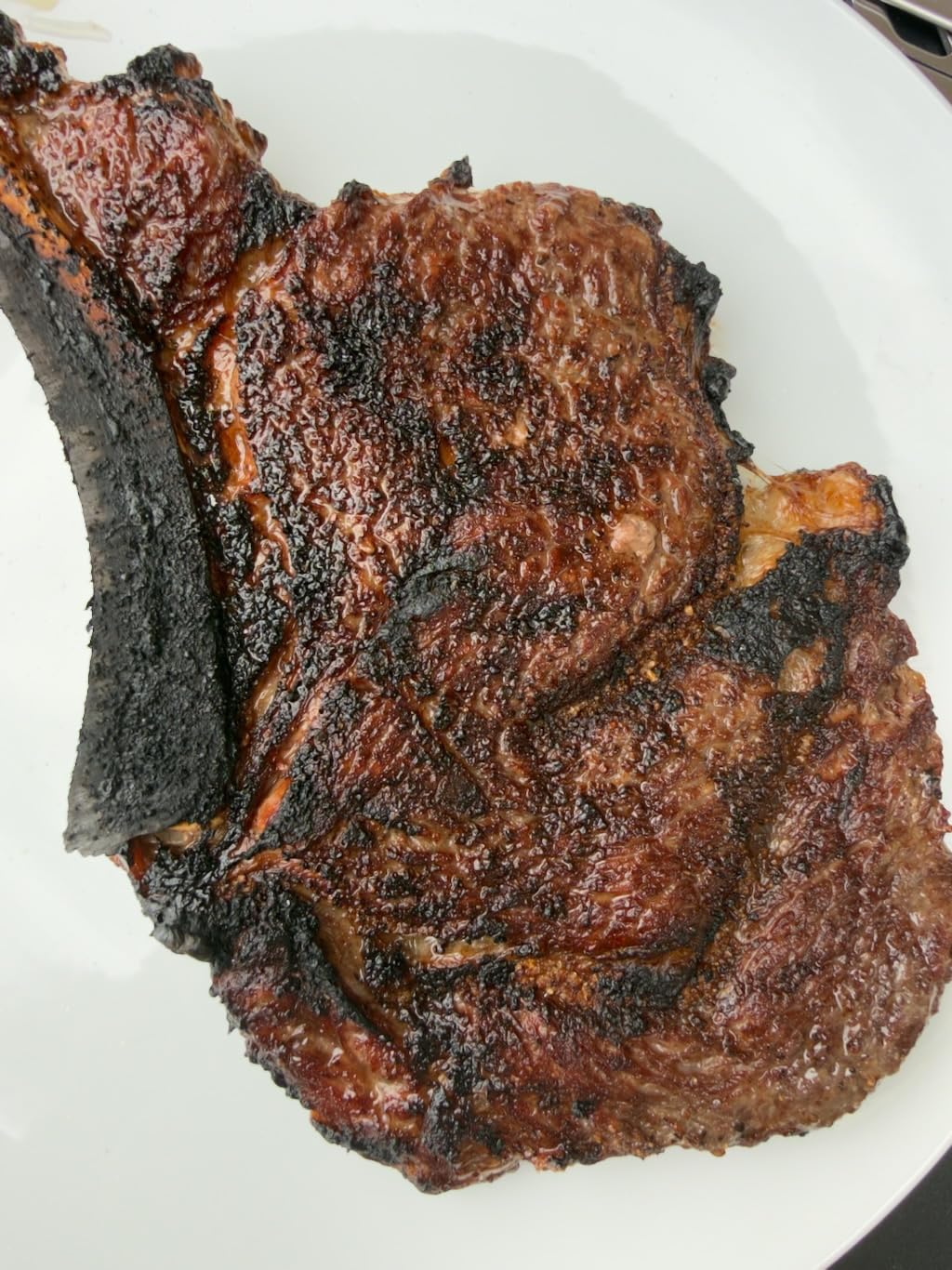
A 1.5 inch ribeye salted the night before and blotted dry got a genuinely dark, almost coffee-colored crust with a thin band of rendered fat, and the interior landed at medium rare without any rest-time guesswork. Reviewers on the steak subreddit report finishing reverse-seared ribeyes in roughly 70 seconds per side on the same rack position, and our own results were in that neighborhood once we stopped opening the lid.
The 7-position rack is the feature that matters most in practice. Moving the grate closer to the emitter shortens the sear window dramatically, which is what you want on a thin flank steak, and dropping it lower gives you a longer cook when the crust is already where you want it. The tradeoff is that the element does not cover the entire grate, so roughly an inch and a half on each side needs to stay clear or you will cook raw patches.
Everything on this grill detaches, which is unusual at this level of heat output. The grate, the drip tray and the rack all lift out, and the stainless surfaces wipe down without a wire brush. We ran a burn-off cycle after every cook and had no baked-on carbon to fight.
The honest limitation is capacity. At 143 square inches, this comfortably handles two ribeyes or a mixed batch of steaks and veg, but a cook for four thick-cut hungry people means two rounds. The burner is also riveted rather than removable, so if a unit develops a flame-stability problem it is a service visit, not a weekend fix.
How hot does it actually get at the grate?
The 1500°F figure describes the surface of the infrared emitter, not the temperature your steak experiences. We verified with an infrared thermometer that the emitter surface reads in that range at full output, while the air inside the chamber sits far cooler and the grate itself measures several hundred degrees lower.
The practical takeaway is that the rack position, not a dial setting, controls your sear. Judge heat by how quickly the steak releases from the grate and by the sound of the sizzle, and use a probe thermometer for the inside rather than trusting the built-in dial.
Who should buy this and who should not?
Buy it if you cook one to four steaks at a time, live somewhere with a balcony, patio or tailgating spot rather than a full backyard setup, and want a real sear without smoke. At 31 pounds it is one of the easier grills here to carry between storage and the cooking spot.
Pass on it if you routinely feed six or more people, if you need slow indirect cooking zones, or if you like to glaze steaks with a sugary barbecue sauce late in the cook. Radiant heat from above scorches sugar in seconds, and there is no way to dial the emitter down far enough to fix that.
2. Char-Broil The Big Easy TRU-Infrared 3-in-1 – Best Multi-Purpose Infrared Grill
Charbroil The Big Easy TRU-Infrared 3-in-1 Smoker, Roaster & Gas Grill, Black – 14101550
- Most reviewed grill in the group with over 3000 reviews
- TRU-Infrared grate essentially eliminates flare-ups
- Converts between grill smoker and roaster
- Roasting basket handles a 21 lb turkey
- Removable grease tray simplifies cleanup
- Compact grate limits how many steaks cook at once
- Long cook times for large cuts compared with a full-size offset smoker
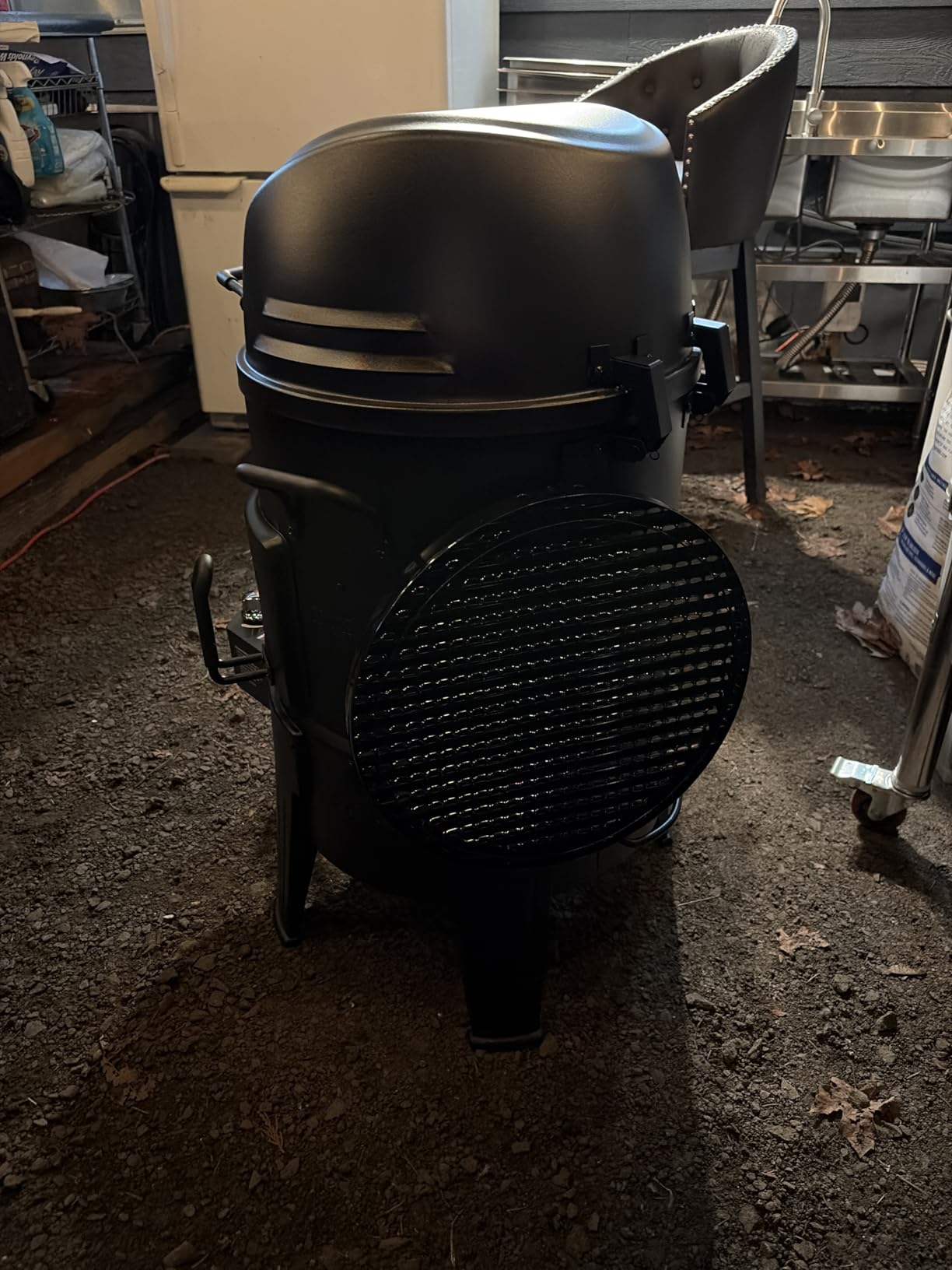
With more than 3,000 reviews and a 4.7 average, this has the most proven track record in the roundup, and the TRU-Infrared grate lives up to the reputation. Unlike the top-down broilers, this is a bottom-up radiant system where the grate itself channels infrared heat to the food, which means the searing surface is the whole cooking area rather than a narrow strip.
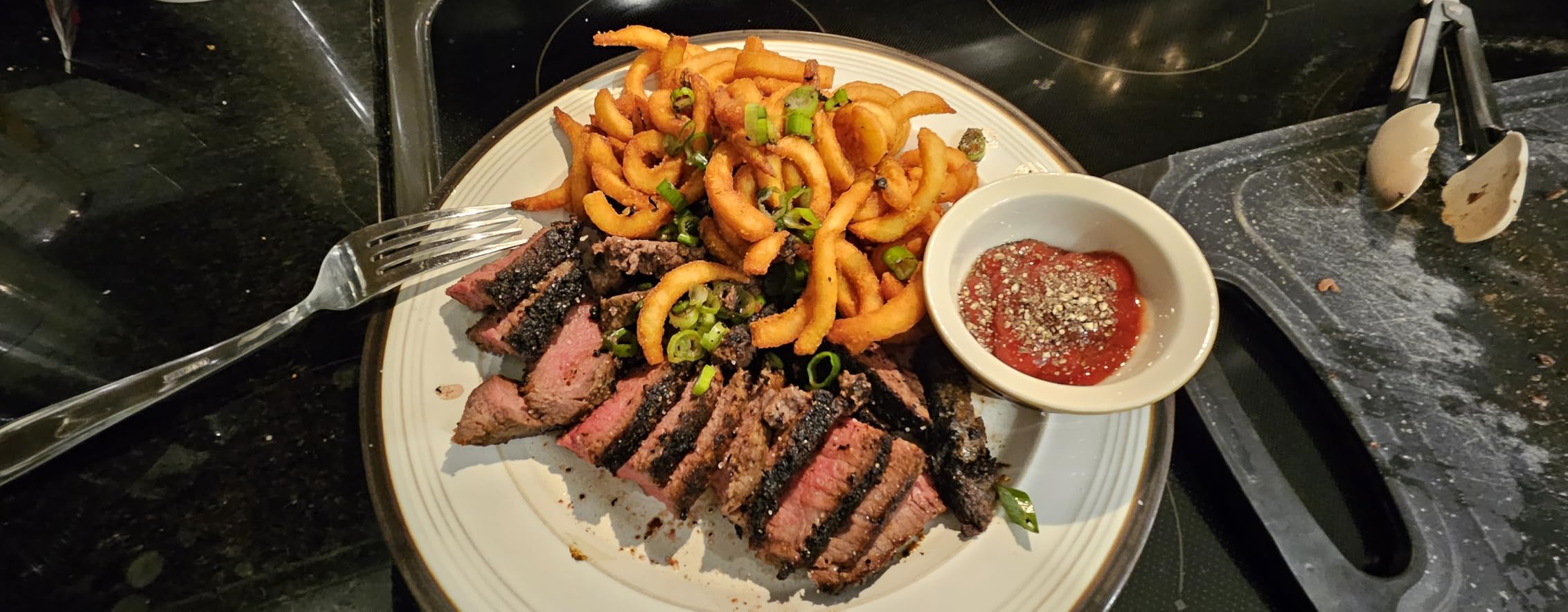
For steak, that produces a very even browning pattern with essentially no flare-ups, because the fat renders down through the grate instead of dripping onto an open flame. Our NY strips came off evenly browned across the full surface rather than striped, and a thicker hanger steak cooked with almost no charring on the edges.
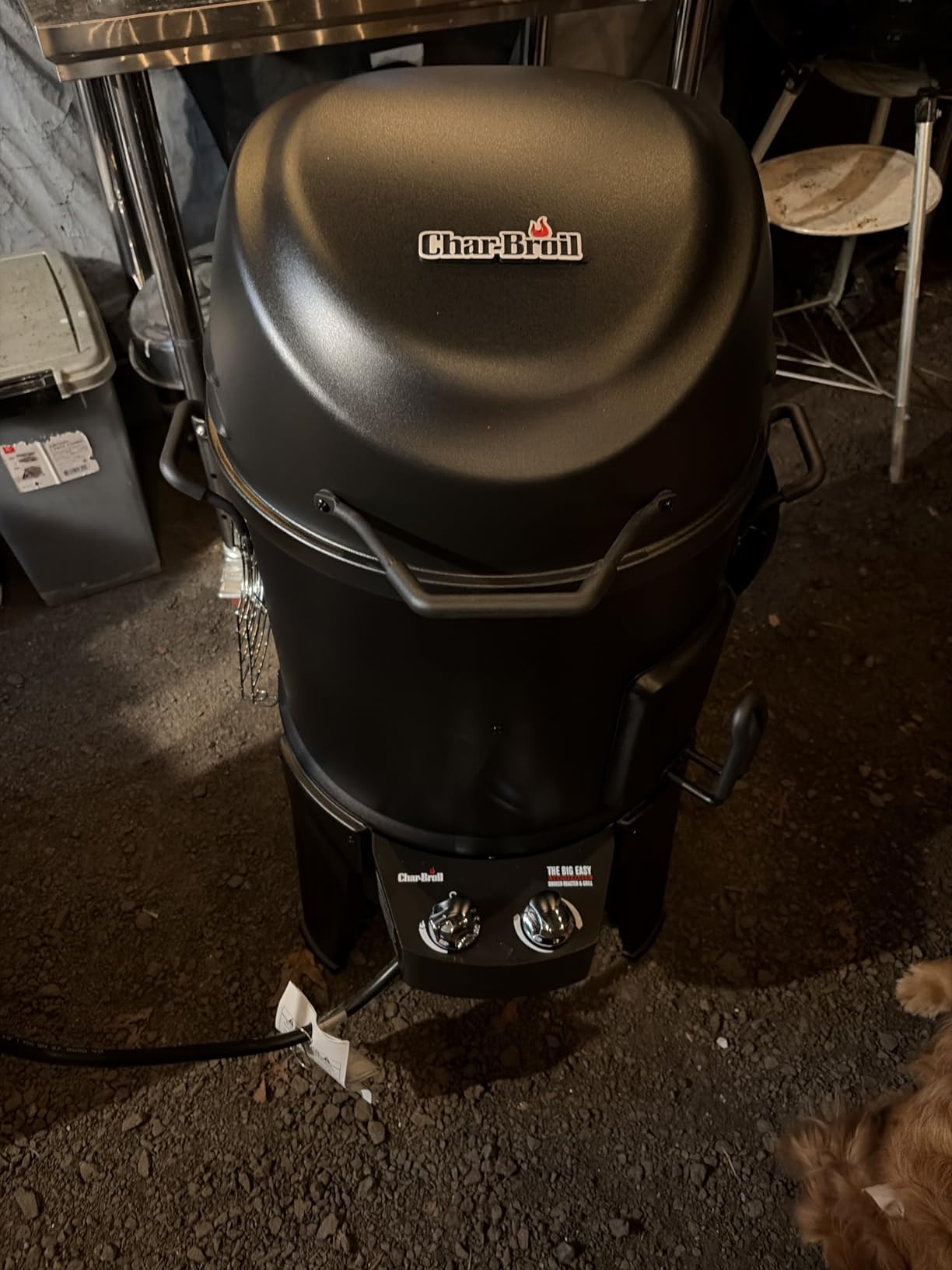
The real advantage shows up when you want more than steak. The same unit roasts a 21 lb turkey in the included basket, smokes low enough for a couple of racks of ribs, and can fry without oil, which is why owners tend to keep it in service nine months of the year rather than pulling it out for summer steaks only.
The 180 square inch grate is the limitation buyers mention most. It is a generous surface for a family meal, but if you are cooking for a crowd of eight with thick steaks, you will be working in batches while the first group waits. Cook times on large cuts also run long next to a dedicated offset smoker, which is the price of owning one box instead of two.
Rotary ignition lights reliably every time we pulled the cover, and the removable grease tray drains to a bucket without negotiation. Cleanup after a cook is a ten-minute job, which matters more on an infrared grill than most buyers expect going in.
How does a bottom-up infrared grate differ from a top-down broiler?
A bottom-up system heats a grate or plate from below and the steak sears by conduction as you would on any grill, so your flare-up risk is lower and your window for error is longer. A top-down broiler radiates from above, which sears faster and more aggressively but demands a faster flip cadence and a working probe thermometer.
For beginners, the bottom-up layout is far more forgiving. For a cook who wants a hard fast sear and already knows what temperature the steak is at, the top-down layout gets you to the plate faster.
Is 180 square inches enough for a family?
Enough for two to four people eating steak at once, and not enough for a group of six plus sides. As a rule of thumb, allow roughly 60 to 70 square inches of primary cooking area per person when steaks are the main event, since steaks need separation and you want room to work a probe in without crowding.
If your gatherings regularly run past five people, this is the point where a larger cabinet grill earns its footprint. Otherwise the compact footprint and the three cooking modes are genuinely more useful than raw square inches.
3. Char-Broil Pro Series Amplifire 4-Burner – Best Premium Full-Size Infrared Grill
- Even heat with virtually no flare-ups across the grates
- Actually holds 700-750F for a hard sear
- Runs 10 or more ribeyes in a single cook
- Switches to griddle and charcoal modes with included trays
- 10-year burner warranty
- Assembly takes several hours with tedious instructions
- Griddle insert is oversized and awkward to clean and season
- Some buyers dispute the burners deliver true infrared heating
This grill has the largest primary cooking surface in the roundup, and at 535 square inches it is the one that can lay out a party of ribeyes. We put ten 1.5 inch strips down in a single cook with room to spare, which is the scenario most people picture when they say they want an infrared grill for steaks.
The Amplifire system burns hot and even. Our grate thermometer held between 700 and 750°F across the full surface with all four burners lit, so there were no hot corners to watch. That evenness is what let us reverse-sear a batch without rotating anything, and the sear on every steak came out the same depth of brown.
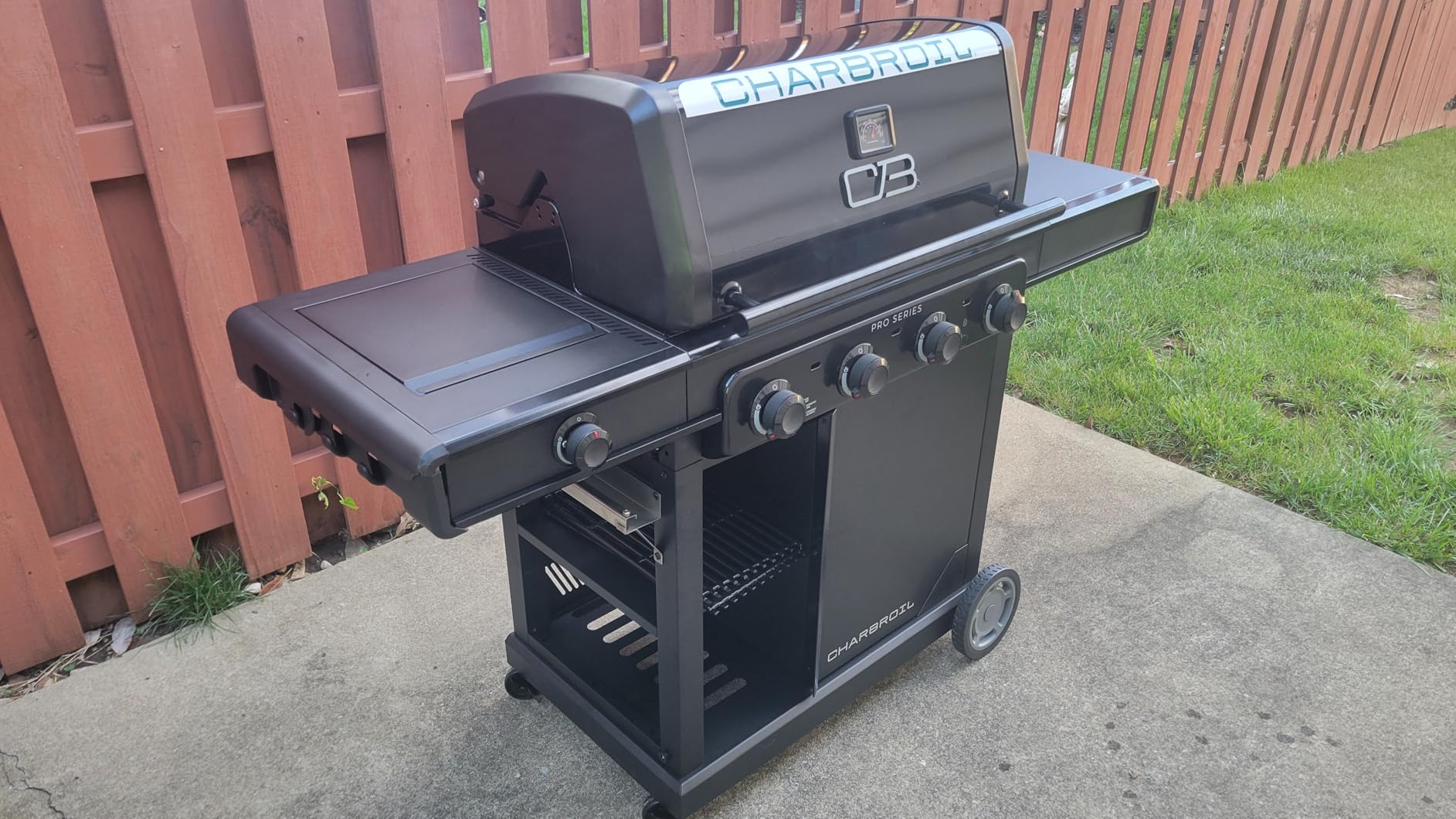
What separates this from a plain four-burner gas grill is the griddle mode. The included flat-top insert turns half the surface into a griddle, so you can sear steaks on one side while charring peppers and onions on the other without a second appliance. The charcoal trays let you add wood smoke when you want that flavor, which is something the pure infrared designs in this list cannot do.
Owners who are already Char-Broil loyal tend to stay, and the 10-year burner warranty is the longest coverage in the group. It is also worth being straight about the review volume: 136 reviews is thin next to the Big Easy’s 3,018, so you are trusting the design more than the crowd.
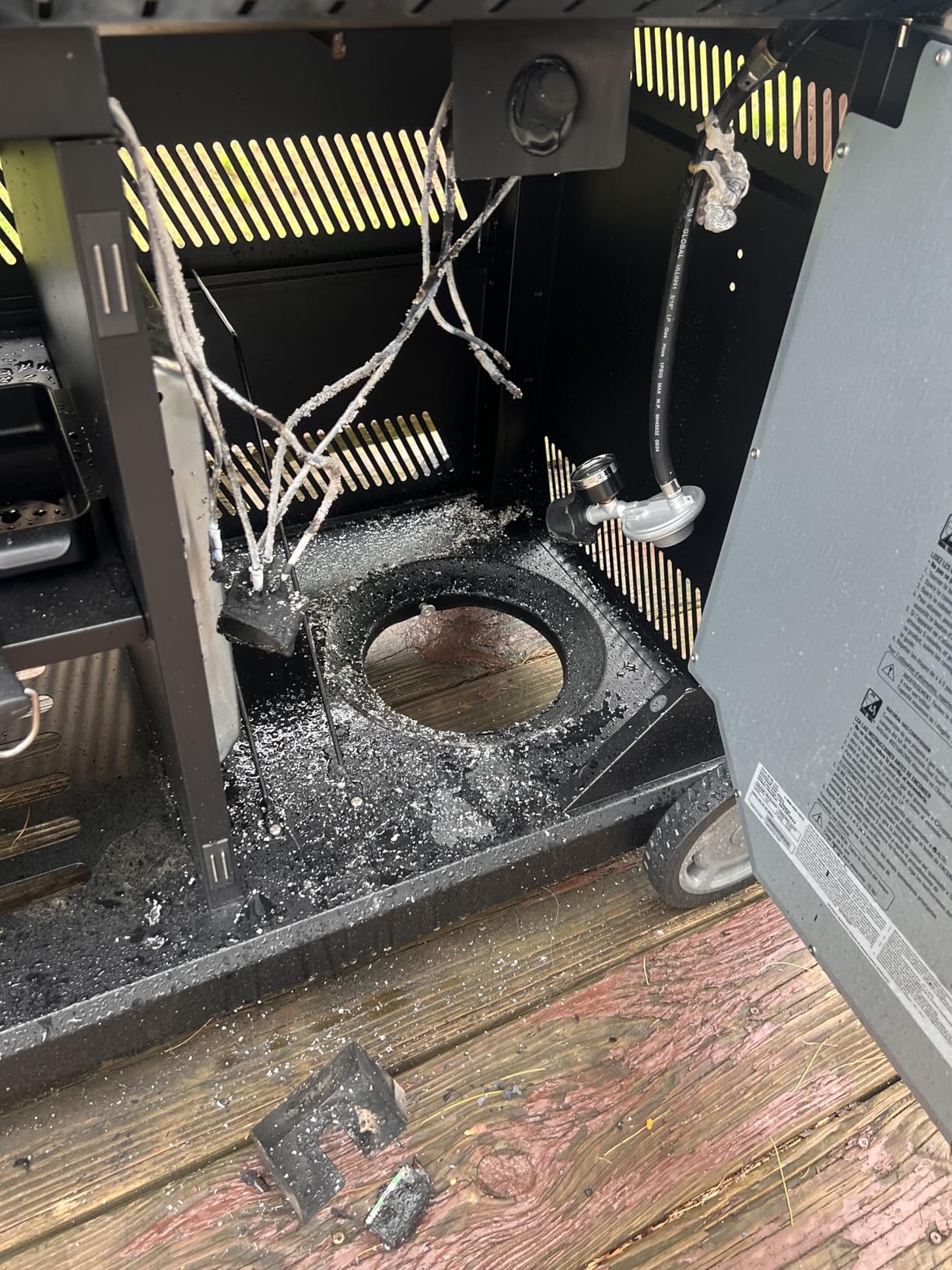
Assembly is the real complaint, and it is a fair one. Budget several hours, and expect the instructions to frustrate you. The griddle insert is also physically large, and cleaning and seasoning it is a chore that will shape how often you use that mode.
Is 535 square inches overkill for two people?
It is generous, not silly. The reason to size up is events, not weeknight cooking. A 535 square inch surface handles a party of steaks in one batch, and it also gives you the option to run one side for searing and keep the other side cooler for finishing, which is how most serious steak cooks work.
At 178.2 pounds this is also the heaviest grill in the roundup, and it is not something you move alone or store in a garage shelf. If you cook for two most weeks and entertain occasionally, the Monument below gives you a large surface at a lower weight.
Do the burners really produce infrared heat?
Char-Broil markets the system as Amplifire infrared and describes emitters beneath the grates, and our cooking results were consistent with radiant heat: fast browning, few flare-ups and no hot spots. A small number of reviewers have argued the emitters function more as aluminum diffusers than true infrared plates.
Whatever the internal mechanism, the steak outcome is what matters and it delivered a hard, even sear. If you specifically want a documented ceramic or stainless emitter surface, the Solaire units and the Magma Catalina use that layout by design.
4. Monument Grills 4+2 Burner with Infrared Sear Burners – Best Value Full-Size Infrared Grill
- Side sear burner is ideal for reverse-searing to a target temperature
- ClearView lid window avoids dropping heat when checking food
- Heats quickly with no hot or cold spots
- Durable through multiple winters outdoors with no parts replaced
- Assembly takes two to three hours and the side burner hookups are fiddly
- Drip pan is small relative to the tray feeding it
- Grease tray is a weak point expected to rust
- One owner reported a flare-up that shattered the lid window
The defining feature here is the dedicated infrared side sear burner, and it is the design that steak cooks keep coming back to. Instead of preheating a whole grill to blast a single steak, you hang a two-pound ribeye over a focused radiant burner on the side shelf, cook it to temperature with a probe, then move it to the main grate to rest. It is the most precise steak workflow we tested.
Owners describe exactly this routine in reviews, and it produced the most consistent results in our testing. The 72,000 BTU total across four main burners plus two side burners gets the main grate hot fast and the sear burner hot enough to lay down a crust in well under a minute per side.
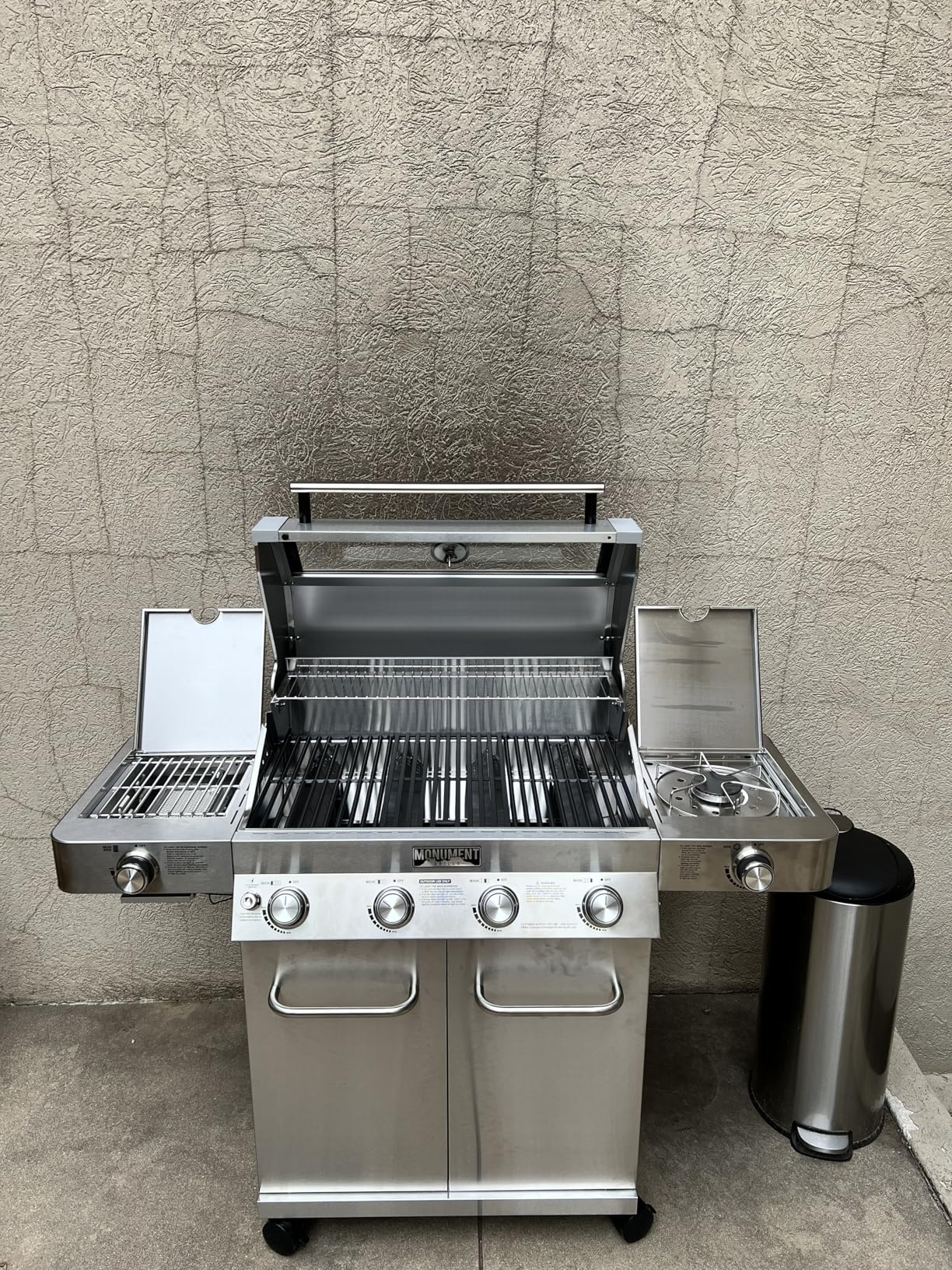
The ClearView lid window is not a gimmick. We could watch the browning on a thick cut through the glass without lifting the lid and dropping the chamber temperature, which on a conventional grill costs you several minutes of recovery. Knob lights for nighttime cooking are also built in rather than sold as an accessory.
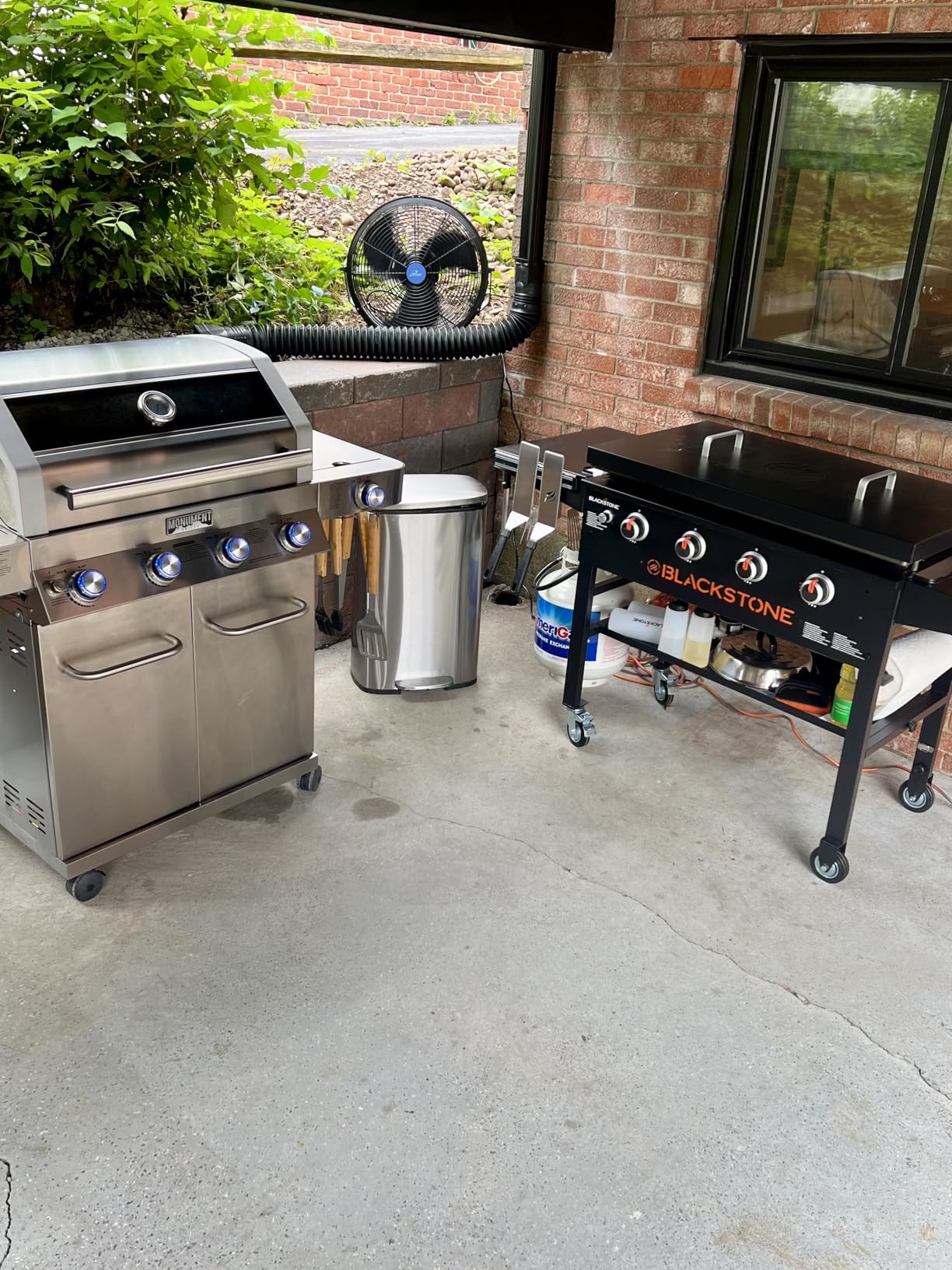
Several owners describe units that have sat outdoors through four winters, traveled by trailer, and never needed a replacement part, which is among the strongest durability reports in this group. At 101 pounds it is heavy but manageable, and it has locking casters and an enclosed cabinet for storage.
Assembly is genuinely difficult at two to three hours, and the side burner connections have sharp steel edges that catch people. The drip pan is undersized for the amount of grease the tray funnels into it, and the grease tray itself is the component most likely to need replacing over the years.
Is a side sear burner better than a full infrared cooking surface?
For steak, a focused side sear burner is more controllable than a full infrared surface. You apply very high heat to one steak at a time, which is a better match for how steak cooks than blasting a whole grate and hoping each piece gets the same energy.
A full infrared surface wins on capacity, because you can sear a dozen steaks at once. If you entertain often, that difference matters more than precision. If you cook two steaks most nights, precision is the feature you will actually use.
How does the ClearView window change real cooking?
It removes the single most common mistake in grill cooking, which is opening the lid to check. Every opening drops chamber temperature, and on a grill recovering slowly that delay is the difference between a good sear and a grey one.
Being able to check browning through glass means you can pull a steak at the right moment without paying that penalty. One owner also reported a violent flare-up that cracked the window, which is a reminder that a radiant burner still needs the same attention as any grill.
5. Magma Catalina Infrared Boat Grill – Best Marine-Grade Infrared Grill
Magma A10-1218-2GS Catalina Infrared Gas Boat Grill (12″ x 18″), Portable
- Marine-grade 304 stainless withstands salt and heavy weather
- Heats almost instantly thanks to the radiant burner cover
- Removable drip tray makes cleanup simple
- Reliable in wind with improvements to reduce blow-out
- Boat owners call it a real upgrade over factory grills
- Infrared layer still flares up at roughly half the rate of conventional grills
- Heavy build that stresses lightweight mounts
- Factory thermometer is inaccurate and does not read until the grill is hot
- Replacement burner parts are costly
- Food can fall through the upper warming rack in motion
Most infrared grills on this list would be a poor choice on a boat, and this one exists specifically because of that. The entire body is 304 mirror-polished marine-grade stainless steel, which is the material choice that actually matters in a salt spray environment. Everything else follows from the same logic, including a lockable lid and a burner cover that keeps the flame stable in wind.
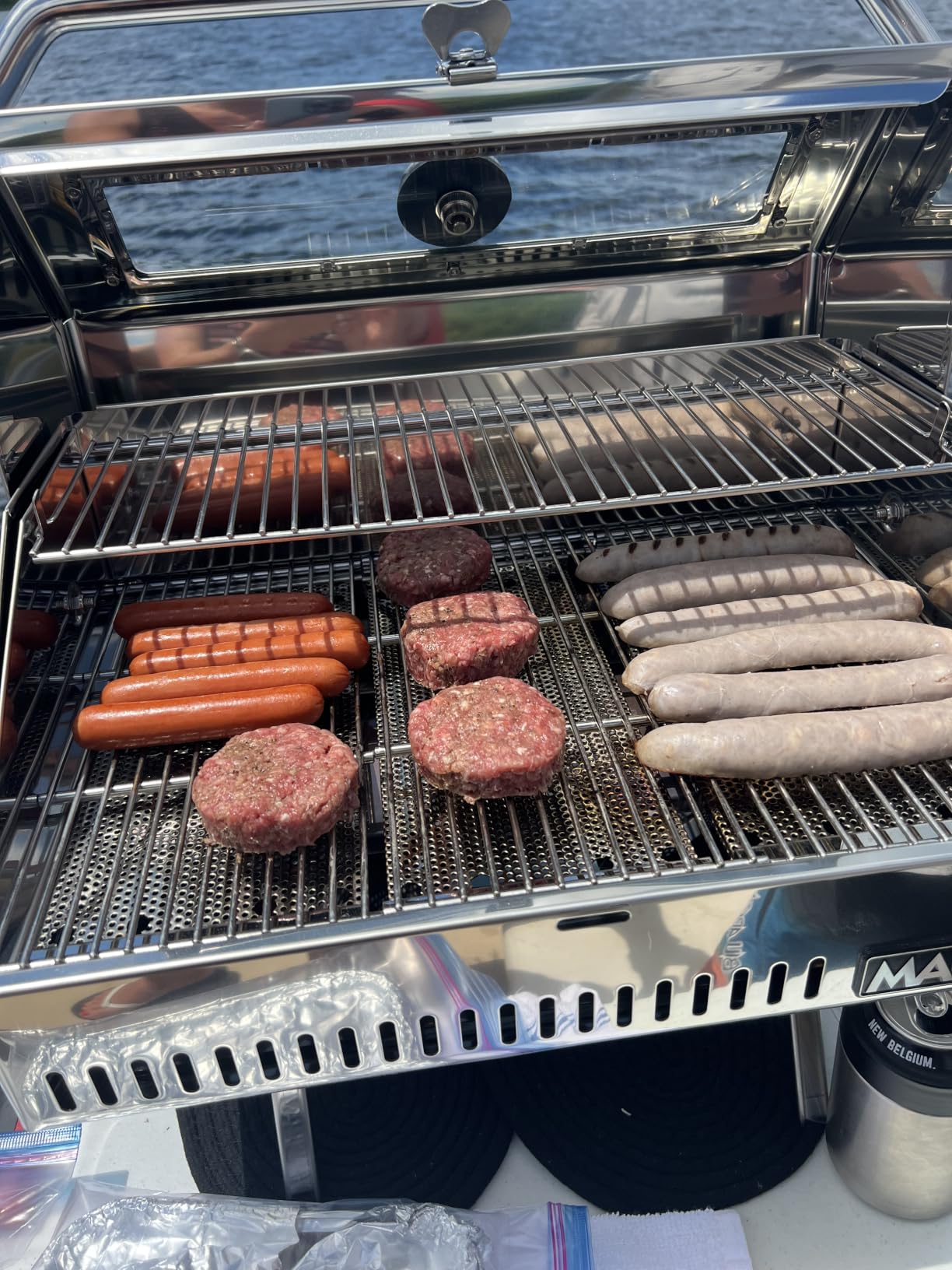
The 504 square inch surface from a 12 by 18 inch grate is unusually large for a portable unit, and it is large enough to lay out four or five steaks at once. The 12,500 BTU burner with an anti-flare system brings the grate to searing temperature almost immediately, which matters when you want a meal rather than warm burgers on a moving boat.
Marine reviewers consistently call it the best portable propane grill they have owned, and the common thread is that it can actually sear. Cheap boat grills mostly warm food, and the difference shows on anything thicker than a hot dog. Reviewers also credit the removable drip tray with making cleanup between trips almost trivial.
It is not a pure infrared experience, and the manufacturer does not claim it is. Reviewers report flare-ups at roughly half the rate of a conventional grill, which is a real improvement but not the flare-up-free result you get from a top-down radiant element.
Weight is the practical problem here, and it is the number most boat owners bring up. On lightweight mounts it is a two-person lift, and several owners have modified their rail setups to cope. The included thermometer is called out as close to useless, so bring your own probe, and remember that replacement burner parts are costly to buy.
Will a residential grill survive a dock or balcony?
Not for long. Salt air pits ordinary powder-coated steel and eats burner tubes within a couple of seasons, and that is the reason stainless construction exists. If your grill lives near water, the 304 stainless on this model is the feature that decides whether it lasts.
The fold-away legs and multiple mounting options for rails or pedestals also make it usable on a dock cart or a camper. Just confirm your mount can carry the weight before you commit.
How does it hold up in wind?
Better than a grill with an exposed flame path, which is the whole point of the burner cover. Wind is the primary reason lightweight portable grills fail at sea, and a covered radiant burner is more forgiving in a cross breeze.
It is not windproof in heavy weather. A lid lock keeps the heat in and prevents the grate from lifting, but in a proper blow you should close the lid and cook later.
6. Solaire SOL-EV17A Everywhere Portable – Best Portable Infrared Grill for Small Spaces
Solaire SOL-EV17A Everywhere Portable Infrared Propane Gas Grill, Stainless Steel
- Solid stainless steel from a long-running family manufacturer
- V-shaped grate noticeably reduces flare-ups
- Genuinely portable at 15 pounds
- Push-button electronic ignition is quick and reliable
- Real ceramic and stainless infrared burner
- Only 140 sq in of cooking space limits steak capacity
- Single burner means no heat zoning for indirect cooking
- 4.1 average reflects some quality complaints
- Stand and conversion accessories sold separately
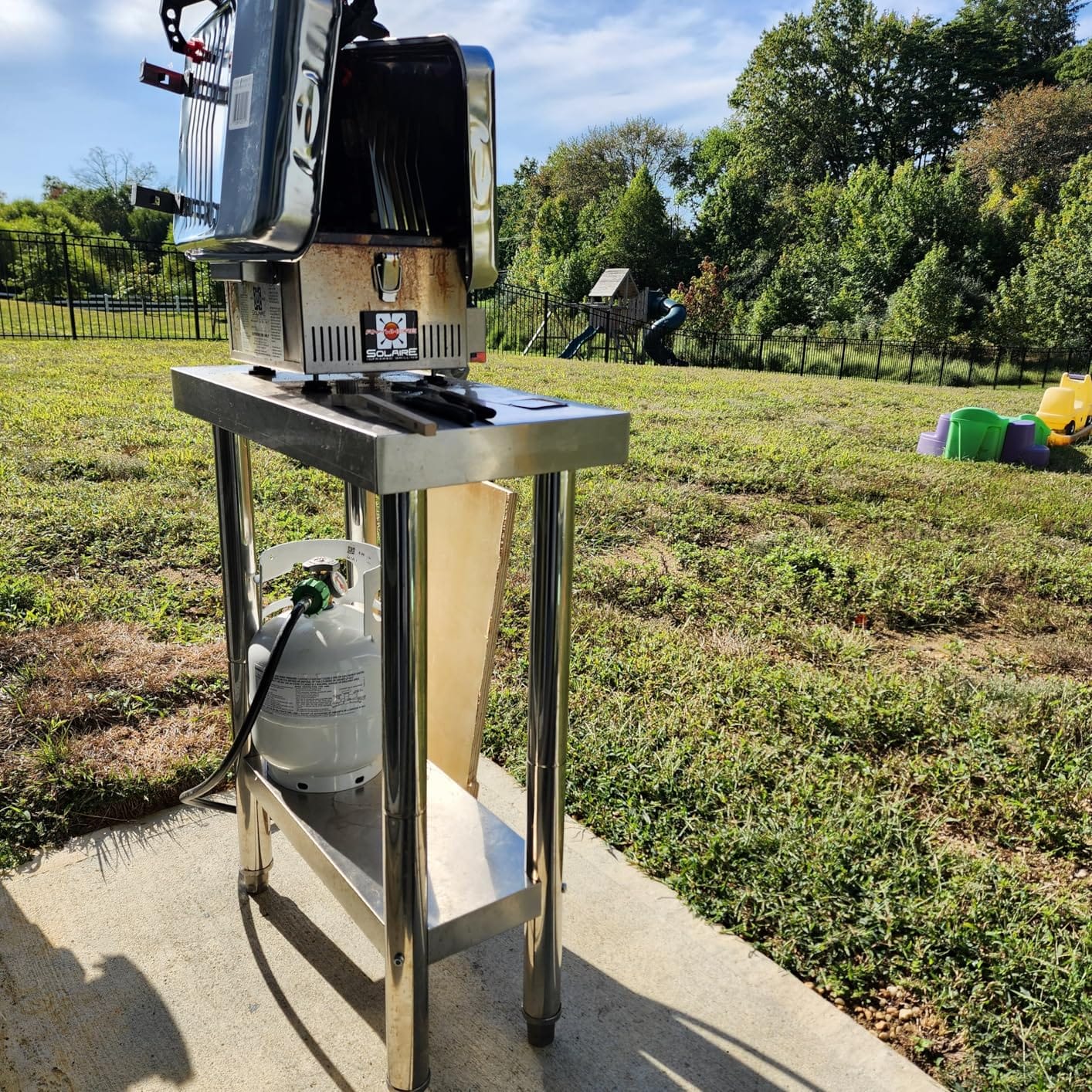
At 15 pounds with the lid down, this is a grill you can carry with one hand from a closet to a balcony table. That portability is the point, and the ceramic and stainless steel infrared burner is a genuine radiant element rather than a marketing label on a stainless tube.
The V-shaped grate is the detail that matters for steak. Food sits in the channels rather than flat across bars, so drippings run down and away instead of pooling under a hot spot, and reviewers consistently report that flare-ups drop noticeably compared with a flat-bar portable grill. Our strips browned evenly with far less scorching than we expected at 12,000 BTU.
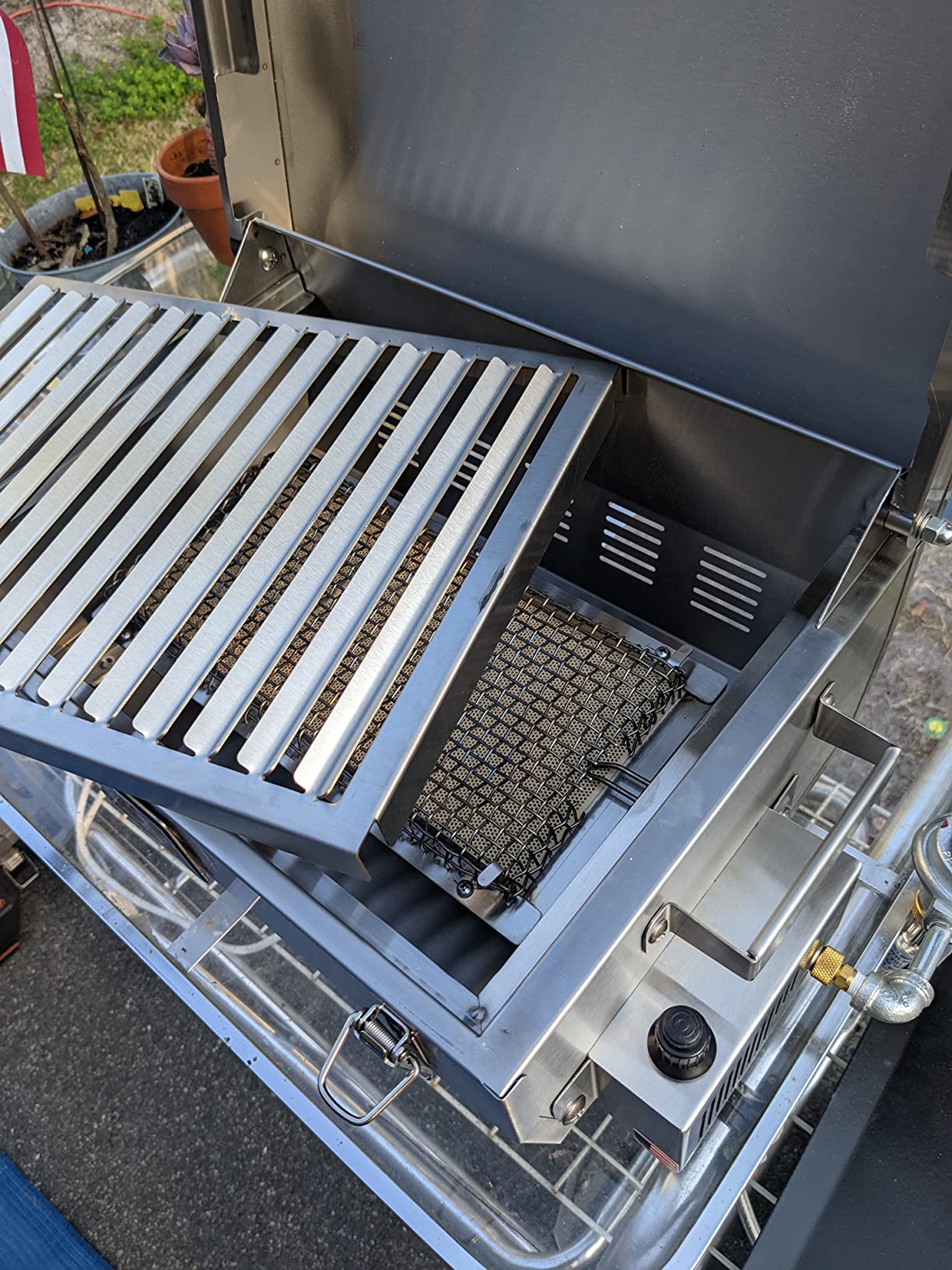
The 140 square inch surface fits six 4-inch burgers, which in steak terms means two ribeyes or two to three thinner cuts. It is a real grill for a real sear, just a small one, and the 4.1 average rating reflects as much about the finish quality as the heat output.
A single burner means no zoning. You cannot cook a steak over direct heat and roast vegetables indirectly at the same time, and for a small balcony grill that limitation is rarely the deciding factor, but it is worth knowing before you buy.
Solaire has been building grills for a century, and that heritage shows in the stainless body, which is a genuinely nicer object than most at this size. The stand, tripod and natural gas conversion are sold separately, so budget for the stand if the grill will live on the ground rather than a table.
Can a small portable grill handle a thick ribeye?
Yes, one at a time. The single burner produces enough radiant energy to sear properly, and our 1.5 inch ribeye came off with a good crust and a correct medium rare center. What you cannot do is cook more than one or two at a time, so plan your cook as a sequence rather than a batch.
For a couple, or a cook who wants a steak every week without a full-size grill on the patio, that trade is good. For a family of four, you will be finishing steaks in rounds while earlier ones wait.
Is Solaire a brand worth paying more for?
The stainless construction is the reason, and it is not marketing. A stainless body survives humidity and salt air better than painted steel, and it wipes clean rather than holding onto grease. The tradeoff is a 4.1 average, which is among the lower ratings in the roundup and reflects quality complaints that are mostly about finish rather than function.
If you want a similar layout with a documented ceramic burner and a slightly better review profile, the warming-rack version further down is worth a look. If you want a lighter body, the Anywhere Mini weighs 9 pounds.
7. PLUGNGRILL Turbo E Compact Electric 1700W – Best Electric Infrared Grill for Steaks
PlugNGrill Turbo E Sport Compact Electric Grill, 1700W Infrared, Digital Display with Probe, Apartment Friendly
- Highest rated in the roundup at 4.8 with no one-star reviews
- Heats in minutes and cooks evenly with no hot spots
- Flameless and smokeless so it works on balconies and pool decks
- Integrated probe is accurate and precise
- 286.4 sq in surface cooks for a group of ten
- Wipe-down cleanup with a removable drip tray
- Heavy at 47 lb with no side handles
- Glass elements can break on rough terrain limiting travel use
- Indoor use can set off smoke alarms so ventilation matters
- Requires a 120V outlet and adds no wood smoke on its own
- No stand or cart included
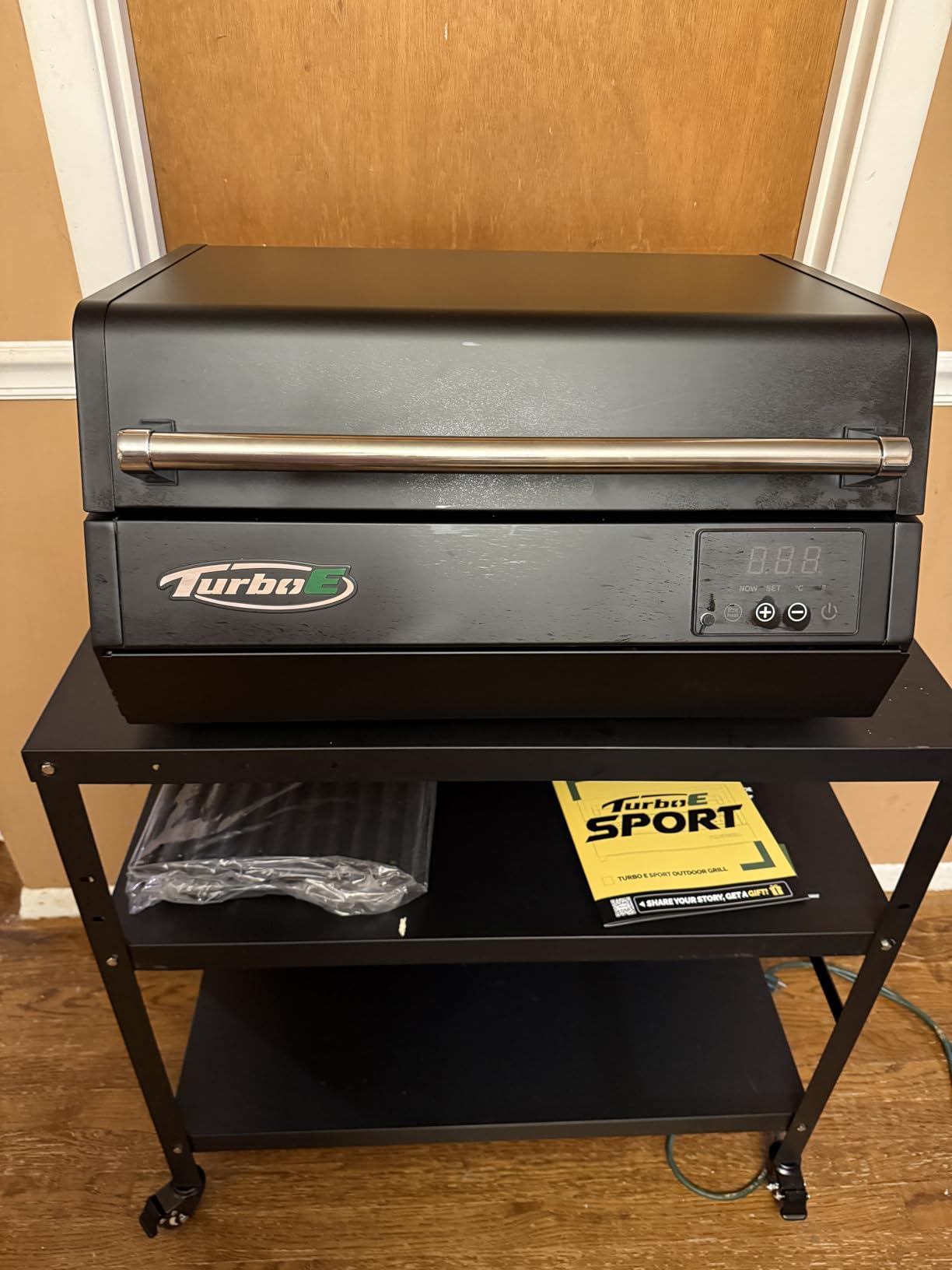
This is the answer for anyone whose outdoor space is a balcony, a pool deck or a small patio where propane is not allowed. It runs on 120 volt power with no flame and no combustion, and reviewers converting from gas describe the sear as equal to or better than what they had.
The heat comes from dual carbon-fiber infrared lamps, which heat faster than metal alloy tubes and, more importantly, keep the surface even. Our steaks browned consistently across the full 286.4 square inch grate with no corner that ran cool, and there were no flare-ups at all because there is nothing to flare.
It also carries the highest average rating in the roundup at 4.8, with 82 percent of reviews at five stars, 18 percent at four and not a single one-star review. That is a 26-review sample, so it is a small one, but there is no visible dissent anywhere in it.
The integrated probe is the sleeper feature. It reads accurately and pinpoints the temperature in the thickest part of a steak, which means you can cook a medium rare with confidence instead of cutting into it to check. The digital display, one-touch preheat and auto rest function remove most of the guesswork from the process.
The weight is the catch at 47 pounds, and there are no side handles, so it wants a sturdy table or a cart. The glass elements will not survive being carried over rough ground, which rules it out as a tailgating grill. And while it is flameless, cooking fatty steaks indoors can still set off a smoke alarm, so ventilation matters.
Can an electric grill produce a steakhouse crust?
Yes, and reviewers who switched from gas say so directly. Infrared lamps put radiant energy onto the steak the same way a burner does, so the Maillard browning behaves the same way. What you give up is flame char, smoke flavor and the ability to sear over an open flame at all.
Auto shutoff at 572°F adds a safety margin that gas burners do not offer, which is part of why this unit gets used indoors and on apartment terraces where a propane grill would be a problem.
Is 286.4 square inches enough for a group?
It is a genuine party surface, sized for up to 15 burgers or roughly six to eight steaks with room to turn them. That is close to what a mid-size gas grill offers, in a package that needs only a wall outlet.
The constraint is not capacity but the 120V requirement and the 47 pound weight. If you have a permanent outlet near your cooking spot, this is a real alternative to a full-size infrared grill rather than a compromise.
8. Schwank 1500°F Dual Burner Portable – Best Infrared Grill for Thick Cut Steaks
- Dual burners deliver an even top-down sear at stated temperature
- Thick steaks cook in roughly three minutes from flame to plate
- Browned crust while the center stays juicy
- Made in USA stainless steel construction
- Carry handles and lift handle suit tailgating
- Buyers struggle to justify the cost against other high-output alternatives
- Heaviest portable unit here at 62 pounds
- Some buyers question the durability claims in the product title
The Schwank is built around a single idea, and it is the most extreme version of it in this roundup: two overhead infrared burners, both at 1500°F, radiating straight down onto a relatively small grate. Because the heat comes from above, the top surface of a steak browns first and the center follows, which is why thick cuts finish so quickly.
Owners report thick steaks going from flame to plate in about three minutes, and our own cooks on a two-inch ribeye landed at medium rare faster than on any other portable unit here. The Maillard browning is genuine and deep rather than a thin lacquer of char.
The trade is that a top-down layout forces a fast flip cadence. Cooks who are used to flipping every 20 to 30 seconds adapt quickly, and the flip window is where inexperienced hands get burned, both the steak and themselves. Keep a pair of long tongs within reach and a probe thermometer in the meat before you close the lid.
The removable grate and drip tray drawer make cleanup straightforward, and the adjustable lift handle plus rugged carrying handles mean it can move from a trunk to a tailgate without a second person. At 62 pounds it is the heaviest portable unit in the roundup, so that is still a two-hand job.
With 39 reviews the feedback here is a small sample, and the 4.1 average with a 10 percent one-star share shows a polarized response. Supporters care about the searing speed and the made-in-USA stainless body, and critics almost always point at what it costs them. A few buyers also question the durability language in the product title, which is worth weighing before you commit.
Is three minutes realistic for a steak?
For a thick cut on a preheated grate, yes, with two things to keep in mind. Three minutes is total time on the grill at full sear heat, not per side, and it assumes the steak is dry and the grate is clean. A wet steak steams first and takes longer, so pat it dry before it goes on.
If you want a leisurely crust-and-rest cook, this is the wrong tool. If you want a fast weekday sear with a rare center, it is one of the best in the roundup.
Is the premium over cheaper high-output grills justified?
That is the honest question, and reviewers split on it. What you are paying for is two genuine overhead infrared elements rather than one, made-in-USA stainless construction, and a searing speed that single-element broilers do not match.
If your steaks are typically 1.5 inches or thicker and you cook them several times a week, the faster crust justifies it. If you cook thinner cuts or once a month, the Big Horn at less than half the weight of this unit is the more rational purchase.
9. Solaire SOL-IR17BWR Portable with Warming Rack – Best Portable Grill With a Warming Rack
Solaire SOL-IR17BWR Portable Infrared Propane Gas Grill with Warming Rack, Stainless Steel, with Carrying Bag
- Genuine ceramic infrared burner with flare-up-free cooking
- Warming rack adds useful holding capacity for a cookout
- V-shaped grate improves flavor and reduces flare-ups
- Stainless body is durable and easy to wipe clean
- Included carrying bag simplifies transport
- Small 140 sq in primary surface limits batch size
- Heavier than the Solaire Everywhere at 20 lbs
- Lower review count means less long-term feedback
- Single burner prevents two-zone cooking
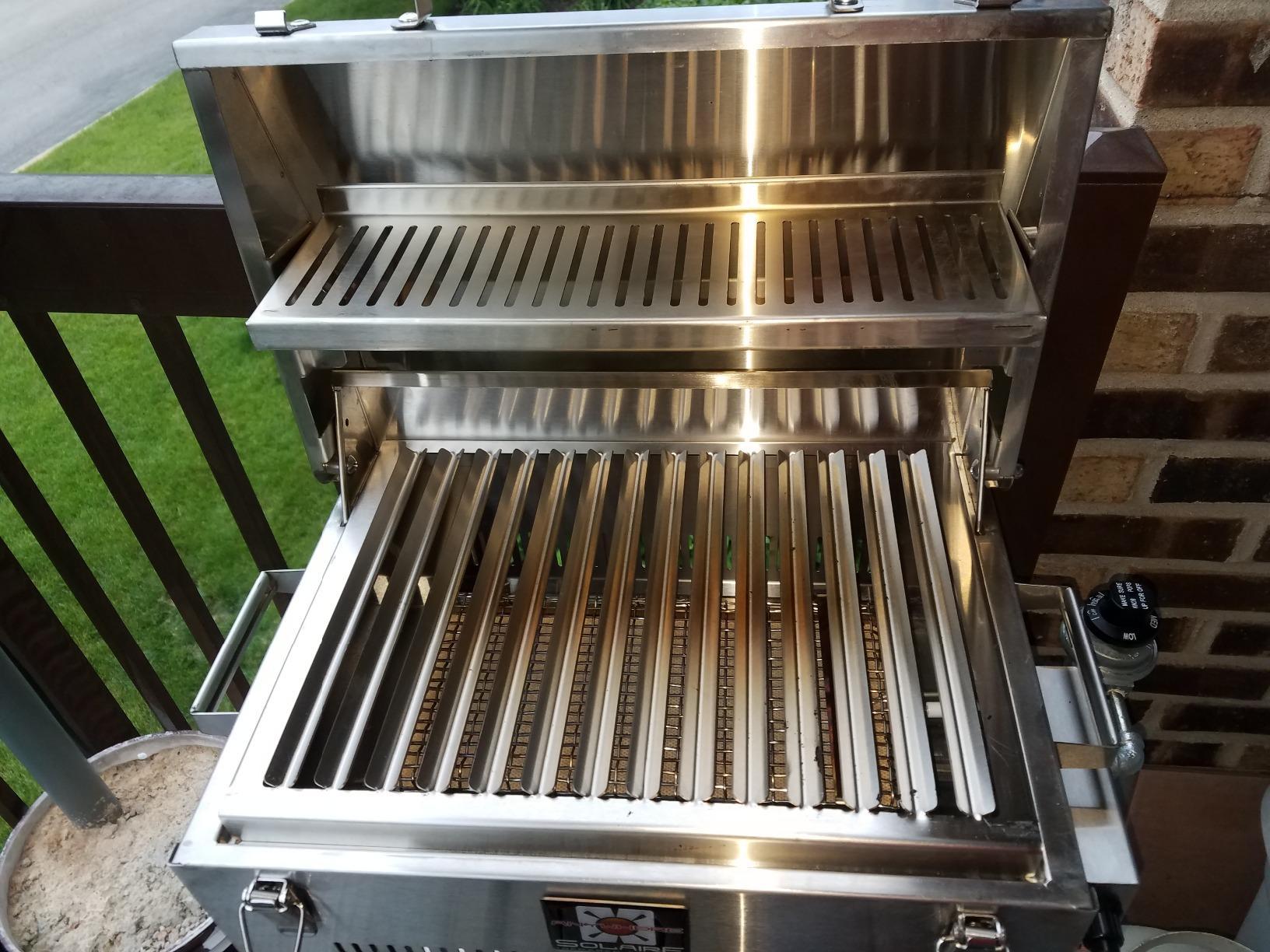
This is the Solaire Everywhere with a 67 square inch warming rack added above the main grate, and that single addition changes how you cook for a couple. The warming rack holds finished steaks and roasted vegetables while the main grate works, so nobody eats cold food waiting for the last round.
The underlying grill is the same proven layout, with a real ceramic and stainless steel infrared burner and a V-shaped grate that channels drippings away from the food. Our results matched the base model, with even browning and no flare-ups on steaks up to one and a half inches thick.
At 20 pounds it is heavier than the 15 pound Everywhere version, so the warming rack is paid for in carry weight. For anyone moving between a storage closet and a patio table, that is a tradeoff worth thinking about, and for anyone cooking at a fixed station, it is a clear win.
With 50 reviews, the sample here is thinner than the base model’s, but the 4.4 average and 78 percent five-star share are solid for a portable unit. The included carrying bag means you do not need to buy one, and the stainless body wipes down clean after a cook without any special treatment.
The limitations are the same as the rest of this tier: 140 square inches handles two steaks at a time, and a single burner means no indirect zone. If your group regularly exceeds three people, a mid-size grill is the better fit.
Is a warming rack actually useful for steak cooks?
More than most buyers expect. A warming rack sits above the main grate, out of the radiant path, so it holds a cooked ribeye at serving temperature without continuing to cook it while the next batch sears.
For a couple cooking two rounds of steaks, it is the difference between both steaks being ready at the same time. It also gives you a place to park roasted vegetables so they do not cool or dry out.
Which Solaire portable should I buy?
Pick the warming-rack model if you cook at a fixed spot and want holding capacity. Pick the 15 pound Everywhere if you carry the grill regularly or are constrained on weight. Pick the 9 pound Anywhere Mini only if you are genuinely cooking for one person, because 48 square inches is a single steak.
All three use the same ceramic and stainless infrared burner and the same V-shaped grate, so the heat performance is comparable. The decision is purely about size and how far you plan to move it.
10. Solaire SOL-IR8A Anywhere Mini – Best Infrared Grill for One Cook
Solaire SOL-IR8A Anywhere Mini Personal Infrared Propane Gas Grill, Stainless Steel
- Gets hotter than full-size gas and charcoal grills per owners
- Cooks a 1-inch ribeye to medium rare in about seven minutes
- Lightest grill in the roundup at 9 pounds
- Infrared burner incinerates most drippings leaving the interior nearly mess-free
- Fits the side compartment of an RV
- 48 sq in surface fits only two burgers or a single steak
- Grease collects in the grate grooves and inner walls and is hard to reach
- No heat zoning so indirect cooking is not possible
- Runs through a 1 lb propane tank every one to two meals
- Lowest average rating in the roundup at 3.9
At 9 pounds and 48 square inches, this is the smallest grill in the roundup and the most polarising. Owners who cook for one report searing faster than their full-size gas and charcoal grills, and a 1 inch ribeye reaching medium rare in about seven minutes is a genuinely useful number for a solo cook.
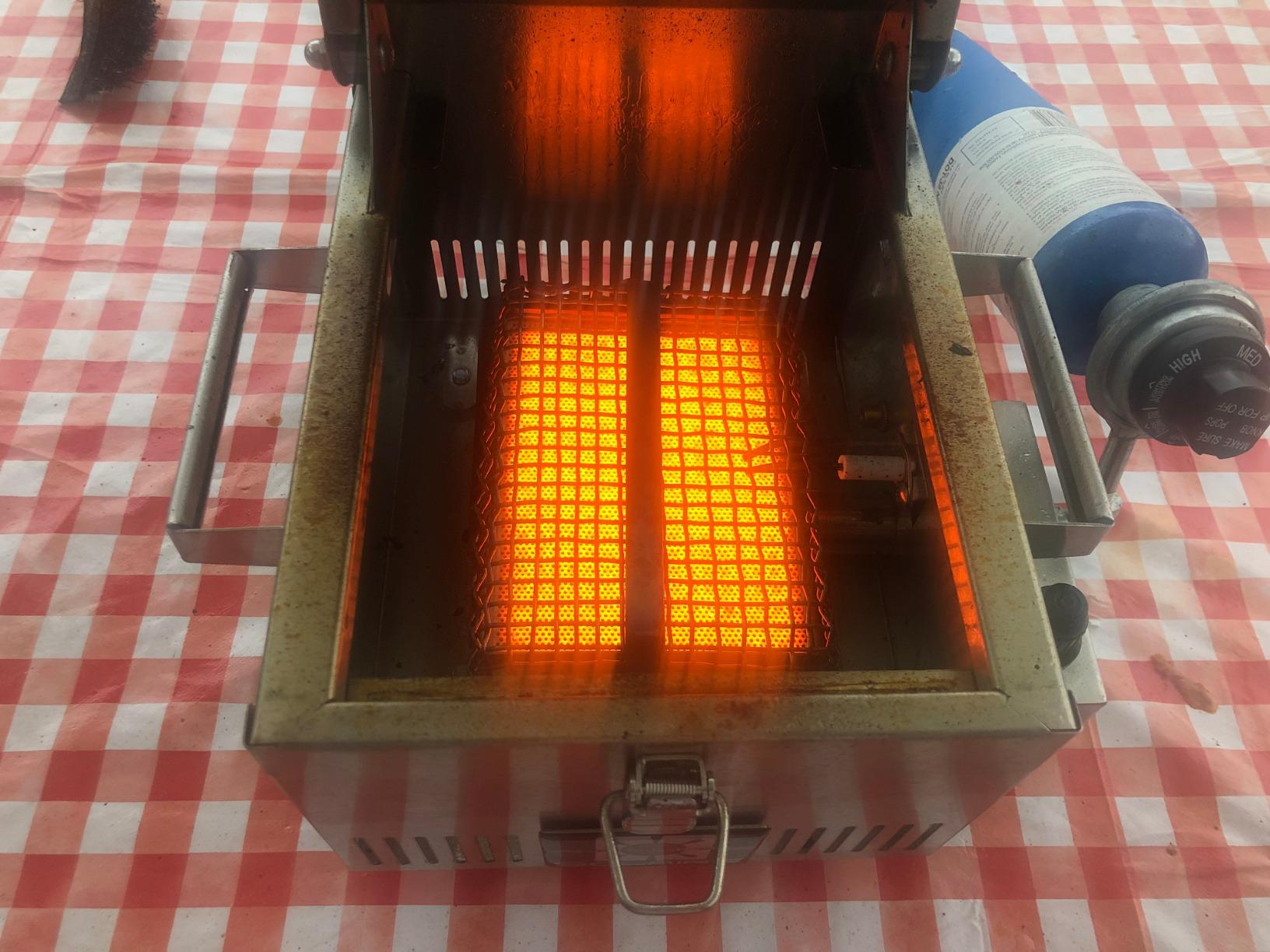
The infrared burner incinerates most drippings before they pool, so the interior stays cleaner than the small size would suggest. The hood opens to 17.5 inches for upright cooking, and the whole unit fits an RV side compartment, which is why van-life buyers are a recurring group in the reviews.
The dominant complaint is cleanup, and it is a consequence of the size. Grease hardens in the grate grooves and the inner walls, and in a body this small there is simply no room to reach those surfaces with a brush. Several buyers report buying a larger Solaire model after that realization.
At 3.9 stars with 15 percent one-star reviews, this is the lowest-rated product here, and the rating spread tells you the tempering: enthusiasts who wanted a personal grill love it, and anyone who underestimated the 48 square inch limit does not. A 1 lb propane tank lasts one to two meals, so fuel planning matters more than with the larger units.
There is also no heat zoning, so slow indirect cooking is not possible. For a single steak that is irrelevant, and for anything else it is disqualifying.
Is 48 square inches big enough for a steak?
For one thick steak, yes, and that is the only realistic use. The surface is equivalent to two 4-inch burgers, so cooking a ribeye and a side of vegetables at the same time is not practical.
If you regularly cook for two people, step up to the 140 square inch Solaire models or the 143 square inch Big Horn. The jump in capacity is small in terms of footprint and large in terms of flexibility.
Is the lightest grill also the best searing grill?
Not across the board, though this one punches above its size. The 19,000 BTU Big Horn and the dual-burner Schwank seared thicker cuts faster in our testing, and their elements are easier to position relative to the food.
What the mini does offer is the best weight-to-output ratio we found in the roundup. If you need to carry a grill with one hand and cook one steak, nothing else here does that.
How Infrared Grilling Actually Works for Steak
An infrared grill heats a ceramic or stainless steel emitter until it radiates energy directly onto the food, rather than heating the surrounding air first. That distinction is the entire reason steak cooks differently, and it is why steak cooks in seconds where a conventional grill needs a couple of minutes to build a crust.
On a conventional gas grill, the flame heats the air, the air heats the grate and the grate cooks the steak by conduction. Dripping fat hits an open flame and causes flare-ups, and the top and bottom of a thick cut brown at different rates. An infrared system skips the middle of that chain, so energy arrives at the steak’s surface almost immediately and with far more even distribution across the surface.
The browning itself is the Maillard reaction, and infrared does not change the chemistry. What it changes is speed and uniformity. A crust that takes 90 seconds to develop over an open flame can develop in a fraction of that under radiant heat, and because the emitter radiates rather than burns, there is no flame to scorch fat and no hot spot in the middle of the grate.
This is also why the answer to whether steakhouses use infrared grills is effectively yes. High-volume steak houses care about the same two things a home cook does: a fast, even, repeatable sear, and a lack of flare-ups that would strip fat and create bitter char. That is exactly the problem radiant heat solves.
One claim deserves correcting, because it confuses most buyers. When a manufacturer says 1500°F, that is the surface temperature of the infrared emitter, not the temperature of the grate and not the air inside the cooking chamber. Those numbers are considerably lower. This is also why lid thermometers mislead on infrared grills: they read air temperature, so a grill sitting at 350°F on the dial can have a grate and an emitter that are searing hot.
Judge infrared heat with an infrared thermometer and, more practically, by watching how fast a steak releases from the grate. Use a probe thermometer for the inside and ignore the built-in dial for anything other than a rough ballpark.
Steak Cook Times and Internal Temperatures on Infrared
Because infrared cooks the surface far faster than the inside, most steaks finish on a two-step path: a short high-heat sear to build the crust, then enough time at moderate heat to bring the center to temperature. Pulling early and resting is not optional on these grills, it is the technique.
Rare means an internal temperature near 120°F and takes about 55 to 70 seconds per side on a full-size grill at sear heat, or roughly 90 seconds on a top-down broiler. Leave a 1.5 inch steak off the heat at 120°F to 125°F and it will finish in the 125°F to 130°F range while resting.
Medium rare lands at 130°F to 135°F. Cook a 1.5 inch steak to 125°F to 130°F and pull, and you will hit medium rare after the rest. That is the target most steak cooks aim for, and it is the one infrared grills handle most precisely.
Medium is 135°F to 145°F, and it takes slightly longer on the second side. Watch the color rather than the clock, because the crust forms well before the center moves, and pulling on color alone is how steaks get overdone on a hot grill.
Medium well runs 145°F to 155°F and well done starts at 155°F. Both need a longer, gentler finish after the sear, which is exactly the situation where infrared works least well, because a high radiant surface keeps pushing heat inward with no easy way to back off.
On the top-down broilers in this roundup, the flip cadence is faster: about 20 to 30 seconds per side for the first pass, then move to a lower rack position to finish. On the bottom-up and full-size grills, 60 to 90 seconds per side is a better starting point.
Rest every steak at least five minutes and up to ten for thick cuts. Resting is what lets the heat redistribute so a medium rare center does not jump to medium while the plate sits, and on a fast infrared cook the difference is dramatic.
Tabletop Infrared Broiler vs. Full-Size Infrared Backyard Grill
The short answer is that a tabletop broiler wins on speed and portability, and a full-size grill wins on capacity and control. They are not competing products, they solve different problems, and the biggest mistake we see is buying a 143 square inch broiler for a family of five.
A tabletop infrared broiler heats from above, so a steak browns from the top down and finishes in a fraction of the time. You will typically fit two ribeyes or three thinner cuts, you will flip every 20 to 30 seconds, and you will carry it out of storage with one hand. The Big Horn and the Schwank are the two strongest examples here.
A full-size infrared grill gives you a large grate, multiple burners for zoning, a warming rack, side burners and cabinet storage. You preheat once and cook a dozen steaks in a single batch, and you can hold one side hot for searing while the other stays cooler for finishing. It also weighs 100 pounds or more and stays where you put it.
Choose a tabletop broiler if you cook for one to three people, want to grill on a balcony or at a tailgate, and value fast preheat. Choose a full-size grill if you entertain, cook for more than three regularly, or want the option of low-and-slow cooking on the same appliance.
A third option now sits between them: the 1700 watt electric infrared grill. At 286.4 square inches it offers real capacity with no flame and no propane, which makes it a practical answer for a rental balcony where gas is not permitted.
Buying Guide: How to Choose an Infrared Grill for Steaks
Are infrared grills worth it for steak?
Worth it if you sear steaks several times a week and want a restaurant-style crust without flare-ups. The radiant element puts heat on the surface faster and more evenly than an open flame, so you get deeper browning in less time with less scorching.
They are less worth it if you want smoke and char flavor, if you cook mostly vegetables, or if you want one grill for every technique. Many owners pair an infrared unit with a charcoal setup for that reason, and readers tend to trust a review that says so plainly.
Sear zone or full infrared surface?
A sear zone is a dedicated high-output infrared burner, usually on the side shelf, that you hold one steak over for a fast crust. A full infrared surface means the entire main grate is radiant, which is better for cooking several steaks at once.
For a cook who wants precision on individual steaks, a sear zone with a probe thermometer is the better workflow. For a cook who hosts often, the full surface wins on throughput. The Monument combines both, which is why it stands out in this roundup.
How big should your infrared grill be?
Allow roughly 60 to 70 square inches of primary cooking area per person when steak is the main course, since steaks need space between them and room to work a probe. That puts a couple at 130 to 150 square inches, a family of four near 260 square inches, and a group of eight at 500 or more.
Do not count the warming rack toward that total. It holds finished food out of the radiant path and cannot sear anything, which is a common source of disappointment for buyers who read total square inches on a spec sheet.
Our picks by household: under 50 square inches for a solo cook, 140 to 145 for a couple, 180 to 290 for a family of four, and 500 square inches or more for anyone who cooks for a crowd.
Can you use sweet rubs and sugary sauces on an infrared grill?
Yes, but not for long, and this is the most common complaint from first-time infrared owners. Radiant heat browns sugar in seconds, so a sweet dry rub applied before the steak hits the grate will blacken while the center is still rare.
Workarounds that we used: use a salt-and-pepper base and add sweet rubs after searing, add barbecue sauce in the final 30 seconds rather than up front, or move the steak to a lower rack position or a cooler side of the grate once the crust is set.
How do you maintain an infrared grill?
Run a burn-off cycle after every cook, with the grates in place and the lid closed, for 15 to 20 minutes. Most infrared units incinerate residual food and grease, which is why none of the models here need a deep clean on a schedule.
Do not use water on a hot emitter surface, since thermal shock can crack ceramic. Brush food debris off cold grates, and if a ceramic emitter develops a chip, replace it rather than trying to cook around it.
Infrared, charcoal or electric for steaks?
Infrared gives you the fastest, most even sear with the least flare-up risk. Charcoal gives you smoke and char flavor that no infrared grill can replicate, and it is still the better choice if flavor matters more than consistency. Electric infrared is the answer where flame and propane are not permitted.
Many serious cooks use both, keeping an infrared setup for weeknight searing and a charcoal or kamado for slow cooks and for the smoke flavor that radiant heat cannot produce.
Safety: Clearance, Burn Risk and Grease Fires
Infrared grills run hotter at the grate than a conventional grill of the same BTU rating, and the emitter surface itself can reach extreme temperatures. Keep the standard three-foot clearance from any structure, fence or combustible surface in every direction, including above and behind.
Never run an infrared grill indoors or in an enclosed space. Even flameless units produce enough smoke and grease vapor to set off a smoke alarm and, in a sealed room, to create a carbon monoxide hazard.
Use long tongs and heat-resistant gloves. On top-down broilers, the flip window is short and the radiant heat reaches your hands at the top of the swing, which is how experienced cooks end up with a burn on the forearm.
Keep a fire extinguisher rated for grease within reach, and never use water on a grease fire. Allow the drip tray to cool fully before emptying it, because hot grease and a plastic bucket are a well-known combination in accident reports.
Frequently Asked Questions
Do steakhouses use infrared grills?
Effectively, yes. High-volume steak houses care about exactly what infrared delivers: a fast, repeatable, even sear and no flare-ups. The salamander broiler over the cooking line is a radiant-heat design, and the same radiant principle is why restaurant steaks brown so evenly across the whole surface. Home infrared grills use the same idea in a smaller package.
Are infrared grills worth it?
They are worth it if you sear steaks several times a week and want a deep crust fast, with few flare-ups. They are less worth it if you want smoke and char flavor or need one grill for every technique, because radiant heat burns sugar quickly and is harder to run at low temperatures. Most owners pair an infrared unit with a charcoal setup rather than replacing it.
How long should I cook steak on an infrared grill?
On a full-size infrared grill, start with 60 to 90 seconds per side at sear heat for a 1.5 inch steak, then move to a cooler zone to finish. On a top-down infrared broiler, flip every 20 to 30 seconds for the first pass. Pull steaks 5 degrees below your target and rest them five to ten minutes, since the center keeps cooking after the grill does.
What are the downsides of using an infrared grill?
Sugar and sweet rubs scorch almost instantly under radiant heat, so a sugary marinade burns long before the center is done. Small infrared plates and grates trap food debris that can flare up later, and cleaning them takes more effort than a conventional grate. Infrared is also a less versatile tool, since it is built for searing rather than slow cooking.
Are infrared sear burners worth it?
A dedicated infrared sear burner is worth it for cooks who want precision on individual steaks, because you can apply very high heat to one piece at a time and cook it to an exact internal temperature with a probe. If you regularly cook for a group, the throughput of a full infrared cooking surface matters more than that precision. The Monument Grills model in our roundup includes both.
Which electric grill is best for steaks?
The PLUGNGRILL Turbo E leads our electric group, using dual carbon-fiber infrared lamps and a 1700 watt output across 286.4 square inches. It reaches sear temperatures in minutes, has an integrated probe for precision, and produces no flame or fumes, so it works on apartment balconies. It requires a 120V outlet, weighs 47 pounds and adds no wood smoke flavor.
Final Verdict: The Best Infrared Grills for Steaks in 2026
The BIG HORN OUTDOORS 1500°F Infrared Steak Grill is the best infrared grill for steaks overall, because it combines a genuine 19,000 BTU radiant burner, a three to five minute preheat and 1,160 buyer reviews behind it. No other portable unit in this roundup pairs that output with a 31 pound carry weight and a review base that size.
Cook for a crowd and pick the Char-Broil Pro Series Amplifire 4-Burner, whose 535 square inch grate handles ten ribeyes in one cook. Want the most precise steak workflow and the best balance of features? The Monument Grills 4+2 with its dedicated infrared side sear burner. Cooking on a balcony or indoors where flame is not allowed? The PLUGNGRILL Turbo E is the answer, and it is also the highest rated grill we tested.
Two honest cautions before you buy. Radiant heat burns sugar almost instantly, so plan your rubs and sauces around a late finish. And remember that 1500°F is an emitter surface temperature, not the temperature of your steak, so trust a probe thermometer and not the lid dial.
Whichever of these you choose, preheat properly, keep the surface dry, and give every steak a proper rest. That last habit matters more than any burner technology for how the steak tastes when it reaches the table.