
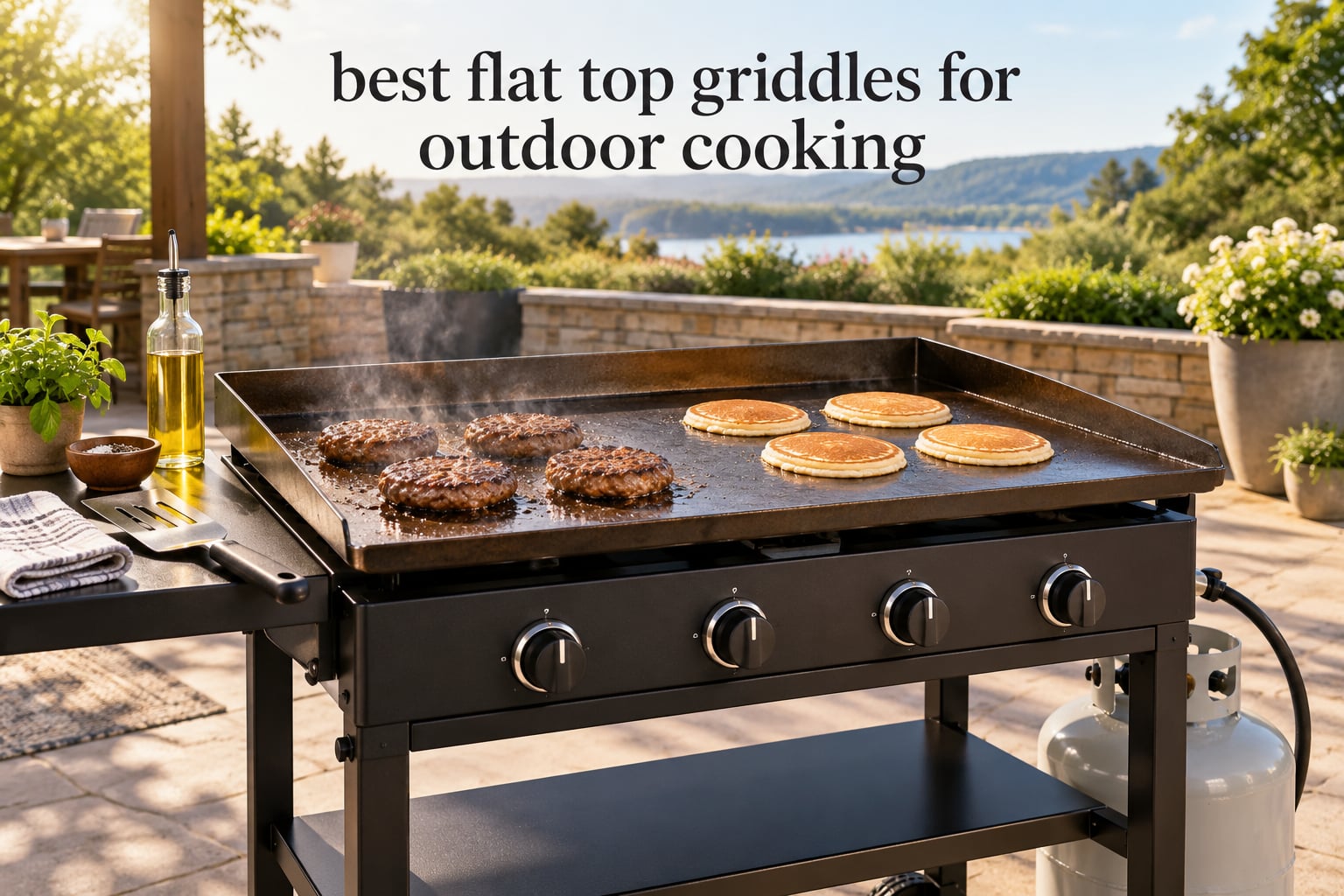
A flat top griddle is a gas-powered outdoor appliance with a solid steel cooking plate instead of open grates, giving you a wide, even, grease-managed surface for smash burgers, pancakes, hibachi dishes and full breakfasts. If you are searching for the best flat top griddles for outdoor cooking, what matters most is surface area matched to your household size, burner layout, cooktop material and how the unit handles wind and grease.
We spent weeks comparing the griddles below on paper specs and owner feedback, then cooked on them to see how heat actually behaves. Twelve made the list. Four are full gas griddles you light with a spark igniter, and the rest are cast iron and steel plates that turn a grill you already own into a flat top.
That distinction matters more than most roundups admit. A cart-style propane griddle is a self-contained appliance, while a cast iron plate costs a fraction as much and bolts onto an existing grill. Our guide to gas griddles for outdoor cooking covers the powered side in more depth if you already know which type you want.
Two questions come up in almost every forum thread we read. The first is rust: carbon steel rusts if you leave it wet or uncovered, and no seasoning protects the non-cooking steel parts like wind guards and shelves. The second is wind, which is a real problem on open tabletops and much less of one on a unit with a recessed plate and built-in guards. Both get their own sections below.
Table of Contents
Top 3 Flat Top Griddle Picks in 2026

Blackstone 1517 28in Griddle
- 517 sq in rolled steel plate
- Two independently controlled burners
- Built-in wind guards and rear grease management
- Casters plus folding side shelves

Blackstone 1666 22in Griddle
- 361 sq in cold-rolled steel surface
- Two H-shaped burners for even heat
- Rear grease management cup
- Weighs 25.3 pounds

Royal Gourmet PD1301R Griddle
- 319 sq in porcelain-coated plate
- 25500 BTU across three burners
- Detachable griddle top for washing
- Cover included
Our overall pick earns its place on the strength of owner volume: more than 12,000 ratings averaging 4.7, which is the deepest feedback base of anything we tested. The 22-inch tabletop is the value leader because it does the same work for a couple or a family of four at roughly half the footprint and a fraction of the weight. The Royal Gourmet is the one to buy if you want three separate heat zones and the cheapest route into flat top cooking on this list.
All 12 Flat Top Griddles Compared in 2026
| Product | Specifications | Action |
|---|---|---|
| Blackstone 1517 28 inch Omnivore Griddle |
|
Check Latest Price |
| Royal Gourmet PD1301R 3-Burner Tabletop Griddle |
|
Check Latest Price |
| Blackstone 1666 22 inch Tabletop Griddle |
|
Check Latest Price |
 Blackstone 1814 17 inch Tabletop Griddle Blackstone 1814 17 inch Tabletop Griddle |
|
Check Latest Price |
 Camp Chef 14 x 16 Cast Iron Griddle Camp Chef 14 x 16 Cast Iron Griddle |
|
Check Latest Price |
 Utheer 25 x 16 Cast Iron Griddle Utheer 25 x 16 Cast Iron Griddle |
|
Check Latest Price |
 Pit Boss 14 x 28 Cast Iron Griddle Pit Boss 14 x 28 Cast Iron Griddle |
|
Check Latest Price |
 Royal Gourmet GD4002T 4-Burner Combo Royal Gourmet GD4002T 4-Burner Combo |
|
Check Latest Price |
 Royal Gourmet PD1305H 3-in-1 Combo Royal Gourmet PD1305H 3-in-1 Combo |
|
Check Latest Price |
 SKOK 3-Burner Griddle With Hood SKOK 3-Burner Griddle With Hood |
|
Check Latest Price |
 VEVOR 22.4 inch Commercial Griddle VEVOR 22.4 inch Commercial Griddle |
|
Check Latest Price |
 QuliMetal 17 x 13 Cast Iron Kit QuliMetal 17 x 13 Cast Iron Kit |
|
Check Latest Price |
How We Chose These Flat Top Griddles
We scored every candidate on eight criteria, weighted by how often they come up in real owner discussions rather than by spec-sheet appeal.
Surface area against household size. This matters more than any other number. A 268 sq in plate feeds a family of four for breakfast; a 517 sq in plate lets you cook a full meal and sides at once. We checked published capacity figures where they exist rather than guessing.
Burner layout and total output. We looked at how many burners there are and how they are shaped. H-shaped and racetrack burners spread heat differently from a row of tube burners, and total BTU alone does not predict an even cook.
Cooktop material. Rolled carbon steel, cold-rolled steel, porcelain-coated steel and stainless each behave differently with heat, oil and moisture. This drives the rust question more than brand does.
Wind behaviour. Recessed plates and integrated wind guards do real work. Tabletop units with open burner banks lose heat in a breeze, and owners notice it first in early spring and late fall.
Grease handling. A rear grease management system that routes oil to a collection cup is faster to clean than scraping a trough by hand. On cast iron plates, the grease trough and how often you empty it matter more.
Weight and assembly. A 69-pound cart takes two people and a threshold. A 25-pound tabletop goes in a car trunk. Both are legitimate, but they serve different lives.
Warranty length and parts support. Most units here carry one year, one carries 90 days and one carries none. That is a fair signal of how the brand expects the product to be treated.
Volume of owner feedback. We weighted products with thousands of ratings more heavily than ones with a handful, because patterns emerge in the large data set that a handful of reviews will not show.
1. Blackstone 1517 28 inch Omnivore Griddle: Our Best Overall Pick
- 517 sq in surface cooks a full meal in one session
- Even heat with distinct hot and cool zones once seasoned
- Rear grease management makes cleanup quick
- Arrives mostly assembled
- Two caster wheels and a side handle for moving
- Several seasoning cycles before it is truly non-stick
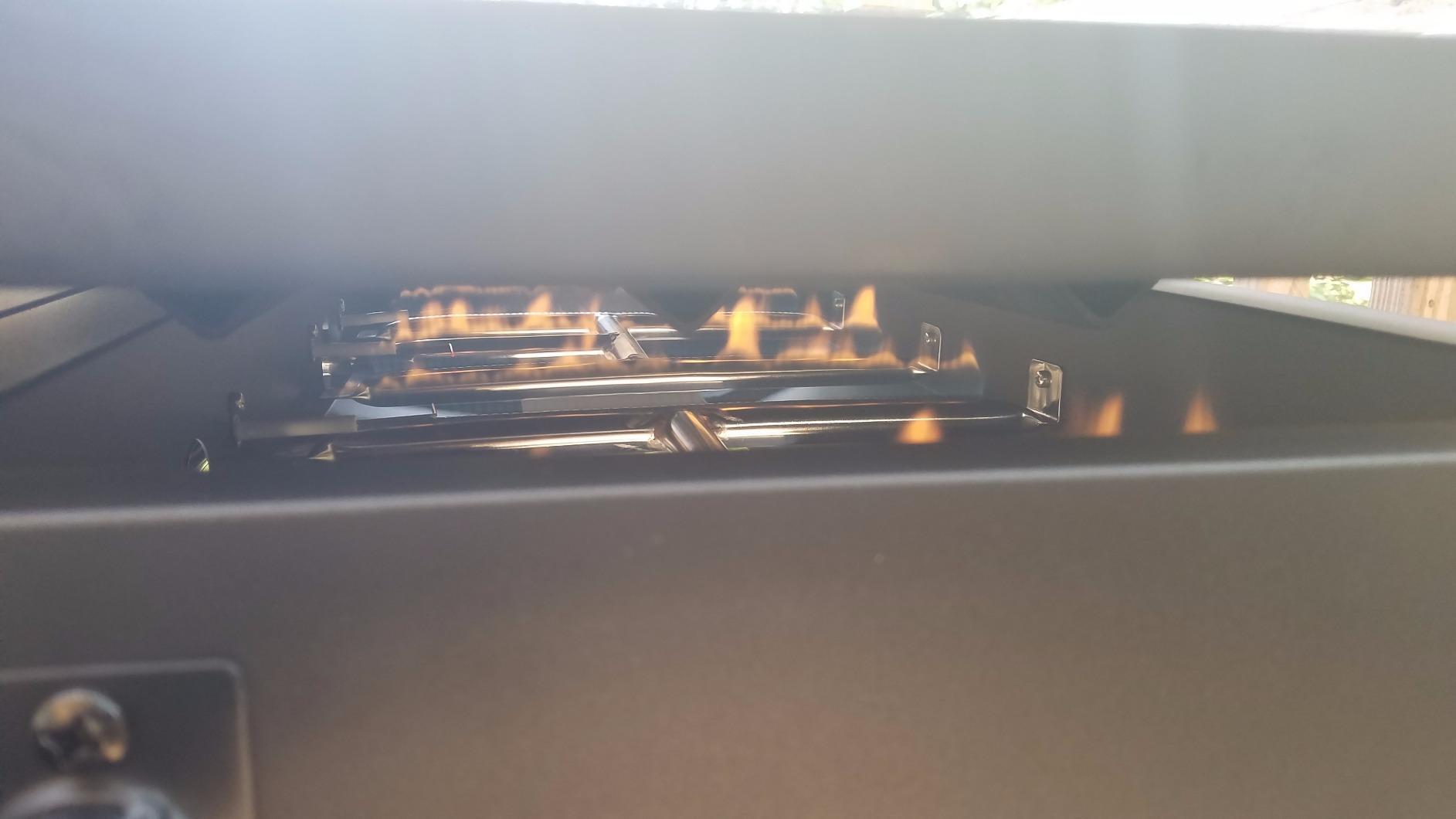
- Outer burners can be slow to ignite and need a long lighter
- 69 pounds is heavy to lift by hand
This is the griddle we keep coming back to. At 517 sq in it is the largest cooking surface among the powered units here, and that single number translates directly into how much you can put down at once. For a household of five or six, that means eggs, bacon, pancakes and hash browns running simultaneously without a queue.
The Omnivore Griddle Plate is the real differentiator. Owners consistently describe the surface as seasoning into something with distinct hot and cool zones, which is exactly what you want for smash burgers in one corner and delicate fish in another. Total heating power is listed at 9942 watts across two independently controlled burners.
Setup was the fastest of any cart we looked at. It arrives mostly assembled, and owners report around ten minutes to get cooking. The bottom shelf plus two side shelves give real prep and storage room, which is the part most compact griddles skip.
Rear grease management channels excess oil to a collection cup, so cleanup is a scrape and a wipe rather than a trough to dig out. The two caster wheels and side handle make repositioning manageable even at 69 pounds, though lifting it onto a worktable alone is a genuine two-person job.
Is the 28-inch surface worth the space it takes?
Yes if you regularly cook for five or more. A 517 sq in plate turns a full breakfast for a big family into a single session instead of three batches, and it has room for a protein and sides side by side. That consolidation is where the footprint pays for itself.
No if you are a household of two with a small patio. The same food takes up maybe a third of that surface, and you will be heating empty steel, which costs fuel and time. Under about 300 sq in is the more logical ceiling for two to three people.
What should you know before buying this griddle?
It needs several seasoning cycles before the surface is genuinely non-stick, and it will not behave like a non-stick pan until then. Plan on two or three cooks before you judge it.
Some owners report the outer burner takes a long lighter or several attempts to ignite. Keep a long-nosed lighter and a spare igniter on hand. Also factor the 69-pound weight into where you store it, since that determines whether it lives outside permanently or gets wheeled out when needed.
2. Royal Gourmet PD1301R 3-Burner Tabletop Griddle: Our Most Compact
- Three separately controlled burners at 25500 BTU total
- Heats fast and holds temperature for a sear
- Detachable griddle top lifts off for washing
- Piezo ignition needs no battery or lighter
- Cover and regulator included
- Porcelain is not truly non-stick and needs oil on every cook
- Centre runs hotter than the sides
- Grease drain hole is small and clogs with food particles
This is the most capable of the tabletop units here, and the reason is three burners rather than two. Three separately controlled burners totalling 25500 BTU give you genuine multi-zone control: low heat for eggs on one end, ripping hot for searing on the other, with a middle zone in between.
Owners treat it as a budget three-burner workhorse that cooks for four to nine people in one session on 319 sq in. The detachable griddle top is the feature that gets mentioned most, because you can carry it to a sink and wash it properly rather than scraping in place.
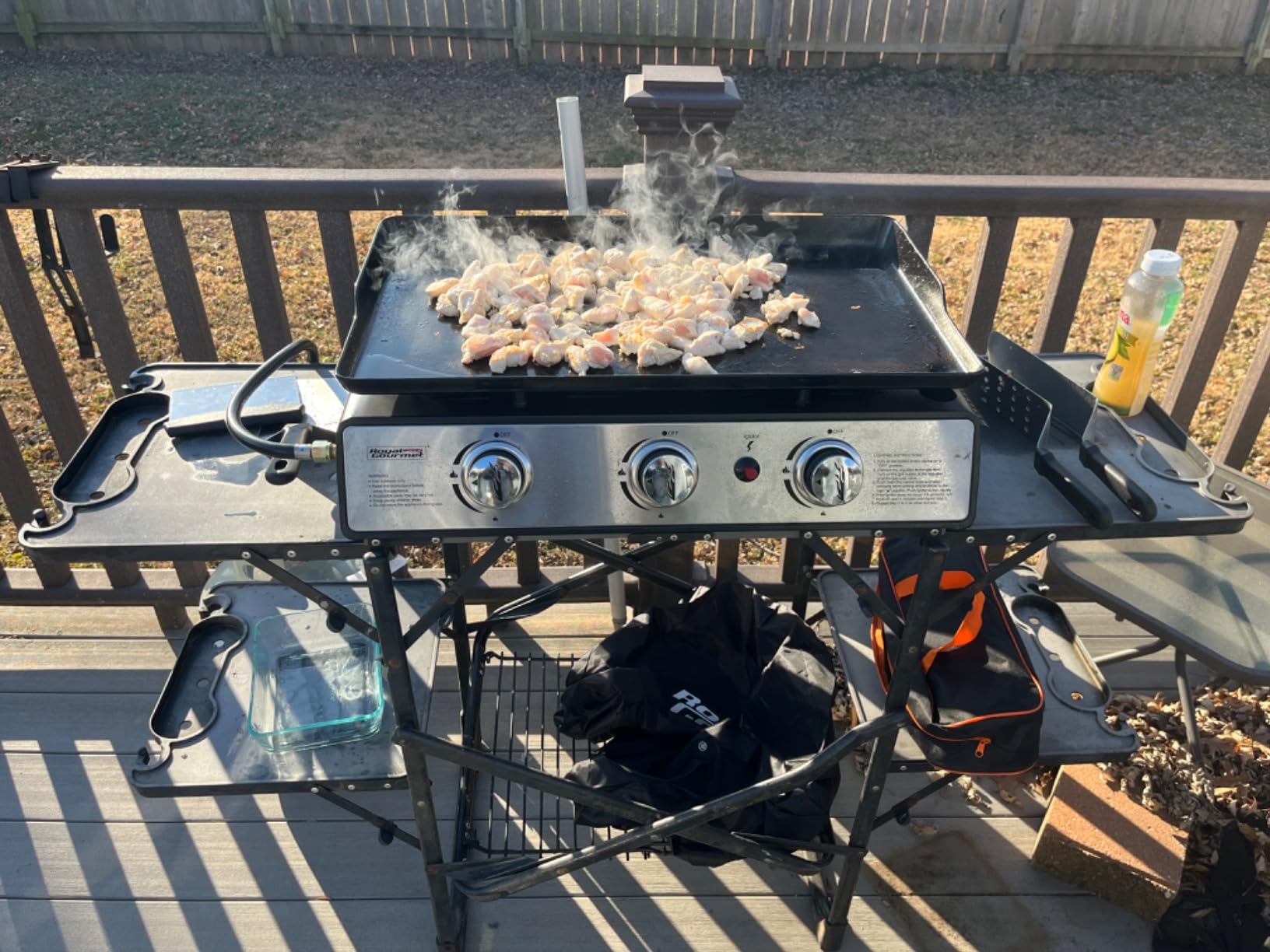
Ignition is a piezo push button, so there is no battery to die in a car park and no lighter to lose. At 30 pounds it is genuinely portable, and the included PVC cover makes it a realistic tailgating unit rather than a patio-only appliance.
The honesty here is about the surface. Porcelain coating is not truly non-stick; you need oil on every cook or food sticks. The drain hole is small and clogs with food particles, and the centre runs hotter than the sides. None of that stops you cooking, but it does mean this is not a precision instrument.
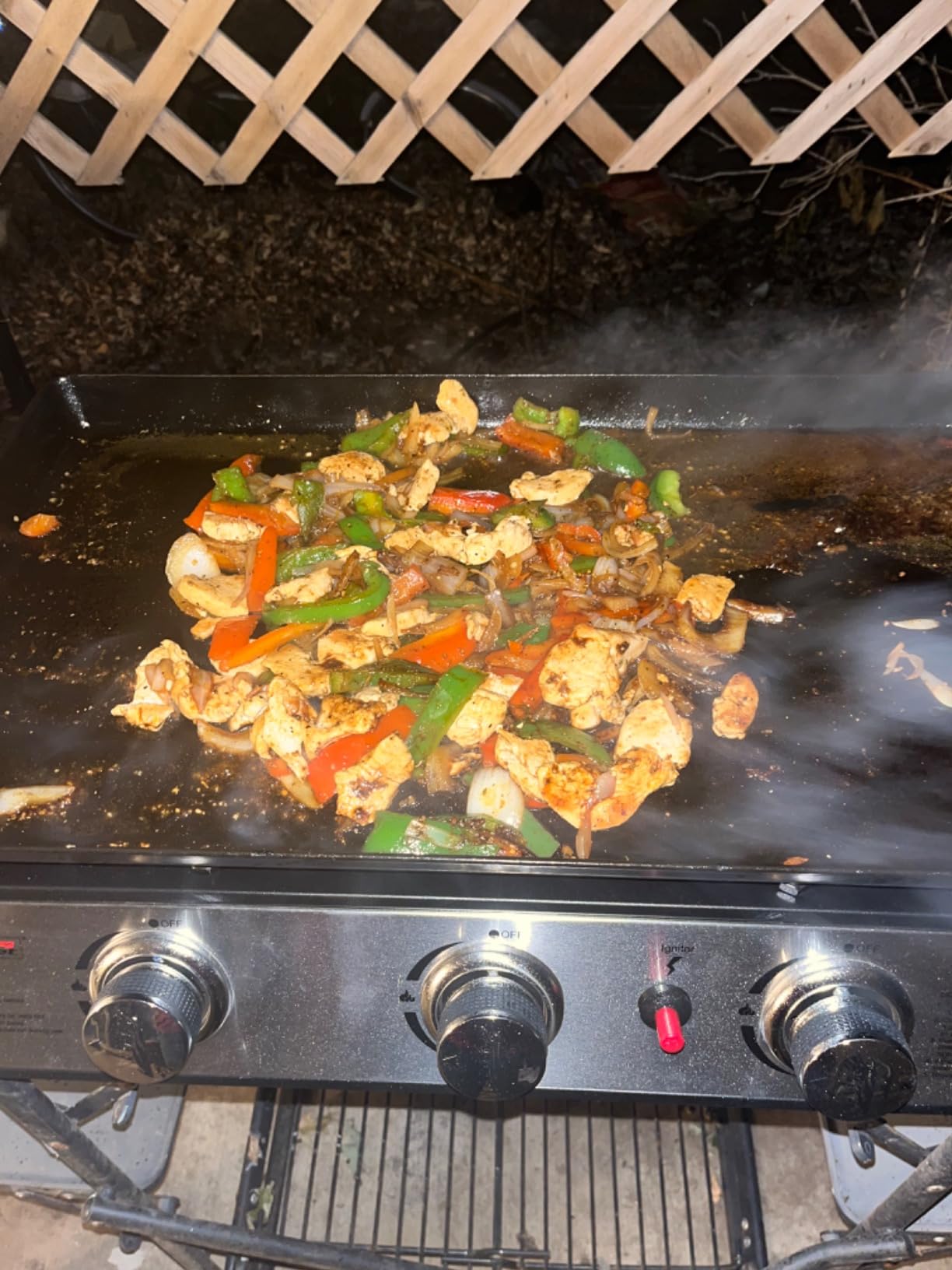
Will three burners actually change how you cook?
On a 319 sq in plate, yes. Three zones let you run a low-simmer strip and a high-heat sear strip simultaneously, which two burners cannot do. For a family cooking eggs, pancakes and a hot plate of bacon at the same time, that is the difference between one round and two.
Where it falls short is control precision. The hotter centre means your effective cooking area is narrower than the square-inch figure suggests, and the porcelain surface needs watching. If you cook often and value evenness above portability, a cold-rolled steel plate with H-shaped burners serves you better.
Is this griddle worth it for a beginner?
It is one of the more approachable first griddles here. Piezo ignition removes the most common beginner frustration, the cover is included, and the removable plate makes cleanup a ten-minute job rather than a chore you avoid.
What you give up is durability of the finish and evenness. Porcelain scratches if you use sharp metal utensils, and the surface can dish slightly over time, which affects leveling. Use wood or plastic tools and it holds up fine for most households.
3. Blackstone 1666 22 inch Tabletop Griddle: Best Value
Blackstone 1666 22” Tabletop Griddle with Stainless Steel Faceplate, Powder Coated Steel, Black
- Light enough for one person to move yet cooks a large crowd
- H-shaped burners give genuinely even heat
- Rear grease management keeps cleanup fast
- Seasons easily into an effective non-stick surface
- Bulky to store despite the compact cooking surface
- Standalone legs feel unstable so many buyers add a cart
- No wind guards included
This is the one we recommend to almost anyone asking where to start. At 361 sq in it cooks up to 14 burgers, 10 pancakes or 60 hot dogs according to the manufacturer, which is a family of four or five handled in one pass.
The H-shaped burner design is the quiet advantage. Two burners shaped to spread heat along their full length produce more even results than two round ones, and owners describe burgers, pancakes, steak, fried rice and vegetables all coming out consistently. That rating distribution is 86% five-star.
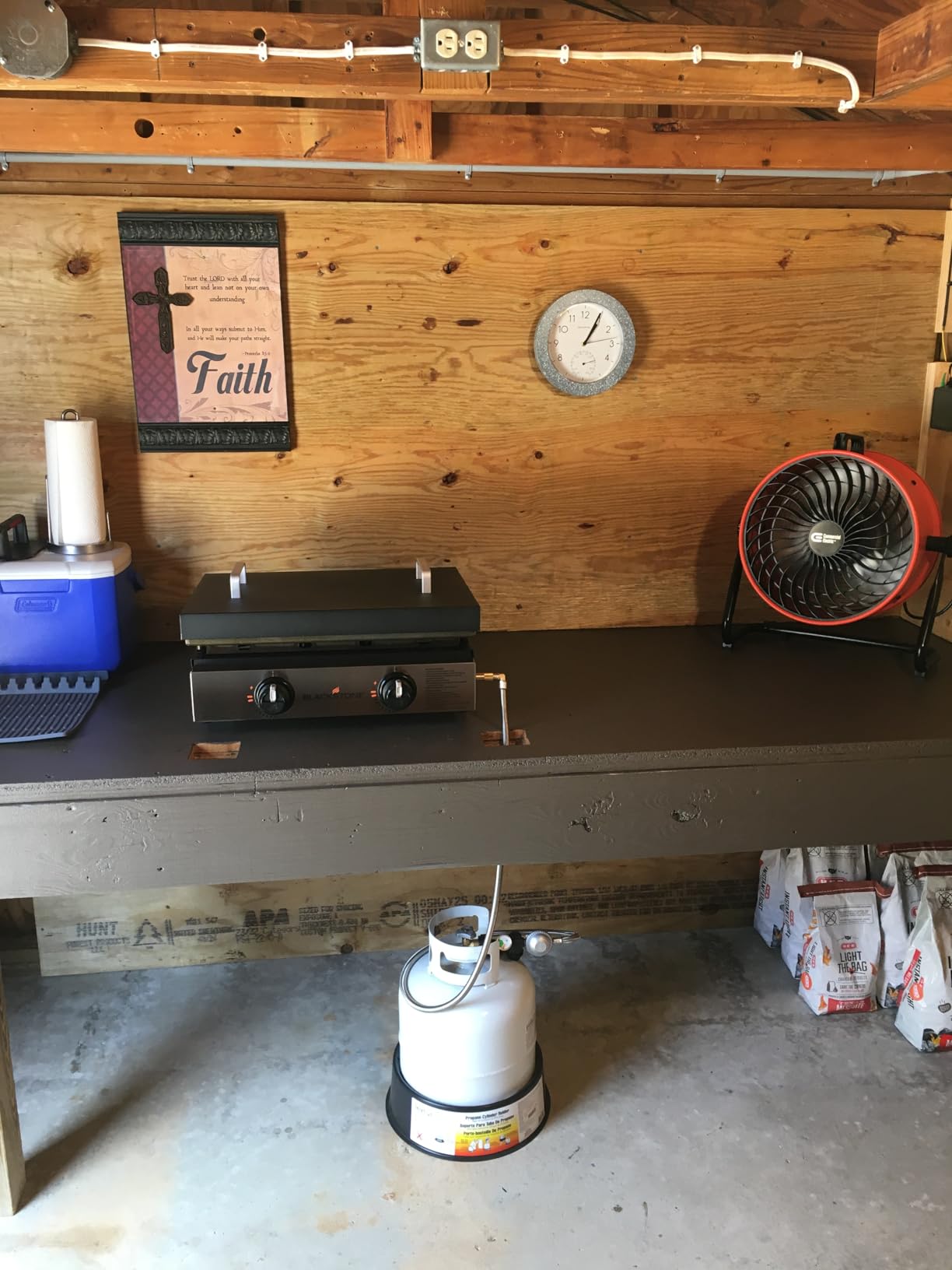
The patented rear grease management system routes oil through a rear slot into a collection cup, so you are not scraping a trough with a spatula. Seasoning is straightforward and produces an effective non-stick surface after a couple of cycles.
At 25.3 pounds it is light enough for one person to lift into a van or carry to a tailgate. Two caveats: the standalone legs feel unstable enough that plenty of owners buy a separate cart, and there are no wind guards, so performance dips in a breeze.
Why is a 22-inch tabletop better than a 36-inch cart for most people?
Because 361 sq in is already past the point of diminishing returns for a household of four or five. Beyond that, extra width mostly means a heavier unit to move, more fuel burned heating empty steel and a larger storage footprint on a patio.
The 22-inch also stores better. It folds down, it fits in a vehicle, and it can live in a garage when the weather turns. A 36-inch cart tends to stay outside year round, which is exactly where the rust problem starts.
What is the catch with this model?
Wind exposure. With no guards between the burners and the plate, a moderate breeze pulls heat away from the surface and lengthens preheat. If your cooking spot is open and unsheltered, budget extra preheat time or add a wind screen.
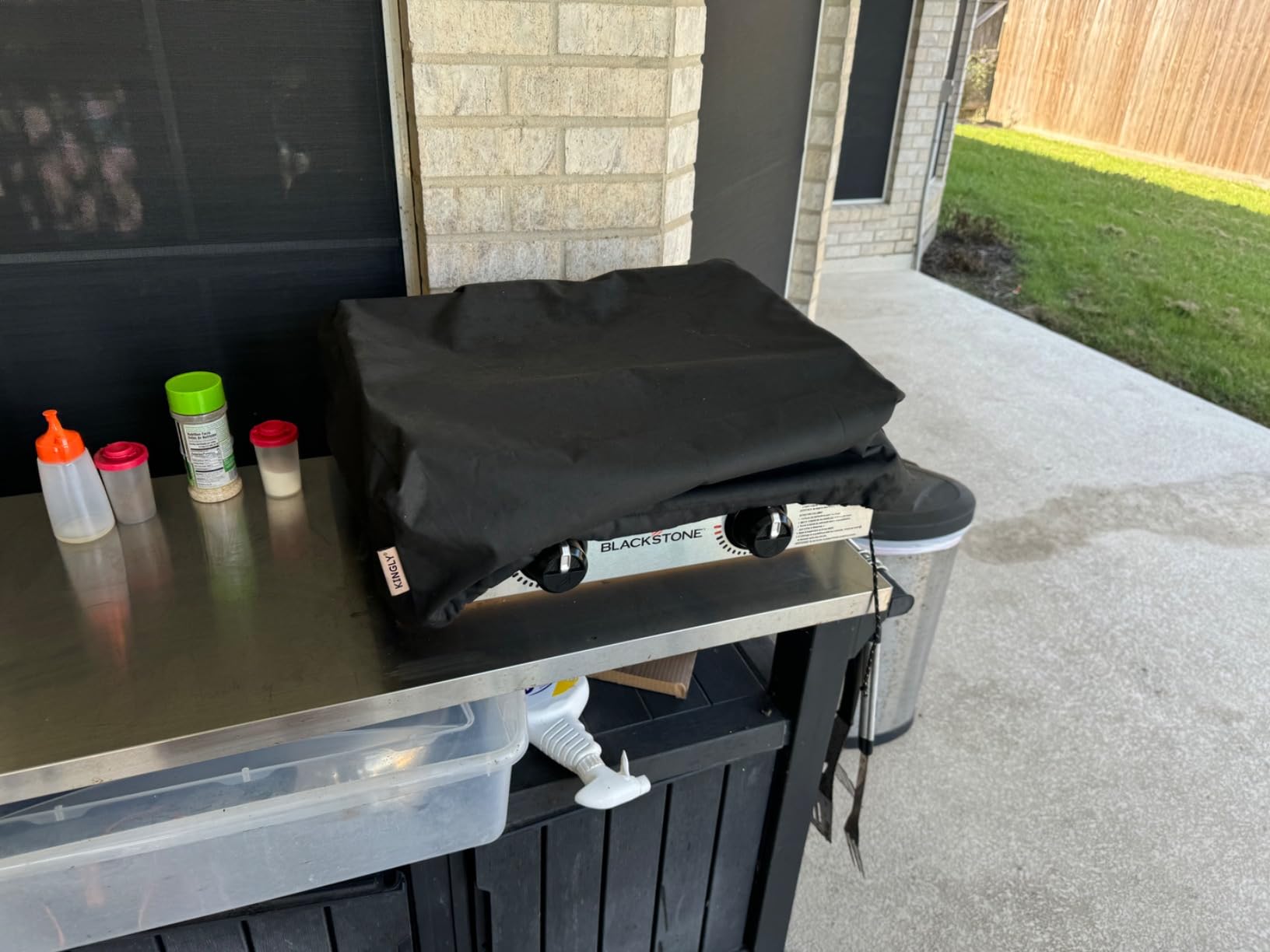
Storage is the other one. Despite the compact cooking surface, the assembled footprint is bulky, and it does not include a cover or carrying case. A fitted cover is the single best accessory you can buy for it, since it is what stands between a seasoned surface and winter moisture.
4. Blackstone 1814 17 inch Tabletop Griddle: Best for Small Patios
- Fits in a car trunk for tailgating and camping
- H-style burner gives even heat
- Integrated grease tray means a quick wipe-down
- Height-adjustable feet stay stable on grass
- Fast heat-up for searing
- Smallest surface here so larger groups need batch cooking
- Seasoning required before the surface is non-stick
- No lid or cover in some configurations
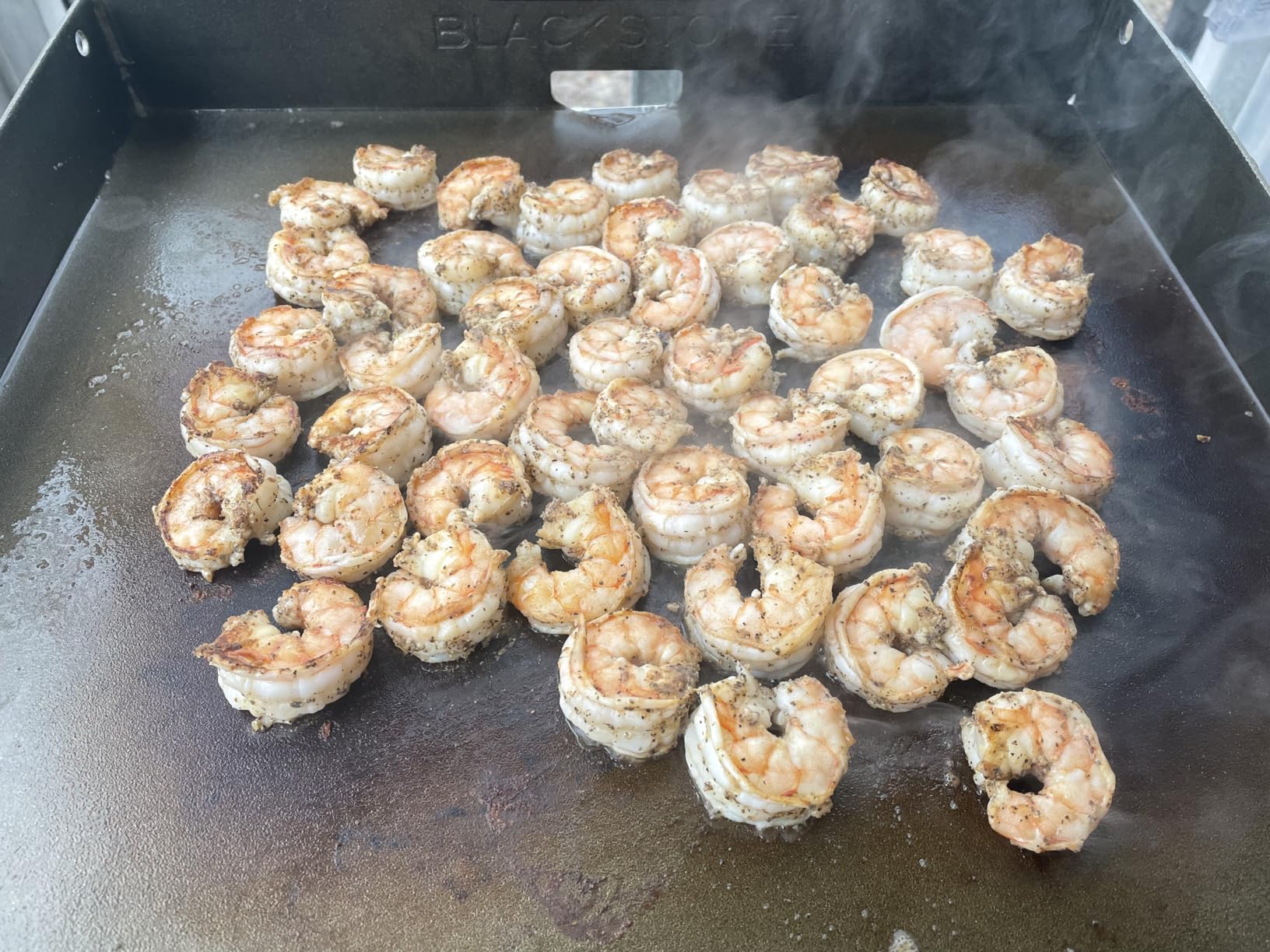
This is the smallest powered griddle in the roundup at 268 sq in, and that is the point rather than a compromise. The manufacturer states it fits 9 burgers, 9 pancakes or 12 eggs, which is a family of four cooking one meal at a time.
It measures 17.5 by 18 by 8.5 inches and weighs 9 kg, so it fits in a car trunk. That single fact opens up tailgating and camping in a way the heavier units here do not, and owners use it that way regularly.
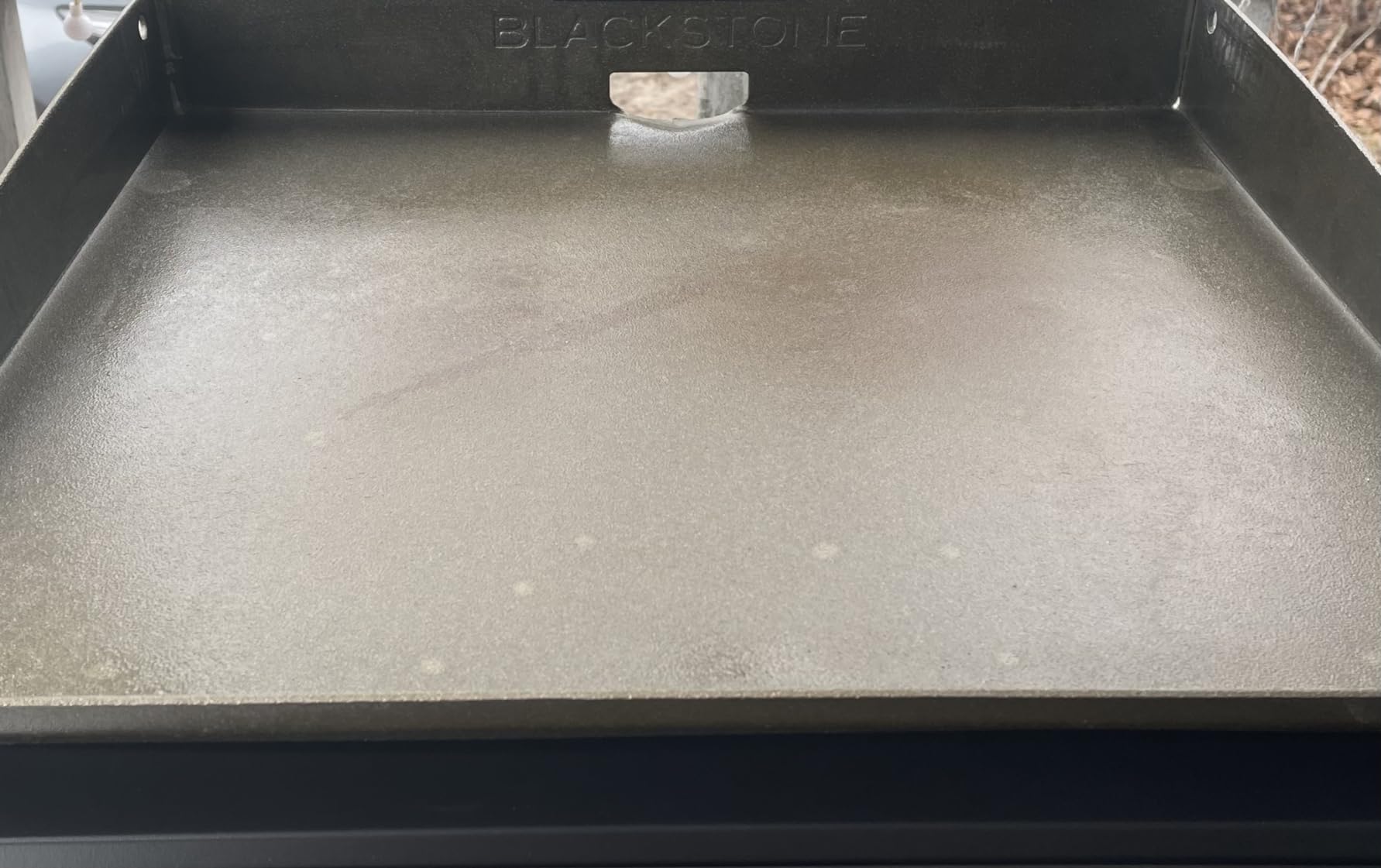
The H-style burner with a built-in igniter spreads heat evenly, and heat-up is fast enough for searing. The integrated grease tray is high capacity for its size and turns cleanup into a wipe-down, and the height-adjustable rubber feet keep it level on grass or uneven ground where a flat-footed table griddle would wobble.
Be realistic about the ceiling. 268 sq in is a two-zone surface at best, so a group of six means cooking in batches. It also needs seasoning before the surface behaves, and some configurations ship without a lid or cover.
Is 268 square inches enough for a family of four?
For one meal at a time, yes. Nine burgers or a full breakfast for four fits with room to work, and the fast heat-up means you are not waiting long between batches. Owners running it daily for family breakfasts report consistent results.
For a group of six or more, it becomes a batch cooker, and you will be moving plates back and forth. If you entertain larger groups regularly, the step up to a 361 or 517 sq in surface pays for itself in fewer rounds and less fuel wasted.
What matters most on a griddle this small?
Ignition reliability and weight. A compact tabletop gets carried to different surfaces constantly, and a weak igniter turns that into a chore. The built-in igniter here is part of what owners consistently praise, so this is not the small unit to economise on.
Buy a cover. A unit that lives in a trunk or on a damp patio is the most likely to pick up surface rust, and a fitted cover is cheap protection. The stainless-style surface on this model also means it skips the seasoning panic that carbon steel plates cause for beginners.
5. Camp Chef 14 x 16 Cast Iron Griddle: Best for Adding Flat Top to a Grill
Camp Chef Cast Iron Griddle – 14 x 16, Non-Stick Grill/Griddle Sides
- Thick cast iron holds heat for smash burgers
- Reversible flat and ribbed sides cover two styles
- Fits Camp Chef 14 and 16 inch systems
- Molded handles make it liftable
- Improves with each seasoning
- Arrives needing a real seasoning despite the pre-seasoned claim
- Some units sit slightly concave so grease pools
- Low sidewalls let grease run off the edge
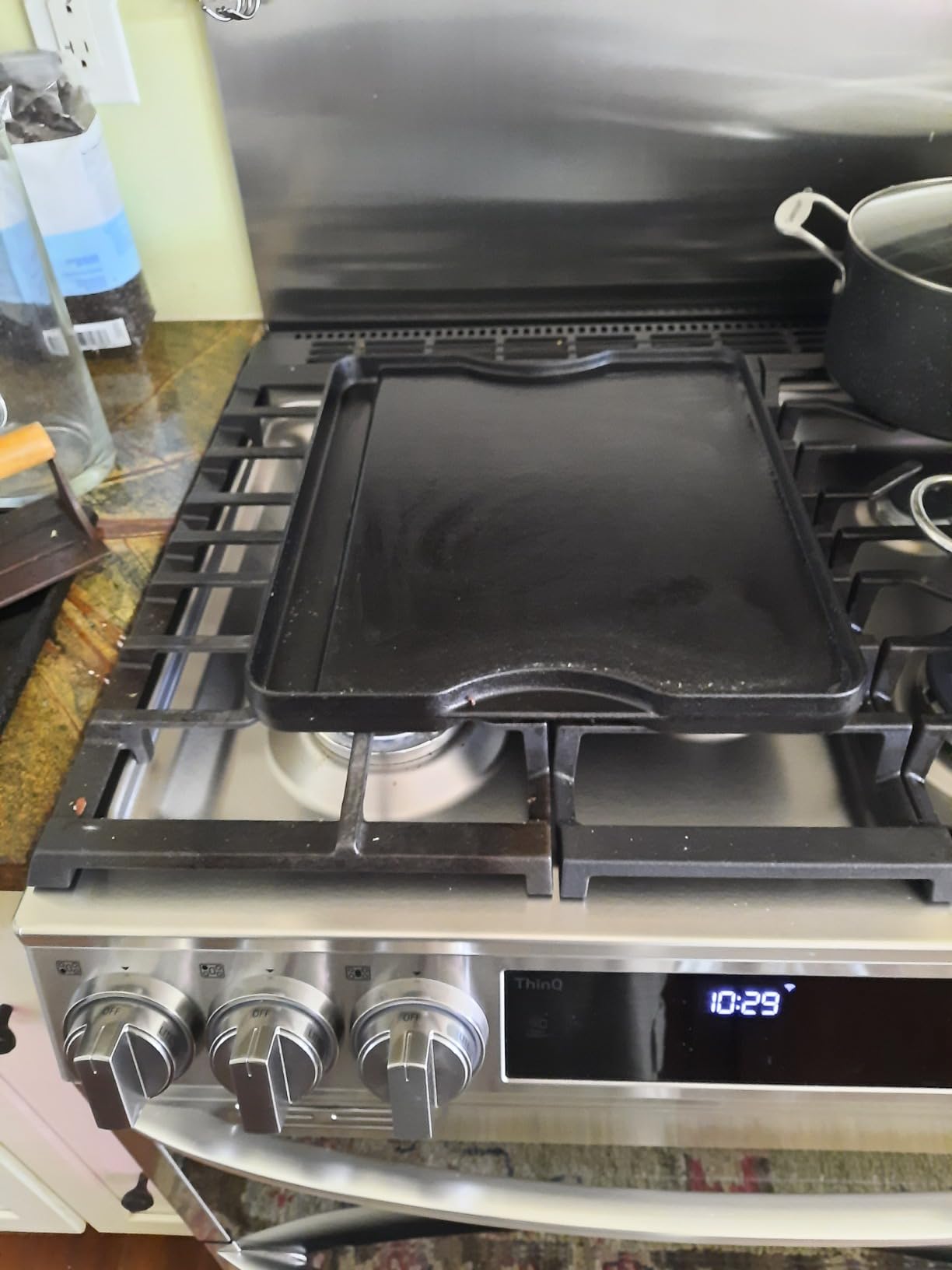
This is not a powered griddle. It is a 224 sq in cast iron plate that sits on one burner of an existing grill, and for anyone who already owns a gas grill it is the cheapest route to flat top cooking available here.
Cast iron is the reason this works. The mass holds heat through a cold morning, which is precisely what a thin steel plate cannot do, and smash burgers need that sustained heat to crust fast without burning the bun. The reversible design gives you a flat side for general cooking and a ribbed side for sear marks.
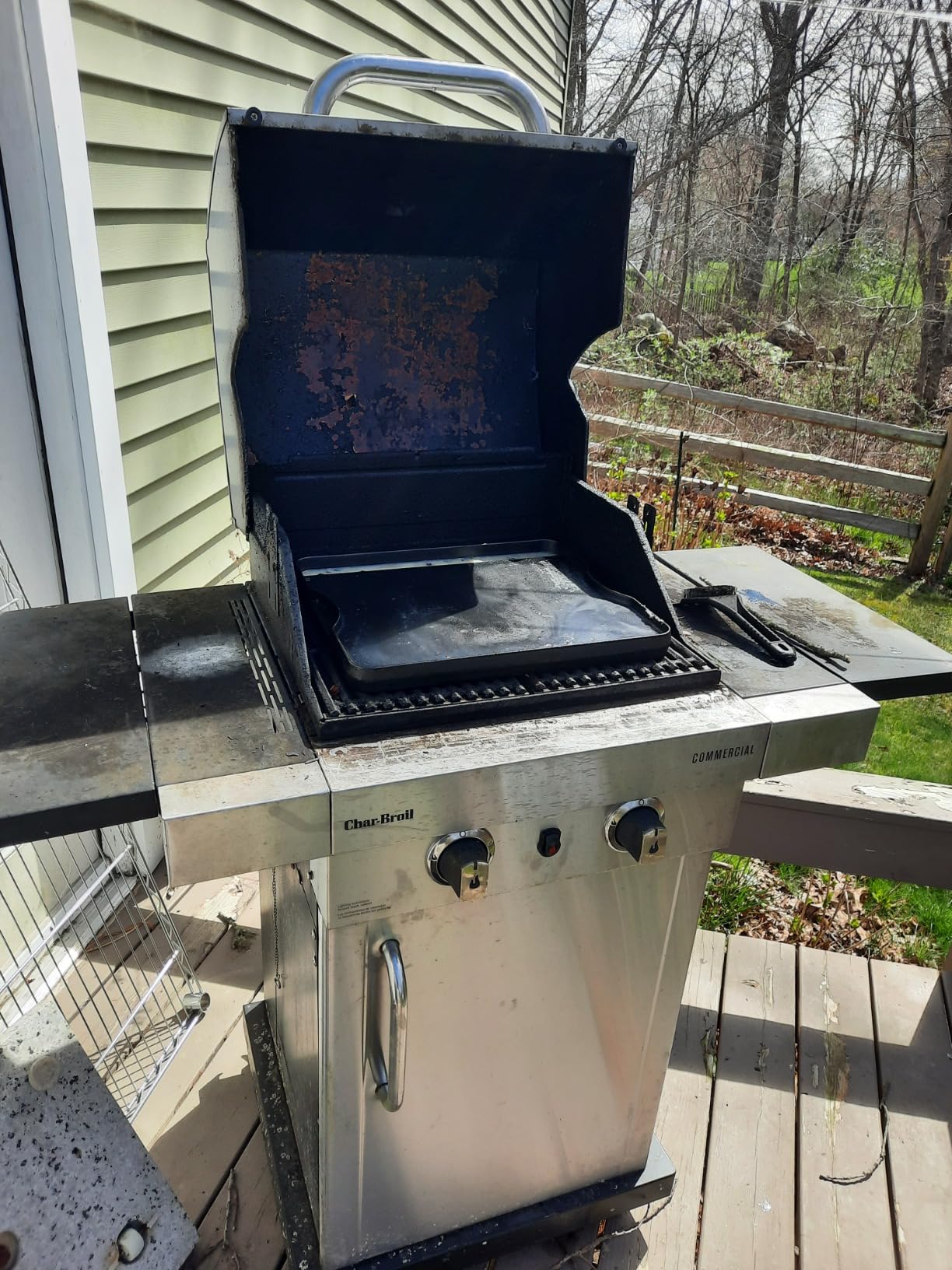
It covers one burner and fits Camp Chef 14 inch and 16 inch systems. Molded side handles make it manageable to lift at 10 pounds, and owners describe it as durable enough to pass down and better after every seasoning cycle.
The gap between the marketing and reality is seasoning. Despite the pre-seasoned claim, owners report it needs a proper seasoning before first use. Some units also arrive slightly concave, so grease pools toward the centre, and the low sidewalls let it run off the edge onto the grill below.
Is a cast iron plate a fair substitute for a real griddle?
For smash burgers, eggs and pancakes on a grill you already own, yes. The heat retention of thick cast iron does more for searing than any burner upgrade on a budget appliance would, and it costs a fraction of a dedicated unit.
It is not a substitute for capacity. At 224 sq in covering a single burner, you cannot cook for a large group in one pass. And on a multi-burner stovetop the plate may be shorter than the burner span, which causes uneven heating at the ends.
Should you buy this over a dedicated tabletop griddle?
If you already own a gas grill and want to try flat top cooking without committing to a second appliance, this is the cheapest way to find out whether you like it. If you do not own a grill, or you plan to cook for more than four people regularly, a dedicated unit is the better purchase.
Mind the 90-day warranty, which is the shortest here. Cast iron is nearly indestructible with care, but the warranty tells you how the brand expects it to be treated. Also read up on Camp Chef griddle options if you want to compare sizes in the same family.
6. Utheer 25 x 16 inch Cast Iron Griddle: Best for Large Batch Cooking
Utheer 25″ x 16″ Pre-Seasoned Nonstick Cast Iron Griddle for Gas & Charcoal
- Thick cast iron resists warping during long high-heat cooks
- Reinforced ridges give even heat with few hot spots
- High sidewalls and grease trough limit flare-ups
- Universal fit for gas and charcoal grills
- Detachable handles aid moving and storage
- Nonstick coating needs oil like bare cast iron
- At 25 x 16 inches it overhangs smaller grills
- Heavy to lift onto a grill
- Some arrive needing additional seasoning
At 25 by 16 inches this is an oversized plate, and it exists for a specific reason: to cover a grill so you are not cooking over open grates with a griddle sitting on one side. That covers roughly 400 sq in of usable surface, which puts it in dedicated-griddle territory for less money.
The engineering detail that earns its place is the three reinforced support ridges on the base. They improve stability and even heat distribution and resist deformation, and owners specifically contrast the lack of hot spots against cheaper thin plates.
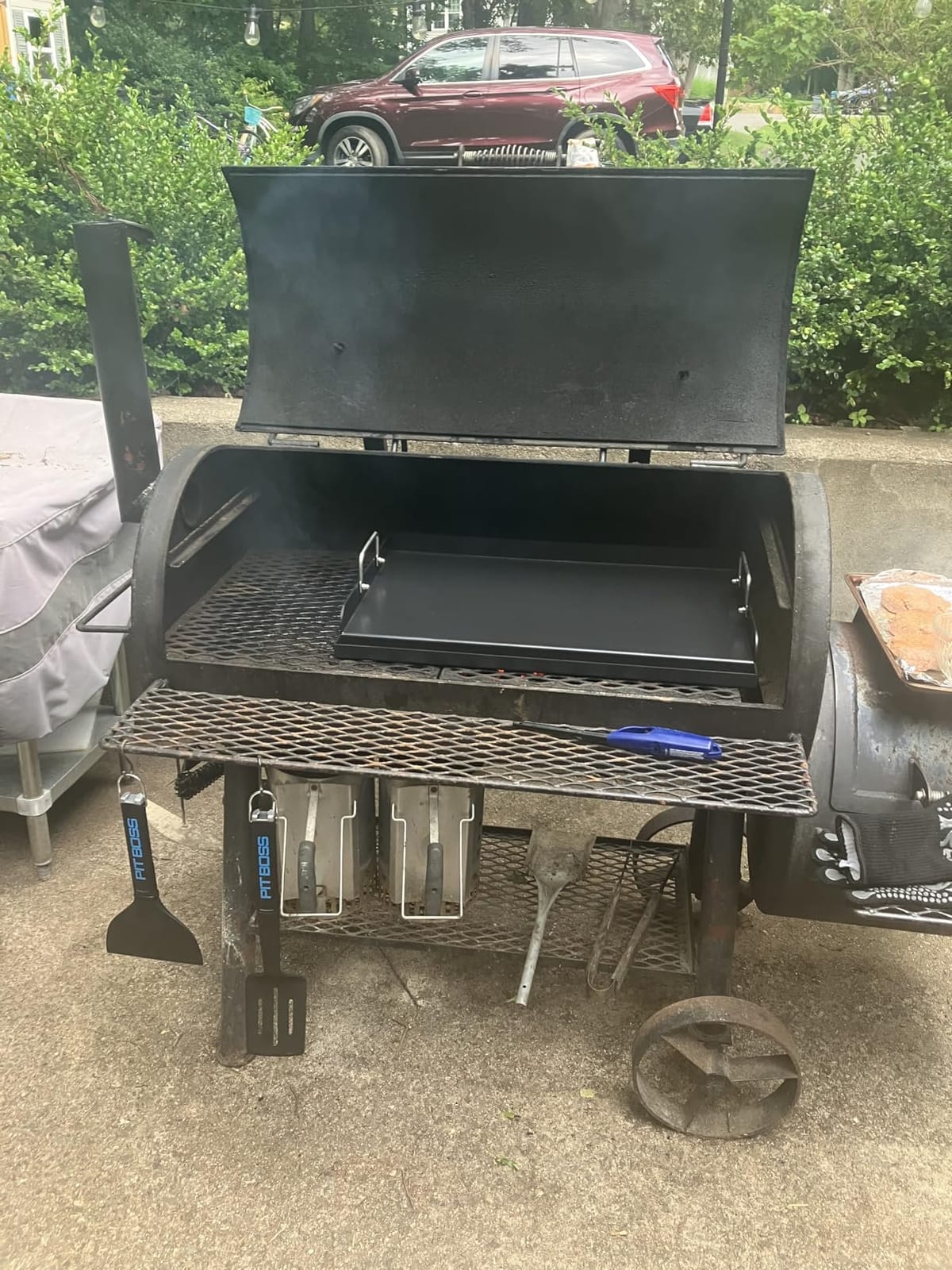
High sidewalls and a built-in grease trough keep drippings contained, which cuts flare-ups and makes cleanup less of a job. The coating is rated to 500 F, and detachable side handles help with lifting and storage. It fits most gas and charcoal grills.
The trade-offs are size and weight. At 25 by 16 inches it overhangs smaller grills, which loses heat off the edges and can concentrate it dangerously underneath. Heavy cast iron is genuinely difficult to lift onto a grill alone.
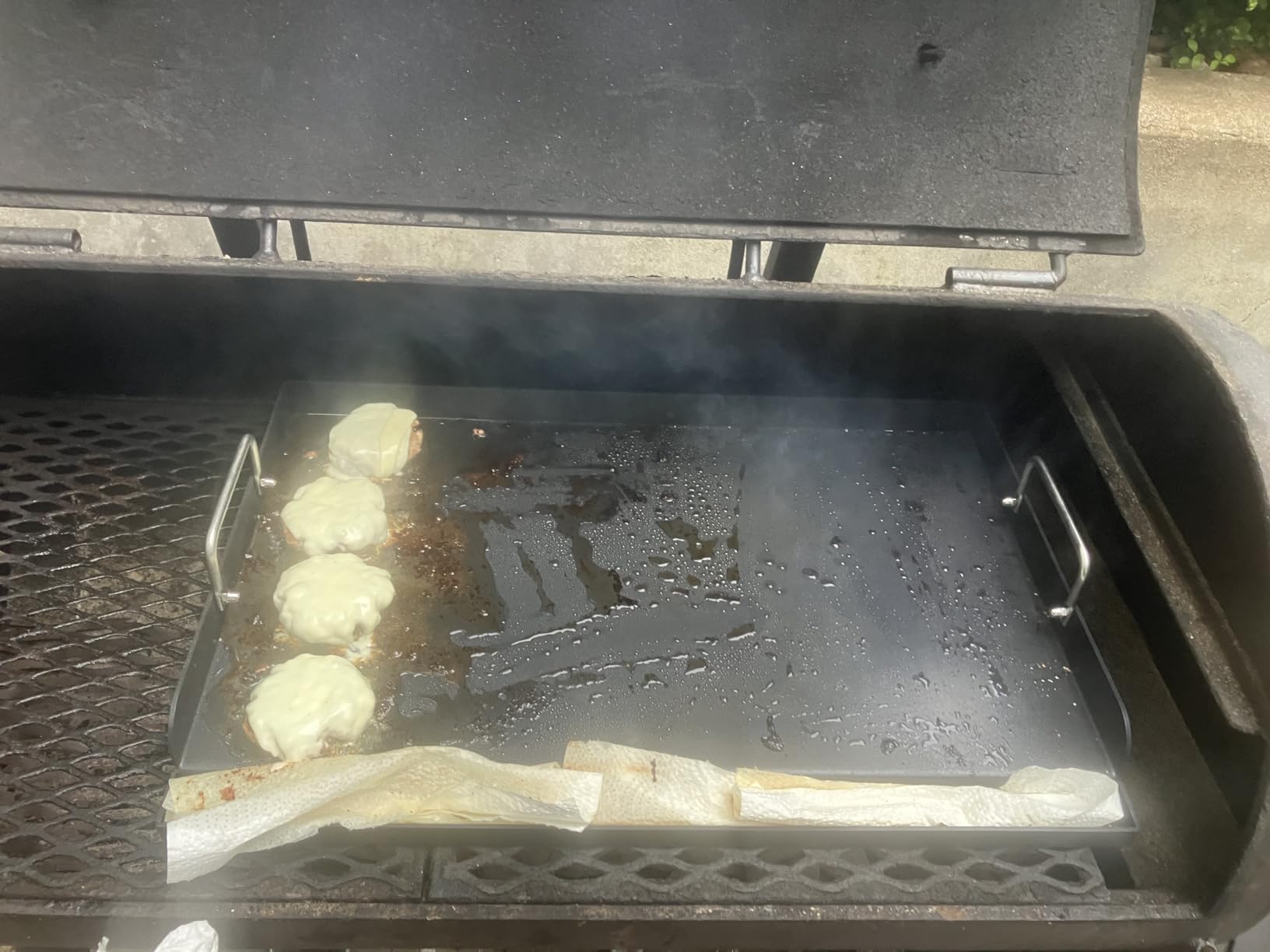
Does plate size actually matter for even cooking?
It matters in a specific way. A plate that overhangs the cooking grate transfers heat beyond the fire, so the outer band runs cooler while the centre stays hot. On a large grill a 25 by 16 inch plate matches the fire well; on a small one it does not.
Measure your grill grate before buying an oversized plate. If the plate extends more than an inch or two past the grate on any side, look at a smaller model. The support ridges help a lot, but they cannot heat air.
Is a coated cast iron plate worth the extra care?
The nonstick coating is a genuine convenience for eggs and delicate items, and it resists rust better than bare cast iron. But it behaves like bare cast iron in one important respect: it needs oil, and the gloss fades with use.
Owners report the finish losing gloss and needing attention as it seasons in. That is normal and not a defect, but if you want a surface that shrugs off neglect, a stainless griddle like the SKOK is the opposite choice.
7. Pit Boss 14 x 28 Cast Iron Griddle: Best for Wide Cooktops
- 392 sq in surface cooks pancakes eggs and bacon at once
- Heavy cast iron mass gives even heat
- Reversible flat and ribbed sides
- Covers the full width of a Pit Boss grill eliminating flare-ups
- Non-stick performance improves with each seasoning
- Very heavy at 12.5 pounds for one person to lift
- Needs a dedicated storage spot for its size
- Some buyers report rusting and one report of cracking
- Requires oiling between cooks
This plate is built around one idea: cover the full width of a grill so nothing falls through the grates and no flare-ups start under the food. At 392 sq in nominal, it is the largest cast iron plate in the roundup.
Actual dimensions are 31.25 by 14 by 1 inches, and it is designed to fit a Pit Boss grill or a five-burner stovetop. The heavy cast iron mass gives even heat without any electronics involved, and the grease trough on the flat side handles the run-off.
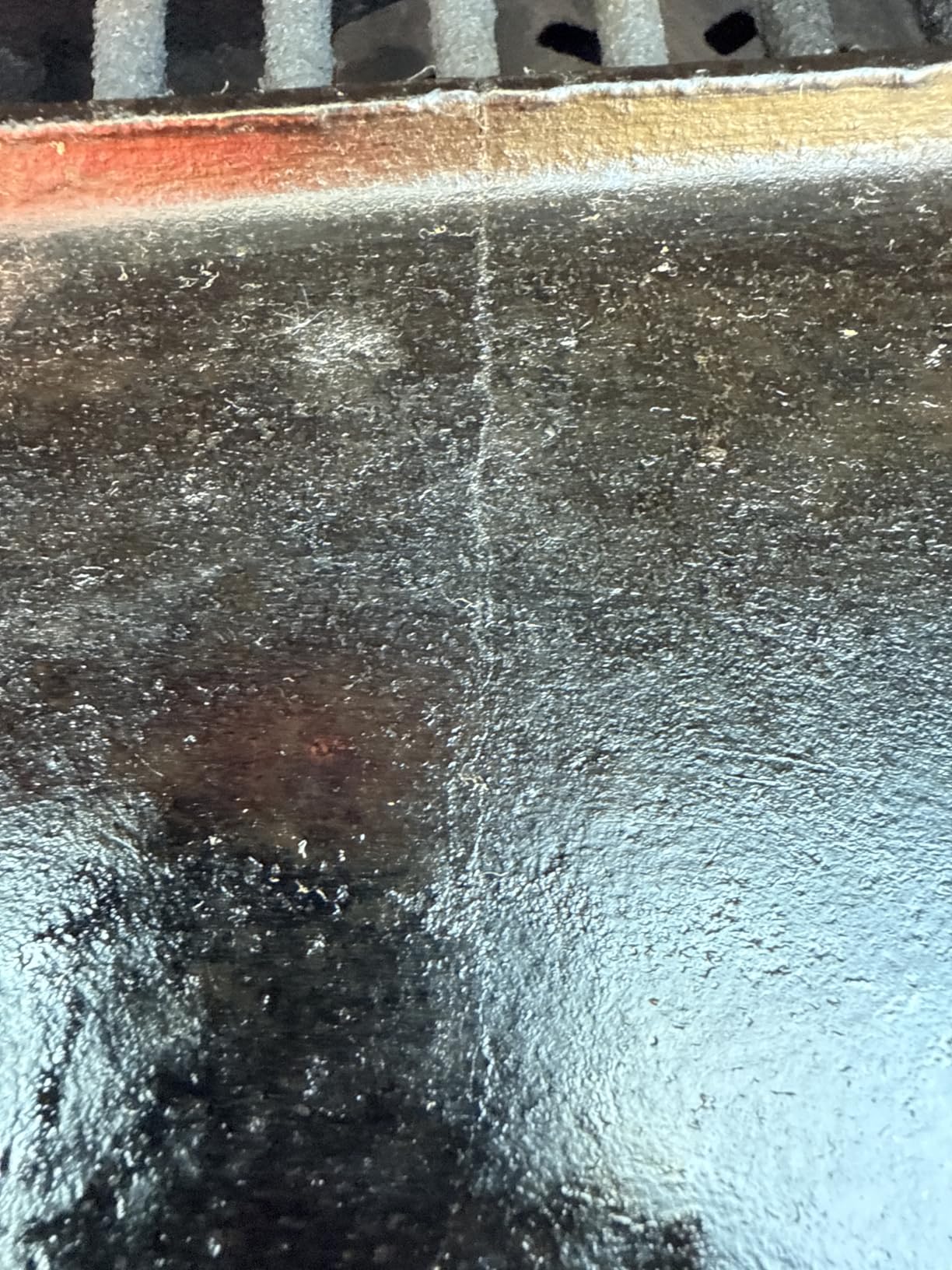
Owners like that it holds enough to run pancakes, eggs and bacon simultaneously for a group. It is reversible, water-only cleaning is the recommended method, and the non-stick character improves with each seasoning cycle.
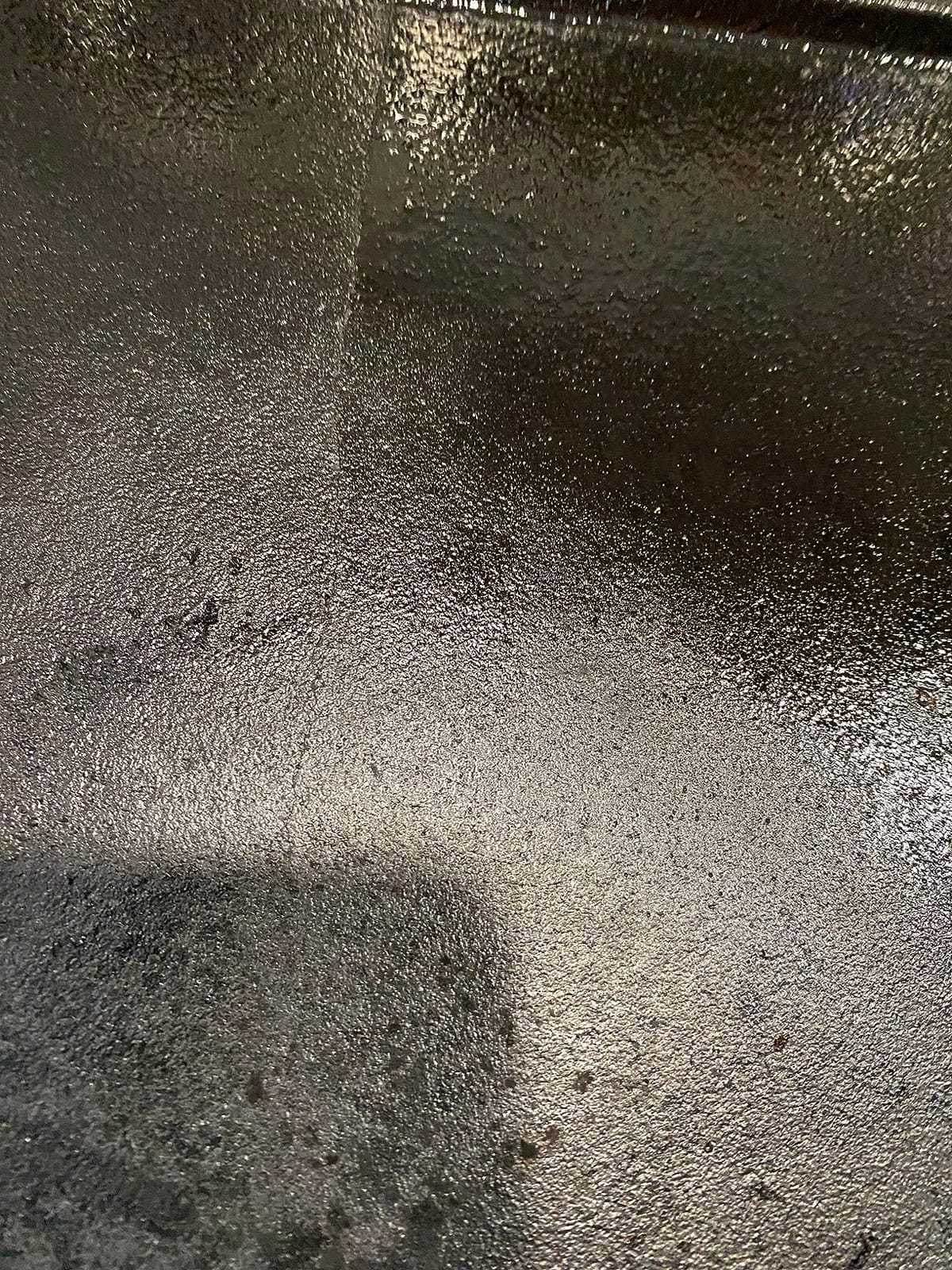
Weight is the recurring complaint at 12.5 pounds, and it needs a dedicated storage spot because of its length. A few buyers report rusting, and one reported a crack developing after extended use, so treat it as durable but not immortal.
Is a full-width plate better than a half-width one?
For a wide grill, yes. Covering the entire grate eliminates the flare-ups that come from juices dripping onto open flames and stops small food falling through. It also means you are not splitting your attention across two cooking surfaces at different temperatures.
For a narrow grill or a compact patio, it is the wrong shape. A 31-inch plate overhangs a small grill badly, and you lose heat at both ends. Match the plate footprint to the fire footprint, not to the amount of food you wish you could cook.
What is the maintenance reality of a big cast iron plate?
Oiling between cooks. That is the routine, and it is not optional, because a dry seasoned surface is exactly the condition that produces rust. Rinse with water only, dry well, and re-season when the bottom loses its well-oiled shine.
Storage is the part people underestimate. At 31 inches long and 12.5 pounds, it needs a shelf where it will not be knocked. We covered the off-season checklist further down, because getting this part wrong is what shortens the life of an otherwise good plate.
8. Royal Gourmet GD4002T 4-Burner Combo: Best Grill and Griddle Combo
Royal Gourmet GD4002T 4-Burner Tailgater Grill and Griddle Combo
- Flat top and grill in one portable unit
- Heats fast and evenly on both surfaces
- 430 sq in cooks multiple items at once
- Easy to assemble and clean
- Ceramic griddle resists rust and wipes down quickly
- Drip tray does not stay seated and pops out during use
- Some igniters failed after fewer than a dozen uses
- A few units arrived with rust spots or missing feet
- 40.6 pounds is heavy for tailgating transport
This is the most flexible powered unit here because it is two appliances. The 430 sq in cooking area splits between a ceramic-coated griddle plate and cast iron grates, so you can smash burgers and grill steaks on the same cook without swapping anything.
Four independently controlled stainless steel burners rated at 10000 BTU each give 40000 BTU total. That is the highest output of any unit in the roundup, and it is spread across a genuinely large surface. Spark electronic ignition with a single centre push button keeps startup simple.
The grooved drip tray channels oil into a removable grease cup, and the ceramic-coated griddle resists rust and wipes down quickly compared with bare steel. Owners use it well beyond tailgating, as a permanent outdoor cooking station on a patio.
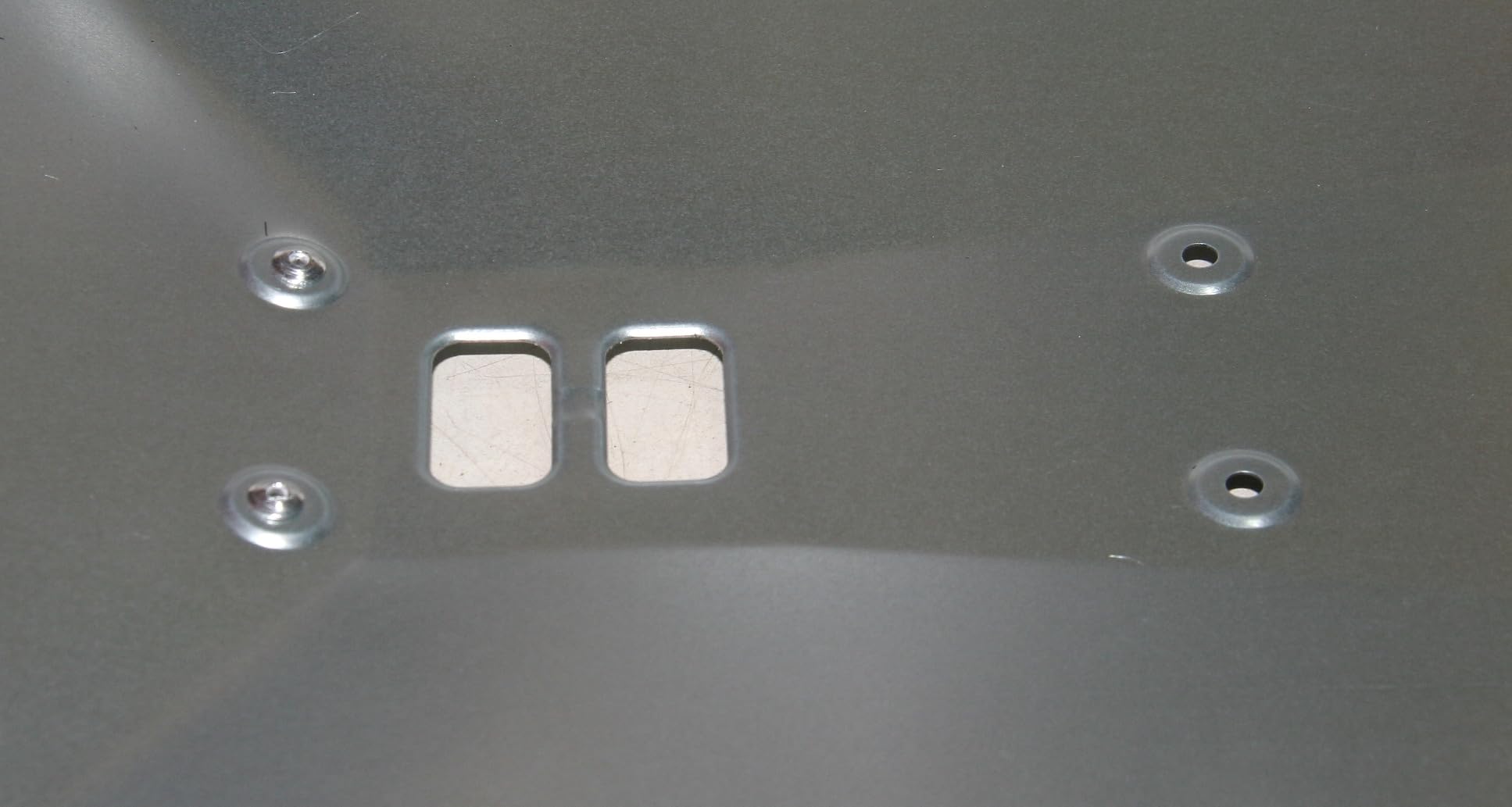
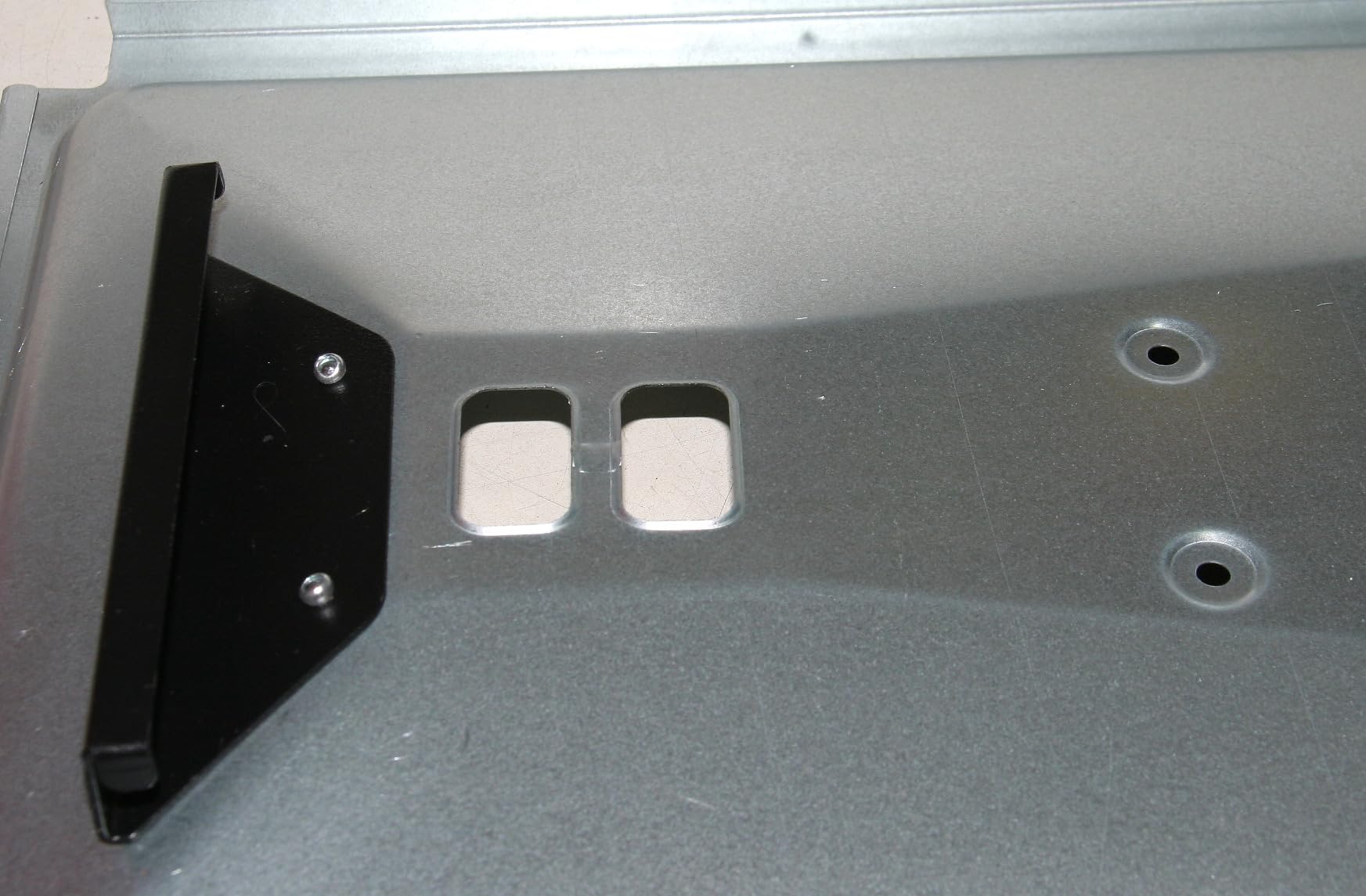
Quality control is the weakness. The drip tray does not stay seated and pops out during use, igniters have failed early for some buyers, and a few shipments arrived with rust spots, a damaged box or missing feet including two of them. Budget for assembly and check the hardware count on arrival.
Is a combo worth giving up dedicated griddle surface?
If your cooking is genuinely mixed, yes. Griddle for breakfast and smash burgers, grate for steaks and vegetables in the evening, and you have not sacrificed either. The griddle surface here is ceramic-coated rather than seasoned steel, so it needs no seasoning and wipes clean.
If you cook almost exclusively on a flat top, the grate is dead surface. You are paying in BTU and footprint for cooking capability you will never use, and you lose some griddle area relative to a dedicated unit of the same size.
What should you check on arrival?
All the hardware, especially the feet. Missing feet are the most reported packaging complaint, and a two-burner unit with one short leg will sit unevenly no matter how good the burners are.
Also inspect the ceramic coating for chips and test the igniter before the first cook. Both are quick checks that save you from discovering a problem halfway through a cookout, which is when most owners found theirs.
9. Royal Gourmet PD1305H 3-in-1 Combo: Best With a Side Burner
Royal Gourmet PD1305H 3-Burner Propane Gas Grill, Griddle Combo with Lid
- Three-way versatility with griddle grill and pot rack
- 364 sq in combined area suits a couple or small family
- Side burner handy for pots and keeping food warm
- Heavier and sturdier than expected for a tabletop
- Clear setup instructions
- Porcelain surfaces clean up faster than bare cast iron
- Hot spots remain on the griddle surface
- Griddle side is small at 211 sq in
- Grill grate has no raised edge so small food rolls off
- One buyer reported burner and valve failure
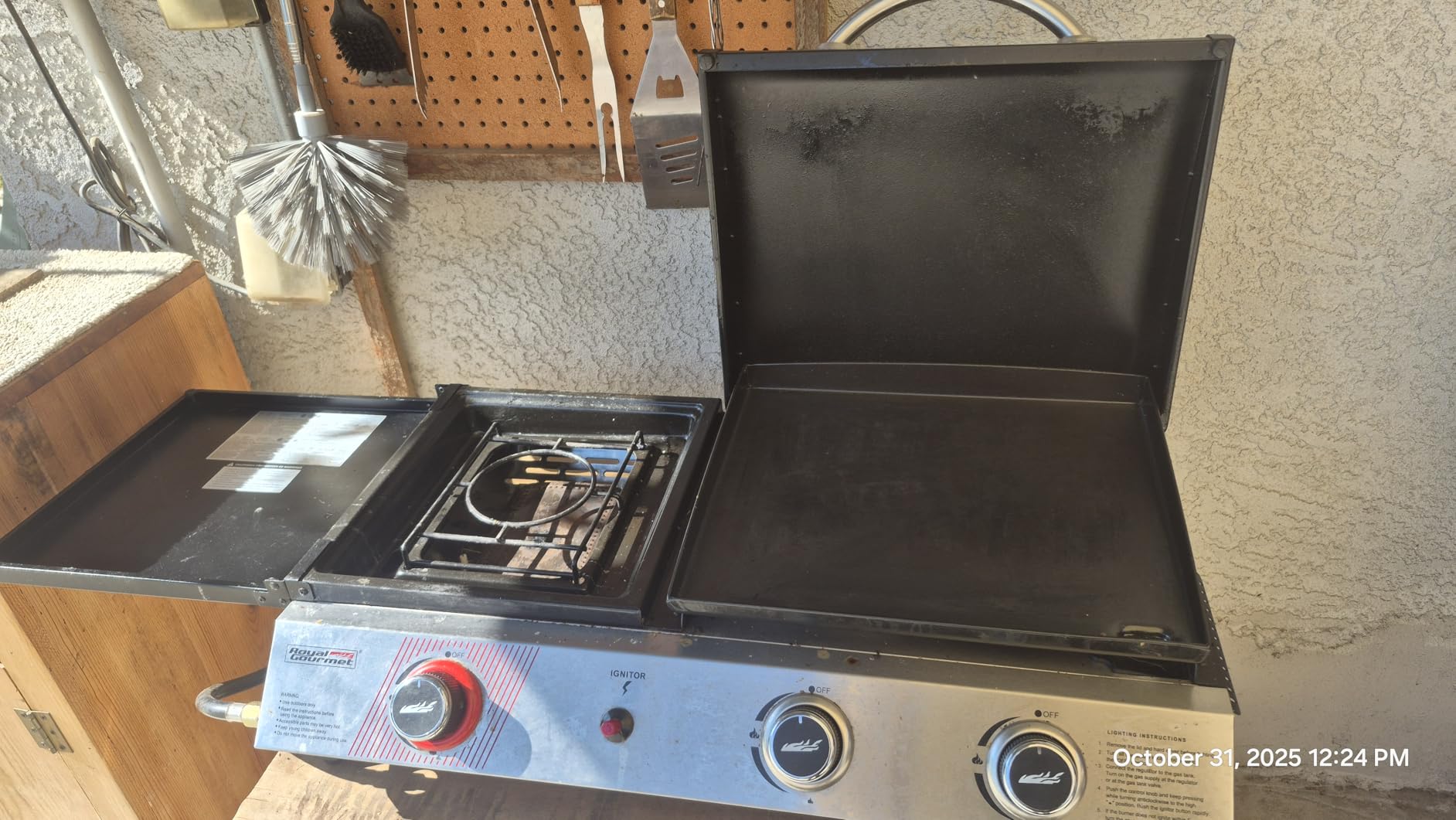
The distinguishing feature is the side burner, and on a 3-in-1 unit it earns its place. Three burner layouts deliver 29000 BTU total: two 8500 BTU main burners plus a 12000 BTU side burner, and having a real burner for pots while the flat top stays at searing heat changes how you cook a whole meal.
The combined cooking area is 364 sq in split into a 211 sq in porcelain-enameled griddle and a 153 sq in grill. Add the pot rack and you have griddle, grill and burner in one portable package at 32.7 pounds.
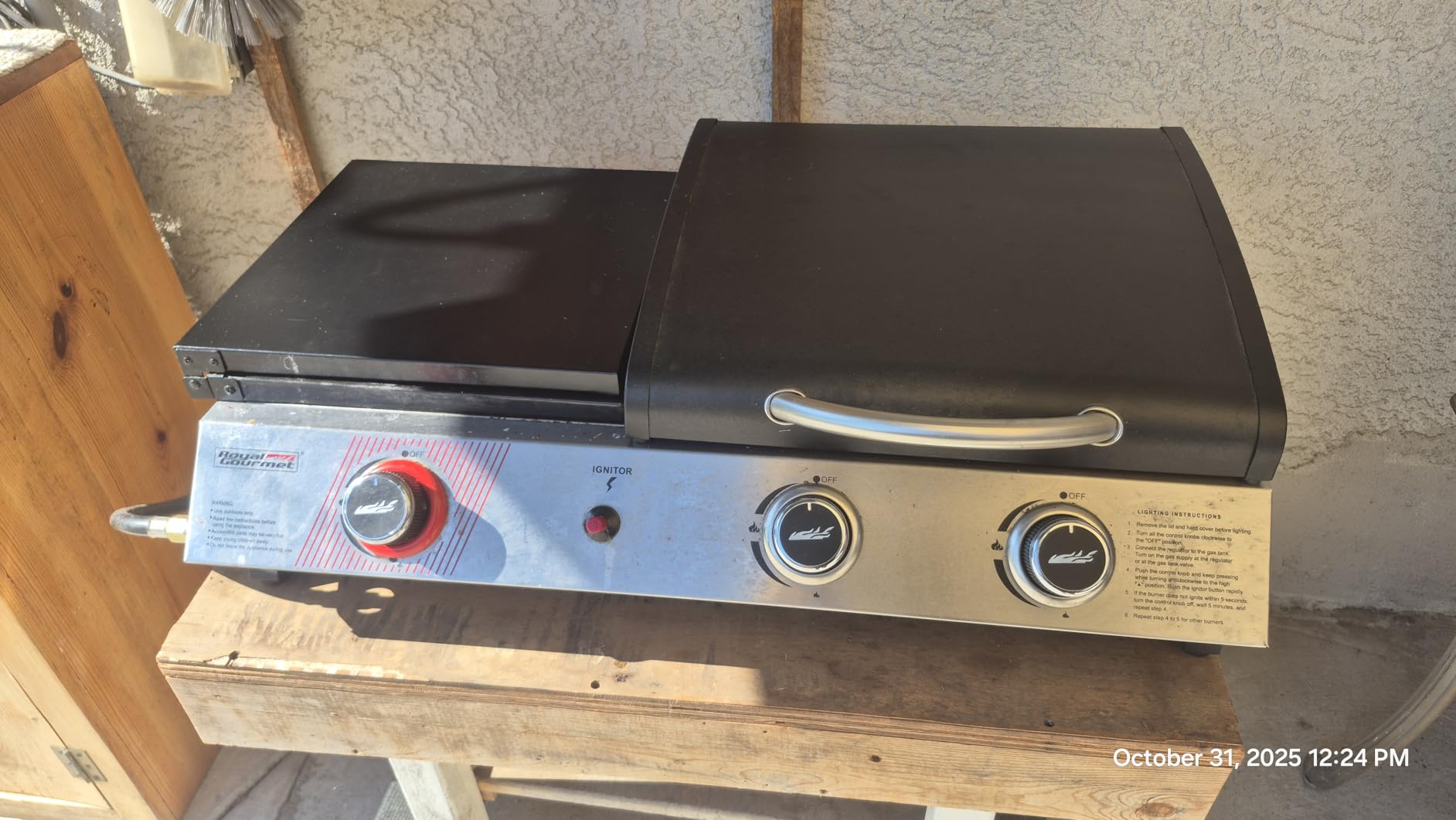
The side burner lid doubles as a cover and a shelf rated to 10 lb, and the griddle lid acts as a wind guard, which is more protection than most open tabletop units offer. Ignition is battery-free piezo, so there is nothing to fail in storage.
Honest limitations: the griddle side is small at 211 sq in, which is tight for anything beyond a couple or a small family. Some hot spots remain on the griddle, and the grill grate has no raised edge, so small food can roll off.
Does a side burner change real cooking, or just the spec sheet?
It changes real cooking. Almost every griddle compromise is that you have to choose between the flat top at high heat and a pan of vegetables or a pot of sauce somewhere else. A side burner removes that trade-off, and it is why combo units with side burners stay popular despite the smaller flat top.
It also extends how long you can stay out there. Warming food, boiling a side, finishing a sauce, all of that happens off the flat top, so the griddle stays at temperature for the food that needs it.
Is this griddle reliable enough to buy sight unseen?
It is the least proven on this list, with the smallest feedback base of the powered units, and one buyer reported burner and valve failure inside the first month that led to flames under the grill. That is a single report, but it is the kind of failure worth buying a product with a longer track record if you can.
If you take one lesson from owner feedback on this unit, test every burner and the propane connection before the first full cook, away from dry vegetation and with an extinguisher to hand. That is good practice for any new appliance, not a comment on this one alone.
10. SKOK 3-Burner Griddle With Hood: Best Stainless Tabletop
SKOK 3 Burners Outdoor Tabletop Gas Griddle with Hood, Flat Top Grill
- Three independently controlled burners create separate heat zones
- 326.2 sq in flat surface gives plenty of room
- Removable high lid retains heat and speeds cooking
- Stainless construction resists rust versus plain steel
- Grease system funnels drippings to a removable tray
- Fast ignition with no complex assembly
- Tabletop form factor limits total capacity versus full-size griddles
- Removable hood adds bulk for transport
- Some buyers may want a thicker cooktop for smash burgers
This is the one to look at if rust is your main worry. The frame and construction are stainless steel with an enamel layer, which resists rust and oxide far better than plain powder-coated steel, and that matters most for the parts seasoning cannot protect.
Three independently controlled stainless-steel tube burners at 15000 BTU each give 45000 BTU total across a 326.2 sq in surface, measured at 14 by 23.3 inches. That is the second-highest output in the roundup on a mid-size plate.
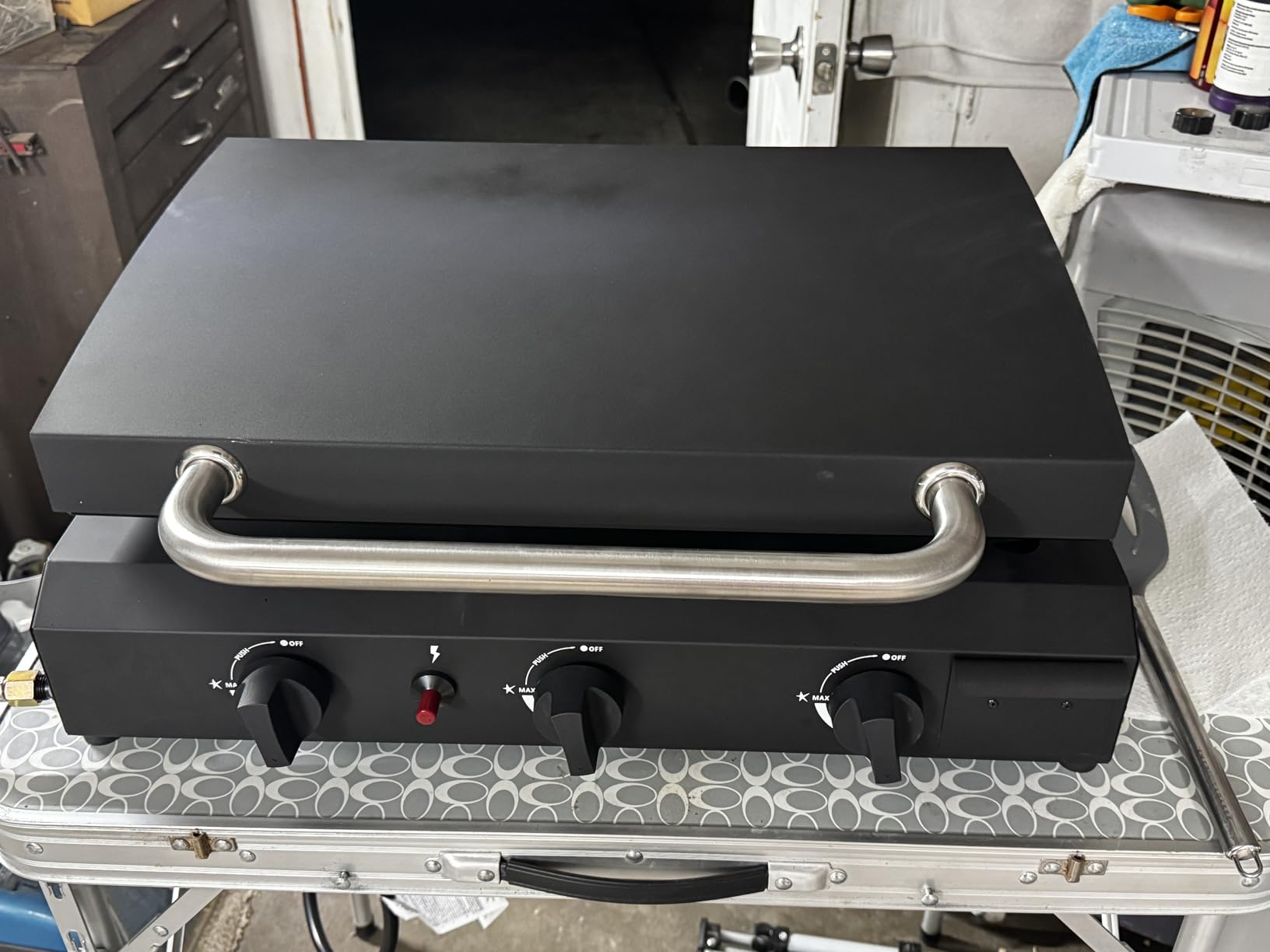
The removable and disassemblable high lid is the feature owners rate highest. It retains heat, which shortens preheat and cook times, and because it comes off it does not turn a portable griddle into a bulky one for transport.
Grease drains through a management system into a removable drip tray, and owners report fast, straightforward ignition with no complex assembly. The trade-off is that a tabletop footprint limits total cooking capacity against full-size griddles.
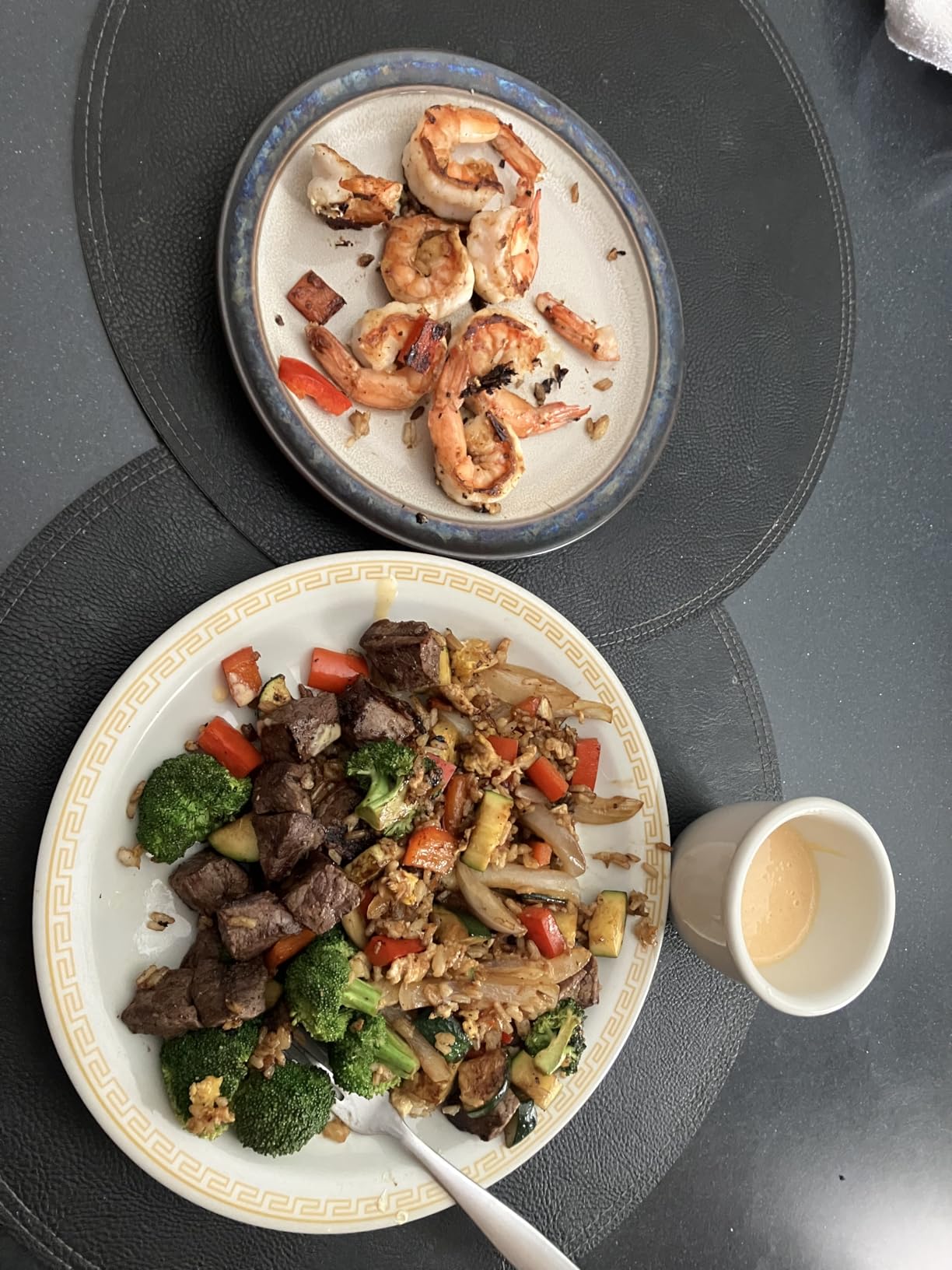
Does stainless really solve the rust problem?
It solves it on the parts that matter most, and that is a real distinction. Rolled carbon steel cooktops rust only if you let water sit on them, which is manageable. Rust on wind guards, shelves and frames is common on cheaper griddles and cannot be fixed with seasoning, because oil on a non-cooking surface just sheds.
A stainless frame largely removes that second category of problem. If you live somewhere with humidity, store the griddle outside, or already own one that rusted despite doing everything right, this is the unit to shortlist. Our deeper material comparison is further down.
What are you giving up compared with a cast iron plate?
Mass. A thick cast iron plate holds heat through a cold morning without any help. A stainless tabletop griddle heats fast but gives that heat back sooner, so an extra push during a long cook matters. Owners who want deeper browning on smash burgers sometimes find themselves wanting a thicker cooktop.
You also trade capacity for portability. 326.2 sq in with the hood removed is manageable to carry, which is exactly what makes it a tailgating and camping unit. We compared the smaller options in our tabletop griddle picks for camping.
11. VEVOR 22.4 inch Commercial Griddle: Most Versatile
- Very low cost for the cooking area provided
- Thick steel top seasons well and heats evenly once burning
- Stainless burners and igniters work reliably
- Runs efficiently on a small propane cylinder
- Removable grill plate simplifies grease management
- Portable enough for the park or camping
- Hardware often mismatched on arrival
- Thin pop-riveted cabinet flexes under load
- Poorly printed instructions make assembly hard
- Bare steel surface is rough and needs careful seasoning
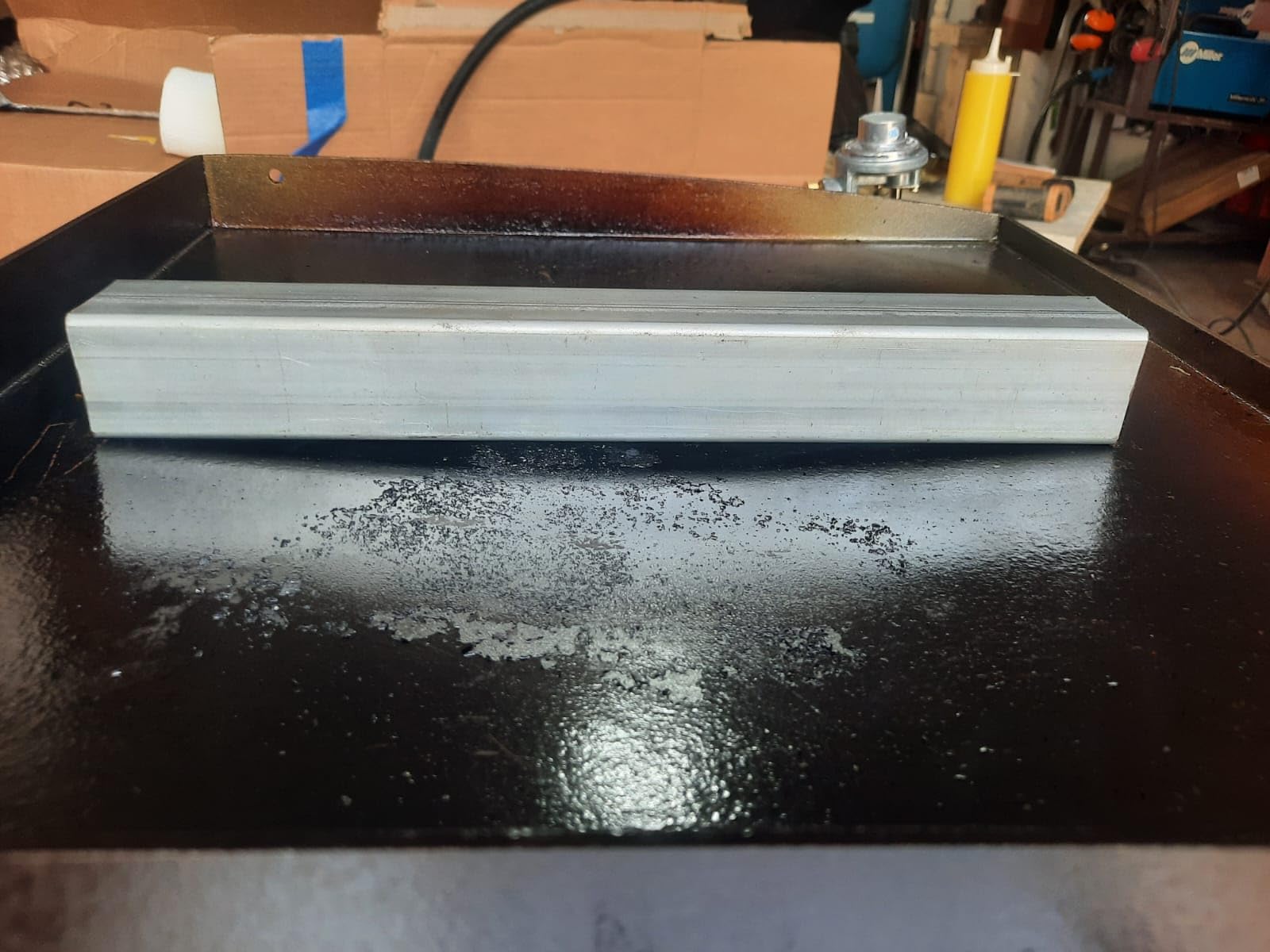
Owning a flat top griddle does not have to mean a large outlay, and the VEVOR is the clearest example of a genuinely usable low-cost appliance. At 21.6 pounds with a 22.4 inch plate, it is a working griddle rather than a novelty.
The cooking surface is bare, sand-blasted steel roughly 11 gauge or thicker, which is the detail that matters most. Thin cheap plate warps; thick plate seasons into a surface owners describe as heating evenly once burning. H-shaped stainless-steel burners deliver 13000 BTU total.
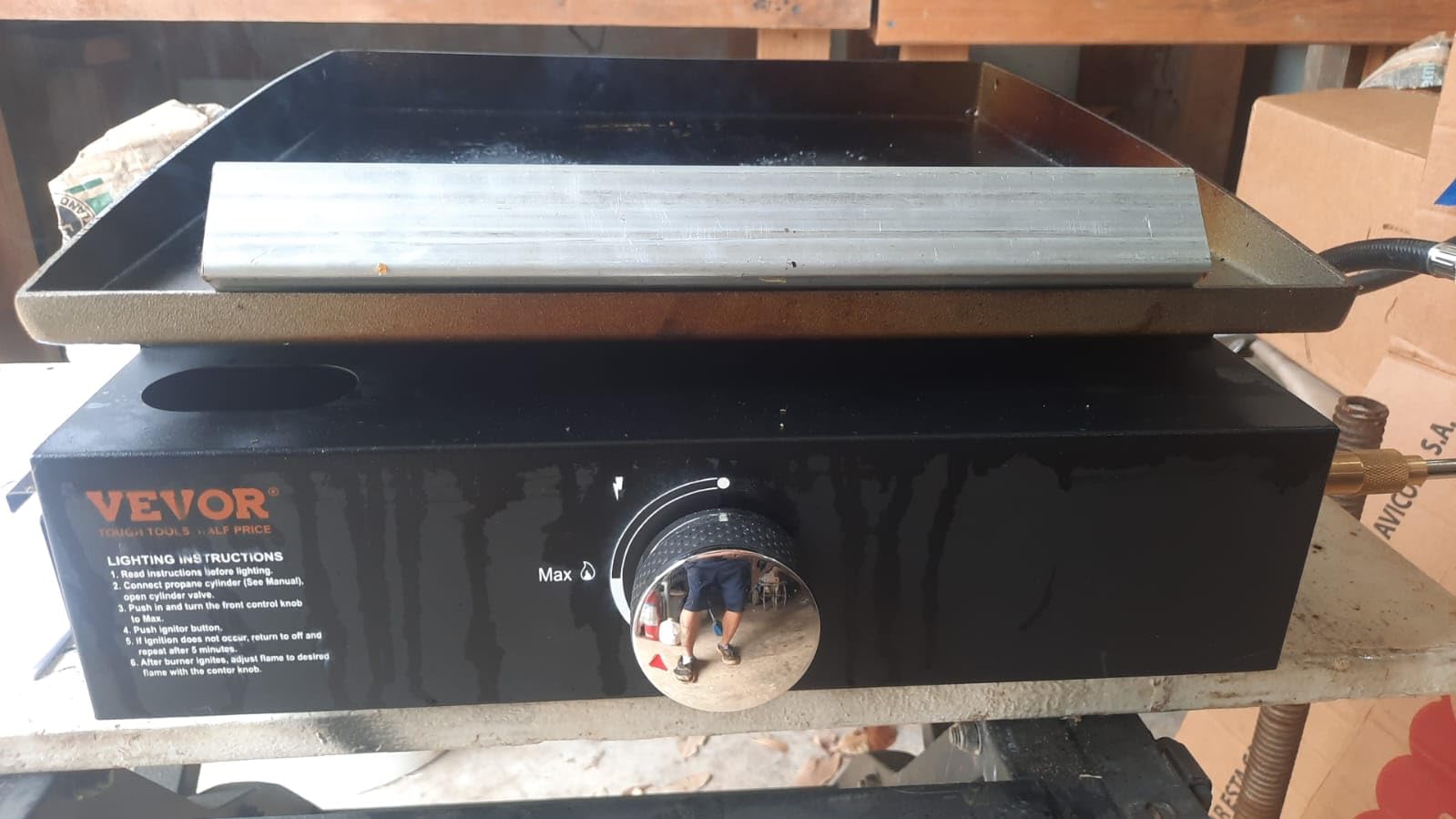
Efficiency is the standout. Owners report cooking a full weekend of meals on a single 1 lb propane cylinder, which changes the economics of cooking outdoors almost entirely. Drip holes channel oil and water to a removable oil cup, and the grill plate lifts out for cleaning.
Finish and assembly are where the money was saved. Hardware frequently arrives mismatched, the cabinet is thin pop-riveted steel that flexes, and the instructions are poorly printed. The bare plate also needs careful seasoning before first use.
Is a budget commercial griddle worth buying?
Yes, if you will sand and season it before the first cook and you are comfortable with assembly. Most owners who do that report the plate coming up well and the burners working reliably. The fuel consumption alone pays back the difference over a season of regular use.
No, if you want something that arrives ready to go. The rating spread reflects exactly that: people who prepared for it are happy, and people who opened the box expecting a finished product are not. Some also report top warping after aggressive heat-up and cool-down cycles.
What is the first thing to do when it arrives?
Inventory the hardware before anything else. Mismatched stainless fender washers and missing fasteners are the most common complaint, and an incomplete box discovered at the end of assembly is a bad afternoon. Then sand the bare plate lightly and season it properly.
Check the plate for warping once it is hot and cold. If it dishes, set it on a flat surface and look at whether the oil drains evenly to the drip holes. Warping that affects drainage will shorten its life no matter how you maintain it.
12. QuliMetal 17 x 13 Cast Iron Kit: Best Starter Kit
- Cheap way to add a flat top to an existing grill
- Fits common grills and sits snugly
- Pre-seasoned surface cooks bacon eggs burgers with minimal sticking
- Easy to clean with mild soap and a soft sponge
- Heavy solid plate holds and distributes heat well
- Removes easily for switching back to open grilling
- Heat is not even directly over the grill burners
- Raised hot edge sits close to your knuckles
- Metal utensils scratch the ceramic coating
- Small grease catcher fills quickly and is awkward to empty
Of the cast iron plates here, this is the most thoughtfully packaged. It includes three surface-friendly spatulas, and that inclusion solves the single most common way people damage a coated cast iron plate, which is using a metal spatula on it.
At 17.1 by 13.1 inches it is a smaller universal fit that works on most gas and charcoal grills. Owners report it fitting common models such as Weber Spirit and Genesis, sometimes with the handles reversed for a snugger fit.
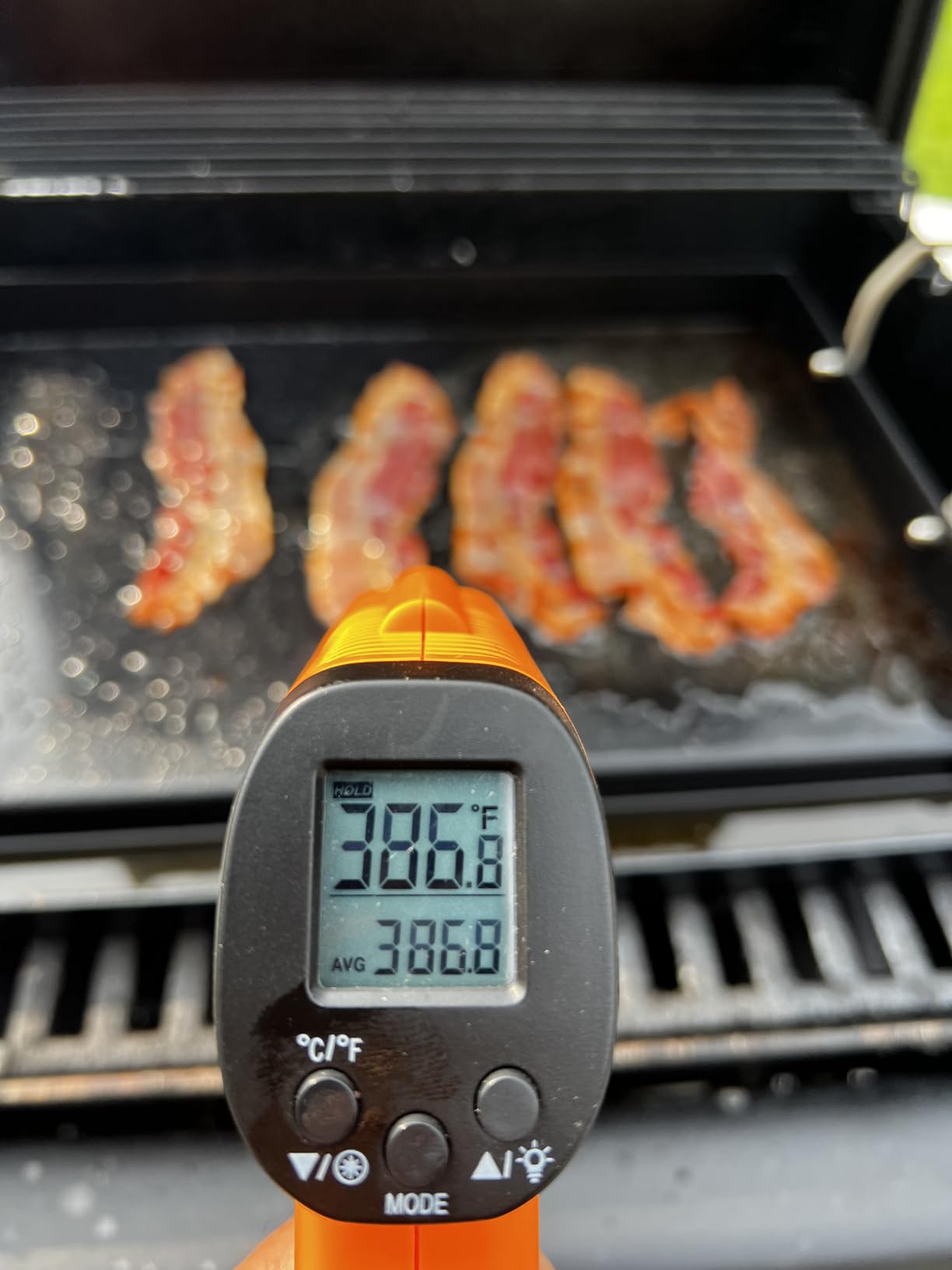
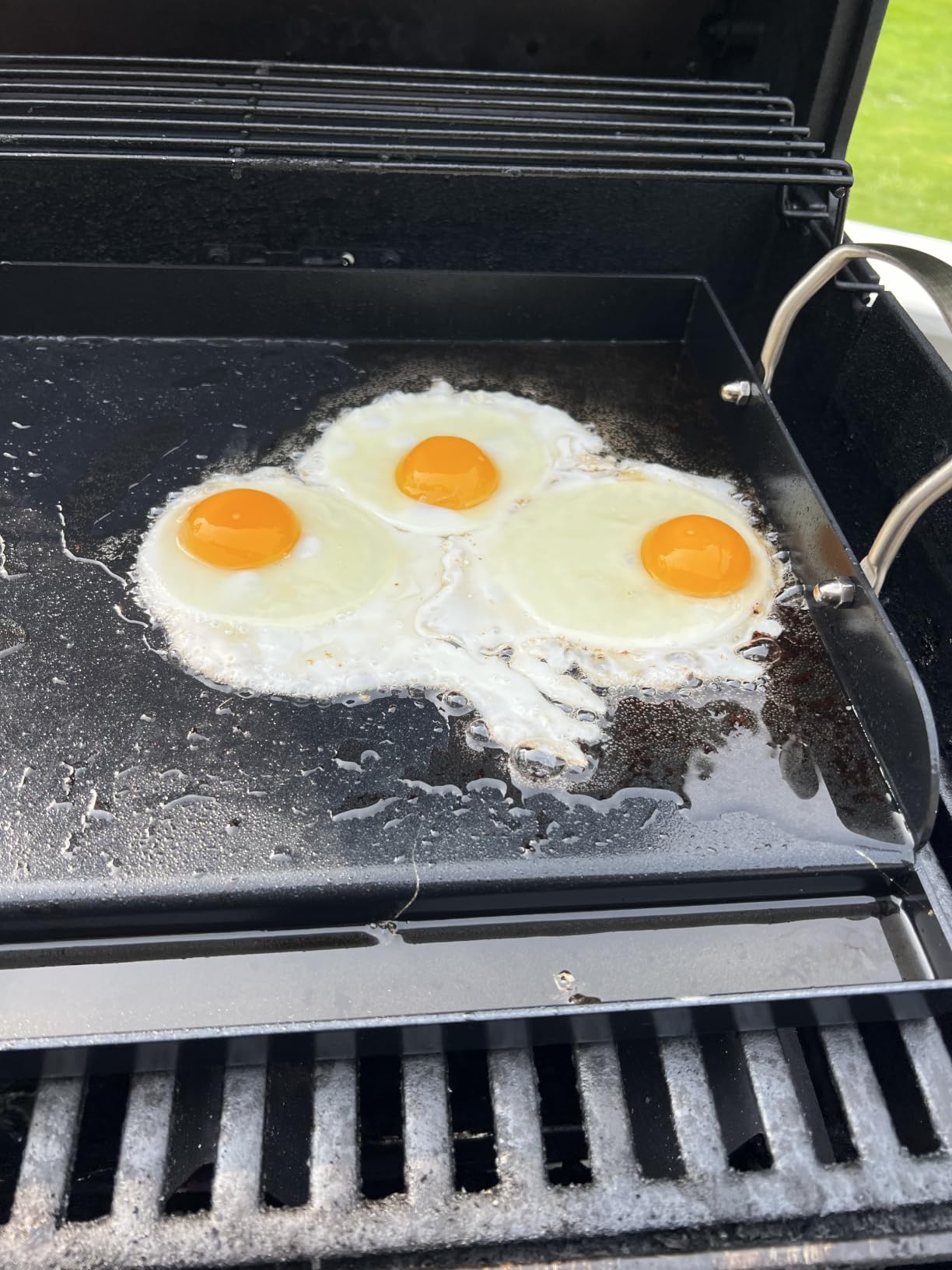
Three support ridges on the base improve stability and promote even heat distribution, reducing hot spots. The built-in grease trough collects oil and drippings, and the pre-seasoned surface handles bacon, eggs, burgers and vegetables with minimal sticking.
Mind the physical design. The sunken cooking surface leaves your knuckles close to a raised, very hot lip, and the grease catcher is small and awkward to empty from a hot plate. Heat directly over the grill burners is not perfectly even, which an infrared thermometer helps with.
Is a 17 by 13 inch plate worth it over a 14 by 16 inch one?
It depends on the grill underneath. A squarer plate suits wider grills better because it matches the burner row more evenly, while a narrower rectangular plate covers a burner span without overhanging. Match the plate shape to the grate, not to the size of the meal you have in mind.
For most standard home gas grills the 17 by 13 inch footprint is the safer fit of the two. It overhangs less, which means less heat lost at the edges and fewer cool bands across your food.
What are the safety details nobody mentions?
Install the handles before lifting the plate into position, because the raised edge is very hot once it is in use and you will not want to grip it bare-handed afterwards. At roughly 20 pounds, getting it onto a grill is a two-person job.
Use only rubber or wood utensils, and a non-abrasive sponge with mild soap. Do not leave it in hot sun or rain. Those four habits are the difference between a plate that improves for years and one that starts shedding its coating after a season.
How to Choose a Flat Top Griddle
Match surface area to the number of people you feed
Under 300 sq in covers a family of four for one meal at a time. Between 300 and 400 sq in handles five or six comfortably. Above 500 sq in is built for entertaining groups of eight or more, and below that you are batch cooking.
Published capacity figures are a useful sanity check. A 268 sq in plate is stated to fit 9 burgers or 12 eggs; 361 sq in fits up to 14 burgers or 10 pancakes. Multiply by the people in your household, then add a margin for a second batch of pancakes.
Count burners and total BTU, then check the layout
Total BTU tells you peak heat, not even cooking. Two H-shaped burners spread heat along their full length and outperform two small round ones on the same total. Three burners give you zones but shrink each one.
A useful rule: two well-shaped burners beat three poor ones. The 45,000 BTU SKOK and the 25,500 BTU Royal Gourmet produce similar results on similar plate sizes because of what those numbers are distributed across.
Understand the cooktop material before you buy
Rolled and cold-rolled carbon steel need seasoning, develop the best non-stick character over time, and rust if left wet. Stainless steel needs no seasoning and resists rust, but heats and cools faster. Ceramic-coated plates need no seasoning and wipe clean, but the coating has a finite life.
The trap is assuming stainless means rust-proof everywhere. It only applies to the cooking surface and frame. A stainless plate on a plain steel frame still rusts at the frame, which is why build quality across the whole unit matters.
Decide how much wind you cook in
Wind steals heat from an exposed burner bank. Integrated wind guards, a recessed cooktop or a lid acting as a wind guard all reduce it, and the 28-inch Omnivore plate is the clearest example of guards built into the plate itself.
If your patio is open, treat wind performance as a feature rather than an afterthought. It is the most common complaint in forum threads about tabletop griddles, and it shows up as slower preheat and streaky browning rather than as anything dramatic.
Look at how grease leaves the plate
A rear grease management system that channels oil through a slot into a collection cup is the fastest to clean. You scrape the surface and empty a cup instead of working a scraper through a trough while it is hot.
On cast iron plates, the grease trough is simpler and you empty it by hand, which is why owners comment on the awkwardness of doing that on a hot plate. Budget for a metal cup with a handle rather than a plastic bucket.
Weigh portability against capacity honestly
Anything under 30 pounds is a one-person lift and fits in a vehicle. The 22-inch Blackstone at 25.3 pounds and the 17-inch at 9 kg both qualify. The 28-inch cart at 69 pounds does not, and needs two people for a threshold or a worktable.
Storage footprint matters as much as weight. A folding tabletop griddle that lives in a garage will not see the winter moisture that destroys an uncovered unit left on a patio all year.
Weigh the extras against what you will actually use
Hoods, warming racks, side burners and pot racks are only worth what you use. A side burner on a combo unit genuinely changes how you cook a whole meal; a paper towel holder does not. Buy the appliance for the surface and the burners first.
A lid, a fitted cover and a metal grease cup are the accessories that actually matter. If you plan a built-in outdoor kitchen rather than a cart, our built-in outdoor gas griddle picks cover that path separately.
Read the warranty as a maintenance instruction
One year on most units, 90 days on the Camp Chef plate, and none on the VEVOR. That spread is not arbitrary. A short warranty usually signals a product expected to be seasoned, oiled and covered by the owner, not one that expects to survive neglect.
If you are not going to put a cover on it and oil it after every cook, buy the longest warranty you can find. If you will, a shorter warranty on a cheaper griddle is a reasonable trade.
Cooktop Material Compared: Carbon Steel, Stainless Steel and Coated Plates
This is the section that decides how much maintenance you are signing up for, and it is where most of the rust anxiety actually starts.
Carbon steel: the best non-stick character, the most care
Rolled and cold-rolled steel plates are what most griddles use, including the two Blackstones at the top of this list. Seasoned properly, they produce a genuine non-stick surface that improves with use and delivers excellent heat retention as the steel thickens with seasoning.
The cost is rust protection being entirely your responsibility. Oil the surface after every cook, dry it, and cover it when it is not in use. Steel is not weak; it is just the only material here that actively corrodes when left wet.
Stainless steel: less care, slightly less character
Stainless cooktops and frames need no seasoning at all and resist both rust and oxide. That removes an entire category of maintenance and the entire “why is my griddle rusting” question from the purchase.
The trade is heat behaviour. Stainless conducts differently and sheds heat faster than a heavily seasoned carbon steel plate, so long cooks can need a nudge. Several models in this roundup use a stainless frame with a coated or steel plate, which gives partial rather than full protection.
Ceramic and porcelain coatings: easy cleaning, finite life
Coated plates wipe clean, need no seasoning and are the friendliest option for a first-time owner. The Royal Gourmet tabletop and the 4-burner combo both use them.
Owners report the non-stick gloss fading with use and the surface needing oil like bare cast iron anyway. Coatings also scratch if you use sharp metal utensils. Treat them as low-fuss, not low-maintenance, and expect to replace rather than reseason them eventually.
Which parts rust, and which parts seasoning cannot save
This is the practical distinction. Seasoning protects a cooking surface because oil polymerises into a hard film on hot, clean steel. It does nothing for a wind guard, a shelf bracket or a frame rail, because oil on cold non-cooking steel just runs off or flakes.
That is why rust on wind guards is such a common complaint and why it recurs even on well-maintained griddles. If your griddle lives outdoors in a humid climate, stainless construction across the frame is worth more to you than any cooktop upgrade.
Seasoning, Rust Prevention and Off-Season Storage
Rust is the number one complaint in every griddle forum we read, and it is nearly always preventable. The mechanism is simple: bare or thinned steel plus water plus time. Here is the routine that prevents it.
How to season a new carbon steel griddle
First, remove the surface with warm soapy water, dry it completely, and wipe it with a cloth dampened with a high-smoke-point oil such as canola.
Heat it on medium until the surface darkens evenly, then let it cool fully. Repeat this two or three times. Most owners report that the second and third cycles are where the surface changes from patchy to genuinely non-stick.
Finish with a thin coat of oil, leave it for an hour, and wipe off the excess. A surface that feels tacky after an hour has too much oil on it. The goal is a thin, even sheen that feels like a finished pan, not a greasy film.
The after-every-cook routine
Scrape, then wipe with paper towels while the surface is still warm, then push the remaining oil to the edges and off. A light scrape removes carbon without stripping seasoning.
Turn the burners off but leave them lit for a few minutes, or run the griddle hot briefly, to evaporate water before you put a cover on. Covering a wet surface is the fastest way to guarantee a spot of rust the next morning.
Off-season storage checklist
Clean and dry the surface completely, then oil it lightly. Do not store a griddle bare, even indoors in a garage, because condensation alone will spot it.
Put a fitted cover on, and if you are storing it under something loose, weigh the cover down so wind cannot get underneath. Loose covers flap and create exactly the airflow they are meant to prevent.
Empty and dry the grease bucket or cup before storing. A grease container left full and uncovered collects rainwater, and that water sits directly under the plate.
Check the storage space for mouse debris and droppings before closing anything up. Owners have reported finding both debris and fresh rust inside a covered griddle after one winter, which is a reminder that a cover is not a sealed container.
Store the propane tank outside or in a ventilated space, never enclosed with the griddle, and check all fittings before the first cook of the season.
Is it safe to use a rusty griddle?
Light surface rust on a cooking plate is not a safety hazard in itself. Scrub it back with coarse salt and a paper towel or a wire brush, wipe it clean, and re-oil the surface before cooking. That removes the corrosion and restores the film.
Deep pitting, flaking metal or rust that has eaten into the plate is different. That is metal loss, it will not season back, and the plate should be replaced. The same goes for any rust on a burner, a valve or a grease channel, which is a service issue rather than a surface one.
Never cook on a surface that has been repaired with filler or that flakes under a scraper. And if you own a stainless frame model, rust on the frame is cosmetic rather than a food contact problem.
What to Cook First on a New Flat Top Griddle
The first cooks teach you where your hot and cool zones are, and a new griddle does not have obvious ones yet. Start with food that forgives a mistake.
First: a full batch of pancakes. They reveal hot spots better than anything else, because the batter sets in rings where the surface is cooler and stays glossy where it is hottest. Expect uneven browning on cook two and a noticeably better cook three.
Second: smashed burgers. Let the steel get properly hot first, press thin, and hold for about thirty seconds before you flip. If the patty sticks, the surface is not seasoned or hot enough yet, and both are fixable.
Third: eggs in one zone and bacon in another. This is where separate burners pay off. Low heat on one side, high heat on the other, both at once, which is the thing a griddle does that a grill cannot.
Fourth: hibachi chicken and fried rice. A high-side pan on a griddle needs real heat retention. If it works here, the surface is seasoning well and holding temperature properly.
Fifth: fajitas or cheesesteaks in a batch. Flat-top searing is about constant contact and a hot surface, and these cook in one fast round with minimal movement.
Keep oil on the surface between cooks and scrape between batches, and by the fifth cook you will already know which corner runs hottest.
Frequently Asked Questions
Are there better outdoor griddles than Blackstone?
Yes, depending on what you are optimising for. Blackstone dominates owner feedback volume, and its 28-inch and 22-inch models are the strongest all-round picks here. For rust resistance, a stainless-framed unit avoids the corrosion that plague powder-coated steel. For three separate heat zones on a small footprint, the Royal Gourmet three-burner tabletop gives you more control per square inch than a two-burner Blackstone.
Is there an outdoor griddle that doesn’t rust?
Partly. A stainless steel cooktop and frame resist rust far better than carbon or powder-coated steel, and the SKOK three-burner model on this list uses stainless construction throughout. No griddle is completely rust-proof, because seasoning oil cannot protect wind guards or shelves. The reliable approach is stainless where available plus a routine of oiling, drying and covering.
What can I put on my griddle to keep it from rusting?
A thin film of high-smoke-point oil, such as canola, applied after every cook while the surface is still warm. Wipe off the excess so it feels like a finished pan rather than a greasy film. Do the same before off-season storage, dry the grease cup, and fit a cover that is weighted down so wind cannot get underneath.
Is it safe to use a rusty griddle?
Light surface rust is not a safety hazard. Scrub it back with coarse salt and a paper towel or a wire brush, wipe clean, and re-oil before cooking. Deep pitting, flaking metal or metal loss will not season back and means the plate should be replaced. Rust on a burner, valve or grease channel is a service issue, not a surface one.
What size outdoor griddle should I buy?
Under 300 square inches suits a family of four cooking one meal at a time. Between 300 and 400 square inches handles five or six comfortably. Above 500 square inches is built for groups of eight or more. A 17-inch plate is stated to fit 9 burgers or 12 eggs, and a 22-inch plate up to 14 burgers or 10 pancakes.
How hot does a flat top griddle get, and do I need a hood?
Flat top griddles run hot enough for searing, and the outputs on this list range from 13,000 BTU on the VEVOR up to 45,000 BTU on the SKOK. A hood is optional. A removable lid on the SKOK and the griddle lid on the 3-in-1 Royal Gourmet both act as wind guards and heat retention, which is more useful day to day than ventilation.
Do I need to season an outdoor griddle?
Only if it has a carbon steel cooking surface. Carbon and cold-rolled steel plates need two or three seasoning cycles before they behave, and seasoning improves with use. Stainless steel, porcelain-coated and ceramic plates need no seasoning at all, which is often the deciding factor for a first-time owner who does not want a maintenance routine attached to a new appliance.
The Best Flat Top Griddle for How You Actually Cook
If you want one answer, take the Blackstone 1517 28-inch Omnivore. Its 517 sq in plate, built-in wind guards and the deepest owner feedback base on this list make it the safest single purchase in 2026, and it is the one we would buy first.
Cooking for four or five, or moving one around by yourself? The 22-inch Blackstone does the same work on 361 sq in at 25.3 pounds. On a tight budget, the VEVOR is a legitimate appliance once you sand and season it. Already own a grill and want to test the idea? The QuliMetal or Camp Chef plate costs a fraction of a dedicated unit.
If rust is what is stopping you, pick a stainless-framed model such as the SKOK, and buy a fitted cover regardless of which griddle you choose. An uncovered griddle in a humid climate will find a way to spot.
Whichever you pick, the first five cooks teach you more than any spec sheet. Cook them, find your hot zone, and check the current details before you buy.
There is also a related guide on electric griddles worth a look if you would rather not run propane or natural gas outdoors at all.