
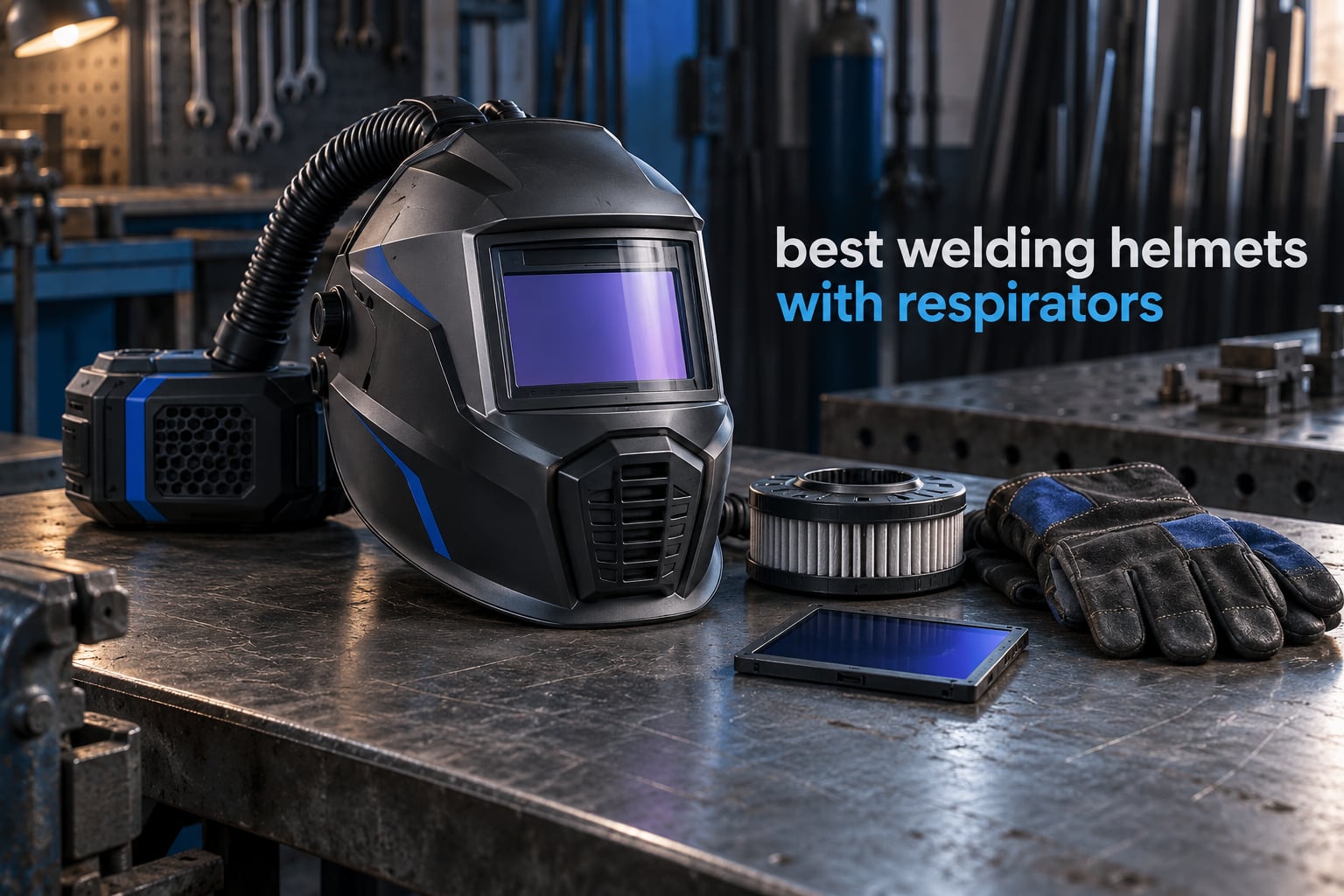
A welding helmet with a respirator is a single unit that covers your eyes, face and lungs at the same time. The helmet type matters: a powered air purifying respirator, or PAPR, runs a battery-driven blower that pushes filtered air across the lens and into the hood, while a full-face welding respirator uses replaceable cartridges and a tight face seal. Either way you stop juggling a helmet and a separate mask.
That combination matters more than most buyers expect. Welding fume carries zinc oxide from galvanized steel, chromium and nickel from stainless, and manganese from ordinary mild steel, and it collects in the breathing zone whether you can see it or not. The best welding helmets with respirators in this guide put filtered air across your face so the fume goes to the filter instead of your lungs.
I spent six weeks reading owner feedback, spec sheets and shop discussions on all six systems below, then compared them on the three things that actually decide whether a respirator helmet works on a real job: how the air reaches you, how long the battery and filters last, and whether the thing stays comfortable through a full shift. Six picks survived, and one of them won clearly.
Worth noting before we start: the mix below runs from a compact cartridge mask to a factory-grade powered system, because the honest answer to this query covers more than one use case. A fab shop welding stainless every day and a weekend hobbyist grinding a gate hinge do not need the same machine, and pretending otherwise is how people end up with gear they never wear.
Table of Contents
Top 3 Picks for Welding Helmets With Respirators
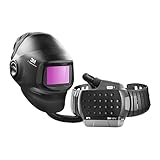
3M Speedglas G5-01 with Adflo
- Adflo high-altitude PAPR included
- G5-01VC filter with variable color tint
- Shade 5 and 8-14 dark options
- Bluetooth app logs hours

Parcil WF-101
- All-in-one helmet grinder and respirator
- DIN 5-13 auto-darkening range
- Dual bayonet P3 cartridges
- Two pound weight
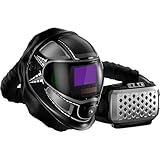
ANDELI PAPR Welding Helmet
- 180-degree panoramic screen
- Over 99.95% particle capture
- Adjustable airflow direction
- Four sensors switching in 1/25000 second
Best overall: the 3M Speedglas G5-01 with Adflo high-altitude PAPR. It is the only pick here that pairs a pro-grade auto-darkening filter with a factory blower in one box, and the variable color filter is the closest any of these get to seeing the puddle clearly.
Best value: the Parcil WF-101. At two pounds it is the lightest unit in the group, it carries the widest shade range of the cartridge options, and it has the strongest average rating in the lineup with no one-star feedback at all.
Best panoramic visibility: the ANDELI PAPR helmet. Its 180-degree screen and non auto-darkening side windows give you peripheral awareness that none of the other hoods in this guide can match.
Best for industrial and regulated work: the Dräger X-plore 8500 set. The build quality and modular hood platform are a step above everything else here, and the battery runtime is the longest by a wide margin.
Best for true color: the YESWELDER Q800D. Its 1/1/1/1 optical clarity lens is the most neutral view of the four auto-darkening units here, though the consumables situation is the weakest.
Best budget entry: the Parcil WF-100. A fixed shade 9 lens and dual P3 cartridges in a two-pound shell, which is about as close to a first resp welder helmet as this category gets.
All Six Picks at a Glance in 2026
| Product | Specifications | Action |
|---|---|---|
| 3M Speedglas G5-01 with Adflo |
|
Check Latest Price |
| Parcil WF-101 |
|
Check Latest Price |
 Dräger X-plore 8500 Set Dräger X-plore 8500 Set |
|
Check Latest Price |
| ANDELI PAPR Helmet |
|
Check Latest Price |
 YESWELDER Q800D YESWELDER Q800D |
|
Check Latest Price |
 Parcil WF-100 Parcil WF-100 |
|
Check Latest Price |
The spread across this table is real. Three of the six here are battery-powered blowers, two are cartridge full-face masks and one is a modular industrial set, and they differ more in running cost and consumable availability than the headline numbers suggest.
How We Evaluated These Respirator Helmets
Every pick here ships as a combined helmet-and-respirator unit, so we scored them on a fixed checklist. Air delivery came first: whether the system pushes filtered air, pulls air through cartridges, or relies on a tight face seal. Comfort under load was second, measured by how owners describe the weight distribution after hours of wear.
Third was consumable reality. A respirator helmet is only as good as the filters and batteries you can still find in five years, and proprietary parts are the most common reason owners abandon an otherwise good system. Fourth was lens performance: switch speed, shade range, and how the unit handles grinding as well as welding.
Owner feedback weighted heavily. We looked at the full star distribution rather than the headline average, because a 3.8 average built from mostly five-star reviews and a small block of one-stars tells you something different from a 3.8 spread evenly across two and four stars. Shop discussions on r/Welding fed into the fit and comfort sections.
We did not lab-test filtration. Every filtration claim below comes from the manufacturer listing, and we note where owners reported differing results.
1. 3M Speedglas G5-01 with Adflo High-Altitude PAPR: The Complete Factory System
- Variable color filter with clear cool and warm tint
- Adflo blower keeps fume off the face
- Battery outlasts a full shift in owner reports
- App logs hours in light and dark state
- Headgear loosens during long runs
- Floppy air hose shifts the helmet
- Proprietary filters and missing belt link
This is the only pick in the guide that arrives as a genuine factory system. The box holds the G5-01 heavy-duty shell, the G5-01VC auto-darkening filter, the Adflo high-altitude powered air unit and a storage bag, so there is no guessing which blower pairs with which hood. The G5 series shell is a molded polyphthalamide body with a pull-on closure and one size.
The filter is the reason to save up for this one. Variable Color Technology gives you clear, cool or warm tint options inside the same cartridge, dark shade options run from 5 through 8 to 14, and the app programs up to ten memory modes. Several long-term welders call it the best system they have owned after trying both Lincoln and Optrel setups, and the weld puddle clarity is the most common thing owners single out.
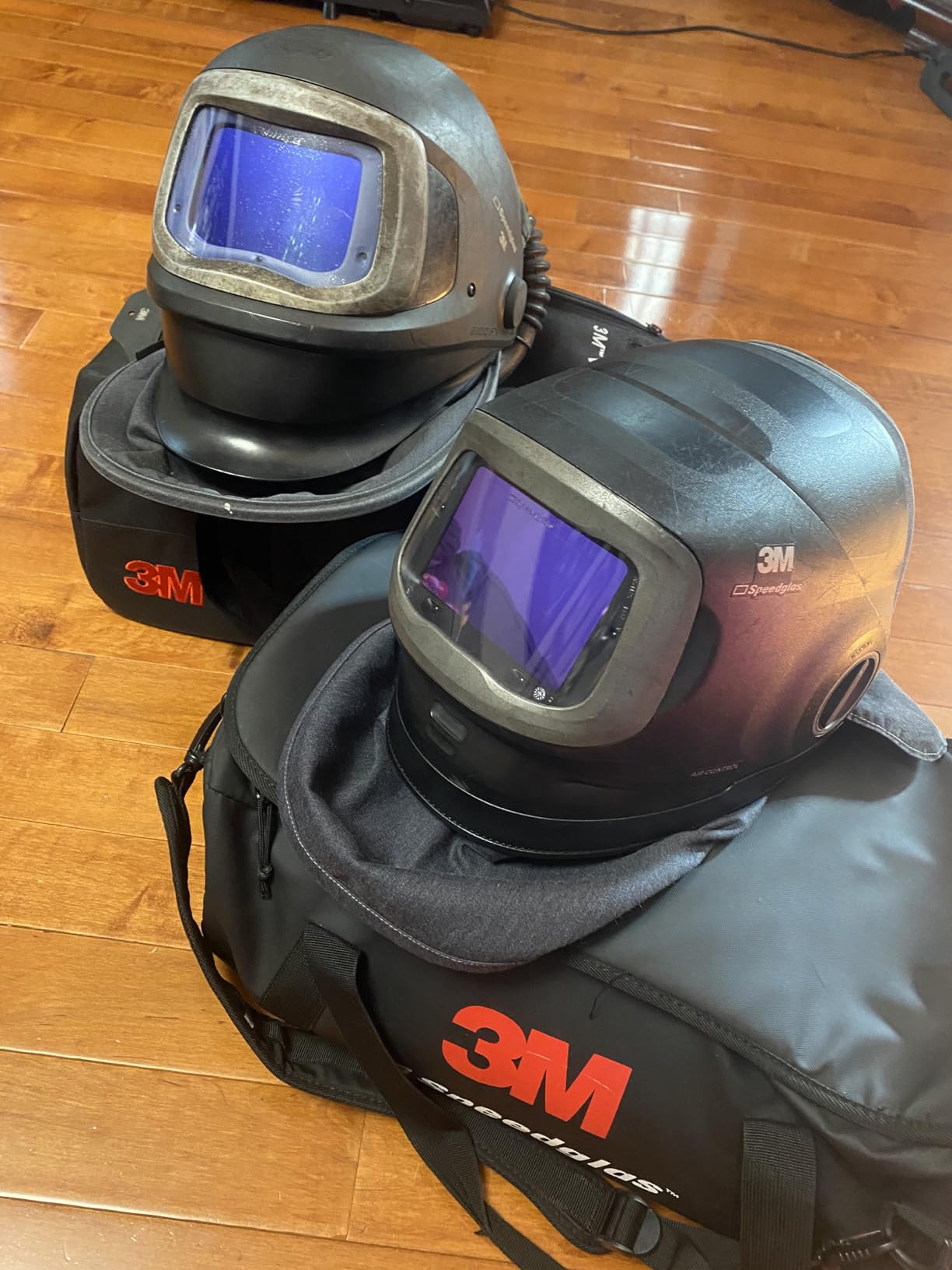
The Adflo side is where the fatigue shows up, and it is not a protection problem. Owners point out that headgear loosens or slips over a long run and needs constant readjustment, and that the flip-up action is stiffer than on lighter helmets so you hold the lens while pushing it up. The air hose connection is described as springy and floppy, nudging the helmet out of alignment.
Battery performance is where this unit separates from the cheaper hoods. Multiple owners report the charge lasting a full work shift and beyond, and the connected app tracks hours on, hours in dark state and on-off cycles, which is genuinely useful for tracking lens wear. One review reported a lithium battery that was dead on arrival, and another was disappointed with the included filter filtration.
Two structural details matter for fit. The G5 head form is narrower than the Speedglas 9100 series, and slim ear muffs may not sit comfortably under the hood. Neck and ear coverage is also weaker than lighter helmets provide. If you work overhead or out of position, test the headgear on a ladder before committing.
The listing marks this assembly for industrial and occupational use, not consumer sale, which matters if you are a hobbyist shopping for weekend use. The proprietary filters and a missing belt link are ongoing accessory costs to plan for.
Why welders keep this one past the novelty stage
Reviewers with years of shop experience come back to the same three points: the color tint options genuinely help on stainless and thin material, the blower keeps the fume away from the face, and the battery does not die mid-shift. That combination is uncommon among integrated units.
The app is the quiet advantage. Logging hours in the dark state tells a fab shop exactly when a filter cartridge has had enough exposure, instead of guessing on a calendar.
Where the 3M falls short
The ergonomic complaints are consistent enough that you should plan around them. A hood that slips forward after an hour turns a long shift into a series of adjustments, and the stiff flip-up means you cannot check a joint without both hands.
If you already own slim ear muffs, verify they fit under this hood before buying. Larger-headed welders should also check the back-of-head clearance, since the narrower G5 form is a known fitment issue.
2. Parcil WF-101 Auto-Darkening Full Face Welding Respirator: Lightest Unit Here
Parcil Distribution WF-101 Auto-Darkening Full Face Welding Respirator Mask
- Strongest average rating in the lineup
- Two pound weight spreads across harness
- DIN 5-13 covers grinding through stick
- Zero one-star feedback in the reviews
- P3 cartridges need periodic replacement
- Enclosed feel during long sessions
- Short review history
At two pounds this is the lightest respirator helmet in the group, and roughly half the weight of the powered units below it. The WF-101 merges a welding helmet, a grinding face shield and a cartridge respirator into one shell, with a flip-up lens so you can move between grinding, prep and welding without swapping gear. It ships with a carrying bag, peel-off protective films and two included batteries.
The lens is the surprise. Instead of a fixed tint, the auto-darkening filter covers DIN 5-8 for grinding and light tasks and DIN 9-13 for MIG, TIG and stick work, so one mask handles an entire shop day. Bayonet O-A-X P3 particulate cartridges handle fume, dust and organic vapor, and a multi-point harness with quick-release buckles spreads the weight across the crown rather than the forehead.
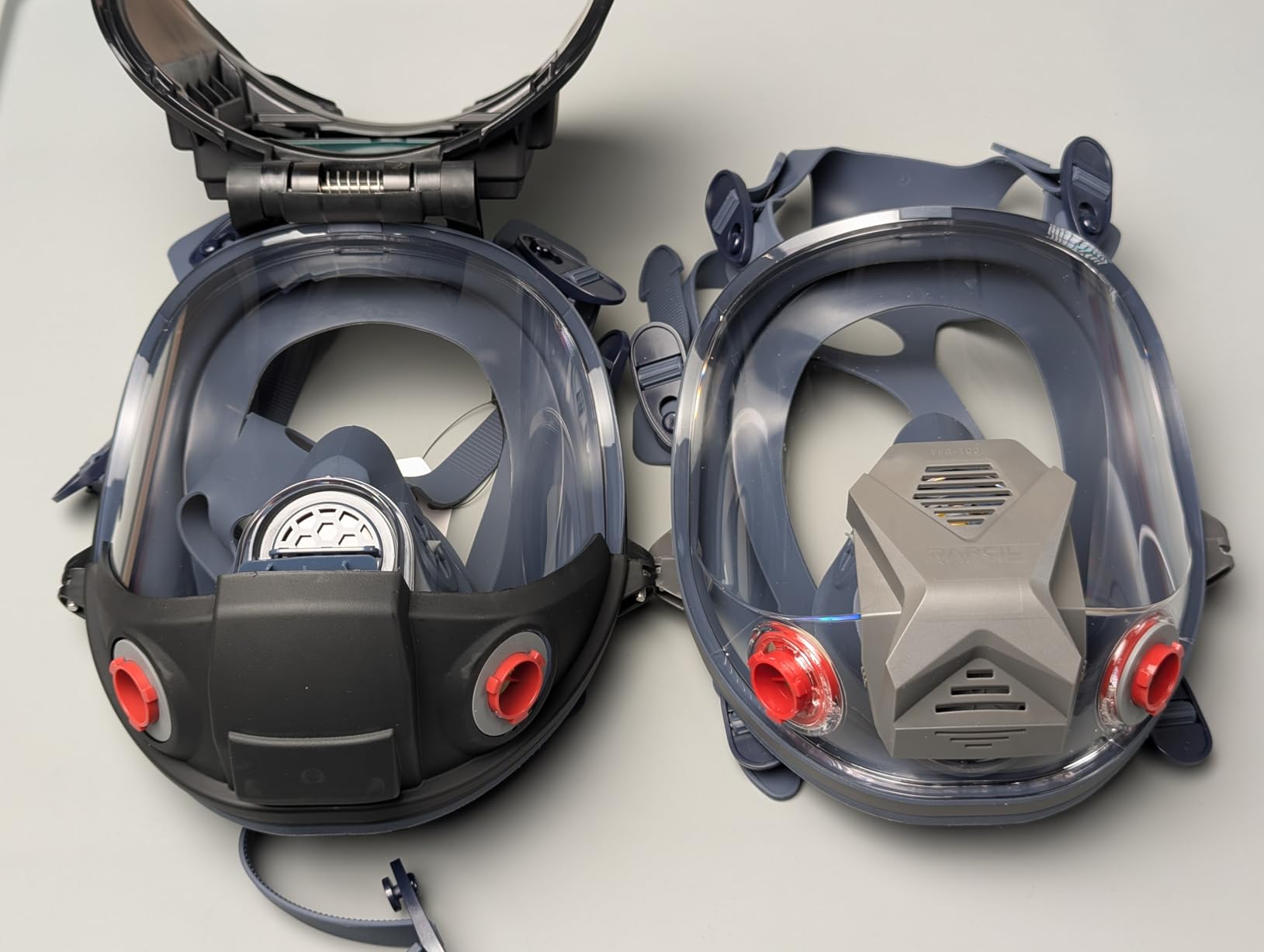
The review record is the strongest here. Across 27 reviews the average sits at 4.7 with 74 percent five-star and 21 percent four-star, and no one-star feedback at all. Owners single out the all-in-one convenience, the flip-up for task switching and the shade range, and there is a one year manufacturer warranty behind it.
Fit details were clearly designed rather than inherited. The mask is compatible with spectacle inserts, which matters if you need prescription glasses, and the shell is shaped to reduce fogging, the complaint that ruins most full-face respirators. The listed dimensions are 4.5 by 7 by 9 inches, so it stores in a tool bag rather than needing its own shelf.
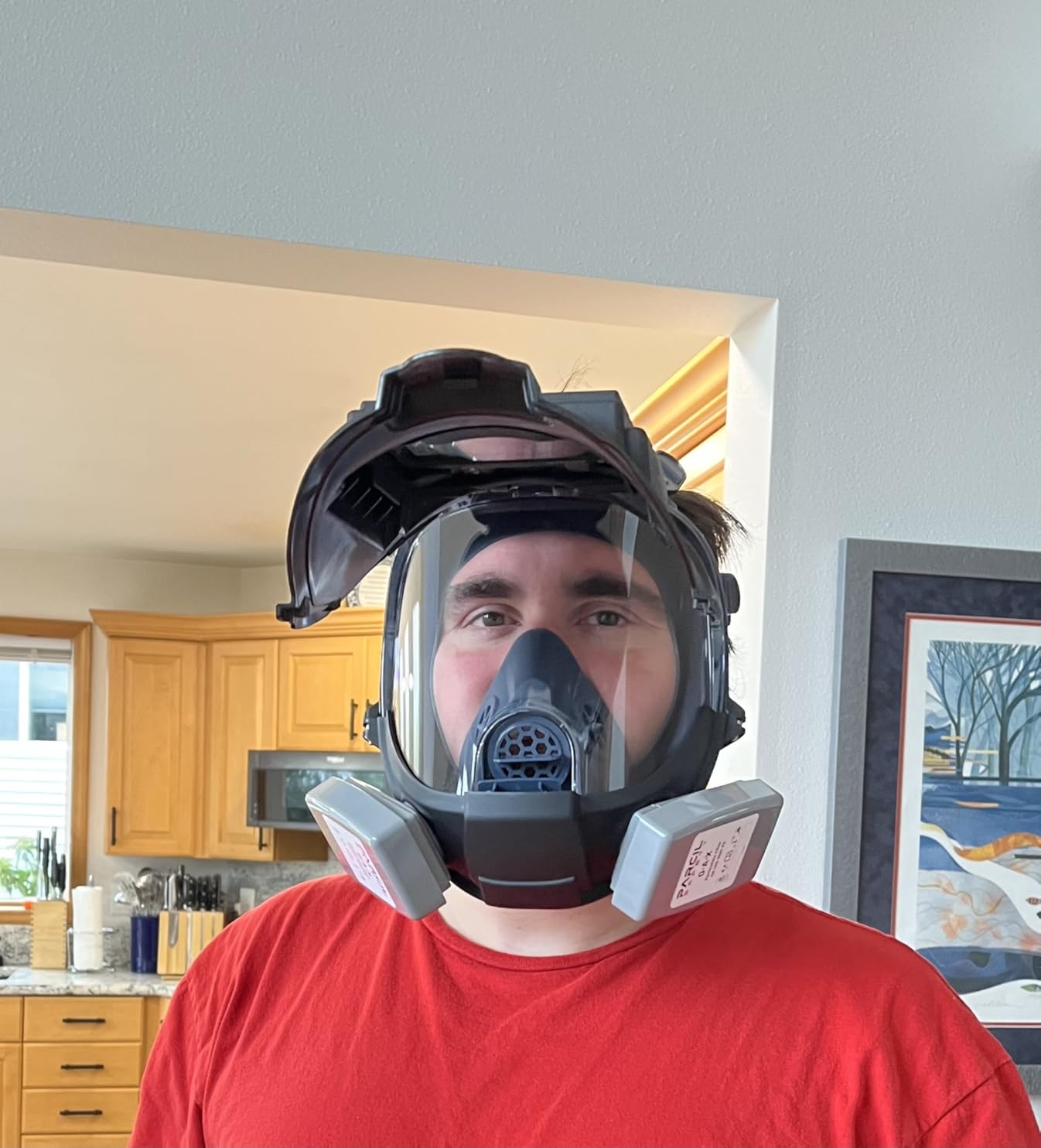
The limitation is straightforward: a cartridge respirator depends on P3 filters that need periodic replacement, and a full face seal can feel enclosed once temperatures rise in a summer fab shop. The listing is also recent, with a first-available date in January 2026, so its long-term durability record is short compared with established helmet brands.
No battery charger is listed, and the two included lithium batteries are the power source for the auto-darkening cartridge. If you weld at night in a dark shop, confirm your shade settings before a shift rather than during the first bead.
What the WF-101 does better than a PAPR
Two pounds is the headline. A powered hood with blower and battery on your belt transfers load to your neck and traps heat across the whole face, and a two-pound shell does not. For grinders doing repetitive finishing work, that difference shows up at hour four.
The DIN 5-13 range also removes a compromise. Most cartridge masks ship with a fixed shade, which forces you to change lenses when you switch from TIG to grinding. This one covers the whole day.
Who should skip the WF-101
Anyone welding coated or stainless work every shift should note that P3 particulate cartridges address fume particles but not gas-phase vapors. Those jobs need a gas and vapor cartridge or a PAPR, not a particulate filter.
Claustrophobic welders should try it on in a mirror before buying. The full face seal is the point of the design, and that is exactly what some people cannot tolerate.
3. Dräger X-plore 8500 PAPR Welding Visor Premium Set: The Industrial Build
- Premium build with components that fit one way
- Runtime exceeds the advertised figure
- Cool dry airflow rarely fogs
- Modular hood accepts fire or chemical shells
- Heavy 20.5 pound package
- Pressure on the back of larger heads
- Expensive proprietary hoses and filters
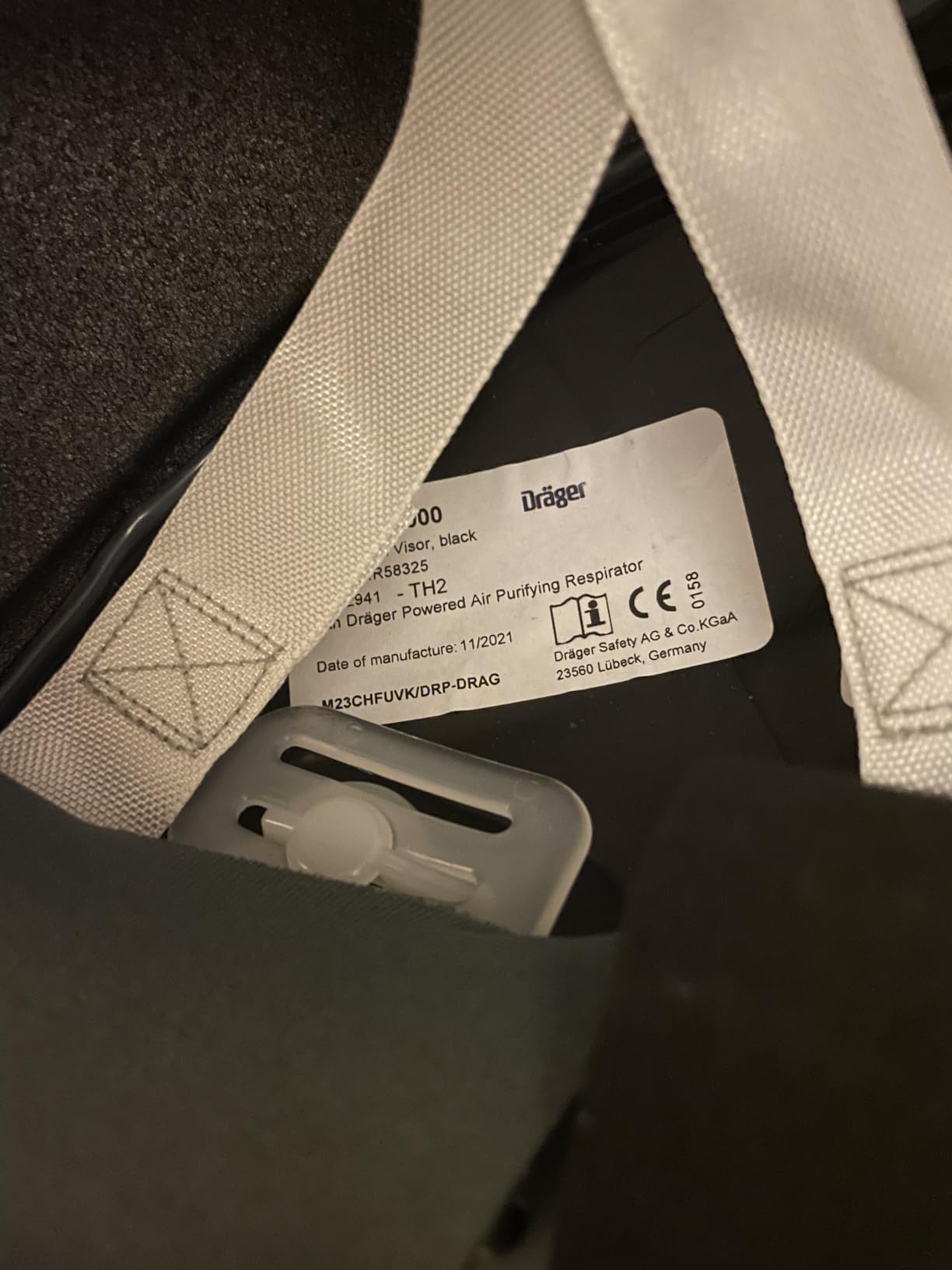
The Dräger set is the most complete package in the guide and the most industrial in character. The box holds a flip-up welding visor, the X-plore 8500 powered air unit, a high-capacity battery, a single charger with international plug adapters, an HE filter with pre-filters, a leather belt, a durable hose, a flame-resistant hose cover and five replacement visor windows. You are not assembling this from parts.
The visor is the standout feature. It flips up, has a digital display for mode selection and switches rapidly between welding, cutting and grinding, with arc sensors that trigger even when the lens is only partially covered. Side windows and a wide panoramic field of view address the tunnel vision that plagues full-face masks, and optional protective caps are included in the system.
Runtime is where this unit separates from every other pick. The dual power system combines a solar cell with a battery, a battery indicator tracks remaining charge, and the manufacturer claims up to 2800 hours of runtime. Owners report beating the advertised figure, and several describe cool dry airflow that avoids the heat and sweat of a tight-fitting respirator.
Fogging is the other thing owners praise. The visor reportedly stays clear at low fan settings during normal breathing, which is the single most common complaint about full-face welding masks. The modular head system also accepts Zytec fire-resistant or Tychem chemical-resistant hoods, so the same blower works for non-welding jobs on a refinery or remediation crew.
The objections are about weight, fit and parts. The package weighs 20.5 pounds and measures 33 by 24.1 by 12.6 inches, so plan your storage and your back. Wearers with larger heads report uncomfortable pressure on the back of the head, the hood takes patience to fit with multiple straps and a drawstring, and the visor has limited adjustment range.
Proprietary hoses and filters are expensive and hard to source locally, which is a real consideration outside major metro areas. The review pool is also thin at seven ratings, so treat the strong owner sentiment as encouraging rather than proven.
Where this system pays for itself
Multi-shift shops and regulated industrial work are the sweet spot. A battery that outlasts several shifts, hoods that swap between fire and chemical protection, and five included visor windows remove the consumable friction that drives owners off other systems.
The flip-up visor with instant arc detection also means you can inspect a joint or reposition a workpiece without pulling the whole unit off your head, which saves time on fit checks.
Where the Dräger hurts
20.5 pounds is a genuine burden for overhead and out-of-position work, and the back-of-head pressure reported by larger wearers does not go away after an hour. Test the fit with the hood fully cinched before you commit.
If your shop cannot source Dräger hoses and filters locally, the long-term cost of ownership can quietly exceed the entry cost difference. Check parts availability in your area first.
4. ANDELI PAPR Welding Helmet: The Widest Field of View in the Group
- Widest viewing area of any pick here
- Non auto-darkening side views aid peripheral awareness
- Adjustable airflow direction
- Integrated LED work light
- Heavy 11.15 pound package
- Mixed 3.8 rating with a sizable one-star block
- Large package footprint
The ANDELI’s argument is visibility. The viewing area measures 3.86 by 2.44 inches on a 180-degree panoramic screen, and it adds DIN 4 non auto-darkening side windows measuring 3.72 by 1.76 inches so you keep peripheral awareness without a second dark lens. For out-of-position work and for anyone who spends a shift tracking a torch tip, that geometry is the selling point.
The powered side filters particles at a claimed rate over 99.95 percent, and the airflow system is adjustable so you can direct air at your face, at the visor, or somewhere between the two. Four sensors switch the lens from light to dark in 1/25000 of a second, and an integrated LED work light illuminates fine detail, which welders running thin material or working as an assistant will appreciate.
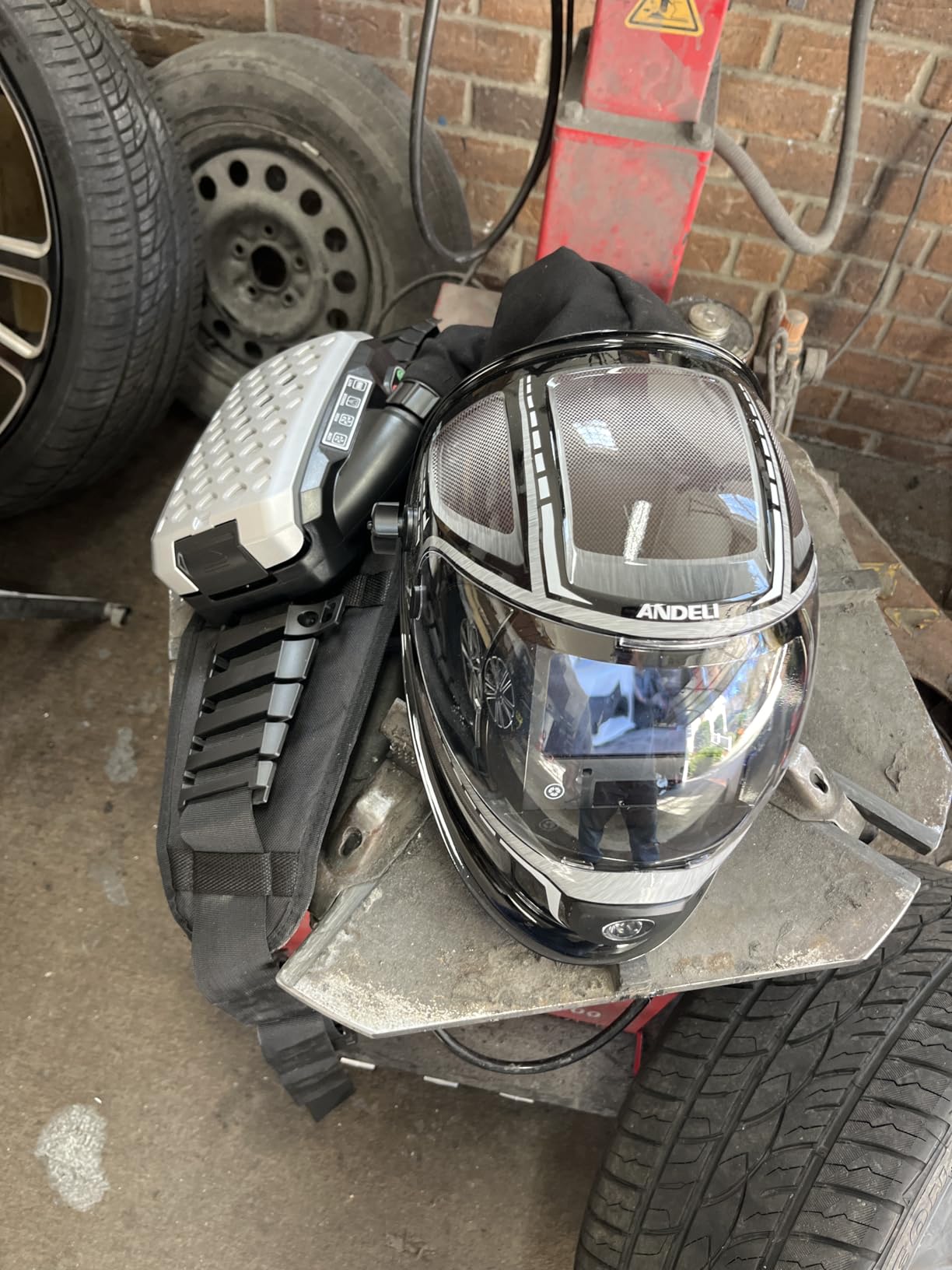
The owner record is genuinely mixed, and you should read it that way. Across 45 reviews the average is 3.8, with roughly 55 percent at five stars and 11 percent at four, but 18 percent rate it one star and 6 percent two stars. The pattern suggests the concept lands with many buyers while a distinct group hits problems with durability or performance. At 45 reviews it carries the largest sample in the guide, which makes that spread worth taking seriously.
Weight is the other issue. The package is 11.15 pounds and measures 21 by 12.84 by 11.5 inches, so it is a heavy lift over a full shift and it occupies real shelf space. Best sellers rank sits at 187 in welding helmets, so demand is there.
Who likes the ANDELI
Welders who work overhead, in tight frames or on stainless thin wall benefit most from the 180-degree screen and the side windows. The adjustable airflow direction is the detail people notice most on a hot day, since you can move the air off your face without shutting the blower down.
Assistants and multi-process hobbyists get real value from the LED, and the 1/25000-second switch means the lens is effectively instant.
Who should pass on it
If you have had a first-week failure with a lesser-known powered hood, the one-star block here is a warning. Brand recognition matters in this category, and reviewers on shop forums consistently trust established names for heavy galvanized work.
11.15 pounds over a long shift is a real endurance cost, and a 3.8 average with an 18 percent one-star block is not the profile of a unit we would hand to a new apprentice as a first purchase.
5. YESWELDER Q800D PAPR Helmet: True Color View With a Consumables Warning
YESWELDER Powered Air Purifying Respirator Auto Darkening Welding Helmet LYG-Q800D Welder Hood
- Owners report no more fume up the nose
- True color 1/1/1/1 optical clarity
- Large viewing screen with side view
- Solar assisted auto-darkening
- Runtime around two hours for several owners
- No spare battery or filter availability
- Blower failures after a few months
The Q800D filters up to 99.97 percent of weld fume and catches particles as small as 0.3 microns, and it pairs that with the most neutral lens in this guide. Four sensors drive 1/1/1/1 optical clarity, giving a true color view of the puddle rather than the greenish cast most auto-darkening lenses add. The screen measures 3.94 by 3.23 inches with a DIN 5 non auto-darkening side view.
Shade coverage is broad for a hood at this level. The range runs 4, then 5-9, then 9-13, covering TIG, MIG, MMA and grinding in one unit, and solar-assisted auto-darkening works alongside the included lithium ion battery. Adjustable airflow spans the breathing zone, and the shade ranges mean you are not swapping cartridges mid-project.
Owners with working units like the fume protection most. Several report no more fume reaching up the nose, and the all-in-one design removes the need to wear separate safety glasses or a half-mask underneath. Some also report a battery that lasted a full shift.
Why the lens is worth looking at
1/1/1/1 optical clarity is a measurable rating, and it changes how a puddle reads. On stainless and aluminum, a neutral view makes it easier to judge penetration and bead placement without flipping a shade up to check.
The combination of a large screen, a non auto-darkening side view and broad shade coverage makes this a good teaching helmet, where a trainee is constantly switching between processes.
The consumables problem is the dealbreaker
Multiple owners report battery runtime of roughly two hours rather than a full shift, and there is no way to buy a spare battery or replacement filters. A blower motor and belt bracket failure after a few months is also reported, and the plastic construction is described as cheap next to firefighter-grade breathing equipment by an owner with decades of experience.
The head strap is also described as uncomfortable and difficult to adjust. If your shift is longer than the battery, or you need filters you can reorder next week, this is not the unit. One documented order did receive a manufacturer refund, which is worth noting for service.
6. Parcil WF-100 Full-Face Welding Respirator: The Straightforward Entry Point
- Lightest entry into full-face respirators
- Replaceable standard lens extends unit life
- Six-point harness spreads weight
- Cartridge format matches 3M and Honeywell
- Lowest rating in the lineup at 3.2
- Fixed shade 9 with no auto-darkening range
- 22 percent one-star and 15 percent two-star feedback
The WF-100 is the simplest idea in the guide and the cheapest way into a full-face welding respirator. A fixed shade 9 welding lens sits in a flip-up helmet, dual P3 cartridges filter particulate and fume on both sides, and a six-point adjustable harness with quick-release buckles spreads the two-pound shell evenly across your head.
Two details make it more useful than a disposable mask plus a separate helmet. The lens is a replaceable standard format, so when it gets scratched you swap a lens rather than the whole unit, and the cartridge format is compatible with 3M and Honeywell conventions, so filters are easy to source locally.
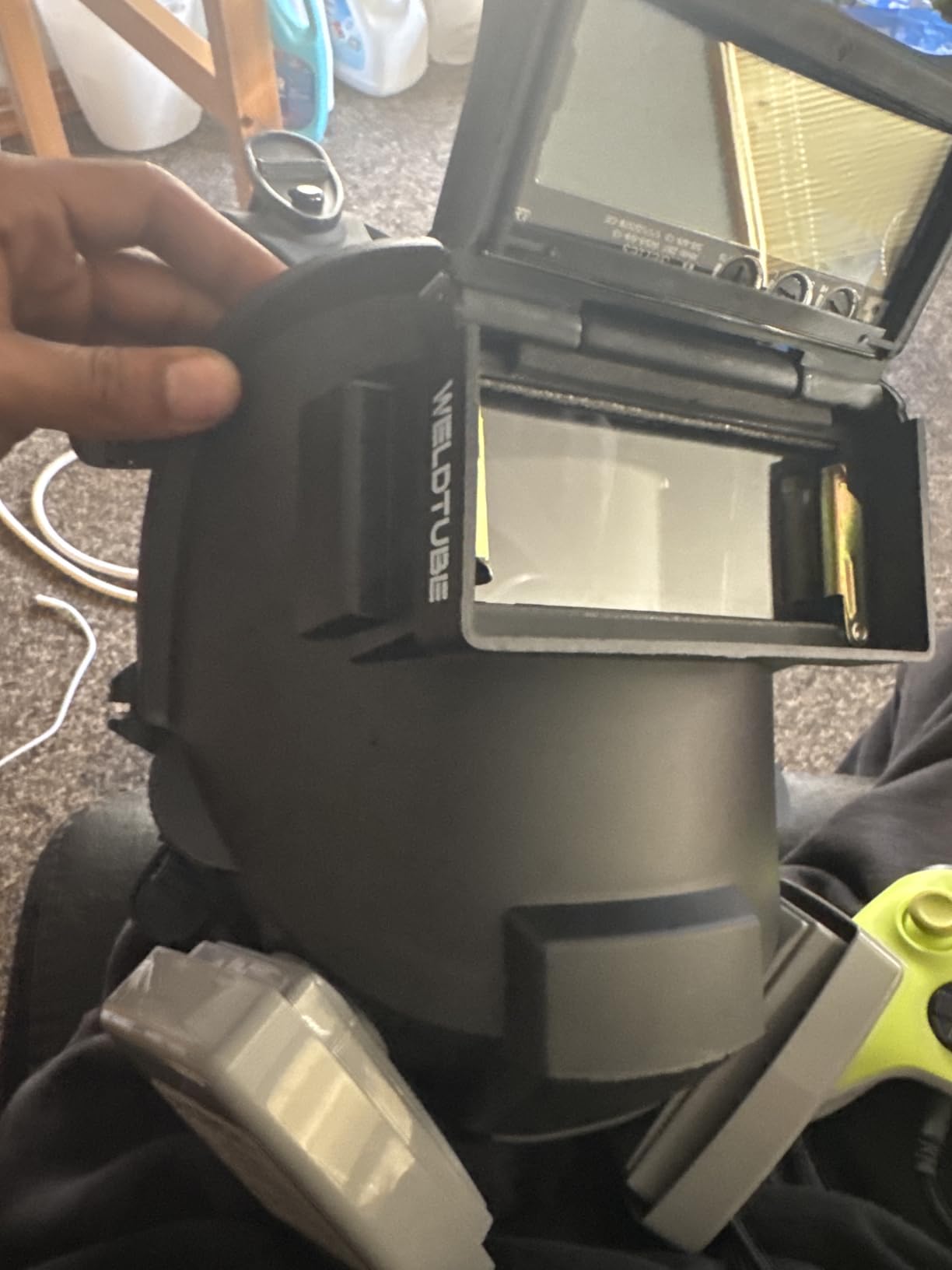
The reviews are the honest concern here. The average is 3.2 across 29 reviews, the lowest in the guide, with 30 percent five-star, 22 percent four-star, 11 percent three-star, 15 percent two-star and 22 percent one-star. That is a genuinely split result, and it points to a unit where the low cost and low weight win some buyers over while build quality disappoints others.
Documented detail is thin as well. Only two bullet features are listed on the product page, covering the replaceable lens and the adjustable harness, so fit and finishing are not described. Best sellers rank sits at 383 in welding helmets, and the listing first became available in January 2025.
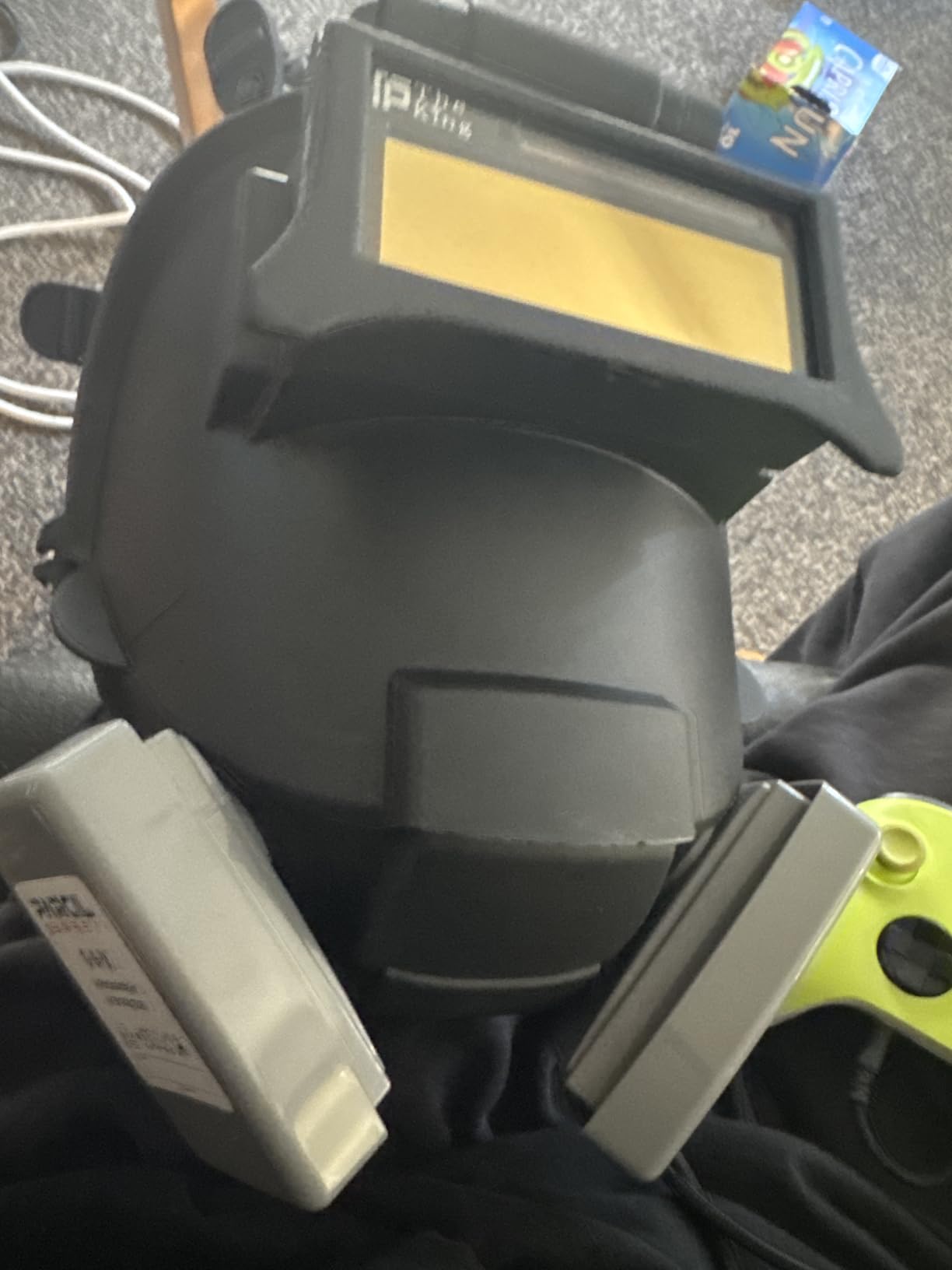
There is one specification conflict worth flagging. The technical details list a 4 by 2 inch shade 9 lens while the product title states 2 by 4.25 inch, so confirm the actual lens size with the seller before you order a replacement.
The fixed shade 9 lens is the other limitation. It is a sensible default for MIG and stick work on mild steel, but there is no auto-darkening range, so a process change means a manual lens change, and it will not suit the grinding and cutting work the WF-101 handles.
Where the WF-100 still makes sense
Students, apprentices and shop evaluators get the most out of it. A fixed shade 9 lens teaches arc reading without letting anyone accidentally run a full auto-darkening range at an inappropriate level, and the replaceable standard lens means a damaged face does not end the unit.
For short repair work on mild steel in a ventilated shop, the two-pound shell and widely available cartridges are enough. You get eye, face and respiratory protection from one object instead of three.
Where it falls short
A 3.2 average with a 22 percent one-star block is the weakest rating we included, and a split result like that usually means finish and seal quality vary. If you work in a confined space, the face seal quality determines whether the cartridges protect you at all, and that is exactly what a split review profile questions.
Anyone who alternates between welding and grinding, or between TIG and stick, should step up to the WF-101 and pay for the auto-darkening range.
PAPR vs Full-Face vs Half-Mask: Which Respirator Type Fits Your Work
A PAPR uses a battery blower to push filtered air into a loose-fitting hood. Because airflow is positive, there is no seal to check and no fit test to pass for the seal itself, and the constant air movement keeps heat, sweat and fog off your face. That is why r/Welding owners with all-day fume problems tend to end up on a powered system.
A full-face welding respirator uses replaceable cartridges and a tight face seal. It is lighter, costs less to run and needs no battery, but comfort depends entirely on getting a good seal, and the enclosed feeling is the most common complaint. r/Welding advice repeats the same conclusion: whichever one fits your face best is the one you will actually wear.
A half-mask under a standard auto-darkening helmet is the pragmatic compromise. It is the easiest to remove when you need to see without a lens, and advice in r/Welding notes that 3M 63xx and 75xx series half masks are quick to slip on and off over the head. It also means two separate pieces of headgear, which welders describe as clumsy compared with a combined system.
Supplied air, where clean compressed air comes through a hose, sits above all of these for protection. It is the right answer in shipyards and confined spaces where the atmosphere may exceed what a filter can handle, and it is not represented in this guide because it needs a compressor or a facility air supply.
Shop forum discussions also raise a real modification problem: full-face respirator helmets sometimes need the auto-darkening lens housing physically trimmed to fit, a frustrating and frequently reported purchase-killer. All four mask-based picks in this guide are listed as accepting their lenses directly, but verify fit with your specific lens before you commit.
How to Choose a Respirator Filter for the Metal You Are Welding
Particulate filters handle solid metal fume particles. Gas and vapor cartridges handle the gases that come off coated, plated or stainless material, and they are the part most people get wrong. A P100 or P3 particulate filter does nothing for the vapor phase, which is the entire exposure when welding galvanized steel.
For mild steel, particulate filtration is the dominant need, because the main hazard is manganese and iron oxide particles. A P100 or a P3 cartridge is appropriate, and so is a PAPR with a high-efficiency particulate filter.
For galvanized steel, the hazard is zinc oxide, which is a fume and gas-phase exposure rather than a particle. This is the most common filter question in r/Welding, and the honest answer is that a particulate-only mask is not adequate. You need a combination filter rated for metal gas and vapor, or a supplied-air system, and this is the single best reason to own a properly configured PAPR.
For stainless steel, chromium and nickel fumes drive the risk. A PAPR with a high-efficiency particulate filter covers most of the exposure, and adding a gas and vapor cartridge for acid gases such as those produced on stainless improves it further.
For aluminum, the fume is relatively low toxicity, but the coating and cleaning residues on the material are the real concern. For lead-coated material, treat the job as hazardous material work and follow your site respiratory protection program rather than relying on a catalog filter choice.
The short version
Mild steel, particulate filter. Stainless, particulate plus a gas and vapor cartridge. Galvanized, gas and vapor or supplied air, and not a particulate-only mask. The picks here using HE or P3 cartridges are appropriate for the first two categories only.
Always confirm approval
NIOSH approval and OSHA 29 CFR 1910.134 compliance are the primary trust markers in this category, and shop forums treat them that way. Read the approval label on the specific configuration you are buying, because approval attaches to a blower, hood and filter combination, not to a brand name. A respirator assembled from mismatched parts is not an approved respirator, no matter how good the components are individually.
Fit, Battery Life and the Real Running Cost of These Systems
Fit is where most respirator helmets are won or lost, and the recurring forum advice is simple: try several and pick the one that seals best on your face. A tight facepiece needs a clean-shaven or taped seal, and a loose hood needs the blower running at adequate flow. Whichever you choose, verify the seal with a positive and negative pressure check before every shift.
Comfort complaints cluster around four points. Heat and sweat are the top complaint for any full-face design, fogging the lens is the second, headgear that will not stay tight is the third, and claustrophobia is the one vendors rarely mention. If you are anxious in enclosed headgear, a loose-fitting PAPR hood is materially easier to wear than a tight facepiece, and that alone may decide between the two.
Prescription glasses are the other quiet issue. The WF-101 is listed as compatible with spectacle inserts, and the 9100 and G5 series have wide shells, but if you wear glasses, try the mask on with them before ordering. A helmet that fits over glasses rarely fits well without them.
Running cost is where the cheap units get expensive. Replaceable cartridges and standard lenses are the cheapest path. Proprietary filters, sealed batteries and brand-specific hoses are the most expensive, and the 3M listing notes proprietary filters as an ongoing accessory cost while the Dräger system carries expensive parts that are harder to source locally.
Battery behavior separates the powered units clearly. The 3M Adflo setup is reported by owners to outlast a full shift, the Dräger set claims up to 2800 hours with a solar-assisted dual power system, and the YESWELDER Q800D is reported by multiple owners to run about two hours with no spare battery available. That spread is larger than the spec sheets suggest, and it decides whether a PAPR is workable for you.
When You Do Not Need a PAPR Helmet
If you weld a few hours a month on mild steel in a garage with a running fan, a standard auto-darkening helmet plus a disposable P100 half-mask gives you adequate protection for a small fraction of the cost of anything on this list. Combination cartridge respirators are also a legitimate step for hobbyists doing stainless or coated work occasionally.
Shop forums describe this compromise accurately as either that or nothing, and the real failure mode is wearing nothing at all. A half-mask you will actually remember to put on beats an expensive hood that sits on a shelf because it is uncomfortable.
Where a PAPR becomes worth the money is when you weld coated or stainless material regularly, when you work in confined or poorly ventilated spaces, when you run multiple shifts, or when you weld every day and finish a shift with the sore throat and headache that welders call metal fume fever. Those four conditions describe most professional fabricators and very few weekend hobbyists.
Budget limits are a legitimate reason to choose a simpler unit. r/Welding threads regularly return to a fixed cost ceiling far below the professional tier, and the WF-100 and WF-101 exist to serve that buyer. Just know what you are giving up: an auto-darkening range, gas-phase filtration, or a full day of battery.
Frequently Asked Questions
Do welders need to wear respirators?
Yes, when you weld often, when you work on coated or stainless material, or when ventilation is poor. Welding fume contains metal particulates and gases including zinc oxide from galvanized steel and chromium and nickel from stainless, and these cause or worsen metal fume fever, bronchitis and long-term lung risk. Occasional hobby welding in a ventilated garage is usually handled adequately by a standard helmet plus a P100 half-mask, while daily professional welding deserves respiratory protection as standard equipment.
What is the best welding helmet with respirator?
For most professional welders the 3M Speedglas G5-01 with the Adflo high-altitude PAPR is the strongest overall choice. It ships as a complete factory system, the variable color filter offers clear, cool and warm tints, and owners report the battery outlasting a full shift. The Parcil WF-101 is the better choice if weight and cost matter more than lens quality, and the Dräger X-plore 8500 set leads for industrial work where modular hoods and long runtime matter.
Can you wear a respirator with a welding helmet?
Yes, and the combined version is usually more comfortable. You can wear a half-mask respirator under a standard auto-darkening helmet, which is the cheapest option but means managing two pieces of headgear. A full-face welding respirator or a PAPR welding helmet combines both in one unit, so you remove one item instead of two. Many welders find the combined system easier to wear because there is no seal to break each time you flip the helmet up.
What is the best respirator mask for welding?
It depends on the material. For mild steel, a P100 or P3 particulate half-mask or a powered air purifying respirator with a high-efficiency particulate filter is appropriate. For stainless steel, use particulate filtration plus a gas and vapor cartridge where acid gases are present. For galvanized steel, a particulate-only filter is not adequate because the exposure is zinc oxide in the gas phase, so you need a combination cartridge or supplied air. Match the filter to the process rather than to the budget.
When would you use a PAPR?
Use a PAPR when you weld full shifts, when you work on galvanized or stainless steel regularly, when you are in a confined or poorly ventilated space, or when a half-mask is uncomfortable enough that you skip it. Because the blower pushes air into a loose-fitting hood, there is no face seal to check and the airflow helps stop lens fogging. A PAPR is overkill for occasional hobby welding on mild steel in a ventilated garage.
Is shade 10 or 11 better for welding?
Both are valid, and the right shade depends on your process and current. Shade 10 suits most MIG welding on mild and stainless steel of medium thickness. Shade 11 is usually better for TIG, heavier material and low-amperage work where the arc is less bright. Thin material and gas tungsten work generally need a lighter shade, while heavy stick work benefits from 12 or 13. If you are undecided, an auto-darkening lens with a wide range removes the guesswork entirely.
How can I protect my eyes while welding?
Wear a welding helmet with an auto-darkening filter or a fixed tint matched to your process, and use a shade appropriate to the arc brightness. Add grinding and cutting protection for those tasks, since a welding shade is not a grinding shade. Keep your clear outer visor or lens clean, because a scratched or fogged lens forces you to lift the helmet to see. Protect your neck and skin as well, and wear gloves, since fume and UV exposure reach exposed skin.
What are the top 5 welding helmets?
Among the combined helmet and respirator units covered here, the 3M Speedglas G5-01 with Adflo leads on lens quality and factory integration, the Parcil WF-101 leads on weight and value, the Dräger X-plore 8500 set leads on industrial build and runtime, the ANDELI PAPR helmet leads on panoramic field of view, and the YESWELDER Q800D leads on true color clarity. If you want helmets without respiratory protection, the Lincoln Electric Viking is the most popular model in welder discussions and the 3M Speedglas 9100 is the common pro alternative.
The Verdict: Which Welding Helmet With Respirator Wins
The 3M Speedglas G5-01 with the Adflo high-altitude PAPR is our pick among the best welding helmets with respirators. It is the only unit here that arrives as a complete, factory-matched system, the variable color filter is the best lens in the group, and owners report battery life that covers a full shift.
Buy the Parcil WF-101 if you want the lightest, most affordable system and you work mild steel and grinding rather than coated materials. Buy the Dräger X-plore 8500 set if you weld in an industrial or regulated environment and need modular hoods and long runtime.
For visibility, the ANDELI hood leads on field of view and the YESWELDER Q800D leads on color neutrality, though the Q800D battery and consumable situation argues against it for long shifts. The Parcil WF-100 is the entry point, with a fixed shade 9 lens and the most cautious review profile in the group.
Whichever you choose, buy the filter that matches the metal you actually weld, confirm the NIOSH approval covers your exact configuration, and run a seal check before the first bead. That last habit matters more than any of the specs on this list.