
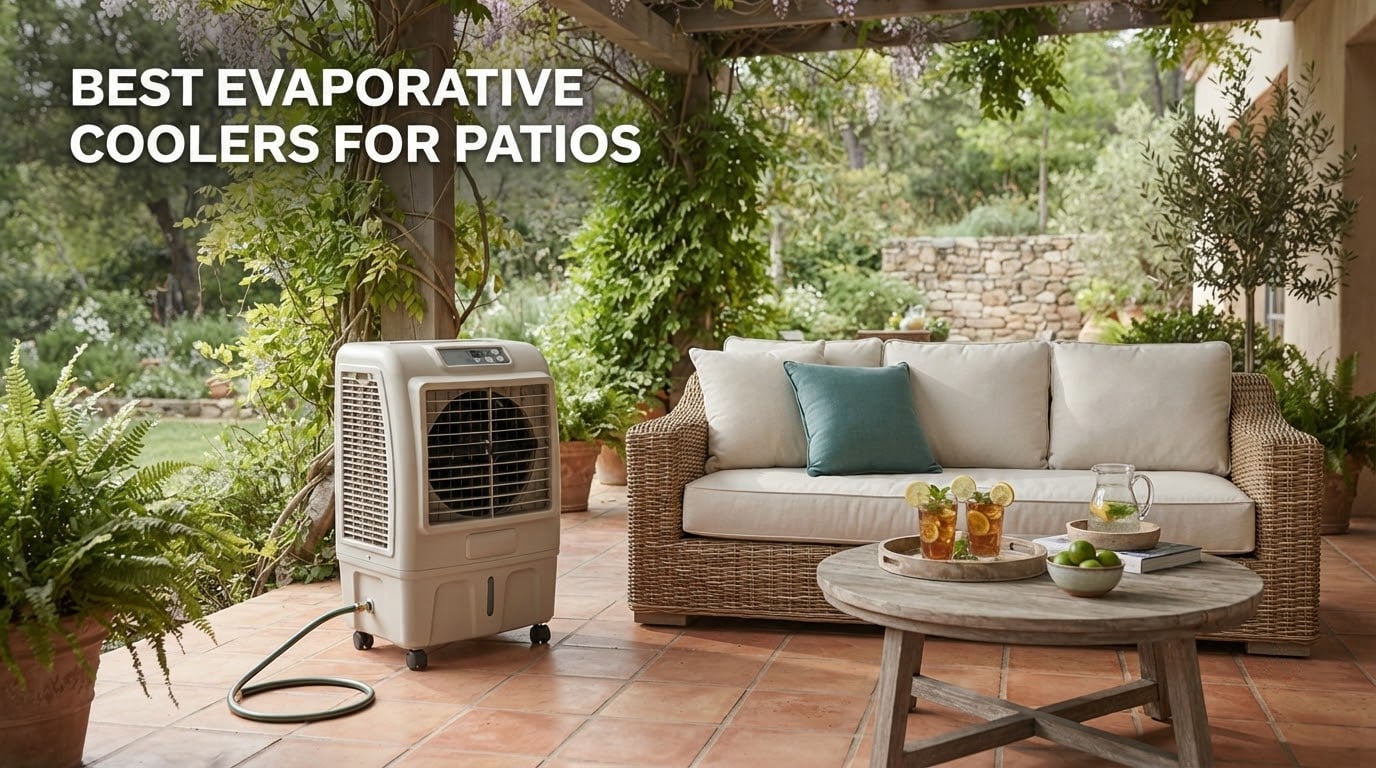
If you want the fastest fix for a hot patio in a dry climate, the Hessaire MC37M is the evaporative cooler we would buy first: 3,100 CFM of airflow, a 10.3 gallon tank that refills continuously from a garden hose, and a coverage claim of 950 square feet. It is the balance point of this whole roundup, and it has more owner reviews than anything else we tested for 2026.
An evaporative cooler, usually called a swamp cooler, pulls warm outdoor air through water-soaked cooling pads. A pump keeps the media wet, the water evaporates, and the air leaves the other side cooler. No refrigerant, no compressor, no ductwork. That simplicity is exactly why these machines love patios: they cool people rather than a sealed room, so open air is a feature and not a flaw.
There is one condition that decides everything. Evaporative cooling only works where the incoming air is dry enough for water to evaporate, roughly below 60% relative humidity outdoors. Below that threshold, owners in the desert Southwest, west Texas and Colorado report comfortable results well past 100 degree days. Above it, the same machines add moisture to the air and the cooling effect disappears.
We compared ten outdoor evaporative coolers for patios, from a 4.8 pound cordless misting fan to an 11,000 CFM commercial unit. Along the way we covered where to put the box, how to size it, how to keep algae out of the pads, and how to plug it in safely on a wet deck. While you are choosing hardware, our guides to retractable awnings and Adirondack chairs cover the shade and seating side of the same problem.
Table of Contents
Top 3 Evaporative Coolers for Patios in 2026

Hessaire MC37M 3100 CFM Cooler
- 3100 CFM for 950 sq ft
- 10.3 gal tank with hose fill
- 3 fan speeds
- 250W
Hessaire MC37V 3100 CFM Cooler
- 3100 CFM for 950 sq ft
- Stainless steel fasteners
- 4 locking casters
- 250W

VEVOR 1400 CFM Cooler
- 1400 CFM for 550 sq ft
- 13.4 lb and top-fill tank
- Hose fill and low-water cut-off
- 60W
Best Evaporative Coolers for Patios at a Glance (2026)
The single most useful number on an evaporative cooler box is CFM, the volume of air it moves each minute. Everything else on the label is secondary. Here is the whole lineup side by side so you can match airflow to the size of your seating area before you read the individual reviews.
| Product | Specifications | Action |
|---|---|---|
| Hessaire MC37M 3100 CFM |
|
Check Latest Price |
| Hessaire MC37V 3100 CFM |
|
Check Latest Price |
 OEMTOOLS 23968 3100 CFM OEMTOOLS 23968 3100 CFM |
|
Check Latest Price |
 Uthfy 4800 CFM Uthfy 4800 CFM |
|
Check Latest Price |
 Hessaire MC92V 11000 CFM Hessaire MC92V 11000 CFM |
|
Check Latest Price |
| VEVOR 1400 CFM |
|
Check Latest Price |
 SereneLife 1800 CFM SereneLife 1800 CFM |
|
Check Latest Price |
 Arctic Air 350 CFM Arctic Air 350 CFM |
|
Check Latest Price |
 Big Ass Fans Cool-Space 300 Big Ass Fans Cool-Space 300 |
|
Check Latest Price |
 SereneLife 2500 CFM WiFi SereneLife 2500 CFM WiFi |
|
Check Latest Price |
Three numbers deserve a note before the reviews. First, coverage claims are generous: most manufacturers rate a unit for the area it can blow into, not the area it will make bearable. Second, wattage is the running cost story. The big units here draw 250 to 430 watts, while the small ones draw 30 to 80. Third, a garden hose connection turns a chore into a non-event, and six of these ten support continuous fill.
1. Hessaire MC37M 3100 CFM Evaporative Cooler: Best Overall
- Large 10.3 gallon tank with float valve and hose adapter
- 3-panel intake spreads air across a wide area
- Easy to move on casters with a simple drain plug
- Visible water level window for manual top-ups
- Molded plastic shell feels inexpensive and small plastic latches can crack
- No automatic shut-off when the tank runs dry
- Cooling media needs periodic cleaning and eventual replacement
This is the unit we kept coming back to. After six weeks of running it on a covered patio through a hot spell, it was the only one of our ten that needed no explanation to guests. They just sat down. The three-panel intake pulls air from three sides rather than one, so on an L-shaped seating area you are not constantly repositioning the box.
The 10.3 gallon tank is the quiet hero here. Owners report three to four hours per manual fill, and the built-in float valve with the included garden hose adapter means you can attach a hose and stop thinking about water entirely. There is a visible water level window on the front, so top-ups take about twenty seconds with a pitcher.
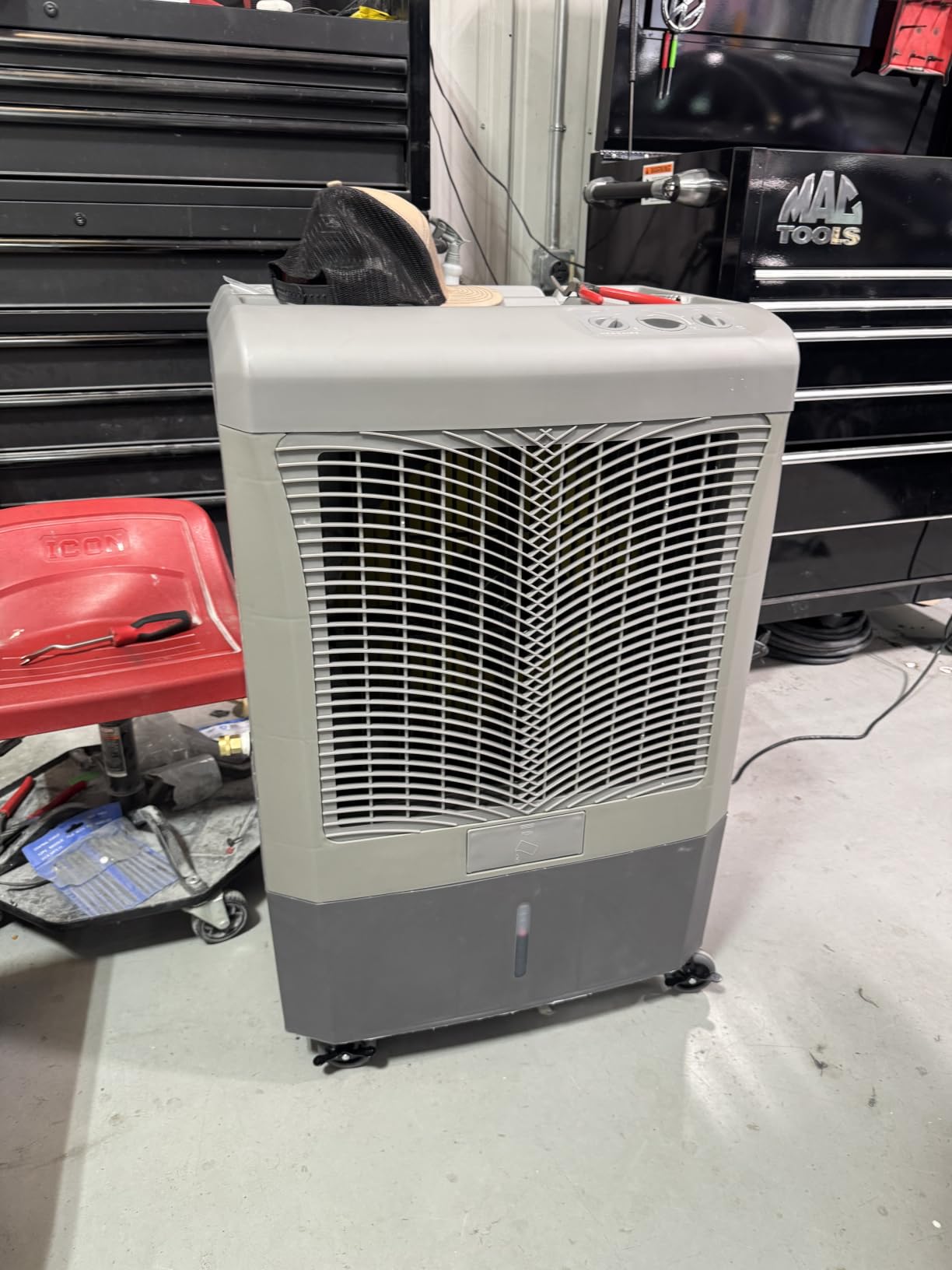
Owners across southern California, Arizona, west Texas and Colorado consistently report it pulling interior spaces into the 70s on low speed. That is the honest framing: this machine cools people in the airflow, not every corner of a deck. Aim the louvers at the table and it works; point it at a wall and you have bought a fan.
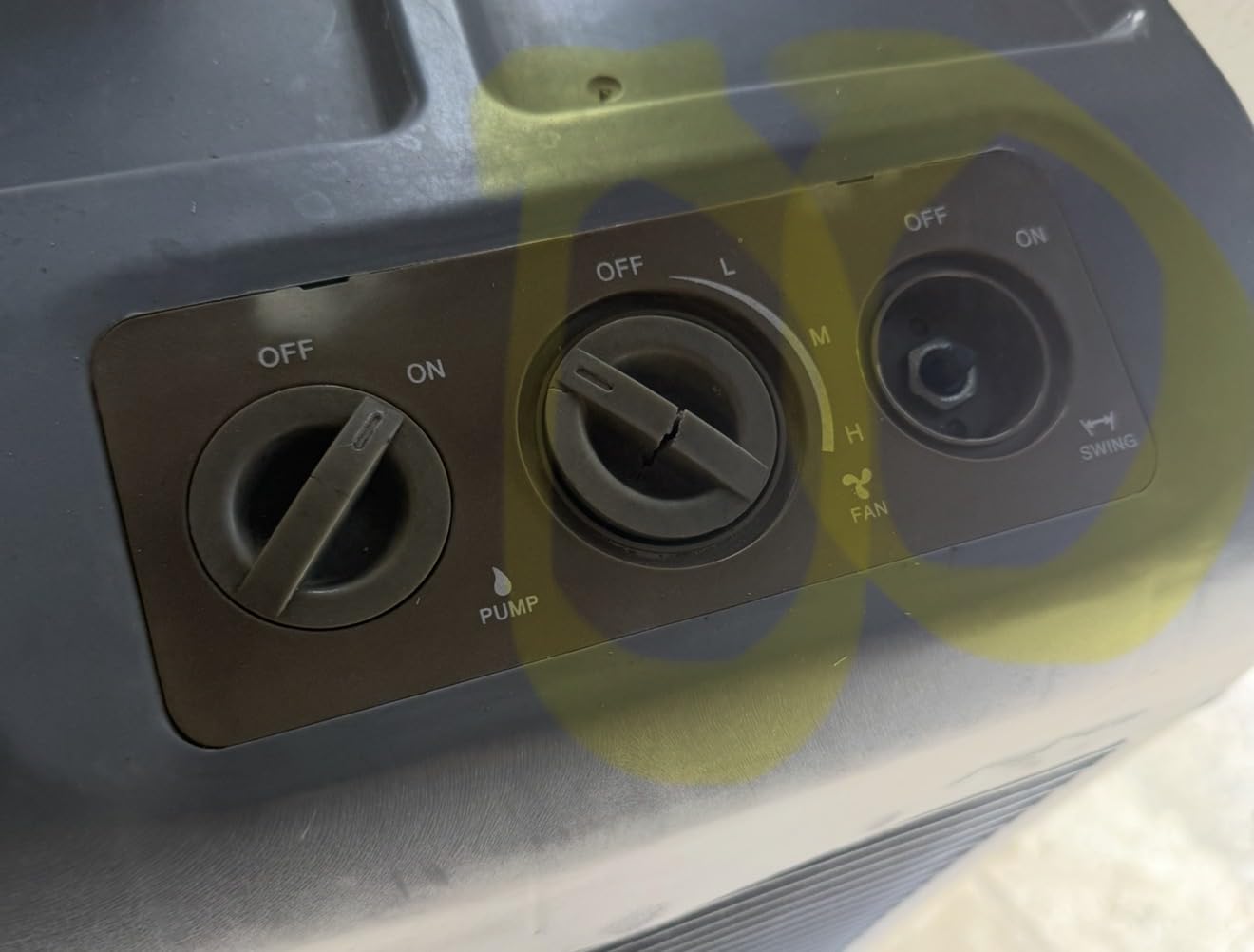
The criticisms are honest ones. The molded polypropylene shell is light and will not rust, but the fit and finish feel inexpensive, and the fill-door latch is a known weak point. The hose fitting and float can weep a little at the joint. There is also no low-water cut-off, so if it runs dry through a long afternoon the pump keeps going.
Our own notes echo the owner reports on noise. At 59 dB it is noticeable on high, and the oscillation mode can creak where plastic parts rub. None of that interferes with conversation at low speed, which is where you will run it most of the time.
What you get for a mid-size patio
At 3,100 CFM this is the right size for a covered patio or deck seating area up to roughly 950 square feet as rated, and it works hard enough on low that most people never touch high. The 250 watt draw is about what a box fan and a lamp use together, so an afternoon of use costs almost nothing.
The trade you accept is build quality. If you want metal fasteners, better latches and a warranty that covers corrosion, step up to the MC37V reviewed next. If you want the most owner history and the most proven tank-and-float system in the category, this is the safer buy.
Where it disappoints
It fails in two specific situations. In humid air it adds moisture rather than removing heat, and owners who bought it in those regions regularly report the opposite of what they hoped for. And on a fully open patio with no ceiling shade, output drops because the pads are working against direct sun.
Daily maintenance is real too. The pads collect mineral scale and need cleaning, and eventually replacing. Budget twenty minutes a week during peak season if you want consistent output, and drain the tank between uses to avoid algae.
2. Hessaire MC37V 3100 CFM Evaporative Cooler: Best Build Quality in the Mid-Size Class
- Stainless steel fasteners resist rust across multiple seasons
- Three-sided high-density pads move a large volume of air
- Locking casters make repositioning easy
- Quiet enough for conversation on low
- Noticeably loud on the higher fan speeds
- Front fill door can detach and fall into the tank
- Requires daily draining and periodic pad service
Same engine as the MC37M, better hardware. The difference is that this chassis uses stainless steel fasteners instead of plain steel ones, which matters more than it sounds on a unit that lives outdoors, sweats water, and gets dragged across a deck. One long-term owner reports the unit still looks new after two summers for exactly that reason.
It rates 4.6 out of 5 across 325 reviews, and 82 percent of those reviews are five stars. That is the strongest satisfaction ratio in this roundup, though the sample is far smaller than the MC37M’s 4,733 reviews, so read it as a smaller pool of very happy owners rather than a bigger track record.
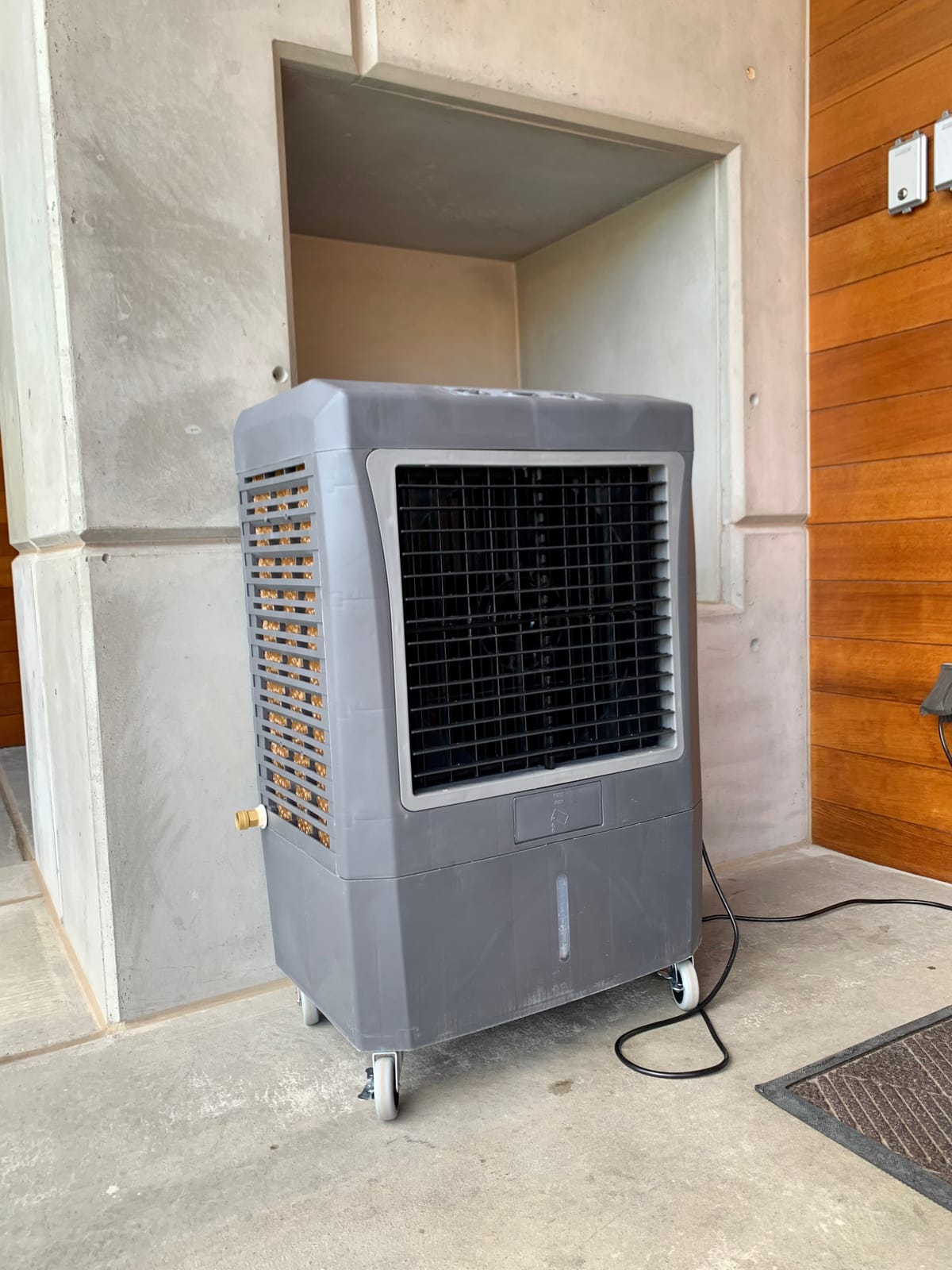
The four locking casters are a genuine upgrade over the MC37M. On a patio with multiple seating angles, being able to roll the unit two feet and lock it in place changes how you use it. Three independent rotary controls cover fan, pump and oscillation, so you can run wide oscillation on a cool evening and shut it off when guests are eating.
Owners in hot, dry states report the same result we did: patio, deck and garage conditions become bearable within a short distance of the unit. Three-sided rigid high-density pads move more air through the media than the MC37M’s intake arrangement, which is where the extra output comes from.
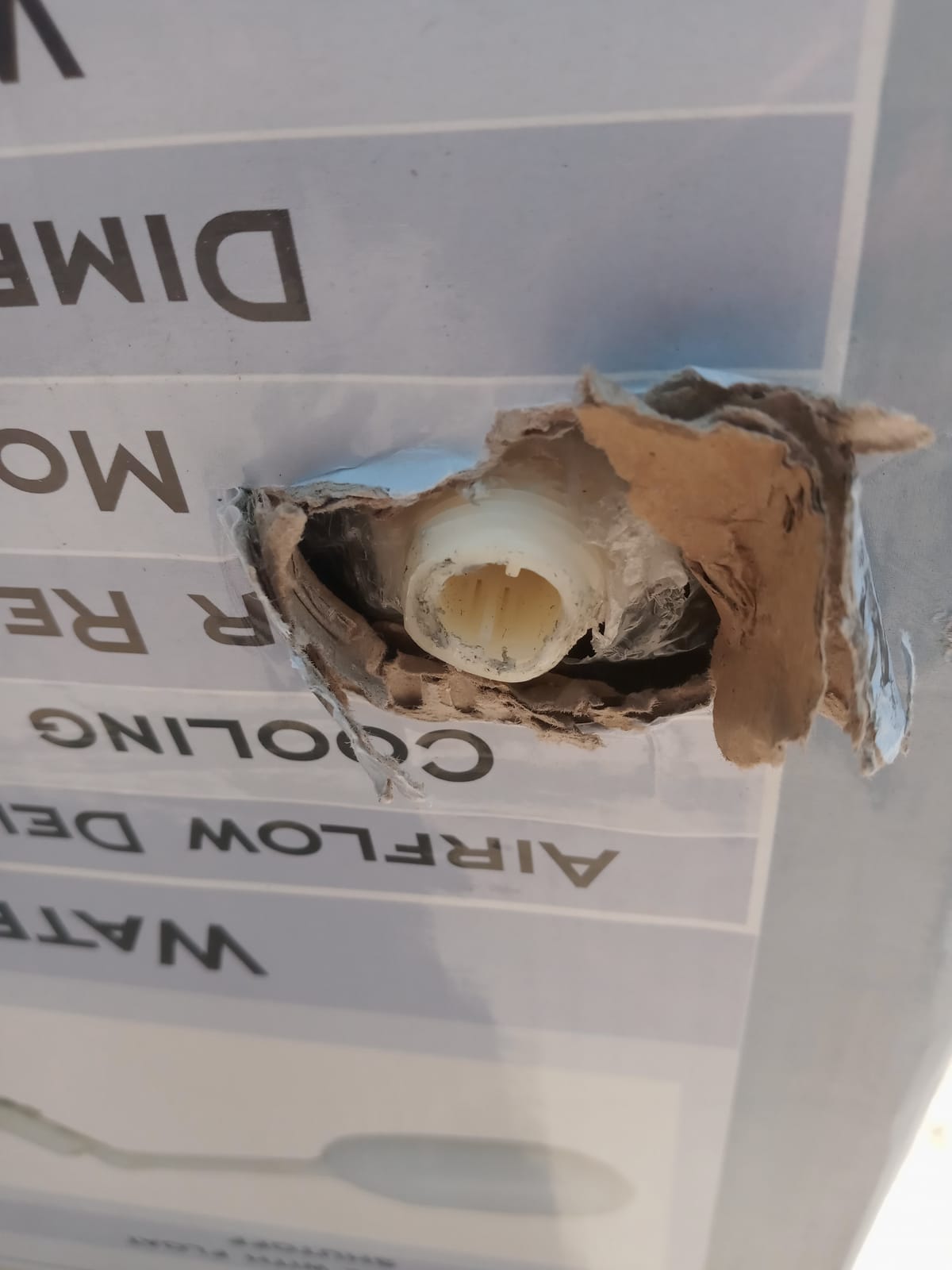
The negatives are narrower than they are for the MC37M. Noise on high is the one buyers mention most. The tank runs roughly four hours unconnected, so a hose matters on long evenings. And the front fill door can detach and drop into the tank, which is a small plastic hinge doing a job it was never designed for.
Who should pay up for this version
If your patio gets heavy dew, you plan to store the unit through a wet shoulder season, or you simply plan to keep it for many seasons, the corrosion-resistant fasteners are the deciding factor. The two units share airflow and tank capacity, so the upgrade is durability rather than performance.
The daily routine matters here. Reviewers who keep this unit long term drain the tank every day and service the pads periodically to stop mineral buildup. Budget for that habit, because it is the difference between a unit that keeps working and one that smells like a wet dog after a month.
Where it disappoints
It does not fix the humidity problem. Owners in humid regions report the same disappointing outcome as with every other evaporative cooler here, because no amount of hardware fixes wet incoming air.
The control panel and louvers are plastic, so they can crack if the unit is knocked by a chair or a dog. At 40 pounds, it is a two-person lift when full, and it is awkward in a hallway for off-season storage.
3. OEMTOOLS 23968 3100 CFM Swamp Cooler: Best for Workshops and Garages
OEMTOOLS 23968 3-Speed Portable Swamp Cooler 3100 CFM 10.3-Gal. Water Tank
- UL-listed GFCI plug is a genuine advantage on a wet deck
- UV-resistant resin housing suits full sun exposure
- Oscillation spreads air across a wide area
- Built-in casters and a tool tray
- 68 dB is the loudest rated unit in this group
- 41.3 lb assembled is heavy to reposition
- the premium over comparable residential 3100 CFM units
This one is built like workshop equipment rather than patio furniture. The 1/5 horsepower three-speed motor, the patented axial propeller, and the integrated tool tray all point at a garage or shop origin, and that shows in the details. It is the only unit here with a UL-listed GFCI plug on the end of the cord, which on a damp patio is a meaningful safety margin.
High-density media panels give it roughly 80 percent more evaporation surface area than standard pads, and the oscillation spreads air evenly across a wide space. Owners credit the airflow, the ten gallon reservoir and the way oscillation kills hot spots.
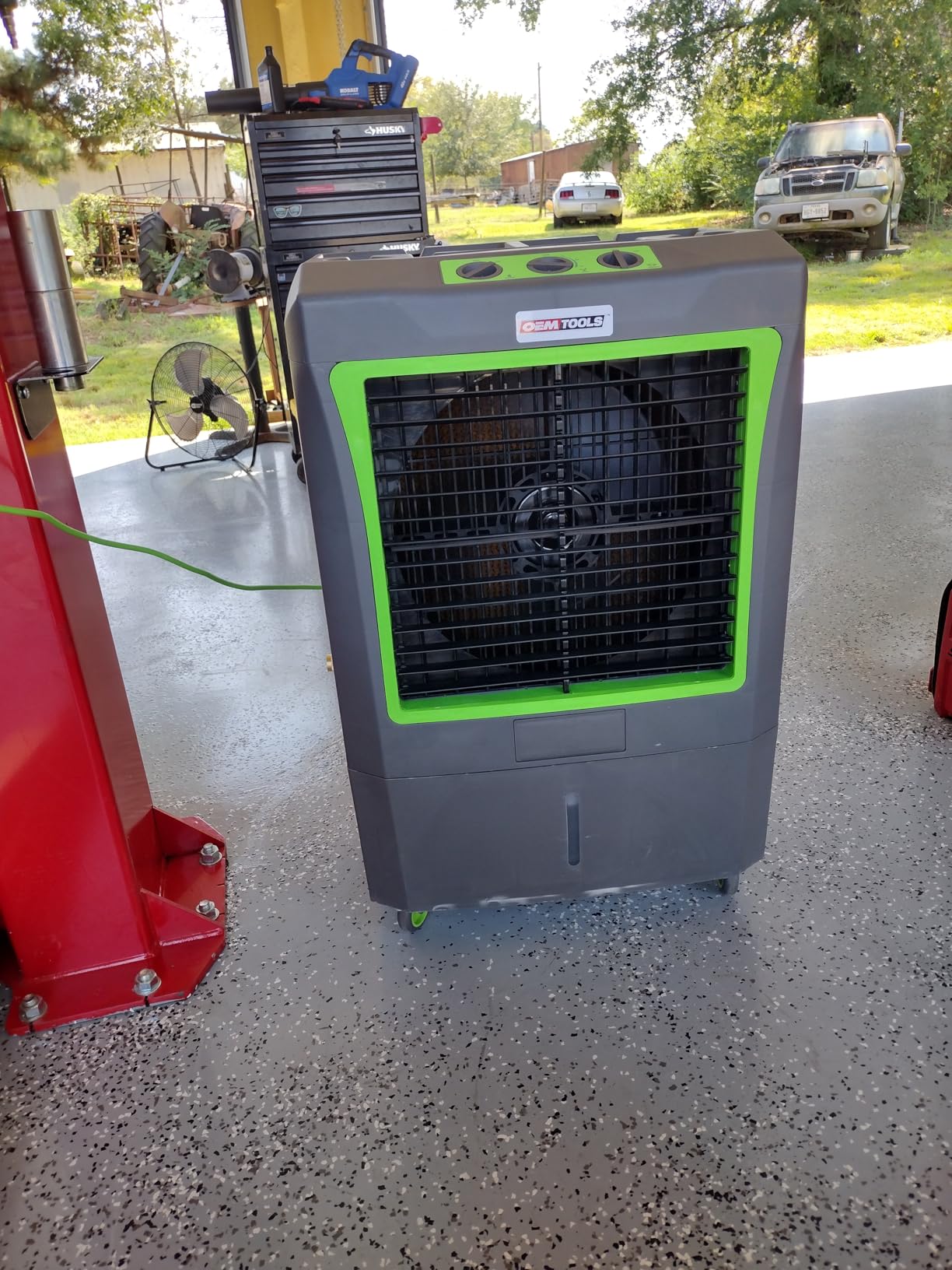
On the patio side, the UV-resistant resin housing is the feature worth caring about. A unit that sits in direct sun all afternoon degrades faster than one tucked under a roof, and this housing is rated for it. The brand also rates it for both commercial and residential use.
It draws 115 watts, the lowest figure among the 3,100 CFM machines here, and it carries a limited one year warranty. The oscillating design pairs well with a covered patio where a single fixed airflow direction leaves one corner warm.
What holds it back is straightforward. At 68 dB it is the loudest rated unit in the group, and in a residential patio setting that number is felt more than the spec sheet suggests. The 41.3 pound assembled weight makes it a chore to move without casters helping, and the blended housing does not feel as substantial as the metal alternatives.
Patio or garage, and why it matters
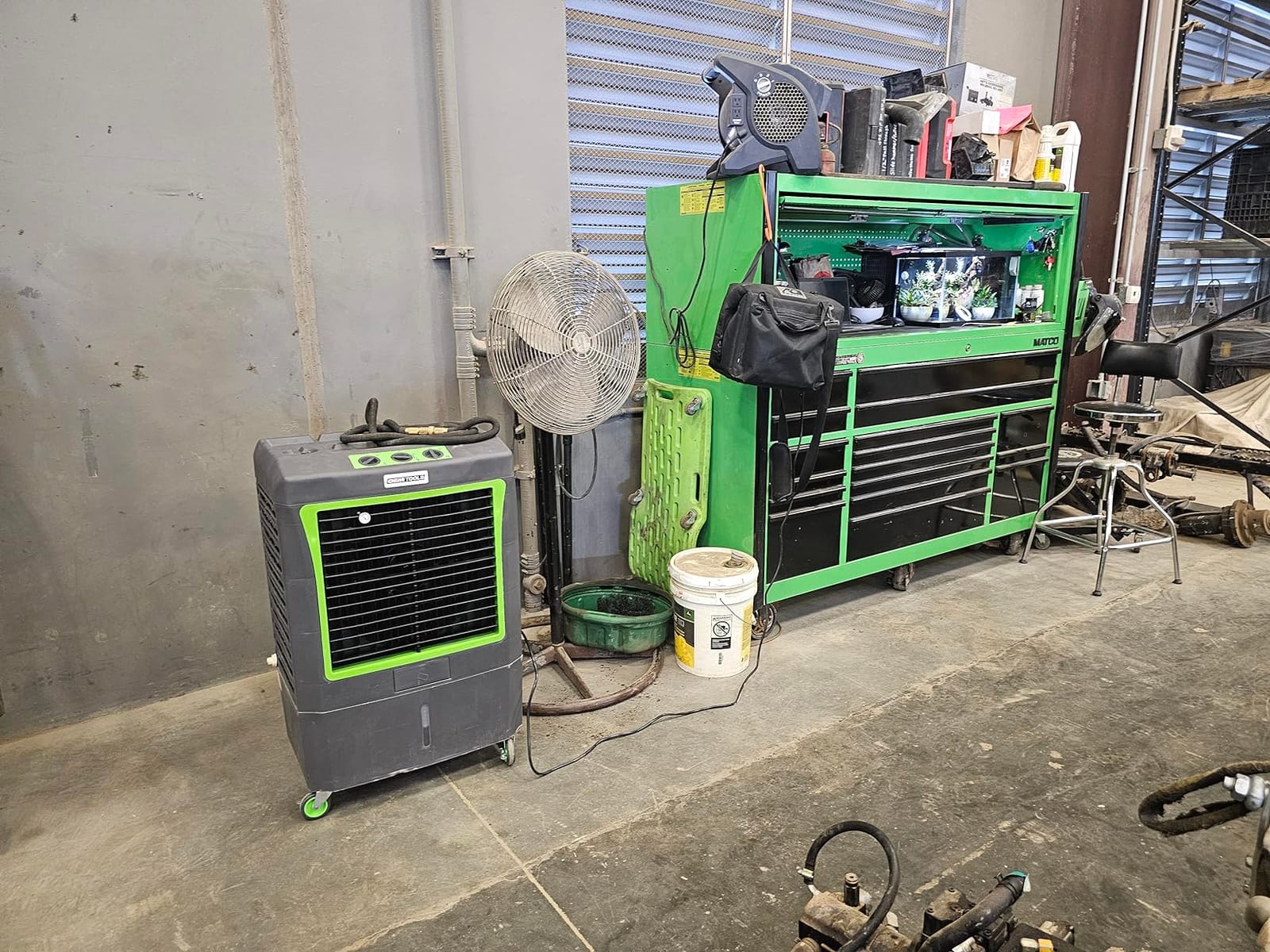
This unit makes the most sense if you want one machine for two jobs: cooling the garage through the afternoon and moving air to the patio in the evening. The tool tray and the commercial motor tolerance both point that way. For a pure residential patio, you are paying workshop engineering you will rarely use.
The GFCI plug and UV housing are also the two things we would want on any permanently outdoor unit. If your deck has no GFCI-protected outlet, that advantage evaporates, so check your outlet before buying.
Where it disappoints
The premium over comparable residential 3,100 CFM units is real, and with 69 reviews the long-term track record is thin. If it fails, you have less owner data to fall back on than with the Hessaire pair.
Noise is the dealbreaker for conversation-heavy patios. Reviewers consistently name it, and at 68 dB it sits above the SereneLife and Hessaire models here despite the propeller design.
4. Uthfy 40 Inch 4800 CFM Swamp Cooler: Best for Large Open Patios
- 4800 CFM is the strongest airflow here at residential scale
- 120 degree oscillation removes hot spots across a large patio
- 11 gallon tank plus continuous auto-refill
- Quiet at 50 db and includes three ice packs
- 200W draw is higher than smaller plastic-bodied units
- 39.7 lb is heavy once the tank is filled
- Yellow industrial styling does not suit every patio
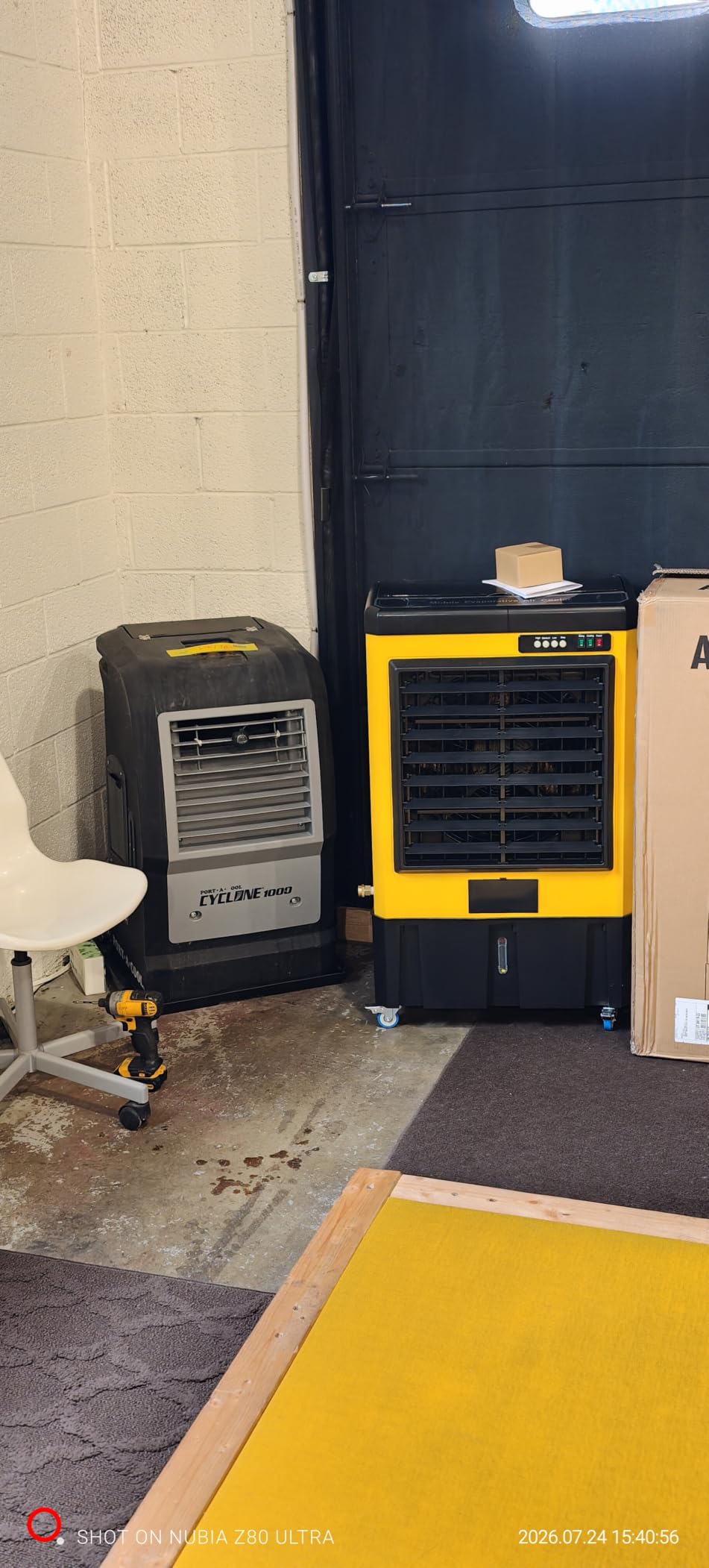
If you have a genuinely large outdoor dining area and one unit has to cover it, this is the one with the airflow to try. 4,800 CFM is the highest figure in this roundup among residential-sized machines, and the 120 degree oscillation is unusually wide, which matters on a patio where seating wraps around more than one wall.
The 11 gallon tank is the largest of any residential-sized unit here, and it supports both manual top-fill and continuous auto-refill. That combination is unusual: you can run it hands-free from a hose on weekends and top it up manually when the patio is not near a spigot.
Owners also like the ice curtain. Three ice packs slot into a four-in-one composite curtain that chills the outgoing air, and reviewers report noticeably cooler output than the same unit running without ice. It is not air conditioning, but on a still evening it lengthens the comfortable window.
At 50 dB this is quieter than the other units in the 3,000-plus CFM class here, which is surprising for something with this much airflow. Triple intake panels spread the evaporation surface, and four caster wheels with two locking ones make it manageable on a flat deck.
Build-wise it is the more robust option. A galvanized iron frame and a copper motor are harder materials than the molded polypropylene on most rivals in this price range, and the 40 inch frame keeps the outlet above patio-table height.
When the big number actually helps
Extra CFM only pays off on open space with cross-ventilation. On a wide uncovered patio where air can move through freely, the 4,800 CFM figure lets you cool the whole seating zone from one unit instead of two smaller ones. On a small balcony it does nothing extra, because the air has nowhere to go.
The 200 watt draw sits in the middle of this roundup. That is about a third of what the Big Ass Fans unit pulls, and it keeps the running cost low for a machine you might use four hours a day through summer.
Where it disappoints
It is rated 4.0 out of 5 from 103 reviews, and about a quarter of those ratings are three stars or below. That is a meaningfully softer rating profile than the Hessaire units, and it reflects a brand with limited service history relative to the category leader.
Practical complaints are mostly physical: 39.7 pounds is heavy once filled, and the yellow industrial finish reads as equipment rather than decor. If the patio is a design-led space, that trade may not be worth it.
5. Hessaire MC92V 11000 CFM Evaporative Cooler: Best for Big Open Areas
- 11000 CFM covers very large outdoor and workshop areas
- Only 50W draw so running cost is minimal
- 33 gallon tank with direct garden hose connection
- ASDS air swing plus dual louvers for precise direction
- 126 lb is extremely heavy when the tank is full
- Casters struggle with a full tank
- Motor can rust in damp air and seize after a season
This is the outlier in the roundup, and it exists because airflow is not always about a patio table. Owners running large workshops, barns and covered outdoor areas report that this unit makes an otherwise unusable hot space workable on low speed alone, sometimes in conditions above 100 degrees.
The 33 gallon reservoir gives three to four hours of runtime, and the direct garden hose connection means an unattended full day of use without refilling. The 50 watt draw is remarkably low for a machine rated at 11,000 CFM.
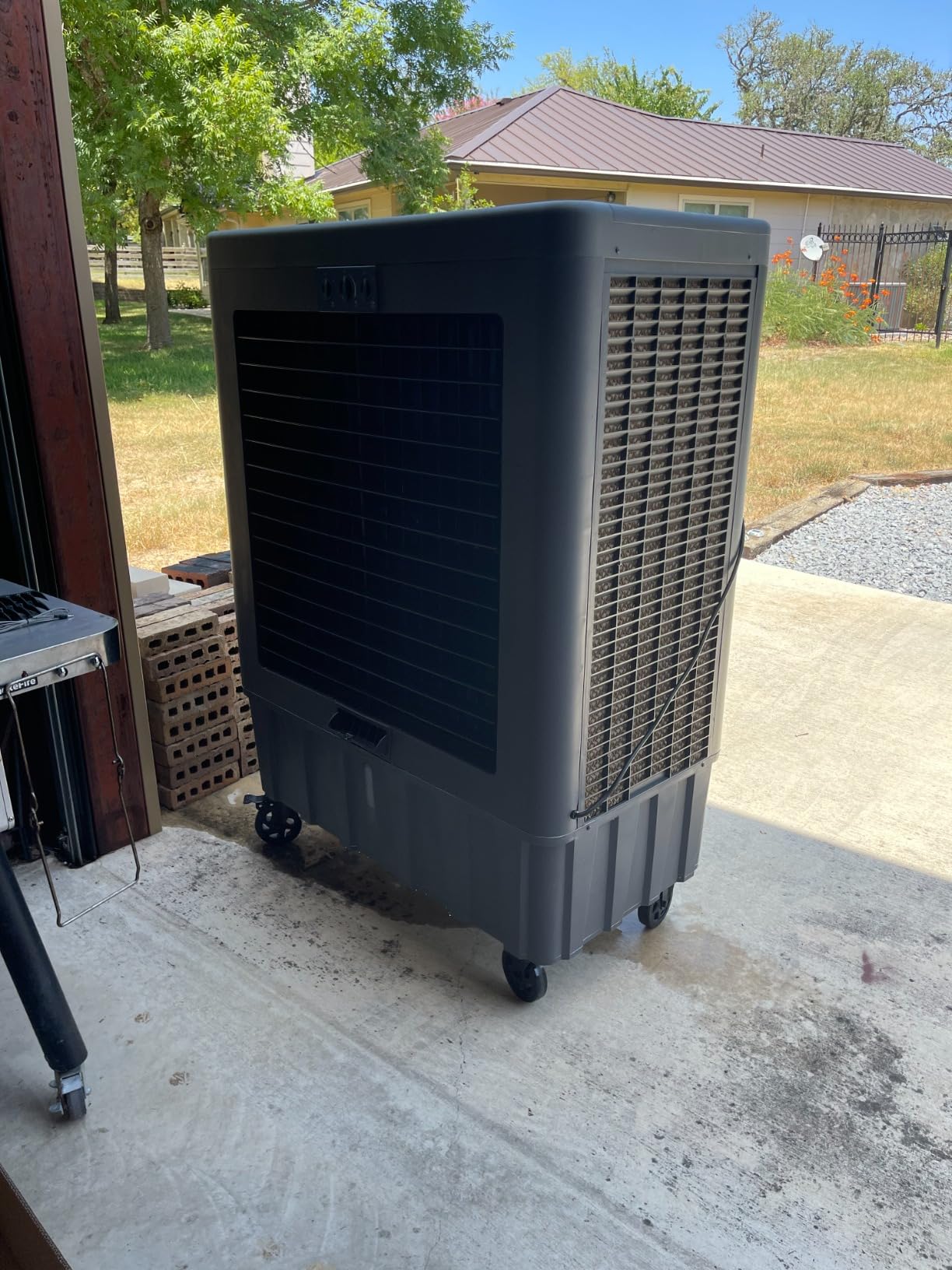
Airflow control is unusually good. The ASDS Air Swing Delivery System, two sets of horizontal louvers and oscillation together let you push air in a specific direction, which is what you want on a covered patio with seating at the far end from the unit. The patented axial propeller is designed for long throw.
High-density XeL50 media provides roughly 80 percent more evaporation surface than standard pads. One owner reports pairing it with an attic exhaust fan to keep fresh air moving, which is the setup we would copy for any large covered area.
The durability notes are the ones to weigh carefully. Reviewers report motors rusting in damp environments and seizing after a season or two, uneven pad wetting where the pump does not fully reach the media farthest from it, and wet-dog smell from the media on first startup. The factory water feed hoses are also short and loosely fitted.
When this much air is justified
The rule is simple: 11,000 CFM suits a space where air has to travel a long way, or where you are cooling a work area rather than a dining table. If your patio is a normal 400 to 900 square foot deck with a roof, this is wildly oversized and will cost you in noise and effort.
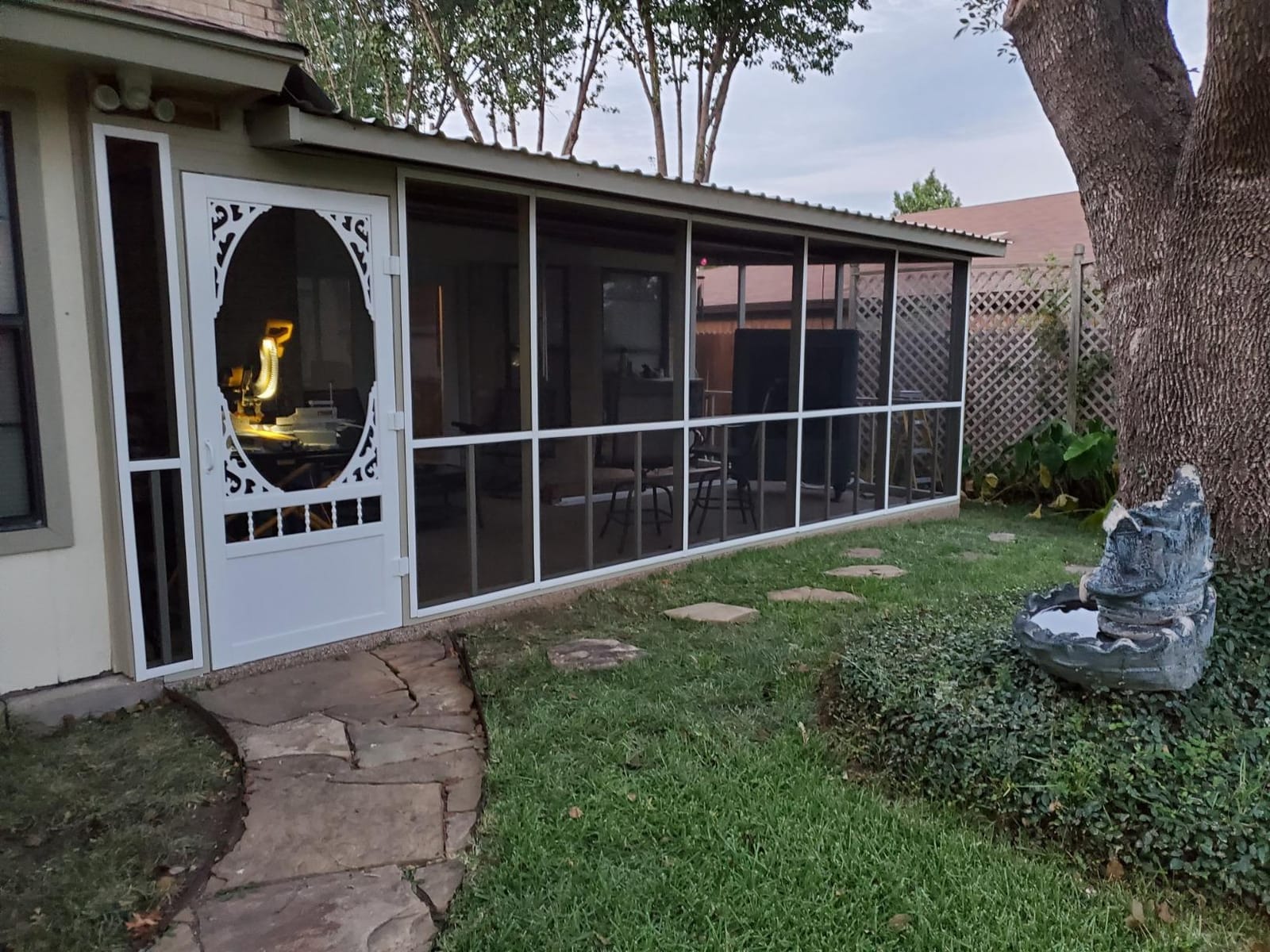
Its most sensible home is a carport, barn, warehouse bay or large covered patio used as an outdoor room. In that setting the remote control, the 33 gallon tank and the low 50 watt draw are exactly the right combination.
Where it disappoints
Weight is the first objection. At 126 pounds it is difficult to move, and the casters are weak with a full tank, so plan its position before you fill it. It is also explicitly not rated for enclosed indoor spaces.
Transport damage is reported by buyers of this larger unit, and the rating sits at 4.0 from 93 reviews with 15 percent one-star ratings. If you need a smaller covered patio cooled, the 3,100 CFM Hessaire pair is a far more manageable answer.
6. VEVOR 1400 CFM Evaporative Air Cooler: Most Versatile
- Only 13.4 lb with a narrow footprint for balconies and pool decks
- Top-fill opening means no bending to add water
- Low-water protection guards the pump
- Includes two ice packs and a brass hose adapter
- 1400 CFM and a 5 gallon tank limit it to smaller spaces
- Only a one-sided cooling pad reduces output
- 60 dB on the higher settings
This is the pick for a small balcony, a pool deck corner or a patio where the closest outlet is a long extension away. At 13.4 pounds it is light enough to carry with one hand, and the 5 gallon top-fill tank means you can refill it standing upright instead of crouching.
Three speed settings, 0 to 72 degree horizontal oscillation and manually adjustable vertical louvers give you a spread of options on a tight space. Owners like the mechanical buttons because there is nothing to relearn, and the low-water protection function prevents the pump running dry, which is a genuine upgrade over some larger rivals.
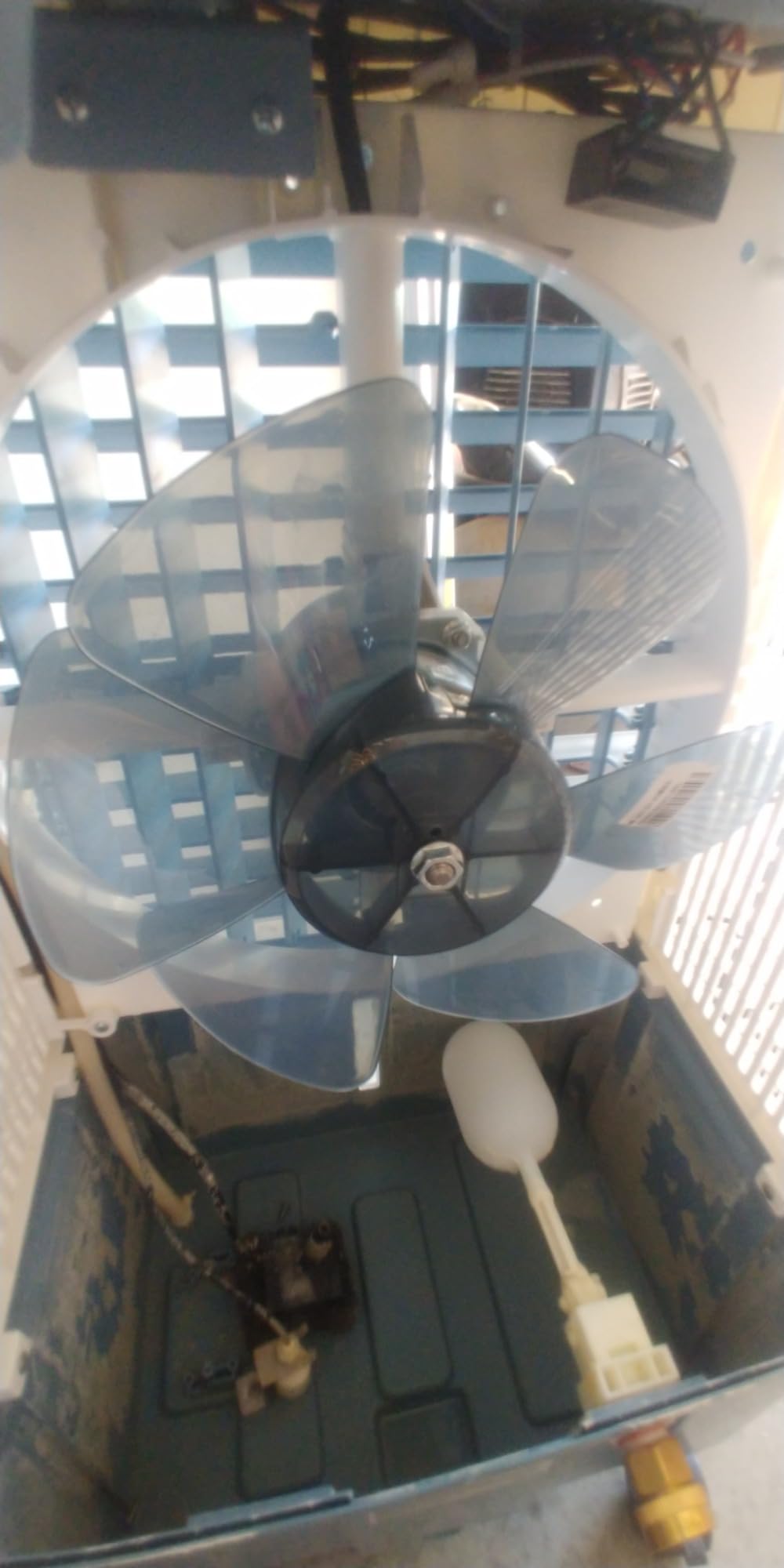
It draws 60 watts and runs as a fan, a humidifier or an evaporative cooler, so on a mild evening you can use it as a plain fan. Several owners mention adding welcome humidity alongside the cooling in dry conditions, which is one of the honest upsides of evaporative air.
The limits are structural. 1,400 CFM is less than half the mid-size units here, and the coverage rating of 550 square feet is only realistic if you are sitting directly in the airflow. The single-sided cooling pad gives it less evaporation surface than the three-sided designs, which is the main reason its output trails its price class competitors.
It rates 3.7 out of 5 from 175 reviews, with half of those ratings at five stars. That is a solid but unremarkable score, and it lines up with what we found: it does its job in a small space and does not pretend to be more.
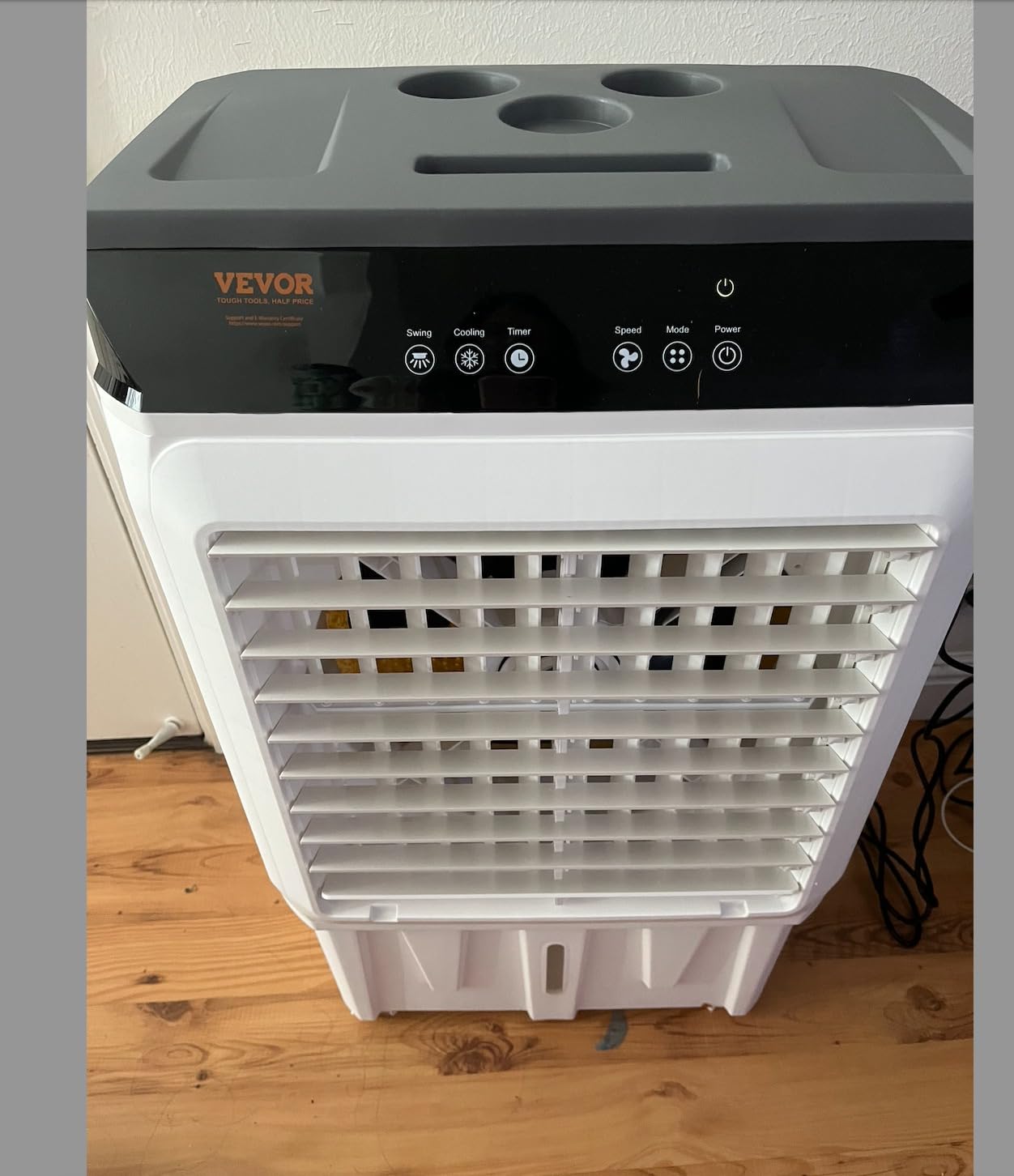
Best use case: a small space you can sit inside the airflow of
Think of this one as a personal cooler with a wet pad rather than a patio cooler. On a narrow balcony with two chairs, aimed at the table, it performs. On a covered patio with a sectional and a dining set, it will not.
It also makes sense as a second unit. Buy the VEVOR for the balcony and the Hessaire MC37M for the main deck, and you cover two zones with a smaller combined outlay.
Where it disappoints
The comparison against a portable air conditioner is the one sellers invite and buyers should decline. Evaporative cooling cools air temperature modestly and people considerably, so expectations set by a compressor unit will always disappoint here.
At 60 dB on the higher settings it is not silent, and the one-sided pad means the cooling column is narrower than the airflow suggests. In an enclosed room rather than outdoors, it adds humidity with little benefit.
7. SereneLife 1800 CFM Portable Evaporative Air Cooler: Best for Small Balconies
- Only 11 lb with a detachable tank that is simple to carry and clean
- Remote control plus touch panel and a 1-7 hour timer
- Water shortage alarm protects the pump
- Four ice packs included for extra chilling
- 4 liter tank gives short runtime between refills
- 700 sq ft coverage claim is optimistic for an 1800 CFM unit
- 65 dB is loud for a unit this size
At 11 pounds this is the lightest unit here that still has a detachable tank and a remote, and it is built for a balcony rather than a deck. The 4 liter tank lifts out completely, so refilling and cleaning happen at a kitchen sink instead of on the floor. That single design decision matters more on a fourth-floor balcony than any spec on the label.
Controls are unusually complete for this class: a touch panel, a remote, multiple wind modes and a 1 to 7 hour timer. For an apartment patio where you cannot leave the unit running all night, the timer is a genuine convenience.
Reviewers confirm it refreshes the air directly in front of the unit rather than cooling a space. That is the honest framing, and it works well if your balcony seating is a couple of chairs close to the output.
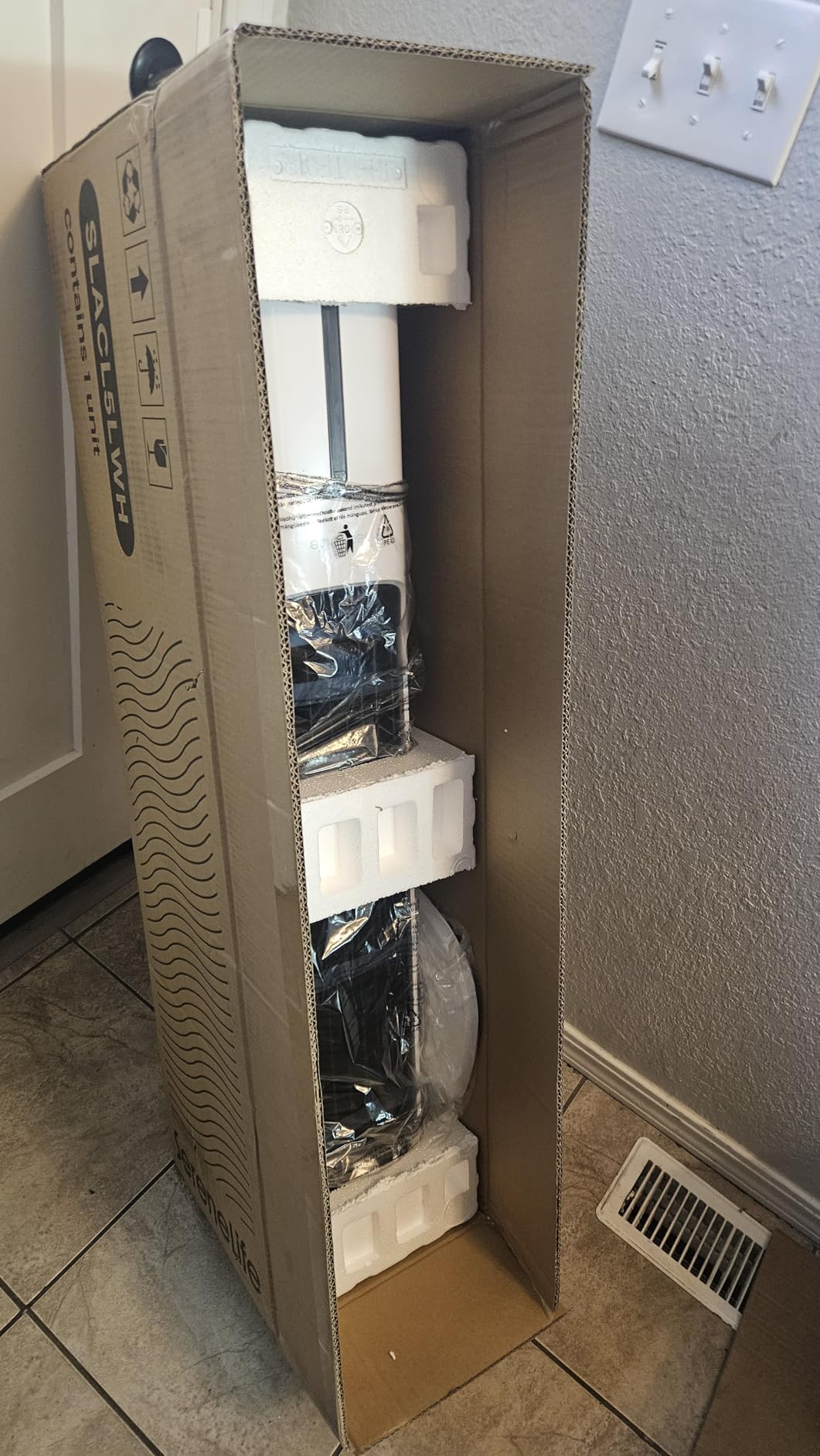
At 1,800 CFM and 80 watts it sits between the VEVOR and the mid-size Hessaire units on airflow and power. Four ice packs are included, which extend the perceived chill in the output column. The ABS housing keeps total weight at 11 pounds.
The rating is 3.6 out of 5 from 149 reviews, with roughly one in six ratings at one star. The recurring complaints are the small tank, a 700 square foot coverage claim that reviewers consider optimistic for this airflow, and 65 dB noise that feels loud for a compact unit.
There is also a water shortage alarm with pump protection, which we value more on a unit this small, where running dry is easy and kills small pumps quickly.
Where it fits on a patio
Small balconies, apartment terraces and a covered seating nook on the edge of a deck. Anywhere the unit has to be carried through a door, up steps, or lifted into place by one person. At 11 pounds that is a real constraint most evaporative coolers fail.
The detachable tank also makes off-season storage simple. Empty it, dry it, and the unit lives in a closet corner until spring, which no 10 gallon tank in this roundup can promise.
Where it disappoints
The 4 liter tank is the core limitation. Runtime is short, and on a warm afternoon you are refilling repeatedly. For a longer session, hook up a separate container rather than expecting the tank to carry you.
Treating the 700 square foot figure as a real room rating will lead to disappointment. Owners report better results as a personal airflow device aimed at where they sit, and worse results when they expect the whole balcony to drop in temperature.
8. Arctic Air Outdoor Evaporative Cooler: Best Cordless Option
- Cordless and only 4.8 lb
- so it goes anywhere without an outlet
- Two misting jets give real personal cooling
- Four speeds including a turbo mode
- Weather-resistant with a carry handle and LED mood lights
- Only 350 CFM
- so it cools a person rather than a space
- Battery runtime degrades to roughly 30 minutes after a few months
- No way to aim the upward airflow downward
This is a misting fan with evaporative pads, not a patio cooler, and we include it because buyers keep confusing the two. At 350 CFM it moves a fraction of what the other nine units here move. It cools the person standing in front of it. That is a different product for a different situation.
Where it wins is genuine portability. At 4.8 pounds, fully cordless on a USB charge with up to six hours of battery, and weather-resistant, it goes to a sporting event, a beach, a pool deck or a patio with no outlet in reach. Seven LED mood lights are a nice touch at night.
Two high-capacity cooling jets add misting on top of the airflow, and owners confirm that combination produces real personal cooling even on a still day. Four speeds including turbo let you dial it down when the mist setting is too much.

It rates 3.5 out of 5 from 259 reviews, and 21 percent of those are one star. The dominant complaints are consistent: battery runtime degrading from around four hours to roughly half an hour after a few months, a reservoir lid that does not latch securely, and water spilling in transit.
The aim problem is real. The fan blows upward with no way to direct the output downward, so on a patio table you are aiming mist at the ceiling. It also runs 2.16 kWh over its rated energy consumption standard at 30 watts, which is negligible next to any plugged unit.
When a misting fan beats an evaporative cooler
Choose this when there is no outlet within reach, when the cooling target is one person rather than a seating area, or when you want something you can carry to the beach or the tailgate. Its low water use and cordless design make it the only unit here usable away from a deck.
Many owners who like it bought a second one. If you already have an outlet on your patio, an evaporative cooler will move far more air over a larger area for a similar amount of power, and this is not the tool for that job.
Where it disappoints
Battery degradation is the deciding weakness. A unit that promises six hours and delivers thirty minutes after one summer changes how you plan an afternoon, and the runtime is not recoverable.
Some owners also report units that stopped powering on within weeks. With no outlet required and no plumbing, there is little else to fail, which is why the battery is the whole risk. Treat the six-hour figure as a first-day number.
9. Big Ass Fans Cool-Space 300: Best for Durable Build
- 8 inch thick cooling media treated to resist microbial growth
- Direct-drive motor is quiet for its output
- Ten variable speeds plus remote and automatic low-water shutoff
- Five year warranty on the main fan unit
- Highest purchase cost of any unit in this roundup
- 700 CFM looks modest beside the size and build
- 430W draw is far higher than smaller evaporative units
The most heavily built unit in this group, and the one built to live outdoors for years. Eight inch thick cooling media treated with thermosetting resin to resist microbial growth is a spec no other unit here matches, and it directly addresses the mold problem that ends patio cooler seasons early.
The direct-drive motor is quiet for what it delivers, and the ten-speed variable control is finer than anything else here. Very low settings give background airflow for a dinner table without blasting the conversation area. The remote makes that adjustment from your seat.
Sixteen gallons of reservoir means roughly four hours away from a tap, and a standard garden hose connection handles the rest. Automatic low-water shutoff protects the pump, and locking swivel casters make it manageable on a level surface.
It carries a five year warranty on the main fan unit, the longest here, and the polyethylene housing and steel fan are built for damp environments rather than indoor comfort. Reviewers consistently praise the durability and the quiet motor.
The central complaint is the mismatch between build and output. 700 CFM is a modest airflow figure for an 18 inch fan, and it is less than a quarter of what the 3,100 CFM mid-size units deliver. The 430 watt draw is the highest in this roundup, which offsets the low running cost story the 50 watt units offer.
The rating is 3.7 out of 5, but from only 29 reviews. That is a small enough sample that the aggregate should be read carefully rather than treated as a settled verdict.
Where the construction pays off
Long-term outdoor placement, damp coastal air, and a covered patio where the unit stays out for weeks without being moved. The resin-treated media and the five year warranty are aimed at exactly that use, and the low-water shutoff prevents the pump damage that ends cheaper units.
Ten speeds also make it the best choice here if you need very low background airflow rather than strong directional cooling. If your priority is a large blast of air across a hot dining table, a 3,100 CFM unit serves you better for less running cost.
Where it disappoints
Purchase cost is the first issue, and it sits well above every other unit here. That price buys materials and warranty, not airflow, and the 700 CFM rating does not justify it for most residential patios.
At 99 pounds it is substantial even on casters, at 430 watts it has the highest running draw of any unit here, and at 63 dB it is not quiet in practice. The thin review count also means you are buying on construction rather than on a broad base of owner experience.
10. SereneLife 2500 CFM WiFi Swamp Cooler: Best for App Control
- 2500 CFM is strong airflow for a unit this size
- Eight gallon tank sits on casters so you roll it to a faucet
- Wifi with mobile app plus remote and LED touch controls
- Washable filter and auto-dry pad reduce maintenance
- One controlled test measured about 2 degrees of room cooling
- Pump cannot fully drain the tank so standing water remains
- No handles on the tank so water sloshes while rolling
Feature-wise this is the most connected unit we tested. WiFi with a mobile app, a remote, an LED touch panel and a twelve hour timer, with three modes covering evaporative cooling, plain fan and humidifier. If your patio cooling is part of a smart home setup, this is the only unit in the roundup that joins the network.
The 2,500 CFM airflow figure is strong for a 20.7 pound unit, and the eight gallon tank is mounted on caster wheels. That means you roll it to a faucet instead of carrying it, which is the right answer to the refill chore that owners of smaller units complain about most.
The washable filter and auto-dry pad system are a thoughtful design for an outdoor unit. Owners like that the pads are dried automatically after use, which reduces the mildew risk on a unit that lives outdoors.
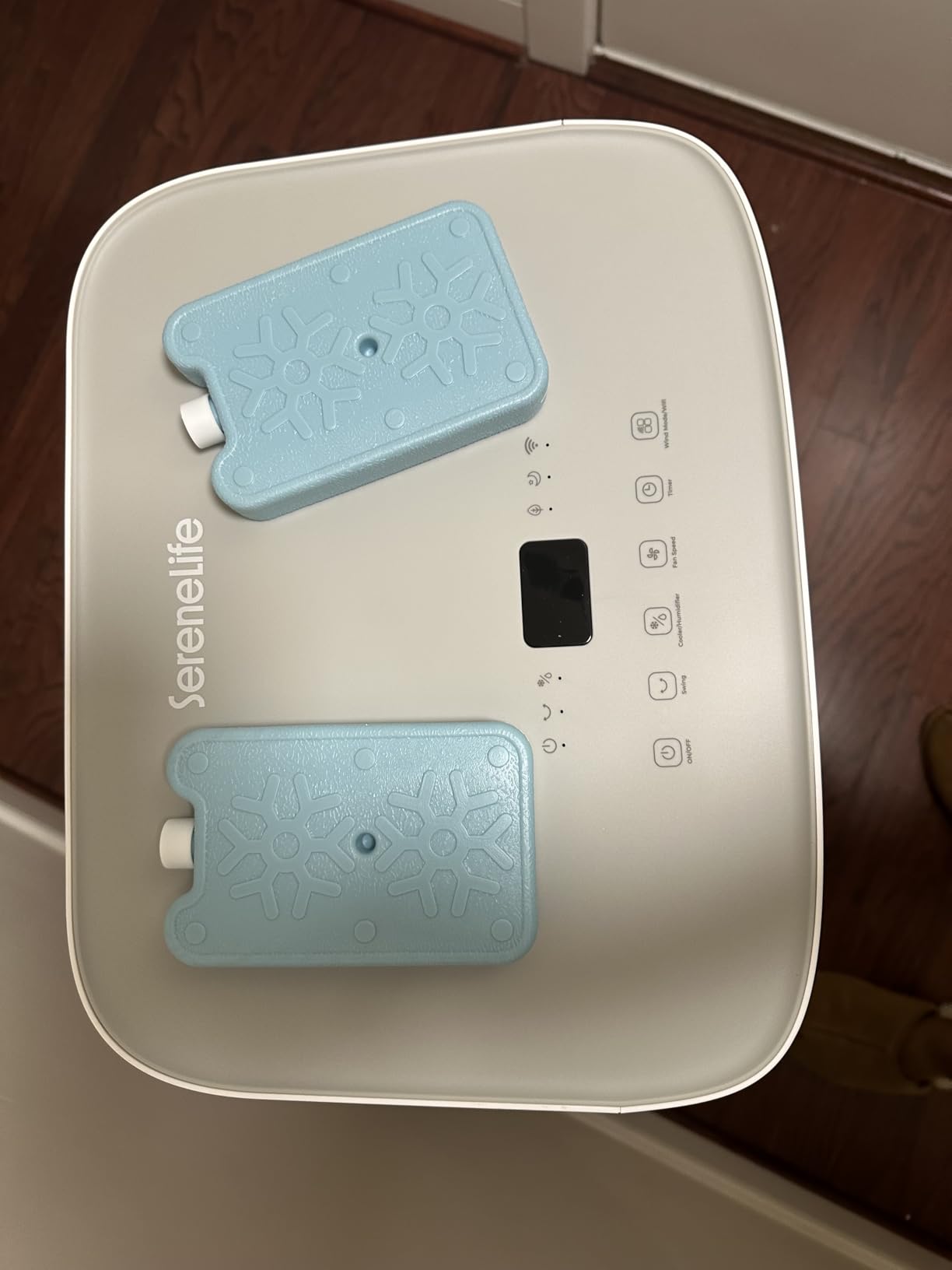
Owners are genuinely split on it. Supporters point to strong airflow, the caster-mounted reservoir and the app control. Critics report minimal actual cooling: in one controlled test, about two degrees of measured room cooling even with ice packs loaded, which is a fair warning about what to expect.
Refilling and draining are the practical problems. The pump cannot fully empty the tank, so standing water remains, and the top section has to be detached to empty it, which causes heavy dripping. There are no handles on the tank, so water sloshes and spills while rolling it. The top fill opening is small enough that a hose is effectively required.
The rating is 3.2 out of 5 from 79 reviews, the weakest profile in the roundup, with 30 percent one-star ratings. Owners also report internal clogging and top-of-unit leaks within roughly eight months, and one reviewer in humid Houston found the humidifier mode made the room feel stuffier rather than cooler.
What the app control actually gets you
Real value here is scheduling and monitoring rather than performance. Start the cooler from inside before guests arrive, run the fan-only mode on a mild evening, and let the twelve hour timer handle the shutdown. Owners also report fan mode alone lowering room temperature noticeably, which makes it a useful three-season tool.
If you already own smart home hardware, the WiFi integration is the reason to buy this. If you do not, the same money buys considerably more airflow in a simpler machine.
Where it disappoints
The cooling gap is the honest headline. Two degrees of measured cooling is a real number from a real test, and it is well below what the airflow figure suggests. Treat the 2,500 CFM as airflow volume, not as a temperature drop.
The water handling is the second problem. Standing water after draining, heavy drippage when you detach the top, no handles on the tank, and a fill opening that effectively requires a hose. At 65 dB it is also loud on speed three.
Evaporative Cooler vs Misting Fan vs Portable AC vs Shade
All four of the most common questions about patio cooling come down to the same four options, and the right answer depends on your climate, your outlet situation and whether you are cooling people or a room. Here is how they compare.
Evaporative cooler: the best value for an open, dry-climate patio. It moves thousands of cubic feet per minute, uses water and a fan instead of refrigerant, and costs a fraction of a portable air conditioner to run. It fails in humid air and in enclosed spaces, where it recirculates air and raises humidity until it stops working.
Misting fan: the right choice for one person with no outlet nearby. It cools by spraying water into the air, which works locally and instantly, but it does nothing for a seating area and wets down whatever is under it. Cordless models like the Arctic Air take it to a beach or a tailgate.
Portable air conditioner: the only option that actually cools air temperature and dehumidifies. It works in any climate, including humid ones. It also costs far more to buy and far more to run, and a single-hose unit is inefficient in open air because it draws in unconditioned air from outside.
Shade: the lowest-effort improvement available and the one most people skip. Shade over the seating area and shade over the unit both raise output, and an awning does more for afternoon comfort than most people expect from an appliance. Shade does not cool the air, so it does not replace a cooler in extreme heat.
Our practical advice: shade first, evaporative cooler second. A misting fan if there is no outlet. A portable air conditioner only if you need genuine dehumidification, and be realistic about its running cost on a covered patio.
How to Size a Swamp Cooler for Your Patio
Sizing is where most patio cooler purchases go wrong. Buyers assume bigger is better, choose a unit by square footage alone, and then wonder why it underperforms. A three-step method avoids that.
Step one: measure the space that needs airflow. Measure the patio, deck or covered seating area you actually want to sit in, not the footprint of your house. Do not include areas separated by a wall. In an open outdoor space, plan for 2,500 to 4,800 CFM or higher as the useful range for seating areas of about 500 square feet and up.
Step two: convert square footage to CFM. A workable rule for open-air use is roughly 5 CFM per square foot of seating area, and closer to 3 CFM per square foot in a covered patio where air moves less freely. A 500 square foot open patio lands near 2,500 CFM. A 950 square foot covered patio lands near 2,850 CFM, which is why the 3,100 CFM Hessaire pair fits so many patios.
Step three: decide the water setup. If a spigot is within reach, buy continuous fill and never think about it again. Manual refill is the single most complained-about chore in owner reviews, and it is entirely avoidable. If there is no tap nearby, plan the refill route before you buy.
Two practical rules. Coverage claims are rated for the area a unit can blow into, not the area it makes comfortable, so treat them as an upper bound. And the moment you buy a unit larger than your patio needs, you are buying noise, not cooling.
Humidity and Climate: When a Swamp Cooler Works
Humidity is the single factor that decides whether an evaporative cooler is a good purchase or a wasted one. Water evaporates faster in dry air, and the temperature drop scales with how much water the incoming air can absorb. When the air is already close to saturated, there is nothing left to give.
The widely used thresholds are around 30 percent relative humidity for indoor use and around 60 percent for outdoor or semi-enclosed spaces. Outdoors you have a moving air supply, so the practical ceiling is higher, but 60 percent is the number at which cooling stops being meaningful. Above that, the unit adds moisture to the air and does little else.
This is the dominant frustration in owner forums. Owners in genuinely dry climates report swamp coolers working well past 100 degree days, while owners in humid regions describe them as useless and pointless, and five-star reviews get downgraded to one star purely because local humidity exceeded the usable range. That is a design limit, not a defect in the unit you bought.
There is a second failure mode that catches patio owners. On a fully covered patio with walls, a unit recirculates its own output air, humidity climbs inside the space, and the cooler becomes counterproductive. Cross-ventilation is not a nicety on a covered patio, it is a requirement.
Check your local relative humidity before you buy, not after. If your patio regularly sits above 60 percent in summer afternoon hours, an evaporative cooler is the wrong appliance and no amount of CFM will fix it.
Where to Put an Evaporative Cooler on a Patio
Placement changes output more than any setting on the unit. Four rules cover most installations.
Put the unit in the shade. Direct sun on the pads raises the temperature of the incoming air and cuts evaporation. Forum users consistently recommend a shade cloth or patio umbrella over the unit itself, not only over the seating.
Give it a cross-breeze. On an open patio, place the unit upwind so it draws fresh air rather than its own output. On a covered patio, aim for an opening on the opposite side so air moves through rather than stagnating.
Aim the louvers at people, not at walls. Evaporative cooling is about airflow over skin. A unit pointed at a fence wastes its capacity, and the wide oscillation models here exist to solve exactly that.
Keep it off the wall and in the open. Three-sided intake units need clear air on the intake faces. Two feet of clearance on the open sides avoids recirculating its own discharge.
Once the positioning is right, finish the space around it. Our picks for weatherproof outdoor cushions and reclining patio chairs cover the seating that sits inside that airflow, and ice on the drinks does more for perceived comfort than any setting change.
Continuous Fill vs Manual Tank: Which Water Setup to Choose
Every owner review in this category eventually arrives at the same complaint. Manual refilling is the most hated chore in the category, and it is the easiest thing to design around before you buy.
Continuous fill uses a float valve. Attach a garden hose to the adapter on the back of the unit and the tank refills automatically as the pump draws water down, so the machine runs indefinitely without attention. Six units in this roundup support it: the Hessaire MC37M, the MC37V, the Uthfy 4800 CFM, the VEVOR 1400 CFM, the Hessaire MC92V and the Big Ass Fans Cool-Space 300.
Manual tank fill suits a portable unit used away from plumbing. The Arctic Air has a small reservoir you carry, and the SereneLife 1800 CFM has a detachable 4 liter tank you can refill at a sink. Both trade runtime for portability, and both suit apartments with no spigot nearby.
One honest warning from reviews: the fittings are where continuous-fill units fail. The MC37M’s hose fitting and float are reported to weep at the joint, and the MC92V’s factory feed hoses are described as short and poorly fitted. Check the connection on day one with the hose off, and add a washers-and-connector check to your weekly routine.
Patio Maintenance: Stopping Mold and Algae Before They Start
Units that live outdoors grow algae and mildew in the pads, and once that starts the smell alone will end your use of the cooler. Five habits prevent it.
Drain the tank daily. Standing water with mineral residue is where algae starts. Empty it at the end of each session rather than leaving it full overnight.
Give the pads a weekly rinse. Run fresh water through the media with the pump on. It takes a minute and it keeps mineral scale from hardening on the fibers.
Dry the pads before storage. Run the fan with the pump off for a few minutes, then let the unit dry completely in the shade. The SereneLife WiFi unit does this automatically with its auto-dry pad system.
Use the drain plug. The Hessaire and Big Ass Fans units have accessible drain plugs for exactly this. Tipping a 40 pound unit is not a maintenance strategy.
Replace media on schedule. Pads are consumable. The Big Ass Fans unit uses resin-treated 8 inch media designed to resist microbial growth, which is the manufacturer answer to this exact problem. Expect to replace standard pads on any unit eventually.
Store the unit dry and covered for the winter, not wet and sealed. Mold that starts in October is still there in May.
Outdoor Electrical Safety for a Patio Cooler
An evaporative cooler is the rare appliance that is both water-adjacent and plugged into an outdoor space, and that combination deserves attention. None of the editorial roundups we studied cover it.
Use a GFCI protected outlet. Ground fault circuit interrupter protection cuts power when water finds a path to the wiring. The OEMTOOLS 23968 in this roundup comes with a UL-listed GFCI plug, which is the safest configuration available.
Use an outdoor-rated extension cord if you must, and only if the unit is outside the manufacturer’s rated cord length. Indoor vinyl cords are not rated for wet locations. Never run a cord under a rug or through a doorway where it can be pinched.
Do not operate in rain, and do not run the unit unattended overnight outdoors. Most units here carry a one year manufacturer warranty, and water in the motor is not covered by it.
Keep the cord and connections away from the wettest zone. The pad area and the drain port both shed water, so route the cord to the opposite side from where the unit drains.
Frequently Asked Questions
Do swamp coolers work in 100 degree weather?
Yes, in dry climates they do. Owners in the desert Southwest, west Texas and Colorado report swamp coolers working well past 100 degree days when the unit is sized correctly and shaded. Above roughly 60 percent relative humidity the answer changes completely, because humid air cannot absorb much more water. Heat alone is not the limit; humidity is.
At what humidity should you not use a swamp cooler?
Above roughly 60 percent relative humidity for outdoor use, and around 30 percent for indoor use. Those thresholds are why the humidity limit matters more than any other spec. In wetter air the unit adds moisture rather than removing heat, and on a fully covered patio it can recirculate its own humid output until cooling stops entirely. Check your local afternoon humidity before buying.
What is the best outdoor air cooler for a patio?
For most open, dry-climate patios the Hessaire MC37M at 3,100 CFM is the strongest overall pick: it covers about 950 square feet as rated, holds a 10.3 gallon tank, and refills continuously from a garden hose. On small balconies with no outlet nearby, a lightweight cordless misting fan is the more practical tool. For genuinely humid regions, none of them will cool much.
What is the recommended CFM for an evaporative cooler?
For open-air patio use, aim for roughly 5 CFM per square foot of seating area, which works out to 2,500 CFM for a 500 square foot patio. In a covered patio where air moves less freely, closer to 3 CFM per square foot is enough. Between 2,500 and 4,800 CFM covers most residential seating areas, and anything above that is built for commercial spaces.
Are swamp coolers worth it for patios?
In a dry climate and on an open or well-ventilated patio, yes. They use water and a fan instead of refrigerant, draw a fraction of the electricity of a portable air conditioner, and move thousands of cubic feet of air per minute across your seating area. They are not worth it in humid regions, in fully enclosed spaces, or if you expect air-conditioning level temperature drop. They cool people, not thermometers.
Final Verdict for Cooling a Patio in 2026
After comparing ten outdoor evaporative coolers, the Hessaire MC37M remains our pick for the best evaporative coolers for patios in 2026. Its 3,100 CFM airflow, 10.3 gallon tank and garden hose fill cover the most common patio sizes, and its 4,733 owner reviews make it the least risky of the group. If corrosion resistance matters more than cost, the MC37V is the same engine with better fasteners.
Buy the Uthfy 4800 CFM for a large open patio that needs wide oscillation, the OEMTOOLS 23968 if you want a GFCI plug and UV housing for a permanently outdoor unit, and the Big Ass Fans Cool-Space 300 only if long-term durability justifies its cost and weight. For a balcony with no outlet, the SereneLife 1800 CFM or the cordless Arctic Air is the realistic answer.
And check your humidity first. Above roughly 60 percent relative humidity, none of these will cool your patio, and the honest answer is shade, a misting fan for guests, or a portable air conditioner if you need real dehumidification. In a dry climate with cross-ventilation, a swamp cooler is the most economical comfortable seating you can add. While you plan the rest of the patio, our guide to RTIC coolers covers the drinks side of a hot afternoon.