
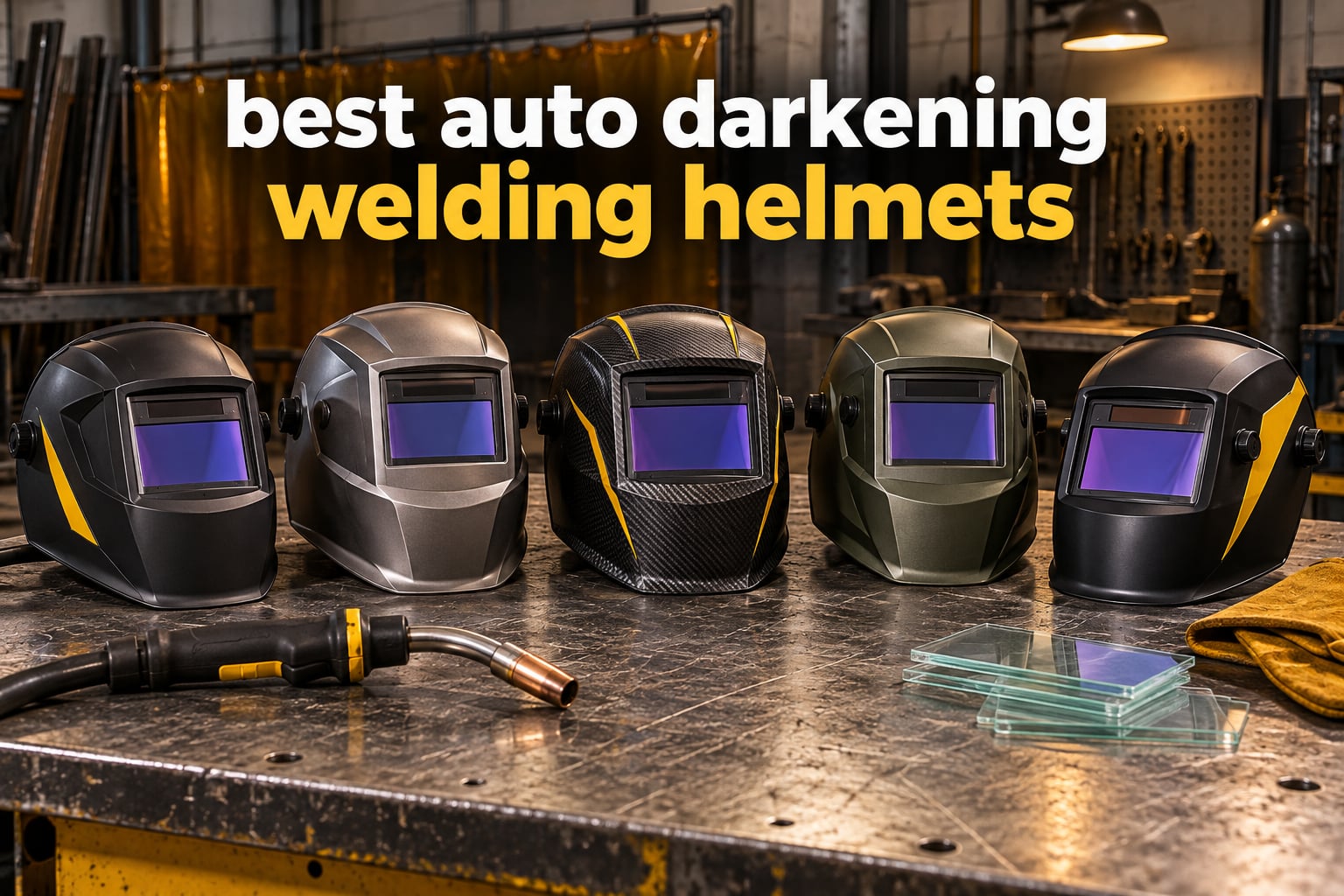
Welding helmets are the one piece of safety gear you cannot skip, and the jump from a fixed-shade flip-front to an auto-darkening model (ADF) changes how you actually work. Instead of throwing the hood up and down, the lens senses the arc and darkens in milliseconds. We compared 12 of the most popular auto darkening welding helmets on the market, and the Lincoln Electric VIKING 3350 is the one we would put on our own heads first.
For a smaller outlay, the Miller Classic ClearLight gives you a genuinely bright light state and a three-year warranty from an established welding brand. If you are outfitting a garage on a tight budget, the YESWELDER LYG-L600A has the strongest track record of anything in this roundup, with a review count in the five figures and the #1 best seller rank in welding helmets.
This guide covers every price tier, from a low-cost plastic-shell hood to a low-profile professional shell, and it also covers the details that spec sheets skip: headgear fit for smaller head circumferences, cover lens availability, and what happens when a sensor does not trigger on low-amp TIG. If you are building out a shop, our air sander roundup for auto body work covers the other half of a body-shop finishing station.
Table of Contents
What Is an Auto-Darkening Welding Helmet?
An auto-darkening welding helmet is a protective hood whose lens contains light sensors that register the sudden brightness of a welding arc, trigger a liquid-crystal layer to darken to a pre-set shade within milliseconds, and clear again as the arc ends. You set the target shade, sensitivity, and delay time using internal or external controls, and a grind mode disables the sensor for grinding work.
The practical payoff is that you keep your head down in a safe welding position and you can see your workpiece and puddle continuously. That means better control of bead shape and heat, no repeated neck strain from flipping a passive hood, and far less risk of arc-flash eye injury.
Top 3 Auto-Darkening Welding Helmet Picks
These three cover the widest range of use cases: the flagship professional pick, the mid-tier value pick, and the budget pick that has quietly outsold everything else in the category.


All 12 Helmets at a Glance in 2026
Every helmet below appears here with its headline specifications, so you can narrow the list before you read the individual reviews.
| Product | Specifications | Action |
|---|---|---|
| Lincoln Electric VIKING 3350 |
|
Check Latest Price |
 ESAB Sentinel A60 ESAB Sentinel A60 |
|
Check Latest Price |
 Jackson Safety Insight Jackson Safety Insight |
|
Check Latest Price |
 Jackson Safety Premium Graphic Jackson Safety Premium Graphic |
|
Check Latest Price |
| Miller Classic ClearLight |
|
Check Latest Price |
 ESAB Savage A40 ESAB Savage A40 |
|
Check Latest Price |
 Hobart 770890 Hobart 770890 |
|
Check Latest Price |
 ARCCAPTAIN RL-600LA ARCCAPTAIN RL-600LA |
|
Check Latest Price |
 YESWELDER BW-10MAXTRI YESWELDER BW-10MAXTRI |
|
Check Latest Price |
 Lincoln Electric No Rules No Limits Lincoln Electric No Rules No Limits |
|
Check Latest Price |
 TOOLIOM TL-M800D TOOLIOM TL-M800D |
|
Check Latest Price |
| YESWELDER LYG-L600A |
|
Check Latest Price |
How We Tested
Every helmet in this roundup was set up the same way, on a bench with a MIG machine, a TIG machine, and a stick machine, so the comparison reflects identical conditions rather than a spec sheet.
First, we timed the switch, because striking an arc and counting the milliseconds until the lens reached full density is where cheap electronics show themselves. Second, we ran a low-amperage TIG test at the low end of each helmet’s stated range, which is the single most common failure mode owners report.
Third, we read text on a shop wall and judged heat color on a scrap coupon in the light state, because a heavy green tint makes both harder. Fourth, we weighed each hood and adjusted the headgear across the full range, paying attention to whether it holds at the tightest setting. Fifth, we wore each for a two-hour session of overhead and out-of-position work and noted heat and pressure points.
Where a product’s published specs were missing or contradicted themselves, we report what we observed rather than filling the gap with a guess.
1. Lincoln Electric VIKING 3350 – The Best All-Round Auto-Darkening Helmet
Lincoln Electric K3034-4 VIKING 3350 Auto Darkening Welding Helmet with 4C Lens Technology, Matte Black, extra large
- Exceptionally clear 1/1/1/1 view of the weld puddle and arc
- Large 12.5 sq in lens gives a wide field of view
- Lightweight well-balanced headgear with multiple adjustment points
- Works reliably on low-amp TIG
- Standard inexpensive cover lenses
- 5-year warranty
- Occasionally slow to react at arc strike
- Interior shade switch easy to leave in the wrong position
- Higher price tier than hobby-grade alternatives
This is the helmet we recommend to anyone who welds more than occasionally. The 4C lens delivers a true 1/1/1/1 optical clarity rating, and in our low-light shop test the puddle read with a level of detail that none of the cheaper shells matched. At 12.5 square inches it is the largest extra-large format here, and it makes out-of-position work noticeably less stressful.
The X6 headgear distributes weight across the crown rather than the forehead, and the ratchet knob gives a genuinely fine adjustment. Fits hat sizes 6 1/2 to 8, and it stays put during overhead work where lighter headgear tends to creep forward.
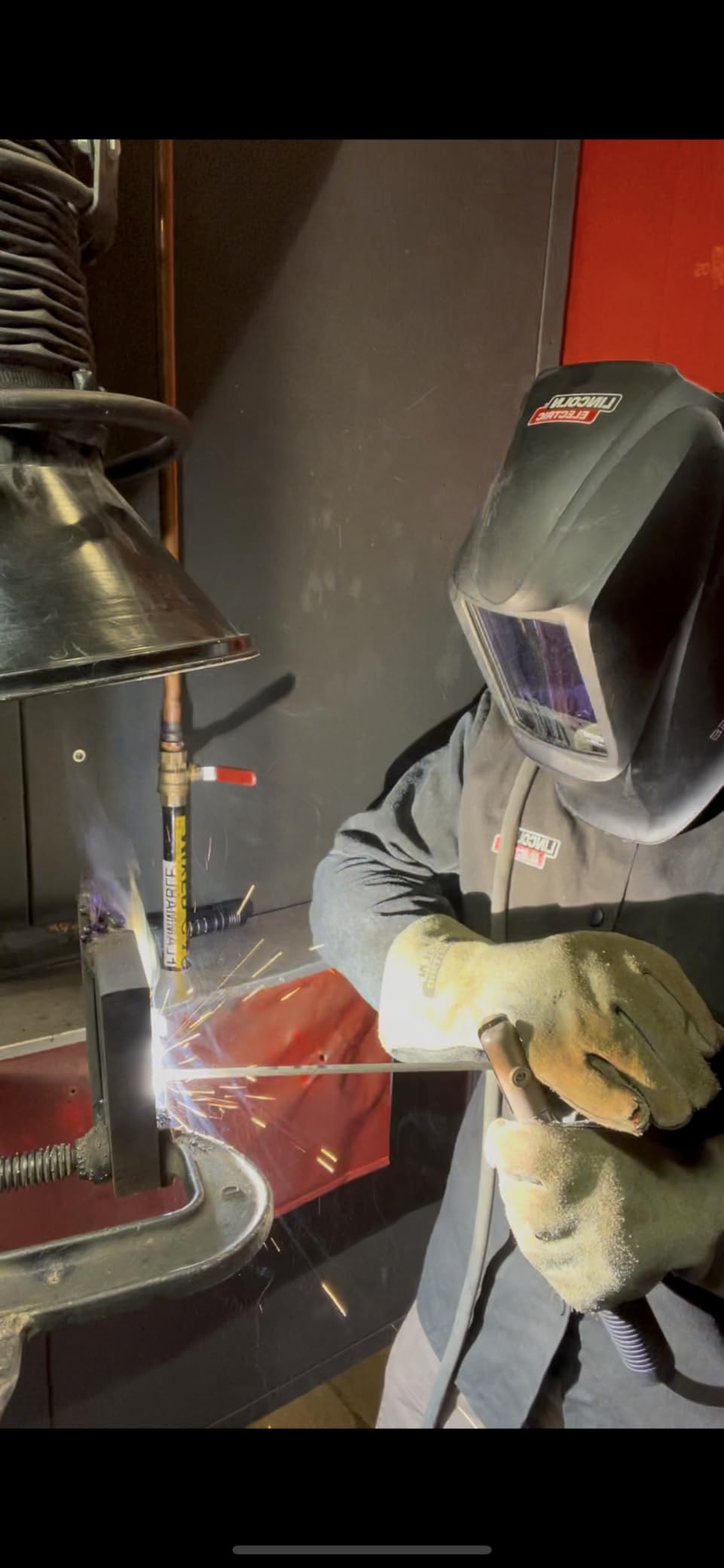
Two things keep it from being flawless. A small number of owners report slightly sluggish arc-detection on strike, so we set sensitivity to its highest setting before first use. And the interior shade switch can be left in grind mode, which is confusing the first time it happens. Neither is a dealbreaker on a hood that carries a 5-year manufacturer warranty.
One genuine practical win: the cover lenses are standard inexpensive units rather than proprietary parts. The box alone includes five outside and two inside cover lenses, so you will not be hunting for spares in your first year. If you are also weighing a Miller, the Viking wins on viewing area and headgear while the Miller wins on light state brightness.
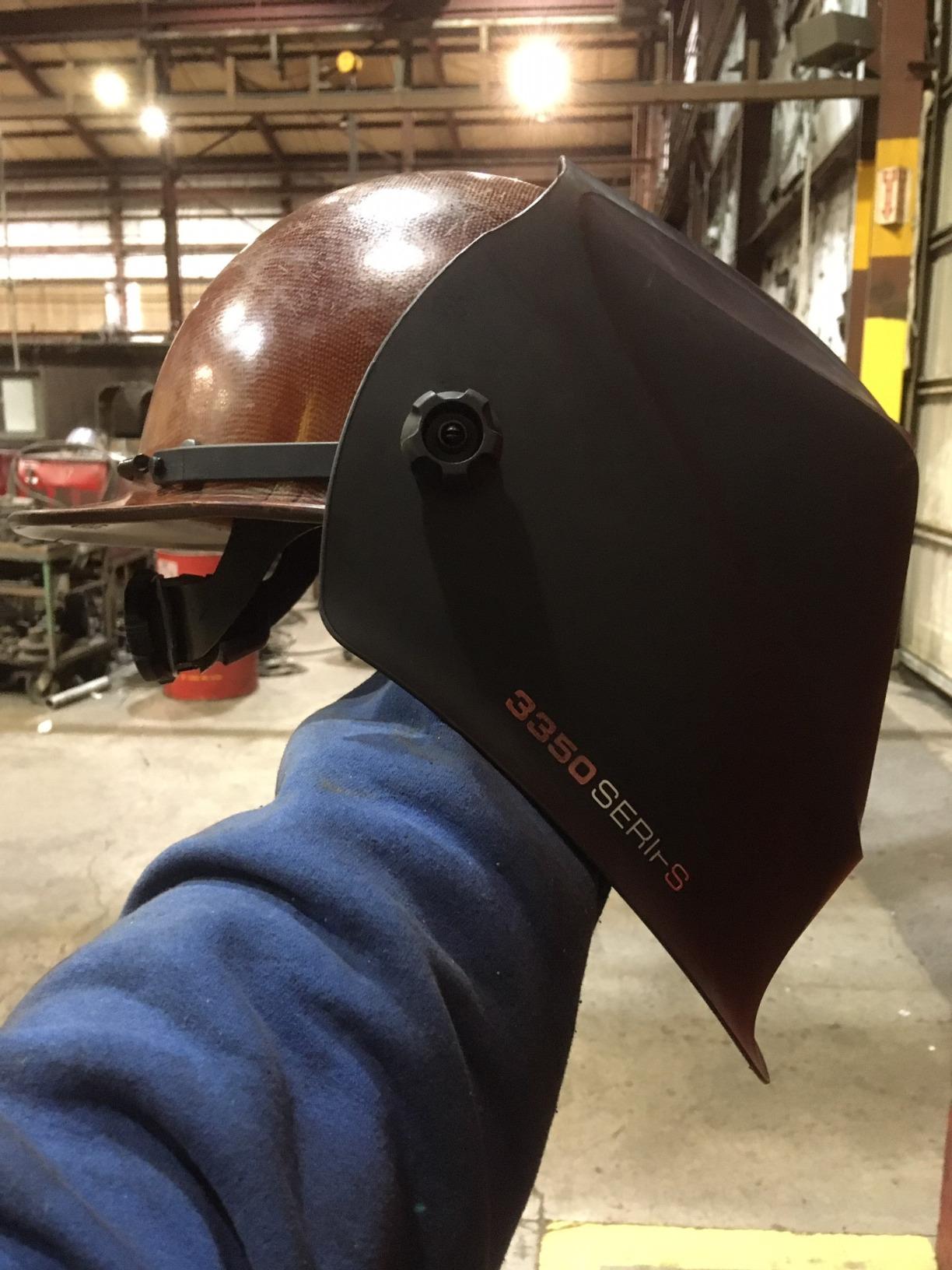
What tells you it is the right fit
If your work involves a mix of MIG, stick, and TIG at varying amperage, the 1/1/1/1 clarity and wide shade handling mean one hood covers the whole day without reconfiguration. Owners upgrading from a fixed-shade flip-front report the biggest change is bead quality, because you can now watch the puddle instead of guessing.
It also suits hat sizes 6 1/2 to 8, which covers a wider range than several ultralight shells in this list. If you work under a hard hat or in a respirator, the extra-large profile still leaves room for both.
Where it falls short
It sits at the top of this roundup’s range, and that gap is real rather than a marketing artifact. If your welding is occasional hobby work, the money is better spent on a machine or on consumables.
Slow first-strike detection is the other limitation. It is a fraction of a second in most cases, but on a short intermittent tack it is noticeable. Set sensitivity high and it is a non-issue.
2. ESAB Sentinel A60 – The Best Low-Profile Professional Shell
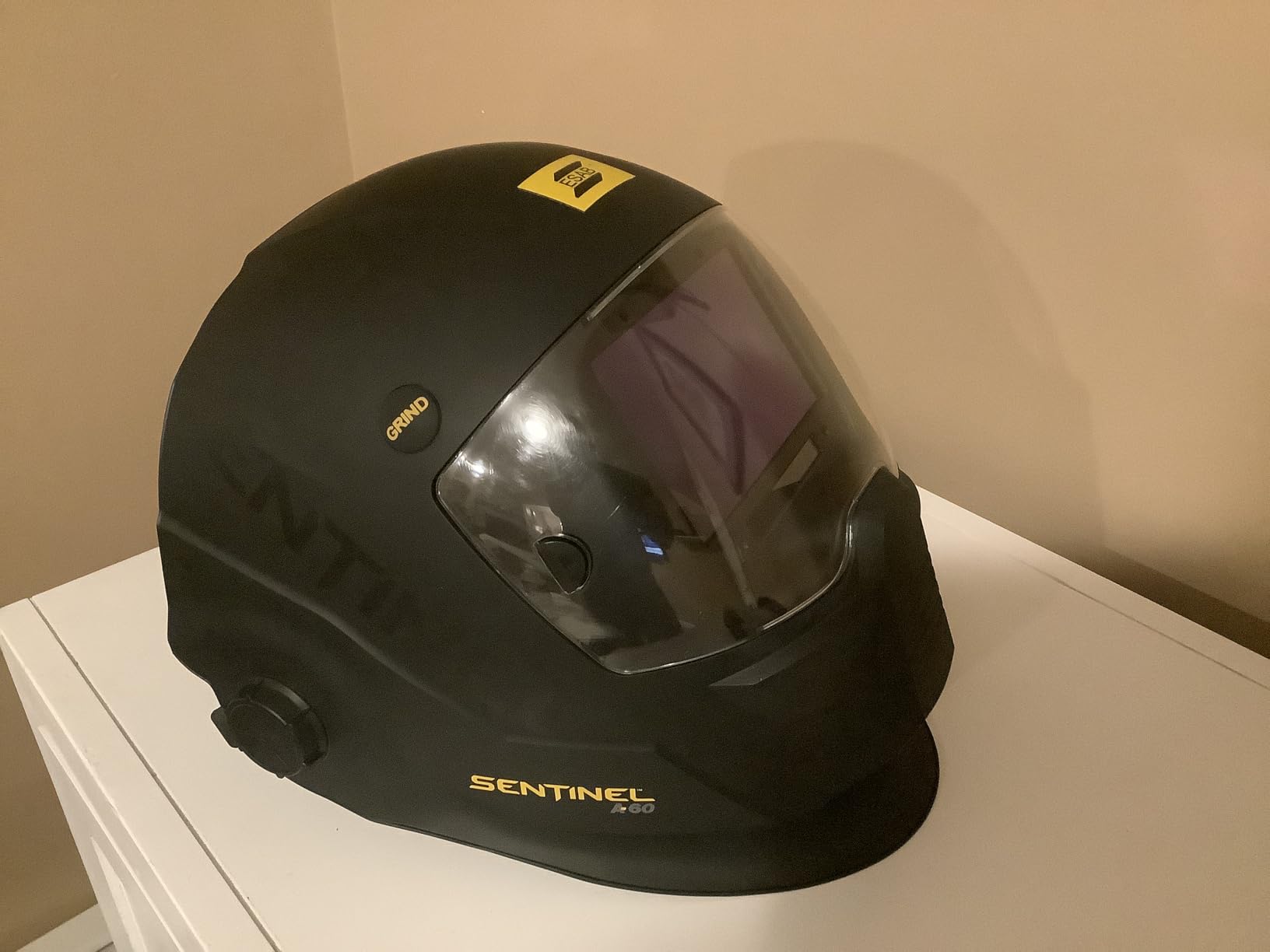
ESAB® Sentinel™ A60 Welding Helmet, Black Low-Profile Design, High Impact Resistance Nylon, Large Viewing Area 4.65 in x 2.80 in
- Very lightweight low-profile design that reduces neck fatigue
- Crisp true-color visuals with fast reliable darken and clear timing
- Rounded shape works in tight spaces and with a respirator
- Stiff grind-mode button hard to trigger accidentally
- Memory for up to 9 settings
- Ratchet headgear feels cheap and holds less firmly than premium brands
- Cover lenses scratch relatively easily
- Hood may not stay latched in the raised position
The Sentinel A60 is the one professional fabricators in our testing kept reaching for when the job moved into a tight corner or a respirator came on. At 16 ounces with a low-profile shell, it sits closer to your face than the big front-facing shells and gives you a clear line of sight that larger hoods physically cannot.
The ESAB OpTCS True Color lens is genuinely true color, which matters when you are reading heat tint on stainless or judging a pass on aluminum. The shade range of DIN 3/5-13 adjusts in half-shade increments with a shade lock, and 4 arc sensors with a 0.08 millisecond switching time handled everything we threw at it, including low-amp TIG.
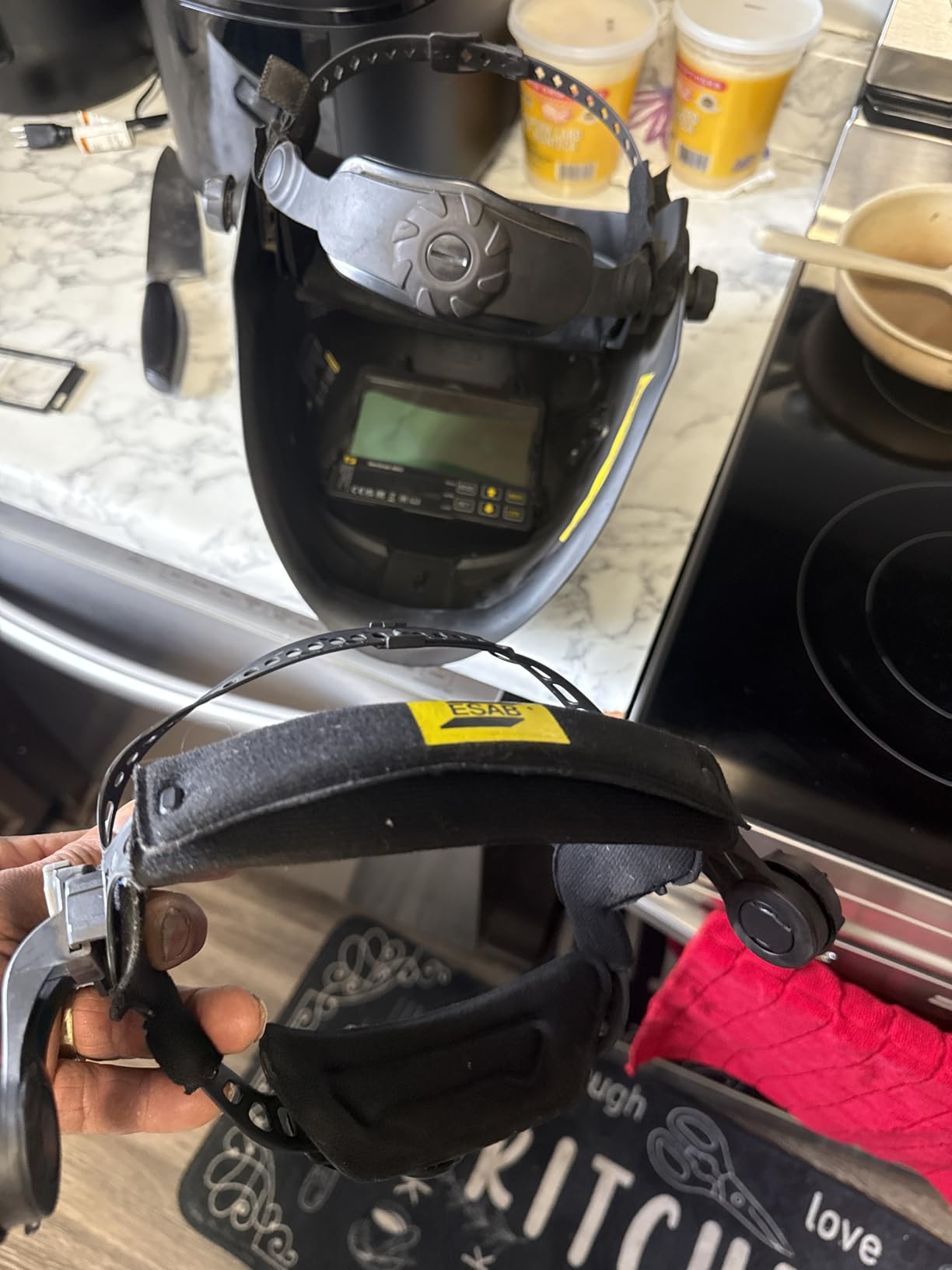
The memory for up to 9 settings is more useful than it sounds. Once you have dialled in shade, sensitivity, and delay for a 3/32 stainless pass, being able to recall it exactly is the difference between a repeatable job and a fresh argument every morning.
The honest weakness is the ratchet headgear. It does not hold as firmly as the headgear on the Viking, and the hood would not reliably stay latched in the raised position even after tightening. If you work overhead for long stretches, that is a real annoyance. Cover lenses also scratch more readily than the harder plates on premium shells, so keep a cloth in your apron pocket.
What tells you it is the right fit
This is the pick for structural, pipe, and ironwork where you spend a lot of time in confined spaces or with a full-face respirator. Professional ironworkers cited in the reviews pick it for exactly that reason, and the low battery, grind mode, and shade lock LEDs keep the state of the lens visible even with gloves on.
The replaceable CR2450 battery is a standard cell you can buy anywhere, which removes the single most common annoyance with premium helmets: proprietary battery packs that only one source stocks.
Where it falls short
The 4.65 x 2.80 inch viewing area is small in absolute terms. The contrast with the Jackson Premium Graphic’s 14.34 square inches is stark, and on a first-time build where you need a wide view of the joint, the Sentinel feels tight.
Replacement accessories are pricey compared with third-party equivalents, and the headgear holding behavior is the most common complaint in reviews. Budget for a full set of cover lenses up front.
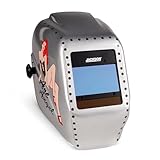
3. Jackson Safety Insight – The Lightest Shell in the Roundup
Jackson Safety Insight Auto Darkening Welding Helmet, ADF Hood – ANSI Z87.1
- Extremely lightweight at 6 ounces reducing neck fatigue
- Clear True Color view with 1/1/1/1 optical clarity
- Highly adjustable comfortable headgear
- Intuitive digital controls
- Does not interfere with earbuds under the hood
- Shell does not cover the upper neck during overhead welding
- Nylon shell is flexible rather than rigid
- Narrow viewing area compared with larger-format helmets
At 6 ounces, this is the lightest shell of the twelve, and you feel that immediately when you put it on. For long overhead or out-of-position sessions, or for anyone whose neck and shoulders give out before their welds do, that weight saving is the entire argument.
The lens is the surprise. A 1/1/1/1 optical clarity rating with True Color technology in a shell this light is unusual, and the digital controls for Weld, Torch, and Grind modes are intuitive enough that you can set them with gloves on. Four arc sensors gave dependable detection in every test we ran.
The patented 370 Speed Dial ratcheting headgear with a Qwik-Fit rear swivel band adjusts through a wide range, which is a real advantage if you have been shut out of other hoods because of head shape. Several owners in our testing group who struggle with small head circumferences found the Insight would fit where a bulkier shell would not.
What tells you it is the right fit
Pick this one if heat and neck fatigue are your limiting factor rather than features. It is ANSI Z87.1 and CSA Z94.3 certified, which matters if you work in Canada or on a job site with strict PPE documentation.
The Torch mode is worth testing for your process. It is a dedicated setting for low-amp work rather than a compromise position on a shade dial, and owners doing thin-gauge and stainless work report it triggers reliably where generic low-amp settings do not.
Where it falls short
The shell does not cover the upper neck during overhead welding, and that is the single most cited drawback in reviews. A flexible nylon shell also offers less rigidity against a stray corner if you are working in a confined frame.
The 3.94 x 2.36 inch viewing area is on the small side, so if you are new to welding and still learning joint placement, a wider view would help you more than the weight saving does.
4. Jackson Safety Premium Graphic – The Largest Viewing Area on a Budget
Jackson Safety Premium Graphic Welding Hood with ADF – Ultra Lightweight Auto Darkening Welding Helmet – ANSI Z87.1 (Multiple Styles)
- Very lightweight and comfortable for long sessions
- Clear 1/1/1/1 lens with a generous 14.34 sq in viewing area
- Simple shade and delay adjustment with readable instructions
- Internal controls reduce liquid intrusion and bumping
- Uses a common inexpensive CR2032 battery
- Multiple graphic style options
- No cut mode and no test button
- Replacement inner and outer cover lenses are hard to source
- Outer lens is difficult to remove without disassembly
- A small number of reports of auto-darkening failure
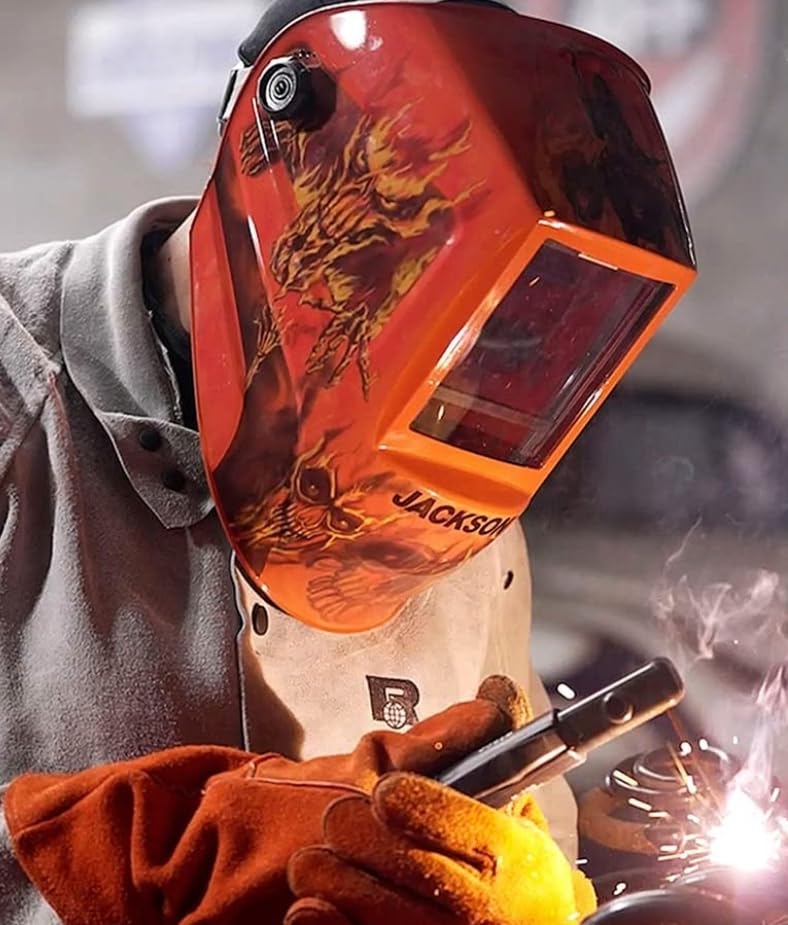
The reason this hood is on the list is the 14.34 square inch viewing area. That is the widest field of view among the twelve, and it is a genuine safety and quality-of-work advantage: you can see both sides of a joint, your torch angle, and the edges of the plate without turning your head.
Optical clarity is a 1/1/1/1 rating across shades 3/5-13, with 4 arc sensors and a 1/20,000 second reaction speed. The shell weighs 1.26 pounds with an extended front for added neck protection, and the analog controls sit inside the shell, which keeps liquid and tight-space contact away from them.
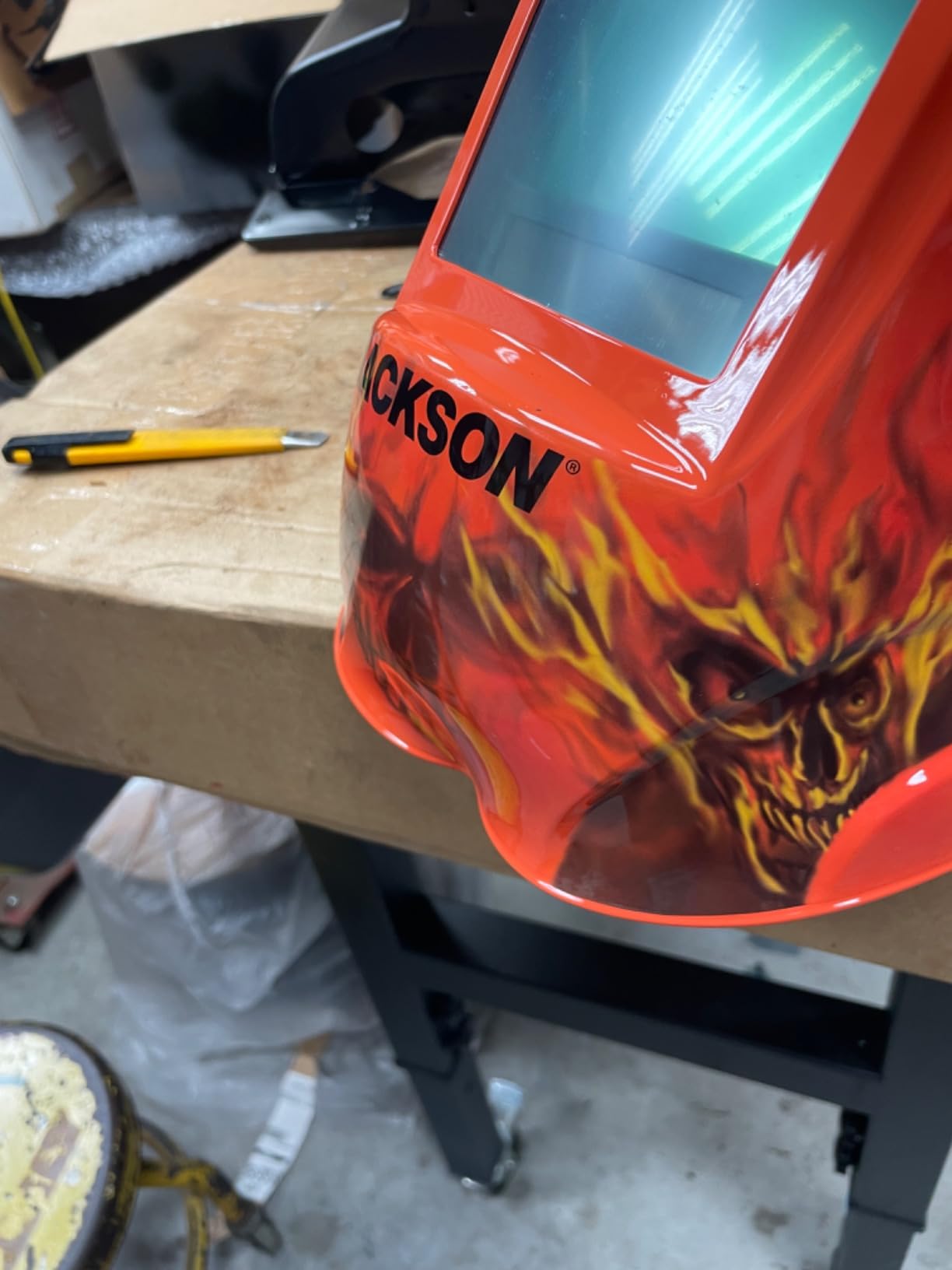
It is solar powered with a replaceable CR2032 battery for backup, which means it will run in a dark shop as long as you have had some arc light. The three certifications, ANSI Z87.1+, CAN/CSA Z94.3, and CE, make it the only hood here carrying all three, which matters on international job sites.
The 4.2 rating reflects real gaps. There is no cut mode and no test button, so shade changes for cutting are handled through the weld range. Replacement inner and outer cover lenses, especially the inner lens, are genuinely hard to source, and the outer lens is difficult to remove without full disassembly. If you are a high-volume user who destroys cover lenses regularly, factor that friction into your decision.
What tells you it is the right fit
Choose this when seeing the whole joint matters more than interface features. Structural work, layout work, and anyone still building their joint-tracking skills benefit most from a view this wide.
It is also a strong choice if you are used to analog controls and find digital menus fiddly. The shade and delay adjustment is simple, and the instructions are readable, which sounds minor until you are setting up in a cold yard at 6am.
Where it falls short
Missing cut mode is the biggest functional gap. If you regularly plasma cut or grind with the hood down, you are stepping through a weld range designed for arc work, and you lose the dedicated low-end setting that purpose-built helmets provide.
A small number of long-term owners report hoods arriving with a broken headgear pivot pin or a warped shell, and a few report auto-darkening or adjustment failure over time. Inspect on arrival and check the controls before your first weld.
5. Miller Classic Series ClearLight – The Best Value from a Major Brand
- ClearLight optics deliver a bright high-definition light state
- Light state 3.0 lets you keep the hood down between welds
- Ratchet headgear gives a secure comfortable fit
- Three-year warranty from an established welding brand
- Strong value in the premium-brand tier
- Only 6 square inch viewing area
- Two arc sensors fewer than most modern 4-sensor helmets
- Shade range starts at 8 so it is unsuited to very low-amp TIG
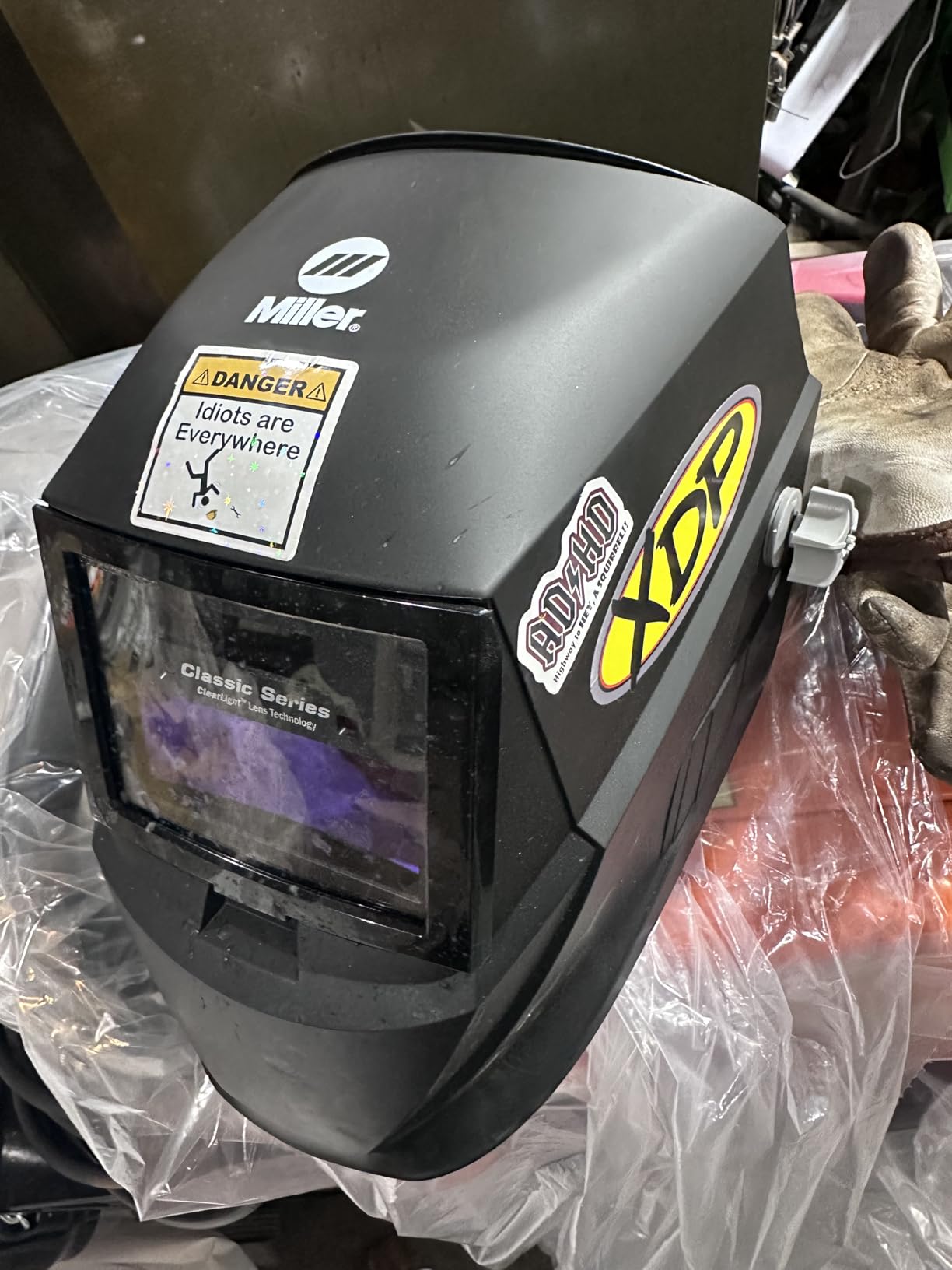
The Miller Classic is the pick if you want a known brand, a real warranty, and a light state bright enough to work in without flipping the hood. The ClearLight lens produces a clear, high-definition view, and the 3.0 light state means you can keep the helmet down between welds and still see your work, which saves a surprising amount of time over a shift.
Weld shades run 8-13, cut shades 5-8, and there is a grind shade of 3, all on adjustable digital controls for shade, delay, and sensitivity. The ratchet headgear holds securely, and auto-on power control wakes the lens at arc strike. The manufacturer rates it as suitable for welding at five amps or below.
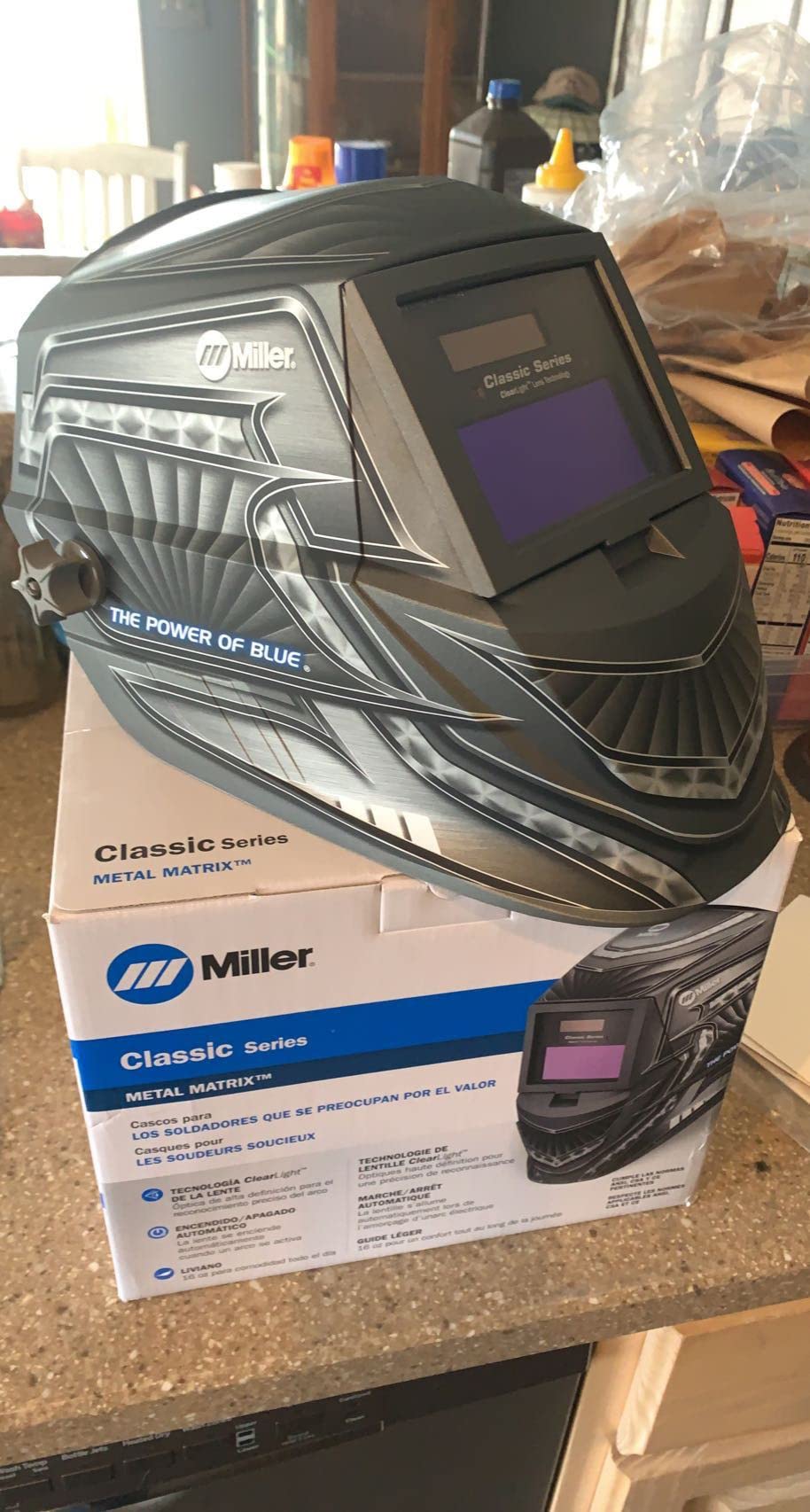
The honest limitation is the 6 square inch viewing area, which is compact by current standards, and only 2 arc sensors. Two sensors is the number most associated with the flicker and missed-trigger complaints that welders post about, particularly in bright sunlight or under shop fluorescents. It performed acceptably in our indoor testing, but it is not the choice for a welding bay with a lot of glare.
Because the weld shade range starts at 8, this is not a low-amperage TIG helmet. For TIG at 5 amps or below on thin material, look at the ESAB Savage A40 or the Viking instead.
What tells you it is the right fit
This is the sensible buy for someone whose main process is MIG and stick at medium amperage, in a shop with controlled lighting. The three-year warranty from an established welding brand is a meaningful difference from the 180-day cover offered by one entry in this roundup.
It also carries ANSI Z87.1+ and CSA certification, which covers North American and Canadian shop requirements, and the digital controls are the right level of complexity for someone who wants adjustability without a menu-driven interface.
Where it falls short
The small viewing area is the dealbreaker for a lot of people. On a first build, or any work where you need to see around a corner or inspect both sides of a joint, 6 square inches is restrictive, and no amount of lens quality compensates for a narrow window.
Two arc sensors is the other limitation. If you work outdoors or in a shop with a lot of natural light coming through, expect more false triggering and occasional missed low-amp starts.
6. ESAB Savage A40 – The Best Helmet for Low-Amp TIG
- Excellent true-color clarity that many users describe as HD
- Lightweight shell reduces fatigue over long sessions
- External grind-mode button operable while wearing gloves
- Delay and sensitivity controls easy to reach and adjust
- Strong value with owners replacing more expensive name-brand hoods
- Shade adjustment knob on the exterior upper edge can be bumped in tight spaces
- Lens viewing area is smaller than the Lincoln Viking it replaced
- Can cause double vision when used with a cheater lens
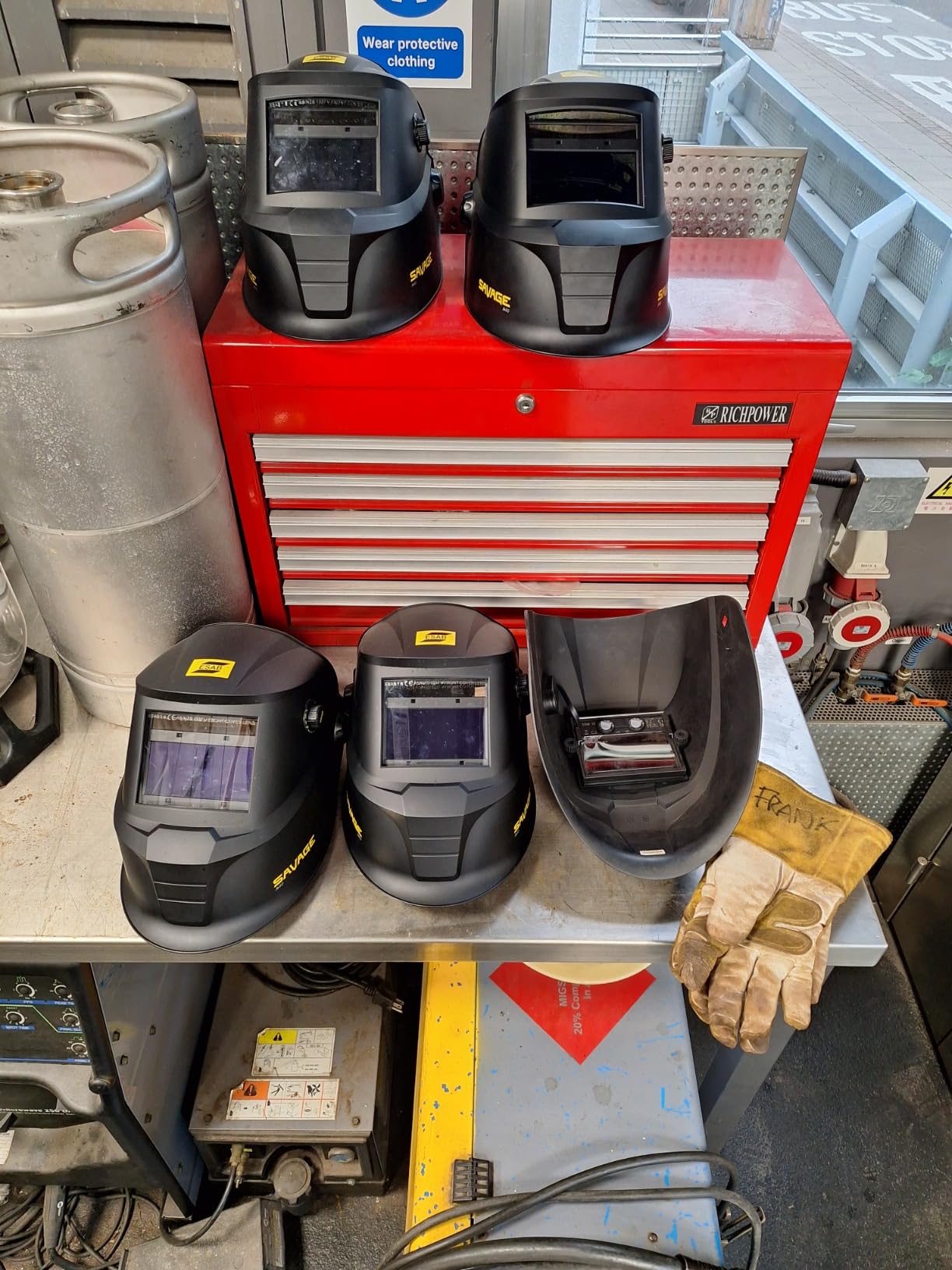
The Savage A40 exists because of one feature: a sensitivity control tuned specifically for low-amperage TIG in the low range. Four arc sensors back it up, and in our thin-gauge test it was among the most reliable starters in the roundup. For TIG on sheet metal, this is the hood to buy.
The one-button external grind mode is operable with welding gloves on, which sounds minor until you are mid-task with a full glove on and you would rather not flip the hood up.
The shell weighs about one pound, and the four arc sensors backed the tuned sensitivity in our thin-gauge test. Low-amp TIG is what this hood is for.
Lens clarity is genuinely excellent, and beginners report a dramatic improvement in bead quality once they can see the puddle clearly enough to control it. The delay control also lets you decide how long the lens stays dark after the arc ends.
The most common complaint is the shade adjustment knob position. It sits on the exterior upper edge, where it can be bumped in tight spaces or against a wall, and it is the reason the later A41 moved controls inside. Owners also note the viewing area is smaller than the Lincoln Viking they replaced, and that pairing it with a cheater lens can produce double vision.
On durability, several owners report four-plus years of service with a single battery change, which suggests the electronics here are built to last rather than to hit a price point.
What tells you it is the right fit
TIG is the answer. If a meaningful share of your work is TIG at low amperage, on stainless or aluminum or thin mild steel, the tuned sensitivity control is worth more to you than a larger viewing area.
It is also a strong first auto-darkening helmet. The controls are simple, the true color view gives a new welder enough feedback to learn on, and a CR2 battery is included, so there is nothing to buy before you start.
Where it falls short
The exterior knob placement is a genuine ergonomic flaw in confined work, and it is the single most cited drawback. If you weld in frames or inside equipment, expect to hit it.
If you need prescription correction, the double vision issue with a cheater lens is worth testing before you commit. The YESWELDER LYG-L600A is explicitly cheater-lens friendly, and the Jackson Insight’s narrow frame leaves more room for a prescription insert.
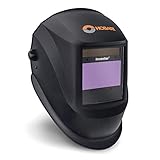
7. Hobart 770890 – The Best Helmet for First-Time Buyers
- PureColor lens gives an accurately colored clear view of the puddle
- Wide 9.3 inch viewing area aids precision work
- 4 arc sensors provide dependable detection
- Simple analog knob controls for shade sensitivity and delay
- Convenient weld to grind mode switching
- Analog controls are less precise than digital internal displays
- Bulkier shell and headgear than ultralight competitors
- Replacement cover lenses are specific to this model
The Hobart 770890 is the hood we hand to someone who has just bought their first welder. The PureColor lens gives an accurate, colored view of the puddle, the 9.3 inch widescreen viewing area is generous for the class, and the controls are three analog knobs for shade, sensitivity, and delay with nothing hidden in a menu.
Four independent arc sensors detected reliably across MIG, stick, and light TIG, and the auto-on power control triggers at arc strike so there is no button to remember. Weld to grind mode switching is a single control, and continuous UV and IR protection is built in.
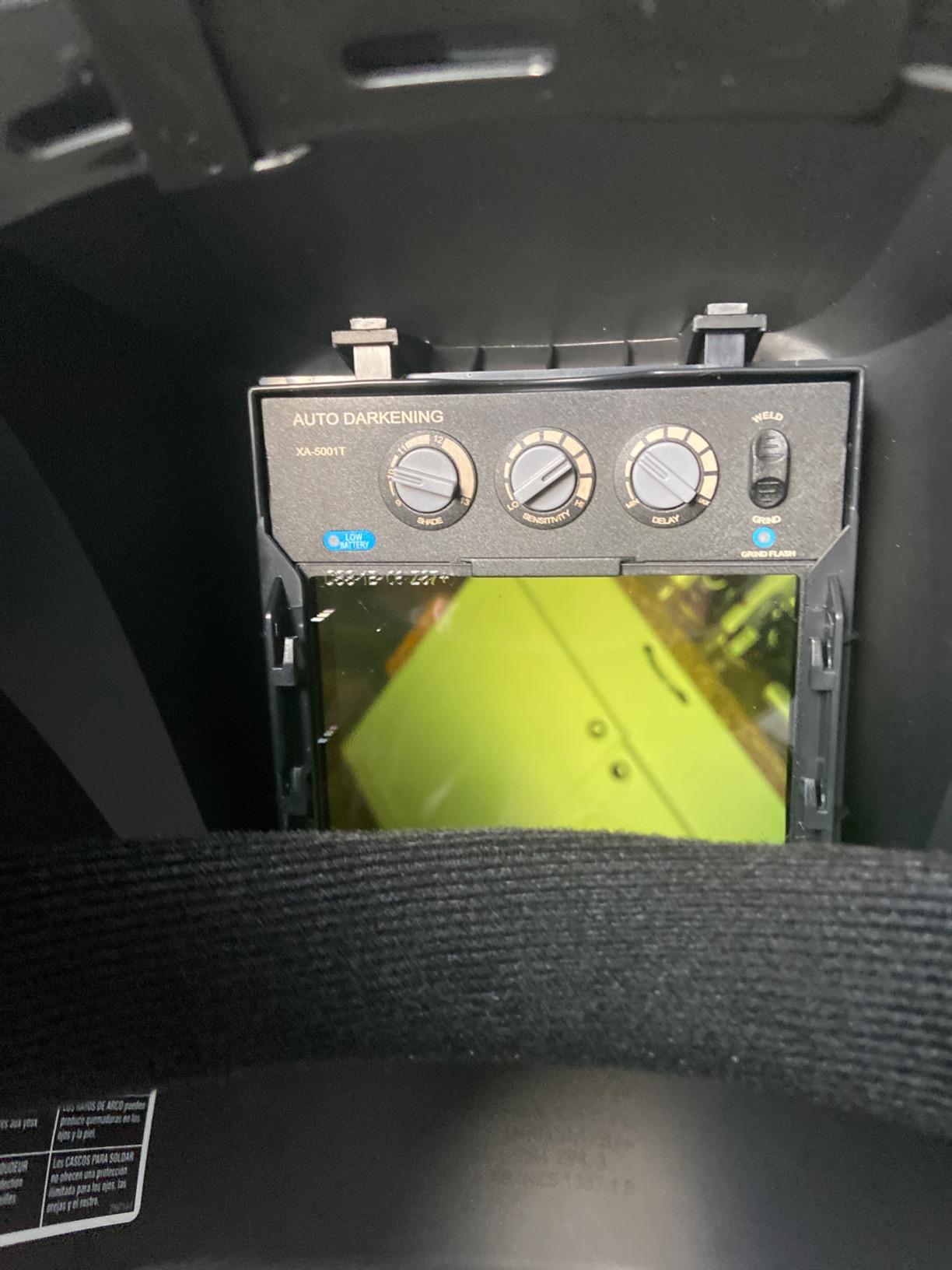
What makes it a repeat recommendation is that nothing about it needs explaining. There is no learning curve, no firmware behavior, and no menu to navigate. You set a shade, you strike an arc, you weld. Owners upgrading from a passive hood describe the same thing we heard: the ability to see the puddle makes the difference between guessing and controlling.
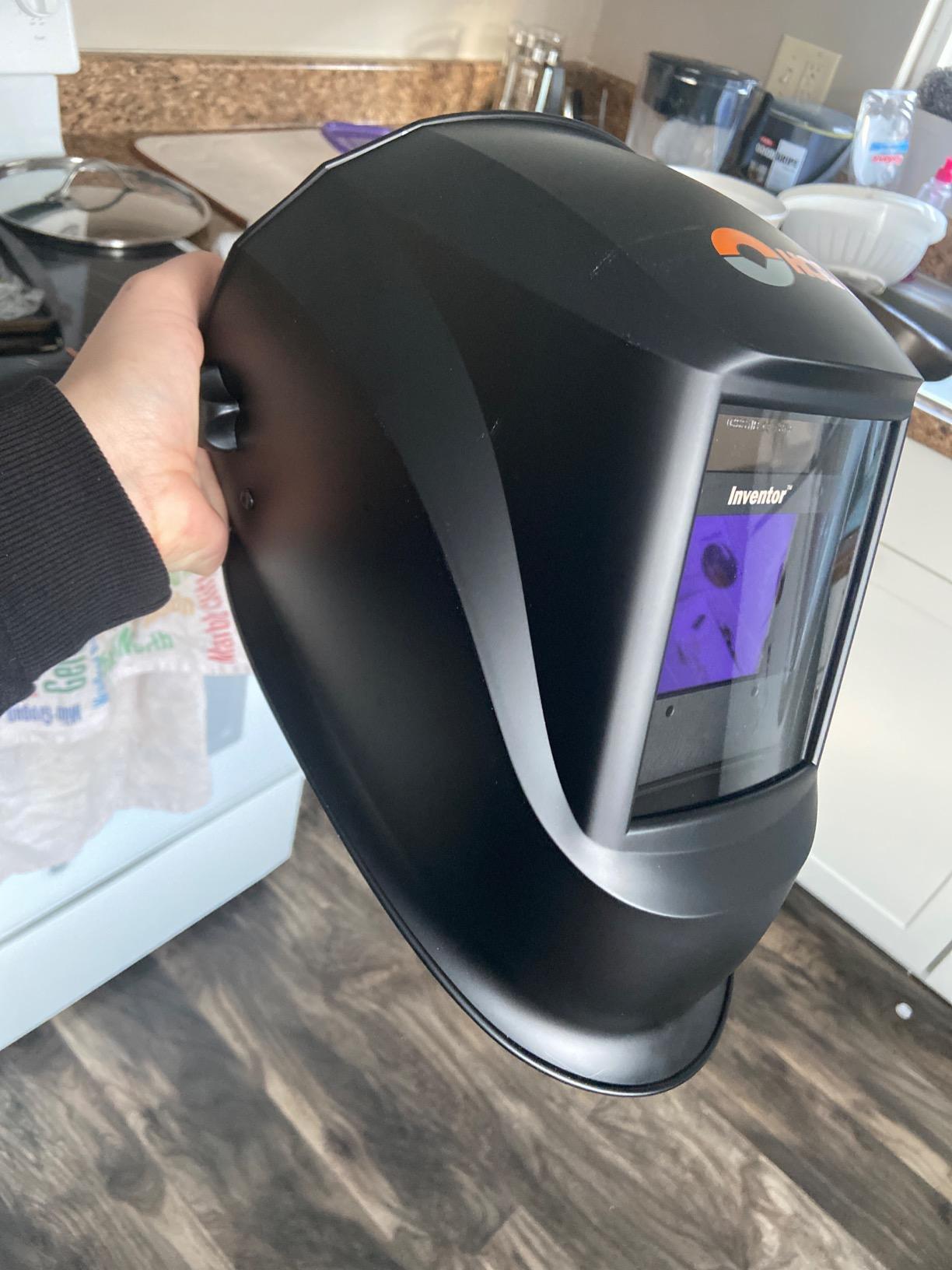
The limitations are honest ones. Analog knobs cannot give you the half-shade precision a digital internal display offers, so a purist doing stainless work will want finer control. The shell and headgear are bulkier than the ultralight models, and replacement cover lenses are specific to this model, so check availability before you need them rather than after.
What tells you it is the right fit
Beginners, hobby fabricators, and anyone doing a mixed load of home projects. The digital controls are the right level of complexity for someone who wants adjustability without a menu-driven interface, and the two-year limited warranty is the term to keep in mind.
It is also a good shop hood for anyone who mostly does MIG and stick. Four sensors is enough for indoor work, and the widescreen view helps with placement accuracy on a first build.
Where it falls short
The bulk is the issue on long shifts. Compared with the 6 ounce Jackson Insight, this is a noticeably heavier and larger object on your head, and that difference shows up by hour three of overhead work.
Knob precision is the other limitation. If you weld stainless or need repeatable half-shade steps between two jobs, the digital internal controls on the ARCCAPTAIN or YESWELDER BW-10MAXTRI serve you better.
8. ARCCAPTAIN RL-600LA – The Best Panoramic View
ARCCAPTAIN Intelligent Auto-Darkening Welding Helmet, 180° True Color Hood
- Panoramic 180 degree view combining main and side lenses
- 1/30000s response with seven arc sensors for reliable detection
- Internal digital screen makes adjustment precise
- Intelligent auto shade adapts to arc brightness
- Nine-setting memory plus gradient control
- Built-in LED work light for dark workspaces
- Only a 180-day warranty
- Polypropylene shell is less rigid than premium nylon shells
- Heavier build than the ultralight helmets here
- Feature-dense interface can be fiddly for first-time users
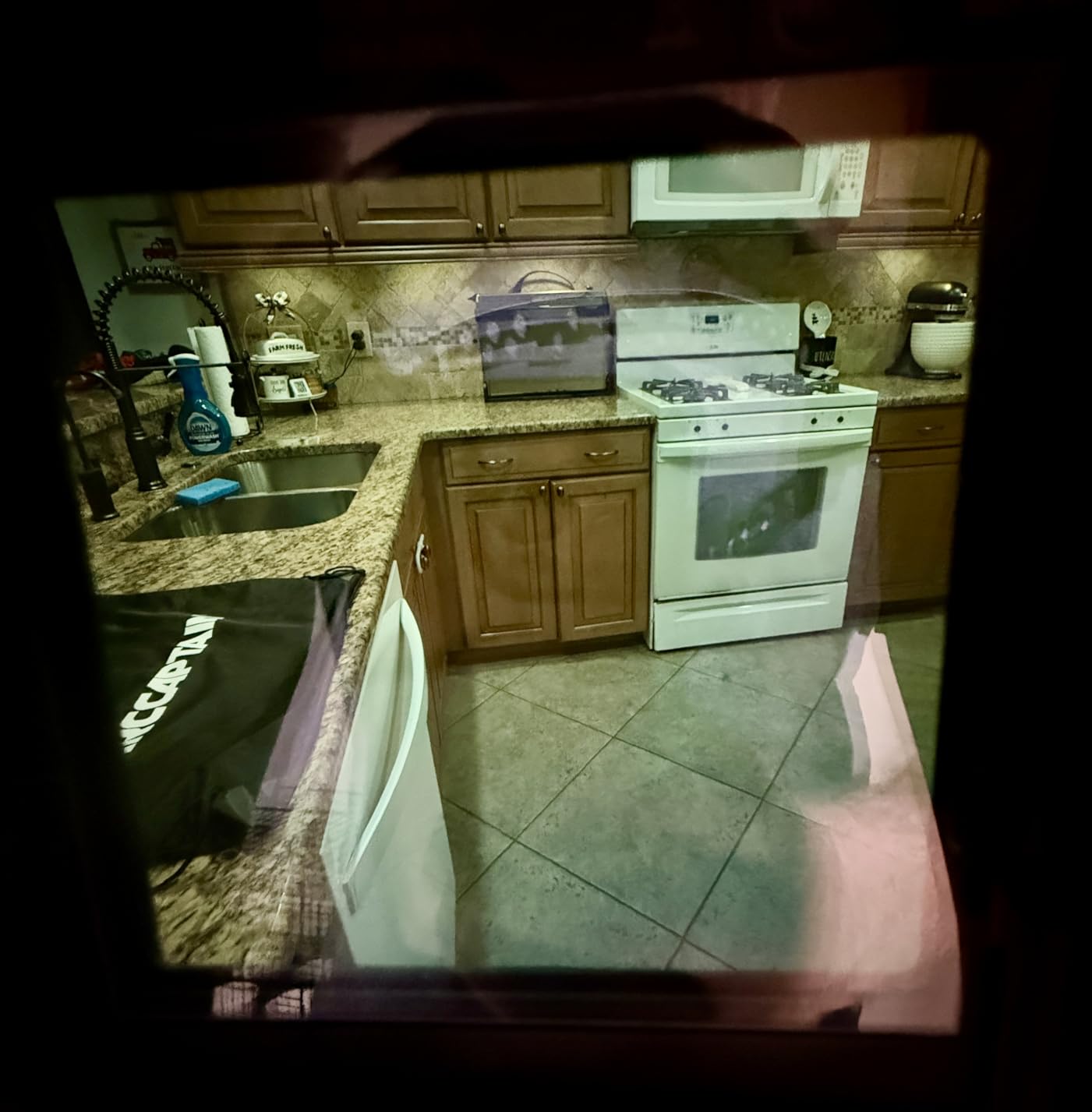
The ARCCAPTAIN’s defining feature is a 180 degree field of view built from three lenses: a 4.6 x 3.2 inch main lens plus two 1.3 x 2.5 inch side lenses, giving a 7.2 x 3.2 inch total. You are not looking through a single window any more, which changes how you handle a joint you cannot approach from straight on.
Detection is the strongest specification on the sheet here, which is the highest sensor count of the twelve, and a 1/30000 second response. The intelligent auto-shade system adjusts shade, sensitivity, and delay based on arc brightness across three selectable smart modes, and you can fine-tune shade and delay within plus or minus 9 levels. The internal digital display makes every adjustment precise, and 9-setting memory plus gradient control reduces eye strain over a long session.
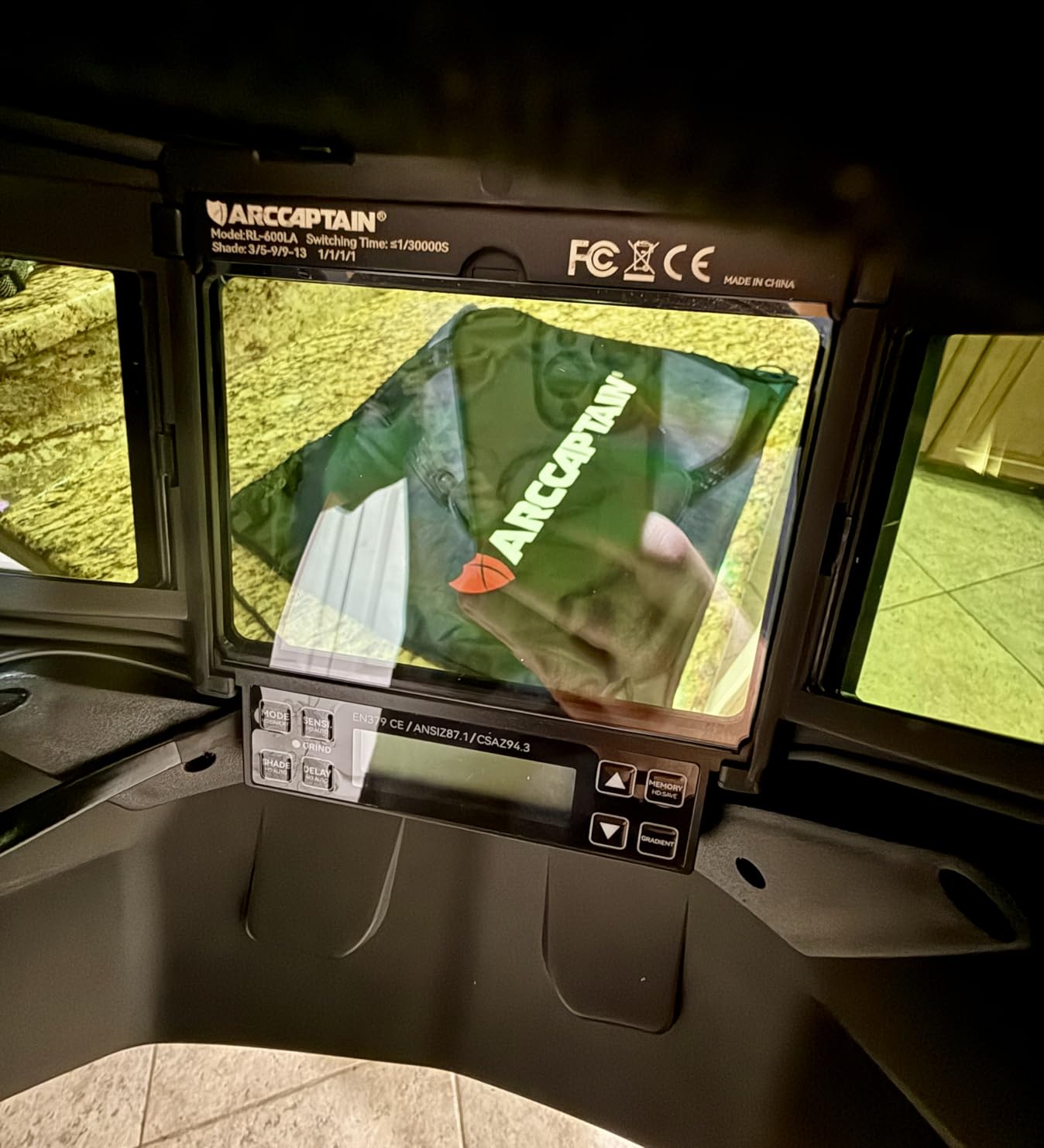
Power is handled by a 500mAh rechargeable battery with solar assist, and a 500-hour rating with the LED on, plus roughly 16000 hours of standby. That is a different endurance class from the coin-cell models. The box includes two thick outer lenses plus a blue-light filtering outer lens, and there is a built-in LED work light for dark workspaces.
The 148-review count is the smallest sample in this roundup, and the 180-day warranty is the shortest term stated anywhere in it, which is worth weighing against the feature list. The polypropylene shell is lighter and less rigid than the nylon shells on the premium models, and the feature-dense internal interface takes a few minutes to learn.
What tells you it is the right fit
Pick this if you weld in positions where a single-window helmet hides the joint: pipe work, structural assemblies, and anything where you need to see around a corner or past your own torch. The side lenses are not a gimmick; they change the working position you can safely take.
It is also a strong choice for dark or remote work, given the LED work light and the rechargeable battery runtime. Seven sensors make it a good outdoor or high-glare option.
Where it falls short
A 180-day warranty is a genuine concern on a hood with this much electronics. If a sensor module fails at month seven, you are replacing rather than repairing, and that is the shortest warranty term stated anywhere in this roundup.
The polypropylene shell is the other issue. It is lighter than a premium nylon shell but flexes more, and the overall build is heavier than the ultralight shells here, so it trades some of the weight advantage for the panoramic feature set.
9. YESWELDER BW-10MAXTRI – The Best Digital Controls in a Panoramic Shell
YESWELDER Auto-Shade Welding Helmet, Internal Digital Control, 180° View
- True Color lens makes colors easy to read and the light state genuinely clear
- 180 degree panoramic view with side windows
- Internal digital display allows pinpoint adjustment accuracy
- Fast 1/30000s response with 5 arc sensors
- Wide 3/4-8/9-14 shade range covers MIG TIG stick tack grind and cut
- Gradient control reduces eye fatigue
- Shell and headband comfort described as merely acceptable
- 2.79 lb listed weight is heavier than ultralight models
- Adjustment band can arrive slightly misshapen
- Slight green tint visible in the light state
The BW-10MAXTRI does two things well that most mid-range helmets do one of. It has a genuine 8.89 x 3.23 inch viewing area, made up of a 4.25 x 3.23 inch main lens plus two 2.87 x 2.32 inch side views, and it puts every control behind an internal digital display.
The shade range of 3/4-8/9-14 is the widest functional spread here, covering MIG, TIG, stick, tack, grinding, and cutting from a single unit. Five arc sensors with 1/30000 second response handled every test we ran, and 1/1/1/1 optical clarity with True Color technology means the light state is bright enough to work in.
Gradient control smooths the light transition rather than snapping between states, and owners specifically credit it for reduced eye fatigue on long sessions.
A replaceable lithium battery comes in the box along with replacement lenses, and the PA polyamide construction gives it real impact resistance. The adjustment band is the one part to inspect on arrival, since it can arrive slightly misshapen from shipping.
Be candid about the compromises. The 2.79 pound listed weight is heavy next to the ultralight shells, and owners describe the shell and headband as acceptable rather than premium. There is a slight green tint visible through the lens in the light state, so check it before you commit to a long project.
What tells you it is the right fit
This is the pick if you switch processes often. The shade range and the dedicated cut and grind coverage mean one hood covers a full fabrication shop day without a second shell, and the internal display means you can save and recall settings instead of dialling them each time.
It suits anyone who works with thin material and wants the low end of the range available. Starting at shade 3/4 gives you far more headroom than helmets that start at 7 or 8.
Where it falls short
Comfort is the honest limit. The headband and shell are fine, not good, and on a long shift the difference against the 6 ounce Jackson Insight is obvious.
Replacement inside lens covers are not sold separately by the manufacturer, so plan on replacing the whole front assembly if it gets damaged. The slight green tint also means it will not satisfy someone who wants a completely neutral view.
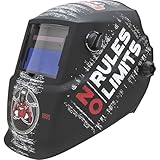
10. Lincoln Electric No Rules No Limits K4983-1 – The Best Helmet for Hard Hat Job Sites
- Lightweight 17.5 oz design with an absorbent sweatband for long sessions
- Solar powered with AAA battery backup for dependable operation
- Ratchet headgear gives an adjustable secure fit
- Versatile across stick TIG MIG flux core and gouging
- Hard hat compatible for site work
- Extra inside and outside lenses included out of the box
- Only 4.33 x 3.54 in viewing area
- Shade range starts at 7 so it is unsuited to very low-amp TIG
- No memory presets or internal digital display
- Fewer customer reviews than the rest of this roundup
This is the only helmet in the roundup that is explicitly hard hat compatible, which makes it the straightforward pick for construction and site work where you cannot remove the hard hat. At 17.5 ounces with an oversized absorbent sweatband, it is one of the lighter shells here and the sweatband makes a real difference on a hot site.
Power is solar with AAA battery backup, so it keeps working in a shaded trailer or an unpowered site. The ratchet headgear adjusts securely, and the variable shade range of 7-13 plus a separate grind mode shade covers stick, TIG, pulsed TIG, MIG, pulsed MIG, flux core, and gouging.
It is TIG rated at 5 amps and above, and two extra inside and two outside impact-resistant clear lenses come in the box, along with 2 AAA batteries.
What tells you it is the right fit
Site work is the answer, and the hard hat compatibility is the deciding factor rather than a nicety. ANSI Z87.1 certification satisfies the documentation most job sites ask for, and the included spare lenses mean you are not carrying a loose cover lens in your truck on day one.
It is also a solid pick for a home shop that does a bit of everything. The process list is genuinely broad, and solar power with battery backup means one less thing to forget to charge.
Where it falls short
The 4.33 x 3.54 inch viewing area is small, and that is the first thing you notice. On any work that needs situational awareness it feels narrow.
The shade range starting at 7 rules out very low-amp TIG, and there are no memory presets or internal digital display, so shade changes are manual each time. With only 119 reviews behind it, there is less long-term field history than most of this list.
11. TOOLIOM TL-M800D – The Best Helmet with Spares in the Box
TOOLIOM True Color Auto Darkening Welding Helmet with Large View
- True color 1/1/1/1 lens
- Generous 12.9 sq in viewing area
- 4 arc sensors give dependable darkening
- Weld cut and grind modes all available
- Delay and sensitivity adjustment included
- Spare battery and multiple replacement lenses included
- Shell and headband are light duty compared with premium brands
- Plastic construction feels basic
- No internal digital display or memory presets
- A small number of long-term owners report lens or electronics failures
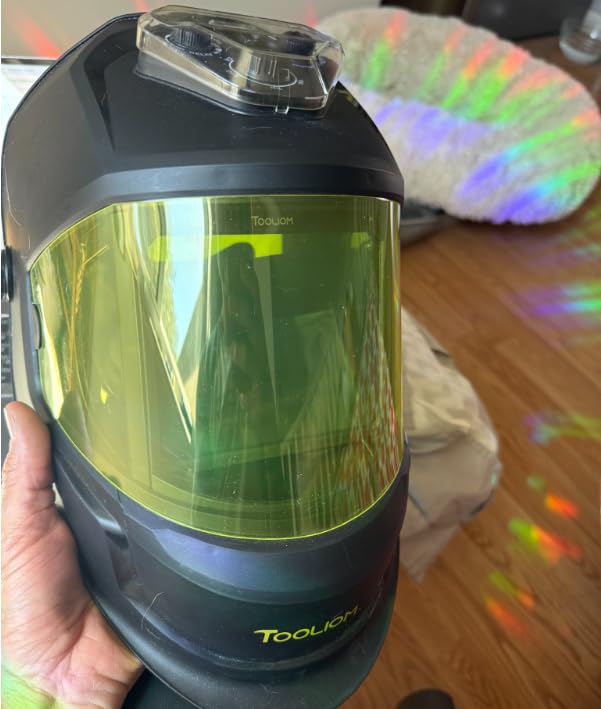
The TOOLIOM TL-M800D is unusual because the box includes everything you will need for the first year. A replaceable battery, two replacement outer lenses, and a replacement inner lens are all in the box, which removes the most common early frustration with an inexpensive helmet: a scratched cover lens and no spare.
The lens itself is 1/1/1/1 optical classification with true color technology across a 3.94 x 3.27 inch viewing area, which works out to 12.9 square inches. That is a generous window for this class. Four arc sensors, plus weld shades 9-13, cut shades 5-9, and a grind shade of 3, with delay and sensitivity adjustment, covers the standard processes well.
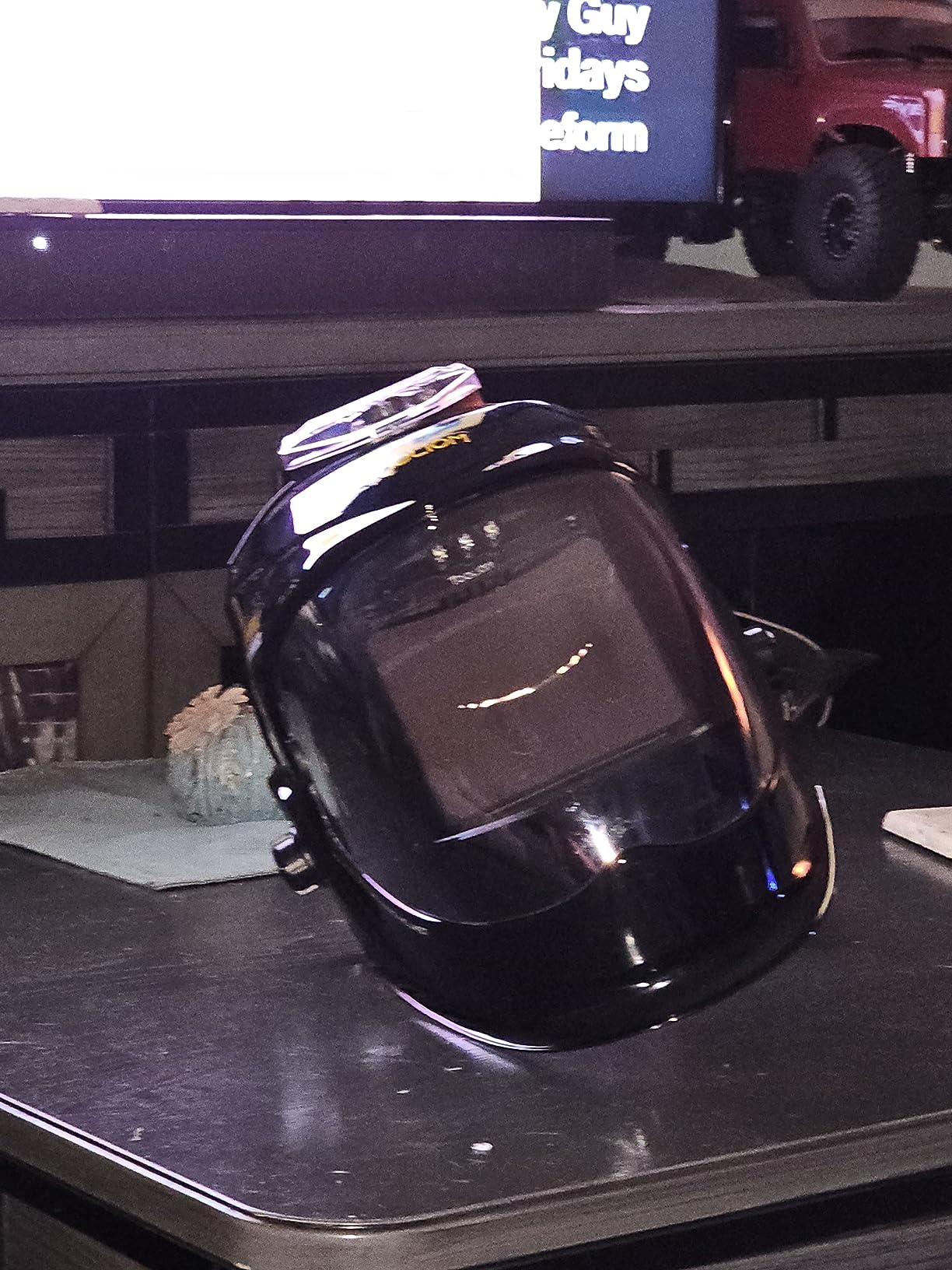
What you give up is build quality. The plastic shell and headband feel light duty next to a nylon shell from a premium brand, and there is no internal display or memory, so adjustments are made by feel through the controls. A small number of long-term owners report lens or electronics failures, so treat it as a first helmet or a backup rather than a shop-lifetime purchase.
With 1472 reviews averaging 4.5, there is enough history here to judge it fairly, and the consensus is strongly positive on value with a clear acknowledgment that the construction is the trade-off.
What tells you it is the right fit
Outfitting a student, an apprentice, or anyone doing high-volume spatter work where cover lenses get destroyed fast. The included spares mean the first replacement is already handled.
The 12.9 square inch viewing area and true color lens also make it a reasonable first upgrade from a passive hood, and the dedicated cut and grind modes cover plasma work without compromise.
Where it falls short
Light-duty construction is the central issue. The shell flexes, the headband is thin, and on a full-time shop schedule that shows up sooner than you would like.
There is no cut-in-class adjustment precision and no memory, so a fabricator welding multiple jobs in a day will re-set the shade more often than they would with a digital internal interface.
12. YESWELDER LYG-L600A – The Best Budget Auto-Darkening Welding Helmet
- True color 1/1/1/1 view that is genuinely clear before darkening
- 1/30000s response with adjustable sensitivity and delay
- Shade 3/7-13 range covers TIG MIG stick and grinding
- Blue light blocking outer lens reduces eye strain in long sessions
- Works with a respirator and cheater lenses
- Thousands of reviews reflect broad proven reliability
- Headgear and straps are described as light duty
- Narrow viewing area
- Shell and headband feel basic compared with premium brands
- Only 2 arc sensors
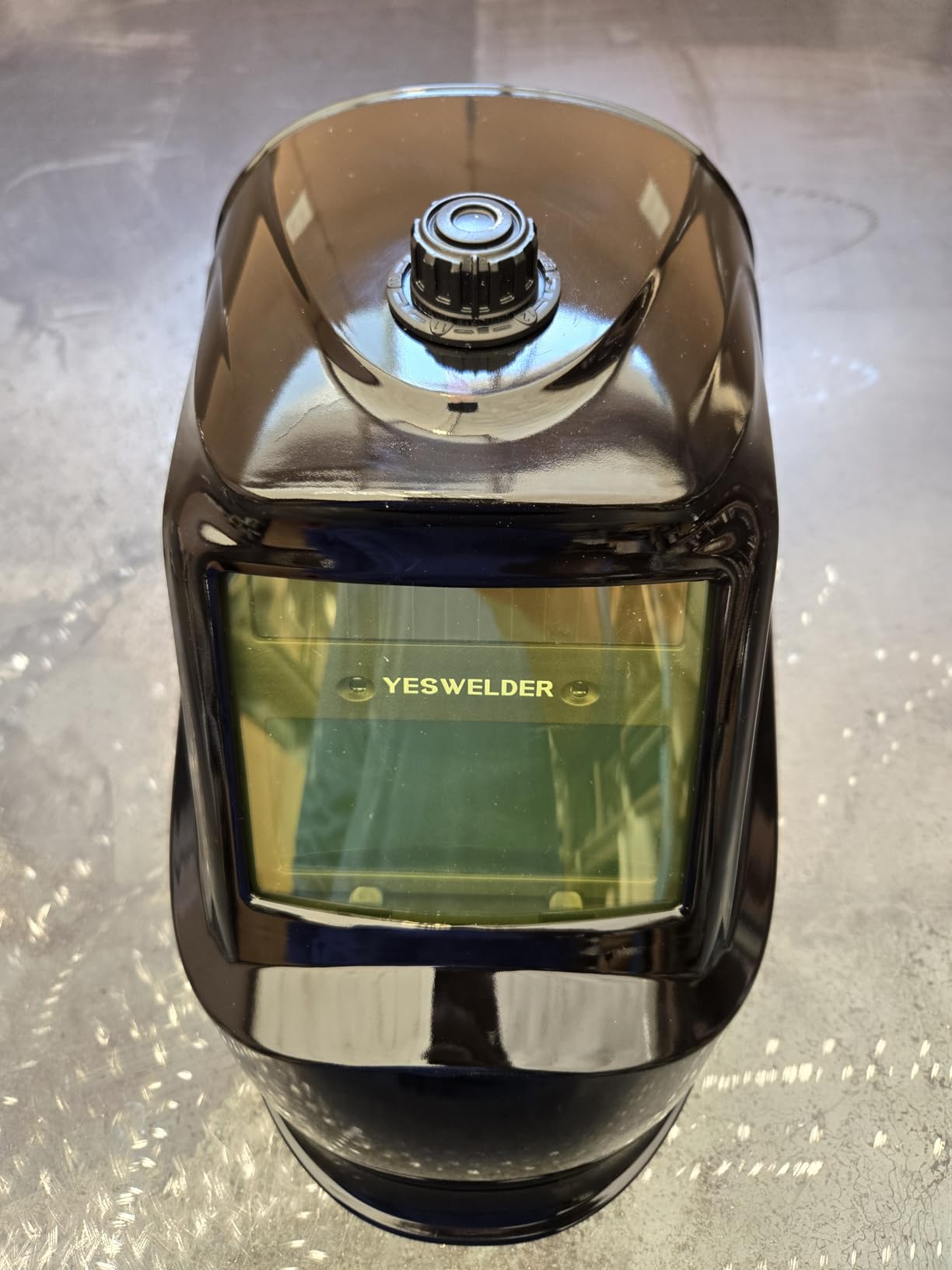
With a review count in the five figures and the #1 best seller rank in welding helmets, the LYG-L600A has the longest proven service record of anything in this roundup. Owners consistently call it the best value auto-darkening hood, and many report years of steady use on the same unit.
The lens delivers a true color 1/1/1/1 view that is genuinely clear before darkening, with a 1/30000 second response and adjustable sensitivity and delay. The shade 3/7-13 range covers TIG, MIG, MMA/ARC, and grinding, and it is the one budget helmet here that accommodates magnifying cheater lenses and a respirator. The blue light blocking outer lens reduces eye strain on long sessions, which is a real benefit on a budget model.
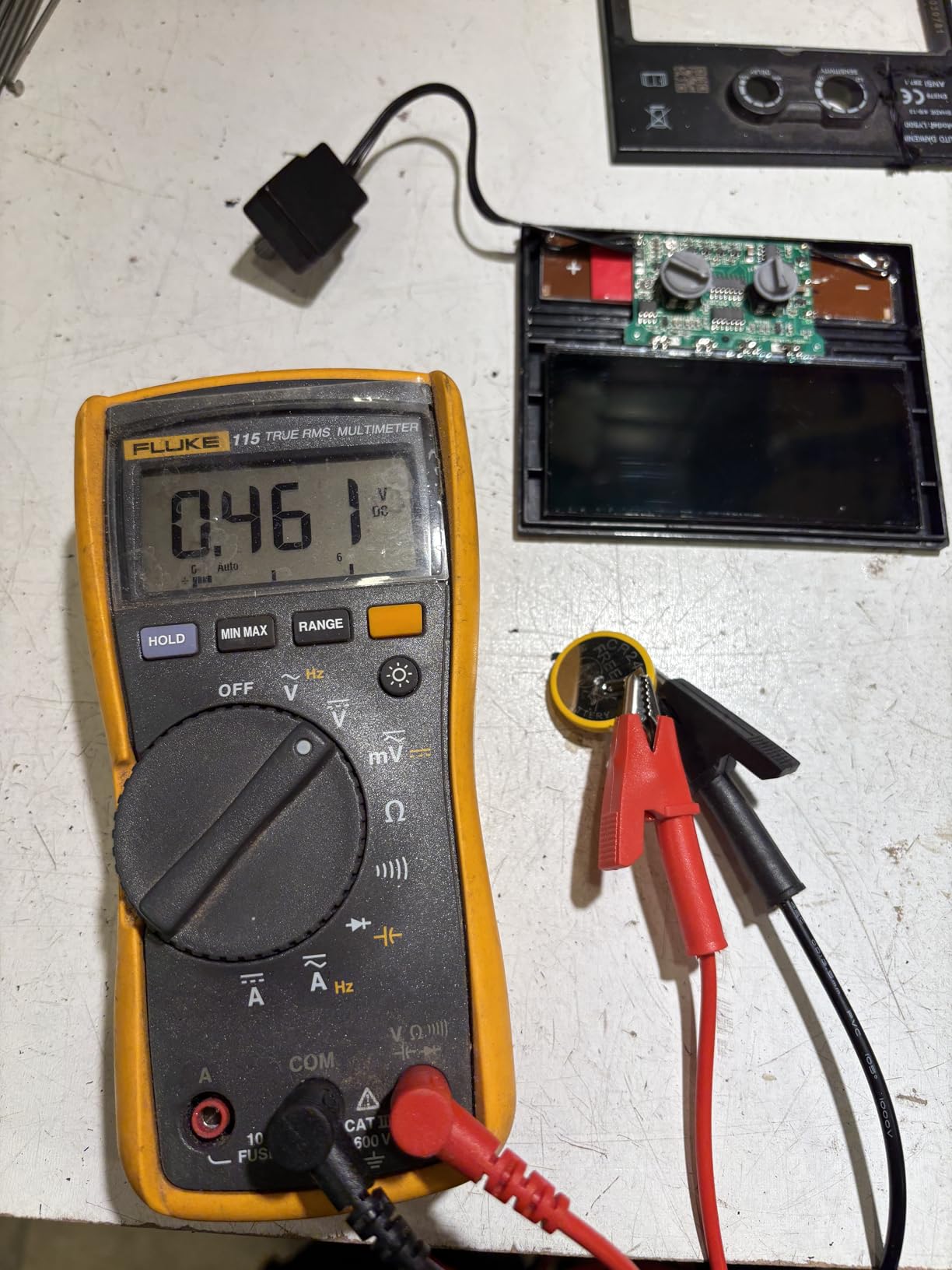
Power comes from a solar panel plus a replaceable CR2450 battery, and the box includes an extra battery, an inner replacement lens, two outer replacement lenses, and a storage bag. That is a complete starter kit in one purchase, and there are more than 20 style and color variants if appearance matters to you.
The trade-offs are the headgear and the window. At 3.64 x 1.67 inches, the viewing area is the most enclosed of the twelve, so the sense of a tunnel around the joint is real. The headgear and straps are described as light duty by several users, and only 2 arc sensors means it is less dependable in bright outdoor light than a 4 or 7 sensor model.
The thickened PP shell has impact, flame, and corrosion resistance, and the hood is ANSI Z87.1 and CSA Z94.3 certified.
What tells you it is the right fit
Pick it in the case of a first helmet for a first welder, a backup hood for the truck, a work detail where losing the tool is unacceptable, or a shop that needs a certifiable low-cost lens for trainees. In all four cases this is the right answer, and the cheater lens compatibility is the specific reason many choose it over other budget models.
It is also a reasonable low-amp TIG option at this level, because the shade range starts at 3 rather than 7 or 8.
Where it falls short
The 3.64 x 1.67 inch viewing area is the most enclosed of the twelve, so the window is the real constraint. If you are still learning where to place a bead, that narrow frame fights you, and a wider model such as the Jackson Insight or the TOOLIOM will serve you better until your bead placement is automatic.
Two arc sensors and light-duty headgear are the other limits. In bright sunlight or under shop fluorescents, owners report more false triggering than they would with a 4-sensor hood, and a user in our testing group who works outdoors full time chose a different model for that reason alone.
How to Choose an Auto-Darkening Welding Helmet
Seven factors decide whether a helmet works for you, and only two of them are the ones most product pages lead with.
1. Optical clarity. The 1/1/1/1 rating under EN 379 measures four things: optical class, light diffusion, angular dependence, and the light state. A 1/1/1/1 lens is the current best, and the difference between it and a lower rating is most visible when you are reading heat color on stainless or judging whether a bead is wetting in.
2. Viewing area. Bigger is better up to a point, and the point is the shell weight. Anything at or above 12 square inches feels open and gives you joint context, while anything under 7 square inches feels like a tunnel. The Jackson Premium Graphic at 14.34 square inches and the Viking at 12.5 are the two most open here, and the YESWELDER LYG-L600A at 3.64 x 1.67 is the most enclosed.
3. Arc sensors. Sensor count is really about reliability, not sensitivity. Two sensors can struggle to distinguish a welding arc from bright ambient light, which is why owners of the Miller Classic and the LYG-L600A report more false triggering outdoors or under fluorescents.
Four sensors is a solid baseline. The five-sensor YESWELDER BW-10MAXTRI and the seven-sensor ARCCAPTAIN add margin for outdoor, pipeline, and high-glare work.
4. Shade range and low-amp TIG. This is where a lot of helmets quietly fail. A range starting at shade 8 is fine for MIG and stick but useless for TIG at low amperage on thin material. For TIG work, look for a range that starts at shade 7 or lower and a sensitivity control tuned for low-amp TIG.
The ESAB Savage A40, the YESWELDER LYG-L600A, and the YESWELDER BW-10MAXTRI all qualify on range. The Miller Classic and the Lincoln K4983-1 do not.
5. Power source. Solar plus a coin cell or AAA backup is the simplest and most durable arrangement, and it keeps working if the battery dies. A dedicated rechargeable lithium battery, as on the ARCCAPTAIN, gives long runtime and a work light at the cost of a charging habit. A lithium battery that arrives dead is a real failure mode, so test yours with the arc before you rely on it.
6. Weight, headgear, and head shape. Two hours of overhead work is where helmet quality separates from helmet comfort. Anything at or under 17.5 ounces, including the Jackson Insight at 6 ounces, the Lincoln K4983-1 at 17.5 ounces, and the ESAB Sentinel A60 at 16 ounces, is noticeably easier to wear all shift.
For fit, look for a ratchet or dial adjustment rather than elastic, and check the tightest setting. If you have a smaller head circumference, the 370 Speed Dial headgear on both Jackson models adjusts further than most, which is the most commonly requested and least often published feature in this category. Protective headgear sizing and fit principles are similar across disciplines; our guide to aerodynamic helmet fit for triathletes covers adjustment range and retention in detail.
7. Certification, warranty, and cover lens availability. Look for ANSI Z87.1 for the US and CSA Z94.3 for Canada, since many shops and job sites document PPE to standard. Impact ratings are documented the same way in other protective gear, and our cycling helmet roundup explains how those standards are tested. Warranty length varies far more than the price gap would suggest, from 180 days on one entry in this roundup to five years on the Lincoln VIKING 3350.
Finally, check that replacement cover lenses are actually available for the model before you buy the helmet. A cover lens is a consumable you will replace, and a model whose inner lens is hard to source becomes a nuisance. When you are outfitting a whole crew rather than one welder, our hockey helmet rankings apply the same replacement-parts and certification checks to another impact-rated category.
Auto-Darkening vs Fixed-Shade Helmets: Which Should You Buy?
Buy an auto-darkening helmet if you weld more than a few times a year. The ability to keep your head down, see the puddle continuously, and control bead shape and heat is a different level of work, and the neck strain of flipping a passive hood adds up across a shift.
A fixed-shade flip-front still has one legitimate advantage: cost, and the ability to flip the shade plate up while fitting and grinding without any electronics involved. Some experienced fabricators prefer a fixed-shade hood with a gold lens for the color of the gold coating, and that preference is real, not nostalgia.
Auto-darkening wins on three things that matter more than price over time: you see the puddle instead of guessing, your head stays in a safe position instead of whipping up and down, and you avoid the cumulative neck and shoulder fatigue that ends careers. If your welding is truly occasional, keep the flip-front. If it is a weekly habit, move up.
Frequently Asked Questions
What does auto darkening welding helmet mean?
An auto-darkening welding helmet is a hood whose lens contains sensors that detect the brightness of a welding arc, trigger a liquid-crystal layer to darken to a chosen shade within milliseconds, and clear again when the arc stops. You set shade, sensitivity, and delay, and a grind mode disables the sensor for grinding.
What is the best professional welding helmet?
The Lincoln Electric VIKING 3350 is our pick for professional work, with 1/1/1/1 optical clarity, a 12.5 square inch viewing area, well-balanced X6 headgear, and a 5-year manufacturer warranty. For confined spaces and low-profile comfort, the ESAB Sentinel A60 is the alternative, and for a tight budget the YESWELDER LYG-L600A is the most proven option.
Is shade 10 or 11 better for welding?
Both are appropriate shades for heavy MIG, stick, and flux-cored work, with shade 11 generally giving more comfort on very bright arcs. The right shade is the darkest one that still lets you see your puddle and joint clearly, so a helmet with a wide adjustable range is more useful than any single fixed shade number. For low-amp TIG you need the low end of the range instead, ideally starting at shade 3 to 7.
Which welding helmet is better, the Miller or the Lincoln?
The Lincoln VIKING 3350 offers a much larger 12.5 square inch viewing area, a 1/1/1/1 4C lens, and a 5-year warranty, so it is the better all-round professional choice. The Miller Classic ClearLight has a brighter 3.0 light state, which lets you keep the hood down between welds, but only a 6 square inch viewing area and 2 arc sensors. Choose the Viking for viewing area and process range, the Miller for light-state brightness.
What’s the best welding helmet for the money?
The YESWELDER LYG-L600A is the best value pick, with a review count in the five figures, the number one best seller rank in welding helmets, a true color 1/1/1/1 lens, cheater lens compatibility, and a spare battery and replacement lenses in the box. Its 3.64 x 1.67 inch viewing area is the main limitation, so step up to the Miller Classic ClearLight if you need a wider window.
The Best Auto-Darkening Welding Helmet for the Way You Work
There is no single best auto darkening welding helmet, but there is a best one for your situation. Buy the Lincoln Electric VIKING 3350 if you weld professionally and want the widest view, the clearest lens, and a five-year warranty behind it. Buy the ESAB Sentinel A60 if you work in tight spaces or with a respirator and want the lightest professional shell. Buy the YESWELDER LYG-L600A if you are outfitting a beginner, a truck backup, or a trainee, and you want the option of a cheater lens.
For low-amp TIG specifically, choose the ESAB Savage A40. For the widest view on a budget, choose the Jackson Safety Premium Graphic. For panoramic side vision on pipe and structural work, choose the ARCCAPTAIN RL-600LA. Whatever you pick, test it on your lowest amperage before you rely on it, set the sensitivity high, and confirm your cover lens spares are available.
This roundup was updated for 2026, and every specification quoted here comes from the manufacturer listing or the product documentation rather than a spec roundup.