
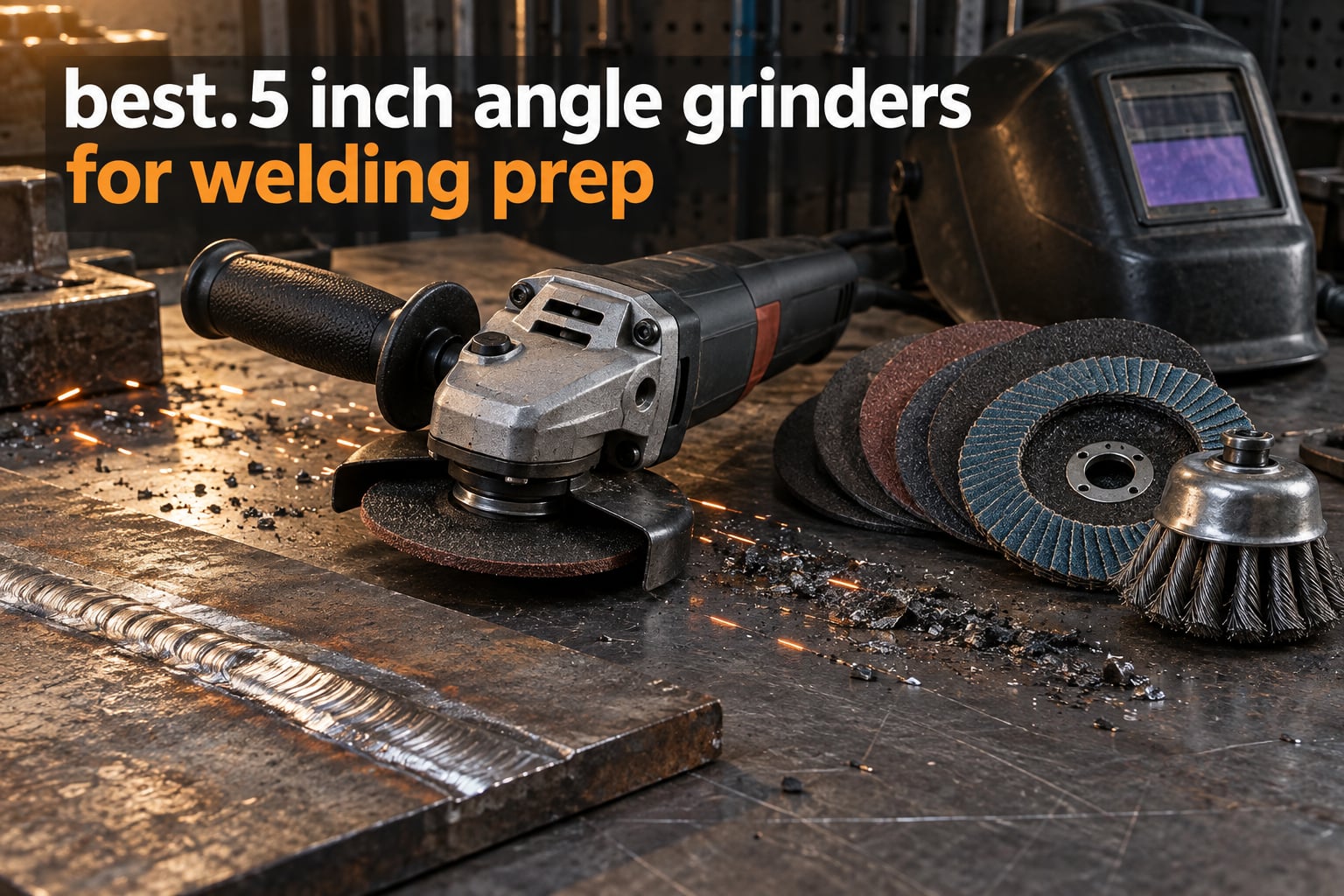
A 4.5 inch angle grinder is the tool a welder touches more than any other in a normal week. It cuts the plate, it puts the bevel on, it knocks the mill scale off the mill scale-free side of the joint, and it cleans the bead after the arc goes out. If you are searching for a 4.5 inch angle grinder for welding prep, the difference between a good one and a bad one shows up in the first week of daily use, not in a spec sheet.
Short answer: the DEWALT DCG413B is the best 4.5 inch angle grinder for welding prep overall, and the Makita 9557PBX1 is the pick if you want mains power. The DEWALT pairs a brushless motor with a kickback brake and a two-stage trigger. The Makita’s 7.5 amp motor, metal gear housing and paddle switch suit long bead-cleanup sessions.
Ten grinders made the cut below, from an entry-level budget cord model to a brushless cordless platform tool. I weighted the things that actually decide whether weld prep goes well: power under load on mill scale, brake and restart protection, how the tool behaves one-handed on a hot bead, guard and wheel-change mechanics, and whether the wheel and guard you already own fit it. If you also grind other things, our meat grinder roundup covers that separate category. This guide was last updated in 2026 and covers the 4.5 inch class only.
Table of Contents
Top 3 Picks for 4.5 Inch Weld Prep


Three tools cover most weld prep situations. The DEWALT wins on safety electronics and weight. The Makita is the one to buy when an outlet is always within reach. The Milwaukee is the pick for shops already committed to M18 batteries and for overhead cleanup where a dampening side handle matters.
Best 4.5 Inch Angle Grinders for Welding Prep in 2026
| Product | Specifications | Action |
|---|---|---|
| DEWALT DCG413B 20V Cordless |
|
Check Latest Price |
| Makita 9557PBX1 Corded |
|
Check Latest Price |
| Milwaukee 2880-20 M18 |
|
Check Latest Price |
 Metabo HPT G12SR4 Metabo HPT G12SR4 |
|
Check Latest Price |
 CRAFTSMAN CMEG100 CRAFTSMAN CMEG100 |
|
Check Latest Price |
 PORTER-CABLE PC750AG PORTER-CABLE PC750AG |
|
Check Latest Price |
 DEWALT DWE4011 DEWALT DWE4011 |
|
Check Latest Price |
 AVID POWER 7.5 Amp AVID POWER 7.5 Amp |
|
Check Latest Price |
 Bosch GWS8-45 Bosch GWS8-45 |
|
Check Latest Price |
 BLACK+DECKER BDEG400 BLACK+DECKER BDEG400 |
|
Check Latest Price |
A note on the specs before you read the reviews. No-load RPM is a free-spinning number, not a cutting number, so a 12,000 rpm grinder is not automatically faster through a weld bead than an 8,500 rpm one. Arbor size decides which wheels fit: most of these tools use a 5/8 inch-11 spindle, and the AVID POWER is also noted as accepting 7/8 inch discs. Amp draw on corded models is the honest comparison; on cordless models, the battery platform is the honest comparison.
1. DEWALT DCG413B – Best Overall for Weld Prep
- Brushless motor needs no brush changes
- Kickback brake stops the wheel fast
- Two-stage trigger and paddle switch give good control
- Light and balanced for long overhead sessions
- Standard hex wrench for disc changes
- Roughly 20-30 minutes of grinding on a single 4Ah pack
- Battery and charger cost extra outside the DEWALT 20V platform
- Less output than a corded grinder on prolonged cuts
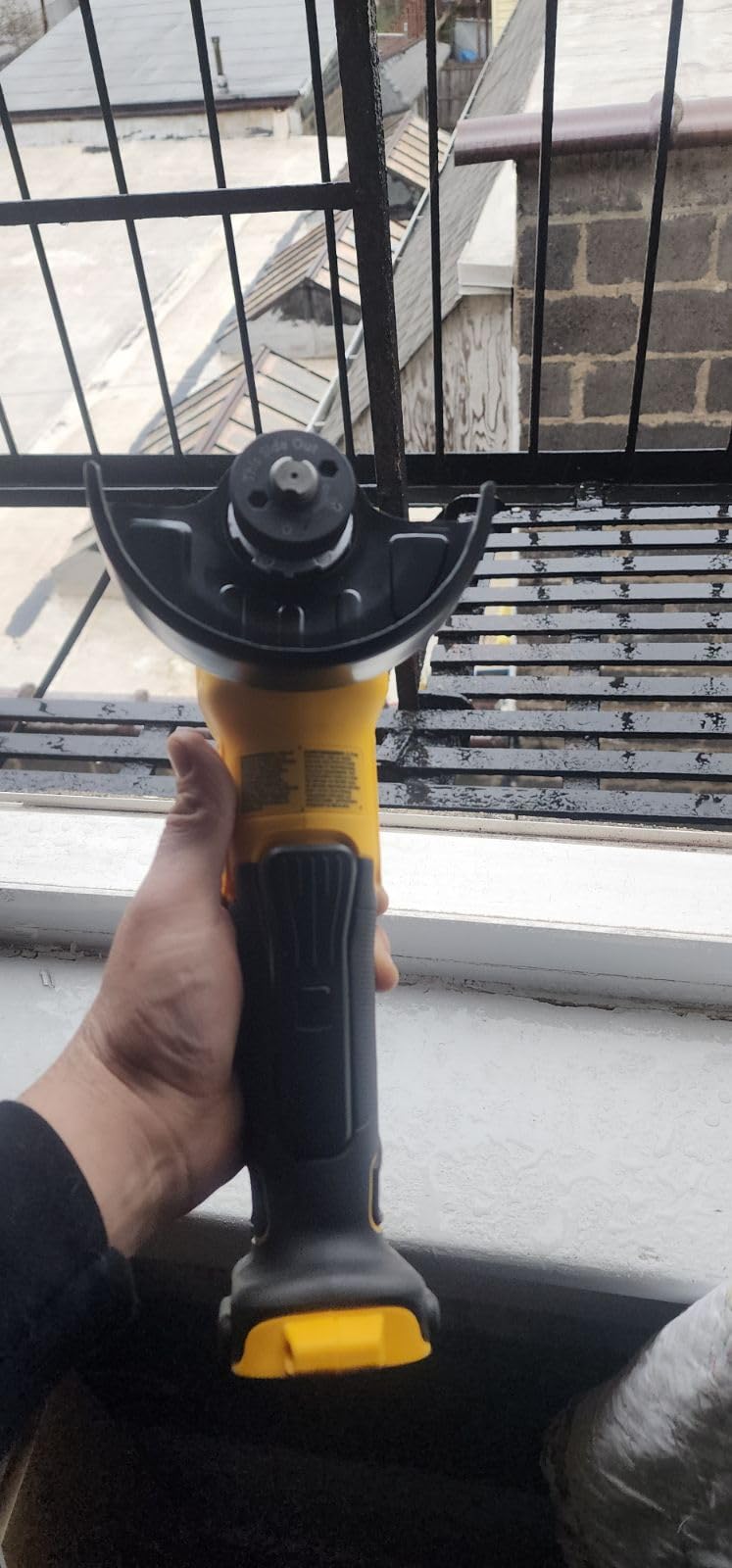
The DCG413B is the grinder I would hand a welder doing daily prep, because the brushless motor has the torque to track a bead without bogging and the brake stops the wheel in two seconds or less once a bind is sensed. The kickback brake engages on a pinch, stall, or bind-up, which is the single most useful safety feature on a small grinder.
It weighs 3.8 pounds, and that low mass is the reason it works for overhead cleanup and one-handed blending with a flap disc. The two-stage trigger requires two actions to activate the tool, so a grinder set down on a bench will not restart. E-Switch Protection with a no-volt release handles the case where you change battery packs mid-grind.
Reviewers consistently point to the power-to-weight balance and the safety systems rather than raw cutting speed, and several describe it as ideal for cleaning welds, cutting steel and light grinding work. The most repeated drawback is battery endurance on long grinding sessions, which is a platform issue as much as a tool issue.
The stated wattage and horsepower figures on the listing reflect the battery platform rather than output, so judge it on the brushless motor description and the two-second brake claim rather than those numbers. Disc changes use a standard Allen wrench, so no proprietary check key is involved. Reviewers also note that some units arrive without written instructions.
What a welder gains by owning this one
Brake and restart protection are the deciding features when you are grinding a hot fillet with one hand and holding the coupon with the other. A wheel that stops in two seconds rather than ten removes most of the risk of a snagged wheel pulling your arm across the joint. It also means you can set the tool down mid-task without a restart cycle.
If you already own 20V MAX packs, the entry cost is one tool. If you do not, the battery and charger change the math entirely, and that is the reason it does not take our corded recommendation.
Where it will disappoint you
A single 4Ah pack gives roughly 20 to 30 minutes of continuous grinding before a swap. On a long production run that means pauses, and swapping a pack mid-grind is a real annoyance that forum threads about cordless grinders complain about constantly.
It also has less sustained output than a comparable corded grinder on prolonged cuts through thicker material. For routine weld prep that is a non-issue. For heavy section work it is the wrong tool, which is why the Makita sits beside it here.
2. Makita 9557PBX1 – Best Corded 4.5 Inch Grinder
- Compact 4.5 inch body fits tight corners
- Full-length paddle switch with lock-on
- Metal gear housing with all-ball-bearing design
- Case includes both guards plus a side handle and five wheels
- Included wheels cut mild steel and stainless cleanly
- Tool does not fit the supplied case with the side handle attached
- No room in the case for extra wheels
- Needs a Phillips screwdriver to swap Type 27 and Type 1 guards
- Lock-on button and paddle lock are fiddly
The 9557PBX1 is the corded answer for anyone who grinds all day, with a 7.5 amp motor, 900 watts and 11,000 rpm packed into a 4.5 pound body. The barrel grip is only 2 to 2.5 inches in diameter, which is the difference between reaching a fillet inside a bracket and not reaching it.
Durability is where this tool earns its reputation. It has labyrinth construction that seals the motor and bearings from dust and debris, protective zig zag varnish over the armature, an all-ball-bearing design and a metal gear housing. On weldingweb.com, owners repeatedly name Makita as the long-term favorite in the 4-1/2 inch class, with multiple units reported as still in service after years.
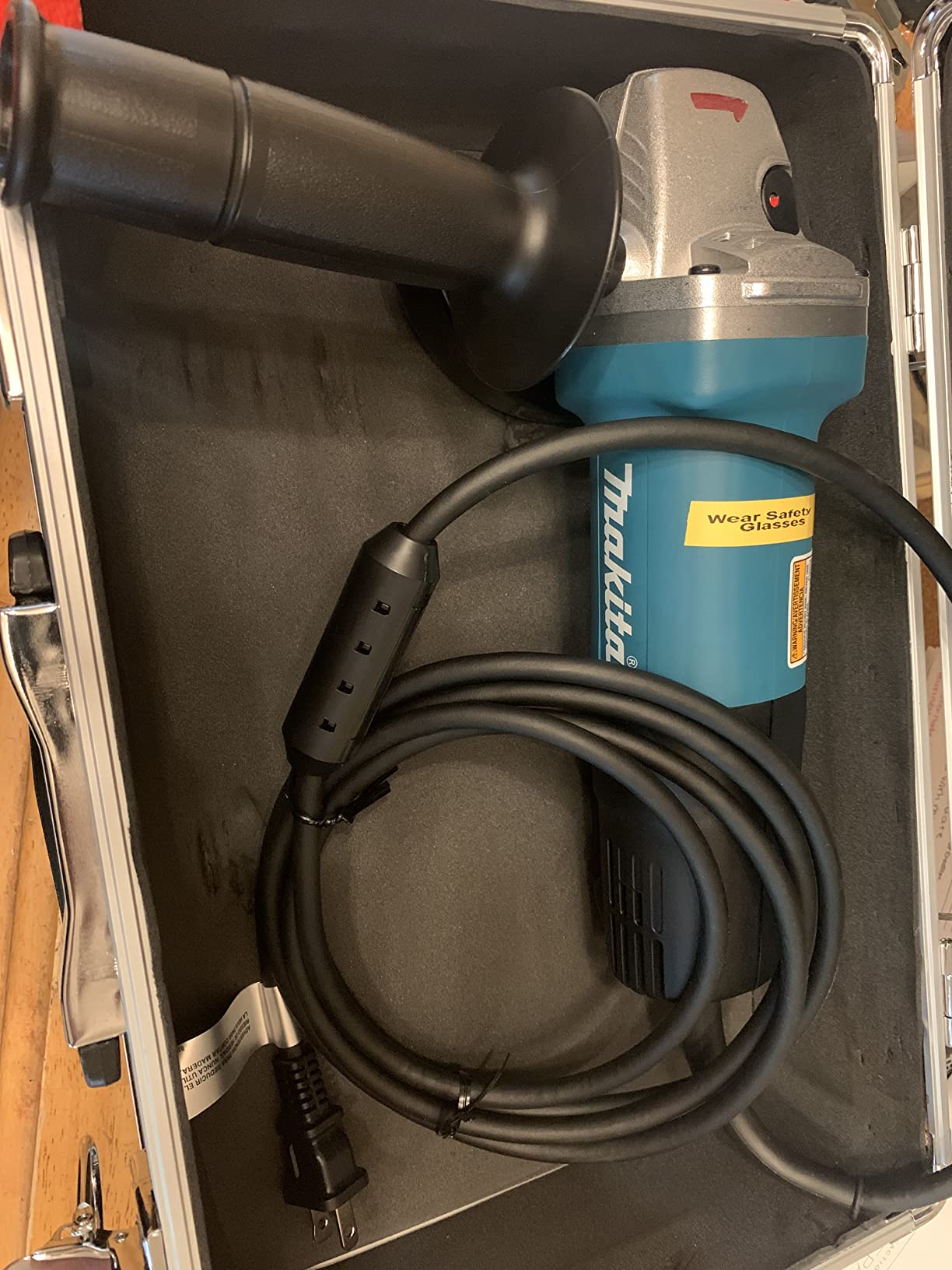
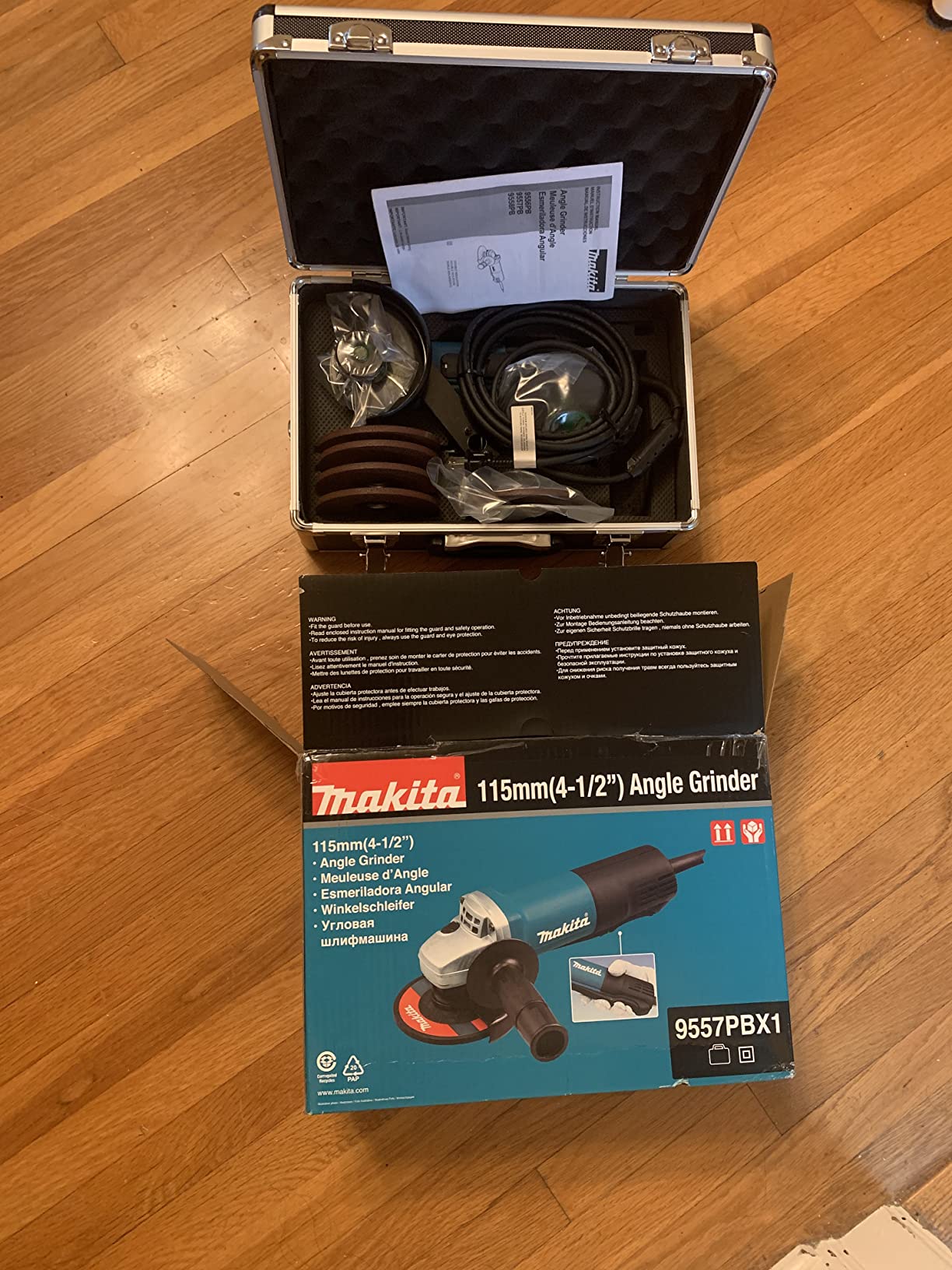
Reviewers treat the accessory package as unusually generous: an aluminum case, a side handle, both guard types, five grinding wheels and a diamond blade, and they report the included wheels are well balanced and cut mild steel and stainless cleanly. The lock-on paddle switch is full length, so you can hold it down for a long pass and still feather it with a light touch.
The AC/DC switch lets it run off an alternative power source, which matters on jobsites where generator output is the question. One detail worth knowing before you buy: phone support states a 5/8 inch arbor only, while the manual indicates the insert can be reversed for 7/8 inch. Confirm against your own wheel inventory.
Where it earns its place in a welding shop
Mains power means constant output. There is no battery to drain, no mid-grind swap and no drop in torque as a pack empties, which is exactly what a fabricator grinding a run of fillets needs. The 11,000 rpm class speed gives clean cuts on mild steel and stainless on light and medium stock.
Both guard types come in the case, so switching between grinding and cut-off duty takes a minute rather than a trip to the hardware store. The labyrinth sealing matters more than specs suggest: grinding dust and spatter are what kill brushed armatures in a fabrication bay.
The complaints worth knowing
The case is the most cited complaint, because the tool does not fit inside it with the side handle attached, and there is no room for extra wheels. It also needs a Phillips screwdriver to swap the Type 27 and Type 1 guards, and that screwdriver is not included.
Reviewers also find the lock-on button and paddle lock fiddly and easy to misread with a gloved hand. And while 7.5 amp is strong for a 4.5 inch grinder, it will not match a larger machine on heavy section work.
3. Milwaukee 2880-20 – Best Cordless for Shop Safety
Milwaukee 2880-20 M18 Fuel Brushless Lithium-Ion 4-1/2 in. / 5 in. Cordless Small Angle Grinder with No-Lock Paddle Switch (Tool Only)
- Brushless M18 motor with consistent grinding power
- Electronic clutch provides kickback protection
- Overload protection extends motor life
- Anti-vibration side handle improves control
- 5/8-11 spindle accepts common accessories
- 8500 rpm is lower than most corded 4.5 inch grinders
- Tool only with battery and charger sold separately
- About 5 lb which is heavier than several corded rivals
The 2880-20 handles 4-1/2 inch and 5 inch discs, which makes it the flexible cordless option for a shop doing both weld prep and light metal finishing. The electronic clutch provides kickback protection and the overload protection is designed to maximize motor life when you lean on it through mill scale.
The anti-vibration side handle is the feature that gets cited most in reviews, and it is genuinely useful for overhead bead cleanup where a standard handle transmits shock into the wrist. The 5/8-11 spindle takes the common grinding accessories already in the shop, and it runs on any M18 battery.
Owners rate it very highly for power, durability and the handle, pointing to the safety electronics as a plus on jobsite weld prep and metal finishing. The listed 800 watt figure sits alongside the brushless M18 motor rather than replacing it, which is how the sustained output is delivered.
One real tradeoff: 8,500 rpm is the lowest no-load speed in this group. It is fine for grinding, blending and descaling, and it reduces kickback tendency on a fresh bead, but it will feel slower than a 12,000 rpm corded tool when cutting thin-wall tubing.

Who should buy this one
Shops already running M18 batteries across drills, drivers and saws. The value calculation inverts once you own the platform, and this tool slots into an existing battery wall rather than starting a new one. It also travels, which matters for field weld repair where an outlet is not a given.
It is also a good second grinder for a shop that keeps one corded tool on the bench. Battery endurance is not the issue on M18 packs; the issue is having a pack in the tool when the job is finished.
Where it falls short
It comes as a tool only, so battery and charger are separate purchases if you are not already on M18. At about 5 pounds it is heavier than several corded competitors in the same class, and that weight shows up at the end of a long overhead cleanup.
For a fabrication bay where the grinder never leaves a bench, the Makita is the better buy. This one earns its slot for mobile work and platform fit.
4. Metabo HPT G12SR4 – Best for Tight Corners
Metabo HPT 4-1/2-Inch Angle Grinder, Includes 5 Grinding Wheels & Hard Case, 6.2-Amp Motor, Compact & Lightweight, G12SR4
- Only 4.0 lb with a low-profile gear case
- Spindle lock for tool-free disc changes
- Quick-off slide switch stops the tool fast when a wheel binds
- Includes five grinding wheels and a hard case
- Forward-canted side handle for either hand
- 6.2 amp motor is below the 7.5 amp class on thicker material
- Slide switch means the tool stops the moment you release it
- Only a 1 year base warranty
The G12SR4 is the grinder for the parts of a job where a larger body simply will not fit. The low-profile gear case and 4.0 pound weight are the reason, and both matter when you are cleaning the inside of a flanged joint or blending a bead in a corner that a 7 inch tool cannot reach.
It runs at 12,000 rpm, tied for the highest no-load speed in this group, with a 6.2 amp motor rated at 980W of maximum output. Owners frequently highlight the low weight, compact head and the value bundle of five wheels plus a hard case, which is why it shows up so often in hobby welding prep.
Two mechanical details make it pleasant to work with. The spindle lock makes disc and accessory changes quick without a wrench, which answers the lost-spanner problem that forum threads joke about constantly. And the left-mounted slide switch has a quick-off feature, so the tool stops the moment the switch slides back rather than coasting down.
The removable forward-canted side handle works for either handedness, and the new labyrinth design is intended to improve dust and debris durability around the smaller grip.
Best use: access and light prep
This is a fit-and-finish tool. Descaling a small bracket, blending a fillet, knocking rust off a light frame and cleaning up inside corners are all jobs it handles without fighting you. A garagejournal.com poster describes the same use case: choosing 4-1/2 inch specifically to prep steel before welding and to clean up welds afterward.
At 12,000 rpm it cuts light stock faster than the 6.2 amp rating suggests, provided you do not force it into heavy section.
When to skip it
The 6.2 amp motor is the honest limitation. It is adequate for grinding welds and light stock removal, but it is not in the same class as the 7.5 amp tools here, and pushing it into thicker material leads to bogging and heat, which is exactly the failure pattern described in buyer discussions.
The slide switch is also not a paddle switch. If your habit is to feather the wheel with a fingertip, a slide switch requires a different technique. And the 1 year warranty is the shortest here.
5. CRAFTSMAN CMEG100 – Best Tool-Free Guard Setup
CRAFTSMAN Small Angle Grinder Tool 4-1/2 inch, 6 Amp, 12,000 RPM, Corded (CMEG100)
- Tool-free guard adjusts without a wrench
- Three-position handle covers overhead and side positions
- Lock-on switch for extended grinds
- Spindle lock speeds wheel changes
- 3 year limited warranty
- Compatible with the VERSATRACK wall system
- 6 amp motor is not intended for heavy daily abuse
- Heavier than several similarly priced 4.5 inch grinders
- Guard is set up for grinding duty and gives less clearance for cut-off wheels
The CMEG100 solves a specific annoyance: guard position. A tool-free guard means you can rotate the guard to suit the job without hunting for a wrench, and combined with the spindle lock the whole disc change takes under a minute. That matters more than it sounds when you change wheels a dozen times in a shift.
It is a 6 amp corded grinder at 12,000 rpm and 4.6 pounds, and the three-position handle is the other quiet strength. Top, left and right mounting covers overhead work, side work and low grinding without swapping grips.
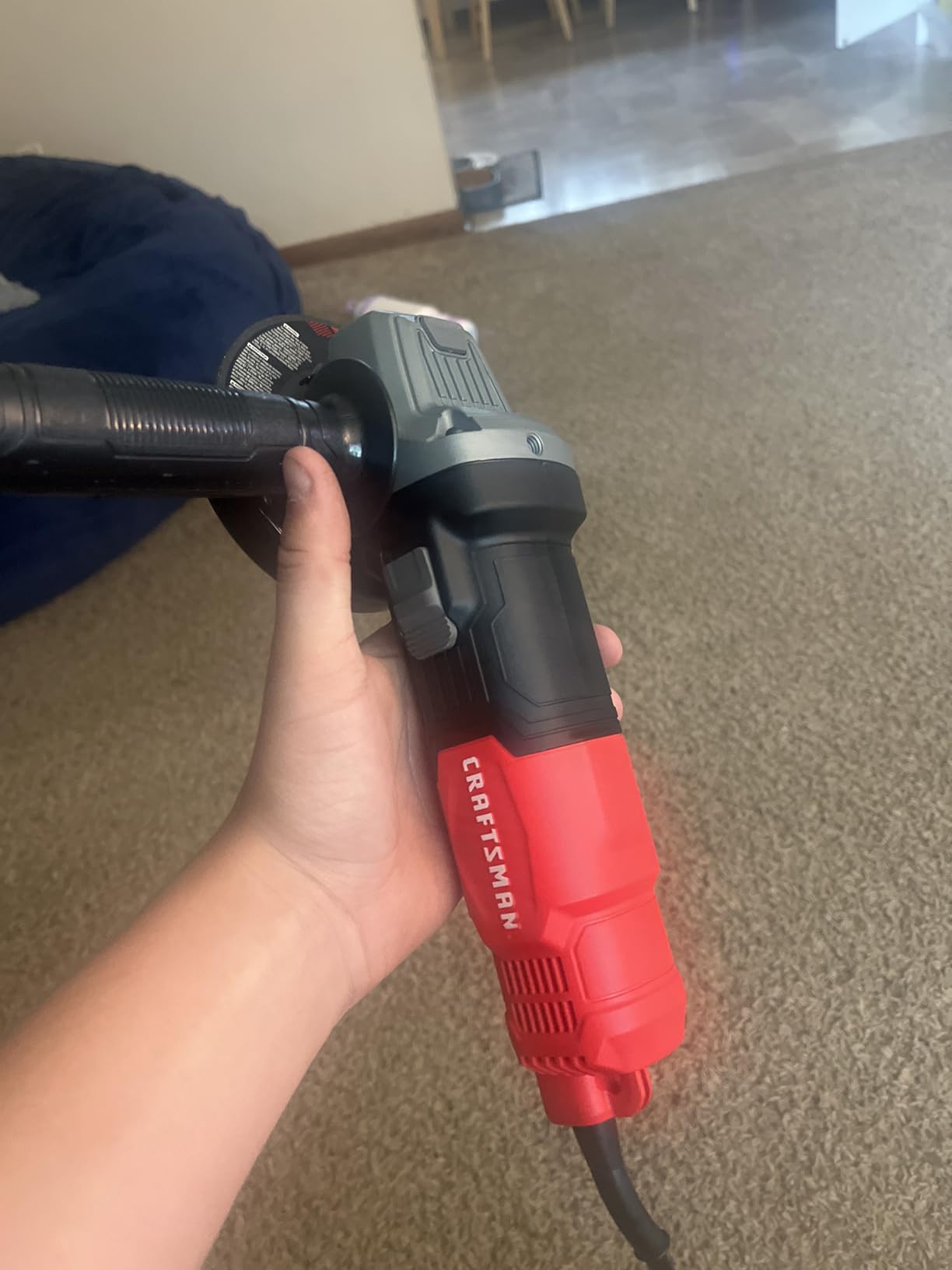
Users describe it as a dependable, good-value grinder suited to occasional garage work, rust removal, cutting off welds and attachment use, and they frequently single out the three-position handle and the lock-on switch. The contoured overmolded handle adds comfort on longer passes, and the 3 year limited warranty outlasts most tools in this class.
It comes with a grinding guard, a grinding wheel, a three-position handle and a wrench in the box, so there is nothing to buy before the first weld cleanup.
What this pick optimizes for
Guard adjustments. On a job that alternates between grinding, blending and occasional cutting, a guard you can reposition by hand removes a recurring five-minute delay and the temptation to run with a badly set guard. The lock-on switch then lets you set the tool to run for a long pass on a seam.
It is a strong first grinder for someone building a home shop around welding, because the accessory handling is forgiving and the warranty is long.
The compromise to accept
At 6 amp this is an occasional-work motor. Reviewers are clear that it is better suited to intermittent than continuous use, so a full production day of weld grinding is not what it is built for. Budget-grinder threads on forums warn specifically that entry models fail under sustained pressure.
It is also heavier than several similarly priced 4.5 inch grinders, and the included guard is a grinding guard, which gives less clearance for cut-off wheels than a dedicated cut-off guard.
6. PORTER-CABLE PC750AG – Best for Thick Section Prep
PORTER-CABLE Angle Grinder Tool, 4-1/2-Inch, 7.5-Amp (PC750AG)
- 7.5 amp motor has more power than lower-amp grinders in this size
- Cast metal gear housing survives heavy shop use
- Three-position side handle with threaded top mount
- Spindle lock for single-wrench wheel changes
- Guard adjusts smoothly to direct sparks
- Nearly 6 lb tires the arm during long overhead sessions
- Audible under load from the brushed motor
- Wheel takes several seconds to coast down after release
- No case or carrying bag included
- Brushed motor needs occasional brush replacement
The PC750AG is the heaviest grinder in this group at 5.9 pounds, and that mass is what supports the cast gear case. A 7.5 amp motor with a cast metal gear housing is what you want when you are grinding down a structural fillet or cleaning a heavy mill-scale weld rather than blending a thin gauge edge.
The three-position adjustable side handle includes a threaded top mount, which is the configuration you want for overhead work and for reaching into a confined corner from above. The spindle lock allows single-wrench wheel changes, and the soft grip handle takes some of the sting out of a long pass.
Owners consistently report strong, reliable power and a rugged cast-metal build, and welders specifically praise it for grinding welds and fabrication cuts. It is a 900 watt, 10,000 rpm corded machine with a 3 year limited warranty, and the guard adjusts smoothly enough to keep sparks directed away from the operator.
Be aware of what a brushed motor means for ownership. Carbon brushes need occasional replacement and the gear case needs periodic greasing, which is maintenance a brushless cordless tool simply does not have.
Buy it if power is the priority
Among corded 4.5 inch grinders, a 7.5 amp motor with a cast metal gear case is the combination that survives sustained work. If your day includes heavy weld cleanup, cutting structural tube and rebar, this is the grinder in the group to buy for that work.
For a shop that grinds all day at a bench, the mains-powered consistency plus the cast gear case is worth the weight.
Buy something lighter if
If most of your prep is overhead bead blending or one-handed work in a frame, 5.9 pounds is punishing. The Bosch GWS8-45 at 4.2 pounds and the DEWALT DCG413B at 3.8 pounds are far easier on the shoulder for those jobs.
Expect noise, a wheel that takes several seconds to coast down after you release the switch, and no carrying bag. This is a bench tool, not a mobile one.
7. DEWALT DWE4011 – Best Guard and Wheel Release
- One-Touch guard rotates into position without tools
- Tool-free wheel release makes disc changes very quick
- 7 amp AC/DC motor with overload protection
- Slim body suits smaller hands and long sessions
- Fewer exposed body screws reduce vibration loosening
- Owners report units lasting 15-20 years
- Pin spanner not included and the included hex wrench is of limited use
- Slide switch is small and easy to miss with a thumb
- Louder and more vibration-prone than brushless rivals
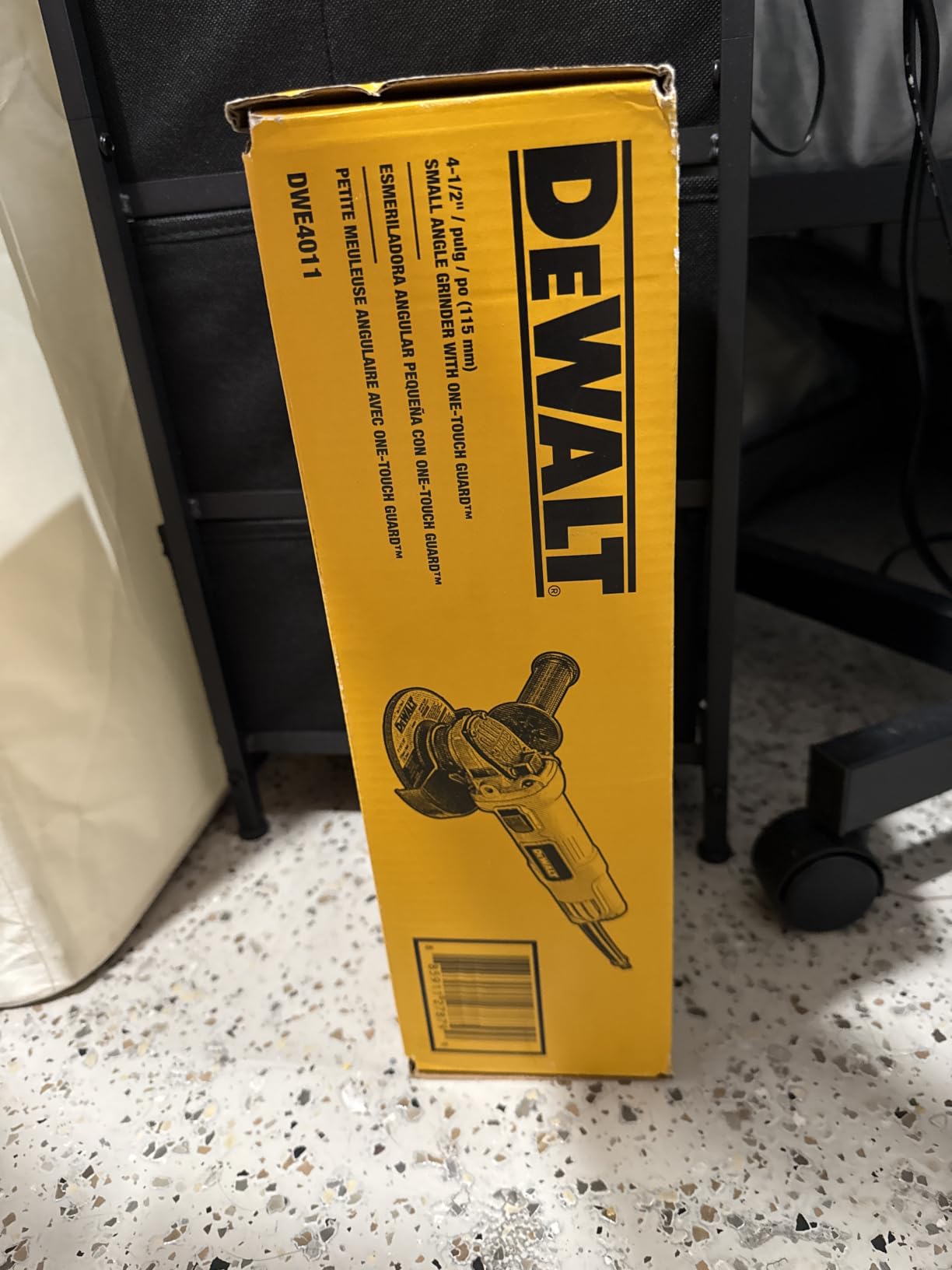
The DWE4011 is the grinder to buy if your priority is a tool that will still be running in a decade. Long-term owners on retailer listings report replacing the same grinder after 15 to 20 years, which is the clearest longevity report in this group.
Its mechanical convenience is the daily reason to like it. The One-Touch guard rotates to the needed position with no tool, and the Quick-Change wheel release removes the wheel without a wrench. Together they turn a disc change from a two-wrench job into a thumb-and-a-minute job.
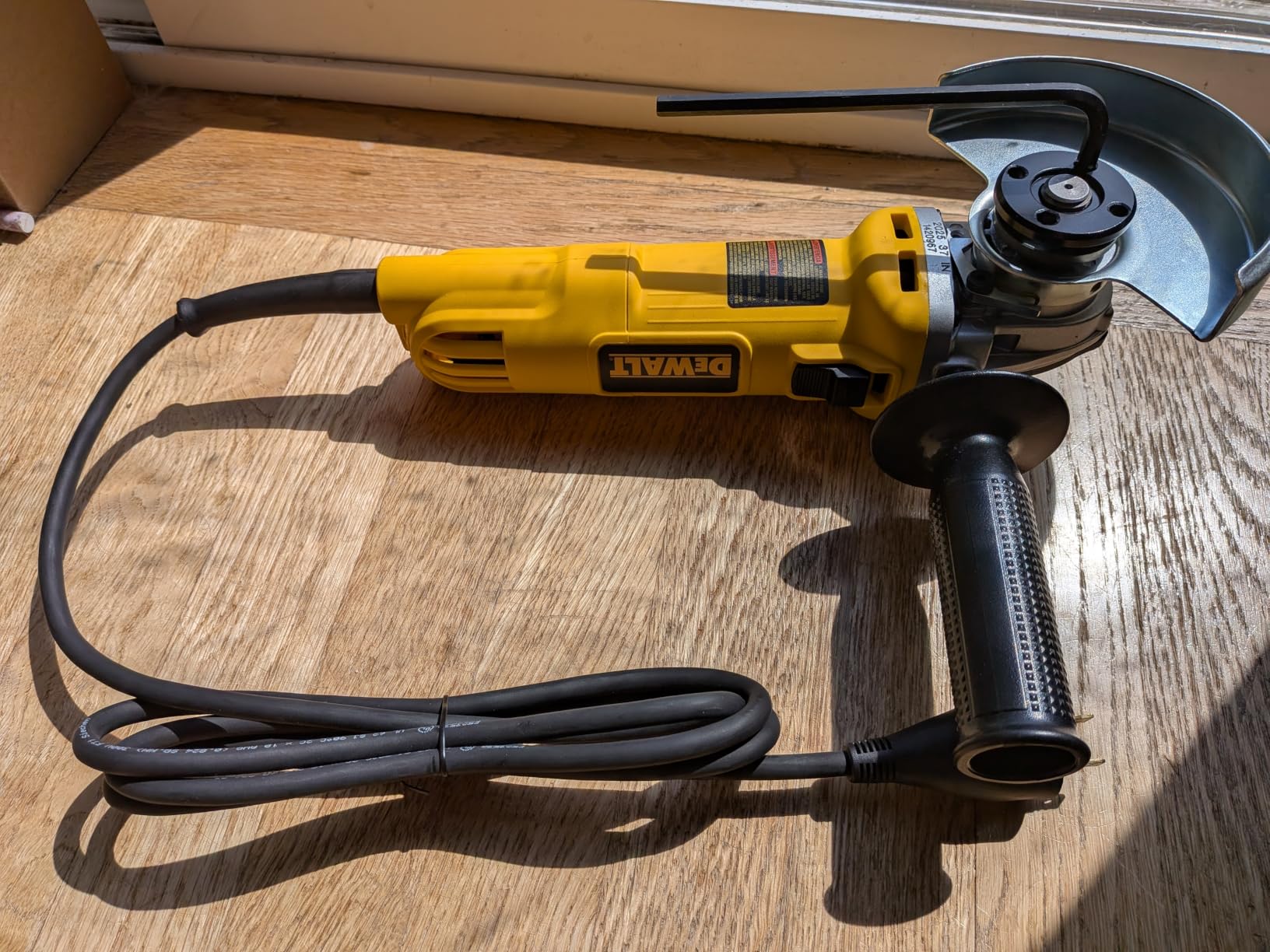
The motor is 7 amp AC/DC at 850 watts and 12,000 rpm with overload protection, and the 5/8-11 spindle thread accepts a wide range of 4-1/2 inch accessories. At 3.9 pounds with a slim body, it suits smaller hands and extended sessions, and fewer exposed body screws than earlier models means less vibration loosening over time.
The AC/DC capability means it can run off an alternative power source, which is useful on generators and on site work where supply is the question.
Why shops keep buying this one
Guard and wheel handling solve a genuine daily problem. Across welding and metalworking forums, one of the most common recurring complaints is the wrench-based wheel change and the spanner that disappears mid-job. A guard that repositions by hand and a wheel that releases without a wrench eliminate that entirely.
It is also light for a 7 amp corded grinder at 3.9 pounds, which matters for a full day of weld cleanup.
The friction points
A large pin spanner is not included, and the hex wrench that is included is of limited use for the guard. If you have no spanner in your drawer, add that to the purchase list. The slide switch is also small enough that a thumb can miss it, which is a common complaint.
It is a brushed motor, so expect more noise and vibration than the brushless picks here. For finishing passes with a flap disc on a thin panel, that vibration is the most noticeable thing about it.
8. AVID POWER – Best Value Kit
- Generous accessory set with two cutting wheels and two grinding wheels
- Plus a flap disc and side handle in the box
- 7.5 amp and 900W motor is ample for cutting and grinding
- Spindle lock for tool-free disc changes
- Tool-free guard adjustment and two-position handle
- Some owners report the outer flange and spanner holes stripping
- Switch feels fragile and is not easy to depress
- Guard has few locking positions and a simple locking mechanism
- Included cutting discs are thicker than optimal
The AVID POWER is the pick when you want a complete kit on the bench in one order. The box alone includes two metal cutting wheels, two metal grinding wheels, a flap disc, a side handle, a wheel guard, a spanner and spare carbon brushes, so nothing else needs buying before the first bead cleanup.
The motor is 7.5 amp and 900 watts at up to 12,000 rpm, which is genuine 7.5 amp class power despite the budget positioning. The integrated spindle lock makes disc changes quick without extra tools, and the guard adjusts without tools as well.
Buyers consistently report that it delivers real power for the money and works well for weekend projects, cutting steel, removing rust and even handling concrete with a diamond disc. The spindle is 5/8-11 threaded and noted as compatible with 7/8 inch arbor wheels from major brands, so the disc shelf at any hardware store is a valid source of consumables.
For a first welding setup, this is the one that gets you from box to joint with no second order.
What the money buys
Compare the accessory list against any corded tool here: a brand-name 7.5 amp grinder usually includes a guard, a wheel and a wrench. This one includes nine consumables and a handle. For someone setting up a garage shop, that difference is bigger than a small step up in motor class.
The 7.5 amp rating also puts it ahead of the 6 amp picks on heavy stock removal, which is the task that separates casual grinders from working ones.
Where the cost shows
Build quality is where the cost is visible in this model. Some owners report the outer flange and spanner holes stripping so wheels become very hard to remove, the switch feels fragile and is not easy to depress, and the guard has few locking positions with a simple locking mechanism. Customer service has replaced several failed units under warranty, which is worth remembering.
Forum consensus across welding and metalworking boards is to buy the better model rather than the entry model, because entry-level grinders tend to fail under daily shop pressure. Buy this for occasional and hobby prep; buy a brand-name tool for production work.
9. Bosch GWS8-45 – Best for Long Grinding Sessions
- 7.5 amp motor handles welding-class metal grinding
- Slim-Grip design is comfortable and can be run one-handed
- Runs cool and steady through long sessions
- Two-position side handle plus constant-on switch
- Guard fits 4-1/2 inch by 7/8 inch abrasive discs
- One-piece Allen key and spanner tool simplify disc changes
- Guard needs an Allen key and locks into set slots so repositioning is tedious
- Manual states the tool is not approved for cut-off applications
- Handle placement can feel awkward above waist height
- Somewhat louder than brushless premium grinders
The GWS8-45 is the one I would hand a welding student or a fabricator who grinds for hours at a stretch. Reviewers consistently praise the slim, comfortable grip and the ability to run long sessions without overheating, and a tool that stays cool at hour three is a tool you will keep using at hour four.
Under the Slim-Grip body sits a professional 7.5 amp motor delivering 11,000 no-load rpm at 900 watts, with directed air flow that diverts dust away from vital components. The Service Minder brush system stops the grinder when preventative maintenance is due, so you find out about worn brushes from the tool rather than from a failure.
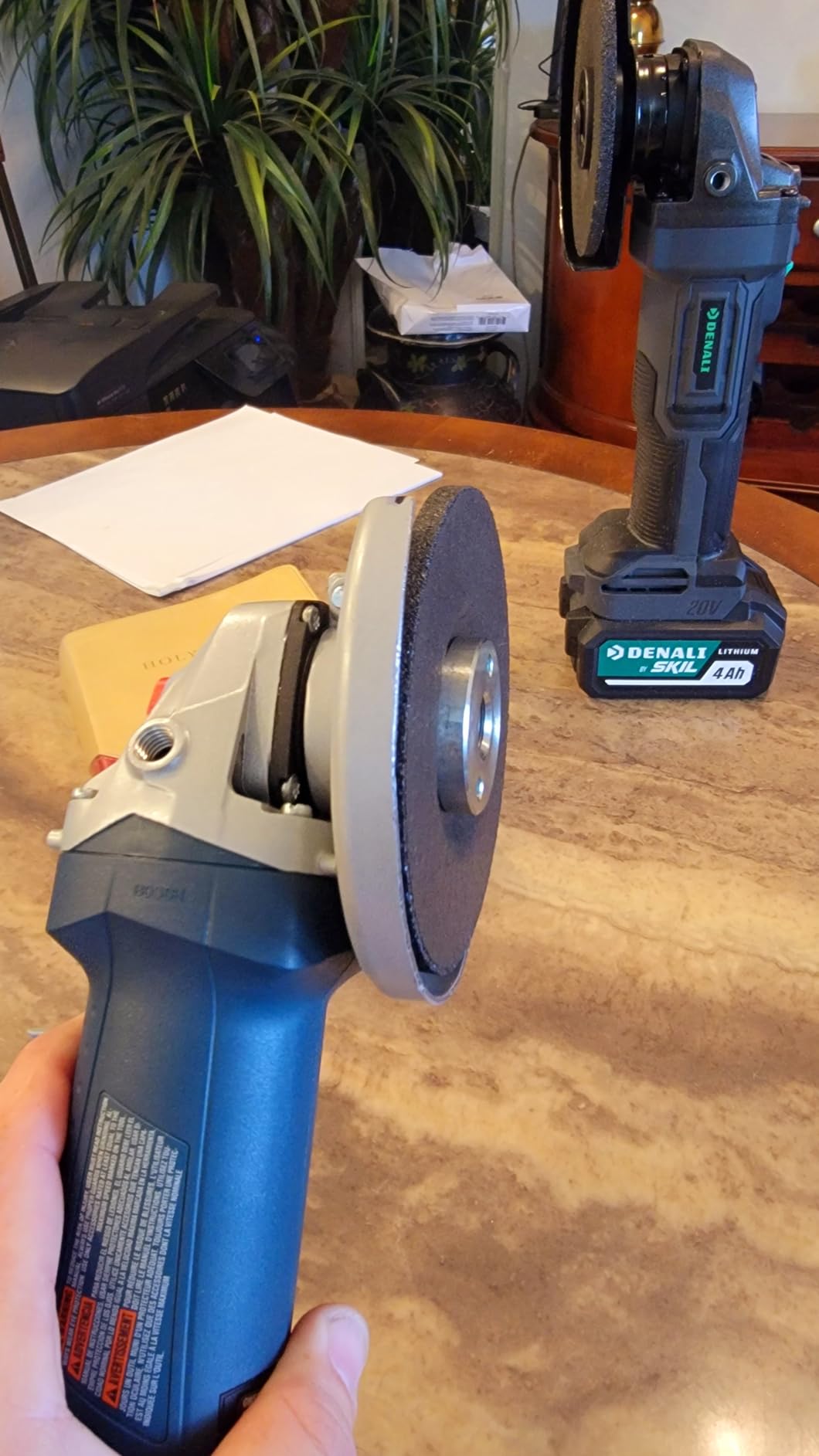
Control options are good for extended work: a two-position side handle plus a constant-on switch. The guard is a burst-protection design and it fits 4-1/2 inch by 7/8 inch abrasive discs correctly, which is a detail that trips up some cheaper tools when a larger disc is fitted.
A one-piece Allen key and spanner tool in the box, combined with the large spindle lock, means the disc change does not depend on finding a separate wrench.
What makes it a session tool
Two things: grip and heat behaviour. The Slim-Grip diameter is comfortable enough to run one-handed for blending, and the directed air flow keeps the motor running cool and steady rather than bogging. Users report it does not overheat through long passes, which is the failure mode that ends most grinding days early.
It is also light for a 7.5 amp corded tool at 4.2 pounds, so the long session does not turn into a shoulder problem.
Two quirks to know about
The guard requires an Allen key and must sit in set slots, so frequent repositioning is tedious. If your work alternates between grinding and cutting positions often, that is an annoyance the DEWALT DWE4011 solves better.
Second, the manual states the tool is not approved for cut-off applications, even though owners report cutting with it. Read that guidance before you put a cut-off wheel on it. And the handle placement can feel awkward when grinding above waist height.
10. BLACK+DECKER BDEG400 – Most Versatile
- Metal gear case feels sturdier than this class suggests
- Three-position side handle and adjustable guard for spark control
- Spindle lock speeds accessory changes
- Switch can be partially pressed for paddle-style use
- Enough power to cut heavy steel and structural tube
- 2 year limited warranty
- Lock-on switch can jump out of its groove once worn
- Noticeable vibration during use
- Guard can arrive bent
- which blocks wheel fitment
- 10000 rpm is lower than most current 4.5 inch grinders
- Best for light and medium duty rather than continuous shop use
The BDEG400 is the budget pick, and the reason it works is the metal gear case. Most grinders at this level use a plastic or blended housing, and a metal gear case is the part that actually takes the shock of a dropped tool or a seized wheel. It comes with a grinding wheel, a spanner wrench and a wheel guard.
It is rated 6.5 amp and 800 watts at 10,000 rpm, weighs about 4.4 pounds, and includes a three-position side handle, an adjustable guard and a spindle lock. Owners report enough power to cut heavy steel and structural tube for hobby and light shop work.
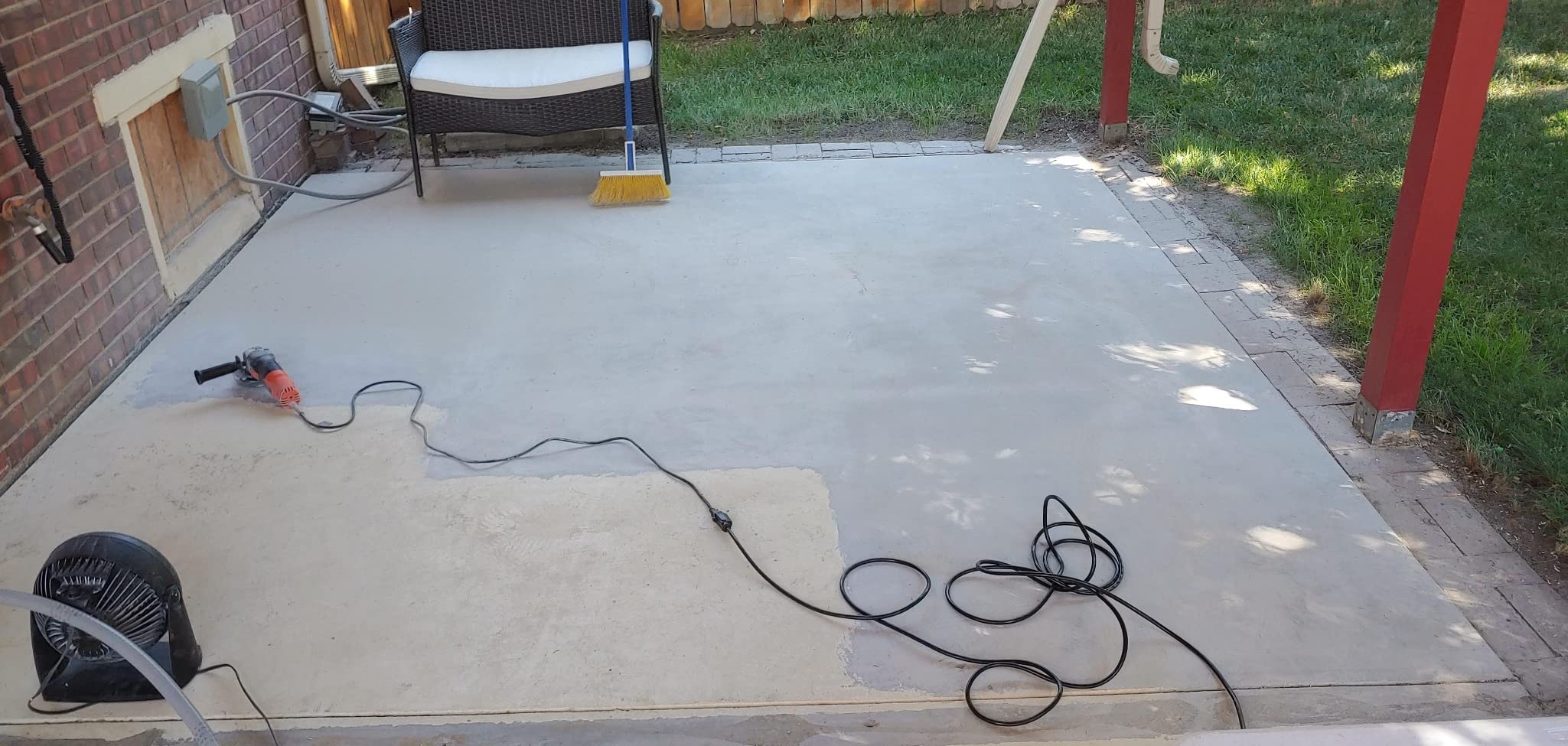
One small design detail is worth praising: the switch can be partially pressed for paddle-style momentary use. That means you can feather a flap disc across a fillet with a fingertip instead of riding the lock-on, which is how most grinders in this class are operated by default.
The 2 year limited warranty is longer than several tools in this group, and owners report several years of reliable hobby and light fabrication work.
Where a budget grinder is the right call
For weekend garage work, hobby fabrication and light shop tasks, this grinder is genuinely capable. Cutting heavy steel and structural tube is within its remit, as is weld cleanup and rust removal, provided you are not grinding continuously for a full production shift.
It is also among the lighter options here with a metal gear case, which makes long blending passes easier than the weight suggests.
What you give up
Two failure modes show up repeatedly. The lock-on switch can jump out of its groove once worn, at which point you have to hold it on for the whole pass. And vibration is noticeable during use, more so than on the tools above it.
A bent guard on arrival also blocks wheel fitment, so check it before you start. At 10,000 rpm it is the slowest-spinning grinder here, and it is best treated as light and medium duty rather than continuous shop use.
How to Choose a 4.5 Inch Angle Grinder for Weld Prep
Corded or cordless: the two grinder types welders use
Welders overwhelmingly use two grinder types: a corded mains-powered side grinder for bench work, and a cordless battery-powered one for site, field repair and overhead work. The corded tool gives constant output and never pauses, which is why it wins in a fabrication bay. The cordless tool wins anywhere an outlet is not guaranteed, and its brake and restart electronics are typically more advanced because each platform adds them to differentiate.
For corded, the deciding factors are amp rating, gear case material and the switch. For cordless, the deciding factor is almost always the battery platform you already own. Forum advice on welding and metalworking boards is consistent: buy the better model of a platform you already own rather than a cheap tool that starts a new ecosystem. If you own M18 packs, the Milwaukee 2880-20 is a short conversation. If you own nothing, budget for the tool plus two batteries plus a charger before you compare grinder options.
How much power you actually need
Amps are the honest corded comparison. A 6 to 6.5 amp grinder covers weld bead cleanup, light de-rusting, blending and cutting thin-wall or light structural material. A 7.5 amp grinder adds the headroom for heavier mill scale removal and thicker section work, and it is the point at which the difference stops being theoretical.
Owners consistently report that budget brushed grinders stall under real weld-grinding pressure and burn out carbon brushes, which is the specific failure the larger motor class exists to prevent. Match the tool to the work rather than the other way round: a higher-amp 4.5 inch grinder used only for light blending wastes its advantage, and a 6 amp grinder on a production line will not last the year.
Brushless vs brushed motors
Brushless motors require no brush changes, run cooler and hold speed under load. In this group, the DEWALT DCG413B and the Milwaukee 2880-20 are brushless cordless machines, and that is the main reason their power figures are not directly comparable to a corded amp rating.
Brushed corded grinders are not obsolete. A 7.5 amp brushed machine such as the Bosch GWS8-45 or the PORTER-CABLE PC750AG will out-grind any of the cordless picks on sustained work, and the cost of ownership is a set of carbon brushes and a grease job. The Bosch even tells you when they are due with its Service Minder system.
Switch type, brake and restart protection
Three different things get sold as safety, and they are worth separating. An electronic brake stops the wheel quickly after you release the trigger, the DEWALT claims two seconds or less. Kickback control, sold as Kickback Brake on DEWALT and as an electronic clutch on Milwaukee, detects a bind and shuts the wheel down. Anti-restart protection stops the tool coming back on if it is picked up after a stall, which DEWALT calls E-Switch Protection with a no-volt release function.
Switch type is the everyday ergonomic choice. A paddle switch gives fine fingertip control and is a better fit for blending, and a lock-on slide switch is simpler and harder to actuate by accident. A slide switch that is not a paddle stops the tool the moment you let go, which some welders prefer and others find tiring. A paddle switch that locks on is the most flexible option, and it is why the Makita 9557PBX1 and the DEWALT DCG413B both use one.
Weight, balance and overhead work
Weight is the criterion most buyers skip and most welders notice by hour two. The range here runs from 3.8 pounds on the DEWALT DCG413B to 5.9 pounds on the PORTER-CABLE PC750AG. For overhead bead cleanup and one-handed work in a frame, anything under 4.5 pounds is noticeably easier on the shoulder and wrist.
Balance matters as much as total weight. A three-position or forward-canted side handle lets you set the grip for overhead, side and low positions without changing hands, and a vibration-dampening or anti-vibration handle such as the one on the Milwaukee reduces shock through long passes. Look for a threaded top mount on the side handle if you work overhead regularly.
Which disc for which prep step
The grinder is only half the job, and pairing the right abrasive with the right prep step is what separates a clean bevel from a chewed edge. The disc you need changes completely between steps, so plan the stack before the job.
Edge prep and beveling: a depressed-center grinding wheel, roughly 36 to 60 grit for a bevel and 80 to 120 grit to finish it. Take light passes and let the wheel do the work rather than leaning on the tool.
Grinding down welds and slag: a 36 to 60 grit grinding wheel for the bulk removal, then a 60 to 80 grit flap disc to blend the joint flush so the next pass of paint or filler has something to hold.
Mill scale and rust removal: a 16 to 24 grit grinding wheel or a wire cup wheel for heavy scale, moving up to a flap disc at 40 to 60 grit to blend the cleaned surface back into the surrounding steel.
Cutting tube, angle and rebar: a cut-off wheel rated above the tool no-load speed, with the type 27 guard fitted. Thin-wall and stainless tubing is the standard 4.5 inch cutting job.
Fillet and joint blending: a flap disc at 40 grit for shaping and 80 to 120 grit for finish, run at a slower speed setting if your tool has one.
Disc brands that come up repeatedly as worth buying in welder discussions are Norton, Walter and 3M, and the practical advice is to keep a dedicated, clean, undamaged disc for stainless rather than reusing a wheel that has touched carbon steel.
Keeping carbon steel and stainless separate
If you cut or grind stainless anywhere, keep a dedicated grinder or at least a dedicated set of discs for it. Iron particles embedded in a used grinding wheel will rust on the stainless surface and cause pitting, which is a weld defect that appears after the joint is already finished. This is the one cross-contamination rule in a welding shop that is genuinely not optional.
Beyond the disc, a stainless-dedicated tool also keeps the gear case and guard free of carbon debris. Most shops solve it with a color-coded grinder body or a marked guard, which sounds fussy until the first pitted stainless part comes back from the customer.
One more prep note before any of this matters. Edge condition and heat-affected zone control are what determine joint quality, so the goal of weld prep is a clean, oxide-free edge with consistent geometry, not the fastest possible removal. A grinder that overheats the plate or gouges a wandering bevel costs you more time than it saves.
Frequently Asked Questions
What is the best angle grinder for welders?
Most welders end up with two: a corded grinder for bench work and a cordless one for site and overhead work. In this group the DEWALT DCG413B leads for cordless weld prep because of its brushless motor, kickback brake and two-stage trigger, while the Makita 9557PBX1 is the strongest corded choice at 7.5 amp with a metal gear housing. If you only want one, pick whichever matches the battery platform or outlet access you actually have.
Which 4.5 inch angle grinder is the best?
For most weld prep the DEWALT DCG413B is the best 4.5 inch angle grinder, because the brushless motor tracks a bead without bogging, the kickback brake stops the wheel in two seconds or less, and the 3.8 pound body is light enough for overhead and one-handed work. The Makita 9557PBX1 is the better single answer if you work plugged in, thanks to its 7.5 amp motor, paddle switch and labyrinth sealing.
What is the best disc to use for grinding down welds?
Use a depressed-center grinding wheel around 36 to 60 grit to remove the bead, then move to a 60 to 80 grit flap disc to blend the joint flush with the surrounding plate. For mill scale and rust, start at 16 to 24 grit or a wire cup wheel, then blend at 40 to 60 grit. Keep a dedicated disc set for stainless so iron particles from carbon steel work cannot cause pitting.
Which two types of grinders are commonly used by welders?
The two common types are corded mains-powered side grinders and cordless battery-powered ones. Corded grinders deliver constant output and suit a fixed bench, while cordless grinders go to the job and carry better brake and restart electronics. Many shops own both: a corded tool for production grinding and a cordless one for field repair and overhead cleanup.
Who makes the best corded angle grinders?
Metabo HPT, Makita and Bosch lead the professional corded class, with DEWALT, CRAFTSMAN and PORTER-CABLE strong in the value and durability tiers. Metabo HPT is widely treated as the dominant professional brand, though the 6.2 amp G12SR4 in this group is a lighter-duty machine than that reputation implies. The 7.5 amp Bosch GWS8-45 and Makita 9557PBX1 are the two to compare for sustained shop work.
How many amps do I need for weld prep?
A 6 to 6.5 amp grinder covers weld bead cleanup, blending, light de-rusting and cutting thin-wall or light structural material. A 7.5 amp machine adds the headroom for heavy mill scale removal and thicker section work, and it resists the stalling and brush burn-out that owners report on lighter models under daily pressure. Buy for the heaviest prep you actually do, not for the lightest.
Conclusion: The Best 4.5 Inch Angle Grinder for Welding Prep
The DEWALT DCG413B takes the top spot for weld prep overall. The brushless motor has the torque to track a bead, the brake stops the wheel in two seconds or less on a bind, and at 3.8 pounds it is light enough for overhead cleanup. If you are on the 20V MAX platform, it is a straightforward addition to the shelf.
Take the Makita 9557PBX1 when your work happens at a bench with power on hand. A 7.5 amp motor, an 11,000 rpm class speed, labyrinth sealing and a metal gear housing make it the grinder most likely to still be running in a few years, and it remains a long-standing favorite in the 4-1/2 inch class among welding forum regulars. For a shop already committed to M18 batteries and doing mobile or overhead work, the Milwaukee 2880-20 takes third place with its electronic clutch, overload protection and anti-vibration side handle.
For access work, the Metabo HPT G12SR4 at 4.0 pounds is hard to beat. For a full kit on one order, the AVID POWER 7.5 amp package gets you cutting wheels, grinding wheels, a flap disc, a guard and a handle out of the box. Whichever you pick, buy a dedicated disc set for stainless, set the guard before you start rather than after the first spark, and this roundup of the best 4.5 inch angle grinders for welding prep in 2026 is a good place to start.