
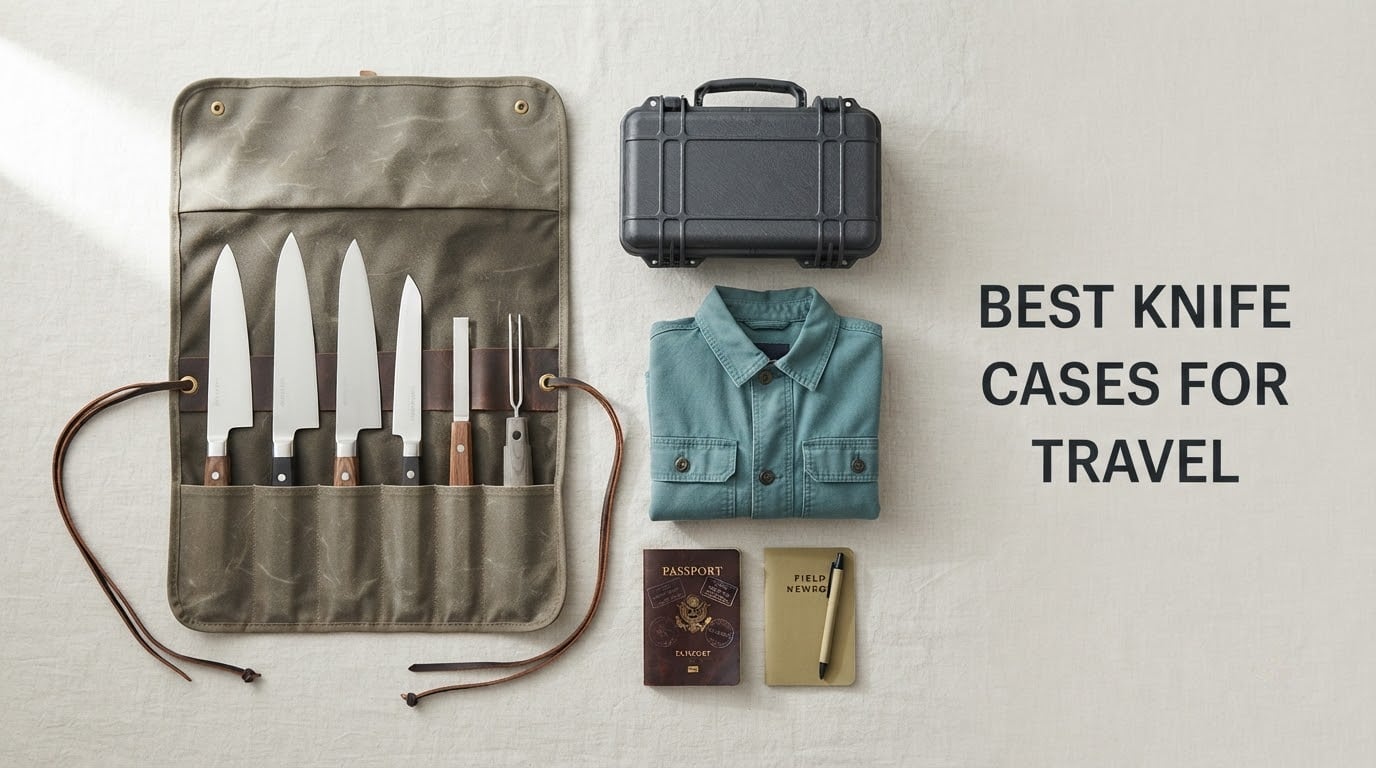
A knife case for travel is a padded bag, roll, backpack or hard-shell case built to keep blades separated, undamaged and secure in transit. The best knife cases for travel hold each blade in its own slot, close with a zipper or buckle so nothing slides out, and stay inside airline checked luggage limits. For carry-on use, a case only helps if every blade stays short enough to pass screening.
That last part matters more than most buyers expect. Knives belong in your checked bag, and the case is what keeps a 10-inch gyuto from punching through a t-shirt, a laptop sleeve and the side of the suitcase in the cargo hold. A loose knife in a roller is exactly how a good edge gets chipped before the trip even starts.
We spent weeks comparing the ten cases below across the three formats that actually work for travel: soft rolls, backpack or tote carriers, and rigid cases for folding knife collections. Each one gets the same treatment: how many knives it truly holds, the longest blade it accepts, what it weighs, and where it falls apart.
If you also carry other gear that needs protecting, our guides to pool cue travel cases for airline travel and travel jewelry cases for organizing cover the same packing logic for different cargo.
Table of Contents
Top 3 Picks for Traveling With Knives in 2026

Chef Sac Vintage Backpack
- Holds 20+ knives and tools
- Slots fit blades up to 16 inches
- Water-resistant 600D polyester
- 3 pounds

EVERPRIDE Chef Knife Bag
- 20 knife slots plus zippered tool section
- Accepts knives up to 20.5 inches
- 600D polyester
- 2.5 pounds

HERSENT Waxed Canvas Roll
- 11 knife sleeves
- Accepts knives up to 18.8 inches
- Waxed canvas
- Two buckle closures
All 10 Knife Cases for Travel Compared in 2026
Every case below is built for transit, but they split cleanly into soft fabric rolls, backpack and tote carriers, and rigid collector cases. Slot count is listed as the manufacturer states it, and max blade length is the longest knife the case is designed to accept.
| Product | Specifications | Action |
|---|---|---|
| Chef Sac Vintage Backpack |
|
Check Latest Price |
| EVERPRIDE Chef Knife Bag |
|
Check Latest Price |
 Chef Sac 30+ Pocket Knife Case Chef Sac 30+ Pocket Knife Case |
|
Check Latest Price |
 Asaya Waxed Nylon Roll Asaya Waxed Nylon Roll |
|
Check Latest Price |
 Chef Sac Heritage Backpack Chef Sac Heritage Backpack |
|
Check Latest Price |
 Rustic Town Buffalo Leather Roll Rustic Town Buffalo Leather Roll |
|
Check Latest Price |
| HERSENT Waxed Canvas Roll |
|
Check Latest Price |
 GWCASE 88-Slot Folding Knife Case GWCASE 88-Slot Folding Knife Case |
|
Check Latest Price |
 HERSENT Waxed Canvas 7-Slot Roll HERSENT Waxed Canvas 7-Slot Roll |
|
Check Latest Price |
 BRANTMAKER 61+ Knife Case BRANTMAKER 61+ Knife Case |
|
Check Latest Price |
1. Chef Sac Vintage Backpack Holds 20+ Knives and Tools in a Discreet Slim Shape
- Water-resistant 600D polyester with reinforced double stitching
- Slots fit knives up to 16 inches
- Mesh and dedicated slots for honing rod and cleaver
- Hidden back pocket for tablet or recipe book
- Padded adjustable straps carry well on commutes
- Soft shell gives less crush protection than a hard case
- Listing names 9 compartments despite 30+ pocket marketing
This is the one we ended up reaching for every time. It measures 12 by 6 by 17 inches, which drops into a roller or a standard checked suitcase without eating the whole bag, and the slots are sized for knives up to 16 inches, so a full gyuto and a nakiri both fit.
Weight is the number most people care about on a flight, and 3 pounds is manageable. Fill it with a full knife set and tools and it gets noticeably heavier, but the padded straps spread that across both shoulders instead of digging into one.
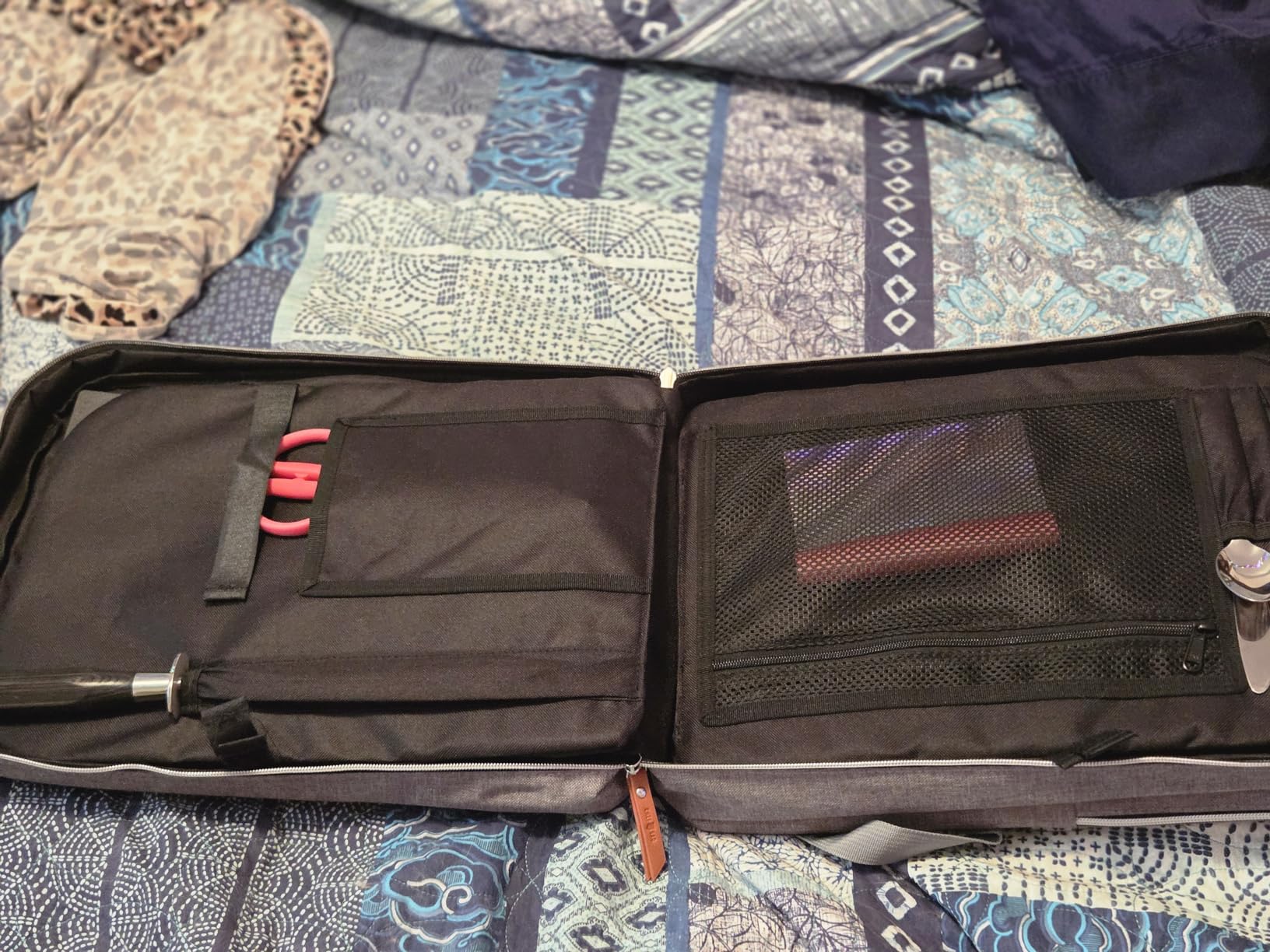
The exterior reads as a normal black backpack. Reviewers mention that it conceals its contents well in public, which matters if you are walking through an airport or a hotel lobby rather than going straight to a kitchen.
Capacity is listed as 20+ knives and culinary equipment, though the listing itself only names 9 compartments. In practice the knife slots are the headline feature and the smaller pockets handle tongs, a honing rod and a cleaver, so treat the pocket marketing as the generous number it is.
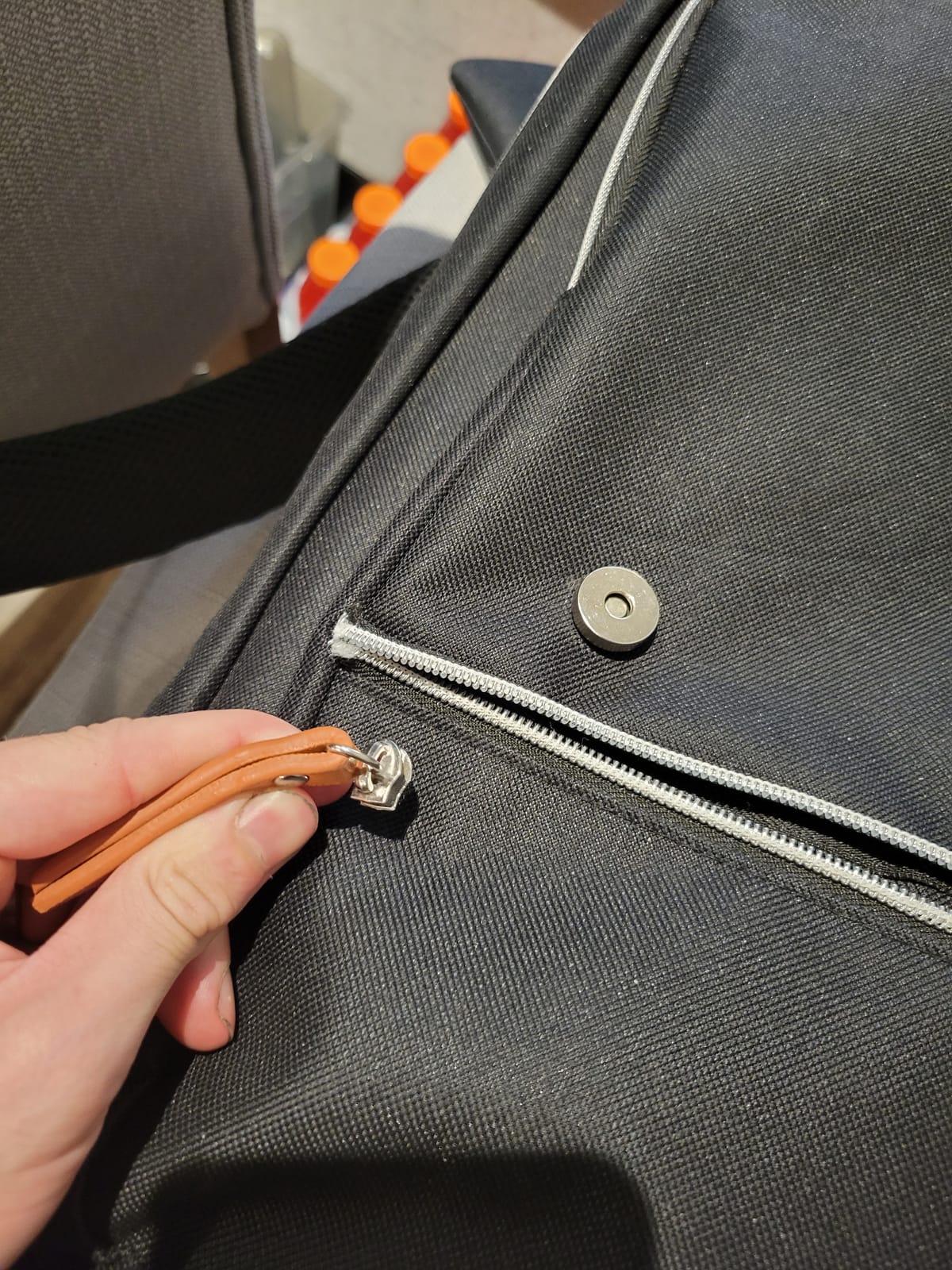
Will it handle checked-bag handling and a full knife load?
It survives transit, but it is a soft case. Nothing keeps working if a heavy roller lands on top of it, so the 600D fabric and reinforced stitching are your only defense against crushing.
For protection above all else, pair it with a layer of clothing folded around the bag inside the suitcase. That is the cheapest crush protection available and it costs nothing.
Is it right for a culinary student or a traveling chef?
Yes. Hands-free carry, a hidden pocket for a notebook or tablet and slots that clear 16 inches cover almost every kit a student or stage cook brings on the road.
It is less suited to a collector with thirty folders, since there is no foam separation and the slots are shaped for straight blades rather than folding handles.
2. EVERPRIDE Chef Knife Bag Takes 20 Knives and Knives Up to 20.5 Inches
- Holds 20 knives plus a separate zippered tool compartment
- Accepts blades up to 20.5 inches
- Book-style fold-out access
- Discreet styling that does not advertise contents
- Zippers and shoulder strap wear faster than premium rivals
- Slots sit close together so knives bump when fully loaded
- Material is not stiff enough for high-value knives
This bag has been around long enough that the hardware complaints are well documented, and they are worth weighing. Reviewers report zipper and strap lifespans of roughly eight or nine months with regular use, which is the honest tradeoff for the capacity you get here.
What it does well is range. At 21 by 14 inches it accepts knives up to 20.5 inches, longer than anything else in this group, so a slicer or a long nakiri is not a problem.
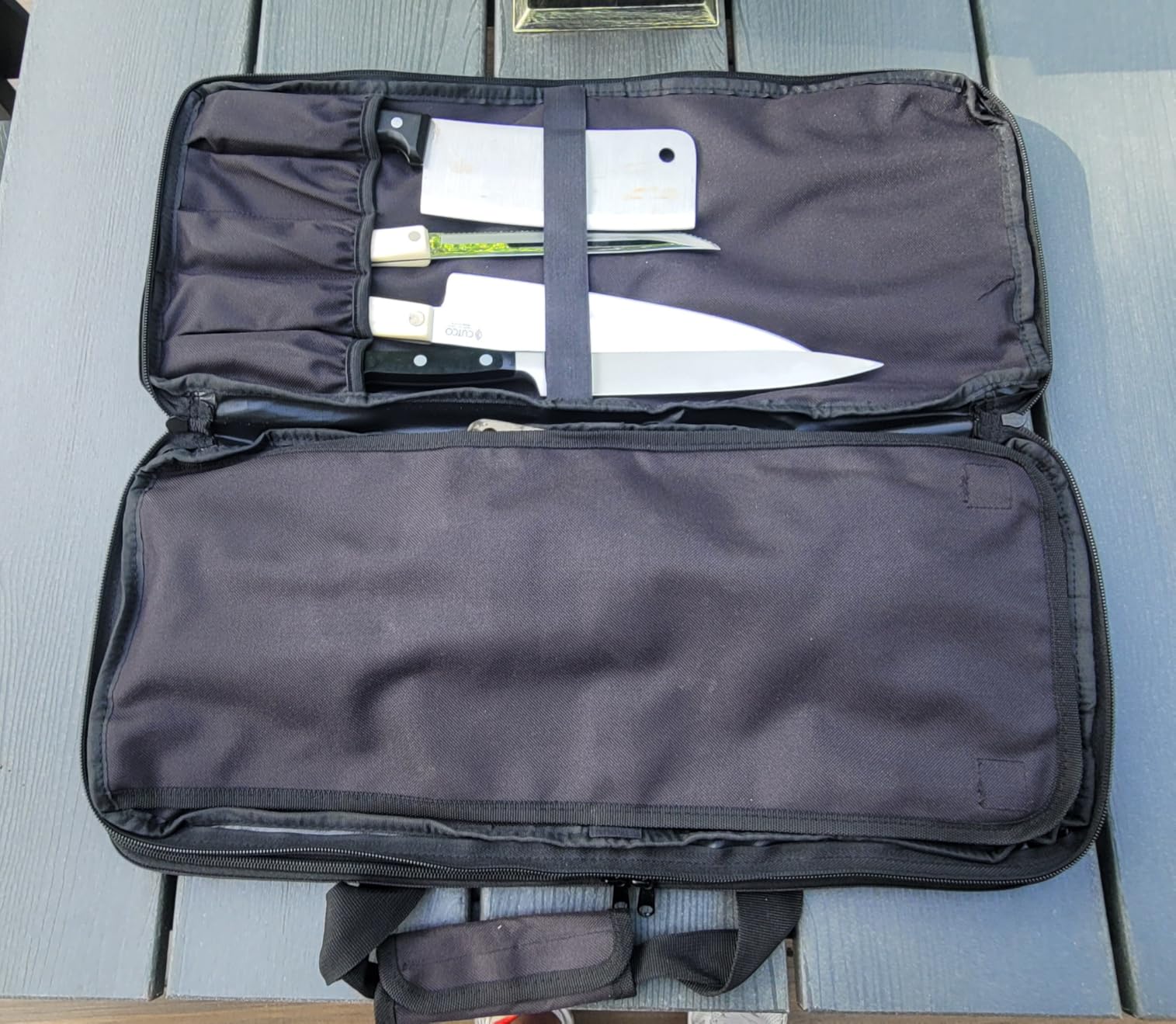
The layout is three large sections: two slot sections for 20 knives and one zippered compartment with three inner zippers for tools. That book-style fold-out means you can see everything at once instead of digging layer by layer.
At 2.5 pounds empty it is lighter than most soft cases this size, and the adjustable shoulder strap plus carry handle give you two ways to move it through an airport.
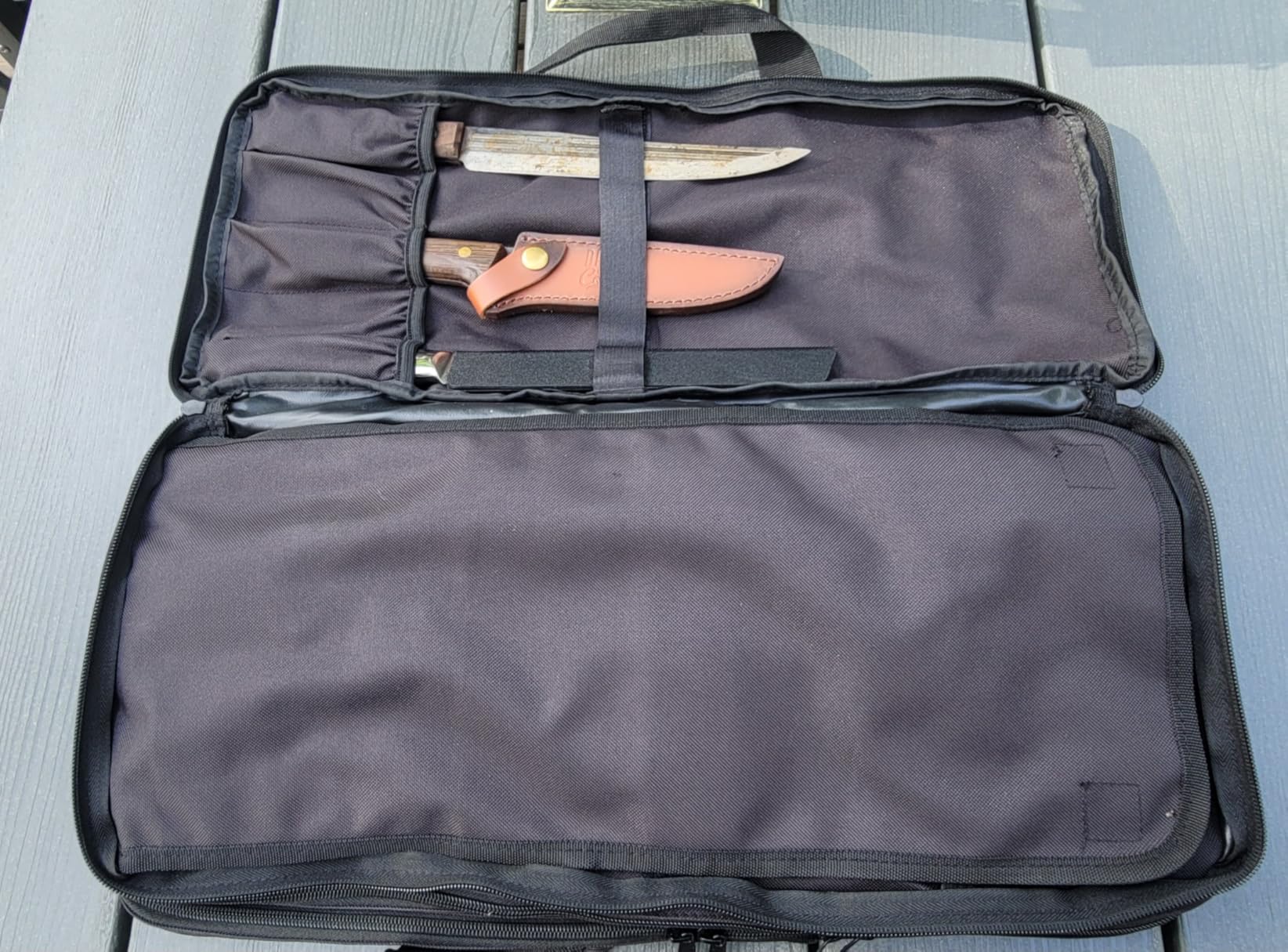
Does slot spacing stop blades from knocking together?
Only partly. When the bag is fully loaded the slots sit close enough that knives bump each other, which is where edge damage and dulling come from over a long trip.
Insert a thin layer of cloth between blades, or slot the knives in saya so the edge never faces another steel edge. That fixes the problem without buying a different bag.
Is it the right pick for high-value knives?
Not really. The polyester is not stiff enough to protect an expensive edge from a fall, and reviewers with costly knives say so directly.
For a first traveling kit or a set of mid-range knives, the capacity-to-weight ratio here is hard to argue with. For hand-forged or collector blades, spend the money on a hard case instead.
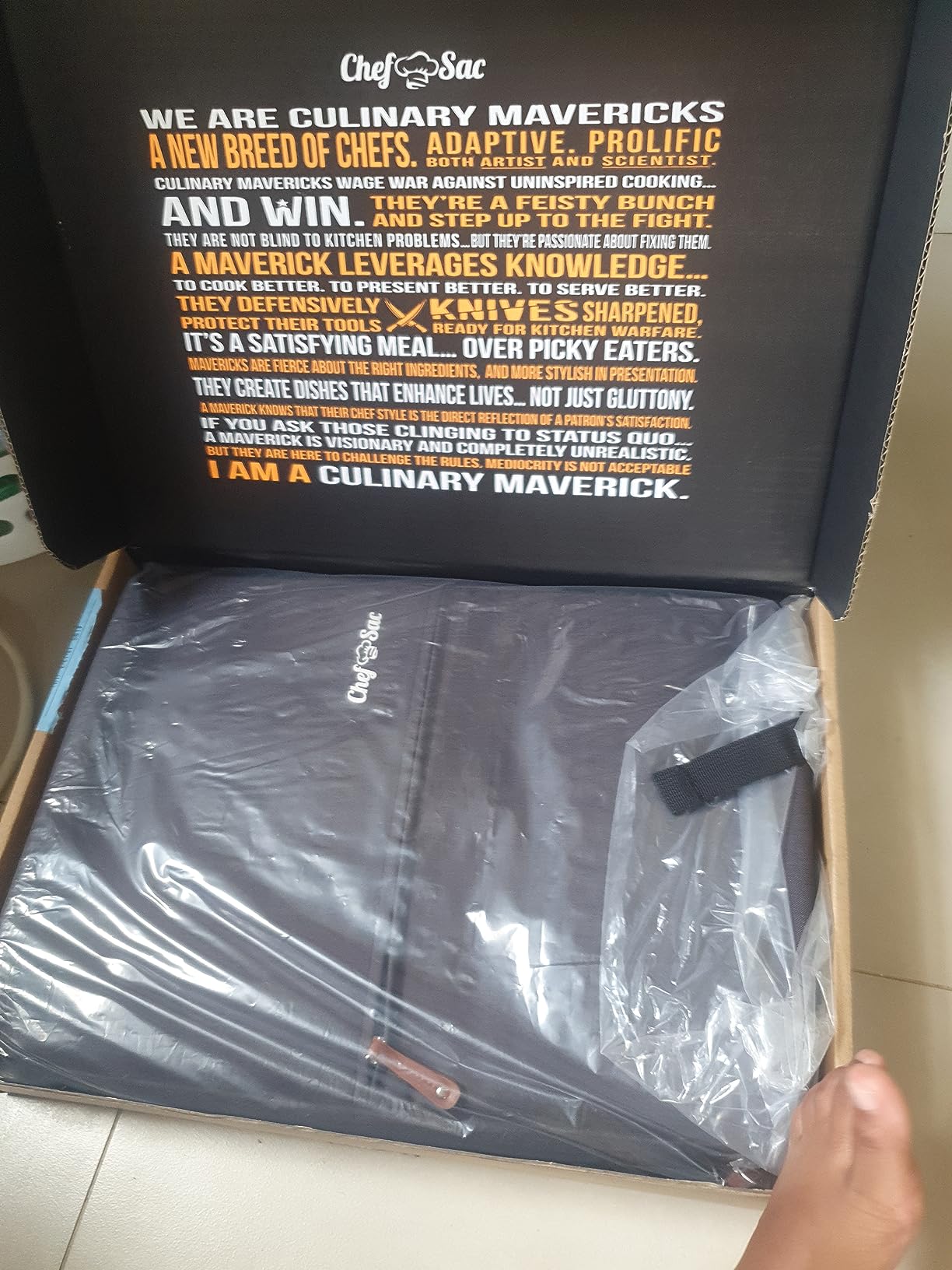
3. Chef Sac 30+ Pocket Knife Case Packs the Most for Culinary Students
- Over 30 pockets for knives tools and kitchenware
- Holds 10-inch blades and 16.5-inch totals
- Compact enough for commute and switch-station travel
- Back pocket fits a tablet or notes
- Runs small for bulky specialty tools
- Small zipper pulls and straps can break
- Better for flat goods than bulky three-dimensional items
This is the slimmer sibling of our top pick, and the difference is pocket count against overall volume. At 11 by 5 by 17 inches it stays narrow, which is exactly what a student carrying knives from a dorm to a kitchen needs.
The slots clear knives up to 16 inches, and reviewers confirm a 10-inch blade fits without forcing the pocket. Everything above that starts to strain the seam.
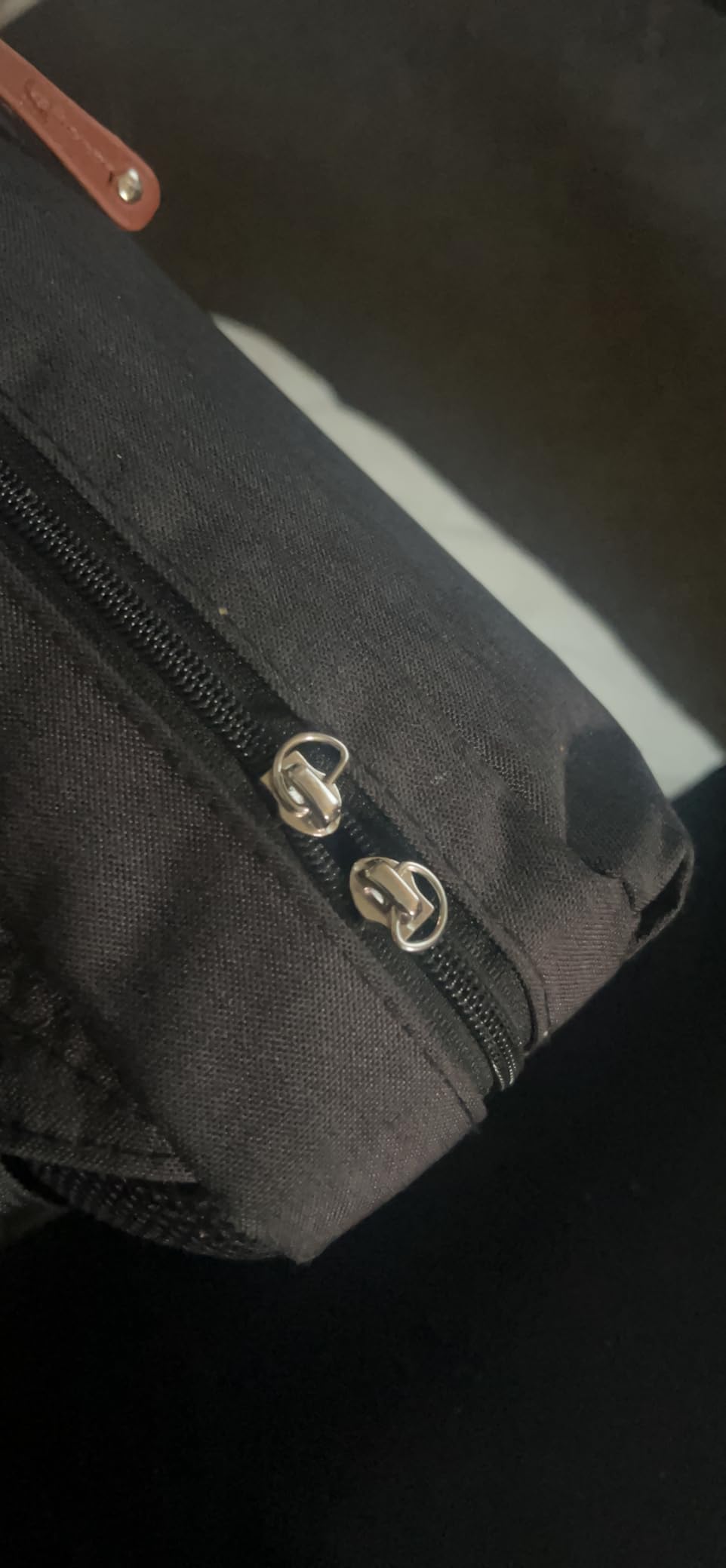
Two things come up repeatedly in reviews. First, the case is narrow, which suits knives and flat tools but frustrates pastry chefs with bulky specialty equipment. Second, the zipper hardware is light duty compared with the fabric itself.
Water resistance is listed rather than a full waterproof rating, so it handles rain and splashes but should not sit in a sink. The listing calls it water resistant with a 600D industrial-grade fabric base.
Is the capacity claim realistic for a full student kit?
Yes for knives and flat tools, no for anything bulky. Reviewers who packed a full knife set report it working; reviewers with mixers, bottles or oversized tools report running out of room fast.
If your kit is mostly steel, this fits. If you carry anything with depth, measure the widest item before you commit.
Will it hold up to a commute and a school year?
The fabric does. The zippers are the weak point, with owners reporting small pulls and straps breaking before the body of the bag gave out.
A one-year manufacturer warranty covers defects, so keep the receipt. If you expect daily use for years, the reinforced version is the safer bet.
4. Asaya Waxed Nylon Roll Gives You 20 Separate Slots in 2 Pounds
- Front-facing Velcro retention straps keep blades from shifting
- Large mesh pocket fits oversized cleavers
- Lightweight at 2 pounds for travel or relocation
- Six color options
- Unfurls to occupy considerable space when opened
- Nylon feels less premium than waxed canvas
- Clip straps will not stay fully tight and the shoulder strap can feel uncomfortable
This is the roll to buy if slot count matters more than material feel. You get 12 full-size knife slots, four smaller utensil slots, a honing rod holder and three zippered pockets, for a total the maker lists as 20 slots.
Closed it measures 6 by 2 by 17.5 inches, so it slides into a daypack or a carry-on pouch without ceremony. Opened, it takes up real counter space, so pack it last.
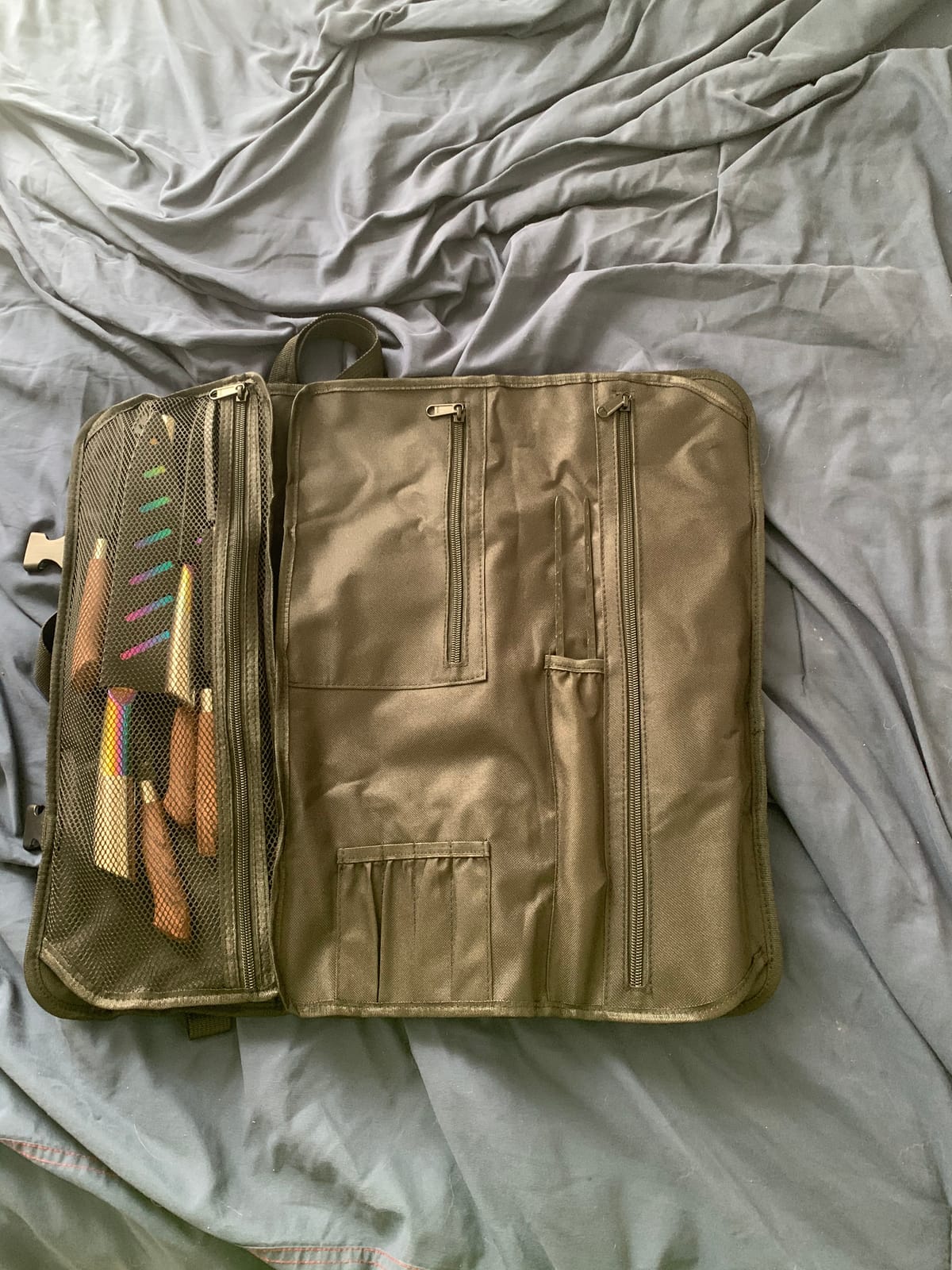
Knives up to 17 inches including the tang fit, which covers most kitchen knives and a lot of EDC folders. The Velcro retention straps across the front are the detail that stops blades sliding down and colliding.
Nylon here is stain resistant and easy to wipe down, which matters if you are working in a rental kitchen. Buyers who want a patina and a heavier feel say waxed canvas suits them better.
Does the retention system actually hold blades in place?
Mostly. The front straps do their job, but some owners find the clip straps do not stay fully tight, so blades can still shift if the case is thrown.
Wax the fabric occasionally and keep the straps centered. If a loose feel bothers you, add a thin strip of hook-and-loop between the clips.
Is it comfortable to carry through an airport?
Light at 2 pounds empty, and the detachable shoulder strap helps. Comfort divides opinion, since some owners find the strap digs in when the case is fully loaded.
For long walks through terminals, pack some of the weight in your main bag rather than hanging it on one shoulder for an hour.
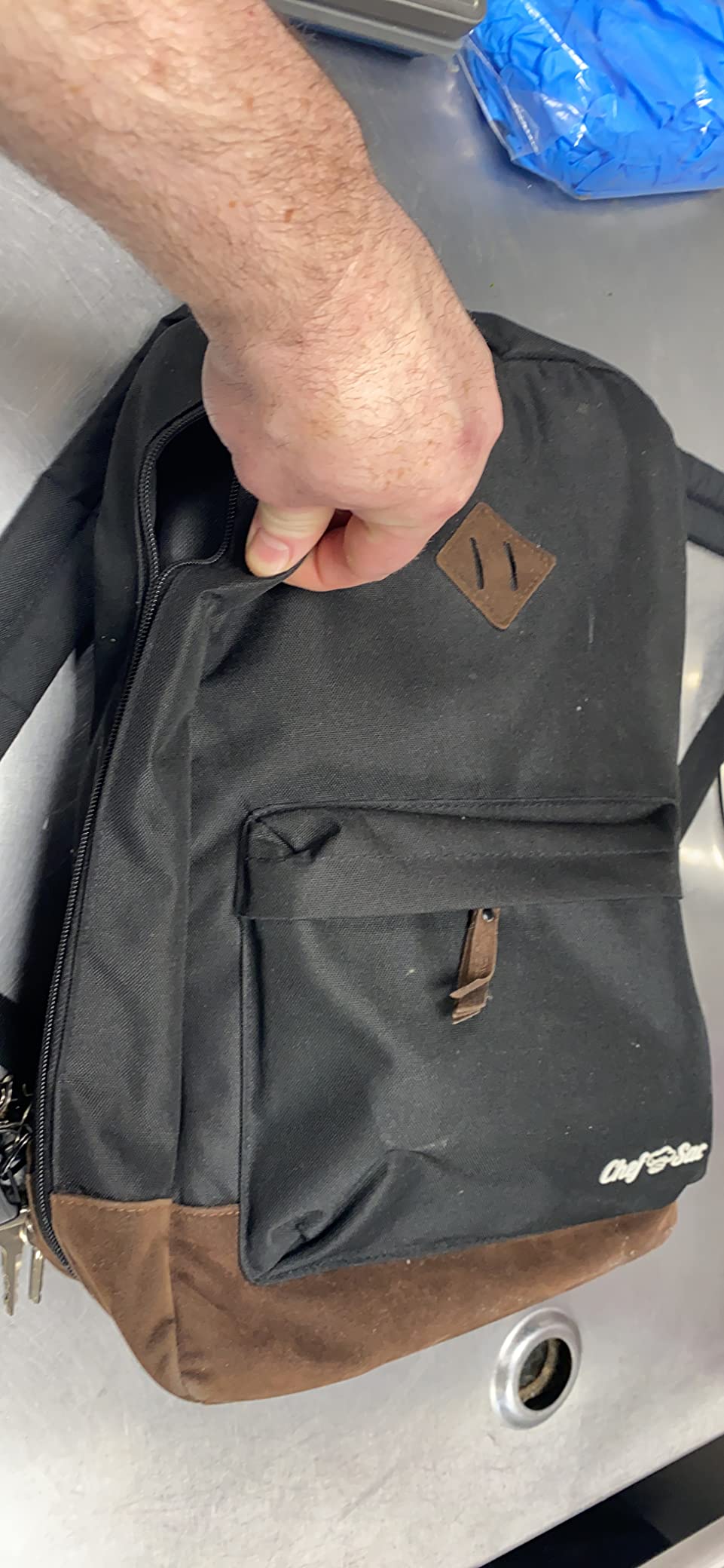
5. Chef Sac Heritage Backpack Uses Retention Panels Instead of Loose Slots
- Hands-free backpack carry is easier than single-strap bags
- Patented retention panels keep blades separated
- YKK zippers and reinforced handles
- Reinforced double-stitching throughout
- A few buyers report zipper failure within a couple of months
- One report of a strap breaking after a few weeks
- Could use more compartments for non-flat items
The idea here is simple and it works well: instead of relying on gravity to keep knives in place, hook-and-loop retention panels grip them. When you open the bag at a destination, the knives stay where they were put.
It measures 12 by 6 by 17 inches, same footprint as our top pick, and carries 30+ pockets and slots including mesh accessory pockets and a hidden back pocket for a notebook.
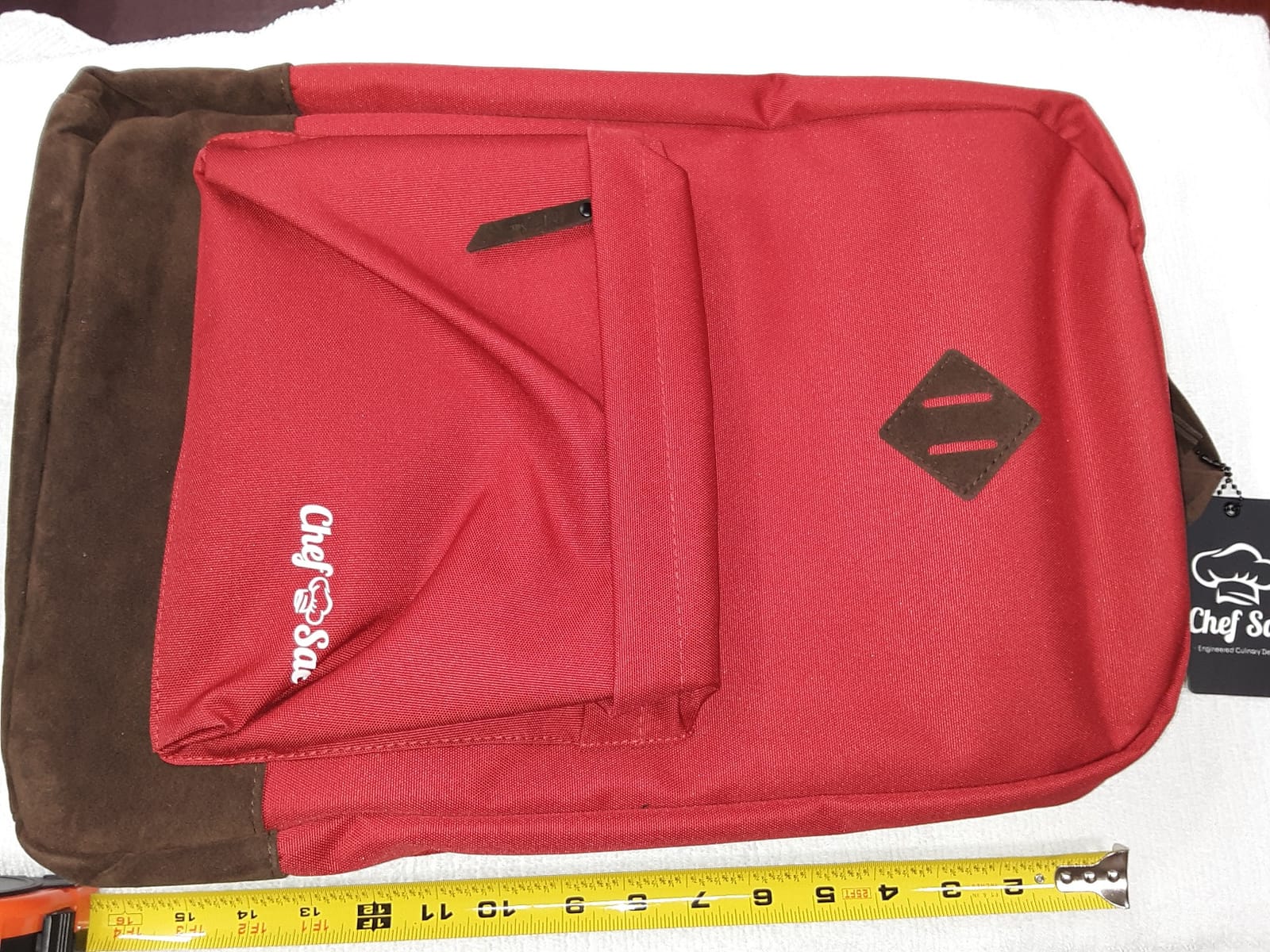
This model was reworked with reinforced top handles, double-stitching and YKK zippers, and the maker moved away from waxed canvas because of moisture retention. That is a deliberate trade: you give up the patina and gain a fabric that dries faster.
A 12-month replacement warranty covers the hardware, which matters given that early zipper failures are the main complaint in reviews.
Does the retention panel system protect edges in a drop?
It protects against shifting and clinking, which is the everyday risk. It is still a soft shell, so a direct crush from a heavy bag is not what it is built for.
Wrap the case in a folded sweater inside your suitcase if the route involves rough handling or a crowded hold.
Is it better than a single-strap tote for a daily kitchen commute?
Yes for anyone who carries a full load. Padded straps spread the weight across both shoulders and the handle is reinforced where a tote strap would be the failure point.
If you carry four knives and a sharpener, the extra structure is not necessary. The panel system earns its keep with a full service kit.
6. Rustic Town Buffalo Leather Roll Ages Well and Holds 11 Knives
Leather Chef Knife Roll Bag – Expandable 11 Pockets with Tool Pouch, Brown
- Full grain buffalo leather that ages into a patina
- Holds 11 knives plus accessories and utensils
- Brass buckle closure rolls up neatly
- Carry handle suits travel and outdoor cooking
- Holds fewer knives than large fabric rolls
- Heavier than nylon or canvas alternatives
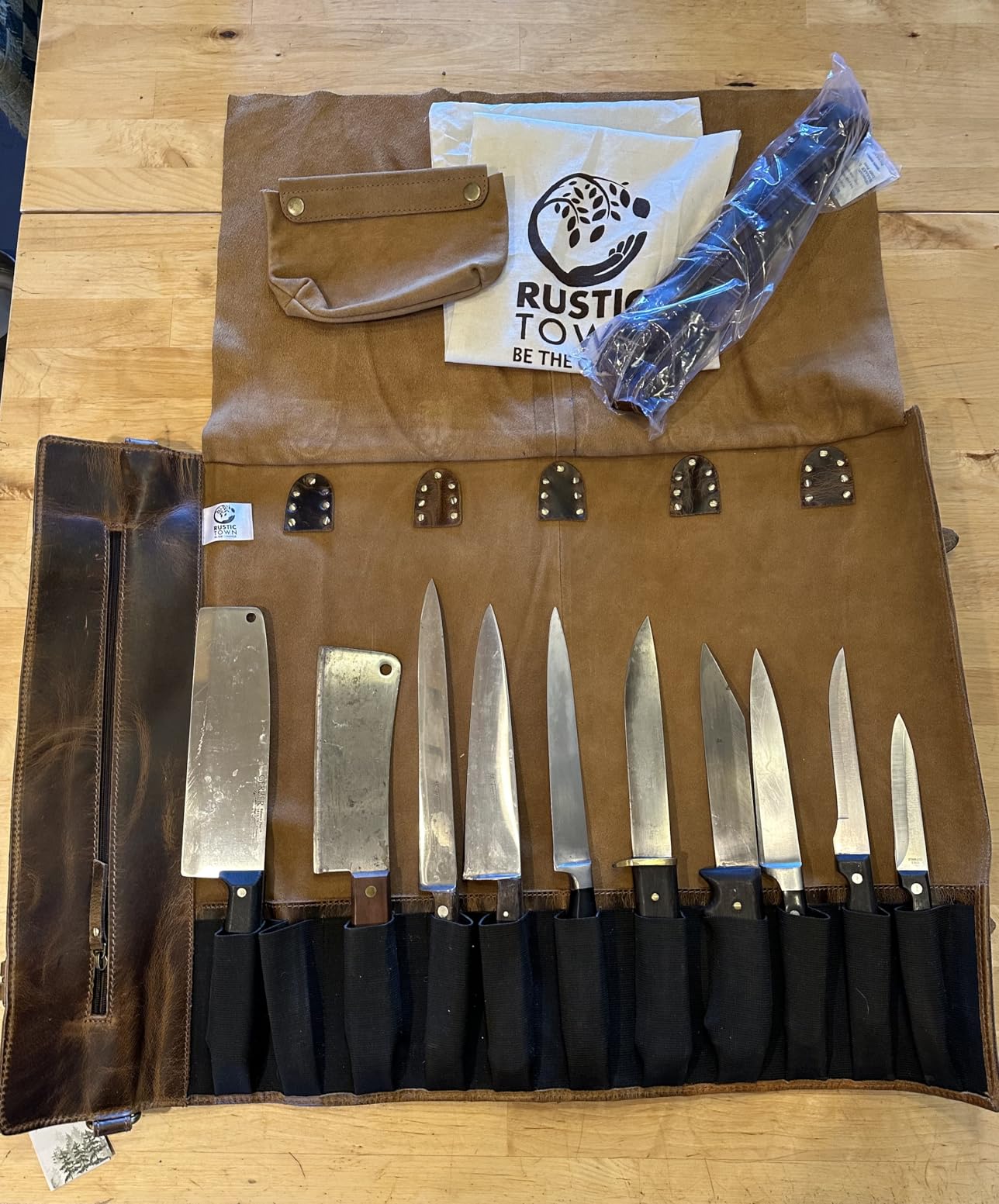
This is the highest-rated case in our group, and the reason is material rather than capacity. Full grain buffalo leather is heavier at 3.53 pounds, but it takes abuse and then looks better for it, developing a patina that fabric never will.
Capacity is 11 knives and accessories, including paring, carving and ceramic knives, scissors and utensils. That is fewer slots than the fabric rolls here, which is the real tradeoff.
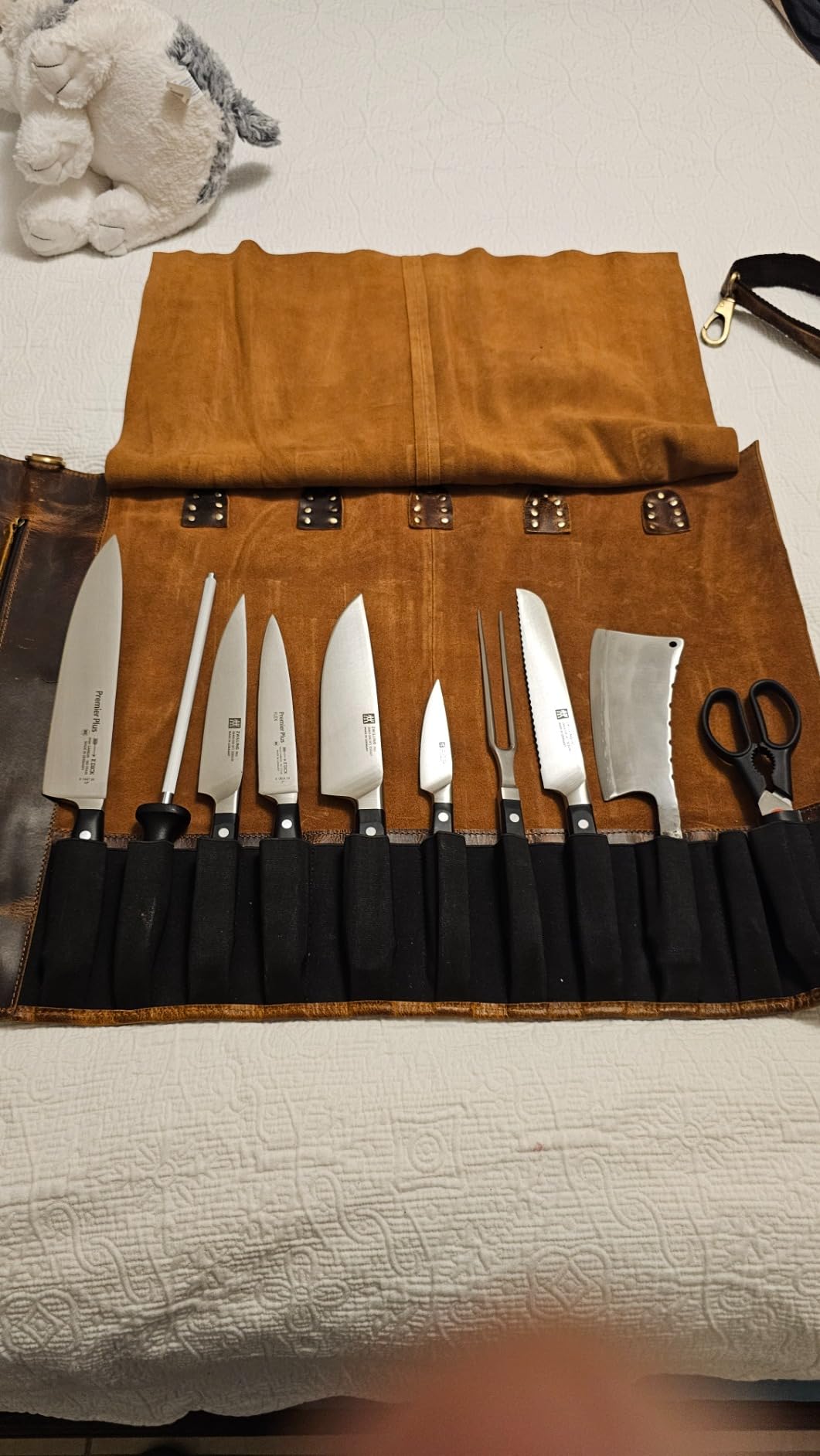
The roll closes with heavy-duty brass buckles rather than a zipper, so there is no slider to bend or snag in a suitcase. The handle makes it easy to carry from a car to a campsite or a rental kitchen.
Leather and water do not mix. Keep it out of rain, and if it gets wet, let it dry slowly away from direct heat rather than rushing it.
Is the weight a problem for air travel?
Not much, because leather weight is mostly empty volume and the roll compresses when closed. It lands flat in a checked bag and takes up about the same footprint as a folded roll of clothing.
Just do not plan to carry it on a flight. Three and a half pounds of dense material is awkward under a seat, and knives are not permitted in carry-on bags anyway.
Is leather the right choice for a rough checked bag?
It handles abrasion and crushing better than nylon, and a scuffed leather roll still works. It handles water poorly, so wrap it before it goes into a suitcase that might get damp.
If you want a case that looks as good in ten years as it does today and do not mind the weight, this is the one.
7. HERSENT Waxed Canvas Roll Is the Most Versatile for Long Blades
- Rugged waxed canvas that breaks in with use
- Rolls down tight for compact packing
- Includes a travel strap and extra knife tip guards
- Easy to scrub clean or machine wash
- All slots are the same size
- Little padding for protecting expensive blades
- Strap anchor points sit inboard and make the bag feel unbalanced
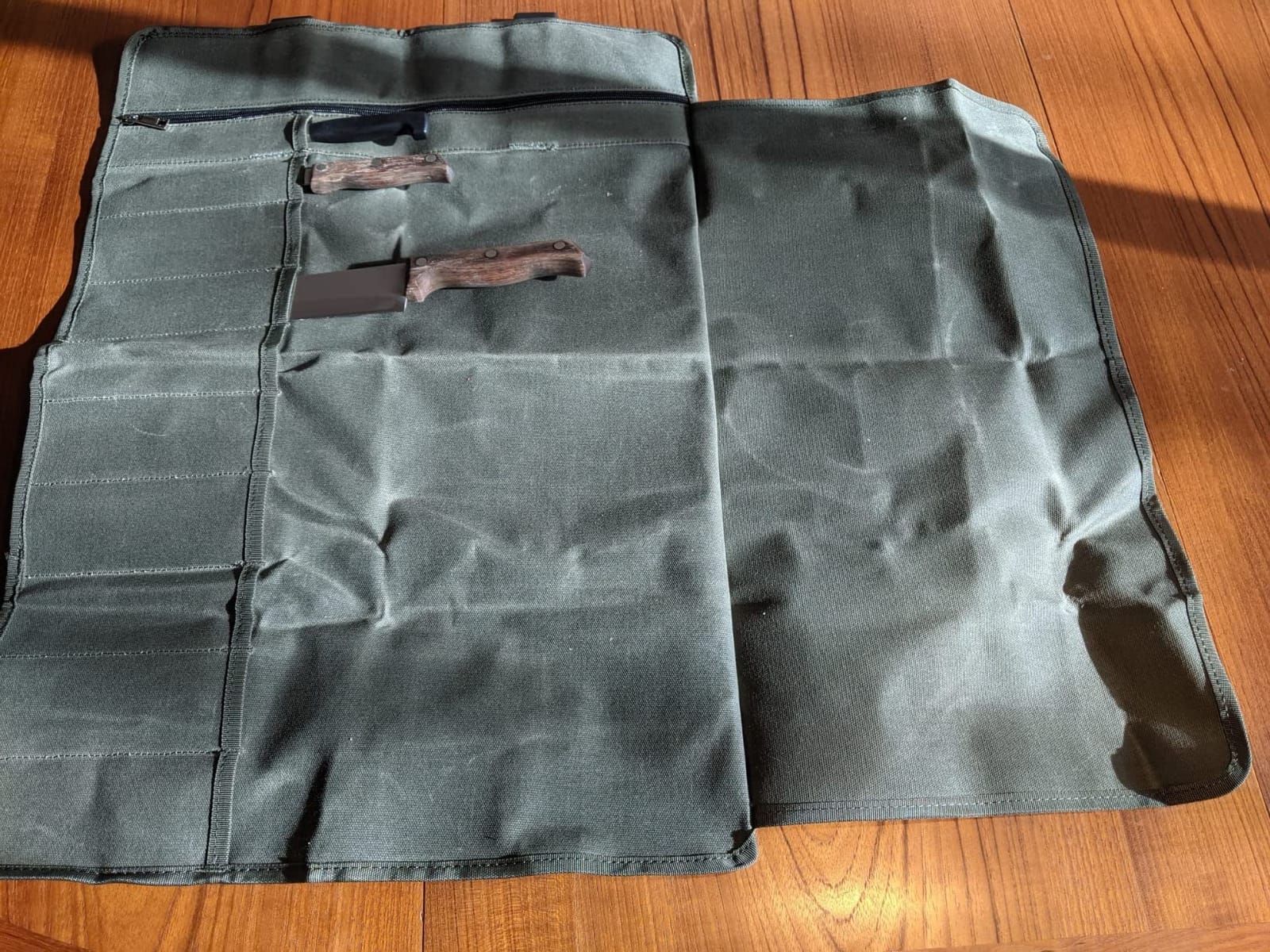
This is the roll most people end up buying first, and for a good reason: it is the only one here that takes knives up to 18.8 inches at a budget price. Long slicers and nakiris fit without argument.
There are 11 sleeves plus a zippered pocket. The canvas is described as cut- and puncture-resistant, which is what stops a sharp tip from working through the bottom of the roll in a crowded bag.
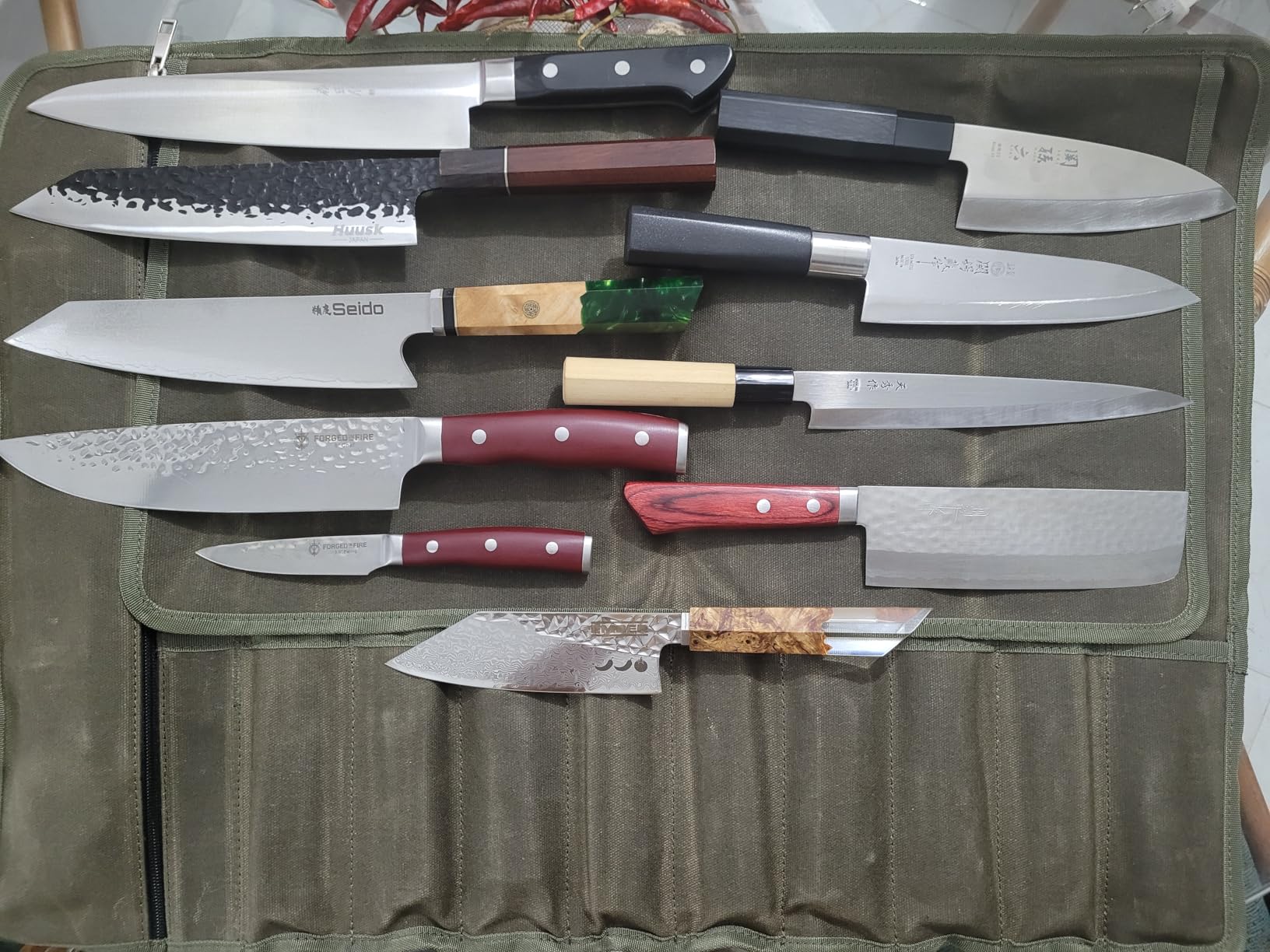
Two buckle closures hold the roll tight, and it ships with a travel strap and extra knife tip guards. Those guards matter more than they sound, because an unguarded blade can slice through the stitching and into a lining.
Cleaning is easy. The canvas can be scrubbed or machine washed, which is rare for a roll in this category and useful after a week of travel cooking.
Does one slot size fit a mixed knife kit?
Not really. Every sleeve is the same size, so a wide nakiri barely fits while a small paring knife can slide down inside one. Mixed kits need a roll with graded slots.
If your kit is uniform, this is fine. If you carry one big knife and four small ones, spend the extra and get graded pockets.
Is the padding enough for an expensive blade?
Minimal. There is little cushioning between blades, so pack in a saya or add a card sleeve so edges never touch edge.
The canvas itself is genuinely durable. It is the blade-to-blade contact that needs managing, and that is a packing habit rather than a case flaw.
8. GWCASE 88-Slot Hard EVA Case Protects a Folding Knife Collection
GWCASE 66+ Pocket Knife Storage Case for Folding Knives, Butterfly Knives
- Hard EVA shell gives real shock and splash protection
- Four slot sizes handle thin folders and wider knives
- Elastic bands stop blades rubbing
- Slides inside a backpack for travel
- Not every slot is usable
- Elastic loops are tight on wider knives
- Very thick knives can make the case hard to close
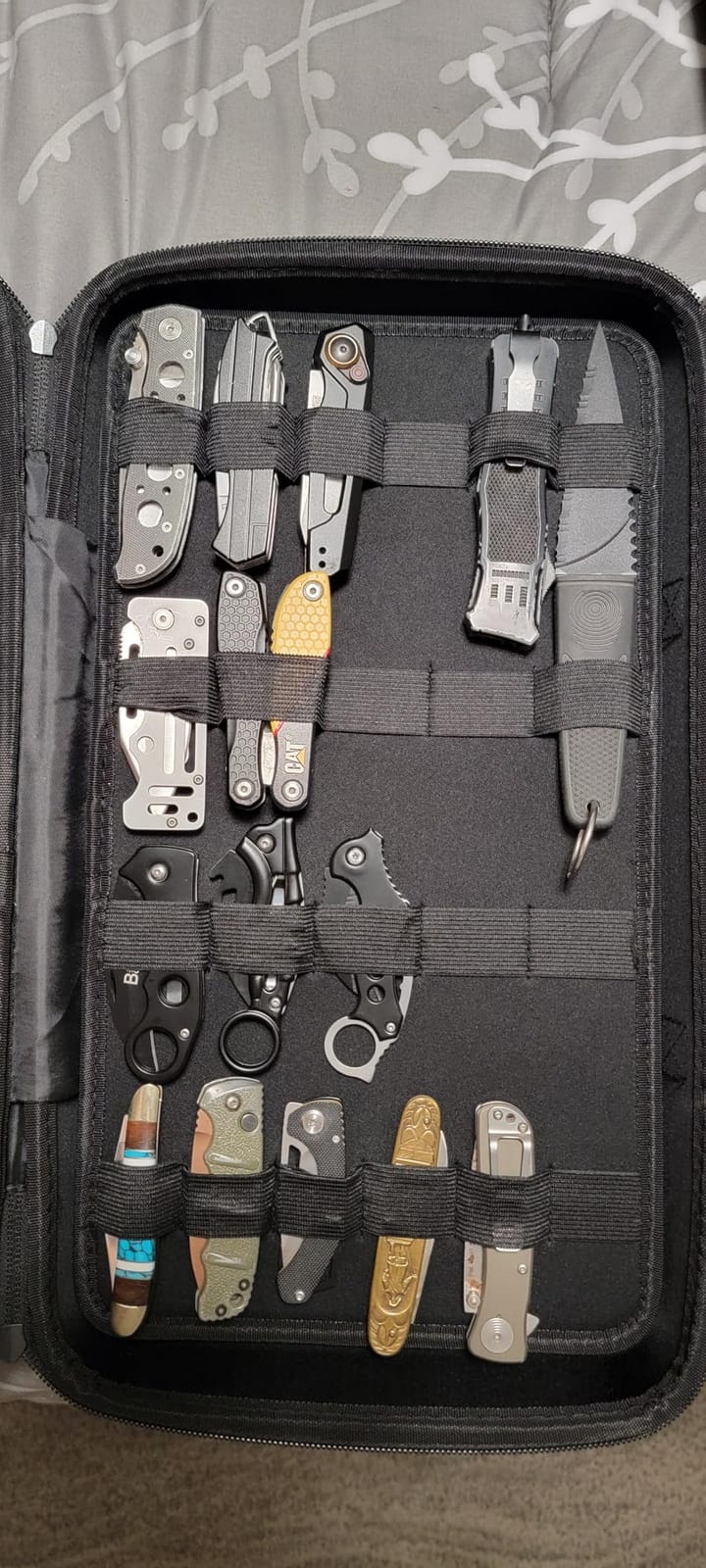
This is the case for anyone moving a folding knife collection rather than a set of kitchen knives. The hard EVA shell is shock and splash resistant, so a dropped bag or a wet walkway is a non-event.
Internally you get 88 elastic slots in four sizes, which is the feature that matters for folders: thin slipjoints and fat automatic knives each find a snug home instead of rattling together.

External size is 16 by 9 by 3.6 inches, and at that footprint it slides into a backpack rather than taking a bag of its own. A non-slip handle and a 360-degree zipper make it easy to open one-handed.
The 88 figure is a best case. Reviewers note that not every slot is usable in practice, so treat it as a ceiling rather than a promise.
Does it stop blades scratching each other?
Yes, and that is the whole point. Independent elastic bands hold each knife in its own space so nothing shifts or rubs in transit.
The same bands are tight on wide handles, so test a couple of your larger folders at home before you commit to a full collection.
Can it pass through airport screening?
Not in carry-on. Like every case here, it belongs in checked luggage, and the rigid shell is a strong argument for keeping expensive folders in it during the flight.
Collectors on bladeforums generally check knives in luggage or mail them ahead rather than risk carry-on screening. The hard shell just makes that option painless.
9. HERSENT 7-Slot Waxed Canvas Roll Packs Flat for Small Kits
- Lowest price point in this group
- Compact roll-up format packs flat for transport
- Cut-resistant waxed canvas protects the bag and blades
- Doubles as a brush or tool roll
- Only 7 slots
- Shortest knife capacity at 16.9 inches
- Lowest average rating in the group with more critical reviews
Seven sleeves is not a lot, and 16.9 inches is the shortest blade capacity in this group. Both facts matter if you are planning to bring a full knife set on a trip.
What it does offer is a very small packed size. The canvas cord closure forms a tight roll, so it slides into a daypack or a jacket pocket in a way the larger rolls cannot.
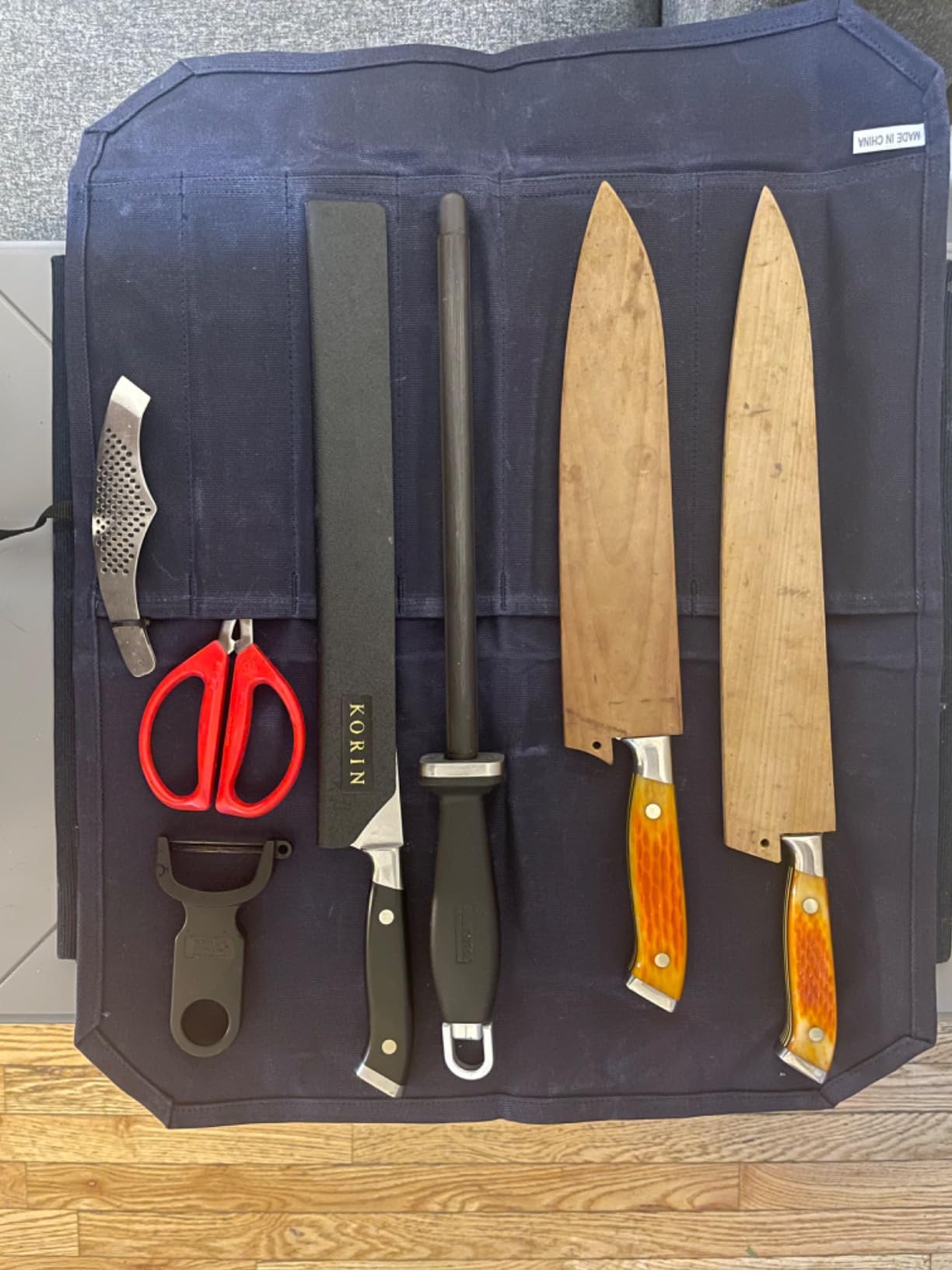
The multi-purpose angle is real. Owners use it as a brush roll, a tool roll and a general travel pouch, which makes it a sensible secondary case rather than a primary one.
It has the largest review volume of any budget case here, and the lowest average rating, which tells you buyers mostly treat it as a starter bag. Feedback on capacity and long-term durability is the recurring theme.
Is seven slots enough for a traveling chef?
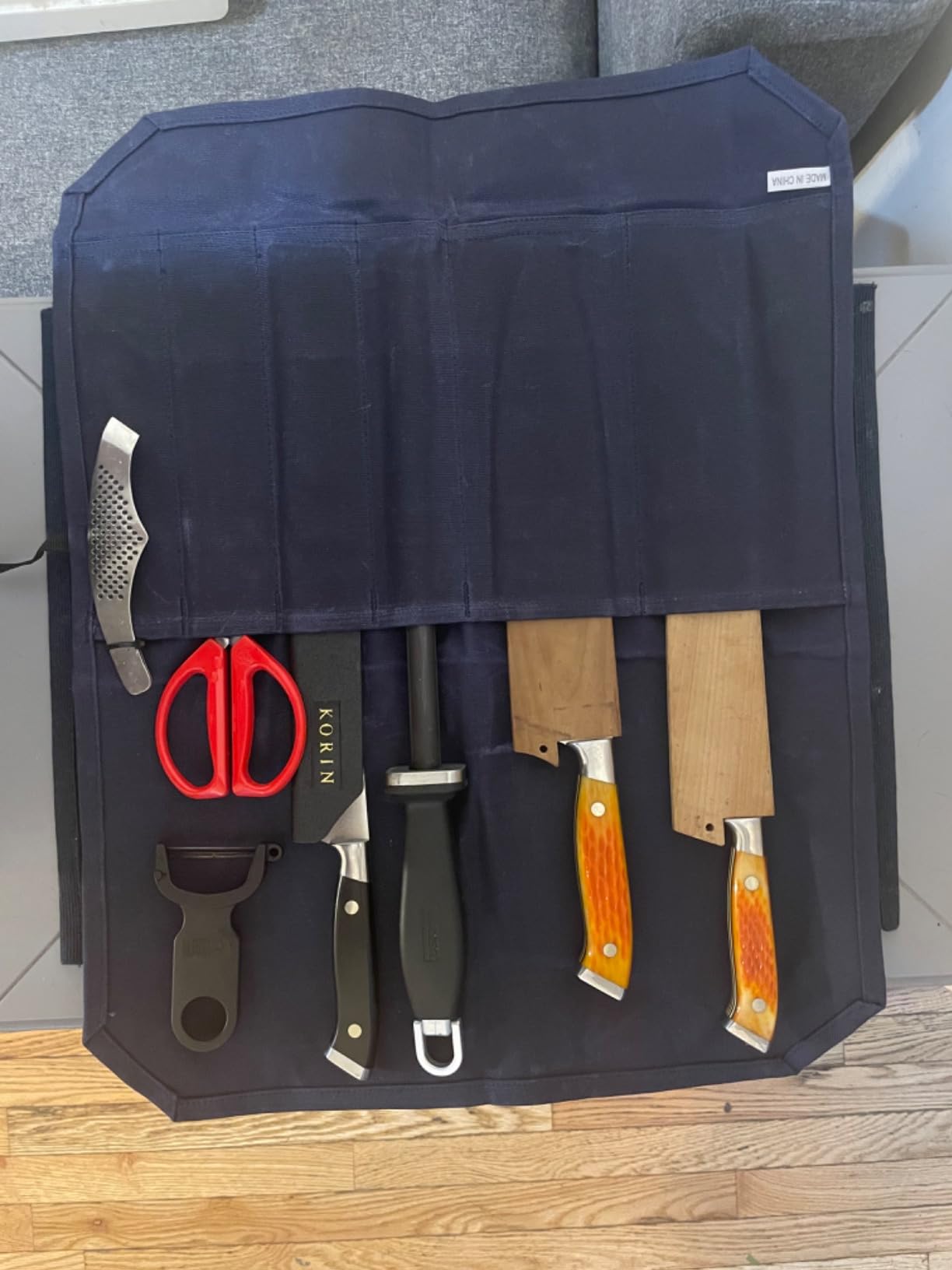
Enough for a paring knife, a utility knife and a small santoku, which covers a lot of vacation-rental cooking. Not enough for a full line kit.
If you are moving rather than cooking on the road, it works as a secondary bag for the knives that matter most.
Is it worth buying at this price?
If you need a spare, a secondary roll or a tool pouch, yes. It is one of the cheapest ways to stop a loose blade from damaging a suitcase lining.
If it is going to be your main travel case, spend more on graded slots and better padding rather than outgrowing this one in a season.
10. BRANTMAKER Foam Clamshell Carries 61+ Knives With Divided Slots
BRANTMAKER Knife Display Case, Knife Case for 61+ Pocket Knives (Box Only)
- Semi-rigid clamshell with soft lining and dividers
- Elastic bands in multiple sizes fit everything from fat multitools to 8-inch folders
- Padded adjustable sling carries a full case comfortably
- Can hold a few larger fixed-blade knives
- Advertised 61+ capacity drops for longer knives
- No closure is listed
- so the lid relies on zip or friction fit
This is the biggest case here and the one built for a serious collection. The 101-slot design is stated to hold over 61 knives and accessories across five different slot sizes, with the largest up to 3.4 inches wide.
Knives up to 15 inches fit, so kitchen blades are in range too. The shell is rigid foam, described as shockproof and splash proof, with slots sewn onto plastic supporting pages and dividers between them.
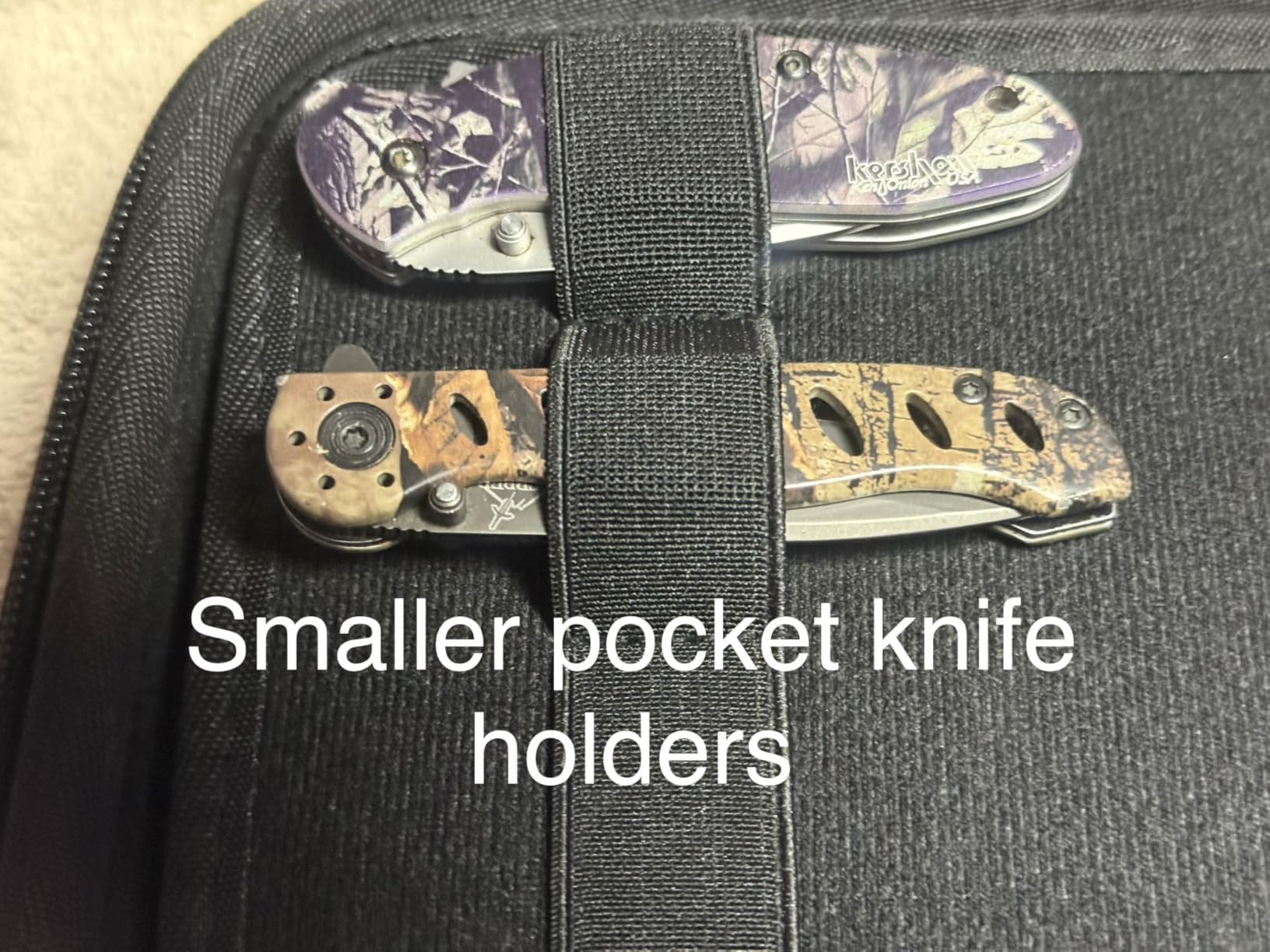
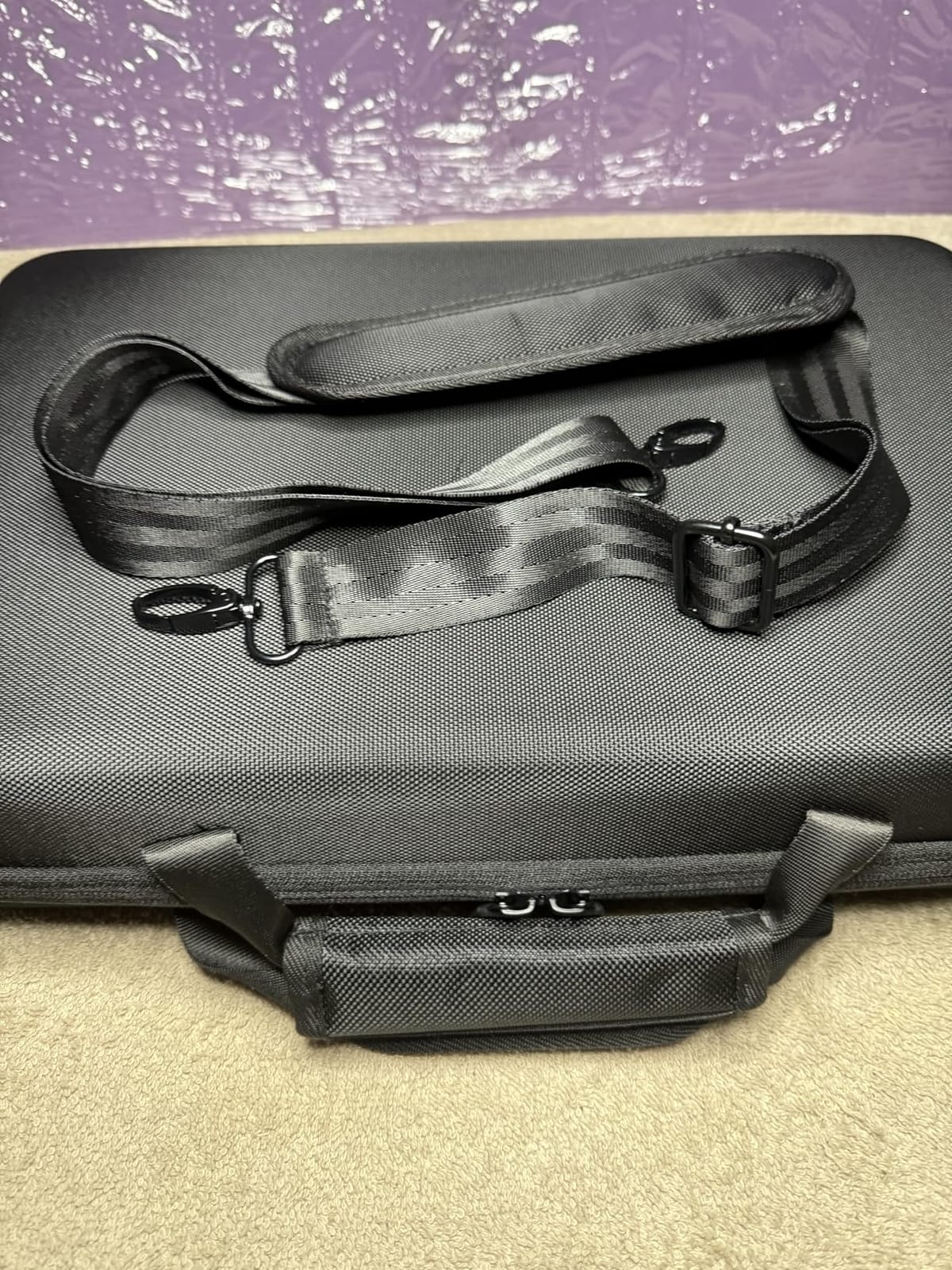
Independent elastic bands fix each knife tightly so nothing shifts or rubs, and the soft lining avoids the abrasive contact that shows up as scratching on polished finishes. A padded shoulder strap and a handle make a 3.1 pound case carryable.
Two caveats are worth knowing. The 61+ figure drops for anyone with longer knives, and no closure is listed, so the lid sits by zip or friction fit rather than a latch.
How much of that 101-slot design can you actually fill?
Plenty, but not at 61 with long blades. Capacity figures like this assume a mix of folders and multi-tools, so count your own knives against the slot sizes before you buy.
Counting slots is worth five minutes. It is the difference between a case that fits your collection and one that does not close properly.
Is it worth the weight for occasional travel?
Only if you are moving the whole collection. At 3.1 pounds and 16 by 10 by 3.6 inches, it is a substantial object to check on a short trip for a handful of knives.
For moving house or relocating a collection it is the most protective option here, with the rigid shell and dividers doing the work that fabric cases leave to luck.
Flying With Knives: TSA and Airline Rules for 2026 Travel
TSA permits knives in checked bags and does not permit them in carry-on bags. That is the whole rule, and almost every question on this topic reduces to it. Blades go in your checked luggage, wrapped in a case that keeps them from touching anything else in the bag.
Carry-on rules are where the confusion lives. TSA has historically allowed small folding knives and hunting knives in carry-on as long as the blade stays under roughly 4 inches from the pivot, though individual officers have discretion and rules change. The practical advice is simple: do not plan on flying with knives you cannot replace.
Checked bag size is the next constraint. Most US carriers limit checked luggage to 22 by 14 by 9 inches, and oversized bags cost extra. Every case here fits inside those dimensions, but a fully loaded backpack or a 20-inch roll will eat a lot of your allowance before you add clothes.
Multiple knives and full sets are allowed in checked luggage without a count limit, as long as they are secured. Forum users report knives being surrendered at the bin more often in carry-on than in checked bags, which is why checked is the lower-risk option.
Internationally, rules can tighten. Some countries restrict the type or length of blade permitted on entry, and customs declarations may be required. If you are crossing a border with a high-value knife, check the destination rules before you pack.
A TSA-approved or lockable case does not guarantee passage. It keeps your knives contained and secure, which matters for checked bags, but no case overrides an officer’s decision. Our guide to airline travel cases covers the same containment logic for sporting gear.
How to Pack Knives Safely for a Flight
Loose blades in a suitcase is the most common way a good knife gets damaged, and it is entirely avoidable.
- Fit each blade in a saya or hard blade guard before it goes anywhere near the case. Reviewers repeatedly report blades cutting through stitching in unguarded rolls.
- Slot guarded blades into the case one at a time, alternating direction so no two edges face each other across a pocket.
- Fill empty sleeves with rolled socks or clothing so the knives cannot slide toward each other when the bag is handled.
- Close every flap, buckle or zipper, then tug the closure gently to confirm nothing can slide past it.
- Wrap the whole case in a folded garment inside your suitcase for crush protection.
- Place the case flat against the hard side of the bag, away from shoes and heavy toiletries.
- Add a luggage tag or a written note inside the case describing the contents for screening.
- Keep blades dry before packing, and oil them lightly after you unpack so a long trip does not leave steel with moisture spots.
How to Choose a Knife Case for Travel
Chefs carry their knives in one of three formats, and buying the wrong one is the most common mistake. Start by matching the case to what you actually carry.
Soft roll suits a small kitchen kit of 6 to 11 blades, packs flat and weighs little, but offers the least crush and impact protection. Choose a roll with graded slot sizes and a buckle or cord closure rather than open pockets.
Backpack or tote carrier suits 15 to 20 knives plus tools and is the only format with real organization for steel, tongs and thermometers. Padded straps matter more than most buyers expect on a long walk through a terminal.
Hard shell or rigid case suits folding knife collections and high-value blades. Foam, EVA and hard polymer cases stop blades shifting and protect against drops, and they double as display cases when you get home.
Slot count is the next filter. Match it to your kit with one spare sleeve at minimum, and check whether the advertised number counts utensil slots and small pockets or only full-size knife slots. Real capacity is usually a little lower than the headline figure.
Blade length is where cheap rolls fail quietly. Cases in this group range from 15 inches to 20.5 inches, so measure your longest knife including the tang and buy above it. A knife that has to be forced into a sleeve will work its way out in transit.
Material decides how the case ages. Waxed canvas is rugged and rolls flat, nylon is light and easy to wipe clean, 600D polyester is the modern standard for backpacks, and full grain leather develops a patina while ignoring water. Washable waxed canvas is easiest to clean after a trip; leather needs the most care.
Closure and security matter because a roll that loosens lets knives slide out. Zipper closure is the most secure, buckles are nearly as good and easier to inspect at screening, and drawstring cords are the least secure.
Carry method should match the trip. A single shoulder strap is fine for a short walk from a car. A backpack harness is worth the extra cost for flights and long transfers, and a case that fits inside a bag you already carry beats one that adds another thing to hold.
Price tiers break down predictably. Budget cases get you waxed canvas or basic polyester with uniform slots and light padding. Mid-range buys you graded slots, reinforced stitching and better hardware. Premium buys you leather, rigid shells and retention panel systems that hold a full service kit.
Whichever tier you pick, do one thing most buyers skip: pack the case the night before and check it in the morning. That is when you notice the sleeve that is too narrow and the strap that does not reach. Our knife sharpener guide covers the other half of a traveling kit.
Frequently Asked Questions
Can I travel with a knife in my suitcase?
Yes. TSA permits knives in checked luggage, including full kitchen sets, as long as the blades are secured so they cannot injure anyone handling the bag. Pack each knife in a saya or blade guard, slot them into a knife case, and place the case flat inside the suitcase away from shoes and heavy items.
Can I carry a chef’s knife through TSA security?
Kitchen knives are not permitted in carry-on bags in the United States. TSA has historically allowed some small folding and hunting knives whose blades stay under roughly 4 inches from the pivot, but officers have discretion and rules change. If a knife is not replaceable, put it in your checked bag inside a case.
How do you pack knives for a flight?
Guard every blade, then slot the guarded blades into a knife case one at a time so no two edges face each other. Fill empty sleeves with rolled clothing so blades cannot slide together, close and secure every buckle or zipper, wrap the case in a garment for crush protection, and place it flat against the hard side of the suitcase.
What type of knife case is best for travel?
A soft roll suits a small kitchen kit of 6 to 11 blades and packs flat with little weight. A backpack or tote carrier suits 15 to 20 knives plus tools. A hard shell or rigid foam case suits a folding knife collection and high-value blades. Choose based on blade count, blade length and how much crush protection you need.
Which knife case holds the longest blades?
Capacity in this group ranges from 15 inches to 20.5 inches. The EVERPRIDE bag accepts knives up to 20.5 inches, the HERSENT waxed canvas roll takes blades up to 18.8 inches, and the Asaya roll fits knives up to 17 inches including the tang. Measure your longest knife including the tang and buy above that length.
Final Verdict: The Best Knife Cases for Travel in 2026
The Chef Sac Vintage Backpack is our pick for the best knife cases for travel overall, because it carries a full kitchen kit, stays inside checked bag dimensions and hides its contents in plain sight. The HERSENT waxed canvas roll is the best budget choice, and the GWCASE hard EVA case is what you want for a folding knife collection.
Whichever one you choose, put it in your checked bag rather than trying to carry it through screening. Our guides to large travel makeup cases and pool cue cases for travel cover the same protective-packing approach for other gear.