
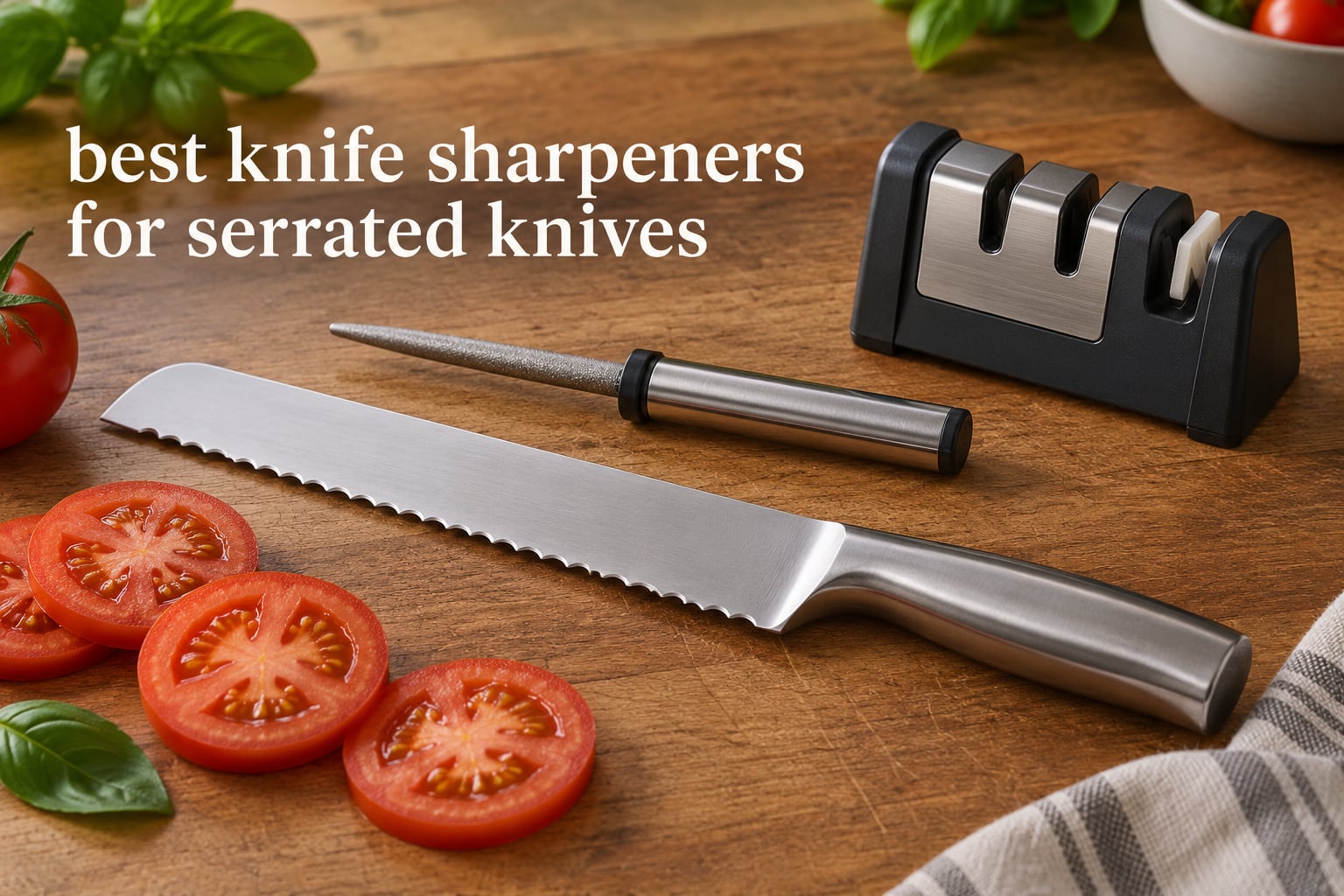
Serrated knives break most sharpeners. A straight-edge wheel or a coarse carbide slot will chew through scallops, flatten the gullets and leave you with a blade that looks scratched and still tears. Only two mechanisms actually work: a small tapered diamond rod that rides down the blade between the teeth, and a narrow dedicated serration slot built into a multi-stage sharpener. Everything else on the market is a compromise.
That is the finding after our team put twelve sharpeners through serrated bread knives, scalloped steak knives, micro-serrated folding knives and a gut hook, and compared them side by side. The best knife sharpeners for serrated knives are not the highest-end electric machines. They are the tools that reach the teeth without destroying them.
The rest of this guide walks through all twelve picks, explains the difference between scalloped and micro-serrated edges, and spells out the technique that keeps your serrations intact. If you want a general-purpose sharpener for straight edges too, our tested knife sharpener roundup covers that side of the shelf. For the blades themselves, the survival knife picks and the bushcraft knife guide are worth a look.
One thing worth saying early: a dull serrated knife is not just slower. It tears instead of slicing, it wanders on tomato skins, and it demands more force than a sharp one, which is where slips happen. Restoring the teeth is a ten-minute job once you know which tool to pick up in 2026.
Table of Contents
Top 3 Sharpeners for Serrated Knives in 2026
Our three headline picks cover three completely different needs. The AccuSharp is the one to own if you want a single tool that handles knives, scissors and hooks in about ten seconds. The Chef’sChoice 15XV is the choice for a household that wants powered, repeatable results. The KitchenIQ is the drawer-sized backup for quick touch-ups between cooking sessions.

AccuSharp Original
- Diamond-honed tungsten carbide blades
- Reversible blades
- Sharpens in about 10 seconds
- Straight and serrated knives

Chef’sChoice 15XV EdgeSelect
- 100 percent diamond abrasives
- 3-stage EdgeSelect system
- Serrated polishing stage
- 3-year warranty

KitchenIQ Edge Grip
- Coarse carbide and fine ceramic stages
- Edge Grip countertop base
- Pre-set angles
- Works on serrated knives
All 12 Serrated Knife Sharpeners Compared
Every sharpener below is rated on one question first: does it reach the teeth of a serrated blade? The key feature column names the mechanism rather than just saying yes or no.
| Product | Specifications | Action |
|---|---|---|
| AccuSharp Knife Sharpener |
|
Check Latest Price |
| Chef’sChoice 15XV EdgeSelect Electric |
|
Check Latest Price |
| KitchenIQ Edge Grip 2-Stage |
|
Check Latest Price |
 Orange Ninja 4-Stage Sharpener Orange Ninja 4-Stage Sharpener |
|
Check Latest Price |
 Chef’sChoice Manual 2-Stage Chef’sChoice Manual 2-Stage |
|
Check Latest Price |
 Wamery Retractable Diamond Rod Wamery Retractable Diamond Rod |
|
Check Latest Price |
 DMT Diafold Serrated Sharpener DMT Diafold Serrated Sharpener |
|
Check Latest Price |
 Fino Edge Retractable Diamond Rod Fino Edge Retractable Diamond Rod |
|
Check Latest Price |
 Siyurongg Pen-Style Diamond Rod Siyurongg Pen-Style Diamond Rod |
|
Check Latest Price |
 Lansky Fine Hone for Serrated Knives Lansky Fine Hone for Serrated Knives |
|
Check Latest Price |
 Work Sharp Ceramic Honing Rod Work Sharp Ceramic Honing Rod |
|
Check Latest Price |
 Croco Dial 5-in-1 Sharpener Croco Dial 5-in-1 Sharpener |
|
Check Latest Price |
1. AccuSharp Knife Sharpener – Best Overall for Serrated and Straight Knives
- Sharpens most blades in about 10 seconds
- Diamond-honed carbide resists wear
- Reversible blades extend service life
- Works for both hands
- Dishwasher safe
- Coarse grit only
- Needs consistent technique on serrations
- Not suited to fine Japanese edges
This is the sharpener we hand to people who own one knife and want it usable tonight. The two tungsten carbide blades are diamond-honed, which means they cut cleanly at the start and stay sharp far longer than plain stamped carbide. Pull it through a serrated bread knife and the teeth come back with two or three passes per side.
What separates it from cheaper pull-through models is the blade geometry and the grip. The channel is narrow enough to sit on the flat between the gullets rather than bridging them, and the full-length finger guard keeps your index finger well away from the abrasive. That matters more than it sounds when you are pushing a serrated blade through a slot that is only a fraction wider than the teeth.
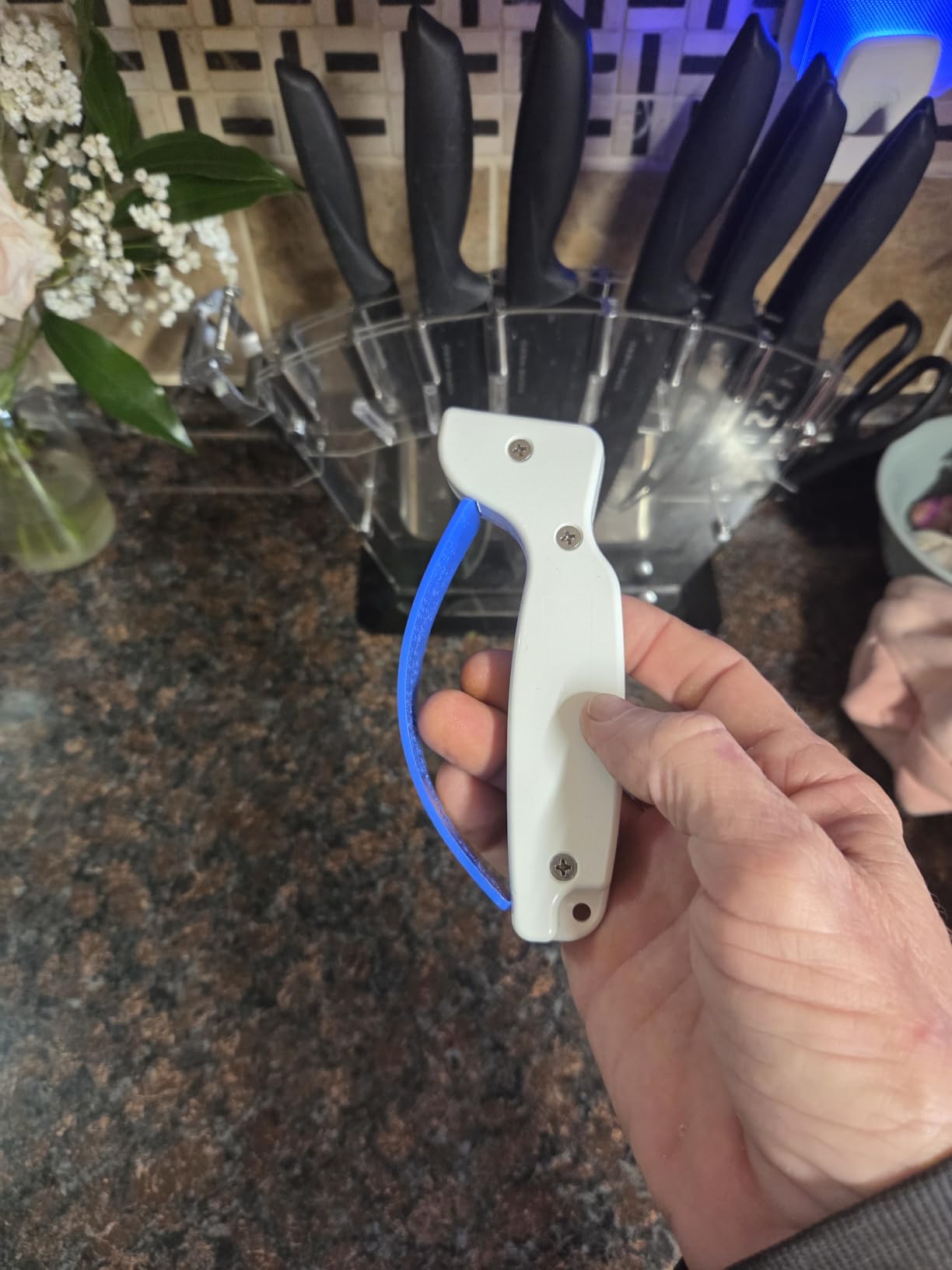
The abrasive is coarse, and that is the honest limitation. On a serrated knife with deep scallops it does a fine job. On a fine micro-serrated pocket knife it can leave a slightly toothy finish that some users prefer and others find harsh. We found the sweet spot is light pressure and more strokes rather than heavy passes.
The reversible design means when the first side dulls you flip the cartridge rather than buy a new tool, which is why owners keep counting on the same unit for years. It also handles scissors, and the body is dishwasher safe, so cleanup is not a chore. At under 4 inches tall it stores flat in a drawer next to the whisks.
How it performs on bread knives versus pocket knives
On a 9 inch serrated bread knife with deep scallops the carbide does exactly what you want. Each tooth tip gets a fresh micro-bevel and the slicing action comes straight back, which is the most satisfying repair in this whole guide. It takes maybe a minute for the full blade.
On a fine micro-serrated folding knife the result is good but less refined. The tooth points end up crisp, though the flats between them stay slightly coarse. If that knife is a premium one you care about, follow up with a ceramic hone like the Lansky covered later in this roundup.
Where it falls short
There is no angle control at all. The tool does not care whether your plain-edge knife is a 15 or 20 degree European or a thinner Japanese edge, and the aggressive carbide is not the right abrasive for a high-value thin edge. Forum users make the same point from the other direction, with enthusiasts pairing it with a controlled-angle system when they want to preserve steel.
It is also a one-size-fits-all answer in a category where serration spacing varies so much. Nothing in the product adapts to a wide scallop versus a tight micro-serration, you simply run it through and check the result by eye and by feel.
2. Chef’sChoice 15XV EdgeSelect Electric Sharpener – Best Powered Option
- Only electric model here with a serrated polishing stage
- Angle guides remove guesswork
- About 1 minute first sharpening
- 3-year limited warranty
- Quiet motor
- Removes more steel than manual methods
- Large countertop footprint
- Instructions must be followed exactly
- 120V power only
This is the only powered sharpener on our list that has a documented serrated path, and it matters. Stages one and two are for straight edges. Stage three uses a flexible abrasive system that conforms to the blade as you draw it through, which is how it reaches the teeth of a serrated knife without grinding the scallops flat.
On a plain 20 degree knife the spring-loaded guides will happily walk the edge down to a 15 degree Trizor XV geometry in a single pass, roughly a minute for the first sharpening and about ten seconds for a touch-up. Users with more than a decade of service on these report the motors holding up, and the 3-year warranty backs that up.
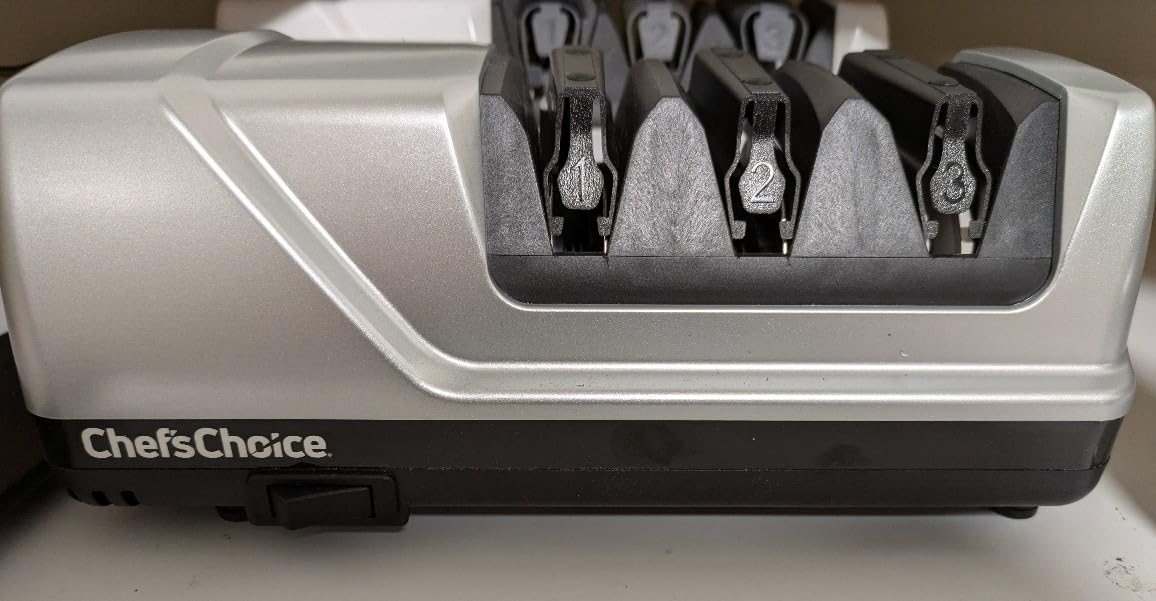
The reason it does not take our top spot is steel removal. Electric machines remove more metal than manual tools because the abrasives are driven at fixed speed rather than by your hand. On serrated knives we would keep it on stage three only, using it as a powered hone rather than a full bevel grinder.
It also demands counter space and a wall outlet. At 4.2 pounds and 10 by 4.25 inches it is not a travel tool, and the 120V-only motor rules it out for anyone outside North America without a converter.
Whether the serrated stage really works
It does, and it is the reason this model earns a place on a serrated list. Draw the blade slowly through stage three and the flexible abrasive bends into the gullets, polishing each tooth tip from the flat side. Users report bread knives returning to clean slicing after a single pass.
The limitation is patience. Rushing the blade through a motorised stage generates heat and uneven results, and the instructions are specific about speed and pressure. Skim those and you will get a mediocre edge on a good knife.
Who should skip it
Anyone with a small collection of folding knives and no interest in straight-edge geometry. This machine is built to convert edges, and serrated work is an afterthought in its design even though stage three handles it. A tapered diamond rod does the same serrated job with less steel loss and none of the noise.
If a large countertop footprint bothers you, the backup pick in this roundup stores flat in a drawer. The trade is speed and repeatability for footprint and cost.
3. KitchenIQ Edge Grip 2-Stage Sharpener – Best Value Pick
- Largest review base of any pick here
- Edge Grip keeps blade angle steady
- Compact enough for a drawer
- Handles serrated and straight knives
- Non-slip base
- Fine stones wear after a few years
- Sharpness fades faster than stone sharpening
- Plastic body feels basic
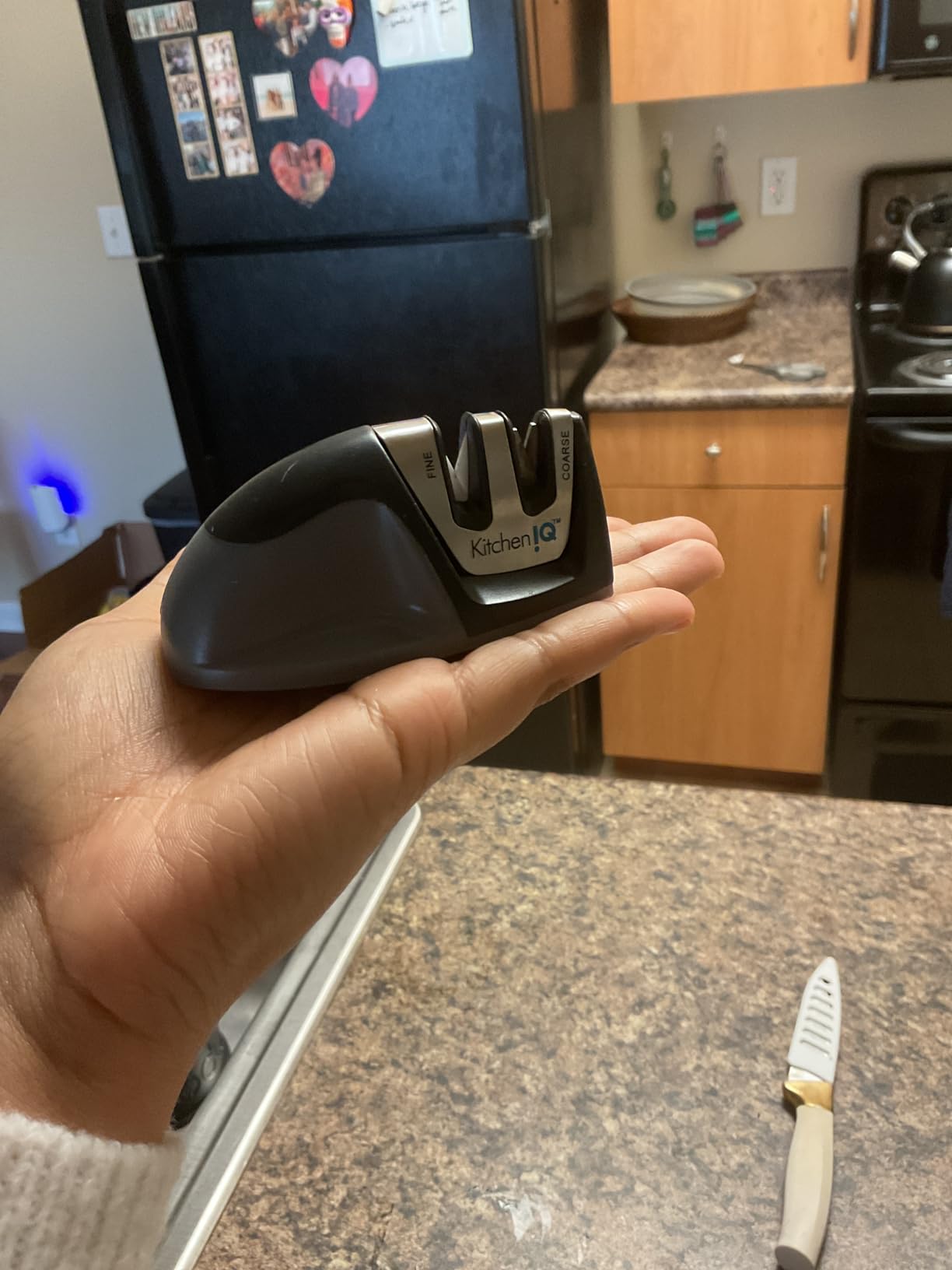
More owners have used this sharpener than any other in our test group, and the reason is the patented Edge Grip. It holds the blade at a fixed angle while you work, which means a beginner gets a consistent pass without learning the geometry by feel.
For serrated knives the fine ceramic stage is the one to use. Coarse carbide on a bread knife is unnecessary when all you need is burr removal from each tooth tip, and the fine stage does that without taking metal off the gullets. Two or three light passes per side is the right pace.
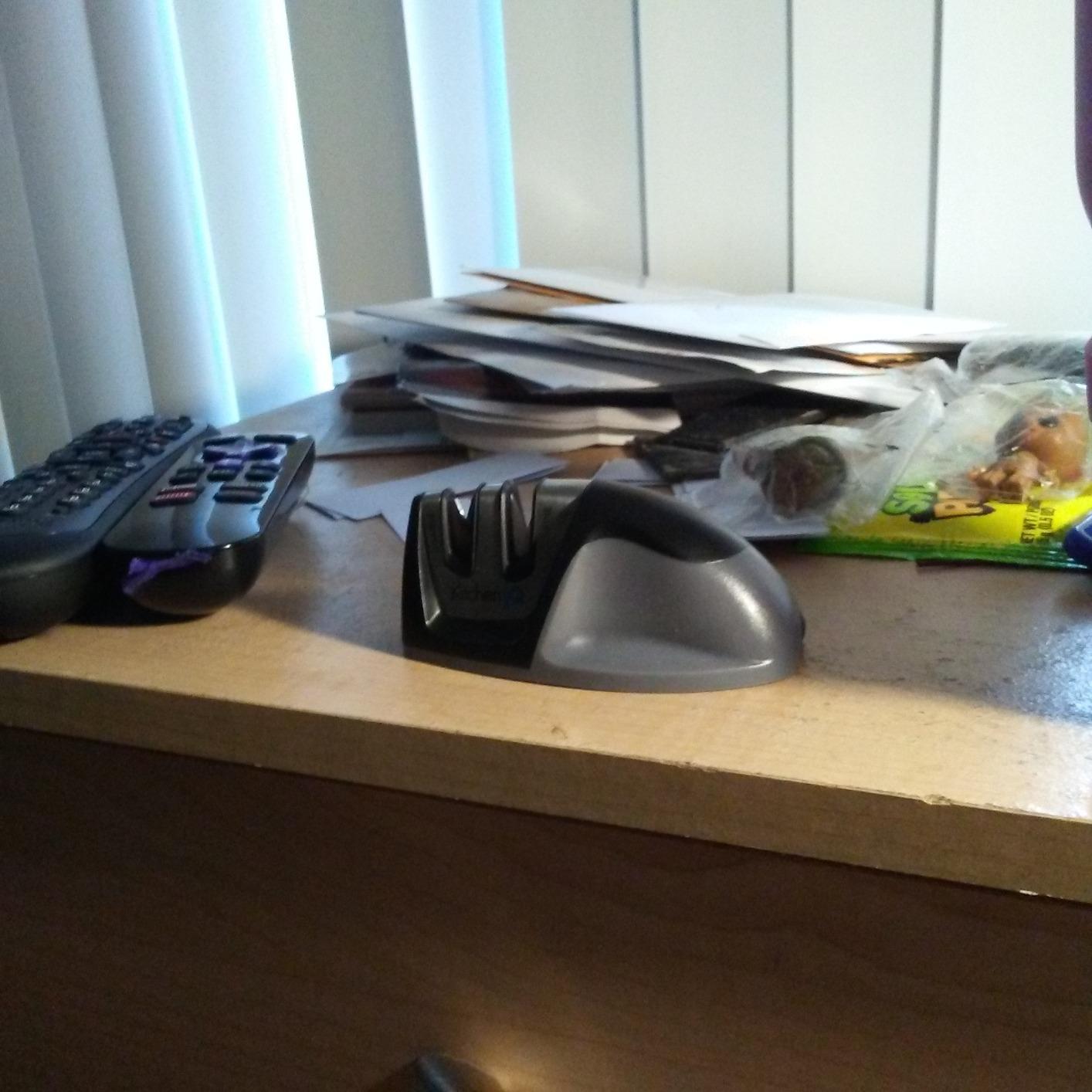
It is tiny. At 14.2 grams and under 4 inches tall it lives in a drawer next to the whisks, and that is where it will earn its keep, because a sharpener you cannot find is a sharpener you do not use. The soft grip rubber handle and non-slip base make it workable on wet hands and clumsy mornings.
Two stages only means no dedicated serration channel, so you are choosing the stage and controlling the angle yourself. For a straight edge that is a limitation, but the pre-set geometry covers common European angles well enough for most home kitchens.
Is it good enough for daily kitchen use
For weekly maintenance, yes. The fine ceramic stage keeps slicing knives crisp, and it will bring a dull serrated bread knife back to service without any learning curve. Think of it as the tool you reach for when a knife stops feeling sharp rather than when it is truly damaged.
The trade-off shows up over years rather than months. Users report the fine stones wearing out after a couple of years, after which the sharpener still works but the edge it leaves fades faster than a stone-sharpened or diamond-honed edge.
Where it is the wrong choice
If your serrated blades include a scalloped gut hook or a fine micro-serrated folder, the fixed geometry here is not adjustable enough to protect the tooth profile. A tapered diamond rod in a later section handles those shapes far more precisely.
It is also all plastic and the base is the only thing holding the angle, so on a very short serrated knife the working room is tight. Longer blades are the easier job here.
4. Orange Ninja 4-Stage Sharpener – Best Budget Multi-Stage Pick
Orange Ninja Serrated & Kitchen Knife Sharpener – 4-Stage Sharpening Tool
- Only budget pick with a named serrated slot
- Diamond rods add real cutting speed
- Handles repair sharpen and polish
- Compact vertical footprint
- Serrated slot may not fit every spacing
- Coarse carbide is aggressive on fine knives
- Four slots can confuse newcomers
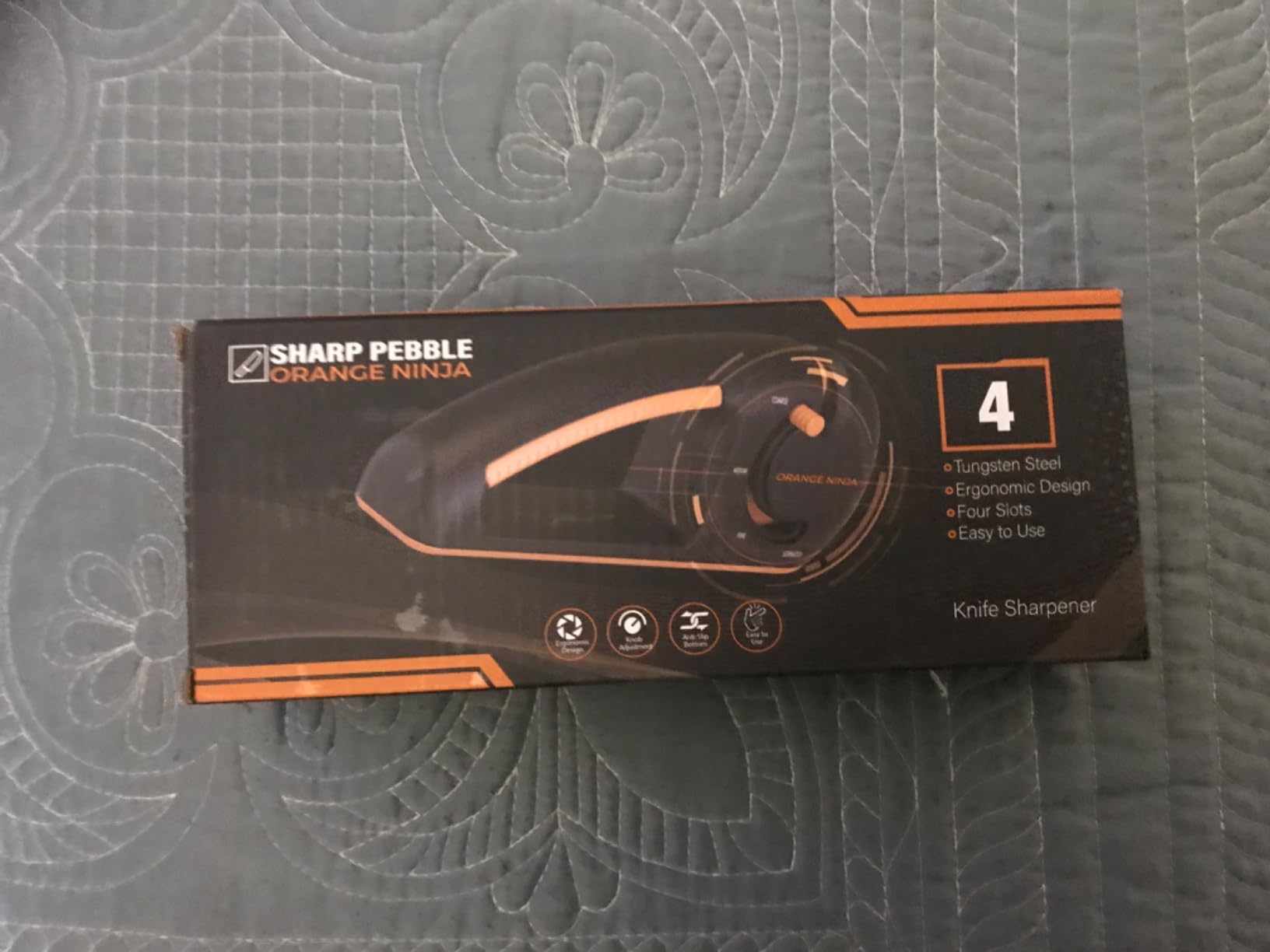
This is the rare budget sharpener where the serrated claim has a named, dedicated part behind it. The fourth slot exists specifically for serrated blades, so you are not improvising with a stone that was never meant to fit between teeth.
The medium stage is where the value sits. Those are diamond rods rather than cheap abrasive blocks, and they do real work fast on a bread knife that has been sitting in a drawer for months. Coarse carbide first if the edge is genuinely damaged, then the medium rods, then the fine ceramic slot for finish.
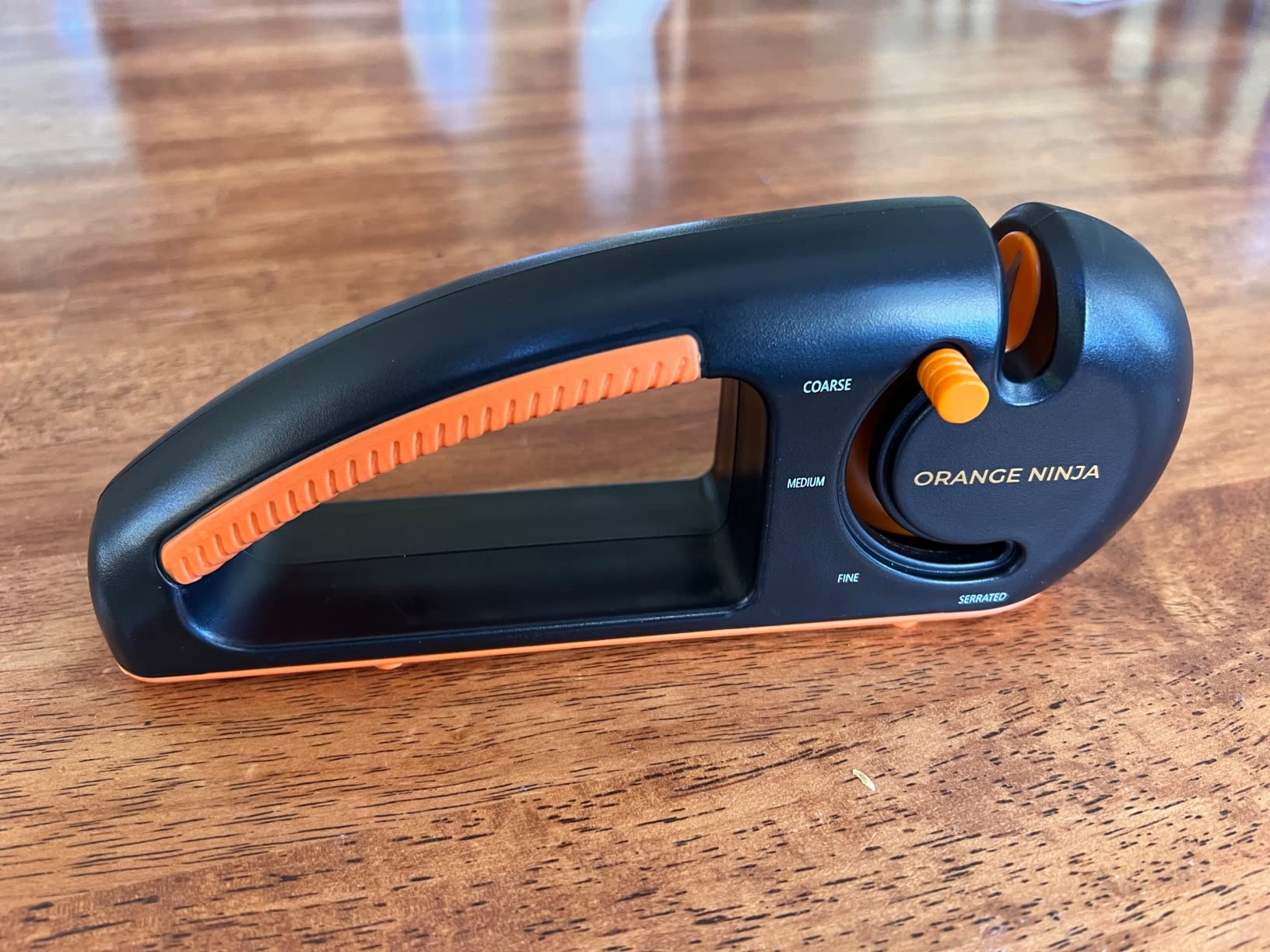
At 10.88 ounces and just under 8 inches tall it stands upright on the counter without needing a base plate. The non-slip grip makes it usable with wet hands, and the symmetrical body works the same way for both hands.
Our complaint is the same one users raise: four slots is a lot of choices when you are starting out, and the labelling does not always make the order obvious. Give it ten minutes on a scrap knife and it clicks into place.
How the dedicated serrated slot performs
It is narrow and shallow, which is what a serration slot should be. On a standard scalloped bread knife it restores the tooth tips quickly. The limit is spacing: very fine micro-serrations can sit tighter than the slot geometry, and then you get an uneven pass across the blade.
If your serrated knives are mostly kitchen bread knives and steak knives, this slot does the job well. If they include folding knives with tight gullets, move up to a tapered rod instead.
What to watch out for
The coarse carbide stage is genuinely coarse. Running a fine kitchen knife through it by reflex will thin the edge faster than you want, so treat stage one as repair work only and stay in stages two and three for routine maintenance.
The ABS plastic body also flexes slightly under real pressure. Users who bought it for a lighter duty do not notice that at all, and those pushing it hard report a softer feel over time. The stage markers are also the first thing to wear down with frequent use.
5. Chef’sChoice Manual 2-Stage Sharpener – Best for Angle Control
- Ten-year warranty
- Real angle selection for both common bevels
- Diamond media in every stage
- Compact storage footprint
- No dedicated serrated stage
- Manual effort on long blades
- Higher cost than basic pull-throughs
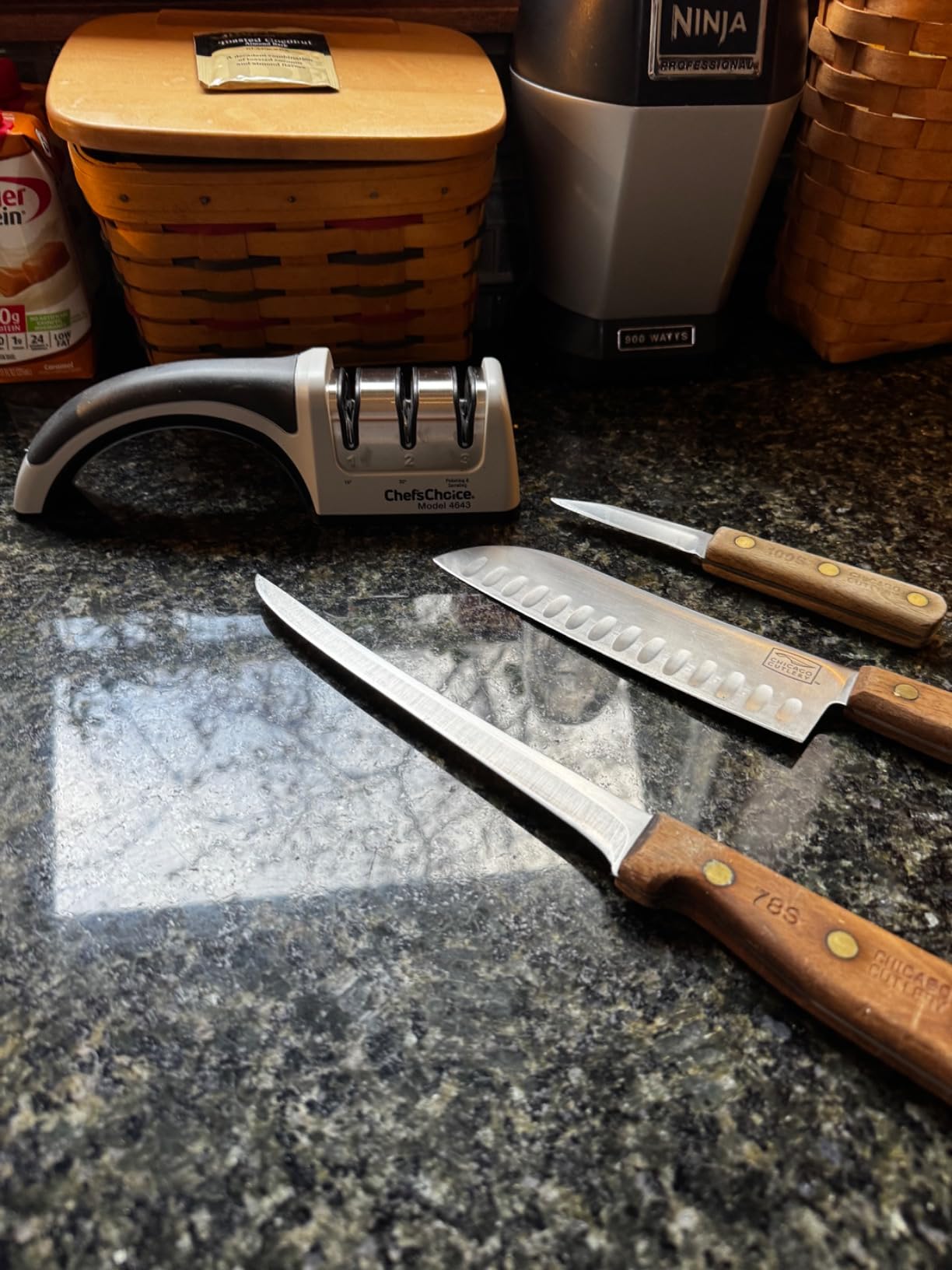
This is the sharpener for people who have already made the mistake forum regulars warn about, namely pulling a 20 degree knife down to 15 and losing steel they can never get back. The angle selector here lets you pick the bevel that matches your knife instead of guessing.
On serrated knives the reason to want angle control is different but just as real. Holding the blade at a fixed angle while a diamond abrasive touches the tooth tips keeps you from grinding the shoulder of each tooth as you draw through, which is the usual way a serrated edge gets wrecked.
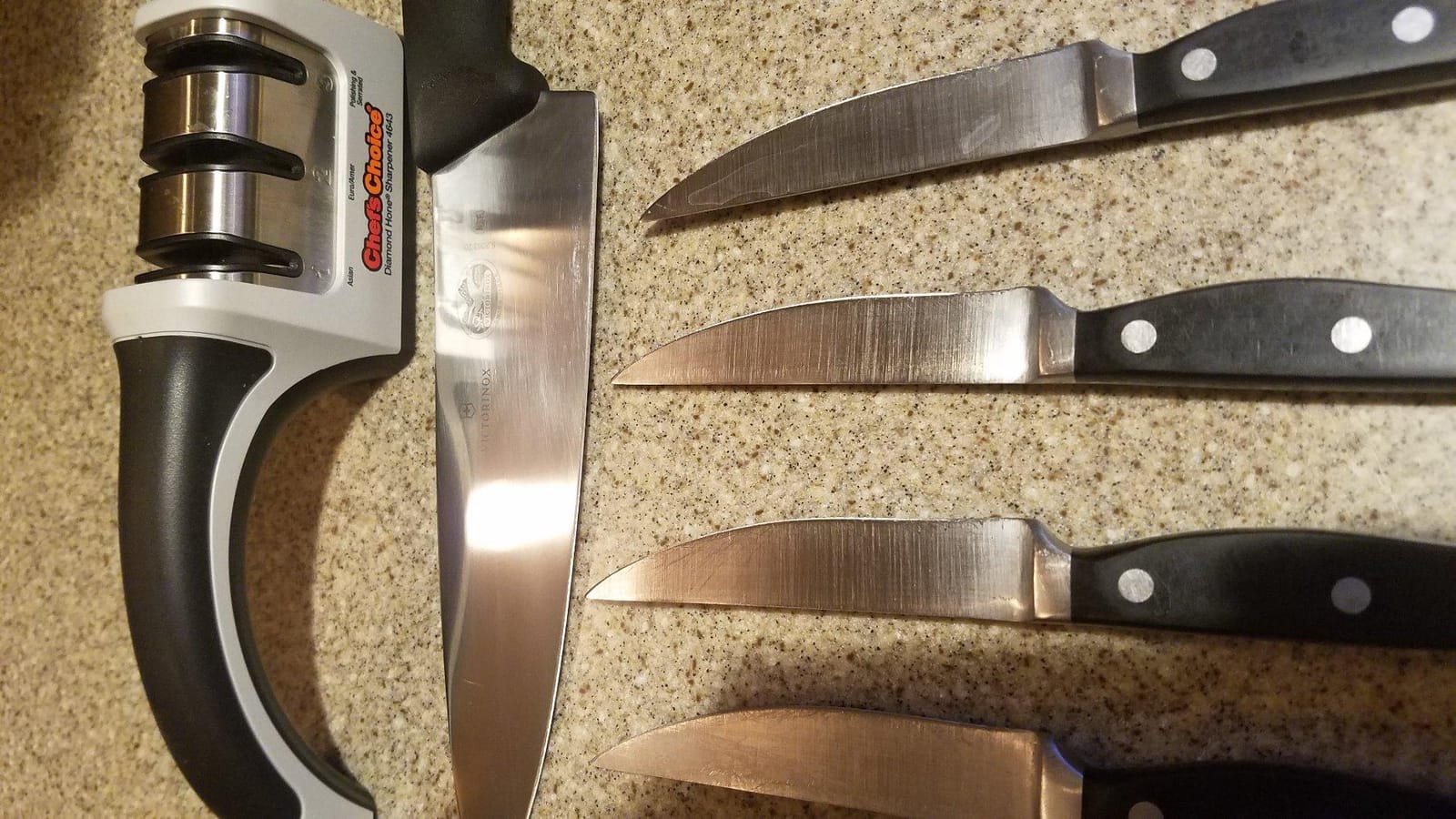
The CrissCross technology produces an arch-shaped edge rather than a flat bevel, and on serrations that arch means each tooth point is contacted across its width instead of at one corner. Users with Japanese knives rate it well for that reason.
It is all plastic and 8 ounces, with a soft touch handle that is comfortable over a long session. The 10-year warranty is the longest in this roundup and tells you what the manufacturer expects of the mechanism.
Is it worth paying more than a pull-through model
If you own mostly straight-edge knives, absolutely. The angle selection and the arch geometry do something a fixed-slot sharpener physically cannot, and the diamond media outlasts carbide blocks by a wide margin.
For serrated work specifically, the value drops. Two stages means no serration-specific stage, so you are using the same diamond surface that works on plain edges and simply applying lighter pressure per tooth. That works well, it is just not the specialised tool a tapered rod would be.
Where the extra spend goes
The money buys diamond abrasive, precise angle geometry and a decade of warranty. It does not buy you serration specialisation, and if serrations are the majority of your sharpening work, put that budget toward a tapered diamond rod instead and save this one for the straight edges.
Manual effort is also real. On a 10 inch blade you are moving it by hand for the full length, and there is no motor helping you keep a steady pace.
6. Wamery Retractable Diamond Rod – Best for Outdoor Use
Wamery Serrated Knife Sharpener, Retractable Diamond Rod Pocket (Black)
- Cone shape fits many serration sizes
- Retracts for safe carry
- Also restores straight edges
- Very light at 1.12 ounces
- Short rod limits stroke length
- Coarse grit only
- Small size needs a steady hand
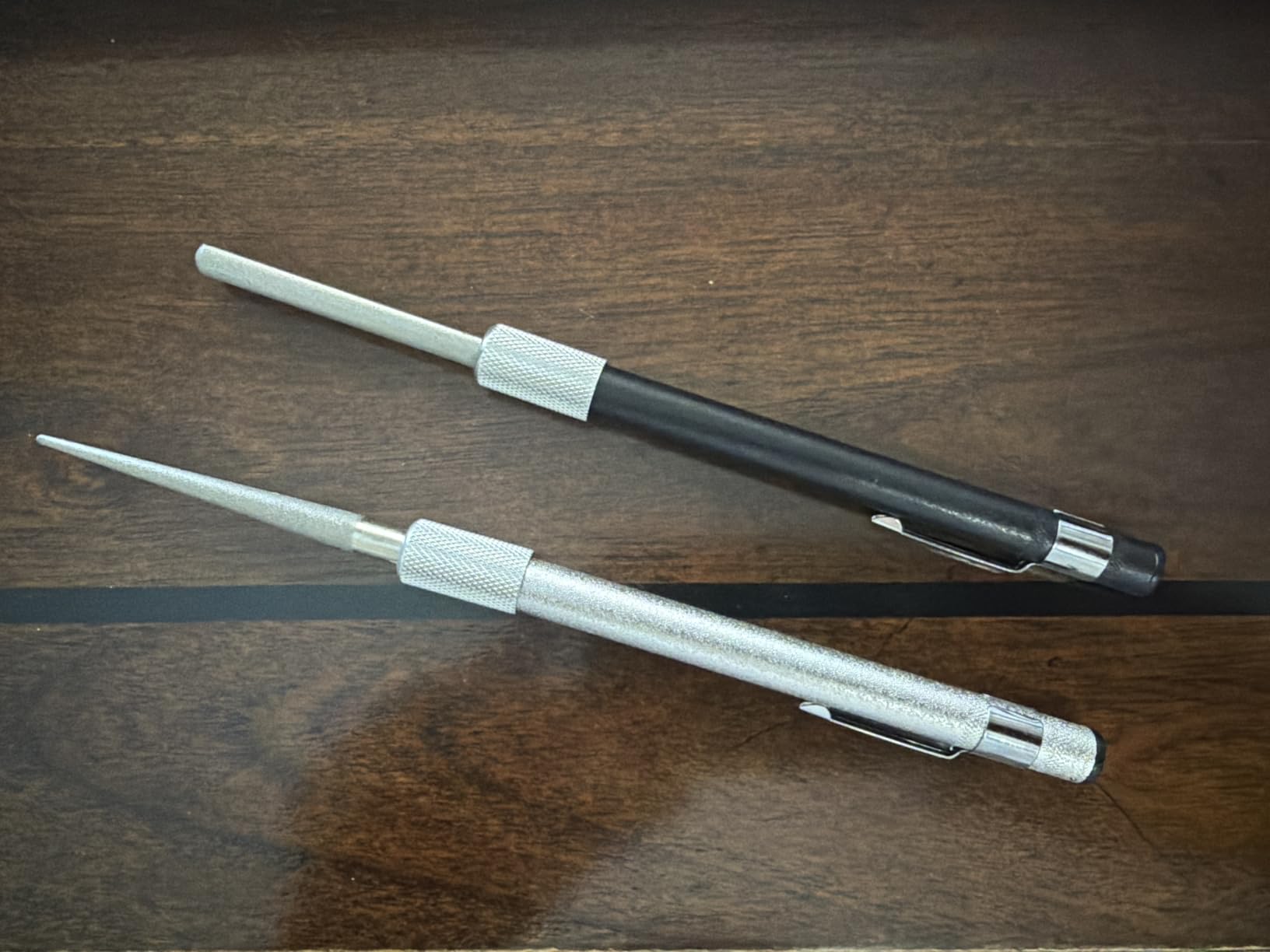
A tapered diamond rod is the honest answer to how serrated edges were meant to be maintained, and this is the compact version of it. The cone narrows as it runs down the blade, so the wide base works on the deep scallops near the heel and the tip reaches the tighter gullets closer to the point.
Hold the blade at roughly 30 to 45 degrees to the rod and draw it through two or three times per side. You are removing the burr on the flat of each tooth, not reshaping the tooth itself. Two or three passes is genuinely all it takes.
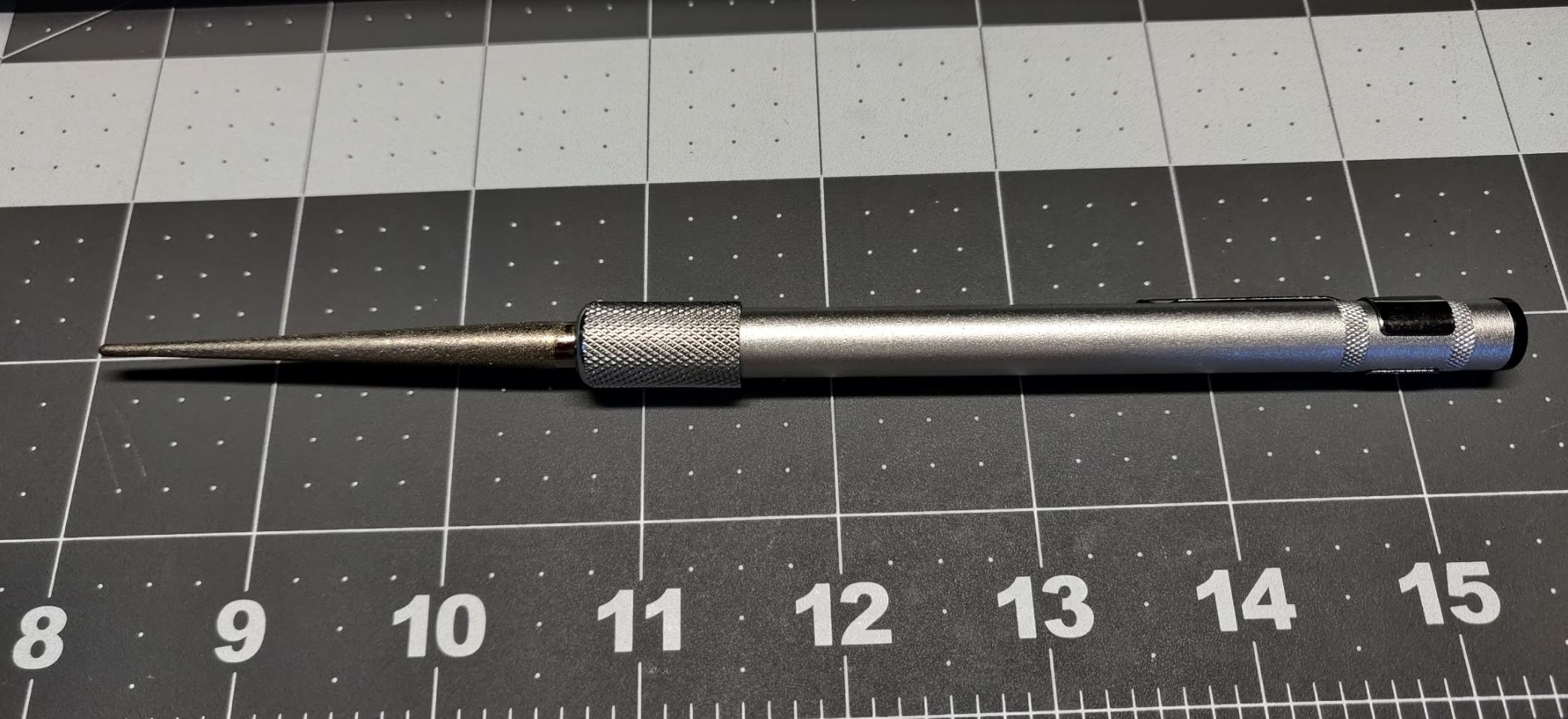
The retractable body is the reason this one earns a place in a bag rather than a drawer. The rod disappears inside the handle, so nothing diamond is exposed when you are reaching for a knife in a pack. It weighs 1.12 ounces, which is nothing, and the whole unit is smaller than a tube of lip balm.
It is also a genuinely two-sided tool. Turn it around and the flat half-round section handles plain edges and even scissors, so a single small object covers most field sharpening needs.
Does it handle scalloped and micro-serrated alike
That tapering cone is the whole trick and it works across both. Scalloped bread knife gullets are large and shallow, so you work the upper half of the cone. Micro-serrated folding knives have narrow gullets that want the narrow tip end, and a rod with a constant diameter simply cannot make that transition.
Gut hooks and recurve blades sit in the same category, and the tapered shape reaches them without changing tools. Users who fish and hunt report this as the one item they stop leaving at home.
Where it struggles
Length. The rod is short, so on a full length bread knife you are working in small overlapping sections rather than one clean stroke, and that takes patience. On a 3 inch folding knife it is flawless.
There is also only one grit. A knife that has been neglected for years may need coarser work first, and this rod will not get you there on its own.
7. DMT Diafold Serrated Sharpener – Best for Fine Control
Diamond Machining Technology (DMT) Diafold Serrated Diamond Knife Sharpener, Fine (FSKF), 4″
- Made in USA with fine diamond media
- Folds to protect the diamond plate
- Works dry or with water
- Doubles as a gut hook file
- Plastic hinge handles reported as flimsy
- Fine grit only for very dull edges
- Shorter rod than a kitchen sharpener
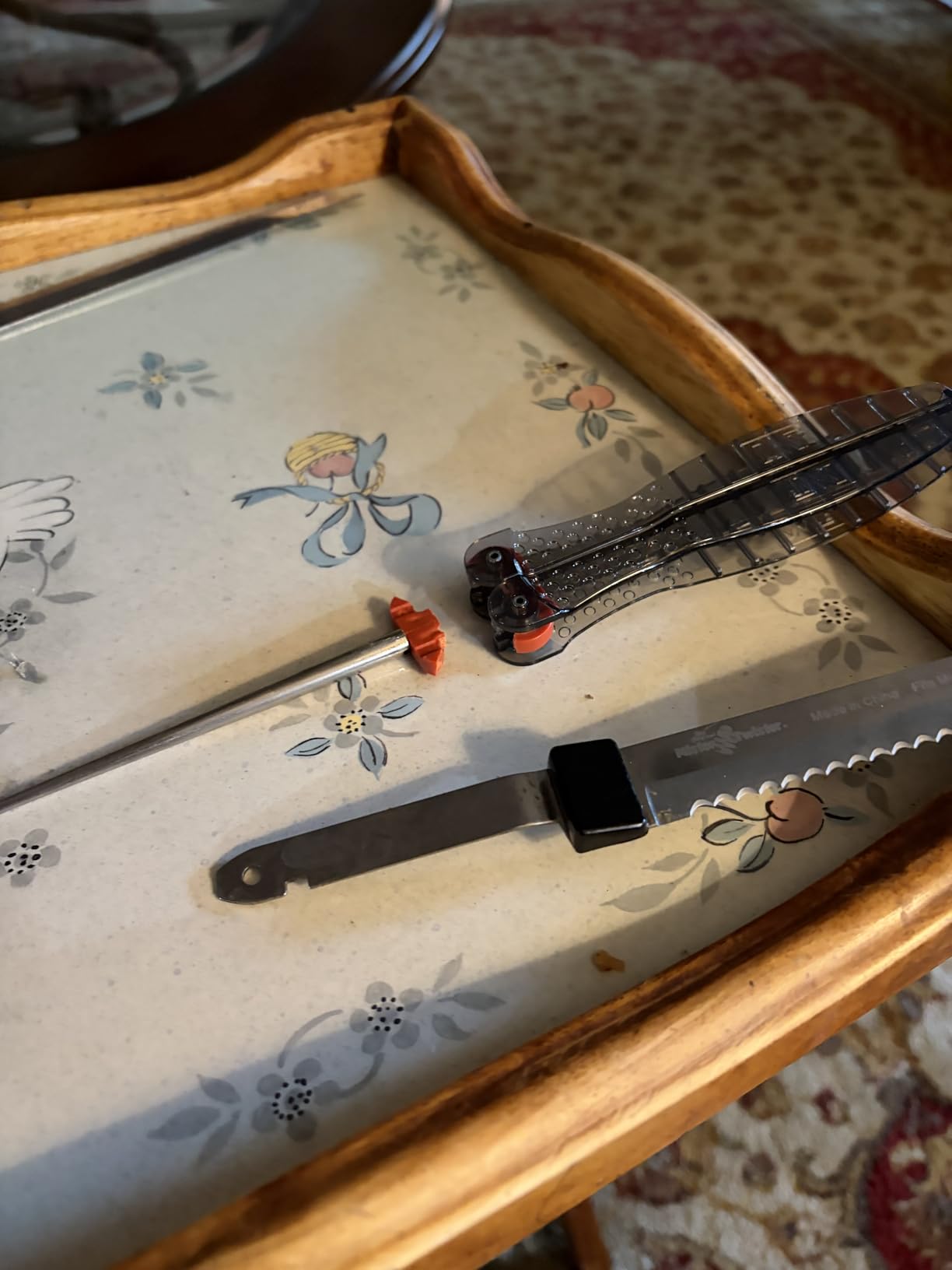
When a serrated knife needs to come back to life properly, this is the tool. The cone runs a full 4 inches and tapers from a quarter inch down to a sixteenth, so a single pass gives you control from the widest scallop to the narrowest gullet on the same blade.
The abrasive is fine diamond at 25 micron, roughly 600 mesh equivalent. That means it polishes as it sharpens rather than grinding, which means it barely removes any steel. On a folding knife worth caring about that is the difference between a knife that survives the repair and one that loses its geometry.
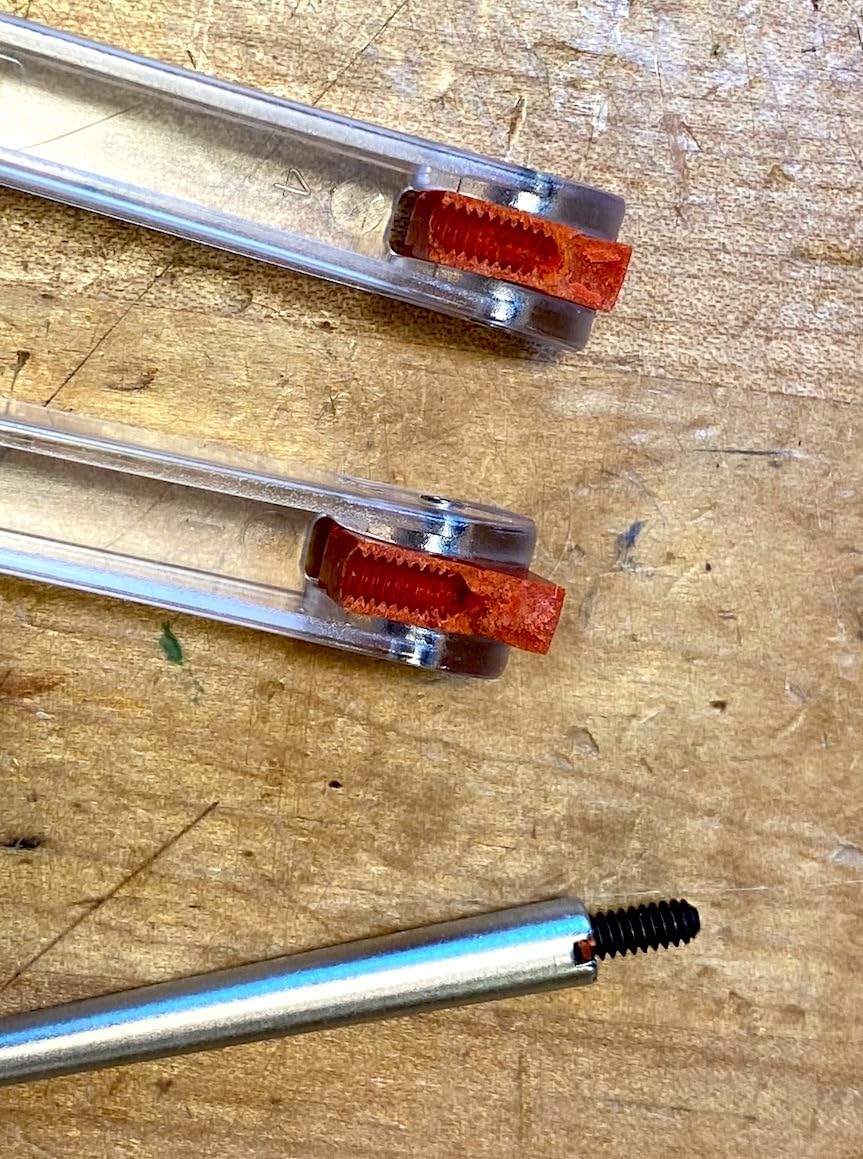
The fold-and-go handles close around the diamond plate so it is not exposed in a drawer or a pack. Open it measures 9.5 inches, closed it is 5 inches, and at 18 grams it disappears into a pocket. You can work it dry or with water, no oil needed.
It is not only for knives. The same cone works on gut hooks, and users treat it as a general conical file for small tools. Made in the USA, and customer service is praised for replacing worn plates.
How it compares to a generic diamond rod
Longer taper, finer grit, and it folds away. A generic rod is usually a short fixed-diameter stick, which means it either sits too wide for micro-serrations or you have to change tools to reach them. This one covers the range in a single pass.
The difference shows most clearly on expensive folders. Because the diamond is fine and the taper is long, you can restore each tooth tip without touching the shoulder, and the edge comes back crisp rather than merely functional.
The weak point to know about
The plastic hinge handles are the most common complaint in the reviews. They can feel flimsy and some users report cracking after heavy use, so treat the fold as a storage feature rather than something to lever against.
Fine grit only is the other limitation. On a badly dull serrated blade the plate will glaze before it cuts, and you will need a coarser stage first, which this product does not include.
8. Fino Edge Retractable Diamond Rod – Best for Pocket Carry
- Pocket clip keeps it on a lanyard or in a pocket
- Tapered end for serrations and flat end for plain edges
- Also sharpens hooks and nippers
- Small enough to carry daily
- Very short rod limits stroke length
- Fine grit only
- Instructions could be clearer
This diamond rod handles pocket knives and small utility knives properly. The 400-grit mono-crystalline diamond coating is a real abrasive rather than a plated imitation, and the tapered end fits serrations while the flat end handles plain edges.
Users who keep it on a lanyard or in a pocket report using it constantly, because the fix takes fifteen seconds and needs no workspace. Draw the blade along the taper two or three times per side at a shallow angle and the tooth tips come back.
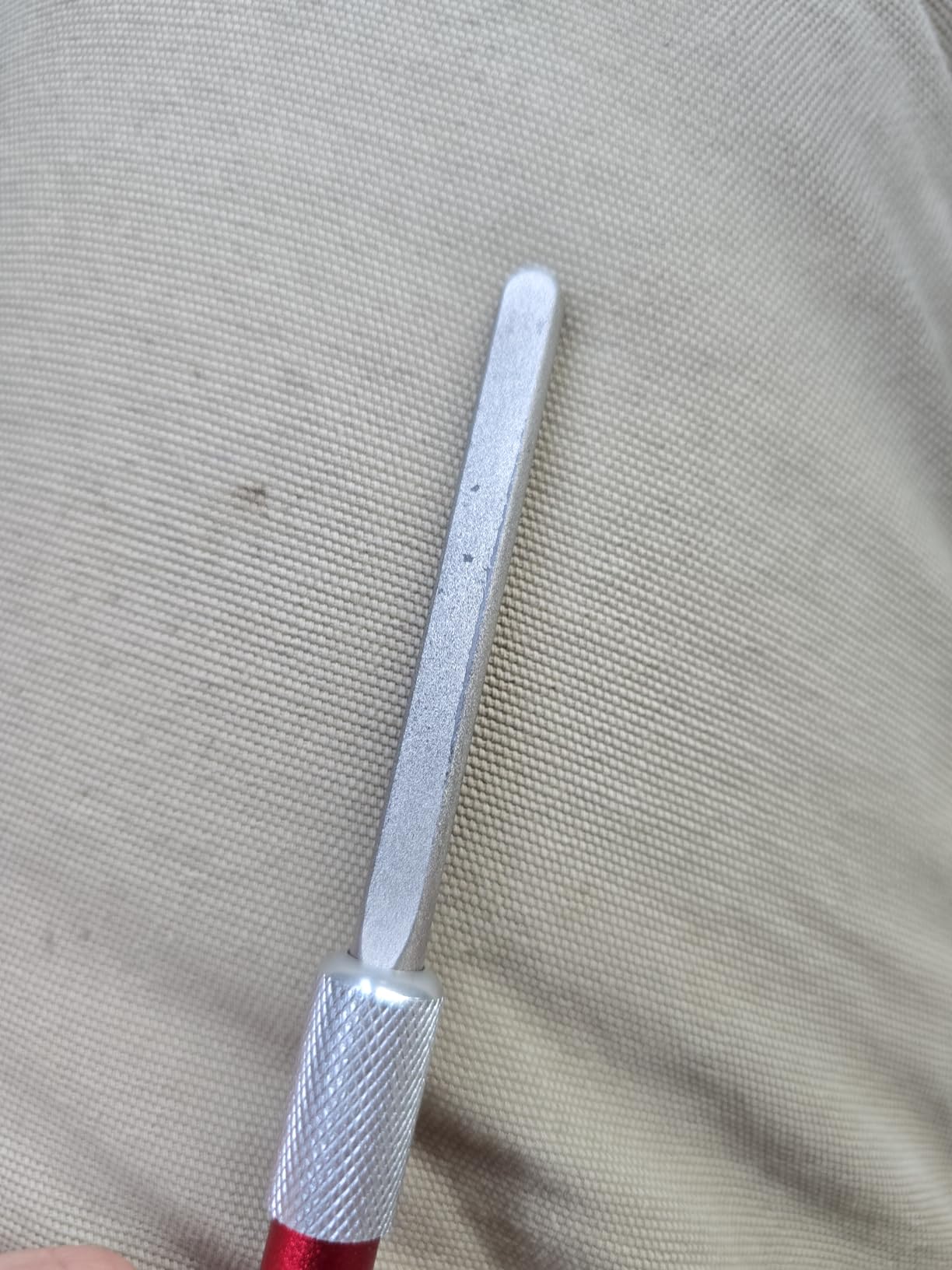
The retractable design with a pocket clip means the rod is not exposed when you are digging through a bag, and the adjustable length lets you pull it out to the position that suits the stroke. It also works on gut hooks, cuticle nippers and nail clippers, which makes it more than a knife tool.
At 5 inches overall it is small enough to genuinely forget you are carrying it, which is the entire point of a pocket sharpener.
What works best with it
Short serrated blades. Folding knives, small utility knives, hook knives and nippers are all jobs this rod can finish in a few seconds because the stroke length matches the tool. The same qualities that make it portable make it awkward on anything larger.
It is also a good backup even if you own a bigger sharpener. Having one in the bag means a dull blade gets fixed immediately instead of waiting until you get home.
Where it is out of its depth
A long bread knife defeats it. With a 5 inch body the rod barely covers the working section, so you end up making many short overlapping passes, and on a scalloped edge that is tedious and uneven. Buy a longer tapered rod for kitchen blades.
The instructions are thin on technique, which matters with a tapered rod because the angle is entirely in your hands. Budget a few minutes of practice on a cheap knife first.
9. Siyurongg Pen-Style Diamond Rod – Best for Small Tools
- Handles knives scissors hooks and needles
- Slips into any pocket or kit
- Pocket clip keeps it from rolling away
- Useful for craft and sewing tools
- Too short for large kitchen blades
- Fine grit only
- Quality control varies between units
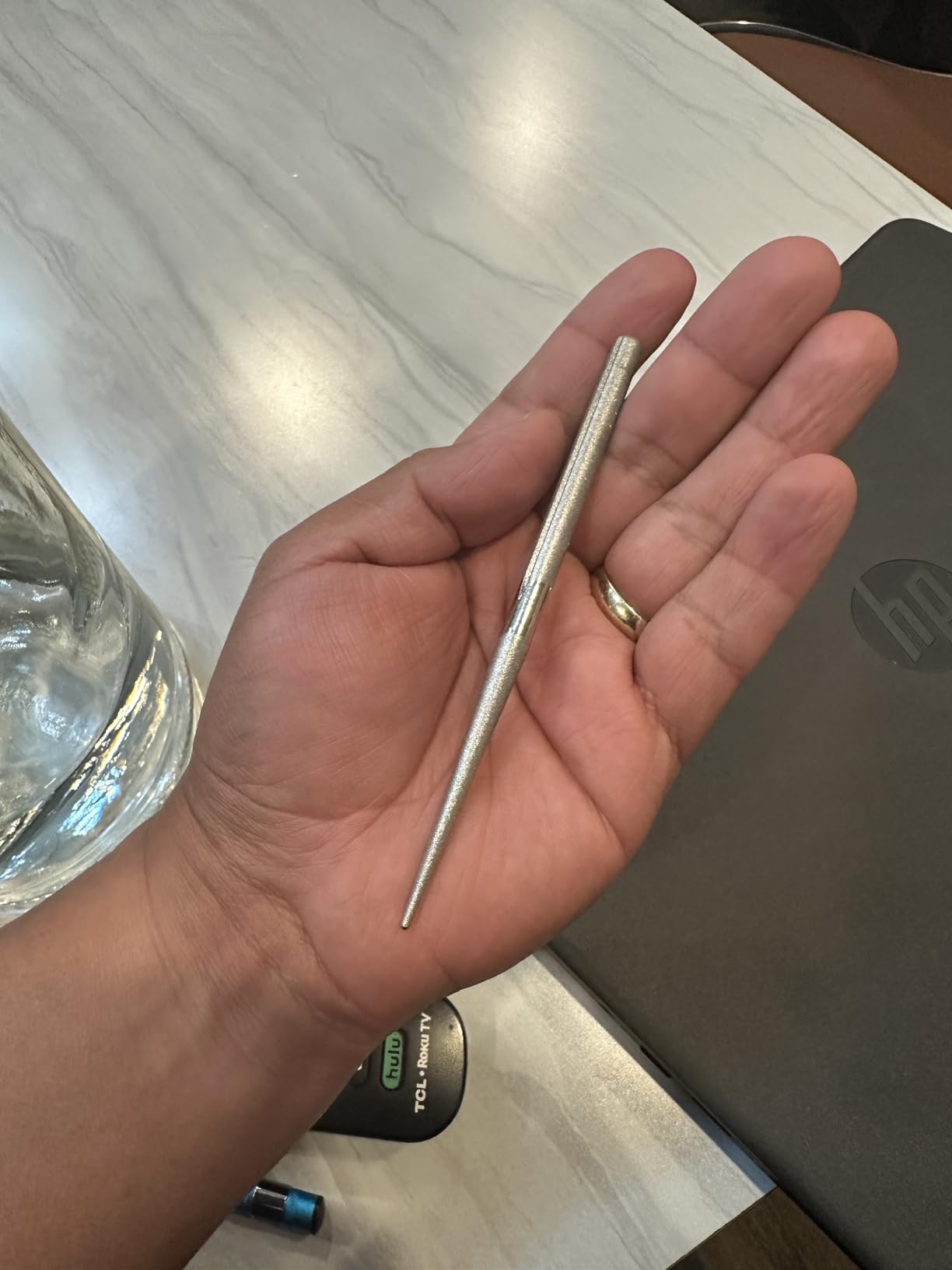
The pen form factor is the selling point. It is 4.92 inches long and barely wider than a marker, so it lives in a sewing kit, a tackle box or a laptop sleeve and nobody will ever notice it. The retractable rod and pocket clip keep the abrasive protected in transit.
The fine diamond coating handles serrations the same way any tapered rod does, just on a much smaller scale. Sewing needles, crochet hooks and fish hooks get the added benefit of the grooves machined into the semi-circular surface, which catch the wire and pull it into line as you roll it.
Scissors and small snips are the other quiet win. A pair of craft scissors that has gone blunt will cut paper badly and fabric worse, and a short pen rod reaches between the blades more easily than a kitchen sharpener does.
For the money this is a sensible backup that covers the small stuff nobody bothers to take to a proper sharpener. It will not rescue a neglected blade, but nothing this small will.
Where it beats the other pocket rods
The grooves. On hooks, needles and thin wire the other retractable rods in this roundup do nothing useful, while the machined channels on this one do the alignment work for you. If your small tools include hooks, that is the deciding factor.
It is also the narrowest of the three, which makes it easier to run along the side of a blade without your fingers crowding the work.
Where it falls short
Size, plainly. This is a tool for serrated pocket knives and small snips, not for a bread knife. On anything longer than a folding blade you will be making a dozen tiny passes with no room to build momentum, and the result is inconsistent.
Quality control is the other variable. Users report that construction varies between units, and the fine grit has no coarse counterpart for a neglected blade.
10. Lansky Fine Hone for Serrated Knives – Best for Refining
- Refines serrations without removing steel
- Ceramic barely wears
- Removes from holder for freehand control
- Works on gut hooks and recurves
- Fine grit only
- Works best inside the Lansky system
- Slow because each tooth is done individually
- Short 3 inch hone
This is a finishing tool, not a rescue tool, and that is exactly why it is on this list. The 1000 grit ceramic is so fine that it removes burrs from each tooth tip and leaves the geometry alone. On an already-sharpened serrated knife it brings back slicing action without touching anything you would miss.
The triangular profile is the serrated-specific detail. A flat hone only touches the center of each tooth, whereas the triangle contacts the full width of every tooth point as you draw the blade through, so all the points end up at the same length.
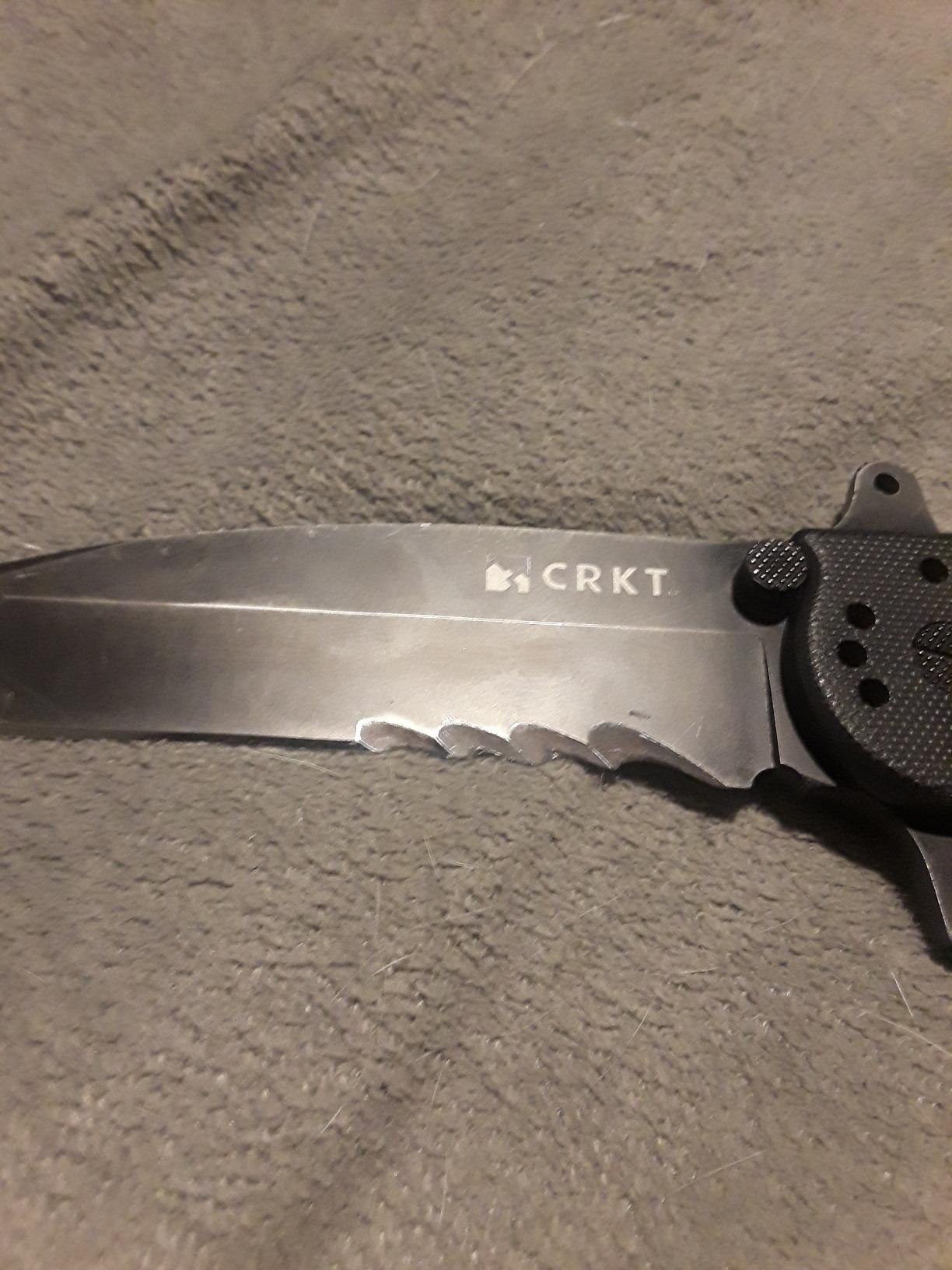
It pulls out of the holder so you can use it freehand, which is how most people use it. In the holder it fits the Lansky system and benefits from the fixed angle, and both approaches work, though the holder gives more consistency on straight edges.
Ceramic that fine barely wears, which means it stays effective for years. Gut hooks, recurve blades and detail knives are all named uses and all benefit from the same fine touch.
Where it fits in your sharpening routine
Use it after a coarser tool has done the work. A medium diamond rod resets the tooth tips, then this hone refines them and removes the remaining burr. Skip straight to the hone and you will be working a dull blade with an abrasive too gentle to cut.
For a bread knife that is already in decent shape and just feels a bit lazy, this alone is often enough. The whole job takes a couple of minutes.
Why it is not a first purchase
If you own nothing in this category, a tapered diamond rod is the better first tool because it sharpens as well as it refines. This one is a companion piece, and buying it first means you will end up working hard material with a hone that was never meant for it.
It is also slow by nature, because each serration has to be worked individually, and at 3 inches the hone covers a short stretch of blade at a time.
11. Work Sharp Ceramic Honing Rod – Best for Routine Honing
Work Sharp Kitchen Ceramic Honing Rod – Angle Guided – For Chef, Santoku, Paring, & Serrated Knives Black
- Angle guides keep the stroke consistent
- Fine ceramic removes almost no material
- Long rod covers a full knife in one pass
- Rubber tip grips the cutting board
- Hone only
- will not rescue a dull blade
- Ceramic can break if dropped
- Angle guides do not fit every profile
At 15.5 inches this is the longest tool in the roundup, and that length is the feature. You can lay a full length bread knife or chef’s knife against the rubber tip and work the whole blade in one continuous stroke rather than resetting a short rod every few inches.
The built-in angle guides are the reason it works on serrations. Without them the tilt wanders, you touch the tooth shoulders, and the edge gets uneven. With them the blade sits at a repeatable angle and the ceramic lands on the tooth tips instead.
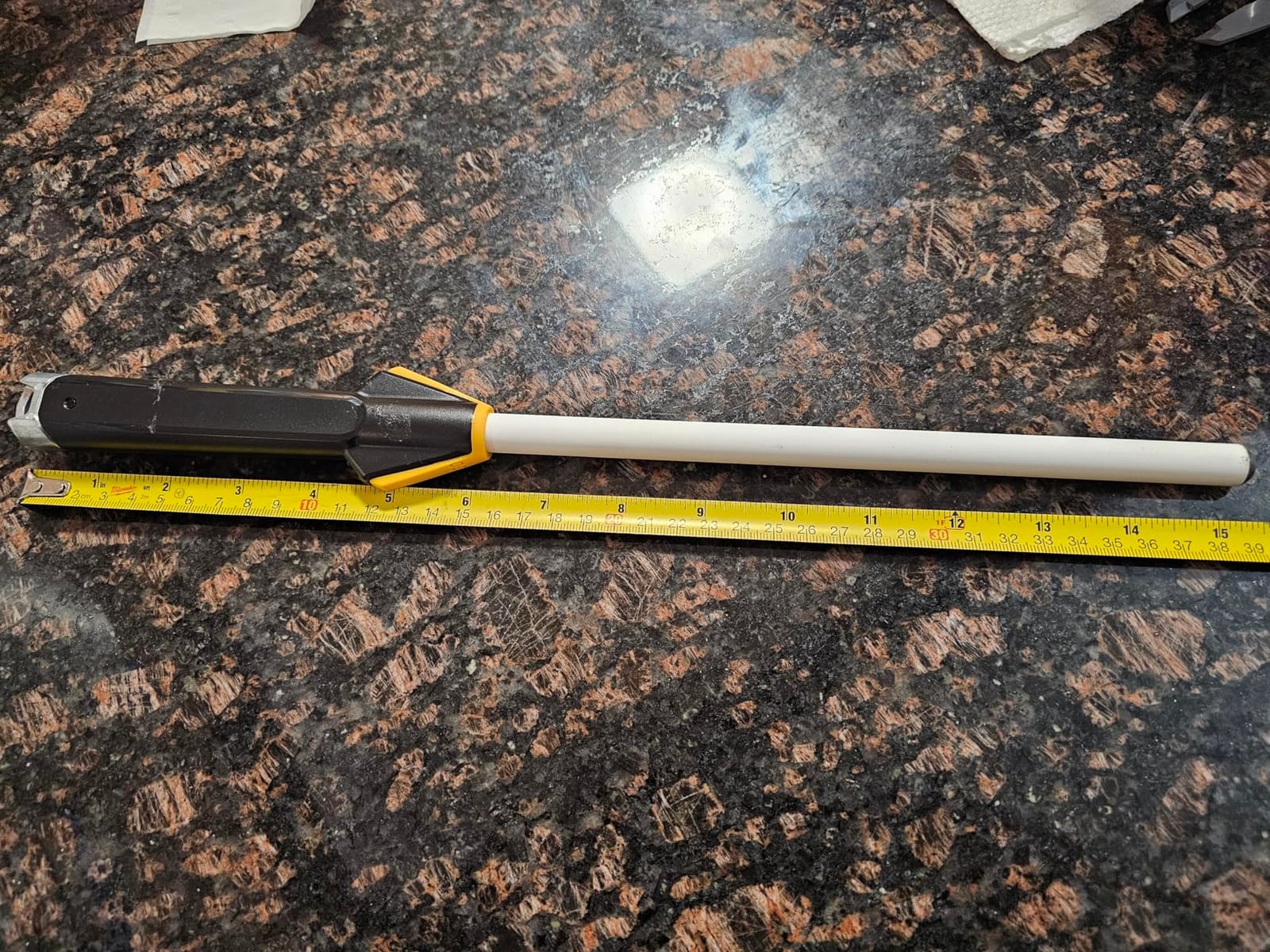
It is a hone, not a sharpener, and users are clear about that. On a knife that is already sharp it keeps it that way between sessions. On a genuinely dull blade it will not save you, because fine ceramic has no bite left in it for hard work.
The rubber tip sits flat on a cutting board and stops the rod from rolling, which is the kind of small detail that decides whether a honing rod gets used daily or lives in a drawer. The lanyard hole means it hangs by the grill rather than disappearing.
How it handles a serrated bread knife
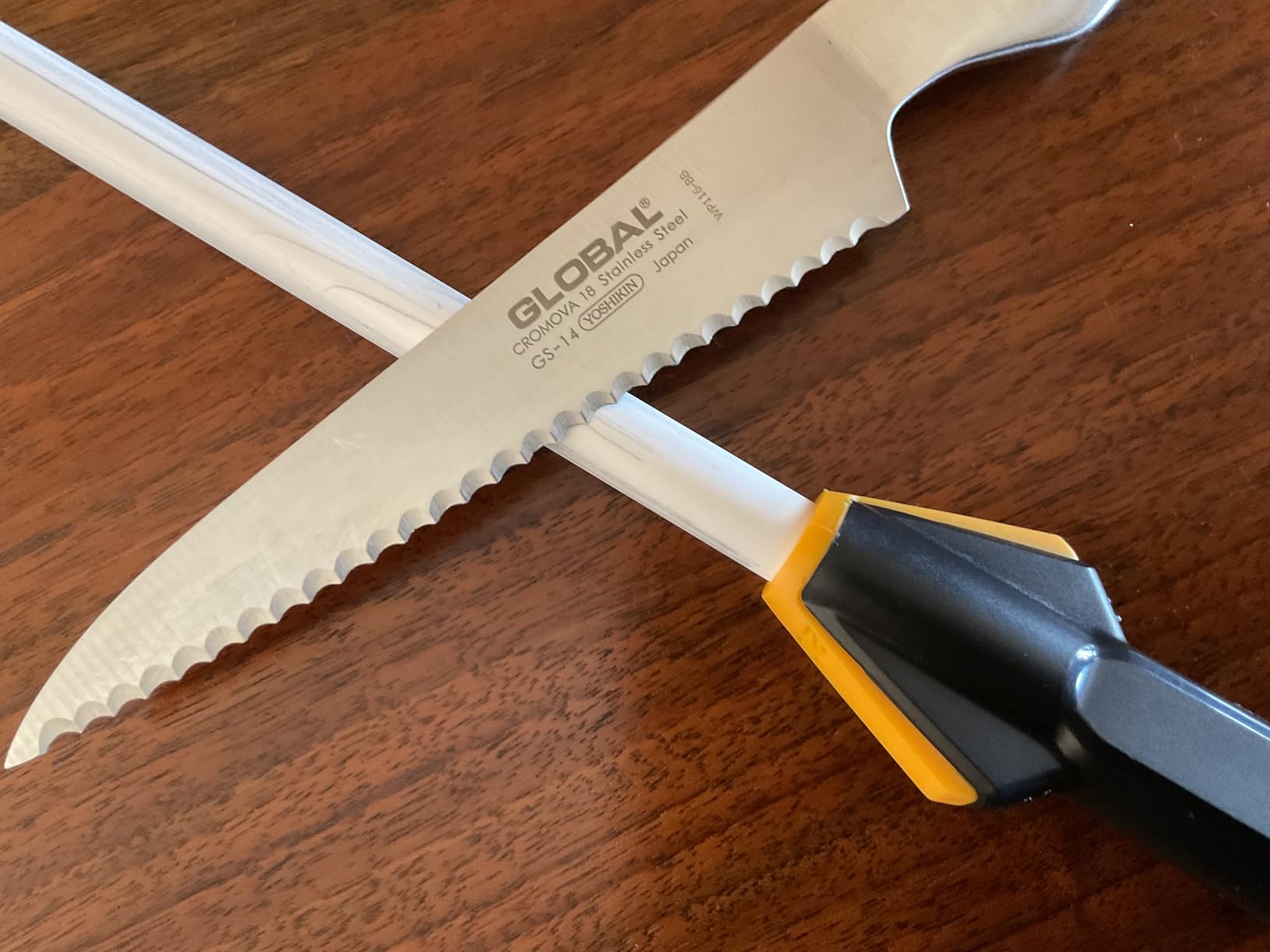
Draw the blade down the rod at a consistent angle and the fine ceramic removes the burr from each tooth tip without touching the gullets. The guides keep the tilt steady, which is the single thing that separates a good serrated honing pass from a random one.
Because the rod is 15.5 inches, a full length bread knife gets a single clean pass per side rather than four or five partial ones, and that consistency is where the result improves.
What it will not do
Rescue a neglected blade, full stop. If a knife has already torn through a cardboard box, this rod will not fix it, and users who expected it to are the source of most of the negative feedback in its reviews.
Two smaller cautions: ceramic is brittle and will not survive a drop onto stone, and the angle guides are shaped for common Western knife profiles rather than every single edge geometry.
12. Croco Dial 5-in-1 Sharpener – Best for Multi-Tool Care
Croco Dial 5-in-1 Knife Sharpener for Straight & Serrated Knives
- Covers serrated knives and scissors in one tool
- Rotating heads are quick to change
- Non-slip grip pads steady the tool
- Pouch keeps it together
- Lowest rating of our picks at 4.0
- Results need many passes to match a knife angle
- No published angle specification
- Polish stage may not pass a fingernail test
The rotating dial is a nice idea. Five heads cover straight edges, serrations and scissors, and turning the dial to step one, two or three is faster than working out which slot to use on a multi-stage block sharpener.
Step one restores a dull blade, step two sharpens, step three polishes, and the tungsten carbide and ceramic media do a reasonable job on kitchen knives. On serrations it works, though it takes more passes than a dedicated tapered rod and the results are less even.
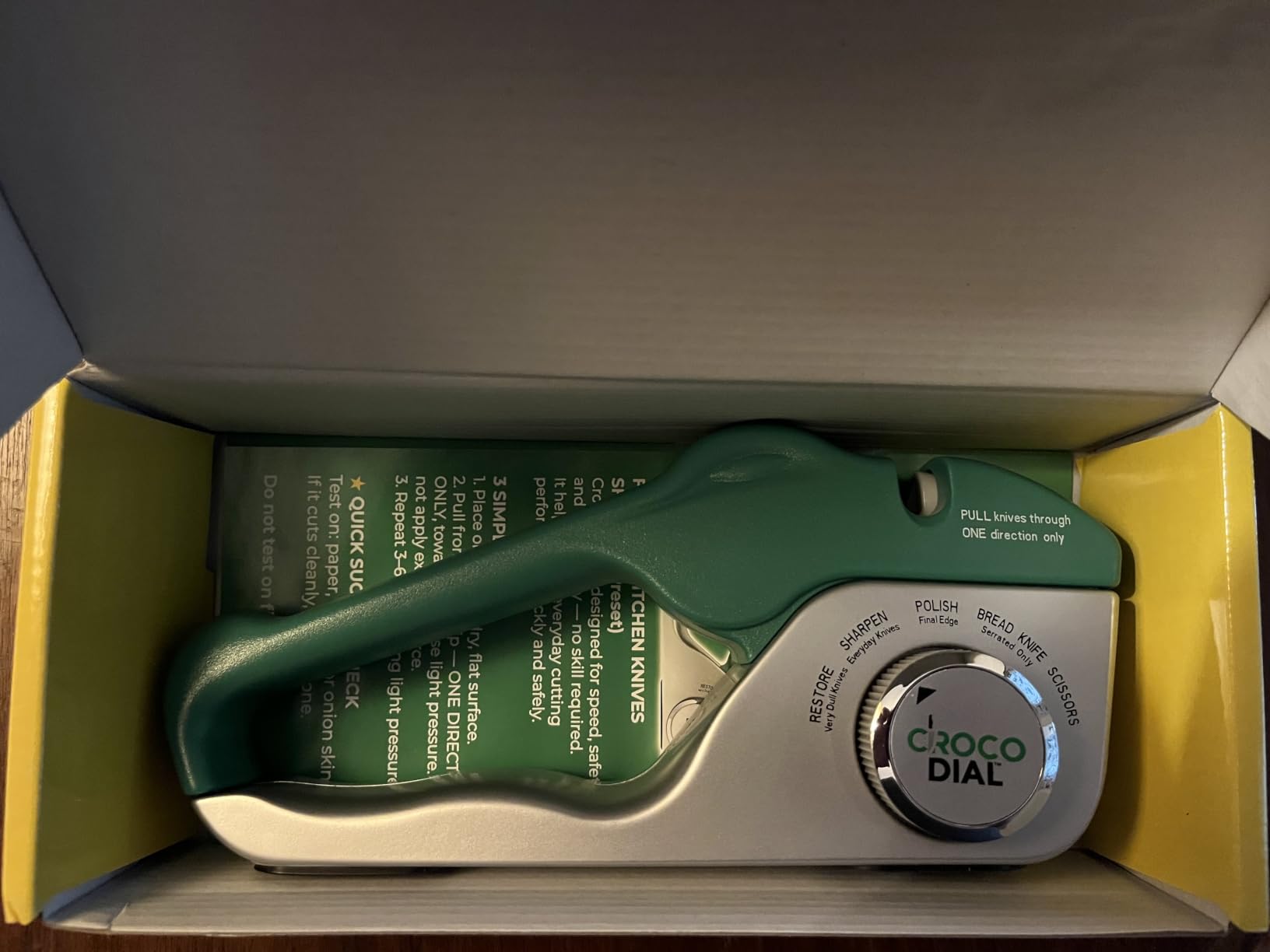
Scissors are where this one earns its slot. Most kitchen sharpeners treat scissors as an afterthought, and having a dedicated rotating head for them at this level of build quality is a genuine convenience for a mixed household.
It comes with a storage pouch, which matters for a tool whose heads rotate freely, and the non-slip grip pads keep it steady on a wet counter.
Does the serrated head do real work
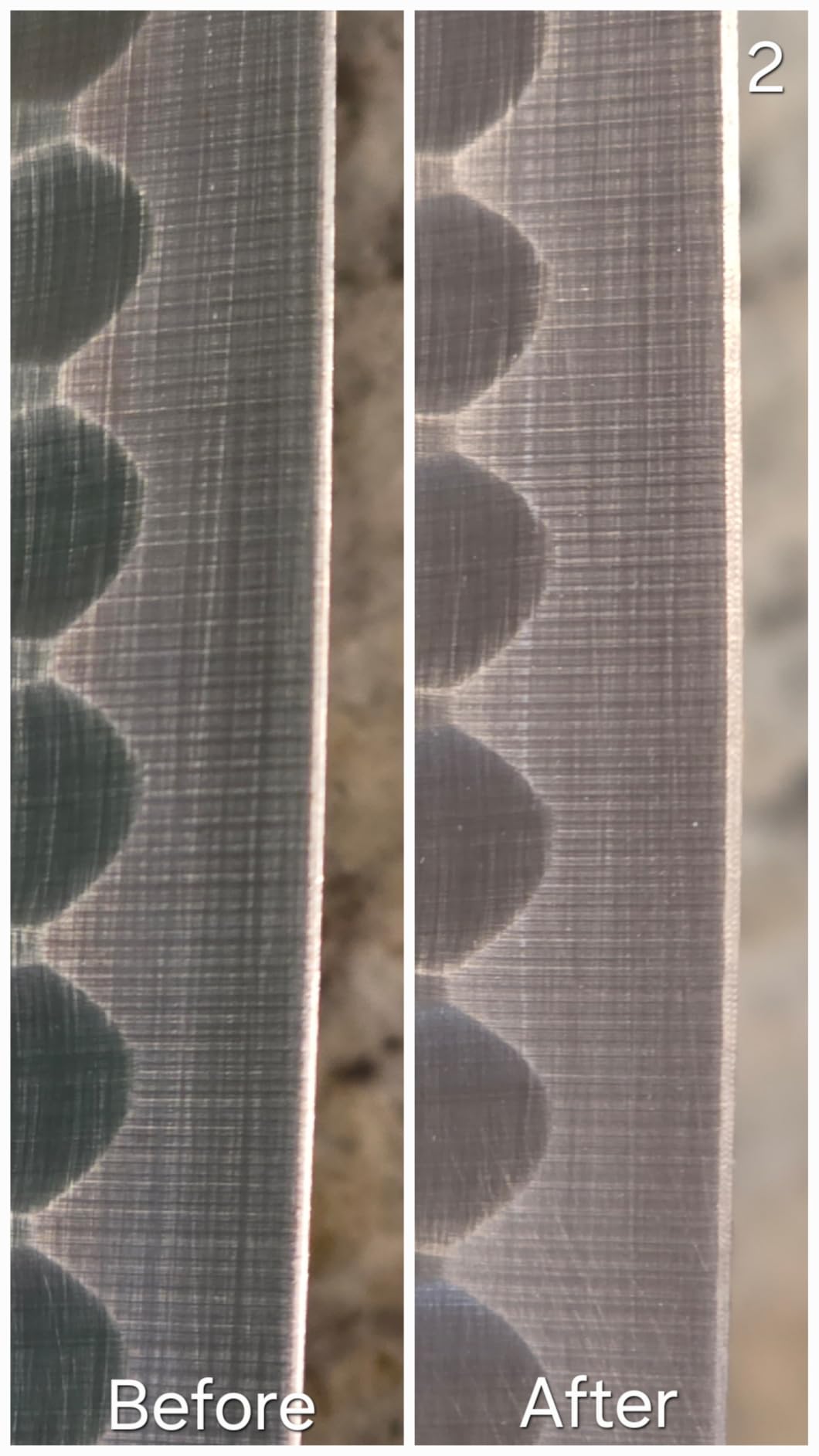
It does, but it is the weakest of the five. Users report needing many more passes than with a dedicated rod and no consistent angle specification, which means results depend more on your hand than the tool. For routine touch-ups on a kitchen serrated knife, that is acceptable.
For a fine folding knife we would not rely on it, because without a defined angle the risk of touching the tooth shoulders is much higher than with a tapered cone.
Why it sits at the bottom of the ranking
Its 4.0 rating is the lowest of the twelve and the reviews explain why. Several owners note it is only marginally effective compared with the dedicated tools, and that you have to work at it repeatedly to match the angle a controlled sharpener would have set in one pass.
It is a broad household tool rather than a specialist one. If your list of blades is mostly serrated kitchen knives and a pair of scissors, it covers the range. If serrated knives are the priority, a tapered rod will serve you better for a fraction of the space.
How to Sharpen a Serrated Knife Step by Step
The technique matters more than the tool for serrations. Work through these steps slowly the first few times and the repair takes minutes rather than ruining a blade.
Step 1: Clean the blade first. Food particles and dried residue sit in the gullets and you will be grinding that debris into the steel. Rinse the blade under hot water with soap and dry it completely.
Step 2: Check whether you actually need to sharpen. Run a thumbnail lightly across the tooth tips, not down into the gullets. A fresh serrated edge catches and skids on a thumbnail. A dull one slides over it with no resistance, and the blade will skid through a tomato rather than cutting into it.
Step 3: Set your angle. Hold the blade at roughly 30 to 45 degrees to the rod or slot surface. You are touching the flat of each tooth tip, not the shoulder of the tooth. Too shallow and you round the tips off, too steep and you grind the shoulders.
Step 4: Work in small overlapping strokes along the full length. Two to four passes per side is plenty. On a long tapered rod you start near the heel where the cone is widest and move toward the tip as the cone narrows.
Step 5: Reduce pressure as you finish. The last stroke on each side should be light enough that you can feel the blade moving without resistance. That final light pass is what removes the burr.
Step 6: Hone if you want more. A 1000 grit ceramic hone takes off the remaining burr and leaves the tooth tips polished rather than toothy. This is optional, and it is the difference between a blade that cuts and one that feels finished.
Step 7: Wipe and test. Wipe the blade clean with a damp cloth, then dry it. Test on a piece of paper or the skin of a tomato rather than on skin.
Serration Types and the Tool That Handles Each One
Not all serrations are the same, and matching the tool to the pattern is where most people go wrong. The patterns below cover almost every serrated knife you will meet.
Scalloped serrations. The deep, rounded gullets on bread knives, steak knives and many traditional patterns. Because the gullets are wide, a coarse stage will bridge them and only touch the peaks, so the best tool is one with a wide opening. A tapered diamond rod with its wide base, or a dedicated serration slot, handles these well.
Micro-serrated edges. Many folding knives carry fine, shallow serrations that look like texture until you run a thumb across them. A wide slot simply cannot reach into the gullets, and the points between teeth get rounded instead of sharpened. A tapered rod using its narrow tip end, or a fine ceramic hone with a triangular profile, is the right answer here.
Wavy and hollow-ground serrations. Gentle waves rather than sharp teeth, common on modern kitchen knives. These need the least pressure of all, because the wave peaks are already points and a coarse abrasive will simply flatten them. Light passes with a fine diamond or ceramic are enough.
Gut hooks. The inside curve of a gutting knife is not a serration at all, and an electric wheel will not touch it. A long tapered rod or a conical file is the only practical option, which is why both the DMT and the Fino Edge in this roundup get described as gut hook sharpeners.
How to Choose a Serrated Knife Sharpener
Once you know which serration pattern your knives carry, the buying decision gets much faster. These are the factors that separated the twelve tools above.
Match the mechanism to the serration. A tapered diamond rod is the most adaptable thing you can own because one cone covers wide and narrow gullets on the same blade. A dedicated serration slot is faster on kitchen bread knives but has a fixed opening. A pull-through cartridge with no serration slot will round your tooth tips, however good it is on plain edges.
Decide between sharpening and honing. These are different jobs. Sharpening removes material to reshape a dull edge. Honing straightens an edge that is already there. A ceramic hone like the Work Sharp rod is a maintenance tool and will not rescue a neglected blade, while a diamond or carbide stage will. Buying the wrong one is the most common complaint in the reviews of the products in this roundup.
Look at the abrasive, not the brand. Diamond wears slowly and cuts cleanly at fine grits, which makes it the best choice for serrations where steel loss matters. Tungsten carbide is tougher and cheaper and works well in pull-through cartridges. Ceramic is the hardest and least aggressive, so it is a refining medium rather than a sharpening one. Steel rods sit at the bottom for serrations because they barely remove burrs at all.
Work out how much steel the tool takes. This is the number one thing forum users care about, and it is easy to overlook. Coarse carbide removes a lot, a fine diamond removes almost nothing, and electric machines remove more than either. Check the grit rating before you buy, not after you regret it.
Mind the angle question. Sharpening a 20 degree straight edge down to 15 is a common and irreversible mistake. If you own European or Asian knives and expect to sharpen them yourself, a controlled-angle system with a selector is worth the extra cost. If your serrated work is the priority, this matters less because you are working tooth tips, not bevels.
Check the warranty as a signal. The 10-year warranty on the Chef’sChoice manual model and the 3-year warranty on the electric model reflect how long the mechanisms are expected to last. A one-year warranty on a plastic pull-through sharpener reflects what it is. Longer warranty also means the manufacturer expects you to keep the tool, which matters when abrasive is a consumable.
Think about blade length and grit range. Short rods are excellent on folding knives and frustrating on a 10 inch bread knife. Fine-only tools need a coarser companion for damaged edges. Multi-stage sharpeners cover both in one object, at the cost of being harder to learn.
Set aside space and budget for both worlds. Most households own more straight-edge blades than serrated ones, and a knife set that includes a chef’s knife and a santoku needs an angle-capable tool. Our general sharpener roundup covers that side in detail. The tapered rods in this guide handle the serrations.
For hunting and bushcraft blades. If your serrated steel is a field knife rather than kitchen cutlery, portability matters more than stages. Retractable rods like the Fino Edge and Wamery models weigh almost nothing and cover hooks and nippers as a bonus. Our survival knife guide and bushcraft knife picks cover the blades themselves.
Common Mistakes That Ruin Serrated Edges
Almost every complaint we found traces back to one of these, and all of them are avoidable.
Forcing a straight-edge wheel onto a serrated blade. Electric sharpeners with abrasive wheels are built for bevels. Run a bread knife through one and you flatten the tooth tips and grind the gullets shut in one pass.
Trusting the small ceramic slot labelled for serrations. Many pull-through sharpeners ship with a tiny ceramic element advertised for serrated knives that is simply too small and too coarse to reach between teeth. Users who have tried one describe it as doing nothing at all.
Rolling sharpeners on a long serrated blade. A rolling sharpener cannot cover the heel to the tip of a 10 inch bread knife, so it leaves the middle section untouched and the edge uneven.
Shallow V-slots on fine serrations. A slot that is too shallow contacts the tooth shoulders instead of the tips, giving you uneven results on both serrated and plain edges.
Pressing too hard. Serrations need light, consistent passes. Heavy pressure removes steel you cannot get back and leaves a toothy, ragged edge rather than a clean one.
Ignoring the cleaning step. Grinding dried food into the gullets is the fastest way to leave a permanently dull-looking serrated blade.
Converting your straight-edge angle by accident. This one is not about serrations, but it is the most common way people damage good knives while chasing a sharper edge.
Frequently Asked Questions
What is the best sharpener for serrated knives?
A tapered diamond rod is the most reliable option, because the cone narrows from a wide base to a fine tip and fits everything from deep bread knife scallops to tight micro-serrations on folding knives. A multi-stage sharpener with a dedicated serration slot is faster for standard kitchen knives.
Do you need a special sharpener for serrated knives?
Yes, you need a tool that can reach between the teeth. Standard coarse carbide wheels and wide straight-edge slots either bridge the gullets or grind the tooth tips flat. Look for a tapered diamond rod, a dedicated serration slot, or a fine ceramic hone with a triangular profile.
What is the best way to sharpen a serrated knife?
Clean the blade, hold it at roughly 30 to 45 degrees to the rod or slot, and draw it through in two to four light passes per side, working from the heel to the tip. Finish with a lighter stroke to remove the burr, then test on paper or a tomato skin.
What is the best knife sharpener for a serrated bread knife?
For a long bread knife you want either a long tapered diamond rod with a 4 inch cone or a multi-stage sharpener with a dedicated serration slot. Short pocket rods work but require many small overlapping passes across a blade that long.
Why won’t my sharpener work on serrated knives?
Most often the abrasive cannot reach the gullets. Coarse wheels bridge the teeth, shallow slots touch the shoulders instead of the tips, and very small ceramic elements advertised for serrations are too coarse to remove a burr. A tapered rod or a narrow serration slot solves it.
Can you use a pull-through sharpener on a serrated knife?
Only if the cartridge has a narrow serration slot. Many do not, and using them rounds the tooth tips and leaves the edge feeling worse. If your pull-through model has a dedicated serrated channel, use light passes and check the result after every few strokes.
The Bottom Line on Serrated Knife Sharpeners
For most households the AccuSharp is the single tool that solves the problem: fast, cheap, ambidextrous, and it restores bread knives and steak knives in under a minute. Add a tapered diamond rod like the DMT or Wamery model and you can handle anything a serrated edge can throw at you, from micro-serrated folders to gut hooks.
The one rule that holds across all twelve picks is to buy for your serration pattern, not for the sharpener brand. If your blades are scalloped kitchen knives, a dedicated serration slot is fastest. If they include fine folding knives, buy the taper. And if you maintain them regularly with light passes, you will never get into the expensive repair situation. That is the short version of the best knife sharpeners for serrated knives, updated for 2026.