
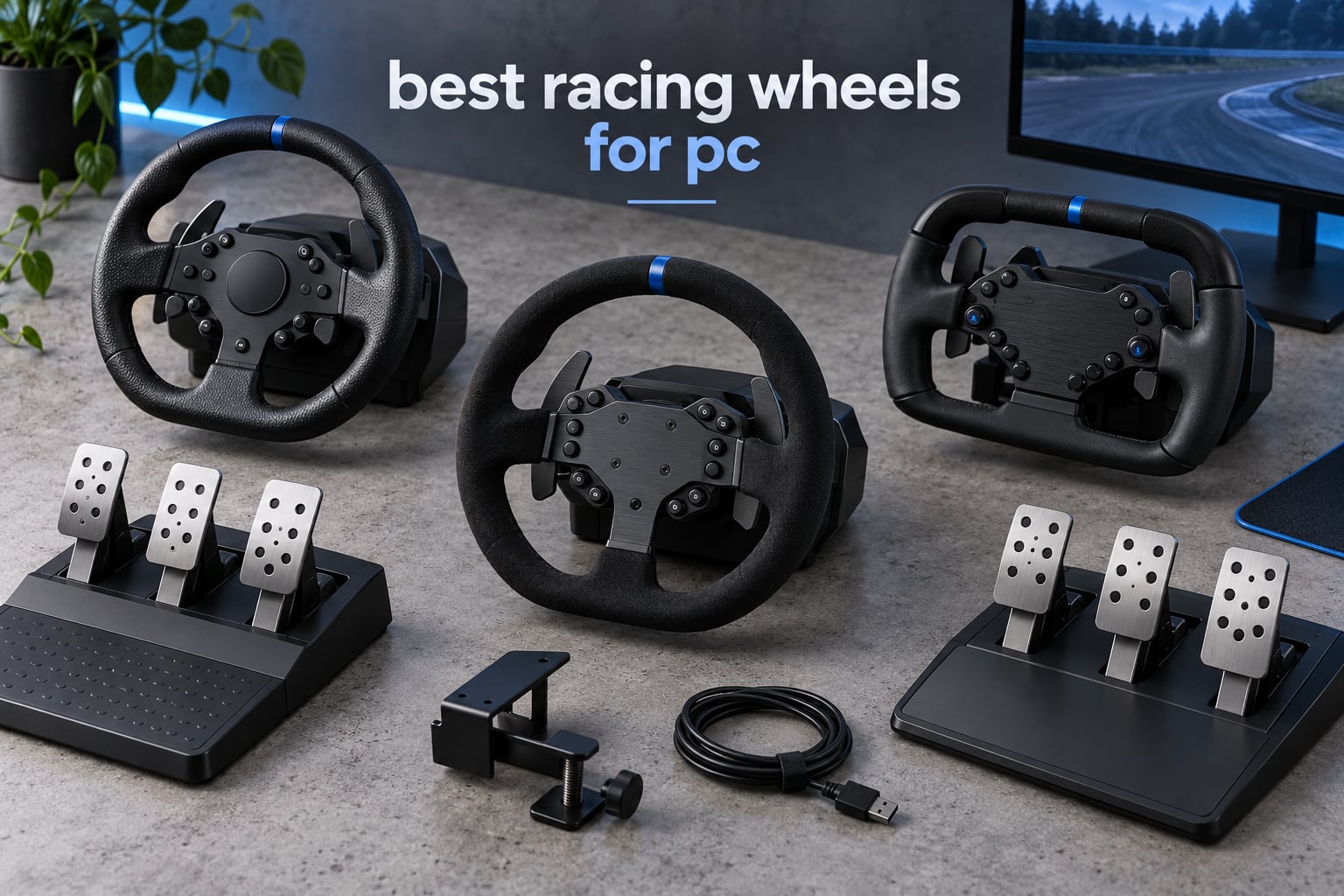
The best racing wheel for PC right now is the Logitech G920, a helical-geared wheel rated 4.6 out of 5 across more than 22,000 owner reviews. It is the most proven first wheel you can buy, and it works on Windows the moment you plug it in.
That said, a wheel is only half the decision. The G920 is gear-driven, and once you have driven a direct-drive base with a real load cell brake, going back is genuinely hard. So the honest answer depends on what you play, what you drive with your hands, and how much desk space you have.
We compared all 12 wheels in this roundup on torque, motor type, feedback linearity, pedal feel, rim size, rotation range, mount type and platform support. Every product here plugs into a gaming PC over USB and works with at least one major sim or racing title. We are PC-only in this guide, so console licensing gets mentioned only where it changes what you can buy.
Is it worth it to buy a racing wheel? Yes, if you play anything with a proper physics model such as Assetto Corsa Competizione, iRacing, Le Mans Ultimate, Formula 1 or Forza Motorsport. Expect to be slower for the first few sessions because a controller lets you cheat with rotation and a wheel does not. After that, you can brake later, carry more speed and feel the front axle let go before you see it.
Our broader sim racing wheel guide covers the hardware ecosystem in more depth, and if you already own a wheel, the pedal roundup is where most of the feel improvement lives.
Table of Contents
Top 3 Picks for PC Sim Racing in 2026
The three wheels below cover the three most common situations: a dependable first wheel, the best all-round wheel if you also use a PlayStation, and the cheapest full-size wheel if you are starting from nothing. Everything else in this guide sits either above or below them.

Logitech G920
- Helical-geared force feedback
- 900-degree lock-to-lock rotation
- Hand-stitched leather rim
- 16 programmable buttons

Logitech G923
- TRUEFORCE at 4000 samples per second
- Programmable dual clutch
- LED RPM indicator
- Leather and polished metal pedals

HORI Racing Wheel Apex
- Full-size wheel and pedals
- No motor so no force feedback
- 270-degree rotation
- PS5 PS4 and PC
Our wider PlayStation wheel guide covers the console side of this market, since several PC picks here also carry official Sony or Microsoft licensing.
All 12 Picks at a Glance in 2026
Read this table as a filter. Torque is the headline number, motor type decides how that torque reaches your hands, and the clutch column tells you whether you can drive a manual gearbox properly.
| Product | Specifications | Action |
|---|---|---|
| Logitech G920 |
|
Check Latest Price |
| Logitech G923 |
|
Check Latest Price |
 Thrustmaster T300RS GT Thrustmaster T300RS GT |
|
Check Latest Price |
| HORI Racing Wheel Apex |
|
Check Latest Price |
 MOZA R5 Bundle MOZA R5 Bundle |
|
Check Latest Price |
 MOZA R3 Bundle MOZA R3 Bundle |
|
Check Latest Price |
 Thrustmaster T98 Ferrari 296 GTB Thrustmaster T98 Ferrari 296 GTB |
|
Check Latest Price |
 Thrustmaster T128X Thrustmaster T128X |
|
Check Latest Price |
 Logitech G RS50 Logitech G RS50 |
|
Check Latest Price |
 Fanatec GT DD Pro Fanatec GT DD Pro |
|
Check Latest Price |
 PXN V99 PXN V99 |
|
Check Latest Price |
 Fanatec CSL GT3 Wheel Fanatec CSL GT3 Wheel |
|
Check Latest Price |
1. Logitech G920 – the dependable first wheel with the biggest owner base
- Helical gearing is smooth and quiet for a gear-driven wheel
- Strong desk clamp and pre-threaded mounting holes
- Hand-stitched leather rim with stainless steel paddles
- 16 programmable on-wheel buttons
- Works on PC and Xbox One with no setup software
- Gear-driven feedback feels textured next to a direct-drive wheel
- Brake rubber block makes the pedal stiff until you remove it
- Force feedback needs tuning in every game
- No PlayStation support
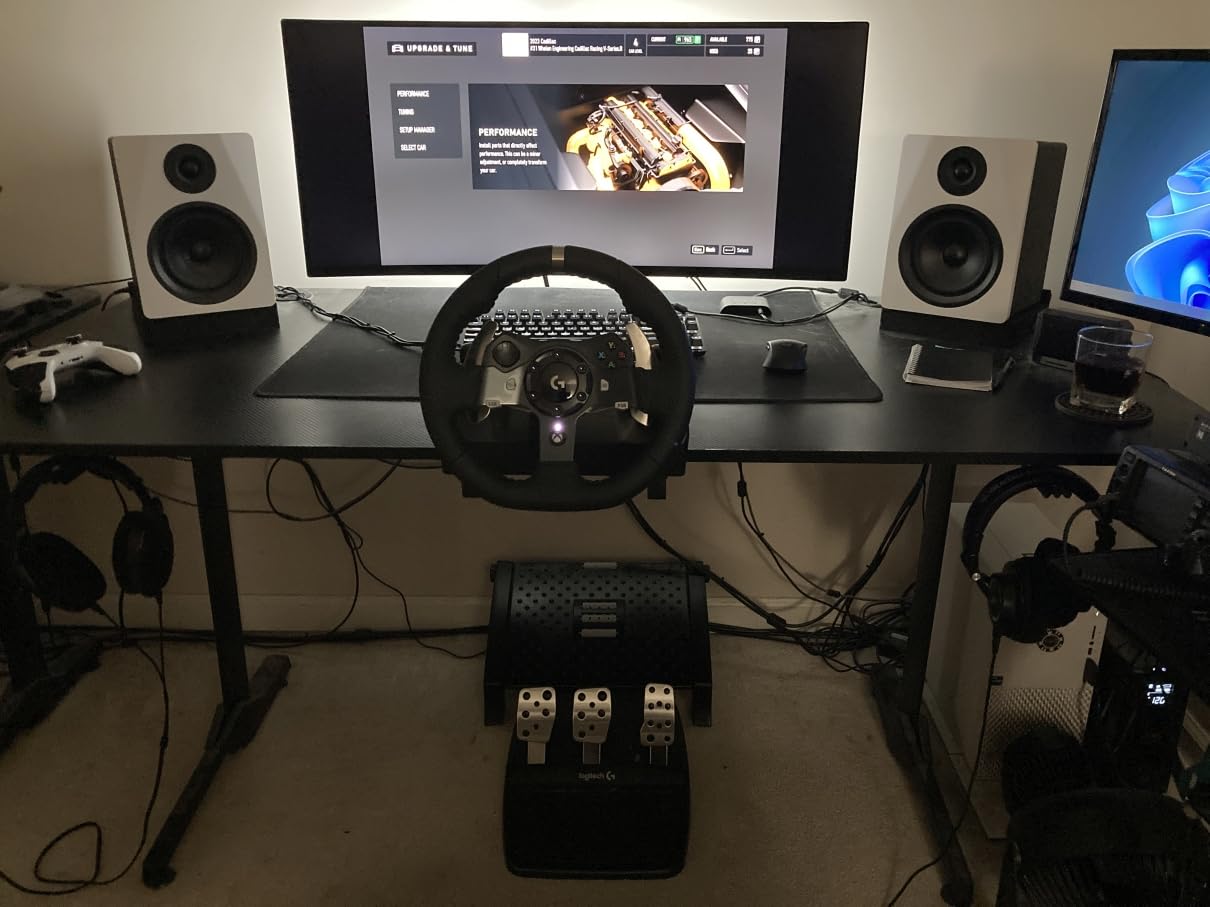
We spent a month with the G920 on Assetto Corsa Competizione and iRacing before testing anything else. It clamps to a standard desk, the wheel is recognised in Windows without installing a single thing, and every input registers on the first try. That reliability is the whole point of this pick.
The 900-degree lock-to-lock rotation is the spec that matters most here. Most competitive sims run 540 degrees or less, and a wheel that can turn further than the game asks for keeps the lock-to-lock ratio intact when you add a steering reduction in the software.
What surprised us most was how quiet it is for a gear-driven wheel. The helical gearing produces a smooth, even push rather than the clunk and rattle that owners of older brushed-motor Logitech wheels describe. Road texture comes through clearly enough that you can feel a kerb.
The brake is the weakest part, and owners mention it constantly. A rubber block sits on the brake face that makes the pedal unusually stiff and can limit your full pedal range until you take it off, which takes two minutes and a hex key. Once removed, the pressure-sensitive non-linear brake behaves far better under trail braking.
Sixteen programmable on-wheel buttons cover every console function, and the stainless steel paddle shifters feel solid for a wheel at this level. The bundled pedal set is a three-pedal unit with adjustable pedal faces, which is unusual on entry wheels and lets you move the pedals closer if your feet are small.
Why the G920 works for first-time sim racers
Nothing has to be explained. There is no configuration software, no torque curve to shape and no calibration tool to open before your first race. Owners consistently report that the wheel and pedals were working within a couple of minutes of taking them out of the box, which matters when you have just spent an evening deciding to buy one.
The mounting deserves a mention too. The desk clamp is genuinely rigid, and the base has pre-threaded mounting holes if you later move to a wheel stand or a proper rig. You will not be replacing the base in a year, which is what makes this a good first purchase rather than a stepping stone.
Where the G920 holds you back
Gear-driven feedback has a texture to it that a direct-drive wheel does not. The helical gears absorb very fine detail, so you feel the slide and the weight transfer but you do not feel individual grains of grip. Once you have driven something like the MOZA R5, the difference is obvious.
It also has no clutch pedal, so manual-transmission cars need to be driven without one until you add a shifter and clutch unit. And if you also play on a PlayStation, this wheel will not work there at all. The G923 covers that case, at the cost of a smaller owner base.
2. Logitech G923 – the best all-round Logitech with a dual clutch pedal
- TRUEFORCE gives smooth high-definition feedback
- Programmable dual clutch helps with launches and standing starts
- LED RPM display and 24-point selector are genuinely useful in race
- Hand-stitched leather and polished metal pedals
- On-wheel sensitivity and feedback adjustment
- Still gear-driven so detail is softer than direct drive
- G HUB software is required and can be finicky
- Wide desk footprint and a long cable run
- Brake feel varies between games
The G923 is the same basic wheel as the G920 with the friction turned up. Force feedback is sampled 4000 times per second through what Logitech calls TRUEFORCE, and the result is a cleaner, more continuous push than the older geared motor. It is not direct drive, but it is a clear step up.
The dual clutch pedal is the feature that changes how you drive. It gives you a separate lever you can bind to a clutch input for standing starts and slow-corner exits, and it can be programmed to a different function entirely. No other wheel near this level gives you that.
A built-in LED RPM indicator and a 24-point selector dial sit in plain view on the wheel face. In a car with no interior display, that little strip of lights is the difference between shifting on revs and shifting on memory.
The progressive brake spring gives more travel before the pedal firms up, which helps with modulation at low speed. Owners like the polished metal pedal faces, and they like that sensitivity and force feedback level can be adjusted from the wheel itself rather than by alt-tabbing into a menu mid-session.
That does require Logitech G HUB, and the software is the most common complaint. Multiple owners report needing to reinstall it after a Windows update before inputs registered correctly, so treat the first setup session as a five-minute job rather than a plug-and-play moment.
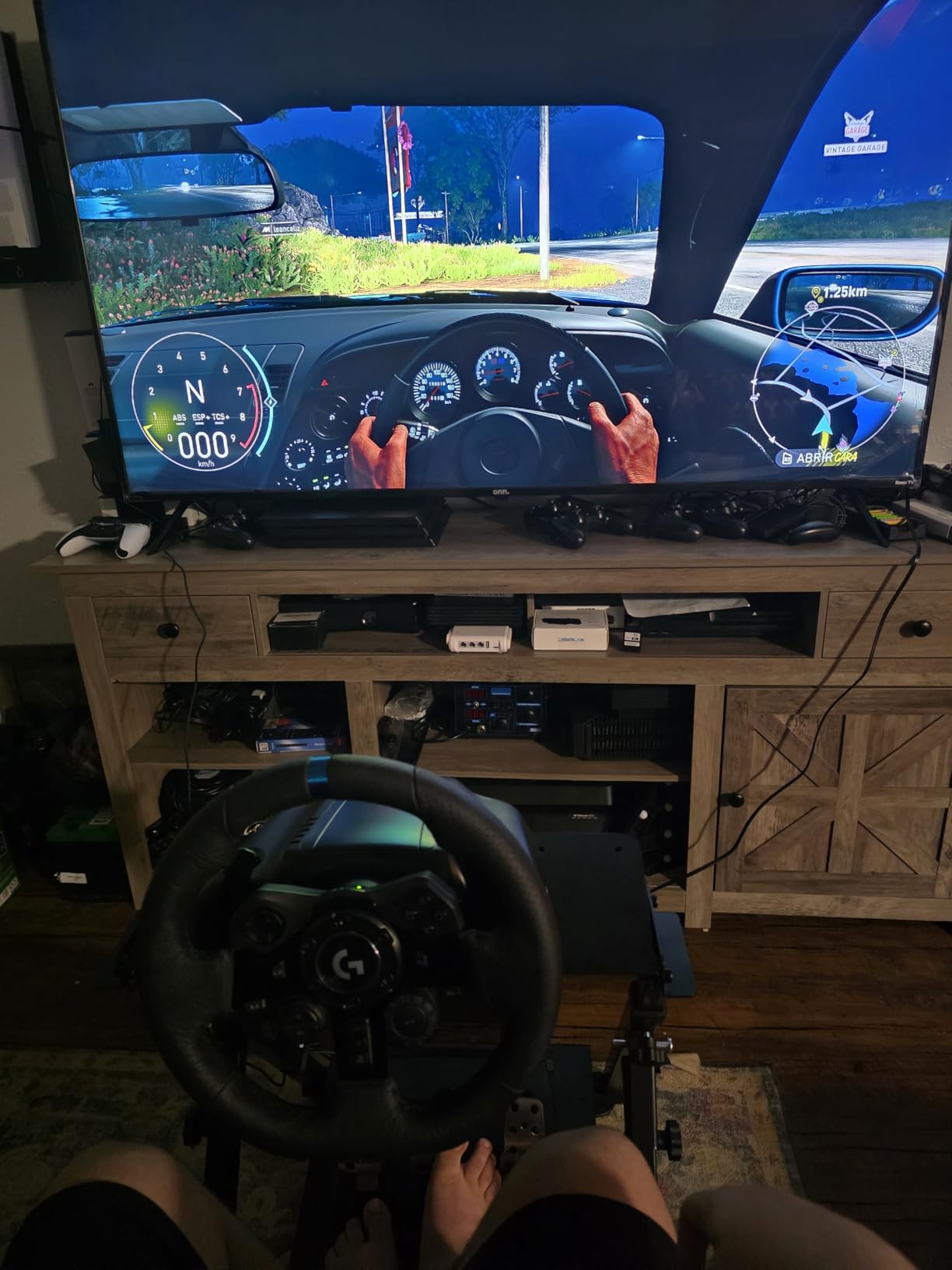
Who benefits most from the G923
Anyone who plays on both PC and a current PlayStation. It is officially licensed for PS5 and PS4, and it is the only wheel in this roundup that combines console support with a clutch pedal and an RPM display. If your racing spans a console and a PC, that combination is rare.
It also suits drivers who like a heavy, full-size rim with a leather cover and who do not want to fiddle with torque curves. The hand-stitched cover and metal pedals give it a more expensive feel than the specification list suggests.
What you give up choosing the G923
The drive train is still helical-geared, so fine detail is softened compared with any direct-drive base here. If your main game is a competitive sim where you are chasing tenths, that smoothing costs you information.
The desk footprint is the other practical issue. It is a wide base, and the cable run to the PC is long enough to strain on a wheel stand. Measure your desk depth before ordering, and note that a three-pedal unit needs a floor or a pedal riser as well as a desk clamp for the base.
3. Thrustmaster T300RS GT – the belt-driven GT wheel with a real upgrade path
Thrustmaster T300RS GT Force Feedback Racing Wheel & 3 Pedal Set – PS5 & PC
- Belt drive gives smooth linear feedback with no gear texture
- Three-pedal set improves braking and acceleration modulation
- Detachable rim makes rim upgrades straightforward
- Officially licensed Gran Turismo design
- Good build quality at a mid-tier price
- Belt feedback is less detailed than direct drive
- Pedals feel basic next to metal sets
- Needs a solid mount to avoid moving under heavy braking
- No Xbox support in this configuration
The T300RS GT is the wheel we recommend to anyone whose games are endurance and GT titles. The belt drive delivers force feedback linearly, with none of the notchy texture you get from gears, and it conveys kerbs, drifts and traction loss clearly enough to drive a GT car on the limit.
It ships with an officially licensed Gran Turismo rim, which means the shape, grip position and button layout match what you see on screen. For a first sim wheel, that familiarity removes a learning curve you would not have considered.
The 3-pedal GT set is a step up from a two-pedal bundle. The progressive brake pedal gives you usable travel for trail braking, and having a clutch means manual-transmission cars are actually driveable rather than a clutchless compromise.
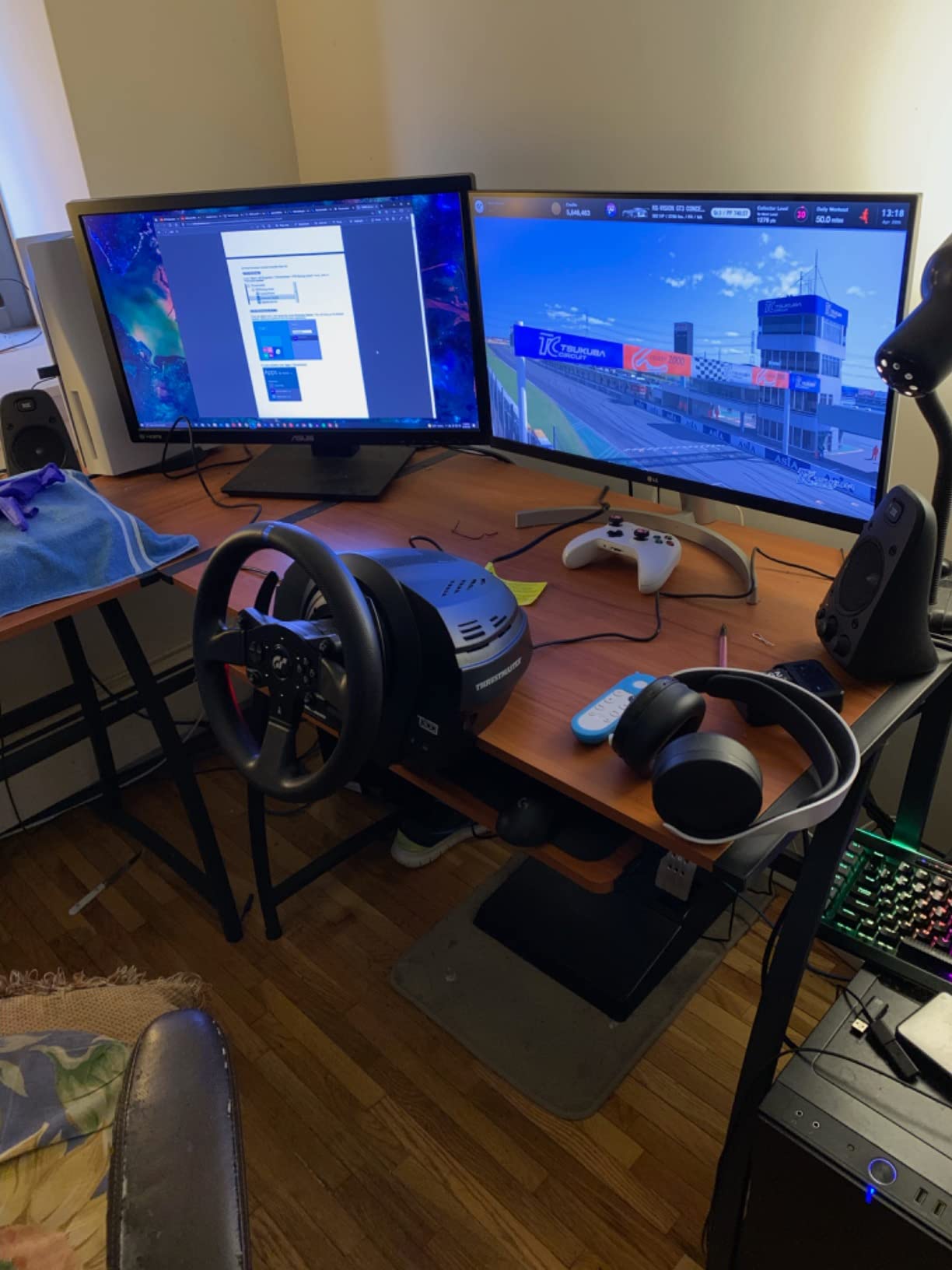
Eighteen programmable controls cover everything: 13 action buttons, a 12-position dial and a directional pad. The detachable quick-release rim is the important detail, because it means you can swap in a different Thrustmaster rim later without replacing the base.
Pedal spacing and rigidity are the parts owners criticise. They work, but they are basic next to a metal pedal set, and the units need a solid table clamp or a wheel stand so the base does not creep across the desk under a heavy stop.
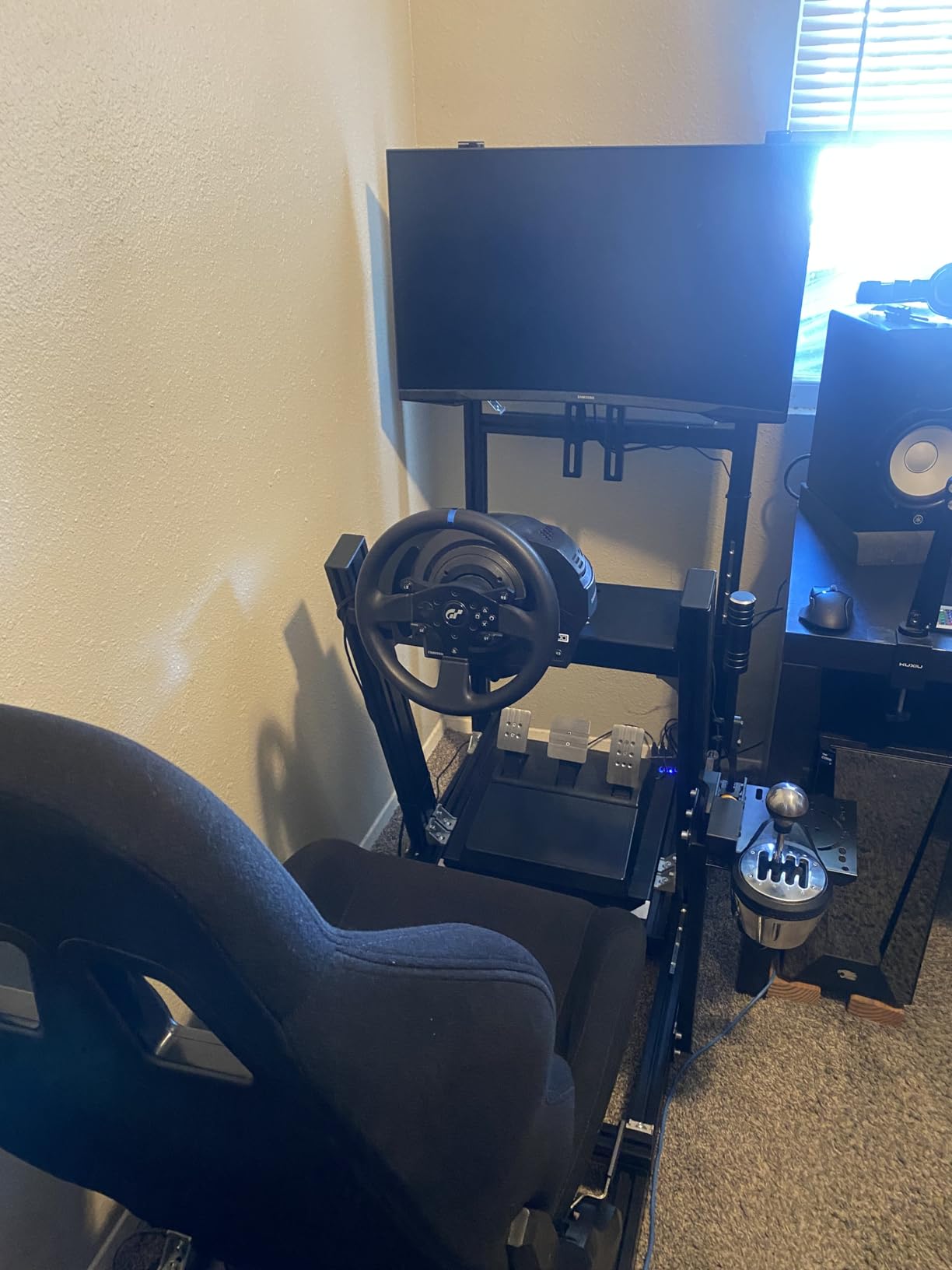
Where the T300RS GT fits best
It is a good match for players who want smooth, quiet feedback and a full pedal set without moving to direct drive. If you have been put off by the noise and texture of geared wheels, the belt drive here is a genuine reprieve and it stays quiet under load.
The Thrustmaster ecosystem is the other argument. Wheel rims, handbrakes, shifters and pedal sets all share the same mounting standard, so the upgrade path is straightforward. Our cockpit roundup covers mounting hardware if you want to move to a frame.
Reasons to pick something else
Belt drive is mechanically smoother than gearing but still loses the finest detail that a direct-drive servo delivers. Once you are used to linear, ripple-free feedback, the difference is easier to feel than the spec sheet suggests.
There is also no Xbox support in this configuration, and the pedals are the first thing most owners replace. If your main title is a modern esports-style sim where clutch and brake feel decide lap times, budget for a better pedal set from the start.
4. HORI Racing Wheel Apex – a full-size wheel for people who do not want force feedback
- Full-size wheel and pedals feel well made
- Sharp and tight lock-to-lock steering
- Compact clamp fits most desks
- 23 buttons plus a touchpad cover every function
- Officially licensed for PS5 and PS4 and works on PC
- No force feedback or vibration of any kind
- Detented auto-centring creates an audible click and a dead zone
- Short pedal travel frustrates full sim settings
- No clutch pedal and the clamp may not fit thick desks
- Some reports of pedal breakage and centre misalignment
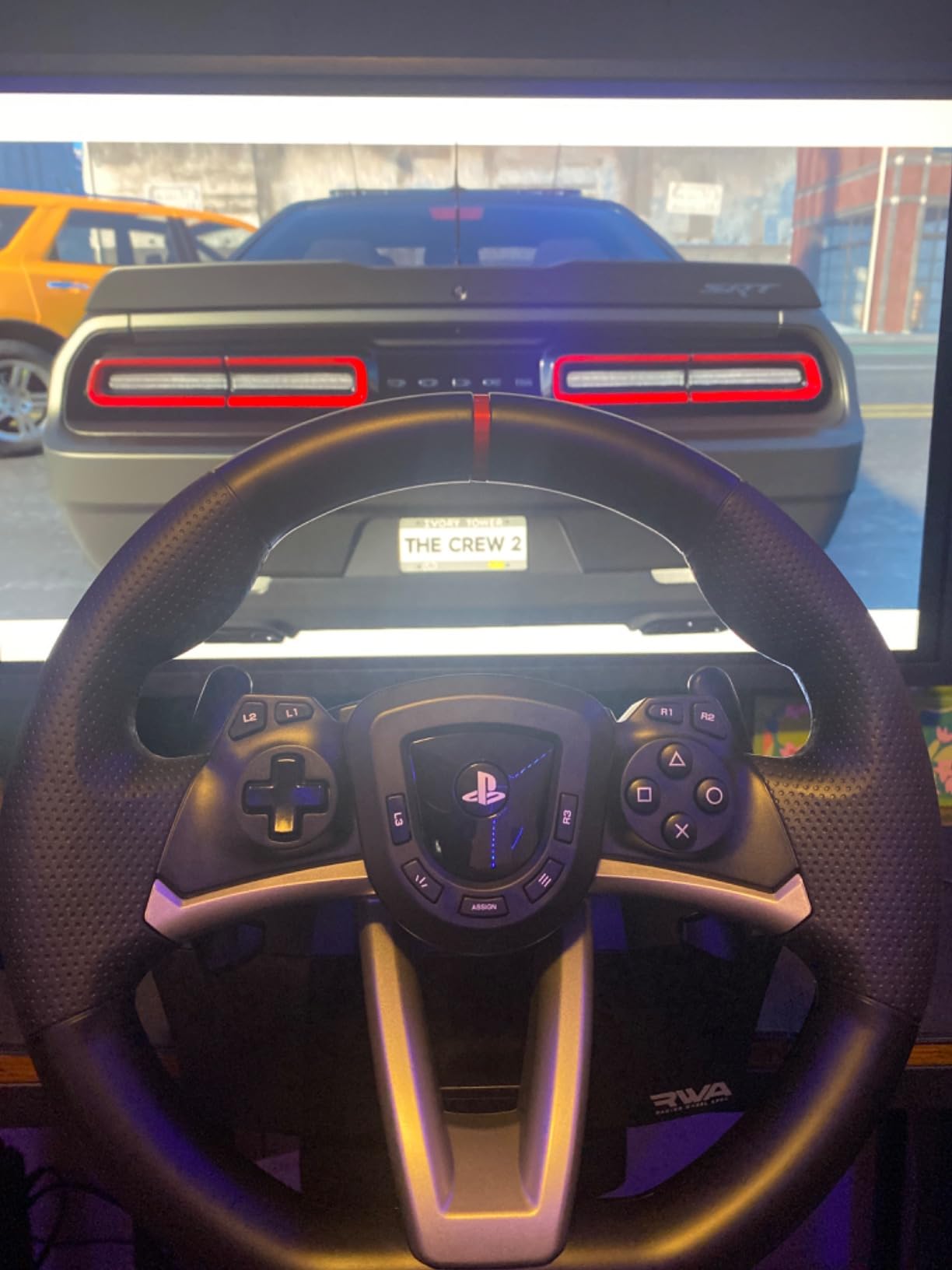
This wheel is not a sim wheel and we want to be clear about that. There is no motor in the base, so there is no force feedback, no vibration and no road feel. What you get is a full-size rim, working pedals and a very tidy clamp.
For someone moving from a controller purely for the physicality of turning a wheel, that is a real upgrade. The rim is the right size, the grip positions are where you expect them to be, and 23 programmable controls including a touchpad mean almost nothing is missing on the dashboard.
Steering lock to lock is 270 degrees with adjustable output options in the HORI Device Manager app, which also handles firmware and up to four custom profiles. Tight and uniform is the word owners use most, and the auto-centring is predictable.
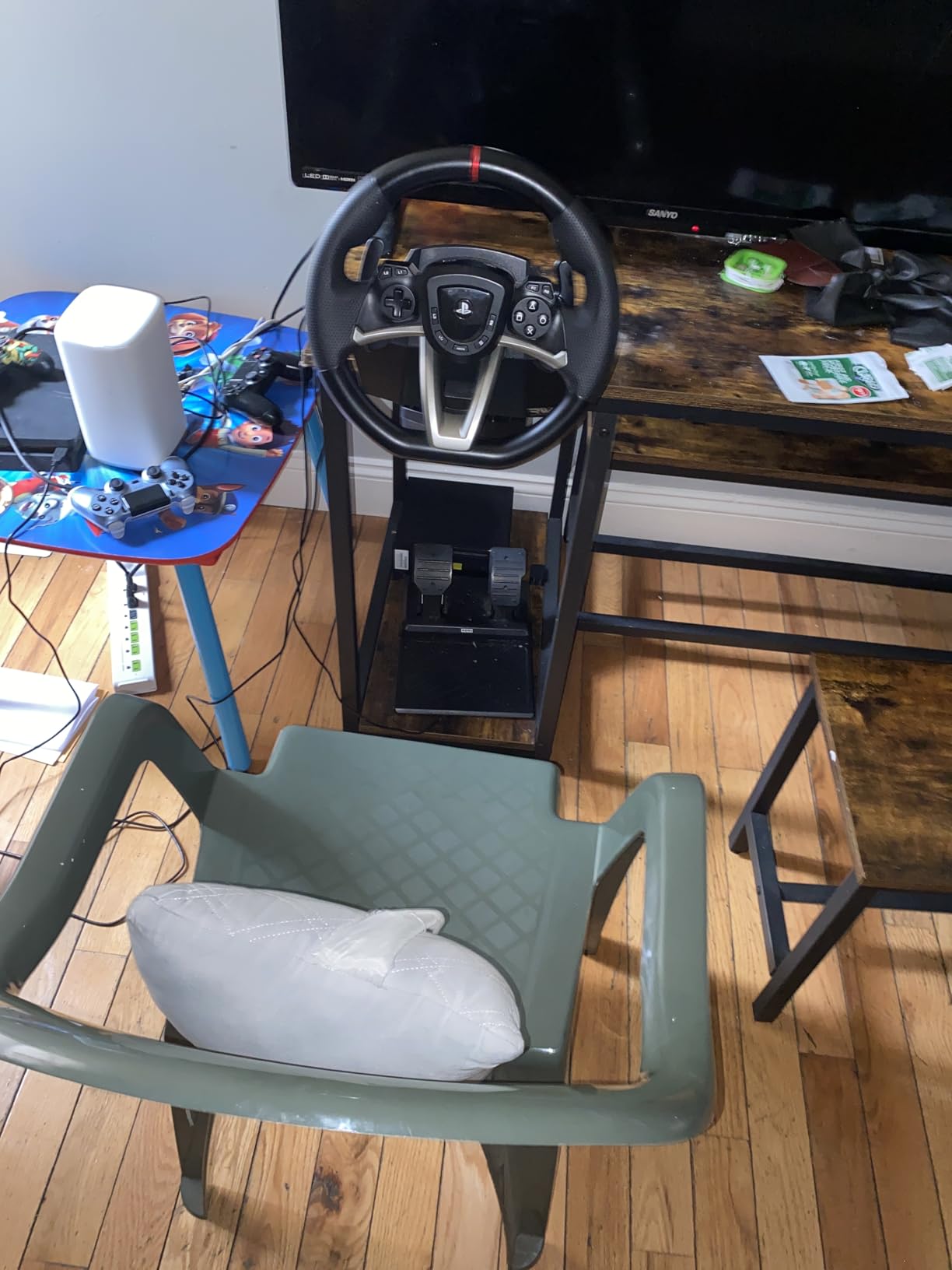
That auto-centring is detented, though, so there is an audible click at the centre and a small dead zone either side of it. In a game with a real physics model you will feel that gap, and the short pedal travel makes modulation difficult when braking assists are turned up.
Build quality is good for the tier, with solid plastics and faux leather grips. The clamp system is compact and stable, though it will not fit every metal-framed or extra-thick desk. A small number of owners report pedal breakage or a misaligned centre position, so check both before a long race.
Who should buy the HORI Apex
Anyone who wants wheel and pedal hardware at the lowest outlay and plays arcade-leaning titles. It is officially licensed for PS5 and PS4 and works on PC, so it is also a safe console-and-PC starter if you only ever use assisted braking and traction control.
It is a good first step for a shared household setup. There is no software to install, no gain setting to get wrong, and nothing in the mechanism that can wear out.
When it is the wrong choice
Buy a wheel with force feedback the moment you start playing anything that rewards reading grip. Without a motor, every slide, kerb and weight transfer is a visual cue you have to interpret, and the detented centre compounds it with a dead zone.
The short pedal travel is the other limit. Full simulation brake settings will not feel right, and there is no clutch pedal at all, so manual cars are limited to an auto-clutch solution in software. Treat this as a stepping stone, not a destination.
5. MOZA R5 Bundle – the best value direct-drive package for a PC-only rig
MOZA R5 Bundle Racing Wheel, Direct Drive Base, Pedals Simulator Kit for PC
- Smooth linear 5.5 Nm direct drive with no gear noise
- All-metal construction including the quick release and paddles
- Four bolts to assemble then plug and play
- Pit House makes tuning curves straightforward
- Cheap future upgrades within the MOZA ecosystem
- Pedals tilt on the floor unless weighted or bolted down
- Shallow desk clamp may not fit metal-framed desks
- No active cooling so firmware throttles torque under sustained load
- Slim flat-bottom rim suits smaller hands
- A few buttons feel loose
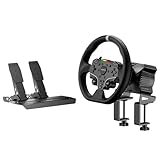
Direct drive is the single biggest jump in this entire roundup, and the R5 bundle is a complete way to make it on a PC-only rig. The servo mounts straight to the wheel shaft, so there is no belt and no gear between the motor and your hands. Feedback arrives instantly and linearly at 5.5 Nm.
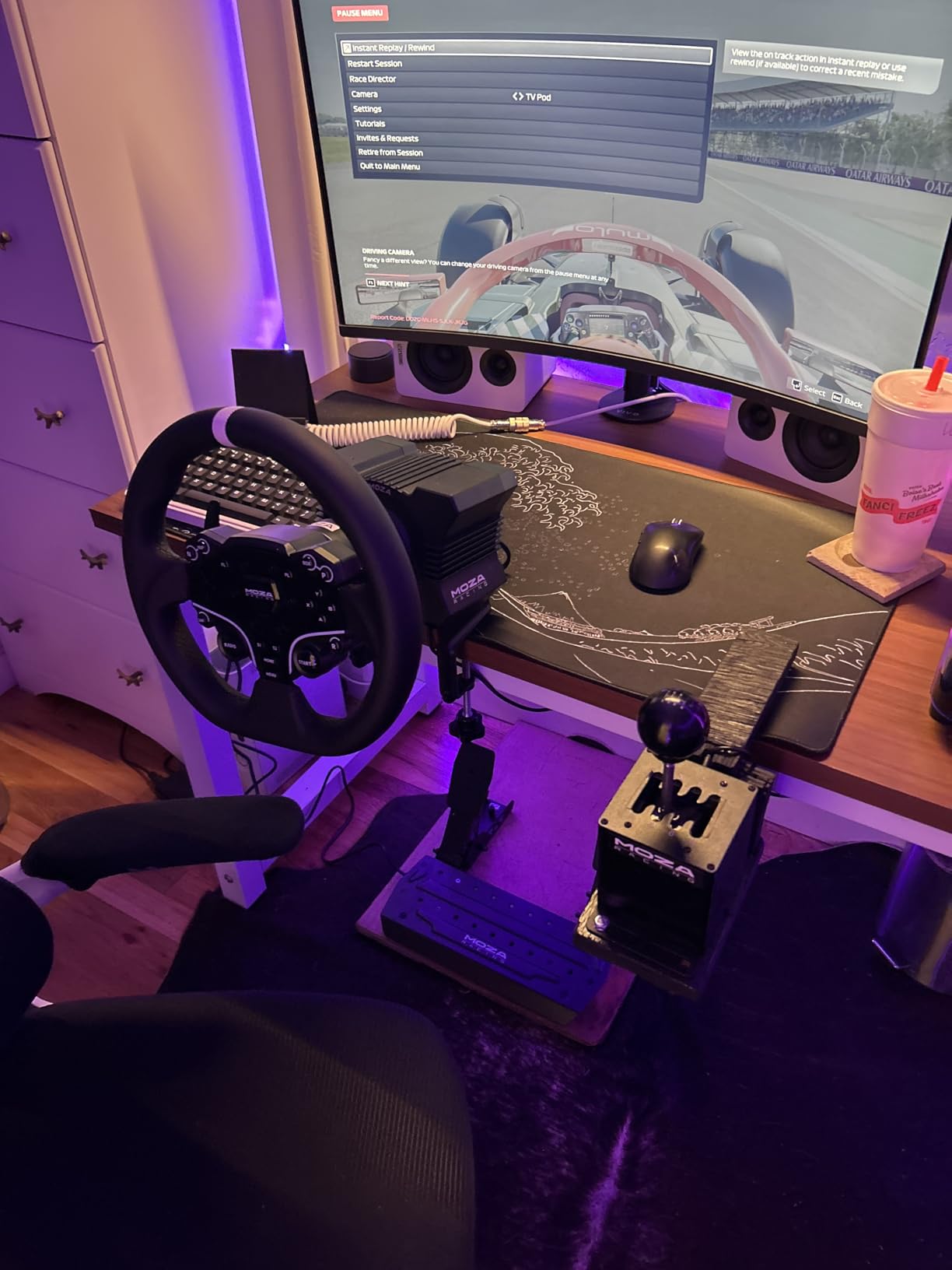
The bundle is genuinely complete. You get the base, a 280 mm MOZA ES aluminium quick-release wheel, the SR-P Lite steel throttle and brake pedals with Hall sensors and adjustable spacing and height, plus a CNC machined steel desk clamp. There is nothing else to buy before your first race.
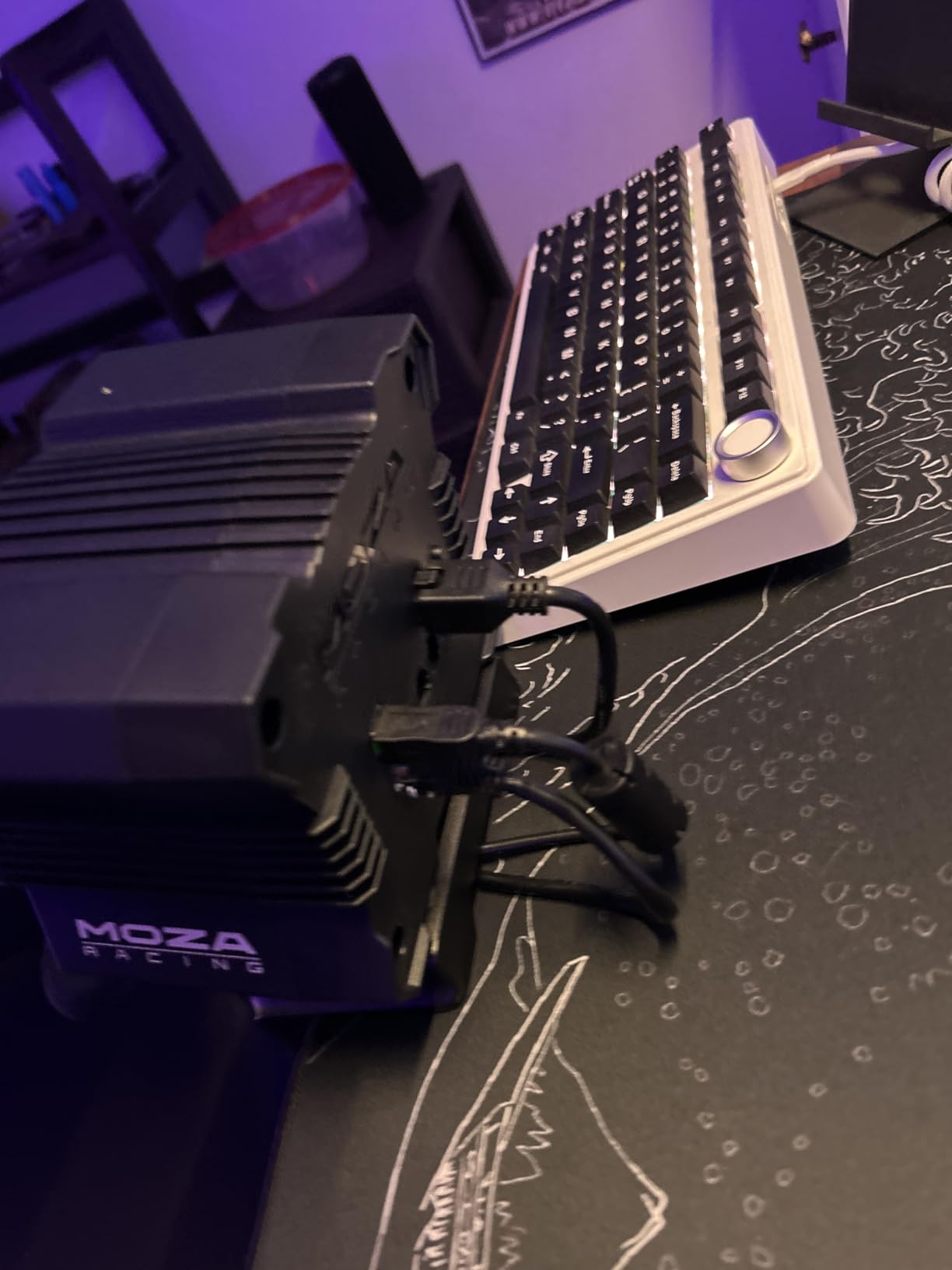
Mounting is the easy part. The base bolts to the included clamp, the quick release fixes the wheel, and everything is over USB from there. MOZA Pit House then handles force feedback tuning, output curves and game launch from the desktop or in the cloud.
Torque ripple is the technical detail that separates this from a gear wheel in practice. Ripple is the unevenness in the motor output as it turns, and low ripple means the push you feel matches what the physics engine is asking for. That is why direct drive feels cleaner even before you increase the strength.
The steel Hall-sensor pedals are a real improvement on plastic entry sets. Hall sensors read position optically rather than with potentiometers, which is why owners report they still feel accurate after months of use with no drift. You can tune the output curve for each pedal in Pit House.
Why the R5 bundle suits a first direct-drive rig
It is a closed system. Rims and bases are interchangeable across the MOZA ecosystem without adapters, so your next upgrade is a single purchase rather than a rebuild.
For PC-only buyers it is a clean fit. There is no console licence to think about, which is exactly what you want if your only screens are a desk and a monitor. The Pit House app is one program rather than a suite per peripheral.
What to watch out for
The pedals are designed to be bolted to a rig. On a hard floor they will tilt under heavy braking unless you weight them down or fix them down, and that changes the pedal angle mid-corner. Our cockpit guide covers floor and rig mounting options.
There is no active cooling in the base. Under sustained heavy force feedback the firmware throttles torque to protect the motor, so a long race at maximum gain can feel weaker at the end than at the start. The desk clamp is also shallow, so check your desk thickness before ordering.
6. MOZA R3 Bundle – the most compact direct-drive kit on this list
MOZA R3 Bundle Kit Direct Drive Servo base, Racing Wheel and Pedals for PC
- Very low torque ripple so feedback arrives instantly and cleanly
- Compact base fits desks where larger bases will not
- Round 11-inch rim is more ergonomic than flat-bottom designs
- All-metal quick release and steel Hall-sensor pedals
- Straightforward Pit House setup with cloud sync
- Less torque than larger direct-drive bases
- No clutch pedal in the SR-P Lite set
- PC only with no console support
- Table clamp depth limits thicker desks
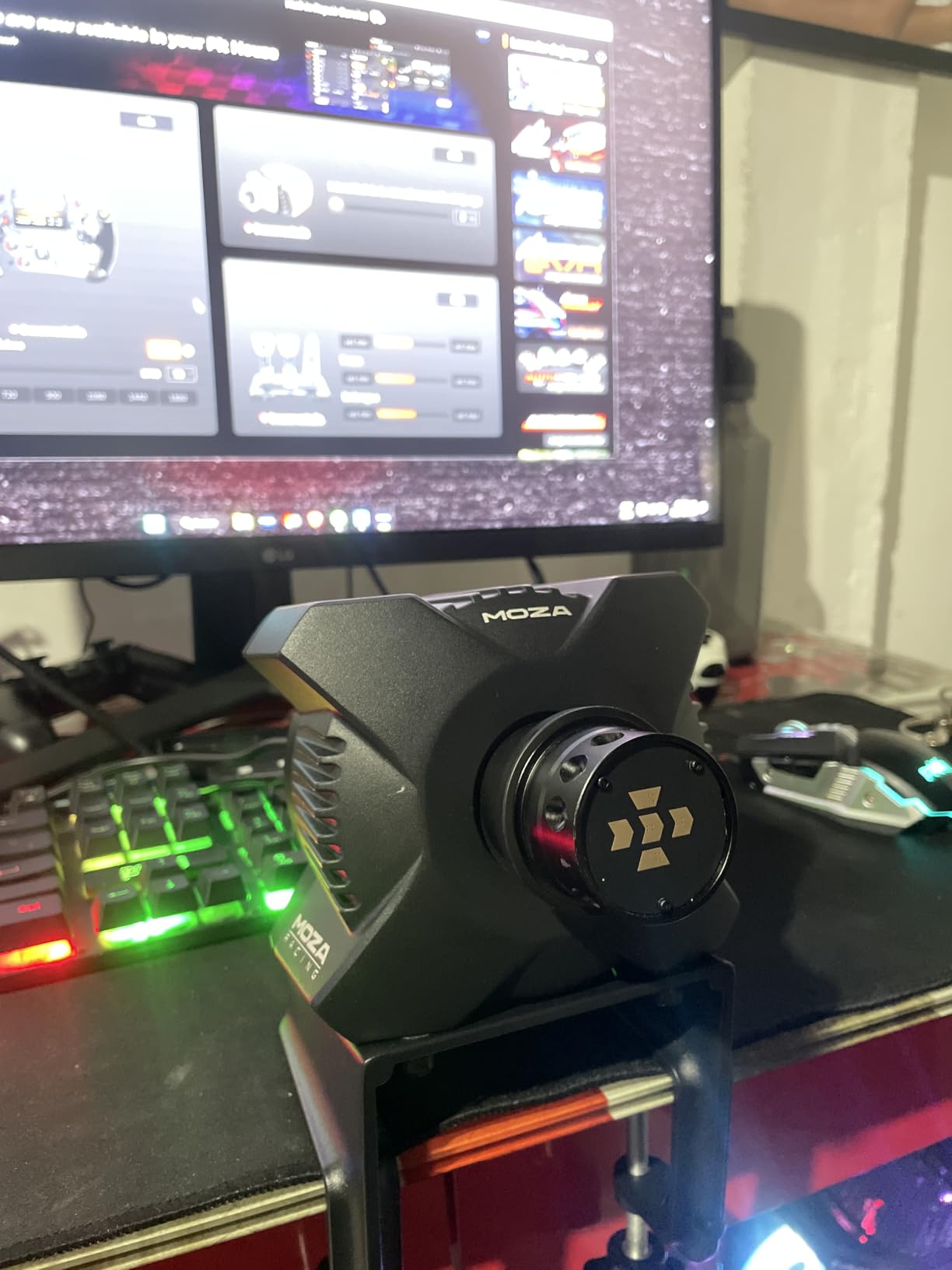
The R3 is the bundle we recommend when desk space is the deciding factor. The base is noticeably smaller than the R5, and it still mounts with a 5 mm CNC steel table clamp at an angle you can set to suit your desk. On a small desk it is the difference between owning a direct-drive wheel and continuing to use a controller.
Buyers single out the torque ripple figure as the reason this kit punches above its weight. Feedback lands the instant the car starts to rotate, with none of the lag you feel on a geared wheel, and 3.9 Nm is enough to feel a front axle let go at a corner entry.
The round 11-inch ES Lite rim has ISF PU grips and an aluminium alloy rim. Round is worth preferring over a flat-bottom shape if you have not settled on a driving position yet, because a flat-bottom rim forces your hands to a fixed angle that suits a single car class.
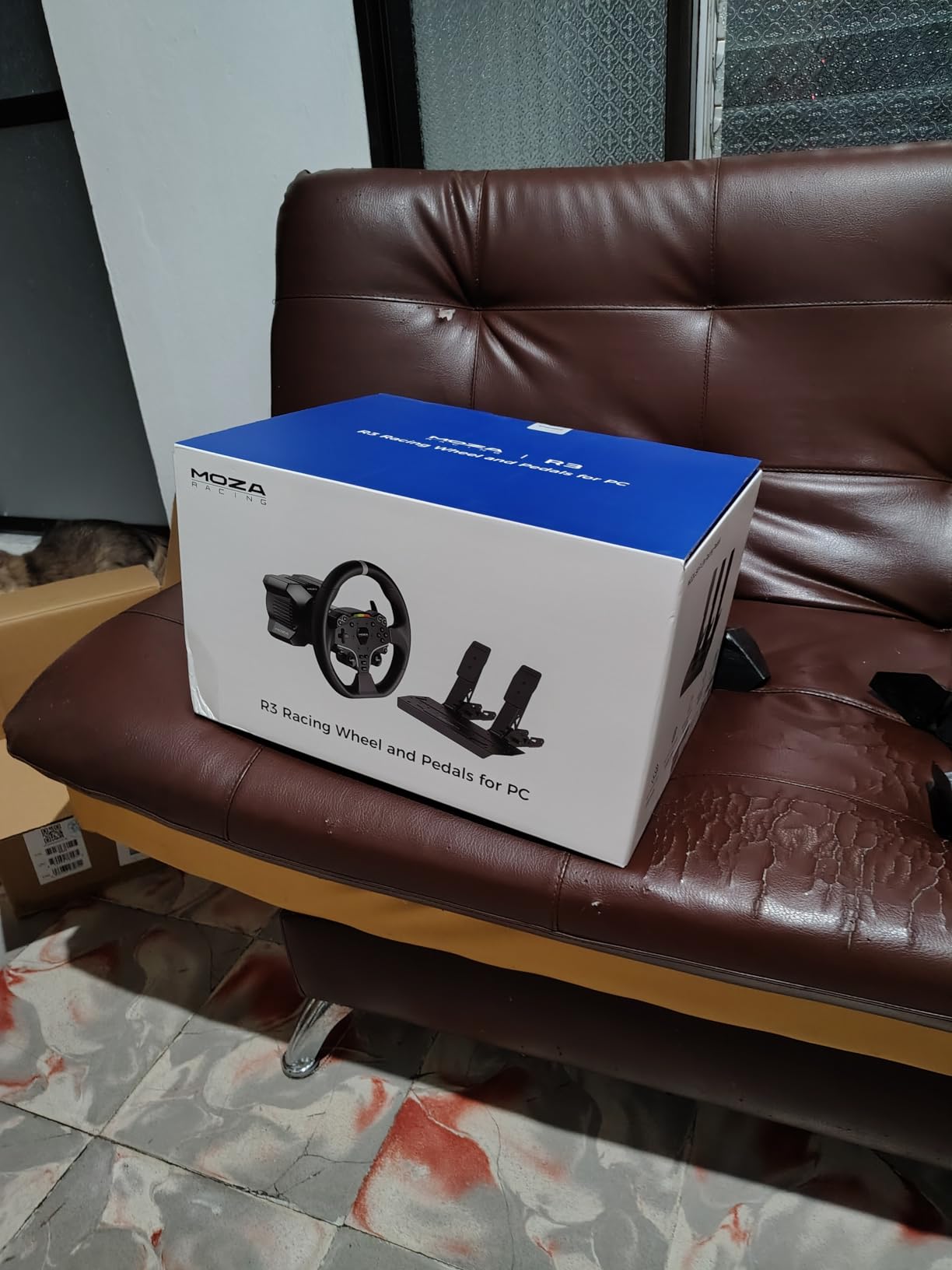
Twenty-two customizable on-wheel buttons cover the full range of inputs, and the racing-level quick release means the wheel comes off in seconds when you want to swap rims. The SR-P Lite pedals are steel with a high-precision Hall sensor and adjustable spacing, height and output curve.
Torque is the honest limit here. 3.9 Nm suits casual and entry-level sim racing well, and it will not overpower a desk, but if you run a heavy car in a competitive sim you will want more than this to lean on.
What the R3 gets right for a compact setup
It removes the usual excuses. There is no separate base purchase, no software to install before racing and no console licence question, because the kit is PC-only by design.
The compact footprint also helps with cable routing. A small base sits closer to the desk edge, so the USB run is shorter and there is less torque on the connector, which is a common failure point on stands with a long cable.
Where it falls short
Two pedal means two pedal, and there is no clutch in the SR-P Lite set. Manual gearbox cars will run on an automatic or an auto-clutch, which is fine for most players and unsatisfying for anyone who wants to learn a heel-and-toe downshift.
Table clamp depth also limits thicker desks, and the modest torque ceiling means heavy cars feel light. If you know you will be running a GT or endurance car in a serious league, step up to a base with more torque rather than planning to replace this one later.
7. Thrustmaster T98 Ferrari 296 GTB – the licensed starter wheel that needs no software
Thrustmaster T98 Ferrari 296 GTB – Racing Wheel and Pedal Set – PS5 & PC
- Ferrari-licensed rim and paddles feel far more convincing than a controller
- Bungee cord resistance is smooth and linear with reliable auto-centring
- 240 degrees provides more usable lock than entry wheels
- Manettino makes it easy to share between drivers of different skill levels
- Tool-free clamp with no software to install
- Bungee cord is simulated resistance rather than true force feedback
- No clutch pedal with throttle and brake only
- Not licensed for Xbox in this configuration
- Pedal feel is basic against metal sets
The T98 is the wheel to buy if you want something that looks and feels like a real car part without opening a configuration app. It plugs in and works. The 10-inch rim is officially licensed from the Ferrari 296 GTB, complete with paddle shifters, and it is available on PC, PS5 and PS4.
Resistance comes from a bungee cord rather than an electric motor. It is smooth and linear with automatic return to centre, and 240 degrees of rotation gives you more lock than the very cheapest wheels. But it is a spring, not force feedback, so it cannot tell you anything about grip.
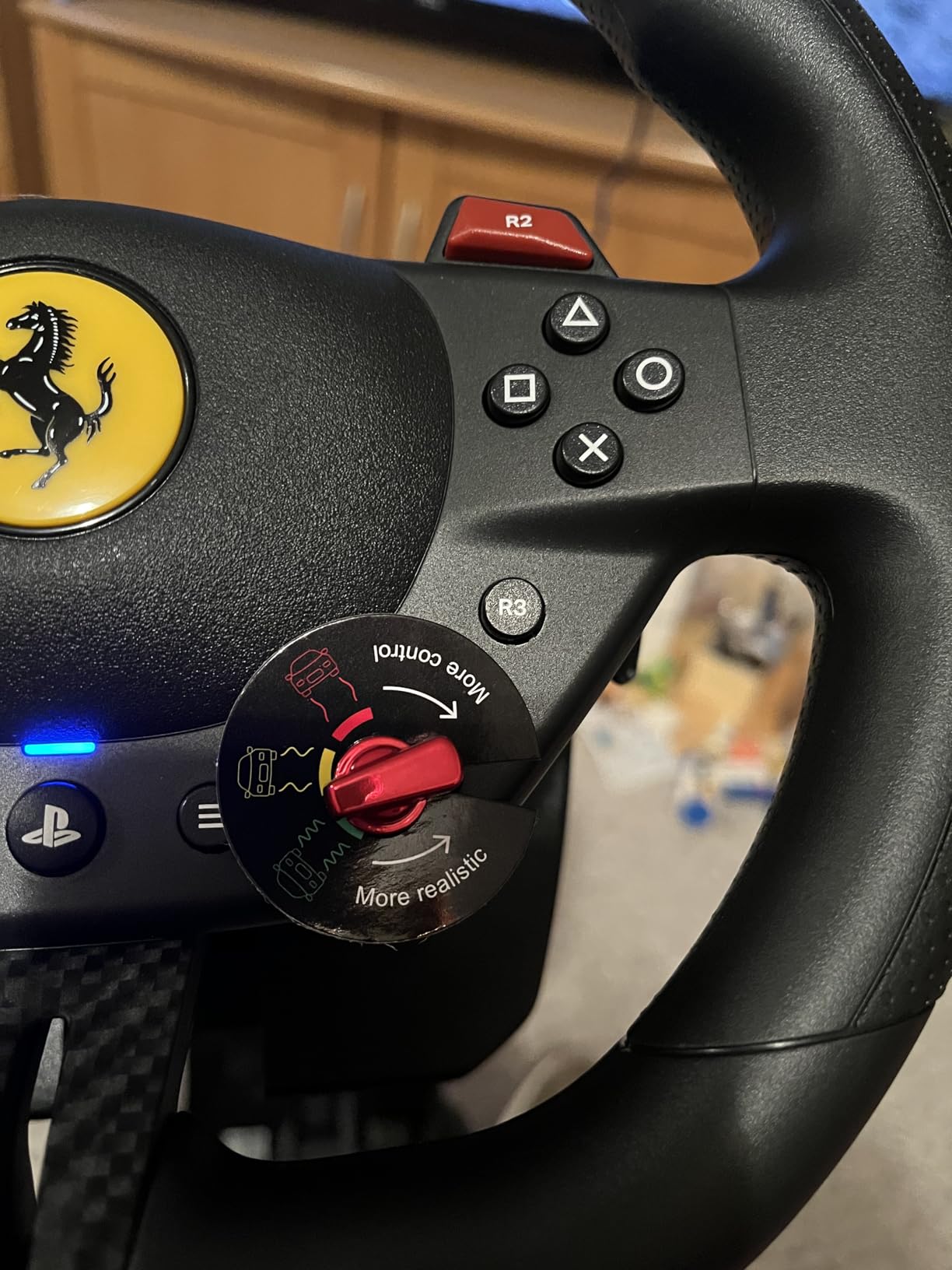
The Manettino-style selector is a genuinely nice touch. It has three driving profiles, so one wheel can switch between a relaxed setup and a sharp one for different drivers, and it works without any software at all.
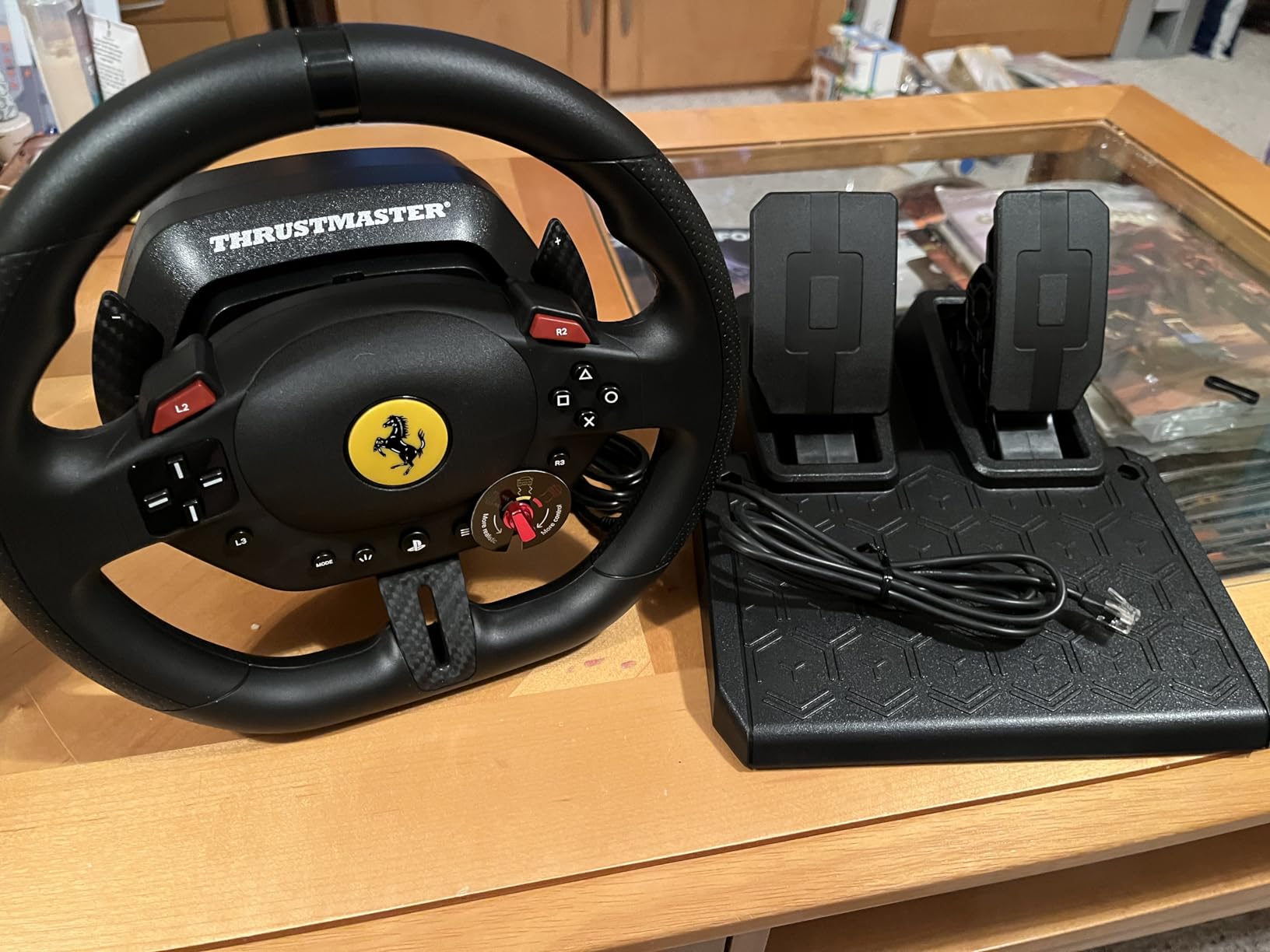
Hall effect sensors are used in both the wheel and the pedals, so inputs stay accurate over time rather than drifting the way cheap potentiometers can. The tool-free clamp fits desks and tables up to 1.8 inches thick, which covers most domestic furniture.
Owners consistently report that the jump from a controller to this wheel is more convincing than they expected, largely because the rim size and paddle placement match a real car. The limitation they name is always the same: the bungee cord cannot reproduce road feel.
Who gets the most out of the T98
Casual players of road and GT games who want the physical experience without the setup. It suits a shared console, because the Manettino profiles let a new driver and an experienced one share the same wheel without reconfiguring it.
It is also a sensible stopgap for a child or a non-gamer partner who occasionally wants to drive. Nothing here breaks, nothing needs calibrating and the mount is tool-free.
What it cannot do
It will not teach you anything about grip, because there is no force feedback. Any title where you are supposed to read the limit through the wheel will be played with your eyes only, and that is a large part of what makes sim racing worth doing.
The throttle and brake set is basic and there is no clutch. For a first wheel in a competitive sim, spending a little more on a direct-drive bundle will repay itself far sooner than the price difference suggests.
8. Thrustmaster T128X – the licensed Xbox and PC starter with magnetic paddles
Thrustmaster T128 X Force Feedback Racing Wheel & Pedal Set – XBOX & PC
- Magnetic H.E.A.R.T paddles give a crisp instant shift
- HYBRID force feedback adds real road and slide feel
- Ergonomic grips stay comfortable in long sessions
- Quick attachment system mounts to most desks
- Officially licensed for Xbox Series X S Xbox One and PC
- Feedback strength is modest against direct-drive bases
- Two-pedal set with no clutch
- Awkward cable management and a clamp that can loosen
- Heavy unit with a large desk footprint
- Mixed reports on centre calibration
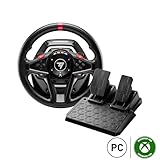
The T128X is the pick if your PC is connected to an Xbox console or you simply prefer Thrustmaster paddles. It is officially licensed for Xbox Series X, Xbox Series S, Xbox One and PC, which means dashboard buttons and console input work without a mapping workaround.
HYBRID drive force feedback is not direct drive, but it is a real motor and it adds genuine road and slide feel. Owners describe it as a meaningful step up from a controller, with enough detail to notice a kerb and enough weight to feel the car settling.
The H.E.A.R.T magnetic paddle shifters are the best part. They snap instantly and return cleanly, which matters more than it sounds when you are shifting under braking in a car with a sequential box.
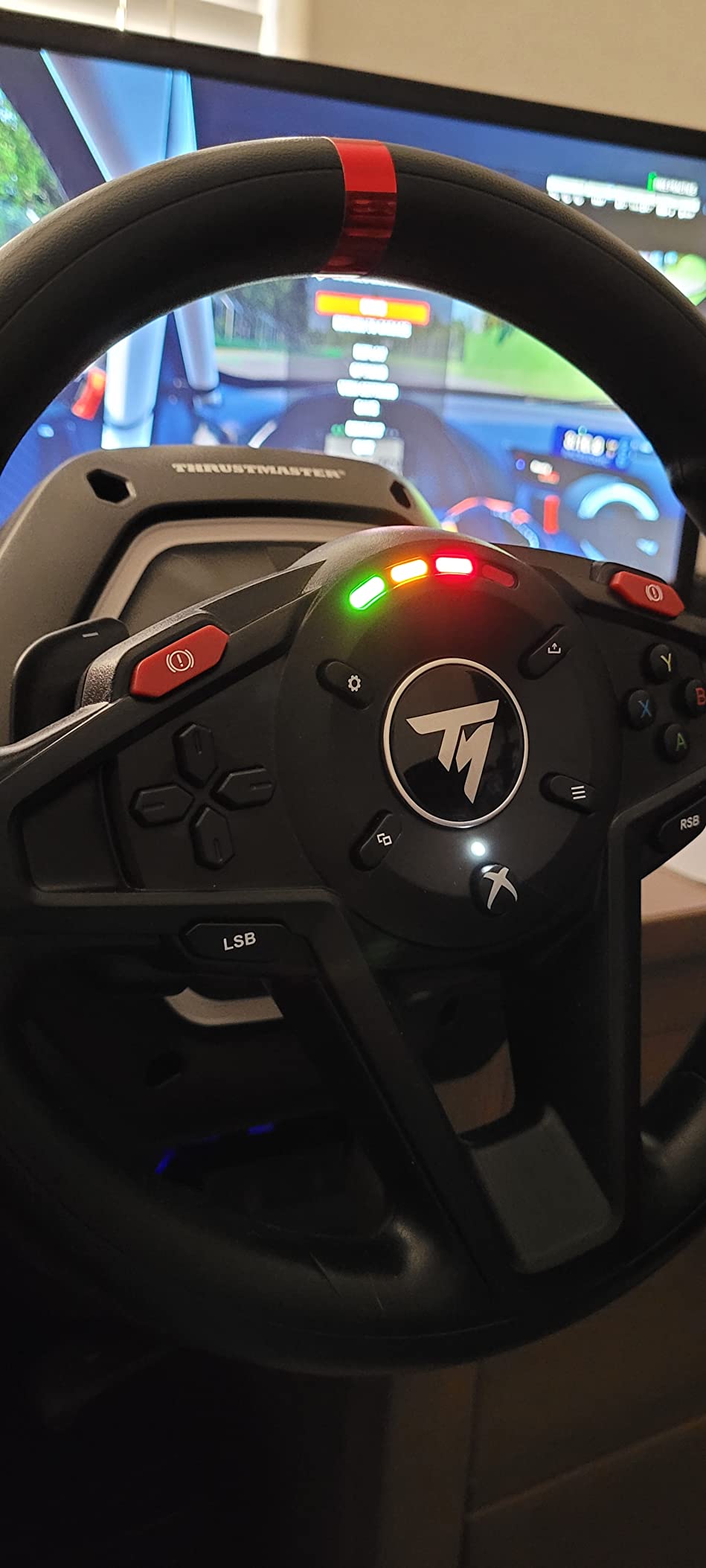
Mounting is handled by a quick attachment system that clamps to desks up to 2.2 inches thick, which is thicker than most competing clamps accept. The ergonomic grips are shaped for long sessions and reviewers comment on them approvingly.
What holds the rating down is the combination of modest feedback strength and a two-pedal set. Several owners also report the desk clamp loosening over time and finding cable management awkward, and there are mixed reports about wheel centre calibration behaving inconsistently.
Where the T128X earns its place
Cross-platform households. One wheel that covers a modern Xbox, an older Xbox and a Windows PC is genuinely rare at this tier, and the official licence means you are not remapping the face buttons every time you switch machines.
It is also a good choice for players who value the paddles most. The magnetic mechanism is crisp in a way that spring paddles on cheaper wheels are not, and that is the input you use most often in a race.
Where it will frustrate you
If your game rewards precise brake pressure, the bundled two-pedal set is the limitation. There is no clutch, so manual cars are limited to an auto-clutch, and the progressive feel that modern sims assume from a load cell brake simply is not there.
Feedback strength is the second limitation. If you plan to run a heavy car with a lot of steering lock, the motor runs out of authority before the car runs out of grip. Check the clamp is tight before a long session, because a heavy unit that creeps is a heavy unit that rattles.
9. Logitech G RS50 – an 8 Nm direct-drive base with swappable rims and load cell pedals
Logitech G RS50 Direct Drive Racing Wheel, Hub, & Base for PS5/PS4/PC
- 8 Nm of quiet linear direct-drive feedback with no gear clunk
- Heavy premium build that feels like a tool
- Hub system makes rim swaps quick
- Rotary dials for differential ABS and brake bias work while driving
- Load cell brake and sequential unit are a serious set
- Works on PS5 PS4 and Windows 10 11
- G HUB can drop inputs or leave a sticky throttle if misconfigured
- Pedal platform angle needs raising on a desk for comfort
- Premium pricing for the torque it delivers
- Round rim suits rally and drift more than GT cars
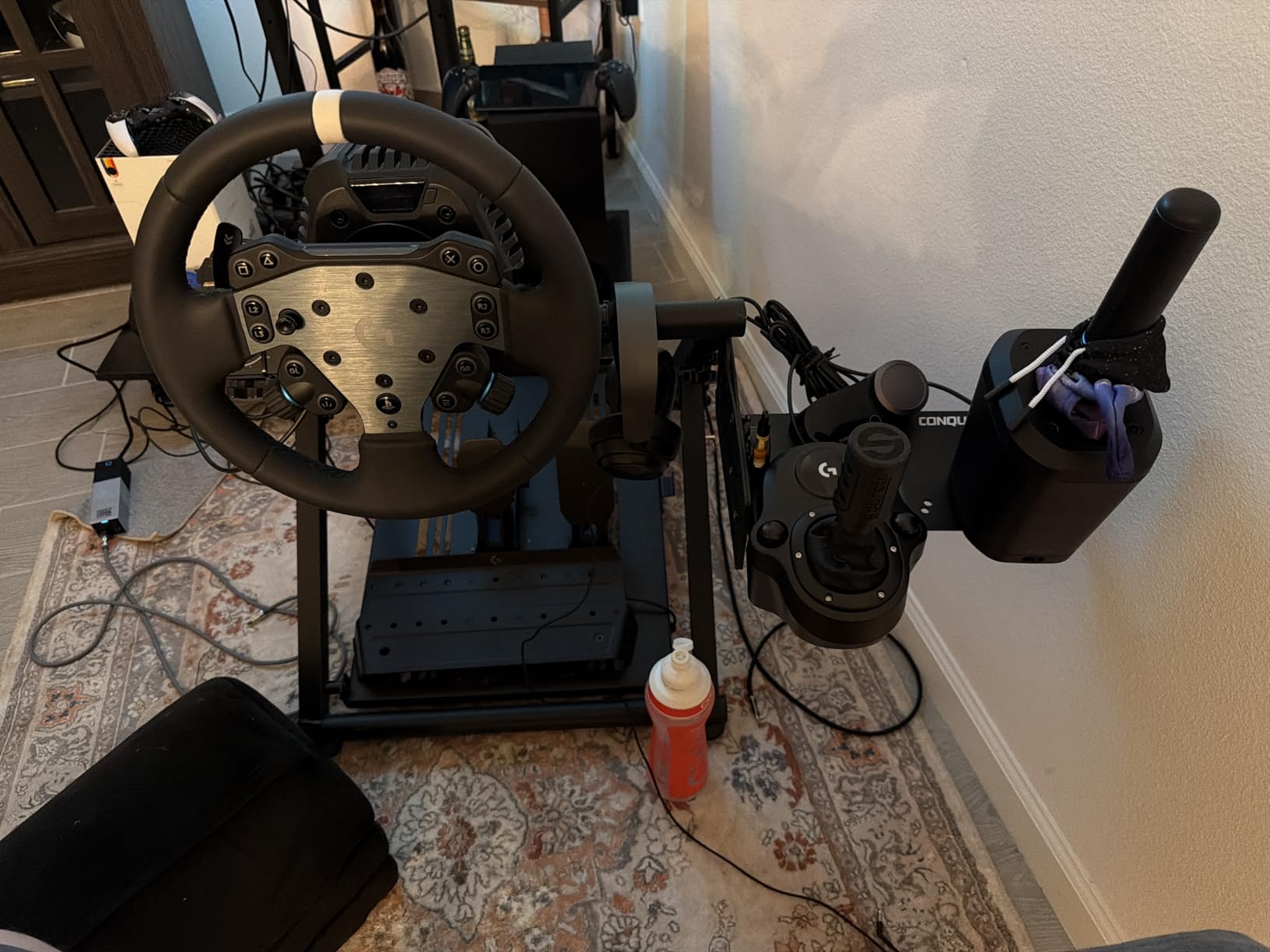
The RS50 is the first Logitech in this roundup with a direct-drive motor, and at 8 Nm it delivers more peak torque than anything else here. Owners upgrading from a G29 or G923 describe the change as immediate, because the feedback is quiet, linear and free of the gear texture they had learned to ignore.
The hub design is the smart part. A single hub carries 13 console-specific buttons, adjustable paddle shifters for rims up to 12 mm wide, an integrated quick release and a set of rotary dials, and it works with any Logitech G RS or PRO series wheel plus G x MOMO rims.
That means the base is a one-time purchase. If you start with the included 11-inch round wheel and later want a GT rim, you swap the rim rather than the whole system.
The load cell brake is the real differentiator. A load cell measures applied force rather than pedal position, which is what allows genuine brake pressure modulation and a realistic bite point. The included sequential and handbrake unit completes the set.
Rotary dials on the wheel face let you change differential, ABS and brake bias without pausing the race. On a car whose setup you are still learning, having that on the wheel rather than buried in a menu is worth a lot.
What the RS50 does that nothing else here does
It combines direct drive, a load cell brake and PlayStation licensing in one package, with a rim ecosystem behind it. If you want a wheel that can grow with you and still work on a PS5, there is no simpler path than this hub.
The construction feels appropriately heavy at 19.5 pounds, which is what keeps the base planted under maximum force feedback. A table clamp is included, along with hardware for a desk or a racing seat mount.
What to watch for
G HUB is the weak point. Some owners report controls losing input mid-session or a throttle that stays pressed until the software is fully reinstalled. Configure it carefully before you race and check the throttle returns to neutral every session.
On a desk the pedal platform sits at an angle that many drivers find uncomfortable, and it is easy to raise with a pedal riser. The included round rim is a rally and drift shape, so GT and open-wheel drivers should budget for a second rim.
10. Fanatec GT DD Pro – the officially licensed Gran Turismo direct-drive kit
Fanatec Officially Licensed Gran Turismo DD Pro PlayStation Sim Racing Steering Wheel, Base and Pedals – Polyphony Digital Wheel, 5 Nm FluxBarrier Direct Drive, 2-Pedal Set for PC, PS5, PS4
- Linear consistent 5 Nm direct drive is a real step up from geared wheels
- OLED display and RevLED strip integrate cleanly with GT7
- Four 5-way sticks give fast in-race setup access
- Upgradable to 8 Nm with a different power supply
- Three year manufacturer warranty and solid construction
- Arrives with a -4 degree centre offset that must be recalibrated on PC
- Considerably more plastic in the wheel and paddles than rivals
- Spring paddle shifters occasionally fail to register
- Two-pedal set is basic with no clutch
- Instructions are rigid and the power supply draws a high current
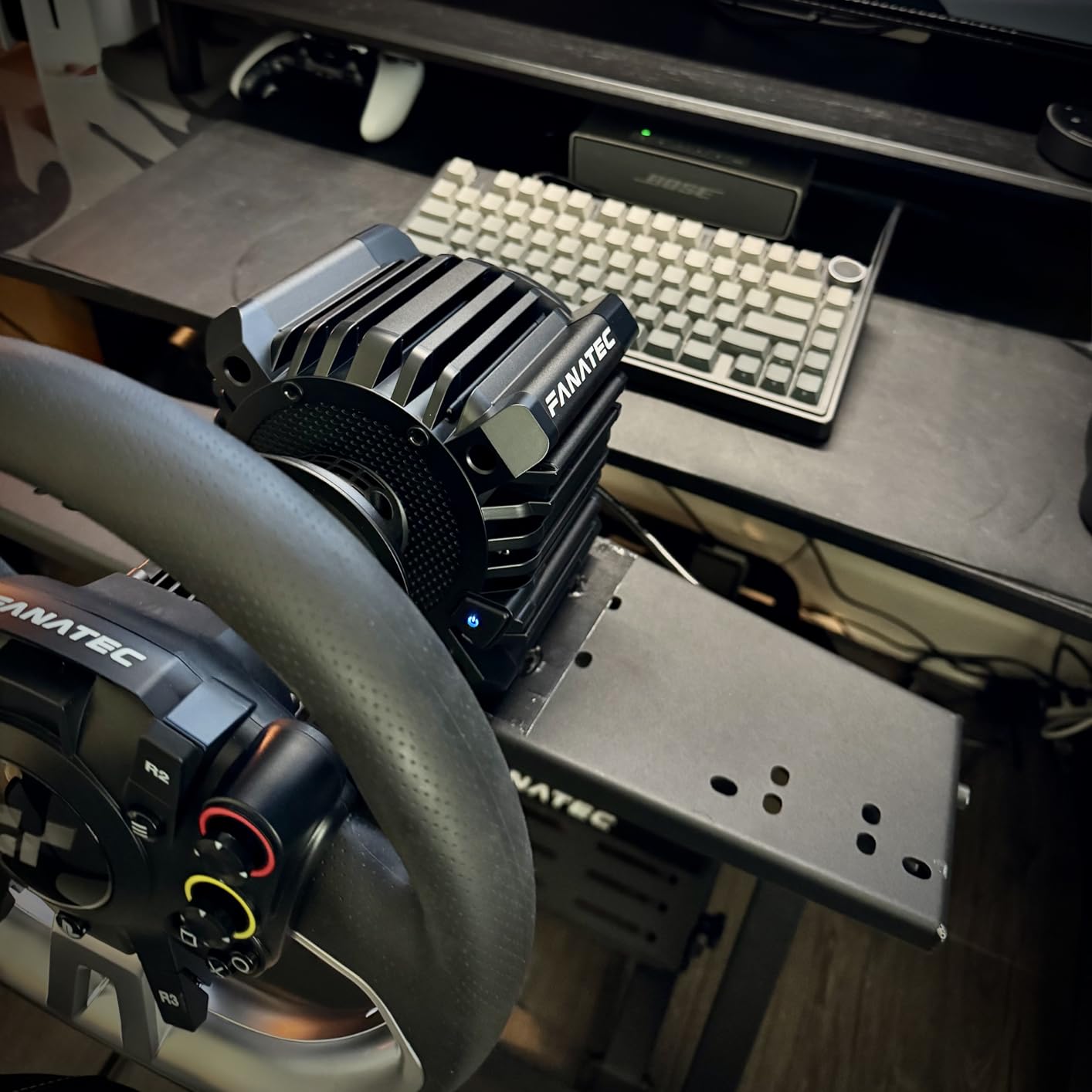
The GT DD Pro is a direct-drive package designed with Polyphony Digital, and the wheel it ships with is the one you see in the game. That design fidelity is the main appeal: the 280 mm rim, the OLED display, the RevLED strip and the four 5-way sticks all correspond to real controls in the cockpit.
Those sticks are mapped to traction control, brake balance, torque split and fuel mapping, so you can change a setup while driving instead of waiting for a menu. Very few wheels in any price range give you that.
Force feedback comes from a 5 Nm servo with FluxBarrier technology, mounted in a passively cooled aluminium housing. Owners upgrading from a gear-driven wheel describe linear, detailed feedback and a genuine jump in quality, and the base can later run at 8 Nm with a different power supply.
There is one setup step everyone should know. The wheel arrives with a -4 degree centre offset, and if you connect it to a PC and drive without recalibrating, the car pulls to one side. Recalibrate the centre position in the Fanatec software and the problem disappears entirely.
The build is where the rating stops short of the top. Buyers expected more metal in the wheel and paddle assembly, and the spring paddle shifters occasionally fail to register. The included two-pedal Hall effect set is the piece most owners replace first.
Why this package suits console and PC racers
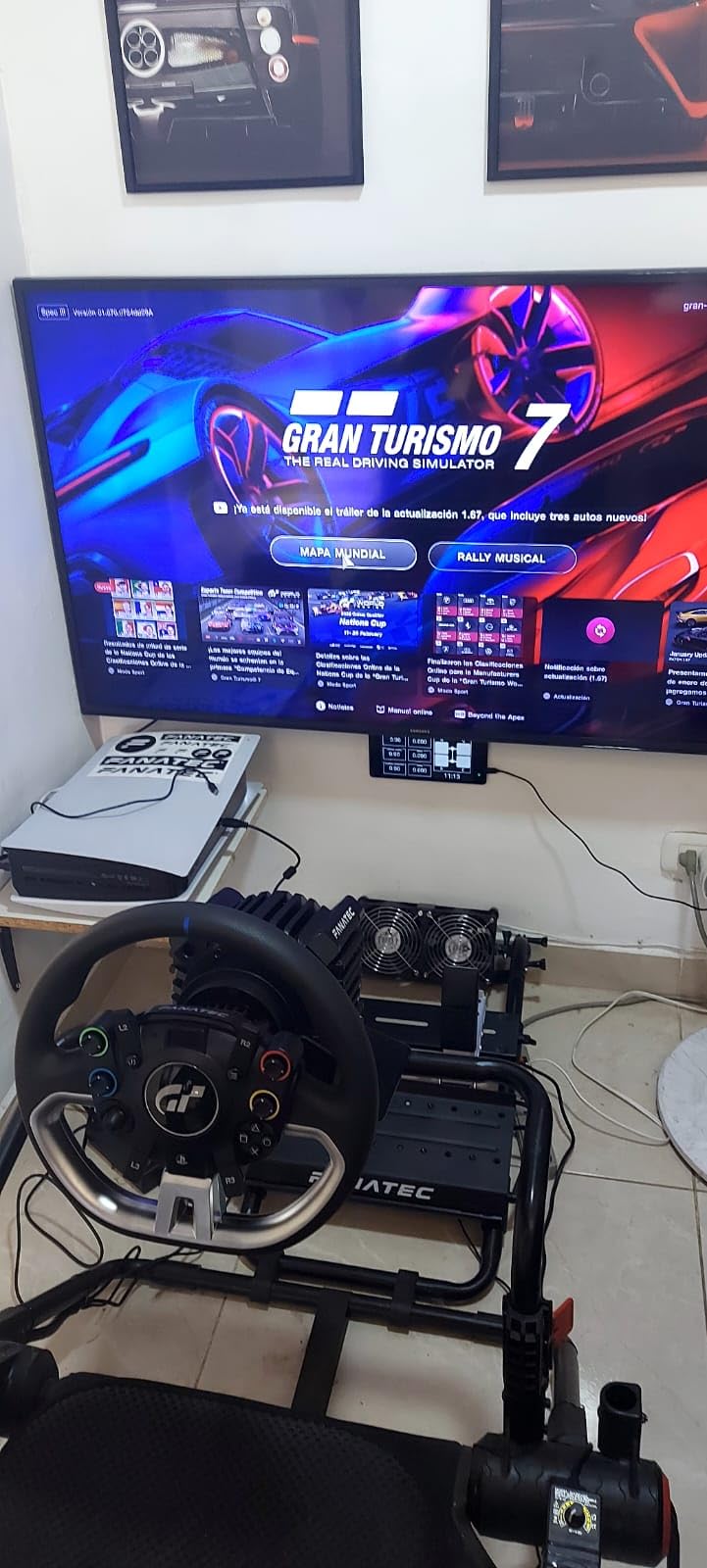
It is officially licensed for PS5 and PS4 and also runs on Windows, and the wheel design means the cockpit you see in the game is the cockpit you hold. The three-year manufacturer warranty is also among the longest listed in this roundup.
The OLED display shows setup and telemetry without a phone or a second monitor, which is one of the few genuinely useful telemetry screens at this tier. For anyone who drives the same car in both Gran Turismo and a PC sim, that continuity is worth more than the extra torque a bigger base would add.
What to consider before buying
Recalibrate on PC. This is the single most common complaint and it costs about two minutes, but skipping it makes the wheel feel broken in a very specific way.
Also weigh the plastic content against the MOZA alternatives, which use more metal at a comparable price point. If your PC gaming is the priority and the PlayStation licence is a bonus rather than a requirement, a MOZA bundle will feel more solid in the hand.
11. PXN V99 – the only way into three pedals, a clutch and a shifter in one box
PXN V99 Force Feedback Racing Wheel, with Pedals and Shifter
- Real 3.2 Nm force feedback with responsive road texture
- Switchable rotation suits arcade and league layouts
- Three Hall pedals plus clutch and a 6+1 shifter are rare at this level
- Metal shifter shaft with dual range feels sturdy
- One wheel covers PC Xbox One Xbox Series and PS4
- Some units overheat and cut force feedback after several races
- Pedal base slides on hard floors unless braced
- Shifter is small and light against a metal H-pattern
- Weak quick release and a few early force feedback failures
- Limited support and no deep-dish rim upgrades
Nothing else in this roundup bundles a clutch pedal and a gear shifter, and that is the reason the V99 keeps coming up in budget conversations. You get a 3.2 Nm dual-motor wheel, three Hall sensor pedals, a 6+1 shifter and desk clamps in one box.
Does it work on PC? Yes. It connects over USB and needs no additional software. The same wheel also covers PS4, Xbox One and both current Xbox Series consoles, so one purchase covers a PC and three console generations.
The switchable rotation is a smart feature. 270 degrees for arcade titles where you want quick response, 900 degrees for a league layout where you want more lock at the same steering reduction.
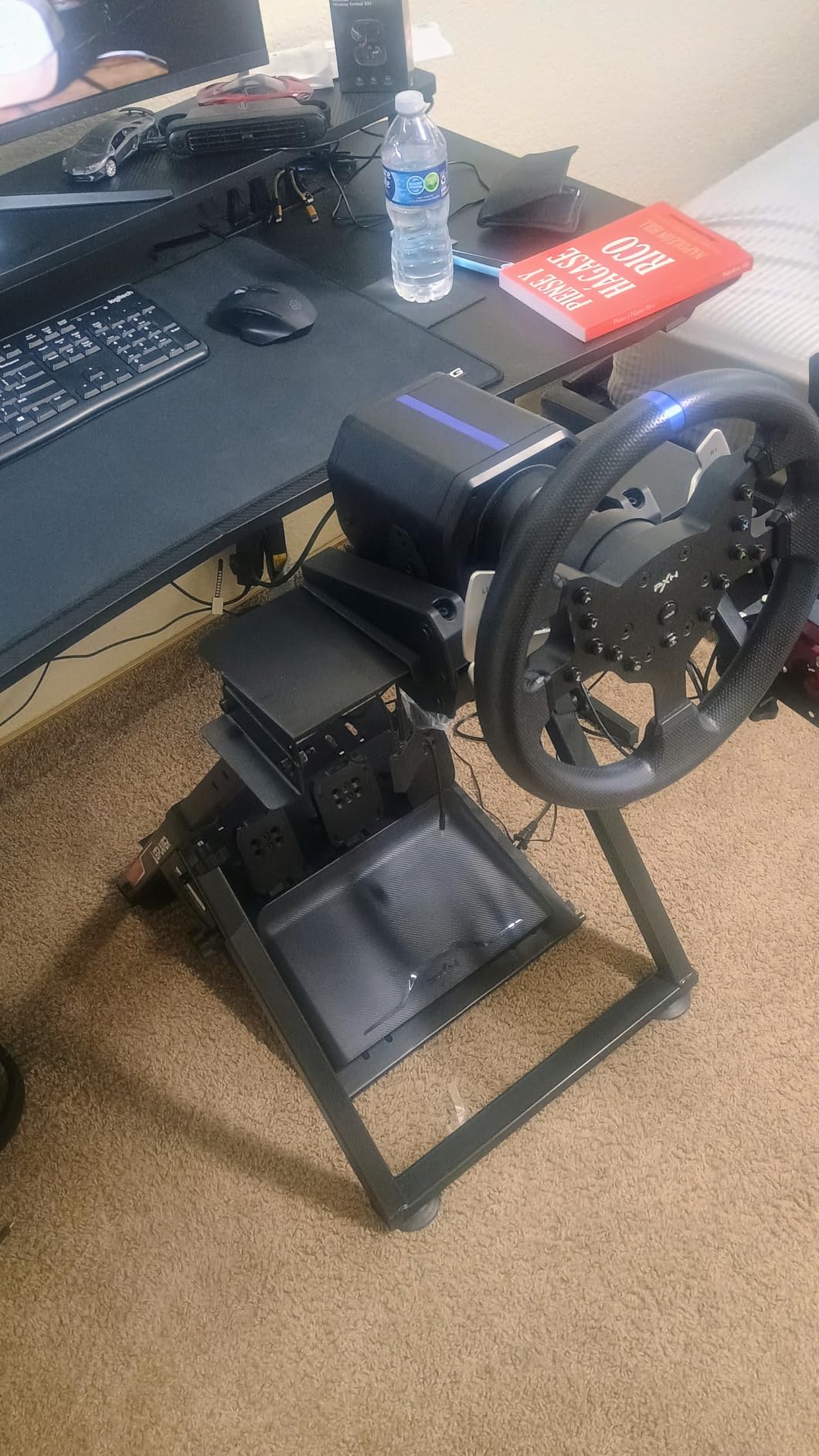
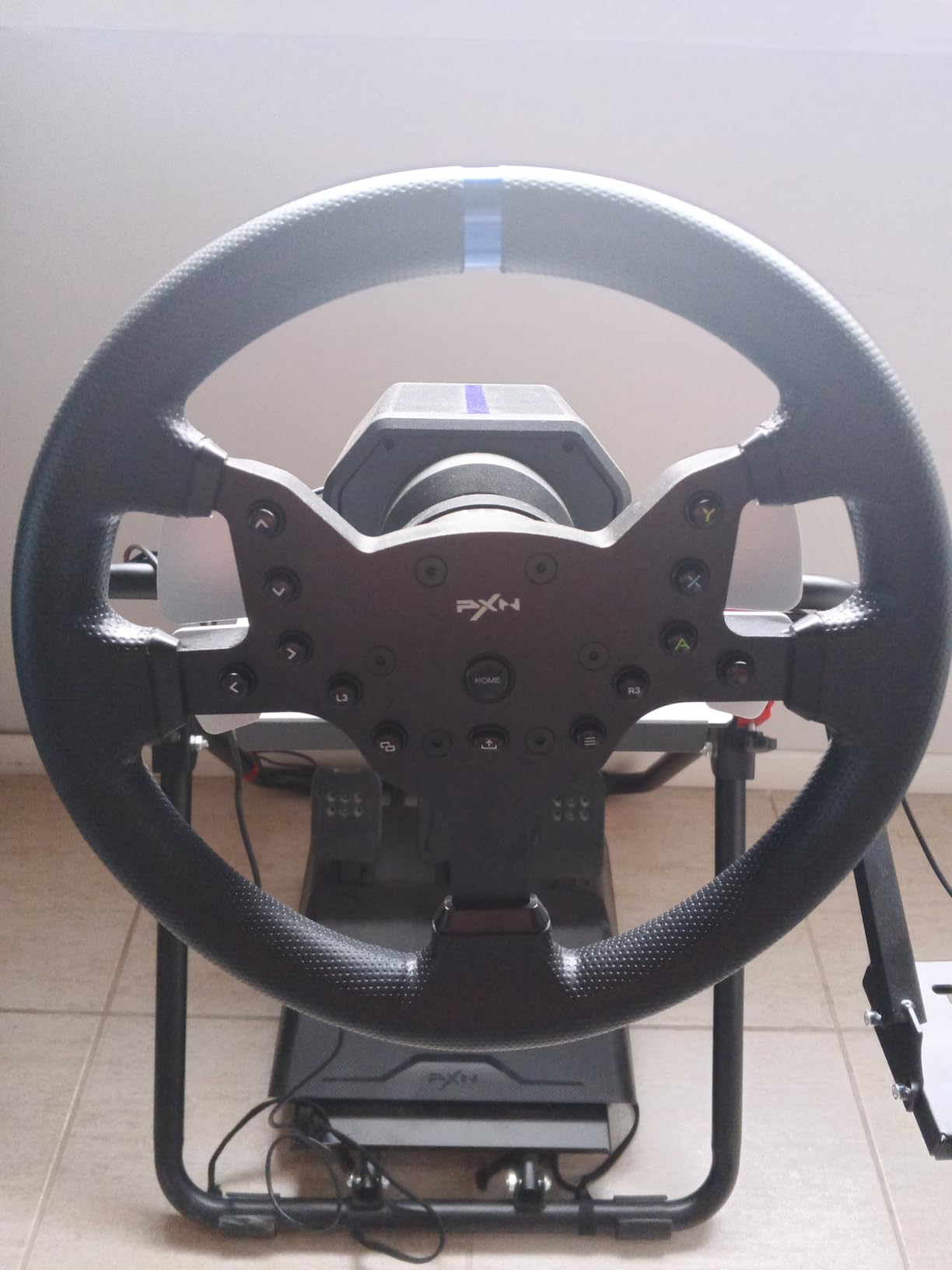
The detachable 11.8-inch wheel has a TPR rubber grip and a four-paddle layout, with upper shifters and lower analog clutch paddles. The paddle clutch is a simulation rather than a force-sensing clutch, so it will not give you a true bite point.
Durability is where the 4.2 rating comes from. Owners report units overheating and cutting force feedback after a few consecutive races, pedal bases sliding across hard floors, and a handful of units failing within weeks. The quick release is also noticeably weaker than the metal systems on MOZA and Logitech kits.
Why the V99 makes sense for a strict budget
If your ceiling is low and you know you will want a clutch and a manual gearbox eventually, this is the shortest route. Real force feedback, three pedals, a clutch and a shifter at once is unusual, and no other wheel here combines all four.
It is also the honest answer to the most common question we see about the brand, which is whether it is worth buying. The hardware itself is more capable than the reputation suggests; the concern is build quality and support over a multi-year ownership period rather than day one performance.
When to buy something else
Do not buy this if you run long endurance races in a row, because the overheating reports cluster around consecutive sessions. Do not buy it if you are building a permanent rig, since the pedal base needs bolting down and the quick release will not survive frequent swaps.
And if your budget stretches a little further, a direct-drive bundle from MOZA gives you lower torque ripple, metal quick release and a documented upgrade path, which is why we rank the R3 and R5 above this one despite the higher outlay.
12. Fanatec CSL GT3 Wheel – the rim to buy when you already own a base
- Properly proportioned 300 mm GT3 rim for GT and endurance racing
- Magnetic aluminium paddles are fast and one-hand operable
- Analog clutch paddles with four switchable modes are genuinely useful
- Deep control set with nine buttons two encoder dials and toggles
- QR2 Lite quick release and OLED display
- Sold as a wheel only so a base and pedals are separate purchases
- Console compatibility depends on which licensed base is fitted
- Analog clutch mode simulates a bite point rather than using a load cell
This is the only rim in the roundup, and that is the point. If you already own a Fanatec direct-drive base, this is how you change the character of the wheel completely without replacing the motor.
A 300 mm rim is the size of a real GT3 wheel. It gives you a greater steering ratio, so a smaller amount of hand movement produces more rotation, and it fills your field of view in a way that a 280 mm rim never quite does in VR or on a large monitor.
The magnetic anodised aluminium paddle shifters are the strongest hardware in the wheel. You can upshift with one hand on either side, and the throw is short and consistent, which is what makes a sequential box feel fast.
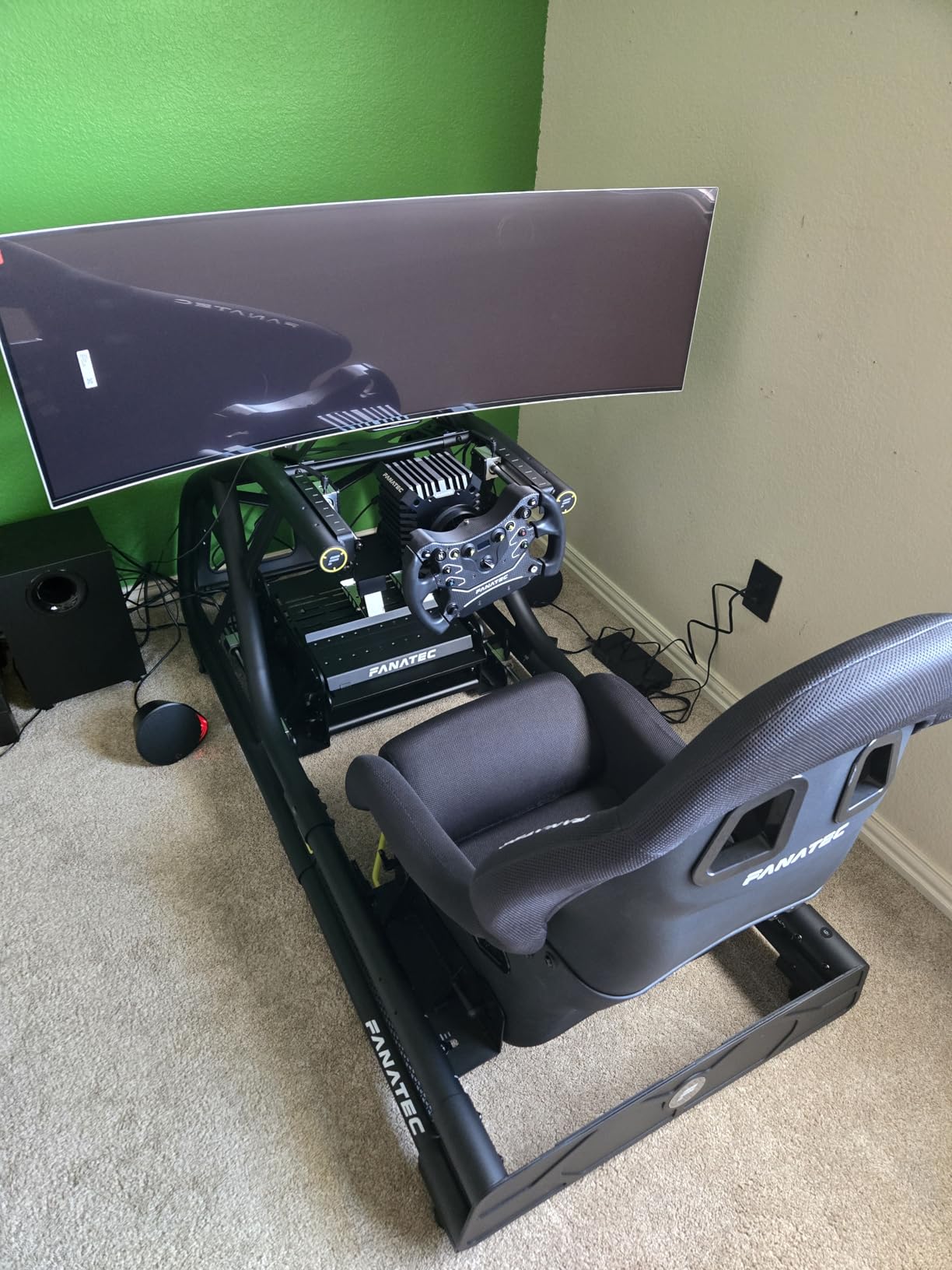
The analog clutch paddles switch between four modes: clutch bite point, clutch and handbrake, brake and throttle, and a fully mappable axis mode. The bite point mode is a simulation rather than a true load-cell clutch, but it does let you practise a partial clutch launch.
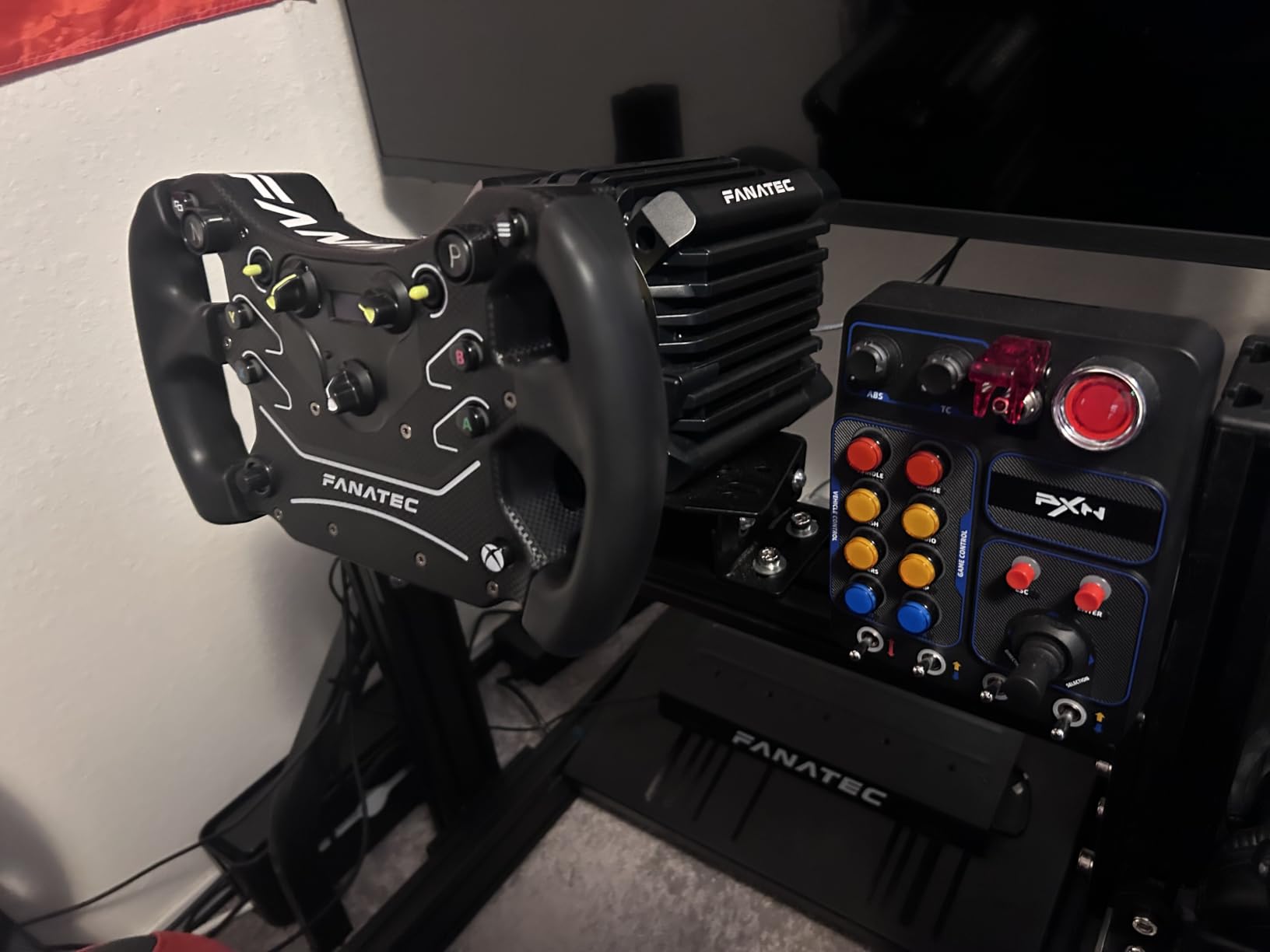
The control count is unusually deep for a rim. Nine push buttons, two Multi-Position Switches with encoders, two 2-way toggles and a 7-way FunkySwitch give you more inputs than most cars have functions for, and the OLED display shows the state of the encoders.
When a bigger rim is the correct upgrade
When you have spent a season in a direct-drive base and plateaued. Most drivers improve lap times by changing what their hands are doing, and moving from a 280 mm round rim to a 300 mm GT3 rim with analog clutch paddles is a change in technique, not just in hardware.
Overmolded 50 Shore A rubber grips matter over long sessions too. They are firm enough to hold a precise line and durable enough not to wear into a shine, and the build quality at this tier is consistently praised.
Why this is not a first purchase
It arrives with a QR2 Lite wheel-side base preinstalled but no motor and no pedals. If you do not already own a Fanatec direct-drive base, you need to buy that first, and console support depends on which licensed base is fitted.
Buying a rim before a base is also the wrong order. Every brand sells better bases than rims, and a new rim on a weak base feels identical to the rim you already had. Buy the base first, then choose the wheel that matches the car you drive.
How to Choose a Racing Wheel for PC
Almost every wrong purchase in this category comes from buying the wrong part. A base and a rim are two separate decisions, and the pedal set is a third. Get those right in that order and the rest is detail.
Direct drive, belt drive and gear drive come down to torque fidelity
Direct drive attaches the motor straight to the wheel shaft. Nothing sits between the motor and your hands, so all the torque arrives immediately, linearly and with very low ripple. It is quiet under load and it is the standard for competitive sim racing.
Belt drive routes the motor through a reinforced belt. The belt absorbs some of the finest detail but gives smooth, continuous, quiet feedback with none of the notchy texture of gears. It is a good compromise, and the T300RS GT in this roundup is the clearest example.
Gear drive uses a small motor spinning a large gear reduction. It is the cheapest mechanism and it is the noisiest, and the reduction is what creates the textured, notchy feel that owners of geared wheels describe. The G920 and G923 are the two geared wheels here, and both use helical gearing to soften it.
Two more categories turn up in this market. A bungee cord or spring, as on the T98, provides a fixed return force with no data from the game at all. A wheel with no motor, like the HORI Apex, provides nothing at all. Neither can tell you where the grip limit is.
Across the nine wheels with an electric motor here, the honest picture is that nothing is a substitute for feedback. The bungee cord on the T98 and the motorless HORI Apex sit in a different category entirely, and both only make sense when the goal is the physical shape of a wheel rather than reading a car.
Among the electric wheels, the ladder runs from noisy and cheap to quiet and expensive. The G920 and G923 sit at the bottom with helical gearing, the T128X and V99 add modest but real motor feedback, the T300RS GT introduces belt smoothness, and the direct-drive bases — R3, R5, RS50 and GT DD Pro — are the group that competitive sim racers actually want.
Across that set, torque alone does not rank them. The 3.9 Nm R3 feels cleaner than the 5.5 Nm R5, and the 5 Nm Fanatec base feels more detailed than either, because ripple and linearity matter more than peak strength. Buy for detail, not for the largest number on the box.
How much torque do you actually need?
Our rule of thumb is 8 Nm as the point where a base can hold a heavy car at full lock without running out of authority, and anything above roughly 12 Nm is not useful unless your rig is bolted down, because the extra strength just shakes your desk.
Below 5 Nm you can still drive comfortably in a mid-weight car with an aggressive in-game damper setting, which is the practical answer for most players. The R3 at 3.9 Nm and the V99 at 3.2 Nm are honest entry points rather than mistakes.
Between 5 and 8 Nm is where most competitive PC setups sit. Above that you are buying headroom for GT and endurance cars, and you need a rig rather than a desk clamp to use it properly.
Rim size and rotation range change what your hands have to do
Rim diameter sets the steering ratio. A 280 mm rim needs more hand movement than a 300 mm rim to produce the same steering angle, and a small 10-inch rim needs the most. Bigger rims suit GT and open-wheel cars; smaller round rims suit rally and drift.
Rotation range is the other half. 900 degrees lock to lock is the traditional figure because it leaves lock in reserve when a game applies a steering reduction of 540 degrees or less. Unlimited rotation wheels let you set any range you want. Below 270 degrees you are choosing convenience over realism.
A 270-degree wheel can still work well in an arcade title, but you will fight the ratio in anything competitive. If a wheel offers both 270 and 900 degrees, keep it on 900 for sim titles.
Choosing pedals: what each type actually adds
A two-pedal set with throttle and brake is all you need for an automatic. The brake is a simple spring, so it tells the game where the pedal is rather than how hard you are pressing, which limits modulation in any car with brake bias.
A three-pedal set adds a clutch and opens up manual gearbox cars and standing starts. It is a real capability difference, not a cosmetic one, and the PXN V99 is unusual in bundling a clutch and a shifter at the entry level.
A load cell brake measures applied force instead of position, and that is what allows realistic brake pressure, a real bite point on a clutch and useful ABS and brake bias adjustment. It is the first upgrade most competitive players make, and it is why the RS50 bundle is worth the outlay.
Game compatibility is broader than the box suggests
Almost every wheel in this roundup works on Windows through USB, but the feature set changes. Official support lists matter for competitive sims: iRacing maintains a validated wheel list, and Assetto Corsa Competizione and Le Mans Ultimate support force feedback on PC hardware regardless of console licence.
Console licensing is the real compatibility trap. A PlayStation-licensed wheel works on PC; a PC-only direct-drive bundle like the MOZA kits does not work on a PS5 at all without a licensed base. Check which screens you actually use before you buy.
Mounting: check the desk before the wheel
Most wheels here clamp to a desk. Clamp depth varies, and the shallow ones will not fit a thick or metal-framed desk. The T128X accepts desks up to 2.2 inches, while the MOZA clamps are shallower, so measure before you order.
Three pedals need a floor or a pedal riser as well as a desk clamp, and they need to be anchored. Pedal units designed for a rig will tilt on a hard floor under heavy braking, which changes the pedal angle mid-corner. Our sim racing cockpit guide covers frame and floor options.
Buy the base before the rim
This is the most common sequencing mistake. A new rim on an old base feels almost identical, because the rim only changes the steering ratio and the grip. The base sets the feedback quality, and the pedals set the brake feel.
Upgrade inside one brand where you can. Quick release standards look similar across manufacturers but the licensing behind them is not, and mixing a base from one brand with add-ons from another is where compatibility friction appears in practice.
Build in this order: base, then pedals, then rim
The order matters more than the amount you spend. A direct-drive base sets the ceiling on how much detail you can feel, the pedal set sets how precisely you can control brake pressure, and the rim only changes how your hands move. Buying a 300 mm rim first is the classic mistake, because the extra feel comes from the motor, not the wheel shape.
A practical sequence for most PC racers runs in three steps. Start with a direct-drive bundle such as the MOZA R3 or R5 so you learn what good feedback feels like on your desk. Then replace the pedal set with a load cell unit, which is the single biggest change to lap times on a fixed base. Only then consider a different rim sized for the car class you actually race.
Two further steps exist for people who reach them. A handbrake unlocks rally and drift titles, and a sequential shifter replaces the clutch for circuit racing where you never need to heel and toe. Both are cheap relative to what a new base costs, and neither is wasted when you eventually move to a more expensive wheel.
What each tier actually unlocks in the car
The tier you buy determines how much of the car you can feel, and the difference is easier to describe through driving tasks than through specifications. In a bungee-cord or motorless wheel, a slide is something you watch. In a belt-driven wheel, a slide is something you anticipate. In a direct-drive base, a slide is something you can catch mid-corner because the front axle tells you it is losing grip before the rear does.
Gear and belt wheels hold up well in road cars and GT cars with forgiving balance, because those cars give you clear visual and audible cues. They fall short in open-wheel cars, where the driver relies almost entirely on a loose front wheel as the primary signal. Direct drive is where open-wheel and endurance racing start to feel right.
Torque matters most in heavy cars. A GT car or a stock car carries a lot of mass through the front axle, and a base with 4 Nm will not be able to hold full lock against that load. If your main title features heavy touring cars, treat 8 Nm as a floor rather than a target.
Desk clearance and the 300 mm rim problem
Check clearance before you fall for a wide rim. A 300 mm wheel needs a little over 30 cm of vertical space above the base, and your knees need to clear the rim as you rotate to full lock. Desks with a crossbar, a drawer front or a modesty panel are the usual problem, and the wheel will hit the desk long before it hits full lock.
Base depth is the second measurement. The MOZA R3 has the smallest published footprint of any base in this roundup, measuring 11.81 by 7.87 by 3.94 inches, and it is why the kit works on a small desk where the 17.9 by 10.94 by 16.54 inch R5 would overhang. The T128X accepts desks up to 2.2 inches thick, and the G923 has both a wide base and a long cable run.
Finally, leave space for the pedals. A three-pedal unit needs floor area in front of the desk, and if your chair blocks it you will end up driving with your knees raised. Our pedal roundup covers pedal risers and floor mounts for tight setups.
Setting Up Your Wheel and Pedals the Right Way
Most complaints about wheels are setup problems, not hardware problems. Four issues account for nearly all of them, and each has a fix you can apply in under ten minutes.
Fix a wheel that shakes at top speed
Almost always one of three things. Your steering range is too wide for the car, your force feedback gain is too high, or the in-game damper setting is too aggressive so the game is feeding you noise instead of grip.
Start by setting the steering range in the game’s settings to 540 degrees or less, then lower the force feedback gain until the wheel stops buzzing. Only then adjust the in-game damper, and change it in small steps. If the wheel shakes harder as the car goes faster, reduce the range before anything else.
Fix a brake that will not calibrate after a load cell change
This is the most common pedal problem and it is not a fault. A load cell reports force, not position, so the game’s brake input axis has to be mapped against pressure rather than travel.
In the pedal software, set the brake max force to the highest reading you can produce when you press as hard as you comfortably can, then set the input axis in the game to match that value as the full-press point. Until you do this, the game sees a fraction of your actual input and the pedal feels dead.
Fix reversed or weak force feedback
If the wheel fights you in the direction you are steering, the effect is inverted in the game’s settings or the software has the wrong axis assigned. Check the wheel’s axis configuration in your control panel first, then the in-game inversion setting.
If feedback is simply weak rather than reversed, you are usually on a geared wheel at full gain. Dialling gain up on a gear-driven wheel mostly amplifies gear noise, so lower the gain and add in-game damping instead.
Fix a wheel that will not self-centre
Run the centre calibration with the wheel physically centred and your hands off. Most base software has a calibration step, and skipping it is why a wheel that was fine yesterday now holds a slight steering offset and makes the car drift.
If the centre keeps shifting, check that nothing is touching the rim and that the desk clamp is tight. A base that has crept a few millimetres over time will not sit at true centre.
Frequently Asked Questions
What is the best budget PC steering wheel?
The best budget PC steering wheel with real force feedback is the PXN V99, which pairs 3.2 Nm of dual-motor feedback with three Hall-sensor pedals, a clutch and a 6+1 shifter. If your budget stretches a little further, the MOZA R3 bundle gives you direct drive at 3.9 Nm with metal construction and a documented upgrade path, which is the better long-term buy.
Does the PXN racing wheel work on PC?
Yes. The PXN V99 connects over USB and requires no additional software. The same wheel also covers PS4, Xbox One and Xbox Series X and S, which makes it the most platform-flexible option we tested. The main caveat is durability, since some owners report force feedback cutting out after several consecutive races once the unit gets hot.
What wheels do NASCAR drivers use?
Professional stock car sim racers generally use the same hardware as any other serious sim racer: a direct-drive wheelbase with at least three pedals, paddle shifters, and a sequential or H-pattern shifter rather than a gamepad. We do not have verified model data for a specific NASCAR professional setup, so we would not name a particular wheel as a professional choice.
Is it worth it to buy a racing wheel?
Yes, if you play anything with a real physics model. A controller lets you rotate freely and shows you grip limits visually, while a wheel with force feedback lets you feel them and drive closer to the limit. Expect to be slower for the first few sessions because a wheel demands real technique, but you will brake later and carry more speed once you adapt.
Is direct drive better than belt drive for sim racing?
Direct drive is better for competitive sim racing. With the motor attached straight to the wheel shaft, feedback arrives instantly and linearly with very low torque ripple and no noise, so you read grip more accurately. Belt drive is smooth, quiet and much cheaper, and it is a good second step, but it softens the finest detail.
How much torque do I need for sim racing on PC?
Our rule of thumb is 8 Nm as the point where a base can hold a heavy car at full lock without running out of authority, and 5 to 8 Nm as the competitive sweet spot. Below 5 Nm you can still drive comfortably with a higher in-game damper setting. Above 12 Nm there is little practical gain unless your rig is bolted down.
Do I need a clutch pedal for sim racing?
Only if you drive a manual gearbox car. A clutch pedal is required for manual transmission, heel-and-toe downshifts and clutch kick starts, and a sequential shifter is a common next step for circuit racing. For automatic cars and truck simulators, a throttle and brake set is enough, though our pedal guide covers the upgrade options.
What is the difference between 900 degree and unlimited rotation wheels?
A 900-degree wheel has a fixed physical limit, and it leaves lock in reserve when a game applies a steering reduction of 540 degrees or less. An unlimited rotation wheel has no physical limit and lets you set any range you like in software. Below 270 degrees you are trading realism for convenience, which suits arcade titles rather than sim racers.
Which Racing Wheel Should You Buy?
Match the wheel to the car you drive and the desk you own, and the decision gets easy. Here is the short version of all 12 picks.
Buy the Logitech G920 as your first wheel. It is our editor’s choice, the most proven model here, and it works on a PC the minute you plug it in.
Buy the Logitech G923 if you also use a PlayStation, or if you want a clutch pedal and an RPM display at a mid-tier budget.
Buy the Thrustmaster T300RS GT for smooth belt-driven GT racing and a genuine upgrade path through the Thrustmaster ecosystem.
Buy the HORI Racing Wheel Apex only if you want a full-size wheel with no motor at the bottom of the price range.
Buy the MOZA R5 Bundle as the best-value route to direct drive, complete with a metal rim and steel pedals.
Buy the MOZA R3 Bundle if your desk is small and direct drive is the goal.
Buy the Thrustmaster T98 for a licensed Ferrari wheel that needs no software and no setup.
Buy the Thrustmaster T128X if Xbox is part of your setup and you care most about the paddles.
Buy the Logitech G RS50 for 8 Nm of direct drive, a load cell brake and a swappable rim ecosystem across PC and PS5.
Buy the Fanatec GT DD Pro for a licensed Gran Turismo wheel with an OLED display, and recalibrate the centre on PC before your first race.
Buy the PXN V99 when the budget is fixed and you want three pedals, a clutch and a shifter in one box.
Buy the Fanatec CSL GT3 Wheel last, once you already own a direct-drive base and want a 300 mm rim to match your driving position.
Whatever you choose, budget ten minutes for setup. Calibrate the centre, set your steering range, and remove that brake rubber block before you chase lap times. Those three steps close most of the gap between a new wheel and a fast one.