
When I started playing pool seriously fifteen years ago, I faced the same question every beginner encounters: should I focus on 8-ball or 9-ball? Both games use the same table and cue stick, yet they demand completely different approaches. After spending thousands of hours at the table and competing in both formats, I can tell you that choosing between 8-ball vs 9-ball pool comes down to understanding what each game actually tests.
In this guide, I will break down the rules, strategies, and skill requirements for both games. You will learn how the triangle rack differs from the diamond rack, why fouls cost you differently in each game, and which variant suits beginners versus competitive players. Whether you are picking up a cue for the first time or looking to expand your game, this comparison will help you make an informed choice.
Table of Contents
8-Ball vs 9-Ball Pool: Quick Comparison
Before diving into the details, here are the fundamental differences between these two popular pool variants:
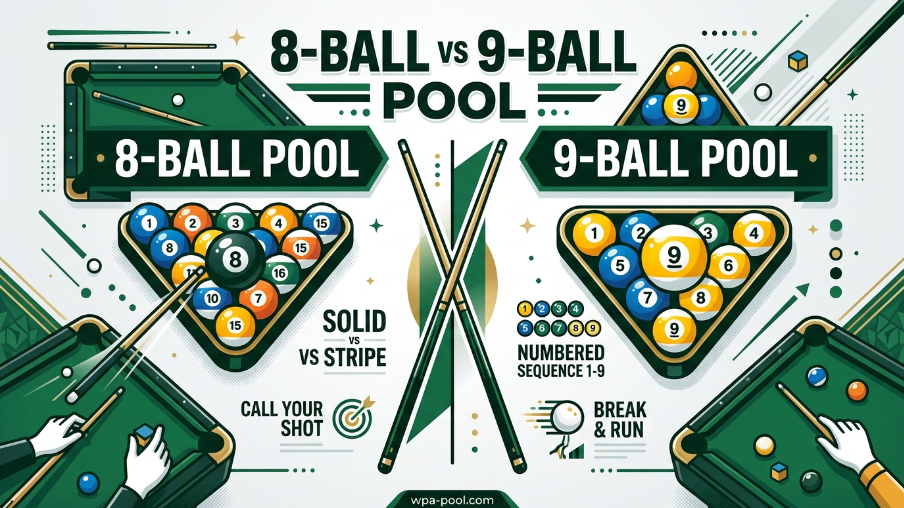
- Balls Used: 8-ball uses 15 balls (solids 1-7, stripes 9-15) plus the cue ball. 9-ball uses balls numbered 1 through 9 plus the cue ball.
- Rack Shape: 8-ball uses a triangle rack. 9-ball uses a diamond-shaped rack.
- Objective: In 8-ball, you clear your assigned group (solids or stripes) then sink the 8-ball. In 9-ball, you must pocket the 9-ball to win, hitting the lowest-numbered ball first on each shot.
- Gameplay Style: 8-ball rewards strategic planning and pattern recognition. 9-ball tests precision, cue ball control, and shot-making ability.
- Complexity: 8-ball gets harder as the game progresses due to clustering. 9-ball typically gets easier as you run through the sequence.
These differences shape everything from how you approach the break shot to how you practice. Let me walk you through each game in detail.
8-Ball Pool Rules and Objectives
8-ball is the game you probably see most often in bars and recreational settings. I spent my first two years of competitive play focused entirely on this format, and it taught me lessons about patience and planning that still help me today.
The Ball Groups and Setup
The game uses 15 object balls plus the cue ball. The balls split into two groups: solids (balls numbered 1 through 7) and stripes (balls numbered 9 through 15). The 8-ball sits in the center of the rack.
You arrange the balls in a triangle rack with the apex ball positioned over the foot spot. The 8-ball goes in the center of the third row. One corner should have a solid ball, and the opposite corner should have a stripe ball. The remaining balls fill in randomly.
How the Game Starts
The break shot determines everything. One player breaks from behind the head string (the kitchen), attempting to pocket a ball or drive at least four balls to the cushions. If the breaker pockets a ball, they choose either solids or stripes based on what went in. If the breaker scratches (sinks the cue ball), the incoming player gets ball-in-hand.
Once groups are assigned, you must pocket all balls from your group before attempting the 8-ball. You must call your pocket for every shot, though you do not need to call combinations or caroms.
Winning and Losing Conditions
You win by legally pocketing the 8-ball in your called pocket after clearing your group. However, several mistakes will cost you the game immediately:
- Pocketing the 8-ball before clearing your group
- Pocketing the 8-ball in an uncalled pocket
- Scratching while shooting the 8-ball
- Sinking the 8-ball on the same shot as your final group ball
These rules make the endgame tense. I have seen countless players lose games they were winning by getting careless on that final 8-ball shot.
9-Ball Pool Rules and Objectives
9-ball offers a completely different rhythm. When I switched to this format, I had to unlearn many habits from 8-ball. The game moves faster, rewards aggressive play, and punishes hesitation.
The Ball Setup
Only nine balls are used, numbered 1 through 9, plus the cue ball. You rack them in a diamond formation using a diamond rack. The 1-ball sits at the apex on the foot spot. The 9-ball goes in the center. The remaining balls fill the other positions randomly.
The Golden Rule of 9-Ball
Here is what makes 9-ball unique: you must always hit the lowest-numbered ball on the table first. You do not need to pocket it, but the cue ball must make contact with it before touching any other ball. This rule fundamentally changes how you approach every shot.
If you pocket the lowest ball legally, you continue shooting. If you miss or foul, your opponent takes over. The game continues until someone pockets the 9-ball to win.
Winning on Combinations
Unlike 8-ball, you can win 9-ball by pocketing the 9-ball at any time, provided you hit the lowest ball first. This means combination shots and caroms that sink the 9-ball count as wins. I have won games in two shots this way when the 1-ball, 9-ball, and cue ball aligned perfectly.
This rule creates constant pressure. Even when you are far behind in the sequence, one perfect shot can end the game.
Break Shot Rules Compared
The break shot sets the tone for every rack, but the rules differ significantly between games.
8-Ball Break Rules
In 8-ball, the breaker must strike the 1-ball first and either pocket a ball or send at least four object balls to the cushions. Failure to do either results in a foul, giving the opponent ball-in-hand.
If you pocket a ball on the break, you continue shooting and choose your group (solids or stripes). If you pocket balls from both groups, you can choose either. If the 8-ball pockets on the break, it spots back on the foot spot and the break continues.
9-Ball Break Rules
The 9-ball break has stricter requirements. You must strike the 1-ball first and either pocket a ball or send at least four object balls to the cushions. If you fail, it is a foul with ball-in-hand to the opponent.
The key difference: if you pocket any ball on a legal 9-ball break, you continue shooting. The push-out option also exists in many rule sets. After a legal break, the breaker (or the incoming player if the breaker fouled) can call a “push-out,” essentially a strategic pass where you are not required to hit the lowest ball first. The opponent can accept the shot or pass it back. This tactical element has no equivalent in 8-ball.
Fouls and Penalties
Understanding fouls keeps you from handing games to your opponent. Both games share some fouls but apply different consequences.
Common Fouls in Both Games
These fouls apply to both 8-ball and 9-ball:
- Scratching: Pocketing the cue ball gives your opponent ball-in-hand.
- No rail after contact: If no ball pockets after contact, either the cue ball or an object ball must touch a cushion.
- Push shots: You cannot push the cue ball with your tip remaining in contact through the stroke.
- Double hits: Only one contact with the cue ball per shot.
- Ball off table: Knocking a ball off the playing surface is a foul.
8-Ball Specific Fouls
8-ball has unique fouls related to the 8-ball itself. Pocketing the 8-ball prematurely (before clearing your group) loses the game immediately. Pocketing the 8-ball on the same shot as your last group ball also loses the game. Hitting the 8-ball first when you still have group balls on the table is a foul, but does not end the game unless you pocket the 8-ball.
9-Ball Specific Fouls
9-ball fouls center on the sequence rule. Failing to hit the lowest ball first is a foul. If three consecutive fouls occur (without a legal shot in between), the third foul results in loss of game under many rule sets including WPA rules.
The three-foul rule adds strategic depth. Experienced players sometimes play safe repeatedly, forcing opponents into difficult positions where a foul becomes likely.
Strategy and Skill Differences
This is where 8-ball vs 9-ball pool truly diverges. After competing in both formats for years, I agree with what the Reddit billiards community consistently says: 9-ball favors the better shot maker, while 8-ball favors the better strategist.
8-Ball Strategy: Pattern Planning
Success in 8-ball requires thinking five or six shots ahead. You must analyze the entire layout, identify clusters that will cause problems, and plan a sequence that breaks up those clusters while pocketing your balls.
The game gets harder as it progresses. With fewer balls on the table, options shrink and blockers increase. That early decision about which ball to pocket first matters enormously. I spend more time standing and analyzing in 8-ball than in any other pool game.
Cluster management separates good 8-ball players from great ones. Sometimes you must play a safety instead of attempting a difficult shot, specifically to break up a cluster that blocks your path to the 8-ball. Sacrificing one turn to improve your position for the next three turns is often the correct play.
9-Ball Strategy: Position Play
9-ball strategy centers on cue ball control. Since you always know which ball you must hit next (the lowest on the table), the challenge becomes positioning the cue ball for the subsequent shot. This is called getting “position” or playing “shape.”
Unlike 8-ball, 9-ball typically gets easier as you progress. Fewer balls remain, creating clearer paths. A well-played rack flows like a dance: pocket the 1, roll to the 2; pocket the 2, roll to the 3, and so on until you sink the 9.
When perfect position is impossible, you have two choices: attempt a difficult shot or play a safety. Safety play in 9-ball means hiding the cue ball behind another ball so your opponent cannot see the lowest ball directly. This tactical battle of position versus safety creates the psychological tension that makes 9-ball exciting to watch and play.
Which Game Is Harder?
The question “Is 9-ball harder than 8-ball?” appears constantly in pool forums, and the honest answer depends on your strengths. If you possess excellent cue ball control and can execute difficult shots under pressure, 9-ball will feel natural. If you excel at pattern recognition, spatial planning, and strategic patience, 8-ball will suit you better.
At the professional level, most players agree 8-ball presents greater complexity due to the strategic depth. However, 9-ball demands more consistent technical execution. You can win an 8-ball match with mediocre shot-making if your strategy is superior. You cannot win 9-ball without hitting your spots.
Which Game Should Beginners Learn First?
I teach both games to new players, and I always recommend starting with 8-ball. Here is why.
Benefits of Starting with 8-Ball
8-ball forgives mistakes better. If you miss a shot, you often leave your opponent with a difficult table rather than an easy runout. The game teaches fundamental skills like calling pockets, planning sequences, and managing the cue ball without the pressure of perfect position on every shot.
The equipment requirements also favor beginners. You can play 8-ball on any pool table dimensions, from bar boxes to tournament tables. The triangle rack is simpler to set up correctly than the diamond rack.
Benefits of Starting with 9-Ball
Some instructors prefer 9-ball for beginners because it forces proper fundamentals. You must hit specific balls first, which teaches accurate cueing. The sequential nature eliminates decision paralysis about which ball to shoot. Games finish faster, giving beginners more repetitions per hour.
If your goal is rapid improvement in cue ball control, 9-ball accelerates that development. You simply cannot succeed without it.
My Recommendation
Learn 8-ball first to understand pool strategy, then add 9-ball to develop shot-making precision. Most professional players compete in both formats, and the skills transfer between games. The strategic thinking from 8-ball improves your safety play in 9-ball. The position skills from 9-ball help you navigate difficult layouts in 8-ball.
Common Beginner Mistakes to Avoid
Having watched hundreds of beginners struggle, here are the most common errors in each game.
8-Ball Mistakes
Beginners often pocket balls randomly without considering the remaining layout. They break up their own clusters early, then face impossible shots later. Many get aggressive with the 8-ball too early, trying to win rather than playing safe when the shot is thin. Remember: in 8-ball, patience wins more games than bravery.
9-Ball Mistakes
New 9-ball players frequently attempt difficult shots when a simple safety would give them control of the table. They also neglect to plan two shots ahead, getting perfect position on the 2-ball but leaving themselves stranded for the 3-ball. The cardinal sin in 9-ball is focusing only on pocketing the current ball without considering the next position.
Practice Tips for Both Games
Regardless of which game you choose, focused practice beats casual play every time.
8-Ball Practice Drills
Rack the balls and practice running out without your opponent. Try to clear the table in one visit at least three times in ten attempts before considering yourself intermediate. Practice cluster breaking by intentionally creating difficult layouts and figuring out how to clear them. Work on safety play by trying to leave the cue ball behind blockers while still hitting your target ball.
9-Ball Practice Drills
The “three-ball drill” works wonders for position play. Place three balls on the table and practice pocketing each while getting position for the next. Increase to six balls as you improve. Practice breaking by focusing on controlling the cue ball rather than just smashing the rack. Work on thin cuts and difficult angles since 9-ball forces these situations regularly.
Frequently Asked Questions
Is 9-ball more difficult than 8-ball?
Neither game is objectively harder, they test different skills. 9-ball requires better shot-making and cue ball control. 8-ball demands superior strategy and pattern planning. Beginners often find 8-ball easier to learn because mistakes are more forgiving. Advanced players typically consider 8-ball more complex at high levels due to strategic depth.
Which pool game is better for beginners?
Most instructors recommend 8-ball for beginners because it teaches fundamental strategy without requiring perfect execution on every shot. However, 9-ball can accelerate learning for players who want to focus on cue ball control and shot accuracy. The best approach is learning 8-ball first, then adding 9-ball to develop complementary skills.
Can you play 8-ball and 9-ball on the same table?
Yes, both games use the same standard pool table. The only equipment differences are the number of balls used (15 for 8-ball, 9 for 9-ball) and the rack shape (triangle for 8-ball, diamond for 9-ball). Any regulation pool table works for both games.
Which game is more popular in professional tournaments?
9-ball dominates professional pool tournaments, particularly in North America. Major events like the US Open 9-Ball Championship and World 9-Ball Championship draw larger audiences and prize pools. However, 8-ball remains popular in amateur leagues, bars, and European competitions.
What is 10-ball and how does it compare?
10-ball is a variant similar to 9-ball but using ten balls instead of nine. It features stricter rules than 9-ball, requiring the called ball to pocket in the called pocket with no combination wins on the 10-ball. Many professionals consider 10-ball the purest test of pool skills because it eliminates lucky combination shots.
Final Thoughts on 8-Ball vs 9-Ball Pool
After comparing 8-ball vs 9-ball pool across rules, strategy, and skill requirements, one truth emerges: both games reward different strengths. 8-ball will make you a smarter player who sees the whole table. 9-ball will make you a sharper shooter who controls the cue ball with precision.
My advice? Do not choose between them. Master both. Start with 8-ball to build your strategic foundation, then add 9-ball to sharpen your technical skills. The combination will make you a complete pool player capable of excelling in any format.
The table is waiting. Rack them up and see which game speaks to you.