
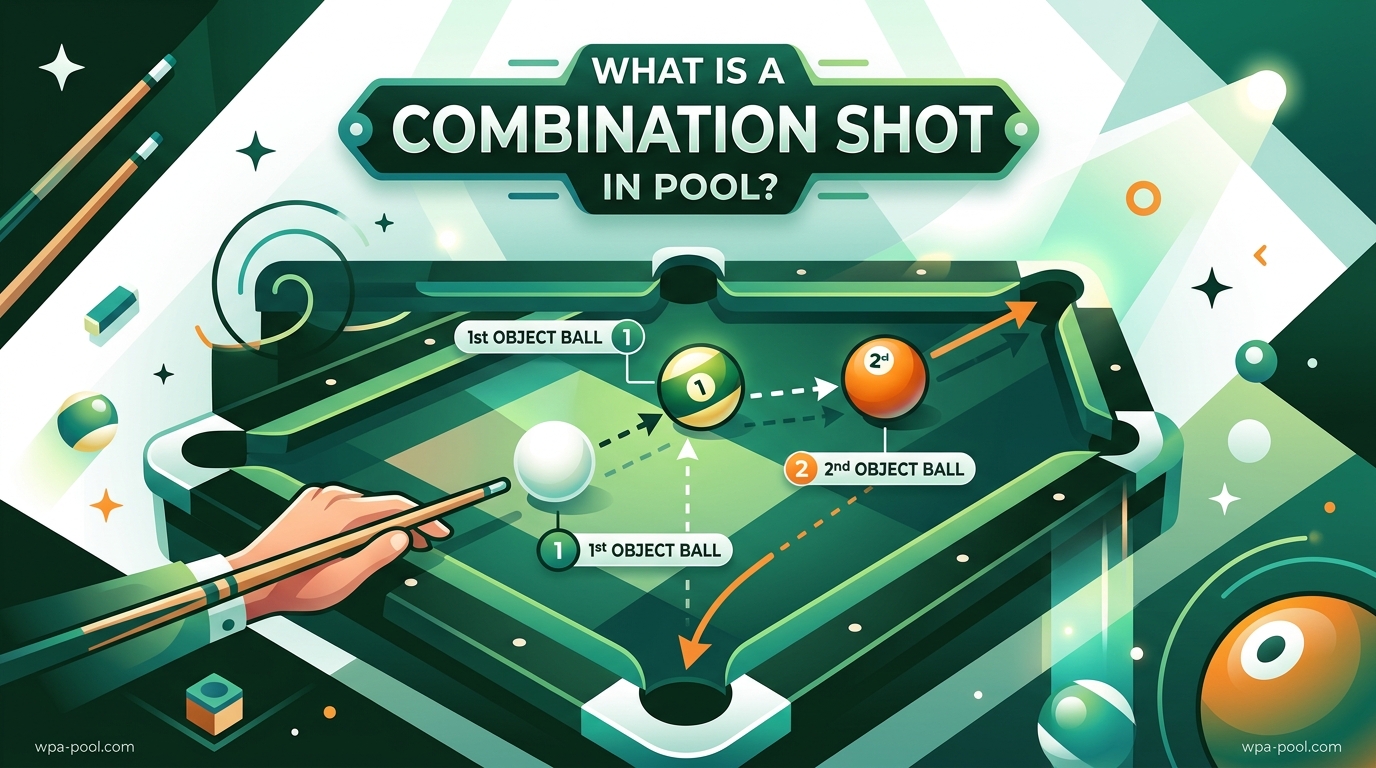
A combination shot in pool is a shot where the cue ball strikes one object ball, which then contacts and pockets a second object ball. This technique is essential when the ball you need to pocket is blocked or positioned where you cannot hit it directly with the cue ball.
In this guide, I will explain exactly how combination shots work, the rules for using them in different pool games, and the aiming technique that makes these shots much easier to execute. Whether you are just learning about combos or looking to improve your success rate, you will find practical steps you can use immediately at the table.
Table of Contents
What is a Combination Shot in Pool
A combination shot involves at least three balls: the cue ball, a first object ball, and a second object ball that you want to pocket. You strike the cue ball into the first object ball, and that ball travels forward to hit and pocket the second object ball.
Most combination shots you will encounter are two-ball combos, where one object ball pockets another. Three-ball combinations are possible but significantly more difficult due to the compounded margin for error at each contact point.
Players use combination shots when a direct path from the cue ball to the target ball is blocked by other balls, or when the cue ball is positioned in a way that makes a direct hit impractical. These shots are common in both 8-ball and 9-ball games when players are running out a rack and need to reach a ball that is tied up.
How Does a Combination Shot Work
The mechanics of a combination shot follow a simple chain reaction. First, your cue tip strikes the cue ball. The cue ball then travels to contact the first object ball at a specific point. That first object ball moves in a straight line from the contact point toward the second object ball, ideally pocketing it.
Each contact point in this chain matters. If the cue ball hits the first object ball even slightly off from your intended aiming point, that error amplifies when the first ball strikes the second. This is why combination shots have a smaller margin for error than direct shots.
Speed control is also critical. The cue ball must carry enough energy to move the first object ball with sufficient force to pocket the second ball. However, excessive speed increases the risk of the balls rattling in the pocket or the cue ball scratching into a corner.
Combination Shot Rules for 8-Ball and 9-Ball
According to APA league rules, combination shots are legal in both 8-ball and 9-ball, but specific restrictions apply depending on the game. The universal rule is that you must strike the correct ball first for your group or the lowest numbered ball, depending on the game format.
8-Ball Combination Rules
In 8-ball, you must strike one of your own group balls (solids or stripes) first before any other ball. The 8-ball may not be the first ball contacted in a combination unless it is your only remaining ball and you are shooting at it legally to win.
You can use your opponent’s balls as the second ball in a combination. For example, if you are solids and your 2-ball is touching your opponent’s 11-ball, you can legally shoot the cue ball into your 2-ball to pocket the 11-ball. However, the cue ball must contact your ball first.
If the 8-ball is pocketed in the same shot as the last object ball of your group via combination, that is a legal win. But if the 8-ball is contacted first or pockets in an illegal combination, it results in a loss of game.
9-Ball Combination Rules
In 9-ball, the cue ball must contact the lowest numbered ball on the table first. You can use that lowest ball to pocket any other ball in a combination, including the 9-ball itself. This is why 9-ball players often look for early opportunities to combo the 9-ball into a pocket for a quick win.
The key difference from 8-ball is that you cannot use any ball other than the lowest numbered ball as the first contact. If the 1-ball is on the table, the cue ball must hit it first in any combination attempt.
How to Aim a Combination Shot
The most reliable method for aiming combination shots is to work backwards from your target. Start by identifying exactly where the first object ball needs to contact the second object ball to pocket it. Then determine where the cue ball must hit the first object ball to send it to that contact point.
Step 1: Find the Pocketing Point
Look at the second object ball and determine the precise spot where the first object ball must strike it to send it into the pocket. This is similar to finding the contact point on a direct shot, except you are aiming one ball into another rather than the cue ball into an object ball.
Step 2: Aim the First Object Ball
Once you know where the first ball must hit the second ball, find the ghost-ball position for the first ball. Imagine the first ball sitting at that ghost-ball spot, and treat it like you are shooting that ball directly at the pocketing point on the second ball.
Step 3: Execute the Cue Ball Shot
Now aim the cue ball to strike the first object ball so that the first ball travels to the ghost-ball position you identified. Use your regular aiming system, whether that is the ghost-ball method, cue-pivot technique, or contact point alignment. The cue ball should hit the first ball with center-ball or slight follow to maintain predictable paths.
Combination Shot vs Carom Shot
Many players confuse combination shots with carom shots, but they are fundamentally different techniques. A combination shot pockets a ball by using another object ball as the pocketing vehicle. A carom shot uses an object ball as a bumper to change the cue ball’s path, typically to achieve position on a subsequent shot.
In a carom, the cue ball strikes an object ball and then continues moving to hit another ball or cushion. The object ball may or may not pocket. In a combination, the object ball you hit first must move and contact another ball specifically to pocket it.
The aiming approach differs as well. Carom shots require calculating the cue ball’s path after contact, while combination shots require calculating the object ball’s path. Both shots are useful in run-out situations, but combinations are for pocketing and caroms are primarily for position play.
Common Mistakes to Avoid
After talking with players on Reddit and observing games at my local hall, I have noticed the same errors appearing repeatedly when players attempt combinations. These mistakes cost games but are easy to correct with awareness.
Hitting the Wrong Ball First
The most costly error is contacting the wrong ball first. In 8-ball, this gives your opponent ball-in-hand. Always double-check that you are hitting your own group ball first, and in 9-ball, verify the lowest numbered ball is your first contact.
Poor Speed Control
Players often hit combination shots too hard, thinking power will overcome the angles. Excessive speed actually makes the shot less accurate and increases the risk of rattling the ball in the pocket jaws. Use smooth, medium-speed strokes that send the balls firmly without slamming them.
Neglecting Position Play
Even when a combination shot is makeable, it may not be the right shot. Consider where the cue ball will travel after the combination. If you pocket a ball but leave yourself hooked or in a bad position for your next shot, the combination was a poor choice. Sometimes a safety is the smarter play.
Attempting Three-Ball Combos Unnecessarily
Three-ball combinations look impressive when they work, but the error margin compounds at each contact. Unless you have no other option and the shot is straightforward, avoid three-ball combinations in competitive play. The risk rarely justifies the reward.
Frequently Asked Questions
What are the rules for combination shots in pool?
Combination shots are legal in both 8-ball and 9-ball provided you strike the correct ball first. In 8-ball, you must hit your own group ball first. In 9-ball, you must contact the lowest numbered ball first. The 8-ball cannot be the first ball contacted in 8-ball unless it is your last legal shot to win.
How to do a combination shot?
Work backwards from your target. First, identify where the first object ball must hit the second object ball to pocket it. Then aim the cue ball to strike the first object ball so it travels to that contact point. Use a smooth, medium-speed stroke with center-ball hit for best accuracy.
How does a combo work in pool?
A combo works by chaining ball contacts. The cue ball strikes the first object ball, which then travels to strike and pocket a second object ball. The energy transfers from cue ball to first object ball to second object ball, sending the second ball toward the pocket.
Can you combo the 8 ball to win?
In 8-ball, you can legally pocket the 8-ball via combination only when it is your last remaining object ball. The 8-ball must be the second ball contacted, not the first. If you pocket the 8-ball in combination with your last group ball, that is a legal win. In 9-ball, you can combo the 9-ball at any time as long as you hit the lowest ball first.
Can you combo off opponents ball in pool?
In 8-ball, you can use your opponent’s ball as the second ball in a combination, but your cue ball must contact your own group ball first. In 9-ball, you cannot use an opponent’s ball in a combination unless it happens to be the lowest numbered ball on the table, which would make it your required first contact anyway.
Conclusion
A combination shot in pool is a valuable skill that expands your shot options when direct paths are blocked. By understanding the rules, working backwards through your aiming process, and avoiding common mistakes like wrong ball first or excessive speed, you will convert more of these opportunities into pocketed balls.
Practice combinations during your warm-up sessions until you can execute them confidently. The ability to recognize and make combination shots separates intermediate players from beginners and opens up run-out possibilities that would otherwise require difficult kicks or banks.