
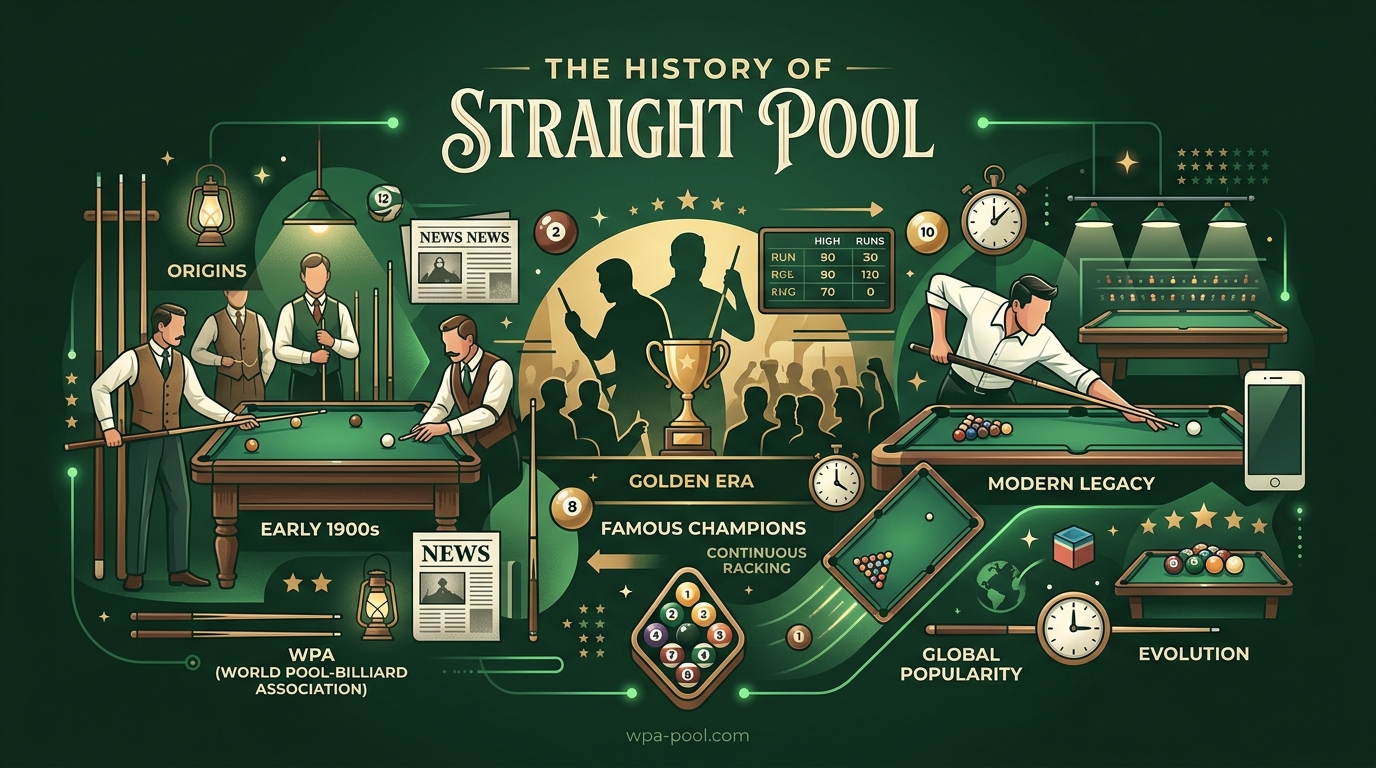
The history of straight pool represents one of the most fascinating chapters in cue sports. This elegant game, also known as 14.1 continuous, dominated competitive pool for much of the 20th century and produced some of the most legendary players and remarkable records the sport has ever witnessed. Understanding this history gives you deeper appreciation for modern pool and the skills that defined an era of mastery and precision.
In this comprehensive guide, I will take you through the complete pool history timeline from its invention by Jerome Keogh in 1910 to the modern revival efforts of today. You will discover how a simple refinement of continuous pool transformed into the premier tournament game, why it eventually declined in popularity, and what remains of its legacy in contemporary billiards.
Whether you are a serious player looking to study the strategic depth of straight pool or a curious enthusiast wanting to understand the roots of American pool culture, this journey through time will give you the knowledge you need.
Table of Contents
The History of Straight Pool: Origins and Invention in 1910
Jerome Keogh invented straight pool in 1910, forever changing the landscape of pocket billiards. Before this innovation, players competed primarily in continuous pool, a game that allowed points to accumulate without a clear structure for ending racks. Keogh recognized the need for a more organized format that would test skill, strategy, and endurance in equal measure.
The breakthrough came with the development of the 14.1 continuous system. In this format, players must call every shot, pocketing 14 balls from a rack of 15 while leaving the final ball to break open the next rack. This seemingly simple modification transformed pool from a casual pastime into a serious competitive discipline requiring immense concentration and tactical thinking.
Keogh’s invention addressed several limitations of continuous pool. The earlier game often devolved into repetitive patterns without requiring players to demonstrate versatile shot-making abilities. Straight pool demanded mastery of cue ball control, precise positioning, and the ability to construct long runs of consecutive balls. These elements elevated it above its predecessor and established the foundation for modern championship play.
The initial reception among serious players was enthusiastic. Pool halls across the northeastern United States began adopting the new format, and word spread quickly through the tight-knit community of professional players. By 1911, straight pool had gained enough traction that tournament organizers began discussing formal championship events.
Evolution and Rise to Prominence (1912-1940s)
The first official World Straight Pool Championship took place in Philadelphia in 1912, cementing the game’s status as the premier competitive format. This inaugural event drew the best players of the era and established a tradition that would continue for nearly eight decades. The championship became the ultimate test of pool skill, attracting competitors from across the United States and eventually from around the world.
Throughout the 1920s and 1930s, straight pool evolved from an experimental format into the undisputed king of tournament billiards. The game found its natural home in the grand ballrooms of American cities, where spectators could watch marathon matches that tested the physical and mental limits of competitors. These events often lasted several hours or even days, with players competing for substantial prize money and national recognition.
The structure of championship play standardized during this period. Matches typically consisted of predetermined point totals, commonly 100, 150, or 200 points depending on the level of competition. The call-shot requirement meant that players had to announce their intentions before each stroke, adding a layer of accountability and strategic disclosure that distinguished straight pool from other cue games.
Key venues emerged as centers of straight pool excellence. New York City, Philadelphia, and Chicago hosted the most prestigious tournaments, drawing crowds of devoted fans. Promoters like the Brunswick Corporation invested heavily in professional pool, providing equipment sponsorships and prize funds that elevated the sport’s profile. This commercial support helped transform straight pool from a gambling game associated with back rooms into a legitimate professional sport.
The tactical complexity of straight pool became increasingly apparent as players developed sophisticated strategies. Safety play emerged as a crucial element, with competitors learning to leave the cue ball in positions that made scoring difficult for opponents. The opening break shot became an art form unto itself, as players discovered techniques for controlling the 15th ball to create favorable layouts.
Golden Era Players and Their Dominance
Willie Mosconi stands as the most celebrated figure in the history of straight pool. Between 1941 and 1957, he captured an unprecedented 19 World Straight Pool Championships, a record that remains unchallenged more than six decades later. Mosconi’s combination of technical perfection, mental discipline, and competitive fire made him the definitive straight pool champion.
His most famous achievement came on March 19, 1954, when Mosconi ran 526 consecutive balls during an exhibition in Springfield, Ohio. This staggering display of consistency and concentration stood as the official world high run record for 65 years. Mosconi later described this performance as his greatest moment in pool, achieved under pressure before a live audience rather than in private practice.
Before Mosconi’s reign, Ralph Greenleaf dominated the straight pool scene throughout the 1920s and early 1930s. Known for his powerful stroke and charismatic personality, Greenleaf won his first world championship in 1919 and went on to claim numerous titles before retiring in 1937. His playing style emphasized aggressive run-out attempts rather than defensive safety exchanges, making him a crowd favorite.
Rudolph Wanderone, better known as Minnesota Fats, brought showmanship and personality to straight pool even though his tournament record never matched his promotional fame. His rivalry with Mosconi, whether real or manufactured for publicity, helped maintain public interest in the game during the 1960s and 1970s. Fats claimed to have defeated Mosconi in private matches, though these assertions were never officially verified.
Other notable champions of the golden era included Irving Crane, who won multiple world titles in the 1960s with a methodical, safety-oriented approach, and Luther Lassiter, whose natural talent and flamboyant style earned him the nickname “Wimpy.” These players, along with dozens of regional champions and road players, created a competitive ecosystem that kept straight pool at the center of American cue sports.
World Records and Championship History
The World Straight Pool Championship served as the sport’s most important event from 1911 until 1990, with a brief revival from 2006 to 2019. This championship represented the pinnacle of achievement in professional pool, with winners earning not just prize money but permanent places in billiards history. The tournament format evolved over the decades but always maintained the core requirement of reaching a predetermined point total ahead of opponents.
Willie Mosconi’s 526 consecutive balls record stood as the benchmark of excellence from 1954 until 2019. The achievement required nearly five hours of continuous play without a single miss, demonstrating not just technical skill but extraordinary mental stamina. Many observers considered this record unbreakable, given the difficulty of maintaining concentration over such an extended period while under public scrutiny.
John Schmidt changed that perception on May 27, 2019, when he ran 626 consecutive balls at Break Billiards in New York City. This new record surpassed Mosconi’s mark by exactly 100 balls and required approximately four and a half hours of sustained excellence. Schmidt, who had dedicated much of his career to high run attempts, finally achieved the goal that had eluded generations of players.
The record books were rewritten again on January 18, 2025, when Jayson Shaw achieved an astounding 832-ball run during a practice session at Griff’s Billiards in Las Vegas. This remarkable performance pushed the boundaries of what players believed possible and reignited discussions about the theoretical limits of human performance in straight pool. Shaw’s record demonstrated that even in the modern era, straight pool remains a game capable of producing extraordinary achievements.
These high run records matter because they represent the purest expression of straight pool’s demanding nature. Unlike tournament victories, which depend partly on opponent matchups and tactical situations, high runs measure absolute consistency under controlled conditions. Each record holder had to maintain perfect concentration while executing hundreds of precise shots, managing cue ball speed, spin, and position with no margin for error.
Decline After the 1980s and Modern Challenges
Straight pool began losing its dominance in the 1980s as faster-paced alternatives captured public attention. Television networks, which had embraced pool during the 1970s and early 1980s, found that straight pool matches took too long for broadcast schedules. A single championship match could require three to four hours of airtime, while networks preferred programming that delivered conclusions within one-hour time slots.
Nine-ball emerged as the primary beneficiary of this shift. The rotation game, where players must hit the lowest-numbered ball first and can win by pocketing the 9-ball at any time, offered quicker resolutions and more dramatic moments. Matches typically lasted 30 to 60 minutes, fitting comfortably into television formats. Professional tours reorganized around nine-ball, and sponsors redirected their investments accordingly.
Player development also contributed to straight pool’s decline. Young players entering the sport in the 1990s and 2000s focused on the games that offered professional opportunities and television exposure. The skills required for straight pool excellence, particularly the ability to construct long runs and execute precise safety play, received less emphasis in training regimens. Pool halls, facing economic pressures themselves, often prioritized tables for faster games that generated higher hourly revenue.
The World Straight Pool Championship, which had been the sport’s crown jewel, ceased operations in 1990. A revival attempt in 2006 brought renewed attention, with events held in various locations including New York and New Jersey. However, the revived championship struggled to secure consistent funding and media coverage, ultimately concluding in 2019. Without a flagship tournament to anchor the competitive calendar, straight pool became increasingly marginal in professional circles.
Despite these challenges, dedicated enthusiasts have kept straight pool alive. Regional tournaments continue in pockets of traditional strength, particularly in the northeastern United States. Online platforms have created new opportunities for instruction and discussion, allowing experienced players to share knowledge with newcomers. The game’s strategic depth and emphasis on fundamental skills ensure that it retains educational value even if its competitive prominence has faded.
Cultural Impact and Media Legacy
The 1961 film “The Hustler” transformed public perception of pool and introduced straight pool to millions of viewers who had never stepped into a billiards hall. Paul Newman’s portrayal of Fast Eddie Felson, an ambitious young player seeking to challenge the legendary Minnesota Fats, created an enduring archetype that influenced every subsequent depiction of pool in popular culture. The film’s dramatic straight pool match between Felson and Fats remains one of cinema’s most iconic sporting sequences.
“The Color of Money,” released in 1986, brought Newman back as an older, wiser Felson mentoring a new generation of players. This sequel introduced nine-ball as the modern game while acknowledging straight pool’s historical significance. Tom Cruise’s energetic performance as Vincent Lauria contrasted with the contemplative pace of straight pool, symbolizing the sport’s evolution toward faster formats.
These films did more than entertain; they shaped how Americans understood pool culture. The image of the pool hustler, whether romanticized or cautionary, became embedded in the national consciousness. Straight pool, with its reputation as the thinking person’s game, represented the highest form of this culture. Books, magazine articles, and subsequent films continued referencing the straight pool era as a golden age of American sportsmanship.
The cultural impact extended beyond entertainment into fashion, language, and social behavior. The term “hustler” entered common vocabulary partly through pool’s influence. Pool hall aesthetics influenced interior design trends, with dark woods, green felt, and vintage lighting fixtures appearing in restaurants and private homes. The straight pool tradition, even as the game itself declined in participation, maintained its status as the symbol of authentic billiards mastery.
Frequently Asked Questions
When was straight pool invented?
Straight pool was invented in 1910 by Jerome Keogh, an American pool player who sought to create a more strategic and skill-based game than the existing continuous pool format.
Who invented straight pool?
Jerome Keogh invented straight pool in 1910. He was an accomplished pool player who developed the 14.1 continuous scoring system that became the foundation of straight pool.
What is the highest run in straight pool?
As of 2025, Jayson Shaw holds the record with a high run of 832 consecutive balls, achieved in January 2025. This surpassed John Schmidt’s 626-ball run from 2019 and Willie Mosconi’s longstanding 526-ball record from 1954.
Why did straight pool decline in popularity?
Straight pool declined after the 1980s due to the rise of faster-paced games like 9-ball, which were more exciting for television audiences and had shorter match durations. The game required extended time commitments from both players and spectators.
Is straight pool still played today?
Yes, straight pool is still played today, though it has a smaller competitive scene compared to its peak. The World Straight Pool Championship was revived in 2006 and continued until 2019, and dedicated enthusiasts continue to preserve and promote the game through exhibitions and regional tournaments.
Conclusion
The history of straight pool spans more than a century of American sporting culture, from Jerome Keogh’s innovative invention in 1910 through the golden age of Willie Mosconi and into the modern era of record-breaking performances by players like Jayson Shaw. This remarkable journey reveals how a single game can define an entire sport while adapting to changing times and tastes.
Understanding straight pool’s evolution from continuous pool to championship centerpiece to its eventual decline provides essential context for anyone interested in billiards. The skills developed by generations of straight pool players, the records they set, and the cultural impact they achieved continue influencing how we think about cue sports today.
I encourage you to seek out straight pool in action, whether through archival footage, regional tournaments, or your own practice sessions. Playing this game, even casually, connects you to a tradition of excellence that represents billiards at its most demanding and rewarding. The history of straight pool is still being written, and dedicated players ensure that Jerome Keogh’s 1910 invention will continue inspiring future generations.