
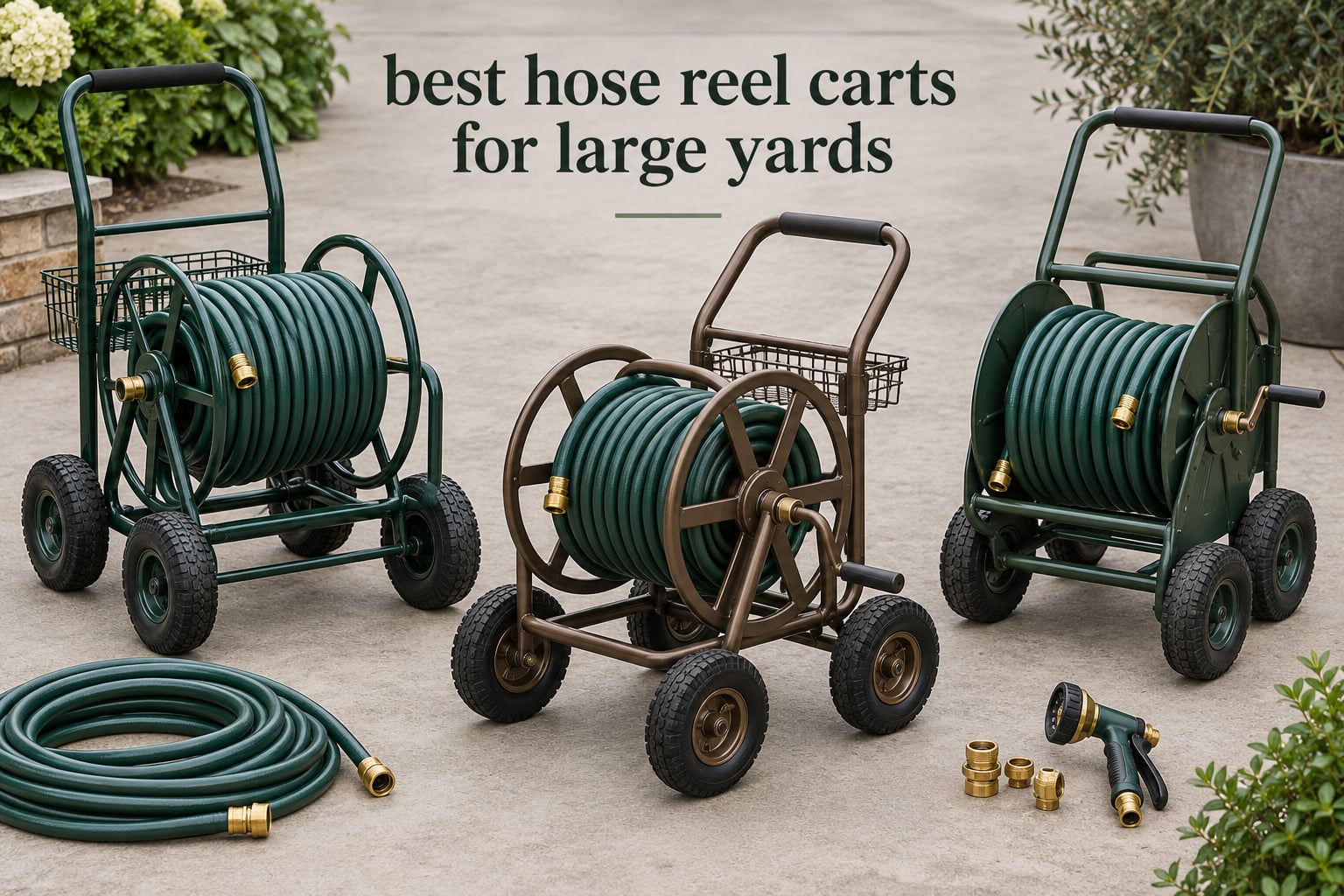
If you have more than a quarter acre, you need a cart that holds at least 250 feet of 5/8-inch hose on a metal frame with a low center of gravity and four wheels. Most large yards land in the 200 to 300 foot range, and anything under 150 feet of capacity leaves you dragging hose you already own. A hose reel cart is a freestanding, wheeled frame that stores your garden hose on a rotating drum, so you roll the whole unit to the far corner of the property instead of dragging the hose itself.
That single change matters more than any spec on the spec sheet. On a big property you are moving hundreds of feet of wet rubber across grass, gravel, and mower paths every week. A cart keeps the hose off your lawn, cuts the tangles that cause kinks, and saves your back from lifting a fully loaded drum.
We spent weeks comparing ten wheeled hose reel carts built for large yards, focusing on the things that actually fail: frame corrosion, seized swivel joints, tires that go flat, and carts that drag themselves across the yard when you pull the hose out. Every cart below is a freestanding model. We left wall-mounts, hideaway boxes, and retractables out of this round-up because they solve a different problem.
While you are mapping out the yard, it is worth noting the rest of our large-property coverage, including our guides to the best zero-turn mowers for large yards and the best battery string trimmers for large yards, since the same hose cart is usually paired with both.
Table of Contents
Top 3 Picks for Large Yards
The Liberty Garden Industrial 4-Wheel takes our top slot for holding a full 300 foot load without shifting. The Liberty Garden Residential Grade 4-Wheel is the smooth-running runner-up with 250 feet of capacity and a storage basket. The FDW 4-Wheel delivers 300 feet of steel-frame capacity for the least spend of the three.

Liberty Garden Industrial 4-Wheel 300 ft Cart
- Holds 300 ft of 5/8-inch hose
- 13 gauge powder-coated steel frame
- Brass swivel and fittings
- Four 10 inch flat-free tires
Liberty Garden Residential 250 ft Cart
- Holds 250 ft of 5/8-inch hose
- 13 gauge steel frame
- Brass hose connections
- Crank handle and storage basket

FDW 4-Wheel 300 ft Cart
- Holds 300 ft of 5/8-inch hose
- Powder-coated steel frame
- Foam-padded handle
- Storage basket and pneumatic tires
Every Hose Reel Cart in This Round-Up at a Glance
All ten carts below are steel-frame, wheeled, and rated for 5/8-inch hose unless noted. Capacity is listed exactly as the manufacturer states it, which is where a lot of buyer confusion lives.
| Product | Specifications | Action |
|---|---|---|
| Liberty Garden Industrial 4-Wheel 300 ft Cart |
|
Check Latest Price |
| Liberty Garden Residential 250 ft Cart |
|
Check Latest Price |
 Giraffe Tools 200 ft Two-Wheel Cart Giraffe Tools 200 ft Two-Wheel Cart |
|
Check Latest Price |
| FDW 4-Wheel 300 ft Cart |
|
Check Latest Price |
 Yard Butler 2-Wheel 200 ft Cart Yard Butler 2-Wheel 200 ft Cart |
|
Check Latest Price |
 PayLessHere 4-Wheel 300 ft Cart PayLessHere 4-Wheel 300 ft Cart |
|
Check Latest Price |
 GOFORWILD 200 ft Steel Cart GOFORWILD 200 ft Steel Cart |
|
Check Latest Price |
 VINGLI 300 ft 4-Wheel Cart VINGLI 300 ft 4-Wheel Cart |
|
Check Latest Price |
 Giraffe Tools Stainless Steel 200 ft Cart Giraffe Tools Stainless Steel 200 ft Cart |
|
Check Latest Price |
 WERMAH 300 ft Four-Wheel Cart WERMAH 300 ft Four-Wheel Cart |
|
Check Latest Price |
How We Picked and Tested
Ten carts went into this round-up, and every one was judged on the same five criteria. First, capacity against the yard it claims to serve, verified against the actual drum dimensions rather than the marketing number. Second, stability under pull, which is where most cheap carts embarrass themselves.
Third, winding friction and whether the hose lays down evenly or bunches into one spot on the drum. Fourth, how the cart rolls on grass, gravel, and a slope while fully loaded. Fifth, corrosion protection, because a steel frame that surfaces rust in year two is a slow-motion replacement cycle.
We also weighed owner feedback at volume, since review counts on these products run into the thousands and the recurring complaints are consistent. We deliberately excluded carts with plastic frames, hideaway boxes, wall mounts, and retractables, and we excluded anything rated below 150 feet of 5/8-inch capacity, since no cart in that class belongs on a large property.
Last updated in 2026. The categories in this round-up skew toward 250 and 300 feet models, because that is the band that actually covers a large yard with slack.
1. Liberty Garden Industrial 4-Wheel 300 ft Cart: Best Overall for Large Yards
- Holds a heavy-duty 300 ft load without tipping
- Brass fittings and swivel stay leak-free over years
- Smooth effort-free reeling of water-filled hose
- Powder-coated frame rolls easily over uneven ground
- Simple assembly with basic hand tools
- Surface rust appears on exposed hardware over time
- Tires are low grade and eventually need replacing
- Hose connects out the side leaving a service loop around the rim
- Cart creeps while cranking unless braced with a foot
This is the cart we kept coming back to. It holds up to 300 feet of 5/8-inch hose on a 13 gauge steel frame with a powder coat finish, and at 29.5 by 25 by 35.5 inches it has a footprint you can park against a wall without losing the whole side yard. The listed weight of 15.88 kg is a big part of why it stays planted when you pull hose out.
Long-tenured owners consistently report 8 to 10 years of service, and the brass fittings and 90 degree brass swivel are the specific parts they credit for never leaking. We agree with the design choice. A swivel at the drum is what lets the hose feed off the side without twisting, and brass will outlast plastic swivel elbows by a wide margin.
Flat-free 10 inch tires were the right call for this class of cart. They will never lose air, and 10 inches of diameter clears most garden edges and gravel transitions without the cart catching. The trade-off is a harder ride on rough ground than a pneumatic tire, but a flat tire in the middle of a watering run is a worse outcome.
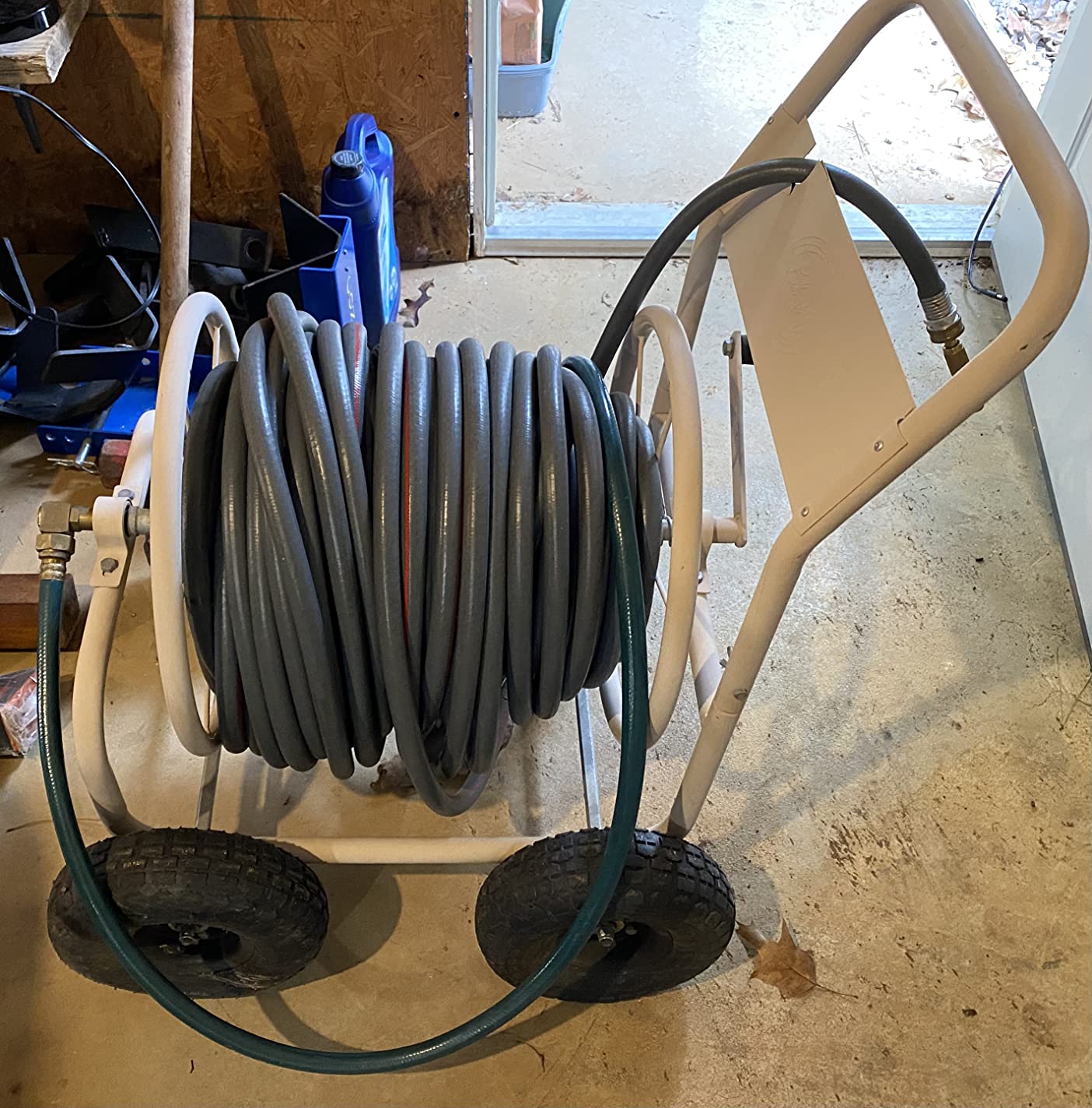
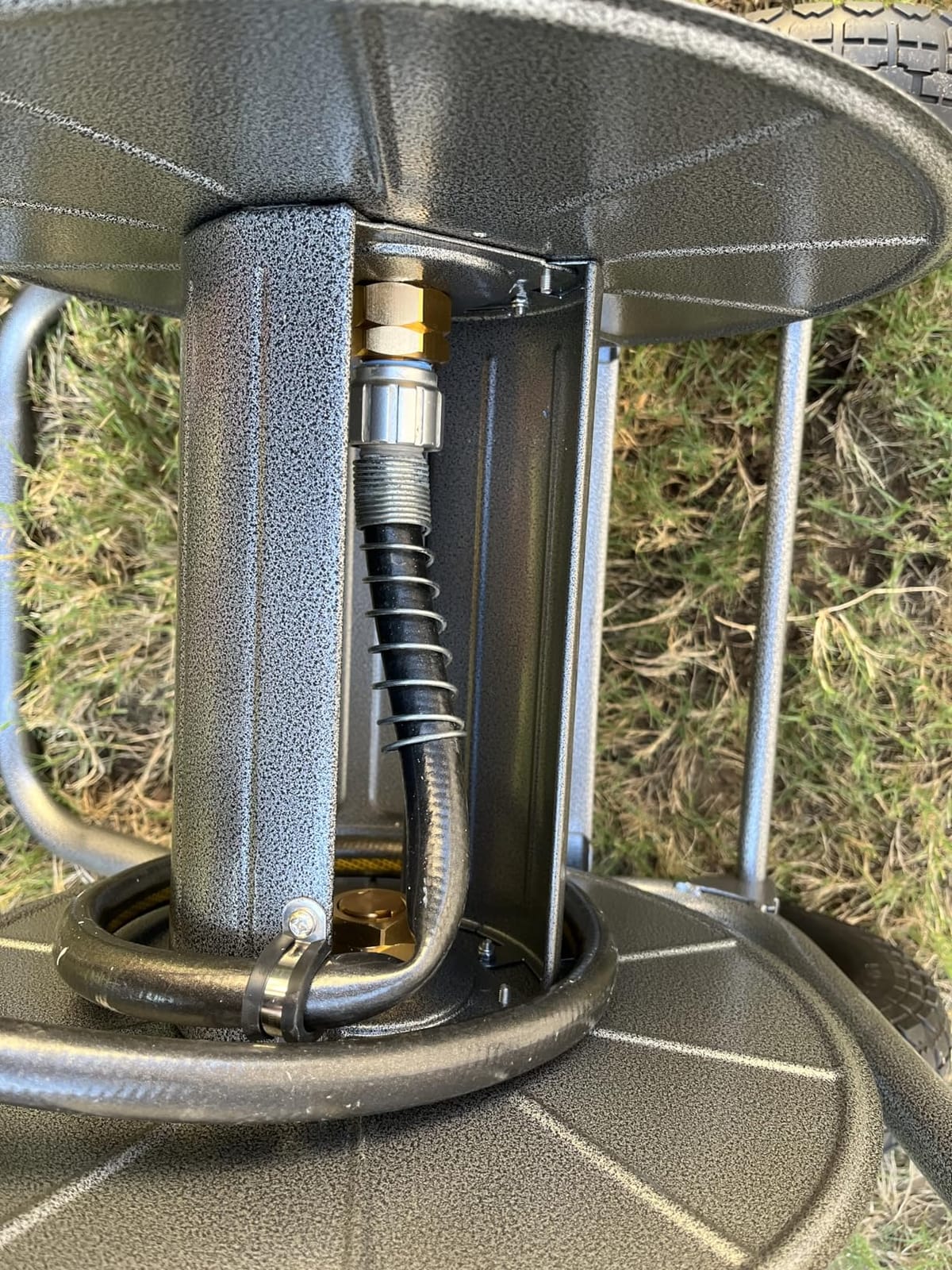
The design detail that draws the most criticism is where the hose connects. It runs straight out from the side of the drum rather than through a swivel elbow at an angle, which leaves a service loop that adds a little resistance as you wind. The low center of gravity is the counterweight, and in practice it keeps the cart from tipping even with a full drum of wet hose.
Surface rust does eventually show up on exposed hardware after years outdoors, which is normal for powder-coated steel and easy to head off with a clear protective coat before the first winter. Tires are the other wear item, described by owners as low grade and eventually needing replacement.
How it holds up when you pull 300 feet of hose
The wide four-wheel stance and low drum keep the center of mass under the frame, so the cart resists the sideways tug that topples lighter two-wheel designs. You will still feel it creep a little on soft ground, and bracing a wheel with your foot while cranking is a habit most owners pick up within a week.
Where this cart is the wrong choice
If your yard is mostly gravel with deep ruts, the flat-free tires transmit every impact into the frame bolts rather than absorbing it, and the side-mounted hose connection adds drag exactly when hose is driest and least cooperative. Buyers who want a softer ride and a swivel elbow should look at the WERMAH instead.
2. Liberty Garden Residential Grade 250 ft Cart: Best 4-Wheel with Storage
- Sturdy steel frame with thick tires that maneuver well
- Brass connections resist leaking once tightened
- Crank handle rolls the hose on neatly
- Easy to assemble
- Storage basket keeps tools off the ground
- Rotary coupler can seize after a month outdoors
- Hose connection sits outside the reel and promotes kinking
- Bare tubing inside the frame rusts quickly
- Included leader hose is low quality
This is the cart we recommend when the hose lives in a visible part of the yard and you want somewhere to hang nozzles. It holds 250 feet of 5/8-inch hose on heavy 13 gauge steel, measures 29 by 24.5 by 35 inches, and weighs 29.5 pounds. The storage basket is the real upgrade over the Industrial model for everyday use.
Brass hose connections that actually resist leaking once tightened, a convenient crank handle for rolling hose on and off, and a frame that owners describe as sturdy with thick tires that are easy to maneuver. Assembly is straightforward, and the whole unit rolls rather than drags when you reposition it across grass.
The recurring complaint is the rotary coupler. Owners report it can seize or unseat after about a month of outdoor exposure, and a shot of Teflon spray on the coupler is the standard fix. Treat it as a seasonal maintenance item rather than a defect, and it stays serviceable for years.
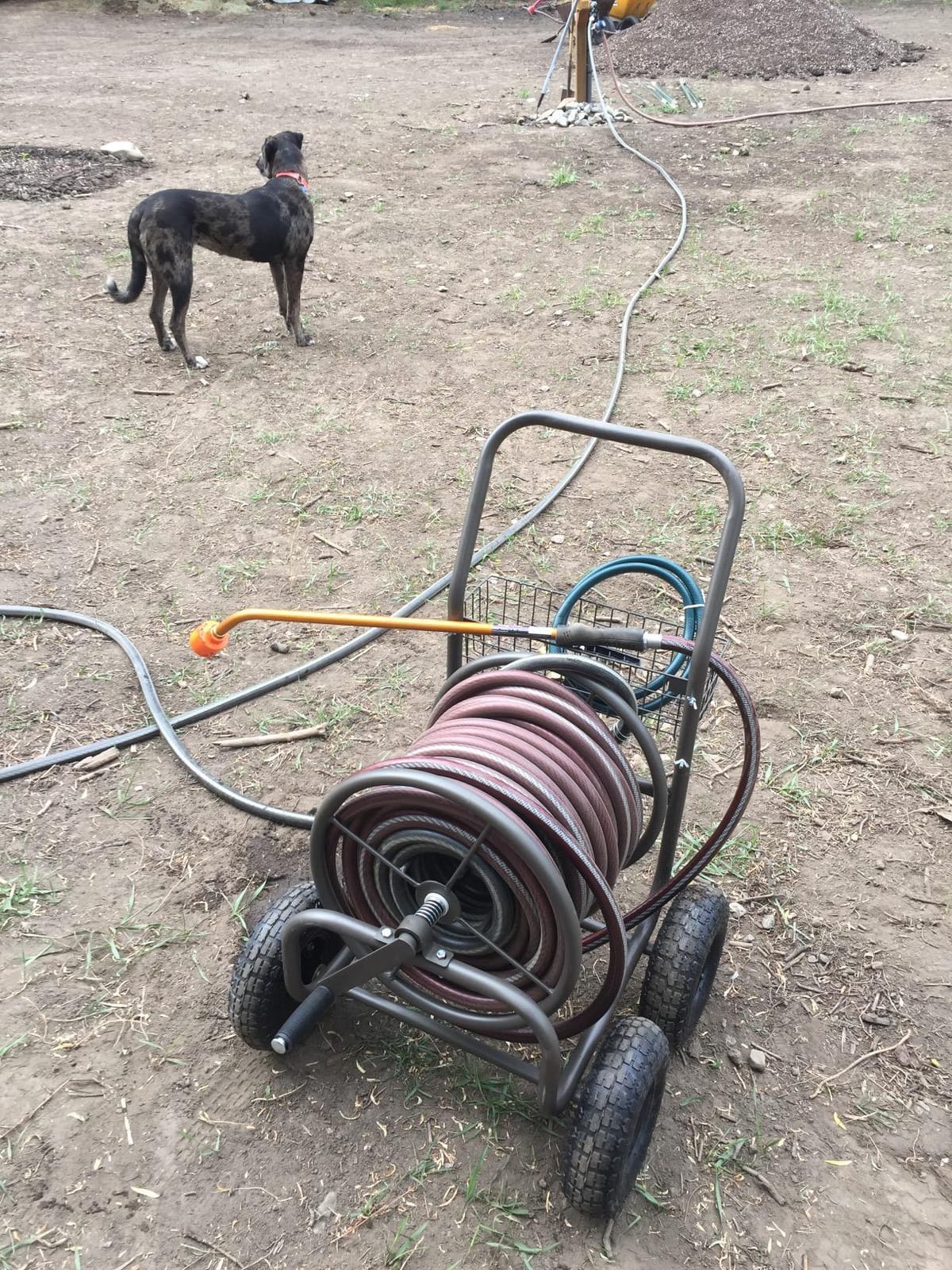
Two smaller issues are worth knowing before you buy. The hose connection sits outside the reel, which promotes kinking and adds resistance when reeling in. And the bare tubing inside the frame rusts quickly when exposed to weather, so painting or coating those internal tubes at assembly time pays off.
The included leader hose is of low quality, which is normal for this category. Plan on replacing it with a short section of 5/8-inch hose you already trust, since the leader hose is the piece that takes the biggest abuse at the spigot connection.
Why the storage basket matters more than it sounds
On a large property, nozzles, splitters, and gloves end up on the grass every time you stop to move the cart. A basket keeps them attached to the machine, and the 250 feet of capacity still covers most large yards with 50 feet of slack for a driveway or a back corner.
Where this cart is the wrong choice
The three-year limited warranty is shorter than the limited lifetime warranty on the Industrial model, which matters if you expect a decade outdoors. If the rotary coupler seizing is a dealbreaker for you, move up to the WERMAH with its sealed one-piece brass connector.
3. Giraffe Tools 200 ft Two-Wheel Cart: Best Compact Reel with a Hose Guide
Giraffe Tools Garden Hose Reel Cart with Wheels, 200FT of 1/2 Capacity
- Stores a large amount of hose in a compact footprint
- Brass connector and low center of gravity stay stable and leak-free
- Hose guide system winds neatly with minimal effort
- Most parts pre-assembled so setup takes only a few steps
- Push-pin handle locks flex and make the frame look loose
- W hose guide can jump timing and trap hose on the drum
- Metal hose strap can arrive with the wrong screw size
- Some plastic components feel suspect for the price
This is the cart for the yard where footprint matters more than capacity. It holds 150 feet of 5/8-inch hose or 200 feet of 1/2-inch hose, measures 19.7 by 19.3 by 17.8 inches, and weighs 34.2 pounds. That is a full 100 feet less of 5/8-inch capacity than the four-wheel carts, so it works best as a second unit rather than a whole-property solution.
What it does have is a genuine hose guide on a reinforced axle, and that is the feature that separates it from most carts in this list. The guide distributes hose side to side as you crank, so the load lays down in even layers instead of stacking in one spot and toppling over itself. Low center of gravity and two explosion-proof knobby tires add stability, and the solid brass connector is described as leakage-proof and wear-resistant.
Setup is fast because most parts ship pre-assembled. A 5 foot lead-in hose is included, which is a nicer touch than most carts at this tier.
The handle is the weak point. Push-pin style locks flex under load, and owners report the frame looking loose and wobbly as a result. It does not stop the cart from working, but it undermines the sense of solidity when you are hauling a full drum across a lawn.
More seriously, the plastic hose guide can jump timing after several months of use and trap hose on the drum. That is a maintenance item to watch, and if you notice the winding pattern changing, check the guide alignment before it cinches a kink into your hose. Some accounts also mention slow or unfulfilled warranty replacements from the manufacturer.
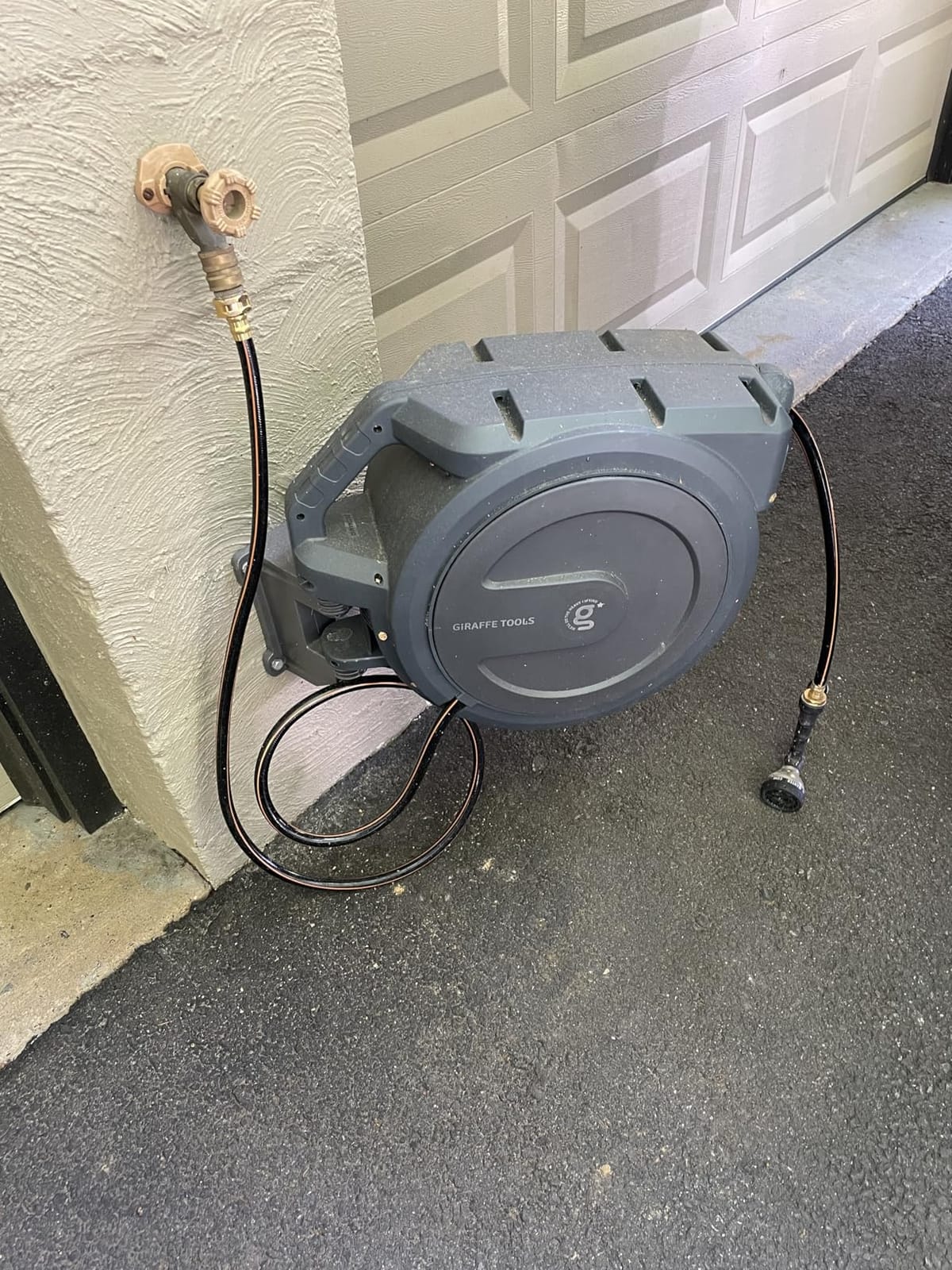
What the hose guide actually does for you
A guide is worth paying extra for on any cart holding more than about 150 feet. Without one, hose piles up on the drum center of gravity and you end up unwinding a tangled rubber mat each time. With one, the hose lays flat and the drum keeps its balance as it fills.
Where this cart is the wrong choice
If your property genuinely needs 250 to 300 feet of 5/8-inch hose, this cart is 100 feet short and no amount of clever packing fixes that. It also explicitly does not accept 3/4-inch hose, so anyone running thick irrigation line should skip it.
4. FDW 4-Wheel 300 ft Cart: Best Value for Big Yards
- Powder-coated steel frame stays sound for years
- 300 ft capacity makes long hose runs easy to deploy
- Easy to roll even when fully loaded
- Foam-padded handle is comfortable for older users
- Paint flakes off the drum when hose sweat is trapped underneath
- Crank sits low so you bend at the waist while winding
- Instructions are incomplete and included tools inadequate
- Tires can lose air and replacements are hard to source
- No wheel brake so the cart drifts while unreeling
For most large yards, this is the cart we recommend on value. It holds up to 300 feet of 5/8-inch hose on a reinforced powder-coated steel frame, includes a storage basket, and rolls easily over lawns and hillsides on pneumatic tires. Assembly runs about 50 minutes with common tools, which is the honest number rather than the optimistic one on the box.
Owners consistently praise the powder-coated steel build, the 300 foot capacity, and how easily the cart moves even when fully loaded. The foam-padded handle with a non-slip grip is worth calling out specifically, because it is one of the few carts in this round-up that stays comfortable for users with limited hand strength.
It measures 37 by 24 by 42 inches, which makes it the tallest cart here. That height is a double-edged sword. It rolls over uneven ground well, but you need to watch the crank height when moving it under low branches or into a garage.
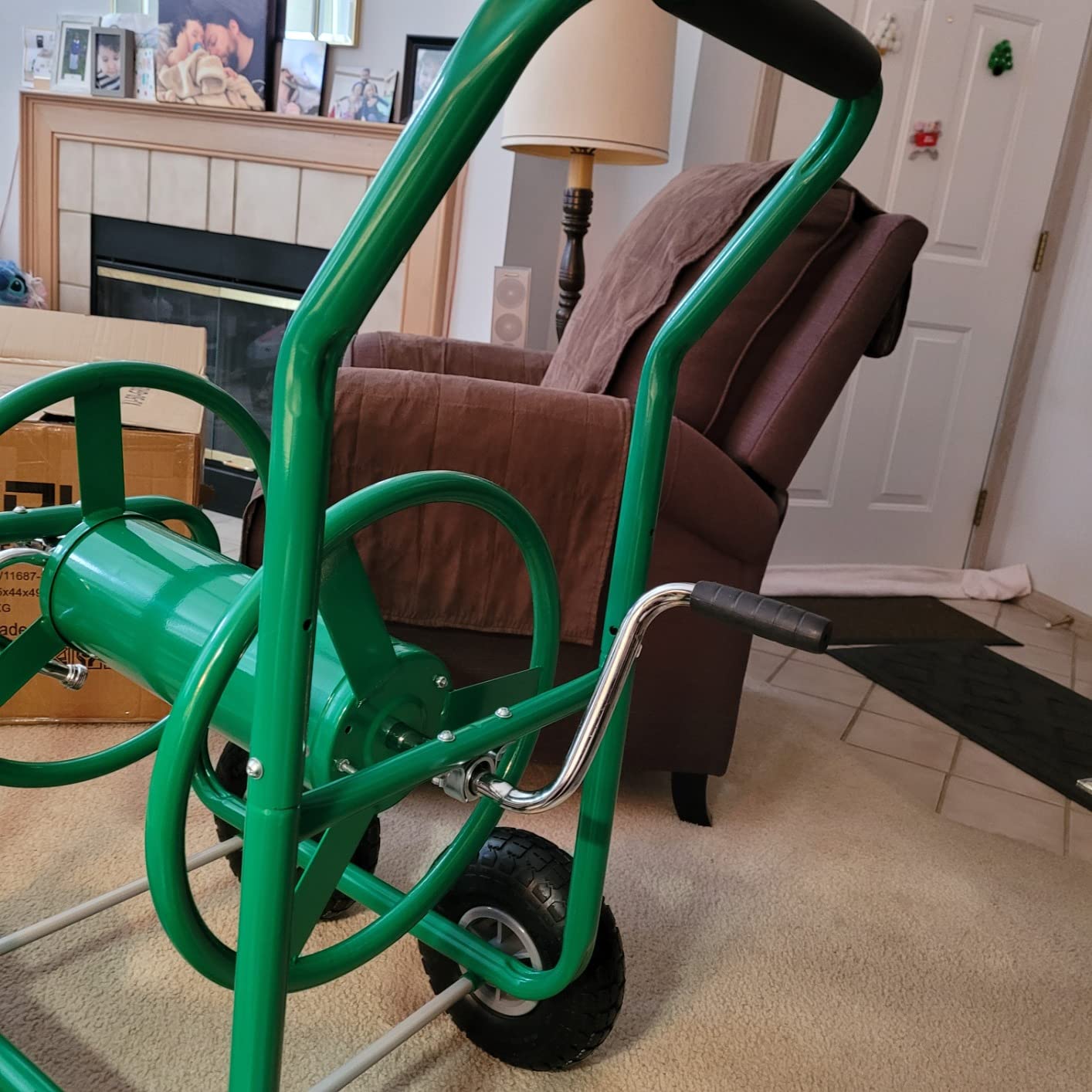
The paint flaking off the drum is the most common long-term complaint, and the cause is understandable. Sweat and moisture from the hose get trapped against the drum, corrode the metal underneath, and push the coating off in patches. Wiping the drum down and storing the cart under cover during the off-season largely prevents it.
Two other issues are worth flagging. There is no wheel brake, so the cart drifts while you unreel hose by hand, and the tires can lose air after a season or two with no easy source of replacements. If you store pneumatic tires, a tire pump is not optional.

Who benefits most from the foam handle
Anyone who already avoids bending or heavy lifting. The padded grip reduces hand fatigue during long cranking sessions, which on a 300 foot load is a real difference. Owners with back strain or limited grip report it as the deciding feature.
Where this cart is the wrong choice
If you need it to sit outdoors year-round with no maintenance, the drum paint and lossy tires work against you. Pair it with a cover, and it will outlast a plastic cart many times over. If you want a maintenance-free tire, spend up on the Liberty Garden Industrial instead.
5. Yard Butler 2-Wheel 200 ft Cart: Best Two-Wheel Metal Design
Yard Butler Hose Cart, Metal Hose Caddy, 2 Wheels, 200 Feet
- All-metal body is heavy enough not to tip when pulling hose
- Reels in smoothly and resists kinking after the first wind
- Metal connectors rarely leak in normal use
- Compact footprint that stores easily
- Stated 200 ft capacity is optimistic for real hose
- Rubber tires degrade quickly in sun and rain
- Paint wears off the frame base exposing bare metal
- Assembly instructions poor and hardware inconsistent
- Rear reel bushing is fragile
The Yard Butler is the most compact metal cart in this round-up, at 18.9 by 16.8 by 19.2 inches and 23.4 pounds, and it carries a lifetime warranty from the manufacturer. That warranty is unusual in this category and tells you something about the confidence behind the frame.
The all-metal body is heavy enough not to tip when pulling a long hose, which is the failure mode that makes people distrust two-wheel carts. Wheels use bearings rather than bushings, so they roll smoothly after months of outdoor storage, and the Max Flo design is credited with smooth reeling and reduced kinks after the first wind. Owners replacing a plastic cart generally treat this as the durable upgrade.
Variants exist in 100 foot, 200 foot, and 400 foot sizes, so the same frame family covers a small garden or a serious property. Metal connectors rarely leak in normal use, which is the single most important thing on any hose reel.
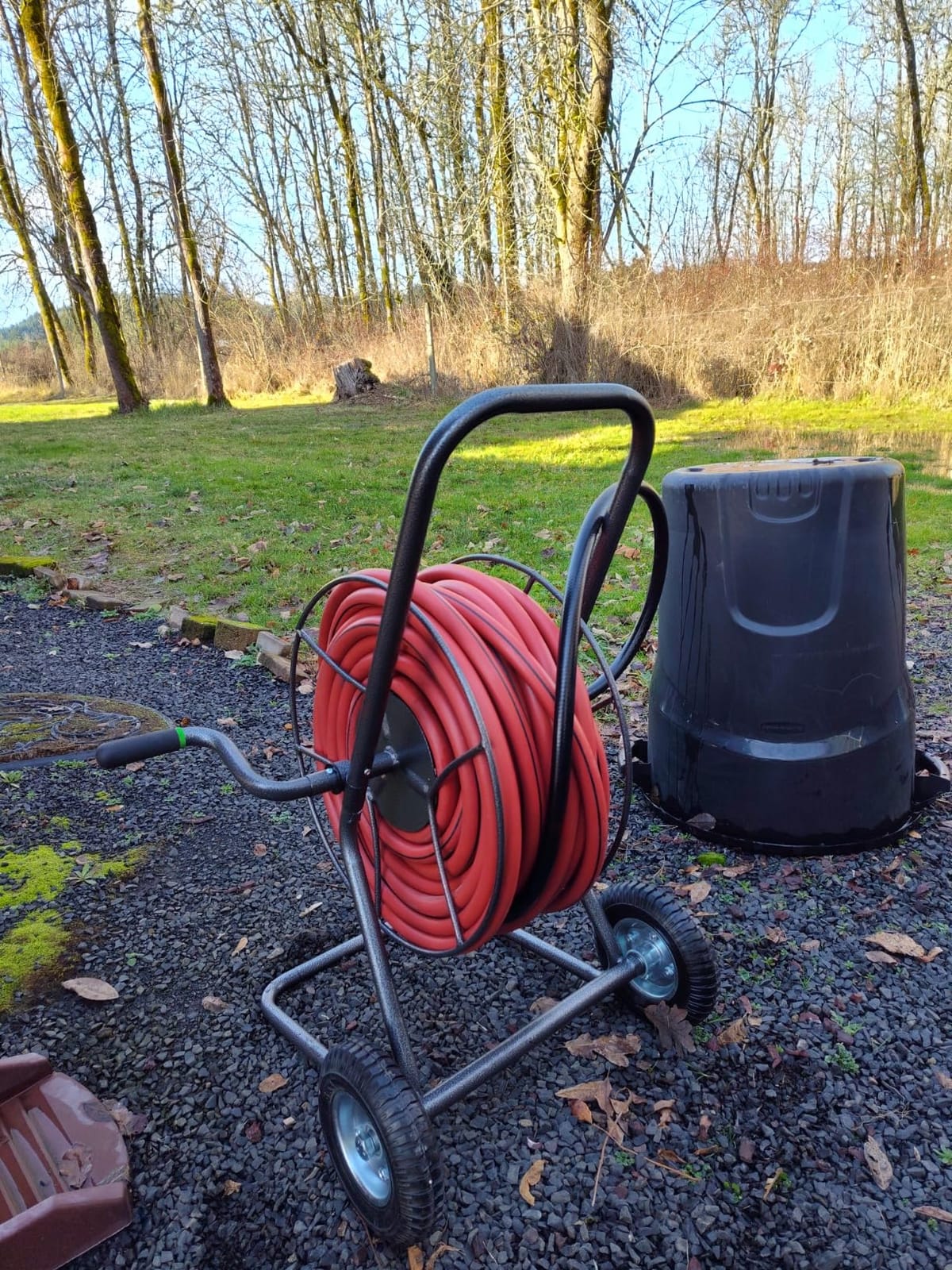
The stated 200 foot capacity is optimistic. Owners report that 100 feet of 5/8-inch hose fills most of the drum, so plan on roughly half the advertised figure for real-world use. That is not a dealbreaker, but it changes which yard this cart suits.
The tires are the weak link. Rubber on the pneumatic-style tires degrades quickly in sun and rain, and paint wears off the ground-contact points on the frame base, exposing bare metal to rust. Treat both as seasonal maintenance and the cart performs well. Assembly instructions are poor and hardware quality control is inconsistent, so allow extra time and check the bag of hardware before you start.
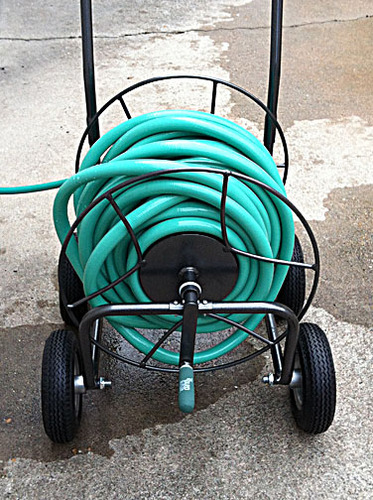
Why the weighted metal frame beats a light cart
Tipping happens when a light frame gets pulled sideways by a hose under pressure. An all-metal body with 23.4 pounds of mass resists that pull instead of yielding to it, and the bearing-mounted wheels keep the whole thing moving in a straight line rather than wobbling.
Where this cart is the wrong choice
If you are set on buying a two-wheel design and you need genuine 200 feet of 5/8-inch capacity, the drum is too small. Buy a four-wheel 300 foot model instead, or accept the shorter run and pick up 1/2-inch hose for the outer reaches.
6. PayLessHere 4-Wheel 300 ft Cart: Best for Accessory Storage
PayLessHere | Garden Hose Reel Cart | Holds Upto 300ft of 5/8″ Hose | Green
- Sturdy solid welds that still look new after a year of heavy use
- Four wheels carry the weight well over grass and gravel
- Basket is handy for nozzles and small tools
- Good value for the money
- Light front end shifts when reeling in a long heavy hose
- Side-heavy balance means bracing with your foot
- Threaded axles need starting by hand
- No wheel brake so the cart rolls while reeling
- Illustration-only instructions are unclear
This cart shares the 37 by 24 by 42 inch footprint and 300 foot rating of the FDW, and it is the other cart in this round-up with a large storage basket. It weighs 33 pounds and includes a non-slip handle grip, a swivel 90 degree elbow water connection with a T fitting, and four wheels for mobility when loaded with a long hose.
Owners describe sturdy solid welds that still look new after a year of heavy use, four wheels that carry the weight well over grass and gravel, and a basket that is genuinely handy for nozzles and small tools. Value for the money comes up repeatedly in reviews.
The 90 degree swivel elbow is a better plumbing arrangement than a side-mounted connection, and it reduces the kinking that slows down winding on some competitors in this list.
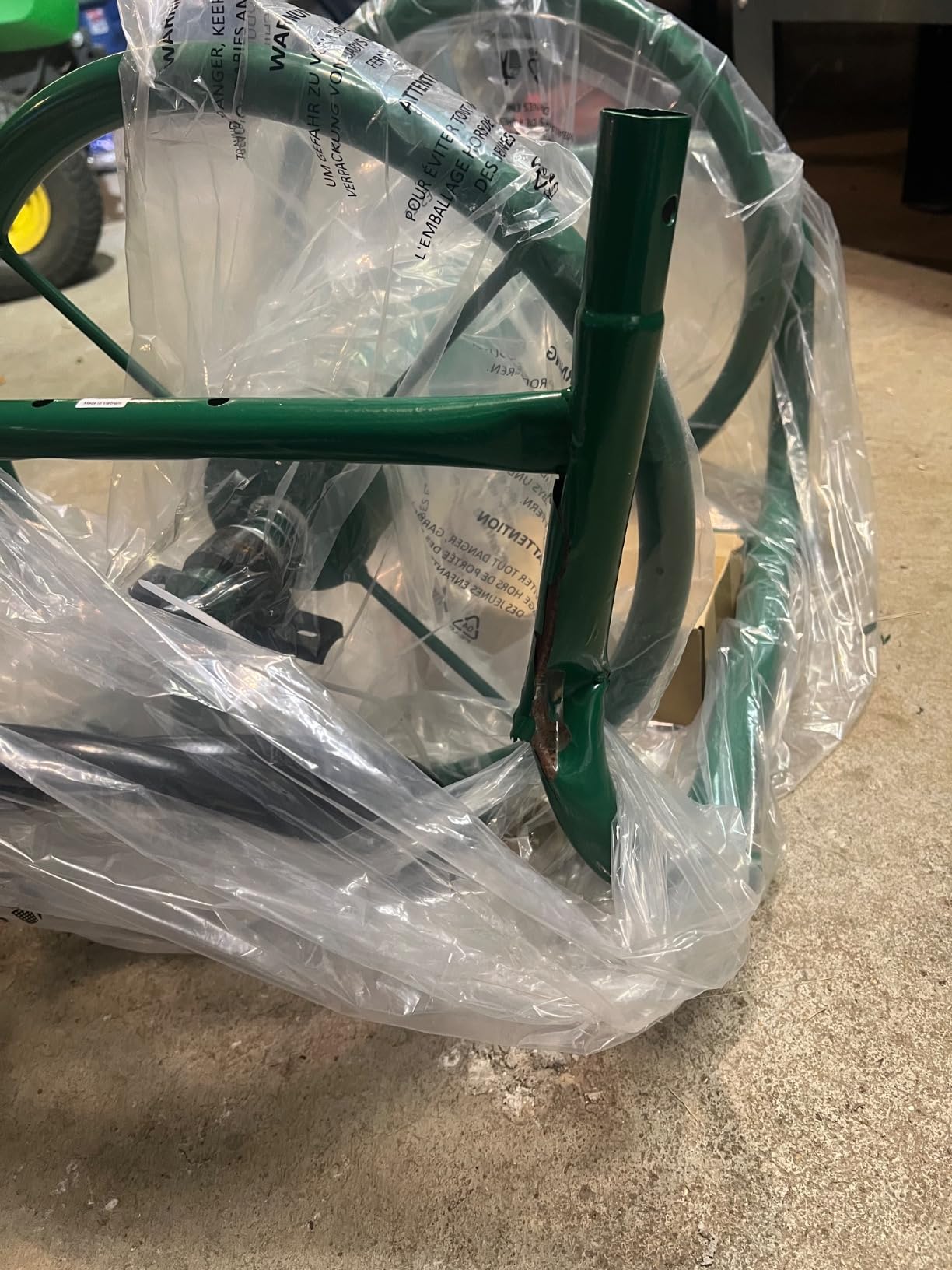
Stability is the consistent weakness. The front end is light and shifts when you are reeling in a long heavy hose, often enough that two people are needed, and the side-heavy handle basket means you have to brace the lower cross piece with your foot. There is no wheel brake either, so the cart rolls while you reel.
Two smaller things: the wheel axles use poorly cut threads that need starting by hand, and the illustration-only instructions leave the T fitting orientation unclear. Budget extra time for assembly and check the fitting orientation twice before you attach water.
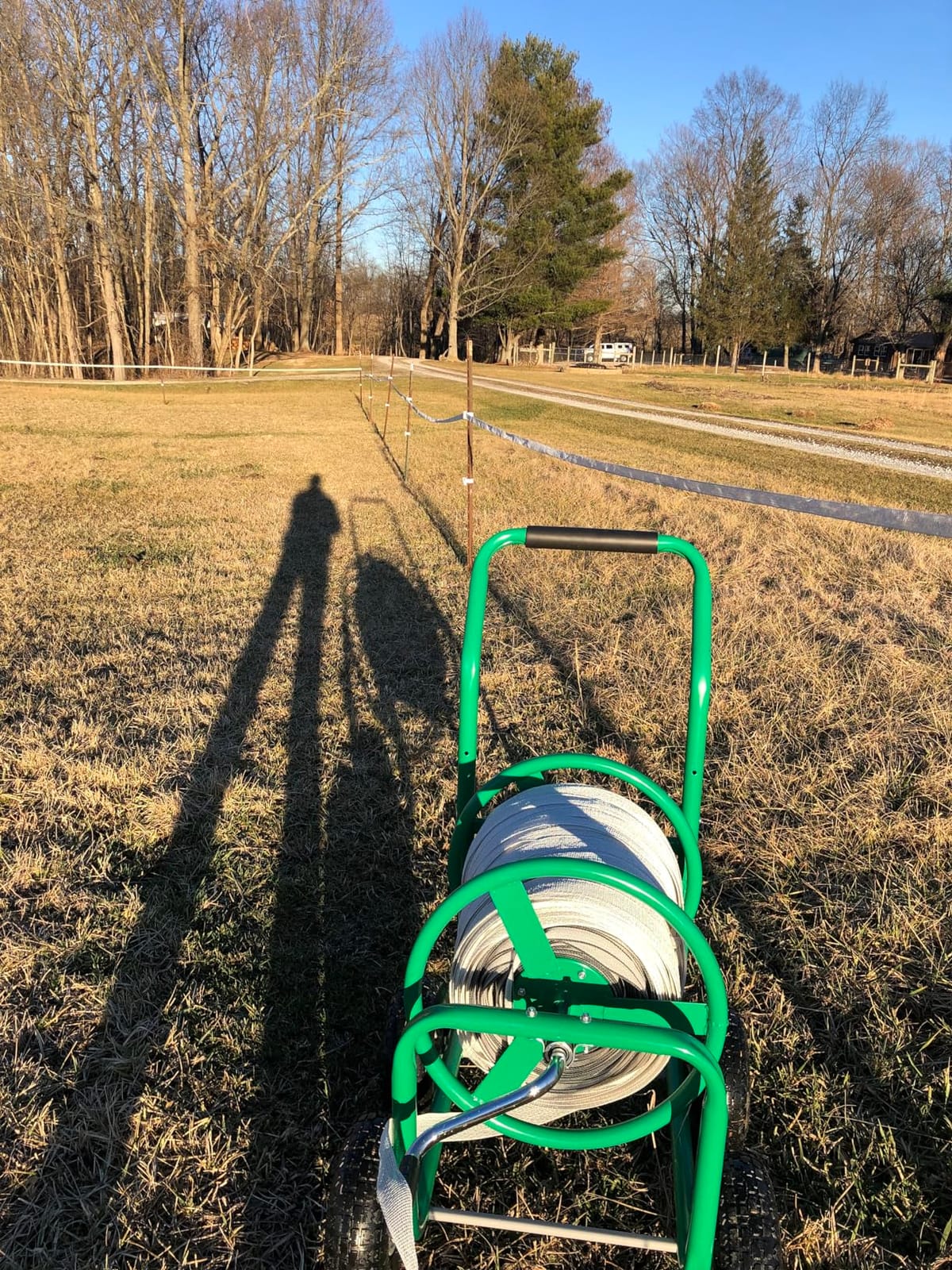
When the basket earns its keep
If you split a nozzle for a vegetable bed and a sprinkler for the lawn, the basket means both travel with the cart. On a large property where you reposition several times per session, that is the difference between two trips to the spigot and none.
Where this cart is the wrong choice
If you reel in 250 feet or more on a regular basis and you will be doing it alone, the light front end is a genuine annoyance. The Liberty Garden Industrial handles the same 300 foot load with a much heavier frame, and that weight is doing real work.
7. GOFORWILD 200 ft Steel Cart: Best for Visible Yards
- Attractive bronze finish that looks good in a visible yard
- Smooth easy reel-in operation
- Sturdy stamped steel that holds 150 ft of metal hose
- Top shelf handy for nozzles or a drink
- Narrow drum clearance rejects standard 100-125 ft hose collars
- Some newer oversized collars require bending the fitting
- Wheel holes are 5/8 inch but axle is 1/2 inch so wheels fit loosely
- Wheels are hard rubber despite being described as pneumatic
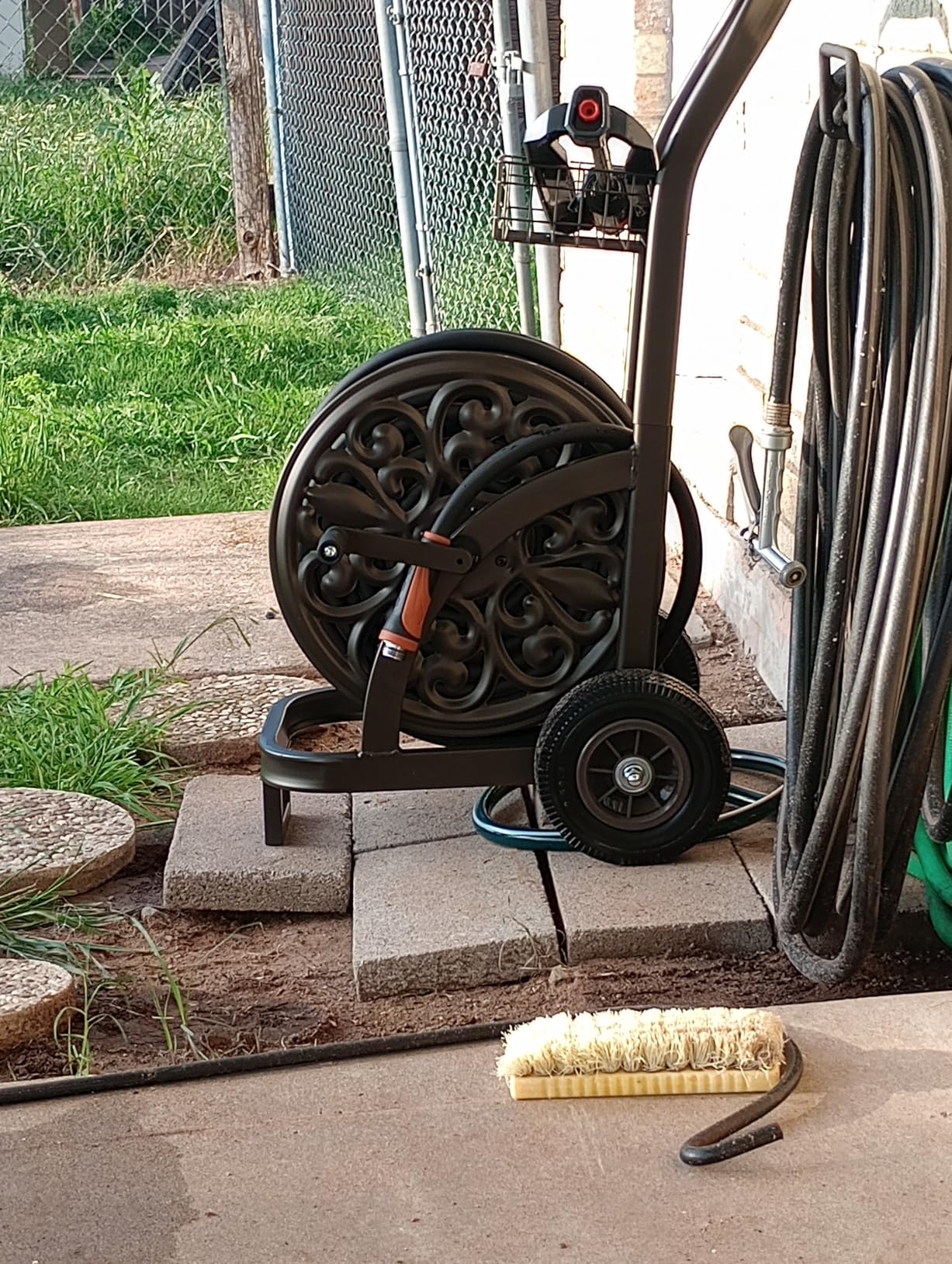
This is the cart to buy when the reel lives in the middle of your view rather than behind a fence. The bronze powder-coated finish on 3 gauge steel looks good enough to leave in the open, it weighs 22 pounds, and it measures 19.29 by 17.71 by 19.88 inches, so it stores against a house wall without dominating the space.
The mechanics are solid. A solid brass connector gives leak-free operation, the two never-flat tires and low center of gravity make it stable and easy to maneuver, and the non-slip crank handle supports tangle-free rewinding. Owners single out smooth reel-in operation and easy assembly, plus a top shelf handy for nozzles or a drink while you work.
One feature will matter if you run industrial hose: industry-standard 3/4 inch to 1.5 NH thread compatibility, which is broader than the garden-hose fittings on most carts here.
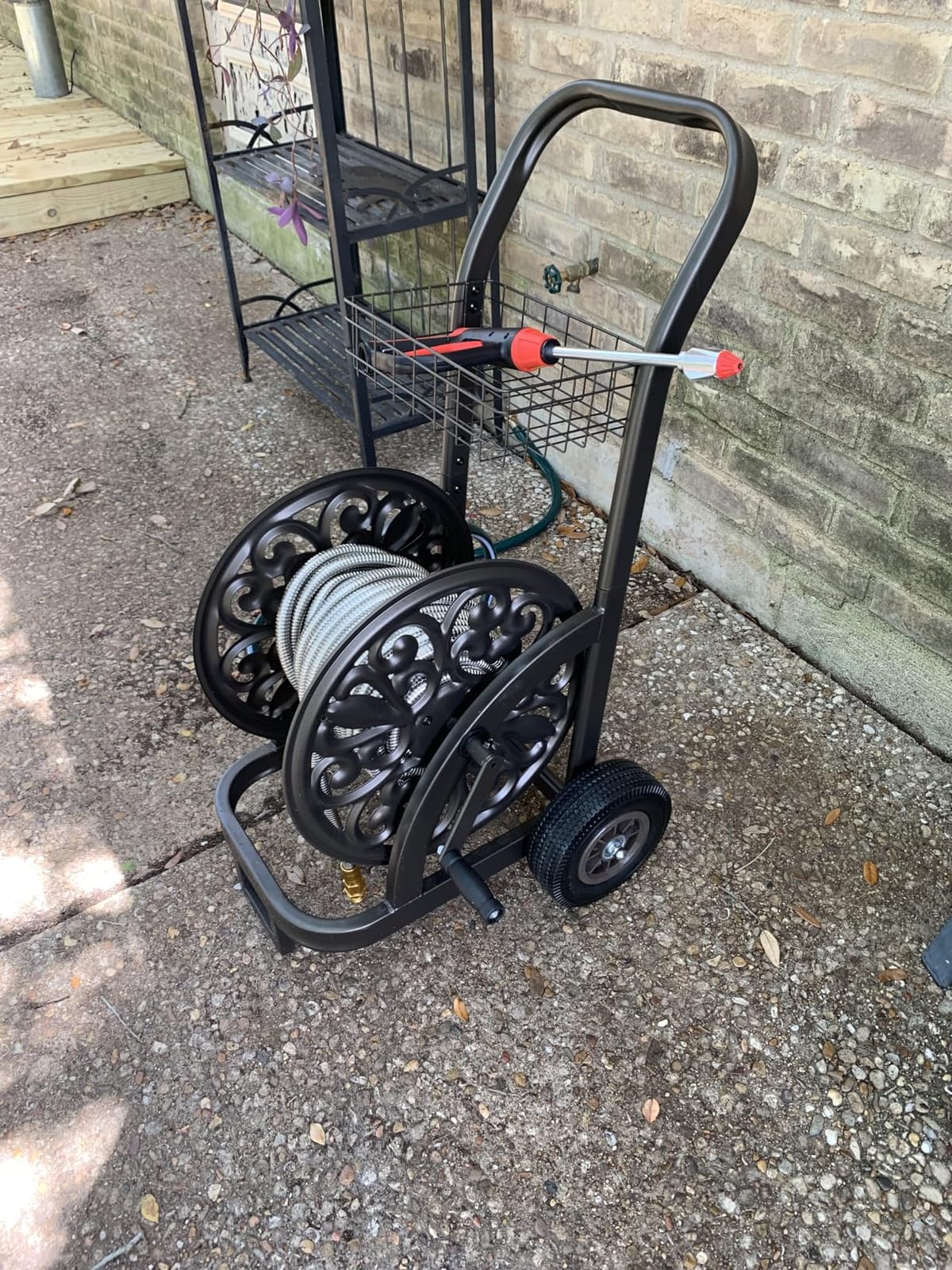
The design flaw to know about is the narrow clearance at the drum hose fitting. It will not accept standard 100 to 125 foot hose collars from major home centers, and some newer hose brands with oversized collars require bending the fitting to attach. Check your hose collars against the drum opening before you commit, because this is not an assembly problem you can work around.
There is also a wheel and axle mismatch. The wheel holes measure 5/8 inch while the axle is 1/2 inch, so the wheels fit loosely without a shim. And the wheels are hard rubber even though the listing describes them as pneumatic, so expect a firmer ride on gravel.
Why the finish matters more than it sounds
Carts stored next to the house or in an open-sided shed get looked at every day. A bronze powder coat that holds its color does more for how the yard looks than any spec gain you get elsewhere in the list, and owners comment on the appearance more often than the capacity.
Where this cart is the wrong choice
If you already own 5/8-inch hose with oversized collars, the drum fitting will fight you. In that case pick a cart with a wider hose inlet, and skip the cosmetic advantage entirely.
8. VINGLI 300 ft 4-Wheel Cart: Best for Small Storage Spaces
VINGLI 300FT 4-Wheel Garden Hose Reel Cart with Storage Basket, Portable Residential Hose Reel Cart, Lawn Watering, for Garden Backyard and Farm (Green)
- Compact and easy to store when not in use
- Metal construction much sturdier than plastic alternatives
- Large wheels roll easily and tires stayed inflated
- Straightforward assembly in about 20 minutes
- Good capacity for the money
- Frame is wobbly and front wheels lift when pushing a loaded cart
- Cart does not steer so curves require lifting the front end
- Push-button handle attachment has play every time
- Connections and manifold can leak and need plumber tape
- Axle holes sometimes do not line up
The VINGLI is the one that folds into real estate better than the other 300 foot carts. It measures 32.68 by 36.22 by 22.83 inches, noticeably lower and shorter than the 37 by 24 by 42 inch FDW and PayLessHere frames, which means it fits in a garage beside a mower where the taller carts will not.
Capacity is genuinely useful here: up to 300 feet of 5/8-inch hose or 400 feet of 1/2-inch hose on a water- and rust-resistant coated steel frame. Owners like the compact storage footprint, the fact that the metal construction is much sturdier than plastic alternatives, large wheels that roll easily with tires that stayed inflated, and assembly in about 20 minutes.
A non-slip crank grip and foam-padded handle round out an unusually well-equipped spec sheet for this tier. Variants also come in 250 foot, black 300 foot, and a 200 foot two-wheel version if your needs are smaller.
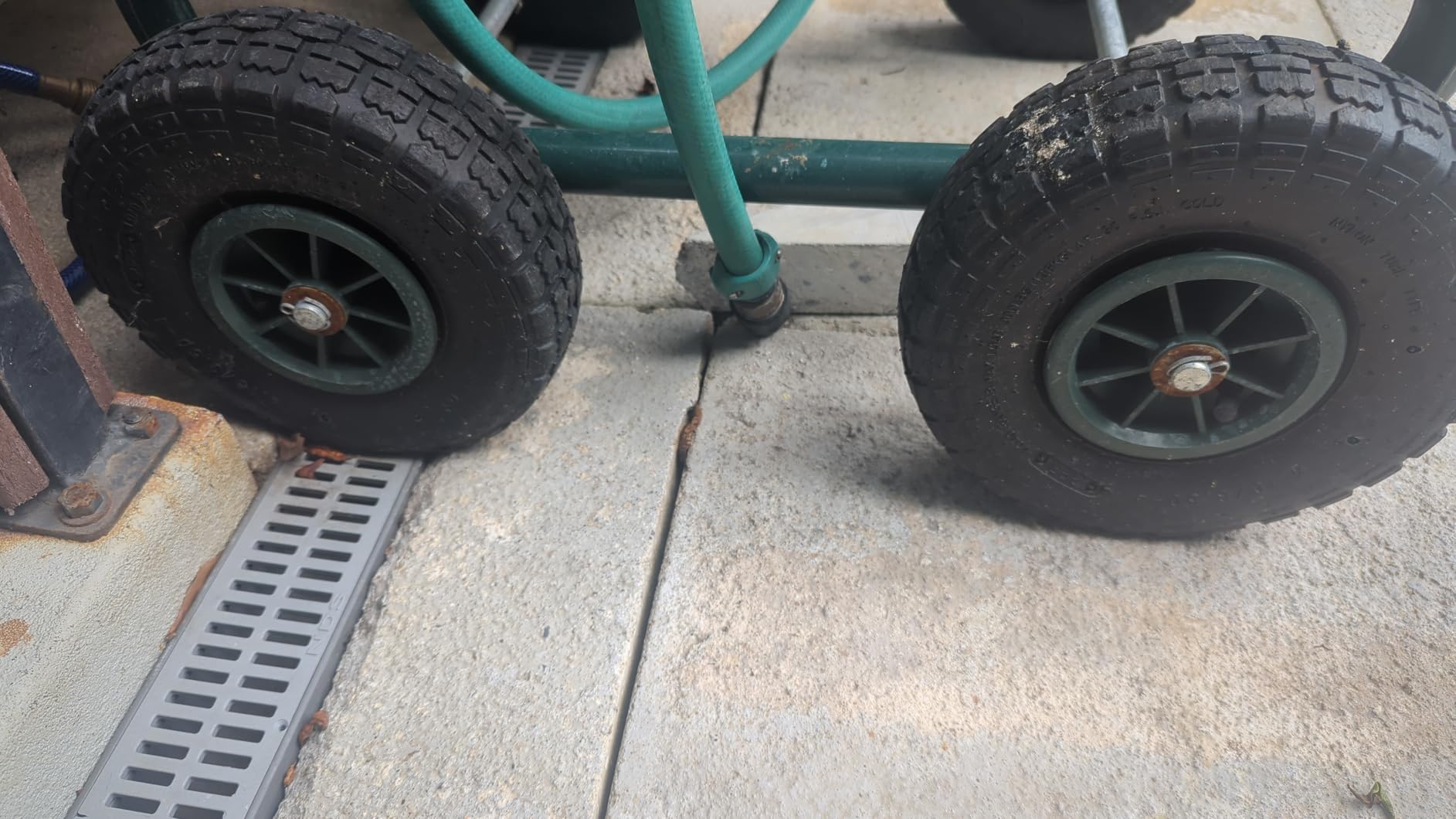
Maneuverability is the weak point, and it is the most commonly reported problem. The frame is wobbly, the front wheels lift off the ground when pushing a loaded cart, and the cart does not steer, so changing direction means lifting or forcing the front end around rather than simply turning.
The push-button handle attachment also develops play every time it is pushed or pulled, which is a small thing that becomes irritating over a season of use. Connections and the manifold can leak and need plumber tape, and some owners find the axle holes do not line up and require drilling.
Why the 400 foot figure is worth noting
That 400 foot rating is for 1/2-inch hose, not 5/8-inch. It is a genuinely useful number for anyone willing to trade a little flow for reach, since 1/2-inch hose is lighter and easier to pull for long distances even though it moves less water.
Where this cart is the wrong choice
If your yard has tight turns, slopes, or many obstacles between the spigot and the far corner, a non-steerable front end turns every repositioning into a small struggle. Four-wheel carts with a lower, planted center of gravity are easier to move in broken ground.
9. Giraffe Tools Stainless Steel 200 ft Cart: Best Corrosion Resistance
Giraffe Tools Garden Hose Reel Cart with Wheels, Stainless Steel Heavy Duty Water Hose Reel Cart, 200 ft of 1/2 Capacity, Mobile for Outside
- Stainless steel resists corrosion and impact
- Brass connector seals tightly for leak-free use
- Pre-assembled parts cut setup to roughly 15 minutes
- Hose guide winds without kinks
- Low center of gravity keeps it stable on rough ground
- Only two wheels so a loaded cart needs lifting to change direction
- Heaviest unit in the group at 34 pounds
- Does not accept 3/4-inch hose despite heavy-duty framing
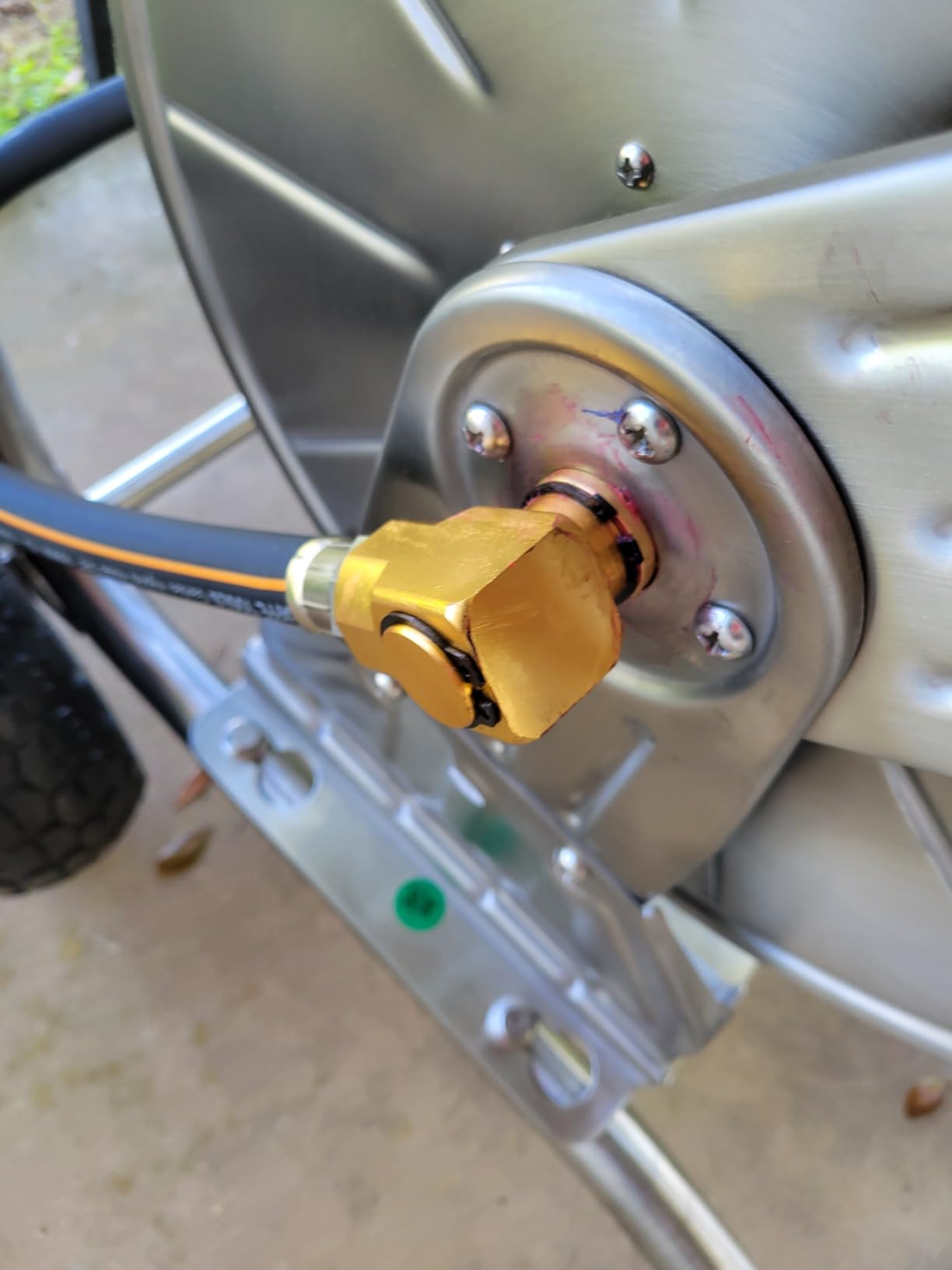
Stainless steel is the rarest material in this round-up, and it is the whole point of this cart. The industrial grade stainless steel frame is described as corrosion and impact resistant, which matters enormously for anyone leaving a reel outside through multiple wet winters. At 34 pounds it is also the heaviest unit in the group.
It measures 20 by 20 by 18 inches and holds 150 feet of 5/8-inch hose or 200 feet of 1/2-inch hose. The solid brass connector seals tightly for leak-free use, the hose guide system winds hose without kinks, and the low center of gravity keeps the cart stable on rough ground. A storage basket and a 5 foot lead-in hose are included.
Setup is the fastest in the round-up. Half the parts ship pre-assembled, which cuts the job to roughly 15 minutes with basic tools. For anyone who dreads building a cart on a Saturday, that matters as much as any material choice.
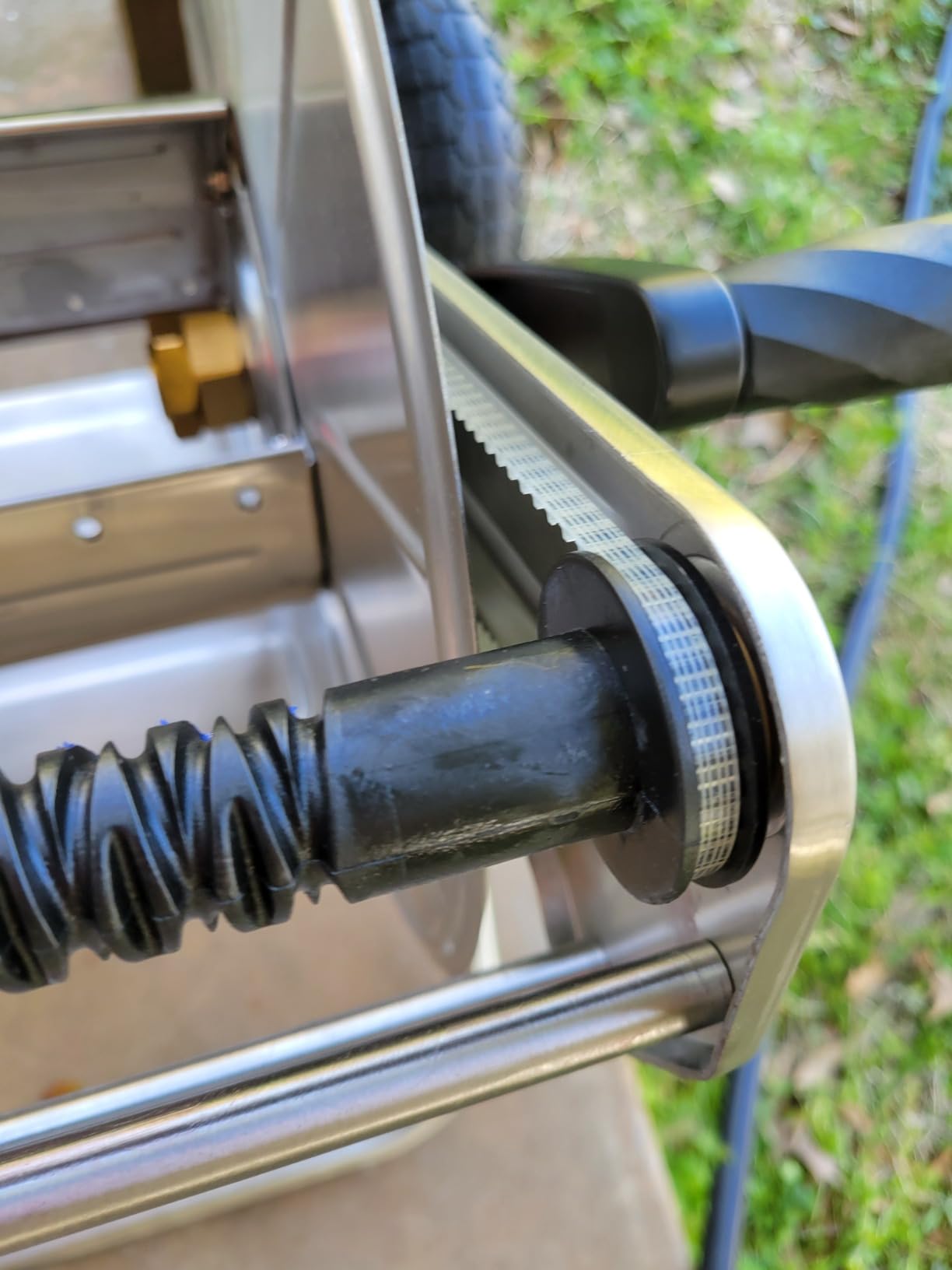
Two wheels means a loaded cart requires lifting or dragging to change direction, and at 34 pounds that lift is not trivial. The two explosion-proof knobby tires are good on rough ground but do not make a two-wheel frame into a four-wheel one. Plan your route so you pull the cart in long arcs rather than short corrections.
It also does not accept 3/4-inch hose despite the heavy-duty framing, which is worth knowing if you were hoping to run irrigation line on the same drum. Otherwise the corrosion resistance alone justifies this pick for coastal, humid, or year-round outdoor placement.
When stainless steel is worth the premium
Salt air, high humidity, or a reel that never sees a garage are the three conditions that end powder-coated steel carts early. In those environments the difference between a coating that scratches and a frame that cannot rust is measured in years, not seasons.
Where this cart is the wrong choice
If your property genuinely needs more than 150 feet of 5/8-inch hose, this is 100 feet short and the material advantage does not close the gap. This is a second reel or a close-to-the-house cart, not a whole-yard solution.
10. WERMAH 300 ft Four-Wheel Cart: Best Leak-Resistant Fittings
WERMAH Upgrade Hose Reel Cart, Garden Hose Cart 4 Wheels, Holds 300ft 5/8″
- Brass swivel and sealed fittings produced zero leaks on first use
- Angled connector eliminates hose kinking
- Flat-free tires need no pumping
- Solid build handles heavy commercial-grade hose
- Rust-proof hardware and coating suit year-round placement
- Responsive replacement when a unit arrived damaged
- Inlet valve is mounted upside down forcing basket removal to connect
- Light frame tips when pulling out more than half the hose
- Reel connection sits between spokes making hookup awkward
- Handle basket is about half the size of previous versions
This cart carries the highest average rating in our group at 4.3 stars, and the reason is its plumbing. The pre-installed integrated brass connector with precision seals and a T-piece extension bar produced zero leaks on first use for the owners who reported on it, and the redesigned swivel is credited with eliminating the year-two leaks that plagued earlier versions.
The angled brass connector prevents hose kinking, which is a real design improvement over the side-mounted connections on two of the carts above. It holds up to 300 feet of 5/8-inch hose on flat-free tires, includes a 6.5 foot leader hose, and uses weather-resistant powder coating on the frame, T piece, and handle, plus stainless steel screws and rust-proof wheel hubs.
The hose guide is unusual. It is built from POM steel-grade plastic with a PU/TPU belt and 304 stainless rods, and it distributes the load evenly as you crank.
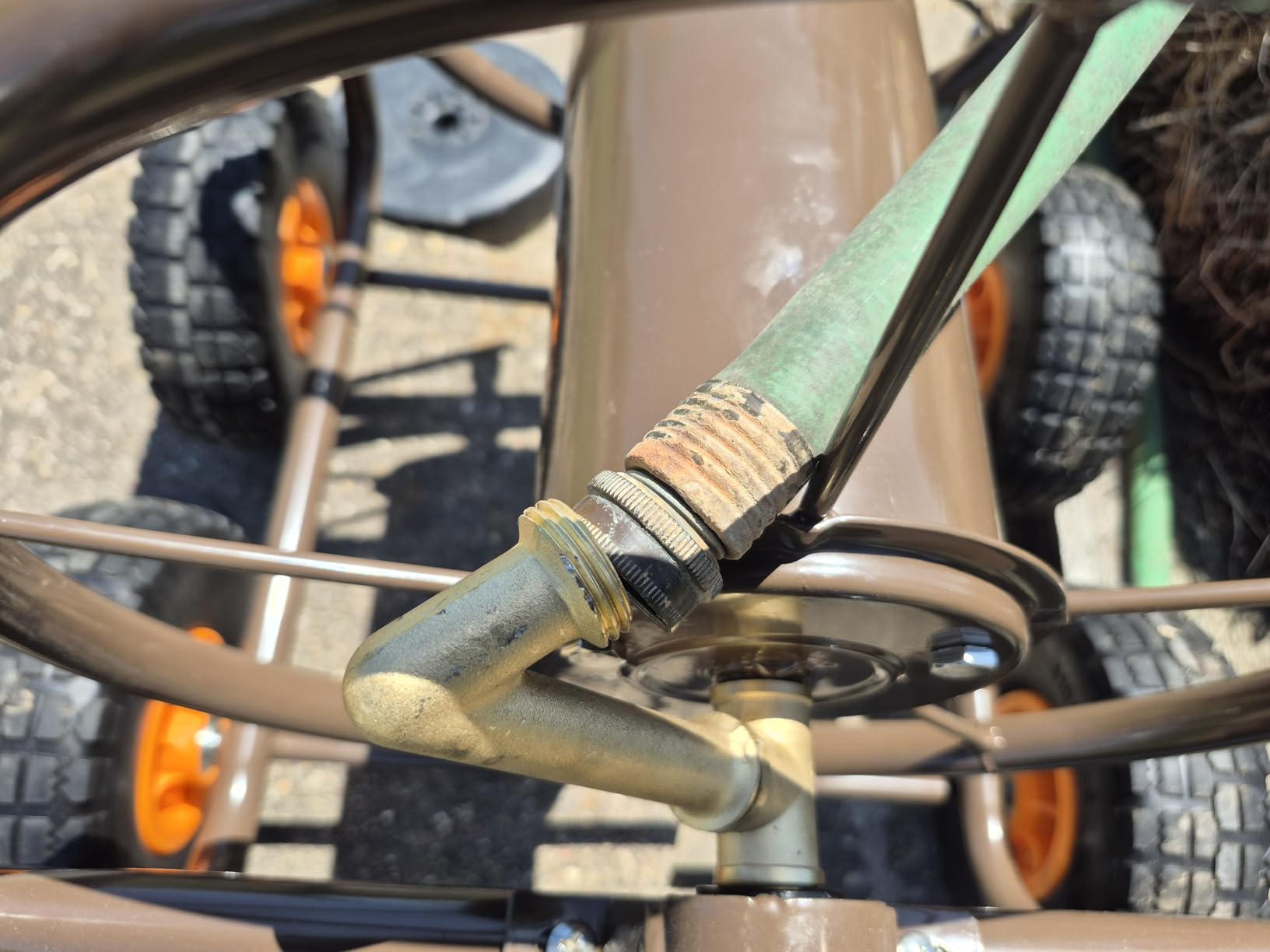
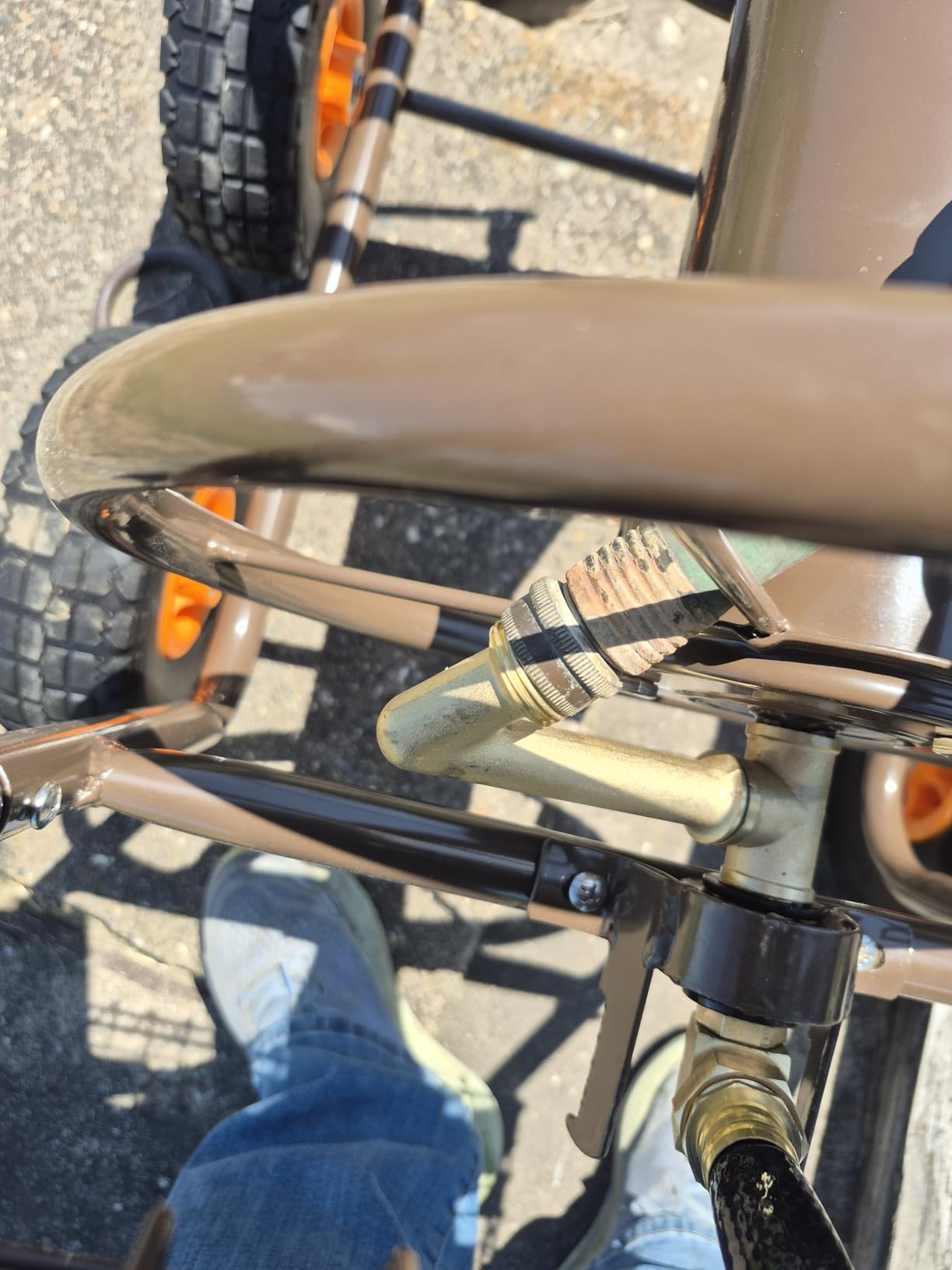
There are assembly-level design details worth knowing. The inlet valve is mounted upside down, which forces you to remove the storage basket to make the connection, and the brass reel connection sits between the reel spokes rather than aligned with one, making hookup awkward until you find the right angle.
The other complaint is the frame itself, which is light enough to tip when you pull out more than half the hose. The handle basket is also about half the size of previous versions, so it is a small shelf rather than a real accessory rack.
Why the angled connector is the standout feature
Most carts connect the hose to the side of the drum, so every pull creates a service loop that fights the wind. An angled connector feeds the hose off the drum in line with the winding direction, which reduces kinking, lowers the force needed to reel in, and is why owners call the winding smooth.
Where this cart is the wrong choice
If you plan to fill the basket with nozzles and a splitter on a regular basis, the smaller shelf is a downgrade. And if you routinely pull 200 feet or more before rewinding, brace it, because the lighter frame will move under that load.
How to Size Hose Reel Cart Capacity for a Large Yard
Capacity is stated in feet, but the number only means something alongside the hose diameter. A drum holding 300 feet of 5/8-inch hose holds far less real hose length than the same drum on 1/2-inch hose. The VINGLI in this round-up is the clearest example, rated for 300 feet of 5/8-inch or 400 feet of 1/2-inch on the same drum.
There is a three-step method that gets you the right size the first time. First, measure the actual path distance from your spigot to the farthest point you water, following the route the hose will take rather than a straight line. Around a corner, down a slope, or along a fence line, add the extra footage the detour requires.
Second, convert to 5/8-inch equivalent. If you run 1/2-inch hose, add roughly a third to the measured distance, because the same drum holds about 33 percent more length in the thinner hose. If you run 1 inch irrigation hose, plan on far more cart than you think and consider a dedicated drum instead.
Third, add 20 to 25 percent slack. Reels wind unevenly, corners eat hose, and the hose you own today is rarely the same length you assumed. A cart sized with no slack will be full before it reaches the far corner, and you will end up dragging hose by hand, which defeats the entire purpose.
As a rough guide, a quarter acre usually needs 100 to 150 feet, a half acre lands around 150 to 250 feet, a full acre pushes into the 250 to 300 foot band, and multi-acre properties or pasture watering want 300 feet plus a second cart rather than one bigger one. Most large yards land in the 250 to 300 foot range, which is exactly why that band dominates this round-up.
What to Look for in a Hose Reel Cart
Frame material is the decision that determines how long the cart lasts. Powder-coated steel is the standard and holds up well if you keep the drum dry, stainless steel is the upgrade for coastal or year-round outdoor placement, and polypropylene or plastic frames are the choice to avoid on a large property. The recurring owner complaint across forums is plastic cracking and bending, and it is the reason most people end up buying twice.
Wheel count follows from terrain. Four wheels are more stable when you pull hose, better on gravel and slopes, and easier to reposition without lifting. Two wheels are more compact, cheaper, and fine on flat lawn if the frame is heavy enough to resist tipping. Pneumatic tires roll softer and absorb bumps but need inflating; flat-free and never-flat tires never do, at the cost of a firmer ride.
Hose guide matters more than most buyers expect. A level-wind guide distributes hose evenly across the drum so the load stays balanced and you avoid the tangled rubber mat that forms without one. If you plan to store more than about 150 feet, treat a guide as a requirement rather than a nicety.
Stability is where cheap carts fail and where the real difference between a 35 pound frame and a 20 pound one shows up. Look for a low center of gravity, a wide wheelbase, and a frame heavy enough that pulling hose does not drag the whole unit across your lawn. Bracing a wheel with your foot is normal on a four-wheel cart and a warning sign on a light two-wheel cart.
Plumbing decides how much attention the cart needs. Brass fittings and a 90 degree swivel with an angled connector resist leaking and reduce kinking, while a bare side-mounted connection is the most common source of both kinks and year-two leaks. A leader hose of reasonable quality saves you replacing the cheapest part of the assembly first.
Storage is a small feature that pays off constantly on a large property. A basket keeps nozzles, splitters, and gloves with the cart instead of on the grass, and it matters more when you are moving the reel several times per session. Check its size against what you actually carry, since baskets range from a small shelf to a full rack.
Warranty length is the fastest durability signal in this category. Metal carts with brass plumbing and multi-year or lifetime warranties signal a manufacturer that expects the product to last, while short or absent warranties on plastic fittings are a fair warning about long-term reliability.
Finally, plan for winter. Drain the hose before cold weather, disconnect it from the spigot, and store it coiled loosely. Freeze damage is a leading cause of failure in this category, and a reel that lives outdoors through a hard freeze is a reel that will need a new hose, and sometimes new fittings, in spring.
Frequently Asked Questions
How much hose capacity do I need for a large yard?
For most large properties, 250 to 300 feet of 5/8-inch hose is the right target. Measure the path from your spigot to the farthest point you water, add 20 to 25 percent for routing and windings, and round up to the next capacity tier. A half acre usually needs 150 to 250 feet, while a full acre or multi-acre property lands in the 250 to 300 foot band or needs a second cart.
Who makes the best hose reel cart?
It depends on your yard and your climate. Liberty Garden is the strongest all-around choice for large properties, with a 300 foot steel 4-wheel model that stays planted under load. Yard Butler makes the best compact all-metal two-wheel design with a lifetime warranty, and Giraffe Tools covers the corrosion-resistant and hose-guide categories. For value at 300 feet of capacity, the FDW four-wheel cart is hard to argue with.
How do you choose the right hose reel cart?
Start with capacity measured in feet of 5/8-inch hose, then check frame material, wheel count, and tire type for your terrain. A metal frame with brass fittings and a low center of gravity is the durability baseline on a large property. Add a hose guide if you will store more than about 150 feet, and check that the warranty covers the plumbing rather than just the frame.
Should I buy a two-wheel or four-wheel hose reel cart?
Four wheels are more stable when you pull hose, better on gravel and slopes, and easier to reposition without lifting. Two wheels save space and weight, and work well on flat lawn if the frame is heavy enough not to tip. If your yard is uneven or you plan to move a full drum frequently, four wheels are worth the extra footprint.
Do hose reel carts tip over when you pull the hose?
They can, and it is the most common complaint about lighter models. A full drum of wet 5/8-inch hose creates real sideways force. Carts with a low center of gravity, a wide four-wheel stance, and a heavier steel frame resist this best. On lighter carts, bracing a wheel with your foot while cranking is standard practice and prevents most tipping.
How high off the ground should a hose reel be?
Between 18 and 30 inches is the practical range. A crank around 20 to 24 inches is comfortable for most adults while cranking, and taller frames make it easier to reach the drum but harder to fit under a bench or in a low garage. If you have back strain, look for a cart with a higher crank and a padded handle, and consider a cart that never requires lifting.
How long should a garden hose reel last?
A steel-frame cart with brass fittings can last 8 to 10 years or more with basic care, which owners of the Liberty Garden models commonly report. Plastic-frame carts tend to crack or bend within a few seasons and get replaced. Winterizing the hose, keeping the drum dry, and touching up scratches on powder coat all extend life noticeably.
What size hose reel do I need for a 100 foot hose?
Any cart rated for at least 150 feet of 5/8-inch hose handles 100 feet comfortably with room to spare. You do not need a 300 foot cart for a 100 foot load, though a larger drum does make winding faster and can handle a longer leader hose. Match the cart to the hose you actually own rather than the largest size available.
The Best Hose Reel Cart for Your Yard
For most large properties, the Liberty Garden Industrial 4-Wheel is the best hose reel cart, because a 300 foot drum on a 13 gauge powder-coated steel frame with brass plumbing and four flat-free tires is the combination that survives real use without babysitting. The Liberty Garden Residential Grade is the pick if a storage basket matters more to you than warranty length, and the FDW 4-Wheel is the value answer when you need 300 feet of capacity without the premium.
Match the rest to your specific problem. Stainless steel and a hose guide point to the Giraffe Tools premium cart, compact two-wheel handling points to the Yard Butler, visible yards point to the bronze GOFORWILD, tight storage spaces point to the VINGLI, and leak-free plumbing points to the WERMAH.
Whichever you choose, size it with the measurement method above rather than the number on the box, and winterize the hose before the first freeze. If you are still working out the rest of your property setup, our guides to the best trampolines for small yards and best battery string trimmers for large yards cover the rest of the ground you maintain. Updated for 2026.