
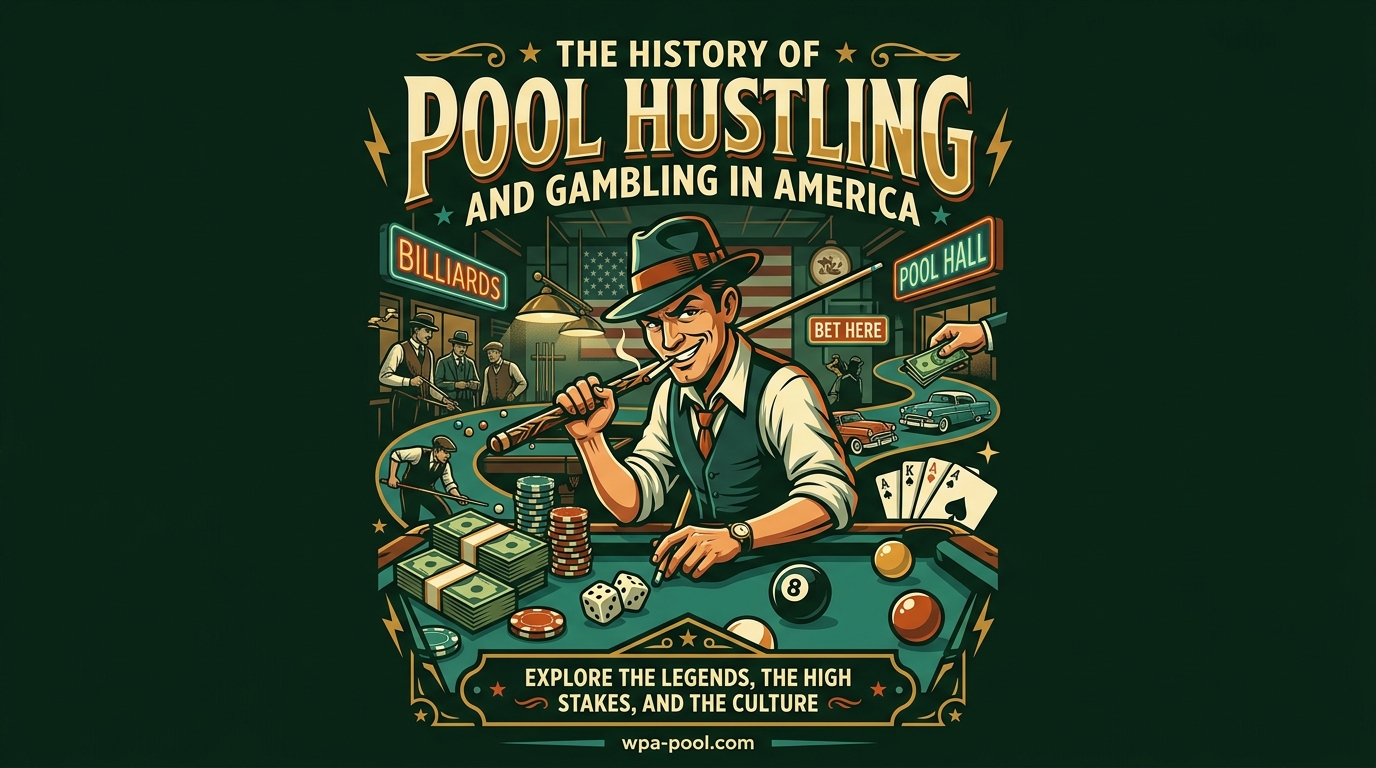
The history of pool hustling and gambling in America stretches back nearly 250 years, weaving together elements of European aristocracy, working-class recreation, and the shadowy world of underground betting. What began as a noble pastime for kings and queens evolved into something far more complex on American soil.
The connection between pocket billiards and wagering runs deep through the nation’s cultural fabric. Pool halls became synonymous with both skilled competition and illicit gambling, creating a reputation that persists even today.
I spent months researching this fascinating intersection of sport and subculture. The stories I’ve uncovered reveal how a simple cue game shaped American entertainment, spawned legendary rivalries, and influenced some of cinema’s most memorable characters.
Table of Contents
The Origins of Pool: From European Nobility to American Streets
Pool traces its lineage to outdoor lawn games played by European royalty in the 15th century. French and English aristocrats enjoyed variations of croquet and ground billiards before the game moved indoors and onto tables.
By the late 1500s, indoor billiards had become a fixture in royal courts across Europe. The game required expensive equipment and dedicated playing spaces, making it exclusively a pursuit of the wealthy.
The game crossed the Atlantic with early American colonists in the 1700s. George Washington reportedly owned a billiards table, and Abraham Lincoln was known to play during his presidency. These early American versions differed significantly from the pocket billiards we recognize today.
Equipment Innovations That Changed Everything
Three key inventions transformed billiards from an aristocratic novelty into a widespread American pastime. Each innovation made the game more accessible, predictable, and suited for gambling.
Michael Phelan revolutionized the industry by advocating for slate table surfaces in the mid-1800s. Unlike wooden tables that warped with humidity, slate provided a perfectly flat, consistent playing surface that serious players could trust. This reliability proved essential for high-stakes wagering.
John Thurston’s vulcanized rubber cushions, introduced around 1835, replaced wooden bumpers that produced unpredictable ball reactions. The new rubber cushions created consistent angles and enabled the strategic shot-making that defines modern pool.
The invention of celluloid billiard balls in the 1860s finally provided a consistent, affordable alternative to expensive ivory. This material breakthrough made quality equipment accessible to working-class players, democratizing the game.
Why Pool Became Synonymous with Gambling
The very name “pool” reveals its gambling origins. In the 19th century, “pool” referred to a collective betting arrangement where multiple gamblers staked money on a shared wager, similar to modern parimutuel betting systems.
Horse racing venues established dedicated rooms where patrons could place collective bets, calling these spaces “poolrooms.” Management installed billiards tables to entertain bettors between races. Over time, the tables became the main attraction while the horse racing connection faded.
Poolrooms and saloons became inseparable in the American imagination during the late 1800s. These establishments offered liquor, wagering, and cue games under one roof, creating environments where gambling and billiards naturally intertwined.
The Prohibition Era and Pool’s Demonization
The 1920s brought intense scrutiny to pool halls as moral reformers targeted them alongside speakeasies. Critics painted these establishments as dens of depravity, associating them with drinking, gambling, and criminal activity.
This reputation peaked with the cultural phenomenon of “The Music Man” in the 1950s. The Broadway musical and subsequent film depicted pool as a corrupting influence on youth, cementing negative perceptions that lingered for generations.
Despite these attacks, pool halls remained vital social institutions in working-class neighborhoods. They provided rare spaces for intergenerational socializing and competition outside the home.
The 19th Century: Pool’s Golden Age Begins
Michael Phelan emerged as the undisputed father of American pool during the mid-1800s. This Irish immigrant didn’t just play the game brilliantly; he transformed how Americans thought about billiards.
Phelan wrote the first American book on billiards in 1850, establishing rules and standards that unified regional variations. He manufactured tables, promoted tournaments, and essentially professionalized a game that had previously existed as informal entertainment.
His competitive matches against John Seereig drew massive crowds and heavy betting. These high-stakes exhibitions demonstrated that skilled pool players could command national attention and substantial earnings.
The Birth of Straight Pool
Jerome Keogh invented straight pool, also known as 14.1 continuous, in 1910. This revolutionary format changed everything about competitive play and wagering.
Unlike earlier rotation games where players shot balls in numerical order, straight pool allowed competitors to pocket any ball on the table. A player could theoretically run the entire rack without surrendering their turn, creating dramatic possibilities for extended runs that enthralled spectators and bettors alike.
Willie Mosconi later demonstrated straight pool’s potential by running 526 consecutive balls in a private exhibition in 1956. This feat, never officially surpassed, cemented his status as perhaps the greatest technical player in history.
Legendary Players and the Art of the Hustle
The golden age of pool hustling produced characters so colorful they seemed fictional. These road players traveled between cities, earning money by concealing their true abilities and luring marks into profitable matches.
Rudolph Wanderone, better known as Minnesota Fats, became the most famous pool hustler in American history. His flamboyant personality and self-promotion skills outshone even his considerable table skills. Fats claimed the film character in “The Hustler” was based on him, a claim the film’s creators disputed but which Fats successfully marketed throughout his life.
Willie Mosconi represented the opposite archetype: the technician. Where Fats embraced showmanship and hustling, Mosconi embodied pure competitive excellence. His 19 world straight pool championships and 15 world championships in other disciplines established standards that modern players still chase.
The Famous Rivalry
The Mosconi-Fats rivalry transcended the sport itself, pitting two philosophies against each other. Mosconi viewed pool as a legitimate sport requiring discipline and training. Fats treated it as entertainment and a means to separate suckers from their money.
Their famous 120-game challenge match in 1978 drew enormous attention. Mosconi won decisively, but Fats remained the more recognizable figure to casual fans. This dynamic, the purist versus the showman, still shapes perceptions of professional pool today.
Road Hustling: The Hidden Economy
Below the famous names, thousands of anonymous hustlers sustained themselves through a shadow economy of cash games. These players developed elaborate techniques for disguising their abilities.
A skilled hustler might play with their non-dominant hand, use inferior equipment, or deliberately miss shots to lower expectations. Once betting stakes increased, they would reveal their true capabilities and collect winnings.
Forum discussions from longtime players reveal this culture persisted well into the 1980s and 1990s. One user recalled their father paying for multiple college degrees through pool hustling during this era. Another described how Virginia Beach pool halls during the 1940s attracted traveling hustlers following military personnel with cash in their pockets.
Modern hustling has evolved significantly. As one experienced player noted, “Hustling doesn’t always look like movies. It’s more subtle now.” Games have shifted toward apps and online platforms, though traditional cash games persist in certain venues.
The Cultural Revolution: Film, Television, and Pop Culture
Walter Tevis’s 1959 novel “The Hustler” transformed American perceptions of pool. The book introduced Eddie Felson, a talented but flawed player navigating the gambling underworld. Its success caught Hollywood’s attention.
The 1961 film adaptation starring Paul Newman and Jackie Gleason became a cultural phenomenon. Newman portrayed Eddie Felson with brooding intensity, while Gleason’s Minnesota Fats character brought sophistication to the hustler archetype.
The film’s realistic depiction of pool hall culture, shot in actual establishments with technical consultants ensuring authenticity, introduced millions to the game’s aesthetic appeal. Pool table sales reportedly increased 300% following the film’s release.
The Color of Money and the Eighties Revival
Twenty-five years later, Martin Scorsese’s “The Color of Money” brought pool back to theaters. Paul Newman returned as an aging Eddie Felson mentoring a young hustler played by Tom Cruise.
This sequel arrived during a genuine pool renaissance. The 1980s witnessed the rise of nine-ball as a television-friendly alternative to straight pool, with faster action and clearer scoring. ESPN began broadcasting tournaments, and players like Earl Strickland and Efren Reyes became recognizable names.
Films and television transformed the pool hustler from a disreputable figure into a romanticized antihero. The dangerous appeal of underground gambling became a selling point rather than something to hide.
Breaking Barriers: Women, Civil Rights, and the Modern Game
Pool remained stubbornly male-dominated for most of its American history. Social customs often barred women from pool halls, and competitive opportunities were virtually nonexistent until the late 20th century.
Jean Balukas changed everything. Starting as a child prodigy who appeared on television at age six, she grew into perhaps the greatest female player in history. Her 20 consecutive titles at the World Straight Pool Championship from 1977 to 1997 demonstrated unprecedented dominance.
Balukas also broke new ground by competing successfully against male professionals. Her induction into the Billiard Congress of America Hall of Fame in 1985, the first woman so honored, marked a turning point for women’s recognition in the sport.
Jeanette Lee, known as “The Black Widow,” brought further mainstream attention through her competitive success and distinctive playing style. These pioneers created pathways that subsequent generations have expanded.
Civil Rights and Cisero Murphy
Cisero Murphy’s story illustrates pool’s complex relationship with American social history. In 1964, Murphy won the BCA U.S. Open Straight Pool Championship but faced discrimination preventing him from competing in subsequent tournaments due to his race.
His talent eventually overcame these barriers, making him one of the first African American players to achieve mainstream recognition. Murphy’s persistence helped open doors for future generations of diverse players.
Today, professional pool features players from dozens of countries, with particular strength from the Philippines, Taiwan, and throughout Asia. The American pool hall, once a distinctly local institution, connects to a global competitive community.
Pool in the Digital Age
The internet and mobile applications have fundamentally altered how people experience pool. Games like 8 Ball Pool attract millions of daily players who may never visit a physical hall.
These digital platforms offer gambling-adjacent features through in-app purchases and tournament entry fees. The connection between virtual and physical pool continues evolving, with some traditionalists concerned about declining interest in actual table play.
However, dedicated pool halls persist, particularly in urban areas and college towns. The social experience of shooting with friends, studying angles, and the tactile pleasure of a well-struck ball cannot be fully replicated digitally.
Understanding Pool’s Enduring Legacy
The history of pool hustling and gambling in America reflects broader themes in American cultural development. From European aristocratic origins to working-class recreation, from prohibition-era demonization to Hollywood glamorization, the game has continuously reinvented itself.
Understanding this history provides context for modern perceptions of pool. The gambling associations that once made the game controversial now contribute to its mystique and appeal.
The techniques, terminology, and cultural touchstones developed over centuries continue shaping how players interact with the game today.
Frequently Asked Questions
When did pool become popular in the US?
Pool gained significant popularity in the United States during the early to mid-19th century, particularly between the 1820s and 1850s. Michael Phelan’s influence, slate table innovations, and the rise of poolrooms in major cities drove this growth. The game received further boosts from the 1961 film The Hustler and the 1986 sequel The Color of Money, each sparking renewed interest in American pool culture.
Why is pool associated with gambling?
Pool’s gambling association stems from its historical connection to horse racing betting pools in the 19th century. The term pool originally referred to collective betting arrangements, and poolrooms were initially established for horse race wagering with billiards tables installed as entertainment between races. Over time, the tables became the main attraction while the gambling reputation persisted. Prohibition-era pool halls and decades of Hollywood depictions further cemented this connection.
Who invented straight pool?
Jerome Keogh invented straight pool, also known as 14.1 continuous, in 1910. This revolutionary format allowed players to pocket any ball on the table rather than following numerical rotation, enabling theoretically unlimited runs. Willie Mosconi later demonstrated straight pool’s potential by running 526 consecutive balls in a 1956 exhibition, a record that still stands today.
What did Einstein say about billiards?
Albert Einstein reportedly said that billiards is a game where the angle of incidence equals the angle of reflection, except when it doesn’t. This humorous observation acknowledged the apparent simplicity of billiard physics while recognizing the complexity that spin, speed, and table conditions add to actual gameplay. Einstein enjoyed playing billiards as recreation during his academic career.
Conclusion
The history of pool hustling and gambling in America represents a fascinating journey through social class, cultural perception, and competitive evolution. From European royal courts to American pool halls, from Michael Phelan’s slate tables to modern mobile apps, the game has continuously adapted while maintaining its essential character.
Legends like Willie Mosconi and Minnesota Fats elevated pool to popular entertainment. Films like The Hustler and The Color of Money introduced generations to the romance and danger of the pool hall. Pioneers like Jean Balukas and Cisero Murphy expanded who could participate in this uniquely American tradition.
Today, pool exists in fascinating tension between its gambling heritage and its legitimacy as a competitive sport. The hustler archetype persists in popular culture even as professional players pursue prize money through sanctioned tournaments rather than underground games.
Whether you shoot casually with friends or study the game seriously, understanding this history enriches every moment at the table. The ghosts of hustlers past, the echo of legendary rivalries, and the enduring appeal of a perfectly executed shot connect modern players to centuries of tradition.