
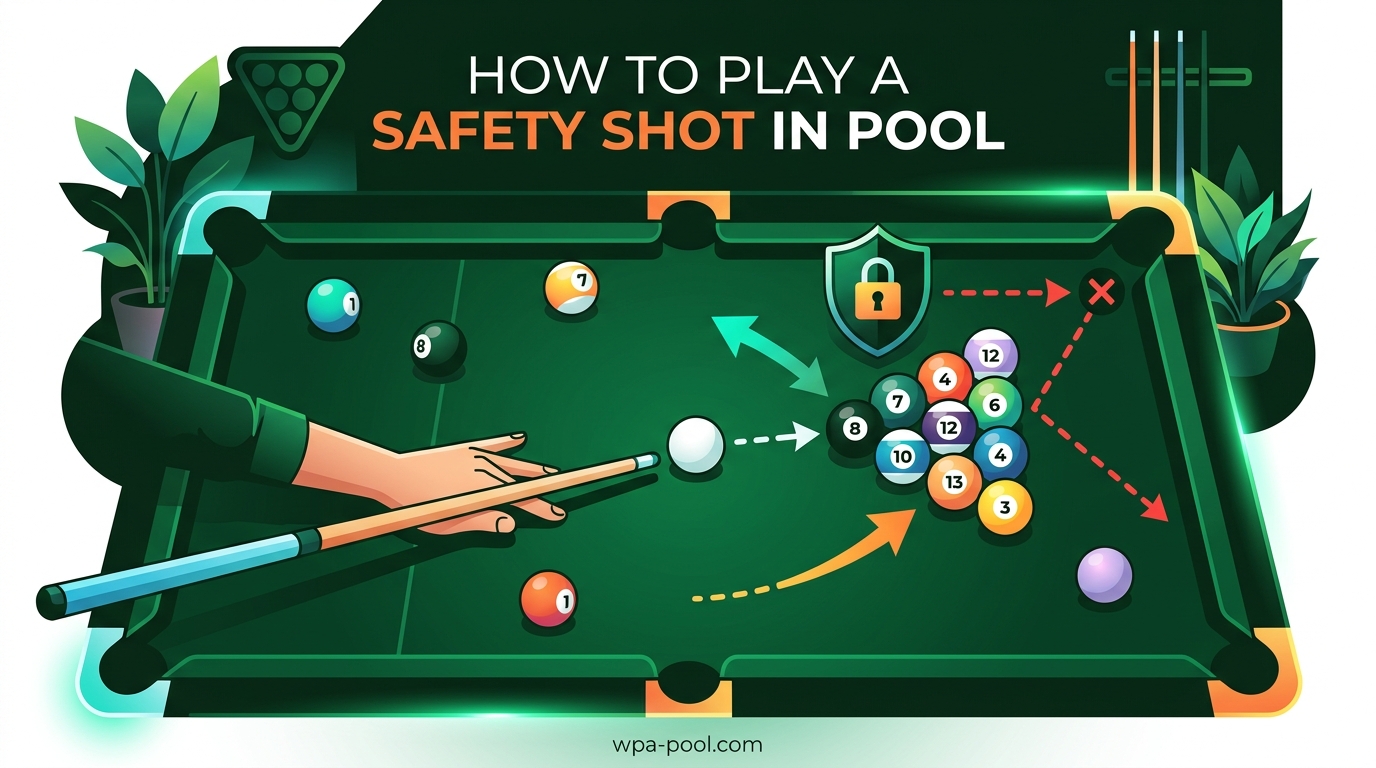
Learning how to play a safety shot in pool is one of the most important skills for any serious player. While most beginners focus entirely on offensive shots, defensive play separates intermediate players from true competitors. Our team has practiced these techniques over hundreds of hours, and I will show you exactly how to execute safeties that give you control of the table.
A safety shot is a defensive play where you intentionally avoid pocketing a ball to leave your opponent in a difficult position. The goal is not to score points immediately, but to limit your opponent’s options and potentially gain ball in hand. Understanding when and how to play safe can turn losing positions into winning opportunities.
In this guide, you will learn what makes a safety shot legal, the different types of defensive plays, step-by-step execution techniques, and the specific rules for calling safeties in different pool games.
Table of Contents
What Is a Safety Shot in Pool?
A safety shot in pool is a defensive play where you legally hit an object ball but do not pocket it, instead positioning the cue ball where your opponent has no easy shot. This strategic move forces your opponent to attempt a difficult shot or play a safety of their own.
Many new players misunderstand safeties as “cheap” or unsportsmanlike play. This is not true at all. Safety shots are a legitimate part of pool strategy, just like defense in chess or basketball. The best players in the world use safeties regularly, especially in tournament play where every advantage matters.
The Difference Between a Safety and a Containing Shot
A true safety shot must meet all legal shot requirements: the cue ball must contact an object ball first, and either the cue ball or an object ball must contact a rail after making contact. A containing shot is different because it focuses on hiding the cue ball behind an object ball without necessarily meeting all the criteria of a called safety under tournament rules.
When to Play a Safety in Pool
Knowing when to play safe is just as important as knowing how. Here is a simple rule our team follows: if both the shot you are facing and the position to your next ball are difficult, look for a safety instead.
You should consider playing a safety when:
- You have no clear path to pocket your ball
- Making the shot would leave you hooked or out of position
- Your opponent has difficult balls remaining and you want to protect a lead
- You are ahead in a race and want to force your opponent to take risks
- The risk of missing outweighs the reward of making the shot
Professional players often say that the mark of a strong competitor is knowing when to play offense and when to switch to defense. Aggressive play wins games, but smart safety play wins matches.
Types of Safety Shots
There are several common safety shots that every pool player should master. Each type serves a different strategic purpose depending on the table layout.
Rail-First Safety
The rail-first safety involves banking the cue ball off a rail before contacting your object ball. This is useful when your object ball is clustered or when you need to change the cue ball’s path to reach a safe position. The key is controlling the speed so the cue ball settles in a protected spot after contact.
Distance Safety
A distance safety sends the cue ball to the opposite end of the table from your opponent’s remaining balls. This forces them to attempt long, low-percentage shots. These safeties work best when your opponent has balls clustered near one end and you can send the cue ball far away.
Cluster Safety
When your opponent has balls that are tied up together, a cluster safety intentionally leaves the cue ball near those clusters. Your opponent may be forced to break up the cluster just to hit their ball, potentially giving you an opening on your next turn.
Hook Safety
The hook safety, also called “snookering” your opponent, positions the cue ball so an object ball blocks the path to your opponent’s balls. This requires precise cue ball control and understanding of angles. When executed properly, your opponent must attempt a difficult kick shot.
How to Execute a Basic Safety Shot
Executing a proper safety requires technique and planning. Follow these steps to play effective defensive shots:
Step 1: Assess the table. Look at your opponent’s ball positions and identify which shots they would want to take. Find the area of the table that gives them the fewest options.
Step 2: Choose your target. Decide which of your balls you will hit and where you want the cue ball to finish. The ideal position hides the cue ball or puts it far from your opponent’s next target.
Step 3: Calculate the path. Determine the angle needed to hit your object ball and send the cue ball to your desired safety zone. Consider whether you need rail contact.
Step 4: Control your speed. Safety shots require precise speed control. Hit the cue ball with just enough force to reach your target position without rolling too far. Practice this touch on your home table.
Step 5: Execute with confidence. Stroke smoothly and follow through. Hesitation causes errors in safety play just as much as in offensive shots.
Common Mistakes to Avoid
Beginners often make these safety shot errors. First, hitting too hard sends the cue ball out of the safe zone. Second, failing to plan what happens if the opponent gets ball in hand. Third, choosing safety when a reasonable offensive shot exists. Fourth, not calling the safety when required by game rules.
Rules for Calling a Safety
The rules for calling a safety vary depending on which game you are playing. Understanding these differences prevents disputes and fouls.
Eight-Ball Safety Rules
In eight-ball under official WPA pool rules, calling a safety means you announce your intention before shooting. This matters because if you make your ball after calling safety, your turn ends anyway. You keep your pocketed ball, but you give up your next shot. This rule prevents players from calling safety only after making a shot.
Nine-Ball Safety Rules
In nine-ball, safeties work differently. You must still hit the lowest-numbered ball first, but you can call a safety before the shot. If the safety is legal, play passes to your opponent even if you pocket a ball. Some house rules require three consecutive safeties to result in a rack restart.
Always check which rule set your match is using before play begins. Tournament play follows strict official WPA pool rules, while casual play may use local variations.
Frequently Asked Questions
What are the rules for safety shot in pool?
Safety shot rules vary by game. In 8-ball, you must call safety before shooting, and your turn ends even if you make a ball. In 9-ball, you must hit the lowest ball first, and a called safety passes play to your opponent regardless of whether you pocket a ball. Always check your specific rule set before playing.
How do safeties work in a pool?
Safeties work by legally hitting an object ball but leaving the cue ball in a position where your opponent has no easy shot. This forces them to attempt a difficult shot, play their own safety, or potentially foul and give you ball in hand. It is a defensive strategy to gain advantage when offense is risky.
Are safety shots allowed in the pool?
Yes, safety shots are completely legal and are considered legitimate strategic play. Professional players use safeties regularly in tournament matches. The key is following proper rules for your game type and calling the safety when required.
Conclusion
Mastering how to play a safety shot in pool will elevate your game from casual play to competitive level. Safety shots are not about avoiding difficult shots but about making smart strategic decisions. When you understand the different types of safeties, know when to use them, and execute them with proper technique, you control the table and force your opponents into mistakes.
Start by practicing the basic rail-first and distance safeties on your home table. Focus on speed control and cue ball positioning. Over time, defensive play will become as natural as offensive shooting, and you will win more games against stronger opponents.