
Astrophotography gets the headlines, but most people buying a telescope want one thing: to see a galaxy, a nebula or a globular cluster with their own eyes. That is the entire subject of this guide to the best telescopes for deep sky objects in 2026, and the answer starts with a single number. Aperture decides what you can see, and everything else on the spec sheet is secondary to it.
Our best overall pick is the Celestron AstroMaster 130EQ. Its 130mm mirror on a German equatorial mount gives real tracking control at a price most beginners can absorb, and it draws on more than 3400 owner reviews. If you want the biggest photons per dollar and do not need a motor, the 8-inch Sky-Watcher Flextube 200 out-views every scope on this list by a wide margin.
We assembled this roundup around the three specs buyers actually cross-check before purchase, which the same three come up again and again on observing forums: aperture, weight, and mount type. Every scope below has a full specification set, an honest list of what it does well and what it does not, and a clear statement of who it suits. If you are still working out the basics, our beginner telescope guide covers the fundamentals first.
One warning before we start. Almost nobody fails to see deep sky objects because the telescope is faulty. A first-time observer under suburban sky glow will fail to see the Veil Nebula with a perfectly good 8-inch scope, and the same 8-inch at a genuinely dark site will show it clearly. If you are wondering why your new telescope shows nothing but stars, the sky is almost certainly the problem, not the glass.
Table of Contents
Top 3 Picks for Deep Sky Observing in 2026

Celestron AstroMaster 130EQ
- 130mm aperture
- 650mm f/5 focal length
- German equatorial mount with slow-motion knobs

Celestron NexStar 8SE
- 8-inch Schmidt-Cassegrain
- 2032mm f/10 focal length
- Single fork GoTo mount with SkyAlign
Sky-Watcher Flextube 200 Dob
- 8-inch aperture
- 1200mm f/6 focal length
- Collapsible tube with 2-inch Crayford focuser
Three specs decide almost every deep sky purchase, and they are worth reading before you look at a single product name.
- Aperture over magnification. Marketing numbers like 500x will not make a galaxy brighter or sharper past roughly 2x per inch of aperture. A wider mirror beats a bigger number every time.
- The mount decides whether you keep the object. An equatorial mount with slow-motion knobs lets you centre a target once. A plain alt-azimuth base means nudging the tube by hand every few minutes.
- Dark skies decide everything else. A 6-inch scope under a Bortle 2 sky can outperform a 12-inch under city glow. Budget for a drive to a dark site, because that is cheaper than a bigger telescope.
Best Telescopes for Deep Sky Objects in 2026 at a Glance
All eight scopes, side by side. The comparison covers the full lineup, and the detailed reviews that follow go deeper on mount behaviour, optics and who each one is really for.
| Product | Specifications | Action |
|---|---|---|
| Celestron AstroMaster 130EQ |
|
Check Latest Price |
| Celestron NexStar 8SE |
|
Check Latest Price |
| Sky-Watcher Flextube 200 Dobsonian |
|
Check Latest Price |
 Celestron PowerSeeker 127EQ Celestron PowerSeeker 127EQ |
|
Check Latest Price |
 Gskyer 130EQ Professional Gskyer 130EQ Professional |
|
Check Latest Price |
 Sky-Watcher EvoStar 100ED APO Sky-Watcher EvoStar 100ED APO |
|
Check Latest Price |
 MEEZAA 150EQ Newtonian MEEZAA 150EQ Newtonian |
|
Check Latest Price |
 Sky-Watcher Heritage 150 Tabletop Dob Sky-Watcher Heritage 150 Tabletop Dob |
|
Check Latest Price |
1. Celestron AstroMaster 130EQ Telescope – our best overall pick for deep sky
- 130mm aperture with aluminum and SiO2 coatings resolves lunar craters and the Virgo cluster
- Dual slow-motion knobs for right ascension and declination let you centre an object once and keep it there
- Tool-free assembly with an adjustable tripod for standing or seated viewing
- 20mm and 10mm eyepieces plus a StarPointer red dot finder and software included
- Not suitable for astrophotography without modification and a better mount
- Mirror collimation must be checked and re-done after transport
- Light-gauge tripod is less stable fully extended
The AstroMaster 130EQ is the scope we keep coming back to because it fixes the single most common beginner failure: losing the object. Most entry-level reflectors sit on a plain tripod, and a deep sky target that takes ten minutes to centre has drifted out of frame before you have finished describing it. This one has a German equatorial mount with independent slow-motion control on both axes, so a nudge of a knob recentres the target without disturbing the focus.
The optics are a 130mm Newtonian on a 650mm focal length, which works out to a fast f/5. That fast ratio gives a wide field of view, and the wide field is what makes deep sky hunting bearable. Instead of hunting for a target one small patch of sky at a time, you sweep across a larger area and recognise shapes. Owners consistently report that the aluminum and silicon dioxide coatings render lunar craters and the Virgo galaxy group well above what the price class usually delivers.
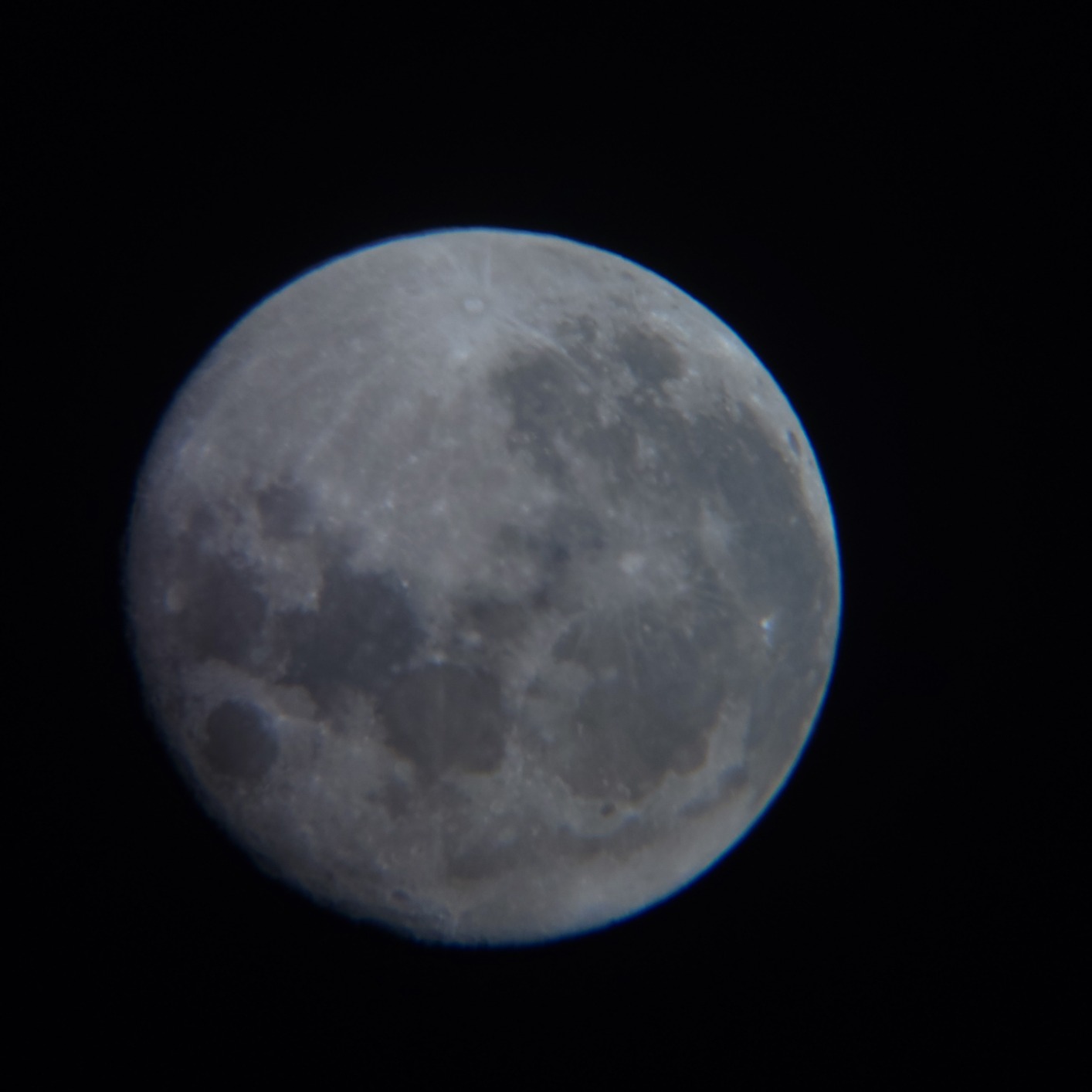
Setup is genuinely quick. The mount and tripod arrive preassembled, the remaining pieces are few, and no tools are required, which matters more than it sounds when you are assembling gear in the dark at a car park. The included tripod adjusts for both standing and seated viewing, and the whole rig is a manageable carry at 17 pounds for an adult and a child together.
What arrives in the box is better than most. You get a 20mm eyepiece with an erect image corrector, a 10mm eyepiece, a StarPointer red dot finder, and astronomy software. The 20mm is the one you will actually use for deep sky; the 10mm is for planetary work and for pushing on the Orion Nebula’s core.
The honest weaknesses are worth facing directly. This is a visual instrument. Attaching a camera for long exposure deep sky imaging requires modification and a considerably better mount than the one supplied, and anyone buying this for astrophotography will be disappointed. The tripod is light-gauge steel and becomes noticeably shakier when fully extended, so keep the centre column lower for planetary work at high power.
Collimation is the other real learning curve. A Newtonian’s mirrors need to be aligned before first use and re-checked after every trip in the car, and the StarPointer red dot finder is hard to dial in perfectly. Both are manageable in an evening, but neither is instant, and buyers who expect zero setup are the source of most of the one-star reviews.
Is the AstroMaster 130EQ bright enough for faint galaxies?
At 130mm it reaches the brighter end of the deep sky catalogue rather than the faintest objects. Open clusters such as M11 and M35 are comfortable, the Andromeda Galaxy shows as a bright oval with a hint of structure, and the Orion Nebula’s core and wings are obvious. Faint planetary nebulae like the Ring and the Dumbbell need a genuinely dark site and a dark-adapted eye, and at a bright suburban sky they are a genuine challenge.
The 20mm eyepiece gives roughly 32x, which is about right for wide nebulae. A 2-inch wide-field eyepiece in the 25mm to 28mm range is the single most useful upgrade for this tube, because it shows more sky at once at the same brightness, and finding faint things is harder than seeing them once you have found them.
Who should skip the AstroMaster 130EQ?
Skip it if astrophotography is your goal. Nothing at this level handles a tracked long exposure well, and the honest advice from imaging communities is that a used tracking mount plus a dedicated imaging tube is a better path than bolting a camera onto a manual equatorial head.
Also consider a different scope if you plan to observe alone without reference material. Learning to star-hop is a real barrier to first success, and our general telescope buying guide covers the finder and chart skills that close that gap. With a printed planisphere and twenty minutes of practice, the 130EQ rewards you quickly.
2. Celestron NexStar 8SE – the best way to see deep sky without star charts
Celestron NexStar 8SE Computerized Telescope – Schmidt-Cassegrain
- 8-inch aperture in a compact portable tube gathers enough light for galaxies and globular clusters
- GoTo mount slews to targets from a 40000 plus object database and tracks them
- SkyAlign needs only three bright stars so no star charts or polar alignment are needed
- StarBright XLT coatings give crisp high-contrast planetary detail
- Electronic motors and the fork arm need regular collimation checks
- Battery or external power required for extended sessions since no power supply is included
- Bulkier and heavier than an equivalent aperture Dobsonian
Everything hard about deep sky observing is either solved or softened by this telescope, and the price of that convenience is size and money. The NexStar 8SE pairs an 8-inch Schmidt-Cassegrain optical tube with a fully computerized single fork arm mount, and it is the only scope on this list that will find and track an object while you watch. For an observer who has never successfully star-hopped, that is worth more than another inch of aperture.
The alignment process is the piece that decides whether people love or resent GoTo mounts. SkyAlign asks you to centre three bright objects in the eyepiece and confirm each one, and the mount then works out where it is pointing. Owners report doing this in minutes with no star chart and no polar alignment, and that same feature is the reason the hand controller carries a database of more than 40000 objects.
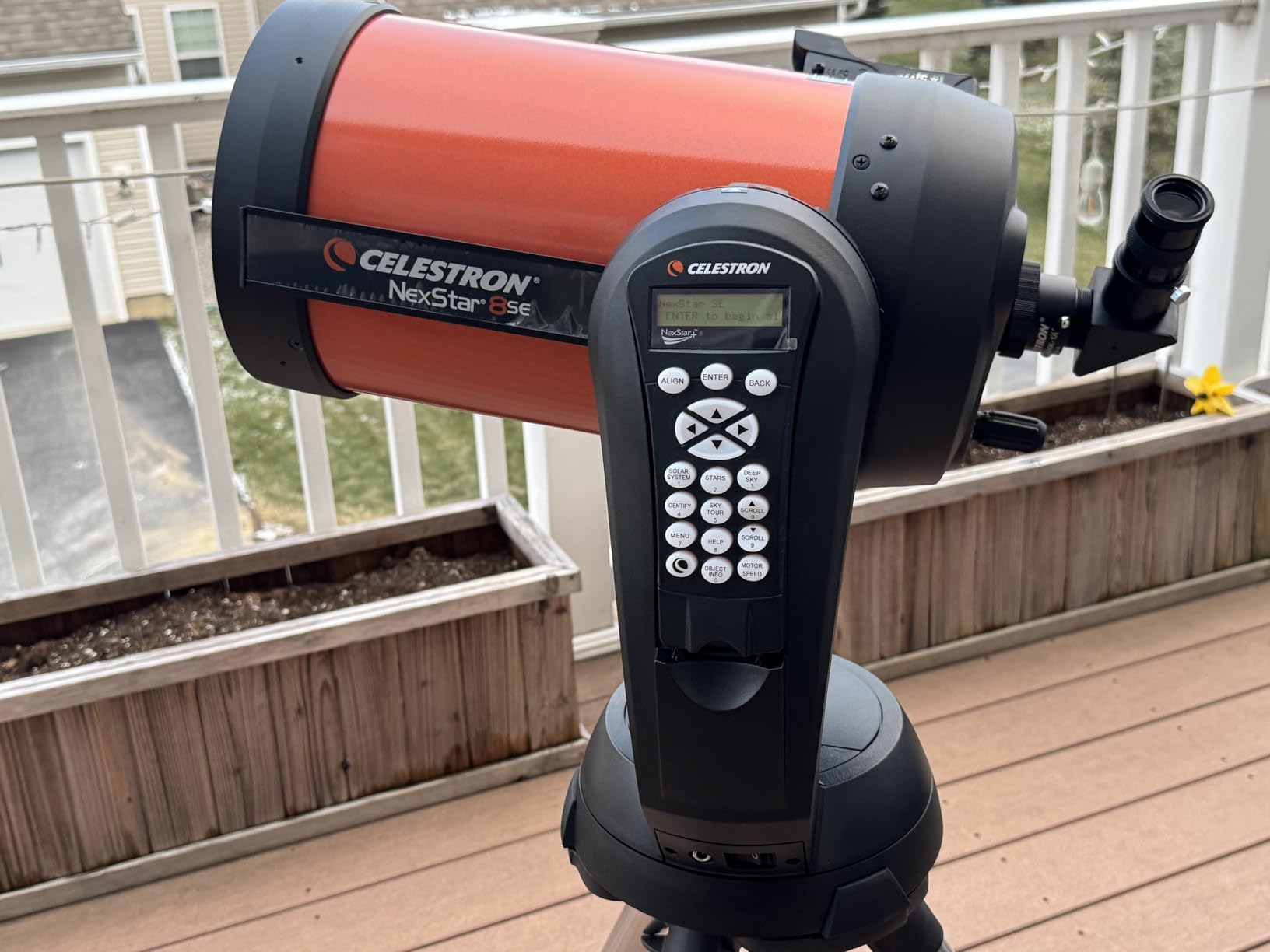
The 8-inch aperture is genuinely large, and it is packed into an optical tube short enough to be a one-person carry. At 2032mm focal length it works out to f/10, a long focal ratio that gives crisp, high-contrast views with planetary detail and keeps the optical system compact. Owners report bright views of globular clusters, galaxies and the Moon, and the GoTo makes each of those a two-press operation rather than an expedition.
This is also the most capable imager among the visual scopes here. The fork mount tracks, and while a catadioptric at f/10 is not the fastest imaging optic, plenty of owners put a camera on this scope and get usable results, particularly on bright targets like the Moon, Jupiter and larger nebulae.
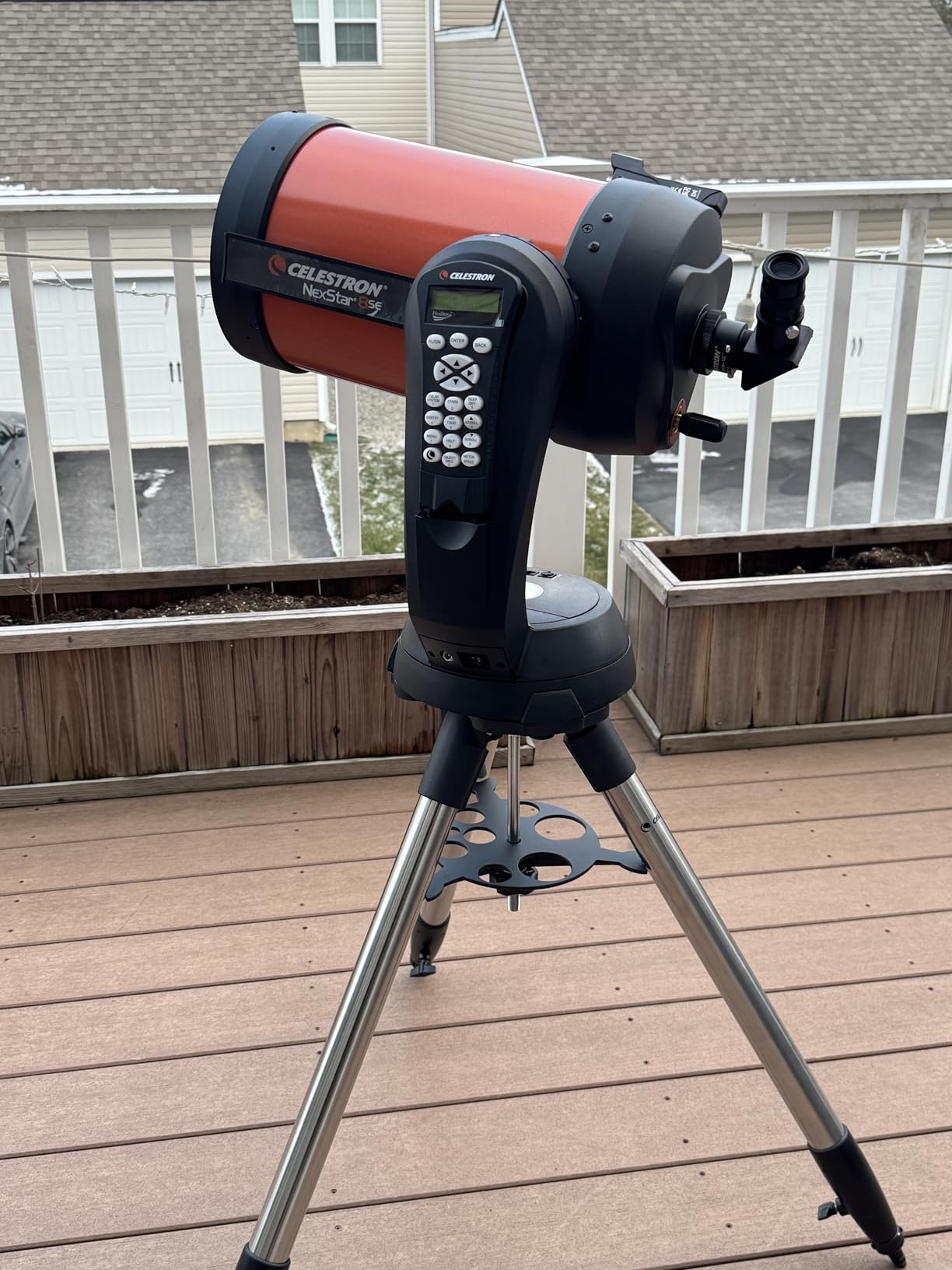
There are two caveats that catch people out. First, power. The scope runs on eight AA batteries, a 12V adapter, or a separate power tank, and no power supply is included in the box, so budget for batteries or an accessory before a long session. Second, collimation is not a one-time job: a Schmidt-Cassegrain with a closed tube and a mounted camera shifts alignment, and it needs checking more often than people expect.
One more honest point. An 8-inch Dobsonian shows more, and shows it at lower power with better contrast on galaxies, because it has no obstruction in the light path. What you are paying for here is not photons. You are paying for finding, tracking and portability in a single package.
Is the NexStar 8SE worth the jump over a 5-inch refractor?
Yes, for visual observers who lose targets. The 8-inch aperture is roughly four times the light gathering of a 4-inch refractor, and combined with GoTo it converts a hobby that depends on navigation skill into one that depends only on patience. The step up from a small manual scope is larger than the spec sheet suggests.
No, if you are confident you can find things yourself and want the deepest view per dollar. Long-exposure imaging is the other case where this is not the ideal tool, since a tracking fork mount and a long focal ratio are a harder combination to build into a repeatable imaging train than a dedicated equatorial rig with a fast optic.
Who should skip the NexStar 8SE?
Skip it if your observing site is remote and you will be the only person there. GoTo is at its most valuable in a group or a star party where someone can point out an object verbally, and at a dark site in the countryside the red dot finder and a chart are often faster than centring three stars for a computerized alignment.
Also skip it if carrying one telescope is your limit. At 24 pounds it is portable but not grab-and-go, and it is bulkier than an equivalent-aperture Dobsonian. If your sessions are backyard-only and you never move, a bigger Dobsonian gives you a better view for the same money.
3. Sky-Watcher Flextube 200 Dobsonian – the deepest views for visual observers
Sky-Watcher Flextube 200 Dobsonian 8-inch Collapsible Large Aperture Telescope – Portable, Easy to Use, Perfect for Beginners (S11700)
- 8-inch aperture delivers bright high-contrast views of galaxies globulars and the Orion Nebula
- Collapsible strut design keeps collimation while making the tube far easier to store and carry
- Teflon bearings and tension control handles give smooth controlled movement
- 2-inch Crayford-style focuser accepts both 2-inch and 1.25-inch eyepieces
- Mirrors typically arrive out of collimation and need laser collimation before first use
- Goes out of alignment each time it is carried
- Azimuth movement can be sticky without a lazy Susan bearing modification
Nothing else on this list shows you as much. An 8-inch Dobsonian is the most cost-effective way to convert faint photons into visible structure, and the Flextube 200 is the version that solves the classic Dobsonian objection: that it is too big to move. Owners report the best views they have had of the Orion Nebula, the Lagoon Nebula and the Virgo cluster, and they attribute much of that to a design that fits in a normal apartment when collapsed.
The optics are straightforward and good. A 203mm borosilicate parabolic primary with 94 percent reflective multi-coating, a 1200mm focal length, and f/6, which is a sensible middle ground: wide enough to sweep for targets, tight enough to give good contrast on planetary nebulae. Because there is no central obstruction from a secondary mirror, galaxies and nebulae look cleaner through this than through a Schmidt-Cassegrain of the same aperture.
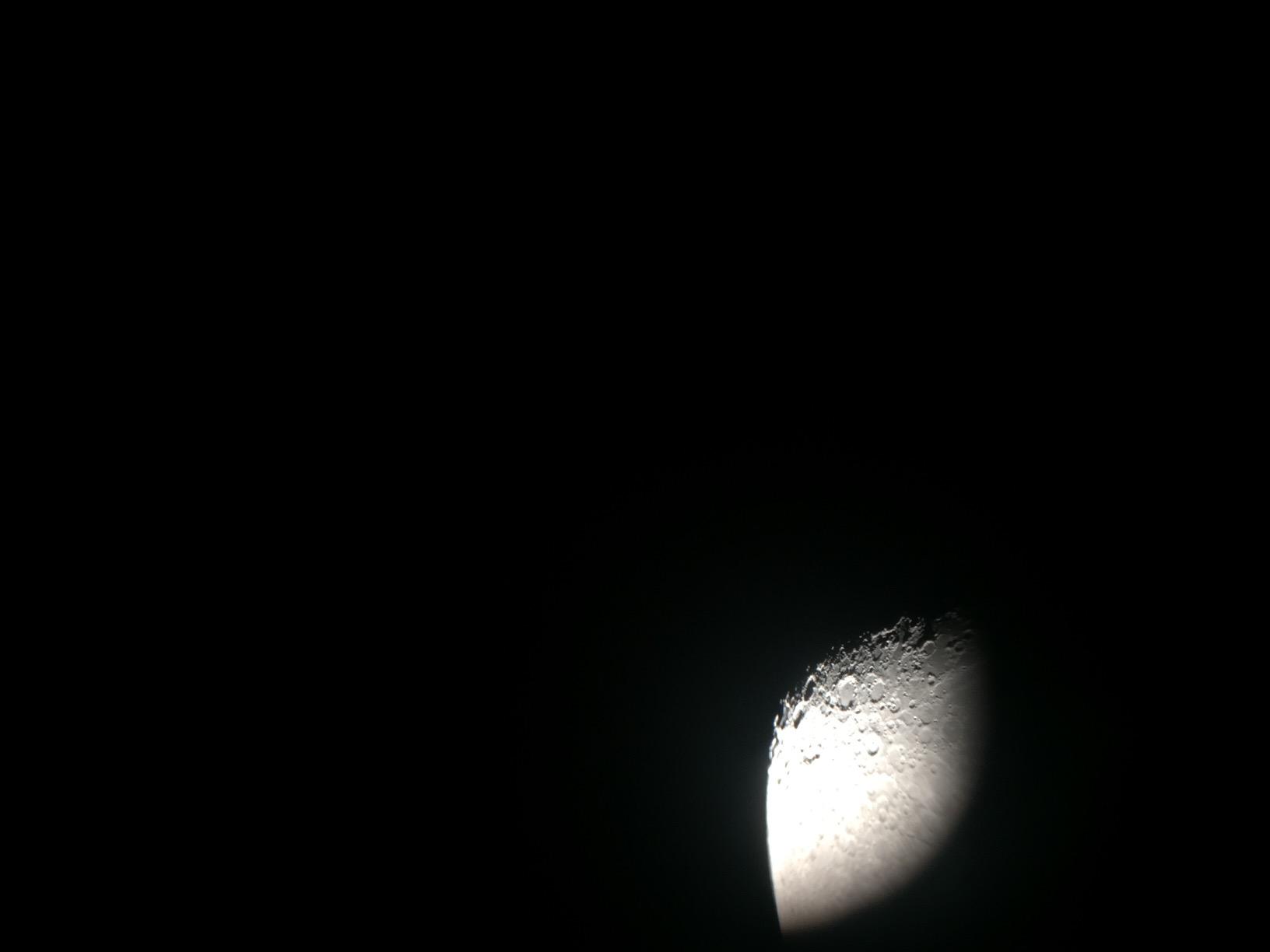
The mechanics are what make this model different from a conventional 8-inch Dob. The tube collapses on a strut design that holds collimation through the collapse, tension control handles let you move the tube without perfect balance, and Teflon bearings keep the azimuth smooth. The 2-inch Crayford-style focuser accepts both 2-inch and 1.25-inch eyepieces with the supplied adapter, which is a genuine upgrade path for wide-field views.
An 8×50 right-angle finder is included, and it is a real finder rather than the token red dot included with cheaper scopes. That matters more for deep sky than it does for planets, because at low power you are navigating a wide field of stars and a right-angle finder with a proper crosshair makes that navigation possible.
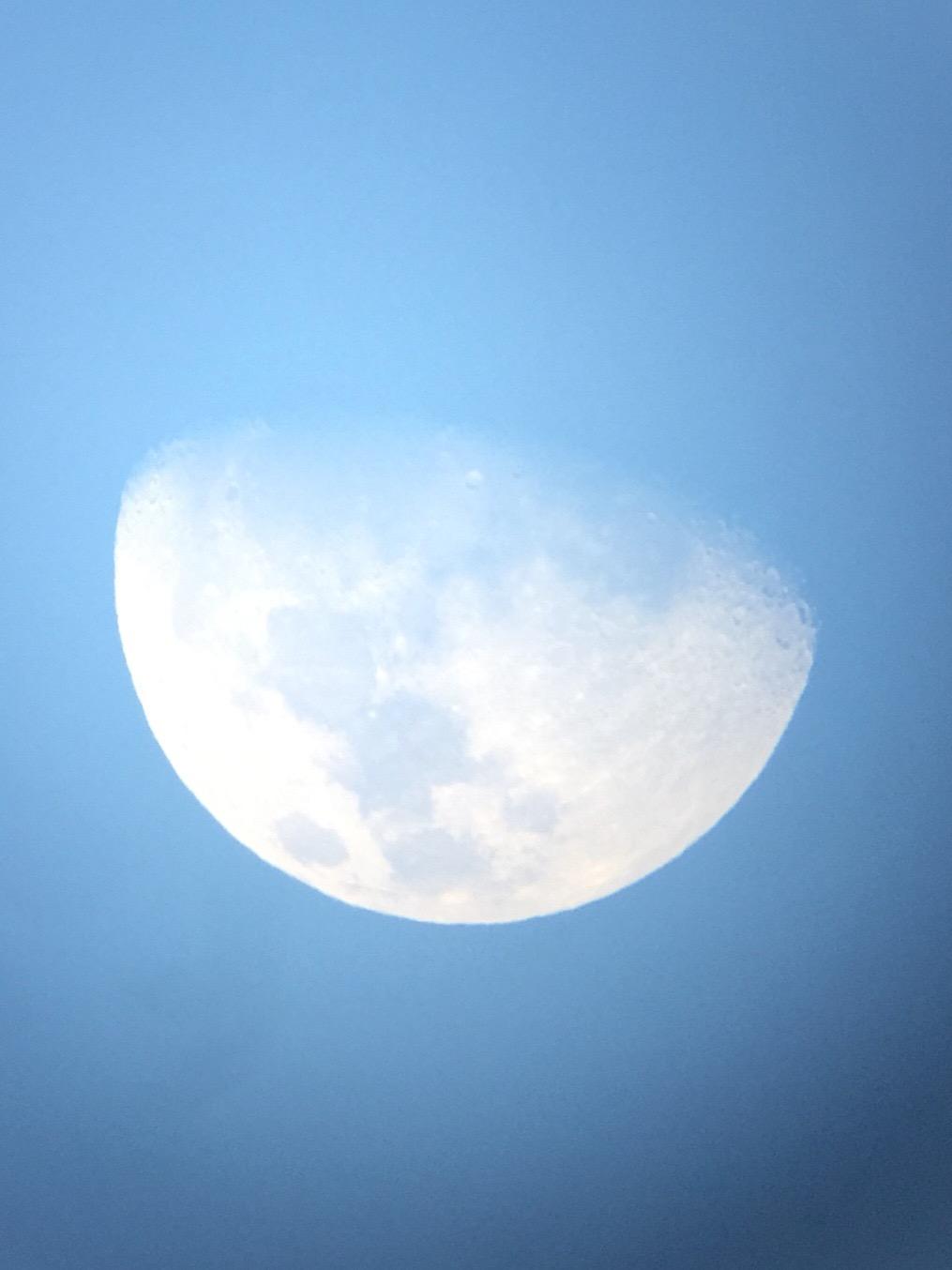
Collimation is the deal-breaker for some buyers, and it deserves a plain paragraph. The mirrors typically arrive out of alignment, a laser collimator is the first thing you should buy, and the process needs repeating after the tube is moved. Azimuth movement can also run sticky without a bearing modification, and the included 25mm and 10mm eyepieces are basic with no Barlow lens supplied.
This is a visual instrument and should be treated as one. An alt-azimuth Dobsonian has no tracking, so for long-exposure imaging a different tool is needed entirely. Buying a Dobsonian for photography by mistake is one of the most common and most expensive errors new observers make.
Can an 8-inch Dobsonian really show galaxy detail?
Yes, at a dark site. An 8-inch is the point where spiral structure stops being a suggestion and becomes visible. The Whirlpool Galaxy shows its bridge to NGC 5195, the Andromeda Galaxy shows a bright core with dust lanes, and the Triangulum Galaxy is a distinct oval. At Bortle 4 or darker with a 25mm wide-field eyepiece you get all three; under bright suburban sky you get their cores and little else.
The 2-inch focuser is a real advantage here. A 2-inch wide-field eyepiece shows more sky at the same magnification, which means fainter objects sit above the sky background and become visible. On smaller scopes with 1.25-inch focusers, the same object is often simply below your eye’s detection threshold at a reasonable magnification.
Who should skip the Flextube 200?
Skip it if collimation frightens you. Not because it is difficult once learned, but because it recurs every time you move the tube, and if that repetition will stop you from observing at all, a sealed catadioptric or a refractor is a calmer choice.
Skip it for astrophotography, full stop. And skip it if you need motorized tracking or GoTo pointing. The absence of both is what makes it affordable and durable, and a buyer who wants a scope to aim at the Veil Nebula in August without a chart will find the experience frustrating even if the optics are superb.
4. Celestron PowerSeeker 127EQ – the budget pick that goes where you go
- 127mm aperture shows planets lunar craters distant stars and the Orion Nebula
- German equatorial mount with slow-motion controls makes it easy to follow objects across the sky
- Light and compact enough for adults and kids to carry to a dark site
- Two eyepieces and a 3x Barlow lens plus free astronomy software included
- Newtonian mirror alignment is required and takes time to learn
- Light-gauge steel tripod shakes under the tube
- Supplied 4mm eyepiece is very dim and awkward to look through
With more than 9000 owner reviews behind it, the PowerSeeker 127EQ is one of the most thoroughly tested beginner telescopes available, and the pattern in those reviews is consistent. Owners are pleasantly surprised by how much light a 127mm mirror collects for the money, and disappointed that the supplied accessories hold the experience back.
At 13 pounds fully assembled, this is the most portable scope here, and portability is the factor owners mention most. A large Dobsonian that lives in a garage because it is awkward to move is a real regret reported repeatedly on forums, and a 13-pound equatorial rig that fits in a car boot gets used.
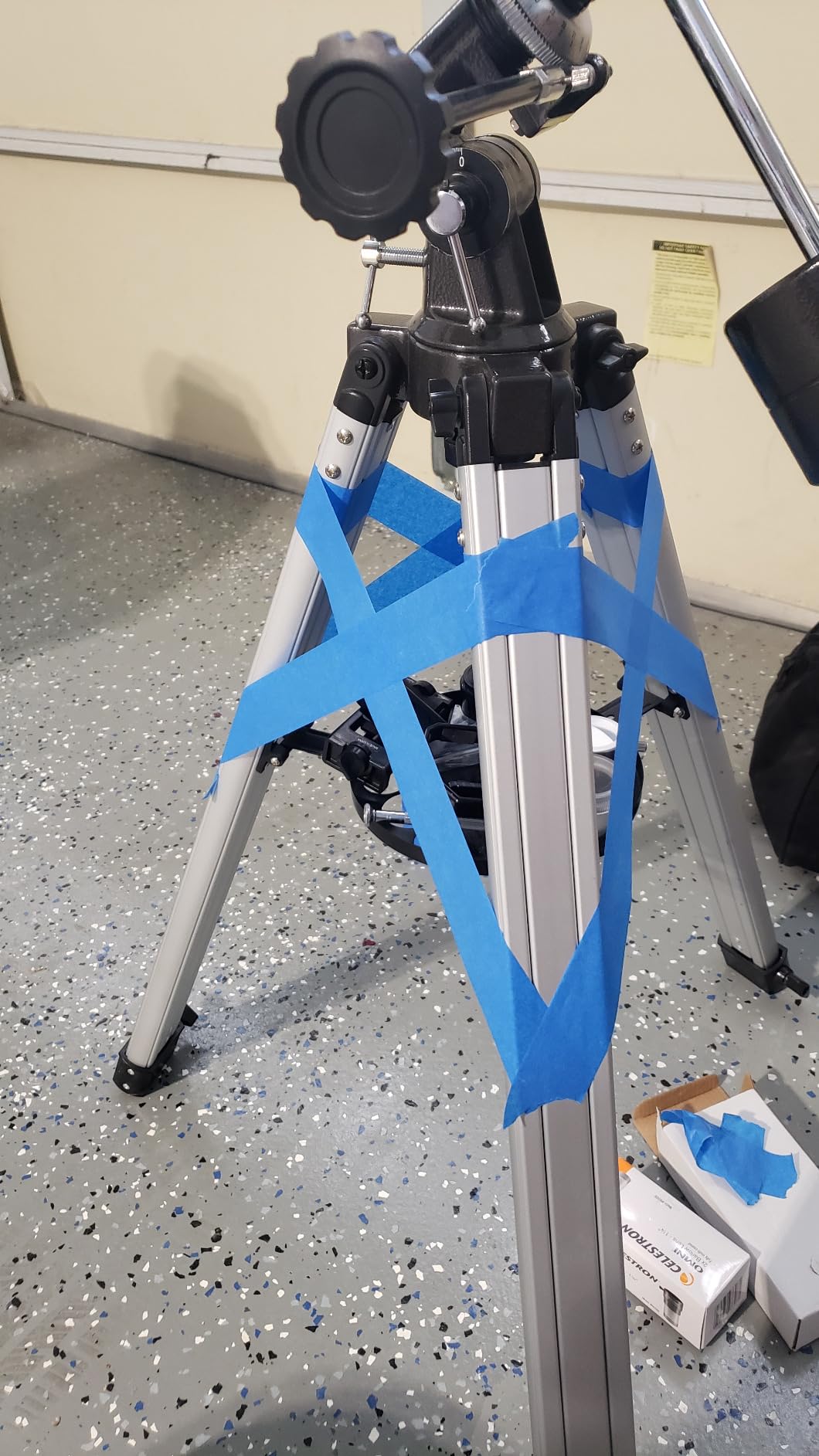
The German equatorial mount is a genuine step above a beginner tripod, and the slow-motion altitude rod lets you follow an object across the sky manually. The 1000mm focal length at f/7.9 is long for a Newtonian, which means narrower fields and higher magnification on demand. The included 3x Barlow lens multiplies that range when you want to look at the Moon’s craters in detail.
You get a 20mm and a 4mm eyepiece plus the Barlow. The 20mm is the useful one for deep sky, showing a 2.5 degree field where open clusters and the Andromeda Galaxy are easy targets. The 4mm, at the sort of magnification it produces, is dim and awkward, and most owners replace it or set it aside.
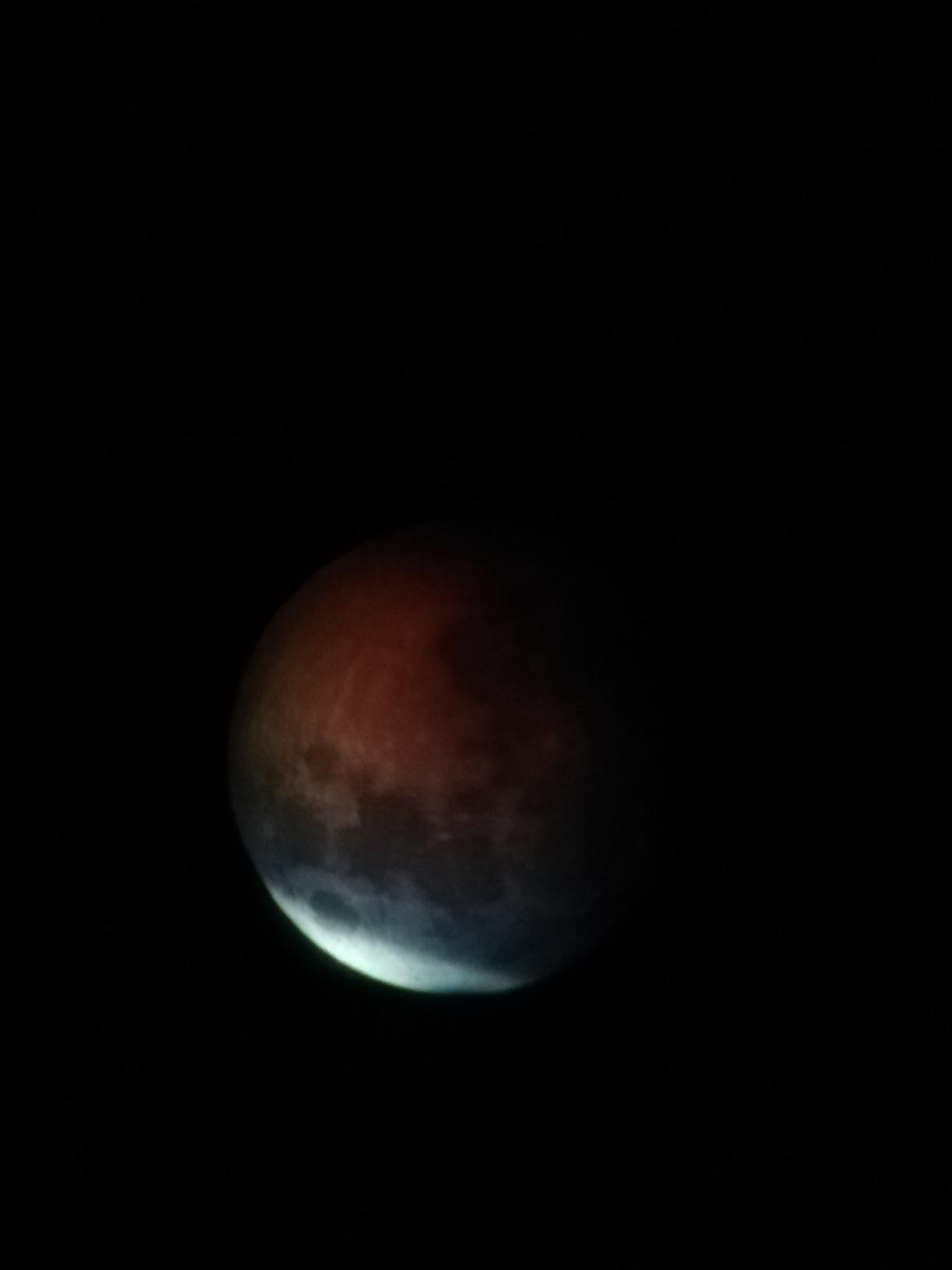
What to know before buying. The supplied finder is small and difficult to align, which is a bigger obstacle to deep sky than most buyers expect. The tripod is light-gauge steel and shakes under the tube, particularly at high power, and the declination adjustment has noticeable backlash. Collimation is required, and owners who buy a laser collimator report the whole setup becomes far more pleasant.
Ratings sit at 4.1 with a genuinely split response, which reflects the nature of the product. Delighted beginners rate it highly because the aperture performs; buyers who found collimation too difficult rate it poorly. A laser collimator is the difference between those two groups.
Is a 5-inch reflector enough for real deep sky objects?
Enough for the bright half of the catalogue. M31, M42, M13, M57, the Double Cluster, M11 and most of the Messier list are all comfortably within reach of 127mm. The Veil Nebula, the faintest galaxies in the Virgo cluster and the fainter globulars are not, and a 5-inch is generally treated by experienced observers as the practical floor rather than the sweet spot.
Dark skies matter enormously at this aperture because there is no spare light to waste. Under a bright suburban sky, filters help more at 5 inches than they do at 8 inches, and a pair of broadband nebula filters is the highest-value accessory purchase for a 127mm Newtonian.
Who should skip the PowerSeeker 127EQ?
Skip it if you will not spend any time on collimation and alignment. A laser collimator and a proper finder solve both problems, but a scope that never gets aligned shows soft, haloed images that owners frequently blame on the telescope rather than on setup.
Skip it if you want the deepest possible view and are willing to accept a stationary scope. The jump from 5 inches to 8 inches is a large and immediately visible improvement in faint object visibility, and if the money is available for a bigger aperture, the bigger aperture wins. This is the right choice for a first scope, a family instrument, or a travel telescope.
5. Gskyer 130EQ – a short tube that tracks well and packs light
Gskyer 130EQ Professional Astronomical Reflector Telescope
- 5.1-inch all-glass aperture with high transmission coatings for brighter clearer deep sky views
- Fast f/5 short tube design is easier to handle than longer Newtonians
- Three eyepieces plus 3x Barlow plus finderscope and adjustable tripod all included
- Bluetooth remote lets you attach a phone for photos without an app
- Listed weight of 30.1 pounds makes the full rig heavy and awkward to carry assembled
- Newtonian reflectors require periodic mirror collimation before use
- Entry-level eyepieces limit fine planetary and small deep sky detail
The Gskyer 130EQ makes a case for the short tube. Most 130mm Newtonians on German equatorial mounts are long and awkward; this one has a 650mm focal length packed into a 24-inch optical tube, and the f/5 ratio that results gives a wide field and low magnification on the included eyepieces, which is exactly the combination that makes sweeping for nebulae pleasant.
At 4.4 average from over 450 reviews, this is the best-rated equatorial reflector here, and the rating reflects something real: the mount. A German equatorial head with slow-motion controls means an object stays where you put it, and for an observer learning to find deep sky targets themselves, that is the feature that produces the feeling of progress.
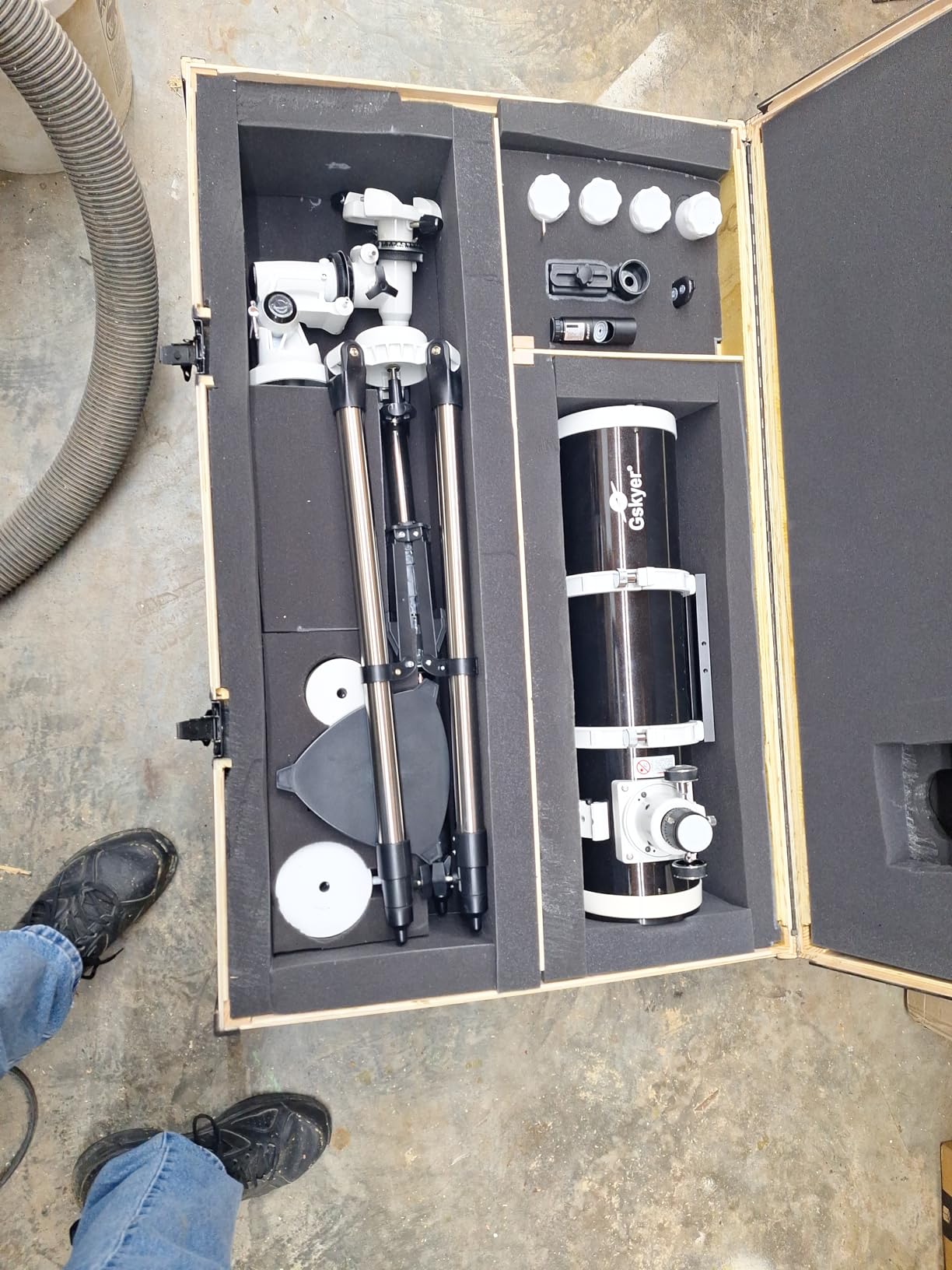
The accessory package is the most generous on this list. Three eyepieces rather than two, a 3x Barlow lens, a reflex finderscope, and an adjustable tripod. Owners note that these cover lunar, planetary and brighter deep sky targets straight out of the box, and that the toothless focusing base makes refocusing quick and stable.
A Bluetooth wireless remote is included, which pairs with a phone and can trigger photos or video without installing an app. It is a modest feature in principle and a genuinely nice one in practice, because it means you can record what you see through the eyepiece without touching the telescope and shaking the image.
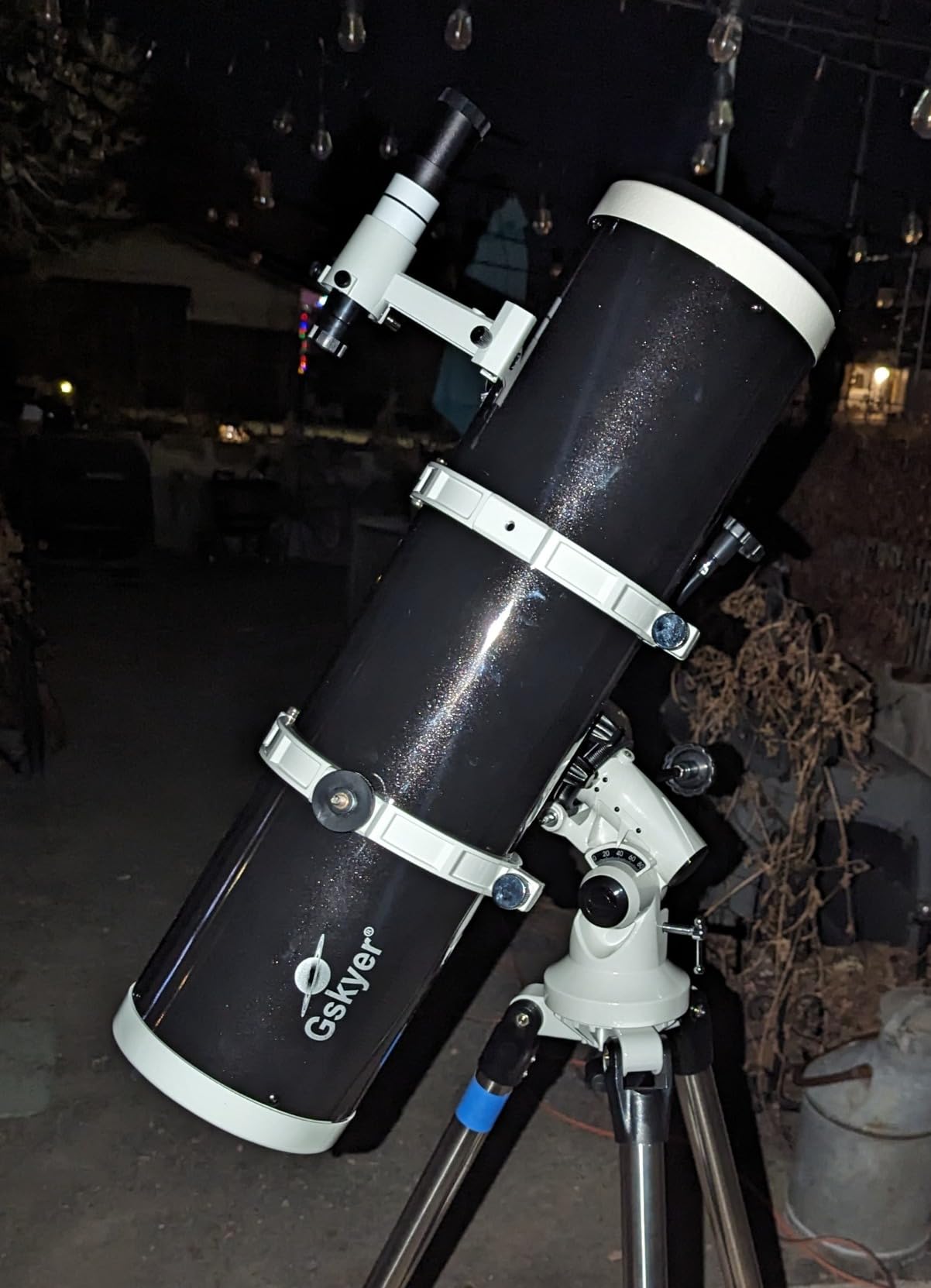
Now the significant caveat, which is weight. The listed item weight is 30.1 pounds, and reviewers call out the assembled rig as heavy and awkward to carry. That is unusual for a 130mm scope and it directly limits where you can take it, so check the stated weight against your own car and your own back before committing.
As with any Newtonian, the mirrors need collimation before use and after any move. The included eyepieces are entry level, and reviewers report upgrading them for planetary and small deep sky detail, which is standard practice at this price. The 1-year warranty is the shortest of the group, which is worth factoring in for a purchase of this size.
Does the short tube cost you field of view or magnification?
It costs you the long end of the magnification range. A 650mm focal length on 1.25-inch eyepieces tops out around 130x without a Barlow, so planetary detail at high power is limited compared with a 1000mm Newtonian. For deep sky that is not a real problem, because you almost never work above about 100x on a diffuse object and wide fields are more useful than high power.
The f/5 ratio is a bonus for anyone who later tries imaging with a fast camera or a smartphone, since short exposure and wide field work is the most forgiving place to start. It is a visual scope, and the f/5 design simply happens to be well matched to wide-field deep sky work.
Who should skip the Gskyer 130EQ?
Skip it if you plan to move the telescope regularly. The weight is the deciding factor, and no amount of good optics compensates for a scope that stays in the house because getting it to the car is a chore.
Consider the Celestron AstroMaster 130EQ instead if support and warranty length matter to you. This scope carries a 1-year warranty against the AstroMaster’s two years, and Celestron’s US-based support is a difference that shows up exactly when you need it, most commonly during a collimation session.
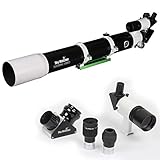
6. Sky-Watcher EvoStar 100ED APO – the pick if your goal is imaging
Sky-Watcher EvoStar 100 APO Doublet Refractor – Compact and Portable Optical Tube for Affordable Astrophotography and Visual Astronomy
- Matched doublet with a synthetic fluorite element gives excellent color correction for visual and photographic use
- Metallic High-Transmission Coatings produce tack-sharp images with accurate color
- 10:1 dual-speed Crayford-style focuser makes precise focusing easy with eyepieces or cameras
- 8.4 pound weight makes it genuinely portable for imaging rigs
- Optical tube only so a separate equatorial mount must be purchased
- Long f/9 focal ratio is less suited to wide-field imaging than a fast refractor
- Premium glass and coatings sit well above typical entry-level pricing
This is the only apochromatic refractor on the list and the only optical tube offered without a mount, and both facts come from the same design decision: it is built for people who already know they will build a camera rig around it. If your interest in deep sky is photography, this is the optics you want to start with, and the 4.4 rating from owners reflects consistently sharp, colour-accurate results.
The objective is a matched doublet with one synthetic fluorite element, a combination that suppresses the purple fringing around bright stars which plagues cheaper achromatic doublets. That matters enormously for imaging, where colour fringing eats detail in every stacked frame, and it is the main reason experienced imagers accept a higher price for a smaller aperture.
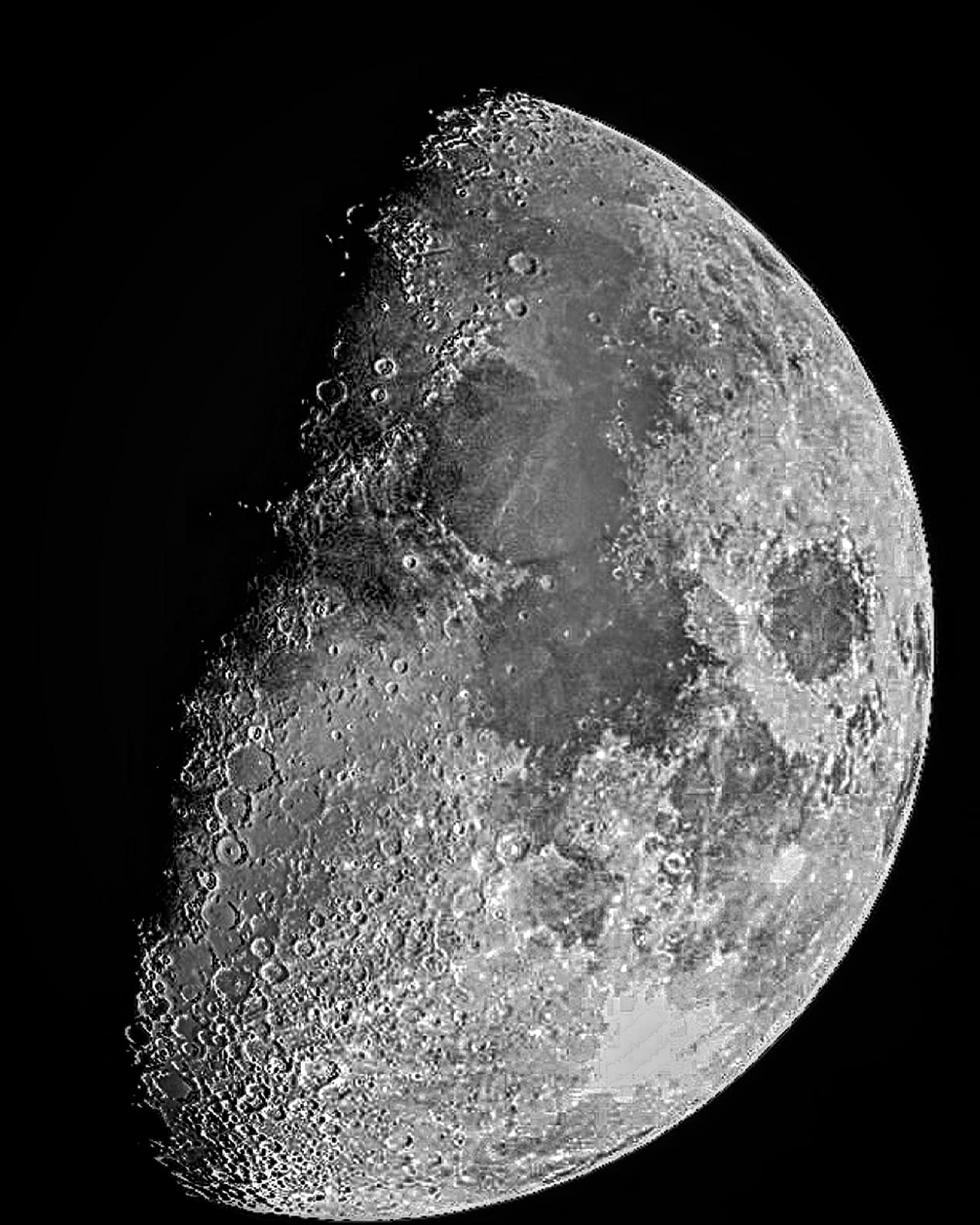
Metallic High-Transmission Coatings and a 10:1 dual-speed Crayford-style focuser complete the package. The dual-speed ratio matters more for imaging than most buyers expect, because a fine focus that does not shift the framing by a fraction of a degree is what makes long focus runs possible. Owners highlight it as the standout feature after the color correction.
At 918mm focal length and f/9.2, this is a long, slow refractor, which shapes what it is good at. It produces small, well-corrected star fields and handles bright targets like nebulae and galaxy cores very well. It is not a wide-field astrograph, and buyers hoping to cover a huge swath of sky in one frame should look at a fast triplet or quadruplet Petzval instead.
Weight is the surprise. At 8.4 pounds for the optical tube, this is by far the easiest instrument here to carry, and because it is a sealed tube with no mirror to align, it will still be perfectly in collimation years from now. That is a meaningful reliability advantage for an imaging setup that gets assembled repeatedly.
The catch is the missing mount. Owners are consistent that the total cost climbs sharply once a suitable equatorial mount is added, and that this is an optical tube for someone who has already made that decision. It is also the narrowest field of view here at 1.71 degrees, which makes locating faint targets by eye more demanding than on a Dobsonian.
Is a 4-inch apochromatic refractor better for deep sky than an 8-inch Dobsonian?
For seeing, no. A 100mm refractor shows you a small, sharp, contrast-rich image of a target you have already located, and it will not show you the faint integrated-light objects that an 8-inch Dobsonian reveals. The comparison is not close on pure visual deep sky capability.
For photography, yes, and it is not close in the other direction. A refractor has no collimation to maintain, no central obstruction, no coma to manage, and produces star fields the camera records cleanly. Serious imagers run a large Dobsonian for visual work and a refractor like this for imaging, and understanding that split is the key to buying the right tool.
Who should skip the EvoStar 100ED?
Skip it if you are buying a first telescope to look at the sky. You will be adding a mount and accessories to reach a system that is good at photography and merely adequate for visual observing, and an 8-inch Dobsonian gives you far more sky for far less money.
Skip it if your imaging interest is very wide-field. The f/9.2 focal ratio at 100mm produces a 1.71 degree field, which is fine for a nebula but restrictive if the plan is large nebula complexes and nearby galaxy groups. Check your target list against that field before ordering.
7. MEEZAA 150EQ – the most complete package, with one spec caveat
- 150mm aperture gathers enough light for bright nebulae and galaxies under suburban skies
- German equatorial mount with slow-motion knobs and precision dials tracks targets smoothly
- Moon filter plus two eyepieces plus 2x Barlow plus red dot finder and phone adapter all included
- Stainless steel tripod and large carry bag make storage and transport straightforward
- Listed aperture of 150mm does not match the actual 130mm primary mirror diameter
- Included Kellner eyepieces are entry level and benefit from upgrades
- Assembly involves many pieces and can challenge first-time builders
The MEEZAA 150EQ arrives with more in the box than anything else here, and the bundle is genuinely useful rather than padded. A moon filter, two Kellner eyepieces, a 2x Barlow, a red dot finder, a phone adapter, a stainless steel tripod, an accessory tray and a large carry bag. If you are starting from nothing, this is the shortest route to a working setup.
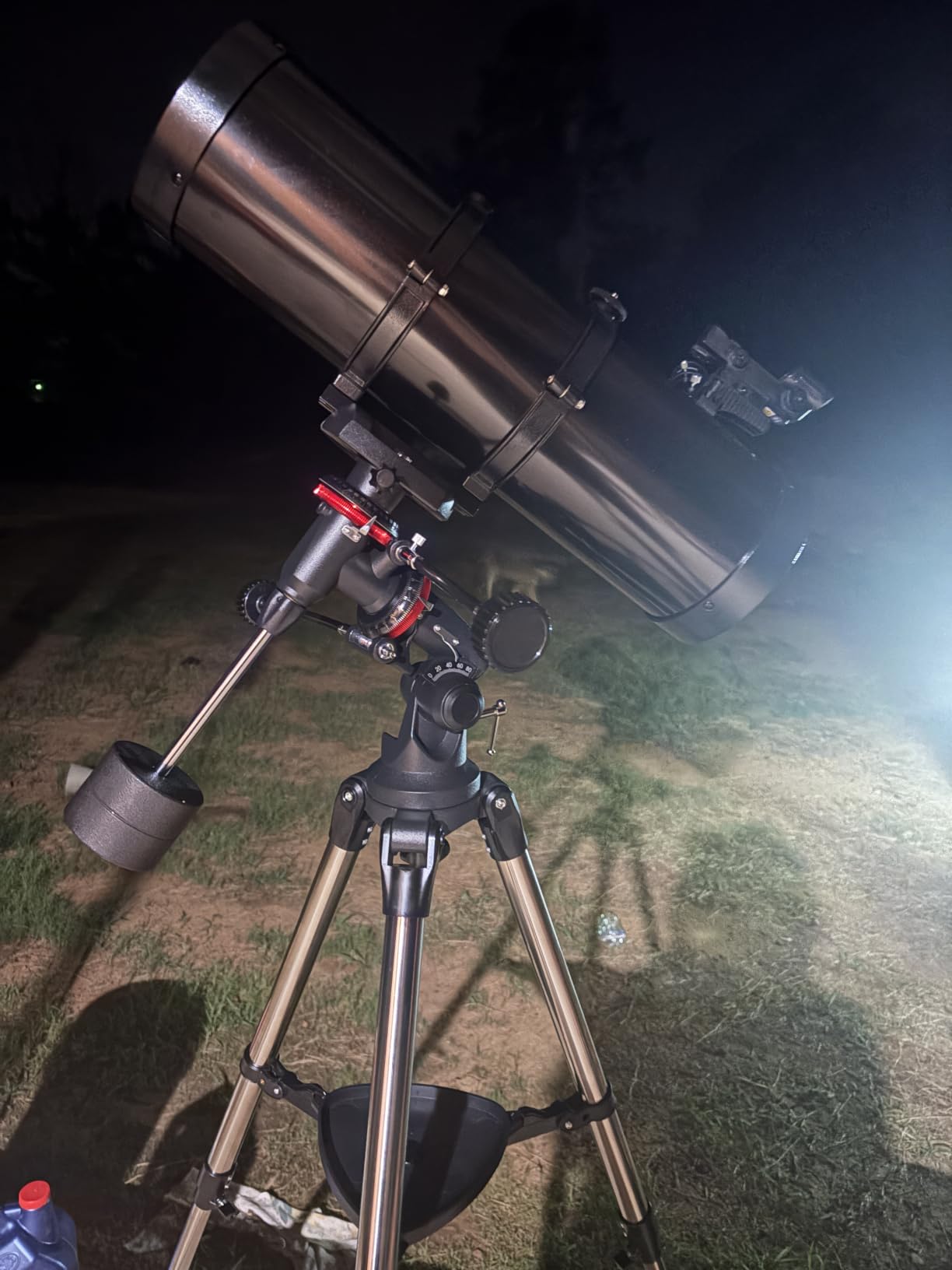
The mount is the part that makes it a real observing tool rather than a box of parts. A German equatorial head with precision dials and slow-motion knobs means a target stays centred, and the f/4.3 focal ratio on a 650mm focal length gives a wide field that suits sweeping for emission nebulae. Owners report bright views of Jupiter, Saturn and the Moon from multiple independent reviews.
There is one specification issue you should know about before you buy, and reviewers raise it directly. The listing states a 150mm aperture, but the primary mirror measures 130mm. Light gathering is set by the actual mirror, so budget your expectations against 130mm rather than 150mm, which puts the view in the same class as the other 5-inch reflectors here rather than ahead of them.
Beyond that, the practical criticisms are familiar ones for this category. The Kellner eyepieces are entry level and are the most likely upgrade, the assembly involves many pieces and catches first-time builders out, and the plastic focuser and phone holder are functional rather than refined.
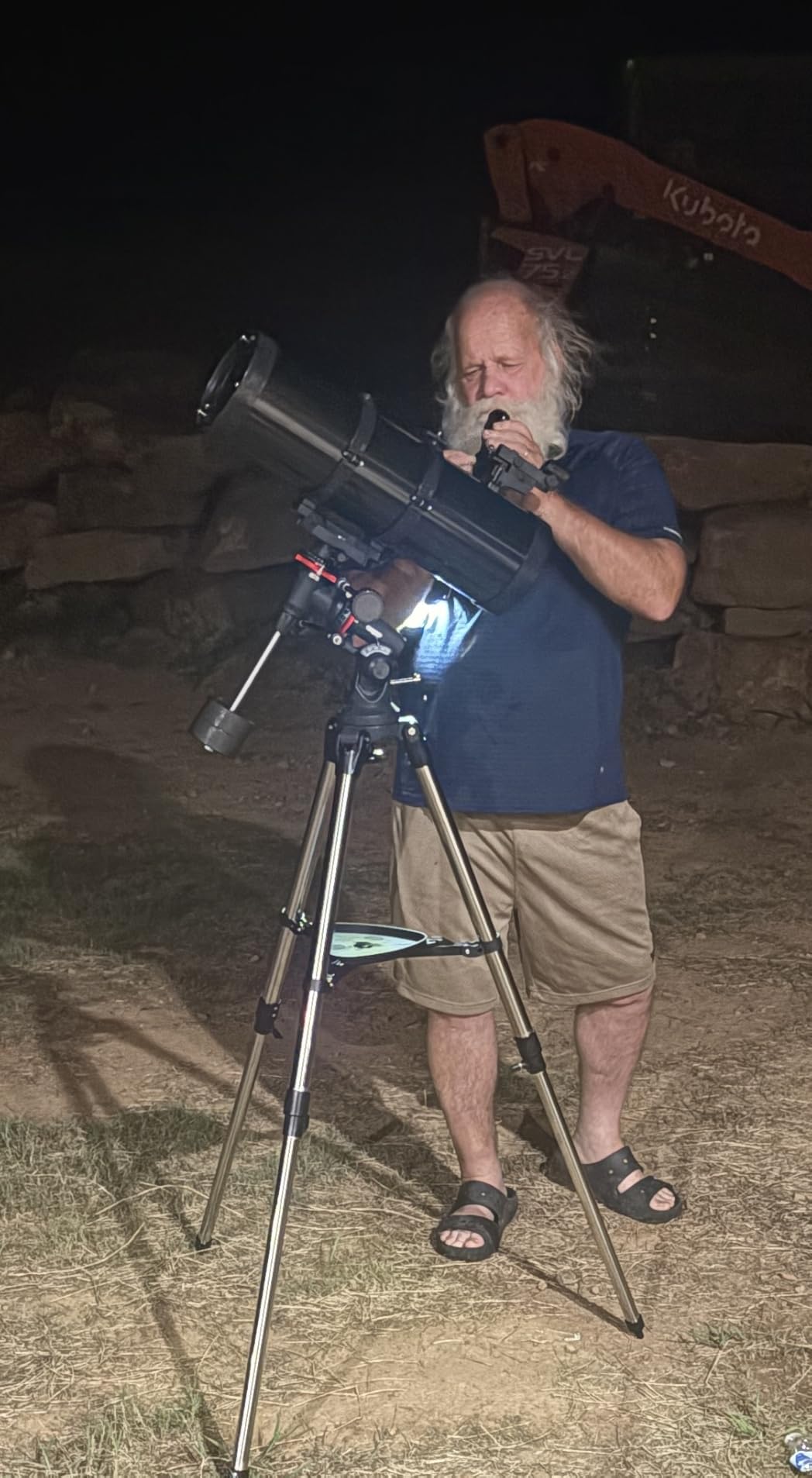
One more limitation affects the eyepiece, not the view. Because the focuser sits at the end of a short tube, changing eyepieces often means repositioning the whole tube, and owners report re-aiming after swaps. It is an inconvenience, and it slows down the kind of rapid comparison observing that wide-field deep sky work encourages.
As with every Newtonian here, collimation is a recurring task, and the carry bag makes moving the rig to a dark site straightforward but does not remove the need to re-collimate afterwards.
Is a 130mm Newtonian enough for suburban deep sky observing?
For bright targets, yes, and this class of scope is a common recommendation for observers under moderate light pollution. The Andromeda Galaxy, the Orion Nebula, the Pleiades, the Hercules Cluster and the Leo Triplet are all realistic targets from a typical suburban backyard with this aperture.
For faint broadband nebulae under city glow, less so. A pair of UHC or OIII filters does more for a suburban 5-inch Newtonian than any eyepiece upgrade, and they are the accessory to buy first if your site is bright. The included moon filter helps with the Moon, not with deep sky, so do not count it as a solution to light pollution.
Who should skip the MEEZAA 150EQ?
Skip it if accurate specifications matter to you. If you are cross-checking aperture against other scopes in this guide, this listing does not describe the mirror you receive, and that is a reasonable reason to look elsewhere.
Skip it if you want long-term support coverage. The included accessories are generous, but the short warranty terms common to this category mean you will eventually need to source parts yourself. The AstroMaster 130EQ offers a longer warranty and established US-based support if support matters to you.
8. Sky-Watcher Heritage 150 – the tabletop Dobsonian for small spaces
Sky-Watcher Heritage 150 Tabletop Dobsonian Telescope – Perfect for Beginners, Easy Setup, Portable, and Fun (S11710)
- 150mm parabolic primary with RAQ coating gives crisp contrast-rich lunar and planetary views
- Fast f/5 design in a compact tabletop package that is easy to carry and store
- Collapsible tube retains collimation while improving portability
- Rubber-footed base minimizes vibration for steady observing
- No motorized tracking so objects must be nudged manually as they drift
- Collapsible tube still requires occasional collimation checks after moving
- 1.25-inch helical focuser holds only smaller eyepieces
The Heritage 150 solves a specific problem: you want a real aperture, a stable base and somewhere to put it. This is a 150mm Dobsonian designed to sit on a table and be used from a chair, which is an unglamorous but genuinely practical category. Owners value it as a grab-and-go instrument that stores easily between sessions.
The optical design is a 150mm borosilicate parabolic primary with Radiant Aluminum Quartz coating at 750mm focal length, giving f/5. That fast ratio suits wide fields, and the altazimuth tabletop base with rubber feet keeps vibration down during short sessions. The collapsible tube is the feature that makes it portable, and it is designed to hold collimation through the collapse better than a rigid tube on a small base.
For a beginner, the learning curve is the shortest on this list. There is no polar alignment, no star chart requirement, and no collimation adjustment in the field. You sit down, point, and look. Short sessions with children or in poor weather are exactly what this scope is for, and a telescope that gets used beats a telescope that sits in a cupboard.
At 150mm the aperture sits at the practical floor that experienced observers point to for satisfying deep sky views. Open clusters and the brighter nebulae are comfortable targets, and the fast f/5 focal length makes wide sweeping easy at low power.

The trade-offs are real. There is no motorized tracking, so targets drift and must be nudged by hand during longer sessions, which is why it suits shorter observations. The 1.25-inch helical focuser accepts only smaller eyepieces, which restricts the wide-field upgrades that help most on larger scopes, and it is best suited to seated tabletop observing rather than uneven ground in the field.
Collimation still applies, even with the collapsible tube, and a laser collimator remains the first accessory to buy. At 23 pounds listed weight, it is not a lightweight carry either, so plan where it will live before it arrives.
Is a 150mm tabletop Dobsonian good for deep sky objects?
Good for the bright and mid-range catalogue. The Orion Nebula, the Andromeda Galaxy, the Pleiades, the Hercules Cluster, open clusters and the larger planetary nebulae are all within reach from a dark or suburban site. It will not reach the faintest galaxies, and the smaller focuser limits how much sky you can sweep at low power.
Short sessions are the key. Without tracking, a target gradually leaves the field, so a 150mm tabletop Dobsonian rewards frequent short observations rather than long ones. For a family instrument, a first telescope, or a portable setup, that pattern fits real life better than trying to image or to chase a faint target for an hour.
Who should skip the Heritage 150?
Skip it if you want to observe standing up in the field, or on uneven ground. A tabletop base needs a flat surface, and the friction of the altazimuth movement is tuned for a table rather than for a damp lawn at a dark site.
Skip it if you are a serious astrophotographer, obviously, and consider the 8-inch Flextube 200 instead if your budget stretches to it. At 8 inches you get a far deeper view of faint objects for a larger instrument you will move less often. The Heritage 150 is the right call for convenience and storage; the Flextube is the right call for performance.
Aperture decides what you can see
Light gathering scales with the square of aperture, so doubling the diameter quadruples the light. That single relationship explains most of what separates these eight scopes. An 8-inch collector gathers roughly sixteen times the light of a 4-inch, which is the difference between seeing a grey smudge and seeing spiral arms.
Resolution works out similarly. Doubling aperture halves the Dawes limit, so larger scopes resolve detail on close double stars and the cores of planetary nebulae. On the very largest nebulae, though, where contrast rather than resolution is the limit, aperture and dark sky deliver together.
Here is roughly what each aperture class delivers. These are expectations at a dark site with a dark-adapted eye, not guarantees under city glow.
- 4 to 5 inches: open clusters, the Orion Nebula, the Andromeda Galaxy, the Pleiades, the Hercules Cluster, the Leo Triplet, M13 and other bright globulars, the Ring and Dumbbell planetary nebulae. A practical entry floor.
- 6 to 8 inches: everything above plus the Veil Nebula, the North America Nebula, fainter Virgo cluster galaxies, the Whirlpool Galaxy’s spiral structure, dust lanes in the Andromeda, and the fainter Messier globulars. This is where visual deep sky becomes genuinely rewarding.
- 10 inches and above: galaxies show knots of star-forming regions, nebulae gain layered structure, and the contrast between an outer arm and the background sky becomes visible. Worth the extra weight only if you will genuinely use it.
On magnification, the rule that matters is roughly twice the aperture in inches as a maximum useful figure. A 5-inch scope is at its limit around 100x and an 8-inch scope around 160x. Beyond that you are magnifying the atmosphere rather than the object, and the marketing numbers on the box are not a target. Faint galaxies and nebulae are best at the lowest magnification that resolves them, usually 20x to 40x per inch of aperture.
Light pollution deserves a direct mention because it is the most common reason a good telescope appears to show nothing. The Bortle scale runs from 1 at a truly dark site to 9 in inner city. A Bortle 1 or 2 site makes faint emission nebulae within reach of a 5-inch scope. A Bortle 5 suburban site halves what you can realistically expect, and a Bortle 8 city site means you are mainly observing bright Messier targets and planets. Nebula filters help most at small apertures and moderate to poor skies.
The mount decides whether you can hold onto the object
Aperture tells you how much light arrives. The mount determines how long you can use it. The sky moves about one degree every four minutes, so an untracked object at 100x crosses the field in a couple of minutes, and much of beginner frustration with deep sky is really frustration with recentring.
Dobsonian mounts put a Newtonian on a smooth altazimuth base. They are simple, have no gears to wear out, cost very little and put the entire budget into the mirror. They offer no tracking, so you move the tube by hand. This is the best value option for visual observing and the least suitable for imaging.
German equatorial mounts tilt the tube toward the celestial pole and provide slow-motion control on both axes. The advantage is that a target is centred once and stays put while you adjust, and the disadvantages are polar alignment, a longer setup and a higher centre of gravity that makes the supplied tripods shake. Four of the scopes here use this mount, and it is the reason most owners reach their first deep sky object.
Single fork GoTo mounts add a database, automatic slewing and tracking to an altazimuth design. Finding objects becomes a two-press operation and alignment takes minutes using three bright stars. The NexStar 8SE is the example here, and it needs power: eight AA batteries, a 12V adapter, or a separate power tank. Budget for that before your first long session, because an unpowered mount is a very expensive paperweight.
For field use, think about power explicitly. Battery-powered mounts run from AA cells or a portable power station, and a small power station sized for a laptop will also run a motorized mount through a long winter night. Do not forget that damp is a bigger enemy of a night out than cold, and dew control is worth more than any filter.
Optical design: refractor, reflector or catadioptric
Newtonian reflectors use a curved primary mirror and a flat diagonal to bring light to the eyepiece. They deliver the most aperture per unit of cost, which is why four of the eight scopes here are Newtonians. The cost is collimation: the mirrors must be aligned, and alignment is lost whenever the tube is moved. Once you own a laser collimator, this is a ten-minute job rather than a problem.
Refractors use a glass objective and need no collimation at all, which makes them the low-maintenance choice. Apochromatic doublets with a fluorite element, like the EvoStar 100ED, give the cleanest star images and the best colour correction, and they are the natural choice for imaging. They cost more per inch of aperture, and a 4-inch refractor will never match an 8-inch reflector for visual deep sky brightness.
Catadioptric Schmidt-Cassegrains combine a corrector plate with two mirrors to pack a long focal length into a short tube. They are sealed, compact, and the 8-inch version here is the only GoTo scope in the lineup. The 33 percent central obstruction slightly reduces contrast on galaxies compared with a Dobsonian of the same aperture, which is the trade for the portability and automation.
Collimation deserves a plain reassessment, because it frightens new owners more than it should. For a Newtonian or Dobsonian, buy a laser collimator, check the mirrors before first use, and check them again after transporting the scope. With an 8-inch Dobsonian the tube is big enough that the check matters; with a 5-inch it matters less because the effect of misalignment is smaller at low power. A refractor and a sealed catadioptric need no routine field collimation at all.
Finally, the split-scope strategy that experienced observers actually use. Most serious visual observers run a large Dobsonian for looking and a separate tracking rig for imaging, because the two jobs want opposite things. If you know you will want both, plan for both rather than trying to make one telescope do each job well.
Frequently Asked Questions
What is the best type of telescope for stargazing?
For deep sky and general stargazing, a Dobsonian reflector offers the most aperture for the money and is the most recommended first instrument. A refractor needs no maintenance and is easiest to set up, while a computerized GoTo scope is best for beginners who want to find objects without learning star-hopping.
How big a telescope do I need to see galaxies?
A 5-inch reflector reaches the brighter galaxies including the Andromeda Galaxy and the Leo Triplet. Around 8 inches, spiral structure in the Whirlpool Galaxy and dust lanes in the Andromeda become visible. Dark skies matter as much as aperture, since a 6-inch under a dark sky can beat a 10-inch under city glow.
Is a Dobsonian good for deep sky?
Yes. Dobsonians are widely considered the best value instruments for visual deep sky observing because all of the budget goes into the mirror. The trade-off is no motorized tracking and no GoTo pointing, and they are not suitable for astrophotography.
What is the best refractor for deep sky imaging?
A short apochromatic refractor with a fluorite element and a fast focal ratio is the usual choice, because it gives clean colour-accurate star fields and needs no collimation. The Sky-Watcher EvoStar 100ED on this list is an affordable step into that class, sold as an optical tube so a tracking mount must be added separately.
Why can’t I see deep sky objects with my new telescope?
In almost every case the sky is the cause, not the telescope. Light pollution, a bright Moon, or observing before your eyes are dark adapted will hide faint objects that a perfectly good instrument can show. Move to a darker site, give your eyes 20 minutes, and check that the optics are collimated.
What size telescope do I need to see Saturn’s rings?
Saturn’s rings are visible in almost any telescope above around 3 inches of aperture, and a 5-inch reflector shows the Cassini Division when conditions are steady. Larger apertures do not add much for Saturn compared with deep sky objects, since planetary detail is limited by atmospheric seeing rather than light gathering.
What are the brightest deep-sky objects?
The easiest first targets are the Orion Nebula, the Andromeda Galaxy, the Pleiades, the Double Cluster, the Hercules Cluster, the Leo Triplet and bright globulars such as M13 and M15. All of these are within reach of a 5-inch reflector from a reasonably dark site.
How much magnification do I need for deep sky objects?
Low. Deep sky objects are faint and extended, so the best magnification is the lowest that resolves structure, typically around 20x to 40x per inch of aperture. A 130mm reflector at roughly 65x shows the Orion Nebula better than the same scope at 250x. The useful ceiling is about twice the aperture in inches.
Final verdict: which deep sky telescope should you buy
For most people, the Celestron AstroMaster 130EQ is the right first answer. It pairs a 130mm aperture with a German equatorial mount that actually holds onto targets, it has the largest reviewed base of any scope in this guide, and it leaves room in the budget for a laser collimator and a better eyepiece.
Buy the 8-inch Sky-Watcher Flextube 200 instead if you have a fixed observing spot and want the deepest view per unit of money. Buy the Celestron NexStar 8SE if finding objects is the barrier stopping you, and the Sky-Watcher EvoStar 100ED if photography is where this is heading. Whatever you choose, the aperture drives the result, the mount decides whether you keep the target in view, and a dark site is worth more than either.