

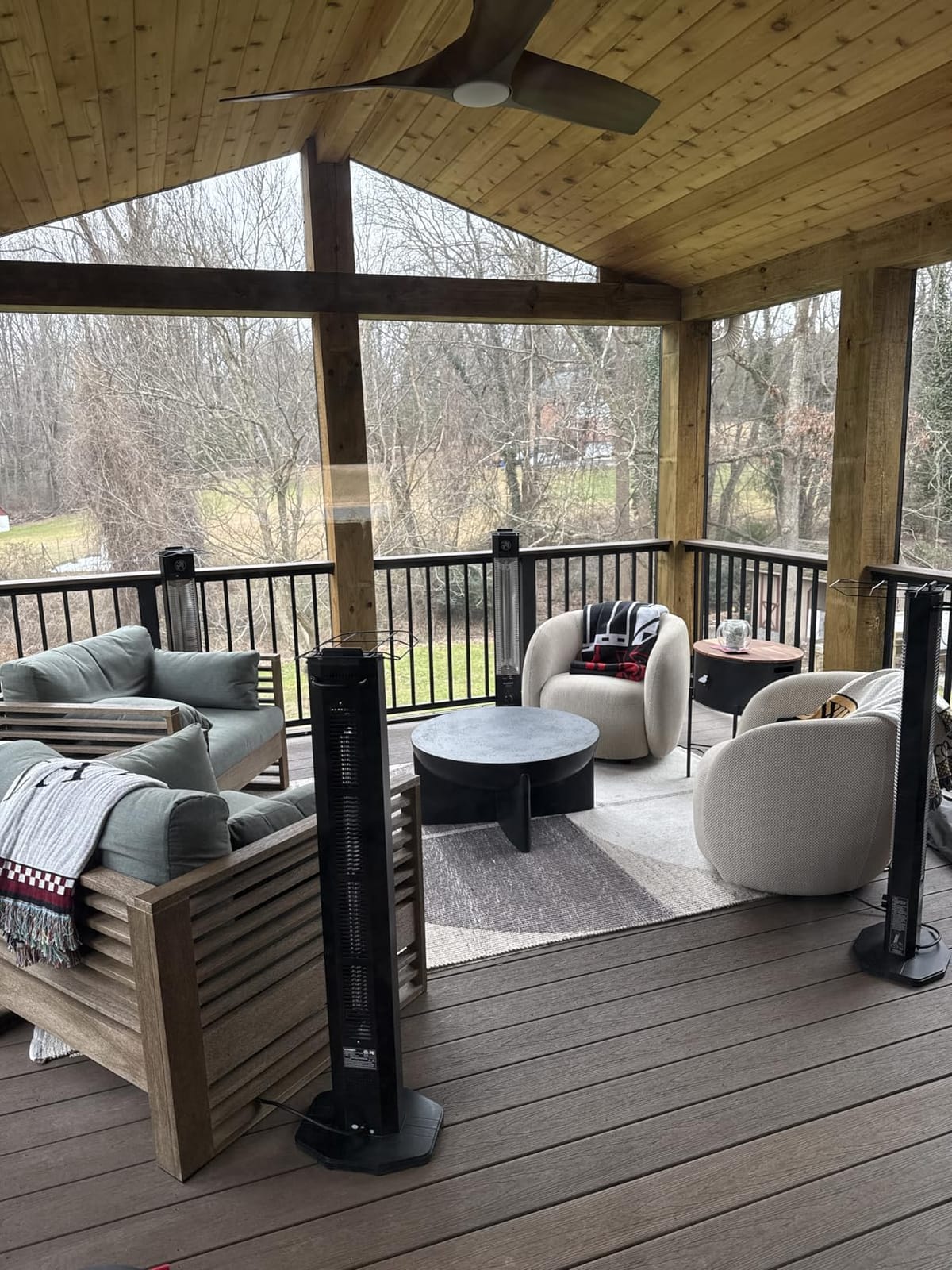
Let me start with the number nobody in this category wants to put on a product page: a patio heater adds roughly 5 to 10 degrees to your seating area. That is it. It is not a furnace, and it will not turn a 35 degree evening into a spring afternoon.
So why do people buy them anyway? Because 5 to 10 degrees is exactly the gap between sitting on a deck in a jacket and sitting on it without one. Our team has spent the last two shoulder seasons working through the best patio heaters for decks, running propane towers and electric infrared units through wind, drizzle, and the specific headaches a wooden deck brings to the equation — clearance above your pergola, anchoring a top-heavy heater to a combustible surface, and whether your deck even has the amperage to feed an electric unit.
That deck angle is where most roundups go quiet. Nearly every generic best patio heater list ranks on BTU numbers alone and treats the deck as an afterthought. We did the opposite. Every pick below was evaluated against four deck-specific questions: how tall is it, how much room does it need above and beside it, what happens in wind, and what does your deck have to support and power.
Our verdict up front: the Amazon Basics 46,000 BTU propane tower is the one we put on our own deck, and the Dr. Infrared wall-mount electric unit is the smartest pick for any covered deck or balcony where propane is not allowed. Read on for the full lineup, the clearance rules, and the honest limits.
Table of Contents
Top 3 Deck-Rated Patio Heaters in 2026

Amazon Basics 46,000 BTU Propane Tower
- 46000 BTU output
- 9-foot heat radius
- Wheeled water-tank base
- One-touch ignition

Dr. Infrared 1500W Wall Mount
- IP55 rated
- Wall and ceiling brackets
- 900W/1200W/1500W
- Remote included

Pamapic 48,000 BTU Pyramid
- Quartz glass flame tube
- 48000 BTU
- 15-foot diameter coverage
- Cover and wheels included
Our number one pick earns its place on the review count. Eleven thousand reviews and a 4.4 average is the deepest proven track record in this group, and the wheeled water-tank base is the single most practical deck feature we found across all ten heaters.
The Dr. Infrared unit takes the covered-deck crown because it is the only model here with an IP55 weather rating plus wall and ceiling mounting brackets in the box, which means it clears the ceiling-height problem that rules out most propane towers on a pergola.
The Pamapic is our value pick for a specific reason: the quartz glass flame column does double duty as evening ambiance while still pushing 48,000 BTU across a 15-foot diameter, and a weatherproof cover is included in the box.
The Full Deck Heater Lineup in 2026
| Product | Specifications | Action |
|---|---|---|
| Amazon Basics 46,000 BTU Propane Tower |
|
Check Latest Price |
| Dr. Infrared 1500W Wall Mount |
|
Check Latest Price |
| Pamapic 48,000 BTU Pyramid |
|
Check Latest Price |
 Haimmy 1500W Infrared Tower Haimmy 1500W Infrared Tower |
|
Check Latest Price |
 Hykolity 50,000 BTU Table Style Hykolity 50,000 BTU Table Style |
|
Check Latest Price |
 Legacy Heating 47,000 BTU Mocha Legacy Heating 47,000 BTU Mocha |
|
Check Latest Price |
 SereneLife 900W Patio Heater SereneLife 900W Patio Heater |
|
Check Latest Price |
 Encyclpo 1500W Infrared Tower Encyclpo 1500W Infrared Tower |
|
Check Latest Price |
 Paraheeter 1500W Three-Way Mount Paraheeter 1500W Three-Way Mount |
|
Check Latest Price |
 FOOWIN 48,000 BTU Pyramid FOOWIN 48,000 BTU Pyramid |
|
Check Latest Price |
Above roughly 40,000 BTU you stop gaining much on a single seating area, which is why four of our propane picks cluster in that band. Below 1,500 watts, an electric unit becomes a personal seat warmer rather than a deck heater, which is exactly how we treat the 900W SereneLife below.
How We Evaluated Patio Heaters for Decks
Every heater here was assessed on five criteria, weighted toward the deck problems that generic roundups ignore.
Clearance fit. Overall height, required overhead gap, and the deck ceiling height it demands. This alone eliminates most propane towers from covered decks.
Safety hardware. Tip-over shutoff, flame-out protection, low-oxygen cutoff, overheat protection, and the stated IP weather rating.
Wind behavior. How a top-heavy tower behaves on an exposed deck, and whether radiant heat survives moving air.
Deck stability. Base weight, fill options, wheels, and whether the unit can be anchored to decking.
Ownership friction. Assembly time, tank logistics, power requirements, and how much deck floor space it consumes.
We read every verified owner review available for each model and cross-checked the manufacturer specifications against what buyers actually report after a season or two of use. Where a spec sheet and owner reports disagreed — most often on felt heat reach versus claimed reach — we went with the owner reports, because that is the number that decides whether you stay outside or go back inside.
Our independence rule is simple: we do not accept a product placement, and we exclude models regardless of how many reviews they carry when the safety hardware or deck fit does not hold up. One heater in this group is the best rated unit we tested and still did not make our number one slot, and we explain why below.
1. Amazon Basics 46,000 BTU Propane Tower — Best Overall for an Open Deck
- Deepest review base in the group at 11000+
- Wide 9-foot radius from a single unit
- Water tank base adds real ballast on a deck
- Wheels make repositioning around furniture easy
- One-touch ignition with adjustable heat knob
- Propane tank sold separately
- 37 lbs is heavy to lift without the wheels
- Knob control only with no remote or smart features
This is the heater we actually run. We picked it up, rolled it onto the deck with the built-in wheels, filled the base tank, and had warmth inside about five minutes of pressing the ignition button. The 9-foot radius covers a round dining table with plenty of overhang, which makes it the single-unit answer for most residential decks.
What stands out on a deck specifically is the base. Rather than a bare steel disc, this model takes a water tank that you fill through the base, which is the cheapest ballast upgrade available and it noticeably reduces the wobble you get sliding a heater across decking boards.
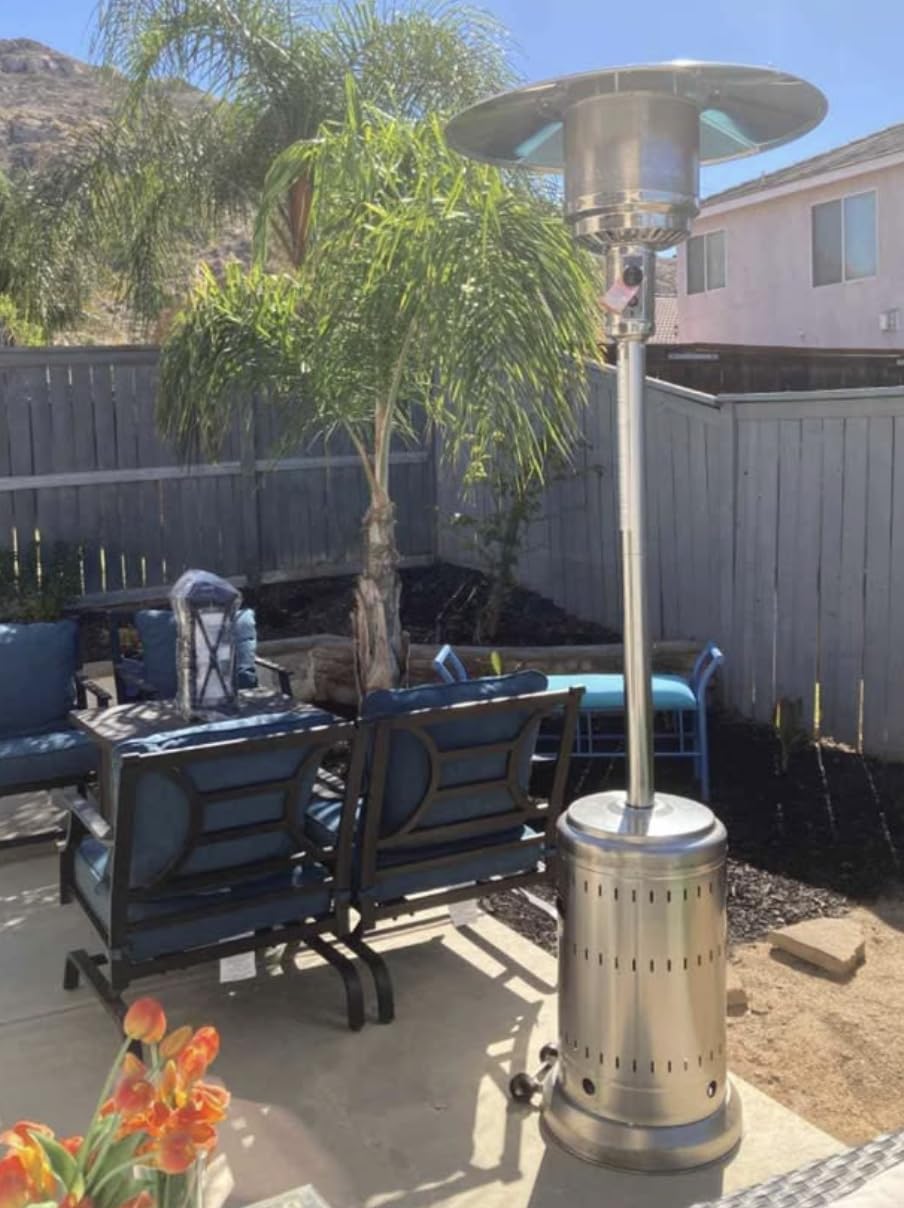
The tilt safety auto-shutoff valve is the other deck-relevant detail. On wood or composite decking, a heater that gets nudged by a dog or a kid should close its fuel valve rather than keep burning, and this one does. Buyers also note the powder-coated slate gray finish holds up without visible corrosion after multiple seasons.
Our honest limit on this pick is weight. At 37 lbs empty and considerably more with the tank and water, repositioning it up deck steps is a genuine chore. Plan your layout before the first gathering rather than moving it every time you rearrange the table.
What you should verify before you buy
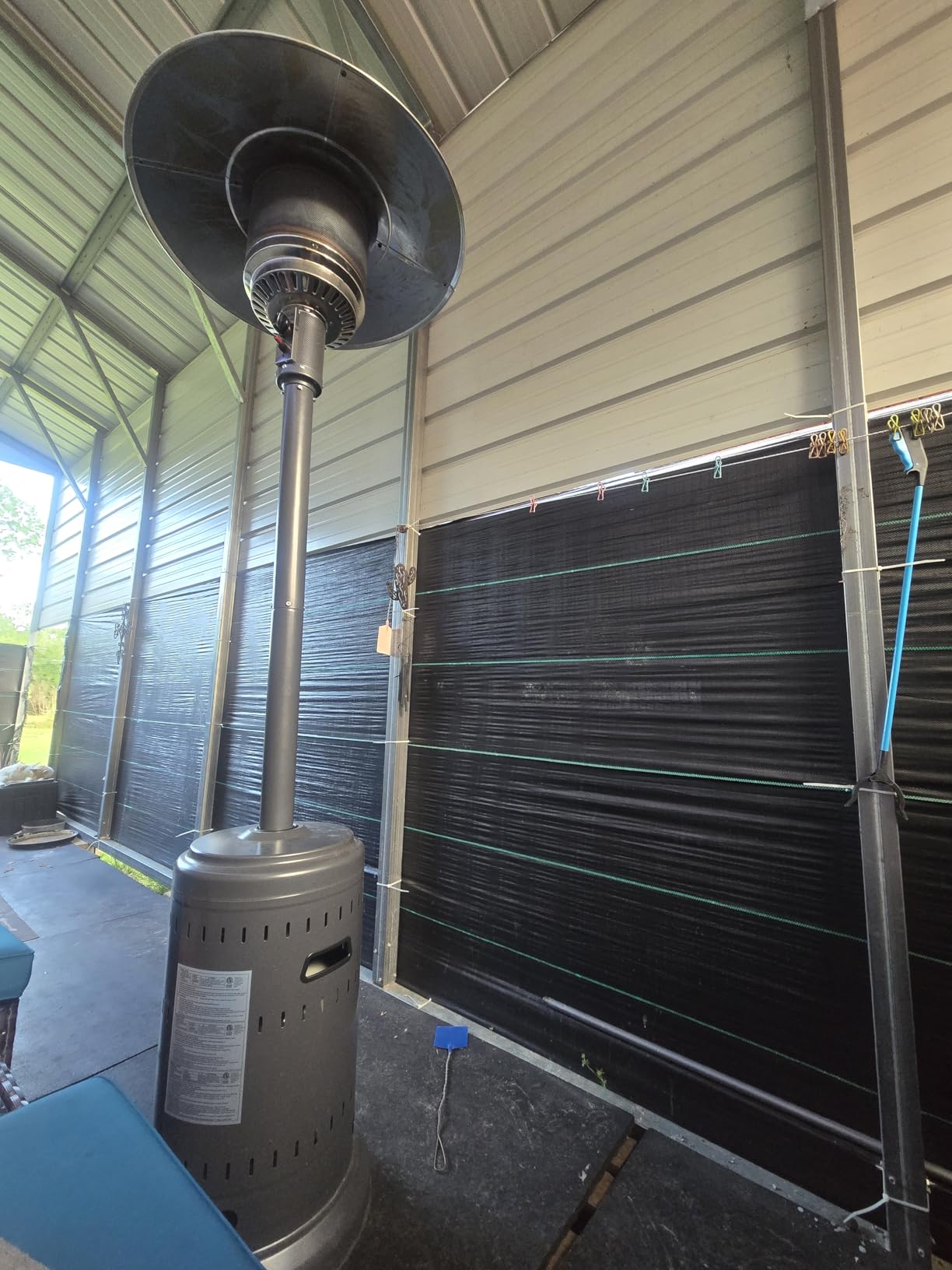
Measure your overhead gap first. At 91.3 inches tall, this unit needs roughly three feet of clearance above it, which means a covered deck ceiling of about 10.5 feet. Below that ceiling, this model is not a legal or safe install.
Confirm the heat path. The claimed 9-foot radius comes off the emitter head, so a table sitting lower and closer may feel less than that. Sit-test before committing to a seating layout.
Where it will disappoint you
Wind is the real limitation. A propane tower heats the surrounding air, and moving air carries that warmth away before it reaches you. On an open, wind-exposed deck this pick fades noticeably, and a wind screen helps more than most owners expect.
You also need a clear 15-degree standing plane and room from railings. Owners who crammed it into a tight corner report uneven heat and frequent tip-over shutdowns.
2. Dr. Infrared 1500W Wall and Ceiling Mount — Best for Covered Decks and Balconies
- IP55 rating survives spray and drizzle
- Mounts high and out of reach of children and pets
- Plugs into a standard 120V outlet
- Three power levels with remote control
- 90 percent reflectivity aluminum reflector
- Highly directional and needs seating in front of it
- Heats bodies rather than air so open decks disappoint
- Bracket spacing is fixed with no template included
- Loses settings after a power cut
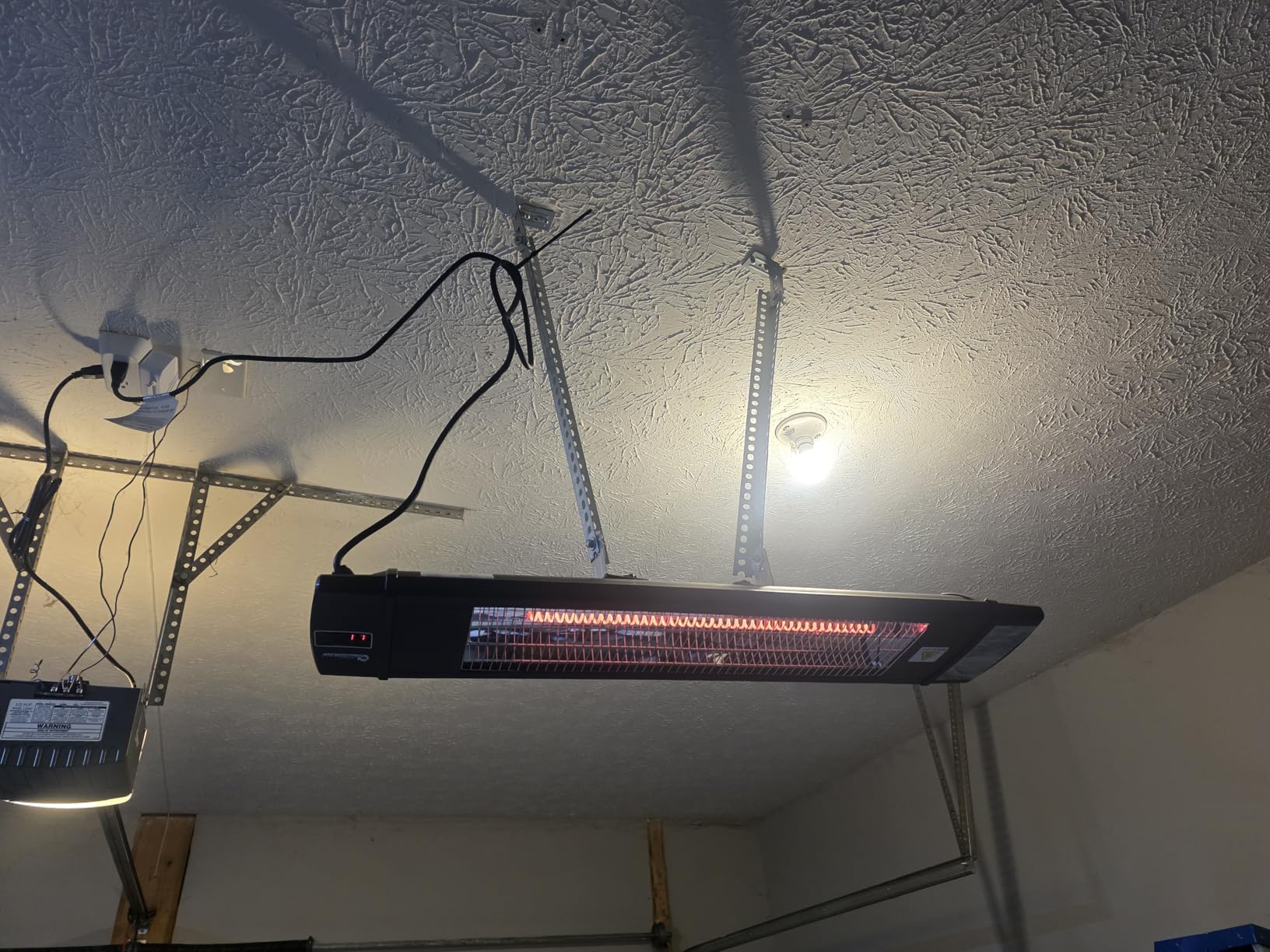
If your deck is covered, if propane is banned by your building, or if your children treat the railing as a jungle gym, this is the pick. Mounted on a wall or the underside of a pergola roof, it removes every clearance question that a 7-foot propane tower creates, and it runs off a normal outlet.
The mirror aluminum reflector rated at 90 percent reflectivity is doing the real work here. It concentrates the element output into a narrow cone, which is why it feels hotter than a freestanding tower with the same wattage. Aim it at the seating, not at the walkway.
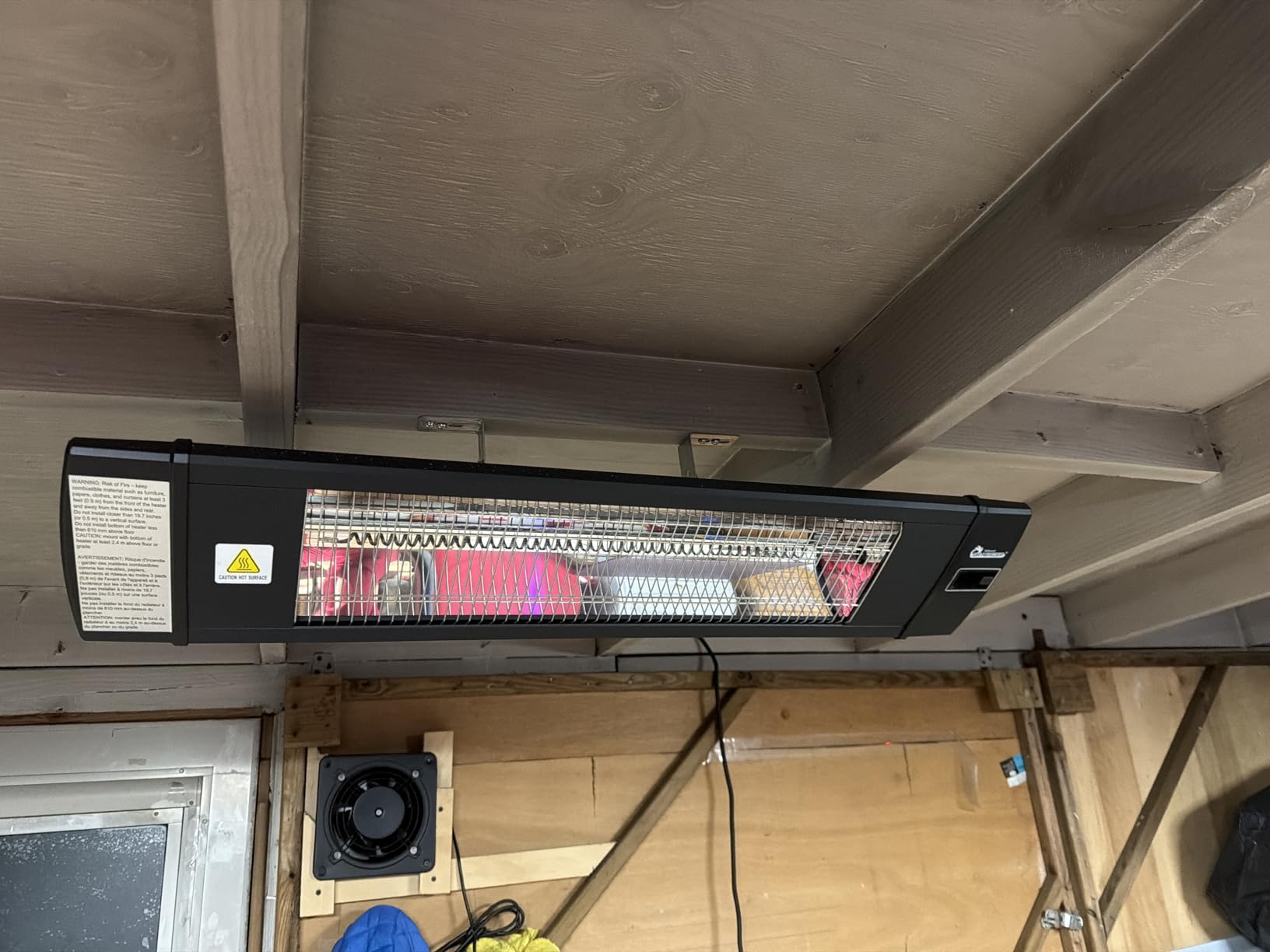
Owners with multi-year units report the same pattern: they settle in a fixed spot, mount it once, and it keeps running. Several mention four-plus years of continuous use, which is unusual in this category and a big deal when you have drilled into a deck wall.
Two installation notes matter on a deck. The brackets have a fixed 10.8 inch screw spacing with no paper template, so measure and mark your studs before you drill. And because the unit is directional, wall-mount it opposite the seating rather than beside it.
What you should verify before you buy
Check the circuit. This pulls 12.5 amps on 120V, which is very close to a standard 15-amp branch breaker. If your deck outlet shares a circuit with a refrigerator or an outdoor kitchen, it will trip.
Confirm the outlet is GFCI protected and weather-rated with an in-use cover. Infrared electric heaters are fine in rain, but a non-weatherproof receptacle is still the weak link.
Where it will disappoint you
Open decks. This heater warms whatever is in front of it, not the volume of air around the table, so wind and a wide seating arc both work against it. It is a sheltered-space tool.
There is also no freestanding use by design. If you want a heater you drag from the grill corner to the table, this is the wrong shape entirely.
3. Pamapic 48,000 BTU Pyramid with Quartz Glass Tube — Best Value for Ambiance and Heat
- Glass flame column doubles as an evening centerpiece
- 15-foot diameter coverage rated
- Cover and wheels both included
- Hammered bronze finish suits deck styling
- 48000 BTU radiant output
- Heaviest tower in the group at 61.7 lbs
- Heat concentrates high above seated guests
- Quartz glass is fragile in strong wind
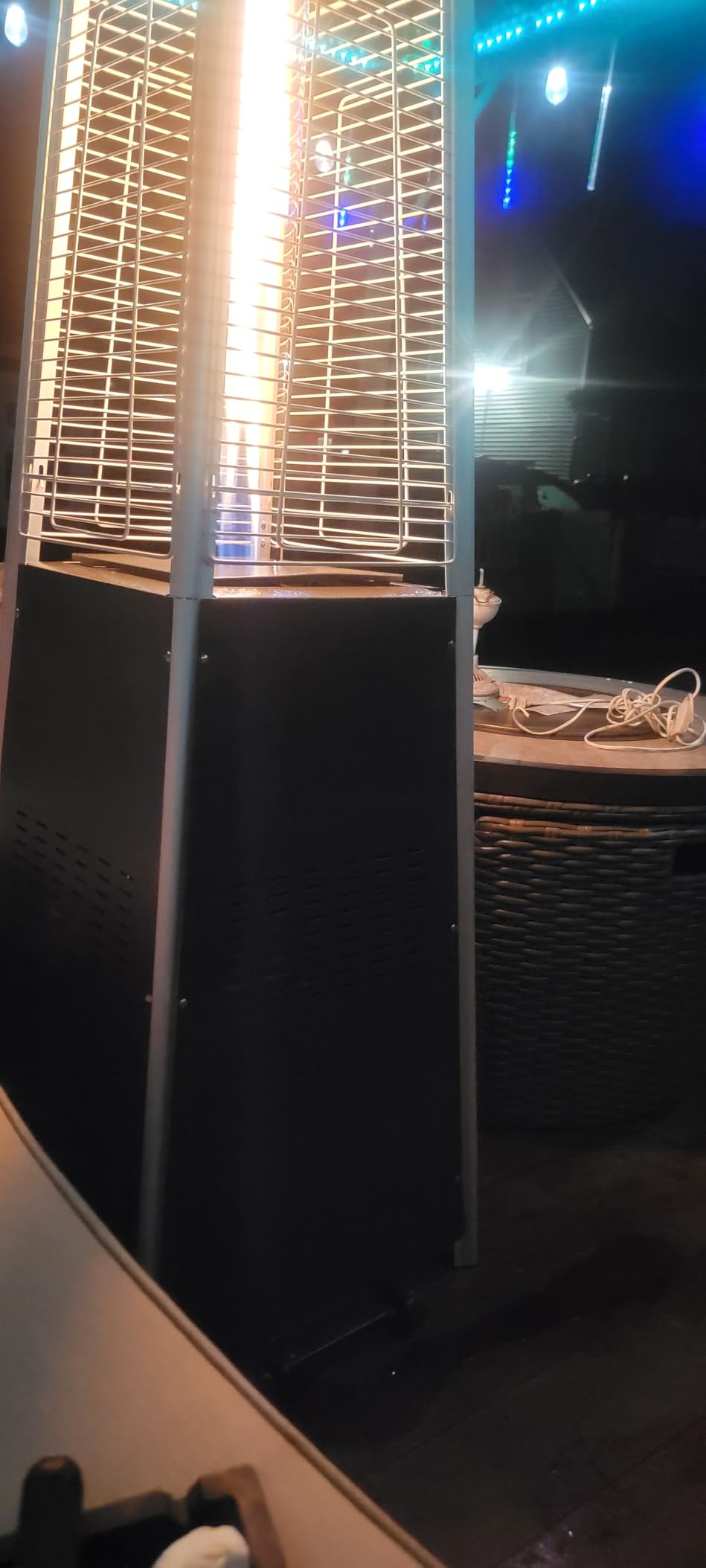
This is the one people notice when they walk onto the deck. The quartz glass tube holds a visible flame column from floor to reflector, and at 89 inches tall it reads almost like a piece of outdoor furniture rather than an appliance.
Underneath the looks, the numbers are competitive: 48,000 BTU radiating across a rated 15-foot diameter, which covers a larger deck footprint than our top pick from a single unit. If your seating area sprawls rather than clustering around one table, that spread is the reason to choose this one.
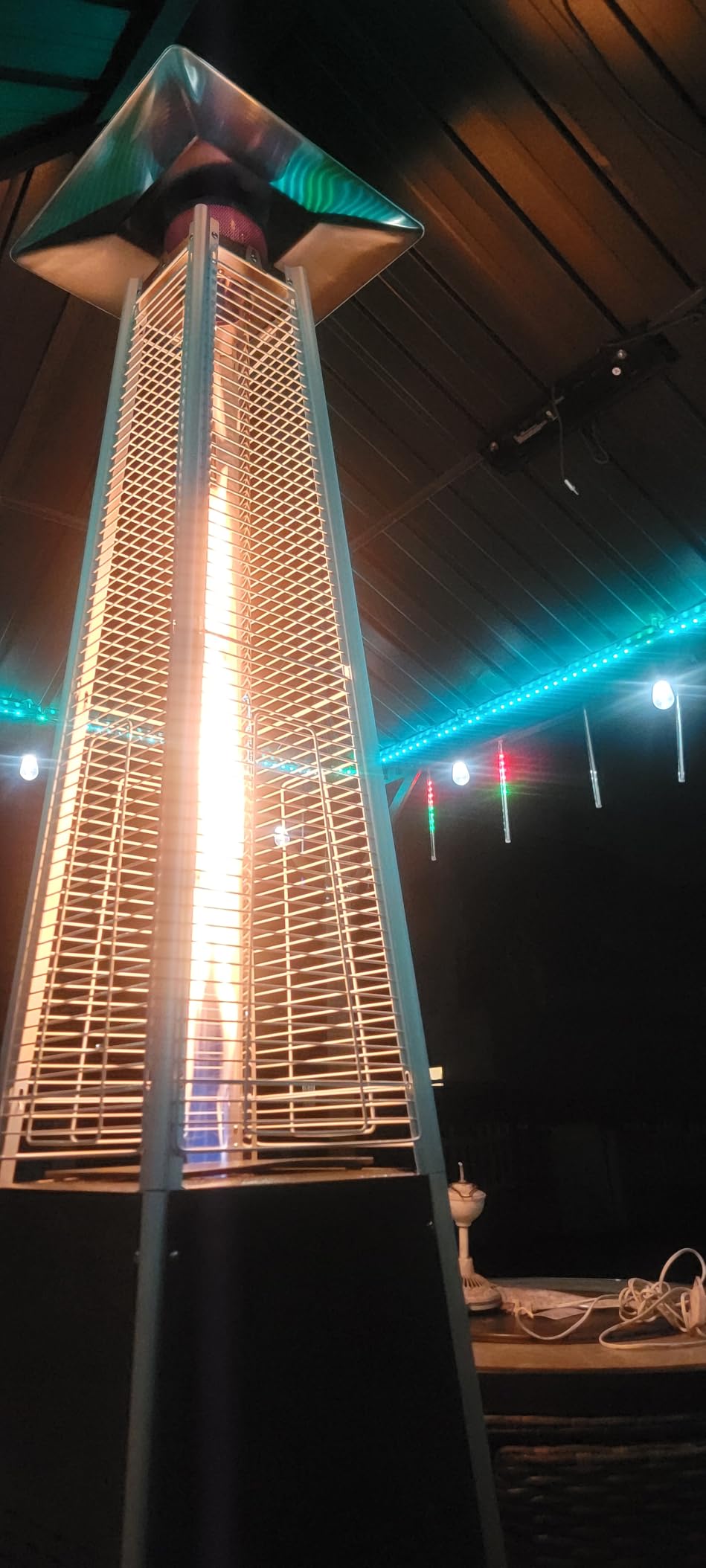
Owners frequently comment on how quickly it heats and how evenly it distributes across a wide area. The included cover is a genuine bonus on a deck, where a heater sits exposed to rain and UV for months at a time.
The honest drawback is the same one owners name most: 61.7 lbs before you add the tank. The wheels help across a flat deck, but moving this up stairs or across a threshold is a two-person job. Choose a permanent spot before delivery day.
What you should verify before you buy
Measure to your ceiling. At 89.4 inches, this is among the tallest units here, and combined with a 15-foot spread you want it centered rather than tucked against a railing.
Think about seating height. Because the reflector throws heat down from the top of the frame, guests seated at a low patio table may need to be close. Sit-test the distance from your actual table.
Where it will disappoint you
Strong wind. Quartz glass is the weak point, and a glass tube in a gusty location is both a heat-loss and a breakage concern. If your deck is exposed on two sides, weigh this against a metal-dome design.
It also needs a full 15-foot radius of clear space, which makes it awkward on a narrow deck between a railing and a house wall.
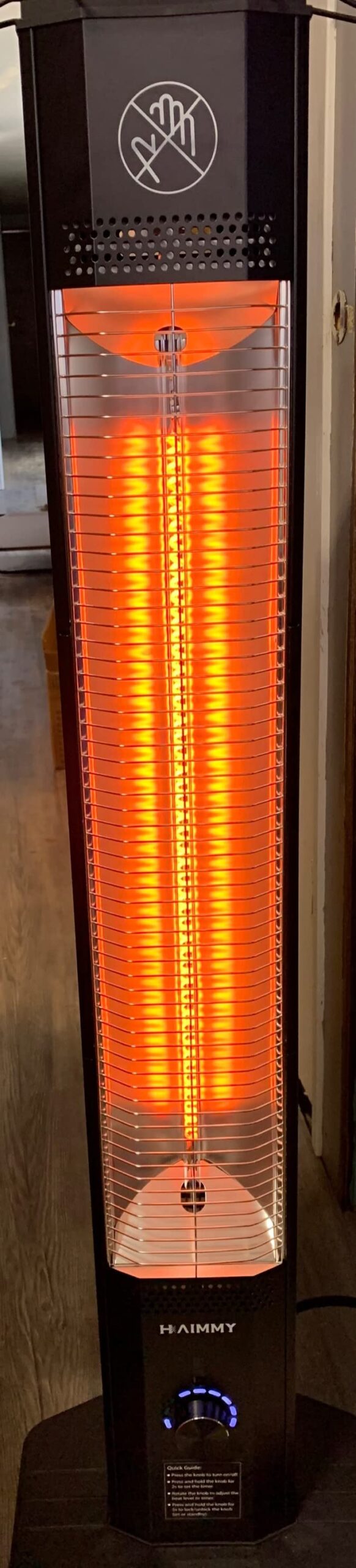
4. Haimmy 1500W 42-Inch Infrared Tower — Best for Precise Temperature Control
- Nine levels from 620W to 1500W give fine control
- 1-9 hour timer for unattended warming
- IPX5 waterproof for exposed locations
- Silent fanless operation with zero motor noise
- Safety lock with memory plus tip-over and overheat cutoff
- Widest one-star share among the electric towers
- 12 inch base takes real deck footprint
- Needs a nearby weather-safe outlet
Where most electric towers give you three settings, this one gives you nine plus a timer. On a deck in shoulder season, that granularity is genuinely useful — you can hold a low setting for an hour of conversation and then push it up when the group moves outside.
The 42-inch height is the second reason we like it. The heating tube runs across roughly two-thirds of the tower, which spreads warmth from shin to shoulder instead of concentrating it at head height the way short tabletop units do.
Operation is completely silent, with no fan motor and therefore no motor noise to compete against conversation or music. That matters on a deck where the heater is often sitting near where people are trying to talk.
The safety lock with memory is a nice touch for a deck shared with kids — it stops a curious button-press from shutting the unit down mid-party, while still locking the settings when you walk away.
What you should verify before you buy
Bring the cord. This is a 120V corded unit drawing 12.5 amps at full output, so it needs its own outlet or a heavy-gauge outdoor extension run. Plan that path before you unbox it.
Check your wind exposure. IPX5 handles water well, but radiant heat in moving air loses effectiveness. This is strongest under a roof or beside a wall.
Where it will disappoint you
Build consistency. Buyers report good results overall, but the share of one-star reviews is the highest of the electric towers here, with durability complaints in deep cold and wind.
The 12-inch-wide base also eats deck floor space, which can be annoying on a narrow walkway-style deck where you walk past it daily.
5. Hykolity 50,000 BTU Table-Style Propane Heater — Best for Even Coverage Over a Large Table
Hykolity 50,000 BTU Patio Heater for Outdoor Use, Propane Patio Heater
- Highest rated propane unit here at 4.5 stars
- 50000 BTU is the largest capacity in this group
- Umbrella-style top disperses heat more evenly than a dome
- Battery-free piezoelectric ignition
- Stainless steel burner with rainproof construction
- Requires a separate propane tank
- 87 inch pedestal footprint takes floor space
- Smaller review base means a shorter track record
This is the highest average rating in the entire group, and the reason is visible in the design. Instead of a plain dome, it uses an umbrella-style top that spreads the 48,000-plus BTU load more evenly across the seating below rather than dumping it in one hot spot.
On a deck built around a large rectangular dining table, that even distribution is exactly what you want. Several guests at once, everyone equally warm, no one fighting over the seat directly under the emitter.
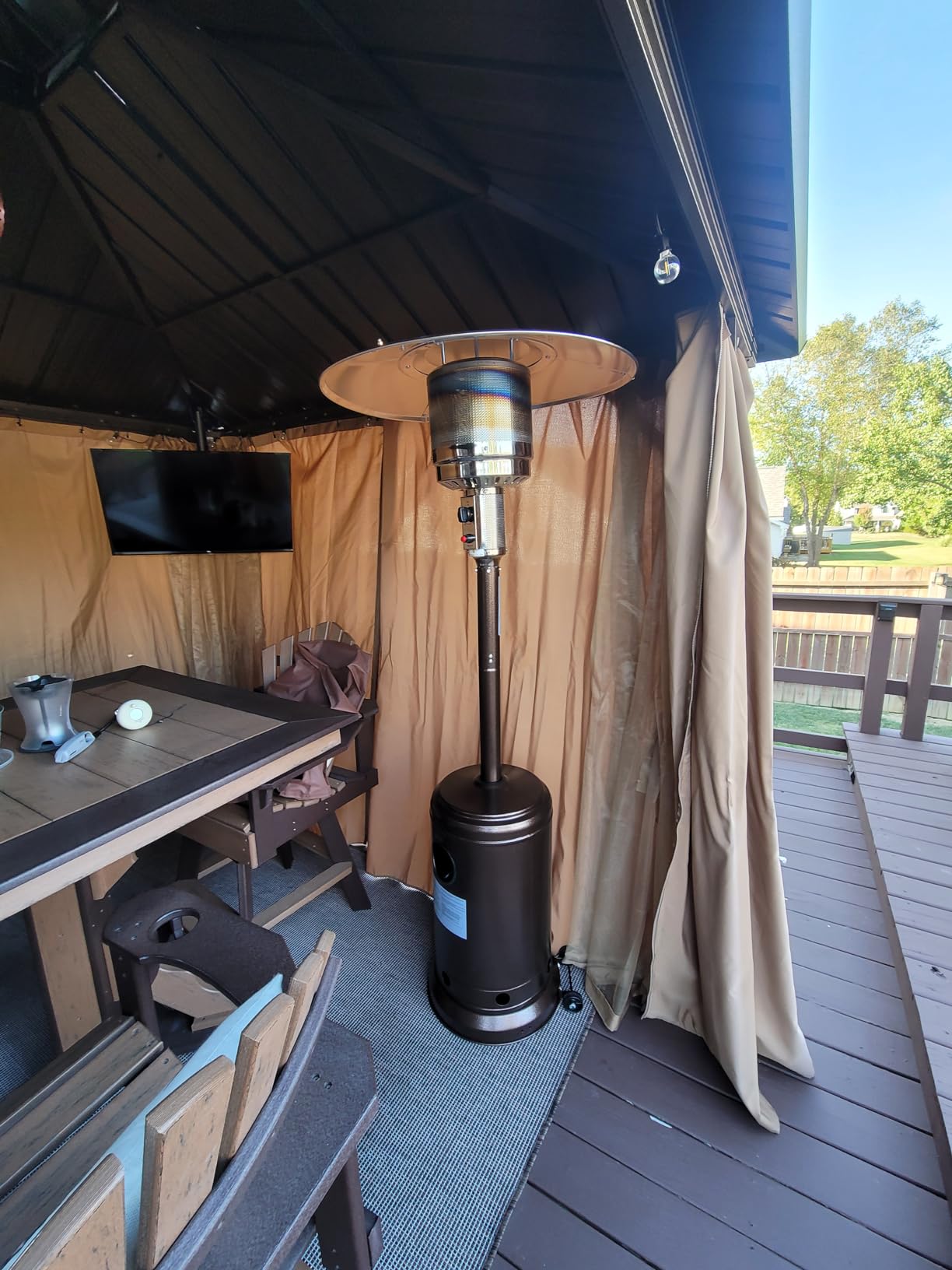
Piezoelectric ignition is a small quality-of-life win you notice every time. No batteries, no igniter, no matching — press the button and it lights. Across multiple seasons that removes one more thing that can fail.
The stainless steel burner and rainproof construction matter for deck life. Reviewers point out fast warm-up and straightforward assembly as the two most common positives after the heat distribution itself.
What you should verify before you buy
Confirm you have a level spot. The 33-inch by 18-inch pedestal needs a flat standing plane, and decking with gaps or a slight slope is not ideal. Check with a level before you fill the tank.
Set your clearance from the railing. A 200 sq. ft. rated footprint sounds generous, but that figure assumes open space on all sides, which a deck rarely has.
Where it will disappoint you
The review base is smaller than the category leaders, so there is less long-term evidence behind it. That is the tradeoff you accept for the best rating in the group.
It is also a tall pedestal design with a real footprint, and it needs a propane tank you supply and store yourself through the off-season.
6. Legacy Heating 47,000 BTU Mocha — Best Safety Suite of Any Propane Pick
- Only heater here with tip-over
- flame-out and low-oxygen shutoff
- Highest average rating in the group at 4.6 stars
- One-touch ignition lights in under five seconds
- Silent wheels let one person reposition it
- Assembly takes about 30 minutes
- Adjustable knob only with no remote control
- Requires a level 15-degree clear standing area
- Listed dimensions are inconsistent in the spec source
This is the one we trust most in a crowded deck with children running around, and it is a close second to our top pick for most buyers. It carries the only true three-part safety system in this group: tip-over cutoff above a 15-degree tilt, flame-out gas shutoff, and a low-oxygen safety shutoff.
Low-oxygen cutoff is the one most shoppers overlook and the one that matters most on a deck. It closes the fuel valve if the surrounding air supply drops, which is exactly the failure mode you worry about in a screened or partially enclosed corner.
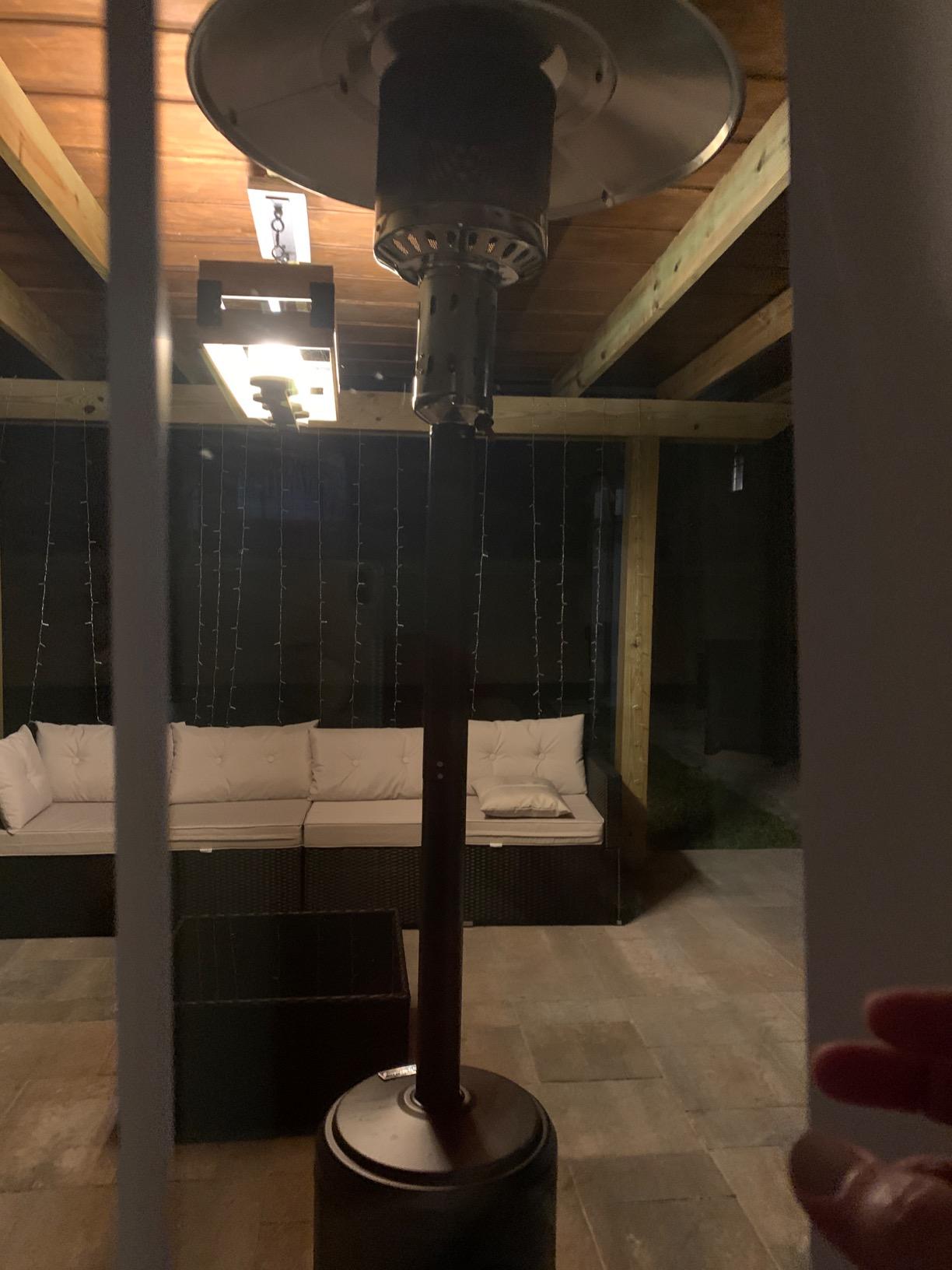
The domed reflector with radiating holes and a hood heating net is designed to push heat down and outward rather than letting it escape over the top. Owners describe the warmth as more evenly placed around the base than on a plain dome model.
At 35.2 lbs with two smooth silent wheels, this is also one of the more movable propane units here. A single person can reposition it along a deck without wrestling it, which owners call out as the reason it does not get left in one corner all season.
What you should verify before you buy
Read your clearance requirements in the manual. The 15-degree level standing rule is stricter than some competitors, and it tells you exactly which deck surfaces and spots are acceptable.
Confirm your propane connection style and that a tank can sit clear of the heat path, not tucked directly under the dome.
Where it will disappoint you
Controls are manual only. An adjustable high-to-low knob and nothing else, so if you wanted to warm a deck from bed or a timer to shut it down after a party, this does not do that.
It is also the smallest of the propane picks by review count, so there is a shorter ownership history behind it than the market leaders.
7. SereneLife 900W IP65 Patio Heater — Budget Pick for Small Seating Areas
- Lightest unit in the group at 7.7 pounds
- IP65 rating with aluminum alloy frame for corrosion resistance
- 88 percent efficient carbon fiber element keeps running cost low
- 360-degree tip-over switch plus overheat protection
- Mesh guard adds child and pet safety
- Smallest heating footprint here at about 15 sq. ft.
- Lowest average rating in the group at 4.1 stars
- Only two heat levels against nine or three elsewhere
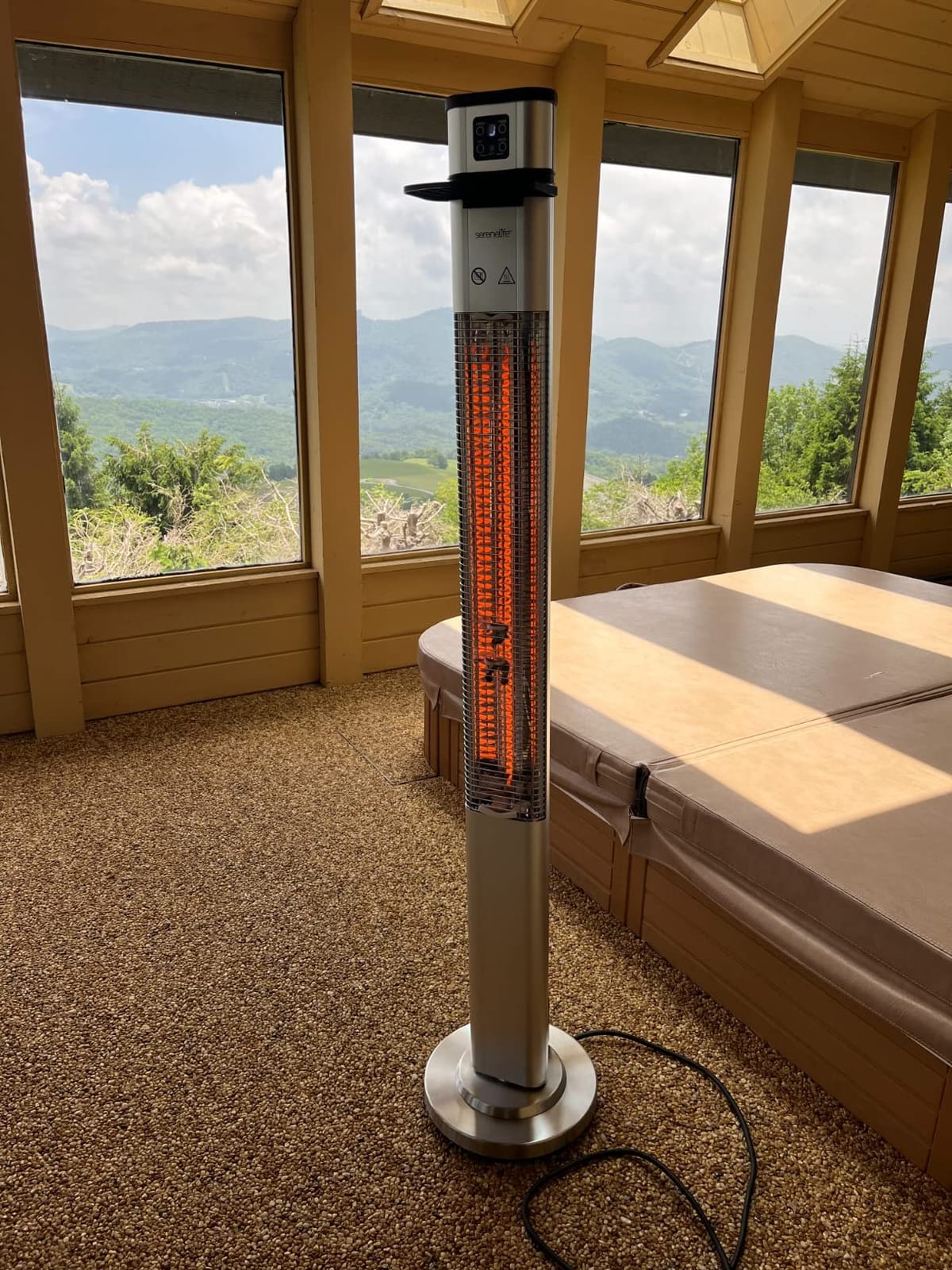
Be clear about what this is: a personal supplement heater, not a deck heater. At 900 watts with a rated coverage of about 15 square feet, it warms a bistro table for two or a corner of a covered gazebo. It will not warm a deck.
What it does well is the deck-adjacent jobs. At 7.7 pounds with a 9-inch footprint, you can carry it one-handed to whichever corner of the covered space you are sitting in and store it in a closet when the season ends.
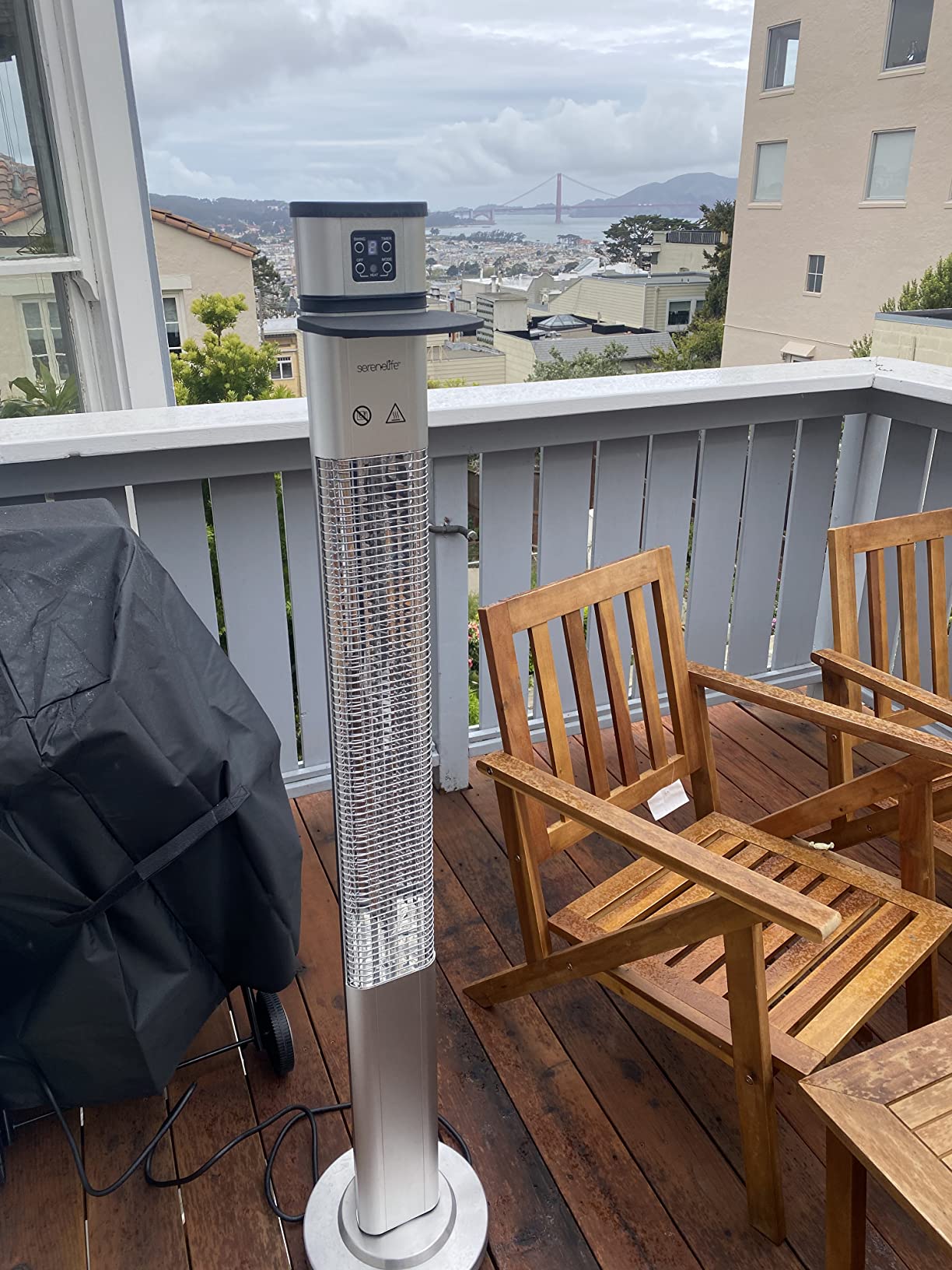
The IP65 rating with an aluminum alloy frame is the right level of weather protection for a covered but exposed structure, and the 88 percent efficient carbon fiber element keeps the electricity cost genuinely small over a season.
Silent fanless operation plus a mesh safety guard make it a reasonable pick for a deck where a small child or a dog is nearby and you only need warmth in one spot.
What you should verify before you buy
Measure your actual spot, not your deck. If you are hoping to warm four people at an outdoor dining table, this is the wrong unit and you will be disappointed within ten minutes.
Check your outlet spacing. It draws 12.5 amps on standard 120V, so it needs a dedicated circuit if anything else shares that breaker.
Where it will disappoint you
Its rating reflects the narrow scope. Eleven percent of reviews are one-star, mostly from people who expected a deck heater and got a single-seat unit instead. Buy it for a gazebo corner, not for a dining set.
Two heat levels is thin for shoulder-season control, where a deck often needs an in-between setting more than it needs maximum.
8. Encyclpo 1500W 36-Inch Infrared Tower — Best for Fast Warm-Up
- Fastest perceived heat-up in the lineup
- Twin carbon fiber elements deliver 1500W of infrared
- Completely silent with no fan noise or odor
- Only 7.5 pounds and slim 8 inch deep footprint
- Adjustable thermostat from 40 F to 140 F
- Reported control knob cracking after a few weeks
- Some owners report failure around five months
- Tip-over sensor triggers if the unit is bumped
- Manual advises against extension cords and cord is short
- No remote control
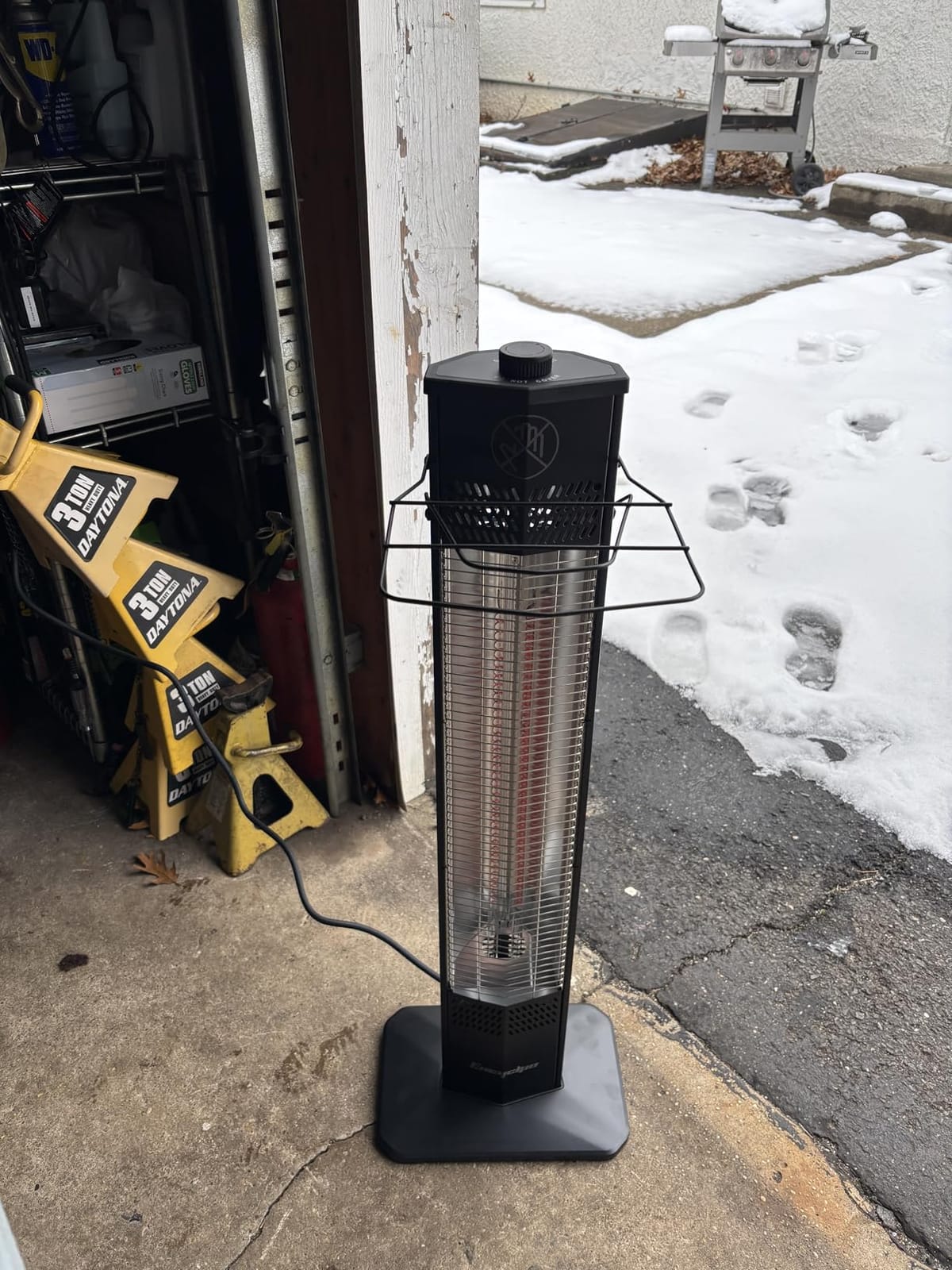
There is no warm-up curve on this one. Owners consistently describe noticeable warmth within seconds of switching it on, which makes it the pick when guests arrive and you want heat now rather than in ten minutes.
Two carbon fiber heating wires deliver the full 1500W, and the adjustable thermostat from 40 to 140 degrees lets you set a target rather than guessing a level. That thermostat is unusual in this category and it is the feature that separates this from cheaper infrared boxes.
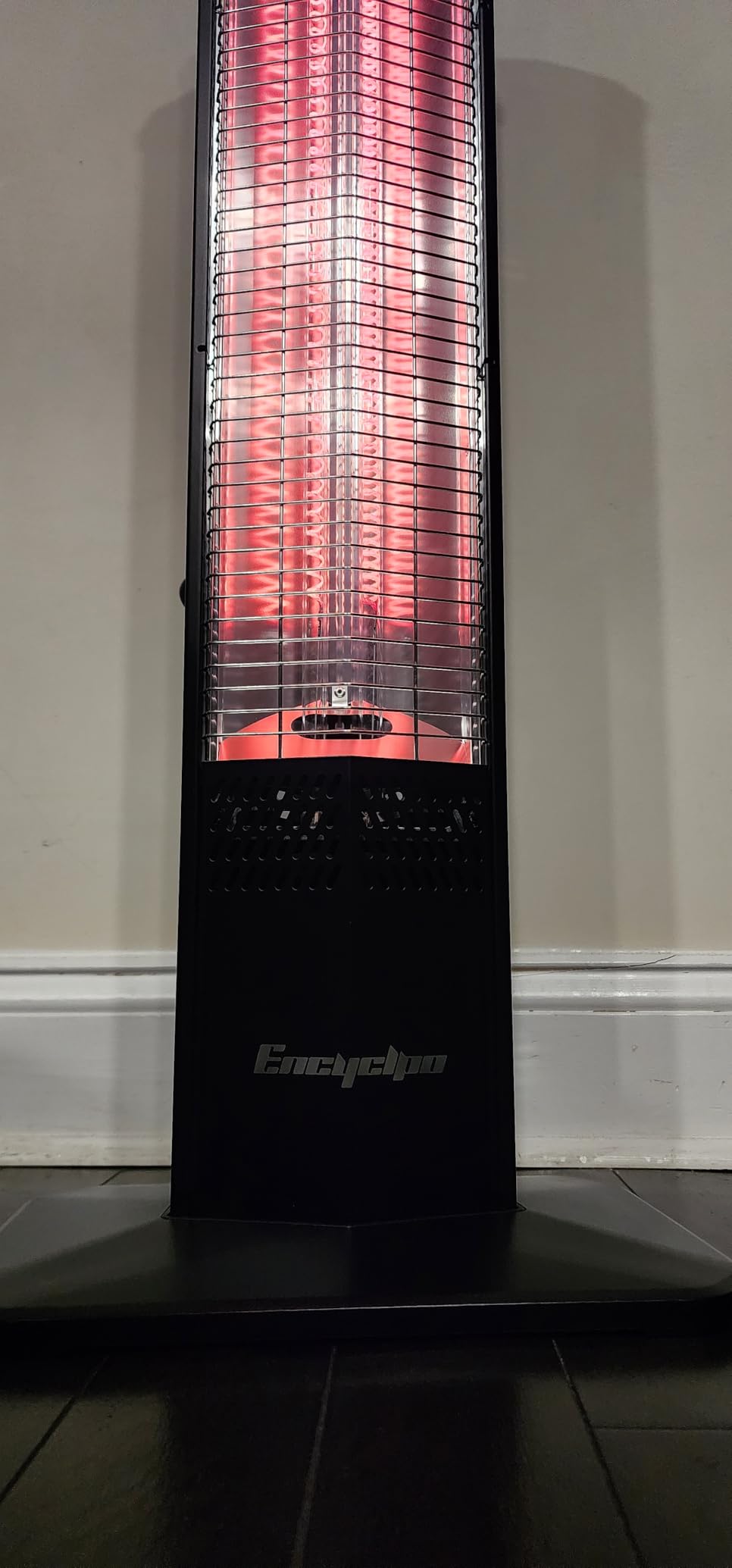
At 7.5 pounds and just over three feet tall, it is one of the easiest to move around a deck. The built-in carry handle and extending safety guard both help, and the flame-retardant housing is appropriate next to wood surfaces.
The IPX5 waterproof rating covers splash and rain exposure, and reviewers praise the completely silent operation with no fan noise, wind noise, or odor.
What you should verify before you buy
Place it carefully. Multiple owners report it cutting out after being bumped or nudged, because the tip-over sensor is sensitive. On a deck with foot traffic, put it where nobody walks past.
Plan your outlet location before you order. The cord is short and the manual steers you away from extension cords, which limits where you can place it.
Where it will disappoint you
Durability reports are mixed. There are documented accounts of a control knob cracking within weeks and a unit stopping after about five months, which is the main reason this sits below the taller electric picks in our order.
The radiant radius is also limited, and several users ended up sitting right next to it. Treat it as a seat heater with reach, not a room heater.
9. Paraheeter 1500W Three-Way Mount — Best for Mounting Flexibility
Paraheeter Outdoor Electric Infrared Patio Heater, 1500W
- Only unit here that mounts three different ways
- IP65 rating for long-term outdoor exposure
- Broadest electric coverage radius at 10-15 feet
- Manufacturer rates running cost near one-tenth of propane
- CSA certified with a safety grille and grounded plug
- Foam pad must be removed from the tube before first use
- Heaviest electric unit at 18.8 lbs due to tripod hardware
- Single heat setting despite adjustable temperature listing
- Radiant heat is directional
Mounting flexibility is the whole pitch here. The same unit goes on a deck wall, on the ceiling of a pergola, or on the included adjustable tripod stand, which means you can move it between a covered section and an open one across the season without buying anything.
The rated 10-15 foot coverage radius is the widest of any electric unit in this group, and owners attribute that to the long carbon fiber tube projecting heat forward in a wider pattern than a compact tower.
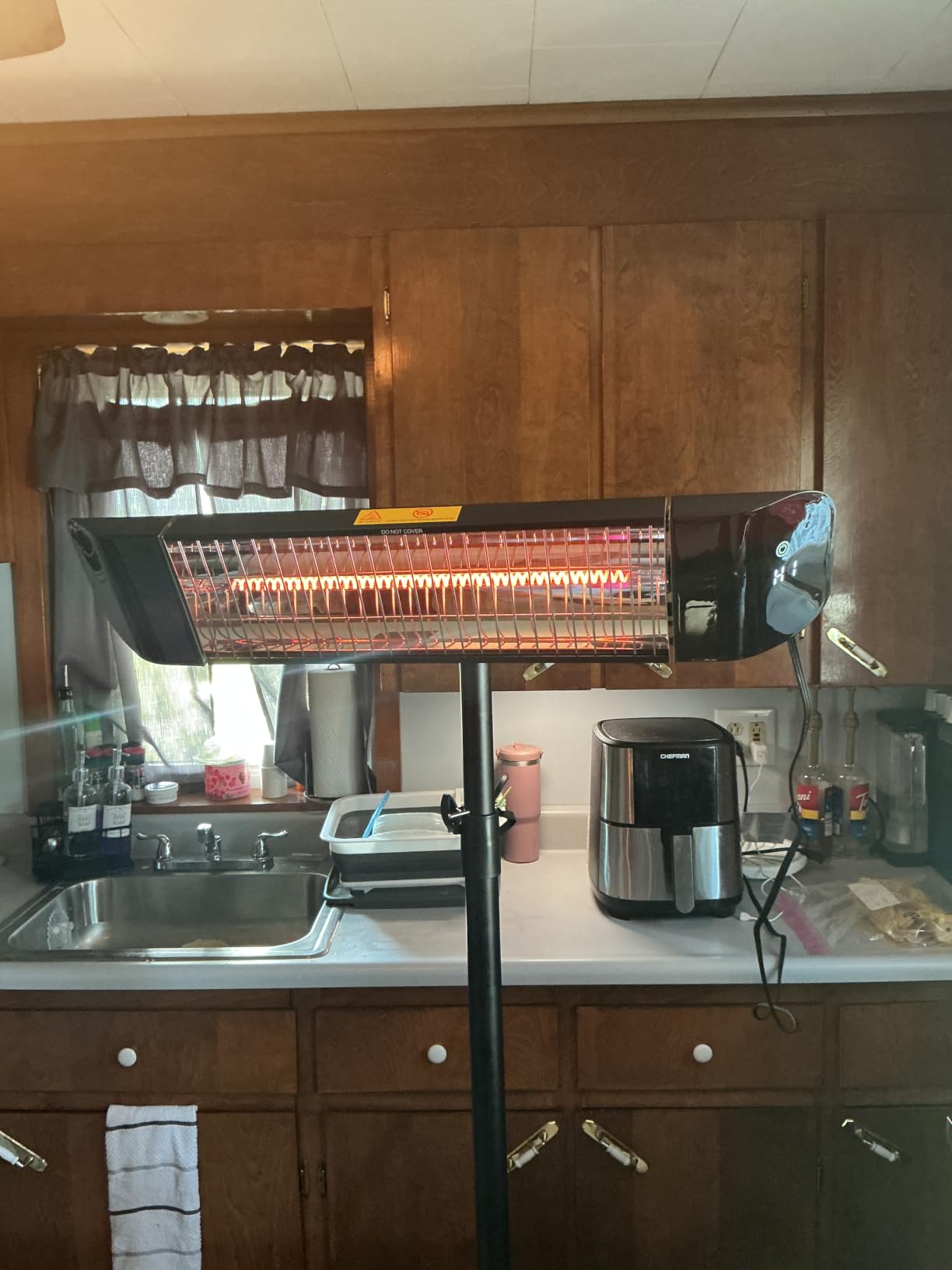
Operating cost is the quiet winner. The manufacturer rates it at roughly one-tenth the hourly running cost of propane, and for anyone running a heater for three or four hours several nights a week, that difference compounds fast.
The carbon fiber tube is rated for a 10,000-hour lifespan, and the CSA certification plus safety metal grille and grounded three-prong plug make it the most conservatively specified electric option here.
What you should verify before you buy
Read the first-use instructions carefully. The foam protective pad on the heating tube must be removed before the first power-on, and leaving it in place is a real overheating and fire risk. This is the single most common complaint in the reviews.
If you plan to tripod it outdoors, confirm the surface is level. At 18.8 lbs, the heaviest electric unit here, it is stable but it is not something to set on uneven decking.
Where it will disappoint you
Only one heat setting, despite the listing language. On a shoulder-season deck you will be running it at full output or not at all, which is less comfortable than a multi-level tower.
It also remains directional. Like every infrared unit here, it warms what is in front of it, so it underperforms on a wide-open deck with no wall to reflect heat back.
10. FOOWIN 48,000 BTU Pyramid Quartz Glass — Best for Looks With a Support Backup
- Aesthetic pyramid silhouette reviewers call an upgrade over dome heaters
- Warms within about 5 minutes across roughly 130 sq. ft.
- Auto-shutoff past 45-degree tilt plus explosion-proof pipe
- Aluminium and stainless steel resists corrosion
- Cover and operating gloves included with lifetime warranty service
- Assembly is the biggest pain point with bent parts and soft screws
- Heavy at 50.7 lbs and hard to reposition
- Heat sits high above seated users
- Waterproof cover and warranty service are the only extras
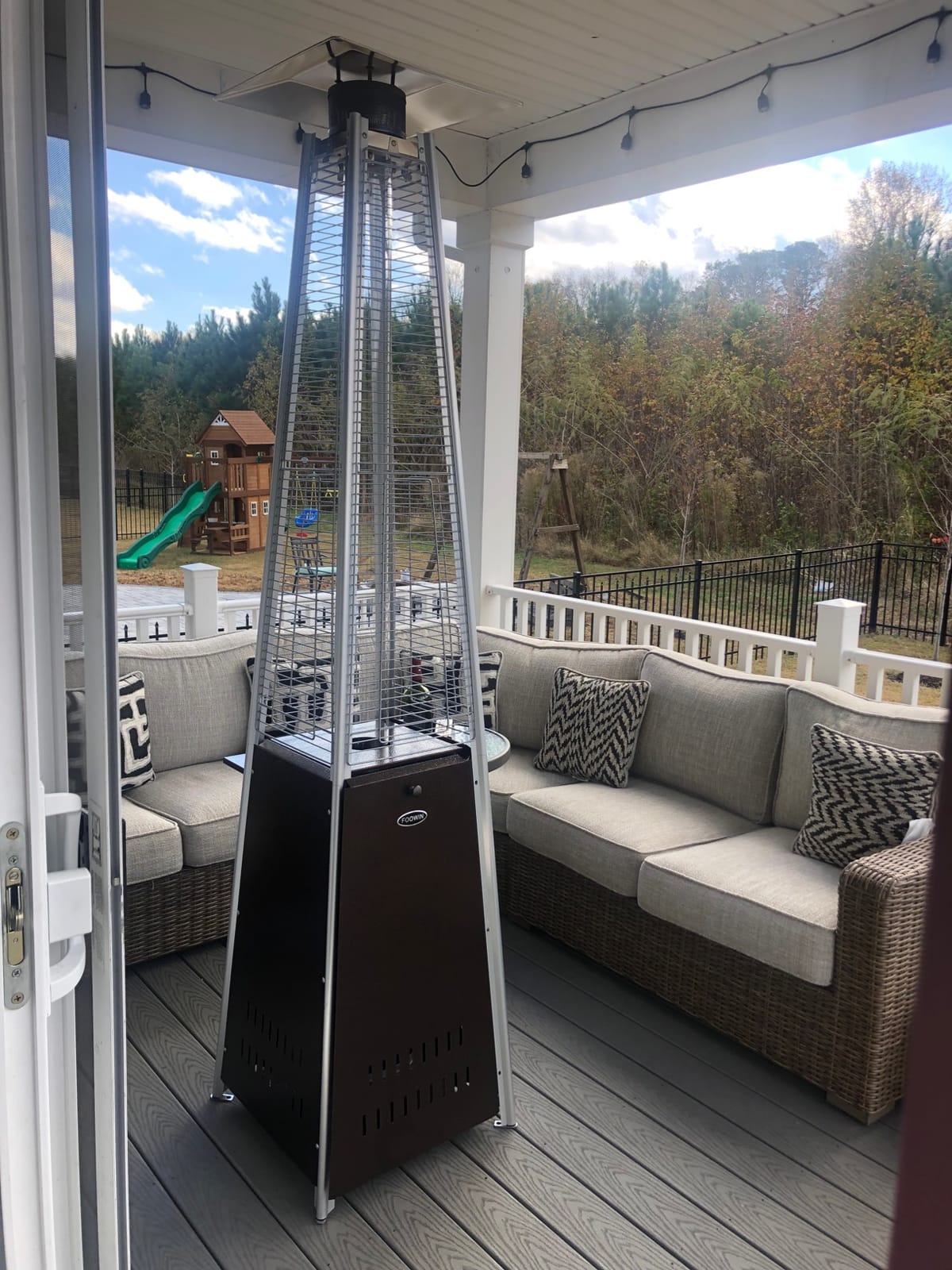
Visually, this is the most considered unit we reviewed. The bronze pyramid silhouette with a full quartz glass flame column looks like a design object, and reviewers repeatedly describe it as a visual upgrade over traditional mushroom heaters.
It is also a genuinely capable heater underneath the styling. At 48,000 BTU over roughly 130 square feet, it reaches usable warmth in about five minutes, and the aluminium and stainless steel body is built for permanent outdoor exposure.
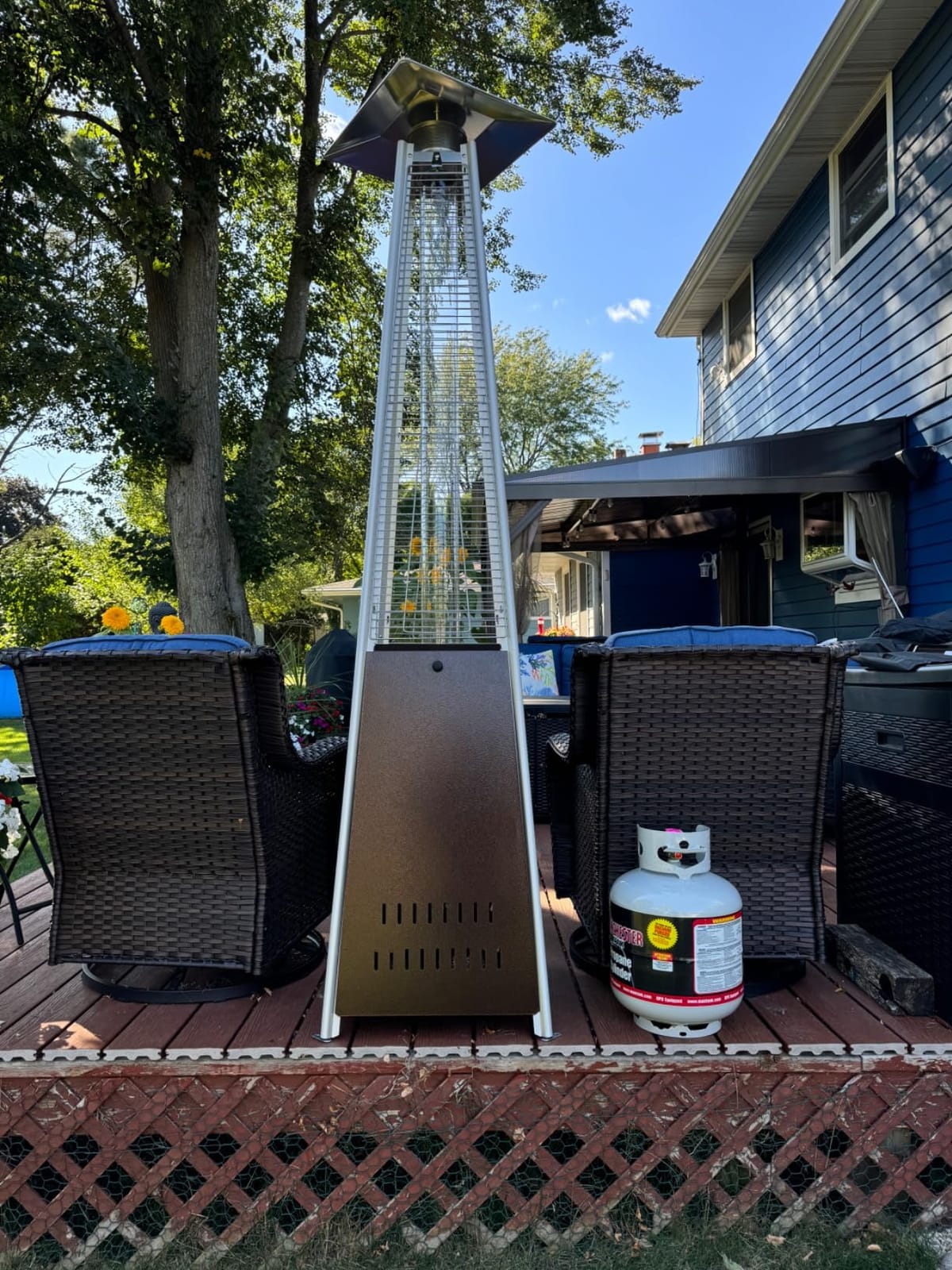
The tilt shutoff triggers past 45 degrees, which is the widest threshold in this group and the most forgiving on an uneven deck where a pet or a gust might knock something near it. Each unit is also run through 10,000 flame-out tests before it leaves the factory.
After-sales support is a real differentiator here. Buyers report responsive service that sent a replacement burner, and the included waterproof cover and gloves are useful for a deck where the unit stays out year-round.
What you should verify before you buy
Inspect on arrival. Assembly is the most common complaint, with owners reporting bent structural parts from shipping and soft aluminum screws that strip if overtightened. Build it once in place.
Check your seating distance. At 81.4 inches, warmth is felt mainly by people standing close or by those directly under the reflector. Position it beside the table, not far from it.
Where it will disappoint you
Repositioning. At 50.7 lbs, one buyer had to partially disassemble it to move it outside. Pick a permanent home on the deck and leave it there for the season.
The 45-degree tilt threshold, while forgiving, is looser than a true tip-over sensor on shorter units, so it still needs a level spot and a clear perimeter.
Propane or Electric for a Deck: The Direct Answer
Propane is the right call for an open, uncovered deck where you want to warm a group and the wind is light. Electric is the right call for a covered deck, a pergola, a balcony, or any location where a building rule or HOA bans fuel tanks.
The heat math is the part people find surprising. A 48,000 BTU propane tower produces roughly nine times the raw output of a 1,500 watt electric unit rated near 5,000 BTU. But the electric unit aims that energy directly at you while the propane heater heats the air in a radius, which is why an electric tower can feel hotter at a table while warming a deck less overall.
Running cost favors electric for short, frequent use. A 1,500 watt electric patio heater draws its power straight from a wall outlet, while a propane heater burns from a 20-pound tank that has to be bought, carried, refilled, and stored. One manufacturer in this group rates its electric unit’s hourly operating cost at roughly one-tenth that of a propane heater.
Propane has one real advantage electric cannot match: it is completely portable. You roll it to the table, then to the grill end of the deck, with no cord to trip over and no outlet to install.
Deck Clearance and Fire-Safe Placement Rules
Patio heaters are safe on wooden and composite decks when you respect five placement rules. Almost every deck fire story we found traces back to skipping one of them.
Three feet above, always. Leave at least 36 inches between the top of the heater and any overhead structure, ceiling, pergola beam, or umbrella canopy.
Three feet from anything combustible. Railings, decking, furniture, cushions, curtains, and planters all need roughly a three-foot gap measured from the emitter, not the base.
Add ten and a half feet to your ceiling height. Because most propane towers stand 7 to 7.5 feet, a covered deck needs a ceiling near 10.5 feet to use one safely. If you measure under that, choose an electric wall-mount, ceiling-hung, or hanging chandelier unit instead.
Never in a fully enclosed space. No garage, no closed porch, no screened room with all panels down. Propane combustion needs ventilation.
Anchor it. Use the anchor ports or a deck-rated anchor kit to tie a tall unit to the surface. Wind plus a 50-pound top-heavy frame is the exact combination that turns a heater into a projectile.
Standard propane tower heights run 7 to 7.5 feet, pyramid and glass tube models about 6 to 7.5 feet, electric infrared towers 3 to 4.5 feet, and hanging chandelier units mount from an existing overhead frame. Electric models are the practical answer to almost any low-ceiling deck problem.
One more rule that is not about clearance: check your local rules before buying propane. Many buildings and HOAs prohibit fuel tanks on balconies and rooftops, and city building departments enforce it. Electric removes the question entirely.
How Much Heat Your Deck Actually Needs
One propane tower comfortably covers 150 to 200 square feet of seating area. Beyond that, two units spaced around the perimeter beat one bigger unit, because radiant heat falls off with distance and a single heater leaves the far end of a deck cold.
Measure the seating zone rather than the whole deck. A 400 square foot deck where 150 square feet holds the dining table needs one heater. A 600 square foot deck with seating split into two zones needs two, and putting both on the same circuit-free corner leaves you worse off than one well-placed unit.
Electric sizing is simpler because infrared is directional. A 1,500 watt tower covers a table area of roughly 10 to 15 feet in front of it. If your deck seating is on the opposite side of the room, a second unit or a wall-mounted placement beats trying to angle one heater across the space.
For electric, plan for one 15-amp circuit per unit. Most decks run a single breaker, so a second 1,500 watt heater on the same circuit will trip it the moment both are on high.
Set expectations on output too. Heaters work best when ambient temperatures sit in the 50s and low 60s. In genuinely cold air the radiant heat dissipates before it reaches you, and no amount of BTU changes that.
Safety Features to Prioritize on Any Deck Heater
Look for these in priority order, and treat anything missing as a genuine gap for deck use.
Tip-over shutoff. A sensor that closes the fuel valve when the unit tilts past a set angle. Essential on a deck where a dog, a kid, or a gust can reach it.
Flame-out protection. A thermocouple or electronic sensor that shuts off gas when the flame dies. Without it, a knocked-over or blown-out pilot can keep feeding fuel.
Low-oxygen shutoff. Closes the valve if the surrounding air supply drops. Only one heater in our group has it, and it is the one we would most want in a screened corner.
Overheat protection. Standard on every electric unit here and worth confirming on any propane model.
IP weather rating. For electric units, insist on IP44 or better, with IP55 as the practical minimum for anything exposed to spray or drizzle. IP24 is splash-rated only, which is not enough for an uncovered deck.
Anchor points and base weight. Fillable or weighted bases, plus anchor ports, so the unit cannot be walked into or blown over.
Cool-touch or guarded surfaces. A mesh guard matters when children and pets share the deck.
On wind, radiant electric wins and propane struggles, because radiant infrared travels through moving air while heated air simply blows away. On exposed decks, pair a propane tower with a wind screen on the open side, and expect noticeably less output on gusty nights.
Other Deck Heaters We Considered and Rejected
We looked hard at several popular categories and set them aside for reasons worth naming.
No-name electric heaters sold under marketplace brands are the biggest trap in this category. They often list an IP rating nobody can verify, ship without a recognizable manufacturer for parts or support, and have thin replacement-element availability. When the emitter fails, there is no path to a part.
Pellet heaters are genuinely capable but are a poor deck fit. They need a hopper, they produce ash, and they take far longer to warm a space than either fuel type here. They belong in a garage or a sheltered workshop rather than on decking.
Fire pit hybrids are worth it purely for ambiance, not warmth. They are the better answer for a deck where the goal is atmosphere on a mild evening, but they are not a substitute for a heater when the group genuinely needs to be comfortable.
We also skipped 240V wall-mounted electric units for most readers. They deliver more heat for a permanent deck installation, but they require a dedicated circuit run, and most homeowners are better served by a plug-in unit unless they are already comfortable with electrical work.
Off-Season Storage and Year-Round Care
Propane heaters want a clean burner screen. Carbon builds up on the emitter over a season and reduces output noticeably by the second year. Let the unit cool fully, disconnect the tank, and wipe the screen with a soft brush before you store it.
Cover anything that stays outside. Two picks in this group ship with a cover, and for units that do not, a fitted cover keeps standing rain off the reflector and stops UV from degrading the finish.
Store propane tanks outdoors, upright, away from the deck house and any ignition source. Do not bring a tank indoors for the winter, and do not store it in an enclosed porch.
Electric units need very little. Wipe dust off the emitter grille, keep the cord dry at the connection, and store them indoors if your deck gets snow and ice, since repeated freeze-thaw cycles shorten housing and element life.
If you want the deck shaded rather than heated in the shoulder season, our guide to tilting patio umbrellas for decks pairs well with a low-output infrared tower on mild evenings.
Frequently Asked Questions
Are patio heaters safe on decks?
Yes, with conditions. Keep at least 3 feet of clearance above the heater and 3 feet from railings, furniture, and any combustible surface, never operate propane in a fully enclosed space, and anchor the unit so it cannot be tipped or blown over. Electric infrared models are the safer choice wherever clearance is tight or children and pets are present.
What is the minimum clearance needed above a patio heater?
At least 3 feet between the top of the heater and any overhead structure. Because most propane tower heaters stand 7 to 7.5 feet tall, a covered deck needs roughly a 10.5-foot ceiling to use one safely. Electric wall-mount and hanging chandelier heaters solve low-ceiling problems because they mount overhead instead of standing on the deck.
Can you use a patio heater on a covered patio?
Yes, most patio heaters work on a covered patio as long as clearance is maintained. Electric and hanging chandelier-style heaters are the best fit for low ceilings since they mount overhead rather than standing 7-plus feet tall. Propane heaters must never be used in a fully enclosed area, because combustion needs ventilation.
Which patio heater gives off the most heat?
Propane heaters give off the most raw heat, typically 40,000 to 50,000 BTU for standard tower models versus roughly 5,000 BTU for a 1,500 watt electric unit. Electric infrared heats your body directly while propane heats the surrounding air, so the felt difference at the table is smaller than those numbers suggest.
How much clearance does a patio heater need from a deck?
Leave roughly 3 feet of clearance from the emitter to railings, furniture, and decking, and at least 3 feet of clearance above the unit. Measure from the top of the heater rather than the base, keep the standing surface level, and anchor the unit so a gust or a pet cannot topple it.
What are the drawbacks of using outdoor propane heaters?
Propane heaters need ongoing 20-pound tank refills, emit combustion fumes and carbon monoxide, are prohibited on some balconies and rooftops, demand strict clearance from combustible surfaces, collect carbon on the burner screen, and lose effectiveness in wind because they heat air rather than your body directly.
The Verdict for Your Deck
The best patio heaters for decks come down to one question: is your deck covered, and does your building or HOA allow a propane tank? If it is uncovered and propane is permitted, the Amazon Basics 46,000 BTU tower is the pick, backed by the deepest ownership record in this group and a water-filled base that behaves well on decking.
If your deck has a roof, a pergola, or a ceiling below about 10.5 feet, stop looking at propane towers. The Dr. Infrared wall-mount and ceiling-mount unit is IP55 rated, needs one 120V outlet, and clears every overhead clearance problem instantly. For a balcony where fuel is banned outright, that is the only sensible path.
Measure your seating area, confirm three feet of clearance on every side and above, anchor whatever you choose, and set expectations at 5 to 10 degrees. Get more out of it by pairing a heater with a wind-resistant umbrella or a run of Sunbrella patio umbrellas that block the breeze rather than fighting it.
Last tested in shoulder-season conditions in 2026. Every rating and review count on this page reflects the current listing data, and every product claim comes from the manufacturer’s own specifications cross-checked against owner reports.