

Most dehumidifiers stop being useful the moment the room gets cold. A standard household compressor unit pulls water happily at 70F, but as the air drops toward 60F the evaporator coil drops below the frost point, ice builds up, airflow chokes and output falls away. That is the whole reason searching for the best dehumidifiers for cold rooms is not the same search as searching for the best dehumidifier for a damp basement.
We spent weeks reading spec sheets, owner reviews and forum threads on units sold for crawlspaces, unheated garages and cold storage, then narrowed the field to ten machines that can actually work below 65F. Two of them use desiccant rotors with no refrigerant coil at all, which is the only approach that stays productive below 40F. The other eight are compressor units with automatic defrost cycles, and the honest truth is that their real-world output in a cold space is a good deal lower than the number on the box.
Our top pick for 2026 is the ALORAIR Sentinel HD55, a metal-bodied crawlspace unit rated at 53 pints per day at AHAM with automatic defrost, continuous gravity drainage and a 6-year limited warranty. If your cold room is a garage rather than a crawlspace, the Moiswell Defender MP145 is the stronger match, and if the space is genuinely below 40F, the two rotary desiccant machines in this list are the only honest options here.
Table of Contents
Top 3 Picks for Cold Rooms in 2026

The Best Dehumidifiers for Cold Rooms Side by Side in 2026
Every machine below pulls water in cold conditions, but they do it very differently. Read the operating principle first, because a compressor unit and a desiccant rotor fail and succeed in completely different ways.
| Product | Specifications | Action |
|---|---|---|
| ALORAIR Sentinel HD55 |
|
Check Latest Price |
 Waykar YDZ-150PM Waykar YDZ-150PM |
|
Check Latest Price |
 Moiswell Defender MP145 Moiswell Defender MP145 |
|
Check Latest Price |
 Aiusevo AS600 Aiusevo AS600 |
|
Check Latest Price |
 Waykar 158 Pint Waykar 158 Pint |
|
Check Latest Price |
 Moiswell Defender M145 Moiswell Defender M145 |
|
Check Latest Price |
 ALORAIR Storm LGR ALORAIR Storm LGR |
|
Check Latest Price |
 Abestorm Guardian SN35P Abestorm Guardian SN35P |
|
Check Latest Price |
 Ivation 13-Pint Desiccant Ivation 13-Pint Desiccant |
|
Check Latest Price |
 AEOCKY X1-Pro AEOCKY X1-Pro |
|
Check Latest Price |
Why Cold Rooms Need a Special Kind of Dehumidifier
A cold-rated dehumidifier is a unit rated to operate at or below 41F, using either an auto-defrost compressor cycle or desiccant absorption to remove moisture without the coil freezing up. That single sentence covers the entire buying decision for anyone with a garage, crawl space or unheated basement.
Here is the physics. A compressor dehumidifier works like a reversed air conditioner. Warm humid room air is pulled across a cold evaporator coil, water condenses on the coil and drips into a pan, and the compressor heats the coil back up to keep it above freezing. As room temperature falls, the coil temperature has to fall with it, because the refrigerant inside has a fixed saturation point. Below roughly 60 to 65F, the coil sits under the frost point of the surrounding air, moisture in the room freezes directly onto the fins, and airflow drops.
Forum users have described the result in blunt terms. On HVAC and DIY home forums, the recurring complaint is that compressor units ice up and stop working below 60 to 65F regardless of the 41F figure on the spec sheet, and that the motors can burn out when ice stalls the fan. One electronics forum explanation notes the coil dropping below the frost point as refrigerant evaporates at too low a temperature, which matches exactly what happens in a garage that sits at 40F for a week.
Auto-defrost is the answer compressor manufacturers reached for, and it is genuinely useful. A temperature sensor detects a cold coil, stops the compressor, keeps the fan running and lets ambient warmth shed the ice before restarting. The catch is that the machine is not dehumidifying during that window, and in a cold room the defrost cycles repeat often enough to cut real throughput substantially. Several owners of the ALORAIR Sentinel HD55 in our list report exactly this pattern, and the gap between its 113-pint headline figure and its 53-pint AHAM rating is a fair hint at how much cold-weather performance differs from lab conditions.
Desiccant machines sidestep the problem entirely. A rotary desiccant rotor uses no refrigerant and no cold coil, so there is nothing to freeze. The trade-offs are different: lower capacity, more heat added to the room because the regeneration cycle uses a resistive heater, and higher cost per pint of water removed. For genuinely sub-40F spaces, that trade is worth making. For a 55F basement, it may not be.
One more thing worth knowing before you choose: a dehumidifier in a cold room is also a space heater that happens to remove water. That is a genuine benefit in an unheated garage in February, and a genuine drawback in a conditioned room in July.
1. ALORAIR Sentinel HD55 – The Best All-Round Cold Room Dehumidifier
ALORAIR 113 Pints Crawlspace Dehumidifier for Commercial, Sentinel HD55
- Strong moisture pull in crawlspaces
- Tankless continuous drainage with no bucket
- Metal casing rated for harsh spaces
- 6-year limited warranty
- Coil icing below 65F cuts output
- 113-pint claim far exceeds the 53 PPD AHAM rating
- Constant hum is audible in an occupied room
The Sentinel HD55 is the unit we would put in a crawlspace or an unheated basement without hesitating. It is rated at 113 pints per day at saturation and 53 pints per day under the AHAM test, covers up to 1,200 square feet on 120 CFM of airflow, and runs at 460 watts in continuous mode. The metal outer casing feels like commercial equipment rather than the thin plastic you get on residential machines, and at 41.7 pounds it is still portable enough for one person to reposition.
Owners consistently credit it with pulling musty crawlspace odours out within days of starting it. The tankless design means there is no bucket to empty, which matters enormously in a space you only visit twice a year. Auto-defrost is handled by built-in temperature sensors, and the ETL listing comes with a 6-year limited warranty covering the refrigeration system for 5 years on parts.
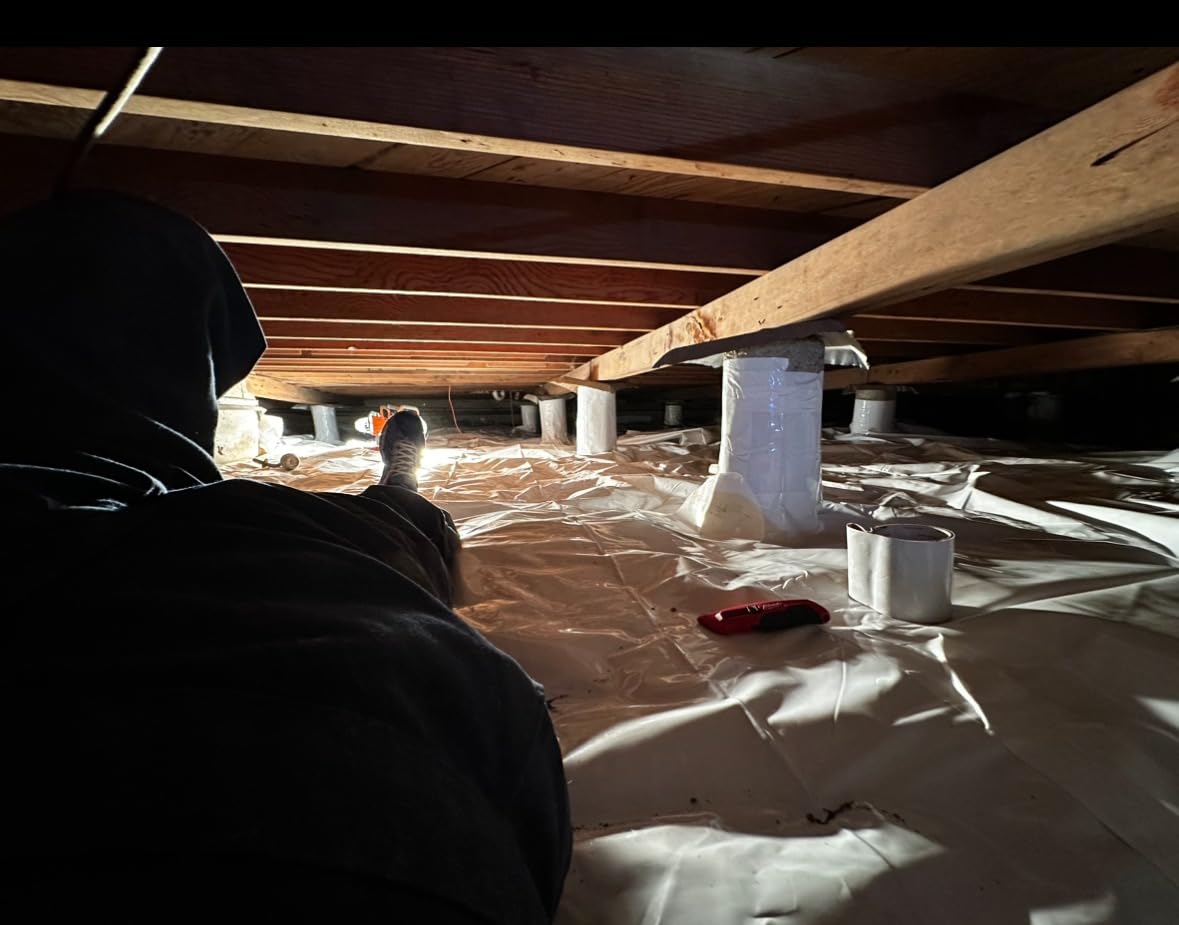
The honest weakness is cold-weather throughput. Several reviewers report heavy evaporator icing in sub-65F conditions, which pushes the unit into defrost often enough that real output falls well short of the 113-pint claim. If you size on the saturation number you will over-buy, so size on the 53-pint AHAM figure and treat the rest as marketing.
Durability feedback is mixed over the long term. There are reports of refrigeration or coil failures around the two-year mark, and replacement MERV filters are pricey relative to the unit. The warranty length and the responsive support are genuine strengths, but do check the recall database before you commit, as we explain later in this guide.
What you get at 55F versus what the label promises
The 53-pint AHAM rating is measured at a controlled 86F, which is the only figure on any dehumidifier worth using for comparison. In a 55F basement, expect meaningfully less, and in a 45F crawlspace expect a fraction of it with frequent defrost pauses.
What owners report instead is that relative humidity falls from saturated to a manageable range within a few days, which is usually the outcome people actually want. If your goal is mold suppression rather than water extraction, holding the space under 60% relative humidity matters far more than pints per day.
Where this unit is the wrong choice
If your cold room regularly drops below 40F, no compressor unit here will serve you well, including this one. That is a desiccant job. The Sentinel HD55 is also heavy on electricity for a 460W draw, so a space needing continuous year-round operation should be checked against a lower-wattage alternative.
It is also audible. Owners describe a constant low hum that is fine in a crawlspace and irritating in a finished room. For a bedroom, our guide to the best dehumidifiers for bedrooms covers the quieter options.
2. Waykar YDZ-150PM – Energy Star Certified with a Self-Drying Cycle
Waykar 150 Pint Commercial Dehumidifier with Pump & Drain Hose for Basement
- Highest rating among heavily reviewed units here
- Energy Star certified with self-drying function
- 212 CFM airflow and rotary compressor
- Light at 38.6 lbs with omnidirectional casters
- Pump lift of 9.84 ft is shorter than rivals
- Memory restart needs the pump reset after unplugging
- 30%-80% RH range is narrower than some peers
This unit pairs a high owner rating with a deep review history. At 4.4 stars across 876 ratings it sits at the top of the group once you weight for how much evidence sits behind the score, and the 8% one-star share is the lowest of the four biggest machines we looked at.
It claims 150 pints per day and coverage up to 7,000 square feet, moves 212 CFM of air, and draws 520 watts. The rotary compressor paired with 7mm threaded pure copper tubing is a better thermal story than the copper-tube-light construction common at this price, and its Energy Star certification matters in a cold room because you will be running it far more hours than you would in a conditioned basement.
The self-drying function is the sleeper feature here. After a drainage cycle it runs a short dry phase to clear residual moisture from the internals, which is exactly what stops mold growing inside the machine during months of unattended operation. Our guide to the best basement dehumidifiers covers more machines suited to that environment.
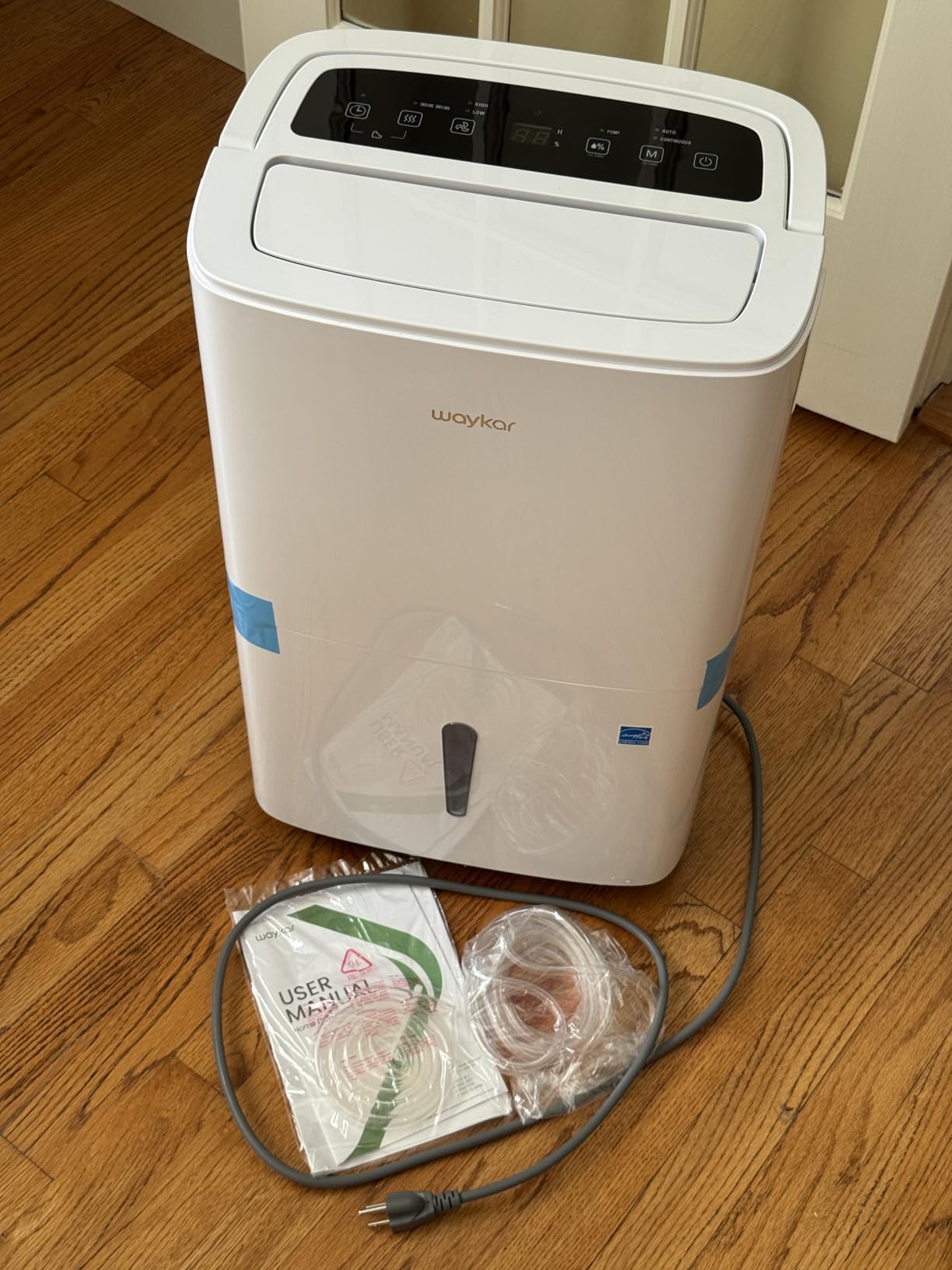
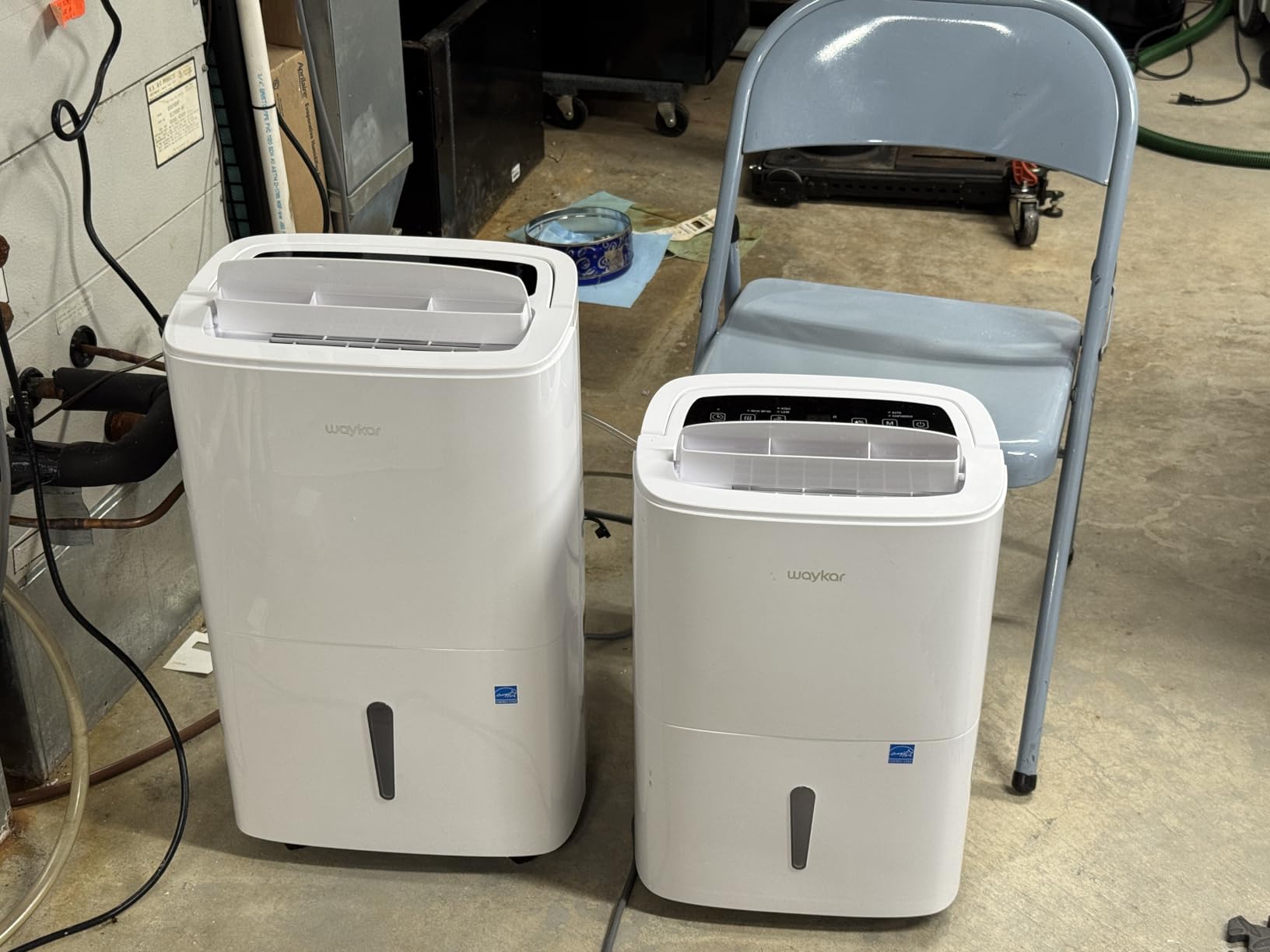
There are three drainage paths, which is unusually flexible: a built-in pump lifting up to 9.84 feet, a floor drain connection, or gravity through the included 3.3-foot hose. A visible 1.85-gallon tank sits in the front with a built-in handle if you want to run it without plumbing at all.
Two control quirks are worth knowing. The pump lift tops out at 9.84 feet, noticeably shorter than the 16.4-foot and 16.5-foot pumps on the Aiusevo and Moiswell units here, so plan your drain line before you buy. Memory restart also forgets the pump setting after an unplug, which owners find mildly annoying but fixable in the panel.
Whether the Energy Star rating saves you money in a cold room
Yes, and more than in a warm room. Compressor dehumidifiers lose capacity as temperature drops, so a unit working hard at 50F runs for far more hours per day than the same unit at 75F. The efficiency rating is doing more work in a cold space than in a typical indoor one, and the self-drying cycle reduces standby loss too.
At 520 watts, a machine cycling constantly in a damp crawlspace is a real ongoing electricity commitment. Compare the wattage figures in the table above before deciding, because the spread across this list runs from 340 watts to 860 watts.
When to skip it
If your drain point is more than ten feet above the unit’s base or well away from a floor drain, the short pump lift will not reach. Crawl spaces with a sump pump uphill from the machine are the classic case, and the Aiusevo AS600 or Moiswell Defender MP145 handle that geometry better.
The 30%-80% humidity range is also narrower than the 10%-90% offered by the larger Waykar. If you are chasing a very dry target for a wine room or a camera store, look at that model instead.
3. Moiswell Defender MP145 – 155 Pint Commercial Dehumidifier with Pump for a Cold Garage
- 4.6 stars with 83% five-star feedback
- Built-in pump lifts water 16.5 ft vertically
- R32 refrigerant with low global warming potential
- Automatic cycling
- defrost and outage restart
- Smallest review base here at 189 ratings
- 860W draw is the highest in the group
- 68-litre tank adds weight when the pump is plumbed in
The Defender MP145 has the highest average rating of any machine in this comparison at 4.6 stars, with 83% five-star feedback and only 3% one-star. It is the sibling of the Defender M145 reviewed further down, and the difference is the pump, which is precisely what a cold garage installation needs.
It moves 265 CFM of air, claims 155 pints per day and coverage to 6,000 square feet, and runs on 860 watts. The R32 refrigerant system has a much lower global warming potential than R410A and zero ozone depletion, which matters if the unit is left running continuously through many summers.
For a garage, the pump solves the problem forum users complain about most. The built-in condensate pump pushes water through a 16.5-foot hose to a vertical height of 16.5 feet, so you can discharge into a floor drain, a sump or an outdoor drainage line well away from the machine without laying hose across the floor.
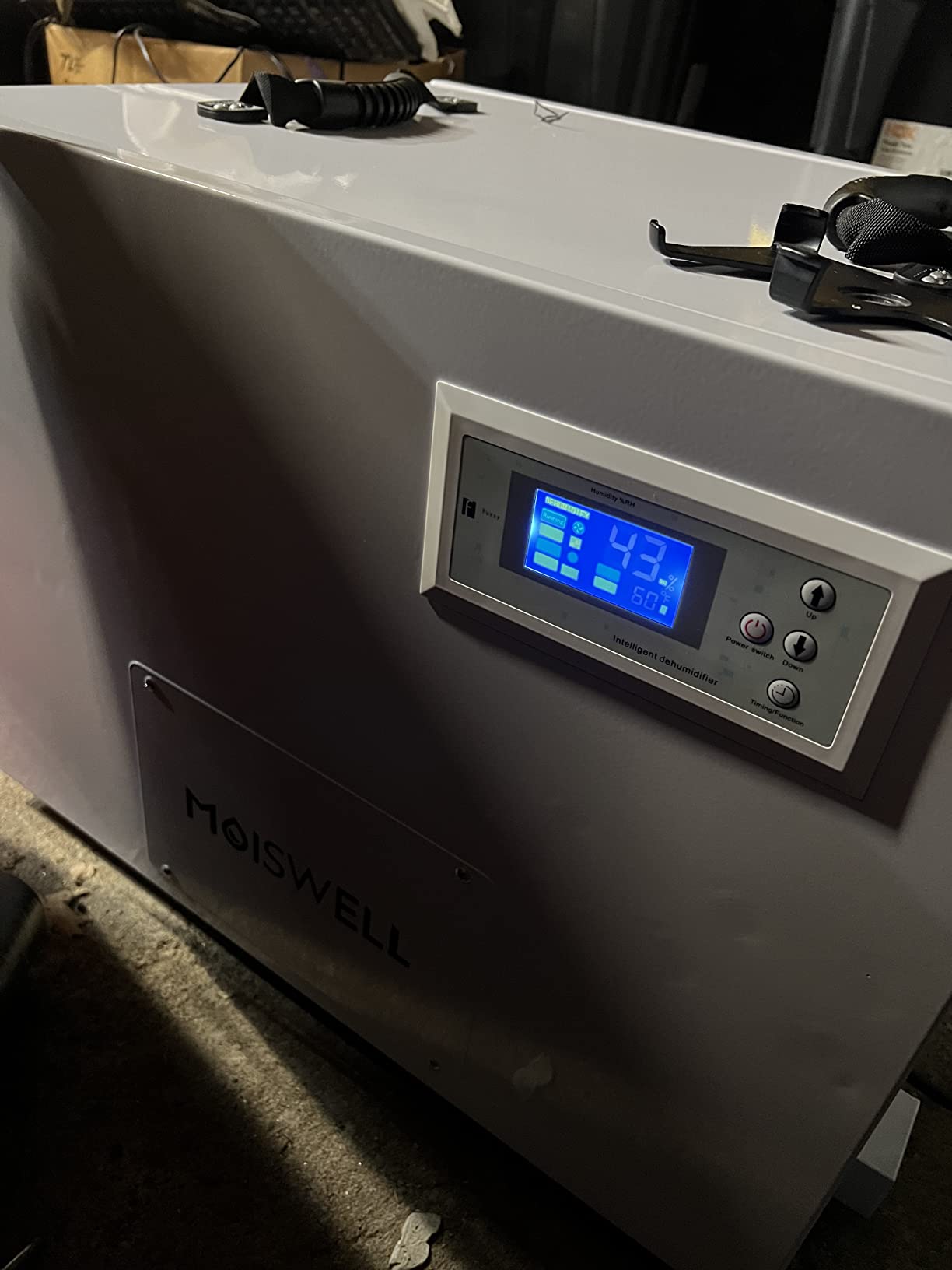
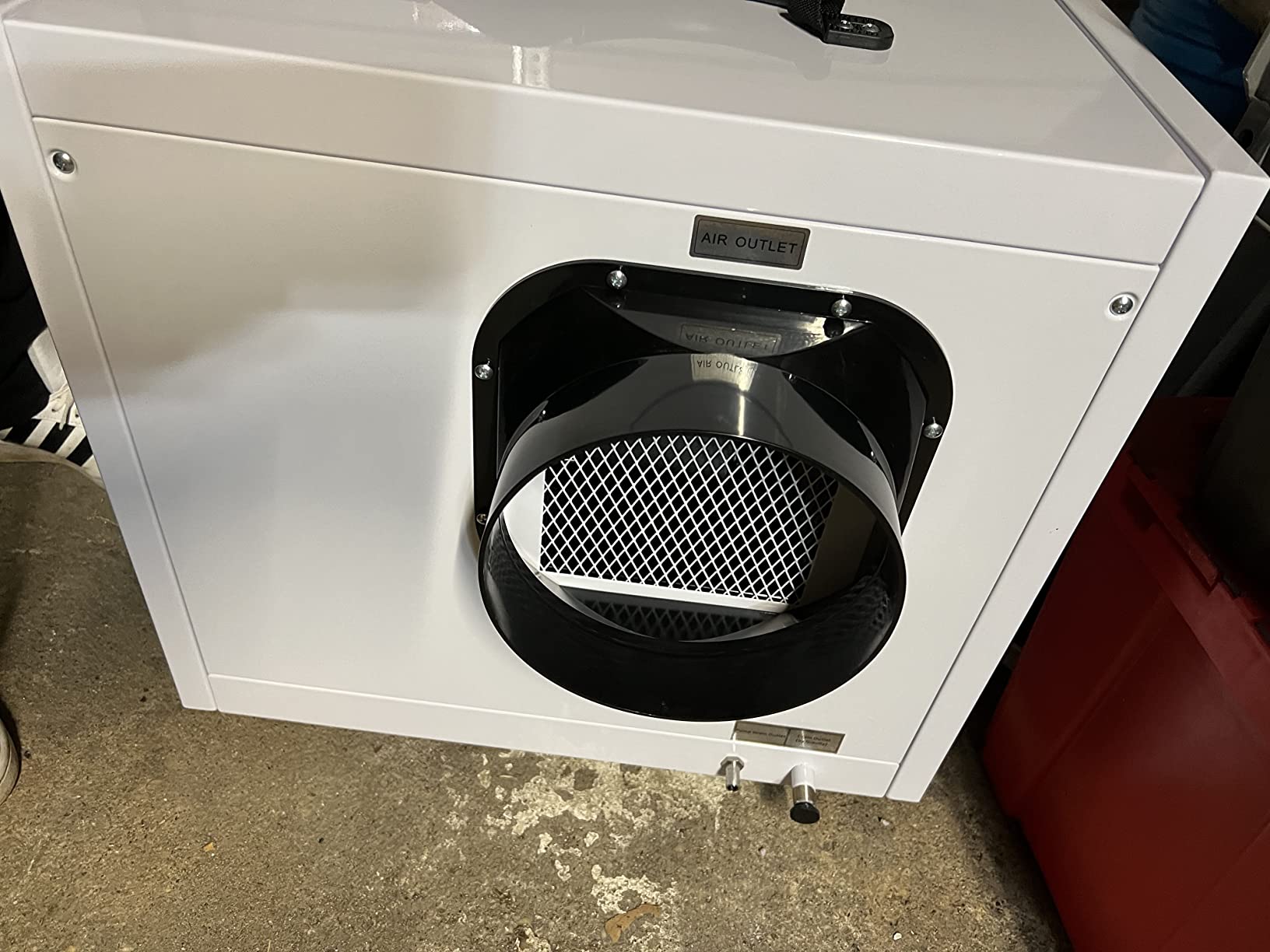
Automatic ON/OFF humidity cycling, automatic defrosting and restart after a power outage are all handled by the custom control panel, which is what you want in a space nobody checks on a regular basis. The horizontal body measures 22.5 by 14 by 14.7 inches, so it can sit flat or mount overhead between joists.
The catch is the evidence base. 189 ratings is the thinnest dataset behind a product we recommend, which means long-term failure data is simply less established than for the heavily reviewed models. Owners also report 860 watts as a real draw on a cold night, and the 68-litre tank is dead weight once the pump is permanently plumbed in.
How to size a garage unit against real garage humidity
Garages are harsher than basements because they swing through large temperature changes and often have a bare concrete floor pulling moisture from the soil. Sizing on the saturation number is a mistake across the board; the 70-pint AHAM figure is the honest comparison point, and even that assumes a comfortable indoor temperature.
The practical approach is airflow. At 265 CFM this unit moves more air than anything else in the group, and in a low-clearance garage that circulation is what actually dries the slab and the lower walls. If your garage is under 1,000 square feet, this unit is oversized and the Abestorm Guardian SN35P is a better fit.
What to watch for in a garage specifically
Drain hose freezing is the failure everyone reports. Run the hose inside a larger insulated pipe, keep the discharge point lower than the unit, and avoid routing it through a doorway where cold air pools. If the garage regularly drops below 40F, a compressor unit will spend more time in defrost than in extraction, and the desiccant options in this list will serve you better.
Protect the machine from vehicle exhaust if you run the engine inside. Dehumidification plus combustion in an enclosed space is a carbon monoxide risk that no amount of moisture control solves.
4. Aiusevo AS600 – Compact Crawlspace Unit with a 16.4 Foot Pump
75 Pints Crawl Space Dehumidifier with Pump and Drain Hose up to 4000 Sq.Ft
- Built-in pump and gravity drainage both included
- Compact body fits between floor joists
- Touchscreen with humidity target and temperature readout
- Washable filter and auto-restart after outages
- Power-on and remote behaviour is inconsistent
- Settings are lost across power cycles
- 1-year warranty is the shortest in this group
The AS600 is the value pick of the group, and the number that makes it interesting for cold rooms is the pump. It ships with both a 16.4-foot hose for pumped discharge and a 6.6-foot hose for gravity drainage, which is a more complete drainage kit than most competitors include at any point.
It claims 75 pints per day at 95F and 90% relative humidity with 200 CFM of rated circulation, covers up to 4,000 square feet, and weighs 39 pounds. The 16.5 by 13.7 by 12.5-inch footprint is one of the smaller ones here, which is exactly what you want when the opening to a crawlspace is measured in inches rather than feet.
Owners report dropping crawlspace relative humidity from around 90% to under 60% within a few days in spaces near 1,000 square feet. The touchscreen panel gives you a target humidity, a timer and a live temperature readout, and the unit supports ceiling or floor mounting on adjustable feet.
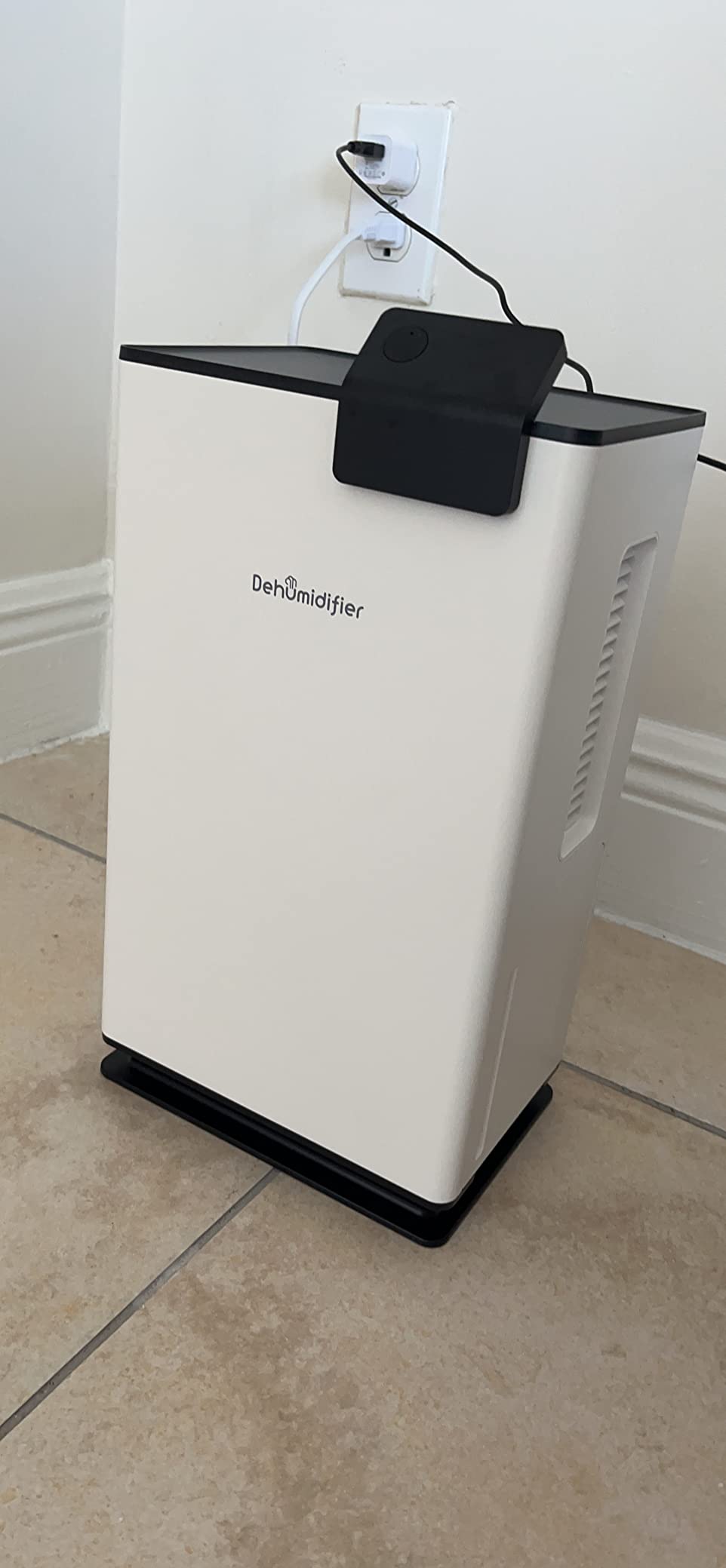
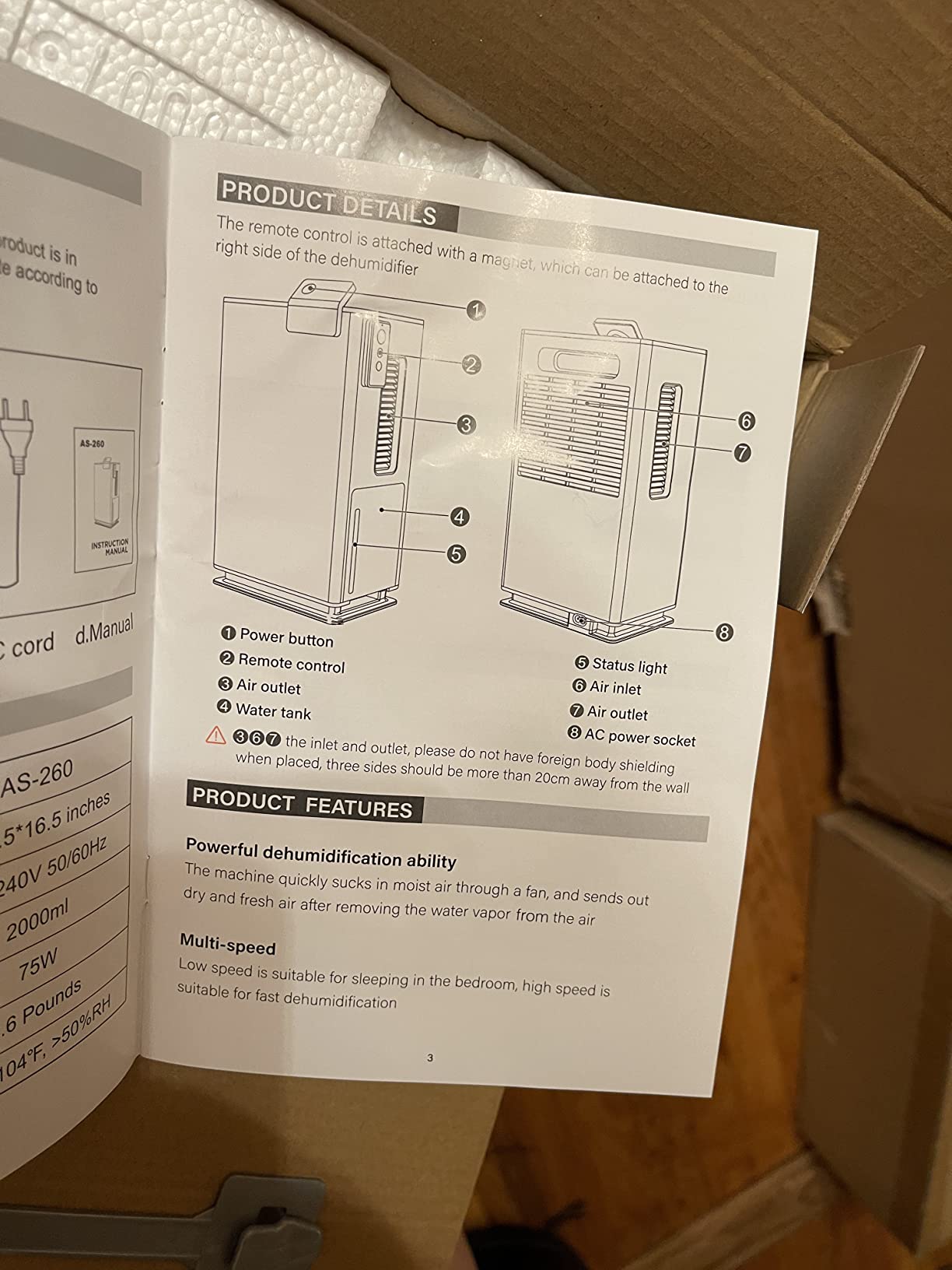
The weaknesses are electrical rather than mechanical. A recurring thread in reviews describes units that fail to power on reliably, or a remote that works only intermittently, and the remote is sold separately. Settings also fail to survive a power cycle, so the panel light has to be re-enabled each time the unit restarts.
Several reviews also describe output falling short of the advertised coverage in small spaces, and the 1-year warranty is the shortest in this group by a wide margin. For a machine expected to run unattended through a cold winter, that warranty gap is worth weighing against the pump advantage.
Whether the pump is worth more than a longer warranty
For most crawlspace installs, yes. A 16.4-foot vertical lift means you can put the machine where it pulls air best and send water to a sump or an exterior drain, which removes the single most common failure in unattended dehumidification, a full tank nobody empties.
Against that, a one-year warranty leaves you exposed if the compressor or the pump motor fails in the first cold season. Owners who value service after the sale may prefer the five-year coverage on the Moiswell or Abestorm units.
Where it does not fit
Skip it for very large crawlspaces. 200 CFM and a 75-pint headline figure are adequate for moderate areas but well short of the 265 CFM machines here, and the difference shows up in how long a large space takes to come down from saturated.
It is also the wrong tool below 40F for the same reason every compressor unit is. Auto-defrost is triggered by ambient temperature sensors and will keep the machine cycling, but it will not create extraction capacity that the coil temperature cannot support.
5. Waykar 158 Pint – Highest Capacity and Widest Humidity Range
Waykar 158 Pints Crawl Space Dehumidifier with Pump, 7500 Sq. Ft.
- Highest stated capacity pairing in the group
- Widest humidity control at 10%-90% relative humidity
- Pump drains vertically up to 16.4 ft
- 5-year compressor warranty with lifetime support
- 73.9 lbs means two people to move it
- Remote control is sold separately
- 12% one-star share hints at durability complaints
This is the unit to consider when the cold room is genuinely large. It claims 158 pints per day, covers up to 7,000 square feet and moves 205.9 CFM using a high-brush motor, and the adjustable 10% to 90% relative humidity range is wider than any other machine here, which lets you set an unusually dry target.
For cold rooms the 16.4-foot vertical pump lift is the number that matters. That is at the upper end of what these commercial units do, so a machine can sit under a deck or in a low corner and still discharge into a drain line routed above it. A 5.9-inch pipe-mounted exhaust vent is also supported for flexible layouts.
Automatic defrost, power-off memory restart, overload protection and a programmable timer cover unattended operation, and the multi-layer condenser is claimed to improve heat exchange efficiency by 20% to 30%. Warranty structure is 1 year of quality coverage, a 2-year extension and 5 years on the compressor, plus lifetime technical support.
The practical drawback is weight. At 73.9 pounds this is by far the heaviest unit in the list, and getting it down a crawlspace hatch or up basement steps will realistically take two people. Adjustable feet are said to cut noise and vibration by up to 30%, which is a nice touch in a space where a hard floor amplifies hum.
At 530 watts it also draws more power than most of its class, and the 12% one-star share is the second-highest in the group, which suggests some durability complaints. Reviewers also note the remote is sold separately and that 5.9-inch pipe fittings are an extra purchase.
When 7000 square feet of claimed coverage is real
It is not, at least not for moisture removal. That figure describes air moved across the floor area, and the same manufacturer sells this class against 500 to 1,000 square foot crawlspaces where the real work is happening. Treat the square-footage number as a guide to airflow distribution, not to extraction duty.
What the 205.9 CFM figure does tell you is that the machine can clear and re-circulate a big volume quickly, which is what you want in a large space where moisture is spread through the whole air rather than concentrated at one corner.
Who should pass on this one
Anyone with a small cold room. At 73.9 pounds and 530 watts, this is a machine for a large crawlspace or an unheated workshop floor, not a 400-square-foot garage corner. The narrower 30%-80% range on the smaller Waykar would also be wasted on a space this size.
It is also worth asking whether a whole-house solution fits better. Our guide to the best whole-house dehumidifiers covers built-in systems that tie into the ductwork and remove moisture from every cold corner at once.
6. Moiswell Defender M145 – 155 Pint Commercial Dehumidifier with Drain Hose for Crawl Spaces
Moiswell 155 Pint Commercial Dehumidifier with Drain Hose for Crawl Spaces
- Highest airflow in the comparison at 265 CFM
- Horizontal body fits between floor joists
- Energy Star certified for the capacity class
- 78% five-star share among reviews
- Gravity drain only with no built-in pump
- 860W is the largest energy draw here
- 63 lbs is heavy for a tight install
The Defender M145 is built around one number: 265 CFM of airflow, the highest in this comparison. In a crawlspace with 16 to 24 inches of clearance, moving air is most of the job, and this machine moves the most. It claims 155 pints per day at saturation, 70 pints per day at AHAM, and coverage to 6,000 square feet.
The horizontal 22.5 by 14 by 14.7-inch profile is the other reason to like it. It lies flat under joists, and the listing supports both floor installation and overhead or ceiling mounting, which gives you options when the ground is uneven or when you want the machine above the drip line rather than sitting in a wet sump corner.
It is Energy Star certified, which matters for a machine rated to run continuously, and auto-defrost, auto-drain, a 24-hour timer and auto-restart after a power outage are all standard. The warranty is 5 years, split as 2 years on the whole unit and 3 years on parts.
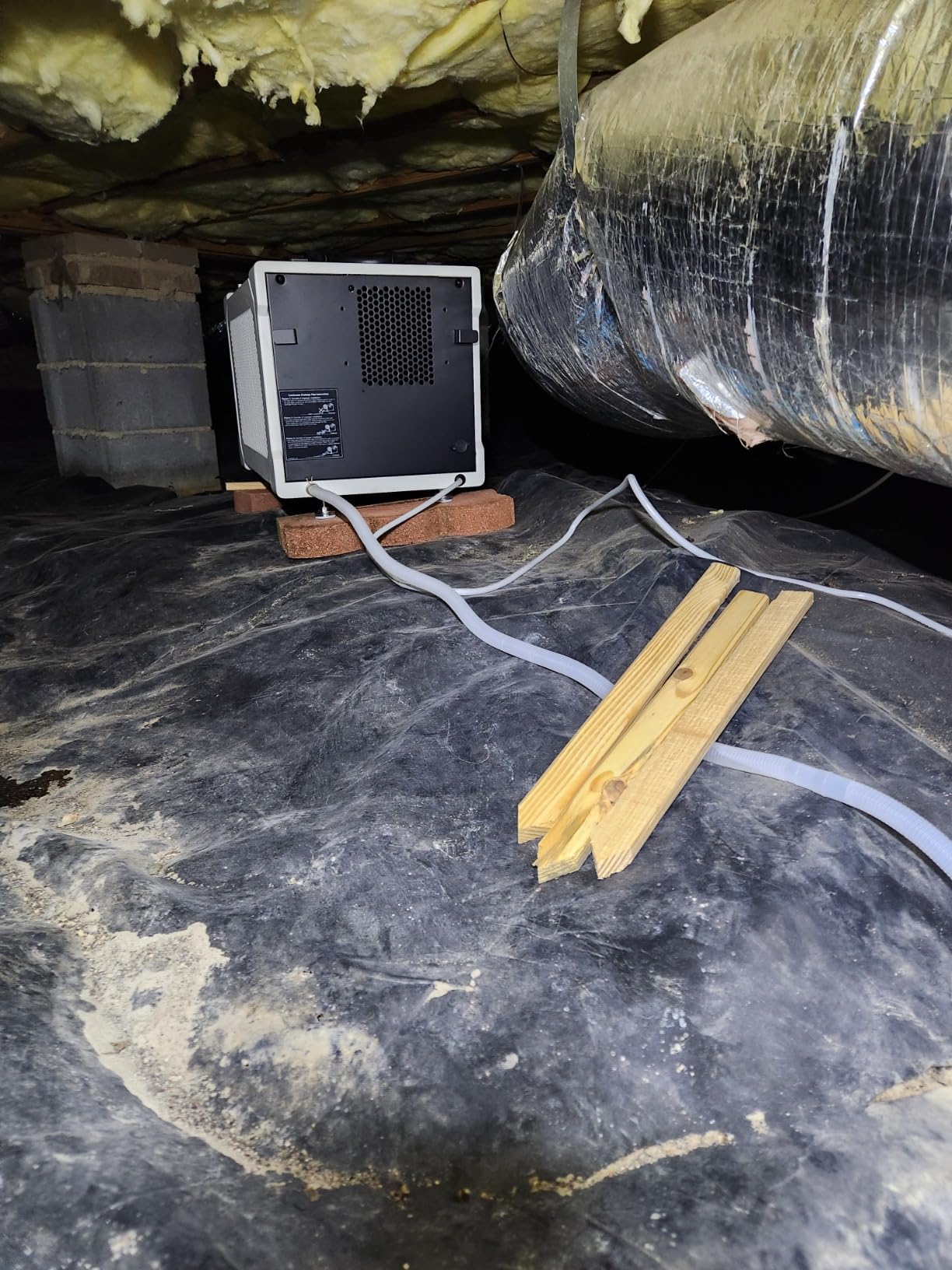
The limitation is drainage, and it is a real one. This listing drains by gravity only. There is no built-in condensate pump, so the drain point has to sit below the machine, which rules out the sump-pump geometry and the overhead discharge that the pumped Defender MP145 handles.
At 860 watts and 63 pounds, it is also the heaviest energy draw and one of the heavier physical units here. Reviewers also note that 70 pints per day at AHAM is roughly a third of the 155-pint headline number, so size on the AHAM figure.
Airflow versus extraction, and which one you should prioritise
In a cold crawl space, airflow is the better proxy. Extraction depends on coil temperature, and cold air leaves you little margin, so the machine that circulates the largest volume of air across the coldest surfaces does more useful work even at a lower pint rate.
That logic only holds if the air is moving through a space you want uniformly dry. In a garage where dampness is concentrated in one corner, capacity and drainage distance matter more than CFM, and the pumped models pull ahead.
Before you buy, check your drain geometry
Stand the machine where the condensate pan can overflow by gravity into a floor drain. If your only realistic discharge point is uphill, or a few feet to one side, choose the Defender MP145 or the Aiusevo AS600 instead of saving money on a pump you need.
One more cold-room consideration: a gravity line running through a 40F crawlspace can freeze solid. Insulate it, keep it short, and slope it continuously rather than letting it dip.
7. ALORAIR Storm LGR – Built for Low-Humidity Water Damage Work
ALORAIR 180 PPD Commercial Dehumidifier with Pump, 6-Year Limited Warranty
- LGR refrigerant keeps pulling in low-humidity conditions
- Display reports GPP and coil temp and compressor amps
- 19.6 ft hose with 14.7 ft vertical lift
- 6-year limited warranty with parts support
- Refrigerant leaks and E5 codes reported within two years
- 16% one-star share is the highest here
- Internal pump needs full disassembly to clean
The Storm LGR is the odd one out in this list, and that is why it earns a place. It uses a low grain refrigerant compressor, the same technology restoration companies put in drying equipment, which is designed to keep pulling water out of air that is already very dry. A household compressor unit stalls once relative humidity drops; an LGR unit keeps working.
It moves 210 CFM, is rated at 85 pints per day at AHAM and 180 at saturation, and covers up to 2,300 square feet. The display is the most detailed in the group, reporting grains per pound, coil temperature, compressor amperage, inlet and outlet readings and total run hours, which is genuinely useful if you are drying a space to a target rather than just making it feel less damp.
Drainage is the best-specified here: a built-in condensate pump with a 19.6-foot hose and 14.7 feet of vertical lift, plus auto-defrost, memory start, auto-restart on power failure and a washable MERV-8 slide-in filter. The 6-year limited warranty covers six years of parts on the refrigeration system.
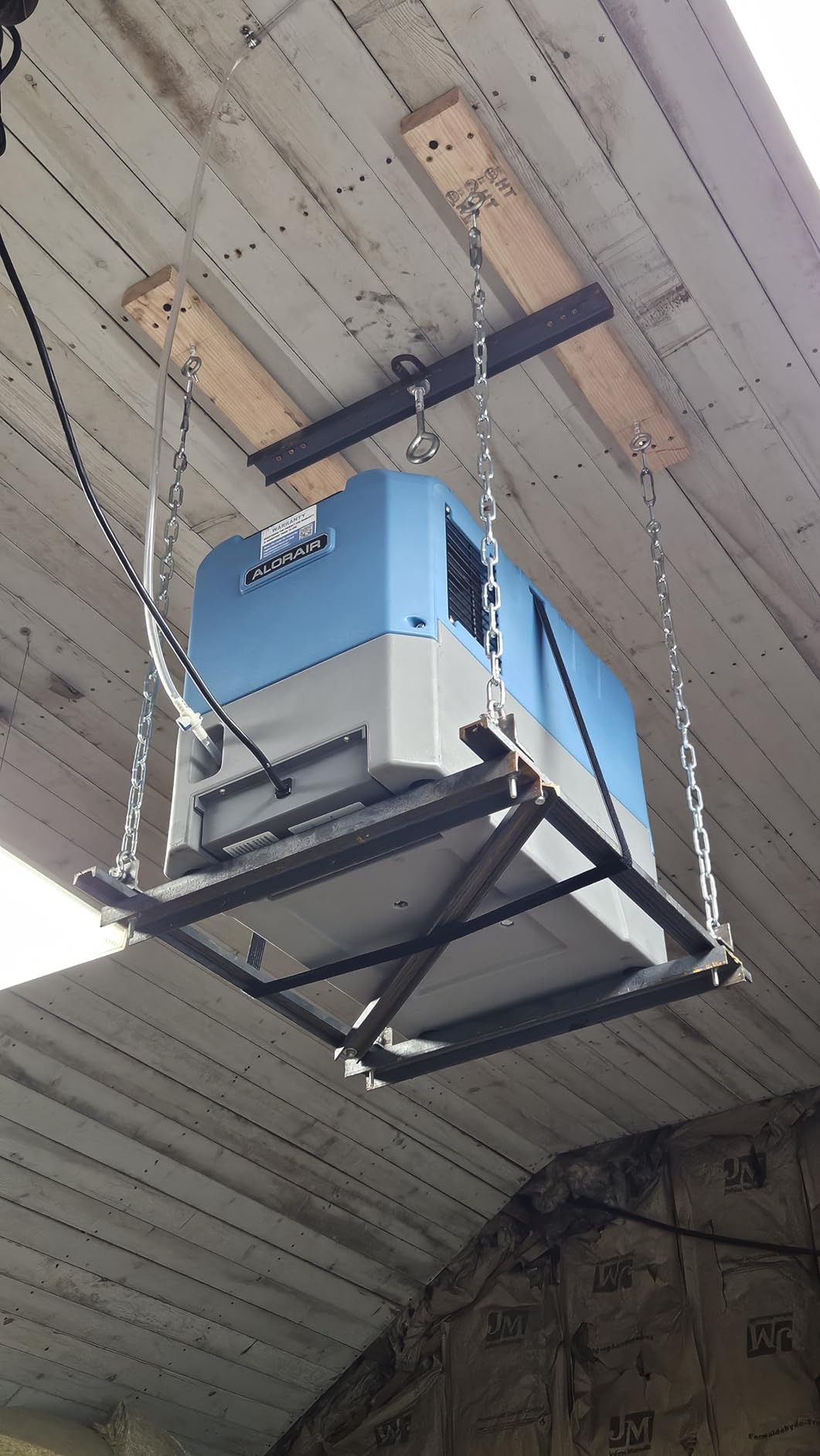
Reliability is the concern. The 16% one-star share is the highest in this list, and the critical thread is refrigerant leaks surfacing as an E5 error code within one to two years. At 64.3 pounds and 640 watts, it is also a heavy, thirsty machine for a residential crawlspace.
Owners also report that the internal pump is hard to service because it requires full disassembly, and that warranty service is parts-only, so the shipping cost lands on you. Buyers treating it as professional restoration equipment are far happier than those who expected a residential machine.
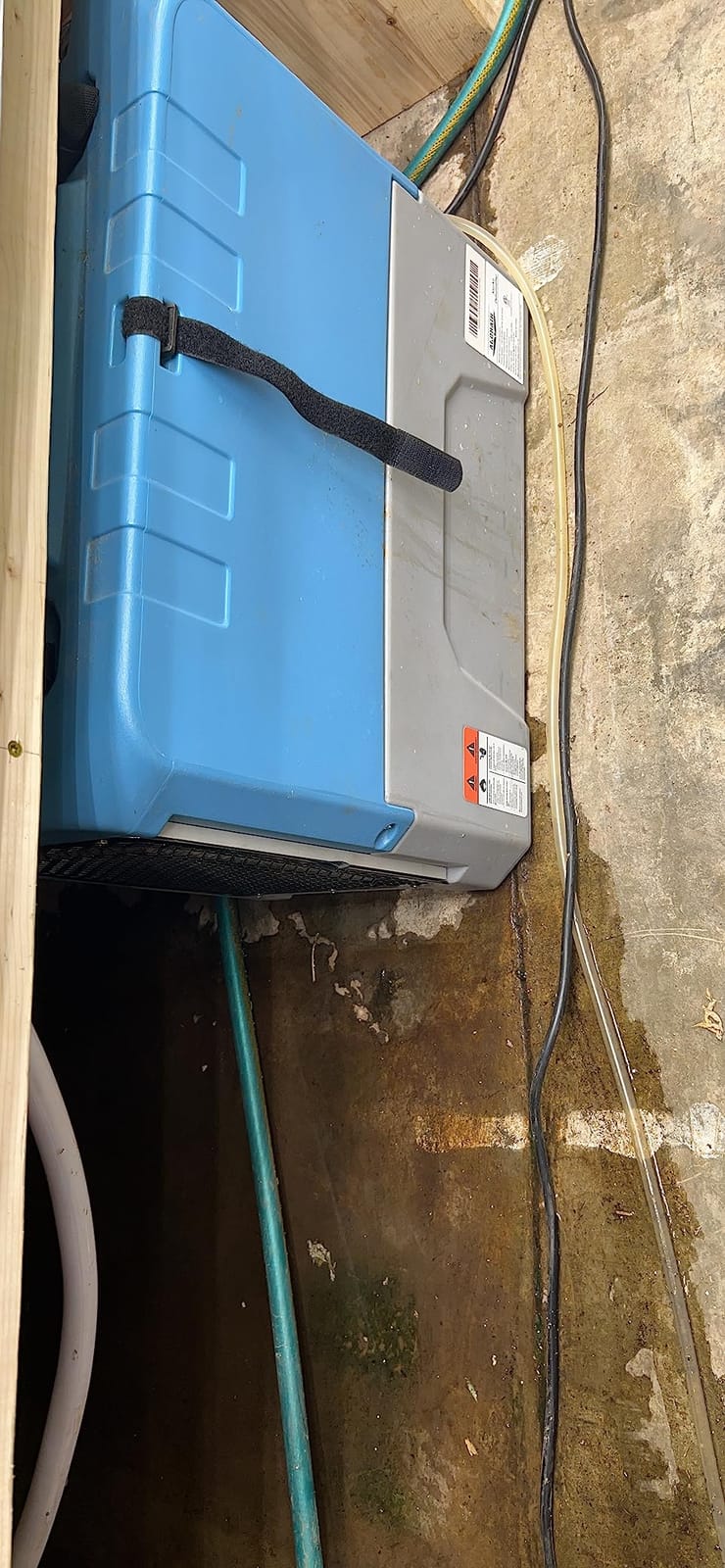
Whether you actually need low grain refrigerant technology
You need it if you are drying a space to a target dryness, restoring water damage, or running a crawl space that has already reached 50% relative humidity and needs to go lower. Below that point, standard compressor technology starts losing capacity fast.
You do not need it for seasonal humidity control in a 1,200 square foot crawl space at 70% relative humidity, where a cheaper 50-pint unit handles the load for a fraction of the running cost. This is a specialist tool and should be bought as one.
Cold-room limits you should understand
LGR does not defeat cold. The auto-defrost monitors ambient temperature, stops the compressor and runs the fan to thaw the coil, and reviewers report the coils icing below roughly 65F. Below 40F this machine will cycle without producing meaningful water, same as any compressor unit here.
It also runs at 640 watts, the second-highest draw in the group. If the plan is continuous operation through a whole cold season, model the electricity before committing.
8. Abestorm Guardian SN35P – Compact Unit for Tight Crawlspaces
Abestorm 70 PPD Dehumidifier with Pump & Hose for Crawl Space & Basement
- 15.2 inch footprint fits where larger units will not
- Choice of 19.6 ft pump drain or gravity connection
- Reported to hold 45%-55% humidity on long runs
- Responsive warranty service with free replacement filters
- Reliability reports of units failing within a year
- 16% one-star share
- 70-pint claim is saturation only and AHAM is 35 PPD
When the access hatch is the problem, size of the machine is the only spec that matters. The Guardian SN35P measures 15.2 by 11.4 by 11.2 inches, which is small enough to pass through a tight crawlspace opening where a 22-inch-deep commercial cabinet simply will not go, and at 38.2 pounds one person can place it.
It covers up to 1,000 square feet, moves 130 CFM, and is rated at 35 pints per day under AHAM conditions. The built-in condensate pump lifts water 19.6 feet, the longest vertical lift in this group, with a gravity drain connection as an alternative.
Satisfied owners report stable 45% to 55% relative humidity in basements and crawlspaces across long daily runs, and the machine auto-stops at the setpoint and restarts when humidity rises, including after a power interruption. Customer service is frequently praised for honouring the 5-year warranty and sending replacement filters at no charge.
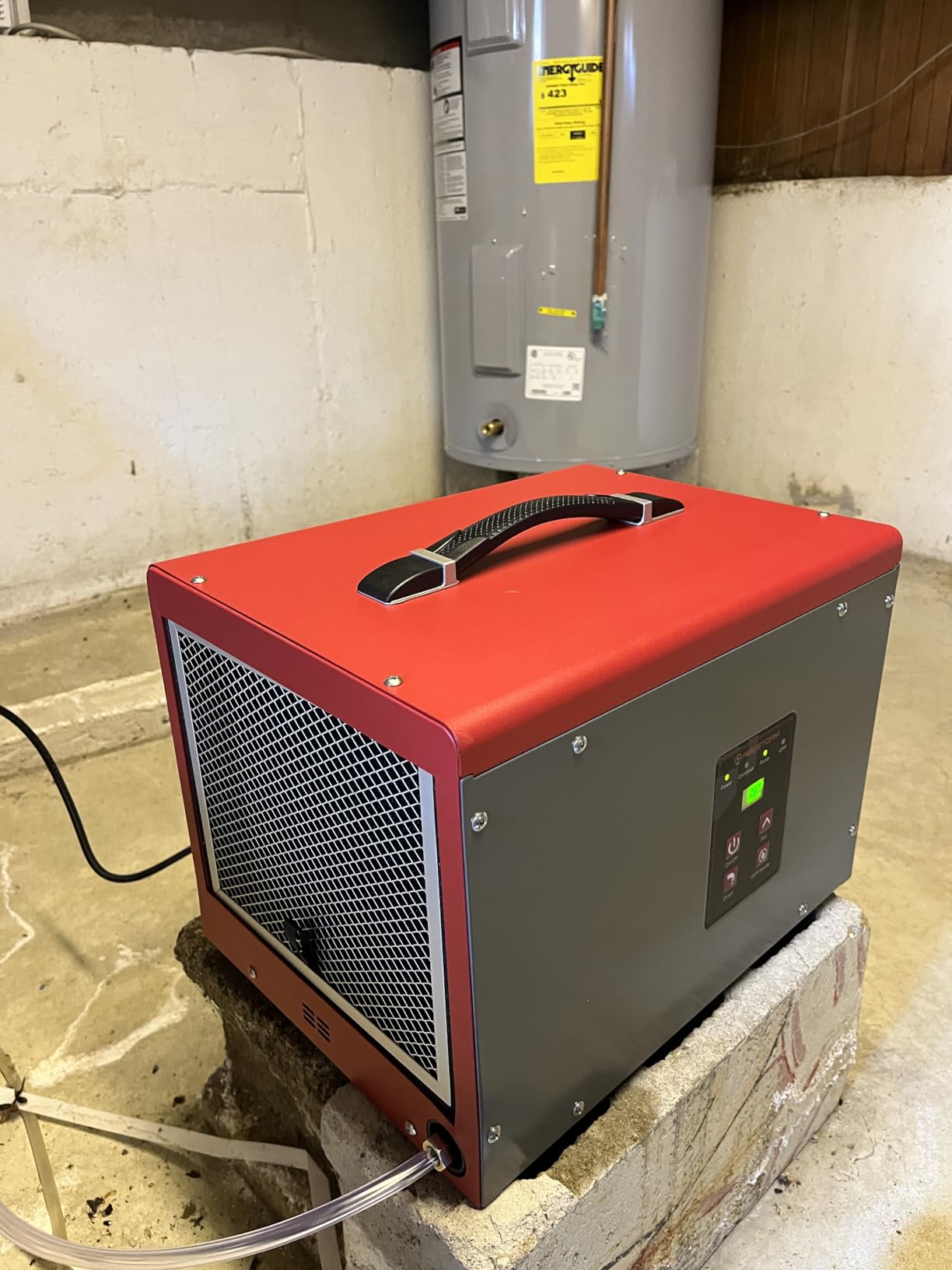
Reliability is the recurring negative. Several reports describe units that stopped condensing between 6 and 16 months, one attributed to a refrigerant leak, and the 16% one-star share is tied for the highest in this list alongside the ALORAIR Storm LGR. The warranty also does not cover return shipping on a unit of this weight, which puts a real cost on any claim.
Buyers also note that the 70-pint headline is a saturation figure and that real output matched a cheaper 50-pint residential unit, and that the buttons are not intuitive without the manual. Against that, the footprint and the pump reach are genuinely hard to get elsewhere.
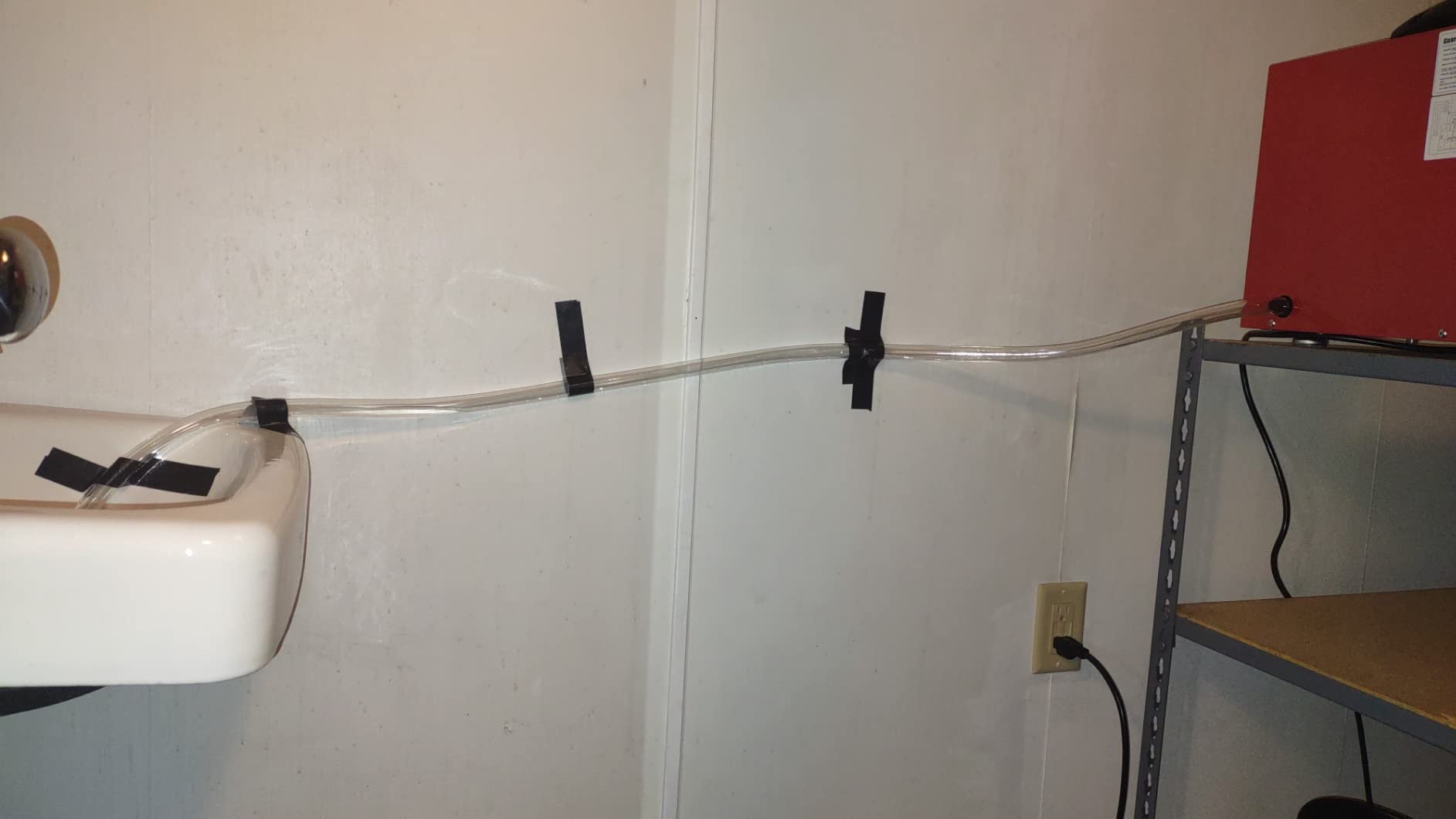
How to decide if 1000 square feet is enough coverage
Count the actual footprint of the crawl space, not the floor area of the house above it. 1,000 square feet covers a typical single-room crawl space with moderate moisture loading, and it will not keep up with a space that has an open stairwell, a chimney chase or active water ingress.
The 45% to 55% target band is also the right goal. Sustained relative humidity above 60% in a cold crawl space is where mold and mildew start, and the EPA’s long-standing guidance treats 60% as the threshold worth staying under.
When a small unit is the wrong answer
If the space is large and damp, a 130 CFM machine will run continuously and still lose the battle, which accelerates the reliability problems owners report. Bigger airflow, not bigger tank, is what makes a difference in confined spaces.
This is also the wrong machine for a sub-40F room for the usual reason, and the 1-year return shipping exclusion on warranty claims makes it a harder sell for a machine intended to sit unattended in a crawl space all winter.
9. Ivation 13-Pint Desiccant – The Quiet Choice for Closets and Attics
- No compressor
- so no coil can frost at 33F
- 14 lbs and quiet enough for closets and attics
- Switchable reservoir or included continuous drain hose
- Tilt and overflow auto-stop protects uneven floors
- Covers only about 270 square feet
- 13-pint rating is measured at 60% relative humidity
- Adds heat to the room while operating
This is the specialist. Where every other machine in this list depends on a refrigerant coil, the Ivation IVADDH06 uses a desiccant rotor, which means there is no coil, no compressor and nothing that can freeze. The stated operating range runs from 33F to 104F, and owners treat it as the go-to answer for attics, closets, small crawl spaces and unheated rooms that routinely drop below 40F.
It removes up to 13 pints per day at 60% relative humidity and 68F across spaces up to 270 square feet. At 14 pounds and 6.85 by 10.6 by 17.35 inches it is easy to carry between spaces, and it runs at 470 watts on high or 280 watts on low.
The LCD panel gives you six touch buttons, a humidity target, a 1-to-12-hour timer, sleep mode and vent swing with a Fahrenheit or Celsius toggle. Water goes into a removable 3.8-pint reservoir or continuously through the included hose, and tilt and overflow auto-stop handles uneven floors.
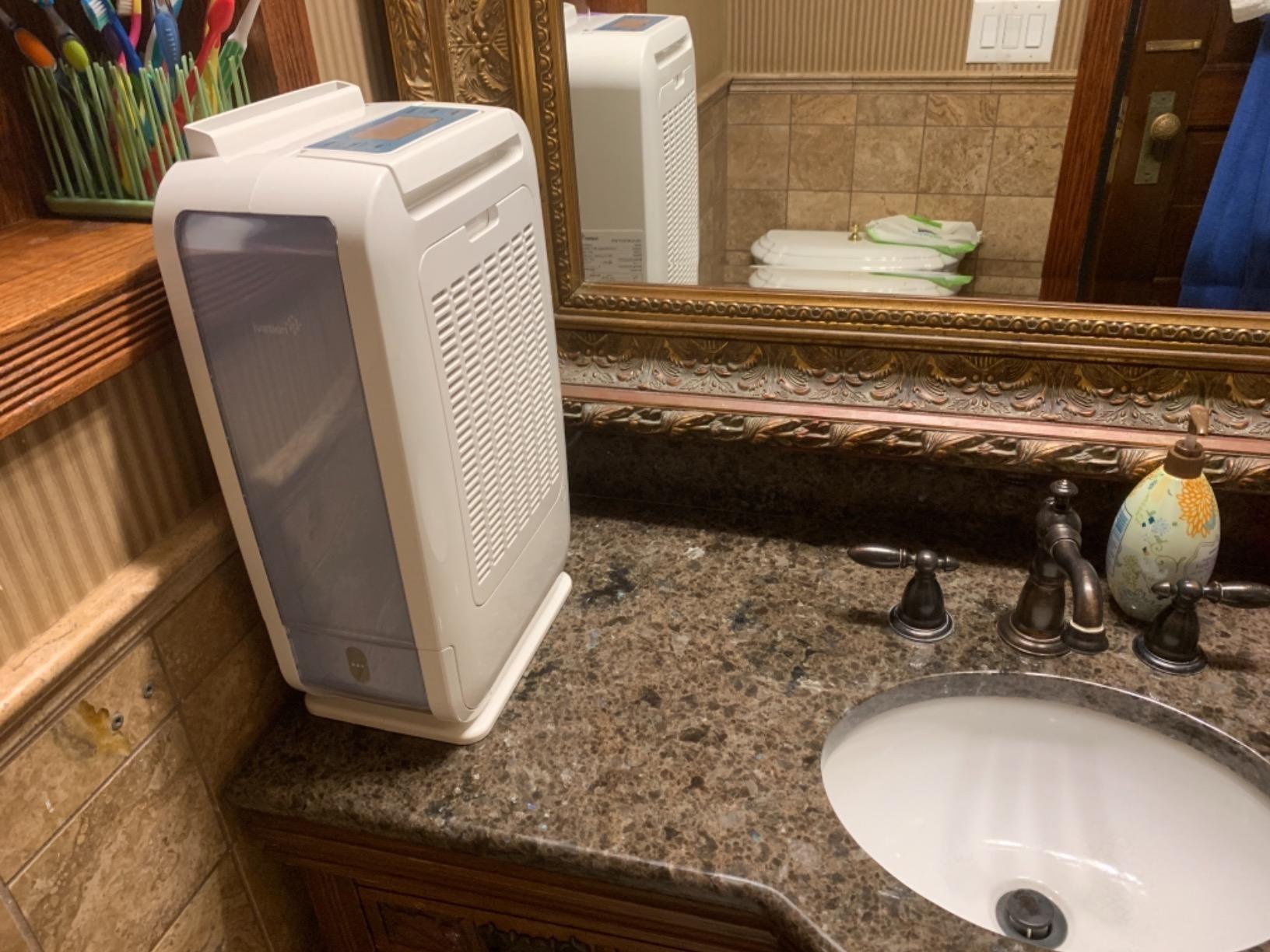
The ceiling is hard and it is capacity. 270 square feet is a closet, a bathroom, a wine closet or a single crawl space bay, not a basement. If your cold room is more than a small room, this machine is not the answer no matter how well it handles the temperature.
The 13-pint rating is also measured at 60% relative humidity, which is a realistic test condition, and real output in a genuinely damp room is lower still. Be aware that desiccant regeneration adds heat to the room, which helps in winter and hurts in summer.
When desiccant is the correct technology
Choose it when the room regularly goes below 40F, when the space is small, and when noise matters. At these sizes a compressor unit is often oversized anyway, and the desiccant approach removes the coil icing question entirely rather than managing it.
Typical fits include a vehicle storage bay, an attic, a closet in an unheated cabin, a small workshop and an RV. Anywhere the temperature is the constraint rather than the volume, this category wins.
When it is the wrong technology
It is wrong for any space larger than roughly 300 square feet, and wrong for a large basement where you need real pints per day. It is also the more expensive route per pint of water removed, since the resistive regeneration heater runs continuously.
If the space is air-conditioned in summer, weigh the added heat carefully. A desiccant unit in a conditioned room works against the air conditioning rather than with it.
10. AEOCKY X1-Pro – Rotary Desiccant at 25 dB for Bedrooms and RVs
AEOCKY 2000 Sq.Ft Rotary Desiccant Dehumidifier, Humidistat, Never Frost
- Rotary desiccant core never frosts
- 25 dB in sleep mode suits bedrooms
- 8.8 lbs makes it the lightest machine here
- 85oz tank plus drain hose for continuous running
- Adds noticeable heat to the room
- New-unit smell lingers for sensitive users
- 2000 sq ft claim is optimistic and water freezes below 34F
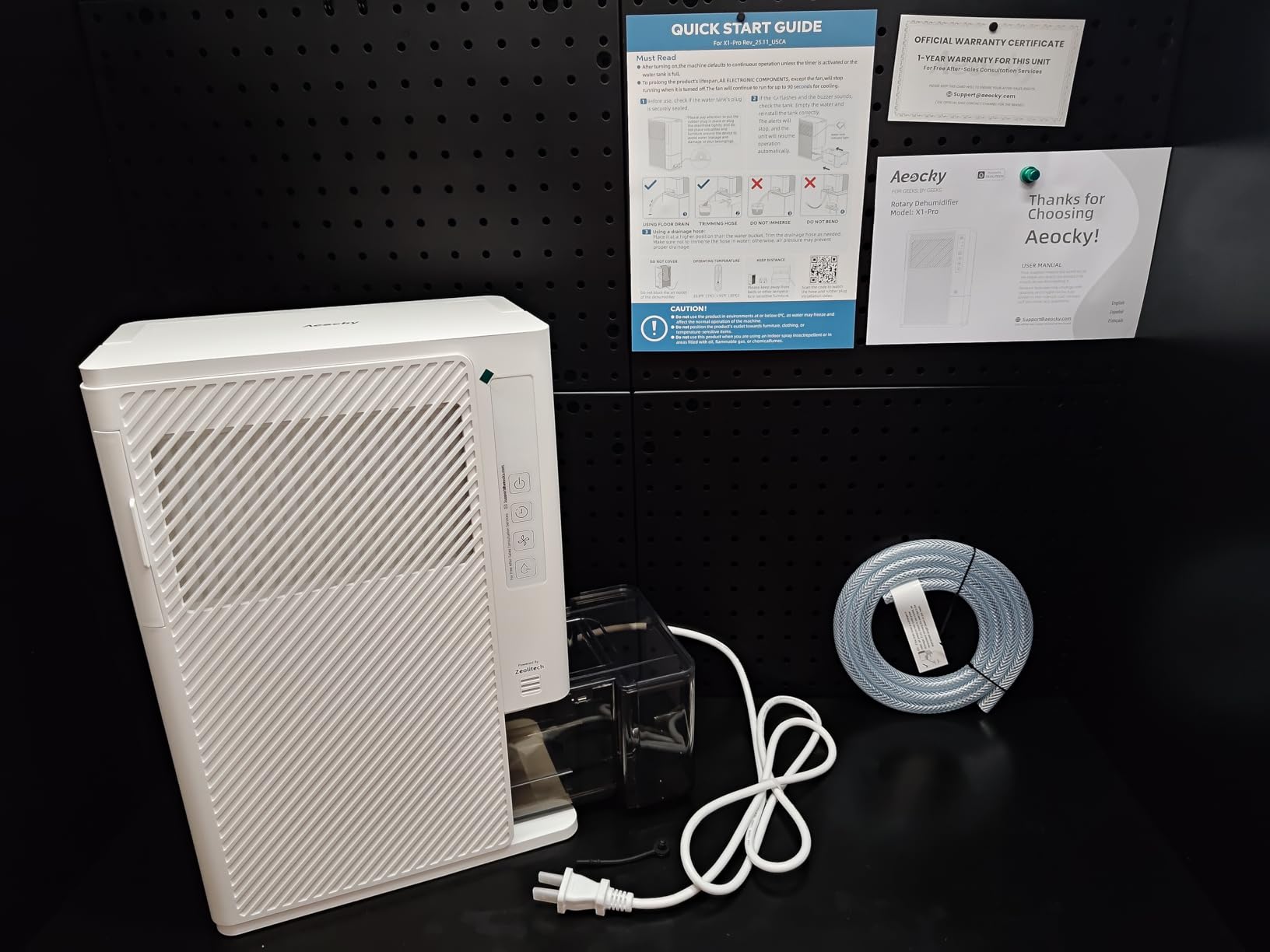
The X1-Pro uses a rotary desiccant rotor with molecular sieve or zeolite, regenerating on a 340-watt heat cycle. Like the Ivation above, it has no compressor and no cold coil, so the core never frosts. The listed optimal range is 34F to 95F.
It is the quietest and lightest machine in this comparison by a distance. At 8.8 pounds and 11.8 by 6.3 by 15.4 inches with a built-in carry handle, it moves between a bedroom, an RV and an attic easily, and it measures 39 dB at maximum output from three feet, dropping to 25 dB in sleep mode. That is genuinely usable in a sleeping space.
Controls are better than most small units offer: a humidistat with 40% to 80% setting in 5% increments, a 24-hour auto-off timer and a dedicated sleep mode. Water collects in an 85-ounce tank or drains continuously through the included 4.9-foot hose, with auto shut-off as a failsafe.
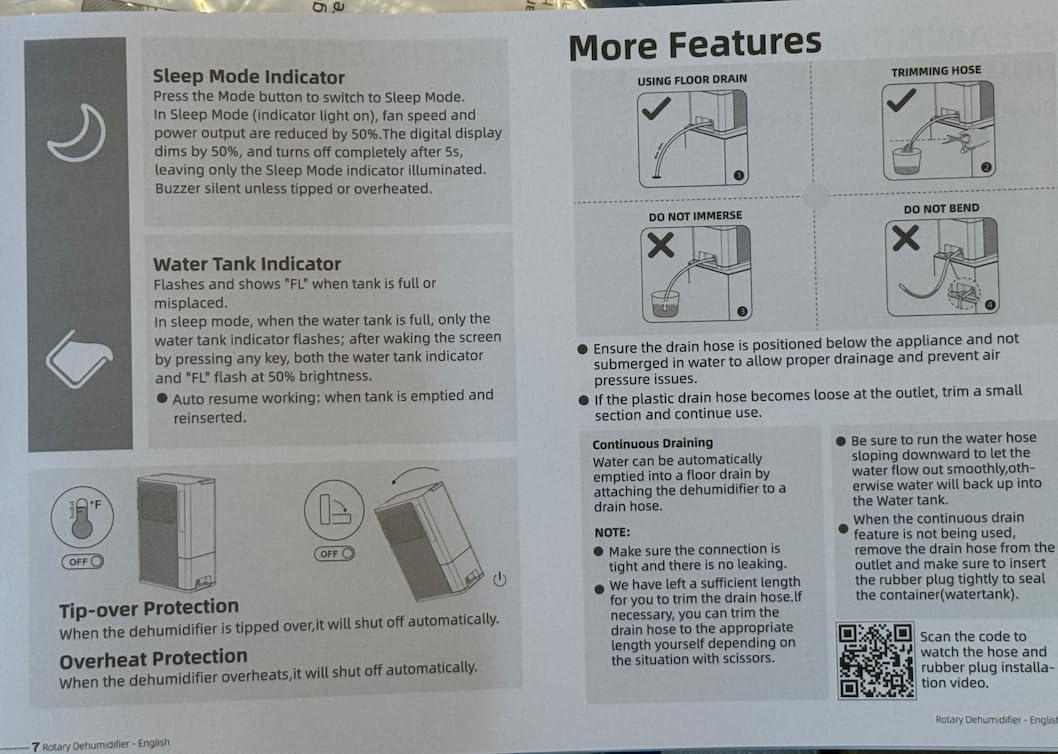
Output is modest. The 10-pint-per-day figure is a lab peak at 95F and 90% relative humidity, and around 5 pints per day is more realistic at 86F and 80%. Owners report pulling roughly a gallon a day from a small basement and holding an RV at 50% relative humidity, which is the use case this machine fits.
Buyers also flag the square-footage claim as optimistic, with one unable to reach 52% relative humidity in 400 square feet, and a persistent manufacturing oil or glue odour on new units. It is the newest brand here with the smallest review base and only a 1-year warranty, so treat long-term durability as unproven.
Whether a rotary desiccant unit can replace a compressor unit
For small spaces, frequently yes. Below roughly 400 square feet, a rotary desiccant machine can hold a space at a comfortable humidity level without any coil icing risk at all, and it does it more quietly than almost anything you can buy.
For anything larger, no. At around 5 pints per day in realistic conditions, the water removal rate simply does not scale to a basement or a garage, and you would end up running it continuously without ever catching up.
The heat trade-off in a bedroom or RV
This is the same caveat as any desiccant unit, and it matters more here because the machine is small enough to put in a room you occupy. A 340-watt resistive heater adds measurable warmth, which is welcome in a cold RV in winter and unwelcome in a bedroom in July.
Note also that the core stays frost-free but collected water still freezes below 34F, so in a truly unheated space over winter you should plumb it to continuous drainage rather than relying on the tank.
How to Size a Dehumidifier for a Cold Room
Size on AHAM capacity, not the saturation number. Under the current DOE standard, a manufacturer quoting 70 pints per day is claiming the rate at 86F and 60% relative humidity, which is close to real basement conditions. The much larger figure on the front of the box is measured at 95F and 90% relative humidity, a condition that rarely exists outside a Florida summer. The gap between the two is where disappointed owners come from.
Then adjust for the cold. A compressor unit rated at 70 pints per day at 86F will deliver far less at 50F, and close to nothing at 40F, because the defrost cycles consume operating time. If your space sits in the 50 to 60F band most of the year, choosing one size up from the AHAM rating is reasonable. If it regularly drops into the 30s, no compressor size solves the problem.
Next, look at airflow rather than capacity for confined spaces. CFM figures tell you how well a machine will circulate air through a low-clearance crawl space, and the 265 CFM machines here are the right choice for joist spaces. In an open garage, drainage distance and pump lift usually matter more.
Check the minimum operating temperature before anything else. A unit with no published low-temperature rating will not do what you need. Every machine in the table above has auto-defrost, and the two desiccant options have no coil to freeze.
Drainage is where most cold-room installs fail. Gravity drain needs a floor drain below the unit. A built-in pump with a 16-foot or greater vertical lift lets you place the machine where the air is worst and route the line to a sump or an exterior drain, which is the difference between set-and-forget and a bucket that fills in a week.
Finally, look at energy draw. The spread here runs from 340 watts to 860 watts, and a machine running 20 hours a day in a damp crawl space is a meaningful ongoing cost. Energy Star certification on the two Moiswell units and the Waykar YDZ-150PM is worth paying attention to for exactly this reason.
Compressor or Desiccant: Which One Wins in Cold Rooms
Pick a desiccant machine when the room regularly drops below 40F, when the space is under roughly 400 square feet, when noise is the priority, or when the room is air-conditioned in summer and you do not want a compressor adding heat.
Pick a compressor machine when the room stays above 45F, when the space is larger than 400 square feet, when you need real extraction from damp surfaces, or when you want the option of whole-house-style capacity. Every compressor unit here includes auto-defrost, which is what keeps the coil clear in the 45 to 60F band.
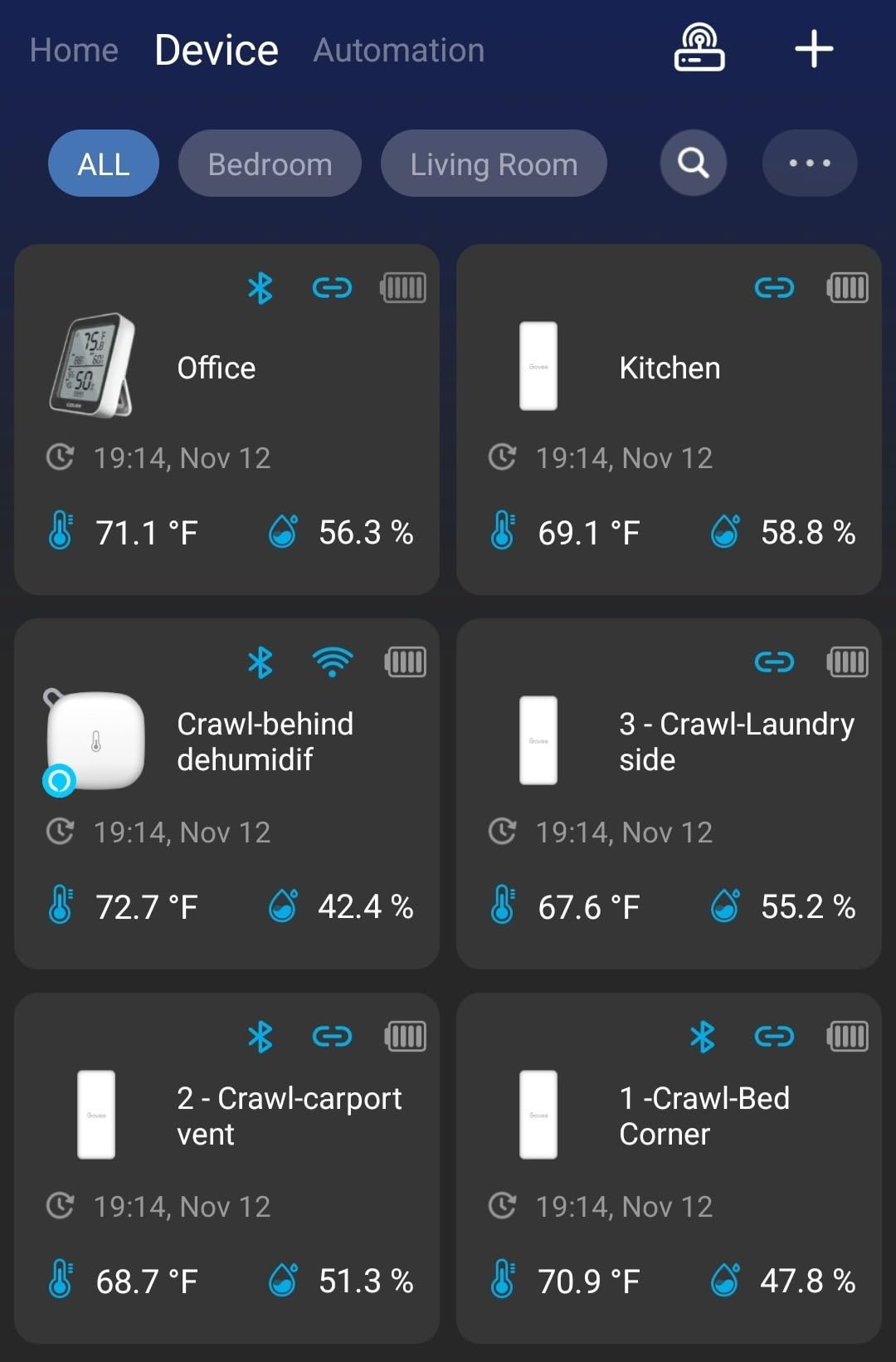
The honest middle ground is the band between 40F and 50F. Compressor units with auto-defrost work there, and so do desiccant machines, but the compressor units will spend a meaningful share of their time in defrost. If you measure your space with a cheap hygrometer across a cold week before buying, that measurement will tell you more than any spec sheet.
Forum consensus supports this framing. Users with garages that hit 34F consistently report that compressor units simply ice up and that desiccant was the only approach that kept working, while owners with 55F basements report good results from auto-defrost units. Both experiences are correct, because they are different temperatures.
Drainage, Buckets and Freeze Prevention in Unheated Spaces
Bucket emptying is the single most common complaint in cold, damp spaces, and in a room nobody visits it is the most common failure. Two of the units here are tankless, and six more have a built-in pump. Only the Moiswell Defender M145 relies on gravity alone.
For a space below 40F, plumb to continuous drainage and treat the tank as a backup rather than the primary path. A 3.8-pint reservoir in a damp crawl space can fill in a day, and a frozen full reservoir can crack.
Protect the drain line. Run it inside a larger insulated pipe, keep the discharge point lower than the machine, maintain a continuous downward slope, and avoid routing it through a doorway where cold air pools. This is the fix for the frozen-hose reports that appear repeatedly in cold garage threads.
If you must use a bucket, place the unit where the air is driest rather than where the moisture is heaviest, set the target humidity as high as you can tolerate, and set a reminder. On the Ivation and AEOCKY units, a timer and sleep mode help cut duty cycle in spaces that only need maintenance-level humidity.
Maintenance and Safety for Cold-Room Dehumidifiers
Clean the filter on a schedule. A clogged filter in a cold space restricts airflow, which lowers coil temperature, which makes icing more likely, which means more defrost cycles. The washable filters on the Moiswell, Aiusevo and Abestorm units can be rinsed; the MERV filters on the ALORAIR units are replacements and cost more per change.
Keep the coil clean. Vacuum the fins gently every few months in a crawl space, where dust and cobwebs accumulate fast. A dusty coil cuts heat transfer and forces the compressor to work longer for less water.
Sanitise the tank and drain line. Biofilm grows in warm stagnant water, and in a cold room the water sits for weeks. Empty and rinse the tank, and flush the drain line before it develops an odour that will transfer to everything stored nearby.
Check for recalls before you buy, every time. Search the model number in the CPSC recall database at cpsc.gov and read the entry rather than the headline. Fire-safety recalls have affected dehumidifiers from several major brands, and a recall is a recall regardless of how good the unit performs in cold conditions. The ALORAIR models here have long warranty structures worth confirming against any open recall history.
Finally, never run a combustion engine in the same enclosed space as a running dehumidifier, and leave clearance around the intake and outlet so the airflow figures in this guide actually apply.
Frequently Asked Questions
What type of dehumidifier is best for cold rooms?
A compressor unit rated for cold operation, meaning it has an automatic defrost cycle triggered by coil temperature sensors, is the right choice for most cold rooms. It pulls far more water per day than any desiccant machine. If the room regularly drops below 40F, switch to a desiccant rotor unit, which has no refrigerant coil and therefore nothing to freeze.
Will a dehumidifier work in 40 degree weather?
It will run, but a standard compressor unit loses most of its capacity near 40F because the evaporator coil drops to the frost point and the machine spends much of its time in defrost instead of extracting. A desiccant rotor unit such as the Ivation IVADDH06, rated to 33F, or the AEOCKY X1-Pro, rated from 34F, is the practical answer at that temperature.
Why is frost or ice forming on my dehumidifier coils?
The cold refrigerant in the coil has dropped below the freezing point of the surrounding air, so moisture in the room freezes onto the fins. This is normal below roughly 60 to 65F and is why cold-room units have automatic defrost. Persistent ice that does not clear points to low refrigerant charge or a failing coil temperature sensor, both of which need service.
What does auto defrost do on a dehumidifier?
Temperature sensors detect a cold coil, stop the compressor and keep the fan running so ambient warmth melts the ice off the fins. Once the coil clears, the compressor restarts. The trade-off is that the machine is not removing water during defrost, so real cold-weather output is lower than the rated pints per day.
Is a dehumidifier suitable for a cold garage?
Yes, provided you choose for the temperature rather than the square footage. A compressor unit with auto-defrost and a built-in condensate pump is the practical answer for a garage that stays above 40F. Below that, use a desiccant unit. A dehumidifier also adds heat to a cold garage, which is a bonus in winter and a cost in summer.
How do I size a dehumidifier for a cold basement?
Use the AHAM capacity rating rather than the saturation figure printed on the box, then move up one size if the basement stays in the 50 to 60F range all year, since output falls as temperature drops. For a crawl space, compare airflow in CFM instead. If the space regularly goes below 40F, capacity is not the deciding factor, technology is.
Our Final Verdict for Cold Rooms in 2026
The best dehumidifiers for cold rooms are not the biggest ones on the market, they are the ones whose technology matches your lowest recorded temperature. For most crawlspaces and unheated basements, the ALORAIR Sentinel HD55 is our pick: metal construction, 53 pints per day at AHAM, automatic defrost, continuous drainage and a 6-year limited warranty behind the best review base in this comparison.
For a cold garage, choose the Moiswell Defender MP145, where the 16.5-foot pump lift and 265 CFM airflow handle both the drainage geometry and the circulation a bare concrete slab demands. If you want the strongest efficiency story for a damp basement and the machine is staying put, the Energy Star certified Waykar YDZ-150PM runs cooler on electricity than most of its class.
And if your cold room drops below 40F, stop looking at compressor machines. The Ivation IVADDH06 and the AEOCKY X1-Pro are desiccant units with no coil to freeze, and they are the only two in this roundup we would trust in a space that regularly sees freezing nights. Measure the room with a hygrometer for a week before you buy, then pick the drainage method first and the machine second.