
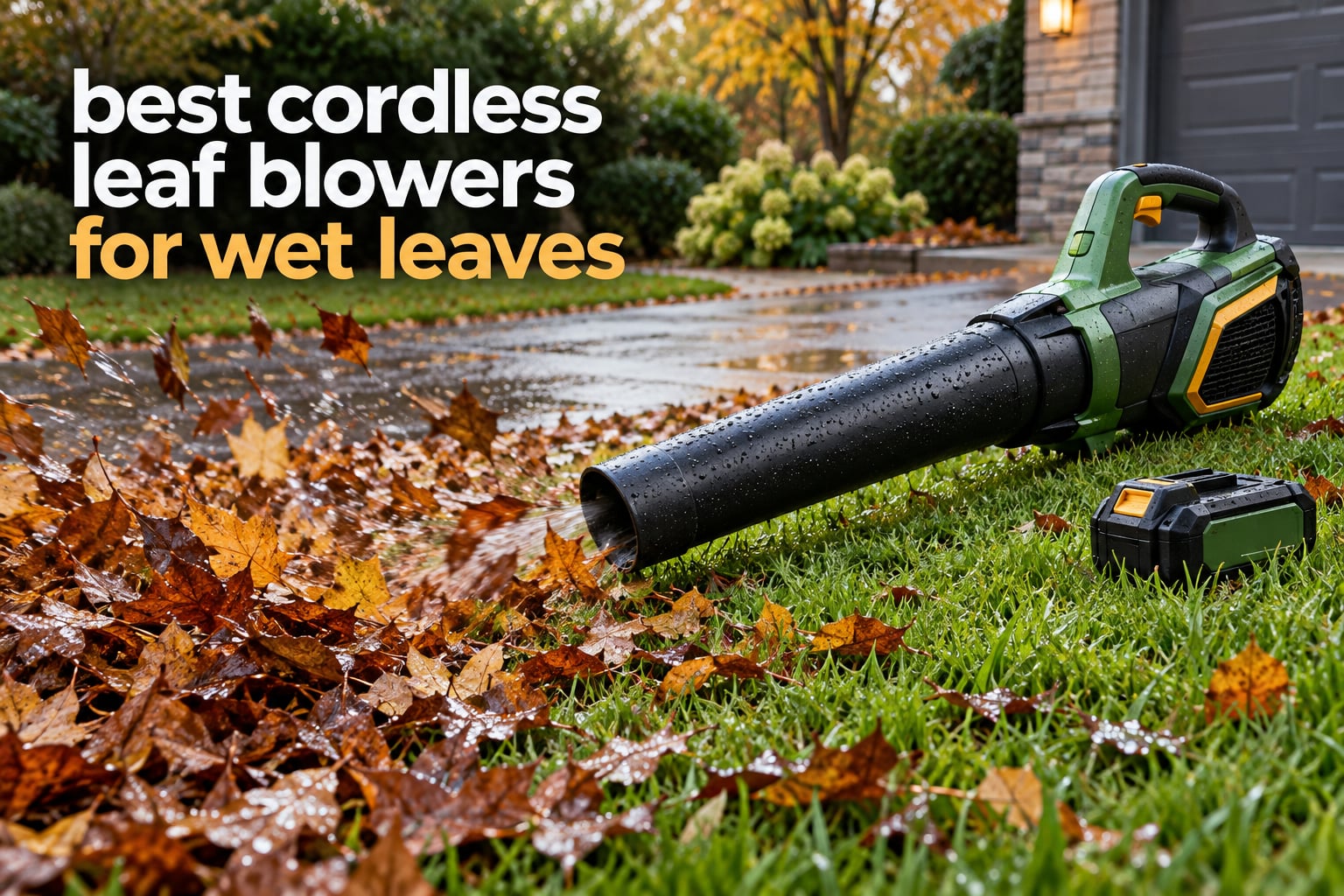
Yes, you can use a leaf blower when leaves are wet, but only if the machine has enough airflow and blowing force to lift a water-heavy pile off the ground. Dry debris moves in seconds; soaked, matted leaves often need a high-output blower on turbo and a second pass. We spent weeks comparing ten cordless blowers on exactly this kind of wet, matted debris so you can see which ones actually shift a soaked carpet and which ones just push the top layer around.
The reason wet leaves behave so differently comes down to water. A soaked leaf can weigh several times what the same leaf weighs dry, and it welds itself to grass blades and to its neighbours. Air that lifts dry material in one pass will leave a damp mat sitting in place unless the blower combines high air speed with serious airflow volume.
We compared the ten picks below on the metrics that matter for wet work: CFM, air speed in MPH, blowing force, weight, runtime and noise. If you want the general best-of list instead, read our cordless leaf blower roundup. If your yard is big enough that you are thinking about a harness rather than a handheld, our backpack blower picks are worth a look too.
Ten blowers is a lot to sort through, so the short version is this: the EGO POWER+ 765 CFM leads on raw wet-leaf power, the Greenworks 80V delivers near-top airflow for owners already in that platform, and the WORX WG543 handles damp material with far less arm fatigue than anything else here. The lighter machines at the bottom of the list are genuinely good for patios, cars and driveways, but they are not the tools you want for a soaked lawn.
Table of Contents
Top 3 Cordless Leaf Blowers for Wet Leaves in 2026

EGO POWER+ 765 CFM LB7654
- 765 CFM turbo airflow
- 200 MPH air speed
- 5.0Ah battery included
- 9.5 lbs

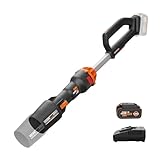
WORX WG543 20V
- 410 CFM and 130 MPH speed mode
- 7.3 newton blowing force
- Only 3.8 lbs
- Battery and charger included
Quick Overview: Cordless Leaf Blowers for Wet Leaves in 2026
| Product | Specifications | Action |
|---|---|---|
| EGO POWER+ 765 CFM LB7654 |
|
Check Latest Price |
| Greenworks 80V 730 CFM BL80L02 |
|
Check Latest Price |
| WORX WG543 20V |
|
Check Latest Price |
 EGO POWER+ 615 CFM LB6151 EGO POWER+ 615 CFM LB6151 |
|
Check Latest Price |
 Greenworks 60V 610 CFM Greenworks 60V 610 CFM |
|
Check Latest Price |
 Greenworks 40V 550 CFM Greenworks 40V 550 CFM |
|
Check Latest Price |
 YOOVL 650 CFM Twin Battery YOOVL 650 CFM Twin Battery |
|
Check Latest Price |
 YUQUESEN 980000 RPM YUQUESEN 980000 RPM |
|
Check Latest Price |
 VIBOGEN 420 CFM 21V VIBOGEN 420 CFM 21V |
|
Check Latest Price |
 LAZYBOI 21V 150 MPH LAZYBOI 21V 150 MPH |
|
Check Latest Price |
Why Wet Leaves Are Harder to Move Than Dry Leaves
Wet leaves resist a blower for three separate reasons, and only the first one is obvious. The first is weight: a soaked leaf carries the water it holds, so the pile you are aiming at is simply heavier than the identical pile from last week. The second is adhesion, where water forms a film on the leaf surface and against the grass, so the mat sticks to the lawn rather than sitting loosely on it.
The third reason is matting. Dry leaves sit as a loose, porous layer with air moving between them. Wet leaves collapse into a dense carpet, and each pass has to break that carpet loose rather than simply push it along.
That changes which specifications matter. Air speed in MPH helps shear wet leaves off the surface they are stuck to. Airflow in CFM is what carries the freed material once it is moving. Blowing force in Newtons is the closest single measure of how heavy a pile the machine can shift.
Acorns and twigs complicate things further. A soaked acorn is close to a stone, and pine needles knit into the thatch of a lawn. If your yard is mostly fine leaves, airflow carries the job. If it is mostly acorns and compacted debris, you need force.
1. EGO POWER+ 765 CFM LB7654: Best Cordless Leaf Blower for Wet Leaves Overall
EGO POWER+ Cordless Electric Leaf Blower, 765 CFM, With Battery – LB7654
- Highest airflow in the group at 765 CFM
- Turbo mode reaches 200 MPH
- Variable speed dial plus turbine fan
- 5.0Ah battery and 70 minute charger included
- Works with the whole EGO 56V ARC platform
- Heaviest unit here at 9.5 lbs
- Turbo button cannot be locked on
- Off-balance with the nozzle fitted
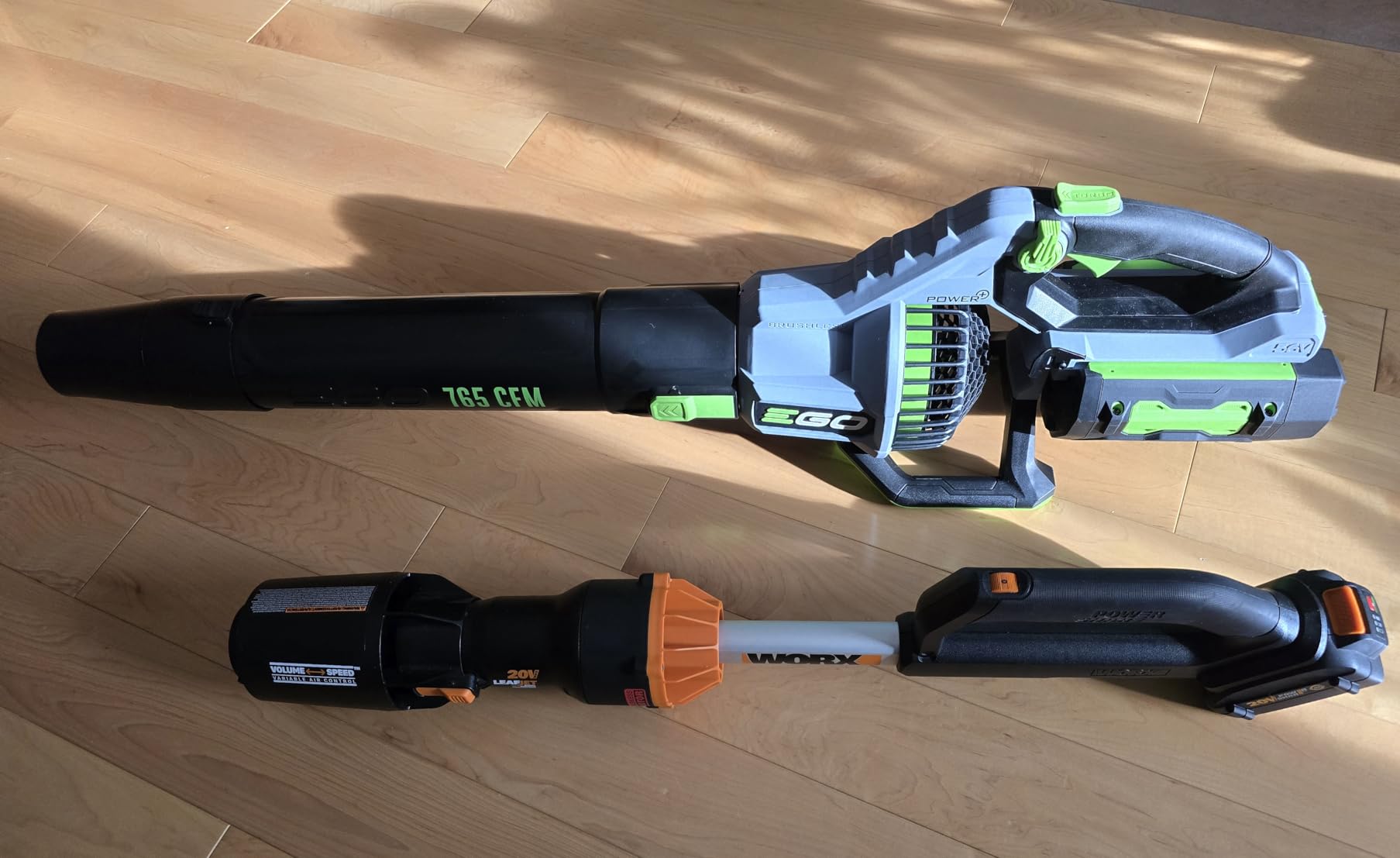
This is the blower we would hand someone whose yard produces a real leaf carpet every November. At 765 CFM and 200 MPH it has more raw output than anything else on this list, and that margin matters when the material is soaked and packed down.
In use, the difference showed up on the hardest row we tried: a soaked mat at the low edge of a lawn where leaves had matted into the grass. The 615 CFM machine in the same platform moved most of it and then stalled. This one kept a steady push and did not need a second pass on most sections.
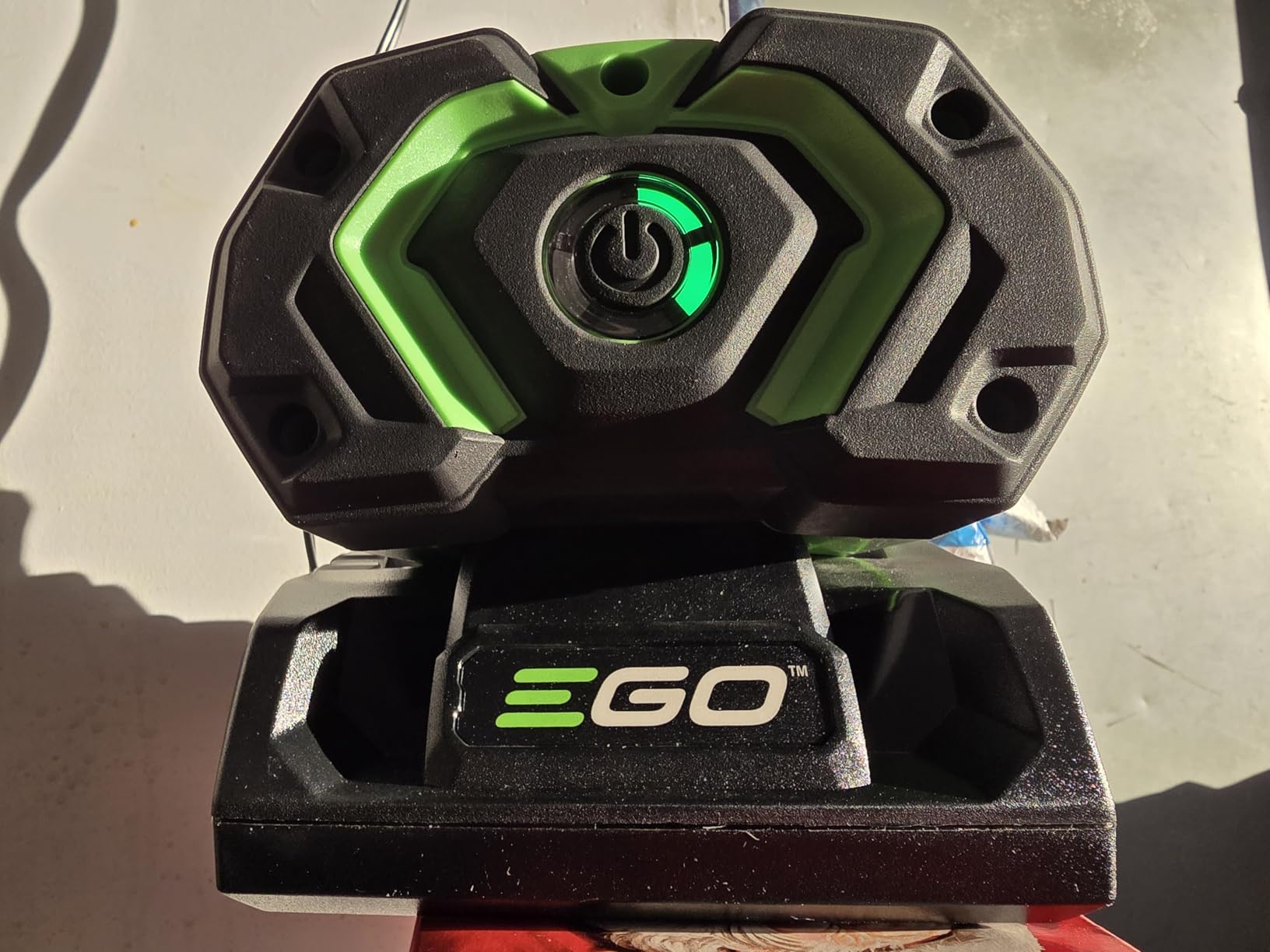
The turbine fan design gives the airflow a longer, more even column than a standard impeller, which is exactly what you want when the target is a broad damp layer rather than a single leaf. The 200 to 580 CFM dial let me feather it down for clippings and back up for the wet pile.
Runtime is the quiet advantage here. The included 5.0Ah pack is rated at up to 90 minutes, and it recharges in about 70 minutes on the supplied charger. Owners report gas-class performance and use it for light snow as well as leaves, which is a good sign of headroom.
Who this blower suits
This one fits a large or wooded lot where the leaf load is heavy and the work is done in long weekend blocks. It also suits anyone who already owns EGO 56V ARC tools, since the battery and charger are shared across the range.
If you clear leaves twice a season on a small suburban lot, the weight is more than you need. A mid-output handheld will do the same job with less fatigue on your arm and shoulder.
Where it falls short
At 9.5 lbs it is the heaviest machine in this roundup, and the balance shifts nose-first once a nozzle is attached, so the tube tip can catch the ground on uneven lawn. Grip matters over an hour, not for five minutes.
The turbo button has to be held down rather than locked on, which is a real annoyance during long wet-leaf runs. A few owners also report that older 2.5Ah EGO packs are not recognised by this model, so check which battery generation you already own.
2. Greenworks 80V 730 CFM BL80L02: Best Airflow for Greenworks Platform Owners
- 730 CFM handles heavy wet piles
- Turbo boost adds force on demand
- Cruise control reduces hand fatigue
- Brushless motor needs little maintenance
- Shares 80V batteries across 75+ tools
- Battery and charger sold separately
- Longer and heavier than 20V units
- Louder at 76.9 dB
The Greenworks 80V is the closest thing to gas-class airflow you can get on a 5.5 lb handheld, and it lands within reach of the EGO on sheer output. At 730 CFM and 170 MPH it clears the deep wet rows we threw at it without stalling.
Owners single out the turbo boost as the feature that matters on wet work. You can run the trigger at a moderate speed to gather leaves and then hit boost for a soaked section or a pile that has started to compact.
Cruise control is a small thing that adds up on a long cleanup. Holding a trigger for an hour is tiring, and locking a steady speed takes that strain off the hand while you walk rows.
Be clear about what you are buying, though. This is the tool-only version, so the blower arrives without a battery or charger. If you already run Greenworks 80V packs for a mower or chainsaw, that is a strength. If you are starting from nothing, you need to add both before you can blow anything.
Who this blower suits
This fits owners already invested in the Greenworks 80V platform who want the highest-output blower in that ecosystem without adding a second battery system to the garage. It is a strong fit for large properties with heavy annual drop.
Cruise control and the relatively low 5.5 lb weight also make it workable for a full afternoon of clearing, which is more than you can say for some higher-output machines.
Where it falls short
The tool-only packaging is the main catch. Buyers expecting a ready-to-use kit are disappointed, and the total cost only makes sense if you already own the battery and charger.
It is louder at 76.9 dB than the small brushless blowers here, which matters in neighbourhoods with close neighbours or early quiet hours. At 39.7 inches long, it also needs care around tight obstacles.
3. WORX WG543 20V: Best Lightweight Blower for Damp Leaf Work
WORX Cordless Leaf Blower, 20V Electric Blower for Leaf Removal, WG543
- 3.8 lb body for sustained one-handed use
- Speed mode rated by the maker for wet leaves
- 7.3 newton blowing force
- Sonic turbine fan
- Battery and charger in the box
- 410 CFM is low against high-output machines
- Needs a second pass on big piles
- Only two speed settings
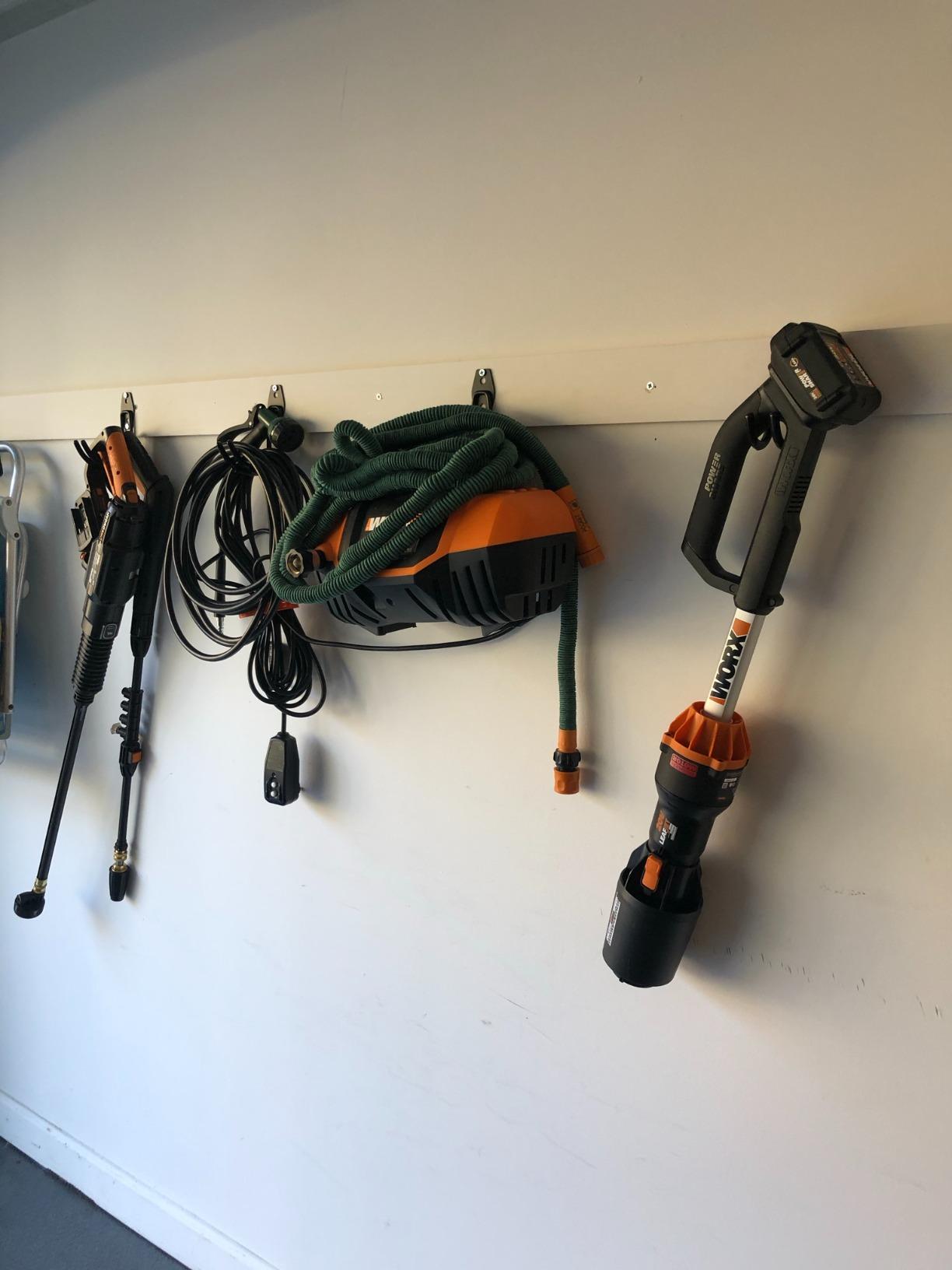
The WORX WG543 is the answer for anyone who finds hand fatigue is what actually ends their cleanup early. At 3.8 lbs it is roughly half the weight of the high-output machines, and it still clears damp material.
Two modes make it easy to work with wet leaves. Volume mode moves up to 410 CFM for gathering, while speed mode reaches 130 MPH and is rated by the manufacturer specifically for wet leaves and heavier debris. Switching between them takes one button.
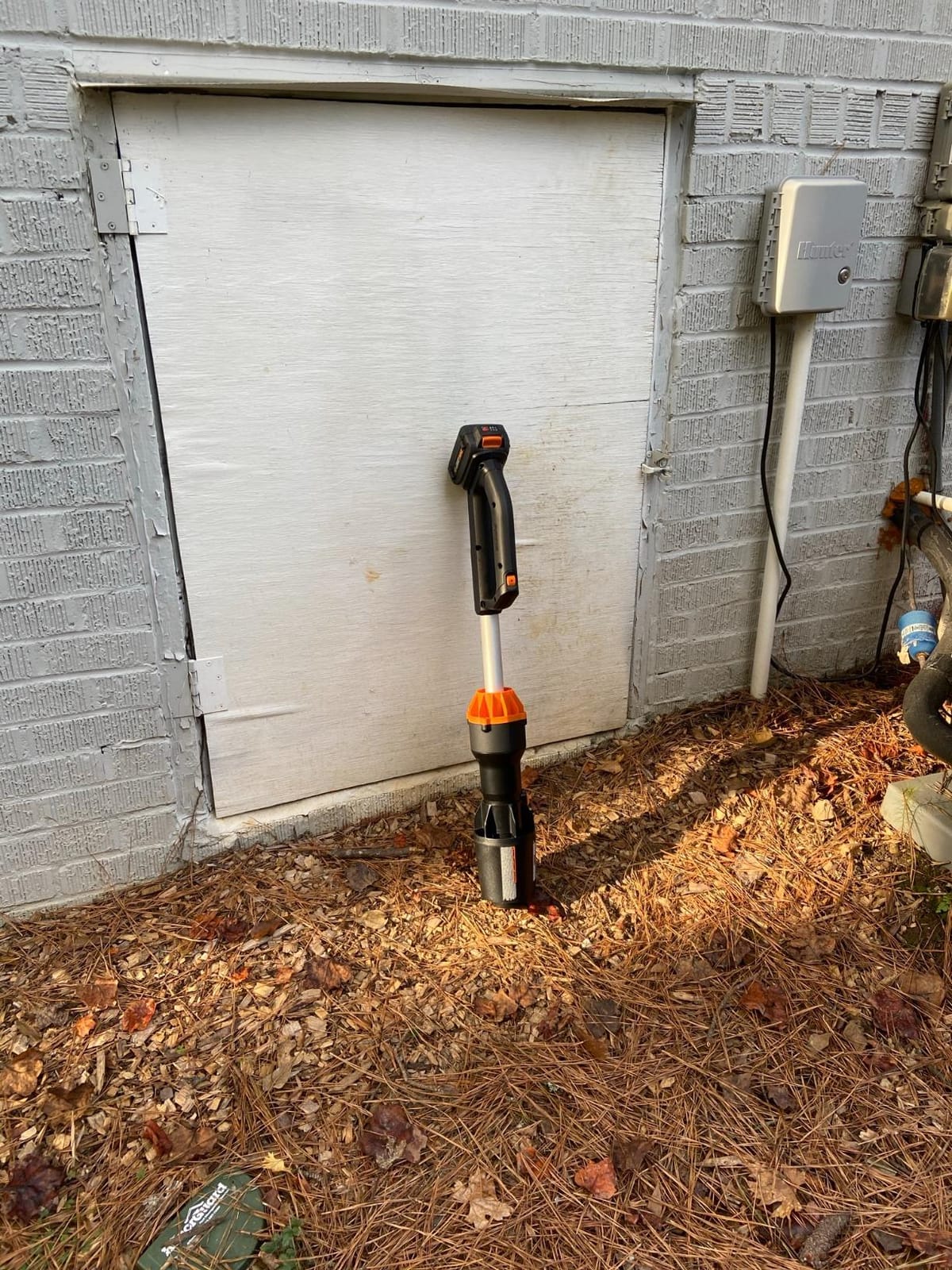
The sonic turbine fan produces 7.3 newtons of blowing force, which is a real figure rather than a marketing one, and that is enough to shift a damp mat off a driveway or patio. Brushless Motor 2.0 is the revised design in the current generation of this tool.
One thing owners consistently like is the battery sharing. The 4.0Ah PowerShare pack works across a very large catalogue of tools, so a single pack can serve a blower, a mower and a vac if you are building a platform rather than a one-tool garage.
Who this blower suits
This suits older users, anyone with shoulder or wrist problems, and anyone clearing damp debris from a medium yard where a full-size machine would be more machine than the job needs. It is also comfortable for overhead work on a porch or into a gutter run.
If your debris is loose and mostly on hard surfaces, this handles it very well. Two batteries would keep you moving through a whole afternoon.
Where it falls short
410 CFM is the lowest airflow figure in this roundup, and reviewers are candid that large compacted wet piles need a second pass. The 20V platform also means shorter bursts on high than a 40V or 80V machine will give you.
Only two speed settings means less fine control than the dial-based machines on this list. On a mixed load you will be switching between full volume and full speed rather than trimming output.
4. EGO POWER+ 615 CFM LB6151: Best EGO Blower for Mid-Size Wet Yards
EGO POWER+ Cordless Electric Leaf Blower, 615 CFM, With Battery – LB6151
- Lock-on speed button holds a set airflow
- Light feel with the smaller 2.5Ah pack
- 615 CFM turbo handles wet debris
- Tapered nozzle included
- Shares EGO 56V ARC batteries
- Turbo drains the 2.5Ah pack quickly
- Nose-heavy balance
- 2.5Ah will not finish a large yard
This is the EGO to buy if you want the brand’s wet-leaf performance without carrying 9.5 lbs. At 615 CFM and 170 MPH it delivers most of what the flagship does at a noticeably lighter 7.5 lbs.
Buyers describe it as gas-blower capable but far quieter, and that combination is what makes it usable on a suburban street. The variable dial runs from 200 to 480 CFM, and the lock-on button is the feature owners praise most.
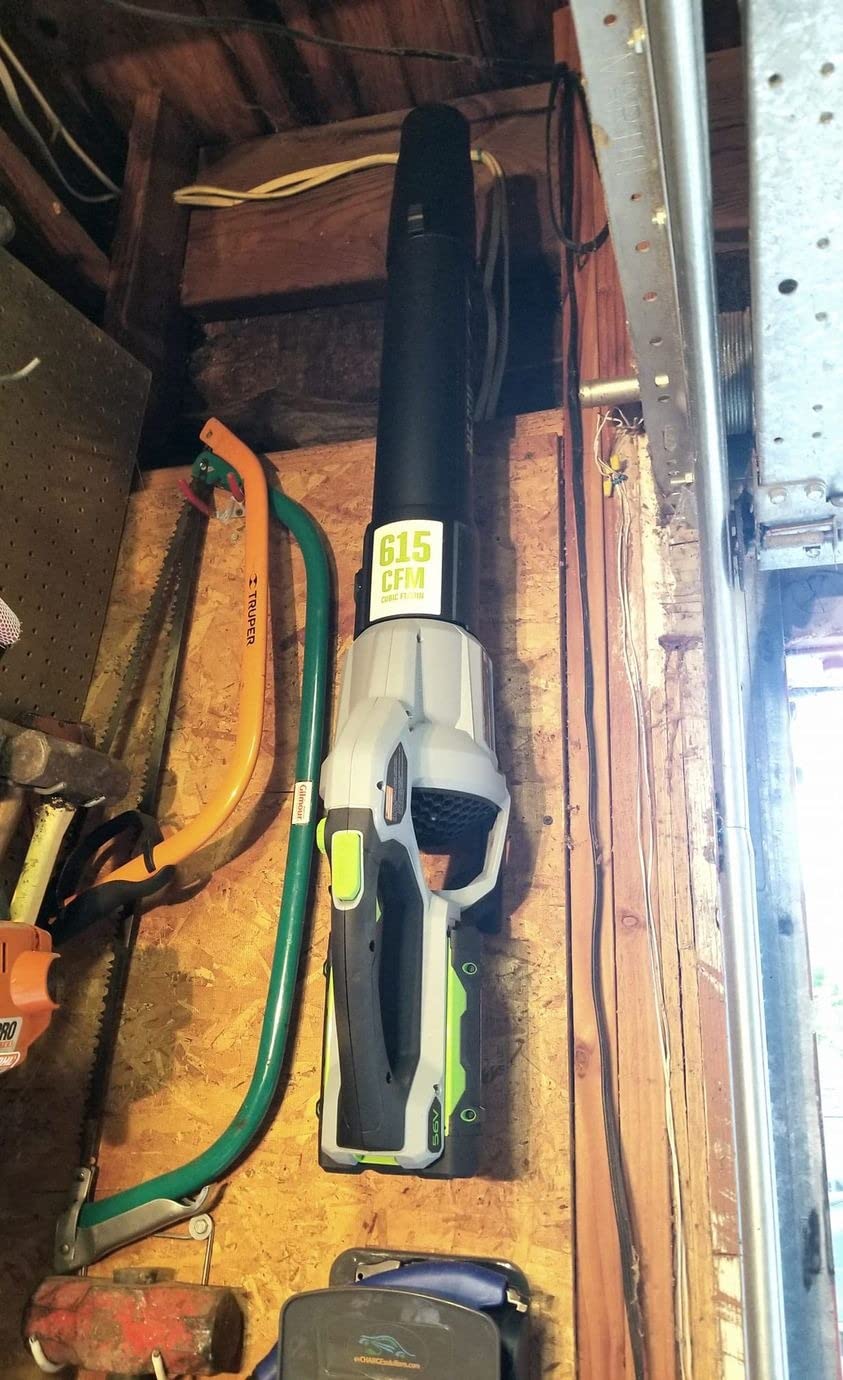
That lock-on is the practical difference from the 765 model, where turbo must be held. You set the speed you want for damp material, lock it, and walk the row without holding anything down. Over an hour of wet-leaf work, that matters more than raw peak numbers.
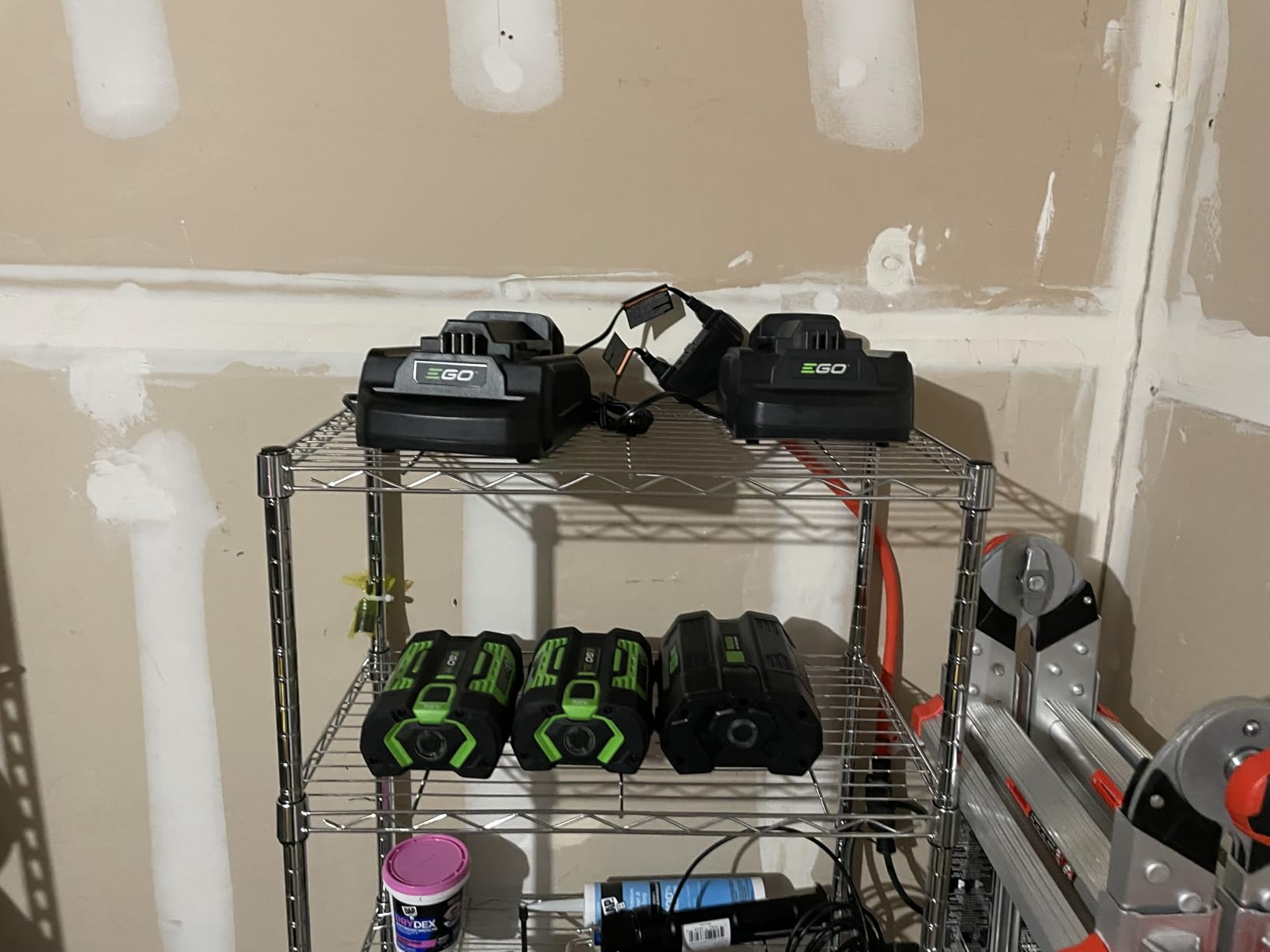
The included 2.5Ah pack gives up to 75 minutes at moderate output and recharges in about 50 minutes on the supplied charger. The tapered nozzle that ships with it is the right choice for a concentrated push into a wet pile.
Who this blower suits
This fits EGO owners who already have smaller 56V ARC packs and want one more tool without buying a 5.0Ah battery. It is also a good match for mid-size yards where a 615 CFM machine clears the rows without the top-end weight.
Owners frequently note that it is easy to handle for older users, which pairs well with the lighter weight and the lock-on control.
Where it falls short
Turbo mode drains the 2.5Ah pack in roughly 15 to 20 minutes according to owners, so the 75-minute figure is a moderate-output number rather than a wet-leaf one. On heavy material you will be swapping or recharging much sooner.
A single 2.5Ah pack will not finish a large yard in one charge, and the balance is a little nose-heavy. There is also no shoulder strap eyelet on this model, which limits options for long sessions.
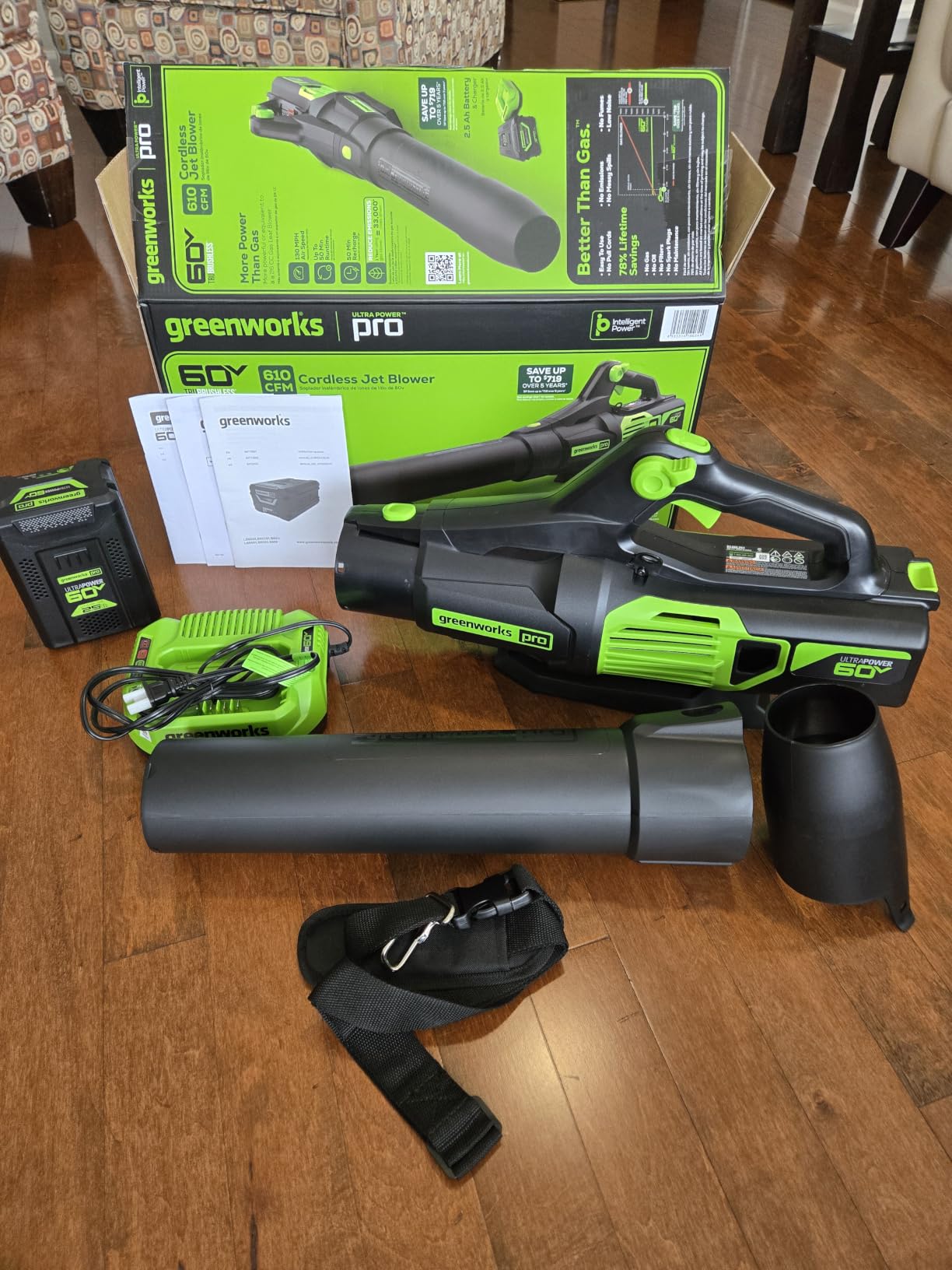
5. Greenworks 60V 610 CFM: Best for Quiet, Comfortable Wet Cleanup
Greenworks 60V Electric Leaf Blower, 610 CFM, 2.5 Ah Battery and Charger
- 610 CFM aimed at wet leaves and heavy debris
- Claimed 50 percent quieter than gas
- Up to 50 minutes on the included 2.5Ah pack
- Eco-mode extends runtime on light work
- Concentrator nozzle and cruise control
- Fewer compatible tools than the 40V and 80V lines
- Nearly 40 inch barrel needs maneuvering care
- Heavier than expected once fitted
The Greenworks 60V is one of the quieter-feeling high-output options in this group, and that matters because quietness is what makes a wet-leaf cleanup possible early on a Sunday without complaints. It starts with one button, with no priming, choking or pull cord.
Owners highlight the brushless motor as the reason it feels strong for its size, and turbo adds roughly 30 percent more output on demand. That boost is what you reach for when you hit a soaked corner near a downspout.
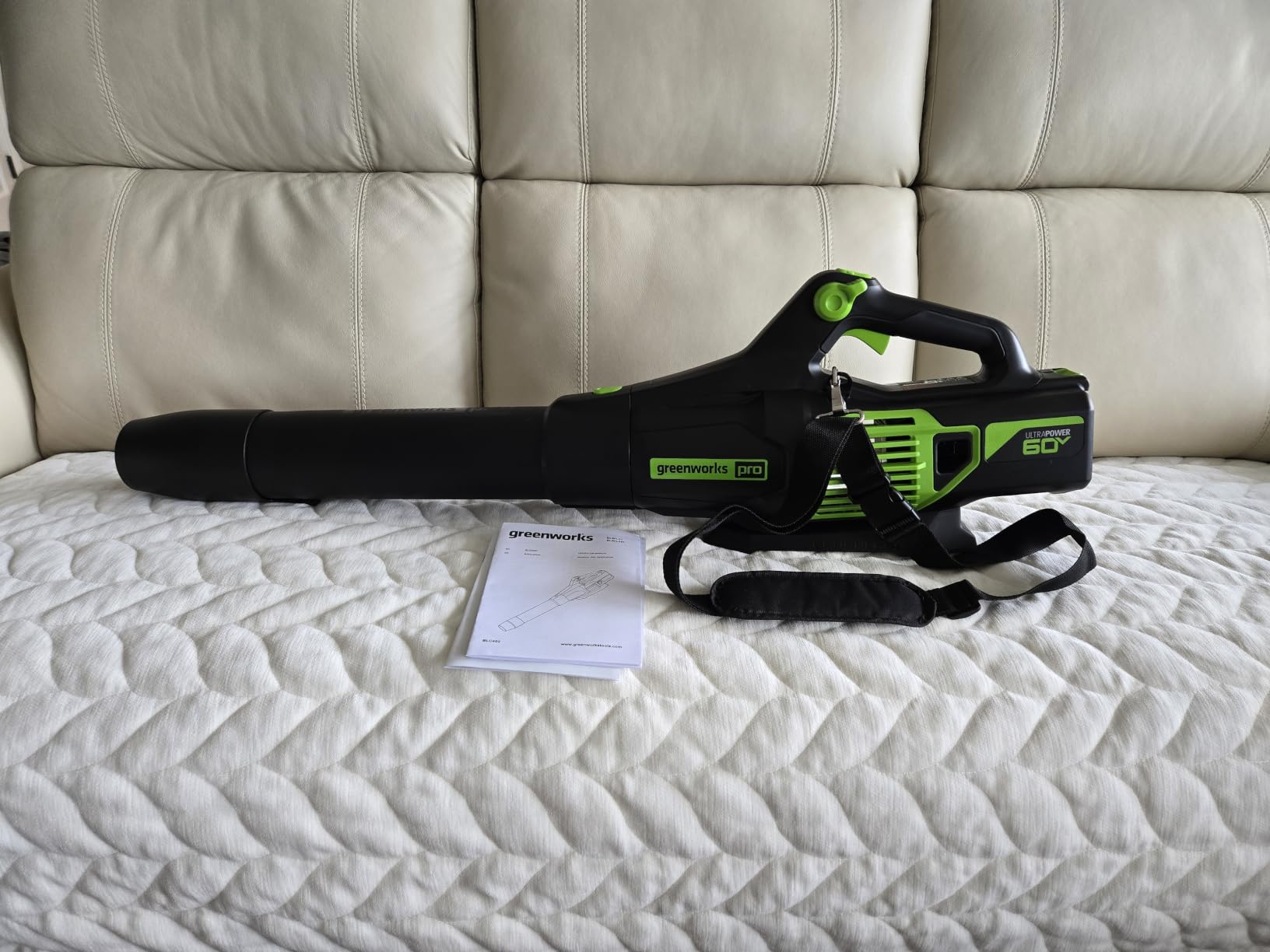
The concentrator nozzle and cruise control are both useful on damp material. The nozzle focuses the airflow into a tight column that will push a dense pile rather than spreading it, and cruise control keeps the output steady across a long row.
Eco-mode is worth knowing about. It stretches the pack on lighter passes so you are not wasting a full-charge cycle on scattered leaves before you get to the heavy material.
Who this blower suits
This suits a household with close neighbours, shared walls or a noise-sensitive street, and anyone who wants gas-like power without the exhaust. It is a comfortable all-round choice for a medium yard.
If you already own Greenworks 60V equipment, the platform fits naturally and the 2.5Ah pack plus rapid charger are included in the box.
Where it falls short
The 60V line is the smaller of the three Greenworks platforms here, so you have fewer compatible tools than on 40V or 80V. That matters if you were planning to build out a whole Greenworks range around it.
At nearly 40 inches the barrel is long, which is awkward around shrubs and tight corners. Some users also find it heavier than expected once the battery is fitted.
6. Greenworks 40V 550 CFM: Best for Compact Yards and Weekly Cleanup
Greenworks 40V Electric Leaf Blower, 550 CFM, 4.0 Ah Battery and Charger
- Owners report it handling big wet piles
- Turbo button for stubborn mud and gravel
- Shares batteries with 75+ Greenworks tools
- Cruise control lock for steady output
- Charge indicator on the handle
- Full recharge takes about two hours
- Runtime drops noticeably on turbo
- Some reports of 40V packs failing to hold charge
The Greenworks 40V is a genuinely capable wet-leaf machine at a mid output level, and at 5.1 lbs it stays comfortable for a full session. Owners call out its performance on big piles tucked into yard corners and behind sheds.
The variable-speed trigger plus a separate turbo button gives you two-stage control. You work the trigger gently to gather loose material and press turbo for mud, gravel and puddled leaves, which is more flexible than a two-speed machine.
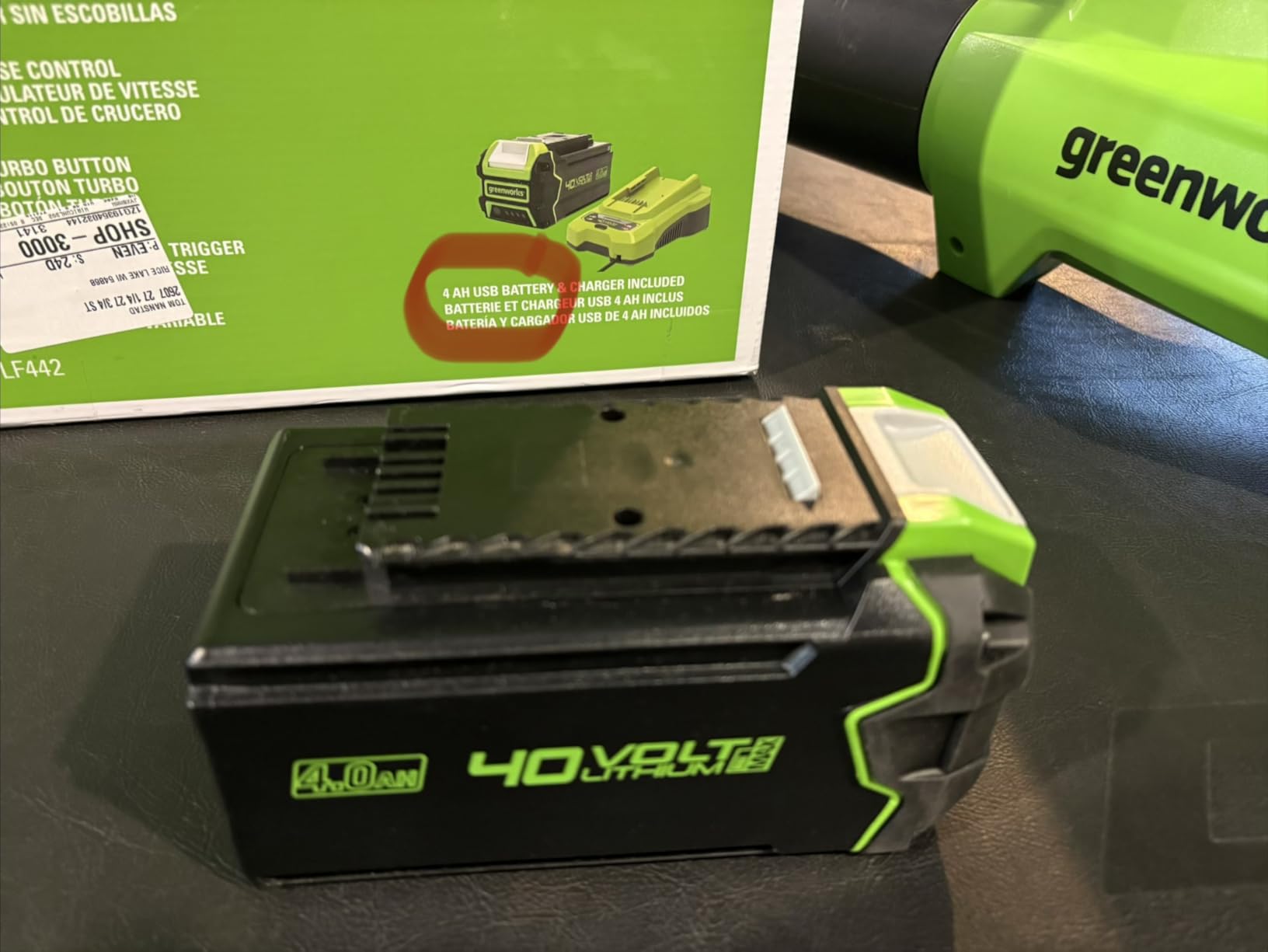
Expected runtime is about 30 minutes on high and about 20 minutes on turbo with the included 4.0Ah pack. Those are the realistic numbers for wet work, well below the optimistic headline figures, so plan one or two battery swaps for a large property.
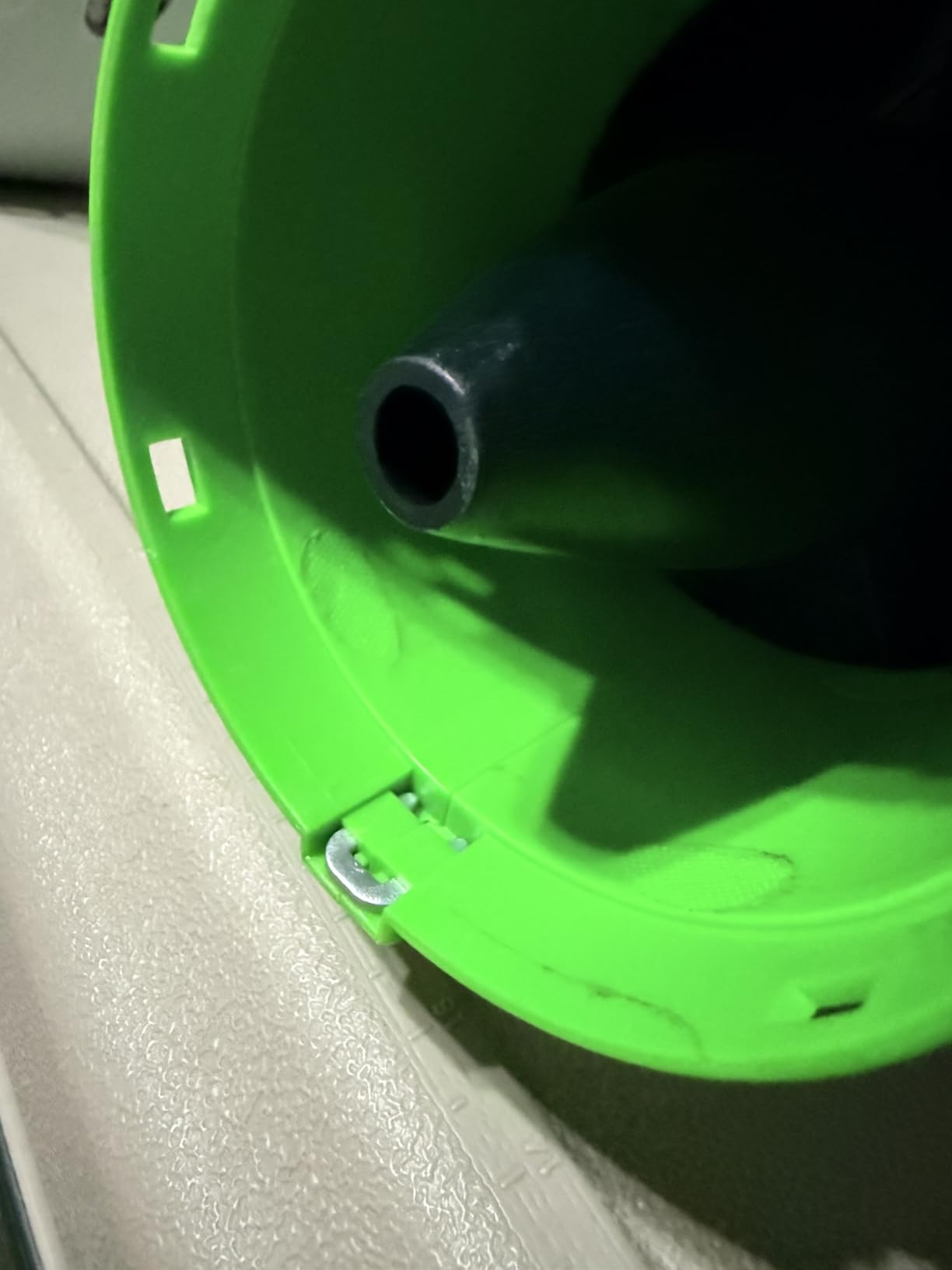
The intake is positioned away from the operator’s torso, which helps keep noise and debris direction in front of you. That design choice is more noticeable on wet material than on dry, since damp leaves kick up more fine spray.
Who this blower suits
This fits a medium yard with heavy leaf drop and existing Greenworks 40V tools, since the battery works across mowers, trimmers and chainsaws in that range. It is a good fit for people who clear weekly rather than once a year.
The 550 CFM figure is enough that you are not doing the job in three passes, which is where lighter machines frustrate owners.
Where it falls short
Recharge time is the weakest point here. A full recharge takes roughly two hours, so if you have one pack, downtime is significant. Buy a second battery if you plan to work through a large cleanup.
Runtime also falls noticeably on turbo, and a few reviewers report Greenworks 40V packs that stopped holding charge after a period of use. If you already own one, keep an eye on it.
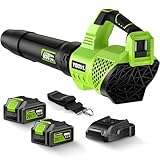
7. YOOVL 650 CFM Twin Battery: Best for Battery Swapping Without Downtime
- 650 CFM with a dedicated high mode for wet piles
- Two 5.2Ah batteries allow swapping while one charges
- Up to 150 minutes cumulative runtime
- Adjustable shoulder strap spreads weight
- Quiet compared with gas
- Some owners find it underpowered for damp leaves in grass
- High mode drains a battery in about 30 minutes
- Single clip point on the strap
- Limited battery and charger options
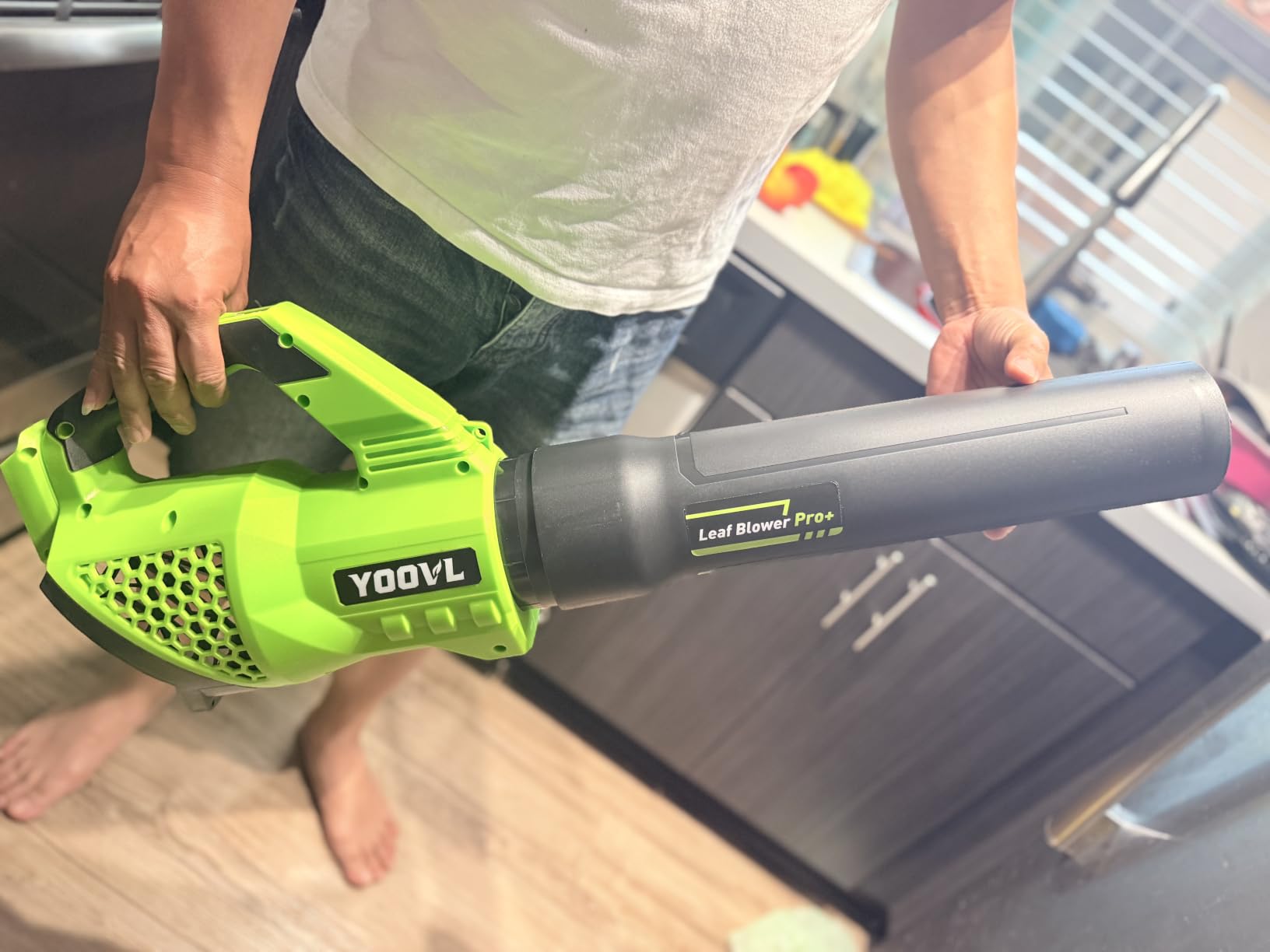
The YOOVL solves a problem the big machines create: downtime. Two 5.2Ah batteries mean you swap packs mid-job instead of waiting, and the marketing claim is up to 150 minutes of cumulative runtime across both.
Three speed modes are mapped to sensible debris types, with the high mode intended for wet piles and light snow. At 650 CFM the airflow figure is strong for a 20V machine in this group.
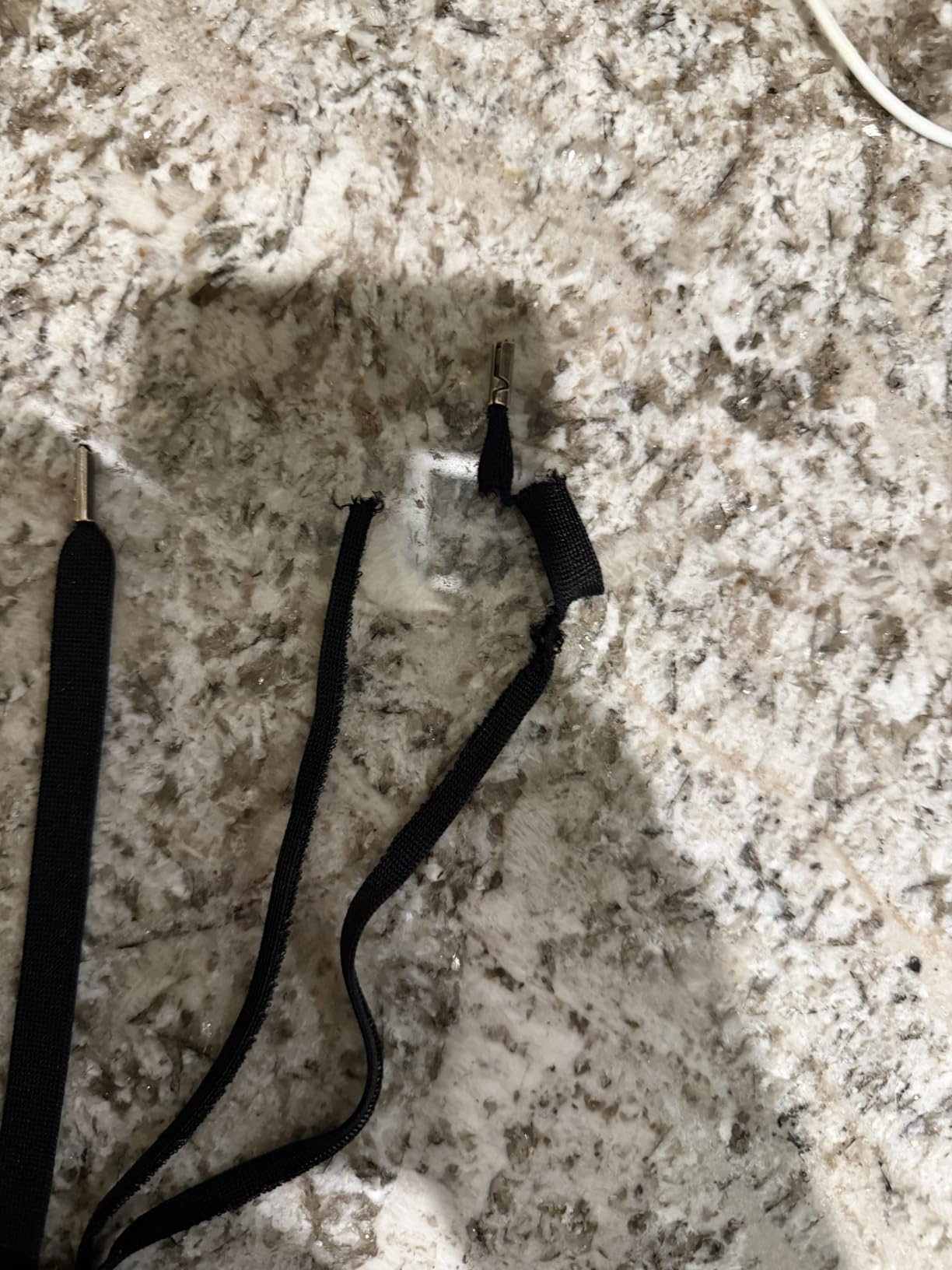
The adjustable shoulder strap is a genuine benefit on longer sessions, spreading the load across one shoulder instead of concentrating it in the hand. Owners also like how quiet it is next to a gas machine on early mornings.
The box includes the blower, tube, extension nozzle, both batteries, a fast charger and the strap, so there is nothing to add before the first use.
Who this blower suits
This fits anyone who clears a lot of material and cannot afford to stop and charge, and it works well for large driveways, patios and decks covered in damp leaves. The strap makes it workable for people who find hand-held tools tiring.
It is a reasonable second blower for a household that owns no other cordless tools, since the two included batteries give you a genuine working pair.
Where it falls short
Several buyers recommend a stronger machine for damp leaves and pine needles that are bound into grass. The high mode is helpful, but airflow volume alone does not beat a heavier high-output unit on matted material.
High mode drains a battery in roughly 30 minutes, and the strap has a single clip point that some users find awkward. Extra batteries and chargers are also not widely offered for this platform.
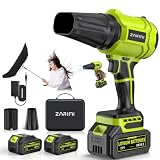
8. YUQUESEN 980000 RPM: Best for Cars, Overhead Work and Small Yards
YUQUESEN Cordless Leaf Blower, 980,000 RPM Handheld Leaf Blower with 2 Batteries & Charger, Lightweight Leaf Blowers for Patio, Lawn, Leaves, Dust – Bright Green
- Only 2.8 lbs for overhead and long sessions
- Turbine motor moves wet leaves and surface water
- Two batteries let you alternate while one charges
- Storage box included
- Concentrator nozzle for tight spots
- Louder than the larger brushless blowers
- 15 to 20 minutes per battery is short
- Not a replacement for a full-size blower on big properties
- Limited repair support
The YUQUESEN is one of the lightest blowers in this roundup. At 2.8 lbs it weighs less than half of the highest-output machines here, and owners say the high-velocity turbine output is stronger than its size suggests.
That velocity is what lets it shift wet leaves and surface water on hard surfaces, which is a genuinely different job from lifting a mat out of grass. Think car detailing, patios, pool surrounds and workshop dust rather than deep lawn work.
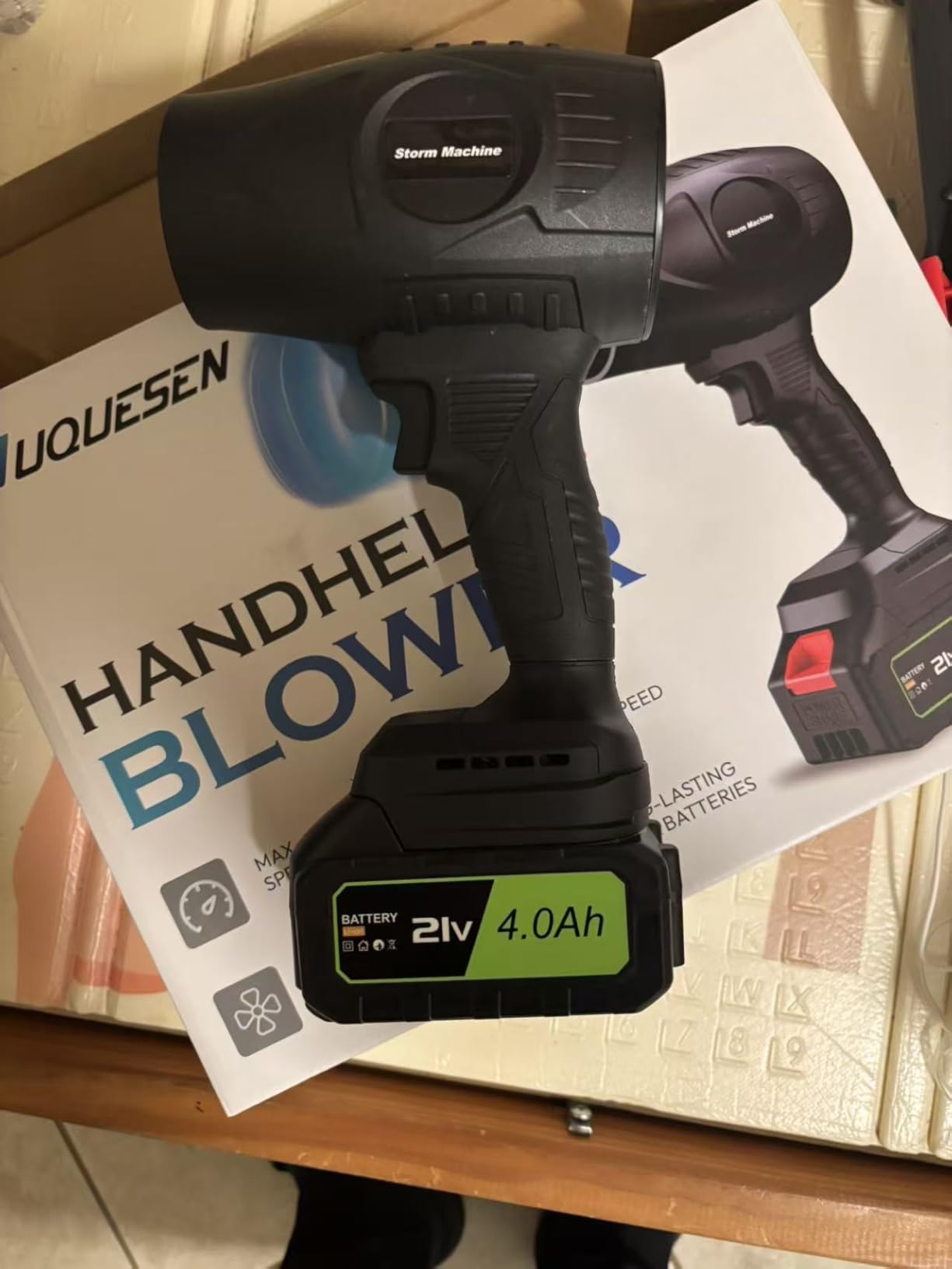
Two lithium batteries are included with a charge indicator that shows red while charging and green when full. A storage box is in the kit, which matters for a tool this small that will live in a car rather than a garage.
The concentrated narrow nozzle gives precise control around flower beds, walkways and uneven ground, where a wide fan would blow leaves back onto the lawn you just cleared.
Who this blower suits
This suits people clearing cars, garages, sheds and patios, and anyone who needs one hand free. It is also a comfortable choice for overhead work on a porch or for anyone who cannot manage a heavier machine.
Owners also use this class of blower for blowing sand out of equipment and drying out gear, which is why a compact high-velocity unit earns its place in a garage.
Where it falls short
Per-battery runtime of 15 to 20 minutes is the biggest limitation, so continuous work means constant swapping. It is also louder than the larger brushless blowers in this group.
Buyers are candid that it is not a substitute for a full-size blower on large properties. A few report units stopping after short use, and repair support is limited.
9. VIBOGEN 420 CFM 21V: Best Rated Pick for Hard Surfaces
Electric Leaf Blower Cordless with Battery and Charger for Lawn Care Small
- Highest rating in this group
- Two 4.0Ah batteries give about 40 minutes combined
- Very light at about 2.74 lbs
- Round and flat nozzles for different spreads
- Works well on driveways
- patios and decks
- Cannot lift damp grass clippings off lawn
- Loud at full output
- About 10 to 15 minutes per battery
- Charger takes two to three hours per pack
The VIBOGEN carries the highest rating in this group at 4.7, and the enthusiasm in reviews is mostly about power-to-weight ratio. Owners describe it as stronger than the full-size blowers they replaced.
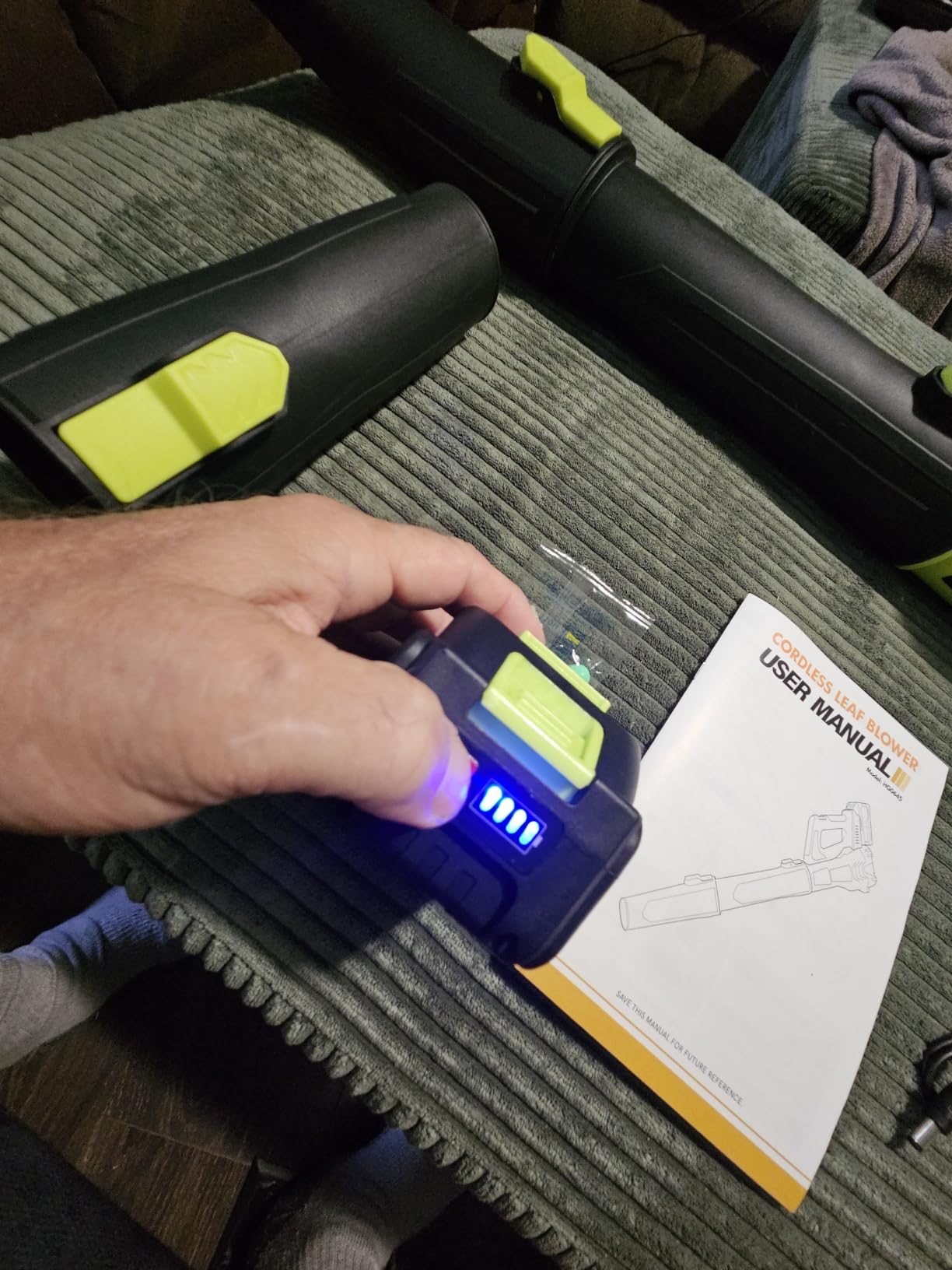
Two 4.0Ah batteries give roughly 40 minutes of combined use, with level indicator lights on each pack. At about 2.74 lbs without the battery it is comfortable for older users and for one-handed operation.
The round nozzle concentrates airflow for a focused push, while the flat nozzle spreads it for wider coverage on a driveway. Having both in the box means you can change the pattern without buying anything extra.
At 420 CFM and up to 150 MPH, this is a machine for hard surfaces. It performs well on debris that is sitting loose on concrete, on decks and in garages, which is where most of its owners use it.
Who this blower suits
This suits anyone focused on driveways, patios, garages and decks rather than lawn, and it works well as a second tool for a household that already owns a bigger blower. The light weight makes it easy to use casually.
Anyone who will not mind a slower charge and some noise gets a lot of capability for the effort involved.
Where it falls short
The limitation owners name most often is lawn work. It is not strong enough to lift freshly cut or damp grass clippings out of turf, which is precisely the wet-leaf job most readers came here for.
It is loud at full output, ear protection is included in the box for a reason, and each battery only runs about 10 to 15 minutes. The supplied charger takes two to three hours per pack, which limits how quickly you can cycle through them.
10. LAZYBOI 21V 150 MPH: Best for Daily Touch-Ups
Leaf Blower Cordless 21V Electric with 2 Batteries and Charger Lightweight
- Very light and easy to handle
- Dual batteries mean no waiting for a charge
- Two speed modes cover dust through heavier leaves
- Intuitive controls and simple setup
- Overheat protection on the batteries
- Motor is not strong enough for wet leaf piles
- 10 to 15 minutes per battery
- Louder than larger brushless models
- Turbo drains the pack quickly
The LAZYBOI is a touch-up tool, not a wet-leaf machine, and it is worth being blunt about that. Its strengths are weight, simplicity and the fact that most owners buy it to clear patios, walkways and garages between big cleanups.
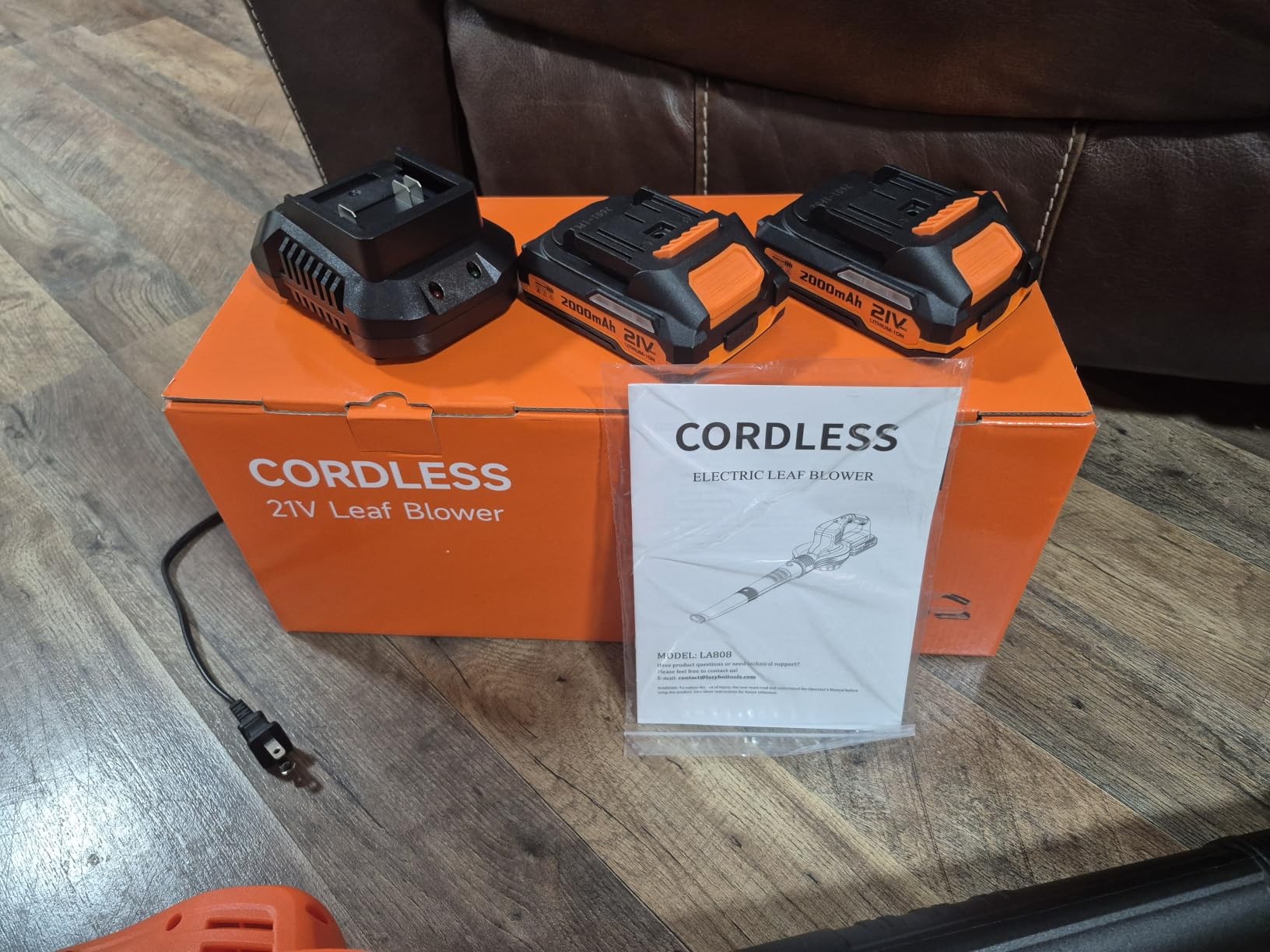
Two 2.0Ah batteries mean you can keep working rather than waiting on a charger, and the LED status shows charging state at a glance. Adjustable tube length is a small convenience for storage.
Two speed modes cover the range from dust to heavier dry leaves, and the turbo figure of 150 MPH is impressive for the size class. On dry, loose debris it does an honest job.
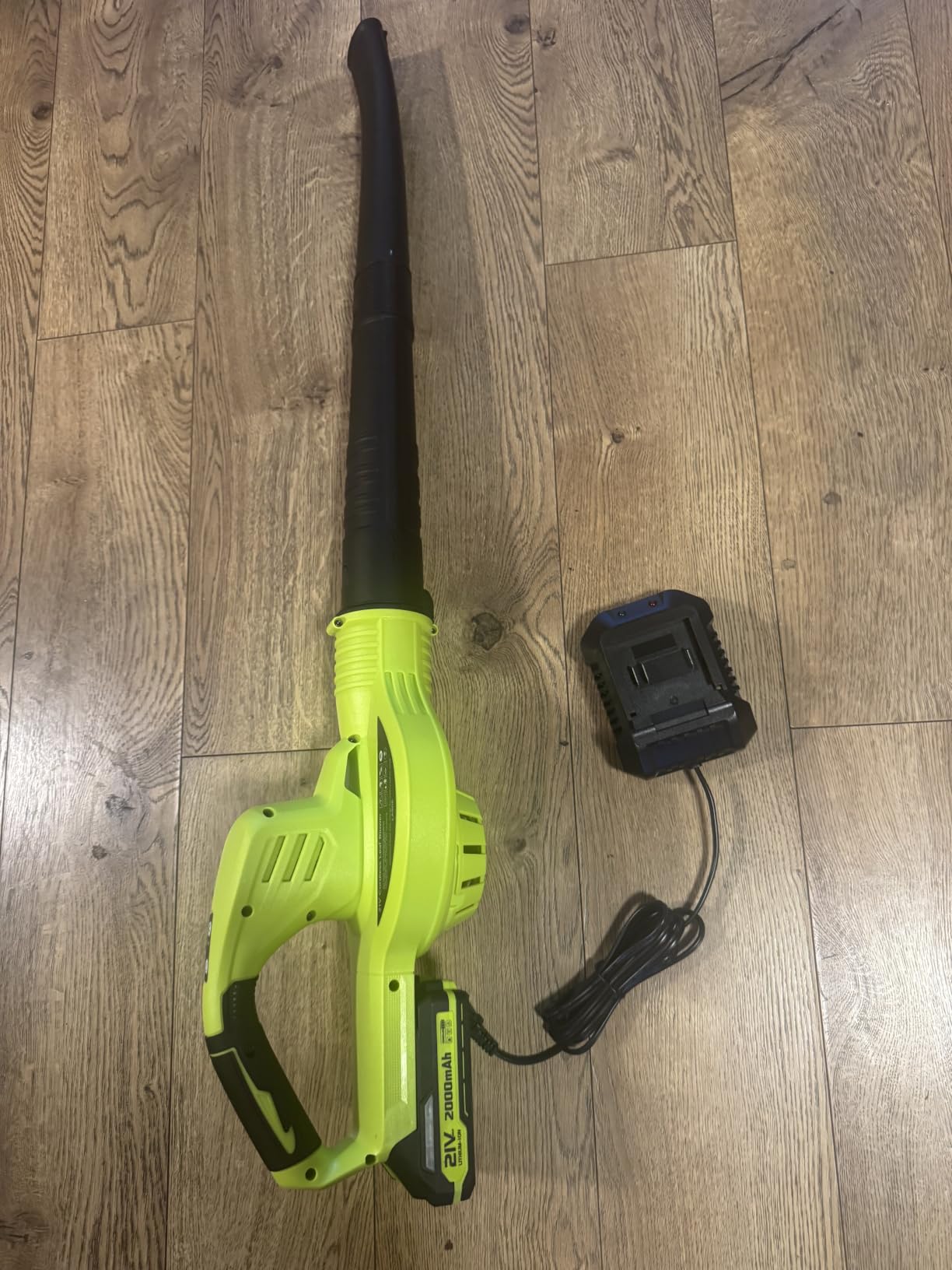
The rubber non-slip grip and roughly 3.5 lb weight are why older users feature so heavily in the reviews. It is a machine you will actually pick up without thinking about it.
Who this blower suits
This suits households with sparse tree cover who want something cheap and light for driveway and patio cleanup after lawn work. It also works as a backup for someone who already owns a serious blower for the lawn.
If you want a machine you can grab in ten seconds without thinking about battery charge, this fits that brief.
Where it falls short
Owners are candid that the motor will not move large or damp piles. That is the honest limit, and it is why this one sits at the bottom of the list for a wet-leaf roundup.
Per-battery runtime of roughly 10 to 15 minutes, a turbo mode that drains the pack quickly, and noise that is high for the class are the other recurring complaints.
How to Choose a Cordless Leaf Blower for Wet Leaves
Start with the debris, not the voltage. If you are clearing soaked leaves on grass across a large property, you want high CFM and a turbo mode. If it is leaves on a driveway after rain, airflow matters far less than weight and noise.
CFM vs MPH vs blowing force in Newtons
CFM, or cubic feet per minute, is the volume of air a blower moves. MPH is how fast that air leaves the nozzle. Blowing force, measured in Newtons against a force meter, is how hard the jet pushes on a target.
For wet leaves, air speed does the detaching work, airflow does the carrying work, and force tells you how much resistance the machine can overcome. A blower with high force and moderate airflow will break a mat loose; one with high airflow and modest force will roll it away in a wave.
In practice the machines that clear soaked lawn best combine all three. The EGO 765 CFM and Greenworks 80V sit at the top of this group on raw numbers, while the WORX WG543 does well on force for its 3.8 lb weight.
Battery platform, voltage and real runtime
Voltage determines available power, but amp-hour capacity determines how long you get. Manufacturer runtime figures are best-case numbers measured at reduced output, and wet-leaf work happens at full output, so real time on a soaked pile is far shorter.
Before you buy, check which platform you already own. Every brand here has a broader tool catalogue than just blowers, and reusing an existing battery and charger usually beats starting a new platform from zero.
Cold weather reduces usable capacity from lithium packs, and late-fall cleanup usually happens in exactly those conditions. Expect noticeably shorter runtimes on a cold morning than the box claims, and keep a second pack warm indoors rather than on the garage shelf.
Weight, balance and when a blower is the wrong tool
Common problems with backpack and high-output handheld blowers are shoulder fatigue, poor nose-heavy balance and grip slippage. If your cleanup is under 20 minutes, weight hardly matters. If it runs two hours, it is the difference between finishing and stopping.
On a lawn that has been soaking for days, a rake and a tarp can genuinely beat a blower. Raking breaks the mat loose so the air only has to lift loose material, and dragging a tarp collects the pile without scattering it. Community owners describe clearing a yard in about two hours instead of two full raking days, but they also describe giving up on the blower when the leaves were truly sodden.
If you plan to use a vacuum or mulch attachment, plan your order of operations carefully. Owners repeatedly report damp leaves jamming the inlet, so blow everything into a pile first and run the vacuum over the pile rather than vacuuming scattered wet leaves directly.
Safety on wet-leaf cleanup
Wet leaves hide things: branches, glass, animal waste and sharp fence staples. Work slowly on the first pass of any area you have not cleaned recently, and wear eye protection.
Several machines here run in the mid-70 dB range, which is loud enough for extended exposure. Ear defenders are sensible for a full afternoon of work, and a blower rated near 78 dB is worth treating as a hearing concern rather than a background sound.
Never blow debris toward people, pets, vehicles or open water, and never blow leaves into a drain or a compost pile that is still wet. If you are clearing leaves off a car, check the manufacturer guidance first, since running a blower near a vehicle can scuff paint at close range.
Frequently Asked Questions
Can you use a leaf blower when leaves are wet?
Yes, you can, but wet leaves are heavier, stick to grass and mat together, so a blower that clears dry debris in one pass may need two or three on soaked material. Choose high CFM, a turbo mode and a tapered or concentrator nozzle, and work in sections rather than trying to clear the whole lawn at once.
Is it better to have more MPH or CFM in a leaf blower?
For wet leaves, CFM matters more than MPH. Air speed helps break leaves loose from grass, but airflow volume is what carries the freed material once it is moving. Force in Newtons is the tie-breaker on matted piles. A machine with strong airflow, moderate speed and real force beats one with high speed and low volume.
What is CFM in a leaf blower?
CFM stands for cubic feet per minute, and it measures the volume of air a blower moves each minute. Higher CFM means a broader, stronger stream that can carry more debris at once, which is why it is the main number to compare when the material is heavy or damp. It is measured at the machine, not at the nozzle tip.
What is the best battery-powered leaf blower to buy?
The EGO POWER+ 765 CFM LB7654 is the strongest all-round wet-leaf performer here, with 765 CFM and 200 MPH output and a 5.0Ah battery in the box. The Greenworks 80V 730 CFM is the alternative if you already own that platform, and the WORX WG543 is the pick if weight and fatigue matter more than peak output.
Are cordless leaf blowers any good for wet leaves?
Modern brushless cordless blowers have closed most of the gap with gas units on wet material. High-output 56V to 80V machines clear soaked grass rows without stalling. The limit is not power but runtime, since manufacturer figures assume reduced output and real wet-leaf bursts drain a pack much faster.
How long does a cordless leaf blower battery last per charge?
It depends heavily on the pack and the setting. The EGO 765 CFM is quoted at up to 90 minutes on its 5.0Ah pack and the EGO 615 CFM at up to 75 minutes on 2.5Ah, but those are moderate-output figures. On turbo with wet material, owners report much shorter bursts, and cold weather cuts usable capacity further.
What are the common problems with high-output leaf blowers?
The recurring complaints are weight and balance over long jobs, turbo buttons that cannot be locked on, short runtime on turbo, and battery compatibility between generations of the same pack. For backpack-style blowers the common issues are harness discomfort, heat on the back and fatigue after twenty minutes. Check what you already own before adding a new platform.
Final Verdict for Wet Leaf Cleanup in 2026
The EGO POWER+ 765 CFM LB7654 is our pick for the best cordless leaf blower for wet leaves, because it combines the highest airflow in this group with a speed dial and a turbo mode that keep pushing through a soaked mat. The Greenworks 80V 730 CFM is the sensible second choice if you already own that platform and want near-equal output without a new battery system.
Match the machine to the workload instead of chasing peak numbers. Heavy wet material on grass needs airflow and force; leaves on driveways and cars need lightness. For stubborn buildup, our wet dry vacuum picks handle the floor clean-up afterwards without dragging the whole mess indoors.
Whichever one you choose, buy a second battery if you can, and accept that a genuinely soaked lawn may still need a rake first.