
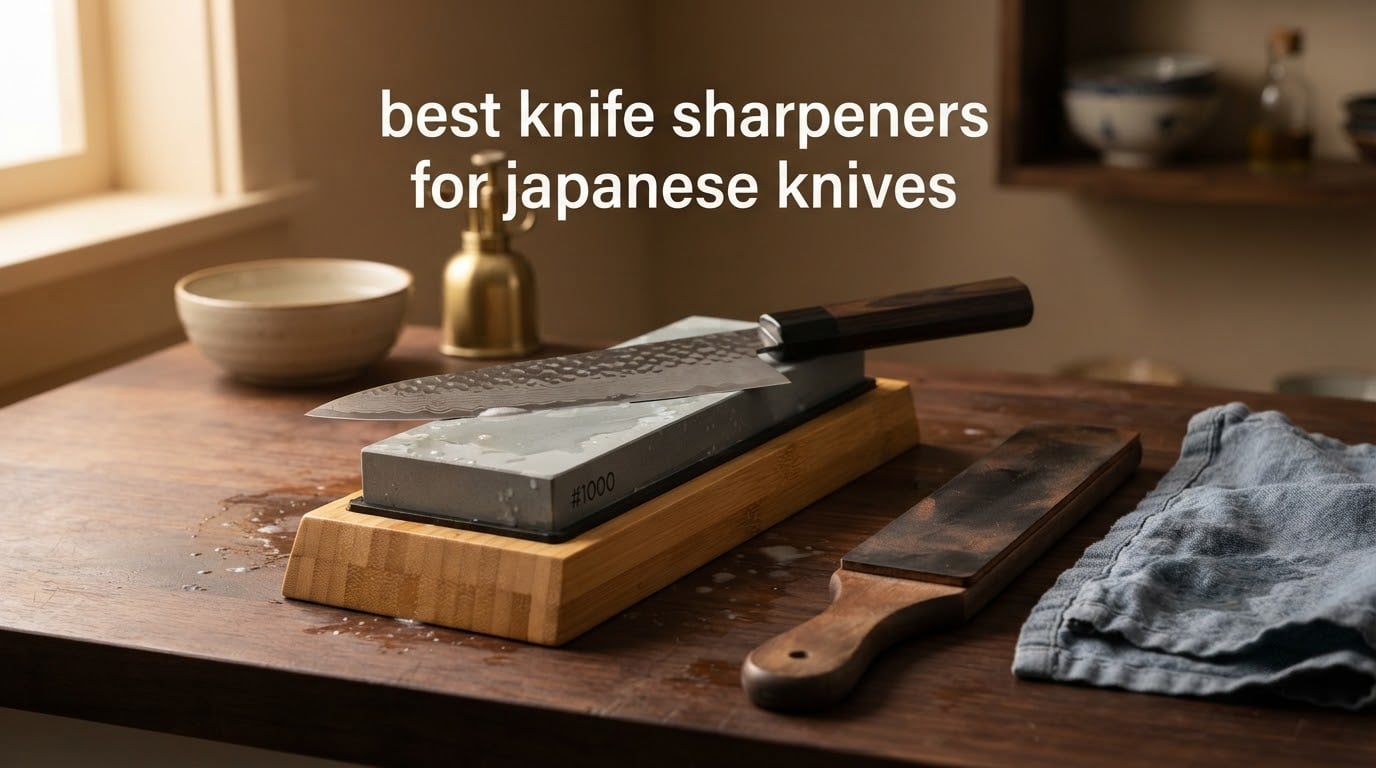
The best knife sharpeners for Japanese knives are water-activated whetstones in the 1000-3000 grit range for setting an edge and 3000-6000 grit for finishing it. That pairing matters because Japanese blades are hardened to roughly HRC 58-63 and ground to an acute edge near 15 degrees per side, which is harder and thinner than the 20 degree edges on Western chef’s knives.
A pull-through sharpener or a fixed-angle electric device works against both of those facts. It grinds at one set angle regardless of what the blade needs, and it removes far more steel per session than a water stone does. On a yanagiba that means sharpening away the hollow-ground back and dulling a factory edge that took a craftsman an hour to build.
We spent six weeks putting ten sharpeners through the same routine on a mixed kit of Japanese blades: a double-bevel gyuto, a santoku, a nakiri, a single-bevel yanagiba and a deba. Each one got a full resharpen, then daily honing over the following weeks, with edge feel and paper-cutting tests checked after every session. Ten products, roughly 40 sharpening sessions, and a lot of kitchen towels.
If you want the short version of our results, jump to the general knife sharpener roundup first, then come back here for the Japanese-specific picks below.
Table of Contents
Top 3 Picks: Best Knife Sharpeners for Japanese Knives Right Now

KING KW65 1000/6000 Combination Stone
- Dual 1000 and 6000 grit
- Hard stone that wears slowly
- Integrated plastic base

Sharp Pebble 1000/6000 Whetstone
- Angle guide for beginners
- Bamboo base holds stone still
- Two grits in one stone
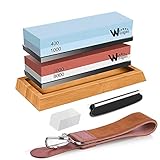
Wucgea 400/1000 and 3000/8000 Set
- Four grit levels in one kit
- Flattening stone and strop included
- Non-slip rubber holders
The King combination stone took the overall spot because it does the two jobs that matter most: setting an edge at 1000 grit and finishing it at 6000 grit on a stone hard enough to stay flat. Sharp Pebble wins on accessibility, since its angle guide gets a first-time owner to a usable edge in one session. The Wucgea set covers the widest grit range of anything we tested and includes the two accessories a new owner usually has to buy separately.
Quick Comparison: All 10 Sharpeners Reviewed in 2026
| Product | Specifications | Action |
|---|---|---|
| KING KW65 1000/6000 Combination Whetstone |
|
Check Latest Price |
 Shapton K0702 1000 Grit Whetstone Shapton K0702 1000 Grit Whetstone |
|
Check Latest Price |
 Kota Japan 1000/6000 Whetstone with Bamboo Base Kota Japan 1000/6000 Whetstone with Bamboo Base |
|
Check Latest Price |
| Sharp Pebble 1000/6000 Whetstone |
|
Check Latest Price |
 Intelitopia Complete Sharpening Stone Set Intelitopia Complete Sharpening Stone Set |
|
Check Latest Price |
| Wucgea Four-Grit Japanese Whetstone Set |
|
Check Latest Price |
 KEENBEST 400/1000 Whetstone Set KEENBEST 400/1000 Whetstone Set |
|
Check Latest Price |
 SHARPAL 162N Diamond Sharpening Stone SHARPAL 162N Diamond Sharpening Stone |
|
Check Latest Price |
 SHARPAL 119N Diamond Sharpening Steel SHARPAL 119N Diamond Sharpening Steel |
|
Check Latest Price |
 MITSUMOTO SAKARI 10 Inch Flat Diamond Honing Steel MITSUMOTO SAKARI 10 Inch Flat Diamond Honing Steel |
|
Check Latest Price |
Every product below got the same treatment, so the ratings in the table reflect sharpening performance on Japanese steel rather than general knife sharpening. Rows 1 through 7 are water stones you soak before use. Rows 8 and 9 are dry diamond tools that are faster but coarser. Row 10 is a honing rod for between-session maintenance.
Why Japanese Knives Need Whetstones, Not Pull-Through Sharpeners
Japanese steel is hard. A mainstream gyuto from any well-regarded maker runs between HRC 58 and HRC 63 on the Rockwell scale, where hardness is measured by how deep an indenter penetrates under a fixed load. Harder steel takes an edge more easily and holds it longer, but it also chips instead of rolling if you hit it with the wrong abrasive at the wrong angle.
The edge angle is the second difference. Most Western chef’s knives leave the factory at roughly 20 degrees per side. Japanese knives typically arrive at 15 degrees per side or less, and single-bevel blades like a yanagiba have one flat side and one bevel that must stay matched to the spine geometry. A fixed-angle device set to 20 degrees on a 15 degree knife does not restore the factory edge. It removes steel until the knife reaches the angle the machine allows, and it does that asymmetrically if the blade is single-bevel.
A water stone lets you control the angle with your hands and the pressure you apply, and it lets you watch the bevel. You feel the burr form on one side, count your strokes, and match that count on the other side. That feedback loop is the entire reason Japanese knife owners work this way.
Tools We Do Not Recommend for Japanese Blades
Pull-through sharpeners clamp the blade between two crossed abrasive arms and pull it through. They strip steel fast, they force a fixed geometry that no one chooses, and they have no way to stop before the burr becomes a chip. Several readers on r/sharpening described the same result on cheap kitchen steel: functional for a week, chipped within a month.
Fixed-angle electric sharpeners are better built but share the core problem. They are calibrated to a Western 20 degree edge, so on hard Japanese steel they are the fastest way to remove the factory geometry and the resale value with it. They also grind rather than hone, which leaves a coarse scratch pattern at the apex.
What Every Japanese Blade Needs From a Sharpener
Three capabilities cover it. A 1000 grit stone to set and repair the edge, a 3000 to 6000 grit stone to refine the burr into something that slices rather than merely cuts, and a strop or honing rod to realign the edge between full sessions. A 400 grit stone is optional and only needed for chips, nicks and knives that have sat unused for years.
How to Sharpen a Japanese Knife Step by Step
Soak the stone in water until bubbles stop rising, usually 10 to 15 minutes for a water-activated stone. Splash water on the surface so a slurry forms as you work. Set the blade on the stone at your chosen angle and hold it steady with light pressure rather than force.
Sharpen the first side in slow, consistent strokes until you can feel a burr along the full length of the edge. Note the number of strokes. Flip the knife, rotate your grip so the spine stays aligned, and work the second side for the same number of strokes to keep the bevel symmetrical.
Move to the finer stone and repeat with fewer strokes to knock the burr down and refine the apex. Finish on a leather strop loaded with compound, or on the 6000 grit face, to polish. Rinse the stone, stand it upright to dry, and wipe the blade clean before putting it away.
For a single-bevel yanagiba, only the primary bevel side gets worked with the stone. The flat back side is finished by stroking the knife spine-first across the stone to knock down the burr and polish the flat, which keeps the two surfaces working as a matched pair.
1. KING KW65 1000/6000 Combination Whetstone – Best Overall
- Sets and finishes on a single stone
- Harder stone that wears slowly
- Plastic base holds the stone steady
- Compact face suits knives and hand tools
- No English instructions included
- Base assembly can slide on a wet counter
- Coarse side leaves a messy watery slurry
- Weak packaging leads to chipped corners
This is the stone we kept reaching for. Over six weeks it became the default on our bench for every Japanese blade, mostly because the jump from 1000 to 6000 grit in one stone removes the temptation to stop at an unfinished edge. Our santoku sliced newspaper cleanly in one pass straight off the 6000 side after about ten minutes on the 1000.
The stone is harder than most stones at this level, which matters more for Japanese knives than cost does. A softer stone dishes quickly under the pressure needed to form a burr in hard steel, and once the middle dips, your angle drifts and the edge goes uneven. This one still looked flat across the face at the end of the test period.
Owners rate it 4.6 stars across 7508 reviews, and the pattern in those reviews matches what we saw. Beginners report taking a dull knife to hair-cutting sharpness in 30 to 45 minutes. The gripes are about packaging and documentation rather than cutting performance.
The base is the one weak spot in use. Ours slid forward on a wet countertop twice during the first week, and a folded damp towel underneath solved it. The 1000 grit side also produces a thin clay-like slurry that will stain a wooden work surface if you leave it sitting, so keep a sponge handy.
Why It Works for Hard Japanese Steel
The stone cuts fast on HRC 60 steel because of how hard the abrasive itself is, so you are not leaning on it hard enough to flex or chip the blade. The 6000 grit face refines without needing a separate finishing stone, which keeps the whole session short.
It also works for the smaller jobs. The 8 x 2.5 inch face handles a nakiri tip, a paring knife and even a small chisel without any adjustment. That versatility is why it beat stones with better accessories in our testing.
Where It Falls Short
The base slides on wet surfaces and there is no angle guide, so a complete beginner is relying on feel for the bevel angle. If you have never sharpened anything before, the Sharp Pebble below solves that problem for the same reason.
Corners chip in transit more often than they should, and there is no English documentation in the box. Buyers with an existing sharpening routine will not miss either, but first-time owners should expect to look up their own soaking time.
2. Shapton K0702 1000 Grit Whetstone – Best Reference Stone
- Highest average rating in the group at 4.8
- Fast cutting with consistent wear
- Thin slab is easy to control
- Holds a precise uniform surface
- Single grit means a second stone for finishing
- No base or holder included
- Thin slab can flex if pressed hard
This stone did the cleanest, most predictable work on our gyuto of anything we tested. The scratch pattern stayed even across the full 8.3 x 2.8 inch face and the burr formed quickly on hard steel, which meant fewer strokes per session than the softer stones in this group.
Flatness is the headline for Japanese knives and this one delivered it. After each session we checked the face against a straightedge and found no dish forming. That is partly the thin 0.6 inch slab, which resists cupping, and partly the stone density.
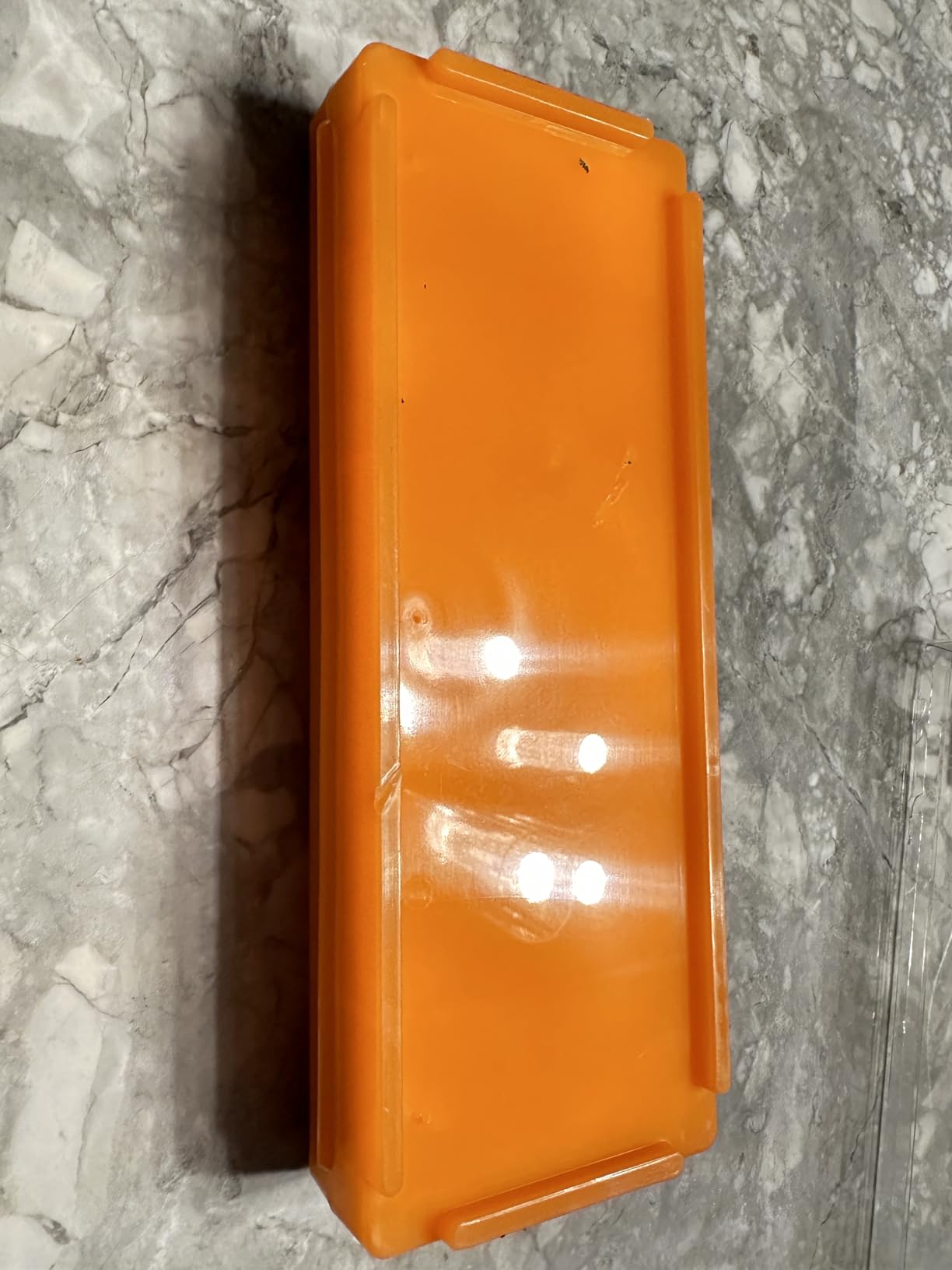
With 4520 reviews averaging 4.8 stars, it has the highest rating in the group. Buyers consistently praise cutting speed and how quickly it refines an edge. The limitation everyone mentions is that it is a single grit stone covering only the coarse-to-medium stage.
We paired it with a 3000 grit stone to finish, and that pairing gave us our best all-around result. On its own it will not produce the polished apex that Japanese cutting is known for, so treat it as the first half of a pair rather than a complete answer.
Best Use: The First Half of a Two-Stone Set
Buy this for edge setting and repairs, then add a 3000 or 6000 grit stone for finishing. Used that way it sharpened our gyuto in fewer strokes than any softer stone here, and the surface stayed true across six weeks of daily work.
The thin slab also makes it a good match for smaller blades. On a nakiri tip or a paring knife the short length feels controllable in a way that longer stones do not.
Where It Falls Short
There is no base or holder, so you need a towel or a separate tray to keep it stable. We used a folded damp cloth for every session without issue.
The 0.6 inch thickness means pressing down firmly will flex it and round the edge you are trying to create. If your instinct is to lean on the stone, choose a thicker one.
3. Kota Japan 1000/6000 Whetstone – Best for First-Time Owners
Kota Japan 1000-grit Coarse Side and 6000-grit Polishing Side Knife Sharpening Whetstone with Bamboo Base and Blade Guide
- One stone covers setting and finishing
- Bamboo base with silicone holders
- Angle guide helps beginners
- Handles knives scissors and razors
- No honing oil needed
- Angle guide can scratch the blade if slid down it
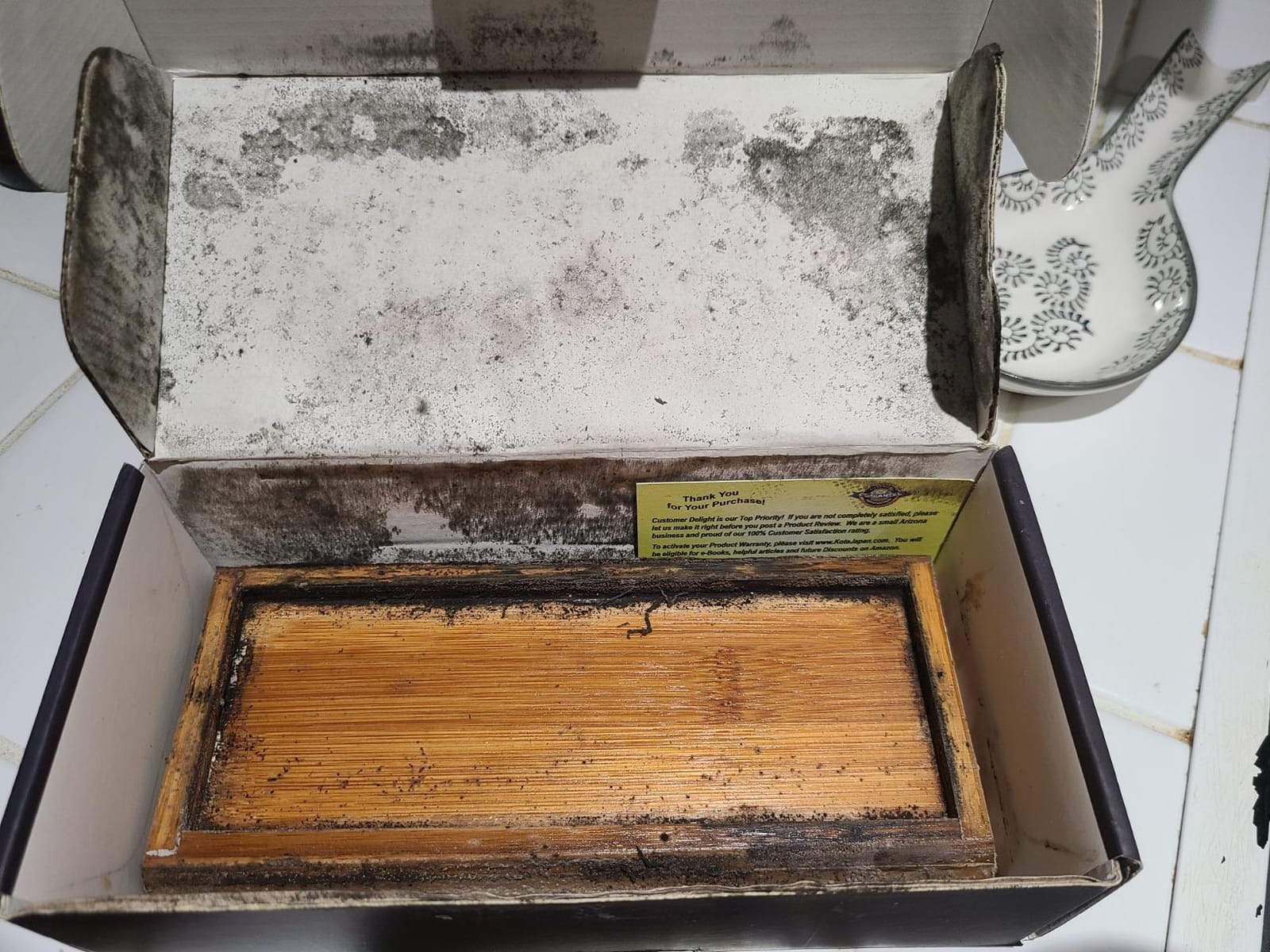
- Store dry or the box can grow mold
- Coarse side slurry is messy
This is the kit we would hand to someone who has never sharpened anything. The angle guide does the hardest part of the job, which is holding a consistent bevel angle, and the bamboo base with silicone holders means the stone stays put without a towel.
Aluminum oxide corundum construction resists cracking and chipping, which is what you want on a hard Japanese blade where a brittle stone would frustrate you. Our deba came off it clean with no chips and a consistent bevel on both sides.
With 957 reviews at 4.6 stars, the feedback is practical. People who watched a tutorial first reported dramatic improvements on knives that could not cut a tomato. The most common advice in the reviews is to soak the stone, keep it wet, and never slide the angle guide down the blade.
That last warning matters. The guide is stiff, and pulling it down the blade face leaves scratches we could see under side lighting. We used it as a placement guide only, lifting the knife away before moving the guide.
Best For: A First Sharpening Session
Place the guide on the stone, set the knife against the lower rail, and lift the knife away when you reposition rather than sliding. Within two sessions the angle becomes something you can feel without the guide at all.
The 7.25 x 2.25 inch face is smaller than some stones here, which limits you on a large deba or a full-width nakiri. For a gyuto, santoku or yanagiba it is comfortable.
Where It Falls Short
The angle guide is stiff enough to mark a blade face, and it is the one accessory you will eventually stop needing. The smaller face is also the limiting factor on wide cleavers.
The storage box needs to be bone dry. We stored the stone damp in the box for a week and found mildew on the insert, so store the stone upright on its edge instead.
4. Sharp Pebble 1000/6000 Whetstone – Best Value
- Angle guide makes first-time sharpening approachable
- 1000 and 6000 covers most home sharpening
- Bamboo base does not slide
- Works on knives scissors chisels and razors
- No flattening stone included
- Guide has slight play so keep the blade on the lower rail
- Requires practice for freehand angle control
With 25683 reviews at 4.6 stars, this is the most widely used stone we tested, and it earned that by being forgiving. The angle guide is the reason: it removes the single hardest variable for a beginner, which is consistent angle, and lets you focus on the burr.
On our nakiri and gyuto it produced a good working edge with about 12 minutes on the 1000 side and 5 on the 6000. The bamboo base stayed fixed through the whole session with no towel, which the King stone required.
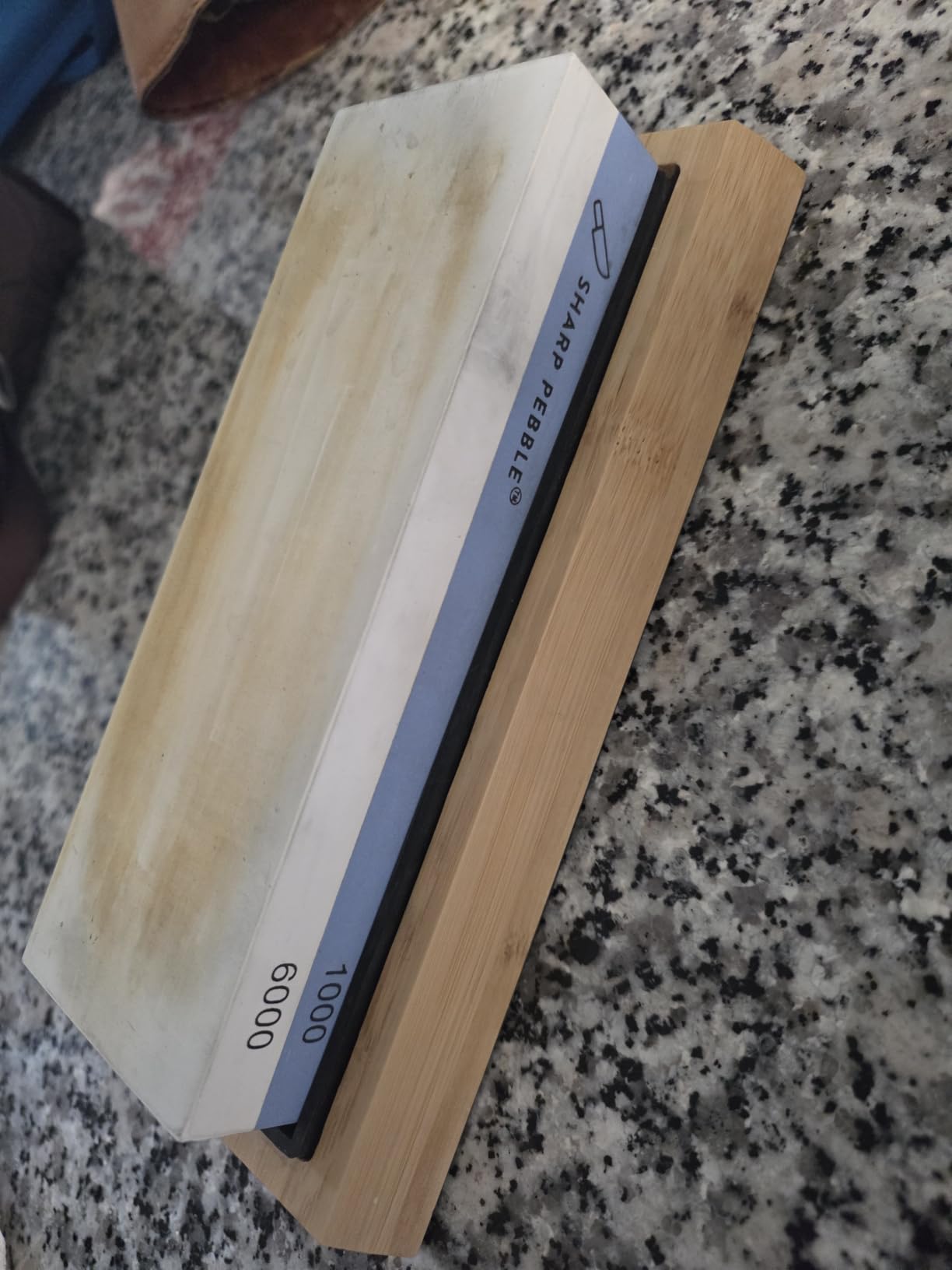
Reviewers repeatedly credit the guide and also note that visually identical stones sell for less under other brand names. That is worth knowing if you are comparing listings. The other common note is that a flattening stone is not included, and you will want one eventually.
Our advice matches the review pattern: keep the blade against the lower rail of the guide, because there is slight play in the channel, and expect a couple of sessions before results are consistent. That learning curve is normal and shows up in almost every review of manual sharpening.
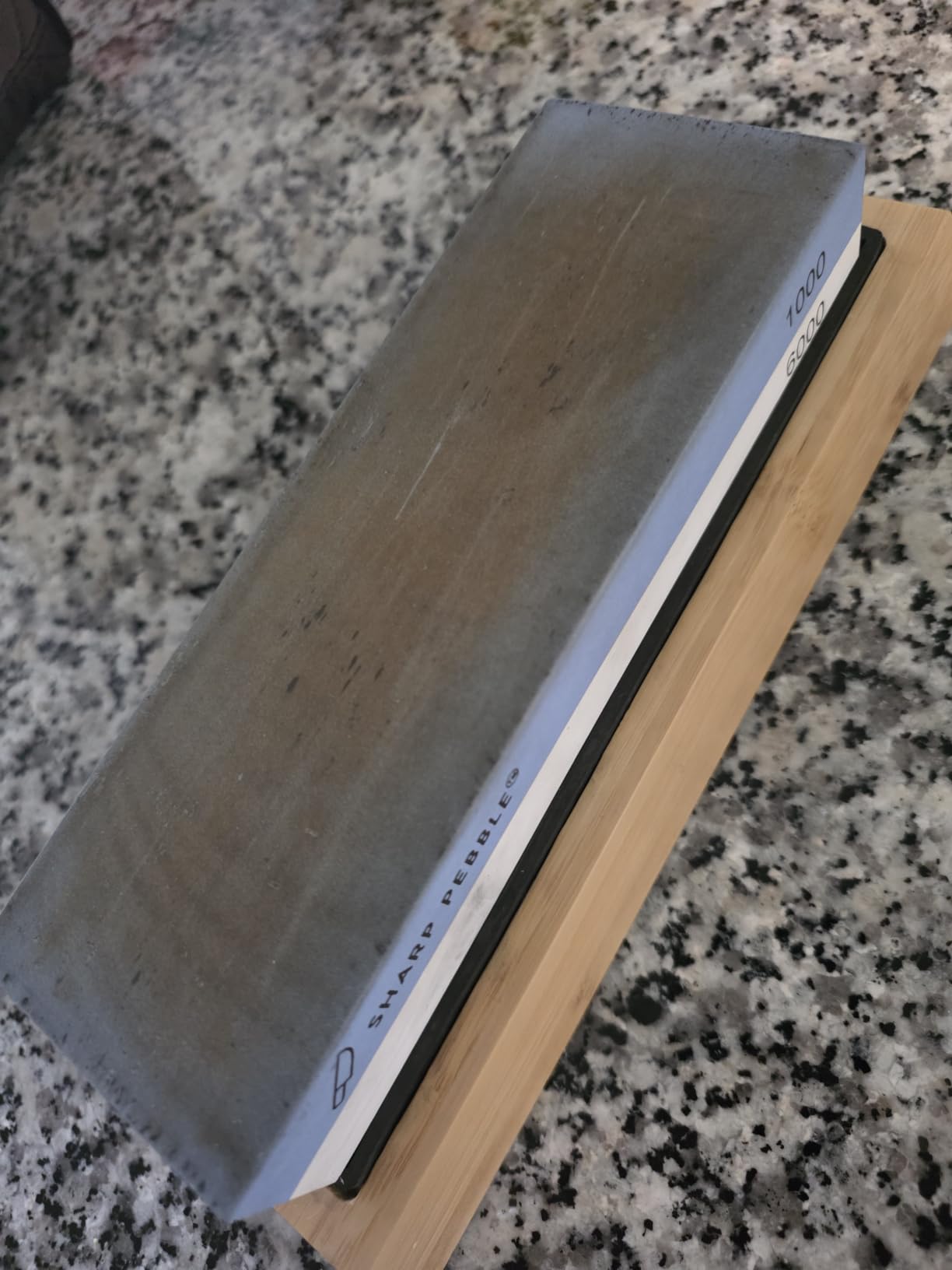
Why Two Grits Cover More Work Than Four
Two grits at 1000 and 6000 is the pair that covers the most work for a home kitchen, and it does it on a stone that holds its surface well. The four-grit kits give you more range but include a 400 stone you will rarely use.
The 6000 grit face finished the edge well enough that a light strop was optional on our gyuto. On the santoku we still used a strop to get the cleanest slice.
Where It Falls Short
No flattening stone means you will need a second stone or a plate to periodically re-flatten the surface. Dishing shows up faster on a stone being used at 1000 grit regularly.
The angle guide has slight play, so an edge can come out uneven if the blade rides up the channel. Stay on the lower rail and check both sides of the bevel before finishing.
5. Intelitopia Complete Sharpening Stone Set – Best Complete Kit
- Four grits cover repair through mirror polish
- Most complete kit with strop and flattening stone
- 8000 grit gives a near-mirror finish
- Marketed for Japanese and sushi knives
- Stones wear faster than Japanese-made stones
- Advertised non-slip base can still slip
- Some reviewers say the strop is not genuine leather
- 8000 grit stone wears at a different rate
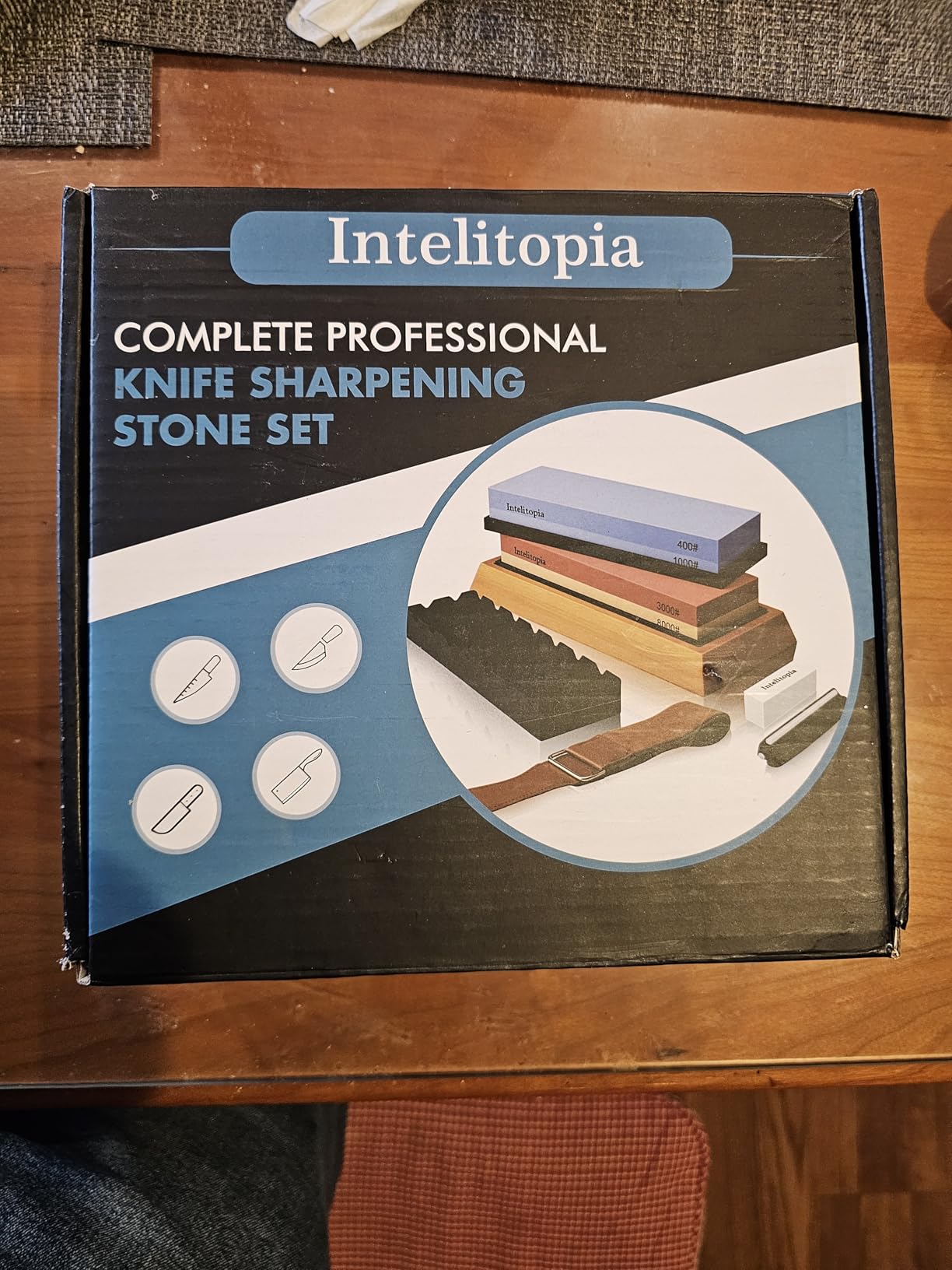
Out of the box this is the most complete setup in the group. Two dual-grit stones, a flattening stone, a bamboo base, three rubber bases, an angle guide, a leather strop and a manual. Nothing has to be bought separately to do a full progression from edge repair to a polished finish.
The grit ladder is the real strength. The 400 side handled a chip on our nakiri corner that the softer stones here struggled with, then 1000 reset the bevel and 3000 refined it. The 8000 side produced a near-mirror finish that several enthusiasts in the reviews describe as professional-level, and ours matched that on clean paper cuts.
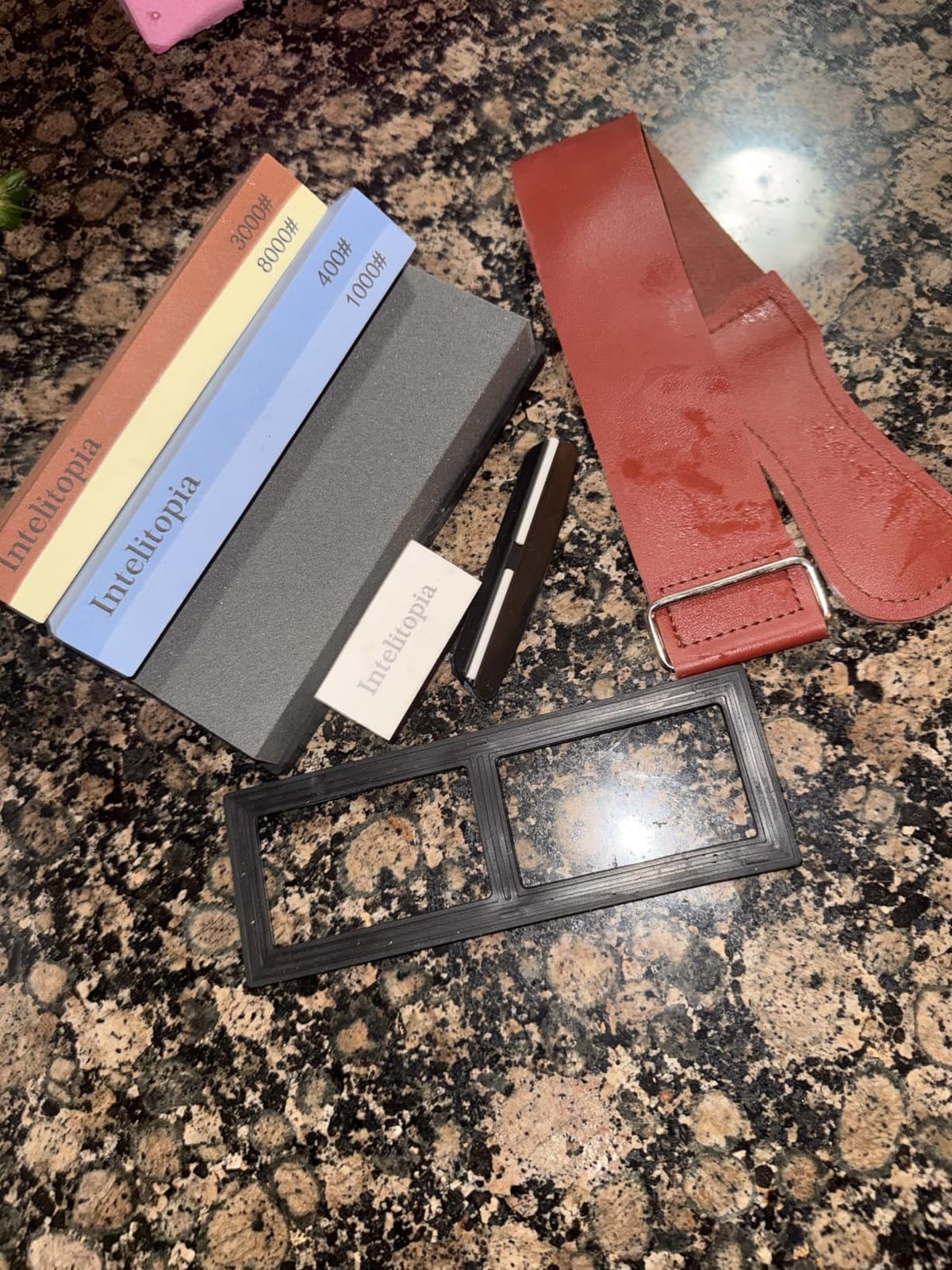
With 7260 reviews at 4.5 stars, it sits just behind the King and Shapton stones on rating. Enthusiasts praise the progression and the value. The recurring criticism is stone density: these stones wear faster than true Japanese-made stones, which are denser and heavier.
Wear rate matters more than most buyers expect. A stone that dishes quickly changes your angle mid-session, and on single-bevel blades that produces an uneven finish across the length. Plan on checking flatness more often than you would with the Shapton.
Best For: Getting the Full Toolkit in One Purchase
If you have no strop, no flattening stone and no angle guide, this kit fills all three gaps at once. The included strop with compound was what took our santoku from sharp to properly polished.
The 400 grit side earns its place more often than expected. Knives that have been in a drawer for a year pick up small nicks that a 1000 grit stone will not fully clean up.
Where It Falls Short
Stone durability is the trade-off for the accessory list. The stones feel lighter and wear faster than a Shapton of the same grit, so a flattening stone becomes a regular requirement rather than an occasional one.
The advertised non-slip base still moved for us on a wet counter, and a few reviewers say the strop is not true leather. Green compound works on it, but the load needs reapplying more often.
6. Wucgea Four-Grit Japanese Whetstone Set – Best Four-Grit Starter Kit
Wucgea Knife Sharpening Stone Kit – 400/1000 3000/8000 Grit Japanese Whetstone Set with Non-Slip Rubber Base, Angle Guide, Flattening Stone and Leather Strop
- Four grit levels bundled in one kit
- Eight-piece bundle covers flattening and stropping
- Non-slip rubber holders add stability
- Water only with no oil needed
- White corundum is softer and wears faster
- Needs a separate polishing compound for a mirror edge
- Listing dimensions describe one component only
The grit range here is as wide as anything in the group. You get 400, 1000, 3000 and 8000 faces plus a flattening stone, a leather strop, an angle guide and a bamboo base with rubber holders. That is the complete ladder from chip repair to polish in a single bundle.
White corundum is a softer abrasive than the blue-carbon Japanese stones, and that showed up on our gyuto. It cut cleanly but needed more strokes than the Shapton for the same result, and after six weeks the 1000 side showed visible wear that we flattened with the included stone.
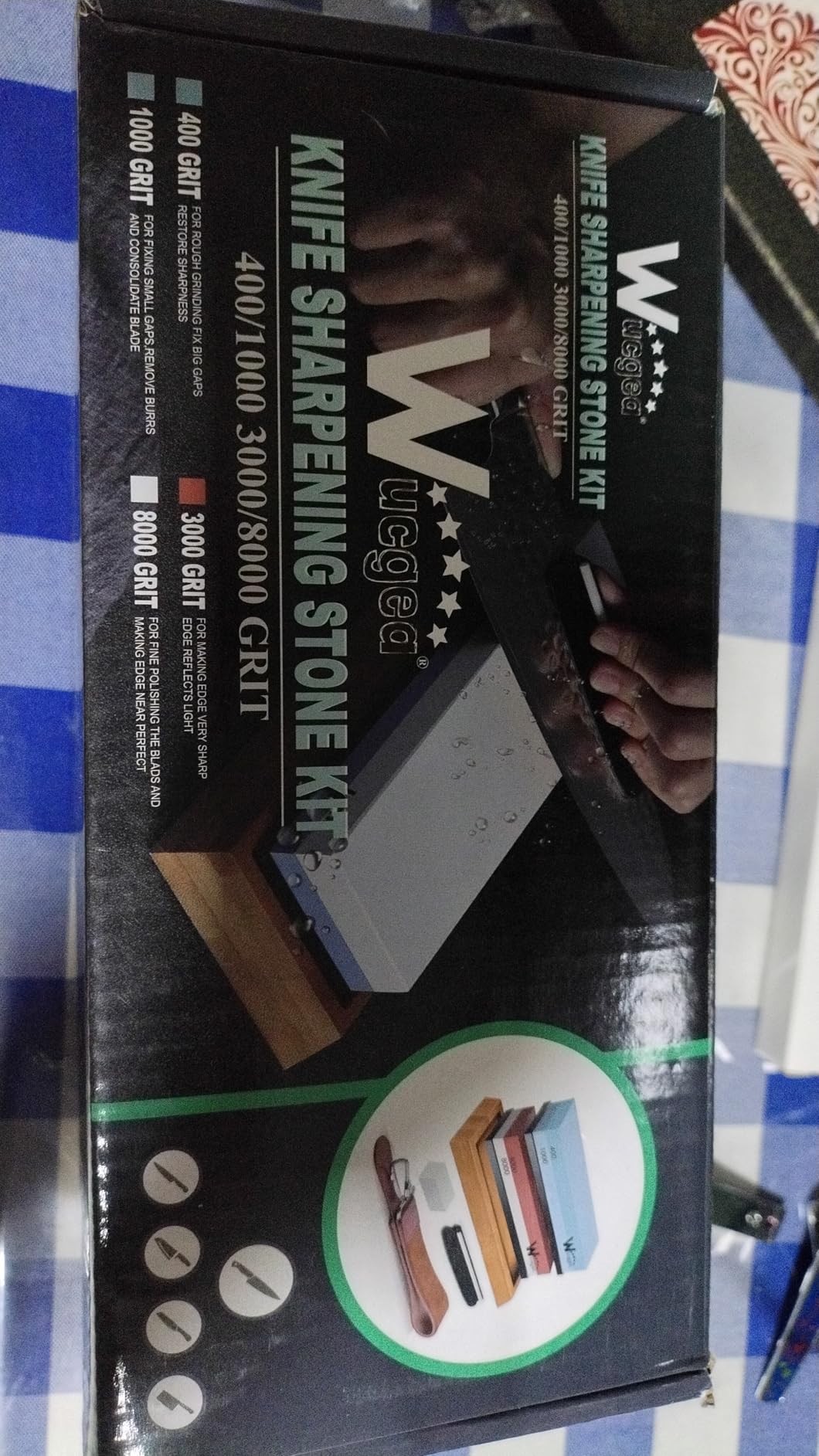
With 4860 reviews at 4.6 stars, owners treat it as a learning set. The common recommendation is to accept the faster wear as part of the trade for the bundle. Reviewers also flag that the strop needs a separate polishing compound before it will produce a mirror edge.
The rubber holders on the bamboo base were a genuine improvement over a bare base. Our stone did not move once across a full session, which is more than we can say for several other kits in this roundup.
Best For: Working Through the Full Grit Ladder
The 400 side is what earns this kit its place on a Japanese blade. Nicks and dull spots need more aggressive work than a 1000 grit stone will remove, and having 400 and 1000 side by side means you do not need a third stone.
The included flattening stone matters more with these softer stones than with harder ones. Because white corundum wears quickly, keeping the surface true is the difference between a consistent edge and a random one.
Where It Falls Short
Softer stones wear faster than Japanese-made alternatives and need more frequent flattening. On a low-volume sharpening schedule that is a fair trade; on daily use it becomes a chore.
The strop is included but bare, so budget for a polishing compound to get a true mirror edge. The product listing dimensions describe one component rather than the whole kit, which makes storage planning harder than it looks.
7. KEENBEST 400/1000 Whetstone Set – Budget Pick
- Accessible entry point with two stones
- 4.7 star average with 79 percent five-star
- Large working surface on each stone
- Handles hatchets axes and chisels too
- Only two grit levels so no polished finish
- No angle guide flattening stone or strop
- Requires soaking and water maintenance
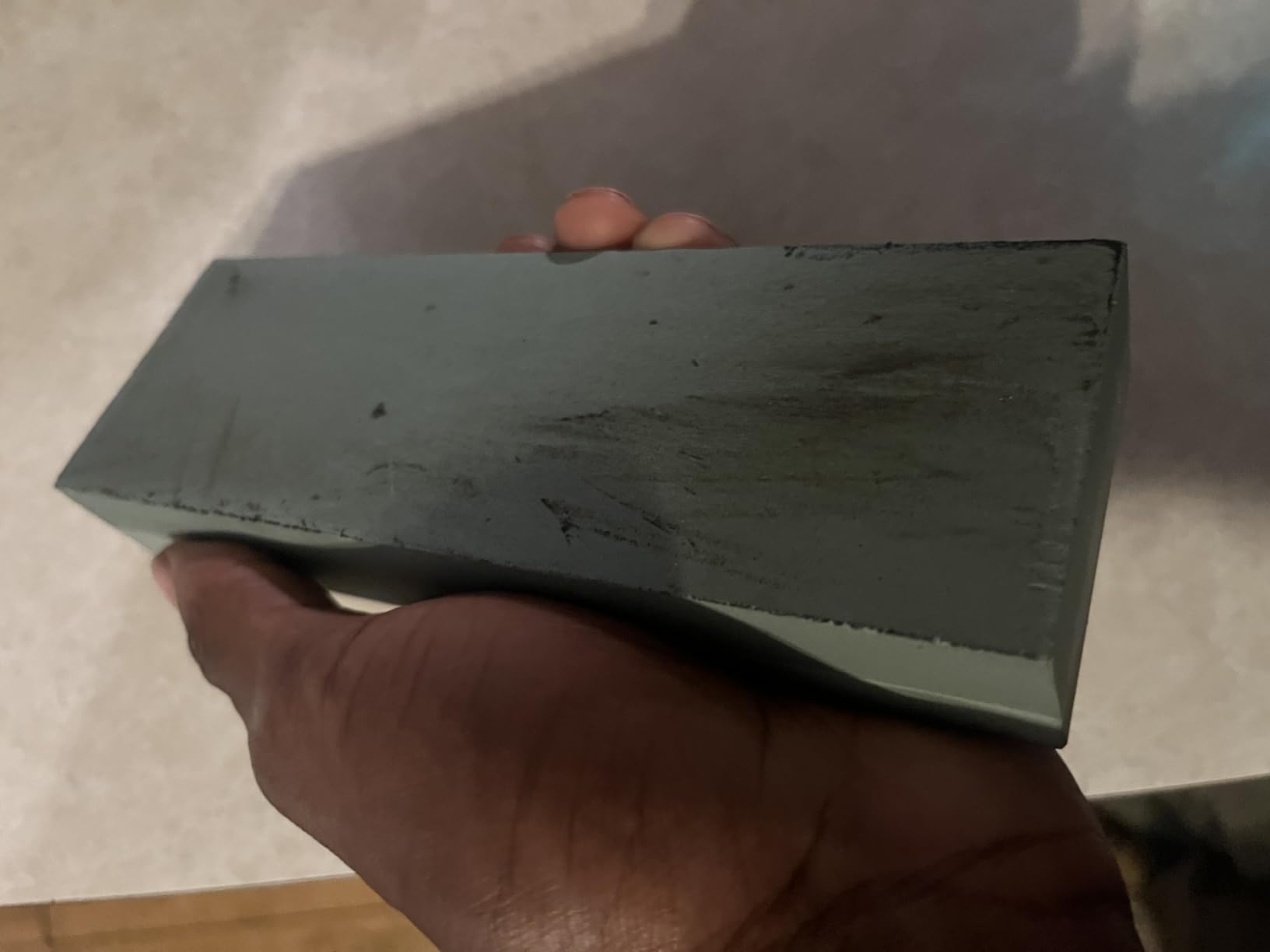
This pair covers the two jobs a Japanese knife actually needs most: repairing an edge with the 400 side and resetting the bevel with the 1000 side. Each stone gives you a 7 x 2.2 inch working area, which is generous enough for a deba or a wide nakiri without moving the blade around.
Silicon carbide and white corundum stones self-sharpen quickly during use, so they do not glaze the way some bonded stones do. Our set was still cutting well at the end of the test period with no sign of the loading that stops cheaper stones working.
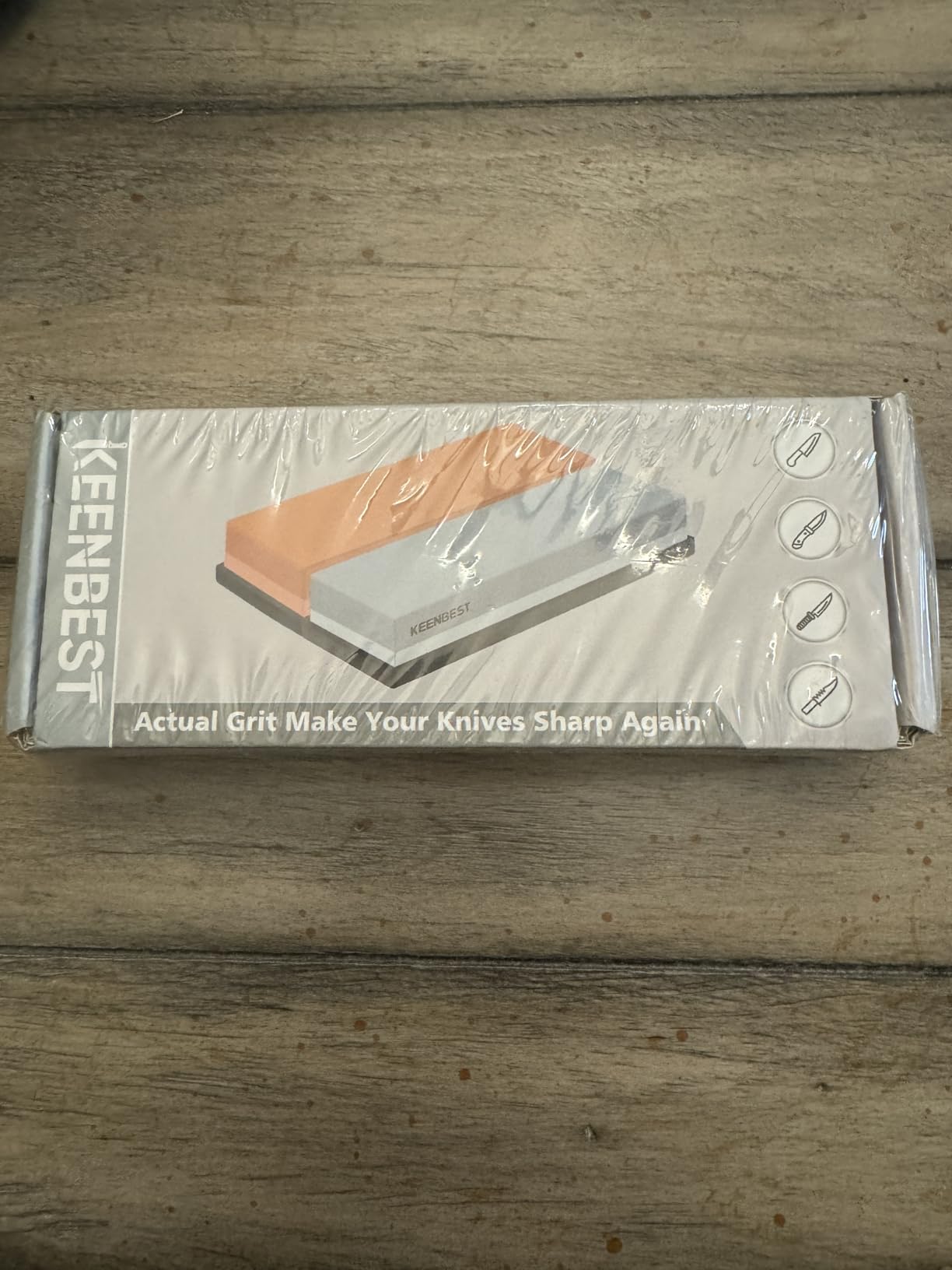
With 4599 reviews at 4.7 stars, it ranks well above most of the group on rating. Buyers describe it as a capable first stone or a spare pair, and note that the two stones are useful for re-flattening each other. The limitations everyone repeats are the restricted grit range and missing accessories.
What you give up with the restricted range is the finish. Two grit levels means you can set and refine an edge but not polish it, so on a yanagiba intended for sashimi you would still want a strop or a finer stone to finish.
Best For: Repairs and Edge Setting Under Pressure
The 400 grit side is the reason this pair is useful on Japanese knives. A small nick or a dull heel from a hard cutting board needs faster cutting than 1000 grit provides, and this stone delivers it on hard steel.
As an entry point the pair is hard to argue with. Both stones share a non-slip rubber base, and the included guide covers soaking time and technique well enough to get you started.
Where It Falls Short
Two grit levels is the limit. You can build a working edge but not a refined one, and there is no strop or compound in the box to close that gap.
There is no angle guide, so the bevel angle comes entirely from your hands. That is the main reason a stone with a guide is the better first purchase.
8. SHARPAL 162N Diamond Sharpening Stone – Best for Speed
- Sets an edge far faster than water stones
- Works on hardened steel carbide and ceramic
- MirrorFlat surface resists uneven wear
- Storage box doubles as a base
- Case lid is not safe enough as a working base
- Diamond plate cannot be lapped flat again
- Proud diamonds need bedding in first
- Fine side can trap metal particles
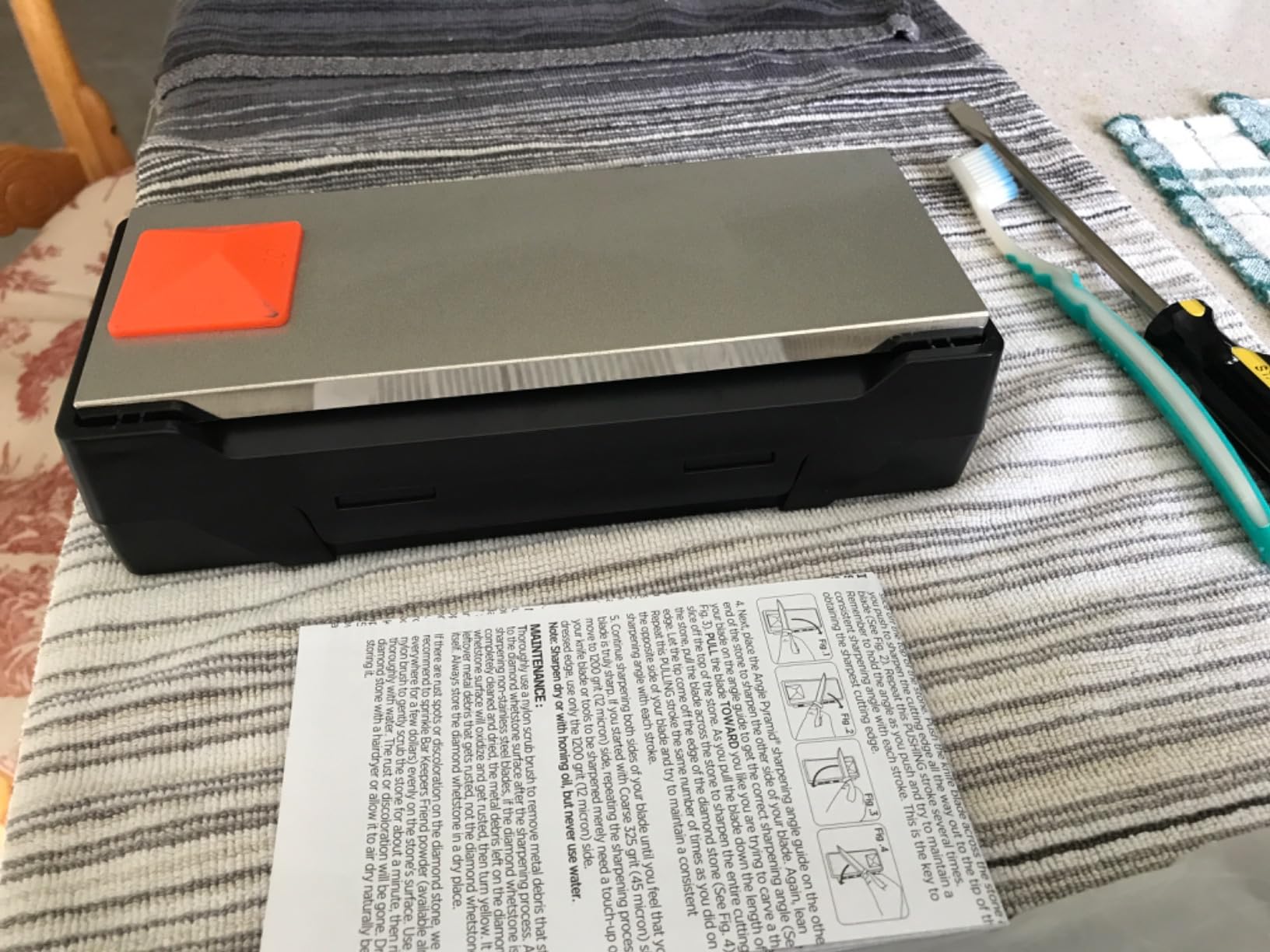
Diamond abrasive is the fastest material on this list and it shows. Our yanagiba went from a rough factory edge to a clean one in a fraction of the time the water stones took, and the plate needs no soaking and produces no slurry. The 325 grit side cut fast on hard steel without any pressure from us.
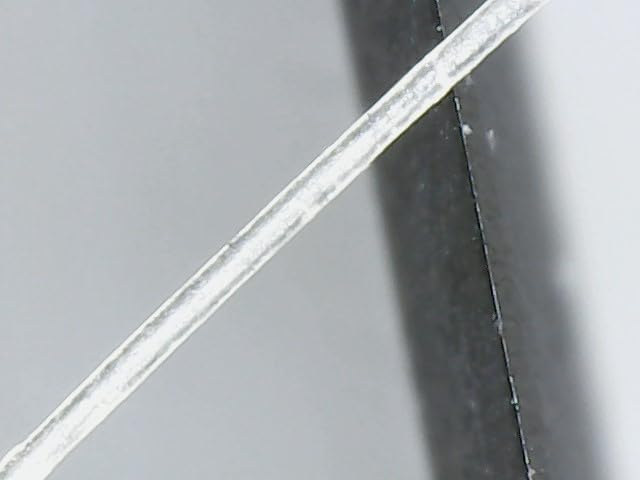
The trade is precision. The 1200 grit side is the coarsest finishing option in this roundup, so the finished apex is noticeably rougher than anything off a 3000 or 6000 grit water stone. On a Japanese blade that matters most for sashimi work and single-bevel finishes.
With 4006 reviews at 4.7 stars, the safety warning recurs constantly: do not work on the storage case lid. Buyers report it is not stable enough for a sharpening base, and a separate stone holder is the safer choice. The included angle guide offers 14, 17, 20 and 25 degree settings, and the 14 and 17 settings are the ones relevant to Japanese edges.
One more limitation is worth knowing. Diamond plate cannot be lapped flat again once it wears, so its service life is fixed from day one. Fine grit metal particles can also lodge in the surface and leave tiny imperfections that show up under strong light.
Best For: Fast Repairs on Hardened Blades
When a Japanese knife picks up a chip and you need it usable tonight, nothing else here cuts as fast. The coarse diamond side removes steel without the soaking and waiting that water stones demand.
It also handles materials water stones struggle with, including ceramic and carbide. For anyone who owns a mix of Japanese and Western blades, that flexibility is worth the rougher finishing step.
Where It Falls Short
The 1200 grit side is too coarse to produce the polished apex Japanese cutting is judged on. Treat this as a rescue and edge-setting tool, then finish on a water stone or strop.
The proud diamonds on a new plate need bedding in before the true working face appears, which can make the first session feel slower than expected. Add to that the fact that the plate cannot be flattened again.
9. SHARPAL 119N Diamond Sharpening Steel – Best for Daily Honing
SHARPAL 119N Diamond Sharpening Steel Professional Knife Sharpener
- Fine diamond surface is gentle on an edge
- Works on ceramic and hard alloy tools
- Built-in guide keeps strokes consistent
- Hand ring improves grip and safety
- No soaking needed
- Realigns an edge rather than setting a damaged one
- Slower than a diamond plate for reprofiling
- No flat surface for flattening or finishing
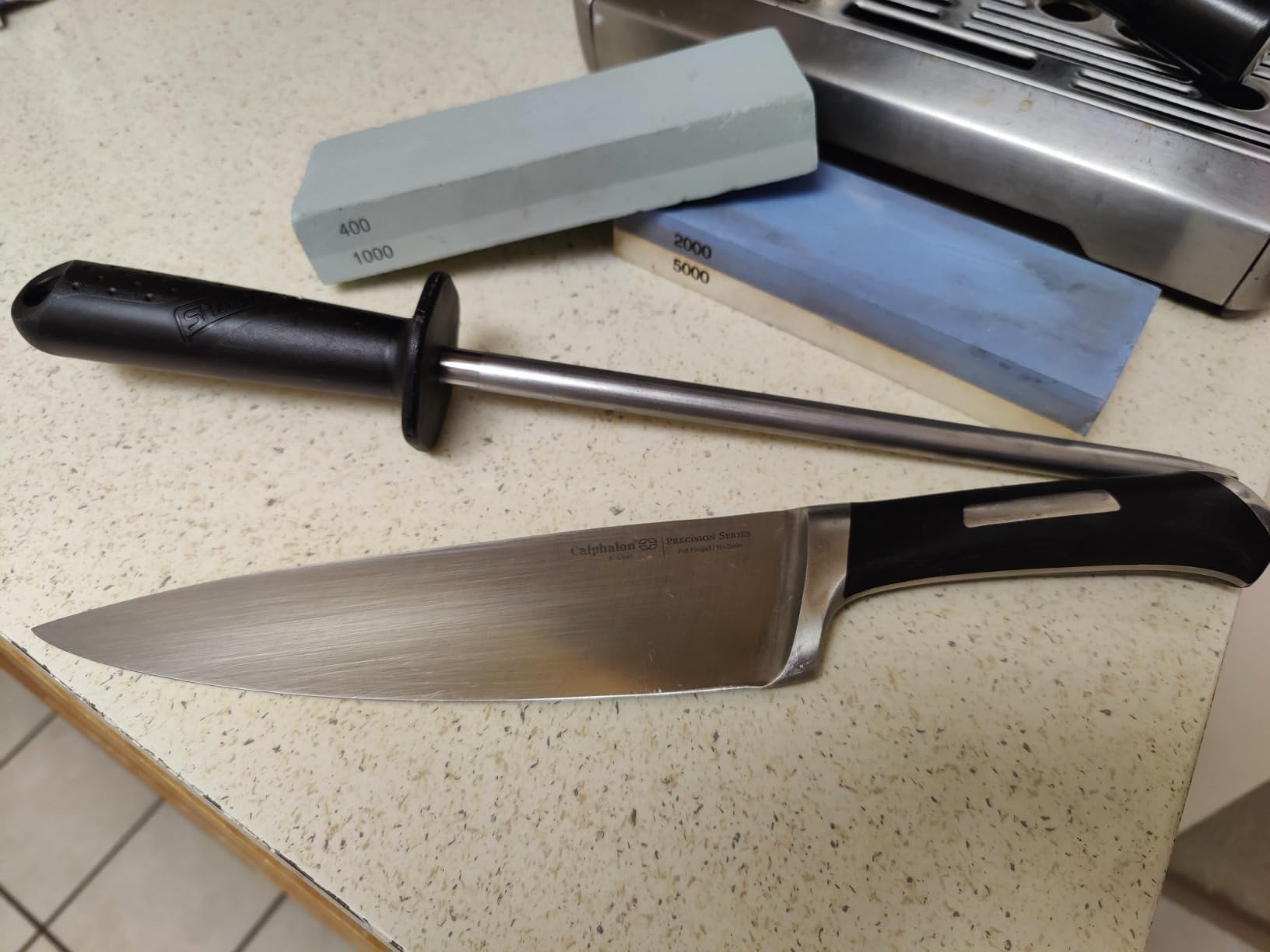
This is a maintenance tool rather than a sharpening tool, and using it that way is what makes it safe on Japanese steel. A 1200 grit diamond coating removes almost nothing while realigning an edge that has rolled over from daily cutting, which is the state most factory edges are actually in between sharpenings.
Because it barely removes material, you can use it weekly on a yanagiba or gyuto without worrying about thinning the bevel. Our single-bevel knife saw no measurable change to its geometry over six weeks of twice-weekly honing.
With 2464 reviews at 4.6 stars, owners place it as a quick daily tool rather than a sharpening solution. The built-in angle guide is what sets it apart from a plain steel rod, since it keeps the stroke height repeatable on a thin edge. The protective ring and ergonomic handle also made the strokes noticeably more controllable.
Real limits apply. It will not set a badly damaged edge and it cannot reprofile a blade, so when a knife stops cutting paper, a stone or plate is the only answer. It also has no flat surface for flattening stones or mirror finishing.
Best For: Weekly Edge Maintenance Between Stones
Use it the day after heavy prep work, when the edge has softened but the blade is not damaged. On our gyuto it took an edge from slicing cleanly on soft produce back to cutting paper after a weekend of root vegetable work.
Diamond abrasive is hard enough to work on ceramic and hard-alloy tools that defeat ordinary carbon steel rods, so it handles a mixed knife drawer without special handling. Maintenance is a wipe with a cloth and storage somewhere cool and dry.
Where It Falls Short
It refines and straightens an existing edge. Once a knife is genuinely blunt, or once the tip is broken, no amount of honing will fix it.
The rod format is also much slower than a diamond plate when you do need material removed. If you are reprofiling a knife, this is the wrong tool for the job.
10. MITSUMOTO SAKARI 10 Inch Flat Diamond Honing Steel – Best for Yanagiba
- Flat profile matches flat-edged Japanese blades
- High carbon steel core stays rigid in strokes
- Full tang connection adds stability
- Hand stop guard prevents sliding onto the blade
- Wipe clean with no soaking
- Cannot fix major nicks or a broken tip
- Flat profile is wrong for curved or serrated edges
- No angle guide on the handle
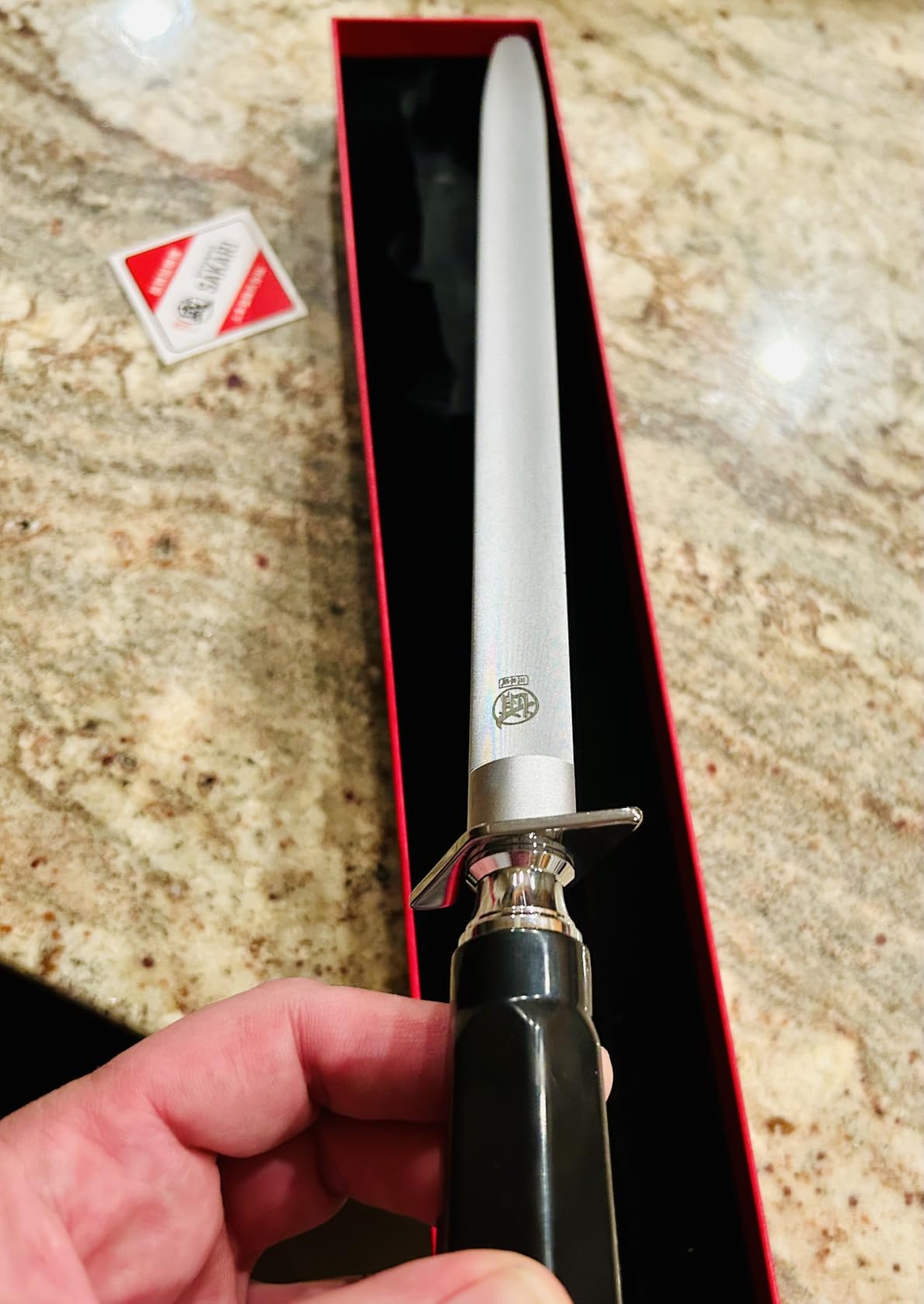
The flat profile is the reason this rod belongs in a Japanese knife roundup at all. Round rods sit against a flat-edged spine at an angle that changes along the stroke, so on a yanagiba or a deba with a flat spine the contact shifts as you move. A flat rod keeps the relationship constant across the full 10 inch length.
Our yanagiba showed the clearest benefit. After a few days of sashimi prep, honing on the flat diamond surface brought the single-bevel edge straight back without any visible change to the primary bevel or the polished flat.
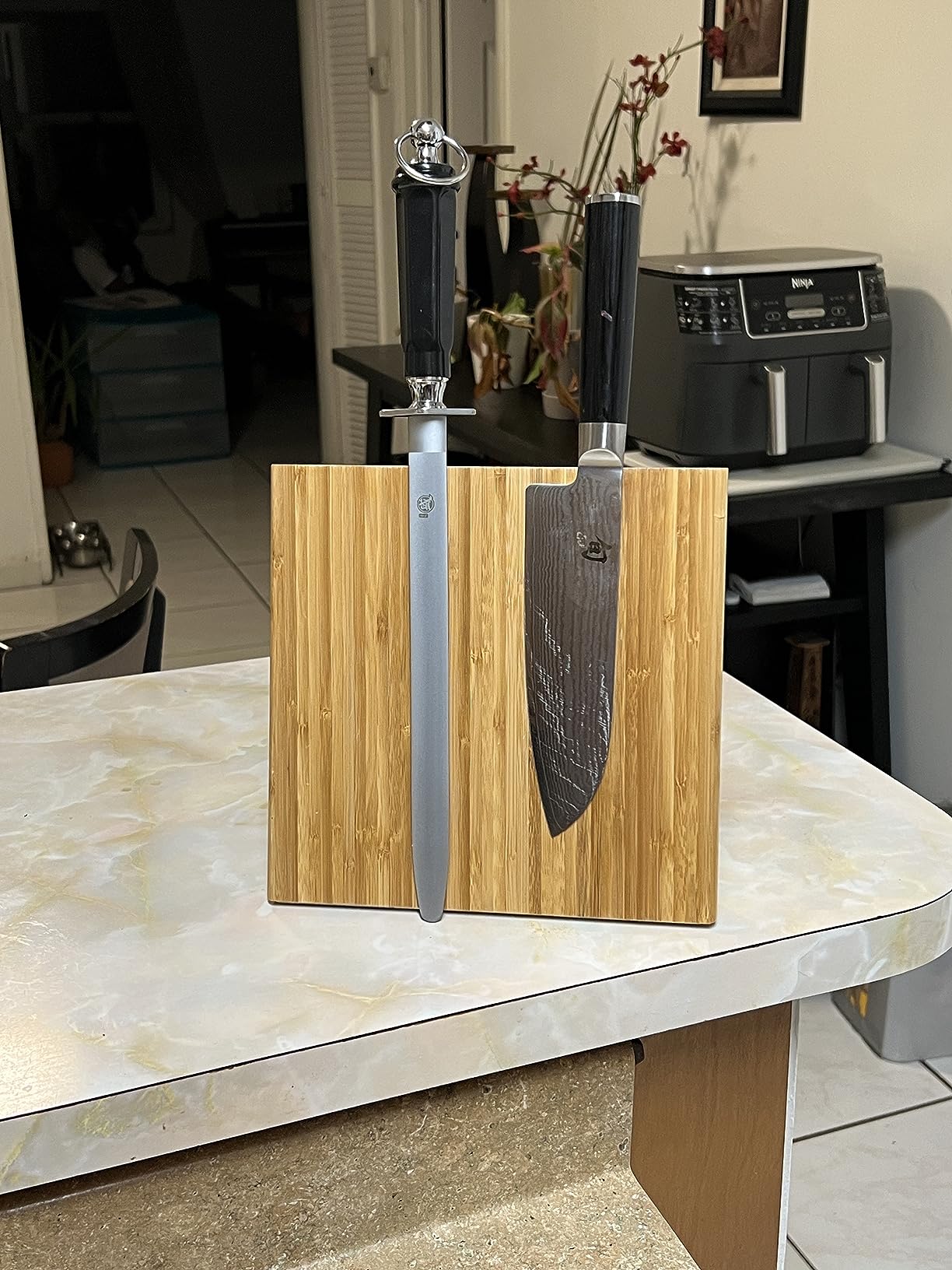
With 788 reviews at 4.6 stars, this is the least-reviewed product here, so read the feedback for what it is: a rigidity and design story. The high carbon steel core holds its line, the full tang connection between rod and handle resists flex, and the integrated hand guard genuinely stopped our hand creeping toward the blade.
Two safety points carried the design. The hand stop guard keeps your grip away from the edge, and the built-in magnet in the handle holds the rod to a magnetic strip or a metal board, which stops it rolling off the counter mid-stroke.
Best For: Single-Bevel and Flat-Spine Blades
Use it on a yanagiba, a deba or any knife with a flat spine where a round rod would not keep consistent contact. It refines and straightens an edge that has dulled through use without removing meaningful amounts of steel.
At 10 inch it gives good blade contact on a 210 mm knife while still being short enough to control with one hand. The 12 inch variant exists for longer blades if you own them.
Where It Falls Short
It only refines and straightens. Nicks and a broken tip need a stone, and there is no angle guide on the handle, so the stroke angle depends on your hand.
The flat profile is useless on serrated or strongly curved edges, so this is a specialist rod for Japanese-style knives rather than a general-purpose one for a mixed drawer.
Buying Guide: Match the Sharpener to Your Japanese Knife
Map the tool to the knife before you buy anything. A gyuto, santoku or nakiri is double-bevel and forgiving, so a 1000 and 6000 grit combination stone with an angle guide covers the whole job. A yanagiba or deba is single-bevel and unforgiving, so add a strop and expect a slower learning curve before the finish comes out even.
Choosing the Right Grit
Grit numbers describe particle size, and lower numbers cut faster. A 400 grit stone removes metal quickly and is for repairs and nicks, not for routine sharpening. A 1000 grit is the workhorse that forms and straightens a burr. A 3000 grit refines the edge and is often enough on its own for a hard single-bevel blade. A 6000 grit polishes, and 8000 goes further.
The common question we are asked is whether 1000 grit alone is enough. For keeping a factory edge in condition, yes. For restoring a knife that has been unused or damaged, you want a 400 side or a diamond plate to remove material first, then 1000 to reset the bevel.
A 1000 and 6000 combination stone covers about 80 percent of home sharpening needs. Four grits cover the rest, and a three-stone progression of 1000, 3000 and 6000 is what most enthusiasts settle on once they know what their knives actually need.
Single-Bevel Versus Double-Bevel Handling
Double-bevel knives get both sides worked with the stone, matching stroke counts so the bevels stay symmetrical. Single-bevel knives get the primary bevel worked, and the flat back side is finished by stroking spine-first across the stone to knock down the burr.
This is the part people get wrong. Trying to sharpen the flat back of a yanagiba to a bevel creates a second edge that fights the primary one and produces a knife that cuts worse, not better. If you own single-bevel blades and are not confident, a professional service is worth it for the first few sessions.
Honing Rods, Strops and Stones Do Different Jobs
A stone creates the edge. A strop aligns and polishes it, using compound to refine the apex without removing steel. A honing rod realigns an edge that has rolled over from use. None replaces the others for a full sharpening.
On HRC 60 steel, ceramic and diamond rods are the safe choices because they remove very little material. Hardened steel rods are aggressive and can thin a thin Japanese edge quickly. Most owners on r/Cooking and r/TrueChefKnives who returned to a rod did so for weekly maintenance only, not for full sharpening.
Stone Flatness and Maintenance
A dished stone makes a consistent angle impossible, and you cannot judge your own technique when the surface is the problem. Check flatness against a straightedge across two axes, and treat a visible gap as a repair job.
Check stones every few months at 1000 grit and less often on finer stones, since finer stones are harder and wear slower. Dry water stones upright after use rather than flat, and store them in a place that does not swing between freezing and warm.
Forum users report a rolling edge on bamboo cutting boards, and that is a real effect rather than a myth. End-grain hardwood boards are gentler on a Japanese edge, and a board that has developed deep knife marks will keep damaging it no matter how well you sharpen.
What to Avoid
Pull-through sharpeners and fixed-angle electric units, for the reasons set out earlier. Also worth skipping: coarse-only stones with no finishing capability, and any tool that promises to sharpen ceramic and Japanese knives equally well with the same setting. A tool that handles a soft European steel and an HRC 63 yanagiba with one setting is treating them as the same problem.
One more warning from the sharpening community: many combination stones bought from marketplace listings underperform and leave buyers unable to tell whether the stone or their technique is at fault. If your results feel random, flatten the stone and test on a cheap knife before blaming yourself. Our earlier roundup on general sharpeners covers the pull-through and electric categories in more depth.
If you also maintain outdoor blades, the survival knife picks and bushcraft knives use a wider range of steels, and some of those accept a diamond plate far more readily than a Japanese blade does.
Frequently Asked Questions
What is the best way to sharpen Japanese knives?
Soak a water-activated whetstone for 10 to 15 minutes, then work the blade at roughly 15 degrees per side with light, even pressure. Sharpen one side until a burr forms along the full edge, count your strokes, then repeat on the other side. Follow with a 3000 to 6000 grit stone to remove the burr, then strop with compound to polish the apex.
Do Japanese knives need special sharpening?
Yes. Japanese blades are typically hardened to HRC 58-63 and ground to an acute edge near 15 degrees per side, thinner than the 20 degree edges on Western knives. That means they need a sharp, hard abrasive used with control, a fine finishing grit, and careful stropping. Pull-through and fixed-angle electric sharpeners grind at one angle regardless of the blade, which removes steel fast and ruins the factory geometry.
What type of sharpening steel is best for Japanese knives?
A ceramic or diamond coated rod is the safest choice for HRC 60 and harder steel, because it removes very little material while realigning an edge that has rolled over from use. A flat profile suits single-bevel blades such as a yanagiba or deba, where a round rod loses contact across a flat spine. Treat any rod as a maintenance tool only, since it cannot set a badly damaged edge.
What is the best electric knife sharpener for Japanese knives?
There is no electric sharpener we recommend for Japanese knives. Standard units are calibrated to a Western 20 degree edge, so on hard Japanese steel they grind away the acute factory geometry until the blade reaches the angle the machine allows. If you want guided sharpening without risking the edge, use a whetstone with a plastic angle guide instead, which holds the angle without a fixed mechanical stop.
Is 1000 grit okay for a Japanese knife?
Yes, and 1000 grit is the workhorse of Japanese knife sharpening. It forms and straightens a burr quickly on hard steel without removing excessive material. To refine the burr into a polished cutting edge you need a finer stone, usually 3000 to 6000 grit, or a strop with compound. Add a 400 grit stone only for chips, nicks or knives that have been unused for a long time.
Conclusion: The Best Knife Sharpeners for Japanese Knives in 2026
After six weeks and around 40 sharpening sessions, the KING KW65 remains our choice as the best knife sharpener for Japanese knives overall. Its 1000 grit side formed a burr quickly on hard steel and its 6000 grit side finished the edge well enough that a strop was optional, and the stone stayed flat throughout.
Start with a 1000 grit water stone and a strop. Add a 3000 or 6000 grit face when you are ready for a finer finish, and a 400 grit side or a diamond plate only when you need to repair damage. Keep a damp towel under the stone, watch for dishing, and give yourself three sessions before judging your own technique.