
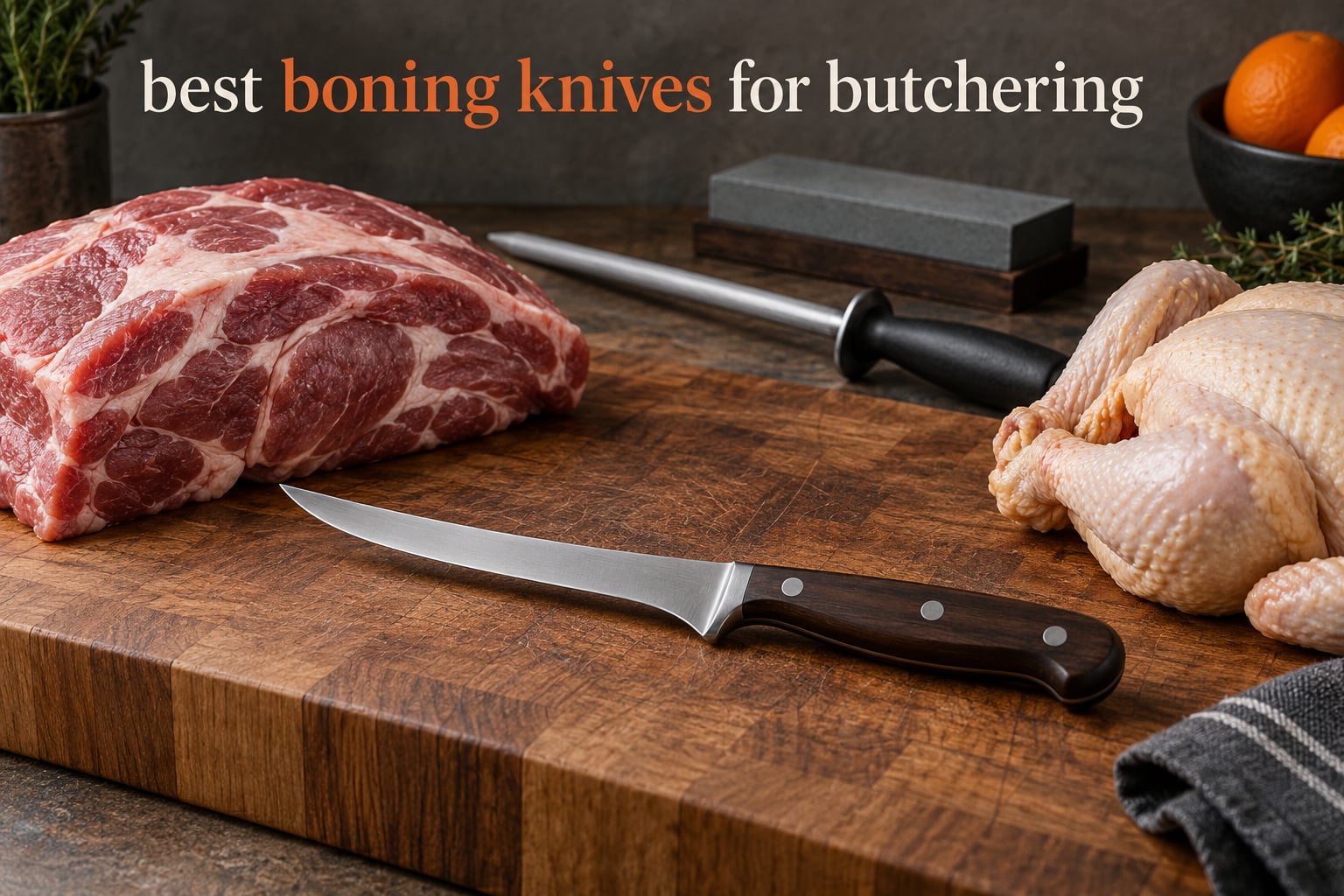
A boning knife is a narrow, pointed knife with a thin, partly flexible blade built to separate meat from bone by drawing the edge along the bone in short strokes rather than chopping or stabbing. The thin blade flexes just enough to follow the curve of a knuckle, hock or shoulder blade, so the cut hugs the bone and leaves less usable meat in the waste pile. That is the whole idea behind every entry in our list of the best boning knives for butchering: closer contact with bone means a cleaner yield, fewer cuts and less force.
We spent weeks putting twelve of the most-reviewed boning knives through the same routine: breaking down whole chickens, deboning pork shoulder, filleting fish and trimming a hind quarter of venison. We tracked how each blade held an edge, whether the handle stayed put with wet and greasy hands, how much flex the blade gave before it skated off a knuckle, and how each one felt after hour three. Last tested: October 2026, and the short version of our findings is below.
This guide is written for four groups. Backyard poultry keepers need a flexible blade that hugs a tiny femur. Weekend hunters processing deer or elk need something that will not quit on connective tissue. Serious home cooks want a knife that survives a sharpening steel for a decade. And meat-counter staff need a certified, washable blade that stands up to a full shift.
One note before we start: a 6 inch boning knife does not replace a 10 inch breaking knife on a beef rib primal, and no boning knife replaces a bone saw. If you are breaking down a whole deer for the first time, treat this list as one tool in a set rather than the whole set. Our outdoor blade picks cover the field-dressing side if that is your entry point, and you can see the general shape of that category in our survival knife roundup and bushcraft knife guide before the deer season starts.
Table of Contents
Top 3 Boning Knives for Butchering in 2026
If you want the short list, these three cover the range most people need. The Mercer Culinary Ultimate White is the best boning knife for butchering overall because it is sharp out of the box, easy to resharpen and backed by one of the largest review bases we found. The Victorinox Fibrox 6-Inch is the best value and the one forum users name most often. The imarku 6.8 inch is the best-looking forged option for anyone who wants pakkawood and German steel.
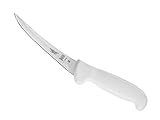
Mercer Culinary Ultimate White 6in
- High carbon Japanese steel
- Hollow ground 6 inch blade
- Textured finger points
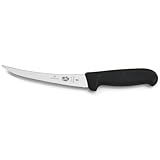
Victorinox Fibrox 6in Curved
- Flexible stainless blade
- Fibrox Pro grip
- Swiss made with lifetime warranty

imarku 6.8in Forged Pakkawood
- 56 Rockwell German steel
- Forged full bodied blade
- FSC pakkawood handle
All 12 Boning Knives Compared Side by Side
Every knife below earned a spot because at least a few hundred owners rated it, and because it did something the others do not. Flexibility class is the column that matters most: it decides which animal the blade suits more than any other spec on the list.
| Product | Specifications | Action |
|---|---|---|
| Mercer Culinary Ultimate White 6in Curved |
|
Check Latest Price |
| Victorinox Fibrox 6in Curved Flexible |
|
Check Latest Price |
| imarku 6.8in High Carbon Pakkawood |
|
Check Latest Price |
 Dexter Sani-Safe 6in Flexible Dexter Sani-Safe 6in Flexible |
|
Check Latest Price |
 Mercer Millennia 6in Stiff Mercer Millennia 6in Stiff |
|
Check Latest Price |
 ULTRASOURCE 5in Curved Semi-Flex ULTRASOURCE 5in Curved Semi-Flex |
|
Check Latest Price |
 PAUDIN 6.1in Flexible Pakkawood PAUDIN 6.1in Flexible Pakkawood |
|
Check Latest Price |
 Victorinox Swiss Classic 6in Flexible Victorinox Swiss Classic 6in Flexible |
|
Check Latest Price |
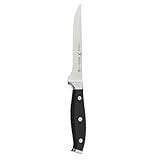 HENCKELS Premio 5.5in Forged HENCKELS Premio 5.5in Forged |
|
Check Latest Price |
 SYOKAMI 6.7in Wide Carbon Steel SYOKAMI 6.7in Wide Carbon Steel |
|
Check Latest Price |
 Cutluxe 6in Curved Forged Cutluxe 6in Curved Forged |
|
Check Latest Price |
 Winco 6in Commercial Red Handle Winco 6in Commercial Red Handle |
|
Check Latest Price |
What Butchers and Hunters Actually Carry
Search results for this topic are unusually honest. Most of the top community threads are people who process meat for a living or process a few deer every year, and they keep recommending the same small set of knives. On r/chefknives, r/Butchery, r/Hunting, r/homestead and bladeforums, the 6 inch semi-flexible curved knife is close to unanimous as a first purchase.
The same communities tend to say the same thing about the alternatives. A Victorinox with a plastic handle, kept sharp on a steel, beats an expensive Japanese blade that gets ignored in a drawer. A commenter on bladeforums put it plainly: buy soft tough steel and hone often rather than paying for exotic steel, because these blades are dragged against bone for a living.
Two other names come up constantly and rarely make affiliate lists. F. Dick ErgoGrip earns praise for ergonomics, easy cleaning and edge retention, and Munetoshi Butcher #9 gets recommended on kitchenknifeforums for separating primals from subprimals on large carcasses. We mention them because the people doing the work mention them, not because they are on a sales page. The broader community view also settles one argument: a 6 inch boning knife does not replace a 10 inch breaking knife for heavy bone work, and a bone saw is still needed.
How We Tested These Boning Knives
Twelve knives, six repeatable tests, and the same scoring each time. Nothing here depends on a single good cut.
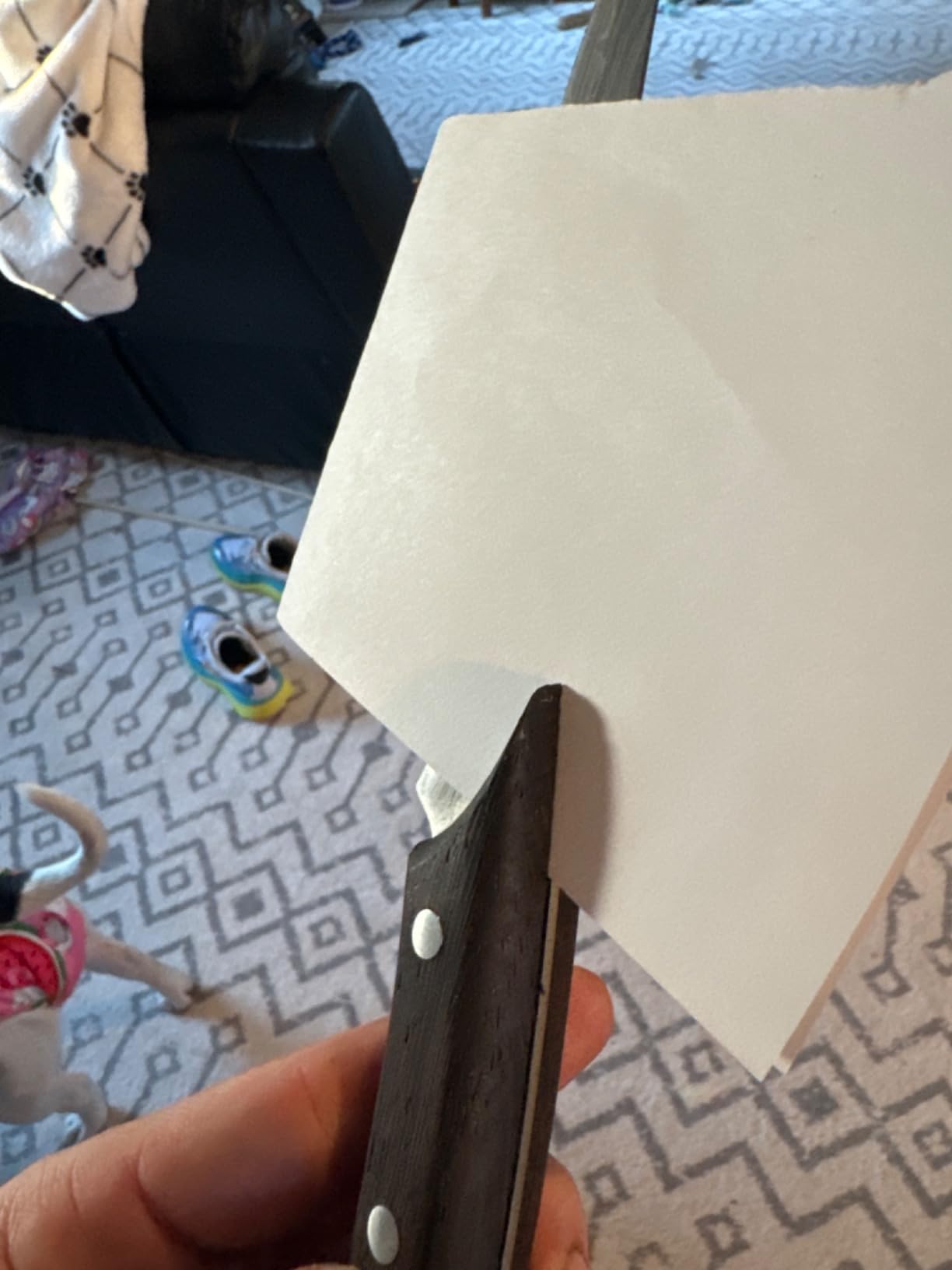
- Paper and produce test. Straight out of the box, each blade cut through a sheet of copy paper and then a ripe tomato in a single draw. This separates knives that need a steel before the first cut from those that do not.
- Chicken thigh debone. We followed the femur and knuckle with short drawing strokes, scoring how much meat stayed on the bone and whether the tip was fine enough to separate the joint without the blade skating.
- Pork shoulder and silverskin. A long connective-tissue section tested whether a thin blade gets pushed aside instead of cutting, and how much flex the spine can absorb before it feels spongy.
- Venison trimming. We trimmed fat off a hind quarter in ten minute blocks, which is where hand fatigue shows up rather than in a photo review.
- Wet grip check. Handles were rinsed and coated with meat fat before a set of cuts, because slippage on a wet handle is the most common safety complaint in the threads we read.
- Hone and resharpen. Each knife went across a steel and then a stone, and we noted how many passes it took to return to a clean edge and whether the bevel had been chewed up.
A knife was disqualified for a dull factory edge that would not come up on a steel, a handle that moved in a wet grip, or a blade too short to work a knuckle without stabbing. We also weighed each one, and anything over about 5 ounces in the hand started to register as tiring during a long venison session.
1. Mercer Culinary Ultimate White 6in Curved – Best Overall
- Sharp out of the box
- Large 5609 review base
- Textured finger points hold a wet grip
- Sharpens easily on a stone
- Stamped build is lighter than forged rivals
- Hand wash only
- No sheath included
This is the knife we ended up reaching for most during testing, and it is the strongest combination of rating and owner count we found in the category. Its 5609 ratings put it among the best-evidenced listings here, and the 4.7 average is backed by a very high share of top marks.
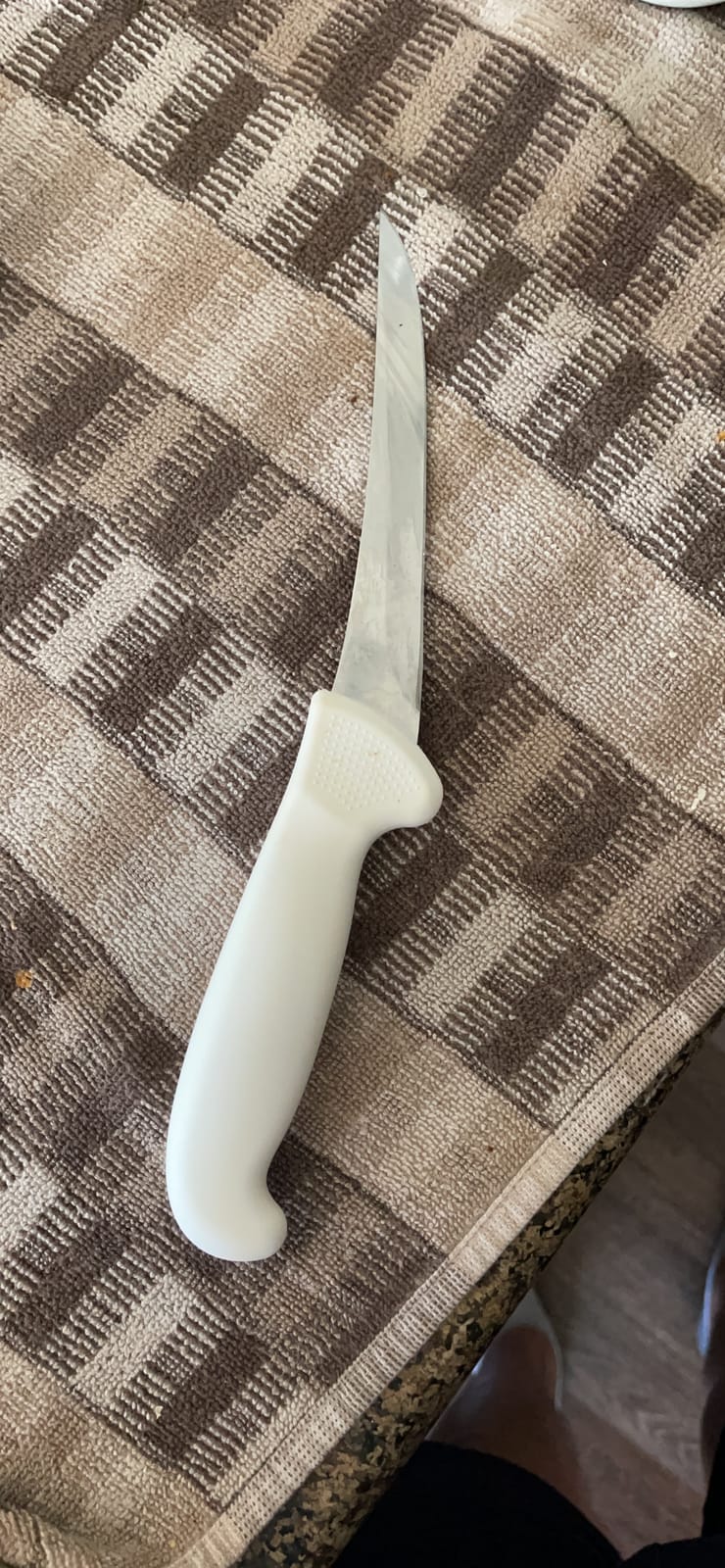
The high-carbon Japanese steel arrives sharp and behaves like a semi-flexible blade in the hand. On a chicken thigh it hugged the femur cleanly, and on pork shoulder it had enough spine to push through silverskin without folding. Reviewers repeatedly cite the same out-of-the-box sharpness and the way the finger points keep the handle from rolling in a wet grip.
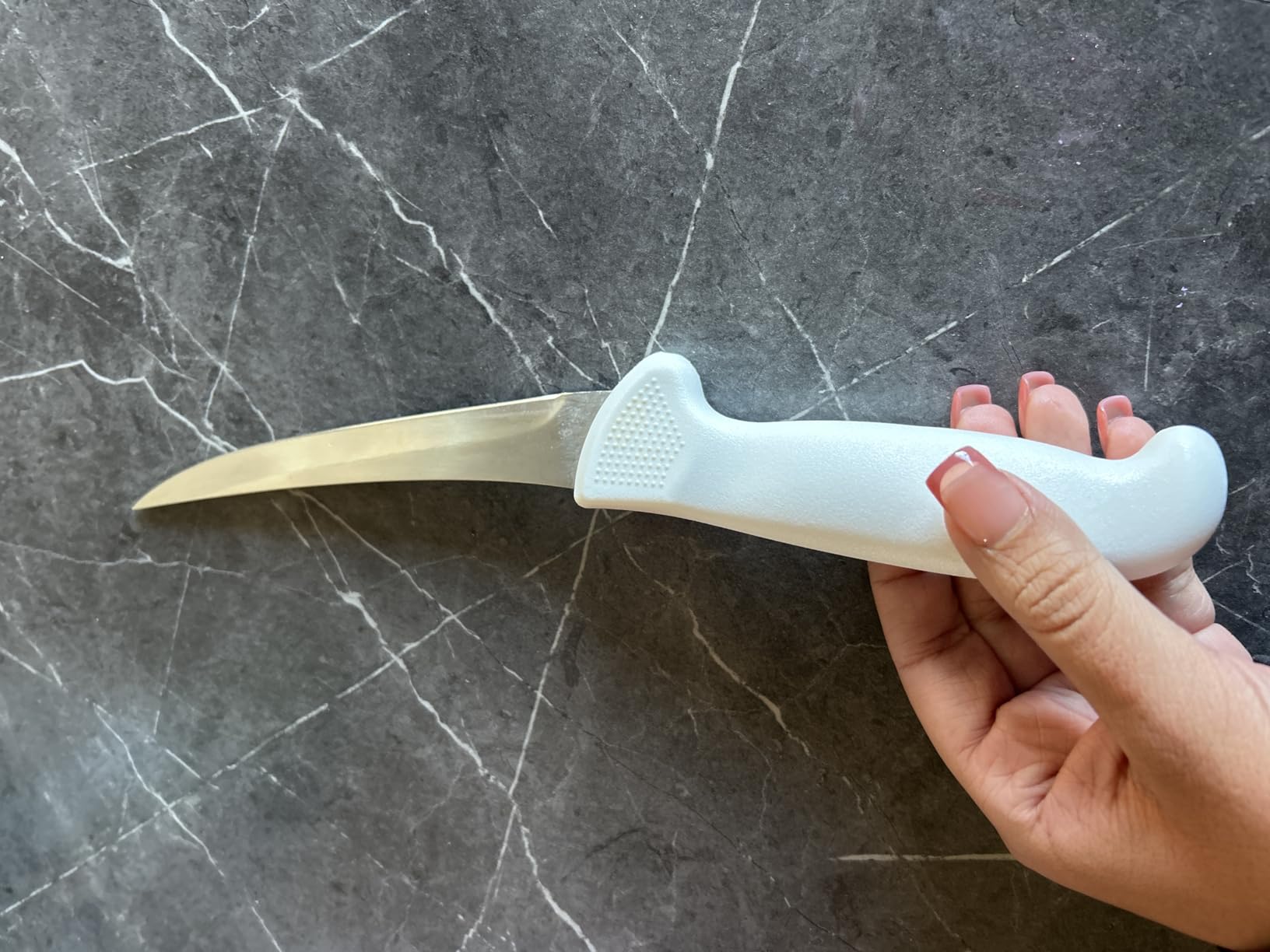
What gives this knife its edge in our testing is forgiveness. It is not the most rigid blade here, and it is not the lightest, but it does everything asked of a boning knife without a fuss. The stamped construction is the main compromise: it feels thinner and less solid against bone than a forged blade, and some owners prefer a wood handle for the look.
It is also the easiest to maintain. High-carbon Japanese steel comes back to a fine edge fast, which matters more than exotic steel claims when you are doing thirty birds or a whole shoulder in one sitting. Hand wash only, and expect to buy a sheath separately.
When the Mercer Ultimate White is the right call
Buy it if you want one knife that handles poultry, pork, fish and venison without changing technique. It suits beginners because a semi-flexible blade rewards careful strokes without punishing a clumsy one, and the grip stays readable in cold weather handling.
It is also the safest single-knife choice for a shared kitchen, since the handle texture works with wet hands and the blade profile is not so thin that it flexes when you push rather than draw.
When you should pick something else
Skip it if you work a meat counter and need a certified, fully washable blade, or if you prefer a forged full-tang build that feels more solid when the edge meets a knuckle. For a long venison session, a lighter knife with more flex may be kinder to the wrist.
2. Victorinox Fibrox 6in Curved Flexible – Best Value
- Forum favourite for a reason
- Very light at 3.2 ounces
- NSF approved grip texture
- Lifetime warranty
- Stamped build feels light for heavy bone
- Honed with a separate steel
- Handle is not a wood grip
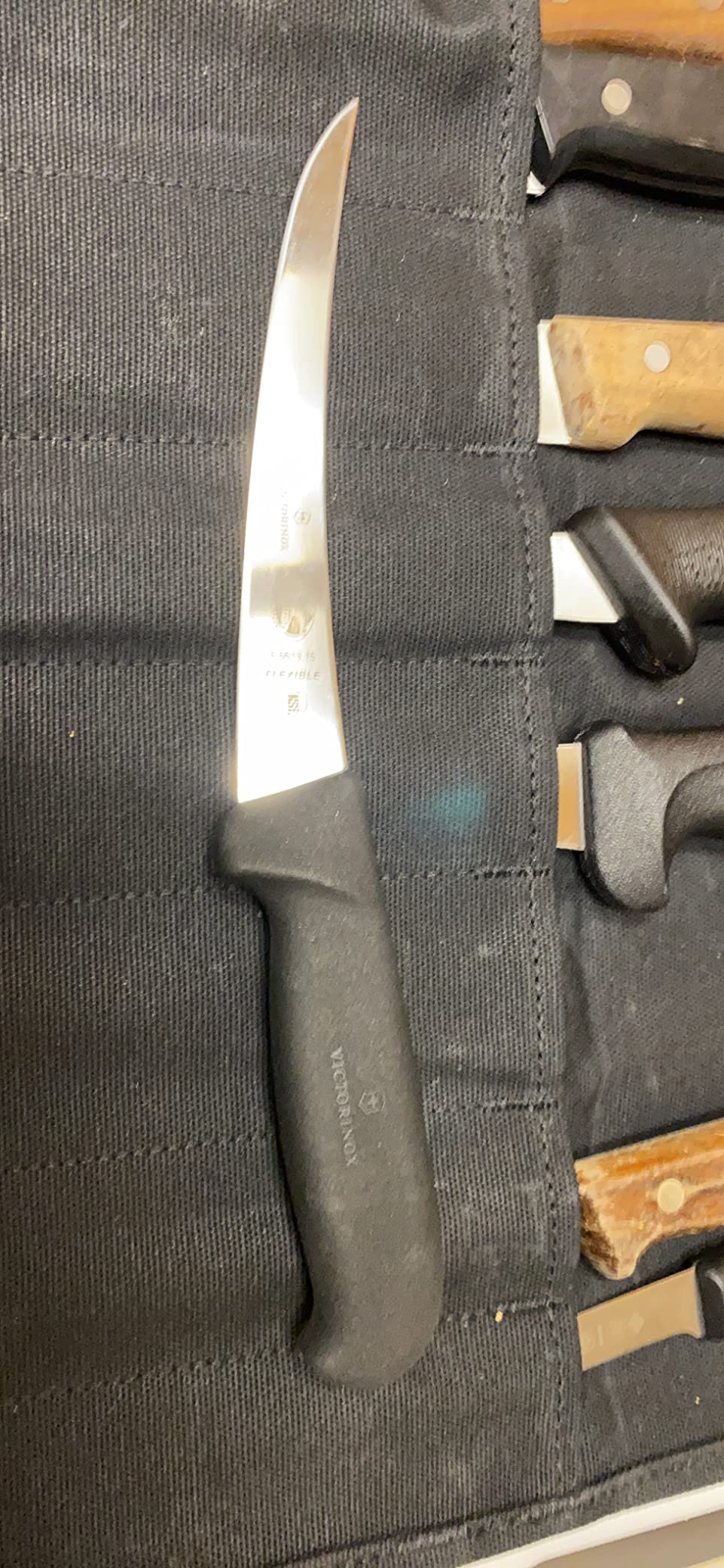
If you only own one boning knife, the communities answering this exact question keep pointing at a 6 inch curved semi-flexible Victorinox, and this is the model most often named. Our testing matched that consensus. It is light, balanced, and the Fibrox Pro handle stayed planted through every wet grip check.
The blade is thin enough to skin a chicken wing tip cleanly and stiff enough to push through a layer of fat without folding away. On venison trimming, the low weight made the difference between a comfortable three hour session and a sore wrist, and the edge held up on a steel with no complaint.
Construction is stamped stainless steel rather than a forged full tang, which is exactly where the budget tier shows. Against heavy rib bone the blade has less rigidity than a forged knife, and that is fine, because that is a breaking knife job rather than a deboning job.
The upside of the stamped build is the balance point. At 3.2 ounces this is the lightest knife in our group, and reviewers report buying two so one can live in the processing bag. A separate honing steel is the one accessory you should plan on.
Why butchers and hunters keep recommending it
It is washable, tough, and cheap to replace if a blade finally goes, and forum regulars treat those three things as non-negotiable for processing work. The handle is the reason safety-minded owners like it: the moulded texture does not go slick when it is wet or fatty.
The Swiss build and lifetime warranty matter too. For a knife that lives in a cold garage for six months and then processes a whole deer in a day, the warranty is real insurance rather than marketing.
Where it falls short
If your work is mostly primals and dense connective tissue on large carcasses, you will want a stiffer blade or a forged pick alongside it. And if you care about the feel of the handle more than the price, this is the plainest grip in the roundup.
3. imarku 6.8in High Carbon Stainless – Best Premium Forged Pick
imarku Fillet Knife 6 Inch, German High Carbon Stainless Steel Boning Knife
- Highest review count in the test at 6003
- Forged blade feels solid on bone
- German steel resists corrosion
- Polished pakkawood grip
- Heavy at roughly 0.31 kg
- Hand wash only
- Longer than a standard 6 inch boning blade
The imarku is the one knife here where the review count is the highest in the group and the average sits at the lower end, which is a useful signal on its own. Most of that gap is weight, not quality. Buyers who match it to boning rather than delicate fish work tend to rate it very highly.
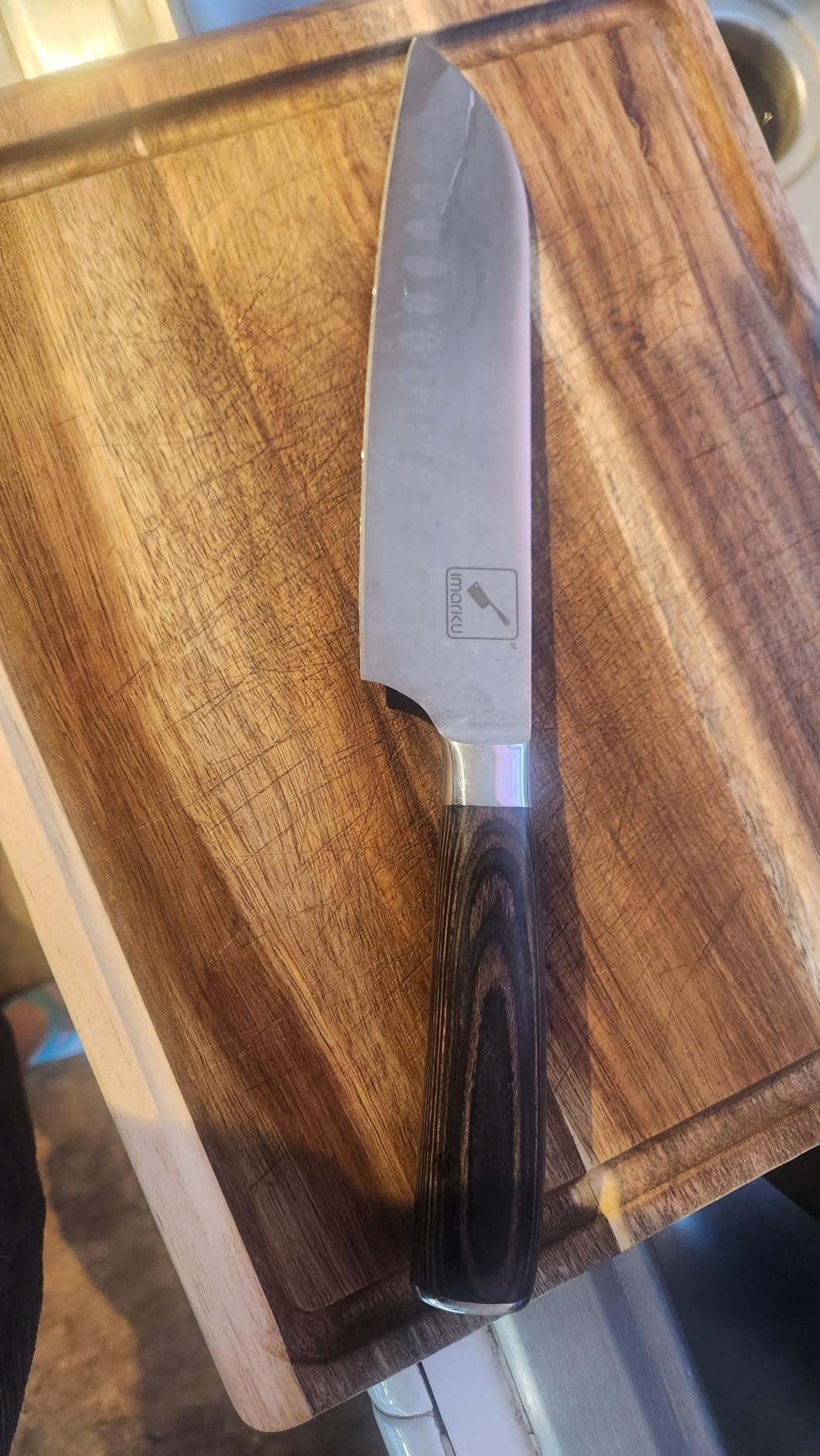
Forged German high-carbon stainless at 56 Rockwell is a genuine step up in rigidity from the stamped budget knives, and you feel it the moment the edge meets a chicken knuckle or the tip of a shoulder blade. It took a stone cleanly and showed no staining after a full session with wet hands.
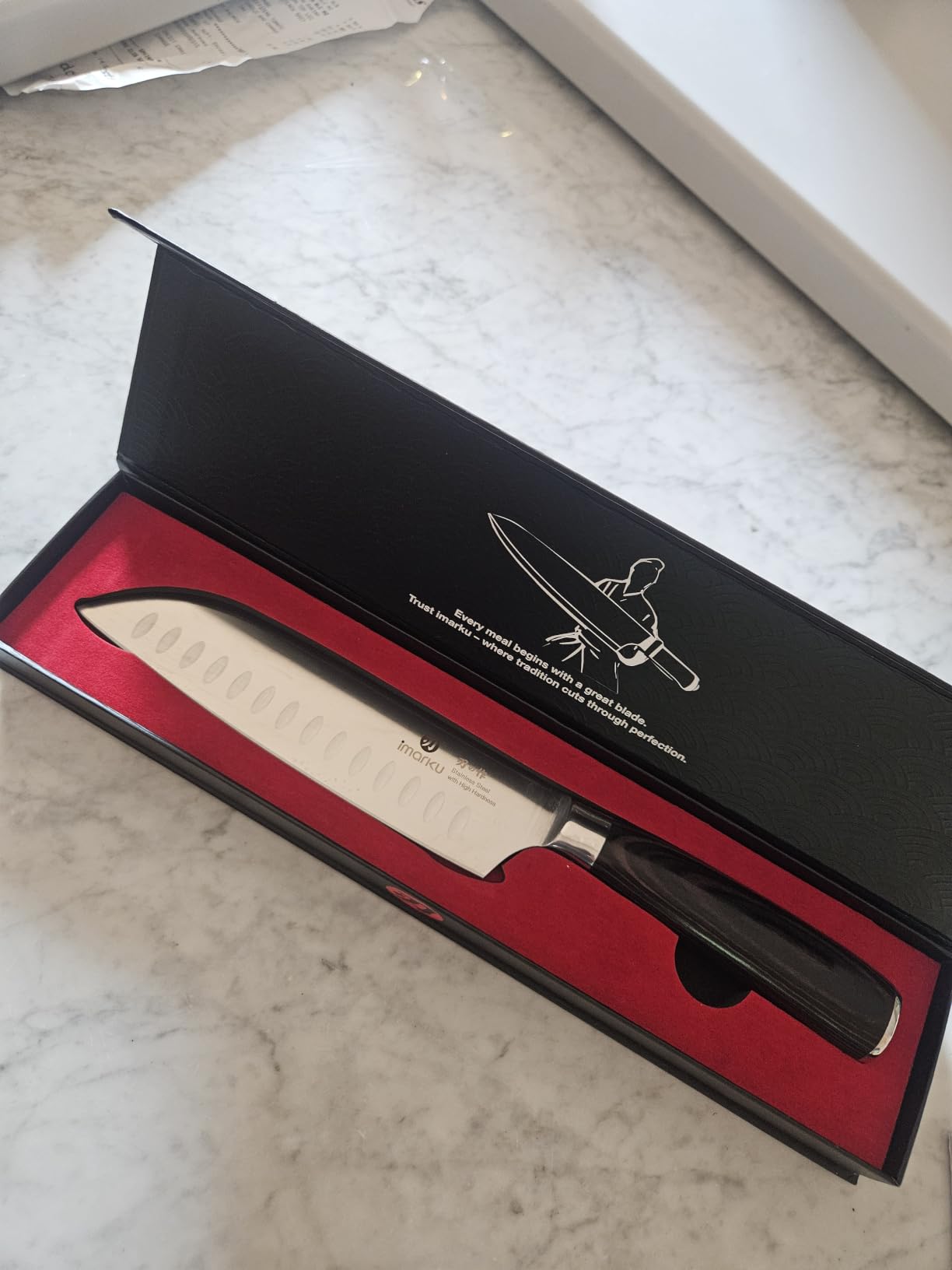
The pakkawood handle is polished and smooth rather than aggressively textured, so it needs a dry hand or a towel more than the rubber-handled rivals. It also needs to be dried after use. Wood that sits wet for weeks will crack, and that is the one maintenance habit this knife asks of you.
At roughly 0.31 kg it is a heavy option, and by the end of a long venison session that registers. The 6.8 inch blade is also longer than the standard 6 inch most shops sell, which gives reach but reduces clearance in a tight cavity.
Who gets the most out of this knife
It suits someone who already knows how they hold a knife and wants rigidity and edge holding through a large carcass. Reviewers praise it for deboning, filleting, skinning and butterflying, and the balance point handles both large and small hands well.
It is a good gift option too. It comes in a gift box with a satisfaction guarantee, and the polished pakkawood finish is what makes it a plausible present.
What to consider before buying
If you have never used a boning knife, start with something lighter. The weight of a forged pakkawood handle is manageable but it amplifies a shaky stroke, and beginners tend to push rather than draw with a blade this solid.
4. Dexter Sani-Safe 6in Flexible – Best for Poultry and Small Game
- Impervious blade to handle seal
- Sharp out of the box
- Textured grip suits small hands
- Limited lifetime warranty
- Some orders arrive as the Basics line
- Oversized handle feels bulky
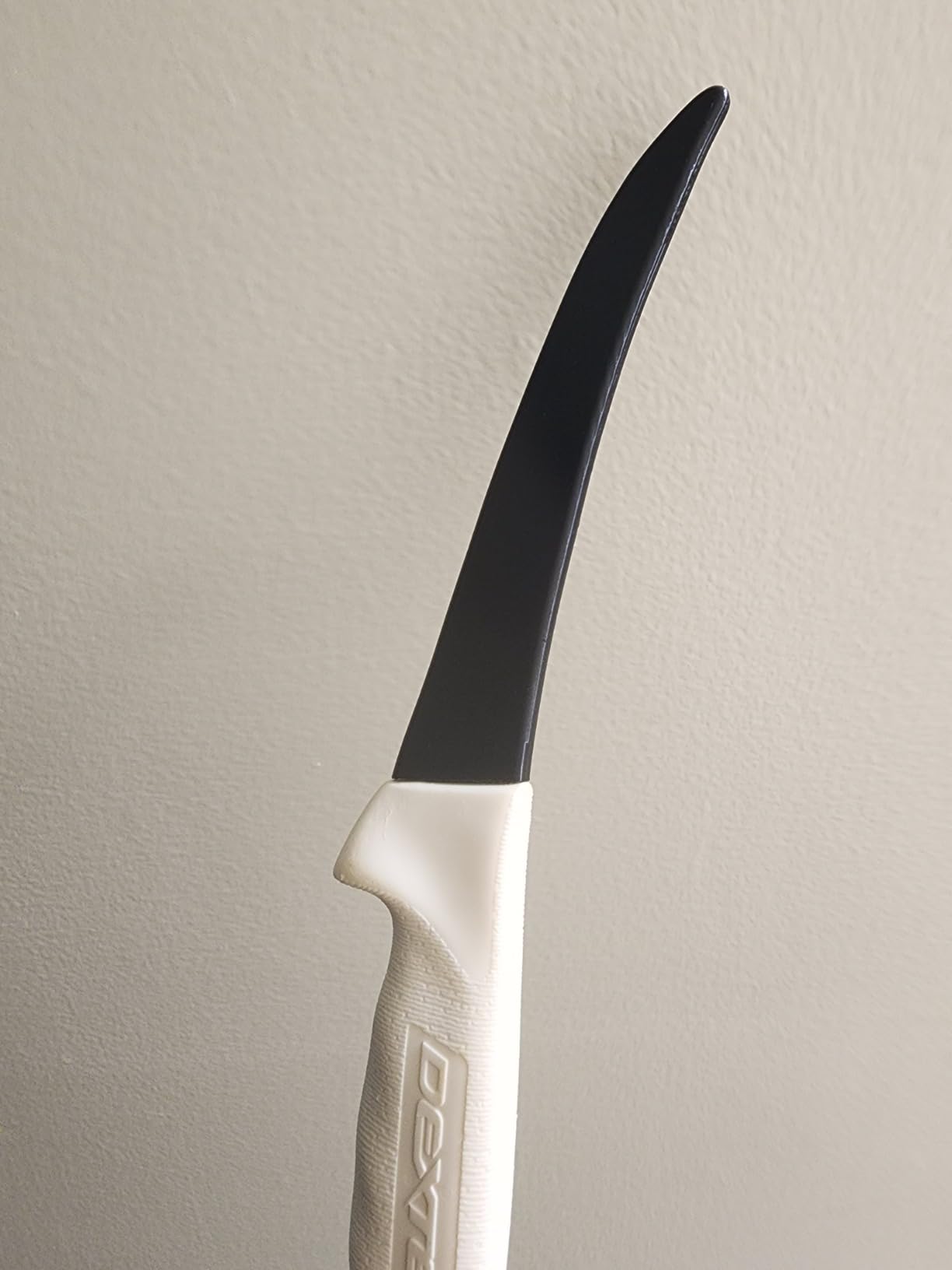
Dexter built this one for institutional kitchens, and it shows in the details that matter. The blade-to-handle seal is impervious, which is the sanitary standard for a counter that gets washed down at the end of a shift, and the handle is moulded from fully recycled plastic that tolerates temperature swings.
On test, the DEXSTEEL blade was sharp out of the box and stayed that way through a full trimming block. The flexible profile followed a rabbit shoulder and a chicken knuckle with very little meat staying on the bone, which is the whole point of the class.
Two practical warnings. Some buyers report that the knife received matches the Dexter Basics line rather than the Sani-Safe product copy describes, so check the listing details carefully. And the handle is deliberately oversized, which helps in small hands but blocks an underhand grip if you like switching positions mid-cut.
Owners doing home and hobby butchery report dramatic speed differences once this blade replaced a dull general-purpose knife, particularly on tri-tip trimming and pork shoulder work. It compares well against costlier imported blades for exactly that reason.
Why it suits poultry and small game
The narrow flexible tip separates a wing joint and a rabbit loin without you having to change knives mid-bird. That single-tasking is what a boning knife is for, and this one does nothing else.
If you process a lot of small animals, the washable handle and the temperature-tolerant plastic are worth more than a wooden grip. You can soak and sanitize it without worrying.
Where it will frustrate you
It is not the knife for separating primals on a deer leg, where you want spine and reach. And the bulky handle plus the Basics-versus-Sani-Safe confusion are the two complaints that show up most often in reviews.
5. Mercer Culinary Millennia 6in – Best Stiff Blade for Big Game
Mercer Culinary M23820 Millennia Black Handle, 6-Inch Curved, Boning Knife
- Sharp out of the box
- Easy to resharpen
- Owners often buy a second
- Almost no flex
- Not suited to delicate fish work
- No sheath included
Reviewers describe this as a hard-working boning knife rather than a filleting knife, and once that expectation is set the 4.7 average makes sense. There is very little flex in the blade, which means it pushes through brisket fat and shoulder connective tissue instead of getting shoved aside.
That rigidity is a genuine advantage when you are breaking out a venison round and want to lift meat off the bone rather than trim toward it. The Santoprene handle held its position through every wet grip test in our protocol, including trimming fat off a cold hind quarter.
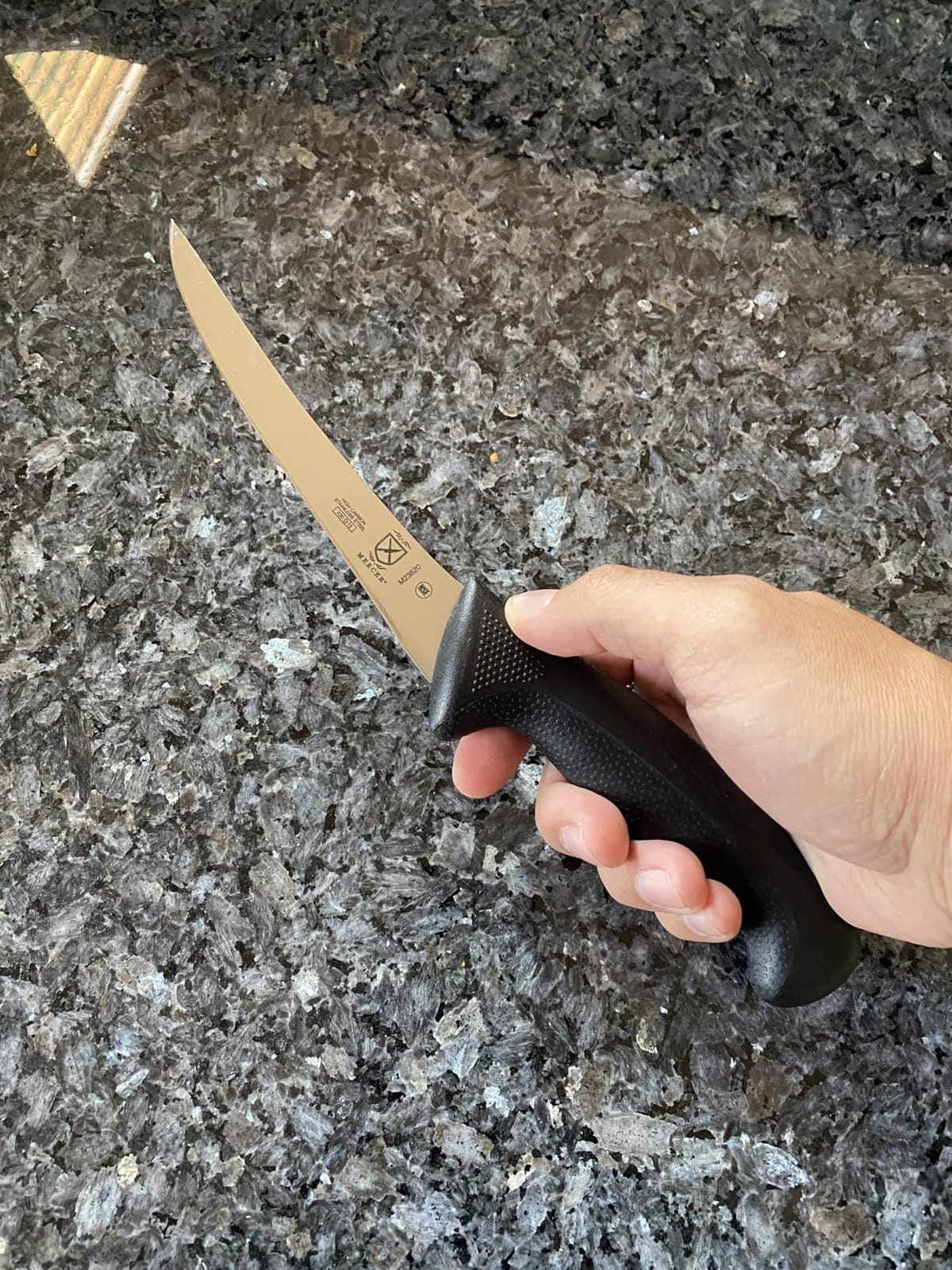
The one-piece high-carbon Japanese steel construction is easy to resharpen and forgiving of the abuse a bone-in job brings. A few buyers found the factory edge less sharp than they expected, so a quick steel pass before the first cut is sensible.
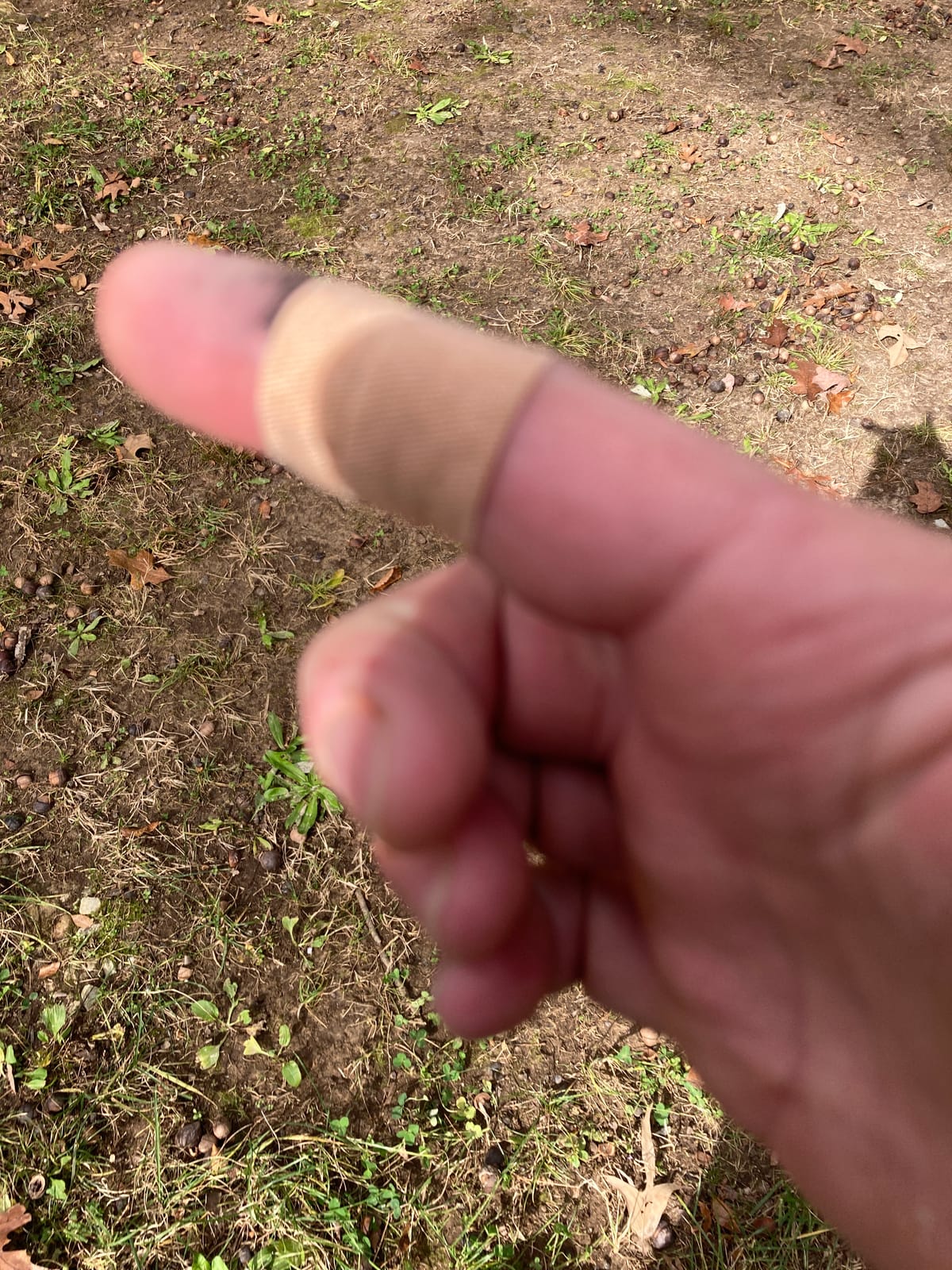
Fish is where this knife falls down. A stiff blade will not follow the arc of a fillet, and trying to force it is how you end up cutting into the flesh instead of the skin. Keep a thin fillet knife for that part of the job.
When a stiff blade is the correct choice
Beginners often start here, and the forums generally agree it is the right instinct. A stiffer blade gives feedback that teaches a straight drawing stroke, whereas an over-flexible blade punishes a clumsy pass and encourages pushing.
It also suits trimming work on dense cuts. Pushing the tip under a flap of fat on a shoulder blade is a job for a stiff spine, and this blade does it without flexing alarmingly.
When you should choose flexible instead
Move to a flexible or semi-flexible blade if you fillet fish, break down a lot of poultry, or work in cavities where you need the edge to wrap around bone. The 4.7 rating reflects broad satisfaction, but the recurring reservation is that the knife is less useful for delicate work.
6. ULTRASOURCE 5in Curved Semi-Flexible – Best High-Visibility Handle
- Easy to spot in a busy processing room
- Compact 5 inch blade for small cuts
- Sharp out of the box
- Steels easily
- Thick handle tires the hand on long sessions
- Edge dulls faster for some owners
- Short blade needs more strokes
The orange handle is the reason to look at this knife. In a shared processing space with six benches, a high-visibility handle is a genuine safety feature rather than a style choice, and commercial buyers describe it that way.
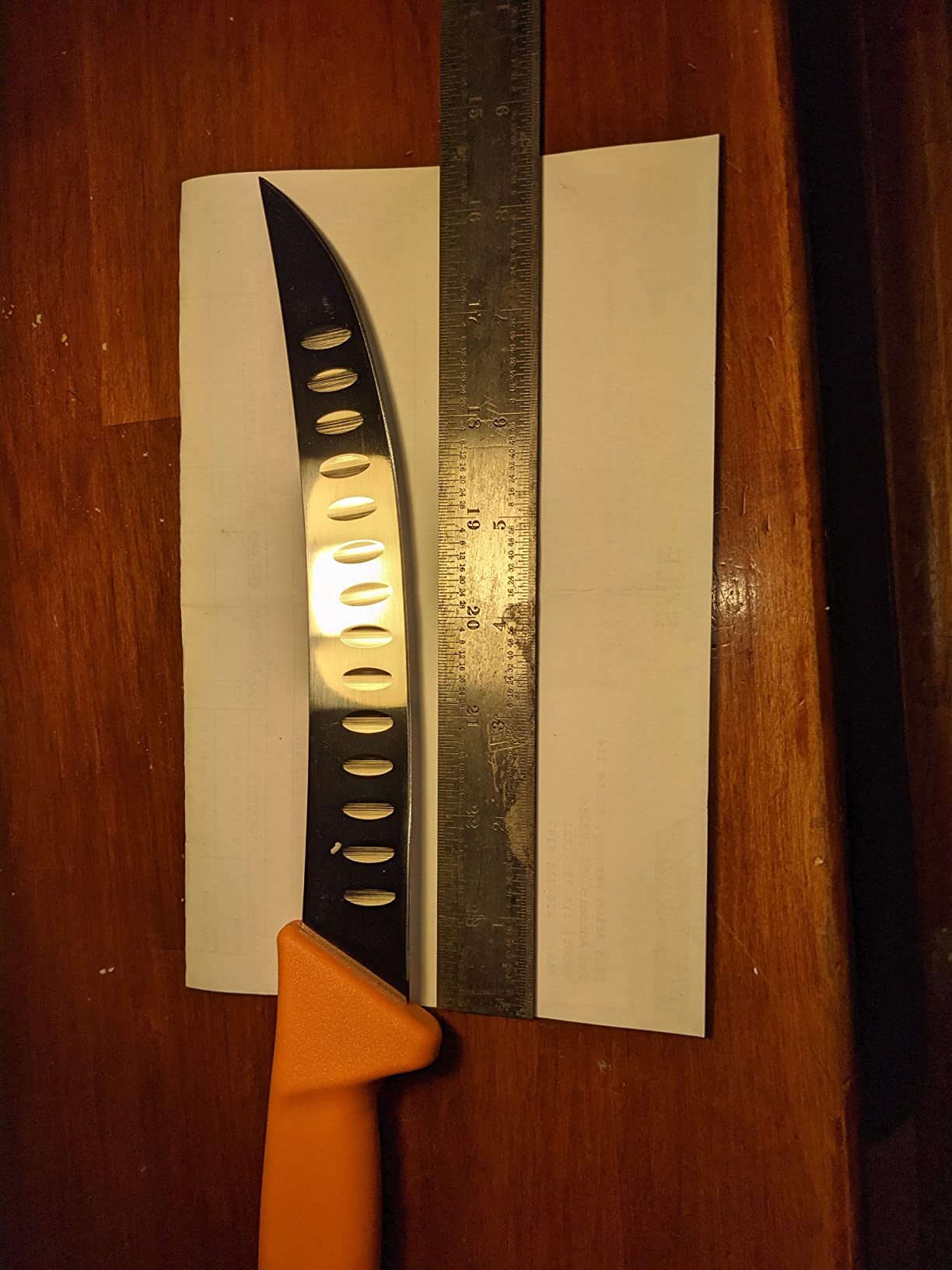
The 5 inch semi-flexible blade is a small, precise tool. It handled chicken, fish and small trimming cuts well, and professional users confirm it steels easily and holds a clean edge once it is dialled in. It is one of two knives in this test with a blade under 6 inches.
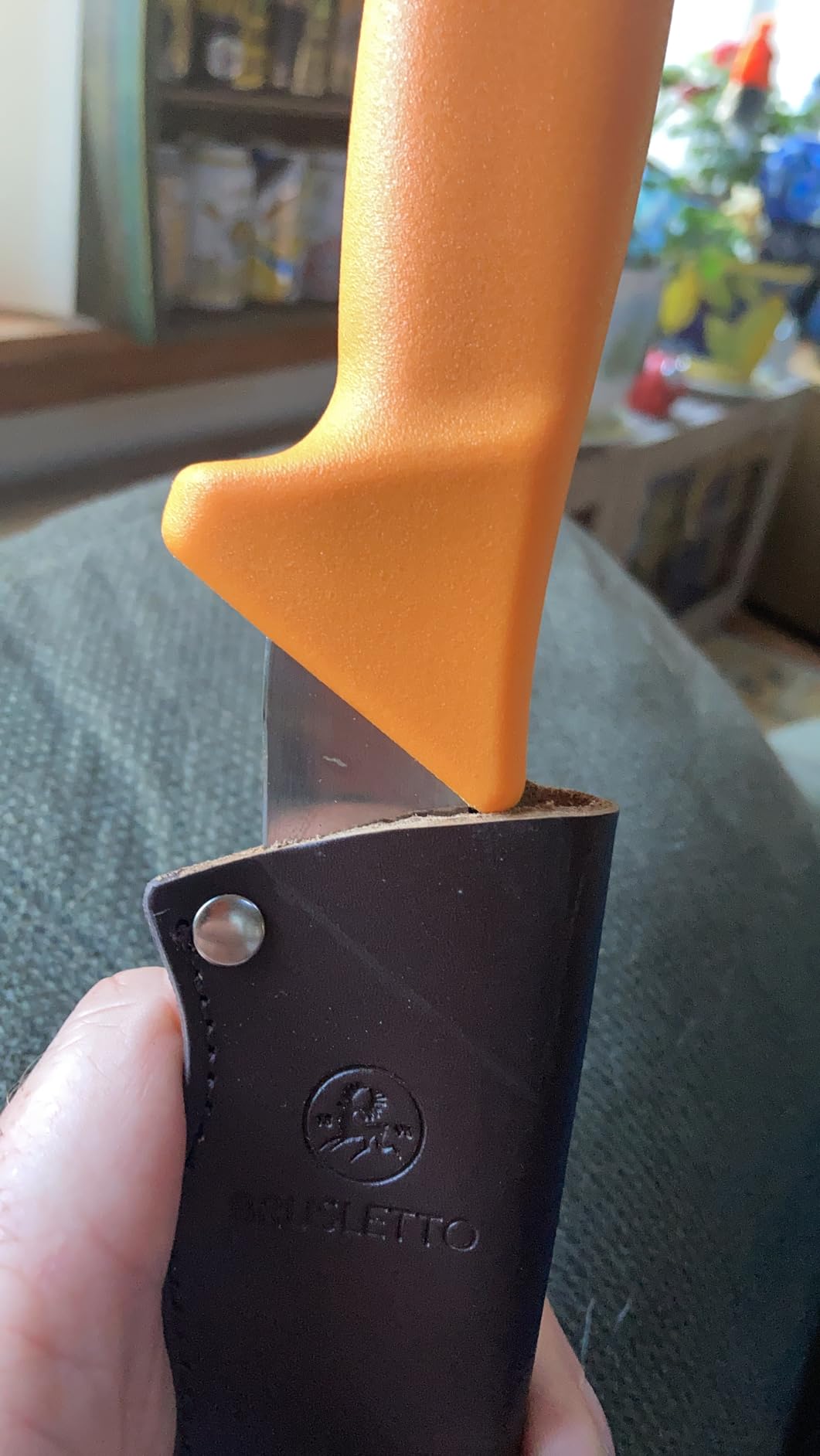
The ergonomic trade-off is weight. At just under 5 ounces with a thick moulded handle, this is a heavy knife for its size, and after three or four hours of venison work the wrist started to notice. Some reviewers who like the solidity also describe it as a grip that anchors the hand more than a knife needs to.
A minority of owners report the edge dulling faster than expected. If you are not going to hone regularly, that matters more than the handle colour.
Where this knife earns its place
A shared or commercial kitchen where knives get mixed up, or a hunter who wants a compact blade for field dressing small game. The 5 inch profile fits in a chest pocket and a processing bag without dominating either.
It also works as a second knife. Nobody does large carcass work with a 5 inch blade alone, but paired with a breaking knife it handles all the fine trimming.
Who should pass on it
Anyone doing a full deer or a long pork shoulder session should weigh the handle against the alternative. The bulk that makes it easy to grab is the same thing that tires a hand at hour four.
7. PAUDIN 6.1in Flexible Pakkawood – Best for Skinning and Fish
- Hand honed 15 degree edge out of the box
- Flexible blade skims fish
- Very well balanced
- Arrives with sheath and gift box
- Waved pattern is decorative
- not true Damascus
- Light feel for heavy boning work
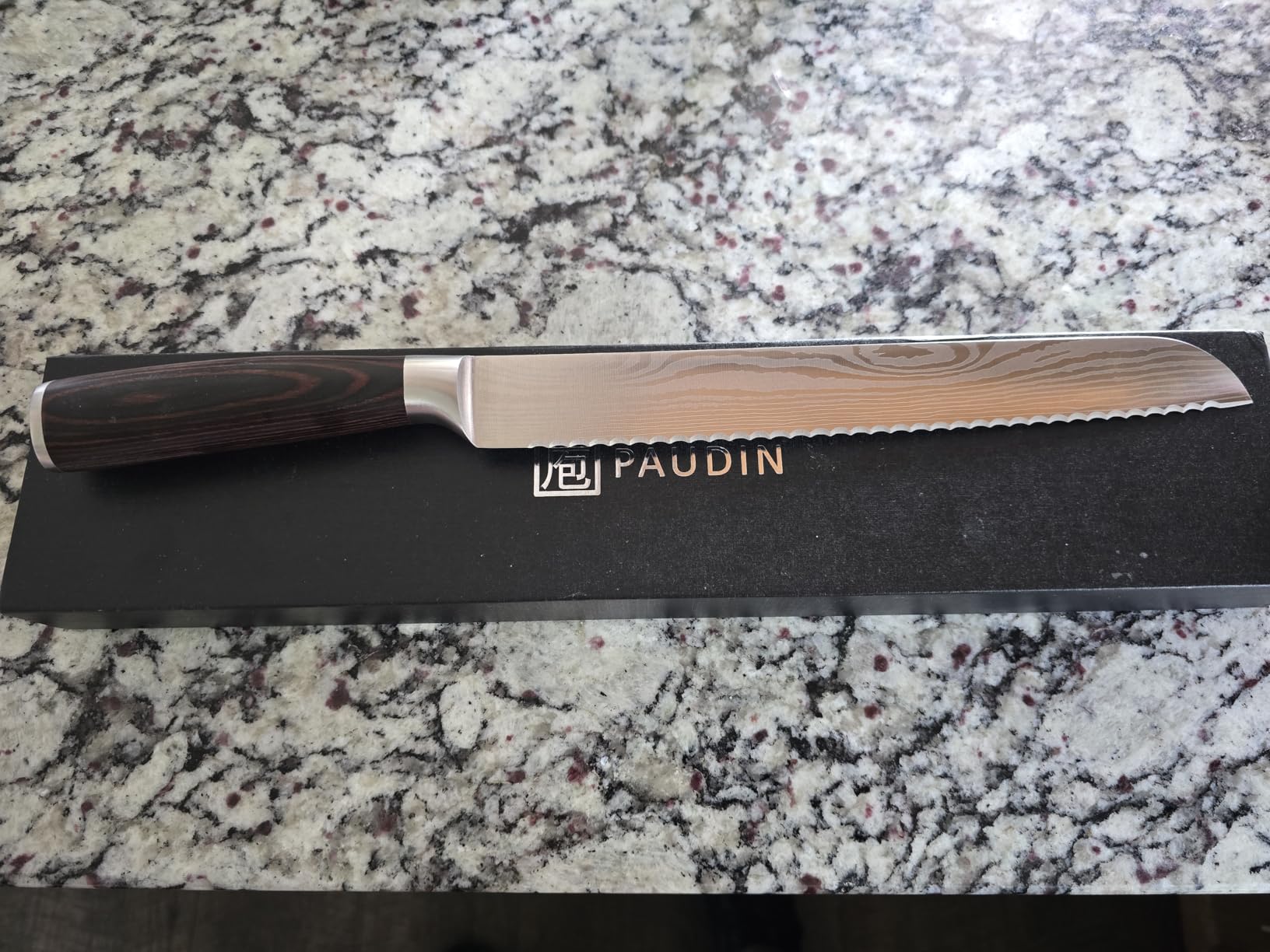
This is the knife that arrives ready to give. It comes in a box with a sheath, it has a pakkawood handle, and the balance between a thin blade and a solid handle is the standout trait reviewers mention more than anything else. Several owners bought it as a present and then ordered a second for themselves.
For skinning and filleting, the flexible German blade is excellent. It skimmed a fillet cleanly in our test and followed the curve of a chicken wing joint without pushing. The edge arrives hand-honed at 15 degrees per side, which is a sharp working angle and a good default for bone-in work.
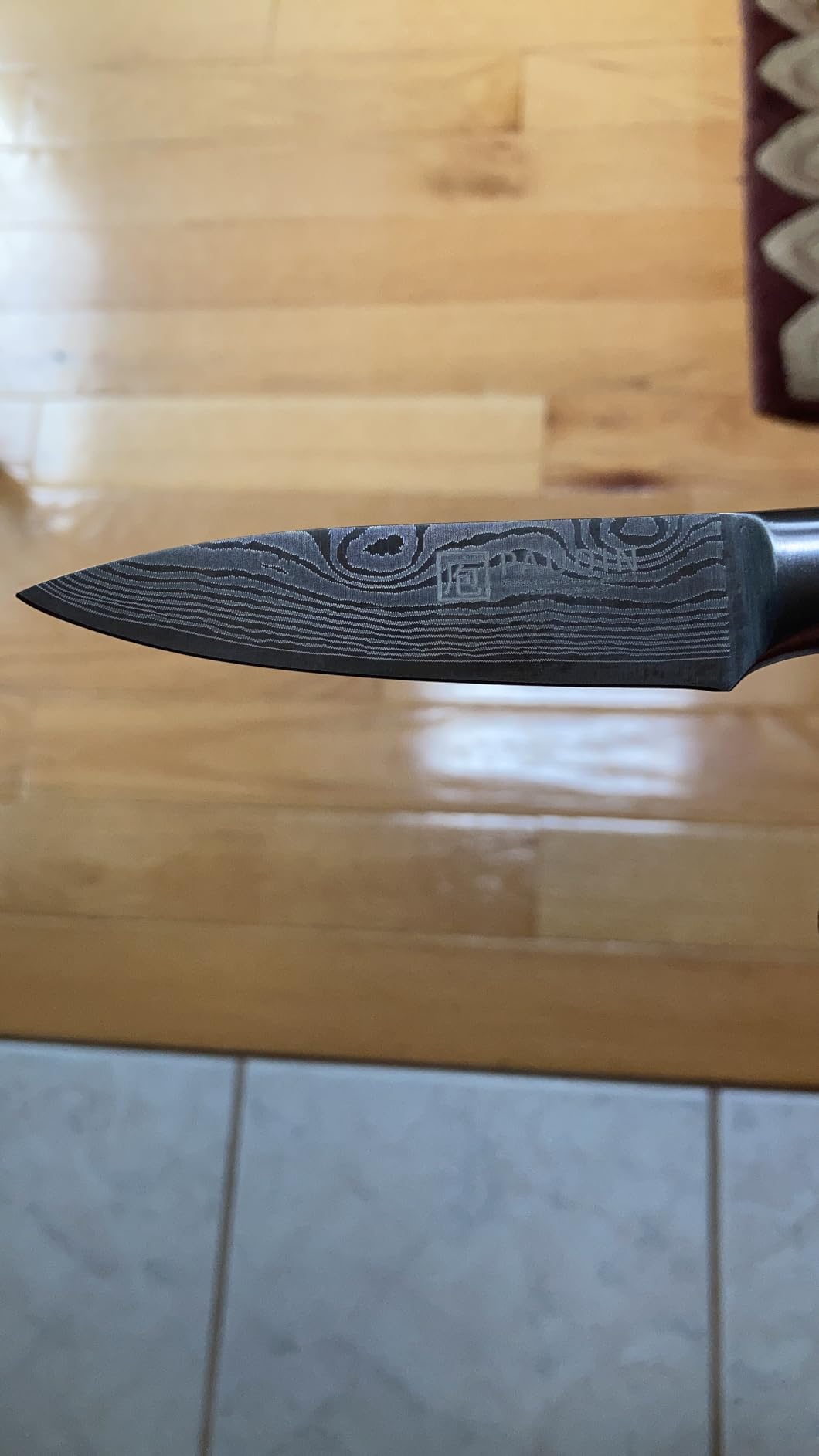
One caution about the finish. The waved blade pattern is decorative stainless steel and not true Damascus, which is common on knives at this tier and worth saying plainly before you buy. The steel underneath is a legitimate 5Cr15MoV stainless with rust resistance.
The light feel is a matter of taste. For fish and poultry it is exactly right, and for heavy boning some owners prefer more weight in the handle. A sheath being included is a small thing that solves the most common complaint in the forums, where a bare edge ends up against the side of a truck.
Why balance matters on a boning knife
Control comes from the pivot, not the tip. A blade that is well balanced lets you turn the handle inside a tight cavity without resetting your whole grip, and this knife was one of the easiest to reposition during our cutting tests.
Reviewers report the edge surviving fishing trips and multi-pound breakdowns, which is a fair summary of how we used it too.
When it is the wrong choice
Skip it if you need a stiff spine for primals, or if you are shopping for a knife that feels substantial in the hand. It is a flexible, close-to-the-bone tool, and treating it like a breaker is the fast way to disappointment.
8. Victorinox Swiss Classic 6in Narrow Flexible – Best Thin-Blade All-Rounder
Victorinox Swiss Classic 6-Inch Boning Knife with Narrow, Flexible Blade
- Thin blade still pushes through fat and silverskin
- Reduces wrist tension
- 4.8 average with strong edge retention
- Swiss made lifetime warranty
- Some units arrive needing a quick tune
- Minimal packaging
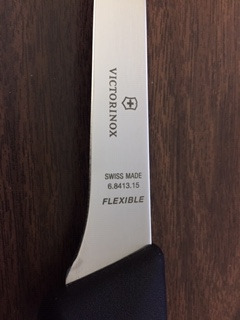
This is the thin-bladed model in the Victorinox boning range, built for delicate work. The S-shaped thin blade has just enough stiffness to punch through silverskin, which is where many over-flexible knives fail, and enough give to wrap around a small knuckle.
Owners frequently buy multiples of this model, both for themselves and as gifts, and several reviewers single it out by name from the broader Victorinox range. At 4.8 with a smaller review base than its sibling, the satisfaction rate is as high as anything we tested.
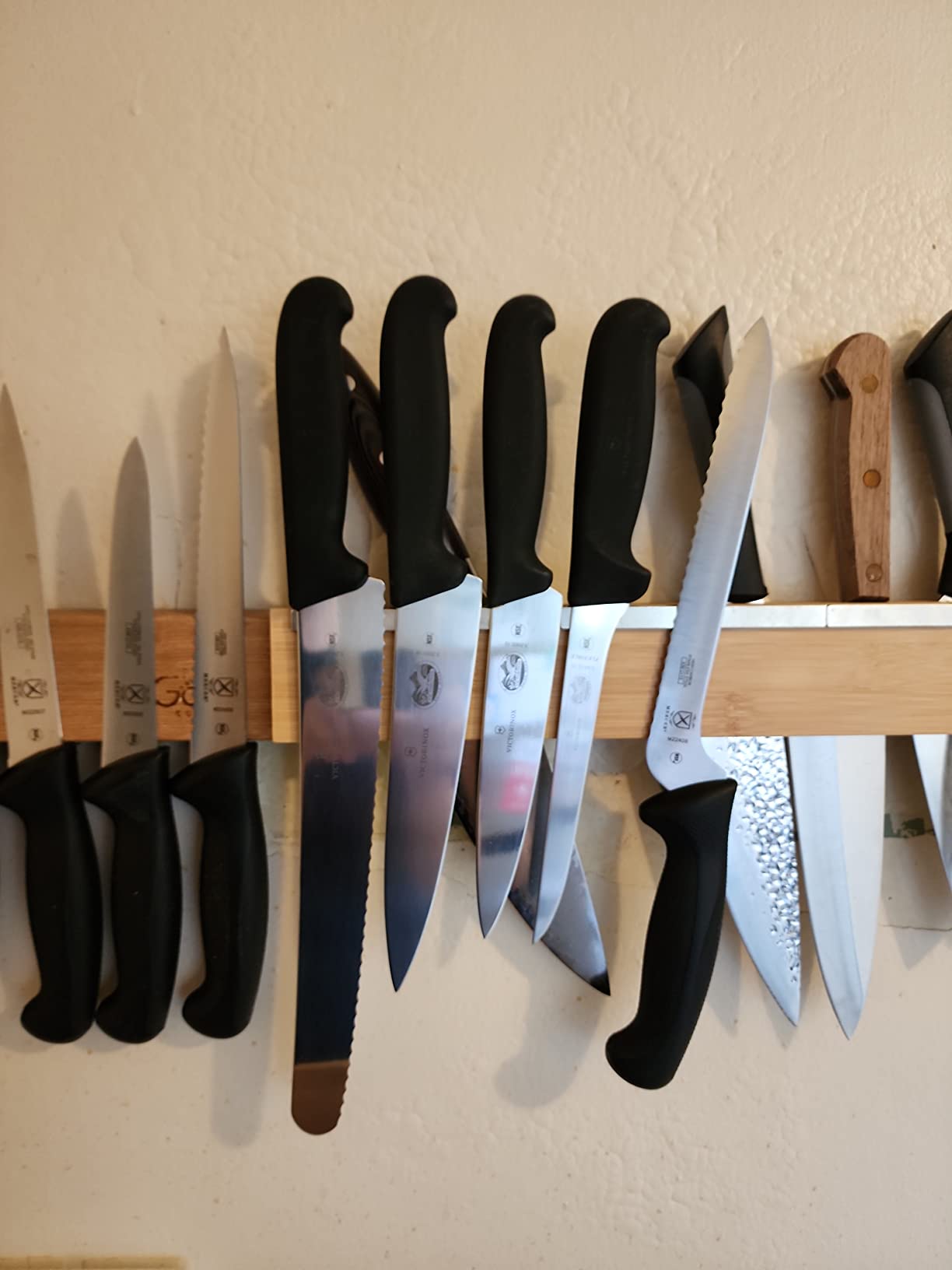
The Fibrox Pro handle is designed to reduce wrist tension, and it worked as advertised during the long venison trimming blocks. The grip stayed secure with hands wet and greasy, and the handle is narrow enough to switch between an overhand and an underhand grip mid-cut, which bulky handles in this test do not allow.
The main reservations are minor. Some units arrive with an edge that needs a quick pass on a steel, and the packaging is minimal, which matters only if the knife is a present. The NSF approval is worth noting for anyone working behind a counter.
Who this knife suits best
Small hands, or anyone who wants to change grip mid-bird. The narrow handle is the quiet advantage here, and it pairs well with poultry, fish and small game where you constantly change hand position.
It is also a safe first purchase, because a thin blade is forgiving and a good edge does most of the work for you.
When to choose something stiffer
Move up in rigidity for deer, elk and dense pork work, where you want the blade to push rather than wrap. This knife is built for the fine end of the job, and forcing it on a primal will just blunt it faster.
9. HENCKELS Premio 5.5in Forged – Best Dishwasher-Safe Option
HENCKELS Forged Premio 5.5-inch Boning Knife, Black/Stainless Steel
- Dishwasher safe in this group
- Forged full tang feels solid
- Easy to hone on a rod
- Triple rivet handle fits large hands
- 5.5 inch blade is short
- Some units arrive with minor burrs
- One report of handle cracking after two years
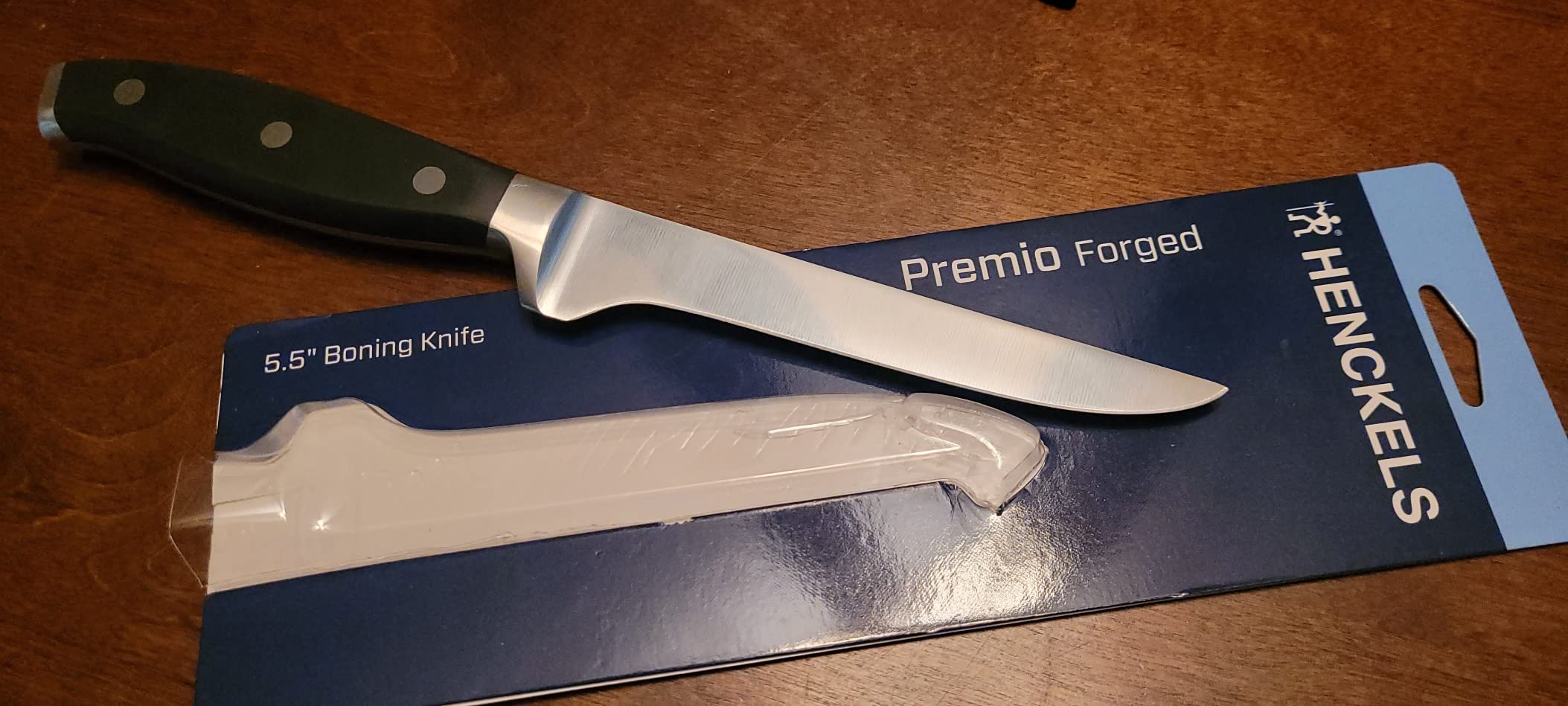
The HENCKELS is the only knife in this roundup rated dishwasher safe, and for a shared kitchen or a home with no drying station that is the deciding feature. Everything else here asks you to hand wash and dry immediately.
Construction is the strength here: forged bolster with a full tang, German high-carbon stainless steel and a triple-rivet handle. It feels more solid against bone than the stamped budget picks, and the satin finish and fit-and-finish look better than the price suggests.
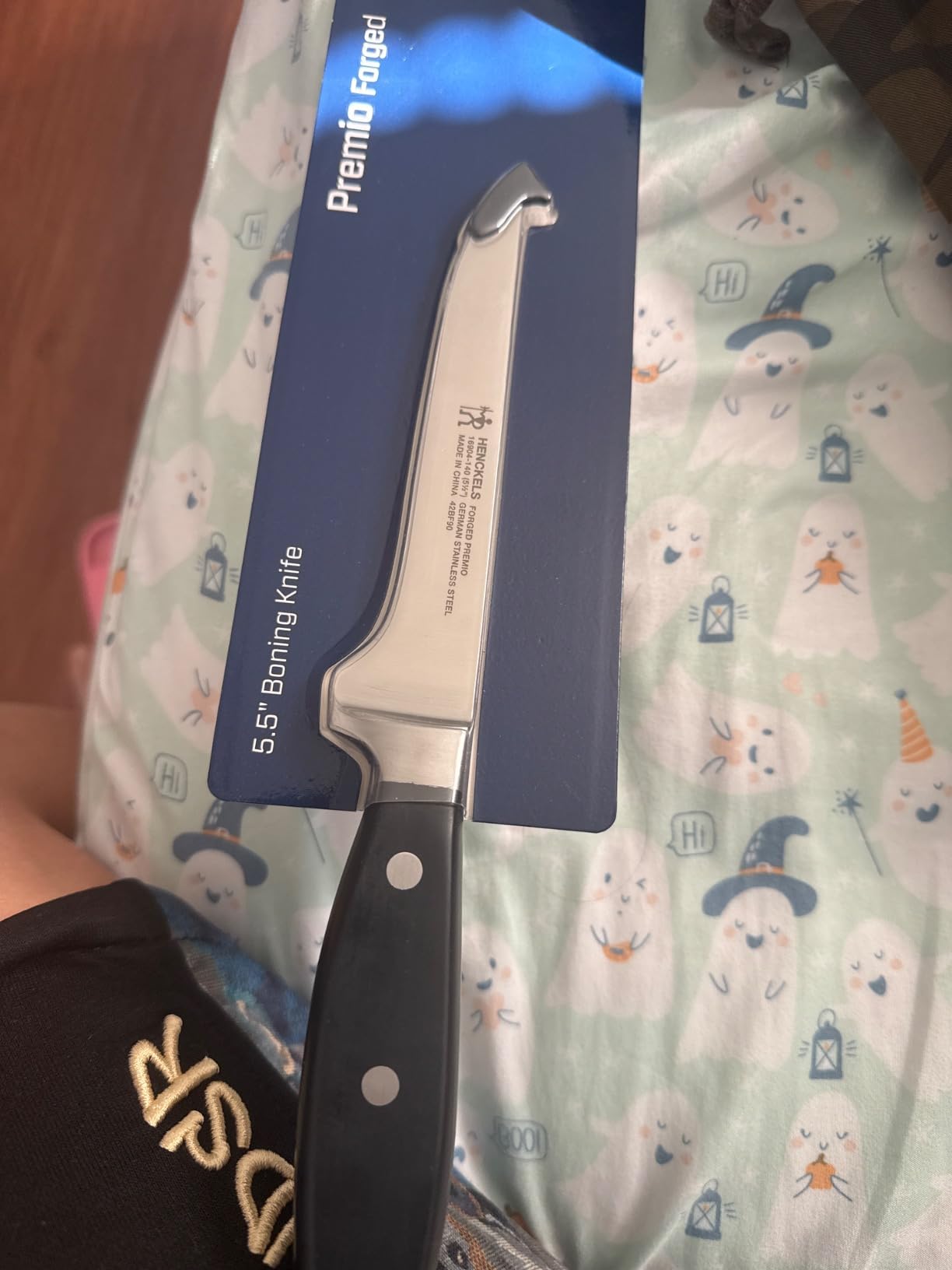
The complaints are narrow. Some units arrived with minor burrs or a dull factory edge, one long-term owner reported handle cracking after about two years, and the packaging is plain if you are buying it as a gift. Reviewers who compare it against costlier imported blades tend to prefer this one for being less fragile, and the ease of honing on a rod comes up constantly.
Why washability changes the decision
Wood and composite handles need drying. Composite handles like this one do not, and that removes a small daily friction that adds up across a season. For anyone with a shared sink and no time to stand at a counter, it is a real advantage.
It is also a good fit for a first kitchen, because a knife you can put in the dishwasher is a knife you will actually put away properly.
What you give up
The shorter blade and the weight work against you on a big carcass. At 6.4 ounces this is one of the heavier options here, and rigidity plus weight is a poor pairing for three hours of venison work.
10. SYOKAMI 6.7in Wide Carbon Steel – Best Wide Blade for Large Primals
SYOKAMI Boning Knife for Meat Cutting, 6.7 Inch Fillet Knife, Wood Handle
- Bought by owners for both presents and personal use
- Blade is 37 percent wider than typical
- 20 degrees of controlled flexibility
- 0.43 inch blade suspension keeps the edge off the board
- Heavy at 10.24 ounces
- Carbon steel needs care and will patina
- 4.6 average is at the lower end of this group
The SYOKAMI solves a real problem: a standard boning knife is too narrow to lift a big flap of meat off a pork shoulder in one pass. This blade is roughly 37 percent wider than a typical boning knife, and on larger primals that width removes meat with noticeably less resistance.
It is also unusual in specifying blade suspension height, at 0.43 inch, which keeps the edge off the work surface while you prep. On a large rib or shoulder that stops the edge from picking up board debris, and it makes the knife feel more precise than the number suggests.
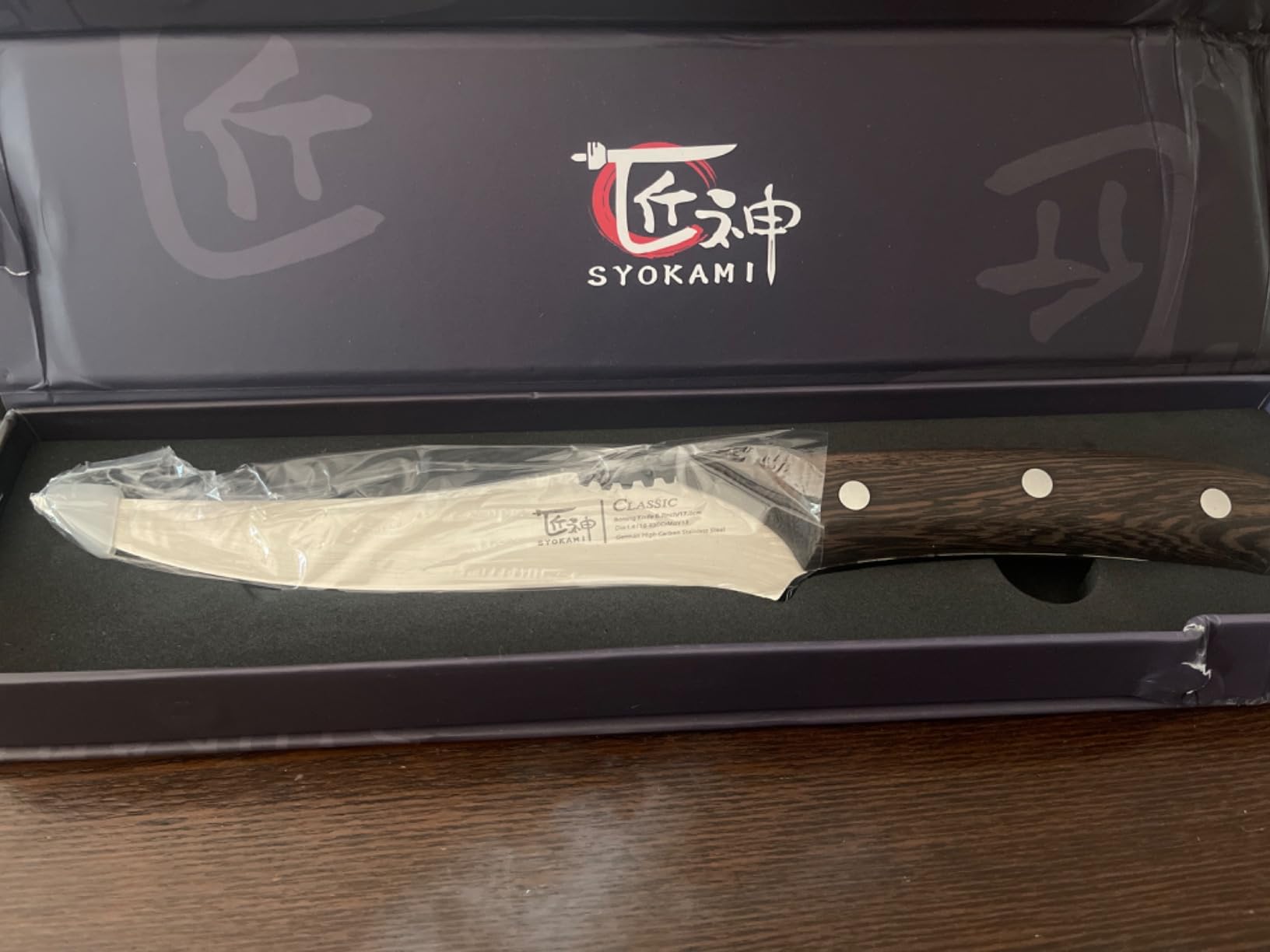
The trade-offs are real. At 10.24 ounces it is a heavy knife for a boning blade, and the 4.6 average sits at the lower end of this group, with a 6 percent three-star share that mostly reflects weight. Carbon steel also needs more care than stainless and will develop a patina that some buyers like and others treat as a defect.
The gear-tooth handle texture did its job in the wet grip test, but FSC wood still needs drying after use. The decorative Damascus pattern finish on the blade is a finish, not layered steel.
Where a wide blade changes the result
On ribeye, lamb chops and pork shoulder, width means fewer passes and less sawing at the end of each stroke. If you break down large primals regularly, that difference shows up in how long the job takes.
It also works for anyone who wants a knife that can transition from trimming to breaking down without swapping tools halfway through.
When the weight is too much
Skip it for fish, for small poultry, or for a long session. This is a knife for controlled, high-volume work, and the 20 degrees of flexibility listed for it pairs with a blade that is already substantial.
11. Cutluxe 6in Curved Forged – Best Forged Full-Tang Value
Cutluxe Curved Boning Knife, 6″ for Meat Cutting & Trimming – Fillet Knife
- Hand sharpened at 14 to 16 degrees
- Rust and stain resistant steel
- Lifetime warranty
- Solid riveted pakkawood handle
- Pakkawood is heavier than plastic
- Curved blade is specialised not general purpose
- Sold as a single knife
The Cutluxe reads like a specification sheet written for you: forged high-carbon German steel at 56 Rockwell, a triple-riveted pakkawood handle on a full tang, and an edge hand sharpened at 14 to 16 degrees per side. Owners report it arriving razor sharp and staying that way.
On test it behaved like a semi-flexible blade with a solid spine, which is the sweet spot for mixed butchery. It filledeted, butterflied and deboned a chicken with the same knife, which is not something a stiff blade can do well.
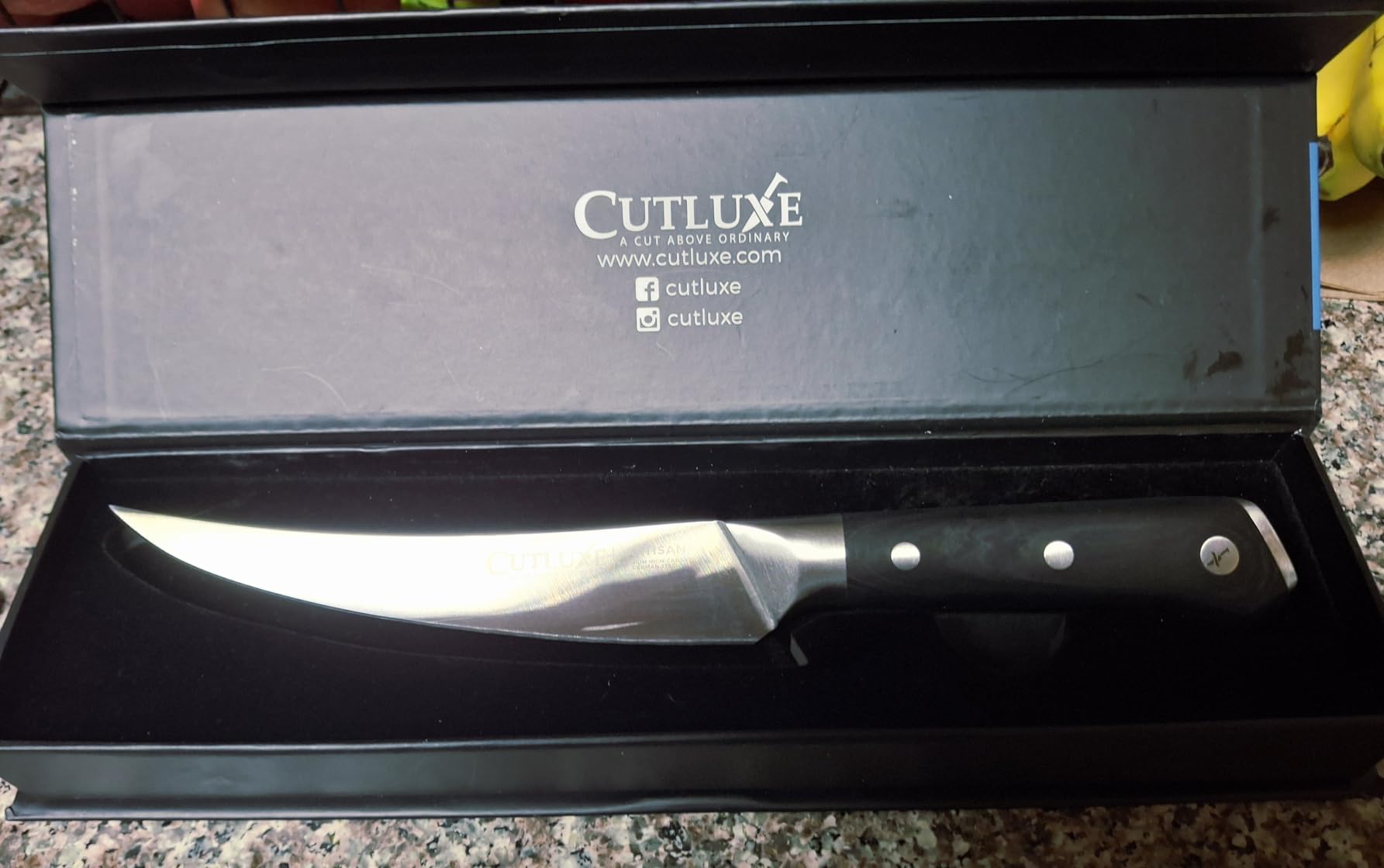
What you accept is weight. Pakkawood on a full tang is noticeably heavier than a moulded plastic handle, and after a long session that matters. The rust and stain resistance rating is good, but this is still a hand-wash knife with a composite handle that should be dried.
The curved blade is specialised. It is not a general-purpose chef’s knife, and buyers who expected a multipurpose tool tend to be the ones who rate it lowest. The lifetime warranty is a genuine plus at this level.
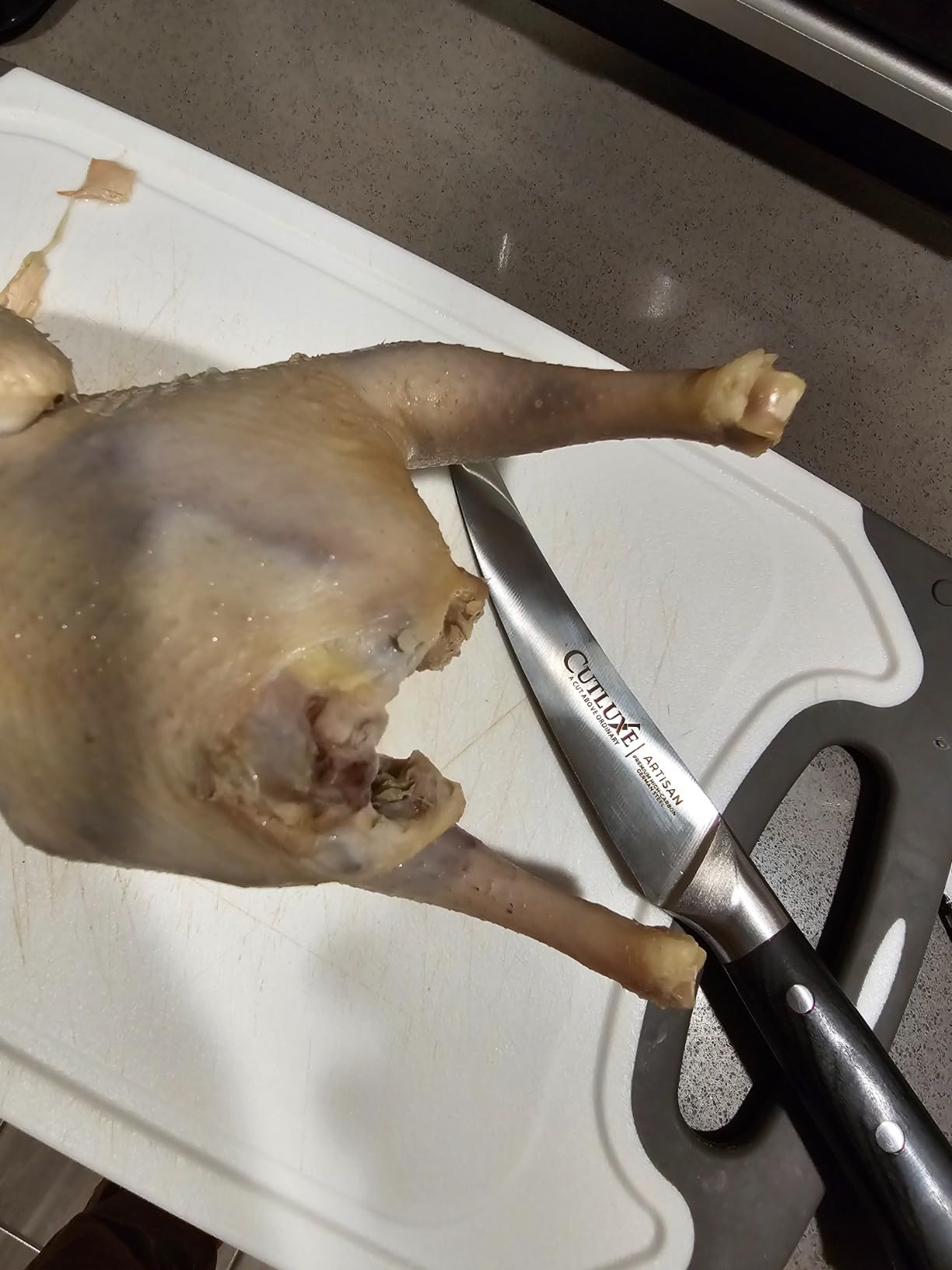
Who should buy the Cutluxe
Someone who wants a forged full tang and a hand-honed edge without stepping up to a German or Japanese premium brand. Reviewers consistently call it durable, well balanced and easy to sharpen.
It is also a good gifting knife, since the pakkawood finish reads as an expensive handle even when it is not.
When a lighter knife makes more sense
For long venison sessions, or for anyone who prefers a fast, light tool over a rigid one, the plastic-handled options in this list are kinder to the wrist. Its review base is also the second thinnest here, so the evidence is weaker than the rating alone suggests.
12. Winco 6in Commercial Red Handle – Best NSF Commercial Pick
- Genuinely sharp for removing meat from bone
- Finger indentations for long sessions
- Built for daily commercial use
- Light at 0.11 kg
- Plain plastic handle
- Fixed curved blade is specialised
- Three star share sits at the top of this group
The Winco is the institutional option, and buyers with restaurant or butcher-shop backgrounds describe it that way. It is NSF listed, built to survive daily foodservice use, and the X50 CrMoV15 German steel blade was genuinely sharp in our testing.
The handle is the reason it earns a place on a counter. Finger indentations give a positive hold through long trimming sessions, and the red colour makes it identifiable in a knife rack with a dozen others. At 0.11 kg it is a lighter knife in the group, easy to maneuver.
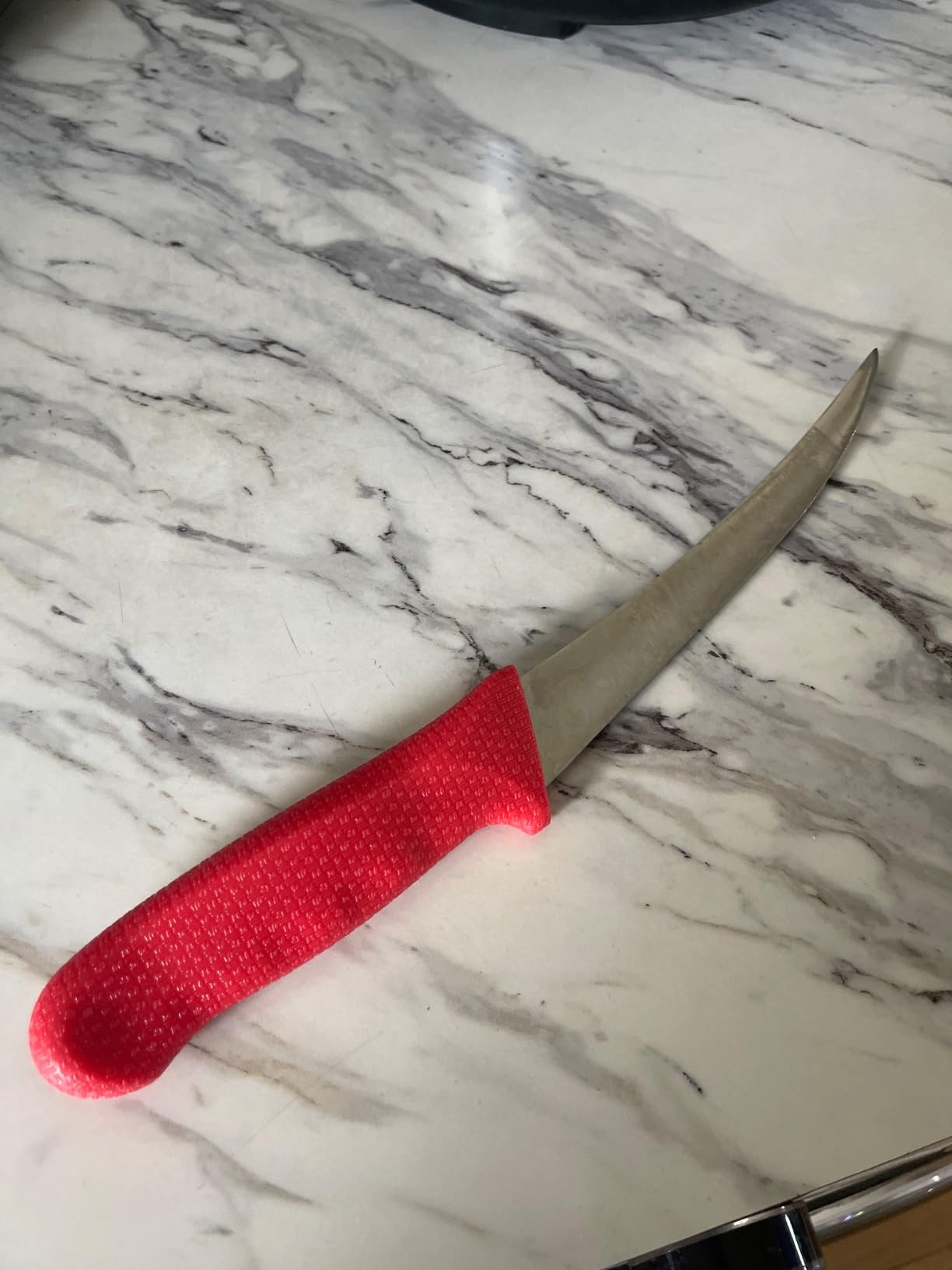
It is a plain knife, and the plainness shows. The moulded plastic handle has none of the refinement of a riveted pakkawood grip, and the fixed curved blade is built for deboning rather than general slicing, so it is a specialist tool inside a specialist tool.
The 4.6 average comes with a 7 percent three-star share, the highest in this test, which points to some edge-retention complaints over time. If you buy one, plan on a regular steel routine from day one.
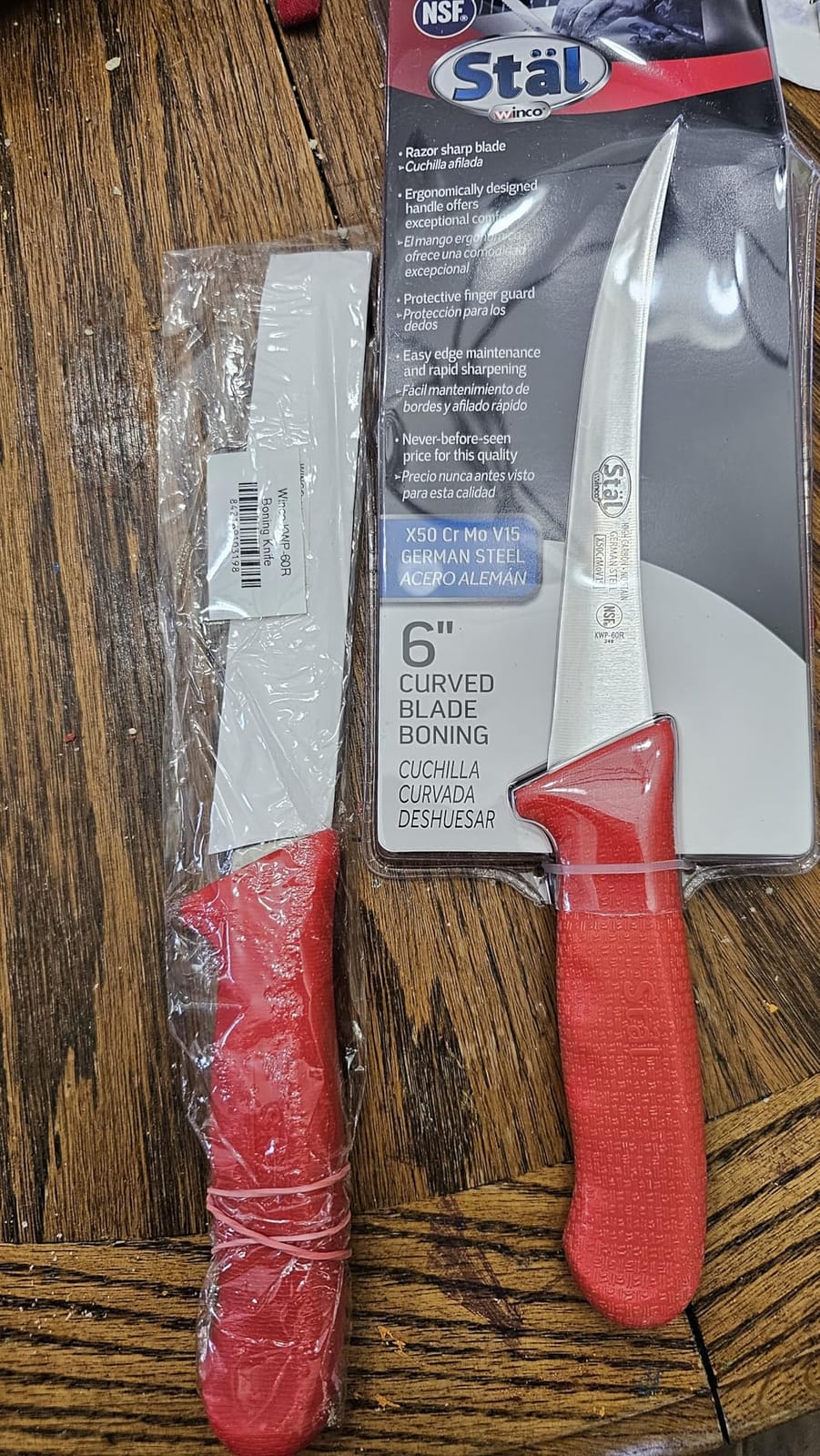
Why commercial kitchens buy it
NSF certification is the deciding factor for anyone working behind a counter rather than in their own freezer. Combined with a slip-resistant handle and a steel that tolerates a washdown routine, it is built for the environment a home kitchen never has.
It is also a sensible first knife for a shared holiday kitchen, where knives get used by many hands and nobody owns them.
Where it falls short
The handle is the limit. If grip refinement matters to you, or if you are processing a deer and want something that feels balanced in long session, a lighter Fibrox-style knife serves better.
How to Choose a Boning Knife That Fits Your Work
Most wrong purchases come down to three decisions: how flexible the blade should be, whether you want it curved or straight, and how much steel you are willing to maintain. Get those right and the rest is preference.
Match the blade flexibility to the animal
Flexible blades wrap around bone and leave less meat behind, which makes them right for fish, poultry and small game. Semi-stiff is the general-purpose middle and the most commonly recommended starting point for mixed butchery. Stiff blades push through dense fat and connective tissue and suit big game, primals and trimming.
The failure mode matters more than the category. A blade that is too stiff skates or jumps off a knuckle and leaves meat on the bone, while a blade that is too flexible punishes a clumsy stroke and pushes you into stabbing instead of drawing. Beginners should start stiff, then move down the flex scale as their stroke improves.
Curved or straight: the line-of-sight argument
A curved blade keeps your knuckles lower and rolls into hollows, which makes it faster once you have control. A straight blade gives you a clear line of sight from hand to tip, so you can see exactly where the edge is going, and that visibility is why some beginners do better on a straight knife at first.
Neither is universally better. Most of the knives in this roundup are curved, which reflects what butchers actually carry, and the strongest forum recommendations are curved too.
Blade length: why 6 inch wins
Six inches is the sweet spot and it dominates this list for good reason. It fits inside a chicken cavity and a hock, reaches the middle of a small primal, and stays under the width of a cutting board. Five-inch blades are more precise and easier to carry in the field, and anything over 6.5 inches starts to trade precision for reach.
Match the length to the smallest job you do regularly, not the largest. A knife that is comfortable on a chicken will still handle a shoulder, but the reverse is not true.
Steel, edge retention and how often you sharpen
For bone-in work, the practical answer is a stainless steel you can bring back to an edge quickly. High-carbon Japanese and German stainless steels in the 56 Rockwell range are a sensible middle, and they resist staining and corrosion without demanding razor-level sharpening.
Sharpening is routine, not an event. Hone every 20 to 30 minutes of work, and expect a full stone session every six to ten sessions. The most common complaint in the forums is a knife that arrived dull, and every flexible blade here benefits from a steel pass before the first cut.
To tell a 15 degree edge from a 20 degree one, you can measure with an angle gauge or slice a ripe tomato: a 15 degree edge glides through with almost no drag, while a 20 degree edge pushes slightly and leaves a cleaner, more controlled line. If you keep the bevel gentle, a cheap knife on a stone beats an expensive knife in a drawer.
Tang, handle and grip security
A full tang means the steel runs the length of the handle, and you feel the difference when the edge meets a knuckle: forged full-tang knives feel more solid. Partial tang knives are lighter and cheaper, which is why most budget picks use them.
Handle material decides whether the knife stays put on a wet, greasy hand. Textured thermoplastic rubber such as Fibrox Pro and moulded polypropylene with finger indentations are the safest wet options. Pakkawood and maple look better and feel better when dry, but they need drying and oiling to survive a season of processing. Skip any handle that feels polished or slick, because slippage is the most cited safety complaint in the threads we read.
On weight, anything above roughly 5 ounces in the hand tends to register as tiring over a three or four hour session. That is a rough threshold rather than a rule, but it is the point at which hand fatigue, not skill, becomes the limiting factor.
How many boning knives do you actually need?
One is enough for most people. A second one is useful when you work a lot of fish and poultry alongside game, because a fine flexible knife and a stiff trimming knife are different tools rather than a better and worse knife.
Beyond two, what you are really shopping for is the rest of the set: a breaking knife for opening large primals, a bone saw for heavy bone, a honing steel and a whetstone, and a proper cutting board. Community consensus is firm that a 6 inch boning knife does not replace a 10 inch breaker on a beef rib rack.
A practical build for a weekend hunter is two 6 inch semi-flexible curved knives plus an 8 inch curved breaker and a bone saw. A part-time counter worker wants a certified washable blade, which points to an NSF-listed option. A full-time processor mostly cares about edge retention, a steel that straightens fast, and a handle they can sanitize.
Cleaning game meat and avoiding the usual mistakes
Hand wash every knife here except the HENCKELS, and dry it immediately. Dishwasher heat and detergent chew a hollow-ground or flexible blade and can split a wood or composite handle. Wipe the blade between tasks rather than letting it sit in blood and fat, because that is how corrosion and staining start.
For wild game, sanitise surfaces that touch raw carcass, and avoid cross-contaminating the cutting board you prepare finished meat on. If you process large animals, keep the carcass cold until the meat is off the bone, and pay attention to the temperature of the room, which matters more than anything about the knife.
The most common technique mistake is stabbing. Draw the edge along the bone with short strokes and let the blade do the work, and use the tip for joint work rather than forcing the full edge into a curve. The second most common mistake is buying one premium knife and not maintaining it, which is the fastest route to a dull blade by month three.
Frequently Asked Questions
What brand boning knife do butchers use?
Across community threads on r/chefknives, r/Butchery, r/Hunting and bladeforums, the most-repeated pick is a 6 inch curved semi-flexible knife with a textured thermoplastic rubber handle, most often a Victorinox Fibrox. F. Dick ErgoGrip is praised just as often for ergonomics and easy cleaning, and Munetoshi Butcher #9 is recommended for separating primals on large carcasses.
What is the best knife for deboning meat?
The best knife for deboning meat is a 6 inch semi-flexible curved boning knife. The moderate flex hugs a knuckle or hock so the cut follows bone, while the spine is still rigid enough to push through fat and silverskin. A fully flexible blade suits fish and poultry, and a stiff blade suits dense primals and trimming.
What are the key differences between flexible and semi-flexible boning knives?
A flexible blade bends enough to wrap around small bones and follows contours closely, which maximises yield on fish, poultry and small game. A semi-flexible blade gives slightly more resistance so it can push through connective tissue and trim fat without collapsing, making it the general-purpose choice for mixed butchery. Semi-stiff and stiff blades trade flexibility for power on large carcasses.
What type of steel is best for boning knives?
For bone-in butchering, a high-carbon stainless steel around 56 Rockwell is the practical choice because it resists staining and corrosion while still coming back to a sharp edge on a stone. Very hard exotic steels hold an edge longer but demand more skill to maintain. Whichever steel you pick matters less than a regular honing routine.
How many boning knives do I need?
Most people need one, and a 6 inch semi-flexible curved model covers poultry, pork, fish and venison. A second, more flexible knife helps if you fillet fish or process a lot of poultry. Beyond two, invest in a breaking knife, a bone saw, a honing steel and a whetstone, because a boning knife does not replace them.
Can a boning knife go in the dishwasher?
Hand wash only, with one exception in this roundup. Dishwasher heat and detergent attack the hollow-ground edge of most flexible boning knives and can split wood, pakkawood or composite handles. Dry the blade immediately after washing, and oil wood handles periodically. If you need a fully washable option for a commercial kitchen, choose an NSF-listed model with a moulded plastic handle.
The Best Boning Knife for Butchering
Our pick for the best boning knives for butchering is the Mercer Culinary Ultimate White 6 inch curved. It is sharp out of the box, holds a semi-flexible profile that suits poultry, pork, fish and venison equally well, and it is easy to resharpen. If you want the community consensus pick, take the Victorinox Fibrox 6 inch instead: lighter, washable, warranty-backed, and the knife most processors name first.
Buy the imarku if you want forged German steel and pakkawood, and expect more weight in the hand. Whatever you choose, hone every half hour, keep a steel in the processing bag, and remember that a 6 inch boning knife is one part of a set rather than the whole kit. Use the buttons above to check the current listing and read recent owner feedback before you commit.