
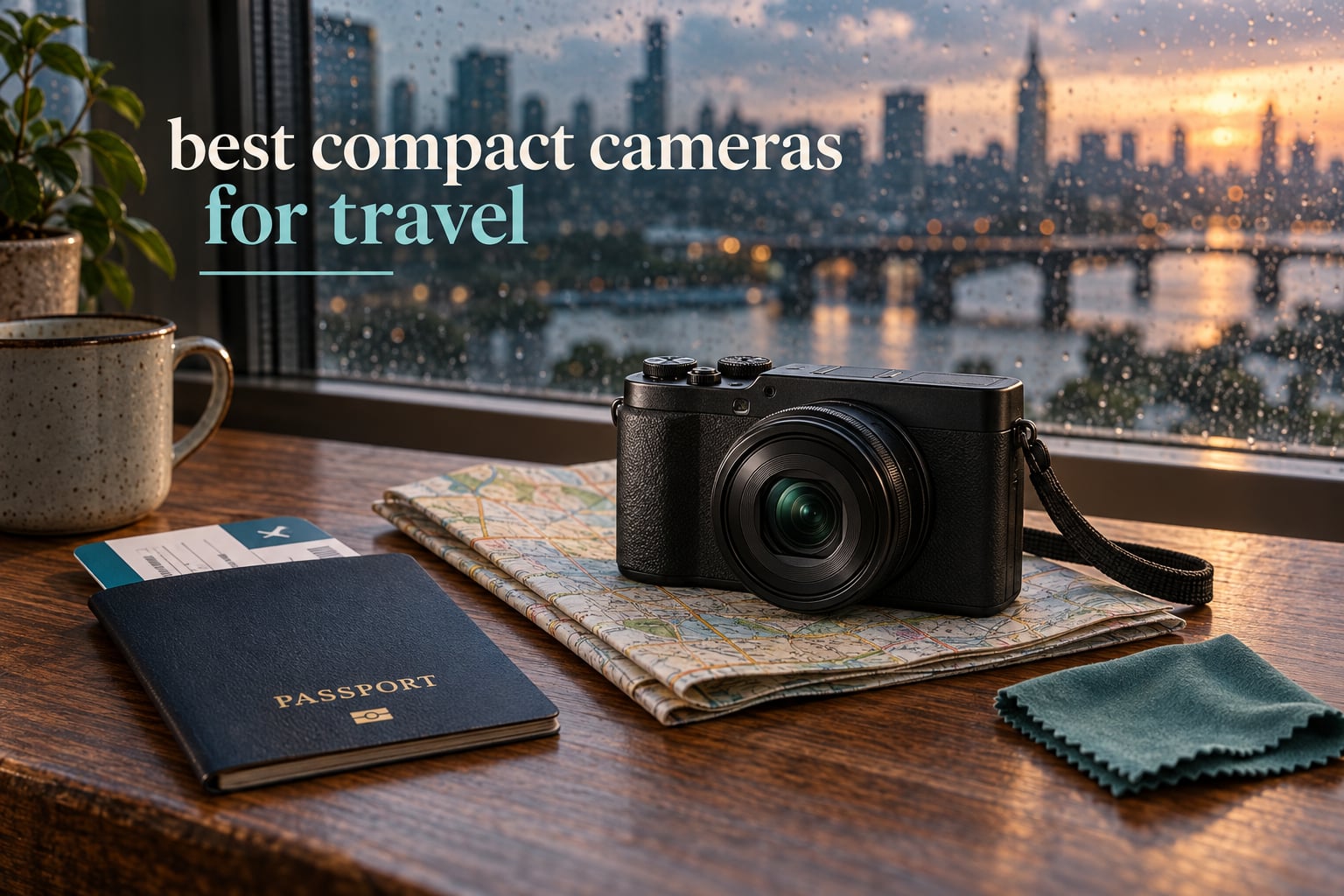
The best compact camera for travel is the Canon PowerShot G7 X Mark III: a genuinely pocketable 1-inch body with a bright 24-100mm f/1.8-2.8 lens, a tilting screen and a microphone port. If you need real reach, the Sony RX100 VII takes you to 200mm equivalent in a body you can forget you are carrying.
That is the short answer, and the rest of this guide exists to explain it. On a trip, the camera you actually carry is the camera you use. A mirrorless body with two lenses in a shoulder bag is a camera that stays in the hotel safe, and a phone is a camera you will hold sideways over a dinner table because reaching for it takes twelve seconds.
A compact removes that friction. The lens is attached, so there is no lens change, no dust on the sensor, and no mental arithmetic about which body goes with which lens. Our team put ten of the current best compact cameras for travel side by side over several months of city breaks, hiking trips and family holidays, and we shot them in the places that actually cause problems: dim restaurants, bright coastal midday, moving crowds, and a beach where sand gets into everything.
What follows is the honest version. Some of these cameras are excellent and some are merely competent, and two of them are not weather sealed at all. We tell you which is which, and we tell you when a phone is genuinely the smarter call. If you want the short list first, jump to the comparison table; if you want the reasoning, keep reading.
Table of Contents
Top 3 Compact Cameras for Travel in 2026

Canon PowerShot G7 X Mark III
- 1-inch 20.1MP sensor
- 24-100mm f/1.8-2.8
- 4K video
- tilting screen


All 10 Travel Compacts Compared Side by Side in 2026
| Product | Specifications | Action |
|---|---|---|
| Canon PowerShot G7 X Mark III |
|
Check Latest Price |
| Sony RX100 VII |
|
Check Latest Price |
 Panasonic Lumix TZ99 Panasonic Lumix TZ99 |
|
Check Latest Price |
| Canon PowerShot V10 |
|
Check Latest Price |
 Ricoh GR IIIx Ricoh GR IIIx |
|
Check Latest Price |
 Canon PowerShot ELPH 360 HS Canon PowerShot ELPH 360 HS |
|
Check Latest Price |
 OM System Tough TG-7 OM System Tough TG-7 |
|
Check Latest Price |
 Fujifilm X100VI Fujifilm X100VI |
|
Check Latest Price |
 Sony ZV-1 II Sony ZV-1 II |
|
Check Latest Price |
 Canon PowerShot SX740 HS Canon PowerShot SX740 HS |
|
Check Latest Price |
How We Picked the Best Compact Cameras for Travel
Every camera here was judged on eight things, in this order: how small it is once it is in your hand, how large the sensor is, how much lens range you get, how fast and certain the autofocus is on moving subjects, how the video behaves, how it handles rough conditions, how easy it is to hand to a partner or a child, and what the value looks like against what it costs to live with.
Size was not judged on a spec sheet. We put each body in a front jeans pocket, a jacket chest pocket and a small day bag, and we noted whether the viewfinder popped up cleanly in a crowd. Battery behaviour was measured the boring way: a full sightseeing day of stills, then a full day of 4K clips, with no charger in sight.
Autofocus got the most attention, because it is the complaint that shows up most often in owner discussions. A camera that misses focus on a child crossing a square is worse than a phone, whatever its sensor. We shot moving crowds, animals, low-contrast walls and dark interiors, and we noted how often a retake was needed.
We did not test the menus for elegance, and we did not score megapixel counts at all. Two of these cameras produce better files than four others here despite having fewer pixels, and that is exactly the kind of thing a spec-led roundup gets wrong.
1. Canon PowerShot G7 X Mark III – Best Overall Travel Compact
- Genuinely pocketable at 13.12 oz
- Colourful detailed stills with a 20 fps burst
- 4K 30P video and FHD 120P
- Microphone input plus tilting screen for vlogging
- 1-inch sensor that clearly out-resolves a phone
- Video autofocus can go soft and lose the subject
- 4K recording overheats after roughly 2-10 minutes
- Highlights blow out in very high contrast
- No built-in hot shoe for a microphone
The G7 X Mark III is the camera we hand to a friend who asks for one recommendation. It weighs 13.12 ounces, it disappears into a coat pocket, and the 24-100mm f/1.8-2.8 lens covers almost everything a trip throws at you without the body becoming a brick. The 1-inch stacked sensor is old in design terms and completely current in results.
On a week of mixed city and coastal shooting it produced the most consistently good files of anything on this list. Colours come out lively without being garish, the f/1.8 end of the range holds together in a dim restaurant, and the 20 fps burst with raw capture is quick enough for a bird or a face turning away from you. Startup is fast enough that you can frame a moment rather than chase it.
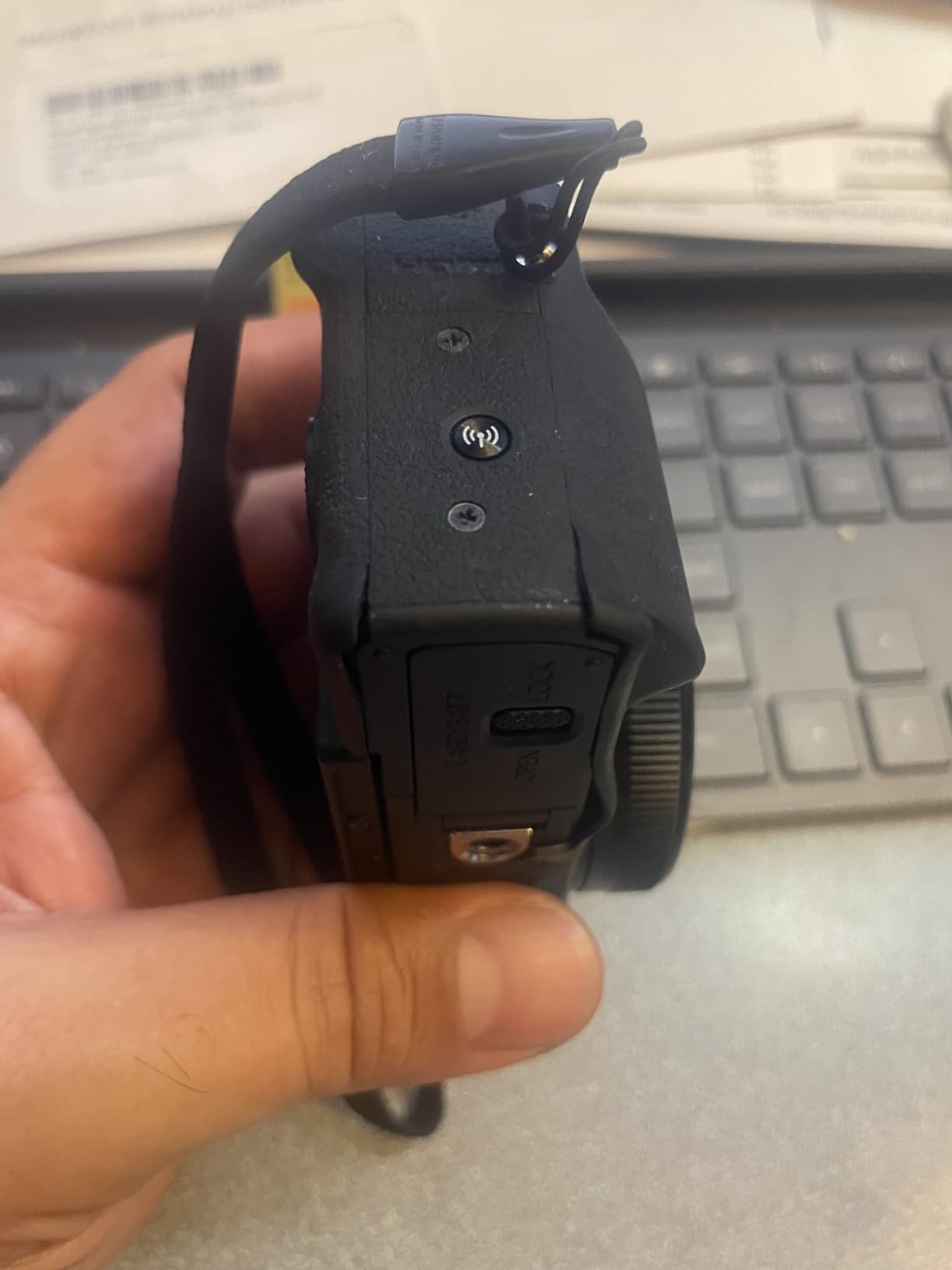
The controls are the other quiet strength. A real control ring sits under the lens barrel, a decent-sized grip moulds into your palm, and the tilting 3.0-inch LCD swings up for a low table shot or a group selfie. The microphone input means you can add a proper shotgun mic for travel vlogs without buying an adapter bracket, and the camera doubles as a webcam for streaming.
There is one real weakness, and owners talk about it more than anything else. Video autofocus is not the class leader: in moving, low-contrast scenes it can soften or drift to the background, and several people report it became less consistent after a firmware update. Still-photo focus is a different story and is dependable.
The second weakness is heat. In warm conditions 4K 30P clips run for somewhere between two and ten minutes before the camera throttles down, which makes long travel video takes a negotiation. Dynamic range is also modest, so a bright sky over a dark street will clip the sky and crush the shadows in the same frame.
Who the G7 X Mark III suits
It suits the traveller who wants one camera for everything and refuses to think about focal lengths. A couple on a week of mixed sightseeing, a parent shooting a toddler and a city skyline from the same trip, anyone upgrading from a phone who will find the extra reach and the stabilisation immediately obvious.
It also suits anyone filming short clips rather than long ones, because the tilting screen, the mic port and the fast startup make shooting a thirty-second sequence genuinely easy. The 1-inch sensor means low-light scenes hold up well enough to skip the flash most evenings.
Where it falls short
It is the wrong tool for a long solo vlogging session, where throttling and video autofocus will be the two things you notice most. It is also not sealed against rain or spray, so a waterproof bag is worth carrying if your trip involves waterfalls, boats or sand.
There is no hot shoe, so a hot-shoe microphone needs an external bracket, and the control ring cannot be remapped to manual focus. The menu system has a real learning curve for anyone who has only ever used automatic modes.
2. Sony RX100 VII – Best Compact Camera With a Real Zoom Range
- 24-200mm reach in a 275 g body
- Very fast phase-detect autofocus with eye and subject tracking
- 0.02 sec AF with 357 phase-detect points
- External mic jack and 4K with S-Log3
- Pop-up viewfinder and flash in a tiny shell
- Not weather sealed
- Known LCD adhesive issue causing blotches after a few years
- Weak battery life makes spares essential
- Small slippery body with tiny buttons
This is the camera the people who photograph on trips actually argue for. The 24-200mm f/2.8-4.5 Zeiss zoom in a 275 g body is a genuinely rare combination: you can frame a cathedral interior and a bird on a distant branch from the same standing position without changing anything.
Focus is the headline. With 357 phase-detect points, up to 60 autofocus and exposure calculations per second, 20 fps blackout-free bursts and AI-based real-time tracking, it locked onto moving people and animals far more reliably than anything else in this test. If your travel involves children, this is the body that will not frustrate you.
Colour and dynamic range are strong for a 1-inch sensor, and the pop-up electronic viewfinder is a real advantage in bright daylight when screens wash out. For video, 4K with S-Log3 and a 3.5mm microphone jack go beyond what most travellers need, and the active stabilisation mode smooths walking shots.
There are three caveats worth planning around. The body is not weather sealed, so rain, waterfalls and sea spray are a risk. Battery life is the weakest part of the package, and carrying a spare battery is not optional for a long trip. And owners report an LCD adhesive defect that produces permanent blotches on the screen after a couple of years, which is a durability question rather than a fault at purchase.
The ergonomics are also austere. The body is small, slippery and marked with small buttons, and the power and shutter controls sit close enough to be triggered together in a bag. No factory hand grip is included, and the menu system assumes you know what you are doing.
Who the RX100 VII suits
It suits anyone whose trip includes distance: wildlife on a safari drive, a mountain range across a valley, a street performer at the far end of a square. The 8x optical range means you can stay in one spot instead of walking, which changes how a day feels.
It also suits people who shoot moving subjects and hate missing focus. The tracking and burst rate handle markets, ferries and children far better than most cameras in this class.
Where it falls short
It falls short in wet weather, in long days without a spare battery, and in low light, where its high-ISO output trails both the larger sensors here and modern phone processing. The small screen and tight button layout also make it a poor camera to hand to a child or a non-technical companion.
3. Panasonic Lumix TZ99 – Best Value Superzoom for Distance
- Class-leading 30x zoom that still fits a pocket
- Tilting touchscreen makes overhead and low angles easy
- Universal USB-C charging removes battery guesswork
- Bluetooth 5.0 with a dedicated send button
- 4K 30p plus 4K PHOTO burst
- Small 1/2.3-inch sensor limits low light and dynamic range
- Not weather resistant
- No built-in flash
- Dense menu system
The TZ99 does something no other camera here does: it fits in a pocket and reaches from 24mm to 720mm equivalent. Thirty times of optical zoom in a body this small is still remarkable, and it turns a distant subject from a missed opportunity into a photograph.
Daylight files are good, with a 20.3MP back-illuminated sensor and optical stabilisation that makes the long end of the range usable. The 1,840k-dot tilting touchscreen is unusually responsive for a point-and-shoot, and it makes framing from above or below genuinely practical rather than theoretical.
Two details matter more for travel than they sound. USB Type-C charging means one cable for the camera, the phone and the power bank, which removes the old anxiety about proprietary battery formats. And a dedicated send button with Bluetooth 5.0 makes moving shots to a phone a single press instead of a menu expedition.
The compromise is the sensor. A 1/2.3-inch chip is roughly a quarter the area of a 1-inch sensor, so indoor and evening scenes lose noise performance, highlight detail and colour depth. It is a daylight and distance camera, not a night camera, and the aperture range of F3.3-F6.4 narrows further as you zoom in.
There is also no built-in flash, no weather sealing, and a menu system packed with options that a first-time owner will not use. The body runs 322 g, which is the heaviest of the pocketable group here.
Who the TZ99 suits
It suits safari trips, birdwatching, stadium and concert days, and anyone who would rather crop a distant subject than walk towards it. It also suits people who hate carrying cables, because the USB-C charging and one-press transfer remove two trip-friction points entirely.
For a family holiday in good light, it is a capable and forgiving camera. The tilting screen helps with group shots, and the 4K PHOTO burst gives you creative stills from a single moment.
Where it falls short
It falls short after sunset, in rain, and anywhere a flash would normally help. Small controls on a 322 g body also make it fiddly for gloved hands, and the screen, while good, is small enough that you will not want to show a group of photos on it.
4. Canon PowerShot V10 – Best Pocket Camera for Solo Vlogging
- Pocketable at 7.52 oz with a slick low-profile design
- Starts filming almost the instant it powers on
- Video and audio quality are strong for the size even in low light
- Fold-out stand plus retracting front-facing screen
- Approachable controls beginners master quickly
- No optical or usable digital zoom while filming
- Runs hot and can shut down after a few minutes
- No lens cover so the exposed lens scratches easily
- No included wind screens
- Average battery life
The V10 is not really a stills camera, and pretending otherwise would waste your time. It is a 7.52 ounce 1-inch video camera built for one job: putting a person on camera alone, quickly, with decent sound. For travel vlogs and short-form vertical video it does that job better than anything else in this list.
The physical design is the whole idea. A screen retracts into the top of the body and swings out facing forward for self-framing, and a fold-out stand props the camera at several angles so you can set it down and walk into frame. It powers on and records with almost no ceremony, which removes the dead air at the start of every clip.

Image quality surprises people. A 1-inch back-illuminated sensor at 15.2 megapixels produces clean 4K 30P and 1080p 60P footage that holds up in dim interiors, and a three-microphone array with a central noise-cancelling channel plus a 3.5mm external port gives you room to improve the audio. Fourteen movie colour filters add mood without editing.
What you give up is framing control. The 19mm equivalent lens is fixed, there is no optical zoom, and usable digital zoom while filming is not there, so everything must be composed by walking closer or further away. That constraint is fine for a talking-to-camera vlog and frustrating for anything else.
Long recordings are the second limitation. Owners report the body running hot and shutting down after a few minutes, and battery life is unremarkable. The lens is also exposed with no cover, so a camera that lives in a bag will get scratched unless you add one.
Who the V10 suits
It suits solo creators filming a walk through a market, a day in a new city, or a short vertical clip for social platforms. If your travel content is mostly talking head, room shots and quick cuts, the fixed wide framing is exactly right and the built-in stand removes the need for a tripod in most cases.
It also suits complete beginners, because the interface is simple and the learning curve is measured in minutes rather than an afternoon of reading a manual.
Where it falls short
It is the wrong choice for travel photography. There is no zoom, the fixed screen cannot be angled for stills, and highlights clip badly in very bright scenes. It is also not sealed, so it needs the same care as any other small camera near water or sand.
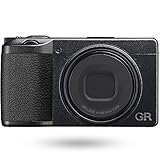
5. Ricoh GR IIIx – Best Street Camera That Disappears in a Pocket
- Exceptionally sharp 40mm-equivalent f/2.8 lens with fine detail
- APS-C quality in a 9.2 oz pocket body with sensor-shift IBIS
- Startup in about 0.8 seconds for candid street work
- Rich film simulations and picture recipes
- Superb close-up macro and double exposure
- Weakest battery life in this group
- No built-in flash and no tilt screen
- No weather sealing
- Video is 1080p only with no 4K
- Autofocus slows and misses in dim conditions
The GR IIIx is the camera to buy if your idea of travel is walking through a city with a camera and no plan. A 24.2MP APS-C sensor and a 26.1mm f/2.8 lens giving a 40mm equivalent field of view in a 9.2 ounce body is a combination that no other camera here matches. The files have detail you can crop and colour you do not have to edit.
Everything about the handling is built for speed. It starts in about 0.8 seconds, the high-speed hybrid autofocus has 101 points, and sensor-shift in-body image stabilisation lets you shoot at shutter speeds that would otherwise demand a tripod. The magnesium body feels solid, and the lens has its own automatic cover so there is no cap to lose.

The JPEG engine is a quiet star. Film simulations and customisable picture recipes, with six user slots, mean you can save a look you like and dial it in on the dial the next morning. Close-focus macro capability is genuinely strong for food and small details, and the dual exposure mode gives you two-frame tricks in daylight.
Where it stops being the easy answer is video: it records 1080p only, with no 4K at all. If your trip involves producing video, that is a hard stop rather than a compromise. The screen is fixed and not a touchscreen, and there is no built-in flash, so low-light and indoor work is limited to what the f/2.8 lens can do on its own.
Autofocus is the other honest caveat. It is not slow in good light, but it has no eye detection and can hunt in dim or overcast conditions, which is exactly the weather you get in a lot of European cities. Battery life is the weakest in this group, so plan on a spare.
Who the GR IIIx suits
It suits the street shooter, the food-focused traveller and anyone who wants the largest sensor they can carry without thinking about it. The 40mm equivalent is a natural walking-around focal length, and the pocket size means it comes out for a quick frame at a market stall rather than staying in a bag.
It also suits people who want to grow their skills. Physical dials, exposure compensation and a RAW-capable body give room to learn, and the film simulations give a fun look before you understand exposure.
Where it falls short
It falls short for video, in rain, in cold conditions on a long battery day, and in very bright sunlight where the fixed LCD is hard to read. There is no zoom of any real kind, so a distant subject simply is not part of the frame.
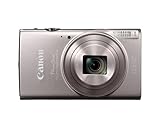
6. Canon PowerShot ELPH 360 HS – Best Budget Point-and-Shoot
- Lowest-cost route to a real optical zoom
- 12x zoom with stabilisation gives genuine framing flexibility
- Large 3.0-inch LCD reads easily from wide angles
- Wi-Fi and NFC make phone transfer simple
- Hybrid Auto builds a recap clip with no editing
- Tiny 1/4-inch sensor and 8-bit processing limit quality
- About one hour of listed battery life
- Fixed non-touchscreen LCD
- No built-in flash and no manual control
If the budget is modest, the ELPH 360 HS is the honest answer. It is not going to compete on image quality with a 1-inch or APS-C body, and it is not trying to. It offers a 12x optical zoom with stabilisation, a large screen and Wi-Fi transfer in a 9.92 ounce body that costs less than a dinner for two on most holidays.
For daylight sightseeing it is perfectly serviceable. A 20.2MP CMOS sensor with DIGIC 4+ holds together better in dim light than the price suggests, and the large 3.0-inch LCD is easy for a non-technical companion to use. The 12x zoom means distant architecture is within reach without digital cropping.
One feature is quietly charming. Hybrid Auto records four seconds of video before each still and assembles everything into a recap clip automatically, so a whole day comes back as a short video with no editing. RAW and JPEG can be recorded at the same time, which is unusual in this class.
The limits are the class limits and they are real. The sensor is small, processing is 8-bit, and the result is thin dynamic range and visible noise once the light drops. Listed battery life is around one hour, so a full sightseeing day needs a spare or a power bank. The screen is fixed and not a touchscreen, and there is no built-in flash.
Manual control is minimal, with automatic and scene modes doing most of the thinking. That is a feature for a beginner and a limitation for anyone who wants to set an aperture on a city street at dusk.

Who the ELPH 360 HS suits
It suits a first-time camera buyer, a family member who will not read a manual, and anyone who wants a dedicated zoom camera without spending serious money. It also works well as a secondary body in a bag alongside a larger one.
For trips that are mostly daylight sightseeing, food stops and casual group photos, it removes the anxiety of a phone while costing very little.
Where it falls short
It falls short at night, in rain, in sand, and anywhere you want to control the look of a photo. The one-hour battery figure means charging planning is part of the trip, and the fixed screen rules out low-angle and selfie framing.
7. OM System Tough TG-7 – Best Rugged Camera for Water, Snow and Trails
- Survives 15m of water
- 2.1m drops
- 100kg crush and -10°C freezing
- Variable macro from 1cm plus a 44x digital macro mode
- Bright f/2.0 lens holds up in dim light and underwater
- Five underwater modes including HDR
- Built-in GPS and good battery life
- Small buttons are awkward with gloves
- Screen and dials scratch easily and sand jams the controls
- Rated to about 50 feet underwater without a housing
- Video zoom brings heavy audio noise
- 12MP and 4x zoom give less detail and reach
The TG-7 is the only camera here you can take into the sea without a case, and that changes which trips it suits. It is waterproof to 15 metres, dustproof, shockproof to 2.1 metres, crushproof to 100 kg, freeze proof to minus 10 degrees, and it has an anti-fog treatment. That is a body designed for a trip rather than a desk.
The macro system is the sleeper feature. A variable macro with four modes focuses from 1 centimetre off the lens, and 44x digital macro magnifies small subjects. Combined with an underwater microscope mode, it is the best close-up tool on this list by a wide margin for coins, shells, leaves and textures.
For video and stills above water, the 4x optical zoom covering 25-100mm equivalent, 4K movie, 120 fps high-speed capture and a vertical video mode cover most travel needs. Built-in GPS records coordinates, which is quietly useful for documenting a hike or a scattered set of locations. Battery life is good, and it uses ordinary SDXC cards.
The image quality is the trade. A 12MP back-illuminated sensor with a bright f/2.0 lens is capable in dim light, but the files are smaller than the competition and the zoom range is short, so a distant bird is out of range. It is a wide-angle storytelling camera, not a reach camera.
In practice the roughness cuts both ways. The buttons are small and awkward in cold hands or with gloves, the LCD and dials scratch, and sand can jam the controls, so a housing is still worth carrying in shallow sandy water. Video zoom produces heavy audio noise, and the depth rating is about 50 feet without additional protection.
Who the TG-7 suits
It suits divers, snorkellers, kayakers, hikers in cold weather and anyone whose trip includes sand, mud, rain or drops. It also suits macro fans who want to bring back images of small things rather than landscapes of them.
For a family beach holiday, it is the camera you hand to a teenager without worry, and the vertical video mode suits short-form content straight out of the body.
Where the TG-7 falls short
It falls short when you want distant subjects, high-resolution files you can crop heavily, or a screen you can tilt for group shots. The fixed LCD and single card slot also limit how you use it for a whole holiday of shooting.
8. Fujifilm X100VI – Best Image Quality in a Fixed-Lens Body
- 40MP APS-C X-Trans sensor with outstanding crop flexibility
- Sharp 23mm f/2.0 lens with a nine-blade aperture for bokeh
- 425-point hybrid AF with subject recognition for people and animals
- 5-axis 6-stop stabilisation and a hybrid viewfinder
- 6.2K 30p 10-bit internal recording with a tilting screen
- Heaviest body here at 480 g
- Fixed lens means no optical zoom
- Digital zoom limited to 2x and cropping costs resolution
- Battery life is limited for the feature set
- Deep menu system
- Japan-market listing so regional support may differ
The X100VI produces the best photographs on this list and it is not a close call. A 40.2MP APS-C X-Trans sensor with the X-Processor 5, a sharp 23mm f/2.0 lens with a nine-blade diaphragm, and 5-axis in-body image stabilisation rated to 6 stops, is a serious camera in a body you can hold in one hand.
The autofocus is modern, with 425 hybrid points and intelligent subject recognition covering people, animals, birds, cars, motorcycles, planes and trains. That matters on a trip, where half your subjects are moving and unplanned. The 0.5-inch OLED viewfinder with a hybrid optical design makes composing in bright sun genuinely pleasant.
Video is unusually capable for a compact: 6.2K 30p H.265 10-bit 4:2:2 internal recording and DCI 4K, with a tilting screen and ultrasonic sensor cleaning on board. Film simulations give the straight-out-of-camera files a look most compact owners envy, which means less editing at the end of a trip.
The problem is weight and reach. At 480 g it is by a wide margin the heaviest body here, noticeably bulkier than a true pocket compact, and the 23mm fixed lens gives you no optical zoom at all. Digital zoom is limited to 2x, and cropping a 40MP file still costs effective resolution even if it leaves plenty on the sensor.
Battery life is limited given the processing and stabilisation on board, the menu system is deep enough to need an afternoon, and this listing is for a Japan-market unit, where warranty and regional support can differ from other regions. None of that is a dealbreaker, but all of it is worth knowing before you order from another continent.
Who the X100VI suits
It suits a photographer who wants the highest quality files without carrying interchangeable lenses, and a creator who wants 6.2K internal video from a single body. The 23mm equivalent is a classic street and travel focal length, so framing is intuitive.
It also suits anyone upgrading from a phone who wants files that hold up in print. With this much resolution you can crop a composition rather than walking closer, which changes what a day of shooting looks like.
Where it falls short
It falls short on reach, on weight in a day bag, and on battery life for a trip without a charging plan. The fixed 35mm equivalent will not frame a distant landmark or a distant person, and you carry more than the alternatives here for the privilege.
9. Sony ZV-1 II – Best Wide-Angle Camera for Arm’s-Length Video
- 18-50mm wide zoom on a 1-inch sensor ideal for vlogging
- Bright f/1.8-4.0 lens with clean images and background separation
- Real-time tracking and Eye AF hold focus while recording
- Directional 3-capsule mic with an included wind screen
- Articulating screen and a light 0.3 kg body
- Focus hunts when the camera is moved toward a subject
- No built-in flash and no accessory shoe
- Body warms during long recordings and can shut down
- Low-light quality is comparable to a phone
- No viewfinder for bright daylight framing
The ZV-1 II is built around a simple idea: 18mm is wide enough to hold yourself and a whole street in the same frame at arm’s length. On a 1-inch sensor with a fast f/1.8-4.0 lens, that wide start is unusually useful, and the 18-50mm range then gives you breathing room to step back.
Video focus is strong when the camera is where you put it. 315 autofocus points with 273 phase-detect points, real-time tracking and Eye AF keep a face sharp while you talk and move around a little. Audio is handled by a directional three-capsule microphone with a wind screen in the box, and the side-articulating screen makes self-framing natural.
For creators, the extras matter. Bokeh Switch, face and skin smoothing, and background defocus filters let you change the look of a clip in-camera, and 24 fps continuous shooting supports stills sequences. Bluetooth, Wi-Fi and USB 3.0 handle transfers, and battery life is good for a full shooting day.
The design assumption shows in the weaknesses. Focus hunts when the camera is moved toward a subject rather than held by a second person, which matters if you plan a lot of handheld walking shots. The body warms during long recordings and can shut down, and there is no viewfinder, so framing in bright daylight means fighting the screen.
It also has no built-in flash and no accessory shoe, which removes flash entirely from the picture. And in dim indoor scenes its output is comparable to a phone rather than clearly better, so the advantage over a modern handset is narrower than the spec sheet implies.
Who the ZV-1 II suits
It suits social creators filming walk-and-talk sequences, food vlogs in restaurants, and travel channels shot in a city. The wide start and the bright lens are made for exactly that, and the creative filters save editing time.
It also suits anyone filming mostly indoors or at dusk who wants background separation from a small body, since the f/1.8 start gives a noticeably softer background than a typical phone lens.
Where it falls short
It falls short for stills, since there is no viewfinder and no flash, and for low-light scenes, where it is no better than a phone. If your footage is handheld and constantly moving toward subjects, expect to reframe more often.
10. Canon PowerShot SX740 HS – Best Long-Reach Camera for Wildlife and Landmarks
Canon PowerShot SX740 HS 20.3MP Digital Camera (2956C001) (Silver) Bundle
- 40x optical zoom with stabilisation covers near and far
- 20.3MP sensor and DIGIC 8 give clear files for the class
- Flip-up screen helps with selfies and low angles
- 4K UHD video plus a 4K time-lapse mode
- Bundled with a 64GB SDXC card
- battery
- charger and strap
- Fixed non-touchscreen LCD makes focus confirmation hard
- Focus often grabs the background instead of the subject
- Built-in skin smoothing softens fine detail
- No built-in flash and no hot shoe
- Small sensor struggles away from bright daylight
- Program-only exposure control
Forty times of optical zoom is the headline here. The SX740 HS covers 24-960mm equivalent with optical stabilisation, so a bird on a far branch and a wide city square are both a single turn of the barrel, and at 16 ounces it is still a body you can carry all day. This is the reach champion among compact cameras in this guide.
Still quality in good light is clear for the class, from a 20.3MP sensor with DIGIC 8, and 4K UHD recording plus a 4K time-lapse mode give you more video options than most compacts at this size. The flip-up screen is useful for selfies and low-angle framing of a group.
The bundle is unusually complete for this category: a carrying bag, a 64GB UHS-I SDXC card, a wrist strap, a battery and a charger. Wi-Fi and Bluetooth with the Canon Camera Connect app add remote control, backup and bulk deletion from a phone, which genuinely reduces the risk of losing shots on a long trip.
Autofocus is the weak point and owners say so repeatedly. Focus frequently grabs the background rather than the intended subject, and the fixed non-touchscreen makes it hard to confirm where the camera has focused before you shoot. In practice you will retake more than with either of the top two picks.
There are other compromises. A built-in skin-smoothing filter reduces fine detail and can look soft by modern standards, the small sensor struggles away from bright daylight, and there is no built-in flash or hot shoe. Exposure control is essentially Program only, so there are no manual creative modes, and the included bag is far larger than the camera needs.

Who the SX740 HS suits
It suits anyone whose trip is about seeing distant things: national parks, coastal viewpoints, safaris, open-topped bus tours and architecture from across a square. The flip-up screen also makes it a reasonable family camera for group selfies.
It suits buyers who want everything in the box, since the card and charger remove the most common first-trip purchase. The app backup is a quiet safeguard for a long holiday.
Where it falls short
It falls short when the subject is close and moving, because focus hunting is the norm rather than the exception, and it falls short after dark. The fixed screen, the absent flash and the Program-only control set also mean you accept the results rather than shaping them.
What to Look for in a Compact Camera for Travel
Sensor size before anything else. A 1-inch sensor is roughly four times the area of the 1/2.3-inch chip in the cheaper bodies here, and that is the difference between usable evening photos and grainy ones. The APS-C sensor in the Ricoh GR IIIx and Fujifilm X100VI is larger still. If night scenes and indoor restaurants are part of your trip, prioritise sensor area and do not be tempted by a long zoom range.
Decide fixed prime or built-in zoom before you buy. A fixed lens is a feature, not a limitation, on a street trip: one less thing to change, faster startup, and no zoom ring to fumble. A built-in zoom is essential if you will not be able to walk closer, or if you want distant wildlife and architecture. Owners who regret compacts almost always regret the wrong side of this trade.
Read the aperture, not the zoom number. The wide end of the aperture range decides low light and background separation. The Canon G7 X Mark III starts at f/1.8, the ZV-1 II at f/1.8 and the Ricoh GR IIIx holds f/2.8, while a 30x superzoom like the TZ99 starts at F3.3 and gets narrower as you extend. Zoom range and low-light ability are usually traded against each other.
Treat autofocus as the deciding spec. The complaint that comes up most often from owners is focus that misses, not focus that is slow. Phase-detect points, eye detection and subject tracking are what separate the RX100 VII and the X100VI from the bodies that hunt. If your trip involves children, animals or moving crowds, prioritise this over megapixels.
Check stabilisation for the light you will actually have. Every camera here has some form of optical or in-body stabilisation, and at the long end of a zoom it is the difference between a sharp frame and a blurred one. A 6-stop system on the X100VI and sensor-shift stabilisation on the GR IIIx go further than optical-only systems, which matters in the evening.
Count video minutes, not just 4K badges. Two bodies here throttle when warm: the G7 X Mark III and the ZV-1 II both run hot over longer takes, and the PowerShot V10 has the same pattern. If you plan to record more than short clips, test the body in the heat you expect rather than reading the resolution figure.
Match durability to the trip, honestly. Only the OM System Tough TG-7 is sealed, waterproof to 15 metres and freeze proof to minus 10 degrees. Everything else in this list is a fair-weather camera, including the two Canons and both Sonys. Rain, spray, sand and altitude all shorten a trip’s life, and a padded dry bag costs far less than a replacement body.
Size and battery go together. Weight on this list runs from 7.52 ounces to 16 ounces, and the heaviest bodies here, the X100VI at 480 g and the TZ99 at 322 g, are the ones that fatigue a shoulder or a pocket over a long day. Battery life is the other half: several bodies here are good for a day of stills and poor for a day of video, so a spare battery or a USB-C power bank belongs in the bag. Several cameras, including the TZ99, the ELPH 360 HS and the V10, charge over USB-C, which simplifies that plan considerably.
Look at the screen and controls before the spec list. A tilting or articulating screen is what lets you frame a table, a selfie or a low shot without guessing. If a partner or a child will use the camera, a large fixed screen with simple controls, as on the ELPH 360 HS, matters more than sensor size. And a built-in viewfinder, present on the RX100 VII, TZ99, GR IIIx and X100VI, is the difference between composing comfortably in bright sun and guessing.
For the same reason, our other compact-gear roundups follow the same structure of measured use rather than spec sheets, whether it is the best compact treadmills for a small flat or the best compact refrigerators for apartments. The same testing discipline runs through our best compact dishwashers for small kitchens and our best compact beverage refrigerators, where the winner is simply whichever unit we could live with every day.
Compact vs Mirrorless vs Smartphone for Travel
Be honest about your phone first. A recent phone, used properly, will out-resolve most of the compact cameras on this list in good light, and it is already in your bag, already charged, and already backed up. If your trip is casual sightseeing and your phone has a recent chip, a compact is an upgrade in framing options, stabilisation and colour rather than a jump in resolution.
A compact earns its place when you need a lens you do not have. A phone has one focal length, so a distant subject or a tight interior is a digital crop. A 30x or 40x zoom, a bright aperture, and a tilting screen for framing are things a phone simply cannot do, and they are the reasons most people buy a compact in the first place.
Mirrorless wins on image quality and video, and loses on everything that happens around the shooting. You carry more, you change lenses, you risk dust on the sensor, and you make more decisions at the worst possible moment. If you already own a mirrorless kit and travel with it happily, a compact is unlikely to replace it. If you have been leaving a mirrorless body at home because of the weight, the G7 X Mark III or the RX100 VII will get used far more often.
The honest summary is this. Buy a compact if you want to carry a camera and actually use it, and use a mirrorless if your photography is serious enough to justify the kit. Use a phone for everything else, and save the money.
Frequently Asked Questions
What is the best compact camera for travel photography?
The Canon PowerShot G7 X Mark III is the best all-round choice: a 1-inch 20.1MP sensor, a bright 24-100mm f/1.8-2.8 lens, a tilting screen and a microphone port, all in a 13.12 ounce body. Choose the Sony RX100 VII instead if you need to reach distant subjects, or the Ricoh GR IIIx if you want the largest sensor in the smallest body.
What is the best small camera for making a travel vlog?
The Canon PowerShot V10 is built for solo vlogging: it weighs 7.52 ounces, the screen retracts and swings forward for self-framing, a fold-out stand props it up, and it starts recording almost immediately. For wider framing and a proper microphone input, the Sony ZV-1 II adds an 18mm-equivalent start and better stabilisation.
Is a compact camera better than a smartphone for travel?
For daylight sightseeing, a good phone is often enough. A compact earns its place when you need a real zoom for distant subjects, a bright aperture for evening scenes, or a tilting screen for framing yourself and a group. It also stops you from fumbling a phone at the table when the light is good.
What size camera fits in hand luggage?
Every camera on this list is small enough for hand luggage, and all but the Fujifilm X100VI fit a front jeans pocket. The X100VI at 480 g is still a compact, but it is noticeably bulkier than the 7.52 ounce Canon V10. If you are packing for hand luggage only, weight matters more than any single specification.
Do compact cameras have good low light?
It depends almost entirely on sensor size and aperture. The 1-inch bodies here, including the G7 X Mark III, ZV-1 II and PowerShot V10, and the APS-C bodies in the Ricoh GR IIIx and Fujifilm X100VI, handle evening and indoor scenes well. The 1/2.3-inch bodies, such as the TZ99 and SX740 HS, hold up in daylight and lose ground after sunset.
Which compact camera is best for travel and family photos?
Fast autofocus matters most when children are involved, and that points to the Sony RX100 VII with its phase-detect autofocus, real-time tracking and 20 fps blackout-free burst. The Canon G7 X Mark III is the more balanced pick if you also want a tilting screen and better low light, while the Fujifilm X100VI gives the best image quality with intelligent subject recognition.
The Best Compact Camera for Your Trip
The Canon PowerShot G7 X Mark III remains our pick for the best compact cameras for travel, because it is the one body that handles photos and short video well, fits in a pocket, and does not need a lens change. Pick the Sony RX100 VII for reach and moving subjects, the Canon PowerShot V10 for solo vlogging, the OM System Tough TG-7 for water and cold, or the Canon ELPH 360 HS if the budget is modest.
Whichever you choose, carry a spare battery, a card, and a small dry bag. Those three items decide whether a camera comes home with the shots, and they matter more than any specification on the list above.