
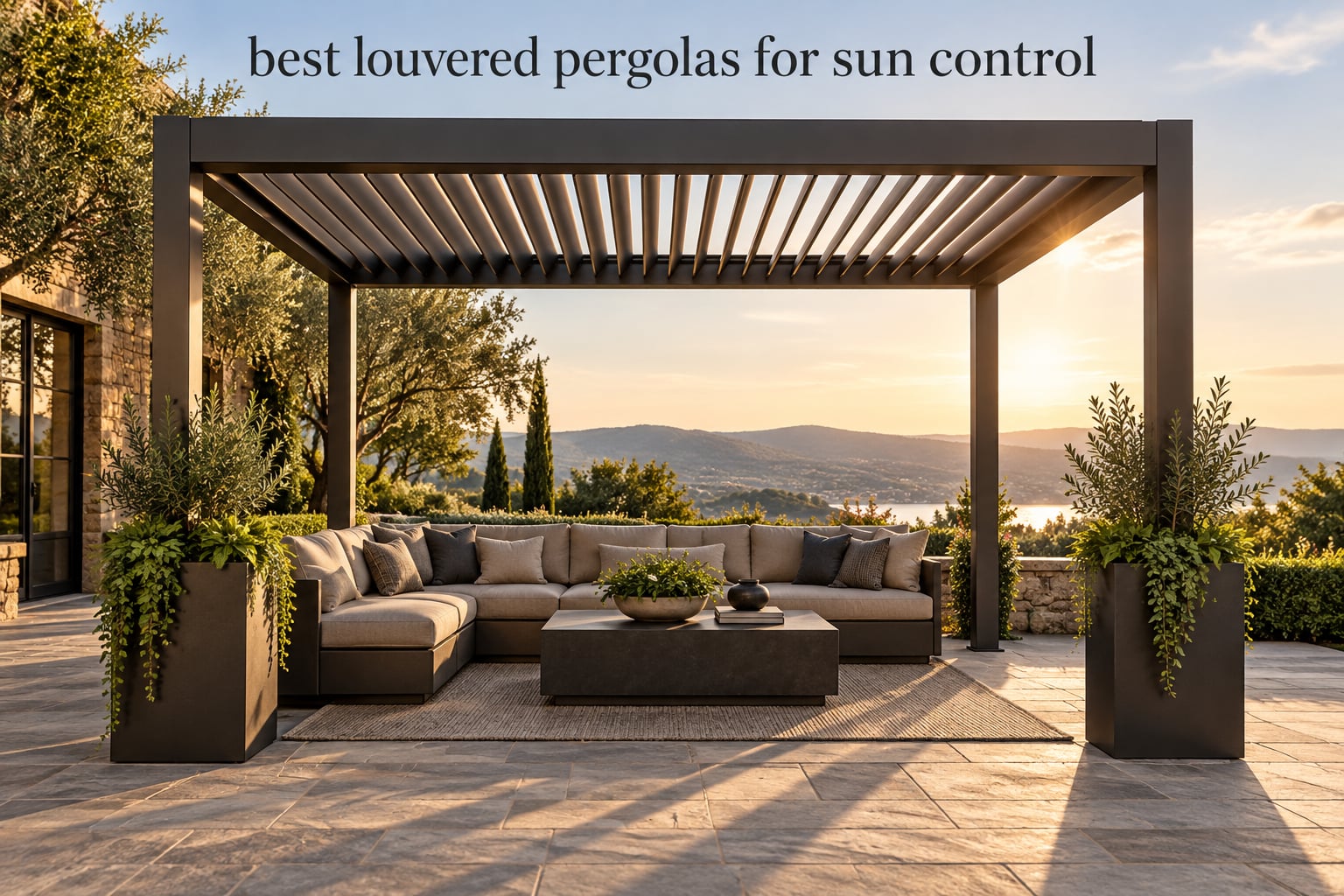
The best louvered pergolas for sun control are the ones whose roof slats rotate far enough to shut the sun out completely, then back open to let the breeze through. Most people buy a pergola for shade and then discover they bought a fixed compromise. A louvered frame changes that: the slats pivot through roughly 0 to 90 degrees, so the same structure handles a noon glare, a low western sun, and a sudden shower without you swapping equipment.
We went through twelve of them for this roundup, focusing on the specs that actually decide whether a patio gets used in July. That means louver angle range, how the blades link together when closed, where rainwater goes, what the wind rating assumes about anchoring, and whether the curtains and netting actually arrive in the box or cost extra later.
Every pick below is a crank-operated kit with a real coverage footprint and published weather numbers, because that is what is available to buy without a custom fabrication order. If you are still weighing pergola types generally, our broader backyard pergola roundup covers fixed-slat and retractable-canopy options too.
Table of Contents
How Louvered Pergolas Control the Sun
A louvered pergola controls sun by rotating its roof slats on a linked mechanism, moving from fully closed at 0 degrees to fully open at 90 degrees. Closed, the blades overlap into a near-solid roof that blocks the large majority of sunlight and sheds rain into a hidden gutter. Angled partway, they cut glare while still moving air underneath.
Each blade sits inside the frame on a spindle and is driven by a crank, a motor, or a linked rod system. Because every blade shares the same drive, they move in unison, and at full closure they nest with a seal that closes the gaps between them.
That nesting is the part that matters most. Fully closed, water runs down the blade faces, into an internal channel in the beam, and out through a hollow column so the seating area stays dry. Half-open, the same roof becomes the weakest state for wind-driven rain, since water can enter sideways through the blade gaps.
One of the most common listing errors is the claimed square footage, so we use the manufacturer dimension strings rather than the rounded marketing number. Where a listing contradicts itself on material or weather rating, we flag it in that product’s section.
Top 3 Picks for Sun Control in 2026

PURPLE LEAF 10×12 Aluminum with LED
- 0-85° louvers
- Hidden drainage
- Solar LED plus USB
- 4.53 inch columns

PURPLE LEAF 10×14 Independent Roof
- 0-85° louvers
- 8.2 psf snow rating
- 70 mph wind rated
- Four-post gutter drainage

MIRADOR 80S 10×10 Metal Louvered
- Crank-operated louvers
- Gutter drainage through posts
- Concealed anchor covers
- Shade screen included
The 10×12 PURPLE LEAF leads because it pairs a genuine 0 to 85 degree range with a hidden drainage path, integrated solar lighting, and a 4.53 inch column, and it carries more owner ratings than anything else in this roundup at 162. The 10×14 PURPLE LEAF is the one to buy if you want published snow and wind numbers. The MIRADOR 80S is the small-footprint option at 100 square feet, and owners describe it as better built than the price suggests.
All 12 Louvered Pergolas at a Glance in 2026
| Product | Specifications | Action |
|---|---|---|
| PURPLE LEAF 10×12 Aluminum with LED |
|
Check Latest Price |
| PURPLE LEAF 10×14 Independent Roof |
|
Check Latest Price |
| MIRADOR 80S 10×10 Metal Louvered |
|
Check Latest Price |
 AirWire 12×16 All-Aluminum Gazebo AirWire 12×16 All-Aluminum Gazebo |
|
Check Latest Price |
 YOLENY 10×12 All-Aluminum YOLENY 10×12 All-Aluminum |
|
Check Latest Price |
 Aoxun 10×12 All-Aluminum Aoxun 10×12 All-Aluminum |
|
Check Latest Price |
 Domi 10×16 Metal Pergola Domi 10×16 Metal Pergola |
|
Check Latest Price |
 SUNVIVI OUTDOOR 10×12 Aluminum SUNVIVI OUTDOOR 10×12 Aluminum |
|
Check Latest Price |
 Goldshire 10×13 Aluminum Goldshire 10×13 Aluminum |
|
Check Latest Price |
 MIRADOR 111S Takasho 10×10 MIRADOR 111S Takasho 10×10 |
|
Check Latest Price |
 Solvado 10×12 Aluminum Solvado 10×12 Aluminum |
|
Check Latest Price |
 LEVELEVE 10×20 Louvered Pergola LEVELEVE 10×20 Louvered Pergola |
|
Check Latest Price |
1. PURPLE LEAF 10×12 Aluminum with LED Bronze — Best Overall for Sun Control
PURPLE LEAF Outdoor Louvered Pergola 10′ x 12′ Aluminum with LED Bronze
- Rain-tight seal when fully closed
- Smooth effortless adjustment
- No rust across multiple seasons
- Three LED modes with USB output
- Assembly runs most of a weekend
- Included Allen wrenches wear out quickly
- Occasional dents and misdrilled holes
This is the frame we would put on a west-facing patio. The aluminum roof sweeps from 0 to 85 degrees, and 85 degrees is the practical full-open point on a real patio, because beyond that the blades begin to cup rather than shade. Owners report the closed position genuinely seals: the deck underneath stays dry through sustained rain, which is the single hardest thing to get from a kit pergola.
The columns measure 4.53 inches, listed as 15 percent wider than comparable products, and that extra mass is why it feels planted rather than tippy in wind. At 324 pounds for the whole structure, it is one of the heavier kits in this group and needs a proper base rather than deck screws.
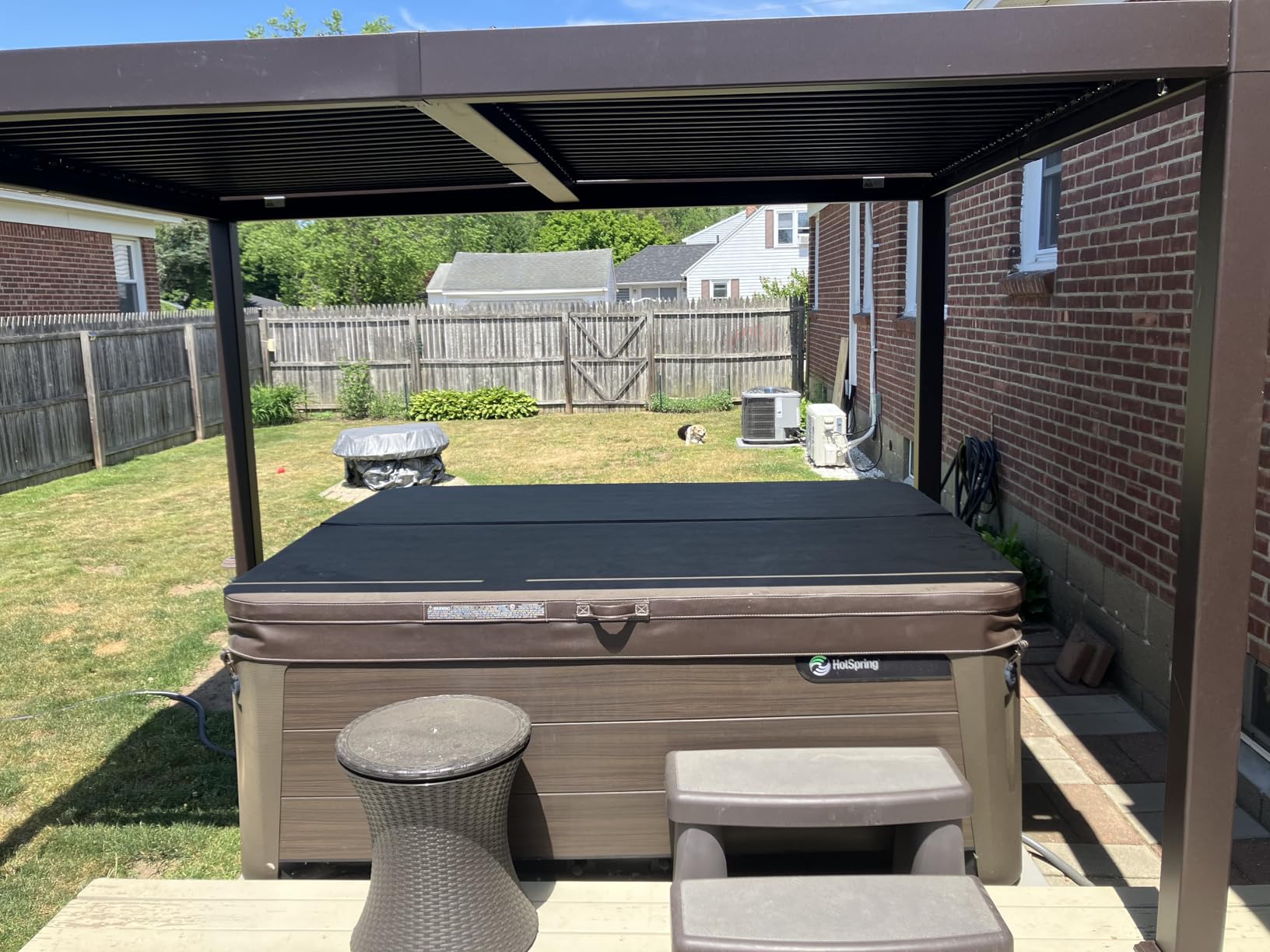
The lighting is the detail nobody expects from a kit pergola. The solar-powered LED array runs three modes with three brightness levels and three color temperatures, and the control board carries a USB power output, so a phone or speaker can charge without running a cable out to the house.
UV protection is listed at 50 and water resistance at water-resistant. The 1-year frame protection plan is short, so this is a structure you buy for its mechanism rather than for coverage terms.
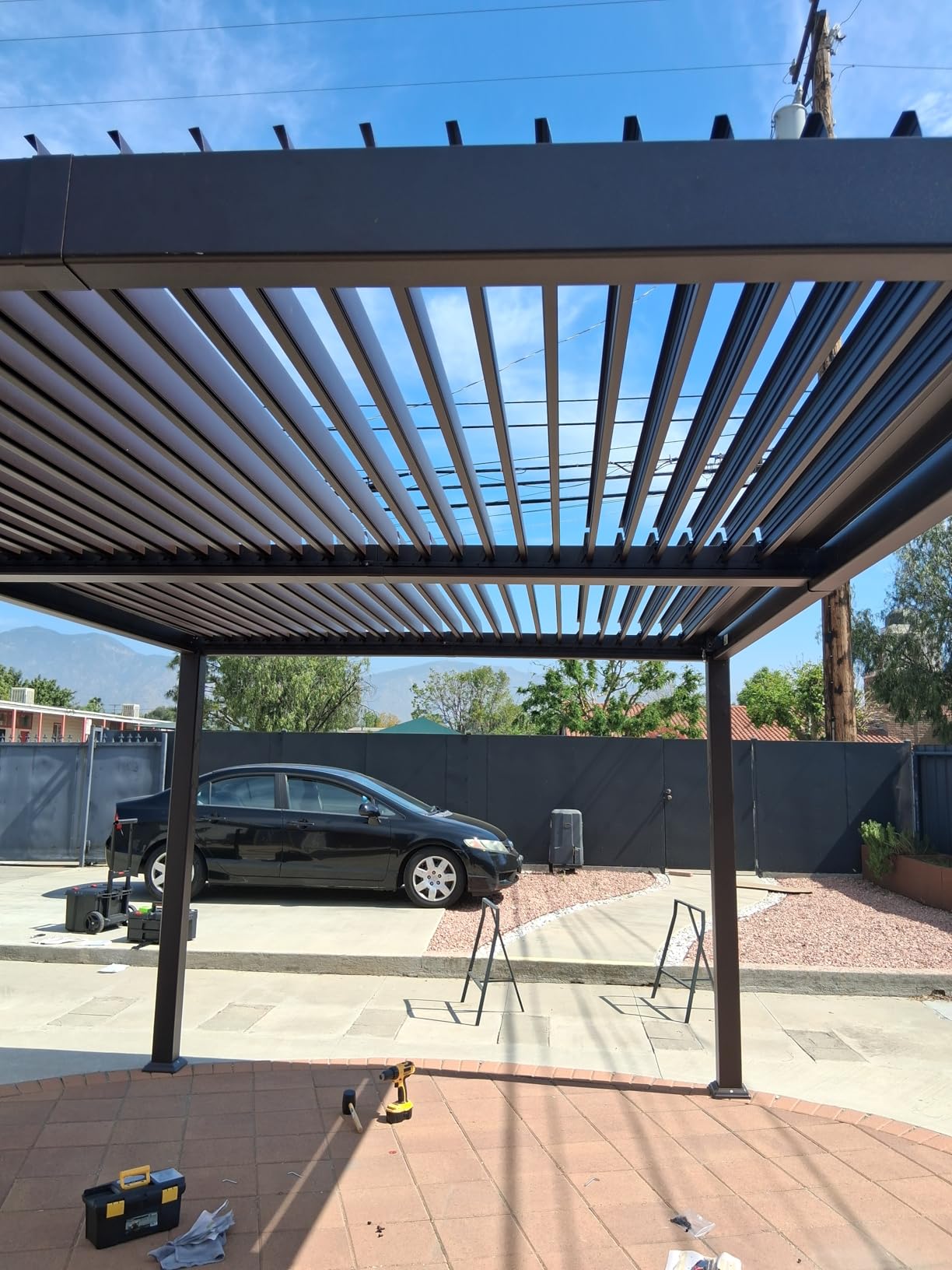
What to check before you order this frame
Confirm you have a concrete or properly framed base in place before assembly begins, because the drain path routes through the columns and the weight argues against a light-duty anchor. Measure for 87 to 91 inch clearance under the beams; at 90.6 inches tall, it clears a ceiling fan only just.
Ask whether the retailer carries replacement louver slats and control boards. That matters more than the warranty length on a structure whose moving parts are the reason you are buying it.
Where this pergola is the wrong choice
If your patio sits in a snow region, the 0 to 85 degree range and 324-pound frame are workable but not ideal, because this listing publishes no snow load figure. Check the stamped rating rather than assuming it inherits anything from the wider PURPLE LEAF range.
If you plan to hang curtains, budget for them separately. This model ships lighting, not soft goods, and the frame has no curtain track in the specification.
2. PURPLE LEAF 10×14 Independent Roof — Best for Snow and Wind Ratings
PURPLE LEAF Louvered Pergola 10′ x 14′ Aluminum Pergola w/Independent Roof
- Thick reinforced louvers rated to 8.2 psf
- Published 70 mph wind rating
- Efficient drainage through four posts
- UPF 50 plus UV protection
- Steel connectors and non-stainless screws can corrode
- Small center-beam gaps splash large raindrops
- Bolt holes sometimes need a grinder taper
This is the pick in our set that publishes both a snow load and a wind rating in the same specification: 8.2 psf for the reinforced aluminum louvers and 70 mph for the powder-coated frame. For a buyer in a four-season climate, those two numbers matter more than the lighting package on the model above.
The 10 by 14 footprint is sized for a six-seat dining set or a sectional, and the integrated gutters channel rain through four posts rather than two, which spreads the discharge points and keeps water away from a single seating corner. Water resistance is listed as waterproof.
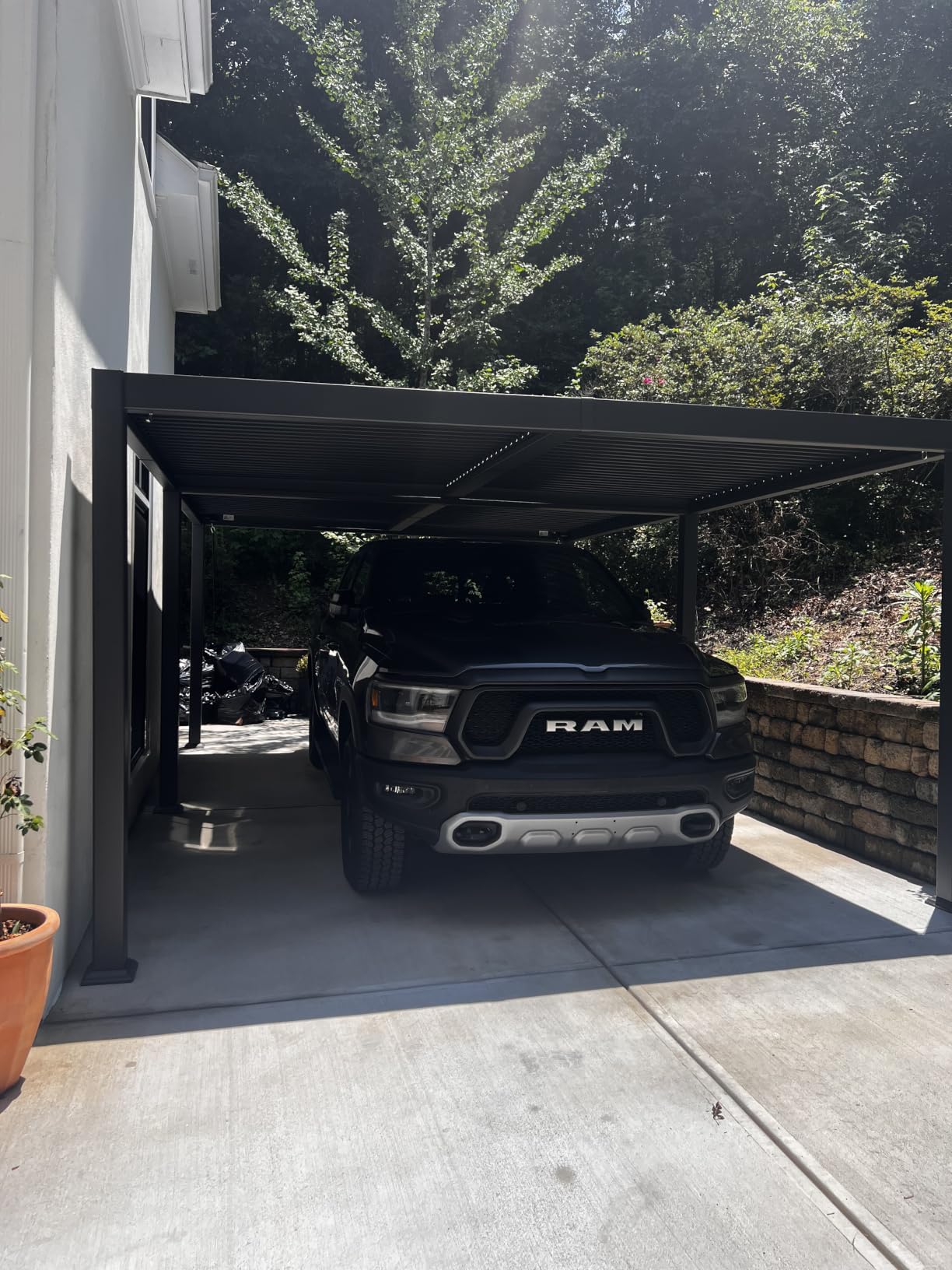
Two reports recur and are worth planning around. The first is corrosion at the steel beam connectors and non-stainless screws, which matters if you are within a few miles of salt water. The second is a small gap at the center beam where large raindrops can splash into the gutter before weatherstrip is added.
At 265.7 pounds this is lighter than the 10×12 in the same line, which makes it easier to assemble but also means the beam bolt holes sometimes arrive a few thousandths off and need a grinder taper to align.
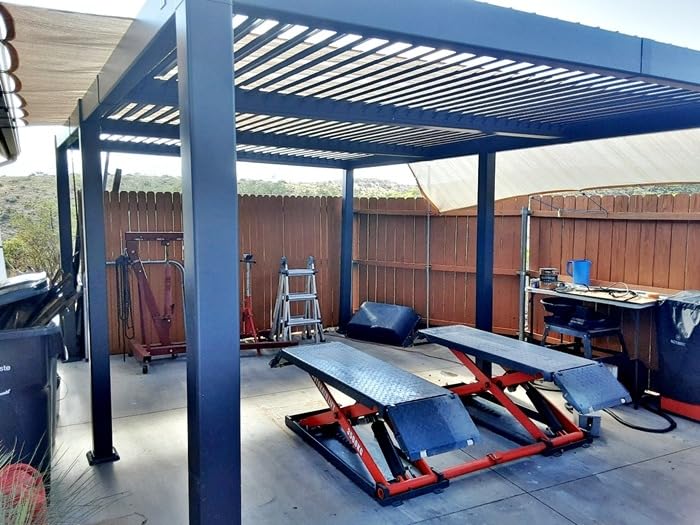
How to set it up for the sun
The independent roof control lets you shade the dining half and leave the cooking half open, which is the practical advantage over a single linked zone on a 140 square foot structure. Louvers rotate 0 to 85 degrees, so the same roof gives you a closed rain cover at breakfast and open airflow by evening.
For a south-facing patio, run the blades at a shallow angle through the middle of the day so you cut glare without losing the breeze off the house.
Where this pergola is the wrong choice
Coastal installs should plan on replacing the connector hardware with stainless before the first wet season. That is cheap insurance, and reviewers who did it report no later corrosion.
The frame warranty is one year, so hold on to every invoice and photograph the connectors on arrival. Documenting the starting condition is worth more than the warranty length here.
3. MIRADOR 80S 10×10 Metal Louvered — Best Value for Small Patios
- Drainage handled heavy downpours
- Crank moves with minimal effort
- Sliding post covers hide anchoring hardware
- Clear printed instructions with QR video
- Some frame flex until footings are poured
- Plastic louver clamps instead of metal
- Included anchor bolts weak in concrete
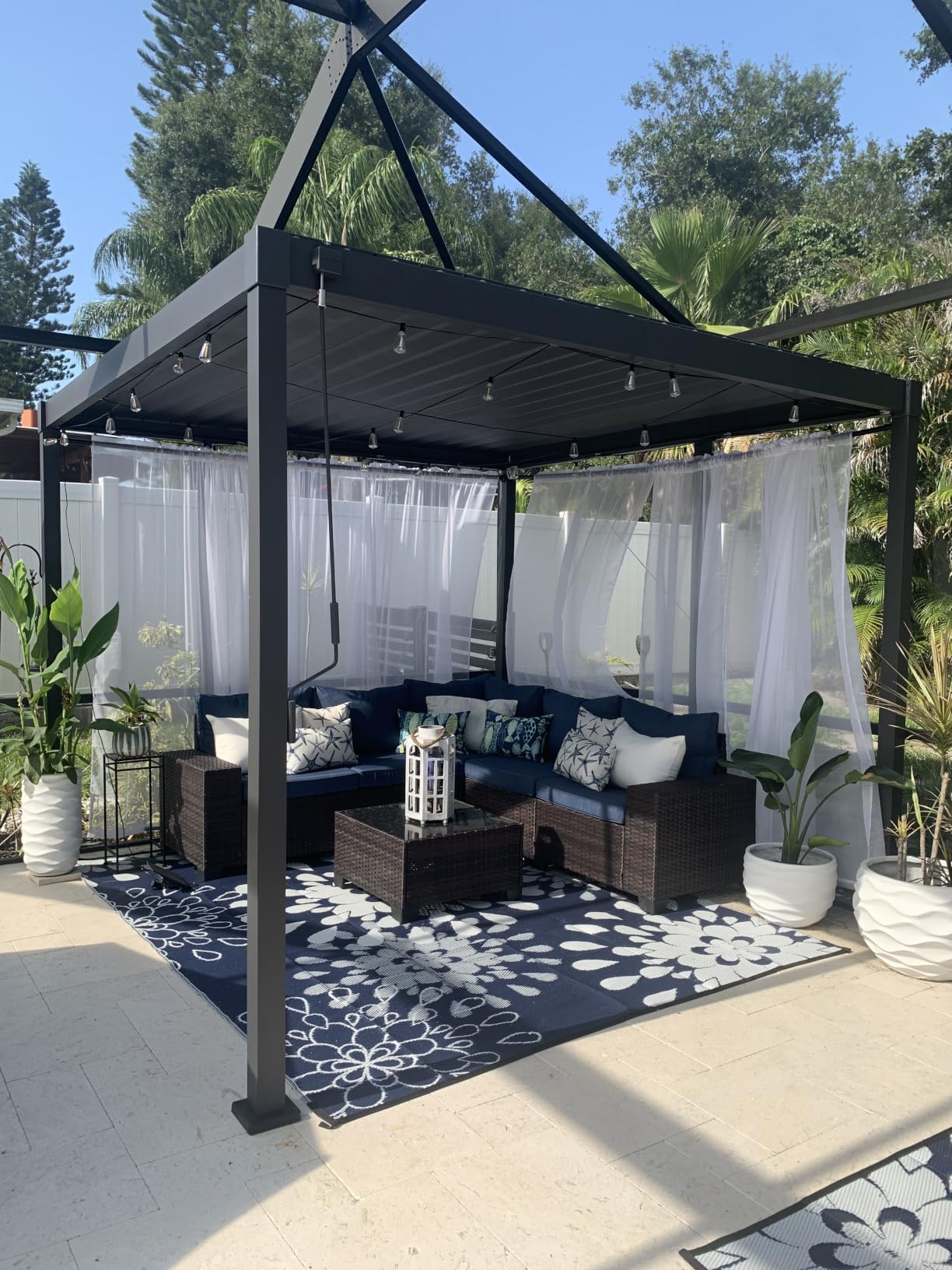
The 80S is a mixed alloy steel and aluminum build with a textured charcoal powder coat, and at 100 square feet it fits a compact deck or a corner of a lawn without swallowing the whole yard. A 10 foot shade screen is included in the box, which removes one of the usual add-on line items.
Drainage is the strongest thread in the reviews. Owners in both Texas and the Pacific Northwest report the integrated gutter system routing water through the louvers, down the side rails, and out through the posts without leaking.
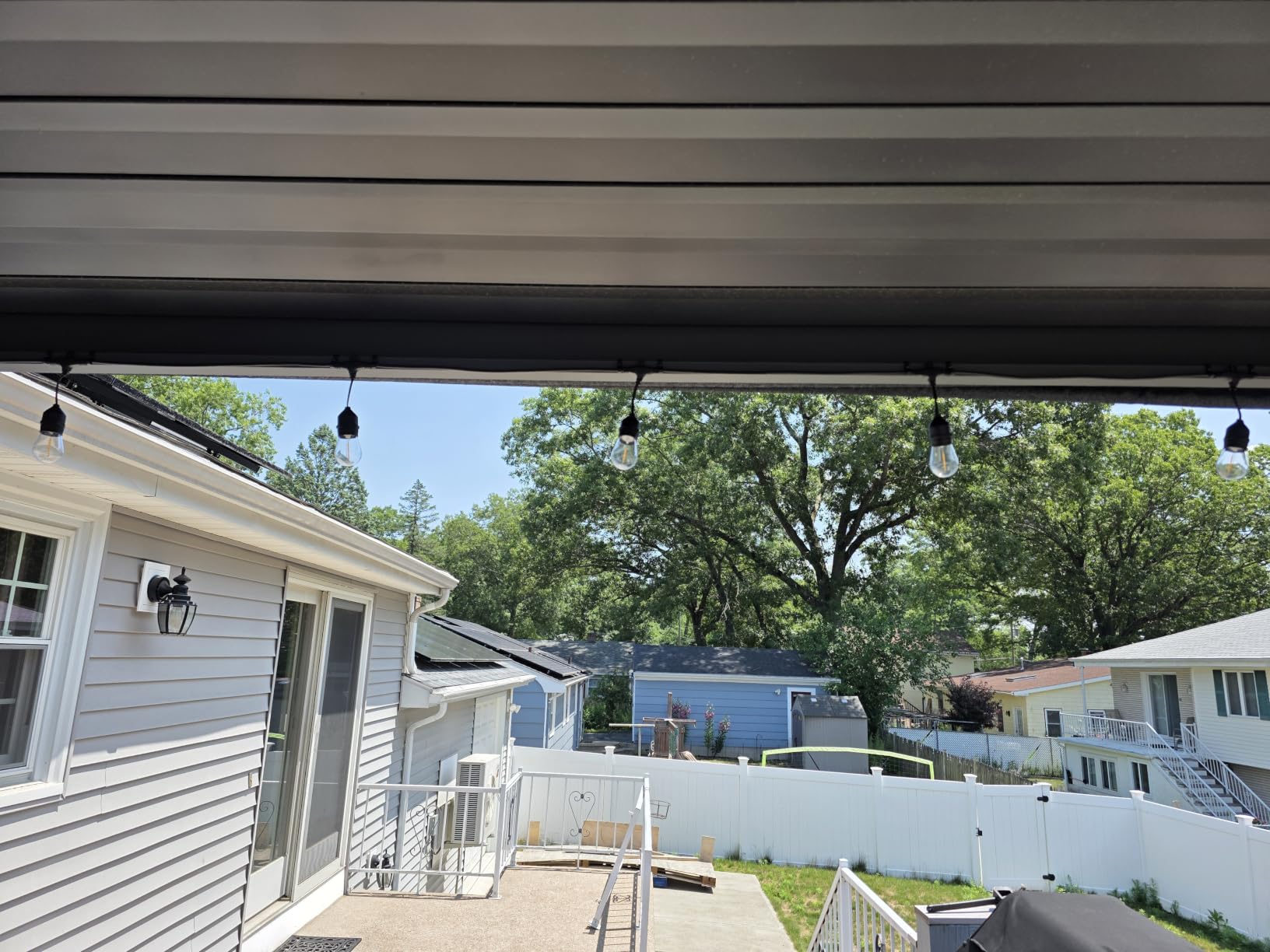
The sliding post covers are a small touch that matters more than it sounds: once the anchor hardware is hidden, the frame reads as a finished structure rather than a bolted assembly. Reviewers repeatedly note the packaging is well labeled and near damage-free.
Louvers can arrive bent, and the replacement packing is thinner than the original. Check each blade on arrival before you break the boxes down.
What to check before assembly
Do not judge the frame until the footings are poured and anchored. Several owners reported flex at the upright-to-horizontal connections that resolved once the base was fixed, which is normal for this style of kit.
Replace the included anchor bolts if you are setting this in concrete. A hammer drill and heavier wedge anchors are the common upgrade, and plastic louver clamps are the part most owners replace for heat durability.
Where this pergola is the wrong choice
If you want a specific published wind rating in mph, this listing does not provide one. The frame is heavily weighted, with reviewers citing roughly 400 pounds, but there is no number to hold the supplier to.
If your site needs a tall structure, note that the dimension string on this listing reads 393.7 inches long by 393.7 inches wide by 311 inches high, which is clearly not the assembled size. Measure the footprint on your own patio instead of trusting that string.
4. AirWire 12×16 All-Aluminum Gazebo — Best for Large Decks
- Stable and heavy even with roof open
- Good shade performance on a sunny deck
- Detachable curtains and mesh screens
- Looks far more expensive assembled
- Some pre-drilled holes do not line up
- Only one crank for two roof zones
- Some dripping at the center when closed
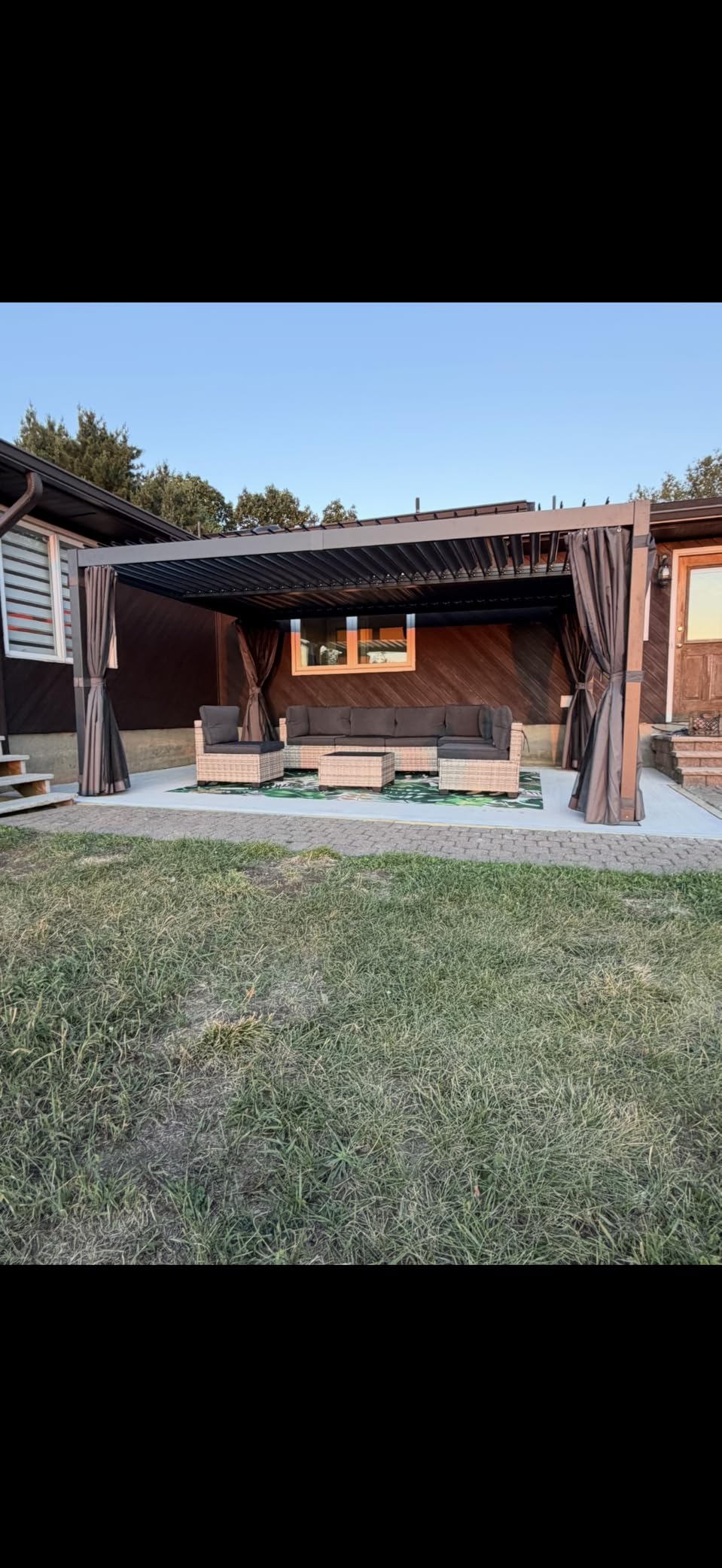
At 192 square feet this is a large all-aluminum structure, and it is the one to look at if you are shading a pool deck or an outdoor kitchen rather than a dining table. Two independently cranked roof panels mean you can close the section over the grill and leave the seating open.
The frame is a heavy-duty aluminum alloy with a matte dark gray coating and corrosion-resistant hardware, weighing 413 pounds. Owners describe it as feeling solid in wind even with the louvers open, which is the honest test of a wide span.
Two complaints come up often enough to plan around. First, some pre-drilled holes do not line up, so expect to rework a joint or drive self-tapping screws. Second, only one crank is supplied, and because there are two roof zones you move it between them.
A few owners also report dripping at the center of the roof when fully closed, and actual dimensions can measure slightly under the advertised size. Clear height is 87.3 inches, which suits most outdoor furniture.
How to set it up for the sun
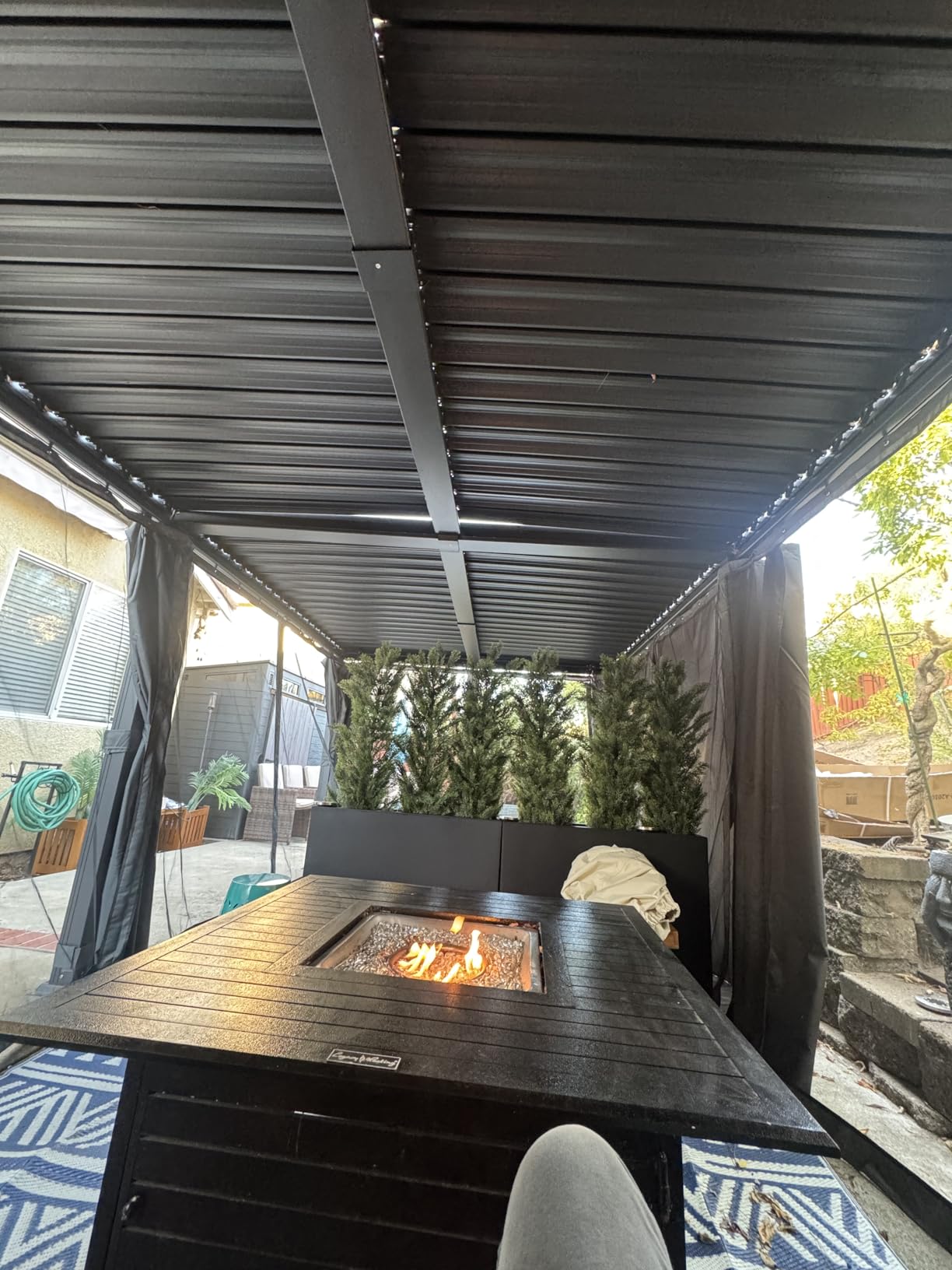
A full 0 to 90 degree sweep means you can run the panels at an aggressive angle for a low afternoon sun without losing headroom under the beams. Detachable curtains and mesh screens let you add privacy and insect control without a permanent fabric roof.
UV protection is listed at UPF 15, the lower of the two numeric frame ratings we found, so treat this as a shade and airflow solution rather than a skin-protection one.
Where this pergola is the wrong choice
If you need a published wind or snow rating in writing, this listing offers neither. The stability in owner reports is real but anecdotal, and it is worth asking the seller for the engineering figure before you commit on a 413-pound structure.
Instructions may not be in English, so budget extra time. A 192 square foot build with misaligned holes is not a single-afternoon job.
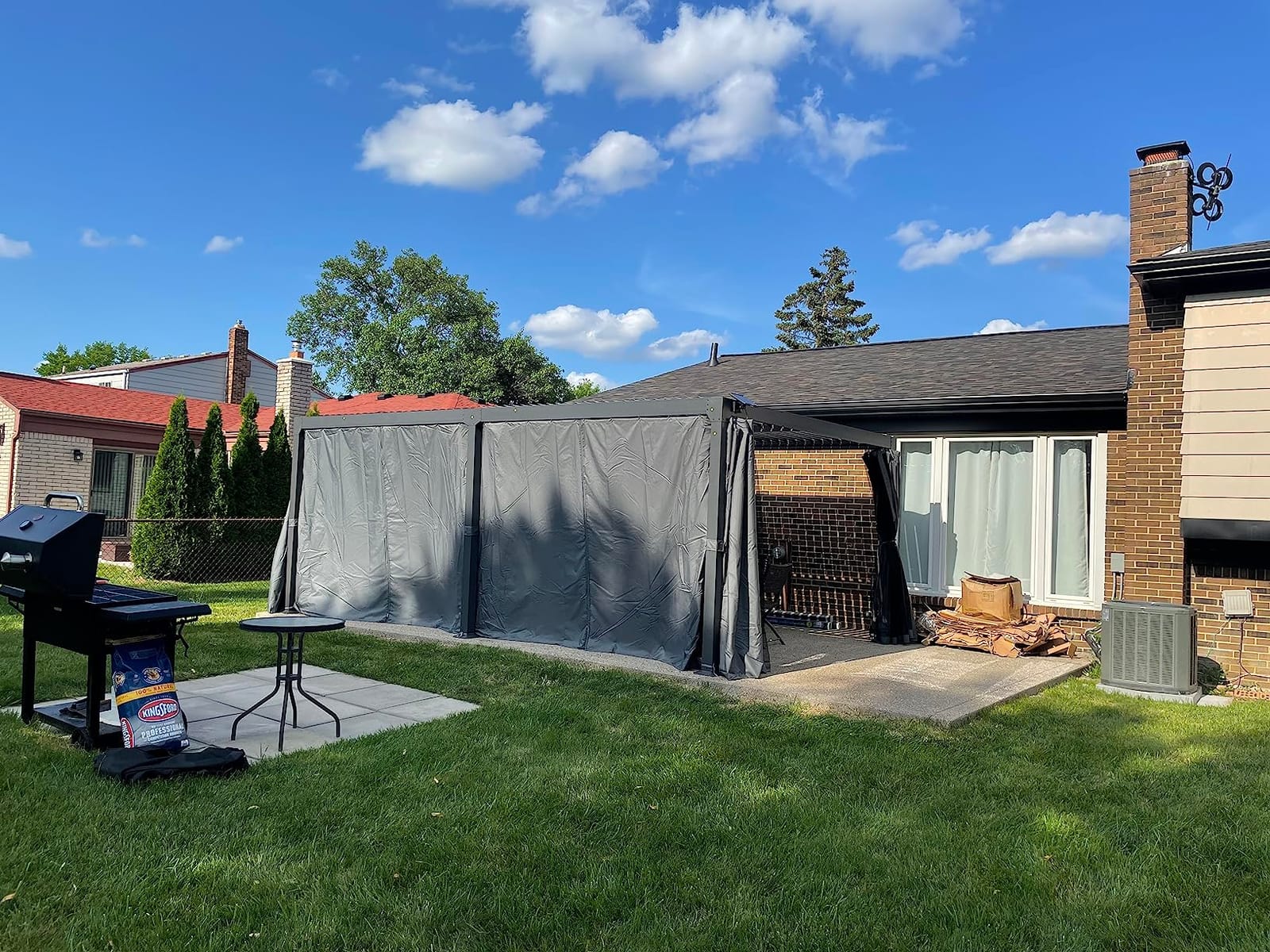
5. YOLENY 10×12 All-Aluminum with Curtains and Nets — Best for Divided Roof Control
YOLENY Louvered Pergola – 10×12, All Aluminum with Adjustable Rainproof Roof, Outdoor Pergola with Curtains and Nets for Patio & Garden, White
- Two independently controlled roof sections
- Held up through 70 mph wind and snow
- Concealed gutters drain through the legs
- Good value against custom builds
- Assembly realistically takes 6-8 hours
- Diagram-only instructions are frustrating
- Bent louvers sometimes arrive
- Curtains are heavy and bulky
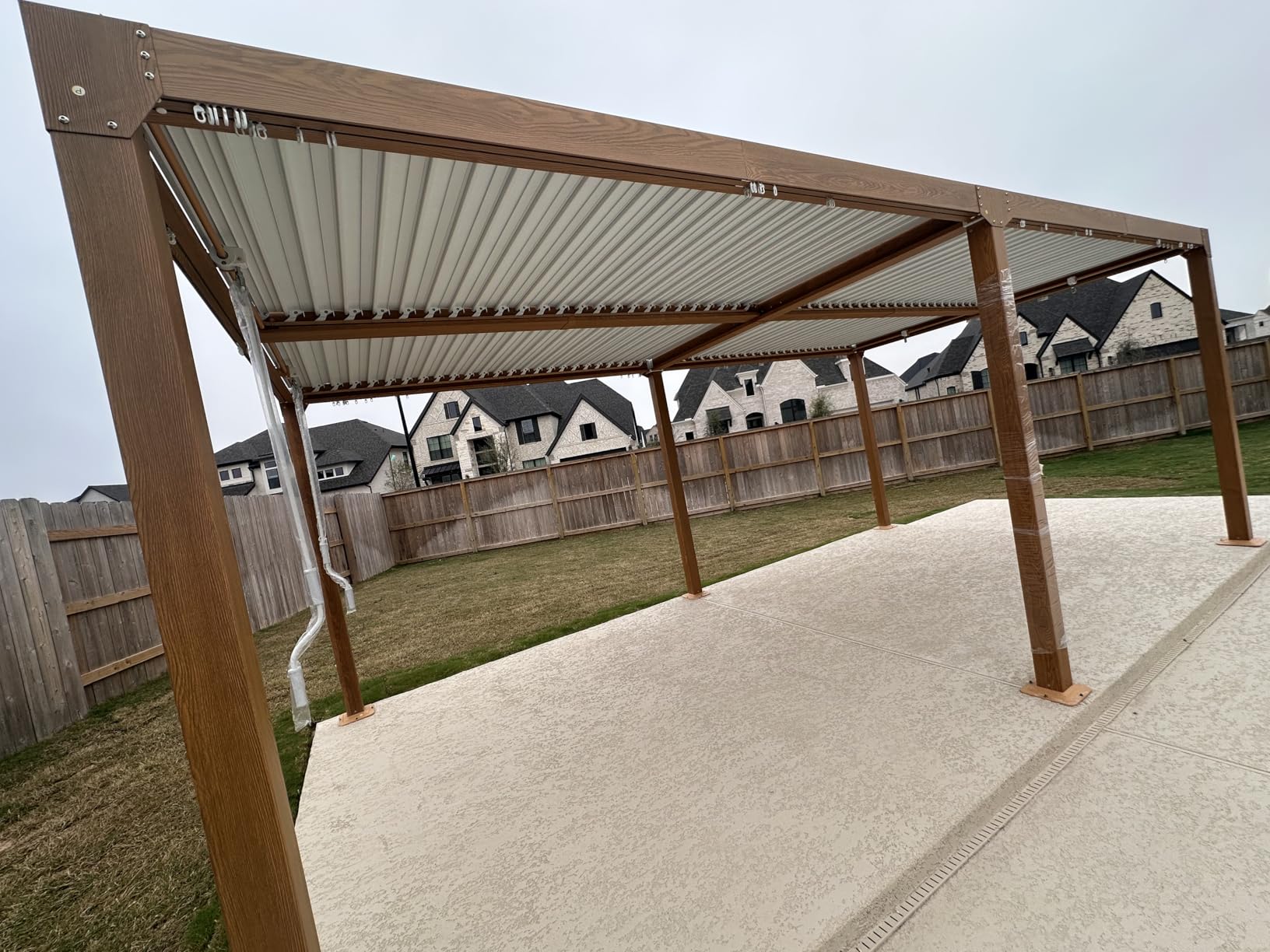
This one sells on split control. Two independently cranked roof sections mean the shaded half and the sunny half of a 120 square foot deck can be set to different angles, which is the single most useful feature on a patio that gets both morning and late-afternoon light.
The wind figure is given as a range of 60 to 80 mph for the powder-coated all-aluminum frame. Owners report the structure holding through 70 mph gusts and snow blankets, and the concealed drainage routes roof water out through the legs rather than onto the deck surface.
Assembly is where the listing copy and reality diverge. The claim is 2 to 5 hours, and owners more commonly report 6 to 8 hours with multiple people, so plan the weekend accordingly. There is no welding, riveting, or extra material needed, which genuinely does simplify the build once you have the crew.
The curtains and nets ship with upper, middle, and lower anti-wind straps, which is more secure than the single-strap kits that flap in a gust. They are also heavy enough that some owners never put them up.
How to set it up for the sun
With two zones, the practical routine is simple: close the west-facing section nearly flat through the afternoon, leave the east zone at a wide angle for airflow, and reverse the pattern at breakfast. Aluminum is also thermally insulating, which cuts both heat and the noise of rain on the roof.
Water resistance is listed as waterproof and UV protection as present, though no numeric UPF figure is given. Ask for the fabric rating before you rely on the curtains for skin protection.
Where this pergola is the wrong choice
The instructions are illustrations only, with no written steps, and a sealant strip over the seams is easy to miss. That strip is part of the rain-tight seal, so read the diagram panel twice before you walk away from it.
At 260 pounds this is a light all-aluminum kit, which helps assembly and means stability depends on your footings. If your yard is open on two sides, add them.
6. Aoxun 10×12 All-Aluminum with Curtains and Netting — Best for Windy Climates
Aoxun Louvered Pergola 10×12 All-Aluminum, Waterproof Curtains and Netting
- All-aluminum roof frame and posts resist rust
- Thickened 3.8 inch posts
- 82.5 mph wind figure when anchored
- Curtains and netting included in the box
- Instructions are unlabeled pictures
- Soft Allen-head screws strip if over-tightened
- Snow capacity and manual limit disagree
- Support replies can be slow
The headline number here is 82.5 mph of wind resistance when properly anchored, the highest stated figure in this group, and it applies to a structure that is genuinely all aluminum through the roof, frame, and posts. That combination is why we recommend it for exposed sites and coastal-adjacent yards.
Posts are 3.8 by 3.8 inches against a 3.1 inch standard, which is a meaningful difference when a frame is resisting uplift. At 323 pounds, the structure is heavy for its footprint and needs a genuine base, not surface mounting.
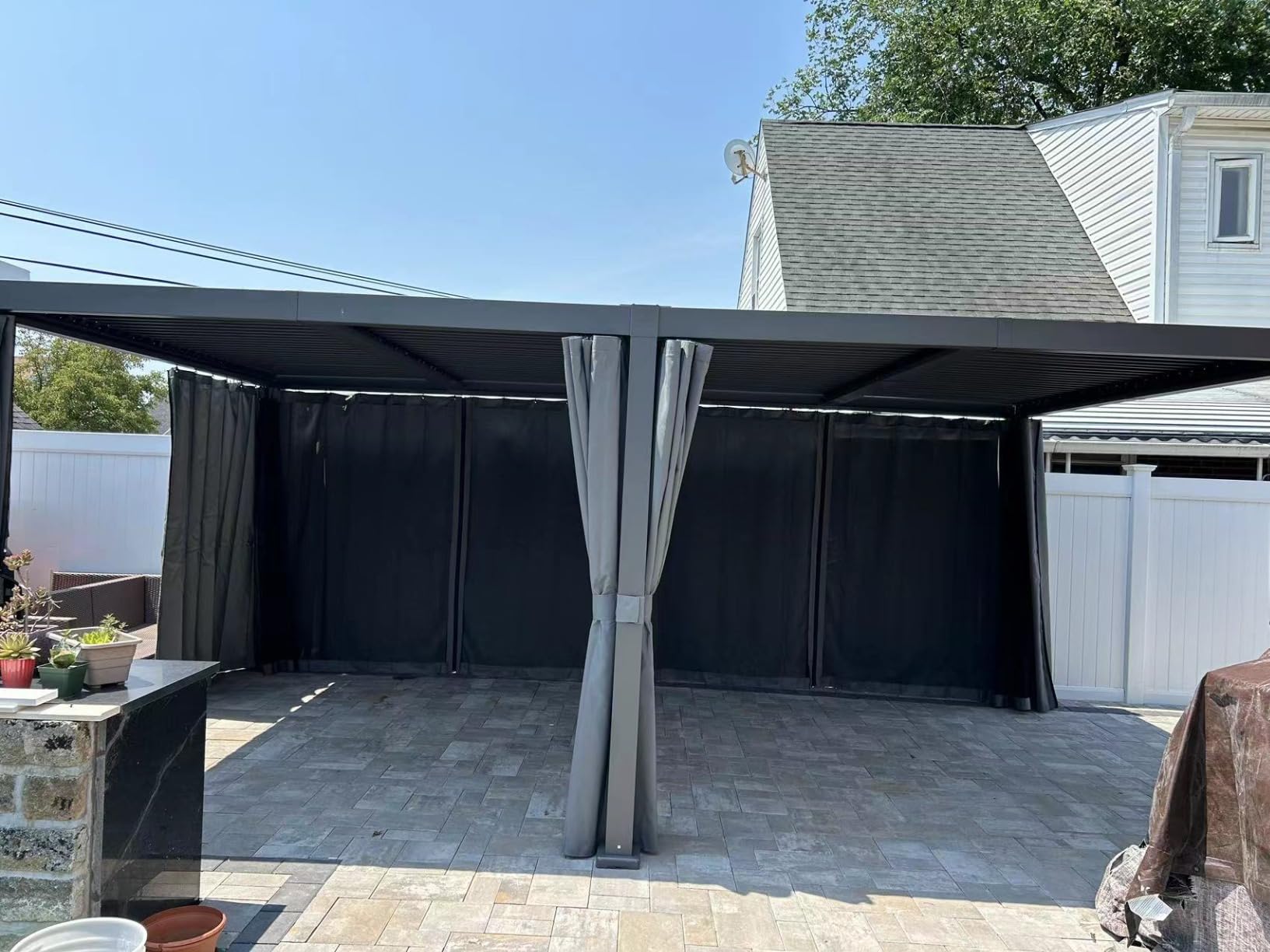
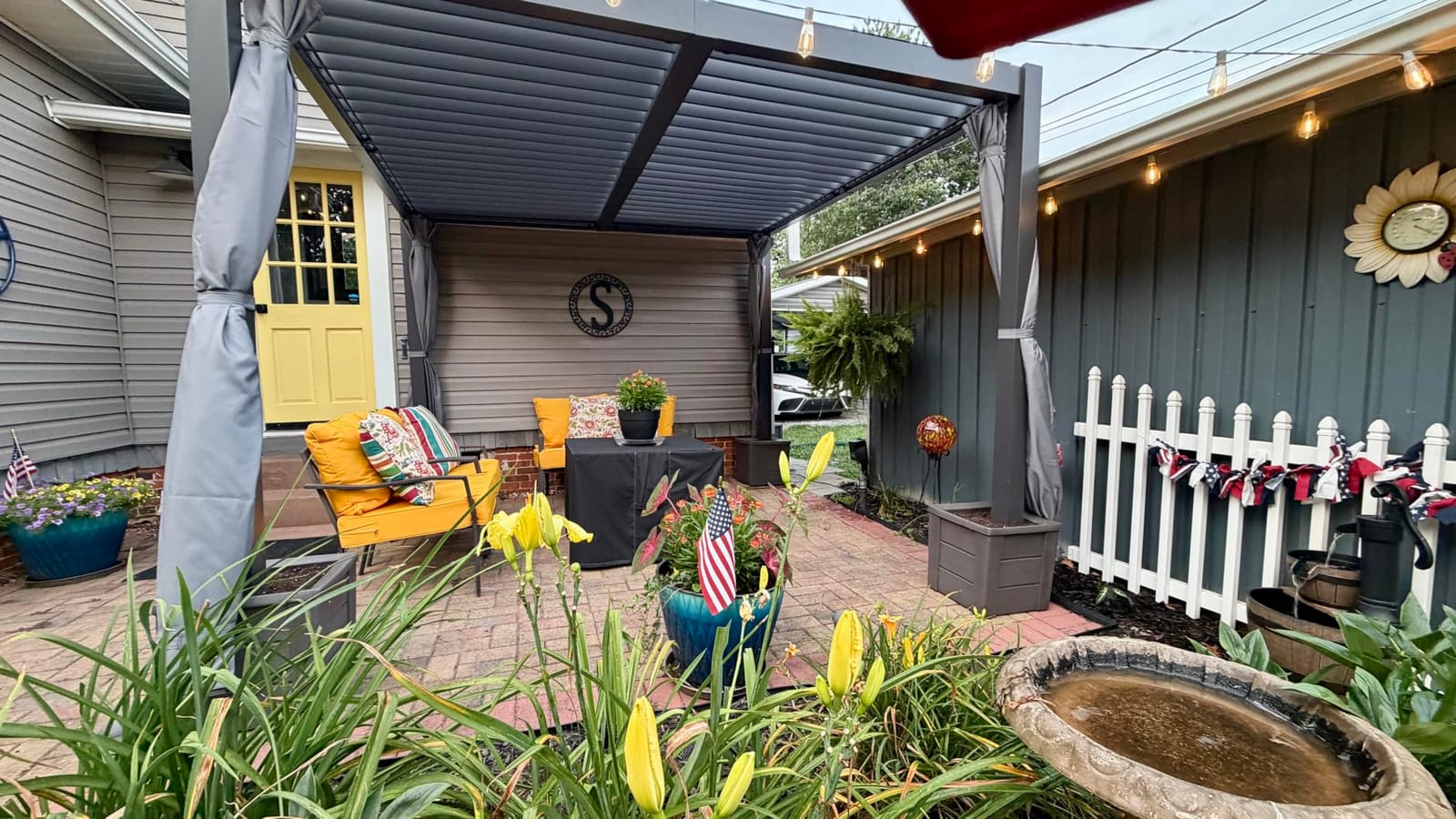
Two independently controlled roof sections give you the same split-angle control as the YOLENY, and the built-in gutter system channels rain through the aluminum posts to keep the seating area dry in a drizzle. Water resistance is listed as waterproof.
The finish has no visible weld marks, which is where most of the value shows on a gray modern frame. Buyers in townhouse settings specifically call out the curtains and netting for privacy.
What to check before assembly
Read the warranty-supported snow figure carefully, because reviewers note the listed capacity and the number in the manual disagree. Take the lower of the two as your working limit and plan to open the louvers fully in a heavy snowfall so weight slides off rather than sitting on the blades.
Hand-tighten the Allen-head screws. They are soft and will strip if driven hard, and a stripped head mid-build means removing the roof panels to reach it.
Where this pergola is the wrong choice
Customer support response time is a reported weak point, so if a part ships bent or a support arrives stripped, plan for a longer resolution window before you start a weekend build with no spare hardware.
The instructions are largely unlabeled pictures, which is workable but slow. If you are not comfortable reverse-engineering a frame from diagrams, budget a second pair of hands.
7. Domi 10×16 Metal Pergola — Best Warranty Coverage
Domi Louvered Pergola 10×16, Outdoor Metal Pergola, Espresso Brown
- Dual independent zones for split shading
- 72 mph wind-rated galvanized steel
- 5.9 by 2.5 inch beams with reinforced bases
- 5-year warranty with US support
- UV protection listed as none
- Water-resistant not waterproof
- Floor area listed as 160 square inches
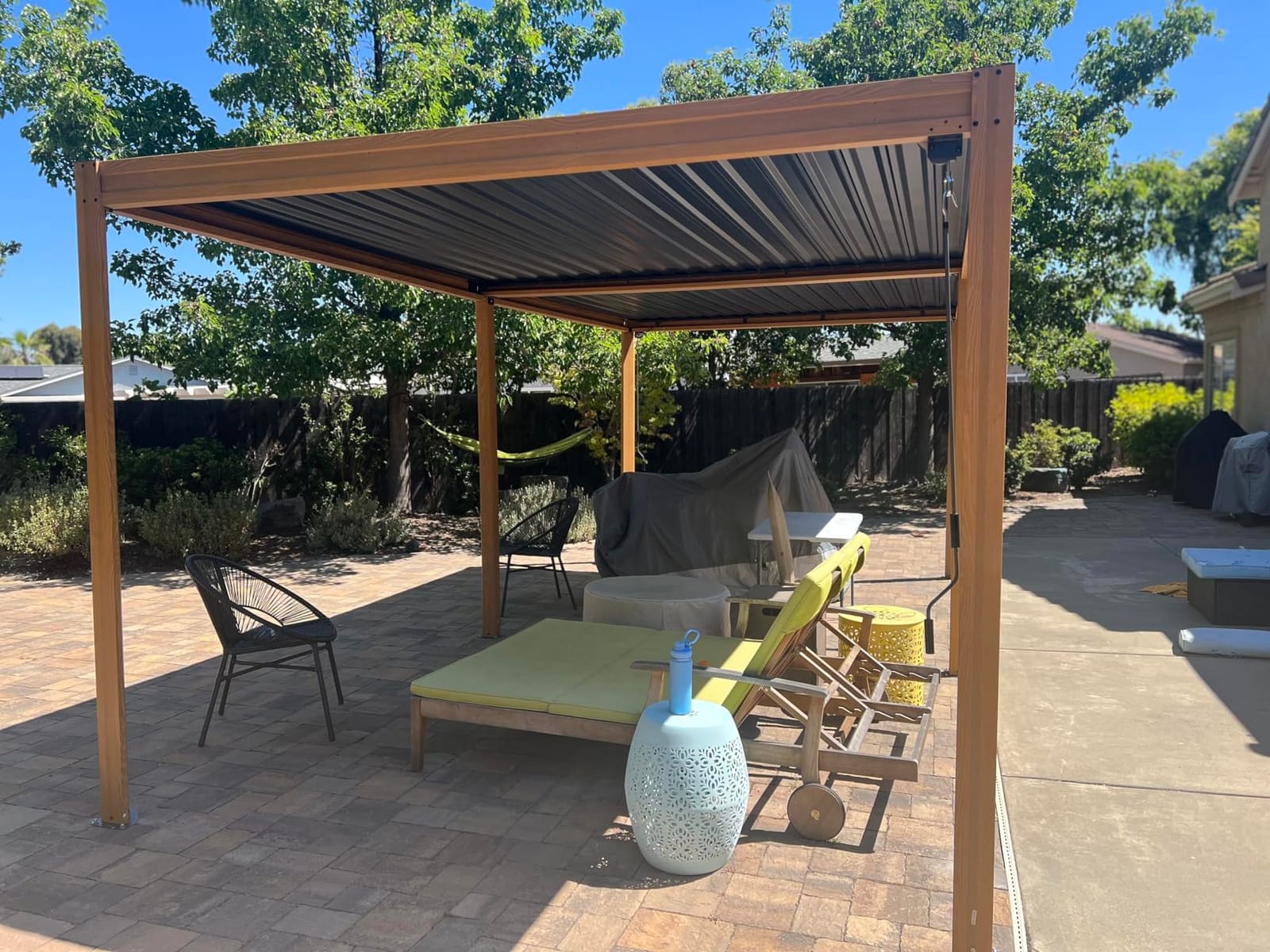
The Domi 10 by 16 is the one to consider if coverage area comes before material purity. At 192 inches long by 124 inches wide, it is a wide steel structure with dual independently cranked roof zones sweeping 0 to 90 degrees, and the 5-year warranty is longer than any other term published on these listings.
Construction is thick powder-coated galvanized steel with 5.9 by 2.5 inch beams and 3.94 inch square columns on wind-reinforced bases, rated to 72 mph. The hidden drainage system is built around multi-point leak-proof frames, and pre-drilled holes are described as precision aligned, which cuts assembly friction.
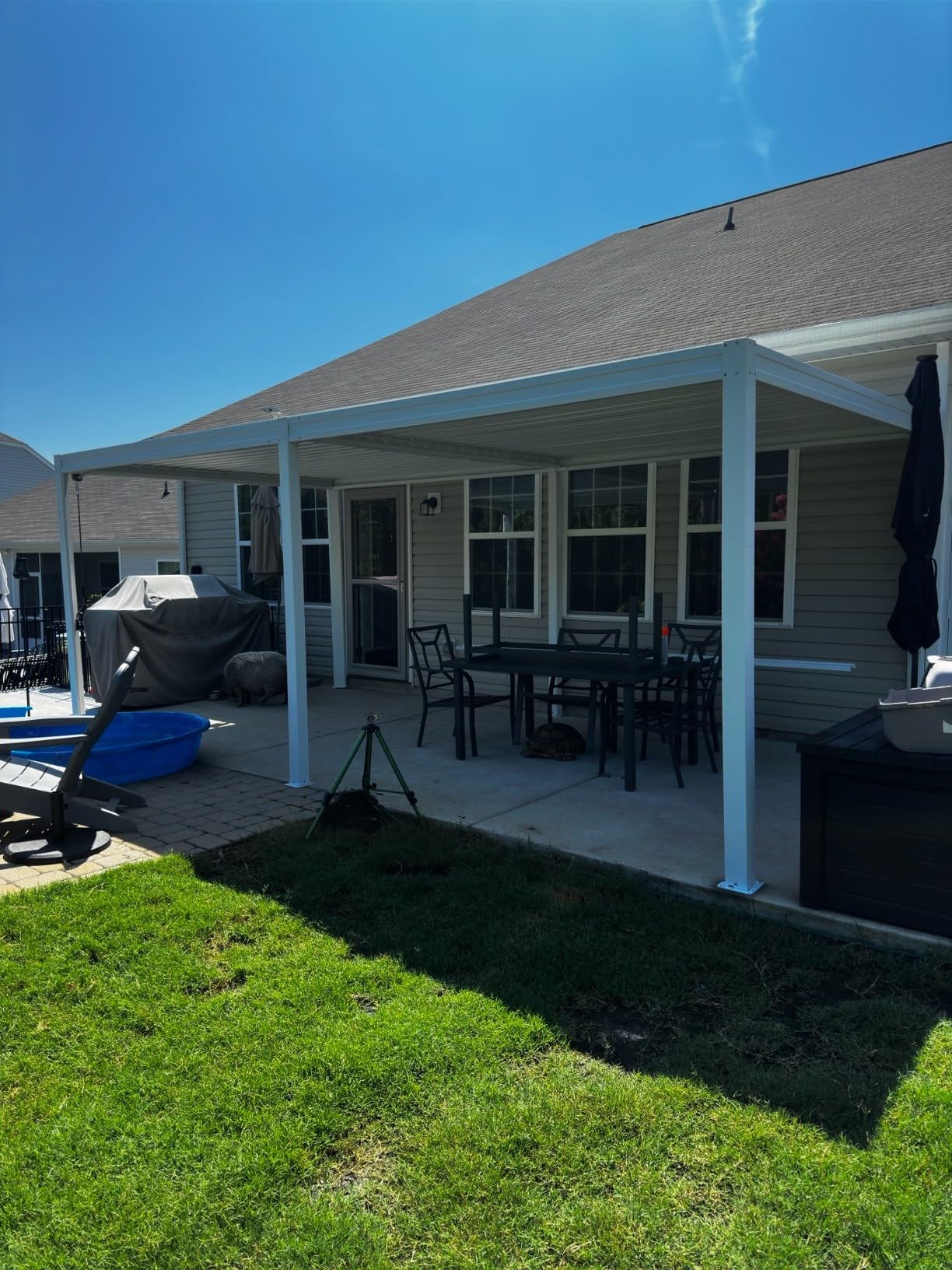
The espresso brown finish is unusual in a category dominated by gray and black, and it reads warmer against a paver patio. Because it is steel rather than aluminum, coastal buyers should expect to maintain the coating over time rather than set and forget it.
This listing also has the clearest documentation errors we found. Floor area is published as 160 square inches, which does not match a 10 by 16 footprint at all, and UV protection is marked as none.
How to set it up for the sun
Dual zones on a structure this long is the reason to pick it. You can hold one end fully closed as a rain and glare shield over an outdoor kitchen while leaving the dining end angled for evening airflow, which is a combination the shorter 10 by 12 kits cannot offer.
Since no UV figure is published for the frame, treat the sun-control claim as shading rather than protection and pair it with a rated fabric if skin protection matters to you.
Where this pergola is the wrong choice
If you are within coastal spray range, galvanized steel with a powder coat will need touch-up cycles that aluminum avoids entirely. Ask the manufacturer what the coating process is before you accept that maintenance.
The spec gaps on this listing are a signal in themselves. When a listing cannot get its own square footage right, ask for a written wind and snow figure in writing before the order is placed.
8. SUNVIVI OUTDOOR 10×12 Thick Aluminum Frame — Best for UV Protection
Pergola 10’x12′ with Thick Aluminum Frame, Adjustable Roof for All Weather
- Louvers block up to 99% of UV rays
- Curtains and breathable netting included
- Integrated drainage through hidden gutters
- 72 mph figure with expansion bolt anchoring
- Louver canopy is iron rather than aluminum
- Arrives in five separate boxes
- Lighter listed weight than comparable frames
This is the pick to shortlist if the sun-control question is really about UV exposure rather than comfort. The listing states the independently adjustable louvers block up to 99% of UV rays across a 0 to 90 degree range, and the multi-slat design lets you build mixed sun-and-shade zones within one frame.
The frame is a high-strength powder-coated aluminum rated for 72 mph winds when anchored with expansion bolts, and the canopy supports 6 inches of snow accumulation at 55 pounds per square meter. Drainage runs through hidden gutters, down the columns, and out at concealed base outlets.
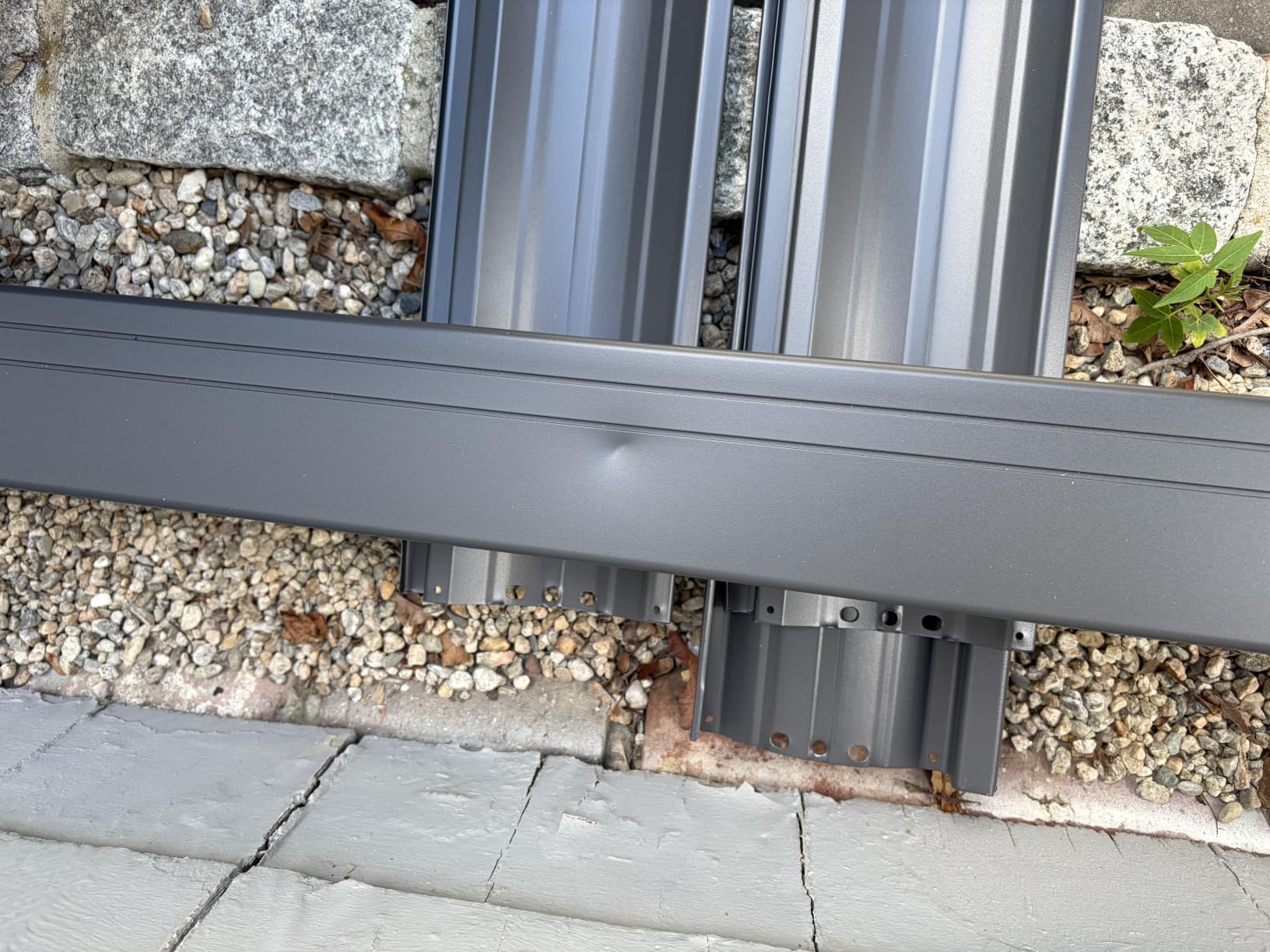
Netting and curtains are included, and the concealed fasteners and slim silhouettes pair well with string lights at an 87.36 inch clearance. Water resistance is listed as waterproof on a 120 square foot footprint.
The catch is material honesty. The frame is aluminum but the louvered canopy is iron, which is the kind of listing inconsistency that only shows up after a few wet seasons. At 92.5 pounds it is also a light structure for a 120 square foot footprint.
What to check before you order
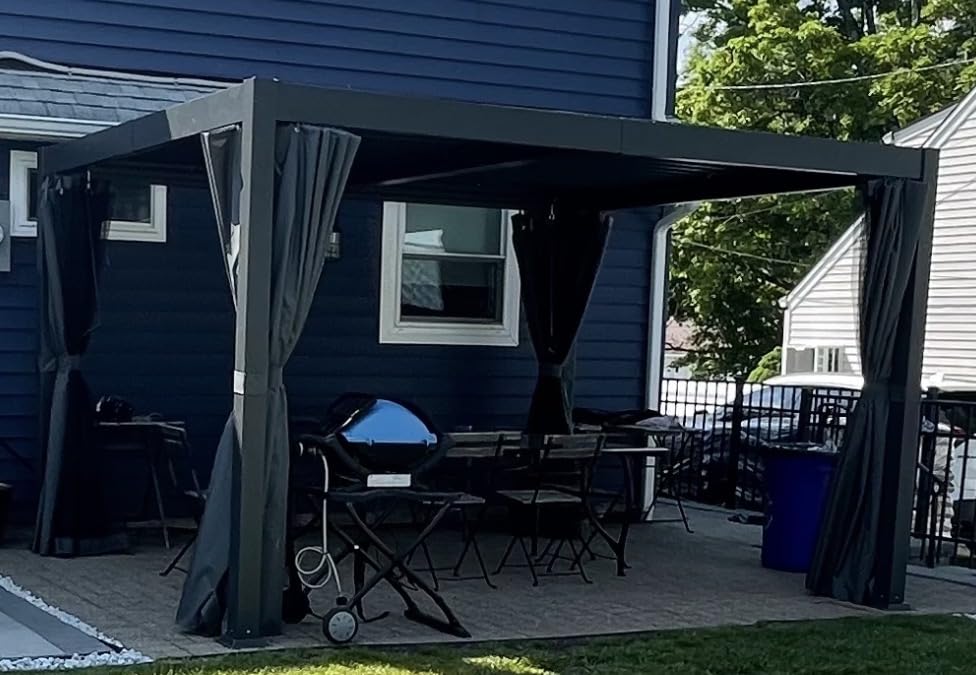
This unit arrives in five separate boxes that can reach you on different days, so plan a storage path and check every carton for damage before you open them.
Verify the anchoring condition attached to the 72 mph figure. That number assumes expansion bolts into a solid surface, and on soil or a floating deck it does not apply.
Where this pergola is the wrong choice
With 21 ratings, this is a smaller evidence base, so long-term durability claims are not supported by field data yet. The 4.5 average is strong, but the sample is not deep.
If you are in a coastal or poolside environment, the iron canopy is a poor match for standing humidity. Choose an all-aluminum frame for that site instead.
9. Goldshire 10×13 Aluminum Louvered Hardtop — Best for Garden Settings
Goldshire 10’x 13′ Patio Louvered Pergola Aluminum Black Hardtop Gazebo
- Average rating of 4.9 with no ratings below four
- Aluminum frame and aluminum louvered canopy
- Two independent roof sections on a hand pole
- Efficient cut-away drainage
- Review base of 20 limits long-term evidence
- UV protection listed as no
- Manufacturer advises vertical storage when unused
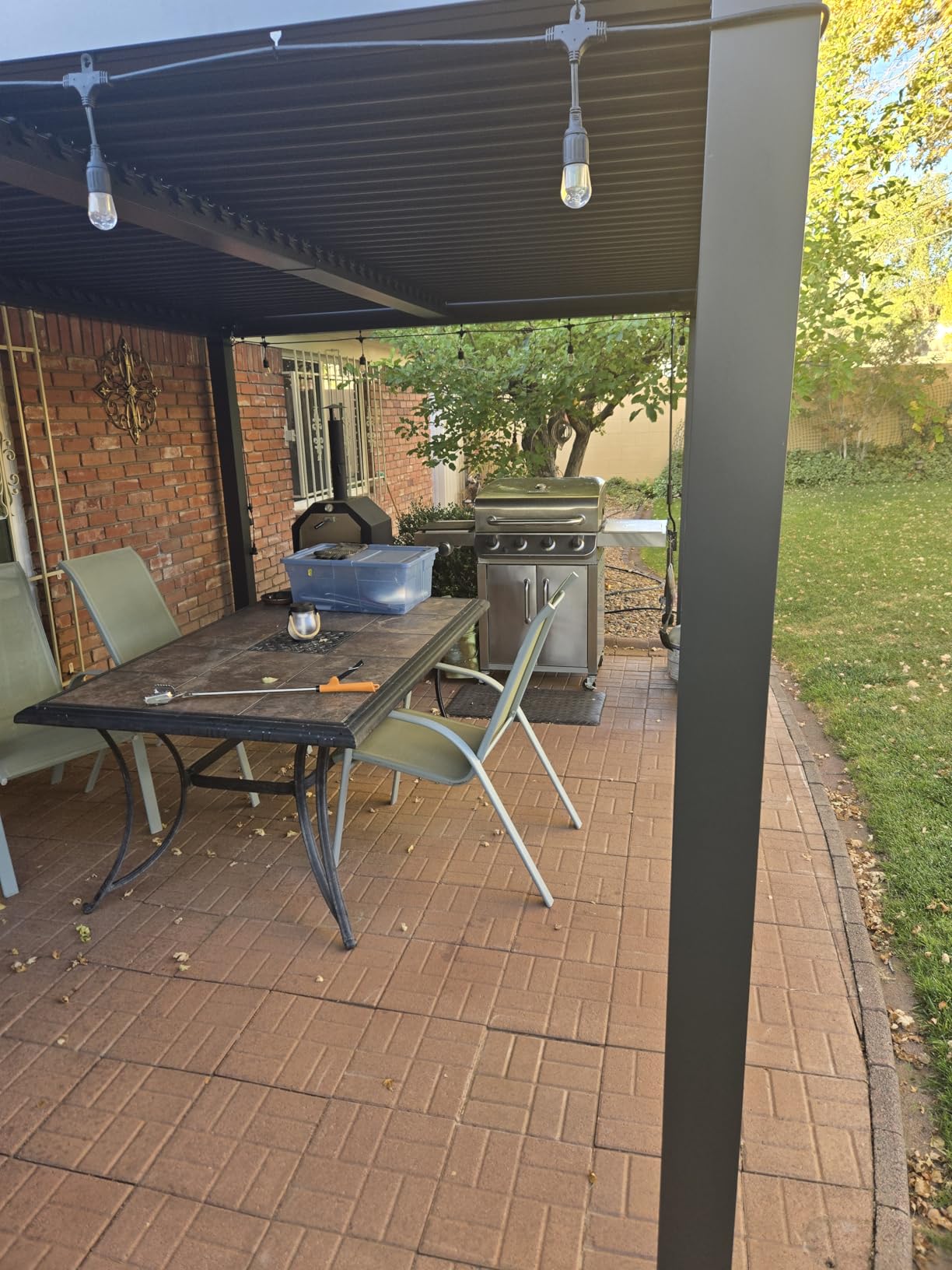
The Goldshire carries a 4.9 average with 88 percent of ratings at five stars and none below four. On a 130 square foot footprint with two independent roof sections, it is a clean, deliberately simple answer for a garden or a small poolside pad.
Both the frame and the louvered canopy are aluminum with a premium powder coating, and the reinforced columns are the part doing the stability work. Two roof sections adjust from 0 to 90 degrees with a hand pole, which is a slower but dependency-free alternative to a crank.
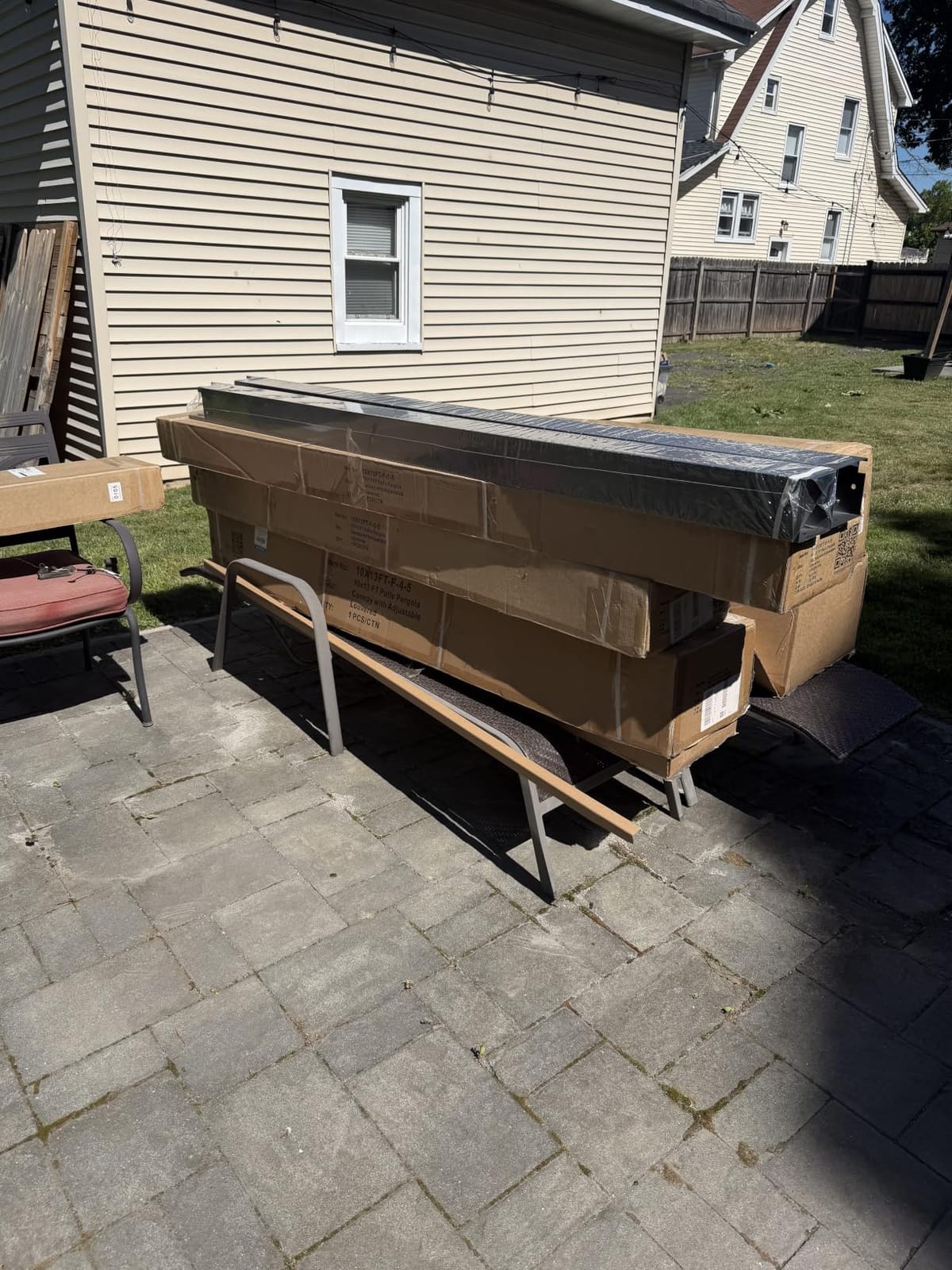
The drainage uses a cut-away mechanism that channels excess water away from the seating area, and water resistance is listed as water-resistant. Clear height is 88.5 inches, which works for most outdoor furniture and standing guests.
The unusual instruction here is from the manufacturer: position the shutters vertically and elevate the shade panels when the structure is not in use. That protects the blades from wind and impact damage during storms, and it is worth setting a seasonal reminder for.
How to set it up for the sun
Two roof sections on a 130 square foot footprint is a workable split for a garden setting where you want dappled light rather than full shade most of the year. Running the blades at a moderate angle keeps the soil beneath cooler without blocking irrigation or plant growth.
Because no UV figure is published, treat this as a shading structure. If you are using it for an outdoor work table through the middle of the day, test a spot for a week before committing to that spot.
Where this pergola is the wrong choice
Twenty ratings is a small base, and no weight is listed by the manufacturer, so you are assembling an aluminum structure without knowing what it will weigh over your patio slab. Ask for the packaged weight before you order.
If you want a written wind or snow rating, this listing offers neither. On a structure with reinforced columns, that is a reasonable question to raise with the seller.
10. MIRADOR 111S Takasho 10×10 Cherry Oak — Best Wood-Grain Finish
- Takasho wood-grain finish that will not rot or discolor
- Crank range of 0 to 93 degrees
- Reddot award-winning design with hidden fixings
- 462 pounds of aluminum and steel construction
- Heaviest listed weight in the set at 462 pounds
- Water-resistant rather than waterproof
- Review base of 17 ratings
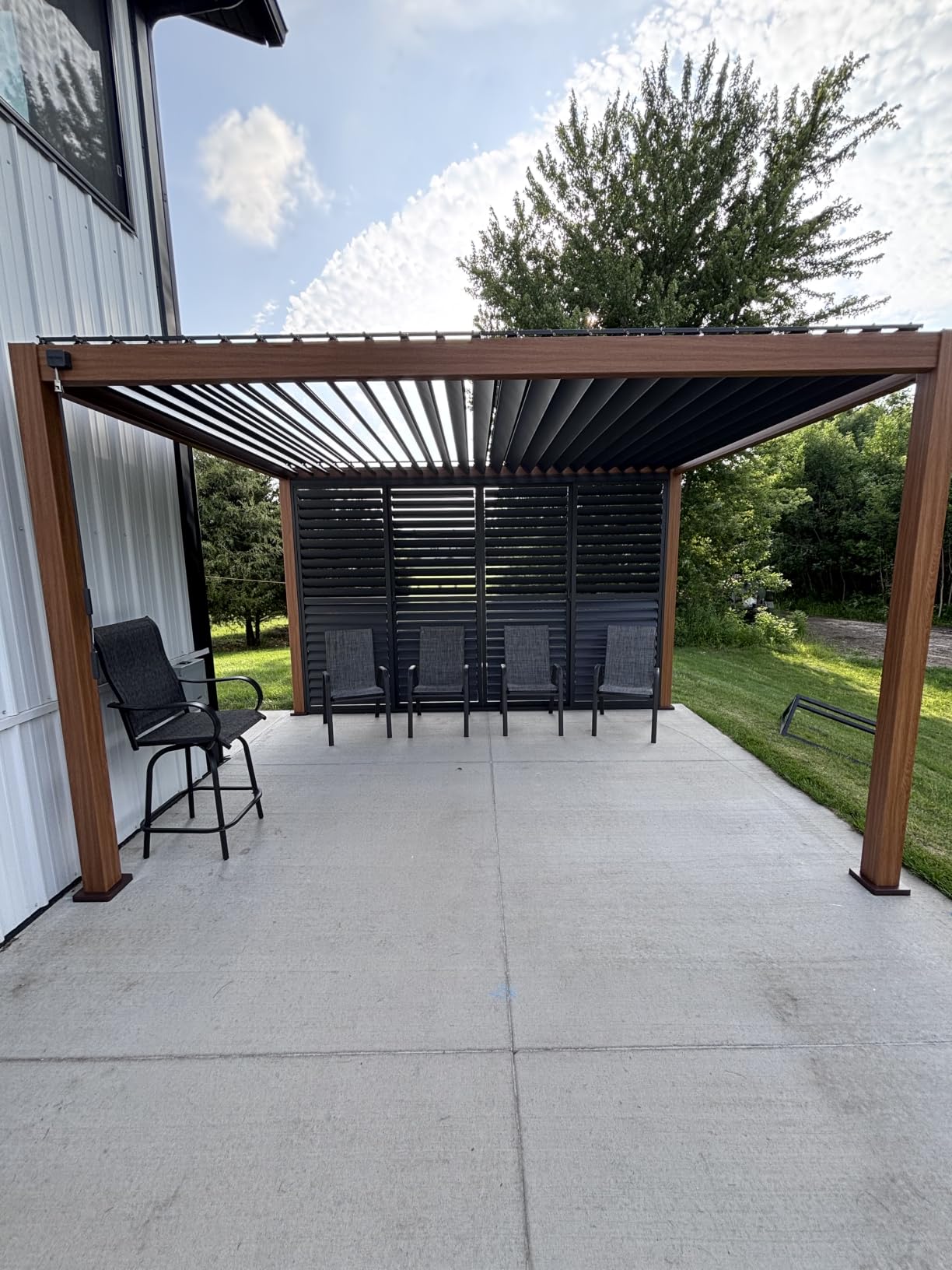
The Takasho finish is the reason to choose this one. It is a wood grain applied to aluminum rather than timber, so it delivers the look of a cedar pergola without rot, staining, or discoloration, and it is a Reddot award-winning design with hidden fixings throughout.
The crank sweeps the louvers from 0 to 93 degrees, the widest range in this roundup, and the slightly overshoot past 90 gives you a hard stop at fully open. Coverage is 130 square feet on a 120 by 120 inch footprint with a 98.4 inch height, the tallest clearance here.
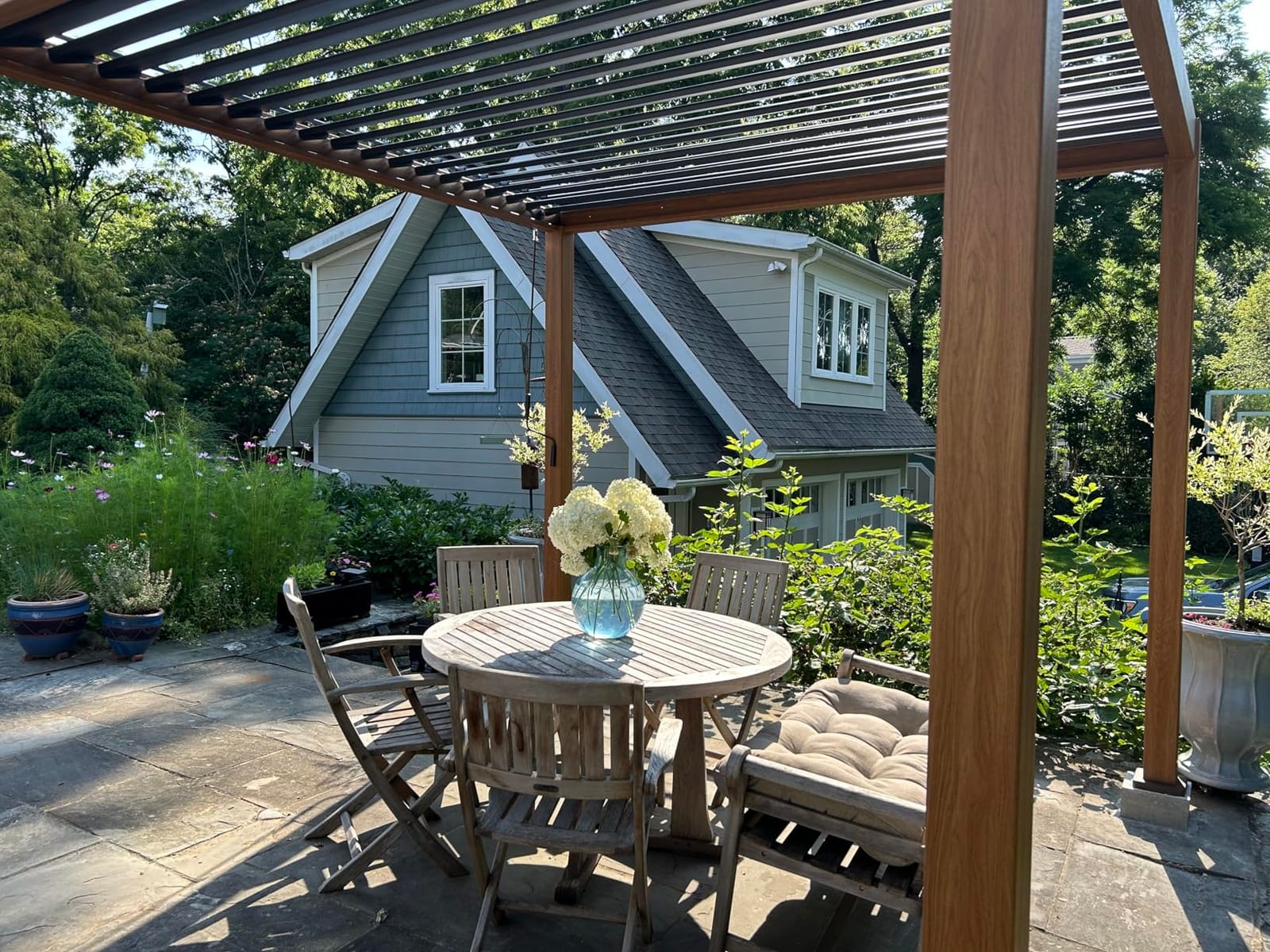
Construction is aluminum and steel, weighing 462 pounds, which is the heaviest listed weight among these picks. That much mass on four columns needs a poured base, and it is the main reason we would not put this on a raised wood deck without engineering input.
An instruction manual, an instructional video, and a professional installation partner are all offered, which is a meaningful service difference from the diagram-only kits below it in this list.
How to set it up for the sun
The extra degrees past 90 are genuinely useful at the edges of the day. At full open the blades clear the frame line almost completely, so at dusk you get an unobstructed view upward rather than a series of angled bars across the sky.
Water resistance is listed as water-resistant, not waterproof, so treat the closed position as shade and drip management rather than a sealed roof in a storm.
Where this pergola is the wrong choice
If your site is a raised timber deck, the 462-pound weight is the deal-breaker to check first. Confirm the joist spacing and footing plan with a structural source before you commit.
Seventeen ratings means no long-term field history yet. For a finish that promises not to discolor, that promise has not been tested by time.
11. Solvado 10×12 Aluminum with Curtains and Nets — Best for Coastal Homes
- Coating targets corrosion resistance in salt air
- Dual adjustable louvers for direct sun control
- Uniform-size screws simplify assembly
- Includes waterproof curtains and netting
- Review base of 14 ratings
- Copy mixes aluminum and iron construction
- Drainage described as effective in light rain
The Solvado is the one we would shortlist for a coastal site, because the coating is specified for corrosion resistance including salt air and the footprint is a true 10 by 12. Listings that claim marine resistance usually mean nothing more than a galvanized steel frame, so a stated salt-air target is worth something.
Coverage is 116.44 square feet rather than a rounded 120, which is the kind of honest number we like to see. The dual adjustable louvers give direct control over sunlight, and waterproof curtains and netting ship in the box.
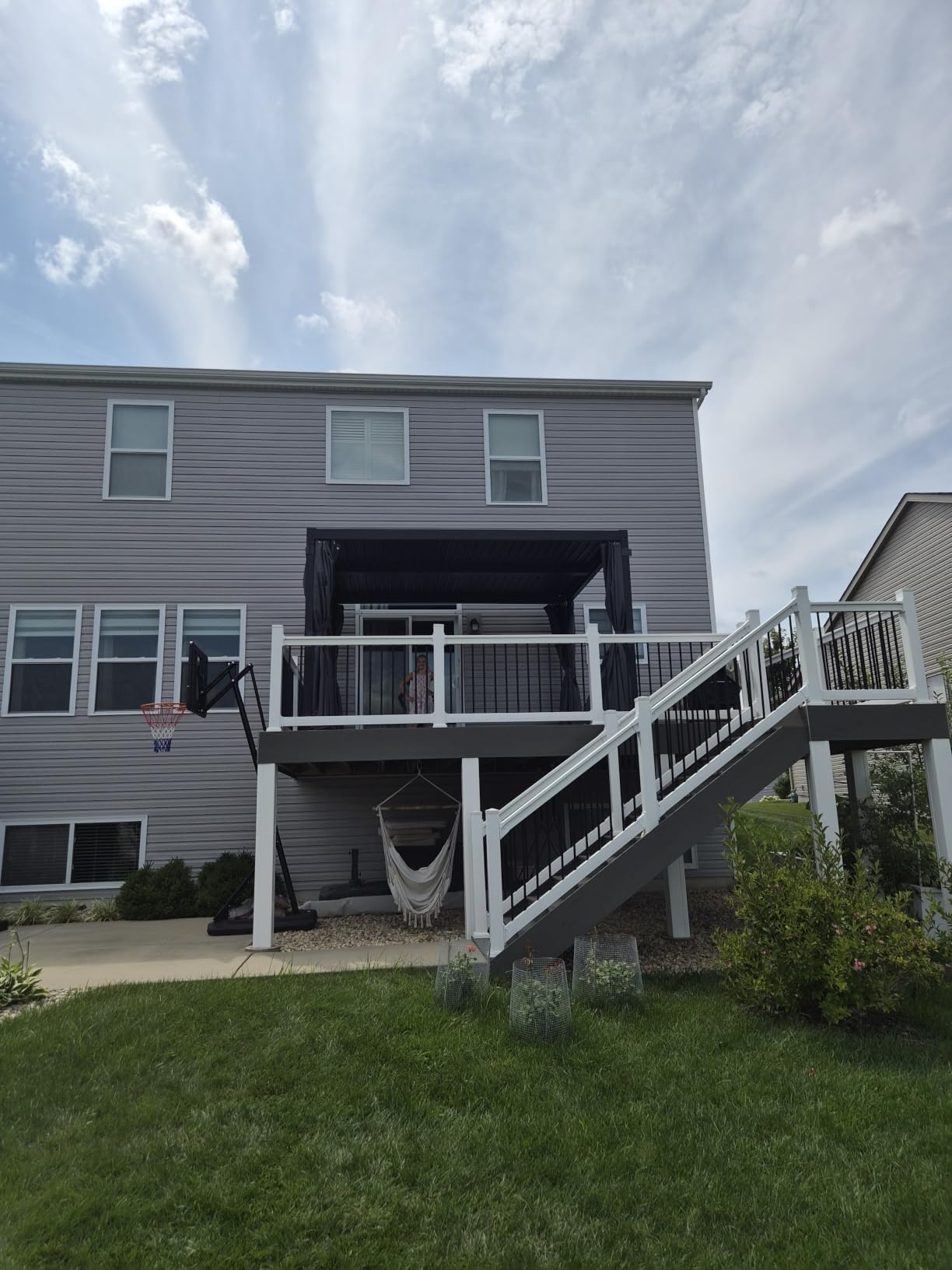
At 344 pounds, this is a solidly built structure for its footprint and uniform-size screws across the whole frame are an underrated assembly feature when you are sorting hardware on a concrete pad. The manual and instructions are described as clear.
Two documentation problems are worth flagging. The feature copy mixes aluminum and iron construction without resolving which is which, and the drainage is described as effective during light rain rather than heavy downpours.
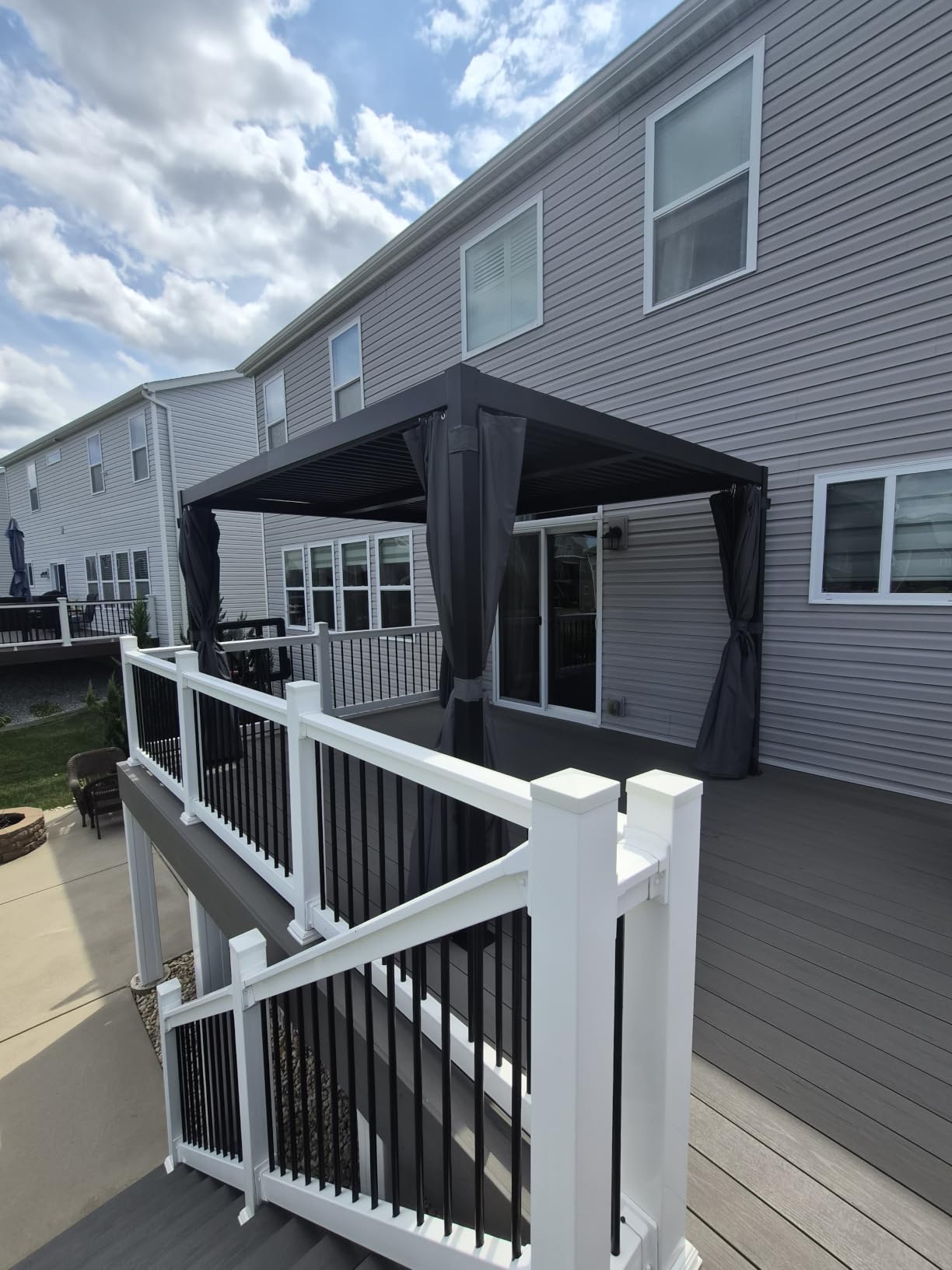
How to set it up for the sun
With dual louvers on a 116 square foot footprint, the workable pattern is one zone angled shallowly toward the house through midday and a second zone opened wide for afternoon airflow. Water resistance is listed as waterproof, and UV protection is marked yes without a numeric rating.
If the listing copy is unclear on material, ask the seller which components are aluminum and which are iron before you buy. On a coastal site, that answer decides whether the frame lasts five years or twenty.
Where this pergola is the wrong choice
Fourteen ratings is a thin evidence base, so you are buying largely on specification rather than on a long owner history.
If your patio sees sustained heavy rain rather than showers, the drainage claim here is not strong enough on paper. Pick a model with a published four-post drainage path instead.
12. LEVELEVE 10×20 Louvered Pergola — Best for Maximum Coverage
- Coverage of 200 square feet
- Slats adjust to track the sun and keep air moving
- Integrated gutters keep the patio dry
- Consistently described as good-looking assembled
- Lowest average rating in the set at 4.2
- Included anchors are weak and often replaced
- Curtains do not match listing photos
- Crank loop broke on one build
At 10 by 20 feet and 200 square feet, this is a wide footprint and the right shape for covering a pool deck or a long outdoor kitchen run rather than a single seating area. The adjustable louver system handles both sunlight and ventilation through the day.
Curtains and netting are included for privacy, wind, and insect protection, and the built-in gutter system channels rainwater away from the structure. UPF 103 is listed, which is the highest fabric rating among these picks.
This is also the weakest-scoring model we included, at 4.2 with 13 percent one-star reviews, and the reasons are consistent. The included anchors are of poor quality and many owners replace them outright, and a die-cast crank loop broke during one reported build.
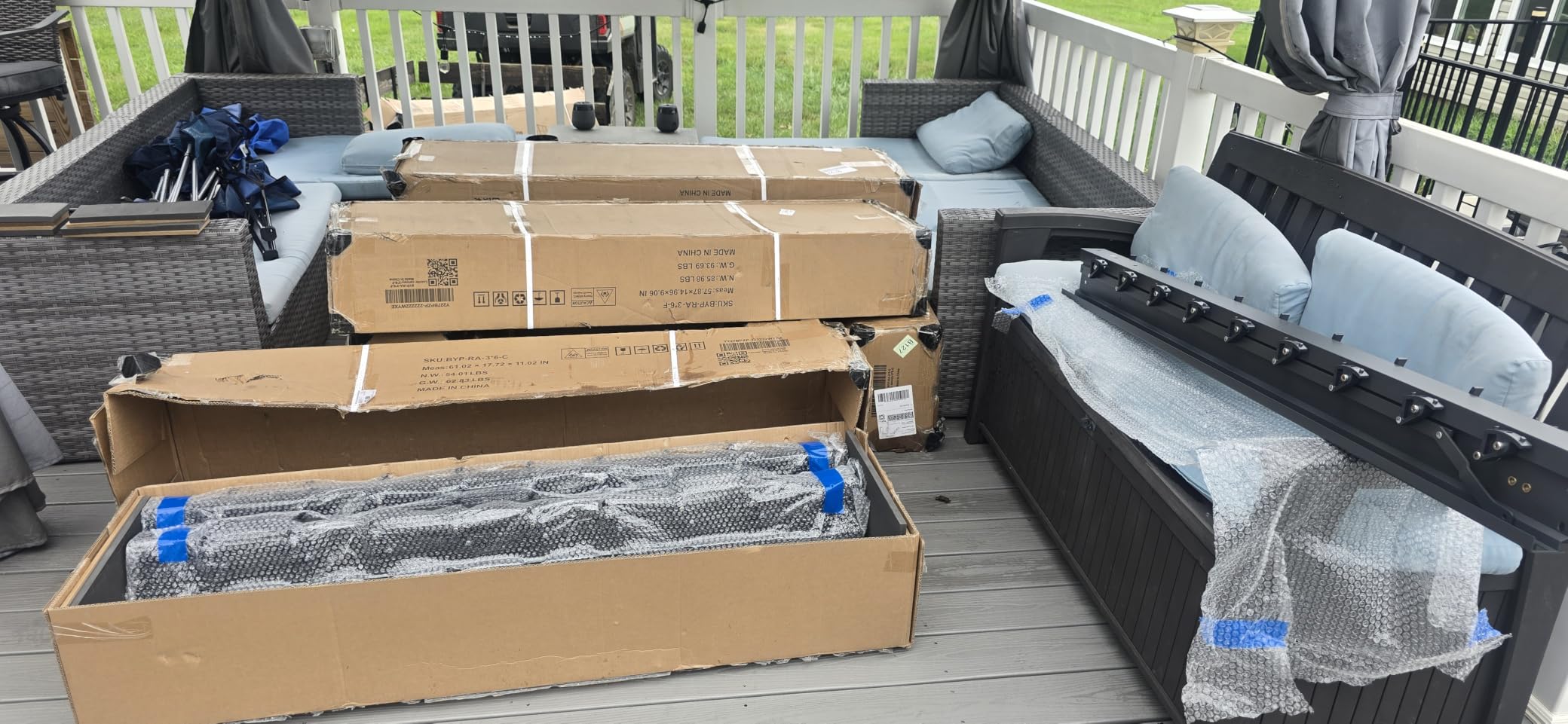
The curtains that arrive do not always match the listing photos, and the manual is pictures only with very small part images. Boxes may also arrive out of order, which is worth knowing before you start.
How to set it up for the sun
A 20 foot run is long enough that a single fixed angle will never suit the whole space, so plan on running the blades in two banks along the length and accepting that you are choosing between ends rather than halves. Angle the bank facing the low western sun more closed through the afternoon.
Water resistance is listed as waterproof, but given the anchor and hardware feedback, we would treat the rain cover as good rather than guaranteed until you have sealed and checked every seam.
Where this pergola is the wrong choice
Replace the anchors before assembly. This is the single most repeated complaint in the reviews and the cheapest fix available to you.
If you want factory support on a build this size, consider a brand with a longer warranty and a published frame weight. A 200 square foot metal frame with a picture-only manual is a two-week project at best.
How to Set the Louver Angle for Your Patio
The rule is simple: angle the blades toward the direction the sun is coming from, and the steeper that sun sits above the horizon, the flatter the blades should sit. A north-facing patio needs very little adjustment, while a west-facing one needs the roof nearly closed for the last few hours of the day.
On a west-facing patio, run the blades at 45 to 85 degrees toward the west through the late afternoon. On a south-facing patio, a shallow angle of about 30 to 45 degrees cuts noon glare while keeping airflow off the house. On an east-facing patio, open the blades wide for morning light and close them as the sun swings south.
Fully closed at 0 degrees is the setting for rain and for the highest midday and late-afternoon sun. Half-open is the compromise setting, and it is also the weakest state for wind-driven rain, which is why an afternoon shower will sometimes reach you even with the roof partly on.
Owners across these reviews describe the same pattern: transform the roof in the morning, leave it partly open through the heat, and close it before an evening event when the temperature drops. A motorized system automates that sequence, and every pick here is crank-driven, so the adjustment happens with a tool, not a switch.
Buying Guide: Sun Control Specs That Matter
Four specs decide whether a louvered pergola controls the sun well: the angle range, how many independent zones you have, whether the blades interlock at closure, and any published UV figure. Check all four before comparing anything else.
The angle range across our picks runs from 0 to 85 degrees on both PURPLE LEAF models, to a full 0 to 90 degrees on the AirWire, Domi, SUNVIVI, and Goldshire, and 0 to 93 degrees on the MIRADOR Takasho. The practical difference is small, because 85 degrees is already visually open on a patio.
Independent zones matter more than the top-end angle. Most of these structures drive two roof sections separately, which lets you shade one end of a deck while leaving the other open. On a single-zone frame, every blade moves together and you get one compromise position for the entire footprint.
Blade interlock at closure is what makes a pergola rain-capable, and it is the spec most often left unstated. Where a listing mentions an integrated gutter, check whether it routes through the beams and hollow posts to the ground, or simply sheds off the edge.
Published UV numbers are rare and inconsistent. We found UPF 50 plus on the PURPLE LEAF 10×14, UPF 15 on the AirWire, UPF 103 on the LEVELEVE fabric, a 99 percent UV blocking claim on the SUNVIVI louvers, and explicit none on the Domi and Goldshire. Treat unstated UV as unstated, not as good.
Buying Guide: Materials, Anchoring and Weather Ratings
Aluminum is the right default for a louvered pergola because it does not corrode and needs no coating maintenance, but steel buys you span and stiffness at the cost of a rust watch. Whichever you choose, the anchoring condition is the most important line on any spec sheet.
Wind ratings in this group run from a stated 60 to 80 mph on the YOLENY, through 70 mph on the PURPLE LEAF 10×14, 72 mph on the Domi and SUNVIVI, up to 82.5 mph on the Aoxun. Every one of those figures assumes anchoring into a hard surface with proper bolts.
Snow figures are published by only two of these models. The PURPLE LEAF 10×14 carries 8.2 psf, and the SUNVIVI lists 6 inches of accumulation at 55 pounds per square meter. In any snow region, plan to open the louvers fully during a storm so weight slides off instead of loading the blades.
On anchoring, concrete is the answer. Several reviews specifically report replacing the included anchor bolts with hammer-drilled wedge anchors, and the AirWire owners note frame flex that resolved once footings were poured. A structure weighing 260 to 462 pounds does not belong on surface plates alone.
Coastal and poolside sites should favor all-aluminum. The PURPLE LEAF 10×14 owners specifically flag the steel beam connectors and non-stainless screws as corrosion points, and the SUNVIVI’s iron canopy is the same issue in a different form.
Buying Guide: Drainage, Operation and Accessories
Most louvered pergola leaks are not motor or mechanism failures, and they are not mysterious. They come from incomplete closure, a mis-set angle, or a blocked gutter, which means you can diagnose a drip by checking those three things before anything else.
A well-built drainage path runs water along the blade faces into an internal channel in the beam, then down a hollow column to a base outlet away from your seating. The PURPLE LEAF 10×14 routes through four posts, and the AirWire uses a sloped roof feeding integrated channels in the beams and columns.
Operation is a crank on every model we reviewed, with the crank either removable or stowed. Two picks ship only one crank for two roof zones, which means you move it between sections. That is a minor irritation, not a defect, but it is worth knowing before you order.
Accessories are where listings mislead most often. Curtains and netting genuinely arrive in the carton on the YOLENY, Aoxun, AirWire, Solvado, SUNVIVI, MIRADOR 80S, and LEVELEVE. They are not included on the PURPLE LEAF 10×12 or the Domi, so plan that as a separate line item rather than a surprise at checkout.
Lighting appears on only one of these twelve. The PURPLE LEAF 10×12 has solar-powered LEDs with three modes, three brightness levels, three color temperatures, and a USB output on the control board. If lighting matters, that is the specification to match against.
Honest Downsides and When to Skip One
The main downsides of a louvered pergola are cost, moving parts, and installation demands. This is not a light project, and buyers who treat it as one are the ones who end up disappointed.
First, the structure needs a real base. It has to be anchored into concrete or a properly engineered deck, and a few models here weigh over 400 pounds, which is not a weekend job for two people without a plan.
Second, partially angled louvers are the weakest state for wind-driven rain, and that is exactly the state people leave them in for sun control. Fully closed and fully open are both well-behaved positions. The middle is not.
Third, assembly times in the listings are optimistic. Claims of 2 to 5 hours appear on a model whose owners report 6 to 8 hours, and picture-only instructions are common across the cheaper kits.
Fourth, delivery damage is a recurring theme, from dented posts to bent louvers and misdrilled holes that need a grinder. Inspect every piece before you break down the packaging.
Fifth, several listings overstate their own numbers. We found a floor area published as 160 square inches for a 10 by 16 footprint, a copy that mixes aluminum and iron materials, and snow ratings that contradict the manual. Read the specification block, not the headline.
Skip a louvered pergola entirely if you have no hard surface to anchor to, if you are on a very exposed site and cannot pour footings, or if a fixed-slat pergola with a fabric shade panel would do the same job for less. Sun control is a real benefit, but it is not the only way to get shade.
Frequently Asked Questions
What are the downsides of a louvered pergola?
The main drawbacks are cost, moving parts, and installation demands. A louvered pergola must be anchored into concrete or an engineered deck, several models here weigh over 400 pounds, and partially angled louvers are the weakest state for wind-driven rain. Assembly claims of 2 to 5 hours often prove to be 6 to 8 in practice.
Do pergolas offer sun protection?
Fixed-slat pergolas only filter light into a dappled pattern. Adjustable louvers rotate from 0 to 90 degrees, and when fully closed the blades interlock into a near-solid roof that blocks the large majority of direct sun. Published UV figures vary widely between models, so check the specification block rather than assuming.
Do motorized pergolas leak?
A properly installed louvered pergola should not leak when fully closed, and the motor itself is rarely the cause. Leaks come from incomplete blade closure, a mis-set angle, or a blocked gutter path. Every model in this roundup is crank-operated rather than motorized, so drainage depends on the gutter design and on the blades reaching a true seal.
Can you leave louvered pergola louvers open in snow?
Opening the louvers fully in a heavy snowfall is the recommended technique, because it lets weight slide off instead of loading the blades. Before doing that, confirm your model’s published snow rating. Only two of the twelve models here publish one, at 8.2 psf and 55 pounds per square meter respectively, so treat unstated figures as unknown.
What size louvered pergola do I need for a patio?
A 10 by 12 foot frame covers roughly 116 to 120 square feet and suits a dining set or sectional, while 10 by 14 handles larger seating. Anything at or above 160 square feet is for outdoor kitchens, pool decks, and long dining runs. Our top pick is a 10 by 12 aluminum frame with 0 to 85 degree louvers.
What to put over a pergola for shade?
Retractable outdoor roller blinds, waterproof privacy curtains, mosquito netting, and HDPE shade cloth panels are the usual additions. With a louvered pergola the roof itself is the shade, so most owners add soft goods only for privacy and insect control rather than for sun protection. Curtains and netting are included with several of the models we reviewed.
Conclusion
The best louvered pergolas for sun control in 2026 are the ones that give you a full closed position, a documented drainage path, and a wind figure you can hold a supplier to. Our top pick, the PURPLE LEAF 10 by 12 aluminum frame with solar LED lighting, pairs 0 to 85 degree louvers with 162 owner ratings behind it.
For snow country, the PURPLE LEAF 10 by 14 publishes both a snow load and a 70 mph wind rating. For exposed sites, the Aoxun states 82.5 mph when anchored. For coverage, the LEVELEVE 10 by 20 gives you 200 square feet, with more assembly friction than the rest. Whatever you choose, pour the footings first and verify the specification block before the boxes are opened.