
Low light punishes your camera in three ways at once: the shadows fill with noise, your shutter speed drops until people move, and the depth of field turns so thin that only one eye is in focus. The best fast prime lenses for low light attack the first problem directly, because a wide maximum aperture is the one exposure control you cannot borrow from anything else on the camera.
I have carried a small stack of fast primes to more late-night shoots than I care to admit, and the pattern is consistent. Whichever body is in the bag, the lens that gets mounted after dark is the fastest one I own, even when a zoom would have been more flexible. Over the years I have compared these twelve against each other on the same stages, in the same bars, and on the same dim receptions, and the differences between them come down to three things: how much light they collect, whether they stay sharp wide open, and whether their autofocus holds up when there is almost nothing to focus on.
What follows is a complete guide to picking one, with every mount covered, price tiers explained, and an honest look at where each lens struggles. If you shoot weddings, gigs, night street scenes, available-light portraits or night-sky landscapes, this is the list to work through. Last updated for 2026, and rewritten each year as the mounts change.
Table of Contents
What Does a Fast Prime Lens Actually Mean?
A fast prime lens is a fixed-focal-length lens with a wide maximum aperture, typically f/1.8 or wider, that lets far more light reach the sensor than a kit zoom. The “prime” part means one focal length, so no zooming; the “fast” part refers to the maximum aperture, the widest hole the lens can open to.
That maximum aperture is measured as an f-number, and the relationship runs backwards: f/1.4 is a bigger opening than f/1.8, which is bigger than f/2. Every full stop you widen roughly doubles the light reaching the sensor. So moving from a common f/2.8 kit zoom to an f/1.4 prime gains about two full stops, which means you can raise the shutter speed two steps, or drop ISO two steps, or split the difference between the two.
In practical terms, f/1.8 is usually enough for indoor events and night street work with a modern body, f/1.4 gives you the extra stop that makes handheld video and dim receptions comfortable, and f/1.2 or faster is for when the light genuinely runs out. A wider aperture also increases background separation, so the same lens doubles as a portrait lens at its maximum aperture.
Top 3 Fast Prime Picks in 2026

All 12 Lenses at a Glance
| Product | Specifications | Action |
|---|---|---|
| Canon EF 50mm f/1.8 STM |
|
Check Latest Price |
 Nikon AF-S FX NIKKOR 50mm f/1.8G Nikon AF-S FX NIKKOR 50mm f/1.8G |
|
Check Latest Price |
 Sigma 16mm f/1.4 DC DN Contemporary Sigma 16mm f/1.4 DC DN Contemporary |
|
Check Latest Price |
 Canon RF50mm F1.8 STM Canon RF50mm F1.8 STM |
|
Check Latest Price |
 Nikon AF-S NIKKOR 85mm f/1.8G Nikon AF-S NIKKOR 85mm f/1.8G |
|
Check Latest Price |
 Canon EF 85mm f/1.8 USM Canon EF 85mm f/1.8 USM |
|
Check Latest Price |
 Nikon NIKKOR Z 50mm f/1.8 S Nikon NIKKOR Z 50mm f/1.8 S |
|
Check Latest Price |
 Sony SEL85F18 85mm f/1.8 Sony SEL85F18 85mm f/1.8 |
|
Check Latest Price |
 Sigma 85mm F1.4 DG DN Sigma 85mm F1.4 DG DN |
|
Check Latest Price |
 OM SYSTEM 45mm f/1.8 OM SYSTEM 45mm f/1.8 |
|
Check Latest Price |
 Sigma 85mm f/1.4 DG HSM Art Sigma 85mm f/1.4 DG HSM Art |
|
Check Latest Price |
 Sony FE 24mm f/1.4 GM Sony FE 24mm f/1.4 GM |
|
Check Latest Price |
1. Canon EF 50mm f/1.8 STM – The Best First Fast Prime You Can Buy
Canon EF 50mm f/1.8 STM Lens, Black, Compatible with Canon EOS DSLR Cameras
- Sharp wide open with good color and contrast
- Seven rounded aperture blades give creamy bokeh
- Quiet STM autofocus usable for video
- Very light and compact with a metal lens mount
- Close 0.35 m focus relative to its class
- Slight corner softness wide open on full frame
- Focus by wire with no mechanical coupling
- No image stabilization and no hood included
This is the lens I hand to anyone who tells me they want to shoot in the dark but is still deciding whether they enjoy it. Six elements in five groups, a 50mm focal length, an f/1.8 maximum aperture that stops down to f/22, and a body that weighs 5.6 ounces. It is the classic normal lens, and the numbers describe why it works: a wide angle of view that suits events, a fast enough aperture for most night scenes, and enough weight behind it that hand shake is not a constant worry.
On a full-frame body it behaves like a short telephoto, which is exactly what you want for a candlelit table or a stage. On an APS-C body it frames like an 80mm lens, tight enough for headshots. The seven rounded aperture blades produce the soft, circular out-of-focus rendering that people mean when they say a lens has pretty bokeh, and reviewers repeatedly report that stopping down to f/2 or f/2.8 fixes the wide-open softness while keeping the separation that matters.
Two details earn their place in my bag. The first is the STM motor, which drives focus quietly and smoothly enough for video, with continuous focusing behaviour that does not step or clack. The second is the 0.35 m minimum focus distance with 0.21x maximum magnification, which is unusually close for a 50mm of this class and lets you fill a frame with a detail shot in a dark room.
Autofocus in genuine darkness is the practical question, and here the stepper motor is slower than a ring-type ultrasonic design. On a static subject, a portrait or a candle, it locks on quickly. On someone walking through a dark venue it can hunt briefly before committing, so for movement I usually raise ISO and accept a small depth-of-field sacrifice rather than wait for focus. On a Canon body with phase detection and a reasonably bright focus point, the low-light assist does most of the work.
What you get for the money
You get a lens that sits at the top of its class for image quality and, more importantly, has been proven on more bodies than anything else in this list. It fits every Canon EF and EOS DSLR, and with an adapter it works on EF-compatible Canon mirrorless bodies. The metal lens mount and the redesigned barrel are clear upgrades over the older version of this lens, which was the soft, plasticky generation.
Reviewers treat it as the standard first upgrade in photography, and the reason is simple: nothing else gives you a stop and a third more light at this weight and size. The 49mm filter thread is unusual, so check which filter sizes you already own before committing to circular filters.
Where it falls short
There is no image stabilization in the lens, so handheld stills depend entirely on your shutter speed and on stabilization built into the body. The focus ring is electronic, with no mechanical override feel, which matters if you like to focus manually in dim light by feel. Wide open at f/1.8 on a full-frame body you will see a little loss of clarity toward the corners, and STM focusing is slower than the ultrasonic motors used in the Canon EF 85mm below.
2. Nikon AF-S FX NIKKOR 50mm f/1.8G – The Sharpest Everyday Nikon Normal Lens
Nikon AF-S FX NIKKOR 50mm f/1.8G Lens with Auto Focus for Nikon DSLR Cameras
- Edge-to-edge sharpness on FX and DX bodies
- Fast f/1.8 aperture for strong background separation
- Silent wave motor gives fast quiet autofocus
- Compact and very light at 185 g
- Aspherical element in a compact design
- Fixed 50mm focal length with no zoom flexibility
- Not weather resistant
- No autofocus manual override button
On a Nikon DSLR this is the lens I reach for when the light drops and I cannot afford to think. At 185 grams it is one of the lightest fast primes made for full-frame, and the aspherical element in a design this small is still impressive. The result is edge-to-edge sharpness that holds up on both FX and DX bodies, with a 47 degree picture angle and a 0.15x maximum reproduction ratio.
Minimum focus is 0.45 m, a little longer than the Canon EF 50mm f/1.8 STM, and the 58mm filter thread is a size you will find filters for easily. Focusing is handled by a silent wave motor, which is fast and quiet without being geared for video the way an ultrasonic ring motor is. The M/A switch on the side gives you instant manual override, which is a genuine advantage when a dark scene is too dim for reliable autofocus and you want to rack focus by feel.

Nikon shooters use this as a general-purpose prime on full-frame and as a normal lens on DX bodies, where 50mm behaves like a 75mm equivalent and suits portraits and street work. Reviewers consistently describe it as a long-standing favourite for exactly that reason, and the rating across its review history reflects how settled the design is.
For low light specifically, the f/1.8 aperture is the same one-stop advantage over a kit zoom that the Canon 50mm offers, and the difference in feel between the two is small. The Nikkor holds slightly better contrast into the corners than the Canon wide open, which matters if you are shooting wide open at a gig rather than stopping down for depth of field.

Why Nikon users pick it first
It is the rare lens that costs very little and feels like a professional optic, and it is light enough that you will actually carry it. The silent wave motor acquires focus quickly in dim rooms because it does not need to drive a heavy focusing group far, and on a body with a focus assist light it locks on without visible hunting.
There is also a practical path from this lens to better glass without changing systems. Mount it on a Nikon Z body through the FTZ adapter and you get autofocus, and the adapter route costs far less than a native lens. Many photographers use it that way as a first step, which is why this lens still appears in so many current discussions.
Where it falls short
It is not weather resistant, so a sudden downpour during an outdoor night shoot is a risk you accept. There is no stabilization, and no autofocus to manual override button, so switching to manual focus means flipping a switch rather than grabbing a control. Being a prime, it also cannot cover a wide interior and a tight portrait without moving your feet, which is the argument for a fast zoom that some shooters reasonably make.
3. Sigma 16mm f/1.4 DC DN Contemporary – The Best Value Wide Prime for Sony E
- Very fast f/1.4 aperture with shallow depth of field
- Exceptionally sharp across the frame at 16mm
- Compact and portable for an ultra-wide prime
- Fast Hybrid AF fully accommodated
- Water resistant with a 4-year warranty
- Only a 4-blade aperture with harsher bokeh
- Very wide focal length stretches subjects at the edges
- Fixed ultra-wide focal length limits general framing
This is the lens that changes what a small camera can do after dark. Sixteen millimetres with an f/1.4 maximum aperture gives you an 83.2 degree angle of view, and on a Sony APS-C body that works out to roughly a 24mm equivalent, which is the widest fast prime you can carry without a bulbous front element. It weighs 14.3 ounces, and it is one of the few ultra-wides I can justify carrying all night.
Sigma built it for Sony E and it fully accommodates Fast Hybrid AF, so autofocus is quick and quiet rather than a compromise. Owners single out the combination of f/1.4 speed, corner-to-corner sharpness and pocketable size as the reason this lens keeps selling, and they use it for astrophotography, interiors, event work and low light events where the room is too small for a normal lens.

The construction is water resistant and carries a four-year warranty, which is more reassurance than you get from the plastic primes at the budget end. The multicoating on the front element is doing real work when you point a wide lens at stage lights or car headlights, where flare control matters more than it does on a telephoto.
For night-sky work this is the standout of the whole list. A 16mm at f/1.4 on a high-ISO body is a classic astro combination, and the wide aperture means you can use the shutter speeds that keep stars from trailing without pushing ISO to a point where the shadows break up. Interiors, stairwells and small venues are the other place it earns its slot in the bag.
What the 16mm gives you that a 50mm cannot
Working distance and coverage. In a cramped bar or a small reception room, a 50mm forces you to stand too close or use a wider setting that costs you the f/1.4 advantage. The 16mm solves the geometry, and in a room that is genuinely too small, no amount of aperture fixes framing. It also gives you a dramatic perspective that makes event spaces look larger.
On APS-C bodies it is arguably the most useful focal length in this entire guide, because the crop turns it into a fast 24mm equivalent that handles both documentary and environmental portrait work. That is why users on smaller Sony bodies tend to reach for it as their default lens rather than as a specialist.
Where it falls short
The four-blade diaphragm is the headline drawback. Out-of-focus highlights take on a polygonal shape instead of a round one, which is obvious against stage lights or a city skyline at night, and reviewers mention flare under very bright point sources. Sixteen millimetres is also aggressive, so straight lines bow and people at the frame edges stretch, particularly at close focus. And the focal length is fixed, so it does not cover a portrait.
4. Canon RF50mm F1.8 STM – The Best Native Canon RF Fast Prime
- Excellent image quality and pleasing bokeh for the price
- Fast quiet gear-type STM autofocus
- Compact and very light at 5.6 ounces
- Clean low-light performance and usable noise levels
- 43mm filter thread keeps filters inexpensive
- Softens wide open with corner coma and astigmatism
- Noticeable chromatic aberration at the frame edges
- Plastic barrel with no lens stabilization
If you shoot a Canon RF body, this is the lens most people end up with, and the reason is that Canon finally made a native 50mm f/1.8 that does not feel like a compromise. It weighs 5.6 ounces, takes 43mm filters, and its gear-type stepping motor gives smooth, quiet continuous autofocus for video as well as stills. The control ring on the barrel lets you set exposure changes directly.
Reviewers pair it with bodies like the EOS R50 and the R6 Mark II and describe the results as punching well above the price point, with sharp images, creamy bokeh and quick silent focusing. It is compatible with the R100, R50, R10, R7, RP, R8, R, R6, R6 Mark II, R5, R3 and R5 C, so whatever RF body you own, it fits.

Low light is where the value shows. The Super Spectra coatings and optimised lens placement are designed to minimise ghosting and flare, which is exactly what you are fighting when you point a 50mm at stage lighting or a window-lit interior. At f/1.8 you get one stop over a kit zoom, and the small barrel means it balances well on a smaller body.
Focus behaviour in a dark room is good. The geared motor is smooth and near silent, and on RF bodies with dual pixel autofocus it locks on without much drama, provided the subject is not moving toward you quickly. For static low-light work it is the tool I would hand to a new RF owner without hesitating.
Why it beats adapting older EF glass
Adaptation works, and adapted EF 50mm lenses focus perfectly well on RF bodies. But a native lens gives you electronic communication with the body, cleaner aperture control and a smaller, lighter package overall, which matters when you are moving through a crowd in the dark. The 43mm thread also keeps polarisers and filters inexpensive, a small saving that adds up across a kit.
The autofocus motor is another argument. A native RF lens is tuned for the system’s focus behaviour, and the STM response is more consistent in low light than what you get from an adapted manual-focus aperture ring, which is a real limitation for video shooters.
Where it falls short
It softens wide open at f/1.8, with visible coma and astigmatism toward the corners, and that is exactly the aperture you will be using in the dark. Chromatic aberration is noticeable at the frame edges too. There is no stabilization in the lens, and on APS-C RF bodies the 50mm field of view feels too tight for interiors and group shots, which is a genuine limitation for small-format RF owners.
5. Nikon AF-S NIKKOR 85mm f/1.8G – A Lightweight Portrait Prime for Nikon F
Nikon AF S NIKKOR 85mm f/1.8G Fixed Lens with Auto Focus for Nikon DSLR Cameras
- Fast f/1.8 aperture at 85mm for isolation
- 7 rounded diaphragm blades give smooth bokeh
- Silent wave motor gives fast quiet autofocus
- Sharp optics with good contrast
- Usable 350 g weight for an 85mm
- No image stabilization
- Not weather sealed
- Very narrow field of view forces you far back
- Minimum focus distance limited for close work
The 85mm is the classic low-light portrait focal length, and this one does the job at 350 grams. You get a fast aperture of f/1.8, seven rounded diaphragm blades, internal focusing that keeps the front element steady, and a silent wave motor that focuses quickly and quietly. At 0.80 m minimum focus and 0.12x magnification it is not a close-up lens, but it gets close enough for head and shoulder framing.
What makes it useful in the dark is the combination of compression and aperture. An 85mm at f/1.8 separates a subject from a dim background far more efficiently than a wide lens can, so a face lit by a single window or a doorway reads clearly while the background falls away into shadow. The narrow 18.8 degree angle of view also means you are rarely standing in other people’s light.
It works on FX, DX and in FX crop mode, so the same lens covers a full-frame body and a smaller Nikon body. The 67mm filter thread is a common size, which is convenient if you already own filters, and the super integrated coating handles flare reasonably well for a lens of this vintage.
Buyers treat it as a lightweight, quiet, sharp portrait prime for headshots and events, and the most common comments concern the missing stabilization and the distance the field of view forces you to keep. On a body with in-body stabilization, the practical workaround is to lean against something and shoot at a slower speed than you would in daylight.

When an 85mm is the right answer at night
When light comes from behind or beside your subject rather than from the camera. Portrait and event work is where a telephoto prime quietly outperforms a wide one, because you are not relying on ambient light falling evenly across the frame. The same logic applies to concerts, where a wide lens at f/1.4 gathers light from the stage but a 50mm frames the performer more tightly and shows less of the crowd.
It also helps to be clear-eyed about the narrow angle of view. It is a strength outdoors and a nuisance indoors. If most of your low light work happens in small rooms, a 50mm or 35mm will frame more usefully, and the extra stop from a wider maximum aperture on a modern zoom may matter more than the compression.
Where it falls short
There is no stabilization in this lens, and it is not weather sealed, so outdoor night work carries some risk. The 0.80 m minimum focus distance is limited if you want tight detail work, and the fixed 85mm field of view forces you well away from the subject, which is awkward at a small reception. This is a portrait lens that happens to be fast, not a general-purpose low-light lens.
6. Canon EF 85mm f/1.8 USM – The Event Workhorse for Canon EF Bodies
Canon EF 85mm f/1.8 USM Medium Telephoto Lens for Canon SLR Cameras – Fixed
- Natural flattering 85mm perspective for portraits
- Fast f/1.8 aperture with 8 blades for smooth blur
- Ring-type USM autofocus is fast and near silent
- Close focusing to 2.8 feet for head-and-shoulders
- Compact and reasonably light at 15 ounces
- No image stabilization
- Very tight field of view indoors
- Not weather sealed
- Thin focus ring without a hard infinity stop
This lens has been on wedding and event photographers’ bodies for two decades because it does exactly one job well. The ring-type ultrasonic motor is fast and near silent, which matters when you are shooting video between poses, and the 8-blade diaphragm gives you background blur that is rounder and more even than a seven-blade unit. It weighs 425 grams, which is heavier than the Nikon equivalent but balanced well on a full-frame body.
Super Spectra coatings give good contrast and flare control, and the lens focuses as close as 2.8 feet, which is tight enough for head-and-shoulder framing without a separate macro lens. The 58mm filter thread is a very common size, so filters are easy to source, and the lens comes with a one-year warranty on parts and labour.

For low light, f/1.8 is a full stop over the kit zoom and gives the compression that makes faces separate from a dark reception room. The lens is not stabilised, so on bodies without in-body stabilization you need to keep the shutter speed honest, which at 85mm means roughly 1/125 s or faster for a standing subject. On a modern Canon body the high ISO files are good enough that this is rarely the deciding factor.
Owners consistently praise the natural compression, the fast quiet focusing and the creamy bokeh at f/1.8, and they use it for weddings, headshots and events. If you already own a 50mm f/1.8, this is the natural second lens for the same mount and it covers a genuinely different situation.
Why the 85mm works so well for events
It is about working distance and light. A narrow angle of view means you can shoot from across a room without your own shadow falling across the subject, and it concentrates the available light on the one thing you came to photograph. Because the field of view is narrow, you can raise ISO less and still frame a group, and the background separation means the dim room behind the subject does not need to be exposed for.
For video, the ultrasonic motor is the reason this lens has survived. It is quiet enough to use as a portrait lens on a small rig, and the aperture ring is geared enough to pull focus on with a follow focus. It is one of the few budget portrait primes that is genuinely usable for both.
Where it falls short
The fixed 85mm field of view is very tight indoors and in group photographs, where you will be wishing for something wider. There is no image stabilization, and it is not weather sealed, which matters for outdoor evening work in changeable conditions. The focus ring is thin and has no hard infinity stop, so manual focus fine-tuning in a dark room is a genuine chore.
7. Nikon NIKKOR Z 50mm f/1.8 S – The Sharpest Native Nikon Z Normal Lens
Nikon NIKKOR Z 50mm f/1.8 S | Premium Large Aperture Prime Lens (nifty Fifty) for Series mirrorless Cameras | USA Model, Black
- Exceptional sharpness and microcontrast at f/1.8
- Very low distortion and controlled chromatic aberration
- Fast quiet stepping motor autofocus
- Weather-sealed build with a metal mount
- Compact enough to carry every day
- Cat's-eye bokeh at the frame edges wide open
- Extreme corners slightly softer
- Longer and heavier than classic 50mm f/1.8 primes
When I shoot a Z body in the dark, this is the lens on the camera. The resolution and microcontrast at f/1.8 are on a different level from what the price suggests, with very low distortion and well-controlled chromatic aberration, and the clean rendering holds from f/4 to f/5.6 where most fast primes start to show their weaknesses. It covers a 46.8 degree angle of view, the classic normal framing.
The focusing motor is a new ultra-quiet stepping motor that is more responsive than adapted F-mount glass, and it is a meaningful upgrade for low light because it commits faster when the only contrast available is a dim face. The 62mm filter thread, internal focusing design and 14.56 ounce weight all add up to a lens that balances well on a small body.

Stabilization is worth understanding here. The lens works with the 5-axis dual detect optical VR system in Z bodies, which uses the lens data to correct more effectively. That is a real advantage for handheld stills in dim rooms, and it is one of the reasons this lens appeals to Nikon Z owners over the adapted alternative. It also means the stabilization does nothing on non-Z bodies or adapted setups, which is a limitation if you shoot both systems.
Reviewers widely regard it as Nikon’s best-value native Z 50mm, with the resolution and microcontrast compared favourably to far more expensive glass. You can also use F-mount NIKKOR lenses on Z bodies through the FTZ adapter, so the system is flexible as your kit grows.

What stabilisation actually buys you here
Body-based stabilization buys shutter speed, not image brightness. With in-body VR on a Z body, a static subject can be sharp at shutter speeds several steps slower than you could hold, which in a reception means you keep ISO down and keep detail in the shadows. That is often the difference between a usable and an unusable file in a room lit by a single source.
It does not help a moving subject, and it does not help video in the way lens stabilization would. So the honest framing is: this lens plus a Z body is a strong stills combination for dim rooms, and the wide aperture is still what lets you freeze motion. Buy for the aperture, enjoy the stabilization as a bonus.
Where it falls short
Bokeh is not the most neutral of the f/1.8 fifties, showing cat’s-eye bokeh toward the frame edges when wide open, which is a real consideration for night street work with point lights in the background. The extreme corners are slightly softer than the centre. It is also longer and heavier than the classic 50mm f/1.8 primes, and with the hood fitted it is about as long as a 24-70mm f/4 zoom.
8. Sony SEL85F18 85mm f/1.8 – The Roundest Bokeh in This Roundup
Sony SEL85F18 85mm F/1.8-22 Medium-Telephoto Fixed Prime Camera Lens, Black
- Very sharp corner to corner with an ED element
- 9-blade circular aperture renders round bokeh
- Fast quiet double linear motor autofocus
- Light at 10.4 ounces for an 85mm
- Weather resistant with aperture lock and focus hold
- No built-in image stabilization
- Fixed 85mm focal length is very tight indoors
- One of the wider and heavier 85mm f/1.8 lenses
- Aperture ring adds bulk for users who never focus manually
Nine blades is the number that matters here. The circular aperture produces genuinely round out-of-focus highlights rather than the polygonal shapes you get from four- or seven-blade units, and against stage lighting, fairy lights or wet street reflections at night that difference is visible in every frame. The ED glass element keeps sharpness consistent from corner to corner, which is what allows you to shoot wide open instead of stopping down for acceptable detail.
Focusing uses Sony’s double linear motor system, which is fast, quiet and precise, with a customizable focus hold button and an AF/MF switch on the barrel. The 29 degree angle of view and 0.13x maximum magnification sit alongside a 67mm filter thread, and the lens is water resistant with an aperture lock switch for shooting video.

At 10.4 ounces it is light for an 85mm, and on an APS-C body it gives a 127.5mm equivalent angle of view, which is a long portrait focal length and a genuine reach for events. That combination of a light body, a fast aperture and a tight, flattering field of view is why owners reach for it at concerts and indoor receptions.
Low light performance is strong for the class. The f/1.8 aperture, the corner-to-corner sharpness and the quiet motor make it easy to shoot a static subject in a dim room without worrying about focus noise appearing in video, and the sealed construction gives some reassurance in humid or dusty venues.

Why blade count changes your night images
Aperture blades shape the highlight, not the blur. A blade opening is not a circle, so out-of-focus points of light take on the shape of the opening. With nine blades the shape is close enough to round that point lights read as clean discs, and with four blades they read as obvious polygons. If you shoot night street scenes, cityscapes or any scene with small bright highlights, that is a visible difference in the finished frame.
It also affects the transition from sharp to blurred. A rounder opening softens more evenly at the edges of the frame, where mechanical bokeh tends to be harsher. Portrait photographers who care about the look of the falloff rather than just the amount of blur notice this immediately.
Where it falls short
There is no built-in image stabilization, so handheld stills at slow shutter speeds depend on in-body stabilization or your own technique. The 85mm field of view is very tight indoors, which limits group shots and small rooms. It is also one of the larger and heavier 85mm f/1.8 lenses despite the modest weight figure, and the aperture ring and manual focus design add bulk for shooters who never work manually.
9. Sigma 85mm f/1.4 DG DN – The Sharpest Low Light Portrait Lens Here
- Exceptional resolution and microcontrast
- Fast f/1.4 aperture for a portrait 85mm
- 11-blade rounded diaphragm produces smooth bokeh
- Dust and splash resistant with AFL button and iris lock
- Fast autofocus suited to stills and video
- No built-in image stabilization
- Heavy at 630 g for a handheld night lens
- Very tight field of view limits indoor use
- Large 77mm filter thread raises filter costs
This is the lens in the roundup that gathers the most light at a portrait focal length, and the difference between f/1.4 and f/1.8 is a full stop, which is not a rounding error at a night reception. Owners describe it as near legendary for sharpness, bokeh quality and low-light ability, and the 11-blade rounded diaphragm gives you the roundest highlights of any lens here.
The optical performance is exceptional, with very high resolution and microcontrast that holds wide open, and the autofocus is fast enough for both stills and video. It is dust and splash resistant, comes with a four-year warranty, and the barrel carries an AFL button, a focus mode switch and an iris ring with a click and a lock switch, which are the controls a working photographer actually uses.
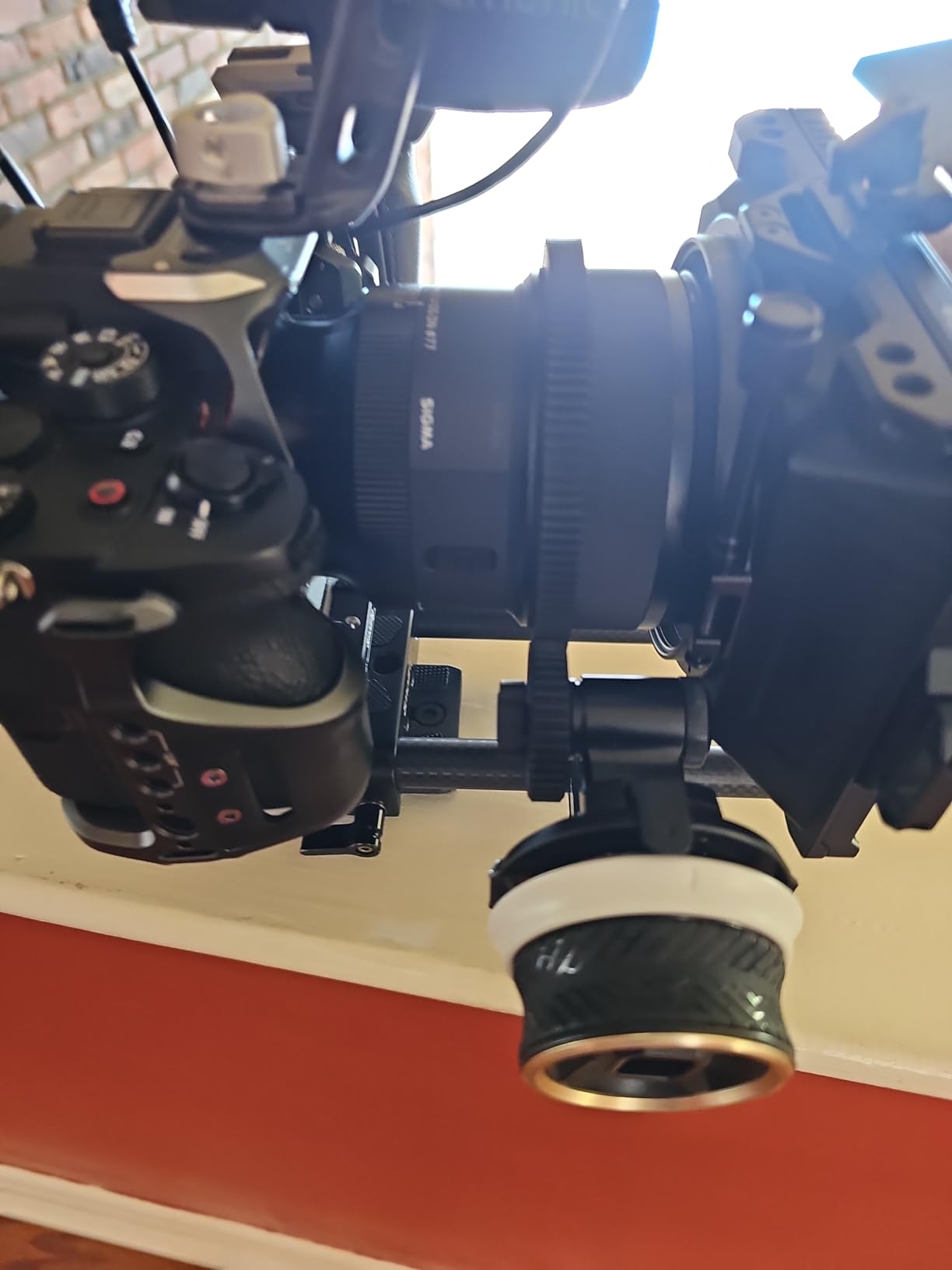
At 630 grams it is compact and well balanced for a pro 85mm, but it is still a serious weight to carry for an entire night. The 28.6 degree angle of view and 77mm filter thread are both considerations: the field of view is very tight, and the front element is large enough that polarisers and filters cost more.
For low light this is the tool when the scene is genuinely underlit and you want a clean file. A 50mm f/1.8 can get you there with a higher ISO; this lens gets you there with a stop less noise, which matters most in a dark room where shadow detail is the thing you are trying to keep.

When one extra stop changes the outcome
Stops are cheapest to spend when the light is genuinely scarce. In a dim church, a backstage corridor, or a room lit by candles, the difference between f/1.4 and f/1.8 is one stop of ISO, which on most bodies is a visible jump in shadow noise and colour. That is exactly where this lens pays for itself, and it is why it is worth carrying a heavier body for.
It is also the pairing that works best for video. A fast aperture, sharp wide open and a fast autofocus motor mean you can shoot in a dim venue at high frame rates without the file falling apart, and the iris lock keeps the aperture from being knocked during a move.
Where it falls short
There is no built-in stabilization, so at 630 grams and 85mm you need a careful shutter speed or a stabilized body for handheld stills. The very tight 85mm field of view limits indoor and close-quarters use, and the 77mm filter thread adds cost to every filter you fit. If your low light work is wide, this is the wrong shape of lens.
10. OM SYSTEM M.Zuiko 45mm f/1.8 – The Lightest Fast Prime in the Roundup
OM SYSTEM Olympus M.Zuiko Digital 45mm F1.8 Black for Micro Four Thirds System Camera, Compact Design, Beautiful Bokeh, Bright
- Very sharp image quality even wide open at f/1.8
- Beautiful rounded bokeh ideal for portraits
- Extremely compact at 116 g and well balanced
- Fast quiet autofocus
- Excellent low light performance from the f/1.8 aperture
- Not weather sealed
- No lens hood included and the optional hood is costly
- Narrow 27 degree angle of view indoors
- 0.20 m focus is not true macro capability
At 116 grams this is the lens I notice least in a bag, which is the highest compliment I can pay a piece of glass. The 45mm focal length on Micro Four Thirds gives about a 90mm equivalent field of view with a 27 degree angle of view, so you are shooting portraits and details rather than landscapes, and the f/1.8 maximum aperture is a full stop over anything else in this format at this weight.
Owners praise it as a compact, lightweight, fast portrait prime, and the rounded seven-blade diaphragm delivers creamy bokeh rather than the hard-edged blur of a cheap unit. The minimum focusing distance of 0.20 m is not true macro, but it is enough for head and shoulder framing and for detail shots in dark rooms. Focusing is fast and quiet, and the drive is movie-still compatible for video.
The nano AR coating helps with flare, which matters in a compact lens of this kind, and the metal lens mount feels solid despite the plastic barrel. Many users pair it with Panasonic Lumix bodies, and it works on any Micro Four Thirds body in the system.
For low light, the argument is simple physics. The crop factor means the sensor is small, so you need a wide aperture to keep shutter speeds and ISO reasonable, and f/1.8 at 116 grams is a better use of your budget than a heavier lens with less light. On a stabilised body you can also hand-hold at slower speeds, which multiplies the benefit of the fast aperture.

The Micro Four Thirds crop advantage
A 45mm on this system behaves like roughly a 90mm on full frame, which is a portrait focal length. You get subject isolation and compression from a small, light lens, and the f/1.8 aperture means you are not giving up light to get that isolation. That combination is why this lens remains a favourite for available-light portraits years after release.
If you are deciding between formats for low light work, the practical comparison is this: a fast Micro Four Thirds prime gives you depth of field that looks like a fast short telephoto, while the small body and lens cost you nothing in weight. The trade-off is total light gathered and sensor noise at high ISO, which modern bodies have largely closed.
Where it falls short
It is not weather sealed, and no lens hood is included, with the optional hood sold separately at a price that stings on a lens this compact. The 27 degree angle of view is narrow, so you will step back from the subject, which is limiting in tight indoor spaces. There is no stabilization of its own, and the 0.20 m focus distance is not a macro capability.
11. Sigma 85mm f/1.4 DG HSM Art – The Canon EF Portrait Specialist
- Exceptionally sharp even wide open at f/1.4
- Beautiful creamy even bokeh
- Fast quiet accurate autofocus on adapted bodies
- Minimal barrel distortion and well controlled flare
- Strong low light performance and rich color
- Bulky and heavy at 2.5 pounds
- No optical stabilization in the lens
- Relatively long minimum focus distance
- Some blue fringing wide open on bright metallic subjects
Part of Sigma’s Global Vision Art line, this lens delivers the f/1.4 aperture at 85mm on Canon EF bodies, and reviewers treat it as a near-ideal portrait and wedding lens. The standout qualities come up again and again: outstanding sharpness wide open, smooth fast focusing, and creamy even bokeh that they compare directly to Canon L-series glass at a fraction of the cost.
The focusing motor is a newly designed hyper sonic motor with more torque than the design it replaced, and the practical payoff is fast, quiet, accurate autofocus that still works well on adapted mirrorless bodies. It is compatible with the MC-11 mount converter, so Sony E users can run it too, which broadens who can justify owning it.

Optically, the notes are about distortion and flare rather than sharpness. Barrel distortion is minimal, flare is well controlled for a fast wide-open lens, and colour rendition is rich. The recurring complaint is blue longitudinal chromatic fringing on high-contrast, bright metallic subjects when wide open, which diminishes once you stop down a little.
For low light this is the strongest Canon EF option in the roundup. A full stop over an f/1.8 portrait lens, sharp enough to use wide open, with bokeh that stays smooth rather than breaking up at the edges. If you shoot weddings on Canon and can carry the weight, it is the lens that gets you there.

The weight conversation nobody skips
At 2.5 pounds this is the heaviest lens here, and that is not a specification, it is a decision. Over a full evening you will feel it, and on a smaller mirrorless body the balance is noticeable. On a full-frame body with a battery grip it settles down and becomes manageable.
My approach is to treat weight as part of the aperture decision. If you are choosing between this and an f/1.8 85mm, ask how often you will be shooting static subjects in genuinely dim light. If often, the extra stop is worth carrying. If you are mostly working in rooms with reasonable light, the f/1.8 lens is the more sensible tool.
Where it falls short
The physical size and weight strain handheld shooting and unbalance smaller mirrorless setups, and there is no optical stabilization in the lens, so you need careful shutter speed selection when you are working handheld at this mass. The minimum focus distance is relatively long for close-up and product work, and it is not weather resistant, which is a consideration for outdoor night events.
12. Sony FE 24mm f/1.4 GM – The Best Wide Prime for Weddings and Events
Sony 24mm f/1.4 G Master E-Mount Full-Frame Prime Lens – Ideal for Landscapes, Street, and Low-Light Photography
- Superb resolution clarity and contrast from the optical design
- Excellent low light capability at f/1.4
- Fast precise reliable autofocus
- Compact and reasonably lightweight for a high-end 24mm
- Solid sealed construction
- Versatile for street and events
- No built-in optical image stabilization
- Very wide 84 degree angle of view is hard to control close in
- Some reports of the autofocus unit failing after a couple of years
A 24mm at f/1.4 is the working photographer’s answer to the problem nobody else solves: how do you photograph a room, a group and a person in a venue with almost no light, with one lens. The 84 degree angle of view covers almost everything in front of you, and the f/1.4 aperture gathers more than any other lens in this roundup at that focal length. It weighs 0.45 kg, which is remarkable for a lens of this specification.
The optical design uses two XA extreme aspherical elements and three ED glass elements, and the result is superb resolution, clarity and contrast that hold toward the corners. Sony’s Nano AR coating suppresses flare and ghosting, which is critical when you point an ultra-wide at stage lights or a bright window in a dim reception room, and the sealed dust and moisture resistant design handles awkward venues.
Focusing uses a high-power DDSSM direct drive system that is fast, precise and dependable, with a circular aperture for smooth defocus rendering. Many wedding and event photographers name this as their most-used lens, and the reason shows up in the review history: it frames well, it focuses in the dark, and it is one lens instead of three.
For low light video it is also excellent, because a fast, wide, sharp lens lets you work at high frame rates in a dim venue without pushing the body to a point where the image falls apart. The hood and caps are supplied, and a case is included.
Why weddings keep coming back to 24mm
Because a reception is unpredictable. You need to get a wide group, then step in for a detail, then catch a candid moment across the room, and you do not want to be changing lenses in bad light. An f/1.4 24mm covers most of that in one frame, and the extra stop over a standard wide zoom is the difference between a usable file and a noisy one.
The wide view also works with small venues. When a ceremony is held in a room too tight for a 35mm, the 24mm is the difference between shooting from where you are and shooting from outside. On APS-C Sony bodies it gives a 36mm equivalent, which many event photographers consider a perfect single-lens focal length.
Where it falls short
There is no built-in optical image stabilization, so handheld stills depend on body stabilization or a fast shutter speed. The 84 degree angle of view is difficult to control close to your subject, and there are a small number of reports of the autofocus unit failing after a couple of years of use, which is worth weighing if you are buying a used example. It is also the heaviest commitment in this list in financial terms.
How to Choose a Fast Prime for Low Light
Aperture in stops of light, worked through
Every full stop of aperture roughly doubles the light, so the gap between a kit zoom and a fast prime is easier to feel than to describe. Consider the most common starting point: an f/2.8 kit zoom at ISO 3200 and 1/60 s in a dim reception. Switching to an f/1.4 prime on the same body is a two-stop gain, which means you can drop to ISO 800 at the same shutter speed, or keep ISO 3200 and raise the shutter to 1/250 s to freeze movement, or split the difference. A 50mm f/1.8 is one stop, not two, and that is why it remains the sensible default for many people.
The other half of the equation is that a wider aperture lets you keep the depth of field you need while raising the shutter speed. A thin slice of focus is the other low-light failure mode people forget: at f/1.4 on an 85mm you may only have one eye in focus, so aperture is a compromise between gathering light and keeping enough of the face sharp.
Prime versus zoom for low light
A fast zoom gives you reframing without moving your feet, and in unpredictable situations that has real value. The honest answer is that primes are not automatically better for low light. A fast prime reliably gives you a wide maximum aperture, better optics wide open and a smaller, lighter body to carry all night. A fast zoom gives you a 24-70mm range in one lens, which for a single-camera working photographer is a serious convenience.
Many photographers carry a fast zoom and one fast prime, and plenty of forum advice is to skip the primes and get a 24-70mm f/2.8 or a 24-105mm f/4. That is defensible for event work. It stops being defensible when the venue is very dark, because the extra stop of a f/1.4 prime is the difference between shooting at ISO 1600 and ISO 6400.
Stabilisation: lens IS versus body IBIS
Stabilization buys shutter speed, not brightness. It cannot add light and will not help a moving subject, but for static scenes in dim rooms it is the difference between a sharp frame and a blurred one. Lens and body stabilization work on the same principle, though systems vary and some pair more effectively with specific bodies than others.
Pay attention to what a body-based system can and cannot do. The Nikon Z 50mm f/1.8 S uses 5-axis dual detect optical VR that depends on the Z body, so that stabilization does nothing on an adapted or non-Z setup.
Crop factor for APS-C and Micro Four Thirds shooters
If you shoot APS-C, a 50mm behaves like roughly an 80mm, and a 35mm behaves like a 56mm. That is the most common complaint in forums: a 50mm fast prime is too long for interiors and documentary work, so APS-C shooters need something in the 24-35mm range instead. This is exactly why the Sigma 16mm f/1.4 is so popular on Sony APS-C bodies, where it gives a fast 24mm equivalent, and why 35mm-class primes are the usual recommendation for smaller sensors.
Micro Four Thirds has a crop factor of two, so a 45mm behaves like roughly a 90mm, which is why the OM System 45mm f/1.8 is a portrait lens. Working out the equivalent before you buy prevents the classic mistake of buying a beautiful normal prime and finding out it is a telephoto for the way you actually shoot.
Autofocus behaviour in genuine darkness
This is the practical question nobody answers properly, and it is the one that catches people out. In near-darkness a phase detection system has little to lock onto, so lenses differ more in low light focusing than the specifications suggest. Stepper motors, used by several of the lighter primes, are quiet and smooth for video but can be slower to commit on a moving subject. Ring-type ultrasonic designs focus faster and suit video better.
Practical advice: on static subjects every lens here will focus. On people moving through a dark room, raise ISO and keep the aperture wide rather than waiting for focus, and use a body with a good focus assist light. If you shoot video in dim venues, prioritise a quiet geared motor and an aperture ring.
Build, sealing, and buying notes
Weight matters more than spec sheets suggest. A heavier lens on a smaller body is awkward to hold steady, and after six hours of night work your hands feel every gram, particularly at wide apertures. Balance lens weight against your body before committing, and remember a fast prime earns its place in a bag by being carried.
Weather sealing is the other overlooked factor for night and outdoor shooting. Several lenses here are water resistant and several are not. If your low light work happens outdoors, sealing is worth more than an extra half stop. On buying technique, the community consistently values used glass: fast primes hold value well, and buying a well-kept example is a reasonable way to move up a tier. Check the front element for haze, the aperture blades for stiffness and the mount for wear first.
On the shooting itself, keep the shutter speed near 1 over the focal length for a static subject, raise it further for anyone moving, and treat ISO as the last dial you want to turn. A fast prime buys you the freedom to do that. If you are building a wider kit alongside your camera, our picks for [fitness watches for low impact exercise](https://www.wpa-pool.com/best-fitness-watches-for-low-impact-exercise/) and [ellipticals for low impact cardio](https://www.wpa-pool.com/best-ellipticals-for-low-impact-cardio/) cover the recovery side of late nights.
Frequently Asked Questions
What does a fast prime lens mean?
A fast prime lens is a fixed-focal-length lens with a wide maximum aperture, typically f/1.8 or wider, that lets far more light reach the sensor than a kit zoom. The prime part means there is only one focal length and no zooming, which keeps the optics sharp and the barrel small. The fast part describes the maximum aperture. That wide opening is what makes a fast prime the standard choice when you are shooting at night, indoors, at gigs or in dim receptions.
Are prime lenses better for low light?
Not automatically. A prime is better when you want the widest possible maximum aperture, the best image quality wide open and the smallest, lightest lens you can carry all night. A fast zoom wins when you need to reframe without moving your feet, which happens constantly at events. In genuinely dark rooms the aperture advantage usually matters more, because a fast zoom usually gives up a stop of light against a dedicated fast prime.
Is f/2 enough for low light?
For many situations, yes. An f/2 lens is a full stop faster than a typical f/2.8 kit zoom and two-thirds of a stop faster than a very common f/1.8 prime, which is enough for most indoor events when a modern body handles high ISO well. Where f/2 starts to struggle is a dim reception, a backstage corridor or night video, where the difference between f/2 and f/1.4 is the difference between a clean file and a noisy one.
Which lens is best for low light?
It depends on your mount and how you shoot. The Canon EF 50mm f/1.8 STM and the Nikon AF-S 50mm f/1.8G are the strongest all-round choices for their systems, and the Canon RF50mm F1.8 STM is the equivalent for Canon mirrorless. For wide night work the Sigma 16mm f/1.4 DC DN is hard to beat on Sony E. For portraits at 85mm, the Sigma 85mm f/1.4 DG DN collects the most light of any lens in this roundup.
Do I need image stabilisation for low light photography?
Stabilization helps, but it is not a substitute for a fast aperture. It buys shutter speed on a static subject, which is useful for sharp stills in a dark room, but it does nothing for a moving subject and it cannot add light. If your camera has in-body stabilization you are covered; if your body is older, prioritise maximum aperture and shoot at a shutter speed near 1 over the focal length for anything standing still.
The Verdict
Start with the Canon EF 50mm f/1.8 STM if you shoot Canon EF. It is the lens I recommend to more people than any other on this list, because a full stop of extra light, seven rounded blades for soft bokeh, a 0.35 m close focus distance and a 5.6 ounce weight solve almost every low light problem at once. Nikon shooters get the same answer in the AF-S 50mm f/1.8G, and Canon mirrorless users get it in the RF50mm F1.8 STM.
Then buy for your actual failing. If your problem is that rooms are too small and dark, look at the Sigma 16mm f/1.4 DC DN on Sony E. If it is that faces are not separating from dark backgrounds, the 85mm primes are the answer, with the Sigma 85mm f/1.4 DG DN gathering the most light of them all. And if you carry one camera for a whole night, the Sony FE 24mm f/1.4 GM covers more situations in one frame than anything else here.
Whatever you choose, buy it for the aperture, because that is the thing you cannot borrow. This roundup of the best fast prime lenses for low light is updated for 2026, and every lens listed works with the mount it is built for. Check the button below for the current details, and then go shoot something after dark.