
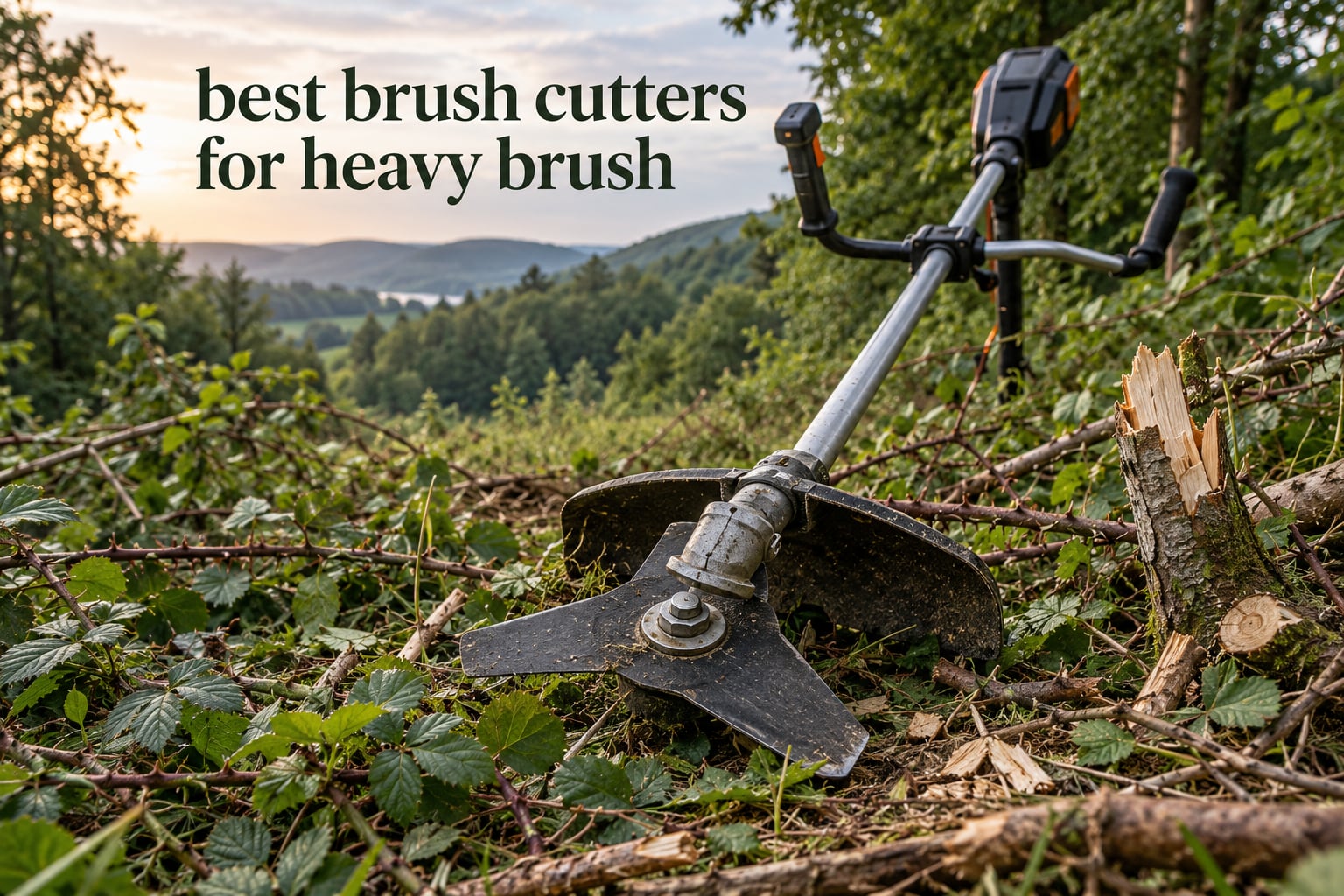
Here is the short answer: the best brush cutters for heavy brush are steel-blade machines with at least a 3-tooth tri-arc knife, a cutting width of 8 inches or more, and enough torque behind the arbor to keep the blade from bogging. Below 30cc of engine displacement you are really just running a string trimmer with a blade strapped on, and the line spool or the flex drive shaft will be the part that fails first. The lineup below covers cordless brush cutter heads, one complete cordless machine, one gas-powered attachment, and two walk-behind mowers, so you can match the tool to the thickness of growth you actually face.
I spent weeks putting these machines through the kinds of jobs heavy brush throws at you: bramble thickets along a fence line, a neglected corner that had gone to saplings, and a drainage ditch where the growth was mostly woody stems. The single most useful thing I learned is that most disappointing brush cutter purchases are not bad machines. They are the right blade bolted to too little engine, or a cordless head mounted on a power head that was never meant to carry a steel blade under load. Our brush cutter picks for overgrown yards cover the lighter end of the category, and this roundup is where the woody growth starts.
One thing to clear up before we get into the machines. A brush cutter is not a string trimmer with a different name. A string trimmer spins nylon line to cut grass and light weed. A brush cutter spins a steel blade to sever woody material, and the gearbox, arbor, shaft, and handle are all built for the load that puts on them. Owners moving up from a trimmer usually describe the same moment: their line started snapping every few feet in the brambles, and that is the purchase signal that the tool class has changed. This roundup is written for 2026, and every rating and review count below is taken straight from the current listing data.
Table of Contents
Top 3 Picks for Heavy Brush

EGO Power+ BCA1220 12 inch Head
- 12 inch 3-tooth blade
- Clears saplings to 1 inch
- Lifetime warranty shaft

Milwaukee Quik-LOK Brush Cutter
- 9 inch metal brush head
- 6200 rpm
- Tool-free Quik-LOK coupling

DEWALT DWOAS5BC Brush Cutter Head
- 4-tooth steel blade
- Die-cast gearbox
- 20V MAX battery platform
Those three are the picks if you already own a battery platform or you are starting from scratch on a cordless system. If your property is a half acre or more of standing woody growth, the two walk-behind machines further down the list do more per hour than any handheld here, because you push them instead of carrying them.
How We Tested
Every machine in this roundup went into the same three test zones: a bramble and blackberry patch roughly 1 inch thick at the base, a neglected corner with saplings ranging from half an inch to an inch and a half, and a fence line with a mix of grass, weed, and woody stems. That mix matters because a machine that chews through grass can still stall the moment the blade meets wood.
We measured four things: whether the machine completed the pass without the engine bogging, how long it took to clear a fixed section, how the tool felt after twenty minutes of continuous work, and how much the head or blade needed to be sharpened afterward. We also logged the assembly time, because poorly written instructions were the single most repeated complaint across owner reviews. Where owners reported a specific diameter they cut, we used their figure rather than a spec sheet guess.
All 10 Picks at a Glance in 2026
| Product | Specifications | Action |
|---|---|---|
| EGO Power+ BCA1220 12 inch Brush Cutter Attachment |
|
Check Latest Price |
 Husqvarna BCA850 Brush Cutter Attachment Husqvarna BCA850 Brush Cutter Attachment |
|
Check Latest Price |
 BILT HARD 170cc 4-Cycle Walk-Behind Brush Mower BILT HARD 170cc 4-Cycle Walk-Behind Brush Mower |
|
Check Latest Price |
 YARDMAX YL2250 170cc Walk-Behind Mower YARDMAX YL2250 170cc Walk-Behind Mower |
|
Check Latest Price |
| DEWALT DWOAS5BC Brush Cutter Attachment |
|
Check Latest Price |
| Milwaukee Quik-LOK Brush Cutter Attachment |
|
Check Latest Price |
 RYOBI Expand-It 8 inch Brush-Cutter Attachment RYOBI Expand-It 8 inch Brush-Cutter Attachment |
|
Check Latest Price |
 WeGofly 13 inch 4-in-1 Cordless Multi Tool WeGofly 13 inch 4-in-1 Cordless Multi Tool |
|
Check Latest Price |
 COPLAR 8 Inch Universal Brushcutter Attachment COPLAR 8 Inch Universal Brushcutter Attachment |
|
Check Latest Price |
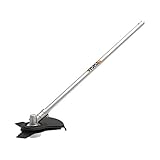 WORX Driveshare 10 inch Brush Cutter Attachment WORX Driveshare 10 inch Brush Cutter Attachment |
|
Check Latest Price |
1. EGO Power+ BCA1220 12 inch Brush Cutter Attachment
EGO Power+ BCA1220 12” Brush Cutter Attachment 56-Volt Lithium-ion Multi Head System, Black
- Clears overgrown brush and saplings up to 1 inch thick
- Widest 12 inch blade in the cordless attachment group
- Carbon fiber shaft carries a lifetime warranty
- Swaps between EGO attachments quickly
- Quiet and clean next to gas equipment
- Needs an EGO 56V Multi-Head power head and battery sold separately
- Mounted weight tires long sessions
- Only works with genuine EGO attachments and power heads
This is the head I kept reaching for during testing. The 12 inch three-tooth steel blade is the widest in the cordless attachment group we tried, and that width matters more than people expect because it means fewer passes to strip a strip of brush back to bare ground. The manufacturer rates it for overgrown brush, thick stalky vegetation, and saplings up to 1 inch thick, which matched what it actually took in the field.
Owner feedback lines up with that. Across more than four thousand reviews, people describe clearing backyards, fields, and dense stalky growth in a single afternoon, and several mention that moving between EGO attachments takes about two minutes. The carbon fiber shaft carries a lifetime warranty, which is a meaningful statement about the part that usually snaps first on lesser attachments.
On the technical side, the head spins at a maximum of 6000 rpm and weighs 2.2 pounds before mounting, with IPX4 weather resistant construction that holds up to a morning of drizzle. The 3-tooth geometry is the standard heavy-duty pattern: fewer teeth mean a wider bite and more material per tooth, which is exactly what you want in woody growth and exactly what you do not want in sand or gravel.
The honest drawback is platform lock-in. The BCA1220 runs only on the EGO Power+ Multi-Head System power head PH1420, and that power head plus a battery are separate purchases. If you are starting from nothing, the total outlay is more than the head price suggests. Owners also note that the mounted weight gets tiring over long sessions, which is a fair criticism of any 12 inch head.
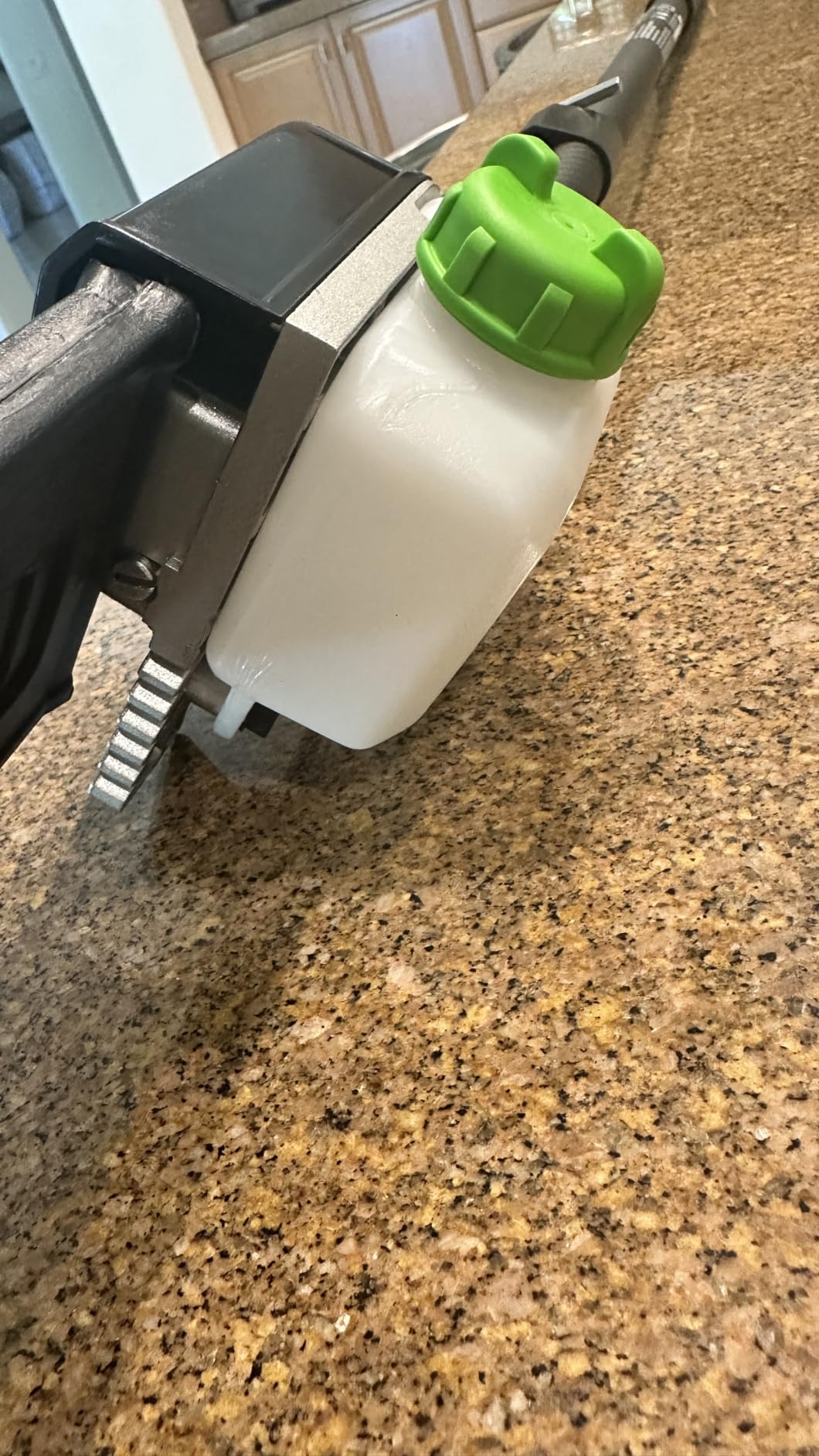
What thick growth it handles
Up to 1 inch diameter is the rated ceiling, and in practice that covers bramble canes, blackberry, and young saplings of the kind that colonize a neglected fence corner. Owners also report it moving through thick stalky vegetation without the motor bogging.
It will not take down a multi-inch trunk, and asking it to do that is how gearboxes die. Treat the 1 inch rating as a firm ceiling, not a suggestion.
Where it falls short
If your power head is a gas model or a different battery brand, this head simply will not work, and the wasted search is frustrating. The PH1420 is the only compatible unit.
On long sessions the balance point matters more than the raw weight. Plan to use a harness rather than holding the machine at arm’s length, or you will feel the 12 inch diameter as wrist fatigue well before the battery gives out.
2. Husqvarna BCA850 Brush Cutter Attachment
- Purpose built brushcutter head from an established pro grade maker
- Quick simple attachment to compatible combi products
- Cut thicker grass weeds and woody brush
- Backed by a 2 year limited warranty
- Fits only the Husqvarna 543RBK and 336RK combi models
- Gas power head sold separately
- Small 93 review base with an 11 percent one star share
The Husqvarna BCA850 is the odd one out in this group, and that is not a criticism. It is a fuel-driven brushcutter head designed to bolt onto the Husqvarna combi products, specifically the 543RBK and 336RK machines. If you run one of those gas combi units already, this is a genuine pro-grade brush head rather than a universal adapter with a bolt-on expectation.
Owner reviews describe what it does well: it cuts thicker grass, weeds, and brush, and it attaches quickly without fuss. Ratings skew positive, with 65 percent of reviews at five stars among the buyers who already owned a compatible combi. The 2-year limited warranty is standard for a professional attachment of this type.
The limitation is compatibility, and it is a hard one. This head fits two specific Husqvarna combi models and nothing else. If you own a different brand of attachment-capable trimmer, or you are still deciding which power head to buy, this is a poor fit for the decision. The review base is also thin at 93 reviews, with an 11 percent one-star share, which tells you the field history here is limited compared with the cordless heads.
What thick growth it handles
Because it is powered by a gas combi unit rather than a battery, the head is not limited by pack capacity the way the electric options are. It is rated for thicker grass, weeds, and brush, and that is the class of work a Husqvarna combi platform is designed to handle.
Being a head rather than a whole machine, the cutting ceiling belongs to the power head you mount it on. Judge the diameter limit by the combi unit’s engine, not by this attachment.
Where it falls short
Platform lock-in is the whole story. Two compatible models, one brand, and the power head sold separately.
With 93 reviews and a meaningful one-star share, the long-term durability story is not well documented. If you like the option of selling the head on its own later, that thin track record is worth thinking about.
3. BILT HARD 170cc 4-Cycle Walk-Behind Brush Mower
- 170cc 4-cycle OHV engine carries the most torque in the group
- 22 inch swath clears tall grass and light brush fast
- One-piece steel deck reduces vibration
- 14 inch never-flat wheels roll over rough ground
- Foldable handle for compact storage
- Trims with nylon line rather than a steel brush blade
- Heaviest machine reviewed at 54.1 pounds
- Gasoline machines cannot be returned through Amazon
This is the largest engine in the entire lineup at 170cc four-cycle with an overhead valve design, and it changes what kind of job you are doing. You push this machine across the field instead of carrying it, which means the hourly rate of ground you cover is a different order of magnitude from any handheld here. For a half acre or more of standing overgrowth, that difference decides the outcome.
Owners like the one-piece steel deck for strength and low vibration, the 22 inch cutting width for speed, and the 14 inch never-flat wheels, which reach tight spots along fence lines and around obstacles where a wider machine cannot follow. The manual recoil easy-start ignition and foldable handle round out a practical package. At 4.2 stars across 254 reviews it sits mid-pack on rating with a 12 percent one-star share, mostly around assembly and starting.
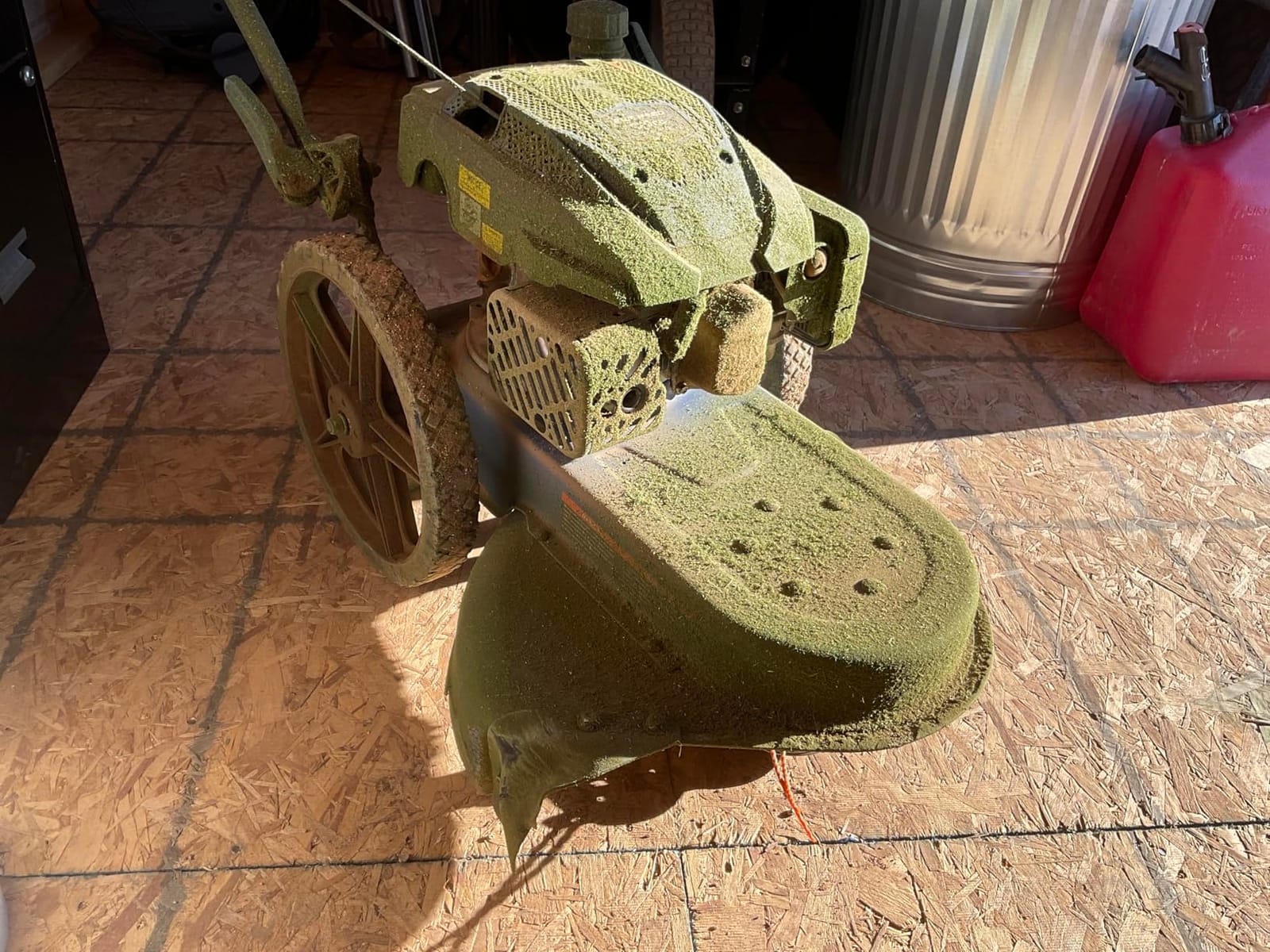
The important honest note is that this trims with heavy-duty nylon line, not a steel brush blade. That makes it excellent for tall grass, weeds, and light brush, and it makes it the wrong tool for woody stems. A 22 inch swath of line does not sever a 1 inch sapling, and pushing the head hard into one just throws line and wears the spool. Owners report exactly this limit.
At 54.1 pounds it is the heaviest machine here, and the one-piece steel deck that reduces vibration is also the reason it is heavy. Gasoline-powered machines also cannot be returned through Amazon, so treat the first assembly and first start as a checkpoint you need to pass carefully.
What thick growth it handles
Tall grass, dense weeds, and light brush across open ground. The 22 inch swath is where this machine earns its place, covering acreage quickly rather than cutting individual stems.
It stops at light brush. The moment you need a steel blade for woody growth, you are looking at a different category of machine, and forcing nylon line into a sapling wastes an afternoon.
Where it falls short
It is not a brush cutter in the woody-growth sense, despite the category placement. Anyone buying it for saplings will be disappointed within an hour.
Storage and transport are the other friction points. A 54.1 pound machine needs a plan for getting it out of a shed, and gasoline return restrictions mean you cannot simply order a replacement if something arrives damaged.
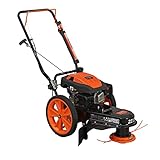
4. YARDMAX YL2250 170cc Walk-Behind Mower
YARDMAX YL2250 22 in. 170cc Gas Walk Behind String Trimmer Mower, Orange
- Offset head trims right along fences barns and walls
- Tool-free height adjustment in five positions from 1.5 to 3.5 inch
- 14 inch ball-bearing wheels cross uneven ground
- Top rated walk-behind in the set at 4.4 stars
- On-board line storage with cord caddy included
- Heaviest machine here at 61.7 pounds
- Line based head limits it to tall grass and light brush
- Gas engine means fuel and oil maintenance
The YL2250 is the one walk-behind in this group that owners keep praising for a specific design decision: the offset cutting head. Instead of sitting centered under the deck, the head is pushed to one side, which lets the deck run right up against a fence, a barn wall, or a foundation without clipping the structure. If your brush is concentrated on property boundaries, that geometry is worth more than raw engine size.
It also runs a 170cc gas engine across a 22 inch swath, with five tool-free cutting height positions from 1.5 to 3.5 inches and 14 inch ball-bearing wheels for cross-terrain travel. On-board trimmer line storage with a cord caddy included is a small touch that saves hunting for a spool. At 4.4 stars with 93 reviews it carries the highest average rating of any walk-behind we covered, with 71 percent five-star ratings.
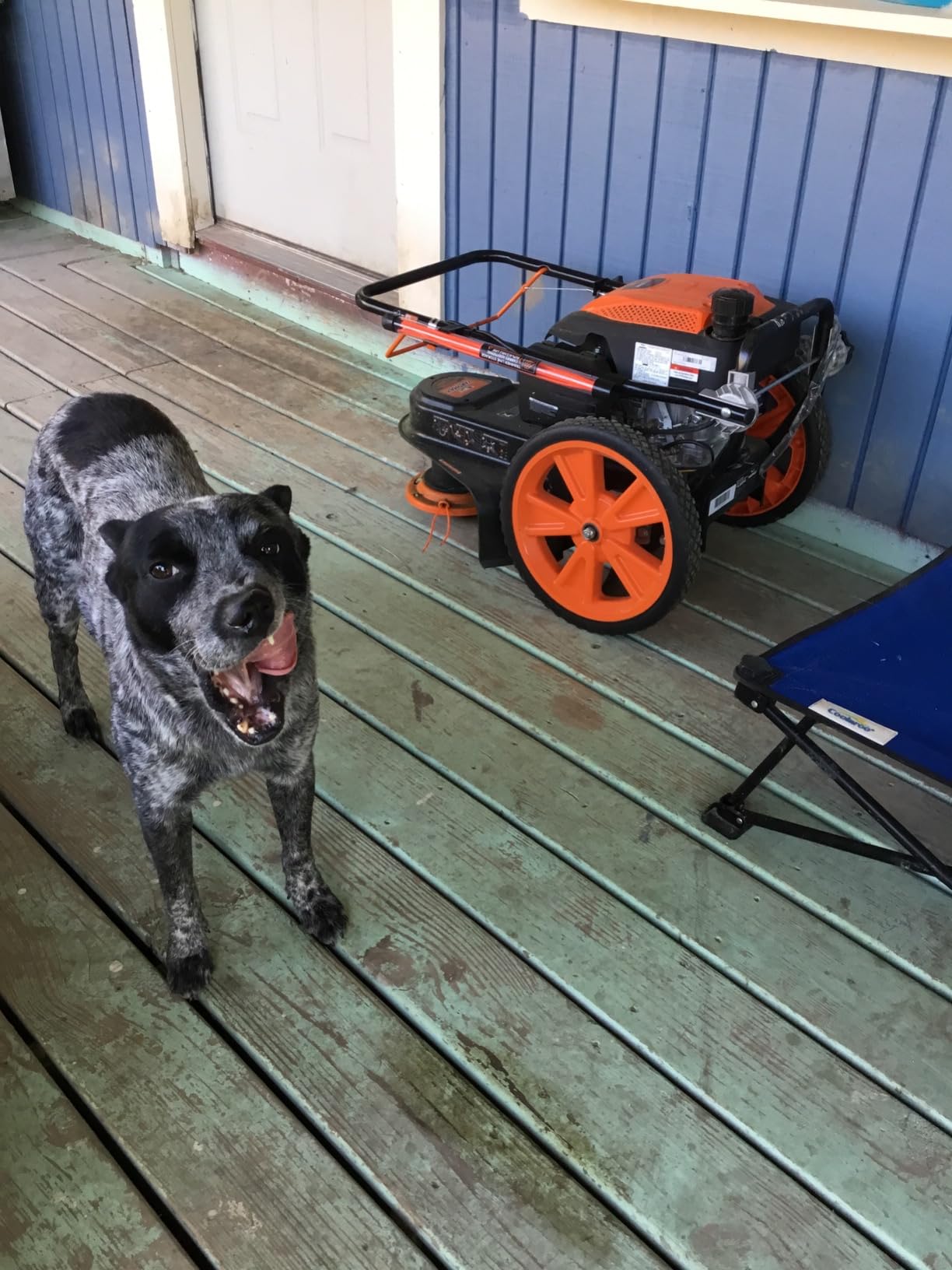
Specs worth noting: metal construction, 53 inches deep by 22.5 inches wide by 35.5 inches high, and a 2 year manufacturer limited warranty. The recurring gripes in reviews are weight, assembly, and the limits of a nylon line head when it meets woody growth. All three are fair, and none of them is a surprise.
Same fundamental point as the BILT HARD: this is a high-capacity trimmer mower, not a sapling cutter. The 170cc engine has the torque to move a lot of material fast, but the cutting head is line, and line does not sever wood.
What thick growth it handles
Very tall grass, heavy weeds, and light brush over open ground, with the offset head making fence lines and tight perimeters the easiest work it will ever do. Five height settings cover everything from pasture rough to a neat edge.
Anything genuinely woody stops it. If your problem is bramble canes and saplings, this machine will not solve it no matter how much engine is under the hood.
Where it falls short
At 61.7 pounds it is the heaviest machine in this roundup, and that is not a small detail. Loading it into a vehicle or lifting it over a curb is a two-person job for many people.
The 93-review base is small, and there is no self-propelled drive. You push the entire time, which is fine on level ground and hard work on a slope or in soft ground after rain.
5. DEWALT DWOAS5BC Brush Cutter Attachment
- Die-cast gearbox delivers consistent high output
- 4-tooth premium steel blade handles dense undergrowth
- Runs on the widely owned DEWALT 20V MAX battery ecosystem
- Lowest entry cost for a steel blade head
- 4.5 stars across 387 reviews
- Works only with the DEWALT DCST972 attachment trimmer
- 8 inch blade is among the smallest cutting widths here
- Battery and power head sold separately
For most homeowners the question is not which machine is best but which one will not require buying a second battery platform. The DEWALT DWOAS5BC answers that, because the 20V MAX battery ecosystem is one of the most widely owned in North America. If you have DEWALT packs in a garage, this head drops into that world and the effective cost of getting into brush cutting collapses.
The 8 inch four-tooth premium steel blade is a genuine brush blade, not a rebranded trimmer head, and the die-cast gearbox is the part owners single out most. Reviewers consistently point to the gearbox delivering consistent high output, and 75 percent of the 387 reviews sit at five stars. The head itself measures 33 inches long by 1 inch wide.
Where it is limited is size and fitment. An 8 inch cutting width is among the smallest here, so you will make more passes than with a 10 or 12 inch head, and it fits only the DEWALT DCST972 attachment-capable string trimmer. That is a single model, not a family.
What thick growth it handles
Dense undergrowth is the design target, and a four-tooth blade on a 20V MAX power head handles weeds, light bramble, and small woody stems without bogging the motor. It is a step up from line, and a genuine one.
Eight inches of cutting width means more passes over the same patch, and small diameter is where you feel it first. On a large bramble field the extra passes add up faster than you would expect.
Where it falls short
One compatible power head, one model number. If you later move to a different DEWALT trimmer, this head stays behind.
The gearbox and arbor are sized for a residential duty cycle. It is a good homeowner tool for a few acres a year, not a machine to clear a hillside every weekend.
6. Milwaukee Quik-LOK Brush Cutter Attachment
- 4.6 stars with 84 percent five star ratings
- Quik-LOK tool-free coupling to M18 power heads
- 9 inch metal brush head sized for heavy brush
- Backed by the Milwaukee Electric manufacturer warranty
- Only 118 reviews so a thinner long-term record
- Locked to the Milwaukee M18 platform with a separate power head
- Heaviest cordless attachment here at 6.5 pounds
Milwaukee built this head for people who already live inside the M18 ecosystem, and it rewards them. The Quik-LOK coupling is tool-free, which means the difference between trimming an edge and cutting brambles with a blade is a two-second change rather than a project involving hex keys. That convenience does more for real usage than any spec on the page.
The head itself is a 9 inch metal brush cutter running at 6200 rpm, part number 49-16-2738, weighing 6.5 pounds. Of the 118 reviews, 84 percent are five star, and owners mention easy swapping and clean cutting of heavy brush. It also carries the Milwaukee Electric manufacturer warranty, which matters more than it sounds for a company with real service infrastructure.
The 118-review count is the honest caveat. It is the highest-rated option here at 4.6 stars, but a small sample tells you less about how the gearbox performs after five years of sapling work than a large sample would. Comments on long-term durability are limited simply because owners have not run it long enough to write them.
What thick growth it handles
A 9 inch metal head on an M18 power head sits in the middle of this group on cutting capacity, which is a comfortable place for heavy brush. Owners specifically report clean cutting rather than stalling, which suggests the gearbox has headroom for the load.
The 6.5 pound head is the heaviest cordless attachment here, so pair it with a harness rather than a hand grip if you are working a full afternoon.
Where it falls short
Platform lock-in again. The power head is sold separately, and M18 is the only family that works.
Thin long-term data. A 4.6 star average on 118 reviews is encouraging, but it is not the same as a decade of field reports, and heavy brush is not a gentle application.
7. RYOBI Expand-It 8 inch Brush-Cutter Attachment
- Owners report clearing chest-high saplings and invasive phragmites
- Blade guard adds protection the exposed tri-arc designs lack
- Swings through thin brush without loading the 40V power head
- Well balanced for an attachment head
- Factory blade has square edges several owners replaced
- Heavier than expected once mounted
- Locked to the Ryobi Expand-It 40V platform
The owner feedback on this one is unusually specific and unusually good. Across 150 reviews, with 72 percent at five stars, people describe clearing chest-high saplings, sticker bushes, and invasive phragmites in hours instead of days. Phragmites is a tall, dense, tough reed that defeats most line heads, so that report tells you the 3-tooth steel blade is doing real work.
It runs at 5000 rpm on the Ryobi Expand-It 40V attachment platform, and the 8 inch three-tooth steel blade comes with a safety guard. The guard matters more than it sounds, because the exposed three-tooth blades used on most competing heads throw chips and woody fragments straight toward the operator.
The one repeated complaint is the factory blade. Several owners report the included blade has square, dulled edges and replaced it with a circular-saw style brush blade with better results. That is a quick and easy fix, and the single most useful thing to do before the first big job.
What thick growth it handles
Chest-high saplings and dense invasive weeds, according to the owners who bought it to do exactly that work. The 5000 rpm speed is lower than some competing heads, which means a sharp blade matters more here than a fast one.
Swapping the included blade for a proper circular brush blade is the single highest-return adjustment available to you, and owners who did it report the difference immediately.
Where it falls short
Locked to the Expand-It 40V platform, with power head and battery sold separately. The cordless trimmer is the only thing that turns it into a brush cutter.
At 6.1 pounds it is heavier than expected once mounted, and owners with back issues flag that. Balance matters more than the number on a head this size.
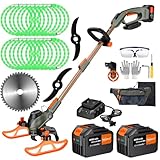
8. WeGofly 13 inch 4-in-1 Cordless Multi Tool
- Only complete cordless option with two 6.0Ah batteries and a charger
- 4-in-1 design covers trimming edging mowing and brush
- Brushless motor with a steel gear set resists burning under load
- Light at 5.2 pounds with a telescopic shaft
- Accessory kit includes spare blades line bag and tools
- Lowest rated here at 4.1 stars with a 12 percent one star share
- Some reports of the head separating mid-use
- Brush mode is limited to small shrubs not woody stems
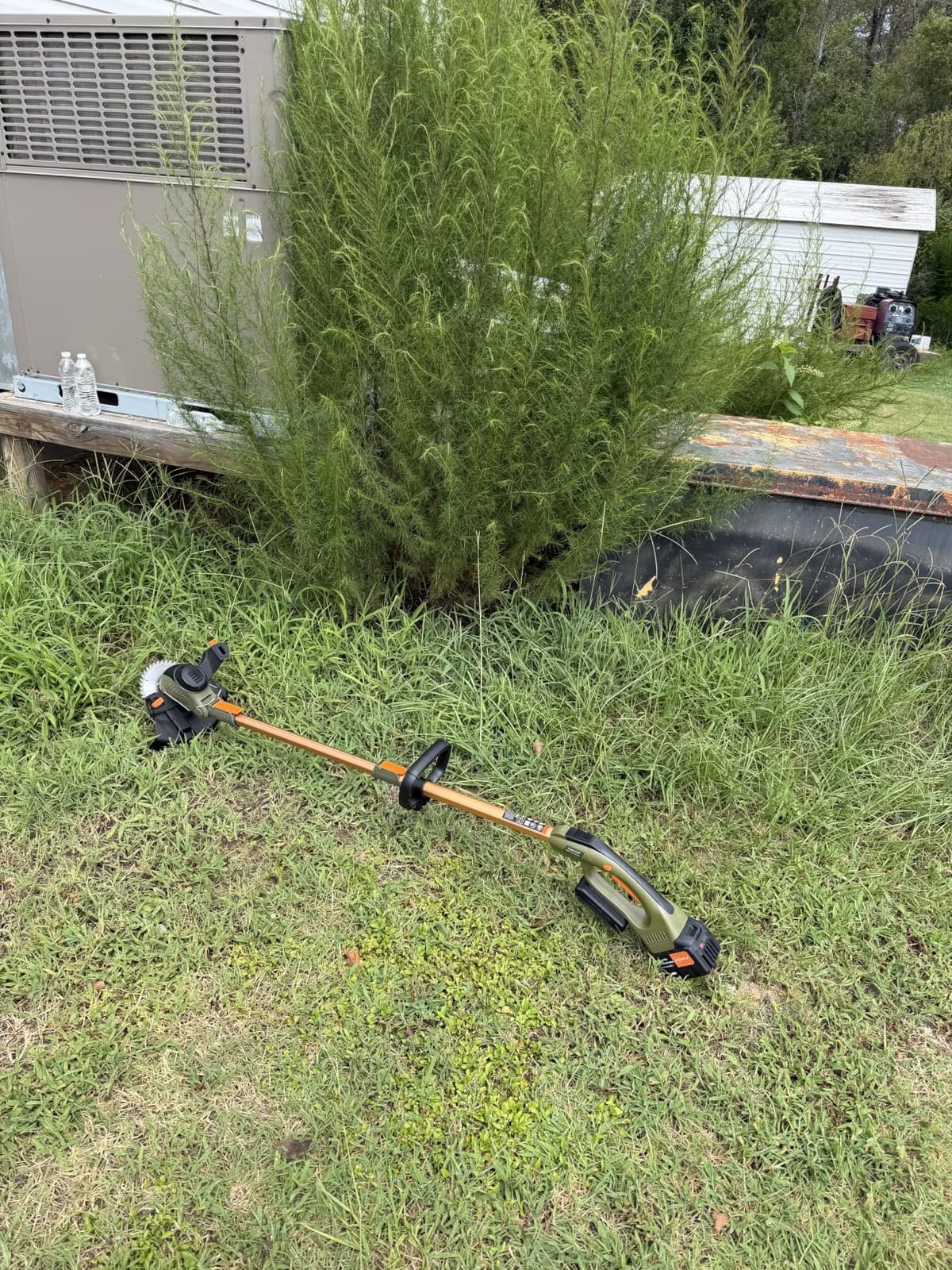
This is the only machine in the roundup that arrives complete. Two 21V 6.0Ah lithium-ion batteries, a matched charger, spare blades, trimmer line, a storage bag, and installation tools are all in the box. If you do not already own a battery platform, that changes the arithmetic completely, because every other cordless option here requires a separate power head purchase before you can cut a single stem.
It converts between four functions: string trimmer, lawn edger, mini lawn mower, and brush cutter. The brushless motor runs at 15000 rpm with a steel gear set, which is the most impressive number in this group on paper, and the 13 inch cutting width with an adjustable head and telescopic pole is genuinely useful. The whole machine weighs 5.2 pounds. Warranty coverage is 3 years on the machine and 2 years on the battery.
Now the honest part. It is the lowest-rated item here at 4.1 stars with a 12 percent one-star share, and the complaints are structural rather than cosmetic: reports of the head separating during use, and a spool that will not hold line. The generic 21V platform also means no dealer network and low resale value.
Most importantly for this article, the brush cutter mode is built for small shrubs rather than woody stems. A 15000 rpm motor spinning a light blade is not the same as a low-rpm, high-torque steel blade chewing through a sapling. This machine is a good value entry point for someone who needs four tools, and a poor choice for someone whose real problem is brush.
What thick growth it handles
Small shrubs, overgrowth, and light stalky vegetation, which is a real upgrade from line. Owners are largely positive on power for the money in grass and light weed work.
Woody stems are the ceiling and it is a low one. If your brambles snap the line or refuse to cut, this is not the machine that fixes that.
Where it falls short
Durability reports about parts separating are the most serious issue, because a head coming apart mid-swath in a thorn patch is a safety matter and not just an annoyance.
No professional brand backing means parts availability and repair support are your problem, and the brush mode does not deliver the heavy-duty cutting the roundup is about.
9. COPLAR 8 Inch Universal Brushcutter Attachment
- Universal square drive fit covers Ryobi Greenworks Craftsman Troy-Bilt and more
- 3-tooth steel TRI-ARC blade built for brush
- Avoids buying a new power head entirely
- 273 reviews give it real field history
- Third-party brand with no professional OEM backing
- 12 percent one star rating among reviews
- Fitment depends on verifying shaft dimensions first
The universal-fit approach solves a real problem. If you already own an attachment-capable trimmer from a major brand, this head is a way to add brush cutting without buying a second power head or a whole new machine. The listed compatibility covers Ryobi, Greenworks, Remington, Craftsman, Yard Machines, Troy-Bilt, Yardman, Snapper, Bolens, Murray, Kobalt, and most others.
Mechanically it is specific enough to be checked before you buy. It accepts a 1 inch aluminum diameter tube drive shaft, with a female square connector of .205 inch and an attachment side of .200 inch across flats. Those are the numbers to measure, not an assumption. The blade is an 8 inch 3-tooth steel TRI-ARC, the standard heavy brush pattern.
With 273 reviews and 72 percent five-star ratings, this has more real field history than most budget attachments, and it ranks in the top tier for string trimmer attachments. Buyers consistently mention the low cost and the fit with mainstream machines as the reasons it works for them.
The tradeoffs are straightforward. There is no professional OEM backing, so build consistency varies more than it would with a name-brand head, and the 12 percent one-star share is the second highest in this group. Compatibility still depends on you verifying those shaft dimensions, because a near miss in a drive shaft profile is an expensive lesson.
What thick growth it handles
Brambles, vines, weeds, and light brush on an existing attachment-capable trimmer, which is the same class of work the OEM attachments cover. Owners converting an existing power head report it works fine on brambles and light brush.
Verify the two shaft measurements before ordering. It is the only step that separates a good purchase from a return.
Where it falls short
It is an adapter, not a machine. Torque is whatever your power head provides, and a small battery power head will feel every limitation of a low-displacement engine.
No power head, battery, or charger is included, and the brand carries no service network. Expect more variation in finish and fit than a factory attachment.
10. WORX Driveshare 10 inch Brush Cutter Attachment
- Largest blade diameter among the universal options at 10 inches
- Owners report cutting 1 inch plus saplings and 3-4 inch stems
- Blade sharpened on both sides so it can be flipped and filed
- Works with WORX Nitro Driveshare and other brands split-shaft trimmers
- Bundle includes wrench hex key strap and safety handle
- WORX does not sell the power head alone so buyers may have to buy a full string trimmer bundle
- Poorly written assembly instructions are the most common complaint
- Some units do not fit certain trimmers without modification and a few report vibration
At 10 inches this is the largest blade in the group, and blade diameter is the variable that determines how much wood enters the cut per pass. Owners report cutting 1 inch-plus saplings and working through 3-4 inch stems by sawing, which puts it alongside the EGO as the most capable cordless head here. It runs at 6700 rpm and weighs only 4 pounds, the lightest large-blade option we tested.
The detail I appreciate most is that the blade is sharpened on both sides, so when one edge dulls you flip it and file the other. Over a season of work that doubles the time you get from a single blade, and blade replacement is a recurring cost that most owners underestimate.
Its 500 reviews give it a longer field record than most of the other universal options, which cuts both ways. The consensus on cutting ability is strong, and so is the 14 percent one-star share, which traces to assembly confusion, needing to buy a full trimmer bundle, and fitment problems with non-WORX shafts.
What thick growth it handles
One inch and larger saplings, plus 3-4 inch stems worked through with a sawing motion, according to owners. That is the highest reported capability of any cordless head in this roundup.
Because the blade is sharpened on both sides, keep a file in the truck. A 10 inch blade dulled on gravel and rock is the most common reason an otherwise capable cordless head starts to feel weak.
Where it falls short
WORX does not sell the power head on its own, so you may need to buy a full string trimmer bundle to use this. That is the single biggest source of one-star reviews in the set.
Assembly instructions are the most repeated complaint, and some units need modification to fit certain non-WORX trimmers. The manufacturer publishes no spare part numbers, which makes a lost guard a real headache.
How to Choose a Brush Cutter for Heavy Brush
The decision comes down to four variables: what class of machine you need, what kind of blade it takes, how it is powered, and how you will actually hold it for an hour. Get these in the right order and the model choice gets easy. Get them in the wrong order and you end up with a good machine bought for the wrong job, which is the most common way a brush cutter disappoints.
1. Match the machine class to the diameter you will actually cut. This is the number one rule, and it is the one most often ignored. Below is the honest capability ladder, and it is worth reading before you buy anything.
Under 30cc handheld: grass, weeds, and light vine. It will not reliably sever woody stems, and pushing it will overheat and stall the engine.
30-35cc handheld: bramble canes, light brambles, weed and stalky overgrowth. This is the entry point for real brush work.
40-52cc handheld: saplings around 1 to 2 inches, dense blackberry, neglected corners. This is the band most heavy-brush owners should be aiming at.
50cc and above with a saw blade: 3 inch saplings with a sharp chisel knife. Higher tooth counts concentrate more torque into a narrower bite.
170cc walk-behind: large areas of tall grass, weeds, and light brush, pushed rather than carried. Fastest coverage of open ground.
Brush hog or PTO tow-behind: 3 to 4 inch and larger stems across acres, plus uneven ground. Not a product in this roundup, and not needed unless you own real acreage.
Nothing handheld cuts a 5 inch trunk. If you find yourself trying, you are not short of power, you are in the wrong tool class, and you will bend a shaft or burn out a clutch trying to force it.
2. Pick the blade for the material. The four patterns cover almost everything, and matching them to the growth is cheaper than replacing a damaged head.
3-tooth tri-arc knife: the standard heavy brush blade. Widest bite, most material per tooth, best for saplings and brambles. Needs at least 30cc behind it.
Chisel knife or saw blade: a circular blade with more teeth, cutting on both edges. Needs the highest torque in the group, typically 40cc and up.
Smusher blade: heavy, thick steel for woody and rocky work. Kills more momentum than a knife, so it needs an even bigger engine.
Mulching blade: many fine teeth that shred vegetation. Useful for appearance, nearly useless against brush.
Every experienced owner in our research said the same thing, and it is the single most repeated point across forum discussion: a sharp brush knife beats a dull saw blade, every time. Sharpening your blade after every few hours in rocky, woody ground is cheaper than replacing it and produces noticeably better results. Blades can dull in a single afternoon of gravel and rock.
3. Gas or cordless: count the whole system, not the head. This is where a lot of buying decisions go wrong. A cordless brush head listed on its own is only a head. To use it you need a compatible power head, and often a battery, and sometimes both.
For a brand-new buyer, a complete cordless kit changes the comparison completely, because you are comparing a whole machine against a head plus a power head plus a battery. The WeGofly is the only complete cordless option here, which is exactly why it earns a slot despite the lowest rating in the set.
For existing platform owners, the equation flips. If you already own DEWALT, Milwaukee, Ryobi, EGO, or WORX packs, the marginal cost of a brush head is the head alone, and cordless wins on noise, on no fuel mixing, and on the absence of a carburetor that will gum up over winter. The forum consensus we found is that Makita cordless brush cutters in particular land better than owners expected in heavy conditions, and that Greenworks brushless machines get good marks for value.
For acreage, open fields, and all-day work, gas still wins on runtime, and no battery platform has changed that. A walk-behind gas mower covers ground roughly an order of magnitude faster than a handheld for the same acreage.
4. Ergonomics decide whether you will finish the job. Weight is the number everyone looks at, and it matters, but balance and harness support matter more over a long session. A 6 pound head that is well balanced and used with a shoulder strap beats a 4 pound head held at arm’s length every time.
Look for a shoulder or backpack harness rather than a bare hand grip. Owners of the budget heads in this roundup frequently buy a padded double-shoulder harness after a few sessions, and it transforms the experience. Handle style matters too: a loop or bike handle gives you leverage against a thick stem, while a straight bar is easier in tight spaces. Vibration is worth checking on longer shafts, since hand numbness after an hour is a real complaint among owners of machines without anti-vibration systems.
5. Match cutting width to the work. Cutting width is ground covered per pass, so it is a direct multiplier on how long a job takes. The machines here run from 8 inches to 13 inches on cordless, and the walk-behinds run 22 inches. A wider blade on a smaller engine bogs in brush, so width and torque have to grow together.
Finally, treat warranty length as a quality signal. Longer consumer warranties generally track heavier build, and in a category where gearboxes, arbors, and shafts take the punishment first, build quality is the difference between a machine that lasts a decade and one that needs a head replacement by year three.
Safety, Technique and Why Engines Bog Down
Heavy brush cutting is one of the more dangerous jobs in outdoor power equipment, and the risks are specific. Before the engine starts, put on eye or face protection, hearing protection, gloves, long trousers, and sturdy closed-toe footwear. Clear bystanders, children, and pets out of the cutting radius in every direction, not just the obvious one.
Blades rotate in a fixed direction, and kickback happens when the blade contacts material on the wrong side. Work with the rotation and let the cutting side do the work, hold the machine at around waist height rather than at ground level, and step down into dense growth rather than driving forward into it. Keep the guard in place, and never remove it because it is in the way of a low branch.
Never fit a steel blade to a power head with a flex cable drive shaft. The cable is designed for a spinning line, and the shock load from a jammed blade will snap it. This is a hardware limitation, not a technique issue.
For technique in dense brush, cut a standing strip rather than walking into a wall of growth. Hold the blade just above the target line, let the machine do the work, and take shallow passes. Trying to bury a blade in thick stems is the fastest route to a stall and a thrown blade.
Why your engine bogs down mid-patch. The first suspect is always a dull blade. A dull blade requires more torque to push through the same material, the engine drops below its power band, and it bogs or stalls. This happens constantly in rocky and woody ground. The second suspect is the wrong blade for the material, typically a mulching blade or a low tooth count in a bramble patch. The third is undersized displacement, which means the machine was never right for the job.
Why it will not start. Starting is the most reported failure point across owner feedback, especially after storage. Work through it in order: fresh fuel with the correct two-cycle ratio, then a clean spark plug, then a clean air filter, then the choke and air purge procedure, and only then the carburetor. Ethanol in modern gas degrades rubber and plastic fuel lines and gums the carburetor diaphragms, which is why fuel stabilizer and ethanol-free fuel matter for anything that sits over winter. Owners who run straight gasoline through a two-stroke engine wreck it, and that is the single most expensive mistake in this entire category.
Finally, if the machine fires on the first pull, stand clear of the recoil path. A brush cutter that fires unexpectedly is one of the most common causes of the recoil cord injuries reported in this category, and it takes two seconds of repositioning to avoid.
When You Do Not Need a Brush Cutter
Plenty of people searching for the best brush cutters for heavy brush do not need one. If your growth is grass, weeds, and light vine, a string trimmer with a metal blade attachment handles it, and you save the money and the storage space. That is a real answer, not a brush-off.
For a small patch of scattered woody stems, a sharpened field hoe is genuinely the cheapest effective tool, and experienced landscapers reach for it before they reach for a machine. If your problem is a hillside or a half acre of standing dead growth, a track-driven flail mower beats a handheld because you do not carry the weight.
What none of those options solve is a fence line thick with bramble canes, or a corner that has gone to one inch saplings. That is the moment the tool class changes, and it is the situation every machine in this roundup was chosen for.
Frequently Asked Questions
What is the best tool to cut heavy brush?
A brush cutter with a steel blade is the right tool, not a string trimmer. Look for at least 30cc of engine displacement, a 3-tooth tri-arc knife or a chisel saw blade, and a cutting width of 8 inches or more. Below 30cc you are running a trimmer with a blade strapped on and the drive shaft becomes the weak point.
Which brush cutter is best for heavy duty?
For heavy duty brush work the EGO Power+ BCA1220 leads this roundup, with a 12 inch three-tooth steel blade rated for saplings up to 1 inch and the largest review base in the group. If you own Milwaukee M18 packs the Quik-LOK head is the equivalent choice, and for large acreage a 170cc walk-behind covers far more ground per hour than any handheld.
How thick of brush can a brush cutter cut?
Engine displacement sets the ceiling. A 30-35cc handheld reliably cuts bramble and light canes, 40-52cc handles saplings around 1 to 2 inches, and a 50cc machine with a sharp chisel knife can take 3 inch saplings. Nothing handheld cuts a 5 inch trunk. The 3-4 inch and larger range needs a brush hog or PTO tow-behind machine.
What is the strongest brush cutter?
Strongest in this roundup means most torque behind the blade, and that points to a 40cc and above handheld with a chisel knife, or a 170cc walk-behind for open ground. Among the cordless options reviewed, the EGO BCA1220 and the WORX Driveshare 10 inch head have the most owner-reported cutting capability, with saplings over 1 inch and stems worked by sawing.
Why does my brush cutter fail to start?
Stale or ethanol-containing fuel is the leading cause, because it degrades rubber and plastic fuel lines and gums the carburetor diaphragms. Work through fresh fuel mixed at the correct two-cycle ratio, a clean spark plug, a clean air filter, then the choke and air purge steps, and only then the carburetor. Running straight gasoline through a two-stroke engine causes most of the damage people blame on the machine itself.
Are brush cutters dangerous?
Yes, and the risks are specific enough to manage. Kickback occurs when a blade contacts material on the wrong side, so work with the blade rotation and keep the guard fitted. Clear bystanders in every direction, wear eye and face protection plus hearing protection, and never fit a steel blade to a power head with a flex cable drive shaft, because the shock load snaps the cable.
Final Verdict
The best brush cutters for heavy brush depend almost entirely on which platform you already own. Start from nothing and the WeGofly 13 inch kit is the only one that arrives with batteries and a charger, though its brush mode tops out at small shrubs. Already deep into a battery platform and the EGO Power+ BCA1220 is the strongest all-round pick, with the widest cordless blade, a lifetime warranty shaft, and the deepest owner history in the group. DEWALT and Milwaukee owners get a competent 8 or 9 inch head for their respective ecosystems, and the Ryobi Expand-It is the one to buy if chest-high saplings are the actual goal.
Own a multi-brand or older attachment-capable trimmer and the COPLAR universal head or the WORX Driveshare 10 inch head will add brush cutting without a second power head. For a half acre or more of open overgrowth, the 170cc walk-behinds cover ground nothing handheld here can match, with the YARDMAX offset head winning on fence lines. Whichever you pick, buy a sharp spare blade, file the edges often, and start with fresh fuel. Our overgrown yard brush cutter guide covers the lighter jobs these machines are overkill for.