
Quick Answer: The hOmeLabs 50-Pint unit with a built-in pump is the best dehumidifier for mold prevention we tested, and it is the only one in this group that combines 50 pints per day, continuous drainage and app control. Set the humidistat to 50% relative humidity for a damp basement, 45% for a crawl space, and stay under 60% everywhere.
Mold needs one thing to grow: sustained moisture on a surface. Pull the relative humidity in a room below 60% and you remove that condition, which is why dehumidification stops mold problems before a remediation bill ever arrives. Every unit below does that job, but they differ sharply on the three things that decide whether you keep running one: how much water they pull, how the water leaves the tank, and how quiet they are while they do it.
We compared 10 dehumidifiers on published AHAM-style capacity ratings, tank volume, drainage options, noise figures and the failure patterns owners actually report. The short version is that capacity beyond about 50 pints per day rarely matters unless your space is genuinely wet, while drainage setup matters every single day. Owners who switched from a bucket to a drain line or built-in pump call it the biggest quality-of-life change in the whole category.
If your problem is airborne rather than surface-level, our guide to the best air purifiers for mold covers the other half of the job. Dehumidification removes water, purification removes spores already in the air, and a damp space needs both.
Table of Contents
Top 3 Dehumidifiers for Mold Prevention in 2026

hOmeLabs 50 Pint with Pump
- 50 pints/day at 80F/60%RH
- Covers 7500 sq ft
- Built-in drain pump
- Wi-Fi app control
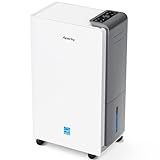
AEOCKY 80 Pint ENERGY STAR
- 80 pints/day at 95F/95%RH
- ENERGY STAR Most Efficient 2025
- 5500 sq ft
- 44 dB lowest fan speed

Yaufey 150 Pint with Pump
- Up to 150 pints/day
- 8500 sq ft coverage
- Pump
- tank and gravity drainage
- 1.85 gallon tank
Quick Overview: All 10 Dehumidifiers for Mold Prevention in 2026
| Product | Specifications | Action |
|---|---|---|
| hOmeLabs 50 Pint with Pump |
|
Check Latest Price |
| AEOCKY 80 Pint ENERGY STAR |
|
Check Latest Price |
| Yaufey 150 Pint with Pump |
|
Check Latest Price |
 Midea 22 Pint Wi-Fi Midea 22 Pint Wi-Fi |
|
Check Latest Price |
 Kesnos 30 Pint Kesnos 30 Pint |
|
Check Latest Price |
 VEAGASO 34 Pint VEAGASO 34 Pint |
|
Check Latest Price |
 KNKA 80 Pint ENERGY STAR KNKA 80 Pint ENERGY STAR |
|
Check Latest Price |
 Waykar 150 Pint Commercial Waykar 150 Pint Commercial |
|
Check Latest Price |
 GoGuess 21 Pint Compact GoGuess 21 Pint Compact |
|
Check Latest Price |
 Trazico 21 Pint Trazico 21 Pint |
|
Check Latest Price |
What a Dehumidifier Can and Cannot Do About Mold
Yes, dehumidifiers work to prevent mold, but only the growth that depends on ambient moisture. Holding a room at 50% relative humidity takes away the water film mold spores need to germinate on drywall, wood and grout, and the EPA’s guidance is to keep indoor relative humidity in the 30-50% band for exactly this reason.
No, a dehumidifier will not take away mold you already have. Existing colonies are attached to porous material, and the only reliable removal is physical: dry it, contain it, or have it professionally remediated. Running a unit in a room with visible growth slows new spread, but it does not clean what is there, and stacking more units in an infected room without fixing the moisture source just dries the surface.
Here is the more useful point for anyone with a recurring problem. A dehumidifier adds no fresh air. In an unvented basement or sealed crawl space it can raise carbon dioxide and other indoor pollutants while lowering humidity, so pair it with a transfer fan or mechanical ventilation rather than treating it as a complete indoor-air solution.
And it does not touch the root cause. Water coming through a foundation wall, soil sloping toward the house, a missing vapor barrier or a leaking supply line will keep every unit you own running at full tilt. Fix the source first, or the compressor pays for the mistake twice.
1. hOmeLabs 50 Pint with Pump – Best Overall for Mold Prevention
hOmeLabs Dehumidifier 7,500 Sq Ft 50 Pint with Pump 120 Pint 95°F, 90% RH
- 50 pints per day rated capacity
- Built-in pump for continuous drainage
- Digital humidity readout with app control
- Covers up to 7500 sq ft
- Automatic defrost and washable filter
- Bulky 30.5 pound body limits portability
- Higher power draw than smaller certified units
This is the unit we kept coming back to. At 4.6 stars across more than 15,000 reviews it carries the strongest combination of capacity and owner satisfaction in the group, and the 50 pints per day rating at 80F and 60% relative humidity is measured at realistic basement conditions rather than the flattering 95F test every listing uses.
The built-in pump is the reason it wins. Water leaves through a drain line instead of a bucket, so there is nothing to remember at 2am in a damp basement with no floor drain. Owners on r/HomeImprovement single out the hOmeLabs pump-equipped line for the same reason, describing continuous drainage as the feature that made the difference between a unit they tolerate and one they leave running.
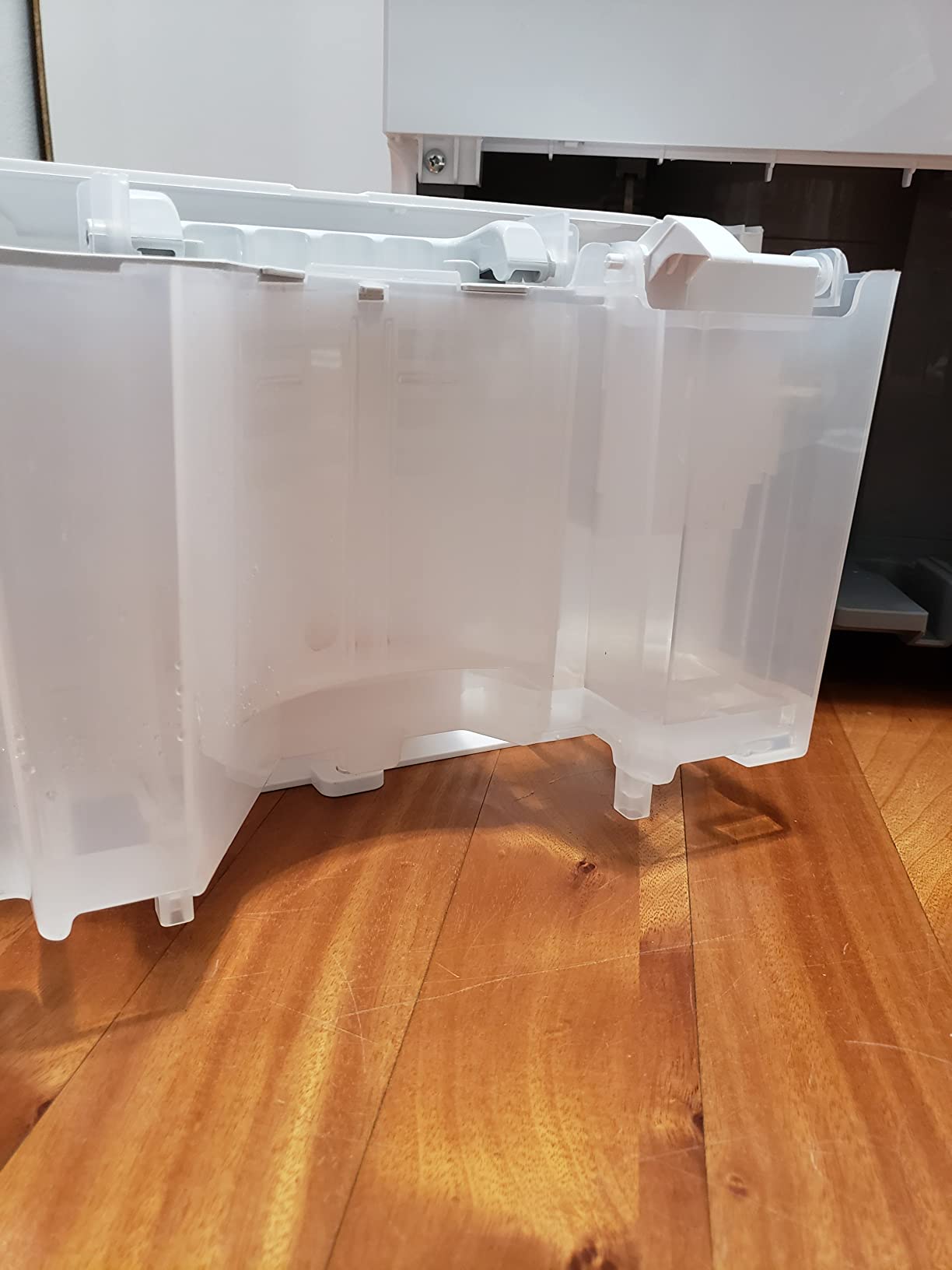
The second pump-equipped option here is the Waykar, but this one covers more floor area at 7500 sq ft against 7000 sq ft, and it weighs 30.5 pounds against 38.6 pounds. Both reach a 1.6 to 1.85 gallon tank, which becomes irrelevant once you plumb a hose to it.
Three fan speeds, a Comfort and Turbo mode pair, a 24-hour timer and a filter-check indicator cover the automation most people want. The digital panel and Wi-Fi app let you watch relative humidity drop without walking downstairs, and on r/HomeImprovement owners of this line cite app control as a meaningful part of the package.
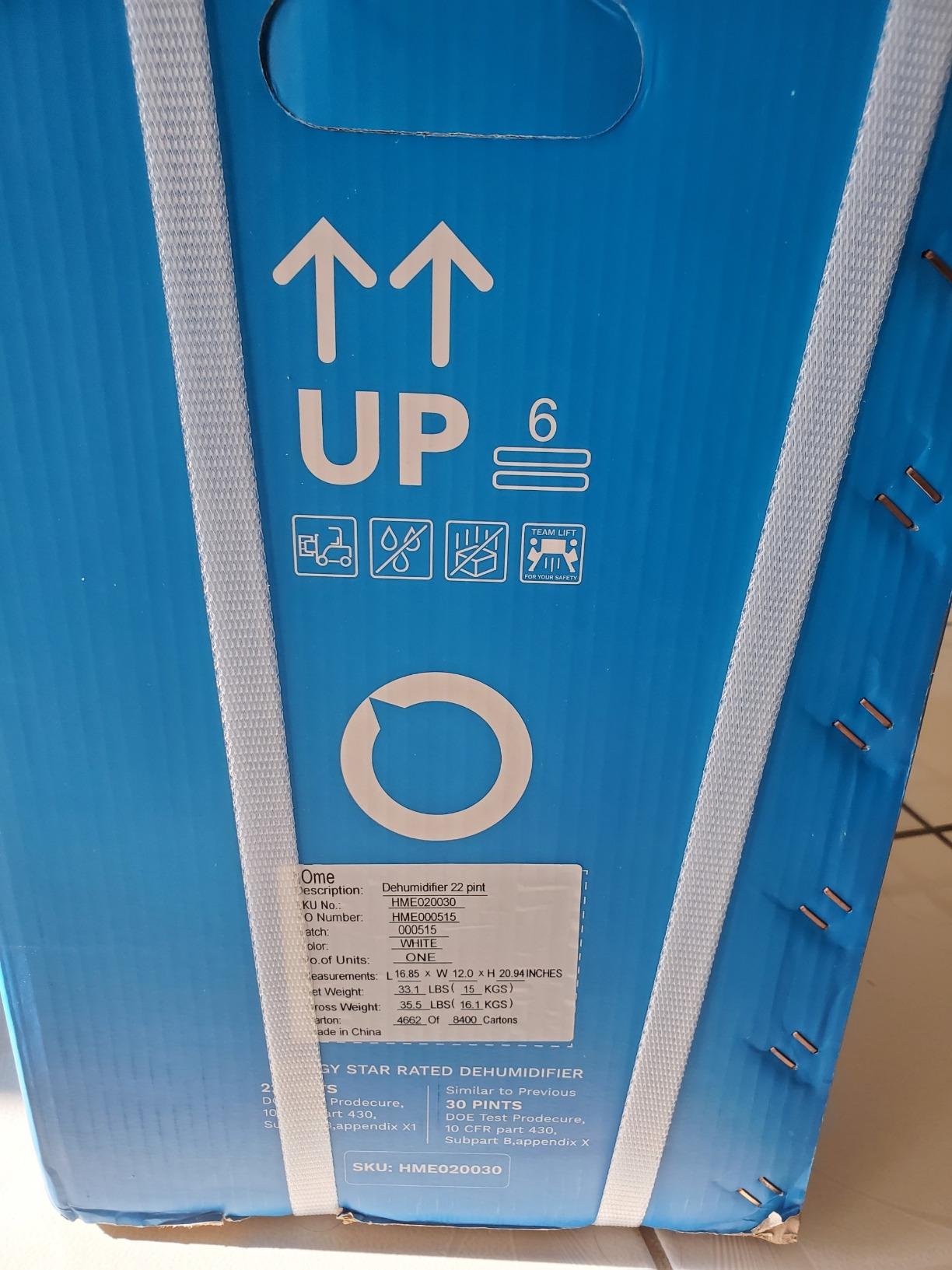
Mold performance you can actually measure
Pull 50 pints a day at standard conditions, and a 1000 sq ft basement with damp air has plenty of work to give it. Expect the humidistat to cycle often in the first two weeks and then settle into short bursts once the room reaches its setpoint.
The 120-pint maximum at 95F and 90% relative humidity is the useful number after a rain event, when outdoor air arrives loaded and the unit has to catch up rather than maintain.
Where the design annoys people
Thirty pounds is a real weight when the job moves from basement to laundry room, and the recessed handle helps but does not make it a one-person lift. Power draw is higher than the ENERGY STAR-certified units in this roundup, so annual electricity cost is a genuine trade against the quieter, smaller machines.
You are also buying a pump, a compressor and an app for one device, and compressor longevity is the top complaint in this category. Budget for a replacement conversation in year three to five rather than assuming decade-long service.
2. AEOCKY 80 Pint – Most Efficient Compressor in the Group
AEOCKY 5500 Sq.Ft Energy Star Most Efficient 2025 Dehumidifier Max 80Pint/D
- ENERGY STAR Most Efficient certification
- 44 dB at lowest fan speed
- Defrost sensors for cooler rooms
- Five operating modes
- Three-year coverage
- 1.45 gallon tank needs constant attention without a drain line
- Certification claims hard to verify from the listing
If your priority is holding humidity down on the lowest possible electricity bill, this is the unit. It carries ENERGY STAR Most Efficient certification for the current cycle and draws 280 watts, which is less than half the draw of the 520-watt commercial unit at number eight while claiming comparable raw capacity.
The rated numbers are 80 pints per day at 95F and 95% relative humidity, and 56 pints per day at 86F and 80% relative humidity. That second figure is the honest one for a warm damp basement and it puts this machine ahead of several units that advertise only the flattering number.
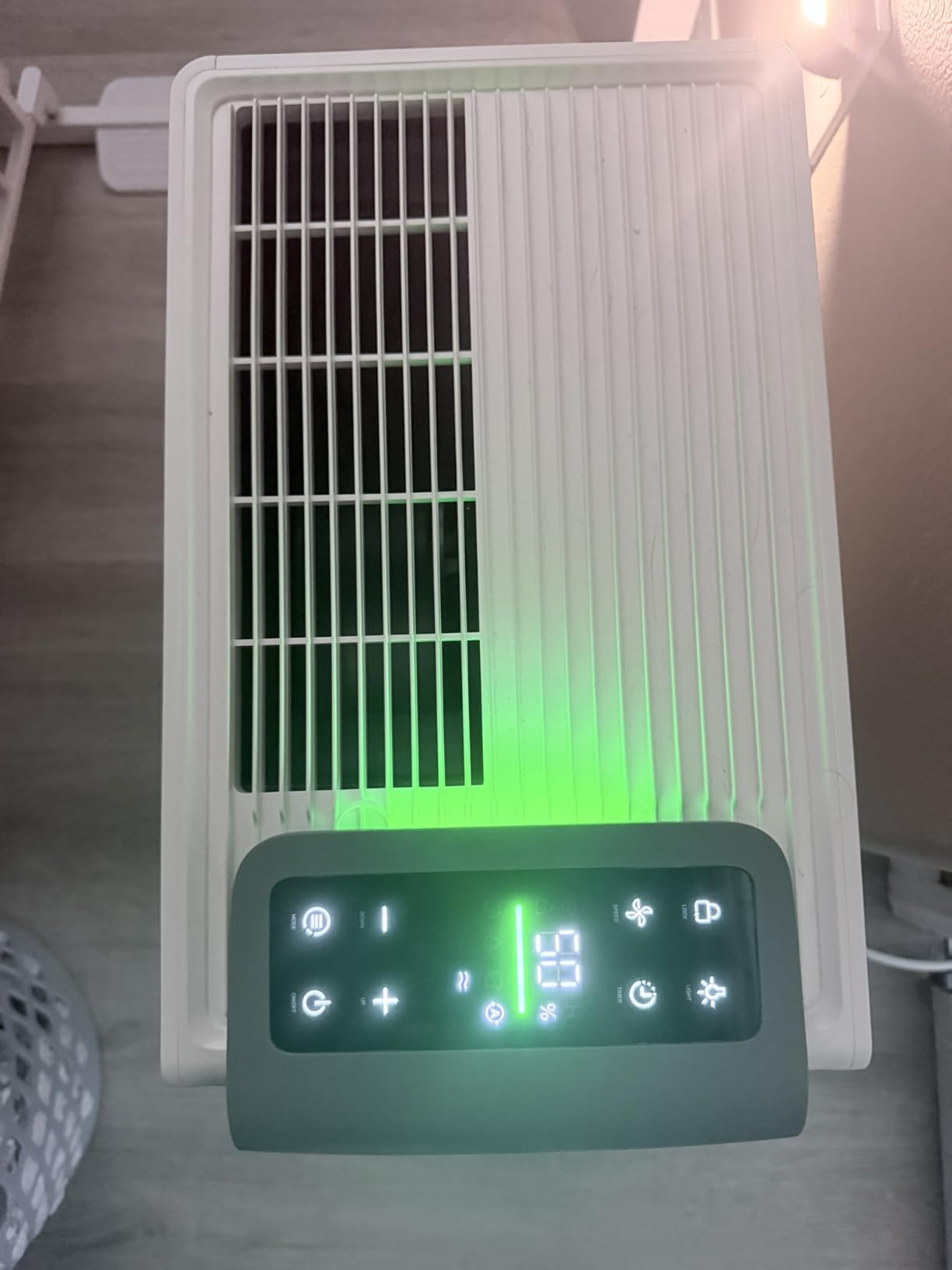
Defrost sensors let the coils keep working as room temperature drops, which matters if your basement sits in the low 60s for part of the season. Hydrophilic coil coating is a detail most listings omit, and it does help the evaporator shed condensate without hard icing.
Five modes cover auto, constant humidity, continuous, smart drying and sleep. The 44 dB lowest fan speed is among the quietest figures in this roundup, which makes the unit usable in a finished basement or bedroom where a 50 dB machine would be exhausting.
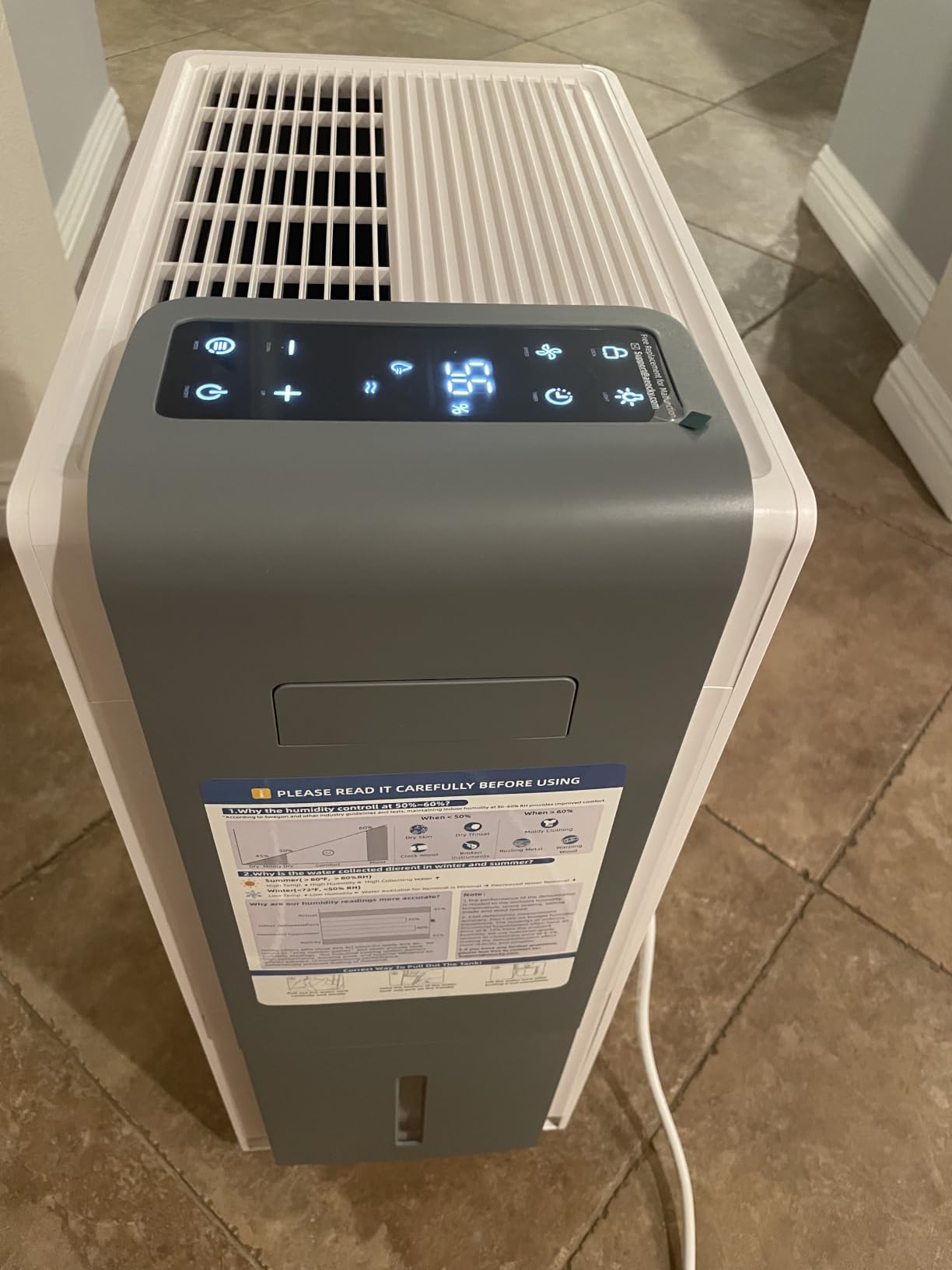
Why the efficiency rating matters for mold control
A dehumidifier in a damp basement runs more hours than most people expect. Pulling a watt-hour back off the compressor every hour compounds into the largest single lever on your annual running cost, and this unit has the strongest certified efficiency claim here.
Owners report large humidity reductions within a few hours of switching it on in genuinely damp rooms, which is the fastest visible result of any machine at this capacity level.
What to watch before you buy
The 1.45 gallon tank is the weak point. Without a drain hose it needs emptying more than once a day in humid conditions, and the frustration of that is the single most common complaint in the reviews for this unit.
The certification is worth believing but not worth trusting blindly. The listing leans heavily on marketing language, so treat the ENERGY STAR claim as a starting point and verify the listing if efficiency is your deciding factor.
3. Yaufey 150 Pint with Pump – Most Capacity and Three Drainage Routes
- Highest rated capacity in the group at 150 pints per day
- Three drainage options including upward pump
- Covers 8500 sq ft
- Humidity range adjustable in 5% steps
- Heaviest unit at nearly 40 pounds
- 500 watt draw is the highest among the picks
This is the pick when the space is big and genuinely wet. At up to 150 pints per day at 95F and 90% relative humidity, it is the highest rated capacity we found, and forum users with large basements consistently advise sizing up rather than down when the alternative is a unit that runs nonstop and never reaches its setpoint.
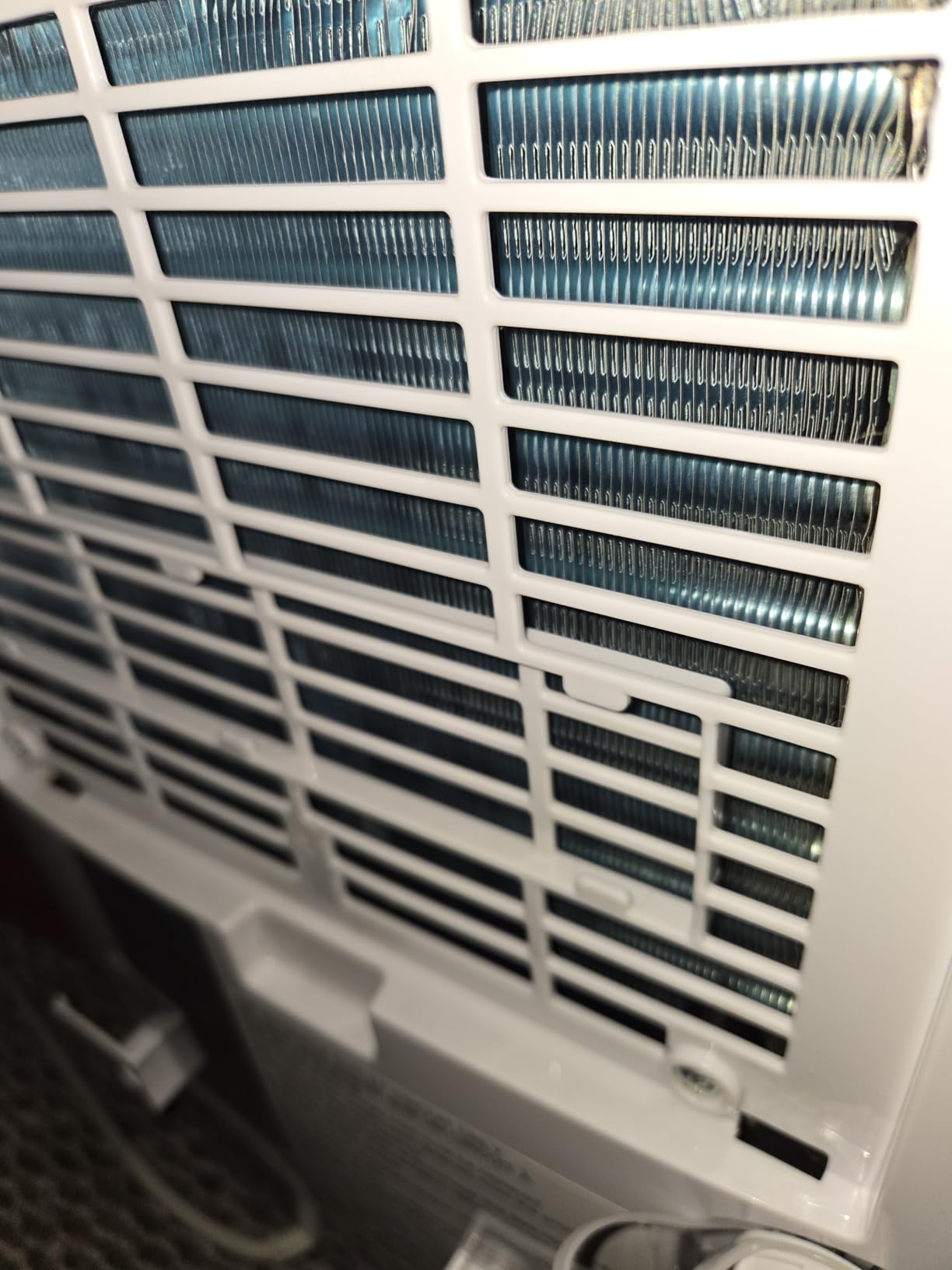
Drainage is the standout feature. You get upward pump discharge through a 16.4 ft hose, gravity drainage through a separate 3.28 ft hose that fits a garden hose, or the 1.85 gallon tank. Most large-capacity competitors force you to pick one method; this one lets you change your mind later without buying a new machine.
Three presets target different jobs: Living Area holds 50% relative humidity, Basement holds 45%, and Continuous runs without cycling. That basement preset is a sensible starting point for mold prevention since it sits below the 60% threshold on its own.
The swing louver spreads air across the room rather than blasting one wall, and temperature and humidity sensors with memory restart mean the unit picks up where it left off after a power outage without you walking downstairs to reset it.
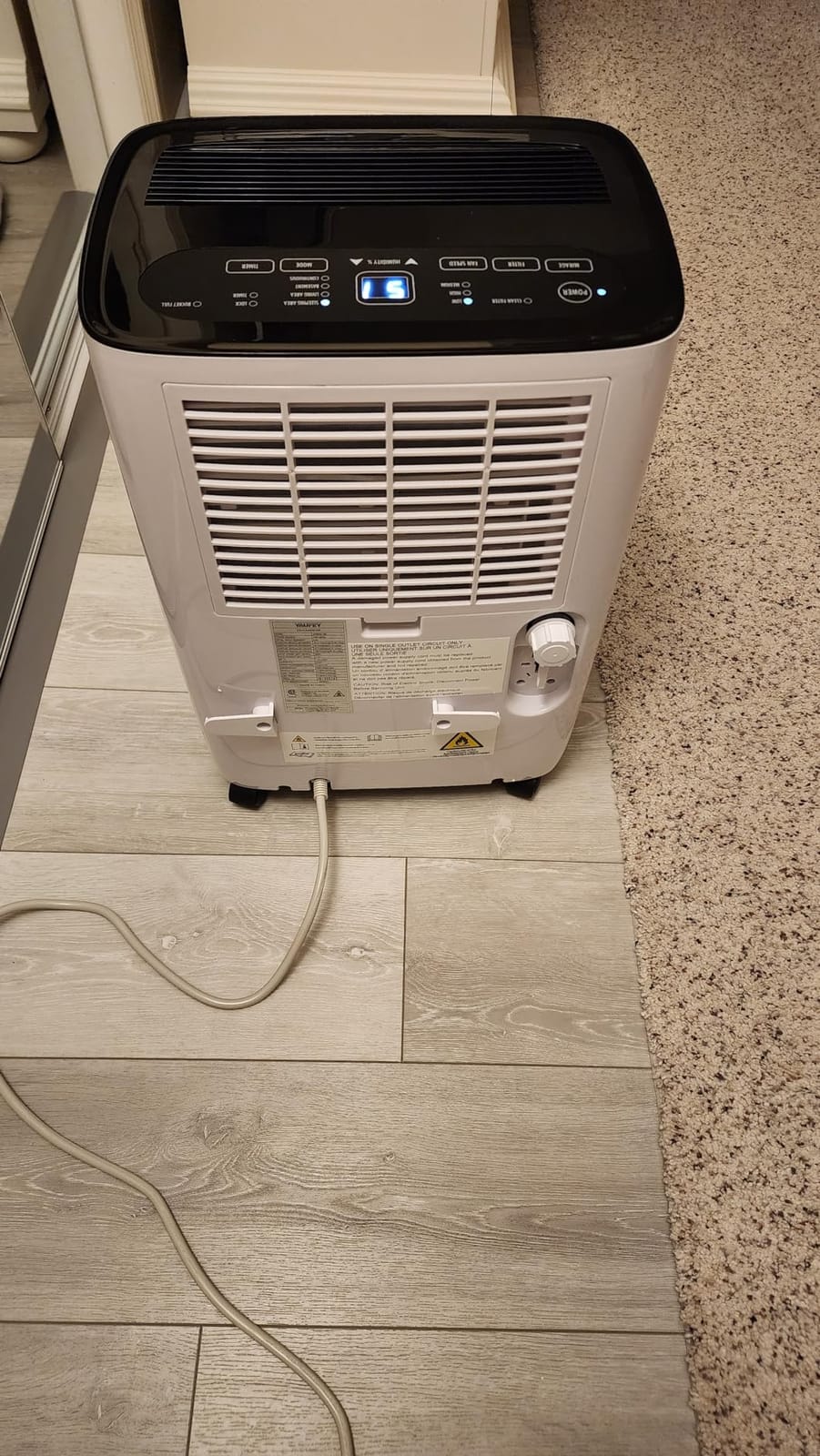
Best fit for large, wet and awkward spaces
If you have a finished basement over 2000 sq ft, multiple bedrooms below grade, or a crawl space with known dampness, extra capacity stops being a spec-sheet luxury. It becomes the difference between holding 45% relative humidity and holding 70% through August.
The 5% increment humidity range from 30% to 80% gives you finer control than most units, which matters when you are chasing a specific target rather than just trying to feel drier.
The case against buying this much capacity
At nearly 40 pounds it is the hardest unit here to move, and moving it is something most people end up doing at least once. A 500-watt draw means the highest running cost in this roundup, and you pay for capacity you may not use in a space that is damp rather than wet.
More capacity also means a bigger investment with a compressor inside it. If your mold problem is moderate, the 50-pint unit at number one does the same job at a lower weight and a lower running cost.
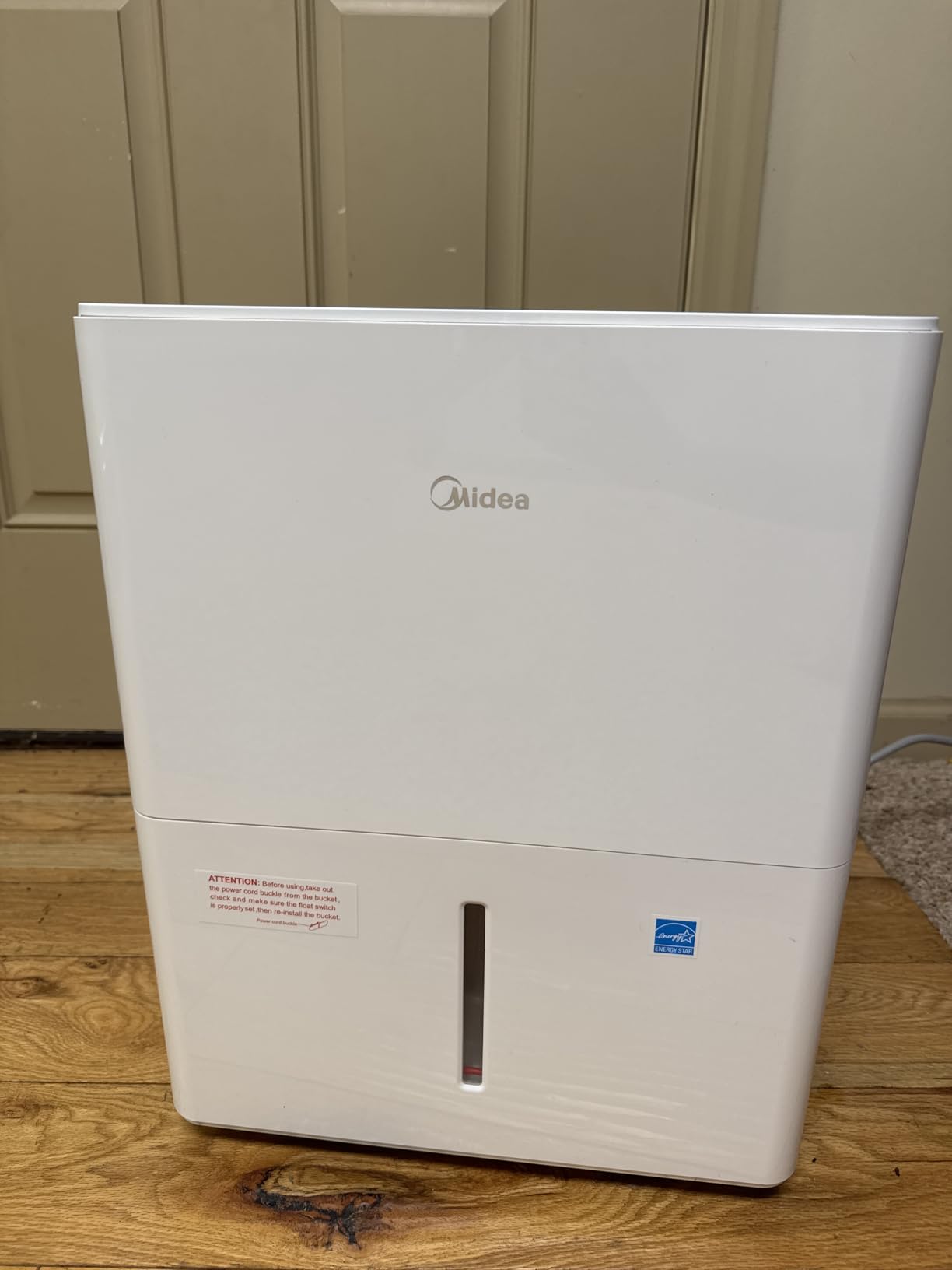
4. Midea 22 Pint Wi-Fi – Best for Bedrooms and Quiet Spaces
- Quiet 47 dBA operation for bedrooms
- Wi-Fi plus Alexa and Google Assistant control
- ENERGY STAR certified
- Auto restart after power outage
- Small 0.8 gallon tank for a compressor unit
- Only rated for 1500 sq ft
- Drain hose not included
This is the one to put where someone sleeps. At 47 dBA it is quiet enough for a bedroom or a home office, and 1500 sq ft of rated coverage matches a normal small room rather than a basement. The 22 pints per day rating is more than enough for a space that is merely humid, not wet.
It is also the only unit here with voice-assistant support built in through Alexa and Google Assistant on top of the app, which makes it easy to check the humidity reading from upstairs. Relative humidity adjusts from 35% to 85%, so you can set a proper target for mold prevention rather than a single fixed level.
On the home dehumidifier forums, Midea is consistently praised for exactly these two things, quiet operation and app control in small spaces. The same owners raise compressor durability as their main concern, and that concern is worth weighing before you commit.
Auto defrost, auto restart after a power outage, a programmable timer and 360-degree rotatable wheels cover the reliability basics that make unattended running practical.
Where it earns its place in a mold strategy
A dehumidifier running in a bedroom at 50% relative humidity stops condensation on the window frame, which is the earliest visible sign that a room is feeding mold colonies behind the drywall. For a nursery, an office or a room that gets used in winter, this is the whole job.
The ENERGY STAR certification is a real saving on a unit that will run often because it is chasing a tight setpoint in a small volume.
Why it will not solve a basement problem
At 1500 sq ft and 22 pints per day, this machine is undersized the moment moisture is coming through a wall. Reviewers consistently note the modest tank and the limited coverage area, and a 0.8 gallon tank is one of the smallest here.
The drain hose is not included, so continuous drainage needs a separate purchase, and the one-year limited warranty is shorter than the three-year coverage on the AEOCKY. Read our basement dehumidifier guide if the space is below grade.
5. Kesnos 30 Pint – Best Balance of Quiet Operation and Control
Kesnos 2,500 Sq. Ft. Energy Star Dehumidifier for Basement with Drain Hose
- Lowest power draw among the larger units at 165 watts
- 36 dB quiet operation
- Drives humidity down to 30% RH
- Compact 22.6 pound body with casters
- Very small 0.39 gallon tank fills quickly
- 2500 sq ft limit means more runtime in large basements
This is the efficiency champion of the group. A 165-watt draw with 30 pints per day of rated capacity is a better balance than most machines twice its size, and it will hold a mid-sized damp room at target for a fraction of what the 500-watt units cost to run.
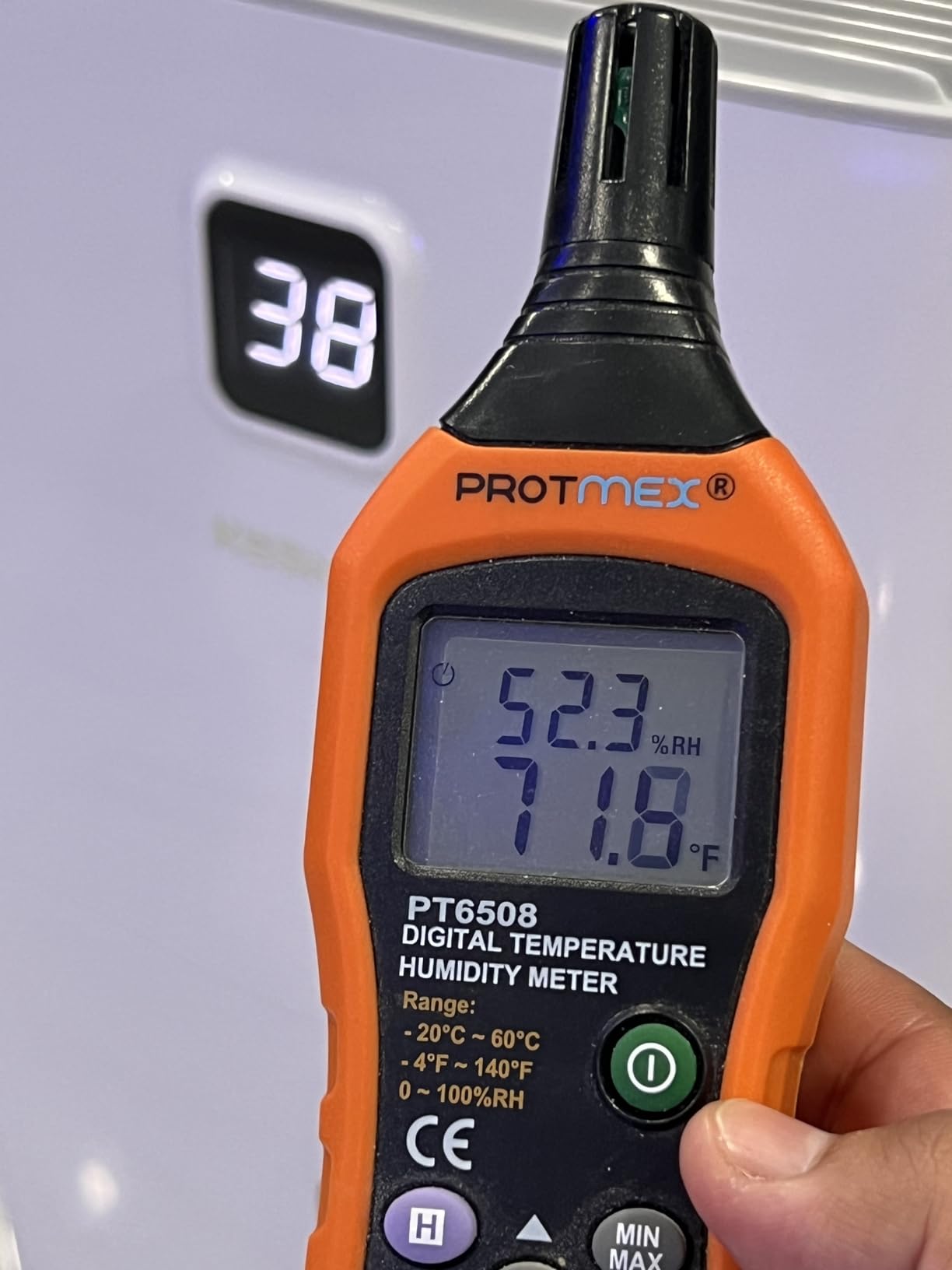
It also reaches 30% relative humidity, which is the low end of the EPA-recommended band. That matters in a basement where you want margin below the 60% mold threshold rather than sitting right at 58% and hoping.
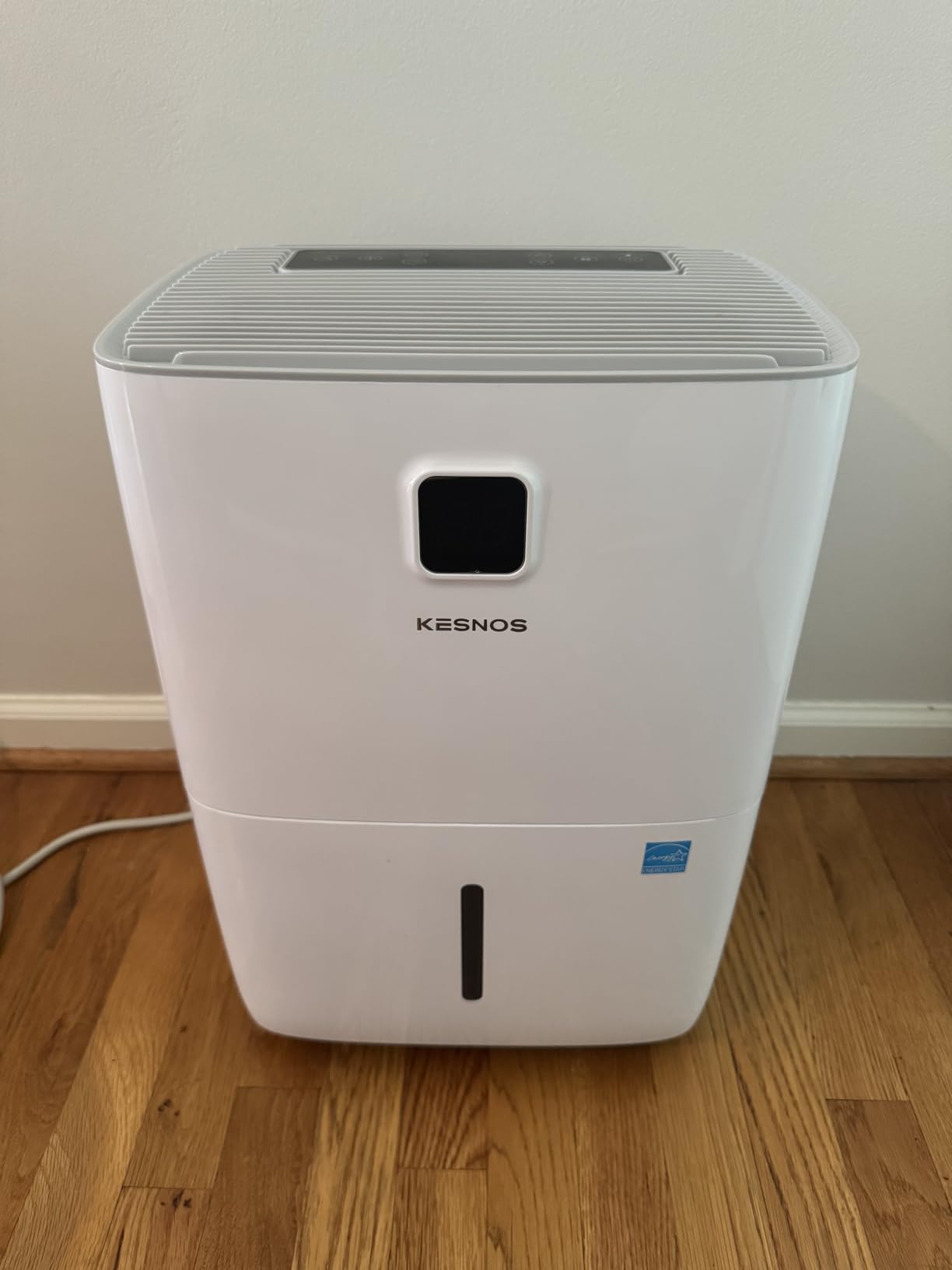
At 36 dB on low speed this is the quietest operating figure among the higher-capacity machines here, and 22.6 pounds with 360-degree casters and a hidden handle means it moves between rooms without a second person. Four pre-set modes cover Comfort, Dry, Continuous and Turbo.
Warranty terms are better than most: one year of coverage with an additional two-year extension on registration, a 30-day satisfaction guarantee and lifetime technical support.
Why 30% RH capability helps in a basement
Most basements that show mold symptoms also show efflorescence and damp concrete. Driving the humidistat to 40% or 45% rather than 55% gives condensation on pipes and ducts somewhere to go, and stops the musty odor that owners describe as the first warning sign.
Reviewers highlight the quiet run and the low relative humidity capability as the two things that made them keep the unit running year-round rather than switching it on only during wet spells.
The tank will test your patience
Point eight of a gallon of capacity is smaller than most of its competitors, and in a genuinely damp room it fills faster than you would like. Run it on continuous mode with the included 3.3 ft drain hose attached and the problem disappears, but out of the box it is the most common complaint.
Coverage is limited to 2500 sq ft, so a larger basement means longer run time rather than a bigger job, and the 30% RH setting will rarely be reached in a very wet space.
6. VEAGASO 34 Pint – Best Mid-Size Option for Real Basements
VEAGASO 34-36 Pint/D, 2500 Sq.Ft Dehumidifier for Basement with Drain Hose
- Owners report humidity drops from musty air to about 50% RH
- Quiet enough for bedrooms and apartments
- Reliable drain hose continuous drainage
- 2 year warranty
- Small tank needs emptying two or three times a day
- Louder on high fan
- 2500 sq ft rating is optimistic for some rooms
This is the unit reviewers most consistently connect to a real mold outcome. Across the reviews, owners describe moving from musty basement air to roughly 50% relative humidity within a few weeks of running it, which is the specific result people buying for mold prevention are looking for.
Three modes cover dehumidify, dry and continuous, and the LED touch panel gives you a live humidity reading rather than a setpoint you have to guess at. That display matters more than it sounds when you are trying to know whether a space has actually crossed into the safe zone.
At 34 pints per day and 2500 sq ft, it sits in the practical middle of this list: more capacity than a bedroom needs, less weight and draw than a 50-pint pump unit. The two-year warranty is longer than most compressors in this roundup offer.
Auto shutoff with a tank-full indicator, power failure memory and a 1-24 hour timer mean you can run it unattended without checking on it.
Best for a mid-size damp basement
Between about 800 and 1500 sq ft of basement with musty air and condensation on the walls, this capacity is right and the 230-watt draw keeps the running cost moderate. The included drain hose makes continuous drainage a ten-minute job.
Forty dB on low speed is acceptable in a space nobody sleeps in, and reviewers describe it as quiet enough for an apartment when running on the lower setting.
Where the compromises show
The 0.53 gallon tank is the main issue, and reviewers repeatedly advise setting up continuous drainage because of it. Emptying two or three times a day in humid conditions is the reality without a hose.
It gets noticeably louder on the high fan setting, the 2500 sq ft coverage figure is optimistic for some rooms according to owners, and the included drain tubing is light-duty plastic with a short cord. Our bedroom dehumidifier picks cover the small-room end of the range.
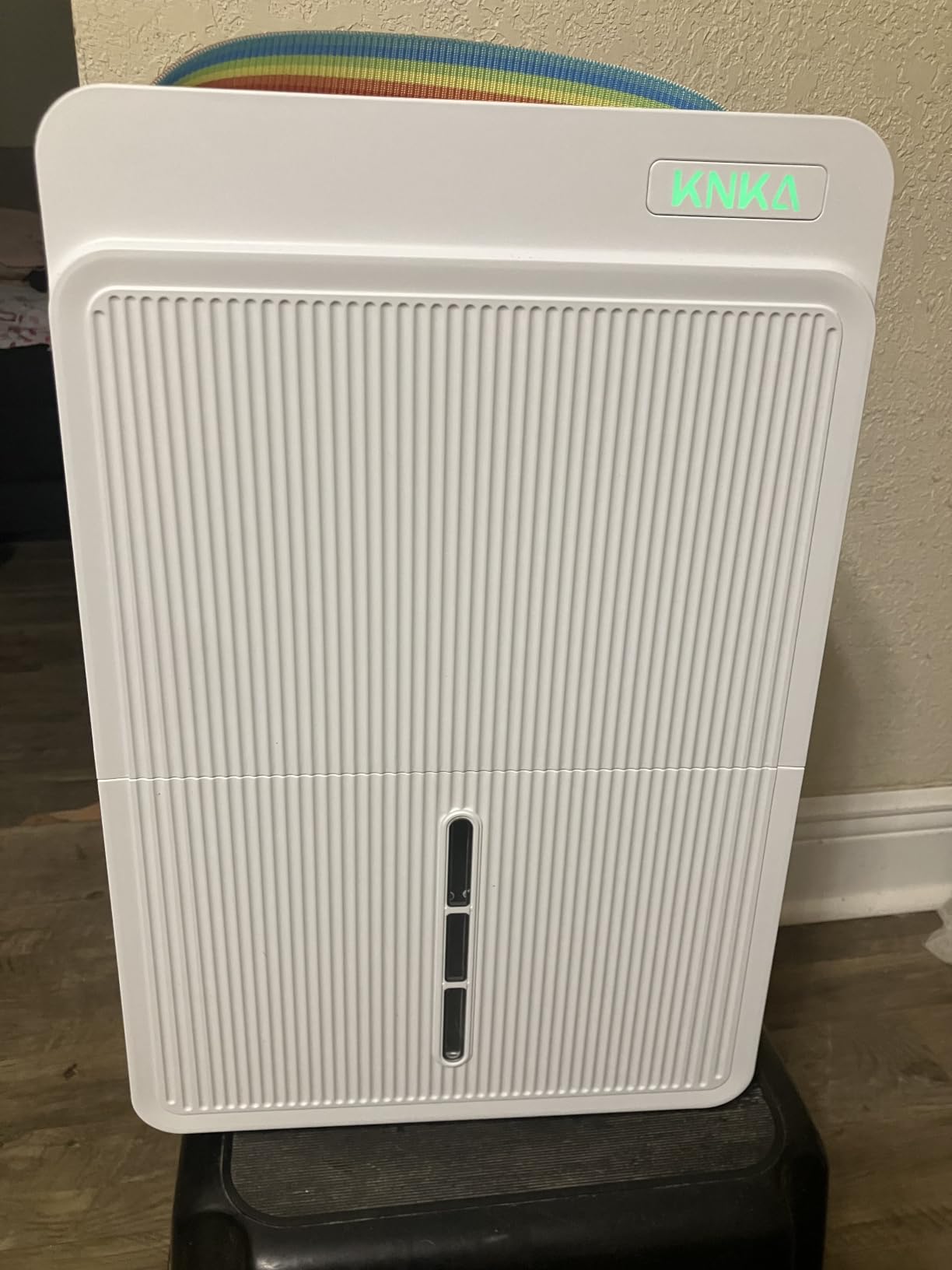
7. KNKA 80 Pint – High Capacity with a Lower Owner Rating
KNKA Energy Star 5500 Sq.Ft Dehumidifier for Basement, Max 80 Pint/Day
- Large humidity reductions reported within hours
- Measured at 42 dB at the unit and 31 dB six feet away
- Simple auto mode plus sleep mode
- Responsive customer service
- Lowest 4.1 star average in this group
- Small tank and some unreliable auto shutoff reports
- Short 6.56 ft drain hose
- Coverage claims not met by all owners
On paper this matches the AEOCKY almost feature for feature: 80 pints per day at 95F and 95% relative humidity, 56 pints per day at 86F and 80%, 5500 sq ft of coverage, ENERGY STAR certification. Where it separates is quietness, with 40-45 dB measured at 42 dB at the unit and 31 dB six feet away.
Owners report large humidity reductions within hours of switching it on, and the auto, dry and setting modes with a 30% to 80% range cover normal use. A color-changing indicator light and a display that switches off let you run it in a finished room without a glowing panel all night.
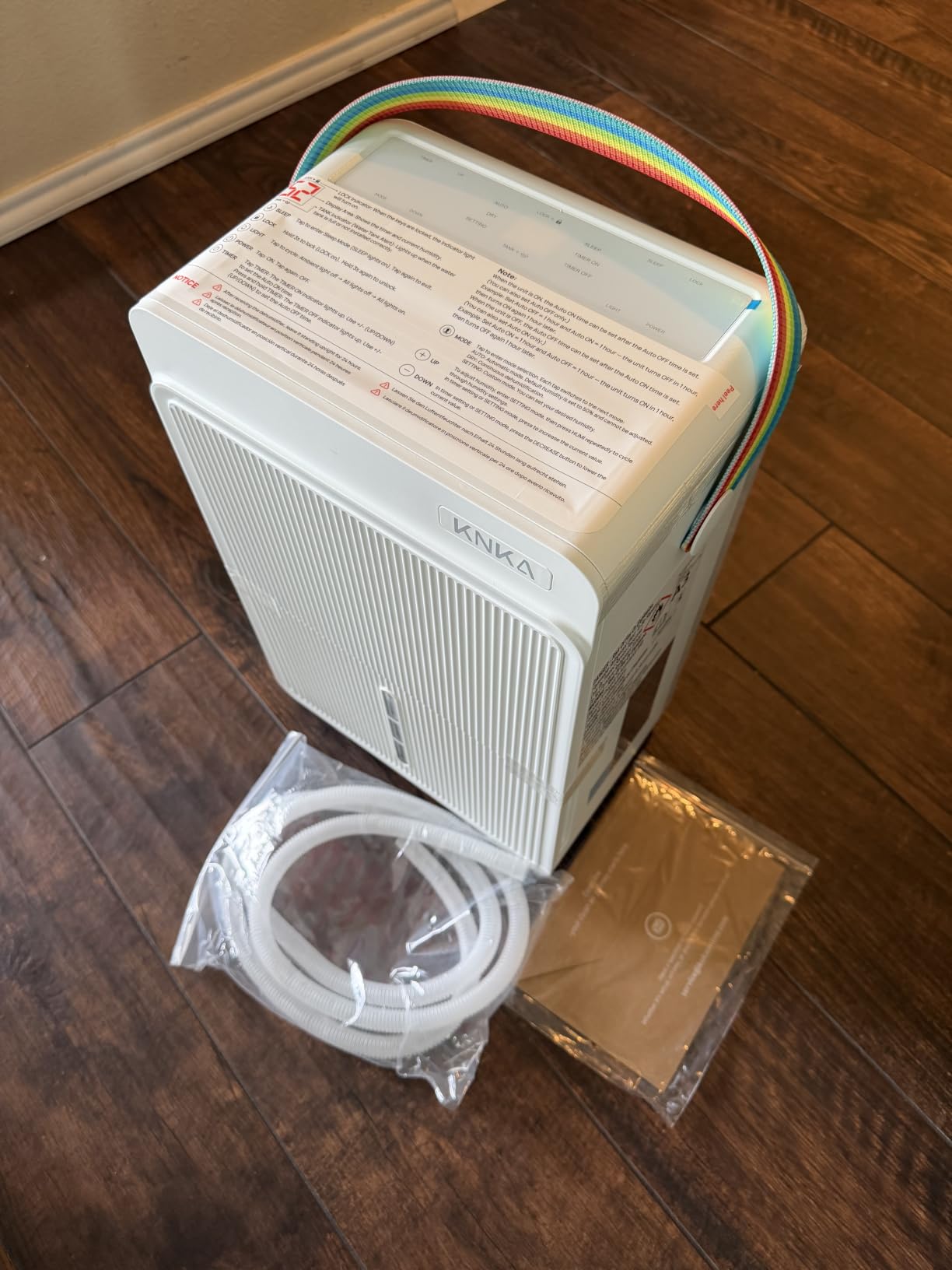
Child lock, cord storage, casters, a 12-hour timer and a washable filter are all present. An optional 2.64 gallon external tank is sold separately, which tells you how the manufacturer expects small-tank complaints to be answered.
Setup is plug and play, and customer service responsiveness comes up well in the reviews.
Where the raw numbers make sense
If you have a large space and 5500 sq ft of coverage is genuinely what you need, the capacity per watt is competitive and the measured low-speed noise is the quietest figure among the 80-pint class units here.
Setting it to about 45% relative humidity puts a large room comfortably below the 60% threshold where mold germination starts, and the 30% minimum gives you real margin.
Why we would not hand this to most people first
At 4.1 stars it is the lowest-rated unit in this roundup, with 14% one-star reviews. Reviewers report that the tank-full auto shutoff is not always reliable and that the awkwardly shaped tank spills when you empty it, which in a basement is a bad combination.
Coverage claims are not met by all owners, the included drain hose is short at 6.56 ft, and the one-year manufacturer warranty is thin next to the AEOCKY’s three years.
8. Waykar 150 Pint Commercial – for Heavy-Duty Drying Jobs
Waykar 150 Pint Commercial Dehumidifier with Pump & Drain Hose for Basement
- Highest capacity option at 150 pints per day
- Built-in pump handles upward discharge
- Self-drying function reduces mold and odor in the coil
- 30-day money-back period and warranty extension
- Heaviest power draw at 520 watts
- Highest cost in this roundup
- Pump setting resets if unplugged after shutdown
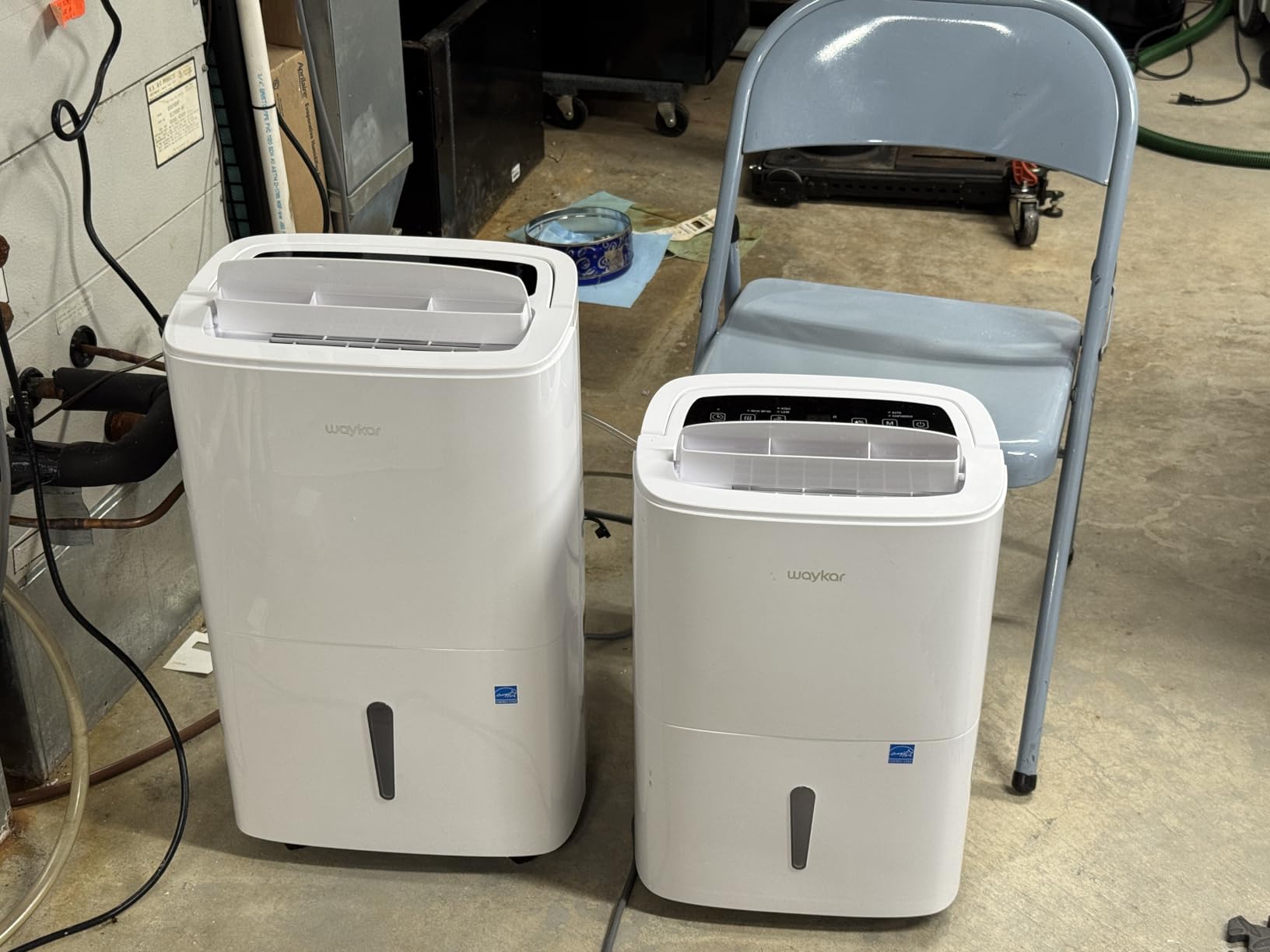
This is the drying machine rather than the maintenance machine. At up to 150 pints per day it moves more water than anything else here, which makes it the right tool after a flooding event, a persistent leak has been fixed, or a crawl space that has been wet for years.
The built-in pump lifts water upward 9.84 ft, which covers most basement sump setups where a gravity drain is impossible. Buyers treat it as a commercial-grade workhorse for large wet basements and crawl spaces rather than a unit for a normal room.
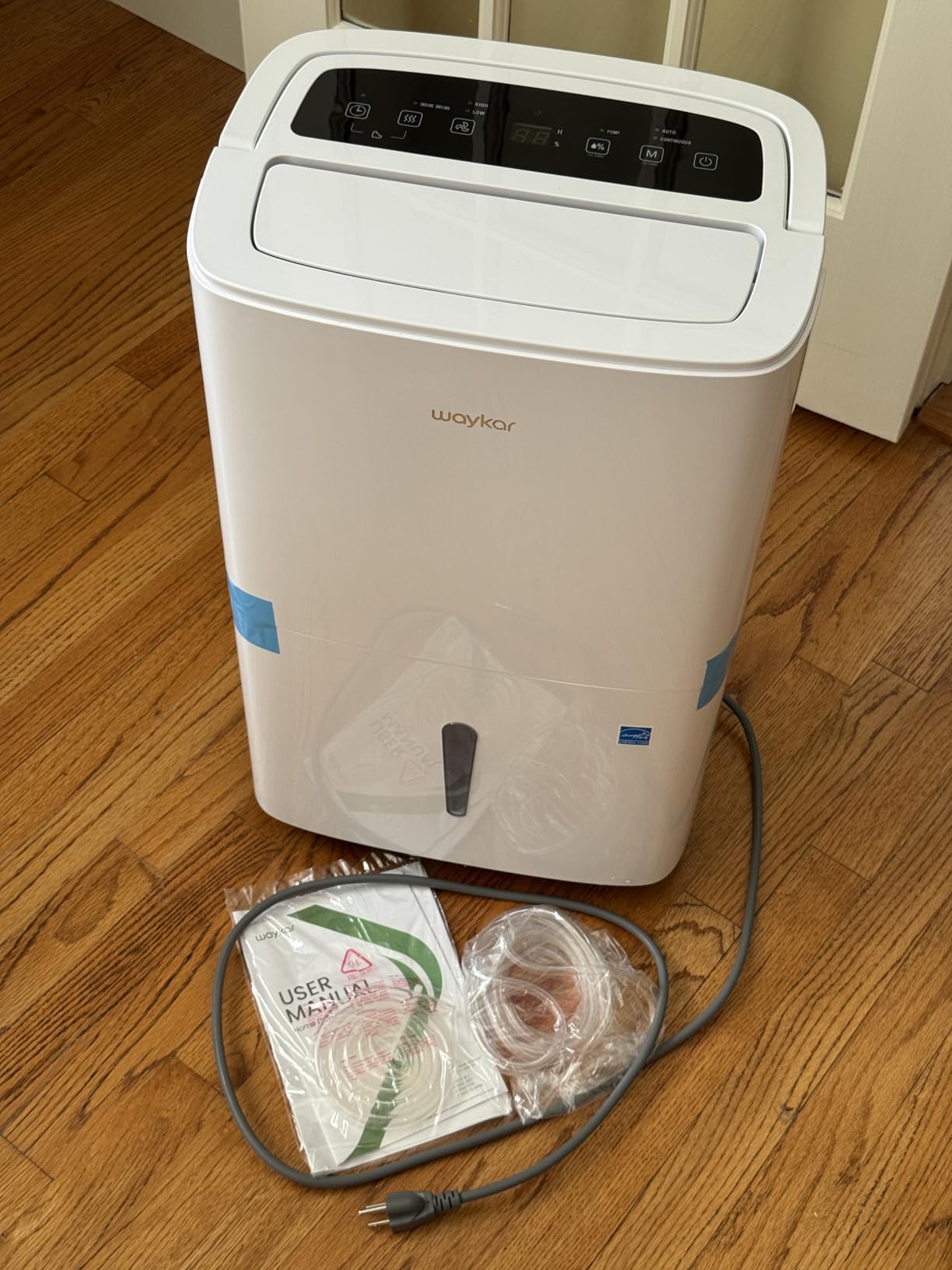
The self-drying function runs the coils dry when the unit shuts down, which reduces the mold and odor growth inside the machine itself. That matters more than it sounds in a unit you plan to leave running through a whole damp season.
Coverage is 7000 sq ft with relative humidity control from 30% to 80%, a 24-hour timer and memory restart, plus 212 cfm of airflow and a swing louver to distribute air across a large space.
Where it beats everything else in this list
Raw removal rate, airflow and pump lift head are the three numbers that matter when water is arriving faster than a normal dehumidifier can extract it. Nothing else here matches that combination, and after a water intrusion event the payback on getting the space dry fast is immediate.
The visible 1.85 gallon tank has an anti-spill design, which solves the tank-emptying problem that generates most negative reviews on smaller units.
Why most people should look elsewhere
It carries the highest cost in this roundup and a 520-watt draw, so it is the most expensive unit to run continuously across a season. If your issue is steady dampness rather than active water, that is money spent on capacity you will not use.
It also weighs 38.6 pounds, and the pump setting resets if the unit is unplugged after a shutdown, which is an annoying failure mode in a space where power gets cut. Our whole-house dehumidifier guide covers larger systems.
9. GoGuess 21 Pint Compact – Lowest Power Draw and Smallest Footprint
GoGuess 1600 Sq.Ft Compressor Dehumidifier for Basement, Max 21 Pint/Day
- Lowest energy draw in the group at 80 watts
- Compact 7.2 by 13.2 by 17.1 inch body
- Owners report it is barely audible
- 2 year warranty
- 1600 sq ft coverage claim is optimistic
- Exhaust air blows warm rather than cold
- Awkward access to some internal parts
At 80 watts this uses a fraction of the power of the other units here, and 40 dB operation with a display-off sleep mode makes it a candidate for spaces where noise is the deciding factor. It carries 80% five-star reviews, the highest share of five-star ratings in this roundup.
The body is small enough for a shelf or a closet, and owners use it in bedrooms, RVs, garages and single damp rooms where a 50-pint machine is simply too much hardware. Tank capacity of 2.3 liters needs emptying roughly every two days in a studio-sized space.
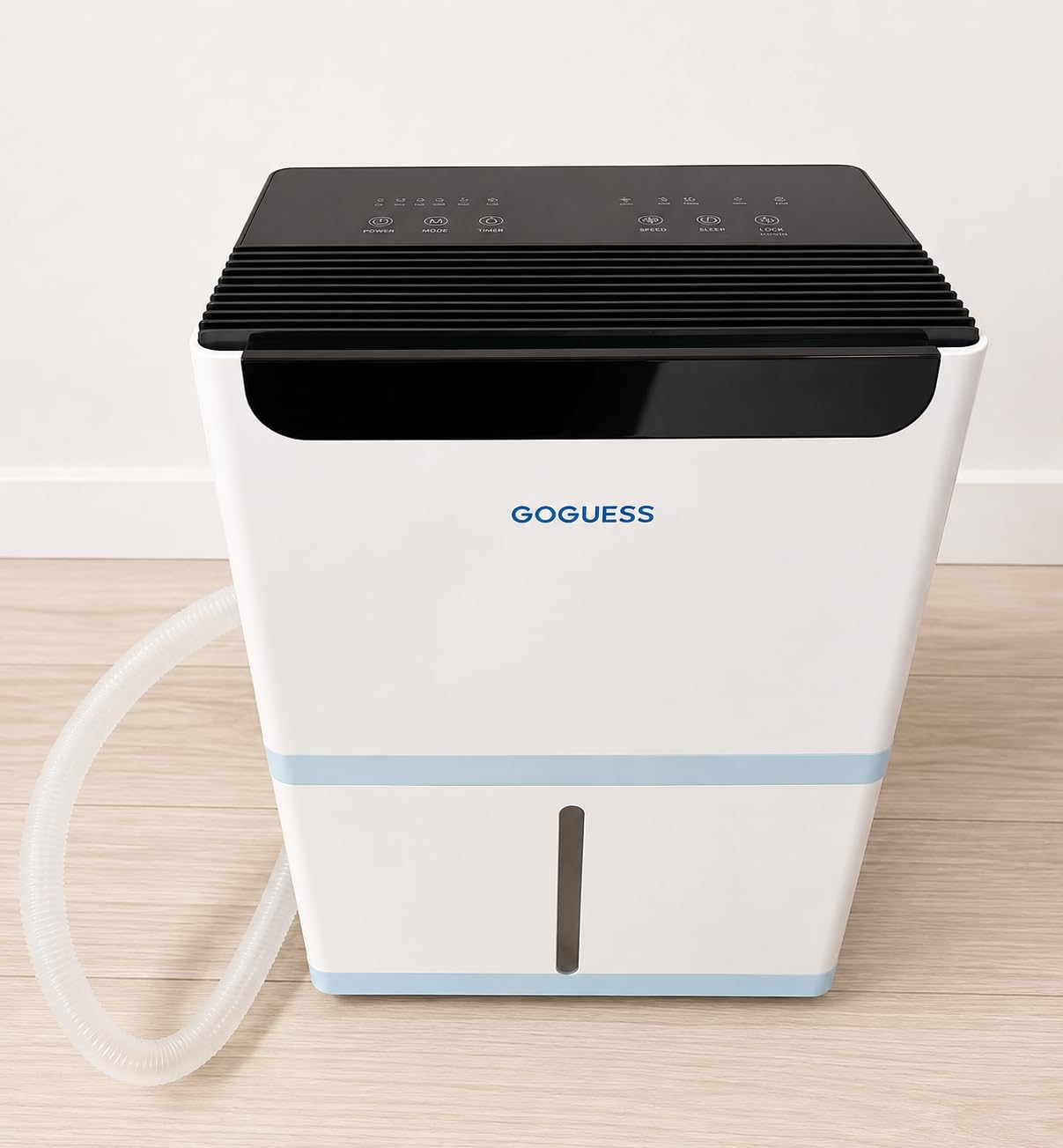
Humidity adjusts from 30% to 80%, with dehumidify, turbo and sleep modes, a 3.28 ft drain hose for continuous drainage, auto defrost, overload protection, full-tank auto shutoff and a child lock.
The color-changing humidity indicator LED stays visible when the unit is off, so you can read the moisture level in a dark crawl space or storage room without turning anything on.
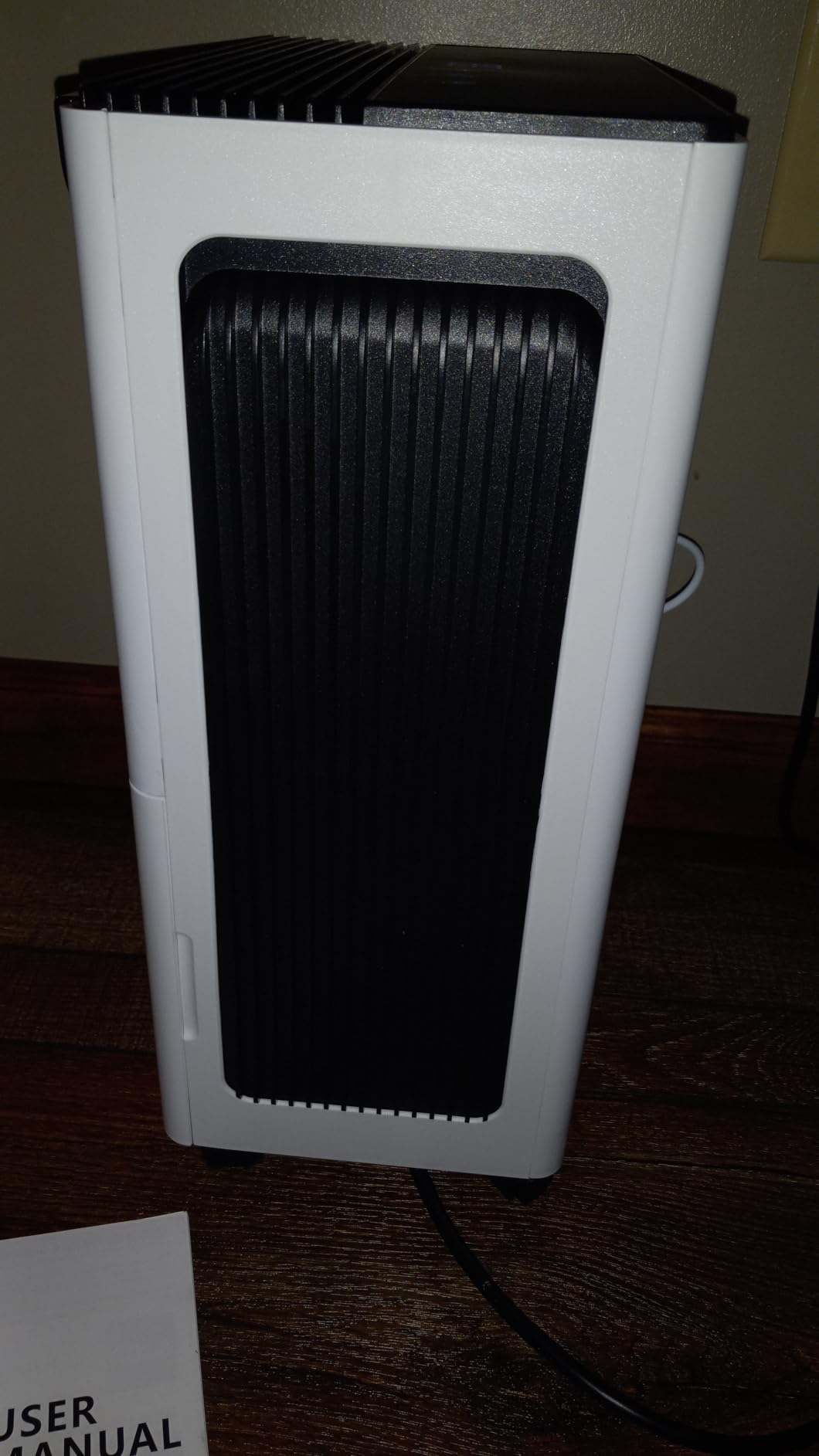
Best for RV, boat and storage spaces
An eighty-watt draw matters enormously when you are running a unit off a battery bank or an inverter in an RV or a boat over winter. It is also the least expensive machine to leave running in a garage or storage unit over a humid season.
For mold prevention in a small room, 21 pints per day and a 30% relative humidity minimum are more than sufficient, and the two-year warranty is a good sign.
Where it runs out of room
The 1600 sq ft coverage claim is optimistic for some owners, who find it better suited to a single room than a wide open space. If your damp area is large, you will be chasing the humidistat rather than holding it.
Exhaust air blows warm rather than cold, which is normal for compressor units but can surprise people expecting a cool draft. Access to some internal parts is awkward for cleaning, and the weight is not listed, which makes planning a trip up basement stairs harder.
10. Trazico 21 Pint – Lightest Pick You Can Move Between Rooms
Trazico 1500 Sq.Ft Dehumidifier for Basement, with Drain Hose, 21 Pints
- Lightest design here at 16.8 pounds
- 39 dB suited to bedrooms and nurseries
- Auto shutoff
- auto defrost and auto restart
- Lowest cost per unit in the roundup
- Smallest tank at 1.5 liters
- Lowest rated capacity and coverage in the group
This is the pick when the machine has to follow you around. At 16.8 pounds it is the lightest unit we covered by a wide margin, and smooth-rolling wheels plus an ergonomic handle make moving it from a nursery to a laundry room a one-person job.
Thirty-nine dB operation is quiet enough for a sleeping room, and auto shutoff, auto defrost and auto restart after an outage mean it can run unattended in a space you do not check daily. Relative humidity control spans 30% to 80% with a 24-hour timer.
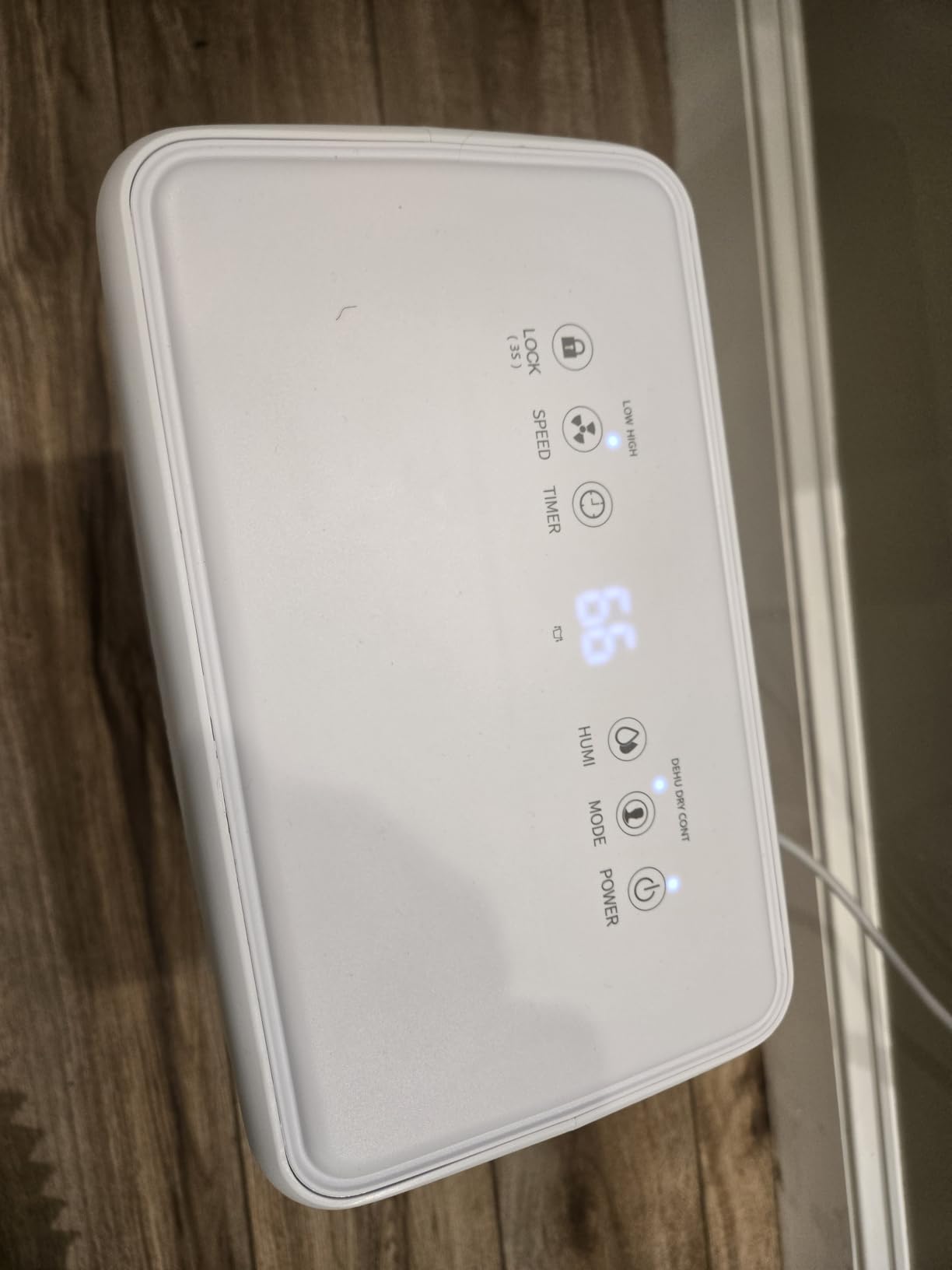
Three modes cover dehumidify, dry and continuous, and the package includes a drain hose, washable filter, water level indicator and child lock. That is a fuller accessory list than several larger units in this roundup.
Owners value it as an affordable quiet unit for bedrooms, nurseries, RVs and smaller damp areas rather than as a serious whole-basement solution.
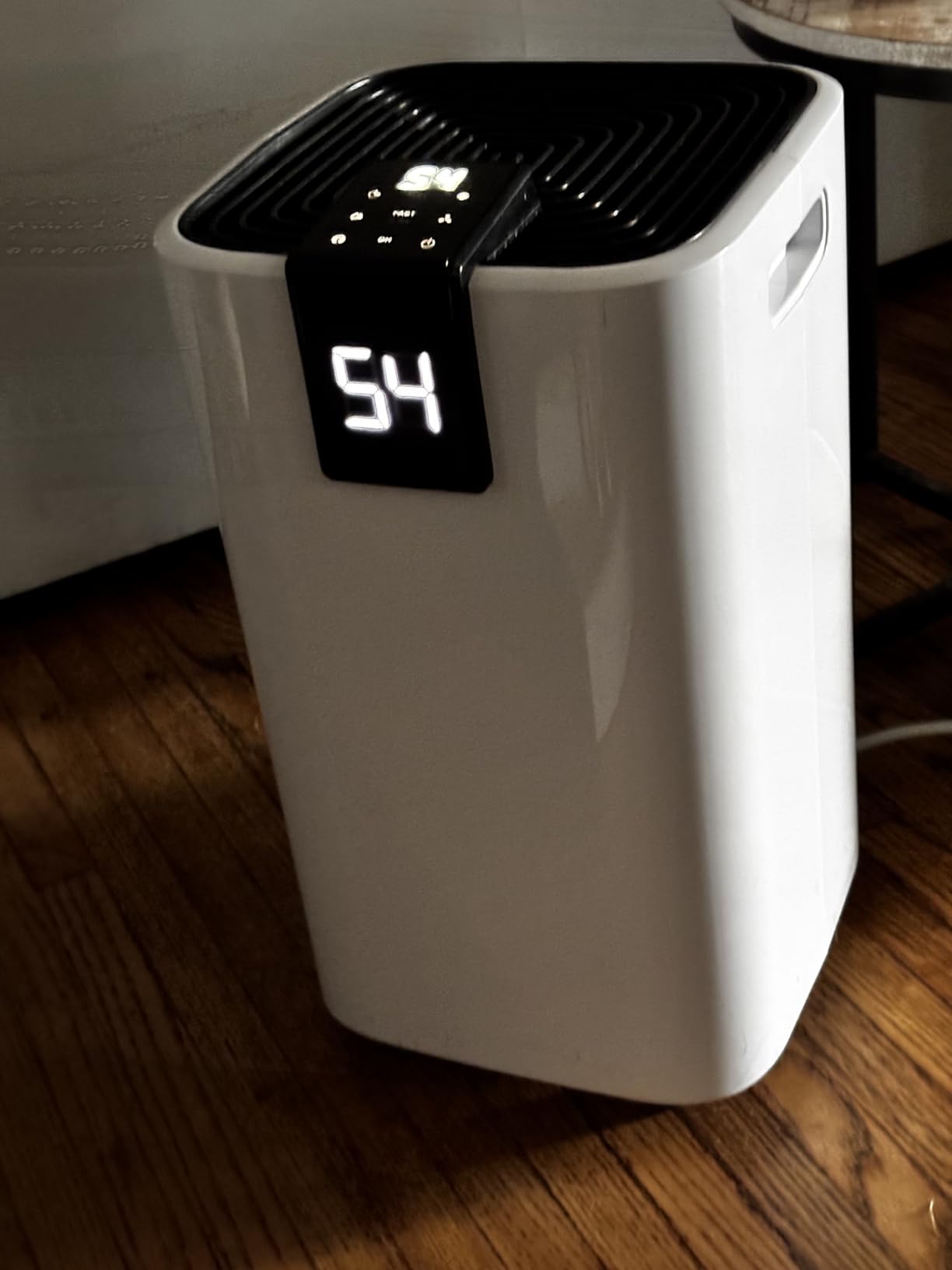
When the small size is the right choice
A single bedroom, a nursery, a small bathroom with persistent mildew or an RV parked for the season are all places where 21 pints per day and 39 dB do the job properly. Humidity at 50% stops condensation on shower-adjacent surfaces before mildew takes hold.
It is also the unit least likely to intimidate someone who has never owned a dehumidifier, and it uses less electricity than anything else here.
Where 21 pints will not be enough
This is the smallest rated capacity and coverage area in the roundup at 21 pints and 1500 sq ft, so a wet basement is simply out of scope. A larger space means the unit runs continuously, the 1.5 liter tank fills quickly, and it may never reach its setpoint.
With 601 reviews it has the thinnest owner base here, which means less long-term durability data than the hOmeLabs at more than 15,000. Consider it a room-scale tool rather than a foundation-scale one.
How to Choose a Dehumidifier for Mold Prevention
What humidity level should you set it to?
Set the humidistat to 50% relative humidity for a damp basement or interior room, 45% for a crawl space or a basement with visible mold history, and 40% to 45% after a flood while materials dry out. The EPA recommends keeping indoor relative humidity between 30% and 50%, and mold growth risk rises once you pass 60%.
Below 30% you gain nothing for mold and start paying for comfort instead, since air that dry can aggravate sinuses and some wood furniture reacts to it. A reading of 70% or above is where you should stop shopping and start looking at water intrusion, because no dehumidifier holds that range in a space with an active leak.
How do you size one for a damp room?
Match capacity to square footage and how wet the space is. A moderately damp 1000 sq ft basement needs roughly 30 to 40 pints per day, while a very damp 1500 sq ft space with mold history needs 50 or more.
Buy the larger unit if you are between sizes. Owners on home improvement forums describe undersized units running constantly, wearing out faster and still failing to reach the target, all while drawing more electricity over the season than a correctly sized machine that cycles normally.
Manufacturer coverage numbers are also flattering. Treat a listed 5500 sq ft as a comfortable ceiling in a dry climate, not a promise in a humid one, and assume you will effectively be drying a much smaller active volume.
Compressor or desiccant for cool spaces?
Use a compressor unit above roughly 60F and a desiccant unit in a crawl space or unheated basement that sits below that. Compressor dehumidifiers depend on the evaporator coil staying cold enough to condense water, and once room temperature falls to the coil temperature they start frosting instead of extracting moisture.
Auto defrost, which cycles the compressor to melt frost, extends the usable floor for these machines and several units here have it. But if your cool space never gets above 60F for long stretches, a non-compressor desiccant unit is the correct tool and no amount of capacity will compensate for the wrong technology.
Desiccant units pull less electricity, work in cold conditions and run quietly, but cost more and typically extract water more slowly, which is why they are the crawl-space choice rather than the whole-basement choice.
Bucket, gravity drain or built-in pump?
A bucket means manual emptying one to three times a day in damp conditions, and every owner we looked at names the switch to continuous drainage as the biggest quality-of-life improvement in the category. Gravity drainage works only if a drain or sump sits below the unit’s outlet.
A built-in condensate pump pushes water upward to a line above the unit, which is the only workable option in a basement with no floor drain. Pump reach varies: this Waykar lifts 9.84 ft, and the Yaufey includes a 16.4 ft pump hose. Check your vertical distance to the drain before choosing.
What does it cost to run?
Multiply watts by hours of runtime, divide by 1000 for kilowatt-hours, then apply your utility rate. A 500-watt unit running 16 hours a day uses about 8 kWh a day, while an 80-watt unit running the same schedule uses about 1.3 kWh.
That is the strongest argument for a right-sized, efficient machine. The Kesnos at 165 watts and the AEOCKY at 280 watts will hold a target for far less energy per season than the 500 and 520 watt units, and ENERGY STAR Most Efficient certification on the AEOCKY is worth checking against your local rate.
Running a dehumidifier alongside a central air conditioner can also cut costs, since the air conditioner carries the dehumidification load and the dehumidifier pulls less humid air at the same time.
How long will the compressor last?
Expect three to five years of normal service rather than a decade, and buy on warranty length as much as on capacity. This roundup spans one year of coverage on the KNKA and Midea through three years on the AEOCKY.
Compressor longevity is the most common complaint across home improvement forums, with owners on r/BuyItForLife reporting units from several major brands failing at roughly the one-year mark. Two habits extend life more than any feature: run it in a space above 60F, and clean the filter and coils so airflow stays healthy.
What maintenance does a mold-prevention setup need?
Rinse the washable filter every two weeks while running, check the drain hose monthly for kinks and standing water, and vacuum or clean the coils at the start and end of every season. Empty the tank whenever it fills if you are not on continuous drainage.
A blocked filter or a dirty evaporator is the most common cause of a unit that runs constantly without reaching its setpoint, and it is also how you get mold growing inside the machine instead of in your basement.
Frequently Asked Questions
Do dehumidifiers work to prevent mold?
Yes. Mold spores need sustained moisture to germinate, and holding a space between 30% and 50% relative humidity removes that condition entirely. The EPA recommends keeping indoor relative humidity in that band, which makes dehumidification the most effective and least expensive form of mold prevention available. Dehumidifiers work best in spaces that are damp rather than actively leaking.
Will a dehumidifier take away mold?
No. Existing mold colonies attach to porous material like drywall and wood, and running a unit will not remove or kill them. A dehumidifier limits new growth by lowering humidity, but visible growth needs to be physically removed or professionally remediated, and any water intrusion feeding it has to be repaired first.
What should a dehumidifier be set at to prevent mold?
Set it to 50% relative humidity for a damp basement or interior room, 45% for a crawl space or a room with mold history, and 40% to 45% while drying out after water intrusion. The EPA advises 30% to 50%, and risk rises once indoor humidity passes 60%. Going below 30% costs energy without helping.
Is a 70 pint dehumidifier enough?
For most moderately damp basements, yes. A 70 pint unit comfortably handles a 1000 to 2000 sq ft space that reads above 60% humidity, and it has headroom for heavy rain events. Very damp spaces or large areas above 2500 sq ft need 80 to 150 pints per day, and small damp rooms need far less than 70.
Do I need a built-in pump for a basement?
Yes, if there is no floor drain or sump below the unit. A pump pushes collected water upward to a drain line above the machine, which gravity drainage cannot do. The Waykar lifts water 9.84 ft and the Yaufey includes a 16.4 ft pump hose. If a drain already sits below the unit, a gravity hose works and costs less.
How much will my electric bill go up with a dehumidifier?
It depends on wattage and runtime. A 500-watt unit running 16 hours a day uses about 8 kWh daily, while an 80-watt unit uses about 1.3 kWh over the same schedule. Multiply that by your utility rate and the months you run it. ENERGY STAR Most Efficient units such as the AEOCKY at 280 watts are the cheapest large-capacity option per season.
Can I run a dehumidifier and air conditioner at the same time?
Yes, and it can reduce your energy bill. The air conditioner handles cooling and much of the dehumidification, so the dehumidifier works with drier air and pulls moisture more efficiently. Close windows and doors between the two rooms so you are not conditioning and dehumidifying the entire outdoors at once.
Final Verdict on Mold Prevention
The best dehumidifiers for mold prevention in 2026 all share one job, and the differences come down to how much water they pull and where that water goes.
Best overall: the hOmeLabs 50-Pint with built-in pump, rated at 4.6 stars across more than 15,000 reviews, with 50 pints per day at standard test conditions, 7500 sq ft of coverage and continuous drainage so nothing depends on your memory.
Best for large wet spaces: the Yaufey 150-Pint with three drainage routes and up to 8500 sq ft of coverage, or the Waykar 150-Pint if you are drying an active water intrusion and need the pump to lift 9.84 ft.
Best for bedrooms and small rooms: the Midea 22-Pint at 47 dBA, or the Kesnos at 36 dB if you want lower running costs and the ability to drive humidity to 30%.
Set the target at 50% relative humidity, plumb the water out rather than carrying it to a sink, and fix whatever is putting water into the space in the first place. Those three steps matter more than any spec on this list.