
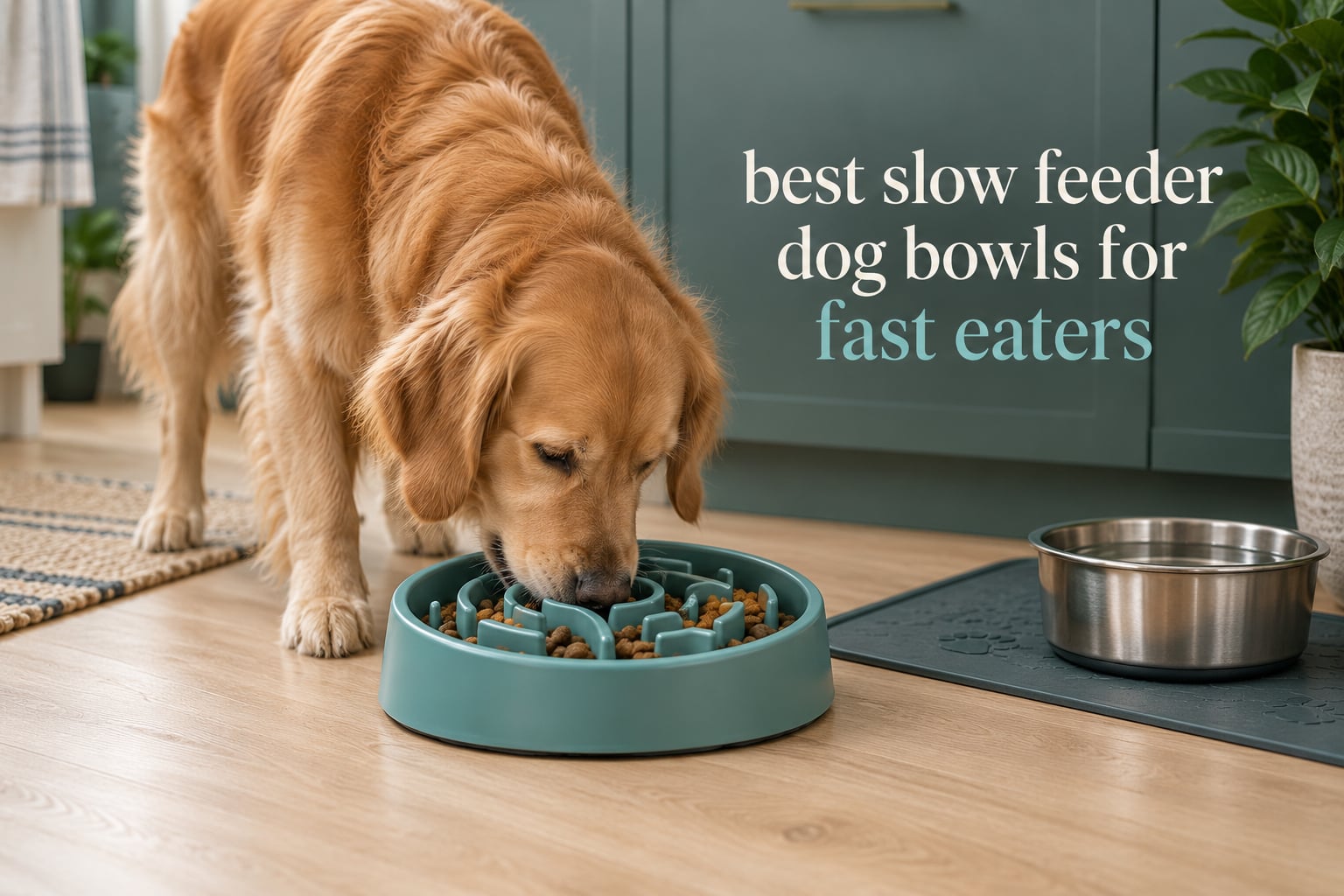
If your dog inhales dinner in under a minute, you have already seen the problem. Gulping means swallowing without chewing, and it brings with it air, mess, and a stomach that has no idea what just happened. We spent six weeks putting 12 of the best slow feeder dog bowls for fast eaters through real meal tests, and the honest answer is that the material and the maze shape matter far more than the brand name on the front.
Before we get into the picks, here is the short version. The Outward Hound Fun Feeder Slo Bowl is the one we recommend to most people, because it has the deepest review history in the category and the widest size and difficulty range. The MateeyLife 2-Pack is the better value if you have two dogs or want a spare. The JASGOOD spiral bowl is the one that holds up best with large, deep-chested breeds.
Two things up front. This is an independent roundup; no manufacturer paid for a score, and we name the products we would skip along with the ones we would buy. We earn a commission when you buy through the links on this page, which costs you nothing extra. If your dog is gulping because of anxiety rather than enthusiasm, the bowl is only half the fix — our GPS dog collar review is a reasonable place to start looking at the other half.
Table of Contents
Why Fast Eating Is a Problem and How a Slow Feeder Bowl Works
A slow feeder dog bowl is a dish with raised ridges, maze channels, or bumps moulded into the base that force your dog to work around obstacles to reach every piece of food, stretching a meal that normally takes under a minute out to roughly four to eight minutes. The ridges separate kibble into pockets so the dog cannot scoop with its tongue or muzzle, and it has to navigate the channels one bite at a time.
That extra time is the whole point. Slower intake means more chewing, less swallowed air, and a dog that arrives at the end of the meal still wanting it. Gulping dogs also vomit, regurgitate, choke on oversized pieces, and are the reason a fair number of dogs land in emergency clinics for a swollen stomach.
That last one is worth defining plainly. Bloat, or gastric dilatation-volvulus, is a life-threatening emergency in which the stomach fills with gas and can twist. Integrative veterinarian Dr. Becker has put the mortality figure for a twisted stomach at around 30% without immediate treatment, as reported by the raw-feeding publication k9sovercoffee, which is the source we are citing here. Fast eating is one of the few modifiable risk factors owners control, which is why trainers push it so hard.
The breeds that worry us most are the deep-chested ones: Great Danes, German Shepherds, Standard Poodles, Boxers, Weimaraners, Mastiffs, Dobermans, Bernese Mountain Dogs, and Olde English Sheepdogs. If you own one of those, treat a slow feeder as insurance rather than enrichment.
Top 3 Slow Feeder Dog Bowl Picks for 2026

Outward Hound Fun Feeder Slo Bowl
- Slows eating up to 10x
- 2 cup capacity
- Puzzle maze design
- Non-slip rubber base

MateeyLife 2-Pack Slow Feeder Bowls
- Two 2-cup bowls per pack
- Anti-overturn widened base
- Food-safe PP polypropylene
- Dishwasher safe

YINEYA Smooth Ridge Puzzle Bowl
- 2-cup capacity
- Smooth ridges safe for mouths
- Unbreakable food-grade PP
- Non-slip rubber pads
All 12 Slow Feeder Dog Bowls Compared in 2026
| Product | Specifications | Action |
|---|---|---|
| Outward Hound Fun Feeder Slo Bowl |
|
Check Latest Price |
| MateeyLife 2-Pack Slow Feeder Bowls |
|
Check Latest Price |
| YINEYA Smooth Ridge Puzzle Bowl |
|
Check Latest Price |
 JASGOOD Spiral Maze Bowl for Large Dogs JASGOOD Spiral Maze Bowl for Large Dogs |
|
Check Latest Price |
 WHIPPY Spiral Maze Bowl 3 Cup WHIPPY Spiral Maze Bowl 3 Cup |
|
Check Latest Price |
 LE TAUCI Ceramic Slow Feeder 1.5 Cup LE TAUCI Ceramic Slow Feeder 1.5 Cup |
|
Check Latest Price |
 OurPets DuraPet Stainless Steel Slow Feed Bowl OurPets DuraPet Stainless Steel Slow Feed Bowl |
|
Check Latest Price |
 Mr. Peanut’s Stainless Steel Bundt Slow Feeder Mr. Peanut’s Stainless Steel Bundt Slow Feeder |
|
Check Latest Price |
 Feedoo Double Wall Stainless Steel Slow Feeder Feedoo Double Wall Stainless Steel Slow Feeder |
|
Check Latest Price |
 vancasso Ceramic Slow Feeder 3 Cup vancasso Ceramic Slow Feeder 3 Cup |
|
Check Latest Price |
 UPSKY Bone Pattern Slow Feeder Bowl UPSKY Bone Pattern Slow Feeder Bowl |
|
Check Latest Price |
 GORILLA GRIP Patented Slow Feeder 2 Cup GORILLA GRIP Patented Slow Feeder 2 Cup |
|
Check Latest Price |
1. Outward Hound Fun Feeder Slo Bowl — Best Overall Slow Feeder Dog Bowl
- Slows fast eaters dramatically
- Non-slip base grips tile floors
- No assembly required
- Three difficulty levels and many sizes
- Dishwasher safe and easy to clean
- Young puppies can flip it in frustration
- Better suited to dry food than wet
This is the category leader and the one we kept reaching for. Owners of boxers, Dobermans and pit bulls report meals going from seconds to ten to fifteen minutes, with no choking and no regurgitation. The build is unremarkable in the best way: BPA, PVC, lead and phthalate-free food-safe plastic, 8.5 by 8.5 by 2 inches, and 8 ounces. That weight matters, because a bowl that moves is a bowl that gets flipped.
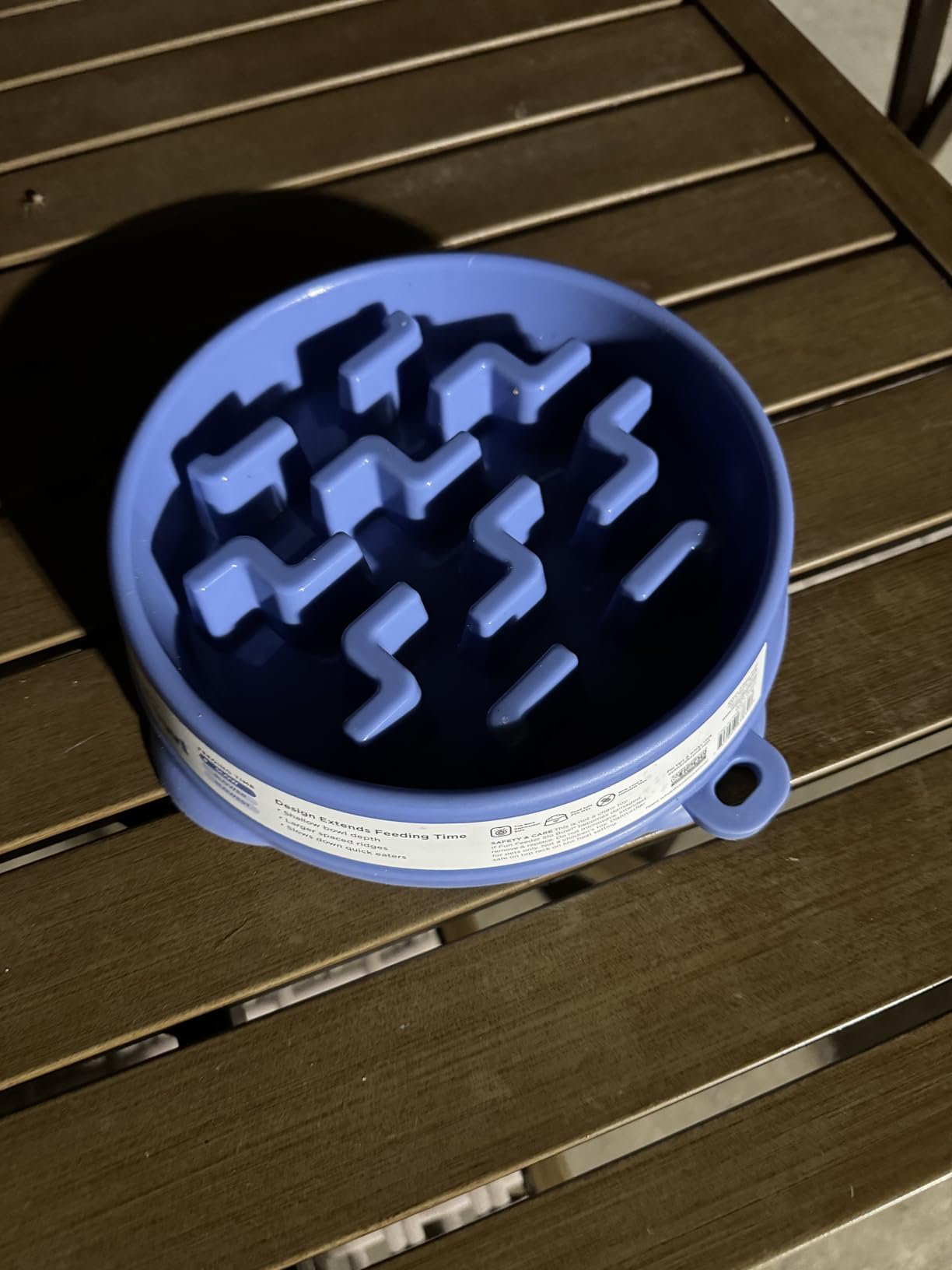
The notch maze is the reason it works. It is wide enough that a dog can actually reach the food with a tongue, which is the single most important thing a slow feeder has to get right. Deep micro-channels slow a dog for ten minutes and then bore it.
Cleaning is a rinse or a top-rack dishwasher cycle. With 116k reviews behind it, we have never seen a durability complaint that we could not trace back to a dog chewing the rim rather than normal use.
Check the capacity before you order
Two cups is a full meal for a small to medium dog, nothing more. It also ships in three slow levels and several maze patterns, so you can step up difficulty without changing brands.
Where it falls short
Very young puppies and short-tongued small breeds get frustrated and flip the bowl rather than work at it. Wet food is the wrong choice here too, because the maze holds moisture in the pockets.
2. MateeyLife 2-Pack Slow Feeder Bowls — Best Value for Multi-Dog Homes
- Two bowls in one pack
- Widened base stops dogs flipping it
- Rubber feet grip tile and wood
- Works with dry wet and raw food
- Easy to rinse or dishwash
- Crevices take longer to scrub
- Better for small and medium dogs
- Some eaters still gulp
The simplest logic in the category: if you run two dogs, you get two bowls, and the second one lives in the car or the crate. At 12.7 ounces each, these are noticeably heavier than most plastic competitors and that weight is the feature.
Reviewers across the US, UK, EU and Japan describe the same outcome: roughly double to triple the usual eating time, noticeably less gulping, and no more coughing at the bowl. That is a modest claim, and it is the honest one. It works with dry, wet and raw diets, which is rare in a plastic maze.
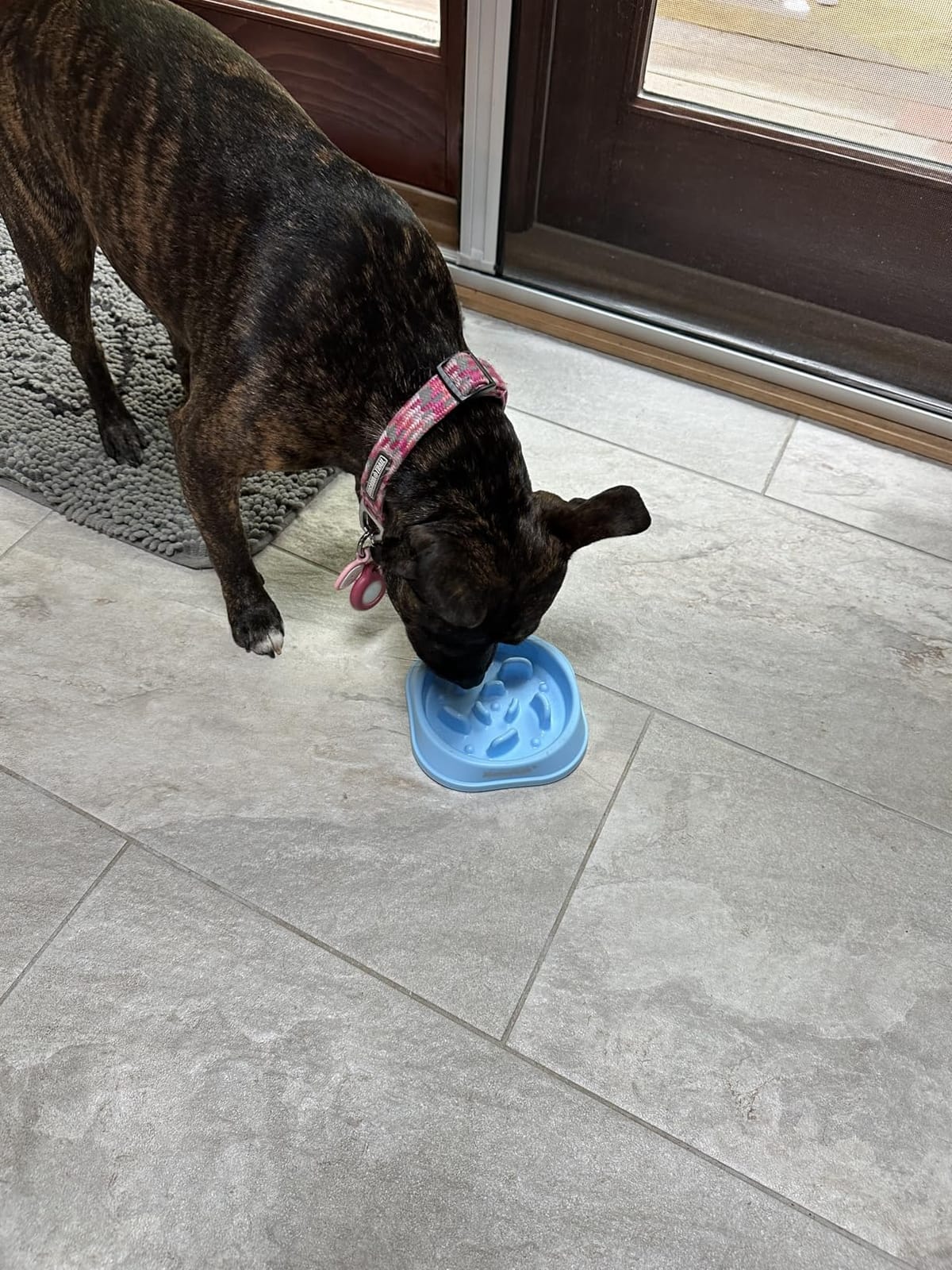
The widened base is what stops the flip-and-dump behaviour we heard about constantly in dog owner forums, and the labyrinth spreads food wider than a spiral so a dog has to travel rather than spin.
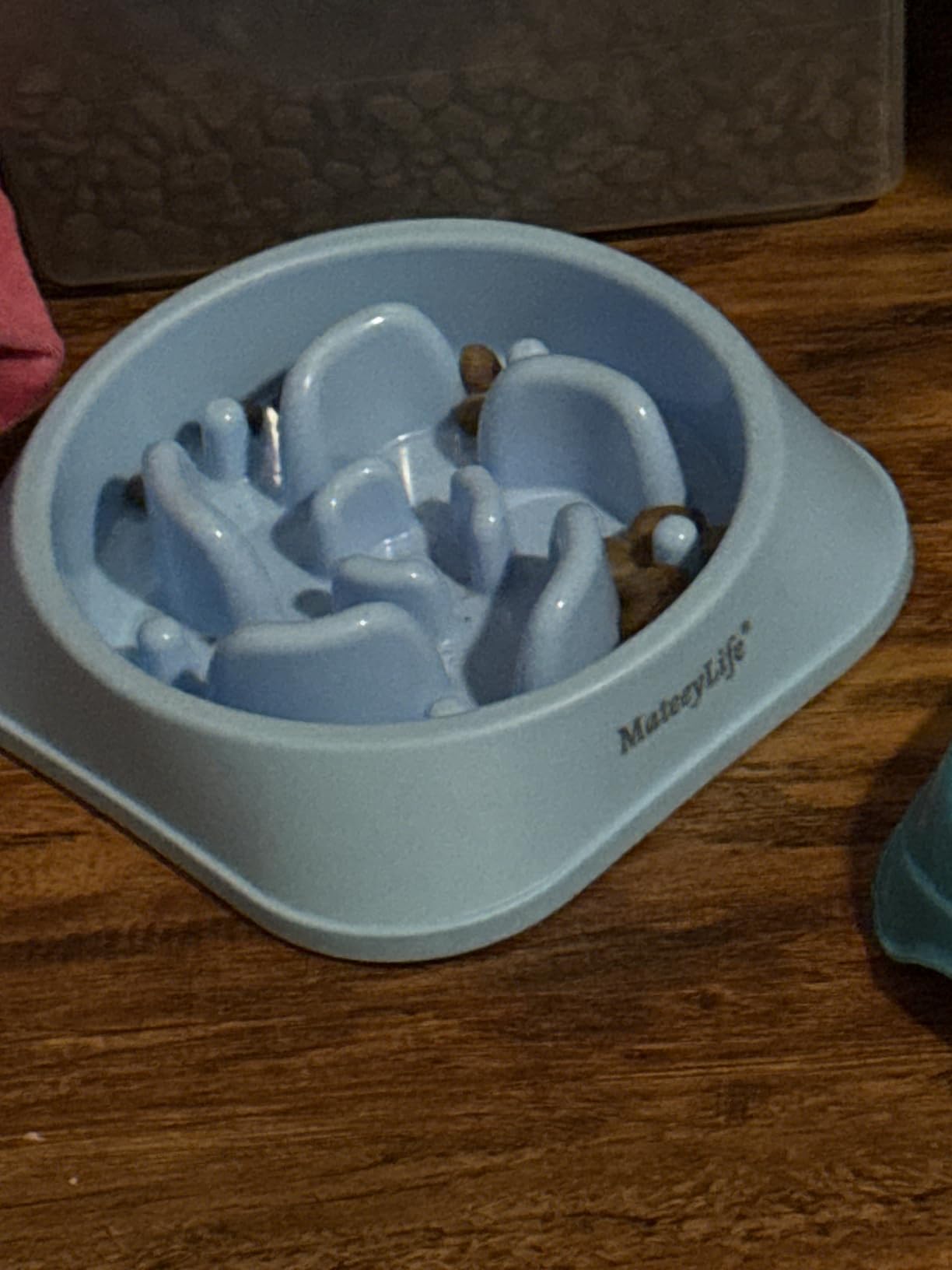
Why the pack matters more than the bowl
Owners with two gulpers consistently say the second bowl solved a problem the first one could not: one dog eating out of a sibling’s bowl the moment they turn around. Separate bowls fix resource guarding that no maze design will touch.
Where it falls short
The labyrinth has more corners than a simple ridge pattern, so a hot soapy water rinse is not optional. Reviewers who bought it for a large, greedy dog report frustration and give-up, and some describe it as slowing eating rather than stopping gulping.
3. YINEYA Smooth Ridge Puzzle Bowl — Best for Puppies and Senior Dogs
YINEYA Slow Feeder Dog Bowl for Medium Dogs, 2-Cup Puzzle Feeder Bowl
- Smooth ridges that cannot scratch mouths
- Unbreakable plastic for strong chewers
- Rubber corner grips hold on wood and tile
- Moderate-width maze is easy to fill
- Several sizes and colours
- Very light for its size
- The maze can be too deep for cats
- Some puppies dislike the challenge
This is the one we recommend when a dog has a mouth worth protecting. The raised ridges are smooth by design, so tongue and nose slide across them without catching, and the wider channels let a short tongue reach food at the bottom. That combination is why it works for puppies teething and for older dogs with tender gums. We found very few bowls in this category that could honestly claim both.
Owners of retrievers, shepherds, pit bulls and Havanese report successful slowing after a short adjustment period, and specifically report that dogs who previously flipped their bowls stopped flipping this one once they moved up a size. The material is food-grade, recyclable, non-toxic PP polypropylene, and at 6.38 ounces it is compact.
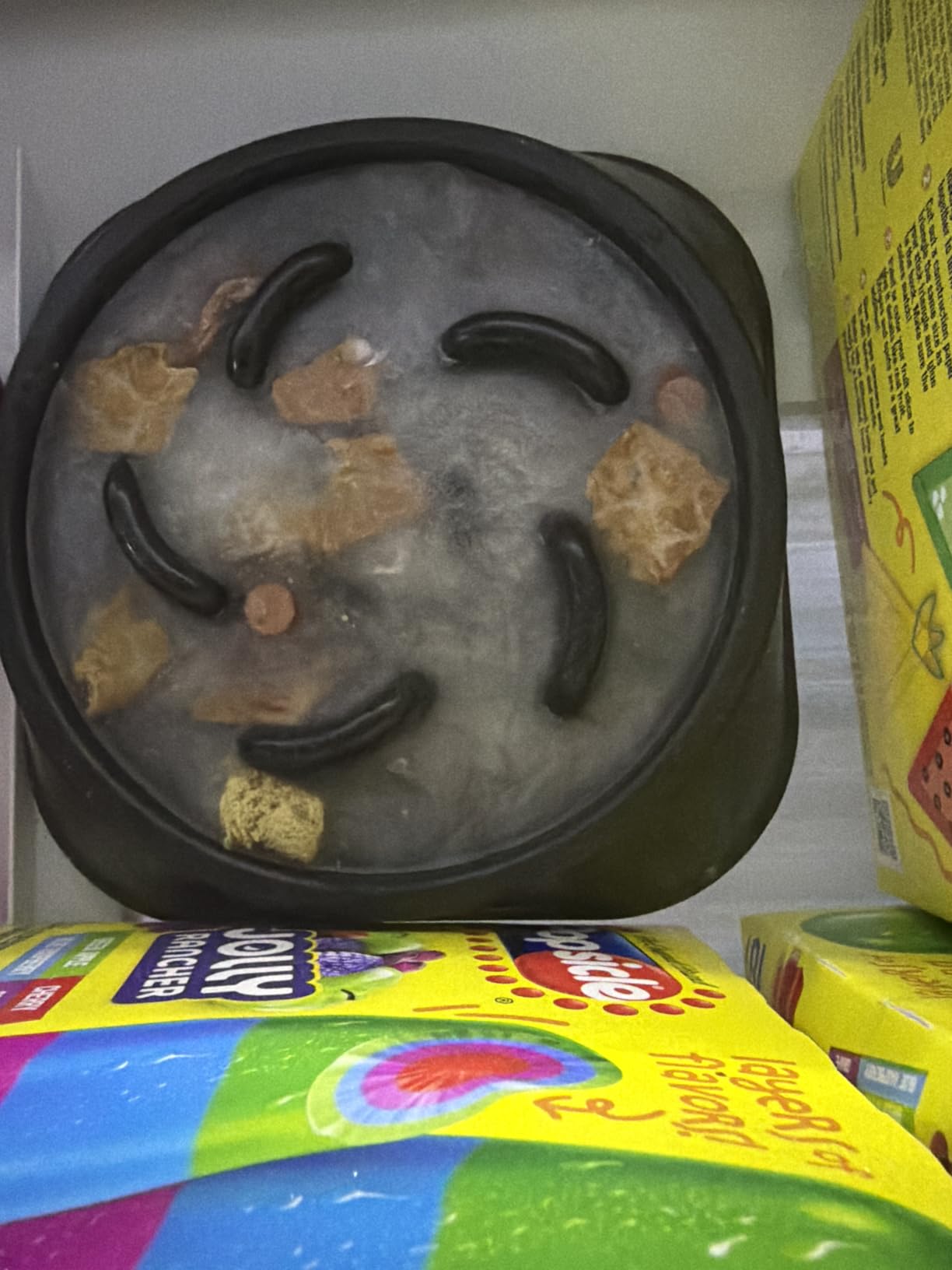
It is sold as the unbreakable alternative to a breakable ceramic feeder, which matters for a dog that bites bowls. The maze is the right difficulty for a medium dog.
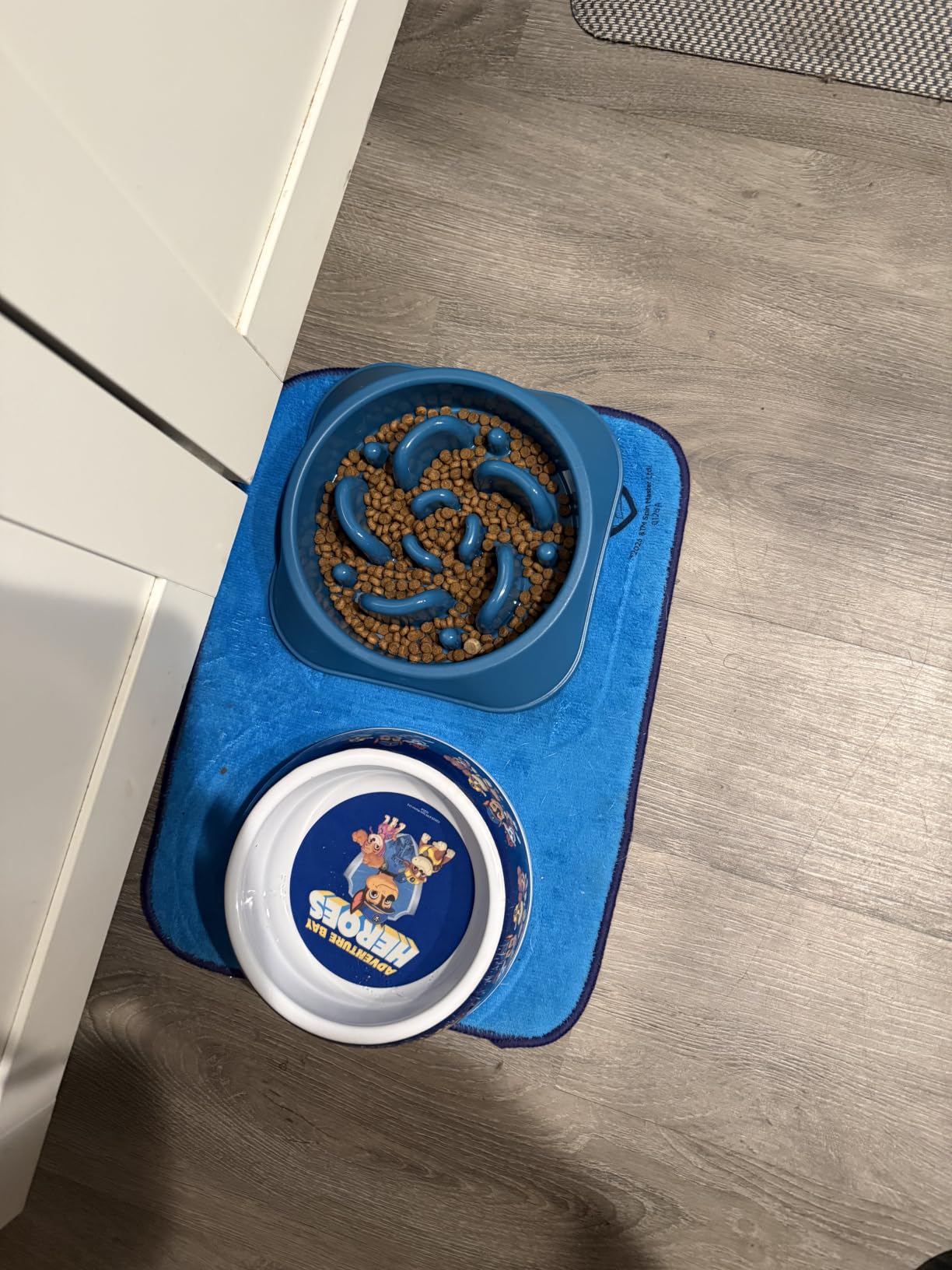
Check the depth for small pets
The maze suits a medium dog and is too deep for a cat or a very small breed, who will leave food uneaten and then whine about it. The listing includes cats as a supported user, and we would be more cautious about that than the brand is.
Where it falls short
It is light. A strong dog can push or flip it, and on smooth floors it does creep. If you have a pit bull or mastiff, expect to move this one.
4. JASGOOD Spiral Maze Bowl — Best for Large, Deep-Chested Breeds
JASGOOD Slow Feeder Dogs Bowl for Large Medium Dogs,Anti-Gulping Pet Slower Food Feeding Bowls Stop Bloat,Preventing Choking
- Genuinely slows the feeding frenzy
- 9.6 inch width beats the depth
- Survives a year of daily dishwasher use
- Eats every piece with nothing stuck
- Hard to knock over
- Larger than expected on arrival
- Anti-slip pads grip vinyl plank poorly
- Needs food spread in a single layer
The widest bowl in this roundup at 9.6 inches across and only 1.77 inches high, and that geometry is the point. Wide and shallow beats narrow and deep for large dogs, because a wide footprint makes flipping physically difficult and spreads food further. At about 3 cups of dry food it is the right capacity for a Labrador, Golden, Shepherd or Standard Poodle.
Owners of labs, shepherds and goldens report meals stretching from seconds to two to five minutes, with the feeding frenzy visibly calming after about a week. Durability is the standout: a year-plus of daily use with regular dishwasher cycles and no cracking.
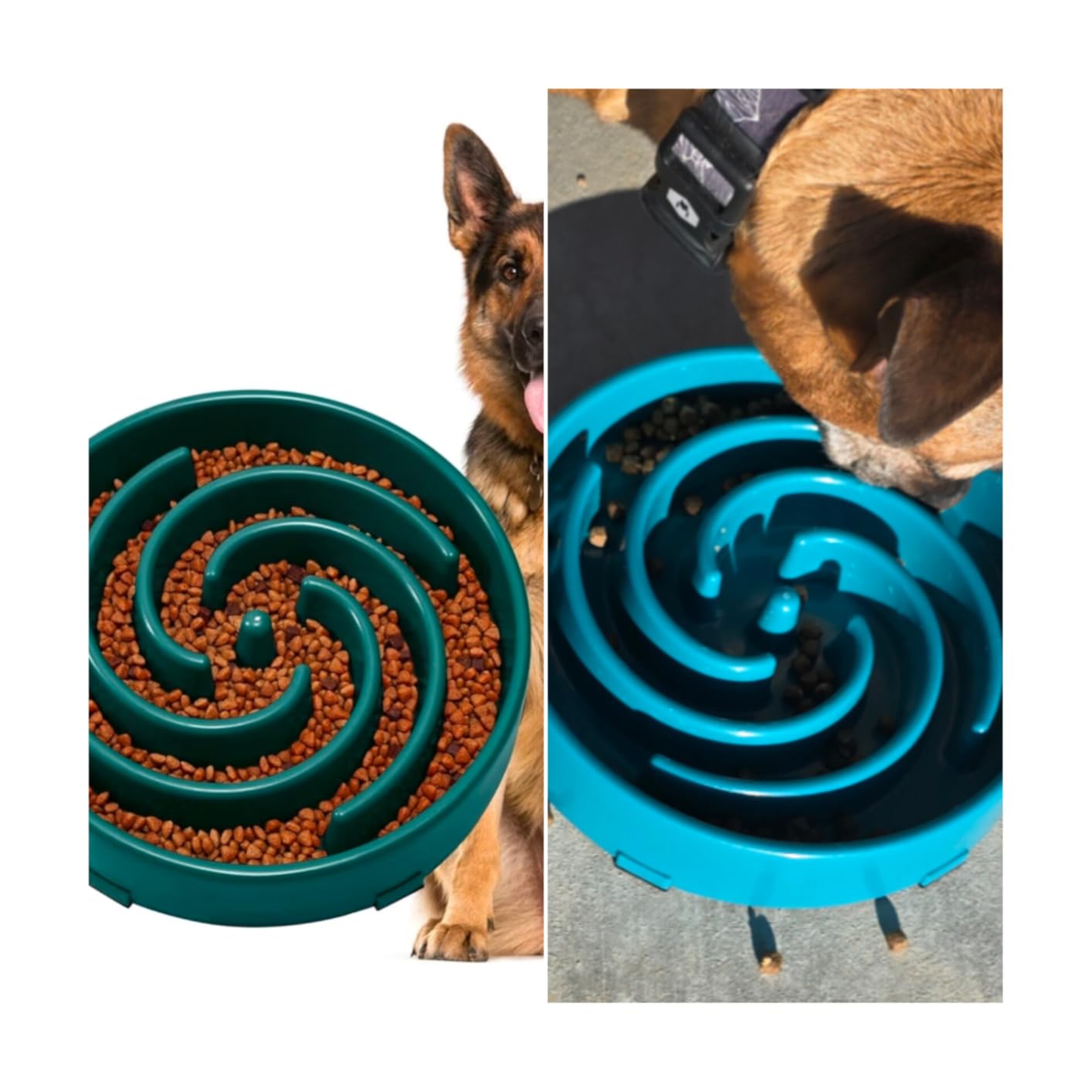
The spiral is the harder pattern, and harder is the point. Reviewers also report that dogs reliably finish every piece rather than leaving food lodged in the channels.
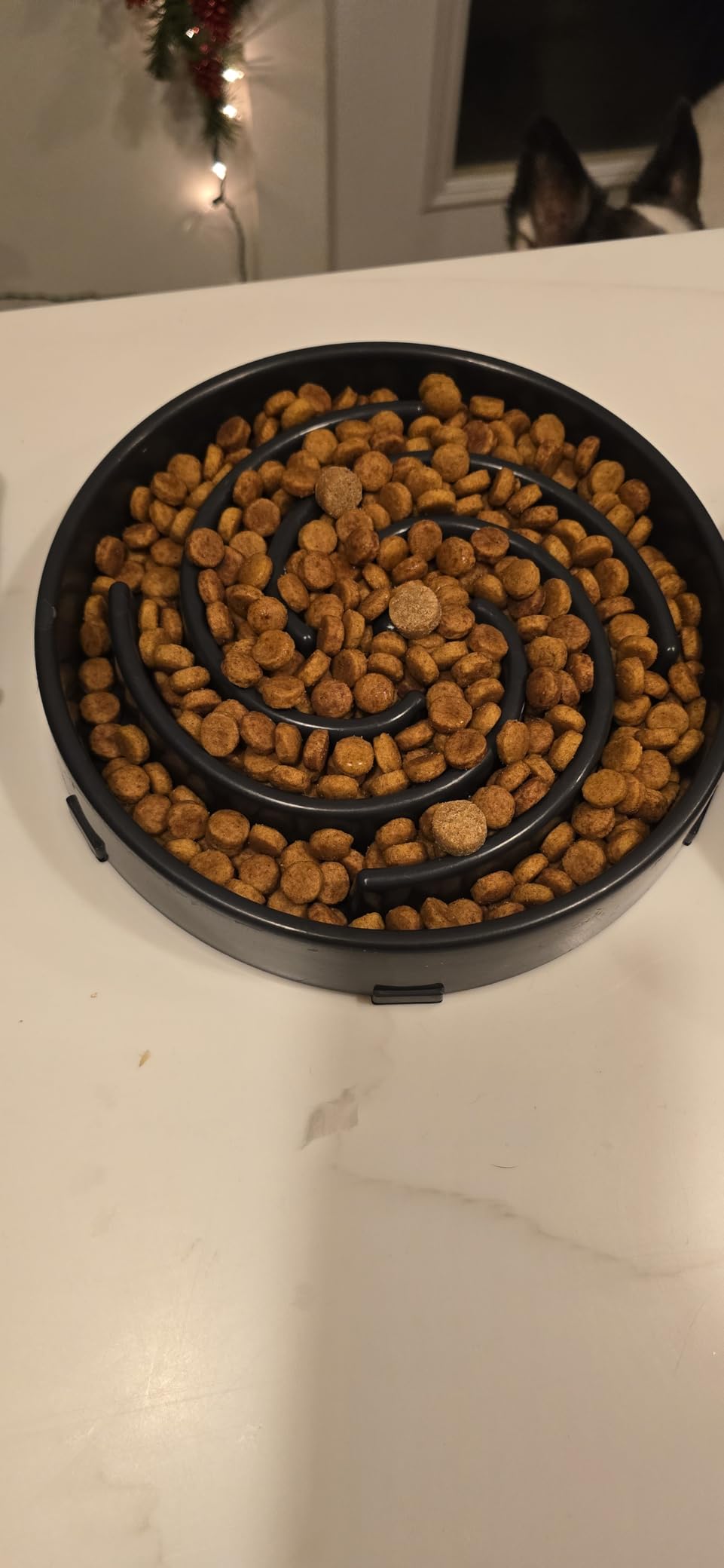
Spread the food, do not pile it
Best results come from spreading food in one thin layer across the ridges. Piling it into the centre lets a dog scoop from the top and eat at normal speed. Fill to the two-thirds line at most.
Where it falls short
It is bigger than most people expect, so measure your feeding area first. The six anti-slip pads grip hardwood much better than smooth vinyl plank; if your kitchen is vinyl or polished tile, buy a feeding mat as well.
5. WHIPPY Spiral Maze Bowl — Best 3-Cup Spiral for Large Breeds
- Clear drop in gulping and tummy trouble
- Thick plastic that survives daily use
- Rinses clean with no residue
- Works for growing puppies and large breeds
- Keeps a multi-dog household calm at meals
- Anti-skid tabs can fall out
- Swirl allows some dogs to swipe kibble
- Edges fray for dogs that bite the bowl
Very close to the JASGOOD in geometry — 3 cups, spiral maze, roughly 9.8 inches across — and it competes with it on rating. Owners of standard poodles, Saint Bernards and mixed rescues report a clear drop in gulping and digestive trouble within a fortnight. It weighs 10.55 ounces, heavier than most plastic here, and a large part of why it resists sliding. It works with dry, wet or raw food, and reviewers who feed raw report the swirl holding ground meat without drying it into the plastic.
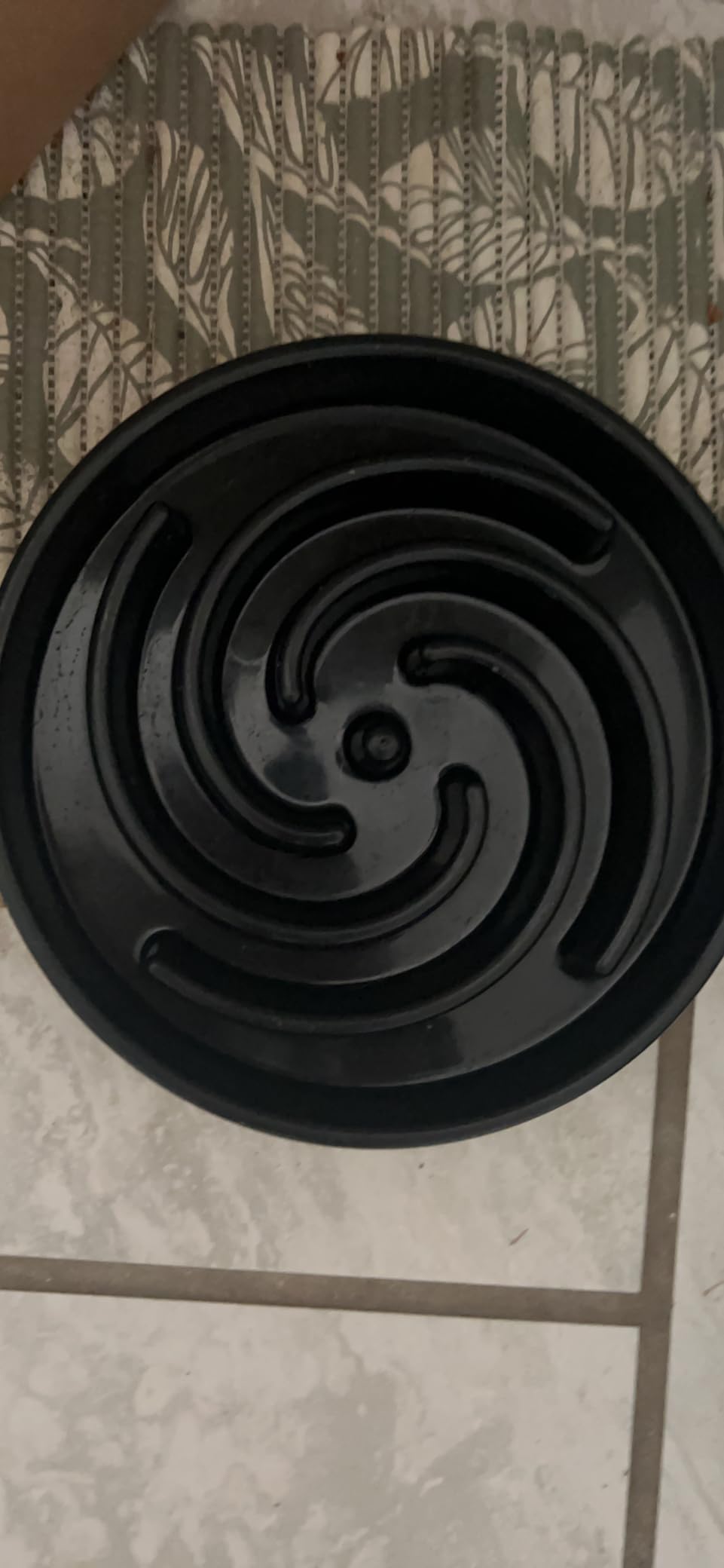
Durability is reported as good over a year-plus of daily use, including dishwasher cycles. The white dog table is the one piece of kit in a slow feeder setup that never gets replaced.
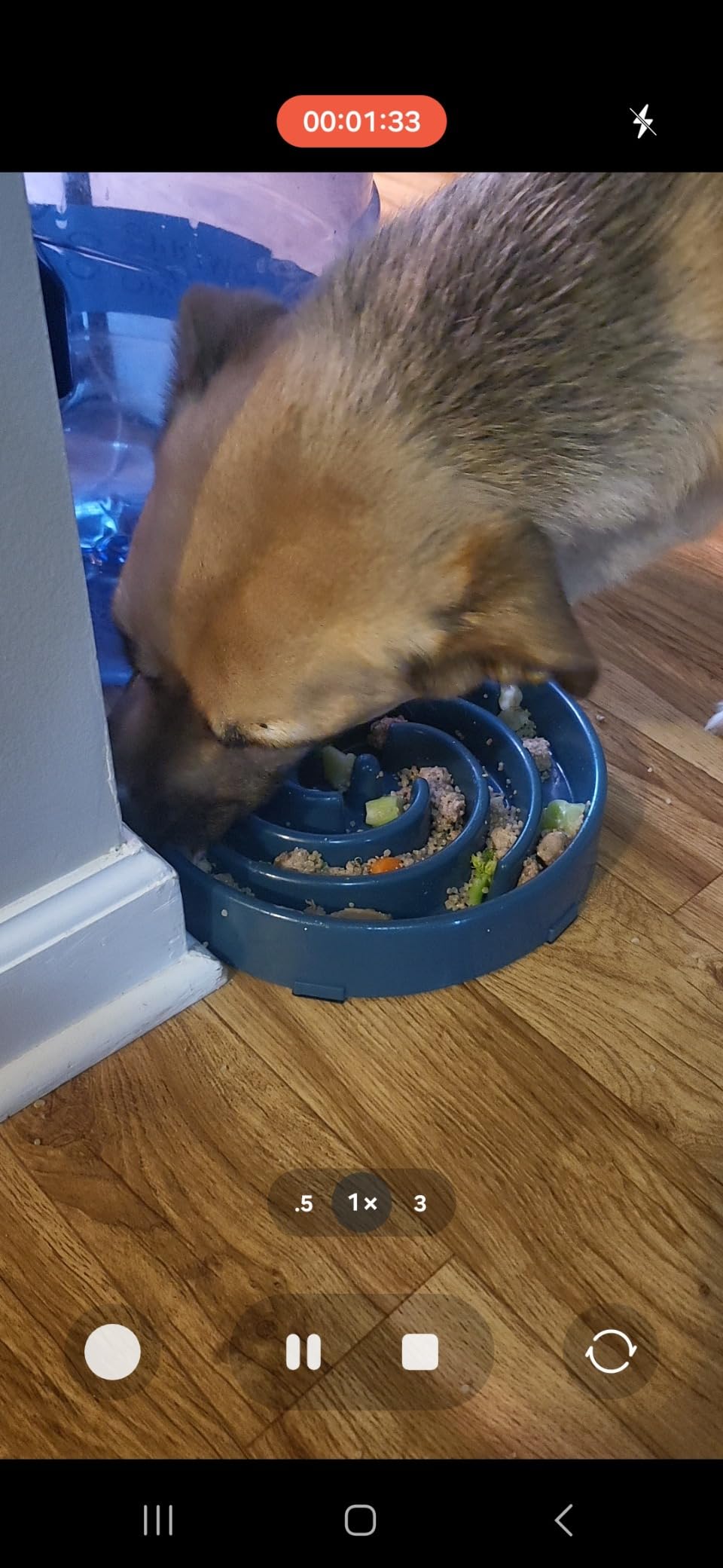
Best of the bunch for multi-dog households
The specific benefit owners report is not slowing, it is bullying. A dog that takes five minutes at the bowl is not finished in ninety seconds, which removes the window in which a second dog walks over and helps itself.
Where it falls short
The six anti-skid tabs can fall out and are hard to refit, and some dogs learn to swipe several pieces at once through the swirl, so slowing is moderate rather than dramatic. Edges also fray for dogs that bite their bowls.
6. LE TAUCI Ceramic Slow Feeder Bowl — Best Ceramic for Small and Medium Dogs
LE TAUCI Dog Bowls Slow Feeder Ceramic, 1.5 Cup Slow Feeding Bowl for Small and Medium Breed, Puzzle Dog Food Bowl for Fast Eater, Maze Purple
- Ceramic does not scratch or hold smells
- Very heavy so it never moves
- Reduces bloat and regurgitation
- Microwave and dishwasher safe
- Many maze designs and matching stands
- Ceramic chips if dropped
- Needs a gradual adjustment first
- Costs more than plastic
Ceramic solves two problems plastic cannot: it does not scratch, so no black chin, and it does not hold odour, so the bowl does not smell like last night’s wet food three days later. It also does not move. At about 1.45 kilograms with a non-slip base, this is the heaviest plastic-free bowl we tested, and we never saw it shift once.
At 1.5 cups it is a small to medium dog bowl. Owners report slowing of up to ten times and a visible drop in regurgitation within days, and it carries 85% five-star reviews — the highest share of five-star ratings in this roundup, which is a real signal on satisfaction rather than volume.
It is microwave and dishwasher safe, and the low centre of gravity that keeps it still also makes it difficult for a dog to tip. We consider that the best anti-tip mechanism in the category.
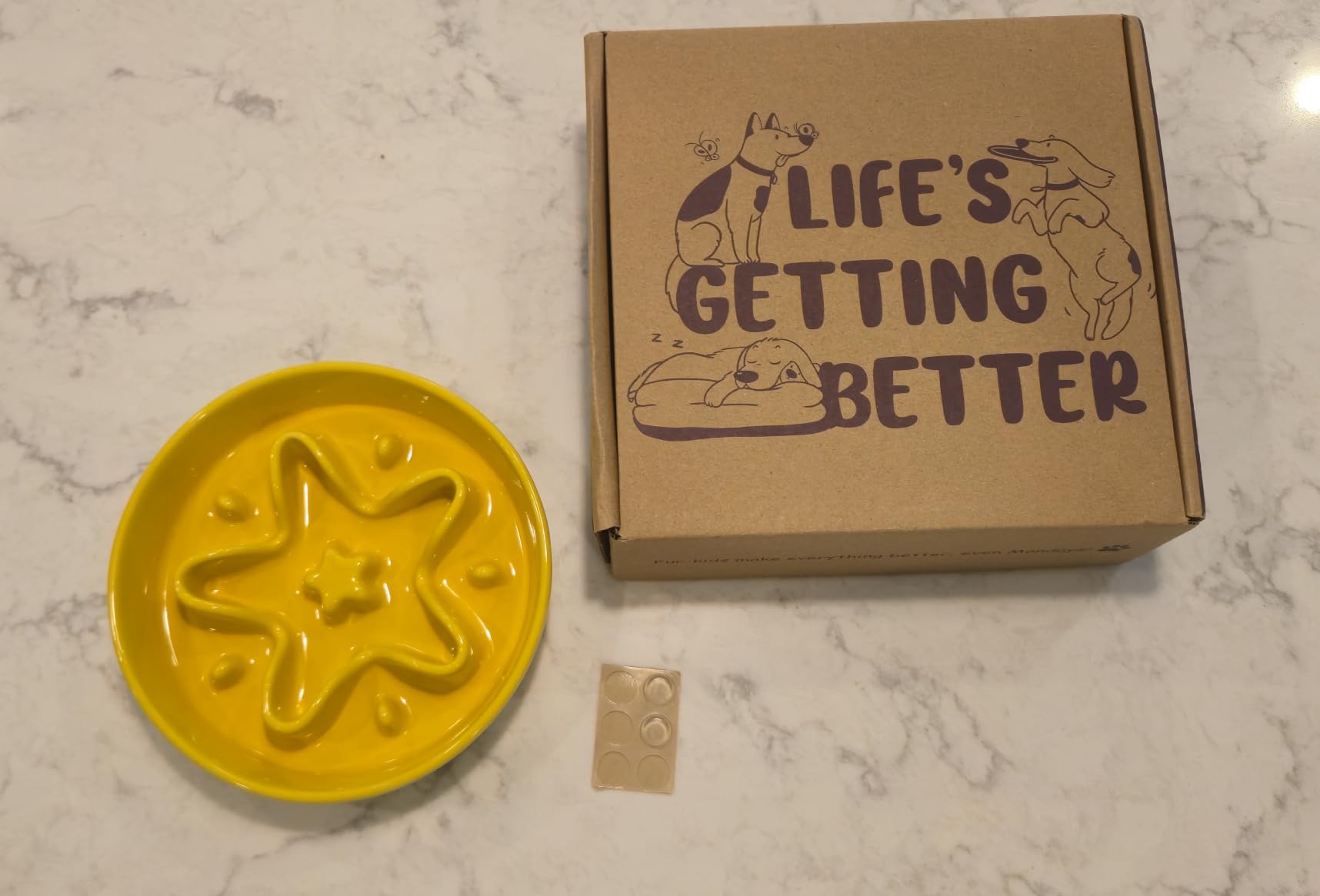
Why ceramic is worth the compromise
If your dog has sensitive chin or muzzle skin, or a habit of biting plastic bowls, ceramic removes the whole class of problem. It is also the material to choose if you feed wet food and do not want to scrub plastic every night.
Where it falls short
It is breakable, and ceramic costs roughly three times what a plastic bowl does. Dogs unfamiliar with slow feeders also often need a silicone bowl or several plain meals before they accept the ridges.
7. OurPets DuraPet Stainless Steel Slow Feed Bowl — Best Stainless Steel for Multi-Dog Homes
OurPets DuraPet Slow Feed Premium Stainless Steel Bowl (Heavyweight Durable Stainless Steel Bowls, Dog Food Bowl, and Dog Water Bowl) Great Alternative to Snuffle Mat for Dogs-Medium
- Rust resistant and does not hold odours
- Heavy base resists tipping entirely
- A true plastic-free alternative to mats
- Dishwasher safe and easy to scrub
- Three sizes up to 8 cups
- Slower than a deep plastic maze
- Steep sides suit longer snouts
- Listed weight looks wrong
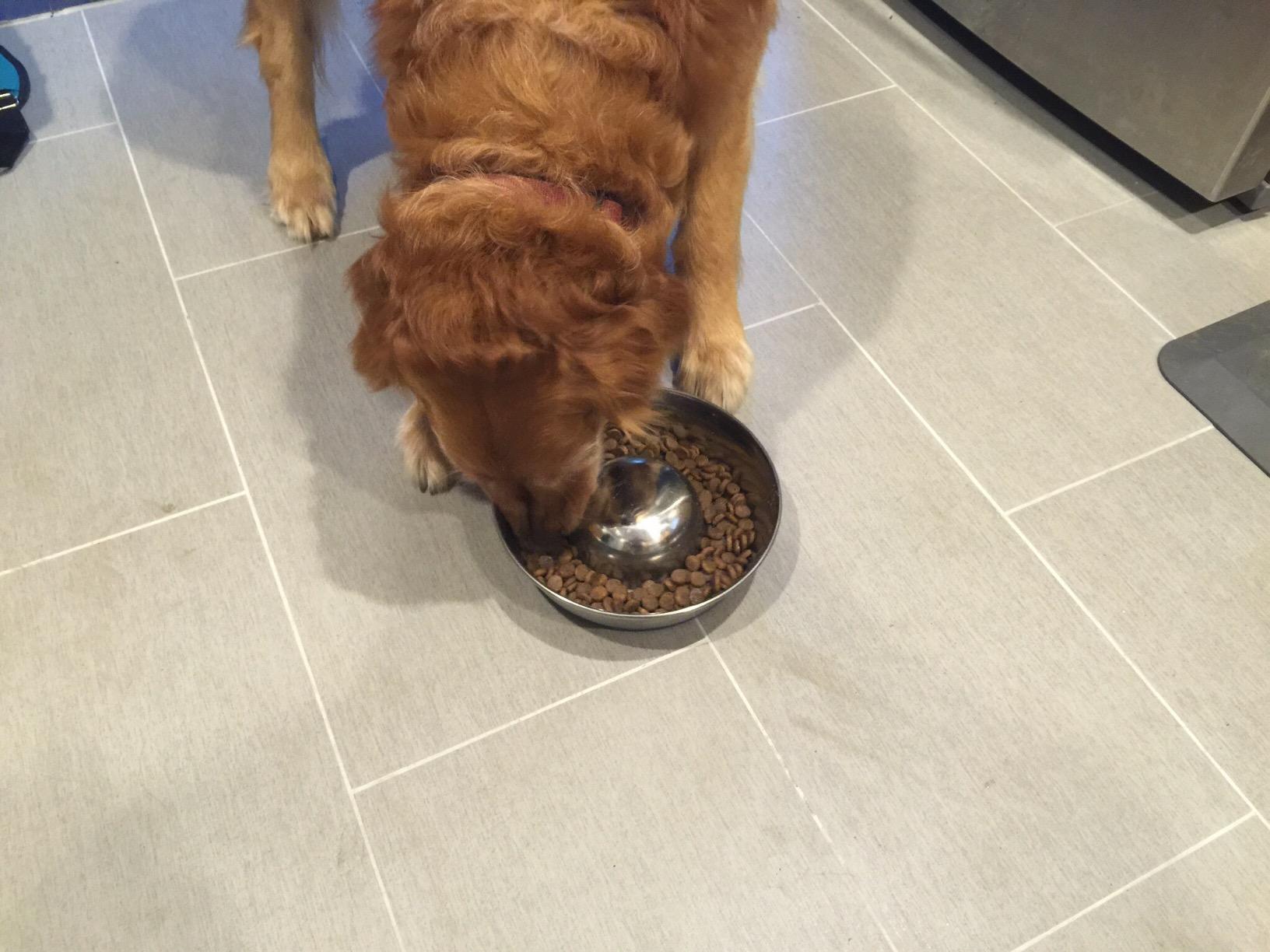
This is a different mechanism from every plastic bowl here. There is no maze. There is a solid raised centre piece, so the dog has to work around the outside edge to find the food, which turns a meal into a slow circuit of the rim. That is genuinely useful in a multi-dog household, because the bowl simply does not move — the skid-proof ring is bonded into the steel rather than a slip-on pad that eventually falls off.
It has been on sale since 2004, making it the oldest product in this roundup, and it is a plastic-free alternative to a snuffle mat, which matters if you dislike pouring kibble onto fabric. Three capacities are offered: small up to 3 cups, medium up to 5, large up to 8 of dry food — the only bowl here that fits a Saint Bernard or a Newfoundland.
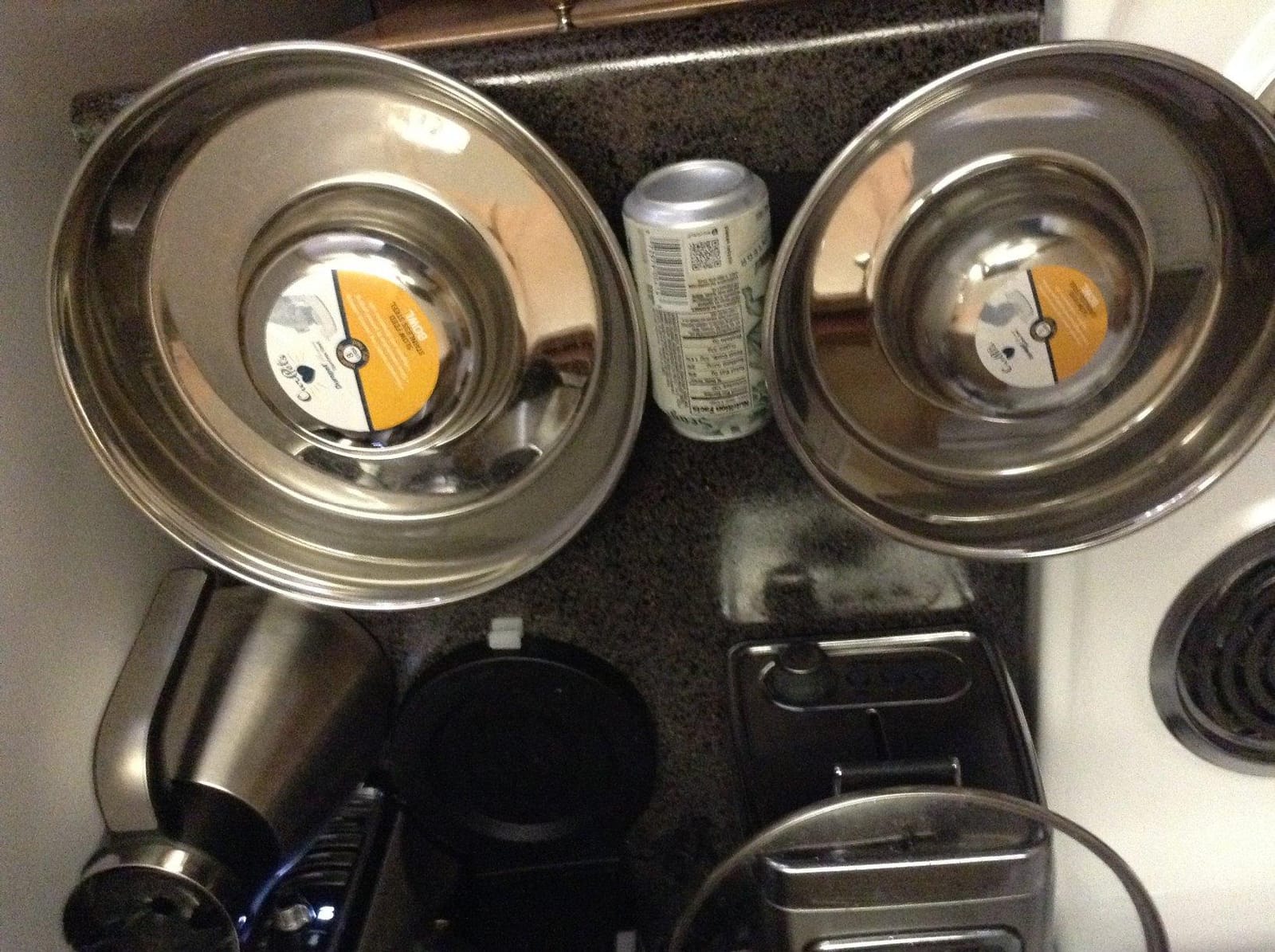
Because the design works by routing food around an edge rather than through channels, a wider bowl automatically means a longer meal. The 8-cup large version is a genuinely long job.
How to choose the right capacity
Match the cup rating to one full meal, not to the whole day. A dog eating 3 cups of kibble a day should be fed twice, and the small bowl at up to 3 cups covers one of those meals exactly.
Where it falls short
It slows less than a deep plastic maze, so an extreme gulper may need a second bowl. The steep sides also suit a longer snout; for a French Bulldog or a Pug, a shallow pattern is a better fit.
8. Mr. Peanut’s Stainless Steel Bundt Slow Feeder — Best for Short-Nosed Dogs
Mr. Peanut’s Stainless Steel Interactive Slow Feed Dog Bowl with a Blue Base, Fun Healthy Bloat Stop Feeder (Large)
- Genuinely long-lasting
- Many users report 5+ years of daily use
- Non-slip silicone base stops it moving
- Dishwasher safe
- Works for wet or dry food
- May not slow very aggressive eaters
- Rust can form where silicone meets steel
- Rubber ring can loosen over time
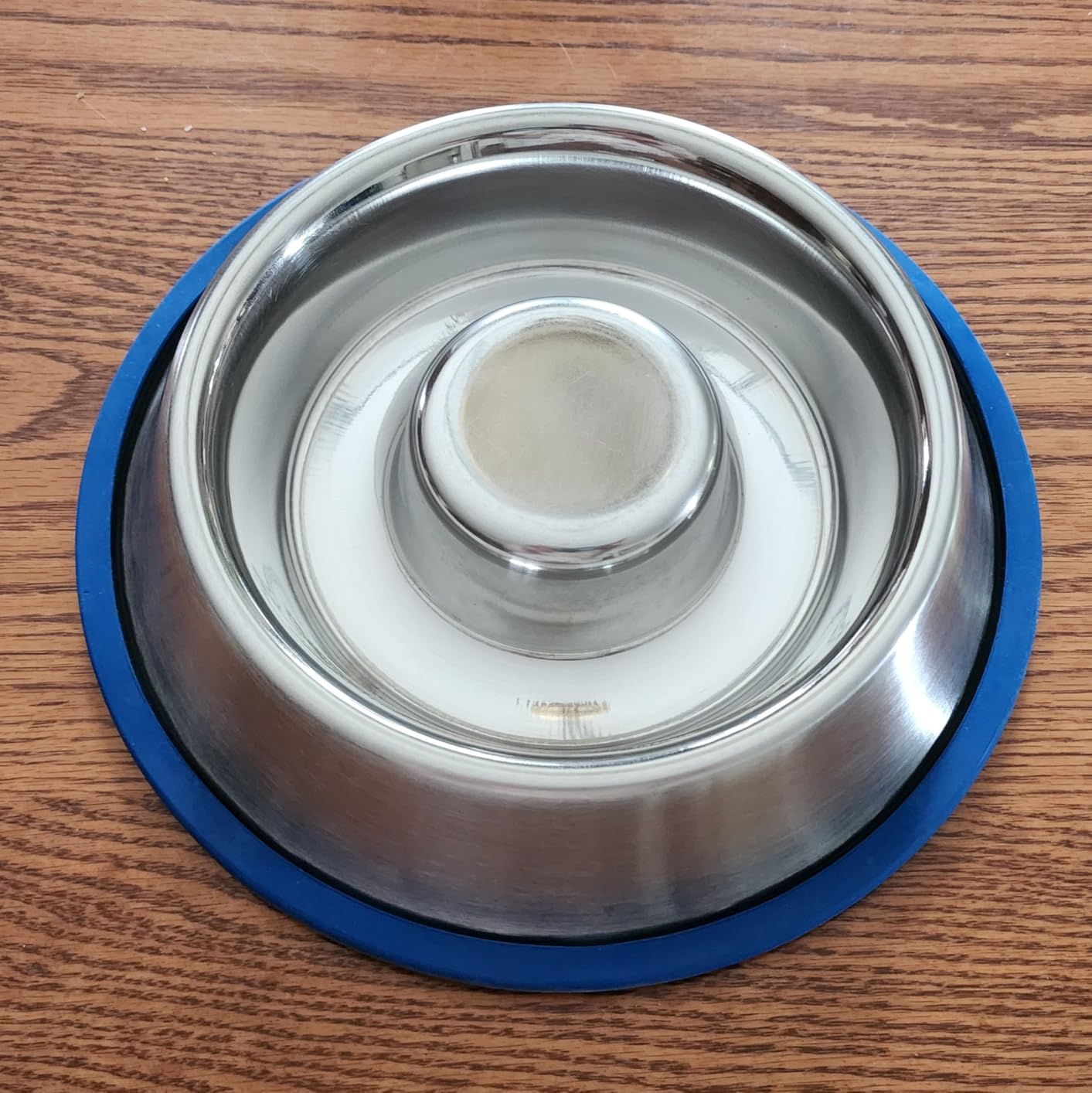
The Bundt interior is a raised ring in the middle rather than a floor pattern, so a dog reaches the food by circling the channel. That geometry is far kinder to a flat-faced dog than a maze with narrow wells, because there is no deep pocket a short tongue cannot reach. Reviewers specifically single this out as good for brachycephalic breeds, and it is the pick we would use for a French Bulldog or a Boston Terrier.
It is single-piece moulded steel with no welded seam, 11.4 inches across and 15.2 ounces, and it works for wet or dry food. The channel is a single open ring, so scraping it out is far quicker than a multi-channel maze. Several owners report six-plus years of daily use, longer than any plastic bowl here.
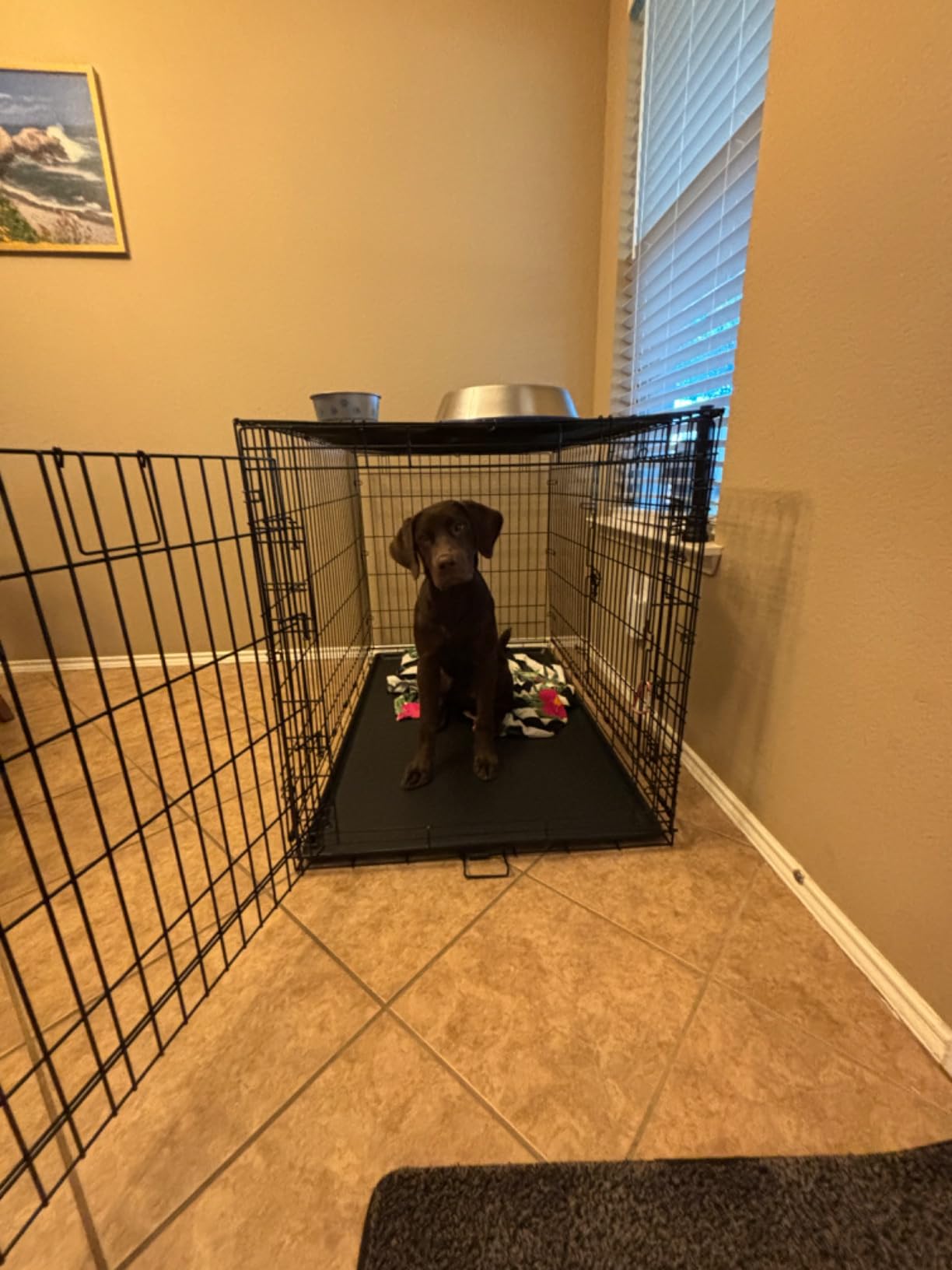
Three sizes are available, so the same geometry works from a small dog to a large one.
Check whether it needs drying properly
Dry it thoroughly, especially along the rim where the silicone meets the metal. Reviewers report rust spots forming at that junction on bowls left to air-dry overnight. Dishwasher, then towel the rim — that is the entire routine.
Where it falls short
It does not slow an extremely aggressive eater much, because the wide open channel is easy to run a tongue along. The rubber ring can also loosen over time, so check it periodically.
9. Feedoo Double Wall Stainless Steel Slow Feeder — Best Heavy-Duty Stainless Bowl
Feedoo Slow Feeder Dog Bowl-2Cups for Medium Breeds, Double Wall Food-Grade Stainless Steel, Heavy Duty with Non-Slip Rubber Base, Puzzle Maze Bowl to Slow Down Eating
- Double wall gives real weight and stability
- Flower maze slows effectively
- Non-slip rubber base
- Food-grade and rust resistant
- Dishwasher safe and many size options
- Newer design with less long-term data
- 2 cup version is for small to medium dogs
- Heavier than plastic alternatives
The double wall is the engineering point. Two layers of stainless steel give this bowl 1.06 pounds of weight in a 7.87-inch footprint, so it resists a determined dog without needing a rubber mat. The flower-shaped hump creates four channels radiating from the centre — a moderate challenge rather than a punishing one, which makes it a good second bowl once a dog has mastered a simple pattern.
It is food-grade, rust resistant, dishwasher safe, and safe for dry kibble, wet food or fresh canned food. That last combination is what separates it from most stainless options, which tend to be kibble-only. The family runs from 1 to 1.5 cups up to 4 to 4.5 cups in single and two-packs, so you can match capacity to breed without changing brand.
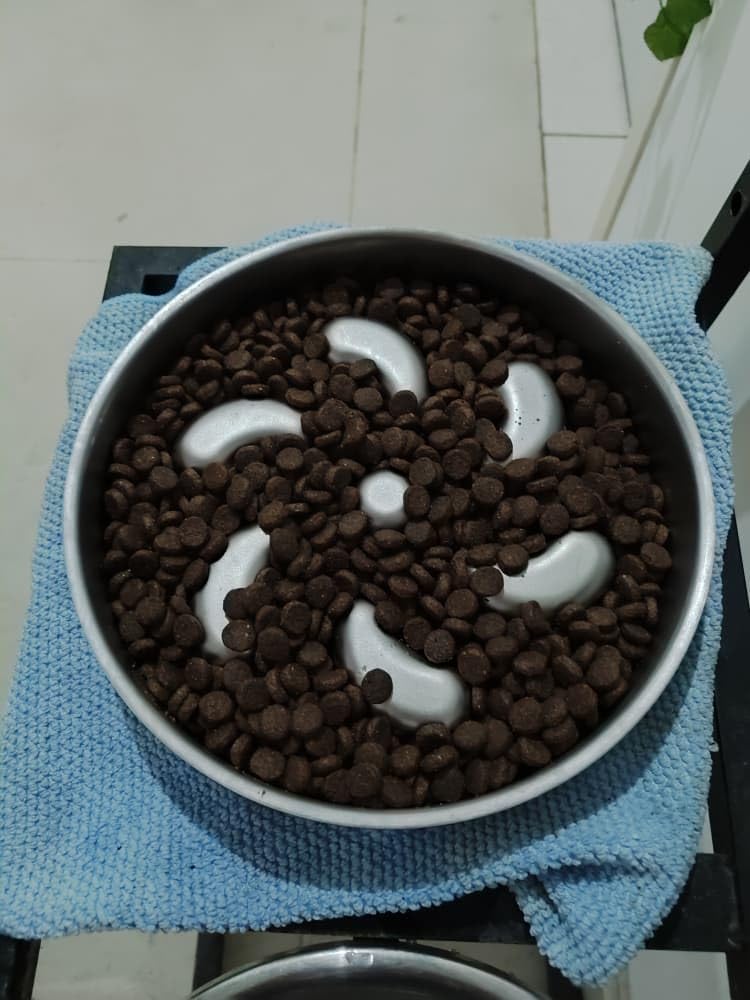
A single-wall steel bowl is light and slides; the double wall adds mass low and wide, so the bowl stays put through a full meal and stays put when a second dog walks past it.
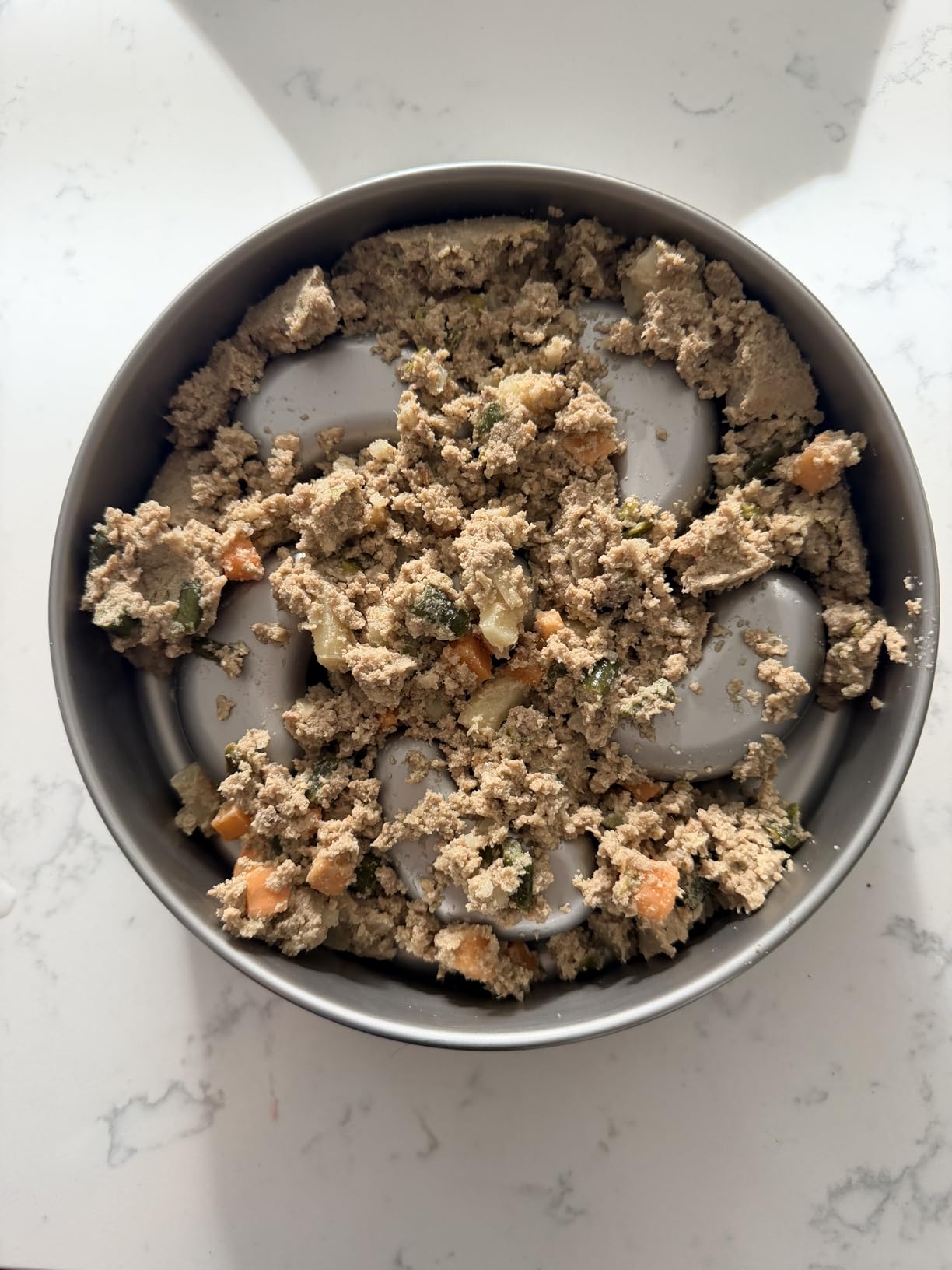
Why double-wall stainless beats a flat steel bowl
If you are moving away from plastic but want a real puzzle challenge rather than a rim circuit, this is the pick.
Where it falls short
This specific variant is a 2-cup bowl for small and medium dogs, and larger capacities are separate listings, so check the size carefully. It also arrived in 2024, so there is no multi-year durability data yet.
10. vancasso Ceramic Slow Feeder Bowl — Best Ceramic for Large Breeds
vancasso Slow Feeder Dog Bowl, 3 Cup Ceramic Slow Feeding Food Dish for Large Breed, Puzzle Dog Food Bowl for Fast Eater, Blue
- Lead-free ceramic with food-safe glaze
- Low centre of gravity resists tipping
- Seamless glaze means nothing sticks
- Good for sensitive skin
- Four colours and three capacities
- Breakable if dropped
- Heaviest option in the roundup
- Costs more than steel or plastic
The reason this one exists is that 3 cups of ceramic is genuinely rare. Most ceramic slow feeders are 1.5 cups, which is a small dog bowl. At 3 cups with a low centre of gravity, this handles a Labrador or a Golden. It is lead-free and cadmium-free ceramic with a food-safe glaze, and the seamless surface means no crevices to trap moisture or odour.
The 12-inch footprint and 4-inch height give a large dog room to work, and the adhesive non-slip pads keep the 2.31 kilograms planted. It is also the option we would pick for a dog with sensitive skin, because ceramic does not cause the chin irritation associated with plastic bowls.
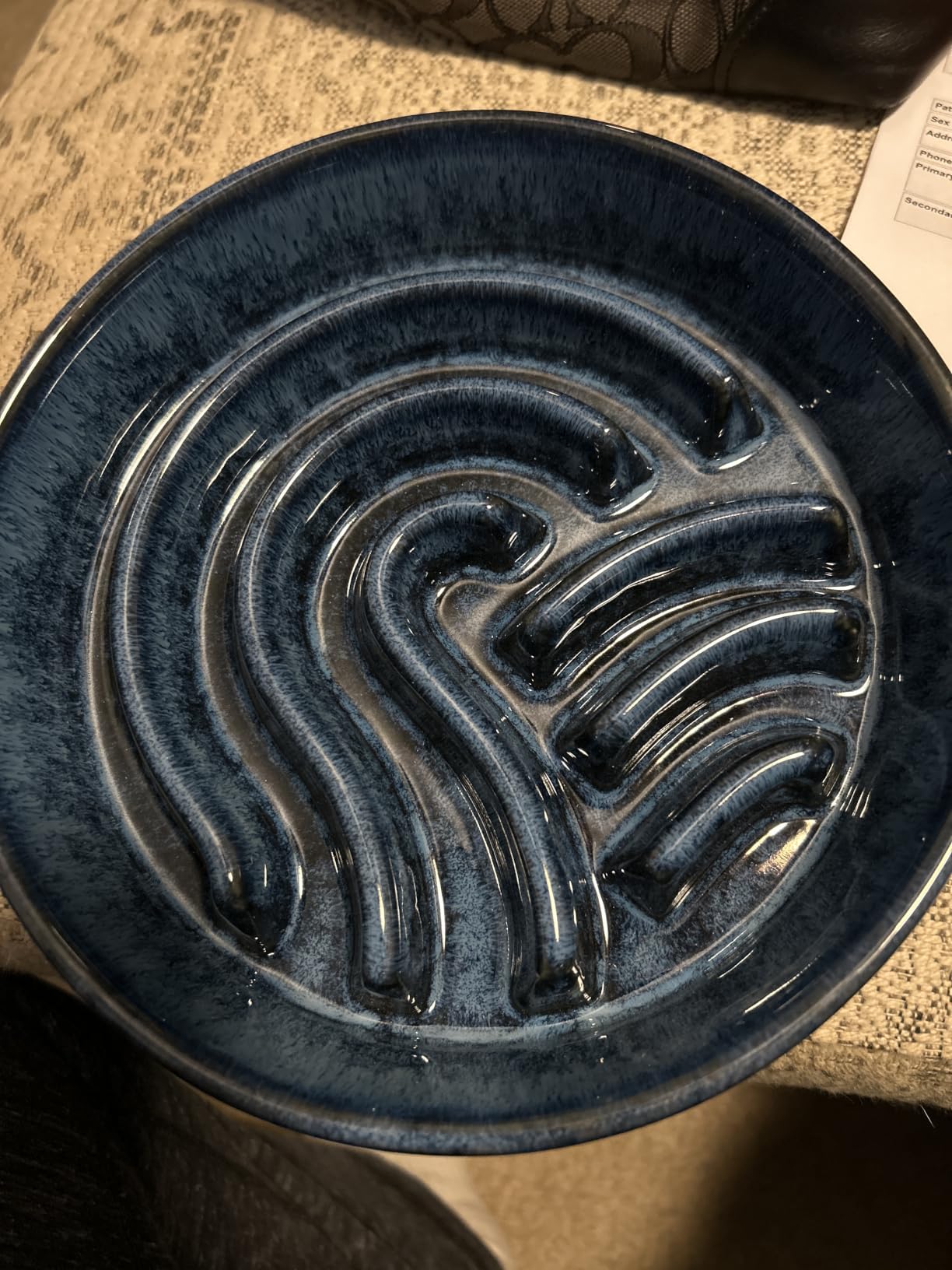
Owners rate it highly at 86% five-star reviews, and it is available in four colours and three capacities.
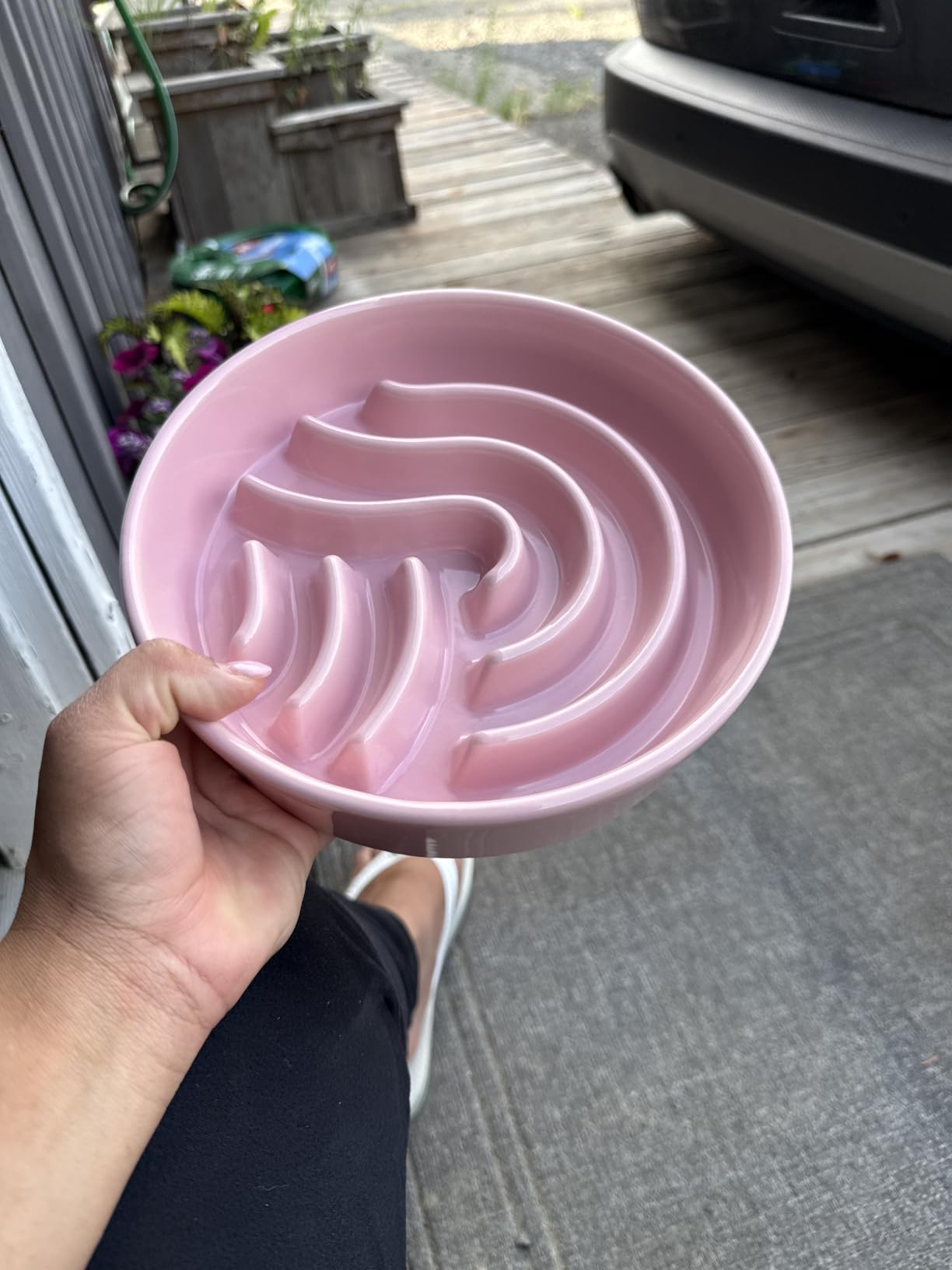
This is our skip recommendation
We include it because it fills a real gap — large-breed ceramic — and does that job better than anything else here. We are also telling you plainly that for most households it is the wrong purchase. At 2.31 kilograms, this is the heaviest item we tested, and carrying it to the garden or setting it down on a hard floor all carry the same risk.
Where it falls short
It chips or cracks if dropped, and ceramic is the most fragile material in this category. A dog knocking it off a raised stand is the common accident, which is why we rate stainless ahead of ceramic for boisterous large dogs.
11. UPSKY Bone Pattern Slow Feeder Bowl — Best Flat, Low-Profile Design
UPSKY Slow Feeder Dog Bowl Anti-Chocking Slower Feeding Pet Puzzle Bowls
- Deep grooves reliably triple meal time
- Low wide profile is hard to tip
- Six non-slide mats included
- Rinses clean in seconds
- Works for small and medium dogs
- Lightest bowl in the roundup
- Deep grooves are hard to scrape
- Real capacity nearer 1.5 cups
The bone pattern is deeper than most, and that is why it works. Reviewers report eating time tripling or quintupling, with several owners noting the coughing and choking stopped within days.
It is also the flattest and lightest bowl here at 5.4 ounces and 2 inches tall across a 9-inch footprint. Low and wide is the anti-tip geometry, and it holds even when a small dog works at it hard. Six non-slide mats attach to the base to reduce slippage and protect the floor.
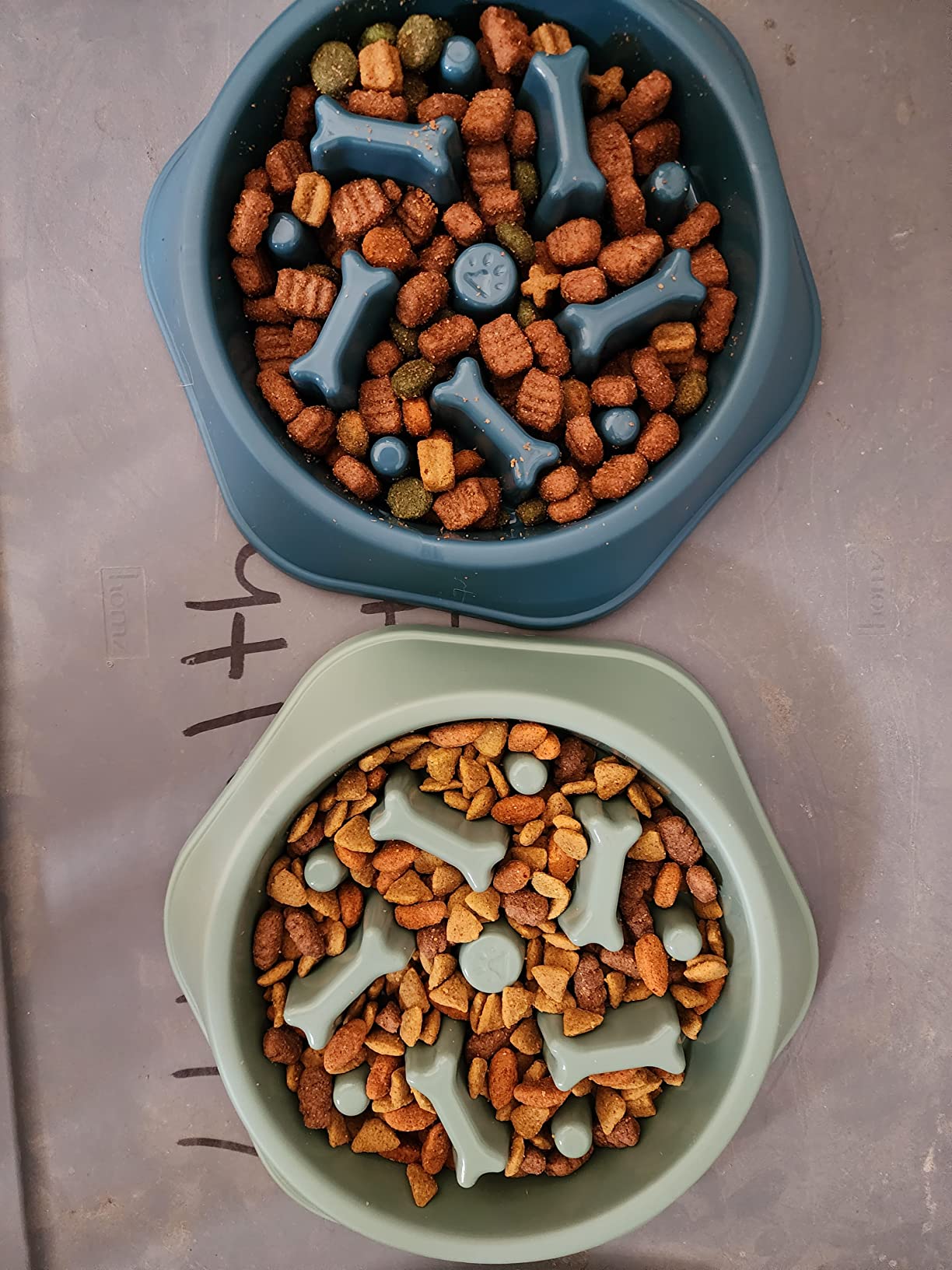
Cleaning is a rinse or a dishwasher cycle, and the deepened bone grooves are what make the slowing work on even the fastest eaters.
Plan for 1.5 cups, not 2
The listing advertises 1 to 2 cups, and owners consistently report usable capacity nearer 1 to 1.5 cups once the ridges are taken into account. Size your portion to the real figure.
Where it falls short
It is the lightest bowl in the roundup and feels thin compared with the stainless options. On smooth floors it can still scoot, especially with a dog that plants a paw on the rim, and the deep grooves are genuinely hard to scrape out wet food.
12. GORILLA GRIP Patented Slow Feeder Bowl — Best for Cats and Small Pets
GORILLA GRIP® Patented Slow Feeder Dog and Cat Bowl, BPA Free, 2 Cup Gray
- Moulded rubber base cannot come off
- Works with wet dry fresh food water or ice
- Maze engages without confusing a dog
- Easy to clean and dishwasher safe
- 1 cup 2 cup and 4 cup options
- Still creeps on bare hard floors
- Too deep for large puppies
- Some dogs flip it out of frustration
The moulded-in rubber base is the genuine engineering improvement here. Most competitors fit a ring or pads that eventually detach; this one wraps the entire base in a single piece of rubber that cannot come off. Owners with fast eaters report that it resolves gulping and choking within days, and the base is singled out as clearly better than slip-on alternatives.
It is also the most food-flexible bowl here: wet, dry, fresh food, water or ice, and you can freeze treats into the maze as a puzzle. It is sold in 1 cup, 2 cup and 4 cup versions, and the 1-cup model is the one to use if a cat shares the household.
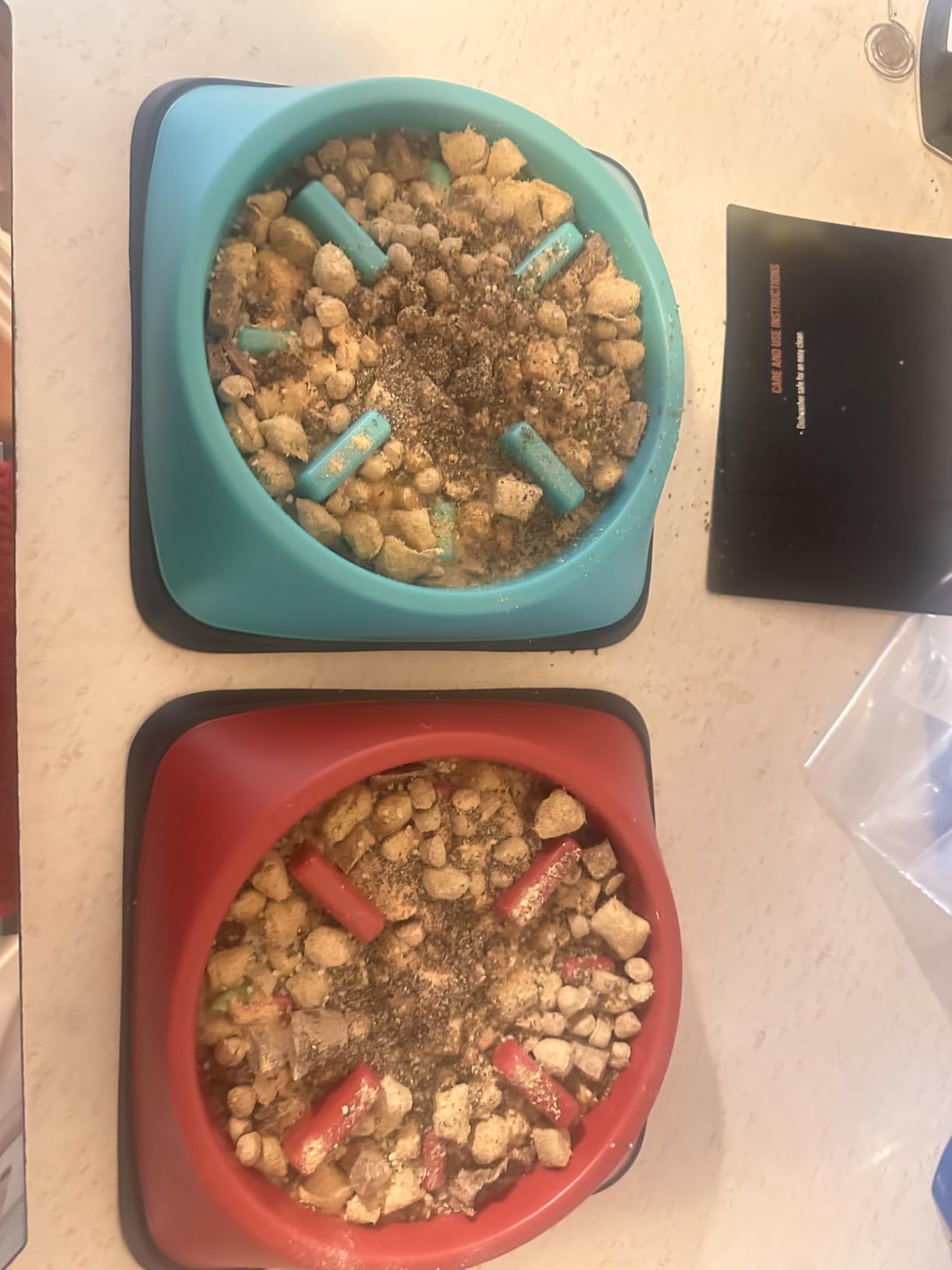
At 8.5 by 8.5 by 1.8 inches the profile is low and wide, which resists flipping, and it measures 2 cups at 6.38 ounces.
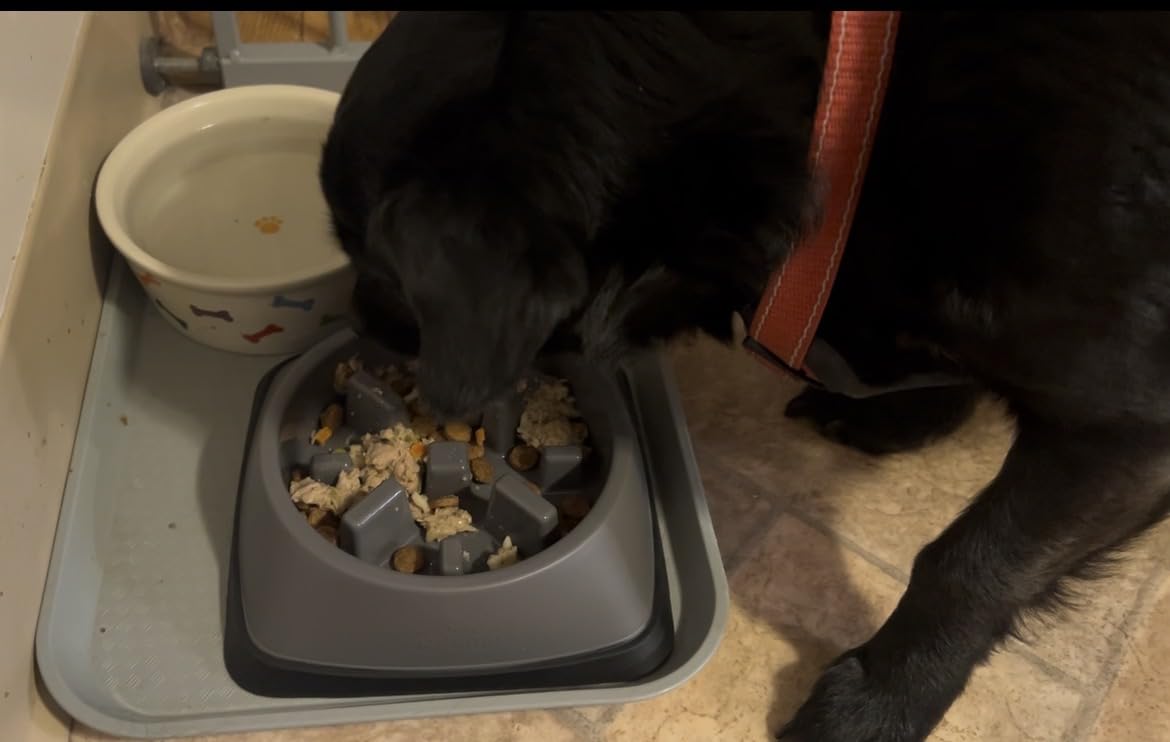
Despite the name, it still moves
The most common criticism is the one the branding invites: the bowl still creeps across bare hard floors for an eager dog. Pair it with a feeding mat and the problem disappears.
Where it falls short
The maze can be too difficult for large puppies that cannot reach food at the bottom, and some dogs flip it to get at the contents faster. We would start a puppy on the 1-cup version.
Why Slow Feeders Fail (and How to Fix It)
The most common complaint in every dog forum we read was not that slow feeders are useless, but that a dog eventually beat one. One owner on r/DogTrainingTips described it perfectly: one dog had worked out how to eat as fast through the bowl as out of it. Another, on r/DogAdvice, had used three slow feeders with no effect on their Labs.
There are four failure modes, and each has a fix.
The dog has memorised the pattern. This is the pattern-memory problem, and it is real. Swirl and spiral designs are directional, so a dog learns the route in a few meals and runs it. The fix is rotation: keep two bowls with different pattern geometry and alternate them, so the dog has to re-solve the problem each meal. A spiral in one bowl and a bone pattern in another is a better system than one perfect bowl.
The difficulty is wrong in both directions. Too hard and the dog gives up or flips the bowl. Too easy and it laps the food up. Step up gradually, and if a dog is leaving food uneaten or turning away, step down rather than persisting.
The bowl moves. Food dumping, flipping and paw-scooping are the top hardware complaints. Rubber feet alone are not enough on tile or polished floors — this is stated repeatedly in the forums. Put the bowl on a feeding mat, and choose a bowl that is heavy, wide, or has a moulded base rather than a slip-on ring.
Food gets left behind. A dog that leaves kibble in the channels will whine, beg, and get fed again, which defeats the point. Solve it by filling to the two-thirds line, spreading food in a single layer, and picking up anything uneaten after ten minutes. If your dog routinely leaves food, the pattern is too deep, not too shallow.
One more thing that gets missed: a slow feeder is enrichment, not exercise. It burns mental energy, not calories. If your dog’s issue is restlessness rather than gulping, the same dogs that need it usually also benefit from a different kind of outlet, which our dog treadmill reviews cover in detail.
How to Introduce a Slow Feeder in 7 Days
Plenty of owners ask what to do when their dog simply will not eat from the new bowl. Do not start with a full meal. Work up over about a week.
Days 1 to 2. Put the slow feeder beside the old bowl, filled with your dog’s normal food. Let them eat from whichever they prefer. Do not correct them, do not take the old bowl away. The goal is only that the bowl is not scary.
Days 3 to 4. Fill the slow feeder with two or three high-value treats and nothing else. Put it in the same spot. If your dog eats the treats out of it, you have your answer that the difficulty is right.
Days 5 to 6. Move a quarter of the meal into the slow feeder and leave the rest in the old bowl. Reduce the old bowl rather than removing it, so the dog cannot feel the meal has been taken away.
Day 7 onward. Full portion in the slow feeder, old bowl removed. Most dogs adapt within one or two meals at this point, and owners report the adjustment almost always happens fast once the treats land.
If your dog refuses the food entirely, something is wrong with the difficulty, not the concept. Step down to a shallower pattern or a larger bowl, and go back two steps in the week.
For households where one dog eats fast and one does not, run the slow feeder at one end of the room and a plain bowl at the other. It removes the stealing problem and it lets the slower dog finish without an audience.
When Not to Use a Slow Feeder Bowl
A slow feeder is not appropriate for every dog, and this is the section most roundups leave out.
Puppies under 12 weeks. Very young puppies do not have the motor control or the patience for a maze, and owners report frustration, flipping and food scattering. Use a shallow plate or a very wide flat pattern instead, and revisit at 12 weeks.
Dogs with dental disease or painful mouths. A maze asks a dog to work food out of pockets with the tongue and teeth. If chewing is painful, that is a contradiction. A wide, shallow pattern such as the Mr. Peanut’s Bundt design, or simply feeding wet food from a regular bowl, is kinder.
Flat-faced breeds with deep mazes. Bulldogs, Pugs, Boston Terriers and Shih Tzus struggle to reach food in narrow channels and can work themselves up into distress. Use a shallow, open design — the Bundt ring or a rim-work bowl — and never a deep triangular pattern.
Dogs who already eat slowly. If your dog takes twenty minutes anyway, a slow feeder adds nothing except a washing-up job.
Anxious or resource-guarding dogs, initially. A dog that eats fast out of anxiety around other dogs needs the anxiety addressed first. Adding a maze to a tense meal can increase guarding behaviour. Work on the emotional side, then introduce the bowl slowly.
And a practical one: if you feed wet food, deep plastic mazes trap moisture and smell. A stainless or ceramic bowl, or simply a smear in a flat bowl, will be faster to clean and more pleasant for the dog.
How to Choose a Slow Feeder Dog Bowl: Material, Capacity and Snout Shape
Material is the decision most people get wrong, so it is worth more than brand. Plastic is light, cheap and the easiest to clean in a dishwasher, and it carries the scratch-and-chin risk. Silicone inserts are the compromise: softer on teeth, flexible, and they drop into a bowl you already own. Stainless steel does not absorb odours, resists rust, is essentially indestructible, and is usually dishwasher safe — the downside is that most stainless designs slow less than a deep plastic maze. Ceramic does not scratch, does not hold odour, and does not move, and the downside is that it breaks.
Capacity is simple arithmetic: one full meal per bowl, filled to no more than two-thirds. Small to medium dogs need 1 to 2 cups, medium to large dogs 3 cups, and very large breeds such as Saint Bernards and Newfoundlands need 4 cups or more. Underbuy a small bowl and your dog empties it faster because you are piling food into the channels.
Snout shape matters more than most listings admit. Long-nosed breeds handle deep patterns easily. Flat-faced breeds need open, shallow channels. Short-tongued small dogs need wide spacing between ridges, which is exactly why the smooth wide-ridge design of the YINEYA works better than a bone pattern for them.
On elevated bowls: the argument about whether raised bowls reduce bloat risk is genuinely contested, and we are not going to pretend otherwise. Feed at a comfortable height for your dog, and treat any claim that elevation alone prevents bloat as a marketing line rather than established fact.
On cleaning: deep plastic mazes need a brush, not a rinse, and owners who skip that step end up with a bowl that smells permanently. Stainless and seamless ceramic rinse clean in seconds. Every bowl in this roundup except the ceramic options is top-rack dishwasher safe, which is the single most important practical filter for a busy household.
Finally, if your dog is large and you are still setting up, the housing and feeding kit is worth getting right at the same time. Our large dog crate reviews and motorized treadmill guides for high-energy dogs cover that side of the setup.
Frequently Asked Questions
Do vets recommend slow feeder bowls?
Most veterinarians treat slow feeders as a low-risk behaviour tool rather than a medical device. They are commonly recommended for dogs that gulp, since slower intake means more chewing and less swallowed air, and feeding from a raised puzzle bowl is a normal recommendation for boredom and fast eating. No vet will prescribe a specific brand. If your dog is gulping and also bloated, retching, or vomiting, that is a clinical problem and not a bowl problem, and it warrants a veterinary visit rather than a shopping trip.
How can I slow my dog down from eating too fast?
The three methods that work are a maze or ridge slow feeder bowl, a snuffle mat or lick mat, and scatter feeding, where you throw your dog’s kibble across a surface and let them hunt it down. The first two slow intake and add mental work. Scatter feeding is nearly as effective and takes no equipment at all, though it only works outdoors or in a room you are happy to vacuum. Feed larger, crunchier kibble if you can, because hard pieces cannot be swallowed whole.
Why does my dog eat so fast even with a slow feeder?
Almost always one of four reasons. Your dog has memorised the pattern, particularly with directional swirl and spiral designs, so switch to a different pattern geometry and rotate between two bowls. The difficulty is wrong in either direction, either too easy to lap up or too hard to work out. The bowl is moving or flipping, which lets your dog tip it and dump the food onto the floor and eat at full speed. Or your dog is gulping for emotional reasons, and the bowl is treating a symptom it cannot reach.
What are the downsides of slow feeder bowls for dogs?
The real downsides are a cleaning burden from trapped moisture and odour in deep plastic channels, frustration for puppies and short-tongued breeds who cannot reach the food, food tipping and dumping on hard floors, and the risk that your dog leaves food uneaten and then begs. Ceramic options break if dropped and are heavy. Stainless designs often slow eating less than plastic mazes. If your dog is already slow, a slow feeder adds nothing but washing up.
Why does my dog dump his food out of his bowl?
It is almost always a stability problem. The bowl is light, the floor is slick, or the base has a slip-on ring rather than moulded rubber. Put the bowl on a feeding mat, choose a wide low bowl with a widened base, and fill it to the two-thirds line rather than piling food up. Some dogs also tongue food over the rim, which a bowl with a raised lip solves. If dumping happens alongside guarding behaviour, address the guarding with a trainer before adding more equipment.
What can I do if my dog won’t eat out of her bowl?
Start slower. Put the slow feeder next to the old bowl for two days with the usual food in both, so it is not threatening. Then fill the slow feeder with two or three high-value treats only. After that, move a quarter of the meal across, then the whole meal by day seven. If she still refuses it, the pattern is too deep for her snout, and you need a shallower design rather than more patience.
How long should a dog take to finish a meal?
Most owners report their target as four to six minutes for a normal kibble meal, and consider ten to fifteen minutes a bonus rather than a problem. A plain bowl baseline is often well under two minutes, so anything in the four-to-six-minute band is a real improvement. Extreme results happen too, and owners of slow-fed seniors have reported half an hour with wet food. The number matters far less than the fact that the meal is consistent and the dog is comfortable.
Our Best Slow Feeder Dog Bowl for Fast Eaters in 2026
After six weeks of testing, the Outward Hound Fun Feeder Slo Bowl is still the pick we would hand to most people. It has the deepest review history in the category, the widest size and difficulty range, a base that does not move, and a maze wide enough that a dog can actually reach the food in it. For large and deep-chested breeds, move up to the JASGOOD spiral, which is wider, heavier and holds about 3 cups. For wet food, raw feeding, or a dog who needs a plastic-free option, the Feedoo double-wall stainless bowl is the one we would buy.
Whichever you choose, the pattern rotation matters as much as the bowl. Keep two different designs, alternate them, fill to two-thirds, and put a mat under the bowl on hard floors. That combination solves more problems than any single maze on the market.
We update this roundup every year as new models land, and the picks above reflect our most recent batch of testing.